Distributed DBMS - Database
Environments
Ayesha Saddiqua
Distributed DBMS - Database Environments
Distributed databases are systems where data is stored across multiple physical locations,
yet managed collectively to appear as a single database to users.
These databases can be broadly categorized into two main types: homogeneous and
heterogeneous.
Each category has distinct characteristics and subtypes, which are essential to understand
for effective database management.
Distributed DBMS - Database Environments
Types of Distributed Databases:
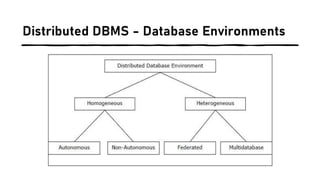
Distributed databases can be broadly classified into homogeneous and heterogeneous
distributed database environments, each with further sub-divisions, as shown in the
following illustration.
Distributed DBMS - Database Environments
Homogeneous Distributed Databases:
A homogeneous distributed database is a system where all the databases across multiple
locations use the same database management software and have identical data structures.
This uniformity ensures seamless data sharing and simplifies management.
Distributed DBMS - Database Environments
Types of Homogeneous Distributed Database:
1. Autonomous Homogeneous Distributed Databases:
Each database functions on its own, managing its data and operations independently.
To share updates or data, these independent databases communicate by sending messages
to each other.
Distributed DBMS - Database Environments
2. Non-Autonomous Homogeneous Distributed Databases:
A central or master DBMS oversees and coordinates the operations and data updates of all
databases in the system.
The central DBMS ensures that data is consistently distributed and updated across all
nodes, maintaining uniformity.
Distributed DBMS - Database Environments
Heterogeneous Distributed Databases:
Heterogeneous distributed databases consist of different sites that may use various DBMS
software, data models, or schemas. This diversity allows for greater flexibility but
introduces challenges in data integration and consistency.
Distributed DBMS - Database Environments
Types of Heterogeneous Distributed Database:
1. Federated: Each site maintains its autonomy and has its own DBMS, but a unified
interface allows for data access across sites.
2. Un-federated: Sites operate independently without a unified interface, requiring
custom solutions for data integration.
Distributed DBMS Architectures
DDBMS architectures are generally developed depending on three parameters −
1. Distribution − It states the physical distribution of data across the different sites.
2. Autonomy − It indicates the distribution of control of the database system and the
degree to which each constituent DBMS can operate independently.
3. Heterogeneity − It refers to the uniformity or dissimilarity of the data models, system
components and databases.
Distributed DBMS Architectures
Architectural Models
Some of the common architectural models are −
• Client - Server Architecture for DDBMS
• Peer - to - Peer Architecture for DDBMS
• Multi - DBMS Architecture
Distributed DBMS Architectures
Architectural Models
Client - Server Architecture for DDBMS
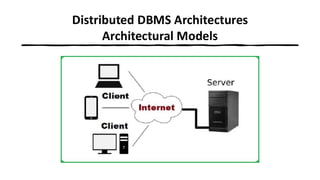
In a Distributed Database Management System (DDBMS), the Client-Server Architecture
is a prevalent model that organizes the system into two main components: clients and
servers.
Clients:
• Role: Act as the interface for end-users to interact with the database system.
• Functions: Send requests to the server for data operations and present the retrieved
data to users.
Distributed DBMS Architectures
Architectural Models
Servers:
• Role: Manage the database and process client requests.
• Functions: Handle data storage, retrieval, and processing tasks.
Operation:
• Clients initiate requests (e.g., querying data) to the server.
• The server processes these requests, performs the necessary operations on the
database, and returns the results to the clients.
Distributed DBMS Architectures
Architectural Models
Distributed DBMS Architectures
Architectural Models
Peer- to-Peer Architecture for DDBMS
In a Peer-to-Peer (P2P) Architecture for Distributed Database Management Systems
(DDBMS), each node, referred to as a peer, functions both as a client and a server.
This means every peer can request services from other peers while also providing services
to them.
Such an arrangement fosters a decentralized network where all nodes share equal
responsibilities and capabilities.
Distributed DBMS Architectures
Architectural Models
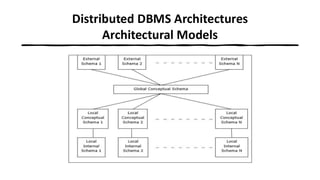
Schema Levels in P2P Architecture:
• Global Conceptual Schema: Represents the overall logical view of the entire database
system.
• Local Conceptual Schema: Depicts the logical organization of data specific to each peer.
• Local Internal Schema: Shows the physical storage details of data at each peer.
• External Schema: Illustrates individual user views of the data, tailored to specific
application needs.
Distributed DBMS Architectures
Architectural Models
Distributed DBMS Architectures
Architectural Models
Multi - DBMS Architectures
• A Multi-Database Management System (Multi-DBMS) integrates multiple autonomous
and possibly heterogeneous database systems into a single, unified framework.
• This architecture enables users to access and manipulate data across different databases
as if they were part of a single system, without needing to be aware of the underlying
distribution or heterogeneity.
Distributed DBMS Architectures
Architectural Models
Schema Levels in Multi-DBMS Architecture:
Multi-Database View Level:
• Depicts multiple user views comprising subsets of the integrated distributed database.
Multi-Database Conceptual Level:
• Represents the integrated multi-database structure definitions.
Distributed DBMS Architectures
Architectural Models
Multi-Database Internal Level:
• Shows data distribution across different sites and mappings between multi-database and
local data.
Local Database View Level:
• Illustrates public views of local data.
Local Conceptual Schema:
• Depicts logical data organization at each site.
Local Internal Schema:
• Shows physical data organization at each site.

Distributed Database Environment Amazing in Easy wording

  • 1.
    Distributed DBMS -Database Environments Ayesha Saddiqua
  • 2.
    Distributed DBMS -Database Environments Distributed databases are systems where data is stored across multiple physical locations, yet managed collectively to appear as a single database to users. These databases can be broadly categorized into two main types: homogeneous and heterogeneous. Each category has distinct characteristics and subtypes, which are essential to understand for effective database management.
  • 3.
    Distributed DBMS -Database Environments Types of Distributed Databases: Distributed databases can be broadly classified into homogeneous and heterogeneous distributed database environments, each with further sub-divisions, as shown in the following illustration.
  • 4.
    Distributed DBMS -Database Environments
  • 5.
    Distributed DBMS -Database Environments Homogeneous Distributed Databases: A homogeneous distributed database is a system where all the databases across multiple locations use the same database management software and have identical data structures. This uniformity ensures seamless data sharing and simplifies management.
  • 6.
    Distributed DBMS -Database Environments Types of Homogeneous Distributed Database: 1. Autonomous Homogeneous Distributed Databases: Each database functions on its own, managing its data and operations independently. To share updates or data, these independent databases communicate by sending messages to each other.
  • 7.
    Distributed DBMS -Database Environments 2. Non-Autonomous Homogeneous Distributed Databases: A central or master DBMS oversees and coordinates the operations and data updates of all databases in the system. The central DBMS ensures that data is consistently distributed and updated across all nodes, maintaining uniformity.
  • 8.
    Distributed DBMS -Database Environments Heterogeneous Distributed Databases: Heterogeneous distributed databases consist of different sites that may use various DBMS software, data models, or schemas. This diversity allows for greater flexibility but introduces challenges in data integration and consistency.
  • 9.
    Distributed DBMS -Database Environments Types of Heterogeneous Distributed Database: 1. Federated: Each site maintains its autonomy and has its own DBMS, but a unified interface allows for data access across sites. 2. Un-federated: Sites operate independently without a unified interface, requiring custom solutions for data integration.
  • 10.
    Distributed DBMS Architectures DDBMSarchitectures are generally developed depending on three parameters − 1. Distribution − It states the physical distribution of data across the different sites. 2. Autonomy − It indicates the distribution of control of the database system and the degree to which each constituent DBMS can operate independently. 3. Heterogeneity − It refers to the uniformity or dissimilarity of the data models, system components and databases.
  • 11.
    Distributed DBMS Architectures ArchitecturalModels Some of the common architectural models are − • Client - Server Architecture for DDBMS • Peer - to - Peer Architecture for DDBMS • Multi - DBMS Architecture
  • 12.
    Distributed DBMS Architectures ArchitecturalModels Client - Server Architecture for DDBMS In a Distributed Database Management System (DDBMS), the Client-Server Architecture is a prevalent model that organizes the system into two main components: clients and servers. Clients: • Role: Act as the interface for end-users to interact with the database system. • Functions: Send requests to the server for data operations and present the retrieved data to users.
  • 13.
    Distributed DBMS Architectures ArchitecturalModels Servers: • Role: Manage the database and process client requests. • Functions: Handle data storage, retrieval, and processing tasks. Operation: • Clients initiate requests (e.g., querying data) to the server. • The server processes these requests, performs the necessary operations on the database, and returns the results to the clients.
  • 14.
  • 15.
    Distributed DBMS Architectures ArchitecturalModels Peer- to-Peer Architecture for DDBMS In a Peer-to-Peer (P2P) Architecture for Distributed Database Management Systems (DDBMS), each node, referred to as a peer, functions both as a client and a server. This means every peer can request services from other peers while also providing services to them. Such an arrangement fosters a decentralized network where all nodes share equal responsibilities and capabilities.
  • 16.
    Distributed DBMS Architectures ArchitecturalModels Schema Levels in P2P Architecture: • Global Conceptual Schema: Represents the overall logical view of the entire database system. • Local Conceptual Schema: Depicts the logical organization of data specific to each peer. • Local Internal Schema: Shows the physical storage details of data at each peer. • External Schema: Illustrates individual user views of the data, tailored to specific application needs.
  • 17.
  • 18.
    Distributed DBMS Architectures ArchitecturalModels Multi - DBMS Architectures • A Multi-Database Management System (Multi-DBMS) integrates multiple autonomous and possibly heterogeneous database systems into a single, unified framework. • This architecture enables users to access and manipulate data across different databases as if they were part of a single system, without needing to be aware of the underlying distribution or heterogeneity.
  • 19.
    Distributed DBMS Architectures ArchitecturalModels Schema Levels in Multi-DBMS Architecture: Multi-Database View Level: • Depicts multiple user views comprising subsets of the integrated distributed database. Multi-Database Conceptual Level: • Represents the integrated multi-database structure definitions.
  • 20.
    Distributed DBMS Architectures ArchitecturalModels Multi-Database Internal Level: • Shows data distribution across different sites and mappings between multi-database and local data. Local Database View Level: • Illustrates public views of local data. Local Conceptual Schema: • Depicts logical data organization at each site. Local Internal Schema: • Shows physical data organization at each site.