Disinfection and sterilization
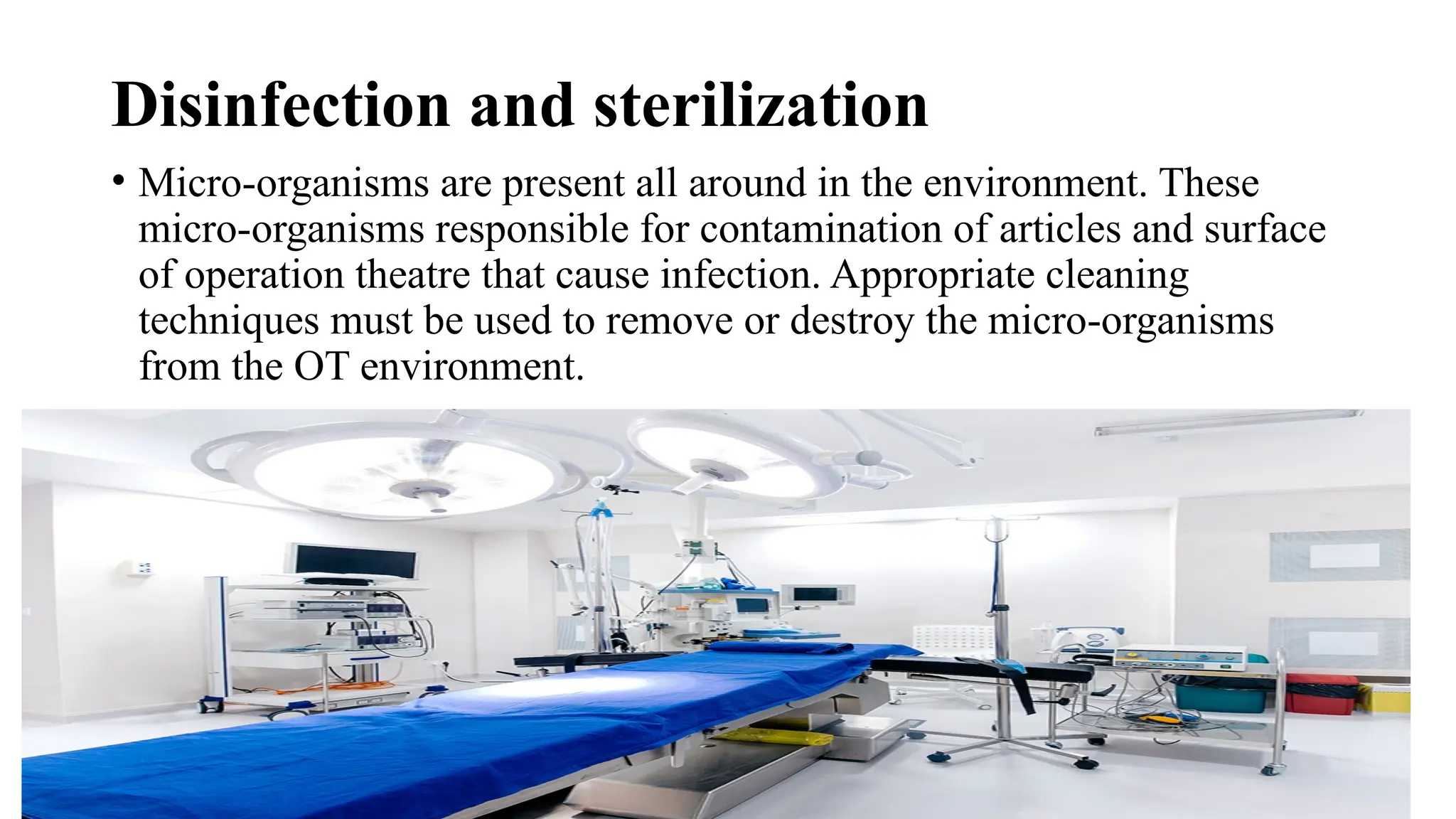
•Micro-organisms are present all around in the environment. These
micro-organisms responsible for contamination of articles and surface
of operation theatre that cause infection. Appropriate cleaning
techniques must be used to remove or destroy the micro-organisms
from the OT environment.
3.
Cleaning of operationtheatre-
Cleaning process of operating room, furniture, trolleys, lights and
instrument etc are divided into following parts -
• Routine cleaning (Before first operation of the day)
• Cleaning between cases
• At the end of the day
• Cleaning after an infected case
(i) Daily Routine Cleaning-The OT is cleaned at least one hour
before operations are started. It includes
• Basic cleaning of floor, sidewalls and furniture.
4.
CONTD....
• Removal ofextra instruments and furniture.
• Arrange the required furniture and instruments properly.
(i) Damp dusting (with fresh water adding little detergent) of
overheaded operating light and furniture.
• Floor is cleaned by wet vaccum cleaner which scrubs and suction
dries it.
• If it is not available, floor is cleaned by mop. Mop cloth needs to be
laundered and autoclaved before being used again.
5.
(ii) Cleaning betweenthe cases
All personnel involved in surgery, should change their gown, gloves,
mask, shoes cover etc and put on setrile protective devices.
All used surgical instrument should be sent for sterilization.
All used linens should be sent to laundary.
All used disposable articles and drapes should be discarded properly.
Clean the operation table mattress with appropriate disinfectant
solution.
Disinfect the overheaded operating light, patient area, surrounding floor
and side walls and furniture.
6.
contd...
• If theblood spot is present on floor or side walls it must be cleaned by
1% Hypochlorite solution (soak with 10 minutes and then mopped
away).
• After cleaning the operating room, rearrange the required furniture and
arrange the surgical instruments.
• Surgical team members should be scrubbed again.
7.
Cleaning at theend of the day -
• At the end of the day surgical procedure room and utility room should
be cleaned properly.
• All the used instruments should be cleaned and sent for sterilization.
• All used linen should be sent to the laundary for washing.
• Disinfect the floor, sidewalls, furniture, kick bucket, cabinets, filter
covers, door etc.
• Disinfect the OT table with both sides of the mattress and the table base.
• Disinfect and clean the blood spots properly.
8.
(iv) Cleaning afteran infected case
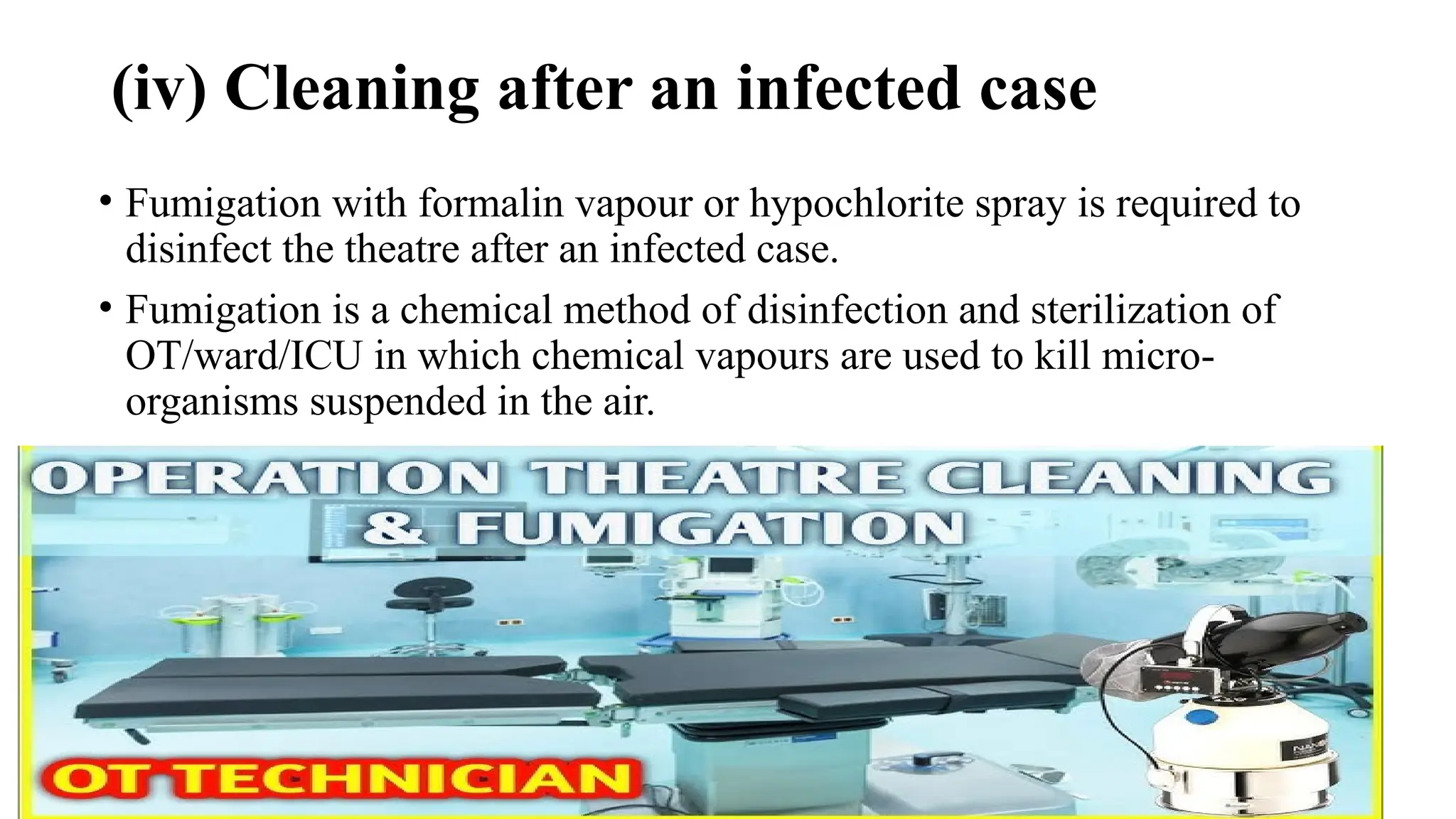
• Fumigation with formalin vapour or hypochlorite spray is required to
disinfect the theatre after an infected case.
• Fumigation is a chemical method of disinfection and sterilization of
OT/ward/ICU in which chemical vapours are used to kill micro-
organisms suspended in the air.
• All used linens and instruments are also soaked in 1% hypochlorite
solution before washing them.
9.
Disinfection and Sterilization
(1)Disinfection-Disinfection It is a process of destruction of
pathogenic micro-organism or their toxins by physical or
chemical means.
(2) Sterilization - Sterilization is the process of destroying or
total elimination of all micro-organisms including their spores.
10.
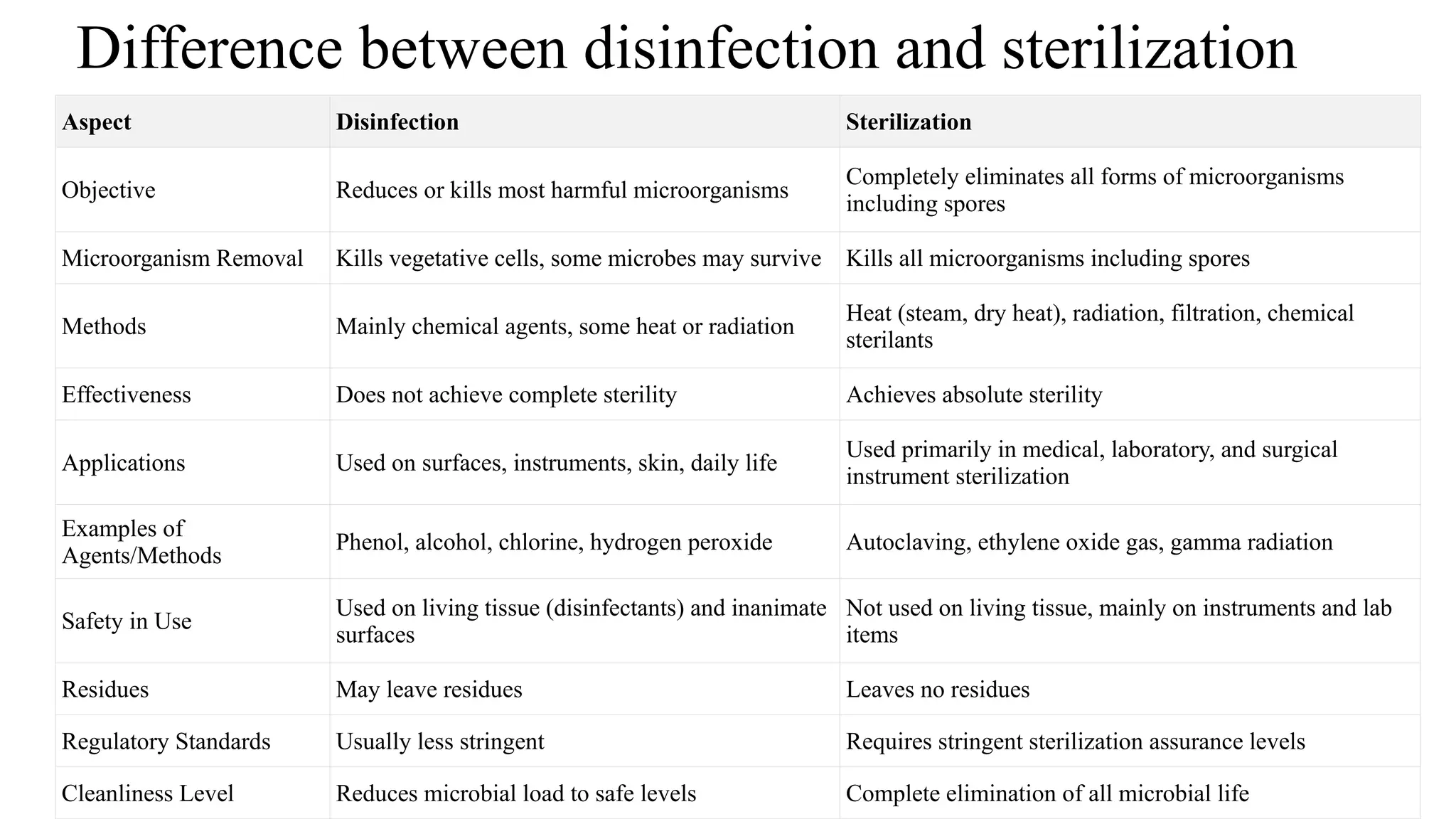
Difference between disinfectionand sterilization
Aspect Disinfection Sterilization
Objective Reduces or kills most harmful microorganisms
Completely eliminates all forms of microorganisms
including spores
Microorganism Removal Kills vegetative cells, some microbes may survive Kills all microorganisms including spores
Methods Mainly chemical agents, some heat or radiation
Heat (steam, dry heat), radiation, filtration, chemical
sterilants
Effectiveness Does not achieve complete sterility Achieves absolute sterility
Applications Used on surfaces, instruments, skin, daily life
Used primarily in medical, laboratory, and surgical
instrument sterilization
Examples of
Agents/Methods
Phenol, alcohol, chlorine, hydrogen peroxide Autoclaving, ethylene oxide gas, gamma radiation
Safety in Use
Used on living tissue (disinfectants) and inanimate
surfaces
Not used on living tissue, mainly on instruments and lab
items
Residues May leave residues Leaves no residues
Regulatory Standards Usually less stringent Requires stringent sterilization assurance levels
Cleanliness Level Reduces microbial load to safe levels Complete elimination of all microbial life
11.
Physical Method
A)Natural Methods-
(1)Sunlight Ultraviolet rays are found in sunlight having active
bactericidal effect.
(ii)Drying in Air - Drying in air has deleterious effect on many
pathogens. Although it is not a reliable method for disinfection.
12.
contd...
• B)Heat
• DryHeat Methods - It is less effective than moist heat. Dry heat
method includes-
• Red Heat
• Flaming
• Incineration
• Hot air oven
13.
contd...
• Dry heatdestroys the micro-organisms by the denaturation of bacterial
protein or coagulation of bacterial protein. The DNA damage is also
responsible for inactivation of microbes.
• (a ) Red Heat-In this method metallic articles are held in the flame of a
Bunsen Burner till they become red hot. Red Heat method is used to
sterilize metallic articles like inoculating wires or loops, tips of the
forceps, needles etc.
14.
• Flaming -In this method metallic articles are held in the flame of a
Bunsen burner without allowing them to become red hot.
• The following articles are sterilized by this method: Glass slides,
mouth of culture tubes, scalpels etc.
• Incineration - It is an excellent method for rapidly destroying wastes
such contaminated cotton balls, soiled dressing, soiled linen etc.
15.
• As itis a waste treatment process that involves the combustion of
organic substances contained in waste material.
• Hot air oven - Hot air oven is one of the most widely used method of
sterilization. It is an effective method for those items which are good
conductor of heat. The oven is electrically heated and is fitted with a
fan to ensure adequate and even distribution of hot air in chamber. Hot
air oven requires temperature at 160°C for at least 1 to 3 hours for
effective sterilization.
16.
Hot air ovenis used to sterilize
• Glassware - Glass syringes, pipettes, test tubes, flask, Petri dishes etc.
• Surgical instruments - Scalpels, scissors, forceps, LP needles, metal
cannula.
17.
• Chemicals -Mineral oils, powders, Vaseline ointments etc.
• Moist Heat Moist Heat is more efficient method for sterilization in
comparison to dry heat. The micro-organism are destroyed by
irreversible denaturation of enzymes and proteins.
• Pasteurization (Temperature below 1000
C )
• - Pasteurization is defined as heating of a liquid such as milk to
moderate temperature (< 1000
C ) for a definite time followed by rapid
cooling to destroy the disease producing micro-organisms without
changing its composition.
18.
Pasteurization can bedone by two methods -
• Holder method minutes. Heating at 620
C for 300
C
• Flash method Healing at 720
C for 15-20 seconds followed by rapid
cooling at 4 - 50
C
• Boiling Boiling is a common and widely used method of disinfection.
Boiling is done at 1000
C at least for 10-30 min to destroy the
vegetative form of bacterial fungi and virus.
20.
Autoclaving -
• Autoclavingis also known as sterilization under pressure. This is the
most effective and most widely used method of sterilization that can
destroy all types of bacteria, spores, viruses and fungi.
• Autoclave Autoclave is a steam pressure sterilizer which utilizes
saturated steam under pressure. The steam is produced with electrical
heating unit. The autoclave has two chambers -
(i) Outer chamber
(ii) Inner chamber
21.
• The outerchamberin which the steam is circulated and forcing the air out of chamber.
Then the steam enters the inner chamber of the autoclave and forces the air to escape
through the valves. The steam remains flowing in this chamber of autoclave until the
desired pressure and desired temperature for effective sterilization by autoclaving
Desired temperature, pressure and length of time are as follows:
• Temperature: 121°C
• Pressure: 15 lbs/inch or 1.05 kg/cm²
• Time: 30 minutes (20-30 minutes)
22.
• It isthe best method of sterilization as it kills all types of organisms
including viruses and spores. It is used to sterile glass articles, non-
disposal syringes, metallic instruments, non disposal catheter, non
disposal gloves, rubber catheter, culture media, dressing drum
(containing cotton balls, sponges, gauze, bandages etc.) suture,
surgical dressing, linen etc.
• Trays containing operation set packed in a cloth wrapper can be
sterilized in an autoclave and afterward they can be used for specific
operation without wasting much time.
23.
• C) RADIATION- Ultra violet radiation have bactericidal activity.
These are used to disinfect surfaces, transparent objects and enclosed
areas such as bacteriological laboratory etc.
• Infrared rays are used for rapid mass sterilization of catheters and
syringes.
• Ionizing rays (i.e. x-rays, y rays, rays, cosmic rays) having very
ẞ
high penetrating power and greater capacity to induce lethal changes
in DNA of cell including bacteria. These ionizing rays are used to
sterile disposal plastic syringes, catheters, IV set and cannula, cultural
plates surgical catgut etc.
24.
• D) FILTRATION- Filtration as a method of sterilization is useful for substances which
get damaged by heat process like sera, sugars and antibiotic solution.
• Chemical Method Although physical methods are reliable and effective method of
disinfection but these are not suitable for heat sensitive materials. In these situation
various chemicals are used for disinfection. Commonly used chemical disinfectants are
-Solid chemical disinfectants -
• Bleaching Power
• Lime
• Potassium Permanganate
• Liquid chemical disinfectant - Savlon, Phenol, Cresol, Hydrogen peroxide (H2O2), Eusol
solution, Dettol, Betadine, Halogen, Gentian violet, cidex, Lysol, mercurochrome etc.
SCRUBBING PROCEDURES:
• GOWNING,MASKING AND GLOVING -
• In the operating room sterile environment is required to reduce the risk
of infection. Surgical asepsis is maintained through aseptic techniques
in the OT.
• The basic principles of surgical asepsis are a Sterile objects remain
sterile only when touched by another sterile objects.
• Only sterile items must be entered into the sterile field.
27.
• The sterileobject held below the person's waist considered as
contaminated.
• The front part of the gown (from chest to table level) and sleeves (2
inches above the elbow) are considered sterile.
• Contaminated items (instruments and clothing) should be removed
immediately.
28.
• Sterile drapesshould be used to create sterile field. The top surface of drape is
considered sterile.
• After opening the sterile pack, its edges are considered unsterile.
• Movement around the sterile field can cause contamination
• Scrubbed members and sterile items contact only sterile area.
• Components of surgical asepsis -
• (1) Surgical scrubbing or Handwashing
• (2) Masking
• (3) Surgical Gowning
• (4) Gloving