
A
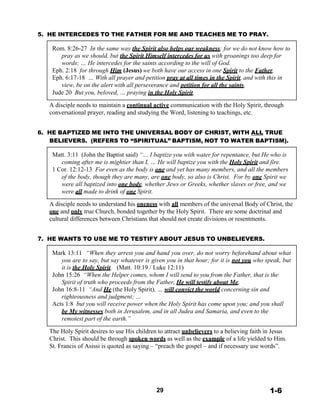
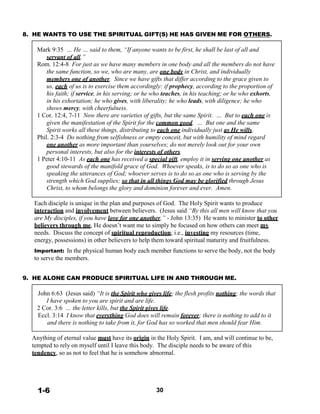
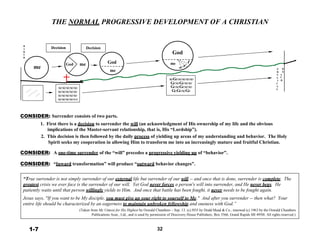
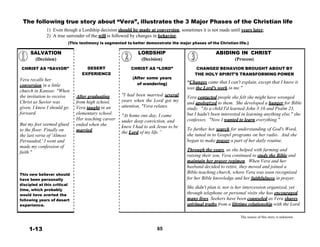
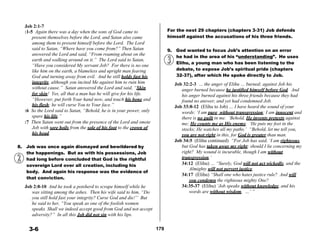
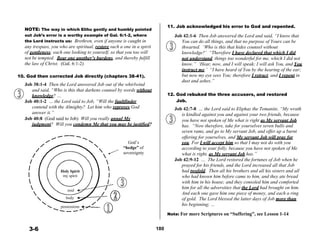
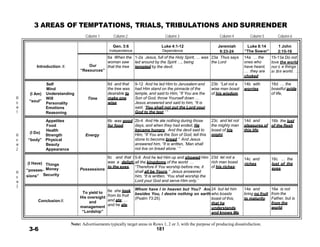
Tool for
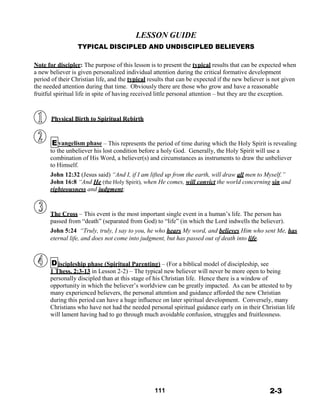
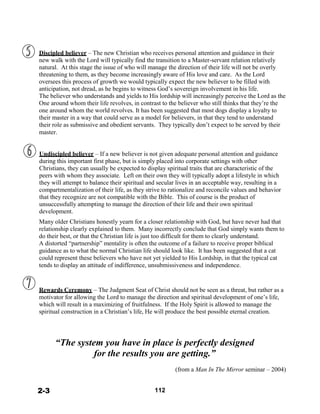
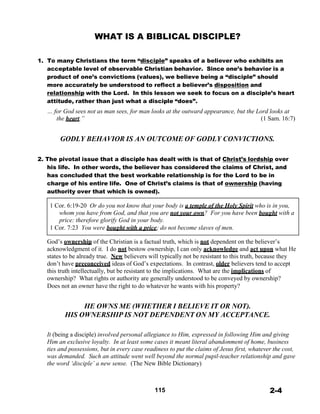
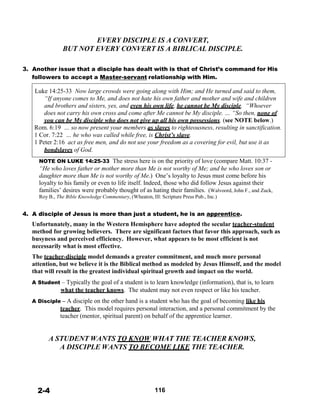
Church
Discipleship 


A Guide to Spiritual Parenting
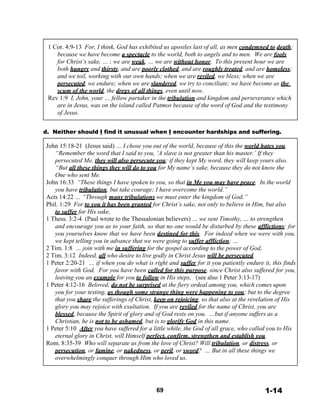
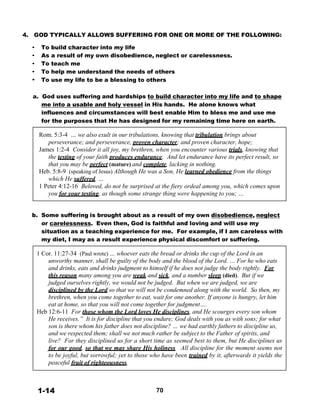
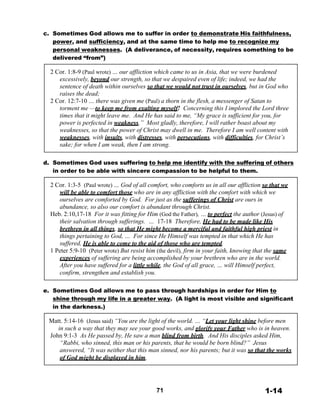
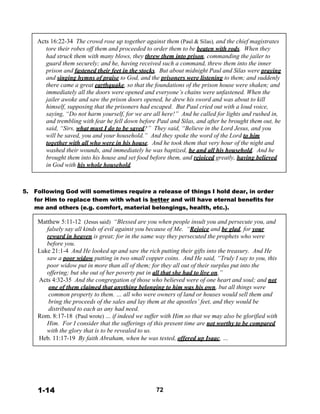
and Spiritual Multiplication


Discipleship Training


This discipleship material is a work in progress, although the basic
design layout will continue as it is now. We welcome comments and/or
suggestions regarding needed corrections, or enhancements to accuracy or
clarity. Our desire is, under the Holy Spirit’s guidance, to make these
spiritual concepts as understandable as possible for all believers, especially
newer and immature believers.
Anyone may freely reproduce and distribute this material, but it may
not be altered or sold without the author's consent.


Discipleship Training


© All Scripture quotations, unless otherwise indicated, are taken from the NEW
AMERICAN STANDARD BIBLE Copyright The Lockman Foundation 1960,
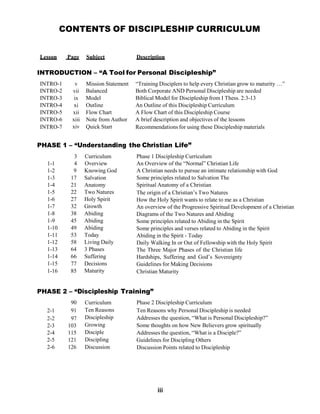
CONTENTS OF DISCIPLESHIP CURRICULUM


Lesson Page Subject Description
 
 
INTRODUCTION – “A Tool for Personal Discipleship”
 
INTRO-1
INTRO-2
INTRO-3
INTRO-4
INTRO-5
INTRO-6
INTRO-7
 
v
vii
ix
xi
xii
xiii
xiv
 
Mission Statement
Balanced
Model
Outline
Flow Chart
Note from Author
Quick Start
 
“Training Disciplers to help every Christian grow to maturity …”
Both Corporate AND Personal Discipleship are needed
Biblical Model for Discipleship from I Thess. 2:3-13
An Outline of this Discipleship Curriculum
A Flow Chart of this Discipleship Course
A brief description and objectives of the lessons
Recommendations for using these Discipleship materials
 
 
PHASE 1 – “Understanding the Christian Life”
 
 
1-1
1-2
1-3
1-4
1-5
1-6
1-7
1-8
1-9
1-10
1-11
1-12
1-13
1-14
1-15
1-16
 
3 Curriculum
4 Overview
9 Knowing God
17 Salvation
21 Anatomy
22 Two Natures
27 Holy Spirit
32 Growth
38 Abiding
45 Abiding
49 Abiding
53 Today
58 Living Daily
64 3 Phases
66 Suffering
77 Decisions
85 Maturity
 
Phase 1 Discipleship Curriculum
An Overview of the “Normal” Christian Life
A Christian needs to pursue an intimate relationship with God
Some principles related to Salvation The
Spiritual Anatomy of a Christian
The origin of a Christian’s Two Natures
How the Holy Spirit wants to relate to me as a Christian
An overview of the Progressive Spiritual Development of a Christian
Diagrams of the Two Natures and Abiding
Some principles related to Abiding in the Spirit
Some principles and verses related to Abiding in the Spirit
Abiding in the Spirit - Today
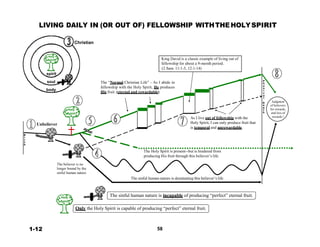
Daily Walking In or Out of Fellowship with the Holy Spirit
The Three Major Phases of the Christian life
Hardships, Suffering and God’s Sovereignty
Guidelines for Making Decisions
Christian Maturity
 
 
PHASE 2 – “Discipleship Training”
 
 
2-1
2-2
2-3
2-4
2-5
2-6
 
90
91
97
103
115
121
126
 
Curriculum
Ten Reasons
Discipleship
Growing
Disciple
Discipling
Discussion
 
Phase 2 Discipleship Curriculum
Ten Reasons why Personal Discipleship is needed
Addresses the question, “What is Personal Discipleship?”
Some thoughts on how New Believers grow spiritually
Addresses the question, “What is a Disciple?”
Guidelines for Discipling Others
Discussion Points related to Discipleship


iii
 
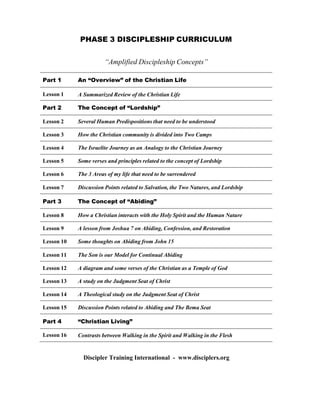
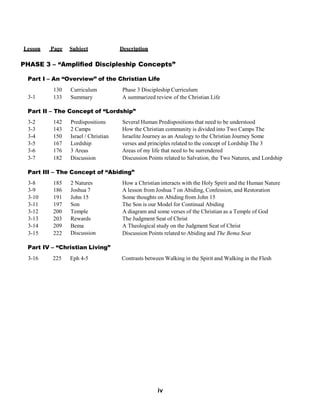
Lesson Page Subject Description
 
 
PHASE 3 – “Amplified Discipleship Concepts”
 
Part I – An “Overview” of the Christian Life
 
 
3-1
 
130
133
 
Curriculum
Summary
 
Phase 3 Discipleship Curriculum
A summarized review of the Christian Life
 
Part II – The Concept of “Lordship”
 
3-2
3-3
3-4
3-5
3-6
3-7
 
142
143
150
167
176
182
 
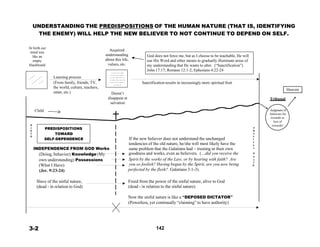
Predispositions
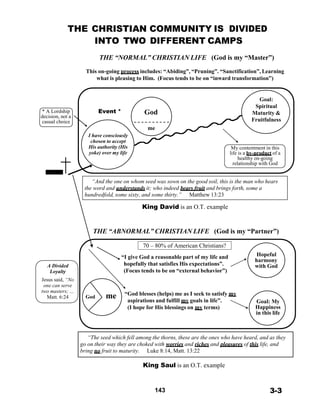
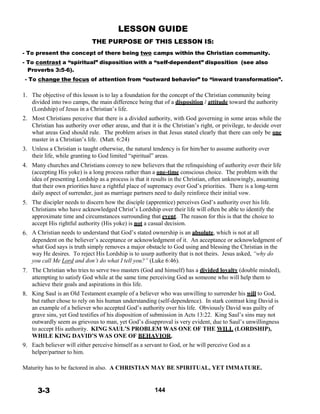
2 Camps
Israel / Christian
Lordship
3 Areas
Discussion
 
Several Human Predispositions that need to be understood
How the Christian community is divided into Two Camps The
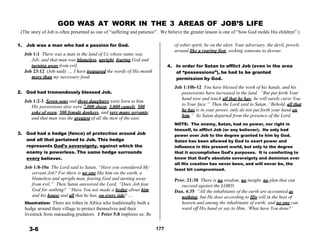
Israelite Journey as an Analogy to the Christian Journey Some
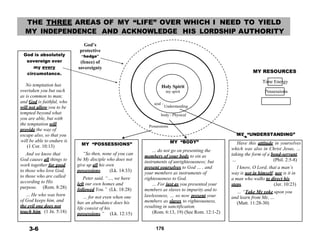
verses and principles related to the concept of Lordship The 3
Areas of my life that need to be surrendered
Discussion Points related to Salvation, the Two Natures, and Lordship
 
Part III – The Concept of “Abiding”
 
3-8
3-9
3-10
3-11
3-12
3-13
3-14
3-15
 
185
186
191
197
200
203
209
222
 
2 Natures
Joshua 7
John 15
Son
Temple
Rewards
Bema
Discussion
 
How a Christian interacts with the Holy Spirit and the Human Nature
A lesson from Joshua 7 on Abiding, Confession, and Restoration
Some thoughts on Abiding from John 15
The Son is our Model for Continual Abiding
A diagram and some verses of the Christian as a Temple of God
The Judgment Seat of Christ
A Theological study on the Judgment Seat of Christ
Discussion Points related to Abiding and The Bema Seat
 
Part IV – “Christian Living”
 
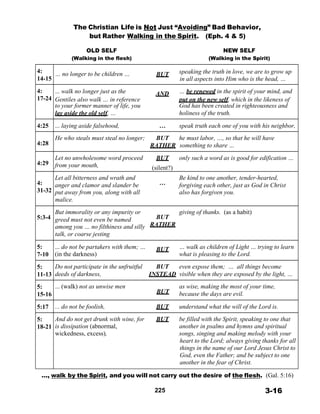
3-16 225 Eph 4-5 Contrasts between Walking in the Spirit and Walking in the Flesh


iv
Training
Members to
help every
Christian grow to
Maturity
and
Fruitfulness
in Christ 
 
 
(Colossians 1:28-29) 


v


These discipleship materials are
not designed to be given to the
typical newer believer with the
expectation that they will be
able to understand them on
their own. 


These discipleship materials are
intended to serve as a tool
to stimulate conversation
between the newer believer
and the discipler (“spiritual parent”),
which will hopefully, under the
guidance of the Holy Spirit,
help the discipler to identify and
address spiritual needs and gaps
in spiritual understanding. 


vi
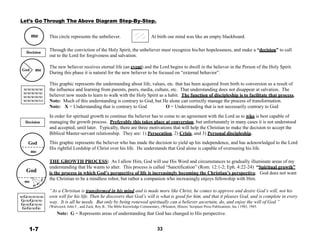
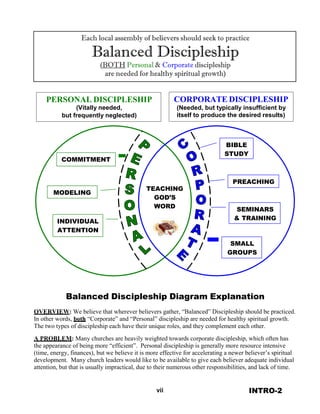
Each local assembly of believers should seek to practice
Balanced Discipleship
(BOTH Personal & Corporate discipleship
are needed for healthy spiritual growth)


PERSONAL DISCIPLESHIP
(Vitally needed,
but frequently neglected)
CORPORATE DISCIPLESHIP
(Needed, but typically insufficient by
itself to produce the desired results)


COMMITMENT
BIBLE
STUDY


MODELING


INDIVIDUAL
ATTENTION
 
TEACHING
GOD’S
WORD
PREACHING


SEMINARS
& TRAINING
 
SMALL
GROUPS


Balanced Discipleship Diagram Explanation
 
OVERVIEW: We believe that wherever believers gather, “Balanced” Discipleship should be practiced.
In other words, both “Corporate” and “Personal” discipleship are needed for healthy spiritual growth.
The two types of discipleship each have their unique roles, and they complement each other.
 
A PROBLEM: Many churches are heavily weighted towards corporate discipleship, which often has
the appearance of being more “efficient”. Personal discipleship is generally more resource intensive
(time, energy, finances), but we believe it is more effective for accelerating a newer believer’s spiritual
development. Many church leaders would like to be available to give each believer adequate individual
attention, but that is usually impractical, due to their numerous other responsibilities, and lack of time.


vii INTRO-2
IS THERE A SOLUTION? We believe an answer is for pastors and leaders to train “faithful”
believers in the church body, who in turn can disciple (spiritually parent) newer believers. We are aware
that many pastors and leaders need assistance in training disciplers, and one of the goals of DTI is to
provide discipleship materials and assistance in training.
 
In many churches, discipleship has come to mean “the presentation of biblical truth”. Thus many
leaders perceive that their responsibility is to present biblical truth, with the expectation that it is then the
responsibility of each believer to allow the Holy Spirit to apply those truths to their own lives.
However, since most newer believers are unfamiliar with the Holy Spirit, they need someone to
personally help them to understand how to cooperate with Him in their personal spiritual development.
 
In many churches the idea is conveyed that to present God's Word correctly seminary or Bible school
training is needed. Certainly Bible school or seminary training has been used by God in the spiritual
development of many leaders, but is it realistic to expect the typical Christian to have such training?
Does this idea not lead many believers to consider themselves to be under-qualified?
 
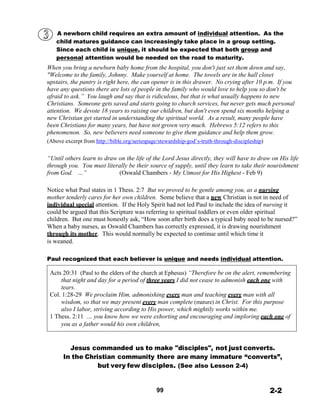
In Ephesians 4:11-16, Paul says, And He gave … some as pastors and teachers, for the equipping
of the saints for the work of service, to the building up of the body of Christ; … the proper
working of each individual part, causes the growth of the body for the building up of itself in love.
 
Should it not be the goal of leaders to see that “personal discipleship” and “spiritual reproduction” are
the “norm” rather than the exception? Should we not expect every believer to be in the process of being
discipled, or to be actively involved in the spiritual growth of other believers?
 
Corporate Discipleship: The Corporate side of this model: Preaching, Conducting a Seminar or
Small Group, Training, etc. will often be led by a believer who has the gift of teaching. Bible school or
seminary training would be helpful, but not essential.
 
Personal Discipleship: The Personal side of this model: the gift of teaching is not a biblical
requirement for personally discipling (spiritually parenting) another believer. How many couples would

have children if they had waited until they felt “qualified”?
 
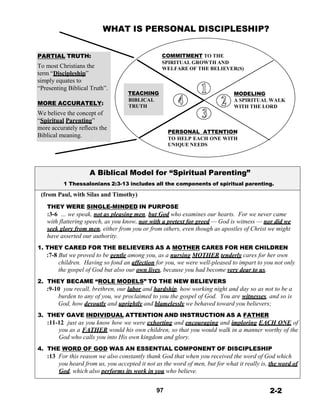
THE FOUR COMPONENTS OF THE PERSONAL MODEL: (See Lesson 2-2 for further details.)
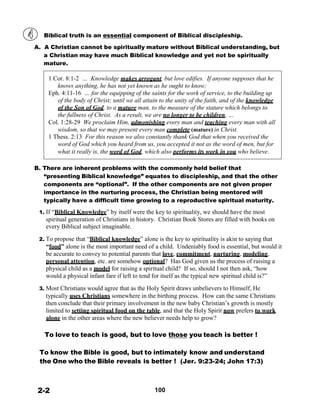
God’s Word: “Teaching God's Word” is an essential component common to both the Corporate
and the Personal side of all discipleship. God does not want the Bible to be seen simply as an academic
text, but rather as a revelation of His character. The Bible is a means by which humans can “know”
Him. This is eternal life, that they may know You, … (John 17:3). The Holy Spirit’s guidance will
always be in accordance with His Word.
 
Commitment: This has to do with the heart attitude of the discipler (spiritual parent) in regards to
the spiritual welfare and development of the disciple. This is a commitment that goes beyond just
presenting God's word. The biblical idea of a disciple is more of an “apprentice” than just a student.
 
Modeling: Hopefully the biblical disciple (apprentice) will end up with the passion of the discipler.
The discipler is a model to the disciple, in ways that go beyond that of a teacher and student. How do
you teach patience, or faithfulness, or passion? These things are seen more than heard.
 
Individual Attention: We are not interested in academically presenting points 1, 2, 3, 4, 5 to a
disciple. The discipler should be prayerfully available to the Holy Spirit, to be used as an instrument as
He develops the newer believer and addresses the particular needs of the disciple. The material from A
Tool For Personal Discipleship is designed with the intent of stimulating questions and conversation
that will promote spiritual growth both in the discipler and the disciple. Each discipler will have unique
and personal experiences that the Holy Spirit can bring to mind and use in the discipling process.
 
INTRO-2 viii
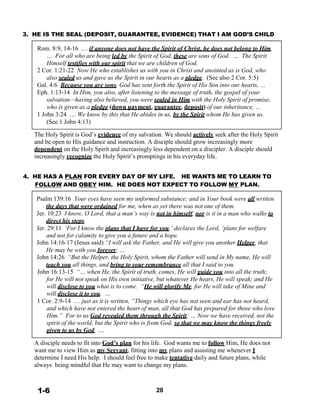
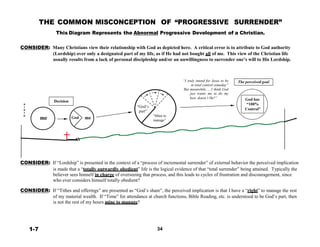
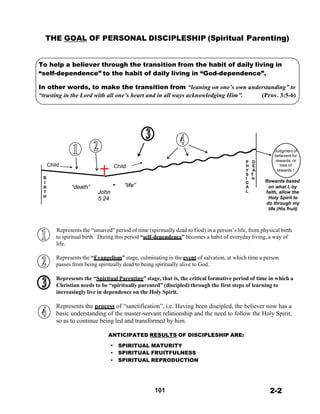
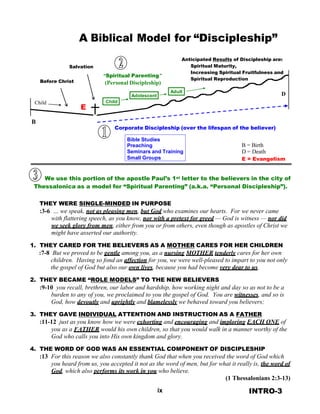
D
A Biblical Model for “Discipleship”


Salvation
 
 
Before Christ


“Spiritual Parenting”
(Personal Discipleship)
Anticipated Results of Discipleship are:
Spiritual Maturity,
Increasing Spiritual Fruitfulness and
Spiritual Reproduction


Child


Child
E
 
Adult
Adolescent
 
B
Corporate Discipleship (over the lifespan of the believer)
 
Bible Studies
Preaching
Seminars and Training
Small Groups
 
B = Birth
D = Death
E = Evangelism
 
 
We use this portion of the apostle Paul’s 1st letter to the believers in the city of
Thessalonica as a model for “Spiritual Parenting” (a.k.a. “Personal Discipleship”).
 
 
THEY WERE SINGLE-MINDED IN PURPOSE
:3-6 … we speak, not as pleasing men, but God who examines our hearts. For we never came
with flattering speech, as you know, nor with a pretext for greed — God is witness — nor did
we seek glory from men, either from you or from others, even though as apostles of Christ we
might have asserted our authority.
 
1. THEY CARED FOR THE BELIEVERS AS A MOTHER CARES FOR HER CHILDREN
:7-8 But we proved to be gentle among you, as a nursing MOTHER tenderly cares for her own
children. Having so fond an affection for you, we were well-pleased to impart to you not only
the gospel of God but also our own lives, because you had become very dear to us.
 
2. THEY BECAME “ROLE MODELS” TO THE NEW BELIEVERS
:9-10 you recall, brethren, our labor and hardship, how working night and day so as not to be a
burden to any of you, we proclaimed to you the gospel of God. You are witnesses, and so is
God, how devoutly and uprightly and blamelessly we behaved toward you believers;
 
3. THEY GAVE INDIVIDUAL ATTENTION AND INSTRUCTION AS A FATHER
:11-12 just as you know how we were exhorting and encouraging and imploring EACH ONE of
you as a FATHER would his own children, so that you would walk in a manner worthy of the
God who calls you into His own kingdom and glory.
 
4. THE WORD OF GOD WAS AN ESSENTIAL COMPONENT OF DISCIPLESHIP
:13 For this reason we also constantly thank God that when you received the word of God which
you heard from us, you accepted it not as the word of men, but for what it really is, the word of
God, which also performs its work in you who believe.
(1 Thessalonians 2:3-13)
 
ix INTRO-3
A Biblical Model
 
Overview
For Discipleship - Description
 
The previous lesson, “Balanced Discipleship” (INTRO-2), is an overview of what should be the
normal practice in churches. The diagram, “A Biblical Model For Discipleship”, depicts how
Balanced Discipleship should look in the typical believer’s spiritual life, including both
Personal Discipleship (“Spiritual Parenting”) and Corporate Discipleship. The two are
contrasted using a time line, and providing biblical support for Personal Discipleship.
 
 
Corporate Discipleship
 
Most churches are well acquainted with and employ Corporate Discipleship (represented by the
dotted line over the lifespan of the believer). However, many church leaders would acknowledge
that something is still lacking in the spiritual growth of many believers.
 
 
Personal Discipleship
 
We believe that “Personalized Discipleship” (“Spiritual Parenting”) is the missing ingredient for
producing healthy spiritual growth. Each new believer has unique spiritual needs that should be
addressed. Typically there is a window of opportunity for new believers, during which time they
are open to biblical concepts, which can accelerate their growth toward spiritual maturity and
fruitfulness. There is a parallel between the spiritual development of a believer and the
development of a baby. In both cases, the initial period is a “formative” stage of their lives. We
believe this is why God has chosen to use spiritual terminology that is paralleled in the human
experience; such as “born again”, “baby”, etc. (see also Lesson 2-2).
Too often believers are left to fend for themselves, with the assumption that simply being in the
presence of biblical presentations and other believers will be sufficient. We believe many
believers would have experienced much more spiritual growth had someone given them personal
attention when they first accepted Christ as their Savior. New believers will often come to
correct conclusions if biblical truths are clearly presented in a personal format.
New believers are usually hungry, and long for personal guidance, much like a new baby. The
typical new believer is excited about having their sins forgiven and knowing that they're going to
heaven. However, that excitement should not be mistaken for spiritual understanding. New
believers need to understand how to recognize the Holy Spirit’s involvement in their life, and
how to listen to, follow and obey Him. They also need to understand how to cooperate with Him
in their own spiritual development.
 
 
Biblical Support for Personalized Discipleship (1 Thess. 2:3-13)
 
Paul presents a model for Personal Discipleship (see also Lesson 2-2), in which he clearly depicts
himself as a “Spiritual Parent” (Spiritual Father and Mother), caring for spiritual children. We
believe that Paul lays out a biblical perspective of how a Spiritual Parent should relate to each
spiritual child, or disciple. The human parallel is intentional and unmistakable.


INTRO-3 x


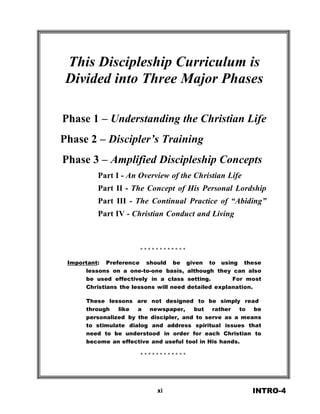
This Discipleship Curriculum is
Divided into Three Major Phases 


Phase 1 – Understanding the Christian Life
 
Phase 2 – Discipler’s Training
 
Phase 3 – Amplified Discipleship Concepts
 
Part I - An Overview of the Christian Life
 
Part II - The Concept of His Personal Lordship
Part III - The Continual Practice of “Abiding”
Part IV - Christian Conduct and Living


* * * * * * * * * * * *
 
Important: Preference should be given to using these
lessons on a one-to-one basis, although they can also
be used effectively in a class setting. For most
Christians the lessons will need detailed explanation.
 
These lessons are not designed to be simply read
through like a newspaper, but rather to be
personalized by the discipler, and to serve as a means
to stimulate dialog and address spiritual issues that
need to be understood in order for each Christian to
become an effective and useful tool in His hands.
 
* * * * * * * * * * * *


xi INTRO-4
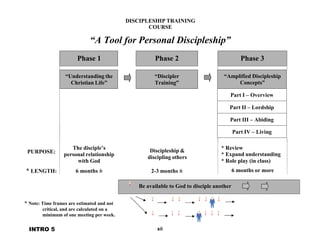
“Amplified Discipleship
Concepts”
Part I – Overview
Part II – Lordship
Part III – Abiding
Part IV – Living
DISCIPLESHIP TRAINING
COURSE
 
“A Tool for Personal Discipleship”
 
 
Phase 1 Phase 2 Phase 3 
 
 
“Understanding the
Christian Life”
“Discipler
Training”


PURPOSE:


* LENGTH:
The disciple’s
personal relationship
with God
 
6 months ±
 
Discipleship &
discipling others
 
 
2-3 months ±
* Review
* Expand understanding
* Role play (in class)
 
6 months or more
 
 
Be available to God to disciple another 
 
 
* Note: Time frames are estimated and not
critical, and are calculated on a
minimum of one meeting per week.
 
 
INTRO 5 xii
INTRODUCTION TO THESE DISCIPLESHIP HANDOUTS
 
We believe it pleases God when we have the attitude of a disciple (an apprentice learner), having
more concern about God making us into the most usable instrument possible in this life, and minimal
interest in defending our personal viewpoints. We ought to not have any beliefs that are not open for
Him to alter. Some of the concepts presented in these materials will conflict with certain beliefs that are
prevalent in the Christian community. Our intention is to offer some Scriptural principles that we
believe are being neglected and expose some wrong assumptions that are being made by many followers
of Christ. We would encourage anyone reading this introduction and following lessons to prayerfully
consider the validity of these concepts with an open mind, and to give us any feedback that would help
us to present Biblical truth clearly and accurately. Our passion to help believers to grow to spiritual
maturity and fruitfulness in Christ is knit together with our fear of presenting error.
There are some foundational principles that all believers, especially newer believers, need to
understand. Often Biblical “knowledge” is presented to new Christians instead of Biblical “principles”
and personalized instruction. New believers need to be quickly introduced to a life of walking in
dependence on the Holy Spirit. (A manual for a car or computer may have the exact specifications and
a great description, but to learn to properly drive a vehicle or operate a computer, most people need
individual mentoring).
We believe there are some harmful misconceptions that are prevalent in the Christian community,
which are assumed to be Scriptural, primarily because contrasting Biblical principles are often not
presented. The neglect, or omission, of a particular Biblical concept (for example, the Rewards
Ceremony of Christ) can easily convey to a new believer that the concept is really not of any great
significance. We believe these misconceptions have resulted in many unhealthy Christians who have
not grown from infancy to maturity in Christ so as to become spiritual reproducers (disciplers), a goal
for which God has made every provision.
Our desire is to give each newer believer (and any spiritually hungry older believer) a clear
overview of the Christian life and a basic understanding of God’s objectives. We believe one of the
biggest reasons for the lack of spiritual vitality in the Christian community is the failure of new converts
to be taught foundational guidelines and Scriptural goals initially. If such principles are presented
initially, a new believer will be saved from much unneeded frustration as he seeks to understand what
God wants to do in and through his life. For most converts the first few months are critical, in order to
take advantage of the initial disposition to learning that characterizes the normal new believer. Too
often new believers are simply placed in the presence of Biblical truth and expected to somehow
assimilate Biblical understanding. New believers will tend to adopt the outlook and value system of
those they associate with during the formative first part of their Christian walk. Is it then a surprise if
many new believers come to the conclusion that Sunday services are the most important spiritual
experience of the week? The spiritual walk with God should be a 24/7 experience.
 
We believe we can compare bits of Biblical knowledge to pieces of a jigsaw puzzle. A person may
have many of the pieces, yet without personal instruction, not have a clear understanding of how they
sensibly fit together. It is much easier to put together the pieces of a puzzle if the puzzle box top is
available for reference. Similarly, it is easier for a new believer to make sense of Biblical truths if an
overview is clearly presented at the very beginning of his walk with the Lord.
 
Caution: Please do not give these lessons to someone without adequate explanation. We usually
tend to assume that others understand more than they actually do. If the disciple grasps and applies the
concepts presented here, the energy and hours you have invested will be well worth it.


xiii
INTRO-6
 
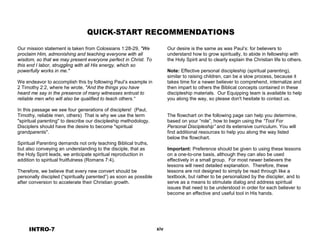
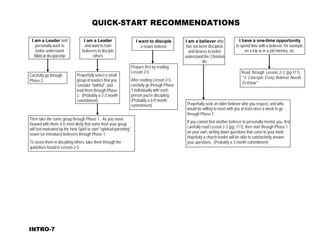
QUICK-START RECOMMENDATIONS
 
 
Our mission statement is taken from Colossians 1:28-29, "We
proclaim Him, admonishing and teaching everyone with all
wisdom, so that we may present everyone perfect in Christ. To
this end I labor, struggling with all His energy, which so
powerfully works in me."
 
We endeavor to accomplish this by following Paul’s example in
2 Timothy 2:2, where he wrote, "And the things you have
heard me say in the presence of many witnesses entrust to
reliable men who will also be qualified to teach others.“
 
In this passage we see four generations of disciplers! (Paul,
Timothy, reliable men, others) That is why we use the term
"spiritual parenting" to describe our discipleship methodology.
Disciplers should have the desire to become "spiritual
grandparents".
 
Spiritual Parenting demands not only teaching Biblical truths,
but also conveying an understanding to the disciple, that as
the Holy Spirit leads, we anticipate spiritual reproduction in
addition to spiritual fruitfulness (Romans 7:4).
 
Therefore, we believe that every new convert should be
personally discipled (“spiritually parented”) as soon as possible
after conversion to accelerate their Christian growth.
Our desire is the same as was Paul’s: for believers to
understand how to grow spiritually, to abide in fellowship with
the Holy Spirit and to clearly explain the Christian life to others.
 
Note: Effective personal discipleship (spiritual parenting),
similar to raising children, can be a slow process, because it
takes time for a newer believer to comprehend, internalize and
then impart to others the Biblical concepts contained in these
discipleship materials. Our Equipping team is available to help
you along the way, so please don't hesitate to contact us.


The flowchart on the following page can help you determine,
based on your “role”, how to begin using the “Tool For
Personal Discipleship” and its extensive curriculum. You will
find additional resources to help you along the way listed
below the flowchart.
 
Important: Preference should be given to using these lessons
on a one-to-one basis, although they can also be used
effectively in a small group. For most newer believers the
lessons will need detailed explanation. Therefore, these
lessons are not designed to simply be read through like a
textbook, but rather to be personalized by the discipler, and to
serve as a means to stimulate dialog and address spiritual
issues that need to be understood in order for each believer to
become an effective and useful tool in His hands.


INTRO-7 xiv
QUICK-START RECOMMENDATIONS
 
 
I am a Leader and
personally want to
better understand
Biblical discipleship


Carefully go through
Phase 2.
I am a Leader
and want to train
believers to disciple
others


Prayerfully select a small
group of leaders that you
consider "faithful", and
lead them through Phase
2. (Probably a 2-3 month
commitment)
I want to disciple
a newer believer


Prepare first by reading
Lesson 2-5.
 
After reading Lesson 2-5,
carefully go through Phase
1 individually with each
person you're discipling.
(Probably a 6-9 month
I am a believer who
has not been discipled,
and desires to better
understand the Christian
life
I have a one-time opportunity
to spend time with a believer, for example,
on a trip or in a jail ministry, etc.


Read through Lesson 2-3 (pg.111),
“5 Concepts Every Believer Needs
To Know”


Then take the same group through Phase 1. As you move
forward with them, it is most likely that some from your group
will feel motivated by the Holy Spirit to start "spiritual parenting"
newer (or immature) believers through Phase 1.
 
To assist them in discipling others, take them through the
guidelines found in Lesson 2-5.
commitment) Prayerfully seek an older believer who you respect, and who
would be willing to meet with you at least once a week to go
through Phase 1.
 
If you cannot find another believer to personally mentor you, first
carefully read Lesson 2-3 (pg. 111), then start through Phase 1
on your own, writing down questions that come to your mind.
Hopefully a church leader will be able to satisfactorily answer
your questions. (Probably a 3 month commitment)


INTRO-7
•
QUICK-START RECOMMENDATIONS
(Printing Options)
 
 
From time to time we receive questions asking about different methods for printing the “Tool For
Personal Discipleship” manual. Below are some guidelines we have come up with based on user needs.


If you are a Church Leader and will be conducting training classes or having small groups:
o You may want to consider printing the manuals locally.
o Here in ICBC, Imus you can ask the church secretary for a copy of the manual.


INTRO-7 xvi
 
 
A Tool For
Personal Discipleship 


PHASE 1 


UNDERSTANDING
THE
CHRISTIAN LIFE 


© All Scripture quotations, unless otherwise indicated, are taken from the NEW
AMERICAN STANDARD BIBLE Copyright The Lockman Foundation 1960,
1962, 1963, 1968, 1971, 1972, 1973, 1975, 1977, 1995 Used by permission.
 
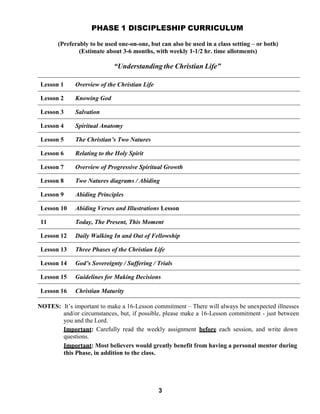
PHASE 1 DISCIPLESHIP CURRICULUM
 
(Preferably to be used one-on-one, but can also be used in a class setting – or both)
(Estimate about 3-6 months, with weekly 1-1/2 hr. time allotments)
 
“Understanding the Christian Life”
 
 
Lesson 1 Overview of the Christian Life
 
Lesson 2 Knowing God
 
Lesson 3 Salvation
 
Lesson 4 Spiritual Anatomy
 
Lesson 5 The Christian’s Two Natures
 
Lesson 6 Relating to the Holy Spirit
 
Lesson 7 Overview of Progressive Spiritual Growth
 
Lesson 8 Two Natures diagrams / Abiding
 
Lesson 9 Abiding Principles
 
Lesson 10 Abiding Verses and Illustrations Lesson
11 Today, The Present, This Moment
Lesson 12 Daily Walking In and Out of Fellowship
Lesson 13 Three Phases of the Christian Life
Lesson 14 God’s Sovereignty / Suffering / Trials
Lesson 15 Guidelines for Making Decisions
Lesson 16 Christian Maturity
 
 
NOTES: It’s important to make a 16-Lesson commitment – There will always be unexpected illnesses
and/or circumstances, but, if possible, please make a 16-Lesson commitment - just between
you and the Lord.
Important: Carefully read the weekly assignment before each session, and write down
questions.
Important: Most believers would greatly benefit from having a personal mentor during
this Phase, in addition to the class.


3
s
h
r
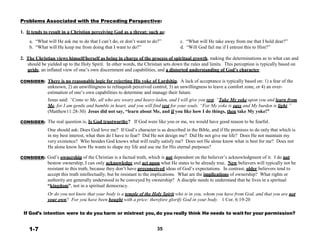
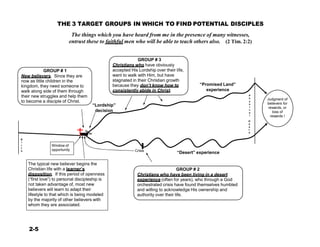
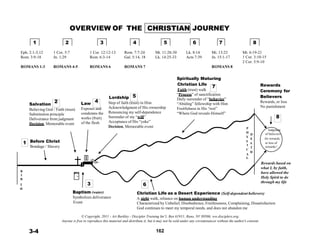
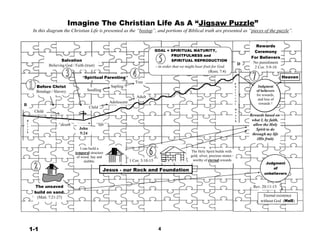
Imagine The Christian Life As A “Jigsaw Puzzle”
In this diagram the Christian Life is presented as the “boxtop”, and portions of Biblical truth are presented as “pieces of the puzzle”.


Salvation
Believing God / Faith (trust)
 
 
“Spiritual Parenting”
 
GOAL = SPIRITUAL MATURITY,
FRUITFULNESS and
SPIRITUAL REPRODUCTION
- in order that we might bear fruit for God.
D
(Rom. 7:4)
 
Tree P
Rewards
Ceremony
For Believers
No punishment
2 Cor. 5:9-10


Heaven
Before Christ
Bondage / Slavery
 
 
B
Child
 
B
 
Seedling


Child
Sapling


Adolescent
 
 
Adult
h Judgment
y
of believers
i for rewards,
c
and loss ofa
l rewards !
 
D
e
a Rewards based on
t
what I, by faith,
i
“death” “life”
t John
h
5:24


I can build a
temporal structure The Holy Spirit builds with
allow the Holy
Spirit to do
through my life
(His fruit)
of wood, hay and
stubble. 1 Cor. 3:10-15
 
Jesus - our Rock and Foundation
gold, silver, precious stones -
worthy of eternal rewards
 
 
Judgment
of
unbelievers
 
 
The unsaved
build on sand.
(Matt. 7:21-27)
Rev. 20:11-15
 
Eternal existence
without God (Hell)


1-1 4
LESSON GUIDE
 
PRESENTING THE CHRISTIAN LIFE AS A “JIGSAW PUZZLE”


The main purpose of this lesson is to present a practical overview of
the Normal Christian Life. As the Christian acquires Biblical
concepts and knowledge we want to help him to mentally connect
the pieces to God’s overall plan for his life.
 
We use the illustration of a jigsaw puzzle. Imagine trying to fit
together the pieces of a puzzle without being able to refer to the
picure boxtop. It is much less frustrating when the boxtop is
available for reference. The second diagram, the Overview, would
be like the puzzle boxtop, while the pieces would represent bits of
Biblical knowledge.
 
Typically a new Christian will begin to accumulate information
from the Bible, friends, books, sermons, conversations, etc., but will
have difficulty in knowing how this acquired knowledge fits into his
everyday life here on earth, or worse yet he may arrive at wrong
conclusions which can distort his understanding of God and the
Christian life.
 
Many newer Christians become frustrated and try to return to their
secular life, while others will compartmentalize their life, resulting
in a perceived “spiritual life” and a “secular life”. They will often
then attempt to live an acceptable spiritual life before others, while
at the same time concluding that Biblical principles somehow don’t
apply to their secular life. We need to help the disciple to view the
various components of his everyday life as a unit, and God’s
involvement in every aspect of that life.
A goal is to help the disciple understand how to
integrate Biblical knowledge into his daily
relationship with God and others, and protect him
from falling into the common practice of simply
archiving Biblical information.


A growing Christian will become increasingly
more aware of his need to continually walk before
the Lord (24/7), seeking His approval, and less
dependent on the need for approval from others.


1-1 5
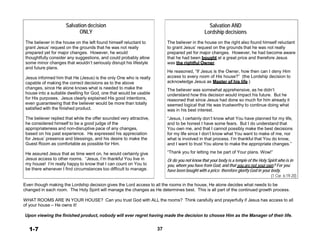
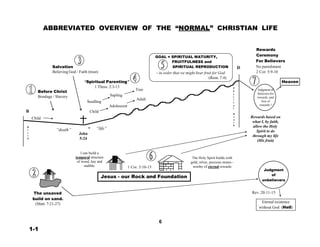
ABBREVIATED OVERVIEW OF THE “NORMAL” CHRISTIAN LIFE


Salvation
Believing God / Faith (trust)
 
“Spiritual Parenting”
1 Thess. 2:3-13
Before Christ
Bondage / Slavery Sapling
Seedling
Adolescent
B Child
Child


Tree
 
Adult
 
 
GOAL = SPIRITUAL MATURITY,
FRUITFULNESS and
SPIRITUAL REPRODUCTION D
- in order that we might bear fruit for God.
(Rom. 7:4)
 
 
P
h
y
s
i
c
a
l
 
D
e
a
t
Rewards
Ceremony
For Believers
No punishment
2 Cor. 5:9-10
 
Heaven
 
Judgmentof
believers for
rewards, and
loss of
rewards !
 
 
Rewards based on
what I, by faith,
B
i “death”
r
t
h
 
 
John
5:24
“life”
h
allow the Holy
Spirit to do
through my life
(His fruit)
 
 
I can build a
temporal structure
of wood, hay and
stubble.


1 Cor. 3:10-15
 
The Holy Spirit builds with
gold, silver, precious stones -
worthy of eternal rewards


Judgment


The unsaved
build on sand.
(Matt. 7:21-27)
Jesus - our Rock and Foundation of
unbelievers
 
 
Rev. 20:11-15
 
Eternal existence
without God (Hell)
 
 
6
1-1
LESSON - GUIDE
 
OVERVIEW OF THE NORMAL CHRISTIAN LIFE
 
 
Note for discipler: It should usually take about one session to cover
this lesson. We want to give the disciple a preview of the normal
Christian life. Briefly explain each component, all of which will be
covered later in more detail.


Birth to Rebirth – We should each be able to easily identify
ourselves as having gone through this period, alienated from God,
And I saw the dead, the great and the small, standing before
the throne, and books were opened; and another book was
opened, which is the book of life; and the dead were judged
from the things which were written in the books, according
to their deeds. And the sea gave up the dead which were in
it, and death and Hades gave up the dead which were in
them; and they were judged, every one of them according to
their deeds. Then death and Hades were thrown into the
lake of fire. This is the second death, the lake of fire. And if
anyone’s name was not found written in the book of life, he
was thrown into the lake of fire.
living in spiritual darkness, and without hope. The Cross – This event is by far the most important
happening in a human’s life. From God’s perspective the Christian
has passed from “death” (without His life) to “life” (the Lord
If a person rejects Christ and dies during this period, he is
like a man who has built his house upon the sand, without a
foundation. He will go to the judgment of unbelievers to spend
eternity separated from God. It is important to understand that this
judgment has nothing to do with believers, only unbelievers.
 
Matt. 7:24-27 (Jesus said) “Therefore everyone who hears these
words of Mine and acts on them, may be compared to a wise
man who built his house on the rock. “And the rain fell, and
the floods came, and the winds blew and slammed against
that house; and yet it did not fall, for it had been founded on
the rock. “Everyone who hears these words of Mine and
does not act on them, will be like a foolish man who built
his house on the sand. “The rain fell, and the floods came,
and the winds blew and slammed against that house; and it
fell—and great was its fall.”
Rev. 20:11-15 (the apostle John wrote) Then I saw a great white
throne and Him who sat upon it, from whose presence earth
indwelling). From hopelessness to hopefulness.
 
John 5:24 “Truly, truly, I say to you, he who hears My word,
and believes Him who sent Me, has eternal life, and does not
come into judgment, but has passed out of death into life.


The New Life – It is important to understand that the event
of salvation is the entrance into a new life with God, prepared by
Him to completely meet our every need, as we fit into His design.
We are introduced to the concept of fitting into God’s plan for our
time here on earth, which is but a small part of His eternal plan for
each of us. Two Biblical analogies can illustrate the Christian life:
that of a plant growing from a seedling to a tree, and that of a human
growing from a baby to an adult. Again, the event of salvation is
just the beginning of the new life of learning to walk with God.
During this period of time it is very important for a new believer to
and heaven fled away, and no place was found for them.
be discipled (“spiritually parented”).


1-1 7
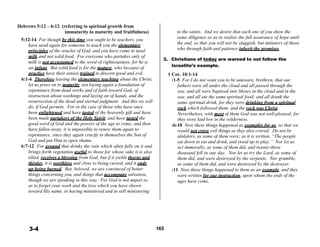
Thessalonians 2:7-13 … we proved to be gentle among you, as
a nursing mother tenderly cares for her own children.
Having so fond an affection for you, we were well-pleased
to impart to you not only the gospel of God but also our
own lives, because you had become very dear to us. …
we were exhorting and encouraging and imploring each
one of you as a father would his own children, so that you
would walk in a manner worthy of the God who calls you
into His own kingdom and glory. For this reason we also
constantly thank God that when you received the word of
God which you heard from us, you accepted it not as the
word of men, but for what it really is, the word of God,
which also performs its work in you who believe.
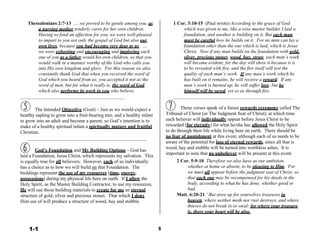
1 Cor. 3:10-15 (Paul wrote) According to the grace of God
which was given to me, like a wise master builder I laid a
foundation, and another is building on it. But each man
must be careful how he builds on it. For no man can lay a
foundation other than the one which is laid, which is Jesus
Christ. Now if any man builds on the foundation with gold,
silver, precious stones, wood, hay, straw, each man’s work
will become evident; for the day will show it because it is
to be revealed with fire, and the fire itself will test the
quality of each man’s work. If any man’s work which he
has built on it remains, he will receive a reward. If any
man’s work is burned up, he will suffer loss; but he
himself will be saved, yet so as through fire.


The Intended Objective (Goal) – Just as we would expect a
healthy sapling to grow into a fruit-bearing tree, and a healthy infant
to grow into an adult and become a parent, so God’s intention is to
make of a healthy spiritual infant a spiritually mature and fruitful
Christian.


God’s Foundation and My Building Options – God has
laid a Foundation, Jesus Christ, which represents my salvation. This
is equally true for all believers. However, each of us individually
has a choice as to how we will build on that Foundation. The
buildings represent the use of my resources (time, energy,
possessions) during my physical life here on earth. If I allow the
Holy Spirit, as the Master Building Contractor, to use my resources,
He will use those building materials to create for me an eternal
structure of gold, silver and precious stones. That which I deny
Him use of will produce a structure of wood, hay and stubble.
These verses speak of a future rewards ceremony called The
Tribunal of Christ (or The Judgment Seat of Christ), at which time
each believer will individually appear before Jesus Christ to be
rewarded (for eternity) for what he/she has allowed the Holy Spirit
to do through their life while living here on earth. There should be
no fear of punishment at this event, although each of us needs to be
aware of the potential for loss of eternal rewards, since all that is
wood, hay and stubble will be turned into worthless ashes. It is
important to note that no unbeliever will be present at this event.
2 Cor. 5:9-10 Therefore we also have as our ambition,
whether at home or absent, to be pleasing to Him. For
we must all appear before the judgment seat of Christ, so
that each one may be recompensed for his deeds in the
body, according to what he has done, whether good or
bad.
Matt. 6:20-21 “But store up for yourselves treasures in
heaven, where neither moth nor rust destroys, and where
thieves do not break in or steal; for where your treasure
is, there your heart will be also.


1-1 8
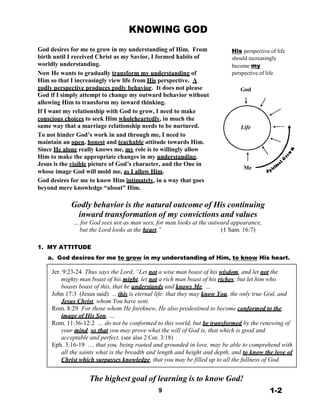
KNOWING GOD
 
 
God desires for me to grow in my understanding of Him. From
birth until I received Christ as my Savior, I formed habits of
worldly understanding.
Now He wants to gradually transform my understanding of
Him so that I increasingly view life from His perspective. A
His perspective of life
should increasingly
become my
perspective of life.
godly perspective produces godly behavior. It does not please God
God if I simply attempt to change my outward behavior without
allowing Him to transform my inward thinking.
If I want my relationship with God to grow, I need to make
conscious choices to seek Him wholeheartedly, in much the
same way that a marriage relationship needs to be nurtured.
To not hinder God’s work in and through me, I need to
maintain an open, honest and teachable attitude towards Him.
Since He alone really knows me, my role is to willingly allow
Him to make the appropriate changes in my understanding.
Jesus is the visible picture of God’s character, and the One in
Life
whose image God will mold me, as I allow Him.
Me
God desires for me to know Him intimately, in a way that goes
beyond mere knowledge “about” Him.
 
 
Godly behavior is the natural outcome of His continuing
inward transformation of my convictions and values
… for God sees not as man sees, for man looks at the outward appearance,
but the Lord looks at the heart.” (1 Sam. 16:7)
 
 
1. MY ATTITUDE
a. God desires for me to grow in my understanding of Him, to know His heart.
 
Jer. 9:23-24 Thus says the Lord, “Let not a wise man boast of his wisdom, and let not the
mighty man boast of his might, let not a rich man boast of his riches; but let him who
boasts boast of this, that he understands and knows Me, …
John 17:3 (Jesus said) ... this is eternal life: that they may know You, the only true God, and
Jesus Christ, whom You have sent.
Rom. 8:29 For those whom He foreknew, He also predestined to become conformed to the
image of His Son, …
Rom. 11:36-12:2 … do not be conformed to this world, but be transformed by the renewing of
your mind, so that you may prove what the will of God is, that which is good and
acceptable and perfect. (see also 2 Cor. 3:18)
Eph. 3:16-19 … that you, being rooted and grounded in love, may be able to comprehend with
all the saints what is the breadth and length and height and depth, and to know the love of
Christ which surpasses knowledge, that you may be filled up to all the fullness of God.
 
 
The highest goal of learning is to know God!
9 1-2
b. In order to grow I need to actively pursue a closer relationship with Him.
 
Psa. 63:1 (David wrote) O God, … I shall seek You earnestly; my soul thirsts for You, …
Prov. 2:1-5 (Solomon wrote) My son, if you will receive my words and treasure my
commandments within you, make your ear attentive to wisdom, incline your heart to
understanding; for if you cry for discernment, lift your voice for understanding; if you seek
her as silver and search for her as for hidden treasures; then you will discern the fear of
the Lord and discover the knowledge of God.
Matt. 7:7-8 “Ask, and it will be given to you; seek, and you will find; knock, and it will be
opened to you. “For everyone who asks receives, and he who seeks finds, and to him who
knocks it will be opened.
1 Peter 2:2-3 like newborn babies, long for the pure milk of the word, so that by it you may
grow in respect to salvation, if you have tasted the kindness of the Lord.


2. GOD’S WORD
 
TRUTH DOES NOT ORIGINATE FROM ME, OR FROM ANY OTHER HUMAN, BUT
ONLY FROM GOD HIMSELF. THEREFORE, ALL “PERCEIVED TRUTH” MUST BE
COMPARED TO, AND VERIFIED BY, GOD’S WORD – THE BIBLE.
 
a. One way God transforms me is through His Word. His Word is trustworthy.
 
Psa. 119:89 Forever, O Lord, Your word is settled in heaven.. (see also 1 Peter 1:25)
Matt. 24:35 (Jesus said) “Heaven and earth will pass away, but My words will not pass away.
John 14:6 (Jesus said) I am the way, and the truth, and the life; …
John 17:17 (Jesus said) “Sanctify them in the truth; Your word is truth. (See also Psa. 119:160)
Rom. 15:4 For whatever was written in earlier times was written for our instruction, so that
through perseverance and the encouragement of the Scriptures we might have hope.
Eph. 4:21 … truth is in Jesus,
2 Tim. 3:16-17 All Scripture is inspired by God and profitable for teaching, for reproof, for
correction, for training in righteousness; so that the man of God may be adequate,
equipped for every good work.
1 John 5:6 … It is the Spirit who testifies, because the Spirit is the truth.
 
 
b. God’s Word should become as essential as food in my daily life.
 
Deut. 6:5-9 “… These words, which I am commanding you today, shall be on your heart. You
shall teach them diligently to your sons and shall talk of them when you sit in your house
and when you walk by the way and when you lie down and when you rise up. … “You shall
write them on the doorposts of your house and on your gates ... (See also Deut. 11:18-21)
Job 23:12 (Job said) “I have not departed from the command of His lips; I have treasured the
words of His mouth more than my necessary food.
Psa. 119:16 I delight in Your decrees; I will not neglect Your word.
Psa. 119:103 How sweet are Your words to my taste! Yes, sweeter than honey to my mouth!
Matt. 4:4 But He (Jesus) answered and said, “It is written, ‘Man shall not live on bread alone,
but on every word that proceeds out of the mouth of God.’ ”


1-2 10
c. Memorization and meditation on His Word will help me to grow.
 
Psa. 1:1-3 How blessed is the man who … his delight is in the law of the Lord, and in His law he
meditates day and night. He will be like a tree firmly planted by streams of water, which
yields its fruit in its season and its leaf does not wither; and in whatever he does, he
prospers.
Psa. 119:11 Your word I have treasured in my heart, that I may not sin against You.
Psa. 119:97 O how I love Your law! It is my meditation all the day.
Psa. 145: 5 On the glorious splendor of Your majesty and on Your wonderful works, I will
meditate.
Prov. 22:17-18 Incline your ear and hear the words of the wise, and apply your mind to my
knowledge; for it will be pleasant if you keep them within you, that they may be ready on
your lips.
Col. 3:16 Let the word of Christ richly dwell within you, with all wisdom teaching and
admonishing one another with psalms and hymns and spiritual songs, singing with
thankfulness in your hearts to God.
 
Visible Reminders: Memorize a verse of Scripture as you go to work.
Write a verse on a card, and tape it where it is visible.
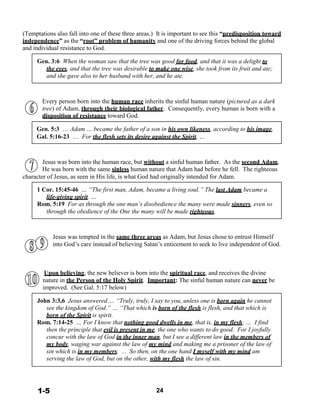
Meditate on that verse during the day.
Our Daily Bread, ©2007 RBC Ministries--Grand Rapids, MI 49555. Reprinted by permission.
 
d. God's Word is like a light shining into my life, disclosing the secrets of my
heart and helping me to see myself as God sees me.
 
Psa. 119:105 Your word is a lamp to my feet and a light to my path.
Psa. 119:130 The unfolding of Your words gives light; it gives understanding to the simple.
Rom. 10:17 So faith comes from hearing, and hearing by the word of Christ.
Heb. 4:12-13 … the word of God is living and active … and able to judge the thoughts and
intentions of the heart. … all things are open and laid bare to the eyes of Him with whom
we have to do.
 
 
e. God alone gives understanding of His Word. Even though some portions
may appear difficult to understand, as I am honest and open to Him, He will
reveal His Word to me as I have need.
 
Deut. 29:29 “The secret things belong to the Lord our God, but the things revealed belong to
us and to our sons forever, that we may observe all the words of this law.
Luke 24:45 Then He (Jesus) opened their minds to understand the Scriptures,
1 Cor. 2:12-14 … Now we have received, not the spirit of the world, but the Spirit who is from
God, so that we may know the things freely given to us by God, which things we also speak,
not in words taught by human wisdom, but in those taught by the Spirit, combining
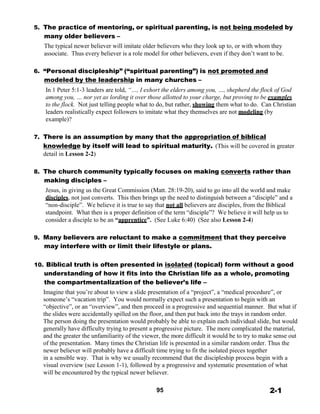
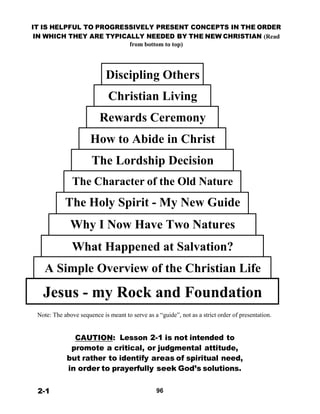
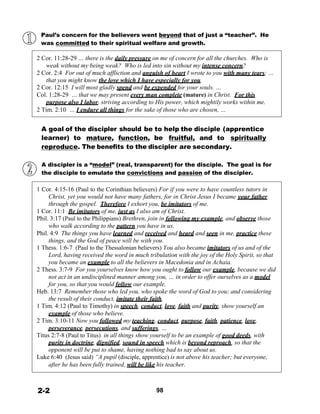
spiritual thoughts with spiritual words. But a natural man does not accept the things of the
Spirit of God, for they are foolishness to him; and he cannot understand them, …
2 Pet. 3:15-16 (Peter wrote) … our beloved brother Paul, according to the wisdom given him,
wrote to you, as also in all his letters, speaking in them of these things, in which are some
things hard to understand, …
 
 
11 1-2
3. PRAYER - CONVERSING WITH GOD
 
We should think of Prayer as an intimate conversation with our Creator and Master, who is
majestic in His creation and control of the universe, while at the same time so loving and caring
that he wants to be involved in the most minute details of my life.
I should approach God with a reverent awe, always conscious of the fact that His accessibility is
only due to the merit of His Son, not a result of any goodness on my part. We should count it an
extreme privilege to approach the God of all creation.
As in any conversation, listening is a major component. Occasionally my time with God will
consist mostly or entirely of contemplating and listening to Him as He speaks to my heart or
reveals to me something new. He wants me to look to Him with expectation.
One way of honoring God and giving Him His rightful recognition in my heart is by actively
seeking and accepting His priorities. This will necessitate forming the habit of not giving Him
the leftovers of my time, energy and possessions, but rather offering Him the best of my
resources.
 
a. Conversation with God will be enhanced by a heart preparation, an honest
assessment of my priorities, and an awareness of His majesty.
 
Psa. 5:3 In the morning, O Lord, You will hear my voice; in the morning I will order my
prayer to You and eagerly watch.
Psa. 37:7 Rest in the LORD and wait patiently for Him; …
Psa. 119:147 I rise before dawn and cry for help; I wait for Your words.
Prov. 3:5-6 Trust in the Lord with all your heart and do not lean on your own understanding.
In all your ways acknowledge Him, and He will make your paths straight.
Isa. 50:4 … He awakens Me morning by morning, He awakens My ear to listen as a disciple.
Matt. 6:31-34 “Do not worry then, saying, ‘What will we eat?’ or ‘What will we drink?’ or
‘What will we wear for clothing?’ … for your heavenly Father knows that you need all
these things. “But seek first His kingdom and His righteousness, and all these things will
be added to you. “So do not worry about tomorrow; for tomorrow will care for itself.
Each day has enough trouble of its own.
Luke 10:38-42 … He (Jesus) entered a village; and a woman named Martha welcomed Him
into her home. She had a sister called Mary, who was seated at the Lord’s feet, listening
to His word. But Martha was distracted with all her preparations; and she came up to
Him and said, “Lord, do You not care that my sister has left me to do all the serving alone?
Then tell her to help me.” But the Lord answered and said to her, “Martha, Martha, you
are worried and bothered about so many things; but only one thing is necessary, for Mary
has chosen the good part, which shall not be taken away from her.”
Eph. 2:18 for through Him (Jesus) we … have our access in one Spirit to the Father.
Col. 3:2-3 Set your mind on the things above, not on the things that are on earth. For you
have died and your life is hidden with Christ in God.
Heb. 4:15-16 For we do not have a high priest who cannot sympathize with our weaknesses,
but One who has been tempted in all things as we are, yet without sin. Therefore let us
draw near with confidence to the throne of grace, so that we may receive mercy and find
grace to help in time of need.
1 Peter 5:6-7 Therefore humble yourselves under the mighty hand of God, that He may exalt
you at the proper time, casting all your anxiety on Him, because He cares for you.


1-2 12
b. Prayer includes adoration, thanksgiving (gratitude), and praise.
 
Psa. 145:2-3 (David wrote) Every day I will bless You, and I will praise Your name forever
and ever. Great is the LORD, and highly to be praised, and His greatness is unsearchable.
Psa. 146:1-2 Praise the LORD! Praise the LORD, O my soul! I will praise the LORD while I
live; I will sing praises to my God while I have my being.
Daniel 6:10 … Daniel … entered his house (now in his roof chamber he had windows open
toward Jerusalem); and he continued kneeling on his knees three times a day, praying and
giving thanks before his God, as he had been doing previously.
Eph. 5:19-20 speaking to one another in psalms and hymns and spiritual songs, singing and
making melody with your heart to the Lord; always giving thanks for all things in the
name of our Lord Jesus Christ to God, even the Father;
Phil. 4:6-7 Be anxious for nothing, but in everything by prayer and supplication with
thanksgiving let your requests be made known to God. And the peace of God, which
surpasses all comprehension, will guard your hearts and your minds in Christ Jesus.
Col. 4:2-4 Devote yourselves to prayer, keeping alert in it with an attitude of thanksgiving; …
1 Thess. 5:16-18 Rejoice always; pray without ceasing; in everything give thanks; for this is
God’s will for you in Christ Jesus.
 
 
c. Prayer includes confession, reconciliation and forgiveness of others.
 
Psa. 32:5 I acknowledged my sin to You, and my iniquity I did not hide; I said, “I will confess
my transgressions to the Lord”; and You forgave the guilt of my sin. … (See Psa. 66:18)
Prov. 28:13 He who conceals his transgressions will not prosper, but he who confesses and
forsakes them will find compassion.
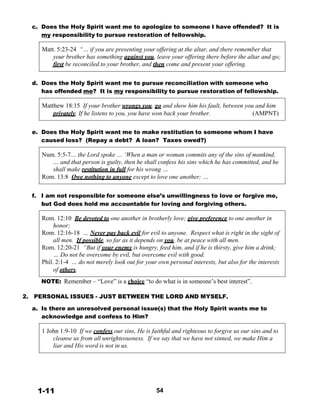
Matt. 5:23-24 “… if you are presenting your offering at the altar, and there remember that
your brother has something against you, leave your offering there before the altar and go;
first be reconciled to your brother, and then come and present your offering.
Mark 11:25 "whenever you stand praying, forgive, if you have anything against anyone; so
that your Father also who is in heaven may forgive you your transgressions.
Rom. 12:18 If possible, so far as it depends on you, be at peace with all men.
1 John 1:9-10 If we confess our sins, He is faithful and righteous to forgive us our sins and to
cleanse us from all unrighteousness. If we say that we have not sinned, we make Him a
liar and His word is not in us.
 
 
d. Prayer includes supplications, requests for my personal needs.
 
Prov. 2:6 For the Lord gives wisdom; from His mouth come knowledge and understanding.
Matt. 6:5-8 “… But you, when you pray, go into your inner room, close your door and pray to
your Father who is in secret, and your Father who sees what is done in secret will reward
you. … for your Father knows what you need before you ask Him.
Matt. 6:25-34 … “But seek first His kingdom and His righteousness, and all these things will
be added to you. …
James 1:5 But if any of you lacks wisdom, let him ask of God, who gives to all generously and
without reproach, and it will be given to him.


13 1-2
e. Prayer—Battle in "The Secret Place"
 
 
When you pray, go into your room, and when you have shut your door, pray to your Father who is
in the secret place; and your Father who sees in secret will reward you openly
—Matthew 6:6
 
Jesus did not say, "Dream about your Father who is in the secret place," but He said, ". . . pray to
your Father who is in the secret place. . . ." Prayer is an effort of the will. After we have entered
our secret place and shut the door, the most difficult thing to do is to pray. We cannot seem to get
our minds into good working order, and the first thing we have to fight is wandering thoughts. The
great battle in private prayer is overcoming this problem of our idle and wandering thinking. We
have to learn to discipline our minds and concentrate on willful, deliberate prayer.
We must have a specially selected place for prayer, but once we get there this plague of wandering
thoughts begins, as we begin to think to ourselves, "This needs to be done, and I have to do that
today." Jesus says to "shut your door." Having a secret stillness before God means deliberately
shutting the door on our emotions and remembering Him. God is in secret, and He sees us from
"the secret place"—He does not see us as other people do, or as we see ourselves. When we truly
live in "the secret place," it becomes impossible for us to doubt God. We become more sure of Him
than of anyone or anything else. Enter into "the secret place," and you will find that God was right
in the middle of your everyday circumstances all the time. Get into the habit of dealing with God
about everything. Unless you learn to open the door of your life completely and let God in from
your first waking moment of each new day, you will be working on the wrong level throughout the
day. But if you will swing the door of your life fully open and "pray to your Father who is in the
secret place," every public thing in your life will be marked with the lasting imprint of the presence
of God.
 
(Taken from My Utmost for His Highest by Oswald Chambers – Aug 23. (c) l935 by Dodd Mead & Co.,
renewed (c) 1963 by the Oswald Chambers Publications Assn., Ltd., and is used by permission of
Discovery House Publishers, Box 3566, Grand Rapids MI 4950l. All rights reserved.)
 
Suggestion: To minimize distractions when you meet alone with the Lord,
have a notepad handy to write down any thoughts that you may
need to act upon later.


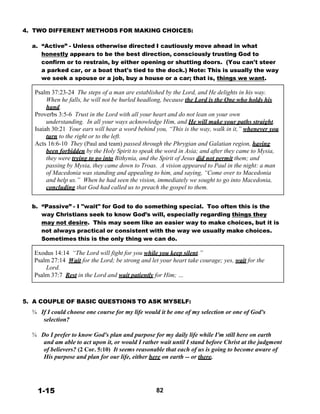
f. Prayer includes intercession, requests for the needs of others.
 
2 Cor. 1:8-11 (Paul wrote of his afflictions in Asia) ... we despaired even of life; ... God …
who delivered us from so great a peril of death, … And He will yet deliver us, you also
joining in helping us through your prayers, so that thanks may be given by many persons
on our behalf for the favor bestowed on us through the prayers of many.
Eph. 6:18-20 (Paul wrote) With all prayer and petition pray at all times in the Spirit, and with
this in view, be on the alert with all perseverance and petition for all the saints, and pray
on my behalf, that utterance may be given to me in the opening of my mouth, to make
known with boldness the mystery of the gospel, for which I am an ambassador in chains;
that in proclaiming it I may speak boldly, as I ought to speak.
Col. 4:12 (Paul wrote of Epaphras) … always laboring earnestly for you in his prayers, that
you may stand perfect and fully assured in all the will of God.


1-2 14
g. Prayer is continual, anytime; but should also include special times set apart.
It pleases God when we seek His direction for appropriate times and places.
 
Psa. 55:17 Evening and morning and at noon, I will complain and murmur, and He will hear
my voice.
Psa. 119:62 At midnight I shall rise to give thanks to You …
Psa. 119:164 Seven times a day I praise You, because of Your righteous ordinances.
Daniel 6:10 … Daniel … continued kneeling on his knees three times a day, praying and
giving thanks before his God, as he had been doing previously.
Rom. 12:12 Be joyful in hope, patient in affliction, faithful in prayer.
1 Thess. 5:17 pray without ceasing;
 
Note on 1 Thess. 5:17 “Continual prayer is not prayer that prevails without any interruption,
but prayer that continues whenever possible. Paul was speaking of maintaining continuous
fellowship with God as much as possible in the midst of daily living in which concentration is
frequently broken.” (Walvoord, John F., and Zuck, Roy B., The Bible Knowledge Commentary, (Wheaton, Illinois:
Scripture Press Publications, Inc.) 1983, 1985.)


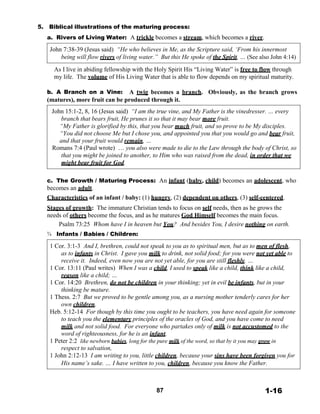
4. Our Daily Bread – (September 19, 2004)
 
Informing God
 
We cannot tell God anything He doesn't already know. When we pray, we simply put into words
what He's been aware of all along.
That doesn't make prayer unnecessary; rather, it encourages us to pray. We find relief in talking to
Someone who knows us and our situation fully. It's a comfort to know that God's response arises
not from information we give Him, but from His perfect knowledge of our circumstances. He
knows all conditions—past, present, future—that bear on our well-being.
"Your Father knows," Jesus said in Matthew 6:8. He knows our thoughts, our intentions, our
desires; He is intimately acquainted with all our ways (Psalm 139:3). He knows the anguish of our
heart, the strain of continual frustration, the enemies inside and outside that war against our souls.
So, can we presume to dictate the time and terms of our deliverance from trials or adversity? Can
we say our way is better, more likely to develop our soul? No, we cannot teach God anything. He
alone knows the way to bring us to glory. Out of all possible paths, He has chosen the best, the
route most adapted to who we are and what He has in store for us.
We cannot teach God knowledge, but we can love and trust Him. That's all He asks of us. —David
Roper
The answer God may choose for me
Is sure to be the best,
So may I always thankful be,
And in His goodness rest. —D. De Haan
 
God knows the end from the beginning, so we can trust Him with everything between.
 
Our Daily Bread, ©2004 RBC Ministries--Grand Rapids, MI 49555. Reprinted by permission.


15 1-2
5. CONCLUSION: As I trust God, I can always be assured of His love, knowing He
will only act toward me in my best interest, even though at times it may appear
otherwise. For Him to do otherwise would be contrary to His character.
 
Psa. 34:15 The eyes of the LORD are on the righteous and His ears are attentive to their cry;
Psa. 37:4-5 Delight yourself in the Lord; and He will give you the desires of your heart.
Commit your way to the Lord, trust also in Him, and He will do it.
Psa. 86:5 You are forgiving and good, O Lord, abounding in love to all who call to You.
Psa. 145:18-19 The LORD is near to all who call on Him, to all who call on Him in truth. He
fulfills the desires of those who fear Him; He hears their cry and saves them.
Jer. 10:23 I know, O Lord, that a man’s way is not in himself, nor is it in a man who walks to direct
his steps.
1 John 5:14-15 This is the confidence we have in approaching God: that if we ask anything
according to His will, He hears us. And if we know that He hears us -- whatever we ask --
we know that we have what we asked of Him.


… I am continually with You; You have taken hold of my right hand. With Your
counsel You will guide me, and afterward receive me to glory. Whom have I in
heaven but You? And besides You, I desire nothing on earth. My flesh and my
heart may fail, but God is the strength of my heart and my portion forever.
(Psalm 73:23-26)


1-2 16
SALVATION PRINCIPLES


Like physical birth, spiritual birth is the entrance into a new life. The purpose
of this lesson is to explain some things that happen to a believer at conversion.
Obviously there are other principles and truths that can be added.
 
 
1. MERCY & GRACE
“Mercy” = When I am not given what I deserve.
“Grace” = When I am given what I don’t deserve.
Illustration of Speeding Ticket -
“Good fortune” - if you’re not caught. “Justice”
- if you’re caught and given a ticket. “Mercy” - if
you’re caught, but not given a ticket.
“Grace” - if you’re caught, given a ticket, but the officer pays the fine.
 
 
2. THE APOSTLE PAUL DESCRIBES WHAT I WAS LIKE BEFORE GOD SAVED ME,
AND WHAT GOD HAS DONE FOR ME. (Discuss terminology as needed.)
 
Rom. 3:10-12 As it is written: “There is no one righteous, not even one; there is no one
who understands, no one who seeks God. All have turned away, they have together
become worthless; there is no one who does good, not even one.”
Rom. 5:6-10 For while we were still helpless, at the right time Christ died for the ungodly.
… But God demonstrates His own love toward us, in that while we were yet sinners,
Christ died for us. Much more then, having now been justified by His blood, we shall
be saved from the wrath of God through Him. For if while we were enemies we were
reconciled to God through the death of His Son, much more, having been reconciled,
we shall be saved by His life.
Eph. 2:1-9 And you were dead in your trespasses and sins, in which you formerly walked
according to the course of this world, according to the prince of the power of the air, of
the spirit that is now working in the sons of disobedience. Among them we too all
formerly lived in the lusts of our flesh, indulging the desires of the flesh and of the
mind, and were by nature children of wrath, even as the rest. But God, being rich in
mercy, because of His great love with which He loved us, even when we were dead in
our transgressions, made us alive together with Christ (by grace you have been saved),
and raised us up with Him, and seated us with Him in the heavenly places in Christ
Jesus, so that in the ages to come He might show the surpassing riches of His grace in
kindness toward us in Christ Jesus. For by grace you have been saved through faith;
and that not of yourselves, it is the gift of God; not as a result of works, so that no one
may boast.
Eph. 2:12 remember that you were at that time separate from Christ, … having no hope
and without God in the world.
Eph. 4:17-19 … darkened in their understanding, excluded from the life of God …


17 1-3
3. GOD’S PRINCIPLE OF SUBSTITUTION
 
a. God’s grace was evident even when Adam and Eve first disobeyed Him.
 
Genesis 2:15-17 The LORD God took the man and put him in the Garden of Eden to work
it and take care of it. And the LORD God commanded the man, “You are free to eat
from any tree in the garden; but you must not eat from the tree of the knowledge of
good and evil, for when you eat of it you will surely die.”
2:25 And the man and his wife were both naked and were not ashamed.
Genesis 3:
:6-7 When the woman saw that the tree was good for food, and that it was a delight to
the eyes, and that the tree was desirable to make one wise, she took from its fruit and
ate; and she gave also to her husband with her, and he ate. Then the eyes of both of
them were opened, and they knew that they were naked; and they sewed fig leaves
together and made themselves loin coverings.
:8-12 They heard the sound of the Lord God walking in the garden in the cool of the
day, and the man and his wife hid themselves from the presence of the Lord God
among the trees of the garden. Then the Lord God called to the man, and said to
him, “Where are you?” He said, “I heard the sound of You in the garden, and I was
afraid because I was naked; so I hid myself.” And He said, “Who told you that you
were naked? Have you eaten from the tree of which I commanded you not to eat?”
The man said, “The woman whom You gave to be with me, she gave me from the
tree, and I ate.”
:13 Then the LORD God said to the woman, “What is this you have done?” The
woman said, “The serpent deceived me, and I ate.”
:20 Adam named his wife Eve, because she would become the mother of all the living.
:21-24 The LORD God made garments of skin for Adam and his wife and clothed
them. And the LORD God said, “The man has now become like One of Us, knowing
good and evil. He must not be allowed to reach out his hand and take also from the
tree of life and eat, and live forever.” So the LORD God banished him from the
Garden of Eden to work the ground from which he had been taken. After He drove
the man out, He placed on the east side of the Garden of Eden cherubim and a
flaming sword flashing back and forth to guard the way to the tree of life.
 
Adam & Eve were given one commandment, which they disobeyed. Then they tried to make
themselves acceptable to God - represented by the fig leaf cover-up. They each blamed
someone else. They got what they deserved - Justice. Then God gave them what they didn’t
deserve – Grace - represented by His animal substitute. An innocent animal’s life was
sacrificed as a result of their sin. This animal sacrifice was a representation of the ultimate
sacrifice of Jesus Christ on the cross for the sin of the entire human race.
 
b. The Passover - another picture of Christ’s substitutionary sacrifice.
 
Exodus 12:1 Now the Lord said to Moses and Aaron in the land of Egypt,
:12-13 ‘For I will go through the land of Egypt on that night, and will strike down all
the firstborn in the land of Egypt, both man and beast; and against all the gods of
Egypt I will execute judgments—I am the Lord. ‘The blood shall be a sign for you
on the houses where you live; and when I see the blood I will pass over you, and no
plague will befall you to destroy you when I strike the land of Egypt.
 
 
1-3 18
:21-22 Then Moses called for all the elders of Israel and said to them, “Go and take for
yourselves lambs according to your families, and slay the Passover lamb. “You
shall take a bunch of hyssop and dip it in the blood which is in the basin, and apply
some of the blood that is in the basin to the lintel and the two doorposts; and none
of you shall go outside the door of his house until morning.
:23 “For the Lord will pass through to smite the Egyptians; and when He sees the
blood on the lintel and on the two doorposts, the Lord will pass over the door and
will not allow the destroyer to come in to your houses to smite you.
:24-27 “And you shall observe this event as an ordinance for you and your children
forever. “And when your children say to you, ‘What does this rite mean to you?’
you shall say, ‘It is a Passover sacrifice to the Lord who passed over the houses of
the sons of Israel in Egypt when He smote the Egyptians, but spared our homes.’ ”
And the people bowed low and worshiped.
:29-30 Now it came about at midnight that the Lord struck all the firstborn in the land of
Egypt, from the firstborn of Pharaoh who sat on his throne to the firstborn of the
captive who was in the dungeon, and all the firstborn of cattle. Pharaoh arose in the
night, he and all his servants and all the Egyptians, and there was a great cry in
Egypt, for there was no home where there was not someone dead.
John 1:29 The next day he (John the Baptist) saw Jesus coming to him and said, “Behold,
the Lamb of God who takes away the sin of the world!
1 Cor. 5:7 … For Christ our Passover also has been sacrificed.
 
The Israelites were in slavery to the Egyptians. A lamb was killed as a substitute. Wherever
there was blood the inhabitants of the house were spared from God’s judgment. When the
Lord saw blood on a doorpost, He could say, “Judgment has already been here”.
(Illustration: One of the safest places during a forest fire is where the fire has already burned)
 
c. Jesus Christ’s sacrifice as our “Substitute” was God’s plan for our salvation.
 
Isaiah 53:4-6 Surely our griefs He Himself bore, and our sorrows He carried; …. But He
was pierced through for our transgressions, He was crushed for our iniquities; the
chastening for our well-being fell upon Him, and by His scourging we are healed. All
of us like sheep have gone astray, each of us has turned to his own way; but the Lord
has caused the iniquity of us all to fall on Him.
2 Cor. 5:21 For our sake He made Christ [virtually] to be sin Who knew no sin, so that in
and through Him we might become [endued with, viewed as being in, and examples of]
the righteousness of God [what we ought to be, approved and acceptable and in right
relationship with Him, by His goodness]. (Amplified New Testament)
Gal. 3:13 Christ purchased our freedom [redeeming us] from the curse (doom) of the Law
[and its condemnation] by [Himself] becoming a curse for us, for it is written [in the
Scriptures], Cursed is everyone who hangs on a tree (is crucified); (Amplified NT)
1 Peter 3:18 For Christ [the Messiah Himself] died for sins once for all, the Righteous for
the unrighteous (the Just for the unjust, the Innocent for the guilty), that He might bring
us to God. In His human body He was put to death, but He was made alive in the spirit,
(Amplified New Testament)


19 1-3
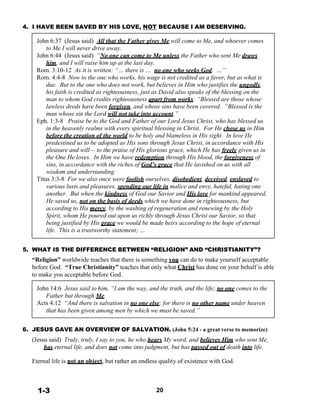
4. I HAVE BEEN SAVED BY HIS LOVE, NOT BECAUSE I AM DESERVING.
 
John 6:37 (Jesus said) All that the Father gives Me will come to Me, and whoever comes
to Me I will never drive away.
John 6:44 (Jesus said) “No one can come to Me unless the Father who sent Me draws
him, and I will raise him up at the last day.
Rom. 3:10-12 As it is written: “… there is … no one who seeks God. …”
Rom. 4:4-8 Now to the one who works, his wage is not credited as a favor, but as what is
due. But to the one who does not work, but believes in Him who justifies the ungodly,
his faith is credited as righteousness, just as David also speaks of the blessing on the
man to whom God credits righteousness apart from works: “Blessed are those whose
lawless deeds have been forgiven, and whose sins have been covered. “Blessed is the
man whose sin the Lord will not take into account.”
Eph. 1:3-8 Praise be to the God and Father of our Lord Jesus Christ, who has blessed us
in the heavenly realms with every spiritual blessing in Christ. For He chose us in Him
before the creation of the world to be holy and blameless in His sight. In love He
predestined us to be adopted as His sons through Jesus Christ, in accordance with His
pleasure and will— to the praise of His glorious grace, which He has freely given us in
the One He loves. In Him we have redemption through His blood, the forgiveness of
sins, in accordance with the riches of God’s grace that He lavished on us with all
wisdom and understanding.
Titus 3:3-8 For we also once were foolish ourselves, disobedient, deceived, enslaved to
various lusts and pleasures, spending our life in malice and envy, hateful, hating one
another. But when the kindness of God our Savior and His love for mankind appeared,
He saved us, not on the basis of deeds which we have done in righteousness, but
according to His mercy, by the washing of regeneration and renewing by the Holy
Spirit, whom He poured out upon us richly through Jesus Christ our Savior, so that
being justified by His grace we would be made heirs according to the hope of eternal
life. This is a trustworthy statement; …
 
 
5. WHAT IS THE DIFFERENCE BETWEEN “RELIGION” AND “CHRISTIANITY”?
“Religion” worldwide teaches that there is something you can do to make yourself acceptable
before God. “True Christianity” teaches that only what Christ has done on your behalf is able
to make you acceptable before God.
 
John 14:6 Jesus said to him, “I am the way, and the truth, and the life; no one comes to the
Father but through Me.
Acts 4:12 “And there is salvation in no one else; for there is no other name under heaven
that has been given among men by which we must be saved.”
 
 
6. JESUS GAVE AN OVERVIEW OF SALVATION. (John 5:24 - a great verse to memorize)
 
(Jesus said) Truly, truly, I say to you, he who hears My word, and believes Him who sent Me,
has eternal life, and does not come into judgment, but has passed out of death into life.
 
Eternal life is not an object, but rather an endless quality of existence with God.


1-3 20
THE SPIRITUAL ANATOMY OF A CHRISTIAN


1. Man was a unique creation of God, set apart from the rest of His creation.
Man alone was given a “spirit”, through which he can know God.
Then the Lord God formed man of dust from the ground, and breathed into his nostrils the
breath of life; and man became a living being. Genesis 2:7


spirit - God awareness. We interact
with God through our spirit.


soul - self awareness. Personality,


spirit
reasoning,
will, etc.
emotions, mind,
 
 
soul
 
 
body
body - world awareness. We interact
with the physical world through
our body senses.


1 Thess. 5:23 Now may the God of peace Himself sanctify you entirely; and may your spirit
and soul and body be preserved complete, without blame at the coming of our Lord
Jesus Christ.
Rom. 8:16 The Spirit Himself testifies with our spirit that we are children of God,
1 Cor. 14:15 (Paul wrote) … I will pray with the spirit and I will pray with the mind also; I
will sing with the spirit and I will sing with the mind also.
 
NOTE FOR THE DISCIPLER: The above diagram is a simple transitional tool to be used
until the more complex biblical model of the temple is presented in Lesson 3-12.


2. The entire animal kingdom is limited in scope, without a “spirit”, and thus
without an awareness of God. (Gen. 2:7 refers to man alone)
 
Animals


soul
body
 
 
No awareness of, or interaction with God.
 
soul - Varying degrees of instinctive personality,
emotions, mind, will, etc.
 
body - world awareness. They interact with the physical
world through their body senses.


21 1-4
HOW I RECEIVED MY HUMAN NATURE & GOD’S DIVINE NATURE


Adam / Eve
GOD
 
God’s Character as defined by Scripture
 
Perfect, Holy, Sovereign, Loving,
Faithful, Can do no wrong,
Cannot lie, Totally trustworthy
Just, Never changes


Jesus (2nd
Adam)
 
 
Satan’s strategy is to distort God’s character
(Satan is a liar by nature – John 8:44)
Holy Spirit
spirit spirit
 
 
soul Christian  
Holy
Spirit
 
soul
body body
 
possessions  
 
 
Sinful Human


Holy
Spirit
God’s Sinless
Divine Nature
(Spiritual)
 
possessions
Nature (Natural)
Luke 4:1-12
test God (understanding)
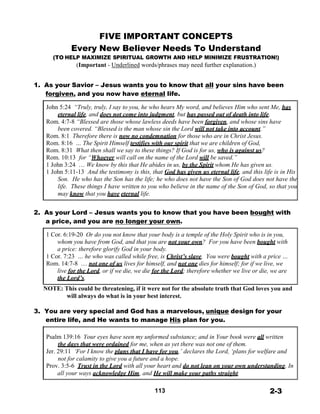
make bread (body)
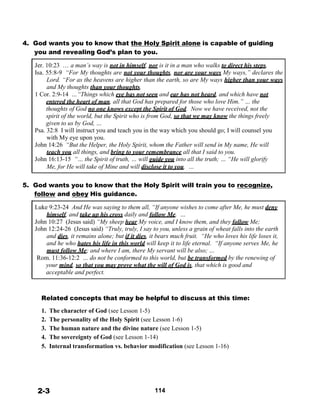
Gen. 3:6
to gain wisdom (understanding)
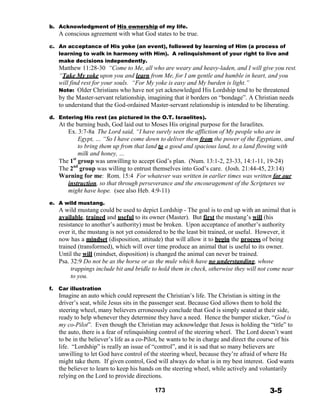
good for food (body)
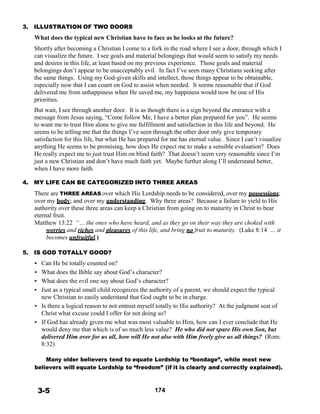
pleasing to eye (possess)
spirit
 
soul
 
(Problem of humanity)
body Jesus chose to
kingdoms (possess)
Adam & Eve chose to seek to
satisfy their “perceived” needs
independent of God
be “dependent
on God”


1-5
ORIGIN OF THE TWO NATURES - GUIDE
 
The main purpose of this lesson is to help clarify the events which have led to our present condition as
a believer having two natures. A number of foundational Biblical principles will be introduced which
should help us to more easily understand other truths as they are presented in subsequent lessons.
 
 
The Character of God --- It is important to understand the significance of Biblical terms that
describe His attributes. His attributes will be reinforced, as we allow the Holy Spirit to speak
to us through His written Word. IMPORTANT: In this lesson, the main purpose of
presenting certain attributes of God is to demonstrate how reasonable it is to trust Him. As
unbelievers we were accustomed to trusting in ourselves, but as believers we need to form the habit of
trusting God in our daily decisions. Reason out that if God’s character is as portrayed in the Bible,
then it is very logical to trust Him completely, and very illogical to not trust Him. There is no
reasonable logic for not yielding to Him. A major reason for distrusting God is our tendency to impute
to God our character. If God were like us then it would be quite reasonable to distrust Him.
 
 
Satan’s strategy --- is to persuade people that God is not trustworthy, by undermining their
confidence in God’s character. Example: In Genesis 3:1-5 he sought to instill doubt,
insinuating that God is a liar, suggesting that God did not have their best interest at heart, and
implying that He was withholding that which in some way would be good for them. If God did not
love them, how then could He be trusted?
 
Gen. 3:1-5 Now the serpent was more crafty than any beast of the field which the Lord God
had made. And he said to the woman, “Indeed, has God said, ‘You shall not eat from any
tree of the garden’?” The woman said to the serpent, “From the fruit of the trees of the
garden we may eat; but from the fruit of the tree which is in the middle of the garden, God
has said, ‘You shall not eat from it or touch it, or you will die.’ ” The serpent said to the
woman, “You surely will not die! “For God knows that in the day you eat from it your
eyes will be opened, and you will be like God, knowing good and evil.”


When Adam and Eve were created they were made perfect, as was all creation. They were
complete and totally satisfied, not lacking in any way. Everything they did was in total
harmony with God’s character. Death did not exist before that time.
 
Rom. 5:12 … just as through one man sin entered into the world, and death through sin,
and so death spread to all men, because all sinned—
1 Cor. 15:21-22 For since by a man came death, … in Adam all die, …


Adam and Eve believed Satan’s lie about God’s character and ate the fruit, choosing to
pursue self-satisfaction “independent” of God. The choice to live independent from God
was evident in three areas:
1. The human understanding (to gain wisdom)
2. The appetites of the body (good for food), and
3. Possessions (pleasing to the eye).
 
 
23 1-5
(Temptations also fall into one of these three areas.) It is important to see this “predisposition toward
independence” as the “root” problem of humanity and one of the driving forces behind the global
and individual resistance to God.
 
Gen. 3:6 When the woman saw that the tree was good for food, and that it was a delight to
the eyes, and that the tree was desirable to make one wise, she took from its fruit and ate;
and she gave also to her husband with her, and he ate.


Every person born into the human race inherits the sinful human nature (pictured as a dark
tree) of Adam, through their biological father. Consequently, every human is born with a
disposition of resistance toward God.
 
Gen. 5:3 … Adam … became the father of a son in his own likeness, according to his image,
Gal. 5:16-23 … For the flesh sets its desire against the Spirit, …


Jesus was born into the human race, but without a sinful human father. As the second Adam,
He was born with the same sinless human nature that Adam had before he fell. The righteous
character of Jesus, as seen in His life, is what God had originally intended for Adam.
 
1 Cor. 15:45-46 … “The first man, Adam, became a living soul.” The last Adam became a
life-giving spirit. …
Rom. 5:19 For as through the one man’s disobedience the many were made sinners, even so
through the obedience of the One the many will be made righteous.


Jesus was tempted in the same three areas as Adam, but Jesus chose to entrust Himself
into God’s care instead of believing Satan’s enticement to seek to live independent of God.


Upon believing, the new believer is born into the spiritual race, and receives the divine
nature in the Person of the Holy Spirit. Important: The sinful human nature can never be
improved. (See Gal. 5:17 below)
 
John 3:3,6 Jesus answered … “Truly, truly, I say to you, unless one is born again he cannot
see the kingdom of God.” … “That which is born of the flesh is flesh, and that which is
born of the Spirit is spirit.
Rom. 7:14-25 … For I know that nothing good dwells in me, that is, in my flesh; … I find
then the principle that evil is present in me, the one who wants to do good. For I joyfully
concur with the law of God in the inner man, but I see a different law in the members of
my body, waging war against the law of my mind and making me a prisoner of the law of
sin which is in my members. ... So then, on the one hand I myself with my mind am
serving the law of God, but on the other, with my flesh the law of sin.


1-5 24
Gal. 5:16-23 But I say, walk by the Spirit, and you will not carry out the desire of the flesh.
For the flesh sets its desire against the Spirit, and the Spirit against the flesh; for these are
in opposition to one another, ... Now the deeds of the flesh are evident, which are:
immorality, impurity, sensuality, idolatry, sorcery, enmities, strife, jealousy, outbursts of
anger, disputes, dissensions, factions, envying, drunkenness, carousing, and things like
these, … But the fruit of the Spirit is love, joy, peace, patience, kindness, goodness,
faithfulness, gentleness, self-control;


A Sampling of Verses Related to God’s Character
 
PERFECT
 
Deut. 32:3-4 ... Ascribe greatness to our God! “The Rock! His work is perfect, …
2 Sam. 22:31 As for God, His way is blameless; The word of the LORD is tested; …
Matt. 5:48 … your heavenly Father is perfect.
 
 
HOLY / RIGHTEOUS / CAN DO NO WRONG, NOR LIE / JUST / PURE FROM ALL EVIL
 
Deut. 32:3-4 … Ascribe greatness to our God! “The Rock! His work is perfect, for all His
ways are just; a God of faithfulness and without injustice, righteous and upright is He.
Lev. 19:2 … Speak to all the congregation of the sons of Israel and say to them, You shall be
holy, for I the LORD your God am holy.
Job 34:10 “… far be it from God to do wickedness, and from the Almighty to do wrong.
Psa. 18:30 As for God, His way is blameless; …
Isa. 6:3 And one called out to another and said, “Holy, Holy, Holy, is the LORD of hosts,
Isa. 57:15 For thus says the high and exalted One Who lives forever, whose name is Holy, “I
dwell on a high and holy place,
Hab. 1:13 Your eyes are too pure to approve evil, …
Luke 1:49 “For the Mighty One has done great things for me; And holy is His name.
Rom. 3:25-26 … whom God displayed publicly as a propitiation in His blood through faith.
This was to demonstrate His righteousness, …
Heb. 6:18 ... it is impossible for God to lie, ...
Rev. 15:4 “Who will not fear, O Lord, and glorify Your name? For You alone are holy; …
 
 
SOVEREIGN
 
Job 34:14-15 “If He should determine to do so, if He should gather to Himself His spirit and
His breath, all flesh would perish together, and man would return to dust.
Prov. 21:30 There is no wisdom, no insight, no plan that can succeed against the LORD.
Isa. 46:11 … Truly I have spoken; truly I will bring it to pass. I have planned it, surely I will
do it.
Dan. 4:35 “All the inhabitants of the earth are accounted as nothing, but He does according
to His will in the host of heaven and among the inhabitants of earth; and no one can ward
off His hand or say to Him, ‘What have You done?’
Acts 4:24 …, they lifted their voices to God with one accord and said, "O Lord, it is You who
made the heaven and the earth and the sea, and all that is in them”,


25 1-5
LOVE
 
John 3:16 For God so loved the world, that He gave His only begotten Son, …
Rom. 5:8 But God demonstrates His own love toward us, in that while we were yet sinners,
Christ died for us.
1 John 4:16 We have come to know and have believed the love which God has for us. God is
love, …
 
 
FAITHFUL / TOTALLY TRUSTWORTHY / DEPENDABLE
 
Deut. 32:3-4 … ; Ascribe greatness to our God! … A God of faithfulness …
Psa. 33:18-21 … the eye of the Lord is on those who fear Him, on those who hope for His
lovingkindness, to deliver their soul from death and to keep them alive in famine. Our soul
waits for the Lord; He is our help and our shield. For our heart rejoices in Him, because
we trust in His holy name.
Psa. 34:4-8 I (David) sought the Lord, and He answered me, and delivered me from all my
fears. … This poor man cried, and the Lord heard him and saved him out of all his
troubles. The angel of the Lord encamps around those who fear Him, and rescues them.
O taste and see that the Lord is good; how blessed is the man who takes refuge in Him!
Psa. 36:5 Your lovingkindness, O LORD, extends to the heavens, Your faithfulness reaches to
the skies.
Psa. 86:15 But You, O Lord, are a God merciful and gracious, slow to anger and abundant in
lovingkindness and truth.
Jer. 29:11 ‘For I know the plans that I have for you,’ declares the Lord, ‘plans for welfare
and not for calamity to give you a future and a hope.
Rom. 8:28 And we know that God causes all things to work together for good to those who
love God, to those who are called according to His purpose.
1 Cor. 10:13 No temptation has overtaken you but such as is common to man; and God is
faithful, who will not allow you to be tempted beyond what you are able, but with the
temptation will provide the way of escape also, so that you will be able to endure it.
1 Thess. 5:24 Faithful is He who calls you, and He also will bring it to pass.
2 Thess. 3:3 But the Lord is faithful, …
2 Tim. 2:13 If we are faithless, He remains faithful, for He cannot deny Himself.
1 Peter 4:19 Therefore, those also who suffer according to the will of God shall entrust their
souls to a faithful Creator in doing what is right.
 
 
NEVER CHANGES
 
Psa. 102:25-27 Of old You founded the earth, and the heavens are the work of Your hands.
Even they will perish, but You endure; And all of them will wear out like a garment; like
clothing You will change them and they will be changed but You are the same and Your
years will not come to an end.
Malachi 3:6 For I, the LORD, do not change; …
James 1:17 Every good thing given and every perfect gift is from above, coming down from
the Father of lights, with whom there is no variation or shifting shadow.


1-5 26
HOW TO RELATE TO THE HOLY SPIRIT
 
Note to discipler: Each point in this lesson introduces an important concept that the disciple
needs to consider and clearly understand early in the Christian walk. As you cover each point,
help the disciple to recognize the consequences of not understanding that concept; for example,
what would be the typical result of not thinking of the Holy Spirit as a Person? Explain how Jesus
was limited by a physical body, but the Holy Spirit is “omnipresent”.
 
 
1. I SHOULD INTERACT WITH THE HOLY SPIRIT AS A PERSON, FOR HE IS GOD
HIMSELF. I SHOULD NOT THINK OF HIM AS JUST AN “INSPIRATION”, OR AN
“INFLUENCE”, WITHOUT PERSONALITY.
 
Acts 5:3-4 … Peter said, “Ananias, why has Satan filled your heart to lie to the Holy Spirit
and to keep back some of the price of the land? “While it remained unsold, did it not
remain your own? And after it was sold, was it not under your control? Why is it that you
have conceived this deed in your heart? You have not lied to men but to God.”
1 Cor. 2:10-11 … the Spirit searches all things, even the depths of God. For who among
men knows the thoughts of a man except the spirit of the man which is in him? Even so the
thoughts of God no one knows except the Spirit of God.
2 Cor. 13:14 The grace of the Lord Jesus Christ, and the love of God, and the fellowship of the
Holy Spirit, be with you all. (Phil. 2:1)
Eph. 4:30 Do not grieve the Holy Spirit of God, by whom you were sealed for the day of
redemption
Job 33:4 “The Spirit of God has made me, …
 
The Holy Spirit is a Person. He is not an influence, or a force, or an inspiration, but God
Himself. He is like a best Friend, yet so much more. My relationship with Him is in many ways
to be similar to a good spousal relationship. What are the implications of such a relationship?
Respect? Communication? Interaction? Nurturing? How would you treat a “force”?
 
 
2. HE LIVES IN ME, HIS TEMPLE. HE OWNS ME (WHETHER I BELIEVE IT OR NOT).
HIS OWNERSHIP DOES NOT BECOME TRUE AFTER I BELIEVE IT.
 
1 Cor. 3:16 Do you not know that you are a temple of God and that the Spirit of God dwells
in you?
1 Cor. 6:19-20 Or do you not know that your body is a temple of the Holy Spirit who is in
you, whom you have from God, and that you are not your own? For you have been
bought with a price: therefore glorify God in your body.
 
God’s ownership of the Christian is a factual truth, which is not dependent on the believer’s
acknowledgment of it. I do not bestow ownership, I can only acknowledge and act upon what
He states to be already true. New believers will typically not be resistant to this truth, because
they don’t have preconceived ideas of God’s expectations. In contrast, older believers tend to
accept this truth intellectually, but be resistant to the implications. What are the implications of
ownership? What rights or authority are generally understood to be conveyed by ownership?
 
 
27 1-6
3. HE IS THE SEAL (DEPOSIT, GUARANTEE, EVIDENCE) THAT I AM GOD’S CHILD
 
Rom. 8:9, 14-16 … if anyone does not have the Spirit of Christ, he does not belong to Him.
… For all who are being led by the Spirit of God, these are sons of God. … The Spirit
Himself testifies with our spirit that we are children of God,
2 Cor. 1:21-22 Now He who establishes us with you in Christ and anointed us is God, who
also sealed us and gave us the Spirit in our hearts as a pledge. (See also 2 Cor. 5:5)
Gal. 4:6 Because you are sons, God has sent forth the Spirit of His Son into our hearts, …
Eph. 1:13-14 In Him, you also, after listening to the message of truth, the gospel of your
salvation—having also believed, you were sealed in Him with the Holy Spirit of promise,
who is given as a pledge (down payment, guarantee, deposit) of our inheritance, …
1 John 3:24 … We know by this that He abides in us, by the Spirit whom He has given us.
(See 1 John 4:13)
 
The Holy Spirit is God’s evidence of my salvation. We should actively seek after the Holy Spirit
and be open to His guidance and instruction. A disciple should grow increasingly more
dependent on the Holy Spirit and increasingly less dependent on a discipler. A disciple should
increasingly recognize the Holy Spirit’s promptings in his everyday life.
 
 
4. HE HAS A PLAN FOR EVERY DAY OF MY LIFE. HE WANTS ME TO LEARN TO
FOLLOW AND OBEY HIM. HE DOES NOT EXPECT TO FOLLOW MY PLAN.
 
Psalm 139:16 Your eyes have seen my unformed substance; and in Your book were all written
the days that were ordained for me, when as yet there was not one of them.
Jer. 10:23 I know, O Lord, that a man’s way is not in himself, nor is it in a man who walks to
direct his steps.
Jer. 29:11 ‘For I know the plans that I have for you,’ declares the Lord, ‘plans for welfare
and not for calamity to give you a future and a hope.
John 14:16-17 (Jesus said) “I will ask the Father, and He will give you another Helper, that
He may be with you forever; …
John 14:26 “But the Helper, the Holy Spirit, whom the Father will send in My name, He will
teach you all things, and bring to your remembrance all that I said to you.
John 16:13-15 “… when He, the Spirit of truth, comes, He will guide you into all the truth;
for He will not speak on His own initiative, but whatever He hears, He will speak; and He
will disclose to you what is to come. “He will glorify Me, for He will take of Mine and
will disclose it to you. …
1 Cor. 2:9-14 … just as it is written, “Things which eye has not seen and ear has not heard,
and which have not entered the heart of man, all that God has prepared for those who love
Him.” For to us God revealed them through the Spirit; … Now we have received, not the
spirit of the world, but the Spirit who is from God, so that we may know the things freely
given to us by God, ….
 
A disciple needs to fit into God’s plan for his life. God wants me to follow Him, He does not
want me to view Him as my Servant, fitting into my plans and assisting me whenever I
determine I need His help. I should feel free to make tentative daily and future plans, while
always being mindful that He may want to change my plans.


1-6 28
5. HE INTERCEDES TO THE FATHER FOR ME AND TEACHES ME TO PRAY.
 
Rom. 8:26-27 In the same way the Spirit also helps our weakness; for we do not know how to
pray as we should, but the Spirit Himself intercedes for us with groanings too deep for
words; … He intercedes for the saints according to the will of God.
Eph. 2:18 for through Him (Jesus) we both have our access in one Spirit to the Father.
Eph. 6:17-18 … With all prayer and petition pray at all times in the Spirit, and with this in
view, be on the alert with all perseverance and petition for all the saints,
Jude 20 But you, beloved, … praying in the Holy Spirit,
 
A disciple needs to maintain a continual active communication with the Holy Spirit, through
conversational prayer, reading and studying the Word, listening to teachings, etc.
 
 
6. HE BAPTIZED ME INTO THE UNIVERSAL BODY OF CHRIST, WITH ALL TRUE
BELIEVERS. (REFERS TO “SPIRITUAL” BAPTISM, NOT TO WATER BAPTISM).
 
Matt. 3:11 (John the Baptist said) “… I baptize you with water for repentance, but He who is
coming after me is mightier than I, … He will baptize you with the Holy Spirit and fire.
1 Cor. 12:12-13 For even as the body is one and yet has many members, and all the members
of the body, though they are many, are one body, so also is Christ. For by one Spirit we
were all baptized into one body, whether Jews or Greeks, whether slaves or free, and we
were all made to drink of one Spirit.
 
A disciple needs to understand his oneness with all members of the universal Body of Christ, the
one and only true Church, bonded together by the Holy Spirit. There are some doctrinal and
cultural differences between Christians that should not create divisions or resentments.
 
 
7. HE WANTS TO USE ME TO TESTIFY ABOUT JESUS TO UNBELIEVERS.
 
Mark 13:11 “When they arrest you and hand you over, do not worry beforehand about what
you are to say, but say whatever is given you in that hour; for it is not you who speak, but
it is the Holy Spirit. (Matt. 10:19 / Luke 12:11)
John 15:26 “When the Helper comes, whom I will send to you from the Father, that is the
Spirit of truth who proceeds from the Father, He will testify about Me,
John 16:8-11 “And He (the Holy Spirit), … will convict the world concerning sin and
righteousness and judgment; …
Acts 1:8 but you will receive power when the Holy Spirit has come upon you; and you shall
be My witnesses both in Jerusalem, and in all Judea and Samaria, and even to the
remotest part of the earth.”
 
The Holy Spirit desires to use His children to attract unbelievers to a believing faith in Jesus
Christ. This should be through spoken words as well as the example of a life yielded to Him.
St. Francis of Asissi is quoted as saying – “preach the gospel – and if necessary use words”.


29 1-6
8. HE WANTS TO USE THE SPIRITUAL GIFT(S) HE HAS GIVEN ME FOR OTHERS.
 
Mark 9:35 … He … said to them, “If anyone wants to be first, he shall be last of all and
servant of all.”
Rom. 12:4-8 For just as we have many members in one body and all the members do not have
the same function, so we, who are many, are one body in Christ, and individually
members one of another. Since we have gifts that differ according to the grace given to
us, each of us is to exercise them accordingly: if prophecy, according to the proportion of
his faith; if service, in his serving; or he who teaches, in his teaching; or he who exhorts,
in his exhortation; he who gives, with liberality; he who leads, with diligence; he who
shows mercy, with cheerfulness.
1 Cor. 12:4, 7-11 Now there are varieties of gifts, but the same Spirit. … But to each one is
given the manifestation of the Spirit for the common good. … But one and the same
Spirit works all these things, distributing to each one individually just as He wills.
Phil. 2:3-4 Do nothing from selfishness or empty conceit, but with humility of mind regard
one another as more important than yourselves; do not merely look out for your own
personal interests, but also for the interests of others.
1 Peter 4:10-11 As each one has received a special gift, employ it in serving one another as
good stewards of the manifold grace of God. Whoever speaks, is to do so as one who is
speaking the utterances of God; whoever serves is to do so as one who is serving by the
strength which God supplies; so that in all things God may be glorified through Jesus
Christ, to whom belongs the glory and dominion forever and ever. Amen.
 
Each disciple is unique in the plan and purposes of God. The Holy Spirit wants to produce
interaction and involvement between believers. (Jesus said “By this all men will know that you
are My disciples, if you have love for one another.” - John 13:35) He wants to minister to other
believers through me, He doesn’t want me to simply be focused on how others can meet my
needs. Discuss the concept of spiritual reproduction; i.e., investing my resources (time,
energy, possessions) in other believers to help them toward spiritual maturity and fruitfulness.
 
Important: In the physical human body each member functions to serve the body, not the body
to serve the members.
 
 
9. HE ALONE CAN PRODUCE SPIRITUAL LIFE IN AND THROUGH ME.
 
John 6:63 (Jesus said) “It is the Spirit who gives life; the flesh profits nothing; the words that
I have spoken to you are spirit and are life.
2 Cor. 3:6 … the letter kills, but the Spirit gives life.
Eccl. 3:14 I know that everything God does will remain forever; there is nothing to add to it
and there is nothing to take from it, for God has so worked that men should fear Him.
 
Anything of eternal value must have its origin in the Holy Spirit. I am, and will continue to be,
tempted to rely on myself until I leave this body. The disciple needs to be aware of this
tendency, so as not to feel that he is somehow abnormal.


1-6 30
NOTES ON DISCIPLESHIP
 
Lesson
No.


31
NOTES
I
THE NORMAL PROGRESSIVE DEVELOPMENT OF A CHRISTIAN 


B
Decision Decision
R
T
H
 
God
 
me
God me God
 
me
me
P D
H E
Y A
xoGoxoxoxoxo S T
 
 
xoxoxoxoxo
xoxoxoxoxo
xoxoxoxoxo
xoxoxoxoxo
I H
GoxoGoxoxo C
GoxoGoxoxo A
GoGoxoGo L


CONSIDER: Surrender consists of two parts.
1. First there is a decision to surrender the will (an acknowledgment of His ownership of my life and the obvious
implications of the Master-servant relationship, that is, His “Lordship”).
2. This decision is then followed by the daily process of yielding up areas of my understanding and behavior. The Holy
Spirit seeks my cooperation in allowing Him to transform me into an increasingly mature and fruitful Christian.
 
CONSIDER: A one-time surrender of the “will” precedes a progressive yielding up of “behavior”.
 
CONSIDER: “Inward transformation” will produce “outward behavior changes”.
 
 
“True surrender is not simply surrender of our external life but surrender of our will -- and once that is done, surrender is complete. The
greatest crisis we ever face is the surrender of our will. Yet God never forces a person's will into surrender, and He never begs. He
patiently waits until that person willingly yields to Him. And once that battle has been fought, it never needs to be fought again.
 
Jesus says, "If you want to be My disciple, you must give up your right to yourself to Me." And after you surrender -- then what? Your
entire life should be characterized by an eagerness to maintain unbroken fellowship and oneness with God.”
(Taken from My Utmost for His Highest by Oswald Chambers – Sep. 13. (c) l935 by Dodd Mead & Co., renewed (c) 1963 by the Oswald Chambers
Publications Assn., Ltd., and is used by permission of Discovery House Publishers, Box 3566, Grand Rapids MI 4950l. All rights reserved.)
 
 
1-7 32
Let’s Go Through The Above Diagram Step-By-Step.
 
 
me This circle represents the unbeliever. At birth our mind was like an empty blackboard.


Decision


God me
Through the conviction of the Holy Spirit, the unbeliever must recognize his/her hopelessness, and make a “decision” to call
out to the Lord for forgiveness and salvation.
 
The new believer receives eternal life (an event) and the Lord begins to dwell in the believer in the Person of the Holy Spirit.
During this phase it is natural for the new believer to be focused on “external behavior”.


xoxoxoxoxo
xoxoxoxoxo
xoxoxoxoxo
xoxoxoxoxo


Decision


God
 
me
This graphic represents the understanding about life, values, etc. that has been acquired from birth to conversion as a result of
the influence and learning from parents, peers, media, culture, etc. That understanding does not disappear at salvation. The
believer now needs to learn to walk with the Holy Spirit as a habit. The function of discipleship is to facilitate that process.
Note: Much of this understanding is contrary to God, but He alone can correctly manage the process of transformation.
Note: X = Understanding that is contrary to God O = Understanding that is not necessarily contrary to God
 
In order for spiritual growth to continue the believer has to come to an agreement with the Lord as to who is best capable of
managing the growth process. Preferably this takes place at conversion, but unfortunately in many cases it is not understood
and accepted, until later. Typically, there are three motivations that will help the Christian to make the decision to accept the
Biblical Master-servant relationship. They are: 1) Persecution, 2) Crisis, and 3) Personal discipleship.
 
This graphic represents the believer who has made the decision to yield up his independence, and has acknowledged to the Lord
His rightful Lordship of Christ over his life. He understands that God alone is capable of overseeing his life.
 
THE GROWTH PROCESS: As I allow Him, God will use His Word and circumstances to gradually illuminate areas of my
understanding that He wants to alter. This process is called “Sanctification” (Rom. 12:1-2; Eph. 4:22-24) “Spiritual growth”
God is the process in which God’s perspective of life is increasingly becoming the Christian’s perspective. God does not want
the Christian to be a mindless robot, but rather a companion who increasingly enjoys fellowship with Him.
me


xoGoxoxoxoxo
GoxoGoxoxo
GoxoGoxoxo
GoGoxoGo
“As a Christian is transformed in his mind and is made more like Christ, he comes to approve and desire God’s will, not his
own will for his life. Then he discovers that God’s will is what is good for him, and that it pleases God, and is complete in every
way. It is all he needs. But only by being renewed spiritually can a believer ascertain, do, and enjoy the will of God.”
(Walvoord, John F., and Zuck, Roy B., The Bible Knowledge Commentary, (Wheaton, Illinois: Scripture Press Publications, Inc.) 1983, 1985.
Note: G = Represents areas of understanding that God has changed to His perspective.
 
 
1-7 33
I
THE COMMON MISCONCEPTION OF “PROGRESSIVE SURRENDER”
 
This Diagram Represents the Abnormal Progressive Development of a Christian.
 
 
CONSIDER: Many Christians view their relationship with God as depicted here. A critical error is to attribute to God authority
(Lordship) over only a designated part of my life, as if He had not bought all of me. This view of the Christian life
usually results from a lack of personal discipleship and/or an unwillingness to surrender one’s will to His Lordship.


“I truly intend for Jesus to be
in total control someday”
But meanwhile…, I think God
just wants me to do my
best, doesn’t He?”
The perceived goal
Decision God has
B
“God’s
“100%
R
T
H
me
 
 
God me
part”
 
 
“Mine to
manage”
Control”


CONSIDER: If “Lordship” is presented in the context of a “process of incremental surrender” of external behavior the perceived implication
is made that a “totally outwardly obedient” life is the logical evidence of that “total surrender” being attained. Typically the
believer sees himself in charge of overseeing that process, and this leads to cycles of frustration and discouragement, since
who ever considers himself totally obedient?
 
CONSIDER: If “Tithes and offerings” are presented as “God’s share”, the perceived implication is that I have a “right” to manage the rest
of my material wealth. If “Time” for attendance at church functions, Bible Reading, etc. is understood to be God’s part, then
is not the rest of my hours mine to manage?


1-7 34
Problems Associated with the Preceding Perspective:
 
1. It tends to result in a Christian perceiving God as a threat; such as:
 
a. “What will He ask me to do that I can’t do, or don’t want to do?”
b. “What will He keep me from doing that I want to do?”
 
 
c. “What will He take away from me that I hold dear?”
d. “Will God fail me if I entrust this to Him?”
 
2. The Christian views himself/herself as being in charge of the process of spiritual growth, making the determinations as to what can and
should be yielded up to the Holy Spirit. In other words, the Christian sets down the rules and limits. This perception is typically based on
pride, an inflated view of one’s own discernment and capabilities, and a distorted understanding of God’s character.
 
CONSIDER: There is no reasonable logic for rejecting His yoke of Lordship. A lack of acceptance is typically based on: 1) a fear of the
unknown, 2) an unwillingness to relinquish perceived control, 3) an unwillingness to leave a comfort zone, or 4) an over-
estimation of one’s own capabilities to determine and manage their future.
Jesus said: “Come to Me, all who are weary and heavy-laden, and I will give you rest. “Take My yoke upon you and learn from
Me, for I am gentle and humble in heart, and you will find rest for your souls. “For My yoke is easy and My burden is light.”
(Matthew11:28-30) Jesus did not say, “learn about Me, and if you like how I do things, then take My yoke!”
 
CONSIDER:


CONSIDER:
The real question is, Is God trustworthy? If God were like you or me, we would have good reason to be fearful.
 
One should ask: Does God love me? If God’s character is as described in the Bible, and if He promises to do only that which is
in my best interest, what then do I have to fear? Did He not design me? Did He not give me life? Does He not maintain my
very existence? Who besides God knows what will really satisfy me? Does not He alone know what is best for me? Does not
He alone know how He wants to shape my life and use me for His eternal purposes?
 
God’s ownership of the Christian is a factual truth, which is not dependent on the believer’s acknowledgment of it. I do not
bestow ownership, I can only acknowledge and act upon what He states to be already true. New believers will typically not be
resistant to this truth, because they don’t have preconceived ideas of God’s expectations. In contrast, older believers tend to
accept this truth intellectually, but be resistant to the implications. What are the implications of ownership? What rights or
authority are generally understood to be conveyed by ownership? A disciple needs to understand that he lives in a spiritual
“kingdom”, not in a spiritual democracy.
 
Or do you not know that your body is a temple of the Holy Spirit who is in you, whom you have from God, and that you are not
your own? For you have been bought with a price: therefore glorify God in your body. 1 Cor. 6:19-20
 
 
If God’s intention were to do you harm or mistreat you, do you really think He needs to wait for your permission?
 
 
1-7 35
Analogy: The Rooms of Your “House”
= Does Jesus have access to all the rooms of your house?
 
 
A story of two believers….
 
When Jesus knocked at the front door of their hearts (Rev. 3:20) and asked permission to enter, both of these persons gladly received
Him, realizing that His absence had been the reason for the emptiness they had always sensed (the Salvation decision).
 
As new believers each was overjoyed that Jesus was in his house and that his sins were forgiven. Each had a new happiness and an
assurance of going to heaven. Jesus was allowed to occupy the “Guest Room” – which was always kept clean and presentable for visitors
– and He was also allowed to reside in the “spiritual” room – where the believer went to church services, prayed and read the Bible.
 
But one day soon Jesus asked each of them for permission to make some changes in other areas of their houses, such as
adopting new management procedures, rearranging items, throwing out worthless things, and bringing in some new items. He asked for
access to every room. Each believer had a different response.


Salvation decision
ONLY
= JESUS has access  
 
Salvation AND
Lordship decisions
 
Financial & Possessions
Management Room
 
Worldview &
Political Room
 
Physical &
Health Room
 
Social &
Relationships Room
Marriage &
Family Room
 
Occupation &
Recreation Room
 
Time Management and
Future Planning Room
 
Miscellaneous Room
Financial & Possessions Marriage &
Management Room Family Room
= =
Worldview & Occupation &
= Political Room Recreation Room =
Physical & Time Management and
= Health Room Future Planning Room =
 
Social &
What’s in this room?
= Relationships Room
 
Guest Room “Spiritual” room
= = =
Guest Room “Spiritual” room
=


1-7 36
Salvation decision
ONLY
 
The believer in the house on the left found himself reluctant to
grant Jesus’ request on the grounds that he was not really
prepared yet for major changes. However, he would
thoughtfully consider any suggestions, and could probably allow
some minor changes that wouldn’t seriously disrupt his lifestyle
and future plans.
 
Jesus informed him that He (Jesus) is the only One who is really
capable of making the correct decisions as to the above
changes, since He alone knows what is needed to make the
house into a suitable dwelling for God, one that would be usable
for His purposes. Jesus clearly explained His good intentions,
even guaranteeing that the believer would be more than totally
satisfied with the finished product.
 
The believer replied that while the offer sounded very attractive,
he considered himself to be a good judge of the
appropriateness and non-disruptive pace of any changes,
based on his past experience. He expressed his appreciation
for Jesus’ presence and blessings, and his desire to make the
Guest Room as comfortable as possible for Him.
 
He assured Jesus that as time went on, he would certainly give
Jesus access to other rooms. “Jesus, I’m thankful You live in
my house! I’m really happy to know that I can count on You to
be there whenever I find circumstances too difficult to manage.
Salvation AND
Lordship decisions
 
The believer in the house on the right also found himself reluctant
to grant Jesus’ request on the grounds that he was not really
prepared yet for major changes. However, he had become aware
that he had been bought at a great price and therefore Jesus
was the rightful Owner.
 
He reasoned, “If Jesus is the Owner, how then can I deny Him
access to every room of His house?” (the Lordship decision to
acknowledge Jesus as Master of his life.)
 
The believer was somewhat apprehensive, as he didn’t
understand how this decision would impact his future. But he
reasoned that since Jesus had done so much for him already it
seemed logical that He was trustworthy to continue doing what
was in his best interest.
 
“Jesus, I certainly don’t know what You have planned for my life,
and to be honest I have some fears. But I do understand that
You own me, and that I cannot possibly make the best decisions
for my life since I don’t know what You want to make of me, nor
what is involved in that process. I’m thankful that You do know,
and I want to trust You alone to make the appropriate changes.”
 
“Thank you for letting me be part of Your plans. Wow!”
 
Or do you not know that your body is a temple of the Holy Spirit who is in
you, whom you have from God, and that you are not your own? For you
have been bought with a price: therefore glorify God in your body.
(1 Cor. 6:19-20)
 
Even though making the Lordship decision gives the Lord access to all the rooms in the house, He alone decides what needs to be
changed in each room. The Holy Spirit will manage the changes as He determines best. This is all part of the continued growth process.
 
WHAT ROOMS ARE IN YOUR HOUSE? Can you trust God with ALL the rooms? Think carefully and prayerfully if Jesus has access to all
of your house – He owns it!
 
Upon viewing the finished product, nobody will ever regret having made the decision to choose Him as the Manager of their life.
 
 
1-7 37
OVERVIEW OF THE TWO NATURES
 
 
1. THE FOLLOWING DIAGRAMS DEPICT FOUR SPIRITUAL CONDITIONS.
 
A Adam (before he sinned) and
Jesus - while He was on earth
 
 
GOD


spirit
soul
The sinless
 
Gen. 1:27 God created man in His own image, …
Gen. 2:7 … the Lord God … breathed into his
nostrils the breath of life; and man became a
living being. (only said of man)
Gen. 1:31 God saw all that He had made, and
behold, it was very good. … (no
imperfections, nothing lacking)
Rom. 5:14 … Adam, who is a type of Him who
was to come.
1 Cor. 15:45 … The first man, Adam, became a
living soul.” The last Adam (Jesus) became a
life-giving spirit.
Phil. 2:5-7 … Christ Jesus, … emptied Himself,
body human nature,
totally compatible
with God.
taking the form of a bond-servant, and being
made in the likeness of men.
Heb. 4:15 (Jesus) … One who has been tempted in
 
All behavior was in total harmony with
God’s character, totally pleasing to God.
all things as we are, yet without sin.
 
= The sinless human nature, totally compatible with God.


B All unbelievers


Without
God’s life
spirit soul
body


GOD
 
 
sin


The corrupted
human nature.
 
 
Rom. 3:23 for all have sinned and fall short of the
glory of God,
Rom. 3:10-12 … There is none righteous, not
even one; … there is none who seeks for God;
… there is none who does good, there is not
even one.”
1 Cor. 15:22 For as in Adam all die, …
Eph. 2:12 … having no hope and without God in
the world.
 
Thought: God can only accept that which is
perfect (100%, without blemish). Nothing that
originates from the human nature has that quality.
The unbeliever is devoid of His life. Only God
Their works (fruit) have no life (eternal),
are imperfect (flawed), and therefore
unacceptable to God.
alone can produce anything of eternal value.


= The sinful human nature, corrupted and incapable of producing fruit that is acceptable and
pleasing to God.
 
1-8 38
 
C The condition of “abiding” in fellowship with
the Holy Spirit. (The “normal” Christian life)
“walking in the Spirit”


Holy
Spirit
 
Gal. 5:16 … walk by the Spirit, and you
will not carry out the desire of the
flesh.
 
Gal. 5:22-23 … the fruit of the Spirit is
love, joy, peace, patience, kindness,
goodness, faithfulness, gentleness,
self-control; against such things
there is no law.
 
spirit Human Nature is still
present and corrupted,
but powerless
soul
 
 
body
 
All that I allow the Holy Spirit to do through me is
eternal and rewardable at the judgment seat of Christ
(gold, silver, precious stones).
 
Note: The circular “dotted line” represents the “conditional” aspect of abiding.
 
 
The condition of “not abiding”, having an
D unresolved issue(s) with the Holy Spirit.
“walking in the flesh”


Holy
Spirit
 
spirit The Law
condemns
 
soul
 
Gal. 5:17 For the flesh sets its desire
against the Spirit, and the Spirit
against the flesh; for these are in
opposition to one another, …
John 15:4-5 “… As the branch cannot
bear fruit of itself unless it abides
in the vine, so neither can you
unless you abide in Me. … for
apart from Me you can do nothing
(nothing of eternal value).
Rom. 8:8 … those who are in the flesh
cannot please God.
 
 
body
All that is not motivated by the Holy Spirit is temporal,
without His life and not rewardable (wood, hay, stubble).
 
 
Thoughts:
 
Even though I am walking in fellowship with the Holy Spirit (#3), and have no unresolved issues, not all
that I do is motivated by Him, or is even pleasing to Him. As I allow Him to grow and mature me, He will
increasingly have more freedom to bear His fruit. If I find myself out of fellowship with the Holy Spirit
(#4), it is by my choice. I do not need to be out of fellowship with the Holy Spirit any longer than I choose
to be. Restoration to the condition of abiding fellowship (#3) will take place immediately upon confession
of the offense(s) for which the Holy Spirit is holding me accountable. We have freedom in Christ ... not
independence.
 
How can I know if I’m out of fellowship with the Holy Spirit (#4)? Usually symptoms indicate an
ailing body. Similarly look for “on-going” spiritual symptoms of the sinful nature, such as: Stumbling,
Striving, Impatience, Lack of peace, Frustration, Sense of defeat, Dissatisfaction, Complaining,
Worry, Anxiety, Anger, Irritability, Addictive behavior, Critical or Judgmental attitude, etc.
 
 
39 1-8
2. GOD USES TREES AND PLANTS TO CONTRAST THE TWO NATURES.


Holy
Spirit


The Divine Nature
in the Person of the
Holy Spirit


The corrupted sinful
human nature from
the 1st
Adam
Jer. 17:7-8 “Blessed is the man who trusts in the Lord and whose
trust is the Lord. “For he will be like a tree planted by the
water, that extends its roots by a stream and will not fear
when the heat comes; but its leaves will be green, and it
will not be anxious in a year of drought nor cease to yield
fruit.
Psa. 1:3 He (a righteous man) will be like a tree firmly planted by
streams of water, which yields its fruit in its season and its
leaf does not wither;
Mat. 7:17-18 “So every good tree bears good fruit, … “A good tree
cannot produce bad fruit, …
Gal. 5:17-23 … But the fruit of the Spirit is love, joy, peace,
patience, kindness, goodness, faithfulness, gentleness, self-
control; against such things there is no law.
2 Pet. 1:4 … He has granted to us His precious and magnificent
promises, so that by them you may become partakers of the
divine nature, …


Jer. 17:5-6 Thus says the Lord, “Cursed is the man who trusts in
mankind and makes flesh his strength, and whose heart
turns away from the Lord. “For he will be like a bush in
the desert and will not see when prosperity comes, but will
live in stony wastes in the wilderness, a land of salt without
inhabitant.
Mat. 7:17-18 …, but the bad tree bears bad fruit. …, nor can a bad
tree produce good fruit.
Gal. 5:17-23 For the flesh sets its desire against the Spirit, … Now
the deeds of the flesh are evident, which are: immorality,
impurity, sensuality, idolatry, sorcery, enmities, strife,
jealousy, outbursts of anger, disputes, dissensions, factions,
envying, drunkenness, carousing, and things like these, …


3. JAMES COMPARES THE HUMAN NATURE TO A “SALT WATER” SPRING AND
THE DIVINE NATURE OF THE HOLY SPIRIT TO A SPRING OF “LIVING WATER”
 
James 3:9-12 … from the same mouth come both blessing and cursing. My brethren, these
things ought not to be this way. Does a fountain send out from the same opening both
fresh and bitter water? Can a fig tree, my brethren, produce olives, or a vine produce
figs? Nor can salt water produce fresh.
John 7:37-39 … Jesus stood and cried out, saying, “If anyone is thirsty, let him come to Me
and drink. “He who believes in Me, as the Scripture said, ‘From his innermost being will
flow rivers of living water.’ ” But this He spoke of the Spirit, … (See also John 4:13-14)


1-8 40
4. THE HUMAN NATURE IS SINFUL, INDEPENDENT, AND BEYOND REPAIR.
 
Jer. 17:9 “The heart is more deceitful than all else and is desperately sick; …
John 6:63 “It is the Spirit who gives life; the flesh profits nothing; …
Rom. 3:10-12 as it is written, “There is none righteous, not even one; … There is none who
seeks for God; all … have become useless; there is none who does good, there is not
even one.”
Rom. 7:18 For I know that nothing good dwells in me, that is, in my flesh; …
Rom. 8:8 … those who are in the flesh cannot please God.
Gal. 5:17 For the flesh sets its desire against the Spirit, and the Spirit against the flesh; for
these are in opposition to one another, so that you may not do the things that you please.
 
 
5. MAN ATTEMPTS TO IMPROVE OUTWARD BEHAVIOR, BUT GOD FOCUSES OUR
ATTENTION ON THE ROOT PROBLEM - THE SINFUL HUMAN NATURE.
OUTWARD BEHAVIOR IS SIMPLY THE EVIDENCE OF THE REAL PROBLEM.
 
Mat. 5:21-22 (Jesus said) “You have heard that the ancients were told, ‘You shall not commit
murder’ and ‘Whoever commits murder shall be liable to the court.’ “But I say to you
that everyone who is angry with his brother shall be guilty before the court; …
5:27-28 “You have heard that it was said, ‘You shall not commit adultery’; but I say to you
that everyone who looks at a woman with lust for her has already committed adultery
with her in his heart.
Mat. 15:19 “For out of the heart come evil thoughts, murders, adulteries, fornications, thefts,
false witness, slanders.
 
 
6. THE PURPOSE OF THE LAW IS TO MAKE EVIDENT THE SINFULNESS OF MY
HUMAN NATURE, IN ORDER TO PERSUADE ME NOT TO RELY ON IT, BUT
RATHER ON THE HOLY SPIRIT. (See also Galatians 3:1-3)
 
Rom. 3:19-20 Now we know that whatever the Law says, it speaks to those who are under the
Law, so that every mouth may be closed and all the world may become accountable to
God; because by the works of the Law no flesh will be justified in His sight; for through
the Law comes the knowledge of sin. (See also Heb. 7:18-19)
Rom. 5:20 The Law came in so that the transgression would increase; …
 
Gal. 5:22-23 But the fruit of the Spirit is love, joy, peace, patience, kindness, goodness,
faithfulness, gentleness, self-control; against such things there is no law. Everything
that is motivated by the Holy Spirit is in complete harmony with God’s character.
Rom. 4:15 for the Law brings about wrath, but where there is no law, there also is no violation.
Rom. 5:13 … sin is not imputed when there is no law.
 
Note (referring back to Point 3): The Law could be pictured as a sign beside a salty spring in
the desert, “WARNING! THIS WATER IS CONTAMINATED AND UNHEALTHY TO
DRINK.” Salt-water “looks like” fresh water, but it is unable to support human life.


41 1-8
7. IN ROMANS, CHAPTERS 7 - 8, PAUL PRESENTS THE HOPELESSNESS OF THE
HUMAN NATURE AND GOD’S PERFECT SOLUTION.
NOTE: In the following verses, “death” refers to “absence of life”, i.e. devoid of life originating
from God. (for example, a salt water spring).
 
 
a. From God’s perspective the believer has “died to” (freed from) the sinful
nature, and has been joined to Christ.
 
Rom. 6:18, 22 and having been freed from sin, you became slaves of righteousness. …
having been freed from sin and enslaved to God, you derive your benefit, …
Rom. 7:4 … you also were made to die to the Law through the body of Christ, so that you
might be joined to another, to Him who was raised from the dead, in order that we
might bear fruit for God.
 
 
b. As an unbeliever I was dominated by
my sinful nature, which resides in my
physical body.
 
Rom. 7:5 For while we were in the flesh,
the sinful passions, which were
aroused by the Law, were at work in
the members of our body to bear fruit
for death (absence of life).
 
The fact is, Christians died to sin. The Greek
aorist (past) tense for “died” suggests a specific
point when the action occurred, at salvation.
Death, whether physical or spiritual, means
separation, not extinction (cf. vv. 6:6-7, 14).
Death to sin is separation from sin’s power, not
the extinction of sin. Being dead to sin means
being “set free from sin” (vv. 6:18, 22 above).
That being true, Paul asked, How can they live
in it any longer? Obviously believers cannot
live in sin if they died to it.” Walvoord, John F., and
Zuck, Roy B., The Bible Knowledge Commentary, (Wheaton,
IL: Scripture Press Pub., Inc.) 1983, 1985.
 
c. Now, as a believer, I have been freed


Without
God’s life
spirit
 
soul
body


Holy
Spirit
 
spirit
 
 
soul


The Law
exposes the
fruit of the
Human Nature


Me, as a
believer
from bondage to the sinful nature. body
 
Rom. 7:6 But now we have been released
from the Law, having died to that by
which we were bound, so that we
serve in newness of the Spirit and not
 
Human Nature
is present, but
powerless
in oldness of the letter.
Note: The circular “dotted line” represents
the “conditional” aspect of abiding


1-8 42
d. God never intended the Law to be a means by which humans could make the
sinful nature acceptable to Him, but rather He used the Law to demonstrate
how “totally unacceptable” the sinful nature is.
 
Rom. 7:7-13 … I would not have come to know sin except through the Law; for I would
not have known about coveting if the Law had not said, “You shall not covet.” …
So then, the Law is holy, and the commandment is holy and righteous and good.
Therefore did that which is good become a cause of death for me? May it never be!
Rather it was sin, in order that it might be shown to be sin by effecting my death
through that which is good, so that through the commandment sin would become
utterly sinful.
 
 
e. Paul experienced what every Christian needs to learn, that the sinful nature is
not the least bit improved since I became a Christian. No matter how I try, I
cannot make it conform to God’s character.
 
Rom. 7:14-16 For we know that the Law is spiritual, but I am of flesh, sold into bondage
to sin. For what I am doing, I do not understand; for I am not practicing what I
would like to do, but I am doing the very thing I hate. But if I do the very thing I do
not want to do, I agree with the Law, confessing that the Law is good.
 
 
f. Paul became aware that the sinful nature cannot be changed. It no longer
represented his real desires, but what other option did he have?
 
Rom. 7:17-24 So now, no longer am I the one doing it, but sin which dwells in me. For I
know that nothing good dwells in me, that is, in my flesh; for the willing is present
in me, but the doing of the good is not. For the good that I want, I do not do, but I
practice the very evil that I do not want. But if I am doing the very thing I do not
want, I am no longer the one doing it, but sin which dwells in me. I find then the
principle that evil is present in me, the one who wants to do good. For I joyfully
concur with the law of God in the inner man, but I see a different law in the
members of my body, waging war against the law of my mind and making me a
prisoner of the law of sin which is in my members. Wretched man that I am! Who
will set me free from the body of this death?
 
 
g. God’s solution for the hopelessness of the sinful human nature was not to
repair or overhaul the old nature, but to provide a new nature that is totally
compatible with His character. Paul did not reside in Rom. 7, nor should I.
 
Rom. 7:25 Thanks be to God through Jesus Christ our Lord! So then, on the one hand I
myself with my mind am serving the law of God, but on the other, with my flesh the
law of sin.
8:1-4 Therefore there is now no condemnation for those who are in Christ Jesus. For the
law of the Spirit of life in Christ Jesus has set you free from the law of sin and of
death. For what the Law could not do, weak as it was through the flesh, God did:
sending His own Son in the likeness of sinful flesh and as an offering for sin, He
condemned sin in the flesh, so that the requirement of the Law might be fulfilled in
us, who do not walk according to the flesh but according to the Spirit.
 
43 1-8
8:5-8 For those who are according to the flesh set their minds on the things of the flesh,
but those who are according to the Spirit, the things of the Spirit. For the mind set
on the flesh is death (absence of life), but the mind set on the Spirit is life and peace,
because the mind set on the flesh is hostile toward God; for it does not subject itself
to the law of God, for it is not even able to do so, and those who are in the flesh
cannot please God.
Gal. 2:19-20 “For through the Law I died to the Law, so that I might live to God. “I have
been crucified with Christ; and it is no longer I who live, but Christ lives in me; …”


Illustration: The Law of Gravity illustrates how my Human Nature continually attracts me
away from God. For the flesh sets its desire against the Spirit, … (Gal. 5:17). My sinful nature
influences me spiritually similar to the way gravity influences my physical body. I am always
aware of gravity and am continually making adjustments so as not to be overcome by it.
or fall I don’t have to stay down. No baby begins the physical life walking.
If I trip
 
 
…walk by the Spirit,
and you will not carry out the desire of the flesh.
(Galatians 5:16)


1-8 44
“ABIDING” PRINCIPLES TO HELP ME MAINTAIN
CONTINUAL FELLOWSHIP WITH THE HOLY SPIRIT
 
 
“To Abide” simply refers to the moment-by-moment experience of walking
in fellowship with the Holy Spirit; that is, without any “unresolved”
offenses that are disrupting that fellowship (communion).


Holy
Spirit
Holy
Spirit
 
spirit spirit
 
 
soul soul


The Law
condemns
the sinful
body
 
 
Condition of “Abiding”
Human Nature
is present, but
powerless
body
 
Condition of “Not Abiding”
human
nature
 
 
Note: The circular “dotted line” represents the “conditional” aspect.


1. WHY IS IT SO IMPORTANT FOR ME TO ABIDE ?
 
a. God is looking for available vessels. God has eternal purposes that He wants to complete in
and through my life. While I am abiding in fellowship, the Holy Spirit is free to produce His
fruit through me as a usable vessel. At any given moment I can allow myself to become
unusable through my unwillingness to remain in fellowship with Him. I should picture myself
as an instrument, a vessel, a water glass, etc. A vessel’s main function is to be available and
usable by its owner, not to perform on its own. Is God as the Potter free to use me at any
moment as He chooses? (Rom. 6:13,19; 2 Cor. 4:6-7; 2 Tim 2:20-21)
 
b. We tend to focus on performance, but this lesson is not about doing, but rather about being.
What I do is a result of what I am being. What is the function of a branch? To be, or to do?
(Jesus said) “I am the vine, you are the branches; he who abides in Me, and I in him, he
bears much fruit; for apart from Me you can do nothing.” (John 15:5)
… the mouth speaks out of that which fills the heart. (Matt. 12:34)
 
c. It will help to look at this lesson as if it were entitled “How To Live In Continual Harmony
With My Spouse”, because the clearest model God has given us is His designed Husband -
Wife relationship. Examining the husband - wife model (or a close friendship) will give me
many insights into my relationship with the Holy Spirit.


45 1-9
W
2. IT MAY HELP TO THINK OF ABIDING AS HAVING THREE DIMENSIONS:
 
WIDTH could refer to the “daily” aspect of abiding. I need to view my relationship of
abiding in fellowship with the Holy Spirit as only encompassing “TODAY”. Yesterday’s
issues should have already been dealt with, and I need to believe God’s promises that
His grace will be sufficient for tomorrow’s issues, as they become “today’s” issues. (see
also Lesson 1-16)
 
a. The Lord promises to meet our “daily” needs.
 
Matt. 6:8-11 … ‘Give us this day our daily bread.
Exodus 16:4-30 Then the Lord said to Moses, “Behold, I will rain bread from heaven for you;
and the people shall go out and gather a day’s portion every day, … he who had gathered
much had no excess, and he who had gathered little had no lack; …
Psalm 68:19 Blessed be the Lord, who daily bears our burden, …
 
 
b. I am told to take up my cross daily, anything greater can be overwhelming.
 
Luke 9:23 … “If anyone wishes to come after Me, he must deny himself, and take up his cross
daily and follow Me.
 
 
c. Thoughts to consider.
I must pursue the habit of “keeping “short accounts” with the Holy Spirit, that is, I need to
consciously choose to quickly acknowledge (confess) any unresolved conflict when I have
offended Him. The missionary Hudson Taylor stated, “We should never be conscious of not
abiding in Christ” (Hudson Taylor’s Spiritual Secret). The same holds true for fellowship with
my spouse, or a close friend. We are told in Eph. 4:26-27: … do not let the sun go down on
your anger, and do not give the devil an opportunity. Paul stated in Acts. 24:16: … I also do
my best to maintain always a blameless conscience both before God and before men.
Important: The Holy Spirit alone determines when I am being held accountable for offending
Him, not me. Likewise, listening to the offended spouse (or friend) is usually the quickest first
step to restoring fellowship.
During the time I am walking out of fellowship with the Holy Spirit I am forfeiting His
intended blessings (eternal fruit), and will probably reap unintended consequences. Do not be
deceived, God is not mocked; for whatever a man sows, this he will also reap. For the one who
sows to his own flesh will from the flesh reap corruption (worthless fruit), … Galatians 6:7-8
God promises to meet my needs (Matt. 6:19-21, 25-34). Being concerned, prudent and
responsible toward the future is appropriate. But if I allow that “concern” to negatively affect
my relationship with the Lord, then “worry and anxiety” can easily become sin. He wants His
peace to reign in my heart. Anxiety in a man’s heart weighs it down, … Prov. 12:25 (Col.
3:15)


H


1-9
HEIGHT could refer to “an open line of vertical communication” between God and
myself. I should jealously guard our fellowship by monitoring our communication
moment by moment, being vigilant to not allow anything to disrupt it. I need to form the
habit of not just checking on it from time to time at my personal convenience. It is a 24-
hour per day, 7-day per week relationship.
 
46
D
Thoughts to consider.
 
I am told to pray continually. Rejoice always; pray without ceasing; in everything give thanks;
for this is God’s will for you in Christ Jesus. (1 Thess. 5:16-18) “Continual” prayer is not
necessarily conversation without any interruptions, but prayer that continues whenever possible.
The adverb for “continually” was used in Greek of a hacking cough. Paul was speaking of
maintaining continuous fellowship with God as much as possible in the midst of daily living in
which concentration is frequently broken. (Walvoord, J. F., Zuck, R. B., & Dallas Theological Seminary. (1983-c1985). The
Bible Knowledge Commentary: An Exposition of the Scriptures. Wheaton, IL: Victor Books.)
 
The husband-wife relationship will also deteriorate unless it is consciously nurtured.
(Ephesians 5:25-32)
 
Caution: Busyness can easily be a trap, causing me to neglect the Holy Spirit. Both the Holy
Spirit and my spouse will be offended if I carelessly disregard them. Neglect often conveys
unimportance. If I will ask Him, the Holy Spirit will always be faithful to reveal to me any
unresolved problems between us. Never allow what you are doing to become more important than
your fellowship with Him.
 
 
DEPTH could refer to my deepening relationship with the Lord, getting to know Him, as
in a marriage. The concept of “spiritual growth” and the “maturing process” imply that
there are many things presently in my life that are displeasing to God. Even though the
Lord is aware of those many displeasing aspects of my character, He only holds me
accountable for those issues that He wants to deal with today as He matures me.
a. Illustration.
I can look at the air in a room and it looks relatively pure (my perspective). If a ray of light
should appear, an innumerable number of dust particles would suddenly be visible (God’s
perspective). Even though God sees my human nature as totally corrupted and unholy if
compared to His holiness, He sees me “in Christ”, and He only holds me accountable for the
issues (dust particles) that He is presently bringing to my attention. The dust particles existed,
even though I was not yet conscious of their existence. My responsibility is to be attentive to
the Holy Spirit so that He can easily show me what areas of my understanding and/or behavior
He wants to change. He will never burden me with more than I can handle.
God deals with me according to my maturity level (just as good parents do with their children)
and my willingness to learn from Him. He has not dealt with us according to our sins, …. He
is mindful that we are but dust. (Psa. 103:10, 14)
b. As I allow Him, God prunes me so that I will bear more eternal fruit.
God’s process of making my life more fruitful is described as “pruning”. … every branch that
bears fruit, He prunes it so that it may bear more fruit. (John 15:2) Pruning is usually not
enjoyable, but always results in more fruitfulness if I allow God to finish His project. An area
of my life that appears to me to be beneficial or harmless, may from God’s perspective be
distracting or harmful, and a hindrance to what He wants to do in my life. God determines
what needs to be pruned. My responsibility is to be teachable and attentive to Him, careful to
not allow my “good” things to rob me of God’s “best”. (e.g. Martha – Luke 10:38-42)
 
c. Caution: Don’t be surprised by the sinfulness of your human nature.
As we grow spiritually, we will increasingly see our human nature as God sees it. Flaws
become more visible as they are more exposed to light. The closer we are to God the more
abhorrent our human nature will become to us. (… all things become visible when they are
exposed by the light, … Eph. 5:13)


47 1-9
3. PREVALENT MISCONCEPTIONS ABOUT THE CONDITION OF ABIDING
 
a. At salvation I was put into the condition of abiding fellowship with the Lord, by virtue of Jesus’
righteousness, not because I deserve it. Now, as a believer, I cannot keep myself in the condition of
abiding through my own efforts. My goal should be to please Him, and to be sensitive to Him in
order to not allow any issues that He brings to my attention to continue unresolved. Those
unresolved issues can disrupt my fellowship, as in human relationships.
 
God’s greatest concern about your sin is not the degree to which it falls short of His standard of
righteousness for you, but rather the disruption it causes in His fellowship with you, and the
consequent hindrance it causes as He seeks to accomplish His purposes in and through you.
“Avoiding sin” should not be the primary focus of your Christian walk, but rather maintaining a
continual abiding communion with Him. The writer of Hebrews tells us: … let us also lay aside
every encumbrance and the sin which so easily entangles us, and let us run with endurance the
race that is set before us, fixing our eyes on Jesus, … (Heb. 12:1-2)
 
b. There is a prevalent misconception that the condition of abiding is somehow “attained to”, when in
reality it is the birthright of every child of God. Abiding does not speak of having achieved a
certain level of maturity. Did you as a child have to earn the privilege of being in fellowship with
your parents? God has made provision for every Christian to habitually live in harmony with Him
without extended periods of disrupted fellowship (communion). Abiding is not restricted by my
lack of knowledge, past experiences, or personal limitations, but only by my unwillingness to
acknowledge and confess unresolved issue(s) that are hindering God from blessing me and using
me as He desires. The Biblical “normal” Christian life is one of habitually abiding; to not
habitually abide is abnormal. (2 Peter 1:3-4)
 
c. My natural tendency is to categorize “acts of behavior” and build for myself a mental list of “do’s”
and “don’ts”. It seems easier to follow a “list” of perceived expectations than to be continually
attentive to the Holy Spirit as He leads me. I need to form the habit of carefully looking at each
choice and judging if it is pleasing to Him at this moment. What I tend to consider “insignificant”
may be very significant to Him. It will help me to consider “sin” as “anything that is displeasing
to God”.
 
Example: I could ask the question, “can reading the Bible be sinful?” Imagine yourself resting on
a riverbank reading your Bible. You hear a child frantically struggling against the current as he is
being swept downriver. You continue faithfully reading your Bible. Shortly a mother appears and
asks if you’ve seen her child. You tell her that you would have saved the child if you hadn’t been
occupied. You can imagine her response (and God’s). This may seem extreme, but it points out
the danger of “categorizing” acts of behavior.
 
 
John 5:30 (Jesus said) … I do not seek My own will, but the will of Him who sent Me.
2 Cor. 5:9 Therefore we also have as our ambition, … to be pleasing to Him.
Eph. 5:8-10 … walk as children of Light … trying to learn what is pleasing to the Lord.
Romans 14:23 … whatever is not from faith is sin.


1-9 48
VERSES RELATED TO “ABIDING”
 
 
1. AS I AM “ABIDING” I AM DEPICTED AS A FRUIT-BEARING BRANCH ON A TREE.


I, as a believer,
am a branch


Jesus is
the Vine
The Holy
Spirit
produces
His fruit


John 15:1-6 (Jesus said) “I am the true vine, and My Father is the vinedresser. “Every
branch in Me that does not bear fruit, He takes away; and every branch that bears fruit,
He prunes it so that it may bear more fruit. “You are already clean because of the word
which I have spoken to you. “Abide in Me, and I in you. As the branch cannot bear fruit
of itself unless it abides in the vine, so neither can you unless you abide in Me. “I am the
vine, you are the branches; he who abides in Me and I in him, he bears much fruit, for
apart from Me you can do nothing. “If anyone does not abide in Me, he is thrown away
as a branch and dries up; and they gather them, and cast them into the fire and they are
burned. (Note: see Lesson 3-10 for a more detailed explanation of John 15)
:7-11 “If you abide in Me, and My words abide in you, ask whatever you wish, and it will be
done for you. “My Father is glorified by this, that you bear much fruit, and so prove to
be My disciples. “Just as the Father has loved Me, I have also loved you; abide in My
love. “If you keep My commandments, you will abide in My love; just as I have kept My
Father’s commandments and abide in His love. “These things I have spoken to you so
that My joy may be in you, and that your joy may be made full.
:12-16 “This is My commandment, that you love one another, just as I have loved you.
“Greater love has no one than this, that one lay down his life for his friends. “You are
My friends if you do what I command you. “No longer do I call you slaves, for the slave
does not know what his master is doing; but I have called you friends, for all things that I
have heard from My Father I have made known to you. “You did not choose Me but I
chose you, and appointed you that you would go and bear fruit, and that your fruit would
remain, so that whatever you ask of the Father in My name He may give to you.
Galatians 5:22-23 But the fruit of the Spirit is love, joy, peace, patience, kindness, goodness,
faithfulness, gentleness, self-control; against such things there is no law.
 
Does the branch produce the fruit, or is the branch simply a conduit (instrument, vessel)
through which the life of the Vine flows?


49 1-10
2. A. AS I AM “ABIDING” I AM DEPICTED AS A VESSEL, AN INSTRUMENT.
Now in a large house there are not only gold and silver vessels, but also vessels of wood and of
earthenware, and some to honor and some to dishonor. Therefore, if anyone cleanses himself
from these things, he will be a vessel for honor, sanctified, useful to the Master, prepared for
every good work. (2 Tim. 2:20-21)
 
 
As I “abide”, His “Living Water”
is able to flow through me


I, as a Christian,
am a vessel, an
instrument
 
 
A “faucet” with “living” water can be a useful illustration. Although the water pressure is always
constant, the “on-off” feature has to be maintained in the “On” position for the water to freely flow.
During the time I am not in abiding fellowship with the Holy Spirit the on-off feature is in the
“Off” position.


B. AS I AM “ABIDING”, I ALLOW GOD’S “LIVING WATER” TO FLOW THROUGH
ME AS THROUGH A SERVING VESSEL. (SEE ALSO EZEK. 47:1-12)
 
 
Jer. 2:13 “… Me, the fountain of living waters, … (see also Jer. 17:13)
John 4:14 (Jesus said) … whoever drinks of the water that I shall give him shall never thirst;
but the water that I shall give him shall become in him a well of water springing up to
eternal life. “
John 7:37-39 … Jesus stood and cried out, saying, “If anyone is thirsty, let him come to Me
and drink. “He who believes in Me, as the Scripture said, ‘From his innermost being will
flow rivers of living water.’ ” But this He spoke of the Spirit, whom those who believed in
Him were to receive; for the Spirit was not yet given, because Jesus was not yet glorified.
James 3:8-12 But no one can tame the tongue; it is a restless evil and full of deadly poison.
With it we bless our Lord and Father, and with it we curse men, who have been made in
the likeness of God; from the same mouth come both blessing and cursing. My brethren,
these things ought not to be this way. Does a fountain send out from the same opening
both fresh and bitter water? Can a fig tree, my brethren, produce olives, or a vine
produce figs? Nor can salt water produce fresh.


1-10 50
3. A. AS I AM “ABIDING”, I AM DEPICTED AS A VESSEL THROUGH WHICH GOD’S
LIGHT IS ABLE TO SHINE.
The electricity represents GOD’S LIFE flowing
through me.
The bulb represents ME as a Christian
The light that is given off represents the Fruit
of the Holy Spirit
 
As I remain in communion with the Holy Spirit
(connected, light switch “On”), I am allowing
His life (electricity) to increasingly flow through
me (bulb), which He will then use to influence
and attract others (light).
 
 
Matt 5:14-16 (Jesus said) “You are the light of the world. A city set on a hill cannot be
hidden; nor does anyone light a lamp and put it under a basket, but on the lampstand, and
it gives light to all who are in the house. “Let your light shine before men in such a way
that they may see your good works, and glorify your Father who is in heaven.
2 Cor 4:6-7 For God, who said, “Light shall shine out of darkness,” is the One who has shone
in our hearts to give the Light of the knowledge of the glory of God in the face of Christ.
But we have this treasure in earthen vessels, so that the surpassing greatness of the power
will be of God and not from ourselves;
Phil. 2:15 … children of God above reproach in the midst of a crooked and perverse
generation, among whom you appear as lights in the world,


B. AS I AM “ABIDING”, I AM WALKING IN THE LIGHT OF GOD’S PRESENCE.
 
1 John 1:5-10 … this is the message we have heard from Him and announce
to you, that God is light, and in Him there is no darkness at all. If we say
that we have fellowship with Him and yet walk in the darkness, we lie
and do not practice the truth; but if we walk in the light as He Himself is
in the light, we have fellowship with one another, and the blood of Jesus
His Son cleanses us from all sin. If we say that we have no sin, we are
deceiving ourselves, and the truth is not in us. If we confess our sins, He
is faithful and righteous to forgive us our sins and to cleanse us from all
unrighteousness. If we say that we have not sinned, we make Him a liar,
and His word is not in us.
1 John 2:8-11 … the darkness is passing away, and the true light is already shining. The one
who says he is in the light and yet hates his brother is in the darkness until now. The one
who loves his brother abides in the light and there is no cause for stumbling in him. But
the one who hates his brother is in the darkness and walks in the darkness, and does not
know where he is going because the darkness has blinded his eyes.
John 8:12 … Jesus again spoke to them, saying, “I am the Light of the world; he who follows
Me will not walk in the darkness, but will have the Light of life.”


51 1-10
4. GOD HAS DESIGNED THE ON-GOING HEALTHY COMMUNION BETWEEN A
CHRISTIAN HUSBAND AND WIFE TO BE A PICTURE OF THE ON-GOING
COMMUNION BETWEEN THE HOLY SPIRIT AND A CHRISTIAN. IF I AM IN
DOUBT AS TO HOW I SHOULD RELATE TO THE HOLY SPIRIT, I CAN ASK
MYSELF HOW SHOULD I RELATE TO A SPOUSE (OR TO A CLOSE FRIEND)?
 
 
Eph. 5:22-33 Wives, be subject to your own husbands, as to the Lord. For
the husband is the head of the wife, as Christ also is the head of the
church, He Himself being the Savior of the body. But as the church is
subject to Christ, so also the wives ought to be to their husbands in
everything. Husbands, love your wives, just as Christ also loved the
church and gave Himself up for her, so that He might sanctify her, having
cleansed her by the washing of water with the word, that He might
present to Himself the church in all her glory, having no spot or wrinkle
or any such thing; but that she
would be holy and blameless. So husbands ought also to love their own wives as their own
bodies. He who loves his own wife loves himself; for no one ever hated his own flesh, but
nourishes and cherishes it, just as Christ also does the church, because we are members of
His body. For this reason a man shall leave his father and mother and shall be joined to
his wife, and the two shall become one flesh. This mystery is great; but I am speaking with
reference to Christ and the church. Nevertheless, each individual among you also is to
love his own wife even as himself, and the wife must see to it that she respects her husband.
(see also John 17:11, 21-22)
Gen. 2:24 For this reason a man shall leave his father and his mother, and be joined to his
wife; and they shall become one flesh.
1 Cor. 6:16-17 … the one who joins himself to the Lord is one spirit with Him.
Col. 3:18-19 Wives, be subject to your husbands, as is fitting in the Lord. Husbands, love
your wives and do not be embittered against them.
1 Peter 2:18 – 3:7 Servants, be submissive to your masters with all respect, not only to those
who are good and gentle, but also to those who are unreasonable. For this finds favor, if
for the sake of conscience toward God a person bears up under sorrows when suffering
unjustly. For what credit is there if, when you sin and are harshly treated, you endure it
with patience? But if when you do what is right and suffer for it you patiently endure it,
this finds favor with God. For you have been called for this purpose, since Christ also
suffered for you, leaving you an example for you to follow in His steps, who committed no
sin, nor was any deceit found in His mouth; and while being reviled, He did not revile in
return; while suffering, He uttered no threats, but kept entrusting Himself to Him who
judges righteously; … In the same way, you wives, be submissive to your own husbands
… You husbands in the same way, live with your wives in an understanding way, as with
someone weaker, since she is a woman; and show her honor as a fellow heir of the grace
of life, so that your prayers will not be hindered.


1-10 52
TODAY - THE PRESENT - THIS MOMENT
 
 
God wants me to be free from the burden of “unresolved issues” of the PAST or
the FUTURE, allowing Him freedom to produce His fruit through my life.
 
 
PAST PRESENT FUTURE 
• Are there issues from my past
that need to be resolved?
• Do I need to forgive or
reconcile with someone, or
confess a wrong to someone?
• Do I need to make restitution
for harm done? (physical,
financial, etc.)
• Are there sins I need to confess
to the Lord?


“Am I in fellowship
with (“abiding with”)
the Holy Spirit at
this moment?”
 
IF NOT, WHY NOT?
 
• Are worries about the
future disrupting my
fellowship with the Lord?
• Do I need to acknowledge
my worry or anxiety as sin?
 
 
1. ISSUES RELATED TO OTHERS - IN THE PAST, OR AT THIS MOMENT.
a. If I think I can maintain good fellowship with God, and at the same time
disregard relationships with others, I am deceiving myself.
 
1 John 2:9-11 The one who says he is in the Light and yet hates (see note) his brother is in the
darkness until now. The one who loves his brother abides in the Light and there is no
cause for stumbling in him. But the one who hates (see note) his brother is in the darkness
and walks in the darkness, and does not know where he is going because the darkness has
blinded his eyes.
1 John 4:20-21 If someone says, “I love God,” and hates (see note) his brother, he is a liar;
for the one who does not love his brother whom he has seen, cannot love God whom he
has not seen. And this commandment we have from Him, that the one who loves God
should love his brother also.
 
NOTE: “Love” is a choice “to do what is best for someone”. That is not necessarily the
same as “doing what is pleasing to someone” (see also Heb. 12:6,11). I do not have to “feel
affectionate” toward someone, but I do have to “love” them. Don’t think of “hate” as
necessarily “malicious”, but rather as “not doing what is in someone’s best interest”. In
other words, “the absence of love” or “not loving”.
 
b. My unwillingness to forgive someone can limit my availability and
usefulness to God, and can thus affect His fruit through my life.
 
Mark 11:25 "whenever you stand praying, forgive, if you have anything against anyone; so
that your Father also who is in heaven may forgive you your transgressions.
Col. 3:12-13 So, as those who have been chosen of God, holy and beloved, put on a heart of
compassion, kindness, humility, gentleness and patience; bearing with one another, and
forgiving each other, whoever has a complaint against anyone; just as the Lord forgave
you, so also should you.
 
 
53 1-11
c. Does the Holy Spirit want me to apologize to someone I have offended? It is
my responsibility to pursue restoration of fellowship.
 
Matt. 5:23-24 “… if you are presenting your offering at the altar, and there remember that
your brother has something against you, leave your offering there before the altar and go;
first be reconciled to your brother, and then come and present your offering.
 
 
d. Does the Holy Spirit want me to pursue reconciliation with someone who
has offended me? It is my responsibility to pursue restoration of fellowship.
 
Matthew 18:15 If your brother wrongs you, go and show him his fault, between you and him
privately. If he listens to you, you have won back your brother. (AMPNT)
 
 
e. Does the Holy Spirit want me to make restitution to someone whom I have
caused loss? (Repay a debt? A loan? Taxes owed?)
 
Num. 5:5-7… the Lord spoke … ‘When a man or woman commits any of the sins of mankind,
… and that person is guilty, then he shall confess his sins which he has committed, and he
shall make restitution in full for his wrong …
Rom. 13:8 Owe nothing to anyone except to love one another; …
 
 
f. I am not responsible for someone else’s unwillingness to love or forgive me,
but God does hold me accountable for loving and forgiving others.
 
Rom. 12:10 Be devoted to one another in brotherly love; give preference to one another in
honor;
Rom. 12:16-18 … Never pay back evil for evil to anyone. Respect what is right in the sight of
all men. If possible, so far as it depends on you, be at peace with all men.
Rom. 12:20-21 “But if your enemy is hungry, feed him, and if he is thirsty, give him a drink;
… Do not be overcome by evil, but overcome evil with good.
Phil. 2:1-4 … do not merely look out for your own personal interests, but also for the interests
of others.
 
NOTE: Remember – “Love” is a choice “to do what is in someone’s best interest”.
 
 
2. PERSONAL ISSUES - JUST BETWEEN THE LORD AND MYSELF.
 
a. Is there an unresolved personal issue(s) that the Holy Spirit wants me to
acknowledge and confess to Him?
 
1 John 1:9-10 If we confess our sins, He is faithful and righteous to forgive us our sins and to
cleanse us from all unrighteousness. If we say that we have not sinned, we make Him a
liar and His word is not in us.


1-11 54
b. IMPORTANT POINTS TO CONTEMPLATE:
 
(1) ACCOUNTABILITY - Most Christians subconsciously reason that God leaves it in their
hands to determine when there is a problem between them and God that needs to be resolved. That
is wrong! I am not the one who decides for what I am being held accountable. The Holy Spirit
alone makes that determination. In a parent-child relationship, the parent’s responsibility is to
explain to the child the nature of the problem. The child’s responsibility is to attentively listen
and respond.
 
(2) DISAGREEMENTS - When a husband and wife begin their marriage they have many
differing opinions. Hopefully as they nurture their relationship many of those differences will
diminish. Some will not. Some differences of opinion will remain until death. That is okay, we
are each designed with a unique personality, and we should respect that difference in others. Do I
really want everyone to think as I do? My goal should be to live in harmony (fellowship) with
others, not to pressure everyone to hold my views. That is true of my spouse and my children as
well as others.
I need to ask myself: Am I bothered by my spouse’s (or other’s) behavior, or views, because it’s
not the way “I” do things, or the way “I” think? Does God say their behavior or view is
displeasing (sin) to Him? If I am bothered or offended by another’s beliefs or behavior, yet God
does not say it is sin, then I may need to examine my own heart. Maybe I’m judgmental. Maybe
God is trying to show me an area He wants to change in my life. It is perfectly normal to hold
different opinions and yet maintain mutual respect and fellowship.
 
(3) GROWTH - Having no unresolved issues for which I am being held accountable does not
mean that everything I am now doing is pleasing to God. What does the concept of growth mean?
We grow “to” something and “from” something. As we grow physically, we are advancing from
a level of weakness to a level of increased physical capability. Likewise, as we grow spiritually,
we are advancing from a level of reliance on self to a level of increasing reliance on God. I need
to understand that spiritual strength is not what I can do, but rather what God is able to do through
me. There is only one thing that hinders the Lord from using my life, unconfessed sin (anything
that displeases the Lord) for which He is holding me accountable. The term “growth” implies then
that there are things in my life today that are displeasing to the Lord, hence the need “to grow”.
Thankfully He does not hold me accountable for all that displeases Him. In fact, I am not even
aware of all that He would like to change. If I am growing spiritually, I will become increasingly
more sensitive to His voice. He wants me to learn to hear His whisper without having to shout at
me.
We are all very familiar with the concept of growth, because it is the way we raise our children.
For example, my 6-month old baby messes in his diaper. Am I shocked? Do I scold him or spank
him? Do I find it pleasing that he ruined his diaper? Of course not! I know that he does not yet
understand. However, if he does the same thing when he is 6 years old, it will be quite different.
That is the same way the Holy Spirit trains me, except that He is more patient and gentle than we
tend to be.
Again, what I need to remember is that the Holy Spirit is the only One who is able to determine
what is displeasing to Him. He is not waiting for me to make those determinations. Do you expect
your baby to tell you the rules by which he will live in harmony with you? That would be
ridiculous. Neither does the Holy Spirit expect me to tell Him what is acceptable!


55 1-11
3. ISSUES RELATED TO THE FUTURE. GOD DOES NOT WANT ME TO BE
WEIGHED DOWN BY EITHER THE PAST OR THE FUTURE.
 
a. It is good to be “concerned” about the future, but concern can become
worry, and worry can become anxiety. I need to be careful to not allow
those emotions to become a pretext for not trusting in God’s care for me.
 
CONCERN WORRY ANXIETY PANIC
 
b. It is okay to be concerned (wise, prudent) and to plan and prepare for the
future. Paul’s “concern” for the welfare of the believers was correct.
 
2 Cor. 11:28-29 (Paul said) … there is the daily pressure on me of concern for all the churches.
Who is weak without my being weak? Who is led into sin without my intense concern?
Prov. 10:5 He who gathers in summer is a son who acts wisely, but he who sleeps in harvest is
a son who acts shamefully.
 
 
c. But I am told to “not worry” about the future. I should not regard that
instruction as just a “suggestion”. Worry and anxiety about the future can
be the evidence of an unwillingness to trust God, and can become sinful.
 
Matt. 6:31-34 “Do not worry then, saying, ‘What will we eat?’ or ‘What will we drink?’ or
‘What will we wear for clothing?’ … for your heavenly Father knows that you need all
these things. “But seek first His kingdom and His righteousness, and all these things
will be added to you. “So do not worry about tomorrow; for tomorrow will care for
itself. Each day has enough trouble of its own.
Phil. 4:6 Be anxious for nothing, …
 
 
d. I can count on the Holy Spirit to faithfully and lovingly take care of my need.
 
Phil. 4:6-7 Be anxious for nothing, but in everything by prayer and supplication with
thanksgiving let your requests be made known to God. And the peace of God, which
surpasses all comprehension, will guard your hearts and your minds in Christ Jesus.
1 Peter 5:6-7 Therefore humble yourselves under the mighty hand of God, that He may exalt
you at the proper time, casting all your anxiety on Him, because He cares for you.
 
 
e. I am told to “follow” Him, even though it is always tempting to “lead”. He
wants me to allow Him to be intimately involved in all my future plans.
 
Prov. 3:5-6 Trust in the Lord with all your heart and do not lean on your own understanding.
In all your ways acknowledge Him, and He will make your paths straight.
Luke 9:23-24 And He was saying to them all, “If anyone wishes to come after Me, he must
deny himself, and take up his cross daily and follow Me. …
James 4:13-17 Come now, you who say, “Today or tomorrow we will go to such and such a
city, and spend a year there and engage in business and make a profit.” Yet you do not
know what your life will be like tomorrow. … Instead, you ought to say, “If the Lord wills,
we will live and also do this or that.” …


1-11 56
NOTES ON DISCIPLESHIP
 
Lesson
No.


57
NOTES
t
LIVING DAILY IN (OR OUT OF) FELLOWSHIP WITHTHE HOLYSPIRIT


Christian
 
 
Holy
Spirit
 
 
spirit
soul
body


Unbeliever


Holy
Spirit
 
King David is a classic example of living out of
fellowship for about a 9-month period.
(2 Sam. 11:1-5, 12:1-14)
 
 
The “Normal Christian Life” - As I abide in
fellowship with the Holy Spirit, He produces
His fruit. (eternal and rewardable)


As I live out of fellowship with the
Holy Spirit, I can only produce fruit that
is temporal and unrewardable.


P
h
y
s
i
c
a
l
D Judgment
e of believers
a
for rewards,
h and loss of
rewards !
 
B
i
r
t
h
 
The Holy Spirit is present--but is hindered from
producing His fruit through this believer’s life.
 
The believer is no
longer bound by the
sinful human nature.


The sinful human nature is dominating this believer’s life


Holy
Spirit
The sinful human nature is incapable of producing “perfect” eternal fruit.
 
 
Only the Holy Spirit is capable of producing “perfect” eternal fruit.


1-12 58
Teaching Guide for Lesson 1-12
 
LESSON OVERVIEW: At the cross we were delivered from the "penalty"
of sin (represented by the “broken chain” around the
This lesson is an overview of concepts previously covered. We
want to help believers to understand their continual interaction with
the two natures, and how that impacts their daily relationship with
the Holy Spirit.
darkened tree). During this life from the cross until
death we are being delivered from the "power" of sin. And at
physical death we will be delivered from the "presence" of sin.
At the moment of salvation, the believer is freed from the mastery of
the sinful human nature, and receives the Holy Spirit, Who indwells
the believer from that time forward. We start the Christian life
abiding in fellowship with the Holy Spirit, and choose to take one of
two paths: (#4 or #5/6)
 
 
After Salvation there are two paths for the new believer.
represent believers.
 
Both paths
It is important to note that while the believer has been set free from
the mastery of the sinful human nature, the sinful nature does
not cease to exist and will continue in the believer until physical
death occurs, at which time the believer will be freed from
1. One line gradually goes upward and into the "spiritual Promised
Land". This upper path represents a believer who sees the Lord
as his Master, that is, the One who oversees and manages his
life.
 
2. The lower path leads into a “spiritual desert.” This lower path
represents the believer who, either out of ignorance or choice,
has not acknowledged the Lordship of Christ over his life.


Before salvation, we were unbelievers, bound to
the sinful human nature (represented by the
the presence of the sinful nature.


Upon believing, I was born into the spiritual
race, and received God’s divine nature in the
Person of the Holy Spirit. I am no longer
bound to the sinful nature, although it is still
present. Paul wrote: knowing this, that our
old self was crucified with Him, …, so that
we would no longer be slaves to sin; for he who has died is freed
from sin. (Romans 6:6-7)
chain around the darkened tree.) The unbeliever has no option but to be mastered by the sinful nature,
producing only flawed fruit. However, the believer is only
dominated by the sinful nature by choice.


1-12 59
Holy
Spirit


The lower wandering line represents the "abnormal" Christian life. If
not personally discipled and instructed as to how to follow the Holy
Spirit, most believers find themselves modeling their behavior after
other believers, rather than following the leading of the Holy Spirit.
The typical result is that the believer will at some specific time
ignore or discount the leading of the Holy Spirit, choosing rather to
follow the example of peers.
 
As a result of spiritual ignorance, or by willful disobedience, the
believer who is unwilling to allow the Holy Spirit to manage his life
finds himself in a “desert” experience – never quite being able to
gain victory over the pull of the sinful nature. This believer forfeits
God’s intended fruitful Christian life.
 
These believers typically see God as their "Junior Partner", rather
than their Master. They conclude that "He is always there when
they can't cope and they determine He is needed to deliver them out
of circumstances". They typically consider their own goals and
aspirations to be of greater importance than those of God. They
desire for God to fit into their plans, rather than fitting into His
 
The solid line at the bottom represents the dominance of the sinful
human nature. This believer relies on his own understanding to
make decisions. By not allowing the Holy Spirit to rule in his life,
the human nature is allowed to rule. Submission to the human
nature will cause problems for the believer, and hopefully he will
become so dissatisfied and frustrated (usually through a crisis) that
he will finally make a decision to acknowledge Christ's Lordship
over his life.
 
These believers are described in the parable of The Sower (Matthew
13 & Luke 8) as being distracted, not maturing, resulting in not
bearing eternal rewardable fruit, until they choose to
acknowledge His authority over their life, and begin to “abide”.
Although saved, they can potentially lose all rewards. If any man’s
work is burned up, he will suffer loss; but he himself will be
saved, yet so as through fire. (1 Cor. 3:15)
 
To believers that have habitually lived in a desert experience, often
for years, the thought of consistently abiding in fellowship with the
Holy Spirit seems unrealistic and "super spiritual". Such a biblical
relationship with the Lord is often perceived as idealistic and
beyond the attainment of the average believer. The simple truth is
that it is not a matter of attaining to, but rather by faith taking
advantage of what God has already made provision for.
 
If a believer simply understands the need to let the Lord manage his
life (Lordship) and learns how to consistently abide, he will
experience God's designed normal Christian life. It's not something
you "attain to", it is yours through spiritual birth. Every Christian
plan. Their lives are characterized by a “disposition of self- has a right to live in the spiritual Promised Land.
dependence”.
 
Note that the Holy Spirit (represented by the dotted line just above
the wavy line) is constantly wooing the believer to choose Christ as
Lord. The Holy Spirit is not the dominant force in this believer’s
life. As a consequence He doesn't have the freedom to produce His
fruit through the believer as He would like to.
 
1-12
For many believers this desert experience could have been
avoided, or significantly shortened, had they been personally
mentored (“spiritually parented”, “personally discipled”) when
they first believed in Christ.


60
 
The short parallel lines, located at the fork in
the believer's life, represent the "spiritual
Jordan river" and the believer's choice to
acknowledge His Lordship and enter the "spiritual Promised Land".
This indicates the “event” in the believer’s life to “choose” to let
the Holy Spirit control and manage his life.
 
This is not a decision to “try my best”, or to “behave better in my
own strength”, but rather a decision to surrender my “will”, accept
His yoke, and allow Him to live His life through me.
 
(Jesus said) “Come to Me, all who are weary and heavy-laden, and I
will give you rest. Take My yoke upon you and learn from Me, for I
am gentle and humble in heart, and you will find rest for your souls.
For My yoke is easy and My burden is light." (Mat. 11:28-30)
 
(Paul wrote) "I have been crucified with Christ; and it is no longer I
who live, but Christ lives in me; and the life which I now live in the
flesh I live by faith in the Son of God, who loved me and gave
Himself up for me. (Gal. 2:20)


Once the believer makes the Lordship
decision, then the normal Christian life is one
of consistently “abiding in fellowship” with
the Holy Spirit.
 
The solid line at the top represents the time in which the believer is
in fellowship with the Holy Spirit (“walking in the Spirit”). The
presence of the sinful nature in the spiritual believer is represented
Notice that there are breaks in the line,
which represent periods of time during
which the believer is out of fellowship (not
abiding) with the Holy Spirit.
 
The third dip depicts the example of King David. When King David
climbed up to the roof of his house he may or may not have been in
fellowship with the Holy Spirit. When he chose to commit adultery
and murder, he was clearly out of fellowship. He remained out of
fellowship with the Lord for approximately a nine-month period.
Fellowship was not restored until just before the baby was born,
when David was confronted by the prophet Nathan. As soon as
David confessed his sin to the Lord he was immediately restored,
even for murder and adultery. Yes, he suffered consequences
through the rest of his life, but as far as God's forgiveness was
concerned, he was immediately forgiven and restored into
fellowship. Being restored into fellowship does not mean that there
are no consequences, but it does mean that there is complete
forgiveness.
 
As shown above, the acceptance of Christ's Lordship over one's life
is no guarantee of continual unbroken spiritual fellowship. Abiding
fellowship is conditional. At any time the believer may allow his
fellowship with the Holy Spirit to be disrupted, and find himself
"walking in the flesh" (submitted to the sinful nature). At any given
moment we are either submitted to the Holy Spirit or we are
submitted to the sinful nature. We are either "walking in the Spirit"
or "walking in the flesh".
by a dashed line. God has made provision for every believer to consistently "walk in
the Spirit" (the "normal" Christian life). A believer may excuse sin
using the pretext of "that's just the way I am", or cite verses from
Romans 7, where Paul describes his struggle with the sinful nature.
It should be noted however that Paul's spiritual life was better
characterized by Romans 8. Certainly every believer will be out of
fellowship with the Holy Spirit at times, but such periods should be
 
1-12 61
the exception, not the rule. And those times of being out of
fellowship (walking in the flesh, dominated by the sinful nature)
should diminish in both frequency and duration as the believer
matures.
 
The Holy Spirit will produce His fruit as we abide. Our part is not
to strive to produce fruit. Or worry about it. Our part is to abide in
fellowship with Him, and the fruit will come naturally. The Holy
Spirit will only produce good fruit. I should not assume that
everything I do while I am abiding is pleasing to God. He will only
hold me accountable according to my maturity level, just as loving
parents train their children. For they disciplined us for a short time
as seemed best to them, but He disciplines us for our good, so that
we may share His holiness. (Heb. 12:10)
 
During periods when we are out of fellowship (when we're not
abiding) the Holy Spirit is not free to produce His fruit through our
lives. It is the Spirit who gives life; the flesh profits nothing; …
(John 6:63)
additional to their diploma. Because you only received a diploma it
would not be correct to view yourself as being "punished". Those
who have received special awards were honored because of their
priority decisions. You could also have received special awards had
you not chosen to forfeit them in favor of other priorities that you
considered to be more important.
 
The believer who is walking in the flesh can do "good" things (from
the human perspective), just as an unbeliever can. Anything,
however small, that is motivated by the Holy Spirit is eternal and
rewardable. Anything, regardless of outward appearance, that is
not motivated by the Holy Spirit is flawed, less than perfect, and of
no eternal or rewardable value. Paul warns us: If I speak with the
tongues of men and of angels, but do not have love, I have become a
noisy gong or a clanging cymbal. If I have the gift of prophecy, and
know all mysteries and all knowledge; and if I have all faith, so as
to remove mountains, but do not have love, I am nothing. And if I
give all my possessions to feed the poor, and if I surrender my body
to be burned, but do not have love, it profits me nothing. (1 Cor.
13:1-3)
 
God wants to reward every believer. He is preparing eternal
rewards that cannot be compared with the things of this
world. Jesus commanded us to lay up treasure for ourselves in
heaven, not here on earth. The treasures in heaven are so wonderful,
they will make everything in this world that we're familiar with pale
in comparison. Each believer has to decide if he wants to lay up
eternal treasures in heaven or temporary treasures here on earth.
Jesus said: "But store up for yourselves treasures in heaven, … for
where your treasure is, there your heart will be also. (Matt. 6:20-21)
 
1 Cor. 3:10-15 speaks of potential "loss" at the Rewards Ceremony
for believers. It is important to distinguish between "loss" and
"punishment". Loss is not punishment. Consider a graduation
ceremony as an example. You may go to a graduation where you
receive a diploma. Others may receive accolades and awards in
Only that which is produced by the Holy Spirit is perfect and
can enter into eternity. Only the Holy Spirit can produce perfect
fruit. It is not what I do "for" God that is important, but rather what
I allow the Holy Spirit to produce through me. (Eccl. 3:14)
 
The issue is not one of fruit or no fruit that we have to be concerned
about. What we need to be concerned about is where does the fruit
originate. As we abide, the Holy Spirit will bear His fruit through
our life. It's as simple as that!
 
(Jesus said) "I am the vine, you are the branches; he who
abides in Me and I in him, he bears much fruit, for apart from
Me you can do nothing. (John 15:5)
 
1-12 62
NOTES ON DISCIPLESHIP
 
Lesson
No.


63
NOTES
THE 3 MAJOR PHASES OF THE NORMAL HEALTHY CHRISTIAN LIFE
 
 
SALVATION LORDSHIP
(Decision) (Decision)


John 5:24 Matt. 11:28-30
“Truly, truly, I (Jesus said) “…
say to you, he “Take My yoke
who hears My upon you and
word, and learn from Me, for
believes Him I am gentle and
who sent Me, humble in heart,
has eternal life, and you will find
and does not rest for your souls.
come into “For My yoke is
judgment, but easy and My
has passed out burden is light.”
of death into
Heb. 3:19, 4:11
life.
… they (Israelites)
1 John 5:13
were not able to
These things I
enter because of
have written to
unbelief. Therefore
you who believe
let us be diligent to
in the name of
enter that rest,
the Son of God, 1 Cor. 7:23 …
so that you may he who was called
know that you while free, is
have eternal Christ’s slave.
life. You were bought
with a price …
ABIDING IN CHRIST
(Process)
 
Goal is “continual” fellowship,
To be a “usable” vessel (instrument)
 
John 15:1-17 … every branch that
bears fruit, He prunes it so that it may
bear more fruit. “You are already
clean because of the word which I have
spoken to you. “Abide in Me, and I in
you. As the branch cannot bear fruit of
itself unless it abides in the vine, so
neither can you unless you abide in Me.
 
1 John 1:7 but if we walk in the
Light as He Himself is in the Light, we
have fellowship with one another, and
the blood of Jesus His Son cleanses us
from all sin.
 
Rom. 6:13 … do not go on
presenting the members of your body to
sin as instruments of unrighteousness;
but present yourselves to God as those
alive from the dead, and your members
as instruments of righteousness to God.
 
2 Tim. 2:21 Therefore, if anyone
cleanses himself from these things, he
will be a vessel for honor, sanctified,
useful to the Master, prepared for
every good work.
AS I ABIDE GOD INCREASINGLY
PRODUCES HIS FRUIT THROUGH ME
Eternal spiritual fruit is whatever the
Holy Spirit produces through my life
 
THE HOLY SPIRIT IS PRODUCING HIS FRUIT
Gal. 5:22-23 the fruit of the Spirit is love, joy, peace,
patience, kindness, goodness, faithfulness,
gentleness, self-control; …
John 15:5 “… he who abides in Me and I in him, he
bears much fruit, … (see also Rom. 7:4)
John 15:16 … I chose you, and appointed you that you
would go and bear fruit, and that your fruit would
remain, …
 
GOD IS GLORIFYING HIMSELF THROUGH ME
John 15:8 “My Father is glorified by this, that you bear
much fruit, …
 
HE IS MATURING ME
John 15:2 “… every branch that bears fruit, He prunes
it so that it may bear more fruit.
 
HE IS USING MY SPIRITUAL GIFT(S)
1 Cor. 12:4-11 … to each one is given the manifestation
of the Spirit for the common good. …
 
HE IS PREPARING ETERNAL REWARDS FOR ME
2 Cor. 4:17 … producing for us an eternal weight of
glory far beyond all comparison,
 
HE IS ATTRACTING OTHERS TO HIMSELF
Acts 1:8 (Jesus said) … you shall be My witnesses …


1-13 64
The following true story about “Vera”, illustrates the 3 Major Phases of the Christian life
 
1) Even though a Lordship decision should be made at conversion, sometimes it is not made until years later.
2) A true surrender of the will is followed by changes in behavior.
(This testimony is segmented to better demonstrate the major phases of the Christian life.)
 
SALVATION
(Decision)
LORDSHIP
(Decision)
ABIDING IN CHRIST
(Process)
 
CHRIST AS “SAVIOR”
 
Vera recalls her
conversion in a little
church in Kansas: "When
the invitation to receive
Christ as Savior was
given, I knew I should go
forward.
 
But my feet seemed glued
to the floor. Finally on
the last verse of 'Almost
Persuaded,' I went and
made my confession of
faith."


This new believer should
have been personally
discipled at this critical
time, which probably
would have averted the
following years of desert
experience.
DESERT
EXPERIENCE


After graduating
from high school,
Vera taught in an
elementary school.
Her teaching career
ended when she
married.
CHRIST AS “LORD”
 
(After some years
of wandering)
 
"I had been married several
years when the Lord got my
attention, "Vera relates.
 
"At home one day, I came
under deep conviction, and
knew I had to ask Jesus to be
the Lord of my life.”
CHANGED BEHAVIOR BROUGHT ABOUT BY
THE HOLY SPIRIT’S TRANSFORMING POWER
 
“Changes came that I can't explain, except that I know it
was the Lord's work in me."
 
Vera contacted people she felt she might have wronged
and apologized to them. She developed a hunger for Bible
study. "As a child I'd learned John 3:16 and Psalm 23,
but I hadn't been interested in learning anything else," she
confesses. "Now I wanted to learn everything."
 
To further her search for understanding of God's Word,
she tuned in to Gospel programs on her radio. And she
began to make prayer a part of her daily routine.
 
Through the years, as she helped with farming and
raising their son, Vera continued to study the Bible and
maintain her prayer regimen. When Vera and her
husband decided to retire, they moved and joined a
Bible-teaching church, where Vera was soon recognized
for her Bible knowledge and her faithfulness in prayer.
 
She didn't plan it, nor is her intercession organized, yet
through telephone or personal visits she has encouraged
many lives. Seekers have been counseled as Vera shares
spiritual truths from a lifetime relationship with the Lord.
 
 
The source of this story is unknown.
 
 
1-13 65
HARDSHIPS, SUFFERING & GOD’S SOVEREIGNTY
 
 
Jesus clearly tells me that I cannot be His disciple unless I make the commitment to follow Him.
(See Matt. 10:38, Matt. 16:24, Luke 14:27, John 12:26) Quite regularly, as I follow Him, He will
cause me to encounter circumstances that I will perceive as unpleasant and often beyond my human
ability to cope. The purpose of this lesson is to help me understand the process in which every
circumstance, even those that appear insignificant, whether good or bad, pass through God’s
permissive will. He uses every circumstance in His process of transforming me into a holy and
useful vessel, through which He can accomplish His eternal purposes.
 
A Christian who does not understand the significance of God’s sovereign control over all
circumstances will typically respond with complaining, blaming, self-pity, anger or bitterness. It
pleases God when I choose to cooperate with Him by acknowledging to Him my acceptance of what
He has designed for me, and seek His direction for the appropriate and godly response, as well as for
any lessons He may want me to learn.
 
1. Is God in absolute control over all that happens in the universe and on earth?
Does there exist some person or force that can somehow affect God’s
sovereign power? Does He always do what is right? Can God do wrong? Can
He make mistakes? Is He totally trustworthy?
 
Deut 32:4 “The Rock! His work is perfect, for all His ways are just; a God of faithfulness and
without injustice, righteous and upright is He.
Psa 18:30 As for God, His way is blameless; the word of the Lord is tried; …
Prov 21:30 There is no wisdom, no insight, no plan that can succeed against the LORD.
Job 34:12-16 “Surely, God will not act wickedly, and the Almighty will not pervert justice. …
Isa 46:11 … Truly I have spoken; truly I will bring it to pass. I have planned it, surely I will do
it.
Dan 4:35 “All the inhabitants of the earth are accounted as nothing, but He does according to
His will in the host of heaven and among the inhabitants of earth; and no one can ward off
His hand or say to Him, ‘What have You done?’


2. Is God in absolute control over all the circumstances and details of my life?
(Read and contemplate Psalm 139 together.)
 
Acts 17:25 … He Himself gives to all people life and breath and all things;
Job 34:14-15 “If He should determine to do so, if He should gather to Himself His spirit and His
breath, all flesh would perish together, and man would return to dust.
Jer. 1:5 “Before I formed you in the womb I knew you, …
Jer. 10:23 I know, O Lord, that a man’s way is not in himself, nor is it in a man who walks to
direct his steps.
Prov 16:9 The mind of man plans his way, but the Lord directs his steps.
Prov 19:21 Many plans are in a man’s heart, but the counsel of the Lord will stand.
Jer. 29:11 ‘For I know the plans that I have for you,’ declares the Lord, ‘plans for welfare and
not for calamity to give you a future and a hope.


1-14 66
Matt 6:25-27,34 “For this reason I say to you, do not be worried about your life, as to what you
will eat or what you will drink; nor for your body, as to what you will put on. Is not life more
than food, and the body more than clothing? “Look at the birds of the air, that they do not
sow, nor reap nor gather into barns, and yet your heavenly Father feeds them. Are you not
worth much more than they? “And who of you by being worried can add a single hour to
his life? … “So do not worry about tomorrow; for tomorrow will care for itself. Each day
has enough trouble of its own.
Rom. 8:28 And we know that God causes all things to work together for good to those who love
God, to those who are called according to His purpose.
1 Cor. 10:13 No temptation has overtaken you but such as is common to man; and God is
faithful, who will not allow you to be tempted beyond what you are able, but with the
temptation will provide the way of escape also, so that you will be able to endure it.
 
 
3. God tells me in His Word that I should consider hardships and suffering to be a
“normal” part of my Christian experience here on earth. Hardships and
suffering should not be assumed to be an indication of God’s displeasure. Nor
can I assume that His blessings always imply my faithfulness. He is a loving
God, and He takes care of His children even when they are displeasing.
 
Note: Let us define “difficulties” as “anything that I personally find unpleasant”. We all find
physical suffering to be undesirable, however, because of our diverse personalities, we can have
very differing reactions to most circumstances. (One person may watch or participate in a sport, or
other activity, and find it exhilarating, while another would view it as a totally unpleasant
experience.)
 
a. Here are two examples of believers who were suffering poverty from the
world’s perspective, but they were rich before God. They were not being
punished, but were temporarily poor so God could make them eternally rich.
 
Luke 16:19-31 “Now there was a rich man, and he habitually dressed in purple and fine linen,
joyously living in splendor every day. “And a poor man named Lazarus was laid at his
gate, covered with sores, and longing to be fed with the crumbs which were falling from the
rich man’s table; besides, even the dogs were coming and licking his sores. “Now the poor
man died and was carried away by the angels to Abraham’s bosom; and the rich man also
died and was buried. “In Hades he lifted up his eyes, being in torment, and saw Abraham
far away and Lazarus in his bosom. … Abraham said, ‘Child, remember that during your
life you received your good things, and likewise Lazarus bad things; but now he is being
comforted here, and you are in agony. …
Mark 12:41-44 And He (Jesus) sat down opposite the treasury, and began observing how the
people were putting money into the treasury; and many rich people were putting in large
sums. A poor widow came and put in two small copper coins, which amount to a cent.
Calling His disciples to Him, He said to them, “Truly I say to you, this poor widow put in
more than all the contributors to the treasury; for they all put in out of their surplus, but she,
out of her poverty, put in all she owned, all she had to live on.”


67 1-14
b. The apostle Paul did not view hardships as something unusual. In fact, the
following long list of hardships are things that transpired while Paul was in
the center of God’s will, seeking to please Him as His servant.
c.
 
Acts 9:15-16 (God said of Paul) … he is a chosen instrument of Mine, to bear My name before the
Gentiles and kings and the sons of Israel; for I will show him how much he must suffer for My
name’s sake.”
2 Cor. 6:4-10 (Paul wrote) … as servants of God, in much endurance, in afflictions, in hardships,
in distresses, in beatings, in imprisonments, in tumults, in labors, in sleeplessness, in
hunger, in purity, in knowledge, in patience, in kindness, in the Holy Spirit, in genuine love, in
the word of truth, in the power of God; by the weapons of righteousness for the right hand and
the left, by glory and dishonor, by evil report and good report; regarded as deceivers and yet
true; as unknown yet well-known, as dying yet behold, we live; as punished yet not put to
death, as sorrowful yet always rejoicing, as poor yet making many rich, as having nothing
yet possessing all things.
2 Cor. 11:23-27 … in far more labors, in far more imprisonments, beaten times without
number, often in danger of death. Five times I received from the Jews thirty-nine lashes.
Three times I was beaten with rods, once I was stoned, three times I was shipwrecked, a
night and a day I have spent in the deep. I have been on frequent journeys, in dangers from
rivers, dangers from robbers, dangers from my countrymen, dangers from the Gentiles,
dangers in the city, dangers in the wilderness, dangers on the sea, dangers among false
brethren; I have been in labor and hardship, through many sleepless nights, in hunger and
thirst, often without food, in cold and exposure.
Phil. 3:7-11 … I count all things to be loss in view of the surpassing value of knowing Christ
Jesus my Lord, for whom I have suffered the loss of all things, and count them but rubbish
…
Phil. 4:11-13 Not that I speak from want, for I have learned to be content in whatever
circumstances I am. I know how to get along with humble means, and I also know how to live
in prosperity; in any and every circumstance I have learned the secret of being filled and
going hungry, both of having abundance and suffering need. I can do all things through Him
who strengthens me.
Acts 16:22-40 The crowd rose up together against them (Paul & Silas), and the chief magistrates
tore their robes off them and proceeded to order them to be beaten with rods. When they had
struck them with many blows, they threw them into prison, commanding the jailer to guard
them securely; and he … threw them into the inner prison and fastened their feet in the
stocks. But about midnight Paul and Silas were praying and singing hymns of praise to God,
and the prisoners were listening to them; …


c. Neither did the other apostles find hardships and suffering to be unusual.
 
Acts 5:40-41 … they (Jewish leaders) flogged them (the apostles) and ordered them not to speak
in the name of Jesus, and then released them. So they went on their way from the presence of
the Council, rejoicing that they had been considered worthy to suffer shame for His name.


1-14 68
 
1 Cor. 4:9-13 For, I think, God has exhibited us apostles last of all, as men condemned to death;
because we have become a spectacle to the world, both to angels and to men. We are fools
for Christ’s sake, … ; we are weak, … we are without honor. To this present hour we are
both hungry and thirsty, and are poorly clothed, and are roughly treated, and are homeless;
and we toil, working with our own hands; when we are reviled, we bless; when we are
persecuted, we endure; when we are slandered, we try to conciliate; we have become as the
scum of the world, the dregs of all things, even until now.
Rev 1:9 I, John, your … fellow partaker in the tribulation and kingdom and perseverance which
are in Jesus, was on the island called Patmos because of the word of God and the testimony
of Jesus.
 
 
d. Neither should I find it unusual when I encounter hardships and suffering.
 
John 15:18-21 (Jesus said) … I chose you out of the world, because of this the world hates you.
“Remember the word that I said to you, ‘A slave is not greater than his master.’ If they
persecuted Me, they will also persecute you; if they kept My word, they will keep yours also.
“But all these things they will do to you for My name’s sake, because they do not know the
One who sent Me.
John 16:33 “These things I have spoken to you, so that in Me you may have peace. In the world
you have tribulation, but take courage; I have overcome the world.”
Acts 14:22 … “Through many tribulations we must enter the kingdom of God.”
Phil. 1:29 For to you it has been granted for Christ’s sake, not only to believe in Him, but also
to suffer for His sake,
1 Thess. 3:2-4 (Paul wrote to the Thessalonian believers) … we sent Timothy, … to strengthen
and encourage you as to your faith, so that no one would be disturbed by these afflictions; for
you yourselves know that we have been destined for this. For indeed when we were with you,
we kept telling you in advance that we were going to suffer affliction; …
2 Tim. 1:8 … join with me in suffering for the gospel according to the power of God,
2 Tim. 3:12 Indeed, all who desire to live godly in Christ Jesus will be persecuted.
1 Peter 2:20-21 … if when you do what is right and suffer for it you patiently endure it, this finds
favor with God. For you have been called for this purpose, since Christ also suffered for you,
leaving you an example for you to follow in His steps, (see also 1 Peter 3:13-17)
1 Peter 4:12-16 Beloved, do not be surprised at the fiery ordeal among you, which comes upon
you for your testing, as though some strange thing were happening to you; but to the degree
that you share the sufferings of Christ, keep on rejoicing, so that also at the revelation of His
glory you may rejoice with exultation. If you are reviled for the name of Christ, you are
blessed, because the Spirit of glory and of God rests on you. …but if anyone suffers as a
Christian, he is not to be ashamed, but is to glorify God in this name.
1 Peter 5:10 After you have suffered for a little while, the God of all grace, who called you to His
eternal glory in Christ, will Himself perfect, confirm, strengthen and establish you.
Rom. 8:35-39 Who will separate us from the love of Christ? Will tribulation, or distress, or
persecution, or famine, or nakedness, or peril, or sword? … But in all these things we
overwhelmingly conquer through Him who loved us.


69 1-14
4. GOD TYPICALLY ALLOWS SUFFERING FOR ONE OR MORE OF THE FOLLOWING:
 
• To build character into my life
• As a result of my own disobedience, neglect or carelessness.
• To teach me
• To help me understand the needs of others
• To use my life to be a blessing to others
 
 
a. God uses suffering and hardships to build character into my life and to shape
me into a usable and holy vessel in His hands. He alone knows what
influences and circumstances will best enable Him to bless me and use me
for the purposes that He has designed for my remaining time here on earth.
 
Rom. 5:3-4 … we also exult in our tribulations, knowing that tribulation brings about
perseverance; and perseverance, proven character; and proven character, hope;
James 1:2-4 Consider it all joy, my brethren, when you encounter various trials, knowing that
the testing of your faith produces endurance. And let endurance have its perfect result, so
that you may be perfect (mature) and complete, lacking in nothing.
Heb. 5:8-9 (speaking of Jesus) Although He was a Son, He learned obedience from the things
which He suffered. …
1 Peter 4:12-16 Beloved, do not be surprised at the fiery ordeal among you, which comes upon
you for your testing, as though some strange thing were happening to you; …


b. Some suffering is brought about as a result of my own disobedience, neglect
or carelessness. Even then, God is faithful and loving and will use my
situation as a teaching experience for me. For example, if I am careless with
my diet, I may as a result experience physical discomfort or suffering.
 
1 Cor. 11:27-34 (Paul wrote) … whoever eats the bread or drinks the cup of the Lord in an
unworthy manner, shall be guilty of the body and the blood of the Lord. … For he who eats
and drinks, eats and drinks judgment to himself if he does not judge the body rightly. For
this reason many among you are weak and sick, and a number sleep (died). But if we
judged ourselves rightly, we would not be judged. But when we are judged, we are
disciplined by the Lord so that we will not be condemned along with the world. So then, my
brethren, when you come together to eat, wait for one another. If anyone is hungry, let him
eat at home, so that you will not come together for judgment….
Heb 12:6-11 For those whom the Lord loves He disciplines, and He scourges every son whom
He receives.” It is for discipline that you endure; God deals with you as with sons; for what
son is there whom his father does not discipline? … we had earthly fathers to discipline us,
and we respected them; shall we not much rather be subject to the Father of spirits, and
live? For they disciplined us for a short time as seemed best to them, but He disciplines us
for our good, so that we may share His holiness. All discipline for the moment seems not
to be joyful, but sorrowful; yet to those who have been trained by it, afterwards it yields the
peaceful fruit of righteousness.


1-14 70
c. Sometimes God allows me to suffer in order to demonstrate His faithfulness,
power, and sufficiency, and at the same time to help me to recognize my
personal weaknesses. (A deliverance, of necessity, requires something to be
delivered “from”)
 
2 Cor. 1:8-9 (Paul wrote) … our affliction which came to us in Asia, that we were burdened
excessively, beyond our strength, so that we despaired even of life; indeed, we had the
sentence of death within ourselves so that we would not trust in ourselves, but in God who
raises the dead;
2 Cor. 12:7-10 … there was given me (Paul) a thorn in the flesh, a messenger of Satan to
torment me —to keep me from exalting myself! Concerning this I implored the Lord three
times that it might leave me. And He has said to me, “My grace is sufficient for you, for
power is perfected in weakness.” Most gladly, therefore, I will rather boast about my
weaknesses, so that the power of Christ may dwell in me. Therefore I am well content with
weaknesses, with insults, with distresses, with persecutions, with difficulties, for Christ’s
sake; for when I am weak, then I am strong.
 
 
d. Sometimes God uses suffering to help me identify with the suffering of others
in order to be able with sincere compassion to be helpful to them.
 
2 Cor. 1:3-5 (Paul wrote) … God of all comfort, who comforts us in all our affliction so that we
will be able to comfort those who are in any affliction with the comfort with which we
ourselves are comforted by God. For just as the sufferings of Christ are ours in
abundance, so also our comfort is abundant through Christ.
Heb. 2:10,17-18 For it was fitting for Him (God the Father), … to perfect the author (Jesus) of
their salvation through sufferings. … 17-18 Therefore, He had to be made like His
brethren in all things, so that He might become a merciful and faithful high priest in
things pertaining to God, … For since He Himself was tempted in that which He has
suffered, He is able to come to the aid of those who are tempted.
1 Peter 5:9-10 (Peter wrote) But resist him (the devil), firm in your faith, knowing that the same
experiences of suffering are being accomplished by your brethren who are in the world.
After you have suffered for a little while, the God of all grace, … will Himself perfect,
confirm, strengthen and establish you.
 
 
e. Sometimes God allows me to pass through hardships in order for Him to
shine through my life in a greater way. (A light is most visible and significant
in the darkness.)
 
Matt. 5:14-16 (Jesus said) “You are the light of the world. … “Let your light shine before men
in such a way that they may see your good works, and glorify your Father who is in heaven.
John 9:1-3 As He passed by, He saw a man blind from birth. And His disciples asked Him,
“Rabbi, who sinned, this man or his parents, that he would be born blind?” Jesus
answered, “It was neither that this man sinned, nor his parents; but it was so that the works
of God might be displayed in him.


71 1-14
Acts 16:22-34 The crowd rose up together against them (Paul & Silas), and the chief magistrates
tore their robes off them and proceeded to order them to be beaten with rods. When they
had struck them with many blows, they threw them into prison, commanding the jailer to
guard them securely; and he, having received such a command, threw them into the inner
prison and fastened their feet in the stocks. But about midnight Paul and Silas were praying
and singing hymns of praise to God, and the prisoners were listening to them; and suddenly
there came a great earthquake, so that the foundations of the prison house were shaken; and
immediately all the doors were opened and everyone’s chains were unfastened. When the
jailer awoke and saw the prison doors opened, he drew his sword and was about to kill
himself, supposing that the prisoners had escaped. But Paul cried out with a loud voice,
saying, “Do not harm yourself, for we are all here!” And he called for lights and rushed in,
and trembling with fear he fell down before Paul and Silas, and after he brought them out, he
said, “Sirs, what must I do to be saved?” They said, “Believe in the Lord Jesus, and you
will be saved, you and your household.” And they spoke the word of the Lord to him
together with all who were in his house. And he took them that very hour of the night and
washed their wounds, and immediately he was baptized, he and all his household. And he
brought them into his house and set food before them, and rejoiced greatly, having believed
in God with his whole household.


5. Following God will sometimes require a release of things I hold dear, in order
for Him to replace them with what is better and will have eternal benefits for
me and others (e.g. comfort, material belongings, health, etc.).
 
Matthew 5:11-12 (Jesus said) “Blessed are you when people insult you and persecute you, and
falsely say all kinds of evil against you because of Me. “Rejoice and be glad, for your
reward in heaven is great; for in the same way they persecuted the prophets who were
before you.
Luke 21:1-4 And He looked up and saw the rich putting their gifts into the treasury. And He
saw a poor widow putting in two small copper coins. And He said, “Truly I say to you, this
poor widow put in more than all of them; for they all out of their surplus put into the
offering; but she out of her poverty put in all that she had to live on.”
Acts 4:32-35 And the congregation of those who believed were of one heart and soul; and not
one of them claimed that anything belonging to him was his own, but all things were
common property to them. … all who were owners of land or houses would sell them and
bring the proceeds of the sales and lay them at the apostles’ feet, and they would be
distributed to each as any had need.
Rom. 8:17-18 (Paul wrote) … if indeed we suffer with Him so that we may also be glorified with
Him. For I consider that the sufferings of this present time are not worthy to be compared
with the glory that is to be revealed to us.
Heb. 11:17-19 By faith Abraham, when he was tested, offered up Isaac, …


1-14 72
Heb. 11:24-27 By faith Moses, when he had grown up, refused to be called the son of Pharaoh’s
daughter, choosing rather to endure ill-treatment with the people of God than to enjoy the
passing pleasures of sin, considering the reproach of Christ greater riches than the
treasures of Egypt; for he was looking to the reward. By faith he left Egypt, not fearing the
wrath of the king; for he endured, as seeing Him who is unseen.
1 Peter 1:6-7 In this you greatly rejoice, even though now for a little while, if necessary, you
have been distressed by various trials, so that the proof of your faith, being more precious
than gold which is perishable, even though tested by fire, may be found to result in praise
and glory and honor at the revelation of Jesus Christ;


6. My responses to His designed circumstances are an indicator of my willingness
to accept what He has planned for me and to entrust myself into His care.
 
a. Jesus shows me by example what my attitude and response should be.
 
Matt. 26:51-53 … one of those who were with Jesus reached and drew out his sword, and
struck the slave of the high priest and cut off his ear. Then Jesus said to him, “Put your
sword back into its place; … “Or do you think that I cannot appeal to My Father, and He
will at once put at My disposal more than twelve legions of angels?
John 19:9-11 … (Pilate) said to Jesus, “Where are You from?” But Jesus gave him no answer.
So Pilate said to Him, “You do not speak to me? Do You not know that I have authority to
release You, and I have authority to crucify You?” Jesus answered, “You would have no
authority over Me, unless it had been given you from above; …”
Heb 5:8 Although He was a Son, He learned obedience from the things which He suffered.
Heb 12:2 fixing our eyes on Jesus, the author and perfecter of faith, who for the joy set before
Him endured the cross, despising the shame, and has sat down at the right hand of the
throne of God.
1 Peter 2:19-23 For this finds favor, if for the sake of conscience toward God a person bears
up under sorrows when suffering unjustly. … if when you do what is right and suffer for it
you patiently endure it, this finds favor with God. For you have been called for this
purpose, since Christ also suffered for you, leaving you an example for you to follow in His
steps, who committed no sin, nor was any deceit found in His mouth; and while being
reviled, He did not revile in return; while suffering, He uttered no threats, but kept
entrusting Himself to Him who judges righteously;


b. The apostle Paul chose to entrust himself into God’s loving care.
 
Acts 20:22-24 “… bound in spirit, I (Paul) am on my way to Jerusalem, not knowing what will
happen to me there, except that the Holy Spirit solemnly testifies to me in every city, saying
that bonds and afflictions await me. “But I do not consider my life of any account as dear
to myself, so that I may finish my course and the ministry which I received from the Lord
Jesus, …


73 1-14
2 Cor. 12:7-10 … He (God) has said to me (Paul), “My grace is sufficient for you, for power is
perfected in weakness.” Most gladly, therefore, I will rather boast about my weaknesses,
so that the power of Christ may dwell in me. Therefore I am well content with weaknesses,
with insults, with distresses, with persecutions, with difficulties, for Christ’s sake; for when I
am weak, then I am strong.
Phil 3:10 that I (Paul) may know Him and the power of His resurrection and the fellowship of
His sufferings, being conformed to His death;
Phil 4:12 I (Paul) know how to get along with humble means, and I also know how to live in
prosperity; in any and every circumstance I have learned the secret of being filled and
going hungry, both of having abundance and suffering need.


c. Job had learned that he could entrust himself into God’s sovereign care. In
one day God allowed Satan to take away almost all Job possessed, including
his children (Job 1:4-19). Then God allowed Satan to severely afflict Job’s
physical health (Job 2:1-8). Yet Job’s response pleased God.
 
Job 1:1-3 … a man … whose name was Job … was blameless, upright, fearing God and
turning away from evil. Seven sons and three daughters were born to him. His possessions
also were 7,000 sheep, 3,000 camels, 500 yoke of oxen, 500 female donkeys, and very many
servants; and that man was the greatest of all the men of the east.
Job 1:20-22 Then Job arose and tore his robe and shaved his head, and he fell to the ground
and worshiped. He said, “Naked I came from my mother’s womb, and naked I shall return
there. The Lord gave and the Lord has taken away. Blessed be the name of the Lord.”
Through all this Job did not sin nor did he blame God.
Job 2:7,8,10 … Then Satan went out from the presence of the Lord and smote Job with sore
boils from the sole of his foot to the crown of his head. And he took a potsherd to scrape
himself while he was sitting among the ashes. … Shall we indeed accept good from God and
not accept adversity?” In all this Job did not sin with his lips.


God’s
“hedge” of
sovereignty


Job 1:9-10 Then Satan
answered the Lord, “Does
Job fear God for nothing?
“Have You not made a
hedge about him and his
house and all that he has,
on every side? …
 
Holy Spirit
my spirit
 
 
soul
body
possessions


1-14 74
d. Let us look at Joseph’s response to the hardships that God allowed - His
jealous brothers hated him and sold him to foreign traders, who took him to
Egypt (Gen. 37:2-36). Then he was falsely accused of attempted rape, and
innocently suffered in prison (Gen. 39:1-40:23 and Psa. 105:17-19).
 
Joseph spoke of God’s faithfulness and sovereignty to his brothers.
 
Gen. 41:52 … he said, “God has made me fruitful in the land of my affliction”.
45:5 “Now do not be grieved or angry with yourselves, because you sold me here, for
God sent me before you to preserve life.
45:8 “Now, therefore, it was not you who sent me here, but God; …
50:19-20 … Joseph said to them, “Do not be afraid, for am I in God’s place? “As for
you, you meant evil against me, but God meant it for good in order to bring about
this present result, to preserve many people alive.


CONCLUSION: God is worthy of my trust. I can always count on Him to do what is
in my best interest. When I stand before Him in heaven, and understand what He
was doing in my life here on earth, I will have no regrets for the times when I
trusted Him fully. He does not desire for me to look at hardships with solemn
resignation, neither to pursue suffering for its own sake, but rather with childlike
faith to accept what comes from a Father who loves me beyond human
understanding. Therefore, those also who suffer according to the will of God shall entrust
their souls to a faithful Creator in doing what is right. (1 Peter 4:19)
 
Psalm 33:18-21 … the eye of the Lord is on those who fear Him, on those who hope for His
lovingkindness, to deliver their soul from death and to keep them alive in famine. Our soul
waits for the Lord; He is our help and our shield. For our heart rejoices in Him, because
we trust in His holy name.
Psalm 34:4-8 I (David) sought the Lord, and He answered me, and delivered me from all my
fears. … This poor man cried, and the Lord heard him and saved him out of all his
troubles. The angel of the Lord encamps around those who fear Him, and rescues them.
O taste and see that the Lord is good; how blessed is the man who takes refuge in Him!
Rom. 8:31-32 What then shall we say to these things? If God is for us, who is against us? He
who did not spare His own Son, but delivered Him over for us all, how will He not also with
Him freely give us all things?
1 John 5:18-19 We know [absolutely] that anyone born of God does not [deliberately and
knowingly] practice committing sin, but the One Who was begotten of God carefully
watches over and protects him [Christ’s divine presence within him preserves him against
the evil], and the wicked one does not lay hold (get a grip) on him or touch [him]. We
know [positively] that we are of God, and the whole world [around us] is under the power
of the evil one. (Amplified New Testament)
1 Thess. 5:16-18 Rejoice always; pray without ceasing; in everything give thanks; for this is
God’s will for you in Christ Jesus.


75 1-14
7. Our Daily Bread – (March 21, 2005)


A Bumpy Road
 
When people tell me life is hard, I always reply, "Of course it is." I find that answer more
satisfying than anything else I can say. Writer Charles Williams said, "The world is painful in
any case; but it is quite unbearable if anybody gives us the idea that we are meant to be liking it."
The path by which God takes us often seems to lead away from what we perceive as our good,
causing us to believe we've missed a turn and taken the wrong road. That's because most of us
have been taught to believe that if we're on the right track God's goodness will always translate
into a life free of trouble.
But that's a pipe dream far removed from the biblical perspective. God's love often leads us
down roads where earthly comforts fail us. Paul said, "To you it has been granted on behalf of
Christ, not only to believe in Him, but also to suffer for His sake" (Philippians 1:29). When we
come to the end of all our dark valleys, we'll understand that every circumstance has been
allowed for our ultimate good.
"No other route would have been as safe and as certain as the one by which we came," Bible
teacher F. B. Meyer said. "If only we could see the path as God has always seen it, we would
have selected it as well." —David Roper


If some darker lot be good,
Lord, teach us to endure
The sorrow, pain, or solitude
That makes the spirit pure. —Irons


No trial would cause us to despair if we knew God's reason for allowing it.
 
FOR FURTHER STUDY
Go to http://www.rbc.org/rtb/4rsn/
“10 Reasons To Believe In A God Who Allows Suffering”


Our Daily Bread, ©2005 RBC Ministries--Grand Rapids, MI 49555. Reprinted by permission.


1-14 76
"MAKING RIGHT CHOICES, DISCERNING GOD’S WILL"


"GOD WILL ALWAYS GIVE THE VERY BEST
TO THOSE WHO LEAVE THE CHOICE WITH HIM"


1. GOD'S GOALS FOR MY LIFE SERVE AS FOUNDATIONAL GUIDELINES:
 
a. God's desire for me is to love Him (demonstrated by my willingness to trust in His
character), to grow in my understanding of how to please Him, and to allow the Holy Spirit
to transform me into His likeness.
b. God loves every person in the world and He has a plan to reach unbelievers with the good
news of salvation and to bring believers to spiritual maturity and fruitfulness in Christ.
c. God wants me to be willing to let Him use me in His plan, resulting in my being blessed
both here on earth as well as eternally in heaven.


2. PREREQUISITES FOR UNDERSTANDING GOD'S WILL.
 
a. I need to believe that God has His tailor made plan for my life.
 
Psalm 139:16 Your eyes have seen my unformed substance; and in Your book were all written
the days that were ordained for me, when as yet there was not one of them.
Proverbs 16:9 The mind of man plans his way, but the Lord directs his steps.
Proverbs 20:24 Man’s steps are ordained by the Lord, how then can man understand his way?
Jeremiah 10:23 … a man’s way is not in himself, nor is it in a man who walks to direct his
steps.
Acts 13:36 …David, after he had served the purpose of God in his own generation, (died) …


b. God wants me to know His will for me, He doesn't want to hide it from me.
He may not give me as much evidence as I want, but He gives me enough to
intelligently follow Him by faith.
 
Romans 12:1-2 Therefore I urge you, brethren, by the mercies of God, to present your bodies a
living and holy sacrifice, acceptable to God, which is your spiritual service of worship. And
do not be conformed to this world, but be transformed by the renewing of your mind, so that
you may prove what the will of God is, that which is good and acceptable and perfect.
Ephesians 5:17 So then do not be foolish, but understand what the will of the Lord is.
Colossians 1:9-10 … since the day we heard of it, we have not ceased to pray for you and to ask
that you may be filled with the knowledge of His will in all spiritual wisdom and
understanding, so that you will walk in a manner worthy of the Lord, to please Him in all
respects, bearing fruit in every good work and increasing in the knowledge of God;


77 1-15
c. God is sovereign and perfectly able to carry out His will.
 
Ecclesiastes 3:14 I know that everything God does will remain forever; there is nothing to add
to it and there is nothing to take from it, for God has so worked that men should fear Him.
Proverbs 19:21 Many plans are in a man’s heart, but the counsel of the Lord will stand.
Isaiah 46:9-10 … I am God, and there is no one like Me, declaring the end from the beginning,
and from ancient times things which have not been done, saying, ‘My purpose will be
established, and I will accomplish all My good pleasure’;
Daniel 4:35 “All the inhabitants of the earth are accounted as nothing, but He does according
to His will in the host of heaven and among the inhabitants of earth; and no one can ward
off His hand or say to Him, ‘What have You done?’
Acts 17:25 nor is He served by human hands, as though He needed anything, since He Himself
gives to all people life and breath and all things;
 
 
d. I must honestly want to know His will, and prayerfully seek it.
 
Jeremiah 29:13 ‘You will seek Me and find Me when you search for Me with all your heart.
Proverbs 2:1-6 My son, if you will receive my words and treasure my commandments within
you, make your ear attentive to wisdom, incline your heart to understanding; for if you cry
for discernment, lift your voice for understanding; if you seek her as silver and search for
her as for hidden treasures; then you will discern the fear of the Lord and discover the
knowledge of God. For the Lord gives wisdom; from His mouth come knowledge and
understanding.
James 1:5-8 But if any of you lacks wisdom, let him ask of God, who gives to all generously and
without reproach, and it will be given to him. But he must ask in faith without any
doubting, for the one who doubts is like the surf of the sea, driven and tossed by the wind.
For that man ought not to expect that he will receive anything from the Lord, being a
double-minded man, unstable in all his ways.
 
 
e. Choices that have eternal rewards (that is, motivated by the Holy Spirit)
always require a measure of faith, and include a perception of risk.
Someone has said, don’t ask if something is possible, but rather ask, “is it
God’s will?”, because if it God’s will, He will make it possible.
 
2 Cor. 4:16-18 … we do not lose heart, … For momentary, light affliction is producing for us an
eternal weight of glory far beyond all comparison, while we look not at the things which
are seen, but at the things which are not seen; for the things which are seen are temporal,
but the things which are not seen are eternal.
Gal. 3:11 … “The righteous man shall live by faith.”
Heb. 11:6 … without faith it is impossible to please Him, …
1 Peter 1:6-7 … now for a little while, if necessary, you have been distressed by various trials,
so that the proof of your faith, being more precious than gold which is perishable, even
though tested by fire, may be found to result in praise and glory and honor at the
revelation of Jesus Christ;


1-15 78
f. Choices based on faith may result in sacrifice and/or suffering. There is a
price for obedience to His will. Trials ought not to be viewed as an enemy.
 
Luke 21:1-4 And He looked up and saw the rich putting their gifts into the treasury. And He
saw a poor widow putting in two small copper coins. And He said, “Truly I say to you, this
poor widow put in more than all of them; for they all out of their surplus put into the
offering; but she out of her poverty put in all that she had to live on.”
Heb. 5:8 Although He was a Son, He learned obedience from the things which He suffered.
James 1:2-4 Consider it all joy, my brethren, when you encounter various trials, knowing that
the testing of your faith produces endurance. And let endurance have its perfect result, so
that you may be perfect and complete, lacking in nothing.


g. I need to choose to humble myself before God with a submissive attitude,
"allowing" Him to teach me and change my priorities, as He deems best.
 
Psalm 25:9 He leads the humble in justice, and He teaches the humble His way.
Psalm 32:8-9 I will instruct you and teach you in the way which you should go; I will counsel
you with My eye upon you. Do not be as the horse or as the mule which have no
understanding, whose trappings include bit and bridle to hold them in check, otherwise they
will not come near to you.
Acts 13:22 … He raised up David to be their king, concerning whom He also testified and said,
‘I have found David the son of Jesse, a man after My heart, who will do all My will.’


3. FOUR FACTORS TO CONSIDER IN MAKING RIGHT CHOICES:
 
a. THE WORD OF GOD: Does the Bible say something specific about the
matter, or present principles related to it?
 
Psalm 119:105 Your word is a lamp to my feet and a light to my path.
2 Timothy 3:16-17 All Scripture is inspired by God and profitable for teaching, for reproof, for
correction, for training in righteousness; so that the man of God may be adequate,
equipped for every good work.
1 Thess. 5:16-18 Rejoice always; pray without ceasing; in everything give thanks; for this is
God’s will for you in Christ Jesus.
1 Thess. 4:3-5 For this is the will of God, your sanctification; that is, that you abstain from
sexual immorality; that each of you know how to possess his own vessel in sanctification
and honor, not in lustful passion, like the Gentiles who do not know God;
Hebrews 4:12 For the word of God is living and active and sharper than any two-edged sword,
and piercing as far as the division of soul and spirit, of both joints and marrow, and able to
judge the thoughts and intentions of the heart.


79 1-15
b. THE PEACE OF GOD: Do I have God's peace?
 
Galatians 5:22-23 But the fruit of the Spirit is love, joy, peace, patience, kindness, goodness,
faithfulness, gentleness, self-control; against such things there is no law.
Colossians 3:15 Let the peace of Christ rule (that is: “act as an umpire”) in your hearts, …
and be thankful.
Philippians 4:6-7 Be anxious for nothing, but in everything by prayer and supplication with
thanksgiving let your requests be made known to God. And the peace of God, which
surpasses all comprehension, will guard your hearts and your minds in Christ Jesus.


<<<CAUTION>>> "Feelings" and "desires" may be deceptive. My natural
tendency is not to follow His direction, but rather to be independent. Be
honest with yourself! It is often helpful to ask yourself (and God), “Would
this be pleasing to God?”.
 
Proverbs 16:2 All the ways of a man are clean in his own sight, but the Lord weighs the
motives.
Proverbs 28:26 He who trusts in his own heart is a fool, but he who walks wisely will be
delivered.
Jeremiah 17:9 “The heart is more deceitful than all else and is desperately sick; who can
understand it?
Galatians 5:17 For the flesh sets its desire against the Spirit, and the Spirit against the flesh; for
these are in opposition to one another, so that you may not do the things that you please.


<<<CAUTION>>> I need to confess any known sin.
 
Psalm 66:18 If I regard wickedness in my heart, the Lord will not hear;
Proverbs 28:9 He who turns away his ear from listening to the law, even his prayer is an
abomination.
Proverbs 28:13 He who conceals his transgressions will not prosper, but he who confesses and
forsakes them will find compassion.
James 4:3 You ask and do not receive, because you ask with wrong motives, so that you may
spend it on your pleasures.
1 John 1:5-10 This is the message we have heard from Him and announce to you, that God is
Light, and in Him there is no darkness at all. If we say that we have fellowship with Him
and yet walk in the darkness, we lie and do not practice the truth; but if we walk in the
Light as He Himself is in the Light, we have fellowship with one another, and the blood of
Jesus His Son cleanses us from all sin. If we say that we have no sin, we are deceiving
ourselves and the truth is not in us. If we confess our sins, He is faithful and righteous to
forgive us our sins and to cleanse us from all unrighteousness. If we say that we have not
sinned, we make Him a liar and His word is not in us.


1-15 80
c. CIRCUMSTANCES: There is really only "One Circumstance" and that is God.
Are circumstances suitable? Are doors opening? Or closing? Finances?
(Caution: If not used carefully, credit cards (and/or credit) can be a
hindrance to God’s freedom to use finances as an instrument to guide me.)
 
<<<CAUTION>>> Are the obstacles (problems) a "Trial" or "Direction"? The
path of least resistance may not be God's will. Difficulties or suffering do
not necessarily prove that I am not in the center of God's will any more than
material and comfort blessings prove that I am in the center of His will.
 
2 Corinthians 1:8-9 (Paul) … we were burdened excessively, beyond our strength, so that we
despaired even of life; indeed, we had the sentence of death within ourselves so that we
would not trust in ourselves, but in God who raises the dead;
2 Corinthians 11:24-28 (Paul, in the center of God’s will) Five times I received from the Jews
thirty-nine lashes. Three times I was beaten with rods, once I was stoned, three times I was
shipwrecked, a night and a day I have spent in the deep. I have been on frequent journeys,
in dangers from rivers, dangers from robbers, dangers from my countrymen, dangers from
the Gentiles, dangers in the city, dangers in the wilderness, dangers on the sea, dangers
among false brethren; I have been in labor and hardship, through many sleepless nights, in
hunger and thirst, often without food, in cold and exposure. …


d. SPIRITUAL COUNSEL: I should seek godly and wise counsel.
may also "balance" me.)
(My spouse
 
Proverbs 1:5 A wise man will hear and increase in learning, and a man of understanding will
acquire wise counsel,
Proverbs 12:15 The way of a fool is right in his own eyes, but a wise man is he who listens to
counsel.
Proverbs 15:22 Without consultation, plans are frustrated, but with many counselors they
succeed.
Proverbs 19:20 Listen to counsel and accept discipline, that you may be wise the rest of your
days.
 
 
<<<CAUTION>>> Counsel can be wrong.
 
Job 2:9 Then his wife said to him (Job), “Do you still hold fast your integrity? Curse God and
die!”
Job 42:7 … the Lord said to Eliphaz the Temanite, “My wrath is kindled against you and
against your two friends, because you have not spoken of Me what is right as My servant
Job has.
See also: 1 Kings 13:1-26


81 1-15
4. TWO DIFFERENT METHODS FOR MAKING CHOICES:
 
a. “Active” - Unless otherwise directed I cautiously move ahead in what
honestly appears to be the best direction, consciously trusting God to
confirm or to restrain, by either opening or shutting doors. (You can't steer
a parked car, or a boat that's tied to the dock.) Note: This is usually the way
we seek a spouse or a job, buy a house or a car; that is, things we want.
 
Psalm 37:23-24 The steps of a man are established by the Lord, and He delights in his way.
When he falls, he will not be hurled headlong, because the Lord is the One who holds his
hand.
Proverbs 3:5-6 Trust in the Lord with all your heart and do not lean on your own
understanding. In all your ways acknowledge Him, and He will make your paths straight.
Isaiah 30:21 Your ears will hear a word behind you, “This is the way, walk in it,” whenever you
turn to the right or to the left.
Acts 16:6-10 They (Paul and team) passed through the Phrygian and Galatian region, having
been forbidden by the Holy Spirit to speak the word in Asia; and after they came to Mysia,
they were trying to go into Bithynia, and the Spirit of Jesus did not permit them; and
passing by Mysia, they came down to Troas. A vision appeared to Paul in the night: a man
of Macedonia was standing and appealing to him, and saying, “Come over to Macedonia
and help us.” When he had seen the vision, immediately we sought to go into Macedonia,
concluding that God had called us to preach the gospel to them.
 
 
b. “Passive” - I "wait" for God to do something special. Too often this is the
way Christians seek to know God’s will, especially regarding things they
may not desire. This may seem like an easier way to make choices, but it is
not always practical or consistent with the way we usually make choices.
Sometimes this is the only thing we can do.
 
Exodus 14:14 “The Lord will fight for you while you keep silent.”
Psalm 27:14 Wait for the Lord; be strong and let your heart take courage; yes, wait for the
Lord.
Psalm 37:7 Rest in the Lord and wait patiently for Him; …


5. A COUPLE OF BASIC QUESTIONS TO ASK MYSELF:
 
¾ If I could choose one course for my life would it be one of my selection or one of God's
selection?
 
¾ Do I prefer to know God's plan and purpose for my daily life while I'm still here on earth
and am able to act upon it, or would I rather wait until I stand before Christ at the judgment
of believers? (2 Cor. 5:10) It seems reasonable that each of us is going to become aware of
His purpose and plan for our life, either here on earth -- or there.


1-15 82
MAKING RIGHTCHOICES - DISCERNING
(Read from bottom to top)
GOD'SWILL


CRITERIA
 
 
4. Counsel Of Spiritual Christians.
 
3. Circumstances.
 
2. The Peace Of God.
 
1. The Word Of God.
 
 
A SURRENDERED ATTITUDE
 
4. A Willingness To Exercise Faith.
 
3. An Openness To Be Changed By Him.
 
2. To Be Prayerfully Seeking His Will For Me.
 
1. A Desire To Allow God To Fulfill His Will In My Life.
 
 
PREREQUISITES
 
 
2. I Need To Believe That God Is Sovereign And Perfectly Able To
Carry Out His Purpose And Plan For My Life.
 
1. I Need To Believe That God Has A Personal And Individualized Plan
And Purpose For My Life.
 
 
GOD'S GOALS
 
 
3. God's Desire Is To Bless And To Use Me In His Purposes, Resulting In Me Being
Blessed Both Here On Earth As Well As Eternally In Heaven.
 
2. God Loves Every Person In The World And He Wants To Use Me In His Plan To
Reach Unbelievers With The Good News Of Salvation And To Bring Believers To
Maturity In Christ.
 
1. God's Desire For Me Is To Love Him (Demonstrated By Surrender And Obedience
To Him), To Be Growing In My Understanding Of How To Please Him, And To
Be Letting The Holy Spirit Transform Me Into His Likeness.


83 1-15
NOTES ON DISCIPLESHIP
 
Lesson
No.


NOTES 84
CHRISTIAN MATURITY
 
A Christian’s level of spiritual maturity is the degree to which
God’s perspective of life has become the Christian’s perspective.


1. What does Growth in Spiritual Maturity refer to?
 
Growing in Spiritual Maturity refers to the process in which the Holy Spirit transforms a
Christian’s spiritual understanding in order to increase the flow of His life (His Living
Water) through that Christian. As more of His life is free to flow through me there will be
an ever-increasing measure of His spiritual fruit in my life.
 
 
ABIDING FELLOWSHIP with the Holy Spirit has to do with whether or not His life is able to
flow through me at any given moment. (# 3 position on Lesson 3-8)
 
SPIRITUAL MATURITY has to do with how much of His life is able to flow through me at any
given moment (in the context of abiding fellowship with the Holy Spirit).
 
 
2. Spiritual Maturity does not necessarily speak of how much Biblical knowledge
I possess, but rather of how willing I have been to allow the Holy Spirit to
transform my understanding of Him, and of life.
 
Jeremiah 9:23-24 Thus says the Lord, “… let him who boasts boast of this, that he understands
and knows Me, …”
John 17:3 “This is eternal life, that they may know You, … His perspective
Rom. 12:2 And do not be conformed to this world, but be of life should
transformed by the renewing of your mind, so that you God increasingly
may prove what the will of God is, that which is good
become my
and acceptable and perfect.
2 Peter 1:5-8 Now for this very reason also, applying all
diligence, in your faith supply moral excellence, and in
your moral excellence, knowledge, and in your Life
knowledge, self-control, and in your self-control,
perseverance, and in your perseverance, godliness, and
in your godliness, brotherly kindness, and in your
brotherly kindness, love. For if these qualities are
yours and are increasing, they render you neither Me
useless nor unfruitful in the true knowledge of our
Lord Jesus Christ.
perspective of life
Col. 1:10 …that you will walk … bearing fruit in every good work and increasing in the
knowledge of God;
2 Peter 3:17-18 You therefore, beloved, … be on your guard so that you are not carried away by
the error of unprincipled men and fall from your own steadfastness, but grow in the grace
and knowledge of our Lord and Savior Jesus Christ. …


85 1-16
3. I can limit the flow of His life through me by focusing on my perceived
personal capabilities or limitations.
My natural tendency is to limit God according to my personal understanding of Him and how He
acts. As He trains me He will speak to me about different areas of my understanding that are
restricting the free flow of His life in and through me. I need to continually maintain the attitude
of a disciple (an apprentice learner), a child (eager to listen and believe), so as to minimize the
time that the Holy Spirit has to expend teaching me in any given area of understanding. I need to
consciously allow Him access to any area of my life, aware that He will never make any changes
except what is in my eternal best interest.
Look at how we limit the Lord by only remembering what we have allowed Him to do for us in the
past. We say, "I always failed there, and I always will." Consequently, we don't ask for what we
want. Instead, we think, "It is ridiculous to ask God to do this." If it is an impossibility, it is the
very thing for which we have to ask. (Oswald Chambers - My Utmost for His Highest - Feb 29)
 
As I grow spiritually, my focus will shift from my capabilities to His capabilities.
CAUTION: It is an unyielding “strength to resist” that hinders God, not weakness.
 
2 Cor. 12:9-10 (Jesus told Paul) “My grace is sufficient for you, for power is perfected in
weakness.” Most gladly, therefore, I will rather boast about my weaknesses, so that the
power of Christ may dwell in me. … for when I am weak, then I am strong.
 
 
To honestly recognize my own capabilities is okay, but to limit
God’s power to my perceived personal capabilities is an insult to Him.
 
 
4. Spiritual growth (learning process) should continue until I move on to heaven.
A trap that awaits the growing Christian is the illusion that he will somehow arrive at a spiritual
plateau after which spiritual growth will continue with minimal discomfort. God wants to exercise
my faith and increase my understanding of how He thinks and acts, in order for me to increasingly
think like Him, and to bear more eternal fruit. Even though every step of faith involves a
“perceived” risk, I can rest in the assurance that I am never out of God’s sovereign oversight and
care, and He will never allow me to suffer beyond His sufficient provision of grace to sustain me.
The process will continue until I leave this earth and step into God’s presence. Growing believers
find that their life is a constant warfare. There are no plateaus, just “rest stops”. Be aware of a
tendency to be complacent and satisfied with your level of spiritual growth. We resist change.
 
Romans 5:3-5 … we also exult in our tribulations, knowing that tribulation brings about
perseverance; and perseverance, proven character; and proven character, hope; and hope
does not disappoint, because the love of God has been poured out within our hearts through
the Holy Spirit who was given to us.
1 Cor. 10:13 No temptation has overtaken you but such as is common to man; and God is
faithful, who will not allow you to be tempted beyond what you are able, but with the
temptation will provide the way of escape also, so that you will be able to endure it.
James 1:3-4 Consider it all joy, my brethren, when you encounter various trials, knowing that
the testing of your faith produces endurance. And let endurance have its perfect result, so
that you may be perfect (mature) and complete, lacking in nothing.


1-16 86
5. Biblical illustrations of the maturing process:
a. Rivers of Living Water: A trickle becomes a stream, which becomes a river.
 
John 7:38-39 (Jesus said) “He who believes in Me, as the Scripture said, ‘From his innermost
being will flow rivers of living water.” But this He spoke of the Spirit, … (See also John 4:14)
 
As I live in abiding fellowship with the Holy Spirit His “Living Water” is free to flow through
my life. The volume of His Living Water that is able to flow depends on my spiritual maturity.
 
b. A Branch on a Vine: A twig becomes a branch. Obviously, as the branch grows
(matures), more fruit can be produced through it.
 
John 15:1-2, 8, 16 (Jesus said) “I am the true vine, and My Father is the vinedresser. … every
branch that bears fruit, He prunes it so that it may bear more fruit.
“My Father is glorified by this, that you bear much fruit, and so prove to be My disciples.
“You did not choose Me but I chose you, and appointed you that you would go and bear fruit,
and that your fruit would remain, …
Romans 7:4 (Paul wrote) … you also were made to die to the Law through the body of Christ, so
that you might be joined to another, to Him who was raised from the dead, in order that we
might bear fruit for God.
 
 
c. The Growth / Maturing Process: An infant (baby, child) becomes an adolescent, who
becomes an adult.
Characteristics of an infant / baby: (1) hungry, (2) dependent on others, (3) self-centered.
 
Stages of growth: The immature Christian tends to focus on self needs, then as he grows the
needs of others become the focus, and as he matures God Himself becomes the main focus.
Psalm 73:25 Whom have I in heaven but You?
¾ Infants / Babies / Children:
And besides You, I desire nothing on earth.
 
1 Cor. 3:1-3 And I, brethren, could not speak to you as to spiritual men, but as to men of flesh,
as to infants in Christ. I gave you milk to drink, not solid food; for you were not yet able to
receive it. Indeed, even now you are not yet able, for you are still fleshly. …
1 Cor. 13:11 (Paul writes) When I was a child, I used to speak like a child, think like a child,
reason like a child; …
1 Cor. 14:20 Brethren, do not be children in your thinking; yet in evil be infants, but in your
thinking be mature.
1 Thess. 2:7 But we proved to be gentle among you, as a nursing mother tenderly cares for her
own children.
Heb. 5:12-14 For though by this time you ought to be teachers, you have need again for someone
to teach you the elementary principles of the oracles of God, and you have come to need
milk and not solid food. For everyone who partakes only of milk is not accustomed to the
word of righteousness, for he is an infant.
1 Peter 2:2 like newborn babies, long for the pure milk of the word, so that by it you may grow in
respect to salvation,
1 John 2:12-13 I am writing to you, little children, because your sins have been forgiven you for
His name’s sake. … I have written to you, children, because you know the Father.


87 1-16
¾ Young Adults:
 
1 John 2:13-14 (John writes) … I have written to you, young men, because you are strong, and
the word of God abides in you, and you have overcome the evil one.
 
 
¾ Adults (fathers):
 
1 Cor. 13:11 (Paul writes) … when I became a man, I did away with childish things.
1 Cor. 14:20 Brethren, do not be children in your thinking; yet in evil be infants, but in your
thinking be mature.
Hebrews 5:14 But solid food is for the mature, who because of practice have their senses trained
to discern good and evil.
1 John 2:13-14 (John writes) I am writing to you, fathers, because you know Him who has been
from the beginning. …
 
 
¾ All Believers (the Church):
 
Col. 1:28-29 We proclaim Him, admonishing every man and teaching every man with all wisdom,
so that we may present every man complete (mature) in Christ. For this purpose also I
labor, striving according to His power, …
Eph. 4:11-15 And He gave some as apostles, and some as prophets, and some as evangelists, and
some as pastors and teachers, for the equipping of the saints for the work of service, to the
building up of the body of Christ; until we all attain to the unity of the faith, and of the
knowledge of the Son of God, to a mature man, to the measure of the stature which belongs
to the fullness of Christ. As a result, we are no longer to be children, tossed here and there
by waves and carried about by every wind of doctrine, by the trickery of men, by craftiness in
deceitful scheming; but speaking the truth in love, we are to grow up in all aspects into Him
who is the head, even Christ,
Rom. 8:29 For those whom He foreknew, He also predestined to become conformed to the image
of His Son, …
 
 
d. The Spiritual Growth of Jesus.
(Note: His spiritual growth had nothing to do with sin.
than perfect.)
 
 
He was never disobedient or less
 
Luke 2:40 The Child continued to grow and become strong, increasing in wisdom; and the grace
of God was upon Him.
Luke 2:42, 46-52 And when He became twelve, … they (Joseph and Mary) found Him in the
temple, sitting in the midst of the teachers, both listening to them and asking them questions.
And all who heard Him were amazed at His understanding and His answers. … And Jesus
kept increasing in wisdom and stature, and in favor with God and men.
Heb. 2:10 For it was fitting for Him, … to perfect the author of their salvation through
sufferings.
Heb. 5:8-9 Although He was a Son, He learned obedience from the things which He suffered.
And having been made perfect, He became to all those who obey Him the source of eternal
salvation,


1-16 88
 
 
A Tool For
Personal Discipleship 


PHASE 2 


DISCIPLER TRAINING 


© All Scripture quotations, unless otherwise indicated, are taken from the NEW AMERICAN
STANDARD BIBLE Copyright The Lockman Foundation 1960, 1962, 1963, 1968, 1971,
1972, 1973, 1975, 1977, 1995 Used by permission.
PHASE 2 DISCIPLESHIP CURRICULUM


“Discipler Training”
Lesson 1 10 Reasons Why Personal Discipleship is Needed
Lesson 2 What is Personal Discipleship?
Lesson 3 Growing – Thoughts On How New Believers Grow Spiritually
 
Lesson 4 What is a Disciple?
 
Lesson 5 Guidelines for Discipling Others
 
Lesson 6 Discussion Points Related To Discipleship
 
 
NOTES: Phase 2 of these discipleship materials is an attempt to define “Biblical Discipleship”
and to present a logical case for incorporating “Personal Discipleship” as an essential
component of the Body life of every Christian congregation.
10 REASONS WHY WE BELIEVE THAT PERSONAL
DISCIPLESHIP (SPIRITUAL PARENTING) IS NEEDED,
IN ADDITION TO CORPORATE DISCIPLESHIP
 
 
1. The generally accepted definition of “discipleship” is distorted –
Generally speaking, in the Christian community the term “discipleship” has become synonymous
with “teaching”. Thus anyone who “teaches” is thought by many to be fulfilling the mandate to
“make disciples”. Biblical discipleship carries the thought of a deeper interaction between the
discipler and the believer being discipled than that of simply teaching. While teaching is a crucial
component of the discipleship process, discipleship needs to be understood to comprise other
essential components as well. The typical practice of group teaching requires little or no
interaction, since many times one person spends an entire session speaking, while others spend the
entire session listening. We would not want to imply that there always has to be a dialog between
the speaker and listeners. However, for a believer to mature as a disciple (apprentice), he must be
given opportunities to express and discuss unique needs and understanding. In other words,
discipleship needs to be redefined to include the idea of “spiritual parenting”, “spiritual tutoring” or
“spiritual mentoring”. The apostle Paul’s example of Biblical discipleship, as described in Lesson
2-2, should be compared with the current typical pattern of church practice.
 
 
2. There is an attempt to develop “teachers” rather than “disciplers” –
A by-product of the common misconception of how to define Biblical Discipleship (point 1.
above) is a tendency to focus special attention on believers who seem to have a “gift” for teaching.
Since teaching is a gift of the Spirit*, we must conclude that most believers will not have the gift
of teaching. But “discipling” is not a gift. Therefore, while we should only expect a few believers
to become teachers, almost all believers should be seen as potential disciplers. If asked, very few
believers would say their gift is teaching. Let’s be liberal and say that 10% of believers are gifted
in teaching. Then how are the other 90% supposed to minister? Many believers if asked would
respond by saying their gift is to “serve”, which can mean anything from serving meals at a
homeless shelter to painting a widow’s house to innumerable other means of “serving”. By no
means do we want to imply that these “services” are not good things. Hopefully it will be seen that
we need to redefine “discipleship”. God designed a system of multiplication whereby humans have
populated the earth. We think it is sad and unusual if a married couple is incapable of having
children, yet there is little surprise in most churches when typical believers are not parenting
spiritual children (making disciples). *Rom. 12:4-8, 1 Cor. 12:28-29, James 3:1
 
 
3. To influence many people simultaneously is generally considered the
method of choice. Personal one-on-one discipleship appears to be too
time-consuming, energy consuming, and inefficient –
The concept we want to demonstrate is that the Biblical method of multiplication is much more
productive over the long term. This is very important, because the seeming short-term
ineffectiveness has led many to the illusion that it really is not the best method. To be honest, many
Christian leaders measure success by numbers. We believe this is one of the reasons there is such
an emphasis in the Christian community to hold events and activities, which give the impression of
short-term success if attendance is the measure.
 
91 2-1
Church Growth through Spiritual Multiplication
(rather than “addition”)
 
Number of “CONVERTS”
(1 converted each day)
Number of “DISCIPLES”
(1 discipled each 6 months)
 
1 To start 1
 
183
 
365
 
548
 
730
 
913
 
1,095
 
1,278
 
1,460
 
1,643
 
1,825
 
2,190
 
2,555
 
2,920
 
3,285
 
3,650
 
4,015
 
½ year
 
1 year
 
1½ years
 
2 years
 
2½ years
 
3 years
 
3½ years
 
4 years
 
4½ years
 
5 years
 
6 years
 
7 years
 
8 years
 
9 years
 
10 years
 
11 years
 
2
 
4
 
8
 
16
 
32
 
64
 
128
 
256
 
512
 
1,024
 
4,096
 
16,384
 
65,536
 
262,144
 
1,048,576
 
4,194,304
 
4,380 12 years 16,777,216
 
 
The figures in the left-hand column represent the number of converts that could be attained to if a
Christian were able to win one person to Christ each and every day of the year. The figures in the
right-hand column represent the number of fruitful disciples that could be attained to if each
Christian would be faithful during each 6 month period to disciple just one other new convert to a
level of spiritual maturity whereby the newer Christian could be used by the Lord to in turn disciple
another convert. The figures in the right-hand column are less impressive at the beginning, but as
can be seen, have a much greater long-term benefit.
 
The things which you (Timothy) have heard from me (Paul) in the presence of many
witnesses, entrust these to faithful men who will be able to teach others also. (2 Tim. 2:2)


2-1 92
4. Most believers consider themselves inadequately trained, or ungifted –
Leaders are presumed to be trained, but lack the time for personal discipleship; while many
followers have the time, but don’t feel they’re adequately trained.


Typical Modern Church
Congregation
 
 
Leaders typically are perceived
to be “trained”, but don’t feel
they have the necessary
time to devote to
individuals.


Leaders


Followers usually
have more time,
but don’t feel they are
adequately trained
to meet the needs of
new believers.
 
 
Followers


And He gave some as apostles, and some as prophets, and some as evangelists, and some as pastors and
teachers, for the equipping of the saints for the work of service, to the building up of the body of Christ;
until we all attain to the unity of the faith, and of the knowledge of the Son of God, to a mature man, to
the measure of the stature which belongs to the fullness of Christ.
 
As a result, we are no longer to be children, tossed here and there by waves and carried about by every
wind of doctrine, by the trickery of men, by craftiness in deceitful scheming; but speaking the truth in
love, we are to grow up in all aspects into Him who is the head, even Christ, from whom the whole
body, being fitted and held together by what every joint supplies, according to the proper working of
each individual part, causes the growth of the body for the building up of itself in love.
Ephesians 4:11-16
 
 
9 Should it not be the goal of the leaders to see that the typical member of the congregation is
equipped and functioning as a fruitful follower of Christ?
 
9 In what capacity should the individual believers be functioning?
 
9 How are we to measure if the saints have been successfully “equipped”?
 
9 Can we claim success if spiritual reproduction is not an end result?
 
9 Should not “personal discipleship” (spiritual reproduction) be the “norm”, rather than the
exception? Should we not expect every believer to be in the process of being discipled, or to
be actively involved in the spiritual growth of other believers?
 
 
93 2-1
IS A SPIRITUAL GIFT REQUIRED TO DISCIPLE?
 
MISCONCEPTION: There is a common misconception that the average Christian cannot effectively
disciple another Christian unless they are “spiritually gifted”. Is there a scriptural basis for that
belief? We think not. Most Christians correctly believe that they should be available to the Lord
for the purpose of being a witness to the unsaved, even though there is not a “witnessing” gift.
Likewise, there is not a “discipling” gift. This misconception can be a convenient rationale to
excuse the lack of discipleship, but it has no scriptural basis. Church leadership ought to convey to
congregations that every Christian should be available to the Holy Spirit as a witness and as a
discipler.
 
�God has not intended for every believer to be gifted as an “evangelist”.
 
Eph. 4:11 And He gave … some as evangelists…
 
 
But God has intended for every believer to be available to Him as a “witness”!
(not a gift.)
 
Matt. 5:16 “Let your light shine before men in such a way that they may see your good works,
and glorify your Father who is in heaven.
Acts 1:8 … you will receive power when the Holy Spirit has come upon you; and you shall be My
witnesses …
1 Peter 3:15 … sanctify Christ as Lord in your hearts, always being ready to make a defense to
everyone who asks you to give an account for the hope that is in you, yet with gentleness and
reverence;
 
 
�God has not intended for every believer to be gifted as a “teacher”.
 
Eph. 4:11 And He gave … some as pastors and teachers,
Rom. 12:6-8 Since we have gifts that differ according to the grace given to us, each of us is to
exercise them accordingly: … he who teaches, in his teaching; …
 
 
But God has intended for every believer to be available to Him as a “discipler”
(that is, a “spiritual parent”), not a gift.
 
1 Thess. 2:7-13 But we proved to be gentle among you, as a nursing mother tenderly cares for
her own children. … exhorting and encouraging and imploring each one of you as a father
would his own children, …
John 12:24-26 “Truly, truly, I say to you, unless a grain of wheat falls into the earth and dies, it
remains alone; but if it dies, it bears much fruit. …
Matt. 28:18-20 (Command to the Church) “Go therefore and make disciples of all the nations,
 
 
Both the command to be witnesses, as well as the command
to make disciples, were given to the Church at large, not just
to those that were present at the time. (Matthew 28:18-20 & Acts 1:8)
 
 
2-1 94
5. The practice of mentoring, or spiritual parenting, is not being modeled by
many older believers –
The typical newer believer will imitate older believers who they look up to, or with whom they
associate. Thus every believer is a role model for other believers, even if they don’t want to be.
 
 
6. “Personal discipleship” (“spiritual parenting”) is not promoted and
modeled by the leadership in many churches –
In 1 Peter 5:1-3 leaders are told, “…, I exhort the elders among you, …, shepherd the flock of God
among you, … nor yet as lording it over those allotted to your charge, but proving to be examples
to the flock. Not just telling people what to do, but rather, showing them what to do. Can Christian
leaders realistically expect followers to imitate what they themselves are not modeling (by
example)?
 
 
7. There is an assumption by many that the appropriation of biblical
knowledge by itself will lead to spiritual maturity. (This will be covered in greater
detail in Lesson 2-2)
 
 
8. The church community typically focuses on making converts rather than
making disciples –
Jesus, in giving us the Great Commission (Matt. 28:19-20), said to go into all the world and make
disciples, not just converts. This then brings up the need to distinguish between a “disciple” and a
“non-disciple”. We believe it is true to say that not all believers are disciples, from the Biblical
standpoint. What then is a proper definition of the term “disciple”? We believe it will help us to
consider a disciple to be an “apprentice”. (See Luke 6:40) (See also Lesson 2-4)
 
 
9. Many believers are reluctant to make a commitment that they perceive
may interfere with or limit their lifestyle or plans.
 
 
10. Biblical truth is often presented in isolated (topical) form without a good
understanding of how it fits into the Christian life as a whole, promoting
the compartmentalization of the believer’s life –
Imagine that you’re about to view a slide presentation of a “project”, a “medical procedure”, or
someone’s “vacation trip”. You would normally expect such a presentation to begin with an
“objective”, or an “overview”, and then proceed in a progressive and sequential manner. But what if
the slides were accidentally spilled on the floor, and then put back into the trays in random order.
The person doing the presentation would probably be able to explain each individual slide, but would
generally have difficulty trying to present a progressive picture. The more complicated the material,
and the greater the unfamiliarity of the viewer, the more difficult it would be to try to make sense out
of the presentation. Many times the Christian life is presented in a similar random order. Thus the
newer believer will probably have a difficult time trying to fit the isolated pieces together
in a sensible way. That is why we usually recommend that the discipleship process begin with a
visual overview (see Lesson 1-1), followed by a progressive and systematic presentation of what
will be encountered by the typical newer believer.
 
 
95 2-1
IT IS HELPFUL TO PROGRESSIVELY PRESENT CONCEPTS IN THE ORDER
IN WHICH THEY ARE TYPICALLY NEEDED BY THE NEW CHRISTIAN (Read
from bottom to top)


Discipling Others
 
Christian Living
Rewards Ceremony
How to Abide in Christ
The Lordship Decision
The Character of the Old Nature
The Holy Spirit - My New Guide
Why I Now Have Two Natures
What Happened at Salvation?
A Simple Overview of the Christian Life
 
Jesus - my Rock and Foundation 
 
Note: The above sequence is meant to serve as a “guide”, not as a strict order of presentation.


CAUTION: Lesson 2-1 is not intended to
promote a critical, or judgmental attitude,
but rather to identify areas of spiritual need,
in order to prayerfully seek God’s solutions.
 
 
2-1 96
WHAT IS PERSONAL DISCIPLESHIP?


PARTIAL TRUTH:
To most Christians the
term “Discipleship”
simply equates to
“Presenting Biblical Truth”.
 
MORE ACCURATELY:
We believe the concept of
“Spiritual Parenting”
more accurately reflects the
Biblical meaning.


TEACHING
BIBLICAL
TRUTH
COMMITMENT TO THE
SPIRITUAL GROWTH AND
WELFARE OF THE BELIEVER(S)


MODELING
A SPIRITUAL WALK
WITH THE LORD


PERSONAL ATTENTION
TO HELP EACH ONE WITH
UNIQUE NEEDS


A Biblical Model for “Spiritual Parenting”
1 Thessalonians 2:3-13 includes all the components of spiritual parenting.
 
(from Paul, with Silas and Timothy)
 
THEY WERE SINGLE-MINDED IN PURPOSE
:3-6 … we speak, not as pleasing men, but God who examines our hearts. For we never came
with flattering speech, as you know, nor with a pretext for greed — God is witness — nor did we
seek glory from men, either from you or from others, even though as apostles of Christ we might
have asserted our authority.
 
1. THEY CARED FOR THE BELIEVERS AS A MOTHER CARES FOR HER CHILDREN
:7-8 But we proved to be gentle among you, as a nursing MOTHER tenderly cares for her own
children. Having so fond an affection for you, we were well-pleased to impart to you not only
the gospel of God but also our own lives, because you had become very dear to us.
 
2. THEY BECAME “ROLE MODELS” TO THE NEW BELIEVERS
:9-10 you recall, brethren, our labor and hardship, how working night and day so as not to be a
burden to any of you, we proclaimed to you the gospel of God. You are witnesses, and so is
God, how devoutly and uprightly and blamelessly we behaved toward you believers;
 
3. THEY GAVE INDIVIDUAL ATTENTION AND INSTRUCTION AS A FATHER
:11-12 just as you know how we were exhorting and encouraging and imploring EACH ONE of
you as a FATHER would his own children, so that you would walk in a manner worthy of the
God who calls you into His own kingdom and glory.
 
4. THE WORD OF GOD WAS AN ESSENTIAL COMPONENT OF DISCIPLESHIP
:13 For this reason we also constantly thank God that when you received the word of God which
you heard from us, you accepted it not as the word of men, but for what it really is, the word of
God, which also performs its work in you who believe.
 
 
97 2-2
Paul’s concern for the believers went beyond that of just a “teacher”. He
was committed to their spiritual welfare and growth.
 
2 Cor. 11:28-29 … there is the daily pressure on me of concern for all the churches. Who is
weak without my being weak? Who is led into sin without my intense concern?
2 Cor. 2:4 For out of much affliction and anguish of heart I wrote to you with many tears; …
that you might know the love which I have especially for you.
2 Cor. 12:15 I will most gladly spend and be expended for your souls. …
Col. 1:28-29 … that we may present every man complete (mature) in Christ. For this
purpose also I labor, striving according to His power, which mightily works within me.
2 Tim. 2:10 … I endure all things for the sake of those who are chosen, …
 
 
A goal of the discipler should be to help the disciple (apprentice
learner) to mature, function, be fruitful, and to spiritually
reproduce. The benefits to the discipler are secondary.
 
 
A discipler is a “model” (real, transparent) for the disciple. The goal is for
the disciple to emulate the convictions and passion of the discipler.
 
 
1 Cor. 4:15-16 (Paul to the Corinthian believers) For if you were to have countless tutors in
Christ, yet you would not have many fathers, for in Christ Jesus I became your father
through the gospel. Therefore I exhort you, be imitators of me.
1 Cor. 11:1 Be imitators of me, just as I also am of Christ.
Phil. 3:17 (Paul to the Philippians) Brethren, join in following my example, and observe those
who walk according to the pattern you have in us.
Phil. 4:9 The things you have learned and received and heard and seen in me, practice these
things, and the God of peace will be with you.
1 Thess. 1:6-7 (Paul to the Thessalonian believers) You also became imitators of us and of the
Lord, having received the word in much tribulation with the joy of the Holy Spirit, so that
you became an example to all the believers in Macedonia and in Achaia.
2 Thess. 3:7-9 For you yourselves know how you ought to follow our example, because we did
not act in an undisciplined manner among you, … in order to offer ourselves as a model
for you, so that you would follow our example.
Heb. 13:7 Remember those who led you, who spoke the word of God to you; and considering
the result of their conduct, imitate their faith.
1 Tim. 4:12 (Paul to Timothy) in speech, conduct, love, faith and purity, show yourself an
example of those who believe.
2 Tim. 3:10-11 Now you followed my teaching, conduct, purpose, faith, patience, love,
perseverance, persecutions, and sufferings, …
Titus 2:7-8 (Paul to Titus) in all things show yourself to be an example of good deeds, with
purity in doctrine, dignified, sound in speech which is beyond reproach, so that the
opponent will be put to shame, having nothing bad to say about us.
Luke 6:40 (Jesus said) “A pupil (disciple, apprentice) is not above his teacher; but everyone,
after he has been fully trained, will be like his teacher.


2-2 98
A newborn child requires an extra amount of individual attention. As the
child matures guidance can increasingly take place in a group setting.
Since each child is unique, it should be expected that both group and
personal attention would be needed on the road to maturity.
When you bring a newborn baby home from the hospital, you don't just set them down and say,
"Welcome to the family, Johnny. Make yourself at home. The towels are in the hall closet
upstairs, the pantry is right here, the can opener is in this drawer. No crying after 10 p.m. If you
have any questions there are lots of people in the family who would love to help you so don't be
afraid to ask.” You laugh and say that is ridiculous, but that is what usually happens to new
Christians. Someone gets saved and starts going to church services, but never gets much personal
attention. We devote 18 years to raising our children, but don't even spend six months helping a
new Christian get started in understanding the spiritual world. As a result, many people have
been Christians for many years, but have not grown very much. Hebrews 5:12 refers to this
phenomenon. So, new believers need someone to give them guidance and help them grow.
(Above excerpt from http://bible.org/seriespage/stewardship-god’s-truth-through-discipleship)
 
 
“Until others learn to draw on the life of the Lord Jesus directly, they will have to draw on His life
through you. You must literally be their source of supply, until they learn to take their nourishment
from God. …” (Oswald Chambers - My Utmost for His Highest - Feb 9)
 
 
Notice what Paul states in 1 Thess. 2:7 But we proved to be gentle among you, as a nursing
mother tenderly cares for her own children. Some believe that a new Christian is not in need of
individual special attention. If the Holy Spirit had not led Paul to include the idea of nursing it
could be argued that this Scripture was referring to spiritual toddlers or even older spiritual
children. But one must honestly ask, “How soon after birth does a typical baby need to be nursed?”
When a baby nurses, as Oswald Chambers has correctly expressed, it is drawing nourishment
through its mother. This would normally be expected to continue until which time it
is weaned.
 
 
Paul recognized that each believer is unique and needs individual attention.
 
Acts 20:31 (Paul to the elders of the church at Ephesus) “Therefore be on the alert, remembering
that night and day for a period of three years I did not cease to admonish each one with
tears.
Col. 1:28-29 We proclaim Him, admonishing every man and teaching every man with all
wisdom, so that we may present every man complete (mature) in Christ. For this purpose
also I labor, striving according to His power, which mightily works within me.
1 Thess. 2:11 … you know how we were exhorting and encouraging and imploring each one of
you as a father would his own children,


Jesus commanded us to make "disciples", not just converts.
In the Christian community there are many immature “converts”,
but very few disciples. (See also Lesson 2-4)


99 2-2
Biblical truth is an essential component of Biblical discipleship.
 
A. A Christian cannot be spiritually mature without Biblical understanding, but
a Christian may have much Biblical knowledge and yet not be spiritually
mature.
 
1 Cor. 8:1-2 … Knowledge makes arrogant, but love edifies. If anyone supposes that he
knows anything, he has not yet known as he ought to know;
Eph. 4:11-16 … for the equipping of the saints for the work of service, to the building up
of the body of Christ; until we all attain to the unity of the faith, and of the knowledge
of the Son of God, to a mature man, to the measure of the stature which belongs to
the fullness of Christ. As a result, we are no longer to be children, …
Col. 1:28-29 We proclaim Him, admonishing every man and teaching every man with all
wisdom, so that we may present every man complete (mature) in Christ.
1 Thess. 2:13 For this reason we also constantly thank God that when you received the
word of God which you heard from us, you accepted it not as the word of men, but for
what it really is, the word of God, which also performs its work in you who believe.
 
 
B. There are inherent problems with the commonly held belief that
“presenting Biblical knowledge” equates to discipleship, and that the other
components are “optional”. If the other components are not given proper
importance in the nurturing process, the Christian being mentored will
typically have a difficult time growing to a reproductive spiritual maturity.
 
1. If “Biblical Knowledge” by itself were the key to spirituality, we should have the most
spiritual generation of Christians in history. Christian Book Stores are filled with books on
every Biblical subject imaginable.
 
2. To propose that “Biblical knowledge” alone is the key to spirituality is akin to saying that
“food” alone is the most important need of a child. Undeniably food is essential, but would it
be accurate to convey to potential parents that love, commitment, nurturing, modeling,
personal attention, etc. are somehow optional? Has God given us the process of raising a
physical child as a model for raising a spiritual child? If so, should I not then ask, “how
would a physical infant fare if left to tend for itself as the typical new spiritual child is?”
 
3. Most Christians would agree that as the Holy Spirit draws unbelievers to Himself, He
typically uses Christians somewhere in the birthing process. How can the same Christians
then conclude that their primary involvement in the new baby Christian’s growth is mostly
limited to setting spiritual food on the table, and that the Holy Spirit now prefers to work
alone in the other areas where the new believer needs help to grow?
 
 
To love to teach is good, but to love those you teach is better !
 
 
To know the Bible is good, but to intimately know and understand
the One who the Bible reveals is better ! (Jer. 9:23-24; John 17:3)


2-2 100
C
THE GOAL OF PERSONAL DISCIPLESHIP (Spiritual Parenting)


To help a believer through the transition from the habit of daily living in
“self-dependence” to the habit of daily living in “God-dependence”.
 
In other words, to make the transition from “leaning on one’s own understanding” to
“trusting in the Lord with all one’s heart and in all ways acknowledging Him”. (Prov. 3:5-6)


Child Child
 
B
I
Judgment of
believers for
P D rewards, or
H E loss of
Y A rewards !
S T
I H
Rewards based
R “death”
T
H
 
John
5:24
“life” A on what I, by
L faith, allow the
Holy Spirit to
do through my
life (His fruit)


Represents the “unsaved” period of time (spiritually dead to God) in a person’s life, from physical birth
to spiritual birth. During this period “self-dependence” becomes a habit of everyday living, a way of
life.
 
Represents the “Evangelism” stage, culminating in the event of salvation, at which time a person
passes from being spiritually dead to being spiritually alive to God.
 
Represents the “Spiritual Parenting” stage, that is, the critical formative period of time in which a
Christian needs to be “spiritually parented” (discipled) through the first steps of learning to
increasingly live in dependence on the Holy Spirit.
 
Represents the process of “sanctification”, i.e. Having been discipled, the believer now has a
basic understanding of the master-servant relationship and the need to follow the Holy Spirit,
so as to continue being led and transformed by him.
 
ANTICIPATED RESULTS OF DISCIPLESHIP ARE:
 
• SPIRITUAL MATURITY
• SPIRITUAL FRUITFULNESS
• SPIRITUAL REPRODUCTION


101 2-2
SPIRITUAL RACE
Matthew 28:18-20
:18 And Jesus came up and spoke to them, saying,
“All authority has been given to Me in heaven
and on earth.
:19 “Go therefore and make disciples of all the
nations, baptizing them in the name of the
Father and the Son and the Holy Spirit,
:20 teaching them to observe all that I commanded
you; and lo, I am with you always, even to the
end of the age.”
1 Cor. 15:45-46
:45 … “The first man, Adam, became a living
soul.” The last Adam (Jesus) became a life-
giving spirit.
46 However, the spiritual is not first, but the
natural; then the spiritual.
Jesus (2nd
Adam)


The
Spiritual
Race
Should we not expect the majority of normal
healthy Christians to be able to reproduce
spiritually?
 
Do we have sympathy for the Christian who is not
spiritually reproducing? If not, why not?
Obstacles to Spiritual Reproduction:
 
1. Spiritual Immaturity
2. A Spiritual Health Problem
3. Lack of Spiritual Intimacy
PHYSICAL & SPIRITUAL MULTIPLICATION


HUMAN RACE
 
Genesis 1:26-28
:26 Then God said, “Let Us make man in Our
image, according to Our likeness; and let
them rule over the fish of the sea and over the
birds of the sky and over the cattle and over
all the earth, and over every creeping thing
that creeps on the earth.”
:27 God created man in His own image, in the
image of God He created him; male and
female He created them.
:28 God blessed them; and God said to them, “Be
fruitful and multiply, and fill the earth, and
subdue it; and rule over the fish of the sea and
over the birds of the sky and over every living
thing that moves on the earth.”
 
Adam (1st
) & Eve


The
Physical
Human
Race
A medical doctor stated that about 90% of normal
healthy couples should be able to physically
reproduce children.
 
We have sympathy for a couple that is unable to
have children, because having children is
considered normal.
Obstacles to Physical Reproduction:
 
1. Physical Immaturity
2. A Physical Health Problem
3. Lack of Physical Intimacy


2-2 102
THOUGHTS ON GROWING NEW BELIEVERS
 
 
How Does A New Believer Acquire Spiritual Understanding?
 
If a new believer is not instructed otherwise, he will typically appropriate the values and convictions of
the Christians that he associates with during the formative first period of his new spiritual life, just as a
baby will tend to adopt the values and convictions of his family.
 
Let’s say that a new Christian is brought into association with a group of Navigators (Navigators.org),
who we would rightly expect to immediately begin to challenge the believer’s former values and
convictions. That believer is either going to adopt the Navigator’s values and convictions, or he will
become so uncomfortable that he will seek a more “friendly” and less intrusive environment.
 
But what happens if there is not such a group of relatively mature mentors who will take the new believer
under wing? Typically the new believer will be introduced into a congregation, where it is often
assumed that “sitting under the preaching of the Word” will be sufficient to lead that new believer into a
spiritually mature walk. It is hoped that the negative traits observed in the congregation do not distort the
new believer’s understanding. Is that realistic? We believe it is safe to say that most new believers will
be impacted more by what they “see” other believers do, than what they “hear” them say. If it can be
said that a particular congregation is spiritually mature, then it would be realistic to reason that the
combination of “hearing” Biblical truth from a pastor/teacher, together with “seeing” Biblical spirituality
modeled from the congregation, would be a tremendous help in the healthy spiritual growth of a new
believer. Leaders need to realistically evaluate the spiritual health of the congregation, asking
themselves, “Do we want a new believer to become like the ‘typical’ member of this congregation?”
If the answer is no, then arrangements need to be put in place to impart Biblical values to new believers.
 
Example – Modeling affects how newer believers interpret the Bible. A one-day workshop
was taught on Discipleship and the Christian life. A lady attended, and later that evening shared
with her husband some of the spiritual issues that had been discussed. The next day the husband
mentioned that after his wife had talked with him, he had taken another look at the Great
Commission in Matt. 28:18-20. He had always interpreted it as saying, “go and make converts”,
but now realized that it indeed said, “go and make disciples”. He was surprised that he hadn’t
been reading it correctly. Why had this happened? We believe what is emphasized or de-
emphasized (for instance, by omission) will bias the listener’s interpretation of the Bible
(especially an impressionable newer believer) as to what has Biblical importance. This Christian
man had read the word “disciples”, but in reality the term had little significance, since what he was
“hearing” and seeing “modeled” around him conveyed to him that what was really important was
“making converts”. In his mind the term “disciple” simply came to mean “convert” as a result of
the definition presented to him by what he “heard” and “saw”.
 
Ideally, we should be able to place new believers into a congregational environment and have healthy
spiritual growth with Biblical values and convictions. Should a new believer not have the “right” to
assume that older Christians have Biblical values and convictions? Are you satisfied with the spiritual
values and convictions of the congregation with which you are associated? In many cases the answer
would be “no”. But when a new believer is simply placed in the congregation without personal tutoring,
is it not conveyed that he should feel “free to adopt” the spiritual values and convictions of that
congregation? Why should we expect otherwise? Would I expect my child to acquire acceptable values
and convictions if I allow him or her to associate with children whose values and convictions are
unacceptable, yet I don’t object? By not saying anything to the contrary, do I not convey to my child
that the association meets my approval?
 
103 2-3
We should not expect the new believer to understand much about the Christian walk. It is only natural
for new believers to be mainly concerned with doing the right things, which means their focus is on
external behavior. As stated previously, a new believer should be able to make the assumption that if
he behaves like “older” Christians, then logically he’ll be behaving in an acceptable Biblical fashion,
since those older Christians have “obviously” styled their behavior on Biblical patterns. Right? NOT!
Unfortunately, many older Christians have typically adopted their behavior from previous older
Christians who they similarly “assumed” to be spiritual. And so one generation follows the next.
Unwittingly, many Christian leaders are “conveying” approval of this natural human process, by not
insuring that each new believer is personally helped through the first formative and critical period of the
Christian walk.
 
While it is totally natural for new believers to begin the Christian walk focusing on “external
behavior”, we believe it is God’s purpose for those believers to quickly begin to focus on living by
“Biblical principles”. Probably more than 90% of typical daily external behavior is not addressed
specifically in the Bible. The typical Christian will not “transition” from focusing on external behavior
to focusing on Biblical principles, unless another Christian is willing to put the time and energy into
helping them to understand God’s purposes and His process for producing spiritual growth.
 
 
Let’s look at several examples of adopting “external behavior” patterns:
 
How does a new believer evaluate the spiritually acceptable car to drive? Clearly it is not a question
addressed specifically in a Bible verse. While the Bible doesn’t say, “thou shalt not drive a car valued at
more than $45,000”, most Christians wouldn’t feel comfortable driving to church meetings in a Rolls
Royce. But who can find a verse that says it’s wrong? A new believer walking through the church
parking lot cannot avoid noticing that most affluent believers drive more expensive vehicles and less
affluent believers tend to drive less expensive vehicles. Imagine that, just like the world!
 
How about spiritually acceptable houses? Same as for cars. Most believers choose their houses, using
the same principles as unbelievers do. Unless a new believer is personally instructed as to Biblical
values, why should we think they’ll come to any other conclusion than, “it must be okay, since older,
wiser Christians have made that determination. They know the Bible better than I do. I’m just a new
believer, what do I know?”
 
How about spiritually acceptable eating behaviors? How obese is obese? Is it 19% over normal?
How about 20% over normal? Who decides what is "normal"? If there are so many overweight
believers (just like in the world), then obviously the new believer has to assume that Bible verses
referring to obesity were really meant for believers in a different era, since the subject is not addressed
in most congregations.
 
What about smoking, drinking alcohol, wasting time, excessive working, neglect of spouses and
family, financial investment in possessions, the stock market, etc. And the list goes on. If the new
believer is allowed to continue focusing on outward external behavior, rather than on Biblical principles,
there is a high probability that the believer will grow into a “self-dependent” and “worldly-minded”
Christian, practicing an externally acceptable spiritual life on the one hand (acceptable to Christian
peers), while at the same time pursuing worldly goals of possessions, pleasures, power and popularity
(to the extent they’re not offensive to Christian peers).


2-3 104
What do we mean by the terms “self-dependent” and “carnal”?
 
In the Bible we see a contrast between “spiritual believers” and “self-dependent (carnal) believers”.
This, we believe, is the contrast brought out in Proverbs 3:5-6, Trust in the Lord with all your heart and
do not lean on your own understanding. In all your ways acknowledge Him, and He will make your
paths straight.
 
We also need to distinguish between “disposition” and “acts of behavior”. What we do is an
expression of what we are. One of the best examples is the contrast between King David and King Saul
(see also Lesson 3-3). King David was described by God as a “spiritual man” (referring to the
disposition of his heart). Acts 13:22 - “… David …, concerning whom He also testified and said, ‘I
have found David the son of Jesse, a man after My heart, who will do all My will.’ But nobody would
suggest that David's behavior was pleasing to God when he committed adultery and murder. On the
other hand, King Saul’s heart disposition was characterized by a pattern of “self-dependence”. As a
result, when faced with decisions related to behavior, King Saul consistently “leaned on his own human
understanding”, rather than walk by faith in God’s leading. It is important to note that Spiritual
believers may not able to trust God always in every situation (see Paul in 2 Cor. 1:8-9 and 12:7), and
“self- dependent” (“carnal”) believers often call upon the Lord in times of distress and crisis.
 
Another example is the clear contrast between Joshua and Caleb and the other ten Israelite tribal
leaders (see also Lesson 3-4). All were sent by God to survey the Promised Land. All twelve men saw
the same things, but only two men, Joshua and Caleb, had a “faithful” heart disposition that led them to
trust God’s promise. The other ten had a disposition of trusting in their own human reasoning, which
led them to forfeit God’s intended blessings. In Joshua 14:7-8, Caleb relates, "I was forty years old
when Moses the servant of the LORD sent me from Kadesh-Barnea to spy out the land, and I
brought word back to him as it was in my heart (according to my convictions - NIV). Nevertheless
my brethren who went up with me made the heart of the people melt with fear; but I followed the
LORD my God fully.” In Numbers 14:22, God says of Caleb, “But My servant Caleb, because he
has had a different spirit and has followed Me fully, I will bring into the land which he entered, and
his descendants shall take possession of it.”
 
We use the term “spiritual” to describe believers who have chosen to acknowledge God as the One who
can best oversee and manage their lives, who view themselves as “servants of God their Master”
(Lordship). We use the terms “self-dependent” and “carnal” to describe believers who have either
willingly, or ignorantly, not chosen to acknowledge and accept the authority and Lordship of Christ
over their life. Unfortunately, we believe the Biblical concept of “self-dependence” would characterize
about 70-80% of believers found in the American evangelical Christian community.
 
Again, we need to be careful to apply the terms “spiritual” and “self-dependent” (carnal) to “heart
attitude” (disposition) rather than to “external behavior”. If we convey to others that the terms
“spiritual” or “self-dependent” refer mainly to external behavior, then we will be unconsciously
promoting the misconception of focusing on external behavior, rather than the Biblical concept of
focusing on the “internal transformation”, from which external behavior is derived.
 
Romans 12:1-2 - Therefore I urge you, brethren, by the mercies of God, to present your bodies a
living and holy sacrifice, acceptable to God, which is your spiritual service of worship. And
do not be conformed to this world, but be transformed by the renewing of your mind, so that
you may prove what the will of God is, that which is good and acceptable and perfect.
 
Proverbs 23:7 - For as he thinks within himself, so he is. …
 
Matthew 12:34 - … For the mouth speaks out of that which fills the heart.
 
 
105 2-3
POINTS TO CONSIDER!
 
Are congregational meetings not designed for the “equipping” of the saints so that they (each
one) will in turn spiritually impact the lives of those with whom they interact?
And He gave some as apostles, and some as prophets, and some as evangelists, and some as pastors
and teachers, for the equipping of the saints for the work of service, to the building up of the body of
Christ; until we all attain to the unity of the faith, and of the knowledge of the Son of God, to a
mature man, to the measure of the stature which belongs to the fullness of Christ. As a result, we are
no longer to be children, tossed here and there by waves and carried about by every wind of doctrine,
by the trickery of men, by craftiness in deceitful scheming; but speaking the truth in love, we are to
grow up in all aspects into Him who is the head, even Christ, from whom the whole body, being fitted
and held together by what every joint supplies, according to the proper working of each individual
part, causes the growth of the body for the building up of itself in love. Ephesians 4:11-16
 
Why is it that many children of Christian leaders become resistant to the values of their
parents?
Some would attribute that resistance to the enemy’s attacks against the Christian parent’s ministry.
That is certainly an occurrence that can’t be ignored. However, we suspect that in many cases what
the child sees modeled in the home has more impact than what the child is told. In other words, a
parent will typically make declarations of Biblical values and convictions, but the child will not adopt
those same stated values and convictions unless there is a consistency in the everyday living out of
those stated values. If I tell my child about the importance of living for eternity, but then demonstrate
by my life that this temporary life on earth is of great importance, which will they believe, my words
or my life? It is relatively easy for a Christian leader to portray a consistent spiritual life to those
with whom there are only short periods of contact each week, but it is very difficult to hide the real
life values and convictions from children who are continually watching, and imitating.
 
The new believer understands the foundational doctrine of salvation by grace through Christ.
Now he wants to build on that truth, but isn’t quite sure how to go about it. Is it reasonable to
simply give him a Bible and expect him to effectively grow to spiritual maturity?
It is possible, but we think it is the exception. Because some new believers do seem to grow with
little individual mentoring, a false impression is given. We are tempted to ask, “Why can’t more
Christians grow like that?” Isn’t it also true that in the secular world there are those who excel
without much help from others? But are they not the exception? For instance, we can hand a
computer manual to 100 people who have no prior computer understanding. A few will manage,
with difficulty, to eventually figure things out. But the vast majority will become frustrated and
decide that a computer really isn’t worth all the hassle. Many Christians, left on their own, reach the
same conclusion regarding the Christian life. Which would you prefer, to be given a computer
manual to learn on your own, or to have someone take the time to personally tutor you through the
beginning phases and answer your questions? We could truthfully state that the manual has all the
knowledge you’ll need, and it is clearly presented. How about building a house on a foundation?
How many inexperienced men would enjoy being handed blueprints and a manual for building a
house, and be expected to do a decent job? Not many.


2-3 106
“I’m saved,
now what?”


Some might argue that the Holy Spirit alone should be the new believer’s Teacher. The Biblical analogy
of a new believer being like a “baby” carries little meaning if we don’t accept the analogous
implications. Does the command to “make disciples” simply convey the idea of handing someone a
Biblical manual? Does the Holy Spirit not expect older Christians to be available for His use in the
process of spiritual parenting, just as He wants them to be available as witnesses when He chooses to
convict an unbeliever?
 
 
If a computer illiterate
person were just handed a
computer manual without
personal tutoring, how well
would most people do?


Yet many Christians
are told, “here’s a
Bible, just read it, it
has all the answers.”


Perhaps one guide for measuring the true spirituality of a congregation would be the level of conviction
that an unbeliever experiences while in the presence of the believers. Does not 1 Cor. 14:24-25 lead us
to believe that if the congregation is truly spiritual and an unbeliever happens to enter, that the
unbeliever should feel uncomfortable? But if all prophesy, and an unbeliever or an ungifted man enters,
he is convicted by all, he is called to account by all; the secrets of his heart are disclosed; and so he will
fall on his face and worship God, declaring that God is certainly among you.
 
In a spiritually healthy congregation should spiritual reproduction not be observable and
measurable? Should spiritual parenting (spiritual tutoring) not be the norm, rather than the exception?
 
 
107 2-3
2
PARABLE OF THE SOWER (One interpretation)
Matthew 13:3-8, 18-23 & Luke 8:4-8, 12-15
 
Lk. 8:4 ... Jesus told this parable:
Lk. 8:11 "This is the meaning of the parable: The seed is the word of God.


U GRP.
N 1
B
E
L
“ALONG THE PATH”
Lk. 8:5 "A farmer went out to sow his seed. As he was scattering the
seed, some fell along the path; it was trampled on, and the birds of
the air ate it up.
Lk. 8:12 Those along the path are the ones who hear, and then the
devil comes and takes away the word from their hearts, so that
they may not believe and be saved.
NOTE:
Obviously
“unsaved”
people who have
rejected the
message of
salvation.
I
E
V GRP.
E
R
S
“ON ROCKY PLACES”
Mt. 13:5-6 Some fell on rocky places, where it did not
have much soil. It sprang up quickly, because the soil
was shallow. But when the sun came up, the plants
were scorched, and they withered because they had
no root (Lk. 8:6 … no moisture).
Mt. 13:20-21 The one who received the seed that fell on
rocky places is the man who hears the word and at
once receives it with joy. But since he has no root, he
lasts only a short time. When trouble or persecution
comes because of the word, he quickly falls away.
NOTE: It appears that these
people “intellectually”
accept the message of
salvation, but then reject the
implications of a relationship
with God, once they realize
that it is not what they had
originally anticipated.
(Perhaps John 6:60-66 is an
example? )


*
B GRP.
E
3L
I
E
V
“AMONG THORNS”
Lk. 8:7 Other seed fell among thorns, which
grew up with it and choked the plants.
Lk. 8:14 The seed that fell among thorns
stands for those who hear, but as they go
on their way they are choked by life's
worries, riches and pleasures, and they do
not mature (Mt. 13:22 making it
unfruitful).
 
 
“ON GOOD SOIL”
NOTE: These people receive Christ as
Savior, but either through lack of
understanding or willingly, some do not
acknowledge His lordship over their
life, while others simply allow the
distractions of this world to choke off
the Holy Spirit’s fruit, thereby
forfeiting the associated blessings and
rewards that God had intended for them.
E
R *
S GRP.
4
 
Mt. 13:8 Still other seed fell on good soil, where it
produced a crop -- a hundred, sixty or thirty
times what was sown.
Mt. 13:23 But the one who received the seed that
fell on good soil is the man who hears the word
and understands it. He produces a crop,
yielding a hundred, sixty or thirty times what
was sown."
NOTE: These people are saved,
have acknowledged His lordship
over their life, and are to varying
degrees allowing the Holy Spirit
to produce His fruit through their
life, resulting in blessings here on
earth and rewards at the Judgment
Seat of Christ.
 
* Note: If personal discipleship were the common church practice, we believe the number in Group #3 would be
greatly diminished, and the number in Group #4 would be greatly increased.
 
2-3 108
The Common Perspective of Christian Congregations
vs. the Biblical Perspective
 
(SPIRITUAL MATURITY IS TYPICALLY GRADED “ON THE CURVE”)
 
Common
perspective
Biblical
perspective


“Spiritual”
 
3
These Christians appear to have
wholeheartedly acknowledged His Lordship in
their life, be walking in fellowship with the
Holy Spirit, and seem to be bearing spiritual
fruit.
 
“Spiritual”
 
3


“Acceptable”
These Christians don’t exhibit excessive
negative outward behavior.
These Christians may regularly attend church services,
give financially, and be involved in other Christian
activities. They will quickly acknowledge God’s
presence in their life, but do not exhibit much passion for
the Lord, or understanding of wholehearted surrender to
His Lordship.
 
“Self-
dependent”
(carnal)
 
2 


“Self-
dependent”
(carnal)
 
2
These Christians tend to exhibit questionable
negative outward behavior, such as on-going
marriage, relational or financial problems,
addictions, etc.
They may or may not regularly attend church services, or
consistently give financially. They may be involved in
some Christian activities. They will quickly
acknowledge God’s presence in their life. Counseling is
often seen as the recommended recourse. Their salvation
may be in doubt.


“Self-
dependent”
(carnal)


being unsaved. 1 
 
 
109 2-3
TYPICAL DISCIPLED and UNDISCIPLED
 
TYPICAL “DISCIPLED” BELIEVER
BELIEVERS
 
• Increasing dependence on God
(Master-servant)
• Increasing God-reliance (Faith walk)
• Focus on inward transformation
(producing Godly behavior)
 
“It’s about God!” (“dog attitude”)


Child
 
 
B
i
r
t
h
 
 
Before
Christ


Child
 
E
D
GOD
 
me P
h
y
s
i
c
a
l
 
D
e
a
t
h


Judgment
of believers
for
rewards,
or loss of
rewards!


God ME


TYPICAL “UNDISCIPLED” BELIEVER
 
• God is my “Junior” Partner (up to 49% control)
• God is my “Co-pilot” (God is on standby)
• Focus on behavior modification
• Self-dependent
 
“It’s about me!” (“cat attitude”)
 
 
I (Paul) planted, Apollos watered, but God was causing the growth. So then neither the one who
plants nor the one who waters is anything, but God who causes the growth. Now he who plants
and he who waters are one; but each will receive his own reward according to his own labor.
For we are God’s fellow workers; you are God’s field, God’s building. (1 Corinthians 3:6-9)
 
 
© Copyright 2011 Art Barkley - Discipler Training Int’l; Box 61911; Reno, NV 89506; www.disciplers.org;
Anyone is free to reproduce this material and distribute it, but it may not be sold under any circumstances without the author's consent
2-3
 
110
LESSON GUIDE
TYPICAL DISCIPLED AND UNDISCIPLED BELIEVERS
 
 
Note for discipler: The purpose of this lesson is to present the typical results that can be expected when
a new believer is given personalized individual attention during the critical formative development
period of their Christian life, and the typical results that can be expected if the new believer is not given
the needed attention during that time. Obviously there are those who grow and have a reasonable
fruitful spiritual life in spite of having received little personal attention – but they are the exception.


Physical Birth to Spiritual Rebirth


Evangelism phase – This represents the period of time during which the Holy Spirit is revealing
to the unbeliever his lost condition before a holy God. Generally, the Holy Spirit will use a
combination of His Word, a believer(s) and circumstances as instruments to draw the unbeliever
to Himself.
John 12:32 (Jesus said) “And I, if I am lifted up from the earth, will draw all men to Myself.”
John 16:8 “And He (the Holy Spirit), when He comes, will convict the world concerning sin and
righteousness and judgment;


The Cross – This event is the most important single event in a human’s life. The person has
passed from “death” (separated from God) to “life” (in which the Lord indwells the believer).
John 5:24 “Truly, truly, I say to you, he who hears My word, and believes Him who sent Me, has
eternal life, and does not come into judgment, but has passed out of death into life.


Discipleship phase (Spiritual Parenting) – (For a biblical model of discipleship, see
1 Thess. 2:3-13 in Lesson 2-2) – The typical new believer will never be more open to being
personally discipled than at this stage of his Christian life. Hence there is a window of
opportunity in which the believer’s worldview can be greatly impacted. As can be attested to by
many experienced believers, the personal attention and guidance afforded the new Christian
during this period can have a huge influence on later spiritual development. Conversely, many
Christians who have not had the needed personal spiritual guidance early on in their Christian life
will lament having had to go through much avoidable confusion, struggles and fruitlessness.


111 2-3
 
 
Discipled believer – The new Christian who receives personal attention and guidance in their
new walk with the Lord will typically find the transition to a Master-servant relation relatively
natural. At this stage the issue of who will manage the direction of their life will not be overly
threatening to them, as they become increasingly aware of His love and care. As the Lord
oversees this process of growth we would typically expect the new believer to be filled with
anticipation, not dread, as he begins to witness God’s sovereign involvement in his life.
The believer who understands and yields to His lordship will increasingly perceive the Lord as the
One around whom their life revolves, in contrast to the believer who still thinks that they’re the
one around whom the world revolves. It has been suggested that most dogs display a loyalty to
their master in a way that could serve as a model for believers, in that they tend to understand
their role as submissive and obedient servants. They typically don’t expect to be served by their
master.


Undiscipled believer – If a new believer is not given adequate personal attention and guidance
during this important first phase, but is simply placed into corporate settings with other
Christians, they can usually be expected to display spiritual traits that are characteristic of the
peers with whom they associate. Left on their own they will typically adopt a lifestyle in which
they will attempt to balance their spiritual and secular lives in an acceptable way, resulting in a
compartmentalization of their life, as they strive to rationalize and reconcile values and behavior
that they recognize are not compatible with the Bible. This of course is the product of
unsuccessfully attempting to manage the direction of their life and their own spiritual
development.
 
Many older Christians honestly yearn for a closer relationship with God, but have never had that
relationship clearly explained to them. Many incorrectly conclude that God simply wants them to
do their best, or that the Christian life is just too difficult for them to clearly understand.
A distorted “partnership” mentality is often the outcome of a failure to receive proper biblical
guidance as to what the normal Christian life should look like. It has been suggested that a cat
could represent these believers who have not yet yielded to His Lordship, in that the typical cat
tends to display an attitude of indifference, unsubmissiveness and independence.


Rewards Ceremony – The Judgment Seat of Christ should not be seen as a threat, but rather as a
motivator for allowing the Lord to manage the direction and spiritual development of one’s life,
which will result in a maximizing of fruitfulness. If the Holy Spirit is allowed to manage the
spiritual construction in a Christian’s life, He will produce the best possible eternal creation.


“The system you have in place is perfectly designed
for the results you are getting.”
 
(from a Man In The Mirror seminar – 2004)


2-3 112
FIVE IMPORTANT CONCEPTS
Every New Believer Needs To Understand
(TO HELP MAXIMIZE SPIRITUAL GROWTH AND HELP MINIMIZE FRUSTRATION!)
(Important - Underlined words/phrases may need further explanation.)
 
 
1. As your Savior – Jesus wants you to know that all your sins have been
forgiven, and you now have eternal life.
 
John 5:24 “Truly, truly, I say to you, he who hears My word, and believes Him who sent Me, has
eternal life, and does not come into judgment, but has passed out of death into life.
Rom. 4:7-8 “Blessed are those whose lawless deeds have been forgiven, and whose sins have
been covered. “Blessed is the man whose sin the Lord will not take into account.”
Rom. 8:1 Therefore there is now no condemnation for those who are in Christ Jesus.
Rom. 8:16 … The Spirit Himself testifies with our spirit that we are children of God,
Rom. 8:31 What then shall we say to these things? If God is for us, who is against us?
Rom. 10:13 for “Whoever will call on the name of the Lord will be saved.”
1 John 3:24 … We know by this that He abides in us, by the Spirit whom He has given us.
1 John 5:11-13 And the testimony is this, that God has given us eternal life, and this life is in His
Son. He who has the Son has the life; he who does not have the Son of God does not have the
life. These things I have written to you who believe in the name of the Son of God, so that you
may know that you have eternal life.
 
 
2. As your Lord – Jesus wants you to know that you have been bought with
a price, and you are no longer your own.
 
1 Cor. 6:19-20 Or do you not know that your body is a temple of the Holy Spirit who is in you,
whom you have from God, and that you are not your own? For you have been bought with
a price: therefore glorify God in your body.
1 Cor. 7:23 … he who was called while free, is Christ’s slave. You were bought with a price …
Rom. 14:7-8 … not one of us lives for himself, and not one dies for himself; for if we live, we
live for the Lord, or if we die, we die for the Lord; therefore whether we live or die, we are
the Lord’s.
 
NOTE: This could be threatening, if it were not for the absolute truth that God loves you and
will always do what is in your best interest.
 
3. You are very special and God has a marvelous, unique design for your
entire life, and He wants to manage His plan for you.
 
 
Psalm 139:16 Your eyes have seen my unformed substance; and in Your book were all written
the days that were ordained for me, when as yet there was not one of them.
Jer. 29:11 ‘For I know the plans that I have for you,’ declares the Lord, ‘plans for welfare and
not for calamity to give you a future and a hope.
Prov. 3:5-6 Trust in the Lord with all your heart and do not lean on your own understanding. In
all your ways acknowledge Him, and He will make your paths straight.
 
 
113 2-3
4. God wants you to know that the Holy Spirit alone is capable of guiding
you and revealing God’s plan to you.
 
Jer. 10:23 … a man’s way is not in himself, nor is it in a man who walks to direct his steps.
Isa. 55:8-9 “For My thoughts are not your thoughts, nor are your ways My ways,” declares the
Lord. “For as the heavens are higher than the earth, so are My ways higher than your ways
and My thoughts than your thoughts.
1 Cor. 2:9-14 …“Things which eye has not seen and ear has not heard, and which have not
entered the heart of man, all that God has prepared for those who love Him.” … the
thoughts of God no one knows except the Spirit of God. Now we have received, not the
spirit of the world, but the Spirit who is from God, so that we may know the things freely
given to us by God, …
Psa. 32:8 I will instruct you and teach you in the way which you should go; I will counsel you
with My eye upon you.
John 14:26 “But the Helper, the Holy Spirit, whom the Father will send in My name, He will
teach you all things, and bring to your remembrance all that I said to you.
John 16:13-15 “… the Spirit of truth, … will guide you into all the truth; … “He will glorify
Me, for He will take of Mine and will disclose it to you. …
 
 
5. God wants you to know that the Holy Spirit will train you to recognize,
follow and obey His guidance.
 
Luke 9:23-24 And He was saying to them all, “If anyone wishes to come after Me, he must deny
himself, and take up his cross daily and follow Me. …
John 10:27 (Jesus said) “My sheep hear My voice, and I know them, and they follow Me;
John 12:24-26 (Jesus said) “Truly, truly, I say to you, unless a grain of wheat falls into the earth
and dies, it remains alone; but if it dies, it bears much fruit. “He who loves his life loses it,
and he who hates his life in this world will keep it to life eternal. “If anyone serves Me, he
must follow Me; and where I am, there My servant will be also; …
Rom. 11:36-12:2 … do not be conformed to this world, but be transformed by the renewing of
your mind, so that you may prove what the will of God is, that which is good and
acceptable and perfect.


Related concepts that may be helpful to discuss at this time:
 
1. The character of God (see Lesson 1-5)
2. The personality of the Holy Spirit (see Lesson 1-6)
3. The human nature and the divine nature (see Lesson 1-5)
4. The sovereignty of God (see Lesson 1-14)
5. Internal transformation vs. behavior modification (see Lesson 1-16)


2-3 114
WHAT IS A BIBLICAL DISCIPLE?


1. To many Christians the term “disciple” speaks of a believer who exhibits an
acceptable level of observable Christian behavior. Since one’s behavior is a
product of one’s convictions (values), we believe being a “disciple” should
more accurately be understood to reflect a believer’s disposition and
relationship with the Lord. In this lesson we seek to focus on a disciple’s heart
attitude, rather than just what a disciple “does”.
… for God sees not as man sees, for man looks at the outward appearance, but the Lord looks at
the heart.” (1 Sam. 16:7)
 
 
GODLY BEHAVIOR IS AN OUTCOME OF GODLY CONVICTIONS.
 
 
2. The pivotal issue that a disciple has dealt with is that of Christ’s lordship over
his life. In other words, the believer has considered the claims of Christ, and
has concluded that the best workable relationship is for the Lord to be in
charge of his entire life. One of Christ’s claims is that of ownership (having
authority over that which is owned).
 
1 Cor. 6:19-20 Or do you not know that your body is a temple of the Holy Spirit who is in you,
whom you have from God, and that you are not your own? For you have been bought with a
price: therefore glorify God in your body.
1 Cor. 7:23 You were bought with a price; do not become slaves of men.
 
God’s ownership of the Christian is a factual truth, which is not dependent on the believer’s
acknowledgment of it. I do not bestow ownership, I can only acknowledge and act upon what He
states to be already true. New believers will typically not be resistant to this truth, because they
don’t have preconceived ideas of God’s expectations. In contrast, older believers tend to accept
this truth intellectually, but be resistant to the implications. What are the implications of
ownership? What rights or authority are generally understood to be conveyed by ownership?
Does not an owner have the right to do whatever he wants with his property?
 
 
HE OWNS ME (WHETHER I BELIEVE IT OR NOT).
HIS OWNERSHIP IS NOT DEPENDENT ON MY ACCEPTANCE.
 
 
It (being a disciple) involved personal allegiance to Him, expressed in following Him and giving
Him an exclusive loyalty. In at least some cases it meant literal abandonment of home, business
ties and possessions, but in every case readiness to put the claims of Jesus first, whatever the cost,
was demanded. Such an attitude went well beyond the normal pupil-teacher relationship and gave
the word ‘disciple’ a new sense. (The New Bible Dictionary)


115 2-4
EVERY DISCIPLE IS A CONVERT,
BUT NOT EVERY CONVERT IS A BIBLICAL DISCIPLE.
 
 
3. Another issue that a disciple has dealt with is that of Christ’s command for His
followers to accept a Master-servant relationship with Him.
 
Luke 14:25-33 Now large crowds were going along with Him; and He turned and said to them,
“If anyone comes to Me, and does not hate his own father and mother and wife and children
and brothers and sisters, yes, and even his own life, he cannot be My disciple. “Whoever
does not carry his own cross and come after Me cannot be My disciple. … “So then, none of
you can be My disciple who does not give up all his own possessions. (see NOTE below.)
Rom. 6:19 … so now present your members as slaves to righteousness, resulting in sanctification.
1 Cor. 7:22 … he who was called while free, is Christ’s slave.
1 Peter 2:16 act as free men, and do not use your freedom as a covering for evil, but use it as
bondslaves of God.
 
NOTE ON LUKE 14:25-33 The stress here is on the priority of love (compare Matt. 10:37 -
“He who loves father or mother more than Me is not worthy of Me; and he who loves son or
daughter more than Me is not worthy of Me.) One’s loyalty to Jesus must come before his
loyalty to his family or even to life itself. Indeed, those who did follow Jesus against their
families’ desires were probably thought of as hating their families. (Walvoord, John F., and Zuck,
Roy B., The Bible Knowledge Commentary, (Wheaton, Ill: Scripture Press Pub., Inc.)
 
 
4. A disciple of Jesus is more than just a student, he is an apprentice.
Unfortunately, many in the Western Hemisphere have adopted the secular teacher-student
method for growing believers. There are significant factors that favor this approach, such as
busyness and perceived efficiency. However, what appears to be most efficient is not
necessarily what is most effective.
 
The teacher-disciple model demands a greater commitment, and much more personal
attention, but we believe it is the Biblical method as modeled by Jesus Himself, and the model
that will result in the greatest individual spiritual growth and impact on the world.
 
A Student – Typically the goal of a student is to learn knowledge (information), that is, to learn
what the teacher knows. The student may not even respect or like his teacher.
 
A Disciple – A disciple on the other hand is a student who has the goal of becoming like his
teacher. This model requires personal interaction, and a personal commitment by the
teacher (mentor, spiritual parent) on behalf of the apprentice learner.


A STUDENT WANTS TO KNOW WHAT THE TEACHER KNOWS,
A DISCIPLE WANTS TO BECOME LIKE THE TEACHER.


2-4 116
 
Luke 6:40 (Jesus said) “A pupil (apprentice learner) is not above his teacher; but everyone, after
he has been fully trained, will be like his teacher.
Matthew 10:24-25 (Jesus said) “A disciple is not above his teacher, nor a slave above his
master. “It is enough for the disciple that he become like his teacher, and the slave like his
master. …


ALL DISCIPLES ARE STUDENTS,
BUT NOT ALL STUDENTS ARE DISCIPLES.
 
 
5. A disciple has a desire to know God, not just know “about” Him.
 
Jer. 9:23-24 Thus says the Lord, … let him who boasts boast of this, that he understands and
knows Me, that I am the Lord who exercises lovingkindness, justice and righteousness on
earth; for I delight in these things,” declares the Lord.
Luke 10:38-42 … He (Jesus) entered a village; and a woman named Martha welcomed Him into
her home. She had a sister called Mary, who was seated at the Lord’s feet, listening to His
word. But Martha was distracted with all her preparations; and she came up to Him and
said, “Lord, do You not care that my sister has left me to do all the serving alone? Then tell
her to help me.” But the Lord answered and said to her, “Martha, Martha, you are worried
and bothered about so many things; but only one thing is necessary, for Mary has chosen the
good part, which shall not be taken away from her.”
John 17:3 “This is eternal life, that they may know You, the only true God, and Jesus Christ
whom You have sent.
Romans 12:2 … do not be conformed to this world, but be transformed by the renewing of your
mind, so that you may prove what the will of God is, that which is good and acceptable
and perfect.


6. A disciple has the attitude of one who follows the Lord, not one who “leads”
the Lord.
 
Luke 5:10-11 … And Jesus said to Simon, “Do not fear, from now on you will be catching men.”
When they had brought their boats to land, they left everything and followed Him.
Luke 9:23-24 And He was saying to them all, “If anyone wishes to come after Me, he must deny
himself, and take up his cross daily and follow Me. “For whoever wishes to save his life will
lose it, but whoever loses his life for My sake, he is the one who will save it.
John 12:24-26 “Truly, truly, I say to you, unless a grain of wheat falls into the earth and dies, it
remains alone; but if it dies, it bears much fruit. “He who loves his life loses it, and he who
hates his life in this world will keep it to life eternal. “If anyone serves Me, he must follow
Me; and where I am, there My servant will be also; if anyone serves Me, the Father will
honor him.


117 2-4
7. What has been described in the previous points should not imply that a disciple
of Jesus is super spiritual or beyond the capacity to sin. Although the
disciple’s acceptance of Christ’s yoke has given the Holy Spirit the freedom to
mold him, he still has a capacity to disobey, and he can submit to the sinful
human nature for varying lengths of time.
The fact that the disciple has made the choice to acknowledge the lordship of Christ over his
life has set the general direction of his Christian life, but the everyday application of learned
convictions will depend on the disciple’s continual willingness to yield up areas of his life to
His authority. The battle has been won, but there are many skirmishes.
Because being a disciple has more to do with one’s disposition than with behavior, even a
wholehearted disciple can find himself in a quagmire of defeat if he does not understand how
to consistently abide in fellowship with the Holy Spirit.


One of the responsibilities of Church leadership
is to convey to the congregation that each believer should
aspire to be used by the Holy Spirit as a “witness”, and
also as a “spiritual parent” (discipler).


One characteristic that is typically evident in the life of
a disciple of Jesus is a discernible “passion for the Lord”.
 
"… He (God) raised up David to be their king, concerning whom He also
testified and said, I have found David the son of Jesse,
a man after My heart, who will do all My will.'
(Acts 13:22)


2-4 118
a
WHERE AM I AS A CHRISTIAN?


GROUP # 1
New believer? Since I am now as
a little child in the “family” of God, I
need someone to walk alongside
of me to answer my questions and
help me to understand how to
follow the Lord and grow spiritually.
 
GROUP # 3
I have acknowledged His Lordship
over my life, but my Christian growth
seems to have plateaued, and I
often find the Christian life difficult
and unfulfilling.
GROUP # 4
I have acknowledged His Lordship
over my life, but hunger to know
more about abiding in Christ and
spiritually mentoring others.


P
h D
y e


Judgment of
believers for
rewards, or
“Lordship” “Promised Land” experience s a
loss of
i t
decision intended
c h
rewards !
l


B
i
r This is usually the most
t effective “window of
h opportunity” for discipleship.
 
 
The typical new believer begins the
Christian life with a learner’s disposition.
If this period of openness (“first love”) to
personal discipleship is not taken
advantage of, most new believers will learn
to adapt their lifestyle to that which is being
modeled by the majority of other believers
with whom they are associated.


2-4


“Desert” experience
 
 
GROUP # 2
Although I am a Christian, I have been living defeated, in a desert
experience. (Often characterized by ongoing spiritual symptoms such
as lack of peace, worry, anger, irritability, unbelief, addictive behavior, a
critical attitude, a sense of defeat, disobedience, complaining and
dissatisfaction.)
My attitude has been that God is there to help me with my plans, rather
than me fitting into His plans for my life.
In my everyday life, I have relied more on my own understanding and
wisdom rather than relying on God’s character.
Will God allow a crisis in my life to humble me, so that I will be willing to
acknowledge His authority and Lordship over my life?
 
 
119
NOTES ON DISCIPLESHIP
 
Lesson
No.


NOTES
 
120
Guidelines for Discipling
 
1. What is the purpose of discipling? (See lesson 2-2)
Every person is born with a predisposition toward independence from God. That disposition tends
to harden as the child grows into an adult. If the person accepts His gift of salvation, God then
begins a process of inward transformation (sanctification). The pace and depth of that
transformation process is affected by the understanding and openness of the new Christian. The
intent of discipleship (mentoring, “spiritual parenting”) is to help the new Christian to understand
what God is doing, in order to significantly influence and accelerate that process.
Romans 12:1-2 Therefore I urge you, brethren, by the mercies of God, to present your bodies a
living and holy sacrifice, acceptable to God, which is your spiritual service of worship. And do
not be conformed to this world, but be transformed by the renewing of your mind, so that you may
prove what the will of God is, that which is good and acceptable and perfect.
Colossians 1:28-29 (Paul wrote) We proclaim Him, admonishing every man and teaching every
man with all wisdom, so that we may present every man complete (mature) in Christ. For this
purpose also I labor, striving according to His power, which mightily works within me.
 
 
2. Targeting (Seeking God’s choices as to whom you should disciple)
A. If you want to be an effective spiritual parent (discipler), you need to
prayerfully seek God’s wisdom for discernment as to which Christian(s) will
benefit from your investment of time, energy and possessions. Jesus let His
Father make the decision.
Luke 6:12-16 … He went off to the mountain to pray, and He spent the whole night in prayer to
God. … And when day came, He called His disciples to Him and chose twelve of them, whom
He also named as apostles: …
 
Note: Sadly, many Christians, especially those who have found a comfortable and acceptable
Christian lifestyle, are not overly interested in being mentored on toward spiritual maturity
and fruitfulness. If you are considering mentoring a Christian, look for the characteristics in
Point 3. If they are not evident, then prayerfully look to the Lord for His confirmation, or to
provide you someone else who does have a hunger to grow spiritually. There are Christians who
would love to have someone take them under their wing to help them grow. Trying to disciple a
disinterested person will usually lead to frustration! If you spend your limited time with a
disinterested person, you may be neglecting someone else who sincerely wants to grow.
Note: Timing is very important. Someone not interested today may be interested at a later time.
 
B. Where should we look for Christians to disciple?
 
1. New believers Since they are now as little children in the kingdom, they tend to be
spiritually hungry, and need someone to walk alongside of them.
2. Christians who have been living in a desert experience (often for years), who through
a God orchestrated crisis have found themselves humbled and finally willing to acknowledge
that He can manage their life better than they can.
3. Christians who have obviously accepted His Lordship over their life, want to walk with
Him, but have either stagnated (or plateaued) in their Christian growth or don’t understand
how to consistently abide in fellowship with the Holy Spirit.
 
 
121 2-5
h
THE 3 TARGET GROUPS IN WHICH TO FIND POTENTIAL DISCIPLES
 
The things which you have heard from me in the presence of many witnesses,
entrust these to faithful men who will be able to teach others also. (2 Tim. 2:2)


GROUP # 1
New believers. Since they are
now as little children in the
kingdom, they need someone to
walk along side of them through
their new struggles and help them
to become a disciple of Christ.
GROUP # 3
Christians who have obviously
accepted His Lordship over their life,
want to walk with Him, but have
stagnated in their Christian growth
because they don’t know how to
consistently abide in Christ.
 
 
“Lordship”
decision


“Promised Land”
experience
 
P
h
y
s
i
c
a
l
 
D
e
a
t
h


Judgment of
believers for
rewards, or
loss of
rewards !
 
B
i
r Window of
t
opportunity
 
 
The typical new believer begins the
Christian life with a learner’s
disposition. If this period of openness
(“first love”) to personal discipleship is
not taken advantage of, most new
believers will learn to adapt their
lifestyle to that which is being modeled
by the majority of other believers with
whom they are associated.


Crisis
“Desert” experience


GROUP # 2
Christians who have been living in a desert
experience (often for years), who through a God
orchestrated crisis have found themselves humbled
and willing to acknowledge His ownership and
authority over their life.


2-5
3. What characteristics should we look for in a disciple-to-be?
A. A spiritual hunger. Are they hungering and seeking after God? Jesus said, "Blessed are those
who hunger and thirst for righteousness, for they shall be satisfied.” (Matt. 5:6)
B. A teachable attitude. Do they have an openness to Him? Do they see themselves as a
learner, apprentice?
C. A reliability (dependability). Paul told Timothy - The things which you have heard from me
in the presence of many witnesses, entrust these to faithful men who will be able to teach others
also. (2 Tim. 2:2) Do they want to apply His truth to their life? Is spiritual growth a priority?
Caution: It is not good if they think they’re doing you a favor.
 
4. Suggested guidelines for discipling another person.
A. • Arrange to meet together at least once each week for about 1½ hours or so.
• Plan on spending at least 3 to 9 months with a disciple, meeting regularly.
• The purpose of the meetings is to explain Biblical truth and principles, and to give the disciple
opportunity to ask questions, share spiritual struggles, and discuss related topics.
• It is important for you to be a thoughtful listener;
it’s the best way to identify gaps in their spiritual
understanding.
• Be flexible enough to allow the Holy Spirit to
change the direction of the study or conversation,
yet orderly enough so the time is not squandered
on less significant matters.
• Teach at the disciple’s pace.
• The disciple should be encouraged to look to the
Holy Spirit to apply Biblical principles to his life.
• A goal is for the disciple to increasingly understand and be able to clearly explain those
Biblical principles to others. At some point the disciple should be ready to start mentoring
another person, with your assistance.
NOTE: We don’t want to imply that these lessons are the only valid ones. Christians have been
discipled over the centuries using different portions of Scriptures. The mentoring and
nurturing aspects are crucial. We believe the concepts presented in these discipleship lessons
need to be understood by the disciple if you expect healthy growth and maturity.
B. Seek to teach them Biblical principles to live by, not just Biblical knowledge.
C. Make sure the disciple understands that you are available through the week. Even after your
formal discipleship time is completed, you should plan to continue being available for the
disciple, as you regularly monitor their spiritual growth.
D. Regularly pray for the disciple, and with the disciple.
E. Remember you are a role model for the disciple. Include the disciple in your spiritual life when
appropriate.
F. Your goal is to lead them into dependence on the Holy Spirit, and independence from you. We
should expect the typical Christian, if correctly discipled, to become a “spiritual reproducer”.
 
THE DISCIPLE WON’T CARE HOW MUCH YOU KNOW,
UNTIL THEY KNOW HOW MUCH YOU CARE!


123 2-5
ESSENTIALS FOR DISCIPLING
(Role descriptions)


Holy
Spirit


Discipler
(me)
 
Materials
(Bible and
compatible
resources)
Disciple


The discipler needs to count on the HOLY SPIRIT to:
a. Orchestrate encounters with others who need to be discipled.
b. Create spiritual hunger in the person to be discipled.
c. Guide the discipleship process.
d. Give wisdom, discernment and clarity to you as a discipler.
 
The DISCIPLER is responsible to:
a. Pray and look to the Holy Spirit with expectation.
b. Continue in fellowship (abide) with the Holy Spirit.
c. Study the Word and seek to be prepared as a usable vessel. (2 Tim. 2:15)
d. Be available to be used as a vessel by the Holy Spirit.
e. Cooperate with the Holy Spirit as a partner in His work.
 
The MATERIAL that is used should:
a. Emphasize the disciple’s need to be looking to the Lord to reveal Himself through His Word, the
Bible.
b. Progressively address the needs of a new Christian (as in building a house). (See 2-1 Point 10)
c. Focus the disciple’s attention on his/her relationship with the Holy Spirit, rather than on external
behavior.
 
¾ In the human physical realm there are three OBSTACLES TO REPRODUCTION:
a) physical immaturity,
b) a health problem, and
c) lack of physical intimacy.
 
¾ Dawson Trotman, founder of the Navigators (navigators.org), has suggested that the
same three obstacles can hinder spiritual reproduction.
a) Spiritual immaturity – Due to being a newer Christian, or due to lack of spiritual growth.
b) Spiritual health problems – Due to unresolved issues between the Christian and the Lord, and/or
lack of correct spiritual understanding.
c) Lack of spiritual intimacy – Due to busyness and/or other activities or things that infringe on the
Christian’s intimacy with the Lord.


2-5 124
Recommendations for Effective Discipleship
 
A disciple has the goal of becoming like the teacher.
(Jesus said) “A pupil (apprentice learner) is not above his teacher; but everyone,
after he has been fully trained, will be like his teacher. (Luke 6:40)
 
 
1. For the newer believer there is usually significant pressure toward behavior modification. Therefore, we
should focus the believer’s attention on his relationship with the Lord, since inward transformation will
produce the behavior that pleases the Lord. Our goal is for him to learn to habitually seek God’s
approval, rather than man’s approval. (Rom. 12:1-2) (John 12:42-43)
 
2. As a spiritual baby, every new believer should be given personalized individual attention during the
critical formative period of their new life with the Lord. CAUTION: Be careful to not interpret the
new believer’s enthusiasm as an accurate indicator of spiritual well being, since this initial openness
and hunger has a tendency to fade if not developed during this window of opportunity.
 
3. Biblical training should be orderly and progressive in nature, rather than random. Due to the new
believer’s unfamiliarity with the Christian life, random information tends to be archived rather than
applied. It is also very easy for the newer believer to unknowingly have gaps in their understanding of
essential concepts. (Illustration: steps in building a house) (1 Cor. 3:10-15)
 
4. Disciples should be treated as apprentices, rather than as students simply seeking biblical knowledge. As
in any purposeful apprenticeship, there is a need for a significant amount of committed time and energy.
Individual training is slower but tends to be deeper.
 
5. One-on-one training (spiritual parenting) should be balanced with corporate training, just as in any
normal family. Neither one should be considered optional. One weakness of corporate settings is
many times there is no requirement for serious interaction or dialog that addresses the individual
spiritual needs of the disciple.
 
6. Serious consideration should be given to the inclusion of the following major components of discipleship,
namely: 1) Commitment, 2) Modeling, 3) Individual Attention, and 4) Teaching. Use 1 Thess. 2:3-13
as a model for personal discipleship. It incorporates all the components of “spiritual parenting”.
 
7. Every believer should be seen as a potential discipler, and trained toward that end. There is no special
spiritual gift for discipling, just as there is no special gift for witnessing. The command to make disciples
was given to the universal church, not just to a few specially trained or gifted individuals. If human
couples raised offspring at the same ratio as Christians spiritually parent new believers, the human race
would probably be considered an endangered species.
 
8. At minimum, the disciple should understand and be able to explain to others an Overview of the
Christian life, as well as the concepts of “lordship”, “sanctification”, “abiding” (walking in the Spirit), the
“Judgment seat of Christ”, etc.
 
9. The spiritual health of a Christian church should not be measured primarily by the activity of its
leadership. A better indicator is the spiritual reproduction and growth that is occurring as a result of
the main body of believers being equipped for the work of service. One should ask, “if the leader(s) were
removed, would the body of believers be spiritually mature enough to continue to grow and
spiritually reproduce?” (Eph. 4:11-16)
 
 
A MEASURE OF SUCCESS IS INDICATED WHEN THE BELIEVER YOU ARE
DISCIPLING IS FUNCTIONING AS A DISCIPLER.
 
125 2-5
Discipleship - Discussion Points


1. Our desire is to present the concept of discipleship as a commitment to “spiritually parent” a
disciple-in-the-making, in contrast to the prevalent idea that discipleship is simply a “transfer of
Biblical knowledge” that takes place, usually in a classroom or group setting. We believe that
group meetings do play an important part in healthy Christian growth, but they cannot take the
place of personal one-on-one mentoring, which includes individualized teaching, modeling,
encouragement, exhortation, etc. Discuss the advantages and disadvantages of corporate meetings
such as in a classroom setting, or a small accountability group. What are the advantages and
disadvantages of one-on-one meetings?
 
2. Discuss the importance of each of the four major components of personal discipleship. Why is
the initial period in a new Christian’s life so important for spiritual development?
 
3. If we see new believers as “spiritual babies” in Christ, then it seems logical to look at the
characteristics of a typical human baby. There are at least three notable traits: 1) They’re hungry;
2) they’re dependent on others; and 3) they are self-centered. Are these characteristics also true of
the typical new believer?
 
4. Often new believers are not presented with essential spiritual concepts because there is a fear of
overwhelming them with too much complex Biblical information, concluding that the Christian life
can really only be understood by advanced believers. None of the spiritual concepts presented in
this discipleship curriculum are overwhelming if clearly explained. However, if left to their own,
many newer Christians will conclude that God’s provision for a healthy Christian life is totally
dependent on their outward behavior and/or Biblical understanding. That is overwhelming.
 
5. Some reasons for which many Christians are reluctant to make a commitment to mentoring a new
believer are: (1) I don’t feel adequate; (2) That’s not my gift; (3) I don’t have enough Biblical
understanding; (4) I don’t want to be a hypocrite; (5) I’m too busy, over committed; etc.
These reasons are usually based on one’s appraisal of personal capabilities, rather than faith in
God’s capabilities. Many such Christians would greatly benefit from being trained as disciplers.
How many Christian parents would have kids if they had waited until they felt their parenting skills
were adequate? Have any of these reasons affected you either in the past or present? If so, has God
given you victory, or are you presently seeing God’s victory in your life?
 
6. How have you been personally impacted by the modeling of other Christians? Has it had a positive
or negative impact on your life?
 
7. The excitement commonly observed in a new Christian’s life is often mistakenly taken to indicate a
measure of spiritual understanding. They hear that they are “new creatures in Christ,” yet soon find
themselves with temptations similar to what they experienced as unbelievers. Is it any wonder that
so many Christians find themselves living like unbelievers after a few months of trying to live the
“new” life that seems to be expected of them? Many continue to attend church services, and may
be involved in Christian events and programs, but inwardly are defeated and struggling, “doing
their best!” Does this resemble your personal experience in any way?


2-6 126
8. Personal discipleship serves to acquaint the newer believer with the general goals that God has for
their life and with the process by which God typically accomplishes spiritual growth. Because each
Christian is unique, only the Holy Spirit can be in charge of the spiritual growth process. Through
personal discipleship, our intent is to shorten the time required for the newer believer to learn how
to cooperate with the Holy Spirit in the process of spiritual growth. What do you believe should be
the anticipated spiritual results of healthy discipleship? Why?
 
9. Ideally every new Christian should be individually discipled in order to help them in the transition
from self-reliance to an increasing God-reliance, as clearly contrasted in Proverbs 3:5-6.
“Persecution” is one instrument that God uses to accelerate that transition. Often older Christians,
who have not yet acknowledged His Lordship, will have an increasing measure of resistance to
changes, since they typically will have become accustomed to a somewhat manageable Christian
lifestyle. God often uses “crisis” to bring about that transition. We need to be alert for Christians
who have recently passed through such a crisis and are now ready to acknowledge His Lordship
over their life. It is the Holy Spirit’s job to coordinate crisis, and my responsibility to be available
to Him when He wants to use me in the life of another who is responding to Him. If someone were
to ask you to describe a “biblical disciple”, how would you respond?
 
10. Do you believe that you know what spiritual gift(s) you have been given by the Holy Spirit? If so,
how have you drawn this conclusion? From observing the Lord’s involvement in your life? How
has He been using you to spiritually benefit others? Has anyone else commented to you regarding
your spiritual engiftedness? (See also Lesson 1-6, pt. 8)


Jesus did not tell us to go into all the world and just make “converts”,
He told us to go and make “disciples”.


Every believer should be seen as a potential witness, and every
believer should be seen as a potential discipler (“spiritual parent”).


127 2-6


Name
PROGRESS RECORD
 
Phone (hm)


(wk)
 
  Date Discussed Today For Next Mtg.


128
 
 
A Tool For
Personal Discipleship 


PHASE 3 


AMPLIFIED
DISCIPLESHIP
CONCEPTS 


© All Scripture quotations, unless otherwise indicated, are taken from the NEW
AMERICAN STANDARD BIBLE Copyright The Lockman Foundation 1960,
1962, 1963, 1968, 1971, 1972, 1973, 1975, 1977, 1995 Used by permission.
PHASE 3 DISCIPLESHIP CURRICULUM


“Amplified Discipleship Concepts”
 
 
Part 1 An “Overview” of the Christian Life
Lesson 1 A Summarized Review of the Christian Life
Part 2 The Concept of “Lordship”
Lesson 2 Several Human Predispositions that need to be understood
 
Lesson 3 How the Christian community is divided into Two Camps
Lesson 4 The Israelite Journey as an Analogy to the Christian Journey
Lesson 5 Some verses and principles related to the concept of Lordship
Lesson 6 The 3 Areas of my life that need to be surrendered
Lesson 7 Discussion Points related to Salvation, the Two Natures, and Lordship
 
Part 3 The Concept of “Abiding”
 
Lesson 8 How a Christian interacts with the Holy Spirit and the Human Nature
Lesson 9 A lesson from Joshua 7 on Abiding, Confession, and Restoration
Lesson 10 Some thoughts on Abiding from John 15
Lesson 11 The Son is our Model for Continual Abiding
 
Lesson 12 A diagram and some verses of the Christian as a Temple of God
 
Lesson 13 A study on the Judgment Seat of Christ
 
Lesson 14 A Theological study on the Judgment Seat of Christ
Lesson 15 Discussion Points related to Abiding and The Bema Seat
Part 4 “Christian Living”
Lesson 16 Contrasts between Walking in the Spirit and Walking in the Flesh


Discipler Training International - www.disciplers.org
 
 
A Tool For
Personal Discipleship 
 
 
Phase 3
Amplified Discipleship Concepts


Part I 
OVERVIEW 


Rewards!
Loss?
 
THE CHRISTIAN LIFE SUMMARIZED


1. Salvation is more than just being saved from hell
 
God has a much greater purpose for our lives here on earth and into eternity. (Jesus said) "… I
came that they might have life, and might have it abundantly. (John 10:10)
it is written, “Things which eye has not seen and ear has not heard, and which have not entered
the heart of man, all that God has prepared for those who love Him.” (1 Cor. 2:9)


2. Man is a special creation
 
God set man apart and put His spirit into him. the LORD God formed man of dust from the ground,
and breathed into his nostrils the breath of life; and man became a living being. (Genesis 2:7)
 
 
All humans
Now may the God of peace Himself sanctify you
entirely; and may your spirit and soul and body
be preserved complete, without blame at the
coming of our Lord Jesus Christ.
(1 Thess. 5:23)


spirit
soul
body
spirit - God awareness. We interact with God
through our spirit.
 
soul - self awareness. Personality, reasoning,
emotions, mind, will, understanding.
 
body - world awareness. We interact with the
physical world through our physical
body senses.
 
 
Animals have no spirit - thus no consciousness of God.


3. The problem started with Adam and Eve
 
God gave a commandment (a law), which they disobeyed. As a result of their disobedience sin and
death entered into the world. … Therefore, just as through one man sin entered into the world,
and death through sin, and so death spread to all men, because all sinned— (Romans 5:12)
 
The Bible describes God as: Loving, Perfect, Sovereign, Faithful, Holy, Just, Merciful, Forgiving.
He can do no wrong. He cannot lie. He never changes. He is totally trustworthy.
 
Satan portrays God as someone who cannot be trusted, nor counted on to do what is in my best
interest. Satan’s lie is that we can obtain peace, happiness, satisfaction, joy and lasting pleasure
independent of God.


133 3-1
The joy and peace that God intends for every human is only possible in companionship with
Him. (Jesus said) … My peace I give to you; not as the world gives do I give to you. … John
14:27
for the kingdom of God is not eating and drinking, but righteousness and peace and joy in the
Holy Spirit. (Romans 14:17)


4. NOT EVERYTHING AN UNBELIEVER DOES IS EVIL
 
An unbeliever can do many good things from man’s perspective. The problem is that man cannot
do good that measures up to God’s perfection.
 
All that man does is blemished, distorted, and falls short. God cannot accept “my best”.


All unbelievers


GOD
Their works (fruits) have no life (eternal), are less
than perfect, and cannot please God. Even their
good deeds are temporary, only for this life.
 
Eph. 4:18 … being darkened in their


Without
God’s life
spirit
 
soul
sin understanding, excluded from the life of God …
 
Rom. 3:23 for all have sinned and fall short …,
 
Rom. 3:10-12 … “THERE IS NONERIGHTEOUS, NOT
EVEN ONE; … THERE IS NONE WHO SEEKS FOR GOD;
… THERE IS NONE WHO DOES GOOD, …”
 
Rom. 8:7-8 because the mind set on the flesh is
hostile toward God; for it does not subject itself to
body The Law
condemns the
sinful nature
the law of God, for it is not even able to do so, and
those who are in the flesh cannot please God.


= The human nature is pictured as a bad tree: (Jesus said) … nor can a bad tree produce
good fruit. (Matt. 7:18)
 
The human nature can only produce artificial fruit. It may look good, but it has no life. How
much nourishment would you get from eating a piece of artificial fruit? Would it be satisfying?
 
 
5. SALVATION
 
An unbeliever comes to the conclusion (after enough pressure) that things are hopeless and cries
out to God. “WHOEVER WILL CALL ON THE NAME OF THE LORD WILL BE SAVED.” (Romans 10:13)
 
Salvation is just the beginning of the Christian life. “Eternal life” is not an object, it is God’s
life, without end.


3-1 134
6. AT SALVATION I RECEIVE THE HOLY SPIRIT AND A NEW LIFE WITH GOD
 
The Normal Christian Life


Holy
Spirit
 
spirit
 
 
soul
body


Human
Nature is
present, but
powerless
At salvation I was put into this position of
fellowship with Him, by virtue of Jesus’
righteousness, not through my own merits. But
by His doing you are in Christ Jesus, who
became to us ... righteousness …, (1 Cor. 1:30)
 
THE HOLY SPIRIT IS A PERSON!
 
1 Cor. 6:19-20 … do you not know that your
body is a temple of the Holy Spirit …?
 
John 16:13 (Jesus said) “… the Spirit of truth,
He will guide you into all the truth; …”.
 
Romans 8:16 The Spirit Himself testifies with
our spirit that we are children of God,
 
Before (as an unbeliever), I was a guilty sinner before a holy Judge. Now (as a believer), I am a
child of the Father, cared for by a divine Person, the Holy Spirit.
 
Note: The circular “dotted line” represents the “conditional” aspect.


7. THERE IS GOOD NEWS and BAD NEWS!
 
Bad News! Our human nature has not been changed, it still cannot produce good fruit.
"It is the Spirit who gives life; the flesh profits nothing; (John 6:63)
 
Good News! It doesn’t matter that our old sinful human nature has not been changed,
because God has given us a new nature, His divine nature in the Person of the Holy Spirit.
… His divine power has granted to us everything pertaining to life and godliness, through the
true knowledge of Him who called us by His own glory and excellence. For by these He has
granted to us His precious and magnificent promises, so that by them you may become
partakers of the divine nature, … (2 Peter 1:3-4)
 
MY HUMAN NATURE WAS NOT CHANGED WHEN I BECAME A CHRISTIAN!
= Same sinful human nature, not the least bit improved, still incapable of
producing acceptable fruit.
 
… Having begun by the Spirit, are you now being perfected by the flesh? (Gal. 3:3)
for the flesh sets its desire against the Spirit, and the Spirit against the flesh; for these are
in opposition to one another, … (Gal. 5:17)
 
THE LAW EXPOSES THE CHARACTER OF OUR HUMAN NATURE.
… for through the Law comes the knowledge of sin. (Rom. 3:19-20)
 
The human nature is pictured as a salty spring, unable to support human life:
Does a fountain send out from the same opening both fresh and bitter water? Can a fig tree
… produce olives, or a vine produce figs? Nor can salt water produce fresh. (James 3:11-12)
 
Imagine the Law as a sign by a water hole in the desert;
“WARNING! This water is contaminated and unhealthy to drink.”
 
135 3-1
8. MORE GOOD NEWS and MORE BAD NEWS
 
Good News = The Holy Spirit is permanent. He will never leave you.
… the Father, … will give you another Helper, that He may be with you forever; (John 14:16)
(Note: The Holy Spirit helps the believer to understand and follow Him, He should not be regarded
as a Servant who waits for the believer to command Him.)
Bad News = The human nature will not leave you until you physically die. We all have the same
sinful human nature.
 
9. ABIDING IN FELLOWSHIP WITH THE LORD
 
The condition of living in fellowship with Him is called ABIDING. Everyone starts the
Christian life here.
 
Illustration of Abiding: If you are holding a small object and you let go of it, the force of gravity
overcomes the object and it immediately falls. Think of gravity as a representation of the way in
which your human nature attracts you away from God and towards sin. Now place that object on
your open palm. Because the power of your hand is greater than the force of gravity, the object can
safely “rest” on your palm. The object does not fall, even though the force of gravity has not
diminished.
 
The Holy Spirit can be represented by your hand, and you can be represented by the object. For as
ever long as you desire you can confidently “rest” in Him, that is, you can continually experience
His power over your sinful nature.
 
This is a place of rest. This is the condition of a branch on a tree. (John 15)
“Come to Me, all who are weary and heavy-laden, and I will give you rest. “Take My yoke
upon you and learn from Me, for I am gentle and humble in heart, and YOU WILL FIND REST FOR
YOUR SOULS. “For My yoke is easy and My burden is light.” (Matthew 11:28-30)
 
10. SHOULD I EXPECT TO LIVE A SINLESS LIFE?
 
Continue to think of gravity as a picture of the way in which my sinful nature attracts me to fall.
Do I go through the day expecting to physically fall? Of course not. Although I must always
remain alert, I should not “expect” to be dominated by the sinful nature.
My little children, I am writing these things to you so that you may not sin. And if anyone sins,
we have an Advocate with the Father, Jesus Christ the righteous; (1 John 1:9, 2:1)
But I say, walk by the Spirit, and you will not carry out the desire of the flesh. (Gal. 5:16)
 
11. WHAT IS THE HOLY SPIRIT DOING AS I ABIDE IN FELLOWSHIP WITH HIM?
 
» He is increasingly producing His fruit through my life.
Gal. 5:22-23 But the fruit of the Spirit is love, joy, peace, patience, kindness, goodness,
faithfulness, gentleness, self-control; against such things there is no law.
John 15:5 “… he who abides in Me and I in him, he bears much fruit, …
» He glorifies the Father through me.
John 15:8 “My Father is glorified by this, that you bear much fruit, …
» He is causing me to grow in spiritual maturity.
John 15:2 … every branch that bears fruit, He prunes it so that it may bear more fruit.
Rom. 12:2 …, but be transformed by the renewing of your mind, so that you may prove
what the will of God is, that which is good and acceptable and perfect.
 
3-1
 
136
» He causes me to experience His joy.
John 15:11 “These things I have spoken to you so that My joy may be in you, and that
your joy may be made full.
» He is producing an eternal inheritance for me.
John 15:16 “… I chose you, and appointed you that you would go and bear fruit, and that
your fruit would remain, ...
2 Cor. 4:17 … producing for us an eternal weight of glory far beyond all comparison,
» He is attracting others to Himself through my life.
Acts 1:8 (Jesus said) … you will receive power when the Holy Spirit has come upon you;
and you shall be My witnesses both in Jerusalem, and in all Judea and Samaria, and even
to the remotest part of the earth.”
 
 
12. LIVING IN ABIDING FELLOWSHIP IS “CONDITIONAL”
 
I still have the sinful human nature, and God will not take away my right to choose. At any
moment I can choose to remove myself from the condition of “rest” (“abiding”), and allow my
human nature to reign as my master.
 
Going back to the hand illustration, if you are not resting on the hand it is because you have chosen
to remove yourself. This has nothing to do with the issue of salvation, but rather with the
fruitfulness of your life here on earth.
 
The Christian husband - wife relationship is meant to be a model for abiding fellowship.
… a man shall leave his father and mother and shall be joined to his wife, and the two shall
become one flesh. This mystery is great; but I am speaking with reference to Christ and the
church. (Eph. 5:31-32)
Do not grieve (offend) the Holy Spirit of God, … (Eph. 4:30)
 
As a Christian you have that living water ready to flow through your life. But when you are out of
abiding fellowship, the tap is turned off. Jesus said in John 7:38-39 “He who believes in Me, as
the Scripture said, ‘From his innermost being will flow rivers of living water.’ ” But this He spoke
of the Spirit, …
 
 
13. AS A CHRISTIAN YOU CAN LIVE UNRECONCILED WITH THE HOLY SPIRIT
 
A believer who is not abiding


Holy
IF I CHOOSE TO SUBMIT TO THE
SINFUL NATURE I WILL FIND
MYSELF HERE, BUT I DO NOT
HAVE TO STAY HERE!
 
I do not need to be out of fellowship with the
Holy Spirit any longer than I choose to be.
 
 
spirit
Spirit Restoration to the position of abiding
fellowship will take place immediately upon
confession of the offense(s) for which the
Holy Spirit is holding me accountable.
soul
The Law
condemns
body
 
Note: The circular “dotted line” represents the “conditional” aspect.
 
137 3-1
How can I know if I am out of fellowship (not abiding)? Usually symptoms indicate an ailing
body. Similarly look for “on-going” spiritual symptoms of the sinful nature, such as: Worry,
Anxiety, Stumbling, Striving, Critical or Judgmental attitude, Impatience, Lack of peace,
Anger, Frustration, Sense of defeat, Complaining, Irritability, Addictive behavior, etc.
 
IMPORTANT: In a healthy family the oversight of parent-child harmony is the responsibility of
the parents, not the children. In the same way, the Holy Spirit oversees our abiding harmony with
Him, and we need to be continually sensitive to His promptings, since our judgment is often
flawed.
 
 
14. WHY DO SOME CHRISTIANS LIVE UNRECONCILED WITH THE HOLY SPIRIT?
 
Some are unwilling to give Him authority over their lives. Do you think of yourself as walking
side by side with the Lord, but you are in charge (that is, He’s your Partner?). Is He just there
to help you when you think you have a need? Or do you see Him as your Master, the One you
follow as His servant? That is Lordship!
 
He doesn’t ask you to design your future and let Him fit in at your convenience. It is the other way
around. He has a personalized plan that He is willing for you to fit into if you are willing.
 
Some see God as the Divine 911. They call upon Him when things get out of hand. (Is God your
co-pilot in case you get lost?) Do you want God, or just His blessings?
 
Some think that God’s greatest priority is to make me happy here on earth! As a matter of fact
He does want our happiness, but not just temporary. God wants to give us lasting satisfaction. If
left on our own we will usually accept temporary satisfaction. Because God loves us and wants
what is best for us, He will not let you be content with less than what He has planned for you, in
companionship with Him. Your happiness is a by-product of living in fellowship with Him.
God loves you so much that He will only let you experience His true joy as you abide in fellowship
with Him.
 
Who knows what will best satisfy me, me or God? We come into the Christian life with a
perceived mental list of what is good and what is bad, what makes me happy and what doesn’t.
We need to unlearn many habits and misconceptions that we brought into the Christian life, and
some we’ve learned since we became Christians. As Christians we cannot expect God to fit into
our program. He has better things, things that can only be experienced through trusting Him.
Therefore I urge you, brethren, by the mercies of God, to present your bodies a living and holy
sacrifice, acceptable to God, which is your spiritual service of worship. And do not be
conformed to this world, but be transformed by the renewing of your mind, so that you may
prove what the will of God is, that which is good and acceptable and perfect. (Romans 12:1-2)
 
Can you do “good” spiritual deeds while you are living out of fellowship with the Holy Spirit?
Absolutely! You can attend church services, read your Bible, pray, give money, do good deeds,
etc. Doing good things is no guarantee that you are abiding in Christ. Paul warns us in 1
Corinthians 13:1-3 If I speak with the tongues of men and of angels, but do not have love, I have
become a noisy gong or a clanging cymbal. If I have the gift of prophecy, and know all mysteries
and all knowledge; and if I have all faith, so as to remove mountains, but do not have love, I am
nothing. And if I give all my possessions to feed the poor, and if I surrender my body to be burned,
but do not have love, it profits me nothing.


3-1 138
15. HOW TO IDENTIFY “UNRESOLVED ISSUES”
 
Often, being overcome by sin is a symptom of a problem. There is a good chance that the most
troublesome areas for you are symptoms and not the problem. That is, He will not allow me to
abide in fellowship with Him and have victory in one area of my life while I am consciously
allowing disobedience and defeat in another area.
 
What is keeping you from abiding in fellowship?
 
Unforgiveness?
Mark 11:25 “… forgive, if you have anything against anyone, …
 
Unreconciled relationships?
Matthew 18:15 “If your brother sins, go and show him his fault in private; if he listens to
you, you have won your brother.
Matthew 5:23-24 “… go; first be reconciled to your brother, and then come and present
your offering.
 
Restitution?
Numbers 5:5-7 … ‘When a man or woman commits any of the sins of mankind, acting
unfaithfully against the Lord, and that person is guilty, then he shall confess his sins which
he has committed, and he shall make restitution in full for his wrong and add to it one-
fifth of it, and give it to him whom he has wronged.
 
Unconfessed sin? (Consider “sin” to be “anything that is displeasing to the Lord”.)
Proverbs 28:13 He who conceals his transgressions will not prosper, but he who
confesses and forsakes them will find compassion.
1 John 1:9-10 If we confess our sins, He is faithful and righteous to forgive us our sins
and to cleanse us from all unrighteousness. If we say that we have not sinned, we make
Him a liar and His word is not in us.
 
 
16. NEED FOR RESTORATION
 
Yes, it is true that sin is an offence against God’s holiness. However, the greatest effect that sin has
on my relationship with God is that it disrupts my abiding fellowship with Him, and hinders Him
from blessing and using me. God cannot bear His good fruit in my life while I am choosing to
allow my human nature to reign.
(Jesus said) “Abide in Me, and I in you. As the branch cannot bear fruit of itself unless it
abides in the vine, so neither can you unless you abide in Me. “I am the vine, you are the
branches; he who abides in Me and I in him, he bears much fruit, for apart from Me you can
do nothing. (John 15:4-5)
 
Only what is motivated by the Holy Spirit has eternal value.
 
King David is an example of a believer living out of fellowship for about 9 months. (2 Samuel
11:1 - 12:25)
 
God’s desire is for you to be restored quickly. The Holy Spirit wants to reveal to you whatever
disrupted your fellowship. You only need to be honest with Him and to acknowledge whatever He
shows you. Ask the Lord to show you in what way(s) you have offended Him.


139 3-1
NOTES ON DISCIPLESHIP
 
Lesson
No.


NOTES
 
140
 
 
A Tool For
Personal Discipleship 
 
 
Phase 3
Amplified Discipleship Concepts


Part II 
LORDSHIP 


Rewards!
Loss?
 
F
I
A
H
UNDERSTANDING THE PREDISPOSITIONS OF THE HUMAN NATURE (THAT IS, IDENTIFYING
THE ENEMY) WILL HELP THE NEW BELIEVER TO NOT CONTINUE TO DEPEND ON SELF.
 
 
At birth our
mind was
like an
empty
blackboard


Learning process
(From family, friends, TV,
the world, culture, teachers,
satan, etc.)
 
Acquired
understanding
about this life,
values, etc.
 
………..
……….…
…….……
….……….
……….…
…….
 
Doesn’t
disappear at
salvation
 
 
God does not force me, but as I choose to be teachable, He will
use His Word and other means to gradually illuminate areas of
my understanding that He wants to alter. (“Sanctification”)
John 17:17; Romans 12:1-2; Ephesians 4:22-24
 
 
Sanctification results in increasingly more spiritual fruit


Tribunal


Heaven
 
Child Judgment of
believers for
rewards or
loss of
B rewards!
I PREDISPOSITIONSR
T TOWARD
H
SELF-DEPENDENCE
 
INDEPENDENCE FROM GOD Works
(Doing, behavior) Knowledge (My
own understanding) Possessions
(What I Have)
(Jer. 9:23-24)
P
H
Y
If the new believer does not understand the unchanged
S
tendencies of the old nature, he/she will most likely have the C
same problem that the Galatians had – trusting in their own L
goodness and works, even as believers. (…did you receive the D
E
Spirit by the works of the Law, or by hearing with faith? Are A
you so foolish? Having begun by the Spirit, are you now being
T
perfected by the flesh? Galatians 3:1-3).
 
Slave of the sinful nature,
(dead - in relation to God)


3-2
Freed from the power of the sinful nature, alive to God
(dead - in relation to the sinful nature)
 
Now the sinful nature is like a “DEPOSED DICTATOR”
(Powerless, yet continually “claiming” to have authority)


142
THE CHRISTIAN COMMUNITY IS DIVIDED
INTO TWO DIFFERENT CAMPS
 
THE “NORMAL” CHRISTIAN LIFE (God is my “Master”)
 
This on-going process includes: “Abiding”, “Pruning”. “Sanctification”, Learning
what is pleasing to Him. (Focus tends to be on “inward transformation”)


* A Lordship Event * Goddecision, not a
casual choice
Goal:
Spiritual
Maturity &
Fruitfulness
me
I have consciously
chosen to accept
His authority (His
yoke) over my life


My contentment in this
life is a by-product of a
healthy on-going
relationship with God
 
 
“And the one on whom seed was sown on the good soil, this is the man who hears
the word and understands it; who indeed bears fruit and brings forth, some a
hundredfold, some sixty, and some thirty.” Matthew 13:23
 
King David is an O.T. example


THE “ABNORMAL” CHRISTIAN LIFE (God is my “Partner”)


A Divided
Loyalty
Jesus said, “No
one can serve
two masters; …
Matt. 6:24


God
70 – 80% of American Christians?
 
“I give God a reasonable part of my life and
hopefully that satisfies His expectations”.
(Focus tends to be on “external behavior”)


me “God blesses (helps) me as I seek to satisfy my
aspirations and fulfill my goals in life”.
(I hope for His blessings on my terms)
 
 
Hopeful
harmony
with God


Goal: My
Happiness
in this life


“The seed which fell among the thorns, these are the ones who have heard, and as they
go on their way they are choked with worries and riches and pleasures of this life, and
bring no fruit to maturity. Luke 8:14, Matt. 13:22
 
King Saul is an O.T. example


143 3-3
LESSON GUIDE
THE PURPOSE OF THIS LESSON IS:
 
- To present the concept of there being two camps within the Christian community.
- To contrast a “spiritual” disposition with a “self-dependent” disposition (see also
Proverbs 3:5-6).
- To change the focus of attention from “outward behavior” to “inward transformation”.
 
 
1. The objective of this lesson is to lay a foundation for the concept of the Christian community being
divided into two camps, the main difference being that of a disposition / attitude toward the authority
(Lordship) of Jesus in a Christian’s life.
2. Most Christians perceive that there is a divided authority, with God governing in some areas while the
Christian has authority over other areas, and that it is the Christian’s right, or privilege, to decide over
what areas God should rule. The problem arises in that Jesus stated clearly that there can only be one
master in a Christian’s life. (Matt. 6:24)
 
3. Unless a Christian is taught otherwise, the natural tendency is for him/her to assume authority over
their life, while granting to God limited “spiritual” areas.
4. Many churches and Christians convey to new believers that the relinquishing of authority over their life
(accepting His yoke) is a long process rather than a one-time conscious choice. The problem with the
idea of presenting Lordship as a process is that it results in the Christian, often unknowingly, assuming
that their own priorities have a rightful place of supremacy over God’s priorities. There is a long-term
daily aspect of surrender, just as marriage partners need to daily reinforce their initial vow.
5. The discipler needs to discern how the disciple (apprentice) perceives God’s authority over his life.
Christians who have acknowledged Christ’s Lordship over their life will often be able to identify the
approximate time and circumstances surrounding that event. The reason for this is that the choice to
accept His rightful authority (His yoke) is not a casual decision.
6. A Christian needs to understand that God’s stated ownership is an absolute, which is not at all
dependent on the believer’s acceptance or acknowledgment of it. An acceptance or acknowledgment of
what God says is truth simply removes a major obstacle to God using and blessing the Christian in the
way He desires. To reject His Lordship is to usurp authority that is not theirs. Jesus asked, “why do
you call Me Lord and don’t do what I tell you?” (Luke 6:46).
 
7. The Christian who tries to serve two masters (God and himself) has a divided loyalty (double minded),
attempting to satisfy God while at the same time perceiving God as someone who will help them to
achieve their goals and aspirations in this life.
8. King Saul is an Old Testament example of a believer who was unwilling to surrender his will to God,
but rather chose to rely on his human understanding (self-dependence). In stark contrast king David is
an example of a believer who accepted God’s authority over his life. Obviously David was guilty of
grave sins, yet God testifies of his disposition of submission in Acts 13:22. King Saul’s sins may not
outwardly seem as grievous to man, yet God’s disapproval is very evident, due to Saul’s unwillingness
to accept His authority. KING SAUL’S PROBLEM WAS ONE OF THE WILL (LORDSHIP),
WHILE KING DAVID’S WAS ONE OF BEHAVIOR.
9. Each believer will either perceive himself as a servant to God, or he will perceive God as a
helper/partner to him.
 
Maturity has to be factored in also. A CHRISTIAN MAY BE SPIRITUAL, YET IMMATURE.


3-3 144
KING SAUL (“SELF-DEPENDENT”)
AND KING DAVID (“SPIRITUAL”)
 
Both kings were chosen by God, and God’s presence was evident in both of them. Each was disobedient to
God and each was confronted by a prophet of God. Their responses to God’s spokesmen, Samuel and
Nathan, reveal their distinct heart dispositions towards God. Man tends to look at outward appearance
(easier to be misled), but God looks at the heart attitude (and is never misled). … for God sees not as man
sees, for man looks at the outward appearance, but the Lord looks at the heart.” (1 Sam. 16:7)
 
KING SAUL – A SELF-DEPENDENT BELIEVER
(King Saul reigned for 40 years – Acts 13:21)
 
1. King Saul was chosen by God, and the Holy Spirit was evidenced in his life.
(1 Sam. 9-10 & 28:19)
 
1 Sam. 9:17 When Samuel saw Saul, the Lord said to him, “Behold, the man of whom I spoke to you!
This one shall rule over My people.”
1 Sam. 10:6-7 (Samuel said) Then the Spirit of the Lord will come upon you mightily, and you shall
prophesy with them and be changed into another man. … for God is with you.
1 Sam. 10:9-10 Then it happened when he turned his back to leave Samuel, God changed his heart;
and all those signs came about on that day. When they came to the hill there, behold, a group of
prophets met him; and the Spirit of God came upon him mightily, so that he prophesied among
them.
 
2. King Saul’s outward appearance was very attractive and acceptable to the
people.
 
1 Sam. 9:2 … Saul, a choice and handsome man, and there was not a more handsome person than he
among the sons of Israel; from his shoulders and up he was taller than any …
1 Sam. 10:22-24 … he was taller than any of the people from his shoulders upward. Samuel said to
all the people, “Do you see him whom the Lord has chosen? Surely there is no one like him among
all the people.” …
 
3. King Saul was given a simple command - to wait for Samuel to come to
offer the sacrifice to God.
 
1 Sam. 10:8 (Samuel said) “And you shall go down before me to Gilgal; and behold, I will come down
to you to offer burnt offerings and sacrifice peace offerings. You shall wait seven days until I come
to you and show you what you should do.”
 
Note: On the seventh day, the day Samuel was to arrive, Saul decided he could wait no longer and
unlawfully took on himself the priestly responsibility of offering community sacrifice. (See Lev. 6:8-13)
 
1 Sam. 13:8-14
:8 Now he waited seven days, according to the appointed time set by Samuel, but Samuel did not come
to Gilgal; and the people were scattering from him.
:9 So Saul said, “Bring to me the burnt offering and the peace offerings.” And he offered the burnt
offering.


145 3-3
:10 As soon as he finished offering the burnt offering, behold, Samuel came; and Saul went out to meet
him and to greet him.
:11 But Samuel said, “What have you done?” And Saul said, “Because I saw that the people were
scattering from me, and that you did not come within the appointed days, and that the Philistines
were assembling at Michmash,
:12 therefore I said, ‘Now the Philistines will come down against me at Gilgal, and I have not asked
the favor of the Lord.’ So I forced myself and offered the burnt offering.”
:13 Samuel said to Saul, “You have acted foolishly; you have not kept the commandment of the Lord
your God, which He commanded you, for now the Lord would have established your kingdom over
Israel forever.
:14 “But now your kingdom shall not endure. The Lord has sought out for Himself a man after His
own heart, and the Lord has appointed him as ruler over His people, because you have not kept
what the Lord commanded you.”
 
 
4. King Saul was given another command, but disobeyed again and was
confronted by Samuel. (1 Sam. 15:1-35)
 
:1-3 Then Samuel said to Saul, … “Thus says the Lord of hosts, ‘I will punish Amalek … ‘Now go and
strike Amalek and utterly destroy all that he has, and do not spare him; but put to death both man
and woman, child and infant, ox and sheep, camel and donkey.’ ”
:4-7 … Saul came to the city of Amalek and set an ambush in the valley. … Saul defeated the
Amalekites, …
 
 
a. Saul once again chose to follow his own reasoning rather than follow
instructions that didn’t seem to concur with his human understanding.
 
:8-9 He captured Agag the king of the Amalekites alive, and utterly destroyed all the people with the
edge of the sword. But Saul and the people spared Agag and the best of the sheep, the oxen, the
fatlings, the lambs, and all that was good, and were not willing to destroy them utterly; but
everything despised and worthless, that they utterly destroyed.
 
Note: What was wrong with Saul’s reasoning?
 
b. Saul was more concerned about the approval of men than the approval
of God.
 
:10-12 Then the word of the Lord came to Samuel, saying, “… Saul … has not carried out My
commands.” … Samuel rose early in the morning to meet Saul; and it was told Samuel, saying,
“Saul came to Carmel, and behold, he set up a monument for himself, then turned and proceeded
on down to Gilgal.”
 
Note: What is the purpose of a monument? One could ask, why was he not repentive and
responsive to the Lord?


3-3 146
c. When confronted by Samuel, Saul defends his reasoning.
 
:13-15 Samuel came to Saul, and Saul said to him, “… I have carried out the command of the Lord.”
But Samuel said, “What then is this bleating of the sheep in my ears, and the lowing of the oxen
which I hear?” Saul said, “They have brought them from the Amalekites, for the people spared the
best of the sheep and oxen, to sacrifice to the Lord your God; but the rest we have utterly
destroyed.”
:16-19 Then Samuel said to Saul, “Wait, and let me tell you what the Lord said to me last night.” And
he said to him, “Speak!” Samuel said, “Is it not true, though you were little in your own eyes, you
were made the head of the tribes of Israel? And the Lord anointed you king over Israel, and the
Lord sent you on a mission, and said, ‘Go and utterly destroy the sinners, the Amalekites, and fight
against them until they are exterminated.’ “Why then did you not obey the voice of the Lord, but
rushed upon the spoil and did what was evil in the sight of the Lord?”
:20-21 Then Saul said to Samuel, “I did obey the voice of the Lord, and went on the mission on which
the Lord sent me, and have brought back Agag the king of Amalek, and have utterly destroyed the
Amalekites. “But the people took some of the spoil, sheep and oxen, the choicest of the things
devoted to destruction, to sacrifice to the Lord your God at Gilgal.”
:22-23 Samuel said, “Has the Lord as much delight in burnt offerings and sacrifices as in obeying the
voice of the Lord? Behold, to obey is better than sacrifice, and to heed than the fat of rams. “For
rebellion is as the sin of divination, and insubordination is as iniquity and idolatry. Because you
have rejected the word of the Lord, He has also rejected you from being king.”
 
Note: What are the flaws in Saul’s reasoning? How does God describe Saul’s attitude?
 
d. Saul finally acknowledges his sin, but is still focused on men’s approval,
rather than God’s approval.
 
:24-25 Then Saul said to Samuel, “I have sinned; I have indeed transgressed the command of the
Lord and your words, because I feared the people and listened to their voice. “Now therefore,
please pardon my sin and return with me, that I may worship the Lord.”
:26-29 But Samuel said to Saul, “I will not return with you; for you have rejected the word of the Lord,
and the Lord has rejected you from being king over Israel.” As Samuel turned to go, Saul seized
the edge of his robe, and it tore. So Samuel said to him, “The Lord has torn the kingdom of Israel
from you today and has given it to your neighbor (David), who is better than you. …”
:30-35 Then he said, “I have sinned; but please honor me now before the elders of my people and
before Israel, and go back with me, that I may worship the Lord your God.” So Samuel went back
following Saul, and Saul worshiped the Lord. … Then Samuel went to Ramah, …
 
e. God tells us why Saul died.
1 Chron. 10:13 Saul died because he was unfaithful to the LORD; he did not keep the word of the
LORD and even consulted a medium for guidance, and did not inquire of the LORD. So the LORD put
him to death and turned the kingdom over to David son of Jesse. (NIV)


147 3-3
KING DAVID – A SPIRITUAL BELIEVER
(King David reigned for 40 years – 2 Sam. 5:4-5)
 
1. David offended God and lived out of fellowship with Him for a period of
months. (2 Samuel 11)
 
2 Sam. 11:1 … in the spring, at the time when kings go out to battle, … David stayed at Jerusalem.
:2-5 Now when evening came David arose from his bed and walked around on the roof of the king’s
house, and from the roof he saw a woman bathing; and the woman was very beautiful in
appearance. So David sent and inquired about the woman. And one said, “Is this not Bathsheba,
the daughter of Eliam, the wife of Uriah the Hittite?” David sent messengers and took her, and
when she came to him, he lay with her; … The woman conceived; and she sent and told David, and
said, “I am pregnant.”
:6-13 Then David sent to Joab, saying, “Send me Uriah the Hittite.” … When Uriah came to him, …
David said to Uriah, “Go down to your house, and wash your feet.” And Uriah went out of the
king’s house, and a present from the king was sent out after him. But Uriah … did not go down to
his house. So Uriah remained in Jerusalem that day and the next. Now David called him, and he
ate and drank before him, and he made him drunk; … but he did not go down to his house.
:14-25 Now in the morning David wrote a letter to Joab and sent it by the hand of Uriah. He had
written in the letter, saying, “Place Uriah in the front line of the fiercest battle and withdraw from
him, so that he may be struck down and die.” … and Uriah the Hittite also died. Then Joab sent
and reported to David all the events of the war. … The messenger said to David, “… your servant
Uriah the Hittite is also dead.” Then David said … “you shall say to Joab, … the sword devours
one as well as another; …”
:26-27 … David sent and brought her to his house and she became his wife; then she bore him a son.
But the thing that David had done was evil in the sight of the Lord.
 
a. Just as Samuel had confronted Saul, the prophet Nathan confronted
David.
 
2 Samuel 12:1-4 Then the Lord sent Nathan to David. And he came to him and said, “There were two
men in one city, the one rich and the other poor. “The rich man had a great many flocks and herds.
“But the poor man had nothing except one little ewe lamb which he bought and nourished; and it
grew up together with him and his children. It would eat of his bread and drink of his cup and lie in
his bosom, and was like a daughter to him. “Now a traveler came to the rich man, and he was
unwilling to take from his own flock or his own herd, to prepare for the wayfarer who had come to
him; rather he took the poor man’s ewe lamb and prepared it for the man who had come to him.”
:5-6 Then David’s anger burned greatly against the man, and he said to Nathan, “As the Lord lives,
surely the man who has done this deserves to die. …”
:7-12 Nathan then said to David, “You are the man! Thus says the Lord God of Israel, ‘It is I who
anointed you king over Israel and it is I who delivered you from the hand of Saul. ‘I also gave you
your master’s house and your master’s wives into your care, and I gave you the house of Israel and
Judah; and if that had been too little, I would have added to you many more things like these! ‘Why
have you despised the word of the Lord by doing evil in His sight? You have struck down Uriah the
Hittite with the sword, have taken his wife to be your wife, and have killed him with the sword of the
sons of Ammon. ‘Now therefore, the sword shall never depart from your house, because you have
despised Me and have taken the wife of Uriah the Hittite to be your wife.’ “Thus says the Lord,
‘Behold, I will raise up evil against you from your own household; I will even take your wives before
your eyes and give them to your companion, and he will lie with your wives in broad daylight.
‘Indeed you did it secretly, but I will do this thing before all Israel, and under the sun.’ ”
3-3 148
b. But unlike Saul, David immediately accepted full blame for his sin, and
was immediately forgiven. (See Psa. 51)
 
12:13 Then David said to Nathan, “I have sinned against the Lord.” And Nathan said to David, “The
Lord also has taken away your sin; you shall not die.
:14 “However, because by this deed you have given occasion to the enemies of the Lord to blaspheme,
the child also that is born to you shall surely die.”
 
2. David’s forgiveness by God was complete.
 
12:24 Then David comforted his wife Bathsheba, and went in to her and lay with her; and she gave
birth to a son, and he named him Solomon. Now the Lord loved him …
(Note: God chose Solomon to build His temple. Solomon was used by God to write some
portions of Scripture. Solomon is also listed in the genealogy of Jesus.)
 
3. Discussion:
 
Both Saul and David were believers. One had not surrendered his will (Lordship) to the Lord,
and sinned; the other had surrendered his will to the Lord, and sinned.
 
 
As a characteristic of life, David sought the approval of God.
As a characteristic of life, Saul sought the approval of other people.
 
 
In a poll, (court of public opinion) whose sin would people consider more grievous? Why?
Whose sin did the Lord consider more grievous? Why?
What were the consequences of their sins?
 
“Self-dependence” (carnal) does not mean everything you do is wrong (before people), and
“spiritual” does not mean everything you do is right (before God).


Someone has said, “Character is what you are when no one else is around”
(when there’s only God and you).


149 3-3
“THE ISRAELITE JOURNEY AS AN ANALOGY TO THE CHRISTIAN JOURNEY”
 
LESSON GUIDE
 
 
NOTE: The discipler should carefully read these teaching suggestions beforehand.


I. The main purpose of this lesson is to acquaint the disciple with the
journey of the Israelites from their enslavement in Egypt to the
conquest of Canaan (through the book of Joshua). The Israelite
journey should serve as an illustration and model to help us better
understand our personal relationship with God. (1 Cor.
10:11 Now these things happened to them as an example, and
they were written for our instruction, upon whom the ends of the
ages have come.)
 
II. Focus on the Israelites, that is, on their attitude towards God and
V. Regarding Exodus 3:7-8a - A detail often overlooked in the
episode of the burning bush, is what God revealed to Moses
about His intended dealing with the Israelites. He had a two-
step plan for them. The first step was to take them OUT OF
Egypt. The second step was to take them directly INTO the
Promised Land, the chosen place of His blessings. It was
never God’s intention for them to forfeit His blessings in
Canaan and consequently spend a fruitless time in the
desert.
God’s perspective of them. As a result of having understood
Lesson 3-3, the individual being discipled may begin on his own
to draw parallels with his personal life and that of other
Christians.
 
III. As you proceed through this overview, emphasize the events,
attitudes and principles that will serve to illustrate in subsequent
lessons characteristics of the Christian life and a Christian’s
attitude towards God.
VI.
VII.
VIII.
As you read together from Exodus 12, (Point 2) discuss the
Passover event, emphasizing the substitutionary principle.
 
If needed, discuss the crossing of the Red Sea and the giving of
the Law (10 Commandments).
 
God’s dealing with the Israelites at the Jordan River and their
attitude towards Him are very significant. As you read
Numbers 13 and 14, (Point 5) emphasize God’s desire for the
Israelites to trust His promises about His good intentions and
IV. As needed, discuss the enslavement of the Israelites in Egypt. plans for them in Canaan, the special destination where He
wanted to bless them. It needs to be understood from the
Scriptures that God only wanted to bless His children, the
Israelites. There is no evidence of any wrongdoing on God’s
part, yet the Israelites, as believers, still refused to consider
Him trustworthy. Their unwillingness to trust in His character
was based on illogical human reasoning. (Prov. 3:5-6)


3-4 150
S
OVERVIEW OF THE ISRAELITE JOURNEY
 
 
“HE BROUGHT US OUT … IN ORDER TO BRING US IN, TO GIVE US THE LAND …” (Deut. 6:23)
 
 
1 2 3 4 5 6 7 8 
 
Ex. 1 - 10
 
Ex. 11-12
 
Ex. 14:1-15:21 Ex. 19-20 Gen. 15:1-21 Deut. 8:1-5 Deut. 8:6-10 Heb. 11
Ex. 12:40 Ex. 12:41 1 Cor. 10:1-2 Num. 13-14 Neh. 9:7-21 Josh. 1 - 4
  Heb. 11:28 Heb 11:29     Acts 7:39 Josh. 21:44-45  
 
Passover
Believing God / Faith (trust)
Substitution principle
River Jordan
Step of faith (trust) in Him
Surrender of their “will”
 
 
2nd
 
 
group in Promised Land (Canaan)
Rewards
Ceremony
for Believers
Deliverance from judgment
Decision, Memorable event
2
E
X
O Egypt
D Bondage / Slavery
U
(430 years)
 
1
Submission to His authority
Renouncing their self-dependence
Memorable event, a Decision
 
 
5
Law
4
Faith (trust) walk
Daily “Process” of sanctification
Victorious, Fruitful, Satisfying, Rest
 
7


THROUGH
JOSHUA 24
Rewards, or loss
No punishment
8
 
Judgmentof
believers for
rewards, or
loss of
rewards !
 
Commander of the
LORD’s army


3-4
3
 
Red Sea
Deliverance
Event
 
 
6
1st
group in Desert (40 years) (self-dependent believers)
Their reliance was on human sight and understanding (followed cloud and fire)
God gave them the cravings of their hearts, He took care of all their temporal needs (manna, etc.),
but they forfeited the blessings that God had prepared for them in His chosen place.
Characterized by Unbelief, Disobedience, Fruitlessness, Complaining, Dissatisfaction
God did not abandon them.
 
151
VERSES RELATED TO THE ISRAELITE JOURNEY
 
 
1. The Israelites had been in bondage in Egypt for about
400 years, when God spoke to Moses at the burning
bush and revealed to him His two-step plan.
 
 
Exodus 3:7-8 The Lord said, “I have surely seen the affliction
of My people who are in Egypt, and have given heed to
1 their cry because of their taskmasters, for I am aware of
their sufferings. “So I have come down to deliver them
from the power of the Egyptians, and to bring them up
from that land to a good and spacious land, to a land
flowing with milk and honey, …
the two doorposts, the Lord will pass over the door and will not
allow the destroyer to come in to your houses to smite you.
Exodus 12:29-31 Now it came about at midnight that the Lord
struck all the firstborn in the land of Egypt, from the firstborn of
Pharaoh who sat on his throne to the firstborn of the captive who
was in the dungeon, and all the firstborn of cattle. Pharaoh
arose in the night, he and all his servants and all the Egyptians,
and there was a great cry in Egypt, for there was no home where
there was not someone dead. Then he called for Moses and
Aaron at night and said, “Rise up, get out from among my
people, both you and the sons of Israel; and go, worship the
Lord, as you have said.
 
Ezekiel 20:5-6 … ‘Thus says the Lord God, “On the day when I
chose Israel and swore to the descendants of the house of Jacob
and made Myself known to them in the land of Egypt, when I swore
to them, saying, I am the Lord your God, on that day I swore to
them, to bring them out from the land of Egypt into a land that I
had selected for them, flowing with milk and honey, which is the
3. God divided the Red Sea and delivered Israel from
Pharaoh’s army. 3
 
Exodus 14:21-22 Then Moses stretched out his hand over the sea;
and the Lord swept the sea back by a strong east wind all night
and turned the sea into dry land, so the waters were divided.
glory of all lands. The sons of Israel went through the midst of the sea on the dry
land, and the waters were like a wall to them on their right hand
2. God sent judgments against the Egyptians. The last
one was the “Passover” 2
 
Exodus 12:21-23 Then Moses called for all the elders of Israel
and said to them, “Go and take for yourselves lambs according
to your families, and slay the Passover lamb. “You shall take a
bunch of hyssop and dip it in the blood which is in the basin, and
apply some of the blood that is in the basin to the lintel and the
two doorposts; and none of you shall go outside the door of his
house until morning. “For the Lord will pass through to smite
the Egyptians; and when He sees the blood on the lintel and on
and on their left.
:23-25 Then the Egyptians took up the pursuit, and all Pharaoh’s
horses, his chariots and his horsemen went in after them into the
midst of the sea. At the morning watch, the Lord looked down
on the army of the Egyptians through the pillar of fire and cloud
and brought the army of the Egyptians into confusion. He
caused their chariot wheels to swerve, and He made them drive
with difficulty; so the Egyptians said,
“Let us flee from Israel, for the Lord is fighting for them against
the Egyptians.”
 
 
3-4 152
:26-28 Then the Lord said to Moses, “Stretch out your hand over
the sea so that the waters may come back over the Egyptians,
over their chariots and their horsemen.” So Moses stretched out
his hand over the sea, and the sea returned to its normal state at
daybreak, while the Egyptians were fleeing right into it; then the
Lord overthrew the Egyptians in the midst of the sea. The
waters returned and covered the chariots and the horsemen,
even Pharaoh’s entire army that had gone into the sea after
5. The Israelites arrived at the River Jordan, where they
had to make a decision. Was God trustworthy? Would
He take care of them? Could they believe His
promises, or was the risk too great?
 
Twelve men, one from each tribe of Israel, were
graciously given a preview of Canaan by God. 5
them; not even one of them remained. Numbers 13
:1-3 Then the Lord spoke to Moses saying, “Send out for yourself
men so that they may spy out the land of Canaan, which I am
4 5 going to give to the sons of Israel; you shall send a man from
each of their fathers’ tribes, …
:23 Then they came to the valley of Eshcol and from there cut
down a branch with a single cluster of grapes; and they
carried it on a pole between two men, with some of the
pomegranates and the figs.
:25-29 When they returned from spying out the land, at the end of
forty days, they … brought back word to them and to all the
congregation and showed them the fruit of the land. … they
4. God appeared at Mt. Sinai, and gave the Ten
Commandments and the Law 4
 
Exodus 19:18-20 Now Mount Sinai was all in smoke because the
Lord descended upon it in fire; and its smoke ascended like the
smoke of a furnace, and the whole mountain quaked violently.
When the sound of the trumpet grew louder and louder, Moses
spoke and God answered him with thunder. …
 
Exodus 24:12 Now the Lord said to Moses, “Come up to Me on
the mountain and remain there, and I will give you the stone
tablets with the law and the commandment which I have written
for their instruction.”
… said, “We went in to the land where you sent us; and it
certainly does flow with milk and honey, and this is its fruit.
“Nevertheless, the people who live in the land are strong, and
the cities are fortified and very large; …
:30 Then Caleb … said, “We should by all means go up and take
possession of it, …”
:31-33 But the men who had gone up with him said, “We are not
able to go up against the people, for they are too strong for
us.” So they gave out to the sons of Israel a bad report of the
land … saying, “The land through which we have gone, in
spying it out, is a land that devours its inhabitants; and all the
people whom we saw in it are men of great size. …”


3-4 153
Numbers 14
:1-4 Then all the congregation lifted up their voices and cried, and
the people wept that night. All the sons of Israel grumbled
against Moses and Aaron; and the whole congregation said to
them, “Would that we had died in the land of Egypt! Or would
that we had died in this wilderness! “Why is the Lord
:17-19 “But now, I pray, let the power of the Lord be great, …
“Pardon, I pray, the iniquity of this people according to the
greatness of Your lovingkindness, just as You also have
forgiven this people, from Egypt even until now.”
:20-25 So the Lord said, “I have pardoned them … “Surely all the
men who have seen My glory and My signs which I performed
bringing us into this land, to fall by the sword? Our wives in Egypt and in the wilderness, yet have put Me to the test
and our little ones will become plunder; would it not be better
for us to return to Egypt?” So they said to one another, “Let
us appoint a leader and return to Egypt.”
:5-9 … Joshua … and Caleb … tore their clothes; and they spoke
to all the congregation … saying, “The land which we passed
through to spy out is an exceedingly good land. “If the Lord
is pleased with us, then He will bring us into this land and give
it to us—a land which flows with milk and honey. “Only do
not rebel against the Lord; and do not fear the people of the
land, for they will be our prey. Their protection has been
removed from them, and the Lord is with us; do not fear
them.”
:10-12 But all the congregation said to stone them with stones.
Then the glory of the Lord appeared in the tent of meeting to
all the sons of Israel. The Lord said to Moses, “How long will
this people spurn Me? And how long will they not believe in
Me, despite all the signs which I have performed in their
midst? “I will smite them with pestilence and dispossess them,
…”
:13-16 But Moses said to the Lord, “Then the Egyptians will hear
of it, for by Your strength You brought up this people from
their midst, and they will tell it to the inhabitants of this land.
They have heard that You, O Lord, are in the midst of this
people, … “Now if You slay this people as one man, then the
nations who have heard of Your fame will say, ‘Because the
Lord could not bring this people into the land which He
promised them by oath, therefore He slaughtered them in the
wilderness.’
these ten times and have not listened to My voice, shall by no
means see the land which I swore to their fathers, nor shall
any of those who spurned Me see it. “But My servant Caleb,
because he has had a different spirit and has followed Me
fully, I will bring into the land which he entered, and his
descendants shall take possession of it.
:26-35 The Lord spoke to Moses and Aaron, saying, “How long
shall I bear with this evil congregation who are grumbling
against Me? I have heard the complaints of the sons of Israel,
which they are making against Me. “Say to them, ‘As I live,’
says the Lord, ‘just as you have spoken in My hearing, so I will
surely do to you; your corpses will fall in this wilderness, even
all your numbered men, according to your complete number
from twenty years old and upward, who have grumbled
against Me. ‘Surely you shall not come into the land in which
I swore to settle you, except Caleb …and Joshua …. ‘Your
children, however, whom you said would become a prey—I
will bring them in, and they will know the land which you have
rejected. ‘But as for you, your corpses will fall in this
wilderness. ‘Your sons shall be shepherds for forty years in
the wilderness, and they will suffer for your unfaithfulness,
until your corpses lie in the wilderness. ‘According to the
number of days which you spied out the land, forty days, for
every day you shall bear your guilt a year, even forty years,
…’ ”
:36-40 As for the men whom Moses sent to spy out the land and
who returned and made all the congregation grumble against
him by bringing out a bad report concerning the land, even
 
3-4 154
those men who brought out the very bad report of the land
died by a plague before the Lord. But Joshua … and Caleb …
acted arrogantly toward them, and made a name for Yourself as
it is this day. “You divided the sea before them, so they passed
remained alive out of those men who went to spy out the land. through the midst of the sea on dry ground; and their pursuers
When Moses spoke these words to all the sons of Israel, the
people mourned greatly. In the morning, however, they rose
up early and went up to the ridge of the hill country, saying,
“Here we are; we have indeed sinned, but we will go up to the
place which the Lord has promised.”
:41-45 But Moses said, “Why then are you transgressing the
commandment of the Lord, when it will not succeed? “Do not
go up, or you will be struck down before your enemies, for the
Lord is not among you. “For the Amalekites and the
Canaanites will be there in front of you, and you will fall by
the sword, ….” But they went up heedlessly to the ridge of the
hill country; neither the ark of the covenant of the Lord nor
Moses left the camp. Then the Amalekites and the Canaanites
who lived in that hill country came down, and struck them and
beat them down as far as Hormah.
 
6. The following passages express God’s perspective
of the Israelites, and the Israelite’s perspective of
God.
You hurled into the depths, like a stone into raging waters.
“And with a pillar of cloud You led them by day, and with a
pillar of fire by night to light for them the way in which they
were to go.
:13-15 “Then You came down on Mount Sinai, and spoke with
them from heaven; … “You provided bread from heaven for
them for their hunger, You brought forth water from a rock for
them for their thirst, and You told them to enter in order to
possess the land which You swore to give them.
:16-21 “But they, our fathers, acted arrogantly; they became
stubborn and would not listen to Your commandments. “They
refused to listen, and did not remember Your wondrous deeds
which You had performed among them; so they became
stubborn and appointed a leader to return to their slavery in
Egypt. But You are a God of forgiveness, gracious and
compassionate, slow to anger and abounding in
lovingkindness; and You did not forsake them. “Even when
they made for themselves a calf of molten metal and said, ‘This
is your God Who brought you up from Egypt,’ and committed
great blasphemies, You, in Your great compassion, did not
6
a. Nehemiah relates God’s faithfulness and the
Israelites’ self-dependent disposition (carnality).
 
Nehemiah 9:7-12 “You are the Lord God, Who chose Abram ….
“You found his heart faithful before You, and made a covenant
with him to give him the land of the Canaanite, of the Hittite
and the Amorite, of the Perizzite, the Jebusite and the Girgashite
forsake them in the wilderness; the pillar of cloud did not leave
them by day, to guide them on their way, nor the pillar of fire by
night, to light for them the way in which they were to go. “You
gave Your good Spirit to instruct them, Your manna You did
not withhold from their mouth, and You gave them water for
their thirst. “Indeed, forty years You provided for them in the
wilderness and they were not in want; their clothes did not
— to give it to his descendants. And You have fulfilled Your wear out, nor did their feet swell.
promise, for You are righteous. “You saw the affliction of our
fathers in Egypt, and heard their cry by the Red Sea. “Then You
performed signs and wonders against Pharaoh, against all his
servants and all the people of his land; for You knew that they
 
 
3-4 155
b. The Psalmists relate God’s faithfulness and the
Israelites’ self-dependent disposition (carnality).
 
Psalm 78:12-16 He wrought wonders before their fathers in the
:32-37 In spite of all this they still sinned and did not believe in
His wonderful works. So He brought their days to an end in
futility and their years in sudden terror. When He killed
them, then they sought Him, and returned and searched
land of Egypt … He divided the sea and caused them to pass diligently for God; and they remembered that God was their
through, … Then He led them with the cloud by day and all the rock, and the Most High God their Redeemer. But they
night with a light of fire. He split the rocks in the wilderness deceived Him with their mouth and lied to Him with their
and gave them abundant drink like the ocean depths. He tongue. For their heart was not steadfast toward Him, nor
brought forth streams also from the rock and caused waters to were they faithful in His covenant.
run down like rivers. :38-43 But He, being compassionate, forgave their iniquity and
:17-19 Yet they still continued to sin against Him, to rebel against did not destroy them; and often He restrained His anger and
the Most High in the desert. And in their heart they put God to
the test by asking food according to their desire. Then they
spoke against God; they said, “Can God prepare a table in the
wilderness?
:20-25 “Behold, He struck the rock so that waters gushed out, and
streams were overflowing; can He give bread also? Will He
provide meat for His people?” Therefore the Lord heard and
was full of wrath; and a fire was kindled against Jacob and
anger also mounted against Israel, because they did not
believe in God and did not trust in His salvation. Yet He
commanded the clouds above and opened the doors of heaven;
He rained down manna upon them to eat and gave them food
from heaven. Man did eat the bread of angels; He sent them
food in abundance.
:26-31 He caused the east wind to blow in the heavens and by His
power He directed the south wind. When He rained meat
upon them like the dust, even winged fowl like the sand of the
seas, then He let them fall in the midst of their camp, round
about their dwellings. So they ate and were well filled, and
their desire He gave to them. Before they had satisfied their
desire, while their food was in their mouths, the anger of God
rose against them and killed some of their stoutest ones, and
subdued the choice men of Israel.


3-4


156
did not arouse all His wrath. Thus He remembered that they
were but flesh, a wind that passes and does not return. How
often they rebelled against Him in the wilderness and grieved
Him in the desert! Again and again they tempted God, and
pained the Holy One of Israel. They did not remember His
power, the day when He redeemed them from the adversary,
when He performed His signs in Egypt and His marvels in the
field of Zoan,


6


Psalm 81:10-16 “I, the Lord, am your God, Who brought you up
from the land of Egypt; Open your mouth wide and I will fill it.
“But My people did not listen to My voice, and Israel did not
obey Me. “So I gave them over to the stubbornness of their
heart, to walk in their own devices. “Oh that My people would
listen to Me, that Israel would walk in My ways! “I would
quickly subdue their enemies and turn My hand against their
adversaries. … “But I would feed you with the finest of the
wheat, and with honey from the rock I would satisfy you.”
 
Psalm 105:36-45 … He brought them out with silver and gold, and
among His tribes there was not one who stumbled. Egypt was
glad when they departed, for the dread of them had fallen upon
them. He spread a cloud for a covering, and fire to illumine by
night. They asked, and He brought quail, and satisfied them
with the bread of heaven. He opened the rock and water c.
flowed out; it ran in the dry places like a river. For He
remembered His holy word with Abraham His servant; and He
brought forth His people with joy, His chosen ones with a joyful
shout. He gave them also the lands of the nations, that they
might take possession of the fruit of the peoples’ labor, …
 
Psalm 106:7-27
:7-12 Our fathers in Egypt did not understand Your wonders; they
did not remember Your abundant kindnesses, but rebelled by
the sea, at the Red Sea. Nevertheless He saved them for the
sake of His name, that He might make His power known. Thus
He rebuked the Red Sea and it dried up, and He led them
had not Moses His chosen one stood in the breach before Him,
to turn away His wrath from destroying them.
:24-27 Then they despised the pleasant land; they did not believe
in His word, but grumbled in their tents; they did not listen to
the voice of the Lord. Therefore He swore to them that He
would cast them down in the wilderness, and that He would
cast their seed among the nations and scatter them in the
lands.
Isaiah relates God’s faithfulness.
 
Isaiah 63:11-14 Then His people remembered the days of old, of
Moses. Where is He who brought them up out of the sea with
the shepherds of His flock? Where is He who put His Holy
Spirit in the midst of them, who caused His glorious arm to go
at the right hand of Moses, who divided the waters before them
to make for Himself an everlasting name, who led them
through the depths? Like the horse in the wilderness, they did
not stumble; as the cattle which go down into the valley, the
Spirit of the Lord gave them rest. So You led Your people, to
make for Yourself a glorious name.
through the deeps, as through the wilderness. So He saved d. Stephen relates God’s faithfulness and the Israelites’
them from the hand of the one who hated them, and redeemed
them from the hand of the enemy. The waters covered their
adversaries; not one of them was left. Then they believed His
words; they sang His praise.
:13-18 They quickly forgot His works; they did not wait for His
counsel, but craved intensely in the wilderness, and tempted
God in the desert. So He gave them their request, but sent a
wasting disease among them. …
:19-20 They made a calf in Horeb and worshiped a molten image.
Thus they exchanged their glory for the image of an ox that
eats grass.
:21-23 They forgot God their Savior, Who had done great things
in Egypt, wonders in the land of Ham and awesome things by
the Red Sea. Therefore He said that He would destroy them,
3-4 157
self-dependent disposition (carnality).
 
Acts 7:36-44 “This man (Moses) led them out, performing
wonders and signs in the land of Egypt and in the Red Sea and
in the wilderness for forty years. … ; he received living
oracles to pass on to you. “Our fathers were unwilling to be
obedient to him, but repudiated him and in their hearts turned
back to Egypt, … “Our fathers had the tabernacle of
testimony in the wilderness, …
e. Paul relates God’s faithfulness and the Israelites’
self-dependent disposition (carnality).
 
1 Cor. 10:1-5 For I do not want you to be unaware, brethren, that
our fathers were all under the cloud and all passed through the
sea; and all were baptized into Moses in the cloud and in the
sea; and all ate the same spiritual food; and all drank the same
spiritual drink, for they were drinking from a spiritual rock
which followed them; and the rock was Christ. Nevertheless,
with most of them God was not well-pleased; for they were laid
Gen. 13:14-18 The Lord said to Abram, …, “Now lift up your eyes
and look from the place where you are, northward and
southward and eastward and westward; for all the land which
you see, I will give it to you and to your descendants forever.
… “Arise, walk about the land through its length and
breadth; for I will give it to you.” …
Gen. 17:1-8 Now when Abram was ninety-nine years old, the
Lord appeared to Abram … “I will establish My covenant
between Me and you and your descendants after you
throughout their generations for an everlasting covenant, to
low in the wilderness.
be God to you and to your descendants after you. “I will give
to you and to your descendants after you, the land of your
sojournings, all the land of Canaan, for an everlasting
7


7. THE SECOND GROUP OF ISRAELITES CHOSE TO
ENTER INTO CANAAN 7
possession; …”
Gen. 26:1-6 … The Lord appeared to him (Isaac) and said, …
“Sojourn in this land and I will be with you and bless you, for
to you and to your descendants I will give all these lands, and I
will establish the oath which I swore to your father Abraham.
… and will give your descendants all these lands;
Gen. 28:10-22 Then Jacob … came to a certain place and spent
the night there, …. He had a dream, and behold, a ladder was
set on the earth with its top reaching to heaven; and behold,
the angels of God were ascending and descending on it. And
 
a. God had made a covenant with Abraham, with Isaac,
and with Jacob, promising to give the chosen land of
Canaan to them and their descendents forever.
 
Genesis 12:1-9
:1-3 Now the Lord said to Abram, “Go forth from your country,
and from your relatives and from your father’s house, to the
land which I will show you; …”
:7-9 The Lord appeared to Abram and said, “To your
descendants I will give this land.”…


3-4


158
behold, the Lord stood above it and said, “I am the Lord, the
God of your father Abraham and the God of Isaac; the land on
which you lie, I will give it to you and to your descendants.
… Then Jacob awoke from his sleep and said, “Surely the
Lord is in this place, and I did not know it.” He was afraid
and said, “How awesome is this place! This is none other
than the house of God, and this is the gate of heaven.” … He
called the name of that place Bethel; ….
Gen. 35:9-15
:9-11 Then God appeared to Jacob again … and He blessed him.
God said to him, “Your name is Jacob; you shall no longer be
called Jacob, but Israel shall be your name.” Thus He called
him Israel. …
:12-15 “The land which I gave to Abraham and Isaac, I will give it
to you, and I will give the land to your descendants after you.”
c. From the beginning they needed to rely on God, not on
self. This was an important step of faith.
 
Joshua 3:13-16 “It shall come about when the soles of the feet of
… the priests who carry the ark of the Lord, the Lord of all the
earth, rest in the waters of the Jordan, the waters of the Jordan
b. Moses reminded them of where they had been and
where they were going.
 
Deut. 8:1-10
:1-6 … “Your clothing did not wear out on you, nor did your foot
swell these forty years. “Thus you are to know in your hear
will be cut off, and the waters which are flowing down from
above will stand in one heap.” So when the people set out
from their tents to cross the Jordan with the priests carrying
the ark of the covenant before the people, and when those who
carried the ark came into the Jordan, and the feet of the priests
carrying the ark were dipped in the edge of the water (for the
that the Lord your God was disciplining you just as a man Jordan overflows all its banks all the days of harvest), the
disciplines his son. “Therefore, you shall keep the
commandments of the Lord your God, to walk in His ways and
to fear Him.
:7-10 “For the Lord your God is bringing you into a good land, a
land of brooks of water, of fountains and springs, flowing forth
in valleys and hills; a land of wheat and barley, of vines and
fig trees and pomegranates, a land of olive oil and honey; a
land where you will eat food without scarcity, in which you
waters which were flowing down from above stood and rose up
in one heap, … So the people crossed opposite Jericho.
 
 
d. The crossing was memorialized. (Symbolic.)
 
Joshua 4:1-9 (See also 4:19-24)
:1-4 Now when all the nation had finished crossing the Jordan, the
Lord spoke to Joshua, saying, “Take for yourselves twelve
will not lack anything; a land whose stones are iron, and out men from the people, one man from each tribe, and command
of whose hills you can dig copper. “When you have eaten and
are satisfied, you shall bless the Lord your God for the good
land which He has given you.
Deut. 11:10-12 “For the land, into which you are entering to
possess it, is not like the land of Egypt from which you came,
where you used to sow your seed and water it with your foot
like a vegetable garden. “But the land into which you are
about to cross to possess it, a land of hills and valleys, drinks
water from the rain of heaven, a land for which the Lord
your God cares; the eyes of the Lord your God are always on
it, from the beginning even to the end of the year.


3-4


159
them, saying, ‘Take up for yourselves twelve stones from here
out of the middle of the Jordan, from the place where the
priests’ feet are standing firm, and carry them over with you
and lay them down in the lodging place where you will lodge
tonight.’ …
:5-7 “Let this be a sign among you, so that when your children ask
later, saying, ‘What do these stones mean to you?’ then you
shall say to them, ‘Because the waters of the Jordan were cut
off before the ark of the covenant of the Lord; when it crossed
the Jordan, the waters of the Jordan were cut off.’ So these
stones shall become a memorial to the sons of Israel forever.”
:8-9 … the sons of Israel did as Joshua commanded, and took up
twelve stones … and they carried them over with them to the
lodging place and put them down there. Then Joshua set up
twelve stones in the middle of the Jordan at the place where f. The pillar of fire and the pillar of cloud were no longer
the feet of the priests who carried the ark of the covenant were
standing, and they are there to this day.
 
e. God re-instituted circumcision, and the Passover was
celebrated.
 
Joshua 5:2-9 At that time the Lord said to Joshua, “Make for
yourself flint knives and circumcise again the sons of Israel
the second time.” So Joshua made himself flint knives and
circumcised the sons of Israel … This is the reason why
Joshua circumcised them: all the people who came out of
Egypt who were males, all the men of war, died in the
wilderness along the way after they came out of Egypt. For
all the people who came out were circumcised, but all the
people who were born in the wilderness along the way as they
came out of Egypt had not been circumcised. For the sons of
Israel walked forty years in the wilderness, until all the
nation, that is, the men of war who came out of Egypt,
perished because they did not listen to the voice of the Lord,
to whom the Lord had sworn that He would not let them see
the land which the Lord had sworn to their fathers to give us,
a land flowing with milk and honey. Their children whom He
raised up in their place, Joshua circumcised; for they were
uncircumcised, because they had not circumcised them along
the way. Now when they had finished circumcising all the
nation, they remained in their places in the camp until they
were healed. Then the Lord said to Joshua, “Today I have
rolled away the reproach of Egypt from you.” So the name
of that place is called Gilgal to this day.
Joshua 5:10 While the sons of Israel camped at Gilgal they
observed the Passover on the evening of the fourteenth day of
the month on the desert plains of Jericho.
mentioned once they entered the Promised Land. It
was now a “faith” walk, not a “sight” walk.
 
g. They immediately began receiving God’s prepared
blessings.
 
Joshua 5:11-12 On the day after the Passover, on that very day,
they ate some of the produce of the land, unleavened cakes and
parched grain. The manna ceased on the day after they had
eaten some of the produce of the land, so that the sons of
Israel no longer had manna, but they ate some of the yield of
the land of Canaan during that year.
Exodus 16:35 The sons of Israel ate the manna forty years, until
they came to an inhabited land; they ate the manna until they
came to the border of the land of Canaan.
 
h. God had already prepared the way for them.
 
Joshua 2:8-11 (Rahab told the two spies) … “I know that the
Lord has given you the land, and that the terror of you has
fallen on us, and that all the inhabitants of the land have
melted away before you. “For we have heard how the Lord
dried up the water of the Red Sea before you when you came
out of Egypt, and what you did to the two kings of the Amorites
who were beyond the Jordan, … whom you utterly destroyed.
“When we heard it, our hearts melted and no courage
remained in any man any longer because of you; for the Lord
your God, He is God in heaven above and on earth beneath.


3-4 160
 
Exodus 15:14-16 “The peoples have heard, they tremble; who goes with you, to fight for you against your enemies, to
anguish has gripped the inhabitants of Philistia. … all the save you.’
inhabitants of Canaan have melted away. “Terror and dread Acts 7:45 … the nations whom God drove out before our fathers,
fall upon them; … …
 
i. Why did God want to destroy the inhabitants of
Canaan?
 
Deuteronomy 9:4-6 … it is because of the wickedness of these
nations that the Lord is dispossessing them before you. “It is
not for your righteousness or for the uprightness of your heart
…
Ezra 9:10-12 … You have commanded by Your servants the
prophets, saying, ‘The land which you are entering to possess
is an unclean land with the uncleanness of the peoples of the
lands, with their abominations which have filled it from end to
end and with their impurity. …
 
j. They met the Commander of the Lord’s army, who
was there to direct and fight their battles
 
Joshua 5:13-15 Now it came about when Joshua was by Jericho,
that he lifted up his eyes and looked, and behold, a man was
standing opposite him with his sword drawn in his hand, and
Joshua went to him and said to him, “Are you for us or for our
adversaries?” He said, “No; rather I indeed come now as
captain of the host of the LORD.” And Joshua fell on his face
to the earth, and bowed down, and said to him, “What has my
lord to say to his servant?” The captain of the LORD’s host
said to Joshua, “Remove your sandals from your feet, for the
place where you are standing is holy.” And Joshua did so.
Deut. 20:3-4 (Moses had given God’s promise to Israel) …
‘Hear, O Israel, you are approaching the battle against your
enemies today. Do not be fainthearted. Do not be afraid, or
panic, or tremble before them, for the Lord your God is the one
k. Some years later, after having conquered the land of
Canaan, the 2nd group of Israelites testified of God’s
faithfulness and blessings - what He had originally
intended for the 1st group.
 
Joshua 21:44-45 And the Lord gave them rest on every side,
according to all that He had sworn to their fathers, and no one
of all their enemies stood before them; the Lord gave all their
enemies into their hand. Not one of the good promises which
the Lord had made to the house of Israel failed; all came to
pass.
Joshua 23:14 … you know in all your hearts and in all your souls
that not one word of all the good words which the Lord your
God spoke concerning you has failed; all have been fulfilled
for you, not one of them has failed.
 
Joshua 23:3 "And you have seen all that the LORD your God has
done to all these nations because of you, for the LORD your
God is He who has been fighting for you.
 
 
3-4 161
OVERVIEW OF THE CHRISTIAN JOURNEY
 
 
1 2 3 4 5 6 7 8 
 
Eph. 2:1-3,12
 
1 Cor. 5:7
 
1 Cor. 12:12-13 Rom. 7:7-24 Mt. 11:28-30 Lk. 8:14 Mt. 13:23 Mt. 6:19-21
Rom. 3:9-18 Jn. 1:29 Rom. 6:3-14 Gal. 5:14, 18 Lk. 14:25-33 Acts 7:39 Jn. 15:1-17 1 Cor. 3:10-15
 
ROMANS 1-3
 
ROMANS 4-5
 
ROMANS 6 ROMANS 7
   
ROMANS 8
2 Cor. 5:9-10
 
Spiritually Maturing
Christian Life
7
Faith (trust) walk
Rewards
Ceremony for
Lordship 5 “Process” of sanctification
Daily surrender of “behavior”
Believers
Salvation
2
Believing God / Faith (trust)
Substitution principle
Deliverance from judgment
Decision, Memorable event


1 Before Christ
Bondage / Slavery


B
I
R
Law
4
Exposes and
condemns the
works (fruit)
of the flesh
Step of faith (trust) in Him
Acknowledgment of His ownership
Renouncing my self-dependence
Surrender of my “will”
Acceptance of His “yoke”
Decision, Memorable event
 
“Abiding” fellowship with Him
Fruitfulness in His “rest”
“Where God reveals Himself”
Rewards, or loss
No punishment
 
8
 
 
P
Judgment
H
D of believers
Y
E for rewards,
S
A or loss of
I
rewards !
C
T
A
H
L
Rewards based on
what I, by faith,
have allowed the
Holy Spirit to do
through my life
T 3 6
H
Baptism (water)
Symbolizes deliverance
Christian Life as a Desert Experience
A sight walk, reliance on human understanding
(Self-dependent believers)
Event Characterized by Unbelief, Disobedience, Fruitlessness, Complaining, Dissatisfaction
God continues to meet my temporal needs, and does not abandon me
 
© Copyright, 2011 - Art Barkley - Discipler Training Int’l; Box 61911; Reno, NV 89506; ww.disciplers.org;
Anyone is free to reproduce this material and distribute it, but it may not be sold under any circumstances without the author's consent.
 
3-4 162
N. T. VERSES RELATED TO THE CHRISTIAN JOURNEY
 
1. God’s call to enter the place of His blessing (the Spiritual Promised Land) is still valid for believers today.
 
Heb. 3:16-4:1 For who provoked Him when they had heard? Indeed, did not all Heb. 4:9-11 So there remains a Sabbath rest
those who came out of Egypt led by Moses? And with whom was He angry for for the people of God. For the one who has
forty years? Was it not with those who sinned, whose bodies fell in the entered His rest has himself also rested
wilderness? And to whom did He swear that they would not enter His rest, but from his works, as God did from His.
to those who were disobedient? So we see that they were not able to enter Therefore let us be diligent to enter that
because of unbelief. Therefore, let us fear if, while a promise remains of rest, so that no one will fall, through
entering His rest, any one of you may seem to have come short of it. following the same example of
disobedience.
Note: While some hymn writers have used Canaan (the Promised Land) as a type of heaven, that analogy is hardly warranted by Scripture.
 
2. The following verses from the letter to the Hebrews provide a New Testament perspective of the Old Testament
example of the Israelites. These Scripture portions can be read at the disciple’s convenience.
 
Hebrews 3:1-19
:1-6 Therefore, holy brethren, partakers of a heavenly calling,
consider Jesus, the Apostle and High Priest of our
confession; He was faithful to Him who appointed Him, as
Moses also was in all His house. For He has been counted
worthy of more glory than Moses, by just so much as the
builder of the house has more honor than the house. For
every house is built by someone, but the builder of all things
is God. Now Moses was faithful in all His house as a servant,
for a testimony of those things which were to be spoken later;
but Christ was faithful as a Son over His house—whose house
we are, if we hold fast our confidence and the boast of our
hope firm until the end.
:7-11 Therefore, just as the Holy Spirit says, “Today if you hear
His voice, do not harden your hearts as when they provoked
Me, as in the day of trial in the wilderness, where your
fathers tried Me by testing Me, and saw My works for forty
years. “Therefore I was angry with this generation, and said,
‘They always go astray in their heart, and they did not know
My ways’; as I swore in My wrath, they shall not enter My
rest.’
:12-15 Take care, brethren, that there not be in any one of you an
evil, unbelieving heart that falls away from the living God. But
encourage one another day after day, as long as it is still called
“Today,” so that none of you will be hardened by the
deceitfulness of sin. For we have become partakers of Christ, if
we hold fast the beginning of our assurance firm until the end,
while it is said, “Today if you hear His voice, do not harden
your hearts, as when they provoked Me.”
:16-19 For who provoked Him when they had heard? Indeed, did
not all those who came out of Egypt led by Moses? And with
whom was He angry for forty years? Was it not with those who
sinned, whose bodies fell in the wilderness? And to whom did
He swear that they would not enter His rest, but to those who
were disobedient? So we see that they were not able to enter
because of unbelief.
 
3-4 163
Hebrews 4:1-11
:1-5 Therefore, let us fear if, while a promise remains of
entering His rest, any one of you may seem to have come
short of it. For indeed we have had good news preached to
us, just as they also; but the word they heard did not profit
them, because it was not united by faith in those who heard.
For we who have believed enter that rest, just as He has said,
“as I swore in My wrath, they shall not enter My rest,”
although His works were finished from the foundation of the
world. For He has said somewhere concerning the seventh
day: “And God rested on the seventh day from all His
works”; and again in this passage, “They shall not enter My
rest.”
:6-8 Therefore, since it remains for some to enter it, and those
who formerly had good news preached to them failed to enter
because of disobedience, He again fixes a certain day,
“Today,” saying through David after so long a time just as
has been said before, “today if you hear His voice, do not
harden your hearts.” For if Joshua had given them rest, He
would not have spoken of another day after that.
:9-11 So there remains a Sabbath rest for the people of God.
For the one who has entered His rest has himself also rested
from his works, as God did from His. Therefore let us be
diligent to enter that rest, so that no one will fall, through
following the same example of disobedience.
 
Hebrews 4:12-16
:12-13 For the word of God is living and active and sharper
than any two-edged sword, and piercing as far as the division
of soul and spirit, of both joints and marrow, and able to
judge the thoughts and intentions of the heart. And there is
no creature hidden from His sight, but all things are open
and laid bare to the eyes of Him with whom we have to do.
:14-16 Therefore, since we have a great high priest who has
passed through the heavens, Jesus the Son of God, let us
hold fast our confession. For we do not have a high priest who
cannot sympathize with our weaknesses, but One who has been
tempted in all things as we are, yet without sin. Therefore let
us draw near with confidence to the throne of grace, so that we
may receive mercy and find grace to help in time of need.
5


Hebrews 5:1-14
:1-3 For every high priest taken from among men is appointed on
behalf of men in things pertaining to God, in order to offer both
gifts and sacrifices for sins; he can deal gently with the
ignorant and misguided, since he himself also is beset with
weakness; and because of it he is obligated to offer sacrifices
for sins, as for the people, so also for himself.
:4-11 And no one takes the honor to himself, but receives it when
he is called by God, even as Aaron was. So also Christ did not
glorify Himself so as to become a high priest, but He who said
to Him, “You are My Son, today I have begotten You”; just as
He says also in another passage, “You are a priest forever
according to the order of Melchizedek.” In the days of His
flesh, He offered up both prayers and supplications with loud
crying and tears to the One able to save Him from death, and
He was heard because of His piety. Although He was a Son,
He learned obedience from the things which He suffered. And
having been made perfect, He became to all those who obey
Him the source of eternal salvation, being designated by God
as a high priest according to the order of Melchizedek.
Concerning him we have much to say, and it is hard to explain,
since you have become dull of hearing.
 
 
3-4 164
Hebrews 5:12 – 6:12 (referring to spiritual growth from
immaturity to maturity and fruitfulness)
 
5:12-14 For though by this time you ought to be teachers, you
have need again for someone to teach you the elementary
principles of the oracles of God, and you have come to need
milk and not solid food. For everyone who partakes only of
 
 
to the saints. And we desire that each one of you show the
same diligence so as to realize the full assurance of hope until
the end, so that you will not be sluggish, but imitators of those
who through faith and patience inherit the promises.
milk is not accustomed to the word of righteousness, for he is
3. Christians of today are warned to not follow the
an infant. But solid food is for the mature, who because of
practice have their senses trained to discern good and evil.
6:1-6 Therefore leaving the elementary teaching about the Christ,
let us press on to maturity, not laying again a foundation of
repentance from dead works and of faith toward God, of
instruction about washings and laying on of hands, and the
resurrection of the dead and eternal judgment. And this we will
do, if God permits. For in the case of those who have once
been enlightened and have tasted of the heavenly gift and have
been made partakers of the Holy Spirit, and have tasted the
good word of God and the powers of the age to come, and then
have fallen away, it is impossible to renew them again to
repentance, since they again crucify to themselves the Son of
God and put Him to open shame.
6:7-12 For ground that drinks the rain which often falls on it and
brings forth vegetation useful to those for whose sake it is also
tilled, receives a blessing from God; but if it yields thorns and
thistles, it is worthless and close to being cursed, and it ends
up being burned. But, beloved, we are convinced of better
things concerning you, and things that accompany salvation,
though we are speaking in this way. For God is not unjust so
as to forget your work and the love which you have shown
toward His name, in having ministered and in still ministering
Israelite’s example.
 
1 Cor. 10:1-14
:1-5 For I do not want you to be unaware, brethren, that our
fathers were all under the cloud and all passed through the
sea; and all were baptized into Moses in the cloud and in the
sea; and all ate the same spiritual food; and all drank the
same spiritual drink, for they were drinking from a spiritual
rock which followed them; and the rock was Christ.
Nevertheless, with most of them God was not well-pleased; for
they were laid low in the wilderness.
:6-10 Now these things happened as examples for us, so that we
would not crave evil things as they also craved. Do not be
idolaters, as some of them were; as it is written, “The people
sat down to eat and drink, and stood up to play.” Nor let us
act immorally, as some of them did, and twenty-three
thousand fell in one day. Nor let us try the Lord, as some of
them did, and were destroyed by the serpents. Nor grumble,
as some of them did, and were destroyed by the destroyer.
:11 Now these things happened to them as an example, and they
were written for our instruction, upon whom the ends of the
ages have come.


3-4 165
E
SUMMARY OF THE CHARACTERISTICS OF THE TWO GROUPS
 
CHARACTERISTICS OF A “PROMISED LAND” EXPERIENCE
- - - - - - - - - - - - - - - - - - - - - - - - - - - - - - - - - - - - - - - - - - - - - - - - - - - - - - - - -
(Heb. 4:9-11) So there remains a Sabbath rest for the people of God. For the one who has entered His rest has himself also rested from his works,
as God did from His. Therefore let us be diligent to enter that rest, so that no one will fall, through following the same example of disobedience.
(Joshua 21:44-45) And the Lord gave them (Israelites) rest on every side, …, and no one of all their enemies stood before them; the Lord gave all
their enemies into their hand. Not one of the good promises which the Lord had made to the house of Israel failed; all came to pass.
(Matt. 11:28-30) “Come to Me, all who are weary and heavy-laden, and I will give you rest. “Take My yoke upon you and learn from Me, for I am
gentle and humble in heart, and you will find rest for your souls. “For My yoke is easy and My burden is light.”
(Eph. 5:31-32) … a man shall leave his father and mother and shall be joined to his wife, and the two shall become one flesh. This mystery is
great; but I am speaking with reference to Christ and the church.
(Matt. 13:23) “And the one on whom seed was sown on the good soil, this is the man who hears the word and understands it; who indeed bears fruit
and brings forth, some a hundredfold, some sixty, and some thirty.”


Passover
Ex. 12
1 Cor. 5:7 River
 
Promised Land “Rest”
P
H
Y JudgmentS
I of believers
C for rewards,A
L or loss of
rewards !
 
Egypt (Bondage)
 
B
I my life before Jesus
R
T
H
Jordan
D
A
T
H
Desert


2 Cor. 5:9-10
1 Cor. 3:11-15
 
CHARACTERISTICS OF A “DESERT” EXPERIENCE
- - - - - - - - - - - - - - - - - - - - - - - - - - - - - - - - - - - - - - - - - - - - - - - -
(1 Cor. 10:11) Now these things happened to them (Israelites) as an example, and they were written for our instruction, upon whom the ends of the
ages have come.
(Heb. 3:19-4:1) … they were not able to enter because of unbelief. Therefore, let us fear if, while a promise remains of entering His rest, any one of
you may seem to have come short of it.
(Luke 8:14, Matt. 13:22) “… the ones who have heard, and as they go on their way they are choked with worries and riches and pleasures of this life,
and bring no fruit to maturity.”
(1 Cor. 3:15) If any man’s work is burned up, he will suffer loss; but he himself will be saved, yet so as through fire.


3-4 166
“LORDSHIP”
 
Does God want every Christian to be a disciple (apprentice) of His?
Is it reasonable? What does this imply?


Rewards!
Loss?


1. I belong to God because He created me. (Does the Creator not have
absolute authority over His creation?)
 
Deut. 10:14 “… to the Lord your God belong … the earth and all that is in it.
Psalm 100:3 It is He who has made us, and not we ourselves; We are His people …
Jer. 10:23 … a man’s way is not in himself, nor is it in a man who walks to direct his steps.
Rom. 14:7-8 … not one of us lives for himself, and not one dies for himself; for if we live, we
live for the Lord, or if we die, we die for the Lord; therefore whether we live or die, we are
the Lord’s.
 
 
2. He bought me. He redeemed me. He owns me. (A statement of fact)
 
1 Cor. 6:19-20 Or do you not know that your body is a temple of the Holy Spirit who is in you,
whom you have from God, and that you are not your own? For you have been bought with
a price: …
2 Cor. 5:15 and He died for all, so that they who live might no longer live for themselves, but
for Him who died and rose again on their behalf.
 
 
3. The title “Lord” implies a Master – servant relationship.
 
Matthew 22:37-38 And He said to him, “ ‘You shall love the Lord your God with all your
heart, and with all your soul, and with all your mind.’ “This is the great and foremost
commandment.
John 13:13 (Jesus said) “You call Me Teacher and Lord; and you are right, for so I am.
Luke 6:46 (Jesus said) “Why do you call Me, ‘Lord, Lord,’ and do not do what I say?
Jn 14:21,23 (Jesus said) “He who has My commandments and keeps them is the one who loves
Me; … Jesus answered and said to him, “If anyone loves Me, he will keep My word; …


167 3-5
4. He is my Master, and I should view myself as His servant (slave).
 
Matthew 10:24-25 (Jesus said) “A disciple is not above his teacher, nor a slave above his
master. “It is enough for the disciple that he become like his teacher, and the slave like his
master. …
Matthew 20:26-28 (Jesus said) “… whoever wishes to become great among you shall be your
servant, and whoever wishes to be first among you shall be your slave; just as the Son of
Man did not come to be served, but to serve, and to give His life a ransom for many.”
Romans 1:1 Paul, a bond-servant of Christ Jesus, …
1 Cor. 7:22-23 he who was called while free, is Christ’s slave. You were bought with a price …
Phil. 2:5-8 Have this attitude in yourselves which was also in Christ Jesus, who, although He
existed in the form of God, did not regard equality with God a thing to be grasped, but
emptied Himself, taking the form of a bond-servant, and being made in the likeness of men.
Being found in appearance as a man, He humbled Himself by becoming obedient to the
point of death, even death on a cross.
2 Tim. 2:4 No soldier in active service entangles himself in the affairs of everyday life, so that
he may please the one who enlisted him as a soldier.
1 Peter 2:16 Act as free men, and do not use your freedom as a covering for evil, but use it as
bondslaves of God.
 
NOTE ON ROM. 1:1 Paul identified himself first as a servant of Christ Jesus. “Servant”
(doulos) means slave, a person owned by another. Paul wore this title gladly (Gal. 1:10; Titus
1:1), reveling in the Old Testament picture of a slave who in love binds himself to his master
for life (Ex. 21:2-6). (Walvoord, John F., and Zuck, Roy B., The Bible Knowledge Commentary, (Wheaton, Illinois:
Scripture Press Publications, Inc.) 1983, 1985.)
 
5. God expects those things I value to be yielded to His Lordship.
 
Matthew 10:37-39 (Jesus said) “He who loves father or mother more than Me is not worthy of
Me; and he who loves son or daughter more than Me is not worthy of Me. “And he who
does not take his cross and follow after Me is not worthy of Me. “He who has found his
life will lose it, and he who has lost his life for My sake will find it.
Matthew 19:29-30 (Jesus said) “And everyone who has left houses or brothers or sisters or
father or mother or children or farms for My name’s sake, will receive many times as
much, and will inherit eternal life. “But many who are first will be last; and the last, first.
Luke 5:10-11 … James and John, … Simon, … When they had brought their boats to land,
they left everything and followed Him. (Luke 5:27-28)
 
 
6. Jesus appeals to me to put my head in His yoke. (Yielding my
independence and perceived rights to Him.)
 
Matthew 11:28-30 (Jesus said) “Come to Me, all who are weary and heavy-laden, and I will
give you rest. “Take My yoke upon you and learn from Me, for I am gentle and humble
in heart, and you will find rest for your souls. “For My yoke is easy and My burden is
light.”
 
 
“Beware of refusing to go to the funeral of your own independence.”
(Taken from My Utmost for His Highest by Oswald Chambers – Dec 9. (c) l935 by Dodd Mead & Co., renewed (c) 1963 by the Oswald
Chambers Pub. Assn., Ltd., and is used by permission of Discovery House Pub., Box 3566, Grand Rapids MI 4950l. All rights reserved.)
 
3-5 168
7. God wants me to offer my body to Him.
 
Romans 6:13,18-19 … For just as you presented your members as slaves to impurity and to
lawlessness, resulting in further lawlessness, so now present your members as slaves to
righteousness, resulting in sanctification.
Romans 11:33-36, 12:1-2 … For from Him and through Him and to Him are all things. …
Therefore I urge you, brethren, by the mercies of God, to present your bodies a living and
holy sacrifice, acceptable to God, which is your spiritual service of worship. And do not be
conformed to this world, but be transformed by the renewing of your mind, so that you
may prove what the will of God is, that which is good and acceptable and perfect.
 
 
8. God has to be more important than my very life.
 
Luke 14:26-33 (Jesus said) “If anyone comes to Me, and does not hate his own father and
mother and wife and children and brothers and sisters, yes, and even his own life, he
cannot be My disciple. “Whoever does not carry his own cross and come after Me cannot
be My disciple. “For which one of you, when he wants to build a tower, does not first sit
down and calculate the cost to see if he has enough to complete it? “Otherwise, when he
has laid a foundation and is not able to finish, all who observe it begin to ridicule him,
saying, ‘This man began to build and was not able to finish.’ “Or what king, when he sets
out to meet another king in battle, will not first sit down and consider whether he is strong
enough with ten thousand men to encounter the one coming against him with twenty
thousand? “Or else, while the other is still far away, he sends a delegation and asks for
terms of peace. “So then, none of you can be My disciple who does not give up all his
own possessions. (See NOTE below.)
Luke 9:23-24 And He was saying to them all, “If anyone wishes to come after Me, he must
deny himself, and take up his cross daily and follow Me. “For whoever wishes to save his
life will lose it, but whoever loses his life for My sake, he is the one who will save it.
John 12:24-26 (Jesus said) “Truly, truly, I say to you, unless a grain of wheat falls into the
earth and dies, it remains alone; but if it dies, it bears much fruit. “He who loves his life
loses it, and he who hates his life in this world will keep it to life eternal. “If anyone
serves Me, he must follow Me; and where I am, there My servant will be also; …
Acts 20:24 “But I (Paul) do not consider my life of any account as dear to myself, so that I
may finish my course and the ministry which I received from the Lord Jesus, …
Acts 21:13 … Paul answered, … I am ready not only to be bound, but even to die at
Jerusalem for the name of the Lord Jesus.”
Rev. 12:11 “And they overcame him (evil one) because of the blood of the Lamb and because
of the word of their testimony, and they did not love their life even when faced with death.
 
NOTE ON LUKE 14:26-33 The stress here is on the priority of love (cf. Matt. 10:37 - “He who
loves father or mother more than Me is not worthy of Me; and he who loves son or daughter more
than Me is not worthy of Me.). One’s loyalty to Jesus must come before his loyalty to his family
or even to life itself. Indeed, those who did follow Jesus against their families’ desires were
probably thought of as hating their families. (Walvoord, John F., and Zuck, Roy B., The Bible Knowledge
Commentary, (Wheaton, Illinois: Scripture Press Publications, Inc.) 1983, 1985.)


169 3-5
If God loves you,
can only do what is in your best interest,
and never makes mistakes,
what would be a logical reason
for not embracing Him as Master?


When clearly explained, the typical new believer will view Lordship as
“good news”, as evidence of God’s love for them.
 
 
Unfortunately, many older believers who have never had Lordship
clearly explained to them, upon hearing it tend to perceive it
as “bad news”, equating it to “bondage”.


3-5 170
SUMMARY OF “LORDSHIP” PRINCIPLES
 
 
God has a great and beautiful plan for my entire life. Am I willing to
yield my personal rights to Him and give Him permission to
orchestrate my life to His perfect ends?
 
 
1. FACTS:
 
a. God says that as a Christian I have been bought (redeemed) from slavery to sin by the blood
of His Son. That purchase has given Him legal ownership of my entire life. That He now
owns me is an absolute fact that does not depend on my acknowledgment or acceptance of it.
1 Cor. 6:19-20 … do you not know that your body is a temple of the Holy Spirit who is in you,
whom you have from God, and that you are not your own? For you have been bought
with a price: therefore glorify God in your body.
1 Peter 1:18-19 … you were not redeemed with perishable things like silver or gold from your
futile way of life inherited from your forefathers, but with precious blood, as of a lamb
unblemished and spotless, the blood of Christ.
 
b. Salvation - speaks of a Foundation, Jesus Christ, upon which construction will take place.
Lordship - The quality and duration of that construction depend on whom I choose as the
architect and contractor. If I will give the Lord permission, allowing Him to manage my life,
He will build a beautiful eternal house of gold, silver and precious stones on that foundation.
That house will survive the judgment seat of Christ. However, if I am unwilling to let Him
manage the construction, I will be building a temporary house of wood, hay and straw which
will only last for the duration of my life here on earth, and will become ashes at the Judgment
Seat of Christ.
Daily Walk in Fellowship - The “building materials” that are available to the Holy Spirit
fall into three categories, my “time”, my “energy” and my “possessions” (both tangible and
intangible possessions). The Lord has given me a “free will”, which means that I have the
privilege of moment by moment “allowing” Him to use those “resources” that He has
granted me. But I am also free at any moment to “deny” Him use of any or all of those
resources (building materials), during which time I will be using those same resources to build
myself a temporary structure for this life here on earth. The Lord will not force me to let Him
use my resources, even though He always has my best interest at heart.
 
1 Cor. 3:10-15 According to the grace of God which was given to me, like a wise master
builder I laid a foundation, and another is building on it. But each man must be careful
how he builds on it. For no man can lay a foundation other than the one which is laid,
which is Jesus Christ. Now if any man builds on the foundation with gold, silver,
precious stones, wood, hay, straw, each man’s work will become evident; for the day will
show it because it is to be revealed with fire, and the fire itself will test the quality of each
man’s work. If any man’s work which he has built on it remains, he will receive a
reward. If any man’s work is burned up, he will suffer loss; but he himself will be saved,
yet so as through fire.
Psalm 127:1 Unless the Lord builds the house, they labor in vain who build it; …
Eccl. 3:14 I know that everything God does will remain forever; …


171 3-5
c. Before I became a Christian, I was enslaved by my human nature (inherited from Adam). I
always resisted God and was not able to please Him. That same human nature still resides in
me as a Christian. It is not the least bit improved. God did not repair my rebellious human
nature, but rather He gave me a new divine nature in the Person of the Holy Spirit.
Mat. 7:17-18 “So every good tree bears good fruit, but the bad tree bears bad fruit. “A good
tree cannot produce bad fruit, nor can a bad tree produce good fruit.
Gal. 3:1-3 You foolish Galatians, who has bewitched you, before whose eyes Jesus Christ was
publicly portrayed as crucified? This is the only thing I want to find out from you: did
you receive the Spirit by the works of the Law, or by hearing with faith? Are you so
foolish? Having begun by the Spirit, are you now being perfected by the flesh?
Gal. 5:17 For the flesh sets its desire against the Spirit, and the Spirit against the flesh; for
these are in opposition to one another, so that you may not do the things that you please.
 
d. I should accept a role as a “disciple” (apprentice learner), allowing the Holy Spirit
“access” to every area of my being.
From infancy I began to accumulate ideas and concepts about life, the world, etc. When I
became a Christian those ideas and concepts did not disappear, but rather have remained in my
mind much like written material on a blackboard. Some of those ideas and concepts will be in
harmony with God, others will not be. Only the Holy Spirit knows what needs to be changed
in my thinking. That is why each Christian needs to give the Holy Spirit “access” to his/her
mental blackboard and be open to whatever changes He determines best. Yielding up that
authority to Him speaks of “Lordship”, after which can follow the process of having my
mind renewed, i.e. to increasingly view life as He views it.
 
Caution: A Christian who intentionally (or through ignorance) is unwilling to acknowledge
His authority over his/her mind (understanding) will very likely adopt a perceived “Do” and
“Don’t Do” list. That list would typically include what seems to be acceptable Christian
behavior, based on the average spiritual expectations as modeled by older Christians. The
danger is that fellowship with the Holy Spirit will be severely threatened when He speaks to
the new believer about areas of thinking or behavior that are outside of the arbitrary
parameters set up by the new Christian. The result is often a reoccurring cycle of
disobedience, frustration, repentance and brokenness. This will continue until the will is
surrendered.
Romans 12:2 … do not be conformed to this world, but be transformed by the renewing of
your mind, so that you may prove what the will of God is, that which is good and
acceptable and perfect.
Luke 6:40 “A pupil (disciple) is not above his teacher; but everyone, after he has been fully
trained, will be like his teacher.
 
 
2. ILLUSTRATIONS AND TERMINOLOGY THAT DESCRIBE LORDSHIP.
 
a. Relinquishing my independence - as in a wedding ceremony.
 
Marriage consists of an event (a wedding ceremony), followed by a process. The wedding
ceremony represents a relinquishment of my right to make independent decisions, in favor o
being joined (yoked) with another. The marriage process is designed to be a growing
relationship, learning to live and walk in harmony with a spouse. This process represents the
manner in which a Christian learns to live and walk in harmony with the Holy Spirit.
Eph. 5:32 This mystery is great; but I am speaking with reference to Christ and the church.
 
 
3-5 172
b. Acknowledgment of His ownership of my life.
A conscious agreement with what God states to be true.
 
c. An acceptance of His yoke (an event), followed by learning of Him (a process of
learning to walk in harmony with Him). A relinquishment of your right to live and
make decisions independently.
Matthew 11:28-30 “Come to Me, all who are weary and heavy-laden, and I will give you rest.
“Take My yoke upon you and learn from Me, for I am gentle and humble in heart, and you
will find rest for your souls. “For My yoke is easy and My burden is light.”
Note: Older Christians who have not yet acknowledged His Lordship tend to be threatened
by the Master-servant relationship, imagining that it borders on “bondage”. A Christian needs
to understand that the God-ordained Master-servant relationship is intended to be liberating.
 
d. Entering His rest (as pictured in the O.T. Israelites).
At the burning bush, God laid out to Moses His original purpose for the Israelites.
Ex. 3:7-8a The Lord said, “I have surely seen the affliction of My people who are in
Egypt, … “So I have come down to deliver them from the power of the Egyptians, and
to bring them up from that land to a good and spacious land, to a land flowing with
milk and honey, …
The 1st
group was unwilling to accept God’s plan. (Num. 13:1-2, 23-33, 14:1-11, 19-24)
The 2nd
group was willing to entrust themselves into God’s care. (Josh. 21:44-45, 23:14)
Warning for me: Rom. 15:4 For whatever was written in earlier times was written for our
instruction, so that through perseverance and the encouragement of the Scriptures we
might have hope. (see also Heb. 4:9-11)
 
e. A wild mustang.
A wild mustang could be used to depict Lordship - The goal is to end up with an animal that is
available, trained and useful to its owner (Master). But first the mustang’s will (his
resistance to another’s authority) must be broken. Upon acceptance of another’s authority
over it, the mustang is not yet considered to be the least bit trained, or useful. However, it
now has a mindset (disposition, attitude) that will allow it to begin the process of being
trained (transformed), which will over time produce an animal that is useful to its owner.
Until the will (mindset, disposition) is changed the animal can never be trained.
Psa. 32:9 Do not be as the horse or as the mule which have no understanding, whose
trappings include bit and bridle to hold them in check, otherwise they will not come near
to you.
 
f. Car illustration
Imagine an auto which could represent the Christian’s life. The Christian is sitting in the
driver’s seat, while Jesus sits in the passenger seat. Because God allows them to hold the
steering wheel, many believers erroneously conclude that God is simply seated at their side,
ready to help whenever they determine they have a need. Hence the bumper sticker, “God is
my co-Pilot”. Even though the Christian may acknowledge that Jesus is holding the “title” to
the auto, there is a fear of relinquishing control of the steering wheel. The Lord doesn’t want
to be in the believer’s life as a co-Pilot, he wants to be in charge and direct the course of his
life. “Lordship” is really an issue of “control”, and it is sad that so many believers are
unwilling to let God have control of the steering wheel, because they’re afraid of where He
might take them. If given control, God will always do what is in my best interest. God wants
the believer to learn to keep his hands on the steering wheel, while actively and voluntarily
relying on the Lord to provide directions.
 
173 3-5
3. ILLUSTRATION OF TWO DOORS
 
What does the typical new Christian have to face as he looks at the future?
 
Shortly after becoming a Christian I come to a fork in the road where I see a door, through which I
can visualize the future. I see goals and material belongings that would seem to satisfy my needs
and desires in this life, at least based on my previous experience. Those goals and material
belongings don’t appear to be unacceptably evil. In fact I’ve seen many Christians seeking after
the same things. Using my God-given skills and intellect, those things appear to be obtainable,
especially now that I can count on God to assist when needed. It seems reasonable that if God
delivered me from unhappiness when He saved me, my happiness would now be one of His
priorities.
 
But wait, I see through another door. It is as though there is a sign beyond the entrance with a
message from Jesus saying, “Come follow Me, I have a better plan prepared for you”. He seems
to want me to trust Him alone to give me fulfillment and satisfaction in this life and beyond. He
seems to be telling me that the things I’ve seen through the other door only give temporary
satisfaction for this life, but what He has prepared for me has eternal value. Since I can’t visualize
anything He seems to be promising, how does He expect me to make a sensible evaluation? Does
He really expect me to just trust Him on blind faith? That doesn’t seem very reasonable since I’m
just a new Christian and don’t have much faith yet. Maybe further along I’ll understand better,
when I have more faith.
 
4. MY LIFE CAN BE CATEGORIZED INTO THREE AREAS
 
There are THREE AREAS over which His Lordship needs to be considered, over my possessions;
over my body; and over my understanding. Why three areas? Because a failure to yield to His
authority over these three areas can keep a Christian from going on to maturity in Christ to bear
eternal fruit.
Matthew 13:22 “… the ones who have heard, and as they go on their way they are choked with
worries and riches and pleasures of this life, and bring no fruit to maturity. (Luke 8:14 … it
becomes unfruitful.)
 
5. IS GOD TOTALLY GOOD?
 
• Can He be totally counted on?
• What does the Bible say about God’s character?
• What does the evil one say about God’s character?
• Just as a typical small child recognizes the authority of a parent, we should expect the typical
new Christian to easily understand that God ought to be in charge.
• Is there a logical reason to not entrust myself totally to His authority? At the judgment seat of
Christ what excuse could I offer for not doing so?
• If God has already given me what was most valuable to Him, how can I ever conclude that He
would deny me that which is of so much less value? He who did not spare His own Son, but
delivered Him over for us all, how will He not also with Him freely give us all things? (Rom.
8:32)
 
Many older believers tend to equate Lordship to “bondage”, while most new
believers will equate Lordship to “freedom” (if it is clearly and correctly explained).


3-5 174
Our Daily Bread
October 24, 1998


Surrender


In the early 1940s, the president of Dallas Seminary, Lewis Sperry Chafer, gave a very brief banquet
speech. Introduced after a long program, he announced his subject:
 
"The Reasonableness Of Fully Surrendering Our Lives To God."
 
Then, because of the lateness of the hour, he gave only the three points of his message.
 
Reason 1: God is all-wise and knows better than anyone else what is best for my life.
Reason 2: He is almighty and has the power to accomplish what is best for me.
Reason 3: God loves me more than anyone else does.
 
Chafer concluded, "Therefore the most logical thing I can do is surrender my life to God. What
more can I say? What more need I say?"
 
The apostle Paul had the same conviction. He knew that prison and hardship awaited him in Jerusalem,
but he also knew that God wanted him to go (Acts 20:22-23). Even his sorrowing friends wisely
concluded, "The will of the Lord be done" (21:14). They knew that Paul was right.
 
No matter what happens, when we do God's will we're in the safest place in all the world. The Lord is
all-wise, almighty, and all-loving. Doesn't it make sense to surrender your life to Him? –HVL
 
All to Jesus I surrender,
All to Him I freely give;
I will ever love and trust Him,
In His presence daily live. --Van de Venter
 
Surrender means victory when we surrender to God.


Herbert Vander Lugt, Our Daily Bread, Copyright 1998 by RBC Ministries, Grand Rapids, MI. Reprinted by permission.


175 3-5
THE THREE AREAS OF MY “LIFE” OVER WHICH I NEED TO YIELD
MY INDEPENDENCE AND ACKNOWLEDGE HIS LORDSHIP AUTHORITY


God is absolutely
sovereign over
my every
circumstance.
 
No temptation has
overtaken you but such
as is common to man;
and God is faithful, who
will not allow you to be
tempted beyond what
you are able, but with
the temptation will
provide the way of
escape also, so that you
will be able to endure it.
(1 Cor. 10:13)
And we know that
God causes all things to
work together for good
to those who love God,
to those who are called
according to His
purpose. (Rom. 8:28)
… He who was born
of God keeps him, and
the evil one does not
touch him. (1 Jn. 5:18)
God’s
protective
“hedge”
(fence) of
sovereignty


MY “POSSESSIONS”
 
“So then, none of you can
be My disciple who does not
give up all his own
possessions. (Lk. 14:33)
Peter said, “…, we have
left our own homes and
followed You.” (Lk. 18:28)
… for not even when one
has an abundance does his
life consist of his
possessions.” (Lk. 12:15)


Holy Spirit
my spirit
 
 
soul -
Understanding
body - Physical
 
Possessions
 
 
MY “BODY”
 
… do not go on presenting the
members of your body to sin as
instruments of unrighteousness; but
present yourselves to God … , and
your members as instruments of
righteousness to God.
… For just as you presented your
members as slaves to impurity and to
lawlessness, … so now present your
members as slaves to righteousness,
resulting in sanctification.
(Rom. 6:13, 19) (See Rom. 12:1-2)


MY RESOURCES
 
Time Energy
Possessions


MY “UNDERSTANDING”
 
Have this attitude in yourselves
which was also in Christ Jesus, …
taking the form of a bond-servant,
… (Phil. 2:5-8)
I know, O Lord, that a man’s
way is not in himself, nor is it in
a man who walks to direct his
steps. (Jer. 10:23)
… “Take My yoke upon you
and learn from Me, …
(Matt. 11:28-30)
 
 
3-6 176
GOD WAS AT WORK IN THE 3 AREAS OF JOB’S LIFE
(The story of Job is often presented as one of “suffering and patience”. We believe the greater lesson is one of “how God molds His children”.)
 
 
1. Job was a man who had a passion for God.
 
Job 1:1 There was a man in the land of Uz whose name was
Job; and that man was blameless, upright, fearing God and
of sober spirit, be on the alert. Your adversary, the devil, prowls
around like a roaring lion, seeking someone to devour.
turning away from evil. 4. In order for Satan to afflict Job (even in the area
Job 23:12 (Job said) … I have treasured the words of His mouth
more than my necessary food.
 
 
2. God had tremendously blessed Job.
 
Job 1:2-3 Seven sons and three daughters were born to him.
His possessions also were 7,000 sheep, 3,000 camels, 500
yoke of oxen, 500 female donkeys, and very many servants;
and that man was the greatest of all the men of the east.
 
 
3. God had a hedge (fence) of protection around Job
and all that pertained to Job. This hedge
represents God’s sovereignty, against which the
enemy is powerless. The same hedge surrounds
every believer.
 
Job 1:8-10a The Lord said to Satan, “Have you considered My
servant Job? For there is no one like him on the earth, a
blameless and upright man, fearing God and turning away
from evil.” Then Satan answered the Lord, “Does Job fear
God for nothing? “Have You not made a hedge about him
and his house and all that he has, on every side? …
Illustration: There are tribes in Africa who traditionally built a
hedge around their village to protect themselves and their
livestock from marauding predators. 1 Peter 5:8 implores us: Be
of “possessions”), he had to be granted
permission by God.
 
Job 1:10b-12 You have blessed the work of his hands, and his
possessions have increased in the land. “But put forth Your
hand now and touch all that he has; he will surely curse You
to Your face.” Then the Lord said to Satan, “Behold, all that
he has is in your power, only do not put forth your hand on
him.” So Satan departed from the presence of the Lord.
 
NOTE: The enemy, Satan, had no power, nor right in
himself, to afflict Job (or any believer). He only had
power over Job to the degree granted to him by God.
Satan has been allowed by God to exert power and
influence in this present world, but only to the degree
that it accomplishes God’s purposes. It is comforting to
know that God’s absolute sovereignty and dominion over
all His creation has never been, and will never be, the
least bit compromised.
 
Prov. 21:30 There is no wisdom, no insight, no plan that can
succeed against the LORD.
Dan. 4:35 “All the inhabitants of the earth are accounted as
nothing, but He does according to His will in the host of
heaven and among the inhabitants of earth; and no one can
ward off His hand or say to Him, ‘What have You done?’
 
 
3-6 177


Holy Spirit
my spirit
 
 
soul
body
possessions


God’s
“hedge” of
sovereignty
:17 While he was still speaking, another also came and said,
“The Chaldeans formed three bands and made a raid on the
camels and took them and slew the servants with the edge of
the sword, and I alone have escaped to tell you.”
:18-19 While he was still speaking, another also came and said,
“Your sons and your daughters were eating and drinking
wine in their oldest brother’s house, and behold, a great wind
came from across the wilderness and struck the four corners
of the house, and it fell on the young people and they died,
and I alone have escaped to tell you.”
 
 
6. Even though Job was crushed, overwhelmed and
bewildered by the happenings, Job had long
before acknowledged that God is the rightful
sovereign Lord over all creation, including all that
5. God granted Satan permission to enter through the
hedge and afflict Job in the area of “possessions”,
but He ordered Satan to not go into the next area,
that of “the body”
 
Job 1:12-19
:12 Then the Lord said to Satan, “Behold, all that he has is in
God had given him. His response was the
evidence of that conviction.
 
Job 1:20-22 Then Job arose and tore his robe and shaved his
head, and he fell to the ground and worshiped. He said,
“Naked I came from my mother’s womb, and naked I shall
return there. The Lord gave and the Lord has taken away.
Blessed be the name of the Lord.” Through all this Job did
your power, only do not put forth your hand on him.” So not sin nor did he blame God.
Satan departed from the presence of the Lord.
:13-15 Now on the day when his sons and his daughters were
eating and drinking wine in their oldest brother’s house, a
messenger came to Job and said, “The oxen were plowing
and the donkeys feeding beside them, and the Sabeans
attacked and took them. They also slew the servants with the
edge of the sword, and I alone have escaped to tell you.”
:16 While he was still speaking, another also came and said,
“The fire of God fell from heaven and burned up the sheep
and the servants and consumed them, and I alone have
escaped to tell you.”
 
3-6


178
7. Having lost the battle in the area of
“possessions”, Satan returned to request
permission to afflict Job in the area of the “body”.
God granted Satan permission to enter into the
area of the “physical body”, but ordered him to not
go further, into the area of the “understanding”
and the soul.
Job 2:1-7
:1-5 Again there was a day when the sons of God came to
present themselves before the Lord, and Satan also came
among them to present himself before the Lord. The Lord
said to Satan, “Where have you come from?” Then Satan
answered the Lord and said, “From roaming about on the
earth and walking around on it.” The Lord said to Satan,
“Have you considered My servant Job? For there is no one
like him on the earth, a blameless and upright man fearing
God and turning away from evil. And he still holds fast his
integrity, although you incited Me against him to ruin him
without cause.” Satan answered the Lord and said, “Skin
 
For the next 29 chapters (chapters 3-31) Job defends
himself against the accusations of his three friends.
 
 
9. God wanted to focus Job’s attention on an error
he had in the area of his “understanding”. He uses
Elihu, a young man who has been listening to the
debate, to expose Job’s spiritual pride (chapters
32-37), after which He spoke directly to Job.
 
Job 32:2-3 … the anger of Elihu … burned; against Job his
anger burned because he justified himself before God. And
for skin! Yes, all that a man has he will give for his life. his anger burned against his three friends because they had
“However, put forth Your hand now, and touch his bone and
his flesh; he will curse You to Your face.”
:6 So the Lord said to Satan, “Behold, he is in your power, only
found no answer, and yet had condemned Job.
Job 33:8-12 (Elihu to Job) … I have heard the sound of your
words: ‘I am pure, without transgression; I am innocent and
spare his life.” there is no guilt in me. ‘Behold, He invents pretexts against
:7 Then Satan went out from the presence of the Lord and smote
Job with sore boils from the sole of his foot to the crown of
his head.
 
 
8. Job was once again dismayed and bewildered by
the happenings. But as with his possessions, Job
had long before concluded that God is the rightful
sovereign Lord over all creation, including his
body. And again his response was the evidence of
that conviction.
 
Job 2:8-10 And he took a potsherd to scrape himself while he
was sitting among the ashes. Then his wife said to him, “Do
you still hold fast your integrity? Curse God and die!” But
he said to her, “You speak as one of the foolish women
speaks. Shall we indeed accept good from God and not accept
adversity?” In all this Job did not sin with his lips.
me; He counts me as His enemy. ‘He puts my feet in the
stocks; He watches all my paths.’ “Behold, let me tell you,
you are not right in this, for God is greater than man.
Job 34:5 (Elihu continued) “For Job has said, ‘I am righteous,
but God has taken away my right; should I lie concerning my
right? My wound is incurable, though I am without
transgression.’
34:12 (Elihu) … “Surely, God will not act wickedly, and the
Almighty will not pervert justice.
34:17 (Elihu) “Shall one who hates justice rule? And will
you condemn the righteous mighty One?
34:35-37 (Elihu) ‘Job speaks without knowledge, and his
words are without wisdom. …’ ”
 
 
3-6 179
 
NOTE: The way in which Elihu gently and humbly pointed
out Job’s error is a worthy example of Gal. 6:1-2, where
the Lord instructs us: Brethren, even if anyone is caught in
any trespass, you who are spiritual, restore such a one in a spirit
of gentleness; each one looking to yourself, so that you too will
11. Job acknowledged his error to God and repented.
 
Job 42:1-6 Then Job answered the Lord and said, “I know that
You can do all things, and that no purpose of Yours can be
thwarted. ‘Who is this that hides counsel without
knowledge?’ “Therefore I have declared that which I did
not be tempted. Bear one another’s burdens, and thereby fulfill not understand, things too wonderful for me, which I did not
the law of Christ. (Gal. 6:1-2) know.” ‘Hear, now, and I will speak; I will ask You, and You
instruct me.’ “I have heard of You by the hearing of the ear;
10. God then corrected Job directly (chapters 38-41).
 
Job 38:1-4 Then the Lord answered Job out of the whirlwind
and said, “Who is this that darkens counsel by words without
knowledge? …
Job 40:1-2 … the Lord said to Job, “Will the faultfinder
contend with the Almighty? Let him who reproves God
answer it.”
Job 40:8 (God said to Job) Will you really annul My
but now my eye sees You; therefore I retract, and I repent in
dust and ashes.”
 
 
12. God rebuked the three accusers, and restored
Job.
 
Job 42:7-8 … the Lord said to Eliphaz the Temanite, “My wrath
is kindled against you and against your two friends, because
you have not spoken of Me what is right as My servant Job
judgment? Will you condemn Me that you may be justified? has. “Now therefore, take for yourselves seven bulls and
seven rams, and go to My servant Job, and offer up a burnt
offering for yourselves, and My servant Job will pray for


Holy Spirit
my spirit
 
 
soul
body
possessions
God’s
“hedge” of
sovereignty
you. For I will accept him so that I may not do with you
according to your folly, because you have not spoken of Me
what is right, as My servant Job has.”
Job 42:9-12 … The Lord restored the fortunes of Job when he
prayed for his friends, and the Lord increased all that Job
had twofold. Then all his brothers and all his sisters and all
who had known him before came to him, and they ate bread
with him in his house; and they consoled him and comforted
him for all the adversities that the Lord had brought on him.
And each one gave him one piece of money, and each a ring
of gold. The Lord blessed the latter days of Job more than
his beginning; …
 
Note: For more Scriptures on “Suffering”, see Lesson 1-14
 
 
3-6 180


Introduction Æ
  Gen. 3:6
Independence
Luke 4:1-12
Dependence
Jeremiah
9:23-24
Luke 8:14
“The Sower”
1 John
2:15-16
 
 
Our
“Resources”
6a When the
woman saw
that the tree
1-2a Jesus, full of the Holy Spirit, … was
led around by the Spirit …, being
tempted by the devil.
23a Thus says
the Lord
14a … the
ones who
have heard,
… they are
choked
15-1
love
nor th
in th
6a Do not
the world
e things
e world.
Self
Mind
(I Am) Understanding
Will
“soul”
Personality
Emotions
Reasoning


Time
6d and that
the tree was
desirable to
make one
wise,
9-12 And he led Him to Jerusalem and
had Him stand on the pinnacle of the
temple, and said to Him, “If You are the
Son of God, throw Yourself down …
Jesus answered and said to him, “It is
said, ‘You shall not put the Lord your
God to the test.’ ”
23b “Let not a
wise man boast
of his wisdom,
14b with
worries
16d … the
boastful pride
of life,
Appetites
Food
Health
(I Do)
Strength
“body” Physical
Beauty
Appearance


Energy
6b was good
for food,
2b-4 And He ate nothing during those
days, and when they had ended, He
became hungry. And the devil said to
Him, “If You are the Son of God, tell this
stone to become bread.” And Jesus
answered him, “It is written, ‘Man shall
not live on bread alone.’ ”
23c and let not
the mighty man
boast of his
might,
14d and
pleasures of
this life,
16b the lust
of the flesh
 
 
(I Have) Things
“posses- Money
sions” Security


Possessions
6c and that it
was a delight
to the eyes,
5-8 And he led Him up and showed Him
all the kingdoms of the world …
“Therefore if You worship before me, it
shall all be Yours.” Jesus answered
him, “It is written, ‘You shall worship the
Lord your God and serve Him only.’
23d let not a
rich man boast
of his riches;
14c and
riches
16c … the
lust of the
eyes


ConclusionÆ
 
To yield to
His oversight
and
management
“Lordship”
6e she took
from its fruit
and ate; …
and he ate.
Whom have I in heaven but You? And
besides You, I desire nothing on earth
(Psalm 73:25)
24 but let him
who boasts
boast of this,
that he
understands
and knows Me,
14e and
bring no fruit
to maturity.
16e is not
from the
Father, but is
from the
world.
3 AREAS OF TEMPTATIONS, TRIALS, TRIBULATIONS AND SURRENDER
 
Column 1 Column 2 Column 3 Column 4 Column 5 Column 6


…


R
o
w
1


R
o
w
2


R
o
w
3


3-6
Note: Advertisements typically target areas in Rows 1, 2 or 3, with the purpose of producing dissatisfaction.
181
Discussion Points
Part II – Salvation, Two Natures and Lordship


1. Contrast the Substitutionary principle of salvation with the common inclination toward merit
based salvation. New Christians need to clearly understand that salvation is not earned, nor kept,
through our human effort, in order for them not to reason like the Galatian Christians. You foolish
Galatians, who has bewitched you, before whose eyes Jesus Christ was publicly portrayed as
crucified? This is the only thing I want to find out from you: did you receive the Spirit by the works
of the Law, or by hearing with faith? Are you so foolish? Having begun by the Spirit, are you now
being perfected by the flesh? (Gal. 3:1-3)
 
2. Discuss the “event” of salvation (the “new birth”) as being just the “first step” in the spiritual
walk with God, just as physical birth is the first step in the human experience of progressing from
childhood to adult maturity. Many Christians emphasize the event of salvation (and obviously it
isn’t optional), but then fail to emphasize the importance of the Christian’s life between the
experience of salvation and the departure from this body. Too many Christians view their daily
life as being a difficult and frustrating struggle with sin, to be endured until they are finally
delivered through death (an unpleasant, but necessary experience) into heaven. Even though they
would like to experience a consistently victorious life, many reason that only “very spiritual”
believers are able to achieve that goal.
 
3. Discuss the importance of understanding God’s character as it pertains to His trustworthiness.
Then discuss the enemy’s strategy of undermining the character of God in a Christian’s mind by
portraying Him as One who cannot always be counted on to do what is best for those who follow
Him. The enemy utilizes the human nature’s propensity toward independence from God to
promote distrust in Him, even though the Bible continually reinforces God’s character as loving,
perfect, faithful and absolutely worthy of my trust.
 
4. Discuss how we came to have within us two natures which are in direct opposition to one
another. Also discuss how the human nature is not the least bit improved at conversion, in contrast
to the common perception that the Holy Spirit’s presence somehow raises the human nature to a
new level of goodness. Each Christian needs to know that he has the same potential for
committing sins after being saved as before. The human nature is beyond repair. God’s only
provision for a victorious life is the Divine Nature in the Person of the Holy Spirit.
 
5. Discuss the need to view the Holy Spirit as a Person, God Himself, in contrast to the idea that He
is something less, such as an “inspiration” or an “influential force” for good in my life. He should
be recognized as a constant Overseer and Companion, and a Person with whom there needs to be
continual communication and interaction, as I would have with a spouse or a close friend. He
has a daily plan for my life and wants me to learn to follow Him and fit into His plans, contrary to
the commonly held belief that He is always by my side, but is really only needed for those difficult
times when “I” determine through my human understanding that I can’t cope alone.


3-7 182
6. Discuss Christ’s “ownership” of each Christian as a truth that does not in anyway depend upon
the Christian’s acknowledgment or acceptance of it. Christians need to clearly understand from
the very beginning that surrender does not imply the giving up of something to God which is not
already His. He has bought me and therefore to do anything less than unconditionally yield myself
to Him is to usurp authority over that which is not mine. He is my Lord and I need to acknowledge
and accept it. He should not be presented as One who will “become” my Lord sometime in the
future.
 
7. Discuss the concept of Lordship as a “decision” (event), a submission of the will to His authority,
followed by a process (abiding, sanctification, spiritual growth). This event is represented by the
decision of the 2nd
group of Israelites to cross the Jordan River into God’s chosen place of blessing
and fruitfulness (Canaan), where they learned to follow God in the process of conquering the land.
The familiar marriage ceremony is also an event of commitment (“relinquishment of
independence”), followed by the marriage process (“learning to live together in harmonious
fellowship”). This perspective is in contrast to the prevalent understanding that Lordship is a goal
that is attained to as a result of a “process” of surrender and obedience.
 
8. Discuss the concept of each Christian fitting into one of two camps, one camp being represented
by the Israelites who entered into Canaan, and the other camp (probably 80% or more) being
represented by the first group of Israelites who refused to believe God and entrust themselves into
His care. They did not consider God trustworthy. As a result they found themselves in a desert
experience where God faithfully took care of all their temporal needs, but they were not fruitful
from God’s eternal perspective. Typically Christians are viewed as all being on the same path
(camp), just at different stages of growth. This perspective tends to view Lordship as a goal
arrived at through a process, rather than as a prior event.
 
9. Discuss the two aspects of surrender, which present an obvious opportunity for confusion. There is
an initial surrender of the will to His authority which is an event, followed by the process of
surrendering those areas of my understanding and behavior that He wants to change and/or prune
to make me more useful and fruitful. (A wild horse’s will must first be broken, after which the
process of being trained can follow.) The “yoke” referred to in Matthew 11:28-30 speaks of the
relinquishment of my independence to Him (event), followed by a process of learning to walk in
harmonious fellowship with Him, “getting to know Him”.
 
10. Discuss how many Christians mistakenly equate Lordship to a surrender of external behavior.
This misconception typically results in a Christian repeatedly committing to total surrender and
obedience, only to be soon disappointed by the lack of anticipated purity and godliness. It is then
easy to conclude that such struggles with the human nature must be due to insincerity, lack of
understanding, or lack of commitment on their part. Many Christians repeat this process over and
over again through the years.


183 3-7
 
 
A Tool For
Personal Discipleship 
 
 
Phase 3
Amplified Discipleship Concepts


Part III 
ABIDING 


Rewards!
Loss?


Discipler Training ICBC
ABBREVIATED OVERVIEW
 
Adam - before he sinned
(Jesus - while on earth)
OF THE TWO NATURES
 
 
All unbelievers
GOD
1 2
GOD
 
 
sin


spirit
Without
God’s life
 
spirit
 
 
soul
body
 
The sinless
human nature,
totally
compatible with
God.
soul
 
 
body
 
 
The
corrupted
human
nature.
 
 
All behavior was in total harmony with God’s
character, totally pleasing to God.
Their works (fruit) have no life (eternal), are
imperfect (flawed), and unacceptable to God.


The condition of “abiding” in
fellowship with the Holy Spirit.
(“Walking in the Spirit”)
 
3
The condition of “not abiding”, having
an unresolved issue with the Holy Spirit.
(“Walking in the flesh”)
 
4


Holy
Spirit
 
spirit


spirit
Holy
Spirit
 
 
soul
body
 
 
Human Nature is still
present and corrupted,
but powerless.


body
 
soul


The Law
condemns
All that I allow the Holy Spirit to do through me
is eternal and rewardable at the judgment seat of
Christ (gold, silver, precious stones).
 
Note: The circular “dotted line” represents the “conditional” aspect.
 
185
 
All that is not motivated by the Holy Spirit is
temporal, without His life and not rewardable
(wood, hay, stubble).


3-8
ABIDING, CONFESSION OF SIN and RESTORATION
TO FELLOWSHIP as illustrated in JOSHUA 7
 
 
SETTING: The 2nd
group of Israelites, under the leadership of Joshua and Caleb, had just entered
Canaan (the Promised Land), after having spent 40 years in the desert because of the unbelief of
the 1st
group of Israelites. They were faced with the challenge of learning to walk in daily
dependence on the Lord as He gave them victory over their enemies, the inhabitants of Canaan.
“When He had destroyed seven nations in the land of Canaan, He distributed their land as an
inheritance—all of which took about four hundred and fifty years. (Acts 13:19)
 
PROBLEM: There is a prevalent misconception that I can somehow be under the control of the
Holy Spirit and the Human Nature simultaneously (as long as I’m “trying my best”). I need to
understand that God interacts with me as a “whole” person, in the same way I would interact with a
spouse, or with a close friend. That is, He will not allow me to abide in fellowship with Him and
have victory in one area of my life while I am consciously allowing disobedience and defeat in
another area. CAUTION: A troublesome area of defeat in my life will often be the result of an
unrelated and less obvious unresolved conflict in another area.
 
 
IMPORTANT: In this illustration, corporate Israel represents me as a Christian.
 
 
1. God assured Israel of victory in the Promised Land. However, Israel needed to learn that His
guarantee of victory was conditional on their “abiding” in fellowship (communion) with Him. In
the same way, He assures me of victory in my Christian walk - conditional on my remaining
(“abiding”) in fellowship with Him.
 
1:3,5 “Every place on which the sole of your foot treads, I have given it to you, just as I spoke
to Moses. … “No man will be able to stand before you all the days of your life. Just as I
have been with Moses, I will be with you; I will not fail you or forsake you.
6:2 The Lord said to Joshua, “See, I have given Jericho into your hand, …
 
 
2. At Jericho, the Lord gave clear instructions. They were accountable to obey what they understood.
 
6:17-19 (The Lord said) “The city … and all that is in it belongs to the Lord; … all the silver
and gold and articles of bronze and iron are holy to the Lord; they shall go into the treasury
of the Lord.”
6:21,24 They utterly destroyed everything in the city, … Only the silver and gold, and articles of
bronze and iron, they put into the treasury of the house of the Lord.
 
They “assumed” that they had obeyed the Lord.
 
3. But there was disobedience that disrupted their fellowship with God, removing them from God’s
provision for victory and rendering them defenseless. (One small piece of dirt or a drop of poison,
in a glass of water pollutes the whole. 1 Cor. 5:6 says: “a little yeast works through the whole
batch of dough.” What I deem “insignificant” may be very significant to the Lord.)


3-9 186
7:1 But the sons of Israel acted unfaithfully … for Achan, … took some of the things under the
ban, therefore the anger of the Lord burned against the sons of Israel.
 
Although only one man was involved, God held the entire nation (corporately) accountable. At
first glance this may appear “unfair” to some. But this is how we relate to a spouse, and to others.
If someone were to steal something, would just their “hand” be sent to jail? One of God’s
purposes for this illustration was to teach Israel (and us) this principle. (read also Joshua 22:20)
 
4. They seemed to feel quite confident at this time, and there is no indication that they “consulted”
the Lord before proceeding. Evidently they felt they were “on a roll”. (read also Joshua 9:14)
 
7:2-3 Now Joshua sent men from Jericho to Ai, … and said to them, “Go up and spy out the
land.” So the men went up and spied out Ai. They returned to Joshua and said to him, “Do
not let all the people go up; only about two or three thousand men need go up to Ai; do not
make all the people toil up there, for they are few.”
 
They appeared unaware that they were now defenseless, and functioning in their own strength.
 
5. When they confronted the enemy in their own strength they found themselves defeated.
 
7:4-5 So about three thousand men from the people went up there, but they fled from the men of
Ai. The men of Ai struck down about thirty-six of their men, and pursued them … so the
hearts of the people melted and became as water.
 
It would be easy to conclude that God’s promises (see point 1) had failed.
 
6. They were very discouraged and at a loss to understand why this had happened. They “assumed”
they had obeyed the Lord. They were ready to give up.
 
7:6-9 Then Joshua tore his clothes and fell to the earth on his face before the ark of the Lord
until the evening, both he and the elders of Israel; and they put dust on their heads. Joshua
said, “Alas, O Lord God, why did You ever bring this people over the Jordan, only to deliver
us into the hand of the Amorites, to destroy us? If only we had been willing to dwell beyond
the Jordan! “O Lord, what can I say since Israel has turned their back before their
enemies? “For the Canaanites and all the inhabitants of the land will hear of it, and they
will surround us and cut off our name from the earth. And what will You do for Your great
name?”
 
 
7. God now had their attention. He wanted to reveal an “unresolved issue” to them. The tendency is
for a believer to not associate the “symptom” with the root problem. Israel viewed Ai as the
problem, but God viewed Ai as a symptom. Achan was the problem. They were defeated at
Ai only because the source of their strength had been disrupted, leaving them defenseless.
 
7:10-11 So the Lord said to Joshua, “Rise up! Why is it that you have fallen on your face?
“Israel has sinned, and they have also transgressed My covenant which I commanded them.
And they have even taken some of the things under the ban and have both stolen and deceived.
…
 
Notice again, God uses “they” because He held the entire nation accountable for one man’s sin.
187 3-9
8. God wanted Israel to understand that victory over their enemies originated from Him alone and
was conditional upon their continual abiding fellowship with Him. While out of fellowship with
Him they were defenseless. (As am I when I “allow” disobedience to disrupt my fellowship with
the Holy Spirit. John 15:4-5 states: … apart from Me you can do nothing.)
 
7:12a “Therefore the sons of Israel cannot stand before their enemies; …
 
1% unresolved sin in my life can leave me 100% out of fellowship with the Lord. That doesn’t
mean I’m 100% sinful, just that I am now functioning in union with my sinful nature (“walking in
the flesh”), until I am willing to be restored.
 
9. In order to be restored to “abiding fellowship” with God they would need to repent and
acknowledge the sin for which God was holding them accountable. Otherwise they could not
count on God’s strength, but rather would be standing against their enemies in their own strength.
 
7:12b-13 “… I will not be with you anymore unless you destroy the things under the ban from
your midst. “Rise up! Consecrate the people and say, ‘Consecrate yourselves for
tomorrow, for thus the Lord, the God of Israel, has said, “There are things under the ban in
your midst, O Israel. You cannot stand before your enemies until you have removed the
things under the ban from your midst.”
 
Note: While refusal to enter His Spiritual Promised Land does result in a defeated and unfruitful
life, simply being in His Spiritual Promised Land does not guarantee a victorious and fruitful
life, because His victories and fruitfulness are “conditional on abiding”.
 
10. They needed to honestly examine themselves to be sure that nothing was left unresolved. The sin
that disrupted their fellowship with the Lord was identified and laid out before the Lord. Biblical
“confession” carries the idea of “repentance” (putting to death). (See also 1 John 1:5-10)
 
7:14-19 ‘In the morning then you shall come near by your tribes. … ‘It shall be that the one
who is taken with the things under the ban shall be burned with fire, he and all that belongs
to him, … So Joshua arose early in the morning and brought Israel near by tribes, … Achan,
… from the tribe of Judah, was taken. Then Joshua said to Achan, “My son, I implore you,
give glory to the Lord, the God of Israel, and give praise to Him; and tell me now what you
have done. Do not hide it from me.”
7:20,21,23 So Achan answered Joshua and said, “Truly, I have sinned against the Lord, the
God of Israel, and this is what I did: when I saw among the spoil a beautiful mantle from
Shinar and two hundred shekels of silver and a bar of gold fifty shekels in weight, then I
coveted them and took them; and behold, they are concealed in the earth inside my tent with
the silver underneath it.” They took them from inside the tent and brought them to Joshua
and to all the sons of Israel, and they poured them out before the Lord.
7:24-26a Then Joshua and all Israel with him, took Achan … the silver, the mantle, the bar of
gold, his sons, his daughters, his oxen, his donkeys, his sheep, his tent and all that belonged
to him; and they brought them up to the valley of Achor. … And all Israel stoned them with
stones; and they burned them with fire …


3-9 188
11.


12.
Their fellowship with the Lord was immediately and completely restored and they were once
again “abiding” in fellowship with Him. Because they were abiding, they could once again
experience and enjoy His blessing and victory.
 
7:26b-8:1 … the Lord turned from the fierceness of His anger. … Now the Lord said to
Joshua, “Do not fear or be dismayed. Take all the people of war with you and arise, go up
to Ai; see, I have given into your hand the king of Ai, his people, his city, and his land.
 
Notice that God reinstates the original promises and encouragement (from Joshua 1:3,5).
 
God gave them different instructions in regard to the next confrontation. What God deemed to be
sin in Jericho was not sin at Ai. If Achan had waited for God’s timing, what he did would not
have displeased God. (Even doing a “good” thing at the wrong time may be sin.)
 
8:2 “You shall do to Ai and its king just as you did to Jericho and its king; you shall take only
its spoil and its cattle as plunder for yourselves. …”
 
 
13. The Israelites were reminded to not forget the lesson they had learned in Joshua 7.
 
Joshua 22:20 When Achan … acted unfaithfully regarding the devoted things, did not wrath
come upon the whole community of Israel? He was not the only one who died for his sin.'"


PRINCIPLES TO BE LEARNED:
1) If you find yourself defeated and cannot seem to get victory in an area of your life, perhaps you
are struggling with a “symptom”, rather than the “problem”. Ask God for discernment to
distinguish the difference.
 
2) God will not allow you to experience His joy, peace, victory and blessings, while you are
unwilling to resolve an issue for which the Holy Spirit is presently holding you accountable.
Remember, it is the Holy Spirit alone who determines when you are responsible for disrupting
your fellowship (and you’re not “abiding”). What He deems to be significant may be
“insignificant” to you (for example, pride, unforgiveness, neglect, complaining, etc.).
3) He may hold you accountable for something “today” for which He would not have held you
accountable “yesterday”. Or He may choose to not hold you accountable today for something
which He chose to hold you accountable yesterday.
4) You will never get to the place in your spiritual life where you don’t have to pay attention to
His leading.


“Sanctification”
 
“I will drive them out before you little by little,
until you become fruitful and take possession of the land.
(Ex. 23:30)


189 3-9
NOTES ON DISCIPLESHIP
 
Lesson
No.


NOTES  
190
JOHN 15 - THE VINE AND THE BRANCHES
(Verse by Verse)
 
These are notes taken from a teaching by E.G. von Trutzschler (“pastor Von”) at a New Tribes
Mission annual conference in Bolivia (and I’ve added some notes - Art Barkley)
 
:1. I am the true Vine, and My Father is the Vinedresser.
The implication here is that there are "untrue" vines. Those who entrust their lives to Christ are of
the "true" Vine. God the Father is the Gardener, Jesus is the Vine, we are the branches. The
Vinedresser (or Gardener) speaks of God's sovereignty, ownership, care and protection. God has a
hedge around us.
 
Job 1:10 "Have You not made a hedge about him and his house and all that he has, …?
 
 
:2. Every branch in Me that does not bear fruit, He takes away (or lifts up); and
every branch that bears fruit, He prunes it, that it may bear more fruit.
 
“in Me” speaks of salvation (he is referring to those who are Christians). We're not “in Christ”
because of bearing fruit. We don’t earn salvation by our fruit; we produce fruit because we are
abiding in Christ. Who of us would be saved by our own righteousness or faithfulness?
 
Ec. 7:20 … there is not a righteous man on earth who continually does good and who never sins.
 
A Christian may or may not bear fruit. “Cuts off / breaks off” refers to divine discipline. God
reacts, perhaps removing me to another place (perhaps to heaven).
 
1 Cor. 5:5 I have decided to deliver such a one to Satan for the destruction of his flesh, so that
his spirit may be saved in the day of the Lord Jesus. (See also 2 Cor. 2:5-8)
1 Cor. 11:30 For this reason many among you are weak and sick, and a number sleep (died).
1 Cor. 3:15 If any man’s work is burned up, he will suffer loss; but he himself will be saved, yet
so as through fire.
 
“Bears fruit” Fruit is the character of Christ being produced in us by the work of God. What
does a natural fruit do? It satisfies, brings pleasure.
 
Gal. 5:22-23 the fruit of the Spirit is love, joy, peace, patience, kindness, goodness,
faithfulness, gentleness, self-control; against such things there is no law.
 
Pruning speaks of removing parts that, from God’s perspective, are a hindrance to what He wants
to accomplish in and through my life. Their harmful character may or may not be obvious to me;
for example, parasitic plants. Who but God can decide what has value? All pruning hurts for
awhile. The bottom line is: Can I trust Him? Trials reveal Christian character.
 
Heb. 12:4-11 … He disciplines us for our good, so that we may share His holiness. All
discipline for the moment seems not to be joyful, but sorrowful; yet to those who have been
trained by it, afterwards it yields the peaceful fruit of righteousness.
Rom. 5:3-4 … we also exult in our tribulations, knowing that tribulation brings about
perseverance; and perseverance, proven character; and proven character, hope;


191 3-10
:3. You are already clean because of the word which I have spoken to you.
You are clean because of what He has accomplished; “clean” is an appropriate reminder of
salvation. The disciples were clean; Judas was unclean. Clean relates to "union", whereas washing
relates to "communion". Our feet get dirty as we walk daily in this world.
 
John 13:10-11 Jesus said to him, "He who has bathed needs only to wash his feet, but is
completely clean; and you are clean, but not all of you. For He knew the one who was
betraying Him; for this reason He said, "Not all of you are clean."
 
 
:4. Abide in Me, and I in you. As the branch cannot bear fruit of itself, unless it
abides in the vine, so neither can you, unless you abide in Me.
“Abide” does not speak of salvation, but "fellowship"; it is not union, but "communion". Union
depends on God, communion depends on me. (for example, as in a marriage relationship)
Abide/remain (used 64 times by apostle John) means "to dwell, continue, tarry, endure", "to
continue in communion/fellowship without unresolved conflicts".
Scofield on “abiding” – “Having no sin unjudged and unconfessed, no interest into which He is
not brought, no life He cannot share. The abiding one takes his burdens to Him, draws wisdom,
life, and strength from Him. It is not unceasing consciousness of these things, and of Him, but that
nothing is allowed in the life which separates from Him.” (pp. 1136-37).
 
Can continual communion be maintained? Is God unreasonable? On page 164 of “Hudson
Taylor’s Spiritual Secret” we read, “We should never be conscious of not abiding in Christ.” (If I
have a thorn in my foot, or a particle in my eye, do I ignore it, or pretend it doesn’t exist?) Only
unacknowledged sin can break fellowship. Confession immediately restores fellowship. Jesus
calls us to a "rest" (see Matt. 11:28-30). Not a "striving" to rest, but rather a vigilance, sensitivity
to anything that would disturb that relationship. If I am "honestly" doing what I believe to be
pleasing to Him, I can trust Him to show me otherwise.
 
Illustration: An object held in an open hand does not strive, yet is not overcome by gravity. If the
object represents you as a soul, then gravity would be like the sinful nature in our body, and the
hand would be like the Holy Spirit.
 
Isaiah 30:20-21 Although the Lord has given you bread of privation and water of oppression,
He, your Teacher will no longer hide Himself, but your eyes will behold your Teacher. Your
ears will hear a word behind you, “This is the way, walk in it,” whenever you turn to the
right or to the left.
 
Walking in the light speaks of communion. Am I aware of darkness? Darkness speaks of sin.
This is dangerous! Our eyes adjust if we are not careful.
 
1 John 1:7 but if we walk in the Light as He Himself is in the Light, we have fellowship with one
another, and the blood of Jesus His Son cleanses us from all sin.
 
God uses His Word to train us.
 
Heb. 5:13-14 For everyone who partakes only of milk is not accustomed to the word of
righteousness, for he is an infant. But solid food is for the mature, who because of practice
have their senses trained to discern good and evil. (See also Hebrews 4:12)


3-10 192
We're all at different levels in our Christian growth - child, adolescent, adult. He alone knows
where I am, and deals with me accordingly. He doesn't expect me to act beyond my age.
 
Communion is conditional. His promise is conditional on my choices, like so many other
promises He makes. The choice to abide/remain indicates that my natural tendency is one of "not
abiding/remaining"
 
:5. I am the vine, you are the branches; he who abides in Me, and I in him, he
bears much fruit; for apart from Me you can do nothing.
The natural, absolute result of being connected is that I will bear fruit! Fruit comes from "just
being healthy". There is no reason to compare ourselves to others.
 
2 Cor. 10:12 … when they … compare themselves with themselves, they are without
understanding.
 
We have different gifts, just as there are different types of natural fruit. People are looking for fruit
that satisfies, they want "good" fruit. "Activity" is not necessarily "good fruit". “Nothing” has no
eternal value, and no eternal reward. We can do plenty in the flesh
 
1 Cor. 13:1-3 If I speak with the tongues of men and of angels, but do not have love, I have
become a noisy gong or a clanging cymbal. If I have the gift of prophecy, and know all
mysteries and all knowledge; and if I have all faith, so as to remove mountains, but do not
have love, I am nothing. And if I give all my possessions to feed the poor, and if I surrender
my body to be burned, but do not have love, it profits me nothing.
John 6:63 It is the Spirit who gives life; the flesh profits nothing;
 
 
:6. If anyone does not abide in Me, he is thrown away as a branch, and dries up;
and they gather them, and cast them into the fire, and they are burned.
Jesus wasn't attempting to "keep" Himself in union with the Father (see v. 10). This verse speaks
of my testimony before the world, not salvation (see v. 2). God sees my faith (invisible to men),
but men see my works (visible to men) – see v. 8.
 
John 13:35 "By this all men will know that you are My disciples, if you have love for one
another."
James 2:14-26 … just as the body without the spirit is dead, so also faith without works is dead.
 
God was held in contempt by the world due to king David’s sin (see 2 Sam. 12:14). A healthy
branch is fixed, but flexible (manageable, pliable, teachable, moldable). A dead branch is brittle,
hard, self-willed, unbendable, unmoldable, unteachable.
 
:7. If you abide in Me, and My words abide in you, ask whatever you wish, and it
shall be done for you.
We'll be in line with Him. We'll learn to think like Him. God is not a "name it and claim it"
wishing well. He wants to change my desires, the things I would wish for.
 
Amos 3:3 Do two walk together unless they have agreed to do so? (NIV)
Psalm 37:4 Delight yourself in the Lord; and He will give you the desires of your heart.


193 3-10
:8. By this is My Father glorified, that you bear much fruit, and so prove to be My
disciples.
Frustration and failure are unpleasant, but are used by God to draw us closer to Himself. We are
lights in the darkness. There is no competition like in the secular world; God gets the glory. There
are no politics in an organism. There is no room for selfish ambitions in our work.
 
Matt. 5:14-16 “You are the light of the world. … “Let your light shine before men in such a way
that they may see your good works, and glorify your Father who is in heaven.
John 7:18 “He who speaks from himself seeks his own glory; but He who is seeking the glory of
the One who sent Him, He is true, and there is no unrighteousness in Him.
Gal. 5:22-23 But the fruit of the Spirit is love, joy, peace, patience, kindness, goodness,
faithfulness, gentleness, self-control; against such things there is no law.
 
 
:9. Just as the Father has loved Me, I have also loved you; abide in My love.
“as” is important. He loves us in the same way the Father loves Him. We see the Father's love
and care for His Son. Jesus entrusted Himself completely into that care.
 
1 Peter 2:21-23 For you have been called for this purpose, since Christ also suffered for you,
leaving you an example for you to follow in His steps, who committed no sin, nor was any
deceit found in His mouth; and while being reviled, He did not revile in return; while
suffering, He uttered no threats, but kept entrusting Himself to Him who judges righteously;
 
 
:10.If you keep My commandments, you will abide in My love; just as I have kept
My Father's commandments, and abide in His love.
We are called to entrust ourselves completely into His hands.
 
Rom. 12:1-2 Therefore I urge you, brethren, by the mercies of God, to present your bodies a
living and holy sacrifice, acceptable to God, which is your spiritual service of worship. And
do not be conformed to this world, but be transformed by the renewing of your mind, so that
you may prove what the will of God is, that which is good and acceptable and perfect.
 
How do we abide/remain? Obey! Obedience is "voluntary". Obey what? Obey the Holy Spirit.
 
Gal. 5:16-17 But I say, walk by the Spirit, and you will not carry out the desire of the flesh. For
the flesh sets its desire against the Spirit, and the Spirit against the flesh; for these are in
opposition to one another, so that you may not do the things that you please.
 
We are given but one command relating to others = Love one another (v.12)
 
Gal. 5:14 For the whole Law is fulfilled in one word, in the statement, “You shall love your
neighbor as yourself.”
 
There is danger in omission, that is not obeying/not doing what we believe to be right. Just as
“darkness” is “the absence of light”.
 
James 4:17 … to one who knows the right thing to do and does not do it, to him it is sin.


3-10 194
:11.These things I have spoken to you, that My joy may be in you, and that your
joy may be made full.
 
An appropriate time to speak of "joy"?
 
Heb. 12:2 fixing our eyes on Jesus, the author and perfecter of faith, who for the joy set before
Him endured the cross, despising the shame, and has sat down at the right hand of the throne
of God
 
We must abide/remain, then we will bear fruit, and then we will experience God's joy. Not just
joy, but rather "Jesus’ joy" in full measure.
 
John 17:13 “But now I come to You; and these things I speak in the world so that they may have
My joy made full in themselves.
 
 
:12.This is My commandment, that you love one another, just as I have loved you.
Fruit is for others (fruit of the Spirit). Love is a choice; it is choosing to give another's welfare and
interests the same importance as my own. “as” puts it within the realm of our possibility.
 
Matt. 22:39 “… ‘You shall love your neighbor as yourself.’
Mat. 23:11 “… the greatest among you shall be your servant.
Phil. 2:3-4 Do nothing from selfishness or empty conceit, but with humility of mind regard one
another as more important than yourselves; do not merely look out for your own personal
interests, but also for the interests of others.
 
 
:13.Greater love has no one than this, that one lay down his life for his friends.
It is an "attitude" of willingness.
 
Matt. 20:26 … whoever wishes to become great among you shall be your servant,
John 10:15-18 even as the Father knows Me and I know the Father; and I lay down My life for
the sheep. … “For this reason the Father loves Me, because I lay down My life so that I may
take it again. “No one has taken it away from Me, but I lay it down on My own initiative. I
have authority to lay it down, and I have authority to take it up again. This commandment I
received from My Father.”
Phil. 2:3-8 … Have this attitude in yourselves which was also in Christ Jesus, …
 
 
:14.You are My friends, if you do what I command you.
A friend is one who yields his allegiance to another. Partners together with Christ.
 
1 Cor. 3:6-9 … then neither the one who plants nor the one who waters is anything, but God
who causes the growth. Now he who plants and he who waters are one; but each will
receive his own reward according to his own labor. For we are God’s fellow workers; …


195 3-10
:15.No longer do I call you slaves, for the slave does not know what his master is
doing; but I have called you friends, for all things that I have heard from My
Father I have made known to you.
A friend knows the Master's business.
 
Eph. 5:17 So then do not be foolish, but understand what the will of the Lord is.
 
 
:16.You did not choose Me, but I chose you, and appointed you, that you should go
and bear fruit, and that your fruit should remain, that whatever you ask of the
Father in My name, He may give to you.
Chose/Election - Who knows why? No one is better than another. We can only be grateful.
 
John 6:44 “No one can come to Me unless the Father who sent Me draws him; …
John 6:65 (Jesus said) no one can come to Me unless it has been granted him from the Father.”
Rom. 3:11 There is none who seeks for God;
 
The fruit that the Holy Spirit produces through me as I abide has eternal value.
 
2 Cor. 4:17 For momentary, light affliction is producing for us an eternal weight of glory far
beyond all comparison,
 
 
:17.This I command you, that you love one another.
One command encompasses all. As I abide in fellowship with the Holy Spirit, He will draw others
to Himself through the love for others that He will manifest through my life.
 
John 13:35 “By this all men will know that you are My disciples, if you have love for one
another.”


REVIEW: RESULTS OF ABIDING/REMAINING IN CONTINUAL FELLOWSHIP:
 
v. 2. I will be pruned/disciplined/corrected to make me more fruitful.
v. 5. 12, 17 The Holy Spirit will draw others to Himself as I allow His love to touch them.
v. 7. I will be communicating/praying and seeing answers.
v. 8. God will be glorified through my life.
v. 11. I will be experiencing His joy.
 
v. 16. I will be bearing fruit that has eternal benefits.


3-10 196
THE SON IS OUR MODEL FOR “CONTINUAL ABIDING”
 
1. The Son was the perfect “Branch” of God. (Old Testament prophecies.)
 
Isa. 4:2 In that day the Branch of the Lord will be beautiful and glorious, …
Isa. 11:1-5 Then a shoot will spring from the stem of Jesse (king David’s father), and a branch
from his roots will bear fruit. … (See also Rom. 15:12)
Jer. 23:5-6 “… the days are coming,” declares the Lord, “When I will raise up for David a
righteous Branch; And He will reign as king and act wisely and do justice and righteousness
in the land. …
Jer. 33:15 ‘In those days and at that time I will cause a righteous Branch of David to spring
forth; and He shall execute justice and righteousness on the earth.
Zech. 3:8 ‘Now listen, Joshua …, I am going to bring in My servant the Branch.
Zech. 6:12-13 … ‘Thus says the Lord of hosts, “Behold, a man whose name is Branch, for He
will branch out from where He is; and He will build the temple of the Lord. …
 
 
2. As a branch the Son was not the source of what He said or did, He was a
usable vessel, constantly available to the Father.
 
Deuteronomy 18:18 ‘I (God) will raise up a prophet from among their countrymen like you
(Moses), and I will put My words in his mouth, and he shall speak to them all that I
command him.
John 3:32 (John the Baptist said) “What He has seen and heard, of that He testifies; …
5:19 …“Truly, truly, I say to you, the Son can do nothing of Himself, unless it is something He
sees the Father doing; …
5:30 “I can do nothing on My own initiative. As I hear, I judge; and My judgment is just, because
I do not seek My own will, but the will of Him who sent Me.
7:16 … Jesus answered them and said, “My teaching is not Mine, but His who sent Me.
8:16 “But even if I do judge, My judgment is true; for I am not alone in it, but I and the Father
who sent Me.
8:26 “… the things which I heard from Him, these I speak to the world.”
8:28 … Jesus said, … I do nothing on My own initiative, but I speak these things as the Father
taught Me.
8:38 “I speak the things which I have seen with My Father; …
12:49-50 “… I did not speak on My own initiative, but the Father Himself who sent Me has given
Me a commandment as to what to say and what to speak. “I know that His commandment is
eternal life; therefore the things I speak, I speak just as the Father has told Me.”
14:24 “… the word which you hear is not Mine, but the Father’s who sent Me.
14:31 … that the world may know that I love the Father, I do exactly as the Father commanded
Me.…
15:15 “… all things that I have heard from My Father I have made known to you.
17:8 (Jesus said to His Father) … the words which You gave Me I have given to them; …
Phil. 2:5-7 … Christ Jesus, who, although He existed in the form of God, … emptied Himself,
taking the form of a bond-servant, …


197 3-11
3. The Son is the visible manifestation of the invisible God:
 
John 1:14 And the Word became flesh, and dwelt among us, and we saw His glory, glory as of
the only begotten from the Father, full of grace and truth.
10:37-38 “If I do not do the works of My Father, do not believe Me; but if I do them,
though you do not believe Me, believe the works, so that you may know and understand
that the Father is in Me, and I in the Father.”
12:44-45 And Jesus cried out and said, “He who believes in Me, does not believe in Me but
in Him who sent Me. “He who sees Me sees the One who sent Me.
14:9 (Jesus said to Philip) He who has seen Me has seen the Father; …
14:10-11 “… The words that I say to you I do not speak on My own initiative, but the
Father abiding in Me does His works. “Believe Me that I am in the Father and the
Father is in Me; otherwise believe because of the works themselves.
Isa. 9:6 For a child will be born to us, a son will be given to us; …; And His name will be called
…, Mighty God, Eternal Father, …
2 Cor. 4:4 … Christ, who is the image of God.
Col. 1:15 He is the image of the invisible God, …
Heb. 1:3 And He is the radiance of His glory and the exact representation of His nature, …
 
 
4. The Son did not seek to please people to win their praise, but sought only to
please His Father:
 
Matt. 26:36-44 Then Jesus came with them to a place called Gethsemane, … And He went a
little beyond them, and fell on His face and prayed, saying, “My Father, if it is
possible, let this cup pass from Me; yet not as I will, but as You will.” … He went
away again a second time and prayed, saying, “My Father, if this cannot pass away
unless I drink it, Your will be done.” … And He left them again, and went away and
prayed a third time, saying the same thing once more.
John 4:34 Jesus said to them, “My food is to do the will of Him who sent Me and to accomplish
His work.
5:30 “I can do nothing on My own initiative. As I hear, I judge; and My judgment is just,
because I do not seek My own will, but the will of Him who sent Me.
5:41 “I do not receive glory from men;
6:38 “For I have come down from heaven, not to do My own will, but the will of Him who
sent Me.
7:18 “He who speaks from himself seeks his own glory; but He who is seeking the glory of
the One who sent Him, He is true, and there is no unrighteousness in Him.
8:29 “And He who sent Me is with Me; He has not left Me alone, for I always do the things
that are pleasing to Him.”
8:50 “But I do not seek My glory; there is One who seeks and judges.
8:54 Jesus answered, “If I glorify Myself, My glory is nothing; it is My Father who
glorifies Me, …
12:27-28 “Now My soul has become troubled; and what shall I say, ‘Father, save Me from
this hour’? But for this purpose I came to this hour. “Father, glorify Your name.” …


3-11 198
5. The Son totally entrusted Himself into His Father's care. He knew His Father
was sovereign and totally trustworthy.
 
Matt. 26:39 And He … fell on His face and prayed, saying, “My Father, if it is possible, let this
cup pass from Me; yet not as I will, but as You will.”
John 7:28 … I have not come of Myself, but He who sent Me is true, …
John 19:10-11 So Pilate said to Him, “You do not speak to me? Do You not know that I have
authority to release You, and I have authority to crucify You?” Jesus answered, “You
would have no authority over Me, unless it had been given you from above; …
Phil. 2:8 Being found in appearance as a man, He humbled Himself by becoming obedient to
the point of death, even death on a cross.
Heb. 5:8-9 Although He was a Son, He learned obedience from the things which He suffered.
And having been made perfect, He became to all those who obey Him the source of eternal
salvation,
1 Pet. 2:21-23 … while being reviled, He did not revile in return; while suffering, He uttered no
threats, but kept entrusting Himself to Him who judges righteously;
 
 
6. God wants me to have that same “abiding” relationship with Him:
 
John 14:12 “Truly, truly, I say to you, he who believes in Me, the works that I do, he will do
also; and greater works than these he will do; because I go to the Father.
15:5 “I am the vine, you are the branches; he who abides in Me and I in him, he bears
much fruit, for apart from Me you can do nothing.
17:3 (Jesus prayed to His Father) “This is eternal life, that they may know You, the only true
God, and Jesus Christ whom You have sent.
17:14 “… they are not of the world, even as I am not of the world.
17:18 “As You sent Me into the world, I also have sent them into the world.
17:23 I in them and You in Me, that they may be perfected in unity, so that the world may
know that You sent Me, and loved them, even as You have loved Me.
17:26 and I have made Your name known to them, and will make it known, so that the love
with which You loved Me may be in them, and I in them.”
20:21 So Jesus said to them again, “… as the Father has sent Me, I also send you.”
Matt. 10:40 “He who receives you receives Me, and he who receives Me receives Him who sent
Me.
Rom. 8:29 For those whom He foreknew, He also predestined to become conformed to the
image of His Son, so that He would be the firstborn among many brethren;
2 Cor. 3:18 … we all, with unveiled face, beholding as in a mirror the glory of the Lord, are
being transformed into the same image from glory to glory, …
Phil. 2:5-7 Have this attitude in yourselves which was also in Christ Jesus, who, although He
existed in the form of God, did not regard equality with God a thing to be grasped, but
emptied Himself, taking the form of a bond-servant, ….
1 Pet. 2:21-23 For you have been called for this purpose, since Christ also suffered for you,
leaving you an example for you to follow in His steps, …;
1 John 2:6 the one who says he abides in Him ought himself to walk in the same manner as He
walked.


199 3-11
Holy of Holies
 
Holy
Spirit


spirit
“Unconfessedsin”  
(1 John 1:5-10)
“ABSENCE OF CONTINUAL
SPIRITUAL LIGHT”
 
Reliance on my and
own human wisdom
understanding
soul
ABIDING IN HIS TEMPLE
 
“Walking in Fellowship with the Holy Spirit”
“Abiding in Christ”
“Walking in His Light”
“Out of Fellowship with the Holy Spirit”
“Allowing the Human Nature to Reign”
“Walking in Spiritual Darkness”


Holy of Holies
 
Holy
Spirit


spirit
 
 
Holy
Place
 
Gal. 5:22-23
 
Curtain
 
PEACE, JOY, REST,
LIGHT FRUITFULNESS
(Rom. 8:6, 14:17)
 
soul


Court
 
Bronze
Altar
(Rom 12:1-2)
 
 
body


Human nature
Rom. 6:6-14
 
Court
 
Bronze
Altar
(Rom 12:1-2)
 
 
body
LAW
Rom.
3:19-20


Human Nature Rom.
8:5-8, Gal. 5:19-21
(Unable to please God)
 
 
THE HOLY SPIRIT
IS PRODUCING HIS FRUIT
EXPECT ONLY WOOD,
HAY AND STUBBLE
 
Illustration – Imagine a reflection in a calm
lake. Sin acts like a pebble that is
dropped into the water and distorts the
reflection.
Illustration – Sin is like dirt in an otherwise
glass of pure clean water.
Sin is “anything that displeases God”.
STAY ALERT FOR ON-GOING
SYMPTOMS OF BEING OUT OF
FELLOWSHIP, SUCH AS:
Stumbling, Impatience, Anxiety Lack of
peace, Sense of defeat, Dissatisfaction,
Striving, Complaining Worry,
Frustration, Anger, Irritability


3-12 200
VERSES RELATED TO THE TEMPLE PRESENTATION
 
 
1. JESUS WAS A TEMPLE OF GOD ON EARTH, AND SO IS EACH TRUE BELIEVER.
 
John 2:19-21 Jesus answered them, “Destroy this temple, and in three days I will raise it up.”
The Jews then said, “It took forty-six years to build this temple, and will You raise it up in
three days?” But He was speaking of the temple of His body.
1 Cor. 3:16 Do you not know that you are a temple of God and that the Spirit of God dwells in
you?
1 Cor. 6:19-20 Or do you not know that your body is a temple of the Holy Spirit who is in you,
whom you have from God, and that you are not your own? For you have been bought with a
price: therefore glorify God in your body.
2 Cor. 6:16 Or what agreement has the temple of God with idols? For we are the temple of the
living God; just as God said, “I will dwell in them and walk among them; and I will be their
God, and they shall be My people.
 
 
2. GOD DWELLS IN EVERY CHRISTIAN AS HIS TEMPLE. NOW EVERY BELIEVER, AS A
PRIEST, CAN ENTER HIS PRESENCE AND COMMUNE WITH HIM. (See also Ex. 30:6-8)
 
Matt. 27:50-51 And Jesus cried out again with a loud voice, and yielded up His spirit. And
behold, the veil of the temple was torn in two from top to bottom; …
Eph. 2:18-22 … you are fellow citizens with the saints, and are of God’s household, having been
built on the foundation of the apostles and prophets, Christ Jesus Himself being the corner
stone, in whom the whole building, being fitted together, is growing into a holy temple in the
Lord, in whom you also are being built together into a dwelling of God in the Spirit.
Heb. 9:1-7 … For there was a tabernacle prepared, the outer one, in which were the lampstand
and the table and the sacred bread; this is called the holy place. Behind the second veil there
was a tabernacle which is called the Holy of Holies, having a golden altar of incense and the
ark of the covenant covered on all sides with gold, in which was a golden jar holding the
manna, and Aaron’s rod which budded, and the tables of the covenant; and above it were the
cherubim of glory overshadowing the mercy seat; … the priests are continually entering the
outer tabernacle performing the divine worship, but into the second, only the high priest
enters once a year, not without taking blood, which he offers for himself and for the sins of
the people committed in ignorance.
Heb. 10:19-22 Therefore, brethren, since we have confidence to enter the holy place by the blood
of Jesus, by a new and living way which He inaugurated for us through the veil, that is, His
flesh, and since we have a great priest over the house of God, let us draw near with a sincere
heart in full assurance of faith, having our hearts sprinkled clean from an evil conscience and
our bodies washed with pure water.
Heb 13:10,15,16 We have an altar from which those who serve the tabernacle have no right to
eat. … Through Him then, let us continually offer up a sacrifice of praise to God, that is,
the fruit of lips that give thanks to His name. And do not neglect doing good and sharing, for
with such sacrifices God is pleased.
1 Peter 2:5,9 you also, as living stones, are being built up as a spiritual house for a holy
priesthood, to offer up spiritual sacrifices acceptable to God through Jesus Christ. … But you
are a chosen race, a royal priesthood, a holy nation, a people for God’s own possession, so
that you may proclaim the excellencies of Him who has called you out of darkness into His
marvelous light;
 
201 3-12
3. HIS “FRUIT” SHOULD BE PRODUCED IN / THROUGH ME
 
Rom. 8:6 For the mind set on the flesh is death (“absence of life”), but the mind set on the Spirit
is life and peace,
Rom. 14:17 for the kingdom of God is … righteousness and peace and joy in the Holy Spirit.
Gal. 5:22-23 … the fruit of the Spirit is love, joy, peace, patience, kindness, goodness,
faithfulness, gentleness, self-control; against such things there is no law.
 
 
4. HIS “LIGHT” SHOULD SHINE THROUGH ME
 
Matt. 5:14-16 “You are the light of the world. A city set on a hill cannot be hidden; nor does
anyone light a lamp and put it under a basket, but on the lampstand, and it gives light to all
who are in the house. “Let your light shine before men in such a way that they may see your
good works, and glorify your Father who is in heaven.
2 Cor. 4:6-11 For God, who said, “Light shall shine out of darkness,” is the One who has shone
in our hearts to give the Light of the knowledge of the glory of God in the face of Christ. But
we have this treasure in earthen vessels, so that the surpassing greatness of the power will be
of God and not from ourselves; … always carrying about in the body the dying of Jesus, so
that the life of Jesus also may be manifested in our body. For we who live are constantly
being delivered over to death for Jesus’ sake, so that the life of Jesus also may be manifested
in our mortal flesh.
Eph. 5:8-13 for you were formerly darkness, but now you are Light in the Lord; walk as children
of Light (for the fruit of the Light consists in all goodness and righteousness and truth),
trying to learn what is pleasing to the Lord. …
1 John 2:8-11 … The one who says he is in the Light and yet hates his brother is in the darkness
until now. The one who loves his brother abides in the Light and there is no cause for
stumbling in him. But the one who hates his brother is in the darkness and walks in the
darkness, and does not know where he is going because the darkness has blinded his eyes.
 
 
5. HIS “LIVING WATER” SHOULD FLOW THROUGH ME (see also Eze. 47:1-12)
 
Jer. 2:13 (God, referring to Himself) … Me, the fountain of living waters, …
John 7:37-38 Now on the last day, the great day of the feast, Jesus stood and cried out, saying,
“If anyone is thirsty, let him come to Me and drink. “He who believes in Me, as the Scripture
said, ‘From his innermost being will flow rivers of living water.’ ”
James 3:8-12 But no one can tame the tongue; it is a restless evil and full of deadly poison. With
it we bless our Lord and Father, and with it we curse men, who have been made in the
likeness of God; from the same mouth come both blessing and cursing. My brethren, these
things ought not to be this way. Does a fountain send out from the same opening both fresh
and bitter water? Can a fig tree, my brethren, produce olives, or a vine produce figs? Nor
can salt water produce fresh.
 
 
6. A GLIMPSE OF THE HEAVENLY CITY
 
Rev. 21:10, 22 And he (angel) carried me (John) away in the Spirit to a great and high
mountain, and showed me the holy city, Jerusalem, coming down out of heaven from God, …
I saw no temple in it, for the Lord God the Almighty and the Lamb are its temple.


3-12 202
REWARDS (or LOSS OF) CEREMONY FOR BELIEVERS
(Commonly known as The Judgment Seat of Christ or The Bema Seat)


The judgment of believers has nothing to do with salvation, nor with punishment - that was all
taken care of at the cross. Nor does it have to do with what I as a Christian can do for God. God does
not need anything I can do. Rewards will be based on the fruit that I have allowed the Holy Spirit to
produce through my life here on earth, as I by faith in His promises, have abided in fellowship with
Him. I cannot compare heavenly rewards with earthly rewards, but I need to understand that they
will somehow affect the quality of my life in eternity. A Christian should not conclude that rewards
are unimportant because there is no associated punishment. If God says they’re important, they are!


1. Every Christian is going to appear at the judgment seat of Christ.
 
Rom. 14:10-12 But you, why do you judge your brother? Or you again, why do you regard
your brother with contempt? For we will all stand before the judgment seat of God. For
it is written, “As I live, says the Lord, every knee shall bow to Me, and every tongue shall
give praise to God.” So then each one of us will give an account of himself to God.
2 Cor. 5:9-10 (Paul wrote) Therefore we also have as our ambition, whether at home or
absent, to be pleasing to Him. For we must all appear before the judgment seat of Christ,
so that each one may be recompensed for his deeds in the body, according to what he has
done, whether good or bad.
2 Tim. 4:7-8 (Paul wrote) I have fought the good fight, I have finished the course, I have kept
the faith; in the future there is laid up for me the crown of righteousness, which the Lord,
the righteous Judge, will award to me on that day; and not only to me, but also to all who
have loved His appearing.
Rev. 22:12 (Jesus said) “Behold, I am coming quickly, and My reward is with Me, to render
to every man according to what he has done.
 
 
2. What will be the nature of the judgment seat of Christ?
 
1 Cor. 3:8-15 (Paul wrote) Now he who plants and he who waters are one; but each will
receive his own reward according to his own labor. … I laid a foundation, and another is
building on it. But each man must be careful how he builds on it. For no man can lay a
foundation other than the one which is laid, which is Jesus Christ. Now if any man builds
on the foundation with gold, silver, precious stones, wood, hay, straw, each man’s work
will become evident; for the day will show it because it is to be revealed with fire, and the
fire itself will test the quality of each man’s work. If any man’s work which he has built
on it remains, he will receive a reward. If any man’s work is burned up, he will suffer
loss; but he himself will be saved, yet so as through fire.
1 Cor. 4:5 … wait until the Lord comes who will both bring to light the things hidden in the
darkness and disclose the motives of men’s hearts; and then each man’s praise will come
to him from God.


203 3-13
3. When will the judgment seat of Christ take place?
 
Matt. 16:27 (Jesus said) “For the Son of Man is going to come in the glory of His Father with
His angels, and will then repay every man according to his deeds.
Luke 14:13-14 (Jesus said) “But when you give a reception, invite the poor, the crippled, the
lame, the blind, and you will be blessed, since they do not have the means to repay you; for
you will be repaid at the resurrection of the righteous.”
1 Peter 5:1-4 (Peter wrote) … I exhort the elders … shepherd the flock of God … And when the
Chief Shepherd appears, you will receive the unfading crown of glory.
Rev. 11:18 “And the nations were enraged, and Your wrath came, and the time came for the
dead to be judged, and the time to reward Your bond-servants the prophets and the saints
and those who fear Your name, …
 
 
4. There will be no punishment for a believer.
 
John 5:24 “Truly, truly, I say to you, he who hears My word, and believes Him who sent Me,
has eternal life, and does not come into judgment, but has passed out of death into life.
Rom. 4:8 “Blessed is the man whose sin the Lord will not take into account.”
Rom. 8:1 Therefore there is now no condemnation for those who are in Christ Jesus.
Heb. 10:14 For by one offering He has perfected for all time those who are sanctified.
Heb. 10:17-18 “And their sins and their lawless deeds I will remember no more.” …
Rev. 21:4 and He will wipe away every tear from their eyes; and there will no longer be any
death; there will no longer be any mourning, or crying, or pain; the first things have
passed away.”
 
 
5. But each one needs to be aware of the potential for “loss” of rewards.
(Loss is not punishment. See also 3-14, pages 214-216)
 
John 15:16 (Jesus said) “… I chose you, and appointed you that you would go and bear fruit,
and that your fruit would remain, …
1 Cor. 3:14-15 … If any man’s work is burned up, he will suffer loss; but he himself will be
saved, …
1 Cor. 9:24-27 Do you not know that those who run in a race all run, but only one receives the
prize? Run in such a way that you may win. Everyone who competes in the games
exercises self-control in all things. They then do it to receive a perishable wreath, but we an
imperishable. Therefore I run in such a way, as not without aim; I box in such a way, as not
beating the air; but I discipline my body and make it my slave, so that, after I have preached
to others, I myself will not be disqualified.
Gal. 6:9 Let us not lose heart in doing good, for in due time we will reap if we do not grow
weary.
2 Tim. 2:5 Also if anyone competes as an athlete, he does not win the prize unless he competes
according to the rules.
2 John 1:8 Watch yourselves, that you do not lose what we have accomplished, but that you
may receive a full reward.
Rev. 3:11-12 (Jesus said) ‘I am coming quickly; hold fast what you have, so that no one will
take your crown. …


3-13 204
6. For what will believers be rewarded? These are but a sampling of fruit
that we should expect to see, as the Holy Spirit is allowed to work.
 
1 Sam. 26:23 “The Lord will repay each man for his righteousness and his faithfulness; …
Prov. 19:17 One who is gracious to a poor man lends to the Lord, and He will repay him for
his good deed.
Matt. 5:11-12 “Blessed are you when people insult you and persecute you, and falsely say all
kinds of evil against you because of Me. “Rejoice and be glad, for your reward in heaven
is great; …
Matt. 5:44-46 (Jesus said) “But I say to you, love your enemies and pray for those who
persecute you, … “For if you love those who love you, what reward do you have? Do not
even the tax collectors do the same?
Luke 6:35 “But love your enemies, and do good, and lend, expecting nothing in return; and
your reward will be great, and you will be sons of the Most High; for He Himself is kind to
ungrateful and evil men.
Matt. 10:42 “And whoever in the name of a disciple gives to one of these little ones even a cup
of cold water to drink, truly I say to you, he shall not lose his reward.”
Matt. 19:27-30 Then Peter said to Him, “Behold, we have left everything and followed You;
what then will there be for us?” And Jesus said to them, … “And everyone who has left
houses or brothers or sisters or father or mother or children or farms for My name’s
sake, will receive many times as much, and will inherit eternal life. “But many who are
first will be last; and the last, first.
Rom. 8:17-18 … heirs of God and fellow heirs with Christ, if indeed we suffer with Him so
that we may also be glorified with Him. For I consider that the sufferings of this present
time are not worthy to be compared with the glory that is to be revealed to us.
Eph. 6:5-8 Slaves (employees?), be obedient to those who are your masters according to the
flesh, with fear and trembling, in the sincerity of your heart, as to Christ; not by way of
eyeservice, as men-pleasers, but as slaves of Christ, doing the will of God from the heart.
With good will render service, as to the Lord, and not to men, knowing that whatever good
thing each one does, this he will receive back from the Lord, whether slave or free.
Col. 3:22-24 Slaves (employees?), in all things obey those who are your masters on earth, not
with external service, as those who merely please men, but with sincerity of heart, fearing
the Lord. Whatever you do, do your work heartily, as for the Lord rather than for men,
knowing that from the Lord you will receive the reward of the inheritance. It is the Lord
Christ whom you serve.
Phil. 4:1 (Paul wrote) Therefore, my beloved brethren whom I long to see, my joy and crown,
in this way stand firm in the Lord, my beloved.
1 Thess. 2:19-20 For who is our hope or joy or crown of exultation? Is it not even you, in the
presence of our Lord Jesus at His coming? For you are our glory and joy.
James 1:12 Blessed is a man who perseveres under trial; for once he has been approved, he
will receive the crown of life which the Lord has promised to those who love Him.
Rev. 2:10 ‘Do not fear what you are about to suffer. Behold, the devil is about to cast some of
you into prison, so that you will be tested, and you will have tribulation for ten days. Be
faithful until death, and I will give you the crown of life.
 
 
“But store up for yourselves treasures in heaven” (Matthew 6:20)
- is not a “suggestion”.


205 3-13
7. We should seek “eternal” rewards, not rewards of an “earthly” nature.
 
Matt. 6:1-6 “Beware of practicing your righteousness before men to be noticed by them;
otherwise you have no reward with your Father who is in heaven. … “But when you give
to the poor, do not let your left hand know what your right hand is doing, so that your giving
will be in secret; and your Father who sees what is done in secret will reward you. “When
you pray, you are not to be like the hypocrites; for they love to stand and pray in the
synagogues and on the street corners so that they may be seen by men. Truly I say to you,
they have their reward in full. “But you, when you pray, go into your inner room, close
your door and pray to your Father who is in secret, and your Father who sees what is done
in secret will reward you.
Matt. 6:16-21 … “Do not store up for yourselves treasures on earth, where moth and rust
destroy, and where thieves break in and steal. “But store up for yourselves treasures in
heaven, where neither moth nor rust destroys, and where thieves do not break in or steal;
for where your treasure is, there your heart will be also.
Luke 14:12-14 … “When you give a luncheon or a dinner, do not invite your friends or your
brothers or your relatives or rich neighbors, otherwise they may also invite you in return
and that will be your repayment. “But when you give a reception, invite the poor, the
crippled, the lame, the blind, and you will be blessed, since they do not have the means to
repay you; for you will be repaid at the resurrection of the righteous.”
John 5:44 “How can you believe, when you receive glory from one another and you do not seek
the glory that is from the one and only God?
John 12:42-43 Nevertheless many even of the rulers believed in Him, but because of the
Pharisees they were not confessing Him, for fear that they would be put out of the
synagogue; for they loved the approval of men rather than the approval of God.
2 Cor. 4:17-18 For momentary, light affliction is producing for us an eternal weight of glory far
beyond all comparison, while we look not at the things which are seen, but at the things
which are not seen; for the things which are seen are temporal, but the things which are not
seen are eternal.
Phil. 3:7-16 … I count all things to be loss in view of the surpassing value of knowing Christ
Jesus my Lord, for whom I have suffered the loss of all things, and count them but rubbish
… forgetting what lies behind and reaching forward to what lies ahead, I press on toward
the goal for the prize of the upward call of God in Christ Jesus. Let us therefore, as many
as are perfect (mature), have this attitude; …
Col. 3:1-3 Therefore if you have been raised up with Christ, keep seeking the things above,
where Christ is, seated at the right hand of God. Set your mind on the things above, not on
the things that are on earth. …
1 Tim. 4:8 for bodily discipline is only of little profit, but godliness is profitable for all things,
since it holds promise for the present life and also for the life to come.
1 Tim. 6:17-19 Instruct those who are rich in this present world not to be conceited or to fix
their hope on the uncertainty of riches, but on God, who richly supplies us with all things to
enjoy. Instruct them to do good, to be rich in good works, to be generous and ready to
share, storing up for themselves the treasure of a good foundation for the future, so that
they may take hold of that which is life indeed.
1 Peter 1:17 Since you call on a Father who judges each man's work impartially, live your lives
as strangers here in reverent fear. (NIV) (See also 1 Peter 1:1 and 2:11)
 
 
“for where your treasure is, there your heart will be also.” (Matthew 6:21)
 
 
3-13 206
8. His rewards are eternal (forever). (Note: Daniel references may refer just to
Old Testament saints.)
 
Dan. 7:18 … the saints of the Highest One will receive the kingdom and possess the kingdom
forever, …
Dan. 7:27 ‘Then the sovereignty, the dominion and the greatness of all the kingdoms under
the whole heaven will be given to the people of the saints of the Highest One; His kingdom
will be an everlasting kingdom, and all the dominions will serve and obey Him.’
1 Cor. 9:24-27 … Everyone who competes in the games exercises self-control in all things.
They then do it to receive a perishable wreath, but we an imperishable.
2 Cor. 4:17-18 For momentary, light affliction is producing for us an eternal weight of glory
far beyond all comparison, while we look not at the things which are seen, but at the
things which are not seen; for the things which are seen are temporal, but the things
which are not seen are eternal.
1 Pet. 1:3-7 Blessed be the God and Father of our Lord Jesus Christ, who according to His
great mercy has caused us to be born again to a living hope through the resurrection of
Jesus Christ from the dead, to obtain an inheritance which is imperishable and undefiled
and will not fade away, reserved in heaven for you, who are protected by the power of
God through faith for a salvation ready to be revealed in the last time. In this you greatly
rejoice, even though now for a little while, if necessary, you have been distressed by
various trials, so that the proof of your faith, being more precious than gold which is
perishable, even though tested by fire, may be found to result in praise and glory and
honor at the revelation of Jesus Christ;
 
 
9. Although much religious activity appears spiritual, only that which is
motivated by the Holy Spirit will be rewarded. (the fruit of the Spirit is love,
joy, peace, patience, kindness, goodness, faithfulness, gentleness, self-
control; against such things there is no law. Gal. 5:22-23)
 
Ecclesiastes 3:14 I know that everything God does will remain forever; there is nothing to
add to it and there is nothing to take from it, …
John 15:5 “I am the vine, you are the branches; he who abides in Me and I in him, he bears
much fruit, for apart from Me you can do nothing.
1 Cor. 13:1-3 If I speak with the tongues of men and of angels, but do not have love, I have
become a noisy gong or a clanging cymbal. If I have the gift of prophecy, and know all
mysteries and all knowledge; and if I have all faith, so as to remove mountains, but do not
have love, I am nothing. And if I give all my possessions to feed the poor, and if I
surrender my body to be burned, but do not have love, it profits me nothing.
Gal. 6:7-10 Do not be deceived, God is not mocked; for whatever a man sows, this he will
also reap. For the one who sows to his own flesh will from the flesh reap corruption, but
the one who sows to the Spirit will from the Spirit reap eternal life. …
1 John 4:16-17 … God is love, and the one who abides in love abides in God, and God abides
in him. By this, love is perfected with us, so that we may have confidence in the day of
judgment; because as He is, so also are we in this world.


207 3-13
10. Old Testament believers will also be rewarded.
 
Hebrews 11
:1-2 Now faith is the assurance of things hoped for, the conviction of things not seen. For
by it the men of old gained approval.
:8-11 By faith Abraham, when he was called, obeyed by going out to a place which he was
to receive for an inheritance; and he went out, not knowing where he was going. By
faith he lived as an alien in the land of promise, as in a foreign land, dwelling in tents
with Isaac and Jacob, fellow heirs of the same promise; for he was looking for the city
which has foundations, whose architect and builder is God. By faith even Sarah
herself received ability to conceive, even beyond the proper time of life, since she
considered Him faithful who had promised.
:13-16 All these died in faith, without receiving the promises, but having seen them and
having welcomed them from a distance, and having confessed that they were strangers
and exiles on the earth. For those who say such things make it clear that they are
seeking a country of their own. And indeed if they had been thinking of that country
from which they went out, they would have had opportunity to return. But as it is, they
desire a better country, that is, a heavenly one. Therefore God is not ashamed to be
called their God; for He has prepared a city for them.
:24-27 By faith Moses, when he had grown up, refused to be called the son of Pharaoh’s
daughter, choosing rather to endure ill-treatment with the people of God than to enjoy
the passing pleasures of sin, considering the reproach of Christ greater riches than the
treasures of Egypt; for he was looking to the reward. By faith he left Egypt, not
fearing the wrath of the king; for he endured, as seeing Him who is unseen.
:32-40 … Women received back their dead by resurrection; and others were tortured, not
accepting their release, so that they might obtain a better resurrection; and others
experienced mockings and scourgings, yes, also chains and imprisonment. They were
stoned, they were sawn in two, they were tempted, they were put to death with the
sword; they went about in sheepskins, in goatskins, being destitute, afflicted, ill-treated
… And all these, having gained approval through their faith, did not receive what was
promised, because God had provided something better for us, so that apart from us
they would not be made perfect.


And without faith it is impossible to please Him,
for he who comes to God must believe that He is and
that He is a rewarder of those who seek Him.
Hebrews 11:6
 
 
We each have three resources: Time, Energy, and Possessions.
As I allow the Holy Spirit freedom to manage and use my resources,
He is building me eternal rewards, using gold, silver and precious stones.
As I deny the Holy Spirit use of my resources, I am using those resources
to build myself a temporary investment of wood, hay and straw.


3-13 208
The Judgment Seat (The Bema) of Christ
or The Doctrine of Rewards (from www.bible.org)
(bold and underline added for emphasis by Art Barkley)
 
One of the prominent doctrines of the New Testament is the Doctrine of Rewards and the Judgment
Seat of Christ. It is a doctrine often ignored or, when taught, it is misrepresented because of the term
"judgment" that is used in translating the Greek text.
 
Commenting on this Samuel Hoyt writes: Within the church today there exists considerable confusion
and debate regarding the exact nature of the examination at the judgment seat of Christ. The
expression "the judgment seat of Christ" in the English Bible has tended to cause some to draw the
wrong conclusion about the nature and purpose of this evaluation. A common misconception which
arises from this English translation is that God will mete out a just retribution for sins in the
believer's life, and some measure of retributive punishment for sins will result (Bibliotheca Sacra,
Article by Samuel Hoyt).
 
As it will be shown below, though it is tremendously serious with eternal ramifications, the
judgment seat of Christ is not a place and time when the Lord will mete out punishment for sins
committed by the child of God. Rather, it is a place where rewards will be given or lost depending on
how one has used his or her life for the Lord.
 
(Added Note: Maybe better stated, “Rewards will be based on the fruit that I have
“allowed” the Holy Spirit to produce through my life, as I by faith in His promises, have
abided in fellowship with Him” – Art B.)
 
In 1 Thessalonians 2:19-20, the Apostle Paul drew courage and was motivated by the fact of rewards at
the return of the Lord for the church which he mentions in every chapter in this epistle and becomes
the primary subject of 2 Thessalonians. The Lord's return and what this means not only to the world
but to us individually is a very prominent subject of the New Testament.
 
It is significant that among the final words of Revelation, the last book of the Bible, we find these
words of the Lord: "Behold, I am coming quickly, and My reward is with Me, to render to every man
according to what he has done" (Rev. 22:12).
 
While salvation is a gift, there are rewards given for faithfulness in the Christian life and loss of
rewards for unfaithfulness. Rewards become one of the great motives of the Christian's life or
should. But we need to understand the nature of these rewards to understand the nature of the
motivation. Some people are troubled by the doctrine of rewards because this seems to suggest
"merit" instead of "grace”, and because, it is pointed out, we should only serve the Lord out of
love and for God's glory.
 
Of course we should serve the Lord out of love and for God's glory, and understanding the nature of
rewards will help us do that. But the fact still remains that the Bible promises us rewards. God gives
us salvation. It is a gift through faith, but He rewards us for good works. God graciously supplies
the means by which we may serve Him. Indeed, He works in us both to will and to do as we
volitionally appropriate His grace (Phil. 2:12-13), but the decision to serve, and the diligence
employed in doing so, are our responsibility and our contribution and God sees this as rewardable.
Compare the following passages:
1 Cor. 15:10 But by the grace of God I am what I am, and His grace toward me did not prove
vain; but I labored even more than all of them, yet not I, but the grace of God with me.
 
209 3-14
Col. 1:29 And for this purpose also I labor, striving according to His power, which mightily
works within me.
Key Verses: Rom. 14:10-11; 1 Cor. 3:11-15; 2 Cor. 5:9-10; 1 John 2:28; Rev. 3:11-12.


The Meaning of The Judgment (Bema) Seat
 
Both Romans 14:10 and 2 Corinthians 5:10 speak of the "judgment seat." This is a translation of one
Greek word, the word bema. While bema is used in the gospels and Acts of the raised platform where
a Roman magistrate or ruler sat to make decisions and pass sentence (Matt. 27:19; John 19:13), its use
in the epistles by Paul, because of his many allusions to the Greek athletic contests, is more in keeping
with its original use among the Greeks.
 
This word was taken from Isthmian games where the contestants would compete for the prize under
the careful scrutiny of judges who would make sure that every rule of the contest was obeyed (cf. 2
Tim. 2:5).
 
The victor of a given event who participated according the rules was led by the judge to the platform
called the bema. There the laurel wreath was placed on his head as a symbol of victory (cf. 1 Cor.
9:24-25).
 
In all of these passages, "Paul was picturing the believer as a competitor in a spiritual contest. As the
victorious Grecian athlete appeared before the bema to receive his perishable award, so the Christian
will appear before Christ's bema to receive his imperishable award. The judge at the bema bestowed
rewards to the victors. He did not whip the losers" (Samuel Hoyt, "The Judgment Seat of Christ in
Theological Perspective," Part 1, Bibliotheca Sacra, p. 37, January-March, 1980, Electronic Media).
We might add, neither did he sentence them to hard labor.
 
In other words, it is a reward seat and portrays a time of rewards or loss of rewards following
examination, but it is not a time of punishment where believers are judged for their sins. Such would
be inconsistent with the finished work of Christ on the Cross because He totally paid the penalty for
our sins. Chafer and Walvoord have an excellent word on this view:
 
With reference to sin, Scripture teaches that the child of God under grace shall not come into judgment
(John 3:18; 5:24; 6:37; Rom. 5:1; 8:1; 1 Cor. 11:32); in his standing before God, and on the ground
that the penalty for all sin -- past, present, and future (Col. 2:13) -- has been borne by Christ as the
perfect Substitute, the believer is not only placed beyond condemnation, but being in Christ is
accepted in the perfection of Christ (1 Cor. 1:30; Eph. 1:6; Col. 2:10; Heb. 10:14) and loved of God
as Christ is loved (John 17:23). (Lewis Sperry Chafer, Major Bible Themes: 52 Vital Doctrines of the
Scripture Simplified and Explained, John F. Walvoord: Zondervan, 1974, p. 282.)
John 5:24 “Truly, truly, I say to you, he who hears My word, and believes Him who sent Me, has
eternal life, and does not come into judgment, but has passed out of death into life.
Rom. 8:1 Therefore there is now no condemnation for those who are in Christ Jesus.
 
Again, Chafer writes concerning the bema, "It cannot be too strongly emphasized that the judgment is
unrelated to the problem of sin, that it is more for the bestowing of rewards than the rejection of
failure." (Lewis Sperry Chafer, Systematic Theology, vol. 4 [Dallas Seminary Press, 1948], p. 406.)


3-14 210
The Time of The Bema
 
This event will occur immediately following the rapture or resurrection of the church after it is caught
up to be with the Lord in the air as described in 1 Thessalonians 4:13-18.
 
Arguments or Reasons in Support of This View:
 
In Luke 14:12-14, reward is associated with the resurrection and the rapture is when the church is
resurrected.
 
In Revelation 19:8, when the Lord returns with His bride at the end of the tribulation, she is seen
already rewarded. Her reward is described as fine linen, the righteous acts of the saints--
undoubtedly the result of rewards.
 
In 2 Timothy 4:8 and 1 Corinthians 4:5, rewards are associated with "that day" and with the
Lord's coming. Again, for the church this means the event of 1 Thessalonians 4:13-18.
 
So the order of events will be:
1. the rapture which includes our glorification or resurrection bodies
2. exaltation into the heavens with the Lord
3. examination before the bema
4. compensation or rewards.


The Place of The Bema
 
It will occur somewhere in the heavenlies in the presence of the Lord. This is evident from 1
Thessalonians 4:17; Revelation 4:2 and 19:8.


The Participants at The Bema
 
All the passages dealing with the bema or rewards are addressed to believers or pertain to
believers of the church (Rom. 14:10-12; 1 Cor. 3:12f; 2 Cor. 5:9f; 1 John 2:28; 1 Thess. 2:19-20; 1
Tim. 6:18-19; Tit. 2:12-14 [note the emphasis on good works].
 
The resurrection program and thus the reward of Old Testament saints occurs after the tribulation, after
church age saints are already seen in heaven and rewarded and returning with the Lord to judge the
earth (cf. Rev. 19:8 with Dan. 12:1-2; Matt. 24).
 
All believers, regardless of their spiritual state, will be raptured and will stand before the bema to give
an account of their lives and will either receive rewards or lose rewards. Some believe in a partial
rapture theory which says that only those in fellowship with the Lord will be raptured as a form of
punishment for their sin. As mentioned above, this is not only contrary to the finished work of Christ
who once and for all paid the penalty for our sins, but it is contrary to the teaching of 1 Thessalonians
5:8-11 For God has not destined us for wrath, but for obtaining salvation through our Lord Jesus
Christ, who died for us, that whether we are awake or asleep, we may live together with Him.
 
The context suggests that Paul has in mind the return of Christ for the church--the rapture (1 Thess.
4:13-18). The rapture is the means of our deliverance from the wrath he discusses in chapter 5:1-3.


211 3-14
Further, the words "awake or asleep" of verse 10 refer to a spiritual or moral condition, not whether
one is alive or dead when Christ returns as in 4:13-14. This is clear from both the context of 5:4-8 and
by the fact he changed the words he used for sleep. He used the Greek katheudo in 5:10 rather than
koimao, the word he used metaphorically in 4:13-14 of physical death. Though katheudo was used of
physical sleep and even death, it was also commonly used of spiritual apathy or carnal indifference to
spiritual matters, and this is clearly the context of chapter 5. The point, then, is this: Because of the
perfect and finished nature of Christ's death (note the words "who died for us" of verse 10), whether
we are spiritually alert or not, we will live together with Him through the rapture to face the
examination of the bema.
 
 
The Examiner or Judge at The Bema
 
This is none other than the Lord Jesus who is even now examining our lives and will bring to light the
true nature of our walk and works when we stand before Him at the Bema (Rev. 1-2; 1 Cor. 4:5f; 2
Cor. 5:10; 1 John 2:28). In Romans 14:10 the apostle called this examining time the Bema of God
while in 2 Corinthians 5:10 he called it the Bema of Christ. The Point: Jesus, who is God, is our
Examiner and Rewarder.
 
 
The Purpose and Basis of The Bema
 
The purpose and the basis is the most critical issue of all and brings us face to face with the practical
aspects of the Bema. Some crucial questions are: Why are we brought before the Bema? Is it only for
rewards or their loss? Will any punishment be meted out? Will there be great sorrow? What's the
basis on which the Bema is conducted? Is it sin, good works, or just what?
 
The Problem: Within the church, there exists a good deal of confusion and disagreement
concerning the exact nature of the Bema. The use of the term "judgment seat" in
most translations, ignorance of the historical and cultural backgroundconcerning the
Bema, and foggy theology regarding the finished work of Christ have all contributed
to several common misconceptions which, in one way or another, see God as giving out
just retribution to believers for sin, or at least for our unconfessed sin.
 
Three Views of the Bema:
1) For a summary of three major views, let me quote Samuel L. Hoyt from Bibliotheca Sacra.
Some Bible teachers view the judgment seat as a place of intense sorrow, a place of terror, and
a place where Christ displays all the believer's sins (or at least those unconfessed) before the
entire resurrected and raptured church. Some go even further by stating that Christians must
experience some sort of suffering for their sins at the time of this examination.
 
2) At the other end of the spectrum another group, which holds to the same eschatological
chronology, views this event as an awards ceremony. Awards are handed out to every
Christian. The result of this judgment will be that each Christian will be grateful for the reward
which he receives, and he will have little or no shame.
 
3) Other Bible teachers espouse a mediating position. They maintain the seriousness of the
examination and yet emphasize the commendation aspect of the judgment seat. They
emphasize the importance and necessity of faithful living today but reject any thought of
 
3-14 212
forensic punishment at the bema. Emphasis is placed on the fact that each Christian must give
an account of his life before the omniscient and holy Christ. All that was done through the
energy of the flesh will be regarded as worthless for reward, while all that was done in the
power of the Holy Spirit will be graciously rewarded. Those who hold this view believe that
the Christian will stand glorified before Christ without his old sin nature. He will, likewise, be
without guilt because he has been declared righteous. There will be no need for forensic
punishment, for Christ has forever borne all of God's wrath toward the believer's sins (Hoyt, pp.
32-33)
 
This last view (#3) I believe to be the one that is in accord with Scripture. Reasons for this will
be set forth and developed as we study the nature, purpose, and basis for the Bema. But for now,
lest we draw some wrong conclusions, we need to be ever mindful that God's Word clearly teaches
there are specific and very serious consequences, both temporal and eternal, for sin or
disobedience. Though we will not be judged in the sense of punished for sin at the Bema since the
Lord has born that for us, we must never take sin lightly because there are many consequences.


The Present Consequences of Sin or Disobedience
While the following is not exhaustive, it demonstrates that sin in the life of a believer is not a small
issue.
(1)
 
 
(2)


(3)


(4)
(5)
Loss of fellowship with the Lord. Known sin in one's life causes a loss of intimate fellowship
with the Lord with the consequent loss of His joy and peace (Ps. 32:3-4).
 
Divine Discipline From the Lord Here in Time. We should not think of discipline as
punishment. Discipline from God is the gracious work of a Father to train and develop His
children. Sometimes this comes in the form of various kinds of testing, trials, failure, and
predicaments which He uses to correct us, to train us, and if we have been going our own
stubborn way, to increase our misery. The goal, however, is always to bring us back to Him
(Heb. 12:5-11). If the believer remains unrepentant, this can lead to the sin unto death as with
Ananias and Sapphira (Acts 5), and some of the believers at Corinth who were failing to confess
their sin and get right with the Lord (1 Cor. 11:28f; cf. also 1 John 5:16-17).
 
Loss of Power and Production. When we fail to deal with our sinful ways through honest
confession, we grieve the Spirit's person and quench His power in our lives. This means that
rather than operating by faith in God's provision, we end up operating in the energy of the flesh.
We turn to our personal bag of tricks by which we seek to handle life (Gal. 3:1-5; 5:5-1-5; Jer.
2:12-13). This results in the works of the flesh and their fruitless consequences (Gal. 5:19-21,
26). Without the abiding life, the life of faith and obedience to the Savior, we can do nothing
(John 15:1-7).
 
Loss of Opportunities. When we are in charge of our lives rather than the Lord, we become
insensitive to people and opportunities of ministry--we lack vision. Carnal believers have no
vision other than their own personal agendas and selfish goals (cf. Jn. 4:34f).
 
Loss of Desire and Motivation for Service. Carnal believers are occupied and controlled
by their own self-centered desires (Gal. 5:16f). Perhaps this is a good place to discuss the
concept of selfishness and rewards, for some see an appeal to rewards as selfish and therefore
carnal.
 
Zane Hodges has some good thoughts on this concept: Scripture does not teach us to be
uninterested in our own happiness or well-being. The very desire to escape eternal damnation is
 
213 3-14
a legitimate and urgent self-interest. The instinct to preserve our lives is the same. Nor are
pleasure and enjoyment illegitimate experiences. When God put Adam and Eve in the garden,
He furnished them with "every tree . . . that is pleasant to the sight and good for food" (Gen.
2:9). They could enjoy themselves freely provided they abstained from eating from the one
forbidden tree. Similarly, Paul tells rich people that "God . . . gives us richly all things to enjoy.
(1 Tim. 6:17: italics added).


(6)
(7)
 
 
(8)
Selfishness ought not to be defined simply as the pursuit of our own self-interest. Instead, it
should be defined as the pursuit of our self-interest in our own way, rather than in God's
way. Since "love" is a preeminent virtue in Christianity, true selfishness often involves a pursuit
of self-interest that violates the law of love (Hodges, Journal of the Grace Evang. Society,
Autumn, 1991, p. 7).
 
Self-interest in God's way is legitimate. Self-centeredness or selfishness is preoccupation
with self at the expense of others and God's will in one’s life. When Adam and Eve chose to
eat of the tree of the knowledge of good and evil, they acted in self-centered independence
which was idolatry and sin. When they enjoyed each other and the fruit trees and blessings of
the garden, they acted in their self-interest but they did so in dependence on and in obedience to
the Lord.
 
Broken relationships and disharmony. Carnality causes broken relationships and pain to
those around us - our families, friends, associates, and co-workers in the body of Christ (Gal.
5:15; Heb. 12:15b).
 
Loss of Physical Health and Vitality. Of course all sickness, weakness, or suffering is not a
product of sin, but it can be and often is (1 Cor. 11:29-30; 1 John 5:16-17; Prov. 17:22; 14:30).
 
Loss of Rewards at the Bema. 1 Cor. 3:13-15: “each man's work will become evident; for
the day will show it, because it is to be revealed with fire; and the fire itself will test the quality
of each man's work. If any man's work which he has built upon it remains, he shall receive a
reward. If any man's work is burned up, he shall suffer loss; but he himself shall be saved, yet
so as through fire.”


The Purpose of The Bema
 
It is not punitive. It is not to judge believers for sin of any kind, confessed or unconfessed. "Scripture
teaches that for the believer God's justice has already been fully and forever satisfied at the Cross in
relation to the believer's sins. If God were to punish the believer judicially for his sins for which Christ
has already rendered payment, He would be requiring two payments for sin and would therefore be
unjust. Such a concept (punishment for sin) erroneously disparages the all-sufficiency of Christ's
death on the cross" (Hoyt, pp. 33-34). Christ paid the penalty for the believer's pre- and post-
conversion sins. The believer will forfeit rewards which he could have received, but he will not be
punished in the judicial sense of "paying" for his sins."
 
Scripture teaches that all sins, both confessed and unconfessed, have been forgiven and taken care of
by the work of Christ on the Cross so the Christian will never face those sins again at the judgment.
 
Key Scriptures: The following verses demonstrate the basic principle of the complete and finished
nature of Christ's Work:
Hebrews 10:14 For by one offering He has perfected for all time those who are sanctified.
 
 
3-14 214
Romans 5:19 For as through the one man's disobedience the many were made sinners, even so
through the obedience of the One the many will be made righteous.
Colossians 2:10 and in Him you have been made complete, and He is the head over all rule and
authority;
These verses state the complete results or conclusion:
Hebrews 8:12 "For I will be merciful to their iniquities, and I will remember their sins no more."
Hebrews 10:17-18 "And their sins and their lawless deeds I will remember no more." Now where
there is forgiveness of these things, there is no longer any offering for sin.
Isaiah 44:22 "I have wiped out your transgressions like a thick cloud, and your sins like a heavy
mist. Return to Me, for I have redeemed you."
Psalm 103:12 As far as the east is from the west, so far has He removed our transgressions from
us.
Micah 7:19 He will again have compassion on us; He will tread our iniquities under foot. Yes,
You will cast all their sins into the depths of the sea.
Isaiah 38:17 "Lo, for my own welfare I had great bitterness; It is You who has kept my soul from
the pit of nothingness, for You have cast all my sins behind Your back.
These verses show we cannot come into judgment. Why? Because Christ has borne our
judgment by being made a curse in our place:
Romans 5:1 Therefore having been justified by faith, we have peace with God through our Lord
Jesus Christ,
Romans 8:1 There is therefore now no condemnation for those who are in Christ Jesus.
John 3:18 "He who believes in Him is not judged; he who does not believe has been judged
already, because he has not believed in the name of the only begotten Son of God.
John 5:24 "Truly, truly, I say to you, he who hears My word, and believes Him who sent Me, has
eternal life, and does not come into judgment, but has passed out of death into life.


Question: Then why do we have to confess sin in this life? And why does God judge believers for
unconfessed sin as with Ananias and Sapphira in Acts 5 and some of the believers in
Corinth in 1 Cor. 11:28f?
 
Answer: Because this is a completely different matter.
 
(1) Unconfessed sin relates to fellowship in this life, not one’s relationship or standing
with God. Unconfessed sin stands as a barrier to fellowship with the Lord and His control over
one's life. As Amos 3:3 says, "can two walk together unless they be agreed?" Obviously the
answer is no. Confession means we agree with God concerning our sin and want to get back
under God's control. "Daily forgiveness of those who are within the family of God is
distinguished from judicial and positional forgiveness which was applied forensically to all of a
person's sins the moment he believed in the Lord Jesus Christ" (Hoyt, p. 38). We need to
distinguish between fellowship forgiveness and legal or forensic forgiveness that justifies us and
gives us a standing before God through Christ.
 
Key Scriptures: Heb. 12:5f and 1 Cor. 11:28-32.
These passages explain the nature of God's judgment of believers in this life. It is discipline
designed to train and bring believers back to a walk with God. They teach us the basic cause of
discipline is failure to examine and confess known sins because they hinder our fellowship with
God. "Condemned along with the world" in 1 Cor. 11:32 most likely refers to the judgment of
Rom. 1:24f, moral degeneration and the gradual breakdown in the moral fiber of men when they


215 3-14


(2)
turn away from God. The same thing happens in the life of believers, but God brings discipline
to stop the process.
 
God does not judge us for our sin in the sense of making us pay the penalty for that
sin. Scripture teaches that Christ's death was all-sufficient, completely satisfying God's wrath
toward sin in the believer. The question of sin in regard to God's justice has been forever
satisfied in the mind of God by the all-sufficient sacrifice of His Son. The penalty for the
believer's sins has been fully paid for by Christ, the believer's substitute. The Christian has been
in court, condemned, sentenced, and executed in his substitute, Jesus Christ. God cannot exact
payment for sins twice since payment has been fully and forever paid. The believer is seen by
the Father as clothed in the righteousness of Christ. God can therefore find no cause for accusing
the Christian judicially any more than He can find cause for accusing Jesus Christ. Therefore, at
the judgment seat of Christ forensic punishment will not be meted out for the believer's sins
(Hoyt, p. 38) Rather, God disciplines us as a father disciplines his sons to bring us back into
fellowship that we might be conformed to His Son. It is a family matter.


The Positive Aspects of The Bema
1) To evaluate the quality of every believer's work whether it is good or bad, i.e., acceptable and thus
worthy of rewards, or unacceptable, to be rejected and unworthy of rewards. Actually an
evaluation is going on every day by the Lord (cf. Rev. 2-3).
 
2) To destroy and remove unacceptable production portrayed in the symbols of wood, hay, and
stubble. All sinful deeds, thoughts, and motives, as well as all good deeds done in the energy of
the flesh will be consumed like wood, hay, and stubble before a fire because they are unworthy of
reward. Why? This will be answered as we consider the basis on which rewards are given or lost.
 
3) To reward the believer for all the good he or she has done as portrayed by the symbols of gold,
silver, and precious stones, that which is valuable and can stand the test of fire without being
consumed.
 
Scriptures:
1 Cor. 3:13-15 each man's work will become evident; for the day will show it, because it is to be
revealed with fire; and the fire itself will test the quality of each man's work. If any man's work
which he has built upon it remains, he shall receive a reward. If any man's work is burned up,
he shall suffer loss; but he himself shall be saved, yet so as through fire.
"Evident" is phaneros which means "known, plain, visible, revealed as to its nature." "The
day" refers to a day well known and refers to the day of the bema after the rapture of the church.
"Declare it" is deloo which means "to make evident, clear." "Be revealed" is apokalupto and
means "to unveil." "Test" is dokimazo and means "to test for the sake of approval." "The
quality" is hopoion, a correlative and qualitative pronoun meaning "of what sort or kind."
1 Cor. 4:5 Therefore do not go on passing judgment before the time, but wait until the Lord comes
who will both bring to light the things hidden in the darkness and disclose the motives of men's
hearts; and then each man's praise will come to him from God.
"Bring to light" is photizo, "to bring to light, make visible." "Disclose" is phaneroo, "to
manifest, reveal." The issue should be extremely clear from these two verses: The Lord will
evaluate the quality and nature of every person’s work. Compare also:


3-14 216
2 Cor. 5:10 For we must all appear before the judgment seat of Christ, that each one may be
recompensed for his deeds in the body, according to what he has done, whether good or bad.
Rev. 22:12 "Behold, I am coming quickly, and My reward is with Me, to render to every man
according to what he has done.


The Negative Aspects of The Bema
 
There are a number of passages that refer to the negative aspects of the Bema which need to be
mentioned and explained. In these passages we read such things as "give account of himself," "suffer
loss," "shrink away from Him in shame," and "recompense for his deeds . . . whether good or bad."
Will believers experience shame, grief, remorse at the Bema? If so, how do we reconcile this with
passages like Revelation 7:17, "God shall wipe away every tear from their eye", and Revelation 21:4,
"and He shall wipe away every tear from their eyes; and there shall no longer be any death; there
shall no longer be any mourning, or crying, or pain; the first things have passed away", or with Isaiah
65:17, "For behold, I create new heavens and a new earth; And the former things shall not be
remembered or come to mind"?
 
The negative effects involve the following:
 
The loss suffered in 1 Corinthians 3:15 refers to the loss of rewards, not salvation as the verse goes on
to make clear. Please note that the clause "he shall suffer loss" would be better rendered "it (the
reward) shall be forfeited."
 
The disqualification mentioned in 1 Corinthians 9:27 means disqualified from rewards, not loss of
salvation. This is clear from the context and the analogy to the Greek athletic games.
 
The "recompense" (NASB) or the "receive back" (KJV) of 2 Corinthians 5:10 refers to the dispensing
of rewards or their loss. The verb used is komizo and means "to carry off safe," "to carry off as booty."
In the middle voice as here, it meant "to bear for oneself" (Abott-Smith, A Manual Greek Lexicon of
the New Testament, p. 252), or "to receive back what is one's own" (Rienecker, p. 468). Compare
Matthew 25:27 and Ephesians 6:8.
 
That dispensing of rewards is in view is also evident from the Greek words in 2 Corinthians 5:10
translated "good" (agathos--valuable like good fruit) and "bad" (phaulos--unacceptable like rotten or
spoiled fruit) (flawed, imperfect – Art). The idea is not good in the sense of righteousness versus
bad in the sense of evil or sinfulness. For those ideas Paul would have most likely used kalos,
"good," and kakos, "evil." For good works, those valuable like good fruit, we will receive back
rewards, but for bad works, those rotten and worthless, we will receive no rewards or the loss of
rewards.
 
Illustration: This is no more a punishment than when a student turns in a worthless assignment and
receives an F or a D. His poor work results in a just grade or recompense. This is what his work
deserves. There used to be a sign in the registrar's office at Dallas Seminary which read, "Salvation is
by grace. . . Graduation is by works."
 
1 John 2:28 This verse undoubtedly refers to the Bema and shows there will be both boldness as a
result of abiding, and shame before the Lord as a result of failing to abide.
 
"And now little children." John is writing to believers. This is his term of endearment for his readers
as born again people.
 
217 3-14
"Abide in Him." "Abide" is a synonym for fellowship which is the subject of the book (1:3-7). It
means to remain in Him from the standpoint of drawing on His life as the source of ours and then
to obey Him out of that relationship of dependence. This is the basis of rewards or the cause of
their loss, the abiding, Christ dependent life.
 
"So that" points us to the purpose, the return of the Savior and what it will mean.
 
"When He appears." Two things. (1) The "when" points to the imminency of the return of the Lord.
It is literally "if He appears." The conditional clause does not question the reality of Christ's
coming, only the time of it and thereby points to its imminency. (2) "Appears" refers to the
rapture which leads quickly into the Bema.
 
"We may have confidence." "Confidence" is parresia and means "courage, boldness to speak."
Point: Though none of us are perfect or ever will be, still, faithfulness to abide and obey the Lord
will give confidence of rewards.
 
"And not shrink away from Him in shame at His coming (presence)." Please note several things
here.
 
(1) The verb is what we call in Greek an aorist subjunctive, and with the basic meaning of
this verb, the grammar points to a future act, but not a continuous state. This in no way
suggests a permanent condition.
 
(2) The voice of the verb is passive. The subject receives the action, that is, he is made to
feel shame. But how?
 
(3)
 
There are two views:
a. The non-abiding believer is made to feel shame by the Lord, i.e., the Lord puts him to
shame. This would be somewhat punitive and does not fit the concept of the Bema
nor the promises of the Lord that we will not come into judgment.
 
b. The non-abiding believer is made to feel shame by the revelatory nature of the event
caused by his own awareness and realization of what his own failure and sin has
caused him in terms of the loss of rewards and loss of glory to the Lord. But this will
only be momentary or short lived at best in view of passages like Revelation 7:17;
21:4 and Isaiah 65:17.
 
Hoyt has a good summary of what this passage is talking about and involves: The Bible suggests that
there will be shame at the judgment seat of Christ to a greater or lesser degree, depending on the
measure of unfaithfulness of each individual believer. Therefore it should be each believer's impelling
desire to be well-pleasing to the Lord in all things. Although Christians apparently will reflect on this
earthly life with some regret, they will also realize what is ahead for them in the heavenly life. This
latter realization will be the source of boundless joy.
 
English strikes a proper balance on this subject: Joy will indeed be the predominant emotion of life
with the Lord; but I suspect that, when our works are made manifest at the tribunal, some grief will be
mixed with the joy, and we shall know shame as we suffer loss. But we shall rejoice also as we realize
that the rewards given will be another example of the grace of our Lord; for at best we are unprofitable
servants" (E. Schuyler English, "The Church at the Tribunal," in Prophetic Truth Unfolding Today
[Fleming H. Revell, 1968], p. 29)
 
The elements of remorse, regret, and shame cannot be avoided in an examination of the judgment seat
of Christ. But this sorrow must be somewhat relative because even for the finest of Christians there
will be some things worthy of unceasing remorse in the light of God's unapproachable holiness. This
 
3-14 218
would mean that the finest of Christians could be sorrowful throughout eternity. However, this is not
the picture that the New Testament gives of heaven. The overwhelming emotion is joyfulness and
gratefulness. Although there is undeniably some measure of remorse or regret, this is not the
overriding emotion to be experienced throughout the eternal state.
The emotional condition of the redeemed is that of complete and unending happiness. Emotion
proceeds from the realization of facts in personal experience. Hope will at last become reality for all
those who are delivered from the bondage of corruption into the glorious liberty of the children of God
(Rom. 8:18-25). Elimination of the curse, pain and death will also remove sorrow, tears and crying.
(Rev. 21:4)
 
The judgment seat of Christ might be compared to a commencement ceremony. At graduation there is
some measure of disappointment and remorse that one did not do better and work harder. However, at
such an event the overwhelming emotion is joy, not remorse. The graduates do not leave the
auditorium weeping because they did not earn better grades. Rather, they are thankful that they have
been graduated, and they are grateful for what they did achieve. To overdo the sorrow aspect of the
judgment seat of Christ is to make heaven hell. To underdo the sorrow aspect is to make
faithfulness inconsequential. (Samuel Hoyt, "The Judgment Seat of Christ in Theological
Perspective," Part 2, p. 131, Bibliotheca Sacra, Electronic Media).


The Nature of the Rewards
 
What are they and how are they described in Scripture? They are described in terms of generalities.
What we know about rewards is given in terms that are more general than specific. These are:
• The Promise of Crowns This seems to be used as a symbol of victory, authority and
responsibility.
• The Promise of Heavenly Treasure (Matt. 6:20; 1 Pet. 1:4). Stresses their eternal value and
security.
• The Promise of Accolades or Commendations This is seen in those passages where a
reward is administered in the form of something like "well done thou good and faithful servant . .
." (cf. Matt. 25:21; Lk. 19:17; 1 Cor. 4:5b).
• The Promises to Overcomers These could refer to special blessing of rewards to those
believers who overcome special trials and tests rather than a general promise to all believers.
See Rev. 2:7; 2:11, 17, 26; etc.
• The Promise of Special Responsibilities and Authority of the Lord's Possessions
(cf. Matt. 19:28; 24:45-47; 25:21, 23; Lk. 19:17-19; 22:29-30; Rev. 2:26).


Some Analogies to Consider
 
A Thanksgiving Dinner At a Thanksgiving dinner, each person eats a different amount, but each
is satisfied. After our glorification, there will be no sinful nature to produce envy, or jealousy, or
resentment, or feelings of dissatisfaction. We will each be enthralled with God and our glorified
state.
A Bat Boy at the World Series Any young man who loves baseball would probably be thrilled to
be a bat boy in the world series, but he would not be jealous or resentful because he was not one of
the stars of the game. He would just be delighted to be there and do what he was doing.
 
 
219 3-14
A Graduate at Commencement All the graduates are there and excited about graduating, yet at
the time of rewards, some sorrow might be experienced, but it is quickly overcome by the joy of the
event.


Our Spiritual Gifts Our rewards may be likened to our spiritual gifts. Our rewards seem to be
primarily a matter of responsibility and maybe opportunities, but they will not be like badges or
medals we wear as in the military. Remember that all of our crowns will be cast at the feet of
Christ, for only He is worthy (Rev. 4:10-11). Also, Matthew 25:21, 23 and Luke 19:17-19 show us
our rewards consist of authority over either many things or many cities. They may include galaxies
of the universe. All believers will live in the millennium and in eternity with the Lord. Some will
reign with Him, but, because of loss of rewards, evidently some will not.
In Scripture, the church is viewed as the heavenly kingdom and a universal priesthood. This may
indicate something of our authority. We may rule over galaxies, celestial bodies, the heavens, and
definitely over angels, and the world (cf. 1 Cor. 6:2-3; 4:8)
Israel is the earthly kingdom and will undoubtedly have authority over portions and sections of the
millennial kingdom and the eternal kingdom as emphasized in Matt. 25:21; Lk. 19:17-19; and Dan.
7:18, 22, 27.


The Crowns of The New Testament
 
The Words Used For Crowns
 
Stephanos. This was the victors crown, the wreath given to the victorious athlete before the judge
at the Bema. It is the word used of the crowns promised to believers for faithfulness in the Christian
life.
 
Diadem. This was the royal crown, the crown of a king. It is used of the seven diadems of the
Beast in Revelation 12:3 and 13:1. But, to stress that Christ is King of kings, this word is also used
of the many diadems the Lord will wear at His return (Rev. 19:12 ).
 
The Principle The Lord Jesus is the Victor, and our victory is really His victory which is
appropriated by faith. Crowns are given as rewards for faithfulness to appropriate God's grace and
Christ's victory in the Christian life. They remind us of our responsibility to abide in the vine.


The Crowns and Their Significance
 
The Crown of Thorns (Matt. 27:29; Mk. 15:17; Jn. 19:2, 5) speaks of Christ's work on the cross
and stands for His victory over sin, Satan, and death.
 
The Incorruptible Crown (1 Cor. 9:25). Two things: (a) This describes all the crowns. It
contrasts our crowns with the temporal and temporary treasure of this life. (b) It is also a special
crown given for faithfulness in running the race and exercising self-control in order to serve the
Lord and finish the race.
 
The Crown of Exultation or Rejoicing (1 Thess. 2:19; Phil. 4:1). This crown is a reward given
for witnessing, follow-up, and ministry to others. In one sense, the Thessalonians will be Paul’s
crown, and the effect at the Bema and throughout eternity will be rejoicing or exultation over their
presence in heaven. But what did Paul mean by this? In view of his use of "crown" (stephanos, the
 
3-14 220
victor's wreath) in other places, and the fact believers will cast their crowns before the Lord (Rev.
4:10), Paul may also have in mind a personal crown or reward that he will receive because of their
presence at the return of the Lord. Though, in this passage the apostle does not say he would
receive a crown, this is suggested, if not here certainly in other passages. Though some of them
were not living as they should, looking ahead and seeing them in glory brought joy and would bring
great rejoicing.
The Crown of Life (Jam. 1:12; Rev. 2:10). This crown is given for enduring testings (trials) and
temptation. The crown is not eternal life which is a gift through faith in Christ alone, (Jn. 4:10;
Rom. 3:24; 5:15-17; 6:23; Eph. 2:8), but a reward for enduring trials and overcoming temptation.
 
The Crown of Righteousness (2 Tim. 4:8). This crown is a reward given for faithfulness to use
our gifts and opportunities in the service of the Lord and for loving His appearing. Note that these
two things go together. To love His appearing is to live in the light of it.
 
The Crown of Glory (1 Pet. 5:4). This crown is a reward promised to Elders for faithfulness in the
discharge of their responsibilities in shepherding the people.
 
The Casting of Crowns (Rev. 4:10-11). Because Christ alone is worthy and because we can only
be fruitful when we abide in Him allowing His life to fills ours, we will all cast our crowns before
Him in recognition that all we have done is by His grace.
 
The Many Crowns or Diadems (Rev. 19:12). The crowns of royalty which stand for Jesus Christ
as King of kings and Lord of lords who alone has the right to rule and judge the world.
------------------------------------------------------------------------------------------------------------------------------
By J. Hampton Keathley III http://bible.org/article/doctrine-rewards-judgment-seat-bema-christ
 
J. Hampton Keathley III, Th.M. was a 1966 graduate of Dallas Theological Seminary and a
former pastor of 28 years. In August of 2001 he was diagnosed with lung cancer and on August
29
th
, 2002 he went home to be with the Lord.


Anyone is free to reproduce this material and distribute it, but it may not be sold under any
circumstances whatsoever without the author's consent.


221 3-14
Discussion Points
Part III – Abiding and The Bema Seat
 
 
1. Discuss the moment by moment experience of ”abiding” in fellowship with the Holy Spirit as a
Christian’s birthright, in contrast to a fellowship that is presumably attained to through
obedience. Each Christian who wants to experience the continual flow of the Holy Spirit’s life
must come to understand that God is concerned about sin because sin disrupts fellowship.
Disrupted fellowship obstructs His blessings and my usefulness. Our tendency is to focus on
obedience to a perceived list of “dos and don’ts”, as if the obedience were the end-goal. Oswald
Chambers rightly states, “Freshness does not come from obedience, but from the Holy Spirit;
obedience keeps us in the light as God is in the light.” In other words, my “doing” should be the
natural by-product of my “being.” The principle of abiding focuses on the relationship of the
believer with the Holy Spirit, out of which His fruit is naturally produced.
 
2. Many Christians find themselves habitually living in a Romans 7 experience, and some would
point at the apostle Paul to prove that he too had the same “struggles.” I believe every Christian
must come to recognize the human nature as hopeless (the law in Romans 7 serves this purpose).
Paul did pass through Romans 7, as will every Christian, but he resided in Romans 8. Has God
not made the same provision for every Christian?
 
3. Discuss how God wants His children to seek “His” eternal rewards, in contrast to the often-held
belief that to seek rewards is somehow unspiritual, and at the very least a wrong motive. If I have
as my goal to be satisfied with worldly desires, i.e. material things, praise, pleasures, etc., then it is
wrong. But we are commanded to seek His eternal rewards, which are not of a worldly nature,
i.e. they cannot be measured by my physical senses and understanding. We cannot comprehend
them beforehand, anymore than a person blind from birth could comprehend “color”. His nature
is to be the Blesser and Rewarder who always desires to give the very best to those who will trust
in His character. He has chosen to bless us into eternity with rewards because of His goodness
and grace, not because of our goodness or merit. (Heb. 11:6)
 
4. Discuss the need to focus our attention on eternal values (regarding myself as a stranger and alien
here on earth), in contrast to the common understanding that it is perfectly fine with God if His
children pursue the comforts, pleasures and material benefits during this short physical existence.
The pursuit of these things is a hindrance that causes many Christians to not mature. (See - Luke
8:14, Col. 3:1-3)
 
5. Discuss how the quality of my life in eternity will somehow be affected by my willingness (by
faith) to let the Holy Spirit make me into a useful instrument through which He can produce His
fruit and accomplish His purposes here on earth. I believe the idea that we as Christians can “do
things for God” reinforces the misconception that God is in heaven with a checklist, keeping track
of things “I” do for him. We quickly acknowledge that God has need of nothing I have to offer.
Then what does God expect of me? “the Spirit gives life, the flesh profits nothing.” Does that
mean I can do nothing? Unfortunately I can do lots of things (see 1 Cor. 13:1-3). The question
is, does what I do have eternal value (His life)? If what I do is motivated by the Holy Spirit it
does have His life, but if it originates from me it only has temporal value for this time on earth.


3-15 222
6. Discuss how we can allow the Holy Spirit to use the resources He has given each believer. Each
of us has varying degrees of three resources; time, epergy and gossessjops. The new believer
should understand from the beginning that God has given him control oyer the cbojce:s to allow
the Holy Spirit to use those resources for His purposes, or to depy Him use of those resources.
As I allow the Holy Spirit use of those resources (building materials) He will build for me an
eternal structure of gold, silver and precious stones. As I deny Him use of those resources, I am
building for myself a temporary structure of wood, hay and stubble. Is it not in a believer's bes1
interest to understand this early in his Christian walk, rather than years later?


223 3-15
 
 
A Tool For
Personal Discipleship 
 
 
Phase 3
Amplified Discipleship Concepts 


Part IV
CHRISTIAN
LIVING 


Rewards!
Loss?
The Christian Life is Not Just “Avoiding” Bad Behavior,
but Rather Walking in the Spirit. (Eph. 4 & 5)
 
OLD SELF
(Walking in the flesh)
NEW SELF
(Walking in the Spirit)
 
4:
14-15
 
… no longer to be children … BUT speaking the truth in love, we are to grow up
in all aspects into Him who is the head, …
4:
17-24
 
... walk no longer just as the AND … be renewed in the spirit of your mind, and
Gentiles also walk … in reference put on the new self, which in the likeness of
to your former manner of life, you God has been created in righteousness and
lay aside the old self, … holiness of the truth.
 
4:25
 
... laying aside falsehood, … speak truth each one of you with his neighbor,
 
4:28
He who steals must steal no longer; BUT he must labor, …, so that he will have
RATHER something to share …
 
4:29
Let no unwholesome word proceed BUT only such a word as is good for edification …
from your mouth, (silent?)
 
4:
31-32
 
Let all bitterness and wrath and Be kind to one another, tender-hearted,
anger and clamor and slander be … forgiving each other, just as God in Christ
put away from you, along with all also has forgiven you.
malice.
 
5:3-4
But immorality or any impurity or giving of thanks. (as a habit)
greed must not even be named BUT
among you … no filthiness and silly RATHER
talk, or coarse jesting
5:
7-10
... do not be partakers with them; … BUT … walk as children of Light … trying to learn
(in the darkness) what is pleasing to the Lord.
5:
11-13
Do not participate in the unfruitful BUT even expose them; … all things become
deeds of darkness, INSTEAD visible when they are exposed by the light, …
5:
15-16
... (walk) not as unwise men as wise, making the most of your time,
BUT because the days are evil.
 
5:17 ... do not be foolish, BUT understand what the will of the Lord is.
5:
18-21
And do not get drunk with wine, for BUT be filled with the Spirit, speaking to one that
is dissipation (abnormal, another in psalms and hymns and spiritual
wickedness, excess), songs, singing and making melody with your
heart to the Lord; always giving thanks for all
things in the name of our Lord Jesus Christ to
God, even the Father; and be subject to one
another in the fear of Christ.
…, walk by the Spirit, and you will not carry out the desire of the flesh. (Gal. 5:16)
 
225 3-16
NOTES ON DISCIPLESHIP
 
Lesson
No.


226
NOTES
 

Disiciplship training program

  • 1.
    A Tool for Church Discipleship                  A Guideto Spiritual Parenting and Spiritual Multiplication       Discipleship Training
  • 2.
                                          This discipleship materialis a work in progress, although the basic design layout will continue as it is now. We welcome comments and/or suggestions regarding needed corrections, or enhancements to accuracy or clarity. Our desire is, under the Holy Spirit’s guidance, to make these spiritual concepts as understandable as possible for all believers, especially newer and immature believers. Anyone may freely reproduce and distribute this material, but it may not be altered or sold without the author's consent.               Discipleship Training                                   © All Scripture quotations, unless otherwise indicated, are taken from the NEW AMERICAN STANDARD BIBLE Copyright The Lockman Foundation 1960,
  • 3.
    CONTENTS OF DISCIPLESHIPCURRICULUM         Lesson Page Subject Description     INTRODUCTION – “A Tool for Personal Discipleship”   INTRO-1 INTRO-2 INTRO-3 INTRO-4 INTRO-5 INTRO-6 INTRO-7   v vii ix xi xii xiii xiv   Mission Statement Balanced Model Outline Flow Chart Note from Author Quick Start   “Training Disciplers to help every Christian grow to maturity …” Both Corporate AND Personal Discipleship are needed Biblical Model for Discipleship from I Thess. 2:3-13 An Outline of this Discipleship Curriculum A Flow Chart of this Discipleship Course A brief description and objectives of the lessons Recommendations for using these Discipleship materials     PHASE 1 – “Understanding the Christian Life”     1-1 1-2 1-3 1-4 1-5 1-6 1-7 1-8 1-9 1-10 1-11 1-12 1-13 1-14 1-15 1-16   3 Curriculum 4 Overview 9 Knowing God 17 Salvation 21 Anatomy 22 Two Natures 27 Holy Spirit 32 Growth 38 Abiding 45 Abiding 49 Abiding 53 Today 58 Living Daily 64 3 Phases 66 Suffering 77 Decisions 85 Maturity   Phase 1 Discipleship Curriculum An Overview of the “Normal” Christian Life A Christian needs to pursue an intimate relationship with God Some principles related to Salvation The Spiritual Anatomy of a Christian The origin of a Christian’s Two Natures How the Holy Spirit wants to relate to me as a Christian An overview of the Progressive Spiritual Development of a Christian Diagrams of the Two Natures and Abiding Some principles related to Abiding in the Spirit Some principles and verses related to Abiding in the Spirit Abiding in the Spirit - Today Daily Walking In or Out of Fellowship with the Holy Spirit The Three Major Phases of the Christian life Hardships, Suffering and God’s Sovereignty Guidelines for Making Decisions Christian Maturity     PHASE 2 – “Discipleship Training”     2-1 2-2 2-3 2-4 2-5 2-6   90 91 97 103 115 121 126   Curriculum Ten Reasons Discipleship Growing Disciple Discipling Discussion   Phase 2 Discipleship Curriculum Ten Reasons why Personal Discipleship is needed Addresses the question, “What is Personal Discipleship?” Some thoughts on how New Believers grow spiritually Addresses the question, “What is a Disciple?” Guidelines for Discipling Others Discussion Points related to Discipleship               iii
  • 4.
      Lesson Page SubjectDescription     PHASE 3 – “Amplified Discipleship Concepts”   Part I – An “Overview” of the Christian Life     3-1   130 133   Curriculum Summary   Phase 3 Discipleship Curriculum A summarized review of the Christian Life   Part II – The Concept of “Lordship”   3-2 3-3 3-4 3-5 3-6 3-7   142 143 150 167 176 182   Predispositions 2 Camps Israel / Christian Lordship 3 Areas Discussion   Several Human Predispositions that need to be understood How the Christian community is divided into Two Camps The Israelite Journey as an Analogy to the Christian Journey Some verses and principles related to the concept of Lordship The 3 Areas of my life that need to be surrendered Discussion Points related to Salvation, the Two Natures, and Lordship   Part III – The Concept of “Abiding”   3-8 3-9 3-10 3-11 3-12 3-13 3-14 3-15   185 186 191 197 200 203 209 222   2 Natures Joshua 7 John 15 Son Temple Rewards Bema Discussion   How a Christian interacts with the Holy Spirit and the Human Nature A lesson from Joshua 7 on Abiding, Confession, and Restoration Some thoughts on Abiding from John 15 The Son is our Model for Continual Abiding A diagram and some verses of the Christian as a Temple of God The Judgment Seat of Christ A Theological study on the Judgment Seat of Christ Discussion Points related to Abiding and The Bema Seat   Part IV – “Christian Living”   3-16 225 Eph 4-5 Contrasts between Walking in the Spirit and Walking in the Flesh                                                 iv
  • 5.
    Training Members to help every Christiangrow to Maturity and Fruitfulness in Christ      (Colossians 1:28-29)          v
  • 6.
          These discipleship materialsare not designed to be given to the typical newer believer with the expectation that they will be able to understand them on their own.            These discipleship materials are intended to serve as a tool to stimulate conversation between the newer believer and the discipler (“spiritual parent”), which will hopefully, under the guidance of the Holy Spirit, help the discipler to identify and address spiritual needs and gaps in spiritual understanding.                        vi
  • 7.
    Each local assemblyof believers should seek to practice Balanced Discipleship (BOTH Personal & Corporate discipleship are needed for healthy spiritual growth)       PERSONAL DISCIPLESHIP (Vitally needed, but frequently neglected) CORPORATE DISCIPLESHIP (Needed, but typically insufficient by itself to produce the desired results)               COMMITMENT BIBLE STUDY           MODELING         INDIVIDUAL ATTENTION   TEACHING GOD’S WORD PREACHING         SEMINARS & TRAINING   SMALL GROUPS               Balanced Discipleship Diagram Explanation   OVERVIEW: We believe that wherever believers gather, “Balanced” Discipleship should be practiced. In other words, both “Corporate” and “Personal” discipleship are needed for healthy spiritual growth. The two types of discipleship each have their unique roles, and they complement each other.   A PROBLEM: Many churches are heavily weighted towards corporate discipleship, which often has the appearance of being more “efficient”. Personal discipleship is generally more resource intensive (time, energy, finances), but we believe it is more effective for accelerating a newer believer’s spiritual development. Many church leaders would like to be available to give each believer adequate individual attention, but that is usually impractical, due to their numerous other responsibilities, and lack of time.       vii INTRO-2
  • 8.
    IS THERE ASOLUTION? We believe an answer is for pastors and leaders to train “faithful” believers in the church body, who in turn can disciple (spiritually parent) newer believers. We are aware that many pastors and leaders need assistance in training disciplers, and one of the goals of DTI is to provide discipleship materials and assistance in training.   In many churches, discipleship has come to mean “the presentation of biblical truth”. Thus many leaders perceive that their responsibility is to present biblical truth, with the expectation that it is then the responsibility of each believer to allow the Holy Spirit to apply those truths to their own lives. However, since most newer believers are unfamiliar with the Holy Spirit, they need someone to personally help them to understand how to cooperate with Him in their personal spiritual development.   In many churches the idea is conveyed that to present God's Word correctly seminary or Bible school training is needed. Certainly Bible school or seminary training has been used by God in the spiritual development of many leaders, but is it realistic to expect the typical Christian to have such training? Does this idea not lead many believers to consider themselves to be under-qualified?   In Ephesians 4:11-16, Paul says, And He gave … some as pastors and teachers, for the equipping of the saints for the work of service, to the building up of the body of Christ; … the proper working of each individual part, causes the growth of the body for the building up of itself in love.   Should it not be the goal of leaders to see that “personal discipleship” and “spiritual reproduction” are the “norm” rather than the exception? Should we not expect every believer to be in the process of being discipled, or to be actively involved in the spiritual growth of other believers?   Corporate Discipleship: The Corporate side of this model: Preaching, Conducting a Seminar or Small Group, Training, etc. will often be led by a believer who has the gift of teaching. Bible school or seminary training would be helpful, but not essential.   Personal Discipleship: The Personal side of this model: the gift of teaching is not a biblical requirement for personally discipling (spiritually parenting) another believer. How many couples would have children if they had waited until they felt “qualified”?   THE FOUR COMPONENTS OF THE PERSONAL MODEL: (See Lesson 2-2 for further details.) God’s Word: “Teaching God's Word” is an essential component common to both the Corporate and the Personal side of all discipleship. God does not want the Bible to be seen simply as an academic text, but rather as a revelation of His character. The Bible is a means by which humans can “know” Him. This is eternal life, that they may know You, … (John 17:3). The Holy Spirit’s guidance will always be in accordance with His Word.   Commitment: This has to do with the heart attitude of the discipler (spiritual parent) in regards to the spiritual welfare and development of the disciple. This is a commitment that goes beyond just presenting God's word. The biblical idea of a disciple is more of an “apprentice” than just a student.   Modeling: Hopefully the biblical disciple (apprentice) will end up with the passion of the discipler. The discipler is a model to the disciple, in ways that go beyond that of a teacher and student. How do you teach patience, or faithfulness, or passion? These things are seen more than heard.   Individual Attention: We are not interested in academically presenting points 1, 2, 3, 4, 5 to a disciple. The discipler should be prayerfully available to the Holy Spirit, to be used as an instrument as He develops the newer believer and addresses the particular needs of the disciple. The material from A Tool For Personal Discipleship is designed with the intent of stimulating questions and conversation that will promote spiritual growth both in the discipler and the disciple. Each discipler will have unique and personal experiences that the Holy Spirit can bring to mind and use in the discipling process.   INTRO-2 viii
  • 9.
    D A Biblical Modelfor “Discipleship”       Salvation     Before Christ       “Spiritual Parenting” (Personal Discipleship) Anticipated Results of Discipleship are: Spiritual Maturity, Increasing Spiritual Fruitfulness and Spiritual Reproduction       Child       Child E   Adult Adolescent   B Corporate Discipleship (over the lifespan of the believer)   Bible Studies Preaching Seminars and Training Small Groups   B = Birth D = Death E = Evangelism     We use this portion of the apostle Paul’s 1st letter to the believers in the city of Thessalonica as a model for “Spiritual Parenting” (a.k.a. “Personal Discipleship”).     THEY WERE SINGLE-MINDED IN PURPOSE :3-6 … we speak, not as pleasing men, but God who examines our hearts. For we never came with flattering speech, as you know, nor with a pretext for greed — God is witness — nor did we seek glory from men, either from you or from others, even though as apostles of Christ we might have asserted our authority.   1. THEY CARED FOR THE BELIEVERS AS A MOTHER CARES FOR HER CHILDREN :7-8 But we proved to be gentle among you, as a nursing MOTHER tenderly cares for her own children. Having so fond an affection for you, we were well-pleased to impart to you not only the gospel of God but also our own lives, because you had become very dear to us.   2. THEY BECAME “ROLE MODELS” TO THE NEW BELIEVERS :9-10 you recall, brethren, our labor and hardship, how working night and day so as not to be a burden to any of you, we proclaimed to you the gospel of God. You are witnesses, and so is God, how devoutly and uprightly and blamelessly we behaved toward you believers;   3. THEY GAVE INDIVIDUAL ATTENTION AND INSTRUCTION AS A FATHER :11-12 just as you know how we were exhorting and encouraging and imploring EACH ONE of you as a FATHER would his own children, so that you would walk in a manner worthy of the God who calls you into His own kingdom and glory.   4. THE WORD OF GOD WAS AN ESSENTIAL COMPONENT OF DISCIPLESHIP :13 For this reason we also constantly thank God that when you received the word of God which you heard from us, you accepted it not as the word of men, but for what it really is, the word of God, which also performs its work in you who believe. (1 Thessalonians 2:3-13)   ix INTRO-3
  • 10.
    A Biblical Model   Overview ForDiscipleship - Description   The previous lesson, “Balanced Discipleship” (INTRO-2), is an overview of what should be the normal practice in churches. The diagram, “A Biblical Model For Discipleship”, depicts how Balanced Discipleship should look in the typical believer’s spiritual life, including both Personal Discipleship (“Spiritual Parenting”) and Corporate Discipleship. The two are contrasted using a time line, and providing biblical support for Personal Discipleship.     Corporate Discipleship   Most churches are well acquainted with and employ Corporate Discipleship (represented by the dotted line over the lifespan of the believer). However, many church leaders would acknowledge that something is still lacking in the spiritual growth of many believers.     Personal Discipleship   We believe that “Personalized Discipleship” (“Spiritual Parenting”) is the missing ingredient for producing healthy spiritual growth. Each new believer has unique spiritual needs that should be addressed. Typically there is a window of opportunity for new believers, during which time they are open to biblical concepts, which can accelerate their growth toward spiritual maturity and fruitfulness. There is a parallel between the spiritual development of a believer and the development of a baby. In both cases, the initial period is a “formative” stage of their lives. We believe this is why God has chosen to use spiritual terminology that is paralleled in the human experience; such as “born again”, “baby”, etc. (see also Lesson 2-2). Too often believers are left to fend for themselves, with the assumption that simply being in the presence of biblical presentations and other believers will be sufficient. We believe many believers would have experienced much more spiritual growth had someone given them personal attention when they first accepted Christ as their Savior. New believers will often come to correct conclusions if biblical truths are clearly presented in a personal format. New believers are usually hungry, and long for personal guidance, much like a new baby. The typical new believer is excited about having their sins forgiven and knowing that they're going to heaven. However, that excitement should not be mistaken for spiritual understanding. New believers need to understand how to recognize the Holy Spirit’s involvement in their life, and how to listen to, follow and obey Him. They also need to understand how to cooperate with Him in their own spiritual development.     Biblical Support for Personalized Discipleship (1 Thess. 2:3-13)   Paul presents a model for Personal Discipleship (see also Lesson 2-2), in which he clearly depicts himself as a “Spiritual Parent” (Spiritual Father and Mother), caring for spiritual children. We believe that Paul lays out a biblical perspective of how a Spiritual Parent should relate to each spiritual child, or disciple. The human parallel is intentional and unmistakable.             INTRO-3 x
  • 11.
          This Discipleship Curriculumis Divided into Three Major Phases          Phase 1 – Understanding the Christian Life   Phase 2 – Discipler’s Training   Phase 3 – Amplified Discipleship Concepts   Part I - An Overview of the Christian Life   Part II - The Concept of His Personal Lordship Part III - The Continual Practice of “Abiding” Part IV - Christian Conduct and Living           * * * * * * * * * * * *   Important: Preference should be given to using these lessons on a one-to-one basis, although they can also be used effectively in a class setting. For most Christians the lessons will need detailed explanation.   These lessons are not designed to be simply read through like a newspaper, but rather to be personalized by the discipler, and to serve as a means to stimulate dialog and address spiritual issues that need to be understood in order for each Christian to become an effective and useful tool in His hands.   * * * * * * * * * * * *             xi INTRO-4
  • 12.
    “Amplified Discipleship Concepts” Part I– Overview Part II – Lordship Part III – Abiding Part IV – Living DISCIPLESHIP TRAINING COURSE   “A Tool for Personal Discipleship”     Phase 1 Phase 2 Phase 3      “Understanding the Christian Life” “Discipler Training”                               PURPOSE:       * LENGTH: The disciple’s personal relationship with God   6 months ±   Discipleship & discipling others     2-3 months ± * Review * Expand understanding * Role play (in class)   6 months or more     Be available to God to disciple another      * Note: Time frames are estimated and not critical, and are calculated on a minimum of one meeting per week.     INTRO 5 xii
  • 13.
    INTRODUCTION TO THESEDISCIPLESHIP HANDOUTS   We believe it pleases God when we have the attitude of a disciple (an apprentice learner), having more concern about God making us into the most usable instrument possible in this life, and minimal interest in defending our personal viewpoints. We ought to not have any beliefs that are not open for Him to alter. Some of the concepts presented in these materials will conflict with certain beliefs that are prevalent in the Christian community. Our intention is to offer some Scriptural principles that we believe are being neglected and expose some wrong assumptions that are being made by many followers of Christ. We would encourage anyone reading this introduction and following lessons to prayerfully consider the validity of these concepts with an open mind, and to give us any feedback that would help us to present Biblical truth clearly and accurately. Our passion to help believers to grow to spiritual maturity and fruitfulness in Christ is knit together with our fear of presenting error. There are some foundational principles that all believers, especially newer believers, need to understand. Often Biblical “knowledge” is presented to new Christians instead of Biblical “principles” and personalized instruction. New believers need to be quickly introduced to a life of walking in dependence on the Holy Spirit. (A manual for a car or computer may have the exact specifications and a great description, but to learn to properly drive a vehicle or operate a computer, most people need individual mentoring). We believe there are some harmful misconceptions that are prevalent in the Christian community, which are assumed to be Scriptural, primarily because contrasting Biblical principles are often not presented. The neglect, or omission, of a particular Biblical concept (for example, the Rewards Ceremony of Christ) can easily convey to a new believer that the concept is really not of any great significance. We believe these misconceptions have resulted in many unhealthy Christians who have not grown from infancy to maturity in Christ so as to become spiritual reproducers (disciplers), a goal for which God has made every provision. Our desire is to give each newer believer (and any spiritually hungry older believer) a clear overview of the Christian life and a basic understanding of God’s objectives. We believe one of the biggest reasons for the lack of spiritual vitality in the Christian community is the failure of new converts to be taught foundational guidelines and Scriptural goals initially. If such principles are presented initially, a new believer will be saved from much unneeded frustration as he seeks to understand what God wants to do in and through his life. For most converts the first few months are critical, in order to take advantage of the initial disposition to learning that characterizes the normal new believer. Too often new believers are simply placed in the presence of Biblical truth and expected to somehow assimilate Biblical understanding. New believers will tend to adopt the outlook and value system of those they associate with during the formative first part of their Christian walk. Is it then a surprise if many new believers come to the conclusion that Sunday services are the most important spiritual experience of the week? The spiritual walk with God should be a 24/7 experience.   We believe we can compare bits of Biblical knowledge to pieces of a jigsaw puzzle. A person may have many of the pieces, yet without personal instruction, not have a clear understanding of how they sensibly fit together. It is much easier to put together the pieces of a puzzle if the puzzle box top is available for reference. Similarly, it is easier for a new believer to make sense of Biblical truths if an overview is clearly presented at the very beginning of his walk with the Lord.   Caution: Please do not give these lessons to someone without adequate explanation. We usually tend to assume that others understand more than they actually do. If the disciple grasps and applies the concepts presented here, the energy and hours you have invested will be well worth it.       xiii INTRO-6
  • 14.
      QUICK-START RECOMMENDATIONS     Our missionstatement is taken from Colossians 1:28-29, "We proclaim Him, admonishing and teaching everyone with all wisdom, so that we may present everyone perfect in Christ. To this end I labor, struggling with all His energy, which so powerfully works in me."   We endeavor to accomplish this by following Paul’s example in 2 Timothy 2:2, where he wrote, "And the things you have heard me say in the presence of many witnesses entrust to reliable men who will also be qualified to teach others.“   In this passage we see four generations of disciplers! (Paul, Timothy, reliable men, others) That is why we use the term "spiritual parenting" to describe our discipleship methodology. Disciplers should have the desire to become "spiritual grandparents".   Spiritual Parenting demands not only teaching Biblical truths, but also conveying an understanding to the disciple, that as the Holy Spirit leads, we anticipate spiritual reproduction in addition to spiritual fruitfulness (Romans 7:4).   Therefore, we believe that every new convert should be personally discipled (“spiritually parented”) as soon as possible after conversion to accelerate their Christian growth. Our desire is the same as was Paul’s: for believers to understand how to grow spiritually, to abide in fellowship with the Holy Spirit and to clearly explain the Christian life to others.   Note: Effective personal discipleship (spiritual parenting), similar to raising children, can be a slow process, because it takes time for a newer believer to comprehend, internalize and then impart to others the Biblical concepts contained in these discipleship materials. Our Equipping team is available to help you along the way, so please don't hesitate to contact us.       The flowchart on the following page can help you determine, based on your “role”, how to begin using the “Tool For Personal Discipleship” and its extensive curriculum. You will find additional resources to help you along the way listed below the flowchart.   Important: Preference should be given to using these lessons on a one-to-one basis, although they can also be used effectively in a small group. For most newer believers the lessons will need detailed explanation. Therefore, these lessons are not designed to simply be read through like a textbook, but rather to be personalized by the discipler, and to serve as a means to stimulate dialog and address spiritual issues that need to be understood in order for each believer to become an effective and useful tool in His hands.               INTRO-7 xiv
  • 15.
    QUICK-START RECOMMENDATIONS     I ama Leader and personally want to better understand Biblical discipleship         Carefully go through Phase 2. I am a Leader and want to train believers to disciple others       Prayerfully select a small group of leaders that you consider "faithful", and lead them through Phase 2. (Probably a 2-3 month commitment) I want to disciple a newer believer         Prepare first by reading Lesson 2-5.   After reading Lesson 2-5, carefully go through Phase 1 individually with each person you're discipling. (Probably a 6-9 month I am a believer who has not been discipled, and desires to better understand the Christian life I have a one-time opportunity to spend time with a believer, for example, on a trip or in a jail ministry, etc.         Read through Lesson 2-3 (pg.111), “5 Concepts Every Believer Needs To Know”         Then take the same group through Phase 1. As you move forward with them, it is most likely that some from your group will feel motivated by the Holy Spirit to start "spiritual parenting" newer (or immature) believers through Phase 1.   To assist them in discipling others, take them through the guidelines found in Lesson 2-5. commitment) Prayerfully seek an older believer who you respect, and who would be willing to meet with you at least once a week to go through Phase 1.   If you cannot find another believer to personally mentor you, first carefully read Lesson 2-3 (pg. 111), then start through Phase 1 on your own, writing down questions that come to your mind. Hopefully a church leader will be able to satisfactorily answer your questions. (Probably a 3 month commitment)                                       INTRO-7
  • 16.
    • QUICK-START RECOMMENDATIONS (Printing Options)     Fromtime to time we receive questions asking about different methods for printing the “Tool For Personal Discipleship” manual. Below are some guidelines we have come up with based on user needs.       If you are a Church Leader and will be conducting training classes or having small groups: o You may want to consider printing the manuals locally. o Here in ICBC, Imus you can ask the church secretary for a copy of the manual.                                                                                                     INTRO-7 xvi
  • 17.
        A Tool For PersonalDiscipleship            PHASE 1              UNDERSTANDING THE CHRISTIAN LIFE            © All Scripture quotations, unless otherwise indicated, are taken from the NEW AMERICAN STANDARD BIBLE Copyright The Lockman Foundation 1960, 1962, 1963, 1968, 1971, 1972, 1973, 1975, 1977, 1995 Used by permission.
  • 18.
  • 19.
    PHASE 1 DISCIPLESHIPCURRICULUM   (Preferably to be used one-on-one, but can also be used in a class setting – or both) (Estimate about 3-6 months, with weekly 1-1/2 hr. time allotments)   “Understanding the Christian Life”     Lesson 1 Overview of the Christian Life   Lesson 2 Knowing God   Lesson 3 Salvation   Lesson 4 Spiritual Anatomy   Lesson 5 The Christian’s Two Natures   Lesson 6 Relating to the Holy Spirit   Lesson 7 Overview of Progressive Spiritual Growth   Lesson 8 Two Natures diagrams / Abiding   Lesson 9 Abiding Principles   Lesson 10 Abiding Verses and Illustrations Lesson 11 Today, The Present, This Moment Lesson 12 Daily Walking In and Out of Fellowship Lesson 13 Three Phases of the Christian Life Lesson 14 God’s Sovereignty / Suffering / Trials Lesson 15 Guidelines for Making Decisions Lesson 16 Christian Maturity     NOTES: It’s important to make a 16-Lesson commitment – There will always be unexpected illnesses and/or circumstances, but, if possible, please make a 16-Lesson commitment - just between you and the Lord. Important: Carefully read the weekly assignment before each session, and write down questions. Important: Most believers would greatly benefit from having a personal mentor during this Phase, in addition to the class.             3
  • 20.
    s h r Imagine The ChristianLife As A “Jigsaw Puzzle” In this diagram the Christian Life is presented as the “boxtop”, and portions of Biblical truth are presented as “pieces of the puzzle”.               Salvation Believing God / Faith (trust)     “Spiritual Parenting”   GOAL = SPIRITUAL MATURITY, FRUITFULNESS and SPIRITUAL REPRODUCTION - in order that we might bear fruit for God. D (Rom. 7:4)   Tree P Rewards Ceremony For Believers No punishment 2 Cor. 5:9-10                 Heaven Before Christ Bondage / Slavery     B Child   B   Seedling       Child Sapling       Adolescent     Adult h Judgment y of believers i for rewards, c and loss ofa l rewards !   D e a Rewards based on t what I, by faith, i “death” “life” t John h 5:24       I can build a temporal structure The Holy Spirit builds with allow the Holy Spirit to do through my life (His fruit) of wood, hay and stubble. 1 Cor. 3:10-15   Jesus - our Rock and Foundation gold, silver, precious stones - worthy of eternal rewards     Judgment of unbelievers     The unsaved build on sand. (Matt. 7:21-27) Rev. 20:11-15   Eternal existence without God (Hell)           1-1 4
  • 21.
    LESSON GUIDE   PRESENTING THECHRISTIAN LIFE AS A “JIGSAW PUZZLE”       The main purpose of this lesson is to present a practical overview of the Normal Christian Life. As the Christian acquires Biblical concepts and knowledge we want to help him to mentally connect the pieces to God’s overall plan for his life.   We use the illustration of a jigsaw puzzle. Imagine trying to fit together the pieces of a puzzle without being able to refer to the picure boxtop. It is much less frustrating when the boxtop is available for reference. The second diagram, the Overview, would be like the puzzle boxtop, while the pieces would represent bits of Biblical knowledge.   Typically a new Christian will begin to accumulate information from the Bible, friends, books, sermons, conversations, etc., but will have difficulty in knowing how this acquired knowledge fits into his everyday life here on earth, or worse yet he may arrive at wrong conclusions which can distort his understanding of God and the Christian life.   Many newer Christians become frustrated and try to return to their secular life, while others will compartmentalize their life, resulting in a perceived “spiritual life” and a “secular life”. They will often then attempt to live an acceptable spiritual life before others, while at the same time concluding that Biblical principles somehow don’t apply to their secular life. We need to help the disciple to view the various components of his everyday life as a unit, and God’s involvement in every aspect of that life. A goal is to help the disciple understand how to integrate Biblical knowledge into his daily relationship with God and others, and protect him from falling into the common practice of simply archiving Biblical information.             A growing Christian will become increasingly more aware of his need to continually walk before the Lord (24/7), seeking His approval, and less dependent on the need for approval from others.             1-1 5
  • 22.
    ABBREVIATED OVERVIEW OFTHE “NORMAL” CHRISTIAN LIFE                 Salvation Believing God / Faith (trust)   “Spiritual Parenting” 1 Thess. 2:3-13 Before Christ Bondage / Slavery Sapling Seedling Adolescent B Child Child                     Tree   Adult     GOAL = SPIRITUAL MATURITY, FRUITFULNESS and SPIRITUAL REPRODUCTION D - in order that we might bear fruit for God. (Rom. 7:4)     P h y s i c a l   D e a t Rewards Ceremony For Believers No punishment 2 Cor. 5:9-10   Heaven   Judgmentof believers for rewards, and loss of rewards !     Rewards based on what I, by faith, B i “death” r t h     John 5:24 “life” h allow the Holy Spirit to do through my life (His fruit)     I can build a temporal structure of wood, hay and stubble.         1 Cor. 3:10-15   The Holy Spirit builds with gold, silver, precious stones - worthy of eternal rewards         Judgment           The unsaved build on sand. (Matt. 7:21-27) Jesus - our Rock and Foundation of unbelievers     Rev. 20:11-15   Eternal existence without God (Hell)     6 1-1
  • 23.
    LESSON - GUIDE   OVERVIEWOF THE NORMAL CHRISTIAN LIFE     Note for discipler: It should usually take about one session to cover this lesson. We want to give the disciple a preview of the normal Christian life. Briefly explain each component, all of which will be covered later in more detail.       Birth to Rebirth – We should each be able to easily identify ourselves as having gone through this period, alienated from God, And I saw the dead, the great and the small, standing before the throne, and books were opened; and another book was opened, which is the book of life; and the dead were judged from the things which were written in the books, according to their deeds. And the sea gave up the dead which were in it, and death and Hades gave up the dead which were in them; and they were judged, every one of them according to their deeds. Then death and Hades were thrown into the lake of fire. This is the second death, the lake of fire. And if anyone’s name was not found written in the book of life, he was thrown into the lake of fire. living in spiritual darkness, and without hope. The Cross – This event is by far the most important happening in a human’s life. From God’s perspective the Christian has passed from “death” (without His life) to “life” (the Lord If a person rejects Christ and dies during this period, he is like a man who has built his house upon the sand, without a foundation. He will go to the judgment of unbelievers to spend eternity separated from God. It is important to understand that this judgment has nothing to do with believers, only unbelievers.   Matt. 7:24-27 (Jesus said) “Therefore everyone who hears these words of Mine and acts on them, may be compared to a wise man who built his house on the rock. “And the rain fell, and the floods came, and the winds blew and slammed against that house; and yet it did not fall, for it had been founded on the rock. “Everyone who hears these words of Mine and does not act on them, will be like a foolish man who built his house on the sand. “The rain fell, and the floods came, and the winds blew and slammed against that house; and it fell—and great was its fall.” Rev. 20:11-15 (the apostle John wrote) Then I saw a great white throne and Him who sat upon it, from whose presence earth indwelling). From hopelessness to hopefulness.   John 5:24 “Truly, truly, I say to you, he who hears My word, and believes Him who sent Me, has eternal life, and does not come into judgment, but has passed out of death into life.       The New Life – It is important to understand that the event of salvation is the entrance into a new life with God, prepared by Him to completely meet our every need, as we fit into His design. We are introduced to the concept of fitting into God’s plan for our time here on earth, which is but a small part of His eternal plan for each of us. Two Biblical analogies can illustrate the Christian life: that of a plant growing from a seedling to a tree, and that of a human growing from a baby to an adult. Again, the event of salvation is just the beginning of the new life of learning to walk with God. During this period of time it is very important for a new believer to and heaven fled away, and no place was found for them. be discipled (“spiritually parented”).       1-1 7
  • 24.
    Thessalonians 2:7-13 …we proved to be gentle among you, as a nursing mother tenderly cares for her own children. Having so fond an affection for you, we were well-pleased to impart to you not only the gospel of God but also our own lives, because you had become very dear to us. … we were exhorting and encouraging and imploring each one of you as a father would his own children, so that you would walk in a manner worthy of the God who calls you into His own kingdom and glory. For this reason we also constantly thank God that when you received the word of God which you heard from us, you accepted it not as the word of men, but for what it really is, the word of God, which also performs its work in you who believe. 1 Cor. 3:10-15 (Paul wrote) According to the grace of God which was given to me, like a wise master builder I laid a foundation, and another is building on it. But each man must be careful how he builds on it. For no man can lay a foundation other than the one which is laid, which is Jesus Christ. Now if any man builds on the foundation with gold, silver, precious stones, wood, hay, straw, each man’s work will become evident; for the day will show it because it is to be revealed with fire, and the fire itself will test the quality of each man’s work. If any man’s work which he has built on it remains, he will receive a reward. If any man’s work is burned up, he will suffer loss; but he himself will be saved, yet so as through fire.         The Intended Objective (Goal) – Just as we would expect a healthy sapling to grow into a fruit-bearing tree, and a healthy infant to grow into an adult and become a parent, so God’s intention is to make of a healthy spiritual infant a spiritually mature and fruitful Christian.       God’s Foundation and My Building Options – God has laid a Foundation, Jesus Christ, which represents my salvation. This is equally true for all believers. However, each of us individually has a choice as to how we will build on that Foundation. The buildings represent the use of my resources (time, energy, possessions) during my physical life here on earth. If I allow the Holy Spirit, as the Master Building Contractor, to use my resources, He will use those building materials to create for me an eternal structure of gold, silver and precious stones. That which I deny Him use of will produce a structure of wood, hay and stubble. These verses speak of a future rewards ceremony called The Tribunal of Christ (or The Judgment Seat of Christ), at which time each believer will individually appear before Jesus Christ to be rewarded (for eternity) for what he/she has allowed the Holy Spirit to do through their life while living here on earth. There should be no fear of punishment at this event, although each of us needs to be aware of the potential for loss of eternal rewards, since all that is wood, hay and stubble will be turned into worthless ashes. It is important to note that no unbeliever will be present at this event. 2 Cor. 5:9-10 Therefore we also have as our ambition, whether at home or absent, to be pleasing to Him. For we must all appear before the judgment seat of Christ, so that each one may be recompensed for his deeds in the body, according to what he has done, whether good or bad. Matt. 6:20-21 “But store up for yourselves treasures in heaven, where neither moth nor rust destroys, and where thieves do not break in or steal; for where your treasure is, there your heart will be also.       1-1 8
  • 25.
    KNOWING GOD     God desiresfor me to grow in my understanding of Him. From birth until I received Christ as my Savior, I formed habits of worldly understanding. Now He wants to gradually transform my understanding of Him so that I increasingly view life from His perspective. A His perspective of life should increasingly become my perspective of life. godly perspective produces godly behavior. It does not please God God if I simply attempt to change my outward behavior without allowing Him to transform my inward thinking. If I want my relationship with God to grow, I need to make conscious choices to seek Him wholeheartedly, in much the same way that a marriage relationship needs to be nurtured. To not hinder God’s work in and through me, I need to maintain an open, honest and teachable attitude towards Him. Since He alone really knows me, my role is to willingly allow Him to make the appropriate changes in my understanding. Jesus is the visible picture of God’s character, and the One in Life whose image God will mold me, as I allow Him. Me God desires for me to know Him intimately, in a way that goes beyond mere knowledge “about” Him.     Godly behavior is the natural outcome of His continuing inward transformation of my convictions and values … for God sees not as man sees, for man looks at the outward appearance, but the Lord looks at the heart.” (1 Sam. 16:7)     1. MY ATTITUDE a. God desires for me to grow in my understanding of Him, to know His heart.   Jer. 9:23-24 Thus says the Lord, “Let not a wise man boast of his wisdom, and let not the mighty man boast of his might, let not a rich man boast of his riches; but let him who boasts boast of this, that he understands and knows Me, … John 17:3 (Jesus said) ... this is eternal life: that they may know You, the only true God, and Jesus Christ, whom You have sent. Rom. 8:29 For those whom He foreknew, He also predestined to become conformed to the image of His Son, … Rom. 11:36-12:2 … do not be conformed to this world, but be transformed by the renewing of your mind, so that you may prove what the will of God is, that which is good and acceptable and perfect. (see also 2 Cor. 3:18) Eph. 3:16-19 … that you, being rooted and grounded in love, may be able to comprehend with all the saints what is the breadth and length and height and depth, and to know the love of Christ which surpasses knowledge, that you may be filled up to all the fullness of God.     The highest goal of learning is to know God! 9 1-2
  • 26.
    b. In orderto grow I need to actively pursue a closer relationship with Him.   Psa. 63:1 (David wrote) O God, … I shall seek You earnestly; my soul thirsts for You, … Prov. 2:1-5 (Solomon wrote) My son, if you will receive my words and treasure my commandments within you, make your ear attentive to wisdom, incline your heart to understanding; for if you cry for discernment, lift your voice for understanding; if you seek her as silver and search for her as for hidden treasures; then you will discern the fear of the Lord and discover the knowledge of God. Matt. 7:7-8 “Ask, and it will be given to you; seek, and you will find; knock, and it will be opened to you. “For everyone who asks receives, and he who seeks finds, and to him who knocks it will be opened. 1 Peter 2:2-3 like newborn babies, long for the pure milk of the word, so that by it you may grow in respect to salvation, if you have tasted the kindness of the Lord.       2. GOD’S WORD   TRUTH DOES NOT ORIGINATE FROM ME, OR FROM ANY OTHER HUMAN, BUT ONLY FROM GOD HIMSELF. THEREFORE, ALL “PERCEIVED TRUTH” MUST BE COMPARED TO, AND VERIFIED BY, GOD’S WORD – THE BIBLE.   a. One way God transforms me is through His Word. His Word is trustworthy.   Psa. 119:89 Forever, O Lord, Your word is settled in heaven.. (see also 1 Peter 1:25) Matt. 24:35 (Jesus said) “Heaven and earth will pass away, but My words will not pass away. John 14:6 (Jesus said) I am the way, and the truth, and the life; … John 17:17 (Jesus said) “Sanctify them in the truth; Your word is truth. (See also Psa. 119:160) Rom. 15:4 For whatever was written in earlier times was written for our instruction, so that through perseverance and the encouragement of the Scriptures we might have hope. Eph. 4:21 … truth is in Jesus, 2 Tim. 3:16-17 All Scripture is inspired by God and profitable for teaching, for reproof, for correction, for training in righteousness; so that the man of God may be adequate, equipped for every good work. 1 John 5:6 … It is the Spirit who testifies, because the Spirit is the truth.     b. God’s Word should become as essential as food in my daily life.   Deut. 6:5-9 “… These words, which I am commanding you today, shall be on your heart. You shall teach them diligently to your sons and shall talk of them when you sit in your house and when you walk by the way and when you lie down and when you rise up. … “You shall write them on the doorposts of your house and on your gates ... (See also Deut. 11:18-21) Job 23:12 (Job said) “I have not departed from the command of His lips; I have treasured the words of His mouth more than my necessary food. Psa. 119:16 I delight in Your decrees; I will not neglect Your word. Psa. 119:103 How sweet are Your words to my taste! Yes, sweeter than honey to my mouth! Matt. 4:4 But He (Jesus) answered and said, “It is written, ‘Man shall not live on bread alone, but on every word that proceeds out of the mouth of God.’ ”       1-2 10
  • 27.
    c. Memorization andmeditation on His Word will help me to grow.   Psa. 1:1-3 How blessed is the man who … his delight is in the law of the Lord, and in His law he meditates day and night. He will be like a tree firmly planted by streams of water, which yields its fruit in its season and its leaf does not wither; and in whatever he does, he prospers. Psa. 119:11 Your word I have treasured in my heart, that I may not sin against You. Psa. 119:97 O how I love Your law! It is my meditation all the day. Psa. 145: 5 On the glorious splendor of Your majesty and on Your wonderful works, I will meditate. Prov. 22:17-18 Incline your ear and hear the words of the wise, and apply your mind to my knowledge; for it will be pleasant if you keep them within you, that they may be ready on your lips. Col. 3:16 Let the word of Christ richly dwell within you, with all wisdom teaching and admonishing one another with psalms and hymns and spiritual songs, singing with thankfulness in your hearts to God.   Visible Reminders: Memorize a verse of Scripture as you go to work. Write a verse on a card, and tape it where it is visible. Meditate on that verse during the day. Our Daily Bread, ©2007 RBC Ministries--Grand Rapids, MI 49555. Reprinted by permission.   d. God's Word is like a light shining into my life, disclosing the secrets of my heart and helping me to see myself as God sees me.   Psa. 119:105 Your word is a lamp to my feet and a light to my path. Psa. 119:130 The unfolding of Your words gives light; it gives understanding to the simple. Rom. 10:17 So faith comes from hearing, and hearing by the word of Christ. Heb. 4:12-13 … the word of God is living and active … and able to judge the thoughts and intentions of the heart. … all things are open and laid bare to the eyes of Him with whom we have to do.     e. God alone gives understanding of His Word. Even though some portions may appear difficult to understand, as I am honest and open to Him, He will reveal His Word to me as I have need.   Deut. 29:29 “The secret things belong to the Lord our God, but the things revealed belong to us and to our sons forever, that we may observe all the words of this law. Luke 24:45 Then He (Jesus) opened their minds to understand the Scriptures, 1 Cor. 2:12-14 … Now we have received, not the spirit of the world, but the Spirit who is from God, so that we may know the things freely given to us by God, which things we also speak, not in words taught by human wisdom, but in those taught by the Spirit, combining spiritual thoughts with spiritual words. But a natural man does not accept the things of the Spirit of God, for they are foolishness to him; and he cannot understand them, … 2 Pet. 3:15-16 (Peter wrote) … our beloved brother Paul, according to the wisdom given him, wrote to you, as also in all his letters, speaking in them of these things, in which are some things hard to understand, …     11 1-2
  • 28.
    3. PRAYER -CONVERSING WITH GOD   We should think of Prayer as an intimate conversation with our Creator and Master, who is majestic in His creation and control of the universe, while at the same time so loving and caring that he wants to be involved in the most minute details of my life. I should approach God with a reverent awe, always conscious of the fact that His accessibility is only due to the merit of His Son, not a result of any goodness on my part. We should count it an extreme privilege to approach the God of all creation. As in any conversation, listening is a major component. Occasionally my time with God will consist mostly or entirely of contemplating and listening to Him as He speaks to my heart or reveals to me something new. He wants me to look to Him with expectation. One way of honoring God and giving Him His rightful recognition in my heart is by actively seeking and accepting His priorities. This will necessitate forming the habit of not giving Him the leftovers of my time, energy and possessions, but rather offering Him the best of my resources.   a. Conversation with God will be enhanced by a heart preparation, an honest assessment of my priorities, and an awareness of His majesty.   Psa. 5:3 In the morning, O Lord, You will hear my voice; in the morning I will order my prayer to You and eagerly watch. Psa. 37:7 Rest in the LORD and wait patiently for Him; … Psa. 119:147 I rise before dawn and cry for help; I wait for Your words. Prov. 3:5-6 Trust in the Lord with all your heart and do not lean on your own understanding. In all your ways acknowledge Him, and He will make your paths straight. Isa. 50:4 … He awakens Me morning by morning, He awakens My ear to listen as a disciple. Matt. 6:31-34 “Do not worry then, saying, ‘What will we eat?’ or ‘What will we drink?’ or ‘What will we wear for clothing?’ … for your heavenly Father knows that you need all these things. “But seek first His kingdom and His righteousness, and all these things will be added to you. “So do not worry about tomorrow; for tomorrow will care for itself. Each day has enough trouble of its own. Luke 10:38-42 … He (Jesus) entered a village; and a woman named Martha welcomed Him into her home. She had a sister called Mary, who was seated at the Lord’s feet, listening to His word. But Martha was distracted with all her preparations; and she came up to Him and said, “Lord, do You not care that my sister has left me to do all the serving alone? Then tell her to help me.” But the Lord answered and said to her, “Martha, Martha, you are worried and bothered about so many things; but only one thing is necessary, for Mary has chosen the good part, which shall not be taken away from her.” Eph. 2:18 for through Him (Jesus) we … have our access in one Spirit to the Father. Col. 3:2-3 Set your mind on the things above, not on the things that are on earth. For you have died and your life is hidden with Christ in God. Heb. 4:15-16 For we do not have a high priest who cannot sympathize with our weaknesses, but One who has been tempted in all things as we are, yet without sin. Therefore let us draw near with confidence to the throne of grace, so that we may receive mercy and find grace to help in time of need. 1 Peter 5:6-7 Therefore humble yourselves under the mighty hand of God, that He may exalt you at the proper time, casting all your anxiety on Him, because He cares for you.       1-2 12
  • 29.
    b. Prayer includesadoration, thanksgiving (gratitude), and praise.   Psa. 145:2-3 (David wrote) Every day I will bless You, and I will praise Your name forever and ever. Great is the LORD, and highly to be praised, and His greatness is unsearchable. Psa. 146:1-2 Praise the LORD! Praise the LORD, O my soul! I will praise the LORD while I live; I will sing praises to my God while I have my being. Daniel 6:10 … Daniel … entered his house (now in his roof chamber he had windows open toward Jerusalem); and he continued kneeling on his knees three times a day, praying and giving thanks before his God, as he had been doing previously. Eph. 5:19-20 speaking to one another in psalms and hymns and spiritual songs, singing and making melody with your heart to the Lord; always giving thanks for all things in the name of our Lord Jesus Christ to God, even the Father; Phil. 4:6-7 Be anxious for nothing, but in everything by prayer and supplication with thanksgiving let your requests be made known to God. And the peace of God, which surpasses all comprehension, will guard your hearts and your minds in Christ Jesus. Col. 4:2-4 Devote yourselves to prayer, keeping alert in it with an attitude of thanksgiving; … 1 Thess. 5:16-18 Rejoice always; pray without ceasing; in everything give thanks; for this is God’s will for you in Christ Jesus.     c. Prayer includes confession, reconciliation and forgiveness of others.   Psa. 32:5 I acknowledged my sin to You, and my iniquity I did not hide; I said, “I will confess my transgressions to the Lord”; and You forgave the guilt of my sin. … (See Psa. 66:18) Prov. 28:13 He who conceals his transgressions will not prosper, but he who confesses and forsakes them will find compassion. Matt. 5:23-24 “… if you are presenting your offering at the altar, and there remember that your brother has something against you, leave your offering there before the altar and go; first be reconciled to your brother, and then come and present your offering. Mark 11:25 "whenever you stand praying, forgive, if you have anything against anyone; so that your Father also who is in heaven may forgive you your transgressions. Rom. 12:18 If possible, so far as it depends on you, be at peace with all men. 1 John 1:9-10 If we confess our sins, He is faithful and righteous to forgive us our sins and to cleanse us from all unrighteousness. If we say that we have not sinned, we make Him a liar and His word is not in us.     d. Prayer includes supplications, requests for my personal needs.   Prov. 2:6 For the Lord gives wisdom; from His mouth come knowledge and understanding. Matt. 6:5-8 “… But you, when you pray, go into your inner room, close your door and pray to your Father who is in secret, and your Father who sees what is done in secret will reward you. … for your Father knows what you need before you ask Him. Matt. 6:25-34 … “But seek first His kingdom and His righteousness, and all these things will be added to you. … James 1:5 But if any of you lacks wisdom, let him ask of God, who gives to all generously and without reproach, and it will be given to him.           13 1-2
  • 30.
    e. Prayer—Battle in"The Secret Place"     When you pray, go into your room, and when you have shut your door, pray to your Father who is in the secret place; and your Father who sees in secret will reward you openly —Matthew 6:6   Jesus did not say, "Dream about your Father who is in the secret place," but He said, ". . . pray to your Father who is in the secret place. . . ." Prayer is an effort of the will. After we have entered our secret place and shut the door, the most difficult thing to do is to pray. We cannot seem to get our minds into good working order, and the first thing we have to fight is wandering thoughts. The great battle in private prayer is overcoming this problem of our idle and wandering thinking. We have to learn to discipline our minds and concentrate on willful, deliberate prayer. We must have a specially selected place for prayer, but once we get there this plague of wandering thoughts begins, as we begin to think to ourselves, "This needs to be done, and I have to do that today." Jesus says to "shut your door." Having a secret stillness before God means deliberately shutting the door on our emotions and remembering Him. God is in secret, and He sees us from "the secret place"—He does not see us as other people do, or as we see ourselves. When we truly live in "the secret place," it becomes impossible for us to doubt God. We become more sure of Him than of anyone or anything else. Enter into "the secret place," and you will find that God was right in the middle of your everyday circumstances all the time. Get into the habit of dealing with God about everything. Unless you learn to open the door of your life completely and let God in from your first waking moment of each new day, you will be working on the wrong level throughout the day. But if you will swing the door of your life fully open and "pray to your Father who is in the secret place," every public thing in your life will be marked with the lasting imprint of the presence of God.   (Taken from My Utmost for His Highest by Oswald Chambers – Aug 23. (c) l935 by Dodd Mead & Co., renewed (c) 1963 by the Oswald Chambers Publications Assn., Ltd., and is used by permission of Discovery House Publishers, Box 3566, Grand Rapids MI 4950l. All rights reserved.)   Suggestion: To minimize distractions when you meet alone with the Lord, have a notepad handy to write down any thoughts that you may need to act upon later.       f. Prayer includes intercession, requests for the needs of others.   2 Cor. 1:8-11 (Paul wrote of his afflictions in Asia) ... we despaired even of life; ... God … who delivered us from so great a peril of death, … And He will yet deliver us, you also joining in helping us through your prayers, so that thanks may be given by many persons on our behalf for the favor bestowed on us through the prayers of many. Eph. 6:18-20 (Paul wrote) With all prayer and petition pray at all times in the Spirit, and with this in view, be on the alert with all perseverance and petition for all the saints, and pray on my behalf, that utterance may be given to me in the opening of my mouth, to make known with boldness the mystery of the gospel, for which I am an ambassador in chains; that in proclaiming it I may speak boldly, as I ought to speak. Col. 4:12 (Paul wrote of Epaphras) … always laboring earnestly for you in his prayers, that you may stand perfect and fully assured in all the will of God.       1-2 14
  • 31.
    g. Prayer iscontinual, anytime; but should also include special times set apart. It pleases God when we seek His direction for appropriate times and places.   Psa. 55:17 Evening and morning and at noon, I will complain and murmur, and He will hear my voice. Psa. 119:62 At midnight I shall rise to give thanks to You … Psa. 119:164 Seven times a day I praise You, because of Your righteous ordinances. Daniel 6:10 … Daniel … continued kneeling on his knees three times a day, praying and giving thanks before his God, as he had been doing previously. Rom. 12:12 Be joyful in hope, patient in affliction, faithful in prayer. 1 Thess. 5:17 pray without ceasing;   Note on 1 Thess. 5:17 “Continual prayer is not prayer that prevails without any interruption, but prayer that continues whenever possible. Paul was speaking of maintaining continuous fellowship with God as much as possible in the midst of daily living in which concentration is frequently broken.” (Walvoord, John F., and Zuck, Roy B., The Bible Knowledge Commentary, (Wheaton, Illinois: Scripture Press Publications, Inc.) 1983, 1985.)       4. Our Daily Bread – (September 19, 2004)   Informing God   We cannot tell God anything He doesn't already know. When we pray, we simply put into words what He's been aware of all along. That doesn't make prayer unnecessary; rather, it encourages us to pray. We find relief in talking to Someone who knows us and our situation fully. It's a comfort to know that God's response arises not from information we give Him, but from His perfect knowledge of our circumstances. He knows all conditions—past, present, future—that bear on our well-being. "Your Father knows," Jesus said in Matthew 6:8. He knows our thoughts, our intentions, our desires; He is intimately acquainted with all our ways (Psalm 139:3). He knows the anguish of our heart, the strain of continual frustration, the enemies inside and outside that war against our souls. So, can we presume to dictate the time and terms of our deliverance from trials or adversity? Can we say our way is better, more likely to develop our soul? No, we cannot teach God anything. He alone knows the way to bring us to glory. Out of all possible paths, He has chosen the best, the route most adapted to who we are and what He has in store for us. We cannot teach God knowledge, but we can love and trust Him. That's all He asks of us. —David Roper The answer God may choose for me Is sure to be the best, So may I always thankful be, And in His goodness rest. —D. De Haan   God knows the end from the beginning, so we can trust Him with everything between.   Our Daily Bread, ©2004 RBC Ministries--Grand Rapids, MI 49555. Reprinted by permission.       15 1-2
  • 32.
    5. CONCLUSION: AsI trust God, I can always be assured of His love, knowing He will only act toward me in my best interest, even though at times it may appear otherwise. For Him to do otherwise would be contrary to His character.   Psa. 34:15 The eyes of the LORD are on the righteous and His ears are attentive to their cry; Psa. 37:4-5 Delight yourself in the Lord; and He will give you the desires of your heart. Commit your way to the Lord, trust also in Him, and He will do it. Psa. 86:5 You are forgiving and good, O Lord, abounding in love to all who call to You. Psa. 145:18-19 The LORD is near to all who call on Him, to all who call on Him in truth. He fulfills the desires of those who fear Him; He hears their cry and saves them. Jer. 10:23 I know, O Lord, that a man’s way is not in himself, nor is it in a man who walks to direct his steps. 1 John 5:14-15 This is the confidence we have in approaching God: that if we ask anything according to His will, He hears us. And if we know that He hears us -- whatever we ask -- we know that we have what we asked of Him.               … I am continually with You; You have taken hold of my right hand. With Your counsel You will guide me, and afterward receive me to glory. Whom have I in heaven but You? And besides You, I desire nothing on earth. My flesh and my heart may fail, but God is the strength of my heart and my portion forever. (Psalm 73:23-26)                                                             1-2 16
  • 33.
    SALVATION PRINCIPLES       Like physicalbirth, spiritual birth is the entrance into a new life. The purpose of this lesson is to explain some things that happen to a believer at conversion. Obviously there are other principles and truths that can be added.     1. MERCY & GRACE “Mercy” = When I am not given what I deserve. “Grace” = When I am given what I don’t deserve. Illustration of Speeding Ticket - “Good fortune” - if you’re not caught. “Justice” - if you’re caught and given a ticket. “Mercy” - if you’re caught, but not given a ticket. “Grace” - if you’re caught, given a ticket, but the officer pays the fine.     2. THE APOSTLE PAUL DESCRIBES WHAT I WAS LIKE BEFORE GOD SAVED ME, AND WHAT GOD HAS DONE FOR ME. (Discuss terminology as needed.)   Rom. 3:10-12 As it is written: “There is no one righteous, not even one; there is no one who understands, no one who seeks God. All have turned away, they have together become worthless; there is no one who does good, not even one.” Rom. 5:6-10 For while we were still helpless, at the right time Christ died for the ungodly. … But God demonstrates His own love toward us, in that while we were yet sinners, Christ died for us. Much more then, having now been justified by His blood, we shall be saved from the wrath of God through Him. For if while we were enemies we were reconciled to God through the death of His Son, much more, having been reconciled, we shall be saved by His life. Eph. 2:1-9 And you were dead in your trespasses and sins, in which you formerly walked according to the course of this world, according to the prince of the power of the air, of the spirit that is now working in the sons of disobedience. Among them we too all formerly lived in the lusts of our flesh, indulging the desires of the flesh and of the mind, and were by nature children of wrath, even as the rest. But God, being rich in mercy, because of His great love with which He loved us, even when we were dead in our transgressions, made us alive together with Christ (by grace you have been saved), and raised us up with Him, and seated us with Him in the heavenly places in Christ Jesus, so that in the ages to come He might show the surpassing riches of His grace in kindness toward us in Christ Jesus. For by grace you have been saved through faith; and that not of yourselves, it is the gift of God; not as a result of works, so that no one may boast. Eph. 2:12 remember that you were at that time separate from Christ, … having no hope and without God in the world. Eph. 4:17-19 … darkened in their understanding, excluded from the life of God …             17 1-3
  • 34.
    3. GOD’S PRINCIPLEOF SUBSTITUTION   a. God’s grace was evident even when Adam and Eve first disobeyed Him.   Genesis 2:15-17 The LORD God took the man and put him in the Garden of Eden to work it and take care of it. And the LORD God commanded the man, “You are free to eat from any tree in the garden; but you must not eat from the tree of the knowledge of good and evil, for when you eat of it you will surely die.” 2:25 And the man and his wife were both naked and were not ashamed. Genesis 3: :6-7 When the woman saw that the tree was good for food, and that it was a delight to the eyes, and that the tree was desirable to make one wise, she took from its fruit and ate; and she gave also to her husband with her, and he ate. Then the eyes of both of them were opened, and they knew that they were naked; and they sewed fig leaves together and made themselves loin coverings. :8-12 They heard the sound of the Lord God walking in the garden in the cool of the day, and the man and his wife hid themselves from the presence of the Lord God among the trees of the garden. Then the Lord God called to the man, and said to him, “Where are you?” He said, “I heard the sound of You in the garden, and I was afraid because I was naked; so I hid myself.” And He said, “Who told you that you were naked? Have you eaten from the tree of which I commanded you not to eat?” The man said, “The woman whom You gave to be with me, she gave me from the tree, and I ate.” :13 Then the LORD God said to the woman, “What is this you have done?” The woman said, “The serpent deceived me, and I ate.” :20 Adam named his wife Eve, because she would become the mother of all the living. :21-24 The LORD God made garments of skin for Adam and his wife and clothed them. And the LORD God said, “The man has now become like One of Us, knowing good and evil. He must not be allowed to reach out his hand and take also from the tree of life and eat, and live forever.” So the LORD God banished him from the Garden of Eden to work the ground from which he had been taken. After He drove the man out, He placed on the east side of the Garden of Eden cherubim and a flaming sword flashing back and forth to guard the way to the tree of life.   Adam & Eve were given one commandment, which they disobeyed. Then they tried to make themselves acceptable to God - represented by the fig leaf cover-up. They each blamed someone else. They got what they deserved - Justice. Then God gave them what they didn’t deserve – Grace - represented by His animal substitute. An innocent animal’s life was sacrificed as a result of their sin. This animal sacrifice was a representation of the ultimate sacrifice of Jesus Christ on the cross for the sin of the entire human race.   b. The Passover - another picture of Christ’s substitutionary sacrifice.   Exodus 12:1 Now the Lord said to Moses and Aaron in the land of Egypt, :12-13 ‘For I will go through the land of Egypt on that night, and will strike down all the firstborn in the land of Egypt, both man and beast; and against all the gods of Egypt I will execute judgments—I am the Lord. ‘The blood shall be a sign for you on the houses where you live; and when I see the blood I will pass over you, and no plague will befall you to destroy you when I strike the land of Egypt.     1-3 18
  • 35.
    :21-22 Then Mosescalled for all the elders of Israel and said to them, “Go and take for yourselves lambs according to your families, and slay the Passover lamb. “You shall take a bunch of hyssop and dip it in the blood which is in the basin, and apply some of the blood that is in the basin to the lintel and the two doorposts; and none of you shall go outside the door of his house until morning. :23 “For the Lord will pass through to smite the Egyptians; and when He sees the blood on the lintel and on the two doorposts, the Lord will pass over the door and will not allow the destroyer to come in to your houses to smite you. :24-27 “And you shall observe this event as an ordinance for you and your children forever. “And when your children say to you, ‘What does this rite mean to you?’ you shall say, ‘It is a Passover sacrifice to the Lord who passed over the houses of the sons of Israel in Egypt when He smote the Egyptians, but spared our homes.’ ” And the people bowed low and worshiped. :29-30 Now it came about at midnight that the Lord struck all the firstborn in the land of Egypt, from the firstborn of Pharaoh who sat on his throne to the firstborn of the captive who was in the dungeon, and all the firstborn of cattle. Pharaoh arose in the night, he and all his servants and all the Egyptians, and there was a great cry in Egypt, for there was no home where there was not someone dead. John 1:29 The next day he (John the Baptist) saw Jesus coming to him and said, “Behold, the Lamb of God who takes away the sin of the world! 1 Cor. 5:7 … For Christ our Passover also has been sacrificed.   The Israelites were in slavery to the Egyptians. A lamb was killed as a substitute. Wherever there was blood the inhabitants of the house were spared from God’s judgment. When the Lord saw blood on a doorpost, He could say, “Judgment has already been here”. (Illustration: One of the safest places during a forest fire is where the fire has already burned)   c. Jesus Christ’s sacrifice as our “Substitute” was God’s plan for our salvation.   Isaiah 53:4-6 Surely our griefs He Himself bore, and our sorrows He carried; …. But He was pierced through for our transgressions, He was crushed for our iniquities; the chastening for our well-being fell upon Him, and by His scourging we are healed. All of us like sheep have gone astray, each of us has turned to his own way; but the Lord has caused the iniquity of us all to fall on Him. 2 Cor. 5:21 For our sake He made Christ [virtually] to be sin Who knew no sin, so that in and through Him we might become [endued with, viewed as being in, and examples of] the righteousness of God [what we ought to be, approved and acceptable and in right relationship with Him, by His goodness]. (Amplified New Testament) Gal. 3:13 Christ purchased our freedom [redeeming us] from the curse (doom) of the Law [and its condemnation] by [Himself] becoming a curse for us, for it is written [in the Scriptures], Cursed is everyone who hangs on a tree (is crucified); (Amplified NT) 1 Peter 3:18 For Christ [the Messiah Himself] died for sins once for all, the Righteous for the unrighteous (the Just for the unjust, the Innocent for the guilty), that He might bring us to God. In His human body He was put to death, but He was made alive in the spirit, (Amplified New Testament)           19 1-3
  • 36.
    4. I HAVEBEEN SAVED BY HIS LOVE, NOT BECAUSE I AM DESERVING.   John 6:37 (Jesus said) All that the Father gives Me will come to Me, and whoever comes to Me I will never drive away. John 6:44 (Jesus said) “No one can come to Me unless the Father who sent Me draws him, and I will raise him up at the last day. Rom. 3:10-12 As it is written: “… there is … no one who seeks God. …” Rom. 4:4-8 Now to the one who works, his wage is not credited as a favor, but as what is due. But to the one who does not work, but believes in Him who justifies the ungodly, his faith is credited as righteousness, just as David also speaks of the blessing on the man to whom God credits righteousness apart from works: “Blessed are those whose lawless deeds have been forgiven, and whose sins have been covered. “Blessed is the man whose sin the Lord will not take into account.” Eph. 1:3-8 Praise be to the God and Father of our Lord Jesus Christ, who has blessed us in the heavenly realms with every spiritual blessing in Christ. For He chose us in Him before the creation of the world to be holy and blameless in His sight. In love He predestined us to be adopted as His sons through Jesus Christ, in accordance with His pleasure and will— to the praise of His glorious grace, which He has freely given us in the One He loves. In Him we have redemption through His blood, the forgiveness of sins, in accordance with the riches of God’s grace that He lavished on us with all wisdom and understanding. Titus 3:3-8 For we also once were foolish ourselves, disobedient, deceived, enslaved to various lusts and pleasures, spending our life in malice and envy, hateful, hating one another. But when the kindness of God our Savior and His love for mankind appeared, He saved us, not on the basis of deeds which we have done in righteousness, but according to His mercy, by the washing of regeneration and renewing by the Holy Spirit, whom He poured out upon us richly through Jesus Christ our Savior, so that being justified by His grace we would be made heirs according to the hope of eternal life. This is a trustworthy statement; …     5. WHAT IS THE DIFFERENCE BETWEEN “RELIGION” AND “CHRISTIANITY”? “Religion” worldwide teaches that there is something you can do to make yourself acceptable before God. “True Christianity” teaches that only what Christ has done on your behalf is able to make you acceptable before God.   John 14:6 Jesus said to him, “I am the way, and the truth, and the life; no one comes to the Father but through Me. Acts 4:12 “And there is salvation in no one else; for there is no other name under heaven that has been given among men by which we must be saved.”     6. JESUS GAVE AN OVERVIEW OF SALVATION. (John 5:24 - a great verse to memorize)   (Jesus said) Truly, truly, I say to you, he who hears My word, and believes Him who sent Me, has eternal life, and does not come into judgment, but has passed out of death into life.   Eternal life is not an object, but rather an endless quality of existence with God.         1-3 20
  • 37.
    THE SPIRITUAL ANATOMYOF A CHRISTIAN       1. Man was a unique creation of God, set apart from the rest of His creation. Man alone was given a “spirit”, through which he can know God. Then the Lord God formed man of dust from the ground, and breathed into his nostrils the breath of life; and man became a living being. Genesis 2:7       spirit - God awareness. We interact with God through our spirit.       soul - self awareness. Personality,       spirit reasoning, will, etc. emotions, mind,     soul     body body - world awareness. We interact with the physical world through our body senses.       1 Thess. 5:23 Now may the God of peace Himself sanctify you entirely; and may your spirit and soul and body be preserved complete, without blame at the coming of our Lord Jesus Christ. Rom. 8:16 The Spirit Himself testifies with our spirit that we are children of God, 1 Cor. 14:15 (Paul wrote) … I will pray with the spirit and I will pray with the mind also; I will sing with the spirit and I will sing with the mind also.   NOTE FOR THE DISCIPLER: The above diagram is a simple transitional tool to be used until the more complex biblical model of the temple is presented in Lesson 3-12.       2. The entire animal kingdom is limited in scope, without a “spirit”, and thus without an awareness of God. (Gen. 2:7 refers to man alone)   Animals       soul body     No awareness of, or interaction with God.   soul - Varying degrees of instinctive personality, emotions, mind, will, etc.   body - world awareness. They interact with the physical world through their body senses.         21 1-4
  • 38.
    HOW I RECEIVEDMY HUMAN NATURE & GOD’S DIVINE NATURE           Adam / Eve GOD   God’s Character as defined by Scripture   Perfect, Holy, Sovereign, Loving, Faithful, Can do no wrong, Cannot lie, Totally trustworthy Just, Never changes       Jesus (2nd Adam)     Satan’s strategy is to distort God’s character (Satan is a liar by nature – John 8:44) Holy Spirit spirit spirit     soul Christian   Holy Spirit   soul body body   possessions       Sinful Human       Holy Spirit God’s Sinless Divine Nature (Spiritual)   possessions Nature (Natural) Luke 4:1-12 test God (understanding) make bread (body) Gen. 3:6 to gain wisdom (understanding) good for food (body) pleasing to eye (possess) spirit   soul   (Problem of humanity) body Jesus chose to kingdoms (possess) Adam & Eve chose to seek to satisfy their “perceived” needs independent of God be “dependent on God”           1-5
  • 39.
    ORIGIN OF THETWO NATURES - GUIDE   The main purpose of this lesson is to help clarify the events which have led to our present condition as a believer having two natures. A number of foundational Biblical principles will be introduced which should help us to more easily understand other truths as they are presented in subsequent lessons.     The Character of God --- It is important to understand the significance of Biblical terms that describe His attributes. His attributes will be reinforced, as we allow the Holy Spirit to speak to us through His written Word. IMPORTANT: In this lesson, the main purpose of presenting certain attributes of God is to demonstrate how reasonable it is to trust Him. As unbelievers we were accustomed to trusting in ourselves, but as believers we need to form the habit of trusting God in our daily decisions. Reason out that if God’s character is as portrayed in the Bible, then it is very logical to trust Him completely, and very illogical to not trust Him. There is no reasonable logic for not yielding to Him. A major reason for distrusting God is our tendency to impute to God our character. If God were like us then it would be quite reasonable to distrust Him.     Satan’s strategy --- is to persuade people that God is not trustworthy, by undermining their confidence in God’s character. Example: In Genesis 3:1-5 he sought to instill doubt, insinuating that God is a liar, suggesting that God did not have their best interest at heart, and implying that He was withholding that which in some way would be good for them. If God did not love them, how then could He be trusted?   Gen. 3:1-5 Now the serpent was more crafty than any beast of the field which the Lord God had made. And he said to the woman, “Indeed, has God said, ‘You shall not eat from any tree of the garden’?” The woman said to the serpent, “From the fruit of the trees of the garden we may eat; but from the fruit of the tree which is in the middle of the garden, God has said, ‘You shall not eat from it or touch it, or you will die.’ ” The serpent said to the woman, “You surely will not die! “For God knows that in the day you eat from it your eyes will be opened, and you will be like God, knowing good and evil.”       When Adam and Eve were created they were made perfect, as was all creation. They were complete and totally satisfied, not lacking in any way. Everything they did was in total harmony with God’s character. Death did not exist before that time.   Rom. 5:12 … just as through one man sin entered into the world, and death through sin, and so death spread to all men, because all sinned— 1 Cor. 15:21-22 For since by a man came death, … in Adam all die, …       Adam and Eve believed Satan’s lie about God’s character and ate the fruit, choosing to pursue self-satisfaction “independent” of God. The choice to live independent from God was evident in three areas: 1. The human understanding (to gain wisdom) 2. The appetites of the body (good for food), and 3. Possessions (pleasing to the eye).     23 1-5
  • 40.
    (Temptations also fallinto one of these three areas.) It is important to see this “predisposition toward independence” as the “root” problem of humanity and one of the driving forces behind the global and individual resistance to God.   Gen. 3:6 When the woman saw that the tree was good for food, and that it was a delight to the eyes, and that the tree was desirable to make one wise, she took from its fruit and ate; and she gave also to her husband with her, and he ate.       Every person born into the human race inherits the sinful human nature (pictured as a dark tree) of Adam, through their biological father. Consequently, every human is born with a disposition of resistance toward God.   Gen. 5:3 … Adam … became the father of a son in his own likeness, according to his image, Gal. 5:16-23 … For the flesh sets its desire against the Spirit, …       Jesus was born into the human race, but without a sinful human father. As the second Adam, He was born with the same sinless human nature that Adam had before he fell. The righteous character of Jesus, as seen in His life, is what God had originally intended for Adam.   1 Cor. 15:45-46 … “The first man, Adam, became a living soul.” The last Adam became a life-giving spirit. … Rom. 5:19 For as through the one man’s disobedience the many were made sinners, even so through the obedience of the One the many will be made righteous.       Jesus was tempted in the same three areas as Adam, but Jesus chose to entrust Himself into God’s care instead of believing Satan’s enticement to seek to live independent of God.         Upon believing, the new believer is born into the spiritual race, and receives the divine nature in the Person of the Holy Spirit. Important: The sinful human nature can never be improved. (See Gal. 5:17 below)   John 3:3,6 Jesus answered … “Truly, truly, I say to you, unless one is born again he cannot see the kingdom of God.” … “That which is born of the flesh is flesh, and that which is born of the Spirit is spirit. Rom. 7:14-25 … For I know that nothing good dwells in me, that is, in my flesh; … I find then the principle that evil is present in me, the one who wants to do good. For I joyfully concur with the law of God in the inner man, but I see a different law in the members of my body, waging war against the law of my mind and making me a prisoner of the law of sin which is in my members. ... So then, on the one hand I myself with my mind am serving the law of God, but on the other, with my flesh the law of sin.           1-5 24
  • 41.
    Gal. 5:16-23 ButI say, walk by the Spirit, and you will not carry out the desire of the flesh. For the flesh sets its desire against the Spirit, and the Spirit against the flesh; for these are in opposition to one another, ... Now the deeds of the flesh are evident, which are: immorality, impurity, sensuality, idolatry, sorcery, enmities, strife, jealousy, outbursts of anger, disputes, dissensions, factions, envying, drunkenness, carousing, and things like these, … But the fruit of the Spirit is love, joy, peace, patience, kindness, goodness, faithfulness, gentleness, self-control;       A Sampling of Verses Related to God’s Character   PERFECT   Deut. 32:3-4 ... Ascribe greatness to our God! “The Rock! His work is perfect, … 2 Sam. 22:31 As for God, His way is blameless; The word of the LORD is tested; … Matt. 5:48 … your heavenly Father is perfect.     HOLY / RIGHTEOUS / CAN DO NO WRONG, NOR LIE / JUST / PURE FROM ALL EVIL   Deut. 32:3-4 … Ascribe greatness to our God! “The Rock! His work is perfect, for all His ways are just; a God of faithfulness and without injustice, righteous and upright is He. Lev. 19:2 … Speak to all the congregation of the sons of Israel and say to them, You shall be holy, for I the LORD your God am holy. Job 34:10 “… far be it from God to do wickedness, and from the Almighty to do wrong. Psa. 18:30 As for God, His way is blameless; … Isa. 6:3 And one called out to another and said, “Holy, Holy, Holy, is the LORD of hosts, Isa. 57:15 For thus says the high and exalted One Who lives forever, whose name is Holy, “I dwell on a high and holy place, Hab. 1:13 Your eyes are too pure to approve evil, … Luke 1:49 “For the Mighty One has done great things for me; And holy is His name. Rom. 3:25-26 … whom God displayed publicly as a propitiation in His blood through faith. This was to demonstrate His righteousness, … Heb. 6:18 ... it is impossible for God to lie, ... Rev. 15:4 “Who will not fear, O Lord, and glorify Your name? For You alone are holy; …     SOVEREIGN   Job 34:14-15 “If He should determine to do so, if He should gather to Himself His spirit and His breath, all flesh would perish together, and man would return to dust. Prov. 21:30 There is no wisdom, no insight, no plan that can succeed against the LORD. Isa. 46:11 … Truly I have spoken; truly I will bring it to pass. I have planned it, surely I will do it. Dan. 4:35 “All the inhabitants of the earth are accounted as nothing, but He does according to His will in the host of heaven and among the inhabitants of earth; and no one can ward off His hand or say to Him, ‘What have You done?’ Acts 4:24 …, they lifted their voices to God with one accord and said, "O Lord, it is You who made the heaven and the earth and the sea, and all that is in them”,       25 1-5
  • 42.
    LOVE   John 3:16 ForGod so loved the world, that He gave His only begotten Son, … Rom. 5:8 But God demonstrates His own love toward us, in that while we were yet sinners, Christ died for us. 1 John 4:16 We have come to know and have believed the love which God has for us. God is love, …     FAITHFUL / TOTALLY TRUSTWORTHY / DEPENDABLE   Deut. 32:3-4 … ; Ascribe greatness to our God! … A God of faithfulness … Psa. 33:18-21 … the eye of the Lord is on those who fear Him, on those who hope for His lovingkindness, to deliver their soul from death and to keep them alive in famine. Our soul waits for the Lord; He is our help and our shield. For our heart rejoices in Him, because we trust in His holy name. Psa. 34:4-8 I (David) sought the Lord, and He answered me, and delivered me from all my fears. … This poor man cried, and the Lord heard him and saved him out of all his troubles. The angel of the Lord encamps around those who fear Him, and rescues them. O taste and see that the Lord is good; how blessed is the man who takes refuge in Him! Psa. 36:5 Your lovingkindness, O LORD, extends to the heavens, Your faithfulness reaches to the skies. Psa. 86:15 But You, O Lord, are a God merciful and gracious, slow to anger and abundant in lovingkindness and truth. Jer. 29:11 ‘For I know the plans that I have for you,’ declares the Lord, ‘plans for welfare and not for calamity to give you a future and a hope. Rom. 8:28 And we know that God causes all things to work together for good to those who love God, to those who are called according to His purpose. 1 Cor. 10:13 No temptation has overtaken you but such as is common to man; and God is faithful, who will not allow you to be tempted beyond what you are able, but with the temptation will provide the way of escape also, so that you will be able to endure it. 1 Thess. 5:24 Faithful is He who calls you, and He also will bring it to pass. 2 Thess. 3:3 But the Lord is faithful, … 2 Tim. 2:13 If we are faithless, He remains faithful, for He cannot deny Himself. 1 Peter 4:19 Therefore, those also who suffer according to the will of God shall entrust their souls to a faithful Creator in doing what is right.     NEVER CHANGES   Psa. 102:25-27 Of old You founded the earth, and the heavens are the work of Your hands. Even they will perish, but You endure; And all of them will wear out like a garment; like clothing You will change them and they will be changed but You are the same and Your years will not come to an end. Malachi 3:6 For I, the LORD, do not change; … James 1:17 Every good thing given and every perfect gift is from above, coming down from the Father of lights, with whom there is no variation or shifting shadow.             1-5 26
  • 43.
    HOW TO RELATETO THE HOLY SPIRIT   Note to discipler: Each point in this lesson introduces an important concept that the disciple needs to consider and clearly understand early in the Christian walk. As you cover each point, help the disciple to recognize the consequences of not understanding that concept; for example, what would be the typical result of not thinking of the Holy Spirit as a Person? Explain how Jesus was limited by a physical body, but the Holy Spirit is “omnipresent”.     1. I SHOULD INTERACT WITH THE HOLY SPIRIT AS A PERSON, FOR HE IS GOD HIMSELF. I SHOULD NOT THINK OF HIM AS JUST AN “INSPIRATION”, OR AN “INFLUENCE”, WITHOUT PERSONALITY.   Acts 5:3-4 … Peter said, “Ananias, why has Satan filled your heart to lie to the Holy Spirit and to keep back some of the price of the land? “While it remained unsold, did it not remain your own? And after it was sold, was it not under your control? Why is it that you have conceived this deed in your heart? You have not lied to men but to God.” 1 Cor. 2:10-11 … the Spirit searches all things, even the depths of God. For who among men knows the thoughts of a man except the spirit of the man which is in him? Even so the thoughts of God no one knows except the Spirit of God. 2 Cor. 13:14 The grace of the Lord Jesus Christ, and the love of God, and the fellowship of the Holy Spirit, be with you all. (Phil. 2:1) Eph. 4:30 Do not grieve the Holy Spirit of God, by whom you were sealed for the day of redemption Job 33:4 “The Spirit of God has made me, …   The Holy Spirit is a Person. He is not an influence, or a force, or an inspiration, but God Himself. He is like a best Friend, yet so much more. My relationship with Him is in many ways to be similar to a good spousal relationship. What are the implications of such a relationship? Respect? Communication? Interaction? Nurturing? How would you treat a “force”?     2. HE LIVES IN ME, HIS TEMPLE. HE OWNS ME (WHETHER I BELIEVE IT OR NOT). HIS OWNERSHIP DOES NOT BECOME TRUE AFTER I BELIEVE IT.   1 Cor. 3:16 Do you not know that you are a temple of God and that the Spirit of God dwells in you? 1 Cor. 6:19-20 Or do you not know that your body is a temple of the Holy Spirit who is in you, whom you have from God, and that you are not your own? For you have been bought with a price: therefore glorify God in your body.   God’s ownership of the Christian is a factual truth, which is not dependent on the believer’s acknowledgment of it. I do not bestow ownership, I can only acknowledge and act upon what He states to be already true. New believers will typically not be resistant to this truth, because they don’t have preconceived ideas of God’s expectations. In contrast, older believers tend to accept this truth intellectually, but be resistant to the implications. What are the implications of ownership? What rights or authority are generally understood to be conveyed by ownership?     27 1-6
  • 44.
    3. HE ISTHE SEAL (DEPOSIT, GUARANTEE, EVIDENCE) THAT I AM GOD’S CHILD   Rom. 8:9, 14-16 … if anyone does not have the Spirit of Christ, he does not belong to Him. … For all who are being led by the Spirit of God, these are sons of God. … The Spirit Himself testifies with our spirit that we are children of God, 2 Cor. 1:21-22 Now He who establishes us with you in Christ and anointed us is God, who also sealed us and gave us the Spirit in our hearts as a pledge. (See also 2 Cor. 5:5) Gal. 4:6 Because you are sons, God has sent forth the Spirit of His Son into our hearts, … Eph. 1:13-14 In Him, you also, after listening to the message of truth, the gospel of your salvation—having also believed, you were sealed in Him with the Holy Spirit of promise, who is given as a pledge (down payment, guarantee, deposit) of our inheritance, … 1 John 3:24 … We know by this that He abides in us, by the Spirit whom He has given us. (See 1 John 4:13)   The Holy Spirit is God’s evidence of my salvation. We should actively seek after the Holy Spirit and be open to His guidance and instruction. A disciple should grow increasingly more dependent on the Holy Spirit and increasingly less dependent on a discipler. A disciple should increasingly recognize the Holy Spirit’s promptings in his everyday life.     4. HE HAS A PLAN FOR EVERY DAY OF MY LIFE. HE WANTS ME TO LEARN TO FOLLOW AND OBEY HIM. HE DOES NOT EXPECT TO FOLLOW MY PLAN.   Psalm 139:16 Your eyes have seen my unformed substance; and in Your book were all written the days that were ordained for me, when as yet there was not one of them. Jer. 10:23 I know, O Lord, that a man’s way is not in himself, nor is it in a man who walks to direct his steps. Jer. 29:11 ‘For I know the plans that I have for you,’ declares the Lord, ‘plans for welfare and not for calamity to give you a future and a hope. John 14:16-17 (Jesus said) “I will ask the Father, and He will give you another Helper, that He may be with you forever; … John 14:26 “But the Helper, the Holy Spirit, whom the Father will send in My name, He will teach you all things, and bring to your remembrance all that I said to you. John 16:13-15 “… when He, the Spirit of truth, comes, He will guide you into all the truth; for He will not speak on His own initiative, but whatever He hears, He will speak; and He will disclose to you what is to come. “He will glorify Me, for He will take of Mine and will disclose it to you. … 1 Cor. 2:9-14 … just as it is written, “Things which eye has not seen and ear has not heard, and which have not entered the heart of man, all that God has prepared for those who love Him.” For to us God revealed them through the Spirit; … Now we have received, not the spirit of the world, but the Spirit who is from God, so that we may know the things freely given to us by God, ….   A disciple needs to fit into God’s plan for his life. God wants me to follow Him, He does not want me to view Him as my Servant, fitting into my plans and assisting me whenever I determine I need His help. I should feel free to make tentative daily and future plans, while always being mindful that He may want to change my plans.       1-6 28
  • 45.
    5. HE INTERCEDESTO THE FATHER FOR ME AND TEACHES ME TO PRAY.   Rom. 8:26-27 In the same way the Spirit also helps our weakness; for we do not know how to pray as we should, but the Spirit Himself intercedes for us with groanings too deep for words; … He intercedes for the saints according to the will of God. Eph. 2:18 for through Him (Jesus) we both have our access in one Spirit to the Father. Eph. 6:17-18 … With all prayer and petition pray at all times in the Spirit, and with this in view, be on the alert with all perseverance and petition for all the saints, Jude 20 But you, beloved, … praying in the Holy Spirit,   A disciple needs to maintain a continual active communication with the Holy Spirit, through conversational prayer, reading and studying the Word, listening to teachings, etc.     6. HE BAPTIZED ME INTO THE UNIVERSAL BODY OF CHRIST, WITH ALL TRUE BELIEVERS. (REFERS TO “SPIRITUAL” BAPTISM, NOT TO WATER BAPTISM).   Matt. 3:11 (John the Baptist said) “… I baptize you with water for repentance, but He who is coming after me is mightier than I, … He will baptize you with the Holy Spirit and fire. 1 Cor. 12:12-13 For even as the body is one and yet has many members, and all the members of the body, though they are many, are one body, so also is Christ. For by one Spirit we were all baptized into one body, whether Jews or Greeks, whether slaves or free, and we were all made to drink of one Spirit.   A disciple needs to understand his oneness with all members of the universal Body of Christ, the one and only true Church, bonded together by the Holy Spirit. There are some doctrinal and cultural differences between Christians that should not create divisions or resentments.     7. HE WANTS TO USE ME TO TESTIFY ABOUT JESUS TO UNBELIEVERS.   Mark 13:11 “When they arrest you and hand you over, do not worry beforehand about what you are to say, but say whatever is given you in that hour; for it is not you who speak, but it is the Holy Spirit. (Matt. 10:19 / Luke 12:11) John 15:26 “When the Helper comes, whom I will send to you from the Father, that is the Spirit of truth who proceeds from the Father, He will testify about Me, John 16:8-11 “And He (the Holy Spirit), … will convict the world concerning sin and righteousness and judgment; … Acts 1:8 but you will receive power when the Holy Spirit has come upon you; and you shall be My witnesses both in Jerusalem, and in all Judea and Samaria, and even to the remotest part of the earth.”   The Holy Spirit desires to use His children to attract unbelievers to a believing faith in Jesus Christ. This should be through spoken words as well as the example of a life yielded to Him. St. Francis of Asissi is quoted as saying – “preach the gospel – and if necessary use words”.               29 1-6
  • 46.
    8. HE WANTSTO USE THE SPIRITUAL GIFT(S) HE HAS GIVEN ME FOR OTHERS.   Mark 9:35 … He … said to them, “If anyone wants to be first, he shall be last of all and servant of all.” Rom. 12:4-8 For just as we have many members in one body and all the members do not have the same function, so we, who are many, are one body in Christ, and individually members one of another. Since we have gifts that differ according to the grace given to us, each of us is to exercise them accordingly: if prophecy, according to the proportion of his faith; if service, in his serving; or he who teaches, in his teaching; or he who exhorts, in his exhortation; he who gives, with liberality; he who leads, with diligence; he who shows mercy, with cheerfulness. 1 Cor. 12:4, 7-11 Now there are varieties of gifts, but the same Spirit. … But to each one is given the manifestation of the Spirit for the common good. … But one and the same Spirit works all these things, distributing to each one individually just as He wills. Phil. 2:3-4 Do nothing from selfishness or empty conceit, but with humility of mind regard one another as more important than yourselves; do not merely look out for your own personal interests, but also for the interests of others. 1 Peter 4:10-11 As each one has received a special gift, employ it in serving one another as good stewards of the manifold grace of God. Whoever speaks, is to do so as one who is speaking the utterances of God; whoever serves is to do so as one who is serving by the strength which God supplies; so that in all things God may be glorified through Jesus Christ, to whom belongs the glory and dominion forever and ever. Amen.   Each disciple is unique in the plan and purposes of God. The Holy Spirit wants to produce interaction and involvement between believers. (Jesus said “By this all men will know that you are My disciples, if you have love for one another.” - John 13:35) He wants to minister to other believers through me, He doesn’t want me to simply be focused on how others can meet my needs. Discuss the concept of spiritual reproduction; i.e., investing my resources (time, energy, possessions) in other believers to help them toward spiritual maturity and fruitfulness.   Important: In the physical human body each member functions to serve the body, not the body to serve the members.     9. HE ALONE CAN PRODUCE SPIRITUAL LIFE IN AND THROUGH ME.   John 6:63 (Jesus said) “It is the Spirit who gives life; the flesh profits nothing; the words that I have spoken to you are spirit and are life. 2 Cor. 3:6 … the letter kills, but the Spirit gives life. Eccl. 3:14 I know that everything God does will remain forever; there is nothing to add to it and there is nothing to take from it, for God has so worked that men should fear Him.   Anything of eternal value must have its origin in the Holy Spirit. I am, and will continue to be, tempted to rely on myself until I leave this body. The disciple needs to be aware of this tendency, so as not to feel that he is somehow abnormal.             1-6 30
  • 47.
  • 48.
    I THE NORMAL PROGRESSIVEDEVELOPMENT OF A CHRISTIAN          B Decision Decision R T H   God   me God me God   me me P D H E Y A xoGoxoxoxoxo S T     xoxoxoxoxo xoxoxoxoxo xoxoxoxoxo xoxoxoxoxo I H GoxoGoxoxo C GoxoGoxoxo A GoGoxoGo L       CONSIDER: Surrender consists of two parts. 1. First there is a decision to surrender the will (an acknowledgment of His ownership of my life and the obvious implications of the Master-servant relationship, that is, His “Lordship”). 2. This decision is then followed by the daily process of yielding up areas of my understanding and behavior. The Holy Spirit seeks my cooperation in allowing Him to transform me into an increasingly mature and fruitful Christian.   CONSIDER: A one-time surrender of the “will” precedes a progressive yielding up of “behavior”.   CONSIDER: “Inward transformation” will produce “outward behavior changes”.     “True surrender is not simply surrender of our external life but surrender of our will -- and once that is done, surrender is complete. The greatest crisis we ever face is the surrender of our will. Yet God never forces a person's will into surrender, and He never begs. He patiently waits until that person willingly yields to Him. And once that battle has been fought, it never needs to be fought again.   Jesus says, "If you want to be My disciple, you must give up your right to yourself to Me." And after you surrender -- then what? Your entire life should be characterized by an eagerness to maintain unbroken fellowship and oneness with God.” (Taken from My Utmost for His Highest by Oswald Chambers – Sep. 13. (c) l935 by Dodd Mead & Co., renewed (c) 1963 by the Oswald Chambers Publications Assn., Ltd., and is used by permission of Discovery House Publishers, Box 3566, Grand Rapids MI 4950l. All rights reserved.)     1-7 32
  • 49.
    Let’s Go ThroughThe Above Diagram Step-By-Step.     me This circle represents the unbeliever. At birth our mind was like an empty blackboard.       Decision       God me Through the conviction of the Holy Spirit, the unbeliever must recognize his/her hopelessness, and make a “decision” to call out to the Lord for forgiveness and salvation.   The new believer receives eternal life (an event) and the Lord begins to dwell in the believer in the Person of the Holy Spirit. During this phase it is natural for the new believer to be focused on “external behavior”.       xoxoxoxoxo xoxoxoxoxo xoxoxoxoxo xoxoxoxoxo         Decision         God   me This graphic represents the understanding about life, values, etc. that has been acquired from birth to conversion as a result of the influence and learning from parents, peers, media, culture, etc. That understanding does not disappear at salvation. The believer now needs to learn to walk with the Holy Spirit as a habit. The function of discipleship is to facilitate that process. Note: Much of this understanding is contrary to God, but He alone can correctly manage the process of transformation. Note: X = Understanding that is contrary to God O = Understanding that is not necessarily contrary to God   In order for spiritual growth to continue the believer has to come to an agreement with the Lord as to who is best capable of managing the growth process. Preferably this takes place at conversion, but unfortunately in many cases it is not understood and accepted, until later. Typically, there are three motivations that will help the Christian to make the decision to accept the Biblical Master-servant relationship. They are: 1) Persecution, 2) Crisis, and 3) Personal discipleship.   This graphic represents the believer who has made the decision to yield up his independence, and has acknowledged to the Lord His rightful Lordship of Christ over his life. He understands that God alone is capable of overseeing his life.   THE GROWTH PROCESS: As I allow Him, God will use His Word and circumstances to gradually illuminate areas of my understanding that He wants to alter. This process is called “Sanctification” (Rom. 12:1-2; Eph. 4:22-24) “Spiritual growth” God is the process in which God’s perspective of life is increasingly becoming the Christian’s perspective. God does not want the Christian to be a mindless robot, but rather a companion who increasingly enjoys fellowship with Him. me       xoGoxoxoxoxo GoxoGoxoxo GoxoGoxoxo GoGoxoGo “As a Christian is transformed in his mind and is made more like Christ, he comes to approve and desire God’s will, not his own will for his life. Then he discovers that God’s will is what is good for him, and that it pleases God, and is complete in every way. It is all he needs. But only by being renewed spiritually can a believer ascertain, do, and enjoy the will of God.” (Walvoord, John F., and Zuck, Roy B., The Bible Knowledge Commentary, (Wheaton, Illinois: Scripture Press Publications, Inc.) 1983, 1985. Note: G = Represents areas of understanding that God has changed to His perspective.     1-7 33
  • 50.
    I THE COMMON MISCONCEPTIONOF “PROGRESSIVE SURRENDER”   This Diagram Represents the Abnormal Progressive Development of a Christian.     CONSIDER: Many Christians view their relationship with God as depicted here. A critical error is to attribute to God authority (Lordship) over only a designated part of my life, as if He had not bought all of me. This view of the Christian life usually results from a lack of personal discipleship and/or an unwillingness to surrender one’s will to His Lordship.         “I truly intend for Jesus to be in total control someday” But meanwhile…, I think God just wants me to do my best, doesn’t He?” The perceived goal Decision God has B “God’s “100% R T H me     God me part”     “Mine to manage” Control”                   CONSIDER: If “Lordship” is presented in the context of a “process of incremental surrender” of external behavior the perceived implication is made that a “totally outwardly obedient” life is the logical evidence of that “total surrender” being attained. Typically the believer sees himself in charge of overseeing that process, and this leads to cycles of frustration and discouragement, since who ever considers himself totally obedient?   CONSIDER: If “Tithes and offerings” are presented as “God’s share”, the perceived implication is that I have a “right” to manage the rest of my material wealth. If “Time” for attendance at church functions, Bible Reading, etc. is understood to be God’s part, then is not the rest of my hours mine to manage?           1-7 34
  • 51.
    Problems Associated withthe Preceding Perspective:   1. It tends to result in a Christian perceiving God as a threat; such as:   a. “What will He ask me to do that I can’t do, or don’t want to do?” b. “What will He keep me from doing that I want to do?”     c. “What will He take away from me that I hold dear?” d. “Will God fail me if I entrust this to Him?”   2. The Christian views himself/herself as being in charge of the process of spiritual growth, making the determinations as to what can and should be yielded up to the Holy Spirit. In other words, the Christian sets down the rules and limits. This perception is typically based on pride, an inflated view of one’s own discernment and capabilities, and a distorted understanding of God’s character.   CONSIDER: There is no reasonable logic for rejecting His yoke of Lordship. A lack of acceptance is typically based on: 1) a fear of the unknown, 2) an unwillingness to relinquish perceived control, 3) an unwillingness to leave a comfort zone, or 4) an over- estimation of one’s own capabilities to determine and manage their future. Jesus said: “Come to Me, all who are weary and heavy-laden, and I will give you rest. “Take My yoke upon you and learn from Me, for I am gentle and humble in heart, and you will find rest for your souls. “For My yoke is easy and My burden is light.” (Matthew11:28-30) Jesus did not say, “learn about Me, and if you like how I do things, then take My yoke!”   CONSIDER:               CONSIDER: The real question is, Is God trustworthy? If God were like you or me, we would have good reason to be fearful.   One should ask: Does God love me? If God’s character is as described in the Bible, and if He promises to do only that which is in my best interest, what then do I have to fear? Did He not design me? Did He not give me life? Does He not maintain my very existence? Who besides God knows what will really satisfy me? Does not He alone know what is best for me? Does not He alone know how He wants to shape my life and use me for His eternal purposes?   God’s ownership of the Christian is a factual truth, which is not dependent on the believer’s acknowledgment of it. I do not bestow ownership, I can only acknowledge and act upon what He states to be already true. New believers will typically not be resistant to this truth, because they don’t have preconceived ideas of God’s expectations. In contrast, older believers tend to accept this truth intellectually, but be resistant to the implications. What are the implications of ownership? What rights or authority are generally understood to be conveyed by ownership? A disciple needs to understand that he lives in a spiritual “kingdom”, not in a spiritual democracy.   Or do you not know that your body is a temple of the Holy Spirit who is in you, whom you have from God, and that you are not your own? For you have been bought with a price: therefore glorify God in your body. 1 Cor. 6:19-20     If God’s intention were to do you harm or mistreat you, do you really think He needs to wait for your permission?     1-7 35
  • 52.
    Analogy: The Roomsof Your “House” = Does Jesus have access to all the rooms of your house?     A story of two believers….   When Jesus knocked at the front door of their hearts (Rev. 3:20) and asked permission to enter, both of these persons gladly received Him, realizing that His absence had been the reason for the emptiness they had always sensed (the Salvation decision).   As new believers each was overjoyed that Jesus was in his house and that his sins were forgiven. Each had a new happiness and an assurance of going to heaven. Jesus was allowed to occupy the “Guest Room” – which was always kept clean and presentable for visitors – and He was also allowed to reside in the “spiritual” room – where the believer went to church services, prayed and read the Bible.   But one day soon Jesus asked each of them for permission to make some changes in other areas of their houses, such as adopting new management procedures, rearranging items, throwing out worthless things, and bringing in some new items. He asked for access to every room. Each believer had a different response.           Salvation decision ONLY = JESUS has access     Salvation AND Lordship decisions   Financial & Possessions Management Room   Worldview & Political Room   Physical & Health Room   Social & Relationships Room Marriage & Family Room   Occupation & Recreation Room   Time Management and Future Planning Room   Miscellaneous Room Financial & Possessions Marriage & Management Room Family Room = = Worldview & Occupation & = Political Room Recreation Room = Physical & Time Management and = Health Room Future Planning Room =   Social & What’s in this room? = Relationships Room   Guest Room “Spiritual” room = = = Guest Room “Spiritual” room =           1-7 36
  • 53.
    Salvation decision ONLY   The believerin the house on the left found himself reluctant to grant Jesus’ request on the grounds that he was not really prepared yet for major changes. However, he would thoughtfully consider any suggestions, and could probably allow some minor changes that wouldn’t seriously disrupt his lifestyle and future plans.   Jesus informed him that He (Jesus) is the only One who is really capable of making the correct decisions as to the above changes, since He alone knows what is needed to make the house into a suitable dwelling for God, one that would be usable for His purposes. Jesus clearly explained His good intentions, even guaranteeing that the believer would be more than totally satisfied with the finished product.   The believer replied that while the offer sounded very attractive, he considered himself to be a good judge of the appropriateness and non-disruptive pace of any changes, based on his past experience. He expressed his appreciation for Jesus’ presence and blessings, and his desire to make the Guest Room as comfortable as possible for Him.   He assured Jesus that as time went on, he would certainly give Jesus access to other rooms. “Jesus, I’m thankful You live in my house! I’m really happy to know that I can count on You to be there whenever I find circumstances too difficult to manage. Salvation AND Lordship decisions   The believer in the house on the right also found himself reluctant to grant Jesus’ request on the grounds that he was not really prepared yet for major changes. However, he had become aware that he had been bought at a great price and therefore Jesus was the rightful Owner.   He reasoned, “If Jesus is the Owner, how then can I deny Him access to every room of His house?” (the Lordship decision to acknowledge Jesus as Master of his life.)   The believer was somewhat apprehensive, as he didn’t understand how this decision would impact his future. But he reasoned that since Jesus had done so much for him already it seemed logical that He was trustworthy to continue doing what was in his best interest.   “Jesus, I certainly don’t know what You have planned for my life, and to be honest I have some fears. But I do understand that You own me, and that I cannot possibly make the best decisions for my life since I don’t know what You want to make of me, nor what is involved in that process. I’m thankful that You do know, and I want to trust You alone to make the appropriate changes.”   “Thank you for letting me be part of Your plans. Wow!”   Or do you not know that your body is a temple of the Holy Spirit who is in you, whom you have from God, and that you are not your own? For you have been bought with a price: therefore glorify God in your body. (1 Cor. 6:19-20)   Even though making the Lordship decision gives the Lord access to all the rooms in the house, He alone decides what needs to be changed in each room. The Holy Spirit will manage the changes as He determines best. This is all part of the continued growth process.   WHAT ROOMS ARE IN YOUR HOUSE? Can you trust God with ALL the rooms? Think carefully and prayerfully if Jesus has access to all of your house – He owns it!   Upon viewing the finished product, nobody will ever regret having made the decision to choose Him as the Manager of their life.     1-7 37
  • 54.
    OVERVIEW OF THETWO NATURES     1. THE FOLLOWING DIAGRAMS DEPICT FOUR SPIRITUAL CONDITIONS.   A Adam (before he sinned) and Jesus - while He was on earth     GOD       spirit soul The sinless   Gen. 1:27 God created man in His own image, … Gen. 2:7 … the Lord God … breathed into his nostrils the breath of life; and man became a living being. (only said of man) Gen. 1:31 God saw all that He had made, and behold, it was very good. … (no imperfections, nothing lacking) Rom. 5:14 … Adam, who is a type of Him who was to come. 1 Cor. 15:45 … The first man, Adam, became a living soul.” The last Adam (Jesus) became a life-giving spirit. Phil. 2:5-7 … Christ Jesus, … emptied Himself, body human nature, totally compatible with God. taking the form of a bond-servant, and being made in the likeness of men. Heb. 4:15 (Jesus) … One who has been tempted in   All behavior was in total harmony with God’s character, totally pleasing to God. all things as we are, yet without sin.   = The sinless human nature, totally compatible with God.         B All unbelievers               Without God’s life spirit soul body       GOD     sin                     The corrupted human nature.     Rom. 3:23 for all have sinned and fall short of the glory of God, Rom. 3:10-12 … There is none righteous, not even one; … there is none who seeks for God; … there is none who does good, there is not even one.” 1 Cor. 15:22 For as in Adam all die, … Eph. 2:12 … having no hope and without God in the world.   Thought: God can only accept that which is perfect (100%, without blemish). Nothing that originates from the human nature has that quality. The unbeliever is devoid of His life. Only God Their works (fruit) have no life (eternal), are imperfect (flawed), and therefore unacceptable to God. alone can produce anything of eternal value.       = The sinful human nature, corrupted and incapable of producing fruit that is acceptable and pleasing to God.   1-8 38
  • 55.
      C The conditionof “abiding” in fellowship with the Holy Spirit. (The “normal” Christian life) “walking in the Spirit”               Holy Spirit   Gal. 5:16 … walk by the Spirit, and you will not carry out the desire of the flesh.   Gal. 5:22-23 … the fruit of the Spirit is love, joy, peace, patience, kindness, goodness, faithfulness, gentleness, self-control; against such things there is no law.   spirit Human Nature is still present and corrupted, but powerless soul     body   All that I allow the Holy Spirit to do through me is eternal and rewardable at the judgment seat of Christ (gold, silver, precious stones).   Note: The circular “dotted line” represents the “conditional” aspect of abiding.     The condition of “not abiding”, having an D unresolved issue(s) with the Holy Spirit. “walking in the flesh”             Holy Spirit   spirit The Law condemns   soul   Gal. 5:17 For the flesh sets its desire against the Spirit, and the Spirit against the flesh; for these are in opposition to one another, … John 15:4-5 “… As the branch cannot bear fruit of itself unless it abides in the vine, so neither can you unless you abide in Me. … for apart from Me you can do nothing (nothing of eternal value). Rom. 8:8 … those who are in the flesh cannot please God.     body All that is not motivated by the Holy Spirit is temporal, without His life and not rewardable (wood, hay, stubble).     Thoughts:   Even though I am walking in fellowship with the Holy Spirit (#3), and have no unresolved issues, not all that I do is motivated by Him, or is even pleasing to Him. As I allow Him to grow and mature me, He will increasingly have more freedom to bear His fruit. If I find myself out of fellowship with the Holy Spirit (#4), it is by my choice. I do not need to be out of fellowship with the Holy Spirit any longer than I choose to be. Restoration to the condition of abiding fellowship (#3) will take place immediately upon confession of the offense(s) for which the Holy Spirit is holding me accountable. We have freedom in Christ ... not independence.   How can I know if I’m out of fellowship with the Holy Spirit (#4)? Usually symptoms indicate an ailing body. Similarly look for “on-going” spiritual symptoms of the sinful nature, such as: Stumbling, Striving, Impatience, Lack of peace, Frustration, Sense of defeat, Dissatisfaction, Complaining, Worry, Anxiety, Anger, Irritability, Addictive behavior, Critical or Judgmental attitude, etc.     39 1-8
  • 56.
    2. GOD USESTREES AND PLANTS TO CONTRAST THE TWO NATURES.             Holy Spirit                 The Divine Nature in the Person of the Holy Spirit                                               The corrupted sinful human nature from the 1st Adam Jer. 17:7-8 “Blessed is the man who trusts in the Lord and whose trust is the Lord. “For he will be like a tree planted by the water, that extends its roots by a stream and will not fear when the heat comes; but its leaves will be green, and it will not be anxious in a year of drought nor cease to yield fruit. Psa. 1:3 He (a righteous man) will be like a tree firmly planted by streams of water, which yields its fruit in its season and its leaf does not wither; Mat. 7:17-18 “So every good tree bears good fruit, … “A good tree cannot produce bad fruit, … Gal. 5:17-23 … But the fruit of the Spirit is love, joy, peace, patience, kindness, goodness, faithfulness, gentleness, self- control; against such things there is no law. 2 Pet. 1:4 … He has granted to us His precious and magnificent promises, so that by them you may become partakers of the divine nature, …         Jer. 17:5-6 Thus says the Lord, “Cursed is the man who trusts in mankind and makes flesh his strength, and whose heart turns away from the Lord. “For he will be like a bush in the desert and will not see when prosperity comes, but will live in stony wastes in the wilderness, a land of salt without inhabitant. Mat. 7:17-18 …, but the bad tree bears bad fruit. …, nor can a bad tree produce good fruit. Gal. 5:17-23 For the flesh sets its desire against the Spirit, … Now the deeds of the flesh are evident, which are: immorality, impurity, sensuality, idolatry, sorcery, enmities, strife, jealousy, outbursts of anger, disputes, dissensions, factions, envying, drunkenness, carousing, and things like these, …       3. JAMES COMPARES THE HUMAN NATURE TO A “SALT WATER” SPRING AND THE DIVINE NATURE OF THE HOLY SPIRIT TO A SPRING OF “LIVING WATER”   James 3:9-12 … from the same mouth come both blessing and cursing. My brethren, these things ought not to be this way. Does a fountain send out from the same opening both fresh and bitter water? Can a fig tree, my brethren, produce olives, or a vine produce figs? Nor can salt water produce fresh. John 7:37-39 … Jesus stood and cried out, saying, “If anyone is thirsty, let him come to Me and drink. “He who believes in Me, as the Scripture said, ‘From his innermost being will flow rivers of living water.’ ” But this He spoke of the Spirit, … (See also John 4:13-14)       1-8 40
  • 57.
    4. THE HUMANNATURE IS SINFUL, INDEPENDENT, AND BEYOND REPAIR.   Jer. 17:9 “The heart is more deceitful than all else and is desperately sick; … John 6:63 “It is the Spirit who gives life; the flesh profits nothing; … Rom. 3:10-12 as it is written, “There is none righteous, not even one; … There is none who seeks for God; all … have become useless; there is none who does good, there is not even one.” Rom. 7:18 For I know that nothing good dwells in me, that is, in my flesh; … Rom. 8:8 … those who are in the flesh cannot please God. Gal. 5:17 For the flesh sets its desire against the Spirit, and the Spirit against the flesh; for these are in opposition to one another, so that you may not do the things that you please.     5. MAN ATTEMPTS TO IMPROVE OUTWARD BEHAVIOR, BUT GOD FOCUSES OUR ATTENTION ON THE ROOT PROBLEM - THE SINFUL HUMAN NATURE. OUTWARD BEHAVIOR IS SIMPLY THE EVIDENCE OF THE REAL PROBLEM.   Mat. 5:21-22 (Jesus said) “You have heard that the ancients were told, ‘You shall not commit murder’ and ‘Whoever commits murder shall be liable to the court.’ “But I say to you that everyone who is angry with his brother shall be guilty before the court; … 5:27-28 “You have heard that it was said, ‘You shall not commit adultery’; but I say to you that everyone who looks at a woman with lust for her has already committed adultery with her in his heart. Mat. 15:19 “For out of the heart come evil thoughts, murders, adulteries, fornications, thefts, false witness, slanders.     6. THE PURPOSE OF THE LAW IS TO MAKE EVIDENT THE SINFULNESS OF MY HUMAN NATURE, IN ORDER TO PERSUADE ME NOT TO RELY ON IT, BUT RATHER ON THE HOLY SPIRIT. (See also Galatians 3:1-3)   Rom. 3:19-20 Now we know that whatever the Law says, it speaks to those who are under the Law, so that every mouth may be closed and all the world may become accountable to God; because by the works of the Law no flesh will be justified in His sight; for through the Law comes the knowledge of sin. (See also Heb. 7:18-19) Rom. 5:20 The Law came in so that the transgression would increase; …   Gal. 5:22-23 But the fruit of the Spirit is love, joy, peace, patience, kindness, goodness, faithfulness, gentleness, self-control; against such things there is no law. Everything that is motivated by the Holy Spirit is in complete harmony with God’s character. Rom. 4:15 for the Law brings about wrath, but where there is no law, there also is no violation. Rom. 5:13 … sin is not imputed when there is no law.   Note (referring back to Point 3): The Law could be pictured as a sign beside a salty spring in the desert, “WARNING! THIS WATER IS CONTAMINATED AND UNHEALTHY TO DRINK.” Salt-water “looks like” fresh water, but it is unable to support human life.               41 1-8
  • 58.
    7. IN ROMANS,CHAPTERS 7 - 8, PAUL PRESENTS THE HOPELESSNESS OF THE HUMAN NATURE AND GOD’S PERFECT SOLUTION. NOTE: In the following verses, “death” refers to “absence of life”, i.e. devoid of life originating from God. (for example, a salt water spring).     a. From God’s perspective the believer has “died to” (freed from) the sinful nature, and has been joined to Christ.   Rom. 6:18, 22 and having been freed from sin, you became slaves of righteousness. … having been freed from sin and enslaved to God, you derive your benefit, … Rom. 7:4 … you also were made to die to the Law through the body of Christ, so that you might be joined to another, to Him who was raised from the dead, in order that we might bear fruit for God.     b. As an unbeliever I was dominated by my sinful nature, which resides in my physical body.   Rom. 7:5 For while we were in the flesh, the sinful passions, which were aroused by the Law, were at work in the members of our body to bear fruit for death (absence of life).   The fact is, Christians died to sin. The Greek aorist (past) tense for “died” suggests a specific point when the action occurred, at salvation. Death, whether physical or spiritual, means separation, not extinction (cf. vv. 6:6-7, 14). Death to sin is separation from sin’s power, not the extinction of sin. Being dead to sin means being “set free from sin” (vv. 6:18, 22 above). That being true, Paul asked, How can they live in it any longer? Obviously believers cannot live in sin if they died to it.” Walvoord, John F., and Zuck, Roy B., The Bible Knowledge Commentary, (Wheaton, IL: Scripture Press Pub., Inc.) 1983, 1985.   c. Now, as a believer, I have been freed             Without God’s life spirit   soul body                 Holy Spirit   spirit     soul                           The Law exposes the fruit of the Human Nature       Me, as a believer from bondage to the sinful nature. body   Rom. 7:6 But now we have been released from the Law, having died to that by which we were bound, so that we serve in newness of the Spirit and not   Human Nature is present, but powerless in oldness of the letter. Note: The circular “dotted line” represents the “conditional” aspect of abiding             1-8 42
  • 59.
    d. God neverintended the Law to be a means by which humans could make the sinful nature acceptable to Him, but rather He used the Law to demonstrate how “totally unacceptable” the sinful nature is.   Rom. 7:7-13 … I would not have come to know sin except through the Law; for I would not have known about coveting if the Law had not said, “You shall not covet.” … So then, the Law is holy, and the commandment is holy and righteous and good. Therefore did that which is good become a cause of death for me? May it never be! Rather it was sin, in order that it might be shown to be sin by effecting my death through that which is good, so that through the commandment sin would become utterly sinful.     e. Paul experienced what every Christian needs to learn, that the sinful nature is not the least bit improved since I became a Christian. No matter how I try, I cannot make it conform to God’s character.   Rom. 7:14-16 For we know that the Law is spiritual, but I am of flesh, sold into bondage to sin. For what I am doing, I do not understand; for I am not practicing what I would like to do, but I am doing the very thing I hate. But if I do the very thing I do not want to do, I agree with the Law, confessing that the Law is good.     f. Paul became aware that the sinful nature cannot be changed. It no longer represented his real desires, but what other option did he have?   Rom. 7:17-24 So now, no longer am I the one doing it, but sin which dwells in me. For I know that nothing good dwells in me, that is, in my flesh; for the willing is present in me, but the doing of the good is not. For the good that I want, I do not do, but I practice the very evil that I do not want. But if I am doing the very thing I do not want, I am no longer the one doing it, but sin which dwells in me. I find then the principle that evil is present in me, the one who wants to do good. For I joyfully concur with the law of God in the inner man, but I see a different law in the members of my body, waging war against the law of my mind and making me a prisoner of the law of sin which is in my members. Wretched man that I am! Who will set me free from the body of this death?     g. God’s solution for the hopelessness of the sinful human nature was not to repair or overhaul the old nature, but to provide a new nature that is totally compatible with His character. Paul did not reside in Rom. 7, nor should I.   Rom. 7:25 Thanks be to God through Jesus Christ our Lord! So then, on the one hand I myself with my mind am serving the law of God, but on the other, with my flesh the law of sin. 8:1-4 Therefore there is now no condemnation for those who are in Christ Jesus. For the law of the Spirit of life in Christ Jesus has set you free from the law of sin and of death. For what the Law could not do, weak as it was through the flesh, God did: sending His own Son in the likeness of sinful flesh and as an offering for sin, He condemned sin in the flesh, so that the requirement of the Law might be fulfilled in us, who do not walk according to the flesh but according to the Spirit.   43 1-8
  • 60.
    8:5-8 For thosewho are according to the flesh set their minds on the things of the flesh, but those who are according to the Spirit, the things of the Spirit. For the mind set on the flesh is death (absence of life), but the mind set on the Spirit is life and peace, because the mind set on the flesh is hostile toward God; for it does not subject itself to the law of God, for it is not even able to do so, and those who are in the flesh cannot please God. Gal. 2:19-20 “For through the Law I died to the Law, so that I might live to God. “I have been crucified with Christ; and it is no longer I who live, but Christ lives in me; …”       Illustration: The Law of Gravity illustrates how my Human Nature continually attracts me away from God. For the flesh sets its desire against the Spirit, … (Gal. 5:17). My sinful nature influences me spiritually similar to the way gravity influences my physical body. I am always aware of gravity and am continually making adjustments so as not to be overcome by it. or fall I don’t have to stay down. No baby begins the physical life walking. If I trip     …walk by the Spirit, and you will not carry out the desire of the flesh. (Galatians 5:16)                                                                                 1-8 44
  • 61.
    “ABIDING” PRINCIPLES TOHELP ME MAINTAIN CONTINUAL FELLOWSHIP WITH THE HOLY SPIRIT     “To Abide” simply refers to the moment-by-moment experience of walking in fellowship with the Holy Spirit; that is, without any “unresolved” offenses that are disrupting that fellowship (communion).                 Holy Spirit Holy Spirit   spirit spirit     soul soul       The Law condemns the sinful body     Condition of “Abiding” Human Nature is present, but powerless body   Condition of “Not Abiding” human nature     Note: The circular “dotted line” represents the “conditional” aspect.       1. WHY IS IT SO IMPORTANT FOR ME TO ABIDE ?   a. God is looking for available vessels. God has eternal purposes that He wants to complete in and through my life. While I am abiding in fellowship, the Holy Spirit is free to produce His fruit through me as a usable vessel. At any given moment I can allow myself to become unusable through my unwillingness to remain in fellowship with Him. I should picture myself as an instrument, a vessel, a water glass, etc. A vessel’s main function is to be available and usable by its owner, not to perform on its own. Is God as the Potter free to use me at any moment as He chooses? (Rom. 6:13,19; 2 Cor. 4:6-7; 2 Tim 2:20-21)   b. We tend to focus on performance, but this lesson is not about doing, but rather about being. What I do is a result of what I am being. What is the function of a branch? To be, or to do? (Jesus said) “I am the vine, you are the branches; he who abides in Me, and I in him, he bears much fruit; for apart from Me you can do nothing.” (John 15:5) … the mouth speaks out of that which fills the heart. (Matt. 12:34)   c. It will help to look at this lesson as if it were entitled “How To Live In Continual Harmony With My Spouse”, because the clearest model God has given us is His designed Husband - Wife relationship. Examining the husband - wife model (or a close friendship) will give me many insights into my relationship with the Holy Spirit.         45 1-9
  • 62.
    W 2. IT MAYHELP TO THINK OF ABIDING AS HAVING THREE DIMENSIONS:   WIDTH could refer to the “daily” aspect of abiding. I need to view my relationship of abiding in fellowship with the Holy Spirit as only encompassing “TODAY”. Yesterday’s issues should have already been dealt with, and I need to believe God’s promises that His grace will be sufficient for tomorrow’s issues, as they become “today’s” issues. (see also Lesson 1-16)   a. The Lord promises to meet our “daily” needs.   Matt. 6:8-11 … ‘Give us this day our daily bread. Exodus 16:4-30 Then the Lord said to Moses, “Behold, I will rain bread from heaven for you; and the people shall go out and gather a day’s portion every day, … he who had gathered much had no excess, and he who had gathered little had no lack; … Psalm 68:19 Blessed be the Lord, who daily bears our burden, …     b. I am told to take up my cross daily, anything greater can be overwhelming.   Luke 9:23 … “If anyone wishes to come after Me, he must deny himself, and take up his cross daily and follow Me.     c. Thoughts to consider. I must pursue the habit of “keeping “short accounts” with the Holy Spirit, that is, I need to consciously choose to quickly acknowledge (confess) any unresolved conflict when I have offended Him. The missionary Hudson Taylor stated, “We should never be conscious of not abiding in Christ” (Hudson Taylor’s Spiritual Secret). The same holds true for fellowship with my spouse, or a close friend. We are told in Eph. 4:26-27: … do not let the sun go down on your anger, and do not give the devil an opportunity. Paul stated in Acts. 24:16: … I also do my best to maintain always a blameless conscience both before God and before men. Important: The Holy Spirit alone determines when I am being held accountable for offending Him, not me. Likewise, listening to the offended spouse (or friend) is usually the quickest first step to restoring fellowship. During the time I am walking out of fellowship with the Holy Spirit I am forfeiting His intended blessings (eternal fruit), and will probably reap unintended consequences. Do not be deceived, God is not mocked; for whatever a man sows, this he will also reap. For the one who sows to his own flesh will from the flesh reap corruption (worthless fruit), … Galatians 6:7-8 God promises to meet my needs (Matt. 6:19-21, 25-34). Being concerned, prudent and responsible toward the future is appropriate. But if I allow that “concern” to negatively affect my relationship with the Lord, then “worry and anxiety” can easily become sin. He wants His peace to reign in my heart. Anxiety in a man’s heart weighs it down, … Prov. 12:25 (Col. 3:15)       H         1-9 HEIGHT could refer to “an open line of vertical communication” between God and myself. I should jealously guard our fellowship by monitoring our communication moment by moment, being vigilant to not allow anything to disrupt it. I need to form the habit of not just checking on it from time to time at my personal convenience. It is a 24- hour per day, 7-day per week relationship.   46
  • 63.
    D Thoughts to consider.   Iam told to pray continually. Rejoice always; pray without ceasing; in everything give thanks; for this is God’s will for you in Christ Jesus. (1 Thess. 5:16-18) “Continual” prayer is not necessarily conversation without any interruptions, but prayer that continues whenever possible. The adverb for “continually” was used in Greek of a hacking cough. Paul was speaking of maintaining continuous fellowship with God as much as possible in the midst of daily living in which concentration is frequently broken. (Walvoord, J. F., Zuck, R. B., & Dallas Theological Seminary. (1983-c1985). The Bible Knowledge Commentary: An Exposition of the Scriptures. Wheaton, IL: Victor Books.)   The husband-wife relationship will also deteriorate unless it is consciously nurtured. (Ephesians 5:25-32)   Caution: Busyness can easily be a trap, causing me to neglect the Holy Spirit. Both the Holy Spirit and my spouse will be offended if I carelessly disregard them. Neglect often conveys unimportance. If I will ask Him, the Holy Spirit will always be faithful to reveal to me any unresolved problems between us. Never allow what you are doing to become more important than your fellowship with Him.     DEPTH could refer to my deepening relationship with the Lord, getting to know Him, as in a marriage. The concept of “spiritual growth” and the “maturing process” imply that there are many things presently in my life that are displeasing to God. Even though the Lord is aware of those many displeasing aspects of my character, He only holds me accountable for those issues that He wants to deal with today as He matures me. a. Illustration. I can look at the air in a room and it looks relatively pure (my perspective). If a ray of light should appear, an innumerable number of dust particles would suddenly be visible (God’s perspective). Even though God sees my human nature as totally corrupted and unholy if compared to His holiness, He sees me “in Christ”, and He only holds me accountable for the issues (dust particles) that He is presently bringing to my attention. The dust particles existed, even though I was not yet conscious of their existence. My responsibility is to be attentive to the Holy Spirit so that He can easily show me what areas of my understanding and/or behavior He wants to change. He will never burden me with more than I can handle. God deals with me according to my maturity level (just as good parents do with their children) and my willingness to learn from Him. He has not dealt with us according to our sins, …. He is mindful that we are but dust. (Psa. 103:10, 14) b. As I allow Him, God prunes me so that I will bear more eternal fruit. God’s process of making my life more fruitful is described as “pruning”. … every branch that bears fruit, He prunes it so that it may bear more fruit. (John 15:2) Pruning is usually not enjoyable, but always results in more fruitfulness if I allow God to finish His project. An area of my life that appears to me to be beneficial or harmless, may from God’s perspective be distracting or harmful, and a hindrance to what He wants to do in my life. God determines what needs to be pruned. My responsibility is to be teachable and attentive to Him, careful to not allow my “good” things to rob me of God’s “best”. (e.g. Martha – Luke 10:38-42)   c. Caution: Don’t be surprised by the sinfulness of your human nature. As we grow spiritually, we will increasingly see our human nature as God sees it. Flaws become more visible as they are more exposed to light. The closer we are to God the more abhorrent our human nature will become to us. (… all things become visible when they are exposed by the light, … Eph. 5:13)       47 1-9
  • 64.
    3. PREVALENT MISCONCEPTIONSABOUT THE CONDITION OF ABIDING   a. At salvation I was put into the condition of abiding fellowship with the Lord, by virtue of Jesus’ righteousness, not because I deserve it. Now, as a believer, I cannot keep myself in the condition of abiding through my own efforts. My goal should be to please Him, and to be sensitive to Him in order to not allow any issues that He brings to my attention to continue unresolved. Those unresolved issues can disrupt my fellowship, as in human relationships.   God’s greatest concern about your sin is not the degree to which it falls short of His standard of righteousness for you, but rather the disruption it causes in His fellowship with you, and the consequent hindrance it causes as He seeks to accomplish His purposes in and through you. “Avoiding sin” should not be the primary focus of your Christian walk, but rather maintaining a continual abiding communion with Him. The writer of Hebrews tells us: … let us also lay aside every encumbrance and the sin which so easily entangles us, and let us run with endurance the race that is set before us, fixing our eyes on Jesus, … (Heb. 12:1-2)   b. There is a prevalent misconception that the condition of abiding is somehow “attained to”, when in reality it is the birthright of every child of God. Abiding does not speak of having achieved a certain level of maturity. Did you as a child have to earn the privilege of being in fellowship with your parents? God has made provision for every Christian to habitually live in harmony with Him without extended periods of disrupted fellowship (communion). Abiding is not restricted by my lack of knowledge, past experiences, or personal limitations, but only by my unwillingness to acknowledge and confess unresolved issue(s) that are hindering God from blessing me and using me as He desires. The Biblical “normal” Christian life is one of habitually abiding; to not habitually abide is abnormal. (2 Peter 1:3-4)   c. My natural tendency is to categorize “acts of behavior” and build for myself a mental list of “do’s” and “don’ts”. It seems easier to follow a “list” of perceived expectations than to be continually attentive to the Holy Spirit as He leads me. I need to form the habit of carefully looking at each choice and judging if it is pleasing to Him at this moment. What I tend to consider “insignificant” may be very significant to Him. It will help me to consider “sin” as “anything that is displeasing to God”.   Example: I could ask the question, “can reading the Bible be sinful?” Imagine yourself resting on a riverbank reading your Bible. You hear a child frantically struggling against the current as he is being swept downriver. You continue faithfully reading your Bible. Shortly a mother appears and asks if you’ve seen her child. You tell her that you would have saved the child if you hadn’t been occupied. You can imagine her response (and God’s). This may seem extreme, but it points out the danger of “categorizing” acts of behavior.     John 5:30 (Jesus said) … I do not seek My own will, but the will of Him who sent Me. 2 Cor. 5:9 Therefore we also have as our ambition, … to be pleasing to Him. Eph. 5:8-10 … walk as children of Light … trying to learn what is pleasing to the Lord. Romans 14:23 … whatever is not from faith is sin.             1-9 48
  • 65.
    VERSES RELATED TO“ABIDING”     1. AS I AM “ABIDING” I AM DEPICTED AS A FRUIT-BEARING BRANCH ON A TREE.           I, as a believer, am a branch                   Jesus is the Vine The Holy Spirit produces His fruit       John 15:1-6 (Jesus said) “I am the true vine, and My Father is the vinedresser. “Every branch in Me that does not bear fruit, He takes away; and every branch that bears fruit, He prunes it so that it may bear more fruit. “You are already clean because of the word which I have spoken to you. “Abide in Me, and I in you. As the branch cannot bear fruit of itself unless it abides in the vine, so neither can you unless you abide in Me. “I am the vine, you are the branches; he who abides in Me and I in him, he bears much fruit, for apart from Me you can do nothing. “If anyone does not abide in Me, he is thrown away as a branch and dries up; and they gather them, and cast them into the fire and they are burned. (Note: see Lesson 3-10 for a more detailed explanation of John 15) :7-11 “If you abide in Me, and My words abide in you, ask whatever you wish, and it will be done for you. “My Father is glorified by this, that you bear much fruit, and so prove to be My disciples. “Just as the Father has loved Me, I have also loved you; abide in My love. “If you keep My commandments, you will abide in My love; just as I have kept My Father’s commandments and abide in His love. “These things I have spoken to you so that My joy may be in you, and that your joy may be made full. :12-16 “This is My commandment, that you love one another, just as I have loved you. “Greater love has no one than this, that one lay down his life for his friends. “You are My friends if you do what I command you. “No longer do I call you slaves, for the slave does not know what his master is doing; but I have called you friends, for all things that I have heard from My Father I have made known to you. “You did not choose Me but I chose you, and appointed you that you would go and bear fruit, and that your fruit would remain, so that whatever you ask of the Father in My name He may give to you. Galatians 5:22-23 But the fruit of the Spirit is love, joy, peace, patience, kindness, goodness, faithfulness, gentleness, self-control; against such things there is no law.   Does the branch produce the fruit, or is the branch simply a conduit (instrument, vessel) through which the life of the Vine flows?       49 1-10
  • 66.
    2. A. ASI AM “ABIDING” I AM DEPICTED AS A VESSEL, AN INSTRUMENT. Now in a large house there are not only gold and silver vessels, but also vessels of wood and of earthenware, and some to honor and some to dishonor. Therefore, if anyone cleanses himself from these things, he will be a vessel for honor, sanctified, useful to the Master, prepared for every good work. (2 Tim. 2:20-21)     As I “abide”, His “Living Water” is able to flow through me                         I, as a Christian, am a vessel, an instrument     A “faucet” with “living” water can be a useful illustration. Although the water pressure is always constant, the “on-off” feature has to be maintained in the “On” position for the water to freely flow. During the time I am not in abiding fellowship with the Holy Spirit the on-off feature is in the “Off” position.       B. AS I AM “ABIDING”, I ALLOW GOD’S “LIVING WATER” TO FLOW THROUGH ME AS THROUGH A SERVING VESSEL. (SEE ALSO EZEK. 47:1-12)     Jer. 2:13 “… Me, the fountain of living waters, … (see also Jer. 17:13) John 4:14 (Jesus said) … whoever drinks of the water that I shall give him shall never thirst; but the water that I shall give him shall become in him a well of water springing up to eternal life. “ John 7:37-39 … Jesus stood and cried out, saying, “If anyone is thirsty, let him come to Me and drink. “He who believes in Me, as the Scripture said, ‘From his innermost being will flow rivers of living water.’ ” But this He spoke of the Spirit, whom those who believed in Him were to receive; for the Spirit was not yet given, because Jesus was not yet glorified. James 3:8-12 But no one can tame the tongue; it is a restless evil and full of deadly poison. With it we bless our Lord and Father, and with it we curse men, who have been made in the likeness of God; from the same mouth come both blessing and cursing. My brethren, these things ought not to be this way. Does a fountain send out from the same opening both fresh and bitter water? Can a fig tree, my brethren, produce olives, or a vine produce figs? Nor can salt water produce fresh.           1-10 50
  • 67.
    3. A. ASI AM “ABIDING”, I AM DEPICTED AS A VESSEL THROUGH WHICH GOD’S LIGHT IS ABLE TO SHINE. The electricity represents GOD’S LIFE flowing through me. The bulb represents ME as a Christian The light that is given off represents the Fruit of the Holy Spirit   As I remain in communion with the Holy Spirit (connected, light switch “On”), I am allowing His life (electricity) to increasingly flow through me (bulb), which He will then use to influence and attract others (light).     Matt 5:14-16 (Jesus said) “You are the light of the world. A city set on a hill cannot be hidden; nor does anyone light a lamp and put it under a basket, but on the lampstand, and it gives light to all who are in the house. “Let your light shine before men in such a way that they may see your good works, and glorify your Father who is in heaven. 2 Cor 4:6-7 For God, who said, “Light shall shine out of darkness,” is the One who has shone in our hearts to give the Light of the knowledge of the glory of God in the face of Christ. But we have this treasure in earthen vessels, so that the surpassing greatness of the power will be of God and not from ourselves; Phil. 2:15 … children of God above reproach in the midst of a crooked and perverse generation, among whom you appear as lights in the world,       B. AS I AM “ABIDING”, I AM WALKING IN THE LIGHT OF GOD’S PRESENCE.   1 John 1:5-10 … this is the message we have heard from Him and announce to you, that God is light, and in Him there is no darkness at all. If we say that we have fellowship with Him and yet walk in the darkness, we lie and do not practice the truth; but if we walk in the light as He Himself is in the light, we have fellowship with one another, and the blood of Jesus His Son cleanses us from all sin. If we say that we have no sin, we are deceiving ourselves, and the truth is not in us. If we confess our sins, He is faithful and righteous to forgive us our sins and to cleanse us from all unrighteousness. If we say that we have not sinned, we make Him a liar, and His word is not in us. 1 John 2:8-11 … the darkness is passing away, and the true light is already shining. The one who says he is in the light and yet hates his brother is in the darkness until now. The one who loves his brother abides in the light and there is no cause for stumbling in him. But the one who hates his brother is in the darkness and walks in the darkness, and does not know where he is going because the darkness has blinded his eyes. John 8:12 … Jesus again spoke to them, saying, “I am the Light of the world; he who follows Me will not walk in the darkness, but will have the Light of life.”           51 1-10
  • 68.
    4. GOD HASDESIGNED THE ON-GOING HEALTHY COMMUNION BETWEEN A CHRISTIAN HUSBAND AND WIFE TO BE A PICTURE OF THE ON-GOING COMMUNION BETWEEN THE HOLY SPIRIT AND A CHRISTIAN. IF I AM IN DOUBT AS TO HOW I SHOULD RELATE TO THE HOLY SPIRIT, I CAN ASK MYSELF HOW SHOULD I RELATE TO A SPOUSE (OR TO A CLOSE FRIEND)?     Eph. 5:22-33 Wives, be subject to your own husbands, as to the Lord. For the husband is the head of the wife, as Christ also is the head of the church, He Himself being the Savior of the body. But as the church is subject to Christ, so also the wives ought to be to their husbands in everything. Husbands, love your wives, just as Christ also loved the church and gave Himself up for her, so that He might sanctify her, having cleansed her by the washing of water with the word, that He might present to Himself the church in all her glory, having no spot or wrinkle or any such thing; but that she would be holy and blameless. So husbands ought also to love their own wives as their own bodies. He who loves his own wife loves himself; for no one ever hated his own flesh, but nourishes and cherishes it, just as Christ also does the church, because we are members of His body. For this reason a man shall leave his father and mother and shall be joined to his wife, and the two shall become one flesh. This mystery is great; but I am speaking with reference to Christ and the church. Nevertheless, each individual among you also is to love his own wife even as himself, and the wife must see to it that she respects her husband. (see also John 17:11, 21-22) Gen. 2:24 For this reason a man shall leave his father and his mother, and be joined to his wife; and they shall become one flesh. 1 Cor. 6:16-17 … the one who joins himself to the Lord is one spirit with Him. Col. 3:18-19 Wives, be subject to your husbands, as is fitting in the Lord. Husbands, love your wives and do not be embittered against them. 1 Peter 2:18 – 3:7 Servants, be submissive to your masters with all respect, not only to those who are good and gentle, but also to those who are unreasonable. For this finds favor, if for the sake of conscience toward God a person bears up under sorrows when suffering unjustly. For what credit is there if, when you sin and are harshly treated, you endure it with patience? But if when you do what is right and suffer for it you patiently endure it, this finds favor with God. For you have been called for this purpose, since Christ also suffered for you, leaving you an example for you to follow in His steps, who committed no sin, nor was any deceit found in His mouth; and while being reviled, He did not revile in return; while suffering, He uttered no threats, but kept entrusting Himself to Him who judges righteously; … In the same way, you wives, be submissive to your own husbands … You husbands in the same way, live with your wives in an understanding way, as with someone weaker, since she is a woman; and show her honor as a fellow heir of the grace of life, so that your prayers will not be hindered.                     1-10 52
  • 69.
    TODAY - THEPRESENT - THIS MOMENT     God wants me to be free from the burden of “unresolved issues” of the PAST or the FUTURE, allowing Him freedom to produce His fruit through my life.     PAST PRESENT FUTURE  • Are there issues from my past that need to be resolved? • Do I need to forgive or reconcile with someone, or confess a wrong to someone? • Do I need to make restitution for harm done? (physical, financial, etc.) • Are there sins I need to confess to the Lord?         “Am I in fellowship with (“abiding with”) the Holy Spirit at this moment?”   IF NOT, WHY NOT?   • Are worries about the future disrupting my fellowship with the Lord? • Do I need to acknowledge my worry or anxiety as sin?     1. ISSUES RELATED TO OTHERS - IN THE PAST, OR AT THIS MOMENT. a. If I think I can maintain good fellowship with God, and at the same time disregard relationships with others, I am deceiving myself.   1 John 2:9-11 The one who says he is in the Light and yet hates (see note) his brother is in the darkness until now. The one who loves his brother abides in the Light and there is no cause for stumbling in him. But the one who hates (see note) his brother is in the darkness and walks in the darkness, and does not know where he is going because the darkness has blinded his eyes. 1 John 4:20-21 If someone says, “I love God,” and hates (see note) his brother, he is a liar; for the one who does not love his brother whom he has seen, cannot love God whom he has not seen. And this commandment we have from Him, that the one who loves God should love his brother also.   NOTE: “Love” is a choice “to do what is best for someone”. That is not necessarily the same as “doing what is pleasing to someone” (see also Heb. 12:6,11). I do not have to “feel affectionate” toward someone, but I do have to “love” them. Don’t think of “hate” as necessarily “malicious”, but rather as “not doing what is in someone’s best interest”. In other words, “the absence of love” or “not loving”.   b. My unwillingness to forgive someone can limit my availability and usefulness to God, and can thus affect His fruit through my life.   Mark 11:25 "whenever you stand praying, forgive, if you have anything against anyone; so that your Father also who is in heaven may forgive you your transgressions. Col. 3:12-13 So, as those who have been chosen of God, holy and beloved, put on a heart of compassion, kindness, humility, gentleness and patience; bearing with one another, and forgiving each other, whoever has a complaint against anyone; just as the Lord forgave you, so also should you.     53 1-11
  • 70.
    c. Does theHoly Spirit want me to apologize to someone I have offended? It is my responsibility to pursue restoration of fellowship.   Matt. 5:23-24 “… if you are presenting your offering at the altar, and there remember that your brother has something against you, leave your offering there before the altar and go; first be reconciled to your brother, and then come and present your offering.     d. Does the Holy Spirit want me to pursue reconciliation with someone who has offended me? It is my responsibility to pursue restoration of fellowship.   Matthew 18:15 If your brother wrongs you, go and show him his fault, between you and him privately. If he listens to you, you have won back your brother. (AMPNT)     e. Does the Holy Spirit want me to make restitution to someone whom I have caused loss? (Repay a debt? A loan? Taxes owed?)   Num. 5:5-7… the Lord spoke … ‘When a man or woman commits any of the sins of mankind, … and that person is guilty, then he shall confess his sins which he has committed, and he shall make restitution in full for his wrong … Rom. 13:8 Owe nothing to anyone except to love one another; …     f. I am not responsible for someone else’s unwillingness to love or forgive me, but God does hold me accountable for loving and forgiving others.   Rom. 12:10 Be devoted to one another in brotherly love; give preference to one another in honor; Rom. 12:16-18 … Never pay back evil for evil to anyone. Respect what is right in the sight of all men. If possible, so far as it depends on you, be at peace with all men. Rom. 12:20-21 “But if your enemy is hungry, feed him, and if he is thirsty, give him a drink; … Do not be overcome by evil, but overcome evil with good. Phil. 2:1-4 … do not merely look out for your own personal interests, but also for the interests of others.   NOTE: Remember – “Love” is a choice “to do what is in someone’s best interest”.     2. PERSONAL ISSUES - JUST BETWEEN THE LORD AND MYSELF.   a. Is there an unresolved personal issue(s) that the Holy Spirit wants me to acknowledge and confess to Him?   1 John 1:9-10 If we confess our sins, He is faithful and righteous to forgive us our sins and to cleanse us from all unrighteousness. If we say that we have not sinned, we make Him a liar and His word is not in us.               1-11 54
  • 71.
    b. IMPORTANT POINTSTO CONTEMPLATE:   (1) ACCOUNTABILITY - Most Christians subconsciously reason that God leaves it in their hands to determine when there is a problem between them and God that needs to be resolved. That is wrong! I am not the one who decides for what I am being held accountable. The Holy Spirit alone makes that determination. In a parent-child relationship, the parent’s responsibility is to explain to the child the nature of the problem. The child’s responsibility is to attentively listen and respond.   (2) DISAGREEMENTS - When a husband and wife begin their marriage they have many differing opinions. Hopefully as they nurture their relationship many of those differences will diminish. Some will not. Some differences of opinion will remain until death. That is okay, we are each designed with a unique personality, and we should respect that difference in others. Do I really want everyone to think as I do? My goal should be to live in harmony (fellowship) with others, not to pressure everyone to hold my views. That is true of my spouse and my children as well as others. I need to ask myself: Am I bothered by my spouse’s (or other’s) behavior, or views, because it’s not the way “I” do things, or the way “I” think? Does God say their behavior or view is displeasing (sin) to Him? If I am bothered or offended by another’s beliefs or behavior, yet God does not say it is sin, then I may need to examine my own heart. Maybe I’m judgmental. Maybe God is trying to show me an area He wants to change in my life. It is perfectly normal to hold different opinions and yet maintain mutual respect and fellowship.   (3) GROWTH - Having no unresolved issues for which I am being held accountable does not mean that everything I am now doing is pleasing to God. What does the concept of growth mean? We grow “to” something and “from” something. As we grow physically, we are advancing from a level of weakness to a level of increased physical capability. Likewise, as we grow spiritually, we are advancing from a level of reliance on self to a level of increasing reliance on God. I need to understand that spiritual strength is not what I can do, but rather what God is able to do through me. There is only one thing that hinders the Lord from using my life, unconfessed sin (anything that displeases the Lord) for which He is holding me accountable. The term “growth” implies then that there are things in my life today that are displeasing to the Lord, hence the need “to grow”. Thankfully He does not hold me accountable for all that displeases Him. In fact, I am not even aware of all that He would like to change. If I am growing spiritually, I will become increasingly more sensitive to His voice. He wants me to learn to hear His whisper without having to shout at me. We are all very familiar with the concept of growth, because it is the way we raise our children. For example, my 6-month old baby messes in his diaper. Am I shocked? Do I scold him or spank him? Do I find it pleasing that he ruined his diaper? Of course not! I know that he does not yet understand. However, if he does the same thing when he is 6 years old, it will be quite different. That is the same way the Holy Spirit trains me, except that He is more patient and gentle than we tend to be. Again, what I need to remember is that the Holy Spirit is the only One who is able to determine what is displeasing to Him. He is not waiting for me to make those determinations. Do you expect your baby to tell you the rules by which he will live in harmony with you? That would be ridiculous. Neither does the Holy Spirit expect me to tell Him what is acceptable!         55 1-11
  • 72.
    3. ISSUES RELATEDTO THE FUTURE. GOD DOES NOT WANT ME TO BE WEIGHED DOWN BY EITHER THE PAST OR THE FUTURE.   a. It is good to be “concerned” about the future, but concern can become worry, and worry can become anxiety. I need to be careful to not allow those emotions to become a pretext for not trusting in God’s care for me.   CONCERN WORRY ANXIETY PANIC   b. It is okay to be concerned (wise, prudent) and to plan and prepare for the future. Paul’s “concern” for the welfare of the believers was correct.   2 Cor. 11:28-29 (Paul said) … there is the daily pressure on me of concern for all the churches. Who is weak without my being weak? Who is led into sin without my intense concern? Prov. 10:5 He who gathers in summer is a son who acts wisely, but he who sleeps in harvest is a son who acts shamefully.     c. But I am told to “not worry” about the future. I should not regard that instruction as just a “suggestion”. Worry and anxiety about the future can be the evidence of an unwillingness to trust God, and can become sinful.   Matt. 6:31-34 “Do not worry then, saying, ‘What will we eat?’ or ‘What will we drink?’ or ‘What will we wear for clothing?’ … for your heavenly Father knows that you need all these things. “But seek first His kingdom and His righteousness, and all these things will be added to you. “So do not worry about tomorrow; for tomorrow will care for itself. Each day has enough trouble of its own. Phil. 4:6 Be anxious for nothing, …     d. I can count on the Holy Spirit to faithfully and lovingly take care of my need.   Phil. 4:6-7 Be anxious for nothing, but in everything by prayer and supplication with thanksgiving let your requests be made known to God. And the peace of God, which surpasses all comprehension, will guard your hearts and your minds in Christ Jesus. 1 Peter 5:6-7 Therefore humble yourselves under the mighty hand of God, that He may exalt you at the proper time, casting all your anxiety on Him, because He cares for you.     e. I am told to “follow” Him, even though it is always tempting to “lead”. He wants me to allow Him to be intimately involved in all my future plans.   Prov. 3:5-6 Trust in the Lord with all your heart and do not lean on your own understanding. In all your ways acknowledge Him, and He will make your paths straight. Luke 9:23-24 And He was saying to them all, “If anyone wishes to come after Me, he must deny himself, and take up his cross daily and follow Me. … James 4:13-17 Come now, you who say, “Today or tomorrow we will go to such and such a city, and spend a year there and engage in business and make a profit.” Yet you do not know what your life will be like tomorrow. … Instead, you ought to say, “If the Lord wills, we will live and also do this or that.” …       1-11 56
  • 73.
  • 74.
    t LIVING DAILY IN(OR OUT OF) FELLOWSHIP WITHTHE HOLYSPIRIT       Christian     Holy Spirit     spirit soul body             Unbeliever                           Holy Spirit   King David is a classic example of living out of fellowship for about a 9-month period. (2 Sam. 11:1-5, 12:1-14)     The “Normal Christian Life” - As I abide in fellowship with the Holy Spirit, He produces His fruit. (eternal and rewardable)           As I live out of fellowship with the Holy Spirit, I can only produce fruit that is temporal and unrewardable.             P h y s i c a l D Judgment e of believers a for rewards, h and loss of rewards !   B i r t h   The Holy Spirit is present--but is hindered from producing His fruit through this believer’s life.   The believer is no longer bound by the sinful human nature.         The sinful human nature is dominating this believer’s life         Holy Spirit The sinful human nature is incapable of producing “perfect” eternal fruit.     Only the Holy Spirit is capable of producing “perfect” eternal fruit.         1-12 58
  • 75.
    Teaching Guide forLesson 1-12   LESSON OVERVIEW: At the cross we were delivered from the "penalty" of sin (represented by the “broken chain” around the This lesson is an overview of concepts previously covered. We want to help believers to understand their continual interaction with the two natures, and how that impacts their daily relationship with the Holy Spirit. darkened tree). During this life from the cross until death we are being delivered from the "power" of sin. And at physical death we will be delivered from the "presence" of sin. At the moment of salvation, the believer is freed from the mastery of the sinful human nature, and receives the Holy Spirit, Who indwells the believer from that time forward. We start the Christian life abiding in fellowship with the Holy Spirit, and choose to take one of two paths: (#4 or #5/6)     After Salvation there are two paths for the new believer. represent believers.   Both paths It is important to note that while the believer has been set free from the mastery of the sinful human nature, the sinful nature does not cease to exist and will continue in the believer until physical death occurs, at which time the believer will be freed from 1. One line gradually goes upward and into the "spiritual Promised Land". This upper path represents a believer who sees the Lord as his Master, that is, the One who oversees and manages his life.   2. The lower path leads into a “spiritual desert.” This lower path represents the believer who, either out of ignorance or choice, has not acknowledged the Lordship of Christ over his life.           Before salvation, we were unbelievers, bound to the sinful human nature (represented by the the presence of the sinful nature.         Upon believing, I was born into the spiritual race, and received God’s divine nature in the Person of the Holy Spirit. I am no longer bound to the sinful nature, although it is still present. Paul wrote: knowing this, that our old self was crucified with Him, …, so that we would no longer be slaves to sin; for he who has died is freed from sin. (Romans 6:6-7) chain around the darkened tree.) The unbeliever has no option but to be mastered by the sinful nature, producing only flawed fruit. However, the believer is only dominated by the sinful nature by choice.       1-12 59
  • 76.
    Holy Spirit                       The lower wanderingline represents the "abnormal" Christian life. If not personally discipled and instructed as to how to follow the Holy Spirit, most believers find themselves modeling their behavior after other believers, rather than following the leading of the Holy Spirit. The typical result is that the believer will at some specific time ignore or discount the leading of the Holy Spirit, choosing rather to follow the example of peers.   As a result of spiritual ignorance, or by willful disobedience, the believer who is unwilling to allow the Holy Spirit to manage his life finds himself in a “desert” experience – never quite being able to gain victory over the pull of the sinful nature. This believer forfeits God’s intended fruitful Christian life.   These believers typically see God as their "Junior Partner", rather than their Master. They conclude that "He is always there when they can't cope and they determine He is needed to deliver them out of circumstances". They typically consider their own goals and aspirations to be of greater importance than those of God. They desire for God to fit into their plans, rather than fitting into His   The solid line at the bottom represents the dominance of the sinful human nature. This believer relies on his own understanding to make decisions. By not allowing the Holy Spirit to rule in his life, the human nature is allowed to rule. Submission to the human nature will cause problems for the believer, and hopefully he will become so dissatisfied and frustrated (usually through a crisis) that he will finally make a decision to acknowledge Christ's Lordship over his life.   These believers are described in the parable of The Sower (Matthew 13 & Luke 8) as being distracted, not maturing, resulting in not bearing eternal rewardable fruit, until they choose to acknowledge His authority over their life, and begin to “abide”. Although saved, they can potentially lose all rewards. If any man’s work is burned up, he will suffer loss; but he himself will be saved, yet so as through fire. (1 Cor. 3:15)   To believers that have habitually lived in a desert experience, often for years, the thought of consistently abiding in fellowship with the Holy Spirit seems unrealistic and "super spiritual". Such a biblical relationship with the Lord is often perceived as idealistic and beyond the attainment of the average believer. The simple truth is that it is not a matter of attaining to, but rather by faith taking advantage of what God has already made provision for.   If a believer simply understands the need to let the Lord manage his life (Lordship) and learns how to consistently abide, he will experience God's designed normal Christian life. It's not something you "attain to", it is yours through spiritual birth. Every Christian plan. Their lives are characterized by a “disposition of self- has a right to live in the spiritual Promised Land. dependence”.   Note that the Holy Spirit (represented by the dotted line just above the wavy line) is constantly wooing the believer to choose Christ as Lord. The Holy Spirit is not the dominant force in this believer’s life. As a consequence He doesn't have the freedom to produce His fruit through the believer as He would like to.   1-12 For many believers this desert experience could have been avoided, or significantly shortened, had they been personally mentored (“spiritually parented”, “personally discipled”) when they first believed in Christ.       60
  • 77.
      The short parallellines, located at the fork in the believer's life, represent the "spiritual Jordan river" and the believer's choice to acknowledge His Lordship and enter the "spiritual Promised Land". This indicates the “event” in the believer’s life to “choose” to let the Holy Spirit control and manage his life.   This is not a decision to “try my best”, or to “behave better in my own strength”, but rather a decision to surrender my “will”, accept His yoke, and allow Him to live His life through me.   (Jesus said) “Come to Me, all who are weary and heavy-laden, and I will give you rest. Take My yoke upon you and learn from Me, for I am gentle and humble in heart, and you will find rest for your souls. For My yoke is easy and My burden is light." (Mat. 11:28-30)   (Paul wrote) "I have been crucified with Christ; and it is no longer I who live, but Christ lives in me; and the life which I now live in the flesh I live by faith in the Son of God, who loved me and gave Himself up for me. (Gal. 2:20)       Once the believer makes the Lordship decision, then the normal Christian life is one of consistently “abiding in fellowship” with the Holy Spirit.   The solid line at the top represents the time in which the believer is in fellowship with the Holy Spirit (“walking in the Spirit”). The presence of the sinful nature in the spiritual believer is represented Notice that there are breaks in the line, which represent periods of time during which the believer is out of fellowship (not abiding) with the Holy Spirit.   The third dip depicts the example of King David. When King David climbed up to the roof of his house he may or may not have been in fellowship with the Holy Spirit. When he chose to commit adultery and murder, he was clearly out of fellowship. He remained out of fellowship with the Lord for approximately a nine-month period. Fellowship was not restored until just before the baby was born, when David was confronted by the prophet Nathan. As soon as David confessed his sin to the Lord he was immediately restored, even for murder and adultery. Yes, he suffered consequences through the rest of his life, but as far as God's forgiveness was concerned, he was immediately forgiven and restored into fellowship. Being restored into fellowship does not mean that there are no consequences, but it does mean that there is complete forgiveness.   As shown above, the acceptance of Christ's Lordship over one's life is no guarantee of continual unbroken spiritual fellowship. Abiding fellowship is conditional. At any time the believer may allow his fellowship with the Holy Spirit to be disrupted, and find himself "walking in the flesh" (submitted to the sinful nature). At any given moment we are either submitted to the Holy Spirit or we are submitted to the sinful nature. We are either "walking in the Spirit" or "walking in the flesh". by a dashed line. God has made provision for every believer to consistently "walk in the Spirit" (the "normal" Christian life). A believer may excuse sin using the pretext of "that's just the way I am", or cite verses from Romans 7, where Paul describes his struggle with the sinful nature. It should be noted however that Paul's spiritual life was better characterized by Romans 8. Certainly every believer will be out of fellowship with the Holy Spirit at times, but such periods should be   1-12 61
  • 78.
    the exception, notthe rule. And those times of being out of fellowship (walking in the flesh, dominated by the sinful nature) should diminish in both frequency and duration as the believer matures.   The Holy Spirit will produce His fruit as we abide. Our part is not to strive to produce fruit. Or worry about it. Our part is to abide in fellowship with Him, and the fruit will come naturally. The Holy Spirit will only produce good fruit. I should not assume that everything I do while I am abiding is pleasing to God. He will only hold me accountable according to my maturity level, just as loving parents train their children. For they disciplined us for a short time as seemed best to them, but He disciplines us for our good, so that we may share His holiness. (Heb. 12:10)   During periods when we are out of fellowship (when we're not abiding) the Holy Spirit is not free to produce His fruit through our lives. It is the Spirit who gives life; the flesh profits nothing; … (John 6:63) additional to their diploma. Because you only received a diploma it would not be correct to view yourself as being "punished". Those who have received special awards were honored because of their priority decisions. You could also have received special awards had you not chosen to forfeit them in favor of other priorities that you considered to be more important.   The believer who is walking in the flesh can do "good" things (from the human perspective), just as an unbeliever can. Anything, however small, that is motivated by the Holy Spirit is eternal and rewardable. Anything, regardless of outward appearance, that is not motivated by the Holy Spirit is flawed, less than perfect, and of no eternal or rewardable value. Paul warns us: If I speak with the tongues of men and of angels, but do not have love, I have become a noisy gong or a clanging cymbal. If I have the gift of prophecy, and know all mysteries and all knowledge; and if I have all faith, so as to remove mountains, but do not have love, I am nothing. And if I give all my possessions to feed the poor, and if I surrender my body to be burned, but do not have love, it profits me nothing. (1 Cor. 13:1-3)   God wants to reward every believer. He is preparing eternal rewards that cannot be compared with the things of this world. Jesus commanded us to lay up treasure for ourselves in heaven, not here on earth. The treasures in heaven are so wonderful, they will make everything in this world that we're familiar with pale in comparison. Each believer has to decide if he wants to lay up eternal treasures in heaven or temporary treasures here on earth. Jesus said: "But store up for yourselves treasures in heaven, … for where your treasure is, there your heart will be also. (Matt. 6:20-21)   1 Cor. 3:10-15 speaks of potential "loss" at the Rewards Ceremony for believers. It is important to distinguish between "loss" and "punishment". Loss is not punishment. Consider a graduation ceremony as an example. You may go to a graduation where you receive a diploma. Others may receive accolades and awards in Only that which is produced by the Holy Spirit is perfect and can enter into eternity. Only the Holy Spirit can produce perfect fruit. It is not what I do "for" God that is important, but rather what I allow the Holy Spirit to produce through me. (Eccl. 3:14)   The issue is not one of fruit or no fruit that we have to be concerned about. What we need to be concerned about is where does the fruit originate. As we abide, the Holy Spirit will bear His fruit through our life. It's as simple as that!   (Jesus said) "I am the vine, you are the branches; he who abides in Me and I in him, he bears much fruit, for apart from Me you can do nothing. (John 15:5)   1-12 62
  • 79.
  • 80.
    THE 3 MAJORPHASES OF THE NORMAL HEALTHY CHRISTIAN LIFE     SALVATION LORDSHIP (Decision) (Decision)         John 5:24 Matt. 11:28-30 “Truly, truly, I (Jesus said) “… say to you, he “Take My yoke who hears My upon you and word, and learn from Me, for believes Him I am gentle and who sent Me, humble in heart, has eternal life, and you will find and does not rest for your souls. come into “For My yoke is judgment, but easy and My has passed out burden is light.” of death into Heb. 3:19, 4:11 life. … they (Israelites) 1 John 5:13 were not able to These things I enter because of have written to unbelief. Therefore you who believe let us be diligent to in the name of enter that rest, the Son of God, 1 Cor. 7:23 … so that you may he who was called know that you while free, is have eternal Christ’s slave. life. You were bought with a price … ABIDING IN CHRIST (Process)   Goal is “continual” fellowship, To be a “usable” vessel (instrument)   John 15:1-17 … every branch that bears fruit, He prunes it so that it may bear more fruit. “You are already clean because of the word which I have spoken to you. “Abide in Me, and I in you. As the branch cannot bear fruit of itself unless it abides in the vine, so neither can you unless you abide in Me.   1 John 1:7 but if we walk in the Light as He Himself is in the Light, we have fellowship with one another, and the blood of Jesus His Son cleanses us from all sin.   Rom. 6:13 … do not go on presenting the members of your body to sin as instruments of unrighteousness; but present yourselves to God as those alive from the dead, and your members as instruments of righteousness to God.   2 Tim. 2:21 Therefore, if anyone cleanses himself from these things, he will be a vessel for honor, sanctified, useful to the Master, prepared for every good work. AS I ABIDE GOD INCREASINGLY PRODUCES HIS FRUIT THROUGH ME Eternal spiritual fruit is whatever the Holy Spirit produces through my life   THE HOLY SPIRIT IS PRODUCING HIS FRUIT Gal. 5:22-23 the fruit of the Spirit is love, joy, peace, patience, kindness, goodness, faithfulness, gentleness, self-control; … John 15:5 “… he who abides in Me and I in him, he bears much fruit, … (see also Rom. 7:4) John 15:16 … I chose you, and appointed you that you would go and bear fruit, and that your fruit would remain, …   GOD IS GLORIFYING HIMSELF THROUGH ME John 15:8 “My Father is glorified by this, that you bear much fruit, …   HE IS MATURING ME John 15:2 “… every branch that bears fruit, He prunes it so that it may bear more fruit.   HE IS USING MY SPIRITUAL GIFT(S) 1 Cor. 12:4-11 … to each one is given the manifestation of the Spirit for the common good. …   HE IS PREPARING ETERNAL REWARDS FOR ME 2 Cor. 4:17 … producing for us an eternal weight of glory far beyond all comparison,   HE IS ATTRACTING OTHERS TO HIMSELF Acts 1:8 (Jesus said) … you shall be My witnesses …       1-13 64
  • 81.
    The following truestory about “Vera”, illustrates the 3 Major Phases of the Christian life   1) Even though a Lordship decision should be made at conversion, sometimes it is not made until years later. 2) A true surrender of the will is followed by changes in behavior. (This testimony is segmented to better demonstrate the major phases of the Christian life.)   SALVATION (Decision) LORDSHIP (Decision) ABIDING IN CHRIST (Process)   CHRIST AS “SAVIOR”   Vera recalls her conversion in a little church in Kansas: "When the invitation to receive Christ as Savior was given, I knew I should go forward.   But my feet seemed glued to the floor. Finally on the last verse of 'Almost Persuaded,' I went and made my confession of faith."         This new believer should have been personally discipled at this critical time, which probably would have averted the following years of desert experience. DESERT EXPERIENCE         After graduating from high school, Vera taught in an elementary school. Her teaching career ended when she married. CHRIST AS “LORD”   (After some years of wandering)   "I had been married several years when the Lord got my attention, "Vera relates.   "At home one day, I came under deep conviction, and knew I had to ask Jesus to be the Lord of my life.” CHANGED BEHAVIOR BROUGHT ABOUT BY THE HOLY SPIRIT’S TRANSFORMING POWER   “Changes came that I can't explain, except that I know it was the Lord's work in me."   Vera contacted people she felt she might have wronged and apologized to them. She developed a hunger for Bible study. "As a child I'd learned John 3:16 and Psalm 23, but I hadn't been interested in learning anything else," she confesses. "Now I wanted to learn everything."   To further her search for understanding of God's Word, she tuned in to Gospel programs on her radio. And she began to make prayer a part of her daily routine.   Through the years, as she helped with farming and raising their son, Vera continued to study the Bible and maintain her prayer regimen. When Vera and her husband decided to retire, they moved and joined a Bible-teaching church, where Vera was soon recognized for her Bible knowledge and her faithfulness in prayer.   She didn't plan it, nor is her intercession organized, yet through telephone or personal visits she has encouraged many lives. Seekers have been counseled as Vera shares spiritual truths from a lifetime relationship with the Lord.     The source of this story is unknown.     1-13 65
  • 82.
    HARDSHIPS, SUFFERING &GOD’S SOVEREIGNTY     Jesus clearly tells me that I cannot be His disciple unless I make the commitment to follow Him. (See Matt. 10:38, Matt. 16:24, Luke 14:27, John 12:26) Quite regularly, as I follow Him, He will cause me to encounter circumstances that I will perceive as unpleasant and often beyond my human ability to cope. The purpose of this lesson is to help me understand the process in which every circumstance, even those that appear insignificant, whether good or bad, pass through God’s permissive will. He uses every circumstance in His process of transforming me into a holy and useful vessel, through which He can accomplish His eternal purposes.   A Christian who does not understand the significance of God’s sovereign control over all circumstances will typically respond with complaining, blaming, self-pity, anger or bitterness. It pleases God when I choose to cooperate with Him by acknowledging to Him my acceptance of what He has designed for me, and seek His direction for the appropriate and godly response, as well as for any lessons He may want me to learn.   1. Is God in absolute control over all that happens in the universe and on earth? Does there exist some person or force that can somehow affect God’s sovereign power? Does He always do what is right? Can God do wrong? Can He make mistakes? Is He totally trustworthy?   Deut 32:4 “The Rock! His work is perfect, for all His ways are just; a God of faithfulness and without injustice, righteous and upright is He. Psa 18:30 As for God, His way is blameless; the word of the Lord is tried; … Prov 21:30 There is no wisdom, no insight, no plan that can succeed against the LORD. Job 34:12-16 “Surely, God will not act wickedly, and the Almighty will not pervert justice. … Isa 46:11 … Truly I have spoken; truly I will bring it to pass. I have planned it, surely I will do it. Dan 4:35 “All the inhabitants of the earth are accounted as nothing, but He does according to His will in the host of heaven and among the inhabitants of earth; and no one can ward off His hand or say to Him, ‘What have You done?’       2. Is God in absolute control over all the circumstances and details of my life? (Read and contemplate Psalm 139 together.)   Acts 17:25 … He Himself gives to all people life and breath and all things; Job 34:14-15 “If He should determine to do so, if He should gather to Himself His spirit and His breath, all flesh would perish together, and man would return to dust. Jer. 1:5 “Before I formed you in the womb I knew you, … Jer. 10:23 I know, O Lord, that a man’s way is not in himself, nor is it in a man who walks to direct his steps. Prov 16:9 The mind of man plans his way, but the Lord directs his steps. Prov 19:21 Many plans are in a man’s heart, but the counsel of the Lord will stand. Jer. 29:11 ‘For I know the plans that I have for you,’ declares the Lord, ‘plans for welfare and not for calamity to give you a future and a hope.         1-14 66
  • 83.
    Matt 6:25-27,34 “Forthis reason I say to you, do not be worried about your life, as to what you will eat or what you will drink; nor for your body, as to what you will put on. Is not life more than food, and the body more than clothing? “Look at the birds of the air, that they do not sow, nor reap nor gather into barns, and yet your heavenly Father feeds them. Are you not worth much more than they? “And who of you by being worried can add a single hour to his life? … “So do not worry about tomorrow; for tomorrow will care for itself. Each day has enough trouble of its own. Rom. 8:28 And we know that God causes all things to work together for good to those who love God, to those who are called according to His purpose. 1 Cor. 10:13 No temptation has overtaken you but such as is common to man; and God is faithful, who will not allow you to be tempted beyond what you are able, but with the temptation will provide the way of escape also, so that you will be able to endure it.     3. God tells me in His Word that I should consider hardships and suffering to be a “normal” part of my Christian experience here on earth. Hardships and suffering should not be assumed to be an indication of God’s displeasure. Nor can I assume that His blessings always imply my faithfulness. He is a loving God, and He takes care of His children even when they are displeasing.   Note: Let us define “difficulties” as “anything that I personally find unpleasant”. We all find physical suffering to be undesirable, however, because of our diverse personalities, we can have very differing reactions to most circumstances. (One person may watch or participate in a sport, or other activity, and find it exhilarating, while another would view it as a totally unpleasant experience.)   a. Here are two examples of believers who were suffering poverty from the world’s perspective, but they were rich before God. They were not being punished, but were temporarily poor so God could make them eternally rich.   Luke 16:19-31 “Now there was a rich man, and he habitually dressed in purple and fine linen, joyously living in splendor every day. “And a poor man named Lazarus was laid at his gate, covered with sores, and longing to be fed with the crumbs which were falling from the rich man’s table; besides, even the dogs were coming and licking his sores. “Now the poor man died and was carried away by the angels to Abraham’s bosom; and the rich man also died and was buried. “In Hades he lifted up his eyes, being in torment, and saw Abraham far away and Lazarus in his bosom. … Abraham said, ‘Child, remember that during your life you received your good things, and likewise Lazarus bad things; but now he is being comforted here, and you are in agony. … Mark 12:41-44 And He (Jesus) sat down opposite the treasury, and began observing how the people were putting money into the treasury; and many rich people were putting in large sums. A poor widow came and put in two small copper coins, which amount to a cent. Calling His disciples to Him, He said to them, “Truly I say to you, this poor widow put in more than all the contributors to the treasury; for they all put in out of their surplus, but she, out of her poverty, put in all she owned, all she had to live on.”             67 1-14
  • 84.
    b. The apostlePaul did not view hardships as something unusual. In fact, the following long list of hardships are things that transpired while Paul was in the center of God’s will, seeking to please Him as His servant. c.   Acts 9:15-16 (God said of Paul) … he is a chosen instrument of Mine, to bear My name before the Gentiles and kings and the sons of Israel; for I will show him how much he must suffer for My name’s sake.” 2 Cor. 6:4-10 (Paul wrote) … as servants of God, in much endurance, in afflictions, in hardships, in distresses, in beatings, in imprisonments, in tumults, in labors, in sleeplessness, in hunger, in purity, in knowledge, in patience, in kindness, in the Holy Spirit, in genuine love, in the word of truth, in the power of God; by the weapons of righteousness for the right hand and the left, by glory and dishonor, by evil report and good report; regarded as deceivers and yet true; as unknown yet well-known, as dying yet behold, we live; as punished yet not put to death, as sorrowful yet always rejoicing, as poor yet making many rich, as having nothing yet possessing all things. 2 Cor. 11:23-27 … in far more labors, in far more imprisonments, beaten times without number, often in danger of death. Five times I received from the Jews thirty-nine lashes. Three times I was beaten with rods, once I was stoned, three times I was shipwrecked, a night and a day I have spent in the deep. I have been on frequent journeys, in dangers from rivers, dangers from robbers, dangers from my countrymen, dangers from the Gentiles, dangers in the city, dangers in the wilderness, dangers on the sea, dangers among false brethren; I have been in labor and hardship, through many sleepless nights, in hunger and thirst, often without food, in cold and exposure. Phil. 3:7-11 … I count all things to be loss in view of the surpassing value of knowing Christ Jesus my Lord, for whom I have suffered the loss of all things, and count them but rubbish … Phil. 4:11-13 Not that I speak from want, for I have learned to be content in whatever circumstances I am. I know how to get along with humble means, and I also know how to live in prosperity; in any and every circumstance I have learned the secret of being filled and going hungry, both of having abundance and suffering need. I can do all things through Him who strengthens me. Acts 16:22-40 The crowd rose up together against them (Paul & Silas), and the chief magistrates tore their robes off them and proceeded to order them to be beaten with rods. When they had struck them with many blows, they threw them into prison, commanding the jailer to guard them securely; and he … threw them into the inner prison and fastened their feet in the stocks. But about midnight Paul and Silas were praying and singing hymns of praise to God, and the prisoners were listening to them; …       c. Neither did the other apostles find hardships and suffering to be unusual.   Acts 5:40-41 … they (Jewish leaders) flogged them (the apostles) and ordered them not to speak in the name of Jesus, and then released them. So they went on their way from the presence of the Council, rejoicing that they had been considered worthy to suffer shame for His name.             1-14 68
  • 85.
      1 Cor. 4:9-13For, I think, God has exhibited us apostles last of all, as men condemned to death; because we have become a spectacle to the world, both to angels and to men. We are fools for Christ’s sake, … ; we are weak, … we are without honor. To this present hour we are both hungry and thirsty, and are poorly clothed, and are roughly treated, and are homeless; and we toil, working with our own hands; when we are reviled, we bless; when we are persecuted, we endure; when we are slandered, we try to conciliate; we have become as the scum of the world, the dregs of all things, even until now. Rev 1:9 I, John, your … fellow partaker in the tribulation and kingdom and perseverance which are in Jesus, was on the island called Patmos because of the word of God and the testimony of Jesus.     d. Neither should I find it unusual when I encounter hardships and suffering.   John 15:18-21 (Jesus said) … I chose you out of the world, because of this the world hates you. “Remember the word that I said to you, ‘A slave is not greater than his master.’ If they persecuted Me, they will also persecute you; if they kept My word, they will keep yours also. “But all these things they will do to you for My name’s sake, because they do not know the One who sent Me. John 16:33 “These things I have spoken to you, so that in Me you may have peace. In the world you have tribulation, but take courage; I have overcome the world.” Acts 14:22 … “Through many tribulations we must enter the kingdom of God.” Phil. 1:29 For to you it has been granted for Christ’s sake, not only to believe in Him, but also to suffer for His sake, 1 Thess. 3:2-4 (Paul wrote to the Thessalonian believers) … we sent Timothy, … to strengthen and encourage you as to your faith, so that no one would be disturbed by these afflictions; for you yourselves know that we have been destined for this. For indeed when we were with you, we kept telling you in advance that we were going to suffer affliction; … 2 Tim. 1:8 … join with me in suffering for the gospel according to the power of God, 2 Tim. 3:12 Indeed, all who desire to live godly in Christ Jesus will be persecuted. 1 Peter 2:20-21 … if when you do what is right and suffer for it you patiently endure it, this finds favor with God. For you have been called for this purpose, since Christ also suffered for you, leaving you an example for you to follow in His steps, (see also 1 Peter 3:13-17) 1 Peter 4:12-16 Beloved, do not be surprised at the fiery ordeal among you, which comes upon you for your testing, as though some strange thing were happening to you; but to the degree that you share the sufferings of Christ, keep on rejoicing, so that also at the revelation of His glory you may rejoice with exultation. If you are reviled for the name of Christ, you are blessed, because the Spirit of glory and of God rests on you. …but if anyone suffers as a Christian, he is not to be ashamed, but is to glorify God in this name. 1 Peter 5:10 After you have suffered for a little while, the God of all grace, who called you to His eternal glory in Christ, will Himself perfect, confirm, strengthen and establish you. Rom. 8:35-39 Who will separate us from the love of Christ? Will tribulation, or distress, or persecution, or famine, or nakedness, or peril, or sword? … But in all these things we overwhelmingly conquer through Him who loved us.           69 1-14
  • 86.
    4. GOD TYPICALLYALLOWS SUFFERING FOR ONE OR MORE OF THE FOLLOWING:   • To build character into my life • As a result of my own disobedience, neglect or carelessness. • To teach me • To help me understand the needs of others • To use my life to be a blessing to others     a. God uses suffering and hardships to build character into my life and to shape me into a usable and holy vessel in His hands. He alone knows what influences and circumstances will best enable Him to bless me and use me for the purposes that He has designed for my remaining time here on earth.   Rom. 5:3-4 … we also exult in our tribulations, knowing that tribulation brings about perseverance; and perseverance, proven character; and proven character, hope; James 1:2-4 Consider it all joy, my brethren, when you encounter various trials, knowing that the testing of your faith produces endurance. And let endurance have its perfect result, so that you may be perfect (mature) and complete, lacking in nothing. Heb. 5:8-9 (speaking of Jesus) Although He was a Son, He learned obedience from the things which He suffered. … 1 Peter 4:12-16 Beloved, do not be surprised at the fiery ordeal among you, which comes upon you for your testing, as though some strange thing were happening to you; …       b. Some suffering is brought about as a result of my own disobedience, neglect or carelessness. Even then, God is faithful and loving and will use my situation as a teaching experience for me. For example, if I am careless with my diet, I may as a result experience physical discomfort or suffering.   1 Cor. 11:27-34 (Paul wrote) … whoever eats the bread or drinks the cup of the Lord in an unworthy manner, shall be guilty of the body and the blood of the Lord. … For he who eats and drinks, eats and drinks judgment to himself if he does not judge the body rightly. For this reason many among you are weak and sick, and a number sleep (died). But if we judged ourselves rightly, we would not be judged. But when we are judged, we are disciplined by the Lord so that we will not be condemned along with the world. So then, my brethren, when you come together to eat, wait for one another. If anyone is hungry, let him eat at home, so that you will not come together for judgment…. Heb 12:6-11 For those whom the Lord loves He disciplines, and He scourges every son whom He receives.” It is for discipline that you endure; God deals with you as with sons; for what son is there whom his father does not discipline? … we had earthly fathers to discipline us, and we respected them; shall we not much rather be subject to the Father of spirits, and live? For they disciplined us for a short time as seemed best to them, but He disciplines us for our good, so that we may share His holiness. All discipline for the moment seems not to be joyful, but sorrowful; yet to those who have been trained by it, afterwards it yields the peaceful fruit of righteousness.         1-14 70
  • 87.
    c. Sometimes Godallows me to suffer in order to demonstrate His faithfulness, power, and sufficiency, and at the same time to help me to recognize my personal weaknesses. (A deliverance, of necessity, requires something to be delivered “from”)   2 Cor. 1:8-9 (Paul wrote) … our affliction which came to us in Asia, that we were burdened excessively, beyond our strength, so that we despaired even of life; indeed, we had the sentence of death within ourselves so that we would not trust in ourselves, but in God who raises the dead; 2 Cor. 12:7-10 … there was given me (Paul) a thorn in the flesh, a messenger of Satan to torment me —to keep me from exalting myself! Concerning this I implored the Lord three times that it might leave me. And He has said to me, “My grace is sufficient for you, for power is perfected in weakness.” Most gladly, therefore, I will rather boast about my weaknesses, so that the power of Christ may dwell in me. Therefore I am well content with weaknesses, with insults, with distresses, with persecutions, with difficulties, for Christ’s sake; for when I am weak, then I am strong.     d. Sometimes God uses suffering to help me identify with the suffering of others in order to be able with sincere compassion to be helpful to them.   2 Cor. 1:3-5 (Paul wrote) … God of all comfort, who comforts us in all our affliction so that we will be able to comfort those who are in any affliction with the comfort with which we ourselves are comforted by God. For just as the sufferings of Christ are ours in abundance, so also our comfort is abundant through Christ. Heb. 2:10,17-18 For it was fitting for Him (God the Father), … to perfect the author (Jesus) of their salvation through sufferings. … 17-18 Therefore, He had to be made like His brethren in all things, so that He might become a merciful and faithful high priest in things pertaining to God, … For since He Himself was tempted in that which He has suffered, He is able to come to the aid of those who are tempted. 1 Peter 5:9-10 (Peter wrote) But resist him (the devil), firm in your faith, knowing that the same experiences of suffering are being accomplished by your brethren who are in the world. After you have suffered for a little while, the God of all grace, … will Himself perfect, confirm, strengthen and establish you.     e. Sometimes God allows me to pass through hardships in order for Him to shine through my life in a greater way. (A light is most visible and significant in the darkness.)   Matt. 5:14-16 (Jesus said) “You are the light of the world. … “Let your light shine before men in such a way that they may see your good works, and glorify your Father who is in heaven. John 9:1-3 As He passed by, He saw a man blind from birth. And His disciples asked Him, “Rabbi, who sinned, this man or his parents, that he would be born blind?” Jesus answered, “It was neither that this man sinned, nor his parents; but it was so that the works of God might be displayed in him.           71 1-14
  • 88.
    Acts 16:22-34 Thecrowd rose up together against them (Paul & Silas), and the chief magistrates tore their robes off them and proceeded to order them to be beaten with rods. When they had struck them with many blows, they threw them into prison, commanding the jailer to guard them securely; and he, having received such a command, threw them into the inner prison and fastened their feet in the stocks. But about midnight Paul and Silas were praying and singing hymns of praise to God, and the prisoners were listening to them; and suddenly there came a great earthquake, so that the foundations of the prison house were shaken; and immediately all the doors were opened and everyone’s chains were unfastened. When the jailer awoke and saw the prison doors opened, he drew his sword and was about to kill himself, supposing that the prisoners had escaped. But Paul cried out with a loud voice, saying, “Do not harm yourself, for we are all here!” And he called for lights and rushed in, and trembling with fear he fell down before Paul and Silas, and after he brought them out, he said, “Sirs, what must I do to be saved?” They said, “Believe in the Lord Jesus, and you will be saved, you and your household.” And they spoke the word of the Lord to him together with all who were in his house. And he took them that very hour of the night and washed their wounds, and immediately he was baptized, he and all his household. And he brought them into his house and set food before them, and rejoiced greatly, having believed in God with his whole household.         5. Following God will sometimes require a release of things I hold dear, in order for Him to replace them with what is better and will have eternal benefits for me and others (e.g. comfort, material belongings, health, etc.).   Matthew 5:11-12 (Jesus said) “Blessed are you when people insult you and persecute you, and falsely say all kinds of evil against you because of Me. “Rejoice and be glad, for your reward in heaven is great; for in the same way they persecuted the prophets who were before you. Luke 21:1-4 And He looked up and saw the rich putting their gifts into the treasury. And He saw a poor widow putting in two small copper coins. And He said, “Truly I say to you, this poor widow put in more than all of them; for they all out of their surplus put into the offering; but she out of her poverty put in all that she had to live on.” Acts 4:32-35 And the congregation of those who believed were of one heart and soul; and not one of them claimed that anything belonging to him was his own, but all things were common property to them. … all who were owners of land or houses would sell them and bring the proceeds of the sales and lay them at the apostles’ feet, and they would be distributed to each as any had need. Rom. 8:17-18 (Paul wrote) … if indeed we suffer with Him so that we may also be glorified with Him. For I consider that the sufferings of this present time are not worthy to be compared with the glory that is to be revealed to us. Heb. 11:17-19 By faith Abraham, when he was tested, offered up Isaac, …                 1-14 72
  • 89.
    Heb. 11:24-27 Byfaith Moses, when he had grown up, refused to be called the son of Pharaoh’s daughter, choosing rather to endure ill-treatment with the people of God than to enjoy the passing pleasures of sin, considering the reproach of Christ greater riches than the treasures of Egypt; for he was looking to the reward. By faith he left Egypt, not fearing the wrath of the king; for he endured, as seeing Him who is unseen. 1 Peter 1:6-7 In this you greatly rejoice, even though now for a little while, if necessary, you have been distressed by various trials, so that the proof of your faith, being more precious than gold which is perishable, even though tested by fire, may be found to result in praise and glory and honor at the revelation of Jesus Christ;       6. My responses to His designed circumstances are an indicator of my willingness to accept what He has planned for me and to entrust myself into His care.   a. Jesus shows me by example what my attitude and response should be.   Matt. 26:51-53 … one of those who were with Jesus reached and drew out his sword, and struck the slave of the high priest and cut off his ear. Then Jesus said to him, “Put your sword back into its place; … “Or do you think that I cannot appeal to My Father, and He will at once put at My disposal more than twelve legions of angels? John 19:9-11 … (Pilate) said to Jesus, “Where are You from?” But Jesus gave him no answer. So Pilate said to Him, “You do not speak to me? Do You not know that I have authority to release You, and I have authority to crucify You?” Jesus answered, “You would have no authority over Me, unless it had been given you from above; …” Heb 5:8 Although He was a Son, He learned obedience from the things which He suffered. Heb 12:2 fixing our eyes on Jesus, the author and perfecter of faith, who for the joy set before Him endured the cross, despising the shame, and has sat down at the right hand of the throne of God. 1 Peter 2:19-23 For this finds favor, if for the sake of conscience toward God a person bears up under sorrows when suffering unjustly. … if when you do what is right and suffer for it you patiently endure it, this finds favor with God. For you have been called for this purpose, since Christ also suffered for you, leaving you an example for you to follow in His steps, who committed no sin, nor was any deceit found in His mouth; and while being reviled, He did not revile in return; while suffering, He uttered no threats, but kept entrusting Himself to Him who judges righteously;       b. The apostle Paul chose to entrust himself into God’s loving care.   Acts 20:22-24 “… bound in spirit, I (Paul) am on my way to Jerusalem, not knowing what will happen to me there, except that the Holy Spirit solemnly testifies to me in every city, saying that bonds and afflictions await me. “But I do not consider my life of any account as dear to myself, so that I may finish my course and the ministry which I received from the Lord Jesus, …           73 1-14
  • 90.
    2 Cor. 12:7-10… He (God) has said to me (Paul), “My grace is sufficient for you, for power is perfected in weakness.” Most gladly, therefore, I will rather boast about my weaknesses, so that the power of Christ may dwell in me. Therefore I am well content with weaknesses, with insults, with distresses, with persecutions, with difficulties, for Christ’s sake; for when I am weak, then I am strong. Phil 3:10 that I (Paul) may know Him and the power of His resurrection and the fellowship of His sufferings, being conformed to His death; Phil 4:12 I (Paul) know how to get along with humble means, and I also know how to live in prosperity; in any and every circumstance I have learned the secret of being filled and going hungry, both of having abundance and suffering need.       c. Job had learned that he could entrust himself into God’s sovereign care. In one day God allowed Satan to take away almost all Job possessed, including his children (Job 1:4-19). Then God allowed Satan to severely afflict Job’s physical health (Job 2:1-8). Yet Job’s response pleased God.   Job 1:1-3 … a man … whose name was Job … was blameless, upright, fearing God and turning away from evil. Seven sons and three daughters were born to him. His possessions also were 7,000 sheep, 3,000 camels, 500 yoke of oxen, 500 female donkeys, and very many servants; and that man was the greatest of all the men of the east. Job 1:20-22 Then Job arose and tore his robe and shaved his head, and he fell to the ground and worshiped. He said, “Naked I came from my mother’s womb, and naked I shall return there. The Lord gave and the Lord has taken away. Blessed be the name of the Lord.” Through all this Job did not sin nor did he blame God. Job 2:7,8,10 … Then Satan went out from the presence of the Lord and smote Job with sore boils from the sole of his foot to the crown of his head. And he took a potsherd to scrape himself while he was sitting among the ashes. … Shall we indeed accept good from God and not accept adversity?” In all this Job did not sin with his lips.         God’s “hedge” of sovereignty       Job 1:9-10 Then Satan answered the Lord, “Does Job fear God for nothing? “Have You not made a hedge about him and his house and all that he has, on every side? …   Holy Spirit my spirit     soul body possessions           1-14 74
  • 91.
    d. Let uslook at Joseph’s response to the hardships that God allowed - His jealous brothers hated him and sold him to foreign traders, who took him to Egypt (Gen. 37:2-36). Then he was falsely accused of attempted rape, and innocently suffered in prison (Gen. 39:1-40:23 and Psa. 105:17-19).   Joseph spoke of God’s faithfulness and sovereignty to his brothers.   Gen. 41:52 … he said, “God has made me fruitful in the land of my affliction”. 45:5 “Now do not be grieved or angry with yourselves, because you sold me here, for God sent me before you to preserve life. 45:8 “Now, therefore, it was not you who sent me here, but God; … 50:19-20 … Joseph said to them, “Do not be afraid, for am I in God’s place? “As for you, you meant evil against me, but God meant it for good in order to bring about this present result, to preserve many people alive.       CONCLUSION: God is worthy of my trust. I can always count on Him to do what is in my best interest. When I stand before Him in heaven, and understand what He was doing in my life here on earth, I will have no regrets for the times when I trusted Him fully. He does not desire for me to look at hardships with solemn resignation, neither to pursue suffering for its own sake, but rather with childlike faith to accept what comes from a Father who loves me beyond human understanding. Therefore, those also who suffer according to the will of God shall entrust their souls to a faithful Creator in doing what is right. (1 Peter 4:19)   Psalm 33:18-21 … the eye of the Lord is on those who fear Him, on those who hope for His lovingkindness, to deliver their soul from death and to keep them alive in famine. Our soul waits for the Lord; He is our help and our shield. For our heart rejoices in Him, because we trust in His holy name. Psalm 34:4-8 I (David) sought the Lord, and He answered me, and delivered me from all my fears. … This poor man cried, and the Lord heard him and saved him out of all his troubles. The angel of the Lord encamps around those who fear Him, and rescues them. O taste and see that the Lord is good; how blessed is the man who takes refuge in Him! Rom. 8:31-32 What then shall we say to these things? If God is for us, who is against us? He who did not spare His own Son, but delivered Him over for us all, how will He not also with Him freely give us all things? 1 John 5:18-19 We know [absolutely] that anyone born of God does not [deliberately and knowingly] practice committing sin, but the One Who was begotten of God carefully watches over and protects him [Christ’s divine presence within him preserves him against the evil], and the wicked one does not lay hold (get a grip) on him or touch [him]. We know [positively] that we are of God, and the whole world [around us] is under the power of the evil one. (Amplified New Testament) 1 Thess. 5:16-18 Rejoice always; pray without ceasing; in everything give thanks; for this is God’s will for you in Christ Jesus.           75 1-14
  • 92.
    7. Our DailyBread – (March 21, 2005)       A Bumpy Road   When people tell me life is hard, I always reply, "Of course it is." I find that answer more satisfying than anything else I can say. Writer Charles Williams said, "The world is painful in any case; but it is quite unbearable if anybody gives us the idea that we are meant to be liking it." The path by which God takes us often seems to lead away from what we perceive as our good, causing us to believe we've missed a turn and taken the wrong road. That's because most of us have been taught to believe that if we're on the right track God's goodness will always translate into a life free of trouble. But that's a pipe dream far removed from the biblical perspective. God's love often leads us down roads where earthly comforts fail us. Paul said, "To you it has been granted on behalf of Christ, not only to believe in Him, but also to suffer for His sake" (Philippians 1:29). When we come to the end of all our dark valleys, we'll understand that every circumstance has been allowed for our ultimate good. "No other route would have been as safe and as certain as the one by which we came," Bible teacher F. B. Meyer said. "If only we could see the path as God has always seen it, we would have selected it as well." —David Roper       If some darker lot be good, Lord, teach us to endure The sorrow, pain, or solitude That makes the spirit pure. —Irons       No trial would cause us to despair if we knew God's reason for allowing it.   FOR FURTHER STUDY Go to http://www.rbc.org/rtb/4rsn/ “10 Reasons To Believe In A God Who Allows Suffering”       Our Daily Bread, ©2005 RBC Ministries--Grand Rapids, MI 49555. Reprinted by permission.                           1-14 76
  • 93.
    "MAKING RIGHT CHOICES,DISCERNING GOD’S WILL"       "GOD WILL ALWAYS GIVE THE VERY BEST TO THOSE WHO LEAVE THE CHOICE WITH HIM"       1. GOD'S GOALS FOR MY LIFE SERVE AS FOUNDATIONAL GUIDELINES:   a. God's desire for me is to love Him (demonstrated by my willingness to trust in His character), to grow in my understanding of how to please Him, and to allow the Holy Spirit to transform me into His likeness. b. God loves every person in the world and He has a plan to reach unbelievers with the good news of salvation and to bring believers to spiritual maturity and fruitfulness in Christ. c. God wants me to be willing to let Him use me in His plan, resulting in my being blessed both here on earth as well as eternally in heaven.       2. PREREQUISITES FOR UNDERSTANDING GOD'S WILL.   a. I need to believe that God has His tailor made plan for my life.   Psalm 139:16 Your eyes have seen my unformed substance; and in Your book were all written the days that were ordained for me, when as yet there was not one of them. Proverbs 16:9 The mind of man plans his way, but the Lord directs his steps. Proverbs 20:24 Man’s steps are ordained by the Lord, how then can man understand his way? Jeremiah 10:23 … a man’s way is not in himself, nor is it in a man who walks to direct his steps. Acts 13:36 …David, after he had served the purpose of God in his own generation, (died) …         b. God wants me to know His will for me, He doesn't want to hide it from me. He may not give me as much evidence as I want, but He gives me enough to intelligently follow Him by faith.   Romans 12:1-2 Therefore I urge you, brethren, by the mercies of God, to present your bodies a living and holy sacrifice, acceptable to God, which is your spiritual service of worship. And do not be conformed to this world, but be transformed by the renewing of your mind, so that you may prove what the will of God is, that which is good and acceptable and perfect. Ephesians 5:17 So then do not be foolish, but understand what the will of the Lord is. Colossians 1:9-10 … since the day we heard of it, we have not ceased to pray for you and to ask that you may be filled with the knowledge of His will in all spiritual wisdom and understanding, so that you will walk in a manner worthy of the Lord, to please Him in all respects, bearing fruit in every good work and increasing in the knowledge of God;         77 1-15
  • 94.
    c. God issovereign and perfectly able to carry out His will.   Ecclesiastes 3:14 I know that everything God does will remain forever; there is nothing to add to it and there is nothing to take from it, for God has so worked that men should fear Him. Proverbs 19:21 Many plans are in a man’s heart, but the counsel of the Lord will stand. Isaiah 46:9-10 … I am God, and there is no one like Me, declaring the end from the beginning, and from ancient times things which have not been done, saying, ‘My purpose will be established, and I will accomplish all My good pleasure’; Daniel 4:35 “All the inhabitants of the earth are accounted as nothing, but He does according to His will in the host of heaven and among the inhabitants of earth; and no one can ward off His hand or say to Him, ‘What have You done?’ Acts 17:25 nor is He served by human hands, as though He needed anything, since He Himself gives to all people life and breath and all things;     d. I must honestly want to know His will, and prayerfully seek it.   Jeremiah 29:13 ‘You will seek Me and find Me when you search for Me with all your heart. Proverbs 2:1-6 My son, if you will receive my words and treasure my commandments within you, make your ear attentive to wisdom, incline your heart to understanding; for if you cry for discernment, lift your voice for understanding; if you seek her as silver and search for her as for hidden treasures; then you will discern the fear of the Lord and discover the knowledge of God. For the Lord gives wisdom; from His mouth come knowledge and understanding. James 1:5-8 But if any of you lacks wisdom, let him ask of God, who gives to all generously and without reproach, and it will be given to him. But he must ask in faith without any doubting, for the one who doubts is like the surf of the sea, driven and tossed by the wind. For that man ought not to expect that he will receive anything from the Lord, being a double-minded man, unstable in all his ways.     e. Choices that have eternal rewards (that is, motivated by the Holy Spirit) always require a measure of faith, and include a perception of risk. Someone has said, don’t ask if something is possible, but rather ask, “is it God’s will?”, because if it God’s will, He will make it possible.   2 Cor. 4:16-18 … we do not lose heart, … For momentary, light affliction is producing for us an eternal weight of glory far beyond all comparison, while we look not at the things which are seen, but at the things which are not seen; for the things which are seen are temporal, but the things which are not seen are eternal. Gal. 3:11 … “The righteous man shall live by faith.” Heb. 11:6 … without faith it is impossible to please Him, … 1 Peter 1:6-7 … now for a little while, if necessary, you have been distressed by various trials, so that the proof of your faith, being more precious than gold which is perishable, even though tested by fire, may be found to result in praise and glory and honor at the revelation of Jesus Christ;             1-15 78
  • 95.
    f. Choices basedon faith may result in sacrifice and/or suffering. There is a price for obedience to His will. Trials ought not to be viewed as an enemy.   Luke 21:1-4 And He looked up and saw the rich putting their gifts into the treasury. And He saw a poor widow putting in two small copper coins. And He said, “Truly I say to you, this poor widow put in more than all of them; for they all out of their surplus put into the offering; but she out of her poverty put in all that she had to live on.” Heb. 5:8 Although He was a Son, He learned obedience from the things which He suffered. James 1:2-4 Consider it all joy, my brethren, when you encounter various trials, knowing that the testing of your faith produces endurance. And let endurance have its perfect result, so that you may be perfect and complete, lacking in nothing.         g. I need to choose to humble myself before God with a submissive attitude, "allowing" Him to teach me and change my priorities, as He deems best.   Psalm 25:9 He leads the humble in justice, and He teaches the humble His way. Psalm 32:8-9 I will instruct you and teach you in the way which you should go; I will counsel you with My eye upon you. Do not be as the horse or as the mule which have no understanding, whose trappings include bit and bridle to hold them in check, otherwise they will not come near to you. Acts 13:22 … He raised up David to be their king, concerning whom He also testified and said, ‘I have found David the son of Jesse, a man after My heart, who will do all My will.’         3. FOUR FACTORS TO CONSIDER IN MAKING RIGHT CHOICES:   a. THE WORD OF GOD: Does the Bible say something specific about the matter, or present principles related to it?   Psalm 119:105 Your word is a lamp to my feet and a light to my path. 2 Timothy 3:16-17 All Scripture is inspired by God and profitable for teaching, for reproof, for correction, for training in righteousness; so that the man of God may be adequate, equipped for every good work. 1 Thess. 5:16-18 Rejoice always; pray without ceasing; in everything give thanks; for this is God’s will for you in Christ Jesus. 1 Thess. 4:3-5 For this is the will of God, your sanctification; that is, that you abstain from sexual immorality; that each of you know how to possess his own vessel in sanctification and honor, not in lustful passion, like the Gentiles who do not know God; Hebrews 4:12 For the word of God is living and active and sharper than any two-edged sword, and piercing as far as the division of soul and spirit, of both joints and marrow, and able to judge the thoughts and intentions of the heart.                 79 1-15
  • 96.
    b. THE PEACEOF GOD: Do I have God's peace?   Galatians 5:22-23 But the fruit of the Spirit is love, joy, peace, patience, kindness, goodness, faithfulness, gentleness, self-control; against such things there is no law. Colossians 3:15 Let the peace of Christ rule (that is: “act as an umpire”) in your hearts, … and be thankful. Philippians 4:6-7 Be anxious for nothing, but in everything by prayer and supplication with thanksgiving let your requests be made known to God. And the peace of God, which surpasses all comprehension, will guard your hearts and your minds in Christ Jesus.       <<<CAUTION>>> "Feelings" and "desires" may be deceptive. My natural tendency is not to follow His direction, but rather to be independent. Be honest with yourself! It is often helpful to ask yourself (and God), “Would this be pleasing to God?”.   Proverbs 16:2 All the ways of a man are clean in his own sight, but the Lord weighs the motives. Proverbs 28:26 He who trusts in his own heart is a fool, but he who walks wisely will be delivered. Jeremiah 17:9 “The heart is more deceitful than all else and is desperately sick; who can understand it? Galatians 5:17 For the flesh sets its desire against the Spirit, and the Spirit against the flesh; for these are in opposition to one another, so that you may not do the things that you please.       <<<CAUTION>>> I need to confess any known sin.   Psalm 66:18 If I regard wickedness in my heart, the Lord will not hear; Proverbs 28:9 He who turns away his ear from listening to the law, even his prayer is an abomination. Proverbs 28:13 He who conceals his transgressions will not prosper, but he who confesses and forsakes them will find compassion. James 4:3 You ask and do not receive, because you ask with wrong motives, so that you may spend it on your pleasures. 1 John 1:5-10 This is the message we have heard from Him and announce to you, that God is Light, and in Him there is no darkness at all. If we say that we have fellowship with Him and yet walk in the darkness, we lie and do not practice the truth; but if we walk in the Light as He Himself is in the Light, we have fellowship with one another, and the blood of Jesus His Son cleanses us from all sin. If we say that we have no sin, we are deceiving ourselves and the truth is not in us. If we confess our sins, He is faithful and righteous to forgive us our sins and to cleanse us from all unrighteousness. If we say that we have not sinned, we make Him a liar and His word is not in us.                 1-15 80
  • 97.
    c. CIRCUMSTANCES: Thereis really only "One Circumstance" and that is God. Are circumstances suitable? Are doors opening? Or closing? Finances? (Caution: If not used carefully, credit cards (and/or credit) can be a hindrance to God’s freedom to use finances as an instrument to guide me.)   <<<CAUTION>>> Are the obstacles (problems) a "Trial" or "Direction"? The path of least resistance may not be God's will. Difficulties or suffering do not necessarily prove that I am not in the center of God's will any more than material and comfort blessings prove that I am in the center of His will.   2 Corinthians 1:8-9 (Paul) … we were burdened excessively, beyond our strength, so that we despaired even of life; indeed, we had the sentence of death within ourselves so that we would not trust in ourselves, but in God who raises the dead; 2 Corinthians 11:24-28 (Paul, in the center of God’s will) Five times I received from the Jews thirty-nine lashes. Three times I was beaten with rods, once I was stoned, three times I was shipwrecked, a night and a day I have spent in the deep. I have been on frequent journeys, in dangers from rivers, dangers from robbers, dangers from my countrymen, dangers from the Gentiles, dangers in the city, dangers in the wilderness, dangers on the sea, dangers among false brethren; I have been in labor and hardship, through many sleepless nights, in hunger and thirst, often without food, in cold and exposure. …         d. SPIRITUAL COUNSEL: I should seek godly and wise counsel. may also "balance" me.) (My spouse   Proverbs 1:5 A wise man will hear and increase in learning, and a man of understanding will acquire wise counsel, Proverbs 12:15 The way of a fool is right in his own eyes, but a wise man is he who listens to counsel. Proverbs 15:22 Without consultation, plans are frustrated, but with many counselors they succeed. Proverbs 19:20 Listen to counsel and accept discipline, that you may be wise the rest of your days.     <<<CAUTION>>> Counsel can be wrong.   Job 2:9 Then his wife said to him (Job), “Do you still hold fast your integrity? Curse God and die!” Job 42:7 … the Lord said to Eliphaz the Temanite, “My wrath is kindled against you and against your two friends, because you have not spoken of Me what is right as My servant Job has. See also: 1 Kings 13:1-26               81 1-15
  • 98.
    4. TWO DIFFERENTMETHODS FOR MAKING CHOICES:   a. “Active” - Unless otherwise directed I cautiously move ahead in what honestly appears to be the best direction, consciously trusting God to confirm or to restrain, by either opening or shutting doors. (You can't steer a parked car, or a boat that's tied to the dock.) Note: This is usually the way we seek a spouse or a job, buy a house or a car; that is, things we want.   Psalm 37:23-24 The steps of a man are established by the Lord, and He delights in his way. When he falls, he will not be hurled headlong, because the Lord is the One who holds his hand. Proverbs 3:5-6 Trust in the Lord with all your heart and do not lean on your own understanding. In all your ways acknowledge Him, and He will make your paths straight. Isaiah 30:21 Your ears will hear a word behind you, “This is the way, walk in it,” whenever you turn to the right or to the left. Acts 16:6-10 They (Paul and team) passed through the Phrygian and Galatian region, having been forbidden by the Holy Spirit to speak the word in Asia; and after they came to Mysia, they were trying to go into Bithynia, and the Spirit of Jesus did not permit them; and passing by Mysia, they came down to Troas. A vision appeared to Paul in the night: a man of Macedonia was standing and appealing to him, and saying, “Come over to Macedonia and help us.” When he had seen the vision, immediately we sought to go into Macedonia, concluding that God had called us to preach the gospel to them.     b. “Passive” - I "wait" for God to do something special. Too often this is the way Christians seek to know God’s will, especially regarding things they may not desire. This may seem like an easier way to make choices, but it is not always practical or consistent with the way we usually make choices. Sometimes this is the only thing we can do.   Exodus 14:14 “The Lord will fight for you while you keep silent.” Psalm 27:14 Wait for the Lord; be strong and let your heart take courage; yes, wait for the Lord. Psalm 37:7 Rest in the Lord and wait patiently for Him; …         5. A COUPLE OF BASIC QUESTIONS TO ASK MYSELF:   ¾ If I could choose one course for my life would it be one of my selection or one of God's selection?   ¾ Do I prefer to know God's plan and purpose for my daily life while I'm still here on earth and am able to act upon it, or would I rather wait until I stand before Christ at the judgment of believers? (2 Cor. 5:10) It seems reasonable that each of us is going to become aware of His purpose and plan for our life, either here on earth -- or there.           1-15 82
  • 99.
    MAKING RIGHTCHOICES -DISCERNING (Read from bottom to top) GOD'SWILL       CRITERIA     4. Counsel Of Spiritual Christians.   3. Circumstances.   2. The Peace Of God.   1. The Word Of God.     A SURRENDERED ATTITUDE   4. A Willingness To Exercise Faith.   3. An Openness To Be Changed By Him.   2. To Be Prayerfully Seeking His Will For Me.   1. A Desire To Allow God To Fulfill His Will In My Life.     PREREQUISITES     2. I Need To Believe That God Is Sovereign And Perfectly Able To Carry Out His Purpose And Plan For My Life.   1. I Need To Believe That God Has A Personal And Individualized Plan And Purpose For My Life.     GOD'S GOALS     3. God's Desire Is To Bless And To Use Me In His Purposes, Resulting In Me Being Blessed Both Here On Earth As Well As Eternally In Heaven.   2. God Loves Every Person In The World And He Wants To Use Me In His Plan To Reach Unbelievers With The Good News Of Salvation And To Bring Believers To Maturity In Christ.   1. God's Desire For Me Is To Love Him (Demonstrated By Surrender And Obedience To Him), To Be Growing In My Understanding Of How To Please Him, And To Be Letting The Holy Spirit Transform Me Into His Likeness.         83 1-15
  • 100.
  • 101.
    CHRISTIAN MATURITY   A Christian’slevel of spiritual maturity is the degree to which God’s perspective of life has become the Christian’s perspective.       1. What does Growth in Spiritual Maturity refer to?   Growing in Spiritual Maturity refers to the process in which the Holy Spirit transforms a Christian’s spiritual understanding in order to increase the flow of His life (His Living Water) through that Christian. As more of His life is free to flow through me there will be an ever-increasing measure of His spiritual fruit in my life.     ABIDING FELLOWSHIP with the Holy Spirit has to do with whether or not His life is able to flow through me at any given moment. (# 3 position on Lesson 3-8)   SPIRITUAL MATURITY has to do with how much of His life is able to flow through me at any given moment (in the context of abiding fellowship with the Holy Spirit).     2. Spiritual Maturity does not necessarily speak of how much Biblical knowledge I possess, but rather of how willing I have been to allow the Holy Spirit to transform my understanding of Him, and of life.   Jeremiah 9:23-24 Thus says the Lord, “… let him who boasts boast of this, that he understands and knows Me, …” John 17:3 “This is eternal life, that they may know You, … His perspective Rom. 12:2 And do not be conformed to this world, but be of life should transformed by the renewing of your mind, so that you God increasingly may prove what the will of God is, that which is good become my and acceptable and perfect. 2 Peter 1:5-8 Now for this very reason also, applying all diligence, in your faith supply moral excellence, and in your moral excellence, knowledge, and in your Life knowledge, self-control, and in your self-control, perseverance, and in your perseverance, godliness, and in your godliness, brotherly kindness, and in your brotherly kindness, love. For if these qualities are yours and are increasing, they render you neither Me useless nor unfruitful in the true knowledge of our Lord Jesus Christ. perspective of life Col. 1:10 …that you will walk … bearing fruit in every good work and increasing in the knowledge of God; 2 Peter 3:17-18 You therefore, beloved, … be on your guard so that you are not carried away by the error of unprincipled men and fall from your own steadfastness, but grow in the grace and knowledge of our Lord and Savior Jesus Christ. …           85 1-16
  • 102.
    3. I canlimit the flow of His life through me by focusing on my perceived personal capabilities or limitations. My natural tendency is to limit God according to my personal understanding of Him and how He acts. As He trains me He will speak to me about different areas of my understanding that are restricting the free flow of His life in and through me. I need to continually maintain the attitude of a disciple (an apprentice learner), a child (eager to listen and believe), so as to minimize the time that the Holy Spirit has to expend teaching me in any given area of understanding. I need to consciously allow Him access to any area of my life, aware that He will never make any changes except what is in my eternal best interest. Look at how we limit the Lord by only remembering what we have allowed Him to do for us in the past. We say, "I always failed there, and I always will." Consequently, we don't ask for what we want. Instead, we think, "It is ridiculous to ask God to do this." If it is an impossibility, it is the very thing for which we have to ask. (Oswald Chambers - My Utmost for His Highest - Feb 29)   As I grow spiritually, my focus will shift from my capabilities to His capabilities. CAUTION: It is an unyielding “strength to resist” that hinders God, not weakness.   2 Cor. 12:9-10 (Jesus told Paul) “My grace is sufficient for you, for power is perfected in weakness.” Most gladly, therefore, I will rather boast about my weaknesses, so that the power of Christ may dwell in me. … for when I am weak, then I am strong.     To honestly recognize my own capabilities is okay, but to limit God’s power to my perceived personal capabilities is an insult to Him.     4. Spiritual growth (learning process) should continue until I move on to heaven. A trap that awaits the growing Christian is the illusion that he will somehow arrive at a spiritual plateau after which spiritual growth will continue with minimal discomfort. God wants to exercise my faith and increase my understanding of how He thinks and acts, in order for me to increasingly think like Him, and to bear more eternal fruit. Even though every step of faith involves a “perceived” risk, I can rest in the assurance that I am never out of God’s sovereign oversight and care, and He will never allow me to suffer beyond His sufficient provision of grace to sustain me. The process will continue until I leave this earth and step into God’s presence. Growing believers find that their life is a constant warfare. There are no plateaus, just “rest stops”. Be aware of a tendency to be complacent and satisfied with your level of spiritual growth. We resist change.   Romans 5:3-5 … we also exult in our tribulations, knowing that tribulation brings about perseverance; and perseverance, proven character; and proven character, hope; and hope does not disappoint, because the love of God has been poured out within our hearts through the Holy Spirit who was given to us. 1 Cor. 10:13 No temptation has overtaken you but such as is common to man; and God is faithful, who will not allow you to be tempted beyond what you are able, but with the temptation will provide the way of escape also, so that you will be able to endure it. James 1:3-4 Consider it all joy, my brethren, when you encounter various trials, knowing that the testing of your faith produces endurance. And let endurance have its perfect result, so that you may be perfect (mature) and complete, lacking in nothing.       1-16 86
  • 103.
    5. Biblical illustrationsof the maturing process: a. Rivers of Living Water: A trickle becomes a stream, which becomes a river.   John 7:38-39 (Jesus said) “He who believes in Me, as the Scripture said, ‘From his innermost being will flow rivers of living water.” But this He spoke of the Spirit, … (See also John 4:14)   As I live in abiding fellowship with the Holy Spirit His “Living Water” is free to flow through my life. The volume of His Living Water that is able to flow depends on my spiritual maturity.   b. A Branch on a Vine: A twig becomes a branch. Obviously, as the branch grows (matures), more fruit can be produced through it.   John 15:1-2, 8, 16 (Jesus said) “I am the true vine, and My Father is the vinedresser. … every branch that bears fruit, He prunes it so that it may bear more fruit. “My Father is glorified by this, that you bear much fruit, and so prove to be My disciples. “You did not choose Me but I chose you, and appointed you that you would go and bear fruit, and that your fruit would remain, … Romans 7:4 (Paul wrote) … you also were made to die to the Law through the body of Christ, so that you might be joined to another, to Him who was raised from the dead, in order that we might bear fruit for God.     c. The Growth / Maturing Process: An infant (baby, child) becomes an adolescent, who becomes an adult. Characteristics of an infant / baby: (1) hungry, (2) dependent on others, (3) self-centered.   Stages of growth: The immature Christian tends to focus on self needs, then as he grows the needs of others become the focus, and as he matures God Himself becomes the main focus. Psalm 73:25 Whom have I in heaven but You? ¾ Infants / Babies / Children: And besides You, I desire nothing on earth.   1 Cor. 3:1-3 And I, brethren, could not speak to you as to spiritual men, but as to men of flesh, as to infants in Christ. I gave you milk to drink, not solid food; for you were not yet able to receive it. Indeed, even now you are not yet able, for you are still fleshly. … 1 Cor. 13:11 (Paul writes) When I was a child, I used to speak like a child, think like a child, reason like a child; … 1 Cor. 14:20 Brethren, do not be children in your thinking; yet in evil be infants, but in your thinking be mature. 1 Thess. 2:7 But we proved to be gentle among you, as a nursing mother tenderly cares for her own children. Heb. 5:12-14 For though by this time you ought to be teachers, you have need again for someone to teach you the elementary principles of the oracles of God, and you have come to need milk and not solid food. For everyone who partakes only of milk is not accustomed to the word of righteousness, for he is an infant. 1 Peter 2:2 like newborn babies, long for the pure milk of the word, so that by it you may grow in respect to salvation, 1 John 2:12-13 I am writing to you, little children, because your sins have been forgiven you for His name’s sake. … I have written to you, children, because you know the Father.         87 1-16
  • 104.
    ¾ Young Adults:   1John 2:13-14 (John writes) … I have written to you, young men, because you are strong, and the word of God abides in you, and you have overcome the evil one.     ¾ Adults (fathers):   1 Cor. 13:11 (Paul writes) … when I became a man, I did away with childish things. 1 Cor. 14:20 Brethren, do not be children in your thinking; yet in evil be infants, but in your thinking be mature. Hebrews 5:14 But solid food is for the mature, who because of practice have their senses trained to discern good and evil. 1 John 2:13-14 (John writes) I am writing to you, fathers, because you know Him who has been from the beginning. …     ¾ All Believers (the Church):   Col. 1:28-29 We proclaim Him, admonishing every man and teaching every man with all wisdom, so that we may present every man complete (mature) in Christ. For this purpose also I labor, striving according to His power, … Eph. 4:11-15 And He gave some as apostles, and some as prophets, and some as evangelists, and some as pastors and teachers, for the equipping of the saints for the work of service, to the building up of the body of Christ; until we all attain to the unity of the faith, and of the knowledge of the Son of God, to a mature man, to the measure of the stature which belongs to the fullness of Christ. As a result, we are no longer to be children, tossed here and there by waves and carried about by every wind of doctrine, by the trickery of men, by craftiness in deceitful scheming; but speaking the truth in love, we are to grow up in all aspects into Him who is the head, even Christ, Rom. 8:29 For those whom He foreknew, He also predestined to become conformed to the image of His Son, …     d. The Spiritual Growth of Jesus. (Note: His spiritual growth had nothing to do with sin. than perfect.)     He was never disobedient or less   Luke 2:40 The Child continued to grow and become strong, increasing in wisdom; and the grace of God was upon Him. Luke 2:42, 46-52 And when He became twelve, … they (Joseph and Mary) found Him in the temple, sitting in the midst of the teachers, both listening to them and asking them questions. And all who heard Him were amazed at His understanding and His answers. … And Jesus kept increasing in wisdom and stature, and in favor with God and men. Heb. 2:10 For it was fitting for Him, … to perfect the author of their salvation through sufferings. Heb. 5:8-9 Although He was a Son, He learned obedience from the things which He suffered. And having been made perfect, He became to all those who obey Him the source of eternal salvation,         1-16 88
  • 105.
        A Tool For PersonalDiscipleship            PHASE 2                                                DISCIPLER TRAINING            © All Scripture quotations, unless otherwise indicated, are taken from the NEW AMERICAN STANDARD BIBLE Copyright The Lockman Foundation 1960, 1962, 1963, 1968, 1971, 1972, 1973, 1975, 1977, 1995 Used by permission.
  • 106.
    PHASE 2 DISCIPLESHIPCURRICULUM       “Discipler Training” Lesson 1 10 Reasons Why Personal Discipleship is Needed Lesson 2 What is Personal Discipleship? Lesson 3 Growing – Thoughts On How New Believers Grow Spiritually   Lesson 4 What is a Disciple?   Lesson 5 Guidelines for Discipling Others   Lesson 6 Discussion Points Related To Discipleship     NOTES: Phase 2 of these discipleship materials is an attempt to define “Biblical Discipleship” and to present a logical case for incorporating “Personal Discipleship” as an essential component of the Body life of every Christian congregation.
  • 107.
    10 REASONS WHYWE BELIEVE THAT PERSONAL DISCIPLESHIP (SPIRITUAL PARENTING) IS NEEDED, IN ADDITION TO CORPORATE DISCIPLESHIP     1. The generally accepted definition of “discipleship” is distorted – Generally speaking, in the Christian community the term “discipleship” has become synonymous with “teaching”. Thus anyone who “teaches” is thought by many to be fulfilling the mandate to “make disciples”. Biblical discipleship carries the thought of a deeper interaction between the discipler and the believer being discipled than that of simply teaching. While teaching is a crucial component of the discipleship process, discipleship needs to be understood to comprise other essential components as well. The typical practice of group teaching requires little or no interaction, since many times one person spends an entire session speaking, while others spend the entire session listening. We would not want to imply that there always has to be a dialog between the speaker and listeners. However, for a believer to mature as a disciple (apprentice), he must be given opportunities to express and discuss unique needs and understanding. In other words, discipleship needs to be redefined to include the idea of “spiritual parenting”, “spiritual tutoring” or “spiritual mentoring”. The apostle Paul’s example of Biblical discipleship, as described in Lesson 2-2, should be compared with the current typical pattern of church practice.     2. There is an attempt to develop “teachers” rather than “disciplers” – A by-product of the common misconception of how to define Biblical Discipleship (point 1. above) is a tendency to focus special attention on believers who seem to have a “gift” for teaching. Since teaching is a gift of the Spirit*, we must conclude that most believers will not have the gift of teaching. But “discipling” is not a gift. Therefore, while we should only expect a few believers to become teachers, almost all believers should be seen as potential disciplers. If asked, very few believers would say their gift is teaching. Let’s be liberal and say that 10% of believers are gifted in teaching. Then how are the other 90% supposed to minister? Many believers if asked would respond by saying their gift is to “serve”, which can mean anything from serving meals at a homeless shelter to painting a widow’s house to innumerable other means of “serving”. By no means do we want to imply that these “services” are not good things. Hopefully it will be seen that we need to redefine “discipleship”. God designed a system of multiplication whereby humans have populated the earth. We think it is sad and unusual if a married couple is incapable of having children, yet there is little surprise in most churches when typical believers are not parenting spiritual children (making disciples). *Rom. 12:4-8, 1 Cor. 12:28-29, James 3:1     3. To influence many people simultaneously is generally considered the method of choice. Personal one-on-one discipleship appears to be too time-consuming, energy consuming, and inefficient – The concept we want to demonstrate is that the Biblical method of multiplication is much more productive over the long term. This is very important, because the seeming short-term ineffectiveness has led many to the illusion that it really is not the best method. To be honest, many Christian leaders measure success by numbers. We believe this is one of the reasons there is such an emphasis in the Christian community to hold events and activities, which give the impression of short-term success if attendance is the measure.   91 2-1
  • 108.
    Church Growth throughSpiritual Multiplication (rather than “addition”)   Number of “CONVERTS” (1 converted each day) Number of “DISCIPLES” (1 discipled each 6 months)   1 To start 1   183   365   548   730   913   1,095   1,278   1,460   1,643   1,825   2,190   2,555   2,920   3,285   3,650   4,015   ½ year   1 year   1½ years   2 years   2½ years   3 years   3½ years   4 years   4½ years   5 years   6 years   7 years   8 years   9 years   10 years   11 years   2   4   8   16   32   64   128   256   512   1,024   4,096   16,384   65,536   262,144   1,048,576   4,194,304   4,380 12 years 16,777,216     The figures in the left-hand column represent the number of converts that could be attained to if a Christian were able to win one person to Christ each and every day of the year. The figures in the right-hand column represent the number of fruitful disciples that could be attained to if each Christian would be faithful during each 6 month period to disciple just one other new convert to a level of spiritual maturity whereby the newer Christian could be used by the Lord to in turn disciple another convert. The figures in the right-hand column are less impressive at the beginning, but as can be seen, have a much greater long-term benefit.   The things which you (Timothy) have heard from me (Paul) in the presence of many witnesses, entrust these to faithful men who will be able to teach others also. (2 Tim. 2:2)           2-1 92
  • 109.
    4. Most believersconsider themselves inadequately trained, or ungifted – Leaders are presumed to be trained, but lack the time for personal discipleship; while many followers have the time, but don’t feel they’re adequately trained.       Typical Modern Church Congregation     Leaders typically are perceived to be “trained”, but don’t feel they have the necessary time to devote to individuals.       Leaders         Followers usually have more time, but don’t feel they are adequately trained to meet the needs of new believers.     Followers         And He gave some as apostles, and some as prophets, and some as evangelists, and some as pastors and teachers, for the equipping of the saints for the work of service, to the building up of the body of Christ; until we all attain to the unity of the faith, and of the knowledge of the Son of God, to a mature man, to the measure of the stature which belongs to the fullness of Christ.   As a result, we are no longer to be children, tossed here and there by waves and carried about by every wind of doctrine, by the trickery of men, by craftiness in deceitful scheming; but speaking the truth in love, we are to grow up in all aspects into Him who is the head, even Christ, from whom the whole body, being fitted and held together by what every joint supplies, according to the proper working of each individual part, causes the growth of the body for the building up of itself in love. Ephesians 4:11-16     9 Should it not be the goal of the leaders to see that the typical member of the congregation is equipped and functioning as a fruitful follower of Christ?   9 In what capacity should the individual believers be functioning?   9 How are we to measure if the saints have been successfully “equipped”?   9 Can we claim success if spiritual reproduction is not an end result?   9 Should not “personal discipleship” (spiritual reproduction) be the “norm”, rather than the exception? Should we not expect every believer to be in the process of being discipled, or to be actively involved in the spiritual growth of other believers?     93 2-1
  • 110.
    IS A SPIRITUALGIFT REQUIRED TO DISCIPLE?   MISCONCEPTION: There is a common misconception that the average Christian cannot effectively disciple another Christian unless they are “spiritually gifted”. Is there a scriptural basis for that belief? We think not. Most Christians correctly believe that they should be available to the Lord for the purpose of being a witness to the unsaved, even though there is not a “witnessing” gift. Likewise, there is not a “discipling” gift. This misconception can be a convenient rationale to excuse the lack of discipleship, but it has no scriptural basis. Church leadership ought to convey to congregations that every Christian should be available to the Holy Spirit as a witness and as a discipler.   �God has not intended for every believer to be gifted as an “evangelist”.   Eph. 4:11 And He gave … some as evangelists…     But God has intended for every believer to be available to Him as a “witness”! (not a gift.)   Matt. 5:16 “Let your light shine before men in such a way that they may see your good works, and glorify your Father who is in heaven. Acts 1:8 … you will receive power when the Holy Spirit has come upon you; and you shall be My witnesses … 1 Peter 3:15 … sanctify Christ as Lord in your hearts, always being ready to make a defense to everyone who asks you to give an account for the hope that is in you, yet with gentleness and reverence;     �God has not intended for every believer to be gifted as a “teacher”.   Eph. 4:11 And He gave … some as pastors and teachers, Rom. 12:6-8 Since we have gifts that differ according to the grace given to us, each of us is to exercise them accordingly: … he who teaches, in his teaching; …     But God has intended for every believer to be available to Him as a “discipler” (that is, a “spiritual parent”), not a gift.   1 Thess. 2:7-13 But we proved to be gentle among you, as a nursing mother tenderly cares for her own children. … exhorting and encouraging and imploring each one of you as a father would his own children, … John 12:24-26 “Truly, truly, I say to you, unless a grain of wheat falls into the earth and dies, it remains alone; but if it dies, it bears much fruit. … Matt. 28:18-20 (Command to the Church) “Go therefore and make disciples of all the nations,     Both the command to be witnesses, as well as the command to make disciples, were given to the Church at large, not just to those that were present at the time. (Matthew 28:18-20 & Acts 1:8)     2-1 94
  • 111.
    5. The practiceof mentoring, or spiritual parenting, is not being modeled by many older believers – The typical newer believer will imitate older believers who they look up to, or with whom they associate. Thus every believer is a role model for other believers, even if they don’t want to be.     6. “Personal discipleship” (“spiritual parenting”) is not promoted and modeled by the leadership in many churches – In 1 Peter 5:1-3 leaders are told, “…, I exhort the elders among you, …, shepherd the flock of God among you, … nor yet as lording it over those allotted to your charge, but proving to be examples to the flock. Not just telling people what to do, but rather, showing them what to do. Can Christian leaders realistically expect followers to imitate what they themselves are not modeling (by example)?     7. There is an assumption by many that the appropriation of biblical knowledge by itself will lead to spiritual maturity. (This will be covered in greater detail in Lesson 2-2)     8. The church community typically focuses on making converts rather than making disciples – Jesus, in giving us the Great Commission (Matt. 28:19-20), said to go into all the world and make disciples, not just converts. This then brings up the need to distinguish between a “disciple” and a “non-disciple”. We believe it is true to say that not all believers are disciples, from the Biblical standpoint. What then is a proper definition of the term “disciple”? We believe it will help us to consider a disciple to be an “apprentice”. (See Luke 6:40) (See also Lesson 2-4)     9. Many believers are reluctant to make a commitment that they perceive may interfere with or limit their lifestyle or plans.     10. Biblical truth is often presented in isolated (topical) form without a good understanding of how it fits into the Christian life as a whole, promoting the compartmentalization of the believer’s life – Imagine that you’re about to view a slide presentation of a “project”, a “medical procedure”, or someone’s “vacation trip”. You would normally expect such a presentation to begin with an “objective”, or an “overview”, and then proceed in a progressive and sequential manner. But what if the slides were accidentally spilled on the floor, and then put back into the trays in random order. The person doing the presentation would probably be able to explain each individual slide, but would generally have difficulty trying to present a progressive picture. The more complicated the material, and the greater the unfamiliarity of the viewer, the more difficult it would be to try to make sense out of the presentation. Many times the Christian life is presented in a similar random order. Thus the newer believer will probably have a difficult time trying to fit the isolated pieces together in a sensible way. That is why we usually recommend that the discipleship process begin with a visual overview (see Lesson 1-1), followed by a progressive and systematic presentation of what will be encountered by the typical newer believer.     95 2-1
  • 112.
    IT IS HELPFULTO PROGRESSIVELY PRESENT CONCEPTS IN THE ORDER IN WHICH THEY ARE TYPICALLY NEEDED BY THE NEW CHRISTIAN (Read from bottom to top)         Discipling Others   Christian Living Rewards Ceremony How to Abide in Christ The Lordship Decision The Character of the Old Nature The Holy Spirit - My New Guide Why I Now Have Two Natures What Happened at Salvation? A Simple Overview of the Christian Life   Jesus - my Rock and Foundation    Note: The above sequence is meant to serve as a “guide”, not as a strict order of presentation.       CAUTION: Lesson 2-1 is not intended to promote a critical, or judgmental attitude, but rather to identify areas of spiritual need, in order to prayerfully seek God’s solutions.     2-1 96
  • 113.
    WHAT IS PERSONALDISCIPLESHIP?       PARTIAL TRUTH: To most Christians the term “Discipleship” simply equates to “Presenting Biblical Truth”.   MORE ACCURATELY: We believe the concept of “Spiritual Parenting” more accurately reflects the Biblical meaning.               TEACHING BIBLICAL TRUTH COMMITMENT TO THE SPIRITUAL GROWTH AND WELFARE OF THE BELIEVER(S)         MODELING A SPIRITUAL WALK WITH THE LORD         PERSONAL ATTENTION TO HELP EACH ONE WITH UNIQUE NEEDS         A Biblical Model for “Spiritual Parenting” 1 Thessalonians 2:3-13 includes all the components of spiritual parenting.   (from Paul, with Silas and Timothy)   THEY WERE SINGLE-MINDED IN PURPOSE :3-6 … we speak, not as pleasing men, but God who examines our hearts. For we never came with flattering speech, as you know, nor with a pretext for greed — God is witness — nor did we seek glory from men, either from you or from others, even though as apostles of Christ we might have asserted our authority.   1. THEY CARED FOR THE BELIEVERS AS A MOTHER CARES FOR HER CHILDREN :7-8 But we proved to be gentle among you, as a nursing MOTHER tenderly cares for her own children. Having so fond an affection for you, we were well-pleased to impart to you not only the gospel of God but also our own lives, because you had become very dear to us.   2. THEY BECAME “ROLE MODELS” TO THE NEW BELIEVERS :9-10 you recall, brethren, our labor and hardship, how working night and day so as not to be a burden to any of you, we proclaimed to you the gospel of God. You are witnesses, and so is God, how devoutly and uprightly and blamelessly we behaved toward you believers;   3. THEY GAVE INDIVIDUAL ATTENTION AND INSTRUCTION AS A FATHER :11-12 just as you know how we were exhorting and encouraging and imploring EACH ONE of you as a FATHER would his own children, so that you would walk in a manner worthy of the God who calls you into His own kingdom and glory.   4. THE WORD OF GOD WAS AN ESSENTIAL COMPONENT OF DISCIPLESHIP :13 For this reason we also constantly thank God that when you received the word of God which you heard from us, you accepted it not as the word of men, but for what it really is, the word of God, which also performs its work in you who believe.     97 2-2
  • 114.
    Paul’s concern forthe believers went beyond that of just a “teacher”. He was committed to their spiritual welfare and growth.   2 Cor. 11:28-29 … there is the daily pressure on me of concern for all the churches. Who is weak without my being weak? Who is led into sin without my intense concern? 2 Cor. 2:4 For out of much affliction and anguish of heart I wrote to you with many tears; … that you might know the love which I have especially for you. 2 Cor. 12:15 I will most gladly spend and be expended for your souls. … Col. 1:28-29 … that we may present every man complete (mature) in Christ. For this purpose also I labor, striving according to His power, which mightily works within me. 2 Tim. 2:10 … I endure all things for the sake of those who are chosen, …     A goal of the discipler should be to help the disciple (apprentice learner) to mature, function, be fruitful, and to spiritually reproduce. The benefits to the discipler are secondary.     A discipler is a “model” (real, transparent) for the disciple. The goal is for the disciple to emulate the convictions and passion of the discipler.     1 Cor. 4:15-16 (Paul to the Corinthian believers) For if you were to have countless tutors in Christ, yet you would not have many fathers, for in Christ Jesus I became your father through the gospel. Therefore I exhort you, be imitators of me. 1 Cor. 11:1 Be imitators of me, just as I also am of Christ. Phil. 3:17 (Paul to the Philippians) Brethren, join in following my example, and observe those who walk according to the pattern you have in us. Phil. 4:9 The things you have learned and received and heard and seen in me, practice these things, and the God of peace will be with you. 1 Thess. 1:6-7 (Paul to the Thessalonian believers) You also became imitators of us and of the Lord, having received the word in much tribulation with the joy of the Holy Spirit, so that you became an example to all the believers in Macedonia and in Achaia. 2 Thess. 3:7-9 For you yourselves know how you ought to follow our example, because we did not act in an undisciplined manner among you, … in order to offer ourselves as a model for you, so that you would follow our example. Heb. 13:7 Remember those who led you, who spoke the word of God to you; and considering the result of their conduct, imitate their faith. 1 Tim. 4:12 (Paul to Timothy) in speech, conduct, love, faith and purity, show yourself an example of those who believe. 2 Tim. 3:10-11 Now you followed my teaching, conduct, purpose, faith, patience, love, perseverance, persecutions, and sufferings, … Titus 2:7-8 (Paul to Titus) in all things show yourself to be an example of good deeds, with purity in doctrine, dignified, sound in speech which is beyond reproach, so that the opponent will be put to shame, having nothing bad to say about us. Luke 6:40 (Jesus said) “A pupil (disciple, apprentice) is not above his teacher; but everyone, after he has been fully trained, will be like his teacher.       2-2 98
  • 115.
    A newborn childrequires an extra amount of individual attention. As the child matures guidance can increasingly take place in a group setting. Since each child is unique, it should be expected that both group and personal attention would be needed on the road to maturity. When you bring a newborn baby home from the hospital, you don't just set them down and say, "Welcome to the family, Johnny. Make yourself at home. The towels are in the hall closet upstairs, the pantry is right here, the can opener is in this drawer. No crying after 10 p.m. If you have any questions there are lots of people in the family who would love to help you so don't be afraid to ask.” You laugh and say that is ridiculous, but that is what usually happens to new Christians. Someone gets saved and starts going to church services, but never gets much personal attention. We devote 18 years to raising our children, but don't even spend six months helping a new Christian get started in understanding the spiritual world. As a result, many people have been Christians for many years, but have not grown very much. Hebrews 5:12 refers to this phenomenon. So, new believers need someone to give them guidance and help them grow. (Above excerpt from http://bible.org/seriespage/stewardship-god’s-truth-through-discipleship)     “Until others learn to draw on the life of the Lord Jesus directly, they will have to draw on His life through you. You must literally be their source of supply, until they learn to take their nourishment from God. …” (Oswald Chambers - My Utmost for His Highest - Feb 9)     Notice what Paul states in 1 Thess. 2:7 But we proved to be gentle among you, as a nursing mother tenderly cares for her own children. Some believe that a new Christian is not in need of individual special attention. If the Holy Spirit had not led Paul to include the idea of nursing it could be argued that this Scripture was referring to spiritual toddlers or even older spiritual children. But one must honestly ask, “How soon after birth does a typical baby need to be nursed?” When a baby nurses, as Oswald Chambers has correctly expressed, it is drawing nourishment through its mother. This would normally be expected to continue until which time it is weaned.     Paul recognized that each believer is unique and needs individual attention.   Acts 20:31 (Paul to the elders of the church at Ephesus) “Therefore be on the alert, remembering that night and day for a period of three years I did not cease to admonish each one with tears. Col. 1:28-29 We proclaim Him, admonishing every man and teaching every man with all wisdom, so that we may present every man complete (mature) in Christ. For this purpose also I labor, striving according to His power, which mightily works within me. 1 Thess. 2:11 … you know how we were exhorting and encouraging and imploring each one of you as a father would his own children,       Jesus commanded us to make "disciples", not just converts. In the Christian community there are many immature “converts”, but very few disciples. (See also Lesson 2-4)       99 2-2
  • 116.
    Biblical truth isan essential component of Biblical discipleship.   A. A Christian cannot be spiritually mature without Biblical understanding, but a Christian may have much Biblical knowledge and yet not be spiritually mature.   1 Cor. 8:1-2 … Knowledge makes arrogant, but love edifies. If anyone supposes that he knows anything, he has not yet known as he ought to know; Eph. 4:11-16 … for the equipping of the saints for the work of service, to the building up of the body of Christ; until we all attain to the unity of the faith, and of the knowledge of the Son of God, to a mature man, to the measure of the stature which belongs to the fullness of Christ. As a result, we are no longer to be children, … Col. 1:28-29 We proclaim Him, admonishing every man and teaching every man with all wisdom, so that we may present every man complete (mature) in Christ. 1 Thess. 2:13 For this reason we also constantly thank God that when you received the word of God which you heard from us, you accepted it not as the word of men, but for what it really is, the word of God, which also performs its work in you who believe.     B. There are inherent problems with the commonly held belief that “presenting Biblical knowledge” equates to discipleship, and that the other components are “optional”. If the other components are not given proper importance in the nurturing process, the Christian being mentored will typically have a difficult time growing to a reproductive spiritual maturity.   1. If “Biblical Knowledge” by itself were the key to spirituality, we should have the most spiritual generation of Christians in history. Christian Book Stores are filled with books on every Biblical subject imaginable.   2. To propose that “Biblical knowledge” alone is the key to spirituality is akin to saying that “food” alone is the most important need of a child. Undeniably food is essential, but would it be accurate to convey to potential parents that love, commitment, nurturing, modeling, personal attention, etc. are somehow optional? Has God given us the process of raising a physical child as a model for raising a spiritual child? If so, should I not then ask, “how would a physical infant fare if left to tend for itself as the typical new spiritual child is?”   3. Most Christians would agree that as the Holy Spirit draws unbelievers to Himself, He typically uses Christians somewhere in the birthing process. How can the same Christians then conclude that their primary involvement in the new baby Christian’s growth is mostly limited to setting spiritual food on the table, and that the Holy Spirit now prefers to work alone in the other areas where the new believer needs help to grow?     To love to teach is good, but to love those you teach is better !     To know the Bible is good, but to intimately know and understand the One who the Bible reveals is better ! (Jer. 9:23-24; John 17:3)         2-2 100
  • 117.
    C THE GOAL OFPERSONAL DISCIPLESHIP (Spiritual Parenting)       To help a believer through the transition from the habit of daily living in “self-dependence” to the habit of daily living in “God-dependence”.   In other words, to make the transition from “leaning on one’s own understanding” to “trusting in the Lord with all one’s heart and in all ways acknowledging Him”. (Prov. 3:5-6)                         Child Child   B I Judgment of believers for P D rewards, or H E loss of Y A rewards ! S T I H Rewards based R “death” T H   John 5:24 “life” A on what I, by L faith, allow the Holy Spirit to do through my life (His fruit)       Represents the “unsaved” period of time (spiritually dead to God) in a person’s life, from physical birth to spiritual birth. During this period “self-dependence” becomes a habit of everyday living, a way of life.   Represents the “Evangelism” stage, culminating in the event of salvation, at which time a person passes from being spiritually dead to being spiritually alive to God.   Represents the “Spiritual Parenting” stage, that is, the critical formative period of time in which a Christian needs to be “spiritually parented” (discipled) through the first steps of learning to increasingly live in dependence on the Holy Spirit.   Represents the process of “sanctification”, i.e. Having been discipled, the believer now has a basic understanding of the master-servant relationship and the need to follow the Holy Spirit, so as to continue being led and transformed by him.   ANTICIPATED RESULTS OF DISCIPLESHIP ARE:   • SPIRITUAL MATURITY • SPIRITUAL FRUITFULNESS • SPIRITUAL REPRODUCTION         101 2-2
  • 118.
    SPIRITUAL RACE Matthew 28:18-20 :18And Jesus came up and spoke to them, saying, “All authority has been given to Me in heaven and on earth. :19 “Go therefore and make disciples of all the nations, baptizing them in the name of the Father and the Son and the Holy Spirit, :20 teaching them to observe all that I commanded you; and lo, I am with you always, even to the end of the age.” 1 Cor. 15:45-46 :45 … “The first man, Adam, became a living soul.” The last Adam (Jesus) became a life- giving spirit. 46 However, the spiritual is not first, but the natural; then the spiritual. Jesus (2nd Adam)             The Spiritual Race Should we not expect the majority of normal healthy Christians to be able to reproduce spiritually?   Do we have sympathy for the Christian who is not spiritually reproducing? If not, why not? Obstacles to Spiritual Reproduction:   1. Spiritual Immaturity 2. A Spiritual Health Problem 3. Lack of Spiritual Intimacy PHYSICAL & SPIRITUAL MULTIPLICATION       HUMAN RACE   Genesis 1:26-28 :26 Then God said, “Let Us make man in Our image, according to Our likeness; and let them rule over the fish of the sea and over the birds of the sky and over the cattle and over all the earth, and over every creeping thing that creeps on the earth.” :27 God created man in His own image, in the image of God He created him; male and female He created them. :28 God blessed them; and God said to them, “Be fruitful and multiply, and fill the earth, and subdue it; and rule over the fish of the sea and over the birds of the sky and over every living thing that moves on the earth.”   Adam (1st ) & Eve         The Physical Human Race A medical doctor stated that about 90% of normal healthy couples should be able to physically reproduce children.   We have sympathy for a couple that is unable to have children, because having children is considered normal. Obstacles to Physical Reproduction:   1. Physical Immaturity 2. A Physical Health Problem 3. Lack of Physical Intimacy             2-2 102
  • 119.
    THOUGHTS ON GROWINGNEW BELIEVERS     How Does A New Believer Acquire Spiritual Understanding?   If a new believer is not instructed otherwise, he will typically appropriate the values and convictions of the Christians that he associates with during the formative first period of his new spiritual life, just as a baby will tend to adopt the values and convictions of his family.   Let’s say that a new Christian is brought into association with a group of Navigators (Navigators.org), who we would rightly expect to immediately begin to challenge the believer’s former values and convictions. That believer is either going to adopt the Navigator’s values and convictions, or he will become so uncomfortable that he will seek a more “friendly” and less intrusive environment.   But what happens if there is not such a group of relatively mature mentors who will take the new believer under wing? Typically the new believer will be introduced into a congregation, where it is often assumed that “sitting under the preaching of the Word” will be sufficient to lead that new believer into a spiritually mature walk. It is hoped that the negative traits observed in the congregation do not distort the new believer’s understanding. Is that realistic? We believe it is safe to say that most new believers will be impacted more by what they “see” other believers do, than what they “hear” them say. If it can be said that a particular congregation is spiritually mature, then it would be realistic to reason that the combination of “hearing” Biblical truth from a pastor/teacher, together with “seeing” Biblical spirituality modeled from the congregation, would be a tremendous help in the healthy spiritual growth of a new believer. Leaders need to realistically evaluate the spiritual health of the congregation, asking themselves, “Do we want a new believer to become like the ‘typical’ member of this congregation?” If the answer is no, then arrangements need to be put in place to impart Biblical values to new believers.   Example – Modeling affects how newer believers interpret the Bible. A one-day workshop was taught on Discipleship and the Christian life. A lady attended, and later that evening shared with her husband some of the spiritual issues that had been discussed. The next day the husband mentioned that after his wife had talked with him, he had taken another look at the Great Commission in Matt. 28:18-20. He had always interpreted it as saying, “go and make converts”, but now realized that it indeed said, “go and make disciples”. He was surprised that he hadn’t been reading it correctly. Why had this happened? We believe what is emphasized or de- emphasized (for instance, by omission) will bias the listener’s interpretation of the Bible (especially an impressionable newer believer) as to what has Biblical importance. This Christian man had read the word “disciples”, but in reality the term had little significance, since what he was “hearing” and seeing “modeled” around him conveyed to him that what was really important was “making converts”. In his mind the term “disciple” simply came to mean “convert” as a result of the definition presented to him by what he “heard” and “saw”.   Ideally, we should be able to place new believers into a congregational environment and have healthy spiritual growth with Biblical values and convictions. Should a new believer not have the “right” to assume that older Christians have Biblical values and convictions? Are you satisfied with the spiritual values and convictions of the congregation with which you are associated? In many cases the answer would be “no”. But when a new believer is simply placed in the congregation without personal tutoring, is it not conveyed that he should feel “free to adopt” the spiritual values and convictions of that congregation? Why should we expect otherwise? Would I expect my child to acquire acceptable values and convictions if I allow him or her to associate with children whose values and convictions are unacceptable, yet I don’t object? By not saying anything to the contrary, do I not convey to my child that the association meets my approval?   103 2-3
  • 120.
    We should notexpect the new believer to understand much about the Christian walk. It is only natural for new believers to be mainly concerned with doing the right things, which means their focus is on external behavior. As stated previously, a new believer should be able to make the assumption that if he behaves like “older” Christians, then logically he’ll be behaving in an acceptable Biblical fashion, since those older Christians have “obviously” styled their behavior on Biblical patterns. Right? NOT! Unfortunately, many older Christians have typically adopted their behavior from previous older Christians who they similarly “assumed” to be spiritual. And so one generation follows the next. Unwittingly, many Christian leaders are “conveying” approval of this natural human process, by not insuring that each new believer is personally helped through the first formative and critical period of the Christian walk.   While it is totally natural for new believers to begin the Christian walk focusing on “external behavior”, we believe it is God’s purpose for those believers to quickly begin to focus on living by “Biblical principles”. Probably more than 90% of typical daily external behavior is not addressed specifically in the Bible. The typical Christian will not “transition” from focusing on external behavior to focusing on Biblical principles, unless another Christian is willing to put the time and energy into helping them to understand God’s purposes and His process for producing spiritual growth.     Let’s look at several examples of adopting “external behavior” patterns:   How does a new believer evaluate the spiritually acceptable car to drive? Clearly it is not a question addressed specifically in a Bible verse. While the Bible doesn’t say, “thou shalt not drive a car valued at more than $45,000”, most Christians wouldn’t feel comfortable driving to church meetings in a Rolls Royce. But who can find a verse that says it’s wrong? A new believer walking through the church parking lot cannot avoid noticing that most affluent believers drive more expensive vehicles and less affluent believers tend to drive less expensive vehicles. Imagine that, just like the world!   How about spiritually acceptable houses? Same as for cars. Most believers choose their houses, using the same principles as unbelievers do. Unless a new believer is personally instructed as to Biblical values, why should we think they’ll come to any other conclusion than, “it must be okay, since older, wiser Christians have made that determination. They know the Bible better than I do. I’m just a new believer, what do I know?”   How about spiritually acceptable eating behaviors? How obese is obese? Is it 19% over normal? How about 20% over normal? Who decides what is "normal"? If there are so many overweight believers (just like in the world), then obviously the new believer has to assume that Bible verses referring to obesity were really meant for believers in a different era, since the subject is not addressed in most congregations.   What about smoking, drinking alcohol, wasting time, excessive working, neglect of spouses and family, financial investment in possessions, the stock market, etc. And the list goes on. If the new believer is allowed to continue focusing on outward external behavior, rather than on Biblical principles, there is a high probability that the believer will grow into a “self-dependent” and “worldly-minded” Christian, practicing an externally acceptable spiritual life on the one hand (acceptable to Christian peers), while at the same time pursuing worldly goals of possessions, pleasures, power and popularity (to the extent they’re not offensive to Christian peers).                 2-3 104
  • 121.
    What do wemean by the terms “self-dependent” and “carnal”?   In the Bible we see a contrast between “spiritual believers” and “self-dependent (carnal) believers”. This, we believe, is the contrast brought out in Proverbs 3:5-6, Trust in the Lord with all your heart and do not lean on your own understanding. In all your ways acknowledge Him, and He will make your paths straight.   We also need to distinguish between “disposition” and “acts of behavior”. What we do is an expression of what we are. One of the best examples is the contrast between King David and King Saul (see also Lesson 3-3). King David was described by God as a “spiritual man” (referring to the disposition of his heart). Acts 13:22 - “… David …, concerning whom He also testified and said, ‘I have found David the son of Jesse, a man after My heart, who will do all My will.’ But nobody would suggest that David's behavior was pleasing to God when he committed adultery and murder. On the other hand, King Saul’s heart disposition was characterized by a pattern of “self-dependence”. As a result, when faced with decisions related to behavior, King Saul consistently “leaned on his own human understanding”, rather than walk by faith in God’s leading. It is important to note that Spiritual believers may not able to trust God always in every situation (see Paul in 2 Cor. 1:8-9 and 12:7), and “self- dependent” (“carnal”) believers often call upon the Lord in times of distress and crisis.   Another example is the clear contrast between Joshua and Caleb and the other ten Israelite tribal leaders (see also Lesson 3-4). All were sent by God to survey the Promised Land. All twelve men saw the same things, but only two men, Joshua and Caleb, had a “faithful” heart disposition that led them to trust God’s promise. The other ten had a disposition of trusting in their own human reasoning, which led them to forfeit God’s intended blessings. In Joshua 14:7-8, Caleb relates, "I was forty years old when Moses the servant of the LORD sent me from Kadesh-Barnea to spy out the land, and I brought word back to him as it was in my heart (according to my convictions - NIV). Nevertheless my brethren who went up with me made the heart of the people melt with fear; but I followed the LORD my God fully.” In Numbers 14:22, God says of Caleb, “But My servant Caleb, because he has had a different spirit and has followed Me fully, I will bring into the land which he entered, and his descendants shall take possession of it.”   We use the term “spiritual” to describe believers who have chosen to acknowledge God as the One who can best oversee and manage their lives, who view themselves as “servants of God their Master” (Lordship). We use the terms “self-dependent” and “carnal” to describe believers who have either willingly, or ignorantly, not chosen to acknowledge and accept the authority and Lordship of Christ over their life. Unfortunately, we believe the Biblical concept of “self-dependence” would characterize about 70-80% of believers found in the American evangelical Christian community.   Again, we need to be careful to apply the terms “spiritual” and “self-dependent” (carnal) to “heart attitude” (disposition) rather than to “external behavior”. If we convey to others that the terms “spiritual” or “self-dependent” refer mainly to external behavior, then we will be unconsciously promoting the misconception of focusing on external behavior, rather than the Biblical concept of focusing on the “internal transformation”, from which external behavior is derived.   Romans 12:1-2 - Therefore I urge you, brethren, by the mercies of God, to present your bodies a living and holy sacrifice, acceptable to God, which is your spiritual service of worship. And do not be conformed to this world, but be transformed by the renewing of your mind, so that you may prove what the will of God is, that which is good and acceptable and perfect.   Proverbs 23:7 - For as he thinks within himself, so he is. …   Matthew 12:34 - … For the mouth speaks out of that which fills the heart.     105 2-3
  • 122.
    POINTS TO CONSIDER!   Arecongregational meetings not designed for the “equipping” of the saints so that they (each one) will in turn spiritually impact the lives of those with whom they interact? And He gave some as apostles, and some as prophets, and some as evangelists, and some as pastors and teachers, for the equipping of the saints for the work of service, to the building up of the body of Christ; until we all attain to the unity of the faith, and of the knowledge of the Son of God, to a mature man, to the measure of the stature which belongs to the fullness of Christ. As a result, we are no longer to be children, tossed here and there by waves and carried about by every wind of doctrine, by the trickery of men, by craftiness in deceitful scheming; but speaking the truth in love, we are to grow up in all aspects into Him who is the head, even Christ, from whom the whole body, being fitted and held together by what every joint supplies, according to the proper working of each individual part, causes the growth of the body for the building up of itself in love. Ephesians 4:11-16   Why is it that many children of Christian leaders become resistant to the values of their parents? Some would attribute that resistance to the enemy’s attacks against the Christian parent’s ministry. That is certainly an occurrence that can’t be ignored. However, we suspect that in many cases what the child sees modeled in the home has more impact than what the child is told. In other words, a parent will typically make declarations of Biblical values and convictions, but the child will not adopt those same stated values and convictions unless there is a consistency in the everyday living out of those stated values. If I tell my child about the importance of living for eternity, but then demonstrate by my life that this temporary life on earth is of great importance, which will they believe, my words or my life? It is relatively easy for a Christian leader to portray a consistent spiritual life to those with whom there are only short periods of contact each week, but it is very difficult to hide the real life values and convictions from children who are continually watching, and imitating.   The new believer understands the foundational doctrine of salvation by grace through Christ. Now he wants to build on that truth, but isn’t quite sure how to go about it. Is it reasonable to simply give him a Bible and expect him to effectively grow to spiritual maturity? It is possible, but we think it is the exception. Because some new believers do seem to grow with little individual mentoring, a false impression is given. We are tempted to ask, “Why can’t more Christians grow like that?” Isn’t it also true that in the secular world there are those who excel without much help from others? But are they not the exception? For instance, we can hand a computer manual to 100 people who have no prior computer understanding. A few will manage, with difficulty, to eventually figure things out. But the vast majority will become frustrated and decide that a computer really isn’t worth all the hassle. Many Christians, left on their own, reach the same conclusion regarding the Christian life. Which would you prefer, to be given a computer manual to learn on your own, or to have someone take the time to personally tutor you through the beginning phases and answer your questions? We could truthfully state that the manual has all the knowledge you’ll need, and it is clearly presented. How about building a house on a foundation? How many inexperienced men would enjoy being handed blueprints and a manual for building a house, and be expected to do a decent job? Not many.               2-3 106
  • 123.
    “I’m saved, now what?”                       Somemight argue that the Holy Spirit alone should be the new believer’s Teacher. The Biblical analogy of a new believer being like a “baby” carries little meaning if we don’t accept the analogous implications. Does the command to “make disciples” simply convey the idea of handing someone a Biblical manual? Does the Holy Spirit not expect older Christians to be available for His use in the process of spiritual parenting, just as He wants them to be available as witnesses when He chooses to convict an unbeliever?     If a computer illiterate person were just handed a computer manual without personal tutoring, how well would most people do?             Yet many Christians are told, “here’s a Bible, just read it, it has all the answers.”                 Perhaps one guide for measuring the true spirituality of a congregation would be the level of conviction that an unbeliever experiences while in the presence of the believers. Does not 1 Cor. 14:24-25 lead us to believe that if the congregation is truly spiritual and an unbeliever happens to enter, that the unbeliever should feel uncomfortable? But if all prophesy, and an unbeliever or an ungifted man enters, he is convicted by all, he is called to account by all; the secrets of his heart are disclosed; and so he will fall on his face and worship God, declaring that God is certainly among you.   In a spiritually healthy congregation should spiritual reproduction not be observable and measurable? Should spiritual parenting (spiritual tutoring) not be the norm, rather than the exception?     107 2-3
  • 124.
    2 PARABLE OF THESOWER (One interpretation) Matthew 13:3-8, 18-23 & Luke 8:4-8, 12-15   Lk. 8:4 ... Jesus told this parable: Lk. 8:11 "This is the meaning of the parable: The seed is the word of God.           U GRP. N 1 B E L “ALONG THE PATH” Lk. 8:5 "A farmer went out to sow his seed. As he was scattering the seed, some fell along the path; it was trampled on, and the birds of the air ate it up. Lk. 8:12 Those along the path are the ones who hear, and then the devil comes and takes away the word from their hearts, so that they may not believe and be saved. NOTE: Obviously “unsaved” people who have rejected the message of salvation. I E V GRP. E R S “ON ROCKY PLACES” Mt. 13:5-6 Some fell on rocky places, where it did not have much soil. It sprang up quickly, because the soil was shallow. But when the sun came up, the plants were scorched, and they withered because they had no root (Lk. 8:6 … no moisture). Mt. 13:20-21 The one who received the seed that fell on rocky places is the man who hears the word and at once receives it with joy. But since he has no root, he lasts only a short time. When trouble or persecution comes because of the word, he quickly falls away. NOTE: It appears that these people “intellectually” accept the message of salvation, but then reject the implications of a relationship with God, once they realize that it is not what they had originally anticipated. (Perhaps John 6:60-66 is an example? )           * B GRP. E 3L I E V “AMONG THORNS” Lk. 8:7 Other seed fell among thorns, which grew up with it and choked the plants. Lk. 8:14 The seed that fell among thorns stands for those who hear, but as they go on their way they are choked by life's worries, riches and pleasures, and they do not mature (Mt. 13:22 making it unfruitful).     “ON GOOD SOIL” NOTE: These people receive Christ as Savior, but either through lack of understanding or willingly, some do not acknowledge His lordship over their life, while others simply allow the distractions of this world to choke off the Holy Spirit’s fruit, thereby forfeiting the associated blessings and rewards that God had intended for them. E R * S GRP. 4   Mt. 13:8 Still other seed fell on good soil, where it produced a crop -- a hundred, sixty or thirty times what was sown. Mt. 13:23 But the one who received the seed that fell on good soil is the man who hears the word and understands it. He produces a crop, yielding a hundred, sixty or thirty times what was sown." NOTE: These people are saved, have acknowledged His lordship over their life, and are to varying degrees allowing the Holy Spirit to produce His fruit through their life, resulting in blessings here on earth and rewards at the Judgment Seat of Christ.   * Note: If personal discipleship were the common church practice, we believe the number in Group #3 would be greatly diminished, and the number in Group #4 would be greatly increased.   2-3 108
  • 125.
    The Common Perspectiveof Christian Congregations vs. the Biblical Perspective   (SPIRITUAL MATURITY IS TYPICALLY GRADED “ON THE CURVE”)   Common perspective Biblical perspective         “Spiritual”   3 These Christians appear to have wholeheartedly acknowledged His Lordship in their life, be walking in fellowship with the Holy Spirit, and seem to be bearing spiritual fruit.   “Spiritual”   3               “Acceptable” These Christians don’t exhibit excessive negative outward behavior. These Christians may regularly attend church services, give financially, and be involved in other Christian activities. They will quickly acknowledge God’s presence in their life, but do not exhibit much passion for the Lord, or understanding of wholehearted surrender to His Lordship.   “Self- dependent” (carnal)   2            “Self- dependent” (carnal)   2 These Christians tend to exhibit questionable negative outward behavior, such as on-going marriage, relational or financial problems, addictions, etc. They may or may not regularly attend church services, or consistently give financially. They may be involved in some Christian activities. They will quickly acknowledge God’s presence in their life. Counseling is often seen as the recommended recourse. Their salvation may be in doubt.       “Self- dependent” (carnal)       being unsaved. 1      109 2-3
  • 126.
    TYPICAL DISCIPLED andUNDISCIPLED   TYPICAL “DISCIPLED” BELIEVER BELIEVERS   • Increasing dependence on God (Master-servant) • Increasing God-reliance (Faith walk) • Focus on inward transformation (producing Godly behavior)   “It’s about God!” (“dog attitude”)                           Child     B i r t h     Before Christ             Child   E D GOD   me P h y s i c a l   D e a t h               Judgment of believers for rewards, or loss of rewards!           God ME       TYPICAL “UNDISCIPLED” BELIEVER   • God is my “Junior” Partner (up to 49% control) • God is my “Co-pilot” (God is on standby) • Focus on behavior modification • Self-dependent   “It’s about me!” (“cat attitude”)     I (Paul) planted, Apollos watered, but God was causing the growth. So then neither the one who plants nor the one who waters is anything, but God who causes the growth. Now he who plants and he who waters are one; but each will receive his own reward according to his own labor. For we are God’s fellow workers; you are God’s field, God’s building. (1 Corinthians 3:6-9)     © Copyright 2011 Art Barkley - Discipler Training Int’l; Box 61911; Reno, NV 89506; www.disciplers.org; Anyone is free to reproduce this material and distribute it, but it may not be sold under any circumstances without the author's consent 2-3   110
  • 127.
    LESSON GUIDE TYPICAL DISCIPLEDAND UNDISCIPLED BELIEVERS     Note for discipler: The purpose of this lesson is to present the typical results that can be expected when a new believer is given personalized individual attention during the critical formative development period of their Christian life, and the typical results that can be expected if the new believer is not given the needed attention during that time. Obviously there are those who grow and have a reasonable fruitful spiritual life in spite of having received little personal attention – but they are the exception.       Physical Birth to Spiritual Rebirth       Evangelism phase – This represents the period of time during which the Holy Spirit is revealing to the unbeliever his lost condition before a holy God. Generally, the Holy Spirit will use a combination of His Word, a believer(s) and circumstances as instruments to draw the unbeliever to Himself. John 12:32 (Jesus said) “And I, if I am lifted up from the earth, will draw all men to Myself.” John 16:8 “And He (the Holy Spirit), when He comes, will convict the world concerning sin and righteousness and judgment;       The Cross – This event is the most important single event in a human’s life. The person has passed from “death” (separated from God) to “life” (in which the Lord indwells the believer). John 5:24 “Truly, truly, I say to you, he who hears My word, and believes Him who sent Me, has eternal life, and does not come into judgment, but has passed out of death into life.       Discipleship phase (Spiritual Parenting) – (For a biblical model of discipleship, see 1 Thess. 2:3-13 in Lesson 2-2) – The typical new believer will never be more open to being personally discipled than at this stage of his Christian life. Hence there is a window of opportunity in which the believer’s worldview can be greatly impacted. As can be attested to by many experienced believers, the personal attention and guidance afforded the new Christian during this period can have a huge influence on later spiritual development. Conversely, many Christians who have not had the needed personal spiritual guidance early on in their Christian life will lament having had to go through much avoidable confusion, struggles and fruitlessness.                           111 2-3
  • 128.
        Discipled believer –The new Christian who receives personal attention and guidance in their new walk with the Lord will typically find the transition to a Master-servant relation relatively natural. At this stage the issue of who will manage the direction of their life will not be overly threatening to them, as they become increasingly aware of His love and care. As the Lord oversees this process of growth we would typically expect the new believer to be filled with anticipation, not dread, as he begins to witness God’s sovereign involvement in his life. The believer who understands and yields to His lordship will increasingly perceive the Lord as the One around whom their life revolves, in contrast to the believer who still thinks that they’re the one around whom the world revolves. It has been suggested that most dogs display a loyalty to their master in a way that could serve as a model for believers, in that they tend to understand their role as submissive and obedient servants. They typically don’t expect to be served by their master.       Undiscipled believer – If a new believer is not given adequate personal attention and guidance during this important first phase, but is simply placed into corporate settings with other Christians, they can usually be expected to display spiritual traits that are characteristic of the peers with whom they associate. Left on their own they will typically adopt a lifestyle in which they will attempt to balance their spiritual and secular lives in an acceptable way, resulting in a compartmentalization of their life, as they strive to rationalize and reconcile values and behavior that they recognize are not compatible with the Bible. This of course is the product of unsuccessfully attempting to manage the direction of their life and their own spiritual development.   Many older Christians honestly yearn for a closer relationship with God, but have never had that relationship clearly explained to them. Many incorrectly conclude that God simply wants them to do their best, or that the Christian life is just too difficult for them to clearly understand. A distorted “partnership” mentality is often the outcome of a failure to receive proper biblical guidance as to what the normal Christian life should look like. It has been suggested that a cat could represent these believers who have not yet yielded to His Lordship, in that the typical cat tends to display an attitude of indifference, unsubmissiveness and independence.       Rewards Ceremony – The Judgment Seat of Christ should not be seen as a threat, but rather as a motivator for allowing the Lord to manage the direction and spiritual development of one’s life, which will result in a maximizing of fruitfulness. If the Holy Spirit is allowed to manage the spiritual construction in a Christian’s life, He will produce the best possible eternal creation.         “The system you have in place is perfectly designed for the results you are getting.”   (from a Man In The Mirror seminar – 2004)       2-3 112
  • 129.
    FIVE IMPORTANT CONCEPTS EveryNew Believer Needs To Understand (TO HELP MAXIMIZE SPIRITUAL GROWTH AND HELP MINIMIZE FRUSTRATION!) (Important - Underlined words/phrases may need further explanation.)     1. As your Savior – Jesus wants you to know that all your sins have been forgiven, and you now have eternal life.   John 5:24 “Truly, truly, I say to you, he who hears My word, and believes Him who sent Me, has eternal life, and does not come into judgment, but has passed out of death into life. Rom. 4:7-8 “Blessed are those whose lawless deeds have been forgiven, and whose sins have been covered. “Blessed is the man whose sin the Lord will not take into account.” Rom. 8:1 Therefore there is now no condemnation for those who are in Christ Jesus. Rom. 8:16 … The Spirit Himself testifies with our spirit that we are children of God, Rom. 8:31 What then shall we say to these things? If God is for us, who is against us? Rom. 10:13 for “Whoever will call on the name of the Lord will be saved.” 1 John 3:24 … We know by this that He abides in us, by the Spirit whom He has given us. 1 John 5:11-13 And the testimony is this, that God has given us eternal life, and this life is in His Son. He who has the Son has the life; he who does not have the Son of God does not have the life. These things I have written to you who believe in the name of the Son of God, so that you may know that you have eternal life.     2. As your Lord – Jesus wants you to know that you have been bought with a price, and you are no longer your own.   1 Cor. 6:19-20 Or do you not know that your body is a temple of the Holy Spirit who is in you, whom you have from God, and that you are not your own? For you have been bought with a price: therefore glorify God in your body. 1 Cor. 7:23 … he who was called while free, is Christ’s slave. You were bought with a price … Rom. 14:7-8 … not one of us lives for himself, and not one dies for himself; for if we live, we live for the Lord, or if we die, we die for the Lord; therefore whether we live or die, we are the Lord’s.   NOTE: This could be threatening, if it were not for the absolute truth that God loves you and will always do what is in your best interest.   3. You are very special and God has a marvelous, unique design for your entire life, and He wants to manage His plan for you.     Psalm 139:16 Your eyes have seen my unformed substance; and in Your book were all written the days that were ordained for me, when as yet there was not one of them. Jer. 29:11 ‘For I know the plans that I have for you,’ declares the Lord, ‘plans for welfare and not for calamity to give you a future and a hope. Prov. 3:5-6 Trust in the Lord with all your heart and do not lean on your own understanding. In all your ways acknowledge Him, and He will make your paths straight.     113 2-3
  • 130.
    4. God wantsyou to know that the Holy Spirit alone is capable of guiding you and revealing God’s plan to you.   Jer. 10:23 … a man’s way is not in himself, nor is it in a man who walks to direct his steps. Isa. 55:8-9 “For My thoughts are not your thoughts, nor are your ways My ways,” declares the Lord. “For as the heavens are higher than the earth, so are My ways higher than your ways and My thoughts than your thoughts. 1 Cor. 2:9-14 …“Things which eye has not seen and ear has not heard, and which have not entered the heart of man, all that God has prepared for those who love Him.” … the thoughts of God no one knows except the Spirit of God. Now we have received, not the spirit of the world, but the Spirit who is from God, so that we may know the things freely given to us by God, … Psa. 32:8 I will instruct you and teach you in the way which you should go; I will counsel you with My eye upon you. John 14:26 “But the Helper, the Holy Spirit, whom the Father will send in My name, He will teach you all things, and bring to your remembrance all that I said to you. John 16:13-15 “… the Spirit of truth, … will guide you into all the truth; … “He will glorify Me, for He will take of Mine and will disclose it to you. …     5. God wants you to know that the Holy Spirit will train you to recognize, follow and obey His guidance.   Luke 9:23-24 And He was saying to them all, “If anyone wishes to come after Me, he must deny himself, and take up his cross daily and follow Me. … John 10:27 (Jesus said) “My sheep hear My voice, and I know them, and they follow Me; John 12:24-26 (Jesus said) “Truly, truly, I say to you, unless a grain of wheat falls into the earth and dies, it remains alone; but if it dies, it bears much fruit. “He who loves his life loses it, and he who hates his life in this world will keep it to life eternal. “If anyone serves Me, he must follow Me; and where I am, there My servant will be also; … Rom. 11:36-12:2 … do not be conformed to this world, but be transformed by the renewing of your mind, so that you may prove what the will of God is, that which is good and acceptable and perfect.       Related concepts that may be helpful to discuss at this time:   1. The character of God (see Lesson 1-5) 2. The personality of the Holy Spirit (see Lesson 1-6) 3. The human nature and the divine nature (see Lesson 1-5) 4. The sovereignty of God (see Lesson 1-14) 5. Internal transformation vs. behavior modification (see Lesson 1-16)               2-3 114
  • 131.
    WHAT IS ABIBLICAL DISCIPLE?       1. To many Christians the term “disciple” speaks of a believer who exhibits an acceptable level of observable Christian behavior. Since one’s behavior is a product of one’s convictions (values), we believe being a “disciple” should more accurately be understood to reflect a believer’s disposition and relationship with the Lord. In this lesson we seek to focus on a disciple’s heart attitude, rather than just what a disciple “does”. … for God sees not as man sees, for man looks at the outward appearance, but the Lord looks at the heart.” (1 Sam. 16:7)     GODLY BEHAVIOR IS AN OUTCOME OF GODLY CONVICTIONS.     2. The pivotal issue that a disciple has dealt with is that of Christ’s lordship over his life. In other words, the believer has considered the claims of Christ, and has concluded that the best workable relationship is for the Lord to be in charge of his entire life. One of Christ’s claims is that of ownership (having authority over that which is owned).   1 Cor. 6:19-20 Or do you not know that your body is a temple of the Holy Spirit who is in you, whom you have from God, and that you are not your own? For you have been bought with a price: therefore glorify God in your body. 1 Cor. 7:23 You were bought with a price; do not become slaves of men.   God’s ownership of the Christian is a factual truth, which is not dependent on the believer’s acknowledgment of it. I do not bestow ownership, I can only acknowledge and act upon what He states to be already true. New believers will typically not be resistant to this truth, because they don’t have preconceived ideas of God’s expectations. In contrast, older believers tend to accept this truth intellectually, but be resistant to the implications. What are the implications of ownership? What rights or authority are generally understood to be conveyed by ownership? Does not an owner have the right to do whatever he wants with his property?     HE OWNS ME (WHETHER I BELIEVE IT OR NOT). HIS OWNERSHIP IS NOT DEPENDENT ON MY ACCEPTANCE.     It (being a disciple) involved personal allegiance to Him, expressed in following Him and giving Him an exclusive loyalty. In at least some cases it meant literal abandonment of home, business ties and possessions, but in every case readiness to put the claims of Jesus first, whatever the cost, was demanded. Such an attitude went well beyond the normal pupil-teacher relationship and gave the word ‘disciple’ a new sense. (The New Bible Dictionary)       115 2-4
  • 132.
    EVERY DISCIPLE ISA CONVERT, BUT NOT EVERY CONVERT IS A BIBLICAL DISCIPLE.     3. Another issue that a disciple has dealt with is that of Christ’s command for His followers to accept a Master-servant relationship with Him.   Luke 14:25-33 Now large crowds were going along with Him; and He turned and said to them, “If anyone comes to Me, and does not hate his own father and mother and wife and children and brothers and sisters, yes, and even his own life, he cannot be My disciple. “Whoever does not carry his own cross and come after Me cannot be My disciple. … “So then, none of you can be My disciple who does not give up all his own possessions. (see NOTE below.) Rom. 6:19 … so now present your members as slaves to righteousness, resulting in sanctification. 1 Cor. 7:22 … he who was called while free, is Christ’s slave. 1 Peter 2:16 act as free men, and do not use your freedom as a covering for evil, but use it as bondslaves of God.   NOTE ON LUKE 14:25-33 The stress here is on the priority of love (compare Matt. 10:37 - “He who loves father or mother more than Me is not worthy of Me; and he who loves son or daughter more than Me is not worthy of Me.) One’s loyalty to Jesus must come before his loyalty to his family or even to life itself. Indeed, those who did follow Jesus against their families’ desires were probably thought of as hating their families. (Walvoord, John F., and Zuck, Roy B., The Bible Knowledge Commentary, (Wheaton, Ill: Scripture Press Pub., Inc.)     4. A disciple of Jesus is more than just a student, he is an apprentice. Unfortunately, many in the Western Hemisphere have adopted the secular teacher-student method for growing believers. There are significant factors that favor this approach, such as busyness and perceived efficiency. However, what appears to be most efficient is not necessarily what is most effective.   The teacher-disciple model demands a greater commitment, and much more personal attention, but we believe it is the Biblical method as modeled by Jesus Himself, and the model that will result in the greatest individual spiritual growth and impact on the world.   A Student – Typically the goal of a student is to learn knowledge (information), that is, to learn what the teacher knows. The student may not even respect or like his teacher.   A Disciple – A disciple on the other hand is a student who has the goal of becoming like his teacher. This model requires personal interaction, and a personal commitment by the teacher (mentor, spiritual parent) on behalf of the apprentice learner.       A STUDENT WANTS TO KNOW WHAT THE TEACHER KNOWS, A DISCIPLE WANTS TO BECOME LIKE THE TEACHER.               2-4 116
  • 133.
      Luke 6:40 (Jesussaid) “A pupil (apprentice learner) is not above his teacher; but everyone, after he has been fully trained, will be like his teacher. Matthew 10:24-25 (Jesus said) “A disciple is not above his teacher, nor a slave above his master. “It is enough for the disciple that he become like his teacher, and the slave like his master. …       ALL DISCIPLES ARE STUDENTS, BUT NOT ALL STUDENTS ARE DISCIPLES.     5. A disciple has a desire to know God, not just know “about” Him.   Jer. 9:23-24 Thus says the Lord, … let him who boasts boast of this, that he understands and knows Me, that I am the Lord who exercises lovingkindness, justice and righteousness on earth; for I delight in these things,” declares the Lord. Luke 10:38-42 … He (Jesus) entered a village; and a woman named Martha welcomed Him into her home. She had a sister called Mary, who was seated at the Lord’s feet, listening to His word. But Martha was distracted with all her preparations; and she came up to Him and said, “Lord, do You not care that my sister has left me to do all the serving alone? Then tell her to help me.” But the Lord answered and said to her, “Martha, Martha, you are worried and bothered about so many things; but only one thing is necessary, for Mary has chosen the good part, which shall not be taken away from her.” John 17:3 “This is eternal life, that they may know You, the only true God, and Jesus Christ whom You have sent. Romans 12:2 … do not be conformed to this world, but be transformed by the renewing of your mind, so that you may prove what the will of God is, that which is good and acceptable and perfect.         6. A disciple has the attitude of one who follows the Lord, not one who “leads” the Lord.   Luke 5:10-11 … And Jesus said to Simon, “Do not fear, from now on you will be catching men.” When they had brought their boats to land, they left everything and followed Him. Luke 9:23-24 And He was saying to them all, “If anyone wishes to come after Me, he must deny himself, and take up his cross daily and follow Me. “For whoever wishes to save his life will lose it, but whoever loses his life for My sake, he is the one who will save it. John 12:24-26 “Truly, truly, I say to you, unless a grain of wheat falls into the earth and dies, it remains alone; but if it dies, it bears much fruit. “He who loves his life loses it, and he who hates his life in this world will keep it to life eternal. “If anyone serves Me, he must follow Me; and where I am, there My servant will be also; if anyone serves Me, the Father will honor him.         117 2-4
  • 134.
    7. What hasbeen described in the previous points should not imply that a disciple of Jesus is super spiritual or beyond the capacity to sin. Although the disciple’s acceptance of Christ’s yoke has given the Holy Spirit the freedom to mold him, he still has a capacity to disobey, and he can submit to the sinful human nature for varying lengths of time. The fact that the disciple has made the choice to acknowledge the lordship of Christ over his life has set the general direction of his Christian life, but the everyday application of learned convictions will depend on the disciple’s continual willingness to yield up areas of his life to His authority. The battle has been won, but there are many skirmishes. Because being a disciple has more to do with one’s disposition than with behavior, even a wholehearted disciple can find himself in a quagmire of defeat if he does not understand how to consistently abide in fellowship with the Holy Spirit.             One of the responsibilities of Church leadership is to convey to the congregation that each believer should aspire to be used by the Holy Spirit as a “witness”, and also as a “spiritual parent” (discipler).             One characteristic that is typically evident in the life of a disciple of Jesus is a discernible “passion for the Lord”.   "… He (God) raised up David to be their king, concerning whom He also testified and said, I have found David the son of Jesse, a man after My heart, who will do all My will.' (Acts 13:22)                                       2-4 118
  • 135.
    a WHERE AM IAS A CHRISTIAN?           GROUP # 1 New believer? Since I am now as a little child in the “family” of God, I need someone to walk alongside of me to answer my questions and help me to understand how to follow the Lord and grow spiritually.   GROUP # 3 I have acknowledged His Lordship over my life, but my Christian growth seems to have plateaued, and I often find the Christian life difficult and unfulfilling. GROUP # 4 I have acknowledged His Lordship over my life, but hunger to know more about abiding in Christ and spiritually mentoring others.         P h D y e                       Judgment of believers for rewards, or “Lordship” “Promised Land” experience s a loss of i t decision intended c h rewards ! l       B i r This is usually the most t effective “window of h opportunity” for discipleship.     The typical new believer begins the Christian life with a learner’s disposition. If this period of openness (“first love”) to personal discipleship is not taken advantage of, most new believers will learn to adapt their lifestyle to that which is being modeled by the majority of other believers with whom they are associated.               2-4       “Desert” experience     GROUP # 2 Although I am a Christian, I have been living defeated, in a desert experience. (Often characterized by ongoing spiritual symptoms such as lack of peace, worry, anger, irritability, unbelief, addictive behavior, a critical attitude, a sense of defeat, disobedience, complaining and dissatisfaction.) My attitude has been that God is there to help me with my plans, rather than me fitting into His plans for my life. In my everyday life, I have relied more on my own understanding and wisdom rather than relying on God’s character. Will God allow a crisis in my life to humble me, so that I will be willing to acknowledge His authority and Lordship over my life?     119
  • 136.
  • 137.
    Guidelines for Discipling   1.What is the purpose of discipling? (See lesson 2-2) Every person is born with a predisposition toward independence from God. That disposition tends to harden as the child grows into an adult. If the person accepts His gift of salvation, God then begins a process of inward transformation (sanctification). The pace and depth of that transformation process is affected by the understanding and openness of the new Christian. The intent of discipleship (mentoring, “spiritual parenting”) is to help the new Christian to understand what God is doing, in order to significantly influence and accelerate that process. Romans 12:1-2 Therefore I urge you, brethren, by the mercies of God, to present your bodies a living and holy sacrifice, acceptable to God, which is your spiritual service of worship. And do not be conformed to this world, but be transformed by the renewing of your mind, so that you may prove what the will of God is, that which is good and acceptable and perfect. Colossians 1:28-29 (Paul wrote) We proclaim Him, admonishing every man and teaching every man with all wisdom, so that we may present every man complete (mature) in Christ. For this purpose also I labor, striving according to His power, which mightily works within me.     2. Targeting (Seeking God’s choices as to whom you should disciple) A. If you want to be an effective spiritual parent (discipler), you need to prayerfully seek God’s wisdom for discernment as to which Christian(s) will benefit from your investment of time, energy and possessions. Jesus let His Father make the decision. Luke 6:12-16 … He went off to the mountain to pray, and He spent the whole night in prayer to God. … And when day came, He called His disciples to Him and chose twelve of them, whom He also named as apostles: …   Note: Sadly, many Christians, especially those who have found a comfortable and acceptable Christian lifestyle, are not overly interested in being mentored on toward spiritual maturity and fruitfulness. If you are considering mentoring a Christian, look for the characteristics in Point 3. If they are not evident, then prayerfully look to the Lord for His confirmation, or to provide you someone else who does have a hunger to grow spiritually. There are Christians who would love to have someone take them under their wing to help them grow. Trying to disciple a disinterested person will usually lead to frustration! If you spend your limited time with a disinterested person, you may be neglecting someone else who sincerely wants to grow. Note: Timing is very important. Someone not interested today may be interested at a later time.   B. Where should we look for Christians to disciple?   1. New believers Since they are now as little children in the kingdom, they tend to be spiritually hungry, and need someone to walk alongside of them. 2. Christians who have been living in a desert experience (often for years), who through a God orchestrated crisis have found themselves humbled and finally willing to acknowledge that He can manage their life better than they can. 3. Christians who have obviously accepted His Lordship over their life, want to walk with Him, but have either stagnated (or plateaued) in their Christian growth or don’t understand how to consistently abide in fellowship with the Holy Spirit.     121 2-5
  • 138.
    h THE 3 TARGETGROUPS IN WHICH TO FIND POTENTIAL DISCIPLES   The things which you have heard from me in the presence of many witnesses, entrust these to faithful men who will be able to teach others also. (2 Tim. 2:2)             GROUP # 1 New believers. Since they are now as little children in the kingdom, they need someone to walk along side of them through their new struggles and help them to become a disciple of Christ. GROUP # 3 Christians who have obviously accepted His Lordship over their life, want to walk with Him, but have stagnated in their Christian growth because they don’t know how to consistently abide in Christ.     “Lordship” decision             “Promised Land” experience   P h y s i c a l   D e a t h                     Judgment of believers for rewards, or loss of rewards !   B i r Window of t opportunity     The typical new believer begins the Christian life with a learner’s disposition. If this period of openness (“first love”) to personal discipleship is not taken advantage of, most new believers will learn to adapt their lifestyle to that which is being modeled by the majority of other believers with whom they are associated.       Crisis “Desert” experience       GROUP # 2 Christians who have been living in a desert experience (often for years), who through a God orchestrated crisis have found themselves humbled and willing to acknowledge His ownership and authority over their life.         2-5
  • 139.
    3. What characteristicsshould we look for in a disciple-to-be? A. A spiritual hunger. Are they hungering and seeking after God? Jesus said, "Blessed are those who hunger and thirst for righteousness, for they shall be satisfied.” (Matt. 5:6) B. A teachable attitude. Do they have an openness to Him? Do they see themselves as a learner, apprentice? C. A reliability (dependability). Paul told Timothy - The things which you have heard from me in the presence of many witnesses, entrust these to faithful men who will be able to teach others also. (2 Tim. 2:2) Do they want to apply His truth to their life? Is spiritual growth a priority? Caution: It is not good if they think they’re doing you a favor.   4. Suggested guidelines for discipling another person. A. • Arrange to meet together at least once each week for about 1½ hours or so. • Plan on spending at least 3 to 9 months with a disciple, meeting regularly. • The purpose of the meetings is to explain Biblical truth and principles, and to give the disciple opportunity to ask questions, share spiritual struggles, and discuss related topics. • It is important for you to be a thoughtful listener; it’s the best way to identify gaps in their spiritual understanding. • Be flexible enough to allow the Holy Spirit to change the direction of the study or conversation, yet orderly enough so the time is not squandered on less significant matters. • Teach at the disciple’s pace. • The disciple should be encouraged to look to the Holy Spirit to apply Biblical principles to his life. • A goal is for the disciple to increasingly understand and be able to clearly explain those Biblical principles to others. At some point the disciple should be ready to start mentoring another person, with your assistance. NOTE: We don’t want to imply that these lessons are the only valid ones. Christians have been discipled over the centuries using different portions of Scriptures. The mentoring and nurturing aspects are crucial. We believe the concepts presented in these discipleship lessons need to be understood by the disciple if you expect healthy growth and maturity. B. Seek to teach them Biblical principles to live by, not just Biblical knowledge. C. Make sure the disciple understands that you are available through the week. Even after your formal discipleship time is completed, you should plan to continue being available for the disciple, as you regularly monitor their spiritual growth. D. Regularly pray for the disciple, and with the disciple. E. Remember you are a role model for the disciple. Include the disciple in your spiritual life when appropriate. F. Your goal is to lead them into dependence on the Holy Spirit, and independence from you. We should expect the typical Christian, if correctly discipled, to become a “spiritual reproducer”.   THE DISCIPLE WON’T CARE HOW MUCH YOU KNOW, UNTIL THEY KNOW HOW MUCH YOU CARE!       123 2-5
  • 140.
    ESSENTIALS FOR DISCIPLING (Roledescriptions)         Holy Spirit         Discipler (me)   Materials (Bible and compatible resources) Disciple             The discipler needs to count on the HOLY SPIRIT to: a. Orchestrate encounters with others who need to be discipled. b. Create spiritual hunger in the person to be discipled. c. Guide the discipleship process. d. Give wisdom, discernment and clarity to you as a discipler.   The DISCIPLER is responsible to: a. Pray and look to the Holy Spirit with expectation. b. Continue in fellowship (abide) with the Holy Spirit. c. Study the Word and seek to be prepared as a usable vessel. (2 Tim. 2:15) d. Be available to be used as a vessel by the Holy Spirit. e. Cooperate with the Holy Spirit as a partner in His work.   The MATERIAL that is used should: a. Emphasize the disciple’s need to be looking to the Lord to reveal Himself through His Word, the Bible. b. Progressively address the needs of a new Christian (as in building a house). (See 2-1 Point 10) c. Focus the disciple’s attention on his/her relationship with the Holy Spirit, rather than on external behavior.   ¾ In the human physical realm there are three OBSTACLES TO REPRODUCTION: a) physical immaturity, b) a health problem, and c) lack of physical intimacy.   ¾ Dawson Trotman, founder of the Navigators (navigators.org), has suggested that the same three obstacles can hinder spiritual reproduction. a) Spiritual immaturity – Due to being a newer Christian, or due to lack of spiritual growth. b) Spiritual health problems – Due to unresolved issues between the Christian and the Lord, and/or lack of correct spiritual understanding. c) Lack of spiritual intimacy – Due to busyness and/or other activities or things that infringe on the Christian’s intimacy with the Lord.       2-5 124
  • 141.
    Recommendations for EffectiveDiscipleship   A disciple has the goal of becoming like the teacher. (Jesus said) “A pupil (apprentice learner) is not above his teacher; but everyone, after he has been fully trained, will be like his teacher. (Luke 6:40)     1. For the newer believer there is usually significant pressure toward behavior modification. Therefore, we should focus the believer’s attention on his relationship with the Lord, since inward transformation will produce the behavior that pleases the Lord. Our goal is for him to learn to habitually seek God’s approval, rather than man’s approval. (Rom. 12:1-2) (John 12:42-43)   2. As a spiritual baby, every new believer should be given personalized individual attention during the critical formative period of their new life with the Lord. CAUTION: Be careful to not interpret the new believer’s enthusiasm as an accurate indicator of spiritual well being, since this initial openness and hunger has a tendency to fade if not developed during this window of opportunity.   3. Biblical training should be orderly and progressive in nature, rather than random. Due to the new believer’s unfamiliarity with the Christian life, random information tends to be archived rather than applied. It is also very easy for the newer believer to unknowingly have gaps in their understanding of essential concepts. (Illustration: steps in building a house) (1 Cor. 3:10-15)   4. Disciples should be treated as apprentices, rather than as students simply seeking biblical knowledge. As in any purposeful apprenticeship, there is a need for a significant amount of committed time and energy. Individual training is slower but tends to be deeper.   5. One-on-one training (spiritual parenting) should be balanced with corporate training, just as in any normal family. Neither one should be considered optional. One weakness of corporate settings is many times there is no requirement for serious interaction or dialog that addresses the individual spiritual needs of the disciple.   6. Serious consideration should be given to the inclusion of the following major components of discipleship, namely: 1) Commitment, 2) Modeling, 3) Individual Attention, and 4) Teaching. Use 1 Thess. 2:3-13 as a model for personal discipleship. It incorporates all the components of “spiritual parenting”.   7. Every believer should be seen as a potential discipler, and trained toward that end. There is no special spiritual gift for discipling, just as there is no special gift for witnessing. The command to make disciples was given to the universal church, not just to a few specially trained or gifted individuals. If human couples raised offspring at the same ratio as Christians spiritually parent new believers, the human race would probably be considered an endangered species.   8. At minimum, the disciple should understand and be able to explain to others an Overview of the Christian life, as well as the concepts of “lordship”, “sanctification”, “abiding” (walking in the Spirit), the “Judgment seat of Christ”, etc.   9. The spiritual health of a Christian church should not be measured primarily by the activity of its leadership. A better indicator is the spiritual reproduction and growth that is occurring as a result of the main body of believers being equipped for the work of service. One should ask, “if the leader(s) were removed, would the body of believers be spiritually mature enough to continue to grow and spiritually reproduce?” (Eph. 4:11-16)     A MEASURE OF SUCCESS IS INDICATED WHEN THE BELIEVER YOU ARE DISCIPLING IS FUNCTIONING AS A DISCIPLER.   125 2-5
  • 142.
    Discipleship - DiscussionPoints       1. Our desire is to present the concept of discipleship as a commitment to “spiritually parent” a disciple-in-the-making, in contrast to the prevalent idea that discipleship is simply a “transfer of Biblical knowledge” that takes place, usually in a classroom or group setting. We believe that group meetings do play an important part in healthy Christian growth, but they cannot take the place of personal one-on-one mentoring, which includes individualized teaching, modeling, encouragement, exhortation, etc. Discuss the advantages and disadvantages of corporate meetings such as in a classroom setting, or a small accountability group. What are the advantages and disadvantages of one-on-one meetings?   2. Discuss the importance of each of the four major components of personal discipleship. Why is the initial period in a new Christian’s life so important for spiritual development?   3. If we see new believers as “spiritual babies” in Christ, then it seems logical to look at the characteristics of a typical human baby. There are at least three notable traits: 1) They’re hungry; 2) they’re dependent on others; and 3) they are self-centered. Are these characteristics also true of the typical new believer?   4. Often new believers are not presented with essential spiritual concepts because there is a fear of overwhelming them with too much complex Biblical information, concluding that the Christian life can really only be understood by advanced believers. None of the spiritual concepts presented in this discipleship curriculum are overwhelming if clearly explained. However, if left to their own, many newer Christians will conclude that God’s provision for a healthy Christian life is totally dependent on their outward behavior and/or Biblical understanding. That is overwhelming.   5. Some reasons for which many Christians are reluctant to make a commitment to mentoring a new believer are: (1) I don’t feel adequate; (2) That’s not my gift; (3) I don’t have enough Biblical understanding; (4) I don’t want to be a hypocrite; (5) I’m too busy, over committed; etc. These reasons are usually based on one’s appraisal of personal capabilities, rather than faith in God’s capabilities. Many such Christians would greatly benefit from being trained as disciplers. How many Christian parents would have kids if they had waited until they felt their parenting skills were adequate? Have any of these reasons affected you either in the past or present? If so, has God given you victory, or are you presently seeing God’s victory in your life?   6. How have you been personally impacted by the modeling of other Christians? Has it had a positive or negative impact on your life?   7. The excitement commonly observed in a new Christian’s life is often mistakenly taken to indicate a measure of spiritual understanding. They hear that they are “new creatures in Christ,” yet soon find themselves with temptations similar to what they experienced as unbelievers. Is it any wonder that so many Christians find themselves living like unbelievers after a few months of trying to live the “new” life that seems to be expected of them? Many continue to attend church services, and may be involved in Christian events and programs, but inwardly are defeated and struggling, “doing their best!” Does this resemble your personal experience in any way?           2-6 126
  • 143.
    8. Personal discipleshipserves to acquaint the newer believer with the general goals that God has for their life and with the process by which God typically accomplishes spiritual growth. Because each Christian is unique, only the Holy Spirit can be in charge of the spiritual growth process. Through personal discipleship, our intent is to shorten the time required for the newer believer to learn how to cooperate with the Holy Spirit in the process of spiritual growth. What do you believe should be the anticipated spiritual results of healthy discipleship? Why?   9. Ideally every new Christian should be individually discipled in order to help them in the transition from self-reliance to an increasing God-reliance, as clearly contrasted in Proverbs 3:5-6. “Persecution” is one instrument that God uses to accelerate that transition. Often older Christians, who have not yet acknowledged His Lordship, will have an increasing measure of resistance to changes, since they typically will have become accustomed to a somewhat manageable Christian lifestyle. God often uses “crisis” to bring about that transition. We need to be alert for Christians who have recently passed through such a crisis and are now ready to acknowledge His Lordship over their life. It is the Holy Spirit’s job to coordinate crisis, and my responsibility to be available to Him when He wants to use me in the life of another who is responding to Him. If someone were to ask you to describe a “biblical disciple”, how would you respond?   10. Do you believe that you know what spiritual gift(s) you have been given by the Holy Spirit? If so, how have you drawn this conclusion? From observing the Lord’s involvement in your life? How has He been using you to spiritually benefit others? Has anyone else commented to you regarding your spiritual engiftedness? (See also Lesson 1-6, pt. 8)         Jesus did not tell us to go into all the world and just make “converts”, He told us to go and make “disciples”.       Every believer should be seen as a potential witness, and every believer should be seen as a potential discipler (“spiritual parent”).                                                   127 2-6
  • 144.
          Name PROGRESS RECORD   Phone (hm)       (wk)    Date Discussed Today For Next Mtg.                                                                                                                                                                                                                                              128
  • 145.
        A Tool For PersonalDiscipleship            PHASE 3          AMPLIFIED DISCIPLESHIP CONCEPTS            © All Scripture quotations, unless otherwise indicated, are taken from the NEW AMERICAN STANDARD BIBLE Copyright The Lockman Foundation 1960, 1962, 1963, 1968, 1971, 1972, 1973, 1975, 1977, 1995 Used by permission.
  • 146.
    PHASE 3 DISCIPLESHIPCURRICULUM       “Amplified Discipleship Concepts”     Part 1 An “Overview” of the Christian Life Lesson 1 A Summarized Review of the Christian Life Part 2 The Concept of “Lordship” Lesson 2 Several Human Predispositions that need to be understood   Lesson 3 How the Christian community is divided into Two Camps Lesson 4 The Israelite Journey as an Analogy to the Christian Journey Lesson 5 Some verses and principles related to the concept of Lordship Lesson 6 The 3 Areas of my life that need to be surrendered Lesson 7 Discussion Points related to Salvation, the Two Natures, and Lordship   Part 3 The Concept of “Abiding”   Lesson 8 How a Christian interacts with the Holy Spirit and the Human Nature Lesson 9 A lesson from Joshua 7 on Abiding, Confession, and Restoration Lesson 10 Some thoughts on Abiding from John 15 Lesson 11 The Son is our Model for Continual Abiding   Lesson 12 A diagram and some verses of the Christian as a Temple of God   Lesson 13 A study on the Judgment Seat of Christ   Lesson 14 A Theological study on the Judgment Seat of Christ Lesson 15 Discussion Points related to Abiding and The Bema Seat Part 4 “Christian Living” Lesson 16 Contrasts between Walking in the Spirit and Walking in the Flesh       Discipler Training International - www.disciplers.org
  • 147.
        A Tool For PersonalDiscipleship      Phase 3 Amplified Discipleship Concepts           Part I  OVERVIEW                      Rewards! Loss?
  • 148.
  • 149.
    THE CHRISTIAN LIFESUMMARIZED       1. Salvation is more than just being saved from hell   God has a much greater purpose for our lives here on earth and into eternity. (Jesus said) "… I came that they might have life, and might have it abundantly. (John 10:10) it is written, “Things which eye has not seen and ear has not heard, and which have not entered the heart of man, all that God has prepared for those who love Him.” (1 Cor. 2:9)       2. Man is a special creation   God set man apart and put His spirit into him. the LORD God formed man of dust from the ground, and breathed into his nostrils the breath of life; and man became a living being. (Genesis 2:7)     All humans Now may the God of peace Himself sanctify you entirely; and may your spirit and soul and body be preserved complete, without blame at the coming of our Lord Jesus Christ. (1 Thess. 5:23)         spirit soul body spirit - God awareness. We interact with God through our spirit.   soul - self awareness. Personality, reasoning, emotions, mind, will, understanding.   body - world awareness. We interact with the physical world through our physical body senses.     Animals have no spirit - thus no consciousness of God.       3. The problem started with Adam and Eve   God gave a commandment (a law), which they disobeyed. As a result of their disobedience sin and death entered into the world. … Therefore, just as through one man sin entered into the world, and death through sin, and so death spread to all men, because all sinned— (Romans 5:12)   The Bible describes God as: Loving, Perfect, Sovereign, Faithful, Holy, Just, Merciful, Forgiving. He can do no wrong. He cannot lie. He never changes. He is totally trustworthy.   Satan portrays God as someone who cannot be trusted, nor counted on to do what is in my best interest. Satan’s lie is that we can obtain peace, happiness, satisfaction, joy and lasting pleasure independent of God.           133 3-1
  • 150.
    The joy andpeace that God intends for every human is only possible in companionship with Him. (Jesus said) … My peace I give to you; not as the world gives do I give to you. … John 14:27 for the kingdom of God is not eating and drinking, but righteousness and peace and joy in the Holy Spirit. (Romans 14:17)       4. NOT EVERYTHING AN UNBELIEVER DOES IS EVIL   An unbeliever can do many good things from man’s perspective. The problem is that man cannot do good that measures up to God’s perfection.   All that man does is blemished, distorted, and falls short. God cannot accept “my best”.         All unbelievers         GOD Their works (fruits) have no life (eternal), are less than perfect, and cannot please God. Even their good deeds are temporary, only for this life.   Eph. 4:18 … being darkened in their       Without God’s life spirit   soul sin understanding, excluded from the life of God …   Rom. 3:23 for all have sinned and fall short …,   Rom. 3:10-12 … “THERE IS NONERIGHTEOUS, NOT EVEN ONE; … THERE IS NONE WHO SEEKS FOR GOD; … THERE IS NONE WHO DOES GOOD, …”   Rom. 8:7-8 because the mind set on the flesh is hostile toward God; for it does not subject itself to body The Law condemns the sinful nature the law of God, for it is not even able to do so, and those who are in the flesh cannot please God.         = The human nature is pictured as a bad tree: (Jesus said) … nor can a bad tree produce good fruit. (Matt. 7:18)   The human nature can only produce artificial fruit. It may look good, but it has no life. How much nourishment would you get from eating a piece of artificial fruit? Would it be satisfying?     5. SALVATION   An unbeliever comes to the conclusion (after enough pressure) that things are hopeless and cries out to God. “WHOEVER WILL CALL ON THE NAME OF THE LORD WILL BE SAVED.” (Romans 10:13)   Salvation is just the beginning of the Christian life. “Eternal life” is not an object, it is God’s life, without end.               3-1 134
  • 151.
    6. AT SALVATIONI RECEIVE THE HOLY SPIRIT AND A NEW LIFE WITH GOD   The Normal Christian Life             Holy Spirit   spirit     soul body                               Human Nature is present, but powerless At salvation I was put into this position of fellowship with Him, by virtue of Jesus’ righteousness, not through my own merits. But by His doing you are in Christ Jesus, who became to us ... righteousness …, (1 Cor. 1:30)   THE HOLY SPIRIT IS A PERSON!   1 Cor. 6:19-20 … do you not know that your body is a temple of the Holy Spirit …?   John 16:13 (Jesus said) “… the Spirit of truth, He will guide you into all the truth; …”.   Romans 8:16 The Spirit Himself testifies with our spirit that we are children of God,   Before (as an unbeliever), I was a guilty sinner before a holy Judge. Now (as a believer), I am a child of the Father, cared for by a divine Person, the Holy Spirit.   Note: The circular “dotted line” represents the “conditional” aspect.       7. THERE IS GOOD NEWS and BAD NEWS!   Bad News! Our human nature has not been changed, it still cannot produce good fruit. "It is the Spirit who gives life; the flesh profits nothing; (John 6:63)   Good News! It doesn’t matter that our old sinful human nature has not been changed, because God has given us a new nature, His divine nature in the Person of the Holy Spirit. … His divine power has granted to us everything pertaining to life and godliness, through the true knowledge of Him who called us by His own glory and excellence. For by these He has granted to us His precious and magnificent promises, so that by them you may become partakers of the divine nature, … (2 Peter 1:3-4)   MY HUMAN NATURE WAS NOT CHANGED WHEN I BECAME A CHRISTIAN! = Same sinful human nature, not the least bit improved, still incapable of producing acceptable fruit.   … Having begun by the Spirit, are you now being perfected by the flesh? (Gal. 3:3) for the flesh sets its desire against the Spirit, and the Spirit against the flesh; for these are in opposition to one another, … (Gal. 5:17)   THE LAW EXPOSES THE CHARACTER OF OUR HUMAN NATURE. … for through the Law comes the knowledge of sin. (Rom. 3:19-20)   The human nature is pictured as a salty spring, unable to support human life: Does a fountain send out from the same opening both fresh and bitter water? Can a fig tree … produce olives, or a vine produce figs? Nor can salt water produce fresh. (James 3:11-12)   Imagine the Law as a sign by a water hole in the desert; “WARNING! This water is contaminated and unhealthy to drink.”   135 3-1
  • 152.
    8. MORE GOODNEWS and MORE BAD NEWS   Good News = The Holy Spirit is permanent. He will never leave you. … the Father, … will give you another Helper, that He may be with you forever; (John 14:16) (Note: The Holy Spirit helps the believer to understand and follow Him, He should not be regarded as a Servant who waits for the believer to command Him.) Bad News = The human nature will not leave you until you physically die. We all have the same sinful human nature.   9. ABIDING IN FELLOWSHIP WITH THE LORD   The condition of living in fellowship with Him is called ABIDING. Everyone starts the Christian life here.   Illustration of Abiding: If you are holding a small object and you let go of it, the force of gravity overcomes the object and it immediately falls. Think of gravity as a representation of the way in which your human nature attracts you away from God and towards sin. Now place that object on your open palm. Because the power of your hand is greater than the force of gravity, the object can safely “rest” on your palm. The object does not fall, even though the force of gravity has not diminished.   The Holy Spirit can be represented by your hand, and you can be represented by the object. For as ever long as you desire you can confidently “rest” in Him, that is, you can continually experience His power over your sinful nature.   This is a place of rest. This is the condition of a branch on a tree. (John 15) “Come to Me, all who are weary and heavy-laden, and I will give you rest. “Take My yoke upon you and learn from Me, for I am gentle and humble in heart, and YOU WILL FIND REST FOR YOUR SOULS. “For My yoke is easy and My burden is light.” (Matthew 11:28-30)   10. SHOULD I EXPECT TO LIVE A SINLESS LIFE?   Continue to think of gravity as a picture of the way in which my sinful nature attracts me to fall. Do I go through the day expecting to physically fall? Of course not. Although I must always remain alert, I should not “expect” to be dominated by the sinful nature. My little children, I am writing these things to you so that you may not sin. And if anyone sins, we have an Advocate with the Father, Jesus Christ the righteous; (1 John 1:9, 2:1) But I say, walk by the Spirit, and you will not carry out the desire of the flesh. (Gal. 5:16)   11. WHAT IS THE HOLY SPIRIT DOING AS I ABIDE IN FELLOWSHIP WITH HIM?   » He is increasingly producing His fruit through my life. Gal. 5:22-23 But the fruit of the Spirit is love, joy, peace, patience, kindness, goodness, faithfulness, gentleness, self-control; against such things there is no law. John 15:5 “… he who abides in Me and I in him, he bears much fruit, … » He glorifies the Father through me. John 15:8 “My Father is glorified by this, that you bear much fruit, … » He is causing me to grow in spiritual maturity. John 15:2 … every branch that bears fruit, He prunes it so that it may bear more fruit. Rom. 12:2 …, but be transformed by the renewing of your mind, so that you may prove what the will of God is, that which is good and acceptable and perfect.   3-1   136
  • 153.
    » He causesme to experience His joy. John 15:11 “These things I have spoken to you so that My joy may be in you, and that your joy may be made full. » He is producing an eternal inheritance for me. John 15:16 “… I chose you, and appointed you that you would go and bear fruit, and that your fruit would remain, ... 2 Cor. 4:17 … producing for us an eternal weight of glory far beyond all comparison, » He is attracting others to Himself through my life. Acts 1:8 (Jesus said) … you will receive power when the Holy Spirit has come upon you; and you shall be My witnesses both in Jerusalem, and in all Judea and Samaria, and even to the remotest part of the earth.”     12. LIVING IN ABIDING FELLOWSHIP IS “CONDITIONAL”   I still have the sinful human nature, and God will not take away my right to choose. At any moment I can choose to remove myself from the condition of “rest” (“abiding”), and allow my human nature to reign as my master.   Going back to the hand illustration, if you are not resting on the hand it is because you have chosen to remove yourself. This has nothing to do with the issue of salvation, but rather with the fruitfulness of your life here on earth.   The Christian husband - wife relationship is meant to be a model for abiding fellowship. … a man shall leave his father and mother and shall be joined to his wife, and the two shall become one flesh. This mystery is great; but I am speaking with reference to Christ and the church. (Eph. 5:31-32) Do not grieve (offend) the Holy Spirit of God, … (Eph. 4:30)   As a Christian you have that living water ready to flow through your life. But when you are out of abiding fellowship, the tap is turned off. Jesus said in John 7:38-39 “He who believes in Me, as the Scripture said, ‘From his innermost being will flow rivers of living water.’ ” But this He spoke of the Spirit, …     13. AS A CHRISTIAN YOU CAN LIVE UNRECONCILED WITH THE HOLY SPIRIT   A believer who is not abiding               Holy IF I CHOOSE TO SUBMIT TO THE SINFUL NATURE I WILL FIND MYSELF HERE, BUT I DO NOT HAVE TO STAY HERE!   I do not need to be out of fellowship with the Holy Spirit any longer than I choose to be.     spirit Spirit Restoration to the position of abiding fellowship will take place immediately upon confession of the offense(s) for which the Holy Spirit is holding me accountable. soul The Law condemns body   Note: The circular “dotted line” represents the “conditional” aspect.   137 3-1
  • 154.
    How can Iknow if I am out of fellowship (not abiding)? Usually symptoms indicate an ailing body. Similarly look for “on-going” spiritual symptoms of the sinful nature, such as: Worry, Anxiety, Stumbling, Striving, Critical or Judgmental attitude, Impatience, Lack of peace, Anger, Frustration, Sense of defeat, Complaining, Irritability, Addictive behavior, etc.   IMPORTANT: In a healthy family the oversight of parent-child harmony is the responsibility of the parents, not the children. In the same way, the Holy Spirit oversees our abiding harmony with Him, and we need to be continually sensitive to His promptings, since our judgment is often flawed.     14. WHY DO SOME CHRISTIANS LIVE UNRECONCILED WITH THE HOLY SPIRIT?   Some are unwilling to give Him authority over their lives. Do you think of yourself as walking side by side with the Lord, but you are in charge (that is, He’s your Partner?). Is He just there to help you when you think you have a need? Or do you see Him as your Master, the One you follow as His servant? That is Lordship!   He doesn’t ask you to design your future and let Him fit in at your convenience. It is the other way around. He has a personalized plan that He is willing for you to fit into if you are willing.   Some see God as the Divine 911. They call upon Him when things get out of hand. (Is God your co-pilot in case you get lost?) Do you want God, or just His blessings?   Some think that God’s greatest priority is to make me happy here on earth! As a matter of fact He does want our happiness, but not just temporary. God wants to give us lasting satisfaction. If left on our own we will usually accept temporary satisfaction. Because God loves us and wants what is best for us, He will not let you be content with less than what He has planned for you, in companionship with Him. Your happiness is a by-product of living in fellowship with Him. God loves you so much that He will only let you experience His true joy as you abide in fellowship with Him.   Who knows what will best satisfy me, me or God? We come into the Christian life with a perceived mental list of what is good and what is bad, what makes me happy and what doesn’t. We need to unlearn many habits and misconceptions that we brought into the Christian life, and some we’ve learned since we became Christians. As Christians we cannot expect God to fit into our program. He has better things, things that can only be experienced through trusting Him. Therefore I urge you, brethren, by the mercies of God, to present your bodies a living and holy sacrifice, acceptable to God, which is your spiritual service of worship. And do not be conformed to this world, but be transformed by the renewing of your mind, so that you may prove what the will of God is, that which is good and acceptable and perfect. (Romans 12:1-2)   Can you do “good” spiritual deeds while you are living out of fellowship with the Holy Spirit? Absolutely! You can attend church services, read your Bible, pray, give money, do good deeds, etc. Doing good things is no guarantee that you are abiding in Christ. Paul warns us in 1 Corinthians 13:1-3 If I speak with the tongues of men and of angels, but do not have love, I have become a noisy gong or a clanging cymbal. If I have the gift of prophecy, and know all mysteries and all knowledge; and if I have all faith, so as to remove mountains, but do not have love, I am nothing. And if I give all my possessions to feed the poor, and if I surrender my body to be burned, but do not have love, it profits me nothing.           3-1 138
  • 155.
    15. HOW TOIDENTIFY “UNRESOLVED ISSUES”   Often, being overcome by sin is a symptom of a problem. There is a good chance that the most troublesome areas for you are symptoms and not the problem. That is, He will not allow me to abide in fellowship with Him and have victory in one area of my life while I am consciously allowing disobedience and defeat in another area.   What is keeping you from abiding in fellowship?   Unforgiveness? Mark 11:25 “… forgive, if you have anything against anyone, …   Unreconciled relationships? Matthew 18:15 “If your brother sins, go and show him his fault in private; if he listens to you, you have won your brother. Matthew 5:23-24 “… go; first be reconciled to your brother, and then come and present your offering.   Restitution? Numbers 5:5-7 … ‘When a man or woman commits any of the sins of mankind, acting unfaithfully against the Lord, and that person is guilty, then he shall confess his sins which he has committed, and he shall make restitution in full for his wrong and add to it one- fifth of it, and give it to him whom he has wronged.   Unconfessed sin? (Consider “sin” to be “anything that is displeasing to the Lord”.) Proverbs 28:13 He who conceals his transgressions will not prosper, but he who confesses and forsakes them will find compassion. 1 John 1:9-10 If we confess our sins, He is faithful and righteous to forgive us our sins and to cleanse us from all unrighteousness. If we say that we have not sinned, we make Him a liar and His word is not in us.     16. NEED FOR RESTORATION   Yes, it is true that sin is an offence against God’s holiness. However, the greatest effect that sin has on my relationship with God is that it disrupts my abiding fellowship with Him, and hinders Him from blessing and using me. God cannot bear His good fruit in my life while I am choosing to allow my human nature to reign. (Jesus said) “Abide in Me, and I in you. As the branch cannot bear fruit of itself unless it abides in the vine, so neither can you unless you abide in Me. “I am the vine, you are the branches; he who abides in Me and I in him, he bears much fruit, for apart from Me you can do nothing. (John 15:4-5)   Only what is motivated by the Holy Spirit has eternal value.   King David is an example of a believer living out of fellowship for about 9 months. (2 Samuel 11:1 - 12:25)   God’s desire is for you to be restored quickly. The Holy Spirit wants to reveal to you whatever disrupted your fellowship. You only need to be honest with Him and to acknowledge whatever He shows you. Ask the Lord to show you in what way(s) you have offended Him.       139 3-1
  • 156.
  • 157.
        A Tool For PersonalDiscipleship      Phase 3 Amplified Discipleship Concepts           Part II  LORDSHIP                    Rewards! Loss?
  • 158.
      F I A H UNDERSTANDING THE PREDISPOSITIONSOF THE HUMAN NATURE (THAT IS, IDENTIFYING THE ENEMY) WILL HELP THE NEW BELIEVER TO NOT CONTINUE TO DEPEND ON SELF.     At birth our mind was like an empty blackboard               Learning process (From family, friends, TV, the world, culture, teachers, satan, etc.)   Acquired understanding about this life, values, etc.   ……….. ……….… …….…… ….………. ……….… …….   Doesn’t disappear at salvation     God does not force me, but as I choose to be teachable, He will use His Word and other means to gradually illuminate areas of my understanding that He wants to alter. (“Sanctification”) John 17:17; Romans 12:1-2; Ephesians 4:22-24     Sanctification results in increasingly more spiritual fruit                           Tribunal                     Heaven   Child Judgment of believers for rewards or loss of B rewards! I PREDISPOSITIONSR T TOWARD H SELF-DEPENDENCE   INDEPENDENCE FROM GOD Works (Doing, behavior) Knowledge (My own understanding) Possessions (What I Have) (Jer. 9:23-24) P H Y If the new believer does not understand the unchanged S tendencies of the old nature, he/she will most likely have the C same problem that the Galatians had – trusting in their own L goodness and works, even as believers. (…did you receive the D E Spirit by the works of the Law, or by hearing with faith? Are A you so foolish? Having begun by the Spirit, are you now being T perfected by the flesh? Galatians 3:1-3).   Slave of the sinful nature, (dead - in relation to God)                   3-2 Freed from the power of the sinful nature, alive to God (dead - in relation to the sinful nature)   Now the sinful nature is like a “DEPOSED DICTATOR” (Powerless, yet continually “claiming” to have authority)           142
  • 159.
    THE CHRISTIAN COMMUNITYIS DIVIDED INTO TWO DIFFERENT CAMPS   THE “NORMAL” CHRISTIAN LIFE (God is my “Master”)   This on-going process includes: “Abiding”, “Pruning”. “Sanctification”, Learning what is pleasing to Him. (Focus tends to be on “inward transformation”)           * A Lordship Event * Goddecision, not a casual choice Goal: Spiritual Maturity & Fruitfulness me I have consciously chosen to accept His authority (His yoke) over my life         My contentment in this life is a by-product of a healthy on-going relationship with God     “And the one on whom seed was sown on the good soil, this is the man who hears the word and understands it; who indeed bears fruit and brings forth, some a hundredfold, some sixty, and some thirty.” Matthew 13:23   King David is an O.T. example       THE “ABNORMAL” CHRISTIAN LIFE (God is my “Partner”)           A Divided Loyalty Jesus said, “No one can serve two masters; … Matt. 6:24                     God 70 – 80% of American Christians?   “I give God a reasonable part of my life and hopefully that satisfies His expectations”. (Focus tends to be on “external behavior”)       me “God blesses (helps) me as I seek to satisfy my aspirations and fulfill my goals in life”. (I hope for His blessings on my terms)     Hopeful harmony with God             Goal: My Happiness in this life       “The seed which fell among the thorns, these are the ones who have heard, and as they go on their way they are choked with worries and riches and pleasures of this life, and bring no fruit to maturity. Luke 8:14, Matt. 13:22   King Saul is an O.T. example       143 3-3
  • 160.
    LESSON GUIDE THE PURPOSEOF THIS LESSON IS:   - To present the concept of there being two camps within the Christian community. - To contrast a “spiritual” disposition with a “self-dependent” disposition (see also Proverbs 3:5-6). - To change the focus of attention from “outward behavior” to “inward transformation”.     1. The objective of this lesson is to lay a foundation for the concept of the Christian community being divided into two camps, the main difference being that of a disposition / attitude toward the authority (Lordship) of Jesus in a Christian’s life. 2. Most Christians perceive that there is a divided authority, with God governing in some areas while the Christian has authority over other areas, and that it is the Christian’s right, or privilege, to decide over what areas God should rule. The problem arises in that Jesus stated clearly that there can only be one master in a Christian’s life. (Matt. 6:24)   3. Unless a Christian is taught otherwise, the natural tendency is for him/her to assume authority over their life, while granting to God limited “spiritual” areas. 4. Many churches and Christians convey to new believers that the relinquishing of authority over their life (accepting His yoke) is a long process rather than a one-time conscious choice. The problem with the idea of presenting Lordship as a process is that it results in the Christian, often unknowingly, assuming that their own priorities have a rightful place of supremacy over God’s priorities. There is a long-term daily aspect of surrender, just as marriage partners need to daily reinforce their initial vow. 5. The discipler needs to discern how the disciple (apprentice) perceives God’s authority over his life. Christians who have acknowledged Christ’s Lordship over their life will often be able to identify the approximate time and circumstances surrounding that event. The reason for this is that the choice to accept His rightful authority (His yoke) is not a casual decision. 6. A Christian needs to understand that God’s stated ownership is an absolute, which is not at all dependent on the believer’s acceptance or acknowledgment of it. An acceptance or acknowledgment of what God says is truth simply removes a major obstacle to God using and blessing the Christian in the way He desires. To reject His Lordship is to usurp authority that is not theirs. Jesus asked, “why do you call Me Lord and don’t do what I tell you?” (Luke 6:46).   7. The Christian who tries to serve two masters (God and himself) has a divided loyalty (double minded), attempting to satisfy God while at the same time perceiving God as someone who will help them to achieve their goals and aspirations in this life. 8. King Saul is an Old Testament example of a believer who was unwilling to surrender his will to God, but rather chose to rely on his human understanding (self-dependence). In stark contrast king David is an example of a believer who accepted God’s authority over his life. Obviously David was guilty of grave sins, yet God testifies of his disposition of submission in Acts 13:22. King Saul’s sins may not outwardly seem as grievous to man, yet God’s disapproval is very evident, due to Saul’s unwillingness to accept His authority. KING SAUL’S PROBLEM WAS ONE OF THE WILL (LORDSHIP), WHILE KING DAVID’S WAS ONE OF BEHAVIOR. 9. Each believer will either perceive himself as a servant to God, or he will perceive God as a helper/partner to him.   Maturity has to be factored in also. A CHRISTIAN MAY BE SPIRITUAL, YET IMMATURE.       3-3 144
  • 161.
    KING SAUL (“SELF-DEPENDENT”) ANDKING DAVID (“SPIRITUAL”)   Both kings were chosen by God, and God’s presence was evident in both of them. Each was disobedient to God and each was confronted by a prophet of God. Their responses to God’s spokesmen, Samuel and Nathan, reveal their distinct heart dispositions towards God. Man tends to look at outward appearance (easier to be misled), but God looks at the heart attitude (and is never misled). … for God sees not as man sees, for man looks at the outward appearance, but the Lord looks at the heart.” (1 Sam. 16:7)   KING SAUL – A SELF-DEPENDENT BELIEVER (King Saul reigned for 40 years – Acts 13:21)   1. King Saul was chosen by God, and the Holy Spirit was evidenced in his life. (1 Sam. 9-10 & 28:19)   1 Sam. 9:17 When Samuel saw Saul, the Lord said to him, “Behold, the man of whom I spoke to you! This one shall rule over My people.” 1 Sam. 10:6-7 (Samuel said) Then the Spirit of the Lord will come upon you mightily, and you shall prophesy with them and be changed into another man. … for God is with you. 1 Sam. 10:9-10 Then it happened when he turned his back to leave Samuel, God changed his heart; and all those signs came about on that day. When they came to the hill there, behold, a group of prophets met him; and the Spirit of God came upon him mightily, so that he prophesied among them.   2. King Saul’s outward appearance was very attractive and acceptable to the people.   1 Sam. 9:2 … Saul, a choice and handsome man, and there was not a more handsome person than he among the sons of Israel; from his shoulders and up he was taller than any … 1 Sam. 10:22-24 … he was taller than any of the people from his shoulders upward. Samuel said to all the people, “Do you see him whom the Lord has chosen? Surely there is no one like him among all the people.” …   3. King Saul was given a simple command - to wait for Samuel to come to offer the sacrifice to God.   1 Sam. 10:8 (Samuel said) “And you shall go down before me to Gilgal; and behold, I will come down to you to offer burnt offerings and sacrifice peace offerings. You shall wait seven days until I come to you and show you what you should do.”   Note: On the seventh day, the day Samuel was to arrive, Saul decided he could wait no longer and unlawfully took on himself the priestly responsibility of offering community sacrifice. (See Lev. 6:8-13)   1 Sam. 13:8-14 :8 Now he waited seven days, according to the appointed time set by Samuel, but Samuel did not come to Gilgal; and the people were scattering from him. :9 So Saul said, “Bring to me the burnt offering and the peace offerings.” And he offered the burnt offering.           145 3-3
  • 162.
    :10 As soonas he finished offering the burnt offering, behold, Samuel came; and Saul went out to meet him and to greet him. :11 But Samuel said, “What have you done?” And Saul said, “Because I saw that the people were scattering from me, and that you did not come within the appointed days, and that the Philistines were assembling at Michmash, :12 therefore I said, ‘Now the Philistines will come down against me at Gilgal, and I have not asked the favor of the Lord.’ So I forced myself and offered the burnt offering.” :13 Samuel said to Saul, “You have acted foolishly; you have not kept the commandment of the Lord your God, which He commanded you, for now the Lord would have established your kingdom over Israel forever. :14 “But now your kingdom shall not endure. The Lord has sought out for Himself a man after His own heart, and the Lord has appointed him as ruler over His people, because you have not kept what the Lord commanded you.”     4. King Saul was given another command, but disobeyed again and was confronted by Samuel. (1 Sam. 15:1-35)   :1-3 Then Samuel said to Saul, … “Thus says the Lord of hosts, ‘I will punish Amalek … ‘Now go and strike Amalek and utterly destroy all that he has, and do not spare him; but put to death both man and woman, child and infant, ox and sheep, camel and donkey.’ ” :4-7 … Saul came to the city of Amalek and set an ambush in the valley. … Saul defeated the Amalekites, …     a. Saul once again chose to follow his own reasoning rather than follow instructions that didn’t seem to concur with his human understanding.   :8-9 He captured Agag the king of the Amalekites alive, and utterly destroyed all the people with the edge of the sword. But Saul and the people spared Agag and the best of the sheep, the oxen, the fatlings, the lambs, and all that was good, and were not willing to destroy them utterly; but everything despised and worthless, that they utterly destroyed.   Note: What was wrong with Saul’s reasoning?   b. Saul was more concerned about the approval of men than the approval of God.   :10-12 Then the word of the Lord came to Samuel, saying, “… Saul … has not carried out My commands.” … Samuel rose early in the morning to meet Saul; and it was told Samuel, saying, “Saul came to Carmel, and behold, he set up a monument for himself, then turned and proceeded on down to Gilgal.”   Note: What is the purpose of a monument? One could ask, why was he not repentive and responsive to the Lord?                     3-3 146
  • 163.
    c. When confrontedby Samuel, Saul defends his reasoning.   :13-15 Samuel came to Saul, and Saul said to him, “… I have carried out the command of the Lord.” But Samuel said, “What then is this bleating of the sheep in my ears, and the lowing of the oxen which I hear?” Saul said, “They have brought them from the Amalekites, for the people spared the best of the sheep and oxen, to sacrifice to the Lord your God; but the rest we have utterly destroyed.” :16-19 Then Samuel said to Saul, “Wait, and let me tell you what the Lord said to me last night.” And he said to him, “Speak!” Samuel said, “Is it not true, though you were little in your own eyes, you were made the head of the tribes of Israel? And the Lord anointed you king over Israel, and the Lord sent you on a mission, and said, ‘Go and utterly destroy the sinners, the Amalekites, and fight against them until they are exterminated.’ “Why then did you not obey the voice of the Lord, but rushed upon the spoil and did what was evil in the sight of the Lord?” :20-21 Then Saul said to Samuel, “I did obey the voice of the Lord, and went on the mission on which the Lord sent me, and have brought back Agag the king of Amalek, and have utterly destroyed the Amalekites. “But the people took some of the spoil, sheep and oxen, the choicest of the things devoted to destruction, to sacrifice to the Lord your God at Gilgal.” :22-23 Samuel said, “Has the Lord as much delight in burnt offerings and sacrifices as in obeying the voice of the Lord? Behold, to obey is better than sacrifice, and to heed than the fat of rams. “For rebellion is as the sin of divination, and insubordination is as iniquity and idolatry. Because you have rejected the word of the Lord, He has also rejected you from being king.”   Note: What are the flaws in Saul’s reasoning? How does God describe Saul’s attitude?   d. Saul finally acknowledges his sin, but is still focused on men’s approval, rather than God’s approval.   :24-25 Then Saul said to Samuel, “I have sinned; I have indeed transgressed the command of the Lord and your words, because I feared the people and listened to their voice. “Now therefore, please pardon my sin and return with me, that I may worship the Lord.” :26-29 But Samuel said to Saul, “I will not return with you; for you have rejected the word of the Lord, and the Lord has rejected you from being king over Israel.” As Samuel turned to go, Saul seized the edge of his robe, and it tore. So Samuel said to him, “The Lord has torn the kingdom of Israel from you today and has given it to your neighbor (David), who is better than you. …” :30-35 Then he said, “I have sinned; but please honor me now before the elders of my people and before Israel, and go back with me, that I may worship the Lord your God.” So Samuel went back following Saul, and Saul worshiped the Lord. … Then Samuel went to Ramah, …   e. God tells us why Saul died. 1 Chron. 10:13 Saul died because he was unfaithful to the LORD; he did not keep the word of the LORD and even consulted a medium for guidance, and did not inquire of the LORD. So the LORD put him to death and turned the kingdom over to David son of Jesse. (NIV)                       147 3-3
  • 164.
    KING DAVID –A SPIRITUAL BELIEVER (King David reigned for 40 years – 2 Sam. 5:4-5)   1. David offended God and lived out of fellowship with Him for a period of months. (2 Samuel 11)   2 Sam. 11:1 … in the spring, at the time when kings go out to battle, … David stayed at Jerusalem. :2-5 Now when evening came David arose from his bed and walked around on the roof of the king’s house, and from the roof he saw a woman bathing; and the woman was very beautiful in appearance. So David sent and inquired about the woman. And one said, “Is this not Bathsheba, the daughter of Eliam, the wife of Uriah the Hittite?” David sent messengers and took her, and when she came to him, he lay with her; … The woman conceived; and she sent and told David, and said, “I am pregnant.” :6-13 Then David sent to Joab, saying, “Send me Uriah the Hittite.” … When Uriah came to him, … David said to Uriah, “Go down to your house, and wash your feet.” And Uriah went out of the king’s house, and a present from the king was sent out after him. But Uriah … did not go down to his house. So Uriah remained in Jerusalem that day and the next. Now David called him, and he ate and drank before him, and he made him drunk; … but he did not go down to his house. :14-25 Now in the morning David wrote a letter to Joab and sent it by the hand of Uriah. He had written in the letter, saying, “Place Uriah in the front line of the fiercest battle and withdraw from him, so that he may be struck down and die.” … and Uriah the Hittite also died. Then Joab sent and reported to David all the events of the war. … The messenger said to David, “… your servant Uriah the Hittite is also dead.” Then David said … “you shall say to Joab, … the sword devours one as well as another; …” :26-27 … David sent and brought her to his house and she became his wife; then she bore him a son. But the thing that David had done was evil in the sight of the Lord.   a. Just as Samuel had confronted Saul, the prophet Nathan confronted David.   2 Samuel 12:1-4 Then the Lord sent Nathan to David. And he came to him and said, “There were two men in one city, the one rich and the other poor. “The rich man had a great many flocks and herds. “But the poor man had nothing except one little ewe lamb which he bought and nourished; and it grew up together with him and his children. It would eat of his bread and drink of his cup and lie in his bosom, and was like a daughter to him. “Now a traveler came to the rich man, and he was unwilling to take from his own flock or his own herd, to prepare for the wayfarer who had come to him; rather he took the poor man’s ewe lamb and prepared it for the man who had come to him.” :5-6 Then David’s anger burned greatly against the man, and he said to Nathan, “As the Lord lives, surely the man who has done this deserves to die. …” :7-12 Nathan then said to David, “You are the man! Thus says the Lord God of Israel, ‘It is I who anointed you king over Israel and it is I who delivered you from the hand of Saul. ‘I also gave you your master’s house and your master’s wives into your care, and I gave you the house of Israel and Judah; and if that had been too little, I would have added to you many more things like these! ‘Why have you despised the word of the Lord by doing evil in His sight? You have struck down Uriah the Hittite with the sword, have taken his wife to be your wife, and have killed him with the sword of the sons of Ammon. ‘Now therefore, the sword shall never depart from your house, because you have despised Me and have taken the wife of Uriah the Hittite to be your wife.’ “Thus says the Lord, ‘Behold, I will raise up evil against you from your own household; I will even take your wives before your eyes and give them to your companion, and he will lie with your wives in broad daylight. ‘Indeed you did it secretly, but I will do this thing before all Israel, and under the sun.’ ” 3-3 148
  • 165.
    b. But unlikeSaul, David immediately accepted full blame for his sin, and was immediately forgiven. (See Psa. 51)   12:13 Then David said to Nathan, “I have sinned against the Lord.” And Nathan said to David, “The Lord also has taken away your sin; you shall not die. :14 “However, because by this deed you have given occasion to the enemies of the Lord to blaspheme, the child also that is born to you shall surely die.”   2. David’s forgiveness by God was complete.   12:24 Then David comforted his wife Bathsheba, and went in to her and lay with her; and she gave birth to a son, and he named him Solomon. Now the Lord loved him … (Note: God chose Solomon to build His temple. Solomon was used by God to write some portions of Scripture. Solomon is also listed in the genealogy of Jesus.)   3. Discussion:   Both Saul and David were believers. One had not surrendered his will (Lordship) to the Lord, and sinned; the other had surrendered his will to the Lord, and sinned.     As a characteristic of life, David sought the approval of God. As a characteristic of life, Saul sought the approval of other people.     In a poll, (court of public opinion) whose sin would people consider more grievous? Why? Whose sin did the Lord consider more grievous? Why? What were the consequences of their sins?   “Self-dependence” (carnal) does not mean everything you do is wrong (before people), and “spiritual” does not mean everything you do is right (before God).             Someone has said, “Character is what you are when no one else is around” (when there’s only God and you).                                   149 3-3
  • 166.
    “THE ISRAELITE JOURNEYAS AN ANALOGY TO THE CHRISTIAN JOURNEY”   LESSON GUIDE     NOTE: The discipler should carefully read these teaching suggestions beforehand.       I. The main purpose of this lesson is to acquaint the disciple with the journey of the Israelites from their enslavement in Egypt to the conquest of Canaan (through the book of Joshua). The Israelite journey should serve as an illustration and model to help us better understand our personal relationship with God. (1 Cor. 10:11 Now these things happened to them as an example, and they were written for our instruction, upon whom the ends of the ages have come.)   II. Focus on the Israelites, that is, on their attitude towards God and V. Regarding Exodus 3:7-8a - A detail often overlooked in the episode of the burning bush, is what God revealed to Moses about His intended dealing with the Israelites. He had a two- step plan for them. The first step was to take them OUT OF Egypt. The second step was to take them directly INTO the Promised Land, the chosen place of His blessings. It was never God’s intention for them to forfeit His blessings in Canaan and consequently spend a fruitless time in the desert. God’s perspective of them. As a result of having understood Lesson 3-3, the individual being discipled may begin on his own to draw parallels with his personal life and that of other Christians.   III. As you proceed through this overview, emphasize the events, attitudes and principles that will serve to illustrate in subsequent lessons characteristics of the Christian life and a Christian’s attitude towards God. VI. VII. VIII. As you read together from Exodus 12, (Point 2) discuss the Passover event, emphasizing the substitutionary principle.   If needed, discuss the crossing of the Red Sea and the giving of the Law (10 Commandments).   God’s dealing with the Israelites at the Jordan River and their attitude towards Him are very significant. As you read Numbers 13 and 14, (Point 5) emphasize God’s desire for the Israelites to trust His promises about His good intentions and IV. As needed, discuss the enslavement of the Israelites in Egypt. plans for them in Canaan, the special destination where He wanted to bless them. It needs to be understood from the Scriptures that God only wanted to bless His children, the Israelites. There is no evidence of any wrongdoing on God’s part, yet the Israelites, as believers, still refused to consider Him trustworthy. Their unwillingness to trust in His character was based on illogical human reasoning. (Prov. 3:5-6)       3-4 150
  • 167.
    S OVERVIEW OF THEISRAELITE JOURNEY     “HE BROUGHT US OUT … IN ORDER TO BRING US IN, TO GIVE US THE LAND …” (Deut. 6:23)     1 2 3 4 5 6 7 8    Ex. 1 - 10   Ex. 11-12   Ex. 14:1-15:21 Ex. 19-20 Gen. 15:1-21 Deut. 8:1-5 Deut. 8:6-10 Heb. 11 Ex. 12:40 Ex. 12:41 1 Cor. 10:1-2 Num. 13-14 Neh. 9:7-21 Josh. 1 - 4   Heb. 11:28 Heb 11:29     Acts 7:39 Josh. 21:44-45     Passover Believing God / Faith (trust) Substitution principle River Jordan Step of faith (trust) in Him Surrender of their “will”     2nd     group in Promised Land (Canaan) Rewards Ceremony for Believers Deliverance from judgment Decision, Memorable event 2 E X O Egypt D Bondage / Slavery U (430 years)   1 Submission to His authority Renouncing their self-dependence Memorable event, a Decision     5 Law 4 Faith (trust) walk Daily “Process” of sanctification Victorious, Fruitful, Satisfying, Rest   7                 THROUGH JOSHUA 24 Rewards, or loss No punishment 8   Judgmentof believers for rewards, or loss of rewards !   Commander of the LORD’s army                               3-4 3   Red Sea Deliverance Event     6 1st group in Desert (40 years) (self-dependent believers) Their reliance was on human sight and understanding (followed cloud and fire) God gave them the cravings of their hearts, He took care of all their temporal needs (manna, etc.), but they forfeited the blessings that God had prepared for them in His chosen place. Characterized by Unbelief, Disobedience, Fruitlessness, Complaining, Dissatisfaction God did not abandon them.   151
  • 168.
    VERSES RELATED TOTHE ISRAELITE JOURNEY     1. The Israelites had been in bondage in Egypt for about 400 years, when God spoke to Moses at the burning bush and revealed to him His two-step plan.     Exodus 3:7-8 The Lord said, “I have surely seen the affliction of My people who are in Egypt, and have given heed to 1 their cry because of their taskmasters, for I am aware of their sufferings. “So I have come down to deliver them from the power of the Egyptians, and to bring them up from that land to a good and spacious land, to a land flowing with milk and honey, … the two doorposts, the Lord will pass over the door and will not allow the destroyer to come in to your houses to smite you. Exodus 12:29-31 Now it came about at midnight that the Lord struck all the firstborn in the land of Egypt, from the firstborn of Pharaoh who sat on his throne to the firstborn of the captive who was in the dungeon, and all the firstborn of cattle. Pharaoh arose in the night, he and all his servants and all the Egyptians, and there was a great cry in Egypt, for there was no home where there was not someone dead. Then he called for Moses and Aaron at night and said, “Rise up, get out from among my people, both you and the sons of Israel; and go, worship the Lord, as you have said.   Ezekiel 20:5-6 … ‘Thus says the Lord God, “On the day when I chose Israel and swore to the descendants of the house of Jacob and made Myself known to them in the land of Egypt, when I swore to them, saying, I am the Lord your God, on that day I swore to them, to bring them out from the land of Egypt into a land that I had selected for them, flowing with milk and honey, which is the 3. God divided the Red Sea and delivered Israel from Pharaoh’s army. 3   Exodus 14:21-22 Then Moses stretched out his hand over the sea; and the Lord swept the sea back by a strong east wind all night and turned the sea into dry land, so the waters were divided. glory of all lands. The sons of Israel went through the midst of the sea on the dry land, and the waters were like a wall to them on their right hand 2. God sent judgments against the Egyptians. The last one was the “Passover” 2   Exodus 12:21-23 Then Moses called for all the elders of Israel and said to them, “Go and take for yourselves lambs according to your families, and slay the Passover lamb. “You shall take a bunch of hyssop and dip it in the blood which is in the basin, and apply some of the blood that is in the basin to the lintel and the two doorposts; and none of you shall go outside the door of his house until morning. “For the Lord will pass through to smite the Egyptians; and when He sees the blood on the lintel and on and on their left. :23-25 Then the Egyptians took up the pursuit, and all Pharaoh’s horses, his chariots and his horsemen went in after them into the midst of the sea. At the morning watch, the Lord looked down on the army of the Egyptians through the pillar of fire and cloud and brought the army of the Egyptians into confusion. He caused their chariot wheels to swerve, and He made them drive with difficulty; so the Egyptians said, “Let us flee from Israel, for the Lord is fighting for them against the Egyptians.”     3-4 152
  • 169.
    :26-28 Then theLord said to Moses, “Stretch out your hand over the sea so that the waters may come back over the Egyptians, over their chariots and their horsemen.” So Moses stretched out his hand over the sea, and the sea returned to its normal state at daybreak, while the Egyptians were fleeing right into it; then the Lord overthrew the Egyptians in the midst of the sea. The waters returned and covered the chariots and the horsemen, even Pharaoh’s entire army that had gone into the sea after 5. The Israelites arrived at the River Jordan, where they had to make a decision. Was God trustworthy? Would He take care of them? Could they believe His promises, or was the risk too great?   Twelve men, one from each tribe of Israel, were graciously given a preview of Canaan by God. 5 them; not even one of them remained. Numbers 13 :1-3 Then the Lord spoke to Moses saying, “Send out for yourself men so that they may spy out the land of Canaan, which I am 4 5 going to give to the sons of Israel; you shall send a man from each of their fathers’ tribes, … :23 Then they came to the valley of Eshcol and from there cut down a branch with a single cluster of grapes; and they carried it on a pole between two men, with some of the pomegranates and the figs. :25-29 When they returned from spying out the land, at the end of forty days, they … brought back word to them and to all the congregation and showed them the fruit of the land. … they 4. God appeared at Mt. Sinai, and gave the Ten Commandments and the Law 4   Exodus 19:18-20 Now Mount Sinai was all in smoke because the Lord descended upon it in fire; and its smoke ascended like the smoke of a furnace, and the whole mountain quaked violently. When the sound of the trumpet grew louder and louder, Moses spoke and God answered him with thunder. …   Exodus 24:12 Now the Lord said to Moses, “Come up to Me on the mountain and remain there, and I will give you the stone tablets with the law and the commandment which I have written for their instruction.” … said, “We went in to the land where you sent us; and it certainly does flow with milk and honey, and this is its fruit. “Nevertheless, the people who live in the land are strong, and the cities are fortified and very large; … :30 Then Caleb … said, “We should by all means go up and take possession of it, …” :31-33 But the men who had gone up with him said, “We are not able to go up against the people, for they are too strong for us.” So they gave out to the sons of Israel a bad report of the land … saying, “The land through which we have gone, in spying it out, is a land that devours its inhabitants; and all the people whom we saw in it are men of great size. …”         3-4 153
  • 170.
    Numbers 14 :1-4 Thenall the congregation lifted up their voices and cried, and the people wept that night. All the sons of Israel grumbled against Moses and Aaron; and the whole congregation said to them, “Would that we had died in the land of Egypt! Or would that we had died in this wilderness! “Why is the Lord :17-19 “But now, I pray, let the power of the Lord be great, … “Pardon, I pray, the iniquity of this people according to the greatness of Your lovingkindness, just as You also have forgiven this people, from Egypt even until now.” :20-25 So the Lord said, “I have pardoned them … “Surely all the men who have seen My glory and My signs which I performed bringing us into this land, to fall by the sword? Our wives in Egypt and in the wilderness, yet have put Me to the test and our little ones will become plunder; would it not be better for us to return to Egypt?” So they said to one another, “Let us appoint a leader and return to Egypt.” :5-9 … Joshua … and Caleb … tore their clothes; and they spoke to all the congregation … saying, “The land which we passed through to spy out is an exceedingly good land. “If the Lord is pleased with us, then He will bring us into this land and give it to us—a land which flows with milk and honey. “Only do not rebel against the Lord; and do not fear the people of the land, for they will be our prey. Their protection has been removed from them, and the Lord is with us; do not fear them.” :10-12 But all the congregation said to stone them with stones. Then the glory of the Lord appeared in the tent of meeting to all the sons of Israel. The Lord said to Moses, “How long will this people spurn Me? And how long will they not believe in Me, despite all the signs which I have performed in their midst? “I will smite them with pestilence and dispossess them, …” :13-16 But Moses said to the Lord, “Then the Egyptians will hear of it, for by Your strength You brought up this people from their midst, and they will tell it to the inhabitants of this land. They have heard that You, O Lord, are in the midst of this people, … “Now if You slay this people as one man, then the nations who have heard of Your fame will say, ‘Because the Lord could not bring this people into the land which He promised them by oath, therefore He slaughtered them in the wilderness.’ these ten times and have not listened to My voice, shall by no means see the land which I swore to their fathers, nor shall any of those who spurned Me see it. “But My servant Caleb, because he has had a different spirit and has followed Me fully, I will bring into the land which he entered, and his descendants shall take possession of it. :26-35 The Lord spoke to Moses and Aaron, saying, “How long shall I bear with this evil congregation who are grumbling against Me? I have heard the complaints of the sons of Israel, which they are making against Me. “Say to them, ‘As I live,’ says the Lord, ‘just as you have spoken in My hearing, so I will surely do to you; your corpses will fall in this wilderness, even all your numbered men, according to your complete number from twenty years old and upward, who have grumbled against Me. ‘Surely you shall not come into the land in which I swore to settle you, except Caleb …and Joshua …. ‘Your children, however, whom you said would become a prey—I will bring them in, and they will know the land which you have rejected. ‘But as for you, your corpses will fall in this wilderness. ‘Your sons shall be shepherds for forty years in the wilderness, and they will suffer for your unfaithfulness, until your corpses lie in the wilderness. ‘According to the number of days which you spied out the land, forty days, for every day you shall bear your guilt a year, even forty years, …’ ” :36-40 As for the men whom Moses sent to spy out the land and who returned and made all the congregation grumble against him by bringing out a bad report concerning the land, even   3-4 154
  • 171.
    those men whobrought out the very bad report of the land died by a plague before the Lord. But Joshua … and Caleb … acted arrogantly toward them, and made a name for Yourself as it is this day. “You divided the sea before them, so they passed remained alive out of those men who went to spy out the land. through the midst of the sea on dry ground; and their pursuers When Moses spoke these words to all the sons of Israel, the people mourned greatly. In the morning, however, they rose up early and went up to the ridge of the hill country, saying, “Here we are; we have indeed sinned, but we will go up to the place which the Lord has promised.” :41-45 But Moses said, “Why then are you transgressing the commandment of the Lord, when it will not succeed? “Do not go up, or you will be struck down before your enemies, for the Lord is not among you. “For the Amalekites and the Canaanites will be there in front of you, and you will fall by the sword, ….” But they went up heedlessly to the ridge of the hill country; neither the ark of the covenant of the Lord nor Moses left the camp. Then the Amalekites and the Canaanites who lived in that hill country came down, and struck them and beat them down as far as Hormah.   6. The following passages express God’s perspective of the Israelites, and the Israelite’s perspective of God. You hurled into the depths, like a stone into raging waters. “And with a pillar of cloud You led them by day, and with a pillar of fire by night to light for them the way in which they were to go. :13-15 “Then You came down on Mount Sinai, and spoke with them from heaven; … “You provided bread from heaven for them for their hunger, You brought forth water from a rock for them for their thirst, and You told them to enter in order to possess the land which You swore to give them. :16-21 “But they, our fathers, acted arrogantly; they became stubborn and would not listen to Your commandments. “They refused to listen, and did not remember Your wondrous deeds which You had performed among them; so they became stubborn and appointed a leader to return to their slavery in Egypt. But You are a God of forgiveness, gracious and compassionate, slow to anger and abounding in lovingkindness; and You did not forsake them. “Even when they made for themselves a calf of molten metal and said, ‘This is your God Who brought you up from Egypt,’ and committed great blasphemies, You, in Your great compassion, did not 6 a. Nehemiah relates God’s faithfulness and the Israelites’ self-dependent disposition (carnality).   Nehemiah 9:7-12 “You are the Lord God, Who chose Abram …. “You found his heart faithful before You, and made a covenant with him to give him the land of the Canaanite, of the Hittite and the Amorite, of the Perizzite, the Jebusite and the Girgashite forsake them in the wilderness; the pillar of cloud did not leave them by day, to guide them on their way, nor the pillar of fire by night, to light for them the way in which they were to go. “You gave Your good Spirit to instruct them, Your manna You did not withhold from their mouth, and You gave them water for their thirst. “Indeed, forty years You provided for them in the wilderness and they were not in want; their clothes did not — to give it to his descendants. And You have fulfilled Your wear out, nor did their feet swell. promise, for You are righteous. “You saw the affliction of our fathers in Egypt, and heard their cry by the Red Sea. “Then You performed signs and wonders against Pharaoh, against all his servants and all the people of his land; for You knew that they     3-4 155
  • 172.
    b. The Psalmistsrelate God’s faithfulness and the Israelites’ self-dependent disposition (carnality).   Psalm 78:12-16 He wrought wonders before their fathers in the :32-37 In spite of all this they still sinned and did not believe in His wonderful works. So He brought their days to an end in futility and their years in sudden terror. When He killed them, then they sought Him, and returned and searched land of Egypt … He divided the sea and caused them to pass diligently for God; and they remembered that God was their through, … Then He led them with the cloud by day and all the rock, and the Most High God their Redeemer. But they night with a light of fire. He split the rocks in the wilderness deceived Him with their mouth and lied to Him with their and gave them abundant drink like the ocean depths. He tongue. For their heart was not steadfast toward Him, nor brought forth streams also from the rock and caused waters to were they faithful in His covenant. run down like rivers. :38-43 But He, being compassionate, forgave their iniquity and :17-19 Yet they still continued to sin against Him, to rebel against did not destroy them; and often He restrained His anger and the Most High in the desert. And in their heart they put God to the test by asking food according to their desire. Then they spoke against God; they said, “Can God prepare a table in the wilderness? :20-25 “Behold, He struck the rock so that waters gushed out, and streams were overflowing; can He give bread also? Will He provide meat for His people?” Therefore the Lord heard and was full of wrath; and a fire was kindled against Jacob and anger also mounted against Israel, because they did not believe in God and did not trust in His salvation. Yet He commanded the clouds above and opened the doors of heaven; He rained down manna upon them to eat and gave them food from heaven. Man did eat the bread of angels; He sent them food in abundance. :26-31 He caused the east wind to blow in the heavens and by His power He directed the south wind. When He rained meat upon them like the dust, even winged fowl like the sand of the seas, then He let them fall in the midst of their camp, round about their dwellings. So they ate and were well filled, and their desire He gave to them. Before they had satisfied their desire, while their food was in their mouths, the anger of God rose against them and killed some of their stoutest ones, and subdued the choice men of Israel.       3-4                                                                       156 did not arouse all His wrath. Thus He remembered that they were but flesh, a wind that passes and does not return. How often they rebelled against Him in the wilderness and grieved Him in the desert! Again and again they tempted God, and pained the Holy One of Israel. They did not remember His power, the day when He redeemed them from the adversary, when He performed His signs in Egypt and His marvels in the field of Zoan,                 6       Psalm 81:10-16 “I, the Lord, am your God, Who brought you up from the land of Egypt; Open your mouth wide and I will fill it. “But My people did not listen to My voice, and Israel did not obey Me. “So I gave them over to the stubbornness of their heart, to walk in their own devices. “Oh that My people would listen to Me, that Israel would walk in My ways! “I would quickly subdue their enemies and turn My hand against their
  • 173.
    adversaries. … “ButI would feed you with the finest of the wheat, and with honey from the rock I would satisfy you.”   Psalm 105:36-45 … He brought them out with silver and gold, and among His tribes there was not one who stumbled. Egypt was glad when they departed, for the dread of them had fallen upon them. He spread a cloud for a covering, and fire to illumine by night. They asked, and He brought quail, and satisfied them with the bread of heaven. He opened the rock and water c. flowed out; it ran in the dry places like a river. For He remembered His holy word with Abraham His servant; and He brought forth His people with joy, His chosen ones with a joyful shout. He gave them also the lands of the nations, that they might take possession of the fruit of the peoples’ labor, …   Psalm 106:7-27 :7-12 Our fathers in Egypt did not understand Your wonders; they did not remember Your abundant kindnesses, but rebelled by the sea, at the Red Sea. Nevertheless He saved them for the sake of His name, that He might make His power known. Thus He rebuked the Red Sea and it dried up, and He led them had not Moses His chosen one stood in the breach before Him, to turn away His wrath from destroying them. :24-27 Then they despised the pleasant land; they did not believe in His word, but grumbled in their tents; they did not listen to the voice of the Lord. Therefore He swore to them that He would cast them down in the wilderness, and that He would cast their seed among the nations and scatter them in the lands. Isaiah relates God’s faithfulness.   Isaiah 63:11-14 Then His people remembered the days of old, of Moses. Where is He who brought them up out of the sea with the shepherds of His flock? Where is He who put His Holy Spirit in the midst of them, who caused His glorious arm to go at the right hand of Moses, who divided the waters before them to make for Himself an everlasting name, who led them through the depths? Like the horse in the wilderness, they did not stumble; as the cattle which go down into the valley, the Spirit of the Lord gave them rest. So You led Your people, to make for Yourself a glorious name. through the deeps, as through the wilderness. So He saved d. Stephen relates God’s faithfulness and the Israelites’ them from the hand of the one who hated them, and redeemed them from the hand of the enemy. The waters covered their adversaries; not one of them was left. Then they believed His words; they sang His praise. :13-18 They quickly forgot His works; they did not wait for His counsel, but craved intensely in the wilderness, and tempted God in the desert. So He gave them their request, but sent a wasting disease among them. … :19-20 They made a calf in Horeb and worshiped a molten image. Thus they exchanged their glory for the image of an ox that eats grass. :21-23 They forgot God their Savior, Who had done great things in Egypt, wonders in the land of Ham and awesome things by the Red Sea. Therefore He said that He would destroy them, 3-4 157 self-dependent disposition (carnality).   Acts 7:36-44 “This man (Moses) led them out, performing wonders and signs in the land of Egypt and in the Red Sea and in the wilderness for forty years. … ; he received living oracles to pass on to you. “Our fathers were unwilling to be obedient to him, but repudiated him and in their hearts turned back to Egypt, … “Our fathers had the tabernacle of testimony in the wilderness, …
  • 174.
    e. Paul relatesGod’s faithfulness and the Israelites’ self-dependent disposition (carnality).   1 Cor. 10:1-5 For I do not want you to be unaware, brethren, that our fathers were all under the cloud and all passed through the sea; and all were baptized into Moses in the cloud and in the sea; and all ate the same spiritual food; and all drank the same spiritual drink, for they were drinking from a spiritual rock which followed them; and the rock was Christ. Nevertheless, with most of them God was not well-pleased; for they were laid Gen. 13:14-18 The Lord said to Abram, …, “Now lift up your eyes and look from the place where you are, northward and southward and eastward and westward; for all the land which you see, I will give it to you and to your descendants forever. … “Arise, walk about the land through its length and breadth; for I will give it to you.” … Gen. 17:1-8 Now when Abram was ninety-nine years old, the Lord appeared to Abram … “I will establish My covenant between Me and you and your descendants after you throughout their generations for an everlasting covenant, to low in the wilderness. be God to you and to your descendants after you. “I will give to you and to your descendants after you, the land of your sojournings, all the land of Canaan, for an everlasting 7                   7. THE SECOND GROUP OF ISRAELITES CHOSE TO ENTER INTO CANAAN 7 possession; …” Gen. 26:1-6 … The Lord appeared to him (Isaac) and said, … “Sojourn in this land and I will be with you and bless you, for to you and to your descendants I will give all these lands, and I will establish the oath which I swore to your father Abraham. … and will give your descendants all these lands; Gen. 28:10-22 Then Jacob … came to a certain place and spent the night there, …. He had a dream, and behold, a ladder was set on the earth with its top reaching to heaven; and behold, the angels of God were ascending and descending on it. And   a. God had made a covenant with Abraham, with Isaac, and with Jacob, promising to give the chosen land of Canaan to them and their descendents forever.   Genesis 12:1-9 :1-3 Now the Lord said to Abram, “Go forth from your country, and from your relatives and from your father’s house, to the land which I will show you; …” :7-9 The Lord appeared to Abram and said, “To your descendants I will give this land.”…       3-4                                   158 behold, the Lord stood above it and said, “I am the Lord, the God of your father Abraham and the God of Isaac; the land on which you lie, I will give it to you and to your descendants. … Then Jacob awoke from his sleep and said, “Surely the Lord is in this place, and I did not know it.” He was afraid and said, “How awesome is this place! This is none other than the house of God, and this is the gate of heaven.” … He called the name of that place Bethel; …. Gen. 35:9-15 :9-11 Then God appeared to Jacob again … and He blessed him. God said to him, “Your name is Jacob; you shall no longer be
  • 175.
    called Jacob, butIsrael shall be your name.” Thus He called him Israel. … :12-15 “The land which I gave to Abraham and Isaac, I will give it to you, and I will give the land to your descendants after you.” c. From the beginning they needed to rely on God, not on self. This was an important step of faith.   Joshua 3:13-16 “It shall come about when the soles of the feet of … the priests who carry the ark of the Lord, the Lord of all the earth, rest in the waters of the Jordan, the waters of the Jordan b. Moses reminded them of where they had been and where they were going.   Deut. 8:1-10 :1-6 … “Your clothing did not wear out on you, nor did your foot swell these forty years. “Thus you are to know in your hear will be cut off, and the waters which are flowing down from above will stand in one heap.” So when the people set out from their tents to cross the Jordan with the priests carrying the ark of the covenant before the people, and when those who carried the ark came into the Jordan, and the feet of the priests carrying the ark were dipped in the edge of the water (for the that the Lord your God was disciplining you just as a man Jordan overflows all its banks all the days of harvest), the disciplines his son. “Therefore, you shall keep the commandments of the Lord your God, to walk in His ways and to fear Him. :7-10 “For the Lord your God is bringing you into a good land, a land of brooks of water, of fountains and springs, flowing forth in valleys and hills; a land of wheat and barley, of vines and fig trees and pomegranates, a land of olive oil and honey; a land where you will eat food without scarcity, in which you waters which were flowing down from above stood and rose up in one heap, … So the people crossed opposite Jericho.     d. The crossing was memorialized. (Symbolic.)   Joshua 4:1-9 (See also 4:19-24) :1-4 Now when all the nation had finished crossing the Jordan, the Lord spoke to Joshua, saying, “Take for yourselves twelve will not lack anything; a land whose stones are iron, and out men from the people, one man from each tribe, and command of whose hills you can dig copper. “When you have eaten and are satisfied, you shall bless the Lord your God for the good land which He has given you. Deut. 11:10-12 “For the land, into which you are entering to possess it, is not like the land of Egypt from which you came, where you used to sow your seed and water it with your foot like a vegetable garden. “But the land into which you are about to cross to possess it, a land of hills and valleys, drinks water from the rain of heaven, a land for which the Lord your God cares; the eyes of the Lord your God are always on it, from the beginning even to the end of the year.           3-4                                         159 them, saying, ‘Take up for yourselves twelve stones from here out of the middle of the Jordan, from the place where the priests’ feet are standing firm, and carry them over with you and lay them down in the lodging place where you will lodge tonight.’ … :5-7 “Let this be a sign among you, so that when your children ask later, saying, ‘What do these stones mean to you?’ then you shall say to them, ‘Because the waters of the Jordan were cut off before the ark of the covenant of the Lord; when it crossed the Jordan, the waters of the Jordan were cut off.’ So these stones shall become a memorial to the sons of Israel forever.” :8-9 … the sons of Israel did as Joshua commanded, and took up twelve stones … and they carried them over with them to the lodging place and put them down there. Then Joshua set up
  • 176.
    twelve stones inthe middle of the Jordan at the place where f. The pillar of fire and the pillar of cloud were no longer the feet of the priests who carried the ark of the covenant were standing, and they are there to this day.   e. God re-instituted circumcision, and the Passover was celebrated.   Joshua 5:2-9 At that time the Lord said to Joshua, “Make for yourself flint knives and circumcise again the sons of Israel the second time.” So Joshua made himself flint knives and circumcised the sons of Israel … This is the reason why Joshua circumcised them: all the people who came out of Egypt who were males, all the men of war, died in the wilderness along the way after they came out of Egypt. For all the people who came out were circumcised, but all the people who were born in the wilderness along the way as they came out of Egypt had not been circumcised. For the sons of Israel walked forty years in the wilderness, until all the nation, that is, the men of war who came out of Egypt, perished because they did not listen to the voice of the Lord, to whom the Lord had sworn that He would not let them see the land which the Lord had sworn to their fathers to give us, a land flowing with milk and honey. Their children whom He raised up in their place, Joshua circumcised; for they were uncircumcised, because they had not circumcised them along the way. Now when they had finished circumcising all the nation, they remained in their places in the camp until they were healed. Then the Lord said to Joshua, “Today I have rolled away the reproach of Egypt from you.” So the name of that place is called Gilgal to this day. Joshua 5:10 While the sons of Israel camped at Gilgal they observed the Passover on the evening of the fourteenth day of the month on the desert plains of Jericho. mentioned once they entered the Promised Land. It was now a “faith” walk, not a “sight” walk.   g. They immediately began receiving God’s prepared blessings.   Joshua 5:11-12 On the day after the Passover, on that very day, they ate some of the produce of the land, unleavened cakes and parched grain. The manna ceased on the day after they had eaten some of the produce of the land, so that the sons of Israel no longer had manna, but they ate some of the yield of the land of Canaan during that year. Exodus 16:35 The sons of Israel ate the manna forty years, until they came to an inhabited land; they ate the manna until they came to the border of the land of Canaan.   h. God had already prepared the way for them.   Joshua 2:8-11 (Rahab told the two spies) … “I know that the Lord has given you the land, and that the terror of you has fallen on us, and that all the inhabitants of the land have melted away before you. “For we have heard how the Lord dried up the water of the Red Sea before you when you came out of Egypt, and what you did to the two kings of the Amorites who were beyond the Jordan, … whom you utterly destroyed. “When we heard it, our hearts melted and no courage remained in any man any longer because of you; for the Lord your God, He is God in heaven above and on earth beneath.         3-4 160
  • 177.
      Exodus 15:14-16 “Thepeoples have heard, they tremble; who goes with you, to fight for you against your enemies, to anguish has gripped the inhabitants of Philistia. … all the save you.’ inhabitants of Canaan have melted away. “Terror and dread Acts 7:45 … the nations whom God drove out before our fathers, fall upon them; … …   i. Why did God want to destroy the inhabitants of Canaan?   Deuteronomy 9:4-6 … it is because of the wickedness of these nations that the Lord is dispossessing them before you. “It is not for your righteousness or for the uprightness of your heart … Ezra 9:10-12 … You have commanded by Your servants the prophets, saying, ‘The land which you are entering to possess is an unclean land with the uncleanness of the peoples of the lands, with their abominations which have filled it from end to end and with their impurity. …   j. They met the Commander of the Lord’s army, who was there to direct and fight their battles   Joshua 5:13-15 Now it came about when Joshua was by Jericho, that he lifted up his eyes and looked, and behold, a man was standing opposite him with his sword drawn in his hand, and Joshua went to him and said to him, “Are you for us or for our adversaries?” He said, “No; rather I indeed come now as captain of the host of the LORD.” And Joshua fell on his face to the earth, and bowed down, and said to him, “What has my lord to say to his servant?” The captain of the LORD’s host said to Joshua, “Remove your sandals from your feet, for the place where you are standing is holy.” And Joshua did so. Deut. 20:3-4 (Moses had given God’s promise to Israel) … ‘Hear, O Israel, you are approaching the battle against your enemies today. Do not be fainthearted. Do not be afraid, or panic, or tremble before them, for the Lord your God is the one k. Some years later, after having conquered the land of Canaan, the 2nd group of Israelites testified of God’s faithfulness and blessings - what He had originally intended for the 1st group.   Joshua 21:44-45 And the Lord gave them rest on every side, according to all that He had sworn to their fathers, and no one of all their enemies stood before them; the Lord gave all their enemies into their hand. Not one of the good promises which the Lord had made to the house of Israel failed; all came to pass. Joshua 23:14 … you know in all your hearts and in all your souls that not one word of all the good words which the Lord your God spoke concerning you has failed; all have been fulfilled for you, not one of them has failed.   Joshua 23:3 "And you have seen all that the LORD your God has done to all these nations because of you, for the LORD your God is He who has been fighting for you.     3-4 161
  • 178.
    OVERVIEW OF THECHRISTIAN JOURNEY     1 2 3 4 5 6 7 8    Eph. 2:1-3,12   1 Cor. 5:7   1 Cor. 12:12-13 Rom. 7:7-24 Mt. 11:28-30 Lk. 8:14 Mt. 13:23 Mt. 6:19-21 Rom. 3:9-18 Jn. 1:29 Rom. 6:3-14 Gal. 5:14, 18 Lk. 14:25-33 Acts 7:39 Jn. 15:1-17 1 Cor. 3:10-15   ROMANS 1-3   ROMANS 4-5   ROMANS 6 ROMANS 7     ROMANS 8 2 Cor. 5:9-10   Spiritually Maturing Christian Life 7 Faith (trust) walk Rewards Ceremony for Lordship 5 “Process” of sanctification Daily surrender of “behavior” Believers Salvation 2 Believing God / Faith (trust) Substitution principle Deliverance from judgment Decision, Memorable event       1 Before Christ Bondage / Slavery           B I R Law 4 Exposes and condemns the works (fruit) of the flesh Step of faith (trust) in Him Acknowledgment of His ownership Renouncing my self-dependence Surrender of my “will” Acceptance of His “yoke” Decision, Memorable event   “Abiding” fellowship with Him Fruitfulness in His “rest” “Where God reveals Himself” Rewards, or loss No punishment   8     P Judgment H D of believers Y E for rewards, S A or loss of I rewards ! C T A H L Rewards based on what I, by faith, have allowed the Holy Spirit to do through my life T 3 6 H Baptism (water) Symbolizes deliverance Christian Life as a Desert Experience A sight walk, reliance on human understanding (Self-dependent believers) Event Characterized by Unbelief, Disobedience, Fruitlessness, Complaining, Dissatisfaction God continues to meet my temporal needs, and does not abandon me   © Copyright, 2011 - Art Barkley - Discipler Training Int’l; Box 61911; Reno, NV 89506; ww.disciplers.org; Anyone is free to reproduce this material and distribute it, but it may not be sold under any circumstances without the author's consent.   3-4 162
  • 179.
    N. T. VERSESRELATED TO THE CHRISTIAN JOURNEY   1. God’s call to enter the place of His blessing (the Spiritual Promised Land) is still valid for believers today.   Heb. 3:16-4:1 For who provoked Him when they had heard? Indeed, did not all Heb. 4:9-11 So there remains a Sabbath rest those who came out of Egypt led by Moses? And with whom was He angry for for the people of God. For the one who has forty years? Was it not with those who sinned, whose bodies fell in the entered His rest has himself also rested wilderness? And to whom did He swear that they would not enter His rest, but from his works, as God did from His. to those who were disobedient? So we see that they were not able to enter Therefore let us be diligent to enter that because of unbelief. Therefore, let us fear if, while a promise remains of rest, so that no one will fall, through entering His rest, any one of you may seem to have come short of it. following the same example of disobedience. Note: While some hymn writers have used Canaan (the Promised Land) as a type of heaven, that analogy is hardly warranted by Scripture.   2. The following verses from the letter to the Hebrews provide a New Testament perspective of the Old Testament example of the Israelites. These Scripture portions can be read at the disciple’s convenience.   Hebrews 3:1-19 :1-6 Therefore, holy brethren, partakers of a heavenly calling, consider Jesus, the Apostle and High Priest of our confession; He was faithful to Him who appointed Him, as Moses also was in all His house. For He has been counted worthy of more glory than Moses, by just so much as the builder of the house has more honor than the house. For every house is built by someone, but the builder of all things is God. Now Moses was faithful in all His house as a servant, for a testimony of those things which were to be spoken later; but Christ was faithful as a Son over His house—whose house we are, if we hold fast our confidence and the boast of our hope firm until the end. :7-11 Therefore, just as the Holy Spirit says, “Today if you hear His voice, do not harden your hearts as when they provoked Me, as in the day of trial in the wilderness, where your fathers tried Me by testing Me, and saw My works for forty years. “Therefore I was angry with this generation, and said, ‘They always go astray in their heart, and they did not know My ways’; as I swore in My wrath, they shall not enter My rest.’ :12-15 Take care, brethren, that there not be in any one of you an evil, unbelieving heart that falls away from the living God. But encourage one another day after day, as long as it is still called “Today,” so that none of you will be hardened by the deceitfulness of sin. For we have become partakers of Christ, if we hold fast the beginning of our assurance firm until the end, while it is said, “Today if you hear His voice, do not harden your hearts, as when they provoked Me.” :16-19 For who provoked Him when they had heard? Indeed, did not all those who came out of Egypt led by Moses? And with whom was He angry for forty years? Was it not with those who sinned, whose bodies fell in the wilderness? And to whom did He swear that they would not enter His rest, but to those who were disobedient? So we see that they were not able to enter because of unbelief.   3-4 163
  • 180.
    Hebrews 4:1-11 :1-5 Therefore,let us fear if, while a promise remains of entering His rest, any one of you may seem to have come short of it. For indeed we have had good news preached to us, just as they also; but the word they heard did not profit them, because it was not united by faith in those who heard. For we who have believed enter that rest, just as He has said, “as I swore in My wrath, they shall not enter My rest,” although His works were finished from the foundation of the world. For He has said somewhere concerning the seventh day: “And God rested on the seventh day from all His works”; and again in this passage, “They shall not enter My rest.” :6-8 Therefore, since it remains for some to enter it, and those who formerly had good news preached to them failed to enter because of disobedience, He again fixes a certain day, “Today,” saying through David after so long a time just as has been said before, “today if you hear His voice, do not harden your hearts.” For if Joshua had given them rest, He would not have spoken of another day after that. :9-11 So there remains a Sabbath rest for the people of God. For the one who has entered His rest has himself also rested from his works, as God did from His. Therefore let us be diligent to enter that rest, so that no one will fall, through following the same example of disobedience.   Hebrews 4:12-16 :12-13 For the word of God is living and active and sharper than any two-edged sword, and piercing as far as the division of soul and spirit, of both joints and marrow, and able to judge the thoughts and intentions of the heart. And there is no creature hidden from His sight, but all things are open and laid bare to the eyes of Him with whom we have to do. :14-16 Therefore, since we have a great high priest who has passed through the heavens, Jesus the Son of God, let us hold fast our confession. For we do not have a high priest who cannot sympathize with our weaknesses, but One who has been tempted in all things as we are, yet without sin. Therefore let us draw near with confidence to the throne of grace, so that we may receive mercy and find grace to help in time of need. 5                   Hebrews 5:1-14 :1-3 For every high priest taken from among men is appointed on behalf of men in things pertaining to God, in order to offer both gifts and sacrifices for sins; he can deal gently with the ignorant and misguided, since he himself also is beset with weakness; and because of it he is obligated to offer sacrifices for sins, as for the people, so also for himself. :4-11 And no one takes the honor to himself, but receives it when he is called by God, even as Aaron was. So also Christ did not glorify Himself so as to become a high priest, but He who said to Him, “You are My Son, today I have begotten You”; just as He says also in another passage, “You are a priest forever according to the order of Melchizedek.” In the days of His flesh, He offered up both prayers and supplications with loud crying and tears to the One able to save Him from death, and He was heard because of His piety. Although He was a Son, He learned obedience from the things which He suffered. And having been made perfect, He became to all those who obey Him the source of eternal salvation, being designated by God as a high priest according to the order of Melchizedek. Concerning him we have much to say, and it is hard to explain, since you have become dull of hearing.     3-4 164
  • 181.
    Hebrews 5:12 –6:12 (referring to spiritual growth from immaturity to maturity and fruitfulness)   5:12-14 For though by this time you ought to be teachers, you have need again for someone to teach you the elementary principles of the oracles of God, and you have come to need milk and not solid food. For everyone who partakes only of     to the saints. And we desire that each one of you show the same diligence so as to realize the full assurance of hope until the end, so that you will not be sluggish, but imitators of those who through faith and patience inherit the promises. milk is not accustomed to the word of righteousness, for he is 3. Christians of today are warned to not follow the an infant. But solid food is for the mature, who because of practice have their senses trained to discern good and evil. 6:1-6 Therefore leaving the elementary teaching about the Christ, let us press on to maturity, not laying again a foundation of repentance from dead works and of faith toward God, of instruction about washings and laying on of hands, and the resurrection of the dead and eternal judgment. And this we will do, if God permits. For in the case of those who have once been enlightened and have tasted of the heavenly gift and have been made partakers of the Holy Spirit, and have tasted the good word of God and the powers of the age to come, and then have fallen away, it is impossible to renew them again to repentance, since they again crucify to themselves the Son of God and put Him to open shame. 6:7-12 For ground that drinks the rain which often falls on it and brings forth vegetation useful to those for whose sake it is also tilled, receives a blessing from God; but if it yields thorns and thistles, it is worthless and close to being cursed, and it ends up being burned. But, beloved, we are convinced of better things concerning you, and things that accompany salvation, though we are speaking in this way. For God is not unjust so as to forget your work and the love which you have shown toward His name, in having ministered and in still ministering Israelite’s example.   1 Cor. 10:1-14 :1-5 For I do not want you to be unaware, brethren, that our fathers were all under the cloud and all passed through the sea; and all were baptized into Moses in the cloud and in the sea; and all ate the same spiritual food; and all drank the same spiritual drink, for they were drinking from a spiritual rock which followed them; and the rock was Christ. Nevertheless, with most of them God was not well-pleased; for they were laid low in the wilderness. :6-10 Now these things happened as examples for us, so that we would not crave evil things as they also craved. Do not be idolaters, as some of them were; as it is written, “The people sat down to eat and drink, and stood up to play.” Nor let us act immorally, as some of them did, and twenty-three thousand fell in one day. Nor let us try the Lord, as some of them did, and were destroyed by the serpents. Nor grumble, as some of them did, and were destroyed by the destroyer. :11 Now these things happened to them as an example, and they were written for our instruction, upon whom the ends of the ages have come.                 3-4 165
  • 182.
    E SUMMARY OF THECHARACTERISTICS OF THE TWO GROUPS   CHARACTERISTICS OF A “PROMISED LAND” EXPERIENCE - - - - - - - - - - - - - - - - - - - - - - - - - - - - - - - - - - - - - - - - - - - - - - - - - - - - - - - - - (Heb. 4:9-11) So there remains a Sabbath rest for the people of God. For the one who has entered His rest has himself also rested from his works, as God did from His. Therefore let us be diligent to enter that rest, so that no one will fall, through following the same example of disobedience. (Joshua 21:44-45) And the Lord gave them (Israelites) rest on every side, …, and no one of all their enemies stood before them; the Lord gave all their enemies into their hand. Not one of the good promises which the Lord had made to the house of Israel failed; all came to pass. (Matt. 11:28-30) “Come to Me, all who are weary and heavy-laden, and I will give you rest. “Take My yoke upon you and learn from Me, for I am gentle and humble in heart, and you will find rest for your souls. “For My yoke is easy and My burden is light.” (Eph. 5:31-32) … a man shall leave his father and mother and shall be joined to his wife, and the two shall become one flesh. This mystery is great; but I am speaking with reference to Christ and the church. (Matt. 13:23) “And the one on whom seed was sown on the good soil, this is the man who hears the word and understands it; who indeed bears fruit and brings forth, some a hundredfold, some sixty, and some thirty.”               Passover Ex. 12 1 Cor. 5:7 River   Promised Land “Rest” P H Y JudgmentS I of believers C for rewards,A L or loss of rewards !   Egypt (Bondage)   B I my life before Jesus R T H Jordan D A T H Desert       2 Cor. 5:9-10 1 Cor. 3:11-15   CHARACTERISTICS OF A “DESERT” EXPERIENCE - - - - - - - - - - - - - - - - - - - - - - - - - - - - - - - - - - - - - - - - - - - - - - - - (1 Cor. 10:11) Now these things happened to them (Israelites) as an example, and they were written for our instruction, upon whom the ends of the ages have come. (Heb. 3:19-4:1) … they were not able to enter because of unbelief. Therefore, let us fear if, while a promise remains of entering His rest, any one of you may seem to have come short of it. (Luke 8:14, Matt. 13:22) “… the ones who have heard, and as they go on their way they are choked with worries and riches and pleasures of this life, and bring no fruit to maturity.” (1 Cor. 3:15) If any man’s work is burned up, he will suffer loss; but he himself will be saved, yet so as through fire.       3-4 166
  • 183.
    “LORDSHIP”   Does God wantevery Christian to be a disciple (apprentice) of His? Is it reasonable? What does this imply?           Rewards! Loss?                   1. I belong to God because He created me. (Does the Creator not have absolute authority over His creation?)   Deut. 10:14 “… to the Lord your God belong … the earth and all that is in it. Psalm 100:3 It is He who has made us, and not we ourselves; We are His people … Jer. 10:23 … a man’s way is not in himself, nor is it in a man who walks to direct his steps. Rom. 14:7-8 … not one of us lives for himself, and not one dies for himself; for if we live, we live for the Lord, or if we die, we die for the Lord; therefore whether we live or die, we are the Lord’s.     2. He bought me. He redeemed me. He owns me. (A statement of fact)   1 Cor. 6:19-20 Or do you not know that your body is a temple of the Holy Spirit who is in you, whom you have from God, and that you are not your own? For you have been bought with a price: … 2 Cor. 5:15 and He died for all, so that they who live might no longer live for themselves, but for Him who died and rose again on their behalf.     3. The title “Lord” implies a Master – servant relationship.   Matthew 22:37-38 And He said to him, “ ‘You shall love the Lord your God with all your heart, and with all your soul, and with all your mind.’ “This is the great and foremost commandment. John 13:13 (Jesus said) “You call Me Teacher and Lord; and you are right, for so I am. Luke 6:46 (Jesus said) “Why do you call Me, ‘Lord, Lord,’ and do not do what I say? Jn 14:21,23 (Jesus said) “He who has My commandments and keeps them is the one who loves Me; … Jesus answered and said to him, “If anyone loves Me, he will keep My word; …               167 3-5
  • 184.
    4. He ismy Master, and I should view myself as His servant (slave).   Matthew 10:24-25 (Jesus said) “A disciple is not above his teacher, nor a slave above his master. “It is enough for the disciple that he become like his teacher, and the slave like his master. … Matthew 20:26-28 (Jesus said) “… whoever wishes to become great among you shall be your servant, and whoever wishes to be first among you shall be your slave; just as the Son of Man did not come to be served, but to serve, and to give His life a ransom for many.” Romans 1:1 Paul, a bond-servant of Christ Jesus, … 1 Cor. 7:22-23 he who was called while free, is Christ’s slave. You were bought with a price … Phil. 2:5-8 Have this attitude in yourselves which was also in Christ Jesus, who, although He existed in the form of God, did not regard equality with God a thing to be grasped, but emptied Himself, taking the form of a bond-servant, and being made in the likeness of men. Being found in appearance as a man, He humbled Himself by becoming obedient to the point of death, even death on a cross. 2 Tim. 2:4 No soldier in active service entangles himself in the affairs of everyday life, so that he may please the one who enlisted him as a soldier. 1 Peter 2:16 Act as free men, and do not use your freedom as a covering for evil, but use it as bondslaves of God.   NOTE ON ROM. 1:1 Paul identified himself first as a servant of Christ Jesus. “Servant” (doulos) means slave, a person owned by another. Paul wore this title gladly (Gal. 1:10; Titus 1:1), reveling in the Old Testament picture of a slave who in love binds himself to his master for life (Ex. 21:2-6). (Walvoord, John F., and Zuck, Roy B., The Bible Knowledge Commentary, (Wheaton, Illinois: Scripture Press Publications, Inc.) 1983, 1985.)   5. God expects those things I value to be yielded to His Lordship.   Matthew 10:37-39 (Jesus said) “He who loves father or mother more than Me is not worthy of Me; and he who loves son or daughter more than Me is not worthy of Me. “And he who does not take his cross and follow after Me is not worthy of Me. “He who has found his life will lose it, and he who has lost his life for My sake will find it. Matthew 19:29-30 (Jesus said) “And everyone who has left houses or brothers or sisters or father or mother or children or farms for My name’s sake, will receive many times as much, and will inherit eternal life. “But many who are first will be last; and the last, first. Luke 5:10-11 … James and John, … Simon, … When they had brought their boats to land, they left everything and followed Him. (Luke 5:27-28)     6. Jesus appeals to me to put my head in His yoke. (Yielding my independence and perceived rights to Him.)   Matthew 11:28-30 (Jesus said) “Come to Me, all who are weary and heavy-laden, and I will give you rest. “Take My yoke upon you and learn from Me, for I am gentle and humble in heart, and you will find rest for your souls. “For My yoke is easy and My burden is light.”     “Beware of refusing to go to the funeral of your own independence.” (Taken from My Utmost for His Highest by Oswald Chambers – Dec 9. (c) l935 by Dodd Mead & Co., renewed (c) 1963 by the Oswald Chambers Pub. Assn., Ltd., and is used by permission of Discovery House Pub., Box 3566, Grand Rapids MI 4950l. All rights reserved.)   3-5 168
  • 185.
    7. God wantsme to offer my body to Him.   Romans 6:13,18-19 … For just as you presented your members as slaves to impurity and to lawlessness, resulting in further lawlessness, so now present your members as slaves to righteousness, resulting in sanctification. Romans 11:33-36, 12:1-2 … For from Him and through Him and to Him are all things. … Therefore I urge you, brethren, by the mercies of God, to present your bodies a living and holy sacrifice, acceptable to God, which is your spiritual service of worship. And do not be conformed to this world, but be transformed by the renewing of your mind, so that you may prove what the will of God is, that which is good and acceptable and perfect.     8. God has to be more important than my very life.   Luke 14:26-33 (Jesus said) “If anyone comes to Me, and does not hate his own father and mother and wife and children and brothers and sisters, yes, and even his own life, he cannot be My disciple. “Whoever does not carry his own cross and come after Me cannot be My disciple. “For which one of you, when he wants to build a tower, does not first sit down and calculate the cost to see if he has enough to complete it? “Otherwise, when he has laid a foundation and is not able to finish, all who observe it begin to ridicule him, saying, ‘This man began to build and was not able to finish.’ “Or what king, when he sets out to meet another king in battle, will not first sit down and consider whether he is strong enough with ten thousand men to encounter the one coming against him with twenty thousand? “Or else, while the other is still far away, he sends a delegation and asks for terms of peace. “So then, none of you can be My disciple who does not give up all his own possessions. (See NOTE below.) Luke 9:23-24 And He was saying to them all, “If anyone wishes to come after Me, he must deny himself, and take up his cross daily and follow Me. “For whoever wishes to save his life will lose it, but whoever loses his life for My sake, he is the one who will save it. John 12:24-26 (Jesus said) “Truly, truly, I say to you, unless a grain of wheat falls into the earth and dies, it remains alone; but if it dies, it bears much fruit. “He who loves his life loses it, and he who hates his life in this world will keep it to life eternal. “If anyone serves Me, he must follow Me; and where I am, there My servant will be also; … Acts 20:24 “But I (Paul) do not consider my life of any account as dear to myself, so that I may finish my course and the ministry which I received from the Lord Jesus, … Acts 21:13 … Paul answered, … I am ready not only to be bound, but even to die at Jerusalem for the name of the Lord Jesus.” Rev. 12:11 “And they overcame him (evil one) because of the blood of the Lamb and because of the word of their testimony, and they did not love their life even when faced with death.   NOTE ON LUKE 14:26-33 The stress here is on the priority of love (cf. Matt. 10:37 - “He who loves father or mother more than Me is not worthy of Me; and he who loves son or daughter more than Me is not worthy of Me.). One’s loyalty to Jesus must come before his loyalty to his family or even to life itself. Indeed, those who did follow Jesus against their families’ desires were probably thought of as hating their families. (Walvoord, John F., and Zuck, Roy B., The Bible Knowledge Commentary, (Wheaton, Illinois: Scripture Press Publications, Inc.) 1983, 1985.)             169 3-5
  • 186.
    If God lovesyou, can only do what is in your best interest, and never makes mistakes, what would be a logical reason for not embracing Him as Master?         When clearly explained, the typical new believer will view Lordship as “good news”, as evidence of God’s love for them.     Unfortunately, many older believers who have never had Lordship clearly explained to them, upon hearing it tend to perceive it as “bad news”, equating it to “bondage”.                                                                                           3-5 170
  • 187.
    SUMMARY OF “LORDSHIP”PRINCIPLES     God has a great and beautiful plan for my entire life. Am I willing to yield my personal rights to Him and give Him permission to orchestrate my life to His perfect ends?     1. FACTS:   a. God says that as a Christian I have been bought (redeemed) from slavery to sin by the blood of His Son. That purchase has given Him legal ownership of my entire life. That He now owns me is an absolute fact that does not depend on my acknowledgment or acceptance of it. 1 Cor. 6:19-20 … do you not know that your body is a temple of the Holy Spirit who is in you, whom you have from God, and that you are not your own? For you have been bought with a price: therefore glorify God in your body. 1 Peter 1:18-19 … you were not redeemed with perishable things like silver or gold from your futile way of life inherited from your forefathers, but with precious blood, as of a lamb unblemished and spotless, the blood of Christ.   b. Salvation - speaks of a Foundation, Jesus Christ, upon which construction will take place. Lordship - The quality and duration of that construction depend on whom I choose as the architect and contractor. If I will give the Lord permission, allowing Him to manage my life, He will build a beautiful eternal house of gold, silver and precious stones on that foundation. That house will survive the judgment seat of Christ. However, if I am unwilling to let Him manage the construction, I will be building a temporary house of wood, hay and straw which will only last for the duration of my life here on earth, and will become ashes at the Judgment Seat of Christ. Daily Walk in Fellowship - The “building materials” that are available to the Holy Spirit fall into three categories, my “time”, my “energy” and my “possessions” (both tangible and intangible possessions). The Lord has given me a “free will”, which means that I have the privilege of moment by moment “allowing” Him to use those “resources” that He has granted me. But I am also free at any moment to “deny” Him use of any or all of those resources (building materials), during which time I will be using those same resources to build myself a temporary structure for this life here on earth. The Lord will not force me to let Him use my resources, even though He always has my best interest at heart.   1 Cor. 3:10-15 According to the grace of God which was given to me, like a wise master builder I laid a foundation, and another is building on it. But each man must be careful how he builds on it. For no man can lay a foundation other than the one which is laid, which is Jesus Christ. Now if any man builds on the foundation with gold, silver, precious stones, wood, hay, straw, each man’s work will become evident; for the day will show it because it is to be revealed with fire, and the fire itself will test the quality of each man’s work. If any man’s work which he has built on it remains, he will receive a reward. If any man’s work is burned up, he will suffer loss; but he himself will be saved, yet so as through fire. Psalm 127:1 Unless the Lord builds the house, they labor in vain who build it; … Eccl. 3:14 I know that everything God does will remain forever; …         171 3-5
  • 188.
    c. Before Ibecame a Christian, I was enslaved by my human nature (inherited from Adam). I always resisted God and was not able to please Him. That same human nature still resides in me as a Christian. It is not the least bit improved. God did not repair my rebellious human nature, but rather He gave me a new divine nature in the Person of the Holy Spirit. Mat. 7:17-18 “So every good tree bears good fruit, but the bad tree bears bad fruit. “A good tree cannot produce bad fruit, nor can a bad tree produce good fruit. Gal. 3:1-3 You foolish Galatians, who has bewitched you, before whose eyes Jesus Christ was publicly portrayed as crucified? This is the only thing I want to find out from you: did you receive the Spirit by the works of the Law, or by hearing with faith? Are you so foolish? Having begun by the Spirit, are you now being perfected by the flesh? Gal. 5:17 For the flesh sets its desire against the Spirit, and the Spirit against the flesh; for these are in opposition to one another, so that you may not do the things that you please.   d. I should accept a role as a “disciple” (apprentice learner), allowing the Holy Spirit “access” to every area of my being. From infancy I began to accumulate ideas and concepts about life, the world, etc. When I became a Christian those ideas and concepts did not disappear, but rather have remained in my mind much like written material on a blackboard. Some of those ideas and concepts will be in harmony with God, others will not be. Only the Holy Spirit knows what needs to be changed in my thinking. That is why each Christian needs to give the Holy Spirit “access” to his/her mental blackboard and be open to whatever changes He determines best. Yielding up that authority to Him speaks of “Lordship”, after which can follow the process of having my mind renewed, i.e. to increasingly view life as He views it.   Caution: A Christian who intentionally (or through ignorance) is unwilling to acknowledge His authority over his/her mind (understanding) will very likely adopt a perceived “Do” and “Don’t Do” list. That list would typically include what seems to be acceptable Christian behavior, based on the average spiritual expectations as modeled by older Christians. The danger is that fellowship with the Holy Spirit will be severely threatened when He speaks to the new believer about areas of thinking or behavior that are outside of the arbitrary parameters set up by the new Christian. The result is often a reoccurring cycle of disobedience, frustration, repentance and brokenness. This will continue until the will is surrendered. Romans 12:2 … do not be conformed to this world, but be transformed by the renewing of your mind, so that you may prove what the will of God is, that which is good and acceptable and perfect. Luke 6:40 “A pupil (disciple) is not above his teacher; but everyone, after he has been fully trained, will be like his teacher.     2. ILLUSTRATIONS AND TERMINOLOGY THAT DESCRIBE LORDSHIP.   a. Relinquishing my independence - as in a wedding ceremony.   Marriage consists of an event (a wedding ceremony), followed by a process. The wedding ceremony represents a relinquishment of my right to make independent decisions, in favor o being joined (yoked) with another. The marriage process is designed to be a growing relationship, learning to live and walk in harmony with a spouse. This process represents the manner in which a Christian learns to live and walk in harmony with the Holy Spirit. Eph. 5:32 This mystery is great; but I am speaking with reference to Christ and the church.     3-5 172
  • 189.
    b. Acknowledgment ofHis ownership of my life. A conscious agreement with what God states to be true.   c. An acceptance of His yoke (an event), followed by learning of Him (a process of learning to walk in harmony with Him). A relinquishment of your right to live and make decisions independently. Matthew 11:28-30 “Come to Me, all who are weary and heavy-laden, and I will give you rest. “Take My yoke upon you and learn from Me, for I am gentle and humble in heart, and you will find rest for your souls. “For My yoke is easy and My burden is light.” Note: Older Christians who have not yet acknowledged His Lordship tend to be threatened by the Master-servant relationship, imagining that it borders on “bondage”. A Christian needs to understand that the God-ordained Master-servant relationship is intended to be liberating.   d. Entering His rest (as pictured in the O.T. Israelites). At the burning bush, God laid out to Moses His original purpose for the Israelites. Ex. 3:7-8a The Lord said, “I have surely seen the affliction of My people who are in Egypt, … “So I have come down to deliver them from the power of the Egyptians, and to bring them up from that land to a good and spacious land, to a land flowing with milk and honey, … The 1st group was unwilling to accept God’s plan. (Num. 13:1-2, 23-33, 14:1-11, 19-24) The 2nd group was willing to entrust themselves into God’s care. (Josh. 21:44-45, 23:14) Warning for me: Rom. 15:4 For whatever was written in earlier times was written for our instruction, so that through perseverance and the encouragement of the Scriptures we might have hope. (see also Heb. 4:9-11)   e. A wild mustang. A wild mustang could be used to depict Lordship - The goal is to end up with an animal that is available, trained and useful to its owner (Master). But first the mustang’s will (his resistance to another’s authority) must be broken. Upon acceptance of another’s authority over it, the mustang is not yet considered to be the least bit trained, or useful. However, it now has a mindset (disposition, attitude) that will allow it to begin the process of being trained (transformed), which will over time produce an animal that is useful to its owner. Until the will (mindset, disposition) is changed the animal can never be trained. Psa. 32:9 Do not be as the horse or as the mule which have no understanding, whose trappings include bit and bridle to hold them in check, otherwise they will not come near to you.   f. Car illustration Imagine an auto which could represent the Christian’s life. The Christian is sitting in the driver’s seat, while Jesus sits in the passenger seat. Because God allows them to hold the steering wheel, many believers erroneously conclude that God is simply seated at their side, ready to help whenever they determine they have a need. Hence the bumper sticker, “God is my co-Pilot”. Even though the Christian may acknowledge that Jesus is holding the “title” to the auto, there is a fear of relinquishing control of the steering wheel. The Lord doesn’t want to be in the believer’s life as a co-Pilot, he wants to be in charge and direct the course of his life. “Lordship” is really an issue of “control”, and it is sad that so many believers are unwilling to let God have control of the steering wheel, because they’re afraid of where He might take them. If given control, God will always do what is in my best interest. God wants the believer to learn to keep his hands on the steering wheel, while actively and voluntarily relying on the Lord to provide directions.   173 3-5
  • 190.
    3. ILLUSTRATION OFTWO DOORS   What does the typical new Christian have to face as he looks at the future?   Shortly after becoming a Christian I come to a fork in the road where I see a door, through which I can visualize the future. I see goals and material belongings that would seem to satisfy my needs and desires in this life, at least based on my previous experience. Those goals and material belongings don’t appear to be unacceptably evil. In fact I’ve seen many Christians seeking after the same things. Using my God-given skills and intellect, those things appear to be obtainable, especially now that I can count on God to assist when needed. It seems reasonable that if God delivered me from unhappiness when He saved me, my happiness would now be one of His priorities.   But wait, I see through another door. It is as though there is a sign beyond the entrance with a message from Jesus saying, “Come follow Me, I have a better plan prepared for you”. He seems to want me to trust Him alone to give me fulfillment and satisfaction in this life and beyond. He seems to be telling me that the things I’ve seen through the other door only give temporary satisfaction for this life, but what He has prepared for me has eternal value. Since I can’t visualize anything He seems to be promising, how does He expect me to make a sensible evaluation? Does He really expect me to just trust Him on blind faith? That doesn’t seem very reasonable since I’m just a new Christian and don’t have much faith yet. Maybe further along I’ll understand better, when I have more faith.   4. MY LIFE CAN BE CATEGORIZED INTO THREE AREAS   There are THREE AREAS over which His Lordship needs to be considered, over my possessions; over my body; and over my understanding. Why three areas? Because a failure to yield to His authority over these three areas can keep a Christian from going on to maturity in Christ to bear eternal fruit. Matthew 13:22 “… the ones who have heard, and as they go on their way they are choked with worries and riches and pleasures of this life, and bring no fruit to maturity. (Luke 8:14 … it becomes unfruitful.)   5. IS GOD TOTALLY GOOD?   • Can He be totally counted on? • What does the Bible say about God’s character? • What does the evil one say about God’s character? • Just as a typical small child recognizes the authority of a parent, we should expect the typical new Christian to easily understand that God ought to be in charge. • Is there a logical reason to not entrust myself totally to His authority? At the judgment seat of Christ what excuse could I offer for not doing so? • If God has already given me what was most valuable to Him, how can I ever conclude that He would deny me that which is of so much less value? He who did not spare His own Son, but delivered Him over for us all, how will He not also with Him freely give us all things? (Rom. 8:32)   Many older believers tend to equate Lordship to “bondage”, while most new believers will equate Lordship to “freedom” (if it is clearly and correctly explained).       3-5 174
  • 191.
    Our Daily Bread October24, 1998       Surrender           In the early 1940s, the president of Dallas Seminary, Lewis Sperry Chafer, gave a very brief banquet speech. Introduced after a long program, he announced his subject:   "The Reasonableness Of Fully Surrendering Our Lives To God."   Then, because of the lateness of the hour, he gave only the three points of his message.   Reason 1: God is all-wise and knows better than anyone else what is best for my life. Reason 2: He is almighty and has the power to accomplish what is best for me. Reason 3: God loves me more than anyone else does.   Chafer concluded, "Therefore the most logical thing I can do is surrender my life to God. What more can I say? What more need I say?"   The apostle Paul had the same conviction. He knew that prison and hardship awaited him in Jerusalem, but he also knew that God wanted him to go (Acts 20:22-23). Even his sorrowing friends wisely concluded, "The will of the Lord be done" (21:14). They knew that Paul was right.   No matter what happens, when we do God's will we're in the safest place in all the world. The Lord is all-wise, almighty, and all-loving. Doesn't it make sense to surrender your life to Him? –HVL   All to Jesus I surrender, All to Him I freely give; I will ever love and trust Him, In His presence daily live. --Van de Venter   Surrender means victory when we surrender to God.               Herbert Vander Lugt, Our Daily Bread, Copyright 1998 by RBC Ministries, Grand Rapids, MI. Reprinted by permission.                 175 3-5
  • 192.
    THE THREE AREASOF MY “LIFE” OVER WHICH I NEED TO YIELD MY INDEPENDENCE AND ACKNOWLEDGE HIS LORDSHIP AUTHORITY        God is absolutely sovereign over my every circumstance.   No temptation has overtaken you but such as is common to man; and God is faithful, who will not allow you to be tempted beyond what you are able, but with the temptation will provide the way of escape also, so that you will be able to endure it. (1 Cor. 10:13) And we know that God causes all things to work together for good to those who love God, to those who are called according to His purpose. (Rom. 8:28) … He who was born of God keeps him, and the evil one does not touch him. (1 Jn. 5:18) God’s protective “hedge” (fence) of sovereignty                                   MY “POSSESSIONS”   “So then, none of you can be My disciple who does not give up all his own possessions. (Lk. 14:33) Peter said, “…, we have left our own homes and followed You.” (Lk. 18:28) … for not even when one has an abundance does his life consist of his possessions.” (Lk. 12:15)                     Holy Spirit my spirit     soul - Understanding body - Physical   Possessions     MY “BODY”   … do not go on presenting the members of your body to sin as instruments of unrighteousness; but present yourselves to God … , and your members as instruments of righteousness to God. … For just as you presented your members as slaves to impurity and to lawlessness, … so now present your members as slaves to righteousness, resulting in sanctification. (Rom. 6:13, 19) (See Rom. 12:1-2)               MY RESOURCES   Time Energy Possessions                 MY “UNDERSTANDING”   Have this attitude in yourselves which was also in Christ Jesus, … taking the form of a bond-servant, … (Phil. 2:5-8) I know, O Lord, that a man’s way is not in himself, nor is it in a man who walks to direct his steps. (Jer. 10:23) … “Take My yoke upon you and learn from Me, … (Matt. 11:28-30)     3-6 176
  • 193.
    GOD WAS ATWORK IN THE 3 AREAS OF JOB’S LIFE (The story of Job is often presented as one of “suffering and patience”. We believe the greater lesson is one of “how God molds His children”.)     1. Job was a man who had a passion for God.   Job 1:1 There was a man in the land of Uz whose name was Job; and that man was blameless, upright, fearing God and of sober spirit, be on the alert. Your adversary, the devil, prowls around like a roaring lion, seeking someone to devour. turning away from evil. 4. In order for Satan to afflict Job (even in the area Job 23:12 (Job said) … I have treasured the words of His mouth more than my necessary food.     2. God had tremendously blessed Job.   Job 1:2-3 Seven sons and three daughters were born to him. His possessions also were 7,000 sheep, 3,000 camels, 500 yoke of oxen, 500 female donkeys, and very many servants; and that man was the greatest of all the men of the east.     3. God had a hedge (fence) of protection around Job and all that pertained to Job. This hedge represents God’s sovereignty, against which the enemy is powerless. The same hedge surrounds every believer.   Job 1:8-10a The Lord said to Satan, “Have you considered My servant Job? For there is no one like him on the earth, a blameless and upright man, fearing God and turning away from evil.” Then Satan answered the Lord, “Does Job fear God for nothing? “Have You not made a hedge about him and his house and all that he has, on every side? … Illustration: There are tribes in Africa who traditionally built a hedge around their village to protect themselves and their livestock from marauding predators. 1 Peter 5:8 implores us: Be of “possessions”), he had to be granted permission by God.   Job 1:10b-12 You have blessed the work of his hands, and his possessions have increased in the land. “But put forth Your hand now and touch all that he has; he will surely curse You to Your face.” Then the Lord said to Satan, “Behold, all that he has is in your power, only do not put forth your hand on him.” So Satan departed from the presence of the Lord.   NOTE: The enemy, Satan, had no power, nor right in himself, to afflict Job (or any believer). He only had power over Job to the degree granted to him by God. Satan has been allowed by God to exert power and influence in this present world, but only to the degree that it accomplishes God’s purposes. It is comforting to know that God’s absolute sovereignty and dominion over all His creation has never been, and will never be, the least bit compromised.   Prov. 21:30 There is no wisdom, no insight, no plan that can succeed against the LORD. Dan. 4:35 “All the inhabitants of the earth are accounted as nothing, but He does according to His will in the host of heaven and among the inhabitants of earth; and no one can ward off His hand or say to Him, ‘What have You done?’     3-6 177
  • 194.
                        Holy Spirit my spirit     soul body possessions       God’s “hedge”of sovereignty :17 While he was still speaking, another also came and said, “The Chaldeans formed three bands and made a raid on the camels and took them and slew the servants with the edge of the sword, and I alone have escaped to tell you.” :18-19 While he was still speaking, another also came and said, “Your sons and your daughters were eating and drinking wine in their oldest brother’s house, and behold, a great wind came from across the wilderness and struck the four corners of the house, and it fell on the young people and they died, and I alone have escaped to tell you.”     6. Even though Job was crushed, overwhelmed and bewildered by the happenings, Job had long before acknowledged that God is the rightful sovereign Lord over all creation, including all that 5. God granted Satan permission to enter through the hedge and afflict Job in the area of “possessions”, but He ordered Satan to not go into the next area, that of “the body”   Job 1:12-19 :12 Then the Lord said to Satan, “Behold, all that he has is in God had given him. His response was the evidence of that conviction.   Job 1:20-22 Then Job arose and tore his robe and shaved his head, and he fell to the ground and worshiped. He said, “Naked I came from my mother’s womb, and naked I shall return there. The Lord gave and the Lord has taken away. Blessed be the name of the Lord.” Through all this Job did your power, only do not put forth your hand on him.” So not sin nor did he blame God. Satan departed from the presence of the Lord. :13-15 Now on the day when his sons and his daughters were eating and drinking wine in their oldest brother’s house, a messenger came to Job and said, “The oxen were plowing and the donkeys feeding beside them, and the Sabeans attacked and took them. They also slew the servants with the edge of the sword, and I alone have escaped to tell you.” :16 While he was still speaking, another also came and said, “The fire of God fell from heaven and burned up the sheep and the servants and consumed them, and I alone have escaped to tell you.”   3-6                             178 7. Having lost the battle in the area of “possessions”, Satan returned to request permission to afflict Job in the area of the “body”. God granted Satan permission to enter into the area of the “physical body”, but ordered him to not go further, into the area of the “understanding” and the soul.
  • 195.
    Job 2:1-7 :1-5 Againthere was a day when the sons of God came to present themselves before the Lord, and Satan also came among them to present himself before the Lord. The Lord said to Satan, “Where have you come from?” Then Satan answered the Lord and said, “From roaming about on the earth and walking around on it.” The Lord said to Satan, “Have you considered My servant Job? For there is no one like him on the earth, a blameless and upright man fearing God and turning away from evil. And he still holds fast his integrity, although you incited Me against him to ruin him without cause.” Satan answered the Lord and said, “Skin   For the next 29 chapters (chapters 3-31) Job defends himself against the accusations of his three friends.     9. God wanted to focus Job’s attention on an error he had in the area of his “understanding”. He uses Elihu, a young man who has been listening to the debate, to expose Job’s spiritual pride (chapters 32-37), after which He spoke directly to Job.   Job 32:2-3 … the anger of Elihu … burned; against Job his anger burned because he justified himself before God. And for skin! Yes, all that a man has he will give for his life. his anger burned against his three friends because they had “However, put forth Your hand now, and touch his bone and his flesh; he will curse You to Your face.” :6 So the Lord said to Satan, “Behold, he is in your power, only found no answer, and yet had condemned Job. Job 33:8-12 (Elihu to Job) … I have heard the sound of your words: ‘I am pure, without transgression; I am innocent and spare his life.” there is no guilt in me. ‘Behold, He invents pretexts against :7 Then Satan went out from the presence of the Lord and smote Job with sore boils from the sole of his foot to the crown of his head.     8. Job was once again dismayed and bewildered by the happenings. But as with his possessions, Job had long before concluded that God is the rightful sovereign Lord over all creation, including his body. And again his response was the evidence of that conviction.   Job 2:8-10 And he took a potsherd to scrape himself while he was sitting among the ashes. Then his wife said to him, “Do you still hold fast your integrity? Curse God and die!” But he said to her, “You speak as one of the foolish women speaks. Shall we indeed accept good from God and not accept adversity?” In all this Job did not sin with his lips. me; He counts me as His enemy. ‘He puts my feet in the stocks; He watches all my paths.’ “Behold, let me tell you, you are not right in this, for God is greater than man. Job 34:5 (Elihu continued) “For Job has said, ‘I am righteous, but God has taken away my right; should I lie concerning my right? My wound is incurable, though I am without transgression.’ 34:12 (Elihu) … “Surely, God will not act wickedly, and the Almighty will not pervert justice. 34:17 (Elihu) “Shall one who hates justice rule? And will you condemn the righteous mighty One? 34:35-37 (Elihu) ‘Job speaks without knowledge, and his words are without wisdom. …’ ”     3-6 179
  • 196.
      NOTE: The wayin which Elihu gently and humbly pointed out Job’s error is a worthy example of Gal. 6:1-2, where the Lord instructs us: Brethren, even if anyone is caught in any trespass, you who are spiritual, restore such a one in a spirit of gentleness; each one looking to yourself, so that you too will 11. Job acknowledged his error to God and repented.   Job 42:1-6 Then Job answered the Lord and said, “I know that You can do all things, and that no purpose of Yours can be thwarted. ‘Who is this that hides counsel without knowledge?’ “Therefore I have declared that which I did not be tempted. Bear one another’s burdens, and thereby fulfill not understand, things too wonderful for me, which I did not the law of Christ. (Gal. 6:1-2) know.” ‘Hear, now, and I will speak; I will ask You, and You instruct me.’ “I have heard of You by the hearing of the ear; 10. God then corrected Job directly (chapters 38-41).   Job 38:1-4 Then the Lord answered Job out of the whirlwind and said, “Who is this that darkens counsel by words without knowledge? … Job 40:1-2 … the Lord said to Job, “Will the faultfinder contend with the Almighty? Let him who reproves God answer it.” Job 40:8 (God said to Job) Will you really annul My but now my eye sees You; therefore I retract, and I repent in dust and ashes.”     12. God rebuked the three accusers, and restored Job.   Job 42:7-8 … the Lord said to Eliphaz the Temanite, “My wrath is kindled against you and against your two friends, because you have not spoken of Me what is right as My servant Job judgment? Will you condemn Me that you may be justified? has. “Now therefore, take for yourselves seven bulls and seven rams, and go to My servant Job, and offer up a burnt offering for yourselves, and My servant Job will pray for               Holy Spirit my spirit     soul body possessions God’s “hedge” of sovereignty you. For I will accept him so that I may not do with you according to your folly, because you have not spoken of Me what is right, as My servant Job has.” Job 42:9-12 … The Lord restored the fortunes of Job when he prayed for his friends, and the Lord increased all that Job had twofold. Then all his brothers and all his sisters and all who had known him before came to him, and they ate bread with him in his house; and they consoled him and comforted him for all the adversities that the Lord had brought on him. And each one gave him one piece of money, and each a ring of gold. The Lord blessed the latter days of Job more than his beginning; …   Note: For more Scriptures on “Suffering”, see Lesson 1-14     3-6 180
  • 197.
              Introduction Æ   Gen.3:6 Independence Luke 4:1-12 Dependence Jeremiah 9:23-24 Luke 8:14 “The Sower” 1 John 2:15-16     Our “Resources” 6a When the woman saw that the tree 1-2a Jesus, full of the Holy Spirit, … was led around by the Spirit …, being tempted by the devil. 23a Thus says the Lord 14a … the ones who have heard, … they are choked 15-1 love nor th in th 6a Do not the world e things e world. Self Mind (I Am) Understanding Will “soul” Personality Emotions Reasoning         Time 6d and that the tree was desirable to make one wise, 9-12 And he led Him to Jerusalem and had Him stand on the pinnacle of the temple, and said to Him, “If You are the Son of God, throw Yourself down … Jesus answered and said to him, “It is said, ‘You shall not put the Lord your God to the test.’ ” 23b “Let not a wise man boast of his wisdom, 14b with worries 16d … the boastful pride of life, Appetites Food Health (I Do) Strength “body” Physical Beauty Appearance         Energy 6b was good for food, 2b-4 And He ate nothing during those days, and when they had ended, He became hungry. And the devil said to Him, “If You are the Son of God, tell this stone to become bread.” And Jesus answered him, “It is written, ‘Man shall not live on bread alone.’ ” 23c and let not the mighty man boast of his might, 14d and pleasures of this life, 16b the lust of the flesh     (I Have) Things “posses- Money sions” Security       Possessions 6c and that it was a delight to the eyes, 5-8 And he led Him up and showed Him all the kingdoms of the world … “Therefore if You worship before me, it shall all be Yours.” Jesus answered him, “It is written, ‘You shall worship the Lord your God and serve Him only.’ 23d let not a rich man boast of his riches; 14c and riches 16c … the lust of the eyes       ConclusionÆ   To yield to His oversight and management “Lordship” 6e she took from its fruit and ate; … and he ate. Whom have I in heaven but You? And besides You, I desire nothing on earth (Psalm 73:25) 24 but let him who boasts boast of this, that he understands and knows Me, 14e and bring no fruit to maturity. 16e is not from the Father, but is from the world. 3 AREAS OF TEMPTATIONS, TRIALS, TRIBULATIONS AND SURRENDER   Column 1 Column 2 Column 3 Column 4 Column 5 Column 6               …           R o w 1           R o w 2           R o w 3                   3-6 Note: Advertisements typically target areas in Rows 1, 2 or 3, with the purpose of producing dissatisfaction. 181
  • 198.
    Discussion Points Part II– Salvation, Two Natures and Lordship       1. Contrast the Substitutionary principle of salvation with the common inclination toward merit based salvation. New Christians need to clearly understand that salvation is not earned, nor kept, through our human effort, in order for them not to reason like the Galatian Christians. You foolish Galatians, who has bewitched you, before whose eyes Jesus Christ was publicly portrayed as crucified? This is the only thing I want to find out from you: did you receive the Spirit by the works of the Law, or by hearing with faith? Are you so foolish? Having begun by the Spirit, are you now being perfected by the flesh? (Gal. 3:1-3)   2. Discuss the “event” of salvation (the “new birth”) as being just the “first step” in the spiritual walk with God, just as physical birth is the first step in the human experience of progressing from childhood to adult maturity. Many Christians emphasize the event of salvation (and obviously it isn’t optional), but then fail to emphasize the importance of the Christian’s life between the experience of salvation and the departure from this body. Too many Christians view their daily life as being a difficult and frustrating struggle with sin, to be endured until they are finally delivered through death (an unpleasant, but necessary experience) into heaven. Even though they would like to experience a consistently victorious life, many reason that only “very spiritual” believers are able to achieve that goal.   3. Discuss the importance of understanding God’s character as it pertains to His trustworthiness. Then discuss the enemy’s strategy of undermining the character of God in a Christian’s mind by portraying Him as One who cannot always be counted on to do what is best for those who follow Him. The enemy utilizes the human nature’s propensity toward independence from God to promote distrust in Him, even though the Bible continually reinforces God’s character as loving, perfect, faithful and absolutely worthy of my trust.   4. Discuss how we came to have within us two natures which are in direct opposition to one another. Also discuss how the human nature is not the least bit improved at conversion, in contrast to the common perception that the Holy Spirit’s presence somehow raises the human nature to a new level of goodness. Each Christian needs to know that he has the same potential for committing sins after being saved as before. The human nature is beyond repair. God’s only provision for a victorious life is the Divine Nature in the Person of the Holy Spirit.   5. Discuss the need to view the Holy Spirit as a Person, God Himself, in contrast to the idea that He is something less, such as an “inspiration” or an “influential force” for good in my life. He should be recognized as a constant Overseer and Companion, and a Person with whom there needs to be continual communication and interaction, as I would have with a spouse or a close friend. He has a daily plan for my life and wants me to learn to follow Him and fit into His plans, contrary to the commonly held belief that He is always by my side, but is really only needed for those difficult times when “I” determine through my human understanding that I can’t cope alone.               3-7 182
  • 199.
    6. Discuss Christ’s“ownership” of each Christian as a truth that does not in anyway depend upon the Christian’s acknowledgment or acceptance of it. Christians need to clearly understand from the very beginning that surrender does not imply the giving up of something to God which is not already His. He has bought me and therefore to do anything less than unconditionally yield myself to Him is to usurp authority over that which is not mine. He is my Lord and I need to acknowledge and accept it. He should not be presented as One who will “become” my Lord sometime in the future.   7. Discuss the concept of Lordship as a “decision” (event), a submission of the will to His authority, followed by a process (abiding, sanctification, spiritual growth). This event is represented by the decision of the 2nd group of Israelites to cross the Jordan River into God’s chosen place of blessing and fruitfulness (Canaan), where they learned to follow God in the process of conquering the land. The familiar marriage ceremony is also an event of commitment (“relinquishment of independence”), followed by the marriage process (“learning to live together in harmonious fellowship”). This perspective is in contrast to the prevalent understanding that Lordship is a goal that is attained to as a result of a “process” of surrender and obedience.   8. Discuss the concept of each Christian fitting into one of two camps, one camp being represented by the Israelites who entered into Canaan, and the other camp (probably 80% or more) being represented by the first group of Israelites who refused to believe God and entrust themselves into His care. They did not consider God trustworthy. As a result they found themselves in a desert experience where God faithfully took care of all their temporal needs, but they were not fruitful from God’s eternal perspective. Typically Christians are viewed as all being on the same path (camp), just at different stages of growth. This perspective tends to view Lordship as a goal arrived at through a process, rather than as a prior event.   9. Discuss the two aspects of surrender, which present an obvious opportunity for confusion. There is an initial surrender of the will to His authority which is an event, followed by the process of surrendering those areas of my understanding and behavior that He wants to change and/or prune to make me more useful and fruitful. (A wild horse’s will must first be broken, after which the process of being trained can follow.) The “yoke” referred to in Matthew 11:28-30 speaks of the relinquishment of my independence to Him (event), followed by a process of learning to walk in harmonious fellowship with Him, “getting to know Him”.   10. Discuss how many Christians mistakenly equate Lordship to a surrender of external behavior. This misconception typically results in a Christian repeatedly committing to total surrender and obedience, only to be soon disappointed by the lack of anticipated purity and godliness. It is then easy to conclude that such struggles with the human nature must be due to insincerity, lack of understanding, or lack of commitment on their part. Many Christians repeat this process over and over again through the years.                           183 3-7
  • 200.
        A Tool For PersonalDiscipleship      Phase 3 Amplified Discipleship Concepts           Part III  ABIDING                    Rewards! Loss?                               Discipler Training ICBC
  • 201.
    ABBREVIATED OVERVIEW   Adam -before he sinned (Jesus - while on earth) OF THE TWO NATURES     All unbelievers GOD 1 2 GOD     sin         spirit Without God’s life   spirit     soul body   The sinless human nature, totally compatible with God. soul     body     The corrupted human nature.     All behavior was in total harmony with God’s character, totally pleasing to God. Their works (fruit) have no life (eternal), are imperfect (flawed), and unacceptable to God.       The condition of “abiding” in fellowship with the Holy Spirit. (“Walking in the Spirit”)   3 The condition of “not abiding”, having an unresolved issue with the Holy Spirit. (“Walking in the flesh”)   4             Holy Spirit   spirit       spirit Holy Spirit     soul body     Human Nature is still present and corrupted, but powerless.       body   soul         The Law condemns All that I allow the Holy Spirit to do through me is eternal and rewardable at the judgment seat of Christ (gold, silver, precious stones).   Note: The circular “dotted line” represents the “conditional” aspect.   185   All that is not motivated by the Holy Spirit is temporal, without His life and not rewardable (wood, hay, stubble).       3-8
  • 202.
    ABIDING, CONFESSION OFSIN and RESTORATION TO FELLOWSHIP as illustrated in JOSHUA 7     SETTING: The 2nd group of Israelites, under the leadership of Joshua and Caleb, had just entered Canaan (the Promised Land), after having spent 40 years in the desert because of the unbelief of the 1st group of Israelites. They were faced with the challenge of learning to walk in daily dependence on the Lord as He gave them victory over their enemies, the inhabitants of Canaan. “When He had destroyed seven nations in the land of Canaan, He distributed their land as an inheritance—all of which took about four hundred and fifty years. (Acts 13:19)   PROBLEM: There is a prevalent misconception that I can somehow be under the control of the Holy Spirit and the Human Nature simultaneously (as long as I’m “trying my best”). I need to understand that God interacts with me as a “whole” person, in the same way I would interact with a spouse, or with a close friend. That is, He will not allow me to abide in fellowship with Him and have victory in one area of my life while I am consciously allowing disobedience and defeat in another area. CAUTION: A troublesome area of defeat in my life will often be the result of an unrelated and less obvious unresolved conflict in another area.     IMPORTANT: In this illustration, corporate Israel represents me as a Christian.     1. God assured Israel of victory in the Promised Land. However, Israel needed to learn that His guarantee of victory was conditional on their “abiding” in fellowship (communion) with Him. In the same way, He assures me of victory in my Christian walk - conditional on my remaining (“abiding”) in fellowship with Him.   1:3,5 “Every place on which the sole of your foot treads, I have given it to you, just as I spoke to Moses. … “No man will be able to stand before you all the days of your life. Just as I have been with Moses, I will be with you; I will not fail you or forsake you. 6:2 The Lord said to Joshua, “See, I have given Jericho into your hand, …     2. At Jericho, the Lord gave clear instructions. They were accountable to obey what they understood.   6:17-19 (The Lord said) “The city … and all that is in it belongs to the Lord; … all the silver and gold and articles of bronze and iron are holy to the Lord; they shall go into the treasury of the Lord.” 6:21,24 They utterly destroyed everything in the city, … Only the silver and gold, and articles of bronze and iron, they put into the treasury of the house of the Lord.   They “assumed” that they had obeyed the Lord.   3. But there was disobedience that disrupted their fellowship with God, removing them from God’s provision for victory and rendering them defenseless. (One small piece of dirt or a drop of poison, in a glass of water pollutes the whole. 1 Cor. 5:6 says: “a little yeast works through the whole batch of dough.” What I deem “insignificant” may be very significant to the Lord.)         3-9 186
  • 203.
    7:1 But thesons of Israel acted unfaithfully … for Achan, … took some of the things under the ban, therefore the anger of the Lord burned against the sons of Israel.   Although only one man was involved, God held the entire nation (corporately) accountable. At first glance this may appear “unfair” to some. But this is how we relate to a spouse, and to others. If someone were to steal something, would just their “hand” be sent to jail? One of God’s purposes for this illustration was to teach Israel (and us) this principle. (read also Joshua 22:20)   4. They seemed to feel quite confident at this time, and there is no indication that they “consulted” the Lord before proceeding. Evidently they felt they were “on a roll”. (read also Joshua 9:14)   7:2-3 Now Joshua sent men from Jericho to Ai, … and said to them, “Go up and spy out the land.” So the men went up and spied out Ai. They returned to Joshua and said to him, “Do not let all the people go up; only about two or three thousand men need go up to Ai; do not make all the people toil up there, for they are few.”   They appeared unaware that they were now defenseless, and functioning in their own strength.   5. When they confronted the enemy in their own strength they found themselves defeated.   7:4-5 So about three thousand men from the people went up there, but they fled from the men of Ai. The men of Ai struck down about thirty-six of their men, and pursued them … so the hearts of the people melted and became as water.   It would be easy to conclude that God’s promises (see point 1) had failed.   6. They were very discouraged and at a loss to understand why this had happened. They “assumed” they had obeyed the Lord. They were ready to give up.   7:6-9 Then Joshua tore his clothes and fell to the earth on his face before the ark of the Lord until the evening, both he and the elders of Israel; and they put dust on their heads. Joshua said, “Alas, O Lord God, why did You ever bring this people over the Jordan, only to deliver us into the hand of the Amorites, to destroy us? If only we had been willing to dwell beyond the Jordan! “O Lord, what can I say since Israel has turned their back before their enemies? “For the Canaanites and all the inhabitants of the land will hear of it, and they will surround us and cut off our name from the earth. And what will You do for Your great name?”     7. God now had their attention. He wanted to reveal an “unresolved issue” to them. The tendency is for a believer to not associate the “symptom” with the root problem. Israel viewed Ai as the problem, but God viewed Ai as a symptom. Achan was the problem. They were defeated at Ai only because the source of their strength had been disrupted, leaving them defenseless.   7:10-11 So the Lord said to Joshua, “Rise up! Why is it that you have fallen on your face? “Israel has sinned, and they have also transgressed My covenant which I commanded them. And they have even taken some of the things under the ban and have both stolen and deceived. …   Notice again, God uses “they” because He held the entire nation accountable for one man’s sin. 187 3-9
  • 204.
    8. God wantedIsrael to understand that victory over their enemies originated from Him alone and was conditional upon their continual abiding fellowship with Him. While out of fellowship with Him they were defenseless. (As am I when I “allow” disobedience to disrupt my fellowship with the Holy Spirit. John 15:4-5 states: … apart from Me you can do nothing.)   7:12a “Therefore the sons of Israel cannot stand before their enemies; …   1% unresolved sin in my life can leave me 100% out of fellowship with the Lord. That doesn’t mean I’m 100% sinful, just that I am now functioning in union with my sinful nature (“walking in the flesh”), until I am willing to be restored.   9. In order to be restored to “abiding fellowship” with God they would need to repent and acknowledge the sin for which God was holding them accountable. Otherwise they could not count on God’s strength, but rather would be standing against their enemies in their own strength.   7:12b-13 “… I will not be with you anymore unless you destroy the things under the ban from your midst. “Rise up! Consecrate the people and say, ‘Consecrate yourselves for tomorrow, for thus the Lord, the God of Israel, has said, “There are things under the ban in your midst, O Israel. You cannot stand before your enemies until you have removed the things under the ban from your midst.”   Note: While refusal to enter His Spiritual Promised Land does result in a defeated and unfruitful life, simply being in His Spiritual Promised Land does not guarantee a victorious and fruitful life, because His victories and fruitfulness are “conditional on abiding”.   10. They needed to honestly examine themselves to be sure that nothing was left unresolved. The sin that disrupted their fellowship with the Lord was identified and laid out before the Lord. Biblical “confession” carries the idea of “repentance” (putting to death). (See also 1 John 1:5-10)   7:14-19 ‘In the morning then you shall come near by your tribes. … ‘It shall be that the one who is taken with the things under the ban shall be burned with fire, he and all that belongs to him, … So Joshua arose early in the morning and brought Israel near by tribes, … Achan, … from the tribe of Judah, was taken. Then Joshua said to Achan, “My son, I implore you, give glory to the Lord, the God of Israel, and give praise to Him; and tell me now what you have done. Do not hide it from me.” 7:20,21,23 So Achan answered Joshua and said, “Truly, I have sinned against the Lord, the God of Israel, and this is what I did: when I saw among the spoil a beautiful mantle from Shinar and two hundred shekels of silver and a bar of gold fifty shekels in weight, then I coveted them and took them; and behold, they are concealed in the earth inside my tent with the silver underneath it.” They took them from inside the tent and brought them to Joshua and to all the sons of Israel, and they poured them out before the Lord. 7:24-26a Then Joshua and all Israel with him, took Achan … the silver, the mantle, the bar of gold, his sons, his daughters, his oxen, his donkeys, his sheep, his tent and all that belonged to him; and they brought them up to the valley of Achor. … And all Israel stoned them with stones; and they burned them with fire …             3-9 188
  • 205.
    11.                       12. Their fellowship withthe Lord was immediately and completely restored and they were once again “abiding” in fellowship with Him. Because they were abiding, they could once again experience and enjoy His blessing and victory.   7:26b-8:1 … the Lord turned from the fierceness of His anger. … Now the Lord said to Joshua, “Do not fear or be dismayed. Take all the people of war with you and arise, go up to Ai; see, I have given into your hand the king of Ai, his people, his city, and his land.   Notice that God reinstates the original promises and encouragement (from Joshua 1:3,5).   God gave them different instructions in regard to the next confrontation. What God deemed to be sin in Jericho was not sin at Ai. If Achan had waited for God’s timing, what he did would not have displeased God. (Even doing a “good” thing at the wrong time may be sin.)   8:2 “You shall do to Ai and its king just as you did to Jericho and its king; you shall take only its spoil and its cattle as plunder for yourselves. …”     13. The Israelites were reminded to not forget the lesson they had learned in Joshua 7.   Joshua 22:20 When Achan … acted unfaithfully regarding the devoted things, did not wrath come upon the whole community of Israel? He was not the only one who died for his sin.'"       PRINCIPLES TO BE LEARNED: 1) If you find yourself defeated and cannot seem to get victory in an area of your life, perhaps you are struggling with a “symptom”, rather than the “problem”. Ask God for discernment to distinguish the difference.   2) God will not allow you to experience His joy, peace, victory and blessings, while you are unwilling to resolve an issue for which the Holy Spirit is presently holding you accountable. Remember, it is the Holy Spirit alone who determines when you are responsible for disrupting your fellowship (and you’re not “abiding”). What He deems to be significant may be “insignificant” to you (for example, pride, unforgiveness, neglect, complaining, etc.). 3) He may hold you accountable for something “today” for which He would not have held you accountable “yesterday”. Or He may choose to not hold you accountable today for something which He chose to hold you accountable yesterday. 4) You will never get to the place in your spiritual life where you don’t have to pay attention to His leading.       “Sanctification”   “I will drive them out before you little by little, until you become fruitful and take possession of the land. (Ex. 23:30)             189 3-9
  • 206.
  • 207.
    JOHN 15 -THE VINE AND THE BRANCHES (Verse by Verse)   These are notes taken from a teaching by E.G. von Trutzschler (“pastor Von”) at a New Tribes Mission annual conference in Bolivia (and I’ve added some notes - Art Barkley)   :1. I am the true Vine, and My Father is the Vinedresser. The implication here is that there are "untrue" vines. Those who entrust their lives to Christ are of the "true" Vine. God the Father is the Gardener, Jesus is the Vine, we are the branches. The Vinedresser (or Gardener) speaks of God's sovereignty, ownership, care and protection. God has a hedge around us.   Job 1:10 "Have You not made a hedge about him and his house and all that he has, …?     :2. Every branch in Me that does not bear fruit, He takes away (or lifts up); and every branch that bears fruit, He prunes it, that it may bear more fruit.   “in Me” speaks of salvation (he is referring to those who are Christians). We're not “in Christ” because of bearing fruit. We don’t earn salvation by our fruit; we produce fruit because we are abiding in Christ. Who of us would be saved by our own righteousness or faithfulness?   Ec. 7:20 … there is not a righteous man on earth who continually does good and who never sins.   A Christian may or may not bear fruit. “Cuts off / breaks off” refers to divine discipline. God reacts, perhaps removing me to another place (perhaps to heaven).   1 Cor. 5:5 I have decided to deliver such a one to Satan for the destruction of his flesh, so that his spirit may be saved in the day of the Lord Jesus. (See also 2 Cor. 2:5-8) 1 Cor. 11:30 For this reason many among you are weak and sick, and a number sleep (died). 1 Cor. 3:15 If any man’s work is burned up, he will suffer loss; but he himself will be saved, yet so as through fire.   “Bears fruit” Fruit is the character of Christ being produced in us by the work of God. What does a natural fruit do? It satisfies, brings pleasure.   Gal. 5:22-23 the fruit of the Spirit is love, joy, peace, patience, kindness, goodness, faithfulness, gentleness, self-control; against such things there is no law.   Pruning speaks of removing parts that, from God’s perspective, are a hindrance to what He wants to accomplish in and through my life. Their harmful character may or may not be obvious to me; for example, parasitic plants. Who but God can decide what has value? All pruning hurts for awhile. The bottom line is: Can I trust Him? Trials reveal Christian character.   Heb. 12:4-11 … He disciplines us for our good, so that we may share His holiness. All discipline for the moment seems not to be joyful, but sorrowful; yet to those who have been trained by it, afterwards it yields the peaceful fruit of righteousness. Rom. 5:3-4 … we also exult in our tribulations, knowing that tribulation brings about perseverance; and perseverance, proven character; and proven character, hope;             191 3-10
  • 208.
    :3. You arealready clean because of the word which I have spoken to you. You are clean because of what He has accomplished; “clean” is an appropriate reminder of salvation. The disciples were clean; Judas was unclean. Clean relates to "union", whereas washing relates to "communion". Our feet get dirty as we walk daily in this world.   John 13:10-11 Jesus said to him, "He who has bathed needs only to wash his feet, but is completely clean; and you are clean, but not all of you. For He knew the one who was betraying Him; for this reason He said, "Not all of you are clean."     :4. Abide in Me, and I in you. As the branch cannot bear fruit of itself, unless it abides in the vine, so neither can you, unless you abide in Me. “Abide” does not speak of salvation, but "fellowship"; it is not union, but "communion". Union depends on God, communion depends on me. (for example, as in a marriage relationship) Abide/remain (used 64 times by apostle John) means "to dwell, continue, tarry, endure", "to continue in communion/fellowship without unresolved conflicts". Scofield on “abiding” – “Having no sin unjudged and unconfessed, no interest into which He is not brought, no life He cannot share. The abiding one takes his burdens to Him, draws wisdom, life, and strength from Him. It is not unceasing consciousness of these things, and of Him, but that nothing is allowed in the life which separates from Him.” (pp. 1136-37).   Can continual communion be maintained? Is God unreasonable? On page 164 of “Hudson Taylor’s Spiritual Secret” we read, “We should never be conscious of not abiding in Christ.” (If I have a thorn in my foot, or a particle in my eye, do I ignore it, or pretend it doesn’t exist?) Only unacknowledged sin can break fellowship. Confession immediately restores fellowship. Jesus calls us to a "rest" (see Matt. 11:28-30). Not a "striving" to rest, but rather a vigilance, sensitivity to anything that would disturb that relationship. If I am "honestly" doing what I believe to be pleasing to Him, I can trust Him to show me otherwise.   Illustration: An object held in an open hand does not strive, yet is not overcome by gravity. If the object represents you as a soul, then gravity would be like the sinful nature in our body, and the hand would be like the Holy Spirit.   Isaiah 30:20-21 Although the Lord has given you bread of privation and water of oppression, He, your Teacher will no longer hide Himself, but your eyes will behold your Teacher. Your ears will hear a word behind you, “This is the way, walk in it,” whenever you turn to the right or to the left.   Walking in the light speaks of communion. Am I aware of darkness? Darkness speaks of sin. This is dangerous! Our eyes adjust if we are not careful.   1 John 1:7 but if we walk in the Light as He Himself is in the Light, we have fellowship with one another, and the blood of Jesus His Son cleanses us from all sin.   God uses His Word to train us.   Heb. 5:13-14 For everyone who partakes only of milk is not accustomed to the word of righteousness, for he is an infant. But solid food is for the mature, who because of practice have their senses trained to discern good and evil. (See also Hebrews 4:12)       3-10 192
  • 209.
    We're all atdifferent levels in our Christian growth - child, adolescent, adult. He alone knows where I am, and deals with me accordingly. He doesn't expect me to act beyond my age.   Communion is conditional. His promise is conditional on my choices, like so many other promises He makes. The choice to abide/remain indicates that my natural tendency is one of "not abiding/remaining"   :5. I am the vine, you are the branches; he who abides in Me, and I in him, he bears much fruit; for apart from Me you can do nothing. The natural, absolute result of being connected is that I will bear fruit! Fruit comes from "just being healthy". There is no reason to compare ourselves to others.   2 Cor. 10:12 … when they … compare themselves with themselves, they are without understanding.   We have different gifts, just as there are different types of natural fruit. People are looking for fruit that satisfies, they want "good" fruit. "Activity" is not necessarily "good fruit". “Nothing” has no eternal value, and no eternal reward. We can do plenty in the flesh   1 Cor. 13:1-3 If I speak with the tongues of men and of angels, but do not have love, I have become a noisy gong or a clanging cymbal. If I have the gift of prophecy, and know all mysteries and all knowledge; and if I have all faith, so as to remove mountains, but do not have love, I am nothing. And if I give all my possessions to feed the poor, and if I surrender my body to be burned, but do not have love, it profits me nothing. John 6:63 It is the Spirit who gives life; the flesh profits nothing;     :6. If anyone does not abide in Me, he is thrown away as a branch, and dries up; and they gather them, and cast them into the fire, and they are burned. Jesus wasn't attempting to "keep" Himself in union with the Father (see v. 10). This verse speaks of my testimony before the world, not salvation (see v. 2). God sees my faith (invisible to men), but men see my works (visible to men) – see v. 8.   John 13:35 "By this all men will know that you are My disciples, if you have love for one another." James 2:14-26 … just as the body without the spirit is dead, so also faith without works is dead.   God was held in contempt by the world due to king David’s sin (see 2 Sam. 12:14). A healthy branch is fixed, but flexible (manageable, pliable, teachable, moldable). A dead branch is brittle, hard, self-willed, unbendable, unmoldable, unteachable.   :7. If you abide in Me, and My words abide in you, ask whatever you wish, and it shall be done for you. We'll be in line with Him. We'll learn to think like Him. God is not a "name it and claim it" wishing well. He wants to change my desires, the things I would wish for.   Amos 3:3 Do two walk together unless they have agreed to do so? (NIV) Psalm 37:4 Delight yourself in the Lord; and He will give you the desires of your heart.         193 3-10
  • 210.
    :8. By thisis My Father glorified, that you bear much fruit, and so prove to be My disciples. Frustration and failure are unpleasant, but are used by God to draw us closer to Himself. We are lights in the darkness. There is no competition like in the secular world; God gets the glory. There are no politics in an organism. There is no room for selfish ambitions in our work.   Matt. 5:14-16 “You are the light of the world. … “Let your light shine before men in such a way that they may see your good works, and glorify your Father who is in heaven. John 7:18 “He who speaks from himself seeks his own glory; but He who is seeking the glory of the One who sent Him, He is true, and there is no unrighteousness in Him. Gal. 5:22-23 But the fruit of the Spirit is love, joy, peace, patience, kindness, goodness, faithfulness, gentleness, self-control; against such things there is no law.     :9. Just as the Father has loved Me, I have also loved you; abide in My love. “as” is important. He loves us in the same way the Father loves Him. We see the Father's love and care for His Son. Jesus entrusted Himself completely into that care.   1 Peter 2:21-23 For you have been called for this purpose, since Christ also suffered for you, leaving you an example for you to follow in His steps, who committed no sin, nor was any deceit found in His mouth; and while being reviled, He did not revile in return; while suffering, He uttered no threats, but kept entrusting Himself to Him who judges righteously;     :10.If you keep My commandments, you will abide in My love; just as I have kept My Father's commandments, and abide in His love. We are called to entrust ourselves completely into His hands.   Rom. 12:1-2 Therefore I urge you, brethren, by the mercies of God, to present your bodies a living and holy sacrifice, acceptable to God, which is your spiritual service of worship. And do not be conformed to this world, but be transformed by the renewing of your mind, so that you may prove what the will of God is, that which is good and acceptable and perfect.   How do we abide/remain? Obey! Obedience is "voluntary". Obey what? Obey the Holy Spirit.   Gal. 5:16-17 But I say, walk by the Spirit, and you will not carry out the desire of the flesh. For the flesh sets its desire against the Spirit, and the Spirit against the flesh; for these are in opposition to one another, so that you may not do the things that you please.   We are given but one command relating to others = Love one another (v.12)   Gal. 5:14 For the whole Law is fulfilled in one word, in the statement, “You shall love your neighbor as yourself.”   There is danger in omission, that is not obeying/not doing what we believe to be right. Just as “darkness” is “the absence of light”.   James 4:17 … to one who knows the right thing to do and does not do it, to him it is sin.         3-10 194
  • 211.
    :11.These things Ihave spoken to you, that My joy may be in you, and that your joy may be made full.   An appropriate time to speak of "joy"?   Heb. 12:2 fixing our eyes on Jesus, the author and perfecter of faith, who for the joy set before Him endured the cross, despising the shame, and has sat down at the right hand of the throne of God   We must abide/remain, then we will bear fruit, and then we will experience God's joy. Not just joy, but rather "Jesus’ joy" in full measure.   John 17:13 “But now I come to You; and these things I speak in the world so that they may have My joy made full in themselves.     :12.This is My commandment, that you love one another, just as I have loved you. Fruit is for others (fruit of the Spirit). Love is a choice; it is choosing to give another's welfare and interests the same importance as my own. “as” puts it within the realm of our possibility.   Matt. 22:39 “… ‘You shall love your neighbor as yourself.’ Mat. 23:11 “… the greatest among you shall be your servant. Phil. 2:3-4 Do nothing from selfishness or empty conceit, but with humility of mind regard one another as more important than yourselves; do not merely look out for your own personal interests, but also for the interests of others.     :13.Greater love has no one than this, that one lay down his life for his friends. It is an "attitude" of willingness.   Matt. 20:26 … whoever wishes to become great among you shall be your servant, John 10:15-18 even as the Father knows Me and I know the Father; and I lay down My life for the sheep. … “For this reason the Father loves Me, because I lay down My life so that I may take it again. “No one has taken it away from Me, but I lay it down on My own initiative. I have authority to lay it down, and I have authority to take it up again. This commandment I received from My Father.” Phil. 2:3-8 … Have this attitude in yourselves which was also in Christ Jesus, …     :14.You are My friends, if you do what I command you. A friend is one who yields his allegiance to another. Partners together with Christ.   1 Cor. 3:6-9 … then neither the one who plants nor the one who waters is anything, but God who causes the growth. Now he who plants and he who waters are one; but each will receive his own reward according to his own labor. For we are God’s fellow workers; …                     195 3-10
  • 212.
    :15.No longer doI call you slaves, for the slave does not know what his master is doing; but I have called you friends, for all things that I have heard from My Father I have made known to you. A friend knows the Master's business.   Eph. 5:17 So then do not be foolish, but understand what the will of the Lord is.     :16.You did not choose Me, but I chose you, and appointed you, that you should go and bear fruit, and that your fruit should remain, that whatever you ask of the Father in My name, He may give to you. Chose/Election - Who knows why? No one is better than another. We can only be grateful.   John 6:44 “No one can come to Me unless the Father who sent Me draws him; … John 6:65 (Jesus said) no one can come to Me unless it has been granted him from the Father.” Rom. 3:11 There is none who seeks for God;   The fruit that the Holy Spirit produces through me as I abide has eternal value.   2 Cor. 4:17 For momentary, light affliction is producing for us an eternal weight of glory far beyond all comparison,     :17.This I command you, that you love one another. One command encompasses all. As I abide in fellowship with the Holy Spirit, He will draw others to Himself through the love for others that He will manifest through my life.   John 13:35 “By this all men will know that you are My disciples, if you have love for one another.”         REVIEW: RESULTS OF ABIDING/REMAINING IN CONTINUAL FELLOWSHIP:   v. 2. I will be pruned/disciplined/corrected to make me more fruitful. v. 5. 12, 17 The Holy Spirit will draw others to Himself as I allow His love to touch them. v. 7. I will be communicating/praying and seeing answers. v. 8. God will be glorified through my life. v. 11. I will be experiencing His joy.   v. 16. I will be bearing fruit that has eternal benefits.                       3-10 196
  • 213.
    THE SON ISOUR MODEL FOR “CONTINUAL ABIDING”   1. The Son was the perfect “Branch” of God. (Old Testament prophecies.)   Isa. 4:2 In that day the Branch of the Lord will be beautiful and glorious, … Isa. 11:1-5 Then a shoot will spring from the stem of Jesse (king David’s father), and a branch from his roots will bear fruit. … (See also Rom. 15:12) Jer. 23:5-6 “… the days are coming,” declares the Lord, “When I will raise up for David a righteous Branch; And He will reign as king and act wisely and do justice and righteousness in the land. … Jer. 33:15 ‘In those days and at that time I will cause a righteous Branch of David to spring forth; and He shall execute justice and righteousness on the earth. Zech. 3:8 ‘Now listen, Joshua …, I am going to bring in My servant the Branch. Zech. 6:12-13 … ‘Thus says the Lord of hosts, “Behold, a man whose name is Branch, for He will branch out from where He is; and He will build the temple of the Lord. …     2. As a branch the Son was not the source of what He said or did, He was a usable vessel, constantly available to the Father.   Deuteronomy 18:18 ‘I (God) will raise up a prophet from among their countrymen like you (Moses), and I will put My words in his mouth, and he shall speak to them all that I command him. John 3:32 (John the Baptist said) “What He has seen and heard, of that He testifies; … 5:19 …“Truly, truly, I say to you, the Son can do nothing of Himself, unless it is something He sees the Father doing; … 5:30 “I can do nothing on My own initiative. As I hear, I judge; and My judgment is just, because I do not seek My own will, but the will of Him who sent Me. 7:16 … Jesus answered them and said, “My teaching is not Mine, but His who sent Me. 8:16 “But even if I do judge, My judgment is true; for I am not alone in it, but I and the Father who sent Me. 8:26 “… the things which I heard from Him, these I speak to the world.” 8:28 … Jesus said, … I do nothing on My own initiative, but I speak these things as the Father taught Me. 8:38 “I speak the things which I have seen with My Father; … 12:49-50 “… I did not speak on My own initiative, but the Father Himself who sent Me has given Me a commandment as to what to say and what to speak. “I know that His commandment is eternal life; therefore the things I speak, I speak just as the Father has told Me.” 14:24 “… the word which you hear is not Mine, but the Father’s who sent Me. 14:31 … that the world may know that I love the Father, I do exactly as the Father commanded Me.… 15:15 “… all things that I have heard from My Father I have made known to you. 17:8 (Jesus said to His Father) … the words which You gave Me I have given to them; … Phil. 2:5-7 … Christ Jesus, who, although He existed in the form of God, … emptied Himself, taking the form of a bond-servant, …             197 3-11
  • 214.
    3. The Sonis the visible manifestation of the invisible God:   John 1:14 And the Word became flesh, and dwelt among us, and we saw His glory, glory as of the only begotten from the Father, full of grace and truth. 10:37-38 “If I do not do the works of My Father, do not believe Me; but if I do them, though you do not believe Me, believe the works, so that you may know and understand that the Father is in Me, and I in the Father.” 12:44-45 And Jesus cried out and said, “He who believes in Me, does not believe in Me but in Him who sent Me. “He who sees Me sees the One who sent Me. 14:9 (Jesus said to Philip) He who has seen Me has seen the Father; … 14:10-11 “… The words that I say to you I do not speak on My own initiative, but the Father abiding in Me does His works. “Believe Me that I am in the Father and the Father is in Me; otherwise believe because of the works themselves. Isa. 9:6 For a child will be born to us, a son will be given to us; …; And His name will be called …, Mighty God, Eternal Father, … 2 Cor. 4:4 … Christ, who is the image of God. Col. 1:15 He is the image of the invisible God, … Heb. 1:3 And He is the radiance of His glory and the exact representation of His nature, …     4. The Son did not seek to please people to win their praise, but sought only to please His Father:   Matt. 26:36-44 Then Jesus came with them to a place called Gethsemane, … And He went a little beyond them, and fell on His face and prayed, saying, “My Father, if it is possible, let this cup pass from Me; yet not as I will, but as You will.” … He went away again a second time and prayed, saying, “My Father, if this cannot pass away unless I drink it, Your will be done.” … And He left them again, and went away and prayed a third time, saying the same thing once more. John 4:34 Jesus said to them, “My food is to do the will of Him who sent Me and to accomplish His work. 5:30 “I can do nothing on My own initiative. As I hear, I judge; and My judgment is just, because I do not seek My own will, but the will of Him who sent Me. 5:41 “I do not receive glory from men; 6:38 “For I have come down from heaven, not to do My own will, but the will of Him who sent Me. 7:18 “He who speaks from himself seeks his own glory; but He who is seeking the glory of the One who sent Him, He is true, and there is no unrighteousness in Him. 8:29 “And He who sent Me is with Me; He has not left Me alone, for I always do the things that are pleasing to Him.” 8:50 “But I do not seek My glory; there is One who seeks and judges. 8:54 Jesus answered, “If I glorify Myself, My glory is nothing; it is My Father who glorifies Me, … 12:27-28 “Now My soul has become troubled; and what shall I say, ‘Father, save Me from this hour’? But for this purpose I came to this hour. “Father, glorify Your name.” …                 3-11 198
  • 215.
    5. The Sontotally entrusted Himself into His Father's care. He knew His Father was sovereign and totally trustworthy.   Matt. 26:39 And He … fell on His face and prayed, saying, “My Father, if it is possible, let this cup pass from Me; yet not as I will, but as You will.” John 7:28 … I have not come of Myself, but He who sent Me is true, … John 19:10-11 So Pilate said to Him, “You do not speak to me? Do You not know that I have authority to release You, and I have authority to crucify You?” Jesus answered, “You would have no authority over Me, unless it had been given you from above; … Phil. 2:8 Being found in appearance as a man, He humbled Himself by becoming obedient to the point of death, even death on a cross. Heb. 5:8-9 Although He was a Son, He learned obedience from the things which He suffered. And having been made perfect, He became to all those who obey Him the source of eternal salvation, 1 Pet. 2:21-23 … while being reviled, He did not revile in return; while suffering, He uttered no threats, but kept entrusting Himself to Him who judges righteously;     6. God wants me to have that same “abiding” relationship with Him:   John 14:12 “Truly, truly, I say to you, he who believes in Me, the works that I do, he will do also; and greater works than these he will do; because I go to the Father. 15:5 “I am the vine, you are the branches; he who abides in Me and I in him, he bears much fruit, for apart from Me you can do nothing. 17:3 (Jesus prayed to His Father) “This is eternal life, that they may know You, the only true God, and Jesus Christ whom You have sent. 17:14 “… they are not of the world, even as I am not of the world. 17:18 “As You sent Me into the world, I also have sent them into the world. 17:23 I in them and You in Me, that they may be perfected in unity, so that the world may know that You sent Me, and loved them, even as You have loved Me. 17:26 and I have made Your name known to them, and will make it known, so that the love with which You loved Me may be in them, and I in them.” 20:21 So Jesus said to them again, “… as the Father has sent Me, I also send you.” Matt. 10:40 “He who receives you receives Me, and he who receives Me receives Him who sent Me. Rom. 8:29 For those whom He foreknew, He also predestined to become conformed to the image of His Son, so that He would be the firstborn among many brethren; 2 Cor. 3:18 … we all, with unveiled face, beholding as in a mirror the glory of the Lord, are being transformed into the same image from glory to glory, … Phil. 2:5-7 Have this attitude in yourselves which was also in Christ Jesus, who, although He existed in the form of God, did not regard equality with God a thing to be grasped, but emptied Himself, taking the form of a bond-servant, …. 1 Pet. 2:21-23 For you have been called for this purpose, since Christ also suffered for you, leaving you an example for you to follow in His steps, …; 1 John 2:6 the one who says he abides in Him ought himself to walk in the same manner as He walked.               199 3-11
  • 216.
    Holy of Holies   Holy Spirit           spirit “Unconfessedsin”  (1 John 1:5-10) “ABSENCE OF CONTINUAL SPIRITUAL LIGHT”   Reliance on my and own human wisdom understanding soul ABIDING IN HIS TEMPLE   “Walking in Fellowship with the Holy Spirit” “Abiding in Christ” “Walking in His Light” “Out of Fellowship with the Holy Spirit” “Allowing the Human Nature to Reign” “Walking in Spiritual Darkness”           Holy of Holies   Holy Spirit         spirit     Holy Place   Gal. 5:22-23   Curtain   PEACE, JOY, REST, LIGHT FRUITFULNESS (Rom. 8:6, 14:17)   soul       Court   Bronze Altar (Rom 12:1-2)     body               Human nature Rom. 6:6-14   Court   Bronze Altar (Rom 12:1-2)     body LAW Rom. 3:19-20           Human Nature Rom. 8:5-8, Gal. 5:19-21 (Unable to please God)     THE HOLY SPIRIT IS PRODUCING HIS FRUIT EXPECT ONLY WOOD, HAY AND STUBBLE   Illustration – Imagine a reflection in a calm lake. Sin acts like a pebble that is dropped into the water and distorts the reflection. Illustration – Sin is like dirt in an otherwise glass of pure clean water. Sin is “anything that displeases God”. STAY ALERT FOR ON-GOING SYMPTOMS OF BEING OUT OF FELLOWSHIP, SUCH AS: Stumbling, Impatience, Anxiety Lack of peace, Sense of defeat, Dissatisfaction, Striving, Complaining Worry, Frustration, Anger, Irritability         3-12 200
  • 217.
    VERSES RELATED TOTHE TEMPLE PRESENTATION     1. JESUS WAS A TEMPLE OF GOD ON EARTH, AND SO IS EACH TRUE BELIEVER.   John 2:19-21 Jesus answered them, “Destroy this temple, and in three days I will raise it up.” The Jews then said, “It took forty-six years to build this temple, and will You raise it up in three days?” But He was speaking of the temple of His body. 1 Cor. 3:16 Do you not know that you are a temple of God and that the Spirit of God dwells in you? 1 Cor. 6:19-20 Or do you not know that your body is a temple of the Holy Spirit who is in you, whom you have from God, and that you are not your own? For you have been bought with a price: therefore glorify God in your body. 2 Cor. 6:16 Or what agreement has the temple of God with idols? For we are the temple of the living God; just as God said, “I will dwell in them and walk among them; and I will be their God, and they shall be My people.     2. GOD DWELLS IN EVERY CHRISTIAN AS HIS TEMPLE. NOW EVERY BELIEVER, AS A PRIEST, CAN ENTER HIS PRESENCE AND COMMUNE WITH HIM. (See also Ex. 30:6-8)   Matt. 27:50-51 And Jesus cried out again with a loud voice, and yielded up His spirit. And behold, the veil of the temple was torn in two from top to bottom; … Eph. 2:18-22 … you are fellow citizens with the saints, and are of God’s household, having been built on the foundation of the apostles and prophets, Christ Jesus Himself being the corner stone, in whom the whole building, being fitted together, is growing into a holy temple in the Lord, in whom you also are being built together into a dwelling of God in the Spirit. Heb. 9:1-7 … For there was a tabernacle prepared, the outer one, in which were the lampstand and the table and the sacred bread; this is called the holy place. Behind the second veil there was a tabernacle which is called the Holy of Holies, having a golden altar of incense and the ark of the covenant covered on all sides with gold, in which was a golden jar holding the manna, and Aaron’s rod which budded, and the tables of the covenant; and above it were the cherubim of glory overshadowing the mercy seat; … the priests are continually entering the outer tabernacle performing the divine worship, but into the second, only the high priest enters once a year, not without taking blood, which he offers for himself and for the sins of the people committed in ignorance. Heb. 10:19-22 Therefore, brethren, since we have confidence to enter the holy place by the blood of Jesus, by a new and living way which He inaugurated for us through the veil, that is, His flesh, and since we have a great priest over the house of God, let us draw near with a sincere heart in full assurance of faith, having our hearts sprinkled clean from an evil conscience and our bodies washed with pure water. Heb 13:10,15,16 We have an altar from which those who serve the tabernacle have no right to eat. … Through Him then, let us continually offer up a sacrifice of praise to God, that is, the fruit of lips that give thanks to His name. And do not neglect doing good and sharing, for with such sacrifices God is pleased. 1 Peter 2:5,9 you also, as living stones, are being built up as a spiritual house for a holy priesthood, to offer up spiritual sacrifices acceptable to God through Jesus Christ. … But you are a chosen race, a royal priesthood, a holy nation, a people for God’s own possession, so that you may proclaim the excellencies of Him who has called you out of darkness into His marvelous light;   201 3-12
  • 218.
    3. HIS “FRUIT”SHOULD BE PRODUCED IN / THROUGH ME   Rom. 8:6 For the mind set on the flesh is death (“absence of life”), but the mind set on the Spirit is life and peace, Rom. 14:17 for the kingdom of God is … righteousness and peace and joy in the Holy Spirit. Gal. 5:22-23 … the fruit of the Spirit is love, joy, peace, patience, kindness, goodness, faithfulness, gentleness, self-control; against such things there is no law.     4. HIS “LIGHT” SHOULD SHINE THROUGH ME   Matt. 5:14-16 “You are the light of the world. A city set on a hill cannot be hidden; nor does anyone light a lamp and put it under a basket, but on the lampstand, and it gives light to all who are in the house. “Let your light shine before men in such a way that they may see your good works, and glorify your Father who is in heaven. 2 Cor. 4:6-11 For God, who said, “Light shall shine out of darkness,” is the One who has shone in our hearts to give the Light of the knowledge of the glory of God in the face of Christ. But we have this treasure in earthen vessels, so that the surpassing greatness of the power will be of God and not from ourselves; … always carrying about in the body the dying of Jesus, so that the life of Jesus also may be manifested in our body. For we who live are constantly being delivered over to death for Jesus’ sake, so that the life of Jesus also may be manifested in our mortal flesh. Eph. 5:8-13 for you were formerly darkness, but now you are Light in the Lord; walk as children of Light (for the fruit of the Light consists in all goodness and righteousness and truth), trying to learn what is pleasing to the Lord. … 1 John 2:8-11 … The one who says he is in the Light and yet hates his brother is in the darkness until now. The one who loves his brother abides in the Light and there is no cause for stumbling in him. But the one who hates his brother is in the darkness and walks in the darkness, and does not know where he is going because the darkness has blinded his eyes.     5. HIS “LIVING WATER” SHOULD FLOW THROUGH ME (see also Eze. 47:1-12)   Jer. 2:13 (God, referring to Himself) … Me, the fountain of living waters, … John 7:37-38 Now on the last day, the great day of the feast, Jesus stood and cried out, saying, “If anyone is thirsty, let him come to Me and drink. “He who believes in Me, as the Scripture said, ‘From his innermost being will flow rivers of living water.’ ” James 3:8-12 But no one can tame the tongue; it is a restless evil and full of deadly poison. With it we bless our Lord and Father, and with it we curse men, who have been made in the likeness of God; from the same mouth come both blessing and cursing. My brethren, these things ought not to be this way. Does a fountain send out from the same opening both fresh and bitter water? Can a fig tree, my brethren, produce olives, or a vine produce figs? Nor can salt water produce fresh.     6. A GLIMPSE OF THE HEAVENLY CITY   Rev. 21:10, 22 And he (angel) carried me (John) away in the Spirit to a great and high mountain, and showed me the holy city, Jerusalem, coming down out of heaven from God, … I saw no temple in it, for the Lord God the Almighty and the Lamb are its temple.       3-12 202
  • 219.
    REWARDS (or LOSSOF) CEREMONY FOR BELIEVERS (Commonly known as The Judgment Seat of Christ or The Bema Seat)       The judgment of believers has nothing to do with salvation, nor with punishment - that was all taken care of at the cross. Nor does it have to do with what I as a Christian can do for God. God does not need anything I can do. Rewards will be based on the fruit that I have allowed the Holy Spirit to produce through my life here on earth, as I by faith in His promises, have abided in fellowship with Him. I cannot compare heavenly rewards with earthly rewards, but I need to understand that they will somehow affect the quality of my life in eternity. A Christian should not conclude that rewards are unimportant because there is no associated punishment. If God says they’re important, they are!       1. Every Christian is going to appear at the judgment seat of Christ.   Rom. 14:10-12 But you, why do you judge your brother? Or you again, why do you regard your brother with contempt? For we will all stand before the judgment seat of God. For it is written, “As I live, says the Lord, every knee shall bow to Me, and every tongue shall give praise to God.” So then each one of us will give an account of himself to God. 2 Cor. 5:9-10 (Paul wrote) Therefore we also have as our ambition, whether at home or absent, to be pleasing to Him. For we must all appear before the judgment seat of Christ, so that each one may be recompensed for his deeds in the body, according to what he has done, whether good or bad. 2 Tim. 4:7-8 (Paul wrote) I have fought the good fight, I have finished the course, I have kept the faith; in the future there is laid up for me the crown of righteousness, which the Lord, the righteous Judge, will award to me on that day; and not only to me, but also to all who have loved His appearing. Rev. 22:12 (Jesus said) “Behold, I am coming quickly, and My reward is with Me, to render to every man according to what he has done.     2. What will be the nature of the judgment seat of Christ?   1 Cor. 3:8-15 (Paul wrote) Now he who plants and he who waters are one; but each will receive his own reward according to his own labor. … I laid a foundation, and another is building on it. But each man must be careful how he builds on it. For no man can lay a foundation other than the one which is laid, which is Jesus Christ. Now if any man builds on the foundation with gold, silver, precious stones, wood, hay, straw, each man’s work will become evident; for the day will show it because it is to be revealed with fire, and the fire itself will test the quality of each man’s work. If any man’s work which he has built on it remains, he will receive a reward. If any man’s work is burned up, he will suffer loss; but he himself will be saved, yet so as through fire. 1 Cor. 4:5 … wait until the Lord comes who will both bring to light the things hidden in the darkness and disclose the motives of men’s hearts; and then each man’s praise will come to him from God.             203 3-13
  • 220.
    3. When willthe judgment seat of Christ take place?   Matt. 16:27 (Jesus said) “For the Son of Man is going to come in the glory of His Father with His angels, and will then repay every man according to his deeds. Luke 14:13-14 (Jesus said) “But when you give a reception, invite the poor, the crippled, the lame, the blind, and you will be blessed, since they do not have the means to repay you; for you will be repaid at the resurrection of the righteous.” 1 Peter 5:1-4 (Peter wrote) … I exhort the elders … shepherd the flock of God … And when the Chief Shepherd appears, you will receive the unfading crown of glory. Rev. 11:18 “And the nations were enraged, and Your wrath came, and the time came for the dead to be judged, and the time to reward Your bond-servants the prophets and the saints and those who fear Your name, …     4. There will be no punishment for a believer.   John 5:24 “Truly, truly, I say to you, he who hears My word, and believes Him who sent Me, has eternal life, and does not come into judgment, but has passed out of death into life. Rom. 4:8 “Blessed is the man whose sin the Lord will not take into account.” Rom. 8:1 Therefore there is now no condemnation for those who are in Christ Jesus. Heb. 10:14 For by one offering He has perfected for all time those who are sanctified. Heb. 10:17-18 “And their sins and their lawless deeds I will remember no more.” … Rev. 21:4 and He will wipe away every tear from their eyes; and there will no longer be any death; there will no longer be any mourning, or crying, or pain; the first things have passed away.”     5. But each one needs to be aware of the potential for “loss” of rewards. (Loss is not punishment. See also 3-14, pages 214-216)   John 15:16 (Jesus said) “… I chose you, and appointed you that you would go and bear fruit, and that your fruit would remain, … 1 Cor. 3:14-15 … If any man’s work is burned up, he will suffer loss; but he himself will be saved, … 1 Cor. 9:24-27 Do you not know that those who run in a race all run, but only one receives the prize? Run in such a way that you may win. Everyone who competes in the games exercises self-control in all things. They then do it to receive a perishable wreath, but we an imperishable. Therefore I run in such a way, as not without aim; I box in such a way, as not beating the air; but I discipline my body and make it my slave, so that, after I have preached to others, I myself will not be disqualified. Gal. 6:9 Let us not lose heart in doing good, for in due time we will reap if we do not grow weary. 2 Tim. 2:5 Also if anyone competes as an athlete, he does not win the prize unless he competes according to the rules. 2 John 1:8 Watch yourselves, that you do not lose what we have accomplished, but that you may receive a full reward. Rev. 3:11-12 (Jesus said) ‘I am coming quickly; hold fast what you have, so that no one will take your crown. …       3-13 204
  • 221.
    6. For whatwill believers be rewarded? These are but a sampling of fruit that we should expect to see, as the Holy Spirit is allowed to work.   1 Sam. 26:23 “The Lord will repay each man for his righteousness and his faithfulness; … Prov. 19:17 One who is gracious to a poor man lends to the Lord, and He will repay him for his good deed. Matt. 5:11-12 “Blessed are you when people insult you and persecute you, and falsely say all kinds of evil against you because of Me. “Rejoice and be glad, for your reward in heaven is great; … Matt. 5:44-46 (Jesus said) “But I say to you, love your enemies and pray for those who persecute you, … “For if you love those who love you, what reward do you have? Do not even the tax collectors do the same? Luke 6:35 “But love your enemies, and do good, and lend, expecting nothing in return; and your reward will be great, and you will be sons of the Most High; for He Himself is kind to ungrateful and evil men. Matt. 10:42 “And whoever in the name of a disciple gives to one of these little ones even a cup of cold water to drink, truly I say to you, he shall not lose his reward.” Matt. 19:27-30 Then Peter said to Him, “Behold, we have left everything and followed You; what then will there be for us?” And Jesus said to them, … “And everyone who has left houses or brothers or sisters or father or mother or children or farms for My name’s sake, will receive many times as much, and will inherit eternal life. “But many who are first will be last; and the last, first. Rom. 8:17-18 … heirs of God and fellow heirs with Christ, if indeed we suffer with Him so that we may also be glorified with Him. For I consider that the sufferings of this present time are not worthy to be compared with the glory that is to be revealed to us. Eph. 6:5-8 Slaves (employees?), be obedient to those who are your masters according to the flesh, with fear and trembling, in the sincerity of your heart, as to Christ; not by way of eyeservice, as men-pleasers, but as slaves of Christ, doing the will of God from the heart. With good will render service, as to the Lord, and not to men, knowing that whatever good thing each one does, this he will receive back from the Lord, whether slave or free. Col. 3:22-24 Slaves (employees?), in all things obey those who are your masters on earth, not with external service, as those who merely please men, but with sincerity of heart, fearing the Lord. Whatever you do, do your work heartily, as for the Lord rather than for men, knowing that from the Lord you will receive the reward of the inheritance. It is the Lord Christ whom you serve. Phil. 4:1 (Paul wrote) Therefore, my beloved brethren whom I long to see, my joy and crown, in this way stand firm in the Lord, my beloved. 1 Thess. 2:19-20 For who is our hope or joy or crown of exultation? Is it not even you, in the presence of our Lord Jesus at His coming? For you are our glory and joy. James 1:12 Blessed is a man who perseveres under trial; for once he has been approved, he will receive the crown of life which the Lord has promised to those who love Him. Rev. 2:10 ‘Do not fear what you are about to suffer. Behold, the devil is about to cast some of you into prison, so that you will be tested, and you will have tribulation for ten days. Be faithful until death, and I will give you the crown of life.     “But store up for yourselves treasures in heaven” (Matthew 6:20) - is not a “suggestion”.       205 3-13
  • 222.
    7. We shouldseek “eternal” rewards, not rewards of an “earthly” nature.   Matt. 6:1-6 “Beware of practicing your righteousness before men to be noticed by them; otherwise you have no reward with your Father who is in heaven. … “But when you give to the poor, do not let your left hand know what your right hand is doing, so that your giving will be in secret; and your Father who sees what is done in secret will reward you. “When you pray, you are not to be like the hypocrites; for they love to stand and pray in the synagogues and on the street corners so that they may be seen by men. Truly I say to you, they have their reward in full. “But you, when you pray, go into your inner room, close your door and pray to your Father who is in secret, and your Father who sees what is done in secret will reward you. Matt. 6:16-21 … “Do not store up for yourselves treasures on earth, where moth and rust destroy, and where thieves break in and steal. “But store up for yourselves treasures in heaven, where neither moth nor rust destroys, and where thieves do not break in or steal; for where your treasure is, there your heart will be also. Luke 14:12-14 … “When you give a luncheon or a dinner, do not invite your friends or your brothers or your relatives or rich neighbors, otherwise they may also invite you in return and that will be your repayment. “But when you give a reception, invite the poor, the crippled, the lame, the blind, and you will be blessed, since they do not have the means to repay you; for you will be repaid at the resurrection of the righteous.” John 5:44 “How can you believe, when you receive glory from one another and you do not seek the glory that is from the one and only God? John 12:42-43 Nevertheless many even of the rulers believed in Him, but because of the Pharisees they were not confessing Him, for fear that they would be put out of the synagogue; for they loved the approval of men rather than the approval of God. 2 Cor. 4:17-18 For momentary, light affliction is producing for us an eternal weight of glory far beyond all comparison, while we look not at the things which are seen, but at the things which are not seen; for the things which are seen are temporal, but the things which are not seen are eternal. Phil. 3:7-16 … I count all things to be loss in view of the surpassing value of knowing Christ Jesus my Lord, for whom I have suffered the loss of all things, and count them but rubbish … forgetting what lies behind and reaching forward to what lies ahead, I press on toward the goal for the prize of the upward call of God in Christ Jesus. Let us therefore, as many as are perfect (mature), have this attitude; … Col. 3:1-3 Therefore if you have been raised up with Christ, keep seeking the things above, where Christ is, seated at the right hand of God. Set your mind on the things above, not on the things that are on earth. … 1 Tim. 4:8 for bodily discipline is only of little profit, but godliness is profitable for all things, since it holds promise for the present life and also for the life to come. 1 Tim. 6:17-19 Instruct those who are rich in this present world not to be conceited or to fix their hope on the uncertainty of riches, but on God, who richly supplies us with all things to enjoy. Instruct them to do good, to be rich in good works, to be generous and ready to share, storing up for themselves the treasure of a good foundation for the future, so that they may take hold of that which is life indeed. 1 Peter 1:17 Since you call on a Father who judges each man's work impartially, live your lives as strangers here in reverent fear. (NIV) (See also 1 Peter 1:1 and 2:11)     “for where your treasure is, there your heart will be also.” (Matthew 6:21)     3-13 206
  • 223.
    8. His rewardsare eternal (forever). (Note: Daniel references may refer just to Old Testament saints.)   Dan. 7:18 … the saints of the Highest One will receive the kingdom and possess the kingdom forever, … Dan. 7:27 ‘Then the sovereignty, the dominion and the greatness of all the kingdoms under the whole heaven will be given to the people of the saints of the Highest One; His kingdom will be an everlasting kingdom, and all the dominions will serve and obey Him.’ 1 Cor. 9:24-27 … Everyone who competes in the games exercises self-control in all things. They then do it to receive a perishable wreath, but we an imperishable. 2 Cor. 4:17-18 For momentary, light affliction is producing for us an eternal weight of glory far beyond all comparison, while we look not at the things which are seen, but at the things which are not seen; for the things which are seen are temporal, but the things which are not seen are eternal. 1 Pet. 1:3-7 Blessed be the God and Father of our Lord Jesus Christ, who according to His great mercy has caused us to be born again to a living hope through the resurrection of Jesus Christ from the dead, to obtain an inheritance which is imperishable and undefiled and will not fade away, reserved in heaven for you, who are protected by the power of God through faith for a salvation ready to be revealed in the last time. In this you greatly rejoice, even though now for a little while, if necessary, you have been distressed by various trials, so that the proof of your faith, being more precious than gold which is perishable, even though tested by fire, may be found to result in praise and glory and honor at the revelation of Jesus Christ;     9. Although much religious activity appears spiritual, only that which is motivated by the Holy Spirit will be rewarded. (the fruit of the Spirit is love, joy, peace, patience, kindness, goodness, faithfulness, gentleness, self- control; against such things there is no law. Gal. 5:22-23)   Ecclesiastes 3:14 I know that everything God does will remain forever; there is nothing to add to it and there is nothing to take from it, … John 15:5 “I am the vine, you are the branches; he who abides in Me and I in him, he bears much fruit, for apart from Me you can do nothing. 1 Cor. 13:1-3 If I speak with the tongues of men and of angels, but do not have love, I have become a noisy gong or a clanging cymbal. If I have the gift of prophecy, and know all mysteries and all knowledge; and if I have all faith, so as to remove mountains, but do not have love, I am nothing. And if I give all my possessions to feed the poor, and if I surrender my body to be burned, but do not have love, it profits me nothing. Gal. 6:7-10 Do not be deceived, God is not mocked; for whatever a man sows, this he will also reap. For the one who sows to his own flesh will from the flesh reap corruption, but the one who sows to the Spirit will from the Spirit reap eternal life. … 1 John 4:16-17 … God is love, and the one who abides in love abides in God, and God abides in him. By this, love is perfected with us, so that we may have confidence in the day of judgment; because as He is, so also are we in this world.               207 3-13
  • 224.
    10. Old Testamentbelievers will also be rewarded.   Hebrews 11 :1-2 Now faith is the assurance of things hoped for, the conviction of things not seen. For by it the men of old gained approval. :8-11 By faith Abraham, when he was called, obeyed by going out to a place which he was to receive for an inheritance; and he went out, not knowing where he was going. By faith he lived as an alien in the land of promise, as in a foreign land, dwelling in tents with Isaac and Jacob, fellow heirs of the same promise; for he was looking for the city which has foundations, whose architect and builder is God. By faith even Sarah herself received ability to conceive, even beyond the proper time of life, since she considered Him faithful who had promised. :13-16 All these died in faith, without receiving the promises, but having seen them and having welcomed them from a distance, and having confessed that they were strangers and exiles on the earth. For those who say such things make it clear that they are seeking a country of their own. And indeed if they had been thinking of that country from which they went out, they would have had opportunity to return. But as it is, they desire a better country, that is, a heavenly one. Therefore God is not ashamed to be called their God; for He has prepared a city for them. :24-27 By faith Moses, when he had grown up, refused to be called the son of Pharaoh’s daughter, choosing rather to endure ill-treatment with the people of God than to enjoy the passing pleasures of sin, considering the reproach of Christ greater riches than the treasures of Egypt; for he was looking to the reward. By faith he left Egypt, not fearing the wrath of the king; for he endured, as seeing Him who is unseen. :32-40 … Women received back their dead by resurrection; and others were tortured, not accepting their release, so that they might obtain a better resurrection; and others experienced mockings and scourgings, yes, also chains and imprisonment. They were stoned, they were sawn in two, they were tempted, they were put to death with the sword; they went about in sheepskins, in goatskins, being destitute, afflicted, ill-treated … And all these, having gained approval through their faith, did not receive what was promised, because God had provided something better for us, so that apart from us they would not be made perfect.         And without faith it is impossible to please Him, for he who comes to God must believe that He is and that He is a rewarder of those who seek Him. Hebrews 11:6     We each have three resources: Time, Energy, and Possessions. As I allow the Holy Spirit freedom to manage and use my resources, He is building me eternal rewards, using gold, silver and precious stones. As I deny the Holy Spirit use of my resources, I am using those resources to build myself a temporary investment of wood, hay and straw.         3-13 208
  • 225.
    The Judgment Seat(The Bema) of Christ or The Doctrine of Rewards (from www.bible.org) (bold and underline added for emphasis by Art Barkley)   One of the prominent doctrines of the New Testament is the Doctrine of Rewards and the Judgment Seat of Christ. It is a doctrine often ignored or, when taught, it is misrepresented because of the term "judgment" that is used in translating the Greek text.   Commenting on this Samuel Hoyt writes: Within the church today there exists considerable confusion and debate regarding the exact nature of the examination at the judgment seat of Christ. The expression "the judgment seat of Christ" in the English Bible has tended to cause some to draw the wrong conclusion about the nature and purpose of this evaluation. A common misconception which arises from this English translation is that God will mete out a just retribution for sins in the believer's life, and some measure of retributive punishment for sins will result (Bibliotheca Sacra, Article by Samuel Hoyt).   As it will be shown below, though it is tremendously serious with eternal ramifications, the judgment seat of Christ is not a place and time when the Lord will mete out punishment for sins committed by the child of God. Rather, it is a place where rewards will be given or lost depending on how one has used his or her life for the Lord.   (Added Note: Maybe better stated, “Rewards will be based on the fruit that I have “allowed” the Holy Spirit to produce through my life, as I by faith in His promises, have abided in fellowship with Him” – Art B.)   In 1 Thessalonians 2:19-20, the Apostle Paul drew courage and was motivated by the fact of rewards at the return of the Lord for the church which he mentions in every chapter in this epistle and becomes the primary subject of 2 Thessalonians. The Lord's return and what this means not only to the world but to us individually is a very prominent subject of the New Testament.   It is significant that among the final words of Revelation, the last book of the Bible, we find these words of the Lord: "Behold, I am coming quickly, and My reward is with Me, to render to every man according to what he has done" (Rev. 22:12).   While salvation is a gift, there are rewards given for faithfulness in the Christian life and loss of rewards for unfaithfulness. Rewards become one of the great motives of the Christian's life or should. But we need to understand the nature of these rewards to understand the nature of the motivation. Some people are troubled by the doctrine of rewards because this seems to suggest "merit" instead of "grace”, and because, it is pointed out, we should only serve the Lord out of love and for God's glory.   Of course we should serve the Lord out of love and for God's glory, and understanding the nature of rewards will help us do that. But the fact still remains that the Bible promises us rewards. God gives us salvation. It is a gift through faith, but He rewards us for good works. God graciously supplies the means by which we may serve Him. Indeed, He works in us both to will and to do as we volitionally appropriate His grace (Phil. 2:12-13), but the decision to serve, and the diligence employed in doing so, are our responsibility and our contribution and God sees this as rewardable. Compare the following passages: 1 Cor. 15:10 But by the grace of God I am what I am, and His grace toward me did not prove vain; but I labored even more than all of them, yet not I, but the grace of God with me.   209 3-14
  • 226.
    Col. 1:29 Andfor this purpose also I labor, striving according to His power, which mightily works within me. Key Verses: Rom. 14:10-11; 1 Cor. 3:11-15; 2 Cor. 5:9-10; 1 John 2:28; Rev. 3:11-12.       The Meaning of The Judgment (Bema) Seat   Both Romans 14:10 and 2 Corinthians 5:10 speak of the "judgment seat." This is a translation of one Greek word, the word bema. While bema is used in the gospels and Acts of the raised platform where a Roman magistrate or ruler sat to make decisions and pass sentence (Matt. 27:19; John 19:13), its use in the epistles by Paul, because of his many allusions to the Greek athletic contests, is more in keeping with its original use among the Greeks.   This word was taken from Isthmian games where the contestants would compete for the prize under the careful scrutiny of judges who would make sure that every rule of the contest was obeyed (cf. 2 Tim. 2:5).   The victor of a given event who participated according the rules was led by the judge to the platform called the bema. There the laurel wreath was placed on his head as a symbol of victory (cf. 1 Cor. 9:24-25).   In all of these passages, "Paul was picturing the believer as a competitor in a spiritual contest. As the victorious Grecian athlete appeared before the bema to receive his perishable award, so the Christian will appear before Christ's bema to receive his imperishable award. The judge at the bema bestowed rewards to the victors. He did not whip the losers" (Samuel Hoyt, "The Judgment Seat of Christ in Theological Perspective," Part 1, Bibliotheca Sacra, p. 37, January-March, 1980, Electronic Media). We might add, neither did he sentence them to hard labor.   In other words, it is a reward seat and portrays a time of rewards or loss of rewards following examination, but it is not a time of punishment where believers are judged for their sins. Such would be inconsistent with the finished work of Christ on the Cross because He totally paid the penalty for our sins. Chafer and Walvoord have an excellent word on this view:   With reference to sin, Scripture teaches that the child of God under grace shall not come into judgment (John 3:18; 5:24; 6:37; Rom. 5:1; 8:1; 1 Cor. 11:32); in his standing before God, and on the ground that the penalty for all sin -- past, present, and future (Col. 2:13) -- has been borne by Christ as the perfect Substitute, the believer is not only placed beyond condemnation, but being in Christ is accepted in the perfection of Christ (1 Cor. 1:30; Eph. 1:6; Col. 2:10; Heb. 10:14) and loved of God as Christ is loved (John 17:23). (Lewis Sperry Chafer, Major Bible Themes: 52 Vital Doctrines of the Scripture Simplified and Explained, John F. Walvoord: Zondervan, 1974, p. 282.) John 5:24 “Truly, truly, I say to you, he who hears My word, and believes Him who sent Me, has eternal life, and does not come into judgment, but has passed out of death into life. Rom. 8:1 Therefore there is now no condemnation for those who are in Christ Jesus.   Again, Chafer writes concerning the bema, "It cannot be too strongly emphasized that the judgment is unrelated to the problem of sin, that it is more for the bestowing of rewards than the rejection of failure." (Lewis Sperry Chafer, Systematic Theology, vol. 4 [Dallas Seminary Press, 1948], p. 406.)         3-14 210
  • 227.
    The Time ofThe Bema   This event will occur immediately following the rapture or resurrection of the church after it is caught up to be with the Lord in the air as described in 1 Thessalonians 4:13-18.   Arguments or Reasons in Support of This View:   In Luke 14:12-14, reward is associated with the resurrection and the rapture is when the church is resurrected.   In Revelation 19:8, when the Lord returns with His bride at the end of the tribulation, she is seen already rewarded. Her reward is described as fine linen, the righteous acts of the saints-- undoubtedly the result of rewards.   In 2 Timothy 4:8 and 1 Corinthians 4:5, rewards are associated with "that day" and with the Lord's coming. Again, for the church this means the event of 1 Thessalonians 4:13-18.   So the order of events will be: 1. the rapture which includes our glorification or resurrection bodies 2. exaltation into the heavens with the Lord 3. examination before the bema 4. compensation or rewards.       The Place of The Bema   It will occur somewhere in the heavenlies in the presence of the Lord. This is evident from 1 Thessalonians 4:17; Revelation 4:2 and 19:8.       The Participants at The Bema   All the passages dealing with the bema or rewards are addressed to believers or pertain to believers of the church (Rom. 14:10-12; 1 Cor. 3:12f; 2 Cor. 5:9f; 1 John 2:28; 1 Thess. 2:19-20; 1 Tim. 6:18-19; Tit. 2:12-14 [note the emphasis on good works].   The resurrection program and thus the reward of Old Testament saints occurs after the tribulation, after church age saints are already seen in heaven and rewarded and returning with the Lord to judge the earth (cf. Rev. 19:8 with Dan. 12:1-2; Matt. 24).   All believers, regardless of their spiritual state, will be raptured and will stand before the bema to give an account of their lives and will either receive rewards or lose rewards. Some believe in a partial rapture theory which says that only those in fellowship with the Lord will be raptured as a form of punishment for their sin. As mentioned above, this is not only contrary to the finished work of Christ who once and for all paid the penalty for our sins, but it is contrary to the teaching of 1 Thessalonians 5:8-11 For God has not destined us for wrath, but for obtaining salvation through our Lord Jesus Christ, who died for us, that whether we are awake or asleep, we may live together with Him.   The context suggests that Paul has in mind the return of Christ for the church--the rapture (1 Thess. 4:13-18). The rapture is the means of our deliverance from the wrath he discusses in chapter 5:1-3.         211 3-14
  • 228.
    Further, the words"awake or asleep" of verse 10 refer to a spiritual or moral condition, not whether one is alive or dead when Christ returns as in 4:13-14. This is clear from both the context of 5:4-8 and by the fact he changed the words he used for sleep. He used the Greek katheudo in 5:10 rather than koimao, the word he used metaphorically in 4:13-14 of physical death. Though katheudo was used of physical sleep and even death, it was also commonly used of spiritual apathy or carnal indifference to spiritual matters, and this is clearly the context of chapter 5. The point, then, is this: Because of the perfect and finished nature of Christ's death (note the words "who died for us" of verse 10), whether we are spiritually alert or not, we will live together with Him through the rapture to face the examination of the bema.     The Examiner or Judge at The Bema   This is none other than the Lord Jesus who is even now examining our lives and will bring to light the true nature of our walk and works when we stand before Him at the Bema (Rev. 1-2; 1 Cor. 4:5f; 2 Cor. 5:10; 1 John 2:28). In Romans 14:10 the apostle called this examining time the Bema of God while in 2 Corinthians 5:10 he called it the Bema of Christ. The Point: Jesus, who is God, is our Examiner and Rewarder.     The Purpose and Basis of The Bema   The purpose and the basis is the most critical issue of all and brings us face to face with the practical aspects of the Bema. Some crucial questions are: Why are we brought before the Bema? Is it only for rewards or their loss? Will any punishment be meted out? Will there be great sorrow? What's the basis on which the Bema is conducted? Is it sin, good works, or just what?   The Problem: Within the church, there exists a good deal of confusion and disagreement concerning the exact nature of the Bema. The use of the term "judgment seat" in most translations, ignorance of the historical and cultural backgroundconcerning the Bema, and foggy theology regarding the finished work of Christ have all contributed to several common misconceptions which, in one way or another, see God as giving out just retribution to believers for sin, or at least for our unconfessed sin.   Three Views of the Bema: 1) For a summary of three major views, let me quote Samuel L. Hoyt from Bibliotheca Sacra. Some Bible teachers view the judgment seat as a place of intense sorrow, a place of terror, and a place where Christ displays all the believer's sins (or at least those unconfessed) before the entire resurrected and raptured church. Some go even further by stating that Christians must experience some sort of suffering for their sins at the time of this examination.   2) At the other end of the spectrum another group, which holds to the same eschatological chronology, views this event as an awards ceremony. Awards are handed out to every Christian. The result of this judgment will be that each Christian will be grateful for the reward which he receives, and he will have little or no shame.   3) Other Bible teachers espouse a mediating position. They maintain the seriousness of the examination and yet emphasize the commendation aspect of the judgment seat. They emphasize the importance and necessity of faithful living today but reject any thought of   3-14 212
  • 229.
    forensic punishment atthe bema. Emphasis is placed on the fact that each Christian must give an account of his life before the omniscient and holy Christ. All that was done through the energy of the flesh will be regarded as worthless for reward, while all that was done in the power of the Holy Spirit will be graciously rewarded. Those who hold this view believe that the Christian will stand glorified before Christ without his old sin nature. He will, likewise, be without guilt because he has been declared righteous. There will be no need for forensic punishment, for Christ has forever borne all of God's wrath toward the believer's sins (Hoyt, pp. 32-33)   This last view (#3) I believe to be the one that is in accord with Scripture. Reasons for this will be set forth and developed as we study the nature, purpose, and basis for the Bema. But for now, lest we draw some wrong conclusions, we need to be ever mindful that God's Word clearly teaches there are specific and very serious consequences, both temporal and eternal, for sin or disobedience. Though we will not be judged in the sense of punished for sin at the Bema since the Lord has born that for us, we must never take sin lightly because there are many consequences.       The Present Consequences of Sin or Disobedience While the following is not exhaustive, it demonstrates that sin in the life of a believer is not a small issue. (1)     (2)                     (3)                   (4) (5) Loss of fellowship with the Lord. Known sin in one's life causes a loss of intimate fellowship with the Lord with the consequent loss of His joy and peace (Ps. 32:3-4).   Divine Discipline From the Lord Here in Time. We should not think of discipline as punishment. Discipline from God is the gracious work of a Father to train and develop His children. Sometimes this comes in the form of various kinds of testing, trials, failure, and predicaments which He uses to correct us, to train us, and if we have been going our own stubborn way, to increase our misery. The goal, however, is always to bring us back to Him (Heb. 12:5-11). If the believer remains unrepentant, this can lead to the sin unto death as with Ananias and Sapphira (Acts 5), and some of the believers at Corinth who were failing to confess their sin and get right with the Lord (1 Cor. 11:28f; cf. also 1 John 5:16-17).   Loss of Power and Production. When we fail to deal with our sinful ways through honest confession, we grieve the Spirit's person and quench His power in our lives. This means that rather than operating by faith in God's provision, we end up operating in the energy of the flesh. We turn to our personal bag of tricks by which we seek to handle life (Gal. 3:1-5; 5:5-1-5; Jer. 2:12-13). This results in the works of the flesh and their fruitless consequences (Gal. 5:19-21, 26). Without the abiding life, the life of faith and obedience to the Savior, we can do nothing (John 15:1-7).   Loss of Opportunities. When we are in charge of our lives rather than the Lord, we become insensitive to people and opportunities of ministry--we lack vision. Carnal believers have no vision other than their own personal agendas and selfish goals (cf. Jn. 4:34f).   Loss of Desire and Motivation for Service. Carnal believers are occupied and controlled by their own self-centered desires (Gal. 5:16f). Perhaps this is a good place to discuss the concept of selfishness and rewards, for some see an appeal to rewards as selfish and therefore carnal.   Zane Hodges has some good thoughts on this concept: Scripture does not teach us to be uninterested in our own happiness or well-being. The very desire to escape eternal damnation is   213 3-14
  • 230.
    a legitimate andurgent self-interest. The instinct to preserve our lives is the same. Nor are pleasure and enjoyment illegitimate experiences. When God put Adam and Eve in the garden, He furnished them with "every tree . . . that is pleasant to the sight and good for food" (Gen. 2:9). They could enjoy themselves freely provided they abstained from eating from the one forbidden tree. Similarly, Paul tells rich people that "God . . . gives us richly all things to enjoy. (1 Tim. 6:17: italics added).                             (6) (7)     (8) Selfishness ought not to be defined simply as the pursuit of our own self-interest. Instead, it should be defined as the pursuit of our self-interest in our own way, rather than in God's way. Since "love" is a preeminent virtue in Christianity, true selfishness often involves a pursuit of self-interest that violates the law of love (Hodges, Journal of the Grace Evang. Society, Autumn, 1991, p. 7).   Self-interest in God's way is legitimate. Self-centeredness or selfishness is preoccupation with self at the expense of others and God's will in one’s life. When Adam and Eve chose to eat of the tree of the knowledge of good and evil, they acted in self-centered independence which was idolatry and sin. When they enjoyed each other and the fruit trees and blessings of the garden, they acted in their self-interest but they did so in dependence on and in obedience to the Lord.   Broken relationships and disharmony. Carnality causes broken relationships and pain to those around us - our families, friends, associates, and co-workers in the body of Christ (Gal. 5:15; Heb. 12:15b).   Loss of Physical Health and Vitality. Of course all sickness, weakness, or suffering is not a product of sin, but it can be and often is (1 Cor. 11:29-30; 1 John 5:16-17; Prov. 17:22; 14:30).   Loss of Rewards at the Bema. 1 Cor. 3:13-15: “each man's work will become evident; for the day will show it, because it is to be revealed with fire; and the fire itself will test the quality of each man's work. If any man's work which he has built upon it remains, he shall receive a reward. If any man's work is burned up, he shall suffer loss; but he himself shall be saved, yet so as through fire.”       The Purpose of The Bema   It is not punitive. It is not to judge believers for sin of any kind, confessed or unconfessed. "Scripture teaches that for the believer God's justice has already been fully and forever satisfied at the Cross in relation to the believer's sins. If God were to punish the believer judicially for his sins for which Christ has already rendered payment, He would be requiring two payments for sin and would therefore be unjust. Such a concept (punishment for sin) erroneously disparages the all-sufficiency of Christ's death on the cross" (Hoyt, pp. 33-34). Christ paid the penalty for the believer's pre- and post- conversion sins. The believer will forfeit rewards which he could have received, but he will not be punished in the judicial sense of "paying" for his sins."   Scripture teaches that all sins, both confessed and unconfessed, have been forgiven and taken care of by the work of Christ on the Cross so the Christian will never face those sins again at the judgment.   Key Scriptures: The following verses demonstrate the basic principle of the complete and finished nature of Christ's Work: Hebrews 10:14 For by one offering He has perfected for all time those who are sanctified.     3-14 214
  • 231.
    Romans 5:19 Foras through the one man's disobedience the many were made sinners, even so through the obedience of the One the many will be made righteous. Colossians 2:10 and in Him you have been made complete, and He is the head over all rule and authority; These verses state the complete results or conclusion: Hebrews 8:12 "For I will be merciful to their iniquities, and I will remember their sins no more." Hebrews 10:17-18 "And their sins and their lawless deeds I will remember no more." Now where there is forgiveness of these things, there is no longer any offering for sin. Isaiah 44:22 "I have wiped out your transgressions like a thick cloud, and your sins like a heavy mist. Return to Me, for I have redeemed you." Psalm 103:12 As far as the east is from the west, so far has He removed our transgressions from us. Micah 7:19 He will again have compassion on us; He will tread our iniquities under foot. Yes, You will cast all their sins into the depths of the sea. Isaiah 38:17 "Lo, for my own welfare I had great bitterness; It is You who has kept my soul from the pit of nothingness, for You have cast all my sins behind Your back. These verses show we cannot come into judgment. Why? Because Christ has borne our judgment by being made a curse in our place: Romans 5:1 Therefore having been justified by faith, we have peace with God through our Lord Jesus Christ, Romans 8:1 There is therefore now no condemnation for those who are in Christ Jesus. John 3:18 "He who believes in Him is not judged; he who does not believe has been judged already, because he has not believed in the name of the only begotten Son of God. John 5:24 "Truly, truly, I say to you, he who hears My word, and believes Him who sent Me, has eternal life, and does not come into judgment, but has passed out of death into life.       Question: Then why do we have to confess sin in this life? And why does God judge believers for unconfessed sin as with Ananias and Sapphira in Acts 5 and some of the believers in Corinth in 1 Cor. 11:28f?   Answer: Because this is a completely different matter.   (1) Unconfessed sin relates to fellowship in this life, not one’s relationship or standing with God. Unconfessed sin stands as a barrier to fellowship with the Lord and His control over one's life. As Amos 3:3 says, "can two walk together unless they be agreed?" Obviously the answer is no. Confession means we agree with God concerning our sin and want to get back under God's control. "Daily forgiveness of those who are within the family of God is distinguished from judicial and positional forgiveness which was applied forensically to all of a person's sins the moment he believed in the Lord Jesus Christ" (Hoyt, p. 38). We need to distinguish between fellowship forgiveness and legal or forensic forgiveness that justifies us and gives us a standing before God through Christ.   Key Scriptures: Heb. 12:5f and 1 Cor. 11:28-32. These passages explain the nature of God's judgment of believers in this life. It is discipline designed to train and bring believers back to a walk with God. They teach us the basic cause of discipline is failure to examine and confess known sins because they hinder our fellowship with God. "Condemned along with the world" in 1 Cor. 11:32 most likely refers to the judgment of Rom. 1:24f, moral degeneration and the gradual breakdown in the moral fiber of men when they       215 3-14
  • 232.
            (2) turn away fromGod. The same thing happens in the life of believers, but God brings discipline to stop the process.   God does not judge us for our sin in the sense of making us pay the penalty for that sin. Scripture teaches that Christ's death was all-sufficient, completely satisfying God's wrath toward sin in the believer. The question of sin in regard to God's justice has been forever satisfied in the mind of God by the all-sufficient sacrifice of His Son. The penalty for the believer's sins has been fully paid for by Christ, the believer's substitute. The Christian has been in court, condemned, sentenced, and executed in his substitute, Jesus Christ. God cannot exact payment for sins twice since payment has been fully and forever paid. The believer is seen by the Father as clothed in the righteousness of Christ. God can therefore find no cause for accusing the Christian judicially any more than He can find cause for accusing Jesus Christ. Therefore, at the judgment seat of Christ forensic punishment will not be meted out for the believer's sins (Hoyt, p. 38) Rather, God disciplines us as a father disciplines his sons to bring us back into fellowship that we might be conformed to His Son. It is a family matter.       The Positive Aspects of The Bema 1) To evaluate the quality of every believer's work whether it is good or bad, i.e., acceptable and thus worthy of rewards, or unacceptable, to be rejected and unworthy of rewards. Actually an evaluation is going on every day by the Lord (cf. Rev. 2-3).   2) To destroy and remove unacceptable production portrayed in the symbols of wood, hay, and stubble. All sinful deeds, thoughts, and motives, as well as all good deeds done in the energy of the flesh will be consumed like wood, hay, and stubble before a fire because they are unworthy of reward. Why? This will be answered as we consider the basis on which rewards are given or lost.   3) To reward the believer for all the good he or she has done as portrayed by the symbols of gold, silver, and precious stones, that which is valuable and can stand the test of fire without being consumed.   Scriptures: 1 Cor. 3:13-15 each man's work will become evident; for the day will show it, because it is to be revealed with fire; and the fire itself will test the quality of each man's work. If any man's work which he has built upon it remains, he shall receive a reward. If any man's work is burned up, he shall suffer loss; but he himself shall be saved, yet so as through fire. "Evident" is phaneros which means "known, plain, visible, revealed as to its nature." "The day" refers to a day well known and refers to the day of the bema after the rapture of the church. "Declare it" is deloo which means "to make evident, clear." "Be revealed" is apokalupto and means "to unveil." "Test" is dokimazo and means "to test for the sake of approval." "The quality" is hopoion, a correlative and qualitative pronoun meaning "of what sort or kind." 1 Cor. 4:5 Therefore do not go on passing judgment before the time, but wait until the Lord comes who will both bring to light the things hidden in the darkness and disclose the motives of men's hearts; and then each man's praise will come to him from God. "Bring to light" is photizo, "to bring to light, make visible." "Disclose" is phaneroo, "to manifest, reveal." The issue should be extremely clear from these two verses: The Lord will evaluate the quality and nature of every person’s work. Compare also:       3-14 216
  • 233.
    2 Cor. 5:10For we must all appear before the judgment seat of Christ, that each one may be recompensed for his deeds in the body, according to what he has done, whether good or bad. Rev. 22:12 "Behold, I am coming quickly, and My reward is with Me, to render to every man according to what he has done.       The Negative Aspects of The Bema   There are a number of passages that refer to the negative aspects of the Bema which need to be mentioned and explained. In these passages we read such things as "give account of himself," "suffer loss," "shrink away from Him in shame," and "recompense for his deeds . . . whether good or bad." Will believers experience shame, grief, remorse at the Bema? If so, how do we reconcile this with passages like Revelation 7:17, "God shall wipe away every tear from their eye", and Revelation 21:4, "and He shall wipe away every tear from their eyes; and there shall no longer be any death; there shall no longer be any mourning, or crying, or pain; the first things have passed away", or with Isaiah 65:17, "For behold, I create new heavens and a new earth; And the former things shall not be remembered or come to mind"?   The negative effects involve the following:   The loss suffered in 1 Corinthians 3:15 refers to the loss of rewards, not salvation as the verse goes on to make clear. Please note that the clause "he shall suffer loss" would be better rendered "it (the reward) shall be forfeited."   The disqualification mentioned in 1 Corinthians 9:27 means disqualified from rewards, not loss of salvation. This is clear from the context and the analogy to the Greek athletic games.   The "recompense" (NASB) or the "receive back" (KJV) of 2 Corinthians 5:10 refers to the dispensing of rewards or their loss. The verb used is komizo and means "to carry off safe," "to carry off as booty." In the middle voice as here, it meant "to bear for oneself" (Abott-Smith, A Manual Greek Lexicon of the New Testament, p. 252), or "to receive back what is one's own" (Rienecker, p. 468). Compare Matthew 25:27 and Ephesians 6:8.   That dispensing of rewards is in view is also evident from the Greek words in 2 Corinthians 5:10 translated "good" (agathos--valuable like good fruit) and "bad" (phaulos--unacceptable like rotten or spoiled fruit) (flawed, imperfect – Art). The idea is not good in the sense of righteousness versus bad in the sense of evil or sinfulness. For those ideas Paul would have most likely used kalos, "good," and kakos, "evil." For good works, those valuable like good fruit, we will receive back rewards, but for bad works, those rotten and worthless, we will receive no rewards or the loss of rewards.   Illustration: This is no more a punishment than when a student turns in a worthless assignment and receives an F or a D. His poor work results in a just grade or recompense. This is what his work deserves. There used to be a sign in the registrar's office at Dallas Seminary which read, "Salvation is by grace. . . Graduation is by works."   1 John 2:28 This verse undoubtedly refers to the Bema and shows there will be both boldness as a result of abiding, and shame before the Lord as a result of failing to abide.   "And now little children." John is writing to believers. This is his term of endearment for his readers as born again people.   217 3-14
  • 234.
    "Abide in Him.""Abide" is a synonym for fellowship which is the subject of the book (1:3-7). It means to remain in Him from the standpoint of drawing on His life as the source of ours and then to obey Him out of that relationship of dependence. This is the basis of rewards or the cause of their loss, the abiding, Christ dependent life.   "So that" points us to the purpose, the return of the Savior and what it will mean.   "When He appears." Two things. (1) The "when" points to the imminency of the return of the Lord. It is literally "if He appears." The conditional clause does not question the reality of Christ's coming, only the time of it and thereby points to its imminency. (2) "Appears" refers to the rapture which leads quickly into the Bema.   "We may have confidence." "Confidence" is parresia and means "courage, boldness to speak." Point: Though none of us are perfect or ever will be, still, faithfulness to abide and obey the Lord will give confidence of rewards.   "And not shrink away from Him in shame at His coming (presence)." Please note several things here.   (1) The verb is what we call in Greek an aorist subjunctive, and with the basic meaning of this verb, the grammar points to a future act, but not a continuous state. This in no way suggests a permanent condition.   (2) The voice of the verb is passive. The subject receives the action, that is, he is made to feel shame. But how?   (3)   There are two views: a. The non-abiding believer is made to feel shame by the Lord, i.e., the Lord puts him to shame. This would be somewhat punitive and does not fit the concept of the Bema nor the promises of the Lord that we will not come into judgment.   b. The non-abiding believer is made to feel shame by the revelatory nature of the event caused by his own awareness and realization of what his own failure and sin has caused him in terms of the loss of rewards and loss of glory to the Lord. But this will only be momentary or short lived at best in view of passages like Revelation 7:17; 21:4 and Isaiah 65:17.   Hoyt has a good summary of what this passage is talking about and involves: The Bible suggests that there will be shame at the judgment seat of Christ to a greater or lesser degree, depending on the measure of unfaithfulness of each individual believer. Therefore it should be each believer's impelling desire to be well-pleasing to the Lord in all things. Although Christians apparently will reflect on this earthly life with some regret, they will also realize what is ahead for them in the heavenly life. This latter realization will be the source of boundless joy.   English strikes a proper balance on this subject: Joy will indeed be the predominant emotion of life with the Lord; but I suspect that, when our works are made manifest at the tribunal, some grief will be mixed with the joy, and we shall know shame as we suffer loss. But we shall rejoice also as we realize that the rewards given will be another example of the grace of our Lord; for at best we are unprofitable servants" (E. Schuyler English, "The Church at the Tribunal," in Prophetic Truth Unfolding Today [Fleming H. Revell, 1968], p. 29)   The elements of remorse, regret, and shame cannot be avoided in an examination of the judgment seat of Christ. But this sorrow must be somewhat relative because even for the finest of Christians there will be some things worthy of unceasing remorse in the light of God's unapproachable holiness. This   3-14 218
  • 235.
    would mean thatthe finest of Christians could be sorrowful throughout eternity. However, this is not the picture that the New Testament gives of heaven. The overwhelming emotion is joyfulness and gratefulness. Although there is undeniably some measure of remorse or regret, this is not the overriding emotion to be experienced throughout the eternal state. The emotional condition of the redeemed is that of complete and unending happiness. Emotion proceeds from the realization of facts in personal experience. Hope will at last become reality for all those who are delivered from the bondage of corruption into the glorious liberty of the children of God (Rom. 8:18-25). Elimination of the curse, pain and death will also remove sorrow, tears and crying. (Rev. 21:4)   The judgment seat of Christ might be compared to a commencement ceremony. At graduation there is some measure of disappointment and remorse that one did not do better and work harder. However, at such an event the overwhelming emotion is joy, not remorse. The graduates do not leave the auditorium weeping because they did not earn better grades. Rather, they are thankful that they have been graduated, and they are grateful for what they did achieve. To overdo the sorrow aspect of the judgment seat of Christ is to make heaven hell. To underdo the sorrow aspect is to make faithfulness inconsequential. (Samuel Hoyt, "The Judgment Seat of Christ in Theological Perspective," Part 2, p. 131, Bibliotheca Sacra, Electronic Media).       The Nature of the Rewards   What are they and how are they described in Scripture? They are described in terms of generalities. What we know about rewards is given in terms that are more general than specific. These are: • The Promise of Crowns This seems to be used as a symbol of victory, authority and responsibility. • The Promise of Heavenly Treasure (Matt. 6:20; 1 Pet. 1:4). Stresses their eternal value and security. • The Promise of Accolades or Commendations This is seen in those passages where a reward is administered in the form of something like "well done thou good and faithful servant . . ." (cf. Matt. 25:21; Lk. 19:17; 1 Cor. 4:5b). • The Promises to Overcomers These could refer to special blessing of rewards to those believers who overcome special trials and tests rather than a general promise to all believers. See Rev. 2:7; 2:11, 17, 26; etc. • The Promise of Special Responsibilities and Authority of the Lord's Possessions (cf. Matt. 19:28; 24:45-47; 25:21, 23; Lk. 19:17-19; 22:29-30; Rev. 2:26).       Some Analogies to Consider   A Thanksgiving Dinner At a Thanksgiving dinner, each person eats a different amount, but each is satisfied. After our glorification, there will be no sinful nature to produce envy, or jealousy, or resentment, or feelings of dissatisfaction. We will each be enthralled with God and our glorified state. A Bat Boy at the World Series Any young man who loves baseball would probably be thrilled to be a bat boy in the world series, but he would not be jealous or resentful because he was not one of the stars of the game. He would just be delighted to be there and do what he was doing.     219 3-14
  • 236.
    A Graduate atCommencement All the graduates are there and excited about graduating, yet at the time of rewards, some sorrow might be experienced, but it is quickly overcome by the joy of the event.       Our Spiritual Gifts Our rewards may be likened to our spiritual gifts. Our rewards seem to be primarily a matter of responsibility and maybe opportunities, but they will not be like badges or medals we wear as in the military. Remember that all of our crowns will be cast at the feet of Christ, for only He is worthy (Rev. 4:10-11). Also, Matthew 25:21, 23 and Luke 19:17-19 show us our rewards consist of authority over either many things or many cities. They may include galaxies of the universe. All believers will live in the millennium and in eternity with the Lord. Some will reign with Him, but, because of loss of rewards, evidently some will not. In Scripture, the church is viewed as the heavenly kingdom and a universal priesthood. This may indicate something of our authority. We may rule over galaxies, celestial bodies, the heavens, and definitely over angels, and the world (cf. 1 Cor. 6:2-3; 4:8) Israel is the earthly kingdom and will undoubtedly have authority over portions and sections of the millennial kingdom and the eternal kingdom as emphasized in Matt. 25:21; Lk. 19:17-19; and Dan. 7:18, 22, 27.       The Crowns of The New Testament   The Words Used For Crowns   Stephanos. This was the victors crown, the wreath given to the victorious athlete before the judge at the Bema. It is the word used of the crowns promised to believers for faithfulness in the Christian life.   Diadem. This was the royal crown, the crown of a king. It is used of the seven diadems of the Beast in Revelation 12:3 and 13:1. But, to stress that Christ is King of kings, this word is also used of the many diadems the Lord will wear at His return (Rev. 19:12 ).   The Principle The Lord Jesus is the Victor, and our victory is really His victory which is appropriated by faith. Crowns are given as rewards for faithfulness to appropriate God's grace and Christ's victory in the Christian life. They remind us of our responsibility to abide in the vine.       The Crowns and Their Significance   The Crown of Thorns (Matt. 27:29; Mk. 15:17; Jn. 19:2, 5) speaks of Christ's work on the cross and stands for His victory over sin, Satan, and death.   The Incorruptible Crown (1 Cor. 9:25). Two things: (a) This describes all the crowns. It contrasts our crowns with the temporal and temporary treasure of this life. (b) It is also a special crown given for faithfulness in running the race and exercising self-control in order to serve the Lord and finish the race.   The Crown of Exultation or Rejoicing (1 Thess. 2:19; Phil. 4:1). This crown is a reward given for witnessing, follow-up, and ministry to others. In one sense, the Thessalonians will be Paul’s crown, and the effect at the Bema and throughout eternity will be rejoicing or exultation over their presence in heaven. But what did Paul mean by this? In view of his use of "crown" (stephanos, the   3-14 220
  • 237.
    victor's wreath) inother places, and the fact believers will cast their crowns before the Lord (Rev. 4:10), Paul may also have in mind a personal crown or reward that he will receive because of their presence at the return of the Lord. Though, in this passage the apostle does not say he would receive a crown, this is suggested, if not here certainly in other passages. Though some of them were not living as they should, looking ahead and seeing them in glory brought joy and would bring great rejoicing. The Crown of Life (Jam. 1:12; Rev. 2:10). This crown is given for enduring testings (trials) and temptation. The crown is not eternal life which is a gift through faith in Christ alone, (Jn. 4:10; Rom. 3:24; 5:15-17; 6:23; Eph. 2:8), but a reward for enduring trials and overcoming temptation.   The Crown of Righteousness (2 Tim. 4:8). This crown is a reward given for faithfulness to use our gifts and opportunities in the service of the Lord and for loving His appearing. Note that these two things go together. To love His appearing is to live in the light of it.   The Crown of Glory (1 Pet. 5:4). This crown is a reward promised to Elders for faithfulness in the discharge of their responsibilities in shepherding the people.   The Casting of Crowns (Rev. 4:10-11). Because Christ alone is worthy and because we can only be fruitful when we abide in Him allowing His life to fills ours, we will all cast our crowns before Him in recognition that all we have done is by His grace.   The Many Crowns or Diadems (Rev. 19:12). The crowns of royalty which stand for Jesus Christ as King of kings and Lord of lords who alone has the right to rule and judge the world. ------------------------------------------------------------------------------------------------------------------------------ By J. Hampton Keathley III http://bible.org/article/doctrine-rewards-judgment-seat-bema-christ   J. Hampton Keathley III, Th.M. was a 1966 graduate of Dallas Theological Seminary and a former pastor of 28 years. In August of 2001 he was diagnosed with lung cancer and on August 29 th , 2002 he went home to be with the Lord.       Anyone is free to reproduce this material and distribute it, but it may not be sold under any circumstances whatsoever without the author's consent.                                           221 3-14
  • 238.
    Discussion Points Part III– Abiding and The Bema Seat     1. Discuss the moment by moment experience of ”abiding” in fellowship with the Holy Spirit as a Christian’s birthright, in contrast to a fellowship that is presumably attained to through obedience. Each Christian who wants to experience the continual flow of the Holy Spirit’s life must come to understand that God is concerned about sin because sin disrupts fellowship. Disrupted fellowship obstructs His blessings and my usefulness. Our tendency is to focus on obedience to a perceived list of “dos and don’ts”, as if the obedience were the end-goal. Oswald Chambers rightly states, “Freshness does not come from obedience, but from the Holy Spirit; obedience keeps us in the light as God is in the light.” In other words, my “doing” should be the natural by-product of my “being.” The principle of abiding focuses on the relationship of the believer with the Holy Spirit, out of which His fruit is naturally produced.   2. Many Christians find themselves habitually living in a Romans 7 experience, and some would point at the apostle Paul to prove that he too had the same “struggles.” I believe every Christian must come to recognize the human nature as hopeless (the law in Romans 7 serves this purpose). Paul did pass through Romans 7, as will every Christian, but he resided in Romans 8. Has God not made the same provision for every Christian?   3. Discuss how God wants His children to seek “His” eternal rewards, in contrast to the often-held belief that to seek rewards is somehow unspiritual, and at the very least a wrong motive. If I have as my goal to be satisfied with worldly desires, i.e. material things, praise, pleasures, etc., then it is wrong. But we are commanded to seek His eternal rewards, which are not of a worldly nature, i.e. they cannot be measured by my physical senses and understanding. We cannot comprehend them beforehand, anymore than a person blind from birth could comprehend “color”. His nature is to be the Blesser and Rewarder who always desires to give the very best to those who will trust in His character. He has chosen to bless us into eternity with rewards because of His goodness and grace, not because of our goodness or merit. (Heb. 11:6)   4. Discuss the need to focus our attention on eternal values (regarding myself as a stranger and alien here on earth), in contrast to the common understanding that it is perfectly fine with God if His children pursue the comforts, pleasures and material benefits during this short physical existence. The pursuit of these things is a hindrance that causes many Christians to not mature. (See - Luke 8:14, Col. 3:1-3)   5. Discuss how the quality of my life in eternity will somehow be affected by my willingness (by faith) to let the Holy Spirit make me into a useful instrument through which He can produce His fruit and accomplish His purposes here on earth. I believe the idea that we as Christians can “do things for God” reinforces the misconception that God is in heaven with a checklist, keeping track of things “I” do for him. We quickly acknowledge that God has need of nothing I have to offer. Then what does God expect of me? “the Spirit gives life, the flesh profits nothing.” Does that mean I can do nothing? Unfortunately I can do lots of things (see 1 Cor. 13:1-3). The question is, does what I do have eternal value (His life)? If what I do is motivated by the Holy Spirit it does have His life, but if it originates from me it only has temporal value for this time on earth.           3-15 222
  • 239.
    6. Discuss howwe can allow the Holy Spirit to use the resources He has given each believer. Each of us has varying degrees of three resources; time, epergy and gossessjops. The new believer should understand from the beginning that God has given him control oyer the cbojce:s to allow the Holy Spirit to use those resources for His purposes, or to depy Him use of those resources. As I allow the Holy Spirit use of those resources (building materials) He will build for me an eternal structure of gold, silver and precious stones. As I deny Him use of those resources, I am building for myself a temporary structure of wood, hay and stubble. Is it not in a believer's bes1 interest to understand this early in his Christian walk, rather than years later?                                                                                                                       223 3-15
  • 240.
        A Tool For PersonalDiscipleship      Phase 3 Amplified Discipleship Concepts          Part IV CHRISTIAN LIVING                Rewards! Loss?
  • 241.
    The Christian Lifeis Not Just “Avoiding” Bad Behavior, but Rather Walking in the Spirit. (Eph. 4 & 5)   OLD SELF (Walking in the flesh) NEW SELF (Walking in the Spirit)   4: 14-15   … no longer to be children … BUT speaking the truth in love, we are to grow up in all aspects into Him who is the head, … 4: 17-24   ... walk no longer just as the AND … be renewed in the spirit of your mind, and Gentiles also walk … in reference put on the new self, which in the likeness of to your former manner of life, you God has been created in righteousness and lay aside the old self, … holiness of the truth.   4:25   ... laying aside falsehood, … speak truth each one of you with his neighbor,   4:28 He who steals must steal no longer; BUT he must labor, …, so that he will have RATHER something to share …   4:29 Let no unwholesome word proceed BUT only such a word as is good for edification … from your mouth, (silent?)   4: 31-32   Let all bitterness and wrath and Be kind to one another, tender-hearted, anger and clamor and slander be … forgiving each other, just as God in Christ put away from you, along with all also has forgiven you. malice.   5:3-4 But immorality or any impurity or giving of thanks. (as a habit) greed must not even be named BUT among you … no filthiness and silly RATHER talk, or coarse jesting 5: 7-10 ... do not be partakers with them; … BUT … walk as children of Light … trying to learn (in the darkness) what is pleasing to the Lord. 5: 11-13 Do not participate in the unfruitful BUT even expose them; … all things become deeds of darkness, INSTEAD visible when they are exposed by the light, … 5: 15-16 ... (walk) not as unwise men as wise, making the most of your time, BUT because the days are evil.   5:17 ... do not be foolish, BUT understand what the will of the Lord is. 5: 18-21 And do not get drunk with wine, for BUT be filled with the Spirit, speaking to one that is dissipation (abnormal, another in psalms and hymns and spiritual wickedness, excess), songs, singing and making melody with your heart to the Lord; always giving thanks for all things in the name of our Lord Jesus Christ to God, even the Father; and be subject to one another in the fear of Christ. …, walk by the Spirit, and you will not carry out the desire of the flesh. (Gal. 5:16)   225 3-16
  • 242.
  • 243.