
Discovery Layers
An Overview and Case Study
Myka Kennedy Stephens
Seminary Librarian
Lancaster Theological Seminary
Lancaster, Pennsylvania
Overview
● Discovery Defined
● Survey of Top Discovery Products
● Case Study: Implementing EBSCO Discovery
Discovery Defined1
Web-Scale Discovery
● Centralized index containing pre-harvested
metadata from multiple sources
● Searchable through one interface
● Includes licensed content for subscribers, open
access content, and local content
Discovery Layer
● User interface to search and display content from
the Web-Scale Discovery (WSD) index(es).
● Relevancy ranking algorithms and de-duplicating
ability for search results
● Refine search tool, direct content linking, and
record management features
Top Discovery Products on the Market2
WorldCat Discovery
https://www.oclc.org/en/worldcat-discovery.html
● OCLC member libraries already have holdings
linked
● Article, dissertation, open access content
metadata from OCLC databases
● Integrates with WordShare Management Services
ExLibris Primo
http://www.exlibrisgroup.com/category/PrimoOverview
● Personalized relevance ranking and other user
profile features
● Relies on vendors to make content indexes
available
● Integrates with ExLibris Alma
Summon
http://www.proquest.com/products-services/The-
Summon-Service.html
● Unified index with discovery-optimized records
● Syndetic Solutions add-on provides cover art,
contents, sample chapter, and more
● ProQuest product compatible with many
integrated library systems
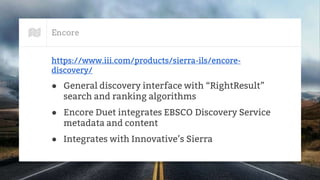
Encore
https://www.iii.com/products/sierra-ils/encore-
discovery/
● General discovery interface with “RightResult”
search and ranking algorithms
● Encore Duet integrates EBSCO Discovery Service
metadata and content
● Integrates with Innovative’s Sierra
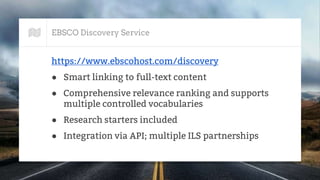
EBSCO Discovery Service
https://www.ebscohost.com/discovery
● Smart linking to full-text content
● Comprehensive relevance ranking and supports
multiple controlled vocabularies
● Research starters included
● Integration via API; multiple ILS partnerships
Case Study: EBSCO Discovery Service3
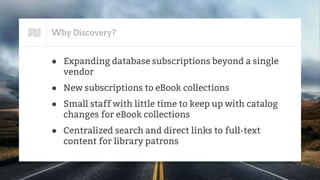
Why Discovery?
● Expanding database subscriptions beyond a single
vendor
● New subscriptions to eBook collections
● Small staff with little time to keep up with catalog
changes for eBook collections
● Centralized search and direct links to full-text
content for library patrons
Why EBSCO Discovery Service (EDS)?
● Tried WorldCat Discovery
○ Did not like relevance ranking
○ Could not add some licensed databases
○ Full-text links did not always work
● EBSCO is our primary content provider
● API integration available for new ILS
Signing Up for EDS
● Assigned EBSCO Discovery Specialist walks you
through setup, testing, and final implementation
● Catalog customizations are complicated and
critical
● Extensive questionnaire
What to Know for the EDS Questionnaire
● Number of local records
● Format of local records
● MARC fields for:
○ Unique identifier
○ Call number
○ Location
○ Barcode
○ URLs
● Catalog permalink
● Z39.50 or REST service
for real-time availability
checking (RTAC)
● Location codes
● Item status codes
Implementing EDS
● Set up content using Holdings Management and
Full-Text Finder
● Customize user profiles in EBSCOadmin for EDS
and EDS-API
● Establish catalog sync (FTP, OAI-PMH, z39.50)
● Discovery Layer options: EDS interface or
integrate EDS-API in Koha (our ILS)
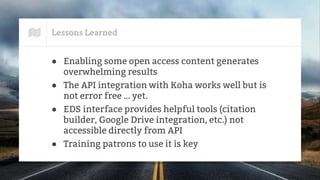
Lessons Learned
● Enabling some open access content generates
overwhelming results
● The API integration with Koha works well but is
not error free … yet.
● EDS interface provides helpful tools (citation
builder, Google Drive integration, etc.) not
accessible directly from API
● Training patrons to use it is key
Thanks!
Myka Kennedy Stephens
Seminary Librarian & Assistant Professor
Lancaster Theological Seminary
Lancaster, Pennsylvania
Email: mkstephens@lancasterseminary.edu
Facebook: @mykakennedystephens
Blog: www.mission-information.org
Presentation template adapted from SlidesCarnival

Discovery Layers: An Overview and Case Study

  • 1.
    Discovery Layers An Overviewand Case Study Myka Kennedy Stephens Seminary Librarian Lancaster Theological Seminary Lancaster, Pennsylvania
  • 2.
    Overview ● Discovery Defined ●Survey of Top Discovery Products ● Case Study: Implementing EBSCO Discovery
  • 3.
  • 4.
    Web-Scale Discovery ● Centralizedindex containing pre-harvested metadata from multiple sources ● Searchable through one interface ● Includes licensed content for subscribers, open access content, and local content
  • 5.
    Discovery Layer ● Userinterface to search and display content from the Web-Scale Discovery (WSD) index(es). ● Relevancy ranking algorithms and de-duplicating ability for search results ● Refine search tool, direct content linking, and record management features
  • 6.
    Top Discovery Productson the Market2
  • 7.
    WorldCat Discovery https://www.oclc.org/en/worldcat-discovery.html ● OCLCmember libraries already have holdings linked ● Article, dissertation, open access content metadata from OCLC databases ● Integrates with WordShare Management Services
  • 8.
    ExLibris Primo http://www.exlibrisgroup.com/category/PrimoOverview ● Personalizedrelevance ranking and other user profile features ● Relies on vendors to make content indexes available ● Integrates with ExLibris Alma
  • 9.
    Summon http://www.proquest.com/products-services/The- Summon-Service.html ● Unified indexwith discovery-optimized records ● Syndetic Solutions add-on provides cover art, contents, sample chapter, and more ● ProQuest product compatible with many integrated library systems
  • 10.
    Encore https://www.iii.com/products/sierra-ils/encore- discovery/ ● General discoveryinterface with “RightResult” search and ranking algorithms ● Encore Duet integrates EBSCO Discovery Service metadata and content ● Integrates with Innovative’s Sierra
  • 11.
    EBSCO Discovery Service https://www.ebscohost.com/discovery ●Smart linking to full-text content ● Comprehensive relevance ranking and supports multiple controlled vocabularies ● Research starters included ● Integration via API; multiple ILS partnerships
  • 12.
    Case Study: EBSCODiscovery Service3
  • 13.
    Why Discovery? ● Expandingdatabase subscriptions beyond a single vendor ● New subscriptions to eBook collections ● Small staff with little time to keep up with catalog changes for eBook collections ● Centralized search and direct links to full-text content for library patrons
  • 14.
    Why EBSCO DiscoveryService (EDS)? ● Tried WorldCat Discovery ○ Did not like relevance ranking ○ Could not add some licensed databases ○ Full-text links did not always work ● EBSCO is our primary content provider ● API integration available for new ILS
  • 15.
    Signing Up forEDS ● Assigned EBSCO Discovery Specialist walks you through setup, testing, and final implementation ● Catalog customizations are complicated and critical ● Extensive questionnaire
  • 16.
    What to Knowfor the EDS Questionnaire ● Number of local records ● Format of local records ● MARC fields for: ○ Unique identifier ○ Call number ○ Location ○ Barcode ○ URLs ● Catalog permalink ● Z39.50 or REST service for real-time availability checking (RTAC) ● Location codes ● Item status codes
  • 17.
    Implementing EDS ● Setup content using Holdings Management and Full-Text Finder ● Customize user profiles in EBSCOadmin for EDS and EDS-API ● Establish catalog sync (FTP, OAI-PMH, z39.50) ● Discovery Layer options: EDS interface or integrate EDS-API in Koha (our ILS)
  • 18.
    Lessons Learned ● Enablingsome open access content generates overwhelming results ● The API integration with Koha works well but is not error free … yet. ● EDS interface provides helpful tools (citation builder, Google Drive integration, etc.) not accessible directly from API ● Training patrons to use it is key
  • 19.
    Thanks! Myka Kennedy Stephens SeminaryLibrarian & Assistant Professor Lancaster Theological Seminary Lancaster, Pennsylvania Email: mkstephens@lancasterseminary.edu Facebook: @mykakennedystephens Blog: www.mission-information.org Presentation template adapted from SlidesCarnival