Human
Mouse
600 BC 1879
1954
1957
1964
1967
1968
1970 1972
1973
1974
1975
1978 1979
1980
1981
1982
1984 1987 1989
1990
1995
1998 2003 2006
2007
2011
SupplementtoNaturePublishingGroup
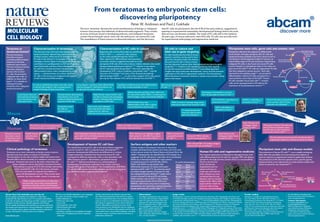
Monstrous tumours
have been a source
of fascination since
the dawn of time1
.
Rudolf Virchow
coins the term
‘teratoma’.
Barry Pierce reports passaging human
teratocarcinomas as xenografts3
.
Leroy Stevens discovers
that testicular teratomas
occur frequently in the
129 mouse strain2
.
EC cells are identified as cancer stem cells, owing
to the fact that single EC cells can generate the
complex histology of teratocarcinomas4
.
Pluripotent mouse
EC cells are
cultured in vitro5
.
Richard Gardner demonstrates
that chimeric mice can be
produced following blastocyst
injection of ICM cells6
.
Karen Artzt and colleagues
show that the F9 cell surface
antigen links EC cells and
ICM cells of the early embryo10
.
Ralph Brinster reports that EC cells
are able to chimerise the developing
embryo, indicating their functional
equivalence to ICM cells11
.
Leroy Stevens7
, and Davor Solter, Nikola Skreb
and Ivan Damjanov8
, find that teratomas can
be derived from ectopic embryos.
Sid Strickland shows that
differentiation of EC cells in culture
can be induced by retinoic acid15
.
Martin Evans and Gail Martin isolate mouse
ES cells17,18
.
SSEA3 is found on cleavage stage mouse
embryos but absent from mouse EC cells19
.
It is demonstrated that
mouse ES cells can form
germ line chimaeras22
.
Homologous recombination is used to
alter the genotype of mouse ES cells27,28
.
SOX2 is identified as a
pluripotency factor30
.
NANOG is identified as a
pluripotency factor33,34
.
The first iPS cells are derived from
mouse somatic cells by Shinya
Yamanaka and colleagues35
.
OCT4 (POU5F1) is identified as a
pluripotency factor29
.
Barbara Knowles and Davor Solter define the
EC cell surface marker SSEA1, a counterpart of
the F9 antigen, using a monoclonal antibody14
.
Gail Martin and Martin Evans show differentiation
of EC cells in embryoid bodies in vitro12
.
Niels Skakkebaek identifies abnormal intratubular
germ cells (CIS) as the likely precursor of invasive
testicular teratocarcinomas9
.
TERA1 and TERA2 cell lines are established
from human teratocarcinomas13
.
Peter Andrews and colleagues suggest
that human EC cells differ from mouse
EC cells and do not express SSEA1 (REF 16).
SSEA3 is found to be
expressed by human
EC cells20,21
.
Human EC TERA2 cells are
found to be pluripotent23,24,25
.
TRA-1-60 and TRA‑1‑81 surface antigens
of human EC cells are defined26
.
Jamie Thomson and
colleagues isolate rhesus
monkey ES cells31
.
Jamie Thomson and
colleagues isolate
human ES cells32
.
The groups of Shinya Yamanaka and
Jamie Thomson separately report
that iPS cells can also be derived
from human somatic cells36,37
.
The first clinical trial of human ES cell-derived cells in
regenerative medicine is started, for spinal cord injury.
Characterization of teratomas
The discovery that 129 strain mice develop testicular
teratocarcinomas2
allowed the experimental study
of these cancers, which are GCTs arising from the
PG cells in the embryo40
; an example of teratoma
histology is shown (right). A strong genetic component
contributes to a predisposition to GCT development.
Lewis Kleinsmith and Barry Pierce showed that a single
EC cell from a teratocarcinoma can generate a
differentiated tumour when transplanted to a host
mouse — a demonstration of a cancer stem cell4
.
EC cells in the tumour are malignant and capable
of self-renewal and differentiation.
Characterization of EC cells in culture
Beginning with work by Boris Ephrussi and Brenda
Finch in 1967 (REF. 5), mouse EC cells cultured
in vitro were studied through the 1970s12,41–45
.
Their capacity for differentiation and expression
of common markers suggested equivalence to the
pluripotent ICM cells of the early embryo. Indeed, chimeric mice could
develop following blastocyst injection11,46,47
(above). In one report,
the EC cells populated the germline46
. This work, especially the
development of EC culture conditions using feeder cells12,43
and the
discovery of F9 antigen10
and, later, of the monoclonal antibody-
defined antigen SSEA1 (REF. 14) as cell surface antigens of EC cells, paved
the way for the isolation of ES cell lines directly from the ICM17,18
.
ES cells in culture and
their use in gene targeting
ES cells transformed the field of mouse
genetics, and they can be used to form
germ line chimaeras (right; the embryo
derived from ES cells is shown in blue,
the host placenta in green) after altering almost any locus by gene
targeting22,27,28
. Analysis of the signalling pathways that regulate
ES cell self-renewal and differentiation48
is providing important
insights into early embryonic development, cancer and the potential
application of ES cells in regenerative medicine. The International
Mouse Knockout Consortium intends to mutate every protein-coding
gene in the mouse.
Pluripotent stem cells, germ cells and somatic cells
Pluripotent cells have the capacity to differentiate
to all somatic cell types and germ cells. EC cells and
teratocarcinomas probably arise from a short-circuit in
normal germ cell development (right). In humans, an
intermediate stage of CIS and seminoma, representing
malignant PG cells, is also found, but mouse PG cells
convert directly to a pluripotent state; in vitro they can
give rise to EG cells49,50
. EC cells are ‘degenerate’ ES cells
that have adapted to tumour growth. EpiS cells,
derived from the epiblast stage51,52
, are primed for
differentiation, whereas ES cells correspond to a
more primitive, naive state of the ICM48
. Human
ES cells resemble mouse EpiS cells51,52
. Somatic
cells can be reprogrammed to iPS cells by the
expression of key pluripotency factors35–37
.
Clinical pathology of teratomas
Teratomas occur most commonly as benign ovarian tumours,
dermoid cysts and, rarely, as tumours of newborns.
The description on the clay cuneiform tablet with omens from
Nineveh (left) is almost certainly of a newborn’s sacrococcygeal
teratoma1
. Teratomas also occur in the testis, where they are
always malignant and are described as teratocarcin­omas.
They belong to a group of GCTs that includes seminomas,
which resemble PG cells. As in the mouse, testicular
GCTs are most likely to originate from defects in
germ cell development in utero9
. They are the most
common, but most curable, cancers in young men.
Development of human EC cell lines
The relationship of mouse EC cells to the early embryo suggested
a use for human EC cells in studying human development53,54
.
However, developmental differences and differences in surface
antigen expression indicated that human and mouse EC cells
correspond to different embryonic cells, or that equivalent cells
differ between species16
. Nevertheless, pluripotent human
EC cells23,26,55
(below)contributed to our understanding of
development, including the realization that retinoic acid acts
through HOX genes in the embryo56
. The transplantation of NTERA2
EC cell-derived neurons into stroke patients was the first attempt to
use pluripotent cells in regenerative medicine57
.
Surface antigens and other markers
Surface antigens have played a key part in dissecting
complex developmental systems since they were first used
in the immune system by Edward Boyse and Lloyd Old in the
1960s58
. Subsequently, the identification of F9 antigen by a
syngeneic anti-EC cell serum10
and, later, of its counterpart
SSEA1 by a monoclonal antibody14
were central
to relating mouse EC and ICM cells. SSEA1,
SSEA3 and SSEA4 are glycolipids with
differential expression in mouse and human
embryos and EC cells19,59,60
. An extensive panel
of surface antigen markers of human EC cells
has subsequently been defined61,62
(right) and is
in use in human ES cell and iPS cell studies.
Other markers, such as ALP63,64
and, notably,
the transcription factors OCT4, SOX2 and
NANOG, which have a key role in maintaining
pluripotency, are commonly expressed between
mouse and human EC and ES cells29,30,33,34
.
Human ES cells and regenerative medicine
The surgical replacement of diseased or damaged tissues with
cells differentiated from ES cells (for example, RPE cells (below,
stained for the tight junction protein ZO1)) is a real possibility.
The first clinical trial
of ES cell-derived
oligodendrocytes for
spinal cord injury is
underway, and trials for
other diseases are near,
including those for eye
diseases, such as macular
degeneration. Many other
opportunities remain for
using ES cells in drug
discovery and toxicology.
Pluripotent stem cells and disease models
The production of human iPS cells36,37
, now a rapidly developing
field, offers the possibility of circumventing the problems of
immune rejection in regenerative medicine applications (below).
The production of iPS cells from patients with a specific genetic
disease presents a new opportunity to create disease models with
which to search for new treatments65–68
.
Teratoma or
teratocarcinom­a?
The term teratoma
describes a tumour
containing differentiated
elements of all three
embryonic germ layers.
The term teratocarcinoma
describes malignant
tumours that contain
EC cells, the presumed
malignant stem cells, in
addition to these three
layers38
. It is valuable to
distinguish benign
teratomas from malignant
teratocarcinomas39
.
EC and ES cell phenotypes
Human Mouse
SSEA1–
SSEA1+
SSEA3+
SSEA3–
SSEA4+
SSEA4–
TRA-1-60+
TRA-1-60–
GCTM2+
GCTM2–
THY1+
THY1–
MHC+
MHC–
ALP+
ALP+
OCT4+
OCT4+
NANOG+
NANOG+
Quality and honesty are Abcam’s top priorities.
Our Abpromise guarantees full technical support
from our experienced team. If an antibody doesn’t
work as it says on our datasheet we will give you a
full refund or replacement, if you tell us within six
months. We publish everything we know about
every product on our datasheets and our catalogue
is web-based. This allows daily updates and far more
information than in any printed catalogue, including
customer reviews, technical enquiries and links to
publication references.
Abcam Stem Cell antibodies you can rely on!
Abcam supplies antibodies and reagents to researchers
worldwide. We ship directly to over 115 countries with offices
in the UK, US, Japan and Hong Kong and offer customer support
in English, French, German, Spanish, Japanese and Chinese.
We are rapidly developing and expanding our range, looking for
new targets and improving our existing antibodies. To help with
this we actively attend, support and help organize conferences
on stem cell research. Find out more on our website:
www.abcam.com
We have over 60,000 antibodies in our catalogue.
Our stem cell markers range includes over
14,000 antibodies to:
• Embryonic stem cells
• Germ cells
• Hematopoietic stem cells
• Mesenchymal stem cells
• Neural stem cells
• Ectoderm, mesoderm and endoderm lineages
• Wnt, TGF-β, Hedgehog and Notch signaling
pathways
Further reading
Damjanov, I. & Solter, D. Experimental teratoma.
Curr. Top. Pathol. 59, 69–130 (1974) | Stevens, L. C.
The biology of teratomas. Adv. Morphog. 6, 1–31 (1967) |
Andrews, P. W. From teratocarcinomas to embryonic
stem cells. Phil. Trans. R. Soc. B 357, 405–417 (2002) |
Solter D. From teratocarcinomas to embryonic stem cells
and beyond: a history of embryonic stem cell research.
Nature Rev Genet. 7, 319–327 (2006) | Evans, M.
Discovering pluripotency: 30 years of mouse embryonic
stem cells. Nature Rev. Mol. Cell Biol. http://dx.doi.
org/10.1039/nrm3190 (2011).
For the reference list please see:
http://www.nature.com/nrm/posters/
discoveringpluripotency
Contact information
p.w.andrews@sheffield.ac.uk
p.gokhale@sheffield.ac.uk
Edited by Katharine H. Wrighton;
copy-edited by Antony Bickenson;
designed by Vicky Summersby.
© 2011 Nature Publishing Group.
http://www.nature.com/nrm/posters/
discoveringpluripotency
Abbreviations
ALP, alkaline phosphatase; CIS, carcinoma
in situ; EG, embryonic germ; EpiS, epiblast
stem; GCT, germ cell tumour; ICM, inner
cell mass; iPS, induced pluripotent stem;
KLF4, Krüppel-like factor 4; MHC, major
histocompatibility complex; PG, primordial
germ; PS-iPS, patient-specific iPS;
RPE, retinal pigment epithelium;
SSEA, stage-specific embryonic antigen;
THY1, thymocyte differentiation antigen 1;
ZO1, zonula occludens 1.
Image credits
Photograph of L. Stevens courtesy of The Jackson Laboratory, USA | Photographs of B. Pierce and
of teratoma histology courtesy of I. Damjanov, University of Kansas, USA | Image of chimeric mouse
is reproduced, with permission, from REF. 9 © (1974) The Rockefeller University Press | Photograph of
M. Evans courtesy of M. Evans, Cardiff University, UK | Photograph of G. Martin courtesy of G. Martin,
University of California, San Francisco, USA | Photograph of J. Thompson courtesy of J. Thompson,
Morgridge Institute for Research, USA | Image of gene-targeted embryo is reproduced, with
permission, from REF. 69 © (2002) BioMed Central | Photograph of S. Yamanaka courtesy of the Center
for iPS cell Research and Application, Kyoto University, Japan | Image of Cuneiform tablet with omens
© The Trustees of the British Museum. All rights reserved | Photograph of RPE cells derived from
human ES cells courtesy of P. Coffey, University College London, UK | Disease models schematic is
modified, with permission, from REF. 70 © (2010) American Society for Clinical Investigation.
“When a woman gives birth to an infant that
has three feet, two in their normal positions
attached to the body, and the third between
them, there will be great prosperity in the land.”
The term ‘teratoma’ denotes the weird manifestations of benign or malignant
tumours that possess the hallmarks of abnormal embryogenesis. They contain
an array of tissues found in developing embryos, and malignant teratomas
contain the archetypal cancer stem cell, the embryonic carcinoma (EC) cell.
The resemblance of these tumours to abnormal embryos, and the discovery
that EC cells are pluripotent, like the ICM of the early embryo, suggested an
opening to experimental mammalian developmental biology before the tools
that we now use became available. The study of EC cells led to the isolation,
30 years ago, of mouse embryonic stem (ES) cells. ES cells now provide tools
for experimental embryology and regenerative medicine.
From teratomas to embryonic stem cells:
discovering pluripotency
Peter W. Andrews and Paul J. Gokhale
MOLECULAR
CELL BIOLOGY
© 2011 Macmillan Publishers Limited. All rights reserved

Discoveringpluripotency

  • 1.
    Human Mouse 600 BC 1879 1954 1957 1964 1967 1968 19701972 1973 1974 1975 1978 1979 1980 1981 1982 1984 1987 1989 1990 1995 1998 2003 2006 2007 2011 SupplementtoNaturePublishingGroup Monstrous tumours have been a source of fascination since the dawn of time1 . Rudolf Virchow coins the term ‘teratoma’. Barry Pierce reports passaging human teratocarcinomas as xenografts3 . Leroy Stevens discovers that testicular teratomas occur frequently in the 129 mouse strain2 . EC cells are identified as cancer stem cells, owing to the fact that single EC cells can generate the complex histology of teratocarcinomas4 . Pluripotent mouse EC cells are cultured in vitro5 . Richard Gardner demonstrates that chimeric mice can be produced following blastocyst injection of ICM cells6 . Karen Artzt and colleagues show that the F9 cell surface antigen links EC cells and ICM cells of the early embryo10 . Ralph Brinster reports that EC cells are able to chimerise the developing embryo, indicating their functional equivalence to ICM cells11 . Leroy Stevens7 , and Davor Solter, Nikola Skreb and Ivan Damjanov8 , find that teratomas can be derived from ectopic embryos. Sid Strickland shows that differentiation of EC cells in culture can be induced by retinoic acid15 . Martin Evans and Gail Martin isolate mouse ES cells17,18 . SSEA3 is found on cleavage stage mouse embryos but absent from mouse EC cells19 . It is demonstrated that mouse ES cells can form germ line chimaeras22 . Homologous recombination is used to alter the genotype of mouse ES cells27,28 . SOX2 is identified as a pluripotency factor30 . NANOG is identified as a pluripotency factor33,34 . The first iPS cells are derived from mouse somatic cells by Shinya Yamanaka and colleagues35 . OCT4 (POU5F1) is identified as a pluripotency factor29 . Barbara Knowles and Davor Solter define the EC cell surface marker SSEA1, a counterpart of the F9 antigen, using a monoclonal antibody14 . Gail Martin and Martin Evans show differentiation of EC cells in embryoid bodies in vitro12 . Niels Skakkebaek identifies abnormal intratubular germ cells (CIS) as the likely precursor of invasive testicular teratocarcinomas9 . TERA1 and TERA2 cell lines are established from human teratocarcinomas13 . Peter Andrews and colleagues suggest that human EC cells differ from mouse EC cells and do not express SSEA1 (REF 16). SSEA3 is found to be expressed by human EC cells20,21 . Human EC TERA2 cells are found to be pluripotent23,24,25 . TRA-1-60 and TRA‑1‑81 surface antigens of human EC cells are defined26 . Jamie Thomson and colleagues isolate rhesus monkey ES cells31 . Jamie Thomson and colleagues isolate human ES cells32 . The groups of Shinya Yamanaka and Jamie Thomson separately report that iPS cells can also be derived from human somatic cells36,37 . The first clinical trial of human ES cell-derived cells in regenerative medicine is started, for spinal cord injury. Characterization of teratomas The discovery that 129 strain mice develop testicular teratocarcinomas2 allowed the experimental study of these cancers, which are GCTs arising from the PG cells in the embryo40 ; an example of teratoma histology is shown (right). A strong genetic component contributes to a predisposition to GCT development. Lewis Kleinsmith and Barry Pierce showed that a single EC cell from a teratocarcinoma can generate a differentiated tumour when transplanted to a host mouse — a demonstration of a cancer stem cell4 . EC cells in the tumour are malignant and capable of self-renewal and differentiation. Characterization of EC cells in culture Beginning with work by Boris Ephrussi and Brenda Finch in 1967 (REF. 5), mouse EC cells cultured in vitro were studied through the 1970s12,41–45 . Their capacity for differentiation and expression of common markers suggested equivalence to the pluripotent ICM cells of the early embryo. Indeed, chimeric mice could develop following blastocyst injection11,46,47 (above). In one report, the EC cells populated the germline46 . This work, especially the development of EC culture conditions using feeder cells12,43 and the discovery of F9 antigen10 and, later, of the monoclonal antibody- defined antigen SSEA1 (REF. 14) as cell surface antigens of EC cells, paved the way for the isolation of ES cell lines directly from the ICM17,18 . ES cells in culture and their use in gene targeting ES cells transformed the field of mouse genetics, and they can be used to form germ line chimaeras (right; the embryo derived from ES cells is shown in blue, the host placenta in green) after altering almost any locus by gene targeting22,27,28 . Analysis of the signalling pathways that regulate ES cell self-renewal and differentiation48 is providing important insights into early embryonic development, cancer and the potential application of ES cells in regenerative medicine. The International Mouse Knockout Consortium intends to mutate every protein-coding gene in the mouse. Pluripotent stem cells, germ cells and somatic cells Pluripotent cells have the capacity to differentiate to all somatic cell types and germ cells. EC cells and teratocarcinomas probably arise from a short-circuit in normal germ cell development (right). In humans, an intermediate stage of CIS and seminoma, representing malignant PG cells, is also found, but mouse PG cells convert directly to a pluripotent state; in vitro they can give rise to EG cells49,50 . EC cells are ‘degenerate’ ES cells that have adapted to tumour growth. EpiS cells, derived from the epiblast stage51,52 , are primed for differentiation, whereas ES cells correspond to a more primitive, naive state of the ICM48 . Human ES cells resemble mouse EpiS cells51,52 . Somatic cells can be reprogrammed to iPS cells by the expression of key pluripotency factors35–37 . Clinical pathology of teratomas Teratomas occur most commonly as benign ovarian tumours, dermoid cysts and, rarely, as tumours of newborns. The description on the clay cuneiform tablet with omens from Nineveh (left) is almost certainly of a newborn’s sacrococcygeal teratoma1 . Teratomas also occur in the testis, where they are always malignant and are described as teratocarcin­omas. They belong to a group of GCTs that includes seminomas, which resemble PG cells. As in the mouse, testicular GCTs are most likely to originate from defects in germ cell development in utero9 . They are the most common, but most curable, cancers in young men. Development of human EC cell lines The relationship of mouse EC cells to the early embryo suggested a use for human EC cells in studying human development53,54 . However, developmental differences and differences in surface antigen expression indicated that human and mouse EC cells correspond to different embryonic cells, or that equivalent cells differ between species16 . Nevertheless, pluripotent human EC cells23,26,55 (below)contributed to our understanding of development, including the realization that retinoic acid acts through HOX genes in the embryo56 . The transplantation of NTERA2 EC cell-derived neurons into stroke patients was the first attempt to use pluripotent cells in regenerative medicine57 . Surface antigens and other markers Surface antigens have played a key part in dissecting complex developmental systems since they were first used in the immune system by Edward Boyse and Lloyd Old in the 1960s58 . Subsequently, the identification of F9 antigen by a syngeneic anti-EC cell serum10 and, later, of its counterpart SSEA1 by a monoclonal antibody14 were central to relating mouse EC and ICM cells. SSEA1, SSEA3 and SSEA4 are glycolipids with differential expression in mouse and human embryos and EC cells19,59,60 . An extensive panel of surface antigen markers of human EC cells has subsequently been defined61,62 (right) and is in use in human ES cell and iPS cell studies. Other markers, such as ALP63,64 and, notably, the transcription factors OCT4, SOX2 and NANOG, which have a key role in maintaining pluripotency, are commonly expressed between mouse and human EC and ES cells29,30,33,34 . Human ES cells and regenerative medicine The surgical replacement of diseased or damaged tissues with cells differentiated from ES cells (for example, RPE cells (below, stained for the tight junction protein ZO1)) is a real possibility. The first clinical trial of ES cell-derived oligodendrocytes for spinal cord injury is underway, and trials for other diseases are near, including those for eye diseases, such as macular degeneration. Many other opportunities remain for using ES cells in drug discovery and toxicology. Pluripotent stem cells and disease models The production of human iPS cells36,37 , now a rapidly developing field, offers the possibility of circumventing the problems of immune rejection in regenerative medicine applications (below). The production of iPS cells from patients with a specific genetic disease presents a new opportunity to create disease models with which to search for new treatments65–68 . Teratoma or teratocarcinom­a? The term teratoma describes a tumour containing differentiated elements of all three embryonic germ layers. The term teratocarcinoma describes malignant tumours that contain EC cells, the presumed malignant stem cells, in addition to these three layers38 . It is valuable to distinguish benign teratomas from malignant teratocarcinomas39 . EC and ES cell phenotypes Human Mouse SSEA1– SSEA1+ SSEA3+ SSEA3– SSEA4+ SSEA4– TRA-1-60+ TRA-1-60– GCTM2+ GCTM2– THY1+ THY1– MHC+ MHC– ALP+ ALP+ OCT4+ OCT4+ NANOG+ NANOG+ Quality and honesty are Abcam’s top priorities. Our Abpromise guarantees full technical support from our experienced team. If an antibody doesn’t work as it says on our datasheet we will give you a full refund or replacement, if you tell us within six months. We publish everything we know about every product on our datasheets and our catalogue is web-based. This allows daily updates and far more information than in any printed catalogue, including customer reviews, technical enquiries and links to publication references. Abcam Stem Cell antibodies you can rely on! Abcam supplies antibodies and reagents to researchers worldwide. We ship directly to over 115 countries with offices in the UK, US, Japan and Hong Kong and offer customer support in English, French, German, Spanish, Japanese and Chinese. We are rapidly developing and expanding our range, looking for new targets and improving our existing antibodies. To help with this we actively attend, support and help organize conferences on stem cell research. Find out more on our website: www.abcam.com We have over 60,000 antibodies in our catalogue. Our stem cell markers range includes over 14,000 antibodies to: • Embryonic stem cells • Germ cells • Hematopoietic stem cells • Mesenchymal stem cells • Neural stem cells • Ectoderm, mesoderm and endoderm lineages • Wnt, TGF-β, Hedgehog and Notch signaling pathways Further reading Damjanov, I. & Solter, D. Experimental teratoma. Curr. Top. Pathol. 59, 69–130 (1974) | Stevens, L. C. The biology of teratomas. Adv. Morphog. 6, 1–31 (1967) | Andrews, P. W. From teratocarcinomas to embryonic stem cells. Phil. Trans. R. Soc. B 357, 405–417 (2002) | Solter D. From teratocarcinomas to embryonic stem cells and beyond: a history of embryonic stem cell research. Nature Rev Genet. 7, 319–327 (2006) | Evans, M. Discovering pluripotency: 30 years of mouse embryonic stem cells. Nature Rev. Mol. Cell Biol. http://dx.doi. org/10.1039/nrm3190 (2011). For the reference list please see: http://www.nature.com/nrm/posters/ discoveringpluripotency Contact information p.w.andrews@sheffield.ac.uk p.gokhale@sheffield.ac.uk Edited by Katharine H. Wrighton; copy-edited by Antony Bickenson; designed by Vicky Summersby. © 2011 Nature Publishing Group. http://www.nature.com/nrm/posters/ discoveringpluripotency Abbreviations ALP, alkaline phosphatase; CIS, carcinoma in situ; EG, embryonic germ; EpiS, epiblast stem; GCT, germ cell tumour; ICM, inner cell mass; iPS, induced pluripotent stem; KLF4, Krüppel-like factor 4; MHC, major histocompatibility complex; PG, primordial germ; PS-iPS, patient-specific iPS; RPE, retinal pigment epithelium; SSEA, stage-specific embryonic antigen; THY1, thymocyte differentiation antigen 1; ZO1, zonula occludens 1. Image credits Photograph of L. Stevens courtesy of The Jackson Laboratory, USA | Photographs of B. Pierce and of teratoma histology courtesy of I. Damjanov, University of Kansas, USA | Image of chimeric mouse is reproduced, with permission, from REF. 9 © (1974) The Rockefeller University Press | Photograph of M. Evans courtesy of M. Evans, Cardiff University, UK | Photograph of G. Martin courtesy of G. Martin, University of California, San Francisco, USA | Photograph of J. Thompson courtesy of J. Thompson, Morgridge Institute for Research, USA | Image of gene-targeted embryo is reproduced, with permission, from REF. 69 © (2002) BioMed Central | Photograph of S. Yamanaka courtesy of the Center for iPS cell Research and Application, Kyoto University, Japan | Image of Cuneiform tablet with omens © The Trustees of the British Museum. All rights reserved | Photograph of RPE cells derived from human ES cells courtesy of P. Coffey, University College London, UK | Disease models schematic is modified, with permission, from REF. 70 © (2010) American Society for Clinical Investigation. “When a woman gives birth to an infant that has three feet, two in their normal positions attached to the body, and the third between them, there will be great prosperity in the land.” The term ‘teratoma’ denotes the weird manifestations of benign or malignant tumours that possess the hallmarks of abnormal embryogenesis. They contain an array of tissues found in developing embryos, and malignant teratomas contain the archetypal cancer stem cell, the embryonic carcinoma (EC) cell. The resemblance of these tumours to abnormal embryos, and the discovery that EC cells are pluripotent, like the ICM of the early embryo, suggested an opening to experimental mammalian developmental biology before the tools that we now use became available. The study of EC cells led to the isolation, 30 years ago, of mouse embryonic stem (ES) cells. ES cells now provide tools for experimental embryology and regenerative medicine. From teratomas to embryonic stem cells: discovering pluripotency Peter W. Andrews and Paul J. Gokhale MOLECULAR CELL BIOLOGY © 2011 Macmillan Publishers Limited. All rights reserved