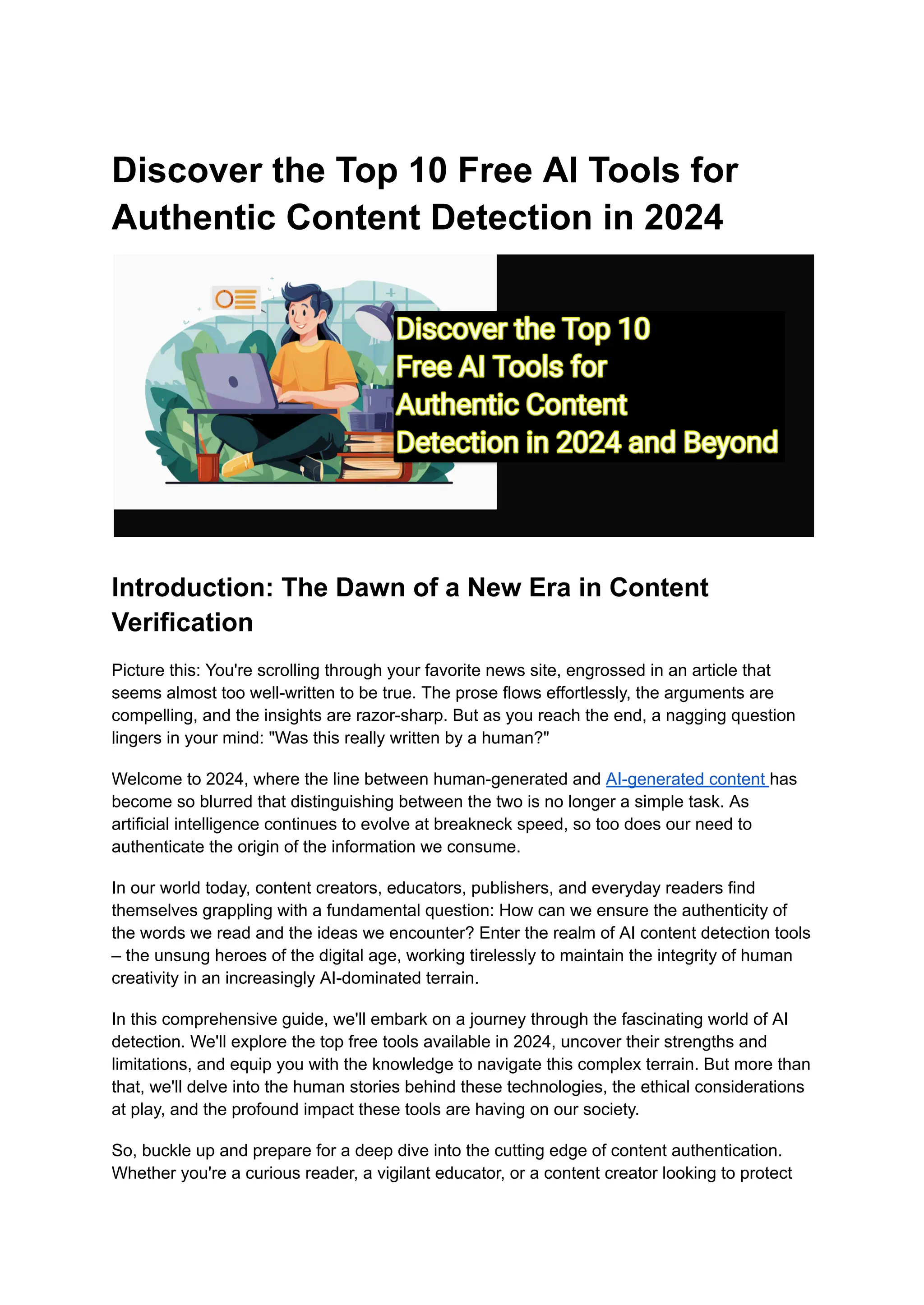
Discover the Top 10 Free AI Tools for
Authentic Content Detection in 2024
Introduction: The Dawn of a New Era in Content
Verification
Picture this: You're scrolling through your favorite news site, engrossed in an article that
seems almost too well-written to be true. The prose flows effortlessly, the arguments are
compelling, and the insights are razor-sharp. But as you reach the end, a nagging question
lingers in your mind: "Was this really written by a human?"
Welcome to 2024, where the line between human-generated and AI-generated content has
become so blurred that distinguishing between the two is no longer a simple task. As
artificial intelligence continues to evolve at breakneck speed, so too does our need to
authenticate the origin of the information we consume.
In our world today, content creators, educators, publishers, and everyday readers find
themselves grappling with a fundamental question: How can we ensure the authenticity of
the words we read and the ideas we encounter? Enter the realm of AI content detection tools
– the unsung heroes of the digital age, working tirelessly to maintain the integrity of human
creativity in an increasingly AI-dominated terrain.
In this comprehensive guide, we'll embark on a journey through the fascinating world of AI
detection. We'll explore the top free tools available in 2024, uncover their strengths and
limitations, and equip you with the knowledge to navigate this complex terrain. But more than
that, we'll delve into the human stories behind these technologies, the ethical considerations
at play, and the profound impact these tools are having on our society.
So, buckle up and prepare for a deep dive into the cutting edge of content authentication.
Whether you're a curious reader, a vigilant educator, or a content creator looking to protect
your craft, this article will serve as your compass in the ever-shifting seas of digital
authenticity.
The Rise of AI-Generated Content: A Double-Edged
Sword
The AI Writing Revolution
Cast your mind back to the early 2020s. Remember when AI-generated text was clunky,
easily identifiable, and often the butt of jokes? Those days are long gone. The AI writing
revolution has been nothing short of extraordinary, transforming the way we create and
consume content.
Today, AI language models can craft everything from compelling news articles and engaging
blog posts to intricate academic papers and even creative fiction. They've become
indispensable tools for content creators, marketers, and businesses looking to scale their
output and reach wider audiences.
Take Sarah, a freelance writer based in Seattle. "When I first started using AI writing
assistants, it was mainly for basic tasks like generating outlines or coming up with catchy
headlines," she recalls. "Now, I use them to co-write entire articles. The AI helps me
overcome writer's block and explore angles I might not have considered on my own."
Sarah's experience is not unique. Across industries, professionals are harnessing the power
of AI to augment their writing capabilities, boost productivity, and push the boundaries of
creativity.
The Dark Side of AI-Generated Content
However, as with any powerful technology, there's a flip side to this coin. The same tools that
empower creators like Sarah have also opened the door to potential misuse and deception.
Consider the case of a popular science blog that was caught publishing AI-generated articles
without disclosure. The blog's readership plummeted, and its credibility was severely
damaged when the truth came to light. "It felt like a betrayal," says Alex, a long-time reader
of the blog. "I'd always trusted their content, shared it with friends. Finding out it was
AI-generated without any human oversight... it made me question everything I'd read there."
This incident highlights the ethical quandaries surrounding AI-generated content. When does
augmentation cross the line into misrepresentation? How can readers trust the authenticity
of the information they consume? And what responsibilities do content creators and
platforms have in maintaining transparency?
The Need for Authentication
As AI-generated content becomes increasingly sophisticated and ubiquitous, the need for
reliable authentication methods has never been more pressing. This need spans various
domains:
1. Academia: Universities and research institutions require tools to ensure the integrity
of student submissions and maintain academic honesty.
2. Journalism: News organizations need to verify the authenticity of sources and
maintain the trust of their readership.
3. Publishing: Literary agents and publishers seek ways to authenticate original works
and protect against AI-generated submissions masquerading as human-authored
pieces.
4. Social Media: Platforms strive to combat the spread of AI-generated misinformation
and maintain the authenticity of user-generated content.
5. Business: Companies need to protect their brand voice and ensure that their
communications are genuinely human-crafted when claimed as such.
It's in this context that AI content detection tools have emerged as crucial allies in the quest
for digital authenticity. These tools leverage advanced algorithms and machine learning
techniques to analyze text and identify patterns indicative of AI generation.
As we delve deeper into the world of AI detection, remember that these tools are not just
lines of code or complex algorithms. They represent our collective effort to preserve the
value of human creativity and maintain trust in our digital discourse. They are the guardians
of authenticity in an age where the lines between human and machine-generated content
are increasingly blurred.
In the following sections, we'll explore the top free AI detection tools available in 2024,
examining their features, strengths, and limitations. We'll also hear from the developers
behind these tools and the users whose lives they've impacted. So, let's embark on this
journey into the frontlines of the AI detection revolution.
Understanding AI Content Detection: The Science
Behind the Tools
The Fundamentals of AI Detection
Before we dive into the specific tools, it's crucial to understand the basic principles
underlying AI content detection. At its core, AI detection is a sophisticated form of pattern
recognition. These tools analyze various aspects of a text to identify characteristics that are
more likely to be present in AI-generated content than in human-written text.
Dr. Elena Rodriguez, a computational linguist at the University of California, Berkeley,
explains: "AI language models, despite their impressive capabilities, still have certain 'tells'
that can be detected. These might include unusual word choices, overly consistent writing
styles, or subtle patterns in sentence structure that humans typically don't produce."
Some of the key factors that AI detection tools consider include:
1. Perplexity: This measures how surprised a language model is by the text.
AI-generated content often has lower perplexity than human-written text.
2. Burstiness: Human writing tends to be "burstier," with greater variations in sentence
length and complexity.
3. Entropy: This relates to the randomness or unpredictability of the text. Human
writing often has higher entropy than AI-generated content.
4. Syntactic Patterns: AI models may produce certain grammatical structures more
frequently than human writers.
5. Contextual Coherence: While AI has improved dramatically in maintaining context,
human writing often exhibits more nuanced and layered contextual understanding.
The Evolution of AI Detection Technology
The field of AI detection has evolved rapidly, mirroring the advancements in AI language
models themselves. Early detection methods relied heavily on simple statistical analysis and
keyword spotting. However, as AI-generated text became more sophisticated, so too did the
tools designed to detect it.
Mark Chen, a software engineer who has worked on several AI detection projects, provides
some historical context: "When we first started developing these tools around 2021, we were
dealing with much simpler AI outputs. We could often spot AI-generated text just by looking
for repetitive phrases or unnatural language patterns. Now, in 2024, we're using advanced
machine learning models that can pick up on incredibly subtle cues that even human experts
might miss."
Today's AI detection tools often employ their own AI models, trained on vast datasets of both
human-written and AI-generated text. These models learn to identify the minute differences
between the two, constantly adapting as AI writing technology improves.
The Challenges of AI Detection
Despite the sophisticated technology behind AI detection tools, the field faces significant
challenges:
1. Rapid AI Advancement: As AI writing models improve, they become harder to
distinguish from human writing. This requires constant updates and improvements to
detection tools.
2. False Positives: Sometimes, human-written text may be flagged as AI-generated,
especially if the writer has a particularly structured or formal style.
3. Hybrid Content: Many writers now use AI as a writing aid, producing hybrid content
that is part human-written and part AI-generated. This blurred line presents a
significant challenge for detection tools.
4. Language and Domain Specificity: Most detection tools work best with English text
and may struggle with other languages or highly specialized domains.
5. Adversarial Techniques: As detection tools become more widespread, techniques
to evade them are also emerging, creating a cat-and-mouse game between
generators and detectors.
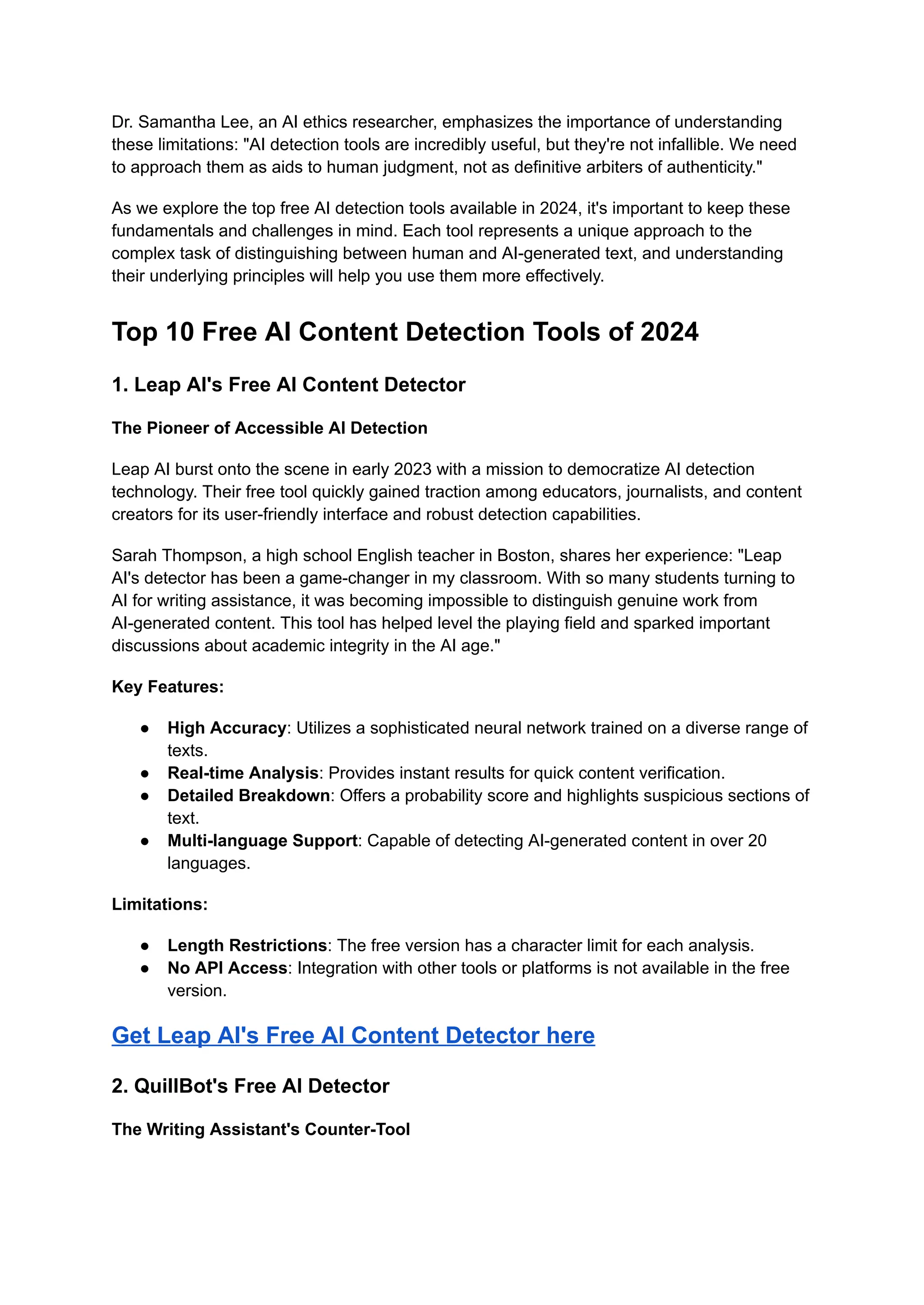
Dr. Samantha Lee, an AI ethics researcher, emphasizes the importance of understanding
these limitations: "AI detection tools are incredibly useful, but they're not infallible. We need
to approach them as aids to human judgment, not as definitive arbiters of authenticity."
As we explore the top free AI detection tools available in 2024, it's important to keep these
fundamentals and challenges in mind. Each tool represents a unique approach to the
complex task of distinguishing between human and AI-generated text, and understanding
their underlying principles will help you use them more effectively.
Top 10 Free AI Content Detection Tools of 2024
1. Leap AI's Free AI Content Detector
The Pioneer of Accessible AI Detection
Leap AI burst onto the scene in early 2023 with a mission to democratize AI detection
technology. Their free tool quickly gained traction among educators, journalists, and content
creators for its user-friendly interface and robust detection capabilities.
Sarah Thompson, a high school English teacher in Boston, shares her experience: "Leap
AI's detector has been a game-changer in my classroom. With so many students turning to
AI for writing assistance, it was becoming impossible to distinguish genuine work from
AI-generated content. This tool has helped level the playing field and sparked important
discussions about academic integrity in the AI age."
Key Features:
● High Accuracy: Utilizes a sophisticated neural network trained on a diverse range of
texts.
● Real-time Analysis: Provides instant results for quick content verification.
● Detailed Breakdown: Offers a probability score and highlights suspicious sections of
text.
● Multi-language Support: Capable of detecting AI-generated content in over 20
languages.
Limitations:
● Length Restrictions: The free version has a character limit for each analysis.
● No API Access: Integration with other tools or platforms is not available in the free
version.
Get Leap AI's Free AI Content Detector here
2. QuillBot's Free AI Detector
The Writing Assistant's Counter-Tool
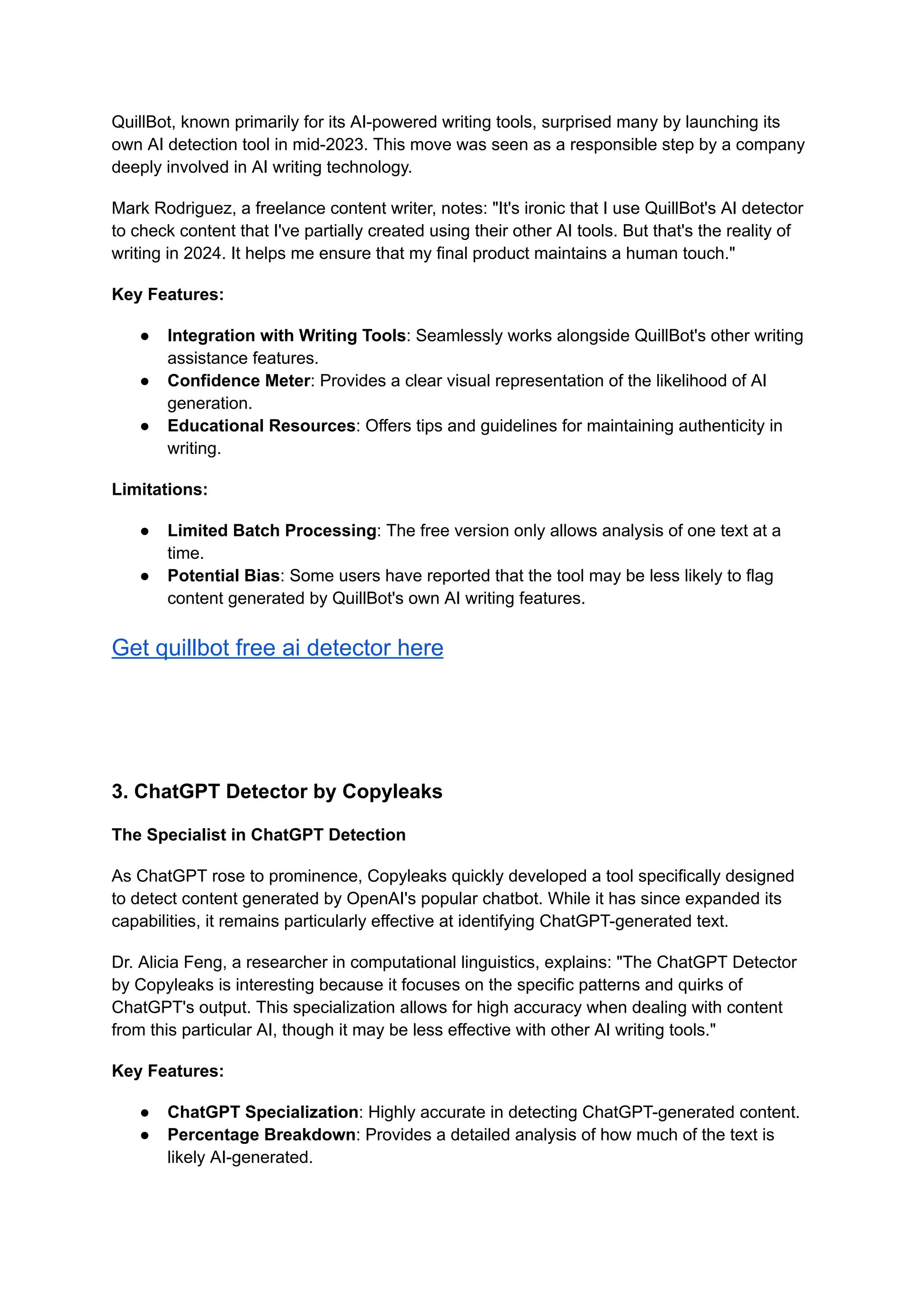
QuillBot, known primarily for its AI-powered writing tools, surprised many by launching its
own AI detection tool in mid-2023. This move was seen as a responsible step by a company
deeply involved in AI writing technology.
Mark Rodriguez, a freelance content writer, notes: "It's ironic that I use QuillBot's AI detector
to check content that I've partially created using their other AI tools. But that's the reality of
writing in 2024. It helps me ensure that my final product maintains a human touch."
Key Features:
● Integration with Writing Tools: Seamlessly works alongside QuillBot's other writing
assistance features.
● Confidence Meter: Provides a clear visual representation of the likelihood of AI
generation.
● Educational Resources: Offers tips and guidelines for maintaining authenticity in
writing.
Limitations:
● Limited Batch Processing: The free version only allows analysis of one text at a
time.
● Potential Bias: Some users have reported that the tool may be less likely to flag
content generated by QuillBot's own AI writing features.
Get quillbot free ai detector here
3. ChatGPT Detector by Copyleaks
The Specialist in ChatGPT Detection
As ChatGPT rose to prominence, Copyleaks quickly developed a tool specifically designed
to detect content generated by OpenAI's popular chatbot. While it has since expanded its
capabilities, it remains particularly effective at identifying ChatGPT-generated text.
Dr. Alicia Feng, a researcher in computational linguistics, explains: "The ChatGPT Detector
by Copyleaks is interesting because it focuses on the specific patterns and quirks of
ChatGPT's output. This specialization allows for high accuracy when dealing with content
from this particular AI, though it may be less effective with other AI writing tools."
Key Features:
● ChatGPT Specialization: Highly accurate in detecting ChatGPT-generated content.
● Percentage Breakdown: Provides a detailed analysis of how much of the text is
likely AI-generated.
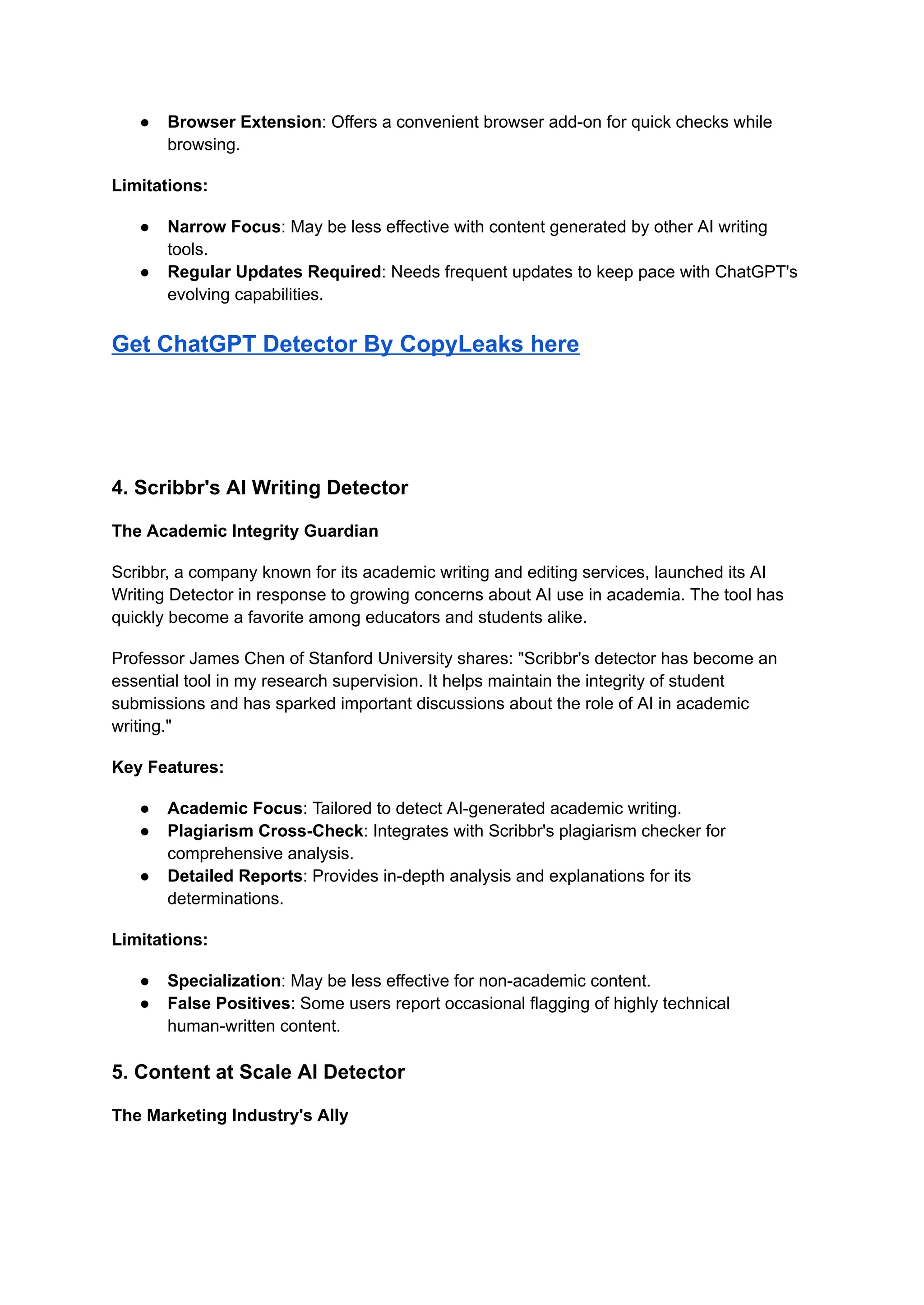
● Browser Extension: Offers a convenient browser add-on for quick checks while
browsing.
Limitations:
● Narrow Focus: May be less effective with content generated by other AI writing
tools.
● Regular Updates Required: Needs frequent updates to keep pace with ChatGPT's
evolving capabilities.
Get ChatGPT Detector By CopyLeaks here
4. Scribbr's AI Writing Detector
The Academic Integrity Guardian
Scribbr, a company known for its academic writing and editing services, launched its AI
Writing Detector in response to growing concerns about AI use in academia. The tool has
quickly become a favorite among educators and students alike.
Professor James Chen of Stanford University shares: "Scribbr's detector has become an
essential tool in my research supervision. It helps maintain the integrity of student
submissions and has sparked important discussions about the role of AI in academic
writing."
Key Features:
● Academic Focus: Tailored to detect AI-generated academic writing.
● Plagiarism Cross-Check: Integrates with Scribbr's plagiarism checker for
comprehensive analysis.
● Detailed Reports: Provides in-depth analysis and explanations for its
determinations.
Limitations:
● Specialization: May be less effective for non-academic content.
● False Positives: Some users report occasional flagging of highly technical
human-written content.
5. Content at Scale AI Detector
The Marketing Industry's Ally
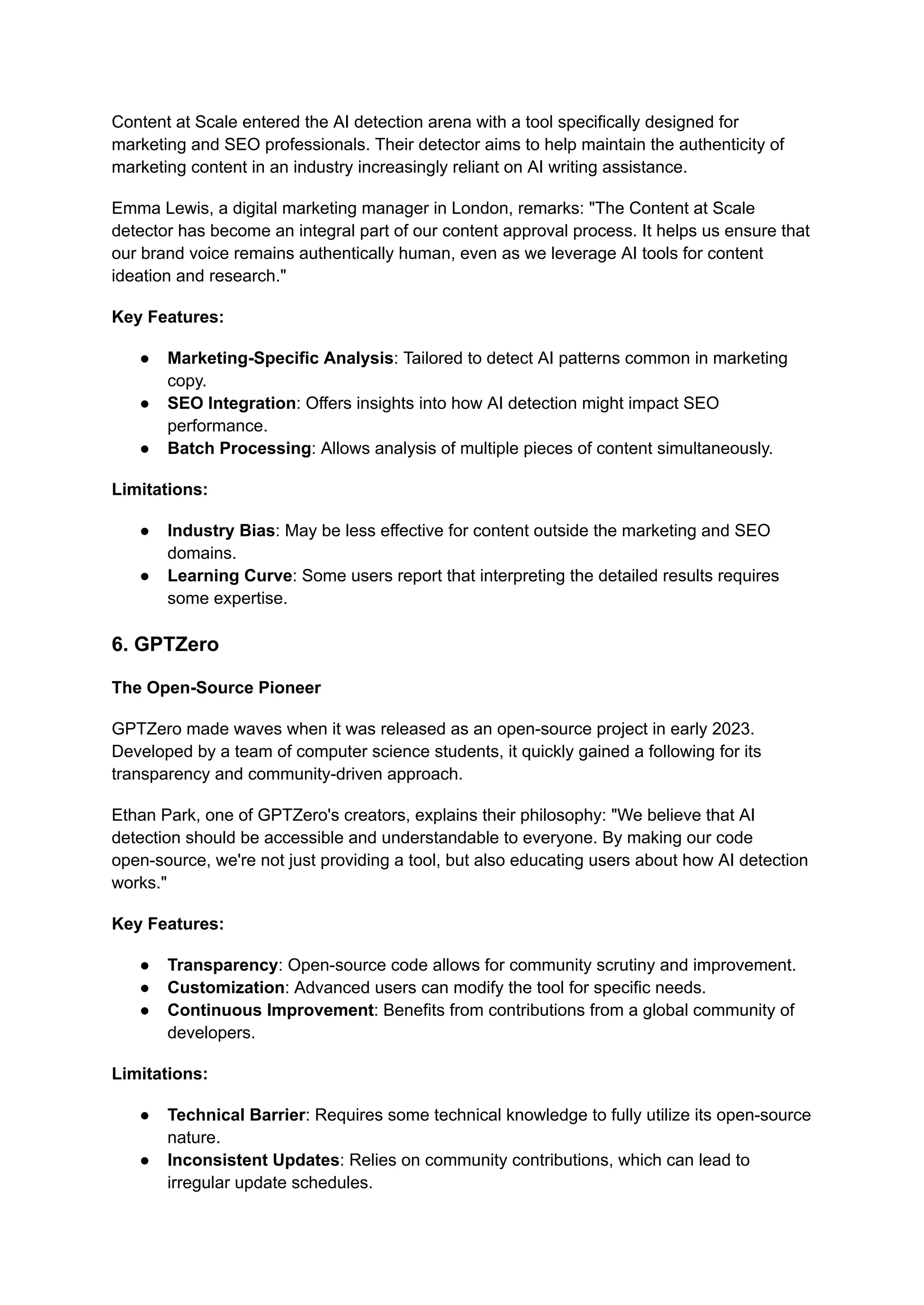
Content at Scale entered the AI detection arena with a tool specifically designed for
marketing and SEO professionals. Their detector aims to help maintain the authenticity of
marketing content in an industry increasingly reliant on AI writing assistance.
Emma Lewis, a digital marketing manager in London, remarks: "The Content at Scale
detector has become an integral part of our content approval process. It helps us ensure that
our brand voice remains authentically human, even as we leverage AI tools for content
ideation and research."
Key Features:
● Marketing-Specific Analysis: Tailored to detect AI patterns common in marketing
copy.
● SEO Integration: Offers insights into how AI detection might impact SEO
performance.
● Batch Processing: Allows analysis of multiple pieces of content simultaneously.
Limitations:
● Industry Bias: May be less effective for content outside the marketing and SEO
domains.
● Learning Curve: Some users report that interpreting the detailed results requires
some expertise.
6. GPTZero
The Open-Source Pioneer
GPTZero made waves when it was released as an open-source project in early 2023.
Developed by a team of computer science students, it quickly gained a following for its
transparency and community-driven approach.
Ethan Park, one of GPTZero's creators, explains their philosophy: "We believe that AI
detection should be accessible and understandable to everyone. By making our code
open-source, we're not just providing a tool, but also educating users about how AI detection
works."
Key Features:
● Transparency: Open-source code allows for community scrutiny and improvement.
● Customization: Advanced users can modify the tool for specific needs.
● Continuous Improvement: Benefits from contributions from a global community of
developers.
Limitations:
● Technical Barrier: Requires some technical knowledge to fully utilize its open-source
nature.
● Inconsistent Updates: Relies on community contributions, which can lead to
irregular update schedules.
7. Writer.com AI Content Detector
The Professional Writer's Choice
Writer.com, a platform known for its AI writing assistance tools, introduced its AI Content
Detector as a complement to its suite of writing products. The tool has found favor among
professional writers and content teams.
Lisa Chen, a content strategist at a major tech company, shares: "Writer.com's detector
helps us maintain a balance between leveraging AI for efficiency and preserving our unique
brand voice. It's become an essential part of our content review process."
Key Features:
● Integration with Writing Platform: Seamlessly works within the Writer.com
ecosystem.
● Team Collaboration: Allows for shared analysis and discussion within content
teams.
● Style Consistency Check: Helps ensure AI-assisted content matches established
brand voice guidelines.
Limitations:
● Platform Dependency: Full features are only available to Writer.com subscribers.
● Potential Bias: May be optimized for content created within the Writer.com
ecosystem.
8. Originality.AI
The Comprehensive Authenticity Suite
Originality.AI offers a holistic approach to content authenticity, combining AI detection with
plagiarism checking and readability analysis. This comprehensive tool has gained traction
among content managers and editorial teams.
David Singh, an editor at a leading online publication, notes: "Originality.AI gives us a
360-degree view of our content's authenticity. It's not just about catching AI-generated text;
it's about ensuring overall content integrity."
Key Features:
● Multi-Faceted Analysis: Combines AI detection with plagiarism checking and
readability scoring.
● Bulk Checking: Allows for analysis of multiple documents
● API Access: Offers integration capabilities for seamless workflow incorporation.
● Detailed Reports: Provides comprehensive breakdowns of authenticity, originality,
and readability scores.
Limitations:
● Complexity: The multi-faceted approach can be overwhelming for users seeking
simple AI detection.
● Cost Considerations: While offering a free tier, full features may require a paid
subscription.
9. Sapling AI Detector
The Contextual Analysis Expert
Sapling's AI Detector emerged in late 2023 as a tool that emphasizes contextual
understanding in its detection process. This approach aims to reduce false positives and
provide more nuanced analysis.
Dr. Rachel Wong, an AI ethics researcher, explains: "Sapling's contextual analysis is a step
forward in AI detection. By considering the broader context of the text, it can better
distinguish between AI-generated content and human writing that might use formal or
structured language."
Key Features:
● Contextual Analysis: Considers broader textual context for more accurate
detection.
● Low False Positive Rate: Aims to minimize incorrectly flagging human-written
content.
● Explainable Results: Provides detailed reasoning behind its determinations.
Limitations:
● Processing Time: The in-depth analysis can take longer than some other tools.
● Length Requirement: May be less effective with very short pieces of text.
10. AI Writing Check
The Educator's Ally
AI Writing Check was developed with a specific focus on the education sector. Launched in
early 2024, it quickly gained popularity among teachers and academic institutions for its
user-friendly interface and features tailored to classroom use.
Professor Michael Brown of Columbia University shares his experience: "AI Writing Check
has transformed how we approach academic integrity in the age of AI. It's not just a
detection tool; it's a teaching aid that helps students understand the importance of original
thinking and expression."
Key Features:
● Education-Focused Interface: Designed with classroom use in mind.
● Feedback Generation: Provides constructive feedback for improving writing
authenticity.
● Integration with Learning Management Systems: Easily incorporates into popular
educational platforms.
Limitations:
● Narrow Focus: May be less suitable for non-academic content.
● Developmental Stage: As a newer tool, it may still be refining its accuracy and
features.
The Human Element: Stories from the Frontlines of AI
Detection
While we've explored the technical aspects and features of these tools, it's crucial to
remember the human stories behind their development and use. Let's hear from some of the
individuals whose lives and work have been impacted by AI detection technology.
The Educator's Perspective
Emily Thompson, a high school English teacher in Chicago, shares her journey with AI
detection tools: "When AI writing assistants first became popular, I was terrified. How could I
possibly grade essays fairly if I couldn't tell what was genuine student work? The free AI
detectors have been a lifeline. But more than that, they've opened up fascinating discussions
in class about creativity, authenticity, and the future of writing."
Emily now incorporates AI detection into her curriculum, teaching students not just how to
write, but how to maintain their unique voice in a world where AI assistance is increasingly
common.
The Journalist's Dilemma
Marcus Lee, an investigative journalist based in New York, reflects on the role of AI detection
in modern newsrooms: "Verifying sources has always been a crucial part of journalism. Now,
with AI-generated text becoming so prevalent, we're having to verify the authenticity of the
writing itself. These detection tools have become as essential as fact-checking in
maintaining the integrity of our reporting."
Marcus emphasizes that while AI detection tools are invaluable, they're not a replacement
for journalistic instinct and thorough investigation. "They're a tool in our kit, not a silver
bullet," he notes.
The Content Creator's Balancing Act
Sophia Chen, a freelance content creator specializing in tech writing, discusses the complex
relationship many writers now have with AI: "I use AI writing assistants in my work - they're
incredible for overcoming writer's block and generating ideas. But I also use AI detection
tools to ensure my final product maintains my personal style and voice. It's a constant
balancing act between leveraging AI capabilities and preserving human creativity."
Sophia's experience highlights the nuanced reality many writers face in 2024, where AI is
both a powerful ally and a potential threat to authenticity.
The Ethics of AI Detection: Navigating Complex Waters
As AI detection tools become more prevalent, they raise important ethical questions that
society is only beginning to grapple with.
Privacy Concerns
Dr. Alana Morales, a digital ethics expert, raises an important point: "When we use AI
detection tools, we're essentially subjecting our writing to analysis by another AI system.
This raises questions about data privacy and the potential for these tools to be used for
surveillance or control."
Many of the free AI detection tools we've discussed have clear privacy policies, but users
should always be aware of how their data is being used and stored.
Bias and Fairness
Another critical issue is the potential for bias in AI detection systems. Dr. James Liu, a
computer scientist specializing in AI fairness, explains: "These tools are trained on datasets
of human and AI-generated writing. If these datasets are not diverse enough, the tools may
perform better for certain types of writing or certain languages, potentially disadvantaging
some users."
This concern highlights the need for ongoing research and development to ensure AI
detection tools are equitable and effective across different languages, cultures, and writing
styles.
The Authenticity Paradox
Perhaps the most philosophical question raised by AI detection is what we mean by
"authentic" writing in an age where AI assistance is becoming ubiquitous.
Professor Sarah Goldstein, a literary theorist at Oxford University, poses a thought-provoking
question: "If a writer uses AI to overcome writer's block, or to polish their prose, at what point
does the work cease to be authentically theirs? And who gets to make that determination?"
This question doesn't have easy answers, but it's one that writers, educators, and society at
large will need to continue grappling with as AI becomes an increasingly integral part of the
creative process.
The Future of AI Detection: Trends and Predictions
As we look to the future, several trends are likely to shape the evolution of AI detection
technology:
1. Increased Sophistication: As AI writing models continue to improve, detection tools
will need to become even more advanced. We may see the emergence of AI systems
specifically designed to outsmart detection tools, leading to an ongoing technological
arms race.
2. Integration into Writing Processes: AI detection may become a standard part of
word processing software and content management systems, allowing for real-time
authenticity checks during the writing process.
3. Regulatory Frameworks: As the implications of AI-generated content become more
apparent, we may see the development of legal and regulatory frameworks
governing its use and detection.
4. Personalized Detection: Future tools might be able to learn individual writing styles,
allowing for more accurate detection of whether a particular person's writing is
authentic to their usual style.
5. Ethical AI Generation: We may see the development of AI writing tools that are
specifically designed to be detectable, prioritizing transparency over perfect mimicry
of human writing.
Dr. Elena Fuentes, a futurist specializing in AI technologies, offers her perspective: "The
future of AI detection is not just about better algorithms. It's about fostering a new kind of
digital literacy where understanding the interplay between human and AI-generated content
becomes as fundamental as reading and writing."
Conclusion: Embracing Authenticity in the AI Era
As we've explored in this comprehensive guide, AI content detection tools are more than just
technological solutions to a modern problem. They represent our collective effort to preserve
the value of human creativity and authentic expression in an age where the lines between
human and machine-generated content are increasingly blurred.
From Leap AI's pioneering accessibility to GPTZero's open-source innovation, from Scribbr's
academic focus to Content at Scale's marketing specialization, each of these free tools
offers unique strengths in the quest for content authenticity. They serve not just as detectors,
but as catalysts for important conversations about the nature of creativity, the value of
original thought, and the future of human expression in an AI-augmented world.
As we move forward, it's crucial to approach these tools with both appreciation for their
capabilities and awareness of their limitations. They are aids to human judgment, not
replacements for critical thinking and discernment.
For writers, these tools offer a means to ensure their voice remains distinctly their own, even
as they leverage AI assistance. For educators, they provide a platform for teaching digital
literacy and the importance of original thinking. For readers, they offer a way to engage more
critically with the content they consume, fostering a more informed and discerning digital
citizenry.
In the end, the goal is not to create an unbridgeable divide between human and
AI-generated content, but to foster an environment where both can coexist transparently and
ethically. As AI continues to evolve, so too will our approaches to maintaining authenticity
and integrity in our digital discourse.
As we navigate this new frontier, let us remember that at the heart of all these technological
advancements and ethical debates lies a fundamentally human desire: to connect, to
express, and to be understood. In our quest for authenticity in the AI era, we are, in essence,
reaffirming the enduring value of the human voice in all its beautiful, imperfect, and
irreplaceable uniqueness.
The tools we've explored are just the beginning. As we move forward, it will be up to all of us
– writers, readers, educators, technologists, and policymakers – to shape a future where
human creativity and AI capability can coexist in a way that enriches rather than diminishes
our collective discourse. The journey of AI detection is, at its core, a journey of human
discernment and wisdom in the face of rapidly advancing technology.
In this new world, may we always strive to keep the human spirit at the forefront of our digital
endeavors, using these tools not just to detect AI, but to celebrate and elevate the
irreplaceable value of human thought and expression.
Recommendation: If you're looking to streamline and scale your
content marketing efforts through an intelligent, all-in-one solution,
the Leap AI SEO platform should be at the top of your list to
consider.

Discover the Top 10 Free AI Tools for Authentic Content Detection in 2024.pdf

  • 1.
    Discover the Top10 Free AI Tools for Authentic Content Detection in 2024 Introduction: The Dawn of a New Era in Content Verification Picture this: You're scrolling through your favorite news site, engrossed in an article that seems almost too well-written to be true. The prose flows effortlessly, the arguments are compelling, and the insights are razor-sharp. But as you reach the end, a nagging question lingers in your mind: "Was this really written by a human?" Welcome to 2024, where the line between human-generated and AI-generated content has become so blurred that distinguishing between the two is no longer a simple task. As artificial intelligence continues to evolve at breakneck speed, so too does our need to authenticate the origin of the information we consume. In our world today, content creators, educators, publishers, and everyday readers find themselves grappling with a fundamental question: How can we ensure the authenticity of the words we read and the ideas we encounter? Enter the realm of AI content detection tools – the unsung heroes of the digital age, working tirelessly to maintain the integrity of human creativity in an increasingly AI-dominated terrain. In this comprehensive guide, we'll embark on a journey through the fascinating world of AI detection. We'll explore the top free tools available in 2024, uncover their strengths and limitations, and equip you with the knowledge to navigate this complex terrain. But more than that, we'll delve into the human stories behind these technologies, the ethical considerations at play, and the profound impact these tools are having on our society. So, buckle up and prepare for a deep dive into the cutting edge of content authentication. Whether you're a curious reader, a vigilant educator, or a content creator looking to protect
  • 2.
    your craft, thisarticle will serve as your compass in the ever-shifting seas of digital authenticity. The Rise of AI-Generated Content: A Double-Edged Sword The AI Writing Revolution Cast your mind back to the early 2020s. Remember when AI-generated text was clunky, easily identifiable, and often the butt of jokes? Those days are long gone. The AI writing revolution has been nothing short of extraordinary, transforming the way we create and consume content. Today, AI language models can craft everything from compelling news articles and engaging blog posts to intricate academic papers and even creative fiction. They've become indispensable tools for content creators, marketers, and businesses looking to scale their output and reach wider audiences. Take Sarah, a freelance writer based in Seattle. "When I first started using AI writing assistants, it was mainly for basic tasks like generating outlines or coming up with catchy headlines," she recalls. "Now, I use them to co-write entire articles. The AI helps me overcome writer's block and explore angles I might not have considered on my own." Sarah's experience is not unique. Across industries, professionals are harnessing the power of AI to augment their writing capabilities, boost productivity, and push the boundaries of creativity. The Dark Side of AI-Generated Content However, as with any powerful technology, there's a flip side to this coin. The same tools that empower creators like Sarah have also opened the door to potential misuse and deception. Consider the case of a popular science blog that was caught publishing AI-generated articles without disclosure. The blog's readership plummeted, and its credibility was severely damaged when the truth came to light. "It felt like a betrayal," says Alex, a long-time reader of the blog. "I'd always trusted their content, shared it with friends. Finding out it was AI-generated without any human oversight... it made me question everything I'd read there." This incident highlights the ethical quandaries surrounding AI-generated content. When does augmentation cross the line into misrepresentation? How can readers trust the authenticity of the information they consume? And what responsibilities do content creators and platforms have in maintaining transparency? The Need for Authentication
  • 3.
    As AI-generated contentbecomes increasingly sophisticated and ubiquitous, the need for reliable authentication methods has never been more pressing. This need spans various domains: 1. Academia: Universities and research institutions require tools to ensure the integrity of student submissions and maintain academic honesty. 2. Journalism: News organizations need to verify the authenticity of sources and maintain the trust of their readership. 3. Publishing: Literary agents and publishers seek ways to authenticate original works and protect against AI-generated submissions masquerading as human-authored pieces. 4. Social Media: Platforms strive to combat the spread of AI-generated misinformation and maintain the authenticity of user-generated content. 5. Business: Companies need to protect their brand voice and ensure that their communications are genuinely human-crafted when claimed as such. It's in this context that AI content detection tools have emerged as crucial allies in the quest for digital authenticity. These tools leverage advanced algorithms and machine learning techniques to analyze text and identify patterns indicative of AI generation. As we delve deeper into the world of AI detection, remember that these tools are not just lines of code or complex algorithms. They represent our collective effort to preserve the value of human creativity and maintain trust in our digital discourse. They are the guardians of authenticity in an age where the lines between human and machine-generated content are increasingly blurred. In the following sections, we'll explore the top free AI detection tools available in 2024, examining their features, strengths, and limitations. We'll also hear from the developers behind these tools and the users whose lives they've impacted. So, let's embark on this journey into the frontlines of the AI detection revolution. Understanding AI Content Detection: The Science Behind the Tools The Fundamentals of AI Detection Before we dive into the specific tools, it's crucial to understand the basic principles underlying AI content detection. At its core, AI detection is a sophisticated form of pattern recognition. These tools analyze various aspects of a text to identify characteristics that are more likely to be present in AI-generated content than in human-written text. Dr. Elena Rodriguez, a computational linguist at the University of California, Berkeley, explains: "AI language models, despite their impressive capabilities, still have certain 'tells' that can be detected. These might include unusual word choices, overly consistent writing styles, or subtle patterns in sentence structure that humans typically don't produce." Some of the key factors that AI detection tools consider include:
  • 4.
    1. Perplexity: Thismeasures how surprised a language model is by the text. AI-generated content often has lower perplexity than human-written text. 2. Burstiness: Human writing tends to be "burstier," with greater variations in sentence length and complexity. 3. Entropy: This relates to the randomness or unpredictability of the text. Human writing often has higher entropy than AI-generated content. 4. Syntactic Patterns: AI models may produce certain grammatical structures more frequently than human writers. 5. Contextual Coherence: While AI has improved dramatically in maintaining context, human writing often exhibits more nuanced and layered contextual understanding. The Evolution of AI Detection Technology The field of AI detection has evolved rapidly, mirroring the advancements in AI language models themselves. Early detection methods relied heavily on simple statistical analysis and keyword spotting. However, as AI-generated text became more sophisticated, so too did the tools designed to detect it. Mark Chen, a software engineer who has worked on several AI detection projects, provides some historical context: "When we first started developing these tools around 2021, we were dealing with much simpler AI outputs. We could often spot AI-generated text just by looking for repetitive phrases or unnatural language patterns. Now, in 2024, we're using advanced machine learning models that can pick up on incredibly subtle cues that even human experts might miss." Today's AI detection tools often employ their own AI models, trained on vast datasets of both human-written and AI-generated text. These models learn to identify the minute differences between the two, constantly adapting as AI writing technology improves. The Challenges of AI Detection Despite the sophisticated technology behind AI detection tools, the field faces significant challenges: 1. Rapid AI Advancement: As AI writing models improve, they become harder to distinguish from human writing. This requires constant updates and improvements to detection tools. 2. False Positives: Sometimes, human-written text may be flagged as AI-generated, especially if the writer has a particularly structured or formal style. 3. Hybrid Content: Many writers now use AI as a writing aid, producing hybrid content that is part human-written and part AI-generated. This blurred line presents a significant challenge for detection tools. 4. Language and Domain Specificity: Most detection tools work best with English text and may struggle with other languages or highly specialized domains. 5. Adversarial Techniques: As detection tools become more widespread, techniques to evade them are also emerging, creating a cat-and-mouse game between generators and detectors.
  • 5.
    Dr. Samantha Lee,an AI ethics researcher, emphasizes the importance of understanding these limitations: "AI detection tools are incredibly useful, but they're not infallible. We need to approach them as aids to human judgment, not as definitive arbiters of authenticity." As we explore the top free AI detection tools available in 2024, it's important to keep these fundamentals and challenges in mind. Each tool represents a unique approach to the complex task of distinguishing between human and AI-generated text, and understanding their underlying principles will help you use them more effectively. Top 10 Free AI Content Detection Tools of 2024 1. Leap AI's Free AI Content Detector The Pioneer of Accessible AI Detection Leap AI burst onto the scene in early 2023 with a mission to democratize AI detection technology. Their free tool quickly gained traction among educators, journalists, and content creators for its user-friendly interface and robust detection capabilities. Sarah Thompson, a high school English teacher in Boston, shares her experience: "Leap AI's detector has been a game-changer in my classroom. With so many students turning to AI for writing assistance, it was becoming impossible to distinguish genuine work from AI-generated content. This tool has helped level the playing field and sparked important discussions about academic integrity in the AI age." Key Features: ● High Accuracy: Utilizes a sophisticated neural network trained on a diverse range of texts. ● Real-time Analysis: Provides instant results for quick content verification. ● Detailed Breakdown: Offers a probability score and highlights suspicious sections of text. ● Multi-language Support: Capable of detecting AI-generated content in over 20 languages. Limitations: ● Length Restrictions: The free version has a character limit for each analysis. ● No API Access: Integration with other tools or platforms is not available in the free version. Get Leap AI's Free AI Content Detector here 2. QuillBot's Free AI Detector The Writing Assistant's Counter-Tool
  • 6.
    QuillBot, known primarilyfor its AI-powered writing tools, surprised many by launching its own AI detection tool in mid-2023. This move was seen as a responsible step by a company deeply involved in AI writing technology. Mark Rodriguez, a freelance content writer, notes: "It's ironic that I use QuillBot's AI detector to check content that I've partially created using their other AI tools. But that's the reality of writing in 2024. It helps me ensure that my final product maintains a human touch." Key Features: ● Integration with Writing Tools: Seamlessly works alongside QuillBot's other writing assistance features. ● Confidence Meter: Provides a clear visual representation of the likelihood of AI generation. ● Educational Resources: Offers tips and guidelines for maintaining authenticity in writing. Limitations: ● Limited Batch Processing: The free version only allows analysis of one text at a time. ● Potential Bias: Some users have reported that the tool may be less likely to flag content generated by QuillBot's own AI writing features. Get quillbot free ai detector here 3. ChatGPT Detector by Copyleaks The Specialist in ChatGPT Detection As ChatGPT rose to prominence, Copyleaks quickly developed a tool specifically designed to detect content generated by OpenAI's popular chatbot. While it has since expanded its capabilities, it remains particularly effective at identifying ChatGPT-generated text. Dr. Alicia Feng, a researcher in computational linguistics, explains: "The ChatGPT Detector by Copyleaks is interesting because it focuses on the specific patterns and quirks of ChatGPT's output. This specialization allows for high accuracy when dealing with content from this particular AI, though it may be less effective with other AI writing tools." Key Features: ● ChatGPT Specialization: Highly accurate in detecting ChatGPT-generated content. ● Percentage Breakdown: Provides a detailed analysis of how much of the text is likely AI-generated.
  • 7.
    ● Browser Extension:Offers a convenient browser add-on for quick checks while browsing. Limitations: ● Narrow Focus: May be less effective with content generated by other AI writing tools. ● Regular Updates Required: Needs frequent updates to keep pace with ChatGPT's evolving capabilities. Get ChatGPT Detector By CopyLeaks here 4. Scribbr's AI Writing Detector The Academic Integrity Guardian Scribbr, a company known for its academic writing and editing services, launched its AI Writing Detector in response to growing concerns about AI use in academia. The tool has quickly become a favorite among educators and students alike. Professor James Chen of Stanford University shares: "Scribbr's detector has become an essential tool in my research supervision. It helps maintain the integrity of student submissions and has sparked important discussions about the role of AI in academic writing." Key Features: ● Academic Focus: Tailored to detect AI-generated academic writing. ● Plagiarism Cross-Check: Integrates with Scribbr's plagiarism checker for comprehensive analysis. ● Detailed Reports: Provides in-depth analysis and explanations for its determinations. Limitations: ● Specialization: May be less effective for non-academic content. ● False Positives: Some users report occasional flagging of highly technical human-written content. 5. Content at Scale AI Detector The Marketing Industry's Ally
  • 8.
    Content at Scaleentered the AI detection arena with a tool specifically designed for marketing and SEO professionals. Their detector aims to help maintain the authenticity of marketing content in an industry increasingly reliant on AI writing assistance. Emma Lewis, a digital marketing manager in London, remarks: "The Content at Scale detector has become an integral part of our content approval process. It helps us ensure that our brand voice remains authentically human, even as we leverage AI tools for content ideation and research." Key Features: ● Marketing-Specific Analysis: Tailored to detect AI patterns common in marketing copy. ● SEO Integration: Offers insights into how AI detection might impact SEO performance. ● Batch Processing: Allows analysis of multiple pieces of content simultaneously. Limitations: ● Industry Bias: May be less effective for content outside the marketing and SEO domains. ● Learning Curve: Some users report that interpreting the detailed results requires some expertise. 6. GPTZero The Open-Source Pioneer GPTZero made waves when it was released as an open-source project in early 2023. Developed by a team of computer science students, it quickly gained a following for its transparency and community-driven approach. Ethan Park, one of GPTZero's creators, explains their philosophy: "We believe that AI detection should be accessible and understandable to everyone. By making our code open-source, we're not just providing a tool, but also educating users about how AI detection works." Key Features: ● Transparency: Open-source code allows for community scrutiny and improvement. ● Customization: Advanced users can modify the tool for specific needs. ● Continuous Improvement: Benefits from contributions from a global community of developers. Limitations: ● Technical Barrier: Requires some technical knowledge to fully utilize its open-source nature. ● Inconsistent Updates: Relies on community contributions, which can lead to irregular update schedules.
  • 9.
    7. Writer.com AIContent Detector The Professional Writer's Choice Writer.com, a platform known for its AI writing assistance tools, introduced its AI Content Detector as a complement to its suite of writing products. The tool has found favor among professional writers and content teams. Lisa Chen, a content strategist at a major tech company, shares: "Writer.com's detector helps us maintain a balance between leveraging AI for efficiency and preserving our unique brand voice. It's become an essential part of our content review process." Key Features: ● Integration with Writing Platform: Seamlessly works within the Writer.com ecosystem. ● Team Collaboration: Allows for shared analysis and discussion within content teams. ● Style Consistency Check: Helps ensure AI-assisted content matches established brand voice guidelines. Limitations: ● Platform Dependency: Full features are only available to Writer.com subscribers. ● Potential Bias: May be optimized for content created within the Writer.com ecosystem. 8. Originality.AI The Comprehensive Authenticity Suite Originality.AI offers a holistic approach to content authenticity, combining AI detection with plagiarism checking and readability analysis. This comprehensive tool has gained traction among content managers and editorial teams. David Singh, an editor at a leading online publication, notes: "Originality.AI gives us a 360-degree view of our content's authenticity. It's not just about catching AI-generated text; it's about ensuring overall content integrity." Key Features: ● Multi-Faceted Analysis: Combines AI detection with plagiarism checking and readability scoring. ● Bulk Checking: Allows for analysis of multiple documents ● API Access: Offers integration capabilities for seamless workflow incorporation. ● Detailed Reports: Provides comprehensive breakdowns of authenticity, originality, and readability scores. Limitations:
  • 10.
    ● Complexity: Themulti-faceted approach can be overwhelming for users seeking simple AI detection. ● Cost Considerations: While offering a free tier, full features may require a paid subscription. 9. Sapling AI Detector The Contextual Analysis Expert Sapling's AI Detector emerged in late 2023 as a tool that emphasizes contextual understanding in its detection process. This approach aims to reduce false positives and provide more nuanced analysis. Dr. Rachel Wong, an AI ethics researcher, explains: "Sapling's contextual analysis is a step forward in AI detection. By considering the broader context of the text, it can better distinguish between AI-generated content and human writing that might use formal or structured language." Key Features: ● Contextual Analysis: Considers broader textual context for more accurate detection. ● Low False Positive Rate: Aims to minimize incorrectly flagging human-written content. ● Explainable Results: Provides detailed reasoning behind its determinations. Limitations: ● Processing Time: The in-depth analysis can take longer than some other tools. ● Length Requirement: May be less effective with very short pieces of text. 10. AI Writing Check The Educator's Ally AI Writing Check was developed with a specific focus on the education sector. Launched in early 2024, it quickly gained popularity among teachers and academic institutions for its user-friendly interface and features tailored to classroom use. Professor Michael Brown of Columbia University shares his experience: "AI Writing Check has transformed how we approach academic integrity in the age of AI. It's not just a detection tool; it's a teaching aid that helps students understand the importance of original thinking and expression." Key Features: ● Education-Focused Interface: Designed with classroom use in mind. ● Feedback Generation: Provides constructive feedback for improving writing authenticity.
  • 11.
    ● Integration withLearning Management Systems: Easily incorporates into popular educational platforms. Limitations: ● Narrow Focus: May be less suitable for non-academic content. ● Developmental Stage: As a newer tool, it may still be refining its accuracy and features. The Human Element: Stories from the Frontlines of AI Detection While we've explored the technical aspects and features of these tools, it's crucial to remember the human stories behind their development and use. Let's hear from some of the individuals whose lives and work have been impacted by AI detection technology. The Educator's Perspective Emily Thompson, a high school English teacher in Chicago, shares her journey with AI detection tools: "When AI writing assistants first became popular, I was terrified. How could I possibly grade essays fairly if I couldn't tell what was genuine student work? The free AI detectors have been a lifeline. But more than that, they've opened up fascinating discussions in class about creativity, authenticity, and the future of writing." Emily now incorporates AI detection into her curriculum, teaching students not just how to write, but how to maintain their unique voice in a world where AI assistance is increasingly common. The Journalist's Dilemma Marcus Lee, an investigative journalist based in New York, reflects on the role of AI detection in modern newsrooms: "Verifying sources has always been a crucial part of journalism. Now, with AI-generated text becoming so prevalent, we're having to verify the authenticity of the writing itself. These detection tools have become as essential as fact-checking in maintaining the integrity of our reporting." Marcus emphasizes that while AI detection tools are invaluable, they're not a replacement for journalistic instinct and thorough investigation. "They're a tool in our kit, not a silver bullet," he notes. The Content Creator's Balancing Act Sophia Chen, a freelance content creator specializing in tech writing, discusses the complex relationship many writers now have with AI: "I use AI writing assistants in my work - they're incredible for overcoming writer's block and generating ideas. But I also use AI detection tools to ensure my final product maintains my personal style and voice. It's a constant balancing act between leveraging AI capabilities and preserving human creativity."
  • 12.
    Sophia's experience highlightsthe nuanced reality many writers face in 2024, where AI is both a powerful ally and a potential threat to authenticity. The Ethics of AI Detection: Navigating Complex Waters As AI detection tools become more prevalent, they raise important ethical questions that society is only beginning to grapple with. Privacy Concerns Dr. Alana Morales, a digital ethics expert, raises an important point: "When we use AI detection tools, we're essentially subjecting our writing to analysis by another AI system. This raises questions about data privacy and the potential for these tools to be used for surveillance or control." Many of the free AI detection tools we've discussed have clear privacy policies, but users should always be aware of how their data is being used and stored. Bias and Fairness Another critical issue is the potential for bias in AI detection systems. Dr. James Liu, a computer scientist specializing in AI fairness, explains: "These tools are trained on datasets of human and AI-generated writing. If these datasets are not diverse enough, the tools may perform better for certain types of writing or certain languages, potentially disadvantaging some users." This concern highlights the need for ongoing research and development to ensure AI detection tools are equitable and effective across different languages, cultures, and writing styles. The Authenticity Paradox Perhaps the most philosophical question raised by AI detection is what we mean by "authentic" writing in an age where AI assistance is becoming ubiquitous. Professor Sarah Goldstein, a literary theorist at Oxford University, poses a thought-provoking question: "If a writer uses AI to overcome writer's block, or to polish their prose, at what point does the work cease to be authentically theirs? And who gets to make that determination?" This question doesn't have easy answers, but it's one that writers, educators, and society at large will need to continue grappling with as AI becomes an increasingly integral part of the creative process. The Future of AI Detection: Trends and Predictions As we look to the future, several trends are likely to shape the evolution of AI detection technology:
  • 13.
    1. Increased Sophistication:As AI writing models continue to improve, detection tools will need to become even more advanced. We may see the emergence of AI systems specifically designed to outsmart detection tools, leading to an ongoing technological arms race. 2. Integration into Writing Processes: AI detection may become a standard part of word processing software and content management systems, allowing for real-time authenticity checks during the writing process. 3. Regulatory Frameworks: As the implications of AI-generated content become more apparent, we may see the development of legal and regulatory frameworks governing its use and detection. 4. Personalized Detection: Future tools might be able to learn individual writing styles, allowing for more accurate detection of whether a particular person's writing is authentic to their usual style. 5. Ethical AI Generation: We may see the development of AI writing tools that are specifically designed to be detectable, prioritizing transparency over perfect mimicry of human writing. Dr. Elena Fuentes, a futurist specializing in AI technologies, offers her perspective: "The future of AI detection is not just about better algorithms. It's about fostering a new kind of digital literacy where understanding the interplay between human and AI-generated content becomes as fundamental as reading and writing." Conclusion: Embracing Authenticity in the AI Era As we've explored in this comprehensive guide, AI content detection tools are more than just technological solutions to a modern problem. They represent our collective effort to preserve the value of human creativity and authentic expression in an age where the lines between human and machine-generated content are increasingly blurred. From Leap AI's pioneering accessibility to GPTZero's open-source innovation, from Scribbr's academic focus to Content at Scale's marketing specialization, each of these free tools offers unique strengths in the quest for content authenticity. They serve not just as detectors, but as catalysts for important conversations about the nature of creativity, the value of original thought, and the future of human expression in an AI-augmented world. As we move forward, it's crucial to approach these tools with both appreciation for their capabilities and awareness of their limitations. They are aids to human judgment, not replacements for critical thinking and discernment. For writers, these tools offer a means to ensure their voice remains distinctly their own, even as they leverage AI assistance. For educators, they provide a platform for teaching digital literacy and the importance of original thinking. For readers, they offer a way to engage more critically with the content they consume, fostering a more informed and discerning digital citizenry. In the end, the goal is not to create an unbridgeable divide between human and AI-generated content, but to foster an environment where both can coexist transparently and
  • 14.
    ethically. As AIcontinues to evolve, so too will our approaches to maintaining authenticity and integrity in our digital discourse. As we navigate this new frontier, let us remember that at the heart of all these technological advancements and ethical debates lies a fundamentally human desire: to connect, to express, and to be understood. In our quest for authenticity in the AI era, we are, in essence, reaffirming the enduring value of the human voice in all its beautiful, imperfect, and irreplaceable uniqueness. The tools we've explored are just the beginning. As we move forward, it will be up to all of us – writers, readers, educators, technologists, and policymakers – to shape a future where human creativity and AI capability can coexist in a way that enriches rather than diminishes our collective discourse. The journey of AI detection is, at its core, a journey of human discernment and wisdom in the face of rapidly advancing technology. In this new world, may we always strive to keep the human spirit at the forefront of our digital endeavors, using these tools not just to detect AI, but to celebrate and elevate the irreplaceable value of human thought and expression. Recommendation: If you're looking to streamline and scale your content marketing efforts through an intelligent, all-in-one solution, the Leap AI SEO platform should be at the top of your list to consider.