Disaster Management & CASE
STUDY
 NAME :- AKASH RANA
 ROLL NO :- 46
 CLASS:- Mcom part-1
 PROJECT GUIDE:- Prof. kishore karia
INTRODUCTION
 A disaster is a serious disruption of the functioning of a community or a
society involving widespread human, material, economic or environmental
losses and impacts, which exceeds the ability of the affected community or
society to cope using its own resources
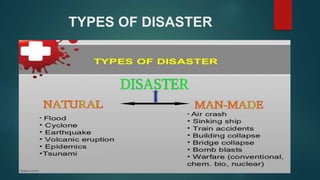
TYPES OF DISASTER
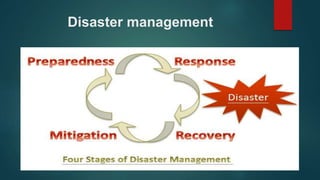
Disaster management
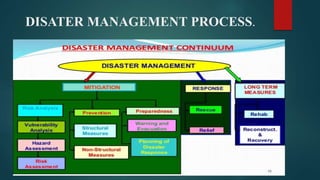
DISATER MANAGEMENT PROCESS.
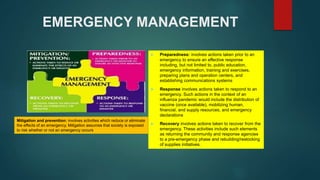
EMERGENCY MANAGEMENT
 Preparedness: involves actions taken prior to an
emergency to ensure an effective response
including, but not limited to, public education,
emergency information, training and exercises,
preparing plans and operation centers, and
establishing communications systems
 Response involves actions taken to respond to an
emergency. Such actions in the context of an
influenza pandemic would include the distribution of
vaccine (once available), mobilizing human,
financial, and supply resources, and emergency
declarations
 Recovery involves actions taken to recover from the
emergency. These activities include such elements
as returning the community and response agencies
to a pre-emergency phase and rebuilding/restocking
of supplies initiatives.
Mitigation and prevention: involves activities which reduce or eliminate
the effects of an emergency. Mitigation assumes that society is exposed
to risk whether or not an emergency occurs
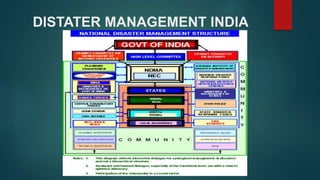
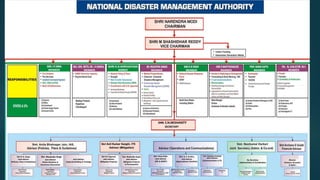
DISTATER MANAGEMENT INDIA
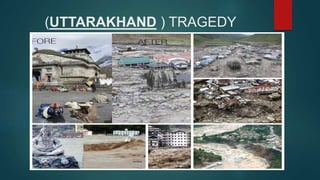
(UTTARAKHAND ) TRAGEDY
A Case Study of Uttarakhand
 At the peak of the monsoon season the northern state of Uttarakhand was
face to face with floods caused due to the cloud burst that hit three of the
four famous Char Dham pilgrim sites, “2013 North India floods” leaving
tens and thousands of inhabitants as well as pilgrims stranded or swept
away due to the floods, and not to mention the damage cause to life,
property and business. The famous Char Dham pilgrimage is now
discontinued for three years for repair and restoration ("Plan ahead",
2013).The National Institute of Disaster Management (NIDM), in one of its
first reports on the Uttarakhand floods, has blamed “climatic conditions
combined with haphazard human intervention” in the hills for the disaster
(“Down To Earth”, 2013).
CONCLUSION
 I just want to add one thing that Indian government would have to
overcome with the new ideas and technology to prevent such natural
disaster and give the promotional ideas to educate people regarding
natural calamities.
SHORT SUMMERY
 INTRODUCTION
 TYPES OF DISASTER
 DISASTER MANAGEMENT
 DISASTER MANAGEMENT PEOCESS
 EMERGENCY MANAGEMENT
 DISASTER MANAGEMENT INDIA
 UTTARAKHAND TRAGEDY & CASE STUDY
 CONCLUSION
 BIBLOGRAPHY
Bibliography
Books:-
M.com Part 1 S.M. book
OXFORD dictionary
Notes & journal:-
Dr. Bindi Varghese & Neha Itty Jose Paul case study On Uttarakhand Disaster
Websites:-
www.google.com
www.wikipedia.com
www.slideshare.com
www.hindustantimes.com
www.economictimes.com
www.blog.wsj.com
Disaster management and case study ppt

Disaster management and case study ppt

  • 1.
    Disaster Management &CASE STUDY  NAME :- AKASH RANA  ROLL NO :- 46  CLASS:- Mcom part-1  PROJECT GUIDE:- Prof. kishore karia
  • 2.
    INTRODUCTION  A disasteris a serious disruption of the functioning of a community or a society involving widespread human, material, economic or environmental losses and impacts, which exceeds the ability of the affected community or society to cope using its own resources
  • 3.
  • 4.
  • 5.
  • 6.
    EMERGENCY MANAGEMENT  Preparedness:involves actions taken prior to an emergency to ensure an effective response including, but not limited to, public education, emergency information, training and exercises, preparing plans and operation centers, and establishing communications systems  Response involves actions taken to respond to an emergency. Such actions in the context of an influenza pandemic would include the distribution of vaccine (once available), mobilizing human, financial, and supply resources, and emergency declarations  Recovery involves actions taken to recover from the emergency. These activities include such elements as returning the community and response agencies to a pre-emergency phase and rebuilding/restocking of supplies initiatives. Mitigation and prevention: involves activities which reduce or eliminate the effects of an emergency. Mitigation assumes that society is exposed to risk whether or not an emergency occurs
  • 7.
  • 9.
  • 10.
    A Case Studyof Uttarakhand  At the peak of the monsoon season the northern state of Uttarakhand was face to face with floods caused due to the cloud burst that hit three of the four famous Char Dham pilgrim sites, “2013 North India floods” leaving tens and thousands of inhabitants as well as pilgrims stranded or swept away due to the floods, and not to mention the damage cause to life, property and business. The famous Char Dham pilgrimage is now discontinued for three years for repair and restoration ("Plan ahead", 2013).The National Institute of Disaster Management (NIDM), in one of its first reports on the Uttarakhand floods, has blamed “climatic conditions combined with haphazard human intervention” in the hills for the disaster (“Down To Earth”, 2013).
  • 11.
    CONCLUSION  I justwant to add one thing that Indian government would have to overcome with the new ideas and technology to prevent such natural disaster and give the promotional ideas to educate people regarding natural calamities.
  • 12.
    SHORT SUMMERY  INTRODUCTION TYPES OF DISASTER  DISASTER MANAGEMENT  DISASTER MANAGEMENT PEOCESS  EMERGENCY MANAGEMENT  DISASTER MANAGEMENT INDIA  UTTARAKHAND TRAGEDY & CASE STUDY  CONCLUSION  BIBLOGRAPHY
  • 13.
    Bibliography Books:- M.com Part 1S.M. book OXFORD dictionary Notes & journal:- Dr. Bindi Varghese & Neha Itty Jose Paul case study On Uttarakhand Disaster Websites:- www.google.com www.wikipedia.com www.slideshare.com www.hindustantimes.com www.economictimes.com www.blog.wsj.com