Direct Marketing
Learning Objectives
Upon completing this chapter the student will be able to:
• Explain the advantages and disadvantages of direct
marketing.
• List the types of objectives used in direct marketing.
• Describe the types of direct marketing strategies.
• Describe the main direct marketing tactics.
• Explain how direct marketing efforts are evaluated.
8
© vaeenma/iStock/Thinkstock
Introduction Chapter 8
Pre-Test
1. Which of the following involves independent contractors who
market or sell products one-to-
one or in homes?
a) Direct marketing
b) Direct response marketing
c) Direct selling
d) Personal sales
2. When would direct marketing be most useful to the IMC
planner?
a) When a product has received negative publicity
b) When product sales have dropped off
c) When launching new products
d) When relationship marketing is not important
3. Which direct marketing strategy is used more often for
retaining current customers?
a) Product trials
b) Newsletters
c) Database purchases
d) Data mining
4. Which direct marketing tactic has the advantage of reaching
the most people?
a) Catalogs
b) Direct mail
c) Television
d) Social media
5. Which media is likely to have the best return on investment
for direct marketing?
a) Internet display
b) Direct mail
c) Social media/networking
d) Commercial email
Answers
1. c) Direct selling. The correct answer can be found in Section
8.1
2. c) When launching new products. The correct answer can be
found in Section 8.2
3. b) Newsletters. The correct answer can be found in Section
8.3
4. c) Television. The correct answer can be found in Section 8.4
5. d) Commercial email. The correct answer can be found in
Section 8.5
Introduction
The authors wish to thank contributing author, Dr. Therese
Maskulka.
Have you ever received a robocall (automated phone call with a
prerecorded message) urging you
to vote for your favorite political candidate? Have you ever
seen an advertisement in the newspaper
Direct Marketing Overview Chapter 8
urging you to act now or miss out on a great sale? Have you
ever watched a 15-, 20-, 30-minute or
hour-long infomercial (long television commercial)? If so,
you’ve been exposed to several types of
direct marketing tactics developed to generate an immediate
action from consumers. Robocalls
were created to assist the IMC professionals with telephone
direct marketing. Infomercials were
created to help explain a product, educate the consumer, and
create immediate sales and requests
for information. Each of these tactics relates to the concept of
direct marketing, or direct response
marketing. Although online marketing is often used with direct
marketing, Internet marketing
will be covered in Chapter 9.
8.1 Direct Marketing Overview
We defined direct marketing in Chapter 3 but it bears repeating
to provide context to the rest of
the chapter. The Direct Marketing Association (DMA) defines
direct marketing as an “interactive
system of marketing which uses one or more advertising media
to effect a measureable response
and/or transaction at any location” (www.thedma.org). Direct
marketing is also defined as “ . . .
targeting of products to customers without the use of other
channel members” (Clow and Baack,
2014). Direct response marketing is a form
of direct marketing, but the purpose is to
create an immediate response from the tar-
geted consumer groups. Direct response
marketing will provide a way for the con-
sumer to contact the company directly with
a telephone number, an Internet address,
or a business reply card. Another area
related to direct marketing is direct selling.
According to the Direct Selling Association
(www.dsa.org) direct selling is “a business
model that offers entrepreneurial opportu-
nities to individuals as independent con-
tractors to market and/or sell products and
services, typically outside of a fixed retail
establishment, through one-to-one selling,
in-home product demonstrations or online”
(What is direct selling, n.d.). Direct sellers
are often called consultants, representatives,
or distributors.
Direct marketing encompasses both channels of distribution and
communications. Integrated
marketing communications professionals are mainly concerned
with the communications func-
tion of direct marketing.
Marketing Guru Speaks about Direct Marketing
David Ogilvy (1911–1999) was an advertising executive and
author of the book,
Ogilvy on Advertising. He became well-known for his expertise.
Although the video
was created in 1985, Ogilvy’s insights are still relevant today.
http://www.youtube.com/watch?v=Br2KSsaTzUc&feature=share
&list=PLA46AF6F687D1A609
© manleyaudio/iStock/Thinkstock
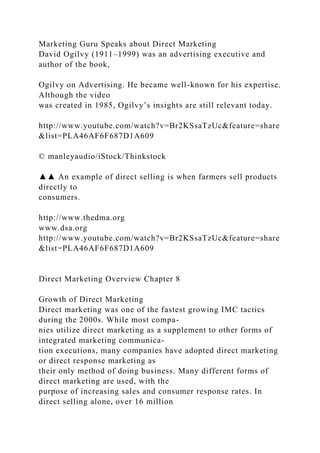
▲▲ An example of direct selling is when farmers sell products
directly to
consumers.
http://www.thedma.org
www.dsa.org
http://www.youtube.com/watch?v=Br2KSsaTzUc&feature=share
&list=PLA46AF6F687D1A609
Direct Marketing Overview Chapter 8
Growth of Direct Marketing
Direct marketing was one of the fastest growing IMC tactics
during the 2000s. While most compa-
nies utilize direct marketing as a supplement to other forms of
integrated marketing communica-
tion executions, many companies have adopted direct marketing
or direct response marketing as
their only method of doing business. Many different forms of
direct marketing are used, with the
purpose of increasing sales and consumer response rates. In
direct selling alone, over 16 million
people are engaged in selling, generating over $28 billion in
sales annually (Belch and Belch, 2012).
In 2011, direct marketing spending was about $163 billion and
accounted for 52.1% of total adver-
tising spending in the United States. The industry supports
about 9.2 million jobs (DMA Releases
. . . , 2011). The DMA (http://thedma.org/) suggests that the
majority of any direct marketing
budget is used for new customer prospecting, while the
remainder typically is spent on customer
retention (Levey, 2004). Direct marketing is typically tied to
database marketing, and is integrat-
ing with electronic commerce and Internet marketing. Let’s take
a look at some advantages and
disadvantages of direct marketing.
Advantages of Direct Marketing
One of the biggest advantages with direct marketing is that a
company can target and reach an
audience without wasting money. Good databases are very
specific and create positive results.
Companies can buy lists that allow them to reach target market
segments. Another major advan-
tage is the ability to evaluate and measure the effectiveness of
direct marketing efforts. A telephone
number, codes on a promotion, or specific website uniform
resource locator can help a company
measure interest. A uniform resource locator (URL) is a text
string used in Web browsers to locate
a specific Internet site. Although costs tend to be high per
contact when using direct marketing,
profits may be higher because of the ability to target the
audience and to reduce waste audience cov-
erage. Direct marketing over the Internet can reduce costs and
may be less expensive when com-
pared to other IMC tactics. The conversion rate, which is the
percentage of consumers that take a
desired action is high, which helps justify the costs. Direct
marketing allows for testing of variables
associated with the launch and running of an IMC campaign that
focuses on direct marketing.
The ability to personalize direct marketing is also an advantage.
Direct marketers can make con-
sumers feel that businesses are speaking directly to them while
customizing products with names,
logos, slogans, or whatever the customer desires. Another
advantage is that direct marketing
pieces can be developed and launched very quickly, allowing
the IMC planner to take advantage
of changes in the business environment. When environmental
scanning shows a change in the
business environment, direct marketers can create and execute a
plan that deals with the changes.
Direct marketing is a great tool to generate frequency. In
particular, online direct marketing can
reach a consumer daily (or multiple times a day), weekly,
monthly, quarterly, or yearly. Finally,
direct marketing helps create long-term relationships.
Relationship marketing is where the seller
focuses on developing an enduring relationship between a brand
and its consumers. The concept of
relationship marketing is to develop brand loyalty, which will
translate into repeat purchases and
greater profits and sales (Shimp and Andrews, 2013).
Disadvantages of Direct Marketing
While direct marketing has many advantages, there are some
disadvantages. One of the major
disadvantages is direct marketing’s image. Many customers
resent direct mail and as a result, they
have a low image of companies using that tactic. Additionally
many direct response broadcasts are
low-budget productions. The image of a product may be
tarnished with these types of executions.
http://thedma.org/
Direct Marketing Overview Chapter 8
Direct marketers must be cognizant of image issues when they
develop their tactical executions.
The numerous do-not-call lists that are in effect for both
landline and mobile phones make tele-
phone direct marketing difficult. Although profits can be high,
the overall costs associated with
direct marketing can be high. For example, every time the
United States government increases
postal rates, the costs associated with direct marketing rise.
Another disadvantage is the lack of content and editorial
support. In magazine and broadcast
advertising, there is editorial support and other content to
complement efforts. With direct market-
ing, the creation of editorial support and its effect on customer
mood is minimal. Direct mail and
online direct marketing are only supported by the programs and
editorial content displayed online
or within the direct mail piece. Another disadvantage to direct
marketing is that consumers often
reject direct marketing efforts due to the many marketing
messages received on a daily basis. It is
easy for a consumer to throw away a direct mail piece that took
time and energy to create. Finally,
there are many inaccurate lists used in direct marketing. People
die, move, change their habits, have
varying income levels, change jobs, and have other changes in
their lives. If companies that provide
lists aren’t keeping lists current, the effectiveness of direct
marketing diminishes. Computer soft-
ware programs have made the task of updating lists and renting
new lists easier; however, it is still
up to the direct marketing planner to make sure in-house
databases contain accurate information.
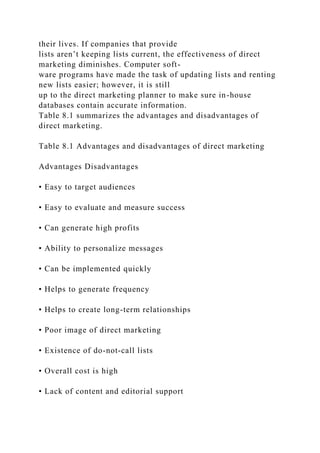
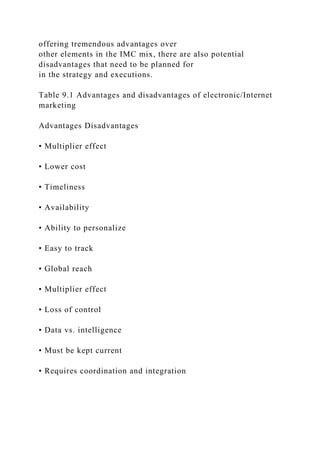
Table 8.1 summarizes the advantages and disadvantages of
direct marketing.
Table 8.1 Advantages and disadvantages of direct marketing
Advantages Disadvantages
• Easy to target audiences
• Easy to evaluate and measure success
• Can generate high profits
• Ability to personalize messages
• Can be implemented quickly
• Helps to generate frequency
• Helps to create long-term relationships
• Poor image of direct marketing
• Existence of do-not-call lists
• Overall cost is high
• Lack of content and editorial support
• Rejected by consumers
• Inaccurate lists
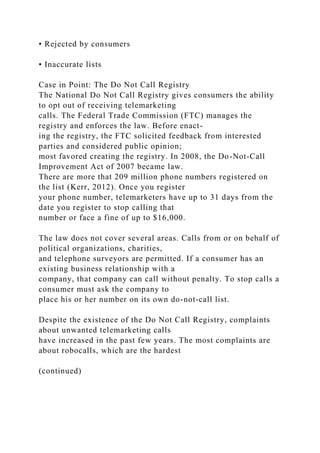
Case in Point: The Do Not Call Registry
The National Do Not Call Registry gives consumers the ability
to opt out of receiving telemarketing
calls. The Federal Trade Commission (FTC) manages the
registry and enforces the law. Before enact-
ing the registry, the FTC solicited feedback from interested
parties and considered public opinion;
most favored creating the registry. In 2008, the Do-Not-Call
Improvement Act of 2007 became law.
There are more that 209 million phone numbers registered on
the list (Kerr, 2012). Once you register
your phone number, telemarketers have up to 31 days from the
date you register to stop calling that
number or face a fine of up to $16,000.
The law does not cover several areas. Calls from or on behalf of
political organizations, charities,
and telephone surveyors are permitted. If a consumer has an
existing business relationship with a
company, that company can call without penalty. To stop calls a
consumer must ask the company to
place his or her number on its own do-not-call list.
Despite the existence of the Do Not Call Registry, complaints
about unwanted telemarketing calls
have increased in the past few years. The most complaints are
about robocalls, which are the hardest
(continued)
Direct Marketing Overview Chapter 8
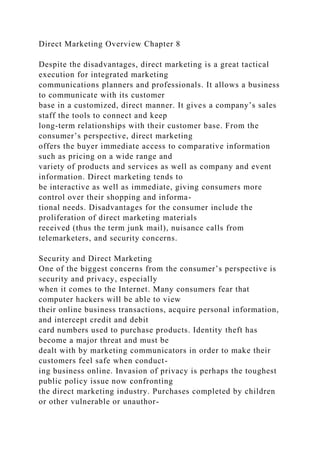
Despite the disadvantages, direct marketing is a great tactical
execution for integrated marketing
communications planners and professionals. It allows a business
to communicate with its customer
base in a customized, direct manner. It gives a company’s sales
staff the tools to connect and keep
long-term relationships with their customer base. From the
consumer’s perspective, direct marketing
offers the buyer immediate access to comparative information
such as pricing on a wide range and
variety of products and services as well as company and event
information. Direct marketing tends to
be interactive as well as immediate, giving consumers more
control over their shopping and informa-
tional needs. Disadvantages for the consumer include the
proliferation of direct marketing materials
received (thus the term junk mail), nuisance calls from
telemarketers, and security concerns.
Security and Direct Marketing
One of the biggest concerns from the consumer’s perspective is
security and privacy, especially
when it comes to the Internet. Many consumers fear that
computer hackers will be able to view
their online business transactions, acquire personal information,
and intercept credit and debit
card numbers used to purchase products. Identity theft has
become a major threat and must be
dealt with by marketing communicators in order to make their
customers feel safe when conduct-
ing business online. Invasion of privacy is perhaps the toughest
public policy issue now confronting
the direct marketing industry. Purchases completed by children
or other vulnerable or unauthor-
ized groups are of particular concern to direct marketers.
Phishing, a type of identity theft that
uses deceptive emails and fraudulent websites to fool consumers
into believing that the communi-
cation is legitimate, has become commonplace. Consumers may
divulge information about their
personal lives, financial situations, passwords, and more when
confronted with phishing commu-
nications. Businesses, and in particular direct marketers, must
be cognizant of these threats and
create countermeasures that combat these threats and make
consumers feel comfortable about
doing business online.
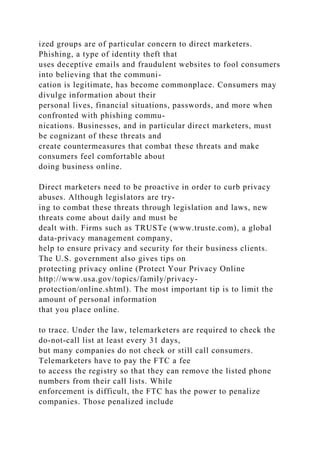
Direct marketers need to be proactive in order to curb privacy
abuses. Although legislators are try-
ing to combat these threats through legislation and laws, new
threats come about daily and must be
dealt with. Firms such as TRUSTe (www.truste.com), a global
data-privacy management company,
help to ensure privacy and security for their business clients.
The U.S. government also gives tips on
protecting privacy online (Protect Your Privacy Online
http://www.usa.gov/topics/family/privacy-
protection/online.shtml). The most important tip is to limit the
amount of personal information
that you place online.
to trace. Under the law, telemarketers are required to check the
do-not-call list at least every 31 days,
but many companies do not check or still call consumers.
Telemarketers have to pay the FTC a fee
to access the registry so that they can remove the listed phone
numbers from their call lists. While
enforcement is difficult, the FTC has the power to penalize
companies. Those penalized include
Talbots®, DirecTV, and Dish Network, yielding $5.6 million in
penalties (Kerr, 2012).
Consumers can register a phone number online at
www.donotcall.gov (National Do Not Call
Registry) or by phone at 1-888-382-1222.
Reflection questions:
1. Why do you think political calls and charities are not covered
under the law?
2. What other actions can telemarketers take to reach
customers?
3. Why do some telemarketers break the law?
4. Do you have your telephone numbers registered on the Do
Not Call Registry? Why or why not?
http://www.truste.com/
http://www.usa.gov/topics/family/privacy-
protection/online.shtml
http://www.usa.gov/topics/family/privacy-
protection/online.shtml
http://www.donotcall.gov
Direct Marketing Planning Chapter 8
› Learning Check
Reflect on your learning by answering the following questions:
1. What are the advantages and disadvantages of direct
marketing from a business perspective?
From a consumer perspective?
2. Do you think companies care about privacy and security for
their customers? Why or why not?
8.2 Direct Marketing Planning
Relationship marketing permeates all aspects of integrated
marketing communication and the
IMC mix. It figures prominently into most IMC plans;
accordingly, the marketing concept and
building relationships must be uppermost when developing a
direct marketing plan. Make sure the
direct marketing objectives relate to the overall IMC objectives.
Direct marketing can help create
synergy, and will be very useful to the IMC planner during slow
sales seasons, when launching new
products, when reminding consumers to take action, or to
stimulate sales at a given point in time.
Direct marketing plans follow the same outline as the other
plans within the IMC plan/market-
ing plan. Start with the direct marketing objectives, create an
overall strategy (or strategies) and
develop tactical executions to achieve the objectives. Budgets
are required, as are timelines that
indicate when and where the tactics will be launched. It is very
important to evaluate and control
the effectiveness of the direct marketing campaign. Make sure it
integrates with the other tactics
and that it creates synergy within the campaign.
Many objectives may be developed for direct marketing.
Remember that businesses use direct mar-
keting for communication and distribution. In this text, we are
not concerned about objectives
for distribution, only about those that deal with communication.
We are not concerned with the
development of a direct marketing distribution channel, but in
how we can use that channel to
communicate with various targeted market segments. Table 8.2
lists the main types of direct mar-
keting objectives (Stone, 1989).
Table 8.2 Direct marketing objectives
Objective Type Example
Supplement sales in other areas of the organization Develop a
30-page catalog to increase sales from the
Internet and retail store by 10% in a 12-month period
Get qualified leads for salespeople, dealers, and distrib-
utors of the company’s products and services
Increase qualified leads for residential paint jobs from
150 to 250 in a 12-month period
To inform or educate consumers and potential
consumers about a brand, product, events, or services
To get 1,000 people to call the toll-free number and
order product × in a one-month period
Create direct sales to other business customers
bypassing the traditional channels of distribution
Increase the number of companies buying supplies
directly from us from 125 to 400 within a 12-month
period
As with the other IMC areas, objectives must be SMART
(specific, measurable, attainable, relevant
and have a time frame). Direct marketing can take many
directions, so objectives have to be very
clear. Once objectives are created, the development of a
strategy or strategies is necessary to deter-
mine how tactics will be achieved.
Strategies Chapter 8
› Learning Check
Reflect on your learning by answering the following questions:
1. What are the types of objectives used when developing direct
marketing?
2. Develop one objective for each type of objective listed in this
section. Is it easy to develop objec-
tives? Why or why not?
8.3 Strategies
There are many different strategies that can be used to guide
direct marketing efforts. When devel-
oping direct marketing strategy it’s important to consider the
entire integrated marketing commu-
nications plan. Additionally, the business or organization’s
mission and vision must be taken into
account. Direct marketing strategies must be integrated
seamlessly with the overall marketing and
IMC strategies as well. The strategy should include the
following components:
• a comprehensive review of the current business situation
• a short description of the problems and opportunities facing
the firm or organization
• a statement on the direction direct marketing should take
• an overall analysis of the IMC plan and where direct
marketing fits in
As with other areas of IMC, the type of message to be
communicated and the overall IMC budget
(as well as the direct marketing budget) will dictate what
strategies should be developed. Although
there are many different strategies that can be pursued, the
following sections discuss the general
areas that are typical direct marketing strategies.
Customer Retention
It is easier and less expensive to retain current customers than
to generate new customers.
According to KISSmetrics, a blog about marketing analytics, it
costs seven times more to acquire
a new customer than to keep a current customer (Fastest Way to
Lose Customers, 2013). Because
of this, direct marketers often develop strategies that can help
with customer retention. Thanks to
the Internet it is getting easier to reach and retain customers. A
customer list is often used to com-
municate with the current market on a regular basis through
newsletters, emails, and social media.
Information is provided about existing and new products or
upcoming events. The overriding idea
is to let the customers feel they are informed about products and
events prior to the general public.
Product Trials
Marketers with new or modified products need to get their
products into the marketplace. Direct
marketing can help facilitate this action by encouraging product
trials. An effective directed mar-
keting strategy, especially for new products, is to provide a
sample. An example of product induce-
ment would be a marketer who wishes to market a new vitamin.
One strategy would be to buy a
database. The marketer may want to access the subscriber base
of Men’s Health magazine in order
to create awareness and generate product trial. Each member of
the list could be targeted to receive
advertisements or free samples of the new product, thus creating
attention, interest, desire, and
action (AIDA) for the new product.
Strategies Chapter 8
Attempts to Encourage People to Switch
Brands
An effective strategy to take market share from com-
petitors, a practice called brand switching, is to entice
customers to switch companies. A company may have
developed a new product that provides the same utili-
ties, or satisfactions, as does the competitor’s, but with
an additional advantage. To begin a campaign focused
on getting the current users of a competitor’s prod-
ucts to switch, a direct marketer must secure a list of
current customers from the competitor and execute a
persuasive direct marketing piece that highlights the
advantages of the new product. Often companies will
develop policies that prevent a customer from easily
switching to a competitor. Switching costs incurred by
a consumer include the costs of canceling a contract,
changing phone numbers, changing website addresses,
and having to buy compatible product accessories
(Klemperer, 1995).
Increase Sales or Usage Volumes
The majority of the time spent in direct marketing is
focused on increasing sales or usage volumes. To under-
take this strategy, direct marketers use loyalty pro-
grams, which encourage consumers to purchase more
of a particular product or service. These programs may
also help increase product usage among the current market. On-
demand television uses this strategy
to encourage the marketplace to view or download more
television content. Customer relationship
management programs are used to drive more sales through
constant contact with customer bases.
Customer Relationship Management
Many companies have in-house databases that are part of their
customer relationship management
(CRM) strategy. Related to relationship marketing is customer
relationship management (CRM),
which refers to a systematic process for managing customer
relationships. Companies implement-
ing CRM are better able to identify, acquire, retain, and nurture
profitable customers by focusing
on building relationships (Sin, Tse, and Yim, 2005). Database
marketing is often an integral part
of a CRM strategy. Database marketing is a form of direct
marketing that uses databases of con-
sumer information to create relevant marketing materials.
Statistical analysis is used to determine
how to communicate with customers. Some database marketing
systems are so sophisticated that
models of consumer behavior are generated to predict customer
behavior.
Building a Customer Database
Effective database marketing begins with a useful customer
database. A customer database is
an organized collection of comprehensive data about current and
potential customers including
demographic, geographic, psychographic, and behavioristic
information. Based on the data, spe-
cific customers are targeted for a given promotion.
PRNewsFoto/Men’s Health magazine
▲▲ Direct marketers may buy a list of names of people
who subscribe to magazines—such as subscribers to
Men’s Health—to attempt to sell products related to the
subject area.
Strategies Chapter 8
Customer information such as customer names, addresses,
purchase data, payment data, use fre-
quency, and credit history are stored in databases. Many
departments have separate databases. The
information in the separate databases is combined to form a
bigger database called a data warehouse
and is analyzed by the company’s direct marketers to develop
reports. The data warehouse is used
to conduct data mining, which is the process of analyzing data
from different databases to discover
buying behavior and trends. The in-house database is often used
to generate leads, which will even-
tually turn into sales for a business because the database
contains information about people who
have already purchased products or have responded to the
company’s marketing efforts in some way.
The goal of the direct marketer is to find the right people to
target with a lead generation campaign.
An additional source of database information comes from
renting lists from other companies.
Because many customers are interested in many different
products and services that provide the
same wants and needs satisfaction, direct marketers rent lists
from other companies. The agreement
in list usage typically limits the number of times a marketer can
use a list and has a cost associated
with how the list is used, often charging a fee for every
thousand names (known as CPM). Direct
marketers can be assured that the customers listed have an
interest in their goods and services.
Types of Lists
There are three kinds of lists available to direct marketers. The
first type is a response list. A response
list consists of customers who have made purchases or who have
responded to direct mail or direct
marketing efforts over a given period (such as a year). List
brokers, the professionals that sell or
rent these lists, provide specific information on the respondents.
Direct response hot lists provide
information on customers who have recently made purchases or
responded to direct marketing
efforts over the past 30 days. Because the information is more
current, hot lists are more expensive
than other response lists. Hot lists typically generate better and
more immediate responses from
customers than do typical response lists.
Another form or type of list is a compiled list. A compiled list
provides information on consumers
who meet specific demographic, geographic, or perhaps
geodemographic profiles. Compiled lists
offer a direct marketer a better method of segmenting the
market than do typical response lists.
Compiled lists tend to cost more than a typical response list.
The more detail required by the direct
marketer when purchasing a list, the more expensive the list. It
has become a common practice to
merge the compiled and response lists to create a more powerful
database.
In addition to in-house sources, other sources can be accessed in
order to generate information for
a database as shown in Table 8.3.
Table 8.3 Database marketing sources
Company Internet Address
The U.S. Census Bureau http://www.census.gov/
Simmons Market Research Bureau (SMRB)
http://www.simmonssurvey.com/
The United States Postal Service
https://www.usps.com/business/send-mail-for-
business.htm
List Brokers Search the Internet for companies
The Standard Rate and Data Service (SRDS)
http://next.srds.com/home
The Direct Marketing Association (DMA) http://thedma.org/
http://www.census.gov/
http://www.simmonssurvey.com/
https://www.usps.com/business/send-mail-for-business.htm
http://next.srds.com/home
http://thedma.org/
Strategies Chapter 8
The DMA’s Statistical Fact Book of Direct Marketing is an
outstanding source of information for
direct marketing and the direct marketer’s database (found at
http://thedma.org/ bookstore).
When renting or purchasing a response or compiled list, the
direct marketer must make sure he or
she adds new names and eliminates duplicate names (within
other lists or the in-house list). This
process is known as a merge and purge. At the same time,
incorrect information is corrected in the
list. Sometimes incorrect information is only discovered when
mail is returned.
After all names have been merged and purged, the next step is
to consider list enhancement. List
enhancement is the process of adding customer information and
data such as psychographics, geo-
graphics, demographics, geodemographics, and behavioristics of
customers into the database. An
example would be adding age and income information. A more
complex example would be add-
ing information such as the number of people in the household
who are interested in skiing. List
enhancement can be accomplished by sending in-house names to
be matched with a demographic
database maintained by a list compiler such as
Metromail/Donnelley or R.I. Polk & Company. The
cost of enhancing using this method is calculated utilizing a
“per hit” method of matching. Because
the enhanced (or basic) list information does not belong to the
direct marketer, the direct marketer
cannot rent or sell the list to others interested in the database.
It’s important for managers to determine the value or
effectiveness of their database. Many direct
marketers have turned to a method called recency, frequency,
and monetary transactions (RFM).
The date of the last transaction (recency), how often the
customer made a purchase (frequency), and
how much money the customer spent in a given time period
(monetary) are recorded and analyzed.
By analyzing patterns in the data, direct marketers can
determine which products and services are
selling, purchases that are trending, and the buying patterns of
individual customers (Belch and
Belch, 2012).
Recency, Frequency, and Monetary Transactions Explained
This video provides an explanation of how companies use RFM:
http://www.youtube.com/watch?v=-WlRm2-8vws
There are many different tactical executions available to direct
marketers. The most popular tactics
are discussed in the sections that follow.
› Learning Check
Reflect on your learning by answering the following questions:
1. Why do companies concentrate more efforts on getting new
customers instead of retaining cur-
rent customers?
2. What are the ethical considerations that should be considered
when developing DM strategy?
3. Have you ever switched brands? If so, why did you switch? If
not, why did you stay with the
brand?
http://thedma.org/
http://www.youtube.com/watch?v=-WlRm2-8vws
Direct Marketing Tactics Chapter 8
8.4 Direct Marketing Tactics
Once the strategy and database operations are in place, it’s time
to plan the direct marketing execu-
tions. Make sure the tactical executions match the overall IMC
and direct marketing strategy and
are in line with the company and IMC mission and vision.
Below are the basic and most popular
forms of direct marketing.
Direct Mail
Direct mail marketing involves developing and sending offer,
announcement, reminder, or another
item to a person either in the mail or online. An offer is a
statement indicating what the company
is selling and the details of the sale. Direct mail is easily
measured. Direct mail pieces get atten-
tion and include a call to action. Often enticements such a
special deals or coupons are included to
encourage action. Each component of direct mail can be easily
tested (the offer, the copy, graphics,
color, etc.). Direct mail is a common tactical execution and
helps drive sales.
Direct mail has many advantages including
• carefully selected customer names,
• the ability to personalize direct mail pieces,
• ease of measurement for direct mailings, and
• options for different formats used by the direct mail marketer.
There are two major disadvantages:
• The abundance (clutter) of direct mail received by consumers
• The cost associated with sending direct mail pieces to large
audiences
Clutter is subsiding a little as Internet marketing replaces direct
mail and companies become more
selective on their mail outs. Direct mail communicates not only
to final consumers, but also to B2B
customers. B2B marketers are encouraged to stretch their
marketing budgets by utilizing direct
marketing to generate leads for their sales staff.
M. H. McIntosh, president and principal consultant for Mac
McIntosh Inc., a B2B lead generation
and marketing consulting firm, recommends the following,
which is applicable for both physical
and email direct mail:
You’ll generate more leads by touching 1,000 prospects three
times with direct marketing
than you would by touching 3,000 prospects once each . . .
emailing is a quick and cost effec-
tive way to generate responses and identify qualified leads as
well as search engine optimiza-
tion. A company can increase the likelihood of being found at
the top of search engine results
when you put the right words or phrases in the places on the
webpage (s).
Source: Krol, C., "How can B2B marketers stretch their budget
to generate leads in this economy?" Direct Marketing News
(July 20, 2009). Copyright © 2009
Direct Marketing News. Reprinted by permission.
Direct mail helps to stimulate short term sales and can be used
in conjunction with other direct
marketing tactics such as the Internet. As technology has
improved, direct marketers have begun
to customize direct mail pieces for individual customers using a
system called digital direct-to-
press, which is software that creates tailor-made messages for
each individual customer (Clow and
Baack, 2014).
Direct Marketing Tactics Chapter 8
How to Get Creative with Direct Mail
This video gives ideas of how companies can get creative with
direct mail campaigns:
http://www.youtube.com/watch?v=3ODT0VwoatQ
Direct Response
It is quite common for a direct marketer to solicit inquiries
simply by listing a firm’s Web address
and toll-free number in print ads (or online). The direct
response offer requires the customer to
take action by going to the Web address or calling the toll-free
number. This is a type of direct
Case in Point: Volkswagen Uses Direct Mail to
Promote New Golf
The automotive industry uses direct mail to promote its
products. In 2013 Volkswagen, in conjunc-
tion with its direct marketing agency, Proximity London,
unveiled the direct mail campaign to pro-
mote the new Golf car. The creative ad shows a cityscape
created by using the parts from the old Golf
model along with the tagline, “There’s so much more to
discover behind the wheel of a new Golf.”
This video shows how the cityscape scene was created.
http://www.youtube.com/watch?v=k4-df2YFNw4
The intent of the DM piece is to encourage
test drives. “Direct mail works incredibly
well in the automotive space; we do a lot of
email and CRM for VW, as well, but direct
mail is still what people want because it
provides a tactile experience—they actu-
ally want to keep the literature,” says Caitlin
Ryan, executive director, Proximity London.
The target audience for the campaign is cur-
rent and potential customers ages 25–65+.
Source: Schiff, A., “VW’s direct mail campaign is greater than
the sum
of its parts,” Direct Marketing News, (April 8, 2013).
Copyright © 2013
Direct Marketing News. Reprinted by permission.
According to Tom Wharfe, marketing com-
munications manager at Volkswagen, “When
customers make a major purchasing decision, they look beyond
the surface gloss to the product
truths underneath. Proximity has cleverly created a
communication which portrays the depth of
changes in the new car and which we hope will be appealing to
our audience” (West, 2013). The pho-
tographer, Carl Warner, is known for creating cityscapes with
food.
Reflection Questions:
1. How does creativity in direct marketing executions translate
into sales?
2. Do you think the target audience will be enticed to take a test
drive as a result of the direct
mail piece?
3. What does Ryan mean by the phrase “direct mail creates a
tactile experience”?
Kyodo via AP Images
http://www.youtube.com/watch?v=3ODT0VwoatQ
http://www.youtube.com/watch?v=k4-df2YFNw4
Direct Marketing Tactics Chapter 8
response marketing. Direct response marketing has become
quite popular and is used extensively
in various industries such as the pharmaceutical industry. Direct
response marketing can be seen
in the ads for prescription medications by pharmaceutical firms.
These ads prompted over one-
third of all Americans to ask their doctors about a particular
brand of medicine they saw adver-
tised (Appleby, 2008). There are numerous media available to
undertake direct response marketing
including newspapers, television, magazines, catalogs, and
radio.
Direct Response Media
Direct response media techniques have changed and expanded
over the past decade. Many new
techniques have emerged and are used as marketing
communicators attempt to stay relevant with
their techniques and messages. The main direct response
techniques that are currently being used
include package insert programs (PIPs), ride-alongs, statement
stuffers, and card packs. Each
technique allows a marketing communicator different methods
of reaching his or her audience.
Table 8.4 summarizes each of these methods.
Table 8.4 Direct response techniques
Technique Description
Package insert
programs (PIPs)
Materials placed within order fulfillment packages.
Example—Omaha Steaks includes direct response order forms
for cookware, checks, CD
clubs, and other inserts within its shipping materials. They
derive revenue from selling the
advertising and direct marketing space to other companies who
do not compete with them.
Ride-alongs Direct marketing and advertising materials placed
within another company’s catalogs or
direct mail pieces. The purpose is to stimulate direct sales or to
generate exposure for a
company or organization’s activities.
Example—A shoe retailer may include special offers in its
direct marketing material. These
offers are related to the purchase. For example, there may be
information about a local
retailer included in direct marketing material from a shoe
retailer.
Statement stuffers Direct mail offers placed inside a company’s
bill or account statement. By using statement
stuffers, direct marketers may save money on the cost of
mailing.
Example—In a bank bill you may get special offers for nearby
restaurants
Card packs Decks of 20 to 50 business reply cards, normally 3
½ by 5 inches, are placed inside a plastic
package and mailed directly to consumers at their homes. The
advertisers are typically
noncompeting. The cost of mailing is shared among those
companies that choose to
advertise or create direct marketing by utilizing this medium.
Example—A group of merchants in a city get together and send
out card packs to residents.
Broadcast Media
Because of its ability to reach large audiences, direct marketers
often opt for broadcast media in
order to get their message and products to their customers. The
two main types of broadcast media
are television and radio. Although popular in the 1950s, radio’s
popularity for direct marketing has
waned, so television makes up the vast majority of direct
marketing broadcast activity. The Media
Comparisons Study (2012) reported the following about
television:
• People spend more time with television each day than they do
with radio, magazines, news-
papers, Internet, or mobile.
Direct Marketing Tactics Chapter 8
• Television reaches more people than other mediums.
• Consumers credit TV ads as more influential than other
mediums in making purchase
decisions.
Figure 8.1 provides specific information on television viewing
habits.
Another method of direct marketing is direct-response
television marketing (DRTV). A televi-
sion advertising spot that describes a product and asks
customers to respond immediately is an
example of DRTV. Usually the customer responds by calling a
toll-free number or accessing a web-
site to make a purchase or get more product information.
DRTVs vary in length. Those that are 30
minutes or longer are called infomercials. DRTV is a basic
method of direct marketing and allows
businesses to generate longer explanations of how their
products and services work and the benefits
of owning or using these products.
Interactive television (ITV) is a new technology influencing the
development of a direct market-
ing plan. ITV lets viewers interact with television programming
and advertising using the remote
control. Interactive television merges the Internet with
traditional television programming. The
ITV system allows the viewer to pull up information about a
television show, its actors, histories,
and other statistics and information. Additionally, ITV allows
viewers to make purchases directly
from their television sets.
When using direct marketing for broadcast, marketers are
aiming to create either direct response
advertising or support advertising. Support advertising was
created to support other integrated
marketing communications or advertising activities. In
broadcast media, direct response market-
ers can use TV spots, infomercials, or home shopping sites to
sell their goods. Radio direct market-
ing works in the same way, just without the “show and tell”
ability of television. Many companies
f08.02_OMM651.ai
TV Radio
14:56
Social media
2:26
Internet video
1:14
38:24:00
33:36:00
28:48:00
24:00:00
19:12:00
14:24:00
9:36:00
4:48:00
0:00:00
A
ve
ra
g
e
w
ee
kl
y
m
ed
ia
u
se
, i
n
h
o
u
rs
32:35
Figure 8.1 Average weekly media use for 2012, in hours
Source: Based on data from Short, J. E. (2013). How Much
Media? 2013: Report on American Consumers. Los Angeles:
Institute for Communications Technology Management,
University of Southern California. Retrieved from
http://classic.marshall.usc.edu/assets/161/25995.pdf.
http://classic.marshall.usc.edu/assets/161/25995.pdf
Direct Marketing Tactics Chapter 8
with very specific markets utilize some form of print media
direct marketing. Most of the time
these direct marketing ads are placed in newspapers and
magazines such as sports magazines,
health magazines, or financial periodicals like the Wall Street
Journal that target a specific segment.
Catalog Marketing
Catalog direct marketing has changed since it was first
introduced. For years it was common prac-
tice to create a bound catalog that was at least 8–10 pages.
These catalogs sold different types of
products and were aimed at those who couldn’t shop in the
traditional manner either because of
distance or physical limitations. Since the advent of the
Internet, catalogs are used with all cus-
tomers, not just those with some type of purchase limitation.
Most print catalogs have added an
online presence, which makes ordering products and services
faster and less expensive than in
the past. The major advantage to using web-
based catalogs is the reduction in printing,
production, and mailing expenses. Those
costs still exist for physical catalogs. Many
customers enjoy the experience of turn-
ing pages and looking at several products
at the same time. Paper catalogs also have
high pass-along rates (people other than the
intended recipient who read the catalog).
Paper catalogs have an emotional appeal and
direct marketers can use this appeal to drive
paper-catalog readers online to make their
purchases (or have an order form attached to
the catalog along with a toll-free telephone
number).
Larger retailers use catalogs as a supplement
to their traditional IMC executions.
Internet Direct Marketing
Internet marketing has revolutionized how marketers use the
information they have collected to
identify and track traditional final consumers as well as B2B
customers. The information allows the
direct marketer to better target and better manage strong
customer relationships. Click-only com-
panies operate only on the Internet. These types of firms include
a wide variety of entities including
e-tailers such as Amazon.com, search engines and portals (such
as Google), transaction sites (such
as eBay), and content sites (such as ESPN.com). These
companies are web-based and facilitate com-
merce and communication. Click-and-brick companies have
both a physical presence as well as an
online presence. Macy’s is a good example of a click-and-brick
company. Customers can go directly
to a Macy’s store to try on clothing or to the Internet site to buy
products. Online marketing and
electronic marketing will be covered more extensively in a later
chapter; however, direct marketers
use them frequently.
Social Media, Local, and Mobile Marketing
SoLoMo, or social media, local, and mobile marketing, has seen
immense gains over the past few
years and will continue to grow in the future. Companies use
Facebook, Twitter, YouTube, and
blogs to get their direct marketing messages to consumers. More
companies embed quick response
AP Photo/Robert F. Bukaty
▲▲ Catalogs can be in paper format, online format, or both.
Direct Marketing Tactics Chapter 8
codes (QR codes) on their direct mail pieces, which are matrix
barcodes that can be read by smart-
phones to provide consumers instant access to a website. Many
consumers use their smartphones
to respond to direct marketing efforts (Direct Marketing Trends,
2012).
According to the International Telecommunication Union
(2013), there are about 6.8 billion world-
wide mobile cellular subscriptions. More than half of the total
subscriptions come from the Asia-
Pacific region. Marketers cannot ignore the importance of this
growing market. Because of the
large numbers of users, many groups and trade associations
have come into being that focus on
mobile marketing (called m-marketing or m-commerce). One
association, the Mobile Marketing
Association (MMA, http://www.mmaglobal.com/), concentrates
its resources on the development
and use of mobile phone for business communications. M-
commerce is here to stay and must be
taken into account when developing a direct marketing plan.
With smartphones becoming more
available, IMC planners and in particular, direct marketers,
must include this channel as part of
their overall IMC plan.
Users of m-commerce technology were at first skeptical about
receiving ads and other marketing
communications directly on their phones. Based upon this
skepticism, a system of permission-based
mobile marketing was created that allowed the phone user to opt
into these types of mobile com-
munications. As time passed and advertisers created advertising
that provided value to the custom-
ers, users of mobile phones have begun to accept the mobile
phone ads as part of life. Mobile phone
owners are open to mobile advertising and communications as
long as they’re relevant to the user.
When developing mobile phone marketing, make sure it is
integrated with the other areas of the
IMC plan, and in particular the tactical executions. Mobile
phone marketing is directly tied to
marketing communications efforts in electronic marketing.
Telemarketing
Telephone marketing, also called telemarketing, involves using
the telephone to sell or commu-
nicate directly with both business customers and product final
consumers. Despite do-not-call
lists, telemarketing continues to be a much-used tactic when
executing direct marketing. Business-
to-business marketers and marketing communicators use
telephone marketing extensively when
communicating with their customer base. There are two types of
telemarketing methods: outbound
and inbound.
Outbound telemarketing is not as popular as it once was because
of laws and regulations that gov-
ern its usage. Outbound telemarketing involves utilizing sales
people to make cold calls to current
or potential customers with the purpose of making a sale or
collecting contact information that can
be turned into leads. Outbound telemarketing works best when
tied to some system of electronic
marketing such as a database. Outbound systems that contact
customers who haven’t made a pur-
chase over a long period are effective. Many people are
offended by telemarketing cold calls; there
can be an image problem if outbound marketing is not handled
properly.
Inbound telemarketing is still very popular. Inbound
telemarketing involves customers calling
a place of business to buy products and services or to get more
information about products and
services. Inbound telemarketing is almost always tied to other
aspects of the IMC plan and is used
in conjunction with other IMC tactics. Toll-free numbers (i.e.,
1-800, 1-888, 1-877, and 1-866) are
placed in advertisements and other IMC tactical executions to
entice potential buyers to place a call
and order a product. These ads are typically placed in
newspapers, direct mail pieces, on the radio,
television, or in catalogs. Website addresses are usually
included within the advertisement to make
ordering as easy as possible for the targeted market group.
http://www.mmaglobal.com
Rationale, Evaluation, and Control Chapter 8
Every day of every year, people are developing new systems
that will ease the job of direct market-
ers. New applications are developed that make it easier for
consumers to receive important mar-
keting communications as well as make purchases of products
and services. Integrated marketing
communications planners need to be aware of the advances in
technology and systems that impact
communicating with customer bases.
› Learning Check
Reflect on your learning by answering the following questions:
1. Which DM tactic appeals to you most? Why?
2. In 10 years which of the mediums used for direct marketing
may no longer be around? Why?
3. How has the Internet changed DM tactics?
8.5 Rationale, Evaluation, and Control
When developing the direct marketing plan it is important to
include why a particular tactic is
used. As with other areas of the IMC plan, evaluation and
control are needed to make sure the
direct marketing efforts are having the desired results. Different
media have varying levels of effec-
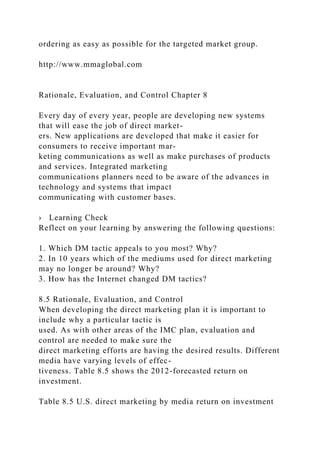
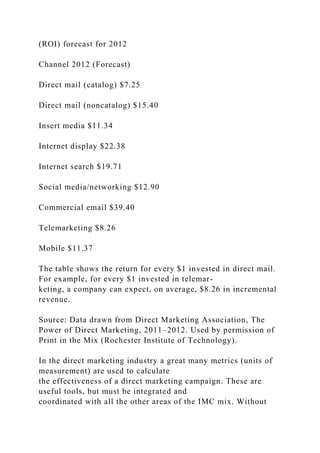
tiveness. Table 8.5 shows the 2012-forecasted return on
investment.
Table 8.5 U.S. direct marketing by media return on investment
(ROI) forecast for 2012
Channel 2012 (Forecast)
Direct mail (catalog) $7.25
Direct mail (noncatalog) $15.40
Insert media $11.34
Internet display $22.38
Internet search $19.71
Social media/networking $12.90
Commercial email $39.40
Telemarketing $8.26
Mobile $11.37
The table shows the return for every $1 invested in direct mail.
For example, for every $1 invested in telemar-
keting, a company can expect, on average, $8.26 in incremental
revenue.
Source: Data drawn from Direct Marketing Association, The
Power of Direct Marketing, 2011–2012. Used by permission of
Print in the Mix (Rochester Institute of Technology).
In the direct marketing industry a great many metrics (units of
measurement) are used to calculate
the effectiveness of a direct marketing campaign. These are
useful tools, but must be integrated and
coordinated with all the other areas of the IMC mix. Without
integration of metrics across the tac-
tical areas, direct marketers as well as IMC professionals will
not have a good idea of how well their
campaigns are faring, and if the campaign is generating desired
results. While standard metrics
such as sales and profits are used to evaluate the direct
marketing plan, two other metrics become
important in assessing the costs associated with direct
marketing and online direct marketing.
Rationale, Evaluation, and Control Chapter 8
The most popular measurements are as follows:
• response rates
• sales conversion rates
• click-through rates
• cost per thousand
• cost per order
• cost per action rates
Response rates calculate the percentage of people responding to
a direct marketing campaign. If a
company sends out 10,000 postcards and 6,000 people contact
the company for more information,
the response rate is 60%. Related to response rates are sales
conversion rates, which calculate the
percentage of people that buy a product based on exposure to a
direct marketing campaign. Out of
the 10,000 postcards sent by a company, if 300 people buy a
product, the sales conversion rate is 3%.
Click-through rates represent the percentage of consumers who
are exposed to an Internet-based
ad and have “clicked” their mouse on the link. If a consumer
doesn’t click through to a site, it is
not counted as part of the click-through rate. The metric, cost-
per-thousand (impressions) or CPM,
calculates how much it costs to place an online advertisement in
order to reach 1,000 impressions.
This metric was also introduced in the chapter about
advertising. This metric will not indicate the
effect of the advertisement, just that the ad is placed in front of
selected audiences who have the
“opportunity to see” (OTS) the advertisement.
The cost per order (CPO) calculates the cost to the company of
a customer placing an order for a
product or service. An example of a CPO would be to run direct
marketing advertisements on dif-
ferent radio stations (or some other medium) at the same time.
The cost of running the ad is divided
by the number of inquiries (or sales) generated to give a cost
per order (or inquiry) for the campaign.
The medium that generates the lowest cost per order has the
highest efficiency and productivity.
Many times direct marketers will place advertisements or offers
in another company’s communica-
tion medium such as a catalog or website. The cost per action
(CPA), also known as cost per acqui-
sition, measures how much the business that is advertising pays
for a specific action performed by
a potential customer. Actions may include submitting a form,
signing up to receive a newsletter,
account registration, or a sale. Direct marketers using this
option only pay when specific predeter-
mined customer actions have occurred, thus minimizing risk.
CPA is most often used with online
direct marketing. Actions are often tracked with the use of
special telephone numbers, websites
with a specific URL, and the use of special promotional codes.
To calculate the CPA, the manager
would take the cost of the direct mail piece and divide it by the
number of acquisitions.
Metrics are tools direct marketers can use to evaluate the
effectiveness of their direct marketing cam-
paigns. Overall, direct marketers should evaluate and control
their direct marketing plans by assessing
the exposure value of the website or online advertisement, the
ability of the site to hold its users, the
number of repeat visitors to the site, and the ability to target the
market and site users. With this type
of information, direct marketers can be assured that their efforts
are being used in an effective way.
› Learning Check
Reflect on your learning by answering the following questions:
1. Why is DM easier to measure when compared to other areas
of IMC?
2. Why is it important to measure the results of a DM
campaign?
Post-Test Chapter 8
Summary and Resources
The focus of Chapter 8 was on the utilization of direct
marketing within the integrated market-
ing communication plan. Direct marketing bypasses other
channels and media to go directly to
the customers in order to generate information or entice the
customer to make a purchase. Many
direct marketing strategies were discussed including the current
customer retention strategy, the
inducement of product trial strategy, and the brand switching
strategy. We also looked at strategies
to increase sales and product usage.
The focus of the chapter then changed to the development of a
database and the use of that database
in direct marketing efforts. Database marketing has become a
major tactic used by direct market-
ers in order to achieve their objectives. Direct mail, direct
response media, and direct response
marketing along with catalog, telephone, and online direct
marketing were identified as the main
forms of direct marketing. Technologies such as direct response
television marketing (DRTV),
digital direct-to-press, and interactive television (ITV) were
also discussed. The chapter ended with
a discussion about the methods of evaluation and control that
are germane to the direct marketing
industry. The next chapter will cover online marketing and
social media.
Post-Test
1. Which of the following involves independent contractors who
market or sell products one-to-
one or in homes?
a) Direct marketing
b) Direct response marketing
c) Direct selling
d) Personal sales
2. When would direct marketing be most useful to the IMC
planner?
a) When a product has received negative publicity.
b) When product sales have dropped off
c) When launching new products
d) When relationship marketing is not important
3. Which direct marketing strategy is used more often for
retaining current customers?
a) Product trials
b) Newsletters
c) Database purchases
d) Data mining
4. Which direct marketing tactic has the advantage of reaching
the most people?
a) Catalogs
b) Direct mail
c) Television
d) Social media
Post-Test Chapter 8
5. Which media is likely to have the best return on investment
for direct marketing?
a) Internet display
b) Direct mail
c) Social media/networking
d) Commercial email
6. The largest portion of a direct marketing budget is typically
spent on
a) prospecting for new customers.
b) building customer loyalty.
c) recruiting new marketers.
d) costs associated with managing databases.
7. An organization would like to increase the number of likely
customer prospects generated for
its services in the next year. Which type of direct marketing
objective should the organization
develop?
a) Supplement sales in other areas of the organization.
b) Get qualified leads for salespeople, dealers, and distributors
of the company’s products
and services.
c) Inform or educate consumers and potential consumers about a
brand, product, events, or
services.
d) Create direct sales to other business customers, bypassing the
traditional channels of
distribution.
8. Which of the following is a true example of switching costs?
a) A customer who wants a new laptop finds she must pay more
for it than she paid for her
previous laptop several years earlier.
b) A customer who decides to go with another provider must
pay to cancel his cable televi-
sion contract.
c) A customer who purchases a cell phone also purchases a
contract for cellular service in
order to get a lower price on the phone.
d) A customer who usually prefers one brand of soda decides to
try another brand because
it is on sale.
9. A high-end tea importer with a mail-order business includes
special offers for another com-
pany’s porcelain teapots with its own catalog mailings. This is
an example of which direct
response technique?
a) Package insert programs (PIPs)
b) Ride-alongs
c) Statement stuffers
d) Card packs
10. Which of the following is NOT a popular metric for
calculating how effective a direct mar-
keting campaign was?
a) Click-through rates
b) Cost per hundred
c) Sales conversion rates
d) Cost per order
Key Ideas Chapter 8
Answers
1. c) Direct selling. The correct answer can be found in Section
8.1.
2. c) When launching new products. The correct answer can be
found in Section 8.2.
3. b) Newsletters. The correct answer can be found in Section
8.3.
4. c) Television. The correct answer can be found in Section
8.4.
5. d) Commercial email. The correct answer can be found in
Section 8.5.
6. a) prospecting for new customers. The correct answer can be
found in Section 8.1.
7. b) Get qualified leads for salespeople, dealers, and
distributors of the company’s products
and services. The correct answer can be found in Section 8.2.
8. b) A customer who decides to go with another provider must
pay to cancel his cable televi-
sion contract. The correct answer can be found in Section 8.3.
9. b) Ride-alongs. The correct answer can be found in Section
8.4.
10. b) Cost per hundred. The correct answer can be found in
Section 8.5.
Key Ideas
• Direct marketing is an IMC tactic that uses one or more
advertising media to reach the cus-
tomer with marketing related, measureable communication.
• Direct marketing encompasses both channels of distribution
and communications.
Integrated marketing communications professionals are mainly
concerned with the com-
munications function of direct marketing.
• Direct marketing allows a business to communicate with its
customer base in a direct and
customizable manner. It also gives a company’s sales staff the
tools necessary to connect and
keep long-term relationships with their customer base.
• From the consumer’s perspective, direct marketing offers the
buyer immediate access to
comparative information, such as pricing and product features,
on a wide range and variety
of products and services as well as company and event
information.
• Disadvantages for the consumer include the proliferation of
direct marketing materials
received (junk mail), nuisance calls from telemarketers, and
security concerns with direct
marketing.
• Direct marketers need to be proactive in order to curb privacy
abuses. Although legislators
are trying to combat these threats through legislation and laws,
new threats come about
daily and must be dealt with.
• Effective database marketing begins with a useful customer
database. The information in
the database is used to identify the customers in the target
market for a given promotion.
• To determine the value or effectiveness of their database,
many direct marketers use the
recency, frequency, and monetary transactions (RFM) method.
Data on the date of the last
transaction (recency), how often the customer made a purchase
(frequency), and how much
money the customer spent in a given period (monetary) are
recorded and analyzed.
• SoLoMo (social media, local, and mobile marketing) has seen
immense gains over the past
few years and will continue to grow in the future.
• The most popular measurements for direct marketing are
response rates, sales conversion
rates, click-through rates, cost per thousand, cost per order, and
cost per action rates.
Key Terms Chapter 8
Key Terms
card packs A direct marketing method of sending a stack of
business reply cards from different
companies directly to customers’ homes via a wrapped card
deck package.
click-and-brick company A company that has both a physical
location and an Internet site.
click-only companies Companies that operate only on the
Internet.
click-through rate Represents the percentage of consumers who
are exposed to an Internet-
based ad and have clicked their mouse on the link.
compiled list A list that provides information on consumers who
meet specific demographic,
geographic, psychographic, or behavioristic profiles.
conversion rate The percentage of consumers that take desired
action as a result of marketing
efforts.
customer database An organized collection of comprehensive
data about current and potential
customers including demographic, geographic, psychographic,
and behavioristic information and
data.
customer relationship management (CRM) A systematic process
for managing customer
relationships.
database marketing A form of direct marketing that uses
databases with consumer information
to create marketing materials relevant to the customer.
data mining The process of analyzing data from different
databases to help determine buying
behavior and trends.
data warehouse A database that combines the data from other
databases to analyze the data and
to develop reports.
digital direct-to-press A software program that enables users to
develop personalized direct
marketing material.
direct response marketing A form of direct marketing with the
purpose of creating an immedi-
ate response from the targeted consumer groups.
direct selling One-to-one selling to the consumer in home and
online; selling occurs outside of a
retail establishment.
direct-response television marketing (DRTV) A television
commercial which asks customers
to respond immediately by calling a toll-free number or
accessing a website to make a purchase or
get more product information.
hot list A direct marketing list that includes customers who
have purchased or responded to
direct marketing efforts in the recent past (typically within 30
days).
inbound telemarketing Occurs when an individual initiates a
call to a company or organization
in order to make a purchase or acquire information.
infomercial A long television commercial.
Discussion Questions Chapter 8
interactive television (ITV) Technology that allows television
viewers to interact with television
programming and advertising via remote control.
list enhancement The process of adding information such as
demographic, psychographic, geo-
graphic, psychographic, or behavioristic data to a direct
marketing list or database.
merge and purge The process of adding names to and removing
names from a direct
marketing list.
offer A statement indicating what a company is willing to sell
and the details of the sale.
outbound telemarketing Occurs when a company calls
individuals via the telephone in order to
make a sale or to get a customer to perform some other action.
package insert programs (PIPs) Materials placed within order
fulfillment packages with the
intent of creating advertising awareness or product ordering;
PIPs are usually used by noncom-
peting companies.
phishing A type of identity theft that uses deceptive emails and
fraudulent websites to fool con-
sumers into believing that the communication is legitimate.
quick response codes (QR codes) Matrix bar codes that can be
read by smartphones to provide
consumers instant access to a website.
recency, frequency, and monetary (RFM) transactions RFM
stands for recency, frequency, and
monetary transactions; the three areas are used by direct
marketers to track direct marketing
sales and relate those sales to the effectiveness of the direct
marketing database.
response list Consists of customers who have made purchases or
who have responded to direct
mail or direct marketing efforts over a given period (such as a
year).
ride-alongs Direct marketing and advertising materials placed
within another company’s cata-
logs or direct mail pieces.
sales conversion rate The percentage of people exposed to a
direct marketing campaign that buy
a product.
SoLoMo A term used to describe social media, local, and
mobile marketing.
statement stuffers Marketing materials placed within a
company’s bill or statement of account.
switching costs The costs incurred by a customer when
switching from one product or brand to
a competitor’s.
uniform resource locator (URL) A text string used in Web
browsers to locate a specific
Internet site.
Discussion Questions
1. What type of products or services do you feel direct
marketing would work best with? Why?
2. How does direct marketing help with relationship marketing?
3. With which variable of the IMC mix would direct marketing
work the best? Give reasons for
your answer.
Continuing Project Chapter 8
4. Do you feel that direct marketing will become a larger or
smaller industry over the next 10
years? Twenty years? Provide rationale for your answer.
Critical Thinking Exercises
1. Find three examples of direct marketing and critique the
effectiveness of the pieces.
2. Choose three companies and explain how each company can
use direct marketing for reten-
tion of current customers.
3. You are a marketing manager of a sporting goods retail
company and have been put in charge
of developing a customer database. What information would you
include in the database?
Where would you get the information?
4. Design a direct mail piece for a company of your choice. In
addition to your creative piece,
include a paragraph that explains the piece.
Continuing Project
Below you will find a template for a direct marketing plan.
Insert the needed information into each
section of the template. When the information is inserted,
review the template and compare it with
those you have already finished to make sure you have seamless
integration in your overall IMC
plan. Insert the finished document (the direct marketing plan)
into the overall IMC plan.
Audience (Trad
e or Consumer):
Objectives:
Strategy:
Tactics:
Rationale:
Evaluation and C
ontrol Methods
:
Web Resources Chapter 8
Web Resources
Direct Marketing Association—Leading independent association
for direct marketing profession-
als: http://thedma.org/
Direct Marketing IQ—Part of Amazon.com, an online bookstore
that sells content from editors
and practitioners in the direct marketing industry:
http://store.directmarketingiq.com/
Direct Marketing Resources—A job placement site focusing on
direct marketing:
http://www.dmresources.com/Main.htm
Neolane—Direct Marketing Best Practices Resource Page–
Contains analyst reports, news arti-
cles, case studies, webinars, blog posts and white papers for
direct marketing professionals:
http://www.neolane.com/usa/resources/best-practices/direct-
marketing/index
MyCustomer—This site offers information pertaining to the
direct marketing industry:
http://www.mycustomer.com/
Direct Marketing Fundraising Association—Professional
association for direct marketing fund-
raising professionals: http://www.dmfa.org/
National Mail Order Association—Helps small and mid-size
businesses with direct mail tech-
niques: http://www.nmoa.org/
American Catalog Mailers Association—Nonprofit organization
for catalog industry:
http://www.catalogmailers.org/
Direct Selling Association—Trade association for companies
that sell directly to consumers:
www.dsa.org
Mobile Marketing Association (or MMA)—Trade association
for mobile marketing professionals:
http://www.mmaglobal.com/
http://thedma.org/
http://store.directmarketingiq.com/
http://www.dmresources.com/Main.htm
http://www.neolane.com/usa/resources/best-practices/direct-
marketing/index
http://www.mycustomer.com/
http://www.dmfa.org/
http://www.nmoa.org/
http://www.catalogmailers.org/
www.dsa.org
http://www.mmaglobal.com/
Case Study Chapter 8
Case Study: Cadbury and the Twisted Campaign
In 2009, Cadbury (United Kingdom) launched a new product
called Cadbury Creme Egg Twisted.
Instead of the traditional egg shape, the candy bar is tube
shaped, with ridges that make it easy
to break off and eat. The candy bar contains the creme egg
filling for which the Cadbury eggs are
known. The company launched an IMC campaign to introduce
Twisted, which included television,
posters, digital, public relations, sales promotion (point-of-
purchase displays and free samples), and
direct mail (Cadbury launches . . . , 2008). The candy bar was
created because consumers indicated
they wanted to eat Cadbury eggs year round (FMCG . . . , 2009).
The new shape makes it convenient
for busy consumers. For retailers, the new product provides an
opportunity to sell the candy year
round instead of only during holidays. The tagline for the
product was “It’s no Creme Egg . . . it’s
Twisted!” (Cadbury launches . . . , 2008).
To introduce Twisted, the advertising agency hired by Cadbury
(CMW London) used direct market-
ing and called the DM campaign Goo on the Loose. Fans,
bloggers, and journalists were sent a lock
box containing spots for three Twisted candy bars. Two candy
bars were included and a third was
missing. It appeared to have escaped out of a hole at the bottom
of the box. The direct mail campaign
invited recipients to become Cadbury Intelligence Agency
(CIA) agents to hunt for clues to find the
missing bars (Ads of the World, n.d.). Players were sent tips via
Twitter. Social media was used to
promote the campaign. Prizes included trips and a cash prize of
£20.000.
Critical Thinking Questions:
1. What attributes did the Twisted direct marketing have that
made it appealing?
2. Why is direct marketing useful in product launches?
3. How does the use of integrated marketing communication
(IMC) improve the chances of prod-
uct success?
4. Explain how Cadbury uses relationship selling when
promoting their products.
Electronic and Internet Marketing
Learning Objectives
Upon completing this chapter the student will be able to:
• Explain the advantages and disadvantages of electronic and
Internet marketing.
• Describe the main social media sites.
• List the types of objectives used in electronic and Internet
marketing.
• Describe the types of electronic and Internet marketing
strategies.
• Describe the main tactics used in electronic and Internet
marketing.
• Explain how electronic and Internet marketing efforts are
evaluated.
9
© Buchachon Petthanya/iStock/Thinkstock
Pre-Test Chapter 9
Pre-Test
1. An online customer logs into his account and receives
product recommendations based on his
previous purchases. Which set below best illustrates the
advantages of electronic marketing the
online customer experiences?
a) Personalized, availability
b) Easy to track, personalized
c) Global reach, lower cost
d) Increased timelines, easy to track
2. What are the “big five” social media websites?
a) Facebook, YouTube™, Netflix, eBay, and Twitter
b) Google+™ social service, Twitter, eBay, Pinterest, and
Facebook
c) Twitter, LinkedIn, Facebook, Google+™ social service, and
YouTube™
d) LinkedIn, Instagram, Facebook, Google+™ social service,
and Pinterest
3. What are the key categories of digital marketing customer
objectives?
a) Like, Share, Pin, Choose, and Use
b) Compare, Choice, Share, Learn, and Multiply
c) Like, Simplify, Comment, Learn, and Use
d) Choice, Learn, Use, Simplify, and Share
4. The key to shaping electronic marketing strategy is
a) creating a Facebook page.
b) knowing the target market you are trying to attract.
c) keeping the message unchanged for a long period of time.
d) measuring the success of the strategy.
5. The first step in developing an organization’s website is
a) making sure all aspects of the site reflect the brand.
b) identifying a Web design company and outsourcing website
development.
c) securing a domain name that supports the brand.
d) ensuring that the navigation, copy, and structure images
support other communications.
6. Which is NOT something that website monitoring software
can measure?
a) The time of day when your site gets the most visits
b) What site users visited before and after your site
c) The number of visits or hits your website receives
d) Users’ opinion of the information on your website
Answers
1. b) Easy to track, personalized. The correct answer can be
found in Section 9.1
2. c) Twitter, LinkedIn, Facebook, Google+™ social service,
and YouTube™. The correct answer
can be found in Section 9.2
3. d) Choice, Learn, Use, Simplify, and Share. The correct
answer can be found in Section 9.3
Introduction Chapter 9
4. b) knowing the target market you are trying to attract. The
correct answer can be found in
Section 9.4
5. c) Securing a domain name that supports the brand. The
correct answer can be found in
Section 9.5
6. d) Users’ opinion of the information on your website. The
correct answer can be found in
Section 9.6
Introduction
The authors wish to thank contributing authors Courtney
Kingery and Keith McIlvaine for their
assistance in writing this chapter.
Jimmy Choo is a high-end luxury shoe retailer whose shoes sell
for hundreds and sometimes thou-
sands of dollars. The company uses Facebook, Twitter, and
Pinterest to generate interest in the
brand. To highlight customers wearing the shoes, the company
started its own social network site
called “Jimmy Choo Stylemakers” (http://www.choo247.com/).
Customers from all over the world
post pictures of themselves in their Jimmy Choo shoes. Viewers
can sort the postings by type of
shoe, location, and the time of day the shoes were worn. Today,
more and more companies are
leveraging electronic and Internet marketing to build their
brands.
One can often tell how hot a market segment
is by the number of vendors, suppliers, con-
sultants, and self-reported experts in that
segment. Using that gauge, the electronic
and digital marketing industry is an inferno.
Not only are there advertising agencies who
specialize in digital and electronic market-
ing, and software companies who have pro-
grams and applications (special software
that allows users to perform specific tasks;
known as apps) to help build and deliver tac-
tics, and hardware companies touting serv-
ers to store all the customer insights gained
through digital and electronic marketing,
there are also top consulting companies like
Gartner, Inc. and McKinsey & Company
offering services to help clients decide which
service provider can best execute the strategy. It seems there are
consulting companies helping
clients select other service providers. These companies tout the
ability to help companies make
money through the effective use of social media. Gartner, Inc.
estimates that in 2013, spending on
electronic marketing will exceed $1 billion worldwide (Social is
here . . . , 2013). According to Direct
Marketing News, digital marketing makes up about a quarter of
an organization’s total marketing
budget (Prezant, 2013).
Organizations are investing money in digital marketing because
that is where customers spend
time. Many consumers expect companies to have an electronic
presence, have information avail-
able on demand, and help them make a buying decision. What is
in it for the companies spend-
ing over $1 billion globally? These companies are moving
customers and consumers through the
TPX/Prisma/SuperStock
▲▲ Jimmy Choo leverages electronic marketing to reach
customers.
http://www.choo247.com/
Overview of Electronic and Internet Marketing Chapter 9
buying process more efficiently, producing more sales and more
profits for the marketing unit and
company as a whole.
This chapter starts with social media and electronic marketing
tactics and covers the development
and use of electronic marketing as part of the overall IMC plan.
In particular, this chapter will
focus on objectives, strategies, and tactics useful in the
execution of the electronic marketing plan.
Nicole Kidman Speaks about Being a Spokesperson for Jimmy
Choo
Companies often place advertisements on social media websites.
This video from YouTube™ shows
Nicole Kidman speaking about the creation of a series of ads for
Jimmy Choo:
http://www.youtube.com/watch?v=QrMwMAFr54M
9.1 Overview of Electronic and Internet Marketing
You may recall that electronic marketing was defined in an
earlier chapter. To refresh your memory,
electronic marketing (also called digital marketing) is the use of
digital technologies to sell goods
and services. Electronic marketing includes e-tailing, CD-
ROMs, email, blog development and
execution, and electronic data interchange (EDI). Electronic
marketing takes traditional market-
ing and applies it to the online realm. Although electronic and
Internet marketing terms are often
used interchangeably, Internet marketing is more specific and
involves using the Internet to sell
products and services. Social media marketing is even more
specific and uses social media sites
to connect with customers and generate website traffic. Figure
9.1 shows the relationship between
these three areas.
f09.01_OMM651.ai
Social Media Marketing
Internet
Marketing
Electronic
Marketing
Figure 9.1 Relationship between electronic, Internet, and social
media marketing
http://www.youtube.com/watch?v=QrMwMAFr54M
Overview of Electronic and Internet Marketing Chapter 9
An online presence is not enough to ensure a company’s
success. How well the electronic market-
ing tactic of the IMC is executed will send a message to
customers about the quality of products and
how much value and attention is paid to the target market.
IMC planners rely on digital marketing to reinforce the
campaign message, drive awareness of the
product, support the brand, and achieve the objectives of the
overall campaign. Social media and
electronic marketing specialist, Keith McIlvaine, believes that
electronic marketing will compete
for the lead of all IMC tactical executions during the next
decade.
Marketers must decide how electronic marketing will fit into the
IMC mix. Digital marketing is an
excellent tool for overcoming some of the barriers associated
with the other variables of the IMC
mix, but it will not solve all problems. As with other elements
in the marketing mix, electronic
marketing does not exist in isolation, but rather works with the
other IMC tactics. Electronic mar-
keting must have clearly defined objectives, be well planned,
cleanly executed, and support the
other areas of the mix. It has grown to take on increasing
importance in marketing plans, replacing
some dollars that were spent on traditional media like radio,
TV, or print advertising.
Evolution of Digital Marketing
Electronic marketing by its very nature is dynamic, interactive,
mobile, on-demand, current, enter-
taining, and informative. It is opening up opportunities for
marketers to push the boundaries in
the digital space. These characteristics have impacted the
evolution of digital marketing.
Electronic marketing has evolved from a one-way
communication model between a company and
buyer to a peer-to-peer influencer model (see Figure 9.2). A
digital marketing campaign built on
the peer-to-peer influencer model compels customers to share
the marketing message across their
social and digital network in a way that is seamless, easy, and
natural (Marketo . . . , 2013). The risk
in this is that as a company’s brand and message are shared with
thousands of customers, the com-
pany loses control of how the brand is represented. Why would
brands take that risk? A Nielson
survey showed that 92% of buyers believe what peers have to
say about a brand, compared to 33%
who believe what a brand has to say about itself (Marketo . . . ,
2013). By implementing a peer-to-
peer influencer model, brands are turning their customers into
brand advocates, which translates
into greater sales. Electronic marketing also increases
consumer-generated marketing. When a
consumer gets directly involved with the marketing activities of
a company, it is called consumer-
generated marketing.
f09.02_OMM651.ai
1-Way Model:
Company to Buyer
• High brand control
• High message control
• Low customer ownership
2-Way Model:
Company to Buyer & Buyer
to Company Feedback
• High brand control
• Lower message control
• Moderate customer ownership
Network Model:
Peer-to-Peer Influencer
• Lower brand control
• Lower message control
• High customer ownership
Figure 9.2 The evolution of digital marketing
Source: Adapted and modified from Edelman (2013) and
McKinsey (2013).
Overview of Electronic and Internet Marketing Chapter 9
Marketers are continually looking toward future trends and at
current systems that deliver the best
productivity and sales. Some innovative individuals and
companies stand out more than others,
and they push the limit to test new avenues for undertaking
business and try new trends that will
drive business. Taking risks is an inherent function of
marketing and many involved in electronic
marketing take that role seriously. Electronic marketing does
not replace a current marketing plan
or strategy, but is an additional tool that can be used to generate
communication with the targeted
markets.
One big misconception about electronic marketing is that it is
free. This is not true. Everything com-
panies undertake has associated costs and electronic marketing
is no exception. While much of social
media is free to access, the people needed to create and manage
the sites are paid. Finally, the concept
of social media is not new, only the tools used to develop and
execute social media have changed.
Before we look at issues involved with developing objectives,
let’s take an overview of the advan-
tages and disadvantages associated with the use of electronic
marketing.
Advantages of Electronic Marketing
Here are some of the advantages of electronic marketing.
Multiplier effect—Albert Einstein once said that compound
interest is the most powerful force in
the universe. Money’s ability to grow amazed one of the
smartest men of modern history. Similarly,
the multiplier effect of digital marketing is when a campaign
grows and spreads across peer-to-
peer networks beyond the original reach, spreading the message
to a larger audience and com-
pounding reach.
Lower cost —Digital is one of least expensive forms of
marketing and advertising. For very little
money and with access to the Internet, anyone can put up a
virtual storefront, webpage, or mobile
application (app). Thousands of pages of information can be
published electronically without the
cost of printing or mailing.
Increased timeliness—Traditional marketing can be time
intensive as one goes through the pro-
cess to write copy, produce, edit, print, etc. Customers expect
digital marketing to be current and
timely. With the use of content management software, marketers
can update electronic marketing
materials quickly, keeping the information fresh. One strategy
to leverage this advantage is to keep
the printed material fairly general and refer customers to an
electronic source of information for
the most up-to date information.
Availability—Content on the Internet is available 24 hours a
day, seven days a week regardless of
where a customer is located. Unlike other variables, digital
marketing is available when the cus-
tomer is interested and ready to receive the information. The
customer is more likely to pay atten-
tion to a message when he or she searches for it.
Personalized—Message personalization is a great feature of
digital marketing. When there is a
clearly identified target market and buying motivators, a
company can customize the campaign
to each subtarget. During the same campaign, different
customers can receive different pieces of
information depending on their preferences, buying patterns,
and even their geographical prox-
imity to the seller. This is a great way to connect to a customer
and build loyalty because the cus-
tomer is given only the information he or she needs.
Amazon.com is an example of a company that
personalizes messages. Based on what a person has ordered in
the past, the customer will receive
purchase recommendations via email or when he or she signs in
to the Amazon account.
Overview of Electronic and Internet Marketing Chapter 9
Easy to track—One of the great advantages of a digital
campaign is that the elements can be tracked.
Marketers do not need to rely on advertising readership studies,
media response rates, or customers
mentioning they heard it on the radio. Marketers know exactly
how many people downloaded and
used the app, visited the website, how long they were on the
site, what their favorite blog posts are,
and how many responded to an email blast. The information can
be added to a customer database
to give the company better insight into customers’ needs.
Global reach—Technology allows people from all parts of the
world to connect. A single digital
campaign can go viral, spreading around the world and touching
people from countless cultures.
While this is a great benefit of digital marketing and social
media, it also presents challenges. For
example, a global shipping company like United Parcel
Service® (UPS) has to overcome the hurdles
of developing a unified global website in several languages that
is compliant with various countries’
electronic and privacy regulations.
Disadvantages of Electronic Marketing
While electronic marketing offers numerous advantages, there
are also some disadvantages that
need to be taken into account to avoid potential pitfalls. Below
are the main disadvantages to the
use of electronic marketing.
Multiplier effect—Just as a positive message has the ability to
grow beyond the original reach of the
campaign, negative messages about the brand or products can
also spread quickly in the digital space.
Upset customers can post messages on many social media sites
where messages are shared. Negative
messages can get out of control very quickly if a company is not
monitoring social media sites.
Case in Point: United Breaks Guitar
Songwriter Dave Carroll had a gripe with United Airlines. In
2008, on a United Airlines flight from
Halifax to Chicago, his $3,500 guitar was damaged by baggage
handling. After months of unsuccess-
fully trying to get restitution from the airline, Carroll wrote a
song and posted it to YouTube™. The
video went viral very quickly. Within four days the song had
four million views. No one could have
imagined the popularity of the video. As of 2013, the video had
over 13 million views. The publicity
was a public relations nightmare for United. The company was
not prepared for the exposure.
United responded by calling the video “excellent” and asking
Carroll if the company could use it
for employee training. Carroll turned down the $1,200 in flight
vouchers offered by the company
and asked them to donate the money to charity. The company
responded by donating $3,000 to the
Thelonious Monk Institute of Jazz. News outlets claimed that
United’s stock value dropped 10%
($180 million) as a result of the video but this was disputed by
the company (Dunne, 2010).
Time™ Magazine listed the story as one of the top ten viral
marketing stories of 2009 (Fletcher, 2009).
The story was featured on a 2012 documentary by CBS/CNBC
called Customer (Dis)Service describ-
ing how social media has changed the way companies respond
to complaints. Carroll capitalized on
his instant fame by writing a book published in May 2012. He
wrote how one guy used social media
to take on a global corporation (Carroll, 2012). He is also a
corporate speaker.
Take a look at the video made by Carroll:
http://www.youtube.com/watch?v=5YGc4zOqozo
Reflection Questions
1. Why is this video so popular?
2. What do you think of United’s response? What would you
have done differently?
3. What are three recommendations that you would give a
company on how to respond to com-
plaints on social media?
http://www.youtube.com/watch?v=5YGc4zOqozo
Overview of Electronic and Internet Marketing Chapter 9
Loss of brand control—In a well-developed and well-executed
digital marketing strategy, custom-
ers become advocates touting the benefits of the brand to their
social networks. However, as soon
as others start touting a company’s brand, the company loses the
ability to control the message.
The positioning of the company’s message may get changed as
the target market loses focus. The
marketer’s goal is to strike a balance between complete brand
lockdown and opportunities for cus-
tomers to embrace and share content (Edelman, 2013).
Data vs. intelligence—One of the advantages of digital
marketing is the ability to track the tactics
in the campaign. One of the disadvantages is all the data that
comes back from the campaign. How
do marketers move from data to intelligence? Marketers must
coordinate with other teams in the
organization (IT, analytics or research, and sales) to develop
and execute actionable insights from
a digital or social media campaign (Social is here . . . , 2013).
Must be kept current—Digital content is expected to be current,
timely, and easy to use. While con-
tent is easier to update in the digital space than in printed
elements, it must be updated more often
to keep customers interested. For many large organizations that
usually requires having a dedi-
cated staff member to post, respond, and track comments about
the brand or products. For organi-
zations with a smaller digital presence, that task can be
outsourced to an agency or freelance writer.
Requires coordination and integration—Customers don’t
interact with businesses in an exclusively
virtual world. Products are shipped, services are provided,
complaints arise, and customer service
is contacted. Just as marketers must coordinate across teams to
move from data to intelligence, all
the members on the team must work together to create a
seamless customer experience. Companies
as a whole must come together across sales, service, IT, and
marketing to deliver high-quality ser-
vice for the entire customer experience (Edelman, 2013). This is
a disadvantage because it’s difficult
to accomplish. Companies want to avoid having a great digital
experience and then a real-world
experience that doesn’t measure up. Customer service channels
will need to be integrated across
Web, mobile, email, sales, and supply chain (Social is here . . . ,
2013). The information technology
infrastructure must support the growing user demands across
mobile, tablet, and PC platforms so
no matter how customers access information it is a positive
experience (Social is here . . . , 2013).
The goal should be to have a seamless transition from the
virtual world to the real world, creating
a positive customer experience.
The advantages and disadvantages of electronic marketing are
summarized in Table 9.1. As can be
seen, electronic marketing is a double-edged sword. While
offering tremendous advantages over
other elements in the IMC mix, there are also potential
disadvantages that need to be planned for
in the strategy and executions.
Table 9.1 Advantages and disadvantages of electronic/Internet
marketing
Advantages Disadvantages
• Multiplier effect
• Lower cost
• Timeliness
• Availability
• Ability to personalize
• Easy to track
• Global reach
• Multiplier effect
• Loss of control
• Data vs. intelligence
• Must be kept current
• Requires coordination and integration
The Biggest Players in Social Media Chapter 9
In the chapter devoted to personal selling, we discussed the
sales cycle from qualification to clos-
ing. To move from strategy to tactics to revenue, the goal is to
move potential customers through
that sales cycle as efficiently as possible. Digital marketing can
be used to move customers through
the buying decision funnel “by showcasing thought leadership
in the digital space through every
aspect of the buying cycle” (Marketo . . . , 2013). Before the
Internet, consumers would rely on
recommendations from friends and family or word-of-mouth
recommendations. Although those
sources are still used today, it’s more often done using the
Internet via online reviews, online rec-
ommendations, blog posts, discussion boards, couponing sites,
publications, and company web-
sites to compare features and prices to get the best value
(Edelman, 2013). All the time spent on
research and learning about a company’s products and services
opens up tremendous opportuni-
ties for marketers to be thought leaders in the buying decision
process.
› Learning Check
Reflect on your learning by answering the following questions:
1. What are the advantages and disadvantages of electronic
marketing from a business perspective?
Consumer perspective?
2. Do you think companies can be successful using only
electronic marketing? Why or why not?
9.2 The Biggest Players in Social Media
Social media are forms of electronic communication that allow
people to share ideas and content.
The phrase “word of Web” (as opposed to “word of mouth”) is
used to describe communication
occurring on the Internet. Known as the “big five” in social
media, Facebook, Google+™ social
service, Twitter, YouTube™, and LinkedIn are the most widely
used social media websites around
the world. This is why a majority of companies look to these
sites first when developing or creat-
ing electronic marketing and social media plans. Of course a
presence on these sites depends on
objectives, strategy, and tactics, but in general, if a company is
seeking to establish a social media
presence, the company should have a presence in each of the big
five. A company can look at other
social media tools and outlets to strengthen overall
communications efforts. If a company’s target
market does not use the big five sites, they should find sites
their customers are using. Marketing
research can help determine which segments of the target
market are on which sites. This will help
determine where to spend time and money. Figure 9.3 shows the
age demographics of some of the
main social networks.
All electronic and social media channels should be considered;
however, only those sites that help
meet company objectives should be used. This process is
typically a trial and error process because
a company often doesn’t know a site’s impact on the bottom
line until it’s used.
So what do the big five social media sites provide marketers?
Let’s take a closer look at each of
these sites.
The Biggest Players in Social Media Chapter 9
Facebook
Facebook (www.facebook.com) is the world’s largest social
networking site and is used by many
companies to promote their brands. Here are some statistics
concerning Facebook (as of December
2012) (Whittaker, 2012; Tam, 2013).
• 1.06 billion monthly active users
• 618 million daily active users
• 680 million mobile monthly active users
• 1.13 trillion Likes generated
• 140.3 billion Friend connections
• 219 billion photos uploaded (265 billion in all if deleted
photos are counted)
• 17 billion location check-ins
Facebook Profiles
According to Facebook, people who joined in July 2010 now
have an average of 305 friends
(Whittaker, 2012). If a company is able to attract brand
evangelists (people who are loyal to a brand)
to a Facebook site then their network will see this activity
which may lead them to look at the com-
pany’s Facebook page and Like the brand as well (McIlvaine,
2013). Facebook uses profile accounts
to reflect all online activity that a person may go through on a
social network (and sometimes
includes outside activities as well). These profiles allow a
company to better target its brand com-
munications. Facebook profiles have a lot of data that people
online are willing to share such as
f09.03_OMM651.ai
Pe
rc
en
t
u
si
n
g
s
o
ci
al
m
ed
ia
Facebook
0
5
0
15
20
25
30
35
40
Twitter Google+ LinkedIn Pinterest
13–17-year olds
35–44-year olds
18–25-year olds
45–54-year olds
26–34-year olds
55 year-olds and up
Figure 9.3 Age profile of social media users
Source: Based on data from Dugan, L. (2012). Facebook,
Twitter, Google+™ social service, Pinterest: The Users of
Social Media. All Twitter (May 15). Retrieved from
http://www.mediabistro.com/alltwitter/social-media-
users_b22556.
http://www.facebook.com
http://www.mediabistro.com/alltwitter/social-media-
users_b22556
The Biggest Players in Social Media Chapter 9
location, education, work experience, sometimes their age,
family status, and their Likes. These
data may lead to additional methods of guerilla marketing (low-
cost marketing) where a planner
can target individuals who Like competitors’ brands and the
planner can then develop and target
advertisements specifically toward this audience.
Facebook Engagement
After creating a page on Facebook, brands must have regular
activity on their pages to keep
followers interested. Having regular activity increases brand
engagement and interactions with
customers and potential customers. Facebook pages allow
brands to repurpose content from
other social media channels such as blogs, Twitter, and
YouTube™ (to name a few). Cross brand-
ing, or repurposing content, is critical because planners never
know who is going to see their
messages. Facebook ads may range from a very specific
audience to a very broad audience. The
challenge for marketers is to communicate a message in fewer
than 90 characters, which is the
limit that Facebook imposes on advertising copy for body ads.
The character limit forces adver-
tisers to make their messages simple, a benefit for consumers. It
is important to include a call
to action for the reader. The more a company spends on a daily
basis in advertising and IMC,
the greater the chance of adding additional Likes to the page
and brand. Ads may be linked to
an external URL or to a Facebook page. People who prefer to
stay on their Facebook page when
logged in are good targets.
Facebook continues to evolve. It is focused on how to allow
brands and people to engage in an
online atmosphere. Expect new avenues and media to arise and
become available for use by
marketers.
Google+™ Social Service
Started in 2011, Google+™ social service (sometimes written as
Google Plus social service) had over
10 million profiles created during its first month of release
making it the fastest growing social
media platform ever. In January 2013, Google+™ social service
surpassed Twitter to become the
second largest social networking site in the world (Waktins and
Presse, 2013).
Google+™ social service has many tools, making integration
just as easy as installations into web-
sites. Here are a few of the Google+™ social service features.
• Profiles—Google+™ social service has a section called a
profile where users can choose infor-
mation to share with anyone searching on the Internet.
• Streams—Google+™ social service uses live newsfeeds of
what your connections are sharing
at any given moment in time.
• Circles—Google+™ social service has the ability to create
circles, which is a method of group-
ing friends and users into a more meaningful organization.
• Photos—This system has the ability to upload and share
photographs. These may be sent to
mobile devices as well.
• Hangouts—Hangouts is a video-conferencing feature that
allows video chat for up to 10
other people at one time.
• +1 Button—This Google mechanism allows users to share
network updates with others.
It also allows others to share their network updates with you.
• Sparks—Sparks is a RSS (Really Simple Syndication) style
layout for users to follow news and
articles all from one central location on your site.
The Biggest Players in Social Media Chapter 9
Twitter
Twitter (www.twitter.com) was created in 2006 and quickly
became popular. In 2013, the site had
an estimated 200 million active users (Kleinman, 2013). The
microblogging site allows users to
share information via a tweet, which can be no more than 140
characters. The user can add videos
and photos in the tweets and can follow other tweeters.
Companies use Twitter to share information, gather marketing
feedback, and build relationships.
Twitter is search engine optimized (SEO) meaning that Google,
Bing, and Yahoo! are able to pull
each individual Twitter message and post them in individual
search results. For IMC professionals,
this means that those who are not using Twitter or not signed up
for Twitter may find branding
messages.
Twitter utilizes hashtag technology. Hashtags (which appear as
a # sign followed by a subject
such as #Gatorade or #NBAFinals or #JustinBieber) allow users
to follow a specific conversation
and all the associated tweets on a topic. It allows users to go
back and search for messages that
have the specific hashtag attached. Twitter also allows a URL to
be shortened, maximizing a
message. Using Twitter, a marketing professional can write an
introduction or teaser message
with a link which takes the reader to another site with more
information. This site could be a
Facebook page, YouTube™ channel, company website, or blog
entry. Twitter has a website devoted
to providing methods for companies to use Twitter to grow their
businesses (https://business
.twitter.com/).
Twitter Celebrates Seven Years
This video was released to YouTube™ by Twitter to celebrate
its 7th birthday:
http://www.youtube.com/watch?v=Bl-
FpuehWGA&feature=player_embedded
YouTube™
YouTube™ (www.youtube.com) has become one of the most
searched and used social media sites
and reaches more adults than any cable network (YouTube™,
2013). YouTube™ has become a magnet
for individuals, companies, and brands to post video and
experiment with new marketing tactics
in order to assess audience response. YouTube™ is a great site
to generate research and gauge feed-
back to learn what’s working and what isn’t working.
The following statistics are reported by YouTube™ (YouTube™
website, 2013).
• more than 1 billion unique users visit YouTube™ each month
• over 6 billion hours of video are watched each month on
YouTube™
• one hundred hours of video are uploaded to YouTube™ every
minute
• seventy percent of YouTube™ traffic comes from outside the
United States
• YouTube™ is localized in 56 countries and across 61
languages
• according to Nielsen, YouTube™ reaches more U.S. adults
ages 18–34 than any cable network
http://www.twitter.com
https://business.twitter.com/
http://www.youtube.com/watch?v=Bl-
FpuehWGA&feature=player_embedded
http://www.youtube.com
The Biggest Players in Social Media Chapter 9
Playlists
A YouTube™ playlist is another effective tool in the execution
of electronic marketing tactics. An
example of a company using a playlist effectively is Old
Spice®. Old Spice’s YouTube™ page (http://
www.youtube.com/oldspice) has a number of playlists ranging
from a “behind the scenes” video
to more specific video titles that help to promote the brand.
Creating a custom page, custom URL,
and playlists are effective ways of communicating and
promoting products, services, and brands.
These are helpful in sharing a specific message or a series of
similar messages; thus, they work well
with other IMC tactical executions. Because YouTube™ is a
socially integrated medium, it is easy to
share, link, or embed videos into other social media platforms
or websites.
LinkedIn
Launched in 2003, LinkedIn (www.LinkedIn.com) is a social
networking site for business pro-
fessionals. According to the website, the site has over 225
million members in over 200 coun-
tries (LinkedIn–About Us, 2013). LinkedIn allows members to
grow their professional networks
within an environment that is free of games and has limited
advertisements. IMC planners can use
LinkedIn to expand their branding and communications efforts.
There are two ways for businesses
to share messages: individually or as a group.
Individual profiles are used to share both personal and
professional information. In addition, it is
a good way to develop and share information about brands,
products, and services. The status bar
allows users to share updates with their network by adding a
URL or sharing personal or company
news that is relevant to the network. LinkedIn allows users to
upload presentations to their pro-
file through the use of SlideShare (http://www.slideshare.net/)
and Box.net (www.box.com). These
add-ons allow individuals to upload presentations that provide
viewers information about a com-
pany, product, brand, activities, or anything else of professional
value.
Video has become an integral part of any IMC campaign. Video
sharing on the site is a very effec-
tive tactic to generate viewer engagement.
In addition to individual LinkedIn profiles, a LinkedIn group
can be created or joined. LinkedIn
allows users to join up to 50 groups. These groups allow
interaction with people that are not in
a user’s network. It is beneficial for IMC professionals to create
a group or join a group for the
purpose of asking questions and trying to understand the
thinking processes of customers and
competitors.
LinkedIn groups have some disadvantages. For example, if a
company creates a group, the com-
pany must be able to carry the interest of the brand into over
100+ million profiles. Well-known
brands such as Apple®, Pepsi, and Microsoft® have the ability
to attract a diverse group of follow-
ers based on brand recognition. Smaller, less-known companies
should join other groups to build
brand awareness.
Company Pages
LinkedIn allows companies to develop and maintain their own
sites. While there are fees associ-
ated with upkeep, company profile pages serve as a branded
location within the LinkedIn net-
work where companies update data, correct any misinformation
(great for PR), and share links.
LinkedIn is a powerful tool and is becoming the most dominant
professional social networking
site. The tools mentioned are an example of how LinkedIn is
expanding. LinkedIn is growing at
approximately one new member every second, positioning them
for continuous growth in the pro-
fessional social networking arena.
http://www.youtube.com/oldspice
http://www.linkedin.com
http://www.slideshare.net/
http://www.box.com
The Biggest Players in Social Media Chapter 9
LinkedIn Company Page
This video explains the advantages of a LinkedIn Company
Page:
http://www.youtube.com/watch?feature=player_embedded&v=b
DXFQetJCc4
In addition to the big five in social media, there are other
options to consider. Sites are created
and deleted every day, so it’s important to scan the social media
environment. Table 9.2 lists other
popular social media sites.
Table 9.2 Popular social media sites
Type Name/URL Description
Photo sharing sites: Allows
members to organize, post
and share images.
Pinterest
http://pinterest.com
A social network where members can organize and
share images through pins and boards; people can
repin (share) photos they find interesting.
Instagram
www.instagram.com
A mobile app that allows the user to take pictures
and use filters to create art from the pictures. The
app makes it easy to share the pictures on other
social media sites.
Flickr
www.flickr.com
A site where people can organize, post, and share
pictures and images.
Location-based electronic
marketing: Uses GPS
smartphone technology
to determine where users
are and allows additional
networking opportunities.
Foursquare
https://foursquare.com
A location-based game where users “check in”
at various locations in order to earn badges (or
other forms of recognition) for varying levels of
participation. If, for example, you check-in and are
named, “The Mayor,” you receive special discounts.
Yelp
www.yelp.com
Organized by city, Yelp allows users to research
local businesses and comment about their various
experiences with that business.
Facebook’s Nearby feature
www.facebook.com
Nearby lets users find local businesses based on
what the person has Liked on Facebook or where a
person has checked in previously.
Other Tumblr
www.tumblr.com
A social media microblog that allows members to
post content; users can follow other blogs or make
their blogs private. In June 2013 Yahoo! acquired
Tumblr for approximately $1.1 billion (Wortham,
2013).
Myspace
www.myspace.com
A social media site with a music emphasis; owned
by Specific Media™ LLC and Justin Timberlake.
› Learning Check
Reflect on your learning by answering the following questions:
1. Which social media sites are you on? Why did you choose
these sites?
2. Should social media sites be responsible for crude or
unethical content? Why or why not?
3. What differentiates a company that uses social media
successfully from those that do not?
http://www.youtube.com/watch?feature=player_embedded&v=b
DXFQetJCc4
http://pinterest.com
http://www.instagram.com
http://www.flickr.com
https://foursquare.com
http://www.yelp.com
http://www.facebook.com
http://www.tumblr.com
http://www.myspace.com
Electronic and Internet Marketing Planning Chapter 9
9.3 Electronic and Internet Marketing Planning
Electronic and Internet marketing can be a strong addition to
IMC. Electronic marketing allows
the IMC planner to
• build relationships with current and potential customers,
• listen to the market,
• promote content, services, and brands,
• influence buyers, and reach beyond the customer to the
customers’ customers or their
networks.
It is essential to determine what will be achieved using an
electronic marketing plan. Start with
objectives, create an overall strategy (or strategies), and
develop tactical executions to achieve the
objectives. Budgets are required, as are timelines that indicate
when and where the tactics will be
launched. It is very important to evaluate and control the
effectiveness of the plan and integrate it
with other tactics used in IMC planning.
Objectives
The primary business objective of any digital strategy should be
to influence the path to purchase.
Beyond that, the objectives should support the overall campaign
and company strategy and objec-
tives. The objectives must be SMART (specific, measurable,
attainable, relevant, and have a time
frame). Just as digital marketing has evolved beyond the
company-to-buyer model to a peer-to-peer
model, the best objectives go beyond company or campaign
performance to align with the objec-
tives of the target markets. In other words, what do customers
want and how can a company use
electronic marketing to meet its needs? Customer objectives for
digital marketing fall into a few
key categories (Dahlstrom and Edelman, 2013; The Hartman
Group, 2013) as shown in Table 9.3:
Table 9.3 Electronic marketing objectives
Purpose of
Objective
Description
Example
Learn Customers are looking for information on
the product and service. They often turn to
electronic media to find answers.
The objective is to inform our customers of
our latest service offerings. We will launch the
new section of the site by X date and expect
1,500 views in a 6-month period.
Choice Customers are looking for the information
to move beyond learning about a product or
service, to choosing the best solution for their
need.
We will use Facebook to compare our
products to the three main competitors.
We expect at least 5,000 views in a 6-month
period and at least 1,000 Likes.
Share Customers want to comment and recommend
with their peer-to-peer network about why
they made a good choice or about their experi-
ence with the business.
We will use three photo-sharing sites to post
pictures of our menu offerings. Our goal is
to get 300 repins of the photos in a 12-month
period.
Use Customers are looking for new, highly valued
services and features deployed to the hardware
they already have.
A mobile app will be created to allow our
customers to order our products and get new
product information. Our goal is to have
at least 5,000 customers download the app
within one year.
(continued)
Strategies Chapter 9
Purpose of
Objective
Description
Example
Simplify Customers are looking for digital tools and
solutions that are not only easy to use and
share, but actually simplify their lives and
their jobs.
We will implement a “one-step” ordering
system on our website. Our goal is to increase
our customer satisfaction scores from 85%
highly satisfied to 92% highly satisfied within
12 months.
Once the electronic marketing objectives are developed, it’s
time to move ahead and create an over-
all electronic marketing strategy that will provide direction on
how the objectives will be achieved.
› Learning Check
Reflect on your learning by answering the following questions:
1. What do you think are the biggest mistakes that companies
make when creating objectives for
electronic marketing?
2. What happens when companies do not make objectives
SMART?
9.4 Strategies
An electronic and social media strategy may sound easy to
develop but it is not. Electronic, and in
particular, social media marketing strategies, typically include
multiple channels. Each channel
has a unique approach to conveying messages and interacting
while connecting with members
of the channel communities. Regardless of the tools chosen, the
audience, message, and methods
are important. Additionally the impact of that message on the
other IMC variables must be deter-
mined so that there is consistency across IMC tactics. Consider
the message on a billboard or in a
television advertisement. Using traditional media the message
can remain unchanged for a long
period. With electronic marketing and in particular social
media, the message needs to be updated
daily or even more frequently. The company or brand messages
must be relevant. There are five key
areas to keep in mind while developing a strategy:
1. Understand the audience.
2. Locate the audience.
3. Create electronic channel(s).
4. Brand each message.
5. Engage the audience.
The key point to remember is that companies need to know
whom they are trying to attract. This
will help shape strategy. The target market will vary depending
on the types of products and
services sold and on the campaign. A company can maximize
efforts by locating where its audi-
ence spends time online. Companies can help create interest so
that the audience wants to learn
more. This could mean creating a Facebook page, a Twitter
handle, a LinkedIn group, a YouTube™
video channel, or an online advertisement that takes the
audience to a company’s home page (or
some other targeted location). Messages can be branded by
making sure the feel of the message is
Tactics Chapter 9
consistent with the brand and contains a logo. Engaging and
interacting with the audience will
influence them to take some type of action. Electronic
marketing often takes experimenting to find
the right mix for a message.
As with other elements in the IMC, the electronic and social
media marketing strategy should be
able to answer a few basic questions:
• Who and where is the target market?
• What is the company’s differentiation and value proposition?
• How does the strategy enable the company to meet its goals
and objectives?
• How is success measured?
• How does success in the digital space translate to revenue?
Main strategies for electronic marketing are push, pull, or a
combination. These strategies have
been discussed with other IMC tactics as well. In the realm of
electronic marketing, push or pull
strategies refer to the way in which the target recipient gains
access to the information provided
by companies. Is the information pushed to the target recipient
via email or app or does the target
recipient have to come to a website to pull off the information?
In the most successful cases, the
information is delivered as a combination of push and pull.
There are advantages and disadvantages to either pushing out
the information or requiring target
recipients to pull the information. When the information is
pushed to the target, it is very easy
for the target to access it. Email marketing (using email to send
marketing messages) is a great
example of pushed information. On the other hand, when a
consumer comes to a website to pull
the information, that indicates the customer is ready to receive
the message.
If the information is difficult to find, difficult to download, or
requires too many steps to access, the
consumer will move on to another website or to another source
of information. Often a combina-
tion of both push and pull is the best strategy to reach
audiences.
› Learning Check
Reflect on your learning by answering the following questions:
1. What strategy would you use to launch a new product? Why?
2. How does a company communicate a value proposition using
electronic marketing?
9.5 Tactics
Once the electronic marketing strategy is in place, it’s time to
create the tactics that will be used
to execute the plan. Knowledge of the electronic marketing
audience is required to generate
effective electronic marketing tactics. As in any area of
marketing or marketing communica-
tions, planners must have a thorough knowledge of who will
receive the message, how they want
to receive it, and how they interact with communications.
Remember, the planner is trying to
achieve numerous objectives in order to drive revenue and
profits. A planner with information
about his or her audience will be much more successful than one
who begins to develop tactics
in a vacuum.
Tactics Chapter 9
While technology touches so many parts of our lives, keep in
mind that connectivity, usage, and
technological ability vary by demographic group. For example,
women with children under the
age of 13 spend over 15 hours per month on social networking
sites, compared to men who spend
8.4 hours per month (Bryant, 2013). If the target market
primarily accesses data through mobile
devices, this may limit the amount of space available to design
graphics and content. If mobile apps
are being developed, a decision will need to be made as to the
types and versions of mobile devices
or tablets that will be supported. Consider too, the amount of
time that the audience has to view
and engage the message.
Below are some of the tactics used by companies to reach
objectives. Typically, samples of the
tactics that a company will use are included in the plan. For
example, a sample newsletter or
mock-up of a webpage will give decision makers an idea of the
message and visual appeal of
the piece.
Websites and Secure Portals
Many people consider the Internet a primary source of
information for company and product
information. Often the first stage in developing a website is to
secure a domain name or URL.
Domain names are secured through paying a registration
company, such as Network
Solution
s,
to license the use of a domain name. Domain names should
support the brand and are often
trademarked. The domain name that best supports the brand may
be licensed by another com-
pany or a cyber squatter. A cyber squatter is someone who
licenses the domain name for the sole
purpose of reselling the use of the domain name for a profit. To
determine who has the license
to a domain name, a whois search can be conducted. This type
of search is a lookup on domain
registration sites that returns the results of who currently has
licensing rights, the contact infor-
mation, and the expiration date of the rights. There are some
legal avenues to assert the rights
of a company of a trademarked domain name over a squatter,
but that can be a costly and time-
consuming task. But, if the brand
value is high enough, the cost may
be justified. Once a domain name is
secured, website development can
begin. Often website development
is an activity that is outsourced to a
Web design and consulting company.
The navigation, structure, images,
and copy on a website should reflect
the organization’s brand and sup-
port other communications. For
example, if an organization values
personal interaction with custom-
ers it is important that the website
have a feature where the customer
can easily convert to a more personal
discussion via a phone call or chat
feature. If the organization is selling
products online, the checkout pro-
cedure should be clear and easy to
use. All aspects of a site should reflect
the brand.
AP Photo/FabKids.com
▲▲ Company websites should reflect the brand personality.
What can you tell
about this company’s brand by its website?
Tactics Chapter 9
Emails and Newsletters
Emails and newsletters are some of the most used forms of e-
marketing and they offer several
advantages.
• Delivery occurs almost instantly and the information is easily
forwarded on to other inter-
ested parties.
• They are relatively inexpensive to develop and send.
• They allow for filtering and the user can easily scan the
message to evaluate relevance.
However, this also is a disadvantage, because the message is
easily deleted.
• Email and newsletter campaigns are easily measurable
through such metrics as open rates
and click-through rates.
Due to the rise in email marketing and unsolicited spam, many
states and countries have enacted
strict email regulations. Unsolicited mail cannot be sent to
users. Also, software companies have
developed many tools to filter out junk and spam mail from
valid emails; therefore, unsolicited
emails may not be an effective way to push data out to targets.
A better way is to target the emails to
specific users via the use of an email subscription process.
Customers who choose to receive infor-
mation via email are more receptive to the message. But even
when the user subscribes to an email
or newsletter, many states require an “opt-out” process where
the user has an easy way to request
that the emails or newsletters are no longer sent.
A well-crafted email or newsletter has several key features:
1. It is relevant. Relevance could include timely or important
information for the recipient.
Knowing the audience is key to ensuring relevance of the
content.
2. It is short. Do not send pages of material. Keep messages
concise.
3. It leaves the recipient wanting more. The message should
entertain and enlighten the recipient,
yet make the recipient want more.
4. It supports the overall message and brand. Coordination of
timing and the look and feel of an
overall campaign is critical to success.
Search Engine Optimization
Since domain names have become longer and less tied to
company names, most users rely on search
engines to direct them to pertinent websites. Search engines
allow users to search the content of
the Internet based on key words. Search engines send out
spiders (software robots) to build lists of
words found on websites. The process of building the list is
called Web crawling. A website will be
ranked according to what the spiders find. Figure 9.4 shows how
a search engine works.
f09.04_OMM651.ai
Web spiders
create lists
of words
found on
websites
Indexed
information
is encoded
to maximize
space usage
Encoded,
indexed
information
is stored for
access by
users
Information
is stored in
an index
Figure 9.4 How a search engine works
Source: Adapted from Franklin, C. (2013). How Internet search
engines work. How Stuff Works. Retrieved from
http://computer.howstuffworks.com/internet/basics/search-
engine1.htm.
http://computer.howstuffworks.com/internet/basics/search-
engine1.htm
Tactics Chapter 9
Generally, users look only on the first page of search engine
results to find a website. A good search
engine optimization program will dramatically increase the
reach of a website and reduce the cost
per user. Search engine optimization (SEO) refers to actions
taken to increase the visibility of a
website or page in the results of a search. While the algorithms
that search engines use to rank
websites are tightly guarded trade secrets, there are some ways
that companies can increase page
ranking on search engine results.
• Meta tags—Meta tags are three to five key words that describe
the content of a single web-
page. The tags are put in the code of a webpage and not visible
to users once the page is
published to the Internet. Meta tags flag the main key words on
a webpage for a spider. The
key words in the meta tags should be supported by the text of
the page.
• Text—It may sound simplistic, but one of the most reviewed
sections of websites by spiders is
text. The more often a phrase, word, or combination of words
are used on a page, the higher
that page will rank in a key word search.
• Nontext content—Spiders cannot read nontext content like
Flash animation, streaming
video, or music. This content needs text descriptions or tags
associated with it to allow the
spiders to rank the content under key words.
• Links—Links to and from pages help the spider to determine
the legitimacy of the web-
site. Links to the site from highly regarded organizations like
public radio, major brand
sites, mainstream information sources, or media outlets will
raise the rank of a website in
search engines.
• Paid placement and word sponsorship—Most search engines
have a section to the side or top
of results pages to display links to those websites who purchase
key word placement or adver-
tisement. Most Internet users are unaware that paid placement
results are different from
the ranked results. There are several rate plans for this
placement. For example, rates could
be based on the number of click-throughs from the search
engine to a website or it could be
free for a specified time. Rates vary widely depending on the
popularity of key words. Also,
the advertising services offered by search engines vary widely.
Most search engines have an
advertising section where a marketer can locate the costs for
specific key word placement and
various advertising options.
Internet Advertising
The revenue stream of many websites is rooted in their ability
to draw and retain advertisers.
This creates a natural synergy between those who want to
advertise and those who need adver-
tisers. The advertising principles discussed in the advertising
chapter apply to online advertising
as well. Internet advertising is a unique blend of print and
television advertising in both content
and delivery. Many traditional media will also include online
advertising as part of the total
package.
Ads can be placed as header (called banner ads) at the top of the
page, block ads in the center
content area of the page, and toward the bottom of the page.
The cost for placement usually goes
down as the advertising moves down the page. In addition to
advertising on the page, users are
all too familiar with pop-up ads that appear when a user loads
or closes a website. Most Internet
browsers have options in place to stop pop-ups, so the reach of
that form of advertising may be
limited. Streaming media also offer an opportunity for
advertisers to place a mini ad prior to media
being played.
Tactics Chapter 9
Social Media and Mobile Marketing
As mentioned earlier in the chapter, social media can be a
strong component in an electronic mar-
keting plan. Social media is all about the shared experience and
not wanting to miss out on what
others are sharing. The desire to belong and share with a larger
community is a powerful tool in
digital marketing. Companies can leverage the desire to share
by providing incentives and rewards
to people if they endorse an organization’s social media site and
share with their circle. The GPS
technology available on many phones allows customers to share
locations and products that were
purchased from a location. These are all ways to leverage the
customers’ desires to share experi-
ences and promote the organization.
In addition to these tactics, other tactics can be added to the
digital marketing mix (Hanbury,
2011):
• Articles or blog posts
• Blogger or influencer outreach
• Infographics
• Videos
• Cartoon drawings
• Tutorials
• Podcasts
• Presentations
Once the ideal content mix is identified, it should be aligned
and included with the editorial calen-
dar and copy messaging and joined with the other elements in
the mix (Hanbury, 2011).
In addition to the social media impact of the electronic
marketing plan, IMC professionals must also
understand and use mobile marketing and mobile marketing
communications. Mobile devices are
becoming ingrained in people’s lives. Marketing communicators
can reach just about any audience
Internet
Advertising
Example
On this homepage
from Haydenfilms,
there are header or
banner ads, block
ads, and sponsor-
ships. Notice how the
ads do not compete
with the overall
layout and design of
the page, yet are still
visible.
Source: Haydenfilms Online film Festival. 01/01/08.
www.haydenFilms.com. Reprinted with permission.
www.haydenFilms.com
Tactics Chapter 9
24 hours a day, seven days a week as long as there is a cellular
network. To illustrate the potential
for mobile marketing consider the following statistics
(Rippetoe, 2013):
• Fifty-three percent of Americans use smartphones to access
search engines at least
once a day.
• Four out of five consumers use their smartphones to shop.
• Mobile search queries have grown five times in the past two
years.
• Mobile is predicted to be bigger than desktop Internet use
within the next five years. Sixty-
four percent of smartphone owners use their smartphone to shop
online.
These data point to a substantial marketplace for branding and
advertisement messaging. Social
media is a significant contributor to mobile traffic and mobile
marketing. IMC professionals need
to not only brand messages for traditional web-based marketing,
but also adapt their marketing
communications for the mobile world. One major issue is the
development of the layout for mobile
devices. Mobile devices have a smaller viewer screen
(typically) than traditional devices, which
affects the mobile user’s experience with the messaging. It is
not easy to transfer communications
done in other formats to mobile marketing. Mobile marketing
communication won’t replace other
marketing methods and tactics, but it will add to the value of
the communications as well as expand
the effectiveness and reach of the overall IMC campaign.
Blogging and Vlogging
Blogs (or web-logs) are becoming a central meeting point for
individuals and companies in terms of
spreading a message. Some companies have made their blogs
the focus of their websites. Consumers
desire to learn more about a company, products, solutions,
company culture, the types of employ-
ees, and other stories. Blogs allow companies to tell their
stories in a different, sometimes in an
“unmarketing” manner.
Vlogs (or video blogs) are blogs that are presented in a video
format. Vlogs allow viewers to see an
individual, a company, a solution to a problem, a brand, or a
message. It is a show-and-tell format for
the Web. Vlogging is not an easy task as people who are being
videotaped often do not act naturally.
Identify employees who “show” well on camera. On-camera
people have to be able to articulate the
message and tell an engaging story that will forward the overall
IMC message. Relevant topic areas
for a vlog may include company history, new products, product
solutions, press releases, employees
talking about their experiences, testimonials, or a funny or
entertaining story about the product,
company, or message. Blogs and vlogs don’t have to be the
focal point of the IMC strategy, but they
help provide deeper connections with customers and deeper
research meaning for the data.
Crowdsourcing
A new way to generate message exposure and to gain feedback
from customers is through crowd-
sourcing. Crowdsourcing involves getting a group of people
who are external to the organization
involved in funding, idea generation, or content development.
Crowdsourcing can show that a
company is engaged and vested in audiences’ interests. A good
example of crowdsourcing is the
project developed by Mountain Dew in 2010. Mountain Dew
had fans create three new flavors for
the drink. The winner of the “taste test” was named as a
permanent Mountain Dew flavor. Asking
customers what they want is very empowering and provides the
customer base with a sense of
investment in the product or service and a sense of ownership
that may lead to greater brand loyalty.
Rationale, Evaluation, and Control Chapter 9
Advergaming
Another way to help build brand loyalty is to include
advergaming in the overall electronic mar-
keting plan. Advergaming refers to advertising that has been
placed within a video game. These
games can be played on a stand-alone machine, computer,
tablet, or some other mobile device. The
use of advergaming helps to build loyalty among consumers and
in particular, male consumers. It
also helps to generate greater exposure for the business or brand
and shouldn’t be overlooked as a
possible tactical execution.
Table 9.4 shows common types of e-marketing strategies and
specific tactics for the type of strategy.
Table 9.4 Strategies and common tactics
Push Pull Combination
• Emails
• Newsletters
• Text messages
• Alerts
• Online advertising and banner
ads
• Websites and secure portals
• Podcasts, apps, downloads
• Product or catalog searches
• Videos, television shows,
expanded television advertise-
ments, movies
• Articles or blog posts
• Videos
• Website optimization for search
engine ranking
• Paid placement in search engines
or sponsored key word purchases
• Contests, games, and surveys
• Click-throughs from emails, CDs
or media spots
• Quick response (QR) codes
• Social media
› Learning Check
Reflect on your learning by answering the following questions:
1. To which of the described tactics have you not been exposed?
2. What do you think are the most effective tactics that a
company can use?
3. What happens when a tactic used in electronic marketing is
not consistent with tactics used in
other IMC areas?
9.6 Rationale, Evaluation, and Control
Once the digital marketing tactics are developed, it is time to
develop rationales, evaluation, and
control methods for each tactic.
Rationale
A rationale must be provided for each activity. How does the
use of email blasts help to prospect for
new accounts? How are the activities positioning the company
as a thought leader through the sales
cycle and buying decision? The rationale should extend to
include all areas of digital marketing,
from website to social media. Provide a rationale for the
timetables, budgets, technology require-
ments, personnel, and prospect qualification criteria. Finally,
explain how the tactics and activities
impact roles and responsibilities on other teams and fit into the
other aspects of the IMC plan.
Rationale, Evaluation, and Control Chapter 9
Evaluation and Control
An advantage of electronic marketing is that it is easy to
measure. Website monitoring software
can measure the number of hits to a website, the navigational
path users take through the website,
the time of day that users visit the website, which site users
were on before they came to a site, and
what site they went to after they left a website. Software can
also track click-throughs from email
and newsletter campaigns. However, the technology only tracks
the data; it does not evaluate the
results. It is up to the IMC manager to understand the data and
determine if objectives are met or if
tactics need to be adjusted. Look for insights in the data as to
how the target market is responding
to the digital content and make adjustments accordingly.
Listening to customers and understanding their wants and needs
are essential requirements in
marketing research and the subsequent marketing and marketing
communications plans. Because
social media can be uncontrollable, many companies monitor
their brands on social media sites.
Not every negative comment made about a brand needs a
response. There are times when remain-
ing silent is the smartest strategy. Letting other consumers reply
and defend a company is also a
helpful strategy.
Google Alerts is a free and effective method of tracking a brand
online. The Google Alerts technol-
ogy searches the Web and notifies companies of brand mentions
on the Internet. A hyperlink is
provided to allow managers to see the context of the
conversation in regard to their brand. In addi-
tion to Google Alerts, other companies offer third-party
solutions. Some of these are free but most
must be paid for. A few of the more notable third-party
solutions are Radian6 (www.salesforcemar-
ketingcloud.com/products/social-media-listening/) and
Solarwinds® (www.solarwinds.com). Keep
in mind that these services just notify managers of a brand
mention, but do not respond or correct
any content. Marketing professionals need to understand if, and
when, a reply is necessary. We sug-
gest creating strategic replies in advance and placing those
within the overall electronic marketing
strategy.
Metrics and ROI
In developing an IMC plan, it’s important to pay attention to the
effectiveness of the program(s). A
main method of assessing effectiveness is through the
development and use of a system that allows
a calculation on the return on investment for the electronic and
social media tactics. Although
money and sales are the ultimate measure of ROI, when dealing
with social media and electronic
marketing other areas must be looked at as well. Some factors
to consider when assessing your ROI
are listed below:
1. Twitter
• number of tweets
• number of mentions
2. Facebook
• number of Likes
• number of comments
• number of organic followers
• number of messages reposted or shared
3. YouTube™
• number of views
http://www.salesforcemarketingcloud.com/products/social-
media-listening/
http://www.salesforcemarketingcloud.com/products/social-
media-listening/
www.solarwinds.com
Summary and Resources Chapter 9
• comments on the views
• number of “thumbs up”
4. Blogs/Vlogs
• content of comments
• number of times the blog or vlog was shared
5. Website URLs
• number of clicks on entire website
• location of clicks
• how long users are on the page
• number of clicks on each page
There are a number of ways to track the above measures. Most
of these activities are easily
monitored simply by looking at each relevant social posting,
social media page, or seeing social
media activity. Google Analytics or another third-party service
can also help the company track
activity.
Establishing key metrics to monitor executions is very
important. Technology and new social
media sites change rapidly. When a company sees a dip in
mentions, it is time to review and adapt
the electronic marketing strategy.
One good metric to measure monetary return on investment is
based on the following formula
(Investopedia.com, 2013):
ROI =
(gain from investment – cost of investment)
cost of investment
› Learning Check
Reflect on your learning by answering the following questions:
1. Are you concerned with companies using GPS technology to
interact with consumers?
2. Why should a company hire a third party to help with
tracking marketing efforts?
3. How can evaluation be used as a competitive advantage?
Summary and Resources
In Chapter 9 we looked at the issues of electronic marketing and
where it fits into the overall
IMC plan. In comparison to the other IMC tactics, electronic
marketing is relatively new. New
applications and channels are developed every day. As
consumers migrate to the use of electronic
devices, numerous new methods of marketing communication
are available to IMC professionals.
Electronic marketing will continue to grow as long as the
marketplace has a desire and want for
convenience. The concept of electronic marketing and social
media were discussed, and methods of
taking advantage of the changes in the marketplace were also
covered. It was noted that electronic
marketing fits well into the overall IMC industry and lends
value to the more traditional methods
of tactical executions. It also brings companies closer to their
customers and allows them to learn
Post-Test Chapter 9
about their customers so that they may create useful products
and services that exceed customer
needs and wants. We noted that electronic marketing fits well
into an IMC model because of its
flexibility and its ability to connect with customers and create
customer engagement (more so than
other IMC tactics).
Because of the amount of rich research available to marketers,
it’s important to connect and engage
customers in an electronic environment. It is necessary to
understand these customers and their
behaviors, as they are different in cyberspace than in a physical
location.
Numerous types of electronic marketing were covered within
the chapter. In particular, we paid
attention to the big five: Facebook, Google+™ social service,
Twitter, YouTube™, and LinkedIn. The
use of these sites was also discussed. Because of changes in
customers, business, and advances in
technology, the new IMC planner must be knowledgeable about
electronic marketing. Additionally
they must be adept at adapting new technologies and creating
new ways for businesses to connect
with their target markets and target audiences.
Post-Test
1. An online customer logs into his account and receives
product recommendations based on his
previous purchases. Which set below best illustrates the
advantages of electronic marketing the
online customer experiences?
a) Personalized, availability
b) Easy to track, personalized
c) Global reach, lower cost
d) Increased timelines, easy to track
2. What are the “big five” social media websites?
a) Facebook, YouTube™, Netflix, eBay, and Twitter
b) Google+™ social service, Twitter, eBay, Pinterest, and
Facebook
c) Twitter, LinkedIn, Facebook, Google+™ social service, and
YouTube™
d) LinkedIn, Instagram, Facebook, Google+™ social service,
and Pinterest
3. What are the key categories of digital marketing customer
objectives?
a) Like, Share, Pin, Choose, and Use
b) Compare, Choice, Share, Learn, and Multiply
c) Like, Simplify, Comment, Learn, and Use
d) Choice, Learn, Use, Simplify, and Share
4. The key to shaping electronic marketing strategy is
a) creating a Facebook page.
b) knowing the target market you are trying to attract.
c) keeping the message unchanged for a long period of time.
d) measuring the success of the strategy.
Post-Test Chapter 9
5. The first step in developing an organization’s website is
a) making sure all aspects of the site reflect the brand.
b) identifying a web design company and outsourcing website
development.
c) securing a domain name that supports the brand.
d) ensuring that the navigation, copy, and structure images
support other
communications.
6. Which is NOT something that website monitoring software
can measure?
a) The time of day when your site gets the most visits
b) What site users visited before and after your site
c) The number of visits or hits your website receives
d) Users’ opinion of the information on your website
7. What is the multiplier effect in electronic marketing?
a) When a campaign spreads from person to person across peer-
to-peer networks, its
reach is compounded.
b) When a campaign uses electronic marketing in addition to
traditional marketing, it
reaches two to three times as many customers.
c) Timelines for electronic marketing must be many times faster
than for print materials,
which do not have to be as timely.
d) Adding one form of electronic marketing increases a
campaign’s touch points by a fac-
tor of more than one.
8. Which social media site is useful for researching audience
response and experimenting with
new tactics?
a) Facebook
b) YouTube™
c) Twitter
d) Google+™ social service
9. Which of the following is NOT a way that IMC planners
typically use electronic marketing?
a) To eliminate other more costly methods of marketing
communication
b) To influence purchasers and promote products
c) To grow relationships with potential and current customers
d) To access customers’ networks
10. Which of the following is an example of a push strategy for
electronic marketing?
a) An e-mail communication
b) A product website
c) A LinkedIn group
d) A YouTube™ channel
Key Ideas Chapter 9
11. Why is search engine optimization important for companies?
a) Search engines pay more money to sites that rank higher.
b) Most Internet users do not look further than the first page of
search results.
c) Search engine optimization allows companies to see what
algorithms search engines are
using.
d) Media outlets will only link to a site that uses search engine
optimization.
12. Why is it sometimes better NOT to respond to a negative
comment made about your brand on
a social media site?
a) Allowing other customers to defend the brand can have a
have a bigger impact.
b) Negative comments are so common that it is impossible to
monitor them.
c) Social media users do not expect companies to monitor their
social media sites.
d) Other users are not influenced by negative comments about a
product online.
Answers
1. b) Easy to track, personalized. The correct answer can be
found in Section 9.1
2. c) Twitter, LinkedIn, Facebook, Google+™ social service,
and YouTube™. The correct answer
can be found in Section 9.2.
3. d) Choice, Learn, Use, Simplify, and Share. The correct
answer can be found in Section 9.3.
4. b) knowing the target market you are trying to attract. The
correct answer can be found in
Section 9.4.
5. c) Securing a domain name that supports the brand. The
correct answer can be found in
Section 9.5.
6. d) Users’ opinion of the information on your website. The
correct answer can be found in
Section 9.6.
7. a) When a campaign spreads from person to person across
peer-to-peer networks, its
reach is compounded. The correct answer can be found in
Section 9.1.
8. b) YouTube™. The correct answer can be found in Section
9.2.
9. a) To eliminate other more costly methods of marketing
communication. The correct
answer can be found in Section 9.3.
10. a) An e-mail communication. The correct answer can be
found in Section 9.4
11. b) Most Internet users do not look further than the first page
of search results. The correct
answer can be found in Section 9.5.
12. a) Allowing other customers to defend the brand can have a
have a bigger impact. The cor-
rect answer can be found in Section 9.6.
Key Ideas
• Electronic marketing takes traditional marketing and applies it
to the online realm.
Although electronic and Internet marketing terms are often used
interchangeably, Internet
marketing is more specific and involves using the Internet to
sell products and services.
• Social media marketing is even more specific and uses social
media sites to connect with
customers and generate website traffic.
Key Terms Chapter 9
• Digital marketing tools are tools that IMC planners have to
reinforce the campaign message,
drive awareness of the product, support the brand, and achieve
the objectives of the overall
campaign.
• Electronic marketing has evolved from a one-way
communication model between a com-
pany and buyer to a peer-to-peer influencer model.
• A digital marketing campaign is often built on the peer-to-peer
influencer model, which
compels customers to share messages across their social and
digital network in an easy
manner.
• The risk with electronic marketing is that as a company’s
brand and message are shared with
thousands of customers, the company loses control of how the
brand is represented.
• One big misconception about electronic marketing is that it’s
free. While most social media
are free to access, the people needed to create and manage the
sites are paid.
• Known as the “big five” in social media, Facebook, Google+™
social service, Twitter,
YouTube™, and LinkedIn, are the most widely used social
media websites around the world.
• Electronic and in particular social media marketing strategies
typically include multiple
channels, each channel with a unique approach to conveying
messages and interacting while
connecting with members of the channel communities.
• Search engine optimization refers to actions taken to increase
the visibility of a website or
page in the results of a search using a search engine.
• IMC professionals need to not only brand messages for
traditional web-based marketing, but
also adapt their marketing communications for the mobile
world.
• Electronic marketing is easy to measure. However, the
technology only tracks the data; it
does not evaluate the results.
Key Terms
advergaming The placement of advertisements inside of video
games (either purchased or pro-
vided for free).
applications (apps) Special software that allows users to
perform specific tasks.
consumer-generated marketing Consumers who get directly
involved with the marketing
activities of a company.
crowdsourcing Involves getting a group of people who are
external to the organization involved
in funding, idea generation, or content development.
email marketing The use of email to send marketing messages.
guerrilla marketing An unconventional way of performing the
IMC functions on a very low
budget.
location-based electronic marketing Uses GPS smartphone
technology to determine where
users are and allow additional networking opportunities.
meta tags Three to five key words that describe the content of a
single webpage.
multiplier effect The growth of a campaign or marketing effort
across peer-to-peer networks
beyond the intended reach.
Continuing Project Chapter 9
search engine optimization (SEO) Actions taken to increase the
visibility of a website or page in
the results of a search using a search engine.
social media Forms of electronic communication that allow
people to share ideas and content.
social media marketing A marketing tactic that uses social
media sites to connect with custom-
ers and generate website traffic.
vlog (video blog) Blogs that are presented in a video format.
Web crawling Search engines use Web crawling to build a list
of key words.
word of Web Word of mouth communication occurring on the
Internet.
Discussion Questions
1. Why do you think electronic marketing has become so
effective with today’s consumers?
2. If you were to develop a new social media application, what
would it do? Why? What problems
are you solving with your app?
3. Do you think the newest advances in marketing technology
are resulting in increased market-
ing productivity? Defend your answer.
4. Where do you feel the next great advance in social media will
take place?
5. Will consumers ever become bored with the new media?
Critical Thinking Exercises
1. List the types of electronic marketing you would use if you
were trying to reach a target market
of people age 60 and older.
2. Use the Internet to find three examples of how individuals
used social media to express a com-
plaint against a business or organization. What were the results?
3. Find three companies that use social media to communicate
brand messages. Critique these
efforts and make recommendations for improvement.
Continuing Project
Now it is time for you to work on your electronic marketing
plan. Fill in the blanks on the following
template. State how the plan supports the other areas of the IMC
mix. Include a time line for when
each activity will be launched; give the estimated reach of each
tactic, and the cost and justification
for each tactic.
Web Resources Chapter 9
Web Resources
Web Marketing Today—A magazine with information on
Internet marketing:
http://webmarketingtoday.com/
Web Pro World—A discussion forum for professionals who use
the Internet for work:
http://www.webproworld.com/
Search Engine Journal—Contains articles about search engine
optimization:
http://www.searchenginejournal.com/
Google Think Insights—Contains articles and industry
information:
http://www.google.com/think/
Entrepreneur Guide to Online Marketing—Entrepreneur
Magazine site:
http://www.entrepreneur.com/marketing/onlinemarketing/index.
html
Internet Marketing Association—Trade association for Internet
marketing professionals:
http://www.imanetwork.org/
Objectives:
Strategy:
Tactics:
Rationale (including the budget):
Evaluation and control:
Case Study Chapter 9
Digital Analytics Association—Trade association dedicated to
better understanding how to mea-
sure electronic marketing:
http://www.digitalanalyticsassociation.org/
Interactive Advertising Bureau—A nonprofit organization
dedicated to growing Internet adver-
tising: http://www.iab.net/
Information Technology Industry Council—Dedicated to
addressing challenges in information
technology: http://www.itic.org/
Mobile Marketing Association (or MMA)—Trade association
for mobile marketing professionals:
http://www.mmaglobal.com/
Case Study: Redbox: Success with Electronic Marketing
Let’s look at how one company, Redbox®, has leveraged the
intersection of digital marketing, mobile
technology, and total customer experience to successfully move
customers through the sales cycle to
revenue.
Redbox started out as an experiment when kiosks were placed in
a couple of Washington, D.C.
McDonald’s® restaurants. The purpose was to drive traffic and
provide a convenient way to rent mov-
ies for McDonald’s customers. The popularity of the format
spread and in 2005, Redbox became
a separate company when Coinstar, known for kiosk technology,
bought a piece of the company.
Redbox Automated Retail, LLC, a wholly owned subsidiary of
Coinstar, Inc. (Nasdaq: CSTR), offers
new-release DVDs, Blu-ray Discs and video game rentals
through its network of self-service red kiosks
(Redbox.com, 2013). Redbox has rented more than 2.7 billion
discs and is available at approximately
43,000 kiosks across 36,000 locations nationwide, including
leading grocery, drug and convenience
stores, and select Walgreens, Wal-Mart and McDonald’s
locations (Redbox.com, 2013).
According to Redbox they had (as of first quarter 2013)
• 65.7 million average monthly rentals,
• over 8.8 million Droid™ app downloads,
• over 10.6 million iPhone® app downloads,
• over 5 million Facebook fans,
• over 26.2 million marketable email addresses, and
• over 16 million unique monthly visitors to redbox.com.
Part of Redbox’s success is electronic and Internet
marketing. According to Jayson Tipp, vice president
of analytics and customer relationship management at
Redbox, “When we reach across channels, including
more effective website, mobile, and kiosk marketing,
our goal is to drive customer engagement and create
potential rental opportunities” (Adobe, 2013). In other
words, they use digital marketing to drive revenue.
How are they doing it? For Redbox, it begins with the network
and systems infrastructure. Redbox is
using a back-end database and cloud-based software to reach its
goals of “enabling streamlined site
search, promoting products in a more automated and data-driven
way, and optimizing every website
interaction. The company also aims to deliver synergistic
messages and promotions across chan-
nels—email, website, mobile, and potentially eventually kiosks”
(Adobe.com “Success,” 2013).
Customers can reserve movies and games ahead of time through
the website or mobile app.
Customers can also join the company’s email list or the Redbox
text club to get information and
(continued)
PRNewsFoto/Redbox Automated Retail, LLC
Case Study Chapter 9
special offers. The company also has Facebook and Twitter sites
that allow people to become part of
their social network. The infrastructure is enabling such digital
and mobile offerings as texting of
monthly freebies, discount codes, new release notifications, and
the app that also locates the closest
Redbox to the customer. If a customer associates an email
address with a debit or credit card, Redbox
will email rental and return receipts when transactions are
completed. Redbox has developed and
implemented digital tactics that are meaningful and valuable to
customers. They use digital mar-
keting and easy-to-use, convenient kiosks to create a total user
experience that moves customers
through the sales cycle to revenue.
Critical Thinking Questions:
1. What is Redbox’s target market?
2. Would Redbox be successful without the use of electronic
marketing? Why or why not?
3. How would you describe Redbox’s strategy?
4. What recommendations would you make for Redbox going
forward?
Direct MarketingLearning ObjectivesUpon completing this .docx

Direct MarketingLearning ObjectivesUpon completing this .docx

  • 1.
    Direct Marketing Learning Objectives Uponcompleting this chapter the student will be able to: • Explain the advantages and disadvantages of direct marketing. • List the types of objectives used in direct marketing. • Describe the types of direct marketing strategies. • Describe the main direct marketing tactics. • Explain how direct marketing efforts are evaluated. 8 © vaeenma/iStock/Thinkstock Introduction Chapter 8 Pre-Test 1. Which of the following involves independent contractors who market or sell products one-to- one or in homes? a) Direct marketing b) Direct response marketing c) Direct selling
  • 2.
    d) Personal sales 2.When would direct marketing be most useful to the IMC planner? a) When a product has received negative publicity b) When product sales have dropped off c) When launching new products d) When relationship marketing is not important 3. Which direct marketing strategy is used more often for retaining current customers? a) Product trials b) Newsletters c) Database purchases d) Data mining 4. Which direct marketing tactic has the advantage of reaching the most people? a) Catalogs b) Direct mail c) Television d) Social media 5. Which media is likely to have the best return on investment for direct marketing? a) Internet display b) Direct mail c) Social media/networking d) Commercial email Answers 1. c) Direct selling. The correct answer can be found in Section 8.1 2. c) When launching new products. The correct answer can be found in Section 8.2 3. b) Newsletters. The correct answer can be found in Section
  • 3.
    8.3 4. c) Television.The correct answer can be found in Section 8.4 5. d) Commercial email. The correct answer can be found in Section 8.5 Introduction The authors wish to thank contributing author, Dr. Therese Maskulka. Have you ever received a robocall (automated phone call with a prerecorded message) urging you to vote for your favorite political candidate? Have you ever seen an advertisement in the newspaper Direct Marketing Overview Chapter 8 urging you to act now or miss out on a great sale? Have you ever watched a 15-, 20-, 30-minute or hour-long infomercial (long television commercial)? If so, you’ve been exposed to several types of direct marketing tactics developed to generate an immediate action from consumers. Robocalls were created to assist the IMC professionals with telephone direct marketing. Infomercials were created to help explain a product, educate the consumer, and create immediate sales and requests for information. Each of these tactics relates to the concept of direct marketing, or direct response marketing. Although online marketing is often used with direct marketing, Internet marketing will be covered in Chapter 9. 8.1 Direct Marketing Overview We defined direct marketing in Chapter 3 but it bears repeating
  • 4.
    to provide contextto the rest of the chapter. The Direct Marketing Association (DMA) defines direct marketing as an “interactive system of marketing which uses one or more advertising media to effect a measureable response and/or transaction at any location” (www.thedma.org). Direct marketing is also defined as “ . . . targeting of products to customers without the use of other channel members” (Clow and Baack, 2014). Direct response marketing is a form of direct marketing, but the purpose is to create an immediate response from the tar- geted consumer groups. Direct response marketing will provide a way for the con- sumer to contact the company directly with a telephone number, an Internet address, or a business reply card. Another area related to direct marketing is direct selling. According to the Direct Selling Association (www.dsa.org) direct selling is “a business model that offers entrepreneurial opportu- nities to individuals as independent con- tractors to market and/or sell products and services, typically outside of a fixed retail establishment, through one-to-one selling, in-home product demonstrations or online” (What is direct selling, n.d.). Direct sellers are often called consultants, representatives, or distributors. Direct marketing encompasses both channels of distribution and communications. Integrated marketing communications professionals are mainly concerned with the communications func- tion of direct marketing.
  • 5.
    Marketing Guru Speaksabout Direct Marketing David Ogilvy (1911–1999) was an advertising executive and author of the book, Ogilvy on Advertising. He became well-known for his expertise. Although the video was created in 1985, Ogilvy’s insights are still relevant today. http://www.youtube.com/watch?v=Br2KSsaTzUc&feature=share &list=PLA46AF6F687D1A609 © manleyaudio/iStock/Thinkstock ▲▲ An example of direct selling is when farmers sell products directly to consumers. http://www.thedma.org www.dsa.org http://www.youtube.com/watch?v=Br2KSsaTzUc&feature=share &list=PLA46AF6F687D1A609 Direct Marketing Overview Chapter 8 Growth of Direct Marketing Direct marketing was one of the fastest growing IMC tactics during the 2000s. While most compa- nies utilize direct marketing as a supplement to other forms of integrated marketing communica- tion executions, many companies have adopted direct marketing or direct response marketing as their only method of doing business. Many different forms of direct marketing are used, with the purpose of increasing sales and consumer response rates. In direct selling alone, over 16 million
  • 6.
    people are engagedin selling, generating over $28 billion in sales annually (Belch and Belch, 2012). In 2011, direct marketing spending was about $163 billion and accounted for 52.1% of total adver- tising spending in the United States. The industry supports about 9.2 million jobs (DMA Releases . . . , 2011). The DMA (http://thedma.org/) suggests that the majority of any direct marketing budget is used for new customer prospecting, while the remainder typically is spent on customer retention (Levey, 2004). Direct marketing is typically tied to database marketing, and is integrat- ing with electronic commerce and Internet marketing. Let’s take a look at some advantages and disadvantages of direct marketing. Advantages of Direct Marketing One of the biggest advantages with direct marketing is that a company can target and reach an audience without wasting money. Good databases are very specific and create positive results. Companies can buy lists that allow them to reach target market segments. Another major advan- tage is the ability to evaluate and measure the effectiveness of direct marketing efforts. A telephone number, codes on a promotion, or specific website uniform resource locator can help a company measure interest. A uniform resource locator (URL) is a text string used in Web browsers to locate a specific Internet site. Although costs tend to be high per contact when using direct marketing, profits may be higher because of the ability to target the audience and to reduce waste audience cov- erage. Direct marketing over the Internet can reduce costs and may be less expensive when com- pared to other IMC tactics. The conversion rate, which is the
  • 7.
    percentage of consumersthat take a desired action is high, which helps justify the costs. Direct marketing allows for testing of variables associated with the launch and running of an IMC campaign that focuses on direct marketing. The ability to personalize direct marketing is also an advantage. Direct marketers can make con- sumers feel that businesses are speaking directly to them while customizing products with names, logos, slogans, or whatever the customer desires. Another advantage is that direct marketing pieces can be developed and launched very quickly, allowing the IMC planner to take advantage of changes in the business environment. When environmental scanning shows a change in the business environment, direct marketers can create and execute a plan that deals with the changes. Direct marketing is a great tool to generate frequency. In particular, online direct marketing can reach a consumer daily (or multiple times a day), weekly, monthly, quarterly, or yearly. Finally, direct marketing helps create long-term relationships. Relationship marketing is where the seller focuses on developing an enduring relationship between a brand and its consumers. The concept of relationship marketing is to develop brand loyalty, which will translate into repeat purchases and greater profits and sales (Shimp and Andrews, 2013). Disadvantages of Direct Marketing While direct marketing has many advantages, there are some disadvantages. One of the major disadvantages is direct marketing’s image. Many customers resent direct mail and as a result, they have a low image of companies using that tactic. Additionally
  • 8.
    many direct responsebroadcasts are low-budget productions. The image of a product may be tarnished with these types of executions. http://thedma.org/ Direct Marketing Overview Chapter 8 Direct marketers must be cognizant of image issues when they develop their tactical executions. The numerous do-not-call lists that are in effect for both landline and mobile phones make tele- phone direct marketing difficult. Although profits can be high, the overall costs associated with direct marketing can be high. For example, every time the United States government increases postal rates, the costs associated with direct marketing rise. Another disadvantage is the lack of content and editorial support. In magazine and broadcast advertising, there is editorial support and other content to complement efforts. With direct market- ing, the creation of editorial support and its effect on customer mood is minimal. Direct mail and online direct marketing are only supported by the programs and editorial content displayed online or within the direct mail piece. Another disadvantage to direct marketing is that consumers often reject direct marketing efforts due to the many marketing messages received on a daily basis. It is easy for a consumer to throw away a direct mail piece that took time and energy to create. Finally, there are many inaccurate lists used in direct marketing. People die, move, change their habits, have varying income levels, change jobs, and have other changes in
  • 9.
    their lives. Ifcompanies that provide lists aren’t keeping lists current, the effectiveness of direct marketing diminishes. Computer soft- ware programs have made the task of updating lists and renting new lists easier; however, it is still up to the direct marketing planner to make sure in-house databases contain accurate information. Table 8.1 summarizes the advantages and disadvantages of direct marketing. Table 8.1 Advantages and disadvantages of direct marketing Advantages Disadvantages • Easy to target audiences • Easy to evaluate and measure success • Can generate high profits • Ability to personalize messages • Can be implemented quickly • Helps to generate frequency • Helps to create long-term relationships • Poor image of direct marketing • Existence of do-not-call lists • Overall cost is high • Lack of content and editorial support
  • 10.
    • Rejected byconsumers • Inaccurate lists Case in Point: The Do Not Call Registry The National Do Not Call Registry gives consumers the ability to opt out of receiving telemarketing calls. The Federal Trade Commission (FTC) manages the registry and enforces the law. Before enact- ing the registry, the FTC solicited feedback from interested parties and considered public opinion; most favored creating the registry. In 2008, the Do-Not-Call Improvement Act of 2007 became law. There are more that 209 million phone numbers registered on the list (Kerr, 2012). Once you register your phone number, telemarketers have up to 31 days from the date you register to stop calling that number or face a fine of up to $16,000. The law does not cover several areas. Calls from or on behalf of political organizations, charities, and telephone surveyors are permitted. If a consumer has an existing business relationship with a company, that company can call without penalty. To stop calls a consumer must ask the company to place his or her number on its own do-not-call list. Despite the existence of the Do Not Call Registry, complaints about unwanted telemarketing calls have increased in the past few years. The most complaints are about robocalls, which are the hardest (continued)
  • 11.
    Direct Marketing OverviewChapter 8 Despite the disadvantages, direct marketing is a great tactical execution for integrated marketing communications planners and professionals. It allows a business to communicate with its customer base in a customized, direct manner. It gives a company’s sales staff the tools to connect and keep long-term relationships with their customer base. From the consumer’s perspective, direct marketing offers the buyer immediate access to comparative information such as pricing on a wide range and variety of products and services as well as company and event information. Direct marketing tends to be interactive as well as immediate, giving consumers more control over their shopping and informa- tional needs. Disadvantages for the consumer include the proliferation of direct marketing materials received (thus the term junk mail), nuisance calls from telemarketers, and security concerns. Security and Direct Marketing One of the biggest concerns from the consumer’s perspective is security and privacy, especially when it comes to the Internet. Many consumers fear that computer hackers will be able to view their online business transactions, acquire personal information, and intercept credit and debit card numbers used to purchase products. Identity theft has become a major threat and must be dealt with by marketing communicators in order to make their customers feel safe when conduct- ing business online. Invasion of privacy is perhaps the toughest public policy issue now confronting the direct marketing industry. Purchases completed by children or other vulnerable or unauthor-

  • 12.
    ized groups areof particular concern to direct marketers. Phishing, a type of identity theft that uses deceptive emails and fraudulent websites to fool consumers into believing that the communi- cation is legitimate, has become commonplace. Consumers may divulge information about their personal lives, financial situations, passwords, and more when confronted with phishing commu- nications. Businesses, and in particular direct marketers, must be cognizant of these threats and create countermeasures that combat these threats and make consumers feel comfortable about doing business online. Direct marketers need to be proactive in order to curb privacy abuses. Although legislators are try- ing to combat these threats through legislation and laws, new threats come about daily and must be dealt with. Firms such as TRUSTe (www.truste.com), a global data-privacy management company, help to ensure privacy and security for their business clients. The U.S. government also gives tips on protecting privacy online (Protect Your Privacy Online http://www.usa.gov/topics/family/privacy- protection/online.shtml). The most important tip is to limit the amount of personal information that you place online. to trace. Under the law, telemarketers are required to check the do-not-call list at least every 31 days, but many companies do not check or still call consumers. Telemarketers have to pay the FTC a fee to access the registry so that they can remove the listed phone numbers from their call lists. While enforcement is difficult, the FTC has the power to penalize companies. Those penalized include
  • 13.
    Talbots®, DirecTV, andDish Network, yielding $5.6 million in penalties (Kerr, 2012). Consumers can register a phone number online at www.donotcall.gov (National Do Not Call Registry) or by phone at 1-888-382-1222. Reflection questions: 1. Why do you think political calls and charities are not covered under the law? 2. What other actions can telemarketers take to reach customers? 3. Why do some telemarketers break the law? 4. Do you have your telephone numbers registered on the Do Not Call Registry? Why or why not? http://www.truste.com/ http://www.usa.gov/topics/family/privacy- protection/online.shtml http://www.usa.gov/topics/family/privacy- protection/online.shtml http://www.donotcall.gov Direct Marketing Planning Chapter 8 › Learning Check Reflect on your learning by answering the following questions: 1. What are the advantages and disadvantages of direct marketing from a business perspective? From a consumer perspective? 2. Do you think companies care about privacy and security for their customers? Why or why not?
  • 14.
    8.2 Direct MarketingPlanning Relationship marketing permeates all aspects of integrated marketing communication and the IMC mix. It figures prominently into most IMC plans; accordingly, the marketing concept and building relationships must be uppermost when developing a direct marketing plan. Make sure the direct marketing objectives relate to the overall IMC objectives. Direct marketing can help create synergy, and will be very useful to the IMC planner during slow sales seasons, when launching new products, when reminding consumers to take action, or to stimulate sales at a given point in time. Direct marketing plans follow the same outline as the other plans within the IMC plan/market- ing plan. Start with the direct marketing objectives, create an overall strategy (or strategies) and develop tactical executions to achieve the objectives. Budgets are required, as are timelines that indicate when and where the tactics will be launched. It is very important to evaluate and control the effectiveness of the direct marketing campaign. Make sure it integrates with the other tactics and that it creates synergy within the campaign. Many objectives may be developed for direct marketing. Remember that businesses use direct mar- keting for communication and distribution. In this text, we are not concerned about objectives for distribution, only about those that deal with communication. We are not concerned with the development of a direct marketing distribution channel, but in how we can use that channel to communicate with various targeted market segments. Table 8.2 lists the main types of direct mar-
  • 15.
    keting objectives (Stone,1989). Table 8.2 Direct marketing objectives Objective Type Example Supplement sales in other areas of the organization Develop a 30-page catalog to increase sales from the Internet and retail store by 10% in a 12-month period Get qualified leads for salespeople, dealers, and distrib- utors of the company’s products and services Increase qualified leads for residential paint jobs from 150 to 250 in a 12-month period To inform or educate consumers and potential consumers about a brand, product, events, or services To get 1,000 people to call the toll-free number and order product × in a one-month period Create direct sales to other business customers bypassing the traditional channels of distribution Increase the number of companies buying supplies directly from us from 125 to 400 within a 12-month period As with the other IMC areas, objectives must be SMART (specific, measurable, attainable, relevant and have a time frame). Direct marketing can take many directions, so objectives have to be very clear. Once objectives are created, the development of a strategy or strategies is necessary to deter- mine how tactics will be achieved.
  • 16.
    Strategies Chapter 8 ›Learning Check Reflect on your learning by answering the following questions: 1. What are the types of objectives used when developing direct marketing? 2. Develop one objective for each type of objective listed in this section. Is it easy to develop objec- tives? Why or why not? 8.3 Strategies There are many different strategies that can be used to guide direct marketing efforts. When devel- oping direct marketing strategy it’s important to consider the entire integrated marketing commu- nications plan. Additionally, the business or organization’s mission and vision must be taken into account. Direct marketing strategies must be integrated seamlessly with the overall marketing and IMC strategies as well. The strategy should include the following components: • a comprehensive review of the current business situation • a short description of the problems and opportunities facing the firm or organization • a statement on the direction direct marketing should take • an overall analysis of the IMC plan and where direct marketing fits in As with other areas of IMC, the type of message to be communicated and the overall IMC budget
  • 17.
    (as well asthe direct marketing budget) will dictate what strategies should be developed. Although there are many different strategies that can be pursued, the following sections discuss the general areas that are typical direct marketing strategies. Customer Retention It is easier and less expensive to retain current customers than to generate new customers. According to KISSmetrics, a blog about marketing analytics, it costs seven times more to acquire a new customer than to keep a current customer (Fastest Way to Lose Customers, 2013). Because of this, direct marketers often develop strategies that can help with customer retention. Thanks to the Internet it is getting easier to reach and retain customers. A customer list is often used to com- municate with the current market on a regular basis through newsletters, emails, and social media. Information is provided about existing and new products or upcoming events. The overriding idea is to let the customers feel they are informed about products and events prior to the general public. Product Trials Marketers with new or modified products need to get their products into the marketplace. Direct marketing can help facilitate this action by encouraging product trials. An effective directed mar- keting strategy, especially for new products, is to provide a sample. An example of product induce- ment would be a marketer who wishes to market a new vitamin. One strategy would be to buy a database. The marketer may want to access the subscriber base of Men’s Health magazine in order to create awareness and generate product trial. Each member of
  • 18.
    the list couldbe targeted to receive advertisements or free samples of the new product, thus creating attention, interest, desire, and action (AIDA) for the new product. Strategies Chapter 8 Attempts to Encourage People to Switch Brands An effective strategy to take market share from com- petitors, a practice called brand switching, is to entice customers to switch companies. A company may have developed a new product that provides the same utili- ties, or satisfactions, as does the competitor’s, but with an additional advantage. To begin a campaign focused on getting the current users of a competitor’s prod- ucts to switch, a direct marketer must secure a list of current customers from the competitor and execute a persuasive direct marketing piece that highlights the advantages of the new product. Often companies will develop policies that prevent a customer from easily switching to a competitor. Switching costs incurred by a consumer include the costs of canceling a contract, changing phone numbers, changing website addresses, and having to buy compatible product accessories (Klemperer, 1995). Increase Sales or Usage Volumes The majority of the time spent in direct marketing is focused on increasing sales or usage volumes. To under- take this strategy, direct marketers use loyalty pro- grams, which encourage consumers to purchase more of a particular product or service. These programs may also help increase product usage among the current market. On-
  • 19.
    demand television usesthis strategy to encourage the marketplace to view or download more television content. Customer relationship management programs are used to drive more sales through constant contact with customer bases. Customer Relationship Management Many companies have in-house databases that are part of their customer relationship management (CRM) strategy. Related to relationship marketing is customer relationship management (CRM), which refers to a systematic process for managing customer relationships. Companies implement- ing CRM are better able to identify, acquire, retain, and nurture profitable customers by focusing on building relationships (Sin, Tse, and Yim, 2005). Database marketing is often an integral part of a CRM strategy. Database marketing is a form of direct marketing that uses databases of con- sumer information to create relevant marketing materials. Statistical analysis is used to determine how to communicate with customers. Some database marketing systems are so sophisticated that models of consumer behavior are generated to predict customer behavior. Building a Customer Database Effective database marketing begins with a useful customer database. A customer database is an organized collection of comprehensive data about current and potential customers including demographic, geographic, psychographic, and behavioristic information. Based on the data, spe- cific customers are targeted for a given promotion. PRNewsFoto/Men’s Health magazine
  • 20.
    ▲▲ Direct marketersmay buy a list of names of people who subscribe to magazines—such as subscribers to Men’s Health—to attempt to sell products related to the subject area. Strategies Chapter 8 Customer information such as customer names, addresses, purchase data, payment data, use fre- quency, and credit history are stored in databases. Many departments have separate databases. The information in the separate databases is combined to form a bigger database called a data warehouse and is analyzed by the company’s direct marketers to develop reports. The data warehouse is used to conduct data mining, which is the process of analyzing data from different databases to discover buying behavior and trends. The in-house database is often used to generate leads, which will even- tually turn into sales for a business because the database contains information about people who have already purchased products or have responded to the company’s marketing efforts in some way. The goal of the direct marketer is to find the right people to target with a lead generation campaign. An additional source of database information comes from renting lists from other companies. Because many customers are interested in many different products and services that provide the same wants and needs satisfaction, direct marketers rent lists from other companies. The agreement in list usage typically limits the number of times a marketer can
  • 21.
    use a listand has a cost associated with how the list is used, often charging a fee for every thousand names (known as CPM). Direct marketers can be assured that the customers listed have an interest in their goods and services. Types of Lists There are three kinds of lists available to direct marketers. The first type is a response list. A response list consists of customers who have made purchases or who have responded to direct mail or direct marketing efforts over a given period (such as a year). List brokers, the professionals that sell or rent these lists, provide specific information on the respondents. Direct response hot lists provide information on customers who have recently made purchases or responded to direct marketing efforts over the past 30 days. Because the information is more current, hot lists are more expensive than other response lists. Hot lists typically generate better and more immediate responses from customers than do typical response lists. Another form or type of list is a compiled list. A compiled list provides information on consumers who meet specific demographic, geographic, or perhaps geodemographic profiles. Compiled lists offer a direct marketer a better method of segmenting the market than do typical response lists. Compiled lists tend to cost more than a typical response list. The more detail required by the direct marketer when purchasing a list, the more expensive the list. It has become a common practice to merge the compiled and response lists to create a more powerful database.
  • 22.
    In addition toin-house sources, other sources can be accessed in order to generate information for a database as shown in Table 8.3. Table 8.3 Database marketing sources Company Internet Address The U.S. Census Bureau http://www.census.gov/ Simmons Market Research Bureau (SMRB) http://www.simmonssurvey.com/ The United States Postal Service https://www.usps.com/business/send-mail-for- business.htm List Brokers Search the Internet for companies The Standard Rate and Data Service (SRDS) http://next.srds.com/home The Direct Marketing Association (DMA) http://thedma.org/ http://www.census.gov/ http://www.simmonssurvey.com/ https://www.usps.com/business/send-mail-for-business.htm https://www.usps.com/business/send-mail-for-business.htm http://next.srds.com/home http://thedma.org/ Strategies Chapter 8 The DMA’s Statistical Fact Book of Direct Marketing is an outstanding source of information for
  • 23.
    direct marketing andthe direct marketer’s database (found at http://thedma.org/ bookstore). When renting or purchasing a response or compiled list, the direct marketer must make sure he or she adds new names and eliminates duplicate names (within other lists or the in-house list). This process is known as a merge and purge. At the same time, incorrect information is corrected in the list. Sometimes incorrect information is only discovered when mail is returned. After all names have been merged and purged, the next step is to consider list enhancement. List enhancement is the process of adding customer information and data such as psychographics, geo- graphics, demographics, geodemographics, and behavioristics of customers into the database. An example would be adding age and income information. A more complex example would be add- ing information such as the number of people in the household who are interested in skiing. List enhancement can be accomplished by sending in-house names to be matched with a demographic database maintained by a list compiler such as Metromail/Donnelley or R.I. Polk & Company. The cost of enhancing using this method is calculated utilizing a “per hit” method of matching. Because the enhanced (or basic) list information does not belong to the direct marketer, the direct marketer cannot rent or sell the list to others interested in the database. It’s important for managers to determine the value or effectiveness of their database. Many direct marketers have turned to a method called recency, frequency, and monetary transactions (RFM).
  • 24.
    The date ofthe last transaction (recency), how often the customer made a purchase (frequency), and how much money the customer spent in a given time period (monetary) are recorded and analyzed. By analyzing patterns in the data, direct marketers can determine which products and services are selling, purchases that are trending, and the buying patterns of individual customers (Belch and Belch, 2012). Recency, Frequency, and Monetary Transactions Explained This video provides an explanation of how companies use RFM: http://www.youtube.com/watch?v=-WlRm2-8vws There are many different tactical executions available to direct marketers. The most popular tactics are discussed in the sections that follow. › Learning Check Reflect on your learning by answering the following questions: 1. Why do companies concentrate more efforts on getting new customers instead of retaining cur- rent customers? 2. What are the ethical considerations that should be considered when developing DM strategy? 3. Have you ever switched brands? If so, why did you switch? If not, why did you stay with the brand? http://thedma.org/ http://www.youtube.com/watch?v=-WlRm2-8vws
  • 25.
    Direct Marketing TacticsChapter 8 8.4 Direct Marketing Tactics Once the strategy and database operations are in place, it’s time to plan the direct marketing execu- tions. Make sure the tactical executions match the overall IMC and direct marketing strategy and are in line with the company and IMC mission and vision. Below are the basic and most popular forms of direct marketing. Direct Mail Direct mail marketing involves developing and sending offer, announcement, reminder, or another item to a person either in the mail or online. An offer is a statement indicating what the company is selling and the details of the sale. Direct mail is easily measured. Direct mail pieces get atten- tion and include a call to action. Often enticements such a special deals or coupons are included to encourage action. Each component of direct mail can be easily tested (the offer, the copy, graphics, color, etc.). Direct mail is a common tactical execution and helps drive sales. Direct mail has many advantages including • carefully selected customer names, • the ability to personalize direct mail pieces, • ease of measurement for direct mailings, and • options for different formats used by the direct mail marketer. There are two major disadvantages: • The abundance (clutter) of direct mail received by consumers • The cost associated with sending direct mail pieces to large
  • 26.
    audiences Clutter is subsidinga little as Internet marketing replaces direct mail and companies become more selective on their mail outs. Direct mail communicates not only to final consumers, but also to B2B customers. B2B marketers are encouraged to stretch their marketing budgets by utilizing direct marketing to generate leads for their sales staff. M. H. McIntosh, president and principal consultant for Mac McIntosh Inc., a B2B lead generation and marketing consulting firm, recommends the following, which is applicable for both physical and email direct mail: You’ll generate more leads by touching 1,000 prospects three times with direct marketing than you would by touching 3,000 prospects once each . . . emailing is a quick and cost effec- tive way to generate responses and identify qualified leads as well as search engine optimiza- tion. A company can increase the likelihood of being found at the top of search engine results when you put the right words or phrases in the places on the webpage (s). Source: Krol, C., "How can B2B marketers stretch their budget to generate leads in this economy?" Direct Marketing News (July 20, 2009). Copyright © 2009 Direct Marketing News. Reprinted by permission. Direct mail helps to stimulate short term sales and can be used in conjunction with other direct marketing tactics such as the Internet. As technology has improved, direct marketers have begun to customize direct mail pieces for individual customers using a
  • 27.
    system called digitaldirect-to- press, which is software that creates tailor-made messages for each individual customer (Clow and Baack, 2014). Direct Marketing Tactics Chapter 8 How to Get Creative with Direct Mail This video gives ideas of how companies can get creative with direct mail campaigns: http://www.youtube.com/watch?v=3ODT0VwoatQ Direct Response It is quite common for a direct marketer to solicit inquiries simply by listing a firm’s Web address and toll-free number in print ads (or online). The direct response offer requires the customer to take action by going to the Web address or calling the toll-free number. This is a type of direct Case in Point: Volkswagen Uses Direct Mail to Promote New Golf The automotive industry uses direct mail to promote its products. In 2013 Volkswagen, in conjunc- tion with its direct marketing agency, Proximity London, unveiled the direct mail campaign to pro- mote the new Golf car. The creative ad shows a cityscape created by using the parts from the old Golf model along with the tagline, “There’s so much more to discover behind the wheel of a new Golf.” This video shows how the cityscape scene was created.
  • 28.
    http://www.youtube.com/watch?v=k4-df2YFNw4 The intent ofthe DM piece is to encourage test drives. “Direct mail works incredibly well in the automotive space; we do a lot of email and CRM for VW, as well, but direct mail is still what people want because it provides a tactile experience—they actu- ally want to keep the literature,” says Caitlin Ryan, executive director, Proximity London. The target audience for the campaign is cur- rent and potential customers ages 25–65+. Source: Schiff, A., “VW’s direct mail campaign is greater than the sum of its parts,” Direct Marketing News, (April 8, 2013). Copyright © 2013 Direct Marketing News. Reprinted by permission. According to Tom Wharfe, marketing com- munications manager at Volkswagen, “When customers make a major purchasing decision, they look beyond the surface gloss to the product truths underneath. Proximity has cleverly created a communication which portrays the depth of changes in the new car and which we hope will be appealing to our audience” (West, 2013). The pho- tographer, Carl Warner, is known for creating cityscapes with food. Reflection Questions: 1. How does creativity in direct marketing executions translate into sales? 2. Do you think the target audience will be enticed to take a test drive as a result of the direct
  • 29.
    mail piece? 3. Whatdoes Ryan mean by the phrase “direct mail creates a tactile experience”? Kyodo via AP Images http://www.youtube.com/watch?v=3ODT0VwoatQ http://www.youtube.com/watch?v=k4-df2YFNw4 Direct Marketing Tactics Chapter 8 response marketing. Direct response marketing has become quite popular and is used extensively in various industries such as the pharmaceutical industry. Direct response marketing can be seen in the ads for prescription medications by pharmaceutical firms. These ads prompted over one- third of all Americans to ask their doctors about a particular brand of medicine they saw adver- tised (Appleby, 2008). There are numerous media available to undertake direct response marketing including newspapers, television, magazines, catalogs, and radio. Direct Response Media Direct response media techniques have changed and expanded over the past decade. Many new techniques have emerged and are used as marketing communicators attempt to stay relevant with their techniques and messages. The main direct response techniques that are currently being used include package insert programs (PIPs), ride-alongs, statement stuffers, and card packs. Each technique allows a marketing communicator different methods of reaching his or her audience.
  • 30.
    Table 8.4 summarizeseach of these methods. Table 8.4 Direct response techniques Technique Description Package insert programs (PIPs) Materials placed within order fulfillment packages. Example—Omaha Steaks includes direct response order forms for cookware, checks, CD clubs, and other inserts within its shipping materials. They derive revenue from selling the advertising and direct marketing space to other companies who do not compete with them. Ride-alongs Direct marketing and advertising materials placed within another company’s catalogs or direct mail pieces. The purpose is to stimulate direct sales or to generate exposure for a company or organization’s activities. Example—A shoe retailer may include special offers in its direct marketing material. These offers are related to the purchase. For example, there may be information about a local retailer included in direct marketing material from a shoe retailer. Statement stuffers Direct mail offers placed inside a company’s bill or account statement. By using statement stuffers, direct marketers may save money on the cost of mailing.
  • 31.
    Example—In a bankbill you may get special offers for nearby restaurants Card packs Decks of 20 to 50 business reply cards, normally 3 ½ by 5 inches, are placed inside a plastic package and mailed directly to consumers at their homes. The advertisers are typically noncompeting. The cost of mailing is shared among those companies that choose to advertise or create direct marketing by utilizing this medium. Example—A group of merchants in a city get together and send out card packs to residents. Broadcast Media Because of its ability to reach large audiences, direct marketers often opt for broadcast media in order to get their message and products to their customers. The two main types of broadcast media are television and radio. Although popular in the 1950s, radio’s popularity for direct marketing has waned, so television makes up the vast majority of direct marketing broadcast activity. The Media Comparisons Study (2012) reported the following about television: • People spend more time with television each day than they do with radio, magazines, news- papers, Internet, or mobile. Direct Marketing Tactics Chapter 8 • Television reaches more people than other mediums. • Consumers credit TV ads as more influential than other
  • 32.
    mediums in makingpurchase decisions. Figure 8.1 provides specific information on television viewing habits. Another method of direct marketing is direct-response television marketing (DRTV). A televi- sion advertising spot that describes a product and asks customers to respond immediately is an example of DRTV. Usually the customer responds by calling a toll-free number or accessing a web- site to make a purchase or get more product information. DRTVs vary in length. Those that are 30 minutes or longer are called infomercials. DRTV is a basic method of direct marketing and allows businesses to generate longer explanations of how their products and services work and the benefits of owning or using these products. Interactive television (ITV) is a new technology influencing the development of a direct market- ing plan. ITV lets viewers interact with television programming and advertising using the remote control. Interactive television merges the Internet with traditional television programming. The ITV system allows the viewer to pull up information about a television show, its actors, histories, and other statistics and information. Additionally, ITV allows viewers to make purchases directly from their television sets. When using direct marketing for broadcast, marketers are aiming to create either direct response advertising or support advertising. Support advertising was
  • 33.
    created to supportother integrated marketing communications or advertising activities. In broadcast media, direct response market- ers can use TV spots, infomercials, or home shopping sites to sell their goods. Radio direct market- ing works in the same way, just without the “show and tell” ability of television. Many companies f08.02_OMM651.ai TV Radio 14:56 Social media 2:26 Internet video 1:14 38:24:00 33:36:00 28:48:00 24:00:00 19:12:00 14:24:00 9:36:00
  • 34.
  • 35.
    Figure 8.1 Averageweekly media use for 2012, in hours Source: Based on data from Short, J. E. (2013). How Much Media? 2013: Report on American Consumers. Los Angeles: Institute for Communications Technology Management, University of Southern California. Retrieved from http://classic.marshall.usc.edu/assets/161/25995.pdf. http://classic.marshall.usc.edu/assets/161/25995.pdf Direct Marketing Tactics Chapter 8 with very specific markets utilize some form of print media direct marketing. Most of the time these direct marketing ads are placed in newspapers and magazines such as sports magazines, health magazines, or financial periodicals like the Wall Street Journal that target a specific segment. Catalog Marketing Catalog direct marketing has changed since it was first introduced. For years it was common prac- tice to create a bound catalog that was at least 8–10 pages. These catalogs sold different types of products and were aimed at those who couldn’t shop in the traditional manner either because of distance or physical limitations. Since the advent of the Internet, catalogs are used with all cus- tomers, not just those with some type of purchase limitation. Most print catalogs have added an online presence, which makes ordering products and services faster and less expensive than in the past. The major advantage to using web- based catalogs is the reduction in printing,
  • 36.
    production, and mailingexpenses. Those costs still exist for physical catalogs. Many customers enjoy the experience of turn- ing pages and looking at several products at the same time. Paper catalogs also have high pass-along rates (people other than the intended recipient who read the catalog). Paper catalogs have an emotional appeal and direct marketers can use this appeal to drive paper-catalog readers online to make their purchases (or have an order form attached to the catalog along with a toll-free telephone number). Larger retailers use catalogs as a supplement to their traditional IMC executions. Internet Direct Marketing Internet marketing has revolutionized how marketers use the information they have collected to identify and track traditional final consumers as well as B2B customers. The information allows the direct marketer to better target and better manage strong customer relationships. Click-only com- panies operate only on the Internet. These types of firms include a wide variety of entities including e-tailers such as Amazon.com, search engines and portals (such as Google), transaction sites (such as eBay), and content sites (such as ESPN.com). These companies are web-based and facilitate com- merce and communication. Click-and-brick companies have both a physical presence as well as an online presence. Macy’s is a good example of a click-and-brick company. Customers can go directly to a Macy’s store to try on clothing or to the Internet site to buy products. Online marketing and
  • 37.
    electronic marketing willbe covered more extensively in a later chapter; however, direct marketers use them frequently. Social Media, Local, and Mobile Marketing SoLoMo, or social media, local, and mobile marketing, has seen immense gains over the past few years and will continue to grow in the future. Companies use Facebook, Twitter, YouTube, and blogs to get their direct marketing messages to consumers. More companies embed quick response AP Photo/Robert F. Bukaty ▲▲ Catalogs can be in paper format, online format, or both. Direct Marketing Tactics Chapter 8 codes (QR codes) on their direct mail pieces, which are matrix barcodes that can be read by smart- phones to provide consumers instant access to a website. Many consumers use their smartphones to respond to direct marketing efforts (Direct Marketing Trends, 2012). According to the International Telecommunication Union (2013), there are about 6.8 billion world- wide mobile cellular subscriptions. More than half of the total subscriptions come from the Asia- Pacific region. Marketers cannot ignore the importance of this growing market. Because of the large numbers of users, many groups and trade associations have come into being that focus on mobile marketing (called m-marketing or m-commerce). One
  • 38.
    association, the MobileMarketing Association (MMA, http://www.mmaglobal.com/), concentrates its resources on the development and use of mobile phone for business communications. M- commerce is here to stay and must be taken into account when developing a direct marketing plan. With smartphones becoming more available, IMC planners and in particular, direct marketers, must include this channel as part of their overall IMC plan. Users of m-commerce technology were at first skeptical about receiving ads and other marketing communications directly on their phones. Based upon this skepticism, a system of permission-based mobile marketing was created that allowed the phone user to opt into these types of mobile com- munications. As time passed and advertisers created advertising that provided value to the custom- ers, users of mobile phones have begun to accept the mobile phone ads as part of life. Mobile phone owners are open to mobile advertising and communications as long as they’re relevant to the user. When developing mobile phone marketing, make sure it is integrated with the other areas of the IMC plan, and in particular the tactical executions. Mobile phone marketing is directly tied to marketing communications efforts in electronic marketing. Telemarketing Telephone marketing, also called telemarketing, involves using the telephone to sell or commu- nicate directly with both business customers and product final consumers. Despite do-not-call lists, telemarketing continues to be a much-used tactic when
  • 39.
    executing direct marketing.Business- to-business marketers and marketing communicators use telephone marketing extensively when communicating with their customer base. There are two types of telemarketing methods: outbound and inbound. Outbound telemarketing is not as popular as it once was because of laws and regulations that gov- ern its usage. Outbound telemarketing involves utilizing sales people to make cold calls to current or potential customers with the purpose of making a sale or collecting contact information that can be turned into leads. Outbound telemarketing works best when tied to some system of electronic marketing such as a database. Outbound systems that contact customers who haven’t made a pur- chase over a long period are effective. Many people are offended by telemarketing cold calls; there can be an image problem if outbound marketing is not handled properly. Inbound telemarketing is still very popular. Inbound telemarketing involves customers calling a place of business to buy products and services or to get more information about products and services. Inbound telemarketing is almost always tied to other aspects of the IMC plan and is used in conjunction with other IMC tactics. Toll-free numbers (i.e., 1-800, 1-888, 1-877, and 1-866) are placed in advertisements and other IMC tactical executions to entice potential buyers to place a call and order a product. These ads are typically placed in newspapers, direct mail pieces, on the radio, television, or in catalogs. Website addresses are usually included within the advertisement to make
  • 40.
    ordering as easyas possible for the targeted market group. http://www.mmaglobal.com Rationale, Evaluation, and Control Chapter 8 Every day of every year, people are developing new systems that will ease the job of direct market- ers. New applications are developed that make it easier for consumers to receive important mar- keting communications as well as make purchases of products and services. Integrated marketing communications planners need to be aware of the advances in technology and systems that impact communicating with customer bases. › Learning Check Reflect on your learning by answering the following questions: 1. Which DM tactic appeals to you most? Why? 2. In 10 years which of the mediums used for direct marketing may no longer be around? Why? 3. How has the Internet changed DM tactics? 8.5 Rationale, Evaluation, and Control When developing the direct marketing plan it is important to include why a particular tactic is used. As with other areas of the IMC plan, evaluation and control are needed to make sure the direct marketing efforts are having the desired results. Different media have varying levels of effec- tiveness. Table 8.5 shows the 2012-forecasted return on investment. Table 8.5 U.S. direct marketing by media return on investment
  • 41.
    (ROI) forecast for2012 Channel 2012 (Forecast) Direct mail (catalog) $7.25 Direct mail (noncatalog) $15.40 Insert media $11.34 Internet display $22.38 Internet search $19.71 Social media/networking $12.90 Commercial email $39.40 Telemarketing $8.26 Mobile $11.37 The table shows the return for every $1 invested in direct mail. For example, for every $1 invested in telemar- keting, a company can expect, on average, $8.26 in incremental revenue. Source: Data drawn from Direct Marketing Association, The Power of Direct Marketing, 2011–2012. Used by permission of Print in the Mix (Rochester Institute of Technology). In the direct marketing industry a great many metrics (units of measurement) are used to calculate the effectiveness of a direct marketing campaign. These are useful tools, but must be integrated and coordinated with all the other areas of the IMC mix. Without
  • 42.
    integration of metricsacross the tac- tical areas, direct marketers as well as IMC professionals will not have a good idea of how well their campaigns are faring, and if the campaign is generating desired results. While standard metrics such as sales and profits are used to evaluate the direct marketing plan, two other metrics become important in assessing the costs associated with direct marketing and online direct marketing. Rationale, Evaluation, and Control Chapter 8 The most popular measurements are as follows: • response rates • sales conversion rates • click-through rates • cost per thousand • cost per order • cost per action rates Response rates calculate the percentage of people responding to a direct marketing campaign. If a company sends out 10,000 postcards and 6,000 people contact the company for more information, the response rate is 60%. Related to response rates are sales conversion rates, which calculate the percentage of people that buy a product based on exposure to a direct marketing campaign. Out of the 10,000 postcards sent by a company, if 300 people buy a product, the sales conversion rate is 3%. Click-through rates represent the percentage of consumers who are exposed to an Internet-based ad and have “clicked” their mouse on the link. If a consumer
  • 43.
    doesn’t click throughto a site, it is not counted as part of the click-through rate. The metric, cost- per-thousand (impressions) or CPM, calculates how much it costs to place an online advertisement in order to reach 1,000 impressions. This metric was also introduced in the chapter about advertising. This metric will not indicate the effect of the advertisement, just that the ad is placed in front of selected audiences who have the “opportunity to see” (OTS) the advertisement. The cost per order (CPO) calculates the cost to the company of a customer placing an order for a product or service. An example of a CPO would be to run direct marketing advertisements on dif- ferent radio stations (or some other medium) at the same time. The cost of running the ad is divided by the number of inquiries (or sales) generated to give a cost per order (or inquiry) for the campaign. The medium that generates the lowest cost per order has the highest efficiency and productivity. Many times direct marketers will place advertisements or offers in another company’s communica- tion medium such as a catalog or website. The cost per action (CPA), also known as cost per acqui- sition, measures how much the business that is advertising pays for a specific action performed by a potential customer. Actions may include submitting a form, signing up to receive a newsletter, account registration, or a sale. Direct marketers using this option only pay when specific predeter- mined customer actions have occurred, thus minimizing risk. CPA is most often used with online direct marketing. Actions are often tracked with the use of special telephone numbers, websites
  • 44.
    with a specificURL, and the use of special promotional codes. To calculate the CPA, the manager would take the cost of the direct mail piece and divide it by the number of acquisitions. Metrics are tools direct marketers can use to evaluate the effectiveness of their direct marketing cam- paigns. Overall, direct marketers should evaluate and control their direct marketing plans by assessing the exposure value of the website or online advertisement, the ability of the site to hold its users, the number of repeat visitors to the site, and the ability to target the market and site users. With this type of information, direct marketers can be assured that their efforts are being used in an effective way. › Learning Check Reflect on your learning by answering the following questions: 1. Why is DM easier to measure when compared to other areas of IMC? 2. Why is it important to measure the results of a DM campaign? Post-Test Chapter 8 Summary and Resources The focus of Chapter 8 was on the utilization of direct marketing within the integrated market- ing communication plan. Direct marketing bypasses other channels and media to go directly to the customers in order to generate information or entice the customer to make a purchase. Many direct marketing strategies were discussed including the current
  • 45.
    customer retention strategy,the inducement of product trial strategy, and the brand switching strategy. We also looked at strategies to increase sales and product usage. The focus of the chapter then changed to the development of a database and the use of that database in direct marketing efforts. Database marketing has become a major tactic used by direct market- ers in order to achieve their objectives. Direct mail, direct response media, and direct response marketing along with catalog, telephone, and online direct marketing were identified as the main forms of direct marketing. Technologies such as direct response television marketing (DRTV), digital direct-to-press, and interactive television (ITV) were also discussed. The chapter ended with a discussion about the methods of evaluation and control that are germane to the direct marketing industry. The next chapter will cover online marketing and social media. Post-Test 1. Which of the following involves independent contractors who market or sell products one-to- one or in homes? a) Direct marketing b) Direct response marketing c) Direct selling d) Personal sales 2. When would direct marketing be most useful to the IMC planner? a) When a product has received negative publicity. b) When product sales have dropped off
  • 46.
    c) When launchingnew products d) When relationship marketing is not important 3. Which direct marketing strategy is used more often for retaining current customers? a) Product trials b) Newsletters c) Database purchases d) Data mining 4. Which direct marketing tactic has the advantage of reaching the most people? a) Catalogs b) Direct mail c) Television d) Social media Post-Test Chapter 8 5. Which media is likely to have the best return on investment for direct marketing? a) Internet display b) Direct mail c) Social media/networking d) Commercial email 6. The largest portion of a direct marketing budget is typically spent on a) prospecting for new customers. b) building customer loyalty. c) recruiting new marketers. d) costs associated with managing databases. 7. An organization would like to increase the number of likely
  • 47.
    customer prospects generatedfor its services in the next year. Which type of direct marketing objective should the organization develop? a) Supplement sales in other areas of the organization. b) Get qualified leads for salespeople, dealers, and distributors of the company’s products and services. c) Inform or educate consumers and potential consumers about a brand, product, events, or services. d) Create direct sales to other business customers, bypassing the traditional channels of distribution. 8. Which of the following is a true example of switching costs? a) A customer who wants a new laptop finds she must pay more for it than she paid for her previous laptop several years earlier. b) A customer who decides to go with another provider must pay to cancel his cable televi- sion contract. c) A customer who purchases a cell phone also purchases a contract for cellular service in order to get a lower price on the phone. d) A customer who usually prefers one brand of soda decides to try another brand because it is on sale. 9. A high-end tea importer with a mail-order business includes
  • 48.
    special offers foranother com- pany’s porcelain teapots with its own catalog mailings. This is an example of which direct response technique? a) Package insert programs (PIPs) b) Ride-alongs c) Statement stuffers d) Card packs 10. Which of the following is NOT a popular metric for calculating how effective a direct mar- keting campaign was? a) Click-through rates b) Cost per hundred c) Sales conversion rates d) Cost per order Key Ideas Chapter 8 Answers 1. c) Direct selling. The correct answer can be found in Section 8.1. 2. c) When launching new products. The correct answer can be found in Section 8.2. 3. b) Newsletters. The correct answer can be found in Section 8.3. 4. c) Television. The correct answer can be found in Section 8.4. 5. d) Commercial email. The correct answer can be found in Section 8.5. 6. a) prospecting for new customers. The correct answer can be found in Section 8.1. 7. b) Get qualified leads for salespeople, dealers, and distributors of the company’s products
  • 49.
    and services. Thecorrect answer can be found in Section 8.2. 8. b) A customer who decides to go with another provider must pay to cancel his cable televi- sion contract. The correct answer can be found in Section 8.3. 9. b) Ride-alongs. The correct answer can be found in Section 8.4. 10. b) Cost per hundred. The correct answer can be found in Section 8.5. Key Ideas • Direct marketing is an IMC tactic that uses one or more advertising media to reach the cus- tomer with marketing related, measureable communication. • Direct marketing encompasses both channels of distribution and communications. Integrated marketing communications professionals are mainly concerned with the com- munications function of direct marketing. • Direct marketing allows a business to communicate with its customer base in a direct and customizable manner. It also gives a company’s sales staff the tools necessary to connect and keep long-term relationships with their customer base. • From the consumer’s perspective, direct marketing offers the buyer immediate access to comparative information, such as pricing and product features, on a wide range and variety of products and services as well as company and event information.
  • 50.
    • Disadvantages forthe consumer include the proliferation of direct marketing materials received (junk mail), nuisance calls from telemarketers, and security concerns with direct marketing. • Direct marketers need to be proactive in order to curb privacy abuses. Although legislators are trying to combat these threats through legislation and laws, new threats come about daily and must be dealt with. • Effective database marketing begins with a useful customer database. The information in the database is used to identify the customers in the target market for a given promotion. • To determine the value or effectiveness of their database, many direct marketers use the recency, frequency, and monetary transactions (RFM) method. Data on the date of the last transaction (recency), how often the customer made a purchase (frequency), and how much money the customer spent in a given period (monetary) are recorded and analyzed. • SoLoMo (social media, local, and mobile marketing) has seen immense gains over the past few years and will continue to grow in the future. • The most popular measurements for direct marketing are response rates, sales conversion rates, click-through rates, cost per thousand, cost per order, and cost per action rates.
  • 51.
    Key Terms Chapter8 Key Terms card packs A direct marketing method of sending a stack of business reply cards from different companies directly to customers’ homes via a wrapped card deck package. click-and-brick company A company that has both a physical location and an Internet site. click-only companies Companies that operate only on the Internet. click-through rate Represents the percentage of consumers who are exposed to an Internet- based ad and have clicked their mouse on the link. compiled list A list that provides information on consumers who meet specific demographic, geographic, psychographic, or behavioristic profiles. conversion rate The percentage of consumers that take desired action as a result of marketing efforts. customer database An organized collection of comprehensive data about current and potential customers including demographic, geographic, psychographic, and behavioristic information and data. customer relationship management (CRM) A systematic process for managing customer
  • 52.
    relationships. database marketing Aform of direct marketing that uses databases with consumer information to create marketing materials relevant to the customer. data mining The process of analyzing data from different databases to help determine buying behavior and trends. data warehouse A database that combines the data from other databases to analyze the data and to develop reports. digital direct-to-press A software program that enables users to develop personalized direct marketing material. direct response marketing A form of direct marketing with the purpose of creating an immedi- ate response from the targeted consumer groups. direct selling One-to-one selling to the consumer in home and online; selling occurs outside of a retail establishment. direct-response television marketing (DRTV) A television commercial which asks customers to respond immediately by calling a toll-free number or accessing a website to make a purchase or get more product information. hot list A direct marketing list that includes customers who have purchased or responded to direct marketing efforts in the recent past (typically within 30 days).
  • 53.
    inbound telemarketing Occurswhen an individual initiates a call to a company or organization in order to make a purchase or acquire information. infomercial A long television commercial. Discussion Questions Chapter 8 interactive television (ITV) Technology that allows television viewers to interact with television programming and advertising via remote control. list enhancement The process of adding information such as demographic, psychographic, geo- graphic, psychographic, or behavioristic data to a direct marketing list or database. merge and purge The process of adding names to and removing names from a direct marketing list. offer A statement indicating what a company is willing to sell and the details of the sale. outbound telemarketing Occurs when a company calls individuals via the telephone in order to make a sale or to get a customer to perform some other action. package insert programs (PIPs) Materials placed within order fulfillment packages with the intent of creating advertising awareness or product ordering; PIPs are usually used by noncom- peting companies.
  • 54.
    phishing A typeof identity theft that uses deceptive emails and fraudulent websites to fool con- sumers into believing that the communication is legitimate. quick response codes (QR codes) Matrix bar codes that can be read by smartphones to provide consumers instant access to a website. recency, frequency, and monetary (RFM) transactions RFM stands for recency, frequency, and monetary transactions; the three areas are used by direct marketers to track direct marketing sales and relate those sales to the effectiveness of the direct marketing database. response list Consists of customers who have made purchases or who have responded to direct mail or direct marketing efforts over a given period (such as a year). ride-alongs Direct marketing and advertising materials placed within another company’s cata- logs or direct mail pieces. sales conversion rate The percentage of people exposed to a direct marketing campaign that buy a product. SoLoMo A term used to describe social media, local, and mobile marketing. statement stuffers Marketing materials placed within a company’s bill or statement of account. switching costs The costs incurred by a customer when
  • 55.
    switching from oneproduct or brand to a competitor’s. uniform resource locator (URL) A text string used in Web browsers to locate a specific Internet site. Discussion Questions 1. What type of products or services do you feel direct marketing would work best with? Why? 2. How does direct marketing help with relationship marketing? 3. With which variable of the IMC mix would direct marketing work the best? Give reasons for your answer. Continuing Project Chapter 8 4. Do you feel that direct marketing will become a larger or smaller industry over the next 10 years? Twenty years? Provide rationale for your answer. Critical Thinking Exercises 1. Find three examples of direct marketing and critique the effectiveness of the pieces. 2. Choose three companies and explain how each company can use direct marketing for reten- tion of current customers. 3. You are a marketing manager of a sporting goods retail company and have been put in charge of developing a customer database. What information would you include in the database?
  • 56.
    Where would youget the information? 4. Design a direct mail piece for a company of your choice. In addition to your creative piece, include a paragraph that explains the piece. Continuing Project Below you will find a template for a direct marketing plan. Insert the needed information into each section of the template. When the information is inserted, review the template and compare it with those you have already finished to make sure you have seamless integration in your overall IMC plan. Insert the finished document (the direct marketing plan) into the overall IMC plan. Audience (Trad e or Consumer): Objectives: Strategy: Tactics: Rationale: Evaluation and C ontrol Methods : Web Resources Chapter 8
  • 57.
    Web Resources Direct MarketingAssociation—Leading independent association for direct marketing profession- als: http://thedma.org/ Direct Marketing IQ—Part of Amazon.com, an online bookstore that sells content from editors and practitioners in the direct marketing industry: http://store.directmarketingiq.com/ Direct Marketing Resources—A job placement site focusing on direct marketing: http://www.dmresources.com/Main.htm Neolane—Direct Marketing Best Practices Resource Page– Contains analyst reports, news arti- cles, case studies, webinars, blog posts and white papers for direct marketing professionals: http://www.neolane.com/usa/resources/best-practices/direct- marketing/index MyCustomer—This site offers information pertaining to the direct marketing industry: http://www.mycustomer.com/ Direct Marketing Fundraising Association—Professional association for direct marketing fund- raising professionals: http://www.dmfa.org/ National Mail Order Association—Helps small and mid-size businesses with direct mail tech- niques: http://www.nmoa.org/ American Catalog Mailers Association—Nonprofit organization for catalog industry:
  • 58.
    http://www.catalogmailers.org/ Direct Selling Association—Tradeassociation for companies that sell directly to consumers: www.dsa.org Mobile Marketing Association (or MMA)—Trade association for mobile marketing professionals: http://www.mmaglobal.com/ http://thedma.org/ http://store.directmarketingiq.com/ http://www.dmresources.com/Main.htm http://www.neolane.com/usa/resources/best-practices/direct- marketing/index http://www.mycustomer.com/ http://www.dmfa.org/ http://www.nmoa.org/ http://www.catalogmailers.org/ www.dsa.org http://www.mmaglobal.com/ Case Study Chapter 8 Case Study: Cadbury and the Twisted Campaign In 2009, Cadbury (United Kingdom) launched a new product called Cadbury Creme Egg Twisted. Instead of the traditional egg shape, the candy bar is tube shaped, with ridges that make it easy to break off and eat. The candy bar contains the creme egg filling for which the Cadbury eggs are known. The company launched an IMC campaign to introduce Twisted, which included television, posters, digital, public relations, sales promotion (point-of- purchase displays and free samples), and
  • 59.
    direct mail (Cadburylaunches . . . , 2008). The candy bar was created because consumers indicated they wanted to eat Cadbury eggs year round (FMCG . . . , 2009). The new shape makes it convenient for busy consumers. For retailers, the new product provides an opportunity to sell the candy year round instead of only during holidays. The tagline for the product was “It’s no Creme Egg . . . it’s Twisted!” (Cadbury launches . . . , 2008). To introduce Twisted, the advertising agency hired by Cadbury (CMW London) used direct market- ing and called the DM campaign Goo on the Loose. Fans, bloggers, and journalists were sent a lock box containing spots for three Twisted candy bars. Two candy bars were included and a third was missing. It appeared to have escaped out of a hole at the bottom of the box. The direct mail campaign invited recipients to become Cadbury Intelligence Agency (CIA) agents to hunt for clues to find the missing bars (Ads of the World, n.d.). Players were sent tips via Twitter. Social media was used to promote the campaign. Prizes included trips and a cash prize of £20.000. Critical Thinking Questions: 1. What attributes did the Twisted direct marketing have that made it appealing? 2. Why is direct marketing useful in product launches? 3. How does the use of integrated marketing communication (IMC) improve the chances of prod- uct success? 4. Explain how Cadbury uses relationship selling when promoting their products.
  • 60.
    Electronic and InternetMarketing Learning Objectives Upon completing this chapter the student will be able to: • Explain the advantages and disadvantages of electronic and Internet marketing. • Describe the main social media sites. • List the types of objectives used in electronic and Internet marketing. • Describe the types of electronic and Internet marketing strategies. • Describe the main tactics used in electronic and Internet marketing. • Explain how electronic and Internet marketing efforts are evaluated. 9 © Buchachon Petthanya/iStock/Thinkstock Pre-Test Chapter 9 Pre-Test
  • 61.
    1. An onlinecustomer logs into his account and receives product recommendations based on his previous purchases. Which set below best illustrates the advantages of electronic marketing the online customer experiences? a) Personalized, availability b) Easy to track, personalized c) Global reach, lower cost d) Increased timelines, easy to track 2. What are the “big five” social media websites? a) Facebook, YouTube™, Netflix, eBay, and Twitter b) Google+™ social service, Twitter, eBay, Pinterest, and Facebook c) Twitter, LinkedIn, Facebook, Google+™ social service, and YouTube™ d) LinkedIn, Instagram, Facebook, Google+™ social service, and Pinterest 3. What are the key categories of digital marketing customer objectives? a) Like, Share, Pin, Choose, and Use b) Compare, Choice, Share, Learn, and Multiply c) Like, Simplify, Comment, Learn, and Use d) Choice, Learn, Use, Simplify, and Share 4. The key to shaping electronic marketing strategy is a) creating a Facebook page. b) knowing the target market you are trying to attract. c) keeping the message unchanged for a long period of time. d) measuring the success of the strategy. 5. The first step in developing an organization’s website is a) making sure all aspects of the site reflect the brand. b) identifying a Web design company and outsourcing website
  • 62.
    development. c) securing adomain name that supports the brand. d) ensuring that the navigation, copy, and structure images support other communications. 6. Which is NOT something that website monitoring software can measure? a) The time of day when your site gets the most visits b) What site users visited before and after your site c) The number of visits or hits your website receives d) Users’ opinion of the information on your website Answers 1. b) Easy to track, personalized. The correct answer can be found in Section 9.1 2. c) Twitter, LinkedIn, Facebook, Google+™ social service, and YouTube™. The correct answer can be found in Section 9.2 3. d) Choice, Learn, Use, Simplify, and Share. The correct answer can be found in Section 9.3 Introduction Chapter 9 4. b) knowing the target market you are trying to attract. The correct answer can be found in Section 9.4 5. c) Securing a domain name that supports the brand. The correct answer can be found in Section 9.5 6. d) Users’ opinion of the information on your website. The correct answer can be found in
  • 63.
    Section 9.6 Introduction The authorswish to thank contributing authors Courtney Kingery and Keith McIlvaine for their assistance in writing this chapter. Jimmy Choo is a high-end luxury shoe retailer whose shoes sell for hundreds and sometimes thou- sands of dollars. The company uses Facebook, Twitter, and Pinterest to generate interest in the brand. To highlight customers wearing the shoes, the company started its own social network site called “Jimmy Choo Stylemakers” (http://www.choo247.com/). Customers from all over the world post pictures of themselves in their Jimmy Choo shoes. Viewers can sort the postings by type of shoe, location, and the time of day the shoes were worn. Today, more and more companies are leveraging electronic and Internet marketing to build their brands. One can often tell how hot a market segment is by the number of vendors, suppliers, con- sultants, and self-reported experts in that segment. Using that gauge, the electronic and digital marketing industry is an inferno. Not only are there advertising agencies who specialize in digital and electronic market- ing, and software companies who have pro- grams and applications (special software that allows users to perform specific tasks; known as apps) to help build and deliver tac- tics, and hardware companies touting serv- ers to store all the customer insights gained through digital and electronic marketing,
  • 64.
    there are alsotop consulting companies like Gartner, Inc. and McKinsey & Company offering services to help clients decide which service provider can best execute the strategy. It seems there are consulting companies helping clients select other service providers. These companies tout the ability to help companies make money through the effective use of social media. Gartner, Inc. estimates that in 2013, spending on electronic marketing will exceed $1 billion worldwide (Social is here . . . , 2013). According to Direct Marketing News, digital marketing makes up about a quarter of an organization’s total marketing budget (Prezant, 2013). Organizations are investing money in digital marketing because that is where customers spend time. Many consumers expect companies to have an electronic presence, have information avail- able on demand, and help them make a buying decision. What is in it for the companies spend- ing over $1 billion globally? These companies are moving customers and consumers through the TPX/Prisma/SuperStock ▲▲ Jimmy Choo leverages electronic marketing to reach customers. http://www.choo247.com/ Overview of Electronic and Internet Marketing Chapter 9 buying process more efficiently, producing more sales and more profits for the marketing unit and
  • 65.
    company as awhole. This chapter starts with social media and electronic marketing tactics and covers the development and use of electronic marketing as part of the overall IMC plan. In particular, this chapter will focus on objectives, strategies, and tactics useful in the execution of the electronic marketing plan. Nicole Kidman Speaks about Being a Spokesperson for Jimmy Choo Companies often place advertisements on social media websites. This video from YouTube™ shows Nicole Kidman speaking about the creation of a series of ads for Jimmy Choo: http://www.youtube.com/watch?v=QrMwMAFr54M 9.1 Overview of Electronic and Internet Marketing You may recall that electronic marketing was defined in an earlier chapter. To refresh your memory, electronic marketing (also called digital marketing) is the use of digital technologies to sell goods and services. Electronic marketing includes e-tailing, CD- ROMs, email, blog development and execution, and electronic data interchange (EDI). Electronic marketing takes traditional market- ing and applies it to the online realm. Although electronic and Internet marketing terms are often used interchangeably, Internet marketing is more specific and involves using the Internet to sell products and services. Social media marketing is even more specific and uses social media sites to connect with customers and generate website traffic. Figure 9.1 shows the relationship between
  • 66.
    these three areas. f09.01_OMM651.ai SocialMedia Marketing Internet Marketing Electronic Marketing Figure 9.1 Relationship between electronic, Internet, and social media marketing http://www.youtube.com/watch?v=QrMwMAFr54M Overview of Electronic and Internet Marketing Chapter 9 An online presence is not enough to ensure a company’s success. How well the electronic market- ing tactic of the IMC is executed will send a message to customers about the quality of products and how much value and attention is paid to the target market. IMC planners rely on digital marketing to reinforce the campaign message, drive awareness of the product, support the brand, and achieve the objectives of the overall campaign. Social media and electronic marketing specialist, Keith McIlvaine, believes that electronic marketing will compete for the lead of all IMC tactical executions during the next decade. Marketers must decide how electronic marketing will fit into the
  • 67.
    IMC mix. Digitalmarketing is an excellent tool for overcoming some of the barriers associated with the other variables of the IMC mix, but it will not solve all problems. As with other elements in the marketing mix, electronic marketing does not exist in isolation, but rather works with the other IMC tactics. Electronic mar- keting must have clearly defined objectives, be well planned, cleanly executed, and support the other areas of the mix. It has grown to take on increasing importance in marketing plans, replacing some dollars that were spent on traditional media like radio, TV, or print advertising. Evolution of Digital Marketing Electronic marketing by its very nature is dynamic, interactive, mobile, on-demand, current, enter- taining, and informative. It is opening up opportunities for marketers to push the boundaries in the digital space. These characteristics have impacted the evolution of digital marketing. Electronic marketing has evolved from a one-way communication model between a company and buyer to a peer-to-peer influencer model (see Figure 9.2). A digital marketing campaign built on the peer-to-peer influencer model compels customers to share the marketing message across their social and digital network in a way that is seamless, easy, and natural (Marketo . . . , 2013). The risk in this is that as a company’s brand and message are shared with thousands of customers, the com- pany loses control of how the brand is represented. Why would brands take that risk? A Nielson survey showed that 92% of buyers believe what peers have to say about a brand, compared to 33%
  • 68.
    who believe whata brand has to say about itself (Marketo . . . , 2013). By implementing a peer-to- peer influencer model, brands are turning their customers into brand advocates, which translates into greater sales. Electronic marketing also increases consumer-generated marketing. When a consumer gets directly involved with the marketing activities of a company, it is called consumer- generated marketing. f09.02_OMM651.ai 1-Way Model: Company to Buyer • High brand control • High message control • Low customer ownership 2-Way Model: Company to Buyer & Buyer to Company Feedback • High brand control • Lower message control • Moderate customer ownership Network Model: Peer-to-Peer Influencer • Lower brand control • Lower message control • High customer ownership Figure 9.2 The evolution of digital marketing
  • 69.
    Source: Adapted andmodified from Edelman (2013) and McKinsey (2013). Overview of Electronic and Internet Marketing Chapter 9 Marketers are continually looking toward future trends and at current systems that deliver the best productivity and sales. Some innovative individuals and companies stand out more than others, and they push the limit to test new avenues for undertaking business and try new trends that will drive business. Taking risks is an inherent function of marketing and many involved in electronic marketing take that role seriously. Electronic marketing does not replace a current marketing plan or strategy, but is an additional tool that can be used to generate communication with the targeted markets. One big misconception about electronic marketing is that it is free. This is not true. Everything com- panies undertake has associated costs and electronic marketing is no exception. While much of social media is free to access, the people needed to create and manage the sites are paid. Finally, the concept of social media is not new, only the tools used to develop and execute social media have changed. Before we look at issues involved with developing objectives, let’s take an overview of the advan- tages and disadvantages associated with the use of electronic marketing. Advantages of Electronic Marketing
  • 70.
    Here are someof the advantages of electronic marketing. Multiplier effect—Albert Einstein once said that compound interest is the most powerful force in the universe. Money’s ability to grow amazed one of the smartest men of modern history. Similarly, the multiplier effect of digital marketing is when a campaign grows and spreads across peer-to- peer networks beyond the original reach, spreading the message to a larger audience and com- pounding reach. Lower cost —Digital is one of least expensive forms of marketing and advertising. For very little money and with access to the Internet, anyone can put up a virtual storefront, webpage, or mobile application (app). Thousands of pages of information can be published electronically without the cost of printing or mailing. Increased timeliness—Traditional marketing can be time intensive as one goes through the pro- cess to write copy, produce, edit, print, etc. Customers expect digital marketing to be current and timely. With the use of content management software, marketers can update electronic marketing materials quickly, keeping the information fresh. One strategy to leverage this advantage is to keep the printed material fairly general and refer customers to an electronic source of information for the most up-to date information. Availability—Content on the Internet is available 24 hours a day, seven days a week regardless of where a customer is located. Unlike other variables, digital marketing is available when the cus-
  • 71.
    tomer is interestedand ready to receive the information. The customer is more likely to pay atten- tion to a message when he or she searches for it. Personalized—Message personalization is a great feature of digital marketing. When there is a clearly identified target market and buying motivators, a company can customize the campaign to each subtarget. During the same campaign, different customers can receive different pieces of information depending on their preferences, buying patterns, and even their geographical prox- imity to the seller. This is a great way to connect to a customer and build loyalty because the cus- tomer is given only the information he or she needs. Amazon.com is an example of a company that personalizes messages. Based on what a person has ordered in the past, the customer will receive purchase recommendations via email or when he or she signs in to the Amazon account. Overview of Electronic and Internet Marketing Chapter 9 Easy to track—One of the great advantages of a digital campaign is that the elements can be tracked. Marketers do not need to rely on advertising readership studies, media response rates, or customers mentioning they heard it on the radio. Marketers know exactly how many people downloaded and used the app, visited the website, how long they were on the site, what their favorite blog posts are, and how many responded to an email blast. The information can be added to a customer database to give the company better insight into customers’ needs.
  • 72.
    Global reach—Technology allowspeople from all parts of the world to connect. A single digital campaign can go viral, spreading around the world and touching people from countless cultures. While this is a great benefit of digital marketing and social media, it also presents challenges. For example, a global shipping company like United Parcel Service® (UPS) has to overcome the hurdles of developing a unified global website in several languages that is compliant with various countries’ electronic and privacy regulations. Disadvantages of Electronic Marketing While electronic marketing offers numerous advantages, there are also some disadvantages that need to be taken into account to avoid potential pitfalls. Below are the main disadvantages to the use of electronic marketing. Multiplier effect—Just as a positive message has the ability to grow beyond the original reach of the campaign, negative messages about the brand or products can also spread quickly in the digital space. Upset customers can post messages on many social media sites where messages are shared. Negative messages can get out of control very quickly if a company is not monitoring social media sites. Case in Point: United Breaks Guitar Songwriter Dave Carroll had a gripe with United Airlines. In 2008, on a United Airlines flight from Halifax to Chicago, his $3,500 guitar was damaged by baggage handling. After months of unsuccess- fully trying to get restitution from the airline, Carroll wrote a song and posted it to YouTube™. The
  • 73.
    video went viralvery quickly. Within four days the song had four million views. No one could have imagined the popularity of the video. As of 2013, the video had over 13 million views. The publicity was a public relations nightmare for United. The company was not prepared for the exposure. United responded by calling the video “excellent” and asking Carroll if the company could use it for employee training. Carroll turned down the $1,200 in flight vouchers offered by the company and asked them to donate the money to charity. The company responded by donating $3,000 to the Thelonious Monk Institute of Jazz. News outlets claimed that United’s stock value dropped 10% ($180 million) as a result of the video but this was disputed by the company (Dunne, 2010). Time™ Magazine listed the story as one of the top ten viral marketing stories of 2009 (Fletcher, 2009). The story was featured on a 2012 documentary by CBS/CNBC called Customer (Dis)Service describ- ing how social media has changed the way companies respond to complaints. Carroll capitalized on his instant fame by writing a book published in May 2012. He wrote how one guy used social media to take on a global corporation (Carroll, 2012). He is also a corporate speaker. Take a look at the video made by Carroll: http://www.youtube.com/watch?v=5YGc4zOqozo Reflection Questions 1. Why is this video so popular? 2. What do you think of United’s response? What would you have done differently?
  • 74.
    3. What arethree recommendations that you would give a company on how to respond to com- plaints on social media? http://www.youtube.com/watch?v=5YGc4zOqozo Overview of Electronic and Internet Marketing Chapter 9 Loss of brand control—In a well-developed and well-executed digital marketing strategy, custom- ers become advocates touting the benefits of the brand to their social networks. However, as soon as others start touting a company’s brand, the company loses the ability to control the message. The positioning of the company’s message may get changed as the target market loses focus. The marketer’s goal is to strike a balance between complete brand lockdown and opportunities for cus- tomers to embrace and share content (Edelman, 2013). Data vs. intelligence—One of the advantages of digital marketing is the ability to track the tactics in the campaign. One of the disadvantages is all the data that comes back from the campaign. How do marketers move from data to intelligence? Marketers must coordinate with other teams in the organization (IT, analytics or research, and sales) to develop and execute actionable insights from a digital or social media campaign (Social is here . . . , 2013). Must be kept current—Digital content is expected to be current, timely, and easy to use. While con- tent is easier to update in the digital space than in printed elements, it must be updated more often
  • 75.
    to keep customersinterested. For many large organizations that usually requires having a dedi- cated staff member to post, respond, and track comments about the brand or products. For organi- zations with a smaller digital presence, that task can be outsourced to an agency or freelance writer. Requires coordination and integration—Customers don’t interact with businesses in an exclusively virtual world. Products are shipped, services are provided, complaints arise, and customer service is contacted. Just as marketers must coordinate across teams to move from data to intelligence, all the members on the team must work together to create a seamless customer experience. Companies as a whole must come together across sales, service, IT, and marketing to deliver high-quality ser- vice for the entire customer experience (Edelman, 2013). This is a disadvantage because it’s difficult to accomplish. Companies want to avoid having a great digital experience and then a real-world experience that doesn’t measure up. Customer service channels will need to be integrated across Web, mobile, email, sales, and supply chain (Social is here . . . , 2013). The information technology infrastructure must support the growing user demands across mobile, tablet, and PC platforms so no matter how customers access information it is a positive experience (Social is here . . . , 2013). The goal should be to have a seamless transition from the virtual world to the real world, creating a positive customer experience. The advantages and disadvantages of electronic marketing are summarized in Table 9.1. As can be seen, electronic marketing is a double-edged sword. While
  • 76.
    offering tremendous advantagesover other elements in the IMC mix, there are also potential disadvantages that need to be planned for in the strategy and executions. Table 9.1 Advantages and disadvantages of electronic/Internet marketing Advantages Disadvantages • Multiplier effect • Lower cost • Timeliness • Availability • Ability to personalize • Easy to track • Global reach • Multiplier effect • Loss of control • Data vs. intelligence • Must be kept current • Requires coordination and integration
  • 77.
    The Biggest Playersin Social Media Chapter 9 In the chapter devoted to personal selling, we discussed the sales cycle from qualification to clos- ing. To move from strategy to tactics to revenue, the goal is to move potential customers through that sales cycle as efficiently as possible. Digital marketing can be used to move customers through the buying decision funnel “by showcasing thought leadership in the digital space through every aspect of the buying cycle” (Marketo . . . , 2013). Before the Internet, consumers would rely on recommendations from friends and family or word-of-mouth recommendations. Although those sources are still used today, it’s more often done using the Internet via online reviews, online rec- ommendations, blog posts, discussion boards, couponing sites, publications, and company web- sites to compare features and prices to get the best value (Edelman, 2013). All the time spent on research and learning about a company’s products and services opens up tremendous opportuni- ties for marketers to be thought leaders in the buying decision process. › Learning Check Reflect on your learning by answering the following questions: 1. What are the advantages and disadvantages of electronic marketing from a business perspective? Consumer perspective? 2. Do you think companies can be successful using only electronic marketing? Why or why not? 9.2 The Biggest Players in Social Media
  • 78.
    Social media areforms of electronic communication that allow people to share ideas and content. The phrase “word of Web” (as opposed to “word of mouth”) is used to describe communication occurring on the Internet. Known as the “big five” in social media, Facebook, Google+™ social service, Twitter, YouTube™, and LinkedIn are the most widely used social media websites around the world. This is why a majority of companies look to these sites first when developing or creat- ing electronic marketing and social media plans. Of course a presence on these sites depends on objectives, strategy, and tactics, but in general, if a company is seeking to establish a social media presence, the company should have a presence in each of the big five. A company can look at other social media tools and outlets to strengthen overall communications efforts. If a company’s target market does not use the big five sites, they should find sites their customers are using. Marketing research can help determine which segments of the target market are on which sites. This will help determine where to spend time and money. Figure 9.3 shows the age demographics of some of the main social networks. All electronic and social media channels should be considered; however, only those sites that help meet company objectives should be used. This process is typically a trial and error process because a company often doesn’t know a site’s impact on the bottom line until it’s used. So what do the big five social media sites provide marketers? Let’s take a closer look at each of these sites.
  • 79.
    The Biggest Playersin Social Media Chapter 9 Facebook Facebook (www.facebook.com) is the world’s largest social networking site and is used by many companies to promote their brands. Here are some statistics concerning Facebook (as of December 2012) (Whittaker, 2012; Tam, 2013). • 1.06 billion monthly active users • 618 million daily active users • 680 million mobile monthly active users • 1.13 trillion Likes generated • 140.3 billion Friend connections • 219 billion photos uploaded (265 billion in all if deleted photos are counted) • 17 billion location check-ins Facebook Profiles According to Facebook, people who joined in July 2010 now have an average of 305 friends (Whittaker, 2012). If a company is able to attract brand evangelists (people who are loyal to a brand) to a Facebook site then their network will see this activity which may lead them to look at the com- pany’s Facebook page and Like the brand as well (McIlvaine, 2013). Facebook uses profile accounts to reflect all online activity that a person may go through on a social network (and sometimes includes outside activities as well). These profiles allow a company to better target its brand com- munications. Facebook profiles have a lot of data that people online are willing to share such as
  • 80.
  • 81.
    25 30 35 40 Twitter Google+ LinkedInPinterest 13–17-year olds 35–44-year olds 18–25-year olds 45–54-year olds 26–34-year olds 55 year-olds and up Figure 9.3 Age profile of social media users Source: Based on data from Dugan, L. (2012). Facebook, Twitter, Google+™ social service, Pinterest: The Users of Social Media. All Twitter (May 15). Retrieved from http://www.mediabistro.com/alltwitter/social-media- users_b22556. http://www.facebook.com http://www.mediabistro.com/alltwitter/social-media- users_b22556
  • 82.
    The Biggest Playersin Social Media Chapter 9 location, education, work experience, sometimes their age, family status, and their Likes. These data may lead to additional methods of guerilla marketing (low- cost marketing) where a planner can target individuals who Like competitors’ brands and the planner can then develop and target advertisements specifically toward this audience. Facebook Engagement After creating a page on Facebook, brands must have regular activity on their pages to keep followers interested. Having regular activity increases brand engagement and interactions with customers and potential customers. Facebook pages allow brands to repurpose content from other social media channels such as blogs, Twitter, and YouTube™ (to name a few). Cross brand- ing, or repurposing content, is critical because planners never know who is going to see their messages. Facebook ads may range from a very specific audience to a very broad audience. The challenge for marketers is to communicate a message in fewer than 90 characters, which is the limit that Facebook imposes on advertising copy for body ads. The character limit forces adver- tisers to make their messages simple, a benefit for consumers. It is important to include a call to action for the reader. The more a company spends on a daily basis in advertising and IMC, the greater the chance of adding additional Likes to the page and brand. Ads may be linked to an external URL or to a Facebook page. People who prefer to stay on their Facebook page when logged in are good targets.
  • 83.
    Facebook continues toevolve. It is focused on how to allow brands and people to engage in an online atmosphere. Expect new avenues and media to arise and become available for use by marketers. Google+™ Social Service Started in 2011, Google+™ social service (sometimes written as Google Plus social service) had over 10 million profiles created during its first month of release making it the fastest growing social media platform ever. In January 2013, Google+™ social service surpassed Twitter to become the second largest social networking site in the world (Waktins and Presse, 2013). Google+™ social service has many tools, making integration just as easy as installations into web- sites. Here are a few of the Google+™ social service features. • Profiles—Google+™ social service has a section called a profile where users can choose infor- mation to share with anyone searching on the Internet. • Streams—Google+™ social service uses live newsfeeds of what your connections are sharing at any given moment in time. • Circles—Google+™ social service has the ability to create circles, which is a method of group- ing friends and users into a more meaningful organization. • Photos—This system has the ability to upload and share photographs. These may be sent to mobile devices as well.
  • 84.
    • Hangouts—Hangouts isa video-conferencing feature that allows video chat for up to 10 other people at one time. • +1 Button—This Google mechanism allows users to share network updates with others. It also allows others to share their network updates with you. • Sparks—Sparks is a RSS (Really Simple Syndication) style layout for users to follow news and articles all from one central location on your site. The Biggest Players in Social Media Chapter 9 Twitter Twitter (www.twitter.com) was created in 2006 and quickly became popular. In 2013, the site had an estimated 200 million active users (Kleinman, 2013). The microblogging site allows users to share information via a tweet, which can be no more than 140 characters. The user can add videos and photos in the tweets and can follow other tweeters. Companies use Twitter to share information, gather marketing feedback, and build relationships. Twitter is search engine optimized (SEO) meaning that Google, Bing, and Yahoo! are able to pull each individual Twitter message and post them in individual search results. For IMC professionals, this means that those who are not using Twitter or not signed up for Twitter may find branding messages.
  • 85.
    Twitter utilizes hashtagtechnology. Hashtags (which appear as a # sign followed by a subject such as #Gatorade or #NBAFinals or #JustinBieber) allow users to follow a specific conversation and all the associated tweets on a topic. It allows users to go back and search for messages that have the specific hashtag attached. Twitter also allows a URL to be shortened, maximizing a message. Using Twitter, a marketing professional can write an introduction or teaser message with a link which takes the reader to another site with more information. This site could be a Facebook page, YouTube™ channel, company website, or blog entry. Twitter has a website devoted to providing methods for companies to use Twitter to grow their businesses (https://business .twitter.com/). Twitter Celebrates Seven Years This video was released to YouTube™ by Twitter to celebrate its 7th birthday: http://www.youtube.com/watch?v=Bl- FpuehWGA&feature=player_embedded YouTube™ YouTube™ (www.youtube.com) has become one of the most searched and used social media sites and reaches more adults than any cable network (YouTube™, 2013). YouTube™ has become a magnet for individuals, companies, and brands to post video and experiment with new marketing tactics in order to assess audience response. YouTube™ is a great site to generate research and gauge feed- back to learn what’s working and what isn’t working.
  • 86.
    The following statisticsare reported by YouTube™ (YouTube™ website, 2013). • more than 1 billion unique users visit YouTube™ each month • over 6 billion hours of video are watched each month on YouTube™ • one hundred hours of video are uploaded to YouTube™ every minute • seventy percent of YouTube™ traffic comes from outside the United States • YouTube™ is localized in 56 countries and across 61 languages • according to Nielsen, YouTube™ reaches more U.S. adults ages 18–34 than any cable network http://www.twitter.com https://business.twitter.com/ https://business.twitter.com/ http://www.youtube.com/watch?v=Bl- FpuehWGA&feature=player_embedded http://www.youtube.com The Biggest Players in Social Media Chapter 9 Playlists A YouTube™ playlist is another effective tool in the execution of electronic marketing tactics. An example of a company using a playlist effectively is Old Spice®. Old Spice’s YouTube™ page (http:// www.youtube.com/oldspice) has a number of playlists ranging from a “behind the scenes” video to more specific video titles that help to promote the brand. Creating a custom page, custom URL, and playlists are effective ways of communicating and promoting products, services, and brands.
  • 87.
    These are helpfulin sharing a specific message or a series of similar messages; thus, they work well with other IMC tactical executions. Because YouTube™ is a socially integrated medium, it is easy to share, link, or embed videos into other social media platforms or websites. LinkedIn Launched in 2003, LinkedIn (www.LinkedIn.com) is a social networking site for business pro- fessionals. According to the website, the site has over 225 million members in over 200 coun- tries (LinkedIn–About Us, 2013). LinkedIn allows members to grow their professional networks within an environment that is free of games and has limited advertisements. IMC planners can use LinkedIn to expand their branding and communications efforts. There are two ways for businesses to share messages: individually or as a group. Individual profiles are used to share both personal and professional information. In addition, it is a good way to develop and share information about brands, products, and services. The status bar allows users to share updates with their network by adding a URL or sharing personal or company news that is relevant to the network. LinkedIn allows users to upload presentations to their pro- file through the use of SlideShare (http://www.slideshare.net/) and Box.net (www.box.com). These add-ons allow individuals to upload presentations that provide viewers information about a com- pany, product, brand, activities, or anything else of professional value. Video has become an integral part of any IMC campaign. Video
  • 88.
    sharing on thesite is a very effec- tive tactic to generate viewer engagement. In addition to individual LinkedIn profiles, a LinkedIn group can be created or joined. LinkedIn allows users to join up to 50 groups. These groups allow interaction with people that are not in a user’s network. It is beneficial for IMC professionals to create a group or join a group for the purpose of asking questions and trying to understand the thinking processes of customers and competitors. LinkedIn groups have some disadvantages. For example, if a company creates a group, the com- pany must be able to carry the interest of the brand into over 100+ million profiles. Well-known brands such as Apple®, Pepsi, and Microsoft® have the ability to attract a diverse group of follow- ers based on brand recognition. Smaller, less-known companies should join other groups to build brand awareness. Company Pages LinkedIn allows companies to develop and maintain their own sites. While there are fees associ- ated with upkeep, company profile pages serve as a branded location within the LinkedIn net- work where companies update data, correct any misinformation (great for PR), and share links. LinkedIn is a powerful tool and is becoming the most dominant professional social networking site. The tools mentioned are an example of how LinkedIn is expanding. LinkedIn is growing at approximately one new member every second, positioning them for continuous growth in the pro-
  • 89.
    fessional social networkingarena. http://www.youtube.com/oldspice http://www.youtube.com/oldspice http://www.linkedin.com http://www.slideshare.net/ http://www.box.com The Biggest Players in Social Media Chapter 9 LinkedIn Company Page This video explains the advantages of a LinkedIn Company Page: http://www.youtube.com/watch?feature=player_embedded&v=b DXFQetJCc4 In addition to the big five in social media, there are other options to consider. Sites are created and deleted every day, so it’s important to scan the social media environment. Table 9.2 lists other popular social media sites. Table 9.2 Popular social media sites Type Name/URL Description Photo sharing sites: Allows members to organize, post and share images. Pinterest http://pinterest.com A social network where members can organize and
  • 90.
    share images throughpins and boards; people can repin (share) photos they find interesting. Instagram www.instagram.com A mobile app that allows the user to take pictures and use filters to create art from the pictures. The app makes it easy to share the pictures on other social media sites. Flickr www.flickr.com A site where people can organize, post, and share pictures and images. Location-based electronic marketing: Uses GPS smartphone technology to determine where users are and allows additional networking opportunities. Foursquare https://foursquare.com A location-based game where users “check in” at various locations in order to earn badges (or other forms of recognition) for varying levels of participation. If, for example, you check-in and are named, “The Mayor,” you receive special discounts. Yelp www.yelp.com
  • 91.
    Organized by city,Yelp allows users to research local businesses and comment about their various experiences with that business. Facebook’s Nearby feature www.facebook.com Nearby lets users find local businesses based on what the person has Liked on Facebook or where a person has checked in previously. Other Tumblr www.tumblr.com A social media microblog that allows members to post content; users can follow other blogs or make their blogs private. In June 2013 Yahoo! acquired Tumblr for approximately $1.1 billion (Wortham, 2013). Myspace www.myspace.com A social media site with a music emphasis; owned by Specific Media™ LLC and Justin Timberlake. › Learning Check Reflect on your learning by answering the following questions: 1. Which social media sites are you on? Why did you choose these sites? 2. Should social media sites be responsible for crude or unethical content? Why or why not? 3. What differentiates a company that uses social media successfully from those that do not?
  • 92.
    http://www.youtube.com/watch?feature=player_embedded&v=b DXFQetJCc4 http://pinterest.com http://www.instagram.com http://www.flickr.com https://foursquare.com http://www.yelp.com http://www.facebook.com http://www.tumblr.com http://www.myspace.com Electronic and InternetMarketing Planning Chapter 9 9.3 Electronic and Internet Marketing Planning Electronic and Internet marketing can be a strong addition to IMC. Electronic marketing allows the IMC planner to • build relationships with current and potential customers, • listen to the market, • promote content, services, and brands, • influence buyers, and reach beyond the customer to the customers’ customers or their networks. It is essential to determine what will be achieved using an electronic marketing plan. Start with objectives, create an overall strategy (or strategies), and develop tactical executions to achieve the objectives. Budgets are required, as are timelines that indicate when and where the tactics will be launched. It is very important to evaluate and control the effectiveness of the plan and integrate it with other tactics used in IMC planning.
  • 93.
    Objectives The primary businessobjective of any digital strategy should be to influence the path to purchase. Beyond that, the objectives should support the overall campaign and company strategy and objec- tives. The objectives must be SMART (specific, measurable, attainable, relevant, and have a time frame). Just as digital marketing has evolved beyond the company-to-buyer model to a peer-to-peer model, the best objectives go beyond company or campaign performance to align with the objec- tives of the target markets. In other words, what do customers want and how can a company use electronic marketing to meet its needs? Customer objectives for digital marketing fall into a few key categories (Dahlstrom and Edelman, 2013; The Hartman Group, 2013) as shown in Table 9.3: Table 9.3 Electronic marketing objectives Purpose of Objective Description Example Learn Customers are looking for information on the product and service. They often turn to electronic media to find answers. The objective is to inform our customers of our latest service offerings. We will launch the
  • 94.
    new section ofthe site by X date and expect 1,500 views in a 6-month period. Choice Customers are looking for the information to move beyond learning about a product or service, to choosing the best solution for their need. We will use Facebook to compare our products to the three main competitors. We expect at least 5,000 views in a 6-month period and at least 1,000 Likes. Share Customers want to comment and recommend with their peer-to-peer network about why they made a good choice or about their experi- ence with the business. We will use three photo-sharing sites to post pictures of our menu offerings. Our goal is to get 300 repins of the photos in a 12-month period. Use Customers are looking for new, highly valued services and features deployed to the hardware they already have. A mobile app will be created to allow our customers to order our products and get new product information. Our goal is to have at least 5,000 customers download the app within one year. (continued)
  • 95.
    Strategies Chapter 9 Purposeof Objective Description Example Simplify Customers are looking for digital tools and solutions that are not only easy to use and share, but actually simplify their lives and their jobs. We will implement a “one-step” ordering system on our website. Our goal is to increase our customer satisfaction scores from 85% highly satisfied to 92% highly satisfied within 12 months. Once the electronic marketing objectives are developed, it’s time to move ahead and create an over- all electronic marketing strategy that will provide direction on how the objectives will be achieved. › Learning Check Reflect on your learning by answering the following questions: 1. What do you think are the biggest mistakes that companies make when creating objectives for electronic marketing? 2. What happens when companies do not make objectives
  • 96.
    SMART? 9.4 Strategies An electronicand social media strategy may sound easy to develop but it is not. Electronic, and in particular, social media marketing strategies, typically include multiple channels. Each channel has a unique approach to conveying messages and interacting while connecting with members of the channel communities. Regardless of the tools chosen, the audience, message, and methods are important. Additionally the impact of that message on the other IMC variables must be deter- mined so that there is consistency across IMC tactics. Consider the message on a billboard or in a television advertisement. Using traditional media the message can remain unchanged for a long period. With electronic marketing and in particular social media, the message needs to be updated daily or even more frequently. The company or brand messages must be relevant. There are five key areas to keep in mind while developing a strategy: 1. Understand the audience. 2. Locate the audience. 3. Create electronic channel(s). 4. Brand each message. 5. Engage the audience. The key point to remember is that companies need to know whom they are trying to attract. This will help shape strategy. The target market will vary depending on the types of products and services sold and on the campaign. A company can maximize efforts by locating where its audi- ence spends time online. Companies can help create interest so
  • 97.
    that the audiencewants to learn more. This could mean creating a Facebook page, a Twitter handle, a LinkedIn group, a YouTube™ video channel, or an online advertisement that takes the audience to a company’s home page (or some other targeted location). Messages can be branded by making sure the feel of the message is Tactics Chapter 9 consistent with the brand and contains a logo. Engaging and interacting with the audience will influence them to take some type of action. Electronic marketing often takes experimenting to find the right mix for a message. As with other elements in the IMC, the electronic and social media marketing strategy should be able to answer a few basic questions: • Who and where is the target market? • What is the company’s differentiation and value proposition? • How does the strategy enable the company to meet its goals and objectives? • How is success measured? • How does success in the digital space translate to revenue? Main strategies for electronic marketing are push, pull, or a combination. These strategies have been discussed with other IMC tactics as well. In the realm of electronic marketing, push or pull strategies refer to the way in which the target recipient gains access to the information provided by companies. Is the information pushed to the target recipient
  • 98.
    via email orapp or does the target recipient have to come to a website to pull off the information? In the most successful cases, the information is delivered as a combination of push and pull. There are advantages and disadvantages to either pushing out the information or requiring target recipients to pull the information. When the information is pushed to the target, it is very easy for the target to access it. Email marketing (using email to send marketing messages) is a great example of pushed information. On the other hand, when a consumer comes to a website to pull the information, that indicates the customer is ready to receive the message. If the information is difficult to find, difficult to download, or requires too many steps to access, the consumer will move on to another website or to another source of information. Often a combina- tion of both push and pull is the best strategy to reach audiences. › Learning Check Reflect on your learning by answering the following questions: 1. What strategy would you use to launch a new product? Why? 2. How does a company communicate a value proposition using electronic marketing? 9.5 Tactics Once the electronic marketing strategy is in place, it’s time to create the tactics that will be used to execute the plan. Knowledge of the electronic marketing audience is required to generate effective electronic marketing tactics. As in any area of
  • 99.
    marketing or marketingcommunica- tions, planners must have a thorough knowledge of who will receive the message, how they want to receive it, and how they interact with communications. Remember, the planner is trying to achieve numerous objectives in order to drive revenue and profits. A planner with information about his or her audience will be much more successful than one who begins to develop tactics in a vacuum. Tactics Chapter 9 While technology touches so many parts of our lives, keep in mind that connectivity, usage, and technological ability vary by demographic group. For example, women with children under the age of 13 spend over 15 hours per month on social networking sites, compared to men who spend 8.4 hours per month (Bryant, 2013). If the target market primarily accesses data through mobile devices, this may limit the amount of space available to design graphics and content. If mobile apps are being developed, a decision will need to be made as to the types and versions of mobile devices or tablets that will be supported. Consider too, the amount of time that the audience has to view and engage the message. Below are some of the tactics used by companies to reach objectives. Typically, samples of the tactics that a company will use are included in the plan. For example, a sample newsletter or mock-up of a webpage will give decision makers an idea of the
  • 100.
    message and visualappeal of the piece. Websites and Secure Portals Many people consider the Internet a primary source of information for company and product information. Often the first stage in developing a website is to secure a domain name or URL. Domain names are secured through paying a registration company, such as Network Solution s, to license the use of a domain name. Domain names should support the brand and are often trademarked. The domain name that best supports the brand may be licensed by another com- pany or a cyber squatter. A cyber squatter is someone who licenses the domain name for the sole purpose of reselling the use of the domain name for a profit. To determine who has the license to a domain name, a whois search can be conducted. This type of search is a lookup on domain registration sites that returns the results of who currently has licensing rights, the contact infor- mation, and the expiration date of the rights. There are some
  • 101.
    legal avenues toassert the rights of a company of a trademarked domain name over a squatter, but that can be a costly and time- consuming task. But, if the brand value is high enough, the cost may be justified. Once a domain name is secured, website development can begin. Often website development is an activity that is outsourced to a Web design and consulting company. The navigation, structure, images, and copy on a website should reflect the organization’s brand and sup- port other communications. For example, if an organization values personal interaction with custom- ers it is important that the website have a feature where the customer can easily convert to a more personal discussion via a phone call or chat feature. If the organization is selling products online, the checkout pro- cedure should be clear and easy to
  • 102.
    use. All aspectsof a site should reflect the brand. AP Photo/FabKids.com ▲▲ Company websites should reflect the brand personality. What can you tell about this company’s brand by its website? Tactics Chapter 9 Emails and Newsletters Emails and newsletters are some of the most used forms of e- marketing and they offer several advantages. • Delivery occurs almost instantly and the information is easily forwarded on to other inter- ested parties. • They are relatively inexpensive to develop and send. • They allow for filtering and the user can easily scan the message to evaluate relevance.
  • 103.
    However, this alsois a disadvantage, because the message is easily deleted. • Email and newsletter campaigns are easily measurable through such metrics as open rates and click-through rates. Due to the rise in email marketing and unsolicited spam, many states and countries have enacted strict email regulations. Unsolicited mail cannot be sent to users. Also, software companies have developed many tools to filter out junk and spam mail from valid emails; therefore, unsolicited emails may not be an effective way to push data out to targets. A better way is to target the emails to specific users via the use of an email subscription process. Customers who choose to receive infor- mation via email are more receptive to the message. But even when the user subscribes to an email or newsletter, many states require an “opt-out” process where the user has an easy way to request that the emails or newsletters are no longer sent. A well-crafted email or newsletter has several key features:
  • 104.
    1. It isrelevant. Relevance could include timely or important information for the recipient. Knowing the audience is key to ensuring relevance of the content. 2. It is short. Do not send pages of material. Keep messages concise. 3. It leaves the recipient wanting more. The message should entertain and enlighten the recipient, yet make the recipient want more. 4. It supports the overall message and brand. Coordination of timing and the look and feel of an overall campaign is critical to success. Search Engine Optimization Since domain names have become longer and less tied to company names, most users rely on search engines to direct them to pertinent websites. Search engines allow users to search the content of the Internet based on key words. Search engines send out spiders (software robots) to build lists of words found on websites. The process of building the list is
  • 105.
    called Web crawling.A website will be ranked according to what the spiders find. Figure 9.4 shows how a search engine works. f09.04_OMM651.ai Web spiders create lists of words found on websites Indexed information is encoded to maximize space usage Encoded, indexed information is stored for
  • 106.
    access by users Information is storedin an index Figure 9.4 How a search engine works Source: Adapted from Franklin, C. (2013). How Internet search engines work. How Stuff Works. Retrieved from http://computer.howstuffworks.com/internet/basics/search- engine1.htm. http://computer.howstuffworks.com/internet/basics/search- engine1.htm Tactics Chapter 9 Generally, users look only on the first page of search engine results to find a website. A good search engine optimization program will dramatically increase the reach of a website and reduce the cost
  • 107.
    per user. Searchengine optimization (SEO) refers to actions taken to increase the visibility of a website or page in the results of a search. While the algorithms that search engines use to rank websites are tightly guarded trade secrets, there are some ways that companies can increase page ranking on search engine results. • Meta tags—Meta tags are three to five key words that describe the content of a single web- page. The tags are put in the code of a webpage and not visible to users once the page is published to the Internet. Meta tags flag the main key words on a webpage for a spider. The key words in the meta tags should be supported by the text of the page. • Text—It may sound simplistic, but one of the most reviewed sections of websites by spiders is text. The more often a phrase, word, or combination of words are used on a page, the higher that page will rank in a key word search. • Nontext content—Spiders cannot read nontext content like Flash animation, streaming
  • 108.
    video, or music.This content needs text descriptions or tags associated with it to allow the spiders to rank the content under key words. • Links—Links to and from pages help the spider to determine the legitimacy of the web- site. Links to the site from highly regarded organizations like public radio, major brand sites, mainstream information sources, or media outlets will raise the rank of a website in search engines. • Paid placement and word sponsorship—Most search engines have a section to the side or top of results pages to display links to those websites who purchase key word placement or adver- tisement. Most Internet users are unaware that paid placement results are different from the ranked results. There are several rate plans for this placement. For example, rates could be based on the number of click-throughs from the search engine to a website or it could be free for a specified time. Rates vary widely depending on the popularity of key words. Also, the advertising services offered by search engines vary widely.
  • 109.
    Most search engineshave an advertising section where a marketer can locate the costs for specific key word placement and various advertising options. Internet Advertising The revenue stream of many websites is rooted in their ability to draw and retain advertisers. This creates a natural synergy between those who want to advertise and those who need adver- tisers. The advertising principles discussed in the advertising chapter apply to online advertising as well. Internet advertising is a unique blend of print and television advertising in both content and delivery. Many traditional media will also include online advertising as part of the total package. Ads can be placed as header (called banner ads) at the top of the page, block ads in the center content area of the page, and toward the bottom of the page. The cost for placement usually goes down as the advertising moves down the page. In addition to advertising on the page, users are all too familiar with pop-up ads that appear when a user loads
  • 110.
    or closes awebsite. Most Internet browsers have options in place to stop pop-ups, so the reach of that form of advertising may be limited. Streaming media also offer an opportunity for advertisers to place a mini ad prior to media being played. Tactics Chapter 9 Social Media and Mobile Marketing As mentioned earlier in the chapter, social media can be a strong component in an electronic mar- keting plan. Social media is all about the shared experience and not wanting to miss out on what others are sharing. The desire to belong and share with a larger community is a powerful tool in digital marketing. Companies can leverage the desire to share by providing incentives and rewards to people if they endorse an organization’s social media site and share with their circle. The GPS technology available on many phones allows customers to share locations and products that were purchased from a location. These are all ways to leverage the
  • 111.
    customers’ desires toshare experi- ences and promote the organization. In addition to these tactics, other tactics can be added to the digital marketing mix (Hanbury, 2011): • Articles or blog posts • Blogger or influencer outreach • Infographics • Videos • Cartoon drawings • Tutorials • Podcasts • Presentations Once the ideal content mix is identified, it should be aligned and included with the editorial calen- dar and copy messaging and joined with the other elements in the mix (Hanbury, 2011). In addition to the social media impact of the electronic marketing plan, IMC professionals must also understand and use mobile marketing and mobile marketing communications. Mobile devices are
  • 112.
    becoming ingrained inpeople’s lives. Marketing communicators can reach just about any audience Internet Advertising Example On this homepage from Haydenfilms, there are header or banner ads, block ads, and sponsor- ships. Notice how the ads do not compete with the overall layout and design of the page, yet are still visible. Source: Haydenfilms Online film Festival. 01/01/08. www.haydenFilms.com. Reprinted with permission. www.haydenFilms.com
  • 113.
    Tactics Chapter 9 24hours a day, seven days a week as long as there is a cellular network. To illustrate the potential for mobile marketing consider the following statistics (Rippetoe, 2013): • Fifty-three percent of Americans use smartphones to access search engines at least once a day. • Four out of five consumers use their smartphones to shop. • Mobile search queries have grown five times in the past two years. • Mobile is predicted to be bigger than desktop Internet use within the next five years. Sixty- four percent of smartphone owners use their smartphone to shop online. These data point to a substantial marketplace for branding and advertisement messaging. Social media is a significant contributor to mobile traffic and mobile marketing. IMC professionals need to not only brand messages for traditional web-based marketing,
  • 114.
    but also adapttheir marketing communications for the mobile world. One major issue is the development of the layout for mobile devices. Mobile devices have a smaller viewer screen (typically) than traditional devices, which affects the mobile user’s experience with the messaging. It is not easy to transfer communications done in other formats to mobile marketing. Mobile marketing communication won’t replace other marketing methods and tactics, but it will add to the value of the communications as well as expand the effectiveness and reach of the overall IMC campaign. Blogging and Vlogging Blogs (or web-logs) are becoming a central meeting point for individuals and companies in terms of spreading a message. Some companies have made their blogs the focus of their websites. Consumers desire to learn more about a company, products, solutions, company culture, the types of employ- ees, and other stories. Blogs allow companies to tell their stories in a different, sometimes in an “unmarketing” manner. Vlogs (or video blogs) are blogs that are presented in a video
  • 115.
    format. Vlogs allowviewers to see an individual, a company, a solution to a problem, a brand, or a message. It is a show-and-tell format for the Web. Vlogging is not an easy task as people who are being videotaped often do not act naturally. Identify employees who “show” well on camera. On-camera people have to be able to articulate the message and tell an engaging story that will forward the overall IMC message. Relevant topic areas for a vlog may include company history, new products, product solutions, press releases, employees talking about their experiences, testimonials, or a funny or entertaining story about the product, company, or message. Blogs and vlogs don’t have to be the focal point of the IMC strategy, but they help provide deeper connections with customers and deeper research meaning for the data. Crowdsourcing A new way to generate message exposure and to gain feedback from customers is through crowd- sourcing. Crowdsourcing involves getting a group of people who are external to the organization involved in funding, idea generation, or content development. Crowdsourcing can show that a
  • 116.
    company is engagedand vested in audiences’ interests. A good example of crowdsourcing is the project developed by Mountain Dew in 2010. Mountain Dew had fans create three new flavors for the drink. The winner of the “taste test” was named as a permanent Mountain Dew flavor. Asking customers what they want is very empowering and provides the customer base with a sense of investment in the product or service and a sense of ownership that may lead to greater brand loyalty. Rationale, Evaluation, and Control Chapter 9 Advergaming Another way to help build brand loyalty is to include advergaming in the overall electronic mar- keting plan. Advergaming refers to advertising that has been placed within a video game. These games can be played on a stand-alone machine, computer, tablet, or some other mobile device. The use of advergaming helps to build loyalty among consumers and in particular, male consumers. It also helps to generate greater exposure for the business or brand
  • 117.
    and shouldn’t beoverlooked as a possible tactical execution. Table 9.4 shows common types of e-marketing strategies and specific tactics for the type of strategy. Table 9.4 Strategies and common tactics Push Pull Combination • Emails • Newsletters • Text messages • Alerts • Online advertising and banner ads • Websites and secure portals • Podcasts, apps, downloads
  • 118.
    • Product orcatalog searches • Videos, television shows, expanded television advertise- ments, movies • Articles or blog posts • Videos • Website optimization for search engine ranking • Paid placement in search engines or sponsored key word purchases • Contests, games, and surveys • Click-throughs from emails, CDs or media spots • Quick response (QR) codes • Social media
  • 119.
    › Learning Check Reflecton your learning by answering the following questions: 1. To which of the described tactics have you not been exposed? 2. What do you think are the most effective tactics that a company can use? 3. What happens when a tactic used in electronic marketing is not consistent with tactics used in other IMC areas? 9.6 Rationale, Evaluation, and Control Once the digital marketing tactics are developed, it is time to develop rationales, evaluation, and control methods for each tactic. Rationale A rationale must be provided for each activity. How does the use of email blasts help to prospect for new accounts? How are the activities positioning the company as a thought leader through the sales cycle and buying decision? The rationale should extend to include all areas of digital marketing, from website to social media. Provide a rationale for the timetables, budgets, technology require-
  • 120.
    ments, personnel, andprospect qualification criteria. Finally, explain how the tactics and activities impact roles and responsibilities on other teams and fit into the other aspects of the IMC plan. Rationale, Evaluation, and Control Chapter 9 Evaluation and Control An advantage of electronic marketing is that it is easy to measure. Website monitoring software can measure the number of hits to a website, the navigational path users take through the website, the time of day that users visit the website, which site users were on before they came to a site, and what site they went to after they left a website. Software can also track click-throughs from email and newsletter campaigns. However, the technology only tracks the data; it does not evaluate the results. It is up to the IMC manager to understand the data and determine if objectives are met or if tactics need to be adjusted. Look for insights in the data as to how the target market is responding to the digital content and make adjustments accordingly.
  • 121.
    Listening to customersand understanding their wants and needs are essential requirements in marketing research and the subsequent marketing and marketing communications plans. Because social media can be uncontrollable, many companies monitor their brands on social media sites. Not every negative comment made about a brand needs a response. There are times when remain- ing silent is the smartest strategy. Letting other consumers reply and defend a company is also a helpful strategy. Google Alerts is a free and effective method of tracking a brand online. The Google Alerts technol- ogy searches the Web and notifies companies of brand mentions on the Internet. A hyperlink is provided to allow managers to see the context of the conversation in regard to their brand. In addi- tion to Google Alerts, other companies offer third-party solutions. Some of these are free but most must be paid for. A few of the more notable third-party solutions are Radian6 (www.salesforcemar- ketingcloud.com/products/social-media-listening/) and Solarwinds® (www.solarwinds.com). Keep
  • 122.
    in mind thatthese services just notify managers of a brand mention, but do not respond or correct any content. Marketing professionals need to understand if, and when, a reply is necessary. We sug- gest creating strategic replies in advance and placing those within the overall electronic marketing strategy. Metrics and ROI In developing an IMC plan, it’s important to pay attention to the effectiveness of the program(s). A main method of assessing effectiveness is through the development and use of a system that allows a calculation on the return on investment for the electronic and social media tactics. Although money and sales are the ultimate measure of ROI, when dealing with social media and electronic marketing other areas must be looked at as well. Some factors to consider when assessing your ROI are listed below: 1. Twitter • number of tweets • number of mentions
  • 123.
    2. Facebook • numberof Likes • number of comments • number of organic followers • number of messages reposted or shared 3. YouTube™ • number of views http://www.salesforcemarketingcloud.com/products/social- media-listening/ http://www.salesforcemarketingcloud.com/products/social- media-listening/ www.solarwinds.com Summary and Resources Chapter 9 • comments on the views • number of “thumbs up” 4. Blogs/Vlogs • content of comments • number of times the blog or vlog was shared
  • 124.
    5. Website URLs •number of clicks on entire website • location of clicks • how long users are on the page • number of clicks on each page There are a number of ways to track the above measures. Most of these activities are easily monitored simply by looking at each relevant social posting, social media page, or seeing social media activity. Google Analytics or another third-party service can also help the company track activity. Establishing key metrics to monitor executions is very important. Technology and new social media sites change rapidly. When a company sees a dip in mentions, it is time to review and adapt the electronic marketing strategy. One good metric to measure monetary return on investment is based on the following formula (Investopedia.com, 2013): ROI =
  • 125.
    (gain from investment– cost of investment) cost of investment › Learning Check Reflect on your learning by answering the following questions: 1. Are you concerned with companies using GPS technology to interact with consumers? 2. Why should a company hire a third party to help with tracking marketing efforts? 3. How can evaluation be used as a competitive advantage? Summary and Resources In Chapter 9 we looked at the issues of electronic marketing and where it fits into the overall IMC plan. In comparison to the other IMC tactics, electronic marketing is relatively new. New applications and channels are developed every day. As consumers migrate to the use of electronic devices, numerous new methods of marketing communication are available to IMC professionals. Electronic marketing will continue to grow as long as the marketplace has a desire and want for convenience. The concept of electronic marketing and social
  • 126.
    media were discussed,and methods of taking advantage of the changes in the marketplace were also covered. It was noted that electronic marketing fits well into the overall IMC industry and lends value to the more traditional methods of tactical executions. It also brings companies closer to their customers and allows them to learn Post-Test Chapter 9 about their customers so that they may create useful products and services that exceed customer needs and wants. We noted that electronic marketing fits well into an IMC model because of its flexibility and its ability to connect with customers and create customer engagement (more so than other IMC tactics). Because of the amount of rich research available to marketers, it’s important to connect and engage customers in an electronic environment. It is necessary to understand these customers and their behaviors, as they are different in cyberspace than in a physical
  • 127.
    location. Numerous types ofelectronic marketing were covered within the chapter. In particular, we paid attention to the big five: Facebook, Google+™ social service, Twitter, YouTube™, and LinkedIn. The use of these sites was also discussed. Because of changes in customers, business, and advances in technology, the new IMC planner must be knowledgeable about electronic marketing. Additionally they must be adept at adapting new technologies and creating new ways for businesses to connect with their target markets and target audiences. Post-Test 1. An online customer logs into his account and receives product recommendations based on his previous purchases. Which set below best illustrates the advantages of electronic marketing the online customer experiences? a) Personalized, availability b) Easy to track, personalized c) Global reach, lower cost d) Increased timelines, easy to track
  • 128.
    2. What arethe “big five” social media websites? a) Facebook, YouTube™, Netflix, eBay, and Twitter b) Google+™ social service, Twitter, eBay, Pinterest, and Facebook c) Twitter, LinkedIn, Facebook, Google+™ social service, and YouTube™ d) LinkedIn, Instagram, Facebook, Google+™ social service, and Pinterest 3. What are the key categories of digital marketing customer objectives? a) Like, Share, Pin, Choose, and Use b) Compare, Choice, Share, Learn, and Multiply c) Like, Simplify, Comment, Learn, and Use d) Choice, Learn, Use, Simplify, and Share 4. The key to shaping electronic marketing strategy is a) creating a Facebook page. b) knowing the target market you are trying to attract. c) keeping the message unchanged for a long period of time. d) measuring the success of the strategy.
  • 129.
    Post-Test Chapter 9 5.The first step in developing an organization’s website is a) making sure all aspects of the site reflect the brand. b) identifying a web design company and outsourcing website development. c) securing a domain name that supports the brand. d) ensuring that the navigation, copy, and structure images support other communications. 6. Which is NOT something that website monitoring software can measure? a) The time of day when your site gets the most visits b) What site users visited before and after your site c) The number of visits or hits your website receives d) Users’ opinion of the information on your website 7. What is the multiplier effect in electronic marketing? a) When a campaign spreads from person to person across peer- to-peer networks, its reach is compounded. b) When a campaign uses electronic marketing in addition to
  • 130.
    traditional marketing, it reachestwo to three times as many customers. c) Timelines for electronic marketing must be many times faster than for print materials, which do not have to be as timely. d) Adding one form of electronic marketing increases a campaign’s touch points by a fac- tor of more than one. 8. Which social media site is useful for researching audience response and experimenting with new tactics? a) Facebook b) YouTube™ c) Twitter d) Google+™ social service 9. Which of the following is NOT a way that IMC planners typically use electronic marketing? a) To eliminate other more costly methods of marketing communication b) To influence purchasers and promote products
  • 131.
    c) To growrelationships with potential and current customers d) To access customers’ networks 10. Which of the following is an example of a push strategy for electronic marketing? a) An e-mail communication b) A product website c) A LinkedIn group d) A YouTube™ channel Key Ideas Chapter 9 11. Why is search engine optimization important for companies? a) Search engines pay more money to sites that rank higher. b) Most Internet users do not look further than the first page of search results. c) Search engine optimization allows companies to see what algorithms search engines are using. d) Media outlets will only link to a site that uses search engine optimization.
  • 132.
    12. Why isit sometimes better NOT to respond to a negative comment made about your brand on a social media site? a) Allowing other customers to defend the brand can have a have a bigger impact. b) Negative comments are so common that it is impossible to monitor them. c) Social media users do not expect companies to monitor their social media sites. d) Other users are not influenced by negative comments about a product online. Answers 1. b) Easy to track, personalized. The correct answer can be found in Section 9.1 2. c) Twitter, LinkedIn, Facebook, Google+™ social service, and YouTube™. The correct answer can be found in Section 9.2. 3. d) Choice, Learn, Use, Simplify, and Share. The correct answer can be found in Section 9.3. 4. b) knowing the target market you are trying to attract. The correct answer can be found in Section 9.4.
  • 133.
    5. c) Securinga domain name that supports the brand. The correct answer can be found in Section 9.5. 6. d) Users’ opinion of the information on your website. The correct answer can be found in Section 9.6. 7. a) When a campaign spreads from person to person across peer-to-peer networks, its reach is compounded. The correct answer can be found in Section 9.1. 8. b) YouTube™. The correct answer can be found in Section 9.2. 9. a) To eliminate other more costly methods of marketing communication. The correct answer can be found in Section 9.3. 10. a) An e-mail communication. The correct answer can be found in Section 9.4 11. b) Most Internet users do not look further than the first page of search results. The correct answer can be found in Section 9.5.
  • 134.
    12. a) Allowingother customers to defend the brand can have a have a bigger impact. The cor- rect answer can be found in Section 9.6. Key Ideas • Electronic marketing takes traditional marketing and applies it to the online realm. Although electronic and Internet marketing terms are often used interchangeably, Internet marketing is more specific and involves using the Internet to sell products and services. • Social media marketing is even more specific and uses social media sites to connect with customers and generate website traffic. Key Terms Chapter 9 • Digital marketing tools are tools that IMC planners have to reinforce the campaign message, drive awareness of the product, support the brand, and achieve
  • 135.
    the objectives ofthe overall campaign. • Electronic marketing has evolved from a one-way communication model between a com- pany and buyer to a peer-to-peer influencer model. • A digital marketing campaign is often built on the peer-to-peer influencer model, which compels customers to share messages across their social and digital network in an easy manner. • The risk with electronic marketing is that as a company’s brand and message are shared with thousands of customers, the company loses control of how the brand is represented. • One big misconception about electronic marketing is that it’s free. While most social media are free to access, the people needed to create and manage the sites are paid. • Known as the “big five” in social media, Facebook, Google+™ social service, Twitter,
  • 136.
    YouTube™, and LinkedIn,are the most widely used social media websites around the world. • Electronic and in particular social media marketing strategies typically include multiple channels, each channel with a unique approach to conveying messages and interacting while connecting with members of the channel communities. • Search engine optimization refers to actions taken to increase the visibility of a website or page in the results of a search using a search engine. • IMC professionals need to not only brand messages for traditional web-based marketing, but also adapt their marketing communications for the mobile world. • Electronic marketing is easy to measure. However, the technology only tracks the data; it does not evaluate the results. Key Terms advergaming The placement of advertisements inside of video games (either purchased or pro-
  • 137.
    vided for free). applications(apps) Special software that allows users to perform specific tasks. consumer-generated marketing Consumers who get directly involved with the marketing activities of a company. crowdsourcing Involves getting a group of people who are external to the organization involved in funding, idea generation, or content development. email marketing The use of email to send marketing messages. guerrilla marketing An unconventional way of performing the IMC functions on a very low budget. location-based electronic marketing Uses GPS smartphone technology to determine where users are and allow additional networking opportunities. meta tags Three to five key words that describe the content of a single webpage.
  • 138.
    multiplier effect Thegrowth of a campaign or marketing effort across peer-to-peer networks beyond the intended reach. Continuing Project Chapter 9 search engine optimization (SEO) Actions taken to increase the visibility of a website or page in the results of a search using a search engine. social media Forms of electronic communication that allow people to share ideas and content. social media marketing A marketing tactic that uses social media sites to connect with custom- ers and generate website traffic. vlog (video blog) Blogs that are presented in a video format. Web crawling Search engines use Web crawling to build a list of key words.
  • 139.
    word of WebWord of mouth communication occurring on the Internet. Discussion Questions 1. Why do you think electronic marketing has become so effective with today’s consumers? 2. If you were to develop a new social media application, what would it do? Why? What problems are you solving with your app? 3. Do you think the newest advances in marketing technology are resulting in increased market- ing productivity? Defend your answer. 4. Where do you feel the next great advance in social media will take place? 5. Will consumers ever become bored with the new media? Critical Thinking Exercises 1. List the types of electronic marketing you would use if you were trying to reach a target market of people age 60 and older. 2. Use the Internet to find three examples of how individuals used social media to express a com-
  • 140.
    plaint against abusiness or organization. What were the results? 3. Find three companies that use social media to communicate brand messages. Critique these efforts and make recommendations for improvement. Continuing Project Now it is time for you to work on your electronic marketing plan. Fill in the blanks on the following template. State how the plan supports the other areas of the IMC mix. Include a time line for when each activity will be launched; give the estimated reach of each tactic, and the cost and justification for each tactic. Web Resources Chapter 9 Web Resources Web Marketing Today—A magazine with information on Internet marketing: http://webmarketingtoday.com/
  • 141.
    Web Pro World—Adiscussion forum for professionals who use the Internet for work: http://www.webproworld.com/ Search Engine Journal—Contains articles about search engine optimization: http://www.searchenginejournal.com/ Google Think Insights—Contains articles and industry information: http://www.google.com/think/ Entrepreneur Guide to Online Marketing—Entrepreneur Magazine site: http://www.entrepreneur.com/marketing/onlinemarketing/index. html Internet Marketing Association—Trade association for Internet marketing professionals: http://www.imanetwork.org/ Objectives: Strategy:
  • 142.
    Tactics: Rationale (including thebudget): Evaluation and control: Case Study Chapter 9 Digital Analytics Association—Trade association dedicated to better understanding how to mea- sure electronic marketing: http://www.digitalanalyticsassociation.org/ Interactive Advertising Bureau—A nonprofit organization dedicated to growing Internet adver- tising: http://www.iab.net/ Information Technology Industry Council—Dedicated to addressing challenges in information technology: http://www.itic.org/ Mobile Marketing Association (or MMA)—Trade association
  • 143.
    for mobile marketingprofessionals: http://www.mmaglobal.com/ Case Study: Redbox: Success with Electronic Marketing Let’s look at how one company, Redbox®, has leveraged the intersection of digital marketing, mobile technology, and total customer experience to successfully move customers through the sales cycle to revenue. Redbox started out as an experiment when kiosks were placed in a couple of Washington, D.C. McDonald’s® restaurants. The purpose was to drive traffic and provide a convenient way to rent mov- ies for McDonald’s customers. The popularity of the format spread and in 2005, Redbox became a separate company when Coinstar, known for kiosk technology, bought a piece of the company. Redbox Automated Retail, LLC, a wholly owned subsidiary of Coinstar, Inc. (Nasdaq: CSTR), offers new-release DVDs, Blu-ray Discs and video game rentals through its network of self-service red kiosks (Redbox.com, 2013). Redbox has rented more than 2.7 billion discs and is available at approximately 43,000 kiosks across 36,000 locations nationwide, including
  • 144.
    leading grocery, drugand convenience stores, and select Walgreens, Wal-Mart and McDonald’s locations (Redbox.com, 2013). According to Redbox they had (as of first quarter 2013) • 65.7 million average monthly rentals, • over 8.8 million Droid™ app downloads, • over 10.6 million iPhone® app downloads, • over 5 million Facebook fans, • over 26.2 million marketable email addresses, and • over 16 million unique monthly visitors to redbox.com. Part of Redbox’s success is electronic and Internet marketing. According to Jayson Tipp, vice president of analytics and customer relationship management at Redbox, “When we reach across channels, including more effective website, mobile, and kiosk marketing, our goal is to drive customer engagement and create potential rental opportunities” (Adobe, 2013). In other words, they use digital marketing to drive revenue. How are they doing it? For Redbox, it begins with the network and systems infrastructure. Redbox is using a back-end database and cloud-based software to reach its
  • 145.
    goals of “enablingstreamlined site search, promoting products in a more automated and data-driven way, and optimizing every website interaction. The company also aims to deliver synergistic messages and promotions across chan- nels—email, website, mobile, and potentially eventually kiosks” (Adobe.com “Success,” 2013). Customers can reserve movies and games ahead of time through the website or mobile app. Customers can also join the company’s email list or the Redbox text club to get information and (continued) PRNewsFoto/Redbox Automated Retail, LLC Case Study Chapter 9 special offers. The company also has Facebook and Twitter sites that allow people to become part of their social network. The infrastructure is enabling such digital and mobile offerings as texting of
  • 146.
    monthly freebies, discountcodes, new release notifications, and the app that also locates the closest Redbox to the customer. If a customer associates an email address with a debit or credit card, Redbox will email rental and return receipts when transactions are completed. Redbox has developed and implemented digital tactics that are meaningful and valuable to customers. They use digital mar- keting and easy-to-use, convenient kiosks to create a total user experience that moves customers through the sales cycle to revenue. Critical Thinking Questions: 1. What is Redbox’s target market? 2. Would Redbox be successful without the use of electronic marketing? Why or why not? 3. How would you describe Redbox’s strategy? 4. What recommendations would you make for Redbox going forward?