Approaches for solvingDP Problems
Greedy
- typically not optimal
solution (for DP-type
problems)
- Build solution
- Use a criterion for picking
- Commit to a choice and
do not look back
Brute Force
- Optimal solution
- Produce all possible combinations,
[check if valid], and keep the best.
- Time: exponential
- Space: depends on
implementation
- It may be hard to generate all
possible combinations
DP
- Optimal solution
- Write math function, sol, that
captures the dependency of solution
to current pb on solutions to smaller
problems
- Can be implemented in any of the
following: iterative, memoized,
recursive
Iterative (bottom-up) - BEST
- Optimal solution
- sol is an array (1D or 2D). Size: N+1
- Fill in sol from 0 to N
- Time: polynomial (or pseudo-
polynomial for some problems)
- Space: polynomial (or pseudo-
polynomial
- To recover the choices that gave the
optimal answer, must backtrace =>
must keep picked array (1D or 2D).
Improve space usage
- Improves the iterative solution
- Saves space
- If used, cannot recover the choices
(gives the optimal value, but not the
choices)
Memoized
- Optimal solution
- Combines recursion and
usage of sol array.
- sol is an array (1D or 2D)
- Fill in sol from 0 to n
- Time: same as iterative
version (typically)
- Space: same as iterative
version (typically) + space for
frame stack. (Frame stack
depth is typically smaller
than the size of the sol array)
Recursive
- Optimal solution
- Time: exponential
(typically) =>
- DO NOT USE
- Space: depends on
implementation (code). E.g.
store all combinations, or
generate, evaluate on the fly
and keep best seen so far.
- Easy to code given math
function
DP can solve:
- some type of counting problems (e.g. stair climbing)
- some type of optimization problems (e.g. Knapsack)
- some type of recursively defined pbs (e.g. Fibonacci)
SOME DP solutions have pseudo polynomial time
3.
3
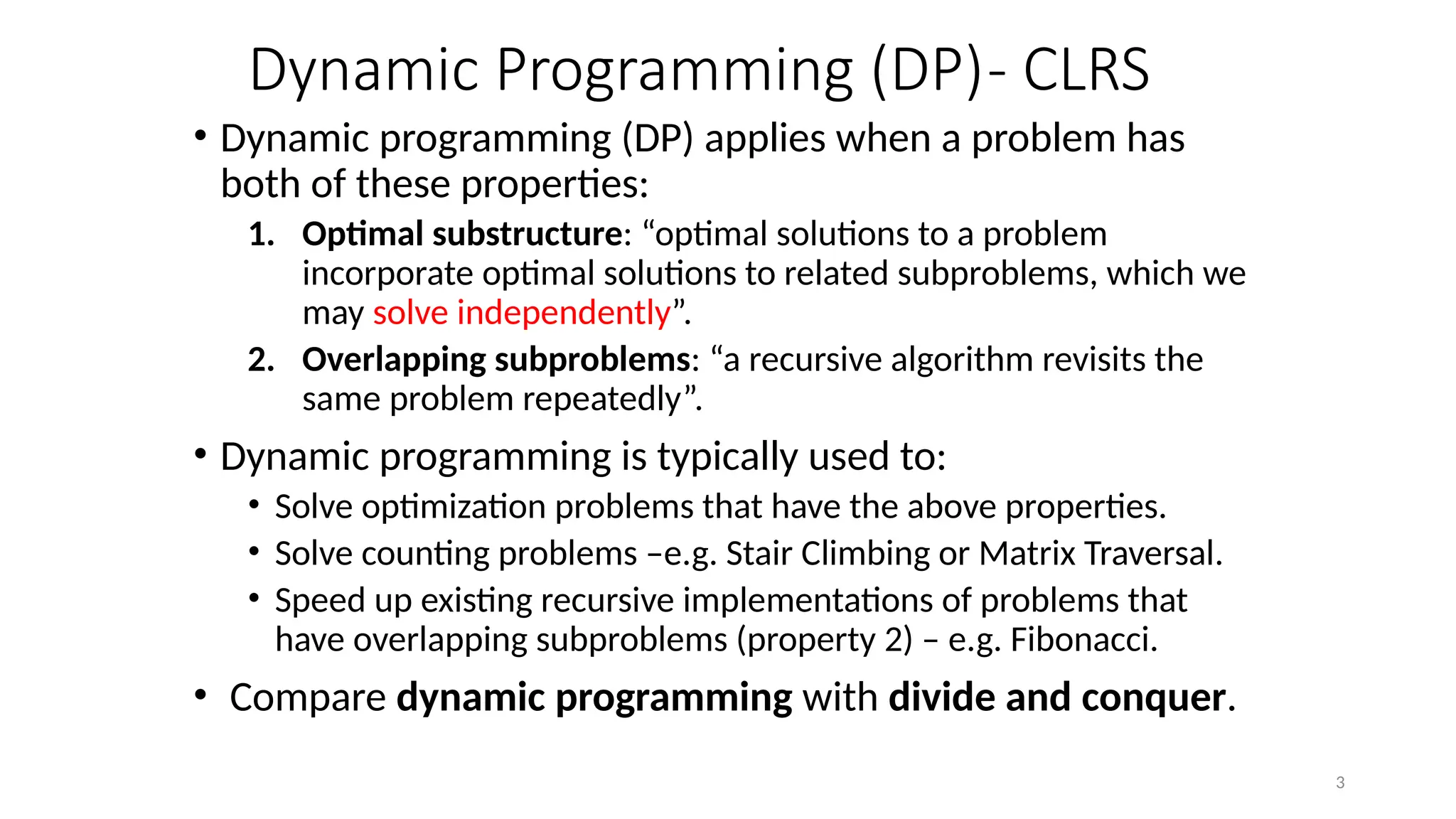
Dynamic Programming (DP)-CLRS
• Dynamic programming (DP) applies when a problem has
both of these properties:
1. Optimal substructure: “optimal solutions to a problem
incorporate optimal solutions to related subproblems, which we
may solve independently”.
2. Overlapping subproblems: “a recursive algorithm revisits the
same problem repeatedly”.
• Dynamic programming is typically used to:
• Solve optimization problems that have the above properties.
• Solve counting problems –e.g. Stair Climbing or Matrix Traversal.
• Speed up existing recursive implementations of problems that
have overlapping subproblems (property 2) – e.g. Fibonacci.
• Compare dynamic programming with divide and conquer.
4.
4
Iterative or Bottom-Up
DynamicProgramming
• Main type of solution for DP problems
• We can define the problems size and solve problems from size 0
going up to the size we need.
• Iterative – because it uses a loop
• Bottom-up because you solve problems from the bottom (the
smallest problem size) up to the original problem size.
5.
5
Bottom-Up vs. TopDown
• There are two versions of dynamic programming.
• Bottom-up.
• Top-down (or memoization).
• Bottom-up:
• Iterative, solves problems in sequence, from smaller to bigger.
• Top-down:
• Recursive, start from the larger problem, solve smaller problems as needed.
• For any problem that we solve, store the solution, so we never have to compute the same
solution twice.
• This approach is also called memoization.
6.
6
Top-Down Dynamic Programming
(Memoization )
• Maintain an array/table where solutions to problems
can be saved.
• To solve a problem P:
• See if the solution has already been stored in the array.
• If yes, return the solution.
• Else:
• Issue recursive calls to solve whatever smaller problems we need
to solve.
• Using those solutions obtain the solution to problem P.
• Store the solution in the solutions array.
• Return the solution.
7.
7
Steps for iterative(bottom up) solution
1. Identify trivial problems
1. typically where the size is 0
2. Look at the last step/choice in an optimal solution:
1. Assuming an optimal solution, what is the last action in
completing it?
2. Are there more than one options for that last action?
3. If you consider each action, what is the smaller problem
that you would combine with that last action?
1. Assume that you have the optimal answer to that smaller problem.
4. Generate all these solutions
5. Compute the value (gain or cost) for each of these
solutions.
6. Keep the optimal one (max or min based on problem)
3. Make a 1D or 2D array and start feeling in answers
from smallest to largest problems.
Other types of solutions:
1. Brute force solution
2. Recursive solution (most
likely exponential and
inefficient)
3. Memoized solution

![Approaches for solving DP Problems
Greedy
- typically not optimal
solution (for DP-type
problems)
- Build solution
- Use a criterion for picking
- Commit to a choice and
do not look back
Brute Force
- Optimal solution
- Produce all possible combinations,
[check if valid], and keep the best.
- Time: exponential
- Space: depends on
implementation
- It may be hard to generate all
possible combinations
DP
- Optimal solution
- Write math function, sol, that
captures the dependency of solution
to current pb on solutions to smaller
problems
- Can be implemented in any of the
following: iterative, memoized,
recursive
Iterative (bottom-up) - BEST
- Optimal solution
- sol is an array (1D or 2D). Size: N+1
- Fill in sol from 0 to N
- Time: polynomial (or pseudo-
polynomial for some problems)
- Space: polynomial (or pseudo-
polynomial
- To recover the choices that gave the
optimal answer, must backtrace =>
must keep picked array (1D or 2D).
Improve space usage
- Improves the iterative solution
- Saves space
- If used, cannot recover the choices
(gives the optimal value, but not the
choices)
Memoized
- Optimal solution
- Combines recursion and
usage of sol array.
- sol is an array (1D or 2D)
- Fill in sol from 0 to n
- Time: same as iterative
version (typically)
- Space: same as iterative
version (typically) + space for
frame stack. (Frame stack
depth is typically smaller
than the size of the sol array)
Recursive
- Optimal solution
- Time: exponential
(typically) =>
- DO NOT USE
- Space: depends on
implementation (code). E.g.
store all combinations, or
generate, evaluate on the fly
and keep best seen so far.
- Easy to code given math
function
DP can solve:
- some type of counting problems (e.g. stair climbing)
- some type of optimization problems (e.g. Knapsack)
- some type of recursively defined pbs (e.g. Fibonacci)
SOME DP solutions have pseudo polynomial time](https://image.slidesharecdn.com/08bdpgeneral-250519084900-35b6000a/75/dinosourrrrrrrrrrrrrrrrrrrrrr-formula-pptx-2-2048.jpg)


![ict_presentation_final_final_final[1].pptx](https://cdn.slidesharecdn.com/ss_thumbnails/ictpresentationfinalfinalfinal1-251230145259-2b4839bd-thumbnail.jpg?width=640&height=640&fit=bounds)


