1
DIGITALISATION IN BANKING
AND ITS IMPACT ON INDUSTRIES
HDFC BANK
SUMMER TRAINING PROJECT REPORT
submitted in partial fulfillment of
MASTER OF BUSINESS ADMINISTRATION
In
Under the guidance of Submitted By:-
Mr. Kamal Manhas Supriya Sharma
(Branch Manager) 1240-MBA-18
2
DECLARATION
I the undersigned solemnly declare that the Project Report
titled “DIGITALISATION IN BANKING AND ITZ IMPACT ON
INDUSTRIES" is based on my own work carried out during the
course of our study under the supervision of Mr. KAMAL
MANHAS , Branch Manager , HDFC BARI BRAHMNA
I assert the statement made and conclusion drawn are an
outcome of my research work. I further certify that:
The work contained in the report is original and has been done
by me under the general supervision of my supervisor.
The information and data given in the report is authentic to
the best of my knowledge.
Whenever we have used materials from other sources, we
have given due credit to them in the text of the report and
giving their details in the references.
SUPRIYA SHARMA
1240-MBA-18
3
ACKNOWLEDGEMENT
I wish to express my gratitude to HDFC BANK for giving me an
opportunity to be a part of their esteemed organization and
enhance my knowledge by granting permission to do summer
training project under their guidance.
I am deeply indebted to my guide Mr. KAMAL MANHAS,
Branch Manager, HDFC bank, for this valuable and enlightened
guidance. He provided me with the opportunity to learn in the
bank and spared his time to help me..
This project has been possible due to the support of several
wonderful individuals. I would like to thank many unknown
individuals, with whom I interacted. All of them with their due
cooperation and motivation made the completion of this project
successful. I would like to thank them all.
Last but not the least I am highly obliged to my friends and
colleagues for their help and support. The learning during the
project was immense and valuable
Regards,
SUPRIYA SHARMA
4
CONTENTS
Page No
CHAPTER 1 INTRODUCTION 5
CHAPTER 2 DIGITAL BANKING/ E-BANKING 9
CHAPTER 3 SWOT ANALYSIS 14
CHAPTER 4 COMPANY'S PROFILE 16
CHAPTER 5 DIGITAL BANKING IN HDFC BANK 28
CHAPTER 6 IMPACT OF DIGITAL BANKING 36
CHAPTER 7 RESEARCH METHODOLOGY 38
CHAPTER 8 DATA ANALYSIS &
INTERPRETATION 42
CHAPTER 9 FINDINGS 51
CHAPTER 10 RECOMMENDATION &
SUGGESTIONS 52
CHAPTER 11 CONCLUSION 53
ANNEXURE 54
5
CHAPTER 1
INTRODUCTION
1.1 BANKING:
A bank is a financial institution which accepts deposits, pays
interest on pre-defined rates, clears checks, makes loans, and
often acts as an intermediary in financial transactions. It also
provides other financial services to its customers.
TRADITIONAL BANKING: Traditional banking means
performing banking transactions in a brick and mortar structure.
The customer has to visit the branch of the bank in person to
perform the basic banking operations such as account enquiry,
funds transfer, cash withdrawals, applying for loans etc. Hence,
physically visiting the bank is essential for a customer to avail
the banking service as there is no use of information
technology in carrying out the banking transactions. Some of
the traditional banking activities are as follows:
a) Opening an account
b) Creating of deposits
c) Renew of fixed deposits
d) Withdrawals
e) Apply for loans
f) Transfer funds between accounts within the banks.
6
1.2 IMPACT OF TECHNOLOGYIN BANKING SECTOR
The information technology has revolutionized aspects for our
life. The world at large is entering into the ‘NET AGE’, internet
or simply ‘NET’ is an inter- connection of computer
communication networks covering the whole world. The
relationship between IT and Banking is fundamentally high
because of which it is expected to reduce costs and facilitate
customized products. The advent of information technology to
every aspect of human life and business has been so obvious
that it does not need to be accentuated more. Information
technology has been of great essence in banking system.
Today both public and private sector banks are trying to rapidly
transform itself from traditional banking to relationship banking
by establishing direct relationship with customers through the
introduction of IT in banking known as “DIGITAL BANKING”.
The following has been implemented effectively to introduce
technology in the traditional form of banking namely-
a) COMPLETE CENTRALIZED SOLUTION
b) CLUSTER APPROACH
c) HIGH TECH BNK WITHIN BANK
7
1.3 SHIFT FROM TRADITIONAL BANKING TO MODERN
BANKING:
The Banking sector in India has experienced a rapid
transformation. Just about a decade back this sector was
limited to the sarkari (read nationalized) and co-operative
banks. Then came the multi-national banks, but these were
confined to serving an elite few. The opening up of the Indian
banking sector to private players acted as 'the tipping point' for
this transformation. The deregulatory efforts prompted many
financial institutions (like HDFC and ICICI) and non- financial
institutions enter the banking arena. With the entry of private
players into retail banking and with multi- nationals focusing on
the individual consumer in a big way, the banking system
underwent a phenomenal change. Multi-channel banking
gained prominence. For the first time consumers got the choice
of conducting transactions either the traditional way (through
bank branch), through ATMs, the telephone or through the Net.
Technology played a key role in providing this multi-service
platform. The entry of private players combined with new RBI
guidelines forced nationalized banks to redefine the core
banking strategy and technology was central to this change.
TRANSFORMATION TO DIGITAL BANKING: E-Banking
started with the introduction of computers and ATM in 1970’s.
The addition of internet and mobile banking has revolutionized
banking services. Banks use E- Banking facilities to offer a
8
wide range of products and services. This development has
been leading to the creation new business models involving
banks and non-banks entity such as internet service providers
and other technology firms.
9
CHAPTER 2
DIGITAL BANKING/ E-BANKING
2.1 E-BANKING/ DIGITAL BANKING:
Online banking, also known as internet banking, e-banking or
virtual banking, is an electronic payment system that enables
customers of a bank or other financial institution to conduct a
range of financial transactions through the financial institution's
website. E-banking includes the systems that enable financial
institution customers, individuals or businesses, to access
accounts, transact business, or obtain information on financial
products and services through a public or private network,
including the Internet. Customers access e-banking services
using an intelligent electronic device, such as a personal
computer (PC), personal digital assistant (PDA), automated
teller machine (ATM), kiosk, or Touch Tone telephone. While
the risks and controls are similar for the various e-banking
access channels, this booklet focuses
Specifically on Internet-based services due to the Internet's
widely accessible public network. Accordingly, this booklet
begins with a discussion of the two primary types of Internet
websites: informational and transactional. Some of the modes
of E-Banking are:
10
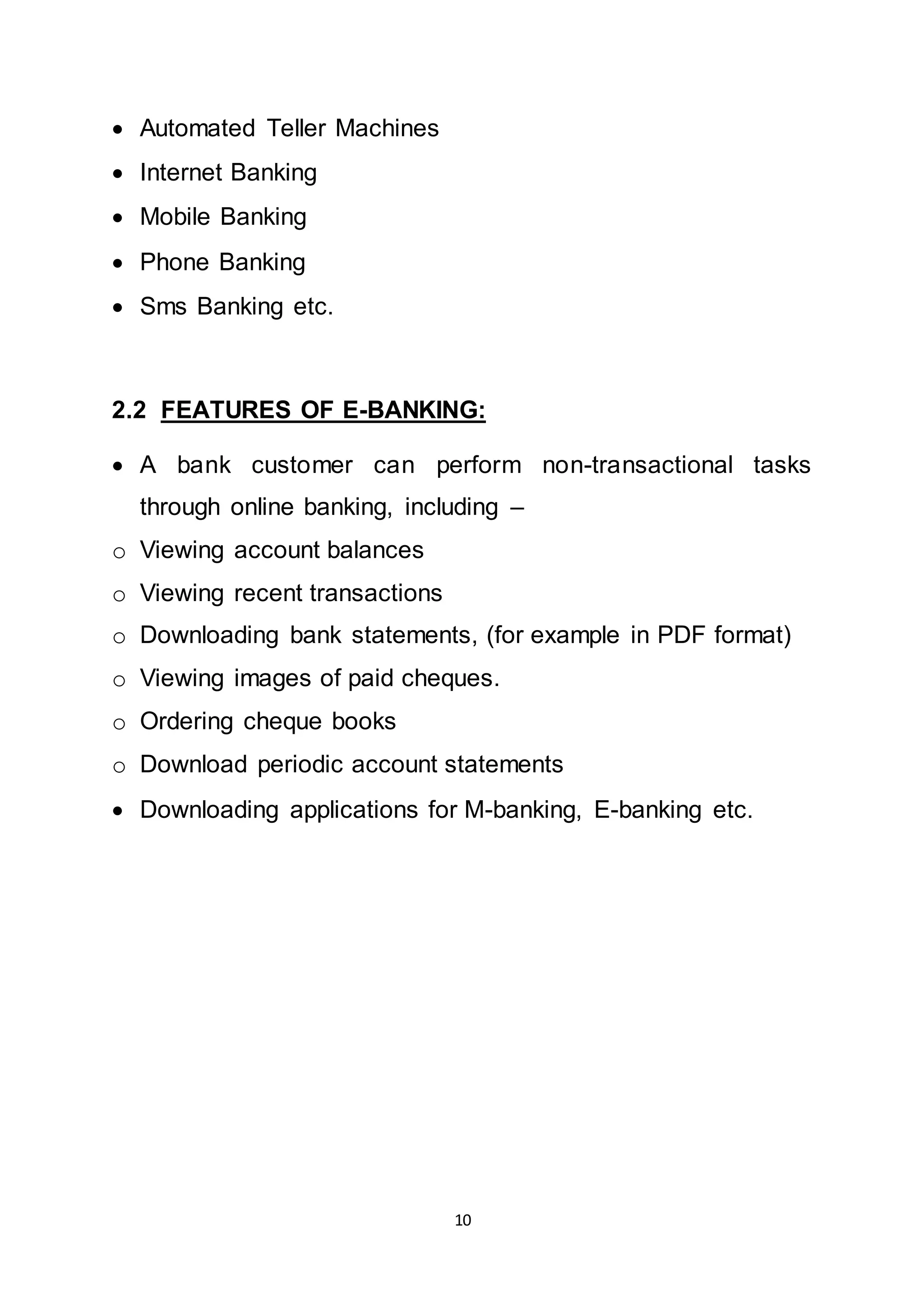
 Automated Teller Machines
 Internet Banking
 Mobile Banking
 Phone Banking
 Sms Banking etc.
2.2 FEATURES OF E-BANKING:
 A bank customer can perform non-transactional tasks
through online banking, including –
o Viewing account balances
o Viewing recent transactions
o Downloading bank statements, (for example in PDF format)
o Viewing images of paid cheques.
o Ordering cheque books
o Download periodic account statements
 Downloading applications for M-banking, E-banking etc.
11
B) Bank customers can transact banking tasks through
online banking, including –
 Funds transfers between the customer's linked accounts
 Paying third parties, including bill payments (see, e.g.,
BPAY) and third party fund transfers (see, e.g., FAST)
 Investment purchase or sale
 Loan applications and transactions, such as repayments of
enrollments
 Credit card applications
 Register utility billers and make bill payments
 Financial institution administration
 Management of multiple users having varying levels of
authority
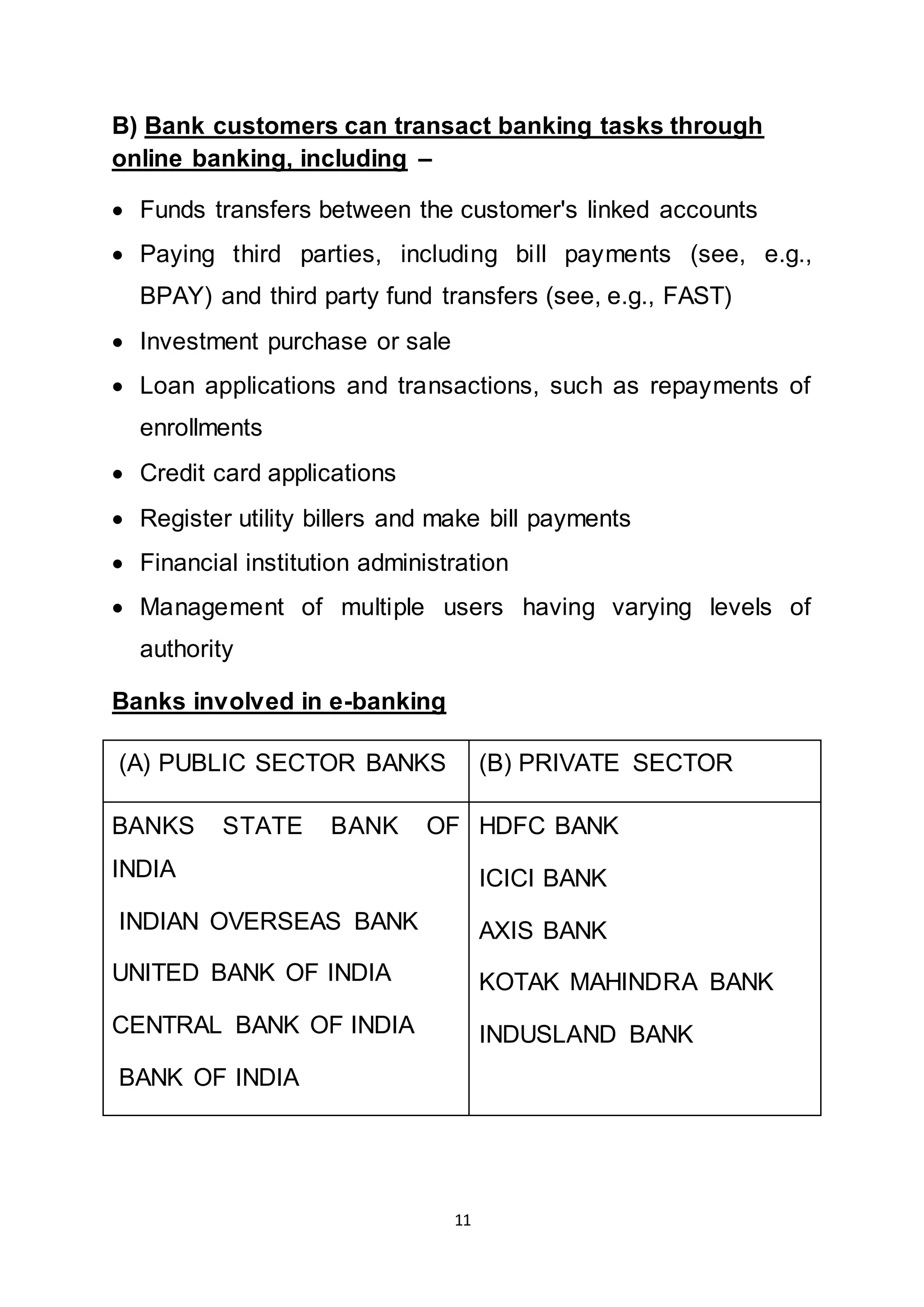
Banks involved in e-banking
(A) PUBLIC SECTOR BANKS (B) PRIVATE SECTOR
BANKS STATE BANK OF
INDIA
INDIAN OVERSEAS BANK
UNITED BANK OF INDIA
CENTRAL BANK OF INDIA
BANK OF INDIA
HDFC BANK
ICICI BANK
AXIS BANK
KOTAK MAHINDRA BANK
INDUSLAND BANK
12
2.3 RELATIONSHIP OF HDFC- DIGITAL BANKING:
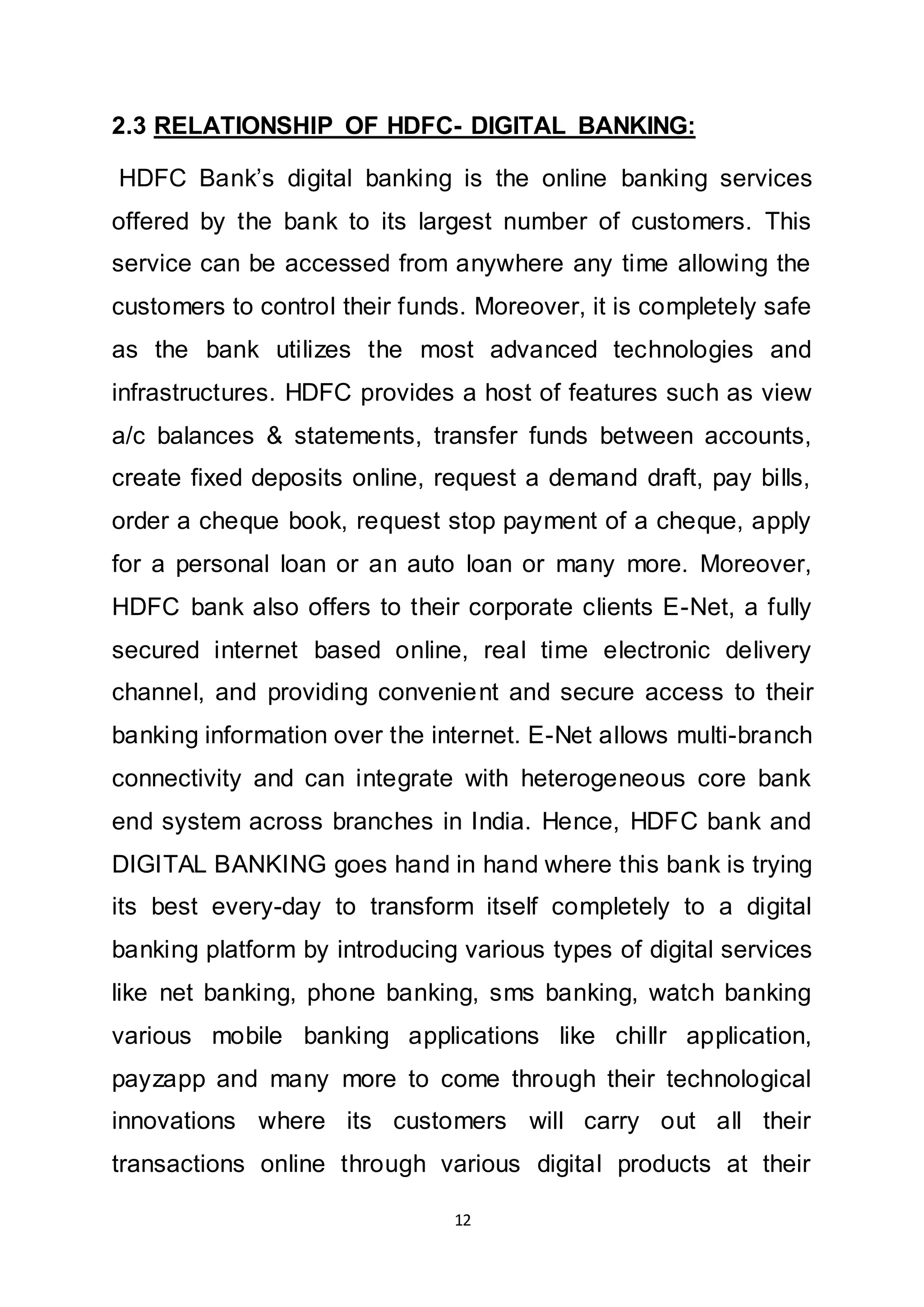
HDFC Bank’s digital banking is the online banking services
offered by the bank to its largest number of customers. This
service can be accessed from anywhere any time allowing the
customers to control their funds. Moreover, it is completely safe
as the bank utilizes the most advanced technologies and
infrastructures. HDFC provides a host of features such as view
a/c balances & statements, transfer funds between accounts,
create fixed deposits online, request a demand draft, pay bills,
order a cheque book, request stop payment of a cheque, apply
for a personal loan or an auto loan or many more. Moreover,
HDFC bank also offers to their corporate clients E-Net, a fully
secured internet based online, real time electronic delivery
channel, and providing convenient and secure access to their
banking information over the internet. E-Net allows multi-branch
connectivity and can integrate with heterogeneous core bank
end system across branches in India. Hence, HDFC bank and
DIGITAL BANKING goes hand in hand where this bank is trying
its best every-day to transform itself completely to a digital
banking platform by introducing various types of digital services
like net banking, phone banking, sms banking, watch banking
various mobile banking applications like chillr application,
payzapp and many more to come through their technological
innovations where its customers will carry out all their
transactions online through various digital products at their
13
convenience and without even visiting the branch of the bank.
Therefore, digital banking is intertwined with HDFC bank which
is aiming to become a pioneer in providing financial services to
its customers through digital channels.
14
CHAPTER 3
SWOT ANALYSIS
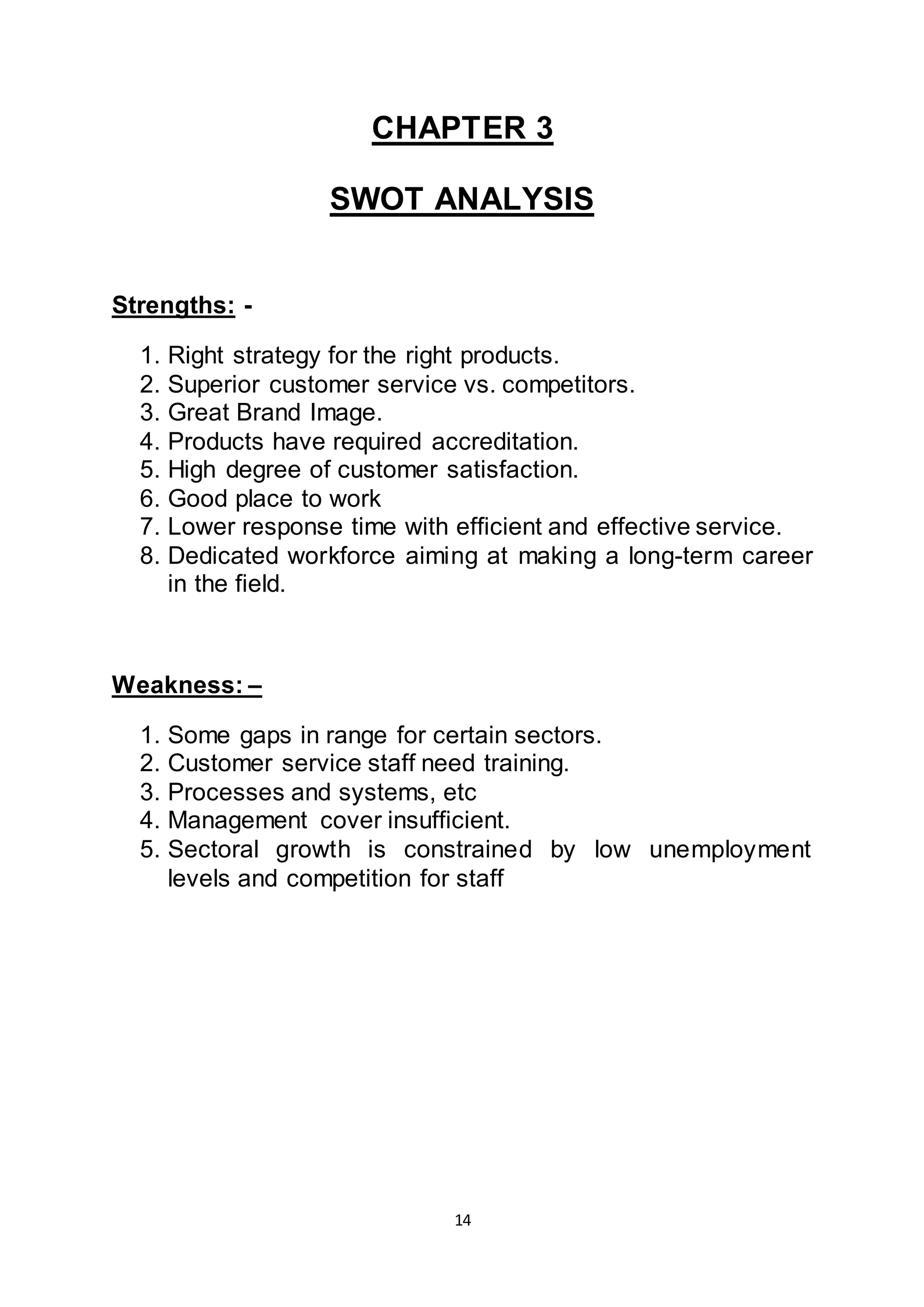
Strengths: -
1. Right strategy for the right products.
2. Superior customer service vs. competitors.
3. Great Brand Image.
4. Products have required accreditation.
5. High degree of customer satisfaction.
6. Good place to work
7. Lower response time with efficient and effective service.
8. Dedicated workforce aiming at making a long-term career
in the field.
Weakness: –
1. Some gaps in range for certain sectors.
2. Customer service staff need training.
3. Processes and systems, etc
4. Management cover insufficient.
5. Sectoral growth is constrained by low unemployment
levels and competition for staff
15
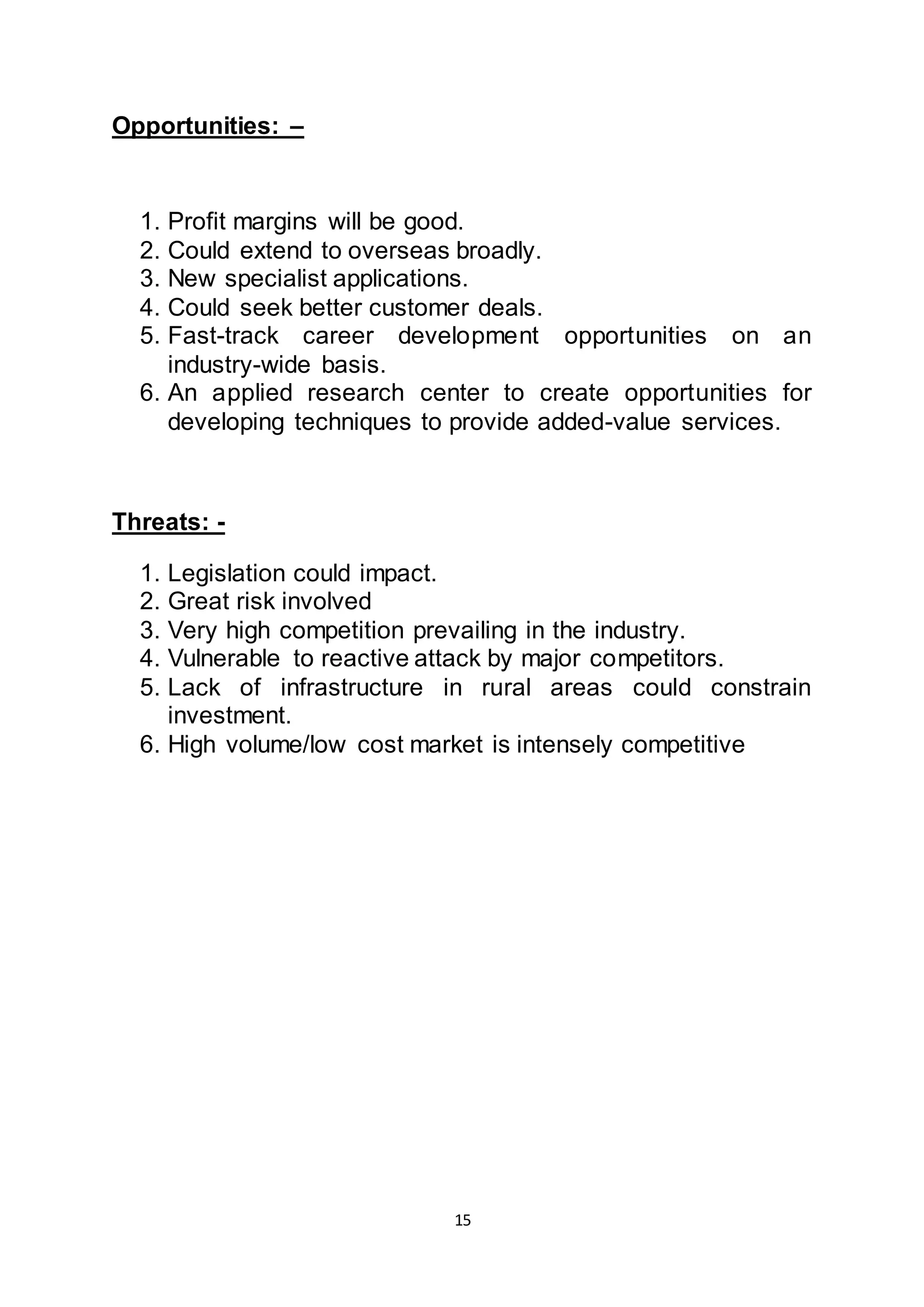
Opportunities: –
1. Profit margins will be good.
2. Could extend to overseas broadly.
3. New specialist applications.
4. Could seek better customer deals.
5. Fast-track career development opportunities on an
industry-wide basis.
6. An applied research center to create opportunities for
developing techniques to provide added-value services.
Threats: -
1. Legislation could impact.
2. Great risk involved
3. Very high competition prevailing in the industry.
4. Vulnerable to reactive attack by major competitors.
5. Lack of infrastructure in rural areas could constrain
investment.
6. High volume/low cost market is intensely competitive
16
CHAPTER 4
COMPANY'S PROFILE
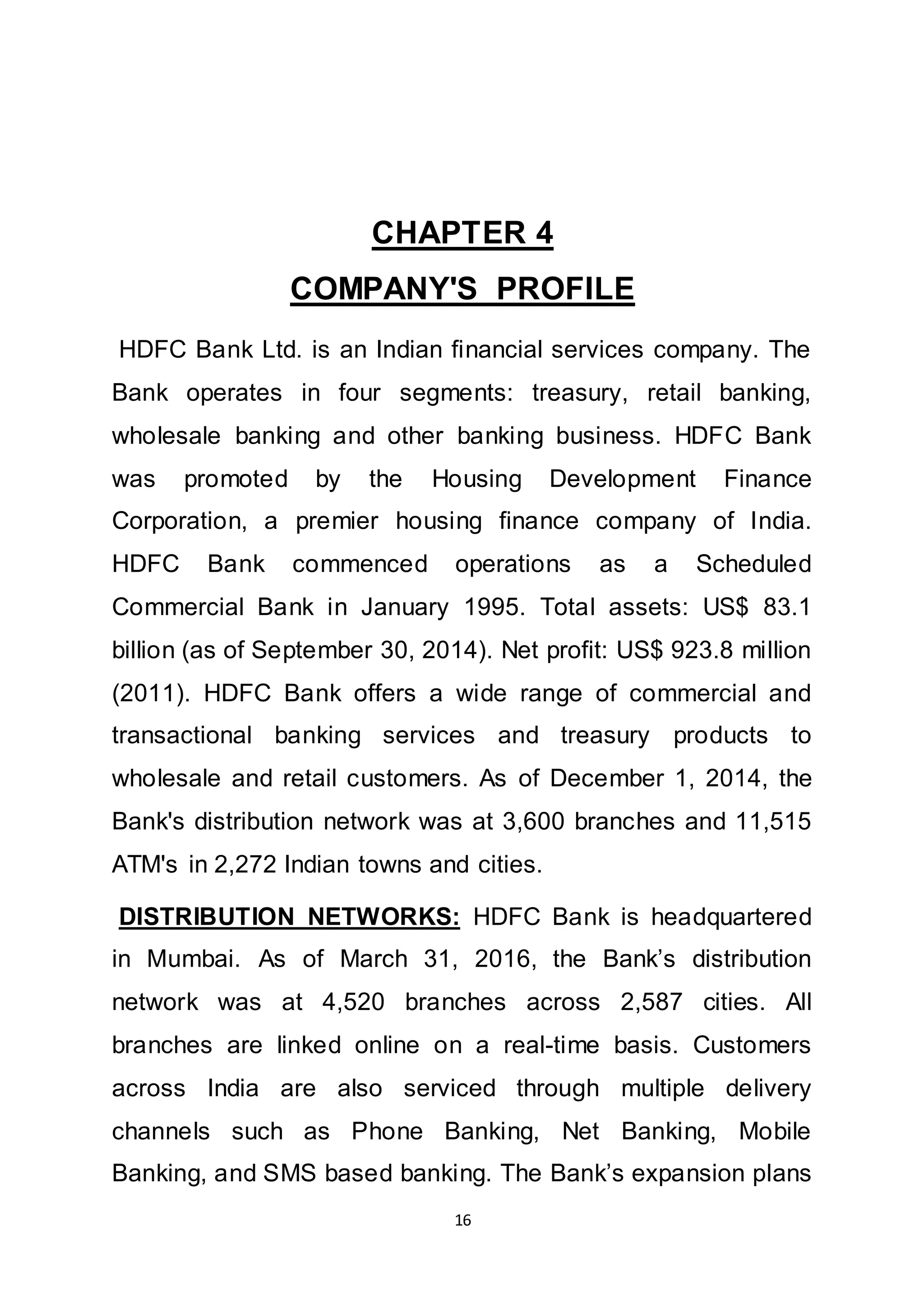
HDFC Bank Ltd. is an Indian financial services company. The
Bank operates in four segments: treasury, retail banking,
wholesale banking and other banking business. HDFC Bank
was promoted by the Housing Development Finance
Corporation, a premier housing finance company of India.
HDFC Bank commenced operations as a Scheduled
Commercial Bank in January 1995. Total assets: US$ 83.1
billion (as of September 30, 2014). Net profit: US$ 923.8 million
(2011). HDFC Bank offers a wide range of commercial and
transactional banking services and treasury products to
wholesale and retail customers. As of December 1, 2014, the
Bank's distribution network was at 3,600 branches and 11,515
ATM's in 2,272 Indian towns and cities.
DISTRIBUTION NETWORKS: HDFC Bank is headquartered
in Mumbai. As of March 31, 2016, the Bank’s distribution
network was at 4,520 branches across 2,587 cities. All
branches are linked online on a real-time basis. Customers
across India are also serviced through multiple delivery
channels such as Phone Banking, Net Banking, Mobile
Banking, and SMS based banking. The Bank’s expansion plans
17
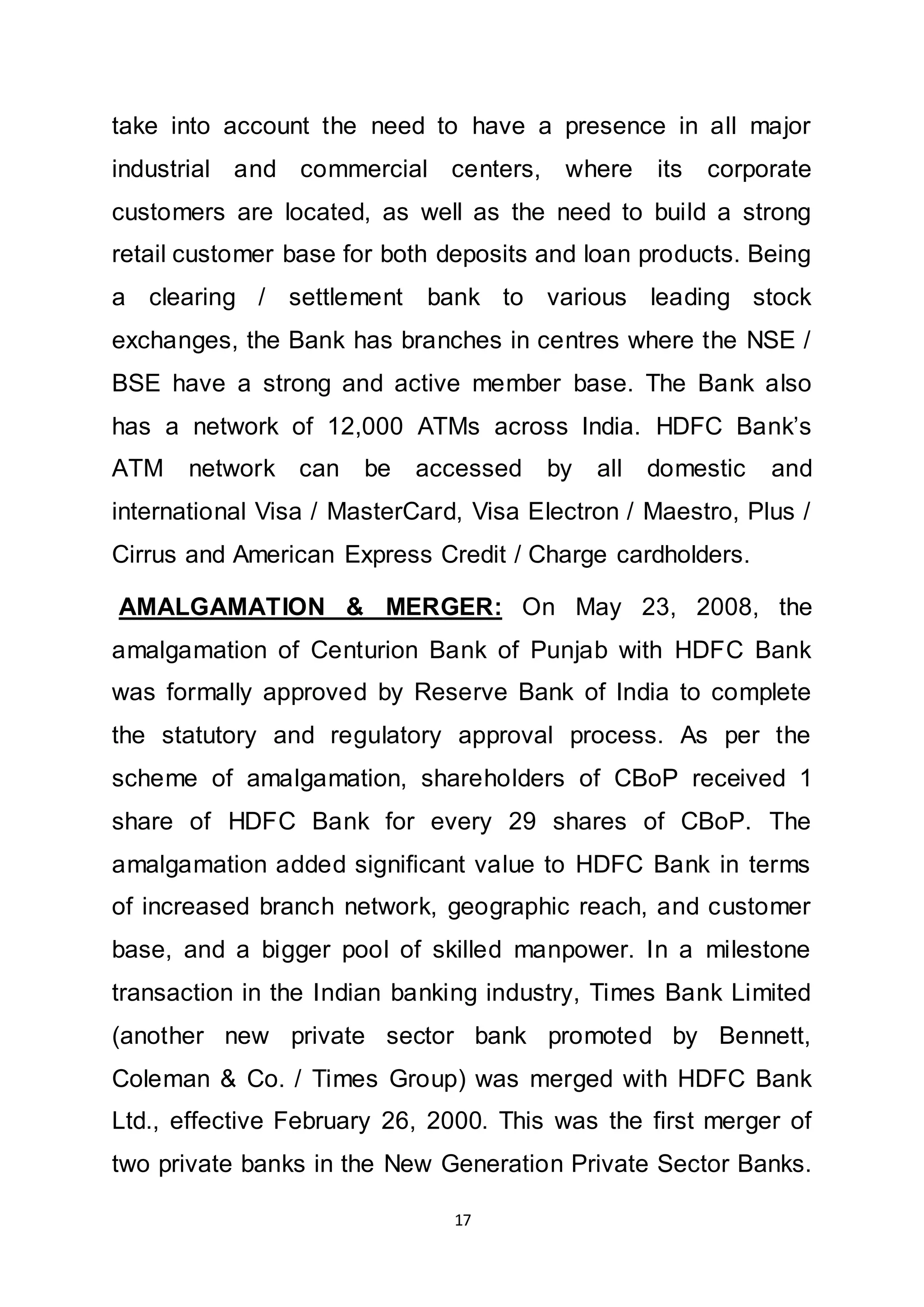
take into account the need to have a presence in all major
industrial and commercial centers, where its corporate
customers are located, as well as the need to build a strong
retail customer base for both deposits and loan products. Being
a clearing / settlement bank to various leading stock
exchanges, the Bank has branches in centres where the NSE /
BSE have a strong and active member base. The Bank also
has a network of 12,000 ATMs across India. HDFC Bank’s
ATM network can be accessed by all domestic and
international Visa / MasterCard, Visa Electron / Maestro, Plus /
Cirrus and American Express Credit / Charge cardholders.
AMALGAMATION & MERGER: On May 23, 2008, the
amalgamation of Centurion Bank of Punjab with HDFC Bank
was formally approved by Reserve Bank of India to complete
the statutory and regulatory approval process. As per the
scheme of amalgamation, shareholders of CBoP received 1
share of HDFC Bank for every 29 shares of CBoP. The
amalgamation added significant value to HDFC Bank in terms
of increased branch network, geographic reach, and customer
base, and a bigger pool of skilled manpower. In a milestone
transaction in the Indian banking industry, Times Bank Limited
(another new private sector bank promoted by Bennett,
Coleman & Co. / Times Group) was merged with HDFC Bank
Ltd., effective February 26, 2000. This was the first merger of
two private banks in the New Generation Private Sector Banks.
18
As per the scheme of amalgamation approved by the
shareholders of both banks and the Reserve Bank of India,
shareholders of Times Bank received 1 share of HDFC Bank
for every 5.75 shares of Times Bank.
BUSINESS FOCUS: HDFC Bank's mission is to be a World
Class Indian Bank. The objective is to build sound customer
franchises across distinct businesses so as to be the preferred
provider of banking services for target retail and wholesale
customer segments, and to achieve healthy growth in
profitability. The bank is committed to maintain the highest level
of ethical standards, professional integrity, corporate
governance and regulatory compliance. HDFC Bank’s business
philosophy is based on five core values: Operational
Excellence, Customer Focus, Product Leadership, People and
Sustainability
Vision & Mission: To become the undisputed market leader in
providing housing related finances, to realize the dream of
shelter for all in Sri Lanka". HDFC Bank’s mission is to be a
world class Indian bank by adopting a single minded focus on
service excellence and product quality. The Bank has adopted
industry leading best practices in establishing a set of operating
principles which govern how risks of a significant business
19
disruption are mitigated to protect the Banks customers,
employees and stakeholders.
CAPITAL STRUCTURE OF HDFC: As on 31st March, 2015
the authorized share capital of the Bank is Rs. 550 crore. The
paid-up share capital of the Bank as on the said date is Rs
501,29,90,634/- ( 2506495317 ) equity shares of Rs. 2/- each).
The HDFC Group holds 21.67 % of the Bank's equity and about
18.87 % of the equity is held by the ADS / GDR Depositories (in
respect of the bank's American Depository Shares (ADS) and
Global Depository Receipts (GDR) Issues). 32.57 % of the
equity is held by Foreign Institutional Investors (FIIs) and the
Bank has 4, 41,457 shareholders. The shares are listed on the
NSE and BSE. The Bank's American Depository Shares (ADS)
are listed on the New York Stock Exchange (NYSE) under the
symbol 'HDB' and the Bank's Global Depository Receipts
(GDRs) are listed on Luxembourg Stock Exchange under ISIN
No US40415F2002.
GOALS/ OBJECTIVES:
a) To develop close relationship with individual households.
b) To transform ideas into viable and creative solutions.
c) To maintain our position as the premier housing finance
institution in the country.
20
OPERATIONS OF HDFC BANK:
The Housing Development Finance Corporation Limited
(HDFC) was amongst the first to receive an ‘in principle’
approval from the Reserve Bank of India (RBI) to set up a bank
in the private sector, as part of RBI’s liberalization of the Indian
Banking Industry in 1994. The bank was incorporated in August
1994 in the name of 'HDFC Bank Limited', with its registered
office in Mumbai, India. HDFC Bank commenced operations as
a Scheduled Commercial Bank in January 1995. HDFC bank
deals with 3 key segments
 RETAIL BANKING
 WHOLESALE BANKING
 NRI BANKING
 TREASURY
RETAIL BANKING: The objective of the Retail Bank is to
provide its target market customers a full range of financial
products and banking services, giving the customer a one-stop
window for all his/her banking requirements. The products are
backed by world-class service and delivered to customers
through the growing branch network, as well as through
alternative delivery channels like ATMs, Phone Banking, Net
Banking and Mobile Banking. The HDFC Bank Preferred
program for high net worth individuals, the HDFC Bank Plus
21
and the Investment Advisory Services programs have been
designed keeping in mind needs of customers who seek
distinct financial solutions, information and advice on various
investment avenues. The Bank also has a wide array of retail
loan products including Auto Loans, Loans against marketable
securities, Personal Loans and Loans for Two-wheelers.
WHOLESALE BANKING: The Bank’s target market is primarily
large, blue-chip manufacturing companies in the Indian
corporate sector and to a lesser extent, small & mid-sized
corporates and agri-based businesses. For these customers,
the Bank provides a wide range of commercial and
transactional banking services, including working capital
finance, trade services, transactional services, cash
management, etc. The bank is also a leading provider of
structured solutions, which combine cash management
services with vendor and distributor finance for facilitating
superior supply chain management for its corporate customers.
Based on its superior product delivery / service levels and
strong customer orientation, the Bank has made significant
inroads into the banking consortia of a number of leading Indian
corporates including multinationals, companies from the
domestic business houses and prime public sector companies.
22
TREASURY: The Bank’s target market is primarily large, blue-
chip manufacturing companies in the Indian corporate sector
and to a lesser extent, small & mid-sized corporates and agri-
based businesses. For these customers, the Bank provides a
wide range of commercial and transactional banking services,
including working capital finance, trade services, transactional
services, cash management, etc. The bank is also a leading
provider of structured solutions, which combine cash
management services with vendor and distributor finance for
facilitating superior supply chain management for its corporate
customers. Based on its superior product delivery / service
levels and strong customer orientation, the Bank has made
significant inroads into the banking consortia of a number of
leading Indian corporates including multinationals, companies
from the domestic business houses and prime public sector
companies.
THE PRODUCTS AND SERVICES:
 Account & Deposits
 Loans
 Cards
 Investments
 Insurance
 Forex
23
 Mutual Funds
 Safe Deposit Lockers
 Private Banking
 NRI Banking
 Premier Banking
DIGITAL BANKING PLATFORM:
HDFC Bank, one of the leading private sector lenders in India,
has launched a new initiative - 'Bank Aap Ki Muththi Mein' - as
part of their 'Go Digital campaign' that attempts to turn a
smartphone into a bank branch. The new HDFC Bank app
allows over 75 banking transactions, apart from essential
transactions such as: booking fixed and recurring deposits, bill
and tax payments, buying insurance, and mutual funds, the app
allows customers to buy all kinds of loans instantly. It also
provides customized, location-specific promotions, as well as
offers and deals on shopping, dining, movies, and
entertainment. Notably, part of the bank's 'Go Digital' offering,
'Bank Aap Ki Muththi Mein', is a technology agnostic initiative
with apps on the three popular smartphone platforms - iOS,
Android, and Windows Phone. The initiative also extends to
basic feature-phone users with SMS and missed-call banking
as well as a mobile site. All that a customer needs to do is,
send a text or call a toll-free number to know his account
balance, get a mini statement, request a check book, or
24
detailed account statement. The latter of course is a popular
channel for a large number of rural and semi-urban customers.
The SMS banking service (and the Android app) is also
available in Hindi for a broader demographic. "With 'Bank Aap
Ki Muththi Mein', you can do everything other than access your
locker, and deposit or withdraw cash. Customer convenience is
central to our concept of Digital. And, there is no bigger
convenience than bringing your bank to the palm of your hand.
We are very excited to unveil our 'Bank Aap Ki Muththi Mein'
offering and with it world class experience of banking
to millions of our countrymen," said Nitin Chugh, head - Digital
Banking, HDFC Bank. HDFC Bank, which began its digital
journey by launching net banking services way back in 1999,
was the first to launch SMS banking in 2000. The conversation
with Nitin Chugh, head - Digital Banking, HDFC Bank, I learned
that as of 2014, 55% of all transactions at HDFC Bank are
conducted through digital channels, which is significantly higher
than the corresponding figure in 2001 of just 3%. Nitin asserted
that the campaign is essential since as of September 2014,
India had over 900 million mobile users in the country, but only
40 million mobile banking customers. "We want to be active
partners in a new digital India, envisioned by the government
and central bank, offering our customers what they want, when
they want it. Customer convenience and centricity lies at the
heart of all our digital banking initiatives," he said, adding that
25
even in rural India, technology will play a big role in financial
inclusion and bringing millions into the organized banking fold.
'Bank Aap Ki Muththi Mein' allows customers to transact with
the bank round-the-clock. While HDFC is not the only bank to
offer mobile banking services through various channels, it aims
to trump the competition with the widest array of capabilities it
offers.
BROAD FACILITIES THAT E-BANKING PROVIDES:
 Lower manpower and back office cost.
 24*7 service bank online services are provided 24 hours a
day, 7 days a week and 52 weeks a year.
 No more Qs- there are no queues in an online bank.
 Convenience.
 Time saving.
DIGITAL SERVICES:
 Internet Banking.
 Phone Banking.
 Mobile Banking.
 SMS Banking.
 Missed call Banking.
 ATMs.
 Watch Banking.
26
a) Internet Banking: Now monitor, transact and control your
bank account online with our net banking service. You can do
multiple things from the comforts of your home or office through
HDFC Net Banking your one stop solution for all your banking
needs. Get all account details, submit requests and undertake
a wide range of transactions online through our HDFC Bank
Net Banking services. Our E-Banking service makes banking a
lot more easy and effective.
b) Phone Banking: Phone Banking offers you all the
conveniences you need to access your Accounts, Credit Cards,
Loans, Demat & Investment Services from the comfort of your
home, office or on the move, all this in your preferred language.
Phone Banking services are a combination of IVR and Agent
offering, depending on the type of transaction. For all
transactions that cannot be completed on the IVR, Phone
Banker assisted services are available. Following are the
services offered- report loss of your ATM/ DEBIT/ CREDIT
card, check your account balance, enquire about cheque
status, order a cheque book/account statement/stop payment
of cheque etc.
27
c) SMS Banking: SMS banking is a form of mobile banking. It
is a facility used by some banks or other financial institutions to
send messages (also called notifications or alerts) to
customer’s mobile phones using SMS messaging, or a service
provided by them which enables its customers to perform some
financial transactions using SMS.
d) Mobile Banking: Mobile banking is a service provided by a
bank or other financial institution that allows its customers to
conduct a range of financial transactions remotely using a
mobile device such as a mobile phone or tablet, and using
software, usually called an app, provided by the financial
institution for the purpose. Mobile banking is usually available
on a 24-hour basis. The types of financial transactions which a
customer may transact through mobile banking include
obtaining account balances and list of latest transactions,
electronic bill payments, and funds transfers between a
customer's or another's accounts. Some also enable copies of
statements to be downloaded and sometimes printed at the
customer's premises; and some banks charge a fee for mailing
hardcopies of bank statements.
28
CHAPTER 5
DIGITAL BANKING IN HDFC BANK
HDFC Bank offers a comprehensive range of transactions
across multiple products through its Net Banking channel. So
just by logging into Net Banking one can conduct 200+
transactions from the comfort of your home or office.
Now monitor, transact and control your bank account online
through our net banking service. You can do multiple things
from the comforts of your home or office with HDFC Bank
Internet Banking - a one stop solution for all your banking
needs. You can now get all your account details, submit
requests and undertake a wide range of transactions online.
Our E-Banking service makes banking a lot more easy and
effective.NET banking is the online facility provided by the
many banks in order to carry out their out their transactions with
much ease and in the most effective & efficient way
Why Net Banking?
• Manage your account conveniently through the Internet.
• 200+ transactions available on Net Banking
• Up-to-the-second details of your account
• Access anytime, from anywhere
29
• No queues to stand in, or turns to wait for
• You can log in to Net Banking using your Customer ID and
IPIN (password).
Features of Net Banking
• Account Details: View your bank account details, account
balance, download statements and more. Also view your
Demat, Loan & Credit Card Account Details all in one place.
• Fund Transfer: Transfer fund to your own accounts, other
HDFC Bank accounts or Other Bank account seamlessly.
• Request Services: Give a request for Cheque book,
Demand Draft, Stop Cheque Payment, Debit Card Loyalty
Point Redemption etc.
• Investment Services: View your complete Portfolio with the
bank, Create Fixed Deposit, Apply for IPO etc.
• Value Added Services: Pay Utility bills for more than 160
billers, Recharge Mobile, Create Virtual Cards, Pay any Visa
Credit Card bills, Register for e-statement and sms banking
etc.
• Net Secure: Our Internet Banking Security System at HDFC
bank follow best-in-class online security practices in order to
safeguard your information while you are banking online. It’s
30
our constant endeavor to prevent fraud and make your net
banking transactions completely safe.
• Transfer funds: between accounts across multiple banks
from your home or office through HDFC Bank Internet
Banking. To send money, just register your beneficiary's
account details through HDFC Bank Internet Banking. You
can transfer funds using NEFT or IMPS.
Advantages of Net Banking
• Security
• Error Free Transactions
• Easily Track Spending
• Cost Effective
• Transfer money between accounts
• View your account summary
• 24*7 Available
• Pay bills online
• Create FD or RD online
• Request stop payment on Cheque
• Request Cheque book
• Check your Account / Interest statement
31
Mobile Applications by HDFC Bank
1. HDFC Bank Mobile Banking
HDFC Bank Mobile Banking is the official app of HDFC Bank
for Android. HDFC Bank Mobile Banking gives you access to
your account on your Android phone. Now, you can perform
your banking tasks from the palm of your hand, from anywhere
and at anytime !
You can :
 Pay utility bills, credit card bills, etc.
 View Account summaries and Fixed Deposit summaries.
 Transfer funds , including transfers to other bank customers.
 Request statements, Cheque book, Stop payment, Balance
and Interest Certificates.
32
PAYZAPPApplication
HDFC Bank PayZapp, a complete payment solution, giving you
the power to pay in just One Click. With PayZapp, you can
shop on your mobile at partner apps, buy movie tickets, music
and groceries, compare and book flight tickets and hotels, shop
online and get great discounts at “Smart Buy”, send money to
anyone in your contact list, pay bills and recharge your mobile,
DTH and data card. PayZapp is convenient, fast and secure.
No need to re-load money again and again. Moreover your card
details are secure with the bank and not stored on your mobile
phone or on transacting sites. It uses a proprietary technology
that conducts three security checks for each transaction.
So link your Debit and Credit Card to PayZapp and enjoy the
most convenient and secure way of payment. Tag line: “Cards
link karoekbaar, pay karobaarbaar!”
33
 HDFC SmartBuy
Smart Buy is a platform only for display of offers extended by
Merchants to HDFC Bank's Customers, and HDFC Bank is not
selling/rendering any of these Products/Services. The Bank
does not act as express or implied agent of the Merchants/the
owners of the Products vis-a-vis the Customers. HDFC Bank is
merely facilitating the payment by its Customers by providing
the Payment Gateway Services and will not earn any fee by
hosting this website.
HDFC Bank is neither guaranteeing nor making any
representation with respect to the offers made by the merchant.
You can shop on your mobile at partner apps, buy movie
tickets, music and groceries, compare and book flight tickets
and hotels, shop online and get great discounts at “Smart Buy”,
send money to anyone in your contact list, pay bills and
recharge your mobile, DTH and data card.HDFC Bank is not
responsible for sale/quality/features of the Products/Services
under the offer.
34
If the Customer proceeds from here, any purchase of a
Product/Service will only be through the HDFC Bank's
credit/debit cards/net banking facility. The Products/Services
offered by Merchants may also be available at other
stores/online platforms. The Customer's discretion is advised in
this regard.
 HDFC Perks
 HDFC PERKS is mainly for salaried people. It offers the
following benefits:
 Stay updated with all new launches
 Enjoy latest offers
 View and share videos/demos on our latest products
 Apply for any product in just a click
 Instantly connect with your Corporate Salary RM
 Download ALL HDFC Bank Apps from here Mobile Banking
LITE App
35
HDFC LITE:
It is a quick-to-install banking application that works without the
internet. You don’t need a login/Password- the app works from
your registered mobile number. You can use this application in
either Hindi or English.
HDFC Bank Lite Banking App helps you check your account
balance, transfer funds, pay your bills and much more. The new
App for Android is loaded with great features. HDFC is the first
bank to offer the My Menu feature. You can customize your
Menu with 10 of your favorite transactions with this feature is
also the only bank to have a Mobile Banking App in Hindi for
Android phones.
Why use Android Mobile Banking Application?
 Access your account anywhere, anytime
 As secure as Net Banking
 Simple and convenient with 75+transactions at your
fingertips
 Transactions that can be done using your Android phone
includes Balance Enquiry, Funds Transfer, Credit Card
payment
36
CHAPTER 6
IMPACT OF DIGITAL BANKING
Positive impact of digitization in banking :-
 Improved customer experience.
 Reduction of costs for banks and customers as well by using
ATMs, cashless transactions etc.
 With more digital data available with banks, they can
take data-driven dynamic decisions by using digital analytics.
This benefits both customers and banks.
 Technology is non-discriminatory. Everyone will be treated
same at banks.
 Number of customers will be increased for banks because of
the increased convenience of banking.
 Digitalization reduces human error.
 Need of handling large amounts of cash will be reduced.
 Opening and maintaining bank accounts are never been this
easier.
 Repetitive tasks will be eliminated by automation.
 Rural and urban gap will be eliminated.
37
 With the increasing cashless transactions, fake currency
threat will be reduced.
 Productivity will be increased.
Negative impact of digitization in banking :-
 Digitalization reduces the effort of employees and hence
results in loss of jobs.
 Some bank branches may cease to exist with the increasing
use of online banking.
 Banks will be more vulnerable to cyber attacks.
 Privacy may have to be compromised. No one can hide
crores of rupees in banks and just act middle class.
 These disadvantages are just temporary. Loss of jobs will be
compensated through creation of new jobs such as cyber
security, research team for innovation in technology etc.
38
CHAPTER 7
RESEARCH METHODOLOGY
TITLE OF THE STUDY
“Digitalisation in banking and its impact on industries”
DURATION OF STUDY
1st
JUNE 2019 to 31st
JULY 2019
7.1 OBJECTIVES OF STUDY
 To analyze the awareness among customers using E-
Banking services.
 To know about E-Banking services provided by HDFC Bank.
 To study the reasons for choosing E-Banking services.
 To understand the problems / reasons for not using E-
Banking facilities by customers provided by their Banks.
 To study the customer satisfaction relating to E-banking
services provided by HDFC Bank.
 Draw out with conclusions and suggestion based on the
analysis and the interpretation of data.
39
7.2 RESEARCH DESIGN
Research design refers to overall strategy that you choose to
integrate the different components of the study in a coherent
and logical way. It constitutes a blueprint for collection,
measurement and analysis of data.
This research is qualitative in nature and it is an exploratory
research wherein we are trying to study the impact of
digitalisation in banking and its impact on industries in HDFC
bank. It includes:
QUESTIONNAIRE
A questionnaire is a research instrument consisting of a series
of questions and other prompts for the purpose of gathering
information from respondents.
SAMPLING PLAN
Sampling is the process of selecting a sufficient number of
elements from the population, so that the sample and an
understanding of its properties of characteristics would make it
possible for us to generalize such properties or characteristics
to the population elements
A sampling plan is a detailed outline of which measurements
will be taken at what times, on which material, in what manner,
40
and by whom. Sampling plans should be designed in such a
way that the resulting data will contain a representative sample
of the parameters of interest and allow for all questions, as
stated in the goals, to be answered.
SAMPLE SIZE
 Sample size determination is the act of choosing the
number of observations or replicates to include in a
statistical sample. The sample size is an important feature
of any empirical study in which the goal is to make
inferences about a population from a sample.
 The sample size for this project is : 80
 All respondents were the customers of HDFC Bank.
SAMPLING UNIT
 The sampling unit could be blocks, households, and
individuals within the households. Sampling frame: This is
the actual list of sampling units from which the sample, or
some stage of the sample, is selected. It is simply a list of
the study population.
 Sampling unit for project was HDFC Bank BARI
BRAHMANA Branch Jammu.
41
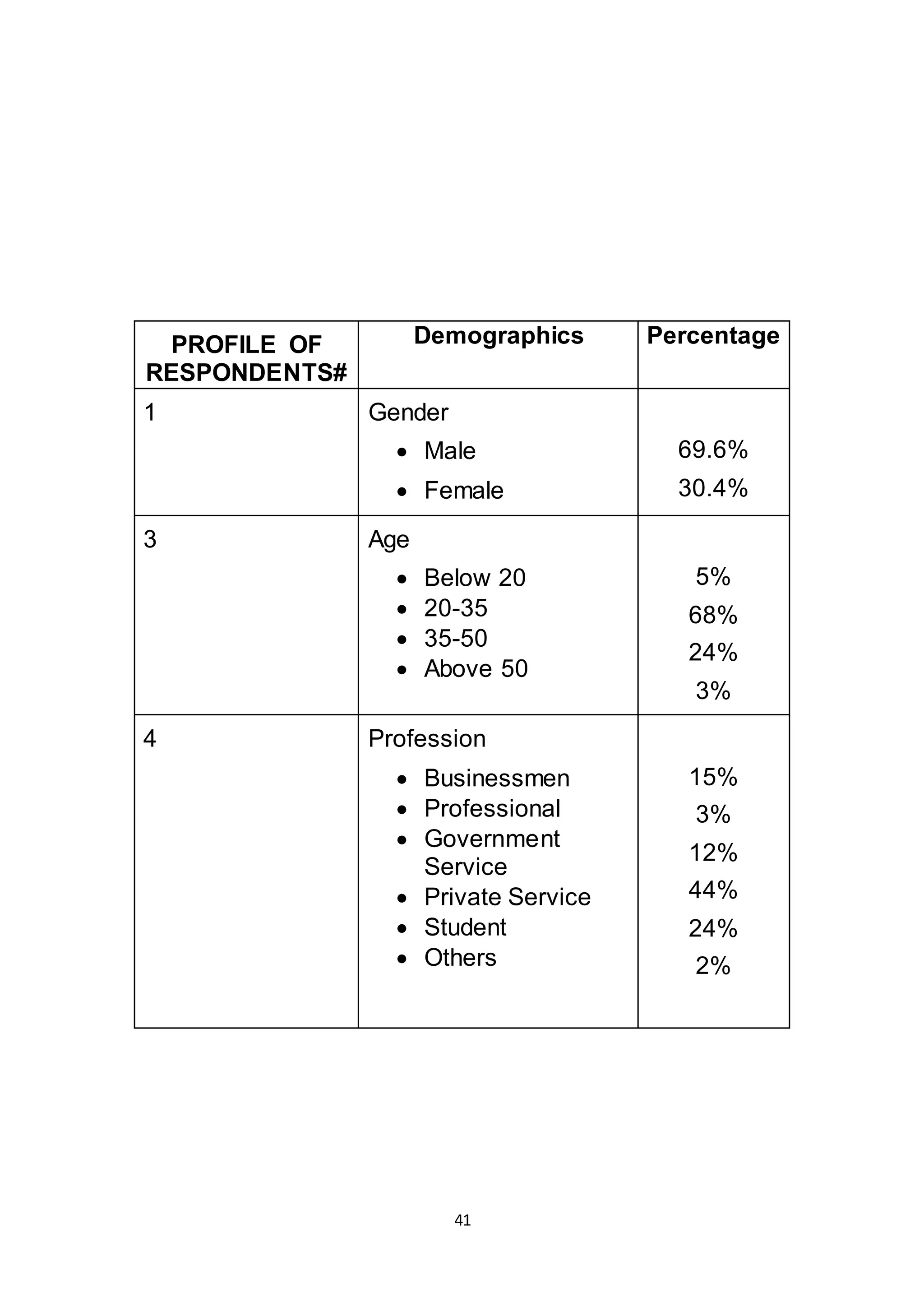
PROFILE OF
RESPONDENTS#
Demographics Percentage
1 Gender
 Male
 Female
69.6%
30.4%
3 Age
 Below 20
 20-35
 35-50
 Above 50
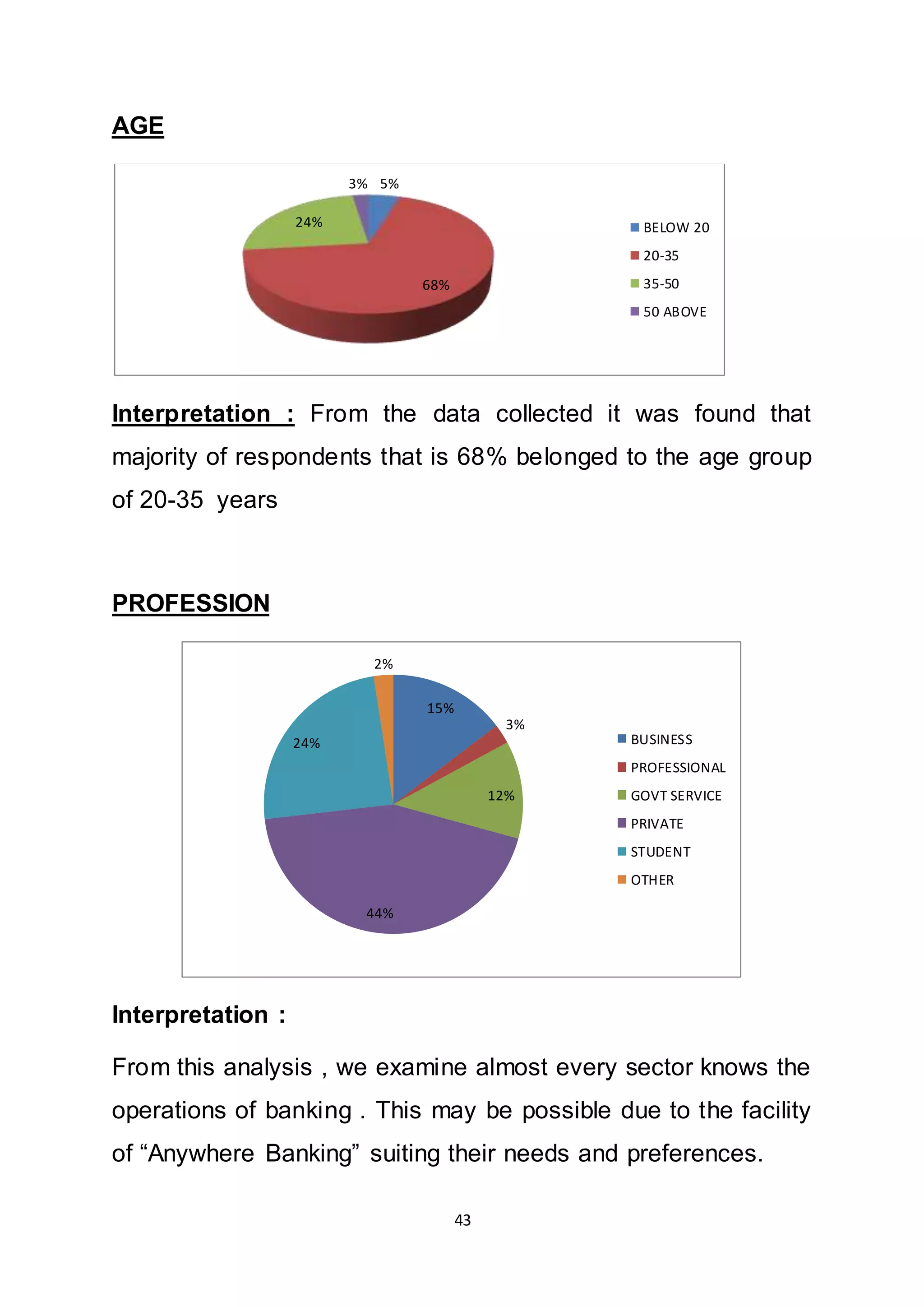
5%
68%
24%
3%
4 Profession
 Businessmen
 Professional
 Government
Service
 Private Service
 Student
 Others
15%
3%
12%
44%
24%
2%
42
CHAPTER 8
DATA ANALYSIS & INTERPRETATION
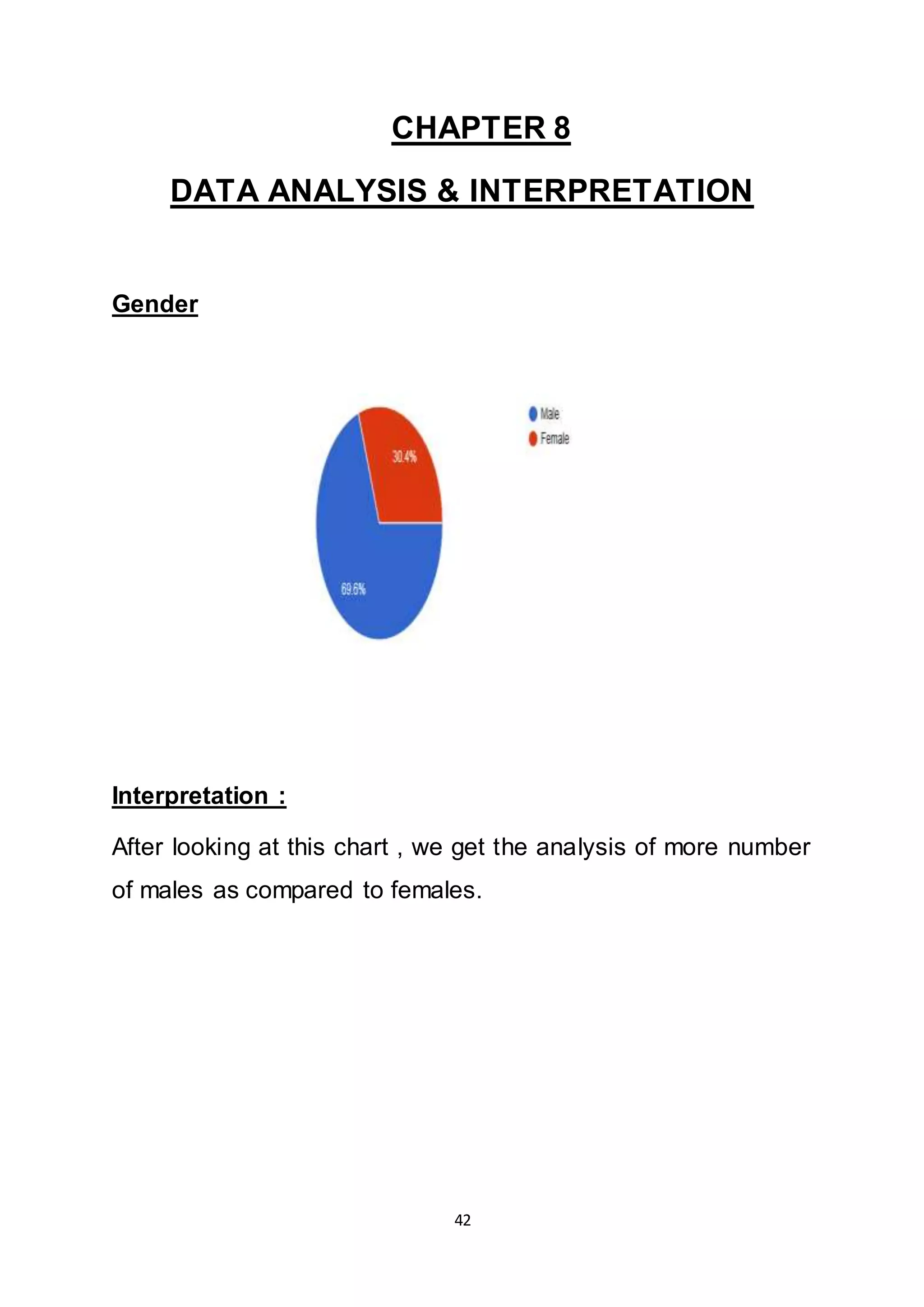
Gender
Interpretation :
After looking at this chart , we get the analysis of more number
of males as compared to females.
43
AGE
Interpretation : From the data collected it was found that
majority of respondents that is 68% belonged to the age group
of 20-35 years
PROFESSION
Interpretation :
From this analysis , we examine almost every sector knows the
operations of banking . This may be possible due to the facility
of “Anywhere Banking” suiting their needs and preferences.
5%
68%
24%
3%
BELOW 20
20-35
35-50
50 ABOVE
15%
3%
12%
44%
24%
2%
BUSINESS
PROFESSIONAL
GOVT SERVICE
PRIVATE
STUDENT
OTHER
44
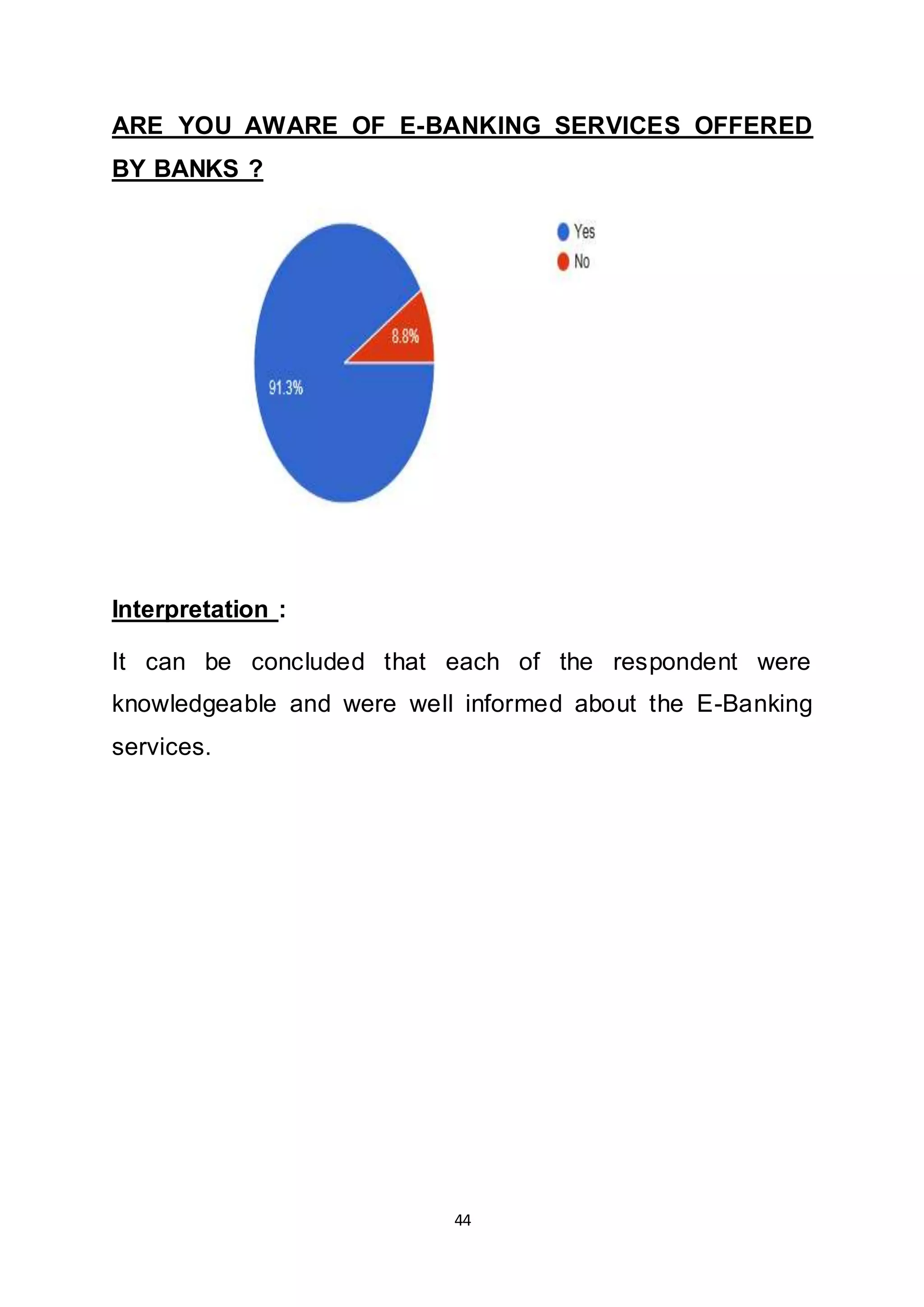
ARE YOU AWARE OF E-BANKING SERVICES OFFERED
BY BANKS ?
Interpretation :
It can be concluded that each of the respondent were
knowledgeable and were well informed about the E-Banking
services.
45
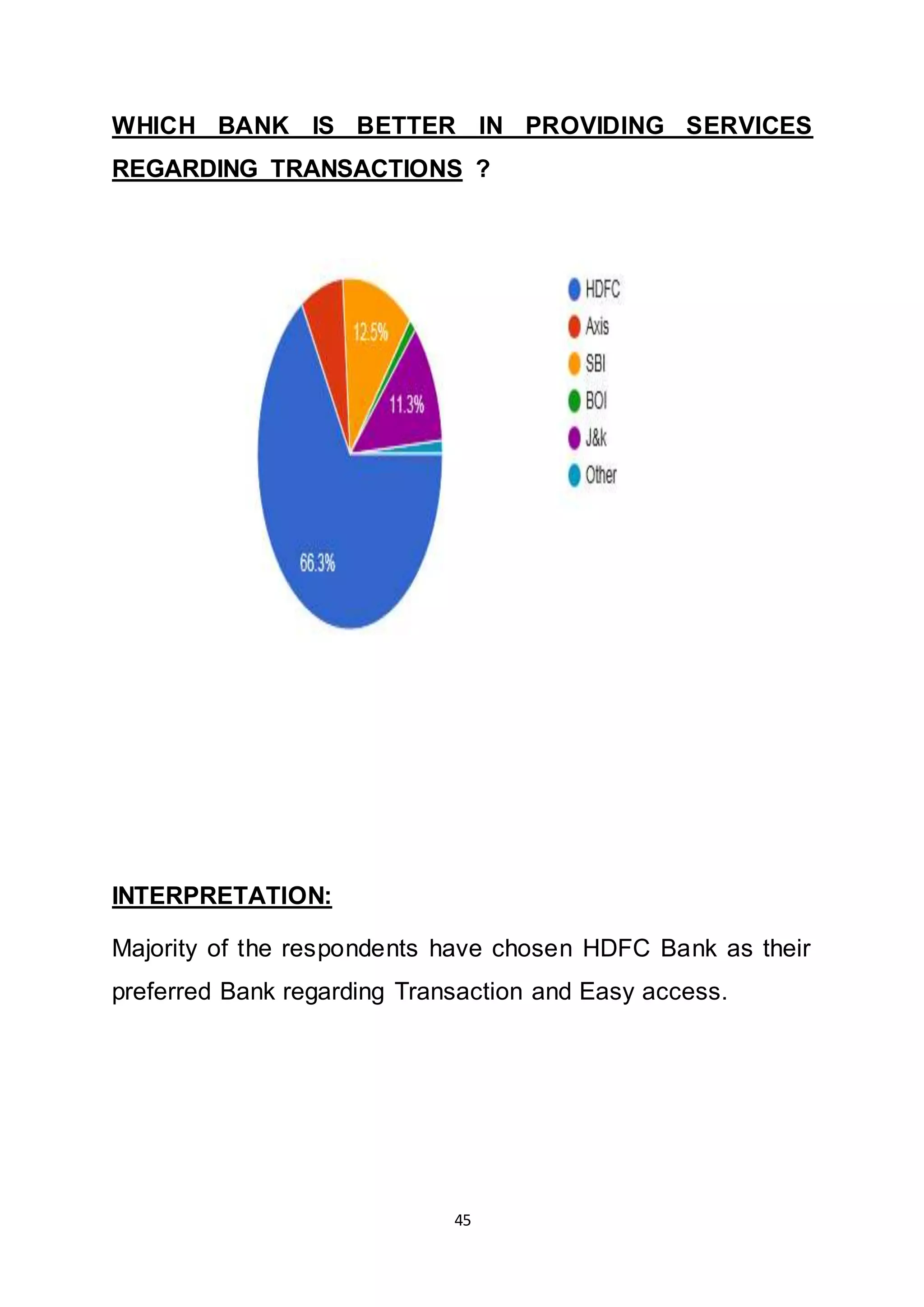
WHICH BANK IS BETTER IN PROVIDING SERVICES
REGARDING TRANSACTIONS ?
INTERPRETATION:
Majority of the respondents have chosen HDFC Bank as their
preferred Bank regarding Transaction and Easy access.
46
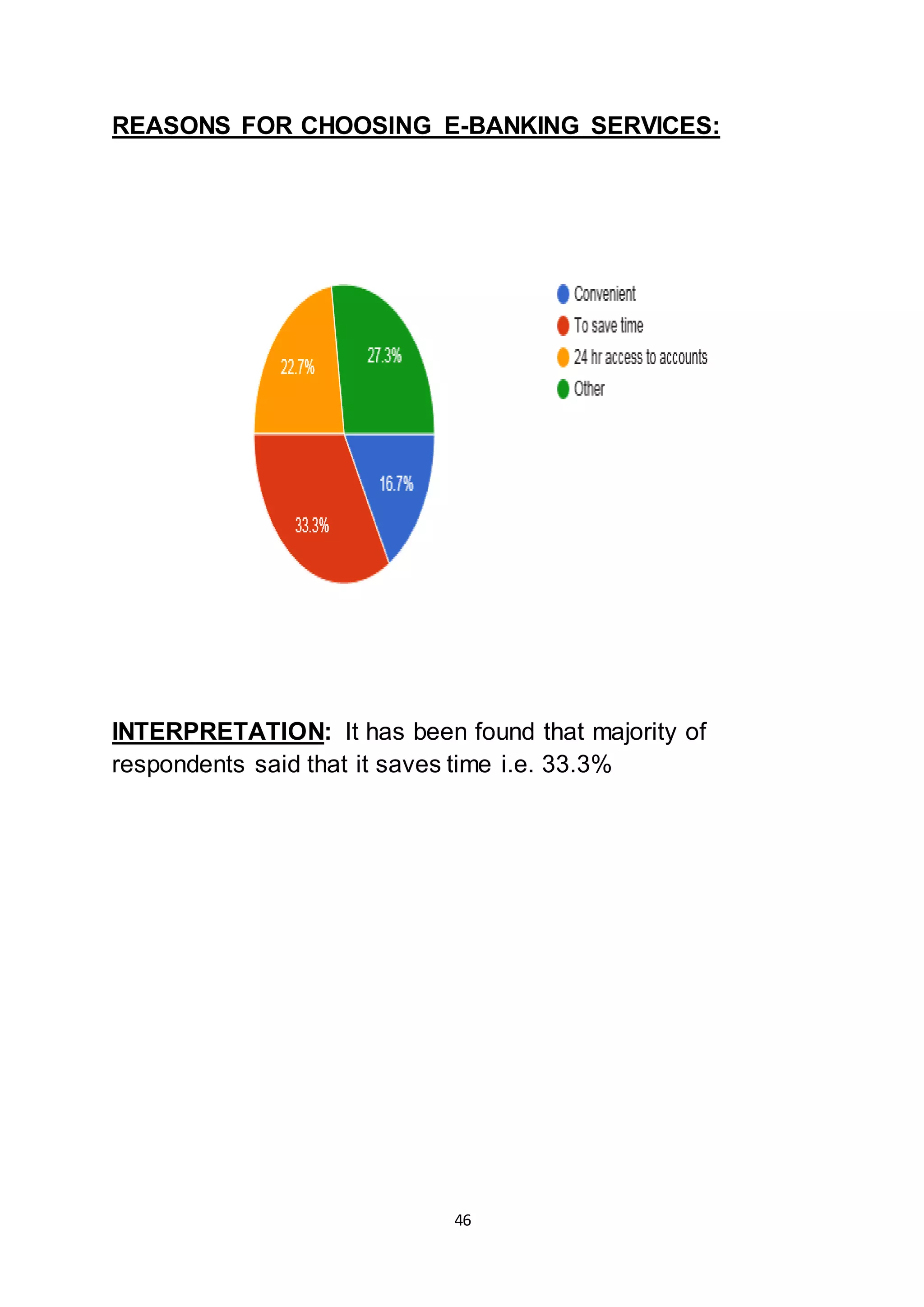
REASONS FOR CHOOSING E-BANKING SERVICES:
INTERPRETATION: It has been found that majority of
respondents said that it saves time i.e. 33.3%
47
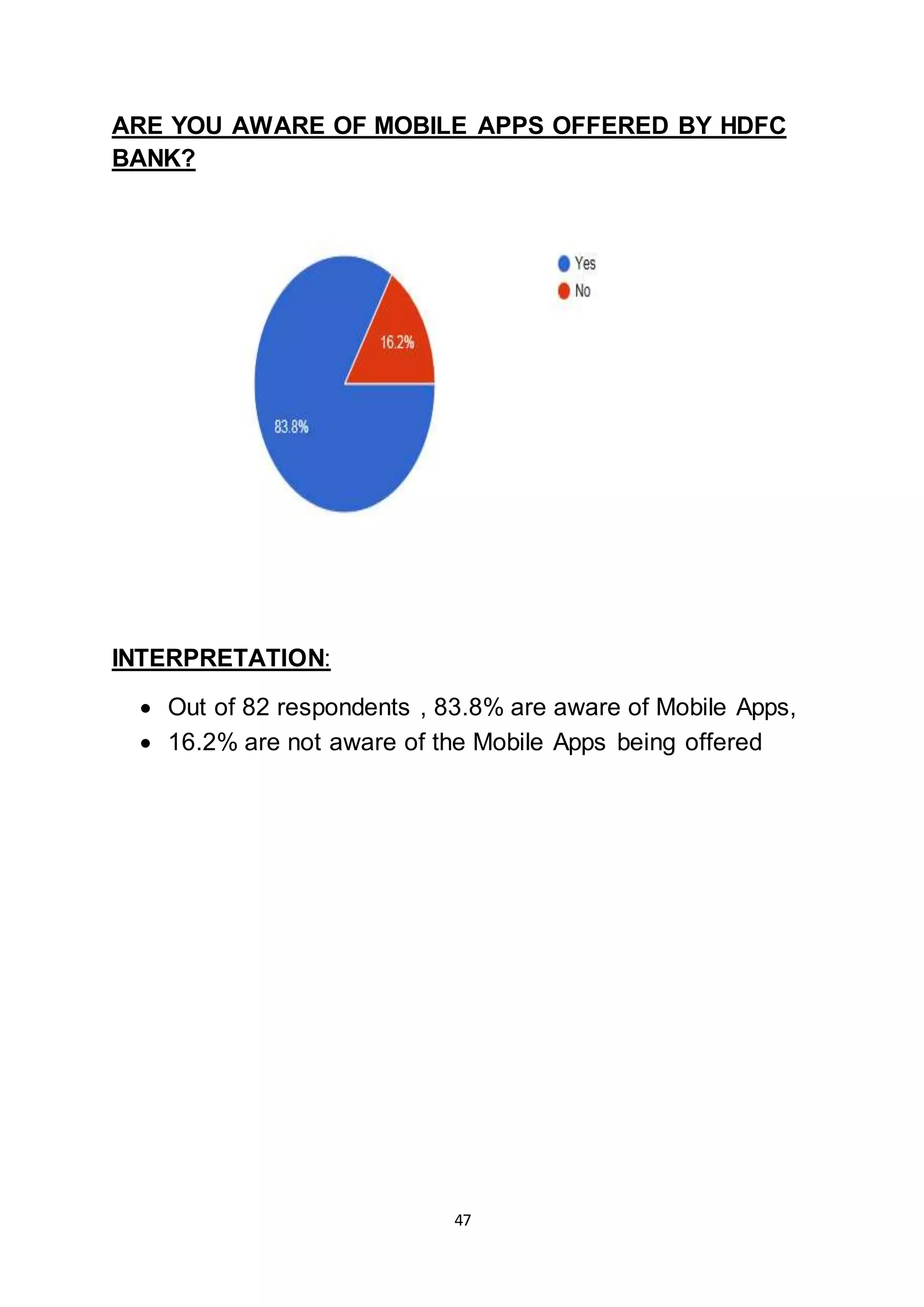
ARE YOU AWARE OF MOBILE APPS OFFERED BY HDFC
BANK?
INTERPRETATION:
 Out of 82 respondents , 83.8% are aware of Mobile Apps,
 16.2% are not aware of the Mobile Apps being offered
48
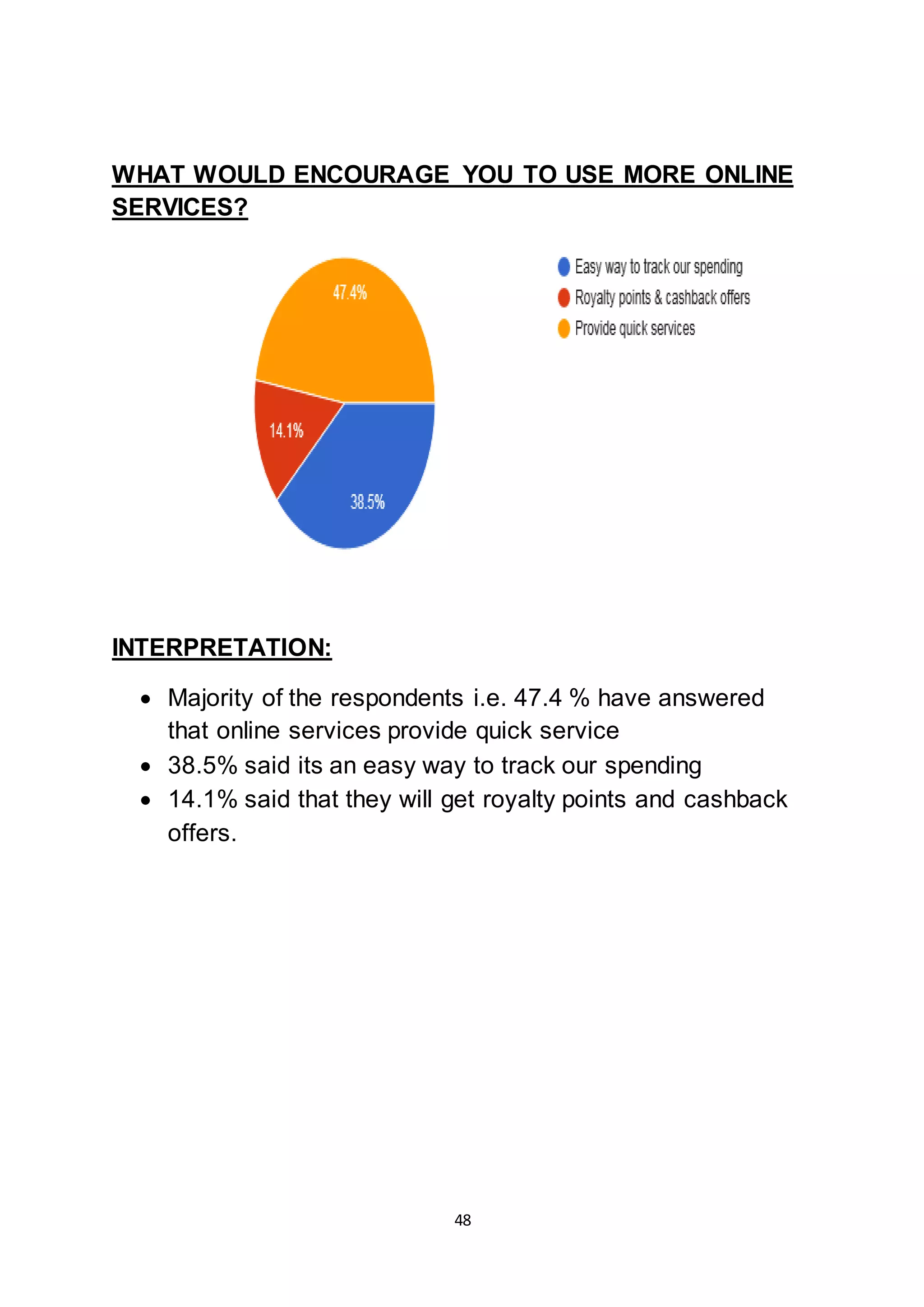
WHAT WOULD ENCOURAGE YOU TO USE MORE ONLINE
SERVICES?
INTERPRETATION:
 Majority of the respondents i.e. 47.4 % have answered
that online services provide quick service
 38.5% said its an easy way to track our spending
 14.1% said that they will get royalty points and cashback
offers.
49
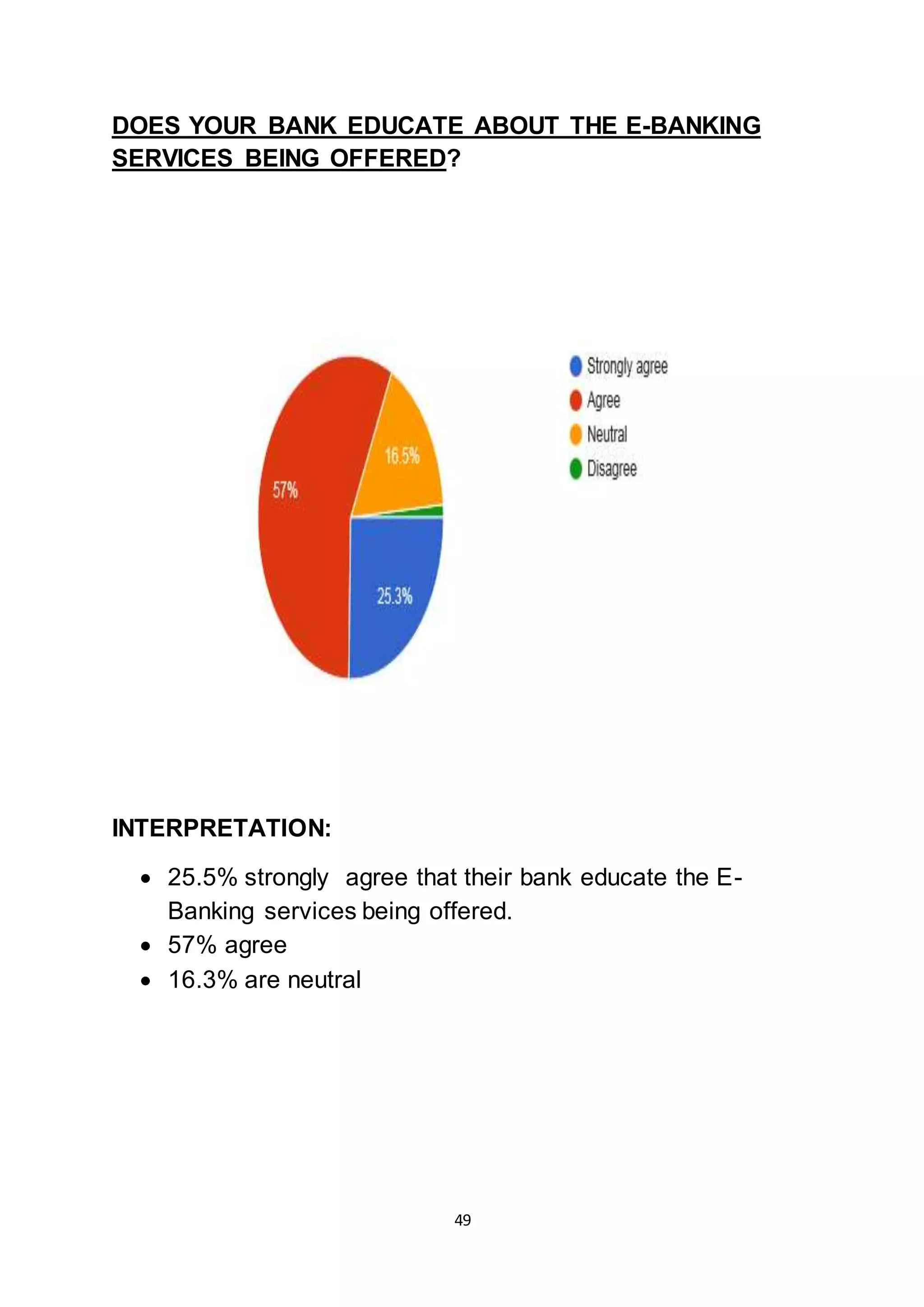
DOES YOUR BANK EDUCATE ABOUT THE E-BANKING
SERVICES BEING OFFERED?
INTERPRETATION:
 25.5% strongly agree that their bank educate the E-
Banking services being offered.
 57% agree
 16.3% are neutral
50
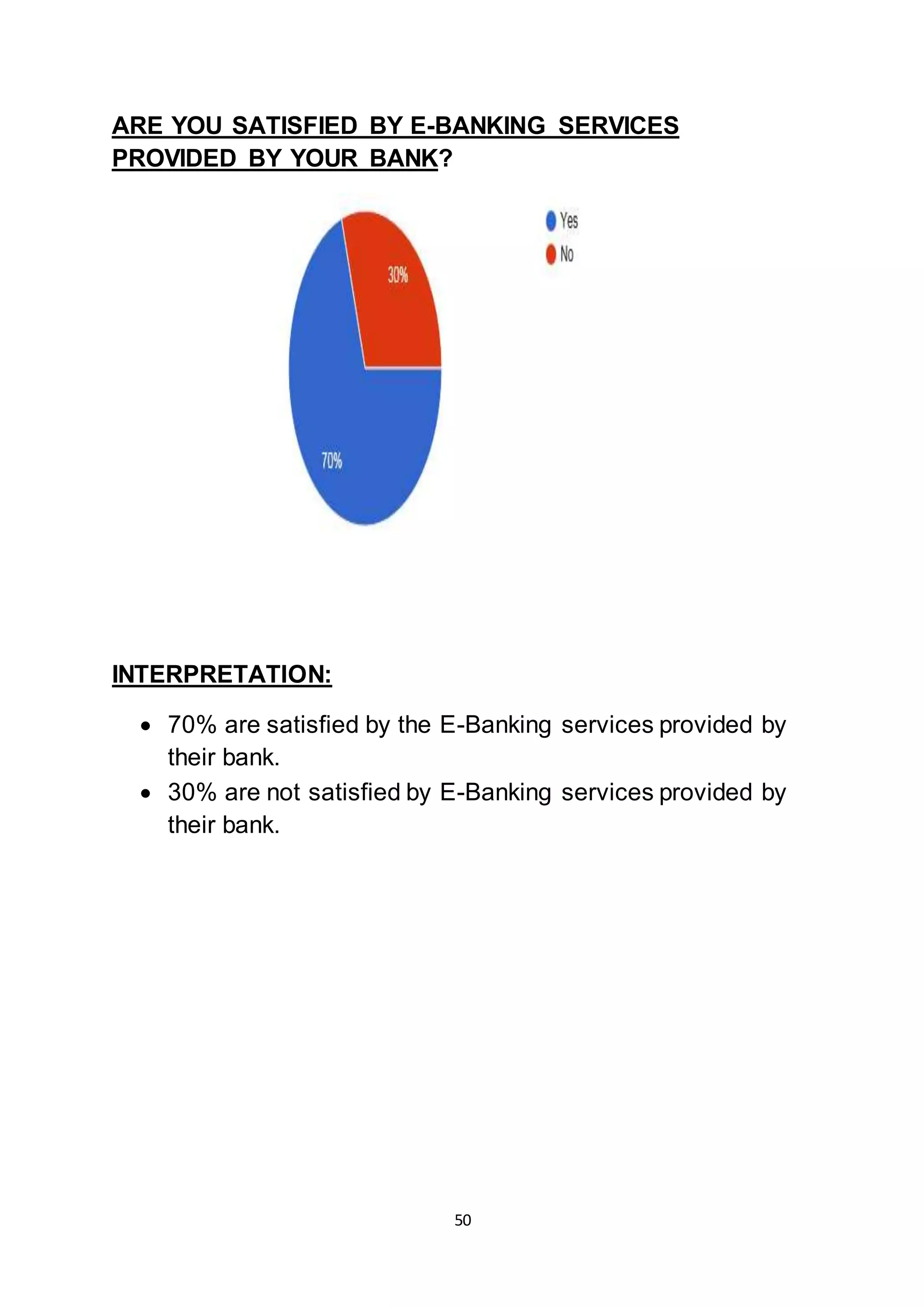
ARE YOU SATISFIED BY E-BANKING SERVICES
PROVIDED BY YOUR BANK?
INTERPRETATION:
 70% are satisfied by the E-Banking services provided by
their bank.
 30% are not satisfied by E-Banking services provided by
their bank.
51
CHAPTER 9
FINDINGS
 According to the survey of 82 respondents , 91.3% of the
respondents are aware about E-banking services provided
by the HDFC banks. Most of the respondents were
knowledgeable and were well informed about the E-Banking
services.
 The majority of the respondents accessed the banking
through e-banking services .
 Majority of the respondents have chosen HDFC Bank as
their preferred Bank regarding Transaction and Easy access.
 According to the survey 33.3% respondents have chosen
that it is time saving, 22.7% respondents have chosen that
it is 24 hr access to accounts.
 The majority of the respondents felt that the Net Banking
service was better than Traditional Banking.
 large number (57%) of respondent are such who agrees that
their banks educate them about E-banking services.
 70% respondents are satisfied with e-banking services while
30% respondents, who are dissatisfied by E-Banking
services provided by their bank.
52
CHAPTER 10
RECOMMENDATION & SUGGESTIONS
 In comparison with other banks the performance of HDFC
Bank is quite good but the bank further have to take
necessary steps to educate the customers regarding new
technology and new services offered.
 The bank should adopt more upgraded techniques to make
their customer feel more secure while accessing their
accounts.
 Effective awareness campaigns should be undertaken by the
banks to make their customers more aware of net banking
service.
 The loyal merchants should be given some more discounts
so that they would not switch to other vendors (attractive
schemes )
 The bank should take steps to create a trust in mind of
customers towards security of their accounts.
 Training program can be conducted for customers so they
can be motivated and can motivate others for using E-
banking services. This would lead to overall economic
development and of course can reduce paper work and save
environment.
 The HDFC bank should introduce more services which can
be accessed through Net Banking.
53
CONCLUSION
 The research report is based on the primary data.
 According to the study, I found that the bond of HDFC Bank
with its customers is very strong, because HDFC Bank
mainly focuses on retaining their customers.
 This study finds that HDFC Bank is not only the leading
private sector bank but its vast range of products and
availability of options make it one of the better banks in India.
 HDFC Bank has positioned itself as a bank which gives
higher standard of services.
 The study mainly was on the customer orientation that how
they think, what they want from their banks and how they
take decision going to any bank.
 We can conclude that there are many customers who are
aware about the net banking service and are using it and
finding it a more beneficial option for conducting transactions
rather than coming to the bank and stand in queue, while
some are just started using it and finding it more effective
and feel satisfied as now they can carry out their things from
their comfort zone.
 The people who are not using E banking services state the
reasons that they fear from misuse of ATM card, Failure of
transaction etc.
54
ANNEXURE
GENERAL INFORMATION:
Name of the customer………….....
Age:
 Below 20
 20-35
 35-50
 Above 50
Gender:
 Male
 Female
Profession:
 Businessmen
 Professional
 Govt. Service
 Private Service
 Student
 Others
Are you aware of E-banking services offered by the banks?
 Yes
 No
55
Which bank is better in providing services regarding
Transactions?
 HDFC Bank
 ICICI Bank
 AXIS Bank
 SBIBank
 BOI
 Others
Reasons for choosing E-Banking Services
 Convenient
 To save time
 24hr access to accounts
 Others.
Problems faced by respondents while using E-Banking
services
 Don’t know how to use E-Banking services.
 High charges applied on using E-Banking services
 Consider as an insecured method
 Fear because of E-crimes and frauds
56
Are you aware of mobile apps offered by hdfc bank?
 Yes
 No
What would encourage you to use more online services?
 Easy way to track our spending
 Royalty points and cash back offers
 Provide quick service
Does your bank educate about the E-Banking services
being offered?
 Strongly agree
 Agree
 Neutral
 Disagree
Are you satisfied by E-Banking services provided by your
bank?
 Yes
 No
57
REFERENCES:
1. http://www.technopedia.com/definitions/6846/digitalisation
2. http://www.hdfc.com
3. http://www.cib.db.com/docs_new/Digitalisation_and_the_f
uture_Banking.pdf
4. http://www.google.co.in

Digitalisation in banking and its impact on industries (1)

  • 1.
    1 DIGITALISATION IN BANKING ANDITS IMPACT ON INDUSTRIES HDFC BANK SUMMER TRAINING PROJECT REPORT submitted in partial fulfillment of MASTER OF BUSINESS ADMINISTRATION In Under the guidance of Submitted By:- Mr. Kamal Manhas Supriya Sharma (Branch Manager) 1240-MBA-18
  • 2.
    2 DECLARATION I the undersignedsolemnly declare that the Project Report titled “DIGITALISATION IN BANKING AND ITZ IMPACT ON INDUSTRIES" is based on my own work carried out during the course of our study under the supervision of Mr. KAMAL MANHAS , Branch Manager , HDFC BARI BRAHMNA I assert the statement made and conclusion drawn are an outcome of my research work. I further certify that: The work contained in the report is original and has been done by me under the general supervision of my supervisor. The information and data given in the report is authentic to the best of my knowledge. Whenever we have used materials from other sources, we have given due credit to them in the text of the report and giving their details in the references. SUPRIYA SHARMA 1240-MBA-18
  • 3.
    3 ACKNOWLEDGEMENT I wish toexpress my gratitude to HDFC BANK for giving me an opportunity to be a part of their esteemed organization and enhance my knowledge by granting permission to do summer training project under their guidance. I am deeply indebted to my guide Mr. KAMAL MANHAS, Branch Manager, HDFC bank, for this valuable and enlightened guidance. He provided me with the opportunity to learn in the bank and spared his time to help me.. This project has been possible due to the support of several wonderful individuals. I would like to thank many unknown individuals, with whom I interacted. All of them with their due cooperation and motivation made the completion of this project successful. I would like to thank them all. Last but not the least I am highly obliged to my friends and colleagues for their help and support. The learning during the project was immense and valuable Regards, SUPRIYA SHARMA
  • 4.
    4 CONTENTS Page No CHAPTER 1INTRODUCTION 5 CHAPTER 2 DIGITAL BANKING/ E-BANKING 9 CHAPTER 3 SWOT ANALYSIS 14 CHAPTER 4 COMPANY'S PROFILE 16 CHAPTER 5 DIGITAL BANKING IN HDFC BANK 28 CHAPTER 6 IMPACT OF DIGITAL BANKING 36 CHAPTER 7 RESEARCH METHODOLOGY 38 CHAPTER 8 DATA ANALYSIS & INTERPRETATION 42 CHAPTER 9 FINDINGS 51 CHAPTER 10 RECOMMENDATION & SUGGESTIONS 52 CHAPTER 11 CONCLUSION 53 ANNEXURE 54
  • 5.
    5 CHAPTER 1 INTRODUCTION 1.1 BANKING: Abank is a financial institution which accepts deposits, pays interest on pre-defined rates, clears checks, makes loans, and often acts as an intermediary in financial transactions. It also provides other financial services to its customers. TRADITIONAL BANKING: Traditional banking means performing banking transactions in a brick and mortar structure. The customer has to visit the branch of the bank in person to perform the basic banking operations such as account enquiry, funds transfer, cash withdrawals, applying for loans etc. Hence, physically visiting the bank is essential for a customer to avail the banking service as there is no use of information technology in carrying out the banking transactions. Some of the traditional banking activities are as follows: a) Opening an account b) Creating of deposits c) Renew of fixed deposits d) Withdrawals e) Apply for loans f) Transfer funds between accounts within the banks.
  • 6.
    6 1.2 IMPACT OFTECHNOLOGYIN BANKING SECTOR The information technology has revolutionized aspects for our life. The world at large is entering into the ‘NET AGE’, internet or simply ‘NET’ is an inter- connection of computer communication networks covering the whole world. The relationship between IT and Banking is fundamentally high because of which it is expected to reduce costs and facilitate customized products. The advent of information technology to every aspect of human life and business has been so obvious that it does not need to be accentuated more. Information technology has been of great essence in banking system. Today both public and private sector banks are trying to rapidly transform itself from traditional banking to relationship banking by establishing direct relationship with customers through the introduction of IT in banking known as “DIGITAL BANKING”. The following has been implemented effectively to introduce technology in the traditional form of banking namely- a) COMPLETE CENTRALIZED SOLUTION b) CLUSTER APPROACH c) HIGH TECH BNK WITHIN BANK
  • 7.
    7 1.3 SHIFT FROMTRADITIONAL BANKING TO MODERN BANKING: The Banking sector in India has experienced a rapid transformation. Just about a decade back this sector was limited to the sarkari (read nationalized) and co-operative banks. Then came the multi-national banks, but these were confined to serving an elite few. The opening up of the Indian banking sector to private players acted as 'the tipping point' for this transformation. The deregulatory efforts prompted many financial institutions (like HDFC and ICICI) and non- financial institutions enter the banking arena. With the entry of private players into retail banking and with multi- nationals focusing on the individual consumer in a big way, the banking system underwent a phenomenal change. Multi-channel banking gained prominence. For the first time consumers got the choice of conducting transactions either the traditional way (through bank branch), through ATMs, the telephone or through the Net. Technology played a key role in providing this multi-service platform. The entry of private players combined with new RBI guidelines forced nationalized banks to redefine the core banking strategy and technology was central to this change. TRANSFORMATION TO DIGITAL BANKING: E-Banking started with the introduction of computers and ATM in 1970’s. The addition of internet and mobile banking has revolutionized banking services. Banks use E- Banking facilities to offer a
  • 8.
    8 wide range ofproducts and services. This development has been leading to the creation new business models involving banks and non-banks entity such as internet service providers and other technology firms.
  • 9.
    9 CHAPTER 2 DIGITAL BANKING/E-BANKING 2.1 E-BANKING/ DIGITAL BANKING: Online banking, also known as internet banking, e-banking or virtual banking, is an electronic payment system that enables customers of a bank or other financial institution to conduct a range of financial transactions through the financial institution's website. E-banking includes the systems that enable financial institution customers, individuals or businesses, to access accounts, transact business, or obtain information on financial products and services through a public or private network, including the Internet. Customers access e-banking services using an intelligent electronic device, such as a personal computer (PC), personal digital assistant (PDA), automated teller machine (ATM), kiosk, or Touch Tone telephone. While the risks and controls are similar for the various e-banking access channels, this booklet focuses Specifically on Internet-based services due to the Internet's widely accessible public network. Accordingly, this booklet begins with a discussion of the two primary types of Internet websites: informational and transactional. Some of the modes of E-Banking are:
  • 10.
    10  Automated TellerMachines  Internet Banking  Mobile Banking  Phone Banking  Sms Banking etc. 2.2 FEATURES OF E-BANKING:  A bank customer can perform non-transactional tasks through online banking, including – o Viewing account balances o Viewing recent transactions o Downloading bank statements, (for example in PDF format) o Viewing images of paid cheques. o Ordering cheque books o Download periodic account statements  Downloading applications for M-banking, E-banking etc.
  • 11.
    11 B) Bank customerscan transact banking tasks through online banking, including –  Funds transfers between the customer's linked accounts  Paying third parties, including bill payments (see, e.g., BPAY) and third party fund transfers (see, e.g., FAST)  Investment purchase or sale  Loan applications and transactions, such as repayments of enrollments  Credit card applications  Register utility billers and make bill payments  Financial institution administration  Management of multiple users having varying levels of authority Banks involved in e-banking (A) PUBLIC SECTOR BANKS (B) PRIVATE SECTOR BANKS STATE BANK OF INDIA INDIAN OVERSEAS BANK UNITED BANK OF INDIA CENTRAL BANK OF INDIA BANK OF INDIA HDFC BANK ICICI BANK AXIS BANK KOTAK MAHINDRA BANK INDUSLAND BANK
  • 12.
    12 2.3 RELATIONSHIP OFHDFC- DIGITAL BANKING: HDFC Bank’s digital banking is the online banking services offered by the bank to its largest number of customers. This service can be accessed from anywhere any time allowing the customers to control their funds. Moreover, it is completely safe as the bank utilizes the most advanced technologies and infrastructures. HDFC provides a host of features such as view a/c balances & statements, transfer funds between accounts, create fixed deposits online, request a demand draft, pay bills, order a cheque book, request stop payment of a cheque, apply for a personal loan or an auto loan or many more. Moreover, HDFC bank also offers to their corporate clients E-Net, a fully secured internet based online, real time electronic delivery channel, and providing convenient and secure access to their banking information over the internet. E-Net allows multi-branch connectivity and can integrate with heterogeneous core bank end system across branches in India. Hence, HDFC bank and DIGITAL BANKING goes hand in hand where this bank is trying its best every-day to transform itself completely to a digital banking platform by introducing various types of digital services like net banking, phone banking, sms banking, watch banking various mobile banking applications like chillr application, payzapp and many more to come through their technological innovations where its customers will carry out all their transactions online through various digital products at their
  • 13.
    13 convenience and withouteven visiting the branch of the bank. Therefore, digital banking is intertwined with HDFC bank which is aiming to become a pioneer in providing financial services to its customers through digital channels.
  • 14.
    14 CHAPTER 3 SWOT ANALYSIS Strengths:- 1. Right strategy for the right products. 2. Superior customer service vs. competitors. 3. Great Brand Image. 4. Products have required accreditation. 5. High degree of customer satisfaction. 6. Good place to work 7. Lower response time with efficient and effective service. 8. Dedicated workforce aiming at making a long-term career in the field. Weakness: – 1. Some gaps in range for certain sectors. 2. Customer service staff need training. 3. Processes and systems, etc 4. Management cover insufficient. 5. Sectoral growth is constrained by low unemployment levels and competition for staff
  • 15.
    15 Opportunities: – 1. Profitmargins will be good. 2. Could extend to overseas broadly. 3. New specialist applications. 4. Could seek better customer deals. 5. Fast-track career development opportunities on an industry-wide basis. 6. An applied research center to create opportunities for developing techniques to provide added-value services. Threats: - 1. Legislation could impact. 2. Great risk involved 3. Very high competition prevailing in the industry. 4. Vulnerable to reactive attack by major competitors. 5. Lack of infrastructure in rural areas could constrain investment. 6. High volume/low cost market is intensely competitive
  • 16.
    16 CHAPTER 4 COMPANY'S PROFILE HDFCBank Ltd. is an Indian financial services company. The Bank operates in four segments: treasury, retail banking, wholesale banking and other banking business. HDFC Bank was promoted by the Housing Development Finance Corporation, a premier housing finance company of India. HDFC Bank commenced operations as a Scheduled Commercial Bank in January 1995. Total assets: US$ 83.1 billion (as of September 30, 2014). Net profit: US$ 923.8 million (2011). HDFC Bank offers a wide range of commercial and transactional banking services and treasury products to wholesale and retail customers. As of December 1, 2014, the Bank's distribution network was at 3,600 branches and 11,515 ATM's in 2,272 Indian towns and cities. DISTRIBUTION NETWORKS: HDFC Bank is headquartered in Mumbai. As of March 31, 2016, the Bank’s distribution network was at 4,520 branches across 2,587 cities. All branches are linked online on a real-time basis. Customers across India are also serviced through multiple delivery channels such as Phone Banking, Net Banking, Mobile Banking, and SMS based banking. The Bank’s expansion plans
  • 17.
    17 take into accountthe need to have a presence in all major industrial and commercial centers, where its corporate customers are located, as well as the need to build a strong retail customer base for both deposits and loan products. Being a clearing / settlement bank to various leading stock exchanges, the Bank has branches in centres where the NSE / BSE have a strong and active member base. The Bank also has a network of 12,000 ATMs across India. HDFC Bank’s ATM network can be accessed by all domestic and international Visa / MasterCard, Visa Electron / Maestro, Plus / Cirrus and American Express Credit / Charge cardholders. AMALGAMATION & MERGER: On May 23, 2008, the amalgamation of Centurion Bank of Punjab with HDFC Bank was formally approved by Reserve Bank of India to complete the statutory and regulatory approval process. As per the scheme of amalgamation, shareholders of CBoP received 1 share of HDFC Bank for every 29 shares of CBoP. The amalgamation added significant value to HDFC Bank in terms of increased branch network, geographic reach, and customer base, and a bigger pool of skilled manpower. In a milestone transaction in the Indian banking industry, Times Bank Limited (another new private sector bank promoted by Bennett, Coleman & Co. / Times Group) was merged with HDFC Bank Ltd., effective February 26, 2000. This was the first merger of two private banks in the New Generation Private Sector Banks.
  • 18.
    18 As per thescheme of amalgamation approved by the shareholders of both banks and the Reserve Bank of India, shareholders of Times Bank received 1 share of HDFC Bank for every 5.75 shares of Times Bank. BUSINESS FOCUS: HDFC Bank's mission is to be a World Class Indian Bank. The objective is to build sound customer franchises across distinct businesses so as to be the preferred provider of banking services for target retail and wholesale customer segments, and to achieve healthy growth in profitability. The bank is committed to maintain the highest level of ethical standards, professional integrity, corporate governance and regulatory compliance. HDFC Bank’s business philosophy is based on five core values: Operational Excellence, Customer Focus, Product Leadership, People and Sustainability Vision & Mission: To become the undisputed market leader in providing housing related finances, to realize the dream of shelter for all in Sri Lanka". HDFC Bank’s mission is to be a world class Indian bank by adopting a single minded focus on service excellence and product quality. The Bank has adopted industry leading best practices in establishing a set of operating principles which govern how risks of a significant business
  • 19.
    19 disruption are mitigatedto protect the Banks customers, employees and stakeholders. CAPITAL STRUCTURE OF HDFC: As on 31st March, 2015 the authorized share capital of the Bank is Rs. 550 crore. The paid-up share capital of the Bank as on the said date is Rs 501,29,90,634/- ( 2506495317 ) equity shares of Rs. 2/- each). The HDFC Group holds 21.67 % of the Bank's equity and about 18.87 % of the equity is held by the ADS / GDR Depositories (in respect of the bank's American Depository Shares (ADS) and Global Depository Receipts (GDR) Issues). 32.57 % of the equity is held by Foreign Institutional Investors (FIIs) and the Bank has 4, 41,457 shareholders. The shares are listed on the NSE and BSE. The Bank's American Depository Shares (ADS) are listed on the New York Stock Exchange (NYSE) under the symbol 'HDB' and the Bank's Global Depository Receipts (GDRs) are listed on Luxembourg Stock Exchange under ISIN No US40415F2002. GOALS/ OBJECTIVES: a) To develop close relationship with individual households. b) To transform ideas into viable and creative solutions. c) To maintain our position as the premier housing finance institution in the country.
  • 20.
    20 OPERATIONS OF HDFCBANK: The Housing Development Finance Corporation Limited (HDFC) was amongst the first to receive an ‘in principle’ approval from the Reserve Bank of India (RBI) to set up a bank in the private sector, as part of RBI’s liberalization of the Indian Banking Industry in 1994. The bank was incorporated in August 1994 in the name of 'HDFC Bank Limited', with its registered office in Mumbai, India. HDFC Bank commenced operations as a Scheduled Commercial Bank in January 1995. HDFC bank deals with 3 key segments  RETAIL BANKING  WHOLESALE BANKING  NRI BANKING  TREASURY RETAIL BANKING: The objective of the Retail Bank is to provide its target market customers a full range of financial products and banking services, giving the customer a one-stop window for all his/her banking requirements. The products are backed by world-class service and delivered to customers through the growing branch network, as well as through alternative delivery channels like ATMs, Phone Banking, Net Banking and Mobile Banking. The HDFC Bank Preferred program for high net worth individuals, the HDFC Bank Plus
  • 21.
    21 and the InvestmentAdvisory Services programs have been designed keeping in mind needs of customers who seek distinct financial solutions, information and advice on various investment avenues. The Bank also has a wide array of retail loan products including Auto Loans, Loans against marketable securities, Personal Loans and Loans for Two-wheelers. WHOLESALE BANKING: The Bank’s target market is primarily large, blue-chip manufacturing companies in the Indian corporate sector and to a lesser extent, small & mid-sized corporates and agri-based businesses. For these customers, the Bank provides a wide range of commercial and transactional banking services, including working capital finance, trade services, transactional services, cash management, etc. The bank is also a leading provider of structured solutions, which combine cash management services with vendor and distributor finance for facilitating superior supply chain management for its corporate customers. Based on its superior product delivery / service levels and strong customer orientation, the Bank has made significant inroads into the banking consortia of a number of leading Indian corporates including multinationals, companies from the domestic business houses and prime public sector companies.
  • 22.
    22 TREASURY: The Bank’starget market is primarily large, blue- chip manufacturing companies in the Indian corporate sector and to a lesser extent, small & mid-sized corporates and agri- based businesses. For these customers, the Bank provides a wide range of commercial and transactional banking services, including working capital finance, trade services, transactional services, cash management, etc. The bank is also a leading provider of structured solutions, which combine cash management services with vendor and distributor finance for facilitating superior supply chain management for its corporate customers. Based on its superior product delivery / service levels and strong customer orientation, the Bank has made significant inroads into the banking consortia of a number of leading Indian corporates including multinationals, companies from the domestic business houses and prime public sector companies. THE PRODUCTS AND SERVICES:  Account & Deposits  Loans  Cards  Investments  Insurance  Forex
  • 23.
    23  Mutual Funds Safe Deposit Lockers  Private Banking  NRI Banking  Premier Banking DIGITAL BANKING PLATFORM: HDFC Bank, one of the leading private sector lenders in India, has launched a new initiative - 'Bank Aap Ki Muththi Mein' - as part of their 'Go Digital campaign' that attempts to turn a smartphone into a bank branch. The new HDFC Bank app allows over 75 banking transactions, apart from essential transactions such as: booking fixed and recurring deposits, bill and tax payments, buying insurance, and mutual funds, the app allows customers to buy all kinds of loans instantly. It also provides customized, location-specific promotions, as well as offers and deals on shopping, dining, movies, and entertainment. Notably, part of the bank's 'Go Digital' offering, 'Bank Aap Ki Muththi Mein', is a technology agnostic initiative with apps on the three popular smartphone platforms - iOS, Android, and Windows Phone. The initiative also extends to basic feature-phone users with SMS and missed-call banking as well as a mobile site. All that a customer needs to do is, send a text or call a toll-free number to know his account balance, get a mini statement, request a check book, or
  • 24.
    24 detailed account statement.The latter of course is a popular channel for a large number of rural and semi-urban customers. The SMS banking service (and the Android app) is also available in Hindi for a broader demographic. "With 'Bank Aap Ki Muththi Mein', you can do everything other than access your locker, and deposit or withdraw cash. Customer convenience is central to our concept of Digital. And, there is no bigger convenience than bringing your bank to the palm of your hand. We are very excited to unveil our 'Bank Aap Ki Muththi Mein' offering and with it world class experience of banking to millions of our countrymen," said Nitin Chugh, head - Digital Banking, HDFC Bank. HDFC Bank, which began its digital journey by launching net banking services way back in 1999, was the first to launch SMS banking in 2000. The conversation with Nitin Chugh, head - Digital Banking, HDFC Bank, I learned that as of 2014, 55% of all transactions at HDFC Bank are conducted through digital channels, which is significantly higher than the corresponding figure in 2001 of just 3%. Nitin asserted that the campaign is essential since as of September 2014, India had over 900 million mobile users in the country, but only 40 million mobile banking customers. "We want to be active partners in a new digital India, envisioned by the government and central bank, offering our customers what they want, when they want it. Customer convenience and centricity lies at the heart of all our digital banking initiatives," he said, adding that
  • 25.
    25 even in ruralIndia, technology will play a big role in financial inclusion and bringing millions into the organized banking fold. 'Bank Aap Ki Muththi Mein' allows customers to transact with the bank round-the-clock. While HDFC is not the only bank to offer mobile banking services through various channels, it aims to trump the competition with the widest array of capabilities it offers. BROAD FACILITIES THAT E-BANKING PROVIDES:  Lower manpower and back office cost.  24*7 service bank online services are provided 24 hours a day, 7 days a week and 52 weeks a year.  No more Qs- there are no queues in an online bank.  Convenience.  Time saving. DIGITAL SERVICES:  Internet Banking.  Phone Banking.  Mobile Banking.  SMS Banking.  Missed call Banking.  ATMs.  Watch Banking.
  • 26.
    26 a) Internet Banking:Now monitor, transact and control your bank account online with our net banking service. You can do multiple things from the comforts of your home or office through HDFC Net Banking your one stop solution for all your banking needs. Get all account details, submit requests and undertake a wide range of transactions online through our HDFC Bank Net Banking services. Our E-Banking service makes banking a lot more easy and effective. b) Phone Banking: Phone Banking offers you all the conveniences you need to access your Accounts, Credit Cards, Loans, Demat & Investment Services from the comfort of your home, office or on the move, all this in your preferred language. Phone Banking services are a combination of IVR and Agent offering, depending on the type of transaction. For all transactions that cannot be completed on the IVR, Phone Banker assisted services are available. Following are the services offered- report loss of your ATM/ DEBIT/ CREDIT card, check your account balance, enquire about cheque status, order a cheque book/account statement/stop payment of cheque etc.
  • 27.
    27 c) SMS Banking:SMS banking is a form of mobile banking. It is a facility used by some banks or other financial institutions to send messages (also called notifications or alerts) to customer’s mobile phones using SMS messaging, or a service provided by them which enables its customers to perform some financial transactions using SMS. d) Mobile Banking: Mobile banking is a service provided by a bank or other financial institution that allows its customers to conduct a range of financial transactions remotely using a mobile device such as a mobile phone or tablet, and using software, usually called an app, provided by the financial institution for the purpose. Mobile banking is usually available on a 24-hour basis. The types of financial transactions which a customer may transact through mobile banking include obtaining account balances and list of latest transactions, electronic bill payments, and funds transfers between a customer's or another's accounts. Some also enable copies of statements to be downloaded and sometimes printed at the customer's premises; and some banks charge a fee for mailing hardcopies of bank statements.
  • 28.
    28 CHAPTER 5 DIGITAL BANKINGIN HDFC BANK HDFC Bank offers a comprehensive range of transactions across multiple products through its Net Banking channel. So just by logging into Net Banking one can conduct 200+ transactions from the comfort of your home or office. Now monitor, transact and control your bank account online through our net banking service. You can do multiple things from the comforts of your home or office with HDFC Bank Internet Banking - a one stop solution for all your banking needs. You can now get all your account details, submit requests and undertake a wide range of transactions online. Our E-Banking service makes banking a lot more easy and effective.NET banking is the online facility provided by the many banks in order to carry out their out their transactions with much ease and in the most effective & efficient way Why Net Banking? • Manage your account conveniently through the Internet. • 200+ transactions available on Net Banking • Up-to-the-second details of your account • Access anytime, from anywhere
  • 29.
    29 • No queuesto stand in, or turns to wait for • You can log in to Net Banking using your Customer ID and IPIN (password). Features of Net Banking • Account Details: View your bank account details, account balance, download statements and more. Also view your Demat, Loan & Credit Card Account Details all in one place. • Fund Transfer: Transfer fund to your own accounts, other HDFC Bank accounts or Other Bank account seamlessly. • Request Services: Give a request for Cheque book, Demand Draft, Stop Cheque Payment, Debit Card Loyalty Point Redemption etc. • Investment Services: View your complete Portfolio with the bank, Create Fixed Deposit, Apply for IPO etc. • Value Added Services: Pay Utility bills for more than 160 billers, Recharge Mobile, Create Virtual Cards, Pay any Visa Credit Card bills, Register for e-statement and sms banking etc. • Net Secure: Our Internet Banking Security System at HDFC bank follow best-in-class online security practices in order to safeguard your information while you are banking online. It’s
  • 30.
    30 our constant endeavorto prevent fraud and make your net banking transactions completely safe. • Transfer funds: between accounts across multiple banks from your home or office through HDFC Bank Internet Banking. To send money, just register your beneficiary's account details through HDFC Bank Internet Banking. You can transfer funds using NEFT or IMPS. Advantages of Net Banking • Security • Error Free Transactions • Easily Track Spending • Cost Effective • Transfer money between accounts • View your account summary • 24*7 Available • Pay bills online • Create FD or RD online • Request stop payment on Cheque • Request Cheque book • Check your Account / Interest statement
  • 31.
    31 Mobile Applications byHDFC Bank 1. HDFC Bank Mobile Banking HDFC Bank Mobile Banking is the official app of HDFC Bank for Android. HDFC Bank Mobile Banking gives you access to your account on your Android phone. Now, you can perform your banking tasks from the palm of your hand, from anywhere and at anytime ! You can :  Pay utility bills, credit card bills, etc.  View Account summaries and Fixed Deposit summaries.  Transfer funds , including transfers to other bank customers.  Request statements, Cheque book, Stop payment, Balance and Interest Certificates.
  • 32.
    32 PAYZAPPApplication HDFC Bank PayZapp,a complete payment solution, giving you the power to pay in just One Click. With PayZapp, you can shop on your mobile at partner apps, buy movie tickets, music and groceries, compare and book flight tickets and hotels, shop online and get great discounts at “Smart Buy”, send money to anyone in your contact list, pay bills and recharge your mobile, DTH and data card. PayZapp is convenient, fast and secure. No need to re-load money again and again. Moreover your card details are secure with the bank and not stored on your mobile phone or on transacting sites. It uses a proprietary technology that conducts three security checks for each transaction. So link your Debit and Credit Card to PayZapp and enjoy the most convenient and secure way of payment. Tag line: “Cards link karoekbaar, pay karobaarbaar!”
  • 33.
    33  HDFC SmartBuy SmartBuy is a platform only for display of offers extended by Merchants to HDFC Bank's Customers, and HDFC Bank is not selling/rendering any of these Products/Services. The Bank does not act as express or implied agent of the Merchants/the owners of the Products vis-a-vis the Customers. HDFC Bank is merely facilitating the payment by its Customers by providing the Payment Gateway Services and will not earn any fee by hosting this website. HDFC Bank is neither guaranteeing nor making any representation with respect to the offers made by the merchant. You can shop on your mobile at partner apps, buy movie tickets, music and groceries, compare and book flight tickets and hotels, shop online and get great discounts at “Smart Buy”, send money to anyone in your contact list, pay bills and recharge your mobile, DTH and data card.HDFC Bank is not responsible for sale/quality/features of the Products/Services under the offer.
  • 34.
    34 If the Customerproceeds from here, any purchase of a Product/Service will only be through the HDFC Bank's credit/debit cards/net banking facility. The Products/Services offered by Merchants may also be available at other stores/online platforms. The Customer's discretion is advised in this regard.  HDFC Perks  HDFC PERKS is mainly for salaried people. It offers the following benefits:  Stay updated with all new launches  Enjoy latest offers  View and share videos/demos on our latest products  Apply for any product in just a click  Instantly connect with your Corporate Salary RM  Download ALL HDFC Bank Apps from here Mobile Banking LITE App
  • 35.
    35 HDFC LITE: It isa quick-to-install banking application that works without the internet. You don’t need a login/Password- the app works from your registered mobile number. You can use this application in either Hindi or English. HDFC Bank Lite Banking App helps you check your account balance, transfer funds, pay your bills and much more. The new App for Android is loaded with great features. HDFC is the first bank to offer the My Menu feature. You can customize your Menu with 10 of your favorite transactions with this feature is also the only bank to have a Mobile Banking App in Hindi for Android phones. Why use Android Mobile Banking Application?  Access your account anywhere, anytime  As secure as Net Banking  Simple and convenient with 75+transactions at your fingertips  Transactions that can be done using your Android phone includes Balance Enquiry, Funds Transfer, Credit Card payment
  • 36.
    36 CHAPTER 6 IMPACT OFDIGITAL BANKING Positive impact of digitization in banking :-  Improved customer experience.  Reduction of costs for banks and customers as well by using ATMs, cashless transactions etc.  With more digital data available with banks, they can take data-driven dynamic decisions by using digital analytics. This benefits both customers and banks.  Technology is non-discriminatory. Everyone will be treated same at banks.  Number of customers will be increased for banks because of the increased convenience of banking.  Digitalization reduces human error.  Need of handling large amounts of cash will be reduced.  Opening and maintaining bank accounts are never been this easier.  Repetitive tasks will be eliminated by automation.  Rural and urban gap will be eliminated.
  • 37.
    37  With theincreasing cashless transactions, fake currency threat will be reduced.  Productivity will be increased. Negative impact of digitization in banking :-  Digitalization reduces the effort of employees and hence results in loss of jobs.  Some bank branches may cease to exist with the increasing use of online banking.  Banks will be more vulnerable to cyber attacks.  Privacy may have to be compromised. No one can hide crores of rupees in banks and just act middle class.  These disadvantages are just temporary. Loss of jobs will be compensated through creation of new jobs such as cyber security, research team for innovation in technology etc.
  • 38.
    38 CHAPTER 7 RESEARCH METHODOLOGY TITLEOF THE STUDY “Digitalisation in banking and its impact on industries” DURATION OF STUDY 1st JUNE 2019 to 31st JULY 2019 7.1 OBJECTIVES OF STUDY  To analyze the awareness among customers using E- Banking services.  To know about E-Banking services provided by HDFC Bank.  To study the reasons for choosing E-Banking services.  To understand the problems / reasons for not using E- Banking facilities by customers provided by their Banks.  To study the customer satisfaction relating to E-banking services provided by HDFC Bank.  Draw out with conclusions and suggestion based on the analysis and the interpretation of data.
  • 39.
    39 7.2 RESEARCH DESIGN Researchdesign refers to overall strategy that you choose to integrate the different components of the study in a coherent and logical way. It constitutes a blueprint for collection, measurement and analysis of data. This research is qualitative in nature and it is an exploratory research wherein we are trying to study the impact of digitalisation in banking and its impact on industries in HDFC bank. It includes: QUESTIONNAIRE A questionnaire is a research instrument consisting of a series of questions and other prompts for the purpose of gathering information from respondents. SAMPLING PLAN Sampling is the process of selecting a sufficient number of elements from the population, so that the sample and an understanding of its properties of characteristics would make it possible for us to generalize such properties or characteristics to the population elements A sampling plan is a detailed outline of which measurements will be taken at what times, on which material, in what manner,
  • 40.
    40 and by whom.Sampling plans should be designed in such a way that the resulting data will contain a representative sample of the parameters of interest and allow for all questions, as stated in the goals, to be answered. SAMPLE SIZE  Sample size determination is the act of choosing the number of observations or replicates to include in a statistical sample. The sample size is an important feature of any empirical study in which the goal is to make inferences about a population from a sample.  The sample size for this project is : 80  All respondents were the customers of HDFC Bank. SAMPLING UNIT  The sampling unit could be blocks, households, and individuals within the households. Sampling frame: This is the actual list of sampling units from which the sample, or some stage of the sample, is selected. It is simply a list of the study population.  Sampling unit for project was HDFC Bank BARI BRAHMANA Branch Jammu.
  • 41.
    41 PROFILE OF RESPONDENTS# Demographics Percentage 1Gender  Male  Female 69.6% 30.4% 3 Age  Below 20  20-35  35-50  Above 50 5% 68% 24% 3% 4 Profession  Businessmen  Professional  Government Service  Private Service  Student  Others 15% 3% 12% 44% 24% 2%
  • 42.
    42 CHAPTER 8 DATA ANALYSIS& INTERPRETATION Gender Interpretation : After looking at this chart , we get the analysis of more number of males as compared to females.
  • 43.
    43 AGE Interpretation : Fromthe data collected it was found that majority of respondents that is 68% belonged to the age group of 20-35 years PROFESSION Interpretation : From this analysis , we examine almost every sector knows the operations of banking . This may be possible due to the facility of “Anywhere Banking” suiting their needs and preferences. 5% 68% 24% 3% BELOW 20 20-35 35-50 50 ABOVE 15% 3% 12% 44% 24% 2% BUSINESS PROFESSIONAL GOVT SERVICE PRIVATE STUDENT OTHER
  • 44.
    44 ARE YOU AWAREOF E-BANKING SERVICES OFFERED BY BANKS ? Interpretation : It can be concluded that each of the respondent were knowledgeable and were well informed about the E-Banking services.
  • 45.
    45 WHICH BANK ISBETTER IN PROVIDING SERVICES REGARDING TRANSACTIONS ? INTERPRETATION: Majority of the respondents have chosen HDFC Bank as their preferred Bank regarding Transaction and Easy access.
  • 46.
    46 REASONS FOR CHOOSINGE-BANKING SERVICES: INTERPRETATION: It has been found that majority of respondents said that it saves time i.e. 33.3%
  • 47.
    47 ARE YOU AWAREOF MOBILE APPS OFFERED BY HDFC BANK? INTERPRETATION:  Out of 82 respondents , 83.8% are aware of Mobile Apps,  16.2% are not aware of the Mobile Apps being offered
  • 48.
    48 WHAT WOULD ENCOURAGEYOU TO USE MORE ONLINE SERVICES? INTERPRETATION:  Majority of the respondents i.e. 47.4 % have answered that online services provide quick service  38.5% said its an easy way to track our spending  14.1% said that they will get royalty points and cashback offers.
  • 49.
    49 DOES YOUR BANKEDUCATE ABOUT THE E-BANKING SERVICES BEING OFFERED? INTERPRETATION:  25.5% strongly agree that their bank educate the E- Banking services being offered.  57% agree  16.3% are neutral
  • 50.
    50 ARE YOU SATISFIEDBY E-BANKING SERVICES PROVIDED BY YOUR BANK? INTERPRETATION:  70% are satisfied by the E-Banking services provided by their bank.  30% are not satisfied by E-Banking services provided by their bank.
  • 51.
    51 CHAPTER 9 FINDINGS  Accordingto the survey of 82 respondents , 91.3% of the respondents are aware about E-banking services provided by the HDFC banks. Most of the respondents were knowledgeable and were well informed about the E-Banking services.  The majority of the respondents accessed the banking through e-banking services .  Majority of the respondents have chosen HDFC Bank as their preferred Bank regarding Transaction and Easy access.  According to the survey 33.3% respondents have chosen that it is time saving, 22.7% respondents have chosen that it is 24 hr access to accounts.  The majority of the respondents felt that the Net Banking service was better than Traditional Banking.  large number (57%) of respondent are such who agrees that their banks educate them about E-banking services.  70% respondents are satisfied with e-banking services while 30% respondents, who are dissatisfied by E-Banking services provided by their bank.
  • 52.
    52 CHAPTER 10 RECOMMENDATION &SUGGESTIONS  In comparison with other banks the performance of HDFC Bank is quite good but the bank further have to take necessary steps to educate the customers regarding new technology and new services offered.  The bank should adopt more upgraded techniques to make their customer feel more secure while accessing their accounts.  Effective awareness campaigns should be undertaken by the banks to make their customers more aware of net banking service.  The loyal merchants should be given some more discounts so that they would not switch to other vendors (attractive schemes )  The bank should take steps to create a trust in mind of customers towards security of their accounts.  Training program can be conducted for customers so they can be motivated and can motivate others for using E- banking services. This would lead to overall economic development and of course can reduce paper work and save environment.  The HDFC bank should introduce more services which can be accessed through Net Banking.
  • 53.
    53 CONCLUSION  The researchreport is based on the primary data.  According to the study, I found that the bond of HDFC Bank with its customers is very strong, because HDFC Bank mainly focuses on retaining their customers.  This study finds that HDFC Bank is not only the leading private sector bank but its vast range of products and availability of options make it one of the better banks in India.  HDFC Bank has positioned itself as a bank which gives higher standard of services.  The study mainly was on the customer orientation that how they think, what they want from their banks and how they take decision going to any bank.  We can conclude that there are many customers who are aware about the net banking service and are using it and finding it a more beneficial option for conducting transactions rather than coming to the bank and stand in queue, while some are just started using it and finding it more effective and feel satisfied as now they can carry out their things from their comfort zone.  The people who are not using E banking services state the reasons that they fear from misuse of ATM card, Failure of transaction etc.
  • 54.
    54 ANNEXURE GENERAL INFORMATION: Name ofthe customer…………..... Age:  Below 20  20-35  35-50  Above 50 Gender:  Male  Female Profession:  Businessmen  Professional  Govt. Service  Private Service  Student  Others Are you aware of E-banking services offered by the banks?  Yes  No
  • 55.
    55 Which bank isbetter in providing services regarding Transactions?  HDFC Bank  ICICI Bank  AXIS Bank  SBIBank  BOI  Others Reasons for choosing E-Banking Services  Convenient  To save time  24hr access to accounts  Others. Problems faced by respondents while using E-Banking services  Don’t know how to use E-Banking services.  High charges applied on using E-Banking services  Consider as an insecured method  Fear because of E-crimes and frauds
  • 56.
    56 Are you awareof mobile apps offered by hdfc bank?  Yes  No What would encourage you to use more online services?  Easy way to track our spending  Royalty points and cash back offers  Provide quick service Does your bank educate about the E-Banking services being offered?  Strongly agree  Agree  Neutral  Disagree Are you satisfied by E-Banking services provided by your bank?  Yes  No
  • 57.
    57 REFERENCES: 1. http://www.technopedia.com/definitions/6846/digitalisation 2. http://www.hdfc.com 3.http://www.cib.db.com/docs_new/Digitalisation_and_the_f uture_Banking.pdf 4. http://www.google.co.in