• Seminar on approach to management
of digitalis toxicity
Presentor: Dr. Tamagnsew (R1)
Moderator: Dr. Nadia (R2)
Advisor: Dr. Ashenafi
(consultant)
Outlines
• Introduction
• Mechanism of action
• Pharmacokinetics
• Sign and symptoms
• Pathophysiology
• Factors that increase digoxin toxicity
• History and physical examination
• Diagnosis
• Management
Objective
• Define the nature of digitalis.
• Identify sources digitalis.
• List the indications for digoxin use.
• Identify sign and symptoms of digitalis toxicity.
• Describe initial management of digitalis toxicity.
Introduction
• Cardiac glycosides are often called digitalis or digitalis
glycosides.
• Digitalis lantana is the source of digoxin, the only
glycoside that is currently in use.
Cont.…
• Others like Digitoxin ( from digitalis purpurea) are no
longer in the market.
• In addition to availability as pharmaceuticals, cardiac
glycosides are also found in the skin of toads
(bufotoxin).
Cont..
• Similar cardioactive steroids are also found in Plants
such as:
– Foxglove,
– Oleander,
– Red squill, and
– Lily of the valley.
MOA
• Directly inhibit Na+/K+ ATPase intracellular Na+
inhibits Na+/Ca2+ exchanger intracellular Ca2+
Ca2+ release from SR contractile force (positive
inotropy).
• Also digoxin vagal activity & SA & AV conduction
heart rate.
Kinetics
• Both digoxin and digitoxin have a narrow therapeutic
index and toxicity is common.
• Good oral absorption with oral bioavailability of 80%.
• It is eliminated primarily through the kidney.
• It has a has a half-life of 36-48 hours, longer in renal
failure.
• Therapeutic levels of digoxin are 0.8-2.0ng/ml.
• The toxic level is above 2.5 ng/ml
Cont..
• Digoxin has a large volume of distribution, being 6-10
L/kg in adults.
• Onset of action after PO administration occurs in 30-120
minutes.
• Onset of action with IV administration occurs in 5-30
minutes.
• The peak effect with PO dosing is 2-4 hours, and that
with IV dosing is 5-30 minutes.
Sign and symptoms of digitalis toxicity
Cardiovascular Palpitation
Syncope
Dyspnea
Dysrhythmias
Constitutional Weakness, fatigue
Central nervous system Headache , confusion, Lethargy, Agitation, Hallucination,
delirium, acute psychosis
Neuropathic pain, seizure
Visual Blurred or snowy vision
Photophobia
Yellow-green chromatopsia (also red, brown, blue)
Transient amblyopia, diplopia, scotomas, blindness
Gastrointestinal Nausea, Vomiting ,Abdominal pain, Diarrhea
Electrolyte disturbances Hyperkalemia
Digoxin toxicity Acute toxicity Chronic toxicity
Clinical history Intentional or accidental
ingestion
Typically elderly cardiac
patients taking diuretics, may
have renal insufficiency
GI effects Nausea and vomiting,
abdominal pain, anorexia
Nausea, vomiting, diarrhea,
Abdominal pan
CNS effects Headache, dizziness,
confusion, coma
Fatigue, Weakness,
Confusion , Delirium, and
Coma are often prominent
Cardiac effects Bradyarrhythmias or
supraventricular
tachyarrhythmias with
atrioventricular block are
common
Almost any ventricular or
supraventricular arrhythmias
can occur; ventricular
arrhythmias are common
Electrolyte
abnormalities
Hyperkalemia Normal ,decreased or
increased serum potassium,
hypomagnesaemia
Digoxin level Markedly elevated (if
obtained within 6 hrs.)
Minimally elevated or within
“therapeutic” range
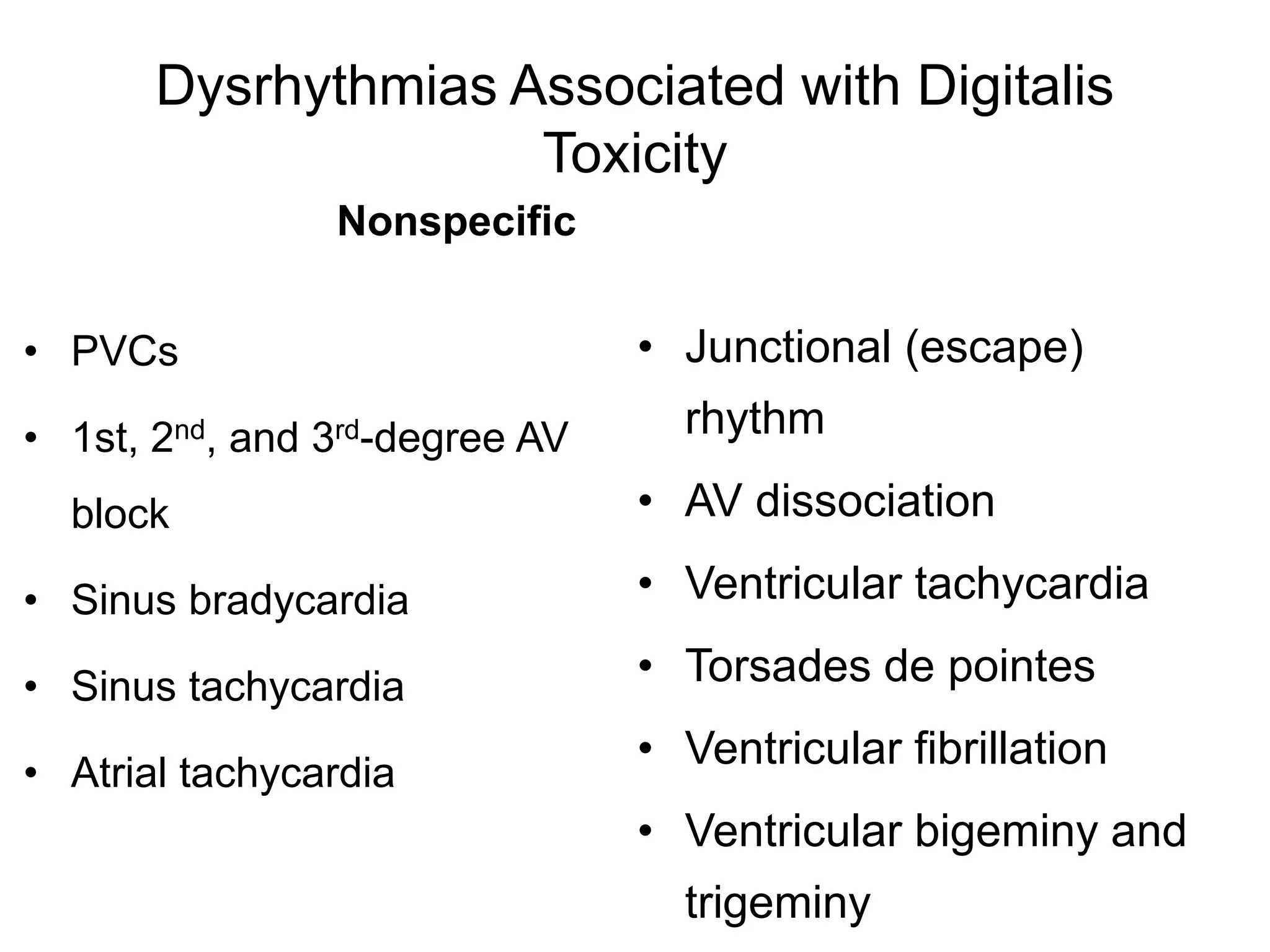
Dysrhythmias Associated with Digitalis
Toxicity
Nonspecific
• PVCs
• 1st, 2nd, and 3rd-degree AV
block
• Sinus bradycardia
• Sinus tachycardia
• Atrial tachycardia
• Junctional (escape)
rhythm
• AV dissociation
• Ventricular tachycardia
• Torsades de pointes
• Ventricular fibrillation
• Ventricular bigeminy and
trigeminy
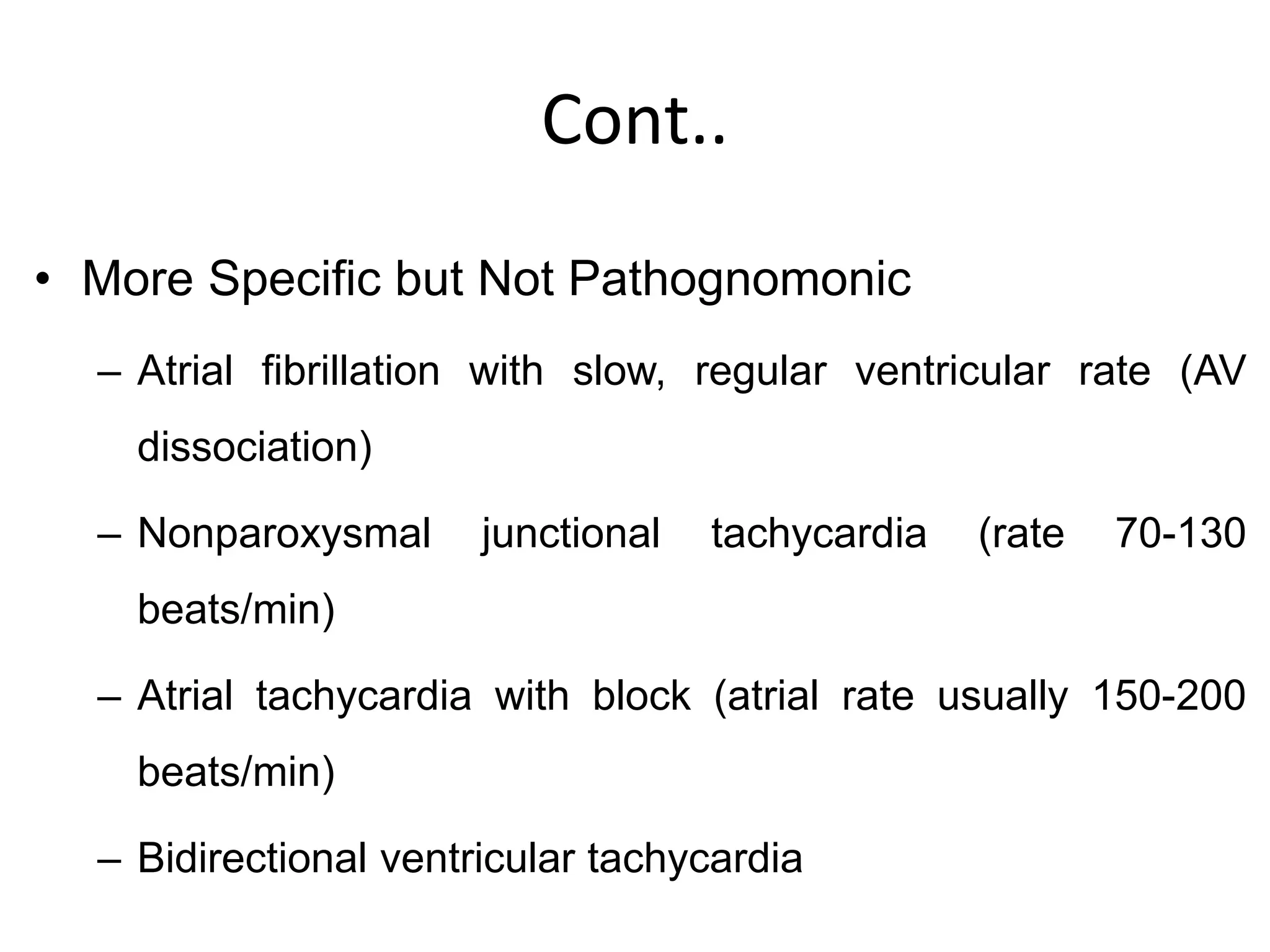
Cont..
• More Specific but Not Pathognomonic
– Atrial fibrillation with slow, regular ventricular rate (AV
dissociation)
– Nonparoxysmal junctional tachycardia (rate 70-130
beats/min)
– Atrial tachycardia with block (atrial rate usually 150-200
beats/min)
– Bidirectional ventricular tachycardia
Factors that Increased Risk of Digitalis Toxicity
• Renal insufficiency
• Congestive heart failure
• Hypothyroidism
• Electrolyte imbalance : Hypokalemia, Hypomagnesaemia,
Hypercalcemia
• Alkalosis
• Acidosis
Drugs that are associated with digoxin toxicity
• Diuretics
• Amiodarone
• Beta blocker
• Calcium channel blockers
• Macrolide antibiotics
• Ketoconazole
History
• Determine the agent
• Amount taken
• Time of ingestion
• Any coingestants whenever possible
• Determine also if the patient normally takes digitalis or if it
was someone else's prescription
• Obtain a thorough medication history to determine if any
recent additions or dosing changes were made
Physical examination
• Assess patient's airway ,breathing, and circulation
• Assess the patient's vital signs.
• Look for evidence of hypoperfusion and end organ
dysfunction.
Diagnosis
• Digoxin toxicity can occur with a single ingestion of 1
to 2 milligrams in an adult.
• Fatalities have been reported following an acute
ingestion of 10 milligrams in an adult and 4
milligrams in a child.
Electrocardiogram
• Almost any cardiac dysrhythmia may be observed in
digoxin toxicity.
• The most common arrhythmias in digoxin toxicity
are PVCs and Bradyarrhythmias.
• Ventricular dysrhythmias occur more frequently in
chronic than in acute poisonings.
ECG findings therapeutic levels
– T-wave changes (such as flattening/inversion/Biphasic T
waves),
– QT-interval shortening,
– “Scooped” or “Salvador Dali sagging” ST segment
depression, and
– Increased U-wave amplitude
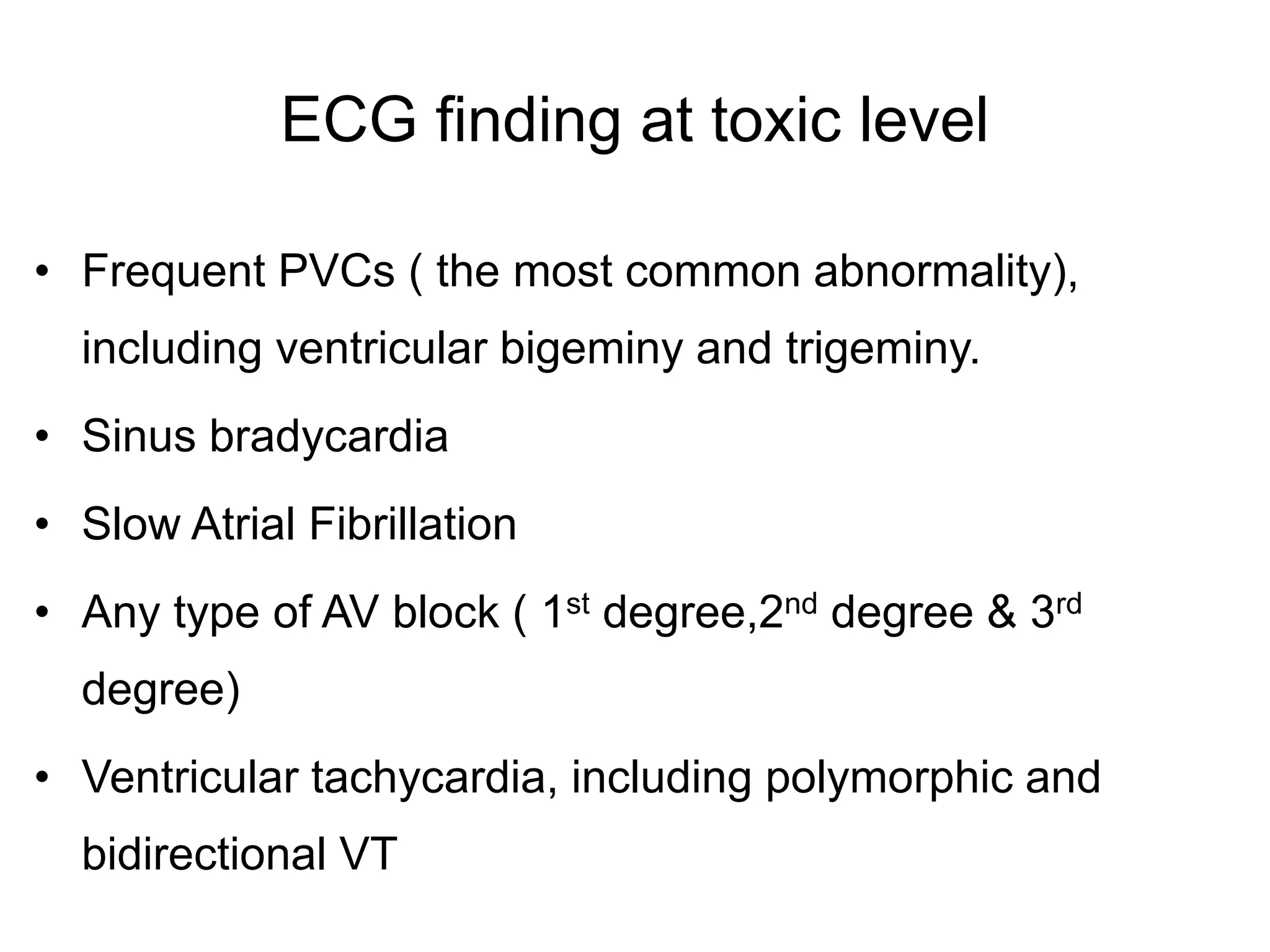
ECG finding at toxic level
• Frequent PVCs ( the most common abnormality),
including ventricular bigeminy and trigeminy.
• Sinus bradycardia
• Slow Atrial Fibrillation
• Any type of AV block ( 1st degree,2nd degree & 3rd
degree)
• Ventricular tachycardia, including polymorphic and
bidirectional VT
Laboratory
• Serum digoxin concentration
• Serum electrolyte level
• Creatinine and BUN to assess renal function
• RBS
• Acetaminophen and salicylate levels, to rule out these
common coingestants
• Pregnancy test in women of childbearing age
Cont.…
• Generally accepted therapeutic digoxin levels are
0.5 to 2.0 ng/ml.
• With corresponding toxic levels above 2.5 ng/ml.
• Ideally, blood samples should be collected 4 hours
after an IV dose or 6 hours after PO dose.
Cont.…
• Serum digoxin level is likely to be falsely elevated
– If the sample is obtained soon after administration or ingestion.
• Endogenous digoxin -like substances have been
identified in:
– Pregnant women,
– Newborns,
– Subarachnoid hemorrhage,
– Liver disease, and renal failure
Cont.….
• Naturally occurring cardiac glycosides from
– Plants and
– animals may cross-react with digoxin assays.
Treatment
• General supportive care
• Treatment of specific complications of toxicity,
• Prevention of further drug absorption,
• Enhancement of drug elimination,
• Antidote administration when indicated
• Safe disposition
GI Decontamination
• The initial treatment should be directed toward
prevention of further GI absorption.
• Gastric lavage???
• Patients who present to the ED within 1 to 2 hours
of ingestion may benefit from the administration of
AC.
Cont..
• The standard dose is 1 g/kg (maximum 50 g).
• Cholestyramine may interrupt enterohepatic
recirculation.
Antidotal therapy with antibody (Fab)
fragments
• DigiFab binds digoxin thus reducing free digoxin
levels, thereby reducing cardio-toxic effects.
• There are at least three approaches
Cont..
• Indications for digoxin-Fab
– Life-threatening arrhythmia
– Evidence of end-organ dysfunction (eg, renal failure,
altered mental status)
– Hyperkalemia (serum potassium >5 to 5.5)
– Cardiac arrest
cont..
• Some toxicologists give fab fragments if:
– The serum digoxin concentration is > 10 ng/ml in acute
ingestions, or
– A child more than 4 mg acutely.
– Serum digoxin level > 15ng/ml or >= 10 ng/ml 6 hours
after post ingestion, regardless of clinical effect.
The first is empirical therapy
• A patient has a history of digitalis ingestion,
consistent symptoms, and life-threatening
dysrhythmias.
• Empiric therapy for acute poisoning
– 10-20 vials for adult/pediatric
• Empiric therapy for chronic poisoning
– Adult: 3-6 vials
– children: 1-2 vials
The second approach uses a
simple calculation
• When the ingested dose is known with reasonable
certainty.
• 1 vial of DigiFab contains 38 mg or 40 mg,
respectively, of Fab fragments, which bind 0.5 mg of
digoxin or digitoxin
The third approach
• Base the dosage on the steady-state serum digoxin
or digitoxin level after 6 to 8 hours
Cont..
• Following the acute ingestion of an unknown amount
of digitalis, empiric treatment consists of 10 vials of
digoxin Fab fragments for adults or 5 vials for
children .
• 1 vial binds approximately 0.5 mg of digoxin.
Cont.…
• In chronic toxicity a hemodynamically stable patient
without clear life threatening arrhythmias is to
administer half of the dose calculated by level.
• If instability develops, the remainder of the full
calculated dose can be administered.
• 1 to 3 vials (40 to 120 milligrams) of digoxin-Fab are
often adequate in reversing chronic toxicity.
Cont.…
• Fab fragments should be given over 30 minutes in
all patients except those in cardiac arrest or in whom
arrest is imminent.
Cont.…
• A full neutralizing dose of digoxin-Fab is based on
an estimation of the total-body load of digoxin, which
can be calculated from either the dose ingested or a
steady-state serum digoxin level.
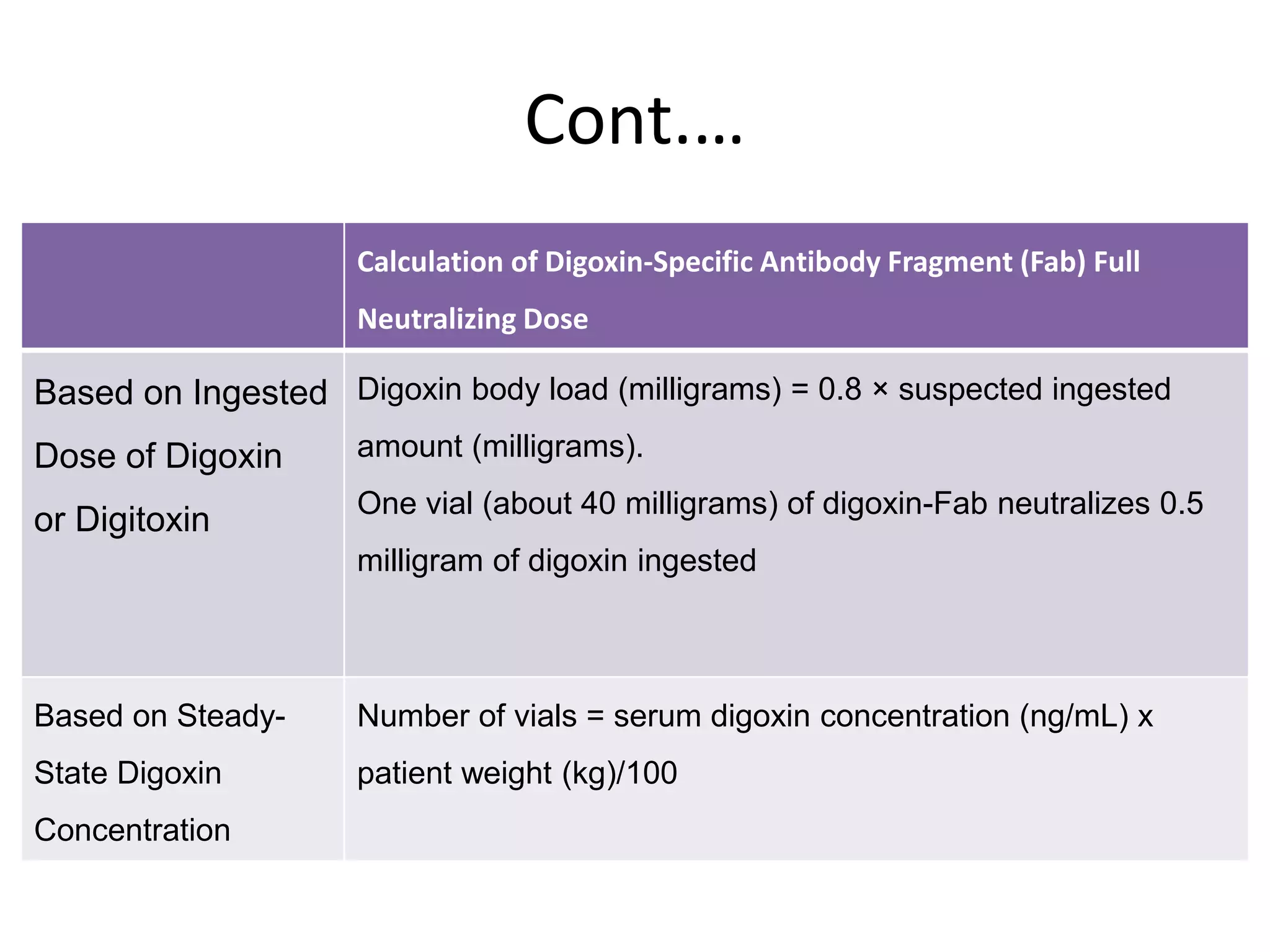
Cont.…
Calculation of Digoxin-Specific Antibody Fragment (Fab) Full
Neutralizing Dose
Based on Ingested
Dose of Digoxin
or Digitoxin
Digoxin body load (milligrams) = 0.8 × suspected ingested
amount (milligrams).
One vial (about 40 milligrams) of digoxin-Fab neutralizes 0.5
milligram of digoxin ingested
Based on Steady-
State Digoxin
Concentration
Number of vials = serum digoxin concentration (ng/mL) x
patient weight (kg)/100
Sample calculation of digifab based on
ingested dose of digoxin
• Case 1: A toxic-appearing 40-year-old woman has
ingested fifty (50) 0.25-mg digoxin tablets.
• How much is digoxin body loading? and how much
is dose of digoxin Fab fragments in vials?
Answer
• Body load = amount ingested x 0.8 (BA of digoxin
tablets)
= 12.5mg × 0.8 = 10mg
• Dose of digoxin Fab fragments (in vials) = 10mg ÷
0.5mg per vial
= 20 vials
Sample calculation of digifab based on steady-state
digoxin concentration
• Case 2: A toxic-appearing 4-year-old child weighing
20 kg has a digoxin level of 16 ng/mL 8 hours after
ingestion of an unknown number of digoxin tablets.
• How much is dose of digoxin Fab fragments in
vials?
Answer
• Dose (in number of vials)= (serum digoxin
concentration × weight in kg) /100
=16 x 20 /100
= approximately vials
Bradyarrhythmias
• Digibind is the definitive treatment.
• Atropine
• Pacing
Tachyarrhythmias
• Digibind is the definitive treatment
• MgSO4 as an adjunctive measures
• Phenytoin
• Lidocaine
• Often refractory to cardiovesion
Hyperkalemia
• Insulin and glucose , bicarbonates
• Calcium is traditionally contra-indicated due the risk
of precipitating a “ stone heart”.
Cont.…
• The initial serum potassium concentration may in
fact be a better predictor of mortality than the initial
digoxin concentration.
Cont..
• In a study of 91 patients with acute digoxin poisoning,
nearly 50% of the patients with serum K+ 5.0 and 5.5
meq/L died.
• No patients with a K+ < 5.0 meq/L died, and
• all 10 patients with serum K+ > 5.5 meq/L perished.
Hypokalemia
• In chronic toxicity, which may be exacerbated by
hypokalemia, maintenance of the serum
potassium level to at least 3.5 to 4 mEq/L.
References
THANK YOU!

Digitalis toxicity.pptx

  • 1.
    • Seminar onapproach to management of digitalis toxicity Presentor: Dr. Tamagnsew (R1) Moderator: Dr. Nadia (R2) Advisor: Dr. Ashenafi (consultant)
  • 2.
    Outlines • Introduction • Mechanismof action • Pharmacokinetics • Sign and symptoms • Pathophysiology • Factors that increase digoxin toxicity • History and physical examination • Diagnosis • Management
  • 3.
    Objective • Define thenature of digitalis. • Identify sources digitalis. • List the indications for digoxin use. • Identify sign and symptoms of digitalis toxicity. • Describe initial management of digitalis toxicity.
  • 4.
    Introduction • Cardiac glycosidesare often called digitalis or digitalis glycosides. • Digitalis lantana is the source of digoxin, the only glycoside that is currently in use.
  • 5.
    Cont.… • Others likeDigitoxin ( from digitalis purpurea) are no longer in the market. • In addition to availability as pharmaceuticals, cardiac glycosides are also found in the skin of toads (bufotoxin).
  • 6.
    Cont.. • Similar cardioactivesteroids are also found in Plants such as: – Foxglove, – Oleander, – Red squill, and – Lily of the valley.
  • 7.
    MOA • Directly inhibitNa+/K+ ATPase intracellular Na+ inhibits Na+/Ca2+ exchanger intracellular Ca2+ Ca2+ release from SR contractile force (positive inotropy). • Also digoxin vagal activity & SA & AV conduction heart rate.
  • 8.
    Kinetics • Both digoxinand digitoxin have a narrow therapeutic index and toxicity is common. • Good oral absorption with oral bioavailability of 80%. • It is eliminated primarily through the kidney. • It has a has a half-life of 36-48 hours, longer in renal failure. • Therapeutic levels of digoxin are 0.8-2.0ng/ml. • The toxic level is above 2.5 ng/ml
  • 9.
    Cont.. • Digoxin hasa large volume of distribution, being 6-10 L/kg in adults. • Onset of action after PO administration occurs in 30-120 minutes. • Onset of action with IV administration occurs in 5-30 minutes. • The peak effect with PO dosing is 2-4 hours, and that with IV dosing is 5-30 minutes.
  • 10.
    Sign and symptomsof digitalis toxicity Cardiovascular Palpitation Syncope Dyspnea Dysrhythmias Constitutional Weakness, fatigue Central nervous system Headache , confusion, Lethargy, Agitation, Hallucination, delirium, acute psychosis Neuropathic pain, seizure Visual Blurred or snowy vision Photophobia Yellow-green chromatopsia (also red, brown, blue) Transient amblyopia, diplopia, scotomas, blindness Gastrointestinal Nausea, Vomiting ,Abdominal pain, Diarrhea Electrolyte disturbances Hyperkalemia
  • 11.
    Digoxin toxicity Acutetoxicity Chronic toxicity Clinical history Intentional or accidental ingestion Typically elderly cardiac patients taking diuretics, may have renal insufficiency GI effects Nausea and vomiting, abdominal pain, anorexia Nausea, vomiting, diarrhea, Abdominal pan CNS effects Headache, dizziness, confusion, coma Fatigue, Weakness, Confusion , Delirium, and Coma are often prominent Cardiac effects Bradyarrhythmias or supraventricular tachyarrhythmias with atrioventricular block are common Almost any ventricular or supraventricular arrhythmias can occur; ventricular arrhythmias are common Electrolyte abnormalities Hyperkalemia Normal ,decreased or increased serum potassium, hypomagnesaemia Digoxin level Markedly elevated (if obtained within 6 hrs.) Minimally elevated or within “therapeutic” range
  • 12.
    Dysrhythmias Associated withDigitalis Toxicity Nonspecific • PVCs • 1st, 2nd, and 3rd-degree AV block • Sinus bradycardia • Sinus tachycardia • Atrial tachycardia • Junctional (escape) rhythm • AV dissociation • Ventricular tachycardia • Torsades de pointes • Ventricular fibrillation • Ventricular bigeminy and trigeminy
  • 13.
    Cont.. • More Specificbut Not Pathognomonic – Atrial fibrillation with slow, regular ventricular rate (AV dissociation) – Nonparoxysmal junctional tachycardia (rate 70-130 beats/min) – Atrial tachycardia with block (atrial rate usually 150-200 beats/min) – Bidirectional ventricular tachycardia
  • 14.
    Factors that IncreasedRisk of Digitalis Toxicity • Renal insufficiency • Congestive heart failure • Hypothyroidism • Electrolyte imbalance : Hypokalemia, Hypomagnesaemia, Hypercalcemia • Alkalosis • Acidosis
  • 15.
    Drugs that areassociated with digoxin toxicity • Diuretics • Amiodarone • Beta blocker • Calcium channel blockers • Macrolide antibiotics • Ketoconazole
  • 16.
    History • Determine theagent • Amount taken • Time of ingestion • Any coingestants whenever possible • Determine also if the patient normally takes digitalis or if it was someone else's prescription • Obtain a thorough medication history to determine if any recent additions or dosing changes were made
  • 17.
    Physical examination • Assesspatient's airway ,breathing, and circulation • Assess the patient's vital signs. • Look for evidence of hypoperfusion and end organ dysfunction.
  • 18.
    Diagnosis • Digoxin toxicitycan occur with a single ingestion of 1 to 2 milligrams in an adult. • Fatalities have been reported following an acute ingestion of 10 milligrams in an adult and 4 milligrams in a child.
  • 19.
    Electrocardiogram • Almost anycardiac dysrhythmia may be observed in digoxin toxicity. • The most common arrhythmias in digoxin toxicity are PVCs and Bradyarrhythmias. • Ventricular dysrhythmias occur more frequently in chronic than in acute poisonings.
  • 20.
    ECG findings therapeuticlevels – T-wave changes (such as flattening/inversion/Biphasic T waves), – QT-interval shortening, – “Scooped” or “Salvador Dali sagging” ST segment depression, and – Increased U-wave amplitude
  • 23.
    ECG finding attoxic level • Frequent PVCs ( the most common abnormality), including ventricular bigeminy and trigeminy. • Sinus bradycardia • Slow Atrial Fibrillation • Any type of AV block ( 1st degree,2nd degree & 3rd degree) • Ventricular tachycardia, including polymorphic and bidirectional VT
  • 25.
    Laboratory • Serum digoxinconcentration • Serum electrolyte level • Creatinine and BUN to assess renal function • RBS • Acetaminophen and salicylate levels, to rule out these common coingestants • Pregnancy test in women of childbearing age
  • 26.
    Cont.… • Generally acceptedtherapeutic digoxin levels are 0.5 to 2.0 ng/ml. • With corresponding toxic levels above 2.5 ng/ml. • Ideally, blood samples should be collected 4 hours after an IV dose or 6 hours after PO dose.
  • 27.
    Cont.… • Serum digoxinlevel is likely to be falsely elevated – If the sample is obtained soon after administration or ingestion. • Endogenous digoxin -like substances have been identified in: – Pregnant women, – Newborns, – Subarachnoid hemorrhage, – Liver disease, and renal failure
  • 28.
    Cont.…. • Naturally occurringcardiac glycosides from – Plants and – animals may cross-react with digoxin assays.
  • 29.
    Treatment • General supportivecare • Treatment of specific complications of toxicity, • Prevention of further drug absorption, • Enhancement of drug elimination, • Antidote administration when indicated • Safe disposition
  • 30.
    GI Decontamination • Theinitial treatment should be directed toward prevention of further GI absorption. • Gastric lavage??? • Patients who present to the ED within 1 to 2 hours of ingestion may benefit from the administration of AC.
  • 31.
    Cont.. • The standarddose is 1 g/kg (maximum 50 g). • Cholestyramine may interrupt enterohepatic recirculation.
  • 32.
    Antidotal therapy withantibody (Fab) fragments • DigiFab binds digoxin thus reducing free digoxin levels, thereby reducing cardio-toxic effects. • There are at least three approaches
  • 33.
    Cont.. • Indications fordigoxin-Fab – Life-threatening arrhythmia – Evidence of end-organ dysfunction (eg, renal failure, altered mental status) – Hyperkalemia (serum potassium >5 to 5.5) – Cardiac arrest
  • 34.
    cont.. • Some toxicologistsgive fab fragments if: – The serum digoxin concentration is > 10 ng/ml in acute ingestions, or – A child more than 4 mg acutely. – Serum digoxin level > 15ng/ml or >= 10 ng/ml 6 hours after post ingestion, regardless of clinical effect.
  • 35.
    The first isempirical therapy • A patient has a history of digitalis ingestion, consistent symptoms, and life-threatening dysrhythmias. • Empiric therapy for acute poisoning – 10-20 vials for adult/pediatric • Empiric therapy for chronic poisoning – Adult: 3-6 vials – children: 1-2 vials
  • 36.
    The second approachuses a simple calculation • When the ingested dose is known with reasonable certainty. • 1 vial of DigiFab contains 38 mg or 40 mg, respectively, of Fab fragments, which bind 0.5 mg of digoxin or digitoxin
  • 37.
    The third approach •Base the dosage on the steady-state serum digoxin or digitoxin level after 6 to 8 hours
  • 38.
    Cont.. • Following theacute ingestion of an unknown amount of digitalis, empiric treatment consists of 10 vials of digoxin Fab fragments for adults or 5 vials for children . • 1 vial binds approximately 0.5 mg of digoxin.
  • 39.
    Cont.… • In chronictoxicity a hemodynamically stable patient without clear life threatening arrhythmias is to administer half of the dose calculated by level. • If instability develops, the remainder of the full calculated dose can be administered. • 1 to 3 vials (40 to 120 milligrams) of digoxin-Fab are often adequate in reversing chronic toxicity.
  • 40.
    Cont.… • Fab fragmentsshould be given over 30 minutes in all patients except those in cardiac arrest or in whom arrest is imminent.
  • 41.
    Cont.… • A fullneutralizing dose of digoxin-Fab is based on an estimation of the total-body load of digoxin, which can be calculated from either the dose ingested or a steady-state serum digoxin level.
  • 42.
    Cont.… Calculation of Digoxin-SpecificAntibody Fragment (Fab) Full Neutralizing Dose Based on Ingested Dose of Digoxin or Digitoxin Digoxin body load (milligrams) = 0.8 × suspected ingested amount (milligrams). One vial (about 40 milligrams) of digoxin-Fab neutralizes 0.5 milligram of digoxin ingested Based on Steady- State Digoxin Concentration Number of vials = serum digoxin concentration (ng/mL) x patient weight (kg)/100
  • 43.
    Sample calculation ofdigifab based on ingested dose of digoxin • Case 1: A toxic-appearing 40-year-old woman has ingested fifty (50) 0.25-mg digoxin tablets. • How much is digoxin body loading? and how much is dose of digoxin Fab fragments in vials?
  • 44.
    Answer • Body load= amount ingested x 0.8 (BA of digoxin tablets) = 12.5mg × 0.8 = 10mg • Dose of digoxin Fab fragments (in vials) = 10mg ÷ 0.5mg per vial = 20 vials
  • 45.
    Sample calculation ofdigifab based on steady-state digoxin concentration • Case 2: A toxic-appearing 4-year-old child weighing 20 kg has a digoxin level of 16 ng/mL 8 hours after ingestion of an unknown number of digoxin tablets. • How much is dose of digoxin Fab fragments in vials?
  • 46.
    Answer • Dose (innumber of vials)= (serum digoxin concentration × weight in kg) /100 =16 x 20 /100 = approximately vials
  • 47.
    Bradyarrhythmias • Digibind isthe definitive treatment. • Atropine • Pacing
  • 48.
    Tachyarrhythmias • Digibind isthe definitive treatment • MgSO4 as an adjunctive measures • Phenytoin • Lidocaine • Often refractory to cardiovesion
  • 49.
    Hyperkalemia • Insulin andglucose , bicarbonates • Calcium is traditionally contra-indicated due the risk of precipitating a “ stone heart”.
  • 50.
    Cont.… • The initialserum potassium concentration may in fact be a better predictor of mortality than the initial digoxin concentration.
  • 51.
    Cont.. • In astudy of 91 patients with acute digoxin poisoning, nearly 50% of the patients with serum K+ 5.0 and 5.5 meq/L died. • No patients with a K+ < 5.0 meq/L died, and • all 10 patients with serum K+ > 5.5 meq/L perished.
  • 52.
    Hypokalemia • In chronictoxicity, which may be exacerbated by hypokalemia, maintenance of the serum potassium level to at least 3.5 to 4 mEq/L.
  • 53.
  • 54.

Editor's Notes

  • #21 Downsloping ST depression with a characteristic slurred appearance
  • #23 ECG shows scooping of ST segments, flattening of T waves, and first-degree atrioventricular block with a serum digoxin level of 1.2 nanograms/mL (1.54 nmol/L).
  • #25 PVC-bigeminy
  • #34 (eg, vt,vf,asystole; complete heart block; Mobitz II heart block; symptomatic bradycardia)
  • #35 We generally do not treat with Fab fragments solely based upon the serum digoxin concentration or the amount ingested.