Digital Transformation &
Open Innovation
Trust Framework Initiative
Michele Nati
Privacy and Trust Technical Leader
Personal Data and Trust Programme
London, 22 October, Digital Transformation Conference
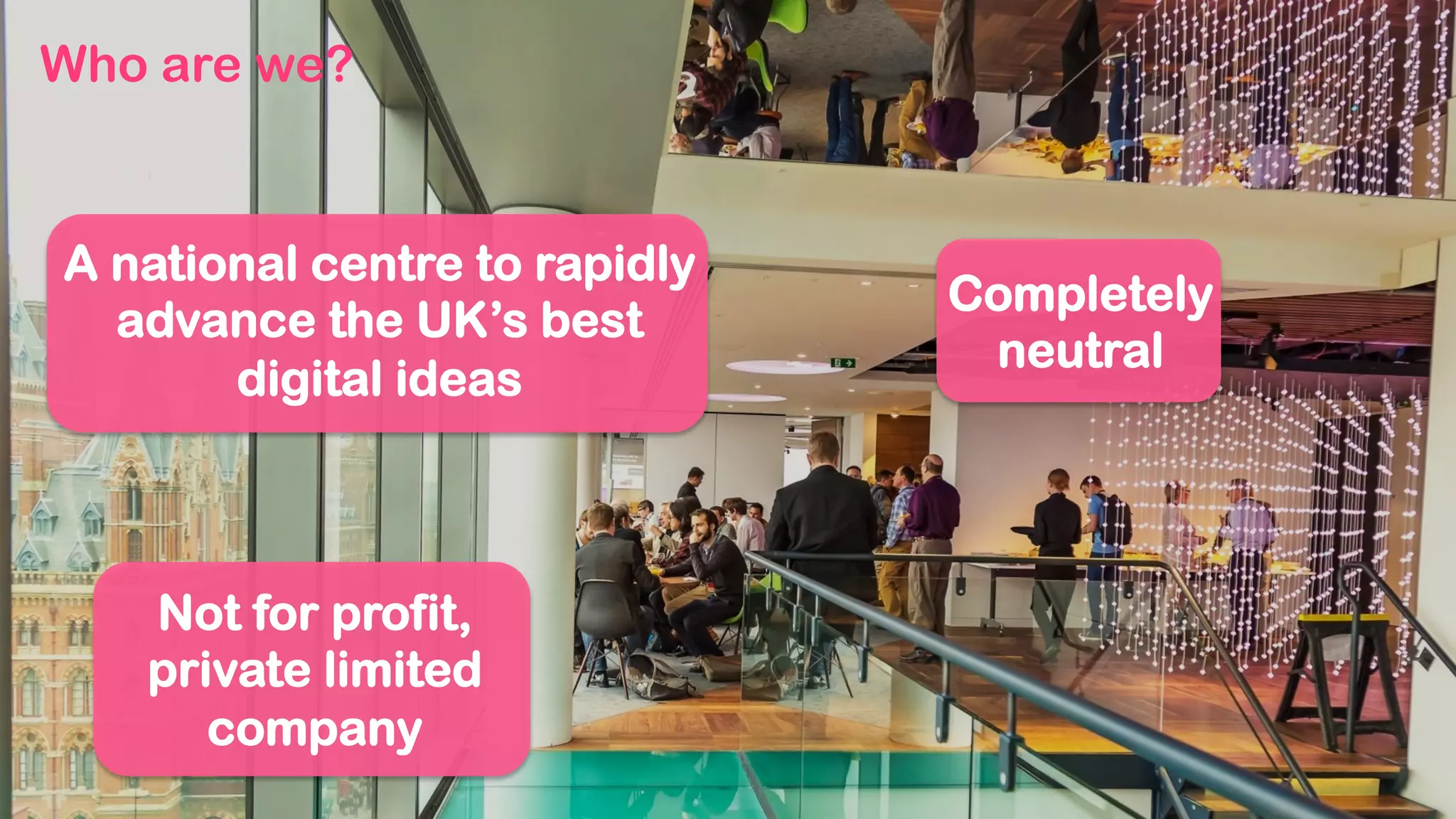
A national centre to rapidly
advance the UK’s best
digital ideas
Completely
neutral
Not for profit,
private limited
company
Who are we?
Some of our partners and supporters
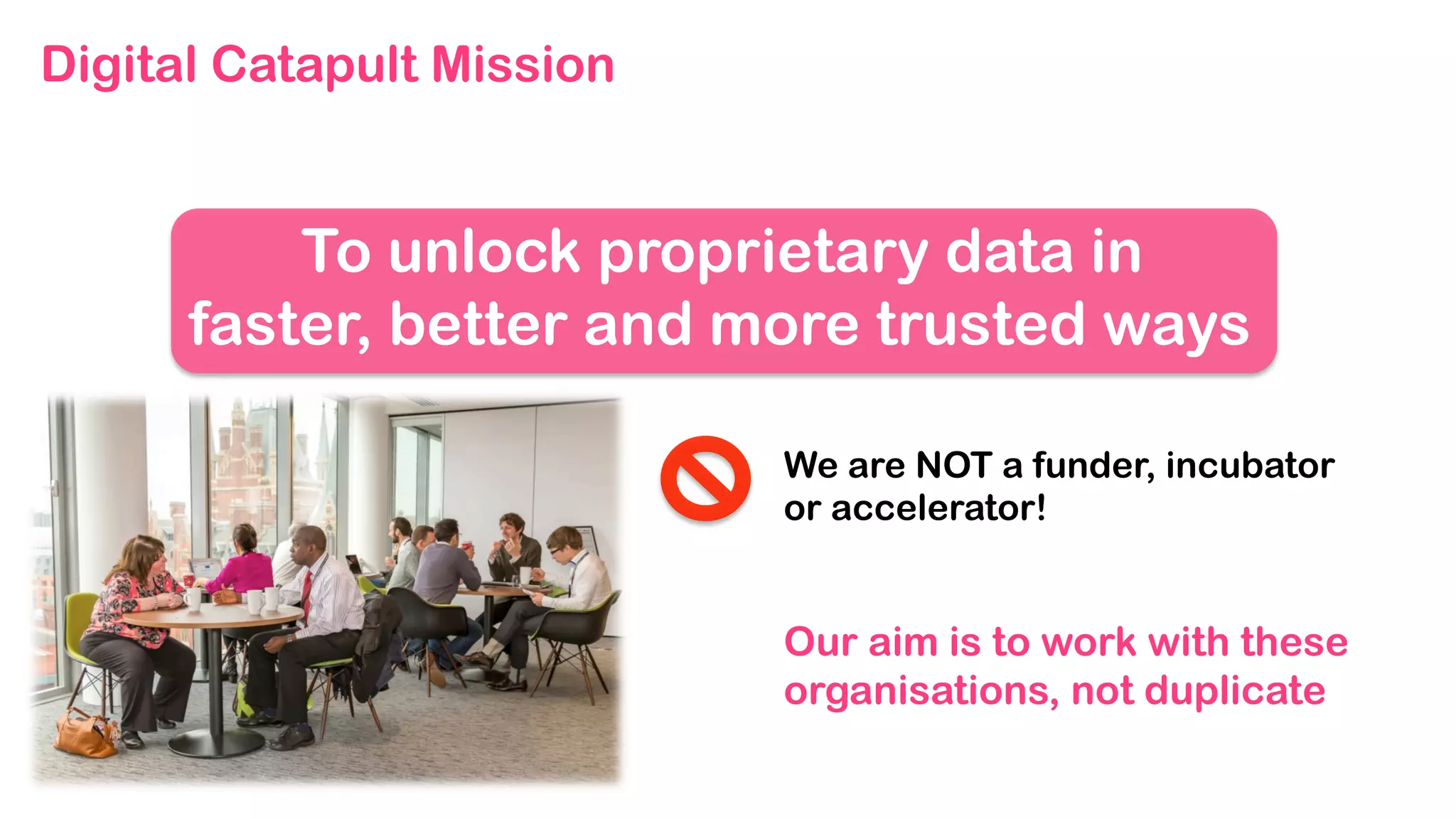
We are NOT a funder, incubator
or accelerator!
Our aim is to work with these
organisations, not duplicate
To unlock proprietary data in
faster, better and more trusted ways
Digital Catapult Mission
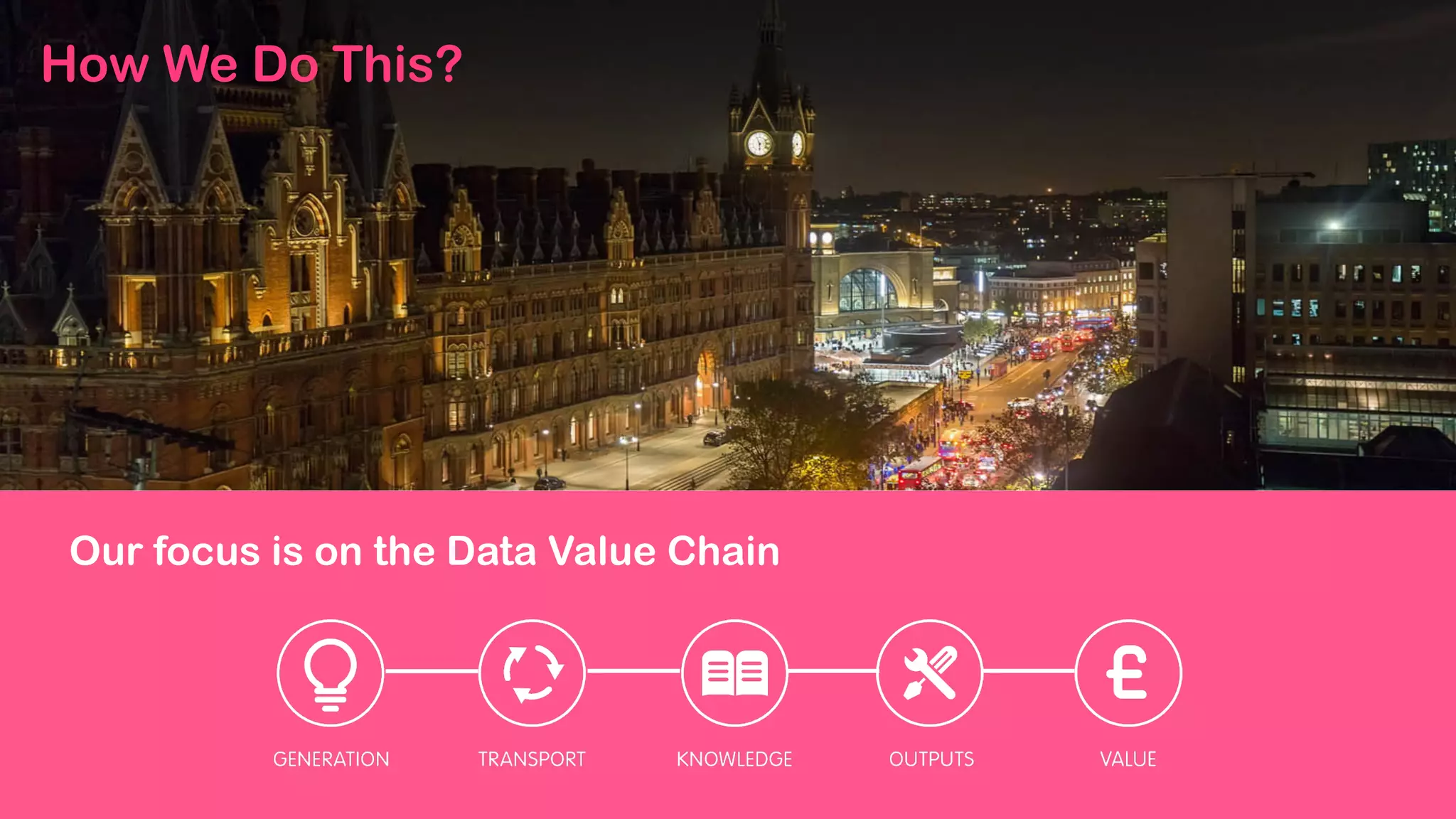
Our focus is on the Data Value Chain
How We Do This?
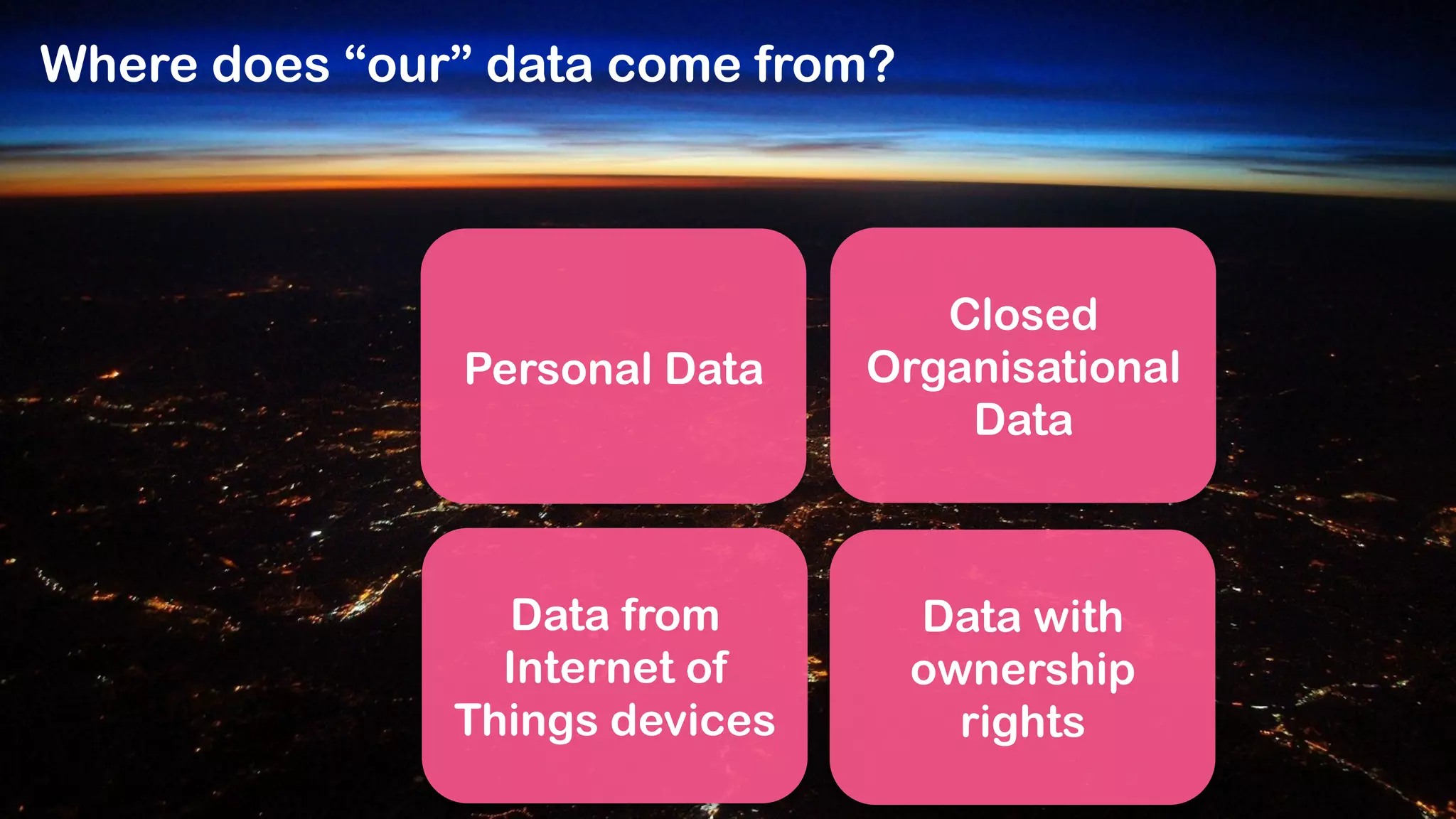
Data from
Internet of
Things devices
Personal Data
Data with
ownership
rights
Closed
Organisational
Data
Where does “our” data come from?
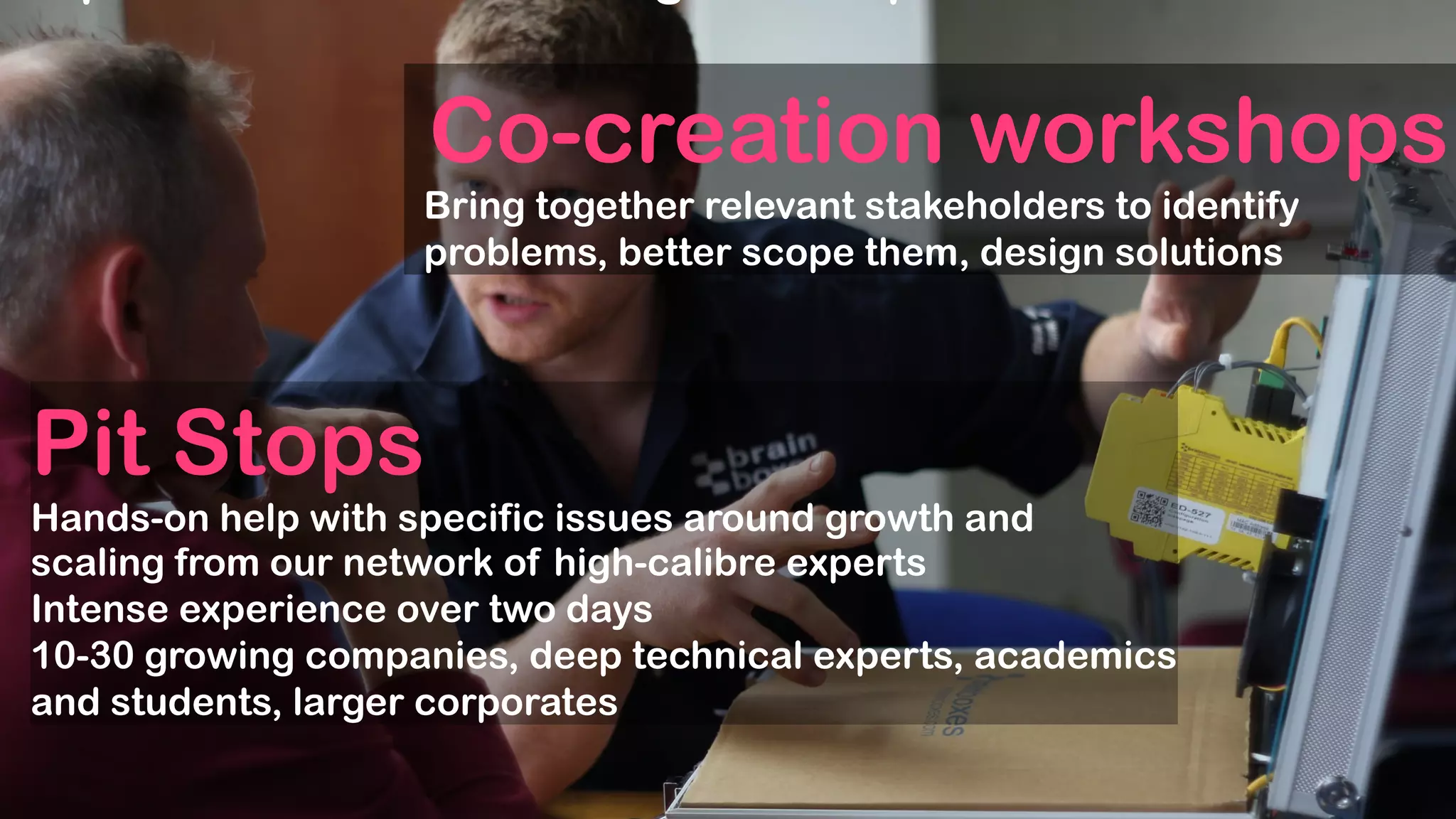
Pit Stops
Hands-on help with specific issues around growth and
scaling from our network of high-calibre experts
Intense experience over two days
10-30 growing companies, deep technical experts, academics
and students, larger corporates
Co-creation workshops
Bring together relevant stakeholders to identify
problems, better scope them, design solutions
The commercial benefits of a personal data
sharing eco-system
•  Personal data flows are the nervous system of any consumer facing
business, they trigger the muscles to move when acquisition, cross-sell
or churn events are identified.
•  As data becomes more abundant, this will be ever more critical to how
“core businesses” compete in the future
•  Being timely and relevant reduces waste and cost, “50% of my marketing
budget is wasted….” etc
•  Above all, it enables a better customer experience because
organisations can be more responsive to their customers needs
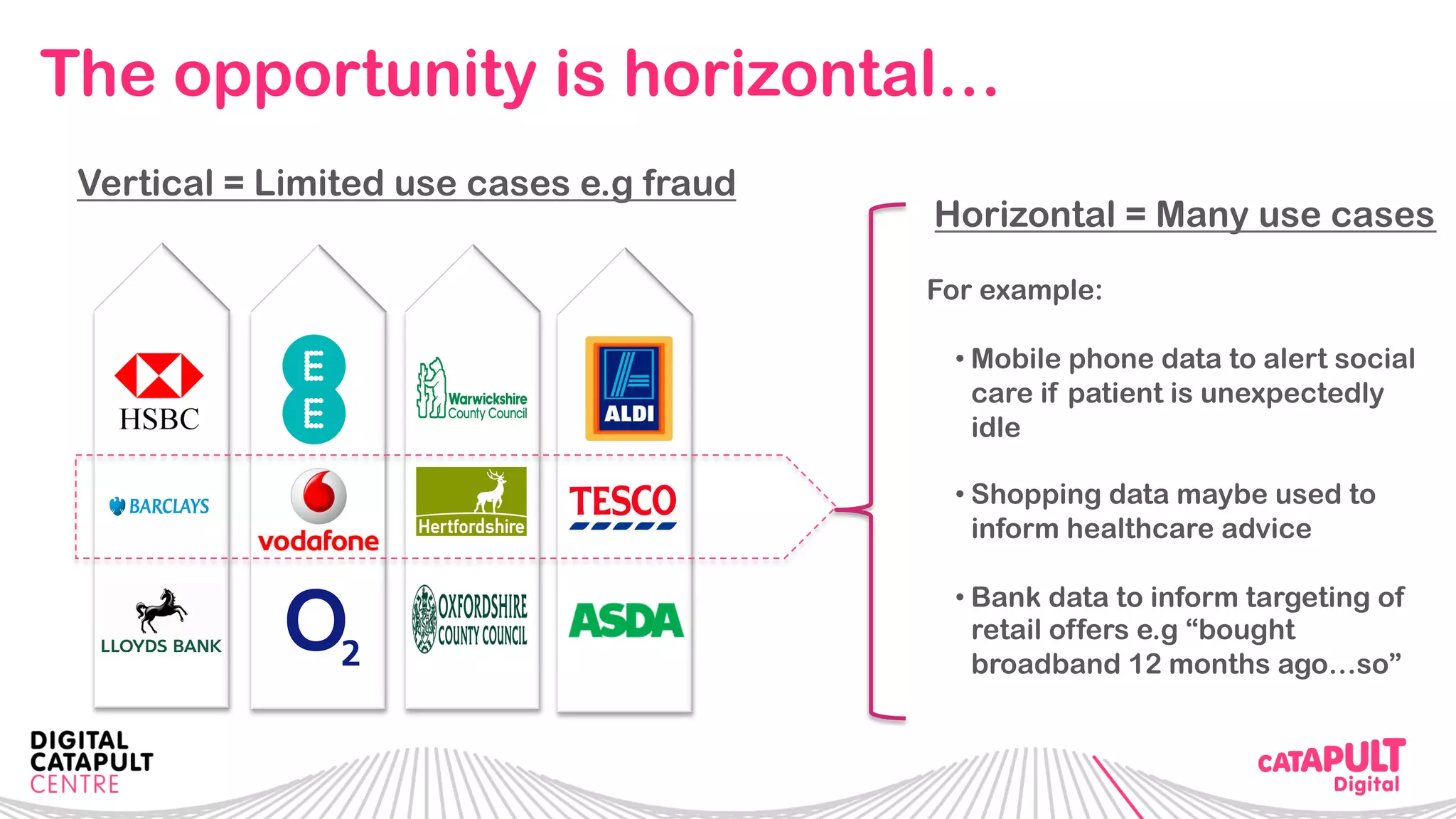
The opportunity is horizontal…
Vertical = Limited use cases e.g fraud
Horizontal = Many use cases
For example:
• Mobile phone data to alert social
care if patient is unexpectedly
idle
• Shopping data maybe used to
inform healthcare advice
• Bank data to inform targeting of
retail offers e.g “bought
broadband 12 months ago…so”
What individuals think about personal data?
•  Consent
•  65% are insure if data is shared without their consent
•  Responsibility
•  30% felt it was their own responsibility to understand personal data issues
•  31% see organizations that hold data as responsible for its protection
•  Protection
•  29% felt they had responsibility to protect their own information
•  Understanding
•  38% don’t know what ‘personal data’ means, but 96% claim to
* http://tinyurl.com/q2n6e2w
How much consumers trust organisations?
•  Most trusted
•  44% of consumers trust the public sector most with their personal data
•  Lack of clarity
•  30% feel the retail sector is not clear on how use their personal data
•  Least trusted
•  2% choose telecoms as the most trusted sector
•  Nervous sharing
•  60% feel uncomfortable sharing personal data
•  Loosing control
•  76% primary concern: no control over how its shared or who with
* http://tinyurl.com/q2n6e2w
Benefits of personal data sharing
•  Greedy Companies
•  79% think organisations use data only for their monetary gain
•  Overall financial benefit
•  £15bn untapped wealth for UK consumers
•  The incentive to share
•  30% of consumers believe “to improve services and benefit” is the most important
incentive for sharing personal data
•  How to incentivise
•  43% said the main incentive for sharing personal data is if it was going to be used to
improve society
* http://tinyurl.com/q2n6e2w
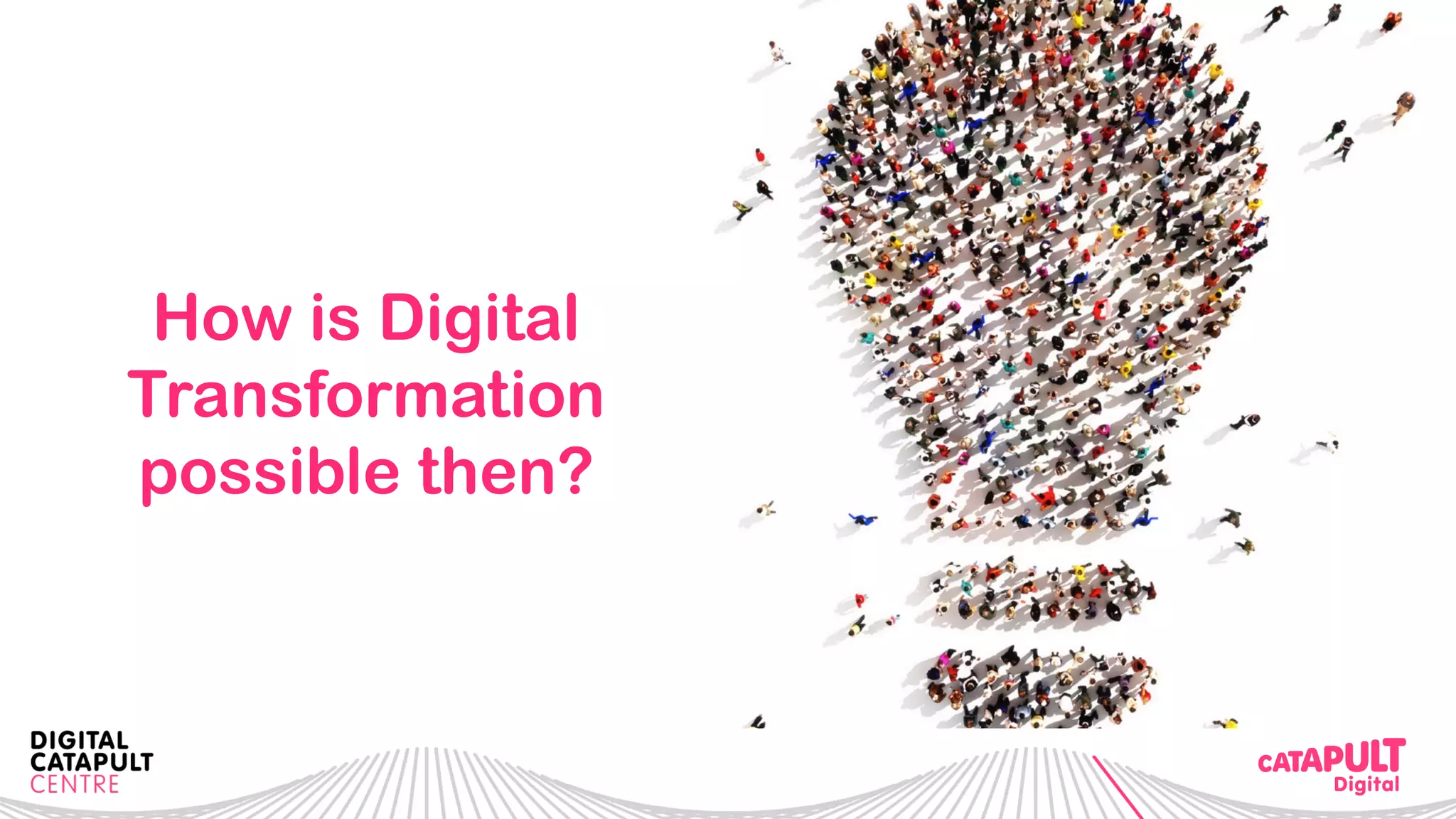
How is Digital
Transformation
possible then?
Trust Framework
Initiative
14
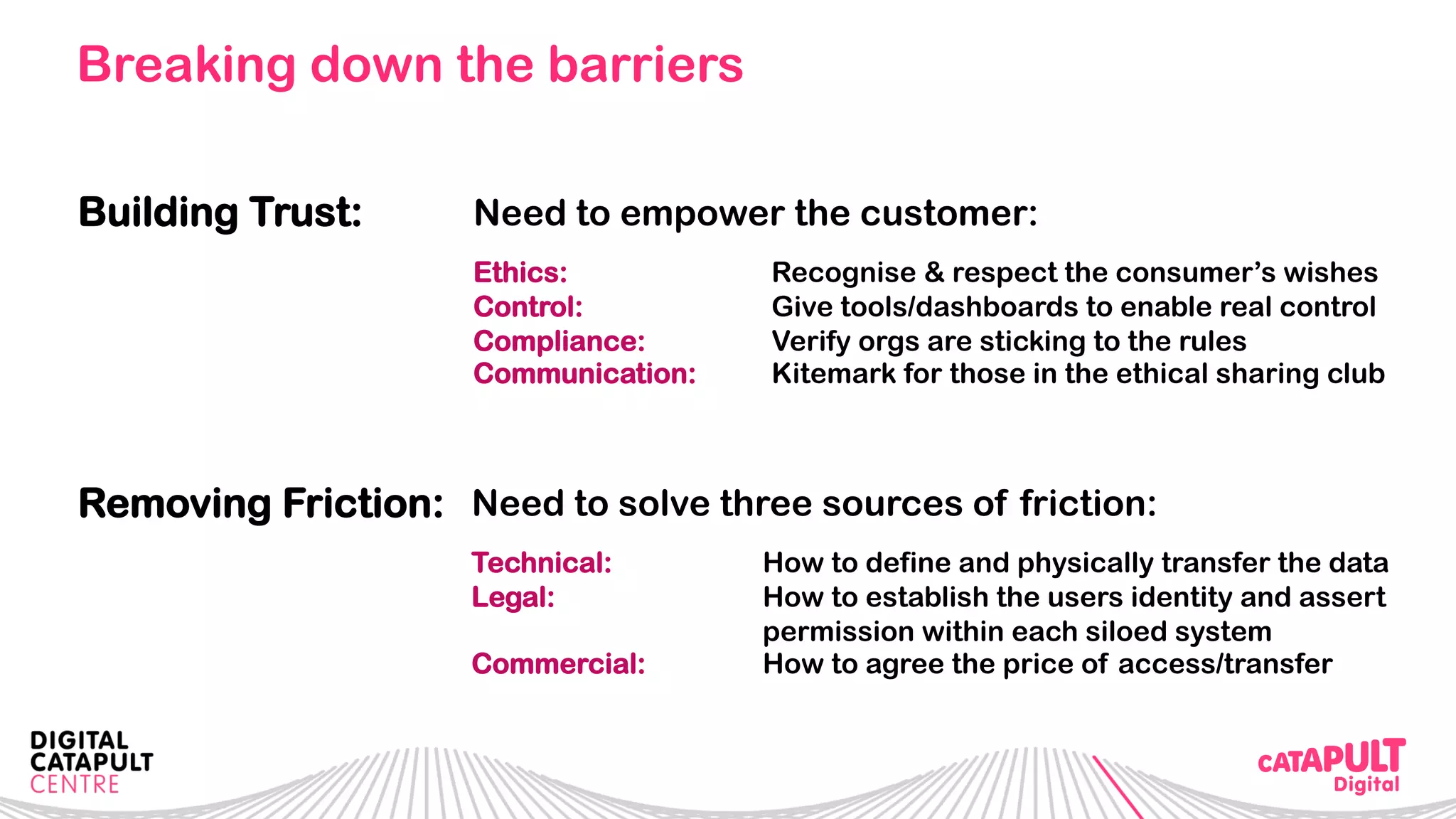
Breaking down the barriers
Building Trust:
Removing Friction: Need to solve three sources of friction:
Technical: How to define and physically transfer the data
Legal: How to establish the users identity and assert
permission within each siloed system
Commercial: How to agree the price of access/transfer
Need to empower the customer:
Ethics: Recognise & respect the consumer’s wishes
Control: Give tools/dashboards to enable real control
Compliance: Verify orgs are sticking to the rules
Communication: Kitemark for those in the ethical sharing club
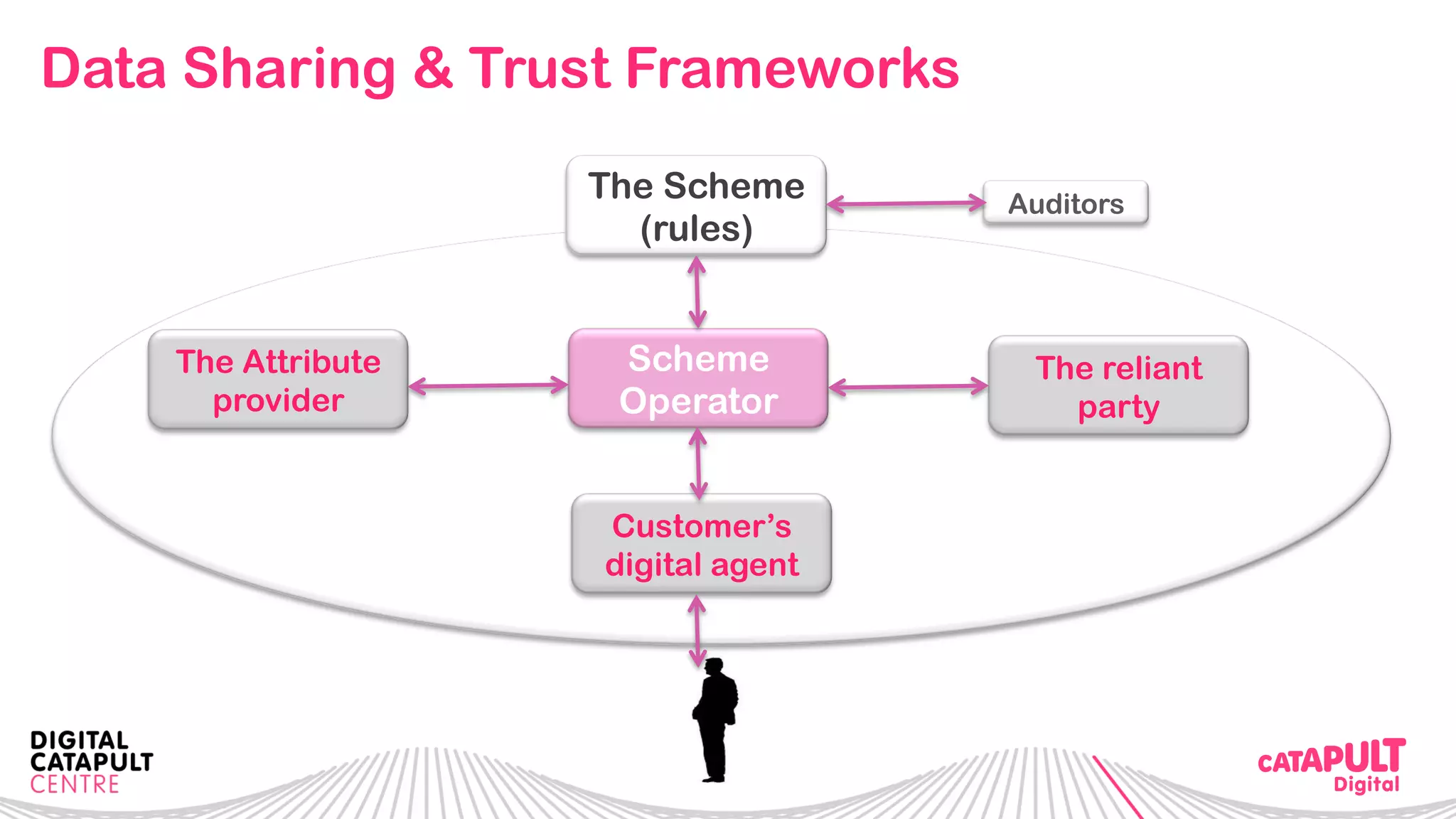
Data Sharing & Trust Frameworks
Scheme
Operator
Customer’s
digital agent
The reliant
party
The Attribute
provider
The Scheme
(rules)
Auditors
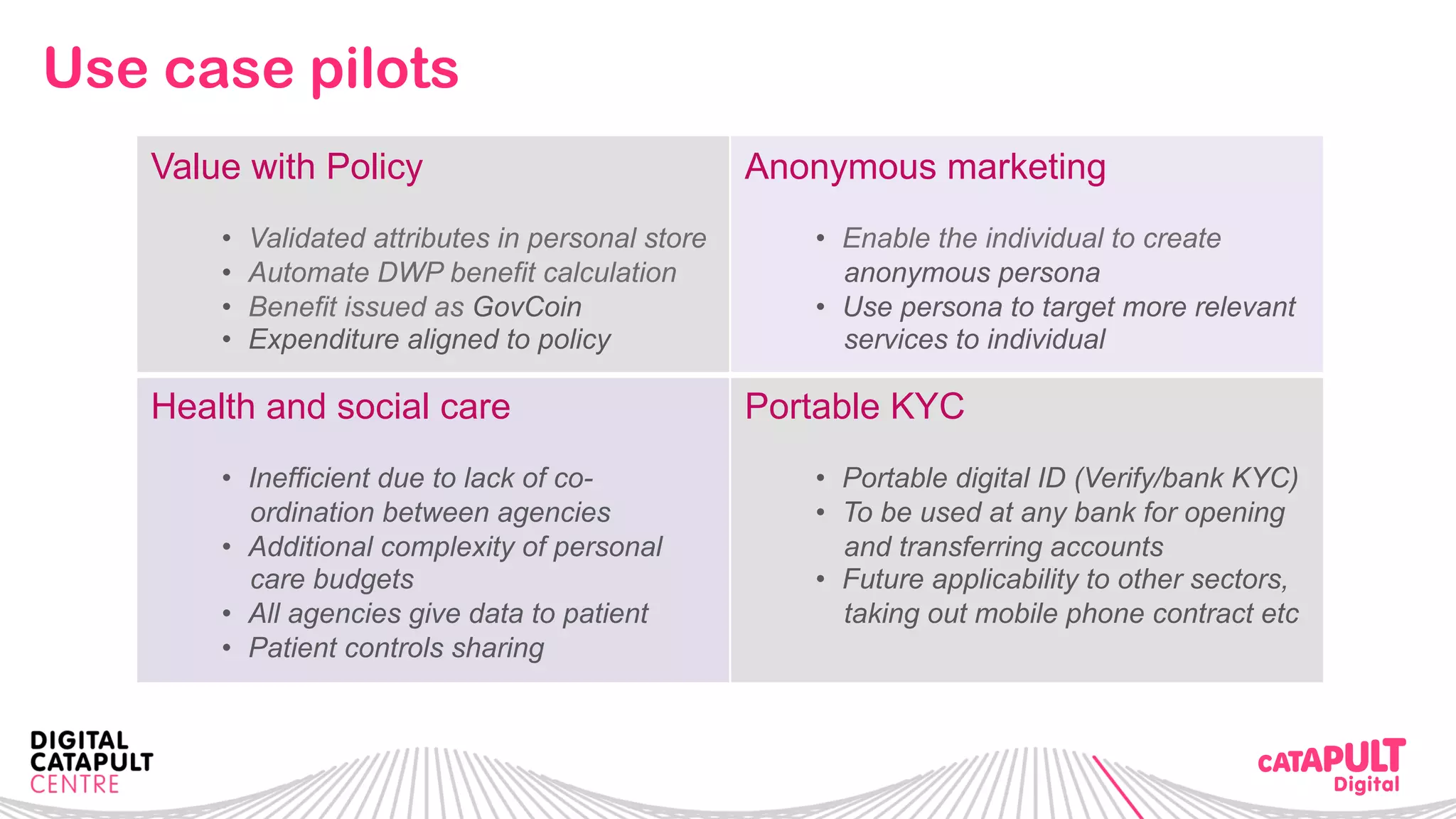
Use case pilots
Value with Policy
•  Validated attributes in personal store
•  Automate DWP benefit calculation
•  Benefit issued as GovCoin
•  Expenditure aligned to policy
Anonymous marketing
•  Enable the individual to create
anonymous persona
•  Use persona to target more relevant
services to individual
Health and social care
•  Inefficient due to lack of co-
ordination between agencies
•  Additional complexity of personal
care budgets
•  All agencies give data to patient
•  Patient controls sharing
Portable KYC
•  Portable digital ID (Verify/bank KYC)
•  To be used at any bank for opening
and transferring accounts
•  Future applicability to other sectors,
taking out mobile phone contract etc
Proposed plan
overview
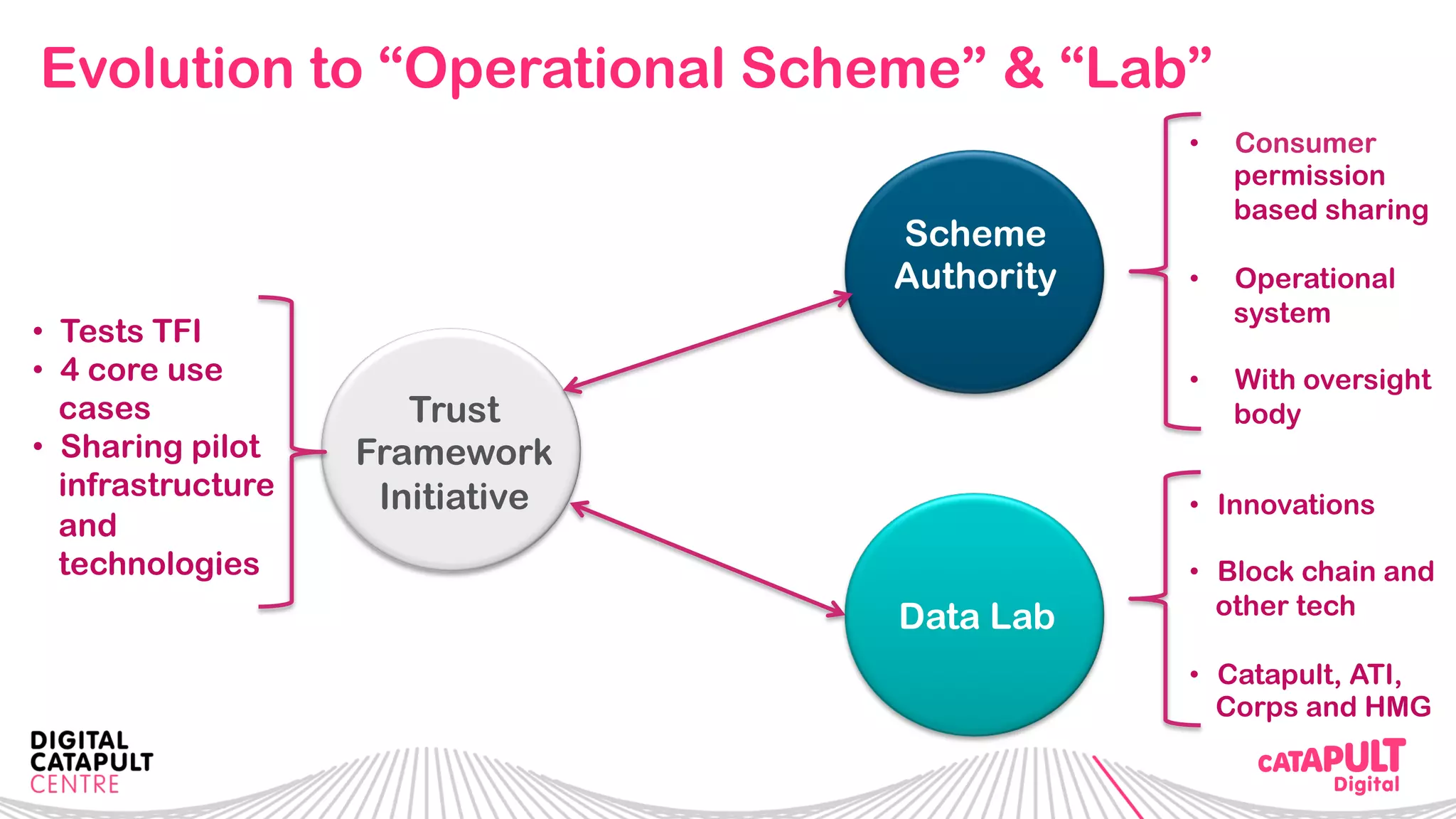
Evolution to “Operational Scheme” & “Lab”
Scheme
Authority
Data Lab
Trust
Framework
Initiative
•  Tests TFI
•  4 core use
cases
•  Sharing pilot
infrastructure
and
technologies
•  Consumer
permission
based sharing
•  Operational
system
•  With oversight
body
•  Innovations
•  Block chain and
other tech
•  Catapult, ATI,
Corps and HMG
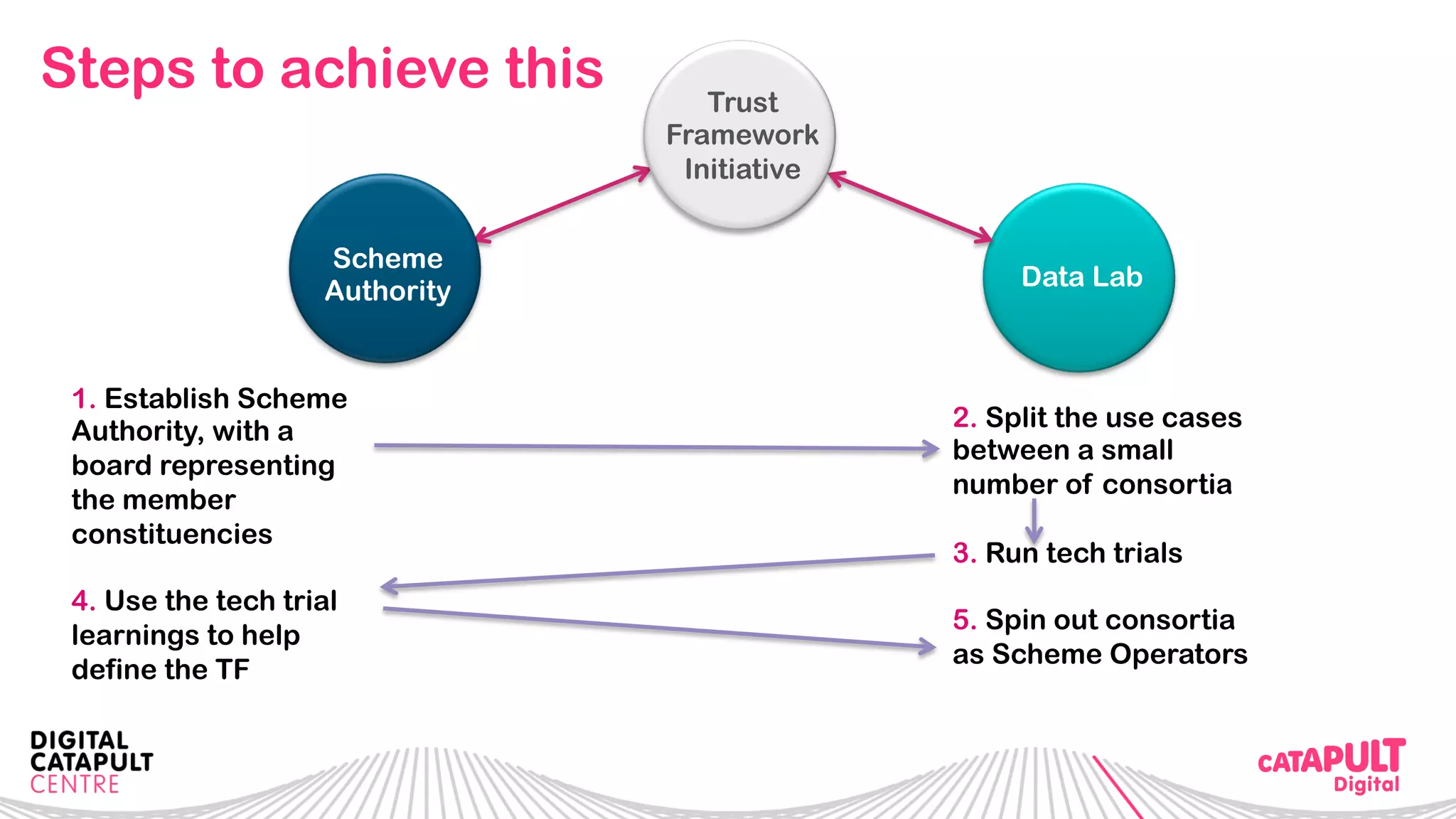
Steps to achieve this
Data Lab
Scheme
Authority
Trust
Framework
Initiative
1. Establish Scheme
Authority, with a
board representing
the member
constituencies
4. Use the tech trial
learnings to help
define the TF
2. Split the use cases
between a small
number of consortia
3. Run tech trials
5. Spin out consortia
as Scheme Operators
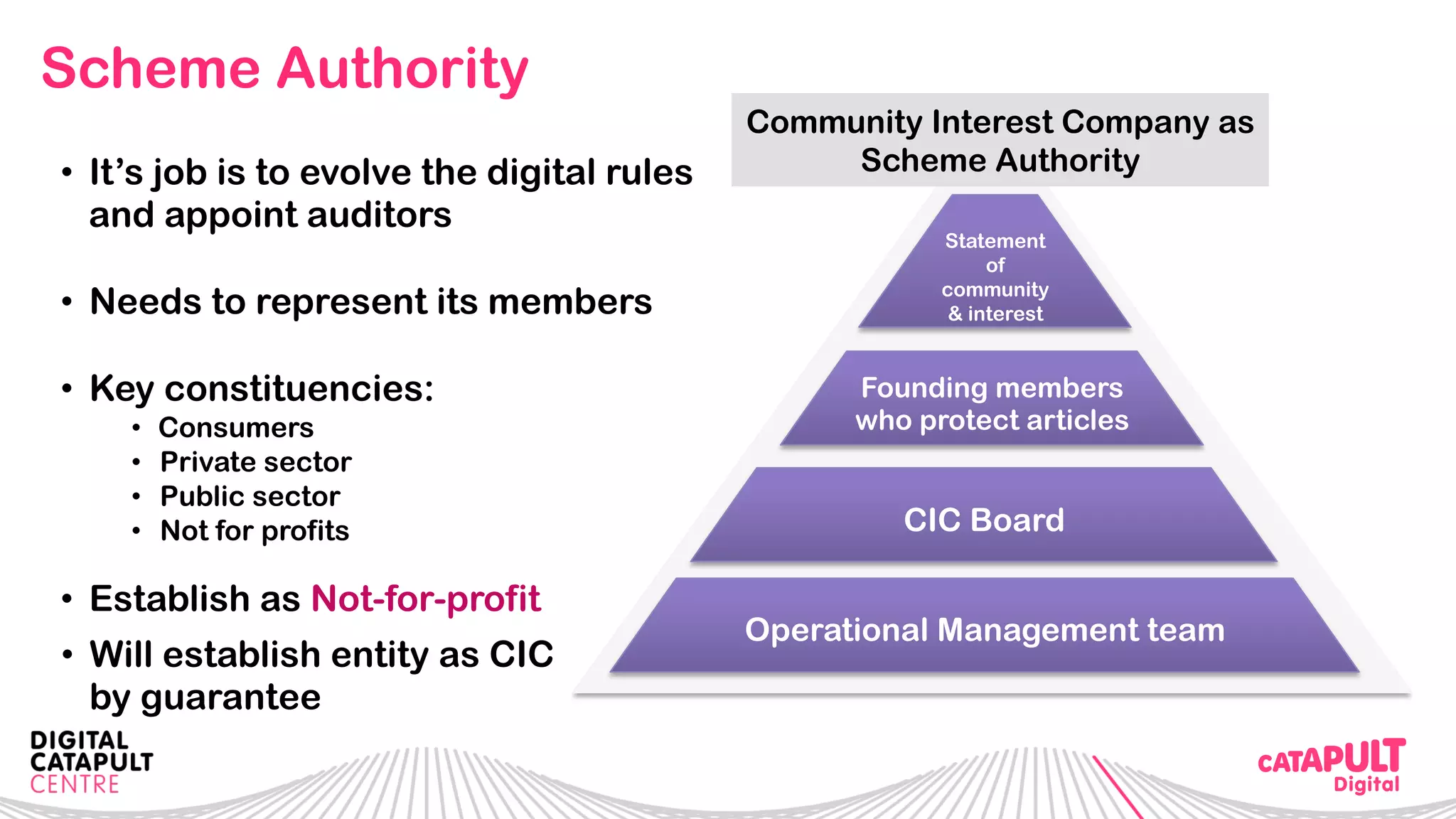
Scheme Authority
 
Operational Management team
Founding members
who protect articles
Statement
of
community
& interest
CIC Board
Community Interest Company as
Scheme Authority•  It’s job is to evolve the digital rules
and appoint auditors
•  Needs to represent its members
•  Key constituencies:
•  Consumers
•  Private sector
•  Public sector
•  Not for profits
•  Establish as Not-for-profit
•  Will establish entity as CIC
by guarantee
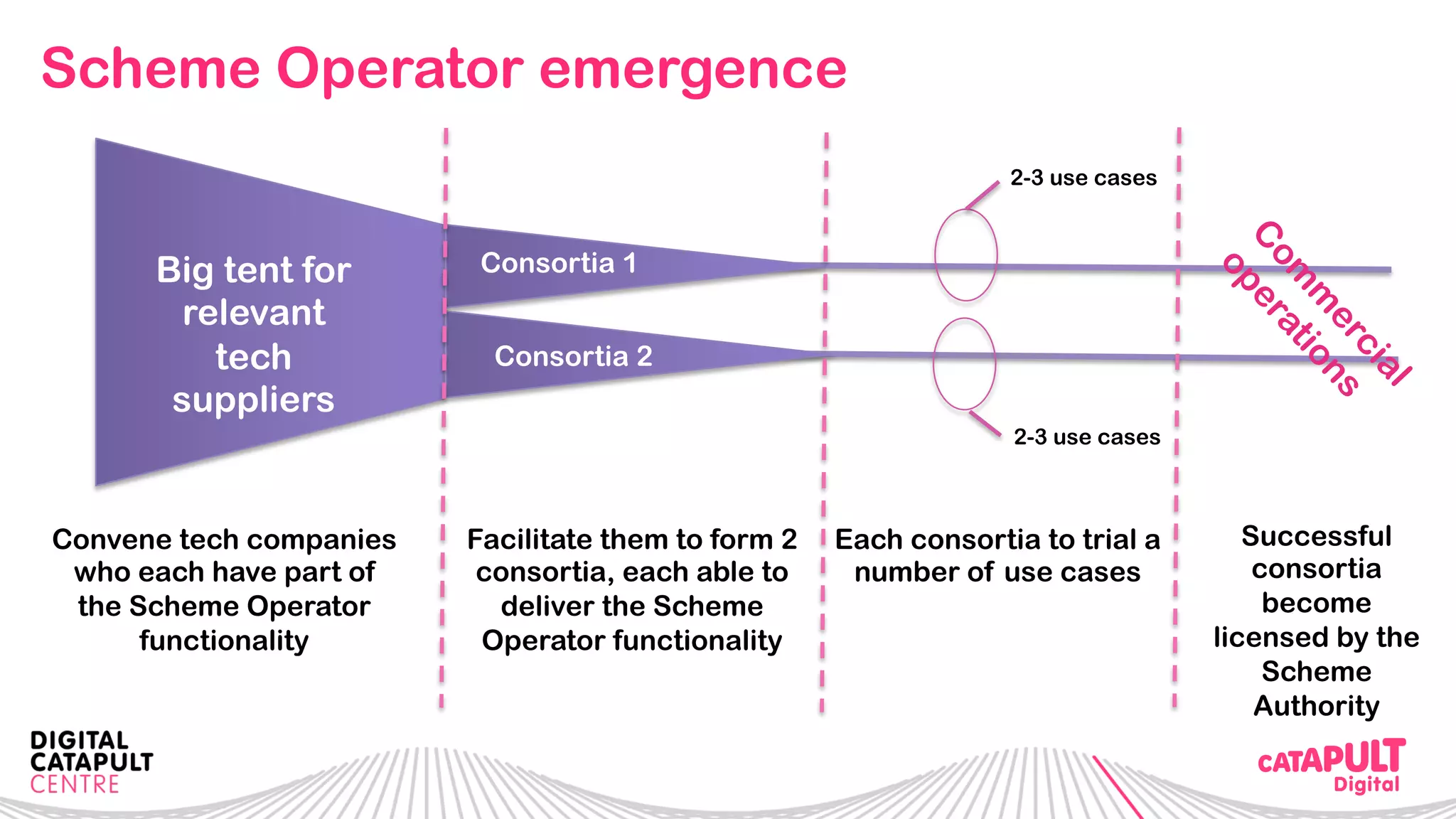
Scheme Operator emergence
Big tent for
relevant
tech
suppliers
Consortia 1
Consortia 2
2-3 use cases
2-3 use cases
Facilitate them to form 2
consortia, each able to
deliver the Scheme
Operator functionality
Convene tech companies
who each have part of
the Scheme Operator
functionality
Each consortia to trial a
number of use cases
Successful
consortia
become
licensed by the
Scheme
Authority
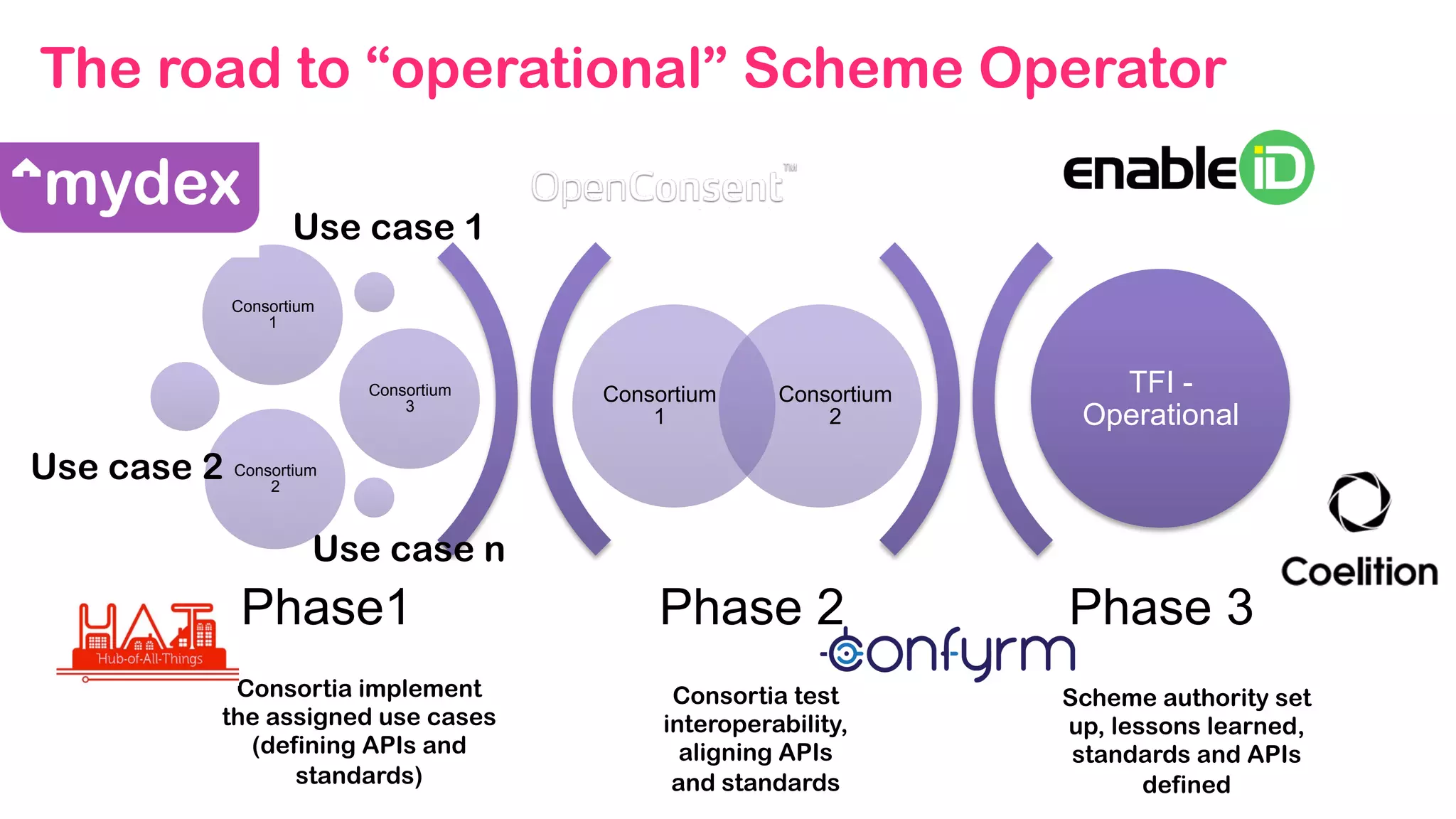
The road to “operational” Scheme Operator
Phase 2 Phase 3
Consortium
1
Consortium
2
Consortium
1
Consortium
3
Consortium
2
TFI -
Operational
Phase1
Use case 1
Use case 2
Use case n
Consortia implement
the assigned use cases
(defining APIs and
standards)
Consortia test
interoperability,
aligning APIs
and standards
Scheme authority set
up, lessons learned,
standards and APIs
defined
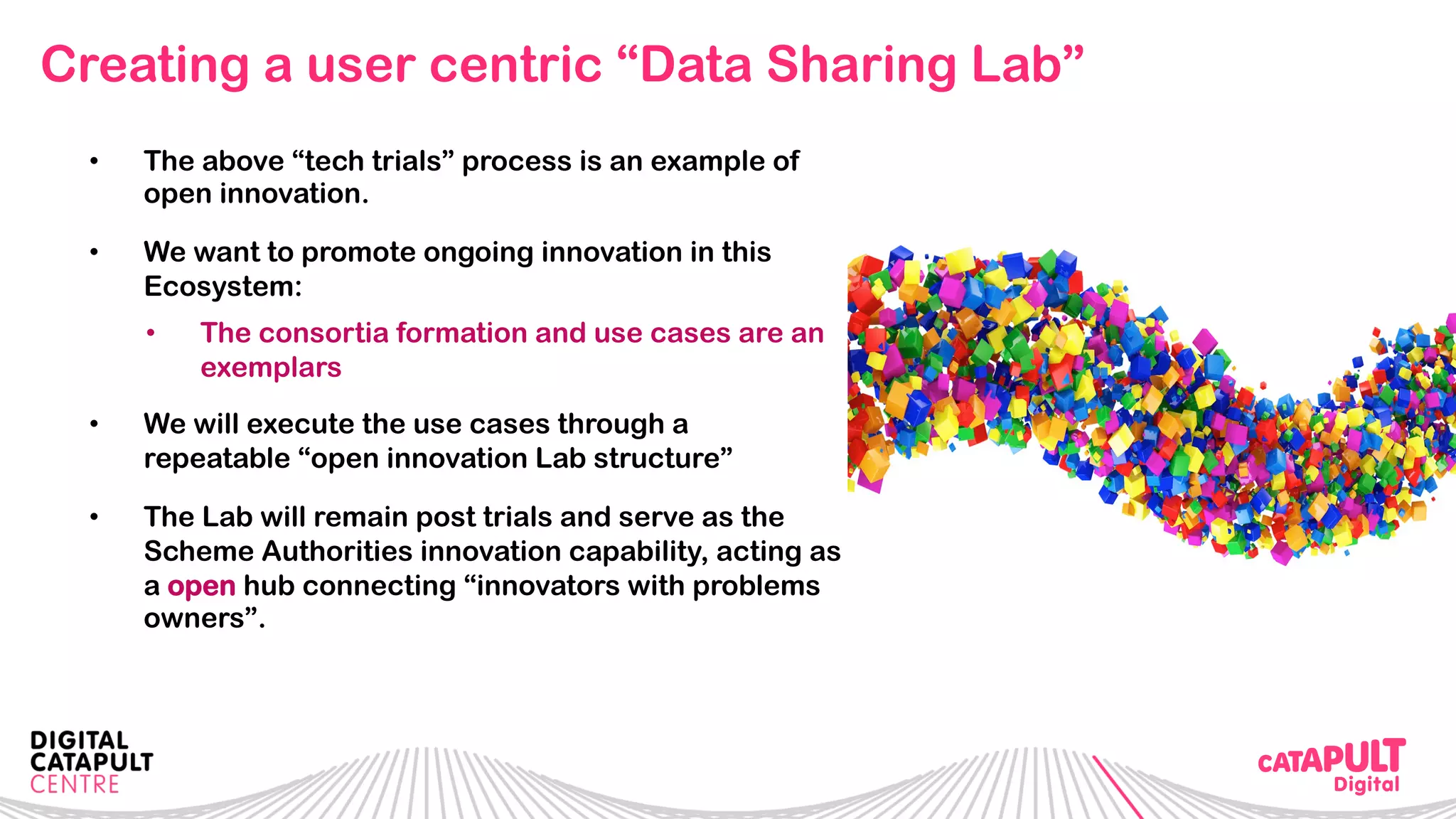
Creating a user centric “Data Sharing Lab”
•  The above “tech trials” process is an example of
open innovation.
•  We want to promote ongoing innovation in this
Ecosystem:
•  The consortia formation and use cases are an
exemplars
•  We will execute the use cases through a
repeatable “open innovation Lab structure”
•  The Lab will remain post trials and serve as the
Scheme Authorities innovation capability, acting as
a open hub connecting “innovators with problems
owners”.
The Scheme Authority will work with the Catapult to start the Lab
with with a number of founding partners
The Catapult brings……
•  It’s a neutral entity, not-for-profit, spans private and public sectors
•  Unique network of thousands of UK SME and academic innovators (inc PDTN)
•  Unique partnership with Alan Turing institute for data (& block chain) research
•  Unique national centre and network of local centers
•  Home of IoTUK, huge cross-over with personal/closed data sharing
•  Convenes a x-Gov data sharing round table
•  Strong links to the TISA and OBWG projects
•  Is an member of and are developing an engagement model with the OIX
The Catapult was founded by the HMG to promote innovation with closed data to
facilitate growth in the UK digital economy
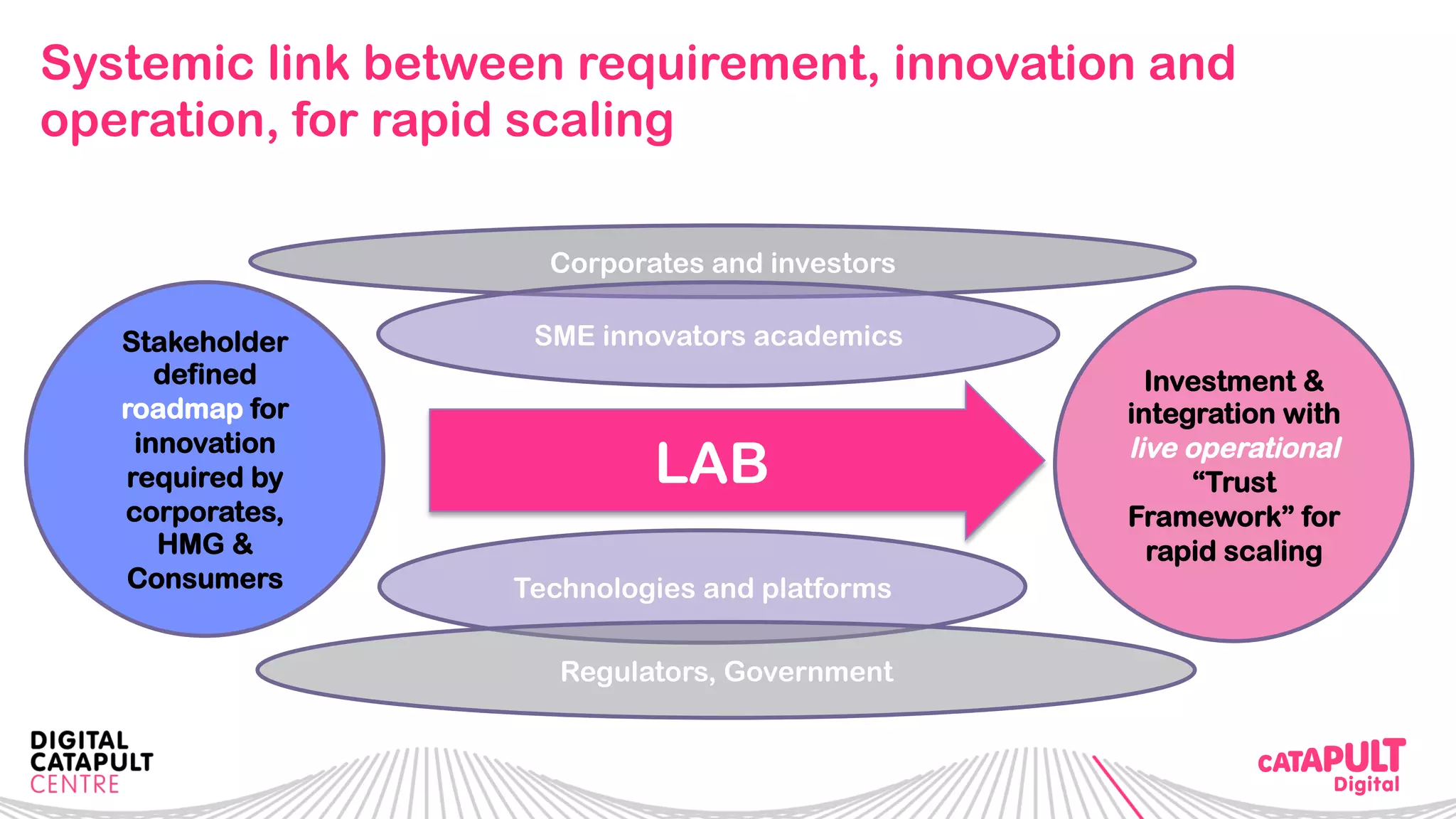
Systemic link between requirement, innovation and
operation, for rapid scaling
Corporates and investors
Stakeholder
defined
roadmap for
innovation
required by
corporates,
HMG &
Consumers Technologies and platforms
SME innovators academics
Regulators, Government
LAB
Investment &
integration with
live operational
“Trust
Framework” for
rapid scaling
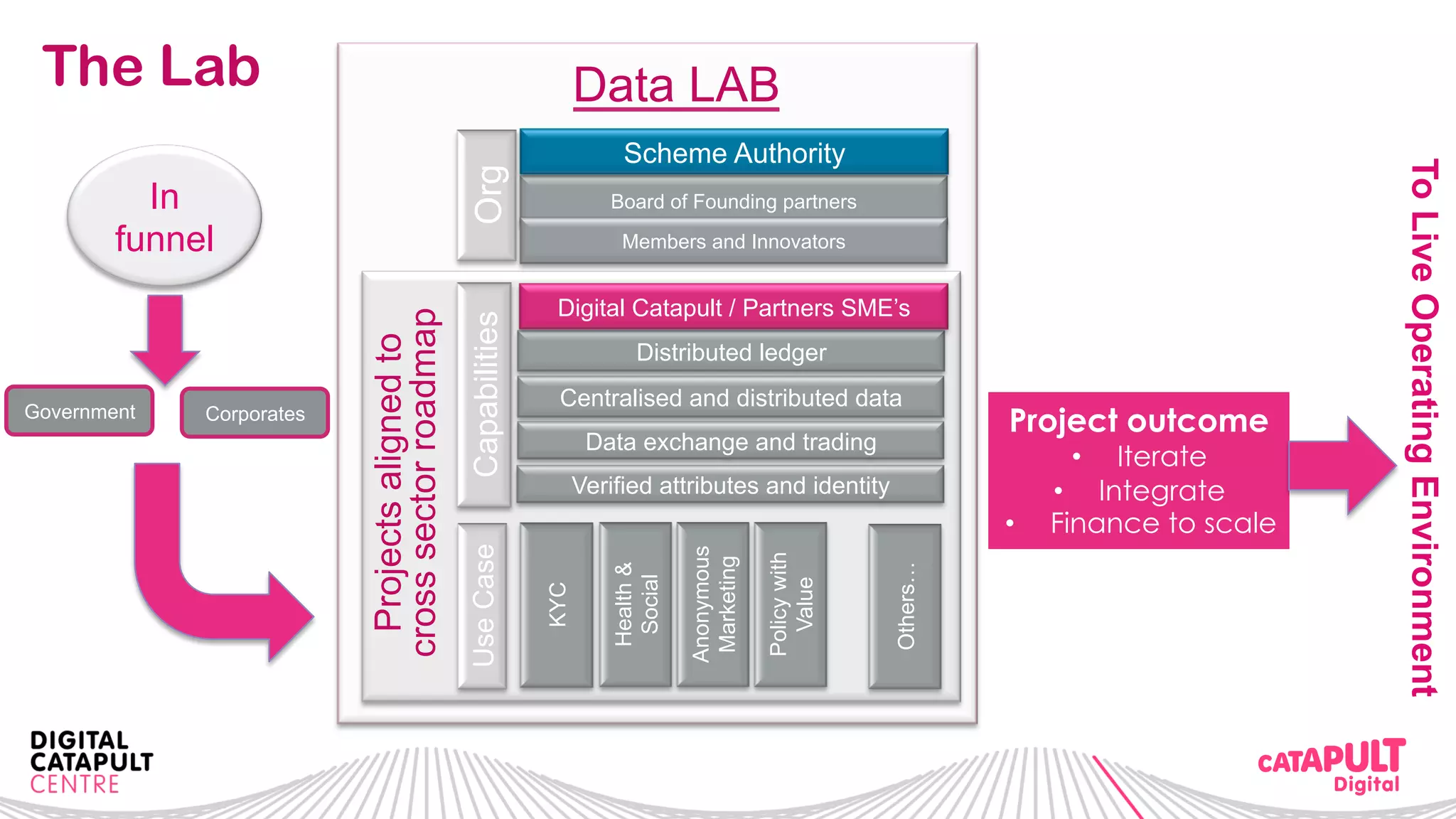
The Lab
Government Corporates
Board of Founding partners
Members and Innovators
Scheme Authority
Project outcome
•  Iterate
•  Integrate
•  Finance to scale
Data LAB
Org
Distributed ledger
Digital Catapult / Partners SME’s
Capabilities
Centralised and distributed data
Data exchange and trading
Verified attributes and identity
KYC
Health&
Social
Anonymous
Marketing
Policywith
Value
Others…
UseCase
Projectsalignedto
crosssectorroadmap
ToLiveOperatingEnvironment
In
funnel
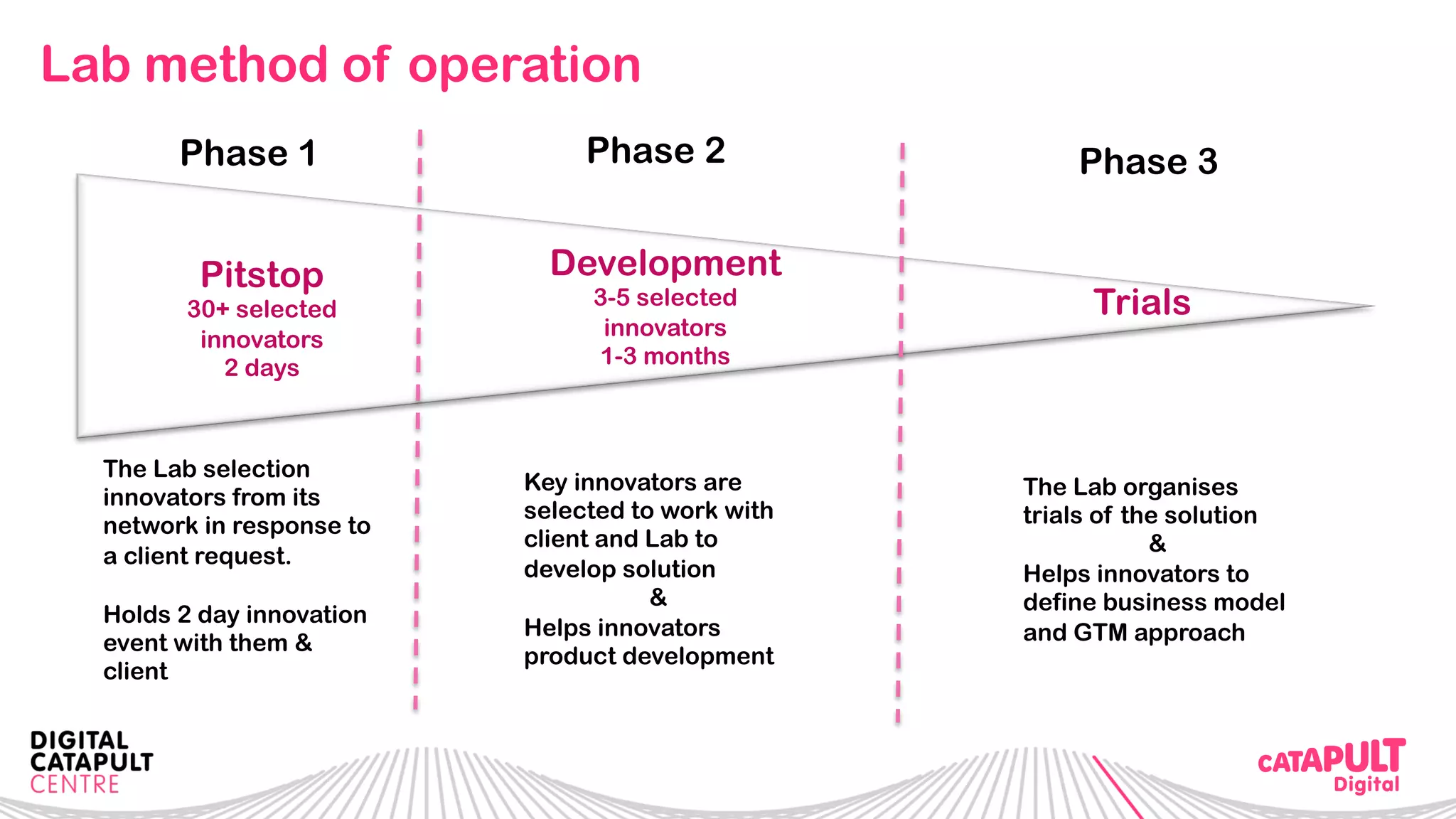
Lab method of operation
Phase 1 Phase 2 Phase 3
Pitstop
30+ selected
innovators
2 days
Development
3-5 selected
innovators
1-3 months
Trials
The Lab selection
innovators from its
network in response to
a client request.
Holds 2 day innovation
event with them &
client
Key innovators are
selected to work with
client and Lab to
develop solution
&
Helps innovators
product development
The Lab organises
trials of the solution
&
Helps innovators to
define business model
and GTM approach
Personal Data and
Trust Network
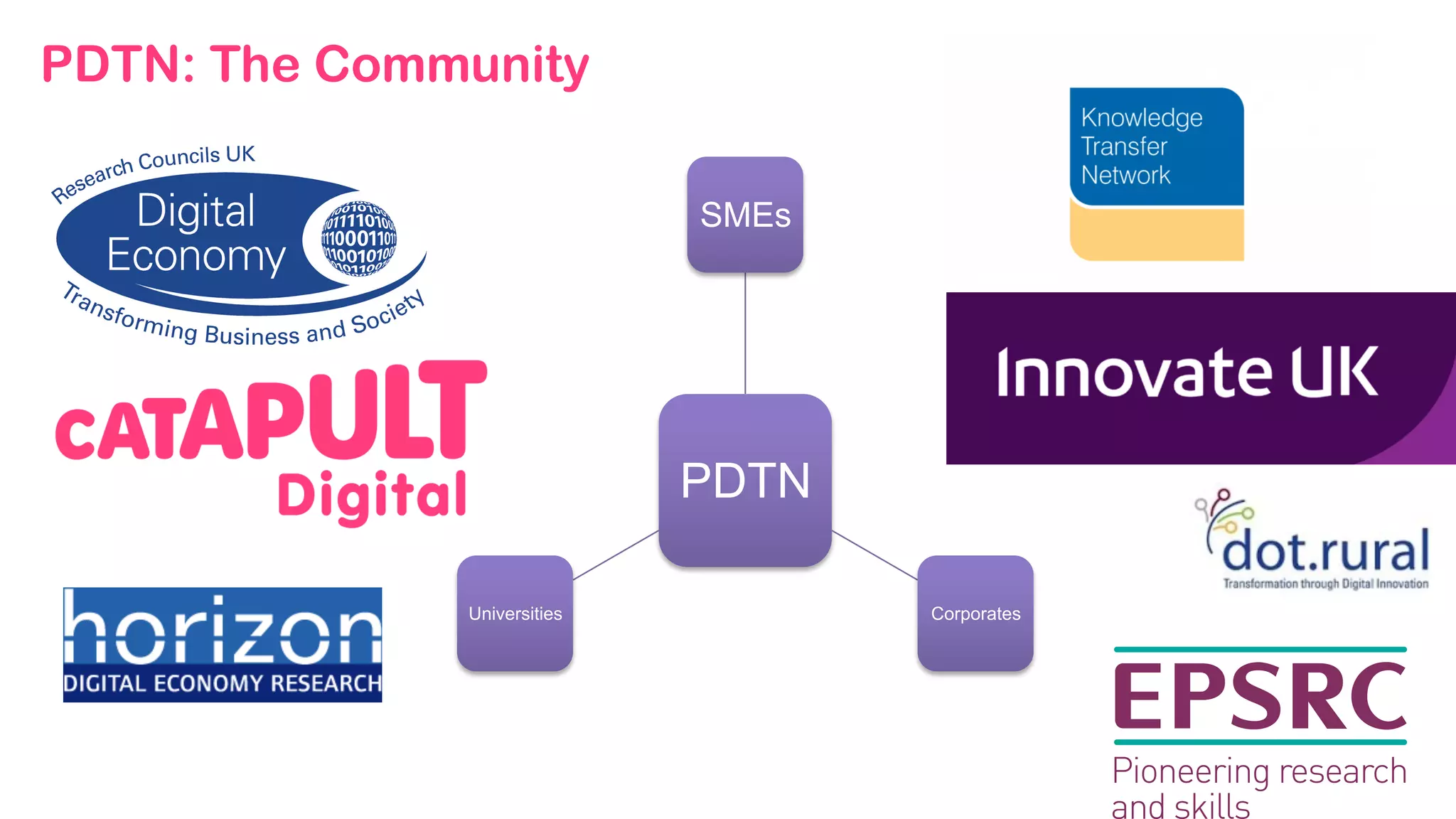
PDTN: The Community
PDTN
SMEs
CorporatesUniversities
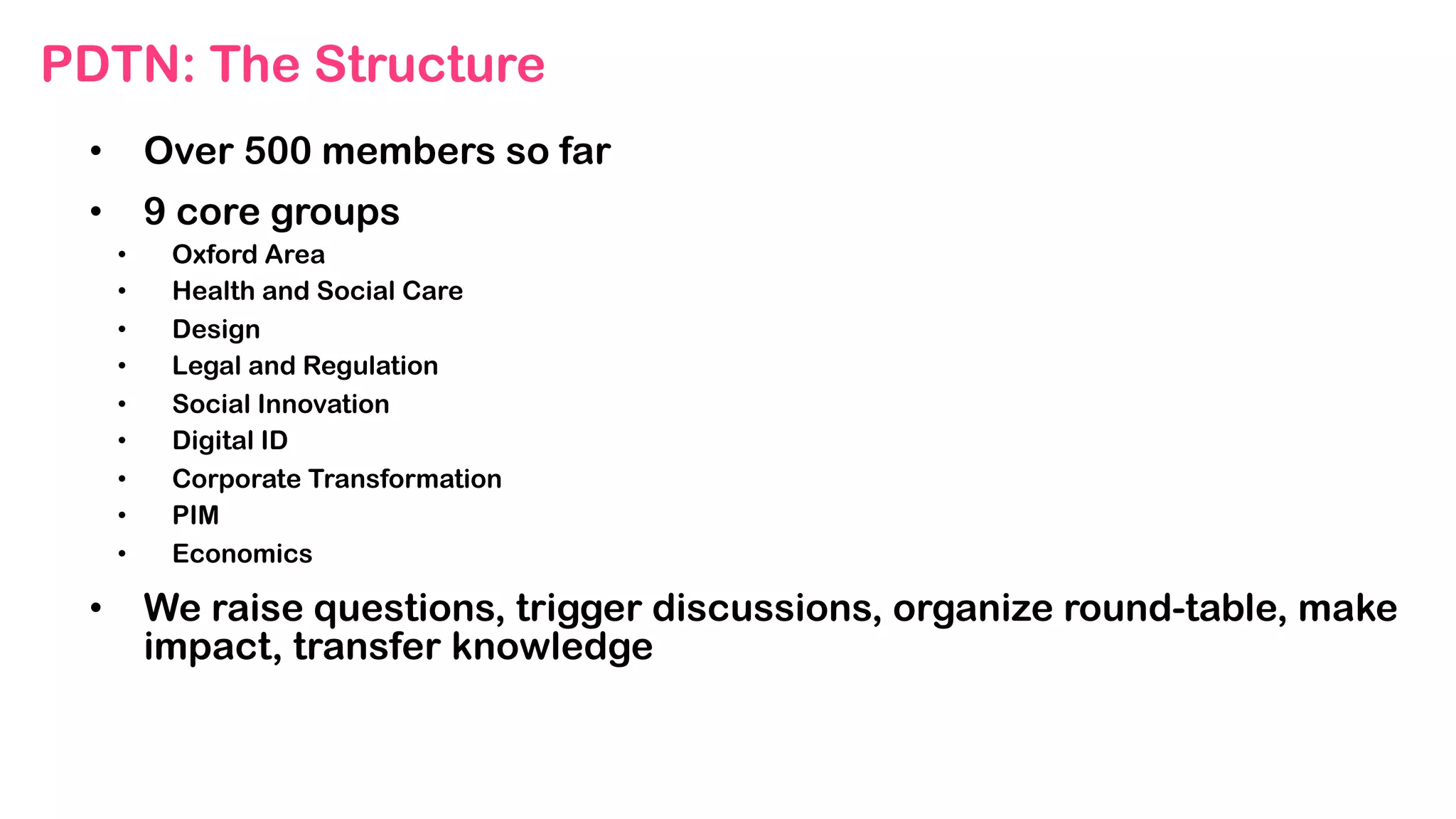
PDTN: The Structure
•  Over 500 members so far
•  9 core groups
•  Oxford Area
•  Health and Social Care
•  Design
•  Legal and Regulation
•  Social Innovation
•  Digital ID
•  Corporate Transformation
•  PIM
•  Economics
•  We raise questions, trigger discussions, organize round-table, make
impact, transfer knowledge
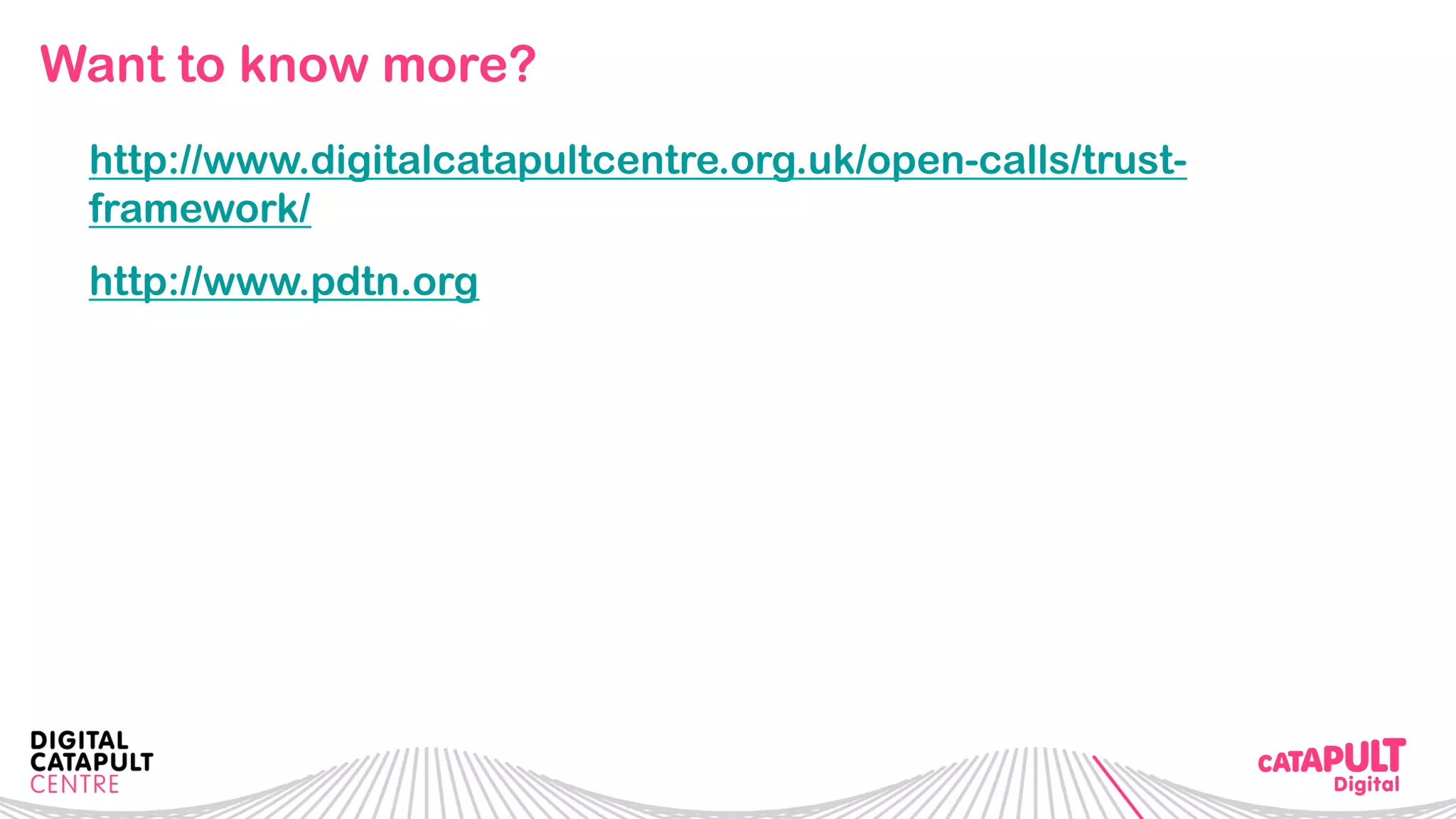
Want to know more?
http://www.digitalcatapultcentre.org.uk/open-calls/trust-
framework/
http://www.pdtn.org
Thank you
Digital Catapult Centre
101 Euston Road
London
NW1 2RA
Twitter: @DigiCatapult
Email: michele.nati@cde.catapult.org.uk
www.digitalcatapultcentre.org.uk

Digital Transformation Business Evolution

  • 1.
    Digital Transformation & OpenInnovation Trust Framework Initiative Michele Nati Privacy and Trust Technical Leader Personal Data and Trust Programme London, 22 October, Digital Transformation Conference
  • 2.
    A national centreto rapidly advance the UK’s best digital ideas Completely neutral Not for profit, private limited company Who are we?
  • 3.
    Some of ourpartners and supporters
  • 4.
    We are NOTa funder, incubator or accelerator! Our aim is to work with these organisations, not duplicate To unlock proprietary data in faster, better and more trusted ways Digital Catapult Mission
  • 5.
    Our focus ison the Data Value Chain How We Do This?
  • 6.
    Data from Internet of Thingsdevices Personal Data Data with ownership rights Closed Organisational Data Where does “our” data come from?
  • 7.
    Pit Stops Hands-on helpwith specific issues around growth and scaling from our network of high-calibre experts Intense experience over two days 10-30 growing companies, deep technical experts, academics and students, larger corporates Co-creation workshops Bring together relevant stakeholders to identify problems, better scope them, design solutions
  • 8.
    The commercial benefitsof a personal data sharing eco-system •  Personal data flows are the nervous system of any consumer facing business, they trigger the muscles to move when acquisition, cross-sell or churn events are identified. •  As data becomes more abundant, this will be ever more critical to how “core businesses” compete in the future •  Being timely and relevant reduces waste and cost, “50% of my marketing budget is wasted….” etc •  Above all, it enables a better customer experience because organisations can be more responsive to their customers needs
  • 9.
    The opportunity ishorizontal… Vertical = Limited use cases e.g fraud Horizontal = Many use cases For example: • Mobile phone data to alert social care if patient is unexpectedly idle • Shopping data maybe used to inform healthcare advice • Bank data to inform targeting of retail offers e.g “bought broadband 12 months ago…so”
  • 10.
    What individuals thinkabout personal data? •  Consent •  65% are insure if data is shared without their consent •  Responsibility •  30% felt it was their own responsibility to understand personal data issues •  31% see organizations that hold data as responsible for its protection •  Protection •  29% felt they had responsibility to protect their own information •  Understanding •  38% don’t know what ‘personal data’ means, but 96% claim to * http://tinyurl.com/q2n6e2w
  • 11.
    How much consumerstrust organisations? •  Most trusted •  44% of consumers trust the public sector most with their personal data •  Lack of clarity •  30% feel the retail sector is not clear on how use their personal data •  Least trusted •  2% choose telecoms as the most trusted sector •  Nervous sharing •  60% feel uncomfortable sharing personal data •  Loosing control •  76% primary concern: no control over how its shared or who with * http://tinyurl.com/q2n6e2w
  • 12.
    Benefits of personaldata sharing •  Greedy Companies •  79% think organisations use data only for their monetary gain •  Overall financial benefit •  £15bn untapped wealth for UK consumers •  The incentive to share •  30% of consumers believe “to improve services and benefit” is the most important incentive for sharing personal data •  How to incentivise •  43% said the main incentive for sharing personal data is if it was going to be used to improve society * http://tinyurl.com/q2n6e2w
  • 13.
  • 14.
  • 15.
    Breaking down thebarriers Building Trust: Removing Friction: Need to solve three sources of friction: Technical: How to define and physically transfer the data Legal: How to establish the users identity and assert permission within each siloed system Commercial: How to agree the price of access/transfer Need to empower the customer: Ethics: Recognise & respect the consumer’s wishes Control: Give tools/dashboards to enable real control Compliance: Verify orgs are sticking to the rules Communication: Kitemark for those in the ethical sharing club
  • 16.
    Data Sharing &Trust Frameworks Scheme Operator Customer’s digital agent The reliant party The Attribute provider The Scheme (rules) Auditors
  • 17.
    Use case pilots Valuewith Policy •  Validated attributes in personal store •  Automate DWP benefit calculation •  Benefit issued as GovCoin •  Expenditure aligned to policy Anonymous marketing •  Enable the individual to create anonymous persona •  Use persona to target more relevant services to individual Health and social care •  Inefficient due to lack of co- ordination between agencies •  Additional complexity of personal care budgets •  All agencies give data to patient •  Patient controls sharing Portable KYC •  Portable digital ID (Verify/bank KYC) •  To be used at any bank for opening and transferring accounts •  Future applicability to other sectors, taking out mobile phone contract etc
  • 18.
  • 19.
    Evolution to “OperationalScheme” & “Lab” Scheme Authority Data Lab Trust Framework Initiative •  Tests TFI •  4 core use cases •  Sharing pilot infrastructure and technologies •  Consumer permission based sharing •  Operational system •  With oversight body •  Innovations •  Block chain and other tech •  Catapult, ATI, Corps and HMG
  • 20.
    Steps to achievethis Data Lab Scheme Authority Trust Framework Initiative 1. Establish Scheme Authority, with a board representing the member constituencies 4. Use the tech trial learnings to help define the TF 2. Split the use cases between a small number of consortia 3. Run tech trials 5. Spin out consortia as Scheme Operators
  • 21.
    Scheme Authority   Operational Managementteam Founding members who protect articles Statement of community & interest CIC Board Community Interest Company as Scheme Authority•  It’s job is to evolve the digital rules and appoint auditors •  Needs to represent its members •  Key constituencies: •  Consumers •  Private sector •  Public sector •  Not for profits •  Establish as Not-for-profit •  Will establish entity as CIC by guarantee
  • 22.
    Scheme Operator emergence Bigtent for relevant tech suppliers Consortia 1 Consortia 2 2-3 use cases 2-3 use cases Facilitate them to form 2 consortia, each able to deliver the Scheme Operator functionality Convene tech companies who each have part of the Scheme Operator functionality Each consortia to trial a number of use cases Successful consortia become licensed by the Scheme Authority
  • 23.
    The road to“operational” Scheme Operator Phase 2 Phase 3 Consortium 1 Consortium 2 Consortium 1 Consortium 3 Consortium 2 TFI - Operational Phase1 Use case 1 Use case 2 Use case n Consortia implement the assigned use cases (defining APIs and standards) Consortia test interoperability, aligning APIs and standards Scheme authority set up, lessons learned, standards and APIs defined
  • 24.
    Creating a usercentric “Data Sharing Lab” •  The above “tech trials” process is an example of open innovation. •  We want to promote ongoing innovation in this Ecosystem: •  The consortia formation and use cases are an exemplars •  We will execute the use cases through a repeatable “open innovation Lab structure” •  The Lab will remain post trials and serve as the Scheme Authorities innovation capability, acting as a open hub connecting “innovators with problems owners”.
  • 25.
    The Scheme Authoritywill work with the Catapult to start the Lab with with a number of founding partners The Catapult brings…… •  It’s a neutral entity, not-for-profit, spans private and public sectors •  Unique network of thousands of UK SME and academic innovators (inc PDTN) •  Unique partnership with Alan Turing institute for data (& block chain) research •  Unique national centre and network of local centers •  Home of IoTUK, huge cross-over with personal/closed data sharing •  Convenes a x-Gov data sharing round table •  Strong links to the TISA and OBWG projects •  Is an member of and are developing an engagement model with the OIX The Catapult was founded by the HMG to promote innovation with closed data to facilitate growth in the UK digital economy
  • 26.
    Systemic link betweenrequirement, innovation and operation, for rapid scaling Corporates and investors Stakeholder defined roadmap for innovation required by corporates, HMG & Consumers Technologies and platforms SME innovators academics Regulators, Government LAB Investment & integration with live operational “Trust Framework” for rapid scaling
  • 27.
    The Lab Government Corporates Boardof Founding partners Members and Innovators Scheme Authority Project outcome •  Iterate •  Integrate •  Finance to scale Data LAB Org Distributed ledger Digital Catapult / Partners SME’s Capabilities Centralised and distributed data Data exchange and trading Verified attributes and identity KYC Health& Social Anonymous Marketing Policywith Value Others… UseCase Projectsalignedto crosssectorroadmap ToLiveOperatingEnvironment In funnel
  • 28.
    Lab method ofoperation Phase 1 Phase 2 Phase 3 Pitstop 30+ selected innovators 2 days Development 3-5 selected innovators 1-3 months Trials The Lab selection innovators from its network in response to a client request. Holds 2 day innovation event with them & client Key innovators are selected to work with client and Lab to develop solution & Helps innovators product development The Lab organises trials of the solution & Helps innovators to define business model and GTM approach
  • 29.
  • 30.
  • 31.
    PDTN: The Structure • Over 500 members so far •  9 core groups •  Oxford Area •  Health and Social Care •  Design •  Legal and Regulation •  Social Innovation •  Digital ID •  Corporate Transformation •  PIM •  Economics •  We raise questions, trigger discussions, organize round-table, make impact, transfer knowledge
  • 32.
    Want to knowmore? http://www.digitalcatapultcentre.org.uk/open-calls/trust- framework/ http://www.pdtn.org
  • 33.
    Thank you Digital CatapultCentre 101 Euston Road London NW1 2RA Twitter: @DigiCatapult Email: michele.nati@cde.catapult.org.uk www.digitalcatapultcentre.org.uk