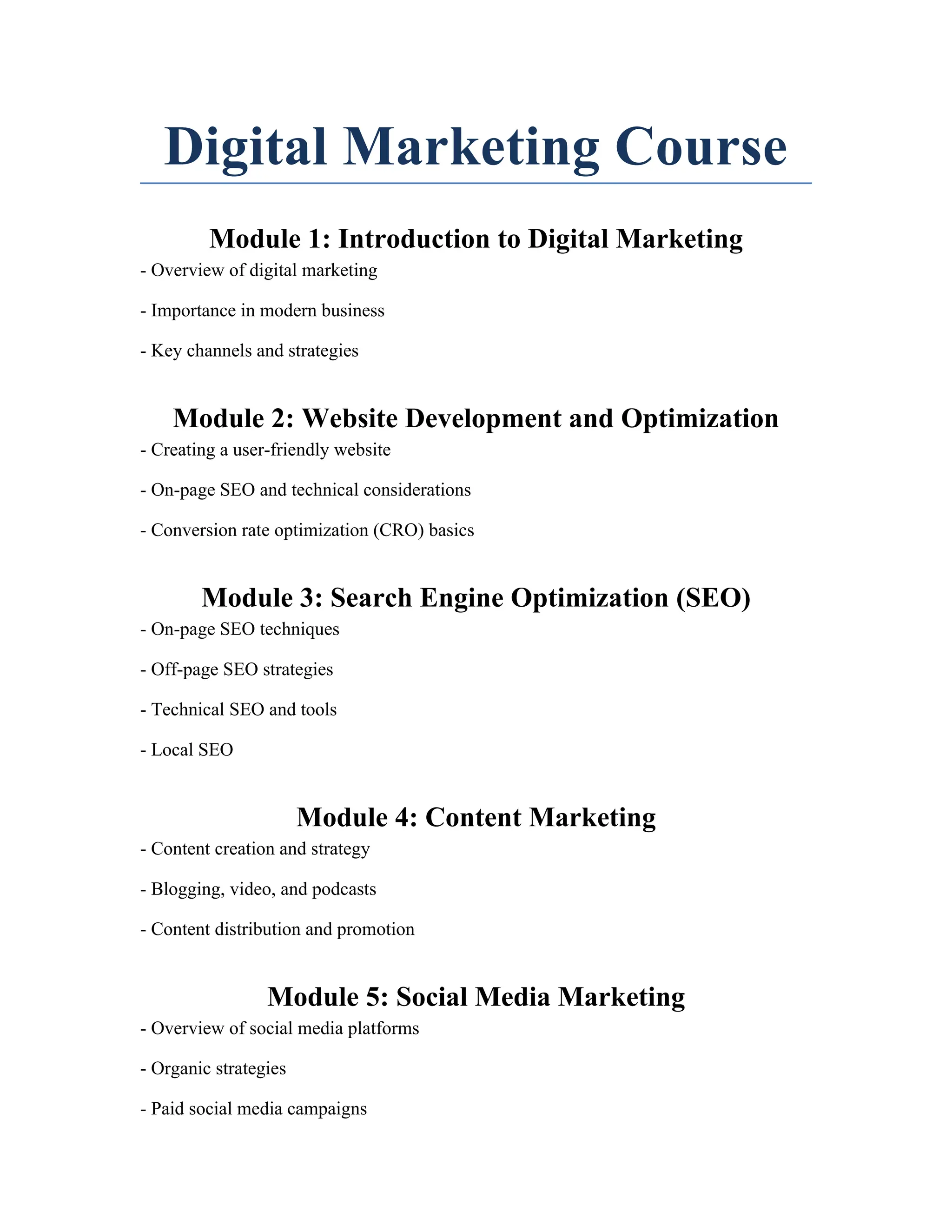
Digital Marketing Course
Module 1: Introduction to Digital Marketing
- Overview of digital marketing
- Importance in modern business
- Key channels and strategies
Module 2: Website Development and Optimization
- Creating a user-friendly website
- On-page SEO and technical considerations
- Conversion rate optimization (CRO) basics
Module 3: Search Engine Optimization (SEO)
- On-page SEO techniques
- Off-page SEO strategies
- Technical SEO and tools
- Local SEO
Module 4: Content Marketing
- Content creation and strategy
- Blogging, video, and podcasts
- Content distribution and promotion
Module 5: Social Media Marketing
- Overview of social media platforms
- Organic strategies
- Paid social media campaigns
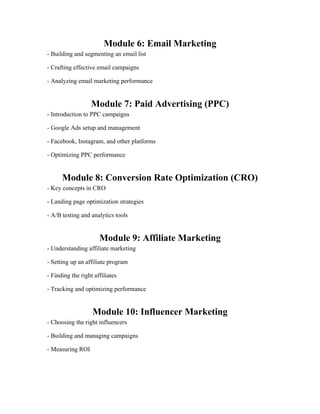
Module 6: Email Marketing
- Building and segmenting an email list
- Crafting effective email campaigns
- Analyzing email marketing performance
Module 7: Paid Advertising (PPC)
- Introduction to PPC campaigns
- Google Ads setup and management
- Facebook, Instagram, and other platforms
- Optimizing PPC performance
Module 8: Conversion Rate Optimization (CRO)
- Key concepts in CRO
- Landing page optimization strategies
- A/B testing and analytics tools
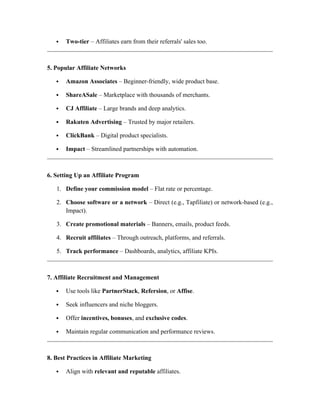
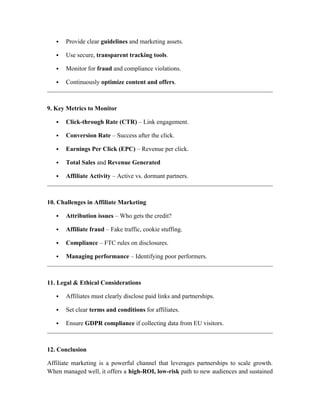
Module 9: Affiliate Marketing
- Understanding affiliate marketing
- Setting up an affiliate program
- Finding the right affiliates
- Tracking and optimizing performance
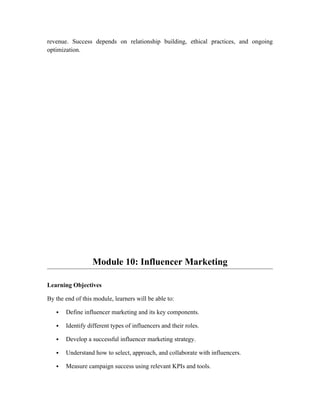
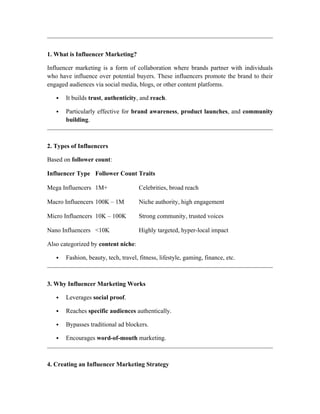
Module 10: Influencer Marketing
- Choosing the right influencers
- Building and managing campaigns
- Measuring ROI
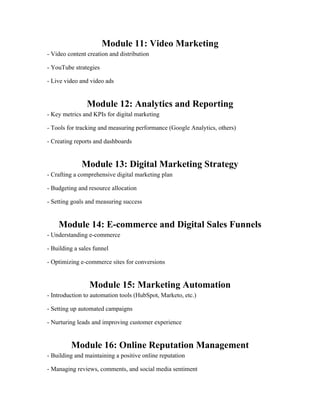
Module 11: Video Marketing
- Video content creation and distribution
- YouTube strategies
- Live video and video ads
Module 12: Analytics and Reporting
- Key metrics and KPIs for digital marketing
- Tools for tracking and measuring performance (Google Analytics, others)
- Creating reports and dashboards
Module 13: Digital Marketing Strategy
- Crafting a comprehensive digital marketing plan
- Budgeting and resource allocation
- Setting goals and measuring success
Module 14: E-commerce and Digital Sales Funnels
- Understanding e-commerce
- Building a sales funnel
- Optimizing e-commerce sites for conversions
Module 15: Marketing Automation
- Introduction to automation tools (HubSpot, Marketo, etc.)
- Setting up automated campaigns
- Nurturing leads and improving customer experience
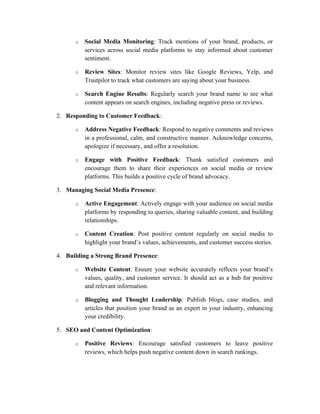
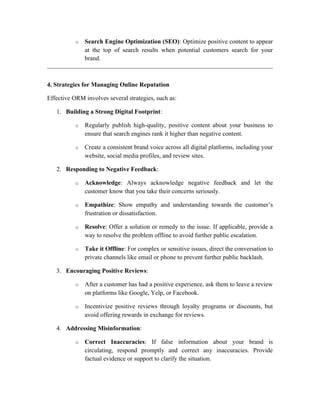
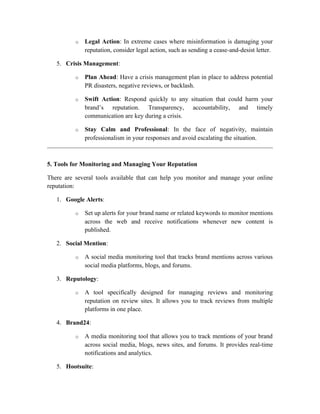
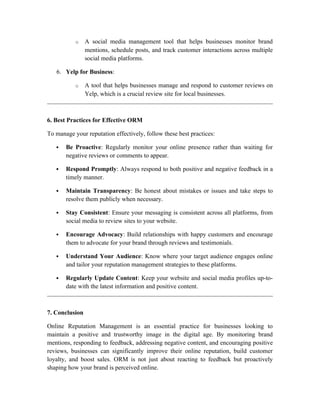
Module 16: Online Reputation Management
- Building and maintaining a positive online reputation
- Managing reviews, comments, and social media sentiment
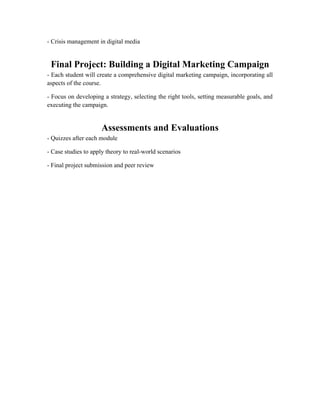
- Crisis management in digital media
Final Project: Building a Digital Marketing Campaign
- Each student will create a comprehensive digital marketing campaign, incorporating all
aspects of the course.
- Focus on developing a strategy, selecting the right tools, setting measurable goals, and
executing the campaign.
Assessments and Evaluations
- Quizzes after each module
- Case studies to apply theory to real-world scenarios
- Final project submission and peer review
Module 1: Introduction to Digital Marketing
What is Digital Marketing?
Digital marketing refers to the use of digital channels, platforms, and technologies to
promote and sell products or services. It involves a variety of online activities, including
search engine optimization (SEO), social media marketing, content marketing, email
marketing, pay-per-click (PPC) advertising, and more. The goal of digital marketing is to
connect with potential customers where they are spending the most time — online — and
drive engagement that leads to conversions.
In contrast to traditional marketing methods, which often involve print ads, TV
commercials, and radio spots, digital marketing allows businesses to reach a global
audience through the internet. This creates new opportunities for brands to engage with
consumers, build relationships, and provide personalized experiences at a scale never
before possible.
The Evolution of Digital Marketing
The rise of the internet and digital technologies has fundamentally changed the way
people communicate and consume information. The early days of digital marketing were
simple and largely focused on email marketing and banner ads. However, as technology
advanced, so did the strategies used in digital marketing.
The Early Days
In the late 1990s and early 2000s, digital marketing was mostly about basic websites and
email newsletters. Websites were static, often with just text and images, and there were
few ways to measure the effectiveness of digital efforts. Search engines like Yahoo! and
the early version of Google began to play a key role in connecting users with relevant
content, setting the stage for search engine marketing.
The Growth of Social Media
In the mid-2000s, social media platforms such as Facebook, Twitter, and LinkedIn began
to emerge. These platforms allowed brands to connect with consumers in new ways,
using organic content and paid advertisements to target users based on their interests,
demographics, and behaviors. Social media marketing became a vital tool in digital
marketing, allowing for more targeted outreach.
The Mobile Revolution
With the advent of smartphones and mobile apps, digital marketing entered a new phase.
Mobile devices have transformed how people access information, communicate, and
shop. Marketers needed to adapt their strategies to ensure their content was mobile-
friendly and optimized for smaller screens. Mobile advertising, including in-app ads,
became a major driver of digital marketing spend.
Artificial Intelligence and Automation
In recent years, digital marketing has become more data-driven, with the use of artificial
intelligence (AI) and automation tools enabling marketers to create personalized
experiences for their audiences. AI-driven chatbots, recommendation algorithms, and
machine learning are helping marketers predict consumer behavior, optimize content
delivery, and automate repetitive tasks.
Key Components of Digital Marketing
Digital marketing is an umbrella term that encompasses various techniques and strategies.
Below are some of the most commonly used components of digital marketing:
1. Search Engine Optimization (SEO)
SEO is the practice of optimizing a website or webpage to improve its ranking in search
engine results. The better a page ranks, the more visible it becomes to users, driving more
organic traffic. SEO involves on-page optimization (like content, structure, and meta
tags) and off-page optimization (like backlinks and social signals). Technical SEO, such
as improving website speed and mobile responsiveness, is also an important factor.
2. Social Media Marketing
Social media marketing involves using platforms like Facebook, Instagram, Twitter, and
LinkedIn to build brand awareness, engage with customers, and drive traffic to websites.
Social media strategies may include posting organic content, running paid
advertisements, and utilizing influencer marketing. Paid ads on social media platforms
are especially effective for hyper-targeting specific audience segments based on
demographics, interests, and behavior.
3. Content Marketing
Content marketing is about creating valuable, relevant, and consistent content to attract
and engage a target audience. It includes blog posts, videos, infographics, case studies,
and podcasts. Content marketing focuses on providing useful information that solves
problems, educates, or entertains potential customers. The ultimate goal is to build trust
and authority, which in turn drives conversions.
4. Pay-Per-Click Advertising (PPC)
PPC is an online advertising model where advertisers pay each time a user clicks on one
of their ads. The most common platform for PPC advertising is Google Ads, where
businesses bid on keywords relevant to their products or services. Advertisers can also
use platforms like Facebook Ads, Instagram Ads, and LinkedIn Ads. PPC campaigns can
be highly targeted, allowing marketers to reach specific audiences based on factors like
location, interests, and behaviors.
5. Email Marketing
Email marketing is one of the oldest forms of digital marketing, yet it remains incredibly
effective. It involves sending targeted messages to a list of subscribers to inform them
about promotions, product updates, and company news. Email marketing allows
businesses to nurture relationships with leads, encourage repeat purchases, and enhance
customer loyalty. Email automation tools like Mailchimp and HubSpot enable marketers
to set up automated email campaigns that are triggered by specific customer actions.
6. Affiliate Marketing
Affiliate marketing is a performance-based marketing strategy where businesses reward
affiliates (partners) for driving traffic or sales to their websites. Affiliates promote
products or services using unique referral links, and when a customer makes a purchase
through the link, the affiliate earns a commission. Affiliate marketing can be an effective
way to extend a brand’s reach without significant upfront costs.
7. Influencer Marketing
Influencer marketing leverages the influence of individuals who have large followings on
social media platforms. Brands partner with influencers to promote products or services
to their followers. Influencers can range from celebrities to micro-influencers with
smaller but highly engaged audiences. Influencer marketing can be especially effective
for brands looking to reach younger audiences.
8. Digital Public Relations (PR)
Digital PR focuses on managing a brand's online presence, reputation, and relationships
with media outlets. It involves outreach to online journalists, bloggers, and influencers, as
well as building relationships with websites that can drive traffic through backlinks.
Digital PR efforts can help improve SEO rankings, increase brand credibility, and
generate positive media coverage.
Why Digital Marketing is Essential
Digital marketing offers numerous advantages over traditional marketing methods. Here
are some of the key reasons why digital marketing is essential for modern businesses:
1. Reach a Global Audience
Digital marketing breaks down geographical barriers, allowing businesses to reach
potential customers worldwide. Whether you're running a small local business or a large
multinational corporation, the internet offers an unprecedented opportunity to reach a vast
audience.
2. Cost-Effective
Compared to traditional marketing methods like TV ads, print ads, and billboards, digital
marketing is more affordable. For example, social media ads and Google Ads can be
highly targeted and cost-efficient. Even businesses with limited budgets can run
successful digital marketing campaigns.
3. Measurable Results
One of the key benefits of digital marketing is the ability to measure and analyze results
in real-time. Tools like Google Analytics allow marketers to track website traffic, user
behavior, and conversion rates. This data enables businesses to make data-driven
decisions and optimize their campaigns for better performance.
4. Personalization
Digital marketing allows businesses to personalize their messaging based on customer
preferences and behaviors. For example, email marketing campaigns can be tailored to
individual customers based on their previous interactions with the brand. Personalization
leads to a more relevant and engaging customer experience, which increases the
likelihood of conversions.
5. Real-Time Engagement
Digital marketing enables businesses to engage with customers in real-time. Social media
platforms, email, and live chat provide immediate communication channels that allow
businesses to respond quickly to inquiries, feedback, and complaints. This real-time
interaction fosters better customer relationships and improves satisfaction.
Challenges in Digital Marketing
While digital marketing offers numerous benefits, it also comes with challenges that
businesses need to navigate. Some of the common challenges include:
 Keeping Up with Trends: Digital marketing is constantly evolving, with new
platforms, tools, and strategies emerging regularly. Staying updated with the latest
trends and best practices is crucial for success.
 Data Overload: With so much data available, it can be overwhelming for
businesses to make sense of it all. Marketers need to filter through the noise and
focus on the most relevant data to drive decision-making.
 Content Saturation: The digital landscape is crowded with content. To stand out,
businesses must create high-quality, engaging content that provides real value to
their audience.
 Privacy Concerns: As digital marketing relies heavily on data collection, privacy
concerns have become a significant issue. Marketers must ensure they are
complying with data protection laws like GDPR and CCPA.
The Future of Digital Marketing
The future of digital marketing looks exciting, with new technologies and strategies
emerging. Here are some trends to watch:
 Artificial Intelligence (AI): AI will continue to play a significant role in digital
marketing, helping businesses personalize content, automate tasks, and predict
customer behavior.
 Voice Search: With the rise of smart speakers and voice assistants like Alexa and
Google Assistant, voice search optimization will become increasingly important
for SEO.
 Augmented Reality (AR) and Virtual Reality (VR): AR and VR technologies
will offer new ways for businesses to engage with customers through immersive
experiences.
 Chatbots: Chatbots will continue to improve and become more intelligent,
providing customers with instant support and information.
Digital Marketing vs. Traditional Marketing
A significant difference between digital and traditional marketing lies in the methods and
tools used to engage customers. Traditional marketing channels include TV, radio, print
media, billboards, and direct mail. While these strategies have proven effective in
reaching mass audiences, they lack the precision and real-time feedback mechanisms that
digital marketing provides.
Key Differences:
1. Targeting and Reach: Traditional marketing relies on broad strategies to reach
large audiences, often without the ability to segment by specific demographics or
interests. Digital marketing, on the other hand, allows for highly targeted
campaigns based on factors such as age, location, interests, and behaviors. This
enables marketers to craft personalized campaigns that resonate with their
audience on a deeper level.
2. Cost and ROI: Digital marketing is generally more cost-effective compared to
traditional marketing. For instance, running a Facebook ad or Google search ad
can cost significantly less than producing a TV commercial or newspaper ad.
Moreover, digital campaigns offer measurable results, allowing marketers to
optimize in real-time for better ROI. Traditional marketing efforts, while
powerful, are harder to measure accurately in terms of customer engagement and
conversion.
3. Interactivity: Traditional marketing is largely a one-way communication
channel, where businesses push their message to the audience through TV or print
ads. Digital marketing, however, fosters two-way communication, where
customers can respond directly to ads, share feedback, and even participate in
discussions through comments and reviews.
4. Speed and Flexibility: Digital marketing allows for quick execution and
adaptation. Businesses can launch campaigns in hours, adjust targeting
parameters, and monitor performance in real-time. Traditional marketing, in
contrast, is often slower to execute, requiring more time for media buys,
production, and distribution.
Digital Marketing Channels
In the modern digital landscape, various channels can be leveraged to reach and engage
with customers. Here, we explore the major channels and their importance in digital
marketing strategies.
1. Search Engines (SEO and SEM)
Search engines like Google, Bing, and Yahoo! are essential for driving organic and paid
traffic to websites. People use search engines to find answers, products, and services,
making them a central component of digital marketing strategies.
 Search Engine Optimization (SEO): SEO is the practice of optimizing your
website or content to rank higher in search engine results. Higher rankings
increase the visibility of your website and, by extension, the likelihood of users
clicking on your link. The main components of SEO include keyword research,
on-page SEO (meta tags, headlines, content optimization), off-page SEO
(backlinks), and technical SEO (site speed, mobile optimization).
 Search Engine Marketing (SEM): SEM refers to paid advertising through
search engines. Google Ads is the most widely used platform for SEM, allowing
businesses to bid on keywords that they want to target. The benefit of SEM is that
it provides immediate visibility and traffic, as your ad appears at the top of the
search results.
2. Social Media Marketing
Social media marketing involves using social media platforms like Facebook, Instagram,
Twitter, LinkedIn, Pinterest, and TikTok to build brand awareness, foster customer
relationships, and drive traffic.
 Organic Social MediA: Posting regular updates, engaging with followers, and
sharing content that resonates with your audience are all key aspects of organic
social media strategies. Organic social media helps to build a community and
encourage word-of-mouth marketing.
 Paid Social MediA: Social media ads can be highly targeted to specific audiences
based on their demographics, interests, behaviors, and location. Facebook and
Instagram, in particular, offer powerful targeting features that allow businesses to
reach their ideal customers with minimal waste.
 Influencer Marketing: Influencer marketing is a subset of social media
marketing that leverages the reach and credibility of influencers. Influencers are
individuals with a large following on platforms like Instagram, YouTube, and
TikTok. Brands collaborate with influencers to promote their products, driving
awareness and conversions.
3. Content Marketing
Content marketing involves creating and distributing valuable content to attract and
engage a target audience. It can take many forms, such as blog posts, articles, videos,
podcasts, webinars, eBooks, and infographics. The goal of content marketing is not only
to promote products but also to provide valuable information that addresses customer
needs or solves problems.
 Content Creation: Creating high-quality, informative, and engaging content is
the core of a successful content marketing strategy. This could involve writing
blog posts, designing infographics, creating tutorial videos, or producing
podcasts. The key is to provide content that is relevant, engaging, and valuable to
your target audience.
 Content Distribution: Once the content is created, the next step is distribution.
This involves promoting the content through various channels, including social
media, email newsletters, guest blogging, or through influencer partnerships.
Effective content distribution ensures that your content reaches the right people.
 Content Curation: Content curation is the process of gathering and sharing
relevant content created by others. Curated content can supplement your own
content and help to establish your authority in a particular field. It can also build
relationships with other creators in your industry.
4. Email Marketing
Email marketing is one of the most effective ways to nurture leads, communicate with
customers, and promote products or services. Unlike social media, where posts can get
lost in the feed, emails go directly to a subscriber’s inbox, providing a more personal and
direct way to engage with customers.
 Building an Email List: The first step in email marketing is to build an email list
of subscribers who have opted-in to receive updates, offers, or newsletters from
your business. Techniques such as offering downloadable resources (eBooks,
whitepapers), running webinars, or providing discounts can encourage users to
subscribe.
 Email Segmentation: Segmenting your email list helps to deliver more targeted,
relevant content to subscribers. For instance, you might have different lists for
new subscribers, existing customers, and those who have abandoned their
shopping carts. Segmentation allows you to send personalized emails based on
customer behavior and preferences.
 Automation and Personalization: Email marketing automation tools like
Mailchimp, ConvertKit, and HubSpot allow marketers to set up automated email
sequences. These can range from welcome emails to nurturing sequences or
follow-up emails after a customer makes a purchase. Personalization, such as
addressing the recipient by name and recommending products based on past
behavior, helps increase engagement and conversions.
5. Pay-Per-Click Advertising (PPC)
Pay-per-click advertising (PPC) is a model in which businesses pay a fee each time their
ad is clicked. PPC ads are displayed on search engines (Google Ads), social media
platforms (Facebook, Instagram, LinkedIn Ads), and other networks (display ads on
websites).
 Google Ads: Google Ads is the most popular PPC platform, allowing businesses
to display ads on Google’s search engine results page (SERP) or across Google’s
Display Network. Google Ads uses a bidding system where businesses bid on
keywords relevant to their products or services. The ads are displayed based on a
combination of bid amount and ad relevance.
 Facebook and Instagram Ads: Facebook and Instagram offer a robust PPC
advertising platform, allowing businesses to target users based on location,
interests, behaviors, and more. These platforms also offer a variety of ad formats,
including image ads, video ads, carousel ads, and lead-generation forms.
 LinkedIn Ads: LinkedIn offers highly targeted advertising, making it a great
platform for B2B marketing. LinkedIn Ads allow businesses to target users based
on job title, industry, company size, and professional interests.
Case Study: Successful Digital Marketing Campaigns
Let’s take a look at a few case studies of successful digital marketing campaigns to better
understand how businesses have used various strategies to achieve their goals.
Case Study 1: Airbnb’s Social Media Strategy
Airbnb has mastered the art of social media marketing by creating a sense of community
and promoting the experiences of hosts and guests. Through user-generated content,
Airbnb highlights the unique properties listed on their platform, and users share their
stories using the #Airbnb hashtag. This user-centric content strategy has helped Airbnb to
build trust with potential customers and gain viral attention.
Case Study 2: Coca-Cola’s Content Marketing
Coca-Cola has long been recognized for its content marketing efforts. The company has
used content to create emotional connections with its audience, particularly through
campaigns like “Share a Coke.” The campaign encouraged people to buy personalized
bottles with common names, sparking excitement and social media sharing. The
campaign was so successful that it boosted sales and increased engagement on social
media platforms.
Case Study 3: Nike’s Influencer Marketing
Nike has been a leader in influencer marketing by partnering with athletes and celebrities
who embody the brand’s values. One notable example is the collaboration with tennis star
Serena Williams. Through authentic storytelling and powerful visual campaigns, Nike
has managed to reach millions of consumers, solidifying its position as a global leader in
sportswear.
Conclusion
In this module, we have explored the core concepts and channels in digital marketing.
From understanding the difference between digital and traditional marketing to diving
deep into the various digital marketing channels like SEO, social media marketing, and
email marketing, we’ve laid the foundation for the rest of the course. As businesses
continue to shift towards digital, mastering these strategies is crucial to gaining a
competitive edge in the marketplace.
In the next module, we will dive deeper into website development and optimization, an
essential skill for anyone pursuing a career in digital marketing. Stay tuned for an
exciting journey ahead!
Module 2: Website Development and Optimization
Introduction
In the digital age, a website serves as the primary touchpoint between a business and its
potential customers. Whether you're an eCommerce site or a service-based business, your
website is the online storefront that represents your brand. However, having a website
isn't enough; it needs to be developed and optimized to ensure it performs effectively,
provides a great user experience, and supports your digital marketing strategies.
Website development and optimization involve a series of processes that ensure your site
is user-friendly, fast, secure, and search-engine friendly. This module will cover the
essential steps in website development, including planning, design, coding, and
optimization strategies to improve website performance, load times, and search engine
visibility.
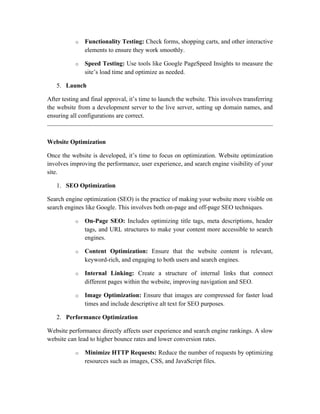
Website Development Process
The development of a website involves various stages, each critical to the final product's
success. These stages ensure that the website is built to meet the user’s needs while also
achieving the business goals.
1. Planning and Strategy
Before any coding or design work begins, the first step in developing a website is
thorough planning. This includes understanding the business goals, target audience, and
the main objectives of the website.
o Goal Setting: Define the goals of the website (e.g., lead generation,
eCommerce, brand awareness).
o Audience Research: Identify the target audience, their needs, and
behaviors.
o Competitor Analysis: Study the competition to understand their strengths
and weaknesses.
o Content Strategy: Plan the type of content that will be needed (e.g.,
blogs, landing pages, product descriptions).
2. Design and User Experience (UX)
The design and user experience (UX) of the website are crucial for keeping visitors
engaged and driving conversions. A website must not only look visually appealing but
also be easy to navigate.
o Wireframing: Create wireframes or mockups that outline the basic layout
and structure of the website.
o Visual Design: Design the website’s visual elements, such as color
scheme, typography, and logo placement.
o Navigation: Ensure the website is easy to navigate, with a clear structure
and logical flow of information.
o Responsiveness: Ensure the website is mobile-friendly and adjusts to
different screen sizes.
3. Website Development and Coding
This is the stage where the website design is brought to life. Depending on the
complexity of the website, you may need different technologies, such as:
o Frontend Development: This includes HTML, CSS, and JavaScript,
which are used to create the website’s visual elements and interactivity.
o Backend Development: This involves server-side programming
languages like PHP, Python, Ruby, or Node.js. It manages data flow, user
authentication, and database interactions.
o Content Management System (CMS): A CMS such as WordPress,
Joomla, or Drupal can simplify content updates without requiring
technical expertise.
o E-commerce Integration: If you're running an online store, integrating
platforms like Shopify or WooCommerce is essential.
4. Testing and Debugging
Before launching the website, thorough testing must be conducted to ensure that it
functions properly across different browsers, devices, and operating systems.
o Browser Testing: Ensure that the website works properly across all major
browsers, including Chrome, Firefox, Safari, and Edge.
o Responsive Testing: Test how the website looks on mobile devices and
tablets.
o Functionality Testing: Check forms, shopping carts, and other interactive
elements to ensure they work smoothly.
o Speed Testing: Use tools like Google PageSpeed Insights to measure the
site’s load time and optimize as needed.
5. Launch
After testing and final approval, it’s time to launch the website. This involves transferring
the website from a development server to the live server, setting up domain names, and
ensuring all configurations are correct.
Website Optimization
Once the website is developed, it’s time to focus on optimization. Website optimization
involves improving the performance, user experience, and search engine visibility of your
site.
1. SEO Optimization
Search engine optimization (SEO) is the practice of making your website more visible on
search engines like Google. This involves both on-page and off-page SEO techniques.
o On-Page SEO: Includes optimizing title tags, meta descriptions, header
tags, and URL structures to make your content more accessible to search
engines.
o Content Optimization: Ensure that the website content is relevant,
keyword-rich, and engaging to both users and search engines.
o Internal Linking: Create a structure of internal links that connect
different pages within the website, improving navigation and SEO.
o Image Optimization: Ensure that images are compressed for faster load
times and include descriptive alt text for SEO purposes.
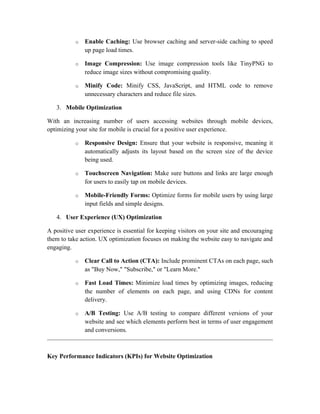
2. Performance Optimization
Website performance directly affects user experience and search engine rankings. A slow
website can lead to higher bounce rates and lower conversion rates.
o Minimize HTTP Requests: Reduce the number of requests by optimizing
resources such as images, CSS, and JavaScript files.
o Enable Caching: Use browser caching and server-side caching to speed
up page load times.
o Image Compression: Use image compression tools like TinyPNG to
reduce image sizes without compromising quality.
o Minify Code: Minify CSS, JavaScript, and HTML code to remove
unnecessary characters and reduce file sizes.
3. Mobile Optimization
With an increasing number of users accessing websites through mobile devices,
optimizing your site for mobile is crucial for a positive user experience.
o Responsive Design: Ensure that your website is responsive, meaning it
automatically adjusts its layout based on the screen size of the device
being used.
o Touchscreen Navigation: Make sure buttons and links are large enough
for users to easily tap on mobile devices.
o Mobile-Friendly Forms: Optimize forms for mobile users by using large
input fields and simple designs.
4. User Experience (UX) Optimization
A positive user experience is essential for keeping visitors on your site and encouraging
them to take action. UX optimization focuses on making the website easy to navigate and
engaging.
o Clear Call to Action (CTA): Include prominent CTAs on each page, such
as "Buy Now," "Subscribe," or "Learn More."
o Fast Load Times: Minimize load times by optimizing images, reducing
the number of elements on each page, and using CDNs for content
delivery.
o A/B Testing: Use A/B testing to compare different versions of your
website and see which elements perform best in terms of user engagement
and conversions.
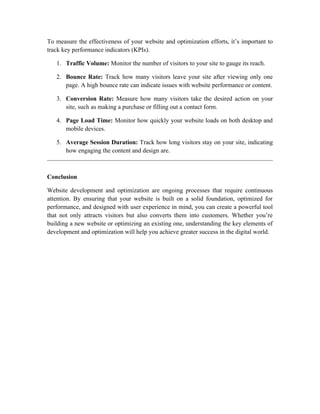
Key Performance Indicators (KPIs) for Website Optimization
To measure the effectiveness of your website and optimization efforts, it’s important to
track key performance indicators (KPIs).
1. Traffic Volume: Monitor the number of visitors to your site to gauge its reach.
2. Bounce Rate: Track how many visitors leave your site after viewing only one
page. A high bounce rate can indicate issues with website performance or content.
3. Conversion Rate: Measure how many visitors take the desired action on your
site, such as making a purchase or filling out a contact form.
4. Page Load Time: Monitor how quickly your website loads on both desktop and
mobile devices.
5. Average Session Duration: Track how long visitors stay on your site, indicating
how engaging the content and design are.
Conclusion
Website development and optimization are ongoing processes that require continuous
attention. By ensuring that your website is built on a solid foundation, optimized for
performance, and designed with user experience in mind, you can create a powerful tool
that not only attracts visitors but also converts them into customers. Whether you’re
building a new website or optimizing an existing one, understanding the key elements of
development and optimization will help you achieve greater success in the digital world.
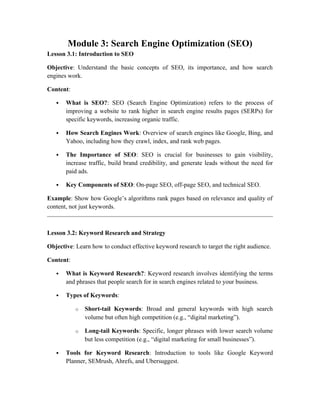
Module 3: Search Engine Optimization (SEO)
Lesson 3.1: Introduction to SEO
Objective: Understand the basic concepts of SEO, its importance, and how search
engines work.
Content:
 What is SEO?: SEO (Search Engine Optimization) refers to the process of
improving a website to rank higher in search engine results pages (SERPs) for
specific keywords, increasing organic traffic.
 How Search Engines Work: Overview of search engines like Google, Bing, and
Yahoo, including how they crawl, index, and rank web pages.
 The Importance of SEO: SEO is crucial for businesses to gain visibility,
increase traffic, build brand credibility, and generate leads without the need for
paid ads.
 Key Components of SEO: On-page SEO, off-page SEO, and technical SEO.
Example: Show how Google’s algorithms rank pages based on relevance and quality of
content, not just keywords.
Lesson 3.2: Keyword Research and Strategy
Objective: Learn how to conduct effective keyword research to target the right audience.
Content:
 What is Keyword Research?: Keyword research involves identifying the terms
and phrases that people search for in search engines related to your business.
 Types of Keywords:
o Short-tail Keywords: Broad and general keywords with high search
volume but often high competition (e.g., “digital marketing”).
o Long-tail Keywords: Specific, longer phrases with lower search volume
but less competition (e.g., “digital marketing for small businesses”).
 Tools for Keyword Research: Introduction to tools like Google Keyword
Planner, SEMrush, Ahrefs, and Ubersuggest.
 Analyzing Search Intent: Understanding the user’s intent behind a search query
—whether informational, transactional, or navigational.
 Keyword Strategy: Incorporating primary and secondary keywords in the right
places (titles, meta descriptions, headers, etc.) to optimize content effectively.
Example: Use a tool like Google Keyword Planner to show how to search for and choose
the best keywords based on volume, competition, and relevance to the website.
Lesson 3.3: On-Page SEO Techniques
Objective: Learn how to optimize individual web pages for higher rankings.
Content:
 Title Tags: Crafting compelling and optimized title tags that include the target
keyword while enticing users to click.
 Meta Descriptions: Writing persuasive meta descriptions that summarize the
content and encourage users to visit the page.
 Header Tags: Using H1, H2, and other header tags to structure content logically
and include relevant keywords.
 Content Optimization:
o Keyword Placement: Strategically place primary and secondary
keywords in the first 100 words, in headings, and throughout the content.
o Quality Content: Creating high-quality, engaging, and informative
content that answers user intent.
o Internal Linking: Linking to other pages within the website to improve
SEO and reduce bounce rates.
o Image Optimization: Using descriptive alt text and file names for images
to improve visibility in search results.
 Mobile Optimization: Ensuring the website is responsive and mobile-friendly for
better ranking, as Google uses mobile-first indexing.
Example: Demonstrate how to optimize a blog post by improving title tags, content, and
internal linking for better rankings.
Lesson 3.4: Off-Page SEO and Link Building
Objective: Understand the importance of off-page SEO, particularly link building, in
improving search engine rankings.
Content:
 What is Off-Page SEO?: Off-page SEO refers to activities that take place outside
of the website but influence its ranking, such as backlinks, social media mentions,
and brand reputation.
 The Role of Backlinks: Backlinks are links from other websites that point to your
website. Google views backlinks as a vote of confidence, indicating that your
content is trustworthy and authoritative.
 How to Build Quality Backlinks:
o Guest Blogging: Writing guest posts for reputable websites in your niche.
o Content Marketing: Creating high-quality, shareable content that
naturally attracts backlinks.
o Directory Listings: Submitting your site to reputable directories and local
business listings.
o Influencer Outreach: Partnering with influencers to share your content or
link back to your website.
o Social Media Signals: Although not a direct ranking factor, social media
shares can drive traffic and build brand visibility.
 Avoiding Black-Hat Techniques: Warning against using unethical tactics like
buying backlinks or participating in link farms.
Example: Show the impact of a backlink from a high-authority site on a website's
ranking and visibility.
Lesson 3.5: Technical SEO
Objective: Dive into the technical aspects of SEO, focusing on website structure, speed,
and indexing.
Content:
 Site Speed: How fast your website loads is a critical factor in both user
experience and SEO. Google’s Core Web Vitals measure aspects like loading
performance, interactivity, and visual stability.
o Optimizing Site Speed: Using tools like Google PageSpeed Insights to
identify slow-loading elements and improve website performance.
 Mobile Optimization: Ensuring the site is fully responsive and performs well on
mobile devices, as mobile traffic continues to increase.
 Crawlability and Indexing:
o Crawl Errors: How to use Google Search Console to identify and fix
crawl errors that prevent search engines from indexing your pages.
o XML Sitemaps: The importance of submitting XML sitemaps to search
engines to ensure proper crawling and indexing.
o Robots.txt: How this file is used to guide search engine crawlers on which
pages to crawl or ignore.
 Structured Data (Schema Markup): Using schema markup to provide search
engines with more information about the content of your pages, improving
visibility in rich snippets.
 HTTPS: Why migrating to HTTPS is important for both security and SEO.
Google gives preference to secure websites.
Example: Walk through the process of identifying a slow-loading page using PageSpeed
Insights and how to improve its speed.
Lesson 3.6: Local SEO
Objective: Learn how to optimize a website for local search results and attract local
customers.
Content:
 What is Local SEO?: Local SEO involves optimizing your website for location-
based searches to attract customers from a specific area.
 Google My Business: Setting up and optimizing your Google My Business
profile to improve local search visibility.
 Local Listings and Citations: Submitting your business to local directories like
Yelp, Yellow Pages, and others, ensuring consistency of NAP (Name, Address,
Phone Number).
 Local Reviews: Encouraging customers to leave positive reviews on platforms
like Google and Yelp, as reviews can impact rankings and trust.
 Localized Content: Creating content that targets local keywords and topics
relevant to your geographic area.
Example: Show how optimizing a local restaurant’s Google My Business profile
improves local search rankings and drives foot traffic.
Lesson 3.7: SEO Analytics and Reporting
Objective: Understand how to track SEO performance and adjust strategies based on
data.
Content:
 Google Analytics: Setting up Google Analytics to track organic traffic, user
behavior, and conversions.
 Google Search Console: Using Search Console to track keyword rankings, click-
through rates (CTR), impressions, and identify issues like crawl errors or manual
penalties.
 SEO Reporting Tools: Introduction to tools like SEMrush, Ahrefs, and Moz for
tracking keyword rankings, backlinks, and overall SEO health.
 Creating SEO Reports: Understanding how to compile key SEO metrics into
clear, actionable reports for stakeholders.
Example: Walk through how to generate a performance report in Google Analytics to
track organic traffic growth over time.
Assessment:
At the end of the module, include a quiz or assignment to test knowledge. Example
questions could include:
1. What are the key differences between on-page and off-page SEO?
2. Explain the process of keyword research and its role in SEO.
3. How can you improve the technical SEO of a website?
4. What is the significance of backlinks in SEO?
5. Describe the steps to optimize a Google My Business profile for local SEO.
Conclusion:
Summarize the importance of SEO in driving organic traffic and improving online
visibility. SEO is an ongoing process, and staying up to date with algorithm changes,
trends, and best practices is crucial to maintaining and improving rankings.
Module 4: Content Marketing
Introduction
Content Marketing is a crucial aspect of digital marketing that focuses on creating and
distributing valuable, relevant, and consistent content to attract and retain a clearly
defined audience. The primary goal of content marketing is to drive profitable customer
action by providing valuable information and experiences that resonate with the target
audience.
In this module, we’ll explore the key elements of content marketing, from content
strategy and types to distribution channels and measurement of success. By the end of
this module, you will understand how to create and execute an effective content
marketing plan.
What is Content Marketing?
Content marketing involves creating and sharing online material (such as blogs, videos,
social media posts, and podcasts) that does not explicitly promote a brand but is intended
to stimulate interest in its products or services. Unlike traditional advertising, content
marketing aims to provide useful information that helps consumers solve problems or
make informed decisions.
Effective content marketing aligns with customer interests, builds trust, and establishes
authority in a particular industry or niche.
Key Components of Content Marketing
1. Content Strategy
A solid content strategy is essential for guiding the creation, distribution, and
measurement of content. It helps align content with business goals, audience needs, and
the customer journey.
Key steps to developing a content strategy include:
o Audience Research: Understand your target audience’s needs,
challenges, and preferences. Use data from surveys, social media insights,
and website analytics to build customer personas.
o Content Goals: Define the objectives of your content. Whether it’s brand
awareness, lead generation, or customer engagement, clear goals will
guide content creation.
o Content Planning: Create a content calendar to ensure that content is
consistently produced and published. This calendar should include content
topics, publication dates, and distribution channels.
o Content Formats: Choose the appropriate content formats based on the
needs of your audience. Common formats include blog posts,
infographics, videos, podcasts, and ebooks.
2. Types of Content
There are various types of content that can be used in content marketing campaigns. The
choice of content depends on your audience and objectives.
o Blog Posts: Blogs are one of the most common forms of content
marketing. They help boost SEO, establish authority, and provide valuable
information to the audience.
o Infographics: Infographics are visual representations of data and
information. They are highly shareable and can make complex topics
easier to understand.
o Videos: Video content, whether it’s tutorials, product demonstrations, or
customer testimonials, is incredibly effective at engaging audiences and
conveying messages.
o Podcasts: Podcasts allow businesses to engage with their audience in a
more personal, conversational way. They are ideal for building
relationships and discussing industry trends.
o Case Studies: Case studies provide real-world examples of how your
product or service has helped customers solve problems. They help build
credibility and trust with potential customers.
o Ebooks and Whitepapers: These long-form content types are used to
dive deeper into a topic. They are often used as lead magnets to gather
email addresses and convert visitors into leads.
3. Content Distribution Channels
Once content is created, it needs to be distributed to the right audience. Choosing the
right distribution channels is essential for reaching your target market effectively.
Common distribution channels include:
o Owned MediA: This includes your website, blog, and email list. These
platforms give you full control over the content and its distribution.
o Earned MediA: Earned media refers to media coverage and social media
mentions that you get through PR efforts, influencer outreach, or customer
advocacy.
o Paid MediA: Paid media involves using paid advertising to distribute
content. This can include social media ads, display ads, and sponsored
content.
o Social MediA: Social media platforms like Facebook, Instagram, Twitter,
and LinkedIn are powerful channels for distributing content and engaging
with your audience.
4. Content Optimization
To ensure that your content resonates with your audience and performs well, it needs to
be optimized for SEO, engagement, and conversion.
Key strategies for content optimization include:
o SEO: Optimize your content for search engines by using relevant
keywords, creating compelling meta descriptions, and ensuring that your
content is structured for easy reading.
o Engaging Headlines: The headline is the first thing that catches a reader’s
attention. Make sure it is compelling and clearly communicates the value
of the content.
o Call to Action (CTA): Every piece of content should include a clear
CTA. Whether it’s to download a resource, subscribe to a newsletter, or
contact sales, CTAs guide your audience on the next steps.
o Visuals: Use images, videos, and infographics to enhance your content
and make it more engaging. Visuals help break up text and increase
audience retention.
5. Measuring Content Marketing Success
To ensure your content marketing efforts are paying off, it’s important to track and
measure performance.
Key metrics to track include:
o Website Traffic: Measure the number of visitors your content drives to
your website. Use tools like Google Analytics to track traffic sources.
o Engagement Metrics: Monitor social media engagement metrics like
likes, shares, comments, and mentions to gauge how your audience is
interacting with your content.
o Lead Generation: Track how well your content is converting visitors into
leads. This can be measured through form submissions, downloads, and
sign-ups.
o Conversion Rate: Measure how well your content is turning leads into
customers. This will help you understand the ROI of your content
marketing efforts.
o Bounce Rate: The bounce rate indicates how many visitors leave your site
after viewing only one page. A high bounce rate can indicate that your
content isn’t resonating with your audience.
Advanced Content Marketing Strategies
1. Content Repurposing
Content repurposing is the process of taking existing content and adapting it for different
formats or platforms. For example, a blog post can be turned into an infographic, video,
podcast episode, or social media post. Repurposing content maximizes the value of your
content and helps you reach new audiences.
2. Content Personalization
Personalization involves tailoring content to the needs and preferences of individual
users. By segmenting your audience and delivering personalized content, you can
increase engagement and drive conversions.
3. User-Generated Content (UGC)
Encouraging customers to create and share content related to your brand is a powerful
way to build trust and authenticity. UGC can include reviews, testimonials, photos, and
social media posts. It helps create a sense of community around your brand.
4. Influencer Content Marketing
Partnering with influencers to create content can amplify your reach and credibility.
Influencers already have an established audience, and their endorsement of your product
or service can significantly boost brand awareness.
Conclusion
Content marketing is a long-term strategy that requires consistency, creativity, and a deep
understanding of your audience. By creating valuable and relevant content, distributing it
through the right channels, and measuring success, businesses can drive customer
engagement, build brand authority, and ultimately increase conversions. In an
increasingly competitive digital landscape, content marketing is an indispensable tool for
achieving business growth.
Module 5: Social Media Marketing
Introduction
Social Media Marketing (SMM) is a critical aspect of digital marketing that focuses on
using social media platforms to promote a brand, increase visibility, and drive customer
engagement. In today’s digital world, social media is one of the most powerful tools
businesses can leverage to connect with their audience, build brand loyalty, and drive
sales.
This module will dive into the key elements of social media marketing, covering
strategies for growing a social media presence, content creation, paid advertising, and
measuring the success of campaigns.
What is Social Media Marketing?
Social Media Marketing is the practice of using social media platforms to market
products or services. It involves creating and sharing content on social media channels
like Facebook, Instagram, Twitter, LinkedIn, and TikTok to achieve marketing and
branding goals.
Social media marketing allows businesses to interact with their audience in real-time,
build community, and generate leads. It also enables companies to analyze audience
behaviors and trends, providing insights for better decision-making.
Importance of Social Media Marketing
1. Increased Brand Awareness: Social media helps businesses gain visibility
among a larger audience. Regular posting on platforms like Instagram and
Facebook increases the chances of reaching new customers.
2. Audience Engagement: Social media platforms allow brands to directly interact
with their audience. Responding to comments, messages, and mentions builds
relationships and fosters community.
3. Cost-Effective: Compared to traditional advertising, social media marketing is
relatively affordable and provides high returns. Businesses can create organic
content or run paid ads to target specific demographics.
4. Targeted Advertising: Social media platforms offer robust targeting options,
allowing businesses to create customized ads that reach specific audiences based
on interests, behavior, location, and more.
5. Performance Insights: Social media platforms provide detailed analytics and
performance metrics, helping businesses measure the success of their campaigns
and optimize them for better results.
Key Platforms for Social Media Marketing
1. Facebook: Facebook is the largest social media platform, with over 2.9 billion
active users. It’s ideal for businesses looking to connect with a broad audience
and create targeted ads.
2. Instagram: Instagram is a visually-focused platform that works well for
businesses in industries like fashion, beauty, food, and travel. It’s also great for
influencer marketing.
3. Twitter: Twitter is a real-time, short-form platform that’s ideal for updates, news,
and customer engagement. It’s perfect for building a brand voice and interacting
with users quickly.
4. LinkedIn: LinkedIn is a professional networking site that’s ideal for B2B
marketing. It helps businesses connect with industry professionals, generate leads,
and build thought leadership.
5. TikTok: TikTok is a rapidly growing platform focused on short-form videos. It’s
perfect for creative, viral marketing campaigns, especially for younger audiences.
6. Pinterest: Pinterest is a visual discovery engine, ideal for businesses in fashion,
home décor, food, and DIY industries. It’s great for creating mood boards and
driving traffic to websites.
Building a Social Media Marketing Strategy
A successful social media strategy requires planning and execution. Here are the key
steps to creating an effective social media marketing plan:
1. Define Your Goals: What do you want to achieve with social media? Common
goals include brand awareness, lead generation, sales, customer service, and
community building.
2. Identify Your Target Audience: Who are you trying to reach? Understanding
your audience’s demographics, interests, and behaviors is crucial for crafting
relevant content and choosing the right platforms.
3. Choose the Right Platforms: Not every platform is suitable for every business.
Identify where your target audience spends most of their time and focus your
efforts on those platforms.
4. Create Compelling Content: Content is at the heart of social media marketing.
Develop content that resonates with your audience, whether it’s text posts,
images, videos, infographics, or stories.
5. Engage with Your Audience: Social media is a two-way communication
channel. Respond to comments, messages, and mentions. Encourage user-
generated content and create a community around your brand.
6. Monitor and Measure Performance: Use social media analytics tools to track
performance and measure the success of your campaigns. Monitor metrics like
reach, engagement, clicks, and conversions to see what works and what needs
improvement.
Types of Social Media Content
1. Text Posts: Simple, direct, and effective. Text posts are often used for sharing
news, updates, quotes, and engaging questions.
2. Images and Graphics: Visual content is more engaging than text alone. Share
photos, memes, infographics, and design-rich content to grab attention.
3. Videos: Video content is one of the most engaging types of content on social
media. This includes promotional videos, behind-the-scenes content, tutorials, and
live streams.
4. Stories: Platforms like Instagram and Facebook offer story features, which are
short-lived posts that appear at the top of users' feeds. Stories are excellent for
showing behind-the-scenes content and promoting time-sensitive offers.
5. User-Generated Content (UGC): Encouraging your audience to create and share
content featuring your products can significantly boost brand credibility and
engagement.
6. Polls and Surveys: Engaging your audience with polls and surveys is a great way
to collect feedback, encourage interaction, and involve your audience in the
decision-making process.
Paid Social Media Advertising
Paid advertising on social media can significantly amplify your reach and help achieve
your marketing goals more quickly. Social media platforms offer several ad formats,
including:
1. Sponsored Posts: These are regular posts that businesses pay to promote. They
appear in users’ feeds and can be targeted based on demographics, interests, and
behaviors.
2. Carousel Ads: Carousel ads allow businesses to showcase multiple images or
videos in one ad, enabling more detailed storytelling.
3. Video Ads: These ads allow you to showcase your product or service through
short videos. They’re particularly effective on platforms like Facebook,
Instagram, and YouTube.
4. Lead Generation Ads: These ads are designed to capture leads directly on social
media platforms. They include forms for users to fill out without leaving the
platform.
5. Remarketing Ads: These ads target users who have previously interacted with
your website or content. They help remind potential customers of your brand and
encourage them to complete a purchase.
Measuring Success in Social Media Marketing
To evaluate the success of your social media marketing efforts, it’s essential to track the
right metrics:
1. Reach: Reach refers to the number of unique users who have seen your content.
This is important for measuring brand visibility.
2. Engagement: Engagement includes likes, comments, shares, and mentions. High
engagement indicates that your audience is actively interacting with your content.
3. Click-Through Rate (CTR): CTR measures how many people clicked on your
content or ad after seeing it. A high CTR indicates that your content resonates
with your audience.
4. Conversion Rate: Conversion rate measures how many users took the desired
action (e.g., making a purchase, signing up for a newsletter) after interacting with
your social media content.
5. Customer Sentiment: Monitoring customer sentiment involves tracking how
users feel about your brand based on their comments, reviews, and interactions.
Conclusion
Social media marketing is an essential tool for building brand awareness, engaging with
customers, and driving business growth. With the right strategy and consistent effort,
social media can help businesses connect with their target audience, foster relationships,
and ultimately increase revenue.
Module 6: Email Marketing
Introduction
Email marketing remains one of the most effective channels for reaching customers
directly. Despite the rise of social media and other digital marketing methods, email
marketing continues to deliver strong ROI. This module covers the fundamentals of email
marketing, from building an email list to designing campaigns that drive engagement and
conversions.
This module also emphasizes the importance of segmentation, personalization, and
optimizing email content to ensure messages reach the right audience and achieve desired
outcomes.
What is Email Marketing?
Email marketing involves sending targeted emails to a group of recipients with the goal
of nurturing relationships, driving conversions, and increasing brand awareness. It can be
used for various purposes, such as announcing promotions, sending newsletters, sharing
updates, and following up with leads.
Email marketing allows businesses to deliver personalized content to their audience,
fostering trust and customer loyalty. It's an essential part of digital marketing because of
its ability to reach people directly in their inbox, one of the most personal spaces online.
Benefits of Email Marketing
1. Cost-Effective: Compared to other marketing methods, email marketing is
incredibly affordable. There's no need for expensive ad budgets, and it offers high
returns on investment (ROI).
2. Direct Communication: Email provides a direct line of communication with
your audience. Unlike social media, which requires users to follow or engage with
content, email reaches subscribers directly in their inbox.
3. Personalization: Emails can be highly personalized, from the subject line to the
content itself. Personalized emails improve engagement and help businesses stand
out in a crowded inbox.
4. Measurable Results: Email marketing platforms offer detailed analytics,
allowing you to track open rates, click-through rates, conversion rates, and more.
This data enables continuous improvement and optimization.
5. Automation: With email marketing automation, businesses can set up workflows
that send targeted emails based on user behavior. This helps nurture leads and
increase conversions without manual intervention.
6. Segmentation: By segmenting your email list, you can send more relevant
content to specific groups. Segmentation ensures that your emails resonate with
each recipient, improving engagement.
Types of Email Campaigns
1. Welcome Emails: The first email a subscriber receives after joining your list. It’s
a great opportunity to introduce your brand and set expectations for future
communication.
2. Newsletter Emails: Regularly scheduled emails that offer valuable content, such
as industry news, tips, and company updates. Newsletters help build ongoing
relationships with subscribers.
3. Promotional Emails: These emails offer discounts, sales, or special promotions.
They’re designed to drive immediate action, such as making a purchase or signing
up for an event.
4. Transactional Emails: These emails confirm a transaction, such as a purchase
receipt, shipping confirmation, or password reset. While not typically
promotional, transactional emails are essential for customer satisfaction.
5. Behavioral Emails: These are triggered by specific actions a subscriber takes,
such as abandoning a cart or downloading content. Behavioral emails are highly
personalized and often have high conversion rates.
6. Re-engagement Emails: Sent to subscribers who have become inactive. Re-
engagement emails encourage users to return to your website, offering incentives
or asking for feedback.
Building an Effective Email List
A successful email marketing campaign starts with building a strong, high-quality email
list. Here are strategies to grow your list:
1. Lead Magnets: Offer valuable content or incentives, such as free eBooks,
whitepapers, or discounts, in exchange for email addresses.
2. Landing Pages: Create dedicated landing pages with compelling calls-to-action
(CTAs) that encourage visitors to subscribe to your email list.
3. Social Media Integration: Promote your email list on social media platforms and
offer incentives for people to join.
4. Referral Programs: Encourage existing subscribers to refer friends and family in
exchange for rewards, expanding your email list organically.
5. Sign-Up Forms: Place clear and easy-to-complete sign-up forms on your website,
blog, and other digital properties.
Crafting Compelling Email Content
The content of your email is crucial for driving engagement. Here’s how to create
effective emails:
1. Catchy Subject Lines: The subject line is the first thing recipients see, and it
determines whether they’ll open the email. Keep it short, clear, and intriguing.
2. Personalization: Use the recipient’s name or other personal details to create a
more engaging and individualized experience.
3. Clear Call-to-Action (CTA): Every email should have a clear CTA that guides
the recipient towards the next step, whether it’s making a purchase, downloading
content, or learning more about a service.
4. Design and Layout: Ensure your email is visually appealing and easy to read.
Use a mobile-friendly design since a significant portion of email opens happen on
mobile devices.
5. Relevant and Valuable Content: Provide value with content that resonates with
your audience. This could include educational resources, discounts, or exclusive
offers.
6. Compelling Visuals: Including images, GIFs, or videos in your emails can make
the content more engaging and help convey your message effectively.
Email Marketing Automation
Email marketing automation involves setting up triggers that send personalized emails
based on user actions or predefined schedules. Some examples of automated email
workflows include:
1. Welcome Series: A series of emails sent to new subscribers introducing your
brand and guiding them through the initial stages of engagement.
2. Abandoned Cart Emails: Automatically send emails to customers who leave
items in their shopping cart without completing a purchase, encouraging them to
finalize the transaction.
3. Birthday or Anniversary Emails: Send personalized offers or messages to
customers on special occasions like birthdays or anniversaries, making them feel
valued.
4. Re-engagement Campaigns: Automatically send re-engagement emails to
subscribers who haven’t opened or clicked on emails in a while.
Measuring the Success of Email Campaigns
To determine the effectiveness of your email marketing efforts, you need to track key
metrics:
1. Open Rate: The percentage of recipients who open your email. A high open rate
indicates that your subject line and sender name are compelling.
2. Click-Through Rate (CTR): The percentage of recipients who click on a link in
your email. A higher CTR suggests that the email content and CTA are effective.
3. Conversion Rate: The percentage of recipients who take the desired action after
clicking a link in your email, such as making a purchase or downloading content.
4. Bounce Rate: The percentage of emails that couldn’t be delivered. A high bounce
rate indicates that your email list may need to be cleaned.
5. Unsubscribe Rate: The percentage of recipients who opt out of receiving future
emails. A high unsubscribe rate could indicate that your content isn’t resonating
with your audience.
Best Practices for Email Marketing
1. Segmentation: Divide your email list into smaller groups based on factors like
demographics, behavior, and engagement levels. This allows you to send more
targeted, relevant content.
2. Mobile Optimization: Ensure your emails are optimized for mobile devices, as
more people check emails on their phones than on desktops.
3. Test and Optimize: Use A/B testing to experiment with different subject lines,
CTAs, and designs to see what works best for your audience.
4. Maintain Consistency: Consistency is key to building trust with your audience.
Send emails regularly, but don’t overwhelm your subscribers.
5. Respect Privacy: Always follow best practices for email privacy and security.
Make it easy for recipients to unsubscribe, and never share their email addresses
without permission.
Conclusion
Email marketing is a powerful tool that can help businesses nurture customer
relationships, boost sales, and drive long-term growth. By building a high-quality email
list, crafting engaging content, and leveraging automation, businesses can create
meaningful connections with their audience and achieve measurable results.
Module 7: Paid Advertising (PPC)
Introduction
Paid advertising, especially Pay-Per-Click (PPC) advertising, is a crucial component of
digital marketing that enables businesses to drive traffic, increase brand awareness, and
boost sales. PPC advertising allows advertisers to display ads on search engines, social
media platforms, websites, and other digital channels and only pay when users interact
with their ads, such as clicking on them.
In this module, we’ll explore the fundamentals of PPC advertising, how to set up and
manage PPC campaigns, and best practices to optimize ad performance and ROI.
What is PPC Advertising?
Pay-Per-Click (PPC) is an online advertising model where advertisers pay a fee each time
their ad is clicked. Essentially, it’s a way of buying visits to your site rather than earning
them organically. Advertisers bid on keywords related to their products or services, and
the search engines or advertising networks display their ads based on the relevance of the
keyword and other factors like ad quality and bid amount.
PPC ads appear in search engine results, on social media platforms, and across various
display networks. The most common platforms for PPC advertising are Google Ads, Bing
Ads, and social media platforms like Facebook, Instagram, LinkedIn, and Twitter.
Benefits of PPC Advertising
1. Instant Traffic: One of the primary advantages of PPC is that it generates
immediate traffic. Unlike SEO, which can take time to build momentum, PPC ads
can start driving traffic as soon as they are launched.
2. Targeted Advertising: PPC allows businesses to target their audience based on
various factors, such as location, demographics, interests, search history, and
more. This ensures that ads reach the right people at the right time.
3. Scalability: PPC campaigns can be easily scaled. You can increase or decrease
your budget based on performance, making it a flexible option for businesses of
all sizes.
4. Cost Control: With PPC, you have complete control over your budget. You can
set a daily or lifetime budget for your campaigns, ensuring that you only spend
what you’re comfortable with.
5. Measurable Results: PPC platforms provide detailed analytics that allow
businesses to measure the success of their campaigns. Metrics like click-through
rate (CTR), conversion rate, and cost per acquisition (CPA) help advertisers
understand the effectiveness of their ads.
Types of PPC Campaigns
1. Search Ads: These are text ads displayed on search engine results pages (SERPs)
when users search for specific keywords. Search ads are the most common type of
PPC and are shown above or below the organic search results.
2. Display Ads: Display ads are banner or image-based ads that appear on websites,
apps, or social media platforms. These ads are often placed on websites that are
part of Google’s Display Network or other advertising networks.
3. Shopping Ads: Shopping ads appear on search engine results pages and feature
product images, prices, and store information. They are ideal for e-commerce
businesses looking to promote their products directly.
4. Video Ads: Video ads, typically shown on platforms like YouTube, allow
businesses to showcase their products or services in a more engaging format.
Video ads can appear before, during, or after video content.
5. Social Media Ads: Social media platforms such as Facebook, Instagram,
LinkedIn, and Twitter offer PPC advertising opportunities where ads can be
targeted based on user behavior, interests, demographics, and more.
6. Retargeting Ads: Retargeting ads are displayed to users who have previously
visited your website or interacted with your brand. These ads encourage users to
return and complete a desired action, such as making a purchase.
How PPC Advertising Works
1. Keyword Research: The first step in PPC advertising is keyword research. You
need to identify the keywords and phrases that your target audience is searching
for and that are relevant to your business. Keyword research tools like Google
Keyword Planner, SEMrush, and Ahrefs can help you discover high-performing
keywords.
2. Creating Ads: Once you’ve selected your keywords, the next step is creating
your ads. This includes writing compelling ad copy, selecting relevant images (for
display ads), and deciding on a call-to-action (CTA) that encourages users to
click.
3. Setting a Budget: You need to set a budget for your PPC campaign. This
involves choosing how much you’re willing to pay per click (CPC) and setting
daily or lifetime spending limits. The higher your bid, the more likely your ad will
appear in front of users.
4. Bidding Strategy: PPC platforms operate on a bidding system. Advertisers bid on
keywords, and the ad platform determines which ads to display based on the bid
amount, ad relevance, and quality score.
5. Campaign Launch and Monitoring: After creating your campaign, it’s time to
launch it. Continuous monitoring is crucial to optimize performance. Regularly
review your campaign data to assess which keywords and ads are performing well
and which need adjustments.
Important Metrics in PPC Advertising
1. Click-Through Rate (CTR): The percentage of people who click on your ad
after seeing it. A high CTR indicates that your ad is relevant and engaging to your
audience.
2. Cost Per Click (CPC): The amount you pay each time someone clicks on your
ad. CPC is determined by your bid and the competition for the keyword.
3. Conversion Rate: The percentage of people who take the desired action after
clicking on your ad, such as making a purchase or filling out a form. A higher
conversion rate indicates that your landing page and offer are effective.
4. Cost Per Acquisition (CPA): The cost of acquiring a customer through PPC.
CPA is calculated by dividing the total campaign cost by the number of
conversions.
5. Quality Score: A metric used by platforms like Google Ads to measure the
quality and relevance of your ads, keywords, and landing pages. A higher quality
score can lower your cost per click and improve your ad placement.
6. Return on Ad Spend (ROAS): The revenue generated for every dollar spent on
advertising. ROAS is a key metric to measure the overall success of your PPC
campaign.
Best Practices for PPC Advertising
1. Target the Right Keywords: Use thorough keyword research to select keywords
that are relevant to your business and have a high search volume. Avoid overly
broad keywords that are expensive and may not convert well.
2. Optimize Landing Pages: Ensure that your landing pages are optimized for
conversion. The landing page should match the ad’s messaging and provide a
seamless experience for visitors.
3. Use Ad Extensions: Ad extensions are additional features you can add to your
ads, such as location information, phone numbers, or links to specific pages on
your website. Extensions improve visibility and CTR.
4. A/B Testing: Regularly test different versions of your ads to see what performs
best. A/B testing allows you to refine your campaigns and improve results over
time.
5. Monitor Campaign Performance: Continuously monitor your campaigns to
ensure they are performing as expected. Adjust your bidding strategy, keywords,
and ad copy based on performance data.
6. Optimize for Mobile: With increasing mobile usage, it’s essential to ensure your
PPC ads and landing pages are mobile-friendly to capture mobile users.
7. Retargeting: Use retargeting ads to re-engage users who have visited your
website but didn’t convert. Retargeting ads are highly effective in bringing back
potential customers.
Conclusion
PPC advertising offers businesses a powerful tool for reaching their target audience,
driving traffic, and boosting sales. With careful planning, strategic keyword selection,
and constant monitoring and optimization, PPC campaigns can deliver significant returns.
By following best practices and using the right tools, businesses can maximize the
effectiveness of their PPC efforts.
Q1: What is PPC and how does it work?
A:
PPC (Pay-Per-Click) is a digital advertising model where advertisers pay a fee each time
their ad is clicked. It’s a way to buy visits to your site rather than earning them
organically. The most common platform is Google Ads. Advertisers bid on keywords
relevant to their target audience, and ads appear in search results or on partner websites.
The ad’s visibility depends on the bid amount and quality score.
Q2: What is a Quality Score in Google Ads?
A:
Quality Score is Google’s rating of the quality and relevance of your keywords, ads, and
landing pages. It is scored on a scale of 1 to 10. A higher Quality Score can lead to lower
costs and better ad positions. It is based on:
 Expected Click-Through Rate (CTR)
 Ad relevance
 Landing page experience
Q3: What are the different types of Google Ads campaigns?
A:
Google Ads offers several campaign types:
 Search Network Campaigns (text ads on Google search results)
 Display Network Campaigns (banner/image ads on websites)
 Shopping Ads (for e-commerce product listings)
 Video Campaigns (ads on YouTube)
 Performance Max (automated campaigns across all Google channels)
 App Campaigns (to drive app installs)
Q4: How do you choose the right keywords for a PPC campaign?
A:
Effective keyword research involves:
 Using tools like Google Keyword Planner, Ubersuggest, or SEMrush
 Focusing on high intent keywords
 Considering keyword match types (Broad, Phrase, Exact)
 Adding negative keywords to avoid irrelevant traffic
 Analyzing competitors’ keywords
Q5: What is CTR and why is it important?
A:
CTR (Click-Through Rate) is the ratio of users who click on your ad to the number who
see it.
FormulA: (Clicks / Impressions) × 100
A high CTR indicates that your ad is relevant and appealing, improving Quality Score
and lowering CPC.
Q6: What is the difference between CPM, CPC, and CPA?
A:
 CPC (Cost Per Click): You pay when someone clicks your ad.
 CPM (Cost Per Mille): You pay per 1,000 impressions.
 CPA (Cost Per Acquisition): You pay when a user completes a desired action
(like purchase or signup).
Q7: What are ad extensions in Google Ads?
A:
Ad extensions are additional pieces of information that expand your ad to increase
visibility and improve CTR. Examples include:
 Sitelink extensions
 Call extensions
 Location extensions
 Structured snippets
 Price and promotion extensions
Q8: How would you reduce the cost of a PPC campaign while maintaining results?
A:
 Improve Quality Score through better ad copy and landing pages
 Use negative keywords to filter out irrelevant traffic
 Optimize ad scheduling and geo-targeting
 A/B test ad creatives regularly
 Pause underperforming keywords or campaigns
 Shift focus to high-performing audiences
Q9: What is remarketing in PPC?
A:
Remarketing targets users who have previously visited your website or interacted with
your content. It helps bring users back into the funnel and increase conversion rates. It
can be done through:
 Google Display Network
 YouTube video ads
 Facebook Custom Audiences
Q10: How do you measure the success of a PPC campaign?
A:
Success is measured using:
 CTR (Click-Through Rate)
 CPC (Cost per Click)
 Conversion Rate
 ROAS (Return on Ad Spend)
 Impression Share
 Bounce Rate
 Tracking goals set up via Google Analytics or Tag Manager
Module 8: Conversion Rate Optimization (CRO)
Introduction
Conversion Rate Optimization (CRO) is the systematic process of increasing the
percentage of website visitors who take a desired action—such as filling out a form,
making a purchase, signing up for a newsletter, or any other goal of your website. CRO is
essential in digital marketing because driving traffic to a website is only the first step.
Ensuring that traffic results in actual conversions is what determines ROI and the success
of digital strategies.
In this module, we explore the strategies, tools, and best practices for effective CRO that
help you turn more of your website visitors into customers.
Understanding Conversion Rate
The conversion rate is the percentage of visitors who complete a desired action on your
site. It is calculated using the formulA:
Conversion Rate = (Number of Conversions / Total Visitors) × 100
Improving your conversion rate means you get more value from the traffic you already
have, rather than spending more to attract new visitors.
The CRO Process
CRO is a continuous process that involves the following steps:
1. Data Collection & Analysis
Use tools like Google Analytics, Hotjar, and Crazy Egg to monitor user behavior,
bounce rates, and conversion funnels.
2. Identifying Goals
Set clear, measurable goals like sales, sign-ups, downloads, etc.
3. Hypothesis Creation
Based on data, form ideas on what changes may improve conversions.
4. A/B Testing
Test different versions of pages to identify which performs best.
5. Implementation
Apply winning variations and monitor their long-term impact.
6. Continuous Optimization
Keep analyzing and optimizing your site to meet user needs.
Key Elements That Impact Conversion Rates
1. Website Design and Layout – Ensure ease of use and visual clarity.
2. Call to Action (CTA) – Make CTAs stand out and drive action.
3. Website Speed – Faster sites reduce bounce rates.
4. Mobile Optimization – Make the site fully responsive.
5. Trust Signals – Include testimonials, secure payment icons, and guarantees.
6. Forms – Keep forms short and user-friendly.
7. Content Quality – Deliver value through headlines, visuals, and copy.
Tools for CRO
 Google Analytics
 Hotjar
 Crazy Egg
 Optimizely
 VWO
 Unbounce
Best Practices for CRO
 Focus on User Experience
 Use Social Proof
 Implement Personalization
 Create compelling CTAs
 Optimize Above-the-Fold Content
 Use Live Chat or Chatbots
 Reduce Distractions
 Analyze Funnel Drop-Offs
Measuring CRO Success
Look beyond conversions. Monitor improvements in:
 Bounce rate
 Average session duration
 Pages per session
 Revenue per visitor
 Cost per acquisition (CPA)
Conclusion
CRO is vital for maximizing the ROI of digital marketing. A structured, data-driven
approach, combined with a focus on user experience, ensures higher conversions and
better business outcomes.
Module 9: Affiliate Marketing
Learning Objectives
By the end of this module, learners will be able to:
 Understand what affiliate marketing is and how it functions.
 Recognize the roles of affiliates, merchants, and networks.
 Set up and manage an affiliate program.
 Explore major affiliate platforms and tools.
 Track and analyze affiliate performance effectively.
1. Introduction to Affiliate Marketing
Affiliate marketing is a performance-based marketing model where businesses reward
external partners (affiliates) for generating traffic, leads, or sales through their
promotional efforts.
 It's a cost-effective and scalable strategy.
 Affiliates earn commissions for actions such as sales, clicks, or leads.
2. How Affiliate Marketing Works
A typical affiliate process:
1. Merchant sets up an affiliate program.
2. Affiliates promote the merchant’s products using unique tracking links.
3. Customers click on these links and perform a desired action.
4. Affiliates earn a commission based on that action.
3. Key Roles in Affiliate Marketing
 Merchant – The seller or product creator.
 Affiliate – The promoter (blogger, influencer, website owner).
 Affiliate Network – A platform that manages tracking, payouts, and connections
(e.g., CJ Affiliate, ShareASale).
 Customer – The end-user who purchases or converts via an affiliate’s referral.
4. Types of Affiliate Programs
 Pay-per-sale (PPS) – Commission for each sale.
 Pay-per-click (PPC) – Earnings based on link clicks.
 Pay-per-lead (PPL) – Earnings for form completions, sign-ups, etc.
 Two-tier – Affiliates earn from their referrals' sales too.
5. Popular Affiliate Networks
 Amazon Associates – Beginner-friendly, wide product base.
 ShareASale – Marketplace with thousands of merchants.
 CJ Affiliate – Large brands and deep analytics.
 Rakuten Advertising – Trusted by major retailers.
 ClickBank – Digital product specialists.
 Impact – Streamlined partnerships with automation.
6. Setting Up an Affiliate Program
1. Define your commission model – Flat rate or percentage.
2. Choose software or a network – Direct (e.g., Tapfiliate) or network-based (e.g.,
Impact).
3. Create promotional materials – Banners, emails, product feeds.
4. Recruit affiliates – Through outreach, platforms, and referrals.
5. Track performance – Dashboards, analytics, affiliate KPIs.
7. Affiliate Recruitment and Management
 Use tools like PartnerStack, Refersion, or Affise.
 Seek influencers and niche bloggers.
 Offer incentives, bonuses, and exclusive codes.
 Maintain regular communication and performance reviews.
8. Best Practices in Affiliate Marketing
 Align with relevant and reputable affiliates.
 Provide clear guidelines and marketing assets.
 Use secure, transparent tracking tools.
 Monitor for fraud and compliance violations.
 Continuously optimize content and offers.
9. Key Metrics to Monitor
 Click-through Rate (CTR) – Link engagement.
 Conversion Rate – Success after the click.
 Earnings Per Click (EPC) – Revenue per click.
 Total Sales and Revenue Generated
 Affiliate Activity – Active vs. dormant partners.
10. Challenges in Affiliate Marketing
 Attribution issues – Who gets the credit?
 Affiliate fraud – Fake traffic, cookie stuffing.
 Compliance – FTC rules on disclosures.
 Managing performance – Identifying poor performers.
11. Legal & Ethical Considerations
 Affiliates must clearly disclose paid links and partnerships.
 Set clear terms and conditions for affiliates.
 Ensure GDPR compliance if collecting data from EU visitors.
12. Conclusion
Affiliate marketing is a powerful channel that leverages partnerships to scale growth.
When managed well, it offers a high-ROI, low-risk path to new audiences and sustained
revenue. Success depends on relationship building, ethical practices, and ongoing
optimization.
Module 10: Influencer Marketing
Learning Objectives
By the end of this module, learners will be able to:
 Define influencer marketing and its key components.
 Identify different types of influencers and their roles.
 Develop a successful influencer marketing strategy.
 Understand how to select, approach, and collaborate with influencers.
 Measure campaign success using relevant KPIs and tools.
1. What is Influencer Marketing?
Influencer marketing is a form of collaboration where brands partner with individuals
who have influence over potential buyers. These influencers promote the brand to their
engaged audiences via social media, blogs, or other content platforms.
 It builds trust, authenticity, and reach.
 Particularly effective for brand awareness, product launches, and community
building.
2. Types of Influencers
Based on follower count:
Influencer Type Follower Count Traits
Mega Influencers 1M+ Celebrities, broad reach
Macro Influencers 100K – 1M Niche authority, high engagement
Micro Influencers 10K – 100K Strong community, trusted voices
Nano Influencers <10K Highly targeted, hyper-local impact
Also categorized by content niche:
 Fashion, beauty, tech, travel, fitness, lifestyle, gaming, finance, etc.
3. Why Influencer Marketing Works
 Leverages social proof.
 Reaches specific audiences authentically.
 Bypasses traditional ad blockers.
 Encourages word-of-mouth marketing.
4. Creating an Influencer Marketing Strategy
Step-by-step process:
1. Define goals: Awareness, sales, leads, app installs, etc.
2. Target audience: Define buyer personas.
3. Platform selection: Instagram, YouTube, TikTok, LinkedIn, blogs, etc.
4. Budgeting: Consider payment models (flat fee, commission, free product).
5. Influencer discovery: Use tools or manual research.
6. Outreach: Personalized pitches work best.
7. Collaboration setup: Deliverables, timelines, creative freedom.
8. Legal agreements: Contracts, disclosure terms.
9. Content review and approval
10. Launch and monitor performance
5. Influencer Discovery Tools
 Upfluence
 BuzzSumo
 Heepsy
 NinjaOutreach
 GRIN
 CreatorIQ
 Social Blade (free tool for stats)
6. Types of Influencer Campaigns
 Sponsored posts
 Product reviews/unboxings
 Giveaways or contests
 Affiliate promotions
 Brand ambassador programs
 Event appearances or takeovers
7. Influencer Compensation Models
 Pay-per-post: Fixed amount for content.
 Affiliate-based: Paid for conversions or sales.
 Free products: Exchange of goods for content.
 Commission-based: Hybrid with sales incentives.
8. KPIs and Performance Tracking
Track success with:
 Engagement Rate (likes, comments, shares)
 Reach and Impressions
 Follower Growth
 Click-through Rate (CTR)
 Conversions and ROI
 Cost per Engagement (CPE)
Use UTM parameters and tracking links for accurate measurement.
9. Compliance & Ethical Standards
 Influencers must disclose paid partnerships (e.g., #ad, #sponsored).
 Brands should provide clear guidelines.
 Ensure content aligns with platform and legal policies.
10. Best Practices
 Choose influencers aligned with brand values.
 Encourage creative freedom while maintaining brand consistency.
 Build long-term partnerships instead of one-off posts.
 Track performance and iterate.
 Respect the audience’s trust — no forced promotions.
11. Challenges and Pitfalls
 Fake followers and engagement fraud.
 Misalignment of brand values.
 Lack of content control.
 Poor performance tracking without the right tools.
Module 11: Video Marketing
Learning Objectives
By the end of this module, learners will be able to:
 Understand the power of video in modern marketing strategies.
 Create effective video content for different platforms.
 Optimize videos for SEO and engagement.
 Measure video performance using key metrics.
 Implement video marketing campaigns across various channels.
1. What is Video Marketing?
Video marketing involves using video content to promote or advertise a product, service,
or brand. Videos are highly engaging and can be used across various platforms, including
websites, social media, YouTube, email campaigns, and more.
2. Why Video Marketing Matters
 Increased Engagement: Video content generates 1200% more shares than text
and images combined.
 Higher Conversion Rates: Including video on landing pages can increase
conversions by 80% or more.
 Better Retention: Video is often easier to digest and retains viewers' attention
longer.
 SEO Advantage: Google and other search engines prioritize video content,
improving your chances of ranking higher.
3. Types of Video Content
1. Explainer Videos – Short videos explaining your product or service.
2. Product Demos – Showcase how your product works and its key features.
3. Customer Testimonials – Videos featuring satisfied customers sharing their
experiences.
4. How-To Videos – Educational content showing how to use your product or
service.
5. Brand Stories – Narratives that showcase your brand’s mission, values, and
vision.
6. Live Streams – Real-time interaction with your audience, often used for product
launches or Q&A sessions.
7. Webinars – Longer, educational video formats that provide in-depth information
on a subject.
4. Platforms for Video Marketing
1. YouTube – The second largest search engine, ideal for long-form content and
tutorials.
2. Instagram – Great for short-form videos, Stories, and Reels.
3. Facebook – Facebook Live and video posts provide excellent engagement
opportunities.
4. TikTok – Short, fun, and viral video content for a younger demographic.
5. LinkedIn – Professional video content, including thought leadership and industry
insights.
6. Vimeo – Used by creative professionals for showcasing high-quality content.
7. Website – Videos hosted on your site, often used for product pages or landing
pages.
5. Video Content Creation Tips
 Keep it Short: Viewers often lose interest quickly, so aim for 30 seconds to 2
minutes, depending on the platform.
 Strong Opening: Capture attention within the first 5 seconds.
 High-Quality Production: Invest in good lighting, sound, and visuals to ensure
your video looks professional.
 Clear Message: Keep the focus on a single topic and provide value to the viewer.
 Call to Action (CTA): Always include a clear CTA to guide viewers on what to
do next (e.g., subscribe, visit your site, download, etc.).
6. Video SEO
Optimizing videos for search engines is crucial for increasing visibility and engagement.
 Title: Include relevant keywords to help search engines understand the video
content.
 Description: Write a detailed description with keywords, but avoid keyword
stuffing.
 Tags: Use relevant tags to help YouTube and Google categorize your video.
 Transcripts: Add captions or transcripts to make your videos more accessible
and improve SEO.
 Thumbnail: Create an eye-catching thumbnail to increase click-through rates.
 Engagement: Higher engagement (likes, comments, shares) signals to search
engines that the video is valuable.
7. Video Ads
Video ads are powerful tools for driving awareness and conversions. These ads appear
across social media platforms, YouTube, and other networks.
 YouTube Ads – Skippable or non-skippable ads that run before or during videos.
 Facebook and Instagram Ads – Video ads that appear in users’ feeds, Stories, or
the Explore tab.
 TikTok Ads – Creative video ads integrated within users' feed.
 LinkedIn Video Ads – Ads that can appear in the LinkedIn feed or as sponsored
content.
Best Practices for Video Ads:
 Grab Attention Quickly: The first 5 seconds should hook the viewer.
 Deliver Your Message Early: Make sure the value is clear before the skip option
appears.
 Optimize for Mobile: Ensure that your video ads look good on mobile devices.
8. Measuring Video Marketing Success
Video marketing success is measured through several key performance indicators (KPIs):
 View Count – How many times the video has been watched.
 Engagement Rate – Likes, comments, shares, and interaction with the video.
 Click-Through Rate (CTR) – The percentage of viewers who clicked on a link
after watching the video.
 Conversion Rate – The number of viewers who completed a desired action, such
as making a purchase or signing up.
 Watch Time – The total time viewers have spent watching your video. Longer
watch time signals good content.
9. Video Marketing Funnel
Top of Funnel (TOFU): Awareness stage – Use engaging, educational videos to attract
new viewers (e.g., brand storytelling, awareness videos).
Middle of Funnel (MOFU): Consideration stage – Provide more in-depth content such
as product demos, webinars, or case studies to nurture leads.
Bottom of Funnel (BOFU): Decision stage – Use persuasive videos like customer
testimonials, product comparisons, or offers to drive conversions.
10. Best Practices for Video Marketing Campaigns
1. Plan for the Customer Journey: Tailor video content to the specific stage of the
funnel.
2. Leverage User-Generated Content (UGC): Encourage customers to create and
share videos related to your brand.
3. Test and Optimize: Conduct A/B testing for different video formats, lengths, and
CTAs to see what performs best.
4. Consistency is Key: Publish videos regularly to build brand presence and
audience loyalty.
11. Video Marketing Trends
 Live Streaming – Real-time video continues to grow, offering authentic
interactions.
 Shoppable Videos – Platforms like Instagram and YouTube allow viewers to
purchase directly from the video.
 Interactive Videos – Viewers can engage with the content, such as choosing
options or exploring different outcomes.
 360-Degree Videos – Provides an immersive experience, particularly useful for
virtual tours or showcasing events.
12. Conclusion
Video marketing is one of the most powerful tools in the modern marketer’s arsenal.
Whether you're educating, entertaining, or promoting, video helps communicate
messages in ways that other formats can't match. By creating high-quality, engaging
videos and optimizing them for SEO, you can improve your brand’s visibility,
engagement, and conversions.
Module 12: Analytics and Reporting
Learning Objectives
By the end of this module, learners will be able to:
 Understand the importance of data analytics in digital marketing.
 Use key analytics tools to track website, social media, and campaign performance.
 Interpret data to gain insights and optimize marketing strategies.
 Create and present detailed reports to stakeholders.
 Set up KPIs (Key Performance Indicators) to measure success.
1. Introduction to Analytics and Reporting
Analytics in digital marketing refers to the process of collecting, analyzing, and
interpreting data to evaluate the effectiveness of marketing strategies and campaigns.
Reporting involves presenting this data in a way that helps teams and stakeholders
understand key performance metrics.
The key goal of digital marketing analytics is to understand user behavior, track
marketing performance, and improve ROI.
2. Importance of Analytics in Digital Marketing
 Measure Campaign Success: By tracking data, you can measure the success of
your campaigns and determine which ones drive the most value.
 Improve ROI: Analytics help optimize marketing spend by identifying the best-
performing channels and strategies.
 Data-Driven Decisions: Instead of making assumptions, you can make informed
decisions based on data.
 Understand Consumer Behavior: Learn about customer preferences,
interactions, and pain points.
 Optimize Performance: Constant monitoring and analysis allow for tweaking
and enhancing strategies for better results.
3. Key Metrics to Track
Website Analytics:
 Traffic Volume: The number of visitors to your site, divided into organic, paid,
direct, referral, and social traffic.
 Bounce Rate: The percentage of visitors who leave after viewing only one page.
 Average Session Duration: How long visitors stay on your site.
 Pages per Session: The number of pages a user views in one session.
 Conversion Rate: The percentage of visitors who take a desired action (purchase,
sign-up, etc.).
Social Media Analytics:
 Engagement Rate: Likes, shares, comments, and interactions on social content.
 Follower Growth: How your social media following grows over time.
 Click-Through Rate (CTR): Percentage of users who click on a link in your post
or ad.
 Reach and Impressions: Reach refers to the number of unique users who see
your content, while impressions refer to the total number of times your content
appears on a screen.
 Sentiment Analysis: The general attitude (positive, negative, neutral) of users
interacting with your brand on social media.
Email Marketing Analytics:
 Open Rate: The percentage of recipients who open your email.
 Click Rate: The percentage of recipients who click on a link within the email.
 Bounce Rate: Percentage of emails that could not be delivered.
 Unsubscribe Rate: Percentage of users who opt-out of your email list.
 Conversion Rate: Percentage of recipients who take the desired action (purchase,
download, etc.).
Paid Advertising Analytics:
 Cost Per Click (CPC): The amount you pay each time a user clicks on your ad.
 Cost Per Acquisition (CPA): The cost of acquiring a new customer or lead.
 Click-Through Rate (CTR): How often people click on your ad after seeing it.
 Return on Ad Spend (ROAS): The revenue generated for every dollar spent on
ads.
4. Tools for Digital Marketing Analytics
1. Google Analytics – One of the most widely used tools to track website
performance and user behavior.
2. Google Search Console – Helps track website search performance, indexability,
and identify issues.
3. Social Media Analytics Tools:
o Facebook Insights
o Instagram Insights
o Twitter Analytics
o LinkedIn Analytics
o Sprout Social / Hootsuite (for cross-platform insights)
4. Email Marketing Platforms – Most platforms like MailChimp, Constant
Contact, and ActiveCampaign provide detailed email performance analytics.
5. SEMrush / Ahrefs – SEO and SEM tools that offer keyword rankings, backlinks,
and competitor performance data.
6. HubSpot – An all-in-one marketing platform that integrates analytics for emails,
social media, and CRM data.
5. Setting Up KPIs (Key Performance Indicators)
To gauge the success of digital marketing efforts, setting the right KPIs is crucial. KPIs
are measurable values that demonstrate how effectively a company is achieving business
objectives. Some KPIs include:
 Sales Revenue: Direct measurement of revenue from marketing activities.
 Lead Generation: Number of leads generated through digital marketing efforts.
 Customer Acquisition Cost (CAC): The cost to acquire a new customer.
 Customer Lifetime Value (CLV): The total value a customer brings over their
relationship with the brand.
 Return on Investment (ROI): Profit generated relative to the amount spent on
marketing.
 Website Traffic Growth: Tracking the number of website visitors over time.
 Engagement Rate: Interactions per post, helping you gauge audience interest.
6. Understanding Data Visualization and Reporting
Data visualization helps present data in a clear and visually engaging way, making it
easier for stakeholders to understand trends, insights, and performance.
 Charts: Use line charts, bar charts, and pie charts to show comparisons and
changes over time.
 Heatmaps: Visual representations of user activity on a website, showing where
users are clicking or focusing.
 Dashboards: Interactive dashboards that consolidate all marketing performance
data in one place. Tools like Google Data Studio, Tableau, and Power BI are
used for creating custom dashboards.
7. Creating Effective Marketing Reports
Reports should be clear, concise, and easy to understand. They should highlight key
performance metrics, insights, and areas for improvement.
1. Executive Summary: A high-level overview of performance.
2. Key Metrics and KPIs: Present the data in a visually appealing way.
3. Insights: Provide insights derived from the data.
4. Actionable Recommendations: Suggest steps to optimize campaigns or
strategies.
5. Data Visualizations: Use charts, graphs, and tables to showcase data clearly.
6. Next Steps: Outline the next steps for improving performance or refining
strategies.
8. Analyzing Data and Extracting Insights
Analyzing marketing data is crucial to understanding how different campaigns and
strategies are performing. Here’s how you can extract meaningful insights:
 Trend Analysis: Look at the data over time to identify patterns (e.g., seasonal
spikes or steady growth).
 Segmentation: Break down data by demographics, geography, device, or
behavior to get deeper insights.
 A/B Testing Results: Use the data from split tests to understand which elements
of your campaigns work better.
 Attribution: Track the customer journey and understand which touchpoints were
most influential in conversion.
9. Using Analytics for Continuous Improvement
Analytics and reporting are not just about tracking performance—they also help improve
campaigns. By consistently reviewing data, you can:
 Optimize underperforming areas: Identify which channels or strategies need
more focus.
 Enhance targeting: Use insights to better target specific audiences based on their
behavior and demographics.
 Refine messaging: Understand which messages resonate best with your audience
and tailor your content accordingly.
 Test new ideas: Use data to inform new marketing experiments and A/B tests.
10. Conclusion
Analytics and reporting are critical components of any digital marketing strategy. By
leveraging the right tools, tracking the right metrics, and continuously optimizing
campaigns based on insights, businesses can achieve better results and maximize ROI.
The key is to measure performance, learn from data, and refine strategies over time.
Module 13: Digital Marketing Strategy
Learning Objectives
By the end of this module, learners will be able to:
 Understand the importance of a digital marketing strategy for business success.
 Develop a comprehensive digital marketing plan.
 Integrate various marketing channels into a cohesive strategy.
 Set clear goals and KPIs to measure success.
 Analyze competitors and the market to build an informed strategy.
1. What is a Digital Marketing Strategy?
A digital marketing strategy is a comprehensive plan that outlines how a business will use
digital channels to achieve its marketing goals. The strategy includes all aspects of online
marketing—such as content, SEO, social media, email marketing, and paid ads—and
ensures that they work together cohesively to meet business objectives.
2. Why is a Digital Marketing Strategy Important?
 Consistency: A well-planned strategy ensures that all digital marketing efforts are
aligned with business goals, leading to consistent messaging across channels.
 Focused Efforts: It helps prioritize resources on the most impactful tactics and
channels.
 Measure Success: Clear goals and KPIs make it easier to measure the
effectiveness of marketing activities.
 Adaptability: A strategy helps businesses stay flexible and adjust to changing
trends, technologies, or market conditions.
 Long-Term Success: Strategic planning enables companies to establish a
sustainable digital presence and create lasting customer relationships.
3. Key Components of a Digital Marketing Strategy
1. Business Goals and Objectives: Understand the primary objectives of the
business (e.g., increasing sales, boosting brand awareness, lead generation) and
align your digital marketing strategy with them.
2. Target Audience: Identify and define the target audience by analyzing
demographics, behavior, preferences, and needs. Create detailed buyer personas
to help guide content and messaging.
3. Competitive Analysis: Evaluate competitors’ digital presence, strengths,
weaknesses, and strategies. Understand what is working for them and identify
opportunities to differentiate your brand.
4. Unique Value Proposition (UVP): What makes your business different from
competitors? Define your UVP and ensure it is communicated across all digital
channels.
5. Marketing Channels: Choose the right mix of digital marketing channels—such
as SEO, content marketing, social media, email marketing, paid advertising, and
affiliate marketing—based on where your audience spends their time.
6. Content Plan: Develop a content marketing strategy that focuses on creating
valuable, relevant, and engaging content that resonates with your target audience.
The content plan should include blog posts, videos, infographics, social media
posts, and more.
7. Budget and Resources: Allocate resources for each marketing activity. Establish
a budget for paid advertising, tools, software, and human resources, and ensure
optimal use of available assets.
8. Metrics and KPIs: Define how success will be measured. Choose the right KPIs
to track—such as conversion rate, customer acquisition cost, lifetime value, ROI,
etc.
9. Timeline and Execution: Develop a timeline for executing the strategy. This
timeline should include key activities and milestones, along with deadlines for
each campaign or initiative.
4. Steps to Develop a Digital Marketing Strategy
1. Conduct a SWOT Analysis: Evaluate your business’s strengths, weaknesses,
opportunities, and threats. This helps understand the internal and external factors
that could impact your digital marketing efforts.
2. Define SMART Goals: Ensure your goals are Specific, Measurable, Achievable,
Relevant, and Time-bound. For example, “Increase website traffic by 20% in the
next 6 months” is a SMART goal.
3. Identify Your Target Audience: Create detailed customer personas based on
demographics, interests, pain points, and behaviors. This helps in creating
personalized and relevant marketing messages.
4. Choose Marketing Channels: Select the right combination of digital marketing
channels to reach your audience effectively. Consider using a mix of SEO,
content marketing, social media, email marketing, and paid advertising.
5. Craft a Content Strategy: Develop a content calendar and create high-quality
content that educates, entertains, or solves problems for your target audience.
6. Budget Allocation: Allocate your marketing budget based on priority channels
and tactics. If paid ads are expected to drive the most conversions, allocate a
higher portion of the budget to them.
7. Measure and Optimize: Continuously monitor the performance of your strategy
using analytics tools. Evaluate which tactics are working and optimize for better
results. A/B testing and feedback loops are key to improvement.
5. Digital Marketing Channels and Tactics
1. Search Engine Optimization (SEO): Optimize your website for search engines
to drive organic traffic. Focus on both on-page (content, keywords, meta tags) and
off-page (backlinks, social signals) SEO tactics.
2. Content Marketing: Develop a content strategy that provides valuable, relevant,
and informative content to attract and engage your target audience. Content can
include blog posts, articles, videos, infographics, and more.
3. Social Media Marketing: Build and engage with your audience on social media
platforms like Facebook, Instagram, Twitter, LinkedIn, and TikTok. Social media
marketing involves organic posting, paid ads, and influencer partnerships.
4. Email Marketing: Use email campaigns to nurture leads, build relationships, and
drive conversions. Build segmented email lists, craft compelling email content,
and track performance through open rates, click rates, and conversions.
5. Paid Advertising (PPC): Invest in paid ads on platforms like Google Ads,
Facebook, and Instagram to drive targeted traffic to your website. Pay-per-click
(PPC) campaigns can yield quick results but should be carefully managed for
cost-effectiveness.
6. Affiliate Marketing: Partner with influencers or affiliate marketers who promote
your products in exchange for a commission. This helps reach a broader audience
and drive sales without upfront costs.
7. Influencer Marketing: Collaborate with influencers in your niche to promote
your products or services. Influencers bring credibility and reach, especially for
younger or niche audiences.
8. Video Marketing: Use video content to engage and educate your audience.
Platforms like YouTube, Instagram, and TikTok are ideal for sharing video
content.
6. Measuring the Success of a Digital Marketing Strategy
To assess the performance of your digital marketing efforts, it's essential to track the right
metrics. Some important metrics to track include:
 Website Traffic: Measure the number of visitors, page views, and bounce rates.
 Lead Generation: Track the number of leads generated from your campaigns.
 Customer Acquisition Cost (CAC): Calculate how much it costs to acquire a
customer through digital marketing channels.
 Return on Investment (ROI): Evaluate the profit generated from digital
marketing activities compared to the investment made.
 Conversion Rate: Measure how many visitors take the desired action, such as
purchasing a product or signing up for a newsletter.
 Social Media Engagement: Monitor likes, shares, comments, and follower
growth on social platforms.
 Email Open and Click Rates: Track how many recipients open your emails and
click on links within the content.
7. Optimizing Your Digital Marketing Strategy
1. Continuous Testing and Iteration: Regularly run A/B tests on different
campaign elements such as ad copy, landing pages, email subject lines, and CTAs
to see what resonates best with your audience.
2. Adjust Based on Insights: Use data analytics to refine your strategy. Adjust your
content, marketing channels, and budget allocation based on the insights gathered.
3. Leverage Automation: Use marketing automation tools to streamline repetitive
tasks such as email campaigns, social media posting, and customer follow-ups.
4. Customer Feedback: Engage with customers through surveys, reviews, and
social media to gather feedback on your products and services. Use this input to
improve your offerings.
8. Conclusion
A successful digital marketing strategy is a dynamic, multifaceted plan that aligns with
business objectives and adapts to evolving digital trends. By developing a comprehensive
strategy, choosing the right marketing channels, and measuring performance, businesses
can maximize their reach, engage with their audience effectively, and drive tangible
results.
Module 14: E-commerce and Digital Sales Funnels
Learning Objectives
By the end of this module, learners will be able to:
 Understand the structure and importance of an e-commerce website.
 Build and optimize a digital sales funnel for e-commerce.
 Use marketing automation to nurture leads and drive sales.
 Understand the psychology behind a sales funnel.
 Integrate e-commerce strategies with various digital marketing channels.
1. Introduction to E-commerce
E-commerce refers to the buying and selling of goods and services over the internet. It
has become one of the most important sectors of the global economy, providing
businesses with the ability to reach customers worldwide. A successful e-commerce site
isn’t just about showcasing products—it's about creating an engaging experience that
encourages conversions and fosters customer loyalty.
In the digital age, e-commerce businesses need to focus on both the customer experience
and the efficiency of their sales processes to stay competitive.
2. Understanding the Digital Sales Funnel
The digital sales funnel is a framework that represents the journey of potential customers
from the first interaction with your brand to making a purchase and beyond. The concept
is based on the traditional sales funnel, but it’s tailored for the digital world, where
customers go through various online touchpoints before making a purchase decision.
The stages of the digital sales funnel are typically divided into:
 Awareness: The potential customer becomes aware of your brand or product.
 Interest: They express interest in your offering by engaging with your content,
social media, or email.
 Consideration: The customer evaluates your product/service against alternatives.
 Intent: The customer demonstrates intent to purchase, often by adding items to a
shopping cart or viewing specific product pages.
 Purchase: The customer completes the transaction, becoming a paying customer.
 Post-Purchase: Follow-up to ensure satisfaction, encourage repeat business, and
build brand loyalty.
Understanding these stages allows you to tailor your marketing efforts and create content
or ads that resonate with the customer at each phase of the funnel.
3. Structuring an E-commerce Website
For any e-commerce business, a well-structured website is the cornerstone of a successful
sales funnel. Here are the key elements of a high-converting e-commerce website:
1. Clear Branding and Messaging: Your website should immediately communicate
who you are, what you offer, and why customers should buy from you.
2. User-Friendly Navigation: Ensure that customers can easily find products or
services. A clean, easy-to-navigate website design improves the user experience.
3. Mobile Optimization: Since many customers shop on mobile devices, your
website must be responsive and fast-loading on mobile screens.
4. Product Pages: Each product page should have high-quality images, clear
descriptions, and customer reviews to help customers make informed decisions.
5. Shopping Cart: Ensure a smooth checkout process with minimal distractions.
Offer multiple payment options to accommodate various preferences.
6. Security: Your e-commerce site must be secure (e.g., SSL encryption) to protect
customer data, especially during transactions.
4. Optimizing the Sales Funnel for E-commerce
The goal of an optimized sales funnel is to move potential customers from one stage to
the next while maximizing conversions at each step. Here's how you can optimize each
stage of your funnel:
1. Awareness Stage:
o Content Marketing: Use blog posts, videos, and social media to create
awareness and educate your target audience.
o SEO: Optimize your site for search engines to increase organic traffic and
visibility for relevant queries.
o Paid Ads: Utilize paid search and display ads to increase brand exposure
and drive traffic to your website.
2. Interest Stage:
o Lead Magnets: Offer free resources like eBooks, webinars, or discounts
to capture leads and engage visitors.
o Email Capture: Use pop-ups, forms, or landing pages to capture emails
from visitors in exchange for valuable content or offers.
o Retargeting Ads: Use display or social media ads to re-engage visitors
who previously visited your website but did not purchase.
3. Consideration Stage:
o Product Reviews: Display customer reviews, testimonials, and case
studies to build trust and help prospects in their evaluation process.
o Email Nurturing: Send personalized emails with tailored
recommendations, abandoned cart reminders, or special offers.
o Social Proof: Highlight user-generated content, influencer partnerships,
and product testimonials to reinforce credibility.
4. Intent Stage:
o Urgency Tactics: Use countdown timers, limited-time offers, or “low
stock” notifications to encourage urgency.
o Retargeting Campaigns: Send targeted ads or emails with discount offers
or reminders to encourage purchase.
5. Purchase Stage:
o Easy Checkout: Simplify the checkout process, offering features like
guest checkout, autofill, and multiple payment options.
o Cross-selling and Upselling: Suggest related or higher-value products
during checkout to increase average order value (AOV).
o Trust Signals: Display security badges, money-back guarantees, and
return policies to reassure customers.
6. Post-Purchase Stage:
o Follow-up Emails: Send confirmation emails, shipping updates, and after-
purchase surveys to build loyalty.
o Referral Programs: Encourage customers to refer others by offering
rewards or discounts for successful referrals.
o Loyalty Programs: Introduce loyalty programs that reward repeat
customers, increasing lifetime value (LTV).
5. Marketing Automation for E-commerce Sales Funnels
Marketing automation can significantly enhance the effectiveness of your e-commerce
sales funnel by nurturing leads, segmenting customers, and delivering personalized
messages based on customer behavior.
1. Email Automation: Use email marketing software (e.g., MailChimp, Klaviyo, or
ActiveCampaign) to create automated email sequences. These can include
welcome emails, abandoned cart reminders, product recommendations, and post-
purchase follow-ups.
2. Behavioral Trigger Emails: Send targeted emails based on user actions, such as
viewing a product, abandoning the cart, or browsing specific categories.
3. Automated Retargeting: Use retargeting ads (via Google Ads or Facebook Ads)
to re-engage customers who showed interest but didn’t complete a purchase.
4. Segmentation: Segment your email list based on behaviors, demographics, and
previous interactions to send more personalized and relevant messages.
6. Conversion Rate Optimization (CRO) for E-commerce
Conversion Rate Optimization (CRO) focuses on improving the percentage of website
visitors who take the desired action (i.e., make a purchase).
1. A/B Testing: Continuously test different elements of your website (e.g.,
headlines, call-to-action buttons, product images) to determine what drives higher
conversions.
2. Optimize Product Descriptions: Ensure your product descriptions are
compelling, informative, and contain the right keywords to help with SEO and
conversions.
3. Simplify the Checkout Process: A complicated checkout process can deter
customers. Minimize the steps required to complete a purchase and provide easy
payment options.
4. User Feedback: Use tools like surveys or live chat to gather user feedback and
identify pain points in the user experience (UX) that may hinder conversions.
7. E-commerce Analytics and Reporting
Using the right analytics tools is crucial to monitor and optimize your e-commerce sales
funnel.
1. Google Analytics: Track website traffic, conversion rates, and identify which
pages are performing the best (or need improvement).
2. E-commerce Platform Analytics: Platforms like Shopify, WooCommerce, and
BigCommerce offer built-in analytics to monitor sales, traffic, and customer
behavior.
3. Heatmaps: Tools like Hotjar or Crazy Egg provide heatmaps to see where
customers are clicking on your site, helping to optimize layout and design.
Key metrics to track include:
 Conversion Rate: Percentage of visitors who complete a purchase.
 Average Order Value (AOV): The average amount spent per transaction.
 Customer Lifetime Value (CLV): The total revenue a customer will generate
over their lifetime with your brand.
 Cart Abandonment Rate: The percentage of customers who add items to their
cart but do not complete the purchase.
8. Conclusion
An optimized e-commerce website paired with a well-designed digital sales funnel is
critical to converting visitors into loyal customers. By understanding customer behavior
at each stage of the funnel and leveraging tools like marketing automation and CRO, e-
commerce businesses can increase sales, improve customer satisfaction, and build long-
term success.
Module 15: Marketing Automation
Learning Objectives
By the end of this module, learners will be able to:
 Understand the principles and benefits of marketing automation.
 Implement automation tools for lead generation, nurturing, and conversions.
 Create and optimize automated workflows.
 Analyze the effectiveness of automated campaigns.
 Integrate marketing automation with other business processes.
1. Introduction to Marketing Automation
Marketing automation refers to the use of technology to automate repetitive marketing
tasks and workflows, such as sending emails, posting on social media, managing leads,
and segmenting customers. It enables businesses to deliver personalized, timely, and
relevant messages to their audience at scale, without manual intervention.
At its core, marketing automation helps businesses improve efficiency, enhance customer
experiences, and drive conversions.
2. Why is Marketing Automation Important?
Marketing automation is crucial because it:
 Saves Time: Automates repetitive tasks like email follow-ups, lead scoring, and
reporting, freeing up time for more strategic activities.
 Improves Efficiency: Helps streamline processes, ensuring timely and relevant
communication with leads and customers.
 Enhances Personalization: Delivers tailored content and offers based on user
behavior, preferences, and demographics.
 Boosts Lead Nurturing: Helps businesses nurture leads through personalized
email sequences, reducing drop-off rates and moving leads through the sales
funnel.
 Increases ROI: By automating repetitive tasks and increasing engagement,
marketing automation helps increase the return on marketing investments.
3. Key Components of Marketing Automation
Marketing automation involves several key components, each contributing to the overall
efficiency and success of automated marketing campaigns:
1. Email Marketing Automation:
o Automatically send personalized emails based on customer behavior (e.g.,
welcome emails, abandoned cart reminders, follow-up emails).
o Create email sequences that nurture leads, moving them closer to making a
purchase.
2. Lead Scoring and Segmentation:
o Segment your audience based on their actions, demographics, or
engagement levels.
o Implement lead scoring to prioritize high-quality leads who are more
likely to convert.
3. Customer Relationship Management (CRM) Integration:
o Integrate marketing automation with your CRM to create a unified
customer experience, track interactions, and tailor marketing efforts based
on customer history and behavior.
o CRM integration helps personalize communication at scale and provides
insights into each lead’s journey.
4. Social Media Automation:
o Use automation tools to schedule and post content on social media
platforms.
o Automate social media engagement by responding to customer queries
and comments with AI-driven bots.
5. Landing Page and Form Automation:
o Create automated landing pages and forms to capture leads, offer
discounts, or collect other valuable data.
o Integrate forms with your automation system to trigger subsequent
workflows based on user actions.
6. A/B Testing:
o Test different versions of your marketing messages (e.g., emails, landing
pages) to identify the most effective tactics.
o Use automation tools to run and track A/B tests for different audience
segments.
7. Analytics and Reporting:
o Track campaign performance with built-in analytics tools to measure key
metrics like open rates, click-through rates, and conversion rates.
o Generate reports automatically to evaluate the effectiveness of marketing
strategies and make data-driven decisions.
4. Types of Marketing Automation Workflows
Marketing automation workflows are the backbone of successful automation strategies.
Here are some common workflows used in digital marketing:
1. Lead Nurturing Workflows:
o Automatically send emails that educate and engage leads over time,
building trust and gradually pushing them toward a purchase decision.
o This workflow can involve a series of educational emails, product
suggestions, case studies, or customer testimonials.
2. Welcome Series:
o Send a series of emails to new subscribers or customers that introduces
your brand, highlights your products or services, and explains the value
proposition.
o Personalize the welcome emails based on user preferences, such as their
browsing or purchase history.
3. Abandoned Cart Workflow:
o Trigger emails to remind customers who have added products to their cart
but haven’t completed the checkout process.
o Include incentives, like discounts or free shipping, to encourage
completion of the purchase.
4. Post-Purchase Follow-Up:
o After a customer makes a purchase, automatically send follow-up emails
thanking them, offering product recommendations, or requesting a review.
o Implement a loyalty program or referral incentive to encourage repeat
purchases.
5. Re-engagement Campaigns:
o Automatically reach out to inactive subscribers or customers who haven’t
engaged with your emails or website in a while.
o Offer exclusive deals or valuable content to re-engage these leads.
6. Birthday or Anniversary Emails:
o Use customer data to send personalized messages on birthdays,
anniversaries, or special occasions.
o Include special offers or discounts as a way to show appreciation and drive
sales.
5. Best Practices for Marketing Automation
To make the most out of your marketing automation efforts, follow these best practices:
1. Define Clear Objectives:
o Before automating, define your marketing goals and KPIs. Are you trying
to increase lead generation, boost conversions, or improve customer
retention?
o Set measurable objectives that will help you track the success of your
automation efforts.
2. Segment Your Audience:
o Segment your audience based on factors such as demographics, behavior,
purchase history, and engagement level.
o Personalize messages for each segment to increase relevance and
engagement.
3. Maintain a Balance Between Automation and Personalization:
o While automation is valuable, it’s essential to maintain a human touch in
communication. Ensure that emails and messages feel personalized to the
recipient.
o Use dynamic content that changes based on customer data to enhance
personalization.
4. Test and Optimize Regularly:
o Continuously A/B test your workflows, emails, and landing pages to
identify what works best for your audience.
o Use the insights gained to tweak and improve your automation campaigns
for better performance.
5. Integrate Across Channels:
o Ensure that your marketing automation tool integrates seamlessly with
other business processes, including CRM, social media platforms, and
customer service.
o This will help create a unified customer experience and streamline
communication.
6. Monitor Campaign Performance:
o Track key metrics such as open rates, click-through rates, conversion
rates, and ROI to measure the effectiveness of your automated campaigns.
o Use insights from analytics to refine and optimize your strategies.
6. Marketing Automation Tools
Several marketing automation tools are available, each offering unique features and
capabilities. Here are some popular tools:
1. HubSpot:
o An all-in-one marketing, sales, and CRM platform that allows businesses
to automate emails, manage leads, create landing pages, and track
performance.
2. Mailchimp:
o A widely-used email marketing automation tool that also includes features
like landing page creation, segmentation, A/B testing, and reporting.
3. ActiveCampaign:
o A robust marketing automation platform with advanced features such as
segmentation, lead scoring, automation workflows, and CRM integration.
4. Marketo:
o A comprehensive marketing automation tool designed for enterprise-level
businesses, offering email marketing, social media automation, lead
management, and analytics.
5. Klaviyo:
o A powerful email automation platform primarily used by e-commerce
businesses, with features such as dynamic product recommendations,
abandoned cart emails, and integration with e-commerce platforms.
6. ConvertKit:
o A user-friendly automation platform designed for creators and small
businesses, with automation workflows, email campaigns, and
segmentation features.
7. Measuring the Success of Marketing Automation
To evaluate the effectiveness of your marketing automation efforts, track the following
metrics:
1. Open Rate: The percentage of recipients who open your automated emails.
2. Click-Through Rate (CTR): The percentage of recipients who click on links
within your emails.
3. Conversion Rate: The percentage of leads who complete a desired action (e.g.,
making a purchase or filling out a form).
4. Lead-to-Customer Conversion Rate: The percentage of leads who eventually
convert into paying customers.
5. Return on Investment (ROI): The total revenue generated from your automated
campaigns relative to the cost of the automation tools and resources.
8. Conclusion
Marketing automation is an essential tool for modern businesses looking to streamline
their marketing processes, engage customers more effectively, and drive conversions. By
understanding its key components, workflows, and best practices, businesses can create
automated systems that deliver personalized, relevant content to their audience, resulting
in higher engagement, increased sales, and improved customer satisfaction.
Module 16: Online Reputation Management (ORM)
Learning Objectives
By the end of this module, learners will be able to:
 Understand the importance of online reputation and its impact on business.
 Learn the key strategies for monitoring and managing online reviews and social
media mentions.
 Implement effective ORM practices to address negative feedback and enhance
positive content.
 Use tools and techniques to track and analyze brand reputation across multiple
platforms.
 Develop a crisis management plan for dealing with reputation-damaging
situations.
1. Introduction to Online Reputation Management
Online Reputation Management (ORM) involves the process of monitoring, influencing,
and controlling an individual’s or company’s online reputation. In today’s digital age, a
person’s or business’s reputation is highly influenced by online interactions, reviews,
social media, and search engine results. Whether you're a small business, a corporation,
or a personal brand, your reputation can significantly impact trust, sales, and overall
success.
Reputation management is important because:
 Customer Trust: Consumers rely heavily on online reviews, social media, and
search results to make decisions. A positive online reputation builds trust.
 Brand Perception: Your reputation directly affects how your brand is perceived,
which can influence loyalty, customer acquisition, and revenue.
 Crisis Mitigation: Negative reviews, online comments, or social media backlash
can damage your brand if not handled appropriately. ORM helps mitigate these
risks.
 Search Engine Impact: Search engine results are often the first place people go
for information about a business. Managing your online presence ensures that
positive content ranks higher than negative or misleading information.
2. The Importance of Online Reputation Management
ORM is essential for several reasons:
 Consumer Decision-Making: Online reputation is a primary source of
information for consumers. A business with a positive reputation is more likely to
gain customer trust and generate conversions.
 Brand Loyalty: A strong online reputation fosters brand loyalty. Customers who
have positive experiences are more likely to return, make repeat purchases, and
recommend your brand to others.
 Competitive Advantage: Businesses with better reputations often have a
competitive edge over those that fail to manage their online presence effectively.
 Legal Implications: Failing to address negative reviews or misinformation could
result in legal repercussions, especially if false information damages a company’s
reputation.
 SEO Benefits: ORM improves SEO by ensuring positive content ranks higher in
search engines, pushing negative content to the lower pages.
3. Key Components of Online Reputation Management
There are several key areas in ORM that businesses need to focus on to maintain a
positive reputation:
1. Monitoring Your Online Reputation:
o Social Media Monitoring: Track mentions of your brand, products, or
services across social media platforms to stay informed about customer
sentiment.
o Review Sites: Monitor review sites like Google Reviews, Yelp, and
Trustpilot to track what customers are saying about your business.
o Search Engine Results: Regularly search your brand name to see what
content appears on search engines, including negative press or reviews.
2. Responding to Customer Feedback:
o Address Negative Feedback: Respond to negative comments and reviews
in a professional, calm, and constructive manner. Acknowledge concerns,
apologize if necessary, and offer a resolution.
o Engage with Positive Feedback: Thank satisfied customers and
encourage them to share their experiences on social media or review
platforms. This builds a positive cycle of brand advocacy.
3. Managing Social Media Presence:
o Active Engagement: Actively engage with your audience on social media
platforms by responding to queries, sharing valuable content, and building
relationships.
o Content Creation: Post positive content regularly on social media to
highlight your brand’s values, achievements, and customer success stories.
4. Building a Strong Brand Presence:
o Website Content: Ensure your website accurately reflects your brand’s
values, quality, and customer service. It should act as a hub for positive
and relevant information.
o Blogging and Thought Leadership: Publish blogs, case studies, and
articles that position your brand as an expert in your industry, enhancing
your credibility.
5. SEO and Content Optimization:
o Positive Reviews: Encourage satisfied customers to leave positive
reviews, which helps push negative content down in search rankings.
o Search Engine Optimization (SEO): Optimize positive content to appear
at the top of search results when potential customers search for your
brand.
4. Strategies for Managing Online Reputation
Effective ORM involves several strategies, such as:
1. Building a Strong Digital Footprint:
o Regularly publish high-quality, positive content about your business to
ensure that search engines rank it higher than negative content.
o Create a consistent brand voice across all digital platforms, including your
website, social media profiles, and review sites.
2. Responding to Negative Feedback:
o Acknowledge: Always acknowledge negative feedback and let the
customer know that you take their concerns seriously.
o Empathize: Show empathy and understanding towards the customer’s
frustration or dissatisfaction.
o Resolve: Offer a solution or remedy to the issue. If applicable, provide a
way to resolve the problem offline to avoid further public escalation.
o Take it Offline: For complex or sensitive issues, direct the conversation to
private channels like email or phone to prevent further public backlash.
3. Encouraging Positive Reviews:
o After a customer has had a positive experience, ask them to leave a review
on platforms like Google, Yelp, or Facebook.
o Incentivize positive reviews through loyalty programs or discounts, but
avoid offering rewards in exchange for reviews.
4. Addressing Misinformation:
o Correct Inaccuracies: If false information about your brand is
circulating, respond promptly and correct any inaccuracies. Provide
factual evidence or support to clarify the situation.
o Legal Action: In extreme cases where misinformation is damaging your
reputation, consider legal action, such as sending a cease-and-desist letter.
5. Crisis Management:
o Plan Ahead: Have a crisis management plan in place to address potential
PR disasters, negative reviews, or backlash.
o Swift Action: Respond quickly to any situation that could harm your
brand’s reputation. Transparency, accountability, and timely
communication are key during a crisis.
o Stay Calm and Professional: In the face of negativity, maintain
professionalism in your responses and avoid escalating the situation.
5. Tools for Monitoring and Managing Your Reputation
There are several tools available that can help you monitor and manage your online
reputation:
1. Google Alerts:
o Set up alerts for your brand name or related keywords to monitor mentions
across the web and receive notifications whenever new content is
published.
2. Social Mention:
o A social media monitoring tool that tracks brand mentions across various
social media platforms, blogs, and forums.
3. Reputology:
o A tool specifically designed for managing reviews and monitoring
reputation on review sites. It allows you to track reviews from multiple
platforms in one place.
4. Brand24:
o A media monitoring tool that allows you to track mentions of your brand
across social media, blogs, news sites, and forums. It provides real-time
notifications and analytics.
5. Hootsuite:
o A social media management tool that helps businesses monitor brand
mentions, schedule posts, and track customer interactions across multiple
social media platforms.
6. Yelp for Business:
o A tool that helps businesses manage and respond to customer reviews on
Yelp, which is a crucial review site for local businesses.
6. Best Practices for Effective ORM
To manage your reputation effectively, follow these best practices:
 Be Proactive: Regularly monitor your online presence rather than waiting for
negative reviews or comments to appear.
 Respond Promptly: Always respond to both positive and negative feedback in a
timely manner.
 Maintain Transparency: Be honest about mistakes or issues and take steps to
resolve them publicly when necessary.
 Stay Consistent: Ensure your messaging is consistent across all platforms, from
social media to review sites to your website.
 Encourage Advocacy: Build relationships with happy customers and encourage
them to advocate for your brand through reviews and testimonials.
 Understand Your Audience: Know where your target audience engages online
and tailor your reputation management strategies to these platforms.
 Regularly Update Content: Keep your website and social media profiles up-to-
date with the latest information and positive content.
7. Conclusion
Online Reputation Management is an essential practice for businesses looking to
maintain a positive and trustworthy image in the digital age. By monitoring brand
mentions, responding to feedback, addressing negative content, and encouraging positive
reviews, businesses can significantly improve their online reputation, build customer
loyalty, and boost sales. ORM is not just about reacting to feedback but proactively
shaping how your brand is perceived online.
### Module 1: Introduction to Digital Marketing
1. Q: What is digital marketing?
A: Digital marketing is the use of digital channels and technologies to promote
products or services online, engaging with potential customers via platforms such as
search engines, social media, email, and websites.
2. Q: What are the main components of digital marketing?
A: The main components include Search Engine Optimization (SEO), Social Media
Marketing (SMM), Content Marketing, Email Marketing, Pay-Per-Click (PPC)
advertising, Affiliate Marketing, and Influencer Marketing.
3. Q: Why is digital marketing important?
A: Digital marketing provides businesses with a way to reach a global audience cost-
effectively, measure campaign performance, and tailor messages through data-driven
strategies, leading to better engagement and conversions.
4. Q: How has digital marketing evolved over time?
A: Digital marketing has evolved from simple email campaigns and banner ads to
sophisticated strategies including social media, influencer partnerships, and data
analytics.
5. Q: What is the difference between digital marketing and traditional marketing?
A: Digital marketing targets specific audiences online using technology and data
analytics, while traditional marketing typically uses broader approaches like print, TV,
and billboard ads which lack precise targeting.
6. Q: What is SEO and why is it important?
A: SEO (Search Engine Optimization) is the practice of optimizing a website to rank
higher on search engine results pages. It's important for improving organic traffic and
visibility online.
7. Q: What role does content marketing play in digital marketing?
A: Content marketing involves creating valuable content that attracts and engages a
target audience, helping to establish brand authority and trust, ultimately guiding
consumers toward a purchase decision.
8. Q: What are some challenges in digital marketing?
A: Common challenges include staying updated with rapid technological changes,
managing data effectively, content saturation, and compliance with data privacy
regulations.
9. Q: How can businesses measure the success of digital marketing campaigns?
A: Success can be measured through various metrics, including conversion rates,
website traffic, engagement rates, lead generation, and ROI.
10. Q: What is the significance of personalization in digital marketing?
A: Personalization enhances user experience by providing tailored content and offers
based on user behavior, increasing engagement and conversion likelihood.
11. Q: What is multi-channel marketing?
A: Multi-channel marketing refers to engaging customers through multiple platforms
(e.g., email, social media, website) to create a cohesive and comprehensive brand
experience.
12. Q: What is the role of social media in digital marketing?
A: Social media serves as a platform for brands to connect with audiences, create
brand awareness, engage with customers, and drive traffic to their websites.
13. Q: What is influencer marketing?
A: Influencer marketing is a strategy where brands collaborate with individuals who
have a significant following in their niche to promote products or services.
14. Q: How can businesses leverage data analytics in digital marketing?
A: Data analytics enables businesses to track user behavior, measure campaign
effectiveness, and optimize strategies based on actionable insights.
15. Q: What ethical concerns exist in digital marketing?
A: Concerns include data privacy, the spread of misinformation, and the potential for
exploitation of consumer data without consent.
16. Q: What is a call to action (CTA)?
A: A CTA is a prompt that encourages the audience to take a specific action, such as
"Buy Now," "Subscribe," or "Learn More," guiding potential customers in the conversion
process.
17. Q: How do search engines rank websites?
A: Websites are ranked based on various algorithms that assess factors such as content
quality, keyword relevance, site performance, and backlink profiles.
18. Q: What is the importance of web analytics?
A: Web analytics allows businesses to understand user behavior, track performance,
and gain insights that inform marketing strategies.
19. Q: How does email marketing fit into a digital marketing strategy?
A: Email marketing nurtures leads, communicates with customers, and drives
conversions by sending targeted messages directly to subscribers.
20. Q: What future trends do you anticipate in digital marketing?
A: Trends may include increased use of AI for personalization, voice search
optimization, visual search, and more emphasis on data privacy and compliance.
---
### Module 2: Website Development and Optimization
1. Q: What are the stages of the website development process?
A: The stages include planning, design, coding, testing, and launch.
2. Q: Why is user experience (UX) important in web development?
A: UX is crucial as it directly affects visitor engagement and conversion rates; a
positive experience encourages users to stay and interact with the site.
3. Q: What is the significance of responsive design?
A: Responsive design ensures that a website looks and functions well on various
devices, enhancing user experience across desktops, tablets, and smartphones.
4. Q: How can you optimize a website for SEO?
A: SEO optimization involves using keyword-rich titles, meta descriptions, alt text for
images, structured data, and ensuring fast loading speed.
5. Q: What tools can be used to test website performance?
A: Tools such as Google PageSpeed Insights, GTmetrix, and Pingdom can be used to
analyze load times and identify areas for improvement.
6. Q: What is the role of a content management system (CMS)?
A: A CMS allows users to build, manage, and modify content on a website without
needing extensive technical knowledge or coding skills.
7. Q: Why is website speed important?
A: Fast loading times enhance user experience and reduce bounce rates, positively
affecting SEO rankings and conversion rates.
8. Q: What is an XML sitemap, and why is it important?
A: An XML sitemap provides search engines with a roadmap of your website, helping
them crawl and index your pages effectively.
9. Q: What are some key performance indicators (KPIs) for website optimization?
A: KPIs include traffic volume, bounce rate, conversion rate, page load time, and
average session duration.
10. Q: How does mobile optimization affect website traffic?
A: Mobile optimization is essential as an increasing number of users browse on mobile
devices; a poorly optimized site may lead to higher bounce rates.
11. Q: What is A/B testing?
A: A/B testing is a method where two versions of a webpage are compared to see
which one performs better regarding user engagement and conversions.
12. Q: Why is a clear navigation structure important?
A: A clear navigation structure helps users find information easily, enhancing their
experience and encouraging them to explore more pages.
13. Q: What strategies can improve conversion rates on a website?
A: Strategies include optimizing CTAs, providing compelling content, simplifying the
checkout process, and using trust signals like testimonials.
14. Q: What is the difference between front-end and back-end development?
A: Front-end development focuses on the visual and interactive aspects of a website,
while back-end development involves server-side functionality and database
management.
15. Q: What are call-to-action buttons (CTAs), and why are they important?
A: CTAs prompt users to take desired actions and are crucial for guiding visitors
toward conversions, such as making a purchase or signing up for a newsletter.
16. Q: How can you ensure a website is secure?
A: Websites can be secured by implementing HTTPS, using firewalls, regularly
updating software, and employing strong password policies.
17. Q: What is the importance of image optimization?
A: Optimized images improve page load times and enhance SEO by making them
faster and ensuring they rank in search results.
18. Q: How can internal linking improve SEO?
A: Internal linking helps search engines understand the structure of the website and
distributes page authority throughout the site.
19. Q: What tools are useful for identifying website issues?
A: Tools like Google Search Console, Screaming Frog, and SEMrush can identify
issues such as broken links, crawl errors, and duplicate content.
20. Q: What is a landing page, and how should it be optimized for conversions?
A: A landing page is a standalone web page created for a specific campaign; it should
be optimized with clear CTAs, relevant content, and minimal distractions to increase
conversions.
---
### Module 3: Search Engine Optimization (SEO)
1. Q: What is SEO?
A: SEO (Search Engine Optimization) is the practice of optimizing a website to
improve its visibility in search engine results pages for relevant queries.
2. Q: How do search engines rank websites?
A: Search engines use algorithms that assess factors like relevance, quality of content,
user experience, and the number and quality of backlinks.
3. Q: What is keyword research, and why is it important?
A: Keyword research identifies search terms that users query, allowing businesses to
create relevant content that meets user needs.
4. Q: What is the difference between on-page SEO and off-page SEO?
A: On-page SEO focuses on optimizing elements within the website, such as content
and HTML tags, while off-page SEO involves external factors like backlinks and social
signals.
5. Q: What are long-tail keywords?
A: Long-tail keywords are more specific phrases typically containing three or more
words that may have lower search volume but higher conversion potential due to their
specificity.
6. Q: How can local businesses benefit from local SEO?
A: Local SEO optimizes a website to appear in local search results and maps, which
helps attract nearby customers and drives foot traffic.
7. Q: What is a backlink, and why is it significant?
A: A backlink is a link from one website to another; it’s crucial because search engines
view backlinks as votes of confidence, improving a site's authority and ranking.
8. Q: What role do meta tags play in SEO?
A: Meta tags, including title tags and meta descriptions, provide search engines context
about the content of a webpage and can influence click-through rates in search results.
9. Q: What is a technical SEO?
A: Technical SEO focuses on optimizing the backend of a website to improve its
readability for search engines, including site speed, mobile-friendliness, XML sitemaps,
and structured data.
10. Q: What is the importance of content quality in SEO?
A: High-quality content that addresses the needs and queries of users is vital for
ranking well in search engines and improving user engagement.
11. Q: How can social media impact SEO?
A: While social media signals aren't a direct ranking factor, increased social shares can
amplify content reach, leading to more backlinks and traffic, indirectly benefiting SEO.
12. Q: What is schema markup?
A: Schema markup is structured data added to a webpage to help search engines
understand the content more effectively, leading to enhanced visibility in search results.
13. Q: How does mobile optimization affect SEO rankings?
A: As Google implements mobile-first indexing, having a mobile-optimized website is
crucial; sites that aren't mobile-friendly may rank lower in mobile search results.
14. Q: What are some on-page SEO techniques?
A: Techniques include optimizing title tags, meta descriptions, headers, images (with
alt tags), and ensuring good internal linking.
15. Q: What are anchor texts, and why do they matter?
A: Anchor texts are clickable text in hyperlinks; relevant, keyword-rich anchor texts
can enhance SEO and help users understand the context of the linked content.
16. Q: How often should you update your content for SEO?
A: Regularly updating content is important to keep it fresh and relevant, improve
accuracy, and align with current industry standards and trends.
17. Q: How can you track the success of your SEO efforts?
A: Using tools like Google Analytics and Google Search Console allows you to set
KPIs such as organic traffic growth, keyword rankings, and user engagement metrics.
18. Q: What is a canonical tag, and why is it used?
A: A canonical tag informs search engines which version of a page is the preferred
one, helping to prevent duplicate content issues.
19. Q: How can a sitemap enhance SEO?
A: A sitemap helps search engines discover and index site pages efficiently, improving
site visibility and crawlability.
20. Q: What is the purpose of robots.txt?
A: Robots.txt is a file used to instruct search engines about pages on the site they can
or cannot crawl, helping manage SEO and server load.
---
### Module 4: Content Marketing
1. Q: What is content marketing?
A: Content marketing focuses on creating and distributing valuable, relevant content to
attract a specific audience and drive profitable customer action.
2. Q: How does content marketing differ from traditional marketing?
A: Unlike traditional marketing, which positions products directly to customers,
content marketing aims to provide value through informative or entertaining content that
fosters engagement.
3. Q: What are some effective content formats?
A: Effective formats include blog posts, infographics, videos, podcasts, eBooks, and
case studies.
4. Q: Why is a content strategy important?
A: A content strategy aligns content creation with business goals and audience needs,
ensuring that resources are used efficiently and effectively.
5. Q: What role does SEO play in content marketing?
A: SEO optimizes content to improve visibility in search results, helping attract organic
traffic and increase reach.
6. Q: How can businesses distribute their content?
A: Content can be distributed through owned media (websites, blogs), earned media
(guest posts or PR), paid media (advertising), and social media channels.
7. Q: How do you measure the success of a content marketing campaign?
A: Success can be measured in metrics like website traffic growth, engagement rates,
lead generation, conversion rates, and social shares.
8. Q: What is a content calendar?
A: A content calendar schedules content creation and distribution, helping businesses
plan and ensure consistent messaging across channels.
9. Q: How can storytelling enhance content marketing?
A: Storytelling helps create emotional connections between brands and consumers,
making content more relatable and memorable.
10. Q: What is the importance of customer personas in content marketing?
A: Customer personas help tailor content to meet the preferences, pain points, and
needs of specific target audiences, increasing relevance and engagement.
11. Q: What is repurposing content?
A: Repurposing content involves taking existing content and adapting it for different
formats or platforms to maximize its reach and longevity.
12. Q: How can user-generated content be beneficial?
A: User-generated content fosters community engagement, builds credibility, and
serves as authentic testimonials that can influence potential customers.
13. Q: What are some common content marketing goals?
A: Common goals include brand awareness, lead generation, driving traffic, increasing
engagement, and enhancing customer loyalty.
14. Q: How can you optimize blog posts for SEO?
A: Optimize blog posts by including keywords in the title, headers, and throughout the
content, and by adding internal and external links, as well as metadata.
15. Q: What are the challenges faced in content marketing?
A: Challenges include content saturation, maintaining consistency, measuring ROI
accurately, and producing high-quality, relevant content continuously.
16. Q: What is a call to action (CTA), and why is it crucial?
A: A CTA prompts the audience to take a specific action, such as subscribing or
making a purchase; it is critical for guiding customers through the sales funnel.
17. Q: How can you encourage engagement with content?
A: Encourage engagement through interactive elements such as polls, comments,
quizzes, and social sharing options.
18. Q: What is the role of analytics in content marketing?
A: Analytics track performance and provide insights into what content resonates with
audiences, enabling ongoing optimization of future campaigns.
19. Q: How often should content be published for effective marketing?
A: The frequency of publishing depends on the business goals and audience; however,
consistency is key to maintaining engagement.
20. Q: How can content marketing foster customer relationships?
A: Providing valuable, relevant content builds trust and authority, keeping customers
engaged and encouraging long-term loyalty.
---
### Module 5: Social Media Marketing
1. Q: What is social media marketing?
A: Social media marketing involves using social media platforms to promote products,
engage with audiences, and build brand awareness.
2. Q: Why is social media marketing important?
A: It provides businesses direct access to customers, allows for real-time engagement,
and is a cost-effective approach to reaching a large audience.
3. Q: What are key metrics for measuring social media performance?
A: Key metrics include engagement rate, reach, impressions, click-through rate (CTR),
and conversion rate.
4. Q: How can businesses create an effective social media strategy?
A: By defining clear goals, identifying target audiences, selecting appropriate
platforms, and developing engaging content that resonates with users.
5. Q: What types of content work best on social media?
A: Visual content (images, videos), interactive posts (polls, quizzes), stories, and user-
generated content typically perform well.
6. Q: How can brands engage with their audience on social media?
A: Through responding to comments, sharing user-generated content, running contests,
and asking for feedback or opinions.
7. Q: What are the benefits of paid social media advertising?
A: Paid ads allow for targeted exposure to specific demographics, increase reach
quickly, and provide measurable results.
8. Q: How can a business manage its online reputation using social media?
A: By actively monitoring mentions, responding to customer feedback, and maintaining
a consistent brand voice across all platforms.
9. Q: What is influencer marketing on social media?
A: Influencer marketing involves partnering with individuals who have significant
followings to promote products authentically to their audience.
10. Q: How can businesses utilize social media analytics?
A: Analytics provide insights into audience behavior, engagement levels, and the
effectiveness of posts, helping to improve future strategies.
11. Q: What is the role of hashtags on social media?
A: Hashtags categorize content, making it discoverable by users searching for specific
topics, thus increasing reach and engagement.
12. Q: How often should businesses post on social media?
A: Posting frequency should balance consistency and quality; however, the best
practices depend on the platform and audience engagement patterns.
13. Q: How does social media contribute to brand loyalty?
A: Creating engaging, informative, and responsive interactions fosters a sense of
community and trust, enhancing customer loyalty.
14. Q: What are some common social media platforms used for marketing?
A: Common platforms include Facebook, Instagram, Twitter, LinkedIn, TikTok, and
Pinterest.
15. Q: How can businesses handle negative comments on social media?
A: Address negative comments promptly and professionally, acknowledging the issue
and providing solutions while taking complex discussions offline if necessary.
16. Q: What strategies can improve social media engagement?
A: Engagement can be improved through interactive content, consistent posting, user-
generated content, and asking questions to resonate with your audience.
17. Q: What is a social media content calendar?
A: A content calendar outlines what content will be posted on which days, helping to
organize and plan social media strategy effectively.
18. Q: How can businesses measure the success of social media campaigns?
A: Success can be measured through analytics tools that track metrics such as reach,
engagement, conversions, and overall ROI.
19. Q: What is the importance of a call to action in social media posts?
A: A CTA encourages users to take specific actions, such as sharing a post or clicking
a link, which guides them through the customer journey.
20. Q: How can social media marketing be integrated with other marketing channels?
A: By cross-promoting content, using consistent branding, sharing email campaigns on
social media, and aligning messaging across platforms.
---
### Module 6: Email Marketing
1. Q: What is email marketing?
A: Email marketing involves sending targeted messages to a group of subscribers to
promote products, share information, or build relationships.
2. Q: Why is email marketing effective?
A: It provides direct communication, personalization opportunities, measurable results,
and high ROI compared to other marketing channels.
3. Q: What are the different types of email campaigns?
A: Types include welcome emails, newsletters, promotional emails, transactional
emails, and re-engagement campaigns.
4. Q: How can businesses grow their email list?
A: By using lead magnets, optimizing sign-up forms, leveraging social media, and
running contests or giveaways.
5. Q: What metrics are important to track in email marketing?
A: Important metrics include open rates, click-through rates (CTR), conversion rates,
bounce rates, and unsubscribe rates.
6. Q: What is segmentation in email marketing?
A: Segmentation involves dividing email subscribers into smaller groups based on
criteria like demographics, behavior, or purchase history to send more targeted content.
7. Q: What are the components of a successful email?
A: Successful emails typically have a compelling subject line, personalized content,
clear CTAs, and are well-structured for readability.
8. Q: How can A/B testing improve email campaigns?
A: A/B testing involves comparing two versions of an email to see which performs
better regarding opens and clicks, guiding future campaign improvements.
9. Q: What is a welcome email series?
A: A sequence of emails sent to new subscribers that introduce the brand, set
expectations, and encourage engagement.
10. Q: What compliance regulations must email marketers follow?
A: Compliance regulations include CAN-SPAM Act in the U.S. and GDPR in Europe,
requiring transparency in data collection and the option to unsubscribe.
11. Q: How can personalization enhance email marketing?
A: Personalization increases engagement and conversions by tailoring content to
individual preferences, behaviors, and past interactions.
12. Q: What is a bounce rate in email marketing?
A: Bounce rate measures the percentage of emails that could not be delivered to
recipients' inboxes, indicating issues with email list quality.
13. Q: How can businesses ensure high deliverability rates for emails?
A: To maintain high deliverability, use opt-in lists, keep email lists clean, avoid
spammy content, and monitor sender reputation.
14. Q: Why are subject lines crucial in email marketing?
A: Subject lines affect open rates as they are the first thing recipients see; compelling
subject lines can entice users to open the email.
15. Q: What tools can assist in email marketing?
A: Tools like Mailchimp, HubSpot, Constant Contact, and ActiveCampaign provide
automation, analytics, and list management functionalities.
16. Q: What is a call to action (CTA) in an email?
A: A CTA prompts readers to take specific actions, such as visiting a website, signing
up for an event, or making a purchase.
17. Q: How should emails be optimized for mobile devices?
A: Emails should have responsive designs, concise text, large buttons, and visually
appealing layouts to improve accessibility on mobile devices.
18. Q: What is the ideal frequency for sending marketing emails?
A: The ideal frequency varies by audience but should ensure consistent engagement
without overwhelming recipients; common practices suggest weekly or bi-weekly emails.
19. Q: How can businesses leverage automation in email marketing?
A: Automation allows businesses to send personalized emails based on user behavior,
nurture leads, and streamline communication without manual intervention.
20. Q: What are the best practices for maintaining an email list?
A: Best practices include regularly cleaning the list, segmenting subscribers, ensuring
opt-in consent, and monitoring engagement to retain active subscribers.
---
### Module 7: Paid Advertising (PPC)
1. Q: What is PPC advertising?
A: Pay-Per-Click (PPC) is an online advertising model where advertisers pay a fee each
time their ad is clicked, generating traffic to their website.
2. Q: What are the benefits of PPC advertising?
A: Benefits include instant traffic, precise audience targeting, cost control, scalable
campaigns, and measurable results.
3. Q: What are the main types of PPC campaigns?
A: Main types include search ads, display ads, shopping ads, video ads, and retargeting
ads.
4. Q: How does a bidding system work in PPC?
A: Advertisers bid on keywords, and ads are displayed based on bid amount and ad
quality score, determining their position on search result pages.
5. Q: What factors influence ad placement in PPC?
A: Factors include bid amount, ad relevance, quality score, user experience, and
historical performance.
6. Q: What metrics should be tracked in PPC advertising?
A: Important metrics include click-through rate (CTR), cost per click (CPC),
conversion rate, and return on ad spend (ROAS).
7. Q: What role does quality score play in PPC?
A: Quality score measures the relevance of keywords, ads, and landing pages; a higher
score can lead to lower CPCs and better ad placements.
8. Q: How can businesses optimize their PPC campaigns?
A: Businesses can optimize campaigns by conducting keyword research, writing
compelling ad copy, testing different ad formats, and adjusting bids based on
performance.
9. Q: What is retargeting in PPC?
A: Retargeting involves displaying ads to users who have previously visited a website
but did not convert, reminding them of the brand to encourage return visits.
10. Q: What are ad extensions in PPC?
A: Ad extensions provide additional information alongside ads, such as phone numbers
or location information, enhancing visibility and click-through rates.
11. Q: Why is landing page optimization important in PPC?
A: A well-optimized landing page improves user experience, boosts conversion rates,
and can positively impact the quality score for better ad performance.
12. Q: What is a conversion rate in PPC?
A: The conversion rate is the percentage of users who complete the desired action
(e.g., making a purchase or signing up) after clicking on an ad.
13. Q: How can negative keywords improve PPC campaigns?
A: Negative keywords filter out irrelevant traffic, ensuring ads are only shown to users
searching for terms related to the business, improving the ad's efficiency.
14. Q: What is the importance of testing in PPC?
A: Testing different ad elements (A/B testing) allows businesses to identify what
resonates best with audiences, leading to improved performance.
15. Q: How can geographic targeting benefit PPC campaigns?
A: Geographic targeting allows businesses to focus ads on specific locations,
enhancing relevance and effectiveness for local markets.
16. Q: How can you improve CTR in PPC campaigns?
A: To improve CTR, use compelling ad copy, relevant keywords, strategic ad
placement, and eye-catching visuals to attract attention.
17. Q: What are some common pitfalls in PPC advertising?
A: Common pitfalls include poor keyword targeting, inadequate bidding strategies,
lack of ad testing, and not tracking performance metrics.
18. Q: How frequently should PPC campaigns be monitored?
A: PPC campaigns should be monitored regularly (daily or weekly) to assess
performance, optimize bids, and adjust strategies based on data.
19. Q: What is the average CPC in PPC campaigns?
A: Average CPC varies by industry and keyword competition but can range from a few
cents to over $50 per click in competitive markets.
20. Q: What is the importance of audience targeting in PPC?
A: Targeting specific audience segments allows businesses to tailor their ads to those
most likely to convert, reducing wasted spend and improving campaign effectiveness.
---
### Module 8: Conversion Rate Optimization (CRO)
1. Q: What is Conversion Rate Optimization (CRO)?
A: CRO is a systematic process that improves the percentage of visitors who take a
desired action on a website, like filling out a form or making a purchase.
2. Q: Why is CRO important?
A: CRO maximizes the effectiveness of existing traffic, leading to higher ROI without
needing to generate additional visitors to the site.
3. Q: What are common elements that can impact conversion rates?
A: Common elements include website design, call-to-action buttons, page load speed,
mobile optimization, and trust signals.
4. Q: How can A/B testing be used for CRO?
A: A/B testing compares two versions of a webpage to identify which one performs
better, allowing marketers to optimize based on user preferences.
5. Q: What tools are commonly used for CRO?
A: Common tools include Google Analytics, Hotjar, Crazy Egg, Optimizely, and VWO
for analyzing user behavior and testing changes.
6. Q: What is a call to action (CTA), and why is it critical?
A: A CTA prompts users to take specific actions and is critical for guiding visitors
toward conversion points on a website.
7. Q: How can website design influence conversion rates?
A: Good design enhances user experience, promotes clarity and navigation, and helps
build trust, all of which contribute to higher conversion rates.
8. Q: What are some strategies to improve conversion rates?
A: Strategies include optimizing CTAs, simplifying the checkout process, using high-
quality images, and providing customer testimonials.
9. Q: How does mobile optimization impact conversions?
A: Mobile optimization ensures users have a seamless experience on mobile devices,
significantly affecting engagement and conversion rates.
10. Q: What are trust signals, and how do they affect CRO?
A: Trust signals, such as customer reviews, testimonials, and security badges, help
build credibility and confidence, positively impacting conversion.
11. Q: What is user feedback, and why is it important?
A: User feedback provides insights into customer experience and pain points, helping
businesses identify areas for improvement and optimization.
12. Q: What is an effective checkout process?
A: An effective checkout process is straightforward, intuitive, and minimizes steps
required to complete a purchase, reducing cart abandonment rates.
13. Q: How can businesses evaluate their conversion rates?
A: Businesses can evaluate conversion rates by using tracking tools and analytics to
determine the percentage of users completing desired actions.
14. Q: What is heatmap analysis?
A: Heatmap analysis visually represents user interactions on a webpage, showing
where users click, scroll, and engage, guiding design adjustments.
15. Q: What are some A/B testing best practices?
A: Best practices include testing one element at a time, having a sufficient sample size,
and running tests for an adequate time to gather results.
16. Q: How can personalization influence conversion rates?
A: Personalization in content and offers enhances relevance, leading to better
engagement and higher chances of conversion.
17. Q: What is funnel analysis?
A: Funnel analysis examines each step in the customer journey on a website,
identifying drop-off points to optimize and improve conversion rates.
18. Q: How can businesses utilize social proof to increase conversions?
A: Utilizing social proof such as showcasing reviews, ratings, and case studies can
reassure potential customers and encourage them to convert.
19. Q: What is the impact of page load speed on conversion?
A: Faster load speeds improve user experience and reduce bounce rates; slow websites
often lead to lost sales as users abandon the site.
20. Q: What are some examples of CRO tools?
A: Examples of CRO tools include Optimizely, Unbounce, Crazy Egg, Hotjar, and
Google Optimize.
---
### Module 9: Affiliate Marketing
1. Q: What is affiliate marketing?
A: Affiliate marketing is a performance-based marketing model where businesses
reward affiliates for generating sales or leads through their promotional efforts.
2. Q: How does affiliate marketing work?
A: Merchants set up an affiliate program, affiliates promote the products using unique
tracking links, and earn commissions when a desired action is completed.
3. Q: Who are the key players in affiliate marketing?
A: Key players include the merchant (seller), affiliate (promoter), affiliate network
(management platform), and the customer.
4. Q: What types of affiliate programs exist?
A: Types include pay-per-sale (PPS), pay-per-click (PPC), and pay-per-lead (PPL).
5. Q: What are some popular affiliate networks?
A: Popular affiliate networks include Amazon Associates, ShareASale, CJ Affiliate,
and ClickBank.
6. Q: How do you set up an affiliate program?
A: Setting up involves defining a commission structure, choosing software for
management, creating promotional materials, and recruiting affiliates.
7. Q: What are common challenges in affiliate marketing?
A: Challenges include tracking performance accurately, managing relationships with
affiliates, and avoiding affiliate fraud.
8. Q: How can businesses ensure compliance in affiliate marketing?
A: Ensuring affiliates disclose paid partnerships (e.g., via #ad), following FTC
guidelines, and providing clear terms of service.
9. Q: What is an affiliate's commission typically based on?
A: Commissions can be based on the number of sales generated, clicks, or leads
produced through affiliate marketing efforts.
10. Q: What is two-tier affiliate marketing?
A: Two-tier affiliate marketing allows affiliates to earn commissions not only on their
direct sales but also on sales made by affiliates they refer.
11. Q: Why is it essential to monitor affiliate performance?
A: Monitoring helps identify successful affiliates, optimize marketing strategies, and
ensure that commissions are accurately rewarded.
12. Q: What is the significance of tracking links in affiliate programs?
A: Tracking links allow merchants to monitor sales and conversions accurately,
attributing them correctly to the respective affiliate.
13. Q: How can businesses recruit affiliates effectively?
A: By utilizing affiliate networks, engaging with industry influencers, offering
competitive commissions, and providing attractive promotional materials.
14. Q: How can social media be leveraged in affiliate marketing?
A: Affiliates can promote products through their social media channels, enhancing
brand visibility, and driving traffic to the merchant’s site.
15. Q: What are performance metrics for affiliate marketing campaigns?
A: Metrics include click-through rates, conversion rates, average order value, and total
sales generated.
16. Q: How can you prevent affiliate fraud?
A: Implement measures such as tracking IP addresses, reviewing traffic sources, and
regularly auditing affiliates’ performance.
17. Q: What role does content play in affiliate marketing?
A: Quality content helps affiliates promote products effectively, providing value to
potential customers and improving conversion rates.
18. Q: How can businesses provide support to affiliates?
A: Providing training materials, promotional toolkits, regular updates on products, and
responding to inquiries promptly supports affiliates.
19. Q: What are the benefits of partnering with influencers in an affiliate marketing
strategy?
A: Influencers have established audiences, enhancing credibility and reach, leading to
higher conversion rates for affiliate products.
20. Q: How do you assess the success of an affiliate marketing program?
A: Success can be evaluated through metrics like overall sales, return on investment
(ROI), affiliate engagement, and feedback from affiliates.
---
### Module 10: Influencer Marketing
1. Q: What is influencer marketing?
A: Influencer marketing is a collaboration between brands and individuals who have
influence over their audience to promote products or services.
2. Q: Why is influencer marketing effective?
A: It leverages the trust and authority influencers have built with their audience,
making promotions feel more authentic and relatable.
3. Q: How can you identify the right influencers for your brand?
A: Identify influencers whose audience aligns with your target market, evaluate their
engagement rates, and ensure their values align with your brand.
4. Q: What types of influencers exist?
A: Influencers can be categorized as mega, macro, micro, and nano, based on their
follower counts, each offering unique engagement levels.
5. Q: What are the benefits of working with micro-influencers?
A: Micro-influencers often have niche markets and higher engagement rates, which can
lead to more targeted and effective campaigns.
6. Q: How do you create an influencer marketing strategy?
A: Define goals, identify the target audience, choose platforms, set a budget, discover
suitable influencers, and plan content details.
7. Q: What are common types of influencer campaigns?
A: Common types include sponsored posts, product reviews, giveaways, affiliate
promotions, and brand ambassador programs.
8. Q: What is an authentic relationship with influencers?
A: An authentic relationship is built on trust, transparency, and collaboration, enabling
both the brand and influencer to create genuine, engaging content.
9. Q: How can brands measure the success of influencer marketing campaigns?
A: Brands can measure success through metrics like engagement rates, reach,
conversions, website traffic, and ROI.
10. Q: What is a call to action (CTA) in influencer promotions?
A: A CTA prompts the audience to take a specific action (e.g., visiting a website or
making a purchase) following the influencer’s recommendation.
11. Q: What should be included in an influencer contract?
A: An influencer contract should outline deliverables, compensation, campaign
timelines, content ownership, and disclosure requirements.
12. Q: What is the importance of audience authenticity in influencer marketing?
A: Authenticity in an influencer's audience ensures that the brand's messages resonate
with genuine potential customers, leading to higher engagement and trust.
13. Q: How can influencers be compensated for their work?
A: Compensation can come in various forms, including cash payments, free products,
commission on sales generated, or mutually beneficial partnerships.
14. Q: What role does content creation play in influencer marketing?
A: Influencers create original content that showcases the brand, allowing them to use
their creativity while promoting products authentically.
15. Q: How can brands build long-term relationships with influencers?
A: Brands can maintain long-term relationships by providing ongoing support, regular
communication, and incentives for continued collaboration.
16. Q: What are some challenges with influencer marketing?
A: Challenges can include influencer fraud, misalignment with brand values, and
measuring effectiveness accurately.
17. Q: How has social media impacted influencer marketing?
A: Social media platforms provide influencers with wide reach and engagement
opportunities, reshaping marketing dynamics and audience interactions.
18. Q: What tools can assist with influencer marketing?
A: Tools like Upfluence, BuzzSumo, and CreatorIQ help identify influencers, track
performance, and manage campaigns.
19. Q: How can brands use UGC (user-generated content) in influencer marketing?
A: Brands can encourage influencers to promote UGC, showcasing authentic customer
experiences and increasing credibility.
20. Q: What ethical considerations are involved in influencer marketing?
A: Ethical considerations include transparency about paid partnerships, ensuring
authenticity, and promoting products that align with the influencer’s values.
---
### Module 11: Video Marketing
1. Q: What is video marketing?
A: Video marketing is the use of video content to promote products, services, or
brands, engaging audiences to drive brand awareness and conversions.
2. Q: Why is video marketing effective?
A: Video content yields higher engagement rates, helps explain complex concepts
easily, and often leads to higher conversion rates.
3. Q: What types of video content can businesses create?
A: Types include explainer videos, product demos, customer testimonials, behind-the-
scenes footage, and educational webinars.
4. Q: How can videos be optimized for SEO?
A: Videos can be optimized by using relevant keywords in titles, descriptions, adding
tags, using engaging thumbnails, and including transcripts.
5. Q: What is the impact of video length on viewer engagement?
A: Shorter videos tend to retain viewer attention better; typically, videos between 30
seconds to 2 minutes perform well.
6. Q: How do you measure the success of video marketing?
A: Success can be measured in metrics such as view count, watch time, engagement
rate (likes, shares, comments), and conversions.
7. Q: What platforms are best for video marketing?
A: Effective platforms include YouTube, Instagram, Facebook, TikTok, and your own
website or landing pages.
8. Q: How can storytelling enhance video marketing?
A: Storytelling engages viewers emotionally, making the content more memorable and
relatable, which can drive conversions.
9. Q: What is the role of CTAs in video content?
A: CTAs in videos guide viewers to take the desired action after watching, such as
visiting a website or making a purchase.
10. Q: How can businesses repurpose existing content into videos?
A: Existing content such as blog posts and webinars can be transformed into video
formats, creating diverse content for different platforms.
11. Q: What are live videos, and how can they benefit brands?
A: Live videos allow real-time interaction with viewers, fostering engagement and
authenticity, which can build trust and community.
12. Q: How do video ads fit into digital marketing strategies?
A: Video ads can be highly engaging and targeted, helping drive traffic and
conversions through paid campaigns on various platforms.
13. Q: What is the significance of video thumbnails?
A: Thumbnails are the first impression viewers have of a video; eye-catching
thumbnails encourage clicks and views.
14. Q: How can testimonials be effectively used in video marketing?
A: Testimonials can showcase customer satisfaction and experiences, enhancing
credibility and encouraging new users to consider the brand.
15. Q: What is the importance of video production quality?
A: High production quality (good lighting, sound, and visuals) enhances
professionalism and trust, affecting viewer perception of the brand.
16. Q: How can businesses create engaging educational content through videos?
A: By presenting useful information clearly and engagingly, including visual aids and
examples to streamline complex concepts.
17. Q: How can time analytics improve future video content?
A: Analytics can reveal viewer drop-off points, helping refine future content for better
engagement and performance.
18. Q: How do shoppable videos work?
A: Shoppable videos allow viewers to interact with the content by adding products to
their cart directly from the video player.
19. Q: What are the best practices for video length?
A: Aim for concise, clear messaging; typically, short videos (1–2 minutes) work best
for social media, while longer formats are suited for educational or detailed content.
20. Q: How does video marketing correlate with SEO?
A: Video content can rank in search results, improve overall engagement, reduce
bounce rates, and keep users on-page longer, all of which are favorable for SEO.
---
### Module 12: Analytics and Reporting
1. Q: What is analytics in digital marketing?
A: Analytics in digital marketing refers to the collection, measurement, and analysis of
data to assess the performance of marketing efforts.
2. Q: Why is tracking performance important?
A: Tracking performance allows marketers to understand what strategies work,
optimize campaigns, and allocate resources effectively.
3. Q: What are the key metrics used in digital marketing analytics?
A: Key metrics include traffic volume, conversion rates, bounce rates, engagement
metrics, and return on investment (ROI).
4. Q: What tools are commonly used for analytics?
A: Common tools include Google Analytics, Google Search Console, social media
analytics, and email marketing platforms.
5. Q: What is a conversion rate?
A: The conversion rate is the percentage of visitors who complete a desired action after
interacting with your website or marketing campaign.
6. Q: How can data visualization improve reporting?
A: Data visualization helps simplify complex data, making it easier for stakeholders to
identify trends, insights, and performance at a glance.
7. Q: What is the purpose of A/B testing in analytics?
A: A/B testing compares two variations of an element (e.g., emails, landing pages) to
determine which performs better in achieving desired outcomes.
8. Q: How can web analytics track user behavior?
A: Web analytics tracks user behavior through metrics such as page views, session
duration, click paths, and referral sources.
9. Q: What are KPIs in digital marketing?
A: Key Performance Indicators (KPIs) are measurable values that demonstrate how
effectively a business achieves its marketing objectives.
10. Q: How does tracking customer acquisition cost (CAC) help businesses?
A: CAC measures how much it costs to acquire a new customer; understanding this
helps businesses optimize marketing strategies for cost-effectiveness.
11. Q: What is the importance of setting up goals in Google Analytics?
A: Setting up goals in Google Analytics enables businesses to track specific actions
and conversions, providing insights into campaign performance.
12. Q: How can sentiment analysis be useful for understanding marketing performance?
A: Sentiment analysis gauges customer opinions toward a brand or product, helping
businesses adjust their messaging and strategies accordingly.
13. Q: What should be included in a marketing report?
A: A marketing report should include an executive summary, key metrics, insights
derived from data, actionable recommendations, and visual data representations.
14. Q: How can businesses assess the performance of social media campaigns?
A: Businesses can assess social media performance through engagement metrics such
as likes, shares, comments, follower growth, and referral traffic.
15. Q: What role does Google Search Console play in analytics?
A: Google Search Console helps monitor website performance in search results, track
keyword rankings, and identify indexing issues.
16. Q: How can businesses ensure data accuracy in analytics?
A: Ensuring data accuracy involves setting up proper tracking codes, filtering out spam
traffic, and regularly auditing analytics settings.
17. Q: What is a dashboard in analytics?
A: A dashboard is a tool that consolidates key performance metrics and data into an
easily accessible format, allowing for quick assessments.
18. Q: What strategies can be used to improve data reporting?
A: Strategies include standardizing reports, using visual aids, focusing on key insights,
and tailoring data presentations to the audience.
19. Q: Why is ROI an important metric in digital marketing?
A: ROI measures the profitability of marketing investments, helping businesses
understand the effectiveness of their strategies and guide future planning.
20. Q: How can marketing automation tools enhance analytics?
A: Marketing automation tools provide integrated analytics that track user behavior
across channels, providing comprehensive insights into campaign performance.
---
### Module 13: Digital Marketing Strategy
1. Q: What is a digital marketing strategy?
A: A digital marketing strategy is a plan outlining how a company will use digital
channels to achieve marketing goals and objectives.
2. Q: Why is a digital marketing strategy important?
A: It ensures that marketing efforts are aligned with business objectives, creates
consistent messaging, and allows for effective prioritization of resources.
3. Q: What are the key components of a digital marketing strategy?
A: Key components include business goals, target audience, competitive analysis,
unique value proposition, marketing channels, and content plan.
4. Q: How do you conduct a competitive analysis?
A: A competitive analysis involves researching competitors' strengths and weaknesses,
analyzing their marketing strategies, and identifying market opportunities.
5. Q: What is the role of content in a digital marketing strategy?
A: Content provides value to the audience, supports brand positioning, and helps drive
traffic and engagement across digital channels.
6. Q: What is an ideal process for developing a digital marketing strategy?
A: The process involves conducting a SWOT analysis, defining SMART goals,
identifying the target audience, selecting channels, and implementing and optimizing
strategies.
7. Q: What is a unique value proposition (UVP)?
A: UVP defines what makes a business unique and valuable compared to competitors,
helping to differentiate the brand in the market.
8. Q: How can customer personas improve a marketing strategy?
A: Customer personas help tailor messaging and content to meet the specific needs and
preferences of different audience segments.
9. Q: What techniques can be used for setting marketing goals?
A: Techniques include using the SMART criteria (Specific, Measurable, Achievable,
Relevant, Time-bound) to set clear and actionable goals.
10. Q: How do marketing channels fit into the overall strategy?
A: Marketing channels dictate how the business communicates with its audience; the
right mix helps maximize outreach and effectiveness.
11. Q: What is a marketing budget, and why is it important?
A: A marketing budget allocates resources for different marketing activities; it is
important for ensuring effective resource management and ROI.
12. Q: How can you integrate different marketing channels into a cohesive strategy?
A: Integrate channels by ensuring consistent messaging, using cross-promotional
tactics, and sharing insights across teams to create synergy.
13. Q: What is the significance of measuring success in digital marketing?
A: Measuring success provides insights into the effectiveness of campaigns, informs
future strategies, and helps optimize marketing actions for improved performance.
14. Q: How can businesses ensure adaptability in their marketing strategy?
A: By regularly reviewing analytics, staying updated with market trends, and
remaining open to feedback, businesses can adapt their strategies effectively.
15. Q: What role does continual testing play in digital marketing?
A: Continual testing allows businesses to optimize their strategies based on real-time
data, helping identify what works best and improving engagement.
16. Q: How does consumer behavior analysis influence marketing strategies?
A: Understanding consumer behavior helps tailor marketing messages to align with
preferences, needs, and buying habits of the target audience.
17. Q: What metrics should businesses track within their marketing strategy?
A: Businesses should track metrics like website traffic, lead generation, conversion
rates, branding metrics, and engagement levels.
18. Q: What is the importance of a timeline in a marketing strategy?
A: A timeline outlines when specific activities should occur, helping to keep
campaigns organized and on schedule.
19. Q: How can businesses effectively communicate their strategy to stakeholders?
A: Through clear presentations, data-driven reports, and engaging summaries that
highlight key insights, goals, and recommendations.
20. Q: What is the process for revising a marketing strategy?
A: The revision process includes evaluating current performance data, assessing
market shifts, gathering stakeholder feedback, and iterating on strategies.
---
### Module 14: E-commerce and Digital Sales Funnels
1. Q: What is an e-commerce website?
A: An e-commerce website is an online platform that allows businesses to sell products
or services directly to consumers over the internet.
2. Q: What is the purpose of a digital sales funnel?
A: A digital sales funnel guides potential customers through the stages of awareness to
purchase, optimizing conversions at each step.
3. Q: What are the stages of a digital sales funnel?
A: The stages include awareness, interest, consideration, intent, purchase, and post-
purchase.
4. Q: How can businesses optimize their e-commerce websites?
A: Businesses can optimize e-commerce sites by enhancing the user experience,
improving site speed, simplifying navigation, and ensuring mobile compatibility.
5. Q: What tactics can be implemented during the interest stage of the funnel?
A: Offer lead magnets, utilize retargeting ads, and provide valuable content to engage
and nurture potential customers.
6. Q: What is the significance of product pages in e-commerce?
A: Product pages should effectively showcase products with high-quality images,
descriptions, and reviews, which influence consumer purchasing decisions.
7. Q: How should businesses approach the checkout process to maximize conversions?
A: The checkout process should be streamlined, minimize steps, offer multiple payment
options, and ensure a clear return policy.
8. Q: Why is it important to follow up with buyers after purchase?
A: Following up helps reinforce customer satisfaction, encourages repeat purchases,
and allows businesses to gather valuable feedback.
9. Q: What role does marketing automation play in e-commerce?
A: Marketing automation streamlines processes such as lead nurturing, personalized
email follow-ups, and abandoned cart reminders, enhancing customer experience.
10. Q: How can social proof be utilized in an e-commerce strategy?
A: Displaying customer reviews, testimonials, and social shares can boost credibility
and trust, influencing purchase decisions.
11. Q: What is the importance of cart abandonment strategies?
A: Implementing cart abandonment strategies such as follow-up emails can recover
potentially lost sales and prompt customers to complete their purchases.
12. Q: What metrics are crucial for assessing e-commerce performance?
A: Metrics include conversion rates, average order value (AOV), cart abandonment
rate, and customer lifetime value (CLV).
13. Q: What is the role of upselling and cross-selling in e-commerce?
A: Upselling encourages customers to purchase higher-value items, while cross-
selling suggests related products, both increasing average order value.
14. Q: How can SEO enhance e-commerce success?
A: SEO improves visibility in search results, driving organic traffic to product pages,
which can result in increased sales and brand awareness.
15. Q: What is behavioral targeting in e-commerce?
A: Behavioral targeting involves personalizing marketing messages based on user
actions, preferences, and browsing history to increase engagement and conversions.
16. Q: How can e-commerce businesses manage inventory effectively?
A: Using inventory management software helps track stock levels, forecast demand,
and optimize procurement processes.
17. Q: What is the significance of mobile optimization for e-commerce?
A: Mobile optimization allows consumers to shop seamlessly on their devices,
improving the user experience and increasing conversion potential from mobile traffic.
18. Q: How are payment gateways integrated into e-commerce sites?
A: Payment gateways facilitate online payment transactions by connecting the e-
commerce site with payment processors while ensuring security and compliance.
19. Q: What strategies can promote customer retention in e-commerce?
A: Customer retention strategies include loyalty programs, personalized offers, email
marketing, and exceptional customer service.
20. Q: How does data analytics contribute to e-commerce optimization?
A: Data analytics provides insights into user behavior, product performance, and sales
trends, helping businesses make informed decisions and optimize strategies.
---
### Module 15: Marketing Automation
1. Q: What is marketing automation?
A: Marketing automation refers to the use of technology to automate repetitive
marketing tasks, allowing businesses to deliver personalized and timely content.
2. Q: Why is marketing automation important?
A: It saves time, enhances efficiency, improves customer targeting, and helps nurture
leads, ultimately boosting ROI.
3. Q: What are common tasks that marketing automation can handle?
A: Common tasks include email campaigns, lead scoring, customer segmentation,
social media posting, and reporting.
4. Q: How can businesses create automated workflows?
A: Automated workflows can be created by defining steps for user interactions
(triggers) and corresponding actions (email sends, notifications) in marketing automation
software.
5. Q: What tools are popular for marketing automation?
A: Popular tools include HubSpot, Mailchimp, ActiveCampaign, Marketo, and
Klaviyo.
6. Q: How can email marketing be automated?
A: Email sequences can be scheduled based on user behavior, such as sign-ups or
interactions, allowing for targeted communication over time.
7. Q: What is lead scoring in marketing automation?
A: Lead scoring assigns values to leads based on their engagement and behavior,
helping prioritize follow-ups based on their likelihood to convert.
8. Q: How does segmentation improve marketing automation results?
A: Segmentation allows for sending tailored messages to specific audience groups
based on criteria such as demographics or past behaviors, increasing relevance and
engagement.
9. Q: What is the role of CRM in marketing automation?
A: CRM integrates customer data and interactions with marketing efforts, enabling
personalized communication and better tracking of the customer journey.
10. Q: How can businesses measure the success of automated campaigns?
A: Success can be measured through metrics like open rates, click rates, conversion
rates, and overall campaign ROI.
11. Q: What are behavioral triggers in marketing automation?
A: Behavioral triggers are predefined actions that prompt automated responses, such as
sending emails when a user clicks a link or signs up for a newsletter.
12. Q: How can social media be integrated into marketing automation?
A: Social media posting can be scheduled in advance, and engagement metrics can be
monitored to inform further automated interactions.
13. Q: What is the significance of A/B testing in automation?
A: A/B testing allows for experimentation in automated campaigns, helping determine
the most effective messaging, design, or offers for better results.
14. Q: How can marketing automation enhance customer experience?
A: By delivering relevant content and timely communication tailored to customer
behavior and preferences, marketing automation enhances the overall customer journey.
15. Q: What types of alerts can be set up in marketing automation?
A: Alerts can be set up for lead activity, campaign milestones, or performance insights,
ensuring teams act promptly based on defined parameters.
16. Q: How can businesses use automation to re-engage inactive leads?
A: Automated re-engagement campaigns can be created to remind inactive leads of
their previous interactions, offering incentives or relevant content to prompt action.
17. Q: What is a customer journey map, and why is it important in automation?
A: A customer journey map outlines the various touchpoints a customer interacts with;
it helps to tailor the automation strategy appropriately for different stages of the journey.
18. Q: How can feedback loops be implemented in marketing automation?
A: Feedback loops can be created by using customer responses to adjust messaging,
offers, and channels based on their real-time engagement.
19. Q: What is dynamic content in marketing automation?
A: Dynamic content personalizes email and web experiences, changing based on user
data or behavior, increasing relevance and engagement.
20. Q: How often should businesses review and optimize their marketing automation
processes?
A: Businesses should review their automation regularly (e.g., quarterly) to assess
performance, make adjustments, and optimize workflows for maximum effectiveness.
---
### Module 16: Online Reputation Management (ORM)
1. Q: What is online reputation management (ORM)?
A: ORM involves monitoring, influencing, and controlling an individual’s or business's
online reputation, shaping perception through positive engagement and addressing
negative content.
2. Q: Why is ORM important for businesses?
A: ORM is critical because it builds customer trust, impacts brand perception, mitigates
crises, and influences search engine results.
3. Q: How can businesses monitor their online reputation?
A: Businesses can monitor their online reputation through social media listening tools,
review sites, and Google Alerts to track mentions of their brand.
4. Q: What strategies should be employed to address negative reviews?
A: Address negative reviews by acknowledging concerns, empathizing with the
reviewer, and offering a resolution, while maintaining professionalism.
5. Q: What are some common ORM tools?
A: Common tools include Google Alerts, Brand24, Hootsuite, and Reputology for
monitoring mentions and managing reviews.
6. Q: How can a business promote positive content?
A: By encouraging satisfied customers to leave positive reviews, showcasing
testimonials, and sharing success stories through various channels.
7. Q: What is the impact of social media on ORM?
A: Social media can significantly influence public perception; positive engagement can
enhance reputation, while negative comments can harm it if not managed properly.
8. Q: What is the significance of responding to customer feedback?
A: Timely responses demonstrate that the business values customer opinions, which
can foster loyalty and encourage further engagement.
9. Q: How can a business encourage more positive reviews?
A: Encourage positive reviews by requesting customers to share their experiences via
email follow-ups and providing incentives without stipulating conditions for positive
feedback.
10. Q: How can ORM benefit SEO strategies?
A: By promoting positive content and managing negative results effectively, ORM can
improve search engine rankings, pushing unfavorable content lower.
11. Q: What role does content creation play in ORM?
A: Consistently producing high-quality, relevant content helps establish authority and
pushes positive narratives about the business online.
12. Q: What is a crisis management plan in ORM?
A: A crisis management plan outlines a strategy to address potential PR issues,
ensuring timely and effective response to negative incidents.
13. Q: What are trust signals, and how can they influence reputation?
A: Trust signals, such as certifications, reviews, and secure payment badges, help build
credibility and confidence in a brand's reputation.
14. Q: How can businesses address misinformation online?
A: Businesses should actively correct misinformation by addressing inaccuracies with
factual evidence through official channels.
15. Q: What is the importance of a proactive ORM approach?
A: A proactive approach helps mitigate potential issues before they escalate,
maintaining a positive brand image and customer relations.
16. Q: How can ORM strategies differ for small businesses versus large corporations?
A: Small businesses may focus on local reviews and community engagement, while
larger corporations might need comprehensive monitoring across multiple platforms due
to their wider reach.
17. Q: How does customer feedback contribute to ORM?
A: Customer feedback provides insights into public perception and areas for
improvement, allowing a business to address concerns actively.
18. Q: What is sentiment analysis in ORM?
A: Sentiment analysis measures the tone of customer feedback (positive, negative,
neutral) on social media and review sites to gauge overall public opinion.
19. Q: How often should businesses conduct ORM efforts?
A: ORM should be an ongoing effort, regularly monitoring feedback and reputation,
especially during campaigns or after significant public interactions.
20. Q: What role do online reviews play in shaping a business's reputation?
A: Online reviews significantly impact consumer perceptions and purchasing
decisions; positive reviews can enhance reputation, whereas negative ones can lead to
lost sales.
---
This concludes the collection of questions and answers for each module. Each set
provides a comprehensive overview of the key concepts and strategies associated with
that particular area of digital marketing. If you need further expansion or specific focus
areas, feel free to ask!

Digital Marketing Course for beginners by prava software solutions

  • 1.
    Digital Marketing Course Module1: Introduction to Digital Marketing - Overview of digital marketing - Importance in modern business - Key channels and strategies Module 2: Website Development and Optimization - Creating a user-friendly website - On-page SEO and technical considerations - Conversion rate optimization (CRO) basics Module 3: Search Engine Optimization (SEO) - On-page SEO techniques - Off-page SEO strategies - Technical SEO and tools - Local SEO Module 4: Content Marketing - Content creation and strategy - Blogging, video, and podcasts - Content distribution and promotion Module 5: Social Media Marketing - Overview of social media platforms - Organic strategies - Paid social media campaigns
  • 2.
    Module 6: EmailMarketing - Building and segmenting an email list - Crafting effective email campaigns - Analyzing email marketing performance Module 7: Paid Advertising (PPC) - Introduction to PPC campaigns - Google Ads setup and management - Facebook, Instagram, and other platforms - Optimizing PPC performance Module 8: Conversion Rate Optimization (CRO) - Key concepts in CRO - Landing page optimization strategies - A/B testing and analytics tools Module 9: Affiliate Marketing - Understanding affiliate marketing - Setting up an affiliate program - Finding the right affiliates - Tracking and optimizing performance Module 10: Influencer Marketing - Choosing the right influencers - Building and managing campaigns - Measuring ROI
  • 3.
    Module 11: VideoMarketing - Video content creation and distribution - YouTube strategies - Live video and video ads Module 12: Analytics and Reporting - Key metrics and KPIs for digital marketing - Tools for tracking and measuring performance (Google Analytics, others) - Creating reports and dashboards Module 13: Digital Marketing Strategy - Crafting a comprehensive digital marketing plan - Budgeting and resource allocation - Setting goals and measuring success Module 14: E-commerce and Digital Sales Funnels - Understanding e-commerce - Building a sales funnel - Optimizing e-commerce sites for conversions Module 15: Marketing Automation - Introduction to automation tools (HubSpot, Marketo, etc.) - Setting up automated campaigns - Nurturing leads and improving customer experience Module 16: Online Reputation Management - Building and maintaining a positive online reputation - Managing reviews, comments, and social media sentiment
  • 4.
    - Crisis managementin digital media Final Project: Building a Digital Marketing Campaign - Each student will create a comprehensive digital marketing campaign, incorporating all aspects of the course. - Focus on developing a strategy, selecting the right tools, setting measurable goals, and executing the campaign. Assessments and Evaluations - Quizzes after each module - Case studies to apply theory to real-world scenarios - Final project submission and peer review
  • 5.
    Module 1: Introductionto Digital Marketing What is Digital Marketing? Digital marketing refers to the use of digital channels, platforms, and technologies to promote and sell products or services. It involves a variety of online activities, including search engine optimization (SEO), social media marketing, content marketing, email marketing, pay-per-click (PPC) advertising, and more. The goal of digital marketing is to connect with potential customers where they are spending the most time — online — and drive engagement that leads to conversions. In contrast to traditional marketing methods, which often involve print ads, TV commercials, and radio spots, digital marketing allows businesses to reach a global audience through the internet. This creates new opportunities for brands to engage with consumers, build relationships, and provide personalized experiences at a scale never before possible. The Evolution of Digital Marketing The rise of the internet and digital technologies has fundamentally changed the way people communicate and consume information. The early days of digital marketing were simple and largely focused on email marketing and banner ads. However, as technology advanced, so did the strategies used in digital marketing. The Early Days In the late 1990s and early 2000s, digital marketing was mostly about basic websites and email newsletters. Websites were static, often with just text and images, and there were few ways to measure the effectiveness of digital efforts. Search engines like Yahoo! and the early version of Google began to play a key role in connecting users with relevant content, setting the stage for search engine marketing. The Growth of Social Media In the mid-2000s, social media platforms such as Facebook, Twitter, and LinkedIn began to emerge. These platforms allowed brands to connect with consumers in new ways, using organic content and paid advertisements to target users based on their interests, demographics, and behaviors. Social media marketing became a vital tool in digital marketing, allowing for more targeted outreach. The Mobile Revolution With the advent of smartphones and mobile apps, digital marketing entered a new phase. Mobile devices have transformed how people access information, communicate, and shop. Marketers needed to adapt their strategies to ensure their content was mobile-
  • 6.
    friendly and optimizedfor smaller screens. Mobile advertising, including in-app ads, became a major driver of digital marketing spend. Artificial Intelligence and Automation In recent years, digital marketing has become more data-driven, with the use of artificial intelligence (AI) and automation tools enabling marketers to create personalized experiences for their audiences. AI-driven chatbots, recommendation algorithms, and machine learning are helping marketers predict consumer behavior, optimize content delivery, and automate repetitive tasks. Key Components of Digital Marketing Digital marketing is an umbrella term that encompasses various techniques and strategies. Below are some of the most commonly used components of digital marketing: 1. Search Engine Optimization (SEO) SEO is the practice of optimizing a website or webpage to improve its ranking in search engine results. The better a page ranks, the more visible it becomes to users, driving more organic traffic. SEO involves on-page optimization (like content, structure, and meta tags) and off-page optimization (like backlinks and social signals). Technical SEO, such as improving website speed and mobile responsiveness, is also an important factor. 2. Social Media Marketing Social media marketing involves using platforms like Facebook, Instagram, Twitter, and LinkedIn to build brand awareness, engage with customers, and drive traffic to websites. Social media strategies may include posting organic content, running paid advertisements, and utilizing influencer marketing. Paid ads on social media platforms are especially effective for hyper-targeting specific audience segments based on demographics, interests, and behavior. 3. Content Marketing Content marketing is about creating valuable, relevant, and consistent content to attract and engage a target audience. It includes blog posts, videos, infographics, case studies, and podcasts. Content marketing focuses on providing useful information that solves problems, educates, or entertains potential customers. The ultimate goal is to build trust and authority, which in turn drives conversions. 4. Pay-Per-Click Advertising (PPC) PPC is an online advertising model where advertisers pay each time a user clicks on one of their ads. The most common platform for PPC advertising is Google Ads, where
  • 7.
    businesses bid onkeywords relevant to their products or services. Advertisers can also use platforms like Facebook Ads, Instagram Ads, and LinkedIn Ads. PPC campaigns can be highly targeted, allowing marketers to reach specific audiences based on factors like location, interests, and behaviors. 5. Email Marketing Email marketing is one of the oldest forms of digital marketing, yet it remains incredibly effective. It involves sending targeted messages to a list of subscribers to inform them about promotions, product updates, and company news. Email marketing allows businesses to nurture relationships with leads, encourage repeat purchases, and enhance customer loyalty. Email automation tools like Mailchimp and HubSpot enable marketers to set up automated email campaigns that are triggered by specific customer actions. 6. Affiliate Marketing Affiliate marketing is a performance-based marketing strategy where businesses reward affiliates (partners) for driving traffic or sales to their websites. Affiliates promote products or services using unique referral links, and when a customer makes a purchase through the link, the affiliate earns a commission. Affiliate marketing can be an effective way to extend a brand’s reach without significant upfront costs. 7. Influencer Marketing Influencer marketing leverages the influence of individuals who have large followings on social media platforms. Brands partner with influencers to promote products or services to their followers. Influencers can range from celebrities to micro-influencers with smaller but highly engaged audiences. Influencer marketing can be especially effective for brands looking to reach younger audiences. 8. Digital Public Relations (PR) Digital PR focuses on managing a brand's online presence, reputation, and relationships with media outlets. It involves outreach to online journalists, bloggers, and influencers, as well as building relationships with websites that can drive traffic through backlinks. Digital PR efforts can help improve SEO rankings, increase brand credibility, and generate positive media coverage. Why Digital Marketing is Essential Digital marketing offers numerous advantages over traditional marketing methods. Here are some of the key reasons why digital marketing is essential for modern businesses: 1. Reach a Global Audience
  • 8.
    Digital marketing breaksdown geographical barriers, allowing businesses to reach potential customers worldwide. Whether you're running a small local business or a large multinational corporation, the internet offers an unprecedented opportunity to reach a vast audience. 2. Cost-Effective Compared to traditional marketing methods like TV ads, print ads, and billboards, digital marketing is more affordable. For example, social media ads and Google Ads can be highly targeted and cost-efficient. Even businesses with limited budgets can run successful digital marketing campaigns. 3. Measurable Results One of the key benefits of digital marketing is the ability to measure and analyze results in real-time. Tools like Google Analytics allow marketers to track website traffic, user behavior, and conversion rates. This data enables businesses to make data-driven decisions and optimize their campaigns for better performance. 4. Personalization Digital marketing allows businesses to personalize their messaging based on customer preferences and behaviors. For example, email marketing campaigns can be tailored to individual customers based on their previous interactions with the brand. Personalization leads to a more relevant and engaging customer experience, which increases the likelihood of conversions. 5. Real-Time Engagement Digital marketing enables businesses to engage with customers in real-time. Social media platforms, email, and live chat provide immediate communication channels that allow businesses to respond quickly to inquiries, feedback, and complaints. This real-time interaction fosters better customer relationships and improves satisfaction. Challenges in Digital Marketing While digital marketing offers numerous benefits, it also comes with challenges that businesses need to navigate. Some of the common challenges include:  Keeping Up with Trends: Digital marketing is constantly evolving, with new platforms, tools, and strategies emerging regularly. Staying updated with the latest trends and best practices is crucial for success.
  • 9.
     Data Overload:With so much data available, it can be overwhelming for businesses to make sense of it all. Marketers need to filter through the noise and focus on the most relevant data to drive decision-making.  Content Saturation: The digital landscape is crowded with content. To stand out, businesses must create high-quality, engaging content that provides real value to their audience.  Privacy Concerns: As digital marketing relies heavily on data collection, privacy concerns have become a significant issue. Marketers must ensure they are complying with data protection laws like GDPR and CCPA. The Future of Digital Marketing The future of digital marketing looks exciting, with new technologies and strategies emerging. Here are some trends to watch:  Artificial Intelligence (AI): AI will continue to play a significant role in digital marketing, helping businesses personalize content, automate tasks, and predict customer behavior.  Voice Search: With the rise of smart speakers and voice assistants like Alexa and Google Assistant, voice search optimization will become increasingly important for SEO.  Augmented Reality (AR) and Virtual Reality (VR): AR and VR technologies will offer new ways for businesses to engage with customers through immersive experiences.  Chatbots: Chatbots will continue to improve and become more intelligent, providing customers with instant support and information. Digital Marketing vs. Traditional Marketing A significant difference between digital and traditional marketing lies in the methods and tools used to engage customers. Traditional marketing channels include TV, radio, print media, billboards, and direct mail. While these strategies have proven effective in reaching mass audiences, they lack the precision and real-time feedback mechanisms that digital marketing provides. Key Differences: 1. Targeting and Reach: Traditional marketing relies on broad strategies to reach large audiences, often without the ability to segment by specific demographics or interests. Digital marketing, on the other hand, allows for highly targeted
  • 10.
    campaigns based onfactors such as age, location, interests, and behaviors. This enables marketers to craft personalized campaigns that resonate with their audience on a deeper level. 2. Cost and ROI: Digital marketing is generally more cost-effective compared to traditional marketing. For instance, running a Facebook ad or Google search ad can cost significantly less than producing a TV commercial or newspaper ad. Moreover, digital campaigns offer measurable results, allowing marketers to optimize in real-time for better ROI. Traditional marketing efforts, while powerful, are harder to measure accurately in terms of customer engagement and conversion. 3. Interactivity: Traditional marketing is largely a one-way communication channel, where businesses push their message to the audience through TV or print ads. Digital marketing, however, fosters two-way communication, where customers can respond directly to ads, share feedback, and even participate in discussions through comments and reviews. 4. Speed and Flexibility: Digital marketing allows for quick execution and adaptation. Businesses can launch campaigns in hours, adjust targeting parameters, and monitor performance in real-time. Traditional marketing, in contrast, is often slower to execute, requiring more time for media buys, production, and distribution. Digital Marketing Channels In the modern digital landscape, various channels can be leveraged to reach and engage with customers. Here, we explore the major channels and their importance in digital marketing strategies. 1. Search Engines (SEO and SEM) Search engines like Google, Bing, and Yahoo! are essential for driving organic and paid traffic to websites. People use search engines to find answers, products, and services, making them a central component of digital marketing strategies.  Search Engine Optimization (SEO): SEO is the practice of optimizing your website or content to rank higher in search engine results. Higher rankings increase the visibility of your website and, by extension, the likelihood of users clicking on your link. The main components of SEO include keyword research, on-page SEO (meta tags, headlines, content optimization), off-page SEO (backlinks), and technical SEO (site speed, mobile optimization).
  • 11.
     Search EngineMarketing (SEM): SEM refers to paid advertising through search engines. Google Ads is the most widely used platform for SEM, allowing businesses to bid on keywords that they want to target. The benefit of SEM is that it provides immediate visibility and traffic, as your ad appears at the top of the search results. 2. Social Media Marketing Social media marketing involves using social media platforms like Facebook, Instagram, Twitter, LinkedIn, Pinterest, and TikTok to build brand awareness, foster customer relationships, and drive traffic.  Organic Social MediA: Posting regular updates, engaging with followers, and sharing content that resonates with your audience are all key aspects of organic social media strategies. Organic social media helps to build a community and encourage word-of-mouth marketing.  Paid Social MediA: Social media ads can be highly targeted to specific audiences based on their demographics, interests, behaviors, and location. Facebook and Instagram, in particular, offer powerful targeting features that allow businesses to reach their ideal customers with minimal waste.  Influencer Marketing: Influencer marketing is a subset of social media marketing that leverages the reach and credibility of influencers. Influencers are individuals with a large following on platforms like Instagram, YouTube, and TikTok. Brands collaborate with influencers to promote their products, driving awareness and conversions. 3. Content Marketing Content marketing involves creating and distributing valuable content to attract and engage a target audience. It can take many forms, such as blog posts, articles, videos, podcasts, webinars, eBooks, and infographics. The goal of content marketing is not only to promote products but also to provide valuable information that addresses customer needs or solves problems.  Content Creation: Creating high-quality, informative, and engaging content is the core of a successful content marketing strategy. This could involve writing blog posts, designing infographics, creating tutorial videos, or producing podcasts. The key is to provide content that is relevant, engaging, and valuable to your target audience.  Content Distribution: Once the content is created, the next step is distribution. This involves promoting the content through various channels, including social
  • 12.
    media, email newsletters,guest blogging, or through influencer partnerships. Effective content distribution ensures that your content reaches the right people.  Content Curation: Content curation is the process of gathering and sharing relevant content created by others. Curated content can supplement your own content and help to establish your authority in a particular field. It can also build relationships with other creators in your industry. 4. Email Marketing Email marketing is one of the most effective ways to nurture leads, communicate with customers, and promote products or services. Unlike social media, where posts can get lost in the feed, emails go directly to a subscriber’s inbox, providing a more personal and direct way to engage with customers.  Building an Email List: The first step in email marketing is to build an email list of subscribers who have opted-in to receive updates, offers, or newsletters from your business. Techniques such as offering downloadable resources (eBooks, whitepapers), running webinars, or providing discounts can encourage users to subscribe.  Email Segmentation: Segmenting your email list helps to deliver more targeted, relevant content to subscribers. For instance, you might have different lists for new subscribers, existing customers, and those who have abandoned their shopping carts. Segmentation allows you to send personalized emails based on customer behavior and preferences.  Automation and Personalization: Email marketing automation tools like Mailchimp, ConvertKit, and HubSpot allow marketers to set up automated email sequences. These can range from welcome emails to nurturing sequences or follow-up emails after a customer makes a purchase. Personalization, such as addressing the recipient by name and recommending products based on past behavior, helps increase engagement and conversions. 5. Pay-Per-Click Advertising (PPC) Pay-per-click advertising (PPC) is a model in which businesses pay a fee each time their ad is clicked. PPC ads are displayed on search engines (Google Ads), social media platforms (Facebook, Instagram, LinkedIn Ads), and other networks (display ads on websites).  Google Ads: Google Ads is the most popular PPC platform, allowing businesses to display ads on Google’s search engine results page (SERP) or across Google’s Display Network. Google Ads uses a bidding system where businesses bid on
  • 13.
    keywords relevant totheir products or services. The ads are displayed based on a combination of bid amount and ad relevance.  Facebook and Instagram Ads: Facebook and Instagram offer a robust PPC advertising platform, allowing businesses to target users based on location, interests, behaviors, and more. These platforms also offer a variety of ad formats, including image ads, video ads, carousel ads, and lead-generation forms.  LinkedIn Ads: LinkedIn offers highly targeted advertising, making it a great platform for B2B marketing. LinkedIn Ads allow businesses to target users based on job title, industry, company size, and professional interests. Case Study: Successful Digital Marketing Campaigns Let’s take a look at a few case studies of successful digital marketing campaigns to better understand how businesses have used various strategies to achieve their goals. Case Study 1: Airbnb’s Social Media Strategy Airbnb has mastered the art of social media marketing by creating a sense of community and promoting the experiences of hosts and guests. Through user-generated content, Airbnb highlights the unique properties listed on their platform, and users share their stories using the #Airbnb hashtag. This user-centric content strategy has helped Airbnb to build trust with potential customers and gain viral attention. Case Study 2: Coca-Cola’s Content Marketing Coca-Cola has long been recognized for its content marketing efforts. The company has used content to create emotional connections with its audience, particularly through campaigns like “Share a Coke.” The campaign encouraged people to buy personalized bottles with common names, sparking excitement and social media sharing. The campaign was so successful that it boosted sales and increased engagement on social media platforms. Case Study 3: Nike’s Influencer Marketing Nike has been a leader in influencer marketing by partnering with athletes and celebrities who embody the brand’s values. One notable example is the collaboration with tennis star Serena Williams. Through authentic storytelling and powerful visual campaigns, Nike has managed to reach millions of consumers, solidifying its position as a global leader in sportswear. Conclusion
  • 14.
    In this module,we have explored the core concepts and channels in digital marketing. From understanding the difference between digital and traditional marketing to diving deep into the various digital marketing channels like SEO, social media marketing, and email marketing, we’ve laid the foundation for the rest of the course. As businesses continue to shift towards digital, mastering these strategies is crucial to gaining a competitive edge in the marketplace. In the next module, we will dive deeper into website development and optimization, an essential skill for anyone pursuing a career in digital marketing. Stay tuned for an exciting journey ahead!
  • 15.
    Module 2: WebsiteDevelopment and Optimization Introduction In the digital age, a website serves as the primary touchpoint between a business and its potential customers. Whether you're an eCommerce site or a service-based business, your website is the online storefront that represents your brand. However, having a website isn't enough; it needs to be developed and optimized to ensure it performs effectively, provides a great user experience, and supports your digital marketing strategies. Website development and optimization involve a series of processes that ensure your site is user-friendly, fast, secure, and search-engine friendly. This module will cover the essential steps in website development, including planning, design, coding, and optimization strategies to improve website performance, load times, and search engine visibility. Website Development Process The development of a website involves various stages, each critical to the final product's success. These stages ensure that the website is built to meet the user’s needs while also achieving the business goals. 1. Planning and Strategy Before any coding or design work begins, the first step in developing a website is thorough planning. This includes understanding the business goals, target audience, and the main objectives of the website. o Goal Setting: Define the goals of the website (e.g., lead generation, eCommerce, brand awareness). o Audience Research: Identify the target audience, their needs, and behaviors. o Competitor Analysis: Study the competition to understand their strengths and weaknesses. o Content Strategy: Plan the type of content that will be needed (e.g., blogs, landing pages, product descriptions). 2. Design and User Experience (UX)
  • 16.
    The design anduser experience (UX) of the website are crucial for keeping visitors engaged and driving conversions. A website must not only look visually appealing but also be easy to navigate. o Wireframing: Create wireframes or mockups that outline the basic layout and structure of the website. o Visual Design: Design the website’s visual elements, such as color scheme, typography, and logo placement. o Navigation: Ensure the website is easy to navigate, with a clear structure and logical flow of information. o Responsiveness: Ensure the website is mobile-friendly and adjusts to different screen sizes. 3. Website Development and Coding This is the stage where the website design is brought to life. Depending on the complexity of the website, you may need different technologies, such as: o Frontend Development: This includes HTML, CSS, and JavaScript, which are used to create the website’s visual elements and interactivity. o Backend Development: This involves server-side programming languages like PHP, Python, Ruby, or Node.js. It manages data flow, user authentication, and database interactions. o Content Management System (CMS): A CMS such as WordPress, Joomla, or Drupal can simplify content updates without requiring technical expertise. o E-commerce Integration: If you're running an online store, integrating platforms like Shopify or WooCommerce is essential. 4. Testing and Debugging Before launching the website, thorough testing must be conducted to ensure that it functions properly across different browsers, devices, and operating systems. o Browser Testing: Ensure that the website works properly across all major browsers, including Chrome, Firefox, Safari, and Edge. o Responsive Testing: Test how the website looks on mobile devices and tablets.
  • 17.
    o Functionality Testing:Check forms, shopping carts, and other interactive elements to ensure they work smoothly. o Speed Testing: Use tools like Google PageSpeed Insights to measure the site’s load time and optimize as needed. 5. Launch After testing and final approval, it’s time to launch the website. This involves transferring the website from a development server to the live server, setting up domain names, and ensuring all configurations are correct. Website Optimization Once the website is developed, it’s time to focus on optimization. Website optimization involves improving the performance, user experience, and search engine visibility of your site. 1. SEO Optimization Search engine optimization (SEO) is the practice of making your website more visible on search engines like Google. This involves both on-page and off-page SEO techniques. o On-Page SEO: Includes optimizing title tags, meta descriptions, header tags, and URL structures to make your content more accessible to search engines. o Content Optimization: Ensure that the website content is relevant, keyword-rich, and engaging to both users and search engines. o Internal Linking: Create a structure of internal links that connect different pages within the website, improving navigation and SEO. o Image Optimization: Ensure that images are compressed for faster load times and include descriptive alt text for SEO purposes. 2. Performance Optimization Website performance directly affects user experience and search engine rankings. A slow website can lead to higher bounce rates and lower conversion rates. o Minimize HTTP Requests: Reduce the number of requests by optimizing resources such as images, CSS, and JavaScript files.
  • 18.
    o Enable Caching:Use browser caching and server-side caching to speed up page load times. o Image Compression: Use image compression tools like TinyPNG to reduce image sizes without compromising quality. o Minify Code: Minify CSS, JavaScript, and HTML code to remove unnecessary characters and reduce file sizes. 3. Mobile Optimization With an increasing number of users accessing websites through mobile devices, optimizing your site for mobile is crucial for a positive user experience. o Responsive Design: Ensure that your website is responsive, meaning it automatically adjusts its layout based on the screen size of the device being used. o Touchscreen Navigation: Make sure buttons and links are large enough for users to easily tap on mobile devices. o Mobile-Friendly Forms: Optimize forms for mobile users by using large input fields and simple designs. 4. User Experience (UX) Optimization A positive user experience is essential for keeping visitors on your site and encouraging them to take action. UX optimization focuses on making the website easy to navigate and engaging. o Clear Call to Action (CTA): Include prominent CTAs on each page, such as "Buy Now," "Subscribe," or "Learn More." o Fast Load Times: Minimize load times by optimizing images, reducing the number of elements on each page, and using CDNs for content delivery. o A/B Testing: Use A/B testing to compare different versions of your website and see which elements perform best in terms of user engagement and conversions. Key Performance Indicators (KPIs) for Website Optimization
  • 19.
    To measure theeffectiveness of your website and optimization efforts, it’s important to track key performance indicators (KPIs). 1. Traffic Volume: Monitor the number of visitors to your site to gauge its reach. 2. Bounce Rate: Track how many visitors leave your site after viewing only one page. A high bounce rate can indicate issues with website performance or content. 3. Conversion Rate: Measure how many visitors take the desired action on your site, such as making a purchase or filling out a contact form. 4. Page Load Time: Monitor how quickly your website loads on both desktop and mobile devices. 5. Average Session Duration: Track how long visitors stay on your site, indicating how engaging the content and design are. Conclusion Website development and optimization are ongoing processes that require continuous attention. By ensuring that your website is built on a solid foundation, optimized for performance, and designed with user experience in mind, you can create a powerful tool that not only attracts visitors but also converts them into customers. Whether you’re building a new website or optimizing an existing one, understanding the key elements of development and optimization will help you achieve greater success in the digital world.
  • 20.
    Module 3: SearchEngine Optimization (SEO) Lesson 3.1: Introduction to SEO Objective: Understand the basic concepts of SEO, its importance, and how search engines work. Content:  What is SEO?: SEO (Search Engine Optimization) refers to the process of improving a website to rank higher in search engine results pages (SERPs) for specific keywords, increasing organic traffic.  How Search Engines Work: Overview of search engines like Google, Bing, and Yahoo, including how they crawl, index, and rank web pages.  The Importance of SEO: SEO is crucial for businesses to gain visibility, increase traffic, build brand credibility, and generate leads without the need for paid ads.  Key Components of SEO: On-page SEO, off-page SEO, and technical SEO. Example: Show how Google’s algorithms rank pages based on relevance and quality of content, not just keywords. Lesson 3.2: Keyword Research and Strategy Objective: Learn how to conduct effective keyword research to target the right audience. Content:  What is Keyword Research?: Keyword research involves identifying the terms and phrases that people search for in search engines related to your business.  Types of Keywords: o Short-tail Keywords: Broad and general keywords with high search volume but often high competition (e.g., “digital marketing”). o Long-tail Keywords: Specific, longer phrases with lower search volume but less competition (e.g., “digital marketing for small businesses”).  Tools for Keyword Research: Introduction to tools like Google Keyword Planner, SEMrush, Ahrefs, and Ubersuggest.
  • 21.
     Analyzing SearchIntent: Understanding the user’s intent behind a search query —whether informational, transactional, or navigational.  Keyword Strategy: Incorporating primary and secondary keywords in the right places (titles, meta descriptions, headers, etc.) to optimize content effectively. Example: Use a tool like Google Keyword Planner to show how to search for and choose the best keywords based on volume, competition, and relevance to the website. Lesson 3.3: On-Page SEO Techniques Objective: Learn how to optimize individual web pages for higher rankings. Content:  Title Tags: Crafting compelling and optimized title tags that include the target keyword while enticing users to click.  Meta Descriptions: Writing persuasive meta descriptions that summarize the content and encourage users to visit the page.  Header Tags: Using H1, H2, and other header tags to structure content logically and include relevant keywords.  Content Optimization: o Keyword Placement: Strategically place primary and secondary keywords in the first 100 words, in headings, and throughout the content. o Quality Content: Creating high-quality, engaging, and informative content that answers user intent. o Internal Linking: Linking to other pages within the website to improve SEO and reduce bounce rates. o Image Optimization: Using descriptive alt text and file names for images to improve visibility in search results.  Mobile Optimization: Ensuring the website is responsive and mobile-friendly for better ranking, as Google uses mobile-first indexing. Example: Demonstrate how to optimize a blog post by improving title tags, content, and internal linking for better rankings.
  • 22.
    Lesson 3.4: Off-PageSEO and Link Building Objective: Understand the importance of off-page SEO, particularly link building, in improving search engine rankings. Content:  What is Off-Page SEO?: Off-page SEO refers to activities that take place outside of the website but influence its ranking, such as backlinks, social media mentions, and brand reputation.  The Role of Backlinks: Backlinks are links from other websites that point to your website. Google views backlinks as a vote of confidence, indicating that your content is trustworthy and authoritative.  How to Build Quality Backlinks: o Guest Blogging: Writing guest posts for reputable websites in your niche. o Content Marketing: Creating high-quality, shareable content that naturally attracts backlinks. o Directory Listings: Submitting your site to reputable directories and local business listings. o Influencer Outreach: Partnering with influencers to share your content or link back to your website. o Social Media Signals: Although not a direct ranking factor, social media shares can drive traffic and build brand visibility.  Avoiding Black-Hat Techniques: Warning against using unethical tactics like buying backlinks or participating in link farms. Example: Show the impact of a backlink from a high-authority site on a website's ranking and visibility. Lesson 3.5: Technical SEO Objective: Dive into the technical aspects of SEO, focusing on website structure, speed, and indexing. Content:
  • 23.
     Site Speed:How fast your website loads is a critical factor in both user experience and SEO. Google’s Core Web Vitals measure aspects like loading performance, interactivity, and visual stability. o Optimizing Site Speed: Using tools like Google PageSpeed Insights to identify slow-loading elements and improve website performance.  Mobile Optimization: Ensuring the site is fully responsive and performs well on mobile devices, as mobile traffic continues to increase.  Crawlability and Indexing: o Crawl Errors: How to use Google Search Console to identify and fix crawl errors that prevent search engines from indexing your pages. o XML Sitemaps: The importance of submitting XML sitemaps to search engines to ensure proper crawling and indexing. o Robots.txt: How this file is used to guide search engine crawlers on which pages to crawl or ignore.  Structured Data (Schema Markup): Using schema markup to provide search engines with more information about the content of your pages, improving visibility in rich snippets.  HTTPS: Why migrating to HTTPS is important for both security and SEO. Google gives preference to secure websites. Example: Walk through the process of identifying a slow-loading page using PageSpeed Insights and how to improve its speed. Lesson 3.6: Local SEO Objective: Learn how to optimize a website for local search results and attract local customers. Content:  What is Local SEO?: Local SEO involves optimizing your website for location- based searches to attract customers from a specific area.  Google My Business: Setting up and optimizing your Google My Business profile to improve local search visibility.
  • 24.
     Local Listingsand Citations: Submitting your business to local directories like Yelp, Yellow Pages, and others, ensuring consistency of NAP (Name, Address, Phone Number).  Local Reviews: Encouraging customers to leave positive reviews on platforms like Google and Yelp, as reviews can impact rankings and trust.  Localized Content: Creating content that targets local keywords and topics relevant to your geographic area. Example: Show how optimizing a local restaurant’s Google My Business profile improves local search rankings and drives foot traffic. Lesson 3.7: SEO Analytics and Reporting Objective: Understand how to track SEO performance and adjust strategies based on data. Content:  Google Analytics: Setting up Google Analytics to track organic traffic, user behavior, and conversions.  Google Search Console: Using Search Console to track keyword rankings, click- through rates (CTR), impressions, and identify issues like crawl errors or manual penalties.  SEO Reporting Tools: Introduction to tools like SEMrush, Ahrefs, and Moz for tracking keyword rankings, backlinks, and overall SEO health.  Creating SEO Reports: Understanding how to compile key SEO metrics into clear, actionable reports for stakeholders. Example: Walk through how to generate a performance report in Google Analytics to track organic traffic growth over time. Assessment: At the end of the module, include a quiz or assignment to test knowledge. Example questions could include: 1. What are the key differences between on-page and off-page SEO?
  • 25.
    2. Explain theprocess of keyword research and its role in SEO. 3. How can you improve the technical SEO of a website? 4. What is the significance of backlinks in SEO? 5. Describe the steps to optimize a Google My Business profile for local SEO. Conclusion: Summarize the importance of SEO in driving organic traffic and improving online visibility. SEO is an ongoing process, and staying up to date with algorithm changes, trends, and best practices is crucial to maintaining and improving rankings.
  • 26.
    Module 4: ContentMarketing Introduction Content Marketing is a crucial aspect of digital marketing that focuses on creating and distributing valuable, relevant, and consistent content to attract and retain a clearly defined audience. The primary goal of content marketing is to drive profitable customer action by providing valuable information and experiences that resonate with the target audience. In this module, we’ll explore the key elements of content marketing, from content strategy and types to distribution channels and measurement of success. By the end of this module, you will understand how to create and execute an effective content marketing plan. What is Content Marketing? Content marketing involves creating and sharing online material (such as blogs, videos, social media posts, and podcasts) that does not explicitly promote a brand but is intended to stimulate interest in its products or services. Unlike traditional advertising, content marketing aims to provide useful information that helps consumers solve problems or make informed decisions. Effective content marketing aligns with customer interests, builds trust, and establishes authority in a particular industry or niche. Key Components of Content Marketing 1. Content Strategy A solid content strategy is essential for guiding the creation, distribution, and measurement of content. It helps align content with business goals, audience needs, and the customer journey. Key steps to developing a content strategy include: o Audience Research: Understand your target audience’s needs, challenges, and preferences. Use data from surveys, social media insights, and website analytics to build customer personas.
  • 27.
    o Content Goals:Define the objectives of your content. Whether it’s brand awareness, lead generation, or customer engagement, clear goals will guide content creation. o Content Planning: Create a content calendar to ensure that content is consistently produced and published. This calendar should include content topics, publication dates, and distribution channels. o Content Formats: Choose the appropriate content formats based on the needs of your audience. Common formats include blog posts, infographics, videos, podcasts, and ebooks. 2. Types of Content There are various types of content that can be used in content marketing campaigns. The choice of content depends on your audience and objectives. o Blog Posts: Blogs are one of the most common forms of content marketing. They help boost SEO, establish authority, and provide valuable information to the audience. o Infographics: Infographics are visual representations of data and information. They are highly shareable and can make complex topics easier to understand. o Videos: Video content, whether it’s tutorials, product demonstrations, or customer testimonials, is incredibly effective at engaging audiences and conveying messages. o Podcasts: Podcasts allow businesses to engage with their audience in a more personal, conversational way. They are ideal for building relationships and discussing industry trends. o Case Studies: Case studies provide real-world examples of how your product or service has helped customers solve problems. They help build credibility and trust with potential customers. o Ebooks and Whitepapers: These long-form content types are used to dive deeper into a topic. They are often used as lead magnets to gather email addresses and convert visitors into leads. 3. Content Distribution Channels Once content is created, it needs to be distributed to the right audience. Choosing the right distribution channels is essential for reaching your target market effectively.
  • 28.
    Common distribution channelsinclude: o Owned MediA: This includes your website, blog, and email list. These platforms give you full control over the content and its distribution. o Earned MediA: Earned media refers to media coverage and social media mentions that you get through PR efforts, influencer outreach, or customer advocacy. o Paid MediA: Paid media involves using paid advertising to distribute content. This can include social media ads, display ads, and sponsored content. o Social MediA: Social media platforms like Facebook, Instagram, Twitter, and LinkedIn are powerful channels for distributing content and engaging with your audience. 4. Content Optimization To ensure that your content resonates with your audience and performs well, it needs to be optimized for SEO, engagement, and conversion. Key strategies for content optimization include: o SEO: Optimize your content for search engines by using relevant keywords, creating compelling meta descriptions, and ensuring that your content is structured for easy reading. o Engaging Headlines: The headline is the first thing that catches a reader’s attention. Make sure it is compelling and clearly communicates the value of the content. o Call to Action (CTA): Every piece of content should include a clear CTA. Whether it’s to download a resource, subscribe to a newsletter, or contact sales, CTAs guide your audience on the next steps. o Visuals: Use images, videos, and infographics to enhance your content and make it more engaging. Visuals help break up text and increase audience retention. 5. Measuring Content Marketing Success To ensure your content marketing efforts are paying off, it’s important to track and measure performance.
  • 29.
    Key metrics totrack include: o Website Traffic: Measure the number of visitors your content drives to your website. Use tools like Google Analytics to track traffic sources. o Engagement Metrics: Monitor social media engagement metrics like likes, shares, comments, and mentions to gauge how your audience is interacting with your content. o Lead Generation: Track how well your content is converting visitors into leads. This can be measured through form submissions, downloads, and sign-ups. o Conversion Rate: Measure how well your content is turning leads into customers. This will help you understand the ROI of your content marketing efforts. o Bounce Rate: The bounce rate indicates how many visitors leave your site after viewing only one page. A high bounce rate can indicate that your content isn’t resonating with your audience. Advanced Content Marketing Strategies 1. Content Repurposing Content repurposing is the process of taking existing content and adapting it for different formats or platforms. For example, a blog post can be turned into an infographic, video, podcast episode, or social media post. Repurposing content maximizes the value of your content and helps you reach new audiences. 2. Content Personalization Personalization involves tailoring content to the needs and preferences of individual users. By segmenting your audience and delivering personalized content, you can increase engagement and drive conversions. 3. User-Generated Content (UGC) Encouraging customers to create and share content related to your brand is a powerful way to build trust and authenticity. UGC can include reviews, testimonials, photos, and social media posts. It helps create a sense of community around your brand. 4. Influencer Content Marketing
  • 30.
    Partnering with influencersto create content can amplify your reach and credibility. Influencers already have an established audience, and their endorsement of your product or service can significantly boost brand awareness. Conclusion Content marketing is a long-term strategy that requires consistency, creativity, and a deep understanding of your audience. By creating valuable and relevant content, distributing it through the right channels, and measuring success, businesses can drive customer engagement, build brand authority, and ultimately increase conversions. In an increasingly competitive digital landscape, content marketing is an indispensable tool for achieving business growth.
  • 31.
    Module 5: SocialMedia Marketing Introduction Social Media Marketing (SMM) is a critical aspect of digital marketing that focuses on using social media platforms to promote a brand, increase visibility, and drive customer engagement. In today’s digital world, social media is one of the most powerful tools businesses can leverage to connect with their audience, build brand loyalty, and drive sales. This module will dive into the key elements of social media marketing, covering strategies for growing a social media presence, content creation, paid advertising, and measuring the success of campaigns. What is Social Media Marketing? Social Media Marketing is the practice of using social media platforms to market products or services. It involves creating and sharing content on social media channels like Facebook, Instagram, Twitter, LinkedIn, and TikTok to achieve marketing and branding goals. Social media marketing allows businesses to interact with their audience in real-time, build community, and generate leads. It also enables companies to analyze audience behaviors and trends, providing insights for better decision-making. Importance of Social Media Marketing 1. Increased Brand Awareness: Social media helps businesses gain visibility among a larger audience. Regular posting on platforms like Instagram and Facebook increases the chances of reaching new customers. 2. Audience Engagement: Social media platforms allow brands to directly interact with their audience. Responding to comments, messages, and mentions builds relationships and fosters community. 3. Cost-Effective: Compared to traditional advertising, social media marketing is relatively affordable and provides high returns. Businesses can create organic content or run paid ads to target specific demographics. 4. Targeted Advertising: Social media platforms offer robust targeting options, allowing businesses to create customized ads that reach specific audiences based on interests, behavior, location, and more.
  • 32.
    5. Performance Insights:Social media platforms provide detailed analytics and performance metrics, helping businesses measure the success of their campaigns and optimize them for better results. Key Platforms for Social Media Marketing 1. Facebook: Facebook is the largest social media platform, with over 2.9 billion active users. It’s ideal for businesses looking to connect with a broad audience and create targeted ads. 2. Instagram: Instagram is a visually-focused platform that works well for businesses in industries like fashion, beauty, food, and travel. It’s also great for influencer marketing. 3. Twitter: Twitter is a real-time, short-form platform that’s ideal for updates, news, and customer engagement. It’s perfect for building a brand voice and interacting with users quickly. 4. LinkedIn: LinkedIn is a professional networking site that’s ideal for B2B marketing. It helps businesses connect with industry professionals, generate leads, and build thought leadership. 5. TikTok: TikTok is a rapidly growing platform focused on short-form videos. It’s perfect for creative, viral marketing campaigns, especially for younger audiences. 6. Pinterest: Pinterest is a visual discovery engine, ideal for businesses in fashion, home décor, food, and DIY industries. It’s great for creating mood boards and driving traffic to websites. Building a Social Media Marketing Strategy A successful social media strategy requires planning and execution. Here are the key steps to creating an effective social media marketing plan: 1. Define Your Goals: What do you want to achieve with social media? Common goals include brand awareness, lead generation, sales, customer service, and community building. 2. Identify Your Target Audience: Who are you trying to reach? Understanding your audience’s demographics, interests, and behaviors is crucial for crafting relevant content and choosing the right platforms.
  • 33.
    3. Choose theRight Platforms: Not every platform is suitable for every business. Identify where your target audience spends most of their time and focus your efforts on those platforms. 4. Create Compelling Content: Content is at the heart of social media marketing. Develop content that resonates with your audience, whether it’s text posts, images, videos, infographics, or stories. 5. Engage with Your Audience: Social media is a two-way communication channel. Respond to comments, messages, and mentions. Encourage user- generated content and create a community around your brand. 6. Monitor and Measure Performance: Use social media analytics tools to track performance and measure the success of your campaigns. Monitor metrics like reach, engagement, clicks, and conversions to see what works and what needs improvement. Types of Social Media Content 1. Text Posts: Simple, direct, and effective. Text posts are often used for sharing news, updates, quotes, and engaging questions. 2. Images and Graphics: Visual content is more engaging than text alone. Share photos, memes, infographics, and design-rich content to grab attention. 3. Videos: Video content is one of the most engaging types of content on social media. This includes promotional videos, behind-the-scenes content, tutorials, and live streams. 4. Stories: Platforms like Instagram and Facebook offer story features, which are short-lived posts that appear at the top of users' feeds. Stories are excellent for showing behind-the-scenes content and promoting time-sensitive offers. 5. User-Generated Content (UGC): Encouraging your audience to create and share content featuring your products can significantly boost brand credibility and engagement. 6. Polls and Surveys: Engaging your audience with polls and surveys is a great way to collect feedback, encourage interaction, and involve your audience in the decision-making process.
  • 34.
    Paid Social MediaAdvertising Paid advertising on social media can significantly amplify your reach and help achieve your marketing goals more quickly. Social media platforms offer several ad formats, including: 1. Sponsored Posts: These are regular posts that businesses pay to promote. They appear in users’ feeds and can be targeted based on demographics, interests, and behaviors. 2. Carousel Ads: Carousel ads allow businesses to showcase multiple images or videos in one ad, enabling more detailed storytelling. 3. Video Ads: These ads allow you to showcase your product or service through short videos. They’re particularly effective on platforms like Facebook, Instagram, and YouTube. 4. Lead Generation Ads: These ads are designed to capture leads directly on social media platforms. They include forms for users to fill out without leaving the platform. 5. Remarketing Ads: These ads target users who have previously interacted with your website or content. They help remind potential customers of your brand and encourage them to complete a purchase. Measuring Success in Social Media Marketing To evaluate the success of your social media marketing efforts, it’s essential to track the right metrics: 1. Reach: Reach refers to the number of unique users who have seen your content. This is important for measuring brand visibility. 2. Engagement: Engagement includes likes, comments, shares, and mentions. High engagement indicates that your audience is actively interacting with your content. 3. Click-Through Rate (CTR): CTR measures how many people clicked on your content or ad after seeing it. A high CTR indicates that your content resonates with your audience. 4. Conversion Rate: Conversion rate measures how many users took the desired action (e.g., making a purchase, signing up for a newsletter) after interacting with your social media content.
  • 35.
    5. Customer Sentiment:Monitoring customer sentiment involves tracking how users feel about your brand based on their comments, reviews, and interactions. Conclusion Social media marketing is an essential tool for building brand awareness, engaging with customers, and driving business growth. With the right strategy and consistent effort, social media can help businesses connect with their target audience, foster relationships, and ultimately increase revenue. Module 6: Email Marketing Introduction Email marketing remains one of the most effective channels for reaching customers directly. Despite the rise of social media and other digital marketing methods, email marketing continues to deliver strong ROI. This module covers the fundamentals of email
  • 36.
    marketing, from buildingan email list to designing campaigns that drive engagement and conversions. This module also emphasizes the importance of segmentation, personalization, and optimizing email content to ensure messages reach the right audience and achieve desired outcomes. What is Email Marketing? Email marketing involves sending targeted emails to a group of recipients with the goal of nurturing relationships, driving conversions, and increasing brand awareness. It can be used for various purposes, such as announcing promotions, sending newsletters, sharing updates, and following up with leads. Email marketing allows businesses to deliver personalized content to their audience, fostering trust and customer loyalty. It's an essential part of digital marketing because of its ability to reach people directly in their inbox, one of the most personal spaces online. Benefits of Email Marketing 1. Cost-Effective: Compared to other marketing methods, email marketing is incredibly affordable. There's no need for expensive ad budgets, and it offers high returns on investment (ROI). 2. Direct Communication: Email provides a direct line of communication with your audience. Unlike social media, which requires users to follow or engage with content, email reaches subscribers directly in their inbox. 3. Personalization: Emails can be highly personalized, from the subject line to the content itself. Personalized emails improve engagement and help businesses stand out in a crowded inbox. 4. Measurable Results: Email marketing platforms offer detailed analytics, allowing you to track open rates, click-through rates, conversion rates, and more. This data enables continuous improvement and optimization. 5. Automation: With email marketing automation, businesses can set up workflows that send targeted emails based on user behavior. This helps nurture leads and increase conversions without manual intervention.
  • 37.
    6. Segmentation: Bysegmenting your email list, you can send more relevant content to specific groups. Segmentation ensures that your emails resonate with each recipient, improving engagement. Types of Email Campaigns 1. Welcome Emails: The first email a subscriber receives after joining your list. It’s a great opportunity to introduce your brand and set expectations for future communication. 2. Newsletter Emails: Regularly scheduled emails that offer valuable content, such as industry news, tips, and company updates. Newsletters help build ongoing relationships with subscribers. 3. Promotional Emails: These emails offer discounts, sales, or special promotions. They’re designed to drive immediate action, such as making a purchase or signing up for an event. 4. Transactional Emails: These emails confirm a transaction, such as a purchase receipt, shipping confirmation, or password reset. While not typically promotional, transactional emails are essential for customer satisfaction. 5. Behavioral Emails: These are triggered by specific actions a subscriber takes, such as abandoning a cart or downloading content. Behavioral emails are highly personalized and often have high conversion rates. 6. Re-engagement Emails: Sent to subscribers who have become inactive. Re- engagement emails encourage users to return to your website, offering incentives or asking for feedback. Building an Effective Email List A successful email marketing campaign starts with building a strong, high-quality email list. Here are strategies to grow your list: 1. Lead Magnets: Offer valuable content or incentives, such as free eBooks, whitepapers, or discounts, in exchange for email addresses. 2. Landing Pages: Create dedicated landing pages with compelling calls-to-action (CTAs) that encourage visitors to subscribe to your email list.
  • 38.
    3. Social MediaIntegration: Promote your email list on social media platforms and offer incentives for people to join. 4. Referral Programs: Encourage existing subscribers to refer friends and family in exchange for rewards, expanding your email list organically. 5. Sign-Up Forms: Place clear and easy-to-complete sign-up forms on your website, blog, and other digital properties. Crafting Compelling Email Content The content of your email is crucial for driving engagement. Here’s how to create effective emails: 1. Catchy Subject Lines: The subject line is the first thing recipients see, and it determines whether they’ll open the email. Keep it short, clear, and intriguing. 2. Personalization: Use the recipient’s name or other personal details to create a more engaging and individualized experience. 3. Clear Call-to-Action (CTA): Every email should have a clear CTA that guides the recipient towards the next step, whether it’s making a purchase, downloading content, or learning more about a service. 4. Design and Layout: Ensure your email is visually appealing and easy to read. Use a mobile-friendly design since a significant portion of email opens happen on mobile devices. 5. Relevant and Valuable Content: Provide value with content that resonates with your audience. This could include educational resources, discounts, or exclusive offers. 6. Compelling Visuals: Including images, GIFs, or videos in your emails can make the content more engaging and help convey your message effectively. Email Marketing Automation Email marketing automation involves setting up triggers that send personalized emails based on user actions or predefined schedules. Some examples of automated email workflows include:
  • 39.
    1. Welcome Series:A series of emails sent to new subscribers introducing your brand and guiding them through the initial stages of engagement. 2. Abandoned Cart Emails: Automatically send emails to customers who leave items in their shopping cart without completing a purchase, encouraging them to finalize the transaction. 3. Birthday or Anniversary Emails: Send personalized offers or messages to customers on special occasions like birthdays or anniversaries, making them feel valued. 4. Re-engagement Campaigns: Automatically send re-engagement emails to subscribers who haven’t opened or clicked on emails in a while. Measuring the Success of Email Campaigns To determine the effectiveness of your email marketing efforts, you need to track key metrics: 1. Open Rate: The percentage of recipients who open your email. A high open rate indicates that your subject line and sender name are compelling. 2. Click-Through Rate (CTR): The percentage of recipients who click on a link in your email. A higher CTR suggests that the email content and CTA are effective. 3. Conversion Rate: The percentage of recipients who take the desired action after clicking a link in your email, such as making a purchase or downloading content. 4. Bounce Rate: The percentage of emails that couldn’t be delivered. A high bounce rate indicates that your email list may need to be cleaned. 5. Unsubscribe Rate: The percentage of recipients who opt out of receiving future emails. A high unsubscribe rate could indicate that your content isn’t resonating with your audience. Best Practices for Email Marketing 1. Segmentation: Divide your email list into smaller groups based on factors like demographics, behavior, and engagement levels. This allows you to send more targeted, relevant content.
  • 40.
    2. Mobile Optimization:Ensure your emails are optimized for mobile devices, as more people check emails on their phones than on desktops. 3. Test and Optimize: Use A/B testing to experiment with different subject lines, CTAs, and designs to see what works best for your audience. 4. Maintain Consistency: Consistency is key to building trust with your audience. Send emails regularly, but don’t overwhelm your subscribers. 5. Respect Privacy: Always follow best practices for email privacy and security. Make it easy for recipients to unsubscribe, and never share their email addresses without permission. Conclusion Email marketing is a powerful tool that can help businesses nurture customer relationships, boost sales, and drive long-term growth. By building a high-quality email list, crafting engaging content, and leveraging automation, businesses can create meaningful connections with their audience and achieve measurable results. Module 7: Paid Advertising (PPC) Introduction Paid advertising, especially Pay-Per-Click (PPC) advertising, is a crucial component of digital marketing that enables businesses to drive traffic, increase brand awareness, and boost sales. PPC advertising allows advertisers to display ads on search engines, social
  • 41.
    media platforms, websites,and other digital channels and only pay when users interact with their ads, such as clicking on them. In this module, we’ll explore the fundamentals of PPC advertising, how to set up and manage PPC campaigns, and best practices to optimize ad performance and ROI. What is PPC Advertising? Pay-Per-Click (PPC) is an online advertising model where advertisers pay a fee each time their ad is clicked. Essentially, it’s a way of buying visits to your site rather than earning them organically. Advertisers bid on keywords related to their products or services, and the search engines or advertising networks display their ads based on the relevance of the keyword and other factors like ad quality and bid amount. PPC ads appear in search engine results, on social media platforms, and across various display networks. The most common platforms for PPC advertising are Google Ads, Bing Ads, and social media platforms like Facebook, Instagram, LinkedIn, and Twitter. Benefits of PPC Advertising 1. Instant Traffic: One of the primary advantages of PPC is that it generates immediate traffic. Unlike SEO, which can take time to build momentum, PPC ads can start driving traffic as soon as they are launched. 2. Targeted Advertising: PPC allows businesses to target their audience based on various factors, such as location, demographics, interests, search history, and more. This ensures that ads reach the right people at the right time. 3. Scalability: PPC campaigns can be easily scaled. You can increase or decrease your budget based on performance, making it a flexible option for businesses of all sizes. 4. Cost Control: With PPC, you have complete control over your budget. You can set a daily or lifetime budget for your campaigns, ensuring that you only spend what you’re comfortable with. 5. Measurable Results: PPC platforms provide detailed analytics that allow businesses to measure the success of their campaigns. Metrics like click-through rate (CTR), conversion rate, and cost per acquisition (CPA) help advertisers understand the effectiveness of their ads.
  • 42.
    Types of PPCCampaigns 1. Search Ads: These are text ads displayed on search engine results pages (SERPs) when users search for specific keywords. Search ads are the most common type of PPC and are shown above or below the organic search results. 2. Display Ads: Display ads are banner or image-based ads that appear on websites, apps, or social media platforms. These ads are often placed on websites that are part of Google’s Display Network or other advertising networks. 3. Shopping Ads: Shopping ads appear on search engine results pages and feature product images, prices, and store information. They are ideal for e-commerce businesses looking to promote their products directly. 4. Video Ads: Video ads, typically shown on platforms like YouTube, allow businesses to showcase their products or services in a more engaging format. Video ads can appear before, during, or after video content. 5. Social Media Ads: Social media platforms such as Facebook, Instagram, LinkedIn, and Twitter offer PPC advertising opportunities where ads can be targeted based on user behavior, interests, demographics, and more. 6. Retargeting Ads: Retargeting ads are displayed to users who have previously visited your website or interacted with your brand. These ads encourage users to return and complete a desired action, such as making a purchase. How PPC Advertising Works 1. Keyword Research: The first step in PPC advertising is keyword research. You need to identify the keywords and phrases that your target audience is searching for and that are relevant to your business. Keyword research tools like Google Keyword Planner, SEMrush, and Ahrefs can help you discover high-performing keywords. 2. Creating Ads: Once you’ve selected your keywords, the next step is creating your ads. This includes writing compelling ad copy, selecting relevant images (for display ads), and deciding on a call-to-action (CTA) that encourages users to click. 3. Setting a Budget: You need to set a budget for your PPC campaign. This involves choosing how much you’re willing to pay per click (CPC) and setting daily or lifetime spending limits. The higher your bid, the more likely your ad will appear in front of users.
  • 43.
    4. Bidding Strategy:PPC platforms operate on a bidding system. Advertisers bid on keywords, and the ad platform determines which ads to display based on the bid amount, ad relevance, and quality score. 5. Campaign Launch and Monitoring: After creating your campaign, it’s time to launch it. Continuous monitoring is crucial to optimize performance. Regularly review your campaign data to assess which keywords and ads are performing well and which need adjustments. Important Metrics in PPC Advertising 1. Click-Through Rate (CTR): The percentage of people who click on your ad after seeing it. A high CTR indicates that your ad is relevant and engaging to your audience. 2. Cost Per Click (CPC): The amount you pay each time someone clicks on your ad. CPC is determined by your bid and the competition for the keyword. 3. Conversion Rate: The percentage of people who take the desired action after clicking on your ad, such as making a purchase or filling out a form. A higher conversion rate indicates that your landing page and offer are effective. 4. Cost Per Acquisition (CPA): The cost of acquiring a customer through PPC. CPA is calculated by dividing the total campaign cost by the number of conversions. 5. Quality Score: A metric used by platforms like Google Ads to measure the quality and relevance of your ads, keywords, and landing pages. A higher quality score can lower your cost per click and improve your ad placement. 6. Return on Ad Spend (ROAS): The revenue generated for every dollar spent on advertising. ROAS is a key metric to measure the overall success of your PPC campaign. Best Practices for PPC Advertising 1. Target the Right Keywords: Use thorough keyword research to select keywords that are relevant to your business and have a high search volume. Avoid overly broad keywords that are expensive and may not convert well.
  • 44.
    2. Optimize LandingPages: Ensure that your landing pages are optimized for conversion. The landing page should match the ad’s messaging and provide a seamless experience for visitors. 3. Use Ad Extensions: Ad extensions are additional features you can add to your ads, such as location information, phone numbers, or links to specific pages on your website. Extensions improve visibility and CTR. 4. A/B Testing: Regularly test different versions of your ads to see what performs best. A/B testing allows you to refine your campaigns and improve results over time. 5. Monitor Campaign Performance: Continuously monitor your campaigns to ensure they are performing as expected. Adjust your bidding strategy, keywords, and ad copy based on performance data. 6. Optimize for Mobile: With increasing mobile usage, it’s essential to ensure your PPC ads and landing pages are mobile-friendly to capture mobile users. 7. Retargeting: Use retargeting ads to re-engage users who have visited your website but didn’t convert. Retargeting ads are highly effective in bringing back potential customers. Conclusion PPC advertising offers businesses a powerful tool for reaching their target audience, driving traffic, and boosting sales. With careful planning, strategic keyword selection, and constant monitoring and optimization, PPC campaigns can deliver significant returns. By following best practices and using the right tools, businesses can maximize the effectiveness of their PPC efforts. Q1: What is PPC and how does it work? A: PPC (Pay-Per-Click) is a digital advertising model where advertisers pay a fee each time their ad is clicked. It’s a way to buy visits to your site rather than earning them organically. The most common platform is Google Ads. Advertisers bid on keywords relevant to their target audience, and ads appear in search results or on partner websites. The ad’s visibility depends on the bid amount and quality score. Q2: What is a Quality Score in Google Ads?
  • 45.
    A: Quality Score isGoogle’s rating of the quality and relevance of your keywords, ads, and landing pages. It is scored on a scale of 1 to 10. A higher Quality Score can lead to lower costs and better ad positions. It is based on:  Expected Click-Through Rate (CTR)  Ad relevance  Landing page experience Q3: What are the different types of Google Ads campaigns? A: Google Ads offers several campaign types:  Search Network Campaigns (text ads on Google search results)  Display Network Campaigns (banner/image ads on websites)  Shopping Ads (for e-commerce product listings)  Video Campaigns (ads on YouTube)  Performance Max (automated campaigns across all Google channels)  App Campaigns (to drive app installs) Q4: How do you choose the right keywords for a PPC campaign? A: Effective keyword research involves:  Using tools like Google Keyword Planner, Ubersuggest, or SEMrush  Focusing on high intent keywords  Considering keyword match types (Broad, Phrase, Exact)  Adding negative keywords to avoid irrelevant traffic  Analyzing competitors’ keywords
  • 46.
    Q5: What isCTR and why is it important? A: CTR (Click-Through Rate) is the ratio of users who click on your ad to the number who see it. FormulA: (Clicks / Impressions) × 100 A high CTR indicates that your ad is relevant and appealing, improving Quality Score and lowering CPC. Q6: What is the difference between CPM, CPC, and CPA? A:  CPC (Cost Per Click): You pay when someone clicks your ad.  CPM (Cost Per Mille): You pay per 1,000 impressions.  CPA (Cost Per Acquisition): You pay when a user completes a desired action (like purchase or signup). Q7: What are ad extensions in Google Ads? A: Ad extensions are additional pieces of information that expand your ad to increase visibility and improve CTR. Examples include:  Sitelink extensions  Call extensions  Location extensions  Structured snippets  Price and promotion extensions Q8: How would you reduce the cost of a PPC campaign while maintaining results? A:  Improve Quality Score through better ad copy and landing pages
  • 47.
     Use negativekeywords to filter out irrelevant traffic  Optimize ad scheduling and geo-targeting  A/B test ad creatives regularly  Pause underperforming keywords or campaigns  Shift focus to high-performing audiences Q9: What is remarketing in PPC? A: Remarketing targets users who have previously visited your website or interacted with your content. It helps bring users back into the funnel and increase conversion rates. It can be done through:  Google Display Network  YouTube video ads  Facebook Custom Audiences Q10: How do you measure the success of a PPC campaign? A: Success is measured using:  CTR (Click-Through Rate)  CPC (Cost per Click)  Conversion Rate  ROAS (Return on Ad Spend)  Impression Share  Bounce Rate  Tracking goals set up via Google Analytics or Tag Manager
  • 48.
    Module 8: ConversionRate Optimization (CRO) Introduction Conversion Rate Optimization (CRO) is the systematic process of increasing the percentage of website visitors who take a desired action—such as filling out a form, making a purchase, signing up for a newsletter, or any other goal of your website. CRO is essential in digital marketing because driving traffic to a website is only the first step. Ensuring that traffic results in actual conversions is what determines ROI and the success of digital strategies. In this module, we explore the strategies, tools, and best practices for effective CRO that help you turn more of your website visitors into customers.
  • 49.
    Understanding Conversion Rate Theconversion rate is the percentage of visitors who complete a desired action on your site. It is calculated using the formulA: Conversion Rate = (Number of Conversions / Total Visitors) × 100 Improving your conversion rate means you get more value from the traffic you already have, rather than spending more to attract new visitors. The CRO Process CRO is a continuous process that involves the following steps: 1. Data Collection & Analysis Use tools like Google Analytics, Hotjar, and Crazy Egg to monitor user behavior, bounce rates, and conversion funnels. 2. Identifying Goals Set clear, measurable goals like sales, sign-ups, downloads, etc. 3. Hypothesis Creation Based on data, form ideas on what changes may improve conversions. 4. A/B Testing Test different versions of pages to identify which performs best. 5. Implementation Apply winning variations and monitor their long-term impact. 6. Continuous Optimization Keep analyzing and optimizing your site to meet user needs. Key Elements That Impact Conversion Rates 1. Website Design and Layout – Ensure ease of use and visual clarity. 2. Call to Action (CTA) – Make CTAs stand out and drive action. 3. Website Speed – Faster sites reduce bounce rates. 4. Mobile Optimization – Make the site fully responsive.
  • 50.
    5. Trust Signals– Include testimonials, secure payment icons, and guarantees. 6. Forms – Keep forms short and user-friendly. 7. Content Quality – Deliver value through headlines, visuals, and copy. Tools for CRO  Google Analytics  Hotjar  Crazy Egg  Optimizely  VWO  Unbounce Best Practices for CRO  Focus on User Experience  Use Social Proof  Implement Personalization  Create compelling CTAs  Optimize Above-the-Fold Content  Use Live Chat or Chatbots  Reduce Distractions  Analyze Funnel Drop-Offs Measuring CRO Success Look beyond conversions. Monitor improvements in:  Bounce rate
  • 51.
     Average sessionduration  Pages per session  Revenue per visitor  Cost per acquisition (CPA) Conclusion CRO is vital for maximizing the ROI of digital marketing. A structured, data-driven approach, combined with a focus on user experience, ensures higher conversions and better business outcomes. Module 9: Affiliate Marketing Learning Objectives By the end of this module, learners will be able to:  Understand what affiliate marketing is and how it functions.  Recognize the roles of affiliates, merchants, and networks.  Set up and manage an affiliate program.  Explore major affiliate platforms and tools.  Track and analyze affiliate performance effectively.
  • 52.
    1. Introduction toAffiliate Marketing Affiliate marketing is a performance-based marketing model where businesses reward external partners (affiliates) for generating traffic, leads, or sales through their promotional efforts.  It's a cost-effective and scalable strategy.  Affiliates earn commissions for actions such as sales, clicks, or leads. 2. How Affiliate Marketing Works A typical affiliate process: 1. Merchant sets up an affiliate program. 2. Affiliates promote the merchant’s products using unique tracking links. 3. Customers click on these links and perform a desired action. 4. Affiliates earn a commission based on that action. 3. Key Roles in Affiliate Marketing  Merchant – The seller or product creator.  Affiliate – The promoter (blogger, influencer, website owner).  Affiliate Network – A platform that manages tracking, payouts, and connections (e.g., CJ Affiliate, ShareASale).  Customer – The end-user who purchases or converts via an affiliate’s referral. 4. Types of Affiliate Programs  Pay-per-sale (PPS) – Commission for each sale.  Pay-per-click (PPC) – Earnings based on link clicks.  Pay-per-lead (PPL) – Earnings for form completions, sign-ups, etc.
  • 53.
     Two-tier –Affiliates earn from their referrals' sales too. 5. Popular Affiliate Networks  Amazon Associates – Beginner-friendly, wide product base.  ShareASale – Marketplace with thousands of merchants.  CJ Affiliate – Large brands and deep analytics.  Rakuten Advertising – Trusted by major retailers.  ClickBank – Digital product specialists.  Impact – Streamlined partnerships with automation. 6. Setting Up an Affiliate Program 1. Define your commission model – Flat rate or percentage. 2. Choose software or a network – Direct (e.g., Tapfiliate) or network-based (e.g., Impact). 3. Create promotional materials – Banners, emails, product feeds. 4. Recruit affiliates – Through outreach, platforms, and referrals. 5. Track performance – Dashboards, analytics, affiliate KPIs. 7. Affiliate Recruitment and Management  Use tools like PartnerStack, Refersion, or Affise.  Seek influencers and niche bloggers.  Offer incentives, bonuses, and exclusive codes.  Maintain regular communication and performance reviews. 8. Best Practices in Affiliate Marketing  Align with relevant and reputable affiliates.
  • 54.
     Provide clearguidelines and marketing assets.  Use secure, transparent tracking tools.  Monitor for fraud and compliance violations.  Continuously optimize content and offers. 9. Key Metrics to Monitor  Click-through Rate (CTR) – Link engagement.  Conversion Rate – Success after the click.  Earnings Per Click (EPC) – Revenue per click.  Total Sales and Revenue Generated  Affiliate Activity – Active vs. dormant partners. 10. Challenges in Affiliate Marketing  Attribution issues – Who gets the credit?  Affiliate fraud – Fake traffic, cookie stuffing.  Compliance – FTC rules on disclosures.  Managing performance – Identifying poor performers. 11. Legal & Ethical Considerations  Affiliates must clearly disclose paid links and partnerships.  Set clear terms and conditions for affiliates.  Ensure GDPR compliance if collecting data from EU visitors. 12. Conclusion Affiliate marketing is a powerful channel that leverages partnerships to scale growth. When managed well, it offers a high-ROI, low-risk path to new audiences and sustained
  • 55.
    revenue. Success dependson relationship building, ethical practices, and ongoing optimization. Module 10: Influencer Marketing Learning Objectives By the end of this module, learners will be able to:  Define influencer marketing and its key components.  Identify different types of influencers and their roles.  Develop a successful influencer marketing strategy.  Understand how to select, approach, and collaborate with influencers.  Measure campaign success using relevant KPIs and tools.
  • 56.
    1. What isInfluencer Marketing? Influencer marketing is a form of collaboration where brands partner with individuals who have influence over potential buyers. These influencers promote the brand to their engaged audiences via social media, blogs, or other content platforms.  It builds trust, authenticity, and reach.  Particularly effective for brand awareness, product launches, and community building. 2. Types of Influencers Based on follower count: Influencer Type Follower Count Traits Mega Influencers 1M+ Celebrities, broad reach Macro Influencers 100K – 1M Niche authority, high engagement Micro Influencers 10K – 100K Strong community, trusted voices Nano Influencers <10K Highly targeted, hyper-local impact Also categorized by content niche:  Fashion, beauty, tech, travel, fitness, lifestyle, gaming, finance, etc. 3. Why Influencer Marketing Works  Leverages social proof.  Reaches specific audiences authentically.  Bypasses traditional ad blockers.  Encourages word-of-mouth marketing. 4. Creating an Influencer Marketing Strategy
  • 57.
    Step-by-step process: 1. Definegoals: Awareness, sales, leads, app installs, etc. 2. Target audience: Define buyer personas. 3. Platform selection: Instagram, YouTube, TikTok, LinkedIn, blogs, etc. 4. Budgeting: Consider payment models (flat fee, commission, free product). 5. Influencer discovery: Use tools or manual research. 6. Outreach: Personalized pitches work best. 7. Collaboration setup: Deliverables, timelines, creative freedom. 8. Legal agreements: Contracts, disclosure terms. 9. Content review and approval 10. Launch and monitor performance 5. Influencer Discovery Tools  Upfluence  BuzzSumo  Heepsy  NinjaOutreach  GRIN  CreatorIQ  Social Blade (free tool for stats) 6. Types of Influencer Campaigns  Sponsored posts  Product reviews/unboxings  Giveaways or contests
  • 58.
     Affiliate promotions Brand ambassador programs  Event appearances or takeovers 7. Influencer Compensation Models  Pay-per-post: Fixed amount for content.  Affiliate-based: Paid for conversions or sales.  Free products: Exchange of goods for content.  Commission-based: Hybrid with sales incentives. 8. KPIs and Performance Tracking Track success with:  Engagement Rate (likes, comments, shares)  Reach and Impressions  Follower Growth  Click-through Rate (CTR)  Conversions and ROI  Cost per Engagement (CPE) Use UTM parameters and tracking links for accurate measurement. 9. Compliance & Ethical Standards  Influencers must disclose paid partnerships (e.g., #ad, #sponsored).  Brands should provide clear guidelines.  Ensure content aligns with platform and legal policies.
  • 59.
    10. Best Practices Choose influencers aligned with brand values.  Encourage creative freedom while maintaining brand consistency.  Build long-term partnerships instead of one-off posts.  Track performance and iterate.  Respect the audience’s trust — no forced promotions. 11. Challenges and Pitfalls  Fake followers and engagement fraud.  Misalignment of brand values.  Lack of content control.  Poor performance tracking without the right tools. Module 11: Video Marketing Learning Objectives By the end of this module, learners will be able to:  Understand the power of video in modern marketing strategies.  Create effective video content for different platforms.  Optimize videos for SEO and engagement.  Measure video performance using key metrics.  Implement video marketing campaigns across various channels.
  • 60.
    1. What isVideo Marketing? Video marketing involves using video content to promote or advertise a product, service, or brand. Videos are highly engaging and can be used across various platforms, including websites, social media, YouTube, email campaigns, and more. 2. Why Video Marketing Matters  Increased Engagement: Video content generates 1200% more shares than text and images combined.  Higher Conversion Rates: Including video on landing pages can increase conversions by 80% or more.  Better Retention: Video is often easier to digest and retains viewers' attention longer.  SEO Advantage: Google and other search engines prioritize video content, improving your chances of ranking higher. 3. Types of Video Content 1. Explainer Videos – Short videos explaining your product or service. 2. Product Demos – Showcase how your product works and its key features. 3. Customer Testimonials – Videos featuring satisfied customers sharing their experiences. 4. How-To Videos – Educational content showing how to use your product or service. 5. Brand Stories – Narratives that showcase your brand’s mission, values, and vision. 6. Live Streams – Real-time interaction with your audience, often used for product launches or Q&A sessions. 7. Webinars – Longer, educational video formats that provide in-depth information on a subject.
  • 61.
    4. Platforms forVideo Marketing 1. YouTube – The second largest search engine, ideal for long-form content and tutorials. 2. Instagram – Great for short-form videos, Stories, and Reels. 3. Facebook – Facebook Live and video posts provide excellent engagement opportunities. 4. TikTok – Short, fun, and viral video content for a younger demographic. 5. LinkedIn – Professional video content, including thought leadership and industry insights. 6. Vimeo – Used by creative professionals for showcasing high-quality content. 7. Website – Videos hosted on your site, often used for product pages or landing pages. 5. Video Content Creation Tips  Keep it Short: Viewers often lose interest quickly, so aim for 30 seconds to 2 minutes, depending on the platform.  Strong Opening: Capture attention within the first 5 seconds.  High-Quality Production: Invest in good lighting, sound, and visuals to ensure your video looks professional.  Clear Message: Keep the focus on a single topic and provide value to the viewer.  Call to Action (CTA): Always include a clear CTA to guide viewers on what to do next (e.g., subscribe, visit your site, download, etc.). 6. Video SEO Optimizing videos for search engines is crucial for increasing visibility and engagement.  Title: Include relevant keywords to help search engines understand the video content.
  • 62.
     Description: Writea detailed description with keywords, but avoid keyword stuffing.  Tags: Use relevant tags to help YouTube and Google categorize your video.  Transcripts: Add captions or transcripts to make your videos more accessible and improve SEO.  Thumbnail: Create an eye-catching thumbnail to increase click-through rates.  Engagement: Higher engagement (likes, comments, shares) signals to search engines that the video is valuable. 7. Video Ads Video ads are powerful tools for driving awareness and conversions. These ads appear across social media platforms, YouTube, and other networks.  YouTube Ads – Skippable or non-skippable ads that run before or during videos.  Facebook and Instagram Ads – Video ads that appear in users’ feeds, Stories, or the Explore tab.  TikTok Ads – Creative video ads integrated within users' feed.  LinkedIn Video Ads – Ads that can appear in the LinkedIn feed or as sponsored content. Best Practices for Video Ads:  Grab Attention Quickly: The first 5 seconds should hook the viewer.  Deliver Your Message Early: Make sure the value is clear before the skip option appears.  Optimize for Mobile: Ensure that your video ads look good on mobile devices. 8. Measuring Video Marketing Success Video marketing success is measured through several key performance indicators (KPIs):  View Count – How many times the video has been watched.  Engagement Rate – Likes, comments, shares, and interaction with the video.
  • 63.
     Click-Through Rate(CTR) – The percentage of viewers who clicked on a link after watching the video.  Conversion Rate – The number of viewers who completed a desired action, such as making a purchase or signing up.  Watch Time – The total time viewers have spent watching your video. Longer watch time signals good content. 9. Video Marketing Funnel Top of Funnel (TOFU): Awareness stage – Use engaging, educational videos to attract new viewers (e.g., brand storytelling, awareness videos). Middle of Funnel (MOFU): Consideration stage – Provide more in-depth content such as product demos, webinars, or case studies to nurture leads. Bottom of Funnel (BOFU): Decision stage – Use persuasive videos like customer testimonials, product comparisons, or offers to drive conversions. 10. Best Practices for Video Marketing Campaigns 1. Plan for the Customer Journey: Tailor video content to the specific stage of the funnel. 2. Leverage User-Generated Content (UGC): Encourage customers to create and share videos related to your brand. 3. Test and Optimize: Conduct A/B testing for different video formats, lengths, and CTAs to see what performs best. 4. Consistency is Key: Publish videos regularly to build brand presence and audience loyalty. 11. Video Marketing Trends  Live Streaming – Real-time video continues to grow, offering authentic interactions.  Shoppable Videos – Platforms like Instagram and YouTube allow viewers to purchase directly from the video.
  • 64.
     Interactive Videos– Viewers can engage with the content, such as choosing options or exploring different outcomes.  360-Degree Videos – Provides an immersive experience, particularly useful for virtual tours or showcasing events. 12. Conclusion Video marketing is one of the most powerful tools in the modern marketer’s arsenal. Whether you're educating, entertaining, or promoting, video helps communicate messages in ways that other formats can't match. By creating high-quality, engaging videos and optimizing them for SEO, you can improve your brand’s visibility, engagement, and conversions. Module 12: Analytics and Reporting Learning Objectives By the end of this module, learners will be able to:  Understand the importance of data analytics in digital marketing.  Use key analytics tools to track website, social media, and campaign performance.  Interpret data to gain insights and optimize marketing strategies.  Create and present detailed reports to stakeholders.  Set up KPIs (Key Performance Indicators) to measure success. 1. Introduction to Analytics and Reporting
  • 65.
    Analytics in digitalmarketing refers to the process of collecting, analyzing, and interpreting data to evaluate the effectiveness of marketing strategies and campaigns. Reporting involves presenting this data in a way that helps teams and stakeholders understand key performance metrics. The key goal of digital marketing analytics is to understand user behavior, track marketing performance, and improve ROI. 2. Importance of Analytics in Digital Marketing  Measure Campaign Success: By tracking data, you can measure the success of your campaigns and determine which ones drive the most value.  Improve ROI: Analytics help optimize marketing spend by identifying the best- performing channels and strategies.  Data-Driven Decisions: Instead of making assumptions, you can make informed decisions based on data.  Understand Consumer Behavior: Learn about customer preferences, interactions, and pain points.  Optimize Performance: Constant monitoring and analysis allow for tweaking and enhancing strategies for better results. 3. Key Metrics to Track Website Analytics:  Traffic Volume: The number of visitors to your site, divided into organic, paid, direct, referral, and social traffic.  Bounce Rate: The percentage of visitors who leave after viewing only one page.  Average Session Duration: How long visitors stay on your site.  Pages per Session: The number of pages a user views in one session.  Conversion Rate: The percentage of visitors who take a desired action (purchase, sign-up, etc.). Social Media Analytics:
  • 66.
     Engagement Rate:Likes, shares, comments, and interactions on social content.  Follower Growth: How your social media following grows over time.  Click-Through Rate (CTR): Percentage of users who click on a link in your post or ad.  Reach and Impressions: Reach refers to the number of unique users who see your content, while impressions refer to the total number of times your content appears on a screen.  Sentiment Analysis: The general attitude (positive, negative, neutral) of users interacting with your brand on social media. Email Marketing Analytics:  Open Rate: The percentage of recipients who open your email.  Click Rate: The percentage of recipients who click on a link within the email.  Bounce Rate: Percentage of emails that could not be delivered.  Unsubscribe Rate: Percentage of users who opt-out of your email list.  Conversion Rate: Percentage of recipients who take the desired action (purchase, download, etc.). Paid Advertising Analytics:  Cost Per Click (CPC): The amount you pay each time a user clicks on your ad.  Cost Per Acquisition (CPA): The cost of acquiring a new customer or lead.  Click-Through Rate (CTR): How often people click on your ad after seeing it.  Return on Ad Spend (ROAS): The revenue generated for every dollar spent on ads. 4. Tools for Digital Marketing Analytics 1. Google Analytics – One of the most widely used tools to track website performance and user behavior. 2. Google Search Console – Helps track website search performance, indexability, and identify issues.
  • 67.
    3. Social MediaAnalytics Tools: o Facebook Insights o Instagram Insights o Twitter Analytics o LinkedIn Analytics o Sprout Social / Hootsuite (for cross-platform insights) 4. Email Marketing Platforms – Most platforms like MailChimp, Constant Contact, and ActiveCampaign provide detailed email performance analytics. 5. SEMrush / Ahrefs – SEO and SEM tools that offer keyword rankings, backlinks, and competitor performance data. 6. HubSpot – An all-in-one marketing platform that integrates analytics for emails, social media, and CRM data. 5. Setting Up KPIs (Key Performance Indicators) To gauge the success of digital marketing efforts, setting the right KPIs is crucial. KPIs are measurable values that demonstrate how effectively a company is achieving business objectives. Some KPIs include:  Sales Revenue: Direct measurement of revenue from marketing activities.  Lead Generation: Number of leads generated through digital marketing efforts.  Customer Acquisition Cost (CAC): The cost to acquire a new customer.  Customer Lifetime Value (CLV): The total value a customer brings over their relationship with the brand.  Return on Investment (ROI): Profit generated relative to the amount spent on marketing.  Website Traffic Growth: Tracking the number of website visitors over time.  Engagement Rate: Interactions per post, helping you gauge audience interest. 6. Understanding Data Visualization and Reporting
  • 68.
    Data visualization helpspresent data in a clear and visually engaging way, making it easier for stakeholders to understand trends, insights, and performance.  Charts: Use line charts, bar charts, and pie charts to show comparisons and changes over time.  Heatmaps: Visual representations of user activity on a website, showing where users are clicking or focusing.  Dashboards: Interactive dashboards that consolidate all marketing performance data in one place. Tools like Google Data Studio, Tableau, and Power BI are used for creating custom dashboards. 7. Creating Effective Marketing Reports Reports should be clear, concise, and easy to understand. They should highlight key performance metrics, insights, and areas for improvement. 1. Executive Summary: A high-level overview of performance. 2. Key Metrics and KPIs: Present the data in a visually appealing way. 3. Insights: Provide insights derived from the data. 4. Actionable Recommendations: Suggest steps to optimize campaigns or strategies. 5. Data Visualizations: Use charts, graphs, and tables to showcase data clearly. 6. Next Steps: Outline the next steps for improving performance or refining strategies. 8. Analyzing Data and Extracting Insights Analyzing marketing data is crucial to understanding how different campaigns and strategies are performing. Here’s how you can extract meaningful insights:  Trend Analysis: Look at the data over time to identify patterns (e.g., seasonal spikes or steady growth).  Segmentation: Break down data by demographics, geography, device, or behavior to get deeper insights.
  • 69.
     A/B TestingResults: Use the data from split tests to understand which elements of your campaigns work better.  Attribution: Track the customer journey and understand which touchpoints were most influential in conversion. 9. Using Analytics for Continuous Improvement Analytics and reporting are not just about tracking performance—they also help improve campaigns. By consistently reviewing data, you can:  Optimize underperforming areas: Identify which channels or strategies need more focus.  Enhance targeting: Use insights to better target specific audiences based on their behavior and demographics.  Refine messaging: Understand which messages resonate best with your audience and tailor your content accordingly.  Test new ideas: Use data to inform new marketing experiments and A/B tests. 10. Conclusion Analytics and reporting are critical components of any digital marketing strategy. By leveraging the right tools, tracking the right metrics, and continuously optimizing campaigns based on insights, businesses can achieve better results and maximize ROI. The key is to measure performance, learn from data, and refine strategies over time.
  • 70.
    Module 13: DigitalMarketing Strategy Learning Objectives By the end of this module, learners will be able to:  Understand the importance of a digital marketing strategy for business success.  Develop a comprehensive digital marketing plan.  Integrate various marketing channels into a cohesive strategy.  Set clear goals and KPIs to measure success.  Analyze competitors and the market to build an informed strategy. 1. What is a Digital Marketing Strategy? A digital marketing strategy is a comprehensive plan that outlines how a business will use digital channels to achieve its marketing goals. The strategy includes all aspects of online
  • 71.
    marketing—such as content,SEO, social media, email marketing, and paid ads—and ensures that they work together cohesively to meet business objectives. 2. Why is a Digital Marketing Strategy Important?  Consistency: A well-planned strategy ensures that all digital marketing efforts are aligned with business goals, leading to consistent messaging across channels.  Focused Efforts: It helps prioritize resources on the most impactful tactics and channels.  Measure Success: Clear goals and KPIs make it easier to measure the effectiveness of marketing activities.  Adaptability: A strategy helps businesses stay flexible and adjust to changing trends, technologies, or market conditions.  Long-Term Success: Strategic planning enables companies to establish a sustainable digital presence and create lasting customer relationships. 3. Key Components of a Digital Marketing Strategy 1. Business Goals and Objectives: Understand the primary objectives of the business (e.g., increasing sales, boosting brand awareness, lead generation) and align your digital marketing strategy with them. 2. Target Audience: Identify and define the target audience by analyzing demographics, behavior, preferences, and needs. Create detailed buyer personas to help guide content and messaging. 3. Competitive Analysis: Evaluate competitors’ digital presence, strengths, weaknesses, and strategies. Understand what is working for them and identify opportunities to differentiate your brand. 4. Unique Value Proposition (UVP): What makes your business different from competitors? Define your UVP and ensure it is communicated across all digital channels. 5. Marketing Channels: Choose the right mix of digital marketing channels—such as SEO, content marketing, social media, email marketing, paid advertising, and affiliate marketing—based on where your audience spends their time.
  • 72.
    6. Content Plan:Develop a content marketing strategy that focuses on creating valuable, relevant, and engaging content that resonates with your target audience. The content plan should include blog posts, videos, infographics, social media posts, and more. 7. Budget and Resources: Allocate resources for each marketing activity. Establish a budget for paid advertising, tools, software, and human resources, and ensure optimal use of available assets. 8. Metrics and KPIs: Define how success will be measured. Choose the right KPIs to track—such as conversion rate, customer acquisition cost, lifetime value, ROI, etc. 9. Timeline and Execution: Develop a timeline for executing the strategy. This timeline should include key activities and milestones, along with deadlines for each campaign or initiative. 4. Steps to Develop a Digital Marketing Strategy 1. Conduct a SWOT Analysis: Evaluate your business’s strengths, weaknesses, opportunities, and threats. This helps understand the internal and external factors that could impact your digital marketing efforts. 2. Define SMART Goals: Ensure your goals are Specific, Measurable, Achievable, Relevant, and Time-bound. For example, “Increase website traffic by 20% in the next 6 months” is a SMART goal. 3. Identify Your Target Audience: Create detailed customer personas based on demographics, interests, pain points, and behaviors. This helps in creating personalized and relevant marketing messages. 4. Choose Marketing Channels: Select the right combination of digital marketing channels to reach your audience effectively. Consider using a mix of SEO, content marketing, social media, email marketing, and paid advertising. 5. Craft a Content Strategy: Develop a content calendar and create high-quality content that educates, entertains, or solves problems for your target audience. 6. Budget Allocation: Allocate your marketing budget based on priority channels and tactics. If paid ads are expected to drive the most conversions, allocate a higher portion of the budget to them.
  • 73.
    7. Measure andOptimize: Continuously monitor the performance of your strategy using analytics tools. Evaluate which tactics are working and optimize for better results. A/B testing and feedback loops are key to improvement. 5. Digital Marketing Channels and Tactics 1. Search Engine Optimization (SEO): Optimize your website for search engines to drive organic traffic. Focus on both on-page (content, keywords, meta tags) and off-page (backlinks, social signals) SEO tactics. 2. Content Marketing: Develop a content strategy that provides valuable, relevant, and informative content to attract and engage your target audience. Content can include blog posts, articles, videos, infographics, and more. 3. Social Media Marketing: Build and engage with your audience on social media platforms like Facebook, Instagram, Twitter, LinkedIn, and TikTok. Social media marketing involves organic posting, paid ads, and influencer partnerships. 4. Email Marketing: Use email campaigns to nurture leads, build relationships, and drive conversions. Build segmented email lists, craft compelling email content, and track performance through open rates, click rates, and conversions. 5. Paid Advertising (PPC): Invest in paid ads on platforms like Google Ads, Facebook, and Instagram to drive targeted traffic to your website. Pay-per-click (PPC) campaigns can yield quick results but should be carefully managed for cost-effectiveness. 6. Affiliate Marketing: Partner with influencers or affiliate marketers who promote your products in exchange for a commission. This helps reach a broader audience and drive sales without upfront costs. 7. Influencer Marketing: Collaborate with influencers in your niche to promote your products or services. Influencers bring credibility and reach, especially for younger or niche audiences. 8. Video Marketing: Use video content to engage and educate your audience. Platforms like YouTube, Instagram, and TikTok are ideal for sharing video content. 6. Measuring the Success of a Digital Marketing Strategy
  • 74.
    To assess theperformance of your digital marketing efforts, it's essential to track the right metrics. Some important metrics to track include:  Website Traffic: Measure the number of visitors, page views, and bounce rates.  Lead Generation: Track the number of leads generated from your campaigns.  Customer Acquisition Cost (CAC): Calculate how much it costs to acquire a customer through digital marketing channels.  Return on Investment (ROI): Evaluate the profit generated from digital marketing activities compared to the investment made.  Conversion Rate: Measure how many visitors take the desired action, such as purchasing a product or signing up for a newsletter.  Social Media Engagement: Monitor likes, shares, comments, and follower growth on social platforms.  Email Open and Click Rates: Track how many recipients open your emails and click on links within the content. 7. Optimizing Your Digital Marketing Strategy 1. Continuous Testing and Iteration: Regularly run A/B tests on different campaign elements such as ad copy, landing pages, email subject lines, and CTAs to see what resonates best with your audience. 2. Adjust Based on Insights: Use data analytics to refine your strategy. Adjust your content, marketing channels, and budget allocation based on the insights gathered. 3. Leverage Automation: Use marketing automation tools to streamline repetitive tasks such as email campaigns, social media posting, and customer follow-ups. 4. Customer Feedback: Engage with customers through surveys, reviews, and social media to gather feedback on your products and services. Use this input to improve your offerings. 8. Conclusion A successful digital marketing strategy is a dynamic, multifaceted plan that aligns with business objectives and adapts to evolving digital trends. By developing a comprehensive strategy, choosing the right marketing channels, and measuring performance, businesses
  • 75.
    can maximize theirreach, engage with their audience effectively, and drive tangible results. Module 14: E-commerce and Digital Sales Funnels Learning Objectives By the end of this module, learners will be able to:  Understand the structure and importance of an e-commerce website.  Build and optimize a digital sales funnel for e-commerce.  Use marketing automation to nurture leads and drive sales.  Understand the psychology behind a sales funnel.  Integrate e-commerce strategies with various digital marketing channels. 1. Introduction to E-commerce E-commerce refers to the buying and selling of goods and services over the internet. It has become one of the most important sectors of the global economy, providing businesses with the ability to reach customers worldwide. A successful e-commerce site isn’t just about showcasing products—it's about creating an engaging experience that encourages conversions and fosters customer loyalty.
  • 76.
    In the digitalage, e-commerce businesses need to focus on both the customer experience and the efficiency of their sales processes to stay competitive. 2. Understanding the Digital Sales Funnel The digital sales funnel is a framework that represents the journey of potential customers from the first interaction with your brand to making a purchase and beyond. The concept is based on the traditional sales funnel, but it’s tailored for the digital world, where customers go through various online touchpoints before making a purchase decision. The stages of the digital sales funnel are typically divided into:  Awareness: The potential customer becomes aware of your brand or product.  Interest: They express interest in your offering by engaging with your content, social media, or email.  Consideration: The customer evaluates your product/service against alternatives.  Intent: The customer demonstrates intent to purchase, often by adding items to a shopping cart or viewing specific product pages.  Purchase: The customer completes the transaction, becoming a paying customer.  Post-Purchase: Follow-up to ensure satisfaction, encourage repeat business, and build brand loyalty. Understanding these stages allows you to tailor your marketing efforts and create content or ads that resonate with the customer at each phase of the funnel. 3. Structuring an E-commerce Website For any e-commerce business, a well-structured website is the cornerstone of a successful sales funnel. Here are the key elements of a high-converting e-commerce website: 1. Clear Branding and Messaging: Your website should immediately communicate who you are, what you offer, and why customers should buy from you. 2. User-Friendly Navigation: Ensure that customers can easily find products or services. A clean, easy-to-navigate website design improves the user experience. 3. Mobile Optimization: Since many customers shop on mobile devices, your website must be responsive and fast-loading on mobile screens.
  • 77.
    4. Product Pages:Each product page should have high-quality images, clear descriptions, and customer reviews to help customers make informed decisions. 5. Shopping Cart: Ensure a smooth checkout process with minimal distractions. Offer multiple payment options to accommodate various preferences. 6. Security: Your e-commerce site must be secure (e.g., SSL encryption) to protect customer data, especially during transactions. 4. Optimizing the Sales Funnel for E-commerce The goal of an optimized sales funnel is to move potential customers from one stage to the next while maximizing conversions at each step. Here's how you can optimize each stage of your funnel: 1. Awareness Stage: o Content Marketing: Use blog posts, videos, and social media to create awareness and educate your target audience. o SEO: Optimize your site for search engines to increase organic traffic and visibility for relevant queries. o Paid Ads: Utilize paid search and display ads to increase brand exposure and drive traffic to your website. 2. Interest Stage: o Lead Magnets: Offer free resources like eBooks, webinars, or discounts to capture leads and engage visitors. o Email Capture: Use pop-ups, forms, or landing pages to capture emails from visitors in exchange for valuable content or offers. o Retargeting Ads: Use display or social media ads to re-engage visitors who previously visited your website but did not purchase. 3. Consideration Stage: o Product Reviews: Display customer reviews, testimonials, and case studies to build trust and help prospects in their evaluation process. o Email Nurturing: Send personalized emails with tailored recommendations, abandoned cart reminders, or special offers.
  • 78.
    o Social Proof:Highlight user-generated content, influencer partnerships, and product testimonials to reinforce credibility. 4. Intent Stage: o Urgency Tactics: Use countdown timers, limited-time offers, or “low stock” notifications to encourage urgency. o Retargeting Campaigns: Send targeted ads or emails with discount offers or reminders to encourage purchase. 5. Purchase Stage: o Easy Checkout: Simplify the checkout process, offering features like guest checkout, autofill, and multiple payment options. o Cross-selling and Upselling: Suggest related or higher-value products during checkout to increase average order value (AOV). o Trust Signals: Display security badges, money-back guarantees, and return policies to reassure customers. 6. Post-Purchase Stage: o Follow-up Emails: Send confirmation emails, shipping updates, and after- purchase surveys to build loyalty. o Referral Programs: Encourage customers to refer others by offering rewards or discounts for successful referrals. o Loyalty Programs: Introduce loyalty programs that reward repeat customers, increasing lifetime value (LTV). 5. Marketing Automation for E-commerce Sales Funnels Marketing automation can significantly enhance the effectiveness of your e-commerce sales funnel by nurturing leads, segmenting customers, and delivering personalized messages based on customer behavior. 1. Email Automation: Use email marketing software (e.g., MailChimp, Klaviyo, or ActiveCampaign) to create automated email sequences. These can include welcome emails, abandoned cart reminders, product recommendations, and post- purchase follow-ups.
  • 79.
    2. Behavioral TriggerEmails: Send targeted emails based on user actions, such as viewing a product, abandoning the cart, or browsing specific categories. 3. Automated Retargeting: Use retargeting ads (via Google Ads or Facebook Ads) to re-engage customers who showed interest but didn’t complete a purchase. 4. Segmentation: Segment your email list based on behaviors, demographics, and previous interactions to send more personalized and relevant messages. 6. Conversion Rate Optimization (CRO) for E-commerce Conversion Rate Optimization (CRO) focuses on improving the percentage of website visitors who take the desired action (i.e., make a purchase). 1. A/B Testing: Continuously test different elements of your website (e.g., headlines, call-to-action buttons, product images) to determine what drives higher conversions. 2. Optimize Product Descriptions: Ensure your product descriptions are compelling, informative, and contain the right keywords to help with SEO and conversions. 3. Simplify the Checkout Process: A complicated checkout process can deter customers. Minimize the steps required to complete a purchase and provide easy payment options. 4. User Feedback: Use tools like surveys or live chat to gather user feedback and identify pain points in the user experience (UX) that may hinder conversions. 7. E-commerce Analytics and Reporting Using the right analytics tools is crucial to monitor and optimize your e-commerce sales funnel. 1. Google Analytics: Track website traffic, conversion rates, and identify which pages are performing the best (or need improvement). 2. E-commerce Platform Analytics: Platforms like Shopify, WooCommerce, and BigCommerce offer built-in analytics to monitor sales, traffic, and customer behavior.
  • 80.
    3. Heatmaps: Toolslike Hotjar or Crazy Egg provide heatmaps to see where customers are clicking on your site, helping to optimize layout and design. Key metrics to track include:  Conversion Rate: Percentage of visitors who complete a purchase.  Average Order Value (AOV): The average amount spent per transaction.  Customer Lifetime Value (CLV): The total revenue a customer will generate over their lifetime with your brand.  Cart Abandonment Rate: The percentage of customers who add items to their cart but do not complete the purchase. 8. Conclusion An optimized e-commerce website paired with a well-designed digital sales funnel is critical to converting visitors into loyal customers. By understanding customer behavior at each stage of the funnel and leveraging tools like marketing automation and CRO, e- commerce businesses can increase sales, improve customer satisfaction, and build long- term success.
  • 81.
    Module 15: MarketingAutomation Learning Objectives By the end of this module, learners will be able to:  Understand the principles and benefits of marketing automation.  Implement automation tools for lead generation, nurturing, and conversions.  Create and optimize automated workflows.  Analyze the effectiveness of automated campaigns.  Integrate marketing automation with other business processes. 1. Introduction to Marketing Automation Marketing automation refers to the use of technology to automate repetitive marketing tasks and workflows, such as sending emails, posting on social media, managing leads, and segmenting customers. It enables businesses to deliver personalized, timely, and relevant messages to their audience at scale, without manual intervention. At its core, marketing automation helps businesses improve efficiency, enhance customer experiences, and drive conversions.
  • 82.
    2. Why isMarketing Automation Important? Marketing automation is crucial because it:  Saves Time: Automates repetitive tasks like email follow-ups, lead scoring, and reporting, freeing up time for more strategic activities.  Improves Efficiency: Helps streamline processes, ensuring timely and relevant communication with leads and customers.  Enhances Personalization: Delivers tailored content and offers based on user behavior, preferences, and demographics.  Boosts Lead Nurturing: Helps businesses nurture leads through personalized email sequences, reducing drop-off rates and moving leads through the sales funnel.  Increases ROI: By automating repetitive tasks and increasing engagement, marketing automation helps increase the return on marketing investments. 3. Key Components of Marketing Automation Marketing automation involves several key components, each contributing to the overall efficiency and success of automated marketing campaigns: 1. Email Marketing Automation: o Automatically send personalized emails based on customer behavior (e.g., welcome emails, abandoned cart reminders, follow-up emails). o Create email sequences that nurture leads, moving them closer to making a purchase. 2. Lead Scoring and Segmentation: o Segment your audience based on their actions, demographics, or engagement levels. o Implement lead scoring to prioritize high-quality leads who are more likely to convert. 3. Customer Relationship Management (CRM) Integration:
  • 83.
    o Integrate marketingautomation with your CRM to create a unified customer experience, track interactions, and tailor marketing efforts based on customer history and behavior. o CRM integration helps personalize communication at scale and provides insights into each lead’s journey. 4. Social Media Automation: o Use automation tools to schedule and post content on social media platforms. o Automate social media engagement by responding to customer queries and comments with AI-driven bots. 5. Landing Page and Form Automation: o Create automated landing pages and forms to capture leads, offer discounts, or collect other valuable data. o Integrate forms with your automation system to trigger subsequent workflows based on user actions. 6. A/B Testing: o Test different versions of your marketing messages (e.g., emails, landing pages) to identify the most effective tactics. o Use automation tools to run and track A/B tests for different audience segments. 7. Analytics and Reporting: o Track campaign performance with built-in analytics tools to measure key metrics like open rates, click-through rates, and conversion rates. o Generate reports automatically to evaluate the effectiveness of marketing strategies and make data-driven decisions. 4. Types of Marketing Automation Workflows Marketing automation workflows are the backbone of successful automation strategies. Here are some common workflows used in digital marketing: 1. Lead Nurturing Workflows:
  • 84.
    o Automatically sendemails that educate and engage leads over time, building trust and gradually pushing them toward a purchase decision. o This workflow can involve a series of educational emails, product suggestions, case studies, or customer testimonials. 2. Welcome Series: o Send a series of emails to new subscribers or customers that introduces your brand, highlights your products or services, and explains the value proposition. o Personalize the welcome emails based on user preferences, such as their browsing or purchase history. 3. Abandoned Cart Workflow: o Trigger emails to remind customers who have added products to their cart but haven’t completed the checkout process. o Include incentives, like discounts or free shipping, to encourage completion of the purchase. 4. Post-Purchase Follow-Up: o After a customer makes a purchase, automatically send follow-up emails thanking them, offering product recommendations, or requesting a review. o Implement a loyalty program or referral incentive to encourage repeat purchases. 5. Re-engagement Campaigns: o Automatically reach out to inactive subscribers or customers who haven’t engaged with your emails or website in a while. o Offer exclusive deals or valuable content to re-engage these leads. 6. Birthday or Anniversary Emails: o Use customer data to send personalized messages on birthdays, anniversaries, or special occasions. o Include special offers or discounts as a way to show appreciation and drive sales.
  • 85.
    5. Best Practicesfor Marketing Automation To make the most out of your marketing automation efforts, follow these best practices: 1. Define Clear Objectives: o Before automating, define your marketing goals and KPIs. Are you trying to increase lead generation, boost conversions, or improve customer retention? o Set measurable objectives that will help you track the success of your automation efforts. 2. Segment Your Audience: o Segment your audience based on factors such as demographics, behavior, purchase history, and engagement level. o Personalize messages for each segment to increase relevance and engagement. 3. Maintain a Balance Between Automation and Personalization: o While automation is valuable, it’s essential to maintain a human touch in communication. Ensure that emails and messages feel personalized to the recipient. o Use dynamic content that changes based on customer data to enhance personalization. 4. Test and Optimize Regularly: o Continuously A/B test your workflows, emails, and landing pages to identify what works best for your audience. o Use the insights gained to tweak and improve your automation campaigns for better performance. 5. Integrate Across Channels: o Ensure that your marketing automation tool integrates seamlessly with other business processes, including CRM, social media platforms, and customer service. o This will help create a unified customer experience and streamline communication.
  • 86.
    6. Monitor CampaignPerformance: o Track key metrics such as open rates, click-through rates, conversion rates, and ROI to measure the effectiveness of your automated campaigns. o Use insights from analytics to refine and optimize your strategies. 6. Marketing Automation Tools Several marketing automation tools are available, each offering unique features and capabilities. Here are some popular tools: 1. HubSpot: o An all-in-one marketing, sales, and CRM platform that allows businesses to automate emails, manage leads, create landing pages, and track performance. 2. Mailchimp: o A widely-used email marketing automation tool that also includes features like landing page creation, segmentation, A/B testing, and reporting. 3. ActiveCampaign: o A robust marketing automation platform with advanced features such as segmentation, lead scoring, automation workflows, and CRM integration. 4. Marketo: o A comprehensive marketing automation tool designed for enterprise-level businesses, offering email marketing, social media automation, lead management, and analytics. 5. Klaviyo: o A powerful email automation platform primarily used by e-commerce businesses, with features such as dynamic product recommendations, abandoned cart emails, and integration with e-commerce platforms. 6. ConvertKit: o A user-friendly automation platform designed for creators and small businesses, with automation workflows, email campaigns, and segmentation features.
  • 87.
    7. Measuring theSuccess of Marketing Automation To evaluate the effectiveness of your marketing automation efforts, track the following metrics: 1. Open Rate: The percentage of recipients who open your automated emails. 2. Click-Through Rate (CTR): The percentage of recipients who click on links within your emails. 3. Conversion Rate: The percentage of leads who complete a desired action (e.g., making a purchase or filling out a form). 4. Lead-to-Customer Conversion Rate: The percentage of leads who eventually convert into paying customers. 5. Return on Investment (ROI): The total revenue generated from your automated campaigns relative to the cost of the automation tools and resources. 8. Conclusion Marketing automation is an essential tool for modern businesses looking to streamline their marketing processes, engage customers more effectively, and drive conversions. By understanding its key components, workflows, and best practices, businesses can create automated systems that deliver personalized, relevant content to their audience, resulting in higher engagement, increased sales, and improved customer satisfaction.
  • 88.
    Module 16: OnlineReputation Management (ORM) Learning Objectives By the end of this module, learners will be able to:  Understand the importance of online reputation and its impact on business.  Learn the key strategies for monitoring and managing online reviews and social media mentions.  Implement effective ORM practices to address negative feedback and enhance positive content.  Use tools and techniques to track and analyze brand reputation across multiple platforms.  Develop a crisis management plan for dealing with reputation-damaging situations. 1. Introduction to Online Reputation Management Online Reputation Management (ORM) involves the process of monitoring, influencing, and controlling an individual’s or company’s online reputation. In today’s digital age, a person’s or business’s reputation is highly influenced by online interactions, reviews, social media, and search engine results. Whether you're a small business, a corporation, or a personal brand, your reputation can significantly impact trust, sales, and overall success. Reputation management is important because:
  • 89.
     Customer Trust:Consumers rely heavily on online reviews, social media, and search results to make decisions. A positive online reputation builds trust.  Brand Perception: Your reputation directly affects how your brand is perceived, which can influence loyalty, customer acquisition, and revenue.  Crisis Mitigation: Negative reviews, online comments, or social media backlash can damage your brand if not handled appropriately. ORM helps mitigate these risks.  Search Engine Impact: Search engine results are often the first place people go for information about a business. Managing your online presence ensures that positive content ranks higher than negative or misleading information. 2. The Importance of Online Reputation Management ORM is essential for several reasons:  Consumer Decision-Making: Online reputation is a primary source of information for consumers. A business with a positive reputation is more likely to gain customer trust and generate conversions.  Brand Loyalty: A strong online reputation fosters brand loyalty. Customers who have positive experiences are more likely to return, make repeat purchases, and recommend your brand to others.  Competitive Advantage: Businesses with better reputations often have a competitive edge over those that fail to manage their online presence effectively.  Legal Implications: Failing to address negative reviews or misinformation could result in legal repercussions, especially if false information damages a company’s reputation.  SEO Benefits: ORM improves SEO by ensuring positive content ranks higher in search engines, pushing negative content to the lower pages. 3. Key Components of Online Reputation Management There are several key areas in ORM that businesses need to focus on to maintain a positive reputation: 1. Monitoring Your Online Reputation:
  • 90.
    o Social MediaMonitoring: Track mentions of your brand, products, or services across social media platforms to stay informed about customer sentiment. o Review Sites: Monitor review sites like Google Reviews, Yelp, and Trustpilot to track what customers are saying about your business. o Search Engine Results: Regularly search your brand name to see what content appears on search engines, including negative press or reviews. 2. Responding to Customer Feedback: o Address Negative Feedback: Respond to negative comments and reviews in a professional, calm, and constructive manner. Acknowledge concerns, apologize if necessary, and offer a resolution. o Engage with Positive Feedback: Thank satisfied customers and encourage them to share their experiences on social media or review platforms. This builds a positive cycle of brand advocacy. 3. Managing Social Media Presence: o Active Engagement: Actively engage with your audience on social media platforms by responding to queries, sharing valuable content, and building relationships. o Content Creation: Post positive content regularly on social media to highlight your brand’s values, achievements, and customer success stories. 4. Building a Strong Brand Presence: o Website Content: Ensure your website accurately reflects your brand’s values, quality, and customer service. It should act as a hub for positive and relevant information. o Blogging and Thought Leadership: Publish blogs, case studies, and articles that position your brand as an expert in your industry, enhancing your credibility. 5. SEO and Content Optimization: o Positive Reviews: Encourage satisfied customers to leave positive reviews, which helps push negative content down in search rankings.
  • 91.
    o Search EngineOptimization (SEO): Optimize positive content to appear at the top of search results when potential customers search for your brand. 4. Strategies for Managing Online Reputation Effective ORM involves several strategies, such as: 1. Building a Strong Digital Footprint: o Regularly publish high-quality, positive content about your business to ensure that search engines rank it higher than negative content. o Create a consistent brand voice across all digital platforms, including your website, social media profiles, and review sites. 2. Responding to Negative Feedback: o Acknowledge: Always acknowledge negative feedback and let the customer know that you take their concerns seriously. o Empathize: Show empathy and understanding towards the customer’s frustration or dissatisfaction. o Resolve: Offer a solution or remedy to the issue. If applicable, provide a way to resolve the problem offline to avoid further public escalation. o Take it Offline: For complex or sensitive issues, direct the conversation to private channels like email or phone to prevent further public backlash. 3. Encouraging Positive Reviews: o After a customer has had a positive experience, ask them to leave a review on platforms like Google, Yelp, or Facebook. o Incentivize positive reviews through loyalty programs or discounts, but avoid offering rewards in exchange for reviews. 4. Addressing Misinformation: o Correct Inaccuracies: If false information about your brand is circulating, respond promptly and correct any inaccuracies. Provide factual evidence or support to clarify the situation.
  • 92.
    o Legal Action:In extreme cases where misinformation is damaging your reputation, consider legal action, such as sending a cease-and-desist letter. 5. Crisis Management: o Plan Ahead: Have a crisis management plan in place to address potential PR disasters, negative reviews, or backlash. o Swift Action: Respond quickly to any situation that could harm your brand’s reputation. Transparency, accountability, and timely communication are key during a crisis. o Stay Calm and Professional: In the face of negativity, maintain professionalism in your responses and avoid escalating the situation. 5. Tools for Monitoring and Managing Your Reputation There are several tools available that can help you monitor and manage your online reputation: 1. Google Alerts: o Set up alerts for your brand name or related keywords to monitor mentions across the web and receive notifications whenever new content is published. 2. Social Mention: o A social media monitoring tool that tracks brand mentions across various social media platforms, blogs, and forums. 3. Reputology: o A tool specifically designed for managing reviews and monitoring reputation on review sites. It allows you to track reviews from multiple platforms in one place. 4. Brand24: o A media monitoring tool that allows you to track mentions of your brand across social media, blogs, news sites, and forums. It provides real-time notifications and analytics. 5. Hootsuite:
  • 93.
    o A socialmedia management tool that helps businesses monitor brand mentions, schedule posts, and track customer interactions across multiple social media platforms. 6. Yelp for Business: o A tool that helps businesses manage and respond to customer reviews on Yelp, which is a crucial review site for local businesses. 6. Best Practices for Effective ORM To manage your reputation effectively, follow these best practices:  Be Proactive: Regularly monitor your online presence rather than waiting for negative reviews or comments to appear.  Respond Promptly: Always respond to both positive and negative feedback in a timely manner.  Maintain Transparency: Be honest about mistakes or issues and take steps to resolve them publicly when necessary.  Stay Consistent: Ensure your messaging is consistent across all platforms, from social media to review sites to your website.  Encourage Advocacy: Build relationships with happy customers and encourage them to advocate for your brand through reviews and testimonials.  Understand Your Audience: Know where your target audience engages online and tailor your reputation management strategies to these platforms.  Regularly Update Content: Keep your website and social media profiles up-to- date with the latest information and positive content. 7. Conclusion Online Reputation Management is an essential practice for businesses looking to maintain a positive and trustworthy image in the digital age. By monitoring brand mentions, responding to feedback, addressing negative content, and encouraging positive reviews, businesses can significantly improve their online reputation, build customer loyalty, and boost sales. ORM is not just about reacting to feedback but proactively shaping how your brand is perceived online.
  • 94.
    ### Module 1:Introduction to Digital Marketing 1. Q: What is digital marketing? A: Digital marketing is the use of digital channels and technologies to promote products or services online, engaging with potential customers via platforms such as search engines, social media, email, and websites. 2. Q: What are the main components of digital marketing? A: The main components include Search Engine Optimization (SEO), Social Media Marketing (SMM), Content Marketing, Email Marketing, Pay-Per-Click (PPC) advertising, Affiliate Marketing, and Influencer Marketing. 3. Q: Why is digital marketing important? A: Digital marketing provides businesses with a way to reach a global audience cost- effectively, measure campaign performance, and tailor messages through data-driven strategies, leading to better engagement and conversions. 4. Q: How has digital marketing evolved over time? A: Digital marketing has evolved from simple email campaigns and banner ads to sophisticated strategies including social media, influencer partnerships, and data analytics.
  • 95.
    5. Q: Whatis the difference between digital marketing and traditional marketing? A: Digital marketing targets specific audiences online using technology and data analytics, while traditional marketing typically uses broader approaches like print, TV, and billboard ads which lack precise targeting. 6. Q: What is SEO and why is it important? A: SEO (Search Engine Optimization) is the practice of optimizing a website to rank higher on search engine results pages. It's important for improving organic traffic and visibility online. 7. Q: What role does content marketing play in digital marketing? A: Content marketing involves creating valuable content that attracts and engages a target audience, helping to establish brand authority and trust, ultimately guiding consumers toward a purchase decision. 8. Q: What are some challenges in digital marketing? A: Common challenges include staying updated with rapid technological changes, managing data effectively, content saturation, and compliance with data privacy regulations. 9. Q: How can businesses measure the success of digital marketing campaigns? A: Success can be measured through various metrics, including conversion rates, website traffic, engagement rates, lead generation, and ROI. 10. Q: What is the significance of personalization in digital marketing? A: Personalization enhances user experience by providing tailored content and offers based on user behavior, increasing engagement and conversion likelihood.
  • 96.
    11. Q: Whatis multi-channel marketing? A: Multi-channel marketing refers to engaging customers through multiple platforms (e.g., email, social media, website) to create a cohesive and comprehensive brand experience. 12. Q: What is the role of social media in digital marketing? A: Social media serves as a platform for brands to connect with audiences, create brand awareness, engage with customers, and drive traffic to their websites. 13. Q: What is influencer marketing? A: Influencer marketing is a strategy where brands collaborate with individuals who have a significant following in their niche to promote products or services. 14. Q: How can businesses leverage data analytics in digital marketing? A: Data analytics enables businesses to track user behavior, measure campaign effectiveness, and optimize strategies based on actionable insights. 15. Q: What ethical concerns exist in digital marketing? A: Concerns include data privacy, the spread of misinformation, and the potential for exploitation of consumer data without consent. 16. Q: What is a call to action (CTA)? A: A CTA is a prompt that encourages the audience to take a specific action, such as "Buy Now," "Subscribe," or "Learn More," guiding potential customers in the conversion process. 17. Q: How do search engines rank websites? A: Websites are ranked based on various algorithms that assess factors such as content quality, keyword relevance, site performance, and backlink profiles.
  • 97.
    18. Q: Whatis the importance of web analytics? A: Web analytics allows businesses to understand user behavior, track performance, and gain insights that inform marketing strategies. 19. Q: How does email marketing fit into a digital marketing strategy? A: Email marketing nurtures leads, communicates with customers, and drives conversions by sending targeted messages directly to subscribers. 20. Q: What future trends do you anticipate in digital marketing? A: Trends may include increased use of AI for personalization, voice search optimization, visual search, and more emphasis on data privacy and compliance. --- ### Module 2: Website Development and Optimization 1. Q: What are the stages of the website development process? A: The stages include planning, design, coding, testing, and launch. 2. Q: Why is user experience (UX) important in web development? A: UX is crucial as it directly affects visitor engagement and conversion rates; a positive experience encourages users to stay and interact with the site. 3. Q: What is the significance of responsive design? A: Responsive design ensures that a website looks and functions well on various devices, enhancing user experience across desktops, tablets, and smartphones.
  • 98.
    4. Q: Howcan you optimize a website for SEO? A: SEO optimization involves using keyword-rich titles, meta descriptions, alt text for images, structured data, and ensuring fast loading speed. 5. Q: What tools can be used to test website performance? A: Tools such as Google PageSpeed Insights, GTmetrix, and Pingdom can be used to analyze load times and identify areas for improvement. 6. Q: What is the role of a content management system (CMS)? A: A CMS allows users to build, manage, and modify content on a website without needing extensive technical knowledge or coding skills. 7. Q: Why is website speed important? A: Fast loading times enhance user experience and reduce bounce rates, positively affecting SEO rankings and conversion rates. 8. Q: What is an XML sitemap, and why is it important? A: An XML sitemap provides search engines with a roadmap of your website, helping them crawl and index your pages effectively. 9. Q: What are some key performance indicators (KPIs) for website optimization? A: KPIs include traffic volume, bounce rate, conversion rate, page load time, and average session duration. 10. Q: How does mobile optimization affect website traffic? A: Mobile optimization is essential as an increasing number of users browse on mobile devices; a poorly optimized site may lead to higher bounce rates.
  • 99.
    11. Q: Whatis A/B testing? A: A/B testing is a method where two versions of a webpage are compared to see which one performs better regarding user engagement and conversions. 12. Q: Why is a clear navigation structure important? A: A clear navigation structure helps users find information easily, enhancing their experience and encouraging them to explore more pages. 13. Q: What strategies can improve conversion rates on a website? A: Strategies include optimizing CTAs, providing compelling content, simplifying the checkout process, and using trust signals like testimonials. 14. Q: What is the difference between front-end and back-end development? A: Front-end development focuses on the visual and interactive aspects of a website, while back-end development involves server-side functionality and database management. 15. Q: What are call-to-action buttons (CTAs), and why are they important? A: CTAs prompt users to take desired actions and are crucial for guiding visitors toward conversions, such as making a purchase or signing up for a newsletter. 16. Q: How can you ensure a website is secure? A: Websites can be secured by implementing HTTPS, using firewalls, regularly updating software, and employing strong password policies. 17. Q: What is the importance of image optimization?
  • 100.
    A: Optimized imagesimprove page load times and enhance SEO by making them faster and ensuring they rank in search results. 18. Q: How can internal linking improve SEO? A: Internal linking helps search engines understand the structure of the website and distributes page authority throughout the site. 19. Q: What tools are useful for identifying website issues? A: Tools like Google Search Console, Screaming Frog, and SEMrush can identify issues such as broken links, crawl errors, and duplicate content. 20. Q: What is a landing page, and how should it be optimized for conversions? A: A landing page is a standalone web page created for a specific campaign; it should be optimized with clear CTAs, relevant content, and minimal distractions to increase conversions. --- ### Module 3: Search Engine Optimization (SEO) 1. Q: What is SEO? A: SEO (Search Engine Optimization) is the practice of optimizing a website to improve its visibility in search engine results pages for relevant queries. 2. Q: How do search engines rank websites? A: Search engines use algorithms that assess factors like relevance, quality of content, user experience, and the number and quality of backlinks.
  • 101.
    3. Q: Whatis keyword research, and why is it important? A: Keyword research identifies search terms that users query, allowing businesses to create relevant content that meets user needs. 4. Q: What is the difference between on-page SEO and off-page SEO? A: On-page SEO focuses on optimizing elements within the website, such as content and HTML tags, while off-page SEO involves external factors like backlinks and social signals. 5. Q: What are long-tail keywords? A: Long-tail keywords are more specific phrases typically containing three or more words that may have lower search volume but higher conversion potential due to their specificity. 6. Q: How can local businesses benefit from local SEO? A: Local SEO optimizes a website to appear in local search results and maps, which helps attract nearby customers and drives foot traffic. 7. Q: What is a backlink, and why is it significant? A: A backlink is a link from one website to another; it’s crucial because search engines view backlinks as votes of confidence, improving a site's authority and ranking. 8. Q: What role do meta tags play in SEO? A: Meta tags, including title tags and meta descriptions, provide search engines context about the content of a webpage and can influence click-through rates in search results. 9. Q: What is a technical SEO?
  • 102.
    A: Technical SEOfocuses on optimizing the backend of a website to improve its readability for search engines, including site speed, mobile-friendliness, XML sitemaps, and structured data. 10. Q: What is the importance of content quality in SEO? A: High-quality content that addresses the needs and queries of users is vital for ranking well in search engines and improving user engagement. 11. Q: How can social media impact SEO? A: While social media signals aren't a direct ranking factor, increased social shares can amplify content reach, leading to more backlinks and traffic, indirectly benefiting SEO. 12. Q: What is schema markup? A: Schema markup is structured data added to a webpage to help search engines understand the content more effectively, leading to enhanced visibility in search results. 13. Q: How does mobile optimization affect SEO rankings? A: As Google implements mobile-first indexing, having a mobile-optimized website is crucial; sites that aren't mobile-friendly may rank lower in mobile search results. 14. Q: What are some on-page SEO techniques? A: Techniques include optimizing title tags, meta descriptions, headers, images (with alt tags), and ensuring good internal linking. 15. Q: What are anchor texts, and why do they matter? A: Anchor texts are clickable text in hyperlinks; relevant, keyword-rich anchor texts can enhance SEO and help users understand the context of the linked content.
  • 103.
    16. Q: Howoften should you update your content for SEO? A: Regularly updating content is important to keep it fresh and relevant, improve accuracy, and align with current industry standards and trends. 17. Q: How can you track the success of your SEO efforts? A: Using tools like Google Analytics and Google Search Console allows you to set KPIs such as organic traffic growth, keyword rankings, and user engagement metrics. 18. Q: What is a canonical tag, and why is it used? A: A canonical tag informs search engines which version of a page is the preferred one, helping to prevent duplicate content issues. 19. Q: How can a sitemap enhance SEO? A: A sitemap helps search engines discover and index site pages efficiently, improving site visibility and crawlability. 20. Q: What is the purpose of robots.txt? A: Robots.txt is a file used to instruct search engines about pages on the site they can or cannot crawl, helping manage SEO and server load. --- ### Module 4: Content Marketing 1. Q: What is content marketing? A: Content marketing focuses on creating and distributing valuable, relevant content to attract a specific audience and drive profitable customer action.
  • 104.
    2. Q: Howdoes content marketing differ from traditional marketing? A: Unlike traditional marketing, which positions products directly to customers, content marketing aims to provide value through informative or entertaining content that fosters engagement. 3. Q: What are some effective content formats? A: Effective formats include blog posts, infographics, videos, podcasts, eBooks, and case studies. 4. Q: Why is a content strategy important? A: A content strategy aligns content creation with business goals and audience needs, ensuring that resources are used efficiently and effectively. 5. Q: What role does SEO play in content marketing? A: SEO optimizes content to improve visibility in search results, helping attract organic traffic and increase reach. 6. Q: How can businesses distribute their content? A: Content can be distributed through owned media (websites, blogs), earned media (guest posts or PR), paid media (advertising), and social media channels. 7. Q: How do you measure the success of a content marketing campaign? A: Success can be measured in metrics like website traffic growth, engagement rates, lead generation, conversion rates, and social shares. 8. Q: What is a content calendar?
  • 105.
    A: A contentcalendar schedules content creation and distribution, helping businesses plan and ensure consistent messaging across channels. 9. Q: How can storytelling enhance content marketing? A: Storytelling helps create emotional connections between brands and consumers, making content more relatable and memorable. 10. Q: What is the importance of customer personas in content marketing? A: Customer personas help tailor content to meet the preferences, pain points, and needs of specific target audiences, increasing relevance and engagement. 11. Q: What is repurposing content? A: Repurposing content involves taking existing content and adapting it for different formats or platforms to maximize its reach and longevity. 12. Q: How can user-generated content be beneficial? A: User-generated content fosters community engagement, builds credibility, and serves as authentic testimonials that can influence potential customers. 13. Q: What are some common content marketing goals? A: Common goals include brand awareness, lead generation, driving traffic, increasing engagement, and enhancing customer loyalty. 14. Q: How can you optimize blog posts for SEO? A: Optimize blog posts by including keywords in the title, headers, and throughout the content, and by adding internal and external links, as well as metadata. 15. Q: What are the challenges faced in content marketing?
  • 106.
    A: Challenges includecontent saturation, maintaining consistency, measuring ROI accurately, and producing high-quality, relevant content continuously. 16. Q: What is a call to action (CTA), and why is it crucial? A: A CTA prompts the audience to take a specific action, such as subscribing or making a purchase; it is critical for guiding customers through the sales funnel. 17. Q: How can you encourage engagement with content? A: Encourage engagement through interactive elements such as polls, comments, quizzes, and social sharing options. 18. Q: What is the role of analytics in content marketing? A: Analytics track performance and provide insights into what content resonates with audiences, enabling ongoing optimization of future campaigns. 19. Q: How often should content be published for effective marketing? A: The frequency of publishing depends on the business goals and audience; however, consistency is key to maintaining engagement. 20. Q: How can content marketing foster customer relationships? A: Providing valuable, relevant content builds trust and authority, keeping customers engaged and encouraging long-term loyalty. --- ### Module 5: Social Media Marketing
  • 107.
    1. Q: Whatis social media marketing? A: Social media marketing involves using social media platforms to promote products, engage with audiences, and build brand awareness. 2. Q: Why is social media marketing important? A: It provides businesses direct access to customers, allows for real-time engagement, and is a cost-effective approach to reaching a large audience. 3. Q: What are key metrics for measuring social media performance? A: Key metrics include engagement rate, reach, impressions, click-through rate (CTR), and conversion rate. 4. Q: How can businesses create an effective social media strategy? A: By defining clear goals, identifying target audiences, selecting appropriate platforms, and developing engaging content that resonates with users. 5. Q: What types of content work best on social media? A: Visual content (images, videos), interactive posts (polls, quizzes), stories, and user- generated content typically perform well. 6. Q: How can brands engage with their audience on social media? A: Through responding to comments, sharing user-generated content, running contests, and asking for feedback or opinions. 7. Q: What are the benefits of paid social media advertising? A: Paid ads allow for targeted exposure to specific demographics, increase reach quickly, and provide measurable results.
  • 108.
    8. Q: Howcan a business manage its online reputation using social media? A: By actively monitoring mentions, responding to customer feedback, and maintaining a consistent brand voice across all platforms. 9. Q: What is influencer marketing on social media? A: Influencer marketing involves partnering with individuals who have significant followings to promote products authentically to their audience. 10. Q: How can businesses utilize social media analytics? A: Analytics provide insights into audience behavior, engagement levels, and the effectiveness of posts, helping to improve future strategies. 11. Q: What is the role of hashtags on social media? A: Hashtags categorize content, making it discoverable by users searching for specific topics, thus increasing reach and engagement. 12. Q: How often should businesses post on social media? A: Posting frequency should balance consistency and quality; however, the best practices depend on the platform and audience engagement patterns. 13. Q: How does social media contribute to brand loyalty? A: Creating engaging, informative, and responsive interactions fosters a sense of community and trust, enhancing customer loyalty. 14. Q: What are some common social media platforms used for marketing? A: Common platforms include Facebook, Instagram, Twitter, LinkedIn, TikTok, and Pinterest.
  • 109.
    15. Q: Howcan businesses handle negative comments on social media? A: Address negative comments promptly and professionally, acknowledging the issue and providing solutions while taking complex discussions offline if necessary. 16. Q: What strategies can improve social media engagement? A: Engagement can be improved through interactive content, consistent posting, user- generated content, and asking questions to resonate with your audience. 17. Q: What is a social media content calendar? A: A content calendar outlines what content will be posted on which days, helping to organize and plan social media strategy effectively. 18. Q: How can businesses measure the success of social media campaigns? A: Success can be measured through analytics tools that track metrics such as reach, engagement, conversions, and overall ROI. 19. Q: What is the importance of a call to action in social media posts? A: A CTA encourages users to take specific actions, such as sharing a post or clicking a link, which guides them through the customer journey. 20. Q: How can social media marketing be integrated with other marketing channels? A: By cross-promoting content, using consistent branding, sharing email campaigns on social media, and aligning messaging across platforms. --- ### Module 6: Email Marketing
  • 110.
    1. Q: Whatis email marketing? A: Email marketing involves sending targeted messages to a group of subscribers to promote products, share information, or build relationships. 2. Q: Why is email marketing effective? A: It provides direct communication, personalization opportunities, measurable results, and high ROI compared to other marketing channels. 3. Q: What are the different types of email campaigns? A: Types include welcome emails, newsletters, promotional emails, transactional emails, and re-engagement campaigns. 4. Q: How can businesses grow their email list? A: By using lead magnets, optimizing sign-up forms, leveraging social media, and running contests or giveaways. 5. Q: What metrics are important to track in email marketing? A: Important metrics include open rates, click-through rates (CTR), conversion rates, bounce rates, and unsubscribe rates. 6. Q: What is segmentation in email marketing? A: Segmentation involves dividing email subscribers into smaller groups based on criteria like demographics, behavior, or purchase history to send more targeted content. 7. Q: What are the components of a successful email? A: Successful emails typically have a compelling subject line, personalized content, clear CTAs, and are well-structured for readability.
  • 111.
    8. Q: Howcan A/B testing improve email campaigns? A: A/B testing involves comparing two versions of an email to see which performs better regarding opens and clicks, guiding future campaign improvements. 9. Q: What is a welcome email series? A: A sequence of emails sent to new subscribers that introduce the brand, set expectations, and encourage engagement. 10. Q: What compliance regulations must email marketers follow? A: Compliance regulations include CAN-SPAM Act in the U.S. and GDPR in Europe, requiring transparency in data collection and the option to unsubscribe. 11. Q: How can personalization enhance email marketing? A: Personalization increases engagement and conversions by tailoring content to individual preferences, behaviors, and past interactions. 12. Q: What is a bounce rate in email marketing? A: Bounce rate measures the percentage of emails that could not be delivered to recipients' inboxes, indicating issues with email list quality. 13. Q: How can businesses ensure high deliverability rates for emails? A: To maintain high deliverability, use opt-in lists, keep email lists clean, avoid spammy content, and monitor sender reputation. 14. Q: Why are subject lines crucial in email marketing? A: Subject lines affect open rates as they are the first thing recipients see; compelling subject lines can entice users to open the email.
  • 112.
    15. Q: Whattools can assist in email marketing? A: Tools like Mailchimp, HubSpot, Constant Contact, and ActiveCampaign provide automation, analytics, and list management functionalities. 16. Q: What is a call to action (CTA) in an email? A: A CTA prompts readers to take specific actions, such as visiting a website, signing up for an event, or making a purchase. 17. Q: How should emails be optimized for mobile devices? A: Emails should have responsive designs, concise text, large buttons, and visually appealing layouts to improve accessibility on mobile devices. 18. Q: What is the ideal frequency for sending marketing emails? A: The ideal frequency varies by audience but should ensure consistent engagement without overwhelming recipients; common practices suggest weekly or bi-weekly emails. 19. Q: How can businesses leverage automation in email marketing? A: Automation allows businesses to send personalized emails based on user behavior, nurture leads, and streamline communication without manual intervention. 20. Q: What are the best practices for maintaining an email list? A: Best practices include regularly cleaning the list, segmenting subscribers, ensuring opt-in consent, and monitoring engagement to retain active subscribers. ---
  • 113.
    ### Module 7:Paid Advertising (PPC) 1. Q: What is PPC advertising? A: Pay-Per-Click (PPC) is an online advertising model where advertisers pay a fee each time their ad is clicked, generating traffic to their website. 2. Q: What are the benefits of PPC advertising? A: Benefits include instant traffic, precise audience targeting, cost control, scalable campaigns, and measurable results. 3. Q: What are the main types of PPC campaigns? A: Main types include search ads, display ads, shopping ads, video ads, and retargeting ads. 4. Q: How does a bidding system work in PPC? A: Advertisers bid on keywords, and ads are displayed based on bid amount and ad quality score, determining their position on search result pages. 5. Q: What factors influence ad placement in PPC? A: Factors include bid amount, ad relevance, quality score, user experience, and historical performance. 6. Q: What metrics should be tracked in PPC advertising? A: Important metrics include click-through rate (CTR), cost per click (CPC), conversion rate, and return on ad spend (ROAS). 7. Q: What role does quality score play in PPC?
  • 114.
    A: Quality scoremeasures the relevance of keywords, ads, and landing pages; a higher score can lead to lower CPCs and better ad placements. 8. Q: How can businesses optimize their PPC campaigns? A: Businesses can optimize campaigns by conducting keyword research, writing compelling ad copy, testing different ad formats, and adjusting bids based on performance. 9. Q: What is retargeting in PPC? A: Retargeting involves displaying ads to users who have previously visited a website but did not convert, reminding them of the brand to encourage return visits. 10. Q: What are ad extensions in PPC? A: Ad extensions provide additional information alongside ads, such as phone numbers or location information, enhancing visibility and click-through rates. 11. Q: Why is landing page optimization important in PPC? A: A well-optimized landing page improves user experience, boosts conversion rates, and can positively impact the quality score for better ad performance. 12. Q: What is a conversion rate in PPC? A: The conversion rate is the percentage of users who complete the desired action (e.g., making a purchase or signing up) after clicking on an ad. 13. Q: How can negative keywords improve PPC campaigns? A: Negative keywords filter out irrelevant traffic, ensuring ads are only shown to users searching for terms related to the business, improving the ad's efficiency.
  • 115.
    14. Q: Whatis the importance of testing in PPC? A: Testing different ad elements (A/B testing) allows businesses to identify what resonates best with audiences, leading to improved performance. 15. Q: How can geographic targeting benefit PPC campaigns? A: Geographic targeting allows businesses to focus ads on specific locations, enhancing relevance and effectiveness for local markets. 16. Q: How can you improve CTR in PPC campaigns? A: To improve CTR, use compelling ad copy, relevant keywords, strategic ad placement, and eye-catching visuals to attract attention. 17. Q: What are some common pitfalls in PPC advertising? A: Common pitfalls include poor keyword targeting, inadequate bidding strategies, lack of ad testing, and not tracking performance metrics. 18. Q: How frequently should PPC campaigns be monitored? A: PPC campaigns should be monitored regularly (daily or weekly) to assess performance, optimize bids, and adjust strategies based on data. 19. Q: What is the average CPC in PPC campaigns? A: Average CPC varies by industry and keyword competition but can range from a few cents to over $50 per click in competitive markets. 20. Q: What is the importance of audience targeting in PPC? A: Targeting specific audience segments allows businesses to tailor their ads to those most likely to convert, reducing wasted spend and improving campaign effectiveness.
  • 116.
    --- ### Module 8:Conversion Rate Optimization (CRO) 1. Q: What is Conversion Rate Optimization (CRO)? A: CRO is a systematic process that improves the percentage of visitors who take a desired action on a website, like filling out a form or making a purchase. 2. Q: Why is CRO important? A: CRO maximizes the effectiveness of existing traffic, leading to higher ROI without needing to generate additional visitors to the site. 3. Q: What are common elements that can impact conversion rates? A: Common elements include website design, call-to-action buttons, page load speed, mobile optimization, and trust signals. 4. Q: How can A/B testing be used for CRO? A: A/B testing compares two versions of a webpage to identify which one performs better, allowing marketers to optimize based on user preferences. 5. Q: What tools are commonly used for CRO? A: Common tools include Google Analytics, Hotjar, Crazy Egg, Optimizely, and VWO for analyzing user behavior and testing changes. 6. Q: What is a call to action (CTA), and why is it critical? A: A CTA prompts users to take specific actions and is critical for guiding visitors toward conversion points on a website.
  • 117.
    7. Q: Howcan website design influence conversion rates? A: Good design enhances user experience, promotes clarity and navigation, and helps build trust, all of which contribute to higher conversion rates. 8. Q: What are some strategies to improve conversion rates? A: Strategies include optimizing CTAs, simplifying the checkout process, using high- quality images, and providing customer testimonials. 9. Q: How does mobile optimization impact conversions? A: Mobile optimization ensures users have a seamless experience on mobile devices, significantly affecting engagement and conversion rates. 10. Q: What are trust signals, and how do they affect CRO? A: Trust signals, such as customer reviews, testimonials, and security badges, help build credibility and confidence, positively impacting conversion. 11. Q: What is user feedback, and why is it important? A: User feedback provides insights into customer experience and pain points, helping businesses identify areas for improvement and optimization. 12. Q: What is an effective checkout process? A: An effective checkout process is straightforward, intuitive, and minimizes steps required to complete a purchase, reducing cart abandonment rates. 13. Q: How can businesses evaluate their conversion rates? A: Businesses can evaluate conversion rates by using tracking tools and analytics to determine the percentage of users completing desired actions.
  • 118.
    14. Q: Whatis heatmap analysis? A: Heatmap analysis visually represents user interactions on a webpage, showing where users click, scroll, and engage, guiding design adjustments. 15. Q: What are some A/B testing best practices? A: Best practices include testing one element at a time, having a sufficient sample size, and running tests for an adequate time to gather results. 16. Q: How can personalization influence conversion rates? A: Personalization in content and offers enhances relevance, leading to better engagement and higher chances of conversion. 17. Q: What is funnel analysis? A: Funnel analysis examines each step in the customer journey on a website, identifying drop-off points to optimize and improve conversion rates. 18. Q: How can businesses utilize social proof to increase conversions? A: Utilizing social proof such as showcasing reviews, ratings, and case studies can reassure potential customers and encourage them to convert. 19. Q: What is the impact of page load speed on conversion? A: Faster load speeds improve user experience and reduce bounce rates; slow websites often lead to lost sales as users abandon the site. 20. Q: What are some examples of CRO tools? A: Examples of CRO tools include Optimizely, Unbounce, Crazy Egg, Hotjar, and Google Optimize.
  • 119.
    --- ### Module 9:Affiliate Marketing 1. Q: What is affiliate marketing? A: Affiliate marketing is a performance-based marketing model where businesses reward affiliates for generating sales or leads through their promotional efforts. 2. Q: How does affiliate marketing work? A: Merchants set up an affiliate program, affiliates promote the products using unique tracking links, and earn commissions when a desired action is completed. 3. Q: Who are the key players in affiliate marketing? A: Key players include the merchant (seller), affiliate (promoter), affiliate network (management platform), and the customer. 4. Q: What types of affiliate programs exist? A: Types include pay-per-sale (PPS), pay-per-click (PPC), and pay-per-lead (PPL). 5. Q: What are some popular affiliate networks? A: Popular affiliate networks include Amazon Associates, ShareASale, CJ Affiliate, and ClickBank. 6. Q: How do you set up an affiliate program? A: Setting up involves defining a commission structure, choosing software for management, creating promotional materials, and recruiting affiliates.
  • 120.
    7. Q: Whatare common challenges in affiliate marketing? A: Challenges include tracking performance accurately, managing relationships with affiliates, and avoiding affiliate fraud. 8. Q: How can businesses ensure compliance in affiliate marketing? A: Ensuring affiliates disclose paid partnerships (e.g., via #ad), following FTC guidelines, and providing clear terms of service. 9. Q: What is an affiliate's commission typically based on? A: Commissions can be based on the number of sales generated, clicks, or leads produced through affiliate marketing efforts. 10. Q: What is two-tier affiliate marketing? A: Two-tier affiliate marketing allows affiliates to earn commissions not only on their direct sales but also on sales made by affiliates they refer. 11. Q: Why is it essential to monitor affiliate performance? A: Monitoring helps identify successful affiliates, optimize marketing strategies, and ensure that commissions are accurately rewarded. 12. Q: What is the significance of tracking links in affiliate programs? A: Tracking links allow merchants to monitor sales and conversions accurately, attributing them correctly to the respective affiliate. 13. Q: How can businesses recruit affiliates effectively? A: By utilizing affiliate networks, engaging with industry influencers, offering competitive commissions, and providing attractive promotional materials.
  • 121.
    14. Q: Howcan social media be leveraged in affiliate marketing? A: Affiliates can promote products through their social media channels, enhancing brand visibility, and driving traffic to the merchant’s site. 15. Q: What are performance metrics for affiliate marketing campaigns? A: Metrics include click-through rates, conversion rates, average order value, and total sales generated. 16. Q: How can you prevent affiliate fraud? A: Implement measures such as tracking IP addresses, reviewing traffic sources, and regularly auditing affiliates’ performance. 17. Q: What role does content play in affiliate marketing? A: Quality content helps affiliates promote products effectively, providing value to potential customers and improving conversion rates. 18. Q: How can businesses provide support to affiliates? A: Providing training materials, promotional toolkits, regular updates on products, and responding to inquiries promptly supports affiliates. 19. Q: What are the benefits of partnering with influencers in an affiliate marketing strategy? A: Influencers have established audiences, enhancing credibility and reach, leading to higher conversion rates for affiliate products. 20. Q: How do you assess the success of an affiliate marketing program?
  • 122.
    A: Success canbe evaluated through metrics like overall sales, return on investment (ROI), affiliate engagement, and feedback from affiliates. --- ### Module 10: Influencer Marketing 1. Q: What is influencer marketing? A: Influencer marketing is a collaboration between brands and individuals who have influence over their audience to promote products or services. 2. Q: Why is influencer marketing effective? A: It leverages the trust and authority influencers have built with their audience, making promotions feel more authentic and relatable. 3. Q: How can you identify the right influencers for your brand? A: Identify influencers whose audience aligns with your target market, evaluate their engagement rates, and ensure their values align with your brand. 4. Q: What types of influencers exist? A: Influencers can be categorized as mega, macro, micro, and nano, based on their follower counts, each offering unique engagement levels. 5. Q: What are the benefits of working with micro-influencers? A: Micro-influencers often have niche markets and higher engagement rates, which can lead to more targeted and effective campaigns.
  • 123.
    6. Q: Howdo you create an influencer marketing strategy? A: Define goals, identify the target audience, choose platforms, set a budget, discover suitable influencers, and plan content details. 7. Q: What are common types of influencer campaigns? A: Common types include sponsored posts, product reviews, giveaways, affiliate promotions, and brand ambassador programs. 8. Q: What is an authentic relationship with influencers? A: An authentic relationship is built on trust, transparency, and collaboration, enabling both the brand and influencer to create genuine, engaging content. 9. Q: How can brands measure the success of influencer marketing campaigns? A: Brands can measure success through metrics like engagement rates, reach, conversions, website traffic, and ROI. 10. Q: What is a call to action (CTA) in influencer promotions? A: A CTA prompts the audience to take a specific action (e.g., visiting a website or making a purchase) following the influencer’s recommendation. 11. Q: What should be included in an influencer contract? A: An influencer contract should outline deliverables, compensation, campaign timelines, content ownership, and disclosure requirements. 12. Q: What is the importance of audience authenticity in influencer marketing? A: Authenticity in an influencer's audience ensures that the brand's messages resonate with genuine potential customers, leading to higher engagement and trust.
  • 124.
    13. Q: Howcan influencers be compensated for their work? A: Compensation can come in various forms, including cash payments, free products, commission on sales generated, or mutually beneficial partnerships. 14. Q: What role does content creation play in influencer marketing? A: Influencers create original content that showcases the brand, allowing them to use their creativity while promoting products authentically. 15. Q: How can brands build long-term relationships with influencers? A: Brands can maintain long-term relationships by providing ongoing support, regular communication, and incentives for continued collaboration. 16. Q: What are some challenges with influencer marketing? A: Challenges can include influencer fraud, misalignment with brand values, and measuring effectiveness accurately. 17. Q: How has social media impacted influencer marketing? A: Social media platforms provide influencers with wide reach and engagement opportunities, reshaping marketing dynamics and audience interactions. 18. Q: What tools can assist with influencer marketing? A: Tools like Upfluence, BuzzSumo, and CreatorIQ help identify influencers, track performance, and manage campaigns. 19. Q: How can brands use UGC (user-generated content) in influencer marketing? A: Brands can encourage influencers to promote UGC, showcasing authentic customer experiences and increasing credibility.
  • 125.
    20. Q: Whatethical considerations are involved in influencer marketing? A: Ethical considerations include transparency about paid partnerships, ensuring authenticity, and promoting products that align with the influencer’s values. --- ### Module 11: Video Marketing 1. Q: What is video marketing? A: Video marketing is the use of video content to promote products, services, or brands, engaging audiences to drive brand awareness and conversions. 2. Q: Why is video marketing effective? A: Video content yields higher engagement rates, helps explain complex concepts easily, and often leads to higher conversion rates. 3. Q: What types of video content can businesses create? A: Types include explainer videos, product demos, customer testimonials, behind-the- scenes footage, and educational webinars. 4. Q: How can videos be optimized for SEO? A: Videos can be optimized by using relevant keywords in titles, descriptions, adding tags, using engaging thumbnails, and including transcripts. 5. Q: What is the impact of video length on viewer engagement? A: Shorter videos tend to retain viewer attention better; typically, videos between 30 seconds to 2 minutes perform well.
  • 126.
    6. Q: Howdo you measure the success of video marketing? A: Success can be measured in metrics such as view count, watch time, engagement rate (likes, shares, comments), and conversions. 7. Q: What platforms are best for video marketing? A: Effective platforms include YouTube, Instagram, Facebook, TikTok, and your own website or landing pages. 8. Q: How can storytelling enhance video marketing? A: Storytelling engages viewers emotionally, making the content more memorable and relatable, which can drive conversions. 9. Q: What is the role of CTAs in video content? A: CTAs in videos guide viewers to take the desired action after watching, such as visiting a website or making a purchase. 10. Q: How can businesses repurpose existing content into videos? A: Existing content such as blog posts and webinars can be transformed into video formats, creating diverse content for different platforms. 11. Q: What are live videos, and how can they benefit brands? A: Live videos allow real-time interaction with viewers, fostering engagement and authenticity, which can build trust and community. 12. Q: How do video ads fit into digital marketing strategies? A: Video ads can be highly engaging and targeted, helping drive traffic and conversions through paid campaigns on various platforms.
  • 127.
    13. Q: Whatis the significance of video thumbnails? A: Thumbnails are the first impression viewers have of a video; eye-catching thumbnails encourage clicks and views. 14. Q: How can testimonials be effectively used in video marketing? A: Testimonials can showcase customer satisfaction and experiences, enhancing credibility and encouraging new users to consider the brand. 15. Q: What is the importance of video production quality? A: High production quality (good lighting, sound, and visuals) enhances professionalism and trust, affecting viewer perception of the brand. 16. Q: How can businesses create engaging educational content through videos? A: By presenting useful information clearly and engagingly, including visual aids and examples to streamline complex concepts. 17. Q: How can time analytics improve future video content? A: Analytics can reveal viewer drop-off points, helping refine future content for better engagement and performance. 18. Q: How do shoppable videos work? A: Shoppable videos allow viewers to interact with the content by adding products to their cart directly from the video player. 19. Q: What are the best practices for video length? A: Aim for concise, clear messaging; typically, short videos (1–2 minutes) work best for social media, while longer formats are suited for educational or detailed content.
  • 128.
    20. Q: Howdoes video marketing correlate with SEO? A: Video content can rank in search results, improve overall engagement, reduce bounce rates, and keep users on-page longer, all of which are favorable for SEO. --- ### Module 12: Analytics and Reporting 1. Q: What is analytics in digital marketing? A: Analytics in digital marketing refers to the collection, measurement, and analysis of data to assess the performance of marketing efforts. 2. Q: Why is tracking performance important? A: Tracking performance allows marketers to understand what strategies work, optimize campaigns, and allocate resources effectively. 3. Q: What are the key metrics used in digital marketing analytics? A: Key metrics include traffic volume, conversion rates, bounce rates, engagement metrics, and return on investment (ROI). 4. Q: What tools are commonly used for analytics? A: Common tools include Google Analytics, Google Search Console, social media analytics, and email marketing platforms. 5. Q: What is a conversion rate?
  • 129.
    A: The conversionrate is the percentage of visitors who complete a desired action after interacting with your website or marketing campaign. 6. Q: How can data visualization improve reporting? A: Data visualization helps simplify complex data, making it easier for stakeholders to identify trends, insights, and performance at a glance. 7. Q: What is the purpose of A/B testing in analytics? A: A/B testing compares two variations of an element (e.g., emails, landing pages) to determine which performs better in achieving desired outcomes. 8. Q: How can web analytics track user behavior? A: Web analytics tracks user behavior through metrics such as page views, session duration, click paths, and referral sources. 9. Q: What are KPIs in digital marketing? A: Key Performance Indicators (KPIs) are measurable values that demonstrate how effectively a business achieves its marketing objectives. 10. Q: How does tracking customer acquisition cost (CAC) help businesses? A: CAC measures how much it costs to acquire a new customer; understanding this helps businesses optimize marketing strategies for cost-effectiveness. 11. Q: What is the importance of setting up goals in Google Analytics? A: Setting up goals in Google Analytics enables businesses to track specific actions and conversions, providing insights into campaign performance. 12. Q: How can sentiment analysis be useful for understanding marketing performance?
  • 130.
    A: Sentiment analysisgauges customer opinions toward a brand or product, helping businesses adjust their messaging and strategies accordingly. 13. Q: What should be included in a marketing report? A: A marketing report should include an executive summary, key metrics, insights derived from data, actionable recommendations, and visual data representations. 14. Q: How can businesses assess the performance of social media campaigns? A: Businesses can assess social media performance through engagement metrics such as likes, shares, comments, follower growth, and referral traffic. 15. Q: What role does Google Search Console play in analytics? A: Google Search Console helps monitor website performance in search results, track keyword rankings, and identify indexing issues. 16. Q: How can businesses ensure data accuracy in analytics? A: Ensuring data accuracy involves setting up proper tracking codes, filtering out spam traffic, and regularly auditing analytics settings. 17. Q: What is a dashboard in analytics? A: A dashboard is a tool that consolidates key performance metrics and data into an easily accessible format, allowing for quick assessments. 18. Q: What strategies can be used to improve data reporting? A: Strategies include standardizing reports, using visual aids, focusing on key insights, and tailoring data presentations to the audience. 19. Q: Why is ROI an important metric in digital marketing?
  • 131.
    A: ROI measuresthe profitability of marketing investments, helping businesses understand the effectiveness of their strategies and guide future planning. 20. Q: How can marketing automation tools enhance analytics? A: Marketing automation tools provide integrated analytics that track user behavior across channels, providing comprehensive insights into campaign performance. --- ### Module 13: Digital Marketing Strategy 1. Q: What is a digital marketing strategy? A: A digital marketing strategy is a plan outlining how a company will use digital channels to achieve marketing goals and objectives. 2. Q: Why is a digital marketing strategy important? A: It ensures that marketing efforts are aligned with business objectives, creates consistent messaging, and allows for effective prioritization of resources. 3. Q: What are the key components of a digital marketing strategy? A: Key components include business goals, target audience, competitive analysis, unique value proposition, marketing channels, and content plan. 4. Q: How do you conduct a competitive analysis? A: A competitive analysis involves researching competitors' strengths and weaknesses, analyzing their marketing strategies, and identifying market opportunities.
  • 132.
    5. Q: Whatis the role of content in a digital marketing strategy? A: Content provides value to the audience, supports brand positioning, and helps drive traffic and engagement across digital channels. 6. Q: What is an ideal process for developing a digital marketing strategy? A: The process involves conducting a SWOT analysis, defining SMART goals, identifying the target audience, selecting channels, and implementing and optimizing strategies. 7. Q: What is a unique value proposition (UVP)? A: UVP defines what makes a business unique and valuable compared to competitors, helping to differentiate the brand in the market. 8. Q: How can customer personas improve a marketing strategy? A: Customer personas help tailor messaging and content to meet the specific needs and preferences of different audience segments. 9. Q: What techniques can be used for setting marketing goals? A: Techniques include using the SMART criteria (Specific, Measurable, Achievable, Relevant, Time-bound) to set clear and actionable goals. 10. Q: How do marketing channels fit into the overall strategy? A: Marketing channels dictate how the business communicates with its audience; the right mix helps maximize outreach and effectiveness. 11. Q: What is a marketing budget, and why is it important? A: A marketing budget allocates resources for different marketing activities; it is important for ensuring effective resource management and ROI.
  • 133.
    12. Q: Howcan you integrate different marketing channels into a cohesive strategy? A: Integrate channels by ensuring consistent messaging, using cross-promotional tactics, and sharing insights across teams to create synergy. 13. Q: What is the significance of measuring success in digital marketing? A: Measuring success provides insights into the effectiveness of campaigns, informs future strategies, and helps optimize marketing actions for improved performance. 14. Q: How can businesses ensure adaptability in their marketing strategy? A: By regularly reviewing analytics, staying updated with market trends, and remaining open to feedback, businesses can adapt their strategies effectively. 15. Q: What role does continual testing play in digital marketing? A: Continual testing allows businesses to optimize their strategies based on real-time data, helping identify what works best and improving engagement. 16. Q: How does consumer behavior analysis influence marketing strategies? A: Understanding consumer behavior helps tailor marketing messages to align with preferences, needs, and buying habits of the target audience. 17. Q: What metrics should businesses track within their marketing strategy? A: Businesses should track metrics like website traffic, lead generation, conversion rates, branding metrics, and engagement levels. 18. Q: What is the importance of a timeline in a marketing strategy? A: A timeline outlines when specific activities should occur, helping to keep campaigns organized and on schedule.
  • 134.
    19. Q: Howcan businesses effectively communicate their strategy to stakeholders? A: Through clear presentations, data-driven reports, and engaging summaries that highlight key insights, goals, and recommendations. 20. Q: What is the process for revising a marketing strategy? A: The revision process includes evaluating current performance data, assessing market shifts, gathering stakeholder feedback, and iterating on strategies. --- ### Module 14: E-commerce and Digital Sales Funnels 1. Q: What is an e-commerce website? A: An e-commerce website is an online platform that allows businesses to sell products or services directly to consumers over the internet. 2. Q: What is the purpose of a digital sales funnel? A: A digital sales funnel guides potential customers through the stages of awareness to purchase, optimizing conversions at each step. 3. Q: What are the stages of a digital sales funnel? A: The stages include awareness, interest, consideration, intent, purchase, and post- purchase. 4. Q: How can businesses optimize their e-commerce websites?
  • 135.
    A: Businesses canoptimize e-commerce sites by enhancing the user experience, improving site speed, simplifying navigation, and ensuring mobile compatibility. 5. Q: What tactics can be implemented during the interest stage of the funnel? A: Offer lead magnets, utilize retargeting ads, and provide valuable content to engage and nurture potential customers. 6. Q: What is the significance of product pages in e-commerce? A: Product pages should effectively showcase products with high-quality images, descriptions, and reviews, which influence consumer purchasing decisions. 7. Q: How should businesses approach the checkout process to maximize conversions? A: The checkout process should be streamlined, minimize steps, offer multiple payment options, and ensure a clear return policy. 8. Q: Why is it important to follow up with buyers after purchase? A: Following up helps reinforce customer satisfaction, encourages repeat purchases, and allows businesses to gather valuable feedback. 9. Q: What role does marketing automation play in e-commerce? A: Marketing automation streamlines processes such as lead nurturing, personalized email follow-ups, and abandoned cart reminders, enhancing customer experience. 10. Q: How can social proof be utilized in an e-commerce strategy? A: Displaying customer reviews, testimonials, and social shares can boost credibility and trust, influencing purchase decisions. 11. Q: What is the importance of cart abandonment strategies?
  • 136.
    A: Implementing cartabandonment strategies such as follow-up emails can recover potentially lost sales and prompt customers to complete their purchases. 12. Q: What metrics are crucial for assessing e-commerce performance? A: Metrics include conversion rates, average order value (AOV), cart abandonment rate, and customer lifetime value (CLV). 13. Q: What is the role of upselling and cross-selling in e-commerce? A: Upselling encourages customers to purchase higher-value items, while cross- selling suggests related products, both increasing average order value. 14. Q: How can SEO enhance e-commerce success? A: SEO improves visibility in search results, driving organic traffic to product pages, which can result in increased sales and brand awareness. 15. Q: What is behavioral targeting in e-commerce? A: Behavioral targeting involves personalizing marketing messages based on user actions, preferences, and browsing history to increase engagement and conversions. 16. Q: How can e-commerce businesses manage inventory effectively? A: Using inventory management software helps track stock levels, forecast demand, and optimize procurement processes. 17. Q: What is the significance of mobile optimization for e-commerce? A: Mobile optimization allows consumers to shop seamlessly on their devices, improving the user experience and increasing conversion potential from mobile traffic. 18. Q: How are payment gateways integrated into e-commerce sites?
  • 137.
    A: Payment gatewaysfacilitate online payment transactions by connecting the e- commerce site with payment processors while ensuring security and compliance. 19. Q: What strategies can promote customer retention in e-commerce? A: Customer retention strategies include loyalty programs, personalized offers, email marketing, and exceptional customer service. 20. Q: How does data analytics contribute to e-commerce optimization? A: Data analytics provides insights into user behavior, product performance, and sales trends, helping businesses make informed decisions and optimize strategies. --- ### Module 15: Marketing Automation 1. Q: What is marketing automation? A: Marketing automation refers to the use of technology to automate repetitive marketing tasks, allowing businesses to deliver personalized and timely content. 2. Q: Why is marketing automation important? A: It saves time, enhances efficiency, improves customer targeting, and helps nurture leads, ultimately boosting ROI. 3. Q: What are common tasks that marketing automation can handle? A: Common tasks include email campaigns, lead scoring, customer segmentation, social media posting, and reporting.
  • 138.
    4. Q: Howcan businesses create automated workflows? A: Automated workflows can be created by defining steps for user interactions (triggers) and corresponding actions (email sends, notifications) in marketing automation software. 5. Q: What tools are popular for marketing automation? A: Popular tools include HubSpot, Mailchimp, ActiveCampaign, Marketo, and Klaviyo. 6. Q: How can email marketing be automated? A: Email sequences can be scheduled based on user behavior, such as sign-ups or interactions, allowing for targeted communication over time. 7. Q: What is lead scoring in marketing automation? A: Lead scoring assigns values to leads based on their engagement and behavior, helping prioritize follow-ups based on their likelihood to convert. 8. Q: How does segmentation improve marketing automation results? A: Segmentation allows for sending tailored messages to specific audience groups based on criteria such as demographics or past behaviors, increasing relevance and engagement. 9. Q: What is the role of CRM in marketing automation? A: CRM integrates customer data and interactions with marketing efforts, enabling personalized communication and better tracking of the customer journey. 10. Q: How can businesses measure the success of automated campaigns? A: Success can be measured through metrics like open rates, click rates, conversion rates, and overall campaign ROI.
  • 139.
    11. Q: Whatare behavioral triggers in marketing automation? A: Behavioral triggers are predefined actions that prompt automated responses, such as sending emails when a user clicks a link or signs up for a newsletter. 12. Q: How can social media be integrated into marketing automation? A: Social media posting can be scheduled in advance, and engagement metrics can be monitored to inform further automated interactions. 13. Q: What is the significance of A/B testing in automation? A: A/B testing allows for experimentation in automated campaigns, helping determine the most effective messaging, design, or offers for better results. 14. Q: How can marketing automation enhance customer experience? A: By delivering relevant content and timely communication tailored to customer behavior and preferences, marketing automation enhances the overall customer journey. 15. Q: What types of alerts can be set up in marketing automation? A: Alerts can be set up for lead activity, campaign milestones, or performance insights, ensuring teams act promptly based on defined parameters. 16. Q: How can businesses use automation to re-engage inactive leads? A: Automated re-engagement campaigns can be created to remind inactive leads of their previous interactions, offering incentives or relevant content to prompt action. 17. Q: What is a customer journey map, and why is it important in automation? A: A customer journey map outlines the various touchpoints a customer interacts with; it helps to tailor the automation strategy appropriately for different stages of the journey.
  • 140.
    18. Q: Howcan feedback loops be implemented in marketing automation? A: Feedback loops can be created by using customer responses to adjust messaging, offers, and channels based on their real-time engagement. 19. Q: What is dynamic content in marketing automation? A: Dynamic content personalizes email and web experiences, changing based on user data or behavior, increasing relevance and engagement. 20. Q: How often should businesses review and optimize their marketing automation processes? A: Businesses should review their automation regularly (e.g., quarterly) to assess performance, make adjustments, and optimize workflows for maximum effectiveness. --- ### Module 16: Online Reputation Management (ORM) 1. Q: What is online reputation management (ORM)? A: ORM involves monitoring, influencing, and controlling an individual’s or business's online reputation, shaping perception through positive engagement and addressing negative content. 2. Q: Why is ORM important for businesses? A: ORM is critical because it builds customer trust, impacts brand perception, mitigates crises, and influences search engine results. 3. Q: How can businesses monitor their online reputation?
  • 141.
    A: Businesses canmonitor their online reputation through social media listening tools, review sites, and Google Alerts to track mentions of their brand. 4. Q: What strategies should be employed to address negative reviews? A: Address negative reviews by acknowledging concerns, empathizing with the reviewer, and offering a resolution, while maintaining professionalism. 5. Q: What are some common ORM tools? A: Common tools include Google Alerts, Brand24, Hootsuite, and Reputology for monitoring mentions and managing reviews. 6. Q: How can a business promote positive content? A: By encouraging satisfied customers to leave positive reviews, showcasing testimonials, and sharing success stories through various channels. 7. Q: What is the impact of social media on ORM? A: Social media can significantly influence public perception; positive engagement can enhance reputation, while negative comments can harm it if not managed properly. 8. Q: What is the significance of responding to customer feedback? A: Timely responses demonstrate that the business values customer opinions, which can foster loyalty and encourage further engagement. 9. Q: How can a business encourage more positive reviews? A: Encourage positive reviews by requesting customers to share their experiences via email follow-ups and providing incentives without stipulating conditions for positive feedback.
  • 142.
    10. Q: Howcan ORM benefit SEO strategies? A: By promoting positive content and managing negative results effectively, ORM can improve search engine rankings, pushing unfavorable content lower. 11. Q: What role does content creation play in ORM? A: Consistently producing high-quality, relevant content helps establish authority and pushes positive narratives about the business online. 12. Q: What is a crisis management plan in ORM? A: A crisis management plan outlines a strategy to address potential PR issues, ensuring timely and effective response to negative incidents. 13. Q: What are trust signals, and how can they influence reputation? A: Trust signals, such as certifications, reviews, and secure payment badges, help build credibility and confidence in a brand's reputation. 14. Q: How can businesses address misinformation online? A: Businesses should actively correct misinformation by addressing inaccuracies with factual evidence through official channels. 15. Q: What is the importance of a proactive ORM approach? A: A proactive approach helps mitigate potential issues before they escalate, maintaining a positive brand image and customer relations. 16. Q: How can ORM strategies differ for small businesses versus large corporations? A: Small businesses may focus on local reviews and community engagement, while larger corporations might need comprehensive monitoring across multiple platforms due to their wider reach.
  • 143.
    17. Q: Howdoes customer feedback contribute to ORM? A: Customer feedback provides insights into public perception and areas for improvement, allowing a business to address concerns actively. 18. Q: What is sentiment analysis in ORM? A: Sentiment analysis measures the tone of customer feedback (positive, negative, neutral) on social media and review sites to gauge overall public opinion. 19. Q: How often should businesses conduct ORM efforts? A: ORM should be an ongoing effort, regularly monitoring feedback and reputation, especially during campaigns or after significant public interactions. 20. Q: What role do online reviews play in shaping a business's reputation? A: Online reviews significantly impact consumer perceptions and purchasing decisions; positive reviews can enhance reputation, whereas negative ones can lead to lost sales. --- This concludes the collection of questions and answers for each module. Each set provides a comprehensive overview of the key concepts and strategies associated with that particular area of digital marketing. If you need further expansion or specific focus areas, feel free to ask!