DIGESTIVE
SYSTEM
Grade 7
Review
DIGESTIVE SYSTEM 2FAO - LNHS - 2020
Grade 7 – Biology* Lessons
•Microscopy
•Levels of Organization
•Asexual and Sexual
Reproduction
•Energy Trasnfer
•Thropic Level
DIGESTIVE SYSTEM 3FAO - LNHS - 2020
Chapter
Objectives
DIGESTIVE SYSTEM 4FAO - LNHS - 2020
Chapter Objectives
•Describe and coordinate the functions of the
organs of the digestive systems
•Trace the path of food as it enters the body
•Explain what and how enzymes helps in
digesting food
•Explain what is absorption and how it
happen
DIGESTIVE SYSTEM 5FAO - LNHS - 2020
Chapter Objectives
•Illustrate how diseases in the digestive
system are detected, prevented and treated
•Reflect on harmful practice that affect the
digestive system
•Discuss contemporary health issues
•Research on technology that are used in the
digestive system
DIGESTIVE SYSTEM 6FAO - LNHS - 2020
“Study shows
that 80% of
students doesn’t
eat breakfast.”
DIGESTIVE SYSTEM FAO - LNHS - 2020 7
“A machine
cannot
function
without fuel.”
DIGESTIVE SYSTEM FAO - LNHS - 2020 8
PARTS
AND
FUNCTIONS
DIGESTIVE SYSTEM 9FAO - LNHS - 2020
Digestive System Organization
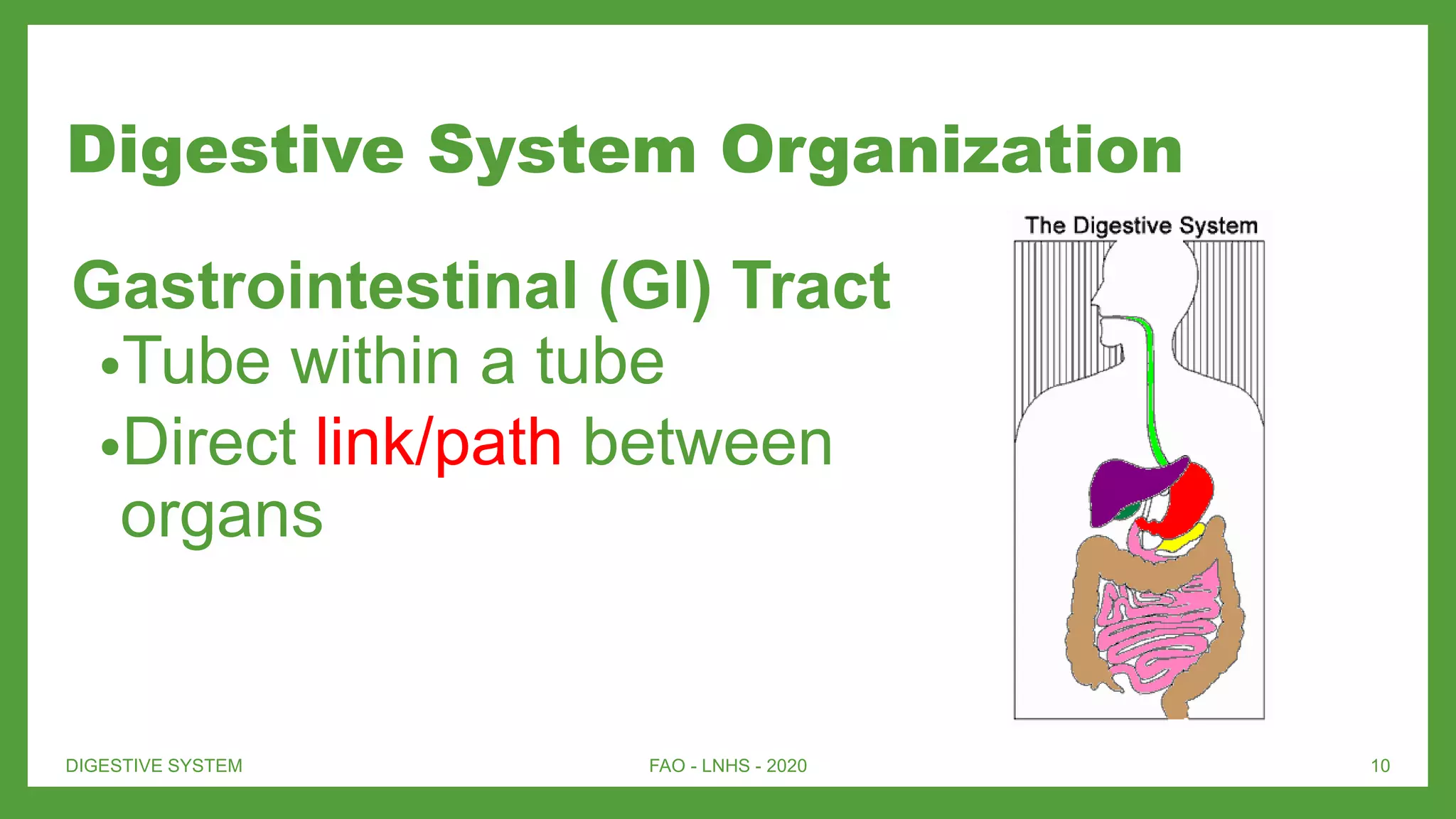
Gastrointestinal (Gl) Tract
•Tube within a tube
•Direct link/path between
organs
DIGESTIVE SYSTEM 10FAO - LNHS - 2020
Digestive System Organization
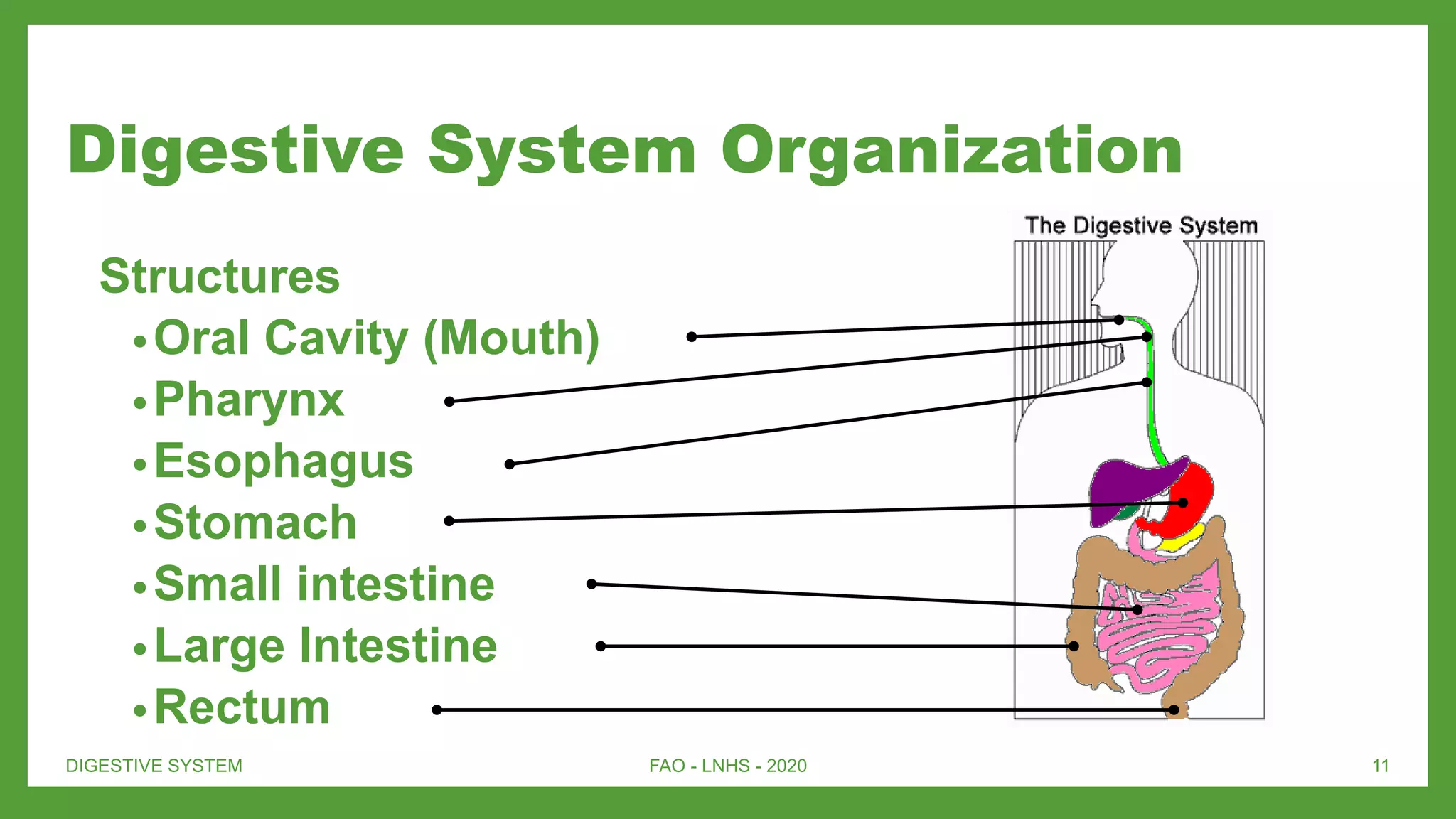
Structures
•Oral Cavity (Mouth)
•Pharynx
•Esophagus
•Stomach
•Small intestine
•Large Intestine
•Rectum
DIGESTIVE SYSTEM 11FAO - LNHS - 2020
The Oral
Cavity
DIGESTIVE SYSTEM 12FAO - LNHS - 2020
The Oral Cavity (Mouth)
The oral cavity serves as the
entrance of the digestive
system. It is responsible for
the mastication of food. It is
composed of the teeth,
tongue, and salivary glands.
DIGESTIVE SYSTEM 13FAO - LNHS - 2020
Teeth
The teeth is responsible for
mastication, the process of
crushing and grinding food.
Different types of teeth carry
out different activities. Normal
adults have 32.
DIGESTIVE SYSTEM 14FAO - LNHS - 2020
Teeth (…)
A tooth is composed of
three main region:
•Crown – located above
the gums
•Neck – in the margin of
the gums
•Root – hold the tooth in
place in the mandible
DIGESTIVE SYSTEM 15FAO - LNHS - 2020
The teeth is the only part of our
body that cannot repair itself.
DIGESTIVE SYSTEM FAO - LNHS - 2020 16
QUICK-KNOWS!
Tongue
Your tongue is a long,
muscular structure that
perceive taste and helps
mix food with saliva. It
also pushes down food
downward when you
swallow.
DIGESTIVE SYSTEM 17FAO - LNHS - 2020
Tongue (…)
The rough parts of the
tongue is the papillae,
where the taste buds are
found. These taste buds
enable us to distinguish
the five main taste – bitter,
salty, sour, sweet and
umami.
DIGESTIVE SYSTEM 18FAO - LNHS - 2020
Some people think that
specific taste in assigned
to specific area of the
tongue. This is not true! All
taste buds can detect all
flavors!
DIGESTIVE SYSTEM FAO - LNHS - 2020 19
QUICK-KNOWS!
Do you smell with tongue or with
nose? Can you taste something
without smelling it?
DIGESTIVE SYSTEM FAO - LNHS - 2020 20
QUICK-STION
Salivary Glands
As food is chewed in the
mouth, saliva, the juice
secreted by salivary glands,
moisten the food and makes it
slippery to facilitate in the
swallowing process.
DIGESTIVE SYSTEM 21FAO - LNHS - 2020
Salivary Glands (…)
Saliva contains the enzyme
salivary amylase that
helps in digesting starch (a
complex carbohydrate) into
maltose (a simpler
carbohydrates).
DIGESTIVE SYSTEM 22FAO - LNHS - 2020
Saliva is important – if your saliva
cannot dissolve something, you
wont be able to taste food.
DIGESTIVE SYSTEM FAO - LNHS - 2020 23
QUICK-KNOWS!
During your lifetime,
you can produce
saliva that can be able
to fill two regular sized
swimming pool
DIGESTIVE SYSTEM FAO - LNHS - 2020 24
QUICK-KNOWS!
Under the Star[ch]
Bring crackers in class and have
them tested for the precense of
starch using an iodine test.
DIGESTIVE SYSTEM FAO - LNHS - 2020 25
QUICK-TIVITY!
PHARYNX
DIGESTIVE SYSTEM 26FAO - LNHS - 2020
Pharynx
The pharynx is a
funnelform structure that
serve as the passageway
for food and air. When
swallowing, the epiglottis
closed so that food won’t
enter the esophagus.
DIGESTIVE SYSTEM 27FAO - LNHS - 2020
ESOPHAGUS
DIGESTIVE SYSTEM 28FAO - LNHS - 2020
Esophagus
DIGESTIVE SYSTEM 29
Running from the base of the
pharynx to the whole neck down to
stomach is a long tube called
esophagus.
It is around 20cm long.
FAO - LNHS - 2020
Esophagus (…)
DIGESTIVE SYSTEM 30
The muscles of the esophagus
contract in a wavelike process
called peristalsis.
Mucous Glands that line in the
inner esophagus secrets mucus,
a slimy substance, that aids in the
passage of the food.
FAO - LNHS - 2020
When harmful objects enter the
esophagus, it sometimes wave in
the opposite direction, called
antiperistalsis, to throw out the
object, and you vomit.
DIGESTIVE SYSTEM FAO - LNHS - 2020 31
QUICK-KNOWS!
stomach
DIGESTIVE SYSTEM 32FAO - LNHS - 2020
Stomach
The esophagus empties food
through a muscular valve called
esophageal sphincter into the
stomach – a J-shaped, expandable,
muscular bag – that stores the food
you eat and breaks it down into tiny
pieces.
DIGESTIVE SYSTEM FAO - LNHS - 2020 33
Stomach (…)
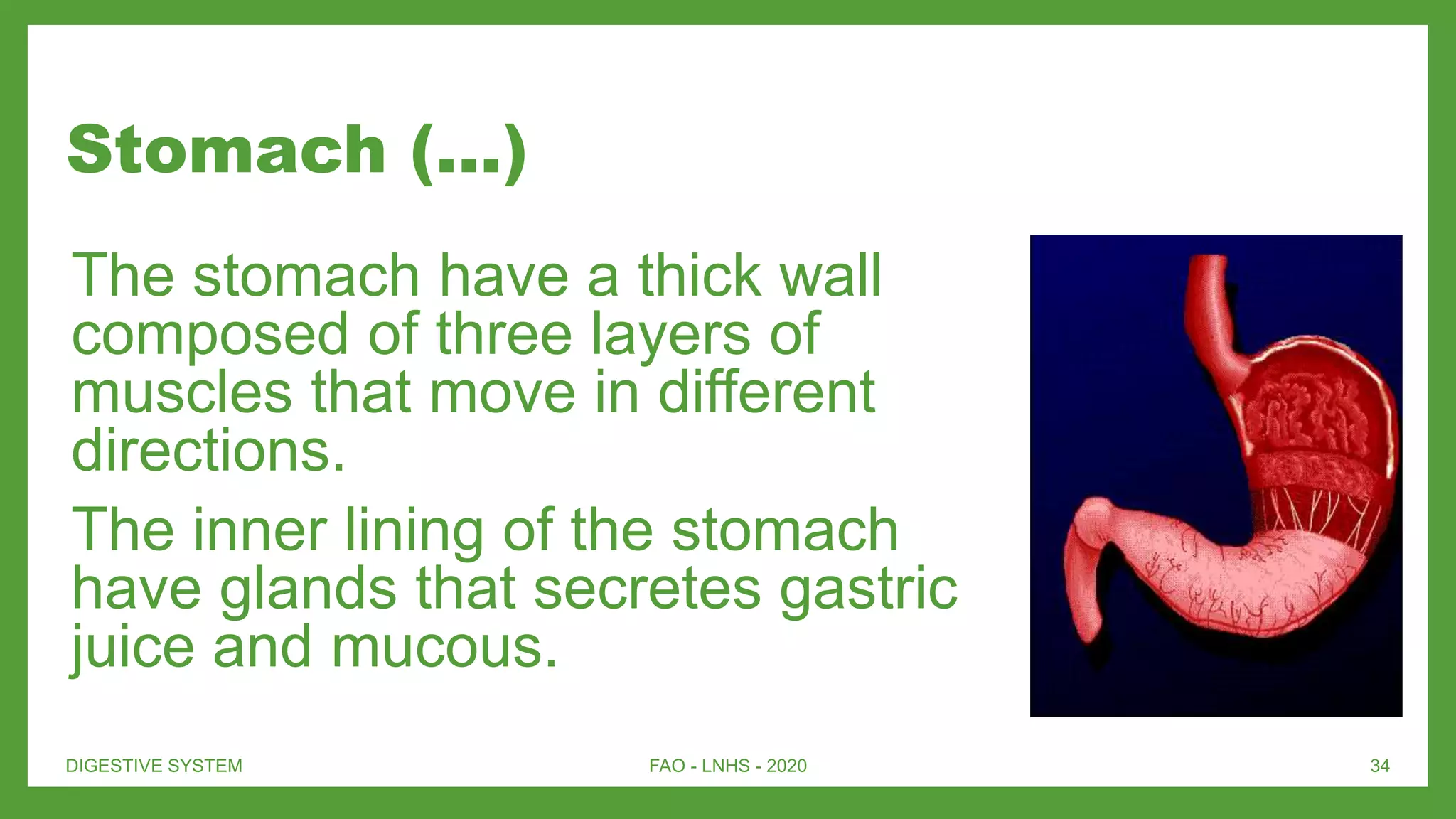
The stomach have a thick wall
composed of three layers of
muscles that move in different
directions.
The inner lining of the stomach
have glands that secretes gastric
juice and mucous.
DIGESTIVE SYSTEM FAO - LNHS - 2020 34
Stomach (…)
Gastric juices are
composed of Hydrochloric
Acid (HCl) and digestive
enzymes pepsin ( and
rennin in infants).
HCl soften fibrous foods
and kills bateria. It is very
acidic, with a pH of 1 and 2.
DIGESTIVE SYSTEM FAO - LNHS - 2020 35
Stomach (…)
Rennin digest milk proteins.
Pepsin breaks down other
protein into amino acids and
peptides.
Food in the stomach mix with
gastric juice is called Chyme.
DIGESTIVE SYSTEM FAO - LNHS - 2020 36
pH is the measure of acidity or
alkalinity of a solution. It is in the
scale of 1 to 14. 7 is neutral, lower
is acidic, higher is alkaline.
DIGESTIVE SYSTEM FAO - LNHS - 2020 37
QUICK-KNOWS!
The acid in our stomach is strong
enough to dissolve a razon blade.
Don’t swallow razor blades!
DIGESTIVE SYSTEM FAO - LNHS - 2020 38
QUICK-KNOWS!
If stomach acid is very strong, why
can’t it dissolve our stomach?
DIGESTIVE SYSTEM FAO - LNHS - 2020 39
QUICK-STION
If the stomach can be emptied in
just 4 hours, how many hours will it
be empty if we eat 3 full meals?
DIGESTIVE SYSTEM FAO - LNHS - 2020 40
QUICK-STION
SMALL
intestine
DIGESTIVE SYSTEM 41FAO - LNHS - 2020
Small Intestine (…)
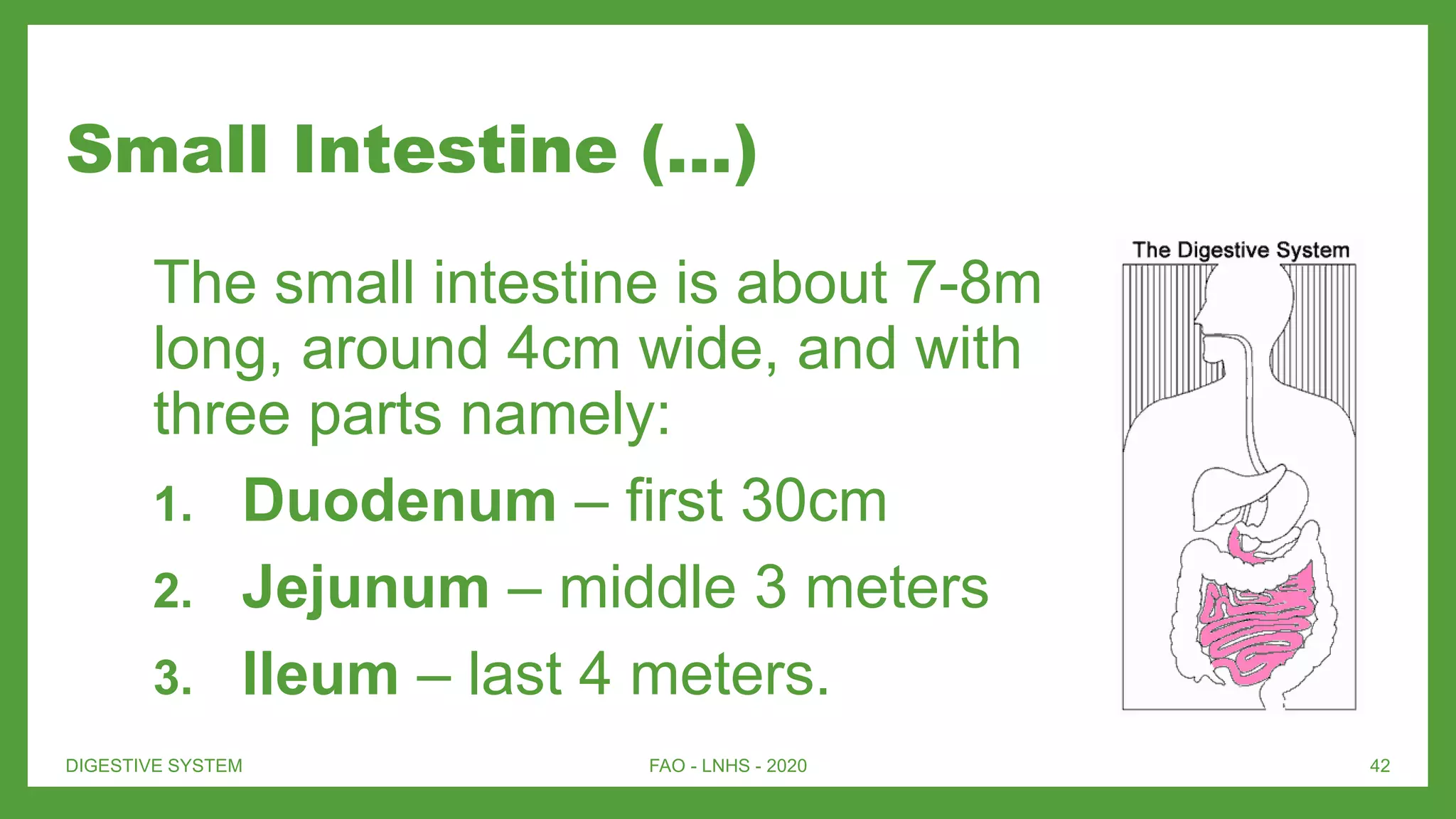
The small intestine is about 7-8m
long, around 4cm wide, and with
three parts namely:
1. Duodenum – first 30cm
2. Jejunum – middle 3 meters
3. Ileum – last 4 meters.
DIGESTIVE SYSTEM 42FAO - LNHS - 2020
Small Intestine
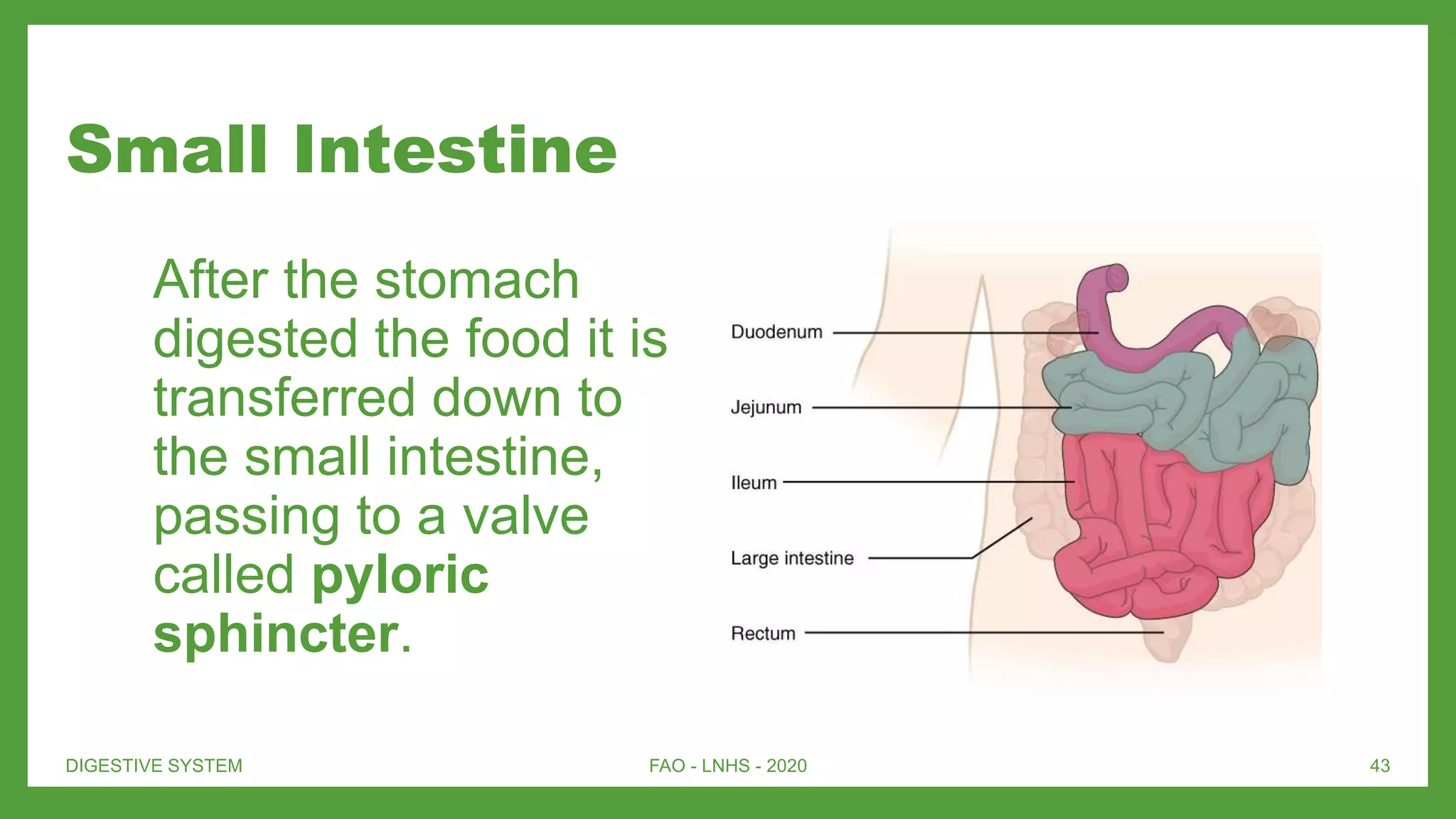
After the stomach
digested the food it is
transferred down to
the small intestine,
passing to a valve
called pyloric
sphincter.
DIGESTIVE SYSTEM 43FAO - LNHS - 2020
Small Intestine (…)
Food in the small intestine
also move via peristalsis.
In duodenum, chyme gets
neutralized (lessen the
acidity).
In jejenum and ileum,
absorption happens.
DIGESTIVE SYSTEM 44FAO - LNHS - 2020
Small Intestine (…)
Lining of intestine walls has
finger-like projections called
villi. The villi are further
covered in microvilli.
Located in each villus is a
blood vessel (capillary) and
a tiny lymph vessel (lacteal).
DIGESTIVE SYSTEM 45FAO - LNHS - 2020
Small Intestine (…)
The small intestine also
has accessory organs
(glands) that aid in the
digestion of the food
namely: liver, gall bladder,
pancreas, and intestinal
glands.
DIGESTIVE SYSTEM 46FAO - LNHS - 2020
Accessory
glands
DIGESTIVE SYSTEM 47FAO - LNHS - 2020
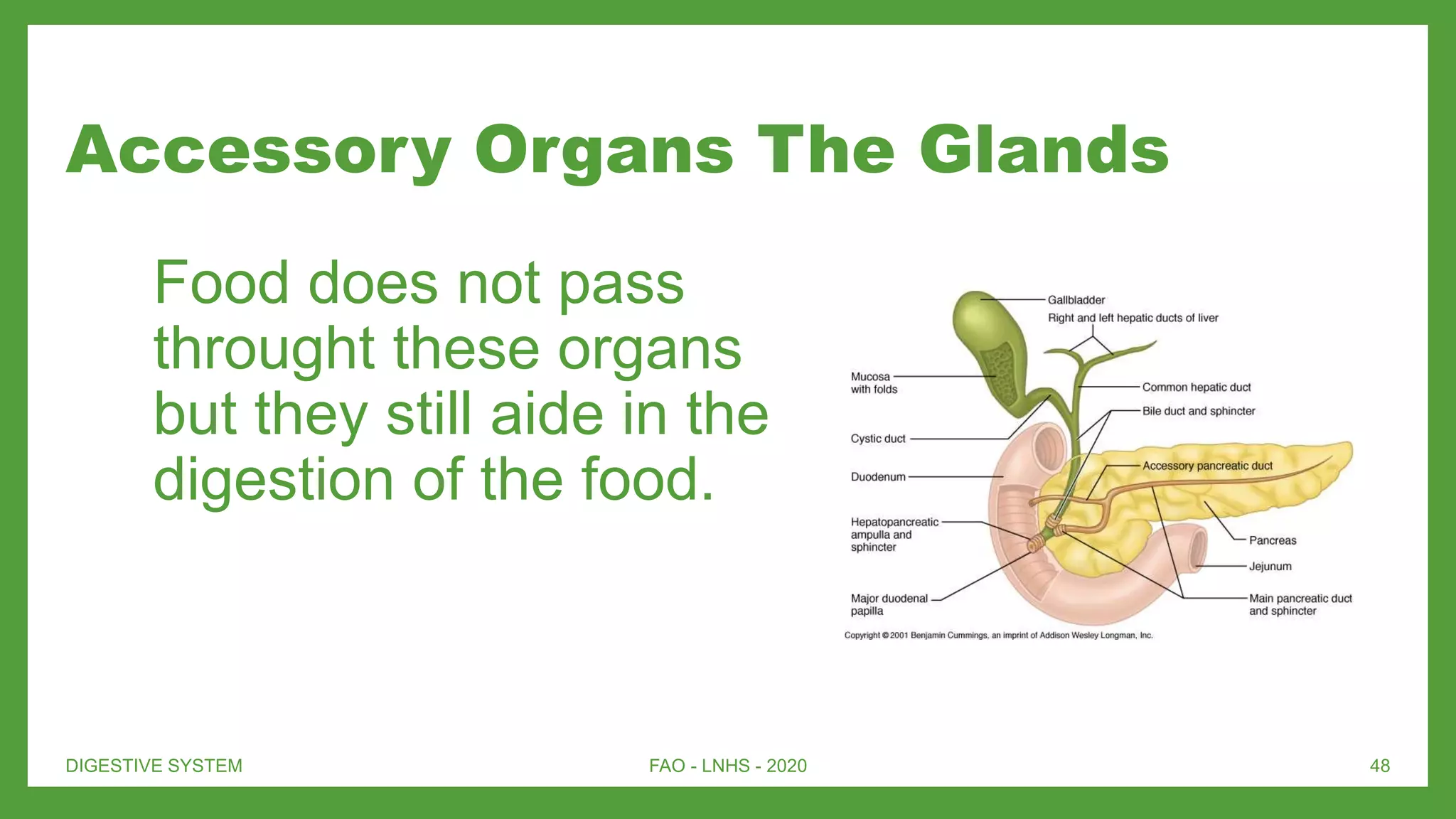
Accessory Organs The Glands
Food does not pass
throught these organs
but they still aide in the
digestion of the food.
DIGESTIVE SYSTEM FAO - LNHS - 2020 48
Liver
Liver is the largest gland in our
body. It secretes bile which is
temporarily stored in the gall
bladder.
DIGESTIVE SYSTEM 49FAO - LNHS - 2020
Liver (…)
Bile is very alkaline. It
contains pigments,
cholesterol, and bile
salts. These particles
convert fat to fat
droplets.
DIGESTIVE SYSTEM 50FAO - LNHS - 2020
Like a Bile
Pour a small amout of cooking oil
into a small plate. Add a few drops
of liquid detergent and observe
what will happen.
DIGESTIVE SYSTEM FAO - LNHS - 2020 51
QUICK-TIVITY!
Gall Bladder
Temporarily stores bile from liver,
then transfer it to the duodenum
via bile duct.
Eating fatty foods can cause gall
stones.
DIGESTIVE SYSTEM 52FAO - LNHS - 2020
Pancreas
Pancreas is another
gland in the digestive
system which release
pancreatic juice loaded
with enzymes. These
enzymes can help in
breaking down fats,
protein, and
carbohydrates.
DIGESTIVE SYSTEM 53FAO - LNHS - 2020
Pancreas
•Lipase – breaks down fat
doplets (from liver)
completely digesting it.
•Protease/Trypsinogen/
Chymotrypsinogen –
break down protein into
amino acids and peptides
•Amylase – break down
starch to maltose
DIGESTIVE SYSTEM 54FAO - LNHS - 2020
Sweet Tooth
Bring juice packets in the class next
time. Read the labels and see what
composes these drinks.
DIGESTIVE SYSTEM FAO - LNHS - 2020 55
QUICK-TIVITY!
Intestinal Glands
Intestinal glands
releases intestinal
juices. It has four
enzymes but mostly, all
their jobs are to break
down left over protein
and carbohydrates.
DIGESTIVE SYSTEM 56FAO - LNHS - 2020
Large
intestines
DIGESTIVE SYSTEM 57FAO - LNHS - 2020
Large Intestine or Colon
Digestion is not always 100%
efficient. There are time that some
enzymes are not always present
in the human body. Thus, if there
are undigested materials, it will
be transferred to the large
intestine or colon.
DIGESTIVE SYSTEM 58FAO - LNHS - 2020
Large Intestine or Colon
Large intestine is around 2
meters long and 7cm
wide. It is shorter than the
small intestine but it is
wider compared to it.
Digestion doesn’t happen
anymore but
reabsorption of salt and
water takes place.
DIGESTIVE SYSTEM 59FAO - LNHS - 2020
Large Intestine or Colon (…)
Peristalsis moves
undigested food from
large intestine to the
rectum, an expandable
storage chamber.
DIGESTIVE SYSTEM 60FAO - LNHS - 2020
Large Intestine or Colon (…)
The undigested food in
rectum is now called
feces which eventually
passes out in the body
through the anus.
DIGESTIVE SYSTEM 61FAO - LNHS - 2020
Bonus organ
DIGESTIVE SYSTEM 62FAO - LNHS - 2020
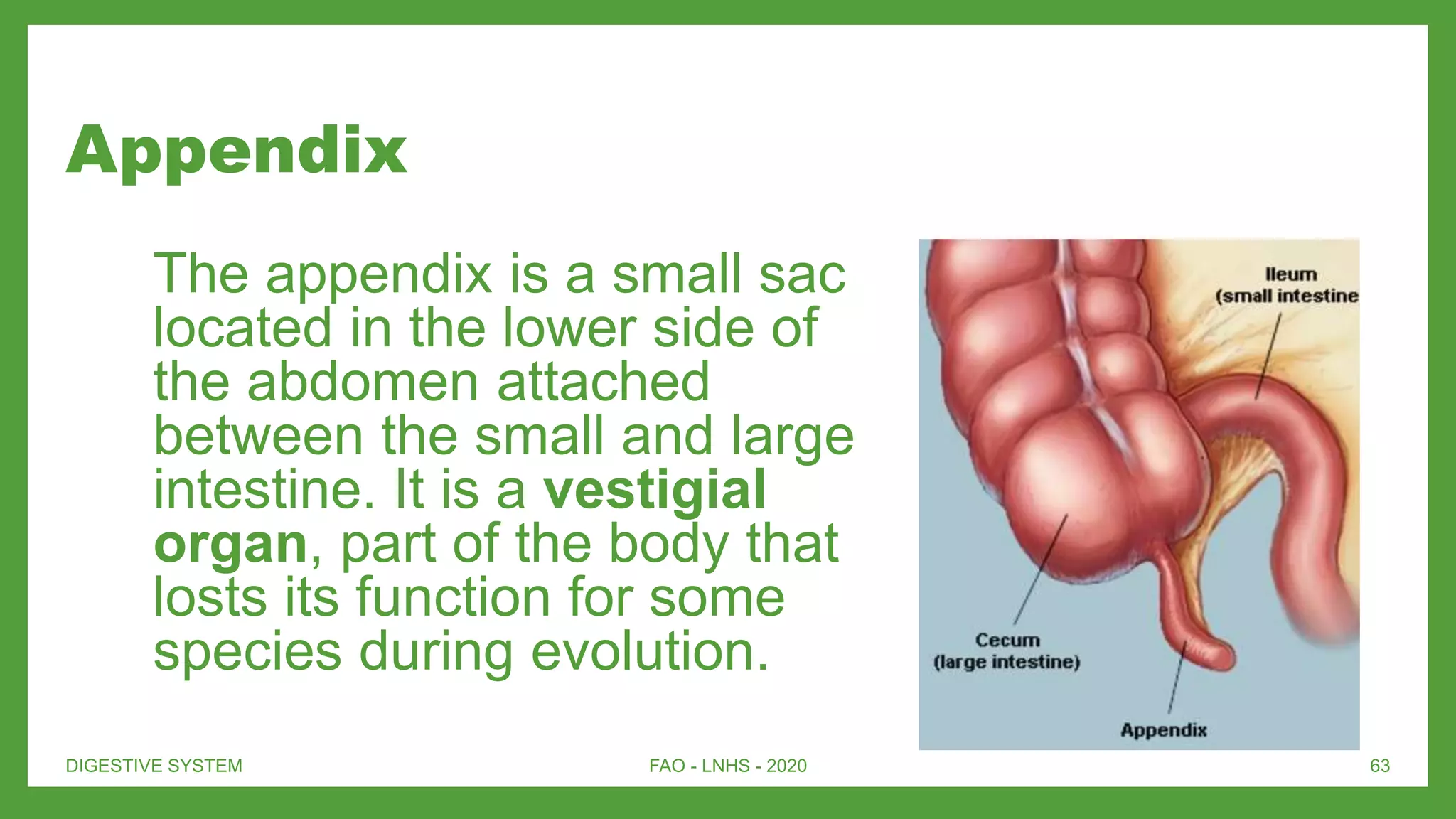
Appendix
The appendix is a small sac
located in the lower side of
the abdomen attached
between the small and large
intestine. It is a vestigial
organ, part of the body that
losts its function for some
species during evolution.
DIGESTIVE SYSTEM 63FAO - LNHS - 2020
QUIZ
TIME!DIGESTIVE SYSTEM 64FAO - LNHS - 2020
On a sheet of paper, write the name
of each colored organ:
DIGESTIVE SYSTEM FAO - LNHS - 2020 65
• Green:
• Red:
• Pink:
• Brown:
• Purple:
• Green:
• Yellow:
How’d you do?
DIGESTIVE SYSTEM FAO - LNHS - 2020 66
• Green: Esophagus
• Red: Stomach
• Pink: Small Intestine
• Brown: Large Intestine
• Purple: Liver
• Green: Gall Bladder
• Yellow: Pancreas
QUIZ #1
1. Part of pharynx
which prevents food
from entering the
trachea (lungs).
DIGESTIVE SYSTEM FAO - LNHS - 2020 Slide 68
2. Found between the
esophagus and the
stomach, it prevents the
backward flow of food from
stomach to esophagus.
DIGESTIVE SYSTEM FAO - LNHS - 2020 Slide 69
3. The wavelike motion
of the mucles of the
esophagus which push
the food down.
DIGESTIVE SYSTEM FAO - LNHS - 2020 Slide 70
4. How many layers of
muscles does the
stomach have?
DIGESTIVE SYSTEM FAO - LNHS - 2020 Slide 71
5. What acid is included
in the gastric juice which
digest food and kill
bacteria.
DIGESTIVE SYSTEM FAO - LNHS - 2020 Slide 72
6. What is the term used
when the digested food
is mixed with the
stomach acid?
DIGESTIVE SYSTEM FAO - LNHS - 2020 Slide 73
7. Give the three
partition of the small
intestine in order.
DIGESTIVE SYSTEM FAO - LNHS - 2020 Slide 74
8. What happens when
the undigested food
reach the large
intestine?
DIGESTIVE SYSTEM FAO - LNHS - 2020 Slide 75
9. Give at least 3 glands
that helps the digestive
system in digesting food.
DIGESTIVE SYSTEM FAO - LNHS - 2020 Slide 76
10. Appendix is a
vestigial organ. What
does vestigial organ
mean?
DIGESTIVE SYSTEM FAO - LNHS - 2020 Slide 77
DIGESTIVE SYSTEM FAO - LNHS - 2020 78
answer
1. Part of pharynx
which prevents food
from entering the
trachea (lungs).
DIGESTIVE SYSTEM FAO - LNHS - 2020 Slide 79
DIGESTIVE SYSTEM FAO - LNHS - 2020 80
Epiglottis
2. Found between the
esophagus and the
stomach, it prevents the
backward flow of food from
stomach to esophagus.
DIGESTIVE SYSTEM FAO - LNHS - 2020 Slide 81
DIGESTIVE SYSTEM FAO - LNHS - 2020 82
Esophageal
sphincter
3. The wavelike motion
of the mucles of the
esophagus which push
the food down.
DIGESTIVE SYSTEM FAO - LNHS - 2020 Slide 83
DIGESTIVE SYSTEM FAO - LNHS - 2020 84
Peristalsis
4. How many layers of
muscles does the
stomach have?
DIGESTIVE SYSTEM FAO - LNHS - 2020 Slide 85
DIGESTIVE SYSTEM FAO - LNHS - 2020 86
Three (3)
5. What acid is included
in the gastric juice which
digest food and kill
bacteria.
DIGESTIVE SYSTEM FAO - LNHS - 2020 Slide 87
DIGESTIVE SYSTEM FAO - LNHS - 2020 88
Hydrochloric acid
6. What is the term used
when the digested food
is mixed with the
stomach acid?
DIGESTIVE SYSTEM FAO - LNHS - 2020 Slide 89
DIGESTIVE SYSTEM FAO - LNHS - 2020 90
Chyme
7. Give the three
partition of the small
intestine in order.
DIGESTIVE SYSTEM FAO - LNHS - 2020 Slide 91
DIGESTIVE SYSTEM FAO - LNHS - 2020 92
Duodenum,
jejenum, ileum
8. What happens when
the undigested food
reach the large
intestine?
DIGESTIVE SYSTEM FAO - LNHS - 2020 Slide 93
DIGESTIVE SYSTEM FAO - LNHS - 2020 94
Reabsorption /
water and salt
are added
9. Give at least 3 glands
that helps the digestive
system in digesting food.
DIGESTIVE SYSTEM FAO - LNHS - 2020 Slide 95
DIGESTIVE SYSTEM FAO - LNHS - 2020 96
Salivary gland, liver,
pancreas, intestinal
gland, mucous gland,
stomach glands
10. Appendix is a
vestigial organ. What
does vestigial organ
mean?
DIGESTIVE SYSTEM FAO - LNHS - 2020 Slide 97
DIGESTIVE SYSTEM FAO - LNHS - 2020 98
Organs without
functions / lost its
function
SCRAMBLED!
Form another word from the letters on the
current word (anagram).
DIGESTIVE SYSTEM FAO - LNHS - 2020 99
OH
PEGASUS
DIGESTIVE SYSTEM FAO - LNHS - 2020 100
ESOPHAGUS
DIGESTIVE SYSTEM FAO - LNHS - 2020 101
MISSES
YETT GIVED
DIGESTIVE SYSTEM FAO - LNHS - 2020 102
DIGESTIVE
SYSTEM
DIGESTIVE SYSTEM FAO - LNHS - 2020 103
ALA
VICTORY
DIGESTIVE SYSTEM FAO - LNHS - 2020 104
ORAL
CAVITY
DIGESTIVE SYSTEM FAO - LNHS - 2020 105
ALERTED
PATHS
DIGESTIVE SYSTEM FAO - LNHS - 2020 106
HARD
PALETTES
DIGESTIVE SYSTEM FAO - LNHS - 2020 107
LIP
ASSISTER
DIGESTIVE SYSTEM FAO - LNHS - 2020 108
PERISTALSIS
DIGESTIVE SYSTEM FAO - LNHS - 2020 109
PIGS
TOILET
DIGESTIVE SYSTEM FAO - LNHS - 2020 110
EPIGLOTTIS
DIGESTIVE SYSTEM FAO - LNHS - 2020 111
DUST
BEAST
DIGESTIVE SYSTEM FAO - LNHS - 2020 112
TASTE
BUDS
DIGESTIVE SYSTEM FAO - LNHS - 2020 113
FATTEST
POLES
DIGESTIVE SYSTEM FAO - LNHS - 2020 114
SOFT
PALETTES
DIGESTIVE SYSTEM FAO - LNHS - 2020 115
CHAOTIC
DAMS
DIGESTIVE SYSTEM FAO - LNHS - 2020 116
STOMACH
ACID
DIGESTIVE SYSTEM FAO - LNHS - 2020 117
CHICO DARYL
ORCHID
DIGESTIVE SYSTEM FAO - LNHS - 2020 118
HYDROCHLORIC
ACID
DIGESTIVE SYSTEM FAO - LNHS - 2020 119
Continuation…
DIGESTIVE SYSTEM FAO - LNHS - 2020 120
INGESTION,
DIGESTION,
AND
ABSORPTION
DIGESTIVE SYSTEM 121FAO - LNHS - 2020
Phases of the Digestive System
1. Ingestion
2. Digestion
(Mechanical and
Chemical)
3. Absorption
4. Elimination/
Excretion/Egestion
DIGESTIVE SYSTEM 122FAO - LNHS - 2020
Ingestion
DIGESTIVE SYSTEM 123FAO - LNHS - 2020
Ingestion
Ingestion is simply the
process of taking in food
into the body. Normally
food enters in the mouth. In
hospitals, sick patients who
can’t eat or swallow eat food
through a tube inserted into
the esophagus into the
stomach.
DIGESTIVE SYSTEM FAO - LNHS - 2020 124
Ingestion
Ingestion on the digestive
system can also be
incomplete or complete.
•Incomplete Digestive
System – food enter and
exit on same opening.
•Complete Digestive
System– food enter on a
mouth and exits on anus.
DIGESTIVE SYSTEM FAO - LNHS - 2020 125
Digestion
DIGESTIVE SYSTEM 126FAO - LNHS - 2020
Digestion
Digestion is the process of
breaking down food.
•Mechanical digestion
breaks food into smaller
pieces. Happens in mouth.
•Chemical Digestion breaks
down food into simpler
substances. Happens in
mouth, stomach and small
intestine.
DIGESTIVE SYSTEM FAO - LNHS - 2020 127
Digestion
Digestion can also be
intracellular or
extracellular.
•Intracellular Digestion
– happens inside the cell
•Extracellular Digestion
– happens outside the
cell but inside the
digestive system.
DIGESTIVE SYSTEM FAO - LNHS - 2020 128
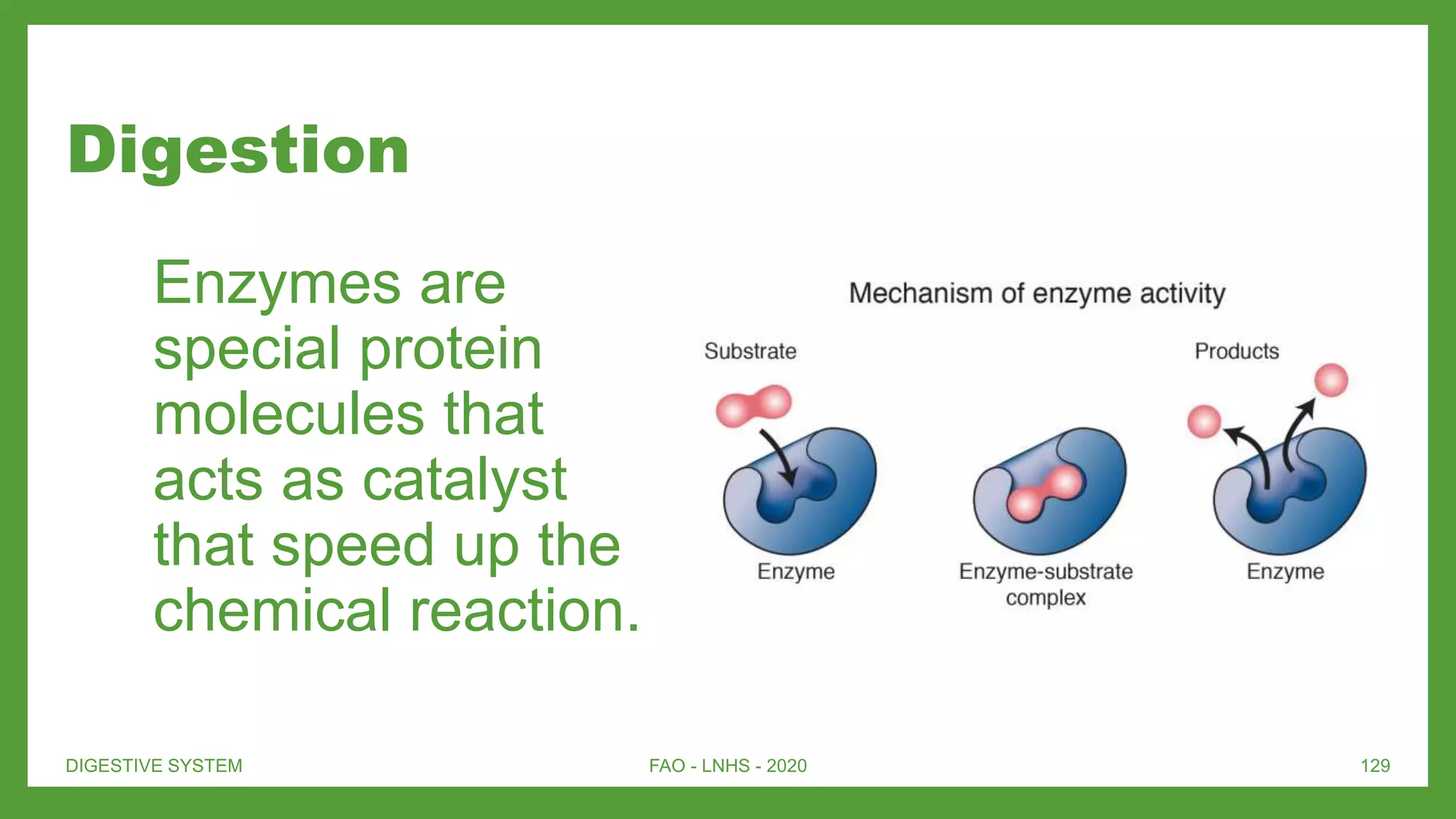
Digestion
Enzymes are
special protein
molecules that
acts as catalyst
that speed up the
chemical reaction.
DIGESTIVE SYSTEM FAO - LNHS - 2020 129
DIGESTIVE SYSTEM FAO - LNHS - 2020 130
FOOD NUTRIENTS ENZYMES PRODUCTS
Carbohydrates which
are reduced to maltose,
lactose and sucrose
Amylase
• Malase
• Lactose
• Sucrose
Simple Sugars
• Glucose
• Galactose
• Fructose
Proteins
Casein (milk) and other
proteins
Protease
• Pepsin
• Rennin
• Trypsinogen
Amino Acids
Peptones and proreoses
Milk Curdles
Acids and Fats Lipase Fatty Acids and Glycerol
Vitamins and Minerals Mostly not needed
Absorbed in the precense of
bile
DIGESTION OF FOOD INTAKE
DIGESTIVE SYSTEM FAO - LNHS - 2020 131
PATH SECRETIONS ENZYMES PROCESS
Mouth Saliva Amylase
Mechanical
and Chemical
Esophagus Mucus Mechanical
Stomach
Gastric Juice
• Pepsinogen
• HCl
Pepsin
Mechanical
and Chemical
SUMMARY OF DIGESTION PROCESS
DIGESTIVE SYSTEM FAO - LNHS - 2020 132
PATH SECRETIONS ENZYMES PROCESS
Small
Intestine
Mucus,
Intestinal
Juice,
Chemotrypsin
Amylase,
Lipase,
Trypsin,
Peptides
Mechanical
and Chemical
Large
Intestine
Mucus
Water
Reabsorption
SUMMARY OF DIGESTION PROCESS
ABSORPTION
DIGESTIVE SYSTEM 133FAO - LNHS - 2020
Absorption
Absorption is the process
when the nutrients and
minerals from the digested
food and distributed to the
different parts of the body.
DIGESTIVE SYSTEM FAO - LNHS - 2020 134
Absorption
Nutrients from the food
pass into the bloodstream
through the small intestine
walls. Absorbs 80%
ingested water, vitamins,
minerals, carbohydrates,
proteins, and lipids.
DIGESTIVE SYSTEM FAO - LNHS - 2020 135
Excretion
DIGESTIVE SYSTEM 136FAO - LNHS - 2020
Excretion
Extretion is when the
undigested food is
extracted to the body.
DIGESTIVE SYSTEM FAO - LNHS - 2020 137
TAKING CARE
OF DIGESTIVE
SYTEMS
DIGESTIVE SYSTEM 138FAO - LNHS - 2020
Eating Out is Fun, but…
While eating your food, you noticed
that something long was stucked in
your teeth. You took it out and you see
a hair in your hand. What will you do?
DIGESTIVE SYSTEM FAO - LNHS - 2020 139
QUICK-TIVITY!
Eating Out is Fun, but…
Upon entering a restaurant, you saw
that there are flies flying inside the
establishment. What will you do?
DIGESTIVE SYSTEM FAO - LNHS - 2020 140
QUICK-TIVITY!
Questions
1. When you eat out, what precautions are on
your mind to ensure that you enjoy your day?
2. What is your criteria in choosing a food to
eat?
3. What are the government agencies and
offices that are concerned with the food we
eat?
4. What can you say about “street food”?
DIGESTIVE SYSTEM 141FAO - LNHS - 2020
“You are
what you
eat.”
DIGESTIVE SYSTEM FAO - LNHS - 2020 142
Nutrients
Essential for Life
DIGESTIVE SYSTEM 143FAO - LNHS - 2020
Nutrients Essential for Life
In elementary, we
classified foods by
Go, Grow and Glow
Foods.
DIGESTIVE SYSTEM 144FAO - LNHS - 2020
Nutrients Essential for Life
Go foods such as camote,
cassava, potatoes, bread,
rice, and other cereals are
rich in carbohydrates and
provide energy. It enable
us to do our daily activities
like walking, jumping and
playing.
DIGESTIVE SYSTEM 145FAO - LNHS - 2020
Nutrients Essential for Life
Grow foods such as meat,
poultry products, cheese,
yogurt, milk and other dairy
products, enhance growth
and development. This helps
us become bigger and
stronger.
DIGESTIVE SYSTEM 146FAO - LNHS - 2020
Nutrients Essential for Life
Glow foods are rich in
vitamins and minerals such
as fruits and green and leafy
vegetables like malunggay,
pechay and spinach. It makes
our hair shine, eyes sparkle,
and make our skin clear.
DIGESTIVE SYSTEM 147FAO - LNHS - 2020
Yummy Yum!
Create an ideal one day meal set
using the food pyramid from the
Food and Nutrition Research
Institute.
DIGESTIVE SYSTEM FAO - LNHS - 2020 148
QUICK-TIVITY!
Carbohydrates
DIGESTIVE SYSTEM 149FAO - LNHS - 2020
Carbohydrates
Carbohydrates are the
immideate source of
energy. The staple food
of Filipinos is rice
which is rich in
carbohydrates. It
contains glucose, the
most basic sugar.
DIGESTIVE SYSTEM 150FAO - LNHS - 2020
Carbohydrates
Cells in our body requires
carbohydrates to perform
their tasks. Glucose – a
type of simple sugar – in
the carbohydrates is the
one providing energy to
the cells.
DIGESTIVE SYSTEM 151FAO - LNHS - 2020
Carbohydrates
Lack of carbohydrate intake
may cause memory loss,
learning difficulty, fatigue,
exhaustion, nausea, muscle
cramps, irritability, and even
grievous conditions like
epilepsy and paralysis.
DIGESTIVE SYSTEM 152FAO - LNHS - 2020
Proteins
DIGESTIVE SYSTEM 153FAO - LNHS - 2020
Proteins
Proteins helps build
body tissues. Proteins
contains amino acids.
Cells can produce amino
acids except eight types,
which can be obtained
from food.
DIGESTIVE SYSTEM 154FAO - LNHS - 2020
Proteins
Lack of proteins may cause
edema (body swelling),
anxiety, depression, hair
loss, weight loss, skin rash
and scaly skin. Poor
countries often suffer from
protein malnutrition.
DIGESTIVE SYSTEM 155FAO - LNHS - 2020
Fats and lipids
DIGESTIVE SYSTEM 156FAO - LNHS - 2020
Fats and Lipids
Fats and Lipids produce
four times energy than
carbohydrates and
proteins. They are the
energy reserves of the
body. Lipids are important
because they help in
building cell membranes.
DIGESTIVE SYSTEM 157FAO - LNHS - 2020
Fats and Lipids
There are two types of fats
•Saturated Fats – found
from butter, cheese,
meats, palm oil, coconut
oil, vegetable oil
•Unsaturated Fats – found
on canola, corn, olive oil,
nuts and legumes
DIGESTIVE SYSTEM 158FAO - LNHS - 2020
Fats and Lipids
Fats intake can affect
cholesterol. Eating much
may increase your “bad
cholesterol” or the low-
density lipoprotein (LDL)
and lower your “good
cholesterol” or high-
density lipopreotein (HDL).
DIGESTIVE SYSTEM 159FAO - LNHS - 2020
Fats and Lipids
Lack of Fat can also be
dangerous in our body.
Without fat, our body
wont be able to absorb
fat-soluble vitamins (A,
D, E, and K).
DIGESTIVE SYSTEM 160FAO - LNHS - 2020
Fats and Lipids
Lack of fat can also
cause lack of
concentration and
attention, learning
difficulties, hyperactivity,
poor memory, and lacks
of production of
hormones.
DIGESTIVE SYSTEM 161FAO - LNHS - 2020
“Proper
nutrition starts
with proper
selection.”
DIGESTIVE SYSTEM FAO - LNHS - 2020 162
Transfat is a type of unsaturated fat
that can be produced artificialy.
DIGESTIVE SYSTEM FAO - LNHS - 2020 163
QUICK-KNOWS!
Scientist Highlight
Ivan Petrovich Pavlov
(1849 – 1936)
DIGESTIVE SYSTEM FAO - LNHS - 2020 164
QUICK-KNOWS!
Regulatory
Nutrients
for the BodyDIGESTIVE SYSTEM 165FAO - LNHS - 2020
WATER
DIGESTIVE SYSTEM 166FAO - LNHS - 2020
Water
We are always advised
to drink plenty of water.
Water is vital to the
physiological and
chemical process that
involve the release of
energy in the cell.
DIGESTIVE SYSTEM 167FAO - LNHS - 2020
Water
Water also normalize
the human body
temperature. Drinking
lots of water when we
are sick helps in
lowering the body
temperature.
DIGESTIVE SYSTEM 168FAO - LNHS - 2020
Water
To determine if our body
has enough water, we can
examine the color of our
urine. When it is pale
yellow to clear, you have
enough water – otherwise,
you’ll see bright yellow to
dark yellow.
DIGESTIVE SYSTEM 169FAO - LNHS - 2020
Under the Star[ch] Part 2
Cut a thin slice of cucumber and
potato. Add a drop of iodine
solution. Observe and compare
what happens.
DIGESTIVE SYSTEM FAO - LNHS - 2020 170
QUICK-TIVITY!
VITAMINS
DIGESTIVE SYSTEM 171FAO - LNHS - 2020
Vitamins
Vitamins needed in small
or large amount are both
vital in our body. These
substances speed up
chemical reaction and
regulate the release of
energy in the body.
DIGESTIVE SYSTEM 172FAO - LNHS - 2020
Vitamins
There are two types of
Vitamins
1. Water-soluble –
B1, B2, B3, B4, B5,
B6, B12, C
2. Fat-soluble – A, D,
E, K
DIGESTIVE SYSTEM 173FAO - LNHS - 2020
DIGESTIVE SYSTEM FAO - LNHS - 2020 174
VITAMIN SOURCE FUNCTION DEFICIENCY
Vitamin A
(retinol)
Milk, Milk
Products, Liver,
Vegetable
Good Eyesight
Rough and Flaky
Skin, Night
Blindness
Vitamin B1
(thiamine)
Meat, Legumes,
unpolished grain
Food Oxidation,
Appetite, Nervous
System Health
Beriberi,
weakening of the
heart
Vitamin B2
(riboflavin)
Milk, Meat, Eggs,
Vegetables, Fish
Food Oxidation,
Healthy Skin, Eye
Function
Soreness,
Swelling
SUMMARY OF MAJOR VITAMINS
DIGESTIVE SYSTEM FAO - LNHS - 2020 175
VITAMIN SOURCE FUNCTION DEFICIENCY
Vitamin B3
(niacin)
Grains, lean
meat, tomatoes,
liver
Metabolism
enzyme, nervous
and digestive
system
Pellagra,
Inflammation of
nerves
Vitamin B5
(panthotenic
acid)
Various food
Conenzymes for
carbohydrates
and fat
metabolism
Fatigue, loss of
coordination
SUMMARY OF MAJOR VITAMINS
DIGESTIVE SYSTEM FAO - LNHS - 2020 176
VITAMIN SOURCE FUNCTION DEFICIENCY
Vitamin B6
(pyridoxine)
Vegetable,
cereals and meat
Coenzyme in
amino acid
metabolism
Anemia and
nervous system
disorder
Vitamin B12
(cyanoco-
balamin)
Red meats,
Livers, and
Kidneys
Nervous System,
blood formation
and growth
Pernicious anemia
SUMMARY OF MAJOR VITAMINS
DIGESTIVE SYSTEM FAO - LNHS - 2020 177
VITAMIN SOURCE FUNCTION DEFICIENCY
Biotin
Meat
and Vegetables
Coenzymes in fat
systhesis and
amino acid
metabolism
Depression,
Nausea
Folic Acid Green Vegetables
Important in
metabolic activity
Anemia, Diarrhea
SUMMARY OF MAJOR VITAMINS
DIGESTIVE SYSTEM FAO - LNHS - 2020 178
VITAMIN SOURCE FUNCTION DEFICIENCY
Vitamin C
(ascorbic
acid)
Citrus fruits,
green and leafy
vegetables
Healthy gums and
teeth, growth and
strength of blood
vessels
Scurvy,
breakdown of
skins and blood
vessels
Vitamin D
(calciferol)
Cod liver oil, dairy
products,
exposure to
sunlight
Normal growth,
healthy teeth and
bones, absorption
of calcium
Rickets
SUMMARY OF MAJOR VITAMINS
DIGESTIVE SYSTEM FAO - LNHS - 2020 179
VITAMIN SOURCE FUNCTION DEFICIENCY
Vitamin E
(tocopherol)
Milk, nuts, leafy
vegetables
Cell membrane
and fatty acids
protection from
oxidation
Problems in the
reproductive
system
Vitamin K
Leafy vegetables,
egg yolk, milk
Prevent blood
clotting
Hemmorage or
severe bleeding
SUMMARY OF MAJOR VITAMINS
Minerals
DIGESTIVE SYSTEM 180FAO - LNHS - 2020
Minerals
Minerals – such as
potassium, calcium,
magnesium, zinc and
iron – are essential for
the growth of the cells.
DIGESTIVE SYSTEM 181FAO - LNHS - 2020
Minerals
There are two types of
minerals
1. Macronutrients –
needed in greater
quantities.
2. Micronutrients –
needed in smaller
quantities.
DIGESTIVE SYSTEM 182FAO - LNHS - 2020
Humans can survive 30 days
without food, 3 days without water,
3 minutes without air.
DIGESTIVE SYSTEM FAO - LNHS - 2020 183
QUICK-KNOWS!
Canteen Raid
List down the food items that can
be bought in the canteen. Tabulate
these item into nutritious and not.
DIGESTIVE SYSTEM FAO - LNHS - 2020 184
QUICK-TIVITY!
Importance of
Exercise
DIGESTIVE SYSTEM 185FAO - LNHS - 2020
Importance of Exercise
Just eating right is not
enough – we need to use
the muscles in our body.
Exercise helps in
developing our muscles and
tissues. Lack of physical
activity may also cause
obesity.
DIGESTIVE SYSTEM 186FAO - LNHS - 2020
10 Reasons
why Exercise
is importanTDIGESTIVE SYSTEM 187FAO - LNHS - 2020
10 Importance of Exercise
1. 30-60 minutes of
exercise will keep your
body fit
2. It increase energy level,
allows greater oxygen
supply to the body
3. Leads to socialization
DIGESTIVE SYSTEM 188FAO - LNHS - 2020
10 Importance of Exercise
4. Good for heart. Imporves
blood circulation/pressure.
5. Maintains ideal weight.
Lessen pressure on other
organs of the body.
6. Exercise is fun.
DIGESTIVE SYSTEM 189FAO - LNHS - 2020
10 Importance of Exercise
7. Provides nice, long sleep
8. Release endorphine in
brain, makes you happier
9. Relax the mind and forgot
your problems
10. Boost confidence and
self esteem.
DIGESTIVE SYSTEM 190FAO - LNHS - 2020
General Care
DIGESTIVE SYSTEM 191FAO - LNHS - 2020
General Care Tips
1. Brush teeth regularly and
have a regular check-up
2. Avoid overeating
3. Eat a lot of fibrous food.
4. Defacate regularly
DIGESTIVE SYSTEM 192FAO - LNHS - 2020
General Care Tips
5. Drink plenty of water
6. Chew food slowly and
relax when you eat
7. Don’t talk when mouth
is full. You might choke.
8. Consult doctor if
experiencing discomforts
DIGESTIVE SYSTEM 193FAO - LNHS - 2020
Job Highlight
Food and Nutrition Technologist
Study the principles underlying food
processing and deterioration.
DIGESTIVE SYSTEM FAO - LNHS - 2020 194
QUICK-KNOWS!
“Now please do what I
ask. Let me fix you some
food. You must eat so
that you will be strong
enough to go on your
way.”
Samuel 28:22
DIGESTIVE SYSTEM FAO - LNHS - 2020 195
QUIZ #2
Identification
Read each sentence carefully then identify what
is being described in each sentence. Choose your
answer from the box provided
DIGESTIVE SYSTEM FAO - LNHS - 2020 Slide 197
1. Foods that gives us
energy and rich in
carbohydrates.
2. Foods that have
plenty of protein
which helps our cells
in multiplying.
DIGESTIVE SYSTEM FAO - LNHS - 2020 Slide 198
Amino Acids
Cholesterol
Exercise
Glow Foods
Glow Foods
Glucose
Go Food
Minerals
Vitamins
3. Food that are rich
in vitamins and
minerals that keeps
our skin healthy.
4. Simple sugar
molecules present in
carbohydrates.
DIGESTIVE SYSTEM FAO - LNHS - 2020 Slide 199
Amino Acids
Cholesterol
Exercise
Glow Foods
Glow Foods
Glucose
Go Food
Minerals
Vitamins
5. 0BB,
DIGESTIVE SYSTEM FAO - LNHS - 2020 Slide 200
Amino Acids
Cholesterol
Exercise
Glow Foods
Glow Foods
Glucose
Go Food
Minerals
Vitamins
DISEASES OF
THE
DIGESTIVE
SYSTEM
DIGESTIVE SYSTEM 201FAO - LNHS - 2020
Common
Ailments
DIGESTIVE SYSTEM 202FAO - LNHS - 2020
Gastroesophage
al Reflux
DIGESTIVE SYSTEM 203FAO - LNHS - 2020
Gastroesophageal Reflux Disease
(GERD)
A condition when the
acid in the stomach
enters the esophagus.
Also known as
heartburn.
DIGESTIVE SYSTEM 204FAO - LNHS - 2020
Gastritis or ulcer
DIGESTIVE SYSTEM 205FAO - LNHS - 2020
Gastritis or Ulcer
Inflamation of the lining of
the stomach caused by
bacteria, Heliobacter Pylori
and some medications.
Cause pain and discomfort
in the lower part of the
stomach. Can be acute or
chronic.
DIGESTIVE SYSTEM 206FAO - LNHS - 2020
Spicy food or strees do not cause
ulcer. But eating spicy food and
being stressed might aggravate
ulcer.
DIGESTIVE SYSTEM FAO - LNHS - 2020 207
QUICK-KNOWS!
indigestion
DIGESTIVE SYSTEM 208FAO - LNHS - 2020
Indigestion
A type of discomfort felt
along the upper part of
abdomen. Caused by
eating too much or too
quickly. Can be avoided
by eating slowly and
regularly.
DIGESTIVE SYSTEM 209FAO - LNHS - 2020
flatulence
DIGESTIVE SYSTEM 210FAO - LNHS - 2020
Carbohydrates
Caused by the build-up of
gas in the when you eat
quickly or when a large
chunk of food is stucked in
the passageway of food.
Can cause stress,
discomfort and belching.
DIGESTIVE SYSTEM 211FAO - LNHS - 2020
Caused by Ingestion
of Harmful Substance
DIGESTIVE SYSTEM 212FAO - LNHS - 2020
Constipation
DIGESTIVE SYSTEM 213FAO - LNHS - 2020
Constipation
Inability to move the
bowels regularly
characterized by difficulty
in defacation. Can be
cured by drinking more
water, eating fibrous foods
and defacating regularly.
DIGESTIVE SYSTEM 214FAO - LNHS - 2020
diarrhea
DIGESTIVE SYSTEM 215FAO - LNHS - 2020
Diarrhea
Frequent passing of stool.
Can be caused by
contaminated food/water or
colon irritation. Drinking lots
of water can counter the
dehydration caused by
diarrhea.
DIGESTIVE SYSTEM 216FAO - LNHS - 2020
apendicitis
DIGESTIVE SYSTEM 217FAO - LNHS - 2020
Apendicitis
Inflammation of the
appendix. Can be infected
by feces or worms. Causes
very excruciating pain along
the lower right abdomen.
Can only be cured by
appendectomy.
DIGESTIVE SYSTEM 218FAO - LNHS - 2020
Some people thought that running
or working after eating cause
appendicitis. This is not true.
DIGESTIVE SYSTEM FAO - LNHS - 2020 219
QUICK-KNOWS!
Technology Highlight
Endoscopy
Examining internal organs and
passageways using endoscope.
DIGESTIVE SYSTEM FAO - LNHS - 2020 220
QUICK-KNOWS!
Caused by Nutrition
Deficiency
DIGESTIVE SYSTEM 221FAO - LNHS - 2020
Anemia
DIGESTIVE SYSTEM 222FAO - LNHS - 2020
Anemia
Anemia is characterized by
paleness, weakness, lack
of vitality and chronic
headache. This is due to
lack of iron in the blood
which reduce the number
of hemoglobin in the red
blood cells.
DIGESTIVE SYSTEM 223FAO - LNHS - 2020
Hypertension
DIGESTIVE SYSTEM 224FAO - LNHS - 2020
Hypertension
Characterized by having
an abnormally high
pressure, chronic
headache and pain at the
back of the neck. Caused
by eating too much fatty
food which blocks the
blood vessels,
DIGESTIVE SYSTEM 225FAO - LNHS - 2020
Diabetes
DIGESTIVE SYSTEM 226FAO - LNHS - 2020
Diabetes
Diabetic people urinate
frequently at night, wounds
are bloated and don’t heal,
and itchiness. Diabetes have
different types but it is mostly
caused by the body’s inability
to metabolized sugar.
DIGESTIVE SYSTEM 227FAO - LNHS - 2020
Scurvy
DIGESTIVE SYSTEM 228FAO - LNHS - 2020
Scurvy
Scurvy is characterized
by having bruises,
swollen gums, wounds
heal slowly, fatigue,
irritability, and
depression. Caused by
the lack of Vitamin C in
the body.
DIGESTIVE SYSTEM 229FAO - LNHS - 2020
Kwashiorkor
DIGESTIVE SYSTEM 230FAO - LNHS - 2020
Kwashiorkor
People with kwashiorkor
experience apathy,
muscular wasting, edema,
hair loss and skin
pigmentation caused by
the lack of protein in the
body.
DIGESTIVE SYSTEM 231FAO - LNHS - 2020
Marasmus
DIGESTIVE SYSTEM 232FAO - LNHS - 2020
Marasmus
People with marasmus
looks skinny and fretful. It
is caused by calorie
deficiency in the body.
DIGESTIVE SYSTEM 233FAO - LNHS - 2020
Rickets
DIGESTIVE SYSTEM 234FAO - LNHS - 2020
Rickets
Rickets is a medical
disease in children
wherein their bones
becomes soft and
weak. It is caused by
the lack of vitamin D in
the body.
DIGESTIVE SYSTEM 235FAO - LNHS - 2020
beriberi
DIGESTIVE SYSTEM 236FAO - LNHS - 2020
Beriberi
A deficiency disease
marked by inflammatory
or degenerative changes
of the nerves, digestive
system, and heart due to
the inability to assimilate
thiamine (vitamin B1)
DIGESTIVE SYSTEM 237FAO - LNHS - 2020
Pellagra
DIGESTIVE SYSTEM 238FAO - LNHS - 2020
Pellagra
Disease marked by
dermatitis,
gastrointestinal disorder
and mental disturbance
associated with a diet
deficient in niacin
(vitamin B3)
DIGESTIVE SYSTEM 239FAO - LNHS - 2020
Night Blindness
DIGESTIVE SYSTEM 240FAO - LNHS - 2020
Night Blindness
Reduced vision on
dark areas caused by
the lack of retinol
(vitamin A)
DIGESTIVE SYSTEM 241FAO - LNHS - 2020
Contemporary
Health Issues
DIGESTIVE SYSTEM 242FAO - LNHS - 2020
Malnutrition
DIGESTIVE SYSTEM 243FAO - LNHS - 2020
Malnutrition
Filipinos are more
underweight than
overweight. Unequal
distribution of wealth
attiribute to hunger in the
Philippines. Most Filipinos
can’t eat 3 times a day.
DIGESTIVE SYSTEM 244FAO - LNHS - 2020
Failure to thrive
DIGESTIVE SYSTEM 245FAO - LNHS - 2020
Failure to Thrive
This refers to children
whose weight is not the
same as their age group.
Child appear smaller,
puberty is also delayed.
DIGESTIVE SYSTEM 246FAO - LNHS - 2020
Food Refusal
DIGESTIVE SYSTEM 247FAO - LNHS - 2020
Food Refusal
Also known as ‘food
jag,’ this refer to the
situation where children
(or some adults) are
being ‘picky’ for their
food because they
dislike the color, texture
or the food itself.
DIGESTIVE SYSTEM 248FAO - LNHS - 2020
Food Allergy
and intolerance
DIGESTIVE SYSTEM 249FAO - LNHS - 2020
Food Allergy and Intolerance
This is common in children.
Allegies may be caused
food such as eggs, milk,
peanuts, chicken and fish.
Milk allergy should be
treated because it may
cause calcium deficiency.
DIGESTIVE SYSTEM 250FAO - LNHS - 2020
Milk allergy also known as lactose
intolerance happen when our body
lack lactose which helps in
digesting milk.
DIGESTIVE SYSTEM FAO - LNHS - 2020 251
QUICK-KNOWS!
DIGESTIVE SYSTEM FAO - LNHS - 2020 252
SUMMATIVE
CHAPTER
TEST

Digestive System (Grade 8, Quarter 4)

  • 1.
  • 2.
  • 3.
    Grade 7 –Biology* Lessons •Microscopy •Levels of Organization •Asexual and Sexual Reproduction •Energy Trasnfer •Thropic Level DIGESTIVE SYSTEM 3FAO - LNHS - 2020
  • 4.
  • 5.
    Chapter Objectives •Describe andcoordinate the functions of the organs of the digestive systems •Trace the path of food as it enters the body •Explain what and how enzymes helps in digesting food •Explain what is absorption and how it happen DIGESTIVE SYSTEM 5FAO - LNHS - 2020
  • 6.
    Chapter Objectives •Illustrate howdiseases in the digestive system are detected, prevented and treated •Reflect on harmful practice that affect the digestive system •Discuss contemporary health issues •Research on technology that are used in the digestive system DIGESTIVE SYSTEM 6FAO - LNHS - 2020
  • 7.
    “Study shows that 80%of students doesn’t eat breakfast.” DIGESTIVE SYSTEM FAO - LNHS - 2020 7
  • 8.
  • 9.
  • 10.
    Digestive System Organization Gastrointestinal(Gl) Tract •Tube within a tube •Direct link/path between organs DIGESTIVE SYSTEM 10FAO - LNHS - 2020
  • 11.
    Digestive System Organization Structures •OralCavity (Mouth) •Pharynx •Esophagus •Stomach •Small intestine •Large Intestine •Rectum DIGESTIVE SYSTEM 11FAO - LNHS - 2020
  • 12.
  • 13.
    The Oral Cavity(Mouth) The oral cavity serves as the entrance of the digestive system. It is responsible for the mastication of food. It is composed of the teeth, tongue, and salivary glands. DIGESTIVE SYSTEM 13FAO - LNHS - 2020
  • 14.
    Teeth The teeth isresponsible for mastication, the process of crushing and grinding food. Different types of teeth carry out different activities. Normal adults have 32. DIGESTIVE SYSTEM 14FAO - LNHS - 2020
  • 15.
    Teeth (…) A toothis composed of three main region: •Crown – located above the gums •Neck – in the margin of the gums •Root – hold the tooth in place in the mandible DIGESTIVE SYSTEM 15FAO - LNHS - 2020
  • 16.
    The teeth isthe only part of our body that cannot repair itself. DIGESTIVE SYSTEM FAO - LNHS - 2020 16 QUICK-KNOWS!
  • 17.
    Tongue Your tongue isa long, muscular structure that perceive taste and helps mix food with saliva. It also pushes down food downward when you swallow. DIGESTIVE SYSTEM 17FAO - LNHS - 2020
  • 18.
    Tongue (…) The roughparts of the tongue is the papillae, where the taste buds are found. These taste buds enable us to distinguish the five main taste – bitter, salty, sour, sweet and umami. DIGESTIVE SYSTEM 18FAO - LNHS - 2020
  • 19.
    Some people thinkthat specific taste in assigned to specific area of the tongue. This is not true! All taste buds can detect all flavors! DIGESTIVE SYSTEM FAO - LNHS - 2020 19 QUICK-KNOWS!
  • 20.
    Do you smellwith tongue or with nose? Can you taste something without smelling it? DIGESTIVE SYSTEM FAO - LNHS - 2020 20 QUICK-STION
  • 21.
    Salivary Glands As foodis chewed in the mouth, saliva, the juice secreted by salivary glands, moisten the food and makes it slippery to facilitate in the swallowing process. DIGESTIVE SYSTEM 21FAO - LNHS - 2020
  • 22.
    Salivary Glands (…) Salivacontains the enzyme salivary amylase that helps in digesting starch (a complex carbohydrate) into maltose (a simpler carbohydrates). DIGESTIVE SYSTEM 22FAO - LNHS - 2020
  • 23.
    Saliva is important– if your saliva cannot dissolve something, you wont be able to taste food. DIGESTIVE SYSTEM FAO - LNHS - 2020 23 QUICK-KNOWS!
  • 24.
    During your lifetime, youcan produce saliva that can be able to fill two regular sized swimming pool DIGESTIVE SYSTEM FAO - LNHS - 2020 24 QUICK-KNOWS!
  • 25.
    Under the Star[ch] Bringcrackers in class and have them tested for the precense of starch using an iodine test. DIGESTIVE SYSTEM FAO - LNHS - 2020 25 QUICK-TIVITY!
  • 26.
  • 27.
    Pharynx The pharynx isa funnelform structure that serve as the passageway for food and air. When swallowing, the epiglottis closed so that food won’t enter the esophagus. DIGESTIVE SYSTEM 27FAO - LNHS - 2020
  • 28.
  • 29.
    Esophagus DIGESTIVE SYSTEM 29 Runningfrom the base of the pharynx to the whole neck down to stomach is a long tube called esophagus. It is around 20cm long. FAO - LNHS - 2020
  • 30.
    Esophagus (…) DIGESTIVE SYSTEM30 The muscles of the esophagus contract in a wavelike process called peristalsis. Mucous Glands that line in the inner esophagus secrets mucus, a slimy substance, that aids in the passage of the food. FAO - LNHS - 2020
  • 31.
    When harmful objectsenter the esophagus, it sometimes wave in the opposite direction, called antiperistalsis, to throw out the object, and you vomit. DIGESTIVE SYSTEM FAO - LNHS - 2020 31 QUICK-KNOWS!
  • 32.
  • 33.
    Stomach The esophagus emptiesfood through a muscular valve called esophageal sphincter into the stomach – a J-shaped, expandable, muscular bag – that stores the food you eat and breaks it down into tiny pieces. DIGESTIVE SYSTEM FAO - LNHS - 2020 33
  • 34.
    Stomach (…) The stomachhave a thick wall composed of three layers of muscles that move in different directions. The inner lining of the stomach have glands that secretes gastric juice and mucous. DIGESTIVE SYSTEM FAO - LNHS - 2020 34
  • 35.
    Stomach (…) Gastric juicesare composed of Hydrochloric Acid (HCl) and digestive enzymes pepsin ( and rennin in infants). HCl soften fibrous foods and kills bateria. It is very acidic, with a pH of 1 and 2. DIGESTIVE SYSTEM FAO - LNHS - 2020 35
  • 36.
    Stomach (…) Rennin digestmilk proteins. Pepsin breaks down other protein into amino acids and peptides. Food in the stomach mix with gastric juice is called Chyme. DIGESTIVE SYSTEM FAO - LNHS - 2020 36
  • 37.
    pH is themeasure of acidity or alkalinity of a solution. It is in the scale of 1 to 14. 7 is neutral, lower is acidic, higher is alkaline. DIGESTIVE SYSTEM FAO - LNHS - 2020 37 QUICK-KNOWS!
  • 38.
    The acid inour stomach is strong enough to dissolve a razon blade. Don’t swallow razor blades! DIGESTIVE SYSTEM FAO - LNHS - 2020 38 QUICK-KNOWS!
  • 39.
    If stomach acidis very strong, why can’t it dissolve our stomach? DIGESTIVE SYSTEM FAO - LNHS - 2020 39 QUICK-STION
  • 40.
    If the stomachcan be emptied in just 4 hours, how many hours will it be empty if we eat 3 full meals? DIGESTIVE SYSTEM FAO - LNHS - 2020 40 QUICK-STION
  • 41.
  • 42.
    Small Intestine (…) Thesmall intestine is about 7-8m long, around 4cm wide, and with three parts namely: 1. Duodenum – first 30cm 2. Jejunum – middle 3 meters 3. Ileum – last 4 meters. DIGESTIVE SYSTEM 42FAO - LNHS - 2020
  • 43.
    Small Intestine After thestomach digested the food it is transferred down to the small intestine, passing to a valve called pyloric sphincter. DIGESTIVE SYSTEM 43FAO - LNHS - 2020
  • 44.
    Small Intestine (…) Foodin the small intestine also move via peristalsis. In duodenum, chyme gets neutralized (lessen the acidity). In jejenum and ileum, absorption happens. DIGESTIVE SYSTEM 44FAO - LNHS - 2020
  • 45.
    Small Intestine (…) Liningof intestine walls has finger-like projections called villi. The villi are further covered in microvilli. Located in each villus is a blood vessel (capillary) and a tiny lymph vessel (lacteal). DIGESTIVE SYSTEM 45FAO - LNHS - 2020
  • 46.
    Small Intestine (…) Thesmall intestine also has accessory organs (glands) that aid in the digestion of the food namely: liver, gall bladder, pancreas, and intestinal glands. DIGESTIVE SYSTEM 46FAO - LNHS - 2020
  • 47.
  • 48.
    Accessory Organs TheGlands Food does not pass throught these organs but they still aide in the digestion of the food. DIGESTIVE SYSTEM FAO - LNHS - 2020 48
  • 49.
    Liver Liver is thelargest gland in our body. It secretes bile which is temporarily stored in the gall bladder. DIGESTIVE SYSTEM 49FAO - LNHS - 2020
  • 50.
    Liver (…) Bile isvery alkaline. It contains pigments, cholesterol, and bile salts. These particles convert fat to fat droplets. DIGESTIVE SYSTEM 50FAO - LNHS - 2020
  • 51.
    Like a Bile Poura small amout of cooking oil into a small plate. Add a few drops of liquid detergent and observe what will happen. DIGESTIVE SYSTEM FAO - LNHS - 2020 51 QUICK-TIVITY!
  • 52.
    Gall Bladder Temporarily storesbile from liver, then transfer it to the duodenum via bile duct. Eating fatty foods can cause gall stones. DIGESTIVE SYSTEM 52FAO - LNHS - 2020
  • 53.
    Pancreas Pancreas is another glandin the digestive system which release pancreatic juice loaded with enzymes. These enzymes can help in breaking down fats, protein, and carbohydrates. DIGESTIVE SYSTEM 53FAO - LNHS - 2020
  • 54.
    Pancreas •Lipase – breaksdown fat doplets (from liver) completely digesting it. •Protease/Trypsinogen/ Chymotrypsinogen – break down protein into amino acids and peptides •Amylase – break down starch to maltose DIGESTIVE SYSTEM 54FAO - LNHS - 2020
  • 55.
    Sweet Tooth Bring juicepackets in the class next time. Read the labels and see what composes these drinks. DIGESTIVE SYSTEM FAO - LNHS - 2020 55 QUICK-TIVITY!
  • 56.
    Intestinal Glands Intestinal glands releasesintestinal juices. It has four enzymes but mostly, all their jobs are to break down left over protein and carbohydrates. DIGESTIVE SYSTEM 56FAO - LNHS - 2020
  • 57.
  • 58.
    Large Intestine orColon Digestion is not always 100% efficient. There are time that some enzymes are not always present in the human body. Thus, if there are undigested materials, it will be transferred to the large intestine or colon. DIGESTIVE SYSTEM 58FAO - LNHS - 2020
  • 59.
    Large Intestine orColon Large intestine is around 2 meters long and 7cm wide. It is shorter than the small intestine but it is wider compared to it. Digestion doesn’t happen anymore but reabsorption of salt and water takes place. DIGESTIVE SYSTEM 59FAO - LNHS - 2020
  • 60.
    Large Intestine orColon (…) Peristalsis moves undigested food from large intestine to the rectum, an expandable storage chamber. DIGESTIVE SYSTEM 60FAO - LNHS - 2020
  • 61.
    Large Intestine orColon (…) The undigested food in rectum is now called feces which eventually passes out in the body through the anus. DIGESTIVE SYSTEM 61FAO - LNHS - 2020
  • 62.
    Bonus organ DIGESTIVE SYSTEM62FAO - LNHS - 2020
  • 63.
    Appendix The appendix isa small sac located in the lower side of the abdomen attached between the small and large intestine. It is a vestigial organ, part of the body that losts its function for some species during evolution. DIGESTIVE SYSTEM 63FAO - LNHS - 2020
  • 64.
  • 65.
    On a sheetof paper, write the name of each colored organ: DIGESTIVE SYSTEM FAO - LNHS - 2020 65 • Green: • Red: • Pink: • Brown: • Purple: • Green: • Yellow:
  • 66.
    How’d you do? DIGESTIVESYSTEM FAO - LNHS - 2020 66 • Green: Esophagus • Red: Stomach • Pink: Small Intestine • Brown: Large Intestine • Purple: Liver • Green: Gall Bladder • Yellow: Pancreas
  • 67.
  • 68.
    1. Part ofpharynx which prevents food from entering the trachea (lungs). DIGESTIVE SYSTEM FAO - LNHS - 2020 Slide 68
  • 69.
    2. Found betweenthe esophagus and the stomach, it prevents the backward flow of food from stomach to esophagus. DIGESTIVE SYSTEM FAO - LNHS - 2020 Slide 69
  • 70.
    3. The wavelikemotion of the mucles of the esophagus which push the food down. DIGESTIVE SYSTEM FAO - LNHS - 2020 Slide 70
  • 71.
    4. How manylayers of muscles does the stomach have? DIGESTIVE SYSTEM FAO - LNHS - 2020 Slide 71
  • 72.
    5. What acidis included in the gastric juice which digest food and kill bacteria. DIGESTIVE SYSTEM FAO - LNHS - 2020 Slide 72
  • 73.
    6. What isthe term used when the digested food is mixed with the stomach acid? DIGESTIVE SYSTEM FAO - LNHS - 2020 Slide 73
  • 74.
    7. Give thethree partition of the small intestine in order. DIGESTIVE SYSTEM FAO - LNHS - 2020 Slide 74
  • 75.
    8. What happenswhen the undigested food reach the large intestine? DIGESTIVE SYSTEM FAO - LNHS - 2020 Slide 75
  • 76.
    9. Give atleast 3 glands that helps the digestive system in digesting food. DIGESTIVE SYSTEM FAO - LNHS - 2020 Slide 76
  • 77.
    10. Appendix isa vestigial organ. What does vestigial organ mean? DIGESTIVE SYSTEM FAO - LNHS - 2020 Slide 77
  • 78.
    DIGESTIVE SYSTEM FAO- LNHS - 2020 78 answer
  • 79.
    1. Part ofpharynx which prevents food from entering the trachea (lungs). DIGESTIVE SYSTEM FAO - LNHS - 2020 Slide 79
  • 80.
    DIGESTIVE SYSTEM FAO- LNHS - 2020 80 Epiglottis
  • 81.
    2. Found betweenthe esophagus and the stomach, it prevents the backward flow of food from stomach to esophagus. DIGESTIVE SYSTEM FAO - LNHS - 2020 Slide 81
  • 82.
    DIGESTIVE SYSTEM FAO- LNHS - 2020 82 Esophageal sphincter
  • 83.
    3. The wavelikemotion of the mucles of the esophagus which push the food down. DIGESTIVE SYSTEM FAO - LNHS - 2020 Slide 83
  • 84.
    DIGESTIVE SYSTEM FAO- LNHS - 2020 84 Peristalsis
  • 85.
    4. How manylayers of muscles does the stomach have? DIGESTIVE SYSTEM FAO - LNHS - 2020 Slide 85
  • 86.
    DIGESTIVE SYSTEM FAO- LNHS - 2020 86 Three (3)
  • 87.
    5. What acidis included in the gastric juice which digest food and kill bacteria. DIGESTIVE SYSTEM FAO - LNHS - 2020 Slide 87
  • 88.
    DIGESTIVE SYSTEM FAO- LNHS - 2020 88 Hydrochloric acid
  • 89.
    6. What isthe term used when the digested food is mixed with the stomach acid? DIGESTIVE SYSTEM FAO - LNHS - 2020 Slide 89
  • 90.
    DIGESTIVE SYSTEM FAO- LNHS - 2020 90 Chyme
  • 91.
    7. Give thethree partition of the small intestine in order. DIGESTIVE SYSTEM FAO - LNHS - 2020 Slide 91
  • 92.
    DIGESTIVE SYSTEM FAO- LNHS - 2020 92 Duodenum, jejenum, ileum
  • 93.
    8. What happenswhen the undigested food reach the large intestine? DIGESTIVE SYSTEM FAO - LNHS - 2020 Slide 93
  • 94.
    DIGESTIVE SYSTEM FAO- LNHS - 2020 94 Reabsorption / water and salt are added
  • 95.
    9. Give atleast 3 glands that helps the digestive system in digesting food. DIGESTIVE SYSTEM FAO - LNHS - 2020 Slide 95
  • 96.
    DIGESTIVE SYSTEM FAO- LNHS - 2020 96 Salivary gland, liver, pancreas, intestinal gland, mucous gland, stomach glands
  • 97.
    10. Appendix isa vestigial organ. What does vestigial organ mean? DIGESTIVE SYSTEM FAO - LNHS - 2020 Slide 97
  • 98.
    DIGESTIVE SYSTEM FAO- LNHS - 2020 98 Organs without functions / lost its function
  • 99.
    SCRAMBLED! Form another wordfrom the letters on the current word (anagram). DIGESTIVE SYSTEM FAO - LNHS - 2020 99
  • 100.
  • 101.
  • 102.
  • 103.
  • 104.
  • 105.
  • 106.
  • 107.
  • 108.
  • 109.
  • 110.
  • 111.
  • 112.
  • 113.
  • 114.
  • 115.
  • 116.
  • 117.
  • 118.
  • 119.
  • 120.
  • 121.
  • 122.
    Phases of theDigestive System 1. Ingestion 2. Digestion (Mechanical and Chemical) 3. Absorption 4. Elimination/ Excretion/Egestion DIGESTIVE SYSTEM 122FAO - LNHS - 2020
  • 123.
  • 124.
    Ingestion Ingestion is simplythe process of taking in food into the body. Normally food enters in the mouth. In hospitals, sick patients who can’t eat or swallow eat food through a tube inserted into the esophagus into the stomach. DIGESTIVE SYSTEM FAO - LNHS - 2020 124
  • 125.
    Ingestion Ingestion on thedigestive system can also be incomplete or complete. •Incomplete Digestive System – food enter and exit on same opening. •Complete Digestive System– food enter on a mouth and exits on anus. DIGESTIVE SYSTEM FAO - LNHS - 2020 125
  • 126.
  • 127.
    Digestion Digestion is theprocess of breaking down food. •Mechanical digestion breaks food into smaller pieces. Happens in mouth. •Chemical Digestion breaks down food into simpler substances. Happens in mouth, stomach and small intestine. DIGESTIVE SYSTEM FAO - LNHS - 2020 127
  • 128.
    Digestion Digestion can alsobe intracellular or extracellular. •Intracellular Digestion – happens inside the cell •Extracellular Digestion – happens outside the cell but inside the digestive system. DIGESTIVE SYSTEM FAO - LNHS - 2020 128
  • 129.
    Digestion Enzymes are special protein moleculesthat acts as catalyst that speed up the chemical reaction. DIGESTIVE SYSTEM FAO - LNHS - 2020 129
  • 130.
    DIGESTIVE SYSTEM FAO- LNHS - 2020 130 FOOD NUTRIENTS ENZYMES PRODUCTS Carbohydrates which are reduced to maltose, lactose and sucrose Amylase • Malase • Lactose • Sucrose Simple Sugars • Glucose • Galactose • Fructose Proteins Casein (milk) and other proteins Protease • Pepsin • Rennin • Trypsinogen Amino Acids Peptones and proreoses Milk Curdles Acids and Fats Lipase Fatty Acids and Glycerol Vitamins and Minerals Mostly not needed Absorbed in the precense of bile DIGESTION OF FOOD INTAKE
  • 131.
    DIGESTIVE SYSTEM FAO- LNHS - 2020 131 PATH SECRETIONS ENZYMES PROCESS Mouth Saliva Amylase Mechanical and Chemical Esophagus Mucus Mechanical Stomach Gastric Juice • Pepsinogen • HCl Pepsin Mechanical and Chemical SUMMARY OF DIGESTION PROCESS
  • 132.
    DIGESTIVE SYSTEM FAO- LNHS - 2020 132 PATH SECRETIONS ENZYMES PROCESS Small Intestine Mucus, Intestinal Juice, Chemotrypsin Amylase, Lipase, Trypsin, Peptides Mechanical and Chemical Large Intestine Mucus Water Reabsorption SUMMARY OF DIGESTION PROCESS
  • 133.
  • 134.
    Absorption Absorption is theprocess when the nutrients and minerals from the digested food and distributed to the different parts of the body. DIGESTIVE SYSTEM FAO - LNHS - 2020 134
  • 135.
    Absorption Nutrients from thefood pass into the bloodstream through the small intestine walls. Absorbs 80% ingested water, vitamins, minerals, carbohydrates, proteins, and lipids. DIGESTIVE SYSTEM FAO - LNHS - 2020 135
  • 136.
  • 137.
    Excretion Extretion is whenthe undigested food is extracted to the body. DIGESTIVE SYSTEM FAO - LNHS - 2020 137
  • 138.
    TAKING CARE OF DIGESTIVE SYTEMS DIGESTIVESYSTEM 138FAO - LNHS - 2020
  • 139.
    Eating Out isFun, but… While eating your food, you noticed that something long was stucked in your teeth. You took it out and you see a hair in your hand. What will you do? DIGESTIVE SYSTEM FAO - LNHS - 2020 139 QUICK-TIVITY!
  • 140.
    Eating Out isFun, but… Upon entering a restaurant, you saw that there are flies flying inside the establishment. What will you do? DIGESTIVE SYSTEM FAO - LNHS - 2020 140 QUICK-TIVITY!
  • 141.
    Questions 1. When youeat out, what precautions are on your mind to ensure that you enjoy your day? 2. What is your criteria in choosing a food to eat? 3. What are the government agencies and offices that are concerned with the food we eat? 4. What can you say about “street food”? DIGESTIVE SYSTEM 141FAO - LNHS - 2020
  • 142.
    “You are what you eat.” DIGESTIVESYSTEM FAO - LNHS - 2020 142
  • 143.
    Nutrients Essential for Life DIGESTIVESYSTEM 143FAO - LNHS - 2020
  • 144.
    Nutrients Essential forLife In elementary, we classified foods by Go, Grow and Glow Foods. DIGESTIVE SYSTEM 144FAO - LNHS - 2020
  • 145.
    Nutrients Essential forLife Go foods such as camote, cassava, potatoes, bread, rice, and other cereals are rich in carbohydrates and provide energy. It enable us to do our daily activities like walking, jumping and playing. DIGESTIVE SYSTEM 145FAO - LNHS - 2020
  • 146.
    Nutrients Essential forLife Grow foods such as meat, poultry products, cheese, yogurt, milk and other dairy products, enhance growth and development. This helps us become bigger and stronger. DIGESTIVE SYSTEM 146FAO - LNHS - 2020
  • 147.
    Nutrients Essential forLife Glow foods are rich in vitamins and minerals such as fruits and green and leafy vegetables like malunggay, pechay and spinach. It makes our hair shine, eyes sparkle, and make our skin clear. DIGESTIVE SYSTEM 147FAO - LNHS - 2020
  • 148.
    Yummy Yum! Create anideal one day meal set using the food pyramid from the Food and Nutrition Research Institute. DIGESTIVE SYSTEM FAO - LNHS - 2020 148 QUICK-TIVITY!
  • 149.
  • 150.
    Carbohydrates Carbohydrates are the immideatesource of energy. The staple food of Filipinos is rice which is rich in carbohydrates. It contains glucose, the most basic sugar. DIGESTIVE SYSTEM 150FAO - LNHS - 2020
  • 151.
    Carbohydrates Cells in ourbody requires carbohydrates to perform their tasks. Glucose – a type of simple sugar – in the carbohydrates is the one providing energy to the cells. DIGESTIVE SYSTEM 151FAO - LNHS - 2020
  • 152.
    Carbohydrates Lack of carbohydrateintake may cause memory loss, learning difficulty, fatigue, exhaustion, nausea, muscle cramps, irritability, and even grievous conditions like epilepsy and paralysis. DIGESTIVE SYSTEM 152FAO - LNHS - 2020
  • 153.
  • 154.
    Proteins Proteins helps build bodytissues. Proteins contains amino acids. Cells can produce amino acids except eight types, which can be obtained from food. DIGESTIVE SYSTEM 154FAO - LNHS - 2020
  • 155.
    Proteins Lack of proteinsmay cause edema (body swelling), anxiety, depression, hair loss, weight loss, skin rash and scaly skin. Poor countries often suffer from protein malnutrition. DIGESTIVE SYSTEM 155FAO - LNHS - 2020
  • 156.
    Fats and lipids DIGESTIVESYSTEM 156FAO - LNHS - 2020
  • 157.
    Fats and Lipids Fatsand Lipids produce four times energy than carbohydrates and proteins. They are the energy reserves of the body. Lipids are important because they help in building cell membranes. DIGESTIVE SYSTEM 157FAO - LNHS - 2020
  • 158.
    Fats and Lipids Thereare two types of fats •Saturated Fats – found from butter, cheese, meats, palm oil, coconut oil, vegetable oil •Unsaturated Fats – found on canola, corn, olive oil, nuts and legumes DIGESTIVE SYSTEM 158FAO - LNHS - 2020
  • 159.
    Fats and Lipids Fatsintake can affect cholesterol. Eating much may increase your “bad cholesterol” or the low- density lipoprotein (LDL) and lower your “good cholesterol” or high- density lipopreotein (HDL). DIGESTIVE SYSTEM 159FAO - LNHS - 2020
  • 160.
    Fats and Lipids Lackof Fat can also be dangerous in our body. Without fat, our body wont be able to absorb fat-soluble vitamins (A, D, E, and K). DIGESTIVE SYSTEM 160FAO - LNHS - 2020
  • 161.
    Fats and Lipids Lackof fat can also cause lack of concentration and attention, learning difficulties, hyperactivity, poor memory, and lacks of production of hormones. DIGESTIVE SYSTEM 161FAO - LNHS - 2020
  • 162.
  • 163.
    Transfat is atype of unsaturated fat that can be produced artificialy. DIGESTIVE SYSTEM FAO - LNHS - 2020 163 QUICK-KNOWS!
  • 164.
    Scientist Highlight Ivan PetrovichPavlov (1849 – 1936) DIGESTIVE SYSTEM FAO - LNHS - 2020 164 QUICK-KNOWS!
  • 165.
    Regulatory Nutrients for the BodyDIGESTIVESYSTEM 165FAO - LNHS - 2020
  • 166.
  • 167.
    Water We are alwaysadvised to drink plenty of water. Water is vital to the physiological and chemical process that involve the release of energy in the cell. DIGESTIVE SYSTEM 167FAO - LNHS - 2020
  • 168.
    Water Water also normalize thehuman body temperature. Drinking lots of water when we are sick helps in lowering the body temperature. DIGESTIVE SYSTEM 168FAO - LNHS - 2020
  • 169.
    Water To determine ifour body has enough water, we can examine the color of our urine. When it is pale yellow to clear, you have enough water – otherwise, you’ll see bright yellow to dark yellow. DIGESTIVE SYSTEM 169FAO - LNHS - 2020
  • 170.
    Under the Star[ch]Part 2 Cut a thin slice of cucumber and potato. Add a drop of iodine solution. Observe and compare what happens. DIGESTIVE SYSTEM FAO - LNHS - 2020 170 QUICK-TIVITY!
  • 171.
  • 172.
    Vitamins Vitamins needed insmall or large amount are both vital in our body. These substances speed up chemical reaction and regulate the release of energy in the body. DIGESTIVE SYSTEM 172FAO - LNHS - 2020
  • 173.
    Vitamins There are twotypes of Vitamins 1. Water-soluble – B1, B2, B3, B4, B5, B6, B12, C 2. Fat-soluble – A, D, E, K DIGESTIVE SYSTEM 173FAO - LNHS - 2020
  • 174.
    DIGESTIVE SYSTEM FAO- LNHS - 2020 174 VITAMIN SOURCE FUNCTION DEFICIENCY Vitamin A (retinol) Milk, Milk Products, Liver, Vegetable Good Eyesight Rough and Flaky Skin, Night Blindness Vitamin B1 (thiamine) Meat, Legumes, unpolished grain Food Oxidation, Appetite, Nervous System Health Beriberi, weakening of the heart Vitamin B2 (riboflavin) Milk, Meat, Eggs, Vegetables, Fish Food Oxidation, Healthy Skin, Eye Function Soreness, Swelling SUMMARY OF MAJOR VITAMINS
  • 175.
    DIGESTIVE SYSTEM FAO- LNHS - 2020 175 VITAMIN SOURCE FUNCTION DEFICIENCY Vitamin B3 (niacin) Grains, lean meat, tomatoes, liver Metabolism enzyme, nervous and digestive system Pellagra, Inflammation of nerves Vitamin B5 (panthotenic acid) Various food Conenzymes for carbohydrates and fat metabolism Fatigue, loss of coordination SUMMARY OF MAJOR VITAMINS
  • 176.
    DIGESTIVE SYSTEM FAO- LNHS - 2020 176 VITAMIN SOURCE FUNCTION DEFICIENCY Vitamin B6 (pyridoxine) Vegetable, cereals and meat Coenzyme in amino acid metabolism Anemia and nervous system disorder Vitamin B12 (cyanoco- balamin) Red meats, Livers, and Kidneys Nervous System, blood formation and growth Pernicious anemia SUMMARY OF MAJOR VITAMINS
  • 177.
    DIGESTIVE SYSTEM FAO- LNHS - 2020 177 VITAMIN SOURCE FUNCTION DEFICIENCY Biotin Meat and Vegetables Coenzymes in fat systhesis and amino acid metabolism Depression, Nausea Folic Acid Green Vegetables Important in metabolic activity Anemia, Diarrhea SUMMARY OF MAJOR VITAMINS
  • 178.
    DIGESTIVE SYSTEM FAO- LNHS - 2020 178 VITAMIN SOURCE FUNCTION DEFICIENCY Vitamin C (ascorbic acid) Citrus fruits, green and leafy vegetables Healthy gums and teeth, growth and strength of blood vessels Scurvy, breakdown of skins and blood vessels Vitamin D (calciferol) Cod liver oil, dairy products, exposure to sunlight Normal growth, healthy teeth and bones, absorption of calcium Rickets SUMMARY OF MAJOR VITAMINS
  • 179.
    DIGESTIVE SYSTEM FAO- LNHS - 2020 179 VITAMIN SOURCE FUNCTION DEFICIENCY Vitamin E (tocopherol) Milk, nuts, leafy vegetables Cell membrane and fatty acids protection from oxidation Problems in the reproductive system Vitamin K Leafy vegetables, egg yolk, milk Prevent blood clotting Hemmorage or severe bleeding SUMMARY OF MAJOR VITAMINS
  • 180.
  • 181.
    Minerals Minerals – suchas potassium, calcium, magnesium, zinc and iron – are essential for the growth of the cells. DIGESTIVE SYSTEM 181FAO - LNHS - 2020
  • 182.
    Minerals There are twotypes of minerals 1. Macronutrients – needed in greater quantities. 2. Micronutrients – needed in smaller quantities. DIGESTIVE SYSTEM 182FAO - LNHS - 2020
  • 183.
    Humans can survive30 days without food, 3 days without water, 3 minutes without air. DIGESTIVE SYSTEM FAO - LNHS - 2020 183 QUICK-KNOWS!
  • 184.
    Canteen Raid List downthe food items that can be bought in the canteen. Tabulate these item into nutritious and not. DIGESTIVE SYSTEM FAO - LNHS - 2020 184 QUICK-TIVITY!
  • 185.
  • 186.
    Importance of Exercise Justeating right is not enough – we need to use the muscles in our body. Exercise helps in developing our muscles and tissues. Lack of physical activity may also cause obesity. DIGESTIVE SYSTEM 186FAO - LNHS - 2020
  • 187.
    10 Reasons why Exercise isimportanTDIGESTIVE SYSTEM 187FAO - LNHS - 2020
  • 188.
    10 Importance ofExercise 1. 30-60 minutes of exercise will keep your body fit 2. It increase energy level, allows greater oxygen supply to the body 3. Leads to socialization DIGESTIVE SYSTEM 188FAO - LNHS - 2020
  • 189.
    10 Importance ofExercise 4. Good for heart. Imporves blood circulation/pressure. 5. Maintains ideal weight. Lessen pressure on other organs of the body. 6. Exercise is fun. DIGESTIVE SYSTEM 189FAO - LNHS - 2020
  • 190.
    10 Importance ofExercise 7. Provides nice, long sleep 8. Release endorphine in brain, makes you happier 9. Relax the mind and forgot your problems 10. Boost confidence and self esteem. DIGESTIVE SYSTEM 190FAO - LNHS - 2020
  • 191.
    General Care DIGESTIVE SYSTEM191FAO - LNHS - 2020
  • 192.
    General Care Tips 1.Brush teeth regularly and have a regular check-up 2. Avoid overeating 3. Eat a lot of fibrous food. 4. Defacate regularly DIGESTIVE SYSTEM 192FAO - LNHS - 2020
  • 193.
    General Care Tips 5.Drink plenty of water 6. Chew food slowly and relax when you eat 7. Don’t talk when mouth is full. You might choke. 8. Consult doctor if experiencing discomforts DIGESTIVE SYSTEM 193FAO - LNHS - 2020
  • 194.
    Job Highlight Food andNutrition Technologist Study the principles underlying food processing and deterioration. DIGESTIVE SYSTEM FAO - LNHS - 2020 194 QUICK-KNOWS!
  • 195.
    “Now please dowhat I ask. Let me fix you some food. You must eat so that you will be strong enough to go on your way.” Samuel 28:22 DIGESTIVE SYSTEM FAO - LNHS - 2020 195
  • 196.
  • 197.
    Identification Read each sentencecarefully then identify what is being described in each sentence. Choose your answer from the box provided DIGESTIVE SYSTEM FAO - LNHS - 2020 Slide 197
  • 198.
    1. Foods thatgives us energy and rich in carbohydrates. 2. Foods that have plenty of protein which helps our cells in multiplying. DIGESTIVE SYSTEM FAO - LNHS - 2020 Slide 198 Amino Acids Cholesterol Exercise Glow Foods Glow Foods Glucose Go Food Minerals Vitamins
  • 199.
    3. Food thatare rich in vitamins and minerals that keeps our skin healthy. 4. Simple sugar molecules present in carbohydrates. DIGESTIVE SYSTEM FAO - LNHS - 2020 Slide 199 Amino Acids Cholesterol Exercise Glow Foods Glow Foods Glucose Go Food Minerals Vitamins
  • 200.
    5. 0BB, DIGESTIVE SYSTEMFAO - LNHS - 2020 Slide 200 Amino Acids Cholesterol Exercise Glow Foods Glow Foods Glucose Go Food Minerals Vitamins
  • 201.
  • 202.
  • 203.
  • 204.
    Gastroesophageal Reflux Disease (GERD) Acondition when the acid in the stomach enters the esophagus. Also known as heartburn. DIGESTIVE SYSTEM 204FAO - LNHS - 2020
  • 205.
    Gastritis or ulcer DIGESTIVESYSTEM 205FAO - LNHS - 2020
  • 206.
    Gastritis or Ulcer Inflamationof the lining of the stomach caused by bacteria, Heliobacter Pylori and some medications. Cause pain and discomfort in the lower part of the stomach. Can be acute or chronic. DIGESTIVE SYSTEM 206FAO - LNHS - 2020
  • 207.
    Spicy food orstrees do not cause ulcer. But eating spicy food and being stressed might aggravate ulcer. DIGESTIVE SYSTEM FAO - LNHS - 2020 207 QUICK-KNOWS!
  • 208.
  • 209.
    Indigestion A type ofdiscomfort felt along the upper part of abdomen. Caused by eating too much or too quickly. Can be avoided by eating slowly and regularly. DIGESTIVE SYSTEM 209FAO - LNHS - 2020
  • 210.
  • 211.
    Carbohydrates Caused by thebuild-up of gas in the when you eat quickly or when a large chunk of food is stucked in the passageway of food. Can cause stress, discomfort and belching. DIGESTIVE SYSTEM 211FAO - LNHS - 2020
  • 212.
    Caused by Ingestion ofHarmful Substance DIGESTIVE SYSTEM 212FAO - LNHS - 2020
  • 213.
  • 214.
    Constipation Inability to movethe bowels regularly characterized by difficulty in defacation. Can be cured by drinking more water, eating fibrous foods and defacating regularly. DIGESTIVE SYSTEM 214FAO - LNHS - 2020
  • 215.
  • 216.
    Diarrhea Frequent passing ofstool. Can be caused by contaminated food/water or colon irritation. Drinking lots of water can counter the dehydration caused by diarrhea. DIGESTIVE SYSTEM 216FAO - LNHS - 2020
  • 217.
  • 218.
    Apendicitis Inflammation of the appendix.Can be infected by feces or worms. Causes very excruciating pain along the lower right abdomen. Can only be cured by appendectomy. DIGESTIVE SYSTEM 218FAO - LNHS - 2020
  • 219.
    Some people thoughtthat running or working after eating cause appendicitis. This is not true. DIGESTIVE SYSTEM FAO - LNHS - 2020 219 QUICK-KNOWS!
  • 220.
    Technology Highlight Endoscopy Examining internalorgans and passageways using endoscope. DIGESTIVE SYSTEM FAO - LNHS - 2020 220 QUICK-KNOWS!
  • 221.
    Caused by Nutrition Deficiency DIGESTIVESYSTEM 221FAO - LNHS - 2020
  • 222.
  • 223.
    Anemia Anemia is characterizedby paleness, weakness, lack of vitality and chronic headache. This is due to lack of iron in the blood which reduce the number of hemoglobin in the red blood cells. DIGESTIVE SYSTEM 223FAO - LNHS - 2020
  • 224.
  • 225.
    Hypertension Characterized by having anabnormally high pressure, chronic headache and pain at the back of the neck. Caused by eating too much fatty food which blocks the blood vessels, DIGESTIVE SYSTEM 225FAO - LNHS - 2020
  • 226.
  • 227.
    Diabetes Diabetic people urinate frequentlyat night, wounds are bloated and don’t heal, and itchiness. Diabetes have different types but it is mostly caused by the body’s inability to metabolized sugar. DIGESTIVE SYSTEM 227FAO - LNHS - 2020
  • 228.
  • 229.
    Scurvy Scurvy is characterized byhaving bruises, swollen gums, wounds heal slowly, fatigue, irritability, and depression. Caused by the lack of Vitamin C in the body. DIGESTIVE SYSTEM 229FAO - LNHS - 2020
  • 230.
  • 231.
    Kwashiorkor People with kwashiorkor experienceapathy, muscular wasting, edema, hair loss and skin pigmentation caused by the lack of protein in the body. DIGESTIVE SYSTEM 231FAO - LNHS - 2020
  • 232.
  • 233.
    Marasmus People with marasmus looksskinny and fretful. It is caused by calorie deficiency in the body. DIGESTIVE SYSTEM 233FAO - LNHS - 2020
  • 234.
  • 235.
    Rickets Rickets is amedical disease in children wherein their bones becomes soft and weak. It is caused by the lack of vitamin D in the body. DIGESTIVE SYSTEM 235FAO - LNHS - 2020
  • 236.
  • 237.
    Beriberi A deficiency disease markedby inflammatory or degenerative changes of the nerves, digestive system, and heart due to the inability to assimilate thiamine (vitamin B1) DIGESTIVE SYSTEM 237FAO - LNHS - 2020
  • 238.
  • 239.
    Pellagra Disease marked by dermatitis, gastrointestinaldisorder and mental disturbance associated with a diet deficient in niacin (vitamin B3) DIGESTIVE SYSTEM 239FAO - LNHS - 2020
  • 240.
  • 241.
    Night Blindness Reduced visionon dark areas caused by the lack of retinol (vitamin A) DIGESTIVE SYSTEM 241FAO - LNHS - 2020
  • 242.
  • 243.
  • 244.
    Malnutrition Filipinos are more underweightthan overweight. Unequal distribution of wealth attiribute to hunger in the Philippines. Most Filipinos can’t eat 3 times a day. DIGESTIVE SYSTEM 244FAO - LNHS - 2020
  • 245.
    Failure to thrive DIGESTIVESYSTEM 245FAO - LNHS - 2020
  • 246.
    Failure to Thrive Thisrefers to children whose weight is not the same as their age group. Child appear smaller, puberty is also delayed. DIGESTIVE SYSTEM 246FAO - LNHS - 2020
  • 247.
    Food Refusal DIGESTIVE SYSTEM247FAO - LNHS - 2020
  • 248.
    Food Refusal Also knownas ‘food jag,’ this refer to the situation where children (or some adults) are being ‘picky’ for their food because they dislike the color, texture or the food itself. DIGESTIVE SYSTEM 248FAO - LNHS - 2020
  • 249.
    Food Allergy and intolerance DIGESTIVESYSTEM 249FAO - LNHS - 2020
  • 250.
    Food Allergy andIntolerance This is common in children. Allegies may be caused food such as eggs, milk, peanuts, chicken and fish. Milk allergy should be treated because it may cause calcium deficiency. DIGESTIVE SYSTEM 250FAO - LNHS - 2020
  • 251.
    Milk allergy alsoknown as lactose intolerance happen when our body lack lactose which helps in digesting milk. DIGESTIVE SYSTEM FAO - LNHS - 2020 251 QUICK-KNOWS!
  • 252.
    DIGESTIVE SYSTEM FAO- LNHS - 2020 252 SUMMATIVE CHAPTER TEST