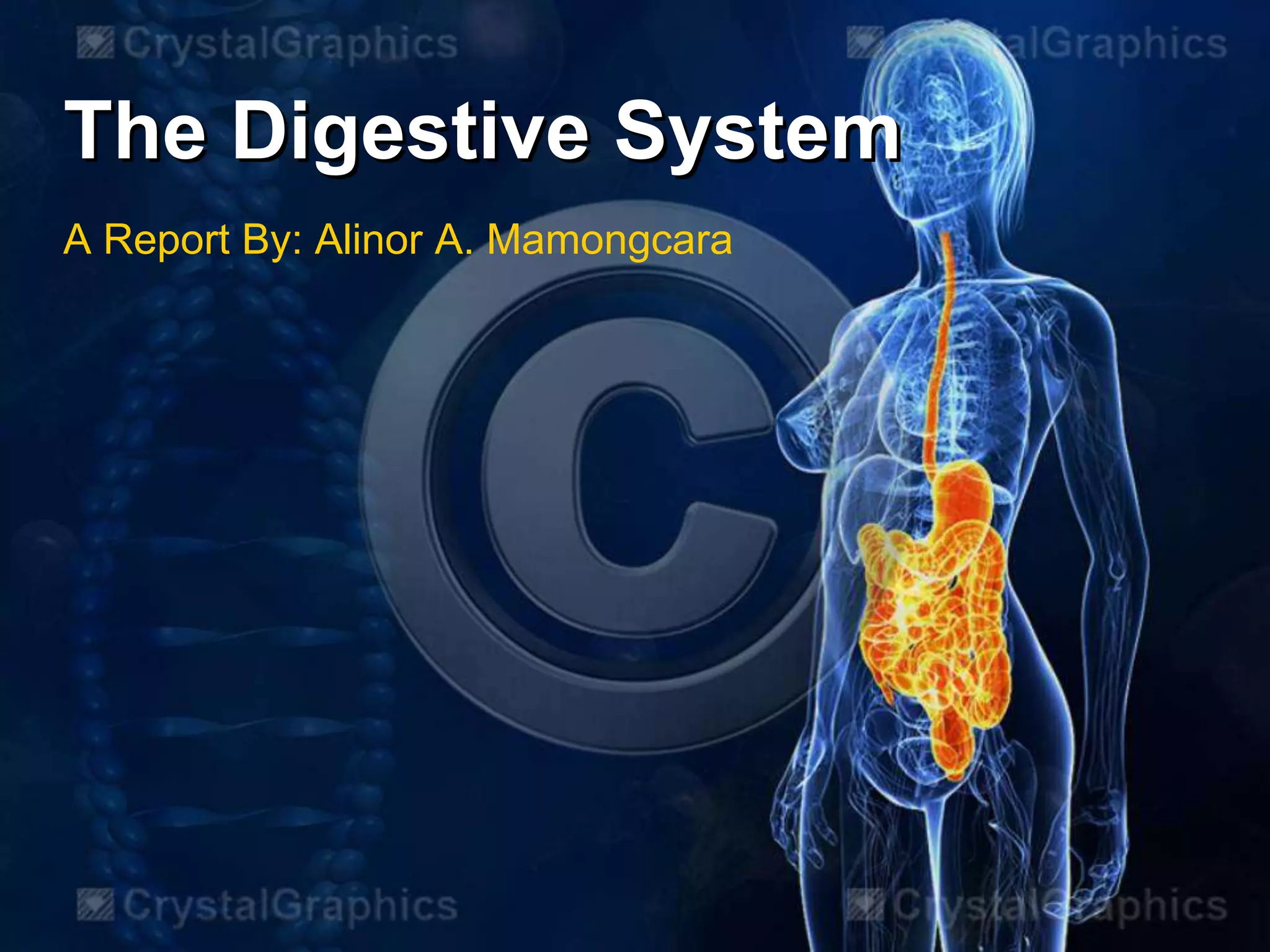
The Digestive System
A Report By: Alinor A. Mamongcara
The Digestive System Song
Gastroenterology
• Study of the digestive system and its
disorders
Digestion
The chemical breakdown of complex
biological molecules into their component
parts.
• Lipids to fatty acids
• Proteins to individual amino acids
• Carbohydrates into simple sugars
Digestion
• Mechanical
–Changes the physical form of food
•Chew
•Tear
•Grind
•Mash
•Mix
Functions of the Digestive
System
• Produces various chemicals to break
down the food.
• Filters out harmful substances.
• Gets rid of solid wastes.
Phases of Digestion
• Ingestion
• Movement
• Digestion
• Absorption
• Further digestion
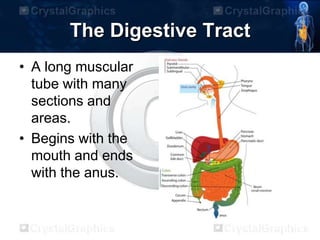
The Digestive Tract
• A long muscular
tube with many
sections and
areas.
• Begins with the
mouth and ends
with the anus.
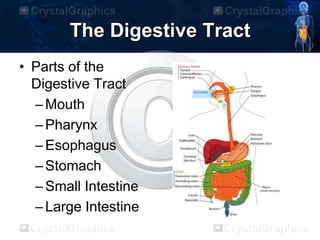
The Digestive Tract
• Parts of the
Digestive Tract
–Mouth
–Pharynx
–Esophagus
–Stomach
–Small Intestine
–Large Intestine
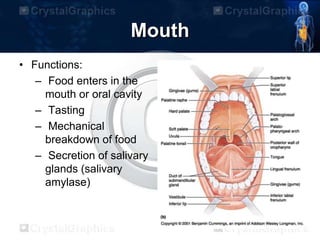
Mouth
• Functions:
– Food enters in the
mouth or oral cavity
– Tasting
– Mechanical
breakdown of food
– Secretion of salivary
glands (salivary
amylase)
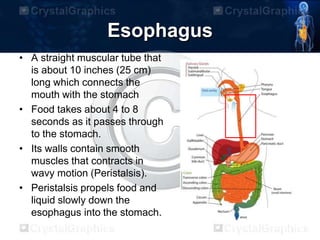
Esophagus
• A straight muscular tube that
is about 10 inches (25 cm)
long which connects the
mouth with the stomach
• Food takes about 4 to 8
seconds as it passes through
to the stomach.
• Its walls contain smooth
muscles that contracts in
wavy motion (Peristalsis).
• Peristalsis propels food and
liquid slowly down the
esophagus into the stomach.
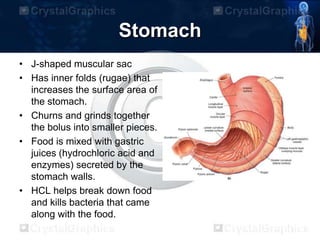
Stomach
• J-shaped muscular sac
• Has inner folds (rugae) that
increases the surface area of
the stomach.
• Churns and grinds together
the bolus into smaller pieces.
• Food is mixed with gastric
juices (hydrochloric acid and
enzymes) secreted by the
stomach walls.
• HCL helps break down food
and kills bacteria that came
along with the food.
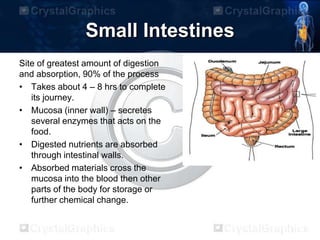
Small Intestines
Site of greatest amount of digestion
and absorption, 90% of the process
• Takes about 4 – 8 hrs to complete
its journey.
• Mucosa (inner wall) – secretes
several enzymes that acts on the
food.
• Digested nutrients are absorbed
through intestinal walls.
• Absorbed materials cross the
mucosa into the blood then other
parts of the body for storage or
further chemical change.
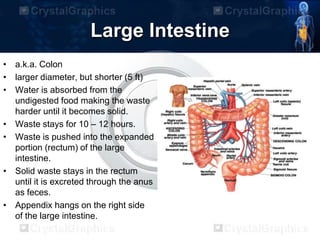
Large Intestine
• a.k.a. Colon
• larger diameter, but shorter (5 ft)
• Water is absorbed from the
undigested food making the waste
harder until it becomes solid.
• Waste stays for 10 – 12 hours.
• Waste is pushed into the expanded
portion (rectum) of the large
intestine.
• Solid waste stays in the rectum
until it is excreted through the anus
as feces.
• Appendix hangs on the right side
of the large intestine.
Common Diseases of the
Digestive System
• Irritable bowel syndrome
• Lactose intolerance
• Peptic ulcer
• Colon Cancer
• Loose Bowel Syndrome (Diarrhea)
Latest Trends
• Pivot (Pacemaker for the Digestive
System)
– The chips can slow the emptying of the
stomach, triggering feeling of fullness in
obese patients.
• Gastric Bypass
– divides the stomach into a small upper pouch
and a much larger lower "remnant" pouch and
then re-arranges the small intestine to
connect to both.
Latest Trends
• Adjustable Gastric Band
– an inflatable silicone device placed around the
top portion of the stomach to treat obesity,
intended to slow consumption of food and
thus the amount of food consumed.
Trivia
• The esophagus is approximately 25cm long. Muscles
contract in waves to move the food down the
esophagus. This means that food would get to a
person's stomach, even if they were standing on their
head.
• The digestive tract is similar to a long tube which is
approximately 30 feet (Equal to 5, 6 footers) long in
total running through the middle of the body.
Reporter’s Profile
• Alinor A. Mamongcara
– Studies at Adamson University
taking up BS Accountancy
– 09-23-87
– Gave up working for HSBC in a span
of 5 years to pursue his studies
– Gaming and Gadget Enthusiast
– Favorite Qoute:
“The only thing necessary for evil to
triumph, is for good men to do nothing”
–Edmund Burke
A Short Video About the
Digestive System

Digestive system

  • 1.
    The Digestive System AReport By: Alinor A. Mamongcara
  • 2.
  • 3.
    Gastroenterology • Study ofthe digestive system and its disorders
  • 4.
    Digestion The chemical breakdownof complex biological molecules into their component parts. • Lipids to fatty acids • Proteins to individual amino acids • Carbohydrates into simple sugars
  • 5.
    Digestion • Mechanical –Changes thephysical form of food •Chew •Tear •Grind •Mash •Mix
  • 6.
    Functions of theDigestive System • Produces various chemicals to break down the food. • Filters out harmful substances. • Gets rid of solid wastes.
  • 7.
    Phases of Digestion •Ingestion • Movement • Digestion • Absorption • Further digestion
  • 8.
    The Digestive Tract •A long muscular tube with many sections and areas. • Begins with the mouth and ends with the anus.
  • 9.
    The Digestive Tract •Parts of the Digestive Tract –Mouth –Pharynx –Esophagus –Stomach –Small Intestine –Large Intestine
  • 10.
    Mouth • Functions: – Foodenters in the mouth or oral cavity – Tasting – Mechanical breakdown of food – Secretion of salivary glands (salivary amylase)
  • 11.
    Esophagus • A straightmuscular tube that is about 10 inches (25 cm) long which connects the mouth with the stomach • Food takes about 4 to 8 seconds as it passes through to the stomach. • Its walls contain smooth muscles that contracts in wavy motion (Peristalsis). • Peristalsis propels food and liquid slowly down the esophagus into the stomach.
  • 12.
    Stomach • J-shaped muscularsac • Has inner folds (rugae) that increases the surface area of the stomach. • Churns and grinds together the bolus into smaller pieces. • Food is mixed with gastric juices (hydrochloric acid and enzymes) secreted by the stomach walls. • HCL helps break down food and kills bacteria that came along with the food.
  • 13.
    Small Intestines Site ofgreatest amount of digestion and absorption, 90% of the process • Takes about 4 – 8 hrs to complete its journey. • Mucosa (inner wall) – secretes several enzymes that acts on the food. • Digested nutrients are absorbed through intestinal walls. • Absorbed materials cross the mucosa into the blood then other parts of the body for storage or further chemical change.
  • 14.
    Large Intestine • a.k.a.Colon • larger diameter, but shorter (5 ft) • Water is absorbed from the undigested food making the waste harder until it becomes solid. • Waste stays for 10 – 12 hours. • Waste is pushed into the expanded portion (rectum) of the large intestine. • Solid waste stays in the rectum until it is excreted through the anus as feces. • Appendix hangs on the right side of the large intestine.
  • 15.
    Common Diseases ofthe Digestive System • Irritable bowel syndrome • Lactose intolerance • Peptic ulcer • Colon Cancer • Loose Bowel Syndrome (Diarrhea)
  • 16.
    Latest Trends • Pivot(Pacemaker for the Digestive System) – The chips can slow the emptying of the stomach, triggering feeling of fullness in obese patients. • Gastric Bypass – divides the stomach into a small upper pouch and a much larger lower "remnant" pouch and then re-arranges the small intestine to connect to both.
  • 17.
    Latest Trends • AdjustableGastric Band – an inflatable silicone device placed around the top portion of the stomach to treat obesity, intended to slow consumption of food and thus the amount of food consumed.
  • 18.
    Trivia • The esophagusis approximately 25cm long. Muscles contract in waves to move the food down the esophagus. This means that food would get to a person's stomach, even if they were standing on their head. • The digestive tract is similar to a long tube which is approximately 30 feet (Equal to 5, 6 footers) long in total running through the middle of the body.
  • 19.
    Reporter’s Profile • AlinorA. Mamongcara – Studies at Adamson University taking up BS Accountancy – 09-23-87 – Gave up working for HSBC in a span of 5 years to pursue his studies – Gaming and Gadget Enthusiast – Favorite Qoute: “The only thing necessary for evil to triumph, is for good men to do nothing” –Edmund Burke
  • 20.
    A Short VideoAbout the Digestive System