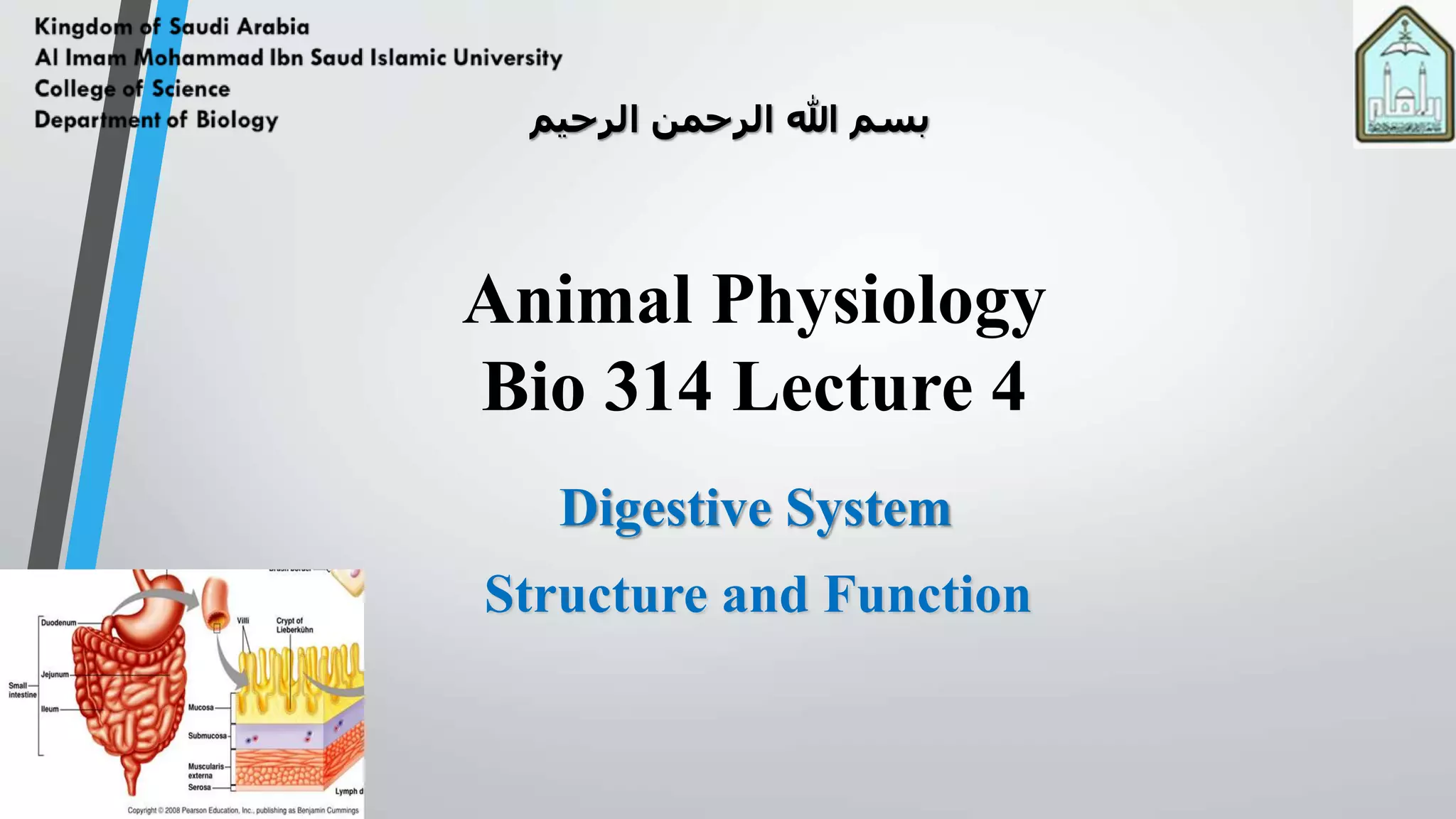
Animal Physiology
Bio 314 Lecture 4
Digestive System
Structure and Function
‫الرحيم‬ ‫الرحمن‬ ‫هللا‬ ‫بسم‬
Digestive System: Structure and Function
• Introduction.
• The structure of the gastrointestinal tract.
• Mouth (teeth and salivary glands) pharynx / Esophagus/stomach /
small intestine / large intestine.
• Gastrointestinal accessories:(pancreatic liver)
• Digestion in the gastrointestinal tract.
• Digestion in ruminants.
• Absorption.
* The survival of the organism depends on its access to food.
* Digestion is the process of converting complex nutrients into
essential materials so that they can be easily absorbed.
* There are substances that can be absorbed and do not need to be
digested such as salts, vitamins and water,….
* But proteins, sugary and fatty substances must be converted to
its raw materials through digestion to facilitate absorption.
Introduction
The Digestive processes
A- Mechanical processes:
Chewing, swallowing, and peristaltic movements of the stomach and
intestines.
B-Secretory:
The activity of the digestive glands in the secretion of different
digestive juices.
C - Chemical processes:
Includes the effect of enzymes and the effect of non-enzymatic
substances such as hydrochloric acid.
D- Microbiological processes:
They include the activity of bacteria and some ciliarys and flagellated
protozoa that are found in the large intestine that digest cellulose.
The Structure of the Elementary canal
• The digestive system organs are separated into two major groups:
1. The alimentary canal or gastrointestinal tract (G.I. tract)
A hollow tube extending from the mouth to the anus. It consists of the
mouth, pharynx, oesophagus, stomach, and small and large intestines.
2. The accessory digestive organs
Include the teeth, salivary glands, gallbladder, liver, and pancreas.
Fig: The structure of Human Digestive system
The Structure of the Elementary canal
The length of the canal and its complexity vary depending on the
animal and the nature of food in:
1. Carnivores :
Animals eating meat have simpler and shorter lengths canal, such as
lion, tiger, hyena, wolf
2. Herbivores:
They are more complex in composition and longer, such as sheep,
cows, deer, pandas, etc.
3. Omnivores:
They are middle between the two, they are meat and grasses eaters
such as human.
Comprise in the Structure of the Elementary
canal in the Carnivore and Herbivore
Comprise in the Structure of the Teeth in the Carnivore and Herbivore
Histology of the elementary canal wall
The digestive tract wall is made up of 4 layers (From inside to outside):
1. The Mucosa:
This is the inner layer of the tract that actually absorbs food and secretes mucus and
digestive enzymes.
2. The Submucosa:
It is made up of loose connective tissue, blood vessels, glands, and nerves.
3. The Muscular Layer:
This layer is made up of 2 layers of smooth muscle, the inner layer of muscle is
circular (I.C.) while the outer layer is longitudinal (O.L.).
4. The Serosa:
is the outer most layer of the tube and is primarily composed of serous epithelium
and some connective tissue
Histology of the elementary canal wall
Food Processing in digestive system
There are four (4) stages of food processing:
• Food ingestion: taking in food
• Digestion: breaking down food into nutrients
• Absorption: taking in nutrients by cells
• Elimination (Defecation): removing any leftover wastes.
The structure of the elementary canal
1- Mouth :The oral cavity tongue and Salivary glands and
Digestion.
• Sensory analysis:
The top of the tongue is covered
with structures called papillae
which help to handle food and
provide the sense of taste of
food before swallowing.
• Lubrication
Mixing food with mucus and
salivary gland secretions.
Mouth : Salivary glands
• In the vertebrate mouth (except amphibia and fish) they have 4 gland 3 type of
them they secrete a bout 1 liter of saliva:
1) Parotid gland: ‫الغدد‬‫النكافية‬
It’s the biggest mouth gland located under the era area they contain serousa cells
they secrete most enzymes in the mouth do not secrete mucus.
2(Submaxillary (submandibular) glands:
located at the side of the lower jaw contain mucous cells secrete mucus, and serosa
cells secrete enzyme.
3)Sublingual glands:
They are located under the tongue, the contain mucous cells they secrete mucus only
4)Buccal glands:
The are small mouth gland located in the mouth epithylium mucus buccal layer, they
secrete very view of mucus (5%)rich in mucin useful for mouth health.
Salivary gland
Digestion in the mouth
1. Mechanical processing:
Mechanical digestion begins here with mastication (chewing) through actions of
teeth, tongue, and palatal surfaces.
2. Chemical digestion:
Salivary amylase, an enzyme in saliva that breaks down carbohydrates (starch)
into maltose, maltotriose and alpha dextrins.
Lingual lipase an enzyme in saliva that breaks down dietary triglycerides.
Mouth : Salivary glands and Digestion
• Saliva consists of 99% water with all myosin/inorganic salts/enzymes
(salivary amylase) known as Ptyline and a small amount of maltase converts
starch into dextrin's sugars and then to maltose ( Maltose) double sugar.
• The pH for the saliva is even (pH =7)
• Saliva is released under the influence of nerve control in response to the
following incentives:
1- Taste or smell some foods that affect taste buds.
2- Chewing food and tasteless substances and these raise pressure
receptors.
3 - The sight of food or just think about it and this is known as psychic reflex
and depends on previous experience.
The Function of saliva
1- Digestion: The presence of two enzymes in the saliva, one affects the starch (amylase) and the
other (Maltase) on maltose sugar.
2- Moisturizing food: Saliva moisturizes food to make it easier to chew and dissolve food
materials, so that sensitive taste buds can distinguish it.
3- Swallowing food: Saliva facilitates the swallowing process for the top.
4- Cleaning the mouth: The saliva cleans the mouth from the leftovers so it prevents the growth
of germs in it so that tooth decay occurs in the absence of saliva.
5- Thirst: Saliva plays an important role in the feeling of thirst, when the saliva decreases, the
mouth mucosa dries, leading to thirst.
6- Acidity equation or alkali: Saliva helps to reduce the effects of acidity or high alkaline foods
protecting the tissues of the mouth from harmful effect on them.
7- Expelling harmful substances: Saliva disposes of organic and inorganic harmful substances
from the mouth by expelling them by masked them outside the mouth.
The Esophagus
• A hollow muscular tube, about 25 cm
long and 2 cm wide.
• Conveys solid food (bolus) and
liquids from the mouth to the
stomach.
• Begins from the pharynx through the
thoracic cavity to the stomach.
The Esophagus: Swallowing
• After completing the process of chewing and
mixing the food well with saliva the bite
(Bolus) is rotated by the tongue and then
pushed to the pharynx.
• At the moment of swallowing, soft palate
rises to block the inner nostrils and block the
opening of the larynx by the tongue of the
flute (Epiglottis) thus temporarily stopping
the breathing process during swallowing.
• At the same time, the top of the esophagus
expands to receive the bite.
• The swallowing process begins voluntarily
and then becomes an involuntary reflex.
The Stomach: Morphology
The Stomach is a curved pouch-like organ that
is located in the upper left quadrant of the
abdomen. It’s divided into 4 regions:
1. The cardiac region is located just inside the
cardiac sphincter.
2. The fundus is the superior most portion
located above the cardiac sphincter.
3. The body region makes up the bulk of the
organ in the middle.
4. The pyloric region is the inferior most area,
just above the Pyloric Sphincter. It consists
of antrum and pyloric canal.
Cont. the Stomach: Functions
The major functions of the stomach are:
1. Storage of ingested food
2. Mechanical breakdown of ingested food
3. Disruption of chemical bonds in food material by acid
and enzymes
4. Production of intrinsic factor, a glycoprotein required for
absorption of vitamin B12 in small intestine. Vitamin B12 is
necessary for RBCs formation.
5. Carrying on a limited amount of absorption.
6. Moving food into the small intestine.
Digestion in the stomach
The stomach secretes gastric Juice that has a very low pH (2-3). This juice is the secretion
of 3 types of exocrine gland cells:
1. Parietal cells that secrete intrinsic factor for B12 absorption and secrete HCl that:
• kills microbes, denatures proteins.
• Causes some acid hydrolysis of food molecules.
• Stimulates secretion of hormones for bile cholecystokinin (CCK) & pancreatic juice flow
(Secretin).
2. Chief cells that produce:
• Pepsinogen (inactive form of pepsin, which becomes active in presence of HCl). The
pepsin cleaves proteins into smaller peptides.
• Rennin an enzyme in neonates: curdles milk to increase time for gastric processing.
• Gastric lipase in neonates: splits short chain triglycerides common in milk.
Fig of the Gastric gland ( exocrine gland) in the stomach
Disorders of the stomach
Gastric ulcers: ‫قرحة‬‫المعدة‬
• erosion of stomach wall.
• pain occurs 1-3 hrs after eating.
• 90% of recurrent ulcers due to bacterial
infection (Helicobacter pylori), which
destroys mucous protective barrier; use
antibiotic therapy to kill bacteria.
Absorption in the stomach
• Impermeable to diffusion of most molecules into the bloodstream.
• Absorbs a few lipid soluble compounds.
• Certain drugs (e,g., aspirin).
• Alcohol.
• Water, ions.
The Small Intestine: Anatomy
• The Small Intestine is a tubular organ that extends from the pyloric
sphincter to the Large Intestine.
• The most active region for both digestion and absorption is the small
intestine.
• This organ is divided into three parts:
1. The duodenum is the proximal most portion and receives secretions
from both the pancreas and the liver.
2. The Jejunum is usually larger in diameter than the ileum and more
vascular.
3. The Ileum is the longest distal portion of this organ and is usually less
active than the jejunum.
Fig. of The Small Intestine: Anatomy
The Small Intestine: Histology
• The interior lining of the intestinal wall are covered by numerous Villi.
• These structures project into the lumen of the intestine and greatly
increase the absorptive capacity of this organ (structure fits
function).
• Each villus is made up of a layer of epithelium and a core of
connective tissue containing blood capillaries, nerve fibers, and a
lymphatic Lacteal.
• At their free surface the epithelial cells have many fine extensions
called Microvilli that form what is known as the “Brush Border” that
further enhances digestion and absorption.
• The capillaries (monosaccharaides and Amino acid absorption) and
lacteals (Fat absorption and glycerol) carry absorbed nutrients into
general circulation.
Fig of the Small Intestine: Histology
Digestion in the small intestine: Duodenum
• The duodenum is the first section of the small intestine and has a thicker layer of
tissue than the other areas of the small intestine.
• It neutralizes stomach acids and breaks down carbohydrates and fats.
• Receive juices from pancreas, liver and its own wall:
• Peptidases (or dipeptidases) break off the bond between dipeptides to
free 2 amino acids.
• Disaccharides: break off disaccharides into 2 monosaccharides (mostly
glucose).
• Intestinal lipase breaks off diglycerides into monoglycerides and fatty acids.
• Nutrients are completely degraded into forms that can be absorbed by cell.
Fig of the Digestion in the small intestine: Duodenum
The accessory organ
the Liver
• The liver is the largest of all internal
organs.
• Is enclosed by a fibrous capsule and
divided into a right and left lobe. Two
minor lobes also exist. They are the
caudate lobe and the quadrate lobe.
• Blood from digestive tract, carried in the
portal vein brings newly absorbed
nutrients into the sinusoids of the liver.
Here blood is cleansed of impurities and
microbes by Kupffer Cells (phagocytosis).
Liver function
1. Storage: oil-soluble vitamins (A, D,E,K),
B12, iron, other nutrients and minerals
2. Remove wastes from the body, notably
dietary toxins, hormones, drugs, old RBCs.
3. Metabolize thyroid and steroid hormones
4. Make bile (500-1000 ml/day)
5. Activation of Vitamin D.
6. Metabolism of CHO, protein and fat
7. Pathologies of the liver: hepatitis (viral,
toxic), cirrhosis, cancer
Liver function
• Carbohydrate metabolism: regulates blood glucose levels
- glycogenesis Formation of glycogen from sugar (glucose) by (insulin hormone) –
glycogenolysis Break down of glycogen to glucose By (glucagon hormone).
- gluconeogenesis (glucagon hormone): Formation of glucose from non-CHO sources
during fasting.
• Lipid metabolism
- stores, metabolizes some triglycerides - synthesizes new cholesterol
- degrades excess cholesterol for bile salt production
• Protein metabolism
-deaminates AA’s by removing amino groups (-NH2) from AA’s (This is the first step of AA
metabolism)
-detoxifies ammonia (NH3) by synthesizing urea (1 CO2 + 2 NH3 = urea)(This is called
urea cycle), can convert AA's from one to another (transamination)
-synthesizes and secretes most plasma proteins (e.g. albumin, alpha and beta globulins,
fibrinogen,…..etc).
‫أ‬.‫د‬.‫مقرر‬ ‫الحميدي‬ ‫أحمد‬333‫أ‬ ‫تأليف‬ ‫العامة‬ ‫القسيولوجيا‬ ‫المرجع‬ ‫حين‬.‫د‬.‫الخليفة‬ ‫محمد‬
Bile secretion by the liver
• Bile is a yellow-green liquid that is continuously
secreted by the liver (hepatocytes). It is then
stored in the gallbladder until needed.
• Bile from the hepatocytes enters bile (canaliculi)
which empty into small bile ducts.
• Hepatic ducts join the cystic duct from the
gallbladder to form the common bile duct.
• Common bile duct meets pancreatic duct at the
hepatopancreatic ampulla (ampulla of Vater
which ends with sphincter of Oddi).
Bile secretion by the liver
• Gallbladder is found on the inferior side of the liver
and stores bile until it is called for by the body.
• It concentrates the bile by dehydration (absorption of
water) and keeps it in this form until release.
• Under certain abnormal conditions this liquid can
form a crystal and an accumulation of these crystals
is referred to as a gallstone. (due to increased
cholesterol)This process is referred to as
Choleolithiasis.
• Choleolithiasis can lead to Choleocystitis, which can
lead to a medical emergency.
The Bile function and composition
• The role of bile salts are fat emulsification and formation of micelles and a route
of waste removal.
• Bile composition:
• water, mucus, bile salts (emulsify lipids), bile pigments (biliverdin and bilirubin),
cholesterol (No enzymes).
• Secreted 800-1000 ml/day, Yellow, brownish, or olive-green liquid
• Bile salts help in emulsification of ingested fats (breaking down large fat
molecules into smaller ones).
• Bilirubin and other bile pigments are wastes from lipid catabolism.
• Cholecystokinin (CCK) stimulates bile release for fatty meals.
• When the small intestine is empty, the hepatopancreatic sphincter closes, forcing
bile into the gallbladder for storage.
The Bile secretion
The accessory organs
The pancreas
• Is located primarily in the upper left
quadrant of the abdomen, and has both
endocrine (insulin, glucagon and
somatostatin) and exocrine (pancreatic
juice) functions.
• In addition to insulin and glucagon
secretion, it secretes many digestive
enzymes.
• These secretions, called pancreatic juice
join bile secreted by the liver and enter
the small intestines through the Ampulla
of Vater(Hepatopancreatic Ampulla).
Pancreatic juice composition
• Secreted 1.2-1.5 L/day Pancreatic juice
• Composition: Mostly water, some salts, bicarbonate and enzymes Alkaline: pH
7.1-8.2, Enzyme include:
• Pancreatic amylase: carbohydrate digestion
• Zymogens: inactive zymogens
1. Trypsinogen  trypsin (under effect of enterokinase)
2. Chymotrypsinogen  Chymotrypsin (under effect of trypsin)
3. Procarboxypeptidase  Carboxypeptidase (under effect of trypsin)
• Pancreatic lipase: lipid digestion
• Ribonuclease and deoxyribonuclease
• Phospholipase
Pancreatic juice and its
role in digestion at the
small intestine
=duodenum
Pancreatic juice and its role in digestion at the
small intestine =duodenum
Digestion in the Small intestine
Digestion of carbohydrates
• Breakdown polysaccharides (polymers) into disaccharides (maltose,
sucrose, lactose).
• Break off disaccharides into 2 monosaccharaides (mostly glucose)
Digestion in the Small intestine
Digestion Of Protein: dipeptide
• The peptidases digest internal peptide bonds to free smaller peptides.
• The dipeptidases break off the bond between dipeptides to free 2 amino acids.
Digestion in the Small intestine
Digestion Of Fats or lipids= Fatty acids
• Triglycerides digested into monoglycerides and free fatty acids.
• Intestinal lipase breaks off diglycerides into monoglycerides and fatty acids
and finally into free fatty acids and glycerol.
Gastro-intestinal hormone regulate the digestive system
Absorption in the small intestine
• The most active region for both digestion and absorption is the small
intestine.
• The barrier through which materials must pass during absorption from the
gut is formed by a single layer of epithelial cells on the surface of the villi,
the finger-like projections.
• The area of the apical luminal surface of each epithelial cell is greatly
increased by the presence of the brush-border.
• Below the villi in the mucosal membrane is a thick network of blood
capillaries and small lymphatics.
• The basal side of the cell rests on a very thin basement membrane, which
is close to the basement membrane of the underlying capillary.
Fig of the small intestine :Microvilli
Absorption in the small intestine
Absorption of carbohydrates
• Carbohydrate is absorbed as monosaccharides (mainly glucose,
galactose and fructose) these being formed from the disaccharides
maltose, lactose and sucrose by enzymes on the brush-border of the
intestinal villi.
• There is a specific protein carrier molecule for glucose and galactose;
the affinity of glucose for this molecule is high, so this sugar is
absorbed especially rapidly.
• One suggestion is that Na+ may modify the structure of the carrier to
give it a greater affinity for glucose; then the complex (carrier, Na+
and glucose) moves in such a way that the Na+ and glucose are
offloaded into the cytoplasm, and the carrier returns to the external
cell surface and picks up another Na+ ion and another glucose
molecule.
Absorption in the small intestine
Absorption of carbohydrates
Absorption in the small intestine
Absorption of peptides
• There are dipeptidases in the cells of the villi, so most of the luminal
dipeptides are hydrolysed at the moment of absorption.
• There are four different carrier molecules:
1. One for the neutral amino acids
2. One for the basic amino acids
3. One for the dicarboxylic amino acids (glutamic and aspartic)
4. and the fourth for proline, hydroxyproline and glycine.
• The presence of the Na+ ion speeds the carrier-mediated movement
of amino acids into the intestinal cell. The role of sodium here may be
similar its role in glucose absorption.
Absorption in the small intestine
Absorption of peptides
Absorption in the small intestine
Absorption of fats
The role of bile salts is emulsification of fat and formation of micelles.
• Fat may be absorbed in the form of extremely small particles.
These may be droplets of an emulsion of monoglyceride, free fatty
acids and bile salts.
• If these particles are less than
5000 nm in diameter, they could pass down between the threads of
the microvilli forming the brush-border, and enter by pinocytosis.
• Most fat absorption, however, involves the micelles.
Absorption in the small
intestine
Absorption of fats
Absorption in the small intestine:
Vitamins and Minerals
• Intestine absorbs vitamins and minerals
• Fat-soluble vitamins (A, D, E, K) absorbed with fats in small intestines
• Water-soluble vitamins (C, B vitamins) absorbed by mediated transport
except vitamin B12 which absorbed by active transport.
• Minerals absorbed by active transport
• Absorption of fats in the Jejunum-Ileum
• Nutrients will be reabsorbed along the jejunum-ileum.
• Vitamin B12 when complexed to intrinsic factor, secreted in the stomach,
and actively absorbed in ileum.
The large intestine: Anatomy
• The Large Intestine is so named because
of its diameter.
• It also forms and stores Feaces. It also
has a limited amount of absorption (water
and electrolytes). It has 3 Parts include:
1. Ascending Colon portion
• The Cecum is the pouch like end of the
ascending portion
• The Veriform Appendix is the terminal
portion of the cecum.
2. Transverse Colon portion
3. Descending Colon portion
The large intestine: Anatomy
• The Sigmoid Colon is the final portion of the
Rectum.
• The Anal Canal is made up two sets of
sphincter muscles that are under voluntary
control:
1. The internal anal sphincter is made of smooth
muscle.
2. The external anal sphincter is made up of
skeletal muscle.
The large intestine Functions
• The large intestine has little or no digestive function, other than to
eliminate an unneeded waste product. Its epithelial lining has many goblet
cells in it and thus mucus is the only significant secretion of this organ.
• Many bacteria inhibit the large intestine and make up the Intestinal Flora.
Many of these bacteria synthesize vitamins such as K and B12 which are
then absorbed by the mucosa.
• Movement through the large intestine are caused by peristalsis, but these
movements are usually less prevalent here than in the small intestine.
• Feces are composed of materials that were not digested (such as
cellulose), or not absorbed, some water and electrolytes, mucus, and
bacteria.
Large intestine : Absorption
The large intestine absorbs water, electrolytes, and remnants of
the digestive secretions remaining in the left over waste product
that was once food.
Summary of digestive system
Summary of digestion in digestive system
‫أ‬.‫د‬.‫مقرر‬ ‫الحميدي‬ ‫أحمد‬333‫أ‬ ‫تأليف‬ ‫العامة‬ ‫القسيولوجيا‬ ‫المرجع‬ ‫حين‬.‫د‬.‫الخليفة‬ ‫محمد‬
‫إضافية‬ ‫قراءة‬
‫األسنان‬Teeth
‫وتو‬ ‫األغذية‬ ‫انواع‬ ‫جميع‬ ‫مع‬ ‫التعامل‬ ‫على‬ ‫القدرة‬ ‫ولها‬ ‫الهضمي‬ ‫للجهاز‬ ‫مساعدة‬ ‫كأعضاء‬ ‫األسنان‬ ‫تعد‬‫جد‬
‫الحي‬ ‫الكائن‬ ‫حسب‬ ‫وتنوعها‬ ‫وتوزيعها‬ ‫عددها‬ ‫ويختلف‬ ‫الفكين‬ ‫على‬
‫اإلنسان‬ ‫في‬:‫لبنية‬ ‫أسنان‬ ‫األسنان‬ ‫من‬ ‫نوعان‬ ‫هناك‬(Milk or deciduous teeth)‫تبدأ‬ ‫سنا‬ ‫عشرون‬ ‫عددها‬
‫الشهر‬ ‫بين‬ ‫فيما‬6-8‫بين‬ ‫بالسقوط‬ ‫وتبدأ‬ ‫الطفل‬ ‫عمر‬ ‫من‬6-13‫العمر‬ ‫من‬ ‫سنه‬
‫دائمة‬ ‫أسنان‬(Permanent teeth)‫عمر‬ ‫بين‬ ‫الظهور‬ ‫في‬ ‫وتبدأ‬6-17‫وعددها‬ ‫سنة‬32‫بأسماء‬ ‫وتسمى‬ ‫سنا‬
‫ووظائفها‬ ‫ألشكالها‬ ‫تبعا‬.‫التالية‬ ‫األسنان‬ ‫توجد‬ ‫لإلنسان‬ ‫فك‬ ‫كل‬ ‫ففي‬:
‫أ‬-‫القواطع‬(Incisors:)‫وعددها‬4×2=8‫شكل‬ ‫وتشبه‬‫األزميل‬‫ومسكه‬ ‫الطعام‬ ‫لتقطيع‬ ‫وتستخدم‬.
‫ب‬-‫األنياب‬(Canines:)‫فك‬ ‫كل‬ ‫في‬ ‫نابان‬ ‫وهناك‬×2=4‫الطعام‬ ‫لتقطيع‬ ‫مدبب‬ ‫شكلها‬‫وتنسيرة‬.
‫ج‬-‫الضواحك‬(premolars:)‫وعددها‬4‫فك‬ ‫كل‬ ‫في‬×2=8‫شبة‬ ‫وهي‬ ‫السابقة‬ ‫عن‬ ‫يختلف‬ ‫وشكلها‬
‫وتمزيقه‬ ‫الطعام‬ ‫سحق‬ ‫على‬ ‫تعمل‬ ‫مربعه‬
‫د‬-‫الطواحن‬(Molars):‫وعددها‬6×2=12‫وتمزيقه‬ ‫الطعام‬ ‫طحن‬ ‫على‬ ‫وتعمل‬ ‫الضواحك‬ ‫تشبه‬ ‫وهي‬
‫ومجموعها‬ ‫العقل‬ ‫بأسنان‬ ‫تعرف‬ ‫الطواحن‬ ‫من‬ ‫األسنان‬ ‫وأخر‬4‫بين‬ ‫بالظهور‬ ‫تبدأ‬17-25‫سنة‬
‫إضافية‬ ‫قراءة‬
‫االجترار‬Rumination
‫للوظيفة‬ ‫التركيب‬ ‫مالئمة‬:
•‫المجترات‬ ‫من‬ ‫عام‬ ‫بشكل‬ ‫المواشي‬ ‫تعتبر‬(Ruminant)‫األعشاب‬ ‫اكالت‬
•‫حيث‬‫يتالئم‬‫و‬ ‫مع‬ ‫المجترات‬ ‫لمعدة‬ ‫والنسيجي‬ ‫التشريحي‬ ‫التركيب‬‫ظائفها‬
‫الفسيولوجية‬:‫الكرش‬ ‫من‬ ‫تتركب‬ ‫حيث‬(Rumen)‫والشبكية‬(Reticulum)
‫والورقية‬(Omasum)‫الفسيولوجي‬ ‫الناحية‬ ‫من‬ ‫والشبكية‬ ‫الكرش‬ ‫وتعبران‬‫ة‬
‫ب‬ ‫فاصل‬ ‫يوجد‬ ‫ال‬ ‫اإلبل‬ ‫في‬ ‫ولكن‬ ‫االبقار‬ ‫في‬ ‫فاصل‬ ‫يوجد‬ ‫وال‬ ‫واحدة‬ ‫وحدة‬‫ين‬
‫الورقية‬‫واألنفحة‬.‫حواجز‬ ‫بينها‬ ‫فيوجد‬ ‫األخرى‬ ‫الجزاء‬ ‫اما‬
•‫تحتوي‬ ‫وال‬ ‫طبقي‬ ‫طالئي‬ ‫نسيج‬ ‫والورقية‬ ‫والشبكية‬ ‫الكرش‬ ‫يبطن‬‫على‬
‫الطعام‬ ‫تخزين‬ ‫يتم‬ ‫فقط‬ ‫انزيمات‬(‫االعشاب‬)‫تحلي‬ ‫يتم‬ ‫حيث‬ ، ‫فيها‬‫مادة‬ ‫ل‬
‫بالكرش‬ ‫الموجودة‬ ‫البكتيريا‬ ‫بواسطة‬ ‫لألعشاب‬ ‫السليلوز‬.
•‫انفحة‬ ‫ثم‬(Abomasum)‫على‬ ‫يحتوى‬ ‫بسيط‬ ‫عمادي‬ ‫طالئي‬ ‫نسيج‬ ‫يبطنها‬
‫االخرى‬ ‫الكائنات‬ ‫في‬ ‫المعدة‬ ‫وتمثل‬ ‫المعدي‬ ‫للعصير‬ ‫المفرزة‬ ‫الغدد‬.
‫أ‬.‫د‬.‫مقرر‬ ‫الحميدي‬ ‫أحمد‬333‫أ‬ ‫تأليف‬ ‫العامة‬ ‫القسيولوجيا‬ ‫المرجع‬ ‫حين‬.‫د‬.‫الخليفة‬ ‫محمد‬
‫الكرش‬ ‫خصائص‬
•1-‫الهيدروجيني‬ ‫األس‬ ‫درجة‬=5.5-7PH
•2-‫محتوياتها‬ ‫حرارة‬ ‫درجة‬39-40‫م‬
•3-‫التخمر‬ ‫اجل‬ ‫من‬ ‫األكسجين‬ ‫غياب‬.
•4-‫التخمر‬ ‫لنواتج‬ ‫تدريجية‬ ‫إزالة‬ ‫مع‬ ‫الغذاء‬ ‫من‬ ‫مناسب‬ ‫معدل‬ ‫وجود‬
•5-‫الالكتيك‬ ‫وحمض‬ ‫واألمونيا‬ ‫الدهنية‬ ‫األحماض‬ ‫امتصاص‬.
•‫بد‬ ‫عند‬ ‫عضلية‬ ‫جدارين‬ ‫عن‬ ‫عبارة‬ ‫وهو‬ ‫المريئي‬ ‫الميزاب‬ ‫يوجد‬ ‫الرضيعة‬ ‫العجول‬ ‫في‬‫اية‬
‫المنطقة‬‫الفؤادية‬‫ف‬ ‫وحتى‬ ‫والشبكية‬ ‫الكرش‬ ‫لجدار‬ ‫الداخلي‬ ‫السطح‬ ‫على‬ ‫ويمران‬‫تحة‬
‫من‬ ‫اللبن‬ ‫لتوصيل‬ ‫قناة‬ ‫تشكالن‬ ‫حيث‬ ‫الورقية‬‫المريئ‬‫الحقيقية‬ ‫المعدة‬ ‫على‬‫في‬
‫التخم‬ ‫حدوث‬ ‫فتتالفى‬ ‫الكرش‬ ‫الى‬ ‫اللبن‬ ‫يصل‬ ‫ال‬ ‫وبالتالي‬ ‫الرضيعة‬ ‫الحيوانات‬‫الضارة‬ ‫ر‬.
‫اإلجترار‬:
•‫اإلجترار‬:
•‫المجتر‬ ‫معدة‬ ‫من‬ ‫الغذاء‬ ‫ارجاع‬ ‫فيها‬ ‫يتم‬ ‫عملية‬ ‫هي‬‫اللى‬‫جيد‬ ‫مضغة‬ ‫يعاد‬ ‫حيث‬ ‫الفم‬‫ا‬
‫ثم‬ ‫باللعاب‬ ‫وخلطة‬‫ابتالعة‬‫اخرى‬ ‫مرة‬
•‫و‬ ‫اللعاب‬ ‫من‬ ‫كبيرة‬ ‫بكمية‬ ‫وتخلط‬ ‫جيدا‬ ‫مضغها‬ ‫يعاد‬ ‫الغذائية‬ ‫البلعة‬ ‫وصول‬ ‫وعند‬‫هذا‬
‫اكثر‬ ‫فتكون‬ ‫ابتالعها‬ ‫اعادة‬ ‫قبل‬ ‫الغذائية‬ ‫الكتلة‬ ‫عن‬ ‫خواصها‬ ‫في‬ ‫تختلف‬ ‫يجعلها‬‫كثافة‬
•‫يعاد‬ ‫ال‬ ‫وبذلك‬ ‫الشبكية‬ ‫نحو‬ ‫تتحرك‬ ‫ثم‬ ‫الكرش‬ ‫قاع‬ ‫في‬ ‫استقرارها‬ ‫الى‬ ‫يؤدي‬ ‫وهذا‬
‫اجترارها‬
•‫عملية‬‫اإلجترار‬‫بالكر‬ ‫الوقت‬ ‫من‬ ‫فترة‬ ‫الغذاء‬ ‫يستمر‬ ‫ولكن‬ ‫التغذية‬ ‫اثناء‬ ‫تحدث‬ ‫ال‬‫حتى‬ ‫ش‬
‫والتفتيت‬ ‫التخمر‬ ‫من‬ ‫درجة‬ ‫له‬ ‫ويحدث‬ ‫يرطب‬.
‫اإلجترار‬ ‫أهمية‬
• 1-‫القيام‬ ‫من‬ ‫والبكتيريا‬ ‫لألنزيمات‬ ‫يمكن‬ ‫حتى‬ ‫الطعام‬ ‫تفتيت‬
‫اجزاء‬ ‫باقي‬ ‫الى‬ ‫المرور‬ ‫له‬ ‫وتسهل‬ ، ‫الكاملة‬ ‫التخمر‬ ‫بعمليات‬
‫الهضمية‬ ‫القناة‬
• 2-‫القلوي‬ ‫اللعاب‬ ‫خاصة‬ ‫اللعاب‬ ‫افراز‬ ‫من‬ ‫تزيد‬ ‫اإلجترار‬ ‫عملية‬)
‫اللعاب‬ ‫ان‬ ‫كما‬ ، ‫الكرش‬ ‫حموضية‬ ‫معادلة‬ ‫على‬ ‫يعمل‬ ‫الذي‬
‫بالكرش‬ ‫واليوريا‬ ‫للماء‬ ‫هام‬ ‫مصدر‬ ‫يعتبر‬.
• 3-‫هضم‬ ‫معامالت‬ ‫من‬ ‫يزيد‬)(‫الغذائية‬ ‫للمواد‬.
• ‫اإلجترار‬ ‫مدة‬:
• ‫الغذاء‬ ‫وكمية‬ ‫الحيوان‬ ‫ونوع‬ ‫الغذاء‬ ‫نوع‬ ‫حسب‬ ‫تختلف‬
• ‫بين‬ ‫عادة‬ ‫الماشية‬ ‫في‬ ‫تتراوح‬ ‫العادة‬ ‫في‬7-12‫يوميا‬ ‫ساعة‬
‫متقطعة‬ ‫فترات‬ ‫على‬
• ‫ز‬
• ‫حوالي‬ ‫اإلجترار‬ ‫فترات‬ ‫عدد‬ ‫تبلغ‬14‫مرة‬/‫كل‬ ‫مدة‬ ‫تتراوح‬ ‫يوميا‬
‫حوالي‬ ‫منها‬30‫الى‬ ‫د‬1‫س‬.
‫المجترة‬ ‫المعدة‬ ‫في‬ ‫الهضم‬ ‫انواع‬
‫أ‬-‫الميكانيكي‬ ‫الهضم‬:
•‫أوال‬:
•‫صغيرة‬ ‫اجزاء‬ ‫على‬ ‫الغذاء‬ ‫تجزئة‬ ‫به‬ ‫ويقصد‬(‫المضغ‬ ‫عملية‬ ‫او‬)‫االسا‬ ‫العملية‬ ‫وهي‬‫سية‬
‫الميكانيكي‬ ‫الهضم‬ ‫في‬.
•‫الصلبة‬ ‫الغذاء‬ ‫نوعية‬ ‫مع‬ ‫الميكانيكي‬ ‫الهضم‬ ‫اهمية‬ ‫تزداد‬.
•‫إل‬ ‫ذلك‬ ‫ويرجع‬ ‫التالية‬ ‫الهضم‬ ‫مراحل‬ ‫نجاح‬ ‫في‬ ‫كبيرة‬ ‫أهمية‬ ‫الميكانيكي‬ ‫وللهضم‬‫ى‬:
•1-‫باللعاب‬ ‫الغذاء‬ ‫تخلط‬ ‫المضغ‬ ‫عملية‬.
•2-‫لألنزيمات‬ ‫المعرض‬ ‫السطح‬ ‫مساحة‬ ‫من‬ ‫يزيد‬ ‫مما‬ ‫صغيرة‬ ‫اجزاء‬ ‫الى‬ ‫الغذاء‬ ‫تكسير‬
•‫الجدر‬ ‫تكسير‬ ‫كذلك‬‫السليلوزية‬‫الخالي‬ ‫محتويات‬ ‫يعرض‬ ‫مما‬ ‫النباتية‬ ‫للخاليا‬‫لفعل‬ ‫ا‬
‫الهاضمة‬ ‫األنزيمات‬.
‫المجترة‬ ‫المعدة‬ ‫في‬ ‫الهضم‬ ‫انواع‬
‫ب‬-‫الميكروبي‬ ‫الهضم‬
•‫المجترة‬ ‫الحيوانات‬ ‫كرش‬ ‫في‬ ‫األولية‬ ‫الحية‬ ‫والكائنات‬ ‫البكتيريا‬ ‫تتواجد‬‫بشكل‬
‫األخرى‬ ‫العشب‬ ‫اكالت‬ ‫وقولون‬ ‫اعور‬ ‫في‬ ‫تتواجد‬ ‫كما‬ ‫كبير‬(‫والخيول‬ ‫االرانب‬.)
‫الميكروبية‬ ‫الحية‬ ‫الكائنات‬ ‫وتقسم‬(Microorganisms)‫إلى‬ ‫والشبكية‬ ‫الكرش‬ ‫في‬:
•‫أ‬-‫األوليات‬(Protozoa)(‫األقل‬ ‫والسوطيات‬ ‫األغلب‬ ‫الهدبيات‬)
•‫ب‬-‫البكتيريا‬(Bacteria)‫بكتيريا‬ ‫معظم‬ ‫تشترك‬ ‫متخصصة‬ ‫عديدة‬ ‫انواع‬ ‫ومنها‬
‫حامض‬ ‫إنتاج‬ ‫في‬ ‫الكرش‬‫الخليك‬(Acetic acid)‫حامض‬ ‫ثم‬‫الخليك‬‫او‬‫البروبيونيك‬
(Propionic acid)‫حمض‬ ‫ثم‬‫البيوتيريك‬(Butyric)‫قصيرة‬ ‫طيارة‬ ‫دهنية‬ ‫احماض‬ ‫وهي‬
‫السلسلة‬)
•‫البكتي‬ ‫من‬ ‫المفرزة‬ ‫األنزيمات‬ ‫تحثه‬ ‫كيميائي‬ ‫هضم‬ ‫هو‬ ‫الميكروبي‬ ‫والهضم‬‫التي‬ ‫ريا‬
‫تكافلية‬ ‫معيشة‬ ‫والشبكية‬ ‫الكرش‬ ‫في‬ ‫تعيش‬(Symbiosis)
‫الميكروبي‬ ‫الهضم‬ ‫نتائج‬
•1-‫السليلوز‬ ‫تحليل‬(‫النباتية‬ ‫الخاليا‬ ‫ار‬ ‫لجد‬ ‫األساسي‬ ‫المكون‬)‫ع‬ ‫مادة‬ ‫عن‬ ‫عبارة‬ ‫وهو‬‫ديدة‬
‫التسكر‬‫السليل‬ ‫لتحلل‬ ‫لديها‬ ‫انزيمات‬ ‫وجود‬ ‫لعدم‬ ‫تحللها‬ ‫ان‬ ‫الحيوانات‬ ‫تستطيع‬ ‫ال‬‫لكن‬ ‫وز‬
‫تحليلها‬ ‫تستطيع‬ ‫الدقيقة‬ ‫الحية‬ ‫الكائنات‬.‫و‬ ‫االمتصاص‬ ‫سهلة‬ ‫مادة‬ ‫الى‬ ‫فتحوله‬‫التمثيل‬
‫الطيارة‬ ‫الدهنية‬ ‫األحماض‬ ‫مثل‬ ‫للطاقة‬ ‫كمصدر‬ ‫واستخدامها‬(Volatile fatty acidVFAs)(‫مثل‬
‫حمض‬‫الخليك‬‫والبرونيك‬‫البيوتيرك‬)
•2-‫الهاضمة‬ ‫لألنزيمات‬ ‫الخاليا‬ ‫محتويات‬ ‫يعرض‬ ‫السليلوز‬ ‫تحليل‬
•3–‫اليوريا‬ ‫بتحليل‬ ‫البكتيريا‬ ‫تقوم‬(Urea)‫البروتينية‬ ‫غير‬ ‫النيتروجينية‬ ‫المواد‬ ‫من‬)‫الن‬ ‫الى‬‫شادر‬
(.NH3)‫هض‬ ‫يتم‬ ‫ثم‬ ‫اجسامها‬ ‫بناء‬ ‫في‬ ‫األمينية‬ ‫األحماض‬ ‫مع‬ ‫البكتيريا‬ ‫تستخدم‬ ‫حيث‬‫م‬
‫بروتيناتها‬ ‫من‬ ‫واالستفادة‬ ‫األنسجة‬ ‫في‬ ‫البكتيريا‬(Microbial Protein. )
•4-‫عملياتها‬ ‫خالل‬ ‫الدقيقة‬ ‫الحية‬ ‫الكائنات‬ ‫تقوم‬‫التمثلية‬‫فيت‬ ‫من‬ ‫مجموعة‬ ‫بإنتاج‬‫ب‬ ‫امين‬(B)
‫الحيوان‬ ‫احتياجات‬ ‫تكفي‬ ‫وبكميات‬(‫الحيوا‬ ‫في‬ ‫ب‬ ‫فيتامين‬ ‫نقص‬ ‫اعراض‬ ‫تظهر‬ ‫ال‬ ‫لذا‬‫نات‬
‫المجترة‬)‫ب‬ ‫فيتامين‬ ‫عدى‬ ‫ما‬12(B12)‫يتكون‬ ‫لكي‬ ‫الكوبالت‬ ‫عنصر‬ ‫الى‬ ‫يحتاج‬ ‫الذي‬.
•‫تل‬ ‫الميكروبي‬ ‫الهضم‬ ‫عملية‬ ‫الن‬ ‫األعور‬ ‫في‬ ‫منه‬ ‫اكفأ‬ ‫الكرش‬ ‫في‬ ‫الميكروبي‬ ‫الهضم‬‫ي‬
‫ي‬ ‫البكتيري‬ ‫الهضم‬ ‫فإن‬ ‫األعور‬ ‫في‬ ‫بينما‬ ‫انزيمي‬ ‫لهضم‬ ‫وتمهد‬ ‫الميكانيكي‬ ‫الهضم‬‫لي‬
‫الميكانيكي‬‫واألنزيمي‬
•‫ج‬-‫الهضم‬‫االنزيمي‬(‫المعدة‬ ‫وحيدة‬ ‫األخرى‬ ‫الحيوانات‬ ‫في‬ ‫يحدث‬ ‫لما‬ ‫مماثل‬.)
‫أ‬.‫د‬.‫مقرر‬ ‫الحميدي‬ ‫أحمد‬333‫أ‬ ‫تأليف‬ ‫العامة‬ ‫القسيولوجيا‬ ‫المرجع‬ ‫حين‬.‫د‬.‫الخليفة‬ ‫محمد‬

Digestive system

  • 1.
    Animal Physiology Bio 314Lecture 4 Digestive System Structure and Function ‫الرحيم‬ ‫الرحمن‬ ‫هللا‬ ‫بسم‬
  • 2.
    Digestive System: Structureand Function • Introduction. • The structure of the gastrointestinal tract. • Mouth (teeth and salivary glands) pharynx / Esophagus/stomach / small intestine / large intestine. • Gastrointestinal accessories:(pancreatic liver) • Digestion in the gastrointestinal tract. • Digestion in ruminants. • Absorption.
  • 3.
    * The survivalof the organism depends on its access to food. * Digestion is the process of converting complex nutrients into essential materials so that they can be easily absorbed. * There are substances that can be absorbed and do not need to be digested such as salts, vitamins and water,…. * But proteins, sugary and fatty substances must be converted to its raw materials through digestion to facilitate absorption. Introduction
  • 4.
    The Digestive processes A-Mechanical processes: Chewing, swallowing, and peristaltic movements of the stomach and intestines. B-Secretory: The activity of the digestive glands in the secretion of different digestive juices. C - Chemical processes: Includes the effect of enzymes and the effect of non-enzymatic substances such as hydrochloric acid. D- Microbiological processes: They include the activity of bacteria and some ciliarys and flagellated protozoa that are found in the large intestine that digest cellulose.
  • 5.
    The Structure ofthe Elementary canal • The digestive system organs are separated into two major groups: 1. The alimentary canal or gastrointestinal tract (G.I. tract) A hollow tube extending from the mouth to the anus. It consists of the mouth, pharynx, oesophagus, stomach, and small and large intestines. 2. The accessory digestive organs Include the teeth, salivary glands, gallbladder, liver, and pancreas.
  • 6.
    Fig: The structureof Human Digestive system
  • 7.
    The Structure ofthe Elementary canal The length of the canal and its complexity vary depending on the animal and the nature of food in: 1. Carnivores : Animals eating meat have simpler and shorter lengths canal, such as lion, tiger, hyena, wolf 2. Herbivores: They are more complex in composition and longer, such as sheep, cows, deer, pandas, etc. 3. Omnivores: They are middle between the two, they are meat and grasses eaters such as human.
  • 8.
    Comprise in theStructure of the Elementary canal in the Carnivore and Herbivore
  • 9.
    Comprise in theStructure of the Teeth in the Carnivore and Herbivore
  • 10.
    Histology of theelementary canal wall The digestive tract wall is made up of 4 layers (From inside to outside): 1. The Mucosa: This is the inner layer of the tract that actually absorbs food and secretes mucus and digestive enzymes. 2. The Submucosa: It is made up of loose connective tissue, blood vessels, glands, and nerves. 3. The Muscular Layer: This layer is made up of 2 layers of smooth muscle, the inner layer of muscle is circular (I.C.) while the outer layer is longitudinal (O.L.). 4. The Serosa: is the outer most layer of the tube and is primarily composed of serous epithelium and some connective tissue
  • 11.
    Histology of theelementary canal wall
  • 12.
    Food Processing indigestive system There are four (4) stages of food processing: • Food ingestion: taking in food • Digestion: breaking down food into nutrients • Absorption: taking in nutrients by cells • Elimination (Defecation): removing any leftover wastes.
  • 13.
    The structure ofthe elementary canal 1- Mouth :The oral cavity tongue and Salivary glands and Digestion. • Sensory analysis: The top of the tongue is covered with structures called papillae which help to handle food and provide the sense of taste of food before swallowing. • Lubrication Mixing food with mucus and salivary gland secretions.
  • 14.
    Mouth : Salivaryglands • In the vertebrate mouth (except amphibia and fish) they have 4 gland 3 type of them they secrete a bout 1 liter of saliva: 1) Parotid gland: ‫الغدد‬‫النكافية‬ It’s the biggest mouth gland located under the era area they contain serousa cells they secrete most enzymes in the mouth do not secrete mucus. 2(Submaxillary (submandibular) glands: located at the side of the lower jaw contain mucous cells secrete mucus, and serosa cells secrete enzyme. 3)Sublingual glands: They are located under the tongue, the contain mucous cells they secrete mucus only 4)Buccal glands: The are small mouth gland located in the mouth epithylium mucus buccal layer, they secrete very view of mucus (5%)rich in mucin useful for mouth health.
  • 15.
  • 16.
    Digestion in themouth 1. Mechanical processing: Mechanical digestion begins here with mastication (chewing) through actions of teeth, tongue, and palatal surfaces. 2. Chemical digestion: Salivary amylase, an enzyme in saliva that breaks down carbohydrates (starch) into maltose, maltotriose and alpha dextrins. Lingual lipase an enzyme in saliva that breaks down dietary triglycerides.
  • 17.
    Mouth : Salivaryglands and Digestion • Saliva consists of 99% water with all myosin/inorganic salts/enzymes (salivary amylase) known as Ptyline and a small amount of maltase converts starch into dextrin's sugars and then to maltose ( Maltose) double sugar. • The pH for the saliva is even (pH =7) • Saliva is released under the influence of nerve control in response to the following incentives: 1- Taste or smell some foods that affect taste buds. 2- Chewing food and tasteless substances and these raise pressure receptors. 3 - The sight of food or just think about it and this is known as psychic reflex and depends on previous experience.
  • 18.
    The Function ofsaliva 1- Digestion: The presence of two enzymes in the saliva, one affects the starch (amylase) and the other (Maltase) on maltose sugar. 2- Moisturizing food: Saliva moisturizes food to make it easier to chew and dissolve food materials, so that sensitive taste buds can distinguish it. 3- Swallowing food: Saliva facilitates the swallowing process for the top. 4- Cleaning the mouth: The saliva cleans the mouth from the leftovers so it prevents the growth of germs in it so that tooth decay occurs in the absence of saliva. 5- Thirst: Saliva plays an important role in the feeling of thirst, when the saliva decreases, the mouth mucosa dries, leading to thirst. 6- Acidity equation or alkali: Saliva helps to reduce the effects of acidity or high alkaline foods protecting the tissues of the mouth from harmful effect on them. 7- Expelling harmful substances: Saliva disposes of organic and inorganic harmful substances from the mouth by expelling them by masked them outside the mouth.
  • 20.
    The Esophagus • Ahollow muscular tube, about 25 cm long and 2 cm wide. • Conveys solid food (bolus) and liquids from the mouth to the stomach. • Begins from the pharynx through the thoracic cavity to the stomach.
  • 21.
    The Esophagus: Swallowing •After completing the process of chewing and mixing the food well with saliva the bite (Bolus) is rotated by the tongue and then pushed to the pharynx. • At the moment of swallowing, soft palate rises to block the inner nostrils and block the opening of the larynx by the tongue of the flute (Epiglottis) thus temporarily stopping the breathing process during swallowing. • At the same time, the top of the esophagus expands to receive the bite. • The swallowing process begins voluntarily and then becomes an involuntary reflex.
  • 22.
    The Stomach: Morphology TheStomach is a curved pouch-like organ that is located in the upper left quadrant of the abdomen. It’s divided into 4 regions: 1. The cardiac region is located just inside the cardiac sphincter. 2. The fundus is the superior most portion located above the cardiac sphincter. 3. The body region makes up the bulk of the organ in the middle. 4. The pyloric region is the inferior most area, just above the Pyloric Sphincter. It consists of antrum and pyloric canal.
  • 23.
    Cont. the Stomach:Functions The major functions of the stomach are: 1. Storage of ingested food 2. Mechanical breakdown of ingested food 3. Disruption of chemical bonds in food material by acid and enzymes 4. Production of intrinsic factor, a glycoprotein required for absorption of vitamin B12 in small intestine. Vitamin B12 is necessary for RBCs formation. 5. Carrying on a limited amount of absorption. 6. Moving food into the small intestine.
  • 24.
    Digestion in thestomach The stomach secretes gastric Juice that has a very low pH (2-3). This juice is the secretion of 3 types of exocrine gland cells: 1. Parietal cells that secrete intrinsic factor for B12 absorption and secrete HCl that: • kills microbes, denatures proteins. • Causes some acid hydrolysis of food molecules. • Stimulates secretion of hormones for bile cholecystokinin (CCK) & pancreatic juice flow (Secretin). 2. Chief cells that produce: • Pepsinogen (inactive form of pepsin, which becomes active in presence of HCl). The pepsin cleaves proteins into smaller peptides. • Rennin an enzyme in neonates: curdles milk to increase time for gastric processing. • Gastric lipase in neonates: splits short chain triglycerides common in milk.
  • 25.
    Fig of theGastric gland ( exocrine gland) in the stomach
  • 26.
    Disorders of thestomach Gastric ulcers: ‫قرحة‬‫المعدة‬ • erosion of stomach wall. • pain occurs 1-3 hrs after eating. • 90% of recurrent ulcers due to bacterial infection (Helicobacter pylori), which destroys mucous protective barrier; use antibiotic therapy to kill bacteria.
  • 27.
    Absorption in thestomach • Impermeable to diffusion of most molecules into the bloodstream. • Absorbs a few lipid soluble compounds. • Certain drugs (e,g., aspirin). • Alcohol. • Water, ions.
  • 28.
    The Small Intestine:Anatomy • The Small Intestine is a tubular organ that extends from the pyloric sphincter to the Large Intestine. • The most active region for both digestion and absorption is the small intestine. • This organ is divided into three parts: 1. The duodenum is the proximal most portion and receives secretions from both the pancreas and the liver. 2. The Jejunum is usually larger in diameter than the ileum and more vascular. 3. The Ileum is the longest distal portion of this organ and is usually less active than the jejunum.
  • 29.
    Fig. of TheSmall Intestine: Anatomy
  • 30.
    The Small Intestine:Histology • The interior lining of the intestinal wall are covered by numerous Villi. • These structures project into the lumen of the intestine and greatly increase the absorptive capacity of this organ (structure fits function). • Each villus is made up of a layer of epithelium and a core of connective tissue containing blood capillaries, nerve fibers, and a lymphatic Lacteal. • At their free surface the epithelial cells have many fine extensions called Microvilli that form what is known as the “Brush Border” that further enhances digestion and absorption. • The capillaries (monosaccharaides and Amino acid absorption) and lacteals (Fat absorption and glycerol) carry absorbed nutrients into general circulation.
  • 31.
    Fig of theSmall Intestine: Histology
  • 32.
    Digestion in thesmall intestine: Duodenum • The duodenum is the first section of the small intestine and has a thicker layer of tissue than the other areas of the small intestine. • It neutralizes stomach acids and breaks down carbohydrates and fats. • Receive juices from pancreas, liver and its own wall: • Peptidases (or dipeptidases) break off the bond between dipeptides to free 2 amino acids. • Disaccharides: break off disaccharides into 2 monosaccharides (mostly glucose). • Intestinal lipase breaks off diglycerides into monoglycerides and fatty acids. • Nutrients are completely degraded into forms that can be absorbed by cell.
  • 33.
    Fig of theDigestion in the small intestine: Duodenum
  • 34.
    The accessory organ theLiver • The liver is the largest of all internal organs. • Is enclosed by a fibrous capsule and divided into a right and left lobe. Two minor lobes also exist. They are the caudate lobe and the quadrate lobe. • Blood from digestive tract, carried in the portal vein brings newly absorbed nutrients into the sinusoids of the liver. Here blood is cleansed of impurities and microbes by Kupffer Cells (phagocytosis).
  • 35.
    Liver function 1. Storage:oil-soluble vitamins (A, D,E,K), B12, iron, other nutrients and minerals 2. Remove wastes from the body, notably dietary toxins, hormones, drugs, old RBCs. 3. Metabolize thyroid and steroid hormones 4. Make bile (500-1000 ml/day) 5. Activation of Vitamin D. 6. Metabolism of CHO, protein and fat 7. Pathologies of the liver: hepatitis (viral, toxic), cirrhosis, cancer
  • 36.
    Liver function • Carbohydratemetabolism: regulates blood glucose levels - glycogenesis Formation of glycogen from sugar (glucose) by (insulin hormone) – glycogenolysis Break down of glycogen to glucose By (glucagon hormone). - gluconeogenesis (glucagon hormone): Formation of glucose from non-CHO sources during fasting. • Lipid metabolism - stores, metabolizes some triglycerides - synthesizes new cholesterol - degrades excess cholesterol for bile salt production • Protein metabolism -deaminates AA’s by removing amino groups (-NH2) from AA’s (This is the first step of AA metabolism) -detoxifies ammonia (NH3) by synthesizing urea (1 CO2 + 2 NH3 = urea)(This is called urea cycle), can convert AA's from one to another (transamination) -synthesizes and secretes most plasma proteins (e.g. albumin, alpha and beta globulins, fibrinogen,…..etc).
  • 37.
    ‫أ‬.‫د‬.‫مقرر‬ ‫الحميدي‬ ‫أحمد‬333‫أ‬‫تأليف‬ ‫العامة‬ ‫القسيولوجيا‬ ‫المرجع‬ ‫حين‬.‫د‬.‫الخليفة‬ ‫محمد‬
  • 38.
    Bile secretion bythe liver • Bile is a yellow-green liquid that is continuously secreted by the liver (hepatocytes). It is then stored in the gallbladder until needed. • Bile from the hepatocytes enters bile (canaliculi) which empty into small bile ducts. • Hepatic ducts join the cystic duct from the gallbladder to form the common bile duct. • Common bile duct meets pancreatic duct at the hepatopancreatic ampulla (ampulla of Vater which ends with sphincter of Oddi).
  • 39.
  • 40.
    Bile secretion bythe liver • Gallbladder is found on the inferior side of the liver and stores bile until it is called for by the body. • It concentrates the bile by dehydration (absorption of water) and keeps it in this form until release. • Under certain abnormal conditions this liquid can form a crystal and an accumulation of these crystals is referred to as a gallstone. (due to increased cholesterol)This process is referred to as Choleolithiasis. • Choleolithiasis can lead to Choleocystitis, which can lead to a medical emergency.
  • 41.
    The Bile functionand composition • The role of bile salts are fat emulsification and formation of micelles and a route of waste removal. • Bile composition: • water, mucus, bile salts (emulsify lipids), bile pigments (biliverdin and bilirubin), cholesterol (No enzymes). • Secreted 800-1000 ml/day, Yellow, brownish, or olive-green liquid • Bile salts help in emulsification of ingested fats (breaking down large fat molecules into smaller ones). • Bilirubin and other bile pigments are wastes from lipid catabolism. • Cholecystokinin (CCK) stimulates bile release for fatty meals. • When the small intestine is empty, the hepatopancreatic sphincter closes, forcing bile into the gallbladder for storage.
  • 42.
  • 43.
    The accessory organs Thepancreas • Is located primarily in the upper left quadrant of the abdomen, and has both endocrine (insulin, glucagon and somatostatin) and exocrine (pancreatic juice) functions. • In addition to insulin and glucagon secretion, it secretes many digestive enzymes. • These secretions, called pancreatic juice join bile secreted by the liver and enter the small intestines through the Ampulla of Vater(Hepatopancreatic Ampulla).
  • 44.
    Pancreatic juice composition •Secreted 1.2-1.5 L/day Pancreatic juice • Composition: Mostly water, some salts, bicarbonate and enzymes Alkaline: pH 7.1-8.2, Enzyme include: • Pancreatic amylase: carbohydrate digestion • Zymogens: inactive zymogens 1. Trypsinogen  trypsin (under effect of enterokinase) 2. Chymotrypsinogen  Chymotrypsin (under effect of trypsin) 3. Procarboxypeptidase  Carboxypeptidase (under effect of trypsin) • Pancreatic lipase: lipid digestion • Ribonuclease and deoxyribonuclease • Phospholipase
  • 45.
    Pancreatic juice andits role in digestion at the small intestine =duodenum
  • 46.
    Pancreatic juice andits role in digestion at the small intestine =duodenum
  • 47.
    Digestion in theSmall intestine Digestion of carbohydrates • Breakdown polysaccharides (polymers) into disaccharides (maltose, sucrose, lactose). • Break off disaccharides into 2 monosaccharaides (mostly glucose)
  • 48.
    Digestion in theSmall intestine Digestion Of Protein: dipeptide • The peptidases digest internal peptide bonds to free smaller peptides. • The dipeptidases break off the bond between dipeptides to free 2 amino acids.
  • 49.
    Digestion in theSmall intestine Digestion Of Fats or lipids= Fatty acids • Triglycerides digested into monoglycerides and free fatty acids. • Intestinal lipase breaks off diglycerides into monoglycerides and fatty acids and finally into free fatty acids and glycerol.
  • 50.
  • 51.
    Absorption in thesmall intestine • The most active region for both digestion and absorption is the small intestine. • The barrier through which materials must pass during absorption from the gut is formed by a single layer of epithelial cells on the surface of the villi, the finger-like projections. • The area of the apical luminal surface of each epithelial cell is greatly increased by the presence of the brush-border. • Below the villi in the mucosal membrane is a thick network of blood capillaries and small lymphatics. • The basal side of the cell rests on a very thin basement membrane, which is close to the basement membrane of the underlying capillary.
  • 52.
    Fig of thesmall intestine :Microvilli
  • 53.
    Absorption in thesmall intestine Absorption of carbohydrates • Carbohydrate is absorbed as monosaccharides (mainly glucose, galactose and fructose) these being formed from the disaccharides maltose, lactose and sucrose by enzymes on the brush-border of the intestinal villi. • There is a specific protein carrier molecule for glucose and galactose; the affinity of glucose for this molecule is high, so this sugar is absorbed especially rapidly. • One suggestion is that Na+ may modify the structure of the carrier to give it a greater affinity for glucose; then the complex (carrier, Na+ and glucose) moves in such a way that the Na+ and glucose are offloaded into the cytoplasm, and the carrier returns to the external cell surface and picks up another Na+ ion and another glucose molecule.
  • 54.
    Absorption in thesmall intestine Absorption of carbohydrates
  • 55.
    Absorption in thesmall intestine Absorption of peptides • There are dipeptidases in the cells of the villi, so most of the luminal dipeptides are hydrolysed at the moment of absorption. • There are four different carrier molecules: 1. One for the neutral amino acids 2. One for the basic amino acids 3. One for the dicarboxylic amino acids (glutamic and aspartic) 4. and the fourth for proline, hydroxyproline and glycine. • The presence of the Na+ ion speeds the carrier-mediated movement of amino acids into the intestinal cell. The role of sodium here may be similar its role in glucose absorption.
  • 56.
    Absorption in thesmall intestine Absorption of peptides
  • 57.
    Absorption in thesmall intestine Absorption of fats The role of bile salts is emulsification of fat and formation of micelles. • Fat may be absorbed in the form of extremely small particles. These may be droplets of an emulsion of monoglyceride, free fatty acids and bile salts. • If these particles are less than 5000 nm in diameter, they could pass down between the threads of the microvilli forming the brush-border, and enter by pinocytosis. • Most fat absorption, however, involves the micelles.
  • 58.
    Absorption in thesmall intestine Absorption of fats
  • 59.
    Absorption in thesmall intestine: Vitamins and Minerals • Intestine absorbs vitamins and minerals • Fat-soluble vitamins (A, D, E, K) absorbed with fats in small intestines • Water-soluble vitamins (C, B vitamins) absorbed by mediated transport except vitamin B12 which absorbed by active transport. • Minerals absorbed by active transport • Absorption of fats in the Jejunum-Ileum • Nutrients will be reabsorbed along the jejunum-ileum. • Vitamin B12 when complexed to intrinsic factor, secreted in the stomach, and actively absorbed in ileum.
  • 60.
    The large intestine:Anatomy • The Large Intestine is so named because of its diameter. • It also forms and stores Feaces. It also has a limited amount of absorption (water and electrolytes). It has 3 Parts include: 1. Ascending Colon portion • The Cecum is the pouch like end of the ascending portion • The Veriform Appendix is the terminal portion of the cecum. 2. Transverse Colon portion 3. Descending Colon portion
  • 61.
    The large intestine:Anatomy • The Sigmoid Colon is the final portion of the Rectum. • The Anal Canal is made up two sets of sphincter muscles that are under voluntary control: 1. The internal anal sphincter is made of smooth muscle. 2. The external anal sphincter is made up of skeletal muscle.
  • 62.
    The large intestineFunctions • The large intestine has little or no digestive function, other than to eliminate an unneeded waste product. Its epithelial lining has many goblet cells in it and thus mucus is the only significant secretion of this organ. • Many bacteria inhibit the large intestine and make up the Intestinal Flora. Many of these bacteria synthesize vitamins such as K and B12 which are then absorbed by the mucosa. • Movement through the large intestine are caused by peristalsis, but these movements are usually less prevalent here than in the small intestine. • Feces are composed of materials that were not digested (such as cellulose), or not absorbed, some water and electrolytes, mucus, and bacteria.
  • 63.
    Large intestine :Absorption The large intestine absorbs water, electrolytes, and remnants of the digestive secretions remaining in the left over waste product that was once food.
  • 64.
  • 65.
    Summary of digestionin digestive system
  • 69.
    ‫أ‬.‫د‬.‫مقرر‬ ‫الحميدي‬ ‫أحمد‬333‫أ‬‫تأليف‬ ‫العامة‬ ‫القسيولوجيا‬ ‫المرجع‬ ‫حين‬.‫د‬.‫الخليفة‬ ‫محمد‬
  • 70.
    ‫إضافية‬ ‫قراءة‬ ‫األسنان‬Teeth ‫وتو‬ ‫األغذية‬‫انواع‬ ‫جميع‬ ‫مع‬ ‫التعامل‬ ‫على‬ ‫القدرة‬ ‫ولها‬ ‫الهضمي‬ ‫للجهاز‬ ‫مساعدة‬ ‫كأعضاء‬ ‫األسنان‬ ‫تعد‬‫جد‬ ‫الحي‬ ‫الكائن‬ ‫حسب‬ ‫وتنوعها‬ ‫وتوزيعها‬ ‫عددها‬ ‫ويختلف‬ ‫الفكين‬ ‫على‬ ‫اإلنسان‬ ‫في‬:‫لبنية‬ ‫أسنان‬ ‫األسنان‬ ‫من‬ ‫نوعان‬ ‫هناك‬(Milk or deciduous teeth)‫تبدأ‬ ‫سنا‬ ‫عشرون‬ ‫عددها‬ ‫الشهر‬ ‫بين‬ ‫فيما‬6-8‫بين‬ ‫بالسقوط‬ ‫وتبدأ‬ ‫الطفل‬ ‫عمر‬ ‫من‬6-13‫العمر‬ ‫من‬ ‫سنه‬ ‫دائمة‬ ‫أسنان‬(Permanent teeth)‫عمر‬ ‫بين‬ ‫الظهور‬ ‫في‬ ‫وتبدأ‬6-17‫وعددها‬ ‫سنة‬32‫بأسماء‬ ‫وتسمى‬ ‫سنا‬ ‫ووظائفها‬ ‫ألشكالها‬ ‫تبعا‬.‫التالية‬ ‫األسنان‬ ‫توجد‬ ‫لإلنسان‬ ‫فك‬ ‫كل‬ ‫ففي‬: ‫أ‬-‫القواطع‬(Incisors:)‫وعددها‬4×2=8‫شكل‬ ‫وتشبه‬‫األزميل‬‫ومسكه‬ ‫الطعام‬ ‫لتقطيع‬ ‫وتستخدم‬. ‫ب‬-‫األنياب‬(Canines:)‫فك‬ ‫كل‬ ‫في‬ ‫نابان‬ ‫وهناك‬×2=4‫الطعام‬ ‫لتقطيع‬ ‫مدبب‬ ‫شكلها‬‫وتنسيرة‬. ‫ج‬-‫الضواحك‬(premolars:)‫وعددها‬4‫فك‬ ‫كل‬ ‫في‬×2=8‫شبة‬ ‫وهي‬ ‫السابقة‬ ‫عن‬ ‫يختلف‬ ‫وشكلها‬ ‫وتمزيقه‬ ‫الطعام‬ ‫سحق‬ ‫على‬ ‫تعمل‬ ‫مربعه‬ ‫د‬-‫الطواحن‬(Molars):‫وعددها‬6×2=12‫وتمزيقه‬ ‫الطعام‬ ‫طحن‬ ‫على‬ ‫وتعمل‬ ‫الضواحك‬ ‫تشبه‬ ‫وهي‬ ‫ومجموعها‬ ‫العقل‬ ‫بأسنان‬ ‫تعرف‬ ‫الطواحن‬ ‫من‬ ‫األسنان‬ ‫وأخر‬4‫بين‬ ‫بالظهور‬ ‫تبدأ‬17-25‫سنة‬
  • 71.
    ‫إضافية‬ ‫قراءة‬ ‫االجترار‬Rumination ‫للوظيفة‬ ‫التركيب‬‫مالئمة‬: •‫المجترات‬ ‫من‬ ‫عام‬ ‫بشكل‬ ‫المواشي‬ ‫تعتبر‬(Ruminant)‫األعشاب‬ ‫اكالت‬ •‫حيث‬‫يتالئم‬‫و‬ ‫مع‬ ‫المجترات‬ ‫لمعدة‬ ‫والنسيجي‬ ‫التشريحي‬ ‫التركيب‬‫ظائفها‬ ‫الفسيولوجية‬:‫الكرش‬ ‫من‬ ‫تتركب‬ ‫حيث‬(Rumen)‫والشبكية‬(Reticulum) ‫والورقية‬(Omasum)‫الفسيولوجي‬ ‫الناحية‬ ‫من‬ ‫والشبكية‬ ‫الكرش‬ ‫وتعبران‬‫ة‬ ‫ب‬ ‫فاصل‬ ‫يوجد‬ ‫ال‬ ‫اإلبل‬ ‫في‬ ‫ولكن‬ ‫االبقار‬ ‫في‬ ‫فاصل‬ ‫يوجد‬ ‫وال‬ ‫واحدة‬ ‫وحدة‬‫ين‬ ‫الورقية‬‫واألنفحة‬.‫حواجز‬ ‫بينها‬ ‫فيوجد‬ ‫األخرى‬ ‫الجزاء‬ ‫اما‬ •‫تحتوي‬ ‫وال‬ ‫طبقي‬ ‫طالئي‬ ‫نسيج‬ ‫والورقية‬ ‫والشبكية‬ ‫الكرش‬ ‫يبطن‬‫على‬ ‫الطعام‬ ‫تخزين‬ ‫يتم‬ ‫فقط‬ ‫انزيمات‬(‫االعشاب‬)‫تحلي‬ ‫يتم‬ ‫حيث‬ ، ‫فيها‬‫مادة‬ ‫ل‬ ‫بالكرش‬ ‫الموجودة‬ ‫البكتيريا‬ ‫بواسطة‬ ‫لألعشاب‬ ‫السليلوز‬. •‫انفحة‬ ‫ثم‬(Abomasum)‫على‬ ‫يحتوى‬ ‫بسيط‬ ‫عمادي‬ ‫طالئي‬ ‫نسيج‬ ‫يبطنها‬ ‫االخرى‬ ‫الكائنات‬ ‫في‬ ‫المعدة‬ ‫وتمثل‬ ‫المعدي‬ ‫للعصير‬ ‫المفرزة‬ ‫الغدد‬.
  • 72.
    ‫أ‬.‫د‬.‫مقرر‬ ‫الحميدي‬ ‫أحمد‬333‫أ‬‫تأليف‬ ‫العامة‬ ‫القسيولوجيا‬ ‫المرجع‬ ‫حين‬.‫د‬.‫الخليفة‬ ‫محمد‬
  • 73.
    ‫الكرش‬ ‫خصائص‬ •1-‫الهيدروجيني‬ ‫األس‬‫درجة‬=5.5-7PH •2-‫محتوياتها‬ ‫حرارة‬ ‫درجة‬39-40‫م‬ •3-‫التخمر‬ ‫اجل‬ ‫من‬ ‫األكسجين‬ ‫غياب‬. •4-‫التخمر‬ ‫لنواتج‬ ‫تدريجية‬ ‫إزالة‬ ‫مع‬ ‫الغذاء‬ ‫من‬ ‫مناسب‬ ‫معدل‬ ‫وجود‬ •5-‫الالكتيك‬ ‫وحمض‬ ‫واألمونيا‬ ‫الدهنية‬ ‫األحماض‬ ‫امتصاص‬. •‫بد‬ ‫عند‬ ‫عضلية‬ ‫جدارين‬ ‫عن‬ ‫عبارة‬ ‫وهو‬ ‫المريئي‬ ‫الميزاب‬ ‫يوجد‬ ‫الرضيعة‬ ‫العجول‬ ‫في‬‫اية‬ ‫المنطقة‬‫الفؤادية‬‫ف‬ ‫وحتى‬ ‫والشبكية‬ ‫الكرش‬ ‫لجدار‬ ‫الداخلي‬ ‫السطح‬ ‫على‬ ‫ويمران‬‫تحة‬ ‫من‬ ‫اللبن‬ ‫لتوصيل‬ ‫قناة‬ ‫تشكالن‬ ‫حيث‬ ‫الورقية‬‫المريئ‬‫الحقيقية‬ ‫المعدة‬ ‫على‬‫في‬ ‫التخم‬ ‫حدوث‬ ‫فتتالفى‬ ‫الكرش‬ ‫الى‬ ‫اللبن‬ ‫يصل‬ ‫ال‬ ‫وبالتالي‬ ‫الرضيعة‬ ‫الحيوانات‬‫الضارة‬ ‫ر‬.
  • 74.
    ‫اإلجترار‬: •‫اإلجترار‬: •‫المجتر‬ ‫معدة‬ ‫من‬‫الغذاء‬ ‫ارجاع‬ ‫فيها‬ ‫يتم‬ ‫عملية‬ ‫هي‬‫اللى‬‫جيد‬ ‫مضغة‬ ‫يعاد‬ ‫حيث‬ ‫الفم‬‫ا‬ ‫ثم‬ ‫باللعاب‬ ‫وخلطة‬‫ابتالعة‬‫اخرى‬ ‫مرة‬ •‫و‬ ‫اللعاب‬ ‫من‬ ‫كبيرة‬ ‫بكمية‬ ‫وتخلط‬ ‫جيدا‬ ‫مضغها‬ ‫يعاد‬ ‫الغذائية‬ ‫البلعة‬ ‫وصول‬ ‫وعند‬‫هذا‬ ‫اكثر‬ ‫فتكون‬ ‫ابتالعها‬ ‫اعادة‬ ‫قبل‬ ‫الغذائية‬ ‫الكتلة‬ ‫عن‬ ‫خواصها‬ ‫في‬ ‫تختلف‬ ‫يجعلها‬‫كثافة‬ •‫يعاد‬ ‫ال‬ ‫وبذلك‬ ‫الشبكية‬ ‫نحو‬ ‫تتحرك‬ ‫ثم‬ ‫الكرش‬ ‫قاع‬ ‫في‬ ‫استقرارها‬ ‫الى‬ ‫يؤدي‬ ‫وهذا‬ ‫اجترارها‬ •‫عملية‬‫اإلجترار‬‫بالكر‬ ‫الوقت‬ ‫من‬ ‫فترة‬ ‫الغذاء‬ ‫يستمر‬ ‫ولكن‬ ‫التغذية‬ ‫اثناء‬ ‫تحدث‬ ‫ال‬‫حتى‬ ‫ش‬ ‫والتفتيت‬ ‫التخمر‬ ‫من‬ ‫درجة‬ ‫له‬ ‫ويحدث‬ ‫يرطب‬.
  • 75.
    ‫اإلجترار‬ ‫أهمية‬ • 1-‫القيام‬‫من‬ ‫والبكتيريا‬ ‫لألنزيمات‬ ‫يمكن‬ ‫حتى‬ ‫الطعام‬ ‫تفتيت‬ ‫اجزاء‬ ‫باقي‬ ‫الى‬ ‫المرور‬ ‫له‬ ‫وتسهل‬ ، ‫الكاملة‬ ‫التخمر‬ ‫بعمليات‬ ‫الهضمية‬ ‫القناة‬ • 2-‫القلوي‬ ‫اللعاب‬ ‫خاصة‬ ‫اللعاب‬ ‫افراز‬ ‫من‬ ‫تزيد‬ ‫اإلجترار‬ ‫عملية‬) ‫اللعاب‬ ‫ان‬ ‫كما‬ ، ‫الكرش‬ ‫حموضية‬ ‫معادلة‬ ‫على‬ ‫يعمل‬ ‫الذي‬ ‫بالكرش‬ ‫واليوريا‬ ‫للماء‬ ‫هام‬ ‫مصدر‬ ‫يعتبر‬. • 3-‫هضم‬ ‫معامالت‬ ‫من‬ ‫يزيد‬)(‫الغذائية‬ ‫للمواد‬. • ‫اإلجترار‬ ‫مدة‬: • ‫الغذاء‬ ‫وكمية‬ ‫الحيوان‬ ‫ونوع‬ ‫الغذاء‬ ‫نوع‬ ‫حسب‬ ‫تختلف‬ • ‫بين‬ ‫عادة‬ ‫الماشية‬ ‫في‬ ‫تتراوح‬ ‫العادة‬ ‫في‬7-12‫يوميا‬ ‫ساعة‬ ‫متقطعة‬ ‫فترات‬ ‫على‬ • ‫ز‬ • ‫حوالي‬ ‫اإلجترار‬ ‫فترات‬ ‫عدد‬ ‫تبلغ‬14‫مرة‬/‫كل‬ ‫مدة‬ ‫تتراوح‬ ‫يوميا‬ ‫حوالي‬ ‫منها‬30‫الى‬ ‫د‬1‫س‬.
  • 76.
    ‫المجترة‬ ‫المعدة‬ ‫في‬‫الهضم‬ ‫انواع‬ ‫أ‬-‫الميكانيكي‬ ‫الهضم‬: •‫أوال‬: •‫صغيرة‬ ‫اجزاء‬ ‫على‬ ‫الغذاء‬ ‫تجزئة‬ ‫به‬ ‫ويقصد‬(‫المضغ‬ ‫عملية‬ ‫او‬)‫االسا‬ ‫العملية‬ ‫وهي‬‫سية‬ ‫الميكانيكي‬ ‫الهضم‬ ‫في‬. •‫الصلبة‬ ‫الغذاء‬ ‫نوعية‬ ‫مع‬ ‫الميكانيكي‬ ‫الهضم‬ ‫اهمية‬ ‫تزداد‬. •‫إل‬ ‫ذلك‬ ‫ويرجع‬ ‫التالية‬ ‫الهضم‬ ‫مراحل‬ ‫نجاح‬ ‫في‬ ‫كبيرة‬ ‫أهمية‬ ‫الميكانيكي‬ ‫وللهضم‬‫ى‬: •1-‫باللعاب‬ ‫الغذاء‬ ‫تخلط‬ ‫المضغ‬ ‫عملية‬. •2-‫لألنزيمات‬ ‫المعرض‬ ‫السطح‬ ‫مساحة‬ ‫من‬ ‫يزيد‬ ‫مما‬ ‫صغيرة‬ ‫اجزاء‬ ‫الى‬ ‫الغذاء‬ ‫تكسير‬ •‫الجدر‬ ‫تكسير‬ ‫كذلك‬‫السليلوزية‬‫الخالي‬ ‫محتويات‬ ‫يعرض‬ ‫مما‬ ‫النباتية‬ ‫للخاليا‬‫لفعل‬ ‫ا‬ ‫الهاضمة‬ ‫األنزيمات‬.
  • 77.
    ‫المجترة‬ ‫المعدة‬ ‫في‬‫الهضم‬ ‫انواع‬ ‫ب‬-‫الميكروبي‬ ‫الهضم‬ •‫المجترة‬ ‫الحيوانات‬ ‫كرش‬ ‫في‬ ‫األولية‬ ‫الحية‬ ‫والكائنات‬ ‫البكتيريا‬ ‫تتواجد‬‫بشكل‬ ‫األخرى‬ ‫العشب‬ ‫اكالت‬ ‫وقولون‬ ‫اعور‬ ‫في‬ ‫تتواجد‬ ‫كما‬ ‫كبير‬(‫والخيول‬ ‫االرانب‬.) ‫الميكروبية‬ ‫الحية‬ ‫الكائنات‬ ‫وتقسم‬(Microorganisms)‫إلى‬ ‫والشبكية‬ ‫الكرش‬ ‫في‬: •‫أ‬-‫األوليات‬(Protozoa)(‫األقل‬ ‫والسوطيات‬ ‫األغلب‬ ‫الهدبيات‬) •‫ب‬-‫البكتيريا‬(Bacteria)‫بكتيريا‬ ‫معظم‬ ‫تشترك‬ ‫متخصصة‬ ‫عديدة‬ ‫انواع‬ ‫ومنها‬ ‫حامض‬ ‫إنتاج‬ ‫في‬ ‫الكرش‬‫الخليك‬(Acetic acid)‫حامض‬ ‫ثم‬‫الخليك‬‫او‬‫البروبيونيك‬ (Propionic acid)‫حمض‬ ‫ثم‬‫البيوتيريك‬(Butyric)‫قصيرة‬ ‫طيارة‬ ‫دهنية‬ ‫احماض‬ ‫وهي‬ ‫السلسلة‬) •‫البكتي‬ ‫من‬ ‫المفرزة‬ ‫األنزيمات‬ ‫تحثه‬ ‫كيميائي‬ ‫هضم‬ ‫هو‬ ‫الميكروبي‬ ‫والهضم‬‫التي‬ ‫ريا‬ ‫تكافلية‬ ‫معيشة‬ ‫والشبكية‬ ‫الكرش‬ ‫في‬ ‫تعيش‬(Symbiosis)
  • 78.
    ‫الميكروبي‬ ‫الهضم‬ ‫نتائج‬ •1-‫السليلوز‬‫تحليل‬(‫النباتية‬ ‫الخاليا‬ ‫ار‬ ‫لجد‬ ‫األساسي‬ ‫المكون‬)‫ع‬ ‫مادة‬ ‫عن‬ ‫عبارة‬ ‫وهو‬‫ديدة‬ ‫التسكر‬‫السليل‬ ‫لتحلل‬ ‫لديها‬ ‫انزيمات‬ ‫وجود‬ ‫لعدم‬ ‫تحللها‬ ‫ان‬ ‫الحيوانات‬ ‫تستطيع‬ ‫ال‬‫لكن‬ ‫وز‬ ‫تحليلها‬ ‫تستطيع‬ ‫الدقيقة‬ ‫الحية‬ ‫الكائنات‬.‫و‬ ‫االمتصاص‬ ‫سهلة‬ ‫مادة‬ ‫الى‬ ‫فتحوله‬‫التمثيل‬ ‫الطيارة‬ ‫الدهنية‬ ‫األحماض‬ ‫مثل‬ ‫للطاقة‬ ‫كمصدر‬ ‫واستخدامها‬(Volatile fatty acidVFAs)(‫مثل‬ ‫حمض‬‫الخليك‬‫والبرونيك‬‫البيوتيرك‬) •2-‫الهاضمة‬ ‫لألنزيمات‬ ‫الخاليا‬ ‫محتويات‬ ‫يعرض‬ ‫السليلوز‬ ‫تحليل‬ •3–‫اليوريا‬ ‫بتحليل‬ ‫البكتيريا‬ ‫تقوم‬(Urea)‫البروتينية‬ ‫غير‬ ‫النيتروجينية‬ ‫المواد‬ ‫من‬)‫الن‬ ‫الى‬‫شادر‬ (.NH3)‫هض‬ ‫يتم‬ ‫ثم‬ ‫اجسامها‬ ‫بناء‬ ‫في‬ ‫األمينية‬ ‫األحماض‬ ‫مع‬ ‫البكتيريا‬ ‫تستخدم‬ ‫حيث‬‫م‬ ‫بروتيناتها‬ ‫من‬ ‫واالستفادة‬ ‫األنسجة‬ ‫في‬ ‫البكتيريا‬(Microbial Protein. ) •4-‫عملياتها‬ ‫خالل‬ ‫الدقيقة‬ ‫الحية‬ ‫الكائنات‬ ‫تقوم‬‫التمثلية‬‫فيت‬ ‫من‬ ‫مجموعة‬ ‫بإنتاج‬‫ب‬ ‫امين‬(B) ‫الحيوان‬ ‫احتياجات‬ ‫تكفي‬ ‫وبكميات‬(‫الحيوا‬ ‫في‬ ‫ب‬ ‫فيتامين‬ ‫نقص‬ ‫اعراض‬ ‫تظهر‬ ‫ال‬ ‫لذا‬‫نات‬ ‫المجترة‬)‫ب‬ ‫فيتامين‬ ‫عدى‬ ‫ما‬12(B12)‫يتكون‬ ‫لكي‬ ‫الكوبالت‬ ‫عنصر‬ ‫الى‬ ‫يحتاج‬ ‫الذي‬. •‫تل‬ ‫الميكروبي‬ ‫الهضم‬ ‫عملية‬ ‫الن‬ ‫األعور‬ ‫في‬ ‫منه‬ ‫اكفأ‬ ‫الكرش‬ ‫في‬ ‫الميكروبي‬ ‫الهضم‬‫ي‬ ‫ي‬ ‫البكتيري‬ ‫الهضم‬ ‫فإن‬ ‫األعور‬ ‫في‬ ‫بينما‬ ‫انزيمي‬ ‫لهضم‬ ‫وتمهد‬ ‫الميكانيكي‬ ‫الهضم‬‫لي‬ ‫الميكانيكي‬‫واألنزيمي‬ •‫ج‬-‫الهضم‬‫االنزيمي‬(‫المعدة‬ ‫وحيدة‬ ‫األخرى‬ ‫الحيوانات‬ ‫في‬ ‫يحدث‬ ‫لما‬ ‫مماثل‬.)
  • 79.
    ‫أ‬.‫د‬.‫مقرر‬ ‫الحميدي‬ ‫أحمد‬333‫أ‬‫تأليف‬ ‫العامة‬ ‫القسيولوجيا‬ ‫المرجع‬ ‫حين‬.‫د‬.‫الخليفة‬ ‫محمد‬