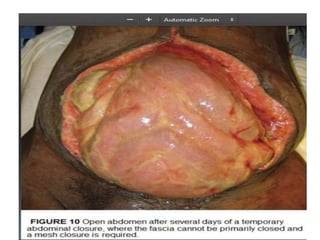
DIFFICULT ABDOMINAL WALL
BY: BIKASH C.SAH
1ST YEAR PG
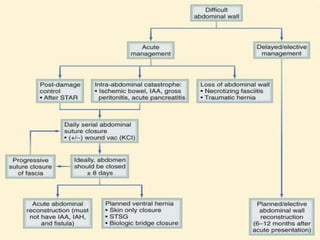
• Difficult abdominal wall closure is a great
challenge, especially in patients with
abdominal compartment syndrome or
repetitive abdominal surgery.
SUTURE MATERIAL
Ideal suture material
for abdominal wall closure
1. Resists infection,
2. Provides adequate tensile strength to
prevent abdominal wall disruption,
3. Minimizes tissue damage, and
4. Absorbable
Polydioxanone (PDS; Ethicon, Johnson &
Johnson), which is frequently used as a double-
stranded suture to increase tensile strength
BECAUSE:
a) Longer strength retention profile
b) Absorption time is longer
c) Being a monofilament that may resist
infection to a greater degree than braided
suture
Closure technique
• Minimization of tissue damage is imperative,
and this may be done by limiting the
incorporation of the abdominal wall
musculature in the closure.
• Although recent evidence suggests that
smaller fascial bites may decrease the
incidence of dehiscence and ventral hernia,
likely a result of decreased tissue ischemia and
damage
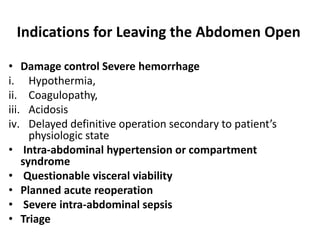
Indications for Leaving the Abdomen Open
• Damage control Severe hemorrhage
i. Hypothermia,
ii. Coagulopathy,
iii. Acidosis
iv. Delayed definitive operation secondary to patient’s
physiologic state
• Intra-abdominal hypertension or compartment
syndrome
• Questionable visceral viability
• Planned acute reoperation
• Severe intra-abdominal sepsis
• Triage
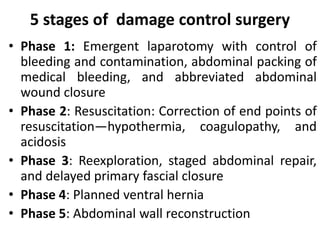
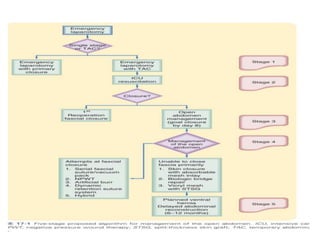
5 stages of damage control surgery
• Phase 1: Emergent laparotomy with control of
bleeding and contamination, abdominal packing of
medical bleeding, and abbreviated abdominal
wound closure
• Phase 2: Resuscitation: Correction of end points of
resuscitation—hypothermia, coagulopathy, and
acidosis
• Phase 3: Reexploration, staged abdominal repair,
and delayed primary fascial closure
• Phase 4: Planned ventral hernia
• Phase 5: Abdominal wall reconstruction
Initial Management
• Stabilize, resuscitate, and prepare the patient
for the next step toward closure of the
abdomen
• Return to the OR within 48 to 72 hours for re-
exploration and possible definitive closure
• If cannot be closed on the first trip back to the
OR, the same principles that dictated leaving
the patient open in the first place will apply
Subsequent Take-Backs to OR
Every 2-3 days return to OR for washouts
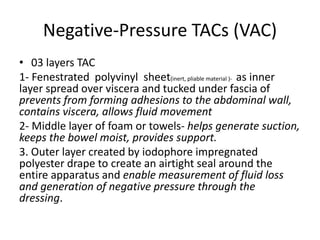
Each visit the fascia is brought together by
tension-free sutures
 By the 3rd-4thvisit, fascial approximation is
usually possible
Patients who remain open at day 8 are
unlikely to have a primary closure
Increased risk for serious complications,
including wound infections and fistulas
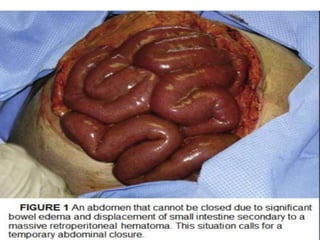
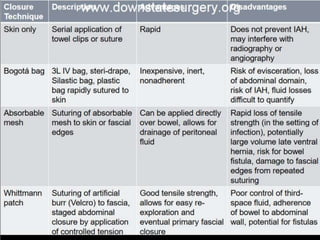
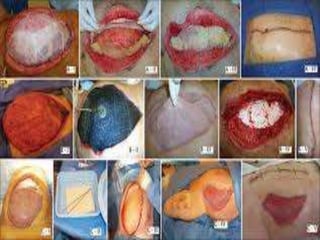
Temporary Abdominal Closure
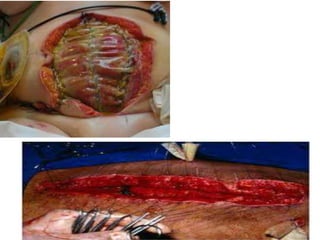
Current options for TAC include
– Tension free atraumatic abdominal visceral
coverage and
– Dynamic techniques in which the fascial edges
are closed with serial plication
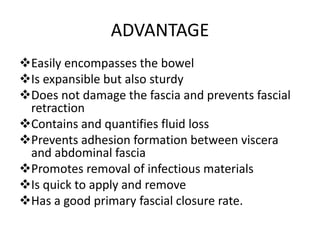
ADVANTAGE
Easily encompasses the bowel
Is expansible but also sturdy
Does not damage the fascia and prevents fascial
retraction
Contains and quantifies fluid loss
Prevents adhesion formation between viscera
and abdominal fascia
Promotes removal of infectious materials
Is quick to apply and remove
Has a good primary fascial closure rate.
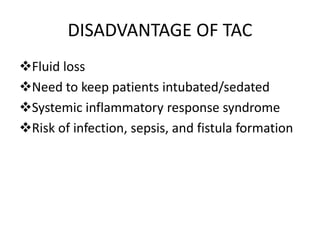
DISADVANTAGE OF TAC
Fluid loss
Need to keep patients intubated/sedated
Systemic inflammatory response syndrome
Risk of infection, sepsis, and fistula formation
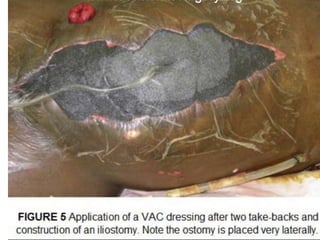
Negative-Pressure TACs (VAC)
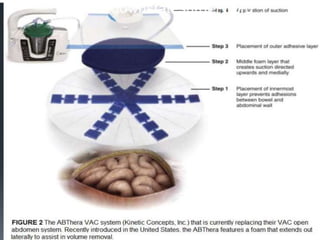
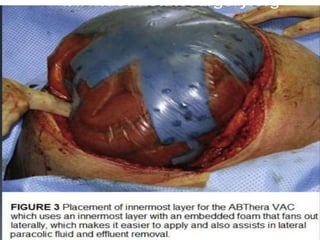
• 03 layers TAC
1- Fenestrated polyvinyl sheet(inert, pliable material )- as inner
layer spread over viscera and tucked under fascia of
prevents from forming adhesions to the abdominal wall,
contains viscera, allows fluid movement
2- Middle layer of foam or towels- helps generate suction,
keeps the bowel moist, provides support.
3. Outer layer created by iodophore impregnated
polyester drape to create an airtight seal around the
entire apparatus and enable measurement of fluid loss
and generation of negative pressure through the
dressing.
Advantage
1. Applied quickly
2. Inexpensive and effective
3. Atraumatic,
4. Allows control of abdominal fluid
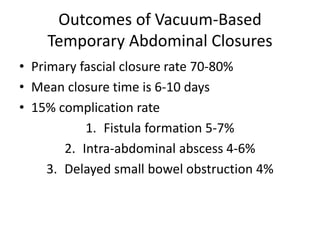
Outcomes of Vacuum-Based
Temporary Abdominal Closures
• Primary fascial closure rate 70-80%
• Mean closure time is 6-10 days
• 15% complication rate
1. Fistula formation 5-7%
2. Intra-abdominal abscess 4-6%
3. Delayed small bowel obstruction 4%
Recent advances
• Technique incorporating Dynamic serial
fascial closure in conjunction with
commercial available vacuum pack
demonstrated
 90% delayed primary fascial closure rate
 Extends beyond of the 08 days
 Highest closure rate
Lowest mortality rate
Abdominal reconstruction
Three main functions:
1. Reduction of contamination and control of
intra-abdominal sepsis,
2. Debridement of devitalized or contaminated
tissue, and
3. Reconstruction
ASSESSING READINESS FOR ABDOMINAL
CLOSURE
 Adequately resuscitated. The goal of resuscitation is
correction of hypothermia, coagulopathy, acidosis
 Clinical parameters such as renal dysfunction values,
Acute Physiology and Chronic Health Evaluation II
(APACHE II) score, and multiorgan dysfunction score
may be predictive of ongoing intra-abdominal sepsis
and can be used as indications for repeated
laparotomy
 Intra-abdominal hypertension (>20 mm Hg)
 Rise of peak inspiratory pressure of 10 cm H2O.
TIMING OF REOPERATION
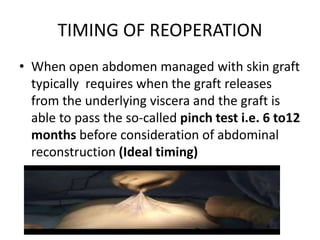
• When open abdomen managed with skin graft
typically requires when the graft releases
from the underlying viscera and the graft is
able to pass the so-called pinch test i.e. 6 to12
months before consideration of abdominal
reconstruction (Ideal timing)
• If there is ostomy has been made
Longer time between ostomy creation and reversal has been associated with
fewer complications, and adhesions appeared to diminish at about 15 weeks and
beyond.
Typical delays of 6 months or more should be
expected before ostomy reversal.
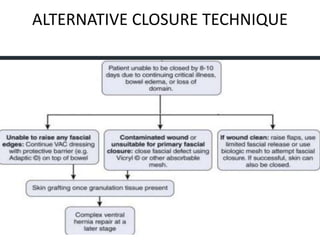
ALTERNATIVE CLOSURE TECHNIQUE
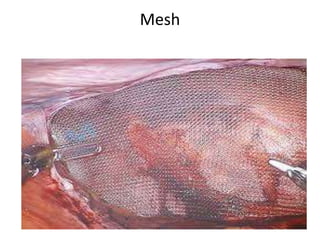
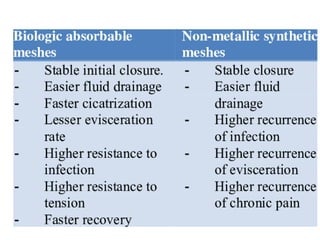
Mesh
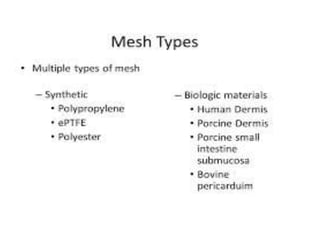
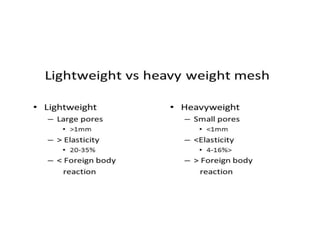
SYNTHETIC MESH
• Surgical treatment of choice for repair of
ventral incisional hernias
• Long-lasting repair with low recurrence rate
• Ease of use, and
• Relatively low cost compared with biologic
mesh
• Use: most commonly used prosthetic for
reinforcement for initial incisional and
recurrent hernia repairs
Biologic Mesh
Promotes tissue regeneration and
revascularization
Can be used in a contaminated field, but not in
heavily infected fields (matrix disintegrates)
Has a tendency to develop significant laxity
Overlying skin wound should be closed to
promote incorporation of the mesh
Hernia rate with Allodermis ~17%
Few complications are reported
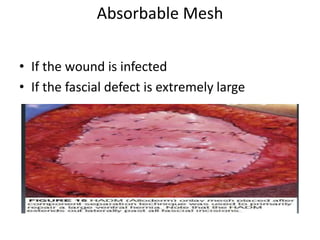
Absorbable Mesh
• If the wound is infected
• If the fascial defect is extremely large
Repair of Hernia after an Open
Abdomen
Place tissue expanders prior to surgery if
necessary
 Excise the skin graft and completely remove
mesh
 Perform lysis of adhesions to release viscera
from overlying fascia
 Re-approximate fascia
Place onlay mesh on top of the fascia for
reinforcement
Place drains under skin flaps
Challenges in Ventral Hernia Repair in
a Contaminated Field
Multiple previous attempts at hernia repair
Significant disruption of tissue planes
Enterocutaneous fistulas must be resected
Accompanying prosthetic material must be
removed
Large fascial defect replacing with permanent
prosthetic mesh is relatively contraindicated in
the acute phase
Protein-calorie malnutrition
 Primary repair has high rate of failure
Definitive reconstruction
• Goal
1. First to optimize the patient’s condition and
2. Then to restore the structure and functional
continuity of the musculofascial system and
3. Provide stable and durable wound coverage
to minimize additional complications
PREPARATION FOR ABDOMINAL WALL
RECONSTRUCTION
Mesh infection is better prevented than treated.
• Preoperative risk factors must be carefully evaluated and optimized before
an elective complex abdominal wall reconstruction is performed.
 Control diabetes
 Maximize protein-calorie repletion and
 Maximize cardiopulmonary status.
 Mandatory cigarette smoking cessation is required for at least 4 to 6
weeks.
 Previous methicillin-resistant Staphylococcus aureus (MRSA) infection, ----
Decolonizing the patient or suppressing MRSA carriers preoperatively and
using Vancomycin prophylaxis preoperatively.
Preoperative computed tomography scan of the abdominal wall
is necessary before any consideration of major reconstruction
Contd.
Intraoperative measures
Iodine-impregnated polyurethane films
Avoidance of wrinkles and redundant mesh
Soaking of synthetic mesh in antibiotic
solution
 Avoidance of contacting the mesh with the
skin
Judicious use of drains
Definitive Closure of the Abdomen
 1stchoice – primary closure
Optional retention sutures
Avoid closure under tension
Currently, a tension-free fascia to fascia closure
using component separation techniques
combined with mesh reinforcement is
considered the ideal method for abdominal wall
reconstruction.
Methods use
Rives Stoppa repair and Transversus abdominis
release repair
Gold standard.
Use a Retromuscular sublay of mesh
Preserve neurovascular space in posterior
component separation,
Posterior compartment is highly vascular
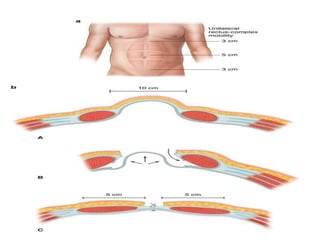
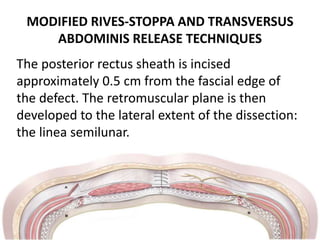
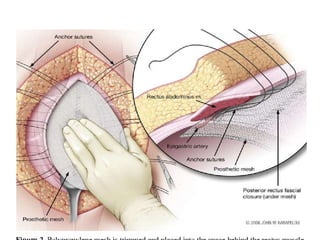
MODIFIED RIVES-STOPPA AND TRANSVERSUS
ABDOMINIS RELEASE TECHNIQUES
The posterior rectus sheath is incised
approximately 0.5 cm from the fascial edge of
the defect. The retromuscular plane is then
developed to the lateral extent of the dissection:
the linea semilunar.
If this dissection is insufficient to close the posterior
rectus fascia, an
Extension of this technique is the transversus abdominis
release.
In this technique, the transversus abdominis muscle is
divided, which then permits entrance into the space
between the transversalis fascia and the lateral edge of
this divided transversus abdominis muscle.
This allows the creation of a wide lateral dissection
plane with substantial posterior and anterior fascial
advancement.
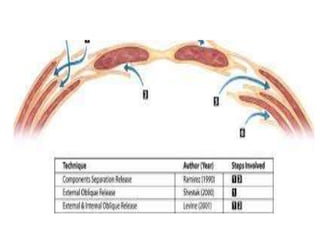
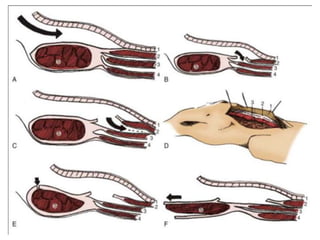
Ramirez technique:
Classically described for component
Separation requires large subcutaneous flaps
for access to be gained to the lateral
abdominal wall to release the external oblique
fascia.
 This technique has high wound morbidity
and is in general no longer recommended for
high-risk patients.
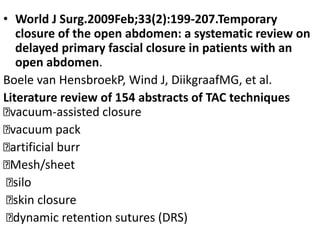
• World J Surg.2009Feb;33(2):199-207.Temporary
closure of the open abdomen: a systematic review on
delayed primary fascial closure in patients with an
open abdomen.
Boele van HensbroekP, Wind J, DiikgraafMG, et al.
Literature review of 154 abstracts of TAC techniques
vacuum-assisted closure
vacuum pack
artificial burr
Mesh/sheet
silo
skin closure
dynamic retention sutures (DRS)
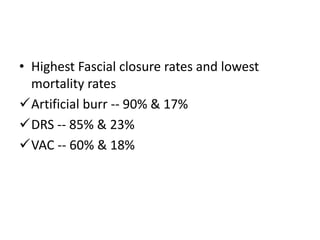
• Highest Fascial closure rates and lowest
mortality rates
Artificial burr -- 90% & 17%
DRS -- 85% & 23%
VAC -- 60% & 18%
Thank you.

Difficult abdominal Wall

  • 1.
    DIFFICULT ABDOMINAL WALL BY:BIKASH C.SAH 1ST YEAR PG
  • 2.
    • Difficult abdominalwall closure is a great challenge, especially in patients with abdominal compartment syndrome or repetitive abdominal surgery.
  • 3.
    SUTURE MATERIAL Ideal suturematerial for abdominal wall closure 1. Resists infection, 2. Provides adequate tensile strength to prevent abdominal wall disruption, 3. Minimizes tissue damage, and 4. Absorbable
  • 4.
    Polydioxanone (PDS; Ethicon,Johnson & Johnson), which is frequently used as a double- stranded suture to increase tensile strength BECAUSE: a) Longer strength retention profile b) Absorption time is longer c) Being a monofilament that may resist infection to a greater degree than braided suture
  • 5.
    Closure technique • Minimizationof tissue damage is imperative, and this may be done by limiting the incorporation of the abdominal wall musculature in the closure. • Although recent evidence suggests that smaller fascial bites may decrease the incidence of dehiscence and ventral hernia, likely a result of decreased tissue ischemia and damage
  • 6.
    Indications for Leavingthe Abdomen Open • Damage control Severe hemorrhage i. Hypothermia, ii. Coagulopathy, iii. Acidosis iv. Delayed definitive operation secondary to patient’s physiologic state • Intra-abdominal hypertension or compartment syndrome • Questionable visceral viability • Planned acute reoperation • Severe intra-abdominal sepsis • Triage
  • 7.
    5 stages ofdamage control surgery • Phase 1: Emergent laparotomy with control of bleeding and contamination, abdominal packing of medical bleeding, and abbreviated abdominal wound closure • Phase 2: Resuscitation: Correction of end points of resuscitation—hypothermia, coagulopathy, and acidosis • Phase 3: Reexploration, staged abdominal repair, and delayed primary fascial closure • Phase 4: Planned ventral hernia • Phase 5: Abdominal wall reconstruction
  • 9.
    Initial Management • Stabilize,resuscitate, and prepare the patient for the next step toward closure of the abdomen • Return to the OR within 48 to 72 hours for re- exploration and possible definitive closure • If cannot be closed on the first trip back to the OR, the same principles that dictated leaving the patient open in the first place will apply
  • 10.
    Subsequent Take-Backs toOR Every 2-3 days return to OR for washouts Each visit the fascia is brought together by tension-free sutures  By the 3rd-4thvisit, fascial approximation is usually possible Patients who remain open at day 8 are unlikely to have a primary closure Increased risk for serious complications, including wound infections and fistulas
  • 12.
    Temporary Abdominal Closure Currentoptions for TAC include – Tension free atraumatic abdominal visceral coverage and – Dynamic techniques in which the fascial edges are closed with serial plication
  • 13.
    ADVANTAGE Easily encompasses thebowel Is expansible but also sturdy Does not damage the fascia and prevents fascial retraction Contains and quantifies fluid loss Prevents adhesion formation between viscera and abdominal fascia Promotes removal of infectious materials Is quick to apply and remove Has a good primary fascial closure rate.
  • 14.
    DISADVANTAGE OF TAC Fluidloss Need to keep patients intubated/sedated Systemic inflammatory response syndrome Risk of infection, sepsis, and fistula formation
  • 18.
    Negative-Pressure TACs (VAC) •03 layers TAC 1- Fenestrated polyvinyl sheet(inert, pliable material )- as inner layer spread over viscera and tucked under fascia of prevents from forming adhesions to the abdominal wall, contains viscera, allows fluid movement 2- Middle layer of foam or towels- helps generate suction, keeps the bowel moist, provides support. 3. Outer layer created by iodophore impregnated polyester drape to create an airtight seal around the entire apparatus and enable measurement of fluid loss and generation of negative pressure through the dressing.
  • 22.
    Advantage 1. Applied quickly 2.Inexpensive and effective 3. Atraumatic, 4. Allows control of abdominal fluid
  • 23.
    Outcomes of Vacuum-Based TemporaryAbdominal Closures • Primary fascial closure rate 70-80% • Mean closure time is 6-10 days • 15% complication rate 1. Fistula formation 5-7% 2. Intra-abdominal abscess 4-6% 3. Delayed small bowel obstruction 4%
  • 24.
    Recent advances • Techniqueincorporating Dynamic serial fascial closure in conjunction with commercial available vacuum pack demonstrated  90% delayed primary fascial closure rate  Extends beyond of the 08 days  Highest closure rate Lowest mortality rate
  • 25.
    Abdominal reconstruction Three mainfunctions: 1. Reduction of contamination and control of intra-abdominal sepsis, 2. Debridement of devitalized or contaminated tissue, and 3. Reconstruction
  • 26.
    ASSESSING READINESS FORABDOMINAL CLOSURE  Adequately resuscitated. The goal of resuscitation is correction of hypothermia, coagulopathy, acidosis  Clinical parameters such as renal dysfunction values, Acute Physiology and Chronic Health Evaluation II (APACHE II) score, and multiorgan dysfunction score may be predictive of ongoing intra-abdominal sepsis and can be used as indications for repeated laparotomy  Intra-abdominal hypertension (>20 mm Hg)  Rise of peak inspiratory pressure of 10 cm H2O.
  • 27.
    TIMING OF REOPERATION •When open abdomen managed with skin graft typically requires when the graft releases from the underlying viscera and the graft is able to pass the so-called pinch test i.e. 6 to12 months before consideration of abdominal reconstruction (Ideal timing)
  • 28.
    • If thereis ostomy has been made Longer time between ostomy creation and reversal has been associated with fewer complications, and adhesions appeared to diminish at about 15 weeks and beyond. Typical delays of 6 months or more should be expected before ostomy reversal.
  • 29.
  • 30.
  • 34.
    SYNTHETIC MESH • Surgicaltreatment of choice for repair of ventral incisional hernias • Long-lasting repair with low recurrence rate • Ease of use, and • Relatively low cost compared with biologic mesh • Use: most commonly used prosthetic for reinforcement for initial incisional and recurrent hernia repairs
  • 35.
    Biologic Mesh Promotes tissueregeneration and revascularization Can be used in a contaminated field, but not in heavily infected fields (matrix disintegrates) Has a tendency to develop significant laxity Overlying skin wound should be closed to promote incorporation of the mesh Hernia rate with Allodermis ~17% Few complications are reported
  • 36.
    Absorbable Mesh • Ifthe wound is infected • If the fascial defect is extremely large
  • 37.
    Repair of Herniaafter an Open Abdomen Place tissue expanders prior to surgery if necessary  Excise the skin graft and completely remove mesh  Perform lysis of adhesions to release viscera from overlying fascia  Re-approximate fascia Place onlay mesh on top of the fascia for reinforcement Place drains under skin flaps
  • 38.
    Challenges in VentralHernia Repair in a Contaminated Field Multiple previous attempts at hernia repair Significant disruption of tissue planes Enterocutaneous fistulas must be resected Accompanying prosthetic material must be removed Large fascial defect replacing with permanent prosthetic mesh is relatively contraindicated in the acute phase Protein-calorie malnutrition  Primary repair has high rate of failure
  • 39.
    Definitive reconstruction • Goal 1.First to optimize the patient’s condition and 2. Then to restore the structure and functional continuity of the musculofascial system and 3. Provide stable and durable wound coverage to minimize additional complications
  • 40.
    PREPARATION FOR ABDOMINALWALL RECONSTRUCTION Mesh infection is better prevented than treated. • Preoperative risk factors must be carefully evaluated and optimized before an elective complex abdominal wall reconstruction is performed.  Control diabetes  Maximize protein-calorie repletion and  Maximize cardiopulmonary status.  Mandatory cigarette smoking cessation is required for at least 4 to 6 weeks.  Previous methicillin-resistant Staphylococcus aureus (MRSA) infection, ---- Decolonizing the patient or suppressing MRSA carriers preoperatively and using Vancomycin prophylaxis preoperatively. Preoperative computed tomography scan of the abdominal wall is necessary before any consideration of major reconstruction
  • 41.
    Contd. Intraoperative measures Iodine-impregnated polyurethanefilms Avoidance of wrinkles and redundant mesh Soaking of synthetic mesh in antibiotic solution  Avoidance of contacting the mesh with the skin Judicious use of drains
  • 42.
    Definitive Closure ofthe Abdomen  1stchoice – primary closure Optional retention sutures Avoid closure under tension Currently, a tension-free fascia to fascia closure using component separation techniques combined with mesh reinforcement is considered the ideal method for abdominal wall reconstruction.
  • 44.
    Methods use Rives Stopparepair and Transversus abdominis release repair Gold standard. Use a Retromuscular sublay of mesh Preserve neurovascular space in posterior component separation, Posterior compartment is highly vascular
  • 46.
    MODIFIED RIVES-STOPPA ANDTRANSVERSUS ABDOMINIS RELEASE TECHNIQUES The posterior rectus sheath is incised approximately 0.5 cm from the fascial edge of the defect. The retromuscular plane is then developed to the lateral extent of the dissection: the linea semilunar.
  • 47.
    If this dissectionis insufficient to close the posterior rectus fascia, an Extension of this technique is the transversus abdominis release. In this technique, the transversus abdominis muscle is divided, which then permits entrance into the space between the transversalis fascia and the lateral edge of this divided transversus abdominis muscle. This allows the creation of a wide lateral dissection plane with substantial posterior and anterior fascial advancement.
  • 49.
    Ramirez technique: Classically describedfor component Separation requires large subcutaneous flaps for access to be gained to the lateral abdominal wall to release the external oblique fascia.  This technique has high wound morbidity and is in general no longer recommended for high-risk patients.
  • 53.
    • World JSurg.2009Feb;33(2):199-207.Temporary closure of the open abdomen: a systematic review on delayed primary fascial closure in patients with an open abdomen. Boele van HensbroekP, Wind J, DiikgraafMG, et al. Literature review of 154 abstracts of TAC techniques vacuum-assisted closure vacuum pack artificial burr Mesh/sheet silo skin closure dynamic retention sutures (DRS)
  • 54.
    • Highest Fascialclosure rates and lowest mortality rates Artificial burr -- 90% & 17% DRS -- 85% & 23% VAC -- 60% & 18%
  • 55.

Editor's Notes

  • #5 Non absorbable suture like prolene is associated with increase pain and sinus tract formation