Differences between Spoken
and Written Discourse
Lecture 3:
Source: Paltridge, p.p. 13-19
Objectives
  Students should be able to:
2. List the differences between spoken and
   Written discourse
3. For each difference, explain the commonly
   held view and its rebuttal, if any.
4. Explain McCarthy’s view of a continuum.
Outline
   I. General Differences between Spoken
    and Written Discourse (Slides 4-13)


   II. A Continuum View (Slides 14- 19)
I. General Differences
 1. Grammatical intricacy
 2. Lexical density
 3. Nominalization
 4. Explicitness
 5. Contextualization
 6. Spontaneity
 7. Repetition, hesitations, and redundancy
1. Grammatical Intricacy
 View:
Written discourse is more structurally
  complex and more elaborate than spoken
  discourse .
In other words, sentences in spoken
  discourse are short and simple, whereas
  they are longer and more complex in
  written discourse.
1. Grammatical Intricacy
 Rebuttal: Halliday argues that spoken
  discourse is NOT less organized. He
  claims that spoken discourse has its own
  kind of complexity.
 In spoken discourse clauses are long and
  spread out => Spoken discourse can be
  grammatically intricate as well.
2. Lexical Density
   Lexical density refers to the ratio of content
    words (i.e. nouns, verbs, adjectives, and
    adverbs) to grammatical or function words
    (e.g. pronouns, prepositions, articles) within
    a clause.

   View: Spoken discourse is less lexically
    dense than written discourse. Content
    words tend to be spread out over a number
    of clauses, whereas they seem to be tightly
    packed into individual clauses. (See extracts
    p. 15)
3. Nominalization
 Nominalization refers to presenting actions
  and events as nouns rather than as verbs.
 View:
 Written discourse has a high level of
  nominalization: i.e. more nouns than verbs.
 Written discourse tends to have longer
  noun groups than spoken discourse. (See
  extracts bottom of p. 15 and the second
  extract on p. 16)
4. Explicitness
View:
Writing is more explicit than speech.

Rebuttal:
-This is not always true.
-It depends on the purpose of text.
A writer/speaker can state something
  explicitly or infer it depending on many
  variables.
5. Contextualization
 Contextualization refers to the extent
  knowledge of context is needed to
  interpret a text.
 View:
Writing is more decontextualized than
  speech: Speech is more attached to
  context than writing because speech
  depends on a shared situation and
  background for interpretation.
5. Contextualization
 Rebuttal:
 This may be true of conversations, but
  not in all types of spoken discourses.
  Some types of written discourse may
  show high dependence on shared
  contextual knowledge, e.g. personal
  letters between friends.
6. Spontaneity
  View:
b. Spoken discourse lacks organization and is
   ungrammatical because it is spontaneous,
   whereas written discourse is organized and
   grammatical.
c. Spoken discourse contains more uncompleted
   and reformulated sentences.
d. Topics can be changed.
e. Speakers may interrupt and overlap
 Rebuttal:
Spoken discourse is organized, but it is organized
   differently from written discourse.
7. Repetition, Hesitation, and Redundancy

  View:
b. Spoken discourse contains more
   repetition, hesitations, and redundancy
   because it is produced in real time (i.e. on
   the spot).
c. Spoken discourse has many pauses and
   fillers, such as ‘hhh’, ‘er’ and ‘you know’.
(See extract on p. 18)
II. A Continuum View
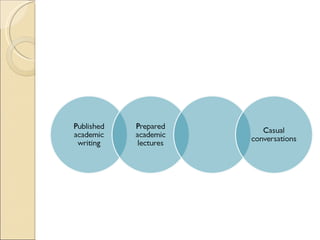
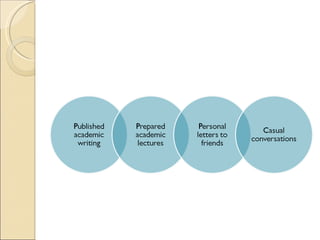
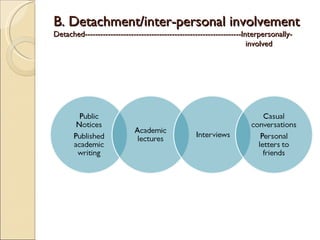
McCarthy (2001) argues for a continuum
  view rather than simple, one-dimensional
  difference between spoken and written
  discourses.
In other words, differences are viewed as
  being on a continuum:
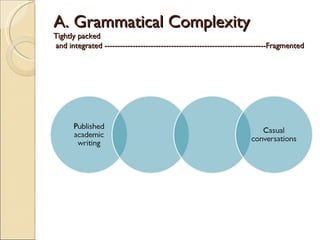
A. Grammatical Complexity
Tightly packed
and integrated ---------------------------------------------------------------Fragmented
B. Detachment/inter-personal involvement
Detached-------------------------------------------------------------Interpersonally-
                                                                       involved
Biber’s(1988) corpus-based study:
 No absolute difference between speech
  and writing in English
There are dimensions of variation for
  different kinds of texts (i.e. genres).
Considerable variation may occur even
  within particular genres.

Differences between spoken and written discourse

  • 1.
    Differences between Spoken andWritten Discourse Lecture 3: Source: Paltridge, p.p. 13-19
  • 2.
    Objectives  Studentsshould be able to: 2. List the differences between spoken and Written discourse 3. For each difference, explain the commonly held view and its rebuttal, if any. 4. Explain McCarthy’s view of a continuum.
  • 3.
    Outline  I. General Differences between Spoken and Written Discourse (Slides 4-13)  II. A Continuum View (Slides 14- 19)
  • 4.
    I. General Differences 1. Grammatical intricacy  2. Lexical density  3. Nominalization  4. Explicitness  5. Contextualization  6. Spontaneity  7. Repetition, hesitations, and redundancy
  • 5.
    1. Grammatical Intricacy View: Written discourse is more structurally complex and more elaborate than spoken discourse . In other words, sentences in spoken discourse are short and simple, whereas they are longer and more complex in written discourse.
  • 6.
    1. Grammatical Intricacy Rebuttal: Halliday argues that spoken discourse is NOT less organized. He claims that spoken discourse has its own kind of complexity.  In spoken discourse clauses are long and spread out => Spoken discourse can be grammatically intricate as well.
  • 7.
    2. Lexical Density  Lexical density refers to the ratio of content words (i.e. nouns, verbs, adjectives, and adverbs) to grammatical or function words (e.g. pronouns, prepositions, articles) within a clause.  View: Spoken discourse is less lexically dense than written discourse. Content words tend to be spread out over a number of clauses, whereas they seem to be tightly packed into individual clauses. (See extracts p. 15)
  • 8.
    3. Nominalization  Nominalizationrefers to presenting actions and events as nouns rather than as verbs.  View:  Written discourse has a high level of nominalization: i.e. more nouns than verbs.  Written discourse tends to have longer noun groups than spoken discourse. (See extracts bottom of p. 15 and the second extract on p. 16)
  • 9.
    4. Explicitness View: Writing ismore explicit than speech. Rebuttal: -This is not always true. -It depends on the purpose of text. A writer/speaker can state something explicitly or infer it depending on many variables.
  • 10.
    5. Contextualization  Contextualizationrefers to the extent knowledge of context is needed to interpret a text.  View: Writing is more decontextualized than speech: Speech is more attached to context than writing because speech depends on a shared situation and background for interpretation.
  • 11.
    5. Contextualization  Rebuttal: This may be true of conversations, but not in all types of spoken discourses. Some types of written discourse may show high dependence on shared contextual knowledge, e.g. personal letters between friends.
  • 12.
    6. Spontaneity  View: b. Spoken discourse lacks organization and is ungrammatical because it is spontaneous, whereas written discourse is organized and grammatical. c. Spoken discourse contains more uncompleted and reformulated sentences. d. Topics can be changed. e. Speakers may interrupt and overlap  Rebuttal: Spoken discourse is organized, but it is organized differently from written discourse.
  • 13.
    7. Repetition, Hesitation,and Redundancy  View: b. Spoken discourse contains more repetition, hesitations, and redundancy because it is produced in real time (i.e. on the spot). c. Spoken discourse has many pauses and fillers, such as ‘hhh’, ‘er’ and ‘you know’. (See extract on p. 18)
  • 14.
    II. A ContinuumView McCarthy (2001) argues for a continuum view rather than simple, one-dimensional difference between spoken and written discourses. In other words, differences are viewed as being on a continuum:
  • 15.
    A. Grammatical Complexity Tightlypacked and integrated ---------------------------------------------------------------Fragmented
  • 18.
  • 19.
    Biber’s(1988) corpus-based study: No absolute difference between speech and writing in English There are dimensions of variation for different kinds of texts (i.e. genres). Considerable variation may occur even within particular genres.