Differentiating Instruction in a  Whole-Group Setting
Word Toss Page 82 Assessment Early Readiness Student Engagement Questioning Flexible Grouping Tiered Instruction Tone RTI
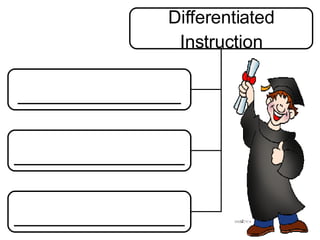
What is Differentiated Instruction? It’s consistently and proactively creating different pathways to help all your students to be successful. ~Betty Hollas Differentiated Instruction ____________ _____________ _____________
Let’s Plan a Vacation!
Differentiating Instruction is doing what’s fair for students.  It’s a collection of best practices strategically employed to  maximize students’ learning at every turn, including giving them the tools to handle anything that is undifferentiated.  It requires us to do different things for different students some, or a lot of the time.  It’s whatever works to advance the student.  It’s highly effective teaching! Wormeli, R., 2005
Differentiated Instruction ______________________ _______________________ _______________________
Failure Students who consistently fail lose their motivation to learn! Tomlinson, C., 1999 Toonaday.com
Easy Success Students who succeed too easily also lose their motivation to learn! Tomlinson, C., 1999  Toonaday.com
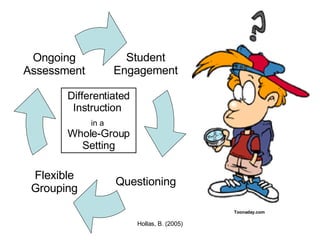
Differentiated Instruction  in a  Whole-Group Setting Toonaday.com Ongoing Assessment Flexible Grouping Questioning Student Engagement
When Differentiating You Must Know . . . each child’s readiness level. early readiness readiness advanced readiness each child’s interests.  (p. 138) how each child learns best.  (p. 139) how the child feels about the classroom, him/herself, and learning. Toonaday.com
Let’s Make an Appointment! (8) 8:00______________ 9:00______________ 10:00_____________ 11:00_____________ 12:00_____________
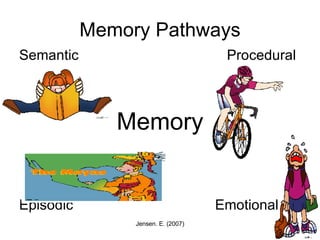
Memory Pathways Semantic   Procedural Memory Episodic  Emotional
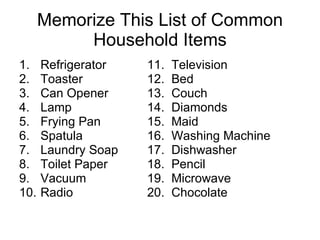
Memorize This List of Common Household Items Refrigerator 11.  Television  Toaster 12.  Bed Can Opener 13.  Couch Lamp 14.  Diamonds Frying Pan  15.  Maid Spatula 16.  Washing Machine Laundry Soap 17.  Dishwasher Toilet Paper 18.  Pencil Vacuum 19.  Microwave Radio 20.  Chocolate
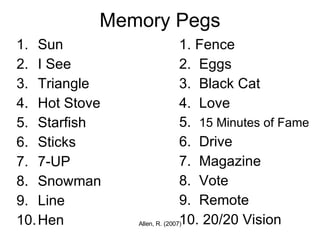
Memory Pegs Sun I See Triangle Hot Stove Starfish Sticks 7-UP Snowman Line Hen Fence Eggs Black Cat Love 15 Minutes of Fame Drive Magazine Vote Remote 20/20 Vision
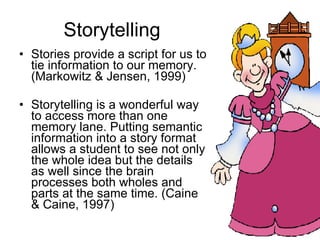
Storytelling Stories provide a script for us to tie information to our memory. (Markowitz & Jensen, 1999) Storytelling is a wonderful way to access more than one memory lane. Putting semantic information into a story format allows a student to see not only the whole idea but the details as well since the brain processes both wholes and parts at the same time. (Caine & Caine, 1997)
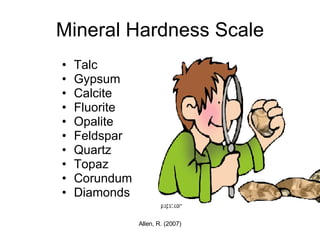
Mineral Hardness Scale Talc Gypsum Calcite Fluorite Opalite Feldspar Quartz Topaz Corundum Diamonds
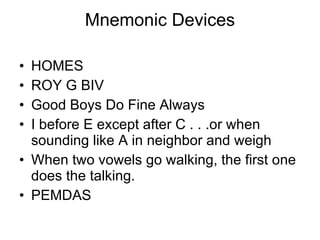
Mnemonic Devices Mnemonics create links or associations between new information the brain is receiving and information already stored in long-term memory. (Wolfe, 2001) Mnemonics help activate the creation of stronger neuro-links in the hippocampus, which are essential to short- and long-term memory. (Jensen, 2001)
Mnemonic Devices HOMES ROY G BIV Good Boys Do Fine Always I before E except after C . . .or when sounding like A in neighbor and weigh When two vowels go walking, the first one does the talking. PEMDAS
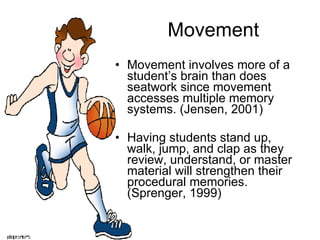
Movement Movement involves more of a student’s brain than does seatwork since movement accesses multiple memory systems. (Jensen, 2001) Having students stand up, walk, jump, and clap as they review, understand, or master material will strengthen their procedural memories. (Sprenger, 1999)
 
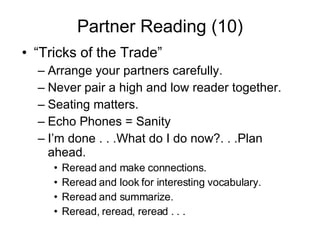
Partner Reading (10) “Tricks of the Trade” Arrange your partners carefully. Never pair a high and low reader together. Seating matters.  Echo Phones = Sanity I’m done . . .What do I do now?. . .Plan ahead. Reread and make connections. Reread and look for interesting vocabulary. Reread and summarize. Reread, reread, reread . . .
Partner Reading List your students from advanced to emergent readers . . . John Sally Ginger Tom Libby Samantha Jane Tim
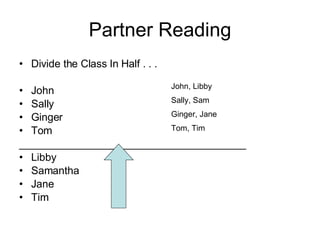
Partner Reading Divide the Class In Half . . . John Sally Ginger Tom _______________________________________ Libby Samantha Jane Tim John, Libby Sally, Sam Ginger, Jane Tom, Tim
Snowball Fight (16)
Vocabulary on the Move (13)
What’s My Name? (19)
Circle the Category (20-21)
TONE Bring Your Teaching SPACE to Life!!
Music, Rhythm, Rhyme and Rap Music activates and synchronizes neural networks which increase the brain’s ability to reason spatially, think creatively, and perform in generalized mathematics. (Jensen, 2001)
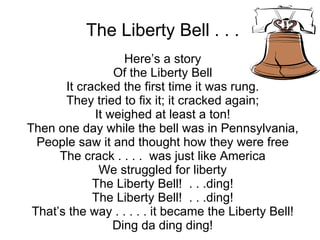
The Liberty Bell . . . Here’s a story Of the Liberty Bell It cracked the first time it was rung. They tried to fix it; it cracked again; It weighed at least a ton! Then one day while the bell was in Pennsylvania, People saw it and thought how they were free The crack . . . .  was just like America We struggled for liberty The Liberty Bell!  . . .ding! The Liberty Bell!  . . .ding! That’s the way . . . . . it became the Liberty Bell! Ding da ding ding!
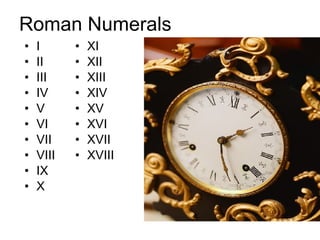
Roman Numerals I II III IV V VI VII VIII IX X XI XII XIII XIV XV XVI XVII XVIII
Question to Ponder What’s more important, the question or the answer?
Use More Questions Than Answers The brain is more receptive to questions than answers.  Allow students to generate questions. How and why questions require more thought than who and what questions.
Hmmm… On average, teachers ask 80 questions each hour. AND . . . Students only ask TWO (Kagan, 1999).
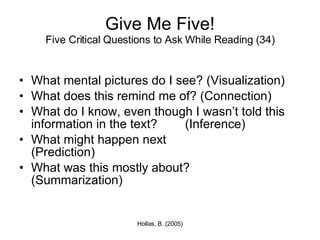
Give Me Five! Five Critical Questions to Ask While Reading (34) What mental pictures do I see? (Visualization) What does this remind me of? (Connection) What do I know, even though I wasn’t told this information in the text?  (Inference) What might happen next  (Prediction) What was this mostly about?  (Summarization)
Gist Who? What? When? Where? Why? How?                                                                                                                                                                                                                       Site
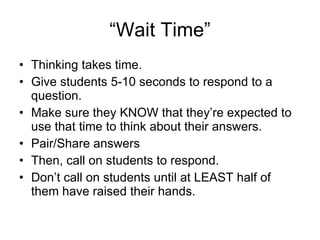
“Wait Time” Thinking takes time. Give students 5-10 seconds to respond to a question.  Make sure they KNOW that they’re expected to use that time to think about their answers. Pair/Share answers Then, call on students to respond. Don’t call on students until at LEAST half of them have raised their hands.
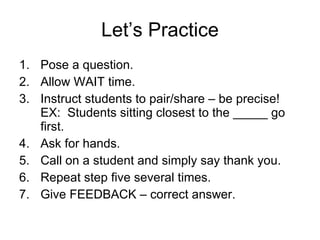
Let’s Practice Pose a question. Allow WAIT time. Instruct students to pair/share – be precise! EX:  Students sitting closest to the _____ go first. Ask for hands. Call on a student and simply say thank you. Repeat step five several times. Give FEEDBACK – correct answer.
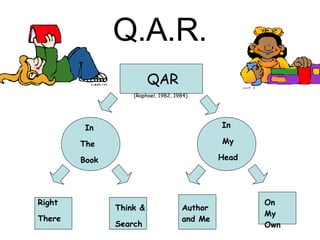
Q.A.R. QAR (Raphael, 1982, 1984) In The  Book In  My Head Right There Think & Search Author and Me On My Own
Q.A.R. (43) Right There:  How is a batting average calculated? Think, Search, Find:  How are batting averages used?  (answer several places) Author and Me:  How much higher is Player C’s batting average than Player A’s? On My Own:  Are you a baseball fan?  Explain.
Games Play speeds up the brain’s maturation process since it involves the build-in processes of challenge, novelty, feedback, coherence and time. (Jensen, 2001) The effectiveness of a game is enhanced when students actually help to design or construct it. (Wolfe, 2001)
I Have . . . Who Has??? (40) Toonaday.com
I Do Have a Question! (33)
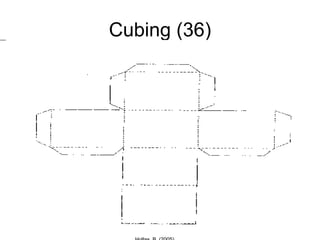
Cubing (36) Hollas, B. (2005)
Types of Groups Whole Group Heterogeneous Groups Homogeneous Groups Independent/ Individual Work
Grouping Ideas Jigsaw – page 61 Numbered Heads Together – page 63 Role Cards – page 64 Discussion Cards – page 65 Toonaday.com Hollas, B. (2005)
I’m done . . .What do I do now?? What are anchor activities? specified ongoing activities on which students work independently  ongoing assignments that students can work on throughout a unit  Why use anchor activities? provide a strategy for teachers to deal with “ragged time” when students complete work at different times  they allow the teacher to work with individual students or groups  provides ongoing activities that relate to the content of the unit  allow the teacher to develop independent group work strategies in order to incorporate a mini lab of computers in classroom
Anchor Activity Ideas Anchor Activities . . . Silent Reading Think-Tac-Toe – Page 67, 133 4-6-8 – Page 69, 137 R.A.F.T. – Page 70, 71 Magazine Pictures – List nouns Add adjectives Verbs Add adverbs
Tiered Assignments Tiering is a differentiated instructional planning strategy that enables educators to teach one concept at multiple levels of complexity based on student readiness levels. Early Readiness Readiness Advanced Readiness
Tiered  Assignments:  http://ideanet.doe.state.in.us/exceptional/gt/tiered_curriculum/welcome.html http:// wblrd.sk.ca/~bestpractice/tiered/index.html Mnemonic Devices: http:// www.rebeccastmartin.com/mnemonicdevices/index.htm A Plethora of Differentiated Instruction Sites: http://www.internet4classrooms.com/di.htm Exit Slip Ideas: http://www.saskschools.ca/curr_content/mathcatch/mainpages/assess_tools/exit_q     uestions.html Layered Assignments: Nunley, Kathie F., Six Simple Steps to Layered Curriculum™  http://help4teachers.com   http://help4teachers.com/samples2.htm Curriculum Compacting PowerPoint: http://www.mcps.k12.md.us/curriculum/enriched/giftedprograms/curriculumcompacting.shtm Grouping Slide:  http://wvde.state.wv.us/reading/reading-module/H%20-      Intervention/8.7Grouping%20Practices.doc Free Timers:  http:// www.interventioncentral.com/timers.php Jokes: http://www.jokes4teachers.com Games: -- Great for SMART Boards http:// www.quia.com/pages/hostetterlinks.html http://jc-schools.net/tutorials/PPT-games / Classroom Website: If you have time to navigate this site . . . it’s AMAZING and has TONS of  freebies. http://hill.troy.k12.mi.us/staff/bnewingham/myweb3/ Carol Tomlinson’s Differentiated Instruction article http://www.learner.org/channel/workshops/socialstudies/session5/explore.html Click on the “Mapping the Route to Differentiated Instruction” article.
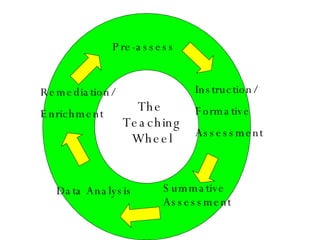
Assessment Pre-assessment:  Determine students’ prior understanding and readiness for the content. Formative Assessment:  Tracking students’ progress throughout the learning process as well as giving them the opportunity to track their own growth. Summative Assessment: Making sure they’ve reached the goals that have been set.
Pre-assess Instruction/ Formative  Assessment Summative Assessment Data Analysis Remediation/ Enrichment The  Teaching Wheel
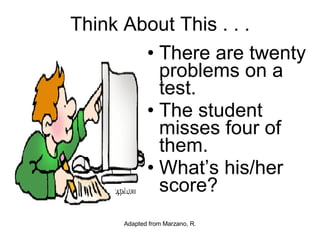
Think About This . . . There are twenty problems on a test.  The student misses four of them.  What’s his/her score?
Do You Need More Information? The first 10 are multiple choice, simple recall questions. The student gets them all right. Numbers 11-15 are constructed response, complex questions that were explicitly taught. The student gets them all right. Numbers 16-20 are also constructed response, but they’re application questions that go beyond what was taught. The student misses four of them.
Word Toss Page 82 Assessment Early Readiness Student Engagement Questioning Flexible Grouping Tiered Instruction Tone RTI
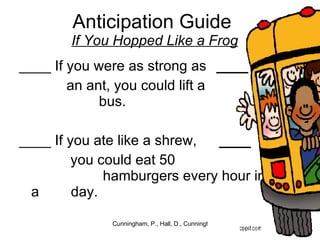
Anticipation Guide  If You Hopped Like a Frog ____ If you were as strong as an ant, you could lift a      bus. ____ If you ate like a shrew,  you could eat 50        hamburgers every hour in a    day. ____ ____
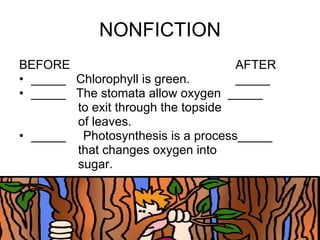
NONFICTION BEFORE   AFTER _____  Chlorophyll is green.   _____ _____  The stomata allow oxygen  _____ to exit through the topside of leaves. _____ Photosynthesis is a process_____ that changes oxygen into sugar.
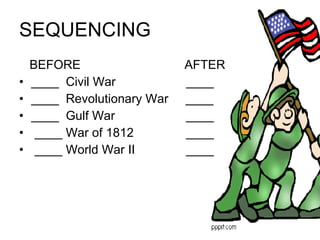
SEQUENCING BEFORE  AFTER ____  Civil War    ____ ____  Revolutionary War  ____ ____  Gulf War   ____ ____ War of 1812   ____ ____ World War II   ____
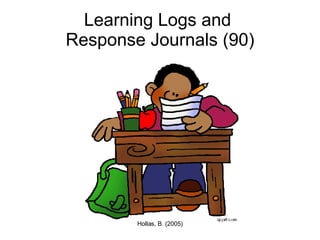
Learning Logs and  Response Journals (90)
Exit Cards (87)
A Special Thank You to: Betty Hollas: Hollas, B. (2005). Differentiating Instruction in a Whole-Group Setting. Peterborough, NH:  Crystal Springs Books Eric Jensen: www.jlcbrain.com Rich Allen: http://www.greenlighteducation.net/ Dorothy Hall: www.wfu.edu/fourblocks Phillip Martin http:// www.pppst.com / Ron Leishman www.toonaday.com

Di Handout 08

  • 1.
    Differentiating Instruction ina Whole-Group Setting
  • 2.
    Word Toss Page82 Assessment Early Readiness Student Engagement Questioning Flexible Grouping Tiered Instruction Tone RTI
  • 3.
    What is DifferentiatedInstruction? It’s consistently and proactively creating different pathways to help all your students to be successful. ~Betty Hollas Differentiated Instruction ____________ _____________ _____________
  • 4.
    Let’s Plan aVacation!
  • 5.
    Differentiating Instruction isdoing what’s fair for students. It’s a collection of best practices strategically employed to maximize students’ learning at every turn, including giving them the tools to handle anything that is undifferentiated. It requires us to do different things for different students some, or a lot of the time. It’s whatever works to advance the student. It’s highly effective teaching! Wormeli, R., 2005
  • 6.
    Differentiated Instruction _____________________________________________ _______________________
  • 7.
    Failure Students whoconsistently fail lose their motivation to learn! Tomlinson, C., 1999 Toonaday.com
  • 8.
    Easy Success Studentswho succeed too easily also lose their motivation to learn! Tomlinson, C., 1999 Toonaday.com
  • 9.
    Differentiated Instruction in a Whole-Group Setting Toonaday.com Ongoing Assessment Flexible Grouping Questioning Student Engagement
  • 10.
    When Differentiating YouMust Know . . . each child’s readiness level. early readiness readiness advanced readiness each child’s interests. (p. 138) how each child learns best. (p. 139) how the child feels about the classroom, him/herself, and learning. Toonaday.com
  • 11.
    Let’s Make anAppointment! (8) 8:00______________ 9:00______________ 10:00_____________ 11:00_____________ 12:00_____________
  • 12.
    Memory Pathways Semantic Procedural Memory Episodic Emotional
  • 13.
    Memorize This Listof Common Household Items Refrigerator 11. Television Toaster 12. Bed Can Opener 13. Couch Lamp 14. Diamonds Frying Pan 15. Maid Spatula 16. Washing Machine Laundry Soap 17. Dishwasher Toilet Paper 18. Pencil Vacuum 19. Microwave Radio 20. Chocolate
  • 14.
    Memory Pegs SunI See Triangle Hot Stove Starfish Sticks 7-UP Snowman Line Hen Fence Eggs Black Cat Love 15 Minutes of Fame Drive Magazine Vote Remote 20/20 Vision
  • 15.
    Storytelling Stories providea script for us to tie information to our memory. (Markowitz & Jensen, 1999) Storytelling is a wonderful way to access more than one memory lane. Putting semantic information into a story format allows a student to see not only the whole idea but the details as well since the brain processes both wholes and parts at the same time. (Caine & Caine, 1997)
  • 16.
    Mineral Hardness ScaleTalc Gypsum Calcite Fluorite Opalite Feldspar Quartz Topaz Corundum Diamonds
  • 17.
    Mnemonic Devices Mnemonicscreate links or associations between new information the brain is receiving and information already stored in long-term memory. (Wolfe, 2001) Mnemonics help activate the creation of stronger neuro-links in the hippocampus, which are essential to short- and long-term memory. (Jensen, 2001)
  • 18.
    Mnemonic Devices HOMESROY G BIV Good Boys Do Fine Always I before E except after C . . .or when sounding like A in neighbor and weigh When two vowels go walking, the first one does the talking. PEMDAS
  • 19.
    Movement Movement involvesmore of a student’s brain than does seatwork since movement accesses multiple memory systems. (Jensen, 2001) Having students stand up, walk, jump, and clap as they review, understand, or master material will strengthen their procedural memories. (Sprenger, 1999)
  • 20.
  • 21.
    Partner Reading (10)“Tricks of the Trade” Arrange your partners carefully. Never pair a high and low reader together. Seating matters. Echo Phones = Sanity I’m done . . .What do I do now?. . .Plan ahead. Reread and make connections. Reread and look for interesting vocabulary. Reread and summarize. Reread, reread, reread . . .
  • 22.
    Partner Reading Listyour students from advanced to emergent readers . . . John Sally Ginger Tom Libby Samantha Jane Tim
  • 23.
    Partner Reading Dividethe Class In Half . . . John Sally Ginger Tom _______________________________________ Libby Samantha Jane Tim John, Libby Sally, Sam Ginger, Jane Tom, Tim
  • 24.
  • 25.
  • 26.
  • 27.
  • 28.
    TONE Bring YourTeaching SPACE to Life!!
  • 29.
    Music, Rhythm, Rhymeand Rap Music activates and synchronizes neural networks which increase the brain’s ability to reason spatially, think creatively, and perform in generalized mathematics. (Jensen, 2001)
  • 30.
    The Liberty Bell. . . Here’s a story Of the Liberty Bell It cracked the first time it was rung. They tried to fix it; it cracked again; It weighed at least a ton! Then one day while the bell was in Pennsylvania, People saw it and thought how they were free The crack . . . . was just like America We struggled for liberty The Liberty Bell! . . .ding! The Liberty Bell! . . .ding! That’s the way . . . . . it became the Liberty Bell! Ding da ding ding!
  • 31.
    Roman Numerals III III IV V VI VII VIII IX X XI XII XIII XIV XV XVI XVII XVIII
  • 32.
    Question to PonderWhat’s more important, the question or the answer?
  • 33.
    Use More QuestionsThan Answers The brain is more receptive to questions than answers. Allow students to generate questions. How and why questions require more thought than who and what questions.
  • 34.
    Hmmm… On average,teachers ask 80 questions each hour. AND . . . Students only ask TWO (Kagan, 1999).
  • 35.
    Give Me Five!Five Critical Questions to Ask While Reading (34) What mental pictures do I see? (Visualization) What does this remind me of? (Connection) What do I know, even though I wasn’t told this information in the text? (Inference) What might happen next (Prediction) What was this mostly about? (Summarization)
  • 36.
    Gist Who? What?When? Where? Why? How?                                                                                                                                                                                                                 Site
  • 37.
    “Wait Time” Thinkingtakes time. Give students 5-10 seconds to respond to a question. Make sure they KNOW that they’re expected to use that time to think about their answers. Pair/Share answers Then, call on students to respond. Don’t call on students until at LEAST half of them have raised their hands.
  • 38.
    Let’s Practice Posea question. Allow WAIT time. Instruct students to pair/share – be precise! EX: Students sitting closest to the _____ go first. Ask for hands. Call on a student and simply say thank you. Repeat step five several times. Give FEEDBACK – correct answer.
  • 39.
    Q.A.R. QAR (Raphael,1982, 1984) In The Book In My Head Right There Think & Search Author and Me On My Own
  • 40.
    Q.A.R. (43) RightThere: How is a batting average calculated? Think, Search, Find: How are batting averages used? (answer several places) Author and Me: How much higher is Player C’s batting average than Player A’s? On My Own: Are you a baseball fan? Explain.
  • 41.
    Games Play speedsup the brain’s maturation process since it involves the build-in processes of challenge, novelty, feedback, coherence and time. (Jensen, 2001) The effectiveness of a game is enhanced when students actually help to design or construct it. (Wolfe, 2001)
  • 42.
    I Have .. . Who Has??? (40) Toonaday.com
  • 43.
    I Do Havea Question! (33)
  • 44.
  • 45.
    Types of GroupsWhole Group Heterogeneous Groups Homogeneous Groups Independent/ Individual Work
  • 46.
    Grouping Ideas Jigsaw– page 61 Numbered Heads Together – page 63 Role Cards – page 64 Discussion Cards – page 65 Toonaday.com Hollas, B. (2005)
  • 47.
    I’m done .. .What do I do now?? What are anchor activities? specified ongoing activities on which students work independently ongoing assignments that students can work on throughout a unit Why use anchor activities? provide a strategy for teachers to deal with “ragged time” when students complete work at different times they allow the teacher to work with individual students or groups provides ongoing activities that relate to the content of the unit allow the teacher to develop independent group work strategies in order to incorporate a mini lab of computers in classroom
  • 48.
    Anchor Activity IdeasAnchor Activities . . . Silent Reading Think-Tac-Toe – Page 67, 133 4-6-8 – Page 69, 137 R.A.F.T. – Page 70, 71 Magazine Pictures – List nouns Add adjectives Verbs Add adverbs
  • 49.
    Tiered Assignments Tieringis a differentiated instructional planning strategy that enables educators to teach one concept at multiple levels of complexity based on student readiness levels. Early Readiness Readiness Advanced Readiness
  • 50.
    Tiered Assignments: http://ideanet.doe.state.in.us/exceptional/gt/tiered_curriculum/welcome.html http:// wblrd.sk.ca/~bestpractice/tiered/index.html Mnemonic Devices: http:// www.rebeccastmartin.com/mnemonicdevices/index.htm A Plethora of Differentiated Instruction Sites: http://www.internet4classrooms.com/di.htm Exit Slip Ideas: http://www.saskschools.ca/curr_content/mathcatch/mainpages/assess_tools/exit_q uestions.html Layered Assignments: Nunley, Kathie F., Six Simple Steps to Layered Curriculum™ http://help4teachers.com http://help4teachers.com/samples2.htm Curriculum Compacting PowerPoint: http://www.mcps.k12.md.us/curriculum/enriched/giftedprograms/curriculumcompacting.shtm Grouping Slide: http://wvde.state.wv.us/reading/reading-module/H%20- Intervention/8.7Grouping%20Practices.doc Free Timers: http:// www.interventioncentral.com/timers.php Jokes: http://www.jokes4teachers.com Games: -- Great for SMART Boards http:// www.quia.com/pages/hostetterlinks.html http://jc-schools.net/tutorials/PPT-games / Classroom Website: If you have time to navigate this site . . . it’s AMAZING and has TONS of freebies. http://hill.troy.k12.mi.us/staff/bnewingham/myweb3/ Carol Tomlinson’s Differentiated Instruction article http://www.learner.org/channel/workshops/socialstudies/session5/explore.html Click on the “Mapping the Route to Differentiated Instruction” article.
  • 51.
    Assessment Pre-assessment: Determine students’ prior understanding and readiness for the content. Formative Assessment: Tracking students’ progress throughout the learning process as well as giving them the opportunity to track their own growth. Summative Assessment: Making sure they’ve reached the goals that have been set.
  • 52.
    Pre-assess Instruction/ Formative Assessment Summative Assessment Data Analysis Remediation/ Enrichment The Teaching Wheel
  • 53.
    Think About This. . . There are twenty problems on a test. The student misses four of them. What’s his/her score?
  • 54.
    Do You NeedMore Information? The first 10 are multiple choice, simple recall questions. The student gets them all right. Numbers 11-15 are constructed response, complex questions that were explicitly taught. The student gets them all right. Numbers 16-20 are also constructed response, but they’re application questions that go beyond what was taught. The student misses four of them.
  • 55.
    Word Toss Page82 Assessment Early Readiness Student Engagement Questioning Flexible Grouping Tiered Instruction Tone RTI
  • 56.
    Anticipation Guide If You Hopped Like a Frog ____ If you were as strong as an ant, you could lift a bus. ____ If you ate like a shrew, you could eat 50 hamburgers every hour in a day. ____ ____
  • 57.
    NONFICTION BEFORE AFTER _____ Chlorophyll is green. _____ _____ The stomata allow oxygen _____ to exit through the topside of leaves. _____ Photosynthesis is a process_____ that changes oxygen into sugar.
  • 58.
    SEQUENCING BEFORE AFTER ____ Civil War ____ ____ Revolutionary War ____ ____ Gulf War ____ ____ War of 1812 ____ ____ World War II ____
  • 59.
    Learning Logs and Response Journals (90)
  • 60.
  • 61.
    A Special ThankYou to: Betty Hollas: Hollas, B. (2005). Differentiating Instruction in a Whole-Group Setting. Peterborough, NH: Crystal Springs Books Eric Jensen: www.jlcbrain.com Rich Allen: http://www.greenlighteducation.net/ Dorothy Hall: www.wfu.edu/fourblocks Phillip Martin http:// www.pppst.com / Ron Leishman www.toonaday.com