DevSecOps
Joel Divekar
KL, Malaysia
WhatsApp : +60 123700515 / +91 9920208223
Mail : joel.divekar@gmail.com
Skype : joel_divekar@hotmail.com
Blog: http://joeldivekar.blogspot.com/
Linkedin : http://www.linkedin.com/in/joeldivekar
Presentation : http://www.slideshare.net/JoelDivekar
What is DevOps ?
DevOps is a Philosophy
Not a method
Nor a framework
Nor knowledge
DevOps is
Unifying Development and
Operations
It’s a way of doing development
activities,
a way of thinking
Its a Culture
DevOps is ...
Automation
of various tasks for
application / service deployment
and its management
DevOps process
 Developer writes the code and pushes it to centralised repository
 Central repository maintains version control
 CI / CD server pulls the code and compiles & builds artifacts/binaries
 These artifacts/binaries are then pushed to the central repository
 Then artifacts/binaries are pulled out and deployed to staging for testing
 Depending upon the deployment stategy services are deployed as a
containers
 After successful UAT/QA the deployment is done on production environment
 And production uptime is monitored using monitoring services
Key Phases of DevOps
 Version Control
 Continuous Integration / Continuous
Deployment
 Configuration Management / Automation
 Virtualisation / Containers
 Monitoring
 Logs management
Open Source Tools
 Version Control – Git
 Build and CI – Ant, Maven, Gradle, Jenkin, Hudson ...
 Configuration Management / Automation – Chef,
Puppet, Ansible
 Virtualisation – VirtualBox, Xen
 Container – LXC, Docker, Kubernetes, Rocket
 Monitoring – Nagios Core, Icinga 2
 Logging – Graylog, Logstash
 Security – Nmap, OSSEC, OpenVAS, Metasploit ...
Well this is old way of doing things
Now its ...
Dev.Sec.Ops
DevSecOps brings in new changes
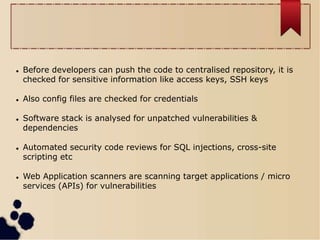
 Before developers can push the code to centralised repository, it is
checked for sensitive information like access keys, SSH keys
 Also config files are checked for credentials
 Software stack is analysed for unpatched vulnerabilities &
dependencies
 Automated security code reviews for SQL injections, cross-site
scripting etc
 Web Application scanners are scanning target applications / micro
services (APIs) for vulnerabilities
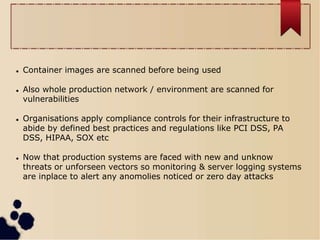
 Container images are scanned before being used
 Also whole production network / environment are scanned for
vulnerabilities
 Organisations apply compliance controls for their infrastructure to
abide by defined best practices and regulations like PCI DSS, PA
DSS, HIPAA, SOX etc
 Now that production systems are faced with new and unknow
threats or unforseen vectors so monitoring & server logging systems
are inplace to alert any anomolies noticed or zero day attacks
Thanks
End of part - I
DevSecOps – Part IIDated : 26th Aug 2019
Joel Divekar
KL, Malaysia
WhatsApp : +91 9920208223 / +60 123700515
Mail : joel.divekar@gmail.com
Skype : joel_divekar@hotmail.com
Blog: http://joeldivekar.blogspot.com/
Linkedin : http://www.linkedin.com/in/joeldivekar
Presentation : http://www.slideshare.net/JoelDivekar
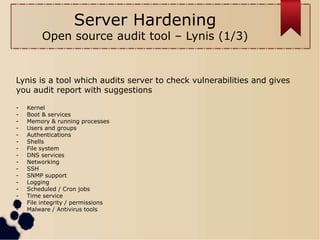
Server Hardening
Open source audit tool – Lynis (1/3)
Lynis is a tool which audits server to check vulnerabilities and gives
you audit report with suggestions
- Kernel
- Boot & services
- Memory & running processes
- Users and groups
- Authentications
- Shells
- File system
- DNS services
- Networking
- SSH
- SNMP support
- Logging
- Scheduled / Cron jobs
- Time service
- File integrity / permissions
- Malware / Antivirus tools
Server Hardening
Open source audit tool – Lynis (2/3)
Installing & using Lynis
1] Create /etc/yum.repos.d/cisofy-lynis.repo
# vi /etc/yum.repos.d/cisofy-lynis.repo
and add
[lynis]
name=CISOfy Software - Lynis package
baseurl=https://packages.cisofy.com/community/lynis/rpm/
enabled=1
gpgkey=https://packages.cisofy.com/keys/cisofy-software-rpms-public.key
gpgcheck=1
priority=2
and save the file
Server Hardening
Open source audit tool – Lynis (3/3)
Lynis (continued)
2] Update additional packages
# yum update ca-certificates curl nss openssl
3] Installing Lynis
# yum install lynis
3] Running audit
# lynis audit system
Thanks for your time
&
please join my meetup groups
DevSecOps
Infra / Cloud Security
Blockchain

DevSecOps

  • 1.
    DevSecOps Joel Divekar KL, Malaysia WhatsApp: +60 123700515 / +91 9920208223 Mail : joel.divekar@gmail.com Skype : joel_divekar@hotmail.com Blog: http://joeldivekar.blogspot.com/ Linkedin : http://www.linkedin.com/in/joeldivekar Presentation : http://www.slideshare.net/JoelDivekar
  • 2.
  • 3.
    DevOps is aPhilosophy Not a method Nor a framework Nor knowledge
  • 4.
    DevOps is Unifying Developmentand Operations It’s a way of doing development activities, a way of thinking Its a Culture
  • 5.
    DevOps is ... Automation ofvarious tasks for application / service deployment and its management
  • 6.
    DevOps process  Developerwrites the code and pushes it to centralised repository  Central repository maintains version control  CI / CD server pulls the code and compiles & builds artifacts/binaries  These artifacts/binaries are then pushed to the central repository  Then artifacts/binaries are pulled out and deployed to staging for testing  Depending upon the deployment stategy services are deployed as a containers  After successful UAT/QA the deployment is done on production environment  And production uptime is monitored using monitoring services
  • 7.
    Key Phases ofDevOps  Version Control  Continuous Integration / Continuous Deployment  Configuration Management / Automation  Virtualisation / Containers  Monitoring  Logs management
  • 8.
    Open Source Tools Version Control – Git  Build and CI – Ant, Maven, Gradle, Jenkin, Hudson ...  Configuration Management / Automation – Chef, Puppet, Ansible  Virtualisation – VirtualBox, Xen  Container – LXC, Docker, Kubernetes, Rocket  Monitoring – Nagios Core, Icinga 2  Logging – Graylog, Logstash  Security – Nmap, OSSEC, OpenVAS, Metasploit ...
  • 9.
    Well this isold way of doing things Now its ...
  • 10.
  • 11.
  • 12.
     Before developerscan push the code to centralised repository, it is checked for sensitive information like access keys, SSH keys  Also config files are checked for credentials  Software stack is analysed for unpatched vulnerabilities & dependencies  Automated security code reviews for SQL injections, cross-site scripting etc  Web Application scanners are scanning target applications / micro services (APIs) for vulnerabilities
  • 13.
     Container imagesare scanned before being used  Also whole production network / environment are scanned for vulnerabilities  Organisations apply compliance controls for their infrastructure to abide by defined best practices and regulations like PCI DSS, PA DSS, HIPAA, SOX etc  Now that production systems are faced with new and unknow threats or unforseen vectors so monitoring & server logging systems are inplace to alert any anomolies noticed or zero day attacks
  • 14.
  • 15.
    DevSecOps – PartIIDated : 26th Aug 2019 Joel Divekar KL, Malaysia WhatsApp : +91 9920208223 / +60 123700515 Mail : joel.divekar@gmail.com Skype : joel_divekar@hotmail.com Blog: http://joeldivekar.blogspot.com/ Linkedin : http://www.linkedin.com/in/joeldivekar Presentation : http://www.slideshare.net/JoelDivekar
  • 16.
    Server Hardening Open sourceaudit tool – Lynis (1/3) Lynis is a tool which audits server to check vulnerabilities and gives you audit report with suggestions - Kernel - Boot & services - Memory & running processes - Users and groups - Authentications - Shells - File system - DNS services - Networking - SSH - SNMP support - Logging - Scheduled / Cron jobs - Time service - File integrity / permissions - Malware / Antivirus tools
  • 17.
    Server Hardening Open sourceaudit tool – Lynis (2/3) Installing & using Lynis 1] Create /etc/yum.repos.d/cisofy-lynis.repo # vi /etc/yum.repos.d/cisofy-lynis.repo and add [lynis] name=CISOfy Software - Lynis package baseurl=https://packages.cisofy.com/community/lynis/rpm/ enabled=1 gpgkey=https://packages.cisofy.com/keys/cisofy-software-rpms-public.key gpgcheck=1 priority=2 and save the file
  • 18.
    Server Hardening Open sourceaudit tool – Lynis (3/3) Lynis (continued) 2] Update additional packages # yum update ca-certificates curl nss openssl 3] Installing Lynis # yum install lynis 3] Running audit # lynis audit system
  • 19.
    Thanks for yourtime & please join my meetup groups DevSecOps Infra / Cloud Security Blockchain