Join our DevOps Training for Modern Software Development and master CI/CD, automation, and cloud tools like Docker, Jenkins, and Kubernetes. Gain hands-on experience and industry-ready skills for high-demand DevOps roles.
What Is DevOps?
DevOpsis a combination of Development (Dev) and Operations
(Ops). It’s a culture, mindset, and set of practices that aims to
unify software development and IT operations to improve
collaboration, automate workflows, and accelerate delivery.
Instead of working in isolated teams, DevOps brings
developers, testers, and operations professionals together to
work as one unit throughout the entire software lifecycle—from
planning and coding to deployment and monitoring.
Introduction
3.
Why DevOps Mattersin
Modern Development?
Faster software delivery cycles:
• Enables quicker releases by automating and streamlining the
development process.
Improved product stability and quality:
• Reduces bugs and downtime through continuous testing and
monitoring.
Continuous integration and deployment:
• Allows frequent code changes to be integrated and deployed
automatically.
Better team collaboration:
• Breaks down silos by encouraging shared responsibility and
open communication.
4.
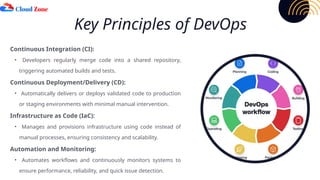
Key Principles ofDevOps
Continuous Integration (CI):
• Developers regularly merge code into a shared repository,
triggering automated builds and tests.
Continuous Deployment/Delivery (CD):
• Automatically delivers or deploys validated code to production
or staging environments with minimal manual intervention.
Infrastructure as Code (IaC):
• Manages and provisions infrastructure using code instead of
manual processes, ensuring consistency and scalability.
Automation and Monitoring:
• Automates workflows and continuously monitors systems to
ensure performance, reliability, and quick issue detection.
5.
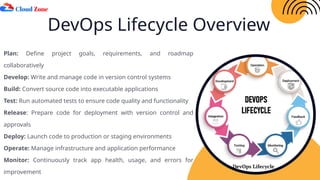
DevOps Lifecycle Overview
Plan:Define project goals, requirements, and roadmap
collaboratively
Develop: Write and manage code in version control systems
Build: Convert source code into executable applications
Test: Run automated tests to ensure code quality and functionality
Release: Prepare code for deployment with version control and
approvals
Deploy: Launch code to production or staging environments
Operate: Manage infrastructure and application performance
Monitor: Continuously track app health, usage, and errors for
improvement
6.
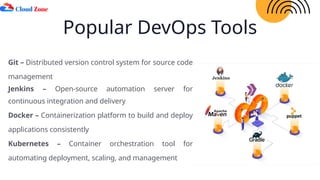
Popular DevOps Tools
Git– Distributed version control system for source code
management
Jenkins – Open-source automation server for
continuous integration and delivery
Docker – Containerization platform to build and deploy
applications consistently
Kubernetes – Container orchestration tool for
automating deployment, scaling, and management
7.
Real-World Use Cases
Fasterdeployment at Netflix, Amazon, and
Facebook:
• Industry leaders use DevOps to release features
quickly and continuously at scale.
Improved bug fixes and rollback systems:
• DevOps enables rapid identification and resolution
of issues with minimal downtime.
CI/CD pipelines reducing manual errors:
• Automated build and deployment pipelines ensure
accuracy, speed, and reliability.
8.
Benefits of TakingDevOps Training
Industry-relevant practical skills
• Gain hands-on experience with tools and workflows used by top
tech companies.
High-demand job opportunities
• DevOps professionals are highly sought after across startups and
enterprises.
Certification and hands-on project experience
• Boost your resume with globally recognized credentials and real-
world projects.
Increased confidence in cloud and automation
• Master automation, CI/CD, and cloud platforms to become job-
9.
• Join ourhands-on DevOps training program
• Learn from industry experts with real-world
experience
• Work on live projects and build a job-ready
portfolio
Start Your DevOps Journey Today