DevOps Practices: Bridging the Gap Between
Development and Operations
What is DevOps?
DevOps is a set of practices that combines software
development (Dev) and IT operations (Ops).
Objective:
To shorten the system development life cycle and provide
continuous delivery of high-quality software.
Why is DevOps Important?
Siloed Development and Operations:
Traditional development and operations teams work in
isolation, leading to inefficiencies and delays.
Collaboration and Communication:
DevOps emphasizes collaboration and communication
between developers, operations, and other stakeholders.
Continuous Integration and Deployment:
DevOps enables organizations to deliver new features and
updates more frequently and reliably.
Did you know that 80% of software development projects face
delays due to communication gaps and manual processes?
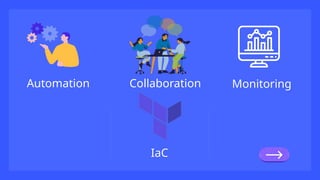
DevOps
principles
Automation Collaboration Monitoring
IaC
Automation
Back to Agenda Page
Importance of Automation
Speed Reliability Scalability
Continous
Improvement
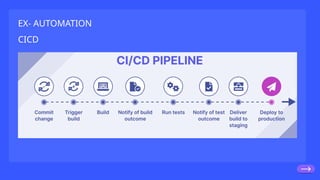
EX- AUTOMATION
CICD
Collaboration
The Heart of DevOps
Why Teamwork and Communication Are Critical in
DevOps
• Faster Problem-Solving: When teams collaborate effectively, they can quickly identify and
address issues, reducing downtime and ensuring smoother operations.
• Shared Responsibility: DevOps promotes a "you build it, you run it" mentality, where all
team members share responsibility for the success of the product.
Infrastructure
as
Code
Manage Your Infrastructure as Code.
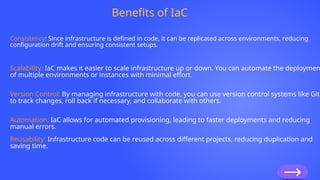
Benefits of IaC
Consistency: Since infrastructure is defined in code, it can be replicated across environments, reducing
configuration drift and ensuring consistent setups.
Scalability: IaC makes it easier to scale infrastructure up or down. You can automate the deploymen
of multiple environments or instances with minimal effort.
Version Control: By managing infrastructure with code, you can use version control systems like Git
to track changes, roll back if necessary, and collaborate with others.
Automation: IaC allows for automated provisioning, leading to faster deployments and reducing
manual errors.
Reusability: Infrastructure code can be reused across different projects, reducing duplication and
saving time.
Monitoring
Keep Your app Healthy
case studies of organizations that have
successfully adopted DevOps
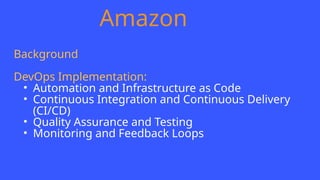
Amazon
Background
DevOps Implementation:
• Automation and Infrastructure as Code
• Continuous Integration and Continuous Delivery
(CI/CD)
• Quality Assurance and Testing
• Monitoring and Feedback Loops
Results and Benefits
• Faster Delivery
• Improved Quality
• Enhanced Scalability
• Cultural Transformation
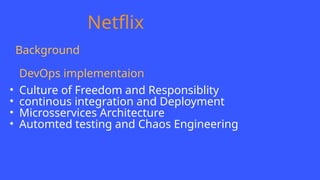
Netflix
Background
DevOps implementaion
• Culture of Freedom and Responsiblity
• continous integration and Deployment
• Microsservices Architecture
• Automted testing and Chaos Engineering
Results and Benifts
• Faster Time-to-MArket
• Improved Quality and Reliablity
• Enahced Scalablity and Resilience
• Data drive Decision Making
Conclusion
DevOps Significance:
• DevOps is pivotal in modern software development,
bridging the gap between development and
operations.
• Its significance lies in fostering a culture of
collaboration, automation, and continuous
improvement.
Key DevOps Principles:
• Automation
• Collaboration
• Infrastructure as Code (IaC)
• Continuous Monitoring
Real-world Case Studies:
• Netflix
• Amazon
• Spotify
Cultural Shift and Innovation:
• DevOps is more than just methodology
• Embracing DevOps principles is crucial for
organizations
Future Outlook:
• Prioritizing collaboration, automation, and
continuous improvement
• Embracing DevOps practices will be essential for
organizations

DevOps Practices: Bridging the Gap Between Development and Operations

  • 1.
    DevOps Practices: Bridgingthe Gap Between Development and Operations
  • 2.
  • 3.
    DevOps is aset of practices that combines software development (Dev) and IT operations (Ops).
  • 4.
    Objective: To shorten thesystem development life cycle and provide continuous delivery of high-quality software.
  • 5.
    Why is DevOpsImportant?
  • 6.
    Siloed Development andOperations: Traditional development and operations teams work in isolation, leading to inefficiencies and delays.
  • 7.
    Collaboration and Communication: DevOpsemphasizes collaboration and communication between developers, operations, and other stakeholders.
  • 8.
    Continuous Integration andDeployment: DevOps enables organizations to deliver new features and updates more frequently and reliably.
  • 9.
    Did you knowthat 80% of software development projects face delays due to communication gaps and manual processes?
  • 10.
  • 11.
  • 12.
  • 13.
    Back to AgendaPage Importance of Automation Speed Reliability Scalability Continous Improvement
  • 14.
  • 15.
  • 16.
    Why Teamwork andCommunication Are Critical in DevOps • Faster Problem-Solving: When teams collaborate effectively, they can quickly identify and address issues, reducing downtime and ensuring smoother operations. • Shared Responsibility: DevOps promotes a "you build it, you run it" mentality, where all team members share responsibility for the success of the product.
  • 17.
  • 18.
    Benefits of IaC Consistency:Since infrastructure is defined in code, it can be replicated across environments, reducing configuration drift and ensuring consistent setups. Scalability: IaC makes it easier to scale infrastructure up or down. You can automate the deploymen of multiple environments or instances with minimal effort. Version Control: By managing infrastructure with code, you can use version control systems like Git to track changes, roll back if necessary, and collaborate with others. Automation: IaC allows for automated provisioning, leading to faster deployments and reducing manual errors. Reusability: Infrastructure code can be reused across different projects, reducing duplication and saving time.
  • 19.
  • 20.
    case studies oforganizations that have successfully adopted DevOps
  • 21.
    Amazon Background DevOps Implementation: • Automationand Infrastructure as Code • Continuous Integration and Continuous Delivery (CI/CD) • Quality Assurance and Testing • Monitoring and Feedback Loops
  • 22.
    Results and Benefits •Faster Delivery • Improved Quality • Enhanced Scalability • Cultural Transformation
  • 23.
    Netflix Background DevOps implementaion • Cultureof Freedom and Responsiblity • continous integration and Deployment • Microsservices Architecture • Automted testing and Chaos Engineering
  • 24.
    Results and Benifts •Faster Time-to-MArket • Improved Quality and Reliablity • Enahced Scalablity and Resilience • Data drive Decision Making
  • 25.
  • 26.
    DevOps Significance: • DevOpsis pivotal in modern software development, bridging the gap between development and operations. • Its significance lies in fostering a culture of collaboration, automation, and continuous improvement.
  • 27.
    Key DevOps Principles: •Automation • Collaboration • Infrastructure as Code (IaC) • Continuous Monitoring
  • 28.
    Real-world Case Studies: •Netflix • Amazon • Spotify
  • 29.
    Cultural Shift andInnovation: • DevOps is more than just methodology • Embracing DevOps principles is crucial for organizations
  • 30.
    Future Outlook: • Prioritizingcollaboration, automation, and continuous improvement • Embracing DevOps practices will be essential for organizations