



Introducing DevOps
By:- Jagatveer Singh
Agenda
—What is DevOps
—Why DevOps?
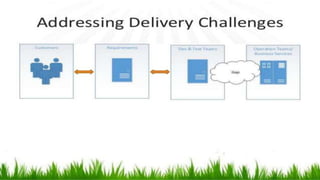
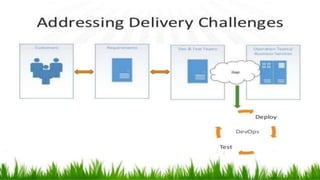
—Addressing Delivery Challenges
—Agile and DevOps - How is it connected?
—DevOps vs Release Management
—When to adopt and when not to
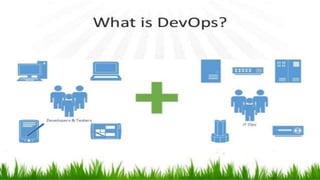
What is DevOps?
—DevOps ( a combination of development and operations) is a
software development method that stresses communication,
collaboration and integration between software developers and
information technology (IT) professionals thereby
-- Enable rapid evolution of products and services
-- Reduce risks, improve quality across portfolio, and reduce costs.
What is DevOps?
—DevOps integration targets product delivery, quality testing,
feature development and maintenance releases in order to
improve reliability and security and faster development and
deployment cycles.
—The adoption of DevOps is being driven by factors such as:
—Use of agile and other development processes and
methodologies
—Demand for an increased rate of production releases from
application and business stakeholders
—Wide availability of virtualized and cloud infrastructure from
internal and external providers.
Principles of DevOps
—Develop and test in an environment similar to production.
—Deploy build frequently
—Validate operation quality continuously
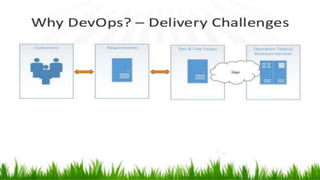
Why Gaps?
Dev View:
• Mostly deliver features after testing in development systems.
• Dev systems may not be same as production system
• Developers will have faster turn around time w.r.t features
• Not much concerned about the infrastructural as well as
deployment impact because of the code change
Why Gaps?
Ops View:
• Worries more about PSR
• Rewarded mainly for uptime
• Lesser turnaround time w.r.t feature deployment and testing
due to large number of dev builds coming their way
• Very much concerned about the infrastructural as well as
deployment impact because if the code changes.
Devs and Ops
• Developers work with Ops to understand the impact of code
changes
• Developers now work more closely with production-equivalent
systems
• Developers focuses on metrics required by Ops team like PSR
• Ops now have more clarity on infrastructure needs
• More automation on deployment
• Closely monitors the Dev-Test-Prod pipeline for each
deployment and immediate feedback
• Better collaboration and communication
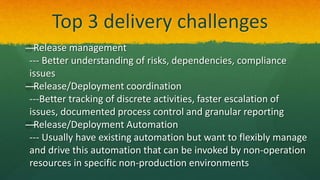
Top 3 delivery challenges
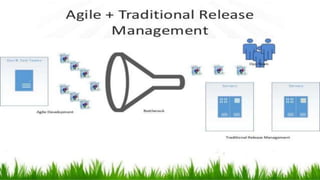
—Release management
--- Better understanding of risks, dependencies, compliance
issues
—Release/Deployment coordination
---Better tracking of discrete activities, faster escalation of
issues, documented process control and granular reporting
—Release/Deployment Automation
--- Usually have existing automation but want to flexibly manage
and drive this automation that can be invoked by non-operation
resources in specific non-production environments
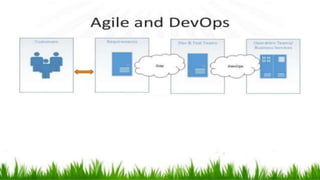
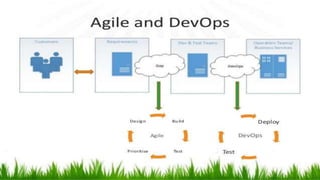
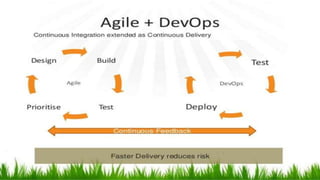
Agile and DevOps
—Agile Development
-- Addresses the gap between customer requirements and dev + testing
teams
-- Cross-function teams to design, develop and test features/stories
prioritised by the P0 (Customer)
--Focuses more on functional and nonfunctional readiness
—DevOps
-- Addresses the gap between dev + testing and Ops
-- Automated release management
--Focusses on functional and nonfunctional plus operations and business
readiness
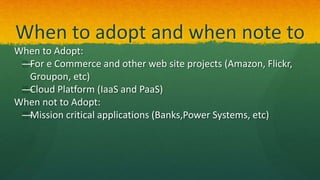
When to adopt and when note to
When to Adopt:
—For e Commerce and other web site projects (Amazon, Flickr,
Groupon, etc)
—Cloud Platform (IaaS and PaaS)
When not to Adopt:
—Mission critical applications (Banks,Power Systems, etc)
DevOps Introduction

DevOps Introduction

  • 1.
  • 2.
    Agenda —What is DevOps —WhyDevOps? —Addressing Delivery Challenges —Agile and DevOps - How is it connected? —DevOps vs Release Management —When to adopt and when not to
  • 5.
    What is DevOps? —DevOps( a combination of development and operations) is a software development method that stresses communication, collaboration and integration between software developers and information technology (IT) professionals thereby -- Enable rapid evolution of products and services -- Reduce risks, improve quality across portfolio, and reduce costs.
  • 6.
    What is DevOps? —DevOpsintegration targets product delivery, quality testing, feature development and maintenance releases in order to improve reliability and security and faster development and deployment cycles. —The adoption of DevOps is being driven by factors such as: —Use of agile and other development processes and methodologies —Demand for an increased rate of production releases from application and business stakeholders —Wide availability of virtualized and cloud infrastructure from internal and external providers.
  • 7.
    Principles of DevOps —Developand test in an environment similar to production. —Deploy build frequently —Validate operation quality continuously
  • 10.
    Why Gaps? Dev View: •Mostly deliver features after testing in development systems. • Dev systems may not be same as production system • Developers will have faster turn around time w.r.t features • Not much concerned about the infrastructural as well as deployment impact because of the code change
  • 11.
    Why Gaps? Ops View: •Worries more about PSR • Rewarded mainly for uptime • Lesser turnaround time w.r.t feature deployment and testing due to large number of dev builds coming their way • Very much concerned about the infrastructural as well as deployment impact because if the code changes.
  • 12.
    Devs and Ops •Developers work with Ops to understand the impact of code changes • Developers now work more closely with production-equivalent systems • Developers focuses on metrics required by Ops team like PSR • Ops now have more clarity on infrastructure needs • More automation on deployment • Closely monitors the Dev-Test-Prod pipeline for each deployment and immediate feedback • Better collaboration and communication
  • 14.
    Top 3 deliverychallenges —Release management --- Better understanding of risks, dependencies, compliance issues —Release/Deployment coordination ---Better tracking of discrete activities, faster escalation of issues, documented process control and granular reporting —Release/Deployment Automation --- Usually have existing automation but want to flexibly manage and drive this automation that can be invoked by non-operation resources in specific non-production environments
  • 21.
    Agile and DevOps —AgileDevelopment -- Addresses the gap between customer requirements and dev + testing teams -- Cross-function teams to design, develop and test features/stories prioritised by the P0 (Customer) --Focuses more on functional and nonfunctional readiness —DevOps -- Addresses the gap between dev + testing and Ops -- Automated release management --Focusses on functional and nonfunctional plus operations and business readiness
  • 28.
    When to adoptand when note to When to Adopt: —For e Commerce and other web site projects (Amazon, Flickr, Groupon, etc) —Cloud Platform (IaaS and PaaS) When not to Adopt: —Mission critical applications (Banks,Power Systems, etc)