DevOps Automation
Services: Accelerating
Software Delivery and
Business Agility
In today’s highly competitive digital world, enterprises are under immense
pressure to deliver applications faster, ensure continuous improvements,
and maintain high levels of quality. Traditional software development and
operations practices are no longer sufficient to meet these demands.
That’s why businesses are increasingly turning to
DevOps automation services to streamline processes, accelerate delivery
cycles, and enhance collaboration between development and IT operations
teams.
By leveraging automation within DevOps, organizations can minimize
manual errors, optimize resources, and establish a culture of continuous
integration and continuous delivery (CI/CD).
What Are DevOps Automation Services?
DevOps automation services involve using intelligent tools and
practices to automate repetitive, manual, and error-prone tasks
across the software development lifecycle. This includes everything
from code integration and testing to deployment, monitoring, and
infrastructure management.
Automation ensures consistency, improves efficiency, and enables
teams to focus on innovation rather than routine operations.
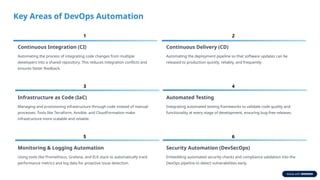
Key Areas of DevOps Automation
1
Continuous Integration (CI)
Automating the process of integrating code changes from multiple
developers into a shared repository. This reduces integration conflicts and
ensures faster feedback.
2
Continuous Delivery (CD)
Automating the deployment pipeline so that software updates can be
released to production quickly, reliably, and frequently.
3
Infrastructure as Code (IaC)
Managing and provisioning infrastructure through code instead of manual
processes. Tools like Terraform, Ansible, and CloudFormation make
infrastructure more scalable and reliable.
4
Automated Testing
Integrating automated testing frameworks to validate code quality and
functionality at every stage of development, ensuring bug-free releases.
5
Monitoring & Logging Automation
Using tools like Prometheus, Grafana, and ELK stack to automatically track
performance metrics and log data for proactive issue detection.
6
Security Automation (DevSecOps)
Embedding automated security checks and compliance validation into the
DevOps pipeline to detect vulnerabilities early.
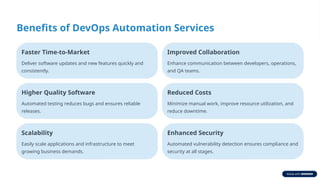
Benefits of DevOps Automation Services
Faster Time-to-Market
Deliver software updates and new features quickly and
consistently.
Improved Collaboration
Enhance communication between developers, operations,
and QA teams.
Higher Quality Software
Automated testing reduces bugs and ensures reliable
releases.
Reduced Costs
Minimize manual work, improve resource utilization, and
reduce downtime.
Scalability
Easily scale applications and infrastructure to meet
growing business demands.
Enhanced Security
Automated vulnerability detection ensures compliance and
security at all stages.
Popular Tools for DevOps Automation
CI/CD Tools
• Jenkins
• GitLab CI/CD
• CircleCI
• Azure DevOps
IaC Tools
• Terraform
• Ansible
• AWS CloudFormation
• Puppet
Containerization & Orchestration
• Docker
• Kubernetes
• OpenShift
Monitoring & Logging
• Prometheus
• Grafana
• ELK Stack
• Splunk
Security Tools
• SonarQube
• Snyk
• Aqua Security
The choice of tools depends on the organization’s IT environment, cloud infrastructure, and scalability needs.
Use Cases of DevOps Automation Services
Application Development
Streamline code integration, testing, and deployment.
Cloud Migration
Automate infrastructure provisioning and configuration for faster cloud adoption.
E-commerce Platforms
Ensure high availability and smooth performance during peak traffic.
Financial Services
Achieve regulatory compliance with automated testing and security checks.
Telecommunications
Automate network monitoring and service delivery.
Industries Benefiting from DevOps Automation
Healthcare
Faster rollout of patient portals and digital health solutions.
Banking & Finance
Secure, reliable, and compliant software delivery.
Retail & E-commerce
Continuous updates for personalized customer experiences.
Manufacturing
Automation of IoT-driven software and predictive maintenance
systems.
How to Choose the Right DevOps Automation Service Provider
Expertise in Tools &
Frameworks
Proficiency in leading CI/CD, IaC, and
monitoring tools.
Cloud Competency
Experience with AWS, Azure, Google
Cloud, and hybrid environments.
Security Practices
Strong focus on DevSecOps and
compliance standards.
Customization
Ability to tailor automation strategies to fit specific
business needs.
End-to-End Support
From consulting to implementation, monitoring, and
continuous improvement.
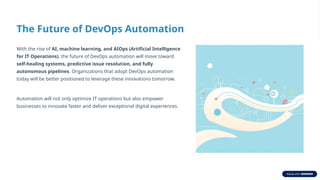
The Future of DevOps Automation
With the rise of AI, machine learning, and AIOps (Artificial Intelligence
for IT Operations), the future of DevOps automation will move toward
self-healing systems, predictive issue resolution, and fully
autonomous pipelines. Organizations that adopt DevOps automation
today will be better positioned to leverage these innovations tomorrow.
Automation will not only optimize IT operations but also empower
businesses to innovate faster and deliver exceptional digital experiences.
Final Thoughts
DevOps automation services are no longer
optional—they are essential for enterprises
aiming to remain competitive in today’s
digital economy.
By automating critical workflows across the software development lifecycle, businesses can achieve faster releases, improved
software quality, cost efficiency, and enhanced collaboration.
Choosing the right DevOps automation partner ensures a seamless journey toward continuous delivery, innovation, and
business agility. For enterprises that want to future-proof their IT strategy, investing in DevOps automation is the key to long-
term success.

DevOps-Automation-Services-Accelerating-Software-Delivery-and-Business-Agility.pptx

  • 1.
    DevOps Automation Services: Accelerating SoftwareDelivery and Business Agility In today’s highly competitive digital world, enterprises are under immense pressure to deliver applications faster, ensure continuous improvements, and maintain high levels of quality. Traditional software development and operations practices are no longer sufficient to meet these demands. That’s why businesses are increasingly turning to DevOps automation services to streamline processes, accelerate delivery cycles, and enhance collaboration between development and IT operations teams. By leveraging automation within DevOps, organizations can minimize manual errors, optimize resources, and establish a culture of continuous integration and continuous delivery (CI/CD).
  • 2.
    What Are DevOpsAutomation Services? DevOps automation services involve using intelligent tools and practices to automate repetitive, manual, and error-prone tasks across the software development lifecycle. This includes everything from code integration and testing to deployment, monitoring, and infrastructure management. Automation ensures consistency, improves efficiency, and enables teams to focus on innovation rather than routine operations.
  • 3.
    Key Areas ofDevOps Automation 1 Continuous Integration (CI) Automating the process of integrating code changes from multiple developers into a shared repository. This reduces integration conflicts and ensures faster feedback. 2 Continuous Delivery (CD) Automating the deployment pipeline so that software updates can be released to production quickly, reliably, and frequently. 3 Infrastructure as Code (IaC) Managing and provisioning infrastructure through code instead of manual processes. Tools like Terraform, Ansible, and CloudFormation make infrastructure more scalable and reliable. 4 Automated Testing Integrating automated testing frameworks to validate code quality and functionality at every stage of development, ensuring bug-free releases. 5 Monitoring & Logging Automation Using tools like Prometheus, Grafana, and ELK stack to automatically track performance metrics and log data for proactive issue detection. 6 Security Automation (DevSecOps) Embedding automated security checks and compliance validation into the DevOps pipeline to detect vulnerabilities early.
  • 4.
    Benefits of DevOpsAutomation Services Faster Time-to-Market Deliver software updates and new features quickly and consistently. Improved Collaboration Enhance communication between developers, operations, and QA teams. Higher Quality Software Automated testing reduces bugs and ensures reliable releases. Reduced Costs Minimize manual work, improve resource utilization, and reduce downtime. Scalability Easily scale applications and infrastructure to meet growing business demands. Enhanced Security Automated vulnerability detection ensures compliance and security at all stages.
  • 5.
    Popular Tools forDevOps Automation CI/CD Tools • Jenkins • GitLab CI/CD • CircleCI • Azure DevOps IaC Tools • Terraform • Ansible • AWS CloudFormation • Puppet Containerization & Orchestration • Docker • Kubernetes • OpenShift Monitoring & Logging • Prometheus • Grafana • ELK Stack • Splunk Security Tools • SonarQube • Snyk • Aqua Security The choice of tools depends on the organization’s IT environment, cloud infrastructure, and scalability needs.
  • 6.
    Use Cases ofDevOps Automation Services Application Development Streamline code integration, testing, and deployment. Cloud Migration Automate infrastructure provisioning and configuration for faster cloud adoption. E-commerce Platforms Ensure high availability and smooth performance during peak traffic. Financial Services Achieve regulatory compliance with automated testing and security checks. Telecommunications Automate network monitoring and service delivery.
  • 7.
    Industries Benefiting fromDevOps Automation Healthcare Faster rollout of patient portals and digital health solutions. Banking & Finance Secure, reliable, and compliant software delivery. Retail & E-commerce Continuous updates for personalized customer experiences. Manufacturing Automation of IoT-driven software and predictive maintenance systems.
  • 8.
    How to Choosethe Right DevOps Automation Service Provider Expertise in Tools & Frameworks Proficiency in leading CI/CD, IaC, and monitoring tools. Cloud Competency Experience with AWS, Azure, Google Cloud, and hybrid environments. Security Practices Strong focus on DevSecOps and compliance standards. Customization Ability to tailor automation strategies to fit specific business needs. End-to-End Support From consulting to implementation, monitoring, and continuous improvement.
  • 9.
    The Future ofDevOps Automation With the rise of AI, machine learning, and AIOps (Artificial Intelligence for IT Operations), the future of DevOps automation will move toward self-healing systems, predictive issue resolution, and fully autonomous pipelines. Organizations that adopt DevOps automation today will be better positioned to leverage these innovations tomorrow. Automation will not only optimize IT operations but also empower businesses to innovate faster and deliver exceptional digital experiences.
  • 10.
    Final Thoughts DevOps automationservices are no longer optional—they are essential for enterprises aiming to remain competitive in today’s digital economy. By automating critical workflows across the software development lifecycle, businesses can achieve faster releases, improved software quality, cost efficiency, and enhanced collaboration. Choosing the right DevOps automation partner ensures a seamless journey toward continuous delivery, innovation, and business agility. For enterprises that want to future-proof their IT strategy, investing in DevOps automation is the key to long- term success.