Developing Educational
Leadership
Professor Susannah Quinsee and
Professor Pam Parker
Developing Educational Leadership
 Why we are interested in this subject
 What we have discovered so far
 Where our research is going now….
Why we are interested in this subject
 Academic leadership development is needed
The Higher Education Leadership and Management survey in 2014 found that
over 80% of respondents felt that more could be done to actually develop
leaders in higher education.
 Academic leadership is different
Leadership in higher education is a strange field (Bryman and Lilley 2009)
Competing demands …. Unclear models …. Mixed rewards
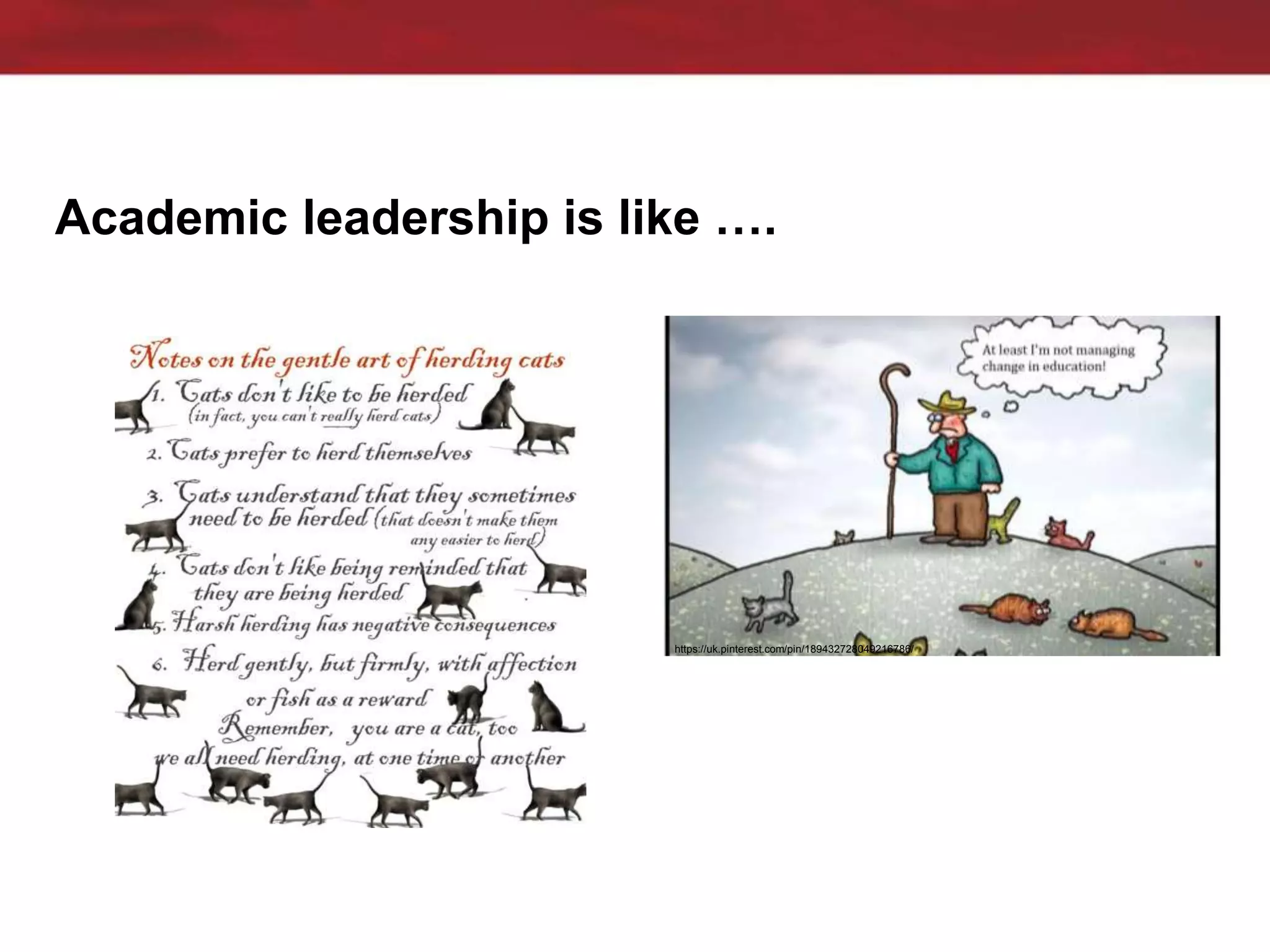
Academic leadership is like ….
https://uk.pinterest.com/pin/189432728049216786/
What we wanted to know
 What skills and knowledge are needed for educational
leadership roles?
 What preparation has been provided for those in existing
roles?
 What might be appropriate preparation to provide for future
educational leaders?
What we did and who we asked
 Lincoln and Guba’s naturalistic inquiry was the methodology
 Ethical approval was granted for the overall study
 Online survey using SurveyMonkey®, qualitative data so three
demographic questions and three open questions as outlined above
 Inductive thematic analysis
 Purposeful sample
 Participants were education leaders and they represented a range of
geographical areas and types of higher education institution.
 56 participants were invited to participate and 17 (30%) responded.
What we discovered
Demographic data showed that:
13 Females 4 Males
Years of experience
14 45
26 mean
1 deputy vice chancellor
type role
2 independent education
consultants
14 Heads/Directors of
education development
units
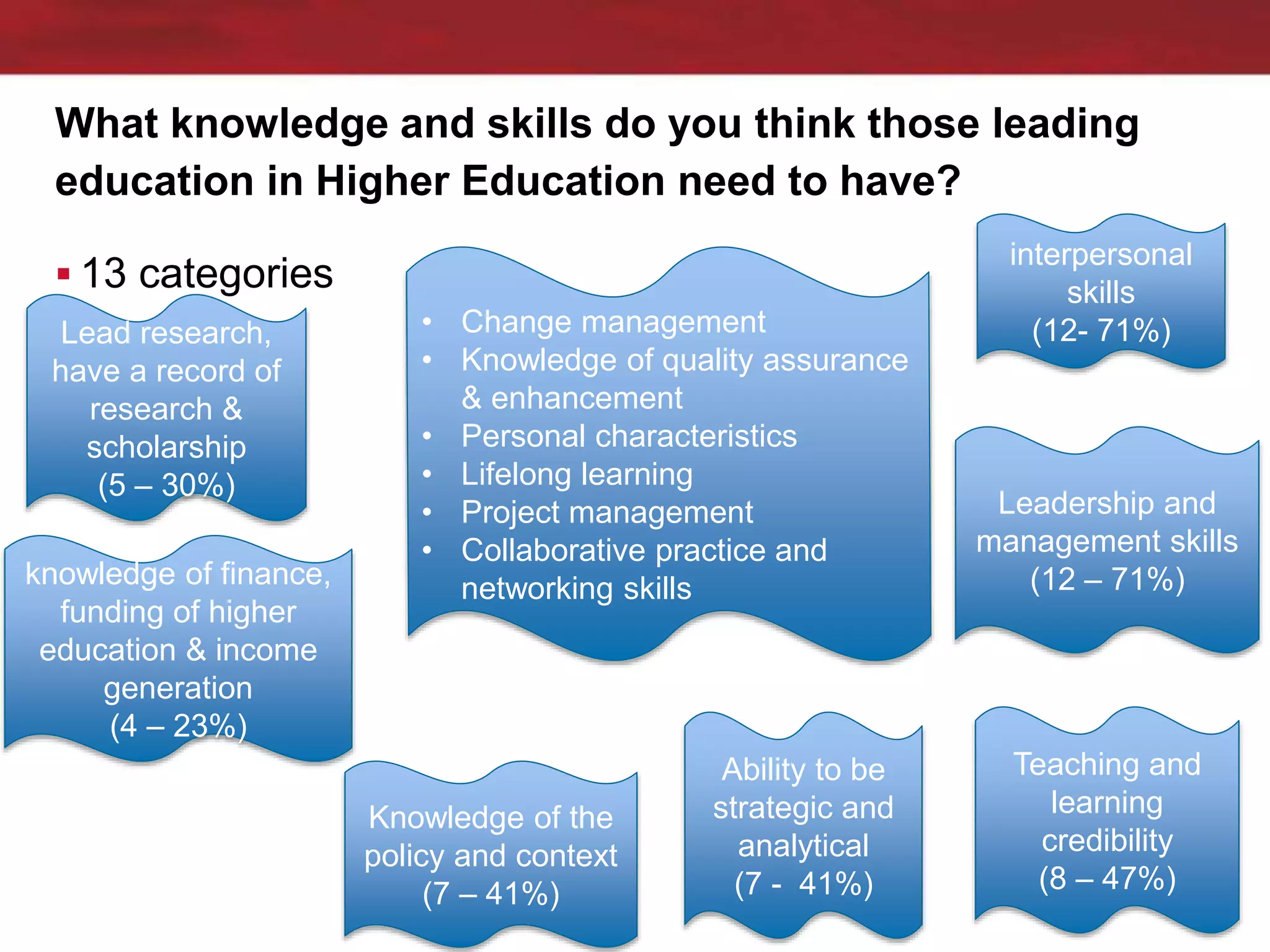
What knowledge and skills do you think those leading
education in Higher Education need to have?
 13 categories
• Change management
• Knowledge of quality assurance
& enhancement
• Personal characteristics
• Lifelong learning
• Project management
• Collaborative practice and
networking skills
Lead research,
have a record of
research &
scholarship
(5 – 30%)
knowledge of finance,
funding of higher
education & income
generation
(4 – 23%)
interpersonal
skills
(12- 71%)
Ability to be
strategic and
analytical
(7 - 41%)
Knowledge of the
policy and context
(7 – 41%)
Teaching and
learning
credibility
(8 – 47%)
Leadership and
management skills
(12 – 71%)
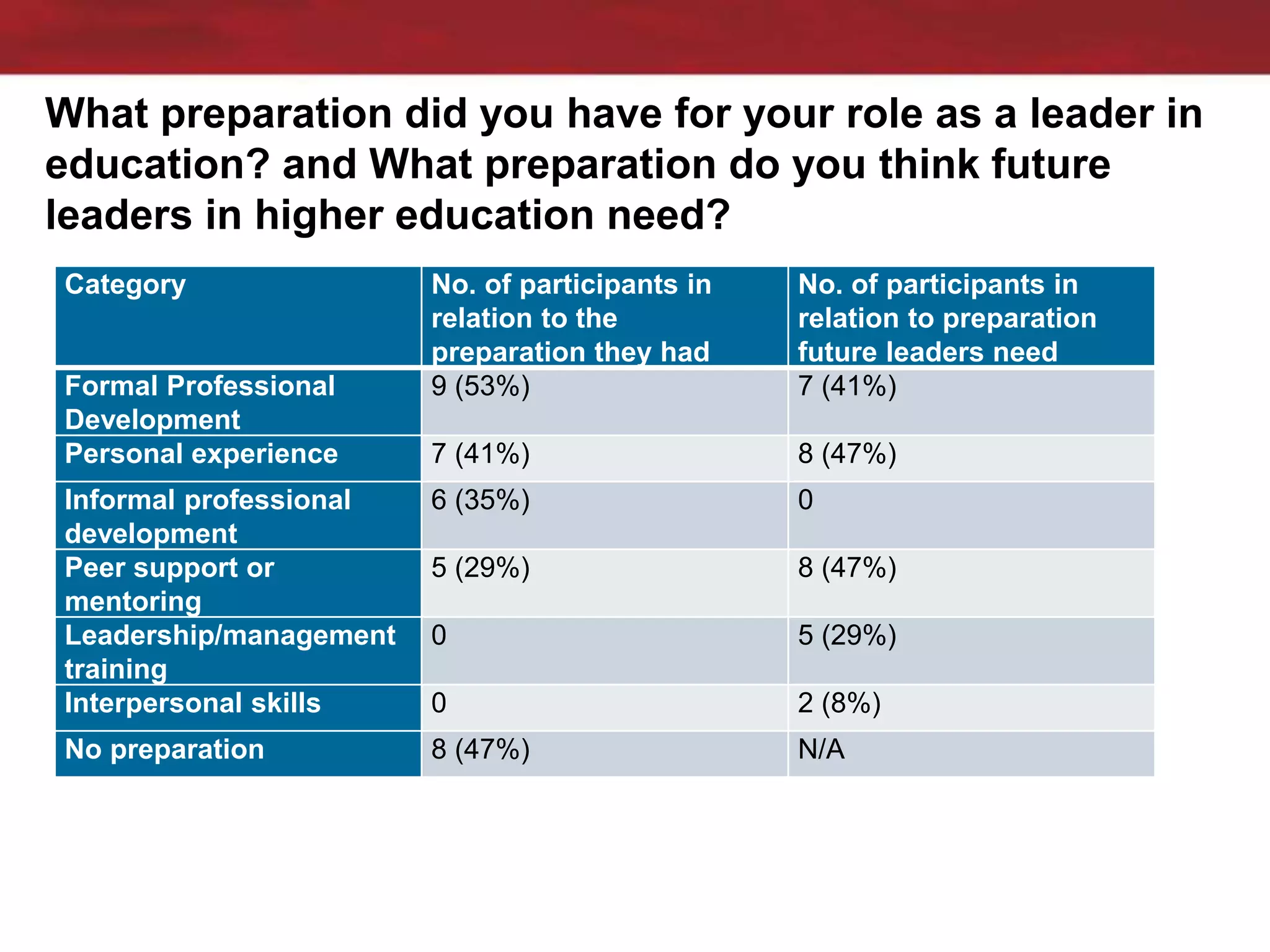
What preparation did you have for your role as a leader in
education? and What preparation do you think future
leaders in higher education need?
Category No. of participants in
relation to the
preparation they had
No. of participants in
relation to preparation
future leaders need
Formal Professional
Development
9 (53%) 7 (41%)
Personal experience 7 (41%) 8 (47%)
Informal professional
development
6 (35%) 0
Peer support or
mentoring
5 (29%) 8 (47%)
Leadership/management
training
0 5 (29%)
Interpersonal skills 0 2 (8%)
No preparation 8 (47%) N/A
Where our research is going now
Using the data in our Developing Leadership and Reflective
Practice Module
Semi-structured interviews with existing leaders to investigate
this data further
Recruit some new leader to participate in workshops and
reflection over a longer period of time
Use the data from all stages to design a programme and
support
References
 Bryman A and Lilley S (2009) ‘Leadership researchers on
leadership in higher education’. Leadership, vol. 5, no. 3, pp.
331 – 346
 Lincoln S and Guba E G (1985) Naturalistic Inquiry, London:
Sage Publications
 Peters K and Ryan M (2015) Leading Higher Education,
London: Leadership Foundation for Higher Education
City, University of London
Northampton Square
London
EC1V 0HB
United Kingdom
T: +44 (0)20 7040 5060
E: department@city.ac.uk
www.city.ac.uk/department

Developing Educational leaders

  • 1.
  • 2.
    Developing Educational Leadership Why we are interested in this subject  What we have discovered so far  Where our research is going now….
  • 3.
    Why we areinterested in this subject  Academic leadership development is needed The Higher Education Leadership and Management survey in 2014 found that over 80% of respondents felt that more could be done to actually develop leaders in higher education.  Academic leadership is different Leadership in higher education is a strange field (Bryman and Lilley 2009) Competing demands …. Unclear models …. Mixed rewards
  • 4.
    Academic leadership islike …. https://uk.pinterest.com/pin/189432728049216786/
  • 5.
    What we wantedto know  What skills and knowledge are needed for educational leadership roles?  What preparation has been provided for those in existing roles?  What might be appropriate preparation to provide for future educational leaders?
  • 6.
    What we didand who we asked  Lincoln and Guba’s naturalistic inquiry was the methodology  Ethical approval was granted for the overall study  Online survey using SurveyMonkey®, qualitative data so three demographic questions and three open questions as outlined above  Inductive thematic analysis  Purposeful sample  Participants were education leaders and they represented a range of geographical areas and types of higher education institution.  56 participants were invited to participate and 17 (30%) responded.
  • 7.
    What we discovered Demographicdata showed that: 13 Females 4 Males Years of experience 14 45 26 mean 1 deputy vice chancellor type role 2 independent education consultants 14 Heads/Directors of education development units
  • 8.
    What knowledge andskills do you think those leading education in Higher Education need to have?  13 categories • Change management • Knowledge of quality assurance & enhancement • Personal characteristics • Lifelong learning • Project management • Collaborative practice and networking skills Lead research, have a record of research & scholarship (5 – 30%) knowledge of finance, funding of higher education & income generation (4 – 23%) interpersonal skills (12- 71%) Ability to be strategic and analytical (7 - 41%) Knowledge of the policy and context (7 – 41%) Teaching and learning credibility (8 – 47%) Leadership and management skills (12 – 71%)
  • 9.
    What preparation didyou have for your role as a leader in education? and What preparation do you think future leaders in higher education need? Category No. of participants in relation to the preparation they had No. of participants in relation to preparation future leaders need Formal Professional Development 9 (53%) 7 (41%) Personal experience 7 (41%) 8 (47%) Informal professional development 6 (35%) 0 Peer support or mentoring 5 (29%) 8 (47%) Leadership/management training 0 5 (29%) Interpersonal skills 0 2 (8%) No preparation 8 (47%) N/A
  • 10.
    Where our researchis going now Using the data in our Developing Leadership and Reflective Practice Module Semi-structured interviews with existing leaders to investigate this data further Recruit some new leader to participate in workshops and reflection over a longer period of time Use the data from all stages to design a programme and support
  • 11.
    References  Bryman Aand Lilley S (2009) ‘Leadership researchers on leadership in higher education’. Leadership, vol. 5, no. 3, pp. 331 – 346  Lincoln S and Guba E G (1985) Naturalistic Inquiry, London: Sage Publications  Peters K and Ryan M (2015) Leading Higher Education, London: Leadership Foundation for Higher Education
  • 12.
    City, University ofLondon Northampton Square London EC1V 0HB United Kingdom T: +44 (0)20 7040 5060 E: department@city.ac.uk www.city.ac.uk/department