Developing Creative
Thinking
Chapter 8: Thinking
DID YOU KNOW?
• The potential for creative thinking is in all of us.
• Creativity can be reflected in activities like
writing, teaching, cooking, story telling, acting, playing games or trying to
solve day to day problems.
• 2 types of thinking :-
Convergent Divergent
Thinking Thinking
(narrowing down (Open minded thinking;
a problem to find individual thinks of
the one probable various answers to
solution) a single question as per
his/her experience)
Developing
creative thinking –
the barriers faced
& the strategies
used
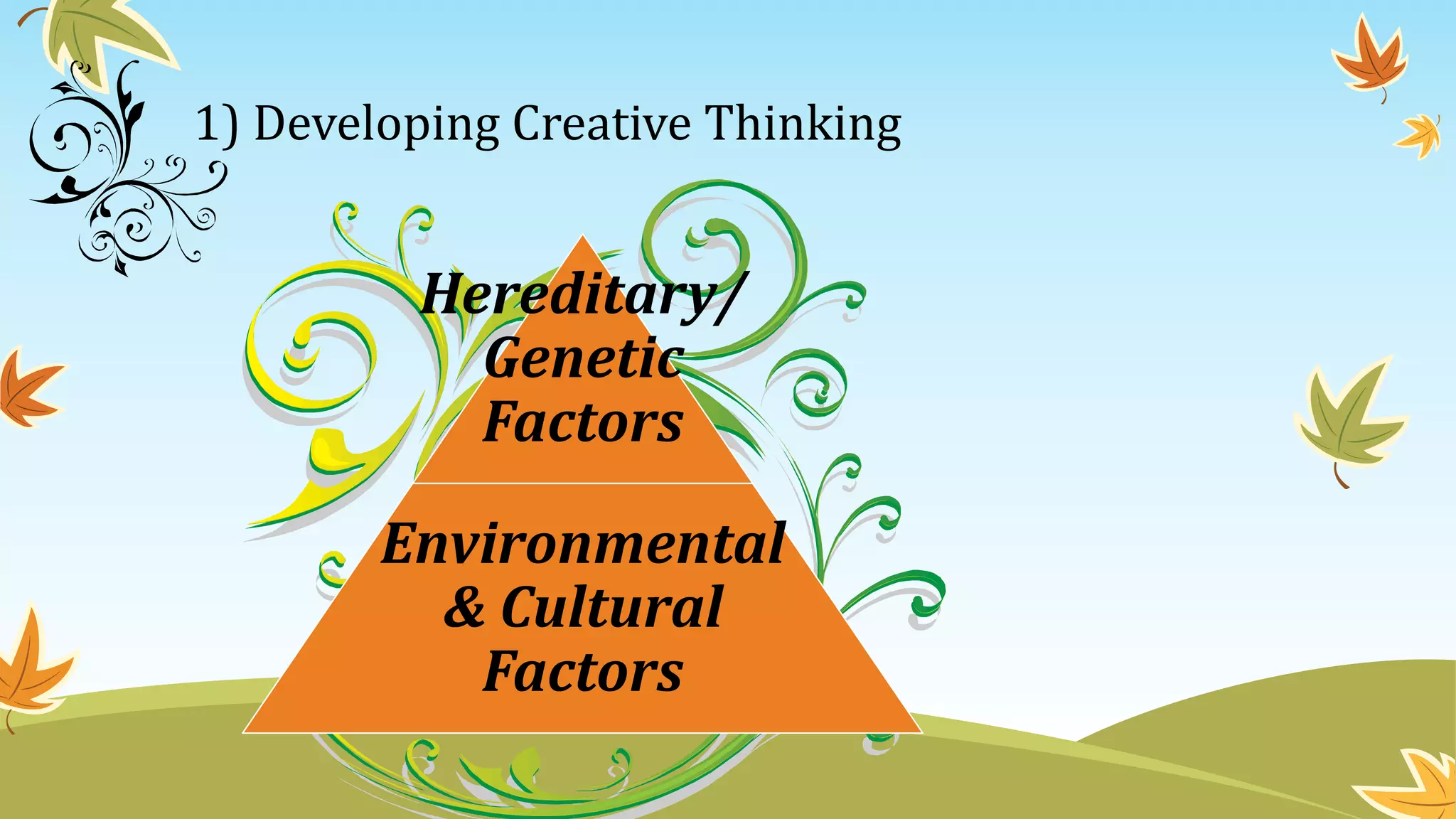
1) Developing Creative Thinking
Hereditary/
Genetic
Factors
Environmental
& Cultural
Factors
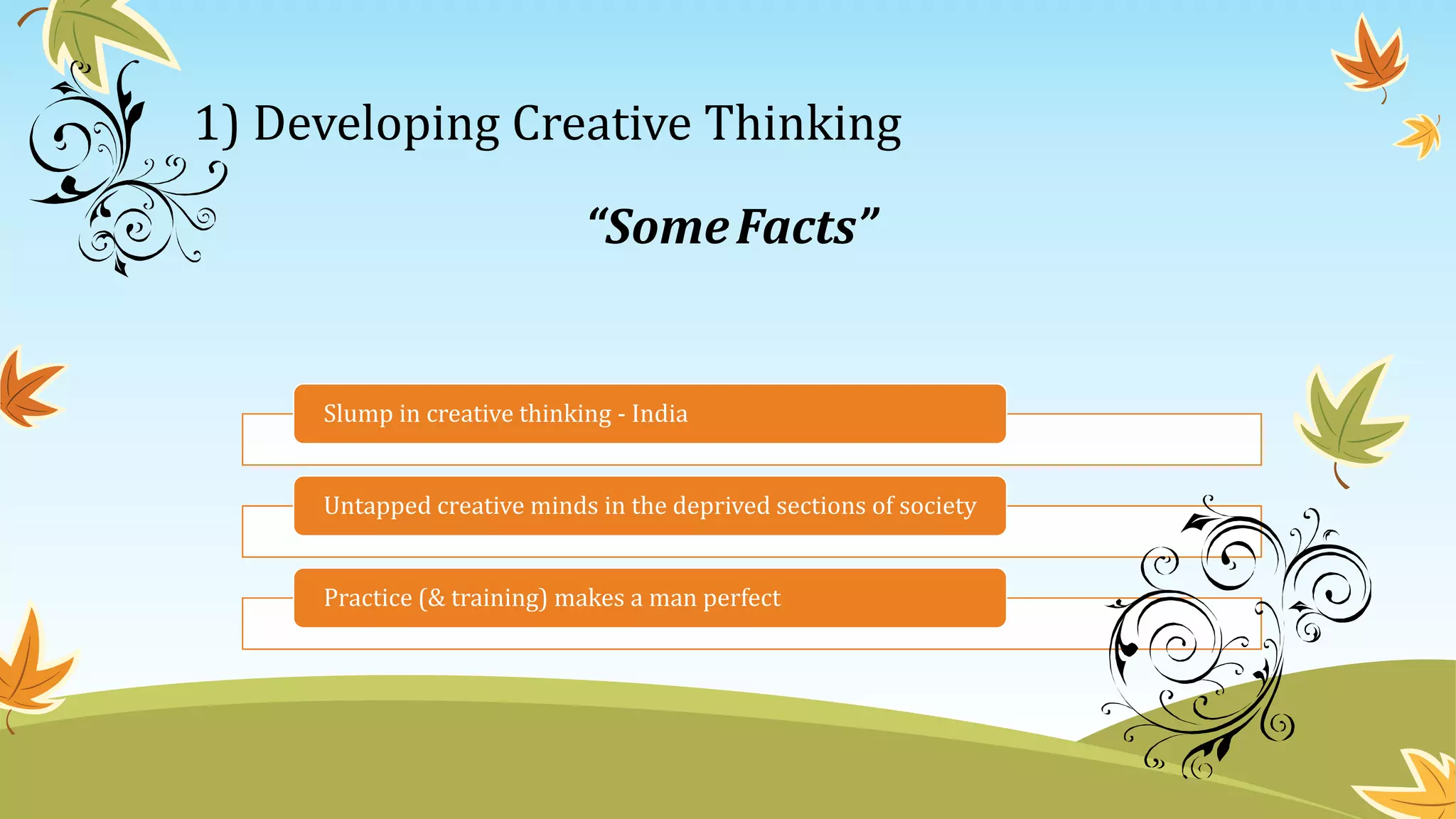
Slump in creative thinking - India
Untapped creative minds in the deprived sections of society
Practice (& training) makes a man perfect
1) Developing Creative Thinking
“SomeFacts”
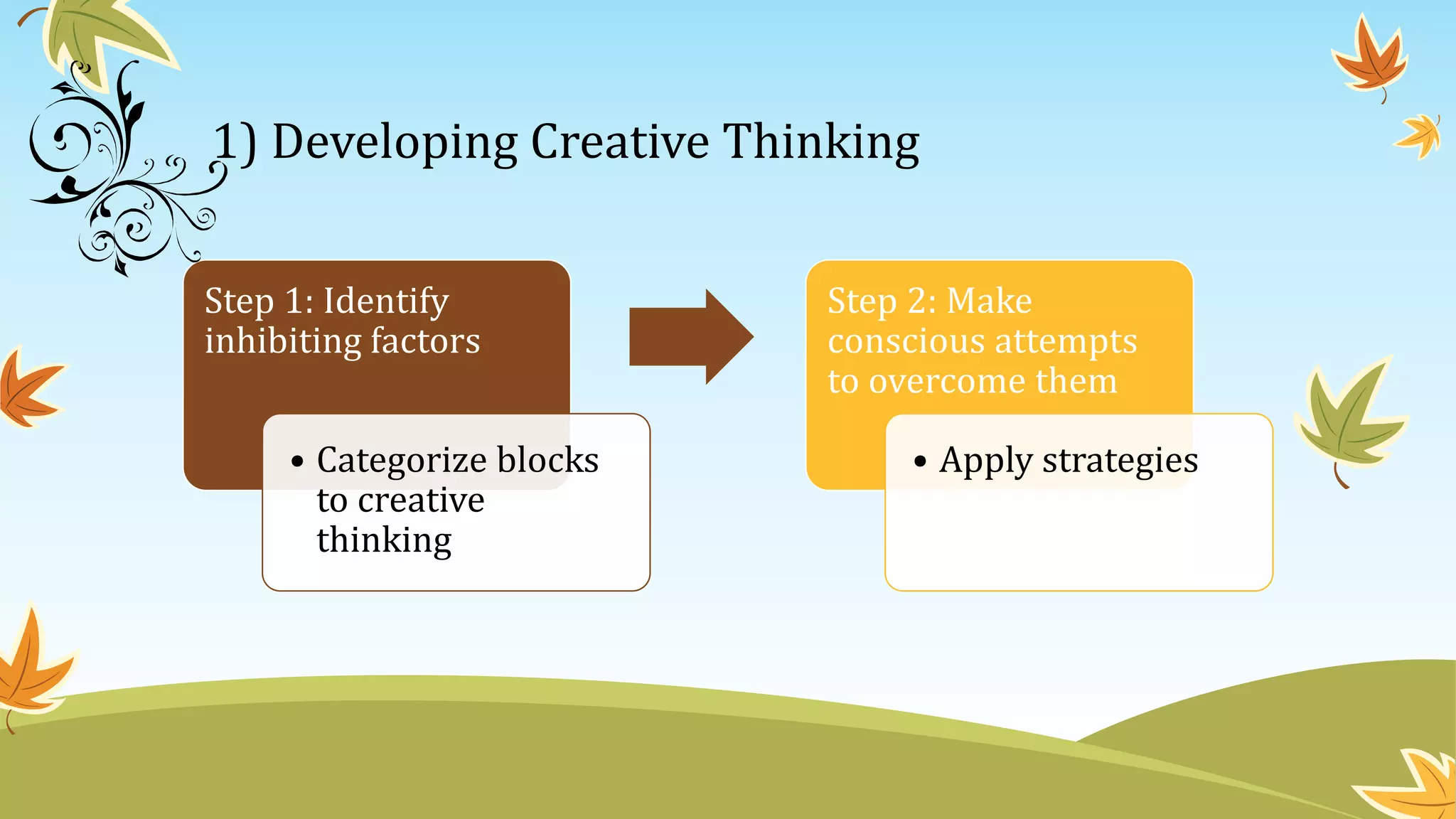
Step 1: Identify
inhibiting factors
• Categorize blocks
to creative
thinking
Step 2: Make
conscious attempts
to overcome them
• Apply strategies
1) Developing Creative Thinking
2) Barriers to Creative Thinking
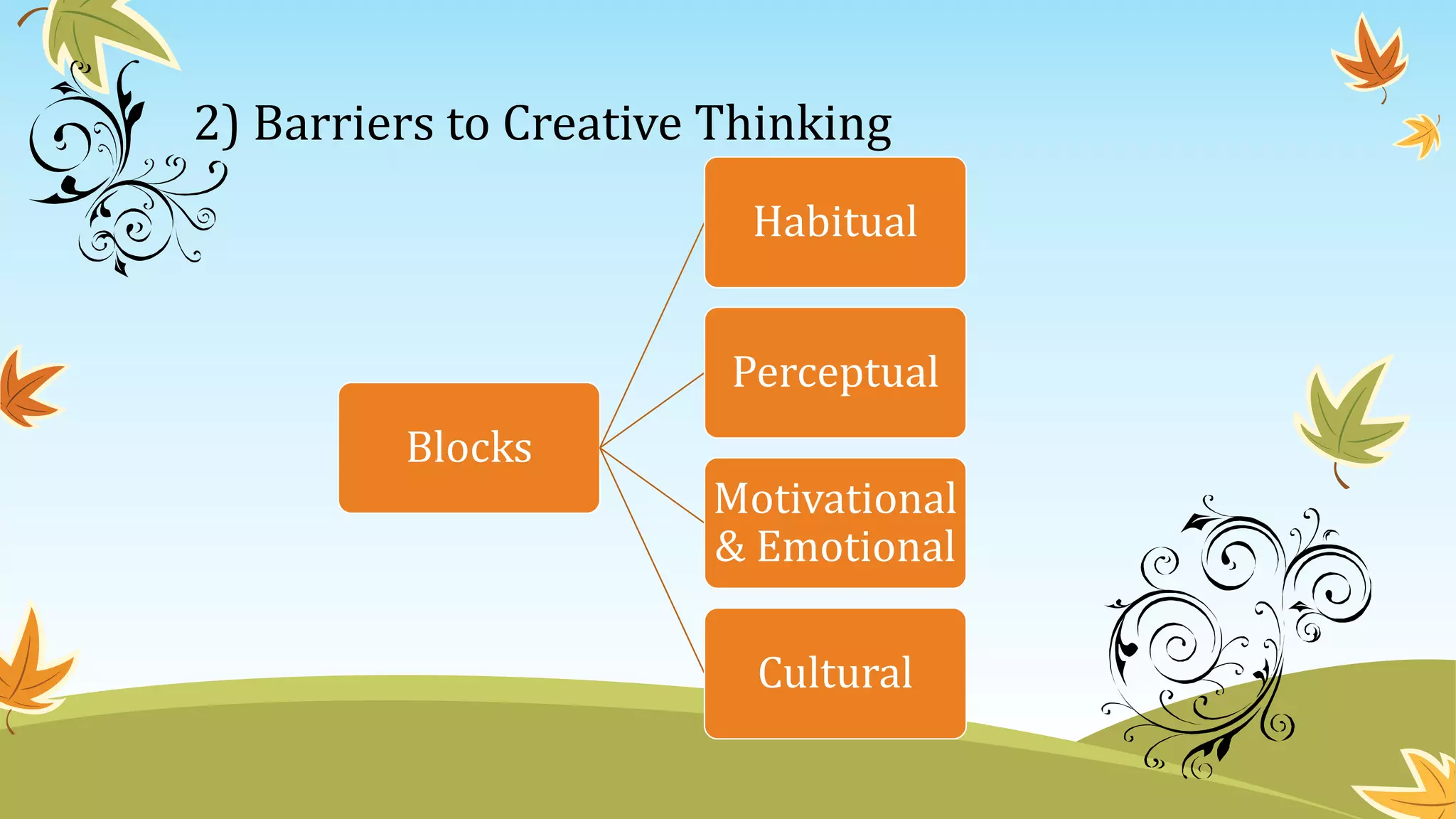
Blocks
Habitual
Perceptual
Motivational
& Emotional
Cultural
2) Barriers to Creative Thinking
• HABITUAL BLOCKS
Tendency to be over-powered by habits, in the
ways of thinking, leads to downfall of creative
expression.
We become so used to seeing & perceiving things,
and thinking about them in one such manner, that
thinking in authentic ways becomes a chore.
2) Barriers to Creative Thinking
• PERCEPTUAL BLOCKS
They prevent us from being open to novel and
original ideas.
Barriers are basically derived from assumptions
such as “no other solutions exist”, “this is the only
alternative” etc.
2) Barriers to Creative Thinking
• MOTIVATIONAL & EMOTIONAL BLOCKS
These blocks actually prove that thinking is just not
a cognitive process.
When a person lacks motivation or is over-
whelmed/effusive with emotions, he/she fails to
apply creative thinking. Examples include – fear of
ridicule/rejection, negative assumptions about
oneself, an “I can’t do it” feeling.
2) Barriers to Creative Thinking
• CULTURAL BLOCKS
Allowing the traditions, societal expectations or
stereotypes to have excessive control on oneself
gives rise to a cultural block.
Cultural blocks arise due to the fear of being
different, the tendency to maintain status etc.
Strategies for
Creative Thinking
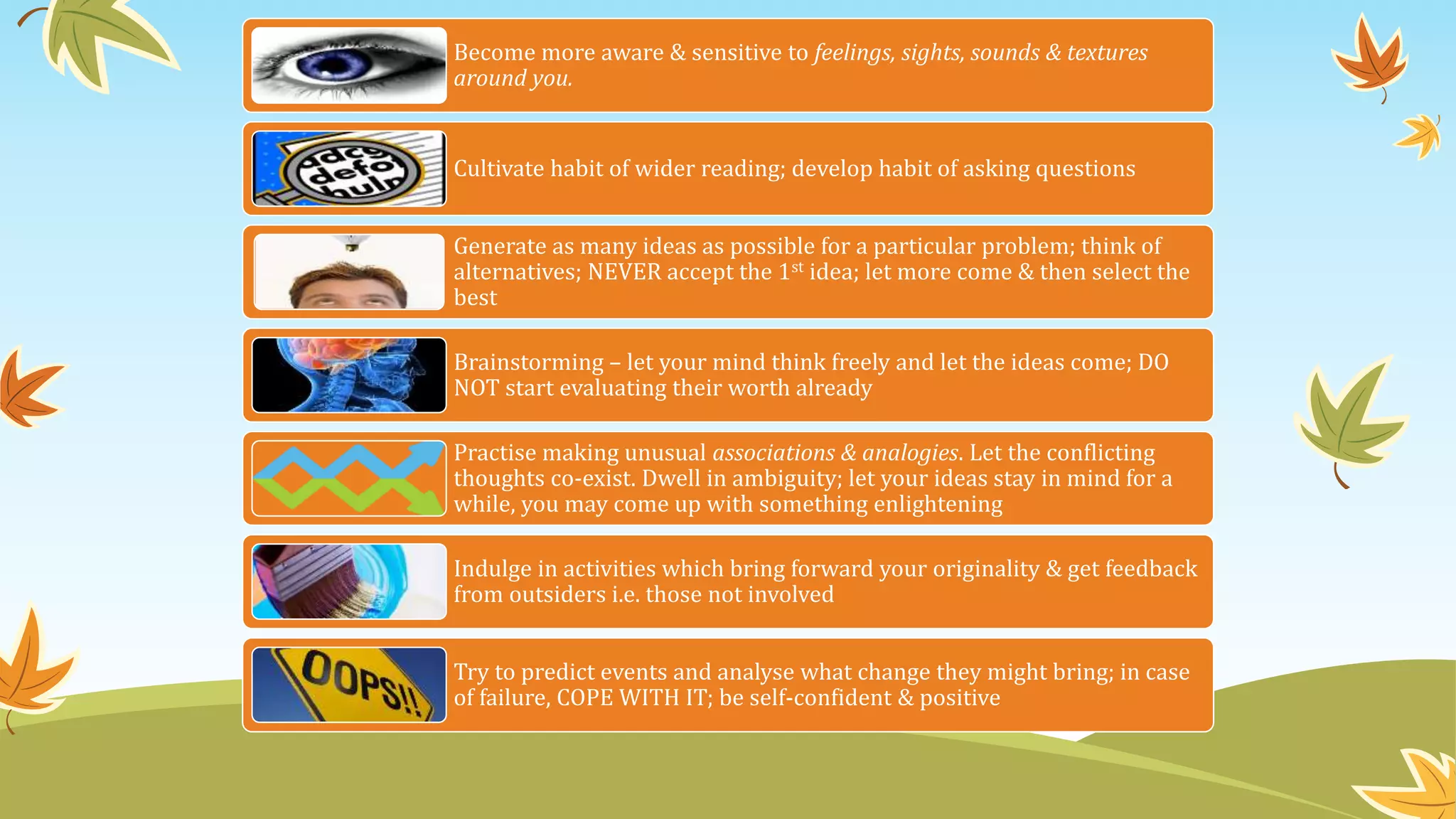
Become more aware & sensitive to feelings, sights, sounds & textures
around you.
Cultivate habit of wider reading; develop habit of asking questions
Generate as many ideas as possible for a particular problem; think of
alternatives; NEVER accept the 1st idea; let more come & then select the
best
Brainstorming – let your mind think freely and let the ideas come; DO
NOT start evaluating their worth already
Practise making unusual associations & analogies. Let the conflicting
thoughts co-exist. Dwell in ambiguity; let your ideas stay in mind for a
while, you may come up with something enlightening
Indulge in activities which bring forward your originality & get feedback
from outsiders i.e. those not involved
Try to predict events and analyse what change they might bring; in case
of failure, COPE WITH IT; be self-confident & positive

Developing creative thinking

  • 1.
  • 2.
    DID YOU KNOW? •The potential for creative thinking is in all of us. • Creativity can be reflected in activities like writing, teaching, cooking, story telling, acting, playing games or trying to solve day to day problems. • 2 types of thinking :- Convergent Divergent Thinking Thinking (narrowing down (Open minded thinking; a problem to find individual thinks of the one probable various answers to solution) a single question as per his/her experience)
  • 3.
    Developing creative thinking – thebarriers faced & the strategies used
  • 4.
    1) Developing CreativeThinking Hereditary/ Genetic Factors Environmental & Cultural Factors
  • 5.
    Slump in creativethinking - India Untapped creative minds in the deprived sections of society Practice (& training) makes a man perfect 1) Developing Creative Thinking “SomeFacts”
  • 6.
    Step 1: Identify inhibitingfactors • Categorize blocks to creative thinking Step 2: Make conscious attempts to overcome them • Apply strategies 1) Developing Creative Thinking
  • 7.
    2) Barriers toCreative Thinking Blocks Habitual Perceptual Motivational & Emotional Cultural
  • 8.
    2) Barriers toCreative Thinking • HABITUAL BLOCKS Tendency to be over-powered by habits, in the ways of thinking, leads to downfall of creative expression. We become so used to seeing & perceiving things, and thinking about them in one such manner, that thinking in authentic ways becomes a chore.
  • 9.
    2) Barriers toCreative Thinking • PERCEPTUAL BLOCKS They prevent us from being open to novel and original ideas. Barriers are basically derived from assumptions such as “no other solutions exist”, “this is the only alternative” etc.
  • 10.
    2) Barriers toCreative Thinking • MOTIVATIONAL & EMOTIONAL BLOCKS These blocks actually prove that thinking is just not a cognitive process. When a person lacks motivation or is over- whelmed/effusive with emotions, he/she fails to apply creative thinking. Examples include – fear of ridicule/rejection, negative assumptions about oneself, an “I can’t do it” feeling.
  • 11.
    2) Barriers toCreative Thinking • CULTURAL BLOCKS Allowing the traditions, societal expectations or stereotypes to have excessive control on oneself gives rise to a cultural block. Cultural blocks arise due to the fear of being different, the tendency to maintain status etc.
  • 12.
  • 13.
    Become more aware& sensitive to feelings, sights, sounds & textures around you. Cultivate habit of wider reading; develop habit of asking questions Generate as many ideas as possible for a particular problem; think of alternatives; NEVER accept the 1st idea; let more come & then select the best Brainstorming – let your mind think freely and let the ideas come; DO NOT start evaluating their worth already Practise making unusual associations & analogies. Let the conflicting thoughts co-exist. Dwell in ambiguity; let your ideas stay in mind for a while, you may come up with something enlightening Indulge in activities which bring forward your originality & get feedback from outsiders i.e. those not involved Try to predict events and analyse what change they might bring; in case of failure, COPE WITH IT; be self-confident & positive