Get CCSP Study Material for 100% Free! Get Now
Blog  Certification  CISCO  DEVASC 200-901: Leading Network Programmability
DEVASC 200-901: Leading Network
Programmability
591 February 5, 2024 DEVASC 200 901
Facebook Tweet LinkedIn
Exploring DEVASC 200-901: Leading Network Programmability reveals the convergence of traditional network
management with automation and programmability. Explore the evolution of networks from rigid structures to
dynamic, flexible, and responsive systems. Learn about software-defined paradigms and automation frameworks
that drive this transformation. This addresses the urgent need for network automation, exploring its technologies,
methodologies, and role in current and future network management.
The 200-901 DEVASC course is essential for professionals looking to excel in network programmability and
automation with Cisco Core Platforms. This certification exam is for those seeking to enhance their understanding
of software development and design for network operations. In an era of increasingly programmable and dynamic
networks, the Cisco DEVASC 200-901 certification equips professionals with the skills to thrive.
Table ofContents
Understanding 200-901 DEVASC
The Imperative for Network Automation
Understanding Network Programmability
The Rationale for Network Automation
The Fundamentals of Network Automation
Cisco DNA and SD-Access
The Ecosystem of Network APIs
Case Studies and Real-world Applications
Preparing for the DEVASC 200-901 Exam
Related Posts
Haider
Splunk vs. Datadog: Key Features, Side-
by-Side Comparison
Splunk and Datadog are leading
observability tools used by IT and
cybersecurity teams. Both track system
activity, monitor cloud-native...
Read More
May 24, 2025
 1:36 pm
 No Comments

Comparison of Certification
Haider
AWS Solutions Architect Associate vs
Professional
Choosing between AWS Solutions Architect
Associate vs Professional matters for your
cloud career path. Cloud skills face a
significant...
Read More
May 24, 2025
 1:28 pm
 No Comments

AWS, Comparison of Certification
About us Certification Services Products Blog Contact Lab Exam
PMI Cisco CompTIA Palo Alto F5 Networks Microsoft AWS Fortinet Azure Oracle Huawei Juniper
VMware Broadcom
English
Real-World Applications of DEVASC Skills
Frequently Asked Questions (FAQs)
Conclusion: The Future of Network Management
Understanding 200-901 DEVASC
The DEVASC 200-901 exam covers many essential topics for network engineers and developers. These include
understanding and using APIs and Cisco platforms and development. Also, application development and security,
and infrastructure and automation. This section will delve into these areas. It will explain their importance. It will
also explain how they contribute to a professional’s skill set.
This statement is set within the context of both current and future networking technologies. Specifically, APIs, or
Application Programming Interfaces, are essential for developers and network engineers. They facilitate
communication between software applications and enable seamless data sharing and integration. Moreover, APIs
are crucial in networking as they automate provisioning, configuration, monitoring, and troubleshooting tasks. Thus,
understanding APIs is critical to developing efficient and scalable network solutions. Additionally, Cisco platforms
and development are integral to the DEVASC Exam.
Cisco is undoubtedly one of the world’s leading networking companies. It offers many products and services to
meet many business needs. Consequently, networking professionals must possess a deep knowledge of how to
work with these platforms, which is necessary for designing or maintaining Cisco-based networks. Specifically, the
exam covers a thorough understanding of Cisco IOS XE architecture and programming languages.
The Imperative for Network Automation
The Evolutionary Stalemate in Network Management
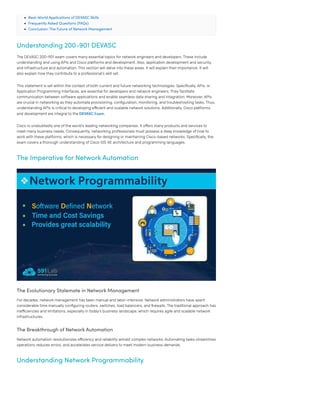
For decades, network management has been manual and labor-intensive. Network administrators have spent
considerable time manually configuring routers, switches, load balancers, and firewalls. The traditional approach has
inefficiencies and limitations, especially in today’s business landscape, which requires agile and scalable network
infrastructures.
The Breakthrough of Network Automation
Network automation revolutionizes efficiency and reliability amidst complex networks. Automating tasks streamlines
operations reduces errors, and accelerates service delivery to meet modern business demands.
Understanding Network Programmability
Redefining Network Administration with SDN
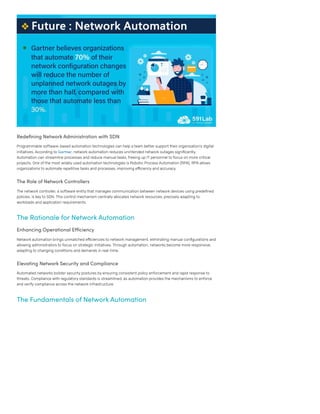
Programmable software-based automation technologies can help a team better support their organization’s digital
initiatives. According to Gartner, network automation reduces unintended network outages significantly.
Automation can streamline processes and reduce manual tasks, freeing up IT personnel to focus on more critical
projects. One of the most widely used automation technologies is Robotic Process Automation (RPA). RPA allows
organizations to automate repetitive tasks and processes, improving efficiency and accuracy.
The Role of Network Controllers
The network controller, a software entity that manages communication between network devices using predefined
policies, is key to SDN. This control mechanism centrally allocates network resources, precisely adapting to
workloads and application requirements.
The Rationale for Network Automation
Enhancing Operational Efficiency
Network automation brings unmatched efficiencies to network management, eliminating manual configurations and
allowing administrators to focus on strategic initiatives. Through automation, networks become more responsive,
adapting to changing conditions and demands in real-time.
Elevating Network Security and Compliance
Automated networks bolster security postures by ensuring consistent policy enforcement and rapid response to
threats. Compliance with regulatory standards is streamlined, as automation provides the mechanisms to enforce
and verify compliance across the network infrastructure.
The Fundamentals of Network Automation
Traditional Networking vs. Controller-Based Networking
Traditional Networking involves connecting devices and systems using physical infrastructure like cables and
switches. In contrast, Controller-Based Networking, also known as Software-Defined Networking (SDN), centralizes
network device control and management through a software controller. Here are the key differences between the
two:
Feature Traditional Networking Controller-Based Networking (SDN)
FlexibilityandAgility Static and inflexible, not suited for
evolving business needs.
Highly programmable and adaptable to
deployment and changes.
Configuration and
Management
Hardware-dependent, using physical
appliances.
Software-driven, using open software for
configuration.
Control Plane Distributed across devices,
complicating management.
Logically centralized, simplifying network
management.
Hardware and
Technology
Utilizes custom ASICs and FPGAs. Employs cost-effective merchant silicon.
Configuration
Interfaces
Relies on proprietary protocols. Uses APIs for flexible and adaptable
configuration.
This table highlights the key differences between the two networking approaches. It showcases the shift from
hardware-centric, static configurations in traditional networking to dynamic, software-driven, and flexible
configurations in controller-based networking.
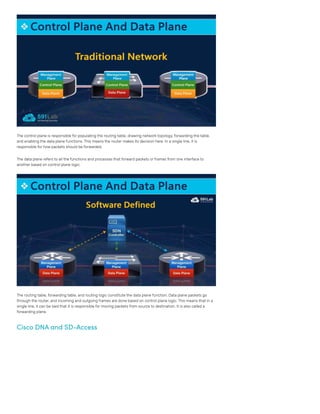
Deciphering the Control and Data Planes
The control plane is responsible for populating the routing table, drawing network topology, forwarding the table,
and enabling the data plane functions. This means the router makes its decision here. In a single line, it is
responsible for how packets should be forwarded.
The data plane refers to all the functions and processes that forward packets or frames from one interface to
another based on control plane logic.
The routing table, forwarding table, and routing logic constitute the data plane function. Data plane packets go
through the router, and incoming and outgoing frames are done based on control plane logic. This means that in a
single line, it can be said that it is responsible for moving packets from source to destination. It is also called a
forwarding plane.
Cisco DNA and SD-Access
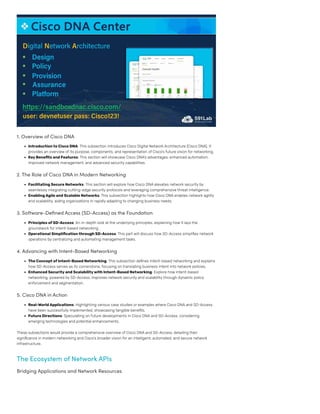
1. Overview of Cisco DNA
Introductionto Cisco DNA: This subsection introduces Cisco Digital Network Architecture (Cisco DNA). It
provides an overview of its purpose, components, and representation of Cisco’s future vision for networking.
KeyBenefits and Features: This section will showcase Cisco DNA’s advantages: enhanced automation,
improved network management, and advanced security capabilities.
2. The Role of Cisco DNA in Modern Networking
Facilitating Secure Networks: This section will explore how Cisco DNA elevates network security by
seamlessly integrating cutting-edge security protocols and leveraging comprehensive threat intelligence.
EnablingAgile and Scalable Networks: This subsection highlights how Cisco DNA enables network agility
and scalability, aiding organizations in rapidly adapting to changing business needs.
3. Software-Defined Access (SD-Access) as the Foundation
Principles ofSD-Access: An in-depth look at the underlying principles, explaining how it lays the
groundwork for intent-based networking.
Operational Simplificationthrough SD-Access: This part will discuss how SD-Access simplifies network
operations by centralizing and automating management tasks.
4. Advancing with Intent-Based Networking
The Concept ofIntent-Based Networking: This subsection defines intent-based networking and explains
how SD-Access serves as its cornerstone, focusing on translating business intent into network policies.
Enhanced Securityand Scalabilitywith Intent-Based Networking: Explore how intent-based
networking, powered by SD-Access, improves network security and scalability through dynamic policy
enforcement and segmentation.
5. Cisco DNA in Action
Real-WorldApplications: Highlighting various case studies or examples where Cisco DNA and SD-Access
have been successfully implemented, showcasing tangible benefits.
Future Directions: Speculating on future developments in Cisco DNA and SD-Access, considering
emerging technologies and potential enhancements.
These subsections would provide a comprehensive overview of Cisco DNA and SD-Access, detailing their
significance in modern networking and Cisco’s broadervision for an intelligent, automated, and secure network
infrastructure.
The Ecosystem of Network APIs
Bridging Applications and Network Resources
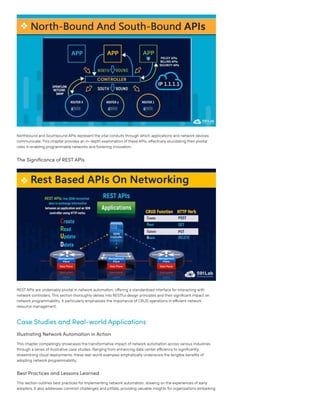
Northbound and Southbound APIs represent the vital conduits through which applications and network devices
communicate. This chapter provides an in-depth examination of these APIs, effectively elucidating their pivotal
roles in enabling programmable networks and fostering innovation.
The Significance of REST APIs
RESTAPIs are undeniably pivotal in network automation, offering a standardized interface for interacting with
network controllers. This section thoroughly delves into RESTful design principles and their significant impact on
network programmability. It particularly emphasizes the importance of CRUD operations in efficient network
resource management.
Case Studies and Real-world Applications
Illustrating Network Automation in Action
This chapter compellingly showcases the transformative impact of network automation across various industries
through a series of illustrative case studies. Ranging from enhancing data center efficiency to significantly
streamlining cloud deployments, these real-world examples emphatically underscore the tangible benefits of
adopting network programmability.
Best Practices and Lessons Learned
This section outlines best practices for implementing network automation, drawing on the experiences of early
adopters. It also addresses common challenges and pitfalls, providing valuable insights for organizations embarking
on their automation journeys. By following these recommendations, you can ensure a successful and smooth
transition to a more efficient and streamlined network.
Preparing for the DEVASC 200-901 Exam
Mastering the Fundamentals
The DEVASC 200-901 exam covers a broad spectrum of topics as the gateway to understanding network
programmability and automation. This chapter provides a comprehensive overview of the exam structure, topics
covered, and strategies for adequate preparation.
Resources and Study Tools
This section has a comprehensive list of resources for exam preparation, including official Cisco materials, online
courses, and community forums. It also recommends practical exercises and labs to reinforce theoretical
knowledge and build hands-on experience.
Understanding Exam Objectives
This subsection thoroughly delves into the specific objectives and skills assessed by the DEVASC 200-901 exam. It
systematically breaks down the exam blueprint into manageable sections, clearly explaining the importance of each
domain and the expected competencies. Consequently, candidates should use this information to strategically
customize their study plan, focusing on areas where improvement is notably needed.
Time Management Strategies
Effective time management is crucial for DEVASC 200-901 exam success. This part provides strategies for effective
study time management: set goals, create a schedule, and balance studying with other responsibilities. Tips on
managing time during the exam are also provided to help candidates maximize their performance.
Practice Tests and Simulations
This section emphasizes the value of practice and suggests a variety of mock exams and simulation tools available
for the DEVASC 200-901. It explains how these resources help candidates become familiar with the exam format,
question types, and working under timed conditions. Recommendations on analyzing practice test results to
identifyweak areas are also included.
Joining Study Groups and Forums
This subsection specifically highlights the benefits of collaborative learning and actively encourages candidates to
join study groups and online forums. It clearly outlines how engaging with peers can provide new insights,
effectively clarify doubts, and offer unwavering moral support throughout the preparation journey. Additionally,
guidance on finding and participating in productive study communities is thoughtfully provided.
Staying Updated and Motivated
Staying abreast of the latest developments in network programmability and automation is essential. This section
provides tips on staying informed about industry trends, exam updates, and new learning resources. It also advises
maintaining motivation throughout the study process, including setting milestones, rewarding progress, and
staying connected with the broader Cisco community.
See OurExpert Opinion inAction
Real-World Applications of DEVASC Skills
To further elaborate on the real-world applications of skills assessed by the DEVASC 200-901 exam in industries like
telecommunications, IT, and cybersecurity, we can highlight how automation and programmability contribute to
creating networks that are both more efficient and secure and scalable. Here are five additional points that
underscore the practical implications of these skills:
1. Self-Healing Networks: In telecommunications, automation enables the creation of self-healing networks
that can automatically detect and correct network problems without human intervention.
2. DevOps in IT: Integrating DevOps practices, a significant aspect of the DEVASC curriculum, streamlines the
collaboration between software developers and IT operations. This synergy leads to faster development
cycles, more stable operating environments, and more rapid feature releases, enhancing the overall
productivity and efficiency of IT departments.
3. SecurityPolicyEnforcement: In cybersecurity, programmability allows for the dynamic enforcement of
security policies across the network.
4. Scalable Cloud Infrastructure: Automation and programmability skills are undeniably critical for managing
scalable cloud infrastructures. They empower IT professionals to automate cloud resource provisioning,
scaling, and management, ensuring that the infrastructure can dynamically adjust to varying workloads and
demands without manual intervention.
5. NetworkCustomization and Integration: With the knowledge ofAPIs and programming concepts,
professionals can more adeptly customize network operations and more seamlessly integrate disparate
systems. This capability is fundamentally essential for creating highly tailored solutions that precisely meet
specific organizational needs, consequently leading to more efficient operations and better alignment with
business objectives.
These points demonstrate how DEVASC skills are not just theoretical but have tangible applications that drive
innovation and efficiency in various sectors, particularly in managing increasingly complex and dynamic modern
network environments.
Frequently Asked Questions (FAQs)
Q: Howlong should I prepareforthe DEVASC 200-901 exam?
A: Preparation time varies by individual, but 3-6 months of consistent study on average should be sufficient.
Q:Arethere anyprerequisitesforthe DEVASC 200-901 exam?
A: No formal prerequisites are required, but a basic understanding of software development and Cisco platforms is
highly recommended.
Q: Howmuch isthe 200-901 DEVASC exam?
The 200-901 DEVASC exam costs $300 USD, plus any applicable taxes. It’s important to note that prices can vary
by location and are subject to change, so it’s a good idea to check with the official Cisco website or Pearson VUE for
the most current information​.
Q:What istheformat ofthe DEVASC 200-901 exam?
A: The exam typically consists of multiple-choice and simulation questions, covering both theoretical knowledge
and practical skills.
Watch on
CISCO DevNet Exam Breakdown | CISCO Certified DevNet Associate
Share
Share
Q: Howcan I registerforthe exam?
A: You can register for the DEVASC 200-901 exam through Pearson VUE, Cisco’s authorized test delivery partner.
Explore ourexpert opinionthroughvisual content.
Conclusion: The Future of Network Management
The final chapter thoughtfully reflects on the network automation and programmability journey and contemplatively
contemplates its future trajectory. As networks progressively evolve, the principles and technologies discussed
herein will undoubtedly play an increasingly pivotal role in shaping the next generation of network infrastructures,
which are characterized by unparalleled efficiency, security, and adaptability.
This expansive exploration of network automation and programmability is a preparatory guide for the DEVASC 200-
901 exam and a comprehensive resource for professionals seeking to navigate the complexities of modern network
environments.
Facebook Tweet LinkedIn
591Lab
Mastering DevNet Exams: Network Security & DNS
Watch on
591
Previous
Fortinet NSE7 Operational Technology Security 7.2 and Specific Solutions
Next
ITIL 4 Certification: Advanced IT Service Management Path
 
Related Posts
MasterAll 4 CISM Domains and Pass
the Exam in 2025
FacebookTweetLinkedIn Mastering the CISM
domains is the first real step toward passing
the exam and building your career in
information security management. These four
domains
Prince2 vs PMP: Which Certification
Offers a Better Career?
FacebookTweetLinkedIn Project management
is a skill set that spreads across multiple
AWS Career Paths: Find the Right
Certification Path in 2025
FacebookTweetLinkedIn Starting a career in
cloud computing offers great rewards today.
What Are the 49 Processes of
Project Management?
FacebookTweetLinkedIn Project management
transforms complex challenges into
industries with remarkable growth potential.
The Project Management Institute predicts
22 million new project
As more companies move to the cloud, the
need forAWS skills rises. 28%
successful outcomes by following structured
approaches. One key framework is the 49
processes of Project Management, developed
by
Let's take you to the next level
Contact us
Launched in 2016 Internationally known as "591Lab" we are committed to offering our
clients excellent experience on ISACA, PMI, Cisco and Huawei certification exam
preparatory services. With our amazing certcollection, we focus strongly on popular
exams, and exam preparations services. We provide our customers with the complete
training needed to earn the best scores for their respective Management and IT career
certifications. We have a huge list of satisfied customers with top grades to back up all the
claims we make.
   
Quick Links
About Us
Certification Services
Products
Blog
Quick Contact
Alice Wong
Whatsapp: +85297410423
Email:marketing@591lab.com
Zoey Pei
Whatsapp: +85256395480
Email:zoey@591lab.com
This material is not sponsored by, endorsed by, or affiliated with Cisco Systems, Inc & Huawei Technologies Co., Ltd. Cisco Certified Internetworking Engineer, the Cisco Systems logo and the CCIE™ logo are trademarks or registered trademarks
of Cisco Systems, Inc. in the United States and certain other countries.Huawei Certified Internetwork Expert, the Huawei logo and the HCIE™ logo are trademarks or registered trademarks of Huawei Technologies Co., Ltd . in China and certain
other countries All other trademarks are trademarks of their respective owners.
Full Disclaimer Copyright © 2026 , All rights reserved to 591Lab

DEVASC 200-901: Leading Network Programmability – My 591Lab

  • 1.
    Get CCSP StudyMaterial for 100% Free! Get Now Blog  Certification  CISCO  DEVASC 200-901: Leading Network Programmability DEVASC 200-901: Leading Network Programmability 591 February 5, 2024 DEVASC 200 901 Facebook Tweet LinkedIn Exploring DEVASC 200-901: Leading Network Programmability reveals the convergence of traditional network management with automation and programmability. Explore the evolution of networks from rigid structures to dynamic, flexible, and responsive systems. Learn about software-defined paradigms and automation frameworks that drive this transformation. This addresses the urgent need for network automation, exploring its technologies, methodologies, and role in current and future network management. The 200-901 DEVASC course is essential for professionals looking to excel in network programmability and automation with Cisco Core Platforms. This certification exam is for those seeking to enhance their understanding of software development and design for network operations. In an era of increasingly programmable and dynamic networks, the Cisco DEVASC 200-901 certification equips professionals with the skills to thrive. Table ofContents Understanding 200-901 DEVASC The Imperative for Network Automation Understanding Network Programmability The Rationale for Network Automation The Fundamentals of Network Automation Cisco DNA and SD-Access The Ecosystem of Network APIs Case Studies and Real-world Applications Preparing for the DEVASC 200-901 Exam Related Posts Haider Splunk vs. Datadog: Key Features, Side- by-Side Comparison Splunk and Datadog are leading observability tools used by IT and cybersecurity teams. Both track system activity, monitor cloud-native... Read More May 24, 2025  1:36 pm  No Comments  Comparison of Certification Haider AWS Solutions Architect Associate vs Professional Choosing between AWS Solutions Architect Associate vs Professional matters for your cloud career path. Cloud skills face a significant... Read More May 24, 2025  1:28 pm  No Comments  AWS, Comparison of Certification About us Certification Services Products Blog Contact Lab Exam PMI Cisco CompTIA Palo Alto F5 Networks Microsoft AWS Fortinet Azure Oracle Huawei Juniper VMware Broadcom English
  • 2.
    Real-World Applications ofDEVASC Skills Frequently Asked Questions (FAQs) Conclusion: The Future of Network Management Understanding 200-901 DEVASC The DEVASC 200-901 exam covers many essential topics for network engineers and developers. These include understanding and using APIs and Cisco platforms and development. Also, application development and security, and infrastructure and automation. This section will delve into these areas. It will explain their importance. It will also explain how they contribute to a professional’s skill set. This statement is set within the context of both current and future networking technologies. Specifically, APIs, or Application Programming Interfaces, are essential for developers and network engineers. They facilitate communication between software applications and enable seamless data sharing and integration. Moreover, APIs are crucial in networking as they automate provisioning, configuration, monitoring, and troubleshooting tasks. Thus, understanding APIs is critical to developing efficient and scalable network solutions. Additionally, Cisco platforms and development are integral to the DEVASC Exam. Cisco is undoubtedly one of the world’s leading networking companies. It offers many products and services to meet many business needs. Consequently, networking professionals must possess a deep knowledge of how to work with these platforms, which is necessary for designing or maintaining Cisco-based networks. Specifically, the exam covers a thorough understanding of Cisco IOS XE architecture and programming languages. The Imperative for Network Automation The Evolutionary Stalemate in Network Management For decades, network management has been manual and labor-intensive. Network administrators have spent considerable time manually configuring routers, switches, load balancers, and firewalls. The traditional approach has inefficiencies and limitations, especially in today’s business landscape, which requires agile and scalable network infrastructures. The Breakthrough of Network Automation Network automation revolutionizes efficiency and reliability amidst complex networks. Automating tasks streamlines operations reduces errors, and accelerates service delivery to meet modern business demands. Understanding Network Programmability
  • 3.
    Redefining Network Administrationwith SDN Programmable software-based automation technologies can help a team better support their organization’s digital initiatives. According to Gartner, network automation reduces unintended network outages significantly. Automation can streamline processes and reduce manual tasks, freeing up IT personnel to focus on more critical projects. One of the most widely used automation technologies is Robotic Process Automation (RPA). RPA allows organizations to automate repetitive tasks and processes, improving efficiency and accuracy. The Role of Network Controllers The network controller, a software entity that manages communication between network devices using predefined policies, is key to SDN. This control mechanism centrally allocates network resources, precisely adapting to workloads and application requirements. The Rationale for Network Automation Enhancing Operational Efficiency Network automation brings unmatched efficiencies to network management, eliminating manual configurations and allowing administrators to focus on strategic initiatives. Through automation, networks become more responsive, adapting to changing conditions and demands in real-time. Elevating Network Security and Compliance Automated networks bolster security postures by ensuring consistent policy enforcement and rapid response to threats. Compliance with regulatory standards is streamlined, as automation provides the mechanisms to enforce and verify compliance across the network infrastructure. The Fundamentals of Network Automation
  • 4.
    Traditional Networking vs.Controller-Based Networking Traditional Networking involves connecting devices and systems using physical infrastructure like cables and switches. In contrast, Controller-Based Networking, also known as Software-Defined Networking (SDN), centralizes network device control and management through a software controller. Here are the key differences between the two: Feature Traditional Networking Controller-Based Networking (SDN) FlexibilityandAgility Static and inflexible, not suited for evolving business needs. Highly programmable and adaptable to deployment and changes. Configuration and Management Hardware-dependent, using physical appliances. Software-driven, using open software for configuration. Control Plane Distributed across devices, complicating management. Logically centralized, simplifying network management. Hardware and Technology Utilizes custom ASICs and FPGAs. Employs cost-effective merchant silicon. Configuration Interfaces Relies on proprietary protocols. Uses APIs for flexible and adaptable configuration. This table highlights the key differences between the two networking approaches. It showcases the shift from hardware-centric, static configurations in traditional networking to dynamic, software-driven, and flexible configurations in controller-based networking. Deciphering the Control and Data Planes
  • 5.
    The control planeis responsible for populating the routing table, drawing network topology, forwarding the table, and enabling the data plane functions. This means the router makes its decision here. In a single line, it is responsible for how packets should be forwarded. The data plane refers to all the functions and processes that forward packets or frames from one interface to another based on control plane logic. The routing table, forwarding table, and routing logic constitute the data plane function. Data plane packets go through the router, and incoming and outgoing frames are done based on control plane logic. This means that in a single line, it can be said that it is responsible for moving packets from source to destination. It is also called a forwarding plane. Cisco DNA and SD-Access
  • 6.
    1. Overview ofCisco DNA Introductionto Cisco DNA: This subsection introduces Cisco Digital Network Architecture (Cisco DNA). It provides an overview of its purpose, components, and representation of Cisco’s future vision for networking. KeyBenefits and Features: This section will showcase Cisco DNA’s advantages: enhanced automation, improved network management, and advanced security capabilities. 2. The Role of Cisco DNA in Modern Networking Facilitating Secure Networks: This section will explore how Cisco DNA elevates network security by seamlessly integrating cutting-edge security protocols and leveraging comprehensive threat intelligence. EnablingAgile and Scalable Networks: This subsection highlights how Cisco DNA enables network agility and scalability, aiding organizations in rapidly adapting to changing business needs. 3. Software-Defined Access (SD-Access) as the Foundation Principles ofSD-Access: An in-depth look at the underlying principles, explaining how it lays the groundwork for intent-based networking. Operational Simplificationthrough SD-Access: This part will discuss how SD-Access simplifies network operations by centralizing and automating management tasks. 4. Advancing with Intent-Based Networking The Concept ofIntent-Based Networking: This subsection defines intent-based networking and explains how SD-Access serves as its cornerstone, focusing on translating business intent into network policies. Enhanced Securityand Scalabilitywith Intent-Based Networking: Explore how intent-based networking, powered by SD-Access, improves network security and scalability through dynamic policy enforcement and segmentation. 5. Cisco DNA in Action Real-WorldApplications: Highlighting various case studies or examples where Cisco DNA and SD-Access have been successfully implemented, showcasing tangible benefits. Future Directions: Speculating on future developments in Cisco DNA and SD-Access, considering emerging technologies and potential enhancements. These subsections would provide a comprehensive overview of Cisco DNA and SD-Access, detailing their significance in modern networking and Cisco’s broadervision for an intelligent, automated, and secure network infrastructure. The Ecosystem of Network APIs Bridging Applications and Network Resources
  • 7.
    Northbound and SouthboundAPIs represent the vital conduits through which applications and network devices communicate. This chapter provides an in-depth examination of these APIs, effectively elucidating their pivotal roles in enabling programmable networks and fostering innovation. The Significance of REST APIs RESTAPIs are undeniably pivotal in network automation, offering a standardized interface for interacting with network controllers. This section thoroughly delves into RESTful design principles and their significant impact on network programmability. It particularly emphasizes the importance of CRUD operations in efficient network resource management. Case Studies and Real-world Applications Illustrating Network Automation in Action This chapter compellingly showcases the transformative impact of network automation across various industries through a series of illustrative case studies. Ranging from enhancing data center efficiency to significantly streamlining cloud deployments, these real-world examples emphatically underscore the tangible benefits of adopting network programmability. Best Practices and Lessons Learned This section outlines best practices for implementing network automation, drawing on the experiences of early adopters. It also addresses common challenges and pitfalls, providing valuable insights for organizations embarking
  • 8.
    on their automationjourneys. By following these recommendations, you can ensure a successful and smooth transition to a more efficient and streamlined network. Preparing for the DEVASC 200-901 Exam Mastering the Fundamentals The DEVASC 200-901 exam covers a broad spectrum of topics as the gateway to understanding network programmability and automation. This chapter provides a comprehensive overview of the exam structure, topics covered, and strategies for adequate preparation. Resources and Study Tools This section has a comprehensive list of resources for exam preparation, including official Cisco materials, online courses, and community forums. It also recommends practical exercises and labs to reinforce theoretical knowledge and build hands-on experience. Understanding Exam Objectives This subsection thoroughly delves into the specific objectives and skills assessed by the DEVASC 200-901 exam. It systematically breaks down the exam blueprint into manageable sections, clearly explaining the importance of each domain and the expected competencies. Consequently, candidates should use this information to strategically customize their study plan, focusing on areas where improvement is notably needed. Time Management Strategies Effective time management is crucial for DEVASC 200-901 exam success. This part provides strategies for effective study time management: set goals, create a schedule, and balance studying with other responsibilities. Tips on managing time during the exam are also provided to help candidates maximize their performance. Practice Tests and Simulations This section emphasizes the value of practice and suggests a variety of mock exams and simulation tools available for the DEVASC 200-901. It explains how these resources help candidates become familiar with the exam format, question types, and working under timed conditions. Recommendations on analyzing practice test results to identifyweak areas are also included. Joining Study Groups and Forums This subsection specifically highlights the benefits of collaborative learning and actively encourages candidates to join study groups and online forums. It clearly outlines how engaging with peers can provide new insights, effectively clarify doubts, and offer unwavering moral support throughout the preparation journey. Additionally, guidance on finding and participating in productive study communities is thoughtfully provided. Staying Updated and Motivated Staying abreast of the latest developments in network programmability and automation is essential. This section provides tips on staying informed about industry trends, exam updates, and new learning resources. It also advises maintaining motivation throughout the study process, including setting milestones, rewarding progress, and staying connected with the broader Cisco community. See OurExpert Opinion inAction
  • 9.
    Real-World Applications ofDEVASC Skills To further elaborate on the real-world applications of skills assessed by the DEVASC 200-901 exam in industries like telecommunications, IT, and cybersecurity, we can highlight how automation and programmability contribute to creating networks that are both more efficient and secure and scalable. Here are five additional points that underscore the practical implications of these skills: 1. Self-Healing Networks: In telecommunications, automation enables the creation of self-healing networks that can automatically detect and correct network problems without human intervention. 2. DevOps in IT: Integrating DevOps practices, a significant aspect of the DEVASC curriculum, streamlines the collaboration between software developers and IT operations. This synergy leads to faster development cycles, more stable operating environments, and more rapid feature releases, enhancing the overall productivity and efficiency of IT departments. 3. SecurityPolicyEnforcement: In cybersecurity, programmability allows for the dynamic enforcement of security policies across the network. 4. Scalable Cloud Infrastructure: Automation and programmability skills are undeniably critical for managing scalable cloud infrastructures. They empower IT professionals to automate cloud resource provisioning, scaling, and management, ensuring that the infrastructure can dynamically adjust to varying workloads and demands without manual intervention. 5. NetworkCustomization and Integration: With the knowledge ofAPIs and programming concepts, professionals can more adeptly customize network operations and more seamlessly integrate disparate systems. This capability is fundamentally essential for creating highly tailored solutions that precisely meet specific organizational needs, consequently leading to more efficient operations and better alignment with business objectives. These points demonstrate how DEVASC skills are not just theoretical but have tangible applications that drive innovation and efficiency in various sectors, particularly in managing increasingly complex and dynamic modern network environments. Frequently Asked Questions (FAQs) Q: Howlong should I prepareforthe DEVASC 200-901 exam? A: Preparation time varies by individual, but 3-6 months of consistent study on average should be sufficient. Q:Arethere anyprerequisitesforthe DEVASC 200-901 exam? A: No formal prerequisites are required, but a basic understanding of software development and Cisco platforms is highly recommended. Q: Howmuch isthe 200-901 DEVASC exam? The 200-901 DEVASC exam costs $300 USD, plus any applicable taxes. It’s important to note that prices can vary by location and are subject to change, so it’s a good idea to check with the official Cisco website or Pearson VUE for the most current information​. Q:What istheformat ofthe DEVASC 200-901 exam? A: The exam typically consists of multiple-choice and simulation questions, covering both theoretical knowledge and practical skills. Watch on CISCO DevNet Exam Breakdown | CISCO Certified DevNet Associate CISCO DevNet Exam Breakdown | CISCO Certified DevNet Associate Share Share
  • 10.
    Q: Howcan Iregisterforthe exam? A: You can register for the DEVASC 200-901 exam through Pearson VUE, Cisco’s authorized test delivery partner. Explore ourexpert opinionthroughvisual content. Conclusion: The Future of Network Management The final chapter thoughtfully reflects on the network automation and programmability journey and contemplatively contemplates its future trajectory. As networks progressively evolve, the principles and technologies discussed herein will undoubtedly play an increasingly pivotal role in shaping the next generation of network infrastructures, which are characterized by unparalleled efficiency, security, and adaptability. This expansive exploration of network automation and programmability is a preparatory guide for the DEVASC 200- 901 exam and a comprehensive resource for professionals seeking to navigate the complexities of modern network environments. Facebook Tweet LinkedIn 591Lab Mastering DevNet Exams: Network Security & DNS Mastering DevNet Exams: Network Security & DNS Watch on 591 Previous Fortinet NSE7 Operational Technology Security 7.2 and Specific Solutions Next ITIL 4 Certification: Advanced IT Service Management Path   Related Posts MasterAll 4 CISM Domains and Pass the Exam in 2025 FacebookTweetLinkedIn Mastering the CISM domains is the first real step toward passing the exam and building your career in information security management. These four domains Prince2 vs PMP: Which Certification Offers a Better Career? FacebookTweetLinkedIn Project management is a skill set that spreads across multiple AWS Career Paths: Find the Right Certification Path in 2025 FacebookTweetLinkedIn Starting a career in cloud computing offers great rewards today. What Are the 49 Processes of Project Management? FacebookTweetLinkedIn Project management transforms complex challenges into
  • 11.
    industries with remarkablegrowth potential. The Project Management Institute predicts 22 million new project As more companies move to the cloud, the need forAWS skills rises. 28% successful outcomes by following structured approaches. One key framework is the 49 processes of Project Management, developed by Let's take you to the next level Contact us Launched in 2016 Internationally known as "591Lab" we are committed to offering our clients excellent experience on ISACA, PMI, Cisco and Huawei certification exam preparatory services. With our amazing certcollection, we focus strongly on popular exams, and exam preparations services. We provide our customers with the complete training needed to earn the best scores for their respective Management and IT career certifications. We have a huge list of satisfied customers with top grades to back up all the claims we make.     Quick Links About Us Certification Services Products Blog Quick Contact Alice Wong Whatsapp: +85297410423 Email:marketing@591lab.com Zoey Pei Whatsapp: +85256395480 Email:zoey@591lab.com This material is not sponsored by, endorsed by, or affiliated with Cisco Systems, Inc & Huawei Technologies Co., Ltd. Cisco Certified Internetworking Engineer, the Cisco Systems logo and the CCIE™ logo are trademarks or registered trademarks of Cisco Systems, Inc. in the United States and certain other countries.Huawei Certified Internetwork Expert, the Huawei logo and the HCIE™ logo are trademarks or registered trademarks of Huawei Technologies Co., Ltd . in China and certain other countries All other trademarks are trademarks of their respective owners. Full Disclaimer Copyright © 2026 , All rights reserved to 591Lab