Dev and BlindDev and Blind
Attacking the weakest link in IT security
A Talk by Johannes Hofmann and Mario Heiderich
Confidence 201002, Prague
Introduction
 Johannes Hofmann
 Ten years of web development
experience
 Security advocate
 Senior Developer at a major
european social network
 @c_ion
 Mario Heiderich
 PHPIDS
 HTML5 Security Cheat Sheet
 Researcher for RUB and
Microsoft
 Web Developer Background
 @0x6d6172696f
What's to come
 Why to attack developers
 A lot of love
 What's the „web dev dilemma“
 Attacks against developers
 Be prepared to see scary things
 New offensive techniques – so fresh they don't even have an
acronym yet
 Protection mechanisms that really work
 Discussion and Q&A
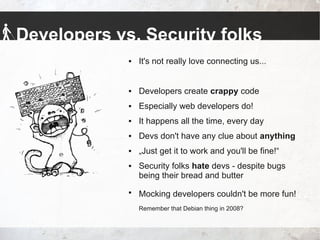
Developers vs. Security folks
 It's not really love connecting us...
 Developers create crappy code
 Especially web developers do!
 It happens all the time, every day
 Devs don't have any clue about anything
 „Just get it to work and you'll be fine!“
 Security folks hate devs - despite bugs
being their bread and butter

Mocking developers couldn't be more fun!
Remember that Debian thing in 2008?
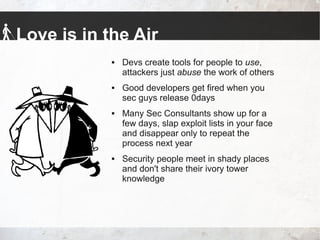
Love is in the Air
 Devs create tools for people to use,
attackers just abuse the work of others
 Good developers get fired when you
sec guys release 0days
 Many Sec Consultants show up for a
few days, slap exploit lists in your face
and disappear only to repeat the
process next year
 Security people meet in shady places
and don't share their ivory tower
knowledge
The Developer's LamentThe Developer's Lament
The Developer's Lament 1/2
 Security hurts performance
 Security hurts user acceptance
 Security hurts development time
 Even relative security is expensive
 Faulty security only becomes notable once it's too late
The Developer's Lament 2/2
 Execs believe that security can be bought (stern look at audience)
 Maybe a fancy IBM scanner license for 33K USD?
 Dependencies on third-party code and services make it hard to audit a
system in it's entirety
 Can you audit a large 200+ table monster at all?
 Unreviewed legacy code is everywhere - but refactoring is not a priority
 The deadline reigns supreme
 And worst of all we're juicy attack targets ourselves...
Why is that?
 Developer machines are located in the "secure" Intranet
 Devs are usually allowed to have highest privileges on their
workstations
 Developers are using web based tools and store tons of credentials in
their browsers
 Developers are power users and use a wide variety of software
 Developers are well connected and easy to reach
 Twitter, Facebook, Skype, GTalk, ICQ...
 They usually have unrestricted access to the extranet during work
hours
What to attack?
 Development Tools
 Communication Tools
 Code Repositories
 Knowledge Bases and Documentation Software
 Browser Extensions for Developers
 Administrative Backends
 Project Management Software
 Server Management Interfaces
 Cloud Service Management Consoles
Attacking Firebug 1/2
 Firebug is a Firefox extension assisting developers with their
frontend work
 Debugging, DOM Inspection, JavaScript Console, Network
Monitor and more
 Downloaded about 30 Million times
 Developers tend to have it activated at all time - for own and
foreign websites
 Security people love the tool too - eases client side pentesting
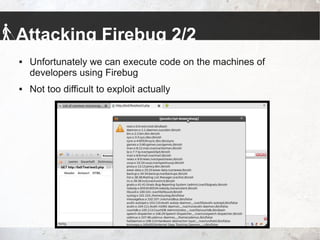
Attacking Firebug 2/2
 Unfortunately we can execute code on the machines of
developers using Firebug
 Not too difficult to exploit actually
Attacking IDE
 Code execution in a Firefox extension is bad - and has
major impact
 But what's even worse is messing with the developer's
most important tool
 The Integreated Development Environment
 Such as Eclipse or the Zend Studio
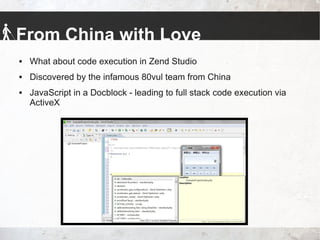
From China with Love
 What about code execution in Zend Studio
 Discovered by the infamous 80vul team from China
 JavaScript in a Docblock - leading to full stack code execution via
ActiveX
Admin Backends
 There's a cloud of tools available out there to help devs with their
daily tasks
 phpMyAdmin
 Plesk
 Confixx
 OTRS
 The usually run in intranet context - not accessible from the outside
 An outbound attacker cannot navigate them - so why bother about
security too much
 The intranet is for internal people only anyway - so why give a
damn?
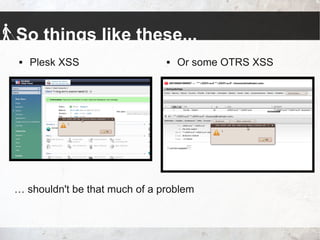
So things like these...
 Plesk XSS  Or some OTRS XSS
… shouldn't be that much of a problem
Or is it?Or is it?Ur mother hax box at Dell!Ur mother hax box at Dell!
Intranet XSS? Meh.
 Big problem it is. The attacker can
 Enumerate resources
 Manipulate data
 Sniff internal passwords and other things
 All pretty scary but none of this is new...
 What would be the holy grail for a bad guy attacking developers
and their companies?
 IXSSSVN attacks – Go Team Acronym!
Time for the juicy stuff!
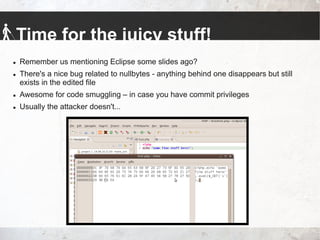
 Remember us mentioning Eclipse some slides ago?
 There's a nice bug related to nullbytes - anything behind one disappears but still
exists in the edited file
 Awesome for code smuggling – in case you have commit privileges
 Usually the attacker doesn't...
Scenario!
 Well imagine you can execute JavaScript with an Intranet XSS
 For example on a Trac or similar
 It's not hard to find out about the SVN URL now
 Even easier if the repositiory is public - like svn.twitter.com :D
 Now imagine the setup:
 XSS on https://intranet.compwny.com/trac/
 SVN is on https://intranet.compwny.com/svn/
 Not so untypical. Realize something? SOP says yay!
XSS the SVN - so what!
 SVN is usually interfaced with mod_dav_svn
 WebDAV - no more than HTTP with extra bacon
 JavaScript can generate HTTP requests
 Oh... Wait .. But do we have to re-implement the whole
DAV protocol dance in JavaScript?
 No - there's a lib for and it's free!
 DavClient
Intranet XSS gone wild
 So with an Intranet XSS we can do SVN commits
 And we can smuggle code into the Compwny's repository
 But everyone will notice!
 No! We use the nullbyte trick to hide the code
 They will notice at some point but it's really gonna take time if
the attacker is lucky
 And do you remember the attack against Zend Studio? Scared
already?
More ways to bust you
 Imagine an attacker aching for your local files
 Imagine you are head of development and keep the
company password list on your machine
 Yes - stuff like that exists
 But how to get hands on that precious file?
DOMXSS will do the trick
 What the.. what? DOMXSS? That lousy useless technique no one cares
about?
 Yep - that one
 Think local this time
 There a huge bunch of webapps on your harddrive - even with a freshly
installed OS
 Documentations, help systems, CouchDB etc. etc.
 Buggy as hell!
 Even Ubuntu 10 ships tons of Local DOMXSS right after installing!
 So we can theoretically use JavaScript to access YOUR harddrive?
Yes we can!
 Let's see how!
 Attacker sends the victim a presentation -
 Preferrably in OpenOffice format
 The first page is overlayed with a huge link
 The link points to a local DOMXSS - for example this one
file:///usr/share/couchdb/www/couch_tests.html#?data:,alert(location)//
 var testsPath = document.location.toString().split('?')[1];
 Why OpenOffice? Because it jumps to file:/// URIs without asking
 Now what?
Now for stealing some files
 We cannot do a lot here using only the browser
 XHR to local files is limited to the directory the XSS
happens in - no way to traverse down to / or C:///
 Kind of a SOP extension to secure users
 But luckily we have a helper
 *burp* … Java!
Step by Step
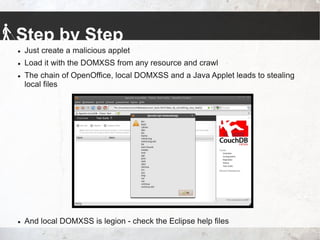
 Just create a malicious applet
 Load it with the DOMXSS from any resource and crawl
 The chain of OpenOffice, local DOMXSS and a Java Applet leads to stealing
local files
 And local DOMXSS is legion - check the Eclipse help files
So we're doomed, aren't we?So we're doomed, aren't we?
The big questions
 Do what now?
 What can be done to protect your asse(t)s?
 Is there a way out of the developer dilemma?
Protect yourself
 Don't **** where you eat
 Never reuse private passwords
 Chain your Mail Accounts – mitigate pwnage
 Do not publish Internals via Skype, Mail or even the
Calendar
NoScript et. al.
 Use Firefox and NoScript
 There's effectively no alternative on any other browser
setup
 NoScript blocks JavaScript on file:/// URIs by default
 Java is being kenneled too
 Best disable the Java plugin itself!
 Least privilege policy for any website
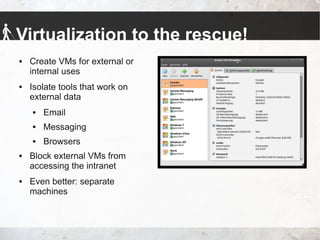
Virtualization to the rescue!
 Create VMs for external or
internal uses
 Isolate tools that work on
external data
 Email
 Messaging
 Browsers
 Block external VMs from
accessing the intranet
 Even better: separate
machines
Protect your Code
 Vulns occur when dealing with unconsidered user input
 You can't remember everything, unit tests can
 Build a vector database and use it to fuzz your application
yourself
 A well abstracted Framework helps a lot here
 Beware this ain't a catch-all
Know your stuff
 Handle 3rd Party software with extreme care
 Bad legacy code: refactor where you can
 Don't blindly trust the cloud - it's not your buddy
 Keep up
 Update your software
 Follow the security buzz
 Visit events like this!
Be proactive about app security!
 CSOs can fight the good fight at management level
 Security is a team efford!
 Attack your own app!
 Make internal company hack challenges
 Make security fun and sexy – as it is!
 Make creative use of rewards and punishments
How about a stupid hat for a day?
That was it
Thanks for your precious time!
Appendix
 Debian and OpenSSL http://www.links.org/?p=327
 Eclipse http://eclipse.org/
 Zend Studio http://www.zend.com/de/products/studio/
 The Zend Studio RCE http://80vul.com/Zend%20studio/Zend%20studio%20location%20Cross.htm
 Firebug https://addons.mozilla.org/de/firefox/addon/1843/
 Selenium https://addons.mozilla.org/en-US/firefox/addon/2079/
 DavClient http://debris.demon.nl/projects/davclient.js/doc/README.html
 CouchDB http://couchdb.apache.org/
 Github http://github.com/
 Amit Klein on DOMXSS http://www.webappsec.org/projects/articles/071105.shtml
 Chromium Blog on Local Web Pages http://blog.chromium.org/2008/12/security-in-depth-local-web-pages.html
 VirtualBox http://www.virtualbox.org/
 NoScript https://addons.mozilla.org/de/firefox/addon/1843/
 The guy who hosts that images we used http://www.plognark.com/
 Image credits
 Blind guy: SkyShaper@flickr
 Code Monkey: plognark.com
 Crying guy: nazreth@sxc.hu
 A silent cry: near proximity@flickr
 Spy vs. Spy.; DC Comics
 Exorcist still: Warner Bros.
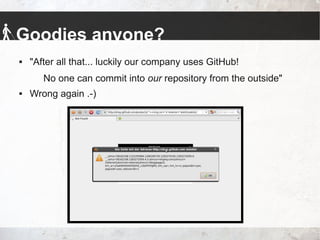
Goodies anyone?
 "After all that... luckily our company uses GitHub!
No one can commit into our repository from the outside"
 Wrong again .-)

Dev and Blind - Attacking the weakest Link in IT Security

  • 1.
    Dev and BlindDevand Blind Attacking the weakest link in IT security A Talk by Johannes Hofmann and Mario Heiderich Confidence 201002, Prague
  • 2.
    Introduction  Johannes Hofmann Ten years of web development experience  Security advocate  Senior Developer at a major european social network  @c_ion  Mario Heiderich  PHPIDS  HTML5 Security Cheat Sheet  Researcher for RUB and Microsoft  Web Developer Background  @0x6d6172696f
  • 3.
    What's to come Why to attack developers  A lot of love  What's the „web dev dilemma“  Attacks against developers  Be prepared to see scary things  New offensive techniques – so fresh they don't even have an acronym yet  Protection mechanisms that really work  Discussion and Q&A
  • 4.
    Developers vs. Securityfolks  It's not really love connecting us...  Developers create crappy code  Especially web developers do!  It happens all the time, every day  Devs don't have any clue about anything  „Just get it to work and you'll be fine!“  Security folks hate devs - despite bugs being their bread and butter  Mocking developers couldn't be more fun! Remember that Debian thing in 2008?
  • 5.
    Love is inthe Air  Devs create tools for people to use, attackers just abuse the work of others  Good developers get fired when you sec guys release 0days  Many Sec Consultants show up for a few days, slap exploit lists in your face and disappear only to repeat the process next year  Security people meet in shady places and don't share their ivory tower knowledge
  • 6.
    The Developer's LamentTheDeveloper's Lament
  • 7.
    The Developer's Lament1/2  Security hurts performance  Security hurts user acceptance  Security hurts development time  Even relative security is expensive  Faulty security only becomes notable once it's too late
  • 8.
    The Developer's Lament2/2  Execs believe that security can be bought (stern look at audience)  Maybe a fancy IBM scanner license for 33K USD?  Dependencies on third-party code and services make it hard to audit a system in it's entirety  Can you audit a large 200+ table monster at all?  Unreviewed legacy code is everywhere - but refactoring is not a priority  The deadline reigns supreme  And worst of all we're juicy attack targets ourselves...
  • 9.
    Why is that? Developer machines are located in the "secure" Intranet  Devs are usually allowed to have highest privileges on their workstations  Developers are using web based tools and store tons of credentials in their browsers  Developers are power users and use a wide variety of software  Developers are well connected and easy to reach  Twitter, Facebook, Skype, GTalk, ICQ...  They usually have unrestricted access to the extranet during work hours
  • 10.
    What to attack? Development Tools  Communication Tools  Code Repositories  Knowledge Bases and Documentation Software  Browser Extensions for Developers  Administrative Backends  Project Management Software  Server Management Interfaces  Cloud Service Management Consoles
  • 11.
    Attacking Firebug 1/2 Firebug is a Firefox extension assisting developers with their frontend work  Debugging, DOM Inspection, JavaScript Console, Network Monitor and more  Downloaded about 30 Million times  Developers tend to have it activated at all time - for own and foreign websites  Security people love the tool too - eases client side pentesting
  • 12.
    Attacking Firebug 2/2 Unfortunately we can execute code on the machines of developers using Firebug  Not too difficult to exploit actually
  • 13.
    Attacking IDE  Codeexecution in a Firefox extension is bad - and has major impact  But what's even worse is messing with the developer's most important tool  The Integreated Development Environment  Such as Eclipse or the Zend Studio
  • 14.
    From China withLove  What about code execution in Zend Studio  Discovered by the infamous 80vul team from China  JavaScript in a Docblock - leading to full stack code execution via ActiveX
  • 15.
    Admin Backends  There'sa cloud of tools available out there to help devs with their daily tasks  phpMyAdmin  Plesk  Confixx  OTRS  The usually run in intranet context - not accessible from the outside  An outbound attacker cannot navigate them - so why bother about security too much  The intranet is for internal people only anyway - so why give a damn?
  • 16.
    So things likethese...  Plesk XSS  Or some OTRS XSS … shouldn't be that much of a problem
  • 17.
    Or is it?Oris it?Ur mother hax box at Dell!Ur mother hax box at Dell!
  • 18.
    Intranet XSS? Meh. Big problem it is. The attacker can  Enumerate resources  Manipulate data  Sniff internal passwords and other things  All pretty scary but none of this is new...  What would be the holy grail for a bad guy attacking developers and their companies?  IXSSSVN attacks – Go Team Acronym!
  • 19.
    Time for thejuicy stuff!  Remember us mentioning Eclipse some slides ago?  There's a nice bug related to nullbytes - anything behind one disappears but still exists in the edited file  Awesome for code smuggling – in case you have commit privileges  Usually the attacker doesn't...
  • 20.
    Scenario!  Well imagineyou can execute JavaScript with an Intranet XSS  For example on a Trac or similar  It's not hard to find out about the SVN URL now  Even easier if the repositiory is public - like svn.twitter.com :D  Now imagine the setup:  XSS on https://intranet.compwny.com/trac/  SVN is on https://intranet.compwny.com/svn/  Not so untypical. Realize something? SOP says yay!
  • 21.
    XSS the SVN- so what!  SVN is usually interfaced with mod_dav_svn  WebDAV - no more than HTTP with extra bacon  JavaScript can generate HTTP requests  Oh... Wait .. But do we have to re-implement the whole DAV protocol dance in JavaScript?  No - there's a lib for and it's free!  DavClient
  • 22.
    Intranet XSS gonewild  So with an Intranet XSS we can do SVN commits  And we can smuggle code into the Compwny's repository  But everyone will notice!  No! We use the nullbyte trick to hide the code  They will notice at some point but it's really gonna take time if the attacker is lucky  And do you remember the attack against Zend Studio? Scared already?
  • 23.
    More ways tobust you  Imagine an attacker aching for your local files  Imagine you are head of development and keep the company password list on your machine  Yes - stuff like that exists  But how to get hands on that precious file?
  • 24.
    DOMXSS will dothe trick  What the.. what? DOMXSS? That lousy useless technique no one cares about?  Yep - that one  Think local this time  There a huge bunch of webapps on your harddrive - even with a freshly installed OS  Documentations, help systems, CouchDB etc. etc.  Buggy as hell!  Even Ubuntu 10 ships tons of Local DOMXSS right after installing!  So we can theoretically use JavaScript to access YOUR harddrive?
  • 25.
    Yes we can! Let's see how!  Attacker sends the victim a presentation -  Preferrably in OpenOffice format  The first page is overlayed with a huge link  The link points to a local DOMXSS - for example this one file:///usr/share/couchdb/www/couch_tests.html#?data:,alert(location)//  var testsPath = document.location.toString().split('?')[1];  Why OpenOffice? Because it jumps to file:/// URIs without asking  Now what?
  • 26.
    Now for stealingsome files  We cannot do a lot here using only the browser  XHR to local files is limited to the directory the XSS happens in - no way to traverse down to / or C:///  Kind of a SOP extension to secure users  But luckily we have a helper  *burp* … Java!
  • 27.
    Step by Step Just create a malicious applet  Load it with the DOMXSS from any resource and crawl  The chain of OpenOffice, local DOMXSS and a Java Applet leads to stealing local files  And local DOMXSS is legion - check the Eclipse help files
  • 28.
    So we're doomed,aren't we?So we're doomed, aren't we?
  • 29.
    The big questions Do what now?  What can be done to protect your asse(t)s?  Is there a way out of the developer dilemma?
  • 30.
    Protect yourself  Don't**** where you eat  Never reuse private passwords  Chain your Mail Accounts – mitigate pwnage  Do not publish Internals via Skype, Mail or even the Calendar
  • 31.
    NoScript et. al. Use Firefox and NoScript  There's effectively no alternative on any other browser setup  NoScript blocks JavaScript on file:/// URIs by default  Java is being kenneled too  Best disable the Java plugin itself!  Least privilege policy for any website
  • 32.
    Virtualization to therescue!  Create VMs for external or internal uses  Isolate tools that work on external data  Email  Messaging  Browsers  Block external VMs from accessing the intranet  Even better: separate machines
  • 33.
    Protect your Code Vulns occur when dealing with unconsidered user input  You can't remember everything, unit tests can  Build a vector database and use it to fuzz your application yourself  A well abstracted Framework helps a lot here  Beware this ain't a catch-all
  • 34.
    Know your stuff Handle 3rd Party software with extreme care  Bad legacy code: refactor where you can  Don't blindly trust the cloud - it's not your buddy  Keep up  Update your software  Follow the security buzz  Visit events like this!
  • 35.
    Be proactive aboutapp security!  CSOs can fight the good fight at management level  Security is a team efford!  Attack your own app!  Make internal company hack challenges  Make security fun and sexy – as it is!  Make creative use of rewards and punishments
  • 36.
    How about astupid hat for a day?
  • 37.
    That was it Thanksfor your precious time!
  • 38.
    Appendix  Debian andOpenSSL http://www.links.org/?p=327  Eclipse http://eclipse.org/  Zend Studio http://www.zend.com/de/products/studio/  The Zend Studio RCE http://80vul.com/Zend%20studio/Zend%20studio%20location%20Cross.htm  Firebug https://addons.mozilla.org/de/firefox/addon/1843/  Selenium https://addons.mozilla.org/en-US/firefox/addon/2079/  DavClient http://debris.demon.nl/projects/davclient.js/doc/README.html  CouchDB http://couchdb.apache.org/  Github http://github.com/  Amit Klein on DOMXSS http://www.webappsec.org/projects/articles/071105.shtml  Chromium Blog on Local Web Pages http://blog.chromium.org/2008/12/security-in-depth-local-web-pages.html  VirtualBox http://www.virtualbox.org/  NoScript https://addons.mozilla.org/de/firefox/addon/1843/  The guy who hosts that images we used http://www.plognark.com/  Image credits  Blind guy: SkyShaper@flickr  Code Monkey: plognark.com  Crying guy: nazreth@sxc.hu  A silent cry: near proximity@flickr  Spy vs. Spy.; DC Comics  Exorcist still: Warner Bros.
  • 39.
    Goodies anyone?  "Afterall that... luckily our company uses GitHub! No one can commit into our repository from the outside"  Wrong again .-)