1
Designing DDD
Aggregates
Presenter:
2
Table Of Contents
Introduction
What are Aggregates
Aggregate Root
Aggregate challenges
Design rules of thumb
Designing Aggregates
3
Introduction
It is a tactical DDD pattern.
Aggregate design is one of the most challenging tactical
tasks.
Goal?
oTry understand what an aggregate is.
oLook at real world use-cases.
oTry to set some rules of thumb for aggregate design.
oTry to design aggregates.
4
What are Aggregates
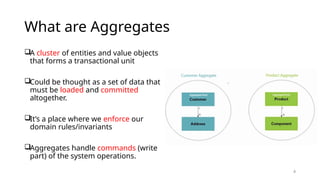
A cluster of entities and value objects
that forms a transactional unit
Could be thought as a set of data that
must be loaded and committed
altogether.
It’s a place where we enforce our
domain rules/invariants
Aggregates handle commands (write
part) of the system operations.
5
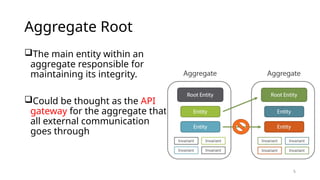
Aggregate Root
The main entity within an
aggregate responsible for
maintaining its integrity.
Could be thought as the API
gateway for the aggregate that
all external communication
goes through
6
Aggregate Challenges
Complex concept.
Extract & Discovering aggregates is hard.
Designing aggregates with the right boundary is a true pain
(Size & Performance tradeoffs).
Cross aggregate validation is one big challenge.
7
Designing Rules of Thumb
Let invariants be your leads/clues for designing.
Design aggregates to be small as much as possible.
Don’t get fooled by unreal domain invariants.
Design your aggregates to handle state-changing actions (commands
only).
Entity lifecycle is a strong indication of aggregate boundaries.
8
Designing Aggregates (E-commerce Order
1)
Design an e-commerce application order aggregatewhere a
user would be able to create an order, add, remove line
items, close, and place order.
Main Entities:
oOrder
oLineItem
9
Designing Aggregates (E-commerce Order
1) Cont.
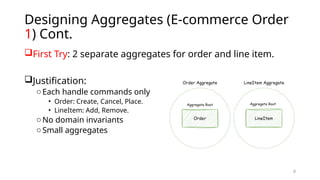
First Try: 2 separate aggregates for order and line item.
Justification:
oEach handle commands only
• Order: Create, Cancel, Place.
• LineItem: Add, Remove.
oNo domain invariants
oSmall aggregates
10
Designing Aggregates (E-commerce Order
2)
Design an e-commerce application order aggregatewhere a user
would be able to create an order, add, remove line items, close, and
place order.
Main Entities:
o Order
o LineItem
Knowing that
o An order must not contain more than 5-line items at once.
o If the total price exceeds 100$, then 5% discount is applied.
11
Designing Aggregates (E-commerce Order
2) Cont.
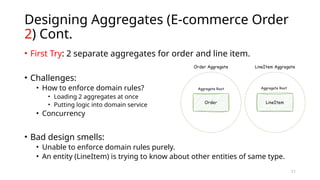
• First Try: 2 separate aggregates for order and line item.
• Challenges:
• How to enforce domain rules?
• Loading 2 aggregates at once
• Putting logic into domain service
• Concurrency
• Bad design smells:
• Unable to enforce domain rules purely.
• An entity (LineItem) is trying to know about other entities of same type.
12
Designing Aggregates (E-commerce Order
2) Cont.

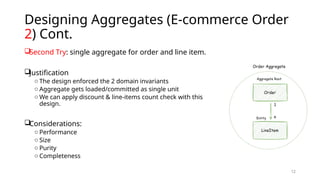
Second Try: single aggregate for order and line item.

Justification
o The design enforced the 2 domain invariants
o Aggregate gets loaded/committed as single unit
o We can apply discount & line-items count check with this
design.

Considerations:
o Performance
o Size
o Purity
o Completeness
13
Designing Aggregates (Ticket Aggregate 1)
You are required to design a Ticket aggregate in a project
management application, where a user can create ticket,
control its status (moving it to InProgress, Test, Done) and
close ticket.
Users are able to add comments in the ticket.
Main entities:
oTicket
oComment
14
Designing Aggregates (Ticket Aggregate 1)
Cont.
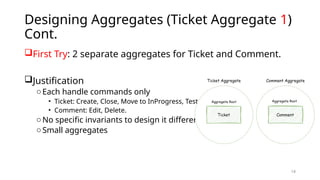
First Try: 2 separate aggregates for Ticket and Comment.
Justification
oEach handle commands only
• Ticket: Create, Close, Move to InProgress, Test ...
• Comment: Edit, Delete.
oNo specific invariants to design it differently
oSmall aggregates
15
Designing Aggregates (Ticket Aggregate 1)
Cont.
Argument #1: If a ticket gets deleted, all related comments must be
deleted so the comment entity should be an entity part of the ticket
aggregate due to this domain invariant.
Answer:
o That’s unreal-domain invariant, it’s instinctively obvious that we must
delete related comments when a ticket gets deleted.
o What we are seeing here is actually a relationship between entities than
a true invariant/behavior; and it’s very important to not overemphasize
entities relationships in DDD since we are modeling behaviors.
o A solution could be easily applied by emitting an event about a ticket
being deleted, and asynchronously we can delete related comments.
16
Designing Aggregates (Ticket Aggregate 1)
Cont.
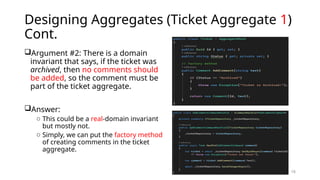
Argument #2: There is a domain
invariant that says, if the ticket was
archived, then no comments should
be added, so the comment must be
part of the ticket aggregate.
Answer:
o This could be a real-domain invariant
but mostly not.
o Simply, we can put the factory method
of creating comments in the ticket
aggregate.
17
Designing Aggregates (Ticket Aggregate 2)
You are required to design a Ticket aggregate in a project
management application, where a user can create ticket, control its
status (moving it to InProgress, Test, Done) and close ticket.
Users are also able to add comments in the ticket.
Main entities:
o Ticket
o Comment
Knowing that
o No more than 10 comments must be added to a single ticket.
18
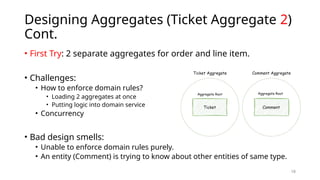
Designing Aggregates (Ticket Aggregate 2)
Cont.
• First Try: 2 separate aggregates for order and line item.
• Challenges:
• How to enforce domain rules?
• Loading 2 aggregates at once
• Putting logic into domain service
• Concurrency
• Bad design smells:
• Unable to enforce domain rules purely.
• An entity (Comment) is trying to know about other entities of same type.
19
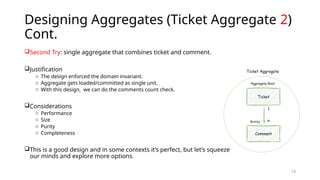
Designing Aggregates (Ticket Aggregate 2)
Cont.
Second Try: single aggregate that combines ticket and comment.
Justification
o The design enforced the domain invariant.
o Aggregate gets loaded/committed as single unit.
o With this design, we can do the comments count check.
Considerations
o Performance
o Size
o Purity
o Completeness
This is a good design and in some contexts it’s perfect, but let’s squeeze
our minds and explore more options.
20
Designing Aggregates (Ticket Aggregate 2)
Cont.
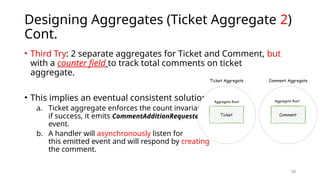
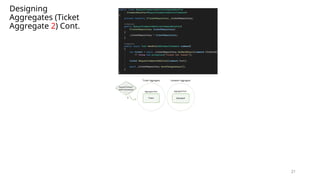
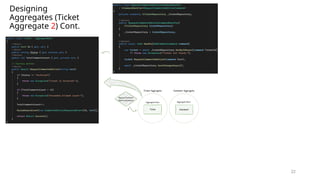
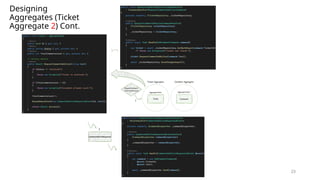
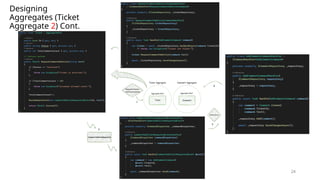
• Third Try: 2 separate aggregates for Ticket and Comment, but
with a counter field to track total comments on ticket
aggregate.
• This implies an eventual consistent solution:
a. Ticket aggregate enforces the count invariant;
if success, it emits CommentAdditionRequested
event.
b. A handler will asynchronously listen for
this emitted event and will respond by creating
the comment.
21
Designing
Aggregates (Ticket
Aggregate 2) Cont.
22
Designing
Aggregates (Ticket
Aggregate 2) Cont.
23
Designing
Aggregates (Ticket
Aggregate 2) Cont.
24
Designing
Aggregates (Ticket
Aggregate 2) Cont.
25
Conclusions
Aggregates should not necessarily represent something meaningful to real life
or common sense, as long as they are enforcing and fulfilling domain rules, then
that’s fine.
There are no deterministic rules to always follow when designing aggregates.
It’s about balancing trade-offs.
Designing aggregates is being more of an art instead of a deterministic
approach.
PRACTICE MAKES PERFECT.
26
Thank You!
Presenter: Maysam Mousa

Designing Domain-Driven Design Aggregates

  • 1.
  • 2.
    2 Table Of Contents Introduction Whatare Aggregates Aggregate Root Aggregate challenges Design rules of thumb Designing Aggregates
  • 3.
    3 Introduction It is atactical DDD pattern. Aggregate design is one of the most challenging tactical tasks. Goal? oTry understand what an aggregate is. oLook at real world use-cases. oTry to set some rules of thumb for aggregate design. oTry to design aggregates.
  • 4.
    4 What are Aggregates Acluster of entities and value objects that forms a transactional unit Could be thought as a set of data that must be loaded and committed altogether. It’s a place where we enforce our domain rules/invariants Aggregates handle commands (write part) of the system operations.
  • 5.
    5 Aggregate Root The mainentity within an aggregate responsible for maintaining its integrity. Could be thought as the API gateway for the aggregate that all external communication goes through
  • 6.
    6 Aggregate Challenges Complex concept. Extract& Discovering aggregates is hard. Designing aggregates with the right boundary is a true pain (Size & Performance tradeoffs). Cross aggregate validation is one big challenge.
  • 7.
    7 Designing Rules ofThumb Let invariants be your leads/clues for designing. Design aggregates to be small as much as possible. Don’t get fooled by unreal domain invariants. Design your aggregates to handle state-changing actions (commands only). Entity lifecycle is a strong indication of aggregate boundaries.
  • 8.
    8 Designing Aggregates (E-commerceOrder 1) Design an e-commerce application order aggregatewhere a user would be able to create an order, add, remove line items, close, and place order. Main Entities: oOrder oLineItem
  • 9.
    9 Designing Aggregates (E-commerceOrder 1) Cont. First Try: 2 separate aggregates for order and line item. Justification: oEach handle commands only • Order: Create, Cancel, Place. • LineItem: Add, Remove. oNo domain invariants oSmall aggregates
  • 10.
    10 Designing Aggregates (E-commerceOrder 2) Design an e-commerce application order aggregatewhere a user would be able to create an order, add, remove line items, close, and place order. Main Entities: o Order o LineItem Knowing that o An order must not contain more than 5-line items at once. o If the total price exceeds 100$, then 5% discount is applied.
  • 11.
    11 Designing Aggregates (E-commerceOrder 2) Cont. • First Try: 2 separate aggregates for order and line item. • Challenges: • How to enforce domain rules? • Loading 2 aggregates at once • Putting logic into domain service • Concurrency • Bad design smells: • Unable to enforce domain rules purely. • An entity (LineItem) is trying to know about other entities of same type.
  • 12.
    12 Designing Aggregates (E-commerceOrder 2) Cont.  Second Try: single aggregate for order and line item.  Justification o The design enforced the 2 domain invariants o Aggregate gets loaded/committed as single unit o We can apply discount & line-items count check with this design.  Considerations: o Performance o Size o Purity o Completeness
  • 13.
    13 Designing Aggregates (TicketAggregate 1) You are required to design a Ticket aggregate in a project management application, where a user can create ticket, control its status (moving it to InProgress, Test, Done) and close ticket. Users are able to add comments in the ticket. Main entities: oTicket oComment
  • 14.
    14 Designing Aggregates (TicketAggregate 1) Cont. First Try: 2 separate aggregates for Ticket and Comment. Justification oEach handle commands only • Ticket: Create, Close, Move to InProgress, Test ... • Comment: Edit, Delete. oNo specific invariants to design it differently oSmall aggregates
  • 15.
    15 Designing Aggregates (TicketAggregate 1) Cont. Argument #1: If a ticket gets deleted, all related comments must be deleted so the comment entity should be an entity part of the ticket aggregate due to this domain invariant. Answer: o That’s unreal-domain invariant, it’s instinctively obvious that we must delete related comments when a ticket gets deleted. o What we are seeing here is actually a relationship between entities than a true invariant/behavior; and it’s very important to not overemphasize entities relationships in DDD since we are modeling behaviors. o A solution could be easily applied by emitting an event about a ticket being deleted, and asynchronously we can delete related comments.
  • 16.
    16 Designing Aggregates (TicketAggregate 1) Cont. Argument #2: There is a domain invariant that says, if the ticket was archived, then no comments should be added, so the comment must be part of the ticket aggregate. Answer: o This could be a real-domain invariant but mostly not. o Simply, we can put the factory method of creating comments in the ticket aggregate.
  • 17.
    17 Designing Aggregates (TicketAggregate 2) You are required to design a Ticket aggregate in a project management application, where a user can create ticket, control its status (moving it to InProgress, Test, Done) and close ticket. Users are also able to add comments in the ticket. Main entities: o Ticket o Comment Knowing that o No more than 10 comments must be added to a single ticket.
  • 18.
    18 Designing Aggregates (TicketAggregate 2) Cont. • First Try: 2 separate aggregates for order and line item. • Challenges: • How to enforce domain rules? • Loading 2 aggregates at once • Putting logic into domain service • Concurrency • Bad design smells: • Unable to enforce domain rules purely. • An entity (Comment) is trying to know about other entities of same type.
  • 19.
    19 Designing Aggregates (TicketAggregate 2) Cont. Second Try: single aggregate that combines ticket and comment. Justification o The design enforced the domain invariant. o Aggregate gets loaded/committed as single unit. o With this design, we can do the comments count check. Considerations o Performance o Size o Purity o Completeness This is a good design and in some contexts it’s perfect, but let’s squeeze our minds and explore more options.
  • 20.
    20 Designing Aggregates (TicketAggregate 2) Cont. • Third Try: 2 separate aggregates for Ticket and Comment, but with a counter field to track total comments on ticket aggregate. • This implies an eventual consistent solution: a. Ticket aggregate enforces the count invariant; if success, it emits CommentAdditionRequested event. b. A handler will asynchronously listen for this emitted event and will respond by creating the comment.
  • 21.
  • 22.
  • 23.
  • 24.
  • 25.
    25 Conclusions Aggregates should notnecessarily represent something meaningful to real life or common sense, as long as they are enforcing and fulfilling domain rules, then that’s fine. There are no deterministic rules to always follow when designing aggregates. It’s about balancing trade-offs. Designing aggregates is being more of an art instead of a deterministic approach. PRACTICE MAKES PERFECT.
  • 26.