Gandhinagar Institute of
Technology
Topic : “Design half ,full Adder and Subtractor ”.
Guided by: Prof. Jatin Chakravarti
Digital Electronics()
Active Learning Assignment
Prepared by : Yash Balani (150120116003)
Yogesh Balani (150120116004)
Jaimin Darji (150120116013)
Branch : IT
Division : A(A1)
Index
 Adder
 Half adder
 Full adder
 Subtractor
 Half Subtractor
 Full Subtractor
Adder
 An adder is a digital logic circuit in electronics that implements addition of numbers.
 In many computers and other kinds of processors, adders are used not only in
the arithmetic logic units, but also in other parts of the processor, where they are used to
calculate addresses, increment and decrement operators, and similar operations.
 Adders are classified into two types: 1)half adder.
2) full adder.
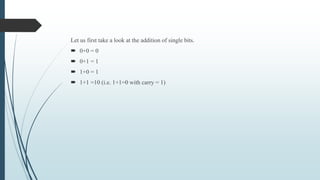
Let us first take a look at the addition of single bits.
 0+0 = 0
 0+1 = 1
 1+0 = 1
 1+1 =10 (i.e. 1+1=0 with carry = 1)
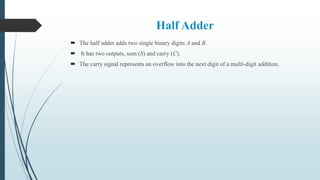
Half Adder
 The half adder adds two single binary digits A and B.
 It has two outputs, sum (S) and carry (C).
 The carry signal represents an overflow into the next digit of a multi-digit addition.
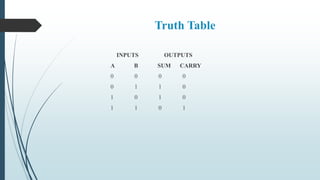
Truth Table
INPUTS OUTPUTS
A B SUM CARRY
0 0 0 0
0 1 1 0
1 0 1 0
1 1 0 1
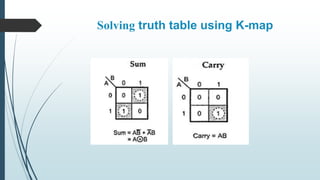
Solving truth table using K-map
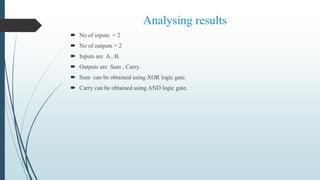
Analysing results
 No of inputs = 2
 No of outputs = 2
 Inputs are A , B.
 Outputs are Sum , Carry.
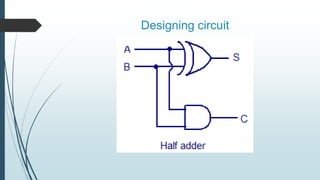
 Sum can be obtained using XOR logic gate.
 Carry can be obtained using AND logic gate.
Designing circuit
Full Adder
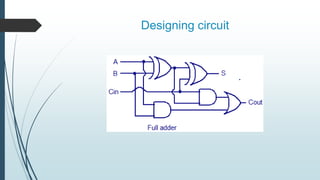
 A full adder adds binary numbers and accounts for values carried in as well as out.
 The main difference between a half-adder and a full-adder is that the full-adder has three
inputs and two outputs.
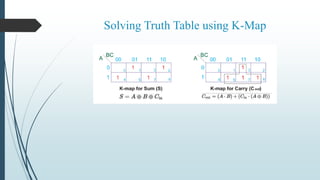
 A one-bit full adder adds three one-bit numbers, often written as A, B, and Cin.
 It has two outputs, sum (S) and carry (Cout).
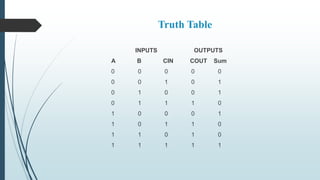
Truth Table
INPUTS OUTPUTS
A B CIN COUT Sum
0 0 0 0 0
0 0 1 0 1
0 1 0 0 1
0 1 1 1 0
1 0 0 0 1
1 0 1 1 0
1 1 0 1 0
1 1 1 1 1
Solving Truth Table using K-Map
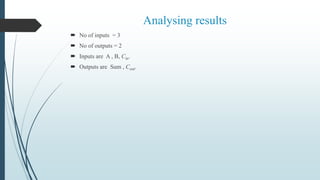
Analysing results
 No of inputs = 3
 No of outputs = 2
 Inputs are A , B, Cin.
 Outputs are Sum , Cout.
Designing circuit
Subtractor
 An Subtractor is a digital logic circuit in electronics that implements subtraction of
numbers.
 In many computers and other kinds of processors, Subtractor are used not only in
the arithmetic logic units, but also in other parts of the processor, where they are used to
calculate addresses, increment and decrement operators, and similar operations.
 Substractor are classified into two types: 1)half Subtractor.
2) full Subtractor.
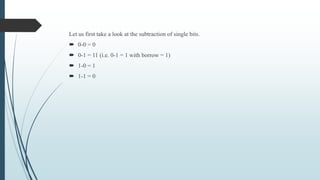
Let us first take a look at the subtraction of single bits.
 0-0 = 0
 0-1 = 11 (i.e. 0-1 = 1 with borrow = 1)
 1-0 = 1
 1-1 = 0
Half Subtractor
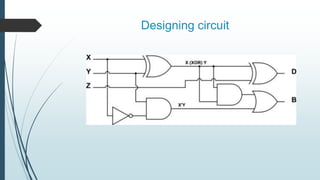
 The half Subtractor subtracts two single binary digits A and B.
 It has two outputs, Difference (D) and borrow (B).
 The borrow signal represents an overflow into the next digit of a multi-digit subtraction.
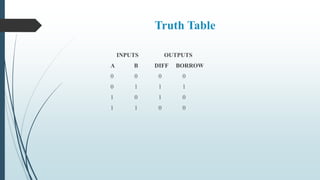
Truth Table
INPUTS OUTPUTS
A B DIFF BORROW
0 0 0 0
0 1 1 1
1 0 1 0
1 1 0 0
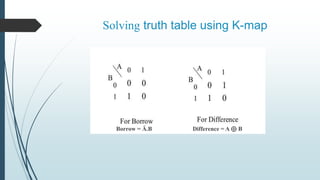
Solving truth table using K-map
Borrow = Ā.B Difference = A ⊕ B
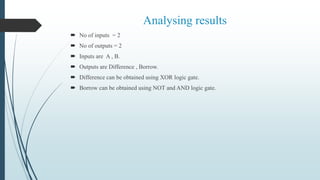
Analysing results
 No of inputs = 2
 No of outputs = 2
 Inputs are A , B.
 Outputs are Difference , Borrow.
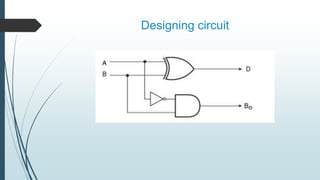
 Difference can be obtained using XOR logic gate.
 Borrow can be obtained using NOT and AND logic gate.
Designing circuit
Full Subtractor
 A full Subtractor subtracts binary numbers and accounts for values borrowed in as well as
out.
 The main difference between a half- Subtractor and a full- Subtractor is that the full-
Subtractor has three inputs and two outputs.
 A one-bit full Subtractor subtracts three one-bit numbers, often written as A, B, and Bin.
 It has two outputs, Difference (D) and borrow (B).
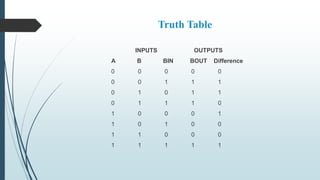
Truth Table
INPUTS OUTPUTS
A B BIN BOUT Difference
0 0 0 0 0
0 0 1 1 1
0 1 0 1 1
0 1 1 1 0
1 0 0 0 1
1 0 1 0 0
1 1 0 0 0
1 1 1 1 1
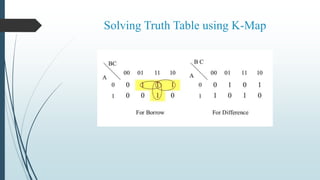
Solving Truth Table using K-Map
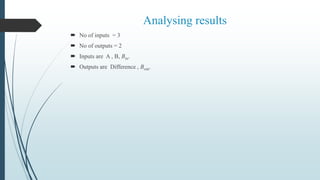
Analysing results
 No of inputs = 3
 No of outputs = 2
 Inputs are A , B, Bin.
 Outputs are Difference , Bout.
Designing circuit
Thank you.

Design half ,full Adder and Subtractor

  • 1.
    Gandhinagar Institute of Technology Topic: “Design half ,full Adder and Subtractor ”. Guided by: Prof. Jatin Chakravarti Digital Electronics() Active Learning Assignment Prepared by : Yash Balani (150120116003) Yogesh Balani (150120116004) Jaimin Darji (150120116013) Branch : IT Division : A(A1)
  • 2.
    Index  Adder  Halfadder  Full adder  Subtractor  Half Subtractor  Full Subtractor
  • 3.
    Adder  An adderis a digital logic circuit in electronics that implements addition of numbers.  In many computers and other kinds of processors, adders are used not only in the arithmetic logic units, but also in other parts of the processor, where they are used to calculate addresses, increment and decrement operators, and similar operations.  Adders are classified into two types: 1)half adder. 2) full adder.
  • 4.
    Let us firsttake a look at the addition of single bits.  0+0 = 0  0+1 = 1  1+0 = 1  1+1 =10 (i.e. 1+1=0 with carry = 1)
  • 5.
    Half Adder  Thehalf adder adds two single binary digits A and B.  It has two outputs, sum (S) and carry (C).  The carry signal represents an overflow into the next digit of a multi-digit addition.
  • 6.
    Truth Table INPUTS OUTPUTS AB SUM CARRY 0 0 0 0 0 1 1 0 1 0 1 0 1 1 0 1
  • 7.
  • 8.
    Analysing results  Noof inputs = 2  No of outputs = 2  Inputs are A , B.  Outputs are Sum , Carry.  Sum can be obtained using XOR logic gate.  Carry can be obtained using AND logic gate.
  • 9.
  • 10.
    Full Adder  Afull adder adds binary numbers and accounts for values carried in as well as out.  The main difference between a half-adder and a full-adder is that the full-adder has three inputs and two outputs.  A one-bit full adder adds three one-bit numbers, often written as A, B, and Cin.  It has two outputs, sum (S) and carry (Cout).
  • 11.
    Truth Table INPUTS OUTPUTS AB CIN COUT Sum 0 0 0 0 0 0 0 1 0 1 0 1 0 0 1 0 1 1 1 0 1 0 0 0 1 1 0 1 1 0 1 1 0 1 0 1 1 1 1 1
  • 12.
  • 13.
    Analysing results  Noof inputs = 3  No of outputs = 2  Inputs are A , B, Cin.  Outputs are Sum , Cout.
  • 14.
  • 15.
    Subtractor  An Subtractoris a digital logic circuit in electronics that implements subtraction of numbers.  In many computers and other kinds of processors, Subtractor are used not only in the arithmetic logic units, but also in other parts of the processor, where they are used to calculate addresses, increment and decrement operators, and similar operations.  Substractor are classified into two types: 1)half Subtractor. 2) full Subtractor.
  • 16.
    Let us firsttake a look at the subtraction of single bits.  0-0 = 0  0-1 = 11 (i.e. 0-1 = 1 with borrow = 1)  1-0 = 1  1-1 = 0
  • 17.
    Half Subtractor  Thehalf Subtractor subtracts two single binary digits A and B.  It has two outputs, Difference (D) and borrow (B).  The borrow signal represents an overflow into the next digit of a multi-digit subtraction.
  • 18.
    Truth Table INPUTS OUTPUTS AB DIFF BORROW 0 0 0 0 0 1 1 1 1 0 1 0 1 1 0 0
  • 19.
    Solving truth tableusing K-map Borrow = Ā.B Difference = A ⊕ B
  • 20.
    Analysing results  Noof inputs = 2  No of outputs = 2  Inputs are A , B.  Outputs are Difference , Borrow.  Difference can be obtained using XOR logic gate.  Borrow can be obtained using NOT and AND logic gate.
  • 21.
  • 22.
    Full Subtractor  Afull Subtractor subtracts binary numbers and accounts for values borrowed in as well as out.  The main difference between a half- Subtractor and a full- Subtractor is that the full- Subtractor has three inputs and two outputs.  A one-bit full Subtractor subtracts three one-bit numbers, often written as A, B, and Bin.  It has two outputs, Difference (D) and borrow (B).
  • 23.
    Truth Table INPUTS OUTPUTS AB BIN BOUT Difference 0 0 0 0 0 0 0 1 1 1 0 1 0 1 1 0 1 1 1 0 1 0 0 0 1 1 0 1 0 0 1 1 0 0 0 1 1 1 1 1
  • 24.
  • 25.
    Analysing results  Noof inputs = 3  No of outputs = 2  Inputs are A , B, Bin.  Outputs are Difference , Bout.
  • 26.
  • 27.