DR. S & S.S GHANDHY 
GEC,SURAT 
ELECTRICAL ENGINEERING 
DEPARTMENT 
DESIGN ENGINEERING(2130005) 
SUBJECT:- Design of Transformation 
for certain application
Group Members 
Name 
• LETHWALA PAVAN 
• MALKIYA ASHISH 
• MARATHE POOJA 
• MEHTA KARNAV 
• GANDHI MITESH 
Enrolment No. 
• 130230109024 
• 130230109025 
• 130230109026 
• 130230109027 
• 130230109028
Types of Energy required for 
Transformation into Electrical energy 
• Thermal Energy 
• Hydro Energy 
• Solar Energy 
• Tidal Energy 
• Wind Energy
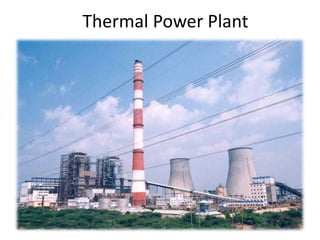
Thermal Power Plant
Introduction to Thermal Power Plant 
• A Thermal Power Plant converts the heat energy of coal 
into electrical energy. Coal is burnt in a boiler which 
converts water into steam. The expansion of steam in 
turbine produces mechanical power which drives the 
alternator coupled to the turbine.Thermal Power Plants 
contribute maximum to the generation of Power for any 
country 
• Thermal Power Plants constitute 75.43% of the total 
installed captive and non-captive power generation in India 
• In thermal generating stations coal, oil, natural gas etc. are 
employed as primary sources of energy.
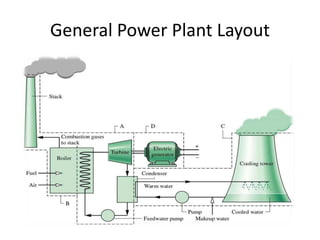
General Power Plant Layout
Operation Mechanism 
• The coal is brought and crushed to powder. This is feed to 
Boiler for producing heat 
• In Boiler the water is converted to steam. 
• In Super heater the moisture content is removed from the 
steam and that steam is called super heated steam 
• The superheated steam rotates the shaft of the High 
pressure turbine 
• The Exhausted steam is sent to preheater and the steam 
then rotates the Intermediate pressure(IP) Turbine 
• The steam from the IP turbine is then feed to low pressure 
turbine. 
• The turbine shaft is connected to the Generator, which 
produces Electric Power. 
• The power generated is then Transmitted.
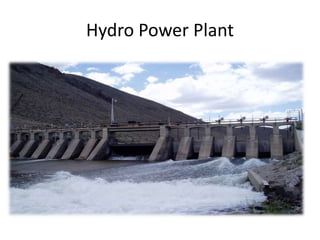
Hydro Power Plant
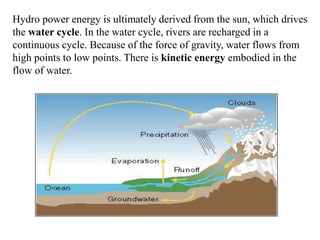
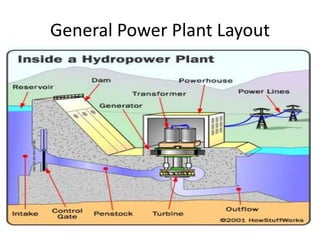
Hydro power energy is ultimately derived from the sun, which drives 
the water cycle. In the water cycle, rivers are recharged in a 
continuous cycle. Because of the force of gravity, water flows from 
high points to low points. There is kinetic energy embodied in the 
flow of water.
General Power Plant Layout
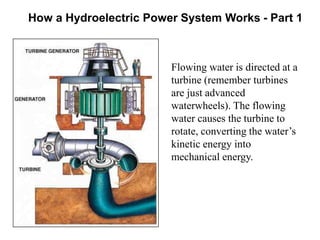
How a Hydroelectric Power System Works - Part 1 
Flowing water is directed at a 
turbine (remember turbines 
are just advanced 
waterwheels). The flowing 
water causes the turbine to 
rotate, converting the water’s 
kinetic energy into 
mechanical energy.
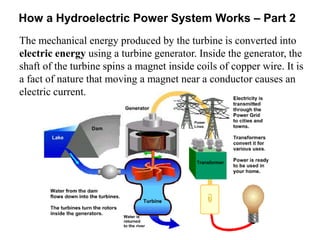
How a Hydroelectric Power System Works – Part 2 
The mechanical energy produced by the turbine is converted into 
electric energy using a turbine generator. Inside the generator, the 
shaft of the turbine spins a magnet inside coils of copper wire. It is 
a fact of nature that moving a magnet near a conductor causes an 
electric current.
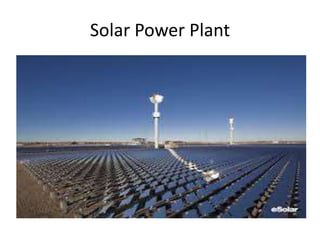
Solar Power Plant
Electricity From Solar Energy 
• Photovoltaic Electricity – This method uses 
photovoltaic cells that absorb the direct sunlight 
just like the solar cells you see on some 
calculators. 
• Solar-Thermal Electricity – 
• This also uses a solar collector: it has a mirrored 
surface that reflects the sunlight onto a receiver 
that heats up a liquid. This heated liquid is used 
to make steam that produces electricity.
Photovoltaic Cell 
• Photo voltaic effect (PV) effect is defined as 
the generation of an electromotive force as a 
result of the absorption of ionising radiation 
• Solar cell are usually made of a single crystal 
silicon, gallium arsenide is another solar cells 
material.
Working of Photovoltaic Solar Plants 
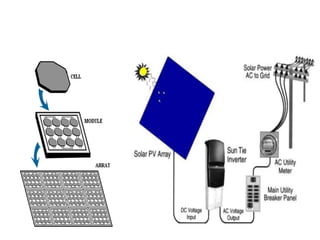
• As light hits the solar panels, the solar radiation is 
converted into direct current electricity (DC). 
• The direct current flows from the panels and is 
converted into alternating current (AC) used by local 
electric utilities. 
• Finally, the electricity travels through transformers, 
and the voltage is boosted for delivery onto the 
transmission lines so local electric utilities can 
distribute the electricity to homes and businesses.
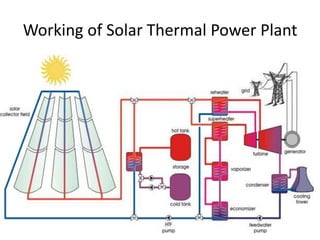
Working of Solar Thermal Power Plant
Working of Solar Thermal Power Plant 
• Solar collectors capture and concentrate sunlight 
to heat a synthetic oil called therminol, which 
then heats water to create steam. 
• The steam is piped to an onsite turbine-generator 
to produce electricity, which is then transmitted 
over power lines. 
• On cloudy days, the plant has a supplementary 
natural gas boiler. The plant can burn natural gas 
to heat the water, creating steam to generate 
electricity.
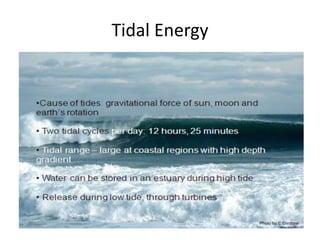
Tidal Energy
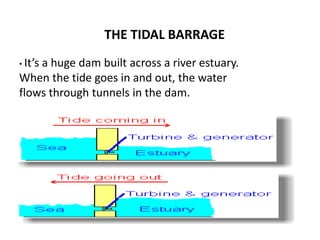
THE TIDAL BARRAGE 
• It’s a huge dam built across a river estuary. 
When the tide goes in and out, the water 
flows through tunnels in the dam.
Ocean Thermal Energy Conversion 
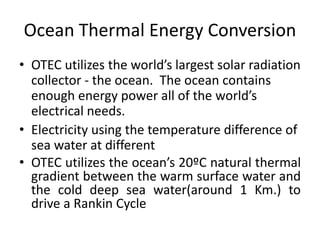
• OTEC utilizes the world’s largest solar radiation 
collector - the ocean. The ocean contains 
enough energy power all of the world’s 
electrical needs. 
• Electricity using the temperature difference of 
sea water at different 
• OTEC utilizes the ocean’s 20ºC natural thermal 
gradient between the warm surface water and 
the cold deep sea water(around 1 Km.) to 
drive a Rankin Cycle
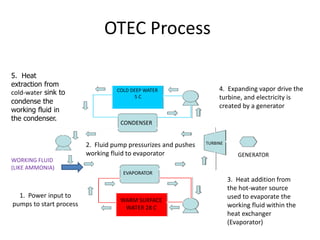
CONDENSER 
2. Fluid pump pressurizes and pushes 
working fluid to evaporator 
1. Power input to 
pumps to start process 
3. Heat addition from 
the hot-water source 
used to evaporate the 
working fluid within the 
heat exchanger 
(Evaporator) 
EVAPORATOR 
WARM SURFACE 
WATER 28 C 
4. Expanding vapor drive the 
turbine, and electricity is 
created by a generator 
5. Heat 
extraction from 
cold-water sink to 
condense the 
working fluid in 
the condenser. 
TURBINE 
GENERATOR 
COLD DEEP WATER 
5 C 
WORKING FLUID 
(LIKE AMMONIA) 
OTEC Process
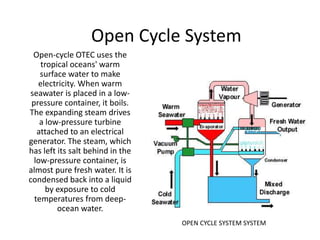
Open Cycle System 
OPEN CYCLE SYSTEM SYSTEM 
Open-cycle OTEC uses the 
tropical oceans' warm 
surface water to make 
electricity. When warm 
seawater is placed in a low-pressure 
container, it boils. 
The expanding steam drives 
a low-pressure turbine 
attached to an electrical 
generator. The steam, which 
has left its salt behind in the 
low-pressure container, is 
almost pure fresh water. It is 
condensed back into a liquid 
by exposure to cold 
temperatures from deep-ocean 
water.
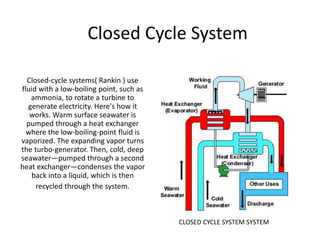
Closed Cycle System 
CLOSED CYCLE SYSTEM SYSTEM 
Closed-cycle systems( Rankin ) use 
fluid with a low-boiling point, such as 
ammonia, to rotate a turbine to 
generate electricity. Here's how it 
works. Warm surface seawater is 
pumped through a heat exchanger 
where the low-boiling-point fluid is 
vaporized. The expanding vapor turns 
the turbo-generator. Then, cold, deep 
seawater—pumped through a second 
heat exchanger—condenses the vapor 
back into a liquid, which is then 
recycled through the system.
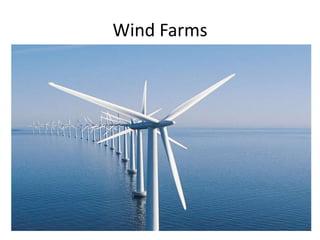
Wind Farms
How do you convert wind into 
Electricity??? 
• Wind turbines convert the kinetic energy in the wind 
into mechanical power. 
• This mechanical power can be used for specific tasks 
(such as grinding grain or pumping water) or a 
generator can convert this mechanical power into 
electricity. 
• A wind turbine works the opposite of a fan. 
• Instead of using electricity to make wind, like a fan, 
wind turbines use wind to make electricity. The wind 
turns the blades, which spin a shaft, which connects to 
a generator and makes electricity.
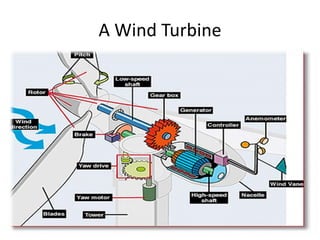
• The energy in the wind turns two or three 
propeller-like blades around a rotor. The rotor 
is connected to the main shaft, which spins a 
generator to create electricity. 
• Wind turbines are mounted on a tower to 
capture the most energy. At 100 feet (30 
meters) or more above ground, they can take 
advantage of faster and less turbulent wind.
A Wind Turbine
Thank You

DESIGN ENGINEERING

  • 1.
    DR. S &S.S GHANDHY GEC,SURAT ELECTRICAL ENGINEERING DEPARTMENT DESIGN ENGINEERING(2130005) SUBJECT:- Design of Transformation for certain application
  • 2.
    Group Members Name • LETHWALA PAVAN • MALKIYA ASHISH • MARATHE POOJA • MEHTA KARNAV • GANDHI MITESH Enrolment No. • 130230109024 • 130230109025 • 130230109026 • 130230109027 • 130230109028
  • 3.
    Types of Energyrequired for Transformation into Electrical energy • Thermal Energy • Hydro Energy • Solar Energy • Tidal Energy • Wind Energy
  • 4.
  • 5.
    Introduction to ThermalPower Plant • A Thermal Power Plant converts the heat energy of coal into electrical energy. Coal is burnt in a boiler which converts water into steam. The expansion of steam in turbine produces mechanical power which drives the alternator coupled to the turbine.Thermal Power Plants contribute maximum to the generation of Power for any country • Thermal Power Plants constitute 75.43% of the total installed captive and non-captive power generation in India • In thermal generating stations coal, oil, natural gas etc. are employed as primary sources of energy.
  • 6.
  • 7.
    Operation Mechanism •The coal is brought and crushed to powder. This is feed to Boiler for producing heat • In Boiler the water is converted to steam. • In Super heater the moisture content is removed from the steam and that steam is called super heated steam • The superheated steam rotates the shaft of the High pressure turbine • The Exhausted steam is sent to preheater and the steam then rotates the Intermediate pressure(IP) Turbine • The steam from the IP turbine is then feed to low pressure turbine. • The turbine shaft is connected to the Generator, which produces Electric Power. • The power generated is then Transmitted.
  • 8.
  • 9.
    Hydro power energyis ultimately derived from the sun, which drives the water cycle. In the water cycle, rivers are recharged in a continuous cycle. Because of the force of gravity, water flows from high points to low points. There is kinetic energy embodied in the flow of water.
  • 10.
  • 11.
    How a HydroelectricPower System Works - Part 1 Flowing water is directed at a turbine (remember turbines are just advanced waterwheels). The flowing water causes the turbine to rotate, converting the water’s kinetic energy into mechanical energy.
  • 12.
    How a HydroelectricPower System Works – Part 2 The mechanical energy produced by the turbine is converted into electric energy using a turbine generator. Inside the generator, the shaft of the turbine spins a magnet inside coils of copper wire. It is a fact of nature that moving a magnet near a conductor causes an electric current.
  • 13.
  • 14.
    Electricity From SolarEnergy • Photovoltaic Electricity – This method uses photovoltaic cells that absorb the direct sunlight just like the solar cells you see on some calculators. • Solar-Thermal Electricity – • This also uses a solar collector: it has a mirrored surface that reflects the sunlight onto a receiver that heats up a liquid. This heated liquid is used to make steam that produces electricity.
  • 15.
    Photovoltaic Cell •Photo voltaic effect (PV) effect is defined as the generation of an electromotive force as a result of the absorption of ionising radiation • Solar cell are usually made of a single crystal silicon, gallium arsenide is another solar cells material.
  • 17.
    Working of PhotovoltaicSolar Plants • As light hits the solar panels, the solar radiation is converted into direct current electricity (DC). • The direct current flows from the panels and is converted into alternating current (AC) used by local electric utilities. • Finally, the electricity travels through transformers, and the voltage is boosted for delivery onto the transmission lines so local electric utilities can distribute the electricity to homes and businesses.
  • 18.
    Working of SolarThermal Power Plant
  • 19.
    Working of SolarThermal Power Plant • Solar collectors capture and concentrate sunlight to heat a synthetic oil called therminol, which then heats water to create steam. • The steam is piped to an onsite turbine-generator to produce electricity, which is then transmitted over power lines. • On cloudy days, the plant has a supplementary natural gas boiler. The plant can burn natural gas to heat the water, creating steam to generate electricity.
  • 20.
  • 21.
    THE TIDAL BARRAGE • It’s a huge dam built across a river estuary. When the tide goes in and out, the water flows through tunnels in the dam.
  • 22.
    Ocean Thermal EnergyConversion • OTEC utilizes the world’s largest solar radiation collector - the ocean. The ocean contains enough energy power all of the world’s electrical needs. • Electricity using the temperature difference of sea water at different • OTEC utilizes the ocean’s 20ºC natural thermal gradient between the warm surface water and the cold deep sea water(around 1 Km.) to drive a Rankin Cycle
  • 23.
    CONDENSER 2. Fluidpump pressurizes and pushes working fluid to evaporator 1. Power input to pumps to start process 3. Heat addition from the hot-water source used to evaporate the working fluid within the heat exchanger (Evaporator) EVAPORATOR WARM SURFACE WATER 28 C 4. Expanding vapor drive the turbine, and electricity is created by a generator 5. Heat extraction from cold-water sink to condense the working fluid in the condenser. TURBINE GENERATOR COLD DEEP WATER 5 C WORKING FLUID (LIKE AMMONIA) OTEC Process
  • 24.
    Open Cycle System OPEN CYCLE SYSTEM SYSTEM Open-cycle OTEC uses the tropical oceans' warm surface water to make electricity. When warm seawater is placed in a low-pressure container, it boils. The expanding steam drives a low-pressure turbine attached to an electrical generator. The steam, which has left its salt behind in the low-pressure container, is almost pure fresh water. It is condensed back into a liquid by exposure to cold temperatures from deep-ocean water.
  • 25.
    Closed Cycle System CLOSED CYCLE SYSTEM SYSTEM Closed-cycle systems( Rankin ) use fluid with a low-boiling point, such as ammonia, to rotate a turbine to generate electricity. Here's how it works. Warm surface seawater is pumped through a heat exchanger where the low-boiling-point fluid is vaporized. The expanding vapor turns the turbo-generator. Then, cold, deep seawater—pumped through a second heat exchanger—condenses the vapor back into a liquid, which is then recycled through the system.
  • 26.
  • 27.
    How do youconvert wind into Electricity??? • Wind turbines convert the kinetic energy in the wind into mechanical power. • This mechanical power can be used for specific tasks (such as grinding grain or pumping water) or a generator can convert this mechanical power into electricity. • A wind turbine works the opposite of a fan. • Instead of using electricity to make wind, like a fan, wind turbines use wind to make electricity. The wind turns the blades, which spin a shaft, which connects to a generator and makes electricity.
  • 28.
    • The energyin the wind turns two or three propeller-like blades around a rotor. The rotor is connected to the main shaft, which spins a generator to create electricity. • Wind turbines are mounted on a tower to capture the most energy. At 100 feet (30 meters) or more above ground, they can take advantage of faster and less turbulent wind.
  • 29.
  • 30.