Description Logic
Author: K.Balamurugan M.Tech, Pondicherry University, Knowledge engineering specialist
1. Abstract:
Descriptionlogicisaformal logic-basedknowledgerepresentationlanguage which“Description"
aboutthe worldintermsof concepts (classes), roles (properties, relationships) and individuals
(instances).descriptionlogics isafamily of logic-basedknowledge representation languages that
can be usedtorepresentthe terminological knowledge of an applicationdomain in a structured
way.Recentexperience withDLs,however,hasshownthattheirexpressivityisofteninsufficient
to accurately describe structured objects. This paper mainly concerned with various kind of
description logic and their power of describing the many real world aspect. Description logic
evolved over the period which will avoid vagueness, uncertain or imprecise knowledge
representationandreasoningindescriptionlogics.Extendedfuzzy description logic is proposed
to increase expressive power for complex fuzzy information.Compared with the other fuzzy
descriptionlogics,the extendedfuzzydescriptionlogiccanexpressmore widefuzzy information.
Anotherkindof newroughdescriptionlogicRDLAC (roughdescriptionlogicbasedonapproximate
concepts) isproposedbasedonapproximate concepts..Inthispapervariousextensions of fuzzy
description logics over lattices are also discussed.
Keyword:Descriptionlogic;Knowledge representation; approximate concepts;rough set theory
2. Introduction:
Descriptionlogics(DLs) are afamily of
knowledge representation formalisms
suitable for representing the
terminological knowledge ina wide range
of applications.The Tableaux algorithm is
a general technique for deciding
theconcept satisfiability problems in
description logics. Historically, the
tableaux algorithm provides an
algorithmic framework that is parametric
withrespect to languageconstructors and
isuseful forstudyingbothcorrectnessand
complexity of concrete decision
procedures.Description Logics (DLs) are a
class of knowledge representation
formalisms in the tradition of semantic
networks and frames, which can be used
to represent the terminological
knowledge of an application domain in a
structured and formally well-understood
way. DL systems provide their users with
inference services (like computing the
subsumption hierarchy) that deduce
implicit knowledge from the explicitly
represented knowledge. They are
employedinvariousapplication domains,
such as semantic Web, ontologies,
databases, and software engineering.
Because classical DLs can only represent
and reason on certain or precise
knowledge, and cannot represent and
reason on uncertain or imprecise
knowledge, therefore, some researchers
extend classical DLs allowing to express
uncertainor imprecise knowledge. At this
aspect, three kinds of description logics,
i.e.,fuzzyDLs,probabilisticDLs,andrough
DLs, are proposed. In what follows, we
will use several DLs, hence it is necessary
to introduce some notationsof DLsfirstly.
The DL that providesthe Booleanconcept
constructors plus the existential and
universal restrictionconstructors is called
ALC, where the Boolean concept
constructors are, apart from concept
disjunction, concept conjunction and
concept negation. In addition to the
Booleans, and existential and universal
restriction constructors, DLs typically
provide concept constructors that form
complex concepts. The basic constructors
of this kind are qualified number
restrictions, unqualified number
restrictions, functional number
restrictions, nominal, concrete domain.
More expressive DLs can be obtained by
extending ALC with new concept
constructors. For example, the logic
obtainedfrom ALC by providing qualified
numberrestrictionsiscalledALCQ. On the
otherhand,addingunqualified,functional
number restrictions, nominal, and
concrete domains to ALC results in the
logics ALCN, ALCF, ALCO, and ACL (D),
respectively. Furthermore, besides
concept constructorsDLs may provide a
set of role constructors such as inversion
and transitive closure operator.The logics
that extend ALC with inversion and
transitive closure operatorare called ALCI
and ALC+, respectively.
3. Preliminaries:
3.1 DL Constructors
Description logic has following basic
constructors:
Concepts(unary predicates/formulaewith
one free variable)
‰E.g.,Person,Father,Mother
Roles(binarypredicates/formulae with
twofree variables)
‰E.g.,hasChild,hasHusband
„ Individualnames(constants)
‰E.g.,Alice,Bob,Cindy
„ Subsumption(relationsbetween
concepts)
‰E.g. Female ⊆Person
„ Operators(forformingconceptsand
roles)
‰And(Π),Or(U),Not(¬)
Universal qualifier(∀),Existent
qualifier(∃)
Number restriction: ≤, ≥, =
Inverse role (-), transitive role (+), Role
hierarchy
Description Logics are characterised by
the constructors that they provide to
buildcomplex class and property
descriptions from atomic ones. For
example, ‘elephantswith their ages
greater than 20’ can be described by the
following DL class description:
Elephant Π∃age.>20
Where Elephant is an atomic class, age is
an atomic data-type property, >20 is a
customised data-type (treated as a unary
data-type predicate) and Π, ∃ are class
constructors.Asshownabove, data-types
and predicates (such as =, >, +) defined
over them can be used in the
constructionsof classdescriptions.Unlike
classes, data-types and data-type
predicates have obvious (fixed)
extensions;e.g.,the extensionof >20 is all
the integers that are greater than 20. Due
to the differences between classes and
data-types, there are two kinds of
properties:
(i) Objectproperties,whichrelate objects
to objects, and (ii) data type properties,
whichrelate objectstodata values,which
are instances of data types
Following few types of role constructors:
(Inverse Role)hasParent = hasChild-
>hasParent(Bob,Alice) ->hasChild(Alice,
Bob)
(Transitive Role)hasBrother
hasBrother(Bob,David),hasBrother(David,
Mack) ->hasBrother(Bob,Mack)
(Role Hierarchy)hasMother⊆hasParent
‰hasMother(Bob,Alice) ->hasParent(Bob,
Alice)
„HappyFather⊆ Father Π≥1
hasChild.WomanΠ≥1 hasChild.Man
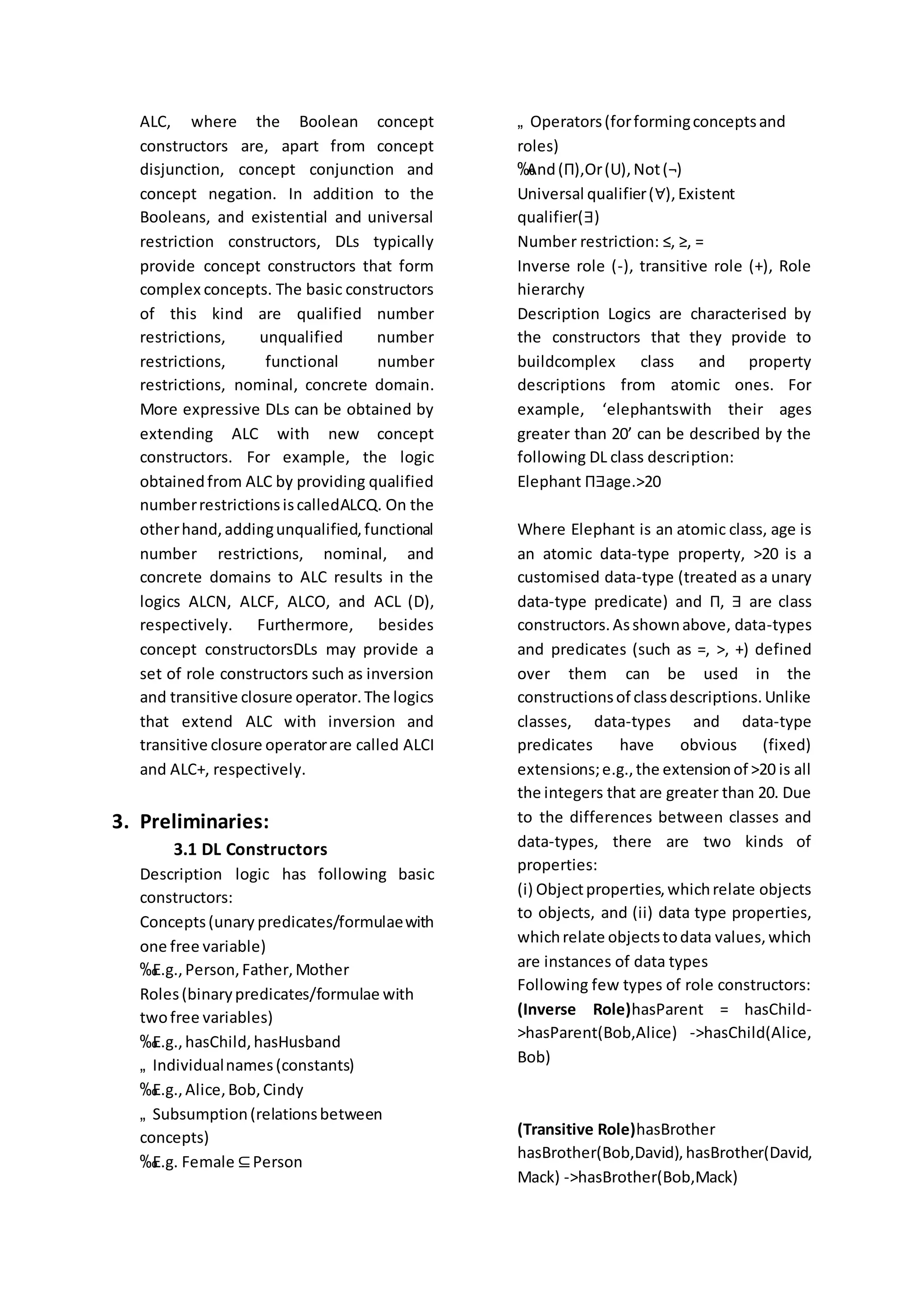
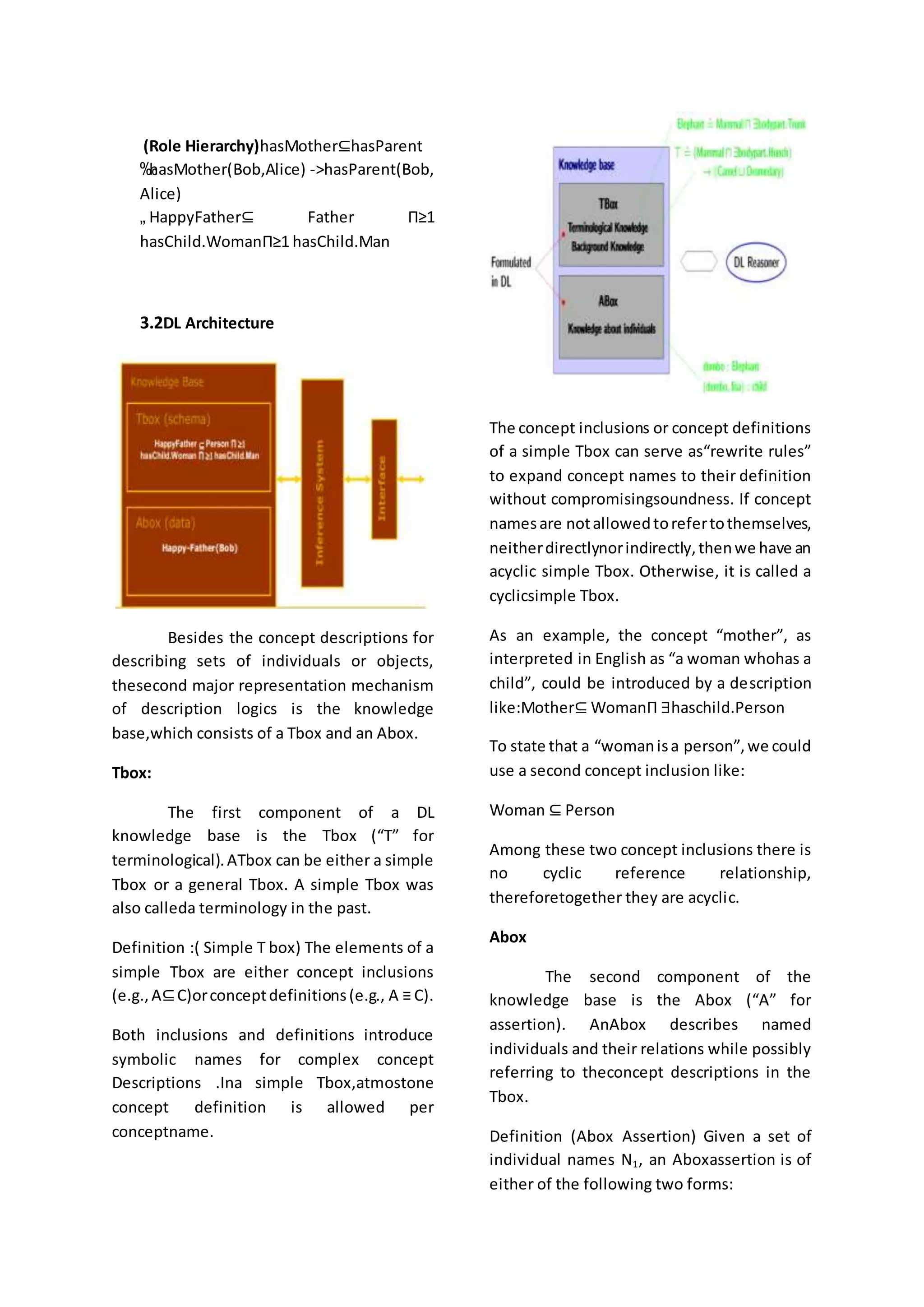
3.2DL Architecture
Besides the concept descriptions for
describing sets of individuals or objects,
thesecond major representation mechanism
of description logics is the knowledge
base,which consists of a Tbox and an Abox.
Tbox:
The first component of a DL
knowledge base is the Tbox (“T” for
terminological).ATbox can be either a simple
Tbox or a general Tbox. A simple Tbox was
also calleda terminology in the past.
Definition :( Simple T box) The elements of a
simple Tbox are either concept inclusions
(e.g.,A⊆C)orconceptdefinitions(e.g., A ≡ C).
Both inclusions and definitions introduce
symbolic names for complex concept
Descriptions .Ina simple Tbox,atmostone
concept definition is allowed per
conceptname.
The concept inclusions or concept definitions
of a simple Tbox can serve as“rewrite rules”
to expand concept names to their definition
without compromisingsoundness. If concept
namesare notallowedtorefertothemselves,
neitherdirectlynorindirectly,thenwe have an
acyclic simple Tbox. Otherwise, it is called a
cyclicsimple Tbox.
As an example, the concept “mother”, as
interpreted in English as “a woman whohas a
child”, could be introduced by a description
like:Mother⊆ WomanΠ ∃haschild.Person
To state that a “womanisa person”,we could
use a second concept inclusion like:
Woman ⊆ Person
Among these two concept inclusions there is
no cyclic reference relationship,
thereforetogether they are acyclic.
Abox
The second component of the
knowledge base is the Abox (“A” for
assertion). AnAbox describes named
individuals and their relations while possibly
referring to theconcept descriptions in the
Tbox.
Definition (Abox Assertion) Given a set of
individual names N1, an Aboxassertion is of
either of the following two forms:
• a : C
• (a, b): R
where a, b ∈ NI are individual names, C is a
concept,and R isa role.An Abox is afinite set
of assertions.
Role Hierarchy
A role hierarchy (denoted by H as in
ALCHIQ and SHIQ) is a mechanism for
specifying the subsumption relationships
betweenroles.InadditiontoTbox andABox,a
role hierarchy is sometimes regarded as a
third component of a DL knowledgebase and
iscalledRbox (“R” forRole).However,thereis
no recognizedreasoningtaskon anRbox itself.
4. ExistingClassical Description
logic
There are various implemented DL
systems based on tableaux algorithms,
offeringa palette of description
formalisms with different expressive
power. In the history,the first DL-like
system was KL-ONE. KRIS is one of the
firstdescription logic reasoners that
implementedahighlyoptimized tableaux
algorithm.The name ALC stands for
“Attributive concept Language with
Complements.” It was first introduced in
first naming scheme for DLs was
proposed:starting from a basic DL AL, the
addition of constructors is indicated by
appending a corresponding letter; e.g.,
ALC is obtained from AL by adding the
complement operator (¬) and ALE is
obtained from AL by adding existential
restrictions (∃r.C).
Reasoning is a finding fact that is implicit
in the ontology given explicitly stated
facts. A variety of reasoning techniques
can be used to solve the reasoning
problems these include resolution based
approaches.automatabased approaches,
and structural approaches (for sub-
Boolean DLs. The most widely used
technique,however, is the tableau based
approach first introduced by
SchmidtSchauß and Smolka.
4.1 Tableaux algorithms
The Tableaux algorithm is a general
technique for deciding theconcept
satisfiability problems in description
logics. Historically,the tableauxalgorithm
providesanalgorithmicframework that is
parametric with respect to
languageconstructors and is useful for
studyingbothcorrectnessandcomplexity
of concretedecision procedures.
Tableau Algorithm is the de facto
standard reasoning algorithm used in DL
Basic intuitions
‰1.Reduces a reasoning problem to
concept satisfiability problem
‰2.Finds an interpretation that satisfies
concepts in question.
‰3.The interpretation is incrementally
constructed as a "Tableau"
Example:
„ given:Wife⊆Woman,Woman⊆ Person
Question: if Wife⊆ Person
Reasoning process:
‰Test if there is an individual that is a
Woman but not a Person, i.e. Test the
satisfiability of concept
C0=(WifeЬPerson)
‰C0(x) -> Wife(x), (¬Person)(x)
‰Wife(x)->Woman(x)
‰Woman(x) ->Person(x)
‰Conflict!
C0 is unsatisfiable, therefore Wife⊆
Person is true with the given ontology.
4.1.1 Pellet for Reasoning in Protégé:
Pellet is one of the most
commonreasoning engines used for
reasoning with Protege OWL models.„
Pellet supports reasoning with the full
expressivity of OWL-DL (SHOIN(D) in
Description Logic jargon) and has been
extended to support OWL 1.1 (the DL
SROIQ(D)). OWL 1.1 adds the following
language constructs to OWL DL:
o qualifiedcardinality
restrictions
o complex subpropertyaxioms
(betweenapropertyanda
propertychain)
o local reflexivityrestrictions
o reflexive,irreflexive,
symmetric,andantisymmetric
properties
o disjointproperties
o user-defineddata-types
Consistency checking
Ensures that ontology does not
contain any contradictory facts. The OWL
Semantics standard provides the formal
definitionof ontologyconsistencyusedby
Pellet.
Concept satisfiability
„Determines whetherit’spossible for
a class to have any instances. If a class is
unsatisfiable,thendefiningan instance of
that classwill cause the whole ontologyto
be inconsistent.
Classification
„computes the subclass relations
betweenevery named class to create the
complete class hierarchy. The class
hierarchy can be used to answer queries
such as getting all or only the direct
subclasses of a class.
Realization
„finds the most specific classes that
an individual belongs to; i.e., realization
computesthe direct types for each of the
individuals. Realization can only be
performedafterclassification since direct
types are defined with respect to a class
hierarchy. Using the classification
hierarchy, it is also possible to get all the
types for each individual.
4.2 Limitations of Existing work
DL knowledge bases describing
structuredobjectsare therefore usuallyunder
constrained, which precludes the entailment
of certain consequences and causes
performance problems during
reasoning.However, classical description
logicsare less suitable in all those domains
where the information tobe represented
comes along with (quantitative) uncertainty
and/orvagueness (or imprecision). For
example,uncertaininformation maybe of the
form “John is a teacher with the degree of
certainty0.3 anda student with the degree of
certainty0.7” (roughly,Johniseitherateacher
or a student,butmore likelyastudent),while
vague information may be of the form “John
is tall with the degree of truth 0.9”(roughly,
John is quite tall);
Formalisms for dealingwith
uncertainty and vagueness have started to
play an importantrole in research related to
the Web andthe SemanticWeb.Forexample,
the order in which Google returns the
answerstoa websearchqueryiscomputedby
using probabilistic techniques.
Furthermore,formalisms for dealing with
uncertaintyandvaguenessinontologies have
been successfully applied in ontology
matching, data integration, and information
retrievalThe rising popularity of description
logicsandtheiruse,andthe need to deal with
uncertaintyand vagueness, both especiallyin
the Semantic Web, is increasingly attracting
the attention ofmany researchers and
practitionerstowardsdescriptionlogicsableto
cope with uncertainty and vagueness. The
goal of this paper is toprovide extended
description logic that deals with uncertainty
and vagueness in description logics for
theSemantic Web, integration, and
information retrieval. Vagueness and
imprecisionalso abound in multimedia
information processing and retrieval.
5. ProposedWorks:
Following papers proposed that
provides several type of Extended
Description logic for dealing with
uncertainty and vagueness. For example
some researchers extend classical DLs
allowing expressing uncertain or
imprecise knowledge.Atthisaspect,three
kinds of description logics:
1. FuzzyDLs,
2. ProbabilisticDLs,and
3. Rough DLs, are proposed.
5.1. Representing ontologies using
description logics, description graphs, and
rules:
 DLs are often used to describe
structuredobjects-objectswhoseparts
are interconnectedinarbitrary,rather
than tree-like ways.
 DL knowledge bases describing
structured objects are therefore
usually under-constrained, which
precludes the entailment of certain
consequences and causes
performance problems during
reasoning.
 To addressthisproblem, anextension
of DL languages with description
graphs—knowledge modelling
construct thatcan accuratelydescribe
objects with parts connected in
arbitrary ways.
 To enable modelling the conditional
aspectsof structured objects, we also
extend DLs with rules.
 Hyper-tableau-based reasoning
algorithm that decides the
satisfiabilityprobleminthe decidable
cases,and that acts as a semi decision
procedure for some undecidable
ones.
 The algorithm(hypertableaucalculus)
first pre-processes (T, A) into a set of
rules ΞT (T) and an ABox A ∪ ΞA (T).
 Hyper tableau calculus consists of
three steps. First, transitivity axioms
are eliminated from T by encoding
them using general concept
inclusions;similar encodings are well
known in the context of various
description and modal logics
 Second, axioms are normalized and
complex concepts are replaced with
atomic ones in a way similar to the
structural transformation
 Third, the normalized axioms are
translated into rules by using the
correspondencesbetweendescription
and first-order logic
5.2. Reasoning with rough description
logics: An approximate concepts
approach
 Existing problems of uncertain or
imprecise knowledge representation
and reasoningindescriptionlogicsare
analysed. Approximate concepts are
introducedtodescriptionlogicsbased
on rough set theory (RDLAC). The
theoryof rough set is an extension of
set theory, in which a subset of a
universe is described by a pair of
ordinary sets called the lower and
upper approximations.
 DL thatprovidesthe Boolean concept
constructors plus the existential and
universal restriction constructors is
called ALC
 Expressive DLs can be obtained by
extending ALC with new concept
constructors. reasoning algorithms of
more expressive rough description
logics including approximate
concepts, number restrictions,
nominal, inverse roles and role
hierarchies are provided by the
(RDLAC)
 Reasoning algorithms of rough
description logics including number
restrictions, nominal, inverse roles
and rolehierarchies, and an
integration between approximate
concepts and fuzzy DLs or
probabilisticDLsbased onfuzzy rough
set theory or probabilistic rough set
theory respectively. Furthermore,
additionalresearch effort can be
focused on the investigation of the
construction of approximate
ontologies (or rough TBoxes) using
formal concept analysis.
5.3 Reasoning within extended fuzzy
description logic:
 FALC is a fuzzy extension of ALC
by adopting fuzzy interpretation
to redefine the semantics of ALC
syntax and extending the axiom
forms in TBox and ABox.
 FALC just offers limited but not
sufficient expressive power of
complex fuzzy information
 FALC only focuses on three
reasoning tasks with respect to
empty TBox. They are
1. Fuzzy entailment
2. Value bound
3. Fuzzy subsumption
 An extended fuzzy description
logic is proposed to increase
expressive power for complex
fuzzy information.
 sets of the fuzzy concepts and
fuzzy roles as atomic concepts
and atomicroles,anduse concept
constructors of the description
logics to support a new logic
system for fuzzy knowledge
representation
 Knowledge base ∑E (TE, AE) of
EFALC not only offers the fuzzy
information, but also supports
several reasoningtasks.Similar to
FALC,we will definethe reasoning
tasks of EFALC with purely
assertional knowledge base.
Satisfiability and consistency are
usually considered as
representative reasoning tasks in
classical DLs.
 Consistencyisaproblemof telling
whetheran ABox AE is consistent.
It can be converted into sat-
domain. Now we define process
of tableau algorithm for
consistency in following steps
(1) Let AE be an EFALC ABox and
any cut concept in AE is in NNF.
The tableau algorithm starts with
a set of a single alterable ABox.
S0={(AE,{n0})}. For any x : C[n1...nk]
or (x;y): R[n1]in AE, we consider ni
as a constant function fi(n).
Therefore we can extend AE as an
alterable ABox {(AE,{n0})} and
apply translation rules to it.
Obviously,AE is consistent iff S0 is
n0-satisfiable.
(2) Apply translation rules
excluding £ exhaustively to
currentS0. So there isa chain of Si
by applying rules:
S0 -> S1 ->…-> Si. In classical ALC,
the similar process is called ‘‘pre-
completion” step. And after this
step, all role assertions can be
ignored, because they cannot be
applied by any translation rule.
The similar conclusion also
holds for EFALC. And S0 is n0-
satisfiable iff Si is n0-satisfiable.
The size of any ABox in Si is
polynomial inthe size of (AE,{n0}).
(3) Apply T-rules to Si, check
whether any T-subsequence of Si
is n0-T satisfiable.
5.4 Inconsistency-tolerant description
logic.
 As a matter of fact, the
information we have about the
world, however, is often
inconsistent.The mergingof data,
for example, may lead to
contradictory pieces of
information.
 three systems of inconsistency-
tolerant constructive description
logic: CALCC (a constructive
version of the basic description
logic ALC with a semantics
induced by a translation into
classical predicate logic), CALCN4
(a versionof ALCwitha semantics
induced by a translation into the
constructive predicate logicQN4),
and CALCN4d
(a versionof ALCwith
a semantics induced by another
translationintoQN4guaranteeing
the duality of existential and
universal role restrictions)
 The best-known system of
constructive logic is intuitionistic
logic. One attractive feature of
intuitionistic logic is that its
relational possible-worlds
semantics admits of an
‘informational’ interpretation
according to which the possible
worldsare informationstates and
the assumedaccessibilityrelation
between worlds is a relation of
possible expansion of information
states.
 The tableau algorithms used to
test for satisfiability. If classical
negation ¬ is present, and
subsumption is defined in terms
of material implication ¬C Π D,
subsumption testing can be
reducedtosatisfiability testing: C
⊆D iff C Π ¬D is unsatisfiable.
 Tableau algorithm allows it to
make the observation that in the
constructionof a completiontree,
extending R-subtrees and
extending subtrees are rather
independent of each other. One
can say that the work with
operators of classical description
logic and the work with
constructive implication go in
orthogonal directions.So,one can
expectthatthe expressive power
of CALCC can be enlarged along
familiar lines.
5.5 A formal framework for description
logics with uncertainty
 Uncertaintyisa form of deficiency
or imperfection commonly found
in real-world information/data.
Framework for knowledge bases
withuncertaintyexpressed in the
description logic ALCU, which is a
propositionally complete
representation language
providing conjunction,
disjunction, existential and
universal quantifications, and full
negation.
 Framework is equipped with a
constraint-based reasoning
procedure that derives a
collection of assertions as well as
a set of linear/nonlinear
constraints that encode the
semantics of the uncertainty
knowledge base.
6. References
1. Haarslev, V., Pai, H., & Shiri, N.
(2009). International Journal of
Approximate Reasoning A formal
framework for description logics with
uncertainty q. International Journal
of Approximate Reasoning, 50(9),
1399–1415.
doi:10.1016/j.ijar.2009.04.009
2. Jiang, Y., Tang, Y., Wang, J., Deng, P.,
& Tang, S. (2010). Knowledge-Based
Systems Expressive fuzzy description
logics over lattices. Knowledge-Based
Systems, 23(2), 150–161.
doi:10.1016/j.knosys.2009.11.002
3. Jiang, Y., Wang, J., Tang, S., & Xiao,
B. (2009). Reasoning with rough
description logics : An approximate
concepts approach. Information
Sciences, 179(5), 600–612.
doi:10.1016/j.ins.2008.10.021
4. Lu, J., Li, Y., Zhou, B., & Kang, D.
(2009). Knowledge-Based Systems
Reasoning within extended fuzzy
description logic. Knowledge-Based
Systems, 22(1), 28–37.
doi:10.1016/j.knosys.2008.04.010
5. Motik, B., Cuenca, B., Horrocks, I., &
Sattler, U. (2009). Representing
ontologies using description logics ,
description graphs ,. Artificial
Intelligence, 173(14), 1275–1309.
doi:10.1016/j.artint.2009.06.003
6. Odintsov, S. P., & Wansing, H. (2008).
Inconsistency-tolerant description
logic . Part II : A tableau algorithm
for CALC C, 6, 343–360.
doi:10.1016/j.jal.2007.06.001

Description logic

  • 1.
    Description Logic Author: K.BalamuruganM.Tech, Pondicherry University, Knowledge engineering specialist 1. Abstract: Descriptionlogicisaformal logic-basedknowledgerepresentationlanguage which“Description" aboutthe worldintermsof concepts (classes), roles (properties, relationships) and individuals (instances).descriptionlogics isafamily of logic-basedknowledge representation languages that can be usedtorepresentthe terminological knowledge of an applicationdomain in a structured way.Recentexperience withDLs,however,hasshownthattheirexpressivityisofteninsufficient to accurately describe structured objects. This paper mainly concerned with various kind of description logic and their power of describing the many real world aspect. Description logic evolved over the period which will avoid vagueness, uncertain or imprecise knowledge representationandreasoningindescriptionlogics.Extendedfuzzy description logic is proposed to increase expressive power for complex fuzzy information.Compared with the other fuzzy descriptionlogics,the extendedfuzzydescriptionlogiccanexpressmore widefuzzy information. Anotherkindof newroughdescriptionlogicRDLAC (roughdescriptionlogicbasedonapproximate concepts) isproposedbasedonapproximate concepts..Inthispapervariousextensions of fuzzy description logics over lattices are also discussed. Keyword:Descriptionlogic;Knowledge representation; approximate concepts;rough set theory 2. Introduction: Descriptionlogics(DLs) are afamily of knowledge representation formalisms suitable for representing the terminological knowledge ina wide range of applications.The Tableaux algorithm is a general technique for deciding theconcept satisfiability problems in description logics. Historically, the tableaux algorithm provides an algorithmic framework that is parametric withrespect to languageconstructors and isuseful forstudyingbothcorrectnessand complexity of concrete decision procedures.Description Logics (DLs) are a class of knowledge representation formalisms in the tradition of semantic networks and frames, which can be used to represent the terminological knowledge of an application domain in a structured and formally well-understood way. DL systems provide their users with inference services (like computing the subsumption hierarchy) that deduce implicit knowledge from the explicitly represented knowledge. They are employedinvariousapplication domains, such as semantic Web, ontologies, databases, and software engineering. Because classical DLs can only represent and reason on certain or precise knowledge, and cannot represent and reason on uncertain or imprecise knowledge, therefore, some researchers extend classical DLs allowing to express uncertainor imprecise knowledge. At this aspect, three kinds of description logics, i.e.,fuzzyDLs,probabilisticDLs,andrough DLs, are proposed. In what follows, we will use several DLs, hence it is necessary to introduce some notationsof DLsfirstly. The DL that providesthe Booleanconcept constructors plus the existential and universal restrictionconstructors is called
  • 2.
    ALC, where theBoolean concept constructors are, apart from concept disjunction, concept conjunction and concept negation. In addition to the Booleans, and existential and universal restriction constructors, DLs typically provide concept constructors that form complex concepts. The basic constructors of this kind are qualified number restrictions, unqualified number restrictions, functional number restrictions, nominal, concrete domain. More expressive DLs can be obtained by extending ALC with new concept constructors. For example, the logic obtainedfrom ALC by providing qualified numberrestrictionsiscalledALCQ. On the otherhand,addingunqualified,functional number restrictions, nominal, and concrete domains to ALC results in the logics ALCN, ALCF, ALCO, and ACL (D), respectively. Furthermore, besides concept constructorsDLs may provide a set of role constructors such as inversion and transitive closure operator.The logics that extend ALC with inversion and transitive closure operatorare called ALCI and ALC+, respectively. 3. Preliminaries: 3.1 DL Constructors Description logic has following basic constructors: Concepts(unary predicates/formulaewith one free variable) ‰E.g.,Person,Father,Mother Roles(binarypredicates/formulae with twofree variables) ‰E.g.,hasChild,hasHusband „ Individualnames(constants) ‰E.g.,Alice,Bob,Cindy „ Subsumption(relationsbetween concepts) ‰E.g. Female ⊆Person „ Operators(forformingconceptsand roles) ‰And(Π),Or(U),Not(¬) Universal qualifier(∀),Existent qualifier(∃) Number restriction: ≤, ≥, = Inverse role (-), transitive role (+), Role hierarchy Description Logics are characterised by the constructors that they provide to buildcomplex class and property descriptions from atomic ones. For example, ‘elephantswith their ages greater than 20’ can be described by the following DL class description: Elephant Π∃age.>20 Where Elephant is an atomic class, age is an atomic data-type property, >20 is a customised data-type (treated as a unary data-type predicate) and Π, ∃ are class constructors.Asshownabove, data-types and predicates (such as =, >, +) defined over them can be used in the constructionsof classdescriptions.Unlike classes, data-types and data-type predicates have obvious (fixed) extensions;e.g.,the extensionof >20 is all the integers that are greater than 20. Due to the differences between classes and data-types, there are two kinds of properties: (i) Objectproperties,whichrelate objects to objects, and (ii) data type properties, whichrelate objectstodata values,which are instances of data types Following few types of role constructors: (Inverse Role)hasParent = hasChild- >hasParent(Bob,Alice) ->hasChild(Alice, Bob) (Transitive Role)hasBrother hasBrother(Bob,David),hasBrother(David, Mack) ->hasBrother(Bob,Mack)
  • 3.
    (Role Hierarchy)hasMother⊆hasParent ‰hasMother(Bob,Alice) ->hasParent(Bob, Alice) „HappyFather⊆Father Π≥1 hasChild.WomanΠ≥1 hasChild.Man 3.2DL Architecture Besides the concept descriptions for describing sets of individuals or objects, thesecond major representation mechanism of description logics is the knowledge base,which consists of a Tbox and an Abox. Tbox: The first component of a DL knowledge base is the Tbox (“T” for terminological).ATbox can be either a simple Tbox or a general Tbox. A simple Tbox was also calleda terminology in the past. Definition :( Simple T box) The elements of a simple Tbox are either concept inclusions (e.g.,A⊆C)orconceptdefinitions(e.g., A ≡ C). Both inclusions and definitions introduce symbolic names for complex concept Descriptions .Ina simple Tbox,atmostone concept definition is allowed per conceptname. The concept inclusions or concept definitions of a simple Tbox can serve as“rewrite rules” to expand concept names to their definition without compromisingsoundness. If concept namesare notallowedtorefertothemselves, neitherdirectlynorindirectly,thenwe have an acyclic simple Tbox. Otherwise, it is called a cyclicsimple Tbox. As an example, the concept “mother”, as interpreted in English as “a woman whohas a child”, could be introduced by a description like:Mother⊆ WomanΠ ∃haschild.Person To state that a “womanisa person”,we could use a second concept inclusion like: Woman ⊆ Person Among these two concept inclusions there is no cyclic reference relationship, thereforetogether they are acyclic. Abox The second component of the knowledge base is the Abox (“A” for assertion). AnAbox describes named individuals and their relations while possibly referring to theconcept descriptions in the Tbox. Definition (Abox Assertion) Given a set of individual names N1, an Aboxassertion is of either of the following two forms:
  • 4.
    • a :C • (a, b): R where a, b ∈ NI are individual names, C is a concept,and R isa role.An Abox is afinite set of assertions. Role Hierarchy A role hierarchy (denoted by H as in ALCHIQ and SHIQ) is a mechanism for specifying the subsumption relationships betweenroles.InadditiontoTbox andABox,a role hierarchy is sometimes regarded as a third component of a DL knowledgebase and iscalledRbox (“R” forRole).However,thereis no recognizedreasoningtaskon anRbox itself. 4. ExistingClassical Description logic There are various implemented DL systems based on tableaux algorithms, offeringa palette of description formalisms with different expressive power. In the history,the first DL-like system was KL-ONE. KRIS is one of the firstdescription logic reasoners that implementedahighlyoptimized tableaux algorithm.The name ALC stands for “Attributive concept Language with Complements.” It was first introduced in first naming scheme for DLs was proposed:starting from a basic DL AL, the addition of constructors is indicated by appending a corresponding letter; e.g., ALC is obtained from AL by adding the complement operator (¬) and ALE is obtained from AL by adding existential restrictions (∃r.C). Reasoning is a finding fact that is implicit in the ontology given explicitly stated facts. A variety of reasoning techniques can be used to solve the reasoning problems these include resolution based approaches.automatabased approaches, and structural approaches (for sub- Boolean DLs. The most widely used technique,however, is the tableau based approach first introduced by SchmidtSchauß and Smolka. 4.1 Tableaux algorithms The Tableaux algorithm is a general technique for deciding theconcept satisfiability problems in description logics. Historically,the tableauxalgorithm providesanalgorithmicframework that is parametric with respect to languageconstructors and is useful for studyingbothcorrectnessandcomplexity of concretedecision procedures. Tableau Algorithm is the de facto standard reasoning algorithm used in DL Basic intuitions ‰1.Reduces a reasoning problem to concept satisfiability problem ‰2.Finds an interpretation that satisfies concepts in question. ‰3.The interpretation is incrementally constructed as a "Tableau" Example: „ given:Wife⊆Woman,Woman⊆ Person Question: if Wife⊆ Person Reasoning process: ‰Test if there is an individual that is a Woman but not a Person, i.e. Test the satisfiability of concept C0=(WifeΠ¬Person) ‰C0(x) -> Wife(x), (¬Person)(x) ‰Wife(x)->Woman(x) ‰Woman(x) ->Person(x) ‰Conflict! C0 is unsatisfiable, therefore Wife⊆ Person is true with the given ontology. 4.1.1 Pellet for Reasoning in Protégé: Pellet is one of the most commonreasoning engines used for reasoning with Protege OWL models.„
  • 5.
    Pellet supports reasoningwith the full expressivity of OWL-DL (SHOIN(D) in Description Logic jargon) and has been extended to support OWL 1.1 (the DL SROIQ(D)). OWL 1.1 adds the following language constructs to OWL DL: o qualifiedcardinality restrictions o complex subpropertyaxioms (betweenapropertyanda propertychain) o local reflexivityrestrictions o reflexive,irreflexive, symmetric,andantisymmetric properties o disjointproperties o user-defineddata-types Consistency checking Ensures that ontology does not contain any contradictory facts. The OWL Semantics standard provides the formal definitionof ontologyconsistencyusedby Pellet. Concept satisfiability „Determines whetherit’spossible for a class to have any instances. If a class is unsatisfiable,thendefiningan instance of that classwill cause the whole ontologyto be inconsistent. Classification „computes the subclass relations betweenevery named class to create the complete class hierarchy. The class hierarchy can be used to answer queries such as getting all or only the direct subclasses of a class. Realization „finds the most specific classes that an individual belongs to; i.e., realization computesthe direct types for each of the individuals. Realization can only be performedafterclassification since direct types are defined with respect to a class hierarchy. Using the classification hierarchy, it is also possible to get all the types for each individual. 4.2 Limitations of Existing work DL knowledge bases describing structuredobjectsare therefore usuallyunder constrained, which precludes the entailment of certain consequences and causes performance problems during reasoning.However, classical description logicsare less suitable in all those domains where the information tobe represented comes along with (quantitative) uncertainty and/orvagueness (or imprecision). For example,uncertaininformation maybe of the form “John is a teacher with the degree of certainty0.3 anda student with the degree of certainty0.7” (roughly,Johniseitherateacher or a student,butmore likelyastudent),while vague information may be of the form “John is tall with the degree of truth 0.9”(roughly, John is quite tall); Formalisms for dealingwith uncertainty and vagueness have started to play an importantrole in research related to the Web andthe SemanticWeb.Forexample, the order in which Google returns the answerstoa websearchqueryiscomputedby using probabilistic techniques. Furthermore,formalisms for dealing with uncertaintyandvaguenessinontologies have been successfully applied in ontology matching, data integration, and information retrievalThe rising popularity of description logicsandtheiruse,andthe need to deal with uncertaintyand vagueness, both especiallyin the Semantic Web, is increasingly attracting the attention ofmany researchers and practitionerstowardsdescriptionlogicsableto cope with uncertainty and vagueness. The
  • 6.
    goal of thispaper is toprovide extended description logic that deals with uncertainty and vagueness in description logics for theSemantic Web, integration, and information retrieval. Vagueness and imprecisionalso abound in multimedia information processing and retrieval. 5. ProposedWorks: Following papers proposed that provides several type of Extended Description logic for dealing with uncertainty and vagueness. For example some researchers extend classical DLs allowing expressing uncertain or imprecise knowledge.Atthisaspect,three kinds of description logics: 1. FuzzyDLs, 2. ProbabilisticDLs,and 3. Rough DLs, are proposed. 5.1. Representing ontologies using description logics, description graphs, and rules:  DLs are often used to describe structuredobjects-objectswhoseparts are interconnectedinarbitrary,rather than tree-like ways.  DL knowledge bases describing structured objects are therefore usually under-constrained, which precludes the entailment of certain consequences and causes performance problems during reasoning.  To addressthisproblem, anextension of DL languages with description graphs—knowledge modelling construct thatcan accuratelydescribe objects with parts connected in arbitrary ways.  To enable modelling the conditional aspectsof structured objects, we also extend DLs with rules.  Hyper-tableau-based reasoning algorithm that decides the satisfiabilityprobleminthe decidable cases,and that acts as a semi decision procedure for some undecidable ones.  The algorithm(hypertableaucalculus) first pre-processes (T, A) into a set of rules ΞT (T) and an ABox A ∪ ΞA (T).  Hyper tableau calculus consists of three steps. First, transitivity axioms are eliminated from T by encoding them using general concept inclusions;similar encodings are well known in the context of various description and modal logics  Second, axioms are normalized and complex concepts are replaced with atomic ones in a way similar to the structural transformation  Third, the normalized axioms are translated into rules by using the correspondencesbetweendescription and first-order logic 5.2. Reasoning with rough description logics: An approximate concepts approach  Existing problems of uncertain or imprecise knowledge representation and reasoningindescriptionlogicsare analysed. Approximate concepts are introducedtodescriptionlogicsbased on rough set theory (RDLAC). The theoryof rough set is an extension of set theory, in which a subset of a universe is described by a pair of ordinary sets called the lower and upper approximations.  DL thatprovidesthe Boolean concept constructors plus the existential and universal restriction constructors is called ALC
  • 7.
     Expressive DLscan be obtained by extending ALC with new concept constructors. reasoning algorithms of more expressive rough description logics including approximate concepts, number restrictions, nominal, inverse roles and role hierarchies are provided by the (RDLAC)  Reasoning algorithms of rough description logics including number restrictions, nominal, inverse roles and rolehierarchies, and an integration between approximate concepts and fuzzy DLs or probabilisticDLsbased onfuzzy rough set theory or probabilistic rough set theory respectively. Furthermore, additionalresearch effort can be focused on the investigation of the construction of approximate ontologies (or rough TBoxes) using formal concept analysis. 5.3 Reasoning within extended fuzzy description logic:  FALC is a fuzzy extension of ALC by adopting fuzzy interpretation to redefine the semantics of ALC syntax and extending the axiom forms in TBox and ABox.  FALC just offers limited but not sufficient expressive power of complex fuzzy information  FALC only focuses on three reasoning tasks with respect to empty TBox. They are 1. Fuzzy entailment 2. Value bound 3. Fuzzy subsumption  An extended fuzzy description logic is proposed to increase expressive power for complex fuzzy information.  sets of the fuzzy concepts and fuzzy roles as atomic concepts and atomicroles,anduse concept constructors of the description logics to support a new logic system for fuzzy knowledge representation  Knowledge base ∑E (TE, AE) of EFALC not only offers the fuzzy information, but also supports several reasoningtasks.Similar to FALC,we will definethe reasoning tasks of EFALC with purely assertional knowledge base. Satisfiability and consistency are usually considered as representative reasoning tasks in classical DLs.  Consistencyisaproblemof telling whetheran ABox AE is consistent. It can be converted into sat- domain. Now we define process of tableau algorithm for consistency in following steps (1) Let AE be an EFALC ABox and any cut concept in AE is in NNF. The tableau algorithm starts with a set of a single alterable ABox. S0={(AE,{n0})}. For any x : C[n1...nk] or (x;y): R[n1]in AE, we consider ni as a constant function fi(n). Therefore we can extend AE as an alterable ABox {(AE,{n0})} and apply translation rules to it. Obviously,AE is consistent iff S0 is n0-satisfiable. (2) Apply translation rules excluding £ exhaustively to currentS0. So there isa chain of Si by applying rules: S0 -> S1 ->…-> Si. In classical ALC, the similar process is called ‘‘pre-
  • 8.
    completion” step. Andafter this step, all role assertions can be ignored, because they cannot be applied by any translation rule. The similar conclusion also holds for EFALC. And S0 is n0- satisfiable iff Si is n0-satisfiable. The size of any ABox in Si is polynomial inthe size of (AE,{n0}). (3) Apply T-rules to Si, check whether any T-subsequence of Si is n0-T satisfiable. 5.4 Inconsistency-tolerant description logic.  As a matter of fact, the information we have about the world, however, is often inconsistent.The mergingof data, for example, may lead to contradictory pieces of information.  three systems of inconsistency- tolerant constructive description logic: CALCC (a constructive version of the basic description logic ALC with a semantics induced by a translation into classical predicate logic), CALCN4 (a versionof ALCwitha semantics induced by a translation into the constructive predicate logicQN4), and CALCN4d (a versionof ALCwith a semantics induced by another translationintoQN4guaranteeing the duality of existential and universal role restrictions)  The best-known system of constructive logic is intuitionistic logic. One attractive feature of intuitionistic logic is that its relational possible-worlds semantics admits of an ‘informational’ interpretation according to which the possible worldsare informationstates and the assumedaccessibilityrelation between worlds is a relation of possible expansion of information states.  The tableau algorithms used to test for satisfiability. If classical negation ¬ is present, and subsumption is defined in terms of material implication ¬C Π D, subsumption testing can be reducedtosatisfiability testing: C ⊆D iff C Π ¬D is unsatisfiable.  Tableau algorithm allows it to make the observation that in the constructionof a completiontree, extending R-subtrees and extending subtrees are rather independent of each other. One can say that the work with operators of classical description logic and the work with constructive implication go in orthogonal directions.So,one can expectthatthe expressive power of CALCC can be enlarged along familiar lines. 5.5 A formal framework for description logics with uncertainty  Uncertaintyisa form of deficiency or imperfection commonly found in real-world information/data. Framework for knowledge bases withuncertaintyexpressed in the description logic ALCU, which is a propositionally complete representation language providing conjunction, disjunction, existential and universal quantifications, and full negation.  Framework is equipped with a constraint-based reasoning
  • 9.
    procedure that derivesa collection of assertions as well as a set of linear/nonlinear constraints that encode the semantics of the uncertainty knowledge base. 6. References 1. Haarslev, V., Pai, H., & Shiri, N. (2009). International Journal of Approximate Reasoning A formal framework for description logics with uncertainty q. International Journal of Approximate Reasoning, 50(9), 1399–1415. doi:10.1016/j.ijar.2009.04.009 2. Jiang, Y., Tang, Y., Wang, J., Deng, P., & Tang, S. (2010). Knowledge-Based Systems Expressive fuzzy description logics over lattices. Knowledge-Based Systems, 23(2), 150–161. doi:10.1016/j.knosys.2009.11.002 3. Jiang, Y., Wang, J., Tang, S., & Xiao, B. (2009). Reasoning with rough description logics : An approximate concepts approach. Information Sciences, 179(5), 600–612. doi:10.1016/j.ins.2008.10.021 4. Lu, J., Li, Y., Zhou, B., & Kang, D. (2009). Knowledge-Based Systems Reasoning within extended fuzzy description logic. Knowledge-Based Systems, 22(1), 28–37. doi:10.1016/j.knosys.2008.04.010 5. Motik, B., Cuenca, B., Horrocks, I., & Sattler, U. (2009). Representing ontologies using description logics , description graphs ,. Artificial Intelligence, 173(14), 1275–1309. doi:10.1016/j.artint.2009.06.003 6. Odintsov, S. P., & Wansing, H. (2008). Inconsistency-tolerant description logic . Part II : A tableau algorithm for CALC C, 6, 343–360. doi:10.1016/j.jal.2007.06.001