Database VirtualizationJedidiah Yueh, CEOApril 2010Delphix turns database infrastructure into software that operates in a fraction of the space, while preserving full functionality and performance.
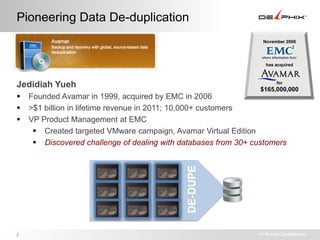
Pioneering Data De-duplicationJedidiah YuehFounded Avamar in 1999, acquired by EMC in 2006
>$1 billion in lifetime revenue in 2011; 10,000+ customers
VP Product Management at EMC
Created targeted VMware campaign, Avamar Virtual Edition
Discovered challenge of dealing with databases from 30+ customersNovember 2006has acquiredforDE-DUPE$165,000,000>> Strictly Confidential  2
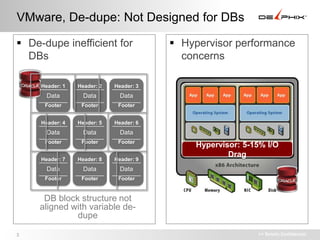
VMware, De-dupe: Not Designed for DBsHypervisor performance concernsDe-dupe inefficient for DBsHeader: 1DataFooterHeader: 2DataFooterHeader: 3DataFooterHeader: 4DataFooterHeader: 5DataFooterHeader: 6DataFooterHeader: 7DataFooterHeader: 8DataFooterHeader: 9DataFooterHypervisor: 5-15% I/O DragDB block structure not aligned with variable de-dupe>> Strictly Confidential  3
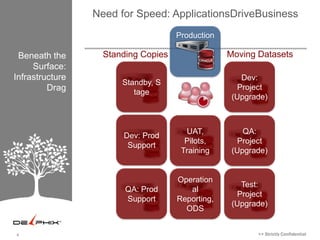
4Need for Speed: ApplicationsDriveBusinessProductionMoving DatasetsStanding CopiesBeneath the Surface: Infrastructure DragStandby, StageDev: Project (Upgrade)Dev: Prod SupportUAT, Pilots, TrainingQA: Project (Upgrade)QA: Prod SupportTest: Project (Upgrade)Operational Reporting, ODS>> Strictly Confidential
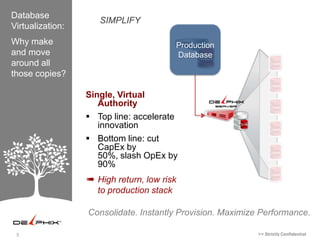
SIMPLIFYProduction DatabaseStandby, StageDev: Project (Upgrade)Single, Virtual AuthorityTop line: accelerate innovationBottom line: cut CapEx by 50%, slash OpEx by 90%High return, low risk to production stackDev: Prod SupportUAT, Pilots, TrainingQA: Project (Upgrade)QA: Prod SupportTest: Project (Upgrade)Operational Reporting, ODSDatabase Virtualization:Why make and move around all those copies?5Consolidate. Instantly Provision. Maximize Performance.>> Strictly Confidential
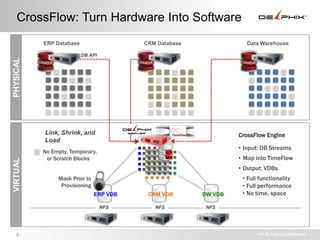
CrossFlow: Turn Hardware Into Software6ERP DatabaseCRM DatabaseData WarehouseDB APIPHYSICALLink, Shrink, and LoadCrossFlow EngineInput: DB Streams
Map into TimeFlow
Output: VDBs
Full functionality
Full performance
No time, spaceTimeFlowNo Empty, Temporary, or Scratch BlocksVIRTUALMask Prior to ProvisioningERP VDBCRM VDBDW VDBNFSNFSNFS>> Strictly Confidential

Delphix

  • 1.
    Database VirtualizationJedidiah Yueh,CEOApril 2010Delphix turns database infrastructure into software that operates in a fraction of the space, while preserving full functionality and performance.
  • 2.
    Pioneering Data De-duplicationJedidiahYuehFounded Avamar in 1999, acquired by EMC in 2006
  • 3.
    >$1 billion inlifetime revenue in 2011; 10,000+ customers
  • 4.
  • 5.
    Created targeted VMwarecampaign, Avamar Virtual Edition
  • 6.
    Discovered challenge ofdealing with databases from 30+ customersNovember 2006has acquiredforDE-DUPE$165,000,000>> Strictly Confidential 2
  • 7.
    VMware, De-dupe: NotDesigned for DBsHypervisor performance concernsDe-dupe inefficient for DBsHeader: 1DataFooterHeader: 2DataFooterHeader: 3DataFooterHeader: 4DataFooterHeader: 5DataFooterHeader: 6DataFooterHeader: 7DataFooterHeader: 8DataFooterHeader: 9DataFooterHypervisor: 5-15% I/O DragDB block structure not aligned with variable de-dupe>> Strictly Confidential 3
  • 8.
    4Need for Speed:ApplicationsDriveBusinessProductionMoving DatasetsStanding CopiesBeneath the Surface: Infrastructure DragStandby, StageDev: Project (Upgrade)Dev: Prod SupportUAT, Pilots, TrainingQA: Project (Upgrade)QA: Prod SupportTest: Project (Upgrade)Operational Reporting, ODS>> Strictly Confidential
  • 9.
    SIMPLIFYProduction DatabaseStandby, StageDev:Project (Upgrade)Single, Virtual AuthorityTop line: accelerate innovationBottom line: cut CapEx by 50%, slash OpEx by 90%High return, low risk to production stackDev: Prod SupportUAT, Pilots, TrainingQA: Project (Upgrade)QA: Prod SupportTest: Project (Upgrade)Operational Reporting, ODSDatabase Virtualization:Why make and move around all those copies?5Consolidate. Instantly Provision. Maximize Performance.>> Strictly Confidential
  • 10.
    CrossFlow: Turn HardwareInto Software6ERP DatabaseCRM DatabaseData WarehouseDB APIPHYSICALLink, Shrink, and LoadCrossFlow EngineInput: DB Streams
  • 11.
  • 12.
  • 13.
  • 14.
  • 15.
    No time, spaceTimeFlowNoEmpty, Temporary, or Scratch BlocksVIRTUALMask Prior to ProvisioningERP VDBCRM VDBDW VDBNFSNFSNFS>> Strictly Confidential

Editor's Notes

  • #2 Hi. My name is Jedidiah Yueh and I’m the CEO of Delphix. Delphix is the database virtualization software company. We turn database infrastructure into software that runs in a fraction of the space, while preserving full functionality and performance.
  • #3 About a decade ago, I founded a software company called Avamar that was acquired by EMC for $165 million.Avamar pioneered data de-duplication, which shrinks backup data so you can use disk instead of tape.It’s like iPod or Tivo for big companies.Avamar will do a billion in lifetime revenue next year and has over 10,000 customers.But, while I was at EMC, I discovered that databases were a big challenge for modern de-duplication and server virtualization solutions.
  • #4 Databases store data in unique block structures, which make them inefficient for de-duplication.Their blocks have “wrappers” that resist de-dupe.Server virtualization solutions use hypervisors that share resources across virtual machines but act like a wet blanket for storage I/O.Enterprises buy the most expensive storage I/O solutions for databases, so they don’t tend to put databases on VMware.Databases pose unique challenges, so you really need to understand the problems, if you’re going to build a solution.
  • #5 Problem: database ecosystem redundant, dynamic, expensiveMost datacenters spend a great deal managing unstructured data, but they spend the most pound-for-pound in the database ecosystem. If you zoom into the database ecosystem, the production application and database is only the tip of the iceberg, as little as 10% of the total infrastructure footprint and costs. Most enterprises are unaware of the full extent of the redundancy and complexity required in regular operations. Due to the high business criticality of applications like ERP and CRM, enterprises generally create multiple copies of their database infrastructure before making even small changes or improvements. For most important applications, a full copy of infrastructure exists for development and QA for production support—to help troubleshoot problems if errors occur in the database or application. In addition, typical environments will create two more copies for dev and QA for projects—such as an application or database upgrade, update, or patch, which come out from vendors monthly or quarterly. In enterprises that develop or customize applications, even more copies are created in non-production environment for dev, test, QA, and staging. Even worse, all this redundancy gets magnified by the need to constantly move the data. As applications grow and change, databases have to be refreshed in development, then moved to testing, QA, staging, and back to production. For projects, which come regularly, development has to be frequently refreshed and moved through the cycle; using stale or partial data can prolong timelines or impede proper testing. Other copies, such as staging for data warehouses, have to be refreshed weekly, nightly, or even more frequently. It takes the average IT organization 10 hours to 10 weeks to provision a new copy of a database from one environment to another, navigating internal procurement processes and coordinating among DBAs, server, storage, and backup teams—an enormous operational expense.
  • #6 Solution and benefits: database virtualizationAt Delphix, we asked a simple question: why make and move around all these copies? What if you could have a single virtual authority that stayed synchronized with production? You could then serve all the copies needed in enterprises off a single shared footprint. If you could do that, you could really empower IT to better service the business—delivering on critical requests from lines of business to improve applications that drive sales or operational efficiency. You could spend less on infrastructure, while simplifying operational IT complexity. Best of all, if you designed the solution correctly, you could achieve all of this with no changes required to production, so you could get a high return on investment, at very low risk.
  • #7 Delphix is built on the CrossFlow Engine.CrossFlow connects to physical databases via standard APIs, so it requires no changes to productionIt take streams and logs from physical databases and shrinks them into a TimeFlow, a rolling record of changes.We shrink the data—even the first load—by up to 75%, with database specific reduction technologies.From any point in aTimeFlow, you can instantly open up virtual databases, which have full functionality and performance.But they take no time and no space to create.
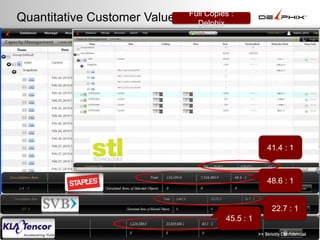
  • #8 Delphix works.By combining the agility virtualization with the efficiency of de-duplication, we can provide hard, quantifiable customer value.These ratios compare making and storing full copies of databases on disk storage vs. the how much you would store on Delphix.In the real world deployments like Staples and SVB, we’ve seen numbers from 22:1 to 48:1.
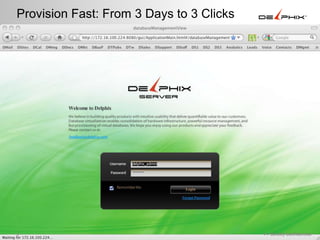
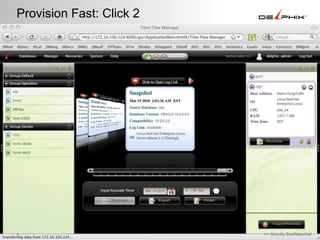
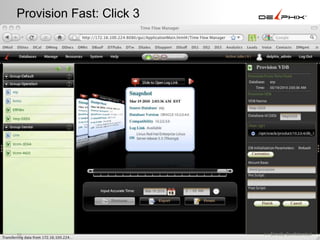
  • #9 Usability and simplicity: 3 clicks to provisioningMost enterprise software products build their user interfaces last, so they reflect the mechanics of the technology. At Delphix, we believe in building interfaces around users, providing intuitive usability and enabling end-user self service. Usability isn’t just about elegant interfaces—it reduces the long term operational cost and complexity of a product, increasing customer value over time. After selecting an LDB in Delphix, it takes only three clicks to provision a VDB with no additional hardware required—a dramatic improvement over the days and weeks often required with physical infrastructure. In reality, the hard savings are not the real benefit.The real benefit is agility and accelerated innovation.We can take a process that takes days and weeks, and reduce it down to three clicks.Click one: log in.
  • #10 Click 2: provision.
  • #11 Click 3: verify parameters and finish.
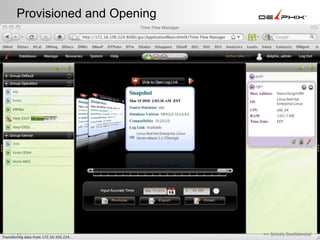
  • #12 That’s all it takes to provision a full copy of a read-write databases—in almost no time and no additional space required.
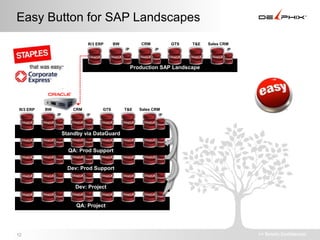
  • #13 At Staples we’re the easy button for provisioning SAP landscapes. With Delphix, all this redundant infrastructure and data movement disappears.