Hypothesis
Meaning:-
• The first step in your scientific endeavor, a hypothesis, is a
strong, concise statement that forms the basis of your
research. It is not the same as a thesis statement, which is a
brief summary of your research paper.
• The hypothesis consists of two words –Hypo+Thesis. ‘Hypo’
means tentative or subject to the verification. ‘Thesis’ means
statement about solution of the problem.
Nature of Hypothesis
(i) Conceptual: Conceptual elements in the framework are
involved in a hypothesis.
(ii) Verbal statement in a declarative form: It is a verbal
expression of ideas and concepts. It is not merely mental
idea but in the verbal form, the idea is ready enough for
empirical verification.
(iii) It represents the tentative relationship between two or
more variables.
(iv) Forward or future oriented: A hypothesis is future-oriented.
It relates to the future verification not the past facts and
information.
(v) Pivot of a scientific research: All research activities are
designed for verification of hypothesis.
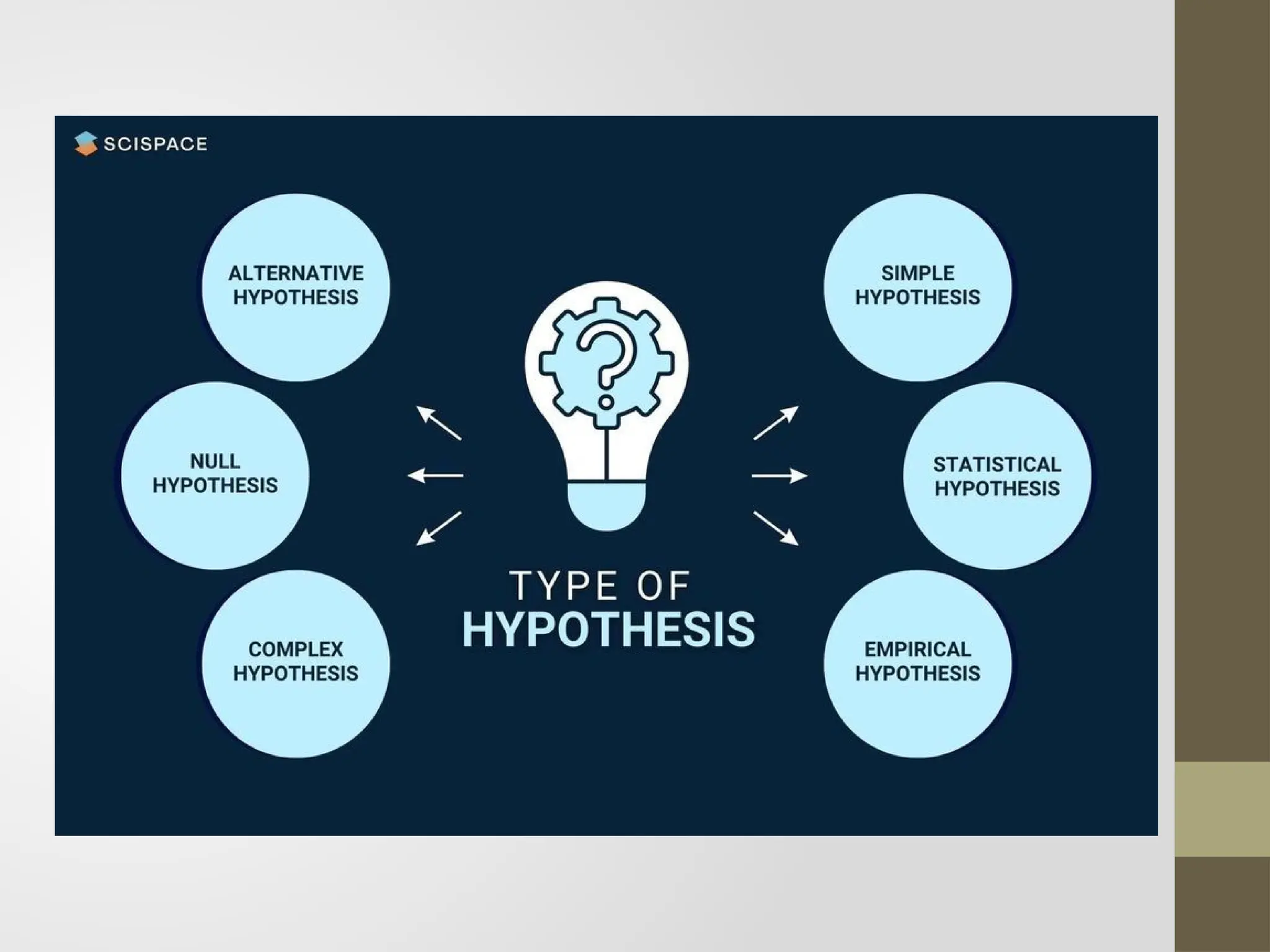
1. Null hypothesis
A null hypothesis proposes no relationship between two variables.
Denoted by H0, it is a negative statement like “Attending physiotherapy
sessions does not affect athletes' on-field performance.” Here, the
author claims physiotherapy sessions have no effect on on-field
performances. Even if there is, it's only a coincidence.
2. Alternative hypothesis
Considered to be the opposite of a null hypothesis, an alternative
hypothesis is donated as H1 or Ha. It explicitly states that the dependent
variable affects the independent variable. A good alternative
hypothesis example is “Attending physiotherapy sessions improves
athletes' on-field performance.” or “Water evaporates at 100°C.”
The alternative hypothesis further branches into directional and non-
directional.
Directional hypothesis: A hypothesis that states the result would be
either positive or negative is called directional hypothesis. It
accompanies H1 with either the ‘<' or ‘>' sign.
Non-directional hypothesis: A non-directional hypothesis only claims an
effect on the dependent variable. It does not clarify whether the result
would be positive or negative. The sign for a non-directional hypothesis
is ‘≠.'
3. Simple hypothesis
A simple hypothesis is a statement made to reflect the relation between
exactly two variables. One independent and one dependent. Consider
the example, “Smoking is a prominent cause of lung cancer." The
dependent variable, lung cancer, is dependent on the independent
variable, smoking.
4. Complex hypothesis
In contrast to a simple hypothesis, a complex hypothesis implies the
relationship between multiple independent and dependent variables.
For instance, “Individuals who eat more fruits tend to have higher
immunity, lesser cholesterol, and high metabolism.” The independent
variable is eating more fruits, while the dependent variables are higher
immunity, lesser cholesterol, and high metabolism.
5. Associative and casual hypothesis
Associative and casual hypotheses don't exhibit how many variables
there will be. They define the relationship between the variables. In an
associative hypothesis, changing any one variable, dependent or
independent, affects others. In a casual hypothesis, the independent
variable directly affects the dependent.
6. Empirical hypothesis
Also referred to as the working hypothesis, an empirical hypothesis
claims a theory's validation via experiments and observation. This way,
the statement appears justifiable and different from a wild guess.
Say, the hypothesis is “Women who take iron tablets face a lesser risk
of anemia than those who take vitamin B12.” This is an example of an
empirical hypothesis where the researcher the statement after
assessing a group of women who take iron tablets and charting the
findings.
7. Statistical hypothesis
The point of a statistical hypothesis is to test an already existing
hypothesis by studying a population sample. Hypothesis like “44% of
the Indian population belong in the age group of 22-27.” leverage
evidence to prove or disprove a particular statement.
definition, types, method Hypothesis.pptx

definition, types, method Hypothesis.pptx

  • 1.
  • 2.
    Meaning:- • The firststep in your scientific endeavor, a hypothesis, is a strong, concise statement that forms the basis of your research. It is not the same as a thesis statement, which is a brief summary of your research paper. • The hypothesis consists of two words –Hypo+Thesis. ‘Hypo’ means tentative or subject to the verification. ‘Thesis’ means statement about solution of the problem.
  • 3.
    Nature of Hypothesis (i)Conceptual: Conceptual elements in the framework are involved in a hypothesis. (ii) Verbal statement in a declarative form: It is a verbal expression of ideas and concepts. It is not merely mental idea but in the verbal form, the idea is ready enough for empirical verification. (iii) It represents the tentative relationship between two or more variables. (iv) Forward or future oriented: A hypothesis is future-oriented. It relates to the future verification not the past facts and information. (v) Pivot of a scientific research: All research activities are designed for verification of hypothesis.
  • 5.
    1. Null hypothesis Anull hypothesis proposes no relationship between two variables. Denoted by H0, it is a negative statement like “Attending physiotherapy sessions does not affect athletes' on-field performance.” Here, the author claims physiotherapy sessions have no effect on on-field performances. Even if there is, it's only a coincidence. 2. Alternative hypothesis Considered to be the opposite of a null hypothesis, an alternative hypothesis is donated as H1 or Ha. It explicitly states that the dependent variable affects the independent variable. A good alternative hypothesis example is “Attending physiotherapy sessions improves athletes' on-field performance.” or “Water evaporates at 100°C.”
  • 6.
    The alternative hypothesisfurther branches into directional and non- directional. Directional hypothesis: A hypothesis that states the result would be either positive or negative is called directional hypothesis. It accompanies H1 with either the ‘<' or ‘>' sign. Non-directional hypothesis: A non-directional hypothesis only claims an effect on the dependent variable. It does not clarify whether the result would be positive or negative. The sign for a non-directional hypothesis is ‘≠.' 3. Simple hypothesis A simple hypothesis is a statement made to reflect the relation between exactly two variables. One independent and one dependent. Consider the example, “Smoking is a prominent cause of lung cancer." The dependent variable, lung cancer, is dependent on the independent variable, smoking.
  • 7.
    4. Complex hypothesis Incontrast to a simple hypothesis, a complex hypothesis implies the relationship between multiple independent and dependent variables. For instance, “Individuals who eat more fruits tend to have higher immunity, lesser cholesterol, and high metabolism.” The independent variable is eating more fruits, while the dependent variables are higher immunity, lesser cholesterol, and high metabolism. 5. Associative and casual hypothesis Associative and casual hypotheses don't exhibit how many variables there will be. They define the relationship between the variables. In an associative hypothesis, changing any one variable, dependent or independent, affects others. In a casual hypothesis, the independent variable directly affects the dependent.
  • 8.
    6. Empirical hypothesis Alsoreferred to as the working hypothesis, an empirical hypothesis claims a theory's validation via experiments and observation. This way, the statement appears justifiable and different from a wild guess. Say, the hypothesis is “Women who take iron tablets face a lesser risk of anemia than those who take vitamin B12.” This is an example of an empirical hypothesis where the researcher the statement after assessing a group of women who take iron tablets and charting the findings. 7. Statistical hypothesis The point of a statistical hypothesis is to test an already existing hypothesis by studying a population sample. Hypothesis like “44% of the Indian population belong in the age group of 22-27.” leverage evidence to prove or disprove a particular statement.