Deepfake Detection Using
DeepLearning
The rapid rise of deepfakes, AI-generated synthetic media, poses a
significant threat to media integrity and public trust. There is an urgent
need for robust, automated detection systems to counter this growing
challenge.
2.
Literature Survey
Deepfake Types
Identifiedvariations include face synthesis, identity
swaps, and expression manipulation (Tolosana et al.,
2020).
Key Datasets
Popular datasets like FaceForensics++ and Celeb-DF are
crucial for training and evaluation.
Detection Models
Current models leverage CNNs (ResNext) for spatial
features and RNNs (LSTM) for temporal analysis.
Challenge Insights
The DeepFake Detection Challenge highlights ensemble
deep learning as a leading approach for high accuracy.
3.
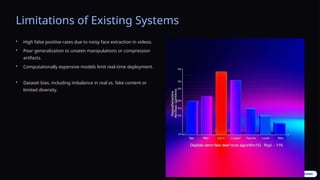
Limitations of ExistingSystems
• High false positive rates due to noisy face extraction in videos.
• Poor generalization to unseen manipulations or compression
artifacts.
• Computationally expensive models limit real-time deployment.
• Dataset bias, including imbalance in real vs. fake content or
limited diversity.
4.
Problem Statement
Accuracy
Develop ahighly accurate and efficient deepfake
detection system.
Versatility
Handle diverse deepfake types and varying video
qualities.
Reliability
Minimize false positives and negatives in real-world
scenarios.
Usability
Enable scalable deployment with a user-friendly interface.
5.
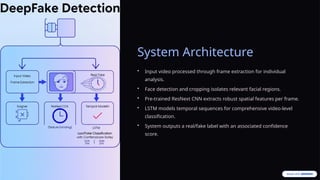
System Architecture
• Inputvideo processed through frame extraction for individual
analysis.
• Face detection and cropping isolates relevant facial regions.
• Pre-trained ResNext CNN extracts robust spatial features per frame.
• LSTM models temporal sequences for comprehensive video-level
classification.
• System outputs a real/fake label with an associated confidence
score.
6.
Tools and Technologies
Python,PyTorch: For robust model development and efficient training.
Face Detection Libraries: MTCNN, Dlib, and face_recognition for precise face localization.
Backend: Flask for API serving, ensuring seamless integration.
Frontend: ReactJS for a dynamic and user-friendly interface.
Datasets: FaceForensics++ and Celeb-DF for comprehensive training and validation.
7.
Scope and FutureWork
Multimodal Analysis: Extend detection to include audio deepfakes.
Edge Optimization: Develop models for efficient real-time detection on edge devices.
API Development: Create open APIs for seamless integration with social media platforms.
Dataset Curation: Implement continuous updates to address evolving deepfake techniques.
8.
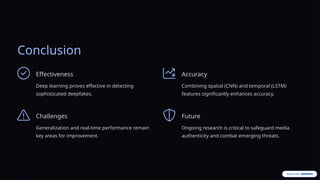
Conclusion
Effectiveness
Deep learning proveseffective in detecting
sophisticated deepfakes.
Accuracy
Combining spatial (CNN) and temporal (LSTM)
features significantly enhances accuracy.
Challenges
Generalization and real-time performance remain
key areas for improvement.
Future
Ongoing research is critical to safeguard media
authenticity and combat emerging threats.
9.
References
Tolosana, R., etal. (2020). "Deepfakes and Beyond: A Survey of Deepfake Detection." arXiv preprint arXiv:2001.00000.
Rössler, A., et al. (2019). "FaceForensics++: Learning to Detect Manipulated Facial Images." Proceedings of the IEEE/CVF
International Conference on Computer Vision (ICCV).
Google, Jigsaw, & Kaggle. (2020). DeepFake Detection Challenge.
Papadopoulos, D., et al. (2020). "Media Forensics Workshop." IEEE International Conference on Multimedia and Expo
Workshops (ICMEW).
• GitHub Repository: "Deepfake detection using ResNext + LSTM" by abhijithjadhav.
10.
Thank You /Q&A
Contact Information: [Your Name/Team] | [Your Email] | [Project
Repository Link]
We welcome your questions and insights. Let's discuss the future of
deepfake detection.



![Thank You / Q&A
Contact Information: [Your Name/Team] | [Your Email] | [Project
Repository Link]
We welcome your questions and insights. Let's discuss the future of
deepfake detection.](https://image.slidesharecdn.com/deepfake-detection-using-deep-learning-250726062009-b5da5e1d/85/Deepfake-Detection-Using-Deep-Learning-pptx-10-320.jpg)


![SSII2021 [SS2] Deepfake Generation and Detection – An Overview (ディープフェイクの生成と検出)](https://cdn.slidesharecdn.com/ss_thumbnails/ss2-01-210607043612-thumbnail.jpg?width=640&height=640&fit=bounds)


