

Acharya Narendra Deva
University Of Agriculture And
Technology, Kumarganj,
Ayodhya,UP.(224229)
SEMINAR ON
Resource conservation technologies for
higher productivity- An Indian
perspective
PRESENTED BY : Deepak Kumar Dwivedi
and
Gayatri Turkar
MSc. 1st year (2nd sem.)
OUTLINE
• Introduction
• Why RCT??
• Future challenges in Indian agriculture
• CA vs RCTs
• Components of RCT
• Various RCTs used in land management
• RCTs used in crop production
• Research findings
• Conclusion
Introduction
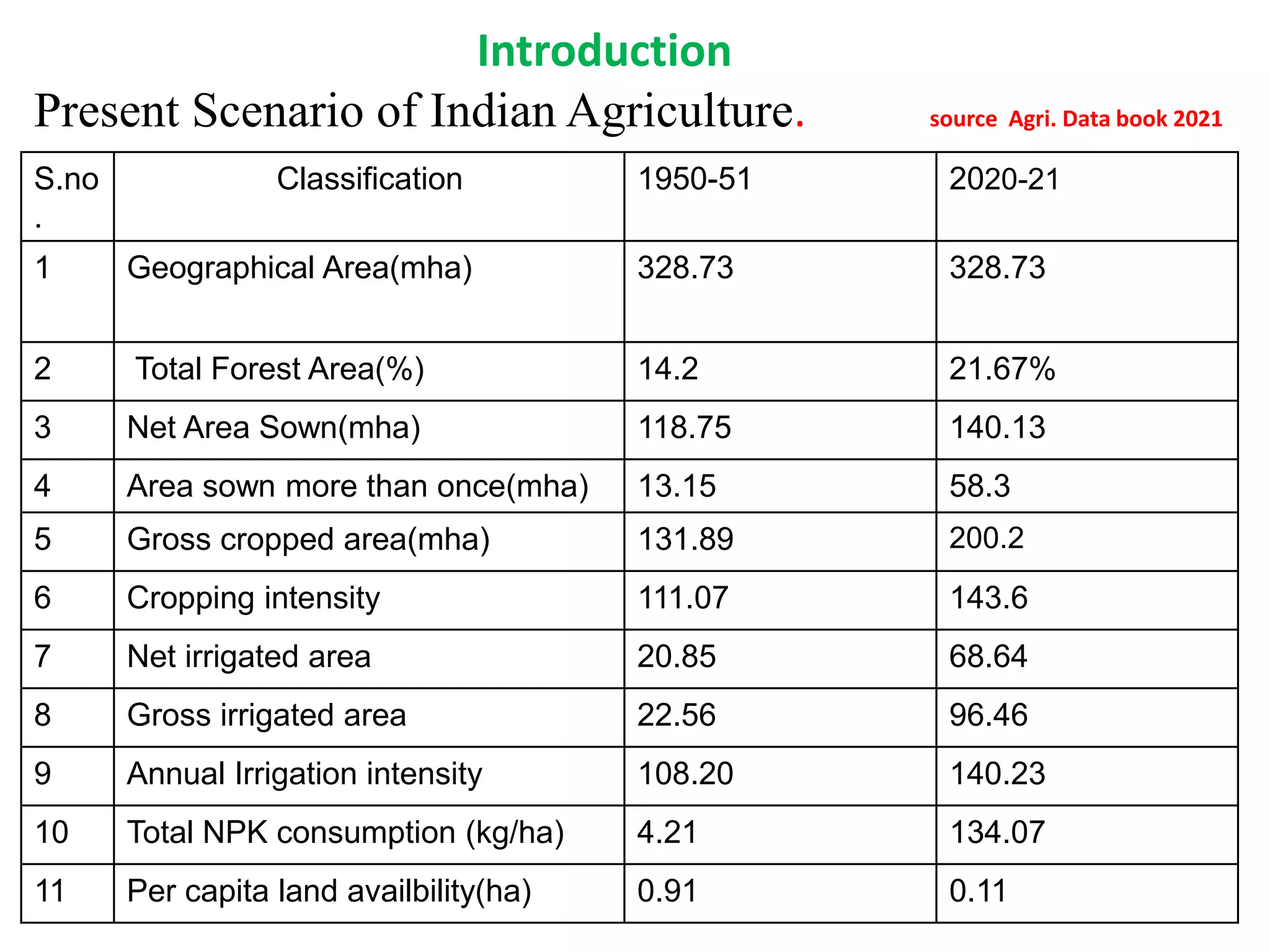
Present Scenario of Indian Agriculture. source Agri. Data book 2021
S.no
.
Classification 1950-51 2020-21
1 Geographical Area(mha) 328.73 328.73
2 Total Forest Area(%) 14.2 21.67%
3 Net Area Sown(mha) 118.75 140.13
4 Area sown more than once(mha) 13.15 58.3
5 Gross cropped area(mha) 131.89 200.2
6 Cropping intensity 111.07 143.6
7 Net irrigated area 20.85 68.64
8 Gross irrigated area 22.56 96.46
9 Annual Irrigation intensity 108.20 140.23
10 Total NPK consumption (kg/ha) 4.21 134.07
11 Per capita land availbility(ha) 0.91 0.11
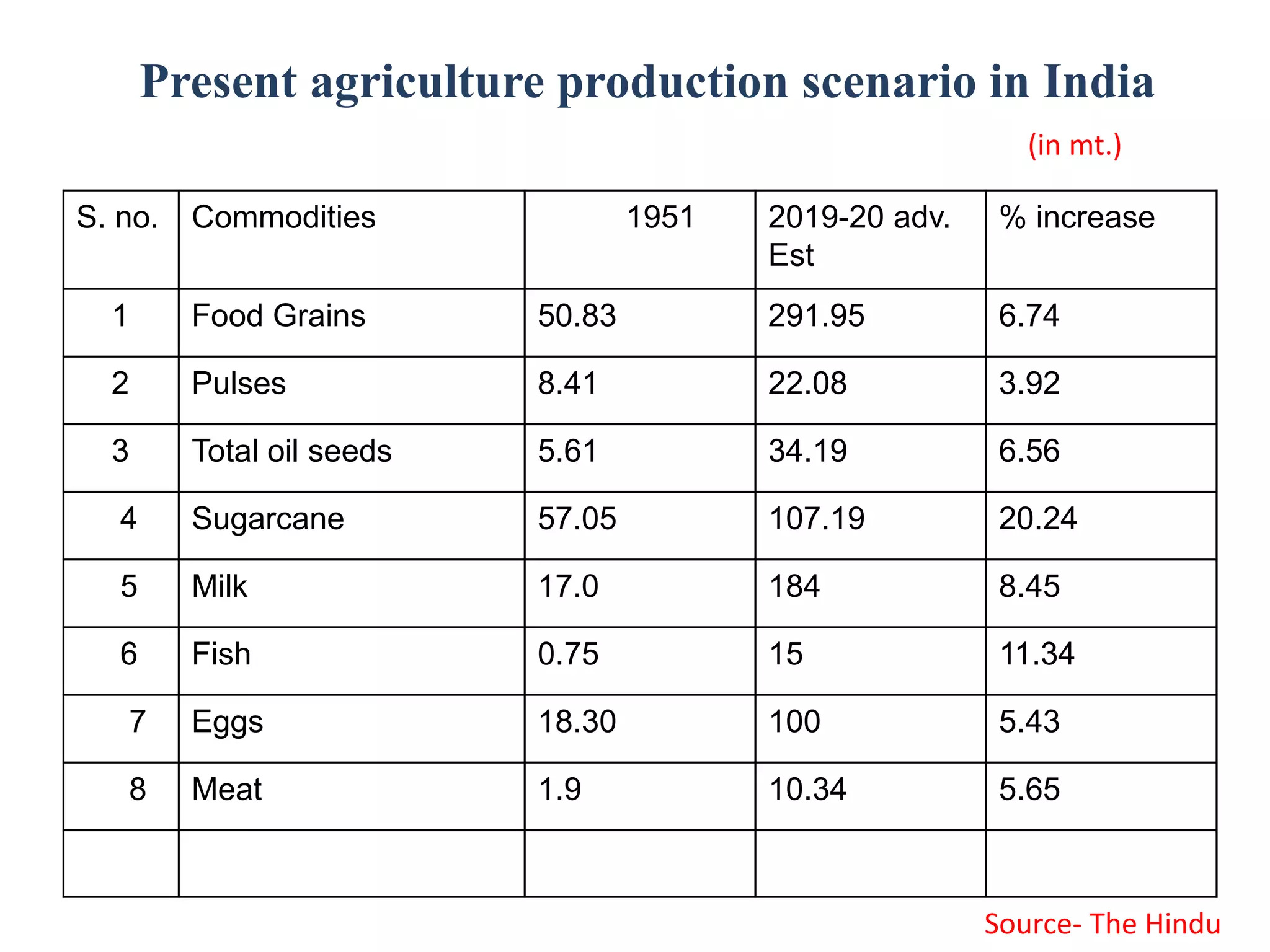
S. no. Commodities 1951 2019-20 adv.
Est
% increase
1 Food Grains 50.83 291.95 6.74
2 Pulses 8.41 22.08 3.92
3 Total oil seeds 5.61 34.19 6.56
4 Sugarcane 57.05 107.19 20.24
5 Milk 17.0 184 8.45
6 Fish 0.75 15 11.34
7 Eggs 18.30 100 5.43
8 Meat 1.9 10.34 5.65
Source- The Hindu
Present agriculture production scenario in India
(in mt.)
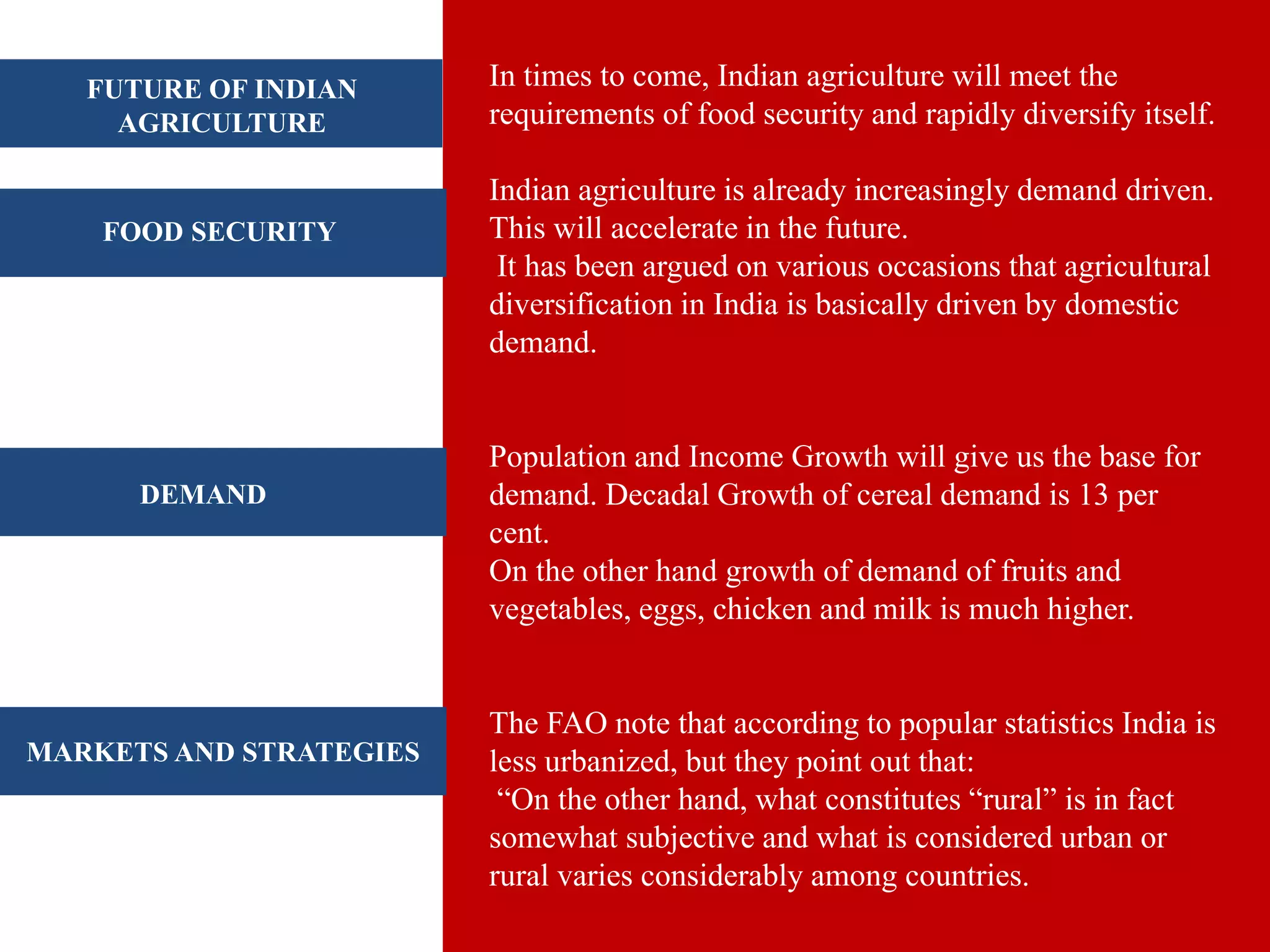
In times to come, Indian agriculture will meet the
requirements of food security and rapidly diversify itself.
Indian agriculture is already increasingly demand driven.
This will accelerate in the future.
It has been argued on various occasions that agricultural
diversification in India is basically driven by domestic
demand.
Population and Income Growth will give us the base for
demand. Decadal Growth of cereal demand is 13 per
cent.
On the other hand growth of demand of fruits and
vegetables, eggs, chicken and milk is much higher.
The FAO note that according to popular statistics India is
less urbanized, but they point out that:
“On the other hand, what constitutes “rural” is in fact
somewhat subjective and what is considered urban or
rural varies considerably among countries.
FUTURE OF INDIAN
AGRICULTURE
FOOD SECURITY
DEMAND
MARKETS AND STRATEGIES
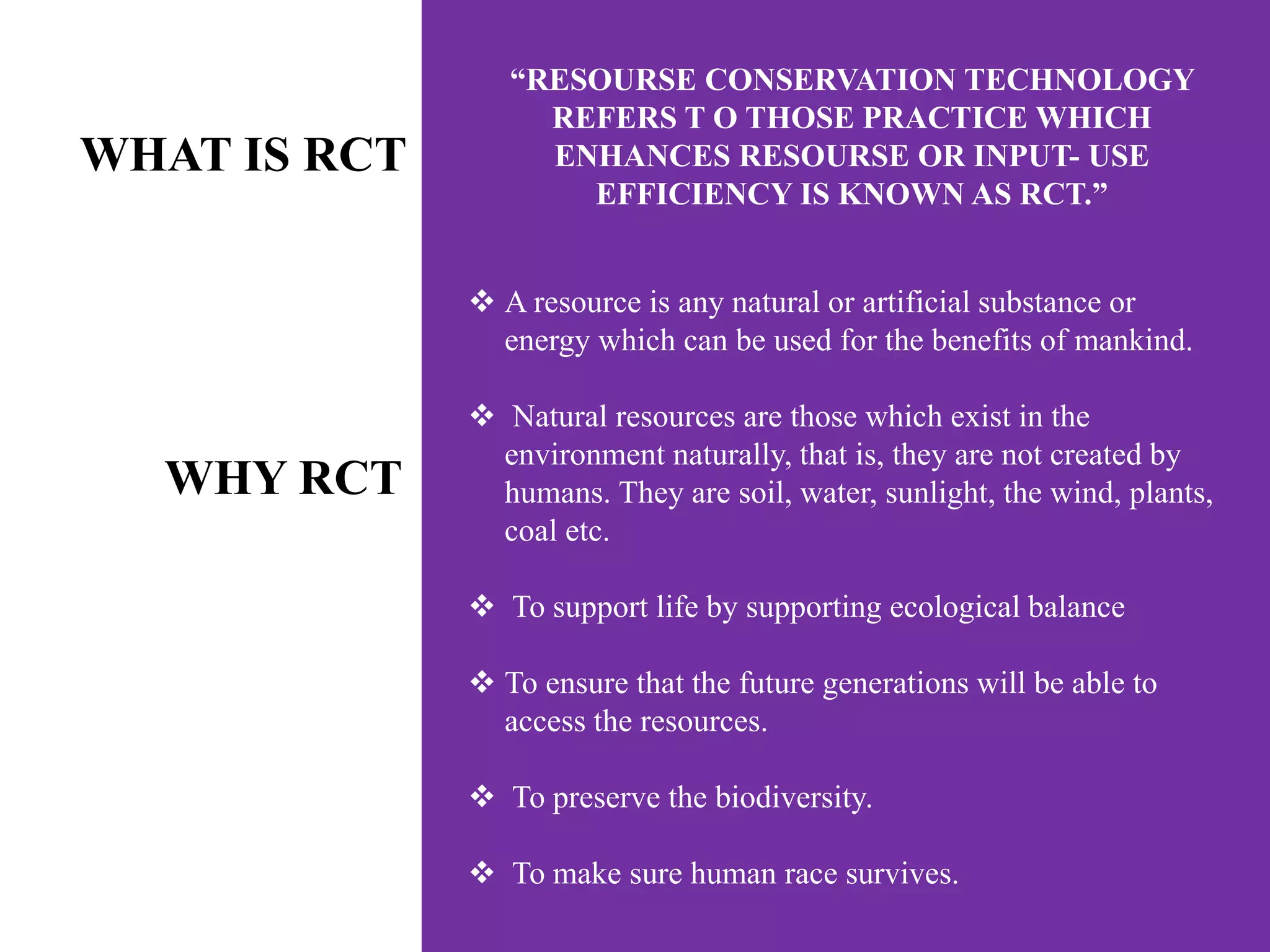
“RESOURSE CONSERVATION TECHNOLOGY
REFERS T O THOSE PRACTICE WHICH
ENHANCES RESOURSE OR INPUT- USE
EFFICIENCY IS KNOWN AS RCT.”
RCT.”
WHAT IS RCT
 A resource is any natural or artificial substance or
energy which can be used for the benefits of mankind.
 Natural resources are those which exist in the
environment naturally, that is, they are not created by
humans. They are soil, water, sunlight, the wind, plants,
coal etc.
 To support life by supporting ecological balance
 To ensure that the future generations will be able to
access the resources.
 To preserve the biodiversity.
 To make sure human race survives.
WHY RCT
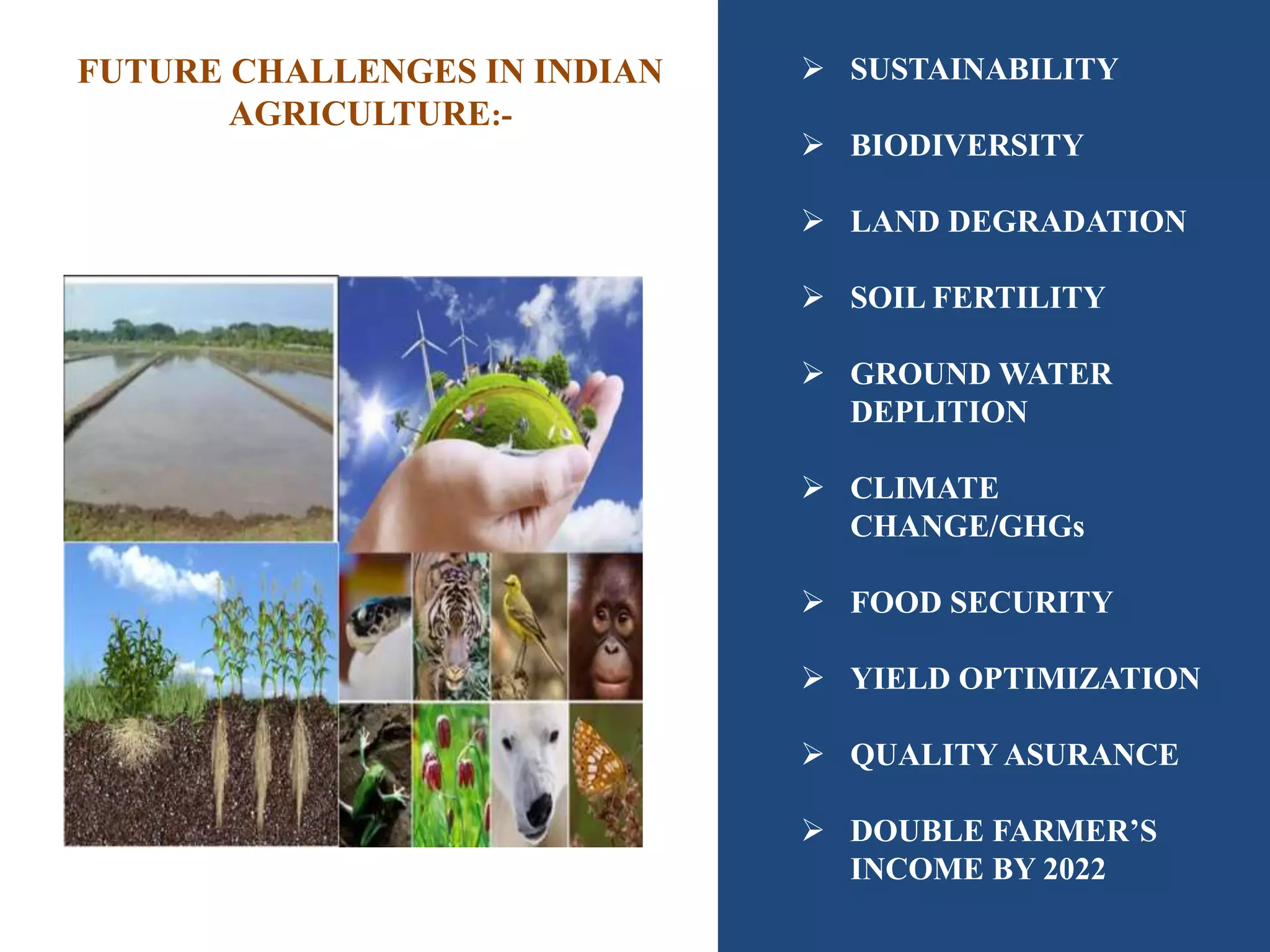
FUTURE CHALLENGES IN INDIAN
AGRICULTURE:-
 SUSTAINABILITY
 BIODIVERSITY
 LAND DEGRADATION
 SOIL FERTILITY
 GROUND WATER
DEPLITION
 CLIMATE
CHANGE/GHGs
 FOOD SECURITY
 YIELD OPTIMIZATION
 QUALITY ASURANCE
 DOUBLE FARMER’S
INCOME BY 2022
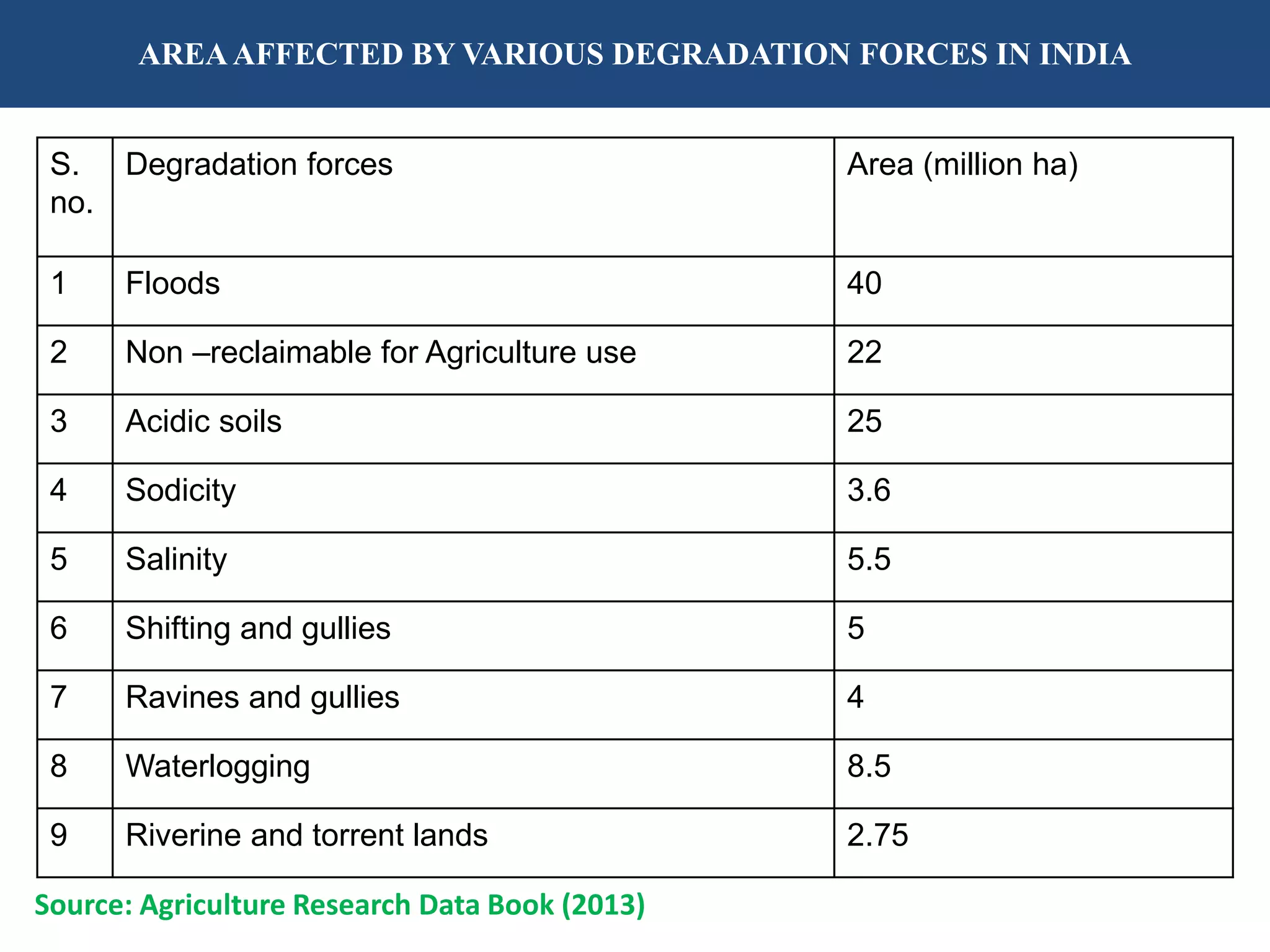
Source: Agriculture Research Data Book (2013)
S.
no.
Degradation forces Area (million ha)
1 Floods 40
2 Non –reclaimable for Agriculture use 22
3 Acidic soils 25
4 Sodicity 3.6
5 Salinity 5.5
6 Shifting and gullies 5
7 Ravines and gullies 4
8 Waterlogging 8.5
9 Riverine and torrent lands 2.75
AREAAFFECTED BY VARIOUS DEGRADATION FORCES IN INDIA
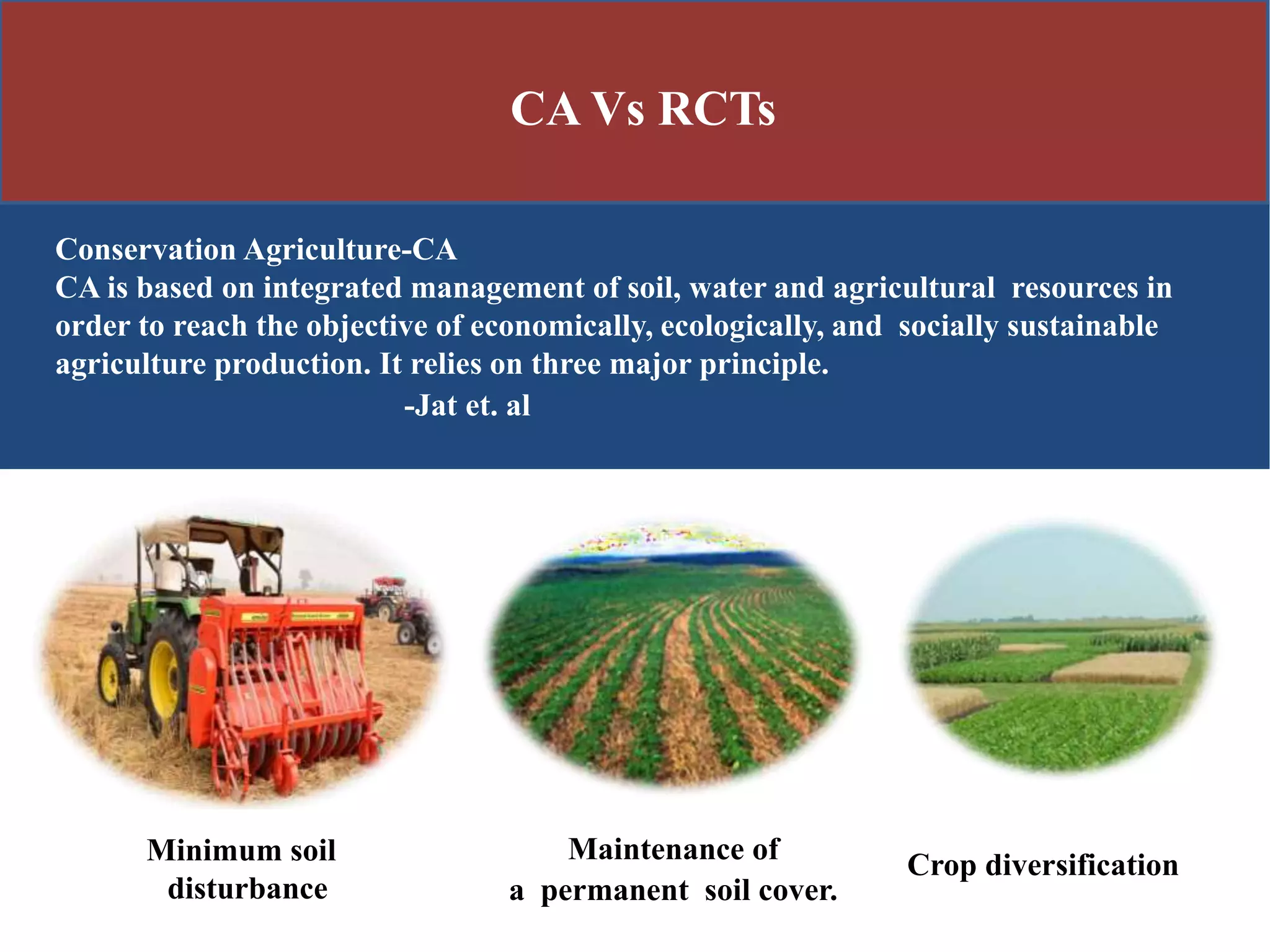
Minimum soil
disturbance
Maintenance of
a permanent soil cover.
Crop diversification
Conservation Agriculture-CA
CA is based on integrated management of soil, water and agricultural resources in
order to reach the objective of economically, ecologically, and socially sustainable
agriculture production. It relies on three major principle.
-Jat et. al
CA Vs RCTs
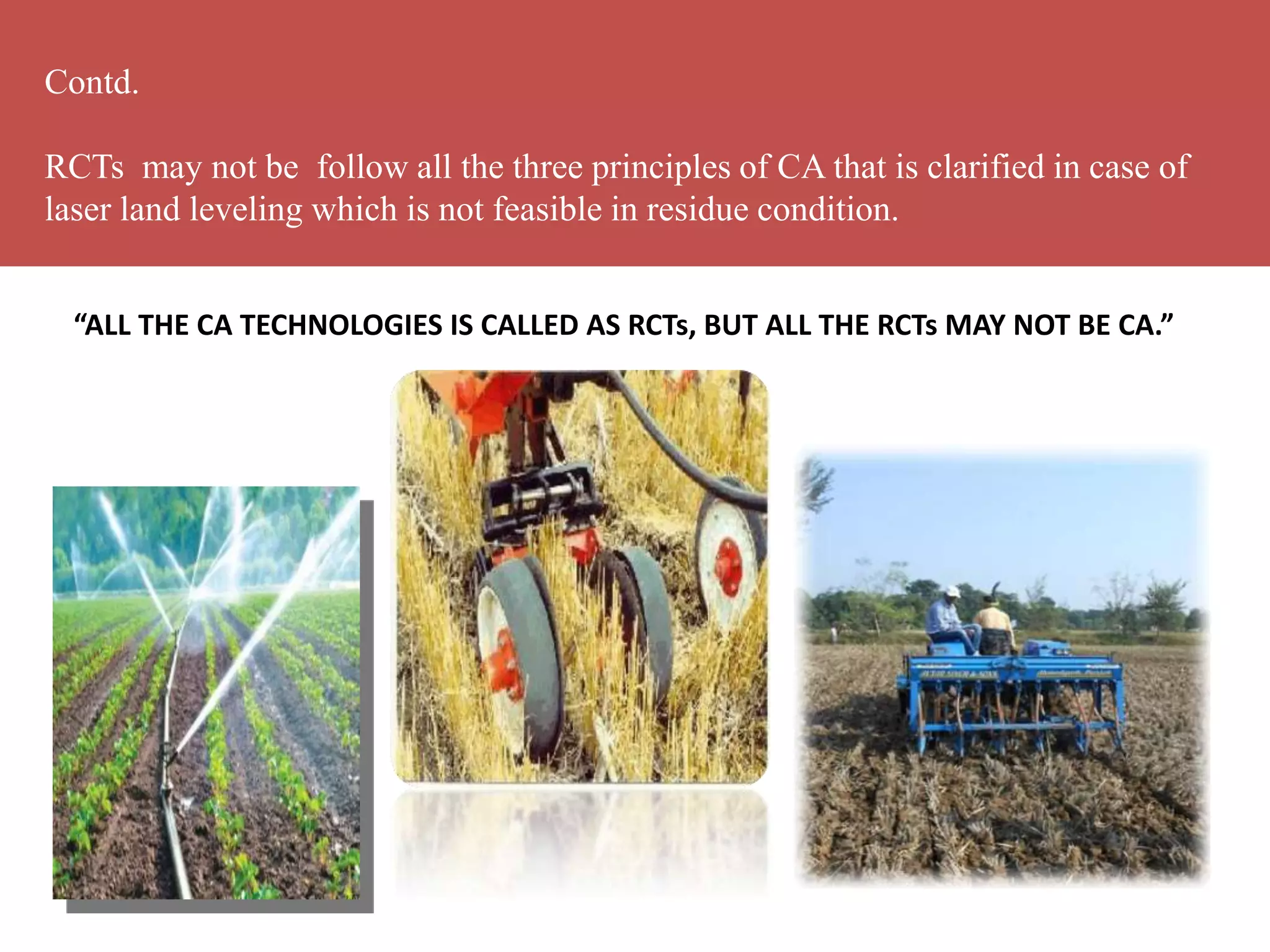
“ALL THE CA TECHNOLOGIES IS CALLED AS RCTs, BUT ALL THE RCTs MAY NOT BE CA.”
Contd.
RCTs may not be follow all the three principles of CA that is clarified in case of
laser land leveling which is not feasible in residue condition.
LAN
D NUTRIEN
T
CROPS
IRRIGATIO
N
RCT’s FOR
COMPONENTS OF RCT’S WHICH ARE USED IN
AGRICULTURE
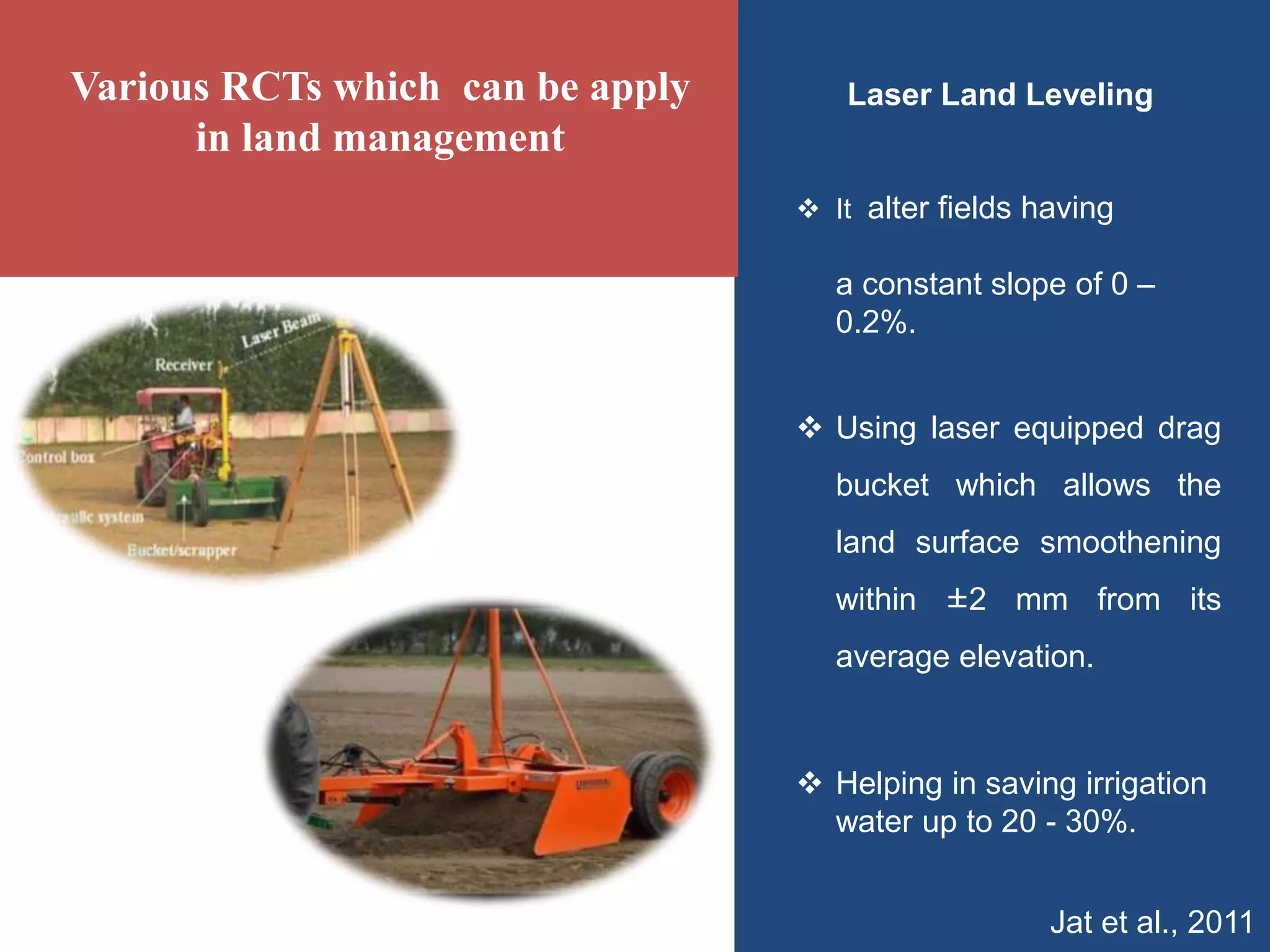
Laser Land Leveling
 It alter fields having
a constant slope of 0 –
0.2%.
 Using laser equipped drag
bucket which allows the
land surface smoothening
within ±2 mm from its
average elevation.
 Helping in saving irrigation
water up to 20 - 30%.
Jat et al., 2011
Various RCTs which can be apply
in land management
Zero Tillage Technology
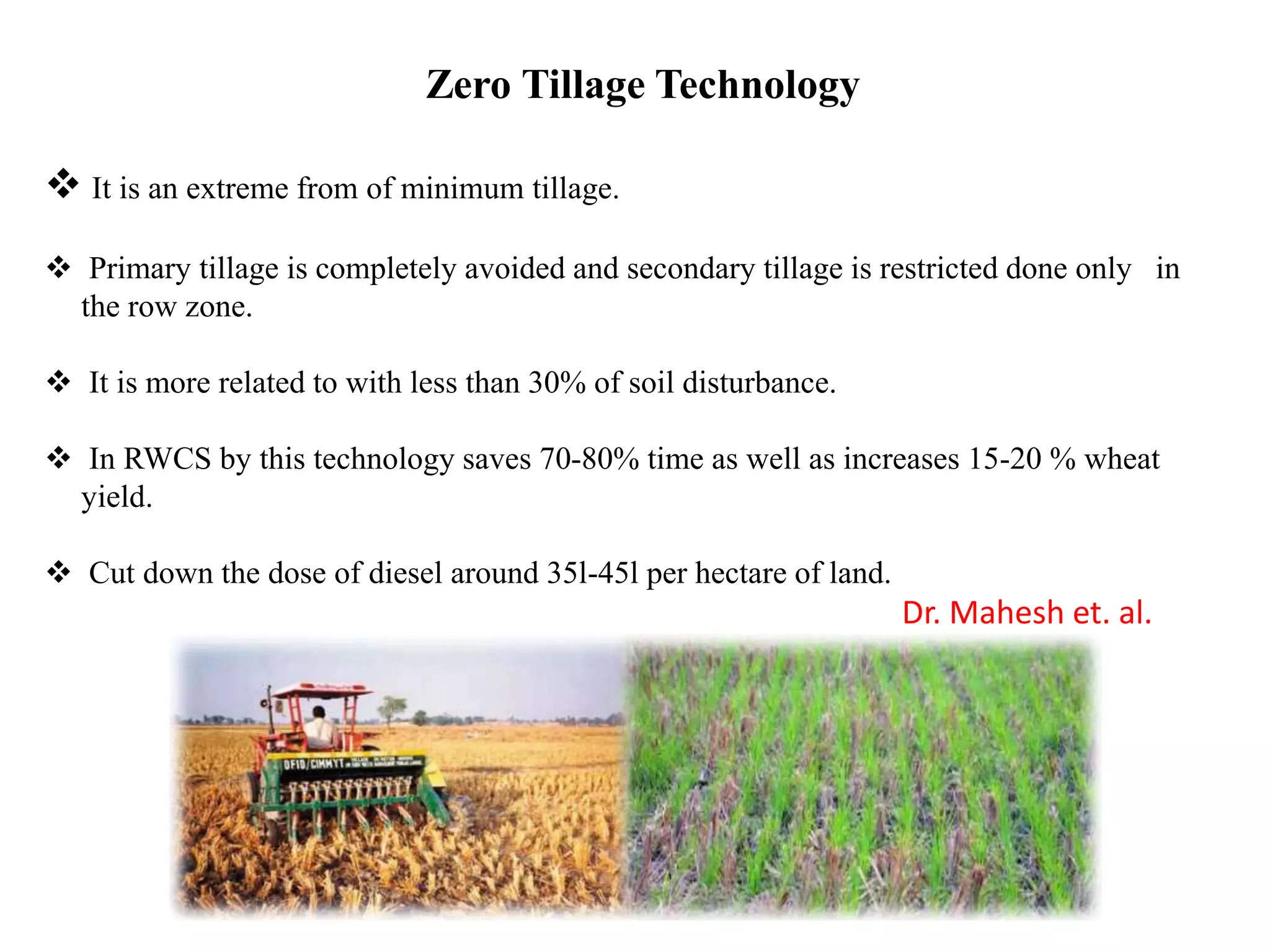
 It is an extreme from of minimum tillage.
 Primary tillage is completely avoided and secondary tillage is restricted done only in
the row zone.
 It is more related to with less than 30% of soil disturbance.
 In RWCS by this technology saves 70-80% time as well as increases 15-20 % wheat
yield.
 Cut down the dose of diesel around 35l-45l per hectare of land.
Dr. Mahesh et. al.
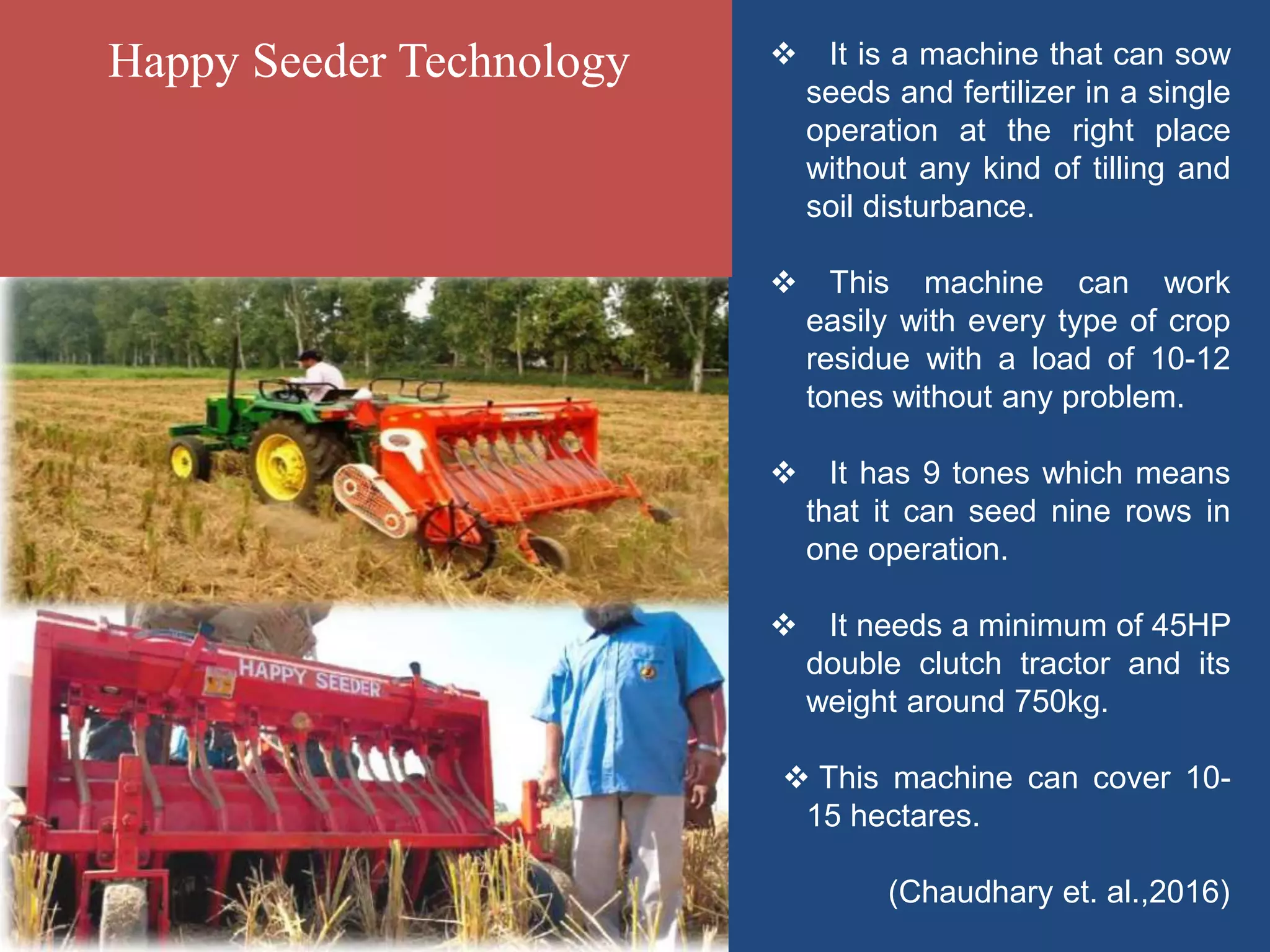
 It is a machine that can sow
seeds and fertilizer in a single
operation at the right place
without any kind of tilling and
soil disturbance.
 This machine can work
easily with every type of crop
residue with a load of 10-12
tones without any problem.
 It has 9 tones which means
that it can seed nine rows in
one operation.
 It needs a minimum of 45HP
double clutch tractor and its
weight around 750kg.
 This machine can cover 10-
15 hectares.
(Chaudhary et. al.,2016)
Happy Seeder Technology
Bed Planting Technique
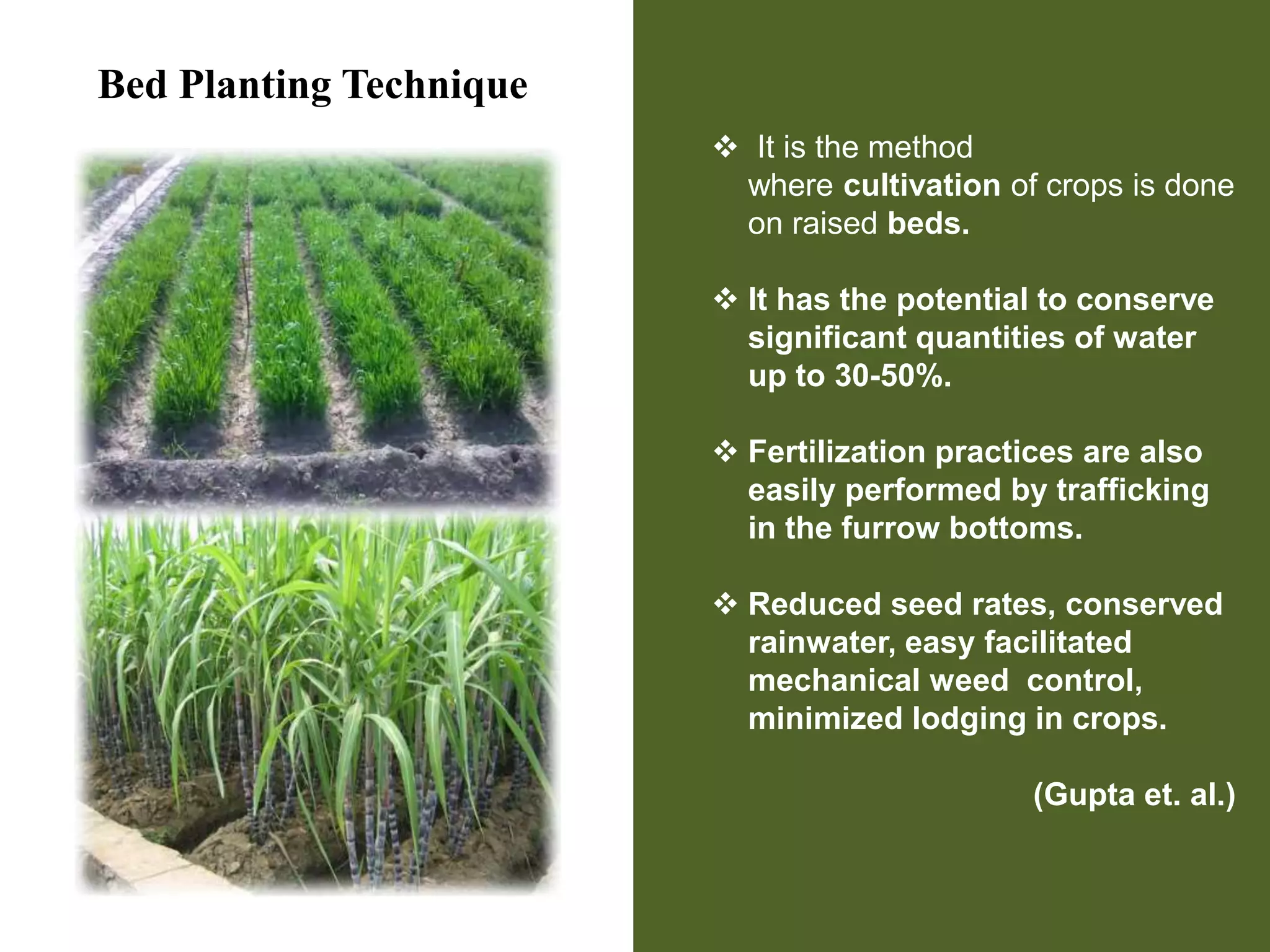
 It is the method
where cultivation of crops is done
on raised beds.
 It has the potential to conserve
significant quantities of water
up to 30-50%.
 Fertilization practices are also
easily performed by trafficking
in the furrow bottoms.
 Reduced seed rates, conserved
rainwater, easy facilitated
mechanical weed control,
minimized lodging in crops.
(Gupta et. al.)
RCTs for nutrient management Site Specific Nutrient
Management
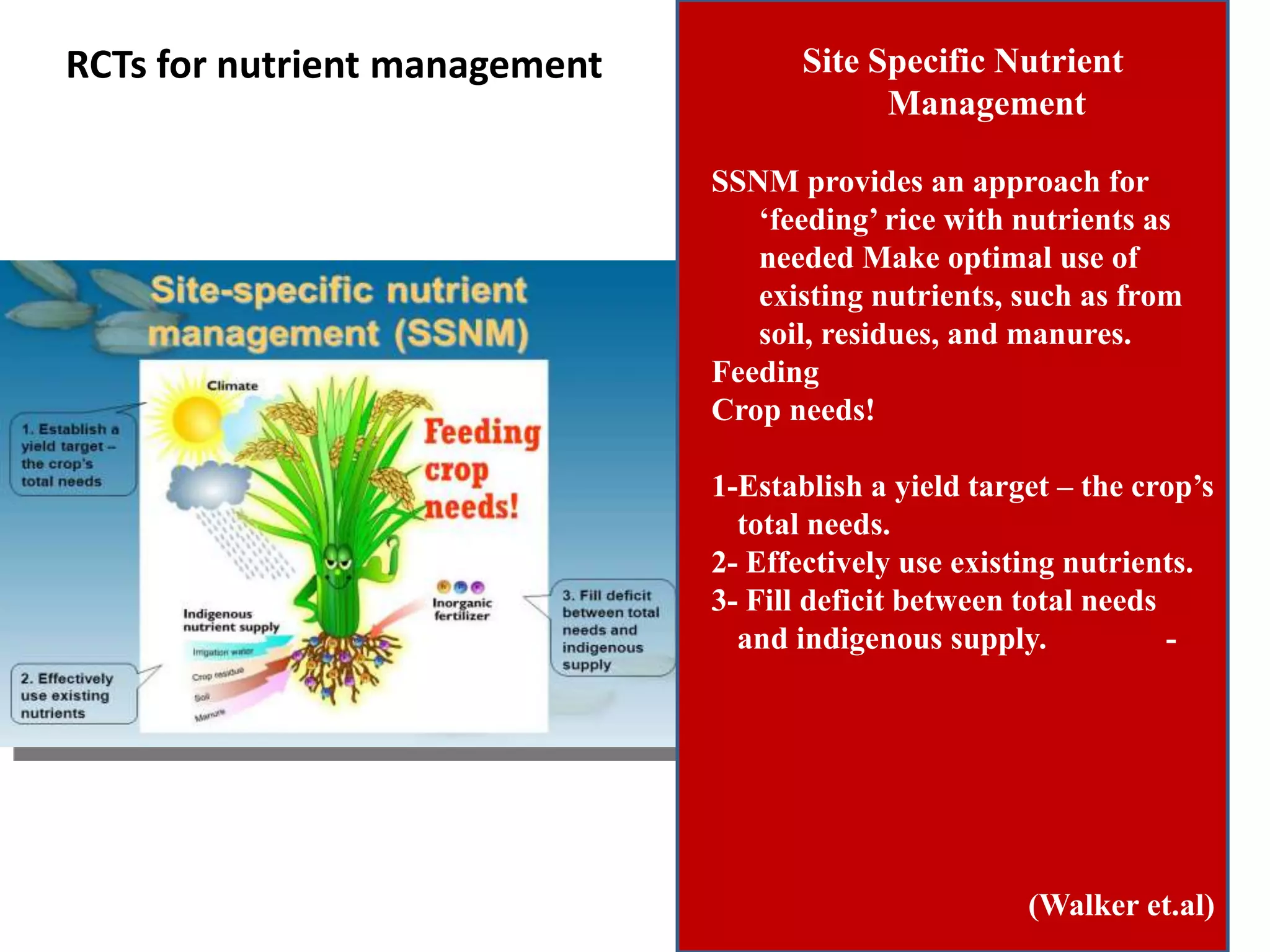
SSNM provides an approach for
‘feeding’ rice with nutrients as
needed Make optimal use of
existing nutrients, such as from
soil, residues, and manures.
Feeding
Crop needs!
1-Establish a yield target – the crop’s
total needs.
2- Effectively use existing nutrients.
3- Fill deficit between total needs
and indigenous supply. -
(Walker et.al)
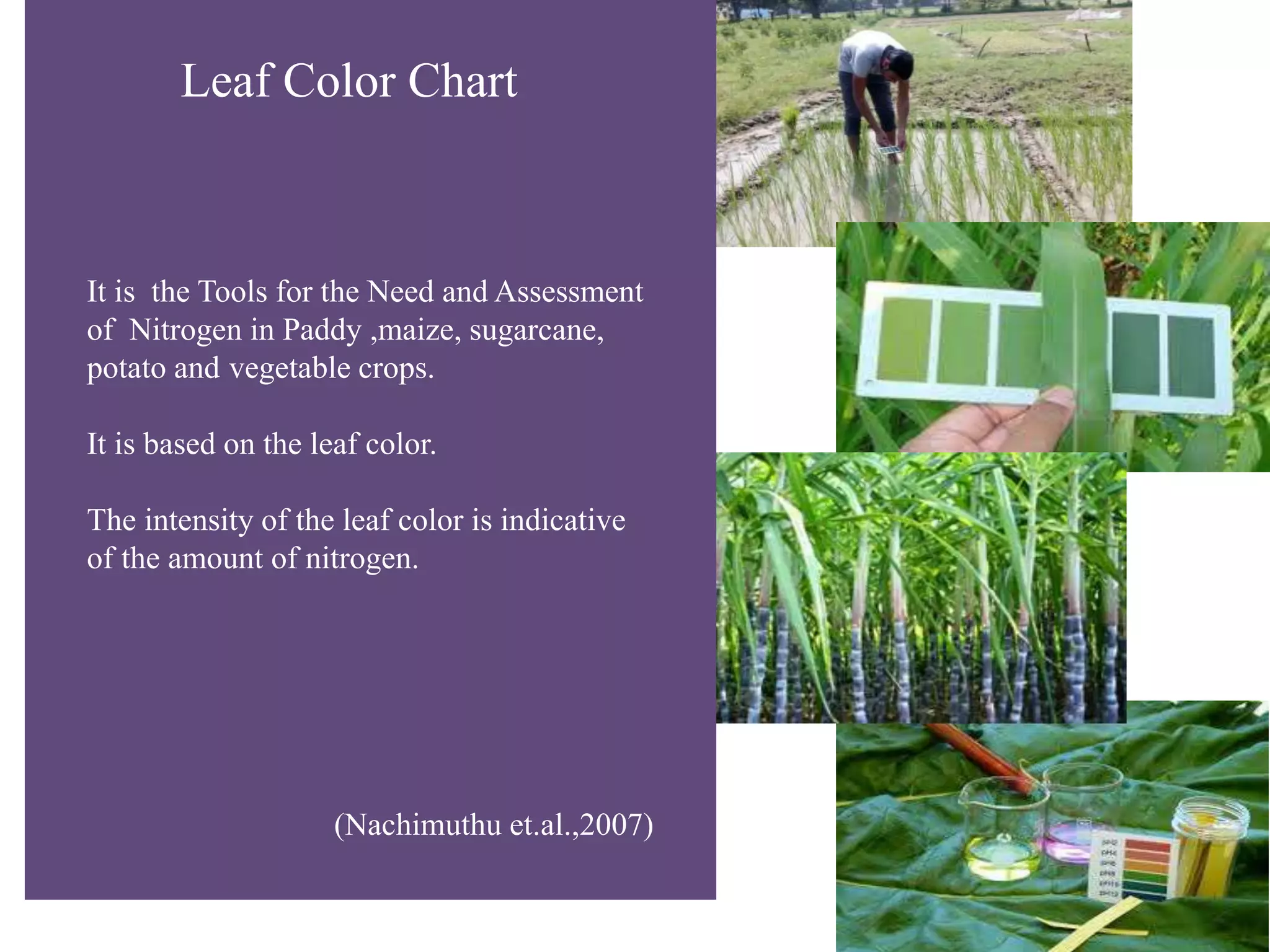
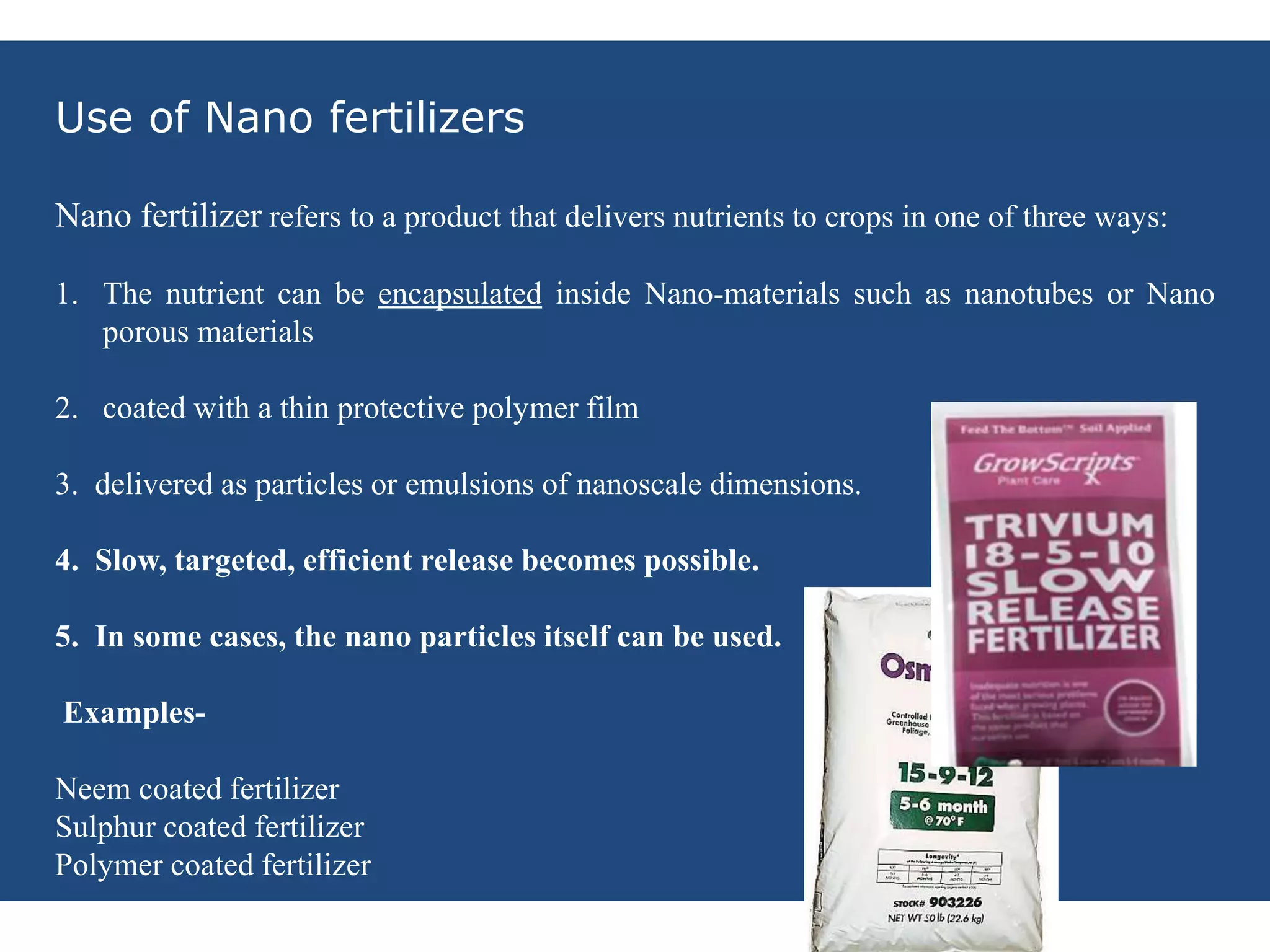
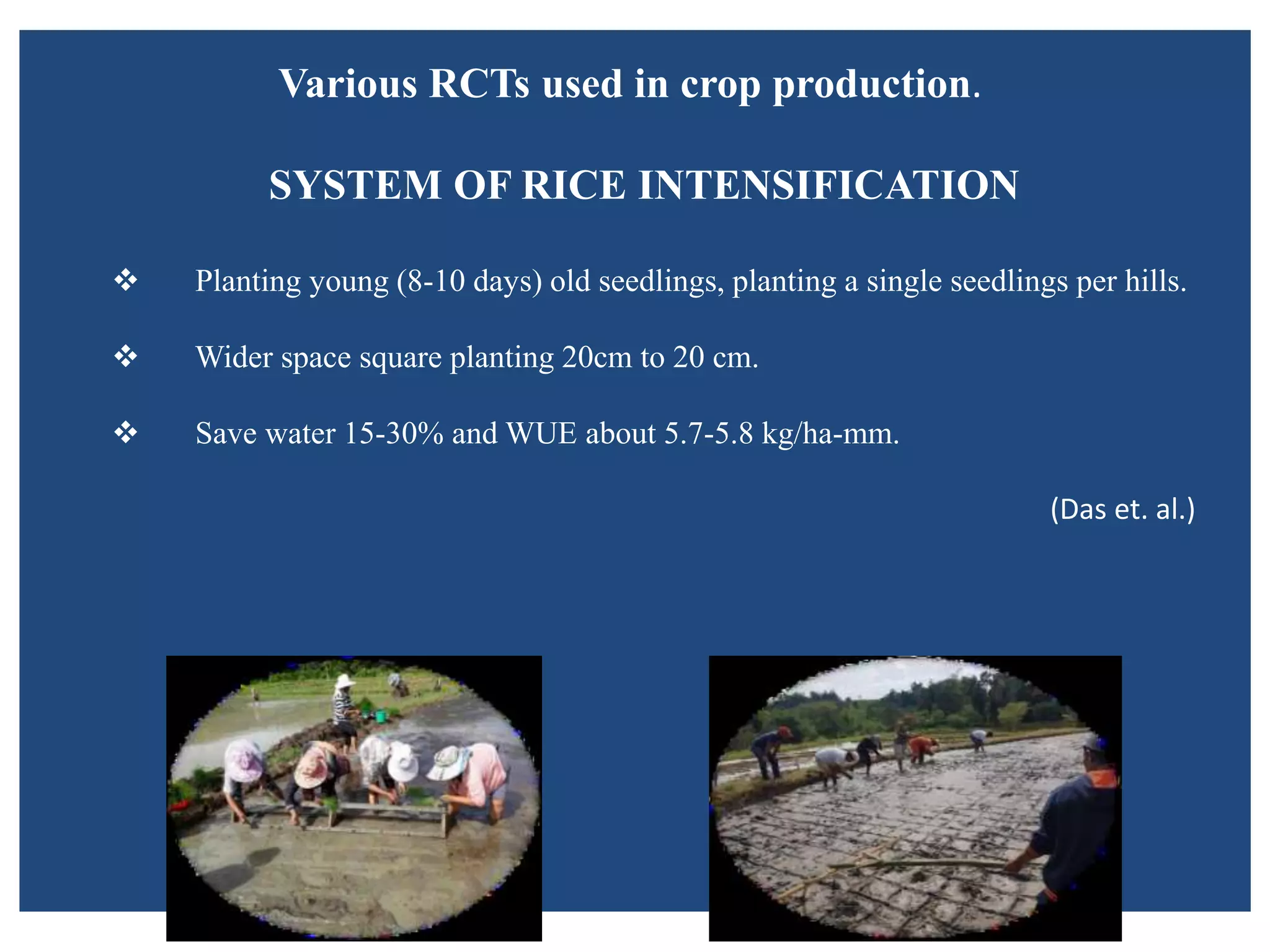
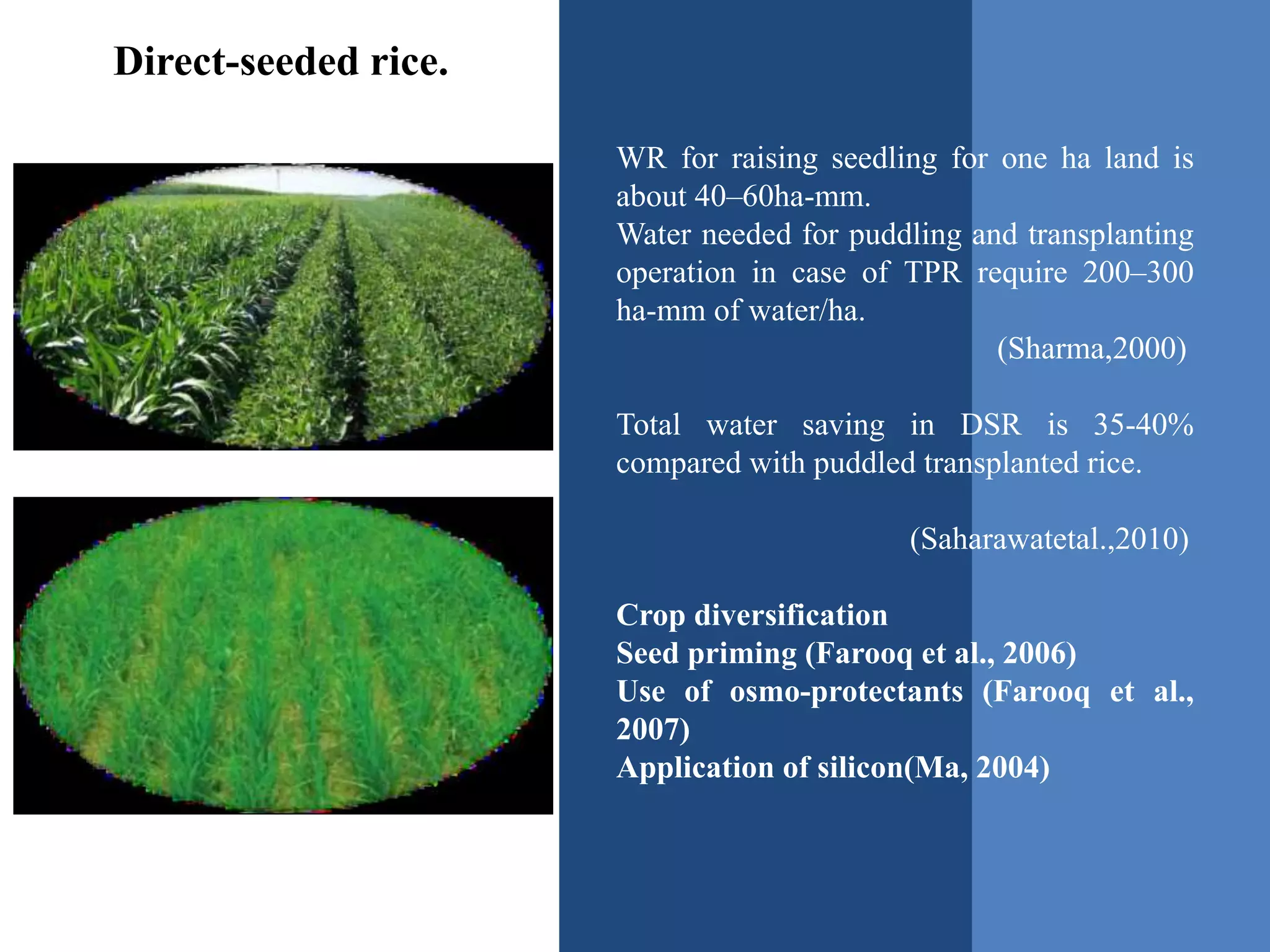
It is the Tools for the Need and Assessment
of Nitrogen in Paddy ,maize, sugarcane,
potato and vegetable crops.
It is based on the leaf color.
The intensity of the leaf color is indicative
of the amount of nitrogen.
(Nachimuthu et.al.,2007)
Leaf Color Chart

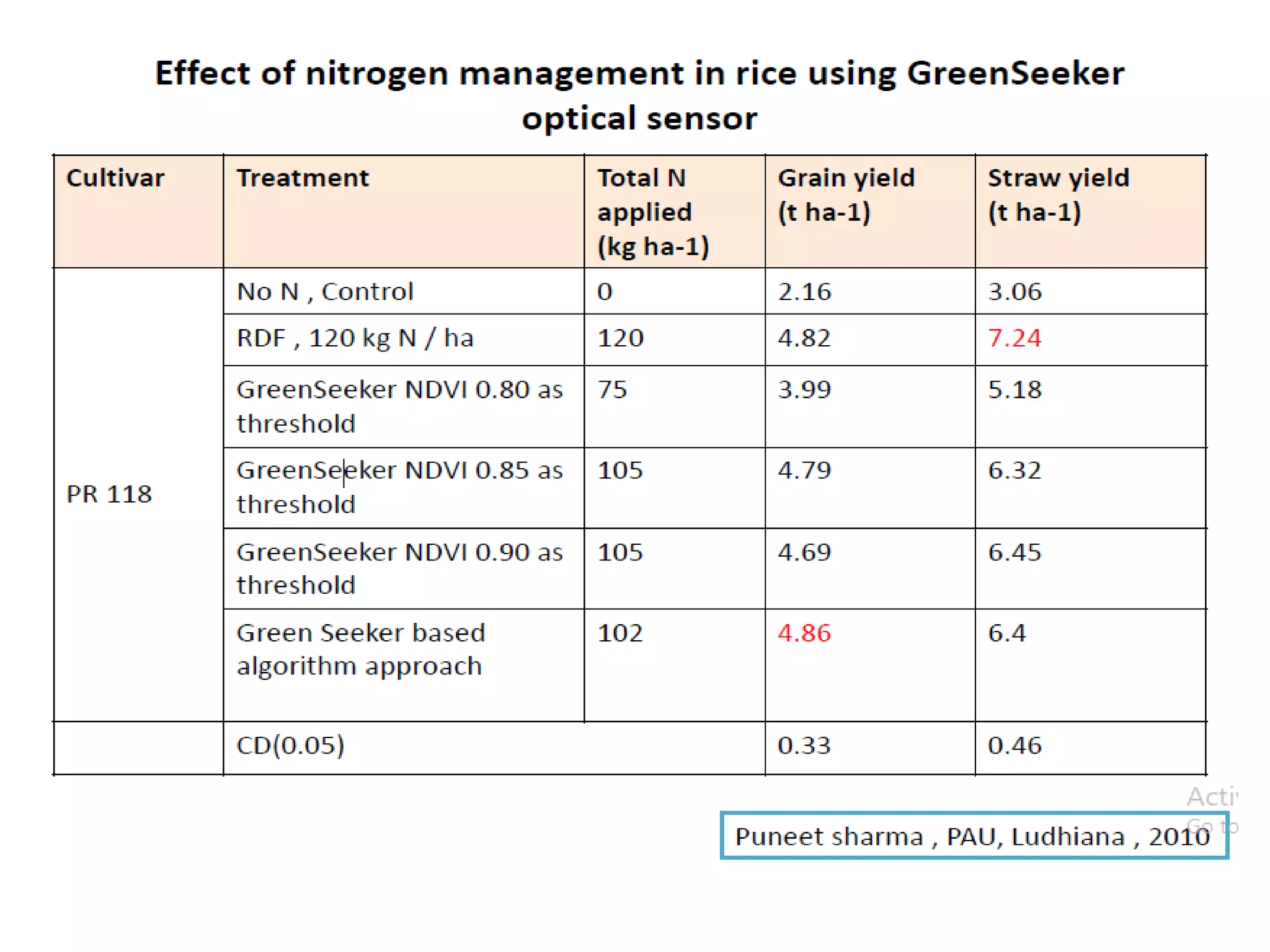
Green Seeker
 It is an integrated optical sensing , variable rate
application & mapping system that measures crop's
nitrogen requirements.
 Yield potential for a crop is identified using a
vegetative index known as NDVI (normalized
difference vegetation index) and an environmental
factor.
 The technology was developed at Oklahoma State
University, USA and licensed to N Tech Industries in
2001 (http://www.ntechindustries.com).
 It offers a more efficient and precise way to manage
crop input i.e. nitrogen.
 Nitrogen (N) recommendation based on yield
potential and the Response Index (RI).
 The Green Seeker estimates the right amount of N at
the critical stages of crop growth.
NNANOFERTILIZERS
Use of Nano fertilizers
Nano fertilizer refers to a product that delivers nutrients to crops in one of three ways:
1. The nutrient can be encapsulated inside Nano-materials such as nanotubes or Nano
porous materials
2. coated with a thin protective polymer film
3. delivered as particles or emulsions of nanoscale dimensions.
4. Slow, targeted, efficient release becomes possible.
5. In some cases, the nano particles itself can be used.
Examples-
Neem coated fertilizer
Sulphur coated fertilizer
Polymer coated fertilizer
Various RCTs used in crop production.
SYSTEM OF RICE INTENSIFICATION
 Planting young (8-10 days) old seedlings, planting a single seedlings per hills.
 Wider space square planting 20cm to 20 cm.
 Save water 15-30% and WUE about 5.7-5.8 kg/ha-mm.
(Das et. al.)
Direct-seeded rice.
WR for raising seedling for one ha land is
about 40–60ha-mm.
Water needed for puddling and transplanting
operation in case of TPR require 200–300
ha-mm of water/ha.
(Sharma,2000)
Total water saving in DSR is 35-40%
compared with puddled transplanted rice.
(Saharawatetal.,2010)
Crop diversification
Seed priming (Farooq et al., 2006)
Use of osmo-protectants (Farooq et al.,
2007)
Application of silicon(Ma, 2004)
Modified Practices
 Lower seed rate.
 Seed treatment.
 Sowing of seeds at
 Proper spacing.
 Control of water in the
 Crop field.
 Weeding / hoeing.
WHAT IS SWI ?
Outputs / Results
 Higher ratio of tillers to
 Mother seedlings.
 Increased number of
 Effective tillers / hill.
 Enhanced panicle length &
 Bolder grains.
 Enhanced yield.
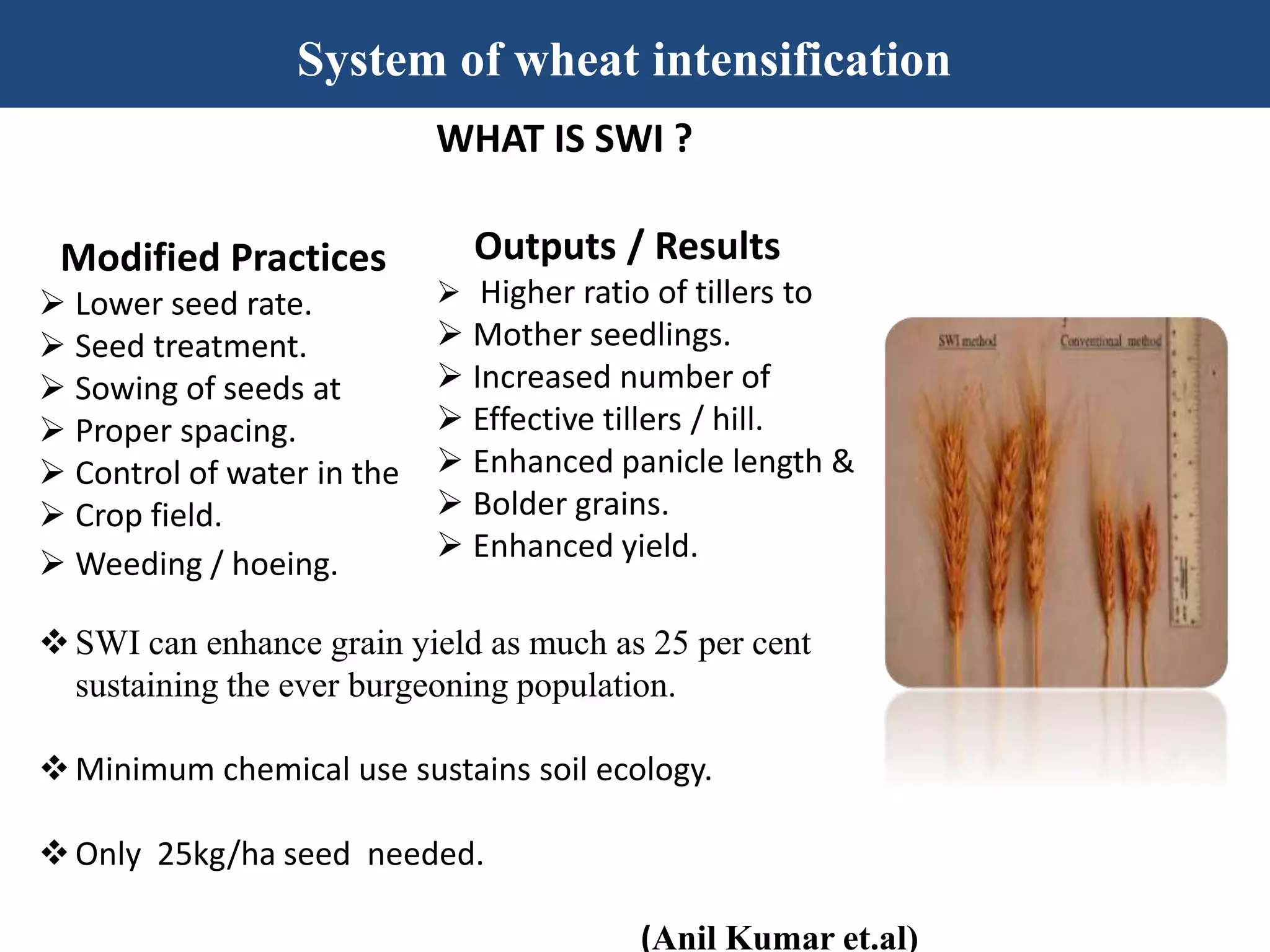
SWI can enhance grain yield as much as 25 per cent
sustaining the ever burgeoning population.
Minimum chemical use sustains soil ecology.
Only 25kg/ha seed needed.
(Anil Kumar et.al)
System of wheat intensification
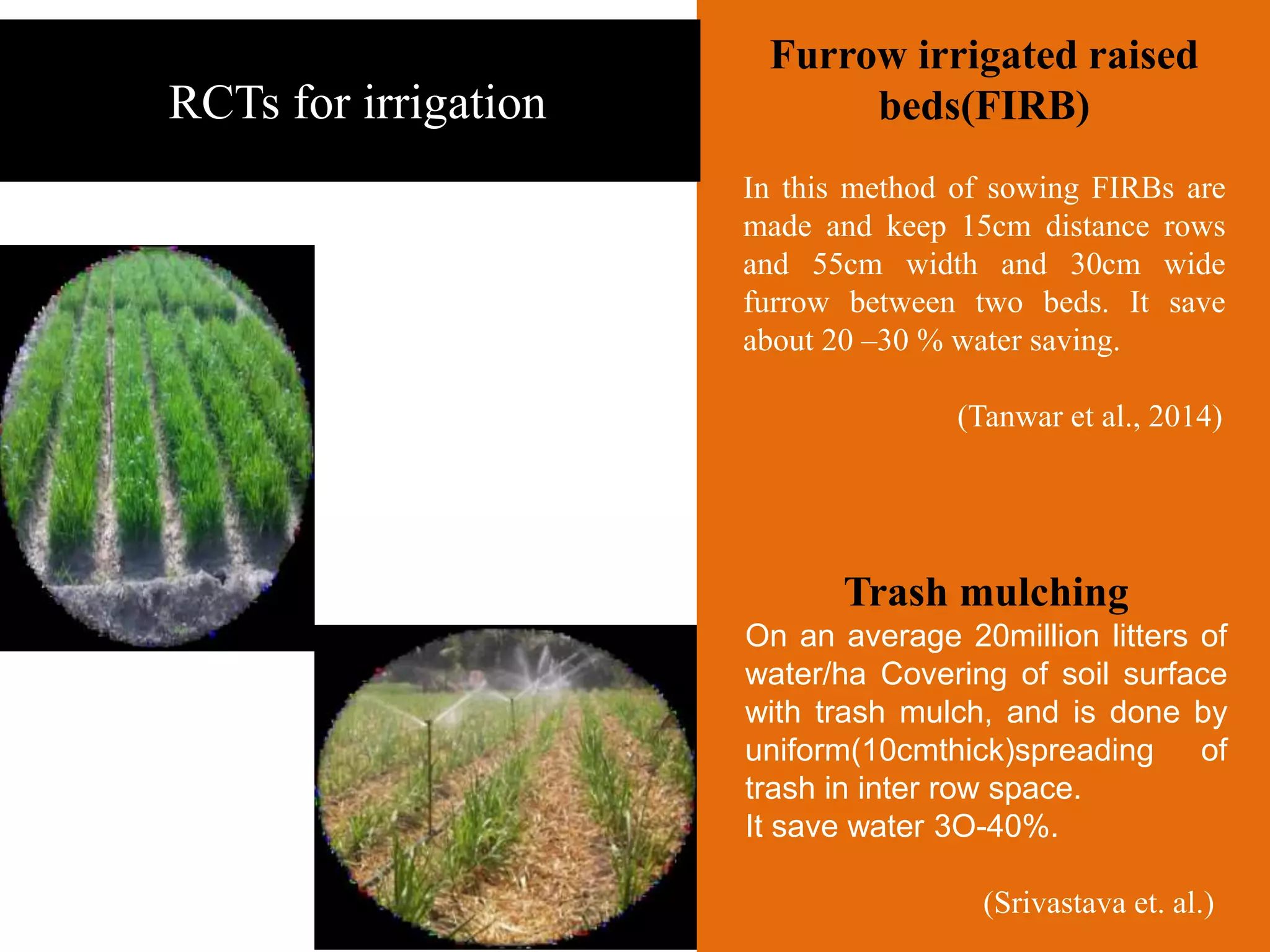
Furrow irrigated raised
beds(FIRB)
In this method of sowing FIRBs are
made and keep 15cm distance rows
and 55cm width and 30cm wide
furrow between two beds. It save
about 20 –30 % water saving.
(Tanwar et al., 2014)
Trash mulching
On an average 20million litters of
water/ha Covering of soil surface
with trash mulch, and is done by
uniform(10cmthick)spreading of
trash in inter row space.
It save water 3O-40%.
(Srivastava et. al.)
RCTs for irrigation
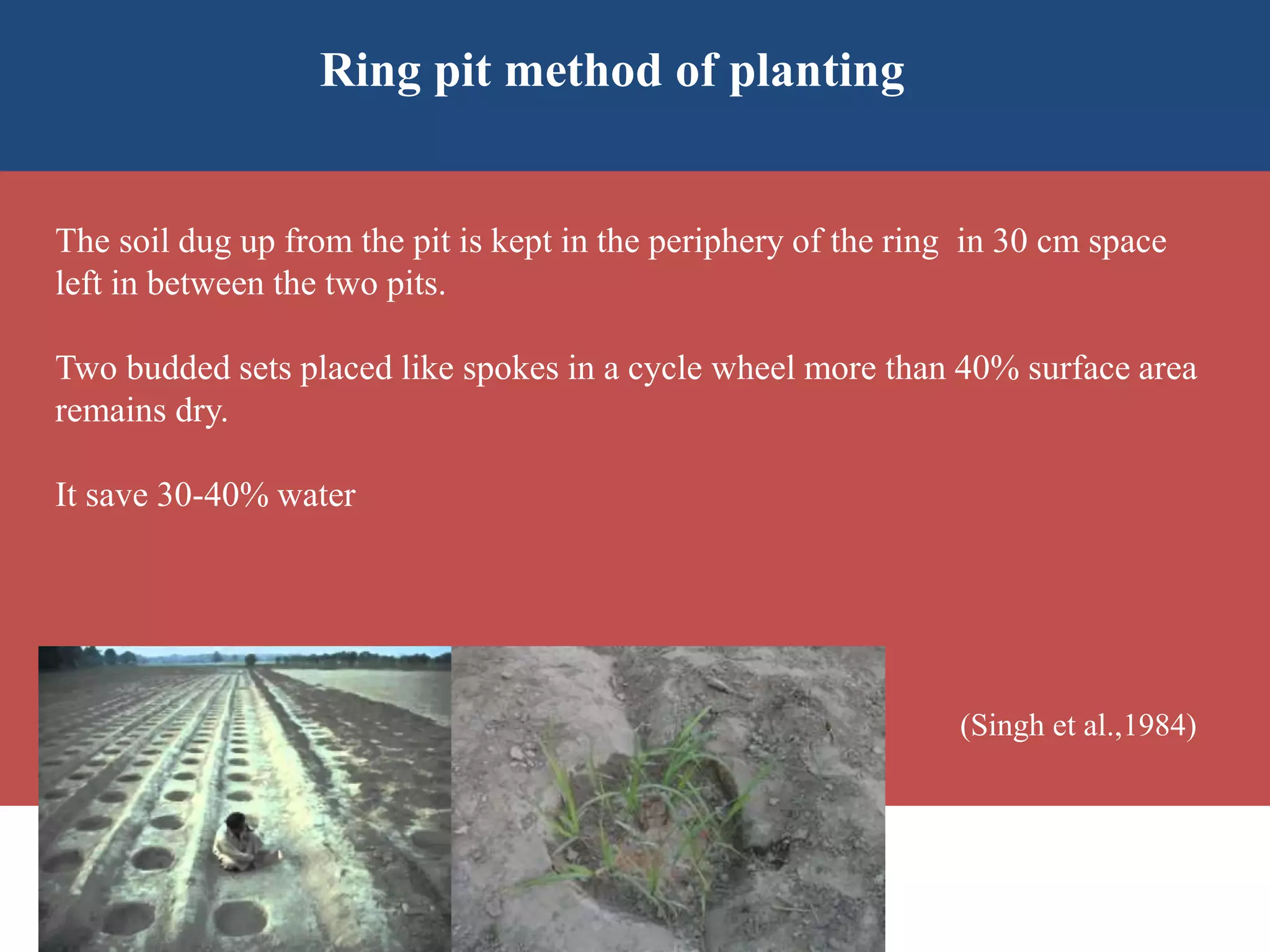
The soil dug up from the pit is kept in the periphery of the ring in 30 cm space
left in between the two pits.
Two budded sets placed like spokes in a cycle wheel more than 40% surface area
remains dry.
It save 30-40% water
(Singh et al.,1984)
Ring pit method of planting
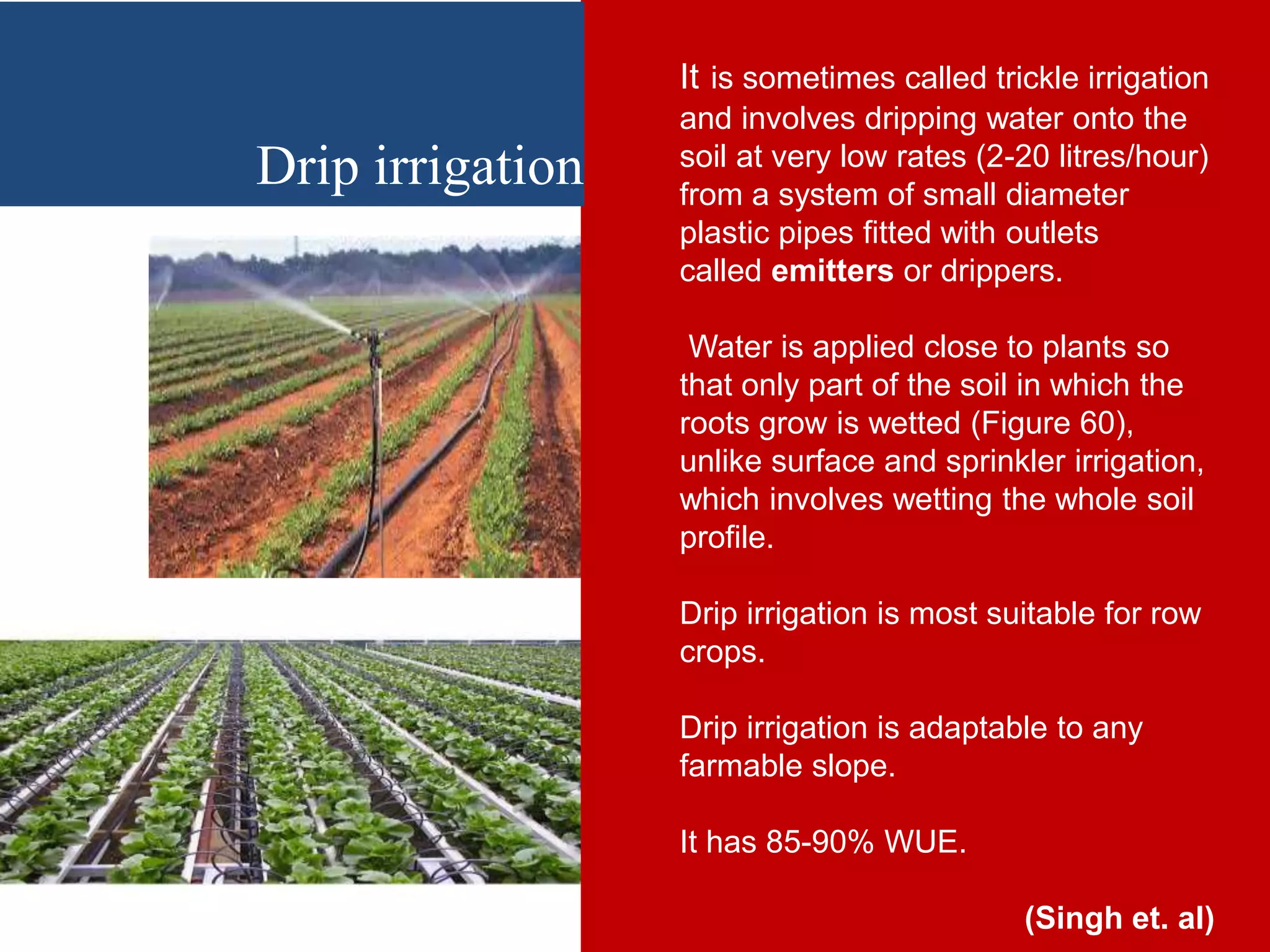
It is sometimes called trickle irrigation
and involves dripping water onto the
soil at very low rates (2-20 litres/hour)
from a system of small diameter
plastic pipes fitted with outlets
called emitters or drippers.
Water is applied close to plants so
that only part of the soil in which the
roots grow is wetted (Figure 60),
unlike surface and sprinkler irrigation,
which involves wetting the whole soil
profile.
Drip irrigation is most suitable for row
crops.
Drip irrigation is adaptable to any
farmable slope.
It has 85-90% WUE.
(Singh et. al)
Drip irrigation
Research Findings
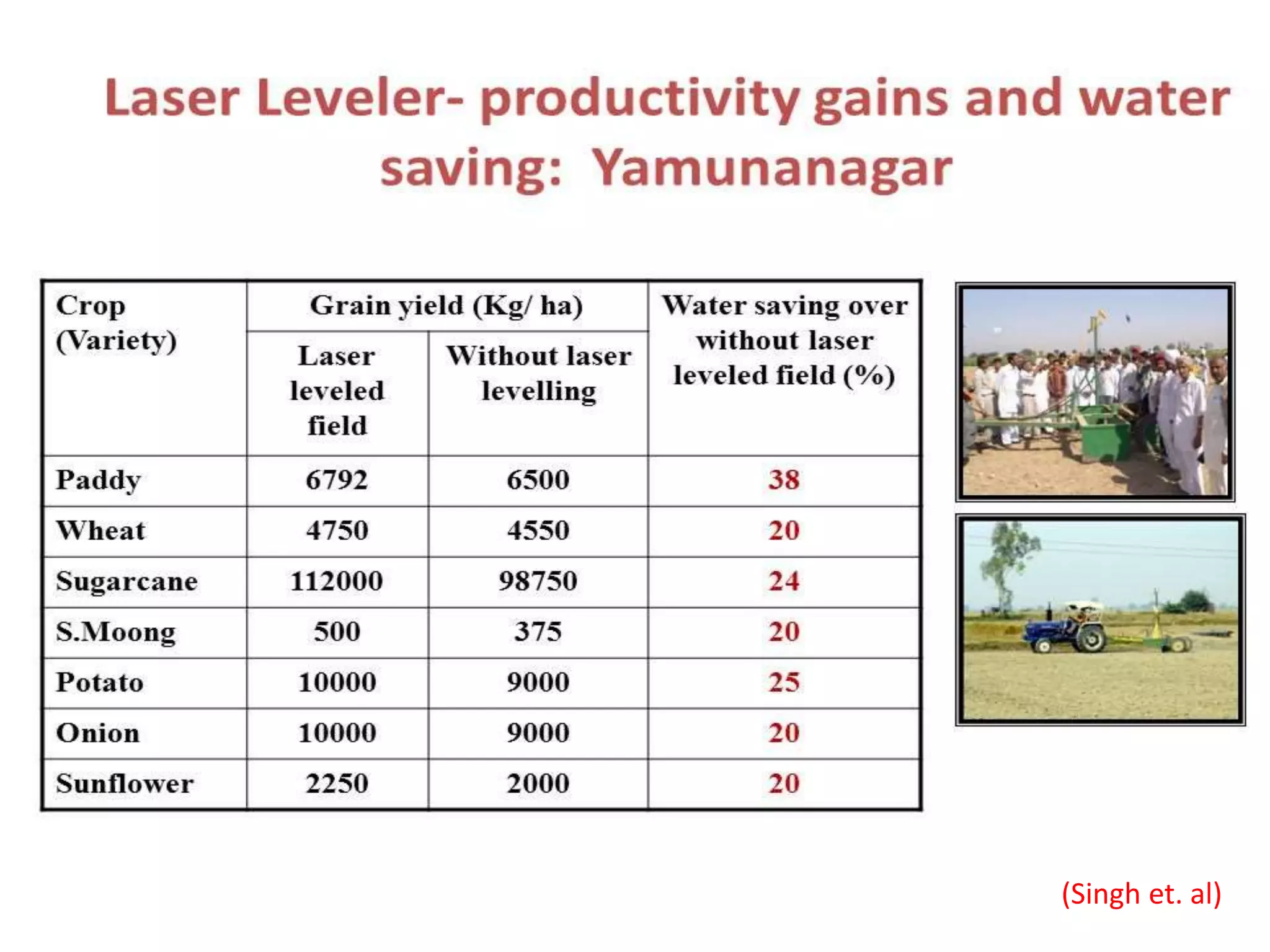
(Singh et. al)
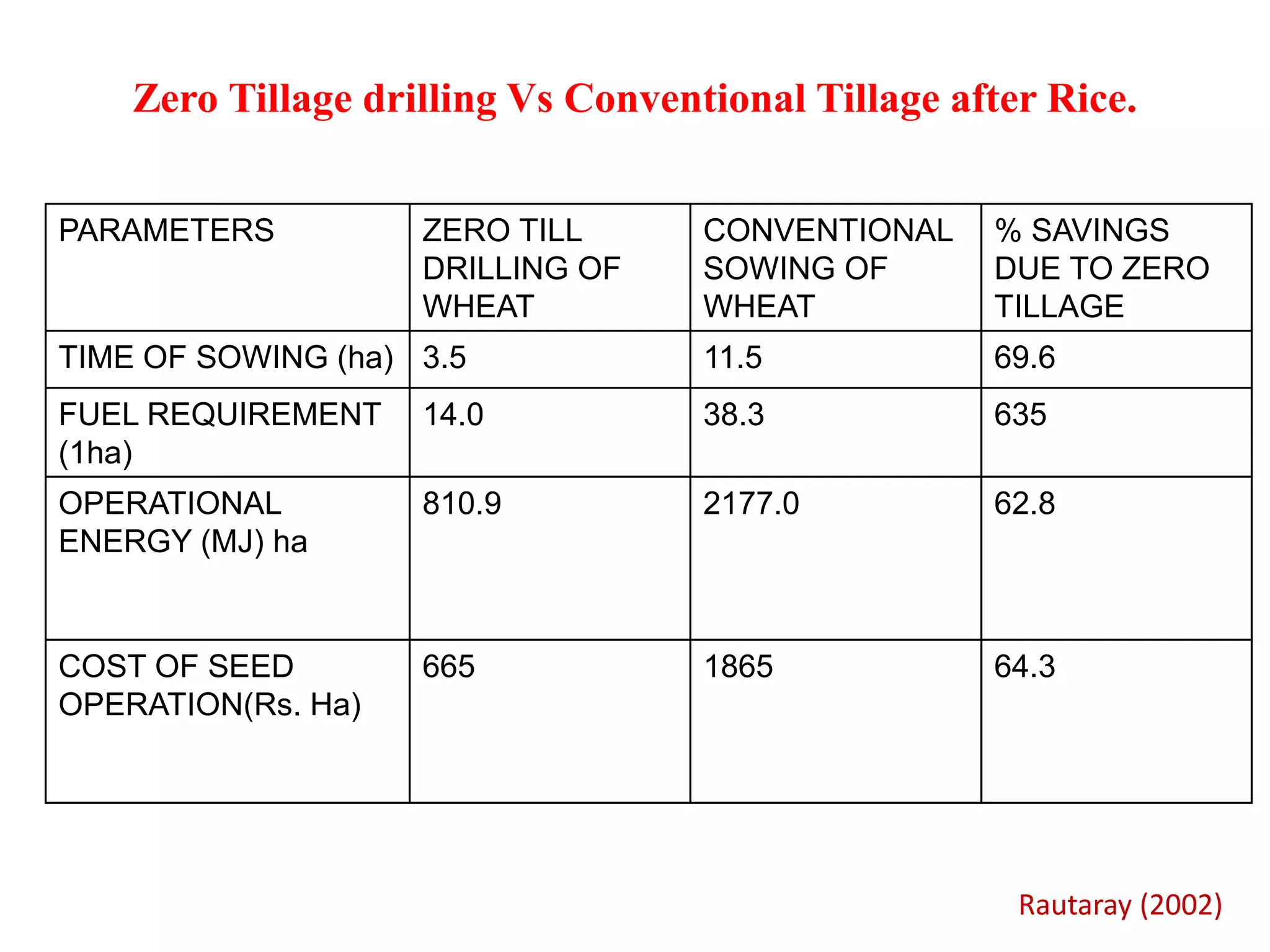
Zero Tillage drilling Vs Conventional Tillage after Rice.
PARAMETERS ZERO TILL
DRILLING OF
WHEAT
CONVENTIONAL
SOWING OF
WHEAT
% SAVINGS
DUE TO ZERO
TILLAGE
TIME OF SOWING (ha) 3.5 11.5 69.6
FUEL REQUIREMENT
(1ha)
14.0 38.3 635
OPERATIONAL
ENERGY (MJ) ha
810.9 2177.0 62.8
COST OF SEED
OPERATION(Rs. Ha)
665 1865 64.3
Rautaray (2002)
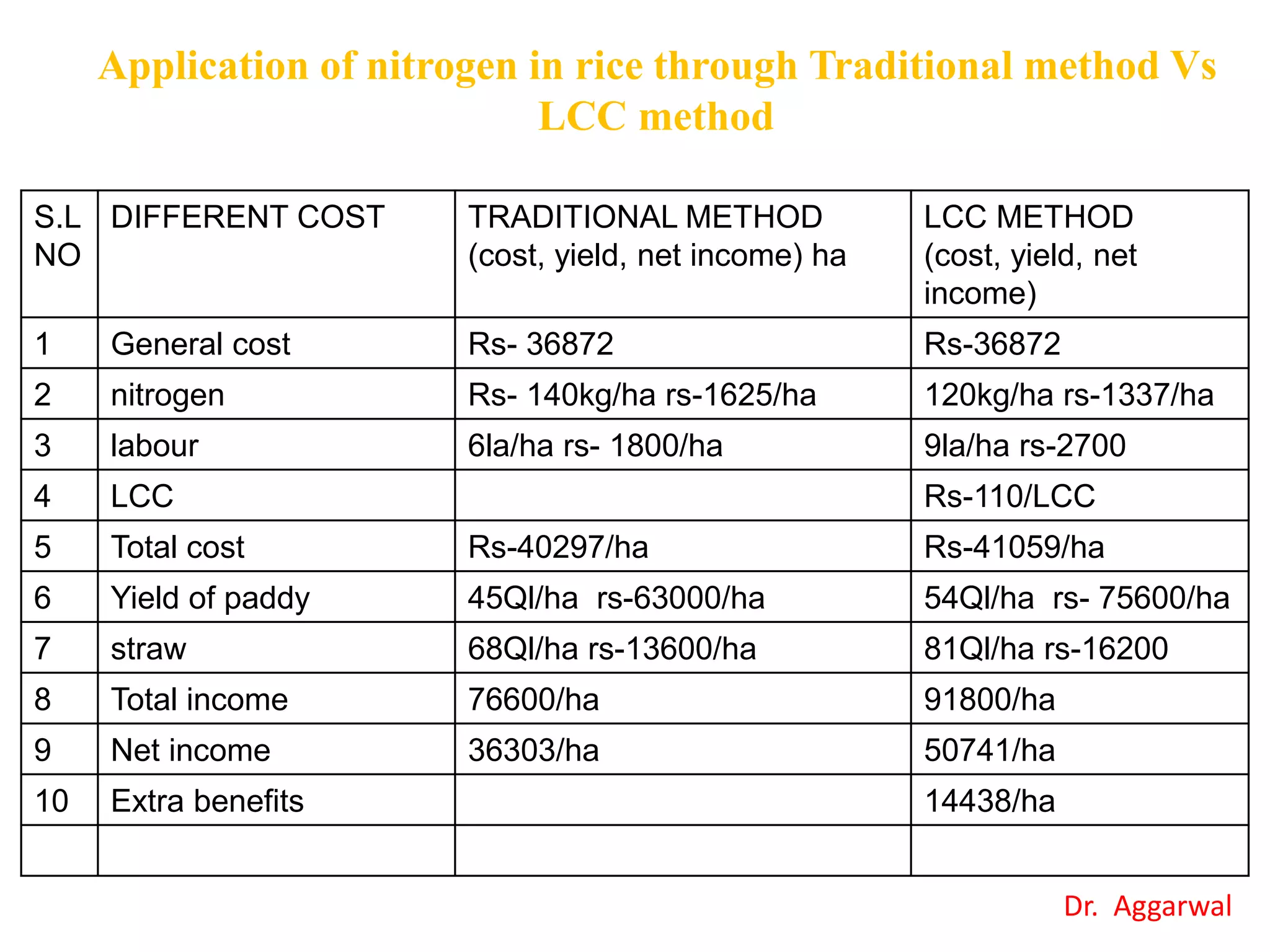
S.L
NO
DIFFERENT COST TRADITIONAL METHOD
(cost, yield, net income) ha
LCC METHOD
(cost, yield, net
income)
1 General cost Rs- 36872 Rs-36872
2 nitrogen Rs- 140kg/ha rs-1625/ha 120kg/ha rs-1337/ha
3 labour 6la/ha rs- 1800/ha 9la/ha rs-2700
4 LCC Rs-110/LCC
5 Total cost Rs-40297/ha Rs-41059/ha
6 Yield of paddy 45Ql/ha rs-63000/ha 54Ql/ha rs- 75600/ha
7 straw 68Ql/ha rs-13600/ha 81Ql/ha rs-16200
8 Total income 76600/ha 91800/ha
9 Net income 36303/ha 50741/ha
10 Extra benefits 14438/ha
Application of nitrogen in rice through Traditional method Vs
LCC method
Dr. Aggarwal
CONCLUSION
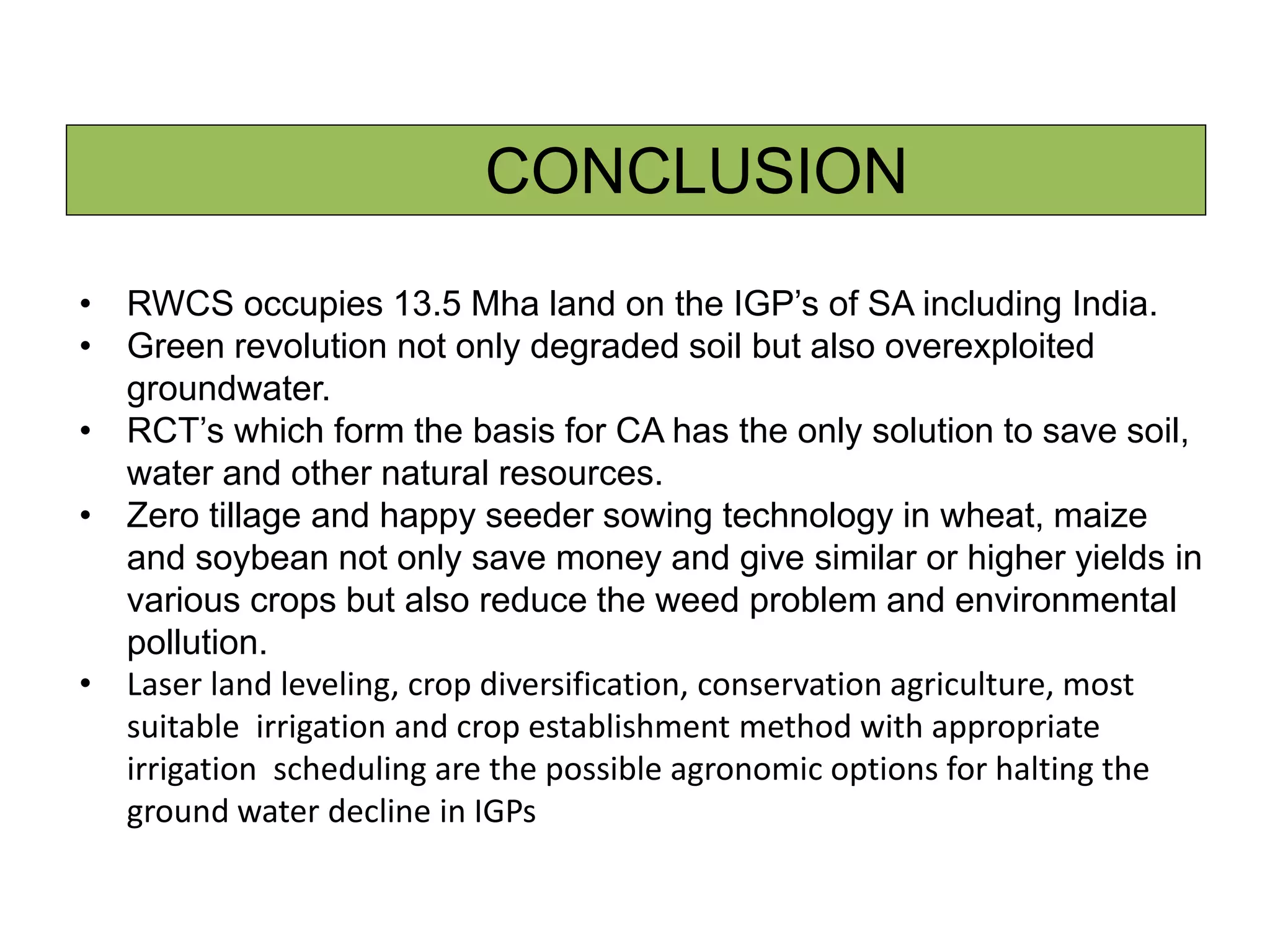
• RWCS occupies 13.5 Mha land on the IGP’s of SA including India.
• Green revolution not only degraded soil but also overexploited
groundwater.
• RCT’s which form the basis for CA has the only solution to save soil,
water and other natural resources.
• Zero tillage and happy seeder sowing technology in wheat, maize
and soybean not only save money and give similar or higher yields in
various crops but also reduce the weed problem and environmental
pollution.
• Laser land leveling, crop diversification, conservation agriculture, most
suitable irrigation and crop establishment method with appropriate
irrigation scheduling are the possible agronomic options for halting the
ground water decline in IGPs
Resource conservation technology.ppt

Resource conservation technology.ppt

  • 2.
    Acharya Narendra Deva UniversityOf Agriculture And Technology, Kumarganj, Ayodhya,UP.(224229) SEMINAR ON Resource conservation technologies for higher productivity- An Indian perspective PRESENTED BY : Deepak Kumar Dwivedi and Gayatri Turkar MSc. 1st year (2nd sem.)
  • 3.
    OUTLINE • Introduction • WhyRCT?? • Future challenges in Indian agriculture • CA vs RCTs • Components of RCT • Various RCTs used in land management • RCTs used in crop production • Research findings • Conclusion
  • 4.
    Introduction Present Scenario ofIndian Agriculture. source Agri. Data book 2021 S.no . Classification 1950-51 2020-21 1 Geographical Area(mha) 328.73 328.73 2 Total Forest Area(%) 14.2 21.67% 3 Net Area Sown(mha) 118.75 140.13 4 Area sown more than once(mha) 13.15 58.3 5 Gross cropped area(mha) 131.89 200.2 6 Cropping intensity 111.07 143.6 7 Net irrigated area 20.85 68.64 8 Gross irrigated area 22.56 96.46 9 Annual Irrigation intensity 108.20 140.23 10 Total NPK consumption (kg/ha) 4.21 134.07 11 Per capita land availbility(ha) 0.91 0.11
  • 5.
    S. no. Commodities1951 2019-20 adv. Est % increase 1 Food Grains 50.83 291.95 6.74 2 Pulses 8.41 22.08 3.92 3 Total oil seeds 5.61 34.19 6.56 4 Sugarcane 57.05 107.19 20.24 5 Milk 17.0 184 8.45 6 Fish 0.75 15 11.34 7 Eggs 18.30 100 5.43 8 Meat 1.9 10.34 5.65 Source- The Hindu Present agriculture production scenario in India (in mt.)
  • 6.
    In times tocome, Indian agriculture will meet the requirements of food security and rapidly diversify itself. Indian agriculture is already increasingly demand driven. This will accelerate in the future. It has been argued on various occasions that agricultural diversification in India is basically driven by domestic demand. Population and Income Growth will give us the base for demand. Decadal Growth of cereal demand is 13 per cent. On the other hand growth of demand of fruits and vegetables, eggs, chicken and milk is much higher. The FAO note that according to popular statistics India is less urbanized, but they point out that: “On the other hand, what constitutes “rural” is in fact somewhat subjective and what is considered urban or rural varies considerably among countries. FUTURE OF INDIAN AGRICULTURE FOOD SECURITY DEMAND MARKETS AND STRATEGIES
  • 7.
    “RESOURSE CONSERVATION TECHNOLOGY REFERST O THOSE PRACTICE WHICH ENHANCES RESOURSE OR INPUT- USE EFFICIENCY IS KNOWN AS RCT.” RCT.” WHAT IS RCT  A resource is any natural or artificial substance or energy which can be used for the benefits of mankind.  Natural resources are those which exist in the environment naturally, that is, they are not created by humans. They are soil, water, sunlight, the wind, plants, coal etc.  To support life by supporting ecological balance  To ensure that the future generations will be able to access the resources.  To preserve the biodiversity.  To make sure human race survives. WHY RCT
  • 8.
    FUTURE CHALLENGES ININDIAN AGRICULTURE:-  SUSTAINABILITY  BIODIVERSITY  LAND DEGRADATION  SOIL FERTILITY  GROUND WATER DEPLITION  CLIMATE CHANGE/GHGs  FOOD SECURITY  YIELD OPTIMIZATION  QUALITY ASURANCE  DOUBLE FARMER’S INCOME BY 2022
  • 9.
    Source: Agriculture ResearchData Book (2013) S. no. Degradation forces Area (million ha) 1 Floods 40 2 Non –reclaimable for Agriculture use 22 3 Acidic soils 25 4 Sodicity 3.6 5 Salinity 5.5 6 Shifting and gullies 5 7 Ravines and gullies 4 8 Waterlogging 8.5 9 Riverine and torrent lands 2.75 AREAAFFECTED BY VARIOUS DEGRADATION FORCES IN INDIA
  • 10.
    Minimum soil disturbance Maintenance of apermanent soil cover. Crop diversification Conservation Agriculture-CA CA is based on integrated management of soil, water and agricultural resources in order to reach the objective of economically, ecologically, and socially sustainable agriculture production. It relies on three major principle. -Jat et. al CA Vs RCTs
  • 11.
    “ALL THE CATECHNOLOGIES IS CALLED AS RCTs, BUT ALL THE RCTs MAY NOT BE CA.” Contd. RCTs may not be follow all the three principles of CA that is clarified in case of laser land leveling which is not feasible in residue condition.
  • 12.
    LAN D NUTRIEN T CROPS IRRIGATIO N RCT’s FOR COMPONENTSOF RCT’S WHICH ARE USED IN AGRICULTURE
  • 13.
    Laser Land Leveling It alter fields having a constant slope of 0 – 0.2%.  Using laser equipped drag bucket which allows the land surface smoothening within ±2 mm from its average elevation.  Helping in saving irrigation water up to 20 - 30%. Jat et al., 2011 Various RCTs which can be apply in land management
  • 14.
    Zero Tillage Technology It is an extreme from of minimum tillage.  Primary tillage is completely avoided and secondary tillage is restricted done only in the row zone.  It is more related to with less than 30% of soil disturbance.  In RWCS by this technology saves 70-80% time as well as increases 15-20 % wheat yield.  Cut down the dose of diesel around 35l-45l per hectare of land. Dr. Mahesh et. al.
  • 15.
     It isa machine that can sow seeds and fertilizer in a single operation at the right place without any kind of tilling and soil disturbance.  This machine can work easily with every type of crop residue with a load of 10-12 tones without any problem.  It has 9 tones which means that it can seed nine rows in one operation.  It needs a minimum of 45HP double clutch tractor and its weight around 750kg.  This machine can cover 10- 15 hectares. (Chaudhary et. al.,2016) Happy Seeder Technology
  • 16.
    Bed Planting Technique It is the method where cultivation of crops is done on raised beds.  It has the potential to conserve significant quantities of water up to 30-50%.  Fertilization practices are also easily performed by trafficking in the furrow bottoms.  Reduced seed rates, conserved rainwater, easy facilitated mechanical weed control, minimized lodging in crops. (Gupta et. al.)
  • 17.
    RCTs for nutrientmanagement Site Specific Nutrient Management SSNM provides an approach for ‘feeding’ rice with nutrients as needed Make optimal use of existing nutrients, such as from soil, residues, and manures. Feeding Crop needs! 1-Establish a yield target – the crop’s total needs. 2- Effectively use existing nutrients. 3- Fill deficit between total needs and indigenous supply. - (Walker et.al)
  • 18.
    It is theTools for the Need and Assessment of Nitrogen in Paddy ,maize, sugarcane, potato and vegetable crops. It is based on the leaf color. The intensity of the leaf color is indicative of the amount of nitrogen. (Nachimuthu et.al.,2007) Leaf Color Chart
  • 19.
     Green Seeker  Itis an integrated optical sensing , variable rate application & mapping system that measures crop's nitrogen requirements.  Yield potential for a crop is identified using a vegetative index known as NDVI (normalized difference vegetation index) and an environmental factor.  The technology was developed at Oklahoma State University, USA and licensed to N Tech Industries in 2001 (http://www.ntechindustries.com).  It offers a more efficient and precise way to manage crop input i.e. nitrogen.  Nitrogen (N) recommendation based on yield potential and the Response Index (RI).  The Green Seeker estimates the right amount of N at the critical stages of crop growth.
  • 20.
    NNANOFERTILIZERS Use of Nanofertilizers Nano fertilizer refers to a product that delivers nutrients to crops in one of three ways: 1. The nutrient can be encapsulated inside Nano-materials such as nanotubes or Nano porous materials 2. coated with a thin protective polymer film 3. delivered as particles or emulsions of nanoscale dimensions. 4. Slow, targeted, efficient release becomes possible. 5. In some cases, the nano particles itself can be used. Examples- Neem coated fertilizer Sulphur coated fertilizer Polymer coated fertilizer
  • 21.
    Various RCTs usedin crop production. SYSTEM OF RICE INTENSIFICATION  Planting young (8-10 days) old seedlings, planting a single seedlings per hills.  Wider space square planting 20cm to 20 cm.  Save water 15-30% and WUE about 5.7-5.8 kg/ha-mm. (Das et. al.)
  • 22.
    Direct-seeded rice. WR forraising seedling for one ha land is about 40–60ha-mm. Water needed for puddling and transplanting operation in case of TPR require 200–300 ha-mm of water/ha. (Sharma,2000) Total water saving in DSR is 35-40% compared with puddled transplanted rice. (Saharawatetal.,2010) Crop diversification Seed priming (Farooq et al., 2006) Use of osmo-protectants (Farooq et al., 2007) Application of silicon(Ma, 2004)
  • 23.
    Modified Practices  Lowerseed rate.  Seed treatment.  Sowing of seeds at  Proper spacing.  Control of water in the  Crop field.  Weeding / hoeing. WHAT IS SWI ? Outputs / Results  Higher ratio of tillers to  Mother seedlings.  Increased number of  Effective tillers / hill.  Enhanced panicle length &  Bolder grains.  Enhanced yield. SWI can enhance grain yield as much as 25 per cent sustaining the ever burgeoning population. Minimum chemical use sustains soil ecology. Only 25kg/ha seed needed. (Anil Kumar et.al) System of wheat intensification
  • 24.
    Furrow irrigated raised beds(FIRB) Inthis method of sowing FIRBs are made and keep 15cm distance rows and 55cm width and 30cm wide furrow between two beds. It save about 20 –30 % water saving. (Tanwar et al., 2014) Trash mulching On an average 20million litters of water/ha Covering of soil surface with trash mulch, and is done by uniform(10cmthick)spreading of trash in inter row space. It save water 3O-40%. (Srivastava et. al.) RCTs for irrigation
  • 25.
    The soil dugup from the pit is kept in the periphery of the ring in 30 cm space left in between the two pits. Two budded sets placed like spokes in a cycle wheel more than 40% surface area remains dry. It save 30-40% water (Singh et al.,1984) Ring pit method of planting
  • 26.
    It is sometimescalled trickle irrigation and involves dripping water onto the soil at very low rates (2-20 litres/hour) from a system of small diameter plastic pipes fitted with outlets called emitters or drippers. Water is applied close to plants so that only part of the soil in which the roots grow is wetted (Figure 60), unlike surface and sprinkler irrigation, which involves wetting the whole soil profile. Drip irrigation is most suitable for row crops. Drip irrigation is adaptable to any farmable slope. It has 85-90% WUE. (Singh et. al) Drip irrigation
  • 27.
  • 28.
  • 29.
    Zero Tillage drillingVs Conventional Tillage after Rice. PARAMETERS ZERO TILL DRILLING OF WHEAT CONVENTIONAL SOWING OF WHEAT % SAVINGS DUE TO ZERO TILLAGE TIME OF SOWING (ha) 3.5 11.5 69.6 FUEL REQUIREMENT (1ha) 14.0 38.3 635 OPERATIONAL ENERGY (MJ) ha 810.9 2177.0 62.8 COST OF SEED OPERATION(Rs. Ha) 665 1865 64.3 Rautaray (2002)
  • 30.
    S.L NO DIFFERENT COST TRADITIONALMETHOD (cost, yield, net income) ha LCC METHOD (cost, yield, net income) 1 General cost Rs- 36872 Rs-36872 2 nitrogen Rs- 140kg/ha rs-1625/ha 120kg/ha rs-1337/ha 3 labour 6la/ha rs- 1800/ha 9la/ha rs-2700 4 LCC Rs-110/LCC 5 Total cost Rs-40297/ha Rs-41059/ha 6 Yield of paddy 45Ql/ha rs-63000/ha 54Ql/ha rs- 75600/ha 7 straw 68Ql/ha rs-13600/ha 81Ql/ha rs-16200 8 Total income 76600/ha 91800/ha 9 Net income 36303/ha 50741/ha 10 Extra benefits 14438/ha Application of nitrogen in rice through Traditional method Vs LCC method Dr. Aggarwal
  • 32.
    CONCLUSION • RWCS occupies13.5 Mha land on the IGP’s of SA including India. • Green revolution not only degraded soil but also overexploited groundwater. • RCT’s which form the basis for CA has the only solution to save soil, water and other natural resources. • Zero tillage and happy seeder sowing technology in wheat, maize and soybean not only save money and give similar or higher yields in various crops but also reduce the weed problem and environmental pollution. • Laser land leveling, crop diversification, conservation agriculture, most suitable irrigation and crop establishment method with appropriate irrigation scheduling are the possible agronomic options for halting the ground water decline in IGPs