Deep Learning
and Text Mining
Will Stanton
Ski Hackathon Kickoff Ceremony, Feb 28, 2015
We have a problem
● At Return Path, we process billions of emails
a year, from tons of senders
● We want to tag and cluster senders
○ Industry verticals (e-commerce, apparel, travel, etc.)
○ Type of customers they sell to (luxury, soccer moms,
etc.)
○ Business model (daily deals, flash sales, etc.)
● It’s too much to do by hand!
What to do?
● Standard approaches aren’t great
○ Bag of words classification model (document-term matrix, LSA, LDA)
■ Have to manually label lots of cases first
■ Difficult with lots of data (especially LDA)
○ Bag of words clustering
■ Can’t easily put one company into multiple categories (ie. more
general tagging)
■ Needs lots of tuning
● How about deep learning neural networks?
○ Very trendy. Let’s try it!
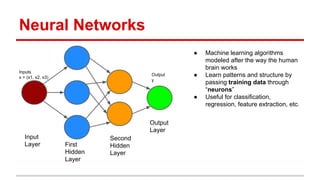
Neural Networks
Input
Layer First
Hidden
Layer
Second
Hidden
Layer
Output
Layer
Inputs
x = (x1, x2, x3)
Output
y
● Machine learning algorithms
modeled after the way the human
brain works
● Learn patterns and structure by
passing training data through
“neurons”
● Useful for classification,
regression, feature extraction, etc.
Deep Learning
● Neural networks with lots of hidden layers
(hundreds)
● State of the art for machine translation, facial
recognition, text classification, speech
recognition
○ Tasks with real deep structure, that humans do
automatically but computers struggle with
○ Should be good for company tagging!
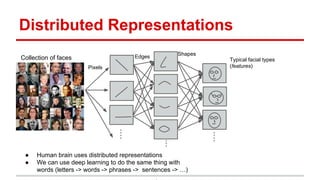
Distributed Representations
Pixels
EdgesCollection of faces
Shapes
Typical facial types
(features)
● Human brain uses distributed representations
● We can use deep learning to do the same thing with
words (letters -> words -> phrases -> sentences -> …)
Deep Learning Challenges
● Computationally difficult to train (ie. slow)
○ Each hidden layer means more parameters
○ Each feature means more parameters
● Real human-generated text has a near-
infinite number of features and data
○ ie. slow would be a problem
● Solution: use word2vec
word2vec
● Published by scientists at Google in 2013
● Python implementation in 2014
○ gensim library
● Learns distributed vector representations
of words (“word to vec”) using a neural net
○ NOTE for hardcore experts: word2vec does not strictly or necessarily train a deep neural
net, but it uses deep learning technology (distributed representations, backpropagation,
stochastic gradient descent, etc.) and is based on a series of deep learning papers
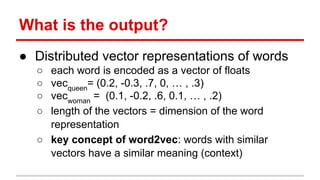
What is the output?
● Distributed vector representations of words
○ each word is encoded as a vector of floats
○ vecqueen
= (0.2, -0.3, .7, 0, … , .3)
○ vecwoman
= (0.1, -0.2, .6, 0.1, … , .2)
○ length of the vectors = dimension of the word
representation
○ key concept of word2vec: words with similar
vectors have a similar meaning (context)
word2vec Features
● Very fast and scalable
○ Google trained it on 100’s of billions of words
● Uncovers deep latent structure of word
relationships
○ Can solve analogies like King::Man as Queen::? or
Paris::France as Berlin::?
○ Can solve “one of these things is not like another”
○ Can be used for machine translation or automated
sentence completion
How does it work?
● Feed the algorithm (lots of) sentences
○ totally unsupervised learning
● word2vec trains a neural net that encodes
the context of words within sentences
○ “Skip-grams”: what is the probability that the word
“queen” appears 1 word after “woman”, 2 words
after, etc.
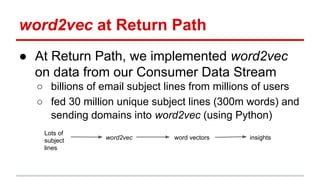
word2vec at Return Path
● At Return Path, we implemented word2vec
on data from our Consumer Data Stream
○ billions of email subject lines from millions of users
○ fed 30 million unique subject lines (300m words) and
sending domains into word2vec (using Python)
Lots of
subject
lines
word2vec word vectors insights
Grouping companies with word2vec
● Find daily deals sites like Groupon
[word for (word, score) in model.most_similar('groupon.com', topn = 100) if
'.com' in word]
['grouponmail.com.au', 'specialicious.com', 'livingsocial.com', 'deem.com',
'hitthedeals.com', 'grabone-mail-ie.com', 'grabone-mail.com', 'kobonaty.com',
'deals.com.au', 'coupflip.com', 'ouffer.com', 'wagjag.com']
● Find apparel sites like Gap
[word for (word, score) in model.most_similar('gap.com', topn = 100) if '.com'
in word]
['modcloth.com', 'bananarepublic.com', 'shopjustice.com', 'thelimited.com',
'jcrew.com', 'gymboree.com', 'abercrombie-email.com', 'express.com',
'hollister-email.com', 'abercrombiekids-email.com', 'thredup.com',
'neimanmarcusemail.com']
More word2vec applications
● Find relationships between products
● model.most_similar(positive=['iphone', 'galaxy'], negative=['apple']) =
‘samsung’
● ie. iphone::apple as galaxy::? samsung!
● Distinguish different companies
● model.doesnt_match(['sheraton','westin','aloft','walmart']) = ‘walmart’
● ie. Wal Mart does not match Sheraton, Westin, and Aloft hotels
● Other possibilities
○ Find different companies with similar marketing copy
○ Automatically construct high-performing subject lines
○ Many more...
Try it yourself
● C implementation exists, but I recommend
Python
○ gensim library: https://radimrehurek.com/gensim/
○ tutorial:http://radimrehurek.
com/gensim/models/word2vec.html
○ webapp to try it out as part of tutorial
○ Pretrained Google News and Freebase models:
https://code.google.com/p/word2vec/
○ Only takes 10 lines of code to get started!
Thanks for listening!
● Many thanks to:
○ Data Science Association and Level 3
○ Michael Walker for organizing
● Slides posted on http://will-stanton.com/
● Email me at will@will-stanton.com
● Return Path is hiring! Voted #2 best
midsized company to work for in the country
http://careers.returnpath.com/

Deep Learning and Text Mining

  • 1.
    Deep Learning and TextMining Will Stanton Ski Hackathon Kickoff Ceremony, Feb 28, 2015
  • 2.
    We have aproblem ● At Return Path, we process billions of emails a year, from tons of senders ● We want to tag and cluster senders ○ Industry verticals (e-commerce, apparel, travel, etc.) ○ Type of customers they sell to (luxury, soccer moms, etc.) ○ Business model (daily deals, flash sales, etc.) ● It’s too much to do by hand!
  • 3.
    What to do? ●Standard approaches aren’t great ○ Bag of words classification model (document-term matrix, LSA, LDA) ■ Have to manually label lots of cases first ■ Difficult with lots of data (especially LDA) ○ Bag of words clustering ■ Can’t easily put one company into multiple categories (ie. more general tagging) ■ Needs lots of tuning ● How about deep learning neural networks? ○ Very trendy. Let’s try it!
  • 4.
    Neural Networks Input Layer First Hidden Layer Second Hidden Layer Output Layer Inputs x= (x1, x2, x3) Output y ● Machine learning algorithms modeled after the way the human brain works ● Learn patterns and structure by passing training data through “neurons” ● Useful for classification, regression, feature extraction, etc.
  • 5.
    Deep Learning ● Neuralnetworks with lots of hidden layers (hundreds) ● State of the art for machine translation, facial recognition, text classification, speech recognition ○ Tasks with real deep structure, that humans do automatically but computers struggle with ○ Should be good for company tagging!
  • 6.
    Distributed Representations Pixels EdgesCollection offaces Shapes Typical facial types (features) ● Human brain uses distributed representations ● We can use deep learning to do the same thing with words (letters -> words -> phrases -> sentences -> …)
  • 7.
    Deep Learning Challenges ●Computationally difficult to train (ie. slow) ○ Each hidden layer means more parameters ○ Each feature means more parameters ● Real human-generated text has a near- infinite number of features and data ○ ie. slow would be a problem ● Solution: use word2vec
  • 8.
    word2vec ● Published byscientists at Google in 2013 ● Python implementation in 2014 ○ gensim library ● Learns distributed vector representations of words (“word to vec”) using a neural net ○ NOTE for hardcore experts: word2vec does not strictly or necessarily train a deep neural net, but it uses deep learning technology (distributed representations, backpropagation, stochastic gradient descent, etc.) and is based on a series of deep learning papers
  • 9.
    What is theoutput? ● Distributed vector representations of words ○ each word is encoded as a vector of floats ○ vecqueen = (0.2, -0.3, .7, 0, … , .3) ○ vecwoman = (0.1, -0.2, .6, 0.1, … , .2) ○ length of the vectors = dimension of the word representation ○ key concept of word2vec: words with similar vectors have a similar meaning (context)
  • 10.
    word2vec Features ● Veryfast and scalable ○ Google trained it on 100’s of billions of words ● Uncovers deep latent structure of word relationships ○ Can solve analogies like King::Man as Queen::? or Paris::France as Berlin::? ○ Can solve “one of these things is not like another” ○ Can be used for machine translation or automated sentence completion
  • 11.
    How does itwork? ● Feed the algorithm (lots of) sentences ○ totally unsupervised learning ● word2vec trains a neural net that encodes the context of words within sentences ○ “Skip-grams”: what is the probability that the word “queen” appears 1 word after “woman”, 2 words after, etc.
  • 12.
    word2vec at ReturnPath ● At Return Path, we implemented word2vec on data from our Consumer Data Stream ○ billions of email subject lines from millions of users ○ fed 30 million unique subject lines (300m words) and sending domains into word2vec (using Python) Lots of subject lines word2vec word vectors insights
  • 13.
    Grouping companies withword2vec ● Find daily deals sites like Groupon [word for (word, score) in model.most_similar('groupon.com', topn = 100) if '.com' in word] ['grouponmail.com.au', 'specialicious.com', 'livingsocial.com', 'deem.com', 'hitthedeals.com', 'grabone-mail-ie.com', 'grabone-mail.com', 'kobonaty.com', 'deals.com.au', 'coupflip.com', 'ouffer.com', 'wagjag.com'] ● Find apparel sites like Gap [word for (word, score) in model.most_similar('gap.com', topn = 100) if '.com' in word] ['modcloth.com', 'bananarepublic.com', 'shopjustice.com', 'thelimited.com', 'jcrew.com', 'gymboree.com', 'abercrombie-email.com', 'express.com', 'hollister-email.com', 'abercrombiekids-email.com', 'thredup.com', 'neimanmarcusemail.com']
  • 14.
    More word2vec applications ●Find relationships between products ● model.most_similar(positive=['iphone', 'galaxy'], negative=['apple']) = ‘samsung’ ● ie. iphone::apple as galaxy::? samsung! ● Distinguish different companies ● model.doesnt_match(['sheraton','westin','aloft','walmart']) = ‘walmart’ ● ie. Wal Mart does not match Sheraton, Westin, and Aloft hotels ● Other possibilities ○ Find different companies with similar marketing copy ○ Automatically construct high-performing subject lines ○ Many more...
  • 15.
    Try it yourself ●C implementation exists, but I recommend Python ○ gensim library: https://radimrehurek.com/gensim/ ○ tutorial:http://radimrehurek. com/gensim/models/word2vec.html ○ webapp to try it out as part of tutorial ○ Pretrained Google News and Freebase models: https://code.google.com/p/word2vec/ ○ Only takes 10 lines of code to get started!
  • 16.
    Thanks for listening! ●Many thanks to: ○ Data Science Association and Level 3 ○ Michael Walker for organizing ● Slides posted on http://will-stanton.com/ ● Email me at will@will-stanton.com ● Return Path is hiring! Voted #2 best midsized company to work for in the country http://careers.returnpath.com/