What it is and why it's important
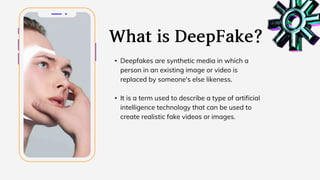
• Deepfakes are synthetic media in which a
person in an existing image or video is
replaced by someone's else likeness.
• It is a term used to describe a type of artificial
intelligence technology that can be used to
create realistic fake videos or images.
Manipulation
Can be used for manipulating videos and images.
Entertainment
Can be used for entertainment purposes.
E.g. to create realistic special effects in movies, TV
Shows, and video games.
Education
Deepfakes can be used to create realistic
simulations for training purposes, such as
medical procedures or military exercises. Social
media content-Deepfakes can be used to create
humorous or satirical videos for social media
platforms.
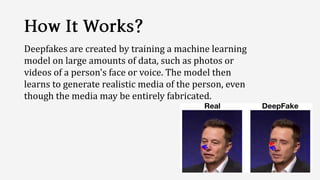
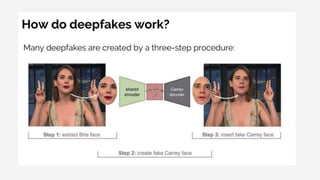
Deepfakes are created by training a machine learning
model on large amounts of data, such as photos or
videos of a person's face or voice. The model then
learns to generate realistic media of the person, even
though the media may be entirely fabricated.
Believability
If we see and hear something with our own eyes and
ears, we believe it to exist or to be true, even if it is
unlikely.
Availability
The technology of today and tomorrow, will allow all of
us to create fakes that appear real, without a
significant investment in training, data collection,
hardware and software.
• Ethical Implications:
⚬ Misuse of deepfake technology for deception and manipulation.
⚬ Invasion of privacy and potential harm to individuals.
• Misinformation and Fake News:
⚬ Deepfakes can be used to spread false information and manipulate
public opinion.
⚬ Difficulty in distinguishing between authentic and manipulated content.
• Trust and Credibility:
⚬ Deepfakes pose challenges to trust in media and journalism.
⚬ Damage to the reputation and credibility of individuals and
organizations.
• Legal and Regulatory Challenges:
⚬ Legal gray areas regarding the use and consequences of deepfakes.
⚬ Lack of robust regulations to address deepfake-related issues.
• Deepfakes can be used in positive and negative ways to
manipulate content for media, entertainment, marketing and
education.
• Deepfakes pose a significant threat to society and
individuals.
• Detection and prevention of deepfakes require ongoing
research and collaboration among tech experts,
policymakers, and society.
.
• Education and media literacy are crucial to recognizing and
verifying deepfakes.
Send it to us! We hope you learned something new.

Deep Fake.pptx

  • 1.
    What it isand why it's important
  • 2.
    • Deepfakes aresynthetic media in which a person in an existing image or video is replaced by someone's else likeness. • It is a term used to describe a type of artificial intelligence technology that can be used to create realistic fake videos or images.
  • 3.
    Manipulation Can be usedfor manipulating videos and images. Entertainment Can be used for entertainment purposes. E.g. to create realistic special effects in movies, TV Shows, and video games. Education Deepfakes can be used to create realistic simulations for training purposes, such as medical procedures or military exercises. Social media content-Deepfakes can be used to create humorous or satirical videos for social media platforms.
  • 4.
    Deepfakes are createdby training a machine learning model on large amounts of data, such as photos or videos of a person's face or voice. The model then learns to generate realistic media of the person, even though the media may be entirely fabricated.
  • 6.
    Believability If we seeand hear something with our own eyes and ears, we believe it to exist or to be true, even if it is unlikely. Availability The technology of today and tomorrow, will allow all of us to create fakes that appear real, without a significant investment in training, data collection, hardware and software.
  • 7.
    • Ethical Implications: ⚬Misuse of deepfake technology for deception and manipulation. ⚬ Invasion of privacy and potential harm to individuals. • Misinformation and Fake News: ⚬ Deepfakes can be used to spread false information and manipulate public opinion. ⚬ Difficulty in distinguishing between authentic and manipulated content. • Trust and Credibility: ⚬ Deepfakes pose challenges to trust in media and journalism. ⚬ Damage to the reputation and credibility of individuals and organizations. • Legal and Regulatory Challenges: ⚬ Legal gray areas regarding the use and consequences of deepfakes. ⚬ Lack of robust regulations to address deepfake-related issues.
  • 9.
    • Deepfakes canbe used in positive and negative ways to manipulate content for media, entertainment, marketing and education. • Deepfakes pose a significant threat to society and individuals. • Detection and prevention of deepfakes require ongoing research and collaboration among tech experts, policymakers, and society. . • Education and media literacy are crucial to recognizing and verifying deepfakes.
  • 10.
    Send it tous! We hope you learned something new.