DECISION SUPPORT
     SYSTEM
            and

           OLAP
               PRESENTED BY:
             BHUWNESHWAR
 PANDAYA
DEFINITION
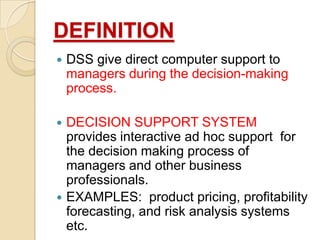
   DSS give direct computer support to
    managers during the decision-making
    process.

 DECISION SUPPORT SYSTEM
  provides interactive ad hoc support for
  the decision making process of
  managers and other business
  professionals.
 EXAMPLES: product pricing, profitability
  forecasting, and risk analysis systems
  etc.
……..
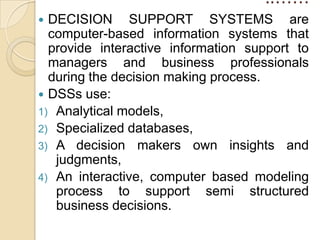
 DECISION SUPPORT SYSTEMS are
  computer-based information systems that
  provide interactive information support to
  managers and business professionals
  during the decision making process.
 DSSs use:
1) Analytical models,
2) Specialized databases,
3) A decision makers own insights and
   judgments,
4) An interactive, computer based modeling
   process to support semi structured
   business decisions.
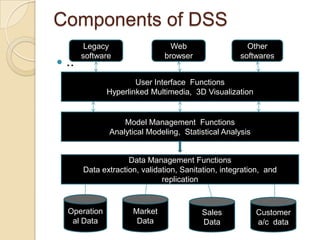
Components of DSS
          Legacy                  Web                    Other
         software               browser                softwares
   ..
                        User Interface Functions
                Hyperlinked Multimedia, 3D Visualization


                    Model Management Functions
                Analytical Modeling, Statistical Analysis


                      Data Management Functions
         Data extraction, validation, Sanitation, integration, and
                                replication


    Operation          Market              Sales            Customer
     al Data            Data               Data             a/c data
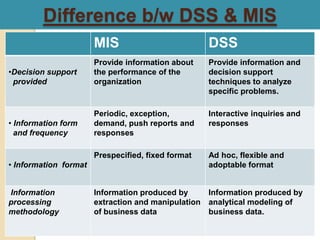
Difference b/w DSS & MIS
                       MIS                           DSS
                       Provide information about     Provide information and
•Decision support      the performance of the        decision support
 provided              organization                  techniques to analyze
                                                     specific problems.

                       Periodic, exception,          Interactive inquiries and
• Information form     demand, push reports and      responses
  and frequency        responses

                       Prespecified, fixed format    Ad hoc, flexible and
• Information format                                 adoptable format


Information            Information produced by       Information produced by
processing             extraction and manipulation   analytical modeling of
methodology            of business data              business data.
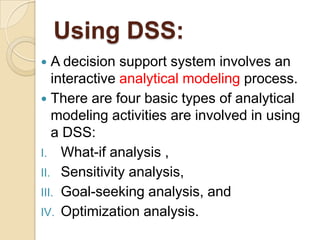
Using DSS:
  A decision support system involves an
   interactive analytical modeling process.
 There are four basic types of analytical
   modeling activities are involved in using
   a DSS:
I. What-if analysis ,
II. Sensitivity analysis,
III. Goal-seeking analysis, and
IV. Optimization analysis.
….
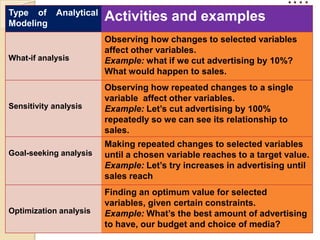
Type of Analytical
Modeling
                        Activities and examples
                        Observing how changes to selected variables
                        affect other variables.
What-if analysis        Example: what if we cut advertising by 10%?
                        What would happen to sales.
                        Observing how repeated changes to a single
                        variable affect other variables.
Sensitivity analysis    Example: Let’s cut advertising by 100%
                        repeatedly so we can see its relationship to
                        sales.
                        Making repeated changes to selected variables
Goal-seeking analysis   until a chosen variable reaches to a target value.
                        Example: Let’s try increases in advertising until
                        sales reach
                        Finding an optimum value for selected
                        variables, given certain constraints.
Optimization analysis   Example: What’s the best amount of advertising
                        to have, our budget and choice of media?
Online Analytical Processing [OLAP]
   OLAP enables managers to examine and
    manipulate large amounts of detailed and
    consolidated data from many perspectives.

 OLAP       involves    analyzing      complex
  relationship among thousands or even
  millions of data items stores in a data marts,
  data warehouses and multidimensional
  databases to discover patterns and trends
  etc.
 It provides fast answers to complex queries
….
.
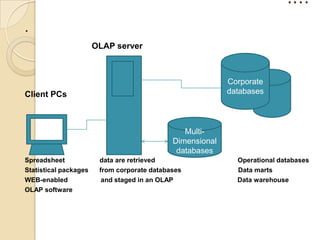
                       OLAP server


                                                           Corporate
Client PCs                                                 databases


                                                Multi-
                                             Dimensional
                                              databases
Spreadsheet             data are retrieved                   Operational databases
Statistical packages    from corporate databases             Data marts
WEB-enabled              and staged in an OLAP               Data warehouse
OLAP software
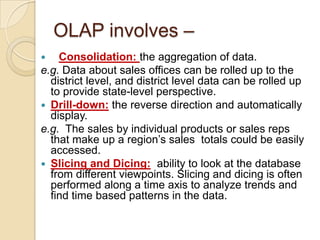
OLAP involves –
   Consolidation: the aggregation of data.
e.g. Data about sales offices can be rolled up to the
  district level, and district level data can be rolled up
  to provide state-level perspective.
 Drill-down: the reverse direction and automatically
  display.
e.g. The sales by individual products or sales reps
  that make up a region’s sales totals could be easily
  accessed.
 Slicing and Dicing: ability to look at the database
  from different viewpoints. Slicing and dicing is often
  performed along a time axis to analyze trends and
  find time based patterns in the data.
OLAP examples….
Common business areas where OLAP can
  solve complex problems include:
 Marketing and sales analysis
 Database marketing
 Budgeting
 Financial reporting and consolidation
 Profitability analysis
 Quality analysis etc.
.
.

Decision support system

  • 1.
    DECISION SUPPORT SYSTEM and OLAP PRESENTED BY: BHUWNESHWAR PANDAYA
  • 2.
    DEFINITION  DSS give direct computer support to managers during the decision-making process.  DECISION SUPPORT SYSTEM provides interactive ad hoc support for the decision making process of managers and other business professionals.  EXAMPLES: product pricing, profitability forecasting, and risk analysis systems etc.
  • 3.
    ……..  DECISION SUPPORTSYSTEMS are computer-based information systems that provide interactive information support to managers and business professionals during the decision making process.  DSSs use: 1) Analytical models, 2) Specialized databases, 3) A decision makers own insights and judgments, 4) An interactive, computer based modeling process to support semi structured business decisions.
  • 4.
    Components of DSS Legacy Web Other software browser softwares  .. User Interface Functions Hyperlinked Multimedia, 3D Visualization Model Management Functions Analytical Modeling, Statistical Analysis Data Management Functions Data extraction, validation, Sanitation, integration, and replication Operation Market Sales Customer al Data Data Data a/c data
  • 5.
    Difference b/w DSS& MIS MIS DSS Provide information about Provide information and •Decision support the performance of the decision support provided organization techniques to analyze specific problems. Periodic, exception, Interactive inquiries and • Information form demand, push reports and responses and frequency responses Prespecified, fixed format Ad hoc, flexible and • Information format adoptable format Information Information produced by Information produced by processing extraction and manipulation analytical modeling of methodology of business data business data.
  • 6.
    Using DSS:  A decision support system involves an interactive analytical modeling process.  There are four basic types of analytical modeling activities are involved in using a DSS: I. What-if analysis , II. Sensitivity analysis, III. Goal-seeking analysis, and IV. Optimization analysis.
  • 7.
    …. Type of Analytical Modeling Activities and examples Observing how changes to selected variables affect other variables. What-if analysis Example: what if we cut advertising by 10%? What would happen to sales. Observing how repeated changes to a single variable affect other variables. Sensitivity analysis Example: Let’s cut advertising by 100% repeatedly so we can see its relationship to sales. Making repeated changes to selected variables Goal-seeking analysis until a chosen variable reaches to a target value. Example: Let’s try increases in advertising until sales reach Finding an optimum value for selected variables, given certain constraints. Optimization analysis Example: What’s the best amount of advertising to have, our budget and choice of media?
  • 8.
    Online Analytical Processing[OLAP]  OLAP enables managers to examine and manipulate large amounts of detailed and consolidated data from many perspectives.  OLAP involves analyzing complex relationship among thousands or even millions of data items stores in a data marts, data warehouses and multidimensional databases to discover patterns and trends etc.  It provides fast answers to complex queries
  • 9.
    …. . OLAP server Corporate Client PCs databases Multi- Dimensional databases Spreadsheet data are retrieved Operational databases Statistical packages from corporate databases Data marts WEB-enabled and staged in an OLAP Data warehouse OLAP software
  • 10.
    OLAP involves –  Consolidation: the aggregation of data. e.g. Data about sales offices can be rolled up to the district level, and district level data can be rolled up to provide state-level perspective.  Drill-down: the reverse direction and automatically display. e.g. The sales by individual products or sales reps that make up a region’s sales totals could be easily accessed.  Slicing and Dicing: ability to look at the database from different viewpoints. Slicing and dicing is often performed along a time axis to analyze trends and find time based patterns in the data.
  • 11.
    OLAP examples…. Common businessareas where OLAP can solve complex problems include:  Marketing and sales analysis  Database marketing  Budgeting  Financial reporting and consolidation  Profitability analysis  Quality analysis etc.
  • 12.