
decimals
What is a Decimal?
What is a decimal?
A decimal is similar to a fraction in that it is
  not a whole number. It is a part of a
  number. We use decimals most often
  when we are talking about money.

                RS13.45
      How would you read this number?
RS   13.45
THIRTEEN RUPEES POINT FOURTY
 FIVE PAISE .
 REMEMBER WE DO NOT USE
 PAISE WHEN AMOUNT IS less
 THAN RS 1
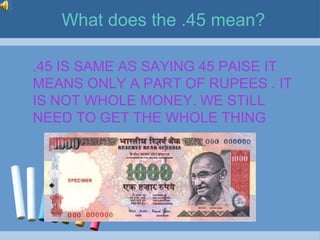
What does the .45 mean?

.45 IS SAME AS SAYING 45 PAISE IT
MEANS ONLY A PART OF RUPEES . IT
IS NOT WHOLE MONEY. WE STILL
NEED TO GET THE WHOLE THING
Why do I have to understand
decimals?
This is a good question. We need to understand
 what the value of each number means in order to
 understand what we are talking about. Here is
 an example
Here is an example:
 A shirt costs RS 12.05, but when I wrote the
 number down I wrote RS 12.5. What is wrong
 with this?
Why is RS12.5 wrong?

RS 12.5 really is saying RS 12.50,
because when we read how much
something costs it always has two places
after the decimal point. If we don’t have a
number after the first number we must
assume it is a zero. However, when we
read $12.05, the zero is the place holder
so we know it is 5p and not 50p. That is a
45¢ difference. I can get a piece of gum
for that amount!
How do I read a decimal?

 If you look at the number 12.3, you say 12
   and 3 tenths.
If you look at the number and it says 12.35,
   you say 12 and 35 hundredths.
If you look at a number and it says 12.05,
   you say 12 and 5 hundredths.
Let’s Write this in Expanded
Notation
If we are using money, it would look like
  this:
RS100 + RS 30 + RS 7 + 80P + 2 P = RS
  137.82.
 If we are not using money, it would look
                   like this:
      100 + 30 + 7 + .8 + .02 = 137.82
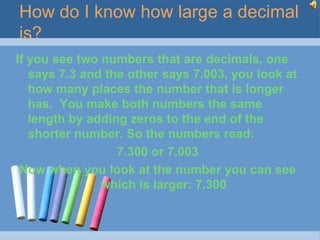
How do I know how large a decimal
is?
If you see two numbers that are decimals, one
   says 7.3 and the other says 7.003, you look at
   how many places the number that is longer
   has. You make both numbers the same
   length by adding zeros to the end of the
   shorter number. So the numbers read:
                  7.300 or 7.003
 Now when you look at the number you can see
               which is larger: 7.300
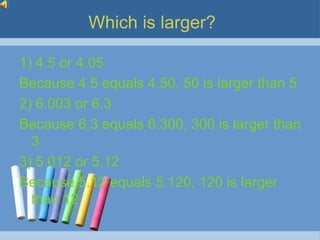
Which is larger?

1) 4.5 or 4.05
Because 4.5 equals 4.50, 50 is larger than 5
2) 6.003 or 6.3
Because 6.3 equals 6.300, 300 is larger than
  3
3) 5.012 or 5.12
Because 5.12 equals 5.120, 120 is larger
  than 12
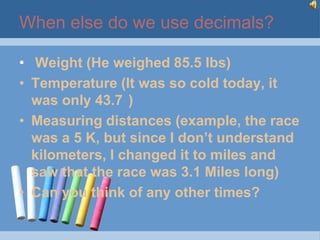
When else do we use decimals?

• Weight (He weighed 85.5 lbs)
• Temperature (It was so cold today, it
  was only 43.7 )
• Measuring distances (example, the race
  was a 5 K, but since I don’t understand
  kilometers, I changed it to miles and
  saw that the race was 3.1 Miles long)
• Can you think of any other times?
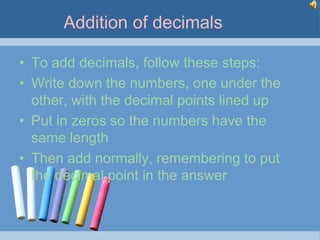
Addition of decimals

• To add decimals, follow these steps:
• Write down the numbers, one under the
  other, with the decimal points lined up
• Put in zeros so the numbers have the
  same length
• Then add normally, remembering to put
  the decimal point in the answer
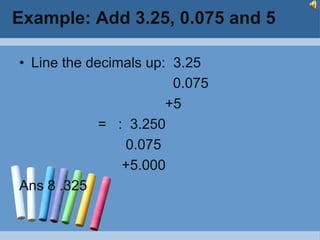
Example: Add 3.25, 0.075 and 5

• Line the decimals up: 3.25
                        0.075
                       +5
             = : 3.250
                0.075
                +5.000
Ans 8 .325
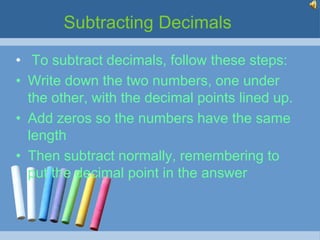
Subtracting Decimals

• To subtract decimals, follow these steps:
• Write down the two numbers, one under
  the other, with the decimal points lined up.
• Add zeros so the numbers have the same
  length
• Then subtract normally, remembering to
  put the decimal point in the answer
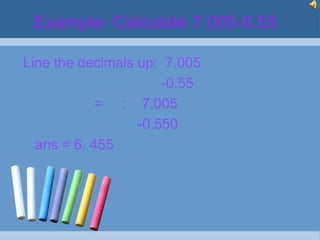
Example: Calculate 7.005-0.55

Line the decimals up: 7.005
                      -0.55
            = : 7.005
                  -0.550
  ans = 6. 455
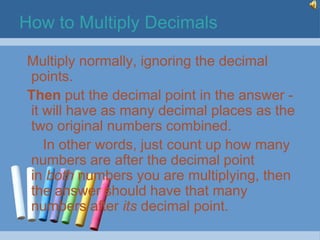
How to Multiply Decimals

Multiply normally, ignoring the decimal
points.
Then put the decimal point in the answer -
it will have as many decimal places as the
two original numbers combined.
   In other words, just count up how many
numbers are after the decimal point
in both numbers you are multiplying, then
the answer should have that many
numbers after its decimal point.
Dividing Decimals

To divide a decimal number by a whole
 number:
Use Long Division (ignoring the decimal
 point)
Then put the decimal point in the same spot
 as the dividend (the number being divided)
Dividing by a Decimal Number

The trick is to convert the number you are
 dividing by to a whole number first,
 by shifting the decimal point of both
 numbers to the right:
  It is safe to do this if you remember to shift
 the decimal point of both numbers the
 same number of places.

Decimals

  • 1.
  • 2.
    What is aDecimal?
  • 3.
    What is adecimal? A decimal is similar to a fraction in that it is not a whole number. It is a part of a number. We use decimals most often when we are talking about money. RS13.45 How would you read this number?
  • 4.
    RS 13.45 THIRTEEN RUPEES POINT FOURTY FIVE PAISE . REMEMBER WE DO NOT USE PAISE WHEN AMOUNT IS less THAN RS 1
  • 5.
    What does the.45 mean? .45 IS SAME AS SAYING 45 PAISE IT MEANS ONLY A PART OF RUPEES . IT IS NOT WHOLE MONEY. WE STILL NEED TO GET THE WHOLE THING
  • 6.
    Why do Ihave to understand decimals? This is a good question. We need to understand what the value of each number means in order to understand what we are talking about. Here is an example Here is an example: A shirt costs RS 12.05, but when I wrote the number down I wrote RS 12.5. What is wrong with this?
  • 7.
    Why is RS12.5wrong? RS 12.5 really is saying RS 12.50, because when we read how much something costs it always has two places after the decimal point. If we don’t have a number after the first number we must assume it is a zero. However, when we read $12.05, the zero is the place holder so we know it is 5p and not 50p. That is a 45¢ difference. I can get a piece of gum for that amount!
  • 8.
    How do Iread a decimal? If you look at the number 12.3, you say 12 and 3 tenths. If you look at the number and it says 12.35, you say 12 and 35 hundredths. If you look at a number and it says 12.05, you say 12 and 5 hundredths.
  • 9.
    Let’s Write thisin Expanded Notation If we are using money, it would look like this: RS100 + RS 30 + RS 7 + 80P + 2 P = RS 137.82. If we are not using money, it would look like this: 100 + 30 + 7 + .8 + .02 = 137.82
  • 10.
    How do Iknow how large a decimal is? If you see two numbers that are decimals, one says 7.3 and the other says 7.003, you look at how many places the number that is longer has. You make both numbers the same length by adding zeros to the end of the shorter number. So the numbers read: 7.300 or 7.003 Now when you look at the number you can see which is larger: 7.300
  • 11.
    Which is larger? 1)4.5 or 4.05 Because 4.5 equals 4.50, 50 is larger than 5 2) 6.003 or 6.3 Because 6.3 equals 6.300, 300 is larger than 3 3) 5.012 or 5.12 Because 5.12 equals 5.120, 120 is larger than 12
  • 12.
    When else dowe use decimals? • Weight (He weighed 85.5 lbs) • Temperature (It was so cold today, it was only 43.7 ) • Measuring distances (example, the race was a 5 K, but since I don’t understand kilometers, I changed it to miles and saw that the race was 3.1 Miles long) • Can you think of any other times?
  • 13.
    Addition of decimals •To add decimals, follow these steps: • Write down the numbers, one under the other, with the decimal points lined up • Put in zeros so the numbers have the same length • Then add normally, remembering to put the decimal point in the answer
  • 14.
    Example: Add 3.25,0.075 and 5 • Line the decimals up: 3.25 0.075 +5 = : 3.250 0.075 +5.000 Ans 8 .325
  • 15.
    Subtracting Decimals • Tosubtract decimals, follow these steps: • Write down the two numbers, one under the other, with the decimal points lined up. • Add zeros so the numbers have the same length • Then subtract normally, remembering to put the decimal point in the answer
  • 16.
    Example: Calculate 7.005-0.55 Linethe decimals up: 7.005 -0.55 = : 7.005 -0.550 ans = 6. 455
  • 17.
    How to MultiplyDecimals Multiply normally, ignoring the decimal points. Then put the decimal point in the answer - it will have as many decimal places as the two original numbers combined. In other words, just count up how many numbers are after the decimal point in both numbers you are multiplying, then the answer should have that many numbers after its decimal point.
  • 18.
    Dividing Decimals To dividea decimal number by a whole number: Use Long Division (ignoring the decimal point) Then put the decimal point in the same spot as the dividend (the number being divided)
  • 19.
    Dividing by aDecimal Number The trick is to convert the number you are dividing by to a whole number first, by shifting the decimal point of both numbers to the right: It is safe to do this if you remember to shift the decimal point of both numbers the same number of places.