Carbon Plan
Contents
Foreword                                                                                            3


Chapter 1:   the challenge of climate change – our approach                                         4


Chapter 2:   secure, sustainable low carbon energy                                                 15


Chapter 3:   saving energy in homes and communities                                                23


Chapter 4:   Reducing emissions from business and industry                                         29


Chapter 5:   towards low carbon transport                                                          35


Chapter 6:   Cutting emissions from waste                                                          44


Chapter 7:   Managing land sustainably                                                             48


Chapter 8:   Reducing emissions in the public sector                                               53


Chapter 9:   Developing leadership within the european Union                                       58


Chapter 10: Building the case for global ambition with key countries and international institutions 62


Chapter 11: supporting the development of low carbon, climate resilient economies                  68


Chapter 12: ensuring progress within international climate negotiations                            74


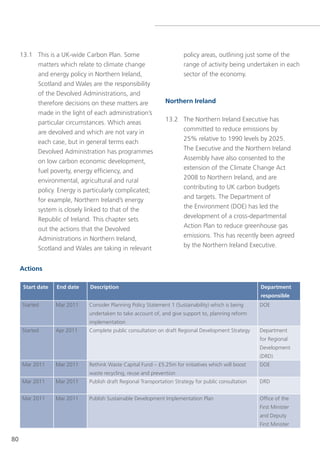
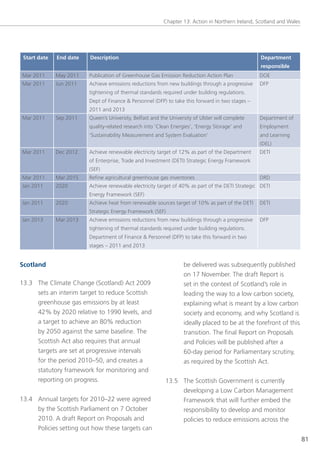
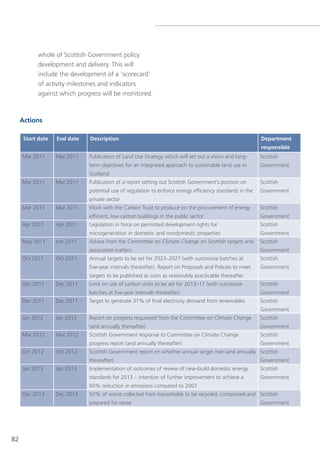
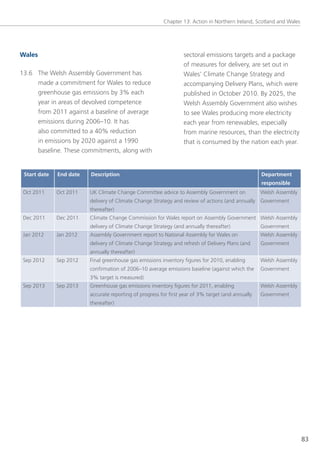
Chapter 13: Action in northern Ireland, scotland and Wales                                         79
Foreword


FoReWoRD
this Carbon Plan sets out a vision of a changed     •    and in the way we travel. this means
Britain, powered by cleaner energy used more             better public transport, reducing emissions
efficiently in our homes and businesses, with            from petrol and diesel engines and moving
more secure energy supplies and more stable              towards alternative technologies such as
energy prices, and benefiting from the jobs and          electric vehicles.
growth that a low carbon economy will bring.
                                                    Becoming a low carbon economy will be one
But it does more than that. It shows exactly        of the greatest changes our country has ever
how we will deliver that vision and play our part   known. But it is a change for the better, for our
in the global effort to tackle climate change       economy, our society, and for the planet. this
and build a green economy through specific,         Carbon Plan shows how, together, we can make
practical action across government, month by        it happen.
month and department by department. We
want the public to tell us where we can be even
more ambitious, and hold us to account on
delivering what we say, when we say. together,
we can make our vision a reality.
                                                    David Cameron
                                                    Prime Minister
Doing this means change across the whole
economy, but most critically and fundamentally
in three areas, namely:


•    in the way we generate our electricity,
     where we must see a dramatic shift away        nick Clegg
     from fossil fuels and towards low carbon       Deputy Prime Minister
     alternatives – renewable energy, new
     unsubsidised nuclear power and fossil fuel
     power stations fitted with Carbon Capture
     and storage;
                                                    Chris Huhne
•    in the way we heat our homes and               secretary of state for
     businesses, where a step change is needed      energy and Climate Change
     in how well our homes are insulated and in
     the use of low carbon energy alternatives,
     such as heat pumps;


                                                                                                        3
CHAPteR 1:
    tHe CHAllenge oF ClIMAte
    CHAnge – oUR APPRoACH


4
Chapter 1: the challenge of climate change – our approach


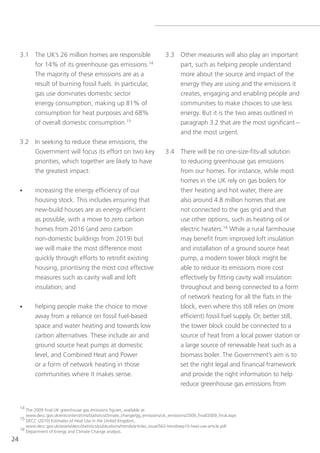
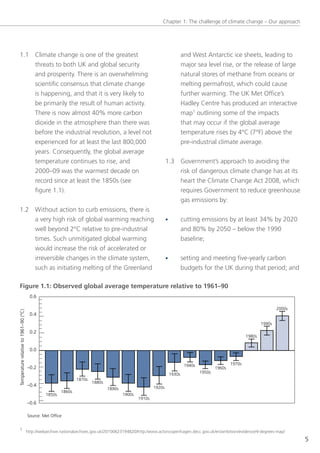
  1.1 Climate change is one of the greatest                                                                                 and West Antarctic ice sheets, leading to
      threats to both UK and global security                                                                                major sea level rise, or the release of large
      and prosperity. there is an overwhelming                                                                              natural stores of methane from oceans or
      scientific consensus that climate change                                                                              melting permafrost, which could cause
      is happening, and that it is very likely to                                                                           further warming. the UK Met office’s
      be primarily the result of human activity.                                                                            Hadley Centre has produced an interactive
      there is now almost 40% more carbon                                                                                   map1 outlining some of the impacts
      dioxide in the atmosphere than there was                                                                              that may occur if the global average
      before the industrial revolution, a level not                                                                         temperature rises by 4°C (7°F) above the
      experienced for at least the last 800,000                                                                             pre-industrial climate average.
      years. Consequently, the global average
      temperature continues to rise, and                                                                        1.3 government’s approach to avoiding the
      2000–09 was the warmest decade on                                                                             risk of dangerous climate change has at its
      record since at least the 1850s (see                                                                          heart the Climate Change Act 2008, which
      figure 1.1).                                                                                                  requires government to reduce greenhouse
                                                                                                                    gas emissions by:
  1.2 Without action to curb emissions, there is
      a very high risk of global warming reaching                                                               •           cutting emissions by at least 34% by 2020
      well beyond 2°C relative to pre-industrial                                                                            and 80% by 2050 – below the 1990
      times. such unmitigated global warming                                                                                baseline;
      would increase the risk of accelerated or
      irreversible changes in the climate system,                                                               •           setting and meeting five-yearly carbon
      such as initiating melting of the greenland                                                                           budgets for the UK during that period; and

  Figure 1.1: Observed global average temperature relative to 1961–90
                                        0.6

                                                                                                                                                                             2000s
Temperature relative to 1961–90 (°C)


                                        0.4
                                                                                                                                                                     1990s
                                        0.2
                                                                                                                                                             1980s


                                        0.0


                                                                                                                             1940s                   1970s
                                       –0.2                                                                                                  1960s
                                                                                                                    1930s            1950s
                                                                1870s
                                                                        1880s
                                       –0.4                                                             1920s
                                                                                1890s
                                                        1860s
                                                1850s                                   1900s
                                                                                                1910s
                                       –0.6

                                       Source: Met Office


  1 http://webarchive.nationalarchives.gov.uk/20100623194820/http:/www.actoncopenhagen.decc.gov.uk/en/ambition/evidence/4-degrees-map/

                                                                                                                                                                                     5
•    requiring that those carbon budgets be           •   Be fair: there will inevitably be costs to
         set three budget periods ahead – so that             government, business and individuals in
         it is always clear what the UK’s emissions           making such a significant change. these
         will be for the next 15 years – and setting          costs will be lower than the alternative
         the trajectory towards the 2020 and 2050             of dealing with the cost of unmitigated
         targets.                                             climate change and offset by maximising
                                                              the growth opportunities from a low
    1.4 this is a firm, long-term and legally binding         carbon transition, but they will still be
        framework that requires government to                 real, and the government is committed to
        ensure that the transition to a low carbon            preventing any unnecessary burden and to
        economy really happens. But it leaves                 sharing the costs fairly.
        important choices about how we make
        that change.                                      •   Act sustainably: this Carbon Plan
                                                              is underpinned by the government’s
                                                              continued commitment to sustainable
    Our principles                                            development, to be open and transparent
                                                              in its operations and to look to the long
    1.5 Within the overarching framework set by               term to tackle economic, environmental
        the Climate Change Act, the government
                                                              and social challenges. the government
        is committed to a number of principles
                                                              is committed to taking a sustainable
        that will guide our approach:
                                                              approach to decarbonising our economy
                                                              and finding the right balance between
    •    Take a whole-government approach:                    environmental benefits, impacts, costs and
         tackling climate change and demonstrating            the need for a secure low carbon energy
         leadership through action is the                     supply. the government will give further
         responsibility of every part of government,          details of its approach in the natural
         cental and local, and the wider public sector.       environment White Paper.

    •    Be facilitative: government’s role should        •   Be outward-looking: Climate change
         be to set the legal and market frameworks            is a global problem and requires a global
         and to provide the information to enable             solution. Action in the UK and our support
         businesses, households, local areas and              for practical action overseas will help
         communities to play their part.                      demonstrate our commitment to other
                                                              countries, and will stand alongside our
    •    Be inclusive: our efforts to cut                     commitment to negotiating for a global
         greenhouse gas emissions should not be               deal on climate change.
         forced through top down by government.
         We should make this change by enthusing
         our whole society, in line with our
         commitment to localism.
6
Chapter 1: the challenge of climate change – our approach


Our approach in the UK                                                             alone. to cope with this, we will need a
                                                                                   new generation of secure, low carbon
1.6 In 2010 the government published 2050                                          electricity, powered by a mix of renewable
    Pathways Analysis, which looked in detail                                      energy, new nuclear power and fossil fuel
    at the changes the UK would have to                                            power stations fitted with new Carbon
    make in order to reduce greenhouse                                             Capture and storage (CCs) technology
    gas emissions by at least 80% by 2050.                                         capable of locking away carbon dioxide
    the report showed many different ways                                          emissions, and reusing as far as possible
    in which this could be done, but most                                          the waste heat that is generated. Much
    fundamentally it showed that it can                                            of this change is likely to need to happen
    be done.                                                                       between now and 2030, requiring in
                                                                                   excess of £110 billion of investment in
1.7 While there are many possible pathways,                                        generation, transmission and distribution
    there are some common themes that                                              over the next decade.3
    emerge across the various solutions
    explored in the report. these themes,                                  •       Heat for our homes and businesses:
    combined with wider evidence, suggest                                          Almost half of the UK’s greenhouse gas
    that while every sector of our economy                                         emissions are from the energy used to
    will need to change between now and                                            generate heat,4 with the vast majority
    2050, there are three areas – which are                                        of our homes still relying on fossil fuel
    together responsible for 80% of the UK’s                                       powered gas boilers and with much of our
    greenhouse gas emissions2 – in which                                           building stock still poorly insulated and
       change is most critical:                                                    inefficient. there is a huge opportunity
                                                                                   here, not only to cut greenhouse gas
•      Generating our electricity: Under many                                      emissions and emissions of harmful
       scenarios explored in 2050 Pathways                                         pollutants, but also for households and
       Analysis, demand for electricity is likely                                  businesses to save money, with the most
       to double by 2050 compared to today.                                        significant and cost effective opportunities
       Changes in other sectors are likely to                                      likely to come from better insulation and
       mean greater reliance on electricity for                                    from replacing inefficient heating systems.
       applications such as transport and heating,                                 We need to ensure that the homes and
       pushing up demand. At the same time,                                        buildings being built now and in the future
       our existing power plants are coming                                        are as energy efficient as possible, and the
       to the end of their lives, with around a                                    government is committed to introducing
       quarter set to close within the next decade                                 ambitious energy efficiency standards for

2 the 2009 final UK greenhouse gas emissions figures, available at:
  www.decc.gov.uk/en/content/cms/statistics/climate_change/gg_emissions/uk_emissions/2009_final/2009_final.aspx
3 DeCC (2010) Electricity Market Reform: Consultation Document,
  www.decc.gov.uk/assets/decc/Consultations/emr/1041-electricity-market-reform-condoc.pdf
4 DeCC (2010) Energy Consumption in the UK: Overall Data Tables, www.decc.gov.uk/en/content/cms/statistics/publications/ecuk/ecuk.aspx,
  tables 1.4 and 1.14.
                                                                                                                                          7
new homes and buildings. In the short                                        homes, businesses and travel, the impact
            term, this means ensuring that all fossil fuel                               of other sectors of the economy will
            boilers are as efficient as possible, but we                                 become ever more important. emissions
            also need to move towards lower carbon                                       from sectors such as agriculture, waste
            alternatives such as air and ground source                                   and industrial processes are likely to grow
            heat pumps and consider decentralised                                        steadily as a proportion of the UK’s total
            options like Combined Heat and Power and                                     emissions and it will be essential that
            district heating.                                                            appropriate policy action is taken across
                                                                                         all of those sectors.
    •       Powering our cars and vehicles:
            transport is a major contributor to the                              1.10 the government believes that this
            UK’s energy demand and greenhouse                                         change can be enabled, among other
            gas emissions, as well as other polluting                                 things, by reform to make the tax system
            emissions, with the majority of those                                     greener, including by increasing the
            emissions coming from the oil-based fuels                                 proportion of tax revenue accounted
            we rely on for road transport. We can                                     for by environmental taxes.
            all play a part in changing this by taking
            advantage of public transport and looking                            1.11 there are significant business opportunities
            at innovative alternatives to travel such                                 associated with the transition to a low
            as video conferencing for some business                                   carbon economy, and our carbon budgets
            meetings. A big impact will come from                                     provide a clear and credible long-term
            improvements to conventional engine                                       framework to incentivise private sector
            technology and from developing vehicle                                    investment in energy saving and low carbon
            technologies that allow us to use low                                     technologies. Being more efficient with
            carbon fuels to power our road vehicles.                                  energy means reducing waste, reducing
            A step change is needed over the coming                                   costs and being more competitive.
            decades to move away from oil-based fuels                                 In 2009 the UK share of the low carbon and
            and towards ultra-low carbon alternatives                                 environmental goods and services sector
            such as electric vehicles.                                                was worth £112 billion, with over 900,000
                                                                                      people employed in the low carbon sector
    1.8 the greatest and most urgent change is                                        and its supply chain; by 2015, it is expected
        needed in these three areas – but it is far                                   that there will be at least 1 million.5
        from the only change needed.
                                                                                 1.12 the government will also need to ensure
    1.9 As we act to reduce greenhouse gas                                            that we stimulate innovation and develop
        emissions from our use of electricity,                                        the necessary skills and technologies in

    5 In 2008/09 the global market for low carbon and environmental goods and services was worth £3.2 trillion and is forecast to grow by approximately
      4% per year over the next five years. Refer to Innovas, for the Department for Business, Innovation and skills (2010) Low Carbon and Environmental
      Goods and Services: An Industry Analysis – Update for 2008/09,
      www.berr.gov.uk/assets/biscore/business-sectors/docs/10-795-low-carbon-environmental-goods-analysis-update-08-09.pdf
8
Chapter 1: the challenge of climate change – our approach


     the UK. this will require significant public     1.14 this Carbon Plan sets out four key priorities
     and private sector investment in all stages           for UK action internationally:
     of the innovation process, from research,
     through development and demonstration,           •     Developing leadership within the
     to deployment. the government directly                 European Union: As the largest single
     supports innovation and works through                  market in the world, the eU has the
     the Research Councils, technology strategy             opportunity to demonstrate to the rest of
     Board, energy technologies Institute and               the world that a low carbon economy is
     Carbon trust. the government will ensure               firmly in our economic and energy security
     that the low carbon business opportunities of          interests. Within the eU we will support
     the future are underpinned by our strengths            the rapid transition to a low carbon
     in science, research and innovation.                   european economy, including through the
                                                            development of a robust eU low carbon
                                                            roadmap to 2050 (and the steps we will
Our approach internationally                                take to 2020) and by encouraging the eU
                                                            to adopt a 30% emissions reduction target
1.13 the UK has a direct national interest in               for 2020. externally we will play our part
     ensuring that the world tackles climate                in ensuring that the eU takes a leading
     change, given the potentially devastating              role in international negotiations, through
     impact that unchecked climate change                   its relations with other major economies,
     could have in this country. the UK                     and by delivering on its obligations
     accounts for just 2% of global emissions,              to provide climate finance to support
     so our long-term security and prosperity               developing countries.
     depends on effective international action.
     the UK’s approach will focus on deploying        •     Building the case for global ambition
     UK and eU economic, technical, diplomatic              with key countries and international
     and development assets to influence                    institutions: globally, we need to work
     global political and economic conditions               to ensure that all major countries see the
     to secure action from other countries to
                                                            move to low carbon economies as essential
     limit greenhouse gas emissions; helping
                                                            to their long-term security and prosperity.
     developing countries to build the climate
                                                            Developed countries need to take the
     resilience of their economies and move
                                                            lead in taking action to cut emissions and
     towards low carbon growth in the future;
                                                            supporting others to act: we will maintain
     and working for a comprehensive global
                                                            our strong relationship with the Us, Japan
     climate change agreement. In taking this
                                                            and other developed countries on these
     forward, the government is committed to
                                                            issues, where we face shared challenges
     working closely with partners in the private
                                                            around how to decarbonise our economies
     sector, non-governmental organisations                 in ways that support long-term growth and
     and civil society.                                     prosperity. the government is committed

                                                                                                                 9
to strengthening bilateral partnerships with   •    Ensuring progress within the
         major emerging economies, including India,          international climate change
         China, Brazil and south Africa, and we will         negotiations: the Un Climate Change
         use these relationships to develop further          Conference in Cancun restored
         our collaboration on low carbon growth.             international confidence, following
         We will also work to support the wide               the disappointments of the previous
         range of developing countries that want             conference in Copenhagen, in the
         to be more ambitious in tackling climate            effectiveness of multilateral action under
         change. And we will continue to seek                the Un Framework Convention on Climate
         effective international action through the          Change (UnFCCC). We will continue to
         g8, g20 and other international fora.               work towards a comprehensive, legally
                                                             binding international climate change
     •   Supporting the development of low                   agreement under the UnFCCC, seeking
         carbon, climate resilient economies:                further progress by the next major
         the UK will support developing countries            Un Climate Change Conference in
         to take practical action to shift to low            Durban, south Africa, in late 2011.
         carbon, climate resilient development               We will continue to support work to build
         paths, including through scaling up the             consensus and trust between developed
         deployment of low carbon technologies               and developing countries on how to move
         and building confidence in long-term                forward in the negotiations.
         private investment in low carbon.
         Recognising the growing importance
         and urgency of taking practical action to      Cross-government management of the
                                                        delivery of emissions reductions
         tackle climate change, the UK has made
         significant commitments to support other
                                                        1.15 All of the above represents a huge
         countries, establishing a £2.9 billion
                                                             programme of change that will transform
         International Climate Fund (ICF). the
                                                             our economy and our way of life. But it
         ICF will reduce international poverty
                                                             also represents a practical task which the
         by supporting low carbon growth and
                                                             government is committed to managing
         development, adaptation to climate
                                                             effectively and transparently. the right way
         change, and action to tackle deforestation
                                                             to do this is through well planned and
         while protecting biodiversity. And the UK
                                                             measurable action right across the UK,
         will work to share expertise and new ideas
                                                             including action taken by the Devolved
         with other countries about how to further
                                                             Administrations in northern Ireland,
         develop carbon markets and open up
                                                             scotland and Wales. this Carbon Plan
         low carbon investment opportunities for
                                                             shows how every part of government will
         private finance.
                                                             work together to deliver that action. It sets
                                                             out, department by department, specific


10
Chapter 1: the challenge of climate change – our approach


       milestones in every sector of the economy                            tracking progress and risks to delivery and
       for the action that the government will                              act as a benchmark for what we expect
       take, alongside the key actions that each                            policies to deliver.
       department will take to support the UK’s
       work internationally. the government is                        •     Departments are held accountable for
       committed to meeting those milestones                                delivery of their carbon reduction policies
       and will publish quarterly online updates to                         and/or activities that support or enable
       show whether it has done so and, if not,                             carbon reduction through a framework of
       what corrective action it will take.6                                regular monitoring and reporting against
                                                                            their actions and indicators of progress.
1.16 As set out in this Carbon Plan, reducing
     greenhouse gas emissions in the UK                               •     the government will report publicly on
     and thus meeting legally binding carbon                                progress against the actions in the Carbon
     budgets under the Climate Change Act                                   Plan on a quarterly basis and will provide
     is a cross-government responsibility.                                  more detailed updates by sector via its
     A number of departments across Whitehall                               response to annual progress reports by the
     lead on the majority of policies that                                  Committee on Climate Change (in october
     reduce emissions, but all departments                                  each year).
     are involved as a minimum through the
     reduction of emissions from their own                            •     this approach to carbon budget
     buildings and estate.                                                  management primarily applies to BIs,
                                                                            DClg, Defra, DeCC, Dft and HMt, which
1.17 to ensure that the sum of the policies                                 lead or have an impact on the majority
     and enabling actions to reduce emissions                               of policies. the wider actions of all
     are sufficiently ambitious and successfully                            departments are constantly kept under
     implemented, a robust carbon budget                                    review, with particular attention to new
     management framework has been put in                                   government initiatives that may have a
     place to hold departments to account for                               knock-on effect on emissions, including
     their actions. the approach comprises the                              those that may lead to an increase in
     following stages:                                                      emissions.

•      through collaborative discussion and                           •     this ‘draft’ Carbon Plan is intended to set
       analysis, the preferred policies and                                 out and seek input into the format and
       measures to meet carbon budgets are                                  content of the final ‘live’ Carbon Plan.
       agreed across government. the resulting                              A ‘live’ Carbon Plan will be published in
       information on emissions savings estimates                           october 2011 (to take into account the
       by policy provide a tool for assisting in                            fourth carbon budget covering the period


6 Updates will be published at: www.number10.gov.uk and www.decc.gov.uk

                                                                                                                                 11
2023–277) and will be refreshed annually                           department is responsible, and where
            thereafter. Comments and suggestions on                            in this document further detail on these
            the approach and on how the final Carbon                           actions, and the milestones through which
            Plan can be strengthened should be sent                            they will be implemented, can be found.
            to CarbonPlan@decc.gsi.gov.uk by                                   this table covers actions by UK government
            31 July 2011.                                                      departments only; actions relating to the
                                                                               Devolved Administrations are listed in
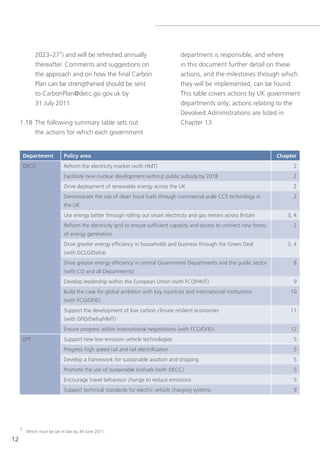
     1.18 the following summary table sets out                                 Chapter 13.
          the actions for which each government


      Department           Policy area                                                                                 Chapter
      DeCC                 Reform the electricity market (with HMt)                                                         2
                           Facilitate new nuclear development without public subsidy by 2018                                2
                           Drive deployment of renewable energy across the UK                                               2
                           Demonstrate the use of clean fossil fuels through commercial scale CCs technology in             2
                           the UK
                           Use energy better through rolling out smart electricity and gas meters across Britain          3, 4
                           Reform the electricity grid to ensure sufficient capacity and access to connect new forms        2
                           of energy generation
                           Drive greater energy efficiency in households and business through the green Deal              3, 4
                           (with DClg/Defra)
                           Drive greater energy efficiency in central government Departments and the public sector          8
                           (with Co and all Departments)
                           Develop leadership within the european Union (with FCo/HMt)                                      9
                           Build the case for global ambition with key countries and international institutions            10
                           (with FCo/DFID)
                           support the development of low carbon climate resilient economies                               11
                           (with DFID/Defra/HMt)
                           ensure progress within international negotiations (with FCo/DFID)                               12
      Dft                  support new low emission vehicle technologies                                                    5
                           Progress high speed rail and rail electrification                                                5
                           Develop a framework for sustainable aviation and shipping                                        5
                           Promote the use of sustainable biofuels (with DeCC)                                              5
                           encourage travel behaviour change to reduce emissions                                            5
                           support technical standards for electric vehicle charging systems                                9


     7 Which must be set in law by 30 June 2011.

12
Chapter 1: the challenge of climate change – our approach


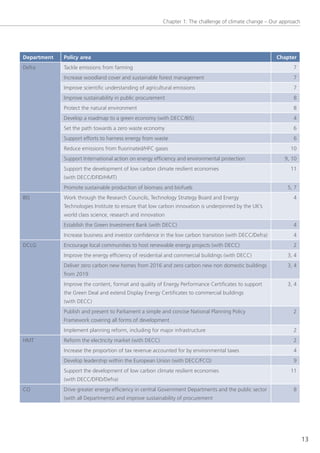
Department   Policy area                                                                                Chapter
Defra        tackle emissions from farming                                                                     7
             Increase woodland cover and sustainable forest management                                         7
             Improve scientific understanding of agricultural emissions                                        7
             Improve sustainability in public procurement                                                      8
             Protect the natural environment                                                                   8
             Develop a roadmap to a green economy (with DeCC/BIs)                                              4
             set the path towards a zero waste economy                                                         6
             support efforts to harness energy from waste                                                      6
             Reduce emissions from fluorinated/HFC gases                                                      10
             support International action on energy efficiency and environmental protection                9, 10
             support the development of low carbon climate resilient economies                                11
             (with DeCC/DFID/HMt)
             Promote sustainable production of biomass and biofuels                                         5, 7
BIs          Work through the Research Councils, technology strategy Board and energy                          4
             technologies Institute to ensure that low carbon innovation is underpinned by the UK’s
             world class science, research and innovation
             establish the green Investment Bank (with DeCC)                                                   4
             Increase business and investor confidence in the low carbon transition (with DeCC/Defra)          4
DClg         encourage local communities to host renewable energy projects (with DeCC)                         2
             Improve the energy efficiency of residential and commercial buildings (with DeCC)              3, 4
             Deliver zero carbon new homes from 2016 and zero carbon new non domestic buildings             3, 4
             from 2019
             Improve the content, format and quality of energy Performance Certificates to support          3, 4
             the green Deal and extend Display energy Certificates to commercial buildings
             (with DeCC)
             Publish and present to Parliament a simple and concise national Planning Policy                   2
             Framework covering all forms of development
             Implement planning reform, including for major infrastructure                                     2
HMt          Reform the electricity market (with DeCC)                                                         2
             Increase the proportion of tax revenue accounted for by environmental taxes                       4
             Develop leadership within the european Union (with DeCC/FCo)                                      9
             support the development of low carbon climate resilient economies                                11
             (with DeCC/DFID/Defra)
Co           Drive greater energy efficiency in central government Departments and the public sector           8
             (with all Departments) and improve sustainability of procurement


                                                                                                                     13
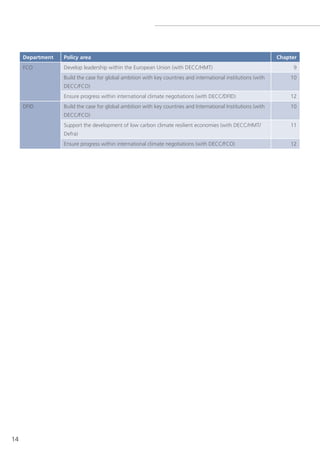
Department   Policy area                                                                                  Chapter
     FCo          Develop leadership within the european Union (with DeCC/HMt)                                      9
                  Build the case for global ambition with key countries and international institutions (with       10
                  DeCC/FCo)
                  ensure progress within international climate negotiations (with DeCC/DFID)                       12
     DFID         Build the case for global ambition with key countries and International Institutions (with       10
                  DeCC/FCo)
                  support the development of low carbon climate resilient economies (with DeCC/HMt/                11
                  Defra)
                  ensure progress within international climate negotiations (with DeCC/FCo)                        12


14
CHAPteR 2:
seCURe, sUstAInABle loW
CARBon eneRgy


                          15
2.1 secure supplies of electricity are something                                      system. Rising future demand means
         we take for granted, lighting our homes,                                          that we need to replace our ageing
         powering our appliances and keeping                                               electricity infrastructure with low carbon
         our workplaces running. But the majority                                          alternatives – a combination of renewable
         of that electricity is generated through                                          energy, new nuclear power and fossil
         burning fossil fuels, meaning that energy                                         fuel power stations fitted with Carbon
         supply is responsible for 35% of the UK’s                                         Capture and storage (CCs) technology.
         greenhouse gas emissions – more than any                                          this represents a vast challenge, with
         other sector of the economy.8                                                     an estimated £110 billion9 or more of
                                                                                           investment likely to be needed by 2020 in
     2.2 At the same time, there are big changes on                                        electricity generation infrastructure and in
         the horizon. Demand for electricity is likely                                     the transmission and distribution network
         to rise due to our efforts to cut greenhouse                                      needed to transport that electricity to end
         gases elsewhere in the economy, for                                               users. Around 30% of our electricity is
         example as we use electricity much more                                           likely to need to come from renewables
         for powering transport and heating our                                            alone by 2020 in order to meet our legally
         homes. And alongside this, around a                                               binding eU target to source 15% of the
         quarter of the UK’s current electricity-                                          UK’s energy from renewable sources by
         generating power plants are set to close                                          that date.10
         over the next decade due to age or stricter
         environmental regulations.
                                                                                  Reforming the electricity market
     2.3 this means we cannot continue as
                                                                                  2.4 the current electricity market structure has
         we are. the UK needs clean, safe and
                                                                                      served us well in maintaining secure energy
         affordable energy to heat our homes and
                                                                                      supplies since the 1990s, encouraging
         power our businesses, and we need to
                                                                                      competition and supporting some of the
         identify a sustainable route for making
                                                                                      lowest electricity prices in the eU. But
         the transition to low carbon energy.
                                                                                      the changing nature of the UK’s energy
         electricity power plants of all types take
                                                                                      and climate change challenges means
         years to plan and build, and many have
                                                                                      we now need a different structure. the
         a working lifespan of 40 years or longer,
                                                                                      reality is that the estimated £110 billion
         making it essential that we plan for the
                                                                                      of investment needed in electricity
         long term. the government is committed
                                                                                      infrastructure represents roughly double
         to finding a sustainable pathway for
                                                                                      the rate of capital investment seen over
         the decarbonisation of our electricity
                                                                                      the last decade, and it is likely that new
     8 the 2009 final UK greenhouse gas emissions figures, available at:
        www.decc.gov.uk/en/content/cms/statistics/climate_change/gg_emissions/uk_emissions/2009_final/2009_final.aspx
     9 DeCC (2010) Electricity Market Reform: Consultation Document,
        www.decc.gov.uk/assets/decc/Consultations/emr/1041-electricity-market-reform-condoc.pdf
     10 Redpoint (2010) Electricity Market Reform: Analysis of Policy Options, www.decc.gov.uk/assets/decc/Consultations/emr/1043-emr-analysis-policy-
        options.pdf, Chapter 3.
16
Chapter 2: secure, sustainable low carbon energy


       entrants to the market will need to be                                     attractive still. A ‘contract for difference’
       encouraged in order for this to be possible.                               model for low carbon generation is
       gas generation remains the lowest cost                                     proposed (guaranteeing a certain price
       and lowest risk investment under the                                       to generators for their electricity, and
       current market structure, and change will                                  contracting for the government to meet
       be needed to bring forward investment                                      the difference between this and the current
       in renewables, nuclear and CCs at the                                      market price), as this should control costs
       right speed and scale and to enable a cost                                 for consumers, provide stable returns
       effective roll-out of these technologies.                                  for investors and maintain the market
                                                                                  incentives to generate when electricity
2.5 to address these challenges, the                                              demand is high. However, because of
    government has published a consultation                                       complex design and implementation issues,
    on electricity Market Reform,11 presenting                                    the government is also consulting on a
    a review of the way that the market                                           premium feed-in tariff (a fixed payment
    framework affects investment decisions                                        which generators receive on top of the
    and proposing a new framework to                                              market price) as a credible alternative.
    incentivise investment in low carbon
    generation and the maintenance of secure                               •      Capacity payments: these are targeted
    supplies in a cost effective way while                                        payments to encourage security of supply
    also keeping energy bills affordable. that                                    through the construction of flexible reserve
    consultation set out four main proposals                                      plants or demand reduction measures
    to reform the market in order to achieve                                      (for instance, contracting with companies
    these aims:                                                                   to reduce energy usage at times of high
                                                                                  demand – so-called ‘negawatts’). Capacity
•      Carbon price support: greater long-                                        payments will ensure that an adequate
       term certainty is needed around the                                        safety cushion of capacity remains as the
       additional cost of running polluting plant.                                amount of intermittent and inflexible low
       supporting the carbon price will encourage                                 carbon generation increases.
       investment in low carbon technologies.
       By strengthening the carbon price for                               •      Emissions Performance Standard:
       electricity generators, it will increase the                               A back-stop to limit how much carbon
       cost of fossil fuel generation, making lower                               the most carbon-intensive coal-fired
       carbon power more attractive.                                              power stations can emit. An emissions
                                                                                  Performance standard will reinforce the
•      Feed-in tariffs: long-term contracts                                       existing requirement that no new coal
       would provide more certainty on the                                        plant is built without demonstrating CCs
       revenues from low carbon generation                                        technology.
       and make clean energy investment more

11 DeCC (2010) Electricity Market Reform: Consultation Document,
   www.decc.gov.uk/assets/decc/Consultations/emr/1041-electricity-market-reform-condoc.pdf
                                                                                                                                        17
2.6 Following that consultation, the                                                     participants (in relevant sectors, defined
         government will publish a White Paper                                                by intensity of energy use, and including
         later in 2011 setting out proposals to                                               the vast majority of electricity generation),
         reform the electricity market.                                                       with that cap decreasing over time.
                                                                                              Companies and organisations covered by
                                                                                              the system are given or sold allowances
     Towards a new energy infrastructure                                                      that permit emissions up to the total set by
                                                                                              the cap, and are able to buy and sell these
     2.7 the reforms to the electricity market set                                            allowances, effectively creating a market
         out above will be essential to transforming                                          price for carbon and encouraging emission
         the UK’s electricity infrastructure and                                              reductions to be made in the most cost
         bringing forward the investment needed                                               effective way.
         in low carbon generation. Ahead of this
         reform, the government has already set in
                                                                                     2.10 In addition, the UK government has
         place a range of measures to encourage
                                                                                          set in place a system of three major
         investment in renewables, nuclear power
                                                                                          financial incentives to support sustainable
         and CCs.
                                                                                          renewable energy deployment:

     2.8 UK trade & Investment (UKtI) has
                                                                                     •        the Renewables obligation, under which
         developed a framework for inward
                                                                                              electricity suppliers are required to source a
         investment in energy focusing on key low
                                                                                              proportion of their energy from renewable
         carbon technologies which offer the best
                                                                                              generation;12
         short and medium-term opportunities for
         foreign direct investment into the UK. For
                                                                                     •        feed-in tariffs, which provide a financial
         key sectors such as offshore wind, onshore
                                                                                              incentive for the generation of small-scale
         wind, nuclear, microgeneration in biomass
                                                                                              (less than 5MW) low carbon electricity; and
         and photovoltaics, and Carbon Capture
         and storage, prospectuses have been
                                                                                     •        the Renewable Heat Incentive, which will
         set up and UKtI‘s network is targeting
                                                                                              support the generation of renewable heat
         companies operating in these sectors with
                                                                                              and which will start to be implemented
         a view to them investing in the UK.
                                                                                              in 2011.

     2.9 the most substantial single measure driving
                                                                                     2.11 We will also need low carbon electricity
         decarbonisation in the power sector is the
                                                                                          from a new generation of civil nuclear
         eU emissions trading system (eU ets). this
                                                                                          power, built without public subsidy. the
             is an eU-wide ‘cap and trade’ scheme,                                        government will support this by creating
             under which a single total cap is set for the                                an enabling framework to facilitate new
             greenhouse gas emissions of all scheme                                       nuclear development from 2018. this
     12 the future of the Renewables obligation and how it relates to the proposed system of feed-in-tariffs is being considered as part of the electricity
        Market Reform project.
18
Chapter 2: secure, sustainable low carbon energy


     will include setting the arrangements for     Reform of the electricity grid
     assessment by the nuclear regulators of the
     safety, security and environmental impact     2.14 Delivering the level of change needed in
     of new nuclear reactors, putting in place          the UK’s energy generation and use will
     regulation to ensure that operators meet           require major changes to the way in which
     the full costs of decommissioning and their        we transport energy around the country.
     full share of waste management costs, and          the electricity grid allows us to transport
     submitting the national Policy statement           power from where it is generated to the
     for new nuclear power to Parliament for            end user, via a transmission network that
     approval by May 2011.                              moves electricity over long distances at
                                                        high voltages and a number of lower
2.12 lastly, if the UK’s energy supplies are to         voltage regional distribution networks that
     remain secure and affordable, fossil fuels         feed electricity into homes and businesses.
     will remain part of its energy mix for             It is a fundamental asset and vital to the
     some time to come, with a role to play in          UK’s economic and national security. 
     balancing the intermittency of high levels
     of renewable electricity generation.          2.15 the government is working to ensure that
                                                        the right framework is in place for the
2.13 In the longer term, for fossil fuels to            investment that will be needed in our grid
     continue to form a substantial part of             infrastructure, including work to connect
     the energy mix we will need commercial-            new forms of electricity generation, so that
     scale deployment of CCs technology. CCs            the grid has the capacity and capability
     has the potential to capture up to 90%             to deal with energy demand and with
     of the emissions from coal and gas-fired           changes to the way we generate energy
     electricity generation and lock the carbon         (such as more widely geographically
     dioxide away securely in underground               distributed generation) as new and more
     geological formations. the government              diverse sources of energy are connected.
     has already announced up to £1 billion of
     funding for the UK’s first commercial-scale   2.16 the government is facilitating this
     demonstration of this new technology               transformation by:
     on coal. the government will complete
     a process to identify further CCs projects    •    ensuring that the planning regime for
     to be supported by public investment by            major national infrastructure, including
     May 2012, and has made subsequent                  the national Policy statements that will
     demonstrations eligible to CCs projects            be submitted to Parliament for approval
     on gas.                                            by May 2011, is designed both to support
                                                        the development of electricity networks
                                                        and to minimise unnecessary barriers and
                                                        potential delays in connecting up the new
                                                        energy infrastructure;
                                                                                                             19
•       creating a new ‘connect and manage’                 back into the hands of communities.
             regime, which was announced in July 2010            the government has also announced its
             to accelerate grid connection time. All             intention to publish a national Planning
             arrangements to ensure effective operation          Policy Framework, which will set out the
             and communication are in place;                     national economic, environmental and
                                                                 social priorities for planning, including on
     •       ensuring that the competitive offshore              climate change. the important role played
             transmission regime maximises the                   by planning in meeting the challenge of
             opportunity for strategic transmission              climate change will be reflected in the
             infrastructure development; and                     Framework and we will make it clear that
                                                                 planning has a big part to play – both
     •       paving the way towards a ‘smarter’                  in cutting emissions and in adaptation.
             electricity grid in the UK, which will              Alongside these planning reforms, the
             increase the efficiency and reliability of          government has committed to allowing
             the network, enable flexible demand                 communities that host renewable energy
             management and the use of electric                  projects to keep the additional business
             vehicles, and support integration of more           rates they generate. this will be taken
             local and wind-powered generation.                  forward through the local government
                                                                 Resource Review.

     Planning reform

     2.17 Reform of the planning system will be
          vital for delivery of infrastructure. For
          major infrastructure, the government
          proposes to replace the Infrastructure
          Planning Commission (IPC) with a Major
          Infrastructure Planning Unit within the
          Planning Inspectorate, restoring the
          responsibility for taking decisions to
          government Ministers while retaining the
          IPC’s fast-track process for examining major
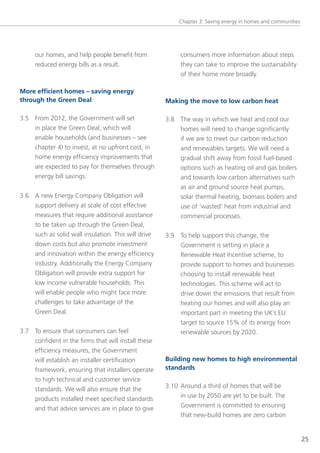
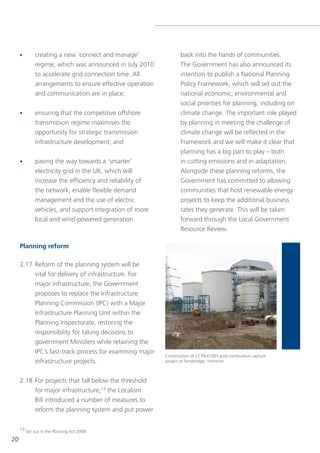
                                                          Construction of CCPilot100+ post-combustion capture
          infrastructure projects.                        project at Ferrybridge, yorkshire


     2.18 For projects that fall below the threshold
          for major infrastructure,13 the localism
          Bill introduced a number of measures to
          reform the planning system and put power

     13 set out in the Planning Act 2008.

20
Chapter 2: secure, sustainable low carbon energy


Actions

 Start date       End date        Description                                                                                Department
                                                                                                                             responsible
 started          Mar 2011        Consult on electricity market reforms, potentially including the following                 DeCC
                                  proposals; a) support for a carbon price to ensure that energy prices
                                  reflect their carbon content and encourage investment in low carbon
                                  generation; b) A mechanism to reduce revenue uncertainty for low
                                  carbon generation, e.g. by establishing a full system of Feed in tariffs;
                                  c) Introducing a new capacity mechanism, improving security of supply
                                  by incentivising or requiring sufficient capacity in the energy system;
                                  An emissions Performance standard that will prevent new coal power
                                  stations being built unless equipped with CCs
 started          Apr 2011        legislate in Finance Bill 11 (reforms to the Climate Change levy) to                       HMt
                                  introduce a carbon price floor mechanism in 2013
 started          Apr 2011        Work with HMt on the reform of the Climate Change levy to help                             DeCC
                                  support the carbon price, with legislation brought forward by HMt in the
                                  Finance Bill 2011 as appropriate
 started          Apr 2011        Work with the Department for Communities and local government                              DeCC
                                  to allow communities that host renewable energy projects to keep the
                                  additional business rates they generate

 started          May 2011        establish the governance arrangements and design the business and                          BIs
                                                                                                  *
                                  operating model of the new [green Investment Bank] institution
 started          May 2011        submit national Policy statements (making the case for new energy                          DeCC
                                  infrastructure) to Parliament for ratification
 started          May 2011        Review the role of ofgem in delivering government’s aims for                               DeCC
                                  independent regulation of the energy sector
 started          Jun 2011        energy national Policy statements designated, working with the                             DClg**
                                  Department of energy and Climate Change
 started          Jun 2011        set arrangements for the independent assessment of the safety, security                    DeCC
                                  and environmental impact of new reactor designs
 started          Jun 2011        Develop regulations for new Renewable Heat Incentive scheme to provide                     DeCC
                                  financial support for renewable heat, and lay before Parliament
 started          Jul 2011        Work with Clg to deliver the local government resource review, including                   HMt
                                  exploring options for local authorities to retain locally collected business
                                  rate revenues

* Where actions have been previously published in Departmental Business Plans in november 2010, the description wording and dates have not been
   changed. square brackets denote explanatory wording added for clarity, which was not in the original Business Plan text.
** DeCC lead.


                                                                                                                                                  21
Start date        End date    Description                                                                    Department
                                                                                                                   responsible
      started           Jul 2011    Deliver proposals for long term change to how local authorities are            DClg
                                    funded through the local government resource review, including local
                                    retention of business rates, giving councils greater freedoms, while
                                    retaining fairness in the local government finance system
      started           Apr 2012    Publish national Planning Policy Framework                                     DClg
      started           Apr 2012    Introduce as part of the national planning framework a strong                  DClg
                                    presumption in favour of sustainable development
      started           May 2012    Run process to identify further CCs projects to be supported by public         DeCC
                                    investment
      started           Apr 2013    Conduct four-yearly review of Renewables obligation (Ro) Banding (levels       DeCC
                                    of financial support for different technologies) to ensure that the Ro
                                    provides the correct level of support to maintain investment in large-scale
                                    renewable energy generation
      Apr 2011          Apr 2011    Complete order and Regulations for financing of waste and                      DeCC
                                    decommissioning associated with new nuclear build
      Apr 2011          Apr 2011    Publish final statutory Funded Decommissioning Plan guidance and a final       DeCC
                                    Waste transfer Pricing Methodology for the transfer to government of
                                    new-build operators’ spent fuel and Intermediate level Waste for final
                                    disposal
      Apr 2011          Jul 2011    Respond to Committee on Climate Change recommendations on the role             DeCC
                                    of renewables beyond 2020 and potential pathways to 2030
      May 2011          May 2011    Publish White Paper setting out reforms to the electricity market              DeCC
      May 2011          May 2011    Design national Policy statements with clear and effective guidance on         DeCC
                                    onshore grid infrastructure to enable network development to take place
                                    in an environmentally sustainable and timely manner
      May 2011          May 2011    submit energy national Policy statements (making the case for new              DeCC
                                    energy infrastructure) to Parliament for ratification
      Jun 2011          Jun 2011    Implement the Renewable Heat Incentive scheme                                  DeCC
      Dec 2011          Dec 2011    Award contract for first [UK Carbon Capture and storage]*                      DeCC
                                    demonstration project
      Apr 2012          Apr 2012    transfer relevant functions from the IPC [Infrastructure Planning              DClg
                                    Commission]* into the Major Infrastructure Planning Unit
      Apr 2012          Apr 2013    Undertake first major review of Feed-in tariffs for small scale renewable      DeCC
                                    energy, consult and implement changes

      Dec 2012          Dec 2012    Publish proposals for tackling the regulatory, legal, planning and technical   DeCC
                                    barriers to co-ordinated offshore grid development in the north and
                                    Irish seas

     * see first note on page 21.


22
CHAPteR 3:
sAvIng eneRgy In HoMes
AnD CoMMUnItIes


                         23
3.1 the UK’s 26 million homes are responsible                               3.3 other measures will also play an important
         for 14% of its greenhouse gas emissions.14                                  part, such as helping people understand
         the majority of these emissions are as a                                    more about the source and impact of the
         result of burning fossil fuels. In particular,                              energy they are using and the emissions it
         gas use dominates domestic sector                                           creates, engaging and enabling people and
         energy consumption, making up 81% of                                        communities to make choices to use less
         consumption for heat purposes and 68%                                       energy. But it is the two areas outlined in
         of overall domestic consumption.15                                          paragraph 3.2 that are the most significant –
                                                                                     and the most urgent.
     3.2 In seeking to reduce these emissions, the
         government will focus its effort on two key                             3.4 there will be no one-size-fits-all solution
         priorities, which together are likely to have                               to reducing greenhouse gas emissions
         the greatest impact:                                                        from our homes. For instance, while most
                                                                                     homes in the UK rely on gas boilers for
     •      increasing the energy efficiency of our                                  their heating and hot water, there are
            housing stock. this includes ensuring that                               also around 4.8 million homes that are
            new-build houses are as energy efficient                                 not connected to the gas grid and that
            as possible, with a move to zero carbon                                  use other options, such as heating oil or
            homes from 2016 (and zero carbon                                         electric heaters.16 While a rural farmhouse
            non-domestic buildings from 2019) but                                    may benefit from improved loft insulation
            we will make the most difference most                                    and installation of a ground source heat
            quickly through efforts to retrofit existing                             pump, a modern tower block might be
            housing, prioritising the most cost effective                            able to reduce its emissions more cost
            measures such as cavity wall and loft                                    effectively by fitting cavity wall insulation
            insulation; and                                                          throughout and being connected to a form
                                                                                     of network heating for all the flats in the
     •      helping people make the choice to move                                   block, even where this still relies on (more
            away from a reliance on fossil fuel-based                                efficient) fossil fuel supply. or, better still,
            space and water heating and towards low                                  the tower block could be connected to a
            carbon alternatives. these include air and                               source of heat from a local power station or
            ground source heat pumps at domestic                                     a large source of renewable heat such as a
            level, and Combined Heat and Power                                       biomass boiler. the government’s aim is to
            or a form of network heating in those                                    set the right legal and financial framework
            communities where it makes sense.                                        and provide the right information to help
                                                                                     reduce greenhouse gas emissions from


     14 the 2009 final UK greenhouse gas emissions figures, available at:
        www.decc.gov.uk/en/content/cms/statistics/climate_change/gg_emissions/uk_emissions/2009_final/2009_final.aspx
     15 DeCC (2010) Estimates of Heat Use in the United Kingdom,
        www.decc.gov.uk/assets/decc/statistics/publications/trends/articles_issue/562-trendssep10-heat-use-article.pdf
     16 Department of energy and Climate Change analysis.

24
Chapter 3: saving energy in homes and communities


     our homes, and help people benefit from              consumers more information about steps
     reduced energy bills as a result.                    they can take to improve the sustainability
                                                          of their home more broadly.

More efficient homes – saving energy
through the Green Deal                               Making the move to low carbon heat

3.5 From 2012, the government will set               3.8 the way in which we heat and cool our
    in place the green Deal, which will                  homes will need to change significantly
    enable households (and businesses – see              if we are to meet our carbon reduction
    chapter 4) to invest, at no upfront cost, in         and renewables targets. We will need a
    home energy efficiency improvements that             gradual shift away from fossil fuel-based
    are expected to pay for themselves through           options such as heating oil and gas boilers
    energy bill savings.                                 and towards low carbon alternatives such
                                                         as air and ground source heat pumps,
3.6 A new energy Company obligation will                 solar thermal heating, biomass boilers and
    support delivery at scale of cost effective          use of ‘wasted’ heat from industrial and
    measures that require additional assistance          commercial processes.
    to be taken up through the green Deal,
    such as solid wall insulation. this will drive   3.9 to help support this change, the
    down costs but also promote investment               government is setting in place a
    and innovation within the energy efficiency          Renewable Heat Incentive scheme, to
    industry. Additionally the energy Company            provide support to homes and businesses
    obligation will provide extra support for            choosing to install renewable heat
    low income vulnerable households. this               technologies. this scheme will act to
    will enable people who might face more               drive down the emissions that result from
    challenges to take advantage of the                  heating our homes and will also play an
    green Deal.                                          important part in meeting the UK’s eU
                                                         target to source 15% of its energy from
3.7 to ensure that consumers can feel                    renewable sources by 2020.
    confident in the firms that will install these
    efficiency measures, the government
    will establish an installer certification        Building new homes to high environmental
    framework, ensuring that installers operate      standards
    to high technical and customer service
                                                     3.10 Around a third of homes that will be
    standards. We will also ensure that the
                                                          in use by 2050 are yet to be built. the
    products installed meet specified standards
                                                          government is committed to ensuring
    and that advice services are in place to give
                                                          that new-build homes are zero carbon


                                                                                                             25
from 2016 and do not add extra carbon                            •      supporting eco-towns and eco-
            dioxide emissions to the atmosphere,                                    developments where there is local support
            while ensuring that the costs of building                               and a wish to adopt higher standards of
            new homes do not prevent suitable and                                   sustainability and design.
            sustainable development.
                                                                                 Box 3.1: Vanguard Areas
     3.11 the government is committed to                                         The Big Society is already happening in many
          successive improvements in national                                    local communities – for example, in the
          new-build standards through changes                                    ‘vanguard’ areas announced by the Prime
          to Part l of the Building Regulations                                  Minister in July 2010. The Department for
          2010 (conservation of fuel and power).                                 Communities and Local Government is working
                                                                                 with the vanguard areas to help them overcome
          In october 2010 the new regulations
                                                                                 the barriers they experience. This includes
          introduced a 25% improvement on 2006
                                                                                 barriers to taking action to reduce greenhouse
          carbon emissions standards. the next
                                                                                 gas emissions, including with the London
          review will look at strengthening standards                            Borough of Sutton on sustainable energy, and
          again in 2013 in line with developing policy                           with Eden Valley, Cumbria on the development
          for zero carbon, and consider provisions                               of a groundbreaking community hydro scheme
          for the existing stock in the light of the                             and anaerobic digestion.
          government’s emerging policies on retrofit,
          including the green Deal.
                                                                             Changing consumer behaviour

     3.12 the government wants to support and                                3.13 the government understands that
          enable communities in their wish to adopt                               reducing energy use and emissions in the
          higher environmental standards for new                                    residential sector will only be possible
          homes including through:                                                  by developing solutions that address the
                                                                                    barriers to action – whether through the
     •      ensuring that there are robust sustainability                           provision of better information or removing
            standards for local authorities to use if                               the hassle associated with action –
            they want to set higher standards than                                  enabling people to take decisions that save
            those in the national regulations in their                              money and reduce emissions.
            local plans. For example, the Code for
            sustainable Homes provides standards for                         3.14 the government’s smart meters
            the sustainable design and construction                               programme, involving the installation of
            of new homes (including water efficiency)                             around 50 million smart gas and electricity
            that meet or exceed those set out in the                              meters,17 will provide consumers with
            Building Regulations 2010; and                                          real-time information about energy use,
                                                                                    enabling them to monitor and manage their

     17 DeCC and ofgem (2010) Smart Metering Implementation Programme: Prospectus,
        www.decc.gov.uk/en/content/cms/consultations/smart_mtr_imp/smart_mtr_imp.aspx
26
Chapter 3: saving energy in homes and communities


     energy consumption, and can pave the way
     for a transformation in the way in which
     energy is supplied and used. Consumers will
     receive accurate bills; switching between
     suppliers will be smoother and faster; and
     improvements in the delivery of energy
     efficiency advice, including the purchasing
     and end use of energy efficient products,
     will be supported.


3.15 energy suppliers will be able to offer a
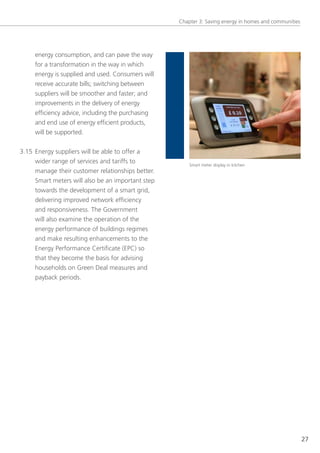
     wider range of services and tariffs to            smart meter display in kitchen
     manage their customer relationships better.
     smart meters will also be an important step
     towards the development of a smart grid,
     delivering improved network efficiency
     and responsiveness. the government
     will also examine the operation of the
     energy performance of buildings regimes
     and make resulting enhancements to the
     energy Performance Certificate (ePC) so
     that they become the basis for advising
     households on green Deal measures and
     payback periods.


                                                                                                       27
Actions

      Start date        End date    Description                                                                 Department
                                                                                                                responsible
      started           Mar 2011    examine the operation of the energy performance of buildings regime         DeCC/DClg
                                    to ensure it is capable of supporting green Deal delivery
      started           Apr 2011    Analyse consultation responses and develop plan for subsequent              DeCC
                                    phases of the [smart Meters]* programme
      started           Jun 2011    Work with potential providers to facilitate early precursor offers to the   DeCC
                                    green Deal
      started           sep 2011    Develop accreditation process to ensure public confidence in green          DeCC
                                    Deal measures
      started           Jan 2012    As part of broader sustainability information available under the green     Defra
                                    Deal, develop advice on water efficiency
      started           Apr 2012    Improve the Content, format and quality of energy Performance               DClg/DeCC
                                    Certificates (ePCs) to support the green Deal, and ensure requirements
                                    are complied with
      started           Jul 2012    subject to consultation, work with industry to confirm technical            DeCC
                                    specifications and begin roll out of smart meters across Britain
      started           oct 2012    Develop policies to increase demand for the green Deal, alongside core      DeCC
                                    finance offer
      started           oct 2012    enable the green Deal by developing proposals for reviewing take-           DClg/DeCC
                                    up and possible regulation of the private rented sector, providing
                                    access to energy Performance Certificate data and linking the ePC to
                                    green Deal legislation
      started           oct 2012    encourage local authorities to become involved in delivering energy         DClg/DeCC
                                    efficiency in their areas and social landlords to take action to improve
                                    the energy performance of their stock, using the Carbon emissions
                                    Reduction targets and the green Deal to augment Decent Homes
                                    funding where appropriate, to stimulate the green Deal and provide
                                    greater certainty to suppliers
      Apr 2011          Apr 2011    subject to consultation, publish detailed implementation plan leading       DeCC
                                    to full roll out [of smart Meters],* beginning in summer 2012
      oct 2011          Jan 2012    Consult on secondary legislation to enable the green Deal, including        DeCC
                                    the new obligation on energy companies
      Dec 2011          Mar 2012    Consult on revisions to Part l 2013 [conservation of fuel and power]*       DClg
                                    of the Building Regulations
      Jan 2012          Jan 2012    lay secondary legislation [to enable green Deal]* before Parliament         DeCC
      2016              ongoing     Introduction of zero carbon build standard for new homes                    DClg

     * see first note on page 21.


28
CHAPteR 4:
ReDUCIng eMIssIons
FRoM BUsIness AnD InDUstRy


                             29
4.1 Around 17% of the UK’s greenhouse gas                                            sector (e.g. addressing the differences
         emissions come from our businesses and                                           between domestic and commercial energy
         industrial processes.18 these emissions                                          supply contracts) to ensure that businesses
         are produced in different ways, including                                        can benefit from the business element of
         from industrial processes or from heating –                                      the green Deal, which will enable them
         and cooling – office buildings. In addition                                      to access the benefits of savings on their
         to heat-related emissions, greenhouse                                            energy bills without the need to provide
         gas emissions are produced by chemical                                           upfront finance (see chapter 3).
         reactions in industrial processes, or from
         leaks of fluorinated gases from equipment                                4.4 the government will also ensure that
         like refrigerators and air conditioners.                                     energy efficiency savings are achieved in
         Making these processes greener and more                                      large organisations that participate in the
         efficient will be an important part of the                                   Carbon Reduction Commitment energy
         move towards a low carbon future.                                            efficiency scheme, through using the
                                                                                      financial and reputational drivers of the
                                                                                      scheme. the energy reporting required
     Helping businesses increase their energy                                         by the scheme ensures that organisations
     efficiency                                                                       are aware of their energy use, and that
                                                                                      senior management is responsible for this
     4.2 the energy used in our businesses and
                                                                                      reporting. the government is currently
         in industrial processes will always be
                                                                                      discussing options with participants
         an important part of our economy. the
                                                                                      for simplifying the scheme, to deliver
         government is committed to improving
                                                                                      improvements most effectively with
         energy efficiency to help deliver the UK’s
                                                                                      minimal burden on business.
             climate objectives at the lowest cost.
             the government will focus its support
                                                                                  4.5 More effort is also needed to reduce the
             where there is a need to help business
                                                                                      emissions of new business buildings.
             overcome barriers to investing in energy
                                                                                      Around 40% of the non-domestic floor
             and carbon saving. By improving resource
                                                                                      space that will exist in 2050 is yet to be
             efficiency, using less energy and water and
                                                                                      built.20 the government is committed
             minimising waste, UK businesses could
                                                                                      to reducing carbon emissions from new
             save around £6.4 billion per year – 1.9% of
                                                                                      buildings through successive changes to
             UK gross operating surplus (profit).19
                                                                                      the Building Regulations and to enabling
                                                                                      new non-domestic buildings to be zero
     4.3 the government will work to take account
                                                                                      carbon from 2019. the next review of
         of the nature of the commercial property

     18 the 2009 final UK greenhouse gas emissions figures, available at:
        www.decc.gov.uk/en/content/cms/statistics/climate_change/gg_emissions/uk_emissions/2009_final/2009_final.aspx
     19 oakdene Hollins and grant thornton (2007) Quantification of the Business Benefits of Resource Efficiency: A Research Report Completed for the
        Department for Environment, Food and Rural Affairs, http://randd.defra.gov.uk/Document.aspx?Document=ev02036_6754_FRP.pdf
     20 Carbon trust (2009) Building the Future, Today.

30
Chapter 4: Reducing emissions from business and industry


        the regulations will look at strengthening                                  year on their spending on plant and
        standards in support of developing policy                                   machinery from a designated list of more
        for zero carbon and will consider provisions                                energy efficient products. A parallel eCA
        for the existing stock in the light of the                                  scheme promotes water efficiency in the
        government’s emerging policies on retrofit,                                 non-domestic sector, which is important
        including the green Deal.                                                   because the UK water system accounts
                                                                                    for about 6% of UK greenhouse gas
                                                                                    emissions;22 and
Helping businesses reduce their emissions
                                                                            •       the Waste and Resources Action
4.6 government will work with business to                                           Programme (WRAP), which provides
    reduce emissions through mechanisms                                             technical support to businesses and advice
    including:                                                                      to consumers to help promote resource
                                                                                    efficiency, increasing business and investor
•       the eU emissions trading system (see                                        confidence in the transition to a low
        chapter 2), which will be responsible for                                   carbon economy.
        the greatest reduction in emissions from
        both the power and business sectors;                                4.7 Having the right information will be key.
                                                                                energy Performance Certificates and
•       the eU regulatory framework on                                          Display energy Certificates (DeCs) provide
        fluorinated greenhouse gases (F gases),                                 businesses with information on the energy
        which has been fully implemented in                                     performance of buildings and their energy
        the UK;21                                                               consumption. the government is currently
                                                                                developing options for extending DeCs to
•       voluntary Business energy efficiency                                    commercial buildings and working with
        Agreements with energy suppliers to                                     industry on their take-up.
        provide energy efficiency advice, energy
        audits and services;                                                4.8 smart meters can also facilitate improved
                                                                                energy efficiency for business. Advanced
•       Carbon trust advice on energy efficiency to                             metering with some smart functionality is
        businesses and public sector organisations;                             already used in the non-domestic sector,
                                                                                particularly at larger sites. Under the
•       the enhanced Capital Allowance (eCA)                                    government’s smart metering proposals,
        scheme for energy efficiency, which                                     new metering will be installed at the
        enables businesses to claim 100% of                                     remaining 2.2 million smaller electricity
        the tax-deductable allowance in the first


21 the framework seeks to minimise leaks from certain types of equipment using F gases, the most common being refrigeration and air
   conditioning units.
22 www.energysavingtrust.org.uk/Water/Water-and-energy

                                                                                                                                        31
sites and up to 1.5 million smaller gas                                     automotive and Ultra-low emission
            sites on the same timetable as that set                                     vehicles, and the built environment.
            for a domestic smart meter roll-out                                         government supports innovation and
            (see chapter 3).23                                                          particularly low carbon innovation
                                                                                        through sponsorship of the UK Research
     4.9 the government will continue to                                                Councils, technology strategy Board and
         encourage companies to measure and                                             energy technologies Institute. through
         report their greenhouse gas emissions,                                         these investments we are ensuring that
         as there is evidence showing the benefits                                      businesses have a strong underpinning of
         to companies and to other stakeholders                                         science, research and innovation to develop
         from public disclosure of emissions data.24                                    the low carbon business opportunities of
         the Climate Change Act 2008 requires                                           the future.
         the government to make regulations by
         April 2012 requiring company directors’                                4.11 Direct emissions from industrial processes
         reports to include information about                                        contribute 2% to the UK’s greenhouse
         greenhouse gas emissions (or to explain                                     gas emissions.25 As part of the energy
         to Parliament why such regulations have                                        Intensive Industries strategy, the
         not been made). the government will be                                         government is conducting in-depth
         announcing a way forward on this matter                                        analysis with key energy intensive sectors
         in the first quarter of 2011.                                                  into the cumulative effect of various energy
                                                                                        and climate change measures and the
     4.10 Investors and business will be the engine                                     abatement potential in the short, medium
          of the transition and it is important that                                    and long term, as well as the barriers
          they appreciate and capitalise on the                                         that businesses face in realising this. the
          opportunities and challenges that this                                        strategy will use this evidence, together
          presents. this year the government                                            with a review of the existing policy
          will publish a roadmap to a green                                             measures that impact on these sectors,
          economy, which will seek to create more                                       to develop policy recommendations for
          transparency, certainty and longevity for                                     maximising abatement potential while
          business and investors to give them the                                       ensuring future competitiveness.
          confidence that they need to drive the
          transition. Innovation will be important in
          a range of low carbon sectors, including
          hydrogen energy, wave and tidal, nuclear,


     23 DeCC (2010) GB Wide Advanced/Smart Meter Roll Out to Small and Medium Non-Domestic Sites: Impact Assessment,
        www.decc.gov.uk/assets/decc/Consultations/smart-meter-imp-prospectus/222-ia-smart-roll-out-non-domestic.pdf
     24 Defra (2010) The Contribution that Reporting of Greenhouse Gas Emissions Makes to the UK Meeting its Climate Change Objectives: A Review of the
        Current Evidence, www.defra.gov.uk/environment/business/reporting/pdf/corporate-reporting101130.pdf
     25 the 2009 final UK greenhouse gas emissions figures, available at:
        www.decc.gov.uk/en/content/cms/statistics/climate_change/gg_emissions/uk_emissions/2009_final/2009_final.aspx


32
Chapter 4: Reducing emissions from business and industry


                                                          and facilitate the entrance of new types
  Box 4.1: GrowHow – increasing energy
                                                          of investor into green infrastructure, so
  efficiency
                                                          that the impact on the finance gap for low
  GrowHow is the UK’s only manufacturer of
                                                          carbon investment is many times the scale
  ammonium nitrate fertiliser which, as the
                                                          of the public contribution.
  main synthetic fertiliser currently used in
  England, is essential to maintaining levels of
  food production. The production of ammonia         4.14 the green Investment Bank will be
  and nitric acid, the constituents of fertilizer,        capitalised initially with £1 billion of
  is both energy and carbon intensive and, as a           funding allocated from departmental
  result, GrowHow is the UK’s largest industrial          budgets together with additional
  consumer of natural gas. GrowHow is investing           significant proceeds from the sale of
  £35 million, voluntarily and ahead of legal
                                                          government-owned assets, subject
  obligations, to increase energy efficiency and
                                                          to a final design that meets the tests
  reduce greenhouse gas emissions (GrowHow
  already supplies surplus carbon dioxide to a
                                                          of effectiveness, affordability and
  greenhouse complex next to their Billingham             transparency. the institution will be able to
  site) in the run-up to 2013, including a current        reinvest the proceeds from its investments.
  £9 million project on nitrous oxide abatement.


Green Investment Bank

4.12 the government is establishing a green
     Investment Bank to provide funding for
     investments in infrastructure projects
     that support economic growth and our
     environmental objectives in areas where
     private sector investment is currently
     constrained. the government will publish
     further details on its proposals for the
     governance arrangements and design of
     the business and operating model of the
     new institution by May 2011.


4.13 the green Investment Bank will tackle
     risk that the market currently cannot
     adequately finance and will look to
     catalyse further private sector investment


                                                                                                                33
Action

      Start date         End date   Description                                                               Department
                                                                                                              responsible
      started            Mar 2011   Consultation on and implementation of first stage of simplification of    DeCC
                                    Carbon Reduction Commitment energy efficiency scheme. Informal
                                    dialogue on wider simplification continues
      started            sep 2011   Develop accreditation process to ensure public confidence in non-         DeCC
                                    domestic green Deal measures
      started            Dec 2011   Put staff and back office systems in place [for the green Investment      BIs
                                    Bank]*, in preparation for the launch of the incubation phase
      started            Jan 2012   Develop advice on water efficiency as part of broader sustainability      Defra
                                    information available under the green Deal
      started            oct 2012   extend Display energy Certificates to commercial buildings                DClg/DeCC
      started            oct 2012   Develop policies to enable application of green Deal to the commercial    DeCC
                                    sector, alongside household offer
      Apr 2011           Apr 2011   Publish report outlining abatement potential, barriers and                BIs/DeCC
                                    opportunities for key energy intensive sectors
      Apr 2011           Apr 2011   Provide certainty and clarity for business and investors by launching a   Defra
                                    roadmap to a green economy with BIs and DeCC, including by using
                                    insights from behavioural science
      Apr 2011           May 2011   Publish a natural environment White Paper setting out measures to:        Defra
                                    protect wildlife, promote green spaces and wildlife corridors; value
                                    natural capital, complementing national accounts; and produce an
                                    analysis of the state of the UK’s natural asset base (the national
                                    ecosystems Assessment)
      May 2011           May 2011   Design of green Investment Bank complete and published                    BIs
      May 2011           Dec 2011   Continue market testing for the role of the green Investment Bank         BIs
                                    beyond the incubation phase
      oct 2011           Jan 2012   Consult on secondary legislation to enable the green Deal, including      DeCC
                                    the new obligation on energy companies
      Dec 2011           Mar 2012   Consult on revisions to Part l 2013 [conservation of fuel and power]*     DClg
                                    of the Building Regulations
      Jan 2012           Jan 2012   lay secondary legislation [to enable green Deal]* before Parliament       DeCC
      sep 2012           sep 2012   green Investment Bank operational                                         BIs
      May 2013           May 2013   First annual data released on the funds in and size of investments        BIs
                                    made by the green Investment Bank
      2019               ongoing    enable all new non domestic buildings to be zero carbon                   DClg

     * see first note on page 21.


34
CHAPteR 5:
toWARDs loW CARBon
tRAnsPoRt


                     35
5.1 transport is an engine for economic                                      Supporting new low emission vehicle
         growth, moving goods and workers                                         technologies
         around the country, allowing people to
         access employment, services, friends                                     5.4 the government is convinced that
         and family, leisure activities and their                                     the introduction of Ulevs will play an
         wider communities. But it is also a major                                    important role in decarbonising transport.
         source of greenhouse gas emissions.                                          the spending Review confirmed provision
         Domestic transport accounts for 22% of                                       of over £400 million to support the
         UK greenhouse gas emissions.26 the vast                                      development of the Ulevs market.
             majority of this came from road transport,                               A consumer incentive (the Plug-in Car
             which accounts for 20% of UK greenhouse                                  grant) will be available to facilitate the
             gas emissions.                                                           purchase of Ulevs while the market is
                                                                                      in its infancy. this will help to create a
     5.2 If we are to tackle greenhouse gas                                                more level playing field between new
         emissions and other harmful emissions                                             and existing vehicle technologies, until
         from transport, it is therefore imperative                                        market scale drives purchase costs of
         that we develop and improve vehicle                                               newer technologies down to a more
         technologies that allow us to use                                                 competitive level.
         less fuel or lower carbon fuels. the
         government will work hard to support
         both the development and introduction
         of new vehicle and fuel technologies
         such as electric and other Ultra-low
         emission vehicles (Ulevs), and ongoing
         improvements in the fuel efficiency of all
         modes of transport.


     5.3 this must be the greatest priority, but other
         changes will play an important part as
         well. the government will work to support
         sustainable travel choices and alternatives
         to travel, and to promote sustainable
         distribution of goods and sustainable
         low carbon approaches to other forms
         of transport, including rail, aviation
         and shipping.


     26 the 2009 final UK greenhouse gas emissions figures, available at: www.decc.gov.uk/en/content/cms/statistics/climate_change/gg_emissions/
        uk_emissions/2009_final/2009_final.aspx. UK domestic emissions only. Including international shipping and aviation, the total is 27%, with 19%
        representing road transport.
36
Chapter 5: towards low carbon transport


                                                             with industry in research and development
  Box 5.1: Supporting the take-up of ultra-low
                                                             to help UK-based businesses maximise the
  emission cars
                                                             economic benefits associated with a rapidly
  The Government announced the first nine
                                                             developing Ulev market. As part of this
  electric and ultra-low emission cars eligible for
                                                             funding, the government has contributed
  the grant of up to £5,000 from 1 January 2011,
  as well as confirming a total of eight Plugged-
                                                             to a total award of £24 million for six
  in Places projects around the country. These               projects to help develop the UK’s low
  projects have successfully bid for a share of a            emission vehicle capability. the projects
  £30 million fund aimed at encouraging a new                include the development of new engines
  network of electric vehicle recharging points in           for plug-in hybrid cars to improve vehicle
  streets, homes and sites such as car parks and             performance, and materials that reduce
  commercial retail and leisure facilities. The first
                                                             vehicle weight.
  nine cars to become eligible for the grant are:
  the Mitsubishi i-MiEV; the Smart Fortwo electric
  drive; the Peugeot iOn; the Nissan Leaf; the Tata
                                                        5.7 A new wave of low carbon public transport
  Indica Vista; the Citroën CZero; the Vauxhall             will be encouraged by the green Bus Fund,
  Ampera; the Toyota Prius Plug-in Hybrid; and              which will incentivise bus operators and
  the Chevrolet Volt.                                       local authorities to buy new hybrid and
  The successful Plugged-in Places consortia are            electric vehicles, with around 170 vehicles
  based in: the Midlands; Greater Manchester; East          expected to be purchased by March 2012.
  of England; Scotland; Northern Ireland; London;
  Milton Keynes; and the North East.                    5.8 the encouragement of a growing
                                                            Ulev market in the UK can provide
5.5 In addition to the environmental and                    manufacturers and the associated supply
    energy security benefits of Ulevs, there                chain with the incentives to invest in the
    are opportunities for the continued                     high-tech manufacturing technologies
    development of the UK’s automotive                      demanded by the market, including range
    industry. the automotive sector is of                   extender engines, batteries for automotive
    significant importance to the UK economy,               use (e.g. nissan’s planned battery plant in
    supporting research and development,                    sunderland), electric motors, mechanical
    technological innovation, skills and a                  storage (flywheels) and fuel cells.
    supply chain that is a mainstay of the wider
    manufacturing sector.                               5.9 However, if we are to see large-scale
                                                            take-up of electric vehicles as a major form
5.6 the government has made provision                       of road transport, developing charging
    of around £80 million to support a                      infrastructure will also be vital and the
    programme of research and development.                  government has committed to mandating
    this includes supporting the technology                 a national recharging network. By June
    strategy Board’s low Carbon vehicles                    2011, the government will produce a
    Innovation Platform, which invests jointly              strategy setting out how it will promote

                                                                                                                37
the provision of nationwide recharging                                            that people have viable, low carbon
             infrastructure. grant funding of £30 million                                      alternatives, including rail.
             will support eight towns and cities to roll
             out charging infrastructure at specific sites                            5.12 High speed rail could potentially treble
             across the UK. this will see up to 8,500                                      the maximum capacity on the crowded
             charging points installed across the UK                                       london to Birmingham rail corridor and
             by March 2013. the government will                                            will help to support economic growth and
             also work with the eU to ensure the early                                     a low carbon economy. the government
             adoption of new common standards for                                          believes that high speed rail is best placed
             charging infrastructure.                                                      to provide significant and sustainable
                                                                                           additional capacity to meet increasing
     5.10 Alongside supporting the introduction                                            demand for travel between the UK’s largest
          of Ulevs in the UK, the government will                                          and most productive conurbations over the
          continue to push at eU level for ambitious                                       next 20–30 years. It would also comprise a
          but realistic vehicle emission standards for                                     step-change improvement in journey times
          carbon dioxide. In 2009 the eU introduced                                        and connectivity.
          a regulation setting mandatory new car
          carbon dioxide targets, which introduced                                    5.13 the government supports a y-shaped
          an eU-wide target of 130g/km.27 similar                                          network, linking london and Birmingham
          regulation is currently being agreed by                                          (2026), with the Manchester and leeds
          the eU for vans.28 the UK welcomes in                                            legs following in the mid-2030s. the
          principle the agreement that has now been                                        network will include direct links with High
          reached on the new van carbon dioxide                                            speed 1 (the line from london st Pancras
          regulation, which is expected to be ratified                                     to the Channel tunnel) and Heathrow.
          by the european Parliament and the                                               the government will now consult on this
          Council in early 2011.                                                           strategy before confirming its decisions
                                                                                           later this year.

     High speed rail and electrification                                              5.14 High speed two (Hs2) ltd’s report29 found
                                                                                           that, even allowing for the substantial
     5.11 While decarbonising road transport is likely                                     additional demand accommodated by Hs2
          to have the most significant greenhouse                                          on the congested West Coast corridor,
          gas impact, and so be our greatest priority                                      there would be no significant change to
          for change, it will also be important                                            overall transport carbon emissions. the

     27 sales-weighted average emission targets of 130g/km from 2012, with full compliance by 2015. this represents an 18% reduction on 2007 levels.
        A further provisional target of an average of 95g/km for all new cars has also been set for 2020, representing a 40% reduction on 2007 levels. the
        european Commission’s review of the 95g/km target for new cars by 2020 is due to be complete by 1 January 2013.
     28 this regulation is due for formal ratification by the european Parliament and Council in early 2011 and it appears likely to introduce average targets for
        new vans of 175g/km from 2014, with full compliance in 2017 (a 14% reduction on 2007 levels) and 147g/km by 2020 (a 28% reduction on 2007
        levels).
     29 High speed two limited (2010) High Speed Rail London to the West Midlands and Beyond: A Report to Government by High Speed Two Limited,
        www.dft.gov.uk/pgr/rail/pi/highspeedrail/hs2ltd/hs2report/
38
Chapter 5: towards low carbon transport


        wider y-shaped high speed network to the                               Sustainable aviation and shipping
        north of the country could also provide
        an attractive alternative for many journeys                            5.18 over time, as other parts of the economy –
        that would otherwise be made by                                             including road transport – reduce their
        short-haul aviation.                                                        carbon emissions, aviation and shipping are
                                                                                    likely to become proportionately more
5.15 the government supports further                                                significant as sources of greenhouse gas
     electrification of the rail network. electric                                  emissions. the government believes that a
     trains are cleaner, quieter and more                                           global deal, rather than national solutions,
     reliable than diesels, as well as providing                                    is the most effective way to tackle
     more seats. they are also cheaper to                                           emissions from these sectors given their
     buy, operate and maintain. By 2016,                                            international nature. However, it also
     electrification of the lines between london                                    recognises the value of regional measures
     and Reading, Didcot, newbury and oxford                                        until a global solution is in place.
     (on the great Western Main line) and of                                        International aviation and shipping
     those between liverpool, Manchester,                                           emissions are not, at present, included
     Preston and Blackpool (in the north West)                                      within the scope of the 2050 reduction
     will allow the current diesel trains to be                                     target required by the Climate Change Act
     replaced with electric trains.                                                 2008, but the legislation obliges the
                                                                                    government to include these emissions
5.16 the great Western electrification is                                           within the target before the end of
     expected to cost up to £600 million, and the                                   December 2012, or to explain to
     package of electrification in the north West                                   Parliament why this has not been done.
     will cost up to £300 million.30 the extent of
        further electrification for intercity services on                      5.19 the government will continue its
        the great Western Main line is dependent                                    preparatory work to include aviation in the
        on the intercity train option chosen. the                                   eU emissions trading system (eU ets) in
        government will continue to consider the                                    2012. the aviation eU ets carbon dioxide
        case for further electrification schemes,                                   cap has been set so that net aviation
        including on the Midland Main line.                                         emissions cannot increase beyond 97%
                                                                                    of average 2004–06 levels in 2012 or
5.17 Alongside electrification, the government                                      beyond 95% of average 2004–06 levels
     will continue to work with the rail industry                                   from 2013 to 2020. growth in aircraft
     to improve the energy efficiency of new                                        emissions above these levels will only be
     and existing trains and the efficiency of the                                  possible if operators purchase allowances
     railway as a system, for example through                                       from other sectors within the eU ets or
     better traffic management and by reducing                                      the wider market.
     electrical losses.

30 Figures reflect the capital costs of electrification, which will be funded by network Rail and supported by the government.

                                                                                                                                               39
5.20 Internationally, the UK is participating in          international shipping emissions at a
          work at a global level to agree a carbon             regional level if no international measure
          dioxide standard for aircraft, and at                has been agreed in the IMo, or through
          european level the UK is actively involved in        the United nations Framework Convention
          making air traffic management operations             on Climate Change, by the end of 2011.
          more efficient through the single european           the UK will work with the Commission and
          sky programme.                                       other Member states to develop a proposal
                                                               for effective regional action.
     5.21 the government has cancelled plans
          for a third runway at Heathrow and
          set a commitment to refuse permission           Promoting the use of sustainable biofuels
          for additional runways at gatwick and
                                                          5.24 Up to now most transport biofuels have
          stansted. the June 2010 Budget included
                                                               been developed for use in road transport
          a commitment by HM treasury to explore
                                                               and in the longer term they could also
          changes to the aviation tax system.
                                                               play a significant role in reducing carbon
                                                               dixoxide emissions from aviation. to inform
     5.22 the government has made clear
                                                               decision making, the government is
          its intention to create a sustainable
                                                               currently working on a number of projects
          framework for aviation in the UK, which
                                                               to analyse the availability and costs of
          supports economic growth and addresses
                                                               different sustainable biofuels for use in
          aviation’s environmental impacts. the
                                                               aviation. such information will be needed
          government will issue a scoping document
                                                               to decide on the most appropriate use,
          in March 2011, setting out the questions
                                                               across different transport modes, of limited
          it is seeking to answer, with a view to
                                                               resources. the government will consider
          publishing a draft policy framework for
                                                               the future potential use of biofuels in
          consultation in March 2012, followed
                                                               aviation and road transport in drawing up
          by formal adoption of the framework in
                                                               plans, later this year, for reducing carbon
          March 2013.
                                                               emissions in the decade beyond 2020.

     5.23 At the same time as pursuing measures
                                                          5.25 the european Renewable energy Directive
          to constrain emissions from aviation,
                                                               (ReD) requires the UK to source 10% of
          the government will continue to pursue
                                                               transport energy from renewable sources
          global action on shipping through the
                                                               by 2020. Biofuels are expected to form
          International Maritime organization (IMo),
                                                               the major contribution to this target,
          which is considering a range of mechanisms
                                                               although electric vehicles and rail will also
          to reduce international shipping emissions.
                                                               play a part. the Fuel Quality Directive (FQD)
          the european Commission also intends
                                                               requires the UK to deliver a 6% reduction
          to bring forward a proposal to address
                                                               in lifecycle greenhouse gas emissions from


40
Chapter 5: towards low carbon transport


        our fuels by 2020. the ReD and the FQD                                  Changing behaviour to reduce emissions
        contain mandatory sustainability criteria for
        biofuels; these include that biofuels must                              5.27 Changes to the way in which transport is
        deliver greenhouse gas savings of at least                                   fuelled are likely to be the most significant
        35% when compared with fossil fuels, and                                     contributor to reducing greenhouse gas
        that they must not be sourced from areas                                     emissions from transport. But a significant
        of high biodiversity or from high carbon                                     impact can also come from changing
        soils (such as rainforests or wetlands). the                                 the way we manage our supply chains
        government remains concerned about                                           and the way we travel, and from finding
        the potential Indirect land Use Change                                       alternatives to needing to travel at all.
        (IlUC) impacts of biofuels and has called
        on the european Commission to come                                      5.28 the government’s local transport White
        forward with proposals to address IlUC                                       Paper32 promotes sustainable transport
        within the ReD and the FQD. the european                                         choices at a local level. For instance,
        Commission is now undertaking further                                            funding of £560 million for the local
        assessment of whether and how to address                                         sustainable transport Fund will enable
        IlUC in european legislation, which will                                         local bodies to deliver sustainable transport
        conclude by July 2011.                                                           solutions that support local economies
                                                                                         and reduce greenhouse gas emissions.
5.26 the Renewable transport Fuel obligation31                                           Projects supported by the fund are likely
     (RtFo) currently obligates fossil fuel                                              to incorporate a range of sustainable
     suppliers who supply at least 450,000 litres                                        transport measures, including public
     a year to supply a specified percentage                                             transport, walking and cycling. the
        of their fuels for road transport in the UK                                      government has also recently announced
        from renewable sources. the RtFo provides                                        plans to work with industry to encourage
        a mechanism which allows obligated                                               greater uptake of eco-driving training and
        suppliers to meet their obligations in the                                       fuel efficiency measures for bus, coach
        most cost effective way, ensuring that the                                       and lorry drivers and the wider freight
        UK can meet these targets in a low cost                                          sector, and its intent to review progress
        manner. the government will shortly be                                           made through such industry-led measures
        consulting on amendments to the RtFo                                             and reconsider the case for government
        to meet the requirements of the ReD and                                          intervention in 2012.
        the FQD.
                                                                                5.29 the government also supports the transfer
                                                                                     of freight from road to rail and water,
                                                                                     where it is practical and economically and


31 the RtFo came into effect in April 2008, with an obligation level of 2.5% in the first year. For 2010/11 the obligated level is set at 3.5%, and this
   increases annually to a level of 5% in 2013/14.
32 Department for transport (2011) Creating Growth, Cutting Carbon: Making Sustainable Local Transport Happen,
   www.dft.gov.uk/pgr/regional/sustainabletransport
                                                                                                                                                           41
environmentally sustainable to do so. this
          includes support through grants, such
          as Mode shift Revenue support grants,
          which are provided to rail and water freight
          operators to assist with the operating costs
          of running a rail or water freight service
          where this is more expensive than road and
          where there are environmental benefits to
          be gained. In 2009/10 alone, such support
          enabled over 800,000 lorry journeys
          to be removed from Britain’s roads,
          generating carbon dioxide savings of over
          130,000 tonnes. We recently confirmed
          future budgets for operational grants of
          £20 million for 2011/12 and £19 million for
          2012/13. It is currently the government’s
          intention to provide much the same level of
          funding in 2013/14 and 2014/15.


     5.30 Modern technology can provide fast and
          effective alternatives to travel, and can
          also provide greater flexibility, resulting
          in a number of benefits to staff and
          businesses – for example improved staff
          motivation, access to a wider staff pool
          and access to a wider job market – as
          well as reduced emissions. Information
          and communications technology
          solutions can substitute the need to
          travel by allowing people to work at
          home, to attend meetings remotely
          through video conferencing or to do their
          shopping online.


42
Chapter 5: towards low carbon transport


Actions

 Start date        End date   Description                                                                 Department
                                                                                                          responsible
 started           Mar 2011   Award grants to successful bidders to help [bus operators and local         Dft
                              authorities]* buy new low carbon buses
 started           Mar 2011   explore the potential to replace Air Passenger Duty with a per-flight duty HMt
 started           Apr 2011   Consolidate existing support mechanisms for low and ultra-low emission Dft
                              vehicle research and development
 started           Apr 2011   Reform the way transport projects are assessed and funding                  Dft
                              prioritisation decisions are made so that the benefits of low carbon
                              proposals are fully recognised: Review and revise Dft guidance on
                              appraising transport projects; Review and revise Dft processes for
                              assessing schemes and supporting Ministerial decisions
 started           Jun 2011   Develop nationwide strategy to promote the installation of electric         Dft
                              vehicle infrastructure, including a decision on whether to use an energy
                              Regulated Asset Base and/or changes to planning/building regulations
 started           Jan 2012   Implement the inclusion of aviation within the eU emissions trading         Dft
                              system
 started           Mar 2012   Review strategy to support transition from early ultra-low emission         Dft
                              vehicle market to mass market
 started           Mar 2012   Push for early eU adoption of electric vehicle infrastructure standards     Dft
 Mar 2011          Mar 2011   Publish scoping document for sustainable framework for UK aviation          Dft
 Apr 2011          Mar 2013   Release second round funding to successful bidders [for Plugged-in          Dft
                              Places pilots programme to encourage the establishment of electric
                              vehicle recharging infrastructure]*
 Jun 2011          Jun 2011   Address the role of Renewable transport Fuel in the UK Renewables           Dft/DeCC
                              Roadmap
 Jul 2011          Jul 2011   Release details on the number of low carbon buses ordered via the           Dft
                              green Bus Fund
 Jul 2011          Jul 2011   Publish the government’s response to the Committee on Climate               Dft
                              Change recommendations on aviation growth compatible with climate
                              change targets
 oct 2011          oct 2011   Release details on the initial tranche of projects to be supported by the   Dft
                              local sustainable transport Fund
 Dec 2011          Dec 2011   Complete transposition of gHg saving requirements of the Fuel Quality       Dft
                              Directive
 Dec 2011          Dec 2011   Complete transposition of transport element of the Renewable energy         Dft
                              Directive
 Jan 2012          Jan 2012   Review progress from industry-led schemes to reduce fuel consumption        Dft
                              and emissions from the freight sector and re-consider the case for
                              government intervention
 Mar 2012          Jul 2012   Consult on sustainable aviation framework for UK                            Dft
 Dec 2012          Dec 2012   Decide on inclusion of international aviation and shipping in UK carbon     Dft
                              budgets
 Mar 2013          Mar 2013   Adopt sustainable aviation framework                                        Dft

*see first note on page 21.                                                                                                 43
CHAPteR 6:
     CUttIng eMIssIons
     FRoM WAste


44
Chapter 6: Cutting emissions from waste


6.1 Around 3% of the UK’s total greenhouse                                         this includes closed landfill sites that are
    gas emissions come from waste.33 Around                                        still giving off methane and looking at the
    89% of these emissions come from                                               role new technologies can play in capturing
    landfill sites where biodegradable wastes                                      this and converting it to valuable energy.
    decompose to produce methane and
    carbon dioxide gas. our near-term priority                                Box 6.1: Local Authority Waste Separation
    must be to reduce the amount of waste                                     Scheme
    going to landfill in the first place. In the
                                                                              In 2008, the London Borough of Bromley
    longer term, generation of energy from                                    introduced a trial scheme to separately collect
    waste is likely to become an increasingly                                 food waste and increase the frequency of paper
    important source of low carbon energy.                                    collection. The final stage of the trial covered
                                                                              27,500 properties, with food waste and paper
                                                                              collected every week, and residual waste, glass,
Transition to a ‘zero waste’ economy                                          cans and plastics collected every other week. The
                                                                              trial showed an 11% reduction in overall waste
6.2 significant progress has been made                                        produced and a 45% reduction in residual waste
                                                                              being collected (and therefore disposed of to
    through instruments such as the landfill
                                                                              landfill). All separately collected biodegradable
    tax to halve the amount of waste going
                                                                              waste was sent for recycling or conversion into
    to landfill over the last 10 years. Building
                                                                              energy. This represented an increase in kerbside
    on this progress, government is currently                                 recycling from 24% to 52%. The scheme was
    reviewing waste policies in england to put                                rolled out across the Borough in October 2010
    us on the path to creating a ‘zero waste’                                 and Bromley is expecting a household recycling
    economy: not an economy where no waste                                    rate above 55% as a direct result.
    is produced, but one where nothing is
       actually ‘wasted’ and all resources are fully                       6.4 the government will continue to increase
       valued – financially and environmentally.                               its knowledge of waste emissions, in
       this will involve reducing the amount of                                particular quantities of methane generated,
       waste we produce and finding better use                                 captured and emitted from landfill sites.
       for the waste we do produce through                                     this will improve the level of certainty
       reuse, recycling and making use of                                      about the evidence base for the waste
       a range of technologies such as anaerobic                               sector and strengthen the model used to
       digestion (see figure 6.1) to produce                                   calculate the waste contribution to the
       energy from waste.                                                      national greenhouse gas inventory.

6.3 government is also working closely with
    the environment Agency and industry to
    explore ways to increase the amount of
    methane that is captured from landfill sites.

33 the 2009 final UK greenhouse gas emissions figures, available at:
   www.decc.gov.uk/en/content/cms/statistics/climate_change/gg_emissions/uk_emissions/2009_final/2009_final.aspx
                                                                                                                                          45
Harnessing energy from waste                             6.6 the government will set the future policy
                                                                  framework for energy from waste and will
     6.5 For waste that cannot be prevented,                      publish a full anaerobic digestion strategy
         reused or recycled, energy from waste                    in May 2011 as part of the review of
         technologies can provide a valuable                      waste policies.
         resource through heat, electricity and
         transport fuels. energy can be generated
         from waste through a variety of both
         established and emerging technologies
         such as combustion with Combined
         Heat and Power, anaerobic digestion,
         gasification and pyrolysis.


       Figure 6.1: Anaerobic digestion – producing energy from waste

       Anaerobic digestion (AD) is the process whereby        can be used as fertiliser. It is a proven technology
       plant and animal material (biomass) is converted       and there are a growing number of anaerobic
       into useful products by micro-organisms in the         digestion plants in the UK processing our waste and
       absence of air. Biomass is put inside sealed tanks     producing energy. Almost any biomass can be
       and naturally occurring micro-organisms digest         processed, including food waste, crop residues,
       it, releasing methane that can be used to provide      slurry and manure. The plants can accept waste
       clean renewable energy. The material left over         from our homes, supermarkets, industry and farms,
       at the end of the process is rich in nutrients so it   meaning less waste goes to landfill.


46
Chapter 6: Cutting emissions from waste


   Box 6.2: Sheffield City Centre District Heating Scheme


   Sheffield has an award-winning city centre                                  of the scheme is the city’s energy from waste plant
   district heating scheme34 which delivers low carbon                         which treats 225,000 tonnes per year of household
   heat to over 140 buildings (including offices,                              waste and provides up to 21MW of electricity to
   hospitals, hotels and residential premises) through                         over 22,600 homes. This enables Sheffield to send
   over 45km of underground pipes, providing all                               less than 15% of its waste to landfill, and save over
   their heating and hot water needs.  At the heart                            21,000 tonnes of carbon dioxide each year.


Actions

 Start date         End date          Description                                                                                   Department
                                                                                                                                    responsible
 started           Apr 2011           explore voluntary responsibility deals on waste among businesses                             Defra
 Mar 2011          Mar 2011           Incorporate updated emissions projections for waste sector into the                          DeCC/Defra
                                      national greenHouse gas inventory
 May 2011          May 2011           Agree waste goals for 2014/20 and set the path towards a ‘zero waste’                        Defra
                                      economy through a review of waste policies
 May 2011          May 2011           Publish detailed strategy to encourage anaerobic digestion measures                          Defra


34 the scheme originated in the 1970s but the original energy from waste plant was replaced in 2006 with a facility built to the latest technical and
   environmental standards by veolia environmental services.
                                                                                                                                                        47
CHAPteR 7:
     MAnAgIng lAnD sUstAInABly


48
Chapter 7: Managing land sustainably


7.1 the way in which we use our land has an                                          its third carbon budget. the Agriculture
    important impact on the UK’s greenhouse                                          Industry GHG Action Plan: Framework for
    gas emissions. the agricultural sector is                                        Action36 (February 2010) outlined how
    responsible for around 8% of the UK’s                                            reductions could be made through more
    greenhouse gas emissions, most of which                                          resource-efficient practices. As well as
    come from livestock, fertilisers and fuel use                                    enabling a reduction in emissions, these
    in farming.35                                                                    practices would also improve farmers’
                                                                                     competitiveness. Many measures involve
7.2 land use and land management also have                                           simple changes in farming practices at
    an important impact on carbon balances,                                          minimal or no extra cost, such as:
    for example in soils and forests. Alongside
    agriculture, other uses of land such as                                  •       better use of nutrients, matching the needs
    forestry have the potential to make a                                            of the crop;
    positive difference, absorbing carbon
                                                                             •       improving livestock productivity and
    dioxide and countering the harmful impact
                                                                                     efficiency; and
    of emissions from other sectors.
                                                                             •       better use of on-farm energy and fuel.
7.3 the government is determined that
    agriculture should play its part in
                                                                                 Box 7.1: Controlled Traffic Farming37
    reducing greenhouse gas emissions,
    working with farmers and others in                                           Andrew Manfield grows a mix of cereals, peas,
                                                                                 oilseed rape and certified seed potatoes on his
    the food supply chain, as well as other
                                                                                 200 hectares in East Yorkshire. Two years ago
    interested organisations, to achieve this.
                                                                                 he switched to a Controlled Traffic Farming
    Internationally, the government will                                         system, which uses GPS technology to create and
    continue to support efforts to secure                                        maintain tracks year after year, confining traffic
    adoption of a work programme on                                              in fields to the smallest possible areas, with the
    agriculture under the Un Framework                                           soil between the tracks being protected. With
    Convention on Climate Change.                                                70% of his land now untrafficked, Andrew is
                                                                                 beginning to reap the financial benefits. He
                                                                                 is cutting energy costs (savings can be up to

Tackling emissions from farming                                                  75%), the soil organic matter and quality has
                                                                                 visibly increased, and the system is much quicker,
                                                                                 freeing up time for other work on the farm. He’s
7.4 the farming industry has made a
                                                                                 looking forward to seeing increased yields as the
    commitment to lead the way in delivering
                                                                                 system becomes established – a similar system on
    greenhouse gas emission reductions                                           a Lincolnshire farm has seen the winter wheat
    within the sector to help the UK to meet                                     yield increase from 3.5 to 4 tonnes per acre.


35 excludes carbon dioxide emissions from on-farm energy use. total agricultural emissions, including on-farm energy use, contribute 9%. the 2009
   final UK greenhouse gas emissions figures, available at: www.decc.gov.uk/en/content/cms/statistics/climate_change/gg_emissions/uk_emissions/
   2009_final/2009_final.aspx
36 www.nfuonline.com/our-work/environment/Climate-change/gHg-emissions---reducing-agricultural-emissions/
37 Climate Change task Force (2010) Agriculture Industry GHG Action Plan: Framework for Action, source: Farming Futures, www.farmingfutures.org.uk
                                                                                                                                                     49
7.5 the industry partnership is due to publish        7.8 government will continue to support
         a delivery plan shortly which will set out            woodland creation through Rural
         how it intends to put the Action Plan                 Development Programme funding, and
         into practice. the government intends to              the Woodland Carbon task Force (see
         review the progress made by 2012, and                 box 7.2). High quality UK-based forest
         will involve other interested organisations           carbon projects will be promoted through
         in this assessment. to support the                    implementation of the Woodland Carbon
         industry’s efforts, the government is also            Code, while changes to UK greenhouse
         funding a pilot project to trial methods of           gas Reporting guidelines to recognise the
         delivering integrated environmental advice            contribution of such projects to emissions
         for farmers (including advice on reducing             reduction are under consideration. the
         greenhouse gas emissions), with a view to             government will publish a revised UK
         subsequent wider delivery by government               Forestry standard supported by new
         and industry advisers.                                Forests and Climate Change guidelines
                                                               to promote ‘carbon management’ in the
                                                               UK’s woodlands.
     Increasing woodland cover and sustainable
     forest management                                     7.9 Increased deployment of wood-fired
                                                               heating systems will be stimulated by
     7.6 the forestry sector can deliver significant
                                                               the Renewable Heat Incentive and a
         greenhouse gas abatement through
                                                               £10 million Woodland Improvement grant
         carbon sequestration in new woodlands
                                                               will focus on woodfuel preparation for
         and increased use of timber and wood
                                                               harvesting.
          products, both to store carbon and to
          substitute for materials with high fossil fuel
                                                           7.10 Internationally, continuing support for
          emissions associated with their production.
                                                                the Forest law enforcement, governance
                                                                and trade process and chain of custody
     7.7 Forestry policy in england is to be reviewed
                                                                requirements for public procurement
         by an independent panel, which will advise
                                                                of timber products, together with the
         on the future direction of forestry and
                                                                development of biomass sustainability
         woodland policy, on the role of the Forestry
                                                                criteria for renewable energy production,
         Commission, and on the role of the Public
                                                                will promote sustainable approaches to
         Forest estate. the panel will report in
                                                                forest management globally, helping to
         autumn 2011, and the actions below are
                                                                reduce emissions from deforestation and
         subject to its findings.
                                                                forest degradation.


50
Chapter 7: Managing land sustainably


                                                          government is also working internationally
  Box 7.2: The Woodland Carbon Task Force
                                                          through the global Research Alliance
  The Woodland Carbon Task Force was set up               to co-ordinate research and exchange
  by the Forestry Commission, with leading roles
                                                          findings.
  for landowners, businesses and civil society. It
  aims to enable a step-change in the level of
  woodland creation to help to deliver abatement
                                                     7.12 government will continue to strengthen
  in the land management sector. As well as               the evidence base on soil carbon,
  working with the financial sector to develop            including exploring the potential for land
  new opportunities for investment in UK-based            management and agricultural practices to
  woodland creation, the Task Force will help             increase permanently the storage of carbon
  to ensure that the contribution of woodland             in soils as mitigation options. government
  creation to carbon budgets is recognised, and
                                                          is consulting on a future policy to reduce
  develop a spatial framework to help to identify
                                                          further and eventually phase out the
  where woodland creation will have the
  most benefit.
                                                          horticultural use of peat where there is
                                                          a much stronger existing evidence base,
                                                          and peat extraction activities are already
                                                          captured in the UK’s greenhouse gas
Improving the science base
                                                          inventory. Forestry projections will also
                                                          be further developed to better represent
7.11 government continues to carry out
                                                          the variation in approaches to forest
     work to improve the science base
                                                          management and the nature of woodland
     and to reduce uncertainty levels in
                                                          creation across the UK.
     the agriculture sector: £12.6 million is
     being invested, in partnership with the
     Devolved Administrations, to strengthen
     our understanding of on-farm emissions.


                                                                                                            51
Actions

      Start date   End date   Description                                                                Department
                                                                                                         responsible
     started       sep 2011   Consult on policy options to further reduce and eventually eliminate the   Defra
                              use of peat in horticulture in england
     started       sep 2011   Publish final version of Woodland Carbon Code, and take decision on        Defra/Forestry
                              proposed changes to gHg Reporting guidelines to recognise carbon           Commission
                              benefits of woodland creation
     started       Jun 2012   launch of pilot project to develop and trial methods for delivering        Defra
                              integrated environmental advice for farmers (including on reducing gHg
                              emissions)
     started       2016       Investment of £12.6m to improve knowledge of on-farm emissions and         Defra/Devolved
                              thereby improving the gHg inventory for agriculture                        Administrations
     Jun 2011      Jun 2011   Publish revised UK Forestry standard and new, supporting, Forests and      Defra/Forestry
                              Climate Change guidelines                                                  Commission
     Jun 2011      Jun 2011   Publish Woodfuel Implementation Plan for england and open a                Defra/Forestry
                              Woodfuel Woodland Improvement grant to support implementation of           Commission
                              the Renewable Heat Incentive
     Jun 2011      Jun 2011   Ministerial summit to adopt the charter of the global Research Alliance    Defra

     Apr 2012      nov 2012   Review progress made by the farming sector in taking action to reduce      Defra
                              gHg emissions


52
CHAPteR 8:
ReDUCIng eMIssIons
In tHe PUBlIC seCtoR


Projects undertaken by Public sector Bodies in partnership with salix Finance: library lighting upgrade by
suffolk County Council; loft insulation at a Museum by Uttlesford District Council


                                                                                                             53
8.1 While the public sector represents only                                  greening government’s operations and
         around 3% of the UK’s greenhouse                                         Procurement, which, by 2015, commit
         gas emissions, it has a responsibility                                   central government to reduce greenhouse
         to lead the way in reducing them. the                                    gas emissions, waste generated and water
         government recognises the importance                                     consumption, to cut domestic business
         of demonstrating leadership on reducing                                  travel flights by 20% (from 2009/10) and
         emissions; one of the Prime Minister’s                                   to encourage sustainable procurement.38
         first announcements in office was a                                      the government is also committed to
         commitment to cut carbon emissions from                                  engaging with its suppliers to understand
         the central government office estate by                                  and reduce the impacts of its supply chain.
         10% within the year to May 2011.                                         the new commitments are more stretching
                                                                                  and have greater scope than the previous
                                                                                  framework for sustainable operations on
     Public sector operational emissions                                          the government estate.

     8.2 to build on this, the government has                              8.3 the government, through salix Finance,
         announced new commitments for                                         has a programme of energy efficiency loans


     Figure 8.1: Emissions from the public sector estate 2008/09

                                                       Non-departmental
                                                         public bodies    Core
                                   Police, fire and
                                                              1%       departments
                                   rescue services
                                                                           3%      Executive agencies
                                         2%
                                                                                          4%

                                                                                         Ministry of Defence
                                   NHS bodies                                                   10%
                                     24%


                                                                                                  Local authorities
                            Further                                                                     20%
                          education
                          institutions
                              4%

                                 Higher
                               education
                               institutions
                                  11%
                                                                       State schools
     Source: Department of Energy and Climate Change                       21%


     38 www.sd.detra.gov.uk/gov/green-government/commitments

54
Chapter 8: Reducing emissions in the public sector


     for the public sector to help organisations
                                                     Box 8.1: Emissions data monitoring
     to invest in energy efficiency projects
     which pay for themselves in less than           Provision of real-time data has enabled some
                                                     innovative approaches to incentivising action
     five years. In addition, the government
                                                     on energy use, such as a competition between
     is piloting a series of innovative projects
                                                     government departments’ HQ buildings to
     through the energy efficiency Whitehall         see which could reduce consumption most in
     competition to demonstrate what can be          October 2010 compared with September. Daily
     done to cut energy bills and reduce carbon      updates of the league table were provided
     emissions. Participating departments are        online, and details of the competition were
     installing nine innovative technologies         communicated to staff in the reception areas

     in their buildings to push forward the          of Whitehall buildings alongside energy-saving
                                                     messages and displays of personal pledges from
     understanding of what can be done in
                                                     staff. Overall the Department for Work and
     office space to reduce emissions even
                                                     Pensions won with a remarkable 22% energy
     further, ranging from phase-change ceiling      saving. In total, departments saved around
     tiles that can absorb heat in the day (to       £22,000 on energy bills compared with the
     save on air conditioning) to innovative         previous month.
     lighting solutions and behaviour change
     programmes to reward and motivate staff
     who reduce their emissions.                   Improving public procurement

8.4 the government supports the Carbon trust       8.5 With an annual public sector spend in
    to work with the public sector, including          excess of £236 billion, procurement is a
    local authorities, hospitals, universities         powerful lever that can reduce emissions
    and central government departments,                and drive innovation. the establishment
    helping them to develop business cases             of minimum and best practice product
    and identify and deliver stretching carbon         specifications for government purchasing
    emission reductions.                               (government Buying standards) has
                                                        improved the environmental performance
                                                        of priority products, such as construction,
                                                        transport, and information and
                                                        communication technology.


                                                   8.6 Many of these product groups
                                                       have resource and energy efficiency
                                                       requirements above the market average,
                                                       reflecting the government’s commitment
                                                       to leading by example in the goods
                                                       and services that it purchases, and
                                                       sending a strong signal to the market

                                                                                                               55
on government expectations for future                                 8.7 the government supports the national
             product performance. the government                                       sustainable Public Procurement
             also supplies data to the Carbon Disclosure                               Programme, which is delivering training
             Project (CDP).39 A procurement exercise                                   on sustainable procurement to public
             to ensure that government continues                                       procurers, sustainability officers and project
             to measure and make transparent the                                       managers in central government and local
             greenhouse gas emissions of its supply                                    authorities, the national Health service and
             base is currently under way.                                              the higher education sector.


        Box 8.2: Sustainable London 2012 Olympic Games                                 – optimising glazed areas to allow adequate
                                                                                          daylight;
        Government is determined that the London 2012
        Olympic and Paralympic Games will be the most                                  – thermal mass to moderate the internal
        sustainable Games in modern times. To achieve this                                environment;
        both the Olympic Delivery Authority (ODA) and
                                                                                       – natural ventilation providing the main cooling
        the London Organising Committee of the Olympic
                                                                                          strategy for the building; and
        Games and Paralympic Games (LOCOG) have
        sought to:                                                                     – improved insulation in the external envelope
                                                                                          and roof.
        •   design the venues and infrastructure to minimise
            carbon emissions and reduce waste;                                     •   For the main stadium, unwanted gas pipes
                                                                                       were reused in the stadium roof structure, the
        •   reduce carbon emissions associated with the
                                                                                       stadium bowl was made during the enabling
            transport of construction materials;
                                                                                       works phase rather than the later construction
        •   take practical steps to introduce more                                     phase, and the ODA worked with the industry
            sustainable technologies, including working                                to identify a concrete mix with 42% less carbon
            with industry to identify new technologies or                              than standard for use in venue construction.
            to drive the market to develop more sustainable
                                                                                   •   The ODA has also installed renewable energy
            solutions; and
                                                                                       capacity on site, including biomass boilers, small-
        •   promote behaviour change, through the                                      scale wind turbines40 and photovoltaic lighting.
            supply chain.
                                                                                   The positive lessons and best practice developed
        Key examples of this approach in action include                            through the delivery of a ‘low carbon Games’
        the following:                                                             are creating an important knowledge legacy for
                                                                                   both the construction and event industries, the
        •   The velodrome has improved energy efficiency
                                                                                   application of which has the potential to achieve
            by 31% (above Part L building requirements
                                                                                   substantial savings in carbon emissions.
            from 2006) achieved by:


     39 CDP holds the largest database of primary corporate climate change information in the world. More than 3,000 organisations in some 60 countries
        worldwide now measure and disclose their greenhouse gas emissions and climate change strategies through CDP.
        https://www.cdproject.net/en-Us/Pages/HomePage.aspx
     40 the oDA’s intention was to install a wind turbine in the north of the olympic Park. Following extensive work with the preferred bidder, and feedback
        from the industry, it was decided that the scheme was not feasible.
56
Chapter 8: Reducing emissions in the public sector


Encouraging and supporting local leadership                                           and locally owned targets for reducing
                                                                                      emissions.
8.8 the government is working with the
    local government group41 to develop                                       8.9 the government would like to embed
        an Action Plan detailing how central                                      leadership in carbon management and
        and local government will facilitate and                                  transparency of performance in all public
        remove barriers to carbon reductions                                      services. the government will work in
        at a local level. this includes looking at                                partnership with public sector bodies to
        how to enable local authorities to act as                                 overcome the barriers that can prevent the
        green Deal providers themselves, alone or                                 public sector from realising cost effective
        in partnership with others (see chapters                                  carbon reduction, and build on and share
        3 and 4). government is piloting local                                    best practice from the excellent actions
        Carbon Frameworks in nine local authority                                 that some public sector bodies are already
        areas. these frameworks are a way of                                      taking. For example, United lincolnshire
        helping local authorities to quantify the                                 Hospitals nHs trust is on track to reduce its
        action needed in their area to develop                                    carbon dioxide emissions by 30% by 2015
        and implement stretching negotiated                                       since 2007/08, while saving over £600,000
                                                                                  on its energy costs by that time.42

Actions

 Start date        End date          Description                                                                                Department
                                                                                                                                responsible
 started           May 2011          Reduce central government’s emissions by 10% in twelve months:                            DeCC
                                     a) Monitor all departments’ implementation plans on a monthly basis;
                                     b) Publish emissions data online, including real time energy use from
                                     central government; c) Publish guidance on priority actions for all
                                     government departments to manage building energy use and report
                                     against departments’ activities
 started           May 2011          Develop programme of action and performance management                                    Co
                                     regime to deliver 10% reduction in carbon emissions in government
                                     departments in 12 months
 started           Jul 2011          Agree a stretching and cost-effective level of ambition for longer-                       DeCC
                                     term reductions in government and public sector emissions, including
                                     potential targets and incentives
 April 2011        Mar 2015          Reduce greenhouse gas emissions, waste generated, water                                   All departments
                                     consumption and domestic business air travel and encourage
                                     sustainable procurement for the whole central government estate
 Mar 2011          Mar 2011          Publish government Buying standards for transport, food, furniture,                       Defra
                                     textiles, gardening services, water-using products and cleaning products
                                     and services
41 www.lga.gov.uk/lga/core/page.do?pageId=4983464
42 Case study from the Carbon trust’s Carbon Management Plans –
   www.carbontrust.co.uk/cut-carbon-reduce-costs/reduce/public-sector/Public-sector-case-studies/Pages/United-lincolnshire-Hospitals.aspx
                                                                                                                                                 57
CHAPteR 9:
     DeveloPIng leADeRsHIP
     WItHIn tHe eURoPeAn UnIon


58
Chapter 9: Developing leadership within the european Union


9.1 the european Union (eU) has the                  9.4 the government has committed to work to
    opportunity to demonstrate to others                 secure a common eU position to increase
    the benefits of low carbon growth, and               its emissions reduction target from 20%
    to strengthen economic and trading                   to 30% by 2020 compared with 1990
    relationships with other countries which             levels. We will share with other Member
    want to collaborate on low carbon                    states evidence which shows that the
    development. strong eU leadership                    costs of greater ambition are manageable
    will be crucial in building momentum                 and can deliver tangible economic and
    internationally and, by making the                   environmental benefits, especially when
    transition to a low carbon economy, the              compared with a scenario of delayed action.
    eU can significantly enhance its long-term
    economic and energy security interests.          9.5 the government will work in europe to
                                                         build support for electric and other low
9.2 the UK negotiates internationally on                 carbon vehicles, agreement of eU legislation
    climate change as part of the eU and                 on wholesale energy markets and the
    recognises that europe is stronger in                launch of a new infrastructure investment
    the world when it works together.                    package (with significant investment for low
    the government will work to ensure that              carbon infrastructure) as part of the delivery
    the eU develops strong common positions              of these ambitious plans.
    in the negotiations.
                                                     9.6 through the adoption of the new
                                                         eU energy efficiency Action Plan, the
Building an EU low carbon economy                        government will work to ensure that
                                                         action at the eU level to address barriers to
9.3 the government will work with our                    energy efficiency effectively supports and
    partners in europe to look for opportunities         complements action at a national level.
    to secure the transition to an eU low                In particular, the government will seek
    carbon economy, encouraging greater                  to encourage the eU to implement a fast
    ambition in areas including energy,                  and ambitious programme of measures
    transport, product standards and finance.            (regulations and voluntary agreements)
    the UK has pressed for a consistent                  with dynamic energy efficiency and energy
    and coherent eU low carbon vision for                labelling standards for all major energy-
    2050 through the development of a low                related products. these standards will, by
    carbon roadmap to 2050, which presents               the end of 2012, cover all domestic and a
    a credible and cost effective emissions              large proportion of industrial products and
    reduction pathway based on robust                    should encourage those which waste the
    analysis, to be complemented by an                   most energy to be taken off the shelves.
    energy roadmap to 2050 and a transport
    White Paper.


                                                                                                                59
9.7 the government will also support the eU                                    Encouraging the EU to lead internationally
         to bring forward greater harmonisation of
         product standards.43 the increased use and                                 9.9 the government will build strong bilateral
         harmonisation of standards would increase                                      relationships with eU Member states to
         the trade and use of more sustainable                                          share UK best practice and experience
         products, bringing both economic and                                           in the shift to a low carbon economy.
         environmental benefits.                                                        through the UK’s overseas network of
                                                                                        embassies and High Commissions we will
     9.8 to manage the risks of the consequences                                        also support the eU’s efforts to strengthen
         of climate change, the government will                                         bilateral low carbon co-operation with
         seek to embed adaptation across eU policy                                      major and emerging economies and
         areas and instruments.                                                         others, co-ordinating with other Member
                                                                                        states and sharing best practice, in
                                                                                        particular on emissions trading and Carbon
                                                                                        Capture and storage.


     43 Discrepancies between technology, performance and energy efficiency standards globally act as non-tariff barriers to trade by increasing transaction
        costs and reducing or complicating market access.
60
Chapter 9: Developing leadership within the european Union


Actions

 Start date     End date   Description                                                                  Department
                                                                                                        responsible
started        Mar 2011    encourage the european Commission to set out a vision of a low carbon DeCC
                           europe and the scenarios for reaching that vision by 2050
started        Jun 2011    Build support for the increase in the eU emissions reduction target to       DeCC/FCo
                           30% by 2020
started        Jul 2011    liaise with standardisation bodies and industry, with a view to adopting     Dft
                           european technical standards for electric vehicle charging systems
started        oct 2011    support the european Commission to publish an energy roadmap                 DeCC
                           to 2050 which sets out scenarios for how the power industry can be
                           decarbonised
started        Dec 2011    encourage a strong eU position in the Un Framework Convention on             FCo*
                           Climate Change negotiations in Cancun and south Africa
started        Dec 2011    Agree a european energy Action Plan, which includes a framework for          DeCC
                           investment in low carbon infrastructure within the eU
started        Dec 2011    Agree eU legislation on transparency and integrity of wholesale energy       DeCC
                           markets
started        sep 2012    Complete review of eU regulation on fluorinated greenhouse gases and         Defra
                           conclude possible negotiations on any proposals
started        Dec 2012    Work with the eU to agree energy efficiency and labelling standards for      Defra
                           remaining energy using products in residential and tertiary sectors, and
                           some industrial products
started        Dec 2012    Work with partners in europe to establish standards for smart grids and      DeCC
                           meters by the end of 2012
started        May 2015    Drive efforts within the eU to amend the emissions trading scheme            DeCC
                           Directive to deliver full auctioning of allowances
started        May 2015    Accelerate the global transition to a low-carbon climate-resilient           FCo
                           economy, working with eU institutions and partners
started        May 2015    extend the internal market, energy security and liberalisation; promote       FCo
                           global free trade with a special regard for global poverty alleviation and
                           coordinated action to build a low carbon economy and avoid dangerous
                           climate change: a) Implement the energy third Package effectively
sep 2011       Jun 2012    eU infrastructure instrument to support projects “of european interest”      DeCC
                           (including funding for low carbon infrastructure) endorsed by Member
                           states
Dec 2012       Dec 2012    Complete negotiations on next eU budget spending period – including          HMt
                           agreement to increase the share of eU budget allocations for low carbon
                           investment within a reprioritised budget
Dec 2012       Dec 2012    Publish proposals for tackling the regulatory, legal, planning and           DeCC
                           technical barriers to coordinated offshore grid development in the north
                           and Irish seas

* Working with DeCC.

                                                                                                                        61
CHAPteR 10:
     BUIlDIng tHe CAse FoR
     gloBAl AMBItIon WItH
     Key CoUntRIes AnD
     InteRnAtIonAl InstItUtIons


62
Chapter 10: Building the case for global ambition with key countries and international institutions


10.1 the Cancun Climate Change Conference                                             climate resilient growth, the UK is
     demonstrated that over 190 governments                                           committed to working with a wide range
     around the world accept that man-made                                            of developed and developing countries
     climate change is a reality and that the                                         both bilaterally and through international
     world should be coming together to                                               fora such as the g20.
     tackle it. Cancun confirmed the goal
     of seeking to limit global temperature                                  10.4 It is for developed countries to take the
     increases to 2°C, beyond which the risks                                     lead in cutting their own emissions and
     of dangerous climate change become                                           providing support to developing countries
     much greater. Many countries are actively                                    to take action. Chapter 9 describes how
     working to reduce their emissions and                                        the UK is seeking to promote greater
     prepare for the impact of climate change.                                    eU ambition, including through a 30%
                                                                                  emissions reduction target by 2020. But
10.2 However, the action which countries have                                     we will also work closely with the Us,
     so far committed to take is not enough                                       Japan, Australia and other developed
     to ward off dangerous climate change.44                                      countries to share expertise on how
     It is vital therefore that we persuade our                                   to meet the common challenge of
     international partners to deliver on the                                     decarbonising our economies in ways
     commitments that they have made and,                                         which support long-term growth and
     over time, take even more ambitious                                          prosperity. For example, later this year
     action. the UK needs to make the case                                        the government will be working with UK
     internationally that it is in countries’ best                                businesses to share with Us counterparts
     economic and wider security interests                                        their experience of identifying new
     to move towards low carbon, climate                                          low carbon opportunities. We will also
     resilient growth. A key part of this will                                    welcome a Us Congressional Delegation
     be demonstrating how we are delivering                                       to the UK to debate these issues.
     at home, as described earlier in this
     document. But it will also depend on                                    10.5 the government is committed to
     how we work with other countries,                                            strengthening bilateral relationships with
     the private sector and civil society to                                      the major emerging economies, which
     demonstrate the global potential of the                                      have a critical part to play in securing
     low carbon transition.                                                       action on a scale sufficient to limit global
                                                                                  temperature increases to 2°C.

Working with other countries                                                 10.6 In 2010, the Prime Minister led major
                                                                                  UK delegations to both India and China,
10.3 to build political and economic
                                                                                  reaching agreements on collaboration
     momentum worldwide for low carbon,

44 Un environment Programme analysis suggests that there is a gap of between 5 and 9 gigatonnes of carbon dioxide equivalent to levels consistent
   with 2°C, depending on how the pledges are implemented. www.unep.org/publications/ebooks/emissionsgapreport/
                                                                                                                                                    63
on low carbon development. We want                 sizes in actively pursuing the low carbon
           to further strengthen and deepen these             transition.
           bilateral relationships. For example, the
           Memorandum of Understanding on low           10.8 the UK’s work to secure effective action
           carbon co-operation signed with China             from other countries will rely heavily
           in January this year provides for further         on our overseas diplomatic network
           UK co-operation in a number of China’s            to engage and support a progressive
           low carbon provinces and cities over the          dialogue with national and local
           next three years. Working closely with the        governments around the world. As
           government of India, we will continue to          part of this dialogue, the UK will listen
           support the work of the UK/India Business         to and learn from other countries and
           leaders Climate group, which has                  share its own expertise and knowledge,
           demonstrated the potential of the private         including from UK domestic policy making
           sector in the UK and India to develop             and implementation, as a means of
           innovative ways of tackling climate               demonstrating that sustainable growth
           change in a pro-business way. And we will         is possible.
           seek to strengthen bilateral low carbon
           collaboration with Brazil, south Africa,
           Mexico, Indonesia and other emerging         Aligning climate and commercial diplomacy
           economies.
                                                        10.9 enhanced trade in environmental goods
                                                             and services and in low carbon solutions
     10.7 We also want to work closely with the
                                                             can make a significant contribution
          wide range of developing countries
                                                              both to tackling climate change and
          with the potential to demonstrate the
                                                              to leading economies out of recession.
          effectiveness of low carbon, climate
                                                              More open, flexible economies are
          resilient growth and which want to be
                                                              expected to be better placed to cope
          ambitious in tackling climate change.
                                                              with climatic shocks and to adapt to
          Chapter 12 describes how the UK is
                                                              trend changes in the climate. overall,
          supporting the work of the Cartagena
                                                              only a global commitment to green
          Dialogue for Progressive Action, which
                                                              growth can ensure sustainable increases
          brings together a range of developed and
                                                              in living standards. Achieving emission
          developing countries which have the twin
                                                              reductions consistent with limited global
          objectives of seeking an international,
                                                              temperature increases to 2°C will require
          legally binding climate change agreement
                                                              the dissemination and deployment of
          and of becoming or remaining low
                                                              technology at an unprecedented rate,
          carbon economies. the Dialogue has
                                                              for which open markets and trade will
          demonstrated a growing consensus about
                                                              be vital. the government has recently
          the opportunities for countries of all
                                                              published the trade and Investment


64
Chapter 10: Building the case for global ambition with key countries and international institutions


         White Paper45 which sets out our                                   •        In the g8, the UK will seek to encourage
         support for a strengthened framework                                        developed countries to demonstrate how
         for international trade, and we will work                                   they are delivering the mitigation and
         towards mainstreaming low carbon                                            Fast start climate finance commitments
         growth into all high level trade and                                        that they have already put forward and,
         business engagement. UK businesses have                                     collectively, maintain their commitment to
         low carbon goods, services and solutions                                    ambitious outcomes in the Un Framework
         that are in demand by countries seeking                                     Convention on Climate Change
         a low carbon growth pathway. UK trade                                       (UnFCCC) negotiations.
         & Investment will champion businesses in
         these countries and set out support for                            •        In the g20, the UK will work with all
         exporters in its new strategy.                                              the major economies, building on the
                                                                                     agreements reached at the seoul summit,
10.10 the government will also gather evidence                                       to work for an ambitious outcome in
      on the contribution that the production                                        the UnFCCC and take forward the
      of goods and services that are consumed                                        recommendations of the Un secretary
      in the UK is making to carbon emissions                                        general’s Advisory group on Climate
      in other countries. the government                                             Finance (see box 12.2). More widely, we
      will develop plans to reduce the most                                          will support continued efforts towards
      significant emissions – for example                                            an international green economy. this
      through discussion with UK businesses                                          includes progressing g20 commitments to
      and other interested groups about the                                          phase out inefficient fossil fuel subsidies.
      management of emissions through supply                                         eliminating fossil fuel subsidies worldwide
      chains.                                                                        could reduce global greenhouse gas
                                                                                     emissions by 5.8% (2 gigatonnes)
                                                                                     by 2020 and 10% or more by 2050.
Working through multilateral fora and                                                Reducing such subsidies would strengthen
international institutions                                                           incentives for investment in energy
                                                                                     efficient technologies and non-fossil
10.11 Alongside our work to engage with other
                                                                                     energy supply. switching these subsidies
      countries, the government will play a full
                                                                                     to international climate finance could
      part in multilateral groups and fora that
                                                                                     provide around $10 billion per year to
      offer further opportunities for countries to
                                                                                     support clean energy growth.46
      work together to address climate change
      and drive up the levels of global ambition.
      For example:


45 Department for Business, Innovation and skills (2011) Trade and Investment for Growth,
   www.bis.gov.uk/assets/biscore/international-trade-investment-and-development/docs/t/11-717-trade-in-investment-for-growth
46 High-level Advisory group on Climate Change Financing (2010) Report of the Secretary General’s High-level Advisory Group on Climate Change
   Financing, www.un.org/wcm/webdav/site/climatechange/shared/Documents/AgF_reports/AgF_Final_Report.pdf
                                                                                                                                                65
•        We will encourage the International                                10.13 the government will also encourage
              energy Agency to show how the low                                        greater international action on
              carbon transition is both possible and                                   greenhouse gases through existing
              economically beneficial.                                                 international mechanisms including,
                                                                                       in principle, the proposal to use the
     •        We will support initiatives under the Clean                              Montreal Protocol on substances that
              energy Ministerial (CeM) process which                                   Deplete the ozone layer to phase
              encourage greater global deployment of                                   down the production and use of
              low carbon technology; the UK will host                                  hydrofluorocarbon (HFC)47 internationally,
              the CeM meeting in 2012.                                                 thereby encouraging both developed
                                                                                       and developing countries to move to
     10.12 the government will also work to                                            less harmful alternatives and so avoid
           support the effectiveness of international                                  increased HFC emissions. the eU already
           institutions, for example the International                                 has a framework of controls in place to
           Renewable energy Agency (IRenA), the                                        minimise HFC emissions. However, there
           International Partnership for energy                                        is concern that, as developing countries
           efficiency Co-operation (IPeeC) and the                                     implement their obligations under the
           global Carbon Capture and storage                                           Montreal Protocol, they will turn to HFCs.
           Institute (gCCsI), by ensuring that they
           have a clear mandate and responsibilities
           to work with both developed and
           developing countries in order to reduce
           the barriers to investment in renewables,
           energy efficiency and CCs.

     Actions

         Start date     End date          Description                                                                              Department
                                                                                                                                   responsible
      started          Mar 2011          launch new energy dialogues with China and Brazil                                         DeCC
      started          April 2011        gather evidence on the contribution that goods and services produced                      Defra
                                         for consumption in the UK are making to carbon emissions in other
                                         countries
      started          oct 2011          Re-prioritise the work of the International energy Agency at the                          DeCC
                                         ministerial meeting to increase focus on low carbon technologies and
                                         non-members
      started          Dec 2011          Continued in principle support for phase-down of hydrofluorocarbon                        Defra
                                         production and use, using the Montreal Protocol


     47 HFCs are greenhouse gases that are covered by the Kyoto Protocol and were invented as replacements for ozone-depleting substances that are being
        phased out by the Montreal Protocol.
66
Chapter 10: Building the case for global ambition with key countries and international institutions


 Start date        End date          Description                                                                              Department
                                                                                                                              responsible
 started          Dec 2011          subject to funding, UK Climate security envoy to have engaged with                        FCo/MoD/
                                    Us, Canada, Japan, African Union and Australia on national and global                     DeCC
                                    security risks of climate change
 started          Dec 2011          Agree action plan for co-operation with norway on oil and gas, Carbon                     DeCC
                                    Capture and storage and renewables
 started          Dec 2011          support the government of India in its work to improve industrial                         DeCC/DFID
                                    energy efficiency, including through the PAt scheme and building of
                                    capacity to enable Indian industry to take full advantage of the scheme
 started          May 2015          low carbon campaign in priority markets of India, China, Brazil and                       UKtI
                                    West Coast north America, in addition to support for low carbon
                                    exporters in other markets
 Mar 2011         Mar 2011          Ministers to lead UK business delegation to Us to promote low carbon                      DeCC/FCo
                                    economic opportunities
 Mar 2011         Mar 2011          establish coalition of low carbon business leaders in south east Asia                     FCo
 Mar 2011         Dec 2012          Work with the Convention on Biological Diversity to improve synergies                     Defra
                                    between climate change and biodiversity policy, including on biodiversity
                                    safeguards in ‘ReDD+’* strategies to reduce emissions
                                    from deforestation
 Apr 2011         Apr 2011          Agree an action plan with China’s national Development and                                DeCC/FCo
                                    Reform Commission to implement the UK/Chinese Memorandum of
                                    Understanding on low Carbon Co-operation (signed January 2011),
                                    taking forward a three-year programme of collaboration in three
                                    Chinese low carbon pilot cities and provinces
 May 2011         May 2011          secure continued commitment to ambitious action on international                          DeCC/FCo
                                    climate change via the g8 summit
 oct 2011         oct 2011          Ministerial visit to India as part of continued co-operation on low carbon DeCC/FCo
                                    growth, trade and investment
 nov 2011         nov 2011          Work through g20 to reconfirm commitments to low carbon growth,                           FCo/DeCC
                                    provision of climate finance and reduction of fossil fuel subsidies
 Apr 2012         Apr 2012          UK hosts Clean energy Ministerial meeting, securing further progress on                   DeCC
                                    practical collaborations on key low carbon technologies
 May 2012         May 2012          take part in Un Conference on sustainable Development (‘Rio+20’)                          Defra
                                    – discussions on green economy in the context of sustainable
                                    development and poverty eradication and institutional frameworks


* Reducing emissions from deforestation and forest degradation, and enhancing forest carbon stocks in developing countries.

                                                                                                                                            67
CHAPteR 11:
     sUPPoRtIng tHe DeveloPMent
     oF loW CARBon, ClIMAte
     ResIlIent eConoMIes


68
Chapter 11: supporting the development of low carbon, climate resilient economies


11.1 the International energy Agency projects                                 11.3 We therefore need to encourage practical
     that, under business-as-usual scenarios,                                      action to reduce emissions and move to
     fossil fuel consumption and therefore                                         low carbon, climate resilient growth paths
     global emissions will continue to grow. oil                                   in a range of countries, using a diverse
     and coal demand in non-oeCD countries                                         range of interventions. But it is important
     in particular is projected to grow. Because                                   to recognise that developing countries
     of the rate at which emissions are                                            will need support and incentives to help
     growing in major emerging economies,                                          them to take action on the scale needed
     even if developed countries reduced                                           and to respond to the challenges that
     their emissions to zero by 2050, it would                                     climate change poses. the government
     still not be enough to keep average                                           will work with key countries to make the
     global temperature increases below 2°C.                                       low carbon, climate resilient transition
     ensuring that global greenhouse gas                                           a reality; assist countries with planning
     emissions peak and start to decline by                                        their low carbon transition and building
     2020 will require both deep emission cuts                                     the capacity they have to deliver this;
     by industrialised countries and mitigation                                    demonstrate the potential of innovative
     action from within developing countries.                                      approaches and new technologies, such
                                                                                   as Carbon Capture and storage (CCs) and
11.2 the poorest and most vulnerable                                               offshore wind; and provide support to
     communities are likely to be hardest hit                                      help developing countries to leverage the
     by future climate change and are least                                        necessary finance to meet or exceed their
     able to cope. Failure to adapt in good                                        commitments and move to low carbon
     time could have serious consequences in                                       growth paths.
     reversing progress towards, or the ability
     to sustain, the Millennium Development
     goals.48 We have a responsibility to                                     International climate finance
     support the poorest and most vulnerable
     to adapt to the impacts of climate                                       11.4 over the next four years the UK is
     change. the wider national security and                                       committing £2.9 billion to support
     political instability risks of climate change                                 developing countries in taking action on
     mean that it is in the UK’s interests to                                      both mitigation and adaptation. How the
     support and engage in building climate                                        UK deploys the £2.9 billion International
     resilience regionally and globally. Climate                                   Climate Fund (ICF) announced in the
     change could exacerbate threats to the                                        2010 spending Review will be at the heart
     UK’s national security such as overseas                                       of the UK’s strategy to support practical
     conflict, migration, disease and food and                                     action on the ground. It will fully fund
     water insecurity.                                                             the remainder of the UK’s £1.5 billion

48 the United nations Millennium Development goals are eight goals that all 191 Un Member states have agreed to try to achieve by the year 2015. the
   United nations Millennium Declaration, signed in september 2000, commits world leaders to combat poverty, hunger, disease, illiteracy, environmental
   degradation and discrimination against women. the goals are derived from this Declaration, and all have specific targets and indicators.
                                                                                                                                                          69
Fast start finance pledge, which included                                 UK and overseas businesses. the Capital
              £300 million to reduce emissions from                                     Markets Climate Initiative – launched by
              deforestation. the government will                                        government in september 2010 (see box
              focus UK climate finance on helping                                       11.1) – will help to identify propositions
              developing countries to reduce poverty                                    for mobilising private capital and engage
              by adapting to climate change, reducing                                   businesses on the case for low carbon
              their emissions through low carbon                                        investment in developing countries.
              development and reducing deforestation.
              the ICF will be delivered through a range                           Box 11.1: The Capital Markets Climate Initiative
              of bilateral and multilateral funding
                                                                                  The Capital Markets Climate Initiative was
              mechanisms. the green Climate Fund,
                                                                                  launched in 2010 to create a forum where
              which was agreed at Cancun and needs                                governments and the private sector can come
              to be designed during 2011, has the                                 together to:
              potential to be a very important route for
                                                                                  •   identify tangible and deliverable propositions
              disbursing climate finance effectively.                                 that can help to mobilise private capital on
                                                                                      a large scale for low carbon investments in
     11.5 the UK will continue to use its position                                    emerging and developing economies;
          on the Boards of Multilateral                                           •   make the case that:
          Development Banks to encourage them to                                      – low carbon growth will create significant
          increase their lending in areas important                                     new business opportunities in developing
          for climate change, such as renewable                                         countries;
          energy and forestry.                                                        – private capital to support critical low carbon
                                                                                        investment is key to sustainable growth and
                                                                                        development; and
     Reducing the barriers to carbon                                                  – together, governments and the private
     investment overseas                                                                sector are willing to assist developing
                                                                                        countries to increase private investment
     11.6 We will need to engage other                                                  that promotes low carbon growth;
          governments, the private sector and                                     •   show the facilitative role that financial centres
          international financial institutions to                                     can play in mobilising capital on a large scale.
          help to provide additional finance and
          to reduce the barriers to low carbon
                                                                               11.7 With 81%49 of the world’s carbon market
          investment overseas. the government will
                                                                                    transactions taking place in london, the
          also work with other countries to support
                                                                                    City has confirmed its place as a global
          the development of the right regulatory,
                                                                                    carbon finance hub. the government
          legislative and market frameworks
                                                                                    will draw on this expertise to support the
          and identify opportunities to support
                                                                                    development and reform of the carbon
          business-to-business collaboration with


     49 Calculations from World Bank (2009) State and Trends of the Carbon Market 2009 and european Climate exchange.

70
Chapter 11: supporting the development of low carbon, climate resilient economies


      market to help to drive and finance              11.10 the government will support work on
      emissions reductions internationally.                  low carbon development plans which
      the government is also supporting the                  are important tools for countries to
      design and implementation of trading                   identify the most appropriate policy, legal,
      schemes in countries such as India (UK–                institutional and investment decisions for
      India collaboration on the PAt scheme).                their circumstances. the government is
      the aim is to build capacity and share                 working to share the knowledge and skills
      expertise to promote emission reductions.              that it and partner organisations have
                                                             accumulated.
11.8 the government will also work with
     developing countries to help to design            11.11 the government is also supporting the
     and deliver their nationally appropriate                Climate and Development Knowledge
     mitigation actions. Assisting countries                 network (CDKn), which links poor
     with identifying the opportunities that                 countries with a network of experts,
     lie in their economy for green action                   giving easy access to research and policy
     and putting together strong business                    information. the UK is contributing
     cases should lower the barriers and                     £46 million of funding over five years,
     catalyse investment.                                    including some Fast start funding prior
                                                             to 2020. CDKn has already supported
                                                             the government of Rwanda to develop
Building capacity for low carbon                             its national strategy on climate change
development                                                  and low carbon development. the
                                                             strategy will develop a roadmap for
11.9 the UK will support developing countries
                                                             future climate resilient and low carbon
     to take a more integrated approach
                                                             growth in Rwanda. the network and its
     to their planning, moving away from
                                                             partners are drawing input from a range
     a project-by-project approach towards
                                                             of stakeholders, including ministries, the
     mainstreaming low carbon and climate
                                                             private sector and civil society, to develop
     resilience into national plans and planning
                                                             the strategy.
     processes. the government is supporting
     the Climate Investment Funds, which are
                                                       11.12 some 17% of global emissions are caused
     trust funds that aim to deliver large-scale
                                                             by deforestation and 90% of the world’s
     finance to support at least 45 developing
                                                             poorest people rely on forests for some
     countries in realising their plans for low
                                                             of their livelihood or derive benefit from
     carbon, climate resilient development.
                                                             their resources. the government will
                                                             continue to support activities designed
                                                             to tackle deforestation through active
                                                             participation in multilateral initiatives


                                                                                                                   71
such as the Forest Carbon Partnership                              ReDD+ Partnership and other fora to
                Facility, the Forest Investment Programme                          share lessons on tackling forest loss and
                and the Congo Basin Forest Fund;                                   degradation, including on addressing the
                supporting the development of robust                               drivers of deforestation, and ensuring that
                national programmes with adequate                                  safeguards are put in place for people and
                financing; and working through the                                 biodiversity.


     Actions

      Start date         End date        Description                                                                Department
                                                                                                                    responsible
      started            Mar 2011        Develop a new programme to improve forest management and tackle            DFID
                                         illegal logging in order to reduce deforestation
      started            Mar 2011        Complete projects under the sustainable Development Dialogues              Defra
                                         with China, Brazil, India, south Africa and Mexico. Including projects
                                         on tackling illegal logging with China and Brazil and climate change
                                         adaptation in Mexico
      started            Apr 2011        Develop further detail on how the UK’s Fast start funding will be          DeCC/DFID
                                         deployed
      started            May 2011        Pilot strategic Climate Programme Reviews in six countries to ensure       DFID
                                         that climate issues are addressed in DFID country business plans
      started            Jun 2011        Develop methodologies and indicators to track impact and value for         DFID*
                                         money, on adaptation, low carbon development and protecting forests
      started            Dec 2011        Agree action plan for co-operation with norway on oil and gas, CCs         DeCC
                                         and renewables
      started            Dec 2012        establish the Capital Markets Climate Initiative to use private sector     DeCC**
                                         expertise to assess new and innovative approaches for leveraging private
                                         finance to tackle climate change in developing countries
      started            Dec 2012        Deliver £300 million of UK Fast start finance to reduce emissions from     DeCC†
                                         deforestation
      started            Dec 2014        support, together with commitments from other donors, for the global       DFID*
                                         environment Facility (geF)
      started            Apr 2015        support for a range of programmes at country level through DFID’s          DFID/DeCC
                                         bilateral programme to support poor countries to adapt to climate
                                         change, protect forests and support low carbon development
      started            Apr 2015        support the Climate and Development Knowledge network (CDKn)               DFID
                                         to enable developing countries to access the best climate change
                                         knowledge, research and data to enable them to build resilience to
                                         climate change, adopt low carbon growth and tackle poverty

     *    Working with DeCC.
     **   Working with DFID.
     †    Working with DFID and Defra.
     *    Working with DeCC.


72
Chapter 11: supporting the development of low carbon, climate resilient economies


Start date   End date   Description                                                             Department
                                                                                                responsible
started      Apr 2015   Complete the disbursement of £2.9bn of climate finance                  DeCC/DFID/
                                                                                                HMt/Defra
Apr 2011     Apr 2011   secure multi-country and business commitments on overcoming the         DeCC
                        barriers to deployment of Carbon Capture and storage at the Clean
                        energy Ministerial to be held in Abu Dhabi
Apr 2011     Dec 2012   encourage, through a range of initiatives, governments in designing and DeCC
                        delivering low carbon development
sep 2011     sep 2011   Capital Markets Climate Initiative event to engage private sector on    DeCC
                        barriers to low carbon, climate resilient investment
sep 2011     sep 2011   Carbon sequestration leadership Forum – Ministerial meeting             DeCC
sep 2011     Dec 2013   Roll out strategic Climate Programme Reviews in all programme           DFID
                        countries to ensure that climate issues are addressed in DFID country
                        business plans
nov 2011     nov 2011   Publish second eU report on progress of Fast start funding              DeCC/DFID/HMt
nov 2012     nov 2012   Publish final eU report on Fast start funding                           DeCC/DFID/HMt


                                                                                                                    73
CHAPteR 12:
     ensURIng PRogRess WItHIn
     InteRnAtIonAl ClIMAte
     negotIAtIons


74
Chapter 12: ensuring progress within international climate negotiations


12.1 A global, comprehensive, legally binding        12.3 the Cancun Climate Change Conference
     agreement to limit greenhouse gas                    restored confidence in the capacity of
     emissions remains the most effective                 the multilateral system to deliver results.
     and cost efficient way of delivering the             Moreover, the international community,
     scale of emissions reductions needed                 through the outcomes of the meeting
     to prevent the most serious impacts of               in Cancun, has begun to build on the
     climate change. An internationally agreed            agreements already reached on a number
     framework is also the best way to provide            of key issues which will, in time, be
     the reassurance that countries need                  reflected in a future global deal (see
     in order to drive up the collective level            box 12.1 below).
     of ambition; provide greater certainty
     that governments will deliver on their          12.4 the challenge now is to build on and
     commitments both to reduce emissions                 strengthen these agreements. Although
     and to provide climate finance; build                securing a comprehensive global
     private sector confidence to make long-              agreement on climate change remains
     term low carbon investments; and build a             difficult, the government is committed
     collective picture of progress in reducing           to building on the momentum achieved
     global emissions. International agreement            at Cancun to make as much progress as
     on the scale and nature of support                   possible in developing the detailed rules
     for adaptation is a vital part of such a             to shape domestic action around the
     global deal.                                         world in the coming years.


                                                     12.5 over the next few months we will be
Making progress through the UNFCCC                        working with our partners to develop
                                                          consensus around negotiating priorities
12.2 the government is committed to working
                                                          for Durban. our current assessment is
     through the United nations Framework
                                                          that key priorities are likely to include
     Convention on Climate Change
                                                          the following:
     (UnFCCC) to make progress towards
     a legally binding global agreement to           •       Ensuring that all countries are well
     reduce emissions consistent with the goal               placed to deliver on the mitigation
     of limiting global temperature increases                pledges they have put forward:
     to 2°C, and to provide financial support                Cancun provides for a series of workshops
     to developing countries for mitigation and              on developed and developing country
     adaptation. In doing so, the government                 pledges. these will be important
     will continue to build on the existing                  opportunities to test the assumptions
     body of rules on mitigation, reporting                  which countries are making in their
     and accounting which have already                       domestic plans and to give us a better
     been agreed through the international                   overall picture of where we stand on
     negotiating process.                                    progress towards the 2°C goal.
                                                                                                                   75
•         Developing the detail of how
        Box 12.1: The outcome of the UN Climate
                                                                                          measurement, reporting and
        Change Conference (COP 16/CMP 6)50
                                                                                          verification of countries’ mitigation
        Cancun agreed a substantial package of
                                                                                          targets and actions will be
        decisions, at the very top of UK expectations.
                                                                                          undertaken: We will look to develop
        Although it will still be challenging to reach
        a truly global and comprehensive climate
                                                                                          the guidelines and procedures which
        agreement, in Cancun, real progress was made                                      will enhance transparency and build
        on issues important for both developed and                                        confidence that countries are delivering
        developing countries. Parties:                                                    on their commitments. A key priority will
        •   agreed for the first time within the UN that                                  be to develop the detailed arrangements
            emissions should peak as soon as possible and                                 for the review of developed country
            that we should limit temperature increases                                    actions, and international consultation
            to 2°C;                                                                       and analysis for developing countries.
        •   anchored emissions reduction pledges from
            the Copenhagen Accord into the UN system so                         •         Further international action to tackle
            they can be properly assessed in light of the                                 deforestation: We will look to secure a
            2°C objective;
                                                                                          methodological approach to ReDD+ and
        •   agreed a system of measurement, reporting                                     ongoing high level ambition on finance
            and verifying emissions so we can see how                                     and action.
            countries are living up to their promises;

        •   established the Green Climate Fund and                              •         Ensuring that accounting rules are
            will start to work on its detailed design so                                  developed which underpin the
            it can help developing countries to move
                                                                                          environmental integrity of the actions
            to a low carbon economy and adapt to
                                                                                          countries are taking: For example, we
            climate impacts;
                                                                                          will want to work with other countries
        •   agreed to reduce emissions from
                                                                                          to develop effective rules governing the
            deforestation, the ground rules for delivering
                                                                                          treatment of surplus Assigned Amount
            this and for monitoring progress;
                                                                                          Units, and in respect of land use, land-use
        •   agreed upon new mechanisms to help
                                                                                          change and forestry.
            developing countries to access low carbon
            technology, and adapt to climate change; and
                                                                                •         Putting in place the detailed design
        •   built an Adaptation Framework and
                                                                                          arrangements to support developing
            established the Adaptation Committee, as
                                                                                          countries in taking action: the
            well as a process to look at the issue of loss
            and damage.
                                                                                          government is keen to see good progress
                                                                                          in 2011 on the detailed design of the
                                                                                          green Fund, with recommendations for
                                                                                          consideration at CoP 17. We will also


     50 Conference of the Parties (CoP) to the Un Framework Convention on Climate Change, Meeting of the Parties to the Kyoto Protocol (CMP).

76
Chapter 12: ensuring progress within international climate negotiations


      work to ensure the effective operation         12.8 the government will work closely with
      of the technology mechanism and                     the government of south Africa and
      adaptation committee agreed at Cancun.              others to make as much progress as
                                                          possible on each of these issues
•     New market mechanisms: We will                      at Durban.
      pursue agreement within the UnFCCC
      on the establishment of new market             12.9 In addition, as part of the wider drive to
      mechanisms to support cost effective                create the conditions necessary to support
      emissions reductions. this will be an               a global deal, the government will
      important tool for securing enhanced                continue to reinforce the need for action
      ambition globally in future years.                  and encourage convergence on a range
                                                          of issues to support the formal UnFCCC
12.6 the government welcomes the                          negotiations. We will continue to be
     agreement reached at Cancun to establish             an active participant in the Cartagena
     a Review from 2013 to report by 2015                 Dialogue for Progressive Action, working
     on international progress towards the                with a range of countries that want to be
     2°C goal; the adequacy of that goal,                 ambitious on climate change and building
     taking into account the latest science;              trust between developed and developing
     and the effectiveness of the international           countries on a range of issues in the
     architecture to support global action. the           negotiations. this work demonstrated its
     UK will work closely with our partners to            value in the role that participant countries
     develop consensus about the scope of the             played in building consensus necessary
     Review, including its potential to underpin          to secure a positive outcome at Cancun.
     further ambition in future years.
                                                     12.10 Also, the government will continue
12.7 A key issue at the next Un Climate                    to engage actively in multilateral fora,
     Change Conference at Durban will                      including the g8 and the g20 (see
     be around the legal form of future                    chapter 10) as well as the International
     international agreements to tackle                    Civil Aviation organization (ICAo), the
     climate change. the eU has signalled                  International Maritime organization
     its willingness to consider a second                  (IMo), the Major economies Forum
     commitment period under the Kyoto                     and the global Research Alliance on
     Protocol in the context of a wider global             Agricultural greenhouse gases, to secure
     framework engaging all major economies.               international action which complements
                                                           progress within the UnFCCC.


                                                                                                                   77
Supporting others to participate
       Box 12.2: The High Level Advisory Group on
       Climate Change Financing
                                                                       12.11 With over 190 countries involved in
       The UN Secretary General established the                              the formal Un negotiations, often with
       High Level Advisory Group on Climate
                                                                             divergent interests, reaching political
       Change Financing (AGF) in February 2010 to
                                                                             consensus on a global deal is challenging.
       consider how we can meet the goal we set in
       Copenhagen of mobilising, by 2020, $100 billion
       a year of public and private finance to assist                  12.12 An effective global deal will only
       poorer countries with the climate challenge.                          be achieved if all countries can fully
       The Group’s report, published in October 2010,                        participate in the negotiations. the
       concluded that the goal was challenging but                           government will establish an Advocacy
       feasible. Now that the AGF has reported, we                           Fund, which will support the very poorest
       are committed to identifying ways in which we
                                                                             countries to take part in international
       can work with others to take this work forward.
                                                                             negotiations by providing access to legal,
       The Secretary of State for Energy and Climate
       Change was a member of this group.
                                                                             technical and logistical support.


     Actions

      Start date      End date       Description                                                               Department
                                                                                                               responsible
      started         sep 2011       Develop and launch an Advocacy Fund [to help the very poorest             DFID
                                     developing countries take part in international negotiations]*
      started         Dec 2011       Design a new international green Fund with international partners         DeCC**
      started         Dec 2011       Work for a comprehensive global agreement on climate, including           FCo†
                                     securing significant progress at the Un Framework Convention on
                                     Climate Change negotiations in Cancun and south Africa
      Mar 2011        Mar 2011       Member states endorse eU negotiating positions for UnFCCC meetings        DeCC
                                     in April and June
      sep 2012        Mar 2013       Monitor and evaluate the impact and value for money of the                DFID
                                     Advocacy Fund [to help the poorest countries take part in international
                                     negotiations]*
      Dec 2012        Dec 2012       Work through the UnFCCC negotiations to make progress towards a           DeCC
                                     global deal on reducing emissions and the provision of climate finance
      2013            2015           support work through the UnFCCC to review progress towards the            DeCC
                                     2 degree target and its adequacy in the light of latest science
      Dec 2013        Dec 2013       negotiations under ICAo and IMo to encourage reduction in emissions       Dft
                                     from aviation and maritime sectors

     * see first note on page 21.
     ** Working with DFID and HMt.
     † Working with DeCC.


78
CHAPteR 13:
ACtIon In noRtHeRn IRelAnD,
sCotlAnD AnD WAles


                              79
13.1 this is a UK-wide Carbon Plan. some                          policy areas, outlining just some of the
          matters which relate to climate change                       range of activity being undertaken in each
          and energy policy in northern Ireland,                       sector of the economy.
          scotland and Wales are the responsibility
          of the Devolved Administrations, and
          therefore decisions on these matters are             Northern Ireland
          made in the light of each administration’s
                                                               13.2 the northern Ireland executive has
          particular circumstances. Which areas
                                                                    committed to reduce emissions by
          are devolved and which are not vary in
                                                                    25% relative to 1990 levels by 2025.
          each case, but in general terms each
                                                                    the executive and the northern Ireland
          Devolved Administration has programmes
                                                                    Assembly have also consented to the
          on low carbon economic development,
                                                                    extension of the Climate Change Act
          fuel poverty, energy efficiency, and
                                                                    2008 to northern Ireland, and are
          environmental, agricultural and rural
                                                                    contributing to UK carbon budgets
          policy. energy is particularly complicated;
                                                                    and targets. the Department of
          for example, northern Ireland’s energy
                                                                    the environment (Doe) has led the
          system is closely linked to that of the
                                                                    development of a cross-departmental
          Republic of Ireland. this chapter sets
                                                                    Action Plan to reduce greenhouse gas
          out the actions that the Devolved
                                                                    emissions. this has recently been agreed
          Administrations in northern Ireland,
                                                                    by the northern Ireland executive.
          scotland and Wales are taking in relevant


     Actions

      Start date   End date   Description                                                              Department
                                                                                                       responsible
     started       Mar 2011   Consider Planning Policy statement 1 (sustainability) which is being     Doe
                              undertaken to take account of, and give support to, planning reform
                              implementation
     started       Apr 2011   Complete public consultation on draft Regional Development strategy      Department
                                                                                                       for Regional
                                                                                                       Development
                                                                                                       (DRD)
     Mar 2011      Mar 2011   Rethink Waste Capital Fund – £5.25m for initiatives which will boost     Doe
                              waste recycling, reuse and prevention
     Mar 2011      Mar 2011   Publish draft Regional transportation strategy for public consultation   DRD


     Mar 2011      Mar 2011   Publish sustainable Development Implementation Plan                      office of the
                                                                                                       First Minister
                                                                                                       and Deputy
                                                                                                       First Minister

80
Chapter 13: Action in northern Ireland, scotland and Wales


 Start date   End date   Description                                                               Department
                                                                                                   responsible
Mar 2011      May 2011   Publication of greenhouse gas emission Reduction Action Plan             Doe
Mar 2011      Jun 2011   Achieve emissions reductions from new buildings through a progressive    DFP
                         tightening of thermal standards required under building regulations.
                         Dept of Finance & Personnel (DFP) to take this forward in two stages –
                         2011 and 2013
Mar 2011      sep 2011   Queen’s University, Belfast and the University of Ulster will complete   Department of
                         quality-related research into ‘Clean energies’, ‘energy storage’ and     employment
                         ‘sustainability Measurement and system evaluation’                       and learning
                                                                                                  (Del)
Mar 2011      Dec 2012   Achieve renewable electricity target of 12% as part of the Department    DetI
                         of enterprise, trade and Investment (DetI) strategic energy Framework
                         (seF)
Mar 2011      Mar 2015   Refine agricultural greenhouse gas inventories                           DRD
Jan 2011      2020       Achieve renewable electricity target of 40% as part of the DetI strategic DetI
                         energy Framework (seF)
Jan 2011      2020       Achieve heat from renewable sources target of 10% as part of the DetI    DetI
                         strategic energy Framework (seF)
Jan 2013      Mar 2013   Achieve emissions reductions from new buildings through a progressive    DFP
                         tightening of thermal standards required under building regulations.
                         Department of Finance & Personnel (DFP) to take this forward in two
                         stages – 2011 and 2013


Scotland                                                           be delivered was subsequently published
                                                                   on 17 november. the draft Report is
13.3 the Climate Change (scotland) Act 2009                        set in the context of scotland’s role in
     sets an interim target to reduce scottish                     leading the way to a low carbon society,
     greenhouse gas emissions by at least                          explaining what is meant by a low carbon
     42% by 2020 relative to 1990 levels, and                      society and economy, and why scotland is
     a target to achieve an 80% reduction                          ideally placed to be at the forefront of this
     by 2050 against the same baseline. the                        transition. the final Report on Proposals
     scottish Act also requires that annual                        and Policies will be published after a
     targets are set at progressive intervals                      60-day period for Parliamentary scrutiny,
     for the period 2010–50, and creates a                         as required by the scottish Act.
     statutory framework for monitoring and
     reporting on progress.                                13.5 the scottish government is currently
                                                                developing a low Carbon Management
13.4 Annual targets for 2010–22 were agreed                     Framework that will further embed the
     by the scottish Parliament on 7 october                    responsibility to develop and monitor
     2010. A draft Report on Proposals and                      policies to reduce emissions across the
     Policies setting out how these targets can
                                                                                                                       81
whole of scottish government policy
           development and delivery. this will
           include the development of a ‘scorecard’
           of activity milestones and indicators
           against which progress will be monitored.


     Actions

      Start date   End date   Description                                                                 Department
                                                                                                          responsible
     Mar 2011      Mar 2011   Publication of land Use strategy which will set out a vision and long-      scottish
                              term objectives for an integrated approach to sustainable land use in       government
                              scotland
     Mar 2011      Mar 2011   Publication of a report setting out scottish government’s position on       scottish
                              potential use of regulation to enforce energy efficiency standards in the   government
                              private sector
     Mar 2011      Mar 2011   Work with the Carbon trust to produce on the procurement of energy          scottish
                              efficient, low carbon buildings in the public sector                        government
     Apr 2011      Apr 2011   legislation in force on permitted development rights for                    scottish
                              microgeneration in domestic and nondomestic properties                      government
     May 2011      Jun 2011   Advice from the Committee on Climate Change on scottish targets and         scottish
                              associated matters                                                          government
     oct 2011      oct 2011   Annual targets to be set for 2023–2027 (with successive batches at          scottish
                              five-year intervals thereafter). Report on Proposals and Policies to meet   government
                              targets to be published as soon as reasonably practicable thereafter
     Dec 2011      Dec 2011   limit on use of carbon units to be set for 2013–17 (with successive         scottish
                              batches at five-year intervals thereafter)                                  government
     Dec 2011      Dec 2011   target to generate 31% of final electricity demand from renewables          scottish
                                                                                                          government
     Jan 2012      Jan 2012   Report on progress requested from the Committee on Climate Change           scottish
                              (and annually thereafter)                                                   government
     Mar 2012      Mar 2012   scottish government response to Committee on Climate Change                 scottish
                              progress report (and annually thereafter)                                   government
     oct 2012      oct 2012   scottish government report on whether annual target met (and annually scottish
                              thereafter)                                                                 government
     Jan 2013      Jan 2013   Implementation of outcomes of review of new-build domestic energy           scottish
                              standards for 2013 – intention of further improvement to achieve a          government
                              60% reduction in emissions compared to 2007
     Dec 2013      Dec 2013   50% of waste collected from households to be recycled, composted and scottish
                              prepared for reuse                                                          government


82
Chapter 13: Action in northern Ireland, scotland and Wales


Wales                                                             sectoral emissions targets and a package
                                                                  of measures for delivery, are set out in
13.6 the Welsh Assembly government has                            Wales’ Climate Change strategy and
     made a commitment for Wales to reduce                        accompanying Delivery Plans, which were
     greenhouse gas emissions by 3% each                          published in october 2010. By 2025, the
     year in areas of devolved competence                         Welsh Assembly government also wishes
     from 2011 against a baseline of average                      to see Wales producing more electricity
     emissions during 2006–10. It has                             each year from renewables, especially
     also committed to a 40% reduction                            from marine resources, than the electricity
     in emissions by 2020 against a 1990                          that is consumed by the nation each year.
     baseline. these commitments, along with


 Start date   End date   Description                                                                Department
                                                                                                    responsible
 oct 2011     oct 2011   UK Climate Change Committee advice to Assembly government on               Welsh Assembly
                         delivery of Climate Change strategy and review of actions (and annually government
                         thereafter)
 Dec 2011     Dec 2011   Climate Change Commission for Wales report on Assembly government Welsh Assembly
                         delivery of Climate Change strategy (and annually thereafter)              government
 Jan 2012     Jan 2012   Assembly government report to national Assembly for Wales on               Welsh Assembly
                         delivery of Climate Change strategy and refresh of Delivery Plans (and     government
                         annually thereafter)
 sep 2012     sep 2012   Final greenhouse gas emissions inventory figures for 2010, enabling        Welsh Assembly
                         confirmation of 2006–10 average emissions baseline (against which the      government
                         3% target is measured)
 sep 2013     sep 2013   greenhouse gas emissions inventory figures for 2011, enabling              Welsh Assembly
                         accurate reporting of progress for first year of 3% target (and annually   government
                         thereafter)


                                                                                                                      83

Decc the carbon-plan

  • 1.
  • 2.
    Contents Foreword 3 Chapter 1: the challenge of climate change – our approach 4 Chapter 2: secure, sustainable low carbon energy 15 Chapter 3: saving energy in homes and communities 23 Chapter 4: Reducing emissions from business and industry 29 Chapter 5: towards low carbon transport 35 Chapter 6: Cutting emissions from waste 44 Chapter 7: Managing land sustainably 48 Chapter 8: Reducing emissions in the public sector 53 Chapter 9: Developing leadership within the european Union 58 Chapter 10: Building the case for global ambition with key countries and international institutions 62 Chapter 11: supporting the development of low carbon, climate resilient economies 68 Chapter 12: ensuring progress within international climate negotiations 74 Chapter 13: Action in northern Ireland, scotland and Wales 79
  • 3.
    Foreword FoReWoRD this Carbon Plansets out a vision of a changed • and in the way we travel. this means Britain, powered by cleaner energy used more better public transport, reducing emissions efficiently in our homes and businesses, with from petrol and diesel engines and moving more secure energy supplies and more stable towards alternative technologies such as energy prices, and benefiting from the jobs and electric vehicles. growth that a low carbon economy will bring. Becoming a low carbon economy will be one But it does more than that. It shows exactly of the greatest changes our country has ever how we will deliver that vision and play our part known. But it is a change for the better, for our in the global effort to tackle climate change economy, our society, and for the planet. this and build a green economy through specific, Carbon Plan shows how, together, we can make practical action across government, month by it happen. month and department by department. We want the public to tell us where we can be even more ambitious, and hold us to account on delivering what we say, when we say. together, we can make our vision a reality. David Cameron Prime Minister Doing this means change across the whole economy, but most critically and fundamentally in three areas, namely: • in the way we generate our electricity, where we must see a dramatic shift away nick Clegg from fossil fuels and towards low carbon Deputy Prime Minister alternatives – renewable energy, new unsubsidised nuclear power and fossil fuel power stations fitted with Carbon Capture and storage; Chris Huhne • in the way we heat our homes and secretary of state for businesses, where a step change is needed energy and Climate Change in how well our homes are insulated and in the use of low carbon energy alternatives, such as heat pumps; 3
  • 4.
    CHAPteR 1: tHe CHAllenge oF ClIMAte CHAnge – oUR APPRoACH 4
  • 5.
    Chapter 1: thechallenge of climate change – our approach 1.1 Climate change is one of the greatest and West Antarctic ice sheets, leading to threats to both UK and global security major sea level rise, or the release of large and prosperity. there is an overwhelming natural stores of methane from oceans or scientific consensus that climate change melting permafrost, which could cause is happening, and that it is very likely to further warming. the UK Met office’s be primarily the result of human activity. Hadley Centre has produced an interactive there is now almost 40% more carbon map1 outlining some of the impacts dioxide in the atmosphere than there was that may occur if the global average before the industrial revolution, a level not temperature rises by 4°C (7°F) above the experienced for at least the last 800,000 pre-industrial climate average. years. Consequently, the global average temperature continues to rise, and 1.3 government’s approach to avoiding the 2000–09 was the warmest decade on risk of dangerous climate change has at its record since at least the 1850s (see heart the Climate Change Act 2008, which figure 1.1). requires government to reduce greenhouse gas emissions by: 1.2 Without action to curb emissions, there is a very high risk of global warming reaching • cutting emissions by at least 34% by 2020 well beyond 2°C relative to pre-industrial and 80% by 2050 – below the 1990 times. such unmitigated global warming baseline; would increase the risk of accelerated or irreversible changes in the climate system, • setting and meeting five-yearly carbon such as initiating melting of the greenland budgets for the UK during that period; and Figure 1.1: Observed global average temperature relative to 1961–90 0.6 2000s Temperature relative to 1961–90 (°C) 0.4 1990s 0.2 1980s 0.0 1940s 1970s –0.2 1960s 1930s 1950s 1870s 1880s –0.4 1920s 1890s 1860s 1850s 1900s 1910s –0.6 Source: Met Office 1 http://webarchive.nationalarchives.gov.uk/20100623194820/http:/www.actoncopenhagen.decc.gov.uk/en/ambition/evidence/4-degrees-map/ 5
  • 6.
    requiring that those carbon budgets be • Be fair: there will inevitably be costs to set three budget periods ahead – so that government, business and individuals in it is always clear what the UK’s emissions making such a significant change. these will be for the next 15 years – and setting costs will be lower than the alternative the trajectory towards the 2020 and 2050 of dealing with the cost of unmitigated targets. climate change and offset by maximising the growth opportunities from a low 1.4 this is a firm, long-term and legally binding carbon transition, but they will still be framework that requires government to real, and the government is committed to ensure that the transition to a low carbon preventing any unnecessary burden and to economy really happens. But it leaves sharing the costs fairly. important choices about how we make that change. • Act sustainably: this Carbon Plan is underpinned by the government’s continued commitment to sustainable Our principles development, to be open and transparent in its operations and to look to the long 1.5 Within the overarching framework set by term to tackle economic, environmental the Climate Change Act, the government and social challenges. the government is committed to a number of principles is committed to taking a sustainable that will guide our approach: approach to decarbonising our economy and finding the right balance between • Take a whole-government approach: environmental benefits, impacts, costs and tackling climate change and demonstrating the need for a secure low carbon energy leadership through action is the supply. the government will give further responsibility of every part of government, details of its approach in the natural cental and local, and the wider public sector. environment White Paper. • Be facilitative: government’s role should • Be outward-looking: Climate change be to set the legal and market frameworks is a global problem and requires a global and to provide the information to enable solution. Action in the UK and our support businesses, households, local areas and for practical action overseas will help communities to play their part. demonstrate our commitment to other countries, and will stand alongside our • Be inclusive: our efforts to cut commitment to negotiating for a global greenhouse gas emissions should not be deal on climate change. forced through top down by government. We should make this change by enthusing our whole society, in line with our commitment to localism. 6
  • 7.
    Chapter 1: thechallenge of climate change – our approach Our approach in the UK alone. to cope with this, we will need a new generation of secure, low carbon 1.6 In 2010 the government published 2050 electricity, powered by a mix of renewable Pathways Analysis, which looked in detail energy, new nuclear power and fossil fuel at the changes the UK would have to power stations fitted with new Carbon make in order to reduce greenhouse Capture and storage (CCs) technology gas emissions by at least 80% by 2050. capable of locking away carbon dioxide the report showed many different ways emissions, and reusing as far as possible in which this could be done, but most the waste heat that is generated. Much fundamentally it showed that it can of this change is likely to need to happen be done. between now and 2030, requiring in excess of £110 billion of investment in 1.7 While there are many possible pathways, generation, transmission and distribution there are some common themes that over the next decade.3 emerge across the various solutions explored in the report. these themes, • Heat for our homes and businesses: combined with wider evidence, suggest Almost half of the UK’s greenhouse gas that while every sector of our economy emissions are from the energy used to will need to change between now and generate heat,4 with the vast majority 2050, there are three areas – which are of our homes still relying on fossil fuel together responsible for 80% of the UK’s powered gas boilers and with much of our greenhouse gas emissions2 – in which building stock still poorly insulated and change is most critical: inefficient. there is a huge opportunity here, not only to cut greenhouse gas • Generating our electricity: Under many emissions and emissions of harmful scenarios explored in 2050 Pathways pollutants, but also for households and Analysis, demand for electricity is likely businesses to save money, with the most to double by 2050 compared to today. significant and cost effective opportunities Changes in other sectors are likely to likely to come from better insulation and mean greater reliance on electricity for from replacing inefficient heating systems. applications such as transport and heating, We need to ensure that the homes and pushing up demand. At the same time, buildings being built now and in the future our existing power plants are coming are as energy efficient as possible, and the to the end of their lives, with around a government is committed to introducing quarter set to close within the next decade ambitious energy efficiency standards for 2 the 2009 final UK greenhouse gas emissions figures, available at: www.decc.gov.uk/en/content/cms/statistics/climate_change/gg_emissions/uk_emissions/2009_final/2009_final.aspx 3 DeCC (2010) Electricity Market Reform: Consultation Document, www.decc.gov.uk/assets/decc/Consultations/emr/1041-electricity-market-reform-condoc.pdf 4 DeCC (2010) Energy Consumption in the UK: Overall Data Tables, www.decc.gov.uk/en/content/cms/statistics/publications/ecuk/ecuk.aspx, tables 1.4 and 1.14. 7
  • 8.
    new homes andbuildings. In the short homes, businesses and travel, the impact term, this means ensuring that all fossil fuel of other sectors of the economy will boilers are as efficient as possible, but we become ever more important. emissions also need to move towards lower carbon from sectors such as agriculture, waste alternatives such as air and ground source and industrial processes are likely to grow heat pumps and consider decentralised steadily as a proportion of the UK’s total options like Combined Heat and Power and emissions and it will be essential that district heating. appropriate policy action is taken across all of those sectors. • Powering our cars and vehicles: transport is a major contributor to the 1.10 the government believes that this UK’s energy demand and greenhouse change can be enabled, among other gas emissions, as well as other polluting things, by reform to make the tax system emissions, with the majority of those greener, including by increasing the emissions coming from the oil-based fuels proportion of tax revenue accounted we rely on for road transport. We can for by environmental taxes. all play a part in changing this by taking advantage of public transport and looking 1.11 there are significant business opportunities at innovative alternatives to travel such associated with the transition to a low as video conferencing for some business carbon economy, and our carbon budgets meetings. A big impact will come from provide a clear and credible long-term improvements to conventional engine framework to incentivise private sector technology and from developing vehicle investment in energy saving and low carbon technologies that allow us to use low technologies. Being more efficient with carbon fuels to power our road vehicles. energy means reducing waste, reducing A step change is needed over the coming costs and being more competitive. decades to move away from oil-based fuels In 2009 the UK share of the low carbon and and towards ultra-low carbon alternatives environmental goods and services sector such as electric vehicles. was worth £112 billion, with over 900,000 people employed in the low carbon sector 1.8 the greatest and most urgent change is and its supply chain; by 2015, it is expected needed in these three areas – but it is far that there will be at least 1 million.5 from the only change needed. 1.12 the government will also need to ensure 1.9 As we act to reduce greenhouse gas that we stimulate innovation and develop emissions from our use of electricity, the necessary skills and technologies in 5 In 2008/09 the global market for low carbon and environmental goods and services was worth £3.2 trillion and is forecast to grow by approximately 4% per year over the next five years. Refer to Innovas, for the Department for Business, Innovation and skills (2010) Low Carbon and Environmental Goods and Services: An Industry Analysis – Update for 2008/09, www.berr.gov.uk/assets/biscore/business-sectors/docs/10-795-low-carbon-environmental-goods-analysis-update-08-09.pdf 8
  • 9.
    Chapter 1: thechallenge of climate change – our approach the UK. this will require significant public 1.14 this Carbon Plan sets out four key priorities and private sector investment in all stages for UK action internationally: of the innovation process, from research, through development and demonstration, • Developing leadership within the to deployment. the government directly European Union: As the largest single supports innovation and works through market in the world, the eU has the the Research Councils, technology strategy opportunity to demonstrate to the rest of Board, energy technologies Institute and the world that a low carbon economy is Carbon trust. the government will ensure firmly in our economic and energy security that the low carbon business opportunities of interests. Within the eU we will support the future are underpinned by our strengths the rapid transition to a low carbon in science, research and innovation. european economy, including through the development of a robust eU low carbon roadmap to 2050 (and the steps we will Our approach internationally take to 2020) and by encouraging the eU to adopt a 30% emissions reduction target 1.13 the UK has a direct national interest in for 2020. externally we will play our part ensuring that the world tackles climate in ensuring that the eU takes a leading change, given the potentially devastating role in international negotiations, through impact that unchecked climate change its relations with other major economies, could have in this country. the UK and by delivering on its obligations accounts for just 2% of global emissions, to provide climate finance to support so our long-term security and prosperity developing countries. depends on effective international action. the UK’s approach will focus on deploying • Building the case for global ambition UK and eU economic, technical, diplomatic with key countries and international and development assets to influence institutions: globally, we need to work global political and economic conditions to ensure that all major countries see the to secure action from other countries to move to low carbon economies as essential limit greenhouse gas emissions; helping to their long-term security and prosperity. developing countries to build the climate Developed countries need to take the resilience of their economies and move lead in taking action to cut emissions and towards low carbon growth in the future; supporting others to act: we will maintain and working for a comprehensive global our strong relationship with the Us, Japan climate change agreement. In taking this and other developed countries on these forward, the government is committed to issues, where we face shared challenges working closely with partners in the private around how to decarbonise our economies sector, non-governmental organisations in ways that support long-term growth and and civil society. prosperity. the government is committed 9
  • 10.
    to strengthening bilateralpartnerships with • Ensuring progress within the major emerging economies, including India, international climate change China, Brazil and south Africa, and we will negotiations: the Un Climate Change use these relationships to develop further Conference in Cancun restored our collaboration on low carbon growth. international confidence, following We will also work to support the wide the disappointments of the previous range of developing countries that want conference in Copenhagen, in the to be more ambitious in tackling climate effectiveness of multilateral action under change. And we will continue to seek the Un Framework Convention on Climate effective international action through the Change (UnFCCC). We will continue to g8, g20 and other international fora. work towards a comprehensive, legally binding international climate change • Supporting the development of low agreement under the UnFCCC, seeking carbon, climate resilient economies: further progress by the next major the UK will support developing countries Un Climate Change Conference in to take practical action to shift to low Durban, south Africa, in late 2011. carbon, climate resilient development We will continue to support work to build paths, including through scaling up the consensus and trust between developed deployment of low carbon technologies and developing countries on how to move and building confidence in long-term forward in the negotiations. private investment in low carbon. Recognising the growing importance and urgency of taking practical action to Cross-government management of the delivery of emissions reductions tackle climate change, the UK has made significant commitments to support other 1.15 All of the above represents a huge countries, establishing a £2.9 billion programme of change that will transform International Climate Fund (ICF). the our economy and our way of life. But it ICF will reduce international poverty also represents a practical task which the by supporting low carbon growth and government is committed to managing development, adaptation to climate effectively and transparently. the right way change, and action to tackle deforestation to do this is through well planned and while protecting biodiversity. And the UK measurable action right across the UK, will work to share expertise and new ideas including action taken by the Devolved with other countries about how to further Administrations in northern Ireland, develop carbon markets and open up scotland and Wales. this Carbon Plan low carbon investment opportunities for shows how every part of government will private finance. work together to deliver that action. It sets out, department by department, specific 10
  • 11.
    Chapter 1: thechallenge of climate change – our approach milestones in every sector of the economy tracking progress and risks to delivery and for the action that the government will act as a benchmark for what we expect take, alongside the key actions that each policies to deliver. department will take to support the UK’s work internationally. the government is • Departments are held accountable for committed to meeting those milestones delivery of their carbon reduction policies and will publish quarterly online updates to and/or activities that support or enable show whether it has done so and, if not, carbon reduction through a framework of what corrective action it will take.6 regular monitoring and reporting against their actions and indicators of progress. 1.16 As set out in this Carbon Plan, reducing greenhouse gas emissions in the UK • the government will report publicly on and thus meeting legally binding carbon progress against the actions in the Carbon budgets under the Climate Change Act Plan on a quarterly basis and will provide is a cross-government responsibility. more detailed updates by sector via its A number of departments across Whitehall response to annual progress reports by the lead on the majority of policies that Committee on Climate Change (in october reduce emissions, but all departments each year). are involved as a minimum through the reduction of emissions from their own • this approach to carbon budget buildings and estate. management primarily applies to BIs, DClg, Defra, DeCC, Dft and HMt, which 1.17 to ensure that the sum of the policies lead or have an impact on the majority and enabling actions to reduce emissions of policies. the wider actions of all are sufficiently ambitious and successfully departments are constantly kept under implemented, a robust carbon budget review, with particular attention to new management framework has been put in government initiatives that may have a place to hold departments to account for knock-on effect on emissions, including their actions. the approach comprises the those that may lead to an increase in following stages: emissions. • through collaborative discussion and • this ‘draft’ Carbon Plan is intended to set analysis, the preferred policies and out and seek input into the format and measures to meet carbon budgets are content of the final ‘live’ Carbon Plan. agreed across government. the resulting A ‘live’ Carbon Plan will be published in information on emissions savings estimates october 2011 (to take into account the by policy provide a tool for assisting in fourth carbon budget covering the period 6 Updates will be published at: www.number10.gov.uk and www.decc.gov.uk 11
  • 12.
    2023–277) and willbe refreshed annually department is responsible, and where thereafter. Comments and suggestions on in this document further detail on these the approach and on how the final Carbon actions, and the milestones through which Plan can be strengthened should be sent they will be implemented, can be found. to CarbonPlan@decc.gsi.gov.uk by this table covers actions by UK government 31 July 2011. departments only; actions relating to the Devolved Administrations are listed in 1.18 the following summary table sets out Chapter 13. the actions for which each government Department Policy area Chapter DeCC Reform the electricity market (with HMt) 2 Facilitate new nuclear development without public subsidy by 2018 2 Drive deployment of renewable energy across the UK 2 Demonstrate the use of clean fossil fuels through commercial scale CCs technology in 2 the UK Use energy better through rolling out smart electricity and gas meters across Britain 3, 4 Reform the electricity grid to ensure sufficient capacity and access to connect new forms 2 of energy generation Drive greater energy efficiency in households and business through the green Deal 3, 4 (with DClg/Defra) Drive greater energy efficiency in central government Departments and the public sector 8 (with Co and all Departments) Develop leadership within the european Union (with FCo/HMt) 9 Build the case for global ambition with key countries and international institutions 10 (with FCo/DFID) support the development of low carbon climate resilient economies 11 (with DFID/Defra/HMt) ensure progress within international negotiations (with FCo/DFID) 12 Dft support new low emission vehicle technologies 5 Progress high speed rail and rail electrification 5 Develop a framework for sustainable aviation and shipping 5 Promote the use of sustainable biofuels (with DeCC) 5 encourage travel behaviour change to reduce emissions 5 support technical standards for electric vehicle charging systems 9 7 Which must be set in law by 30 June 2011. 12
  • 13.
    Chapter 1: thechallenge of climate change – our approach Department Policy area Chapter Defra tackle emissions from farming 7 Increase woodland cover and sustainable forest management 7 Improve scientific understanding of agricultural emissions 7 Improve sustainability in public procurement 8 Protect the natural environment 8 Develop a roadmap to a green economy (with DeCC/BIs) 4 set the path towards a zero waste economy 6 support efforts to harness energy from waste 6 Reduce emissions from fluorinated/HFC gases 10 support International action on energy efficiency and environmental protection 9, 10 support the development of low carbon climate resilient economies 11 (with DeCC/DFID/HMt) Promote sustainable production of biomass and biofuels 5, 7 BIs Work through the Research Councils, technology strategy Board and energy 4 technologies Institute to ensure that low carbon innovation is underpinned by the UK’s world class science, research and innovation establish the green Investment Bank (with DeCC) 4 Increase business and investor confidence in the low carbon transition (with DeCC/Defra) 4 DClg encourage local communities to host renewable energy projects (with DeCC) 2 Improve the energy efficiency of residential and commercial buildings (with DeCC) 3, 4 Deliver zero carbon new homes from 2016 and zero carbon new non domestic buildings 3, 4 from 2019 Improve the content, format and quality of energy Performance Certificates to support 3, 4 the green Deal and extend Display energy Certificates to commercial buildings (with DeCC) Publish and present to Parliament a simple and concise national Planning Policy 2 Framework covering all forms of development Implement planning reform, including for major infrastructure 2 HMt Reform the electricity market (with DeCC) 2 Increase the proportion of tax revenue accounted for by environmental taxes 4 Develop leadership within the european Union (with DeCC/FCo) 9 support the development of low carbon climate resilient economies 11 (with DeCC/DFID/Defra) Co Drive greater energy efficiency in central government Departments and the public sector 8 (with all Departments) and improve sustainability of procurement 13
  • 14.
    Department Policy area Chapter FCo Develop leadership within the european Union (with DeCC/HMt) 9 Build the case for global ambition with key countries and international institutions (with 10 DeCC/FCo) ensure progress within international climate negotiations (with DeCC/DFID) 12 DFID Build the case for global ambition with key countries and International Institutions (with 10 DeCC/FCo) support the development of low carbon climate resilient economies (with DeCC/HMt/ 11 Defra) ensure progress within international climate negotiations (with DeCC/FCo) 12 14
  • 15.
    CHAPteR 2: seCURe, sUstAInABleloW CARBon eneRgy 15
  • 16.
    2.1 secure suppliesof electricity are something system. Rising future demand means we take for granted, lighting our homes, that we need to replace our ageing powering our appliances and keeping electricity infrastructure with low carbon our workplaces running. But the majority alternatives – a combination of renewable of that electricity is generated through energy, new nuclear power and fossil burning fossil fuels, meaning that energy fuel power stations fitted with Carbon supply is responsible for 35% of the UK’s Capture and storage (CCs) technology. greenhouse gas emissions – more than any this represents a vast challenge, with other sector of the economy.8 an estimated £110 billion9 or more of investment likely to be needed by 2020 in 2.2 At the same time, there are big changes on electricity generation infrastructure and in the horizon. Demand for electricity is likely the transmission and distribution network to rise due to our efforts to cut greenhouse needed to transport that electricity to end gases elsewhere in the economy, for users. Around 30% of our electricity is example as we use electricity much more likely to need to come from renewables for powering transport and heating our alone by 2020 in order to meet our legally homes. And alongside this, around a binding eU target to source 15% of the quarter of the UK’s current electricity- UK’s energy from renewable sources by generating power plants are set to close that date.10 over the next decade due to age or stricter environmental regulations. Reforming the electricity market 2.3 this means we cannot continue as 2.4 the current electricity market structure has we are. the UK needs clean, safe and served us well in maintaining secure energy affordable energy to heat our homes and supplies since the 1990s, encouraging power our businesses, and we need to competition and supporting some of the identify a sustainable route for making lowest electricity prices in the eU. But the transition to low carbon energy. the changing nature of the UK’s energy electricity power plants of all types take and climate change challenges means years to plan and build, and many have we now need a different structure. the a working lifespan of 40 years or longer, reality is that the estimated £110 billion making it essential that we plan for the of investment needed in electricity long term. the government is committed infrastructure represents roughly double to finding a sustainable pathway for the rate of capital investment seen over the decarbonisation of our electricity the last decade, and it is likely that new 8 the 2009 final UK greenhouse gas emissions figures, available at: www.decc.gov.uk/en/content/cms/statistics/climate_change/gg_emissions/uk_emissions/2009_final/2009_final.aspx 9 DeCC (2010) Electricity Market Reform: Consultation Document, www.decc.gov.uk/assets/decc/Consultations/emr/1041-electricity-market-reform-condoc.pdf 10 Redpoint (2010) Electricity Market Reform: Analysis of Policy Options, www.decc.gov.uk/assets/decc/Consultations/emr/1043-emr-analysis-policy- options.pdf, Chapter 3. 16
  • 17.
    Chapter 2: secure,sustainable low carbon energy entrants to the market will need to be attractive still. A ‘contract for difference’ encouraged in order for this to be possible. model for low carbon generation is gas generation remains the lowest cost proposed (guaranteeing a certain price and lowest risk investment under the to generators for their electricity, and current market structure, and change will contracting for the government to meet be needed to bring forward investment the difference between this and the current in renewables, nuclear and CCs at the market price), as this should control costs right speed and scale and to enable a cost for consumers, provide stable returns effective roll-out of these technologies. for investors and maintain the market incentives to generate when electricity 2.5 to address these challenges, the demand is high. However, because of government has published a consultation complex design and implementation issues, on electricity Market Reform,11 presenting the government is also consulting on a a review of the way that the market premium feed-in tariff (a fixed payment framework affects investment decisions which generators receive on top of the and proposing a new framework to market price) as a credible alternative. incentivise investment in low carbon generation and the maintenance of secure • Capacity payments: these are targeted supplies in a cost effective way while payments to encourage security of supply also keeping energy bills affordable. that through the construction of flexible reserve consultation set out four main proposals plants or demand reduction measures to reform the market in order to achieve (for instance, contracting with companies these aims: to reduce energy usage at times of high demand – so-called ‘negawatts’). Capacity • Carbon price support: greater long- payments will ensure that an adequate term certainty is needed around the safety cushion of capacity remains as the additional cost of running polluting plant. amount of intermittent and inflexible low supporting the carbon price will encourage carbon generation increases. investment in low carbon technologies. By strengthening the carbon price for • Emissions Performance Standard: electricity generators, it will increase the A back-stop to limit how much carbon cost of fossil fuel generation, making lower the most carbon-intensive coal-fired carbon power more attractive. power stations can emit. An emissions Performance standard will reinforce the • Feed-in tariffs: long-term contracts existing requirement that no new coal would provide more certainty on the plant is built without demonstrating CCs revenues from low carbon generation technology. and make clean energy investment more 11 DeCC (2010) Electricity Market Reform: Consultation Document, www.decc.gov.uk/assets/decc/Consultations/emr/1041-electricity-market-reform-condoc.pdf 17
  • 18.
    2.6 Following thatconsultation, the participants (in relevant sectors, defined government will publish a White Paper by intensity of energy use, and including later in 2011 setting out proposals to the vast majority of electricity generation), reform the electricity market. with that cap decreasing over time. Companies and organisations covered by the system are given or sold allowances Towards a new energy infrastructure that permit emissions up to the total set by the cap, and are able to buy and sell these 2.7 the reforms to the electricity market set allowances, effectively creating a market out above will be essential to transforming price for carbon and encouraging emission the UK’s electricity infrastructure and reductions to be made in the most cost bringing forward the investment needed effective way. in low carbon generation. Ahead of this reform, the government has already set in 2.10 In addition, the UK government has place a range of measures to encourage set in place a system of three major investment in renewables, nuclear power financial incentives to support sustainable and CCs. renewable energy deployment: 2.8 UK trade & Investment (UKtI) has • the Renewables obligation, under which developed a framework for inward electricity suppliers are required to source a investment in energy focusing on key low proportion of their energy from renewable carbon technologies which offer the best generation;12 short and medium-term opportunities for foreign direct investment into the UK. For • feed-in tariffs, which provide a financial key sectors such as offshore wind, onshore incentive for the generation of small-scale wind, nuclear, microgeneration in biomass (less than 5MW) low carbon electricity; and and photovoltaics, and Carbon Capture and storage, prospectuses have been • the Renewable Heat Incentive, which will set up and UKtI‘s network is targeting support the generation of renewable heat companies operating in these sectors with and which will start to be implemented a view to them investing in the UK. in 2011. 2.9 the most substantial single measure driving 2.11 We will also need low carbon electricity decarbonisation in the power sector is the from a new generation of civil nuclear eU emissions trading system (eU ets). this power, built without public subsidy. the is an eU-wide ‘cap and trade’ scheme, government will support this by creating under which a single total cap is set for the an enabling framework to facilitate new greenhouse gas emissions of all scheme nuclear development from 2018. this 12 the future of the Renewables obligation and how it relates to the proposed system of feed-in-tariffs is being considered as part of the electricity Market Reform project. 18
  • 19.
    Chapter 2: secure,sustainable low carbon energy will include setting the arrangements for Reform of the electricity grid assessment by the nuclear regulators of the safety, security and environmental impact 2.14 Delivering the level of change needed in of new nuclear reactors, putting in place the UK’s energy generation and use will regulation to ensure that operators meet require major changes to the way in which the full costs of decommissioning and their we transport energy around the country. full share of waste management costs, and the electricity grid allows us to transport submitting the national Policy statement power from where it is generated to the for new nuclear power to Parliament for end user, via a transmission network that approval by May 2011. moves electricity over long distances at high voltages and a number of lower 2.12 lastly, if the UK’s energy supplies are to voltage regional distribution networks that remain secure and affordable, fossil fuels feed electricity into homes and businesses. will remain part of its energy mix for It is a fundamental asset and vital to the some time to come, with a role to play in UK’s economic and national security.  balancing the intermittency of high levels of renewable electricity generation. 2.15 the government is working to ensure that the right framework is in place for the 2.13 In the longer term, for fossil fuels to investment that will be needed in our grid continue to form a substantial part of infrastructure, including work to connect the energy mix we will need commercial- new forms of electricity generation, so that scale deployment of CCs technology. CCs the grid has the capacity and capability has the potential to capture up to 90% to deal with energy demand and with of the emissions from coal and gas-fired changes to the way we generate energy electricity generation and lock the carbon (such as more widely geographically dioxide away securely in underground distributed generation) as new and more geological formations. the government diverse sources of energy are connected. has already announced up to £1 billion of funding for the UK’s first commercial-scale 2.16 the government is facilitating this demonstration of this new technology transformation by: on coal. the government will complete a process to identify further CCs projects • ensuring that the planning regime for to be supported by public investment by major national infrastructure, including May 2012, and has made subsequent the national Policy statements that will demonstrations eligible to CCs projects be submitted to Parliament for approval on gas. by May 2011, is designed both to support the development of electricity networks and to minimise unnecessary barriers and potential delays in connecting up the new energy infrastructure; 19
  • 20.
    creating a new ‘connect and manage’ back into the hands of communities. regime, which was announced in July 2010 the government has also announced its to accelerate grid connection time. All intention to publish a national Planning arrangements to ensure effective operation Policy Framework, which will set out the and communication are in place; national economic, environmental and social priorities for planning, including on • ensuring that the competitive offshore climate change. the important role played transmission regime maximises the by planning in meeting the challenge of opportunity for strategic transmission climate change will be reflected in the infrastructure development; and Framework and we will make it clear that planning has a big part to play – both • paving the way towards a ‘smarter’ in cutting emissions and in adaptation. electricity grid in the UK, which will Alongside these planning reforms, the increase the efficiency and reliability of government has committed to allowing the network, enable flexible demand communities that host renewable energy management and the use of electric projects to keep the additional business vehicles, and support integration of more rates they generate. this will be taken local and wind-powered generation. forward through the local government Resource Review. Planning reform 2.17 Reform of the planning system will be vital for delivery of infrastructure. For major infrastructure, the government proposes to replace the Infrastructure Planning Commission (IPC) with a Major Infrastructure Planning Unit within the Planning Inspectorate, restoring the responsibility for taking decisions to government Ministers while retaining the IPC’s fast-track process for examining major Construction of CCPilot100+ post-combustion capture infrastructure projects. project at Ferrybridge, yorkshire 2.18 For projects that fall below the threshold for major infrastructure,13 the localism Bill introduced a number of measures to reform the planning system and put power 13 set out in the Planning Act 2008. 20
  • 21.
    Chapter 2: secure,sustainable low carbon energy Actions Start date End date Description Department responsible started Mar 2011 Consult on electricity market reforms, potentially including the following DeCC proposals; a) support for a carbon price to ensure that energy prices reflect their carbon content and encourage investment in low carbon generation; b) A mechanism to reduce revenue uncertainty for low carbon generation, e.g. by establishing a full system of Feed in tariffs; c) Introducing a new capacity mechanism, improving security of supply by incentivising or requiring sufficient capacity in the energy system; An emissions Performance standard that will prevent new coal power stations being built unless equipped with CCs started Apr 2011 legislate in Finance Bill 11 (reforms to the Climate Change levy) to HMt introduce a carbon price floor mechanism in 2013 started Apr 2011 Work with HMt on the reform of the Climate Change levy to help DeCC support the carbon price, with legislation brought forward by HMt in the Finance Bill 2011 as appropriate started Apr 2011 Work with the Department for Communities and local government DeCC to allow communities that host renewable energy projects to keep the additional business rates they generate started May 2011 establish the governance arrangements and design the business and BIs * operating model of the new [green Investment Bank] institution started May 2011 submit national Policy statements (making the case for new energy DeCC infrastructure) to Parliament for ratification started May 2011 Review the role of ofgem in delivering government’s aims for DeCC independent regulation of the energy sector started Jun 2011 energy national Policy statements designated, working with the DClg** Department of energy and Climate Change started Jun 2011 set arrangements for the independent assessment of the safety, security DeCC and environmental impact of new reactor designs started Jun 2011 Develop regulations for new Renewable Heat Incentive scheme to provide DeCC financial support for renewable heat, and lay before Parliament started Jul 2011 Work with Clg to deliver the local government resource review, including HMt exploring options for local authorities to retain locally collected business rate revenues * Where actions have been previously published in Departmental Business Plans in november 2010, the description wording and dates have not been changed. square brackets denote explanatory wording added for clarity, which was not in the original Business Plan text. ** DeCC lead. 21
  • 22.
    Start date End date Description Department responsible started Jul 2011 Deliver proposals for long term change to how local authorities are DClg funded through the local government resource review, including local retention of business rates, giving councils greater freedoms, while retaining fairness in the local government finance system started Apr 2012 Publish national Planning Policy Framework DClg started Apr 2012 Introduce as part of the national planning framework a strong DClg presumption in favour of sustainable development started May 2012 Run process to identify further CCs projects to be supported by public DeCC investment started Apr 2013 Conduct four-yearly review of Renewables obligation (Ro) Banding (levels DeCC of financial support for different technologies) to ensure that the Ro provides the correct level of support to maintain investment in large-scale renewable energy generation Apr 2011 Apr 2011 Complete order and Regulations for financing of waste and DeCC decommissioning associated with new nuclear build Apr 2011 Apr 2011 Publish final statutory Funded Decommissioning Plan guidance and a final DeCC Waste transfer Pricing Methodology for the transfer to government of new-build operators’ spent fuel and Intermediate level Waste for final disposal Apr 2011 Jul 2011 Respond to Committee on Climate Change recommendations on the role DeCC of renewables beyond 2020 and potential pathways to 2030 May 2011 May 2011 Publish White Paper setting out reforms to the electricity market DeCC May 2011 May 2011 Design national Policy statements with clear and effective guidance on DeCC onshore grid infrastructure to enable network development to take place in an environmentally sustainable and timely manner May 2011 May 2011 submit energy national Policy statements (making the case for new DeCC energy infrastructure) to Parliament for ratification Jun 2011 Jun 2011 Implement the Renewable Heat Incentive scheme DeCC Dec 2011 Dec 2011 Award contract for first [UK Carbon Capture and storage]* DeCC demonstration project Apr 2012 Apr 2012 transfer relevant functions from the IPC [Infrastructure Planning DClg Commission]* into the Major Infrastructure Planning Unit Apr 2012 Apr 2013 Undertake first major review of Feed-in tariffs for small scale renewable DeCC energy, consult and implement changes Dec 2012 Dec 2012 Publish proposals for tackling the regulatory, legal, planning and technical DeCC barriers to co-ordinated offshore grid development in the north and Irish seas * see first note on page 21. 22
  • 23.
    CHAPteR 3: sAvIng eneRgyIn HoMes AnD CoMMUnItIes 23
  • 24.
    3.1 the UK’s26 million homes are responsible 3.3 other measures will also play an important for 14% of its greenhouse gas emissions.14 part, such as helping people understand the majority of these emissions are as a more about the source and impact of the result of burning fossil fuels. In particular, energy they are using and the emissions it gas use dominates domestic sector creates, engaging and enabling people and energy consumption, making up 81% of communities to make choices to use less consumption for heat purposes and 68% energy. But it is the two areas outlined in of overall domestic consumption.15 paragraph 3.2 that are the most significant – and the most urgent. 3.2 In seeking to reduce these emissions, the government will focus its effort on two key 3.4 there will be no one-size-fits-all solution priorities, which together are likely to have to reducing greenhouse gas emissions the greatest impact: from our homes. For instance, while most homes in the UK rely on gas boilers for • increasing the energy efficiency of our their heating and hot water, there are housing stock. this includes ensuring that also around 4.8 million homes that are new-build houses are as energy efficient not connected to the gas grid and that as possible, with a move to zero carbon use other options, such as heating oil or homes from 2016 (and zero carbon electric heaters.16 While a rural farmhouse non-domestic buildings from 2019) but may benefit from improved loft insulation we will make the most difference most and installation of a ground source heat quickly through efforts to retrofit existing pump, a modern tower block might be housing, prioritising the most cost effective able to reduce its emissions more cost measures such as cavity wall and loft effectively by fitting cavity wall insulation insulation; and throughout and being connected to a form of network heating for all the flats in the • helping people make the choice to move block, even where this still relies on (more away from a reliance on fossil fuel-based efficient) fossil fuel supply. or, better still, space and water heating and towards low the tower block could be connected to a carbon alternatives. these include air and source of heat from a local power station or ground source heat pumps at domestic a large source of renewable heat such as a level, and Combined Heat and Power biomass boiler. the government’s aim is to or a form of network heating in those set the right legal and financial framework communities where it makes sense. and provide the right information to help reduce greenhouse gas emissions from 14 the 2009 final UK greenhouse gas emissions figures, available at: www.decc.gov.uk/en/content/cms/statistics/climate_change/gg_emissions/uk_emissions/2009_final/2009_final.aspx 15 DeCC (2010) Estimates of Heat Use in the United Kingdom, www.decc.gov.uk/assets/decc/statistics/publications/trends/articles_issue/562-trendssep10-heat-use-article.pdf 16 Department of energy and Climate Change analysis. 24
  • 25.
    Chapter 3: savingenergy in homes and communities our homes, and help people benefit from consumers more information about steps reduced energy bills as a result. they can take to improve the sustainability of their home more broadly. More efficient homes – saving energy through the Green Deal Making the move to low carbon heat 3.5 From 2012, the government will set 3.8 the way in which we heat and cool our in place the green Deal, which will homes will need to change significantly enable households (and businesses – see if we are to meet our carbon reduction chapter 4) to invest, at no upfront cost, in and renewables targets. We will need a home energy efficiency improvements that gradual shift away from fossil fuel-based are expected to pay for themselves through options such as heating oil and gas boilers energy bill savings. and towards low carbon alternatives such as air and ground source heat pumps, 3.6 A new energy Company obligation will solar thermal heating, biomass boilers and support delivery at scale of cost effective use of ‘wasted’ heat from industrial and measures that require additional assistance commercial processes. to be taken up through the green Deal, such as solid wall insulation. this will drive 3.9 to help support this change, the down costs but also promote investment government is setting in place a and innovation within the energy efficiency Renewable Heat Incentive scheme, to industry. Additionally the energy Company provide support to homes and businesses obligation will provide extra support for choosing to install renewable heat low income vulnerable households. this technologies. this scheme will act to will enable people who might face more drive down the emissions that result from challenges to take advantage of the heating our homes and will also play an green Deal. important part in meeting the UK’s eU target to source 15% of its energy from 3.7 to ensure that consumers can feel renewable sources by 2020. confident in the firms that will install these efficiency measures, the government will establish an installer certification Building new homes to high environmental framework, ensuring that installers operate standards to high technical and customer service 3.10 Around a third of homes that will be standards. We will also ensure that the in use by 2050 are yet to be built. the products installed meet specified standards government is committed to ensuring and that advice services are in place to give that new-build homes are zero carbon 25
  • 26.
    from 2016 anddo not add extra carbon • supporting eco-towns and eco- dioxide emissions to the atmosphere, developments where there is local support while ensuring that the costs of building and a wish to adopt higher standards of new homes do not prevent suitable and sustainability and design. sustainable development. Box 3.1: Vanguard Areas 3.11 the government is committed to The Big Society is already happening in many successive improvements in national local communities – for example, in the new-build standards through changes ‘vanguard’ areas announced by the Prime to Part l of the Building Regulations Minister in July 2010. The Department for 2010 (conservation of fuel and power). Communities and Local Government is working with the vanguard areas to help them overcome In october 2010 the new regulations the barriers they experience. This includes introduced a 25% improvement on 2006 barriers to taking action to reduce greenhouse carbon emissions standards. the next gas emissions, including with the London review will look at strengthening standards Borough of Sutton on sustainable energy, and again in 2013 in line with developing policy with Eden Valley, Cumbria on the development for zero carbon, and consider provisions of a groundbreaking community hydro scheme for the existing stock in the light of the and anaerobic digestion. government’s emerging policies on retrofit, including the green Deal. Changing consumer behaviour 3.12 the government wants to support and 3.13 the government understands that enable communities in their wish to adopt reducing energy use and emissions in the higher environmental standards for new residential sector will only be possible homes including through: by developing solutions that address the barriers to action – whether through the • ensuring that there are robust sustainability provision of better information or removing standards for local authorities to use if the hassle associated with action – they want to set higher standards than enabling people to take decisions that save those in the national regulations in their money and reduce emissions. local plans. For example, the Code for sustainable Homes provides standards for 3.14 the government’s smart meters the sustainable design and construction programme, involving the installation of of new homes (including water efficiency) around 50 million smart gas and electricity that meet or exceed those set out in the meters,17 will provide consumers with Building Regulations 2010; and real-time information about energy use, enabling them to monitor and manage their 17 DeCC and ofgem (2010) Smart Metering Implementation Programme: Prospectus, www.decc.gov.uk/en/content/cms/consultations/smart_mtr_imp/smart_mtr_imp.aspx 26
  • 27.
    Chapter 3: savingenergy in homes and communities energy consumption, and can pave the way for a transformation in the way in which energy is supplied and used. Consumers will receive accurate bills; switching between suppliers will be smoother and faster; and improvements in the delivery of energy efficiency advice, including the purchasing and end use of energy efficient products, will be supported. 3.15 energy suppliers will be able to offer a wider range of services and tariffs to smart meter display in kitchen manage their customer relationships better. smart meters will also be an important step towards the development of a smart grid, delivering improved network efficiency and responsiveness. the government will also examine the operation of the energy performance of buildings regimes and make resulting enhancements to the energy Performance Certificate (ePC) so that they become the basis for advising households on green Deal measures and payback periods. 27
  • 28.
    Actions Start date End date Description Department responsible started Mar 2011 examine the operation of the energy performance of buildings regime DeCC/DClg to ensure it is capable of supporting green Deal delivery started Apr 2011 Analyse consultation responses and develop plan for subsequent DeCC phases of the [smart Meters]* programme started Jun 2011 Work with potential providers to facilitate early precursor offers to the DeCC green Deal started sep 2011 Develop accreditation process to ensure public confidence in green DeCC Deal measures started Jan 2012 As part of broader sustainability information available under the green Defra Deal, develop advice on water efficiency started Apr 2012 Improve the Content, format and quality of energy Performance DClg/DeCC Certificates (ePCs) to support the green Deal, and ensure requirements are complied with started Jul 2012 subject to consultation, work with industry to confirm technical DeCC specifications and begin roll out of smart meters across Britain started oct 2012 Develop policies to increase demand for the green Deal, alongside core DeCC finance offer started oct 2012 enable the green Deal by developing proposals for reviewing take- DClg/DeCC up and possible regulation of the private rented sector, providing access to energy Performance Certificate data and linking the ePC to green Deal legislation started oct 2012 encourage local authorities to become involved in delivering energy DClg/DeCC efficiency in their areas and social landlords to take action to improve the energy performance of their stock, using the Carbon emissions Reduction targets and the green Deal to augment Decent Homes funding where appropriate, to stimulate the green Deal and provide greater certainty to suppliers Apr 2011 Apr 2011 subject to consultation, publish detailed implementation plan leading DeCC to full roll out [of smart Meters],* beginning in summer 2012 oct 2011 Jan 2012 Consult on secondary legislation to enable the green Deal, including DeCC the new obligation on energy companies Dec 2011 Mar 2012 Consult on revisions to Part l 2013 [conservation of fuel and power]* DClg of the Building Regulations Jan 2012 Jan 2012 lay secondary legislation [to enable green Deal]* before Parliament DeCC 2016 ongoing Introduction of zero carbon build standard for new homes DClg * see first note on page 21. 28
  • 29.
    CHAPteR 4: ReDUCIng eMIssIons FRoMBUsIness AnD InDUstRy 29
  • 30.
    4.1 Around 17%of the UK’s greenhouse gas sector (e.g. addressing the differences emissions come from our businesses and between domestic and commercial energy industrial processes.18 these emissions supply contracts) to ensure that businesses are produced in different ways, including can benefit from the business element of from industrial processes or from heating – the green Deal, which will enable them and cooling – office buildings. In addition to access the benefits of savings on their to heat-related emissions, greenhouse energy bills without the need to provide gas emissions are produced by chemical upfront finance (see chapter 3). reactions in industrial processes, or from leaks of fluorinated gases from equipment 4.4 the government will also ensure that like refrigerators and air conditioners. energy efficiency savings are achieved in Making these processes greener and more large organisations that participate in the efficient will be an important part of the Carbon Reduction Commitment energy move towards a low carbon future. efficiency scheme, through using the financial and reputational drivers of the scheme. the energy reporting required Helping businesses increase their energy by the scheme ensures that organisations efficiency are aware of their energy use, and that senior management is responsible for this 4.2 the energy used in our businesses and reporting. the government is currently in industrial processes will always be discussing options with participants an important part of our economy. the for simplifying the scheme, to deliver government is committed to improving improvements most effectively with energy efficiency to help deliver the UK’s minimal burden on business. climate objectives at the lowest cost. the government will focus its support 4.5 More effort is also needed to reduce the where there is a need to help business emissions of new business buildings. overcome barriers to investing in energy Around 40% of the non-domestic floor and carbon saving. By improving resource space that will exist in 2050 is yet to be efficiency, using less energy and water and built.20 the government is committed minimising waste, UK businesses could to reducing carbon emissions from new save around £6.4 billion per year – 1.9% of buildings through successive changes to UK gross operating surplus (profit).19 the Building Regulations and to enabling new non-domestic buildings to be zero 4.3 the government will work to take account carbon from 2019. the next review of of the nature of the commercial property 18 the 2009 final UK greenhouse gas emissions figures, available at: www.decc.gov.uk/en/content/cms/statistics/climate_change/gg_emissions/uk_emissions/2009_final/2009_final.aspx 19 oakdene Hollins and grant thornton (2007) Quantification of the Business Benefits of Resource Efficiency: A Research Report Completed for the Department for Environment, Food and Rural Affairs, http://randd.defra.gov.uk/Document.aspx?Document=ev02036_6754_FRP.pdf 20 Carbon trust (2009) Building the Future, Today. 30
  • 31.
    Chapter 4: Reducingemissions from business and industry the regulations will look at strengthening year on their spending on plant and standards in support of developing policy machinery from a designated list of more for zero carbon and will consider provisions energy efficient products. A parallel eCA for the existing stock in the light of the scheme promotes water efficiency in the government’s emerging policies on retrofit, non-domestic sector, which is important including the green Deal. because the UK water system accounts for about 6% of UK greenhouse gas emissions;22 and Helping businesses reduce their emissions • the Waste and Resources Action 4.6 government will work with business to Programme (WRAP), which provides reduce emissions through mechanisms technical support to businesses and advice including: to consumers to help promote resource efficiency, increasing business and investor • the eU emissions trading system (see confidence in the transition to a low chapter 2), which will be responsible for carbon economy. the greatest reduction in emissions from both the power and business sectors; 4.7 Having the right information will be key. energy Performance Certificates and • the eU regulatory framework on Display energy Certificates (DeCs) provide fluorinated greenhouse gases (F gases), businesses with information on the energy which has been fully implemented in performance of buildings and their energy the UK;21 consumption. the government is currently developing options for extending DeCs to • voluntary Business energy efficiency commercial buildings and working with Agreements with energy suppliers to industry on their take-up. provide energy efficiency advice, energy audits and services; 4.8 smart meters can also facilitate improved energy efficiency for business. Advanced • Carbon trust advice on energy efficiency to metering with some smart functionality is businesses and public sector organisations; already used in the non-domestic sector, particularly at larger sites. Under the • the enhanced Capital Allowance (eCA) government’s smart metering proposals, scheme for energy efficiency, which new metering will be installed at the enables businesses to claim 100% of remaining 2.2 million smaller electricity the tax-deductable allowance in the first 21 the framework seeks to minimise leaks from certain types of equipment using F gases, the most common being refrigeration and air conditioning units. 22 www.energysavingtrust.org.uk/Water/Water-and-energy 31
  • 32.
    sites and upto 1.5 million smaller gas automotive and Ultra-low emission sites on the same timetable as that set vehicles, and the built environment. for a domestic smart meter roll-out government supports innovation and (see chapter 3).23 particularly low carbon innovation through sponsorship of the UK Research 4.9 the government will continue to Councils, technology strategy Board and encourage companies to measure and energy technologies Institute. through report their greenhouse gas emissions, these investments we are ensuring that as there is evidence showing the benefits businesses have a strong underpinning of to companies and to other stakeholders science, research and innovation to develop from public disclosure of emissions data.24 the low carbon business opportunities of the Climate Change Act 2008 requires the future. the government to make regulations by April 2012 requiring company directors’ 4.11 Direct emissions from industrial processes reports to include information about contribute 2% to the UK’s greenhouse greenhouse gas emissions (or to explain gas emissions.25 As part of the energy to Parliament why such regulations have Intensive Industries strategy, the not been made). the government will be government is conducting in-depth announcing a way forward on this matter analysis with key energy intensive sectors in the first quarter of 2011. into the cumulative effect of various energy and climate change measures and the 4.10 Investors and business will be the engine abatement potential in the short, medium of the transition and it is important that and long term, as well as the barriers they appreciate and capitalise on the that businesses face in realising this. the opportunities and challenges that this strategy will use this evidence, together presents. this year the government with a review of the existing policy will publish a roadmap to a green measures that impact on these sectors, economy, which will seek to create more to develop policy recommendations for transparency, certainty and longevity for maximising abatement potential while business and investors to give them the ensuring future competitiveness. confidence that they need to drive the transition. Innovation will be important in a range of low carbon sectors, including hydrogen energy, wave and tidal, nuclear, 23 DeCC (2010) GB Wide Advanced/Smart Meter Roll Out to Small and Medium Non-Domestic Sites: Impact Assessment, www.decc.gov.uk/assets/decc/Consultations/smart-meter-imp-prospectus/222-ia-smart-roll-out-non-domestic.pdf 24 Defra (2010) The Contribution that Reporting of Greenhouse Gas Emissions Makes to the UK Meeting its Climate Change Objectives: A Review of the Current Evidence, www.defra.gov.uk/environment/business/reporting/pdf/corporate-reporting101130.pdf 25 the 2009 final UK greenhouse gas emissions figures, available at: www.decc.gov.uk/en/content/cms/statistics/climate_change/gg_emissions/uk_emissions/2009_final/2009_final.aspx 32
  • 33.
    Chapter 4: Reducingemissions from business and industry and facilitate the entrance of new types Box 4.1: GrowHow – increasing energy of investor into green infrastructure, so efficiency that the impact on the finance gap for low GrowHow is the UK’s only manufacturer of carbon investment is many times the scale ammonium nitrate fertiliser which, as the of the public contribution. main synthetic fertiliser currently used in England, is essential to maintaining levels of food production. The production of ammonia 4.14 the green Investment Bank will be and nitric acid, the constituents of fertilizer, capitalised initially with £1 billion of is both energy and carbon intensive and, as a funding allocated from departmental result, GrowHow is the UK’s largest industrial budgets together with additional consumer of natural gas. GrowHow is investing significant proceeds from the sale of £35 million, voluntarily and ahead of legal government-owned assets, subject obligations, to increase energy efficiency and to a final design that meets the tests reduce greenhouse gas emissions (GrowHow already supplies surplus carbon dioxide to a of effectiveness, affordability and greenhouse complex next to their Billingham transparency. the institution will be able to site) in the run-up to 2013, including a current reinvest the proceeds from its investments. £9 million project on nitrous oxide abatement. Green Investment Bank 4.12 the government is establishing a green Investment Bank to provide funding for investments in infrastructure projects that support economic growth and our environmental objectives in areas where private sector investment is currently constrained. the government will publish further details on its proposals for the governance arrangements and design of the business and operating model of the new institution by May 2011. 4.13 the green Investment Bank will tackle risk that the market currently cannot adequately finance and will look to catalyse further private sector investment 33
  • 34.
    Action Start date End date Description Department responsible started Mar 2011 Consultation on and implementation of first stage of simplification of DeCC Carbon Reduction Commitment energy efficiency scheme. Informal dialogue on wider simplification continues started sep 2011 Develop accreditation process to ensure public confidence in non- DeCC domestic green Deal measures started Dec 2011 Put staff and back office systems in place [for the green Investment BIs Bank]*, in preparation for the launch of the incubation phase started Jan 2012 Develop advice on water efficiency as part of broader sustainability Defra information available under the green Deal started oct 2012 extend Display energy Certificates to commercial buildings DClg/DeCC started oct 2012 Develop policies to enable application of green Deal to the commercial DeCC sector, alongside household offer Apr 2011 Apr 2011 Publish report outlining abatement potential, barriers and BIs/DeCC opportunities for key energy intensive sectors Apr 2011 Apr 2011 Provide certainty and clarity for business and investors by launching a Defra roadmap to a green economy with BIs and DeCC, including by using insights from behavioural science Apr 2011 May 2011 Publish a natural environment White Paper setting out measures to: Defra protect wildlife, promote green spaces and wildlife corridors; value natural capital, complementing national accounts; and produce an analysis of the state of the UK’s natural asset base (the national ecosystems Assessment) May 2011 May 2011 Design of green Investment Bank complete and published BIs May 2011 Dec 2011 Continue market testing for the role of the green Investment Bank BIs beyond the incubation phase oct 2011 Jan 2012 Consult on secondary legislation to enable the green Deal, including DeCC the new obligation on energy companies Dec 2011 Mar 2012 Consult on revisions to Part l 2013 [conservation of fuel and power]* DClg of the Building Regulations Jan 2012 Jan 2012 lay secondary legislation [to enable green Deal]* before Parliament DeCC sep 2012 sep 2012 green Investment Bank operational BIs May 2013 May 2013 First annual data released on the funds in and size of investments BIs made by the green Investment Bank 2019 ongoing enable all new non domestic buildings to be zero carbon DClg * see first note on page 21. 34
  • 35.
    CHAPteR 5: toWARDs loWCARBon tRAnsPoRt 35
  • 36.
    5.1 transport isan engine for economic Supporting new low emission vehicle growth, moving goods and workers technologies around the country, allowing people to access employment, services, friends 5.4 the government is convinced that and family, leisure activities and their the introduction of Ulevs will play an wider communities. But it is also a major important role in decarbonising transport. source of greenhouse gas emissions. the spending Review confirmed provision Domestic transport accounts for 22% of of over £400 million to support the UK greenhouse gas emissions.26 the vast development of the Ulevs market. majority of this came from road transport, A consumer incentive (the Plug-in Car which accounts for 20% of UK greenhouse grant) will be available to facilitate the gas emissions. purchase of Ulevs while the market is in its infancy. this will help to create a 5.2 If we are to tackle greenhouse gas more level playing field between new emissions and other harmful emissions and existing vehicle technologies, until from transport, it is therefore imperative market scale drives purchase costs of that we develop and improve vehicle newer technologies down to a more technologies that allow us to use competitive level. less fuel or lower carbon fuels. the government will work hard to support both the development and introduction of new vehicle and fuel technologies such as electric and other Ultra-low emission vehicles (Ulevs), and ongoing improvements in the fuel efficiency of all modes of transport. 5.3 this must be the greatest priority, but other changes will play an important part as well. the government will work to support sustainable travel choices and alternatives to travel, and to promote sustainable distribution of goods and sustainable low carbon approaches to other forms of transport, including rail, aviation and shipping. 26 the 2009 final UK greenhouse gas emissions figures, available at: www.decc.gov.uk/en/content/cms/statistics/climate_change/gg_emissions/ uk_emissions/2009_final/2009_final.aspx. UK domestic emissions only. Including international shipping and aviation, the total is 27%, with 19% representing road transport. 36
  • 37.
    Chapter 5: towardslow carbon transport with industry in research and development Box 5.1: Supporting the take-up of ultra-low to help UK-based businesses maximise the emission cars economic benefits associated with a rapidly The Government announced the first nine developing Ulev market. As part of this electric and ultra-low emission cars eligible for funding, the government has contributed the grant of up to £5,000 from 1 January 2011, as well as confirming a total of eight Plugged- to a total award of £24 million for six in Places projects around the country. These projects to help develop the UK’s low projects have successfully bid for a share of a emission vehicle capability. the projects £30 million fund aimed at encouraging a new include the development of new engines network of electric vehicle recharging points in for plug-in hybrid cars to improve vehicle streets, homes and sites such as car parks and performance, and materials that reduce commercial retail and leisure facilities. The first vehicle weight. nine cars to become eligible for the grant are: the Mitsubishi i-MiEV; the Smart Fortwo electric drive; the Peugeot iOn; the Nissan Leaf; the Tata 5.7 A new wave of low carbon public transport Indica Vista; the Citroën CZero; the Vauxhall will be encouraged by the green Bus Fund, Ampera; the Toyota Prius Plug-in Hybrid; and which will incentivise bus operators and the Chevrolet Volt. local authorities to buy new hybrid and The successful Plugged-in Places consortia are electric vehicles, with around 170 vehicles based in: the Midlands; Greater Manchester; East expected to be purchased by March 2012. of England; Scotland; Northern Ireland; London; Milton Keynes; and the North East. 5.8 the encouragement of a growing Ulev market in the UK can provide 5.5 In addition to the environmental and manufacturers and the associated supply energy security benefits of Ulevs, there chain with the incentives to invest in the are opportunities for the continued high-tech manufacturing technologies development of the UK’s automotive demanded by the market, including range industry. the automotive sector is of extender engines, batteries for automotive significant importance to the UK economy, use (e.g. nissan’s planned battery plant in supporting research and development, sunderland), electric motors, mechanical technological innovation, skills and a storage (flywheels) and fuel cells. supply chain that is a mainstay of the wider manufacturing sector. 5.9 However, if we are to see large-scale take-up of electric vehicles as a major form 5.6 the government has made provision of road transport, developing charging of around £80 million to support a infrastructure will also be vital and the programme of research and development. government has committed to mandating this includes supporting the technology a national recharging network. By June strategy Board’s low Carbon vehicles 2011, the government will produce a Innovation Platform, which invests jointly strategy setting out how it will promote 37
  • 38.
    the provision ofnationwide recharging that people have viable, low carbon infrastructure. grant funding of £30 million alternatives, including rail. will support eight towns and cities to roll out charging infrastructure at specific sites 5.12 High speed rail could potentially treble across the UK. this will see up to 8,500 the maximum capacity on the crowded charging points installed across the UK london to Birmingham rail corridor and by March 2013. the government will will help to support economic growth and also work with the eU to ensure the early a low carbon economy. the government adoption of new common standards for believes that high speed rail is best placed charging infrastructure. to provide significant and sustainable additional capacity to meet increasing 5.10 Alongside supporting the introduction demand for travel between the UK’s largest of Ulevs in the UK, the government will and most productive conurbations over the continue to push at eU level for ambitious next 20–30 years. It would also comprise a but realistic vehicle emission standards for step-change improvement in journey times carbon dioxide. In 2009 the eU introduced and connectivity. a regulation setting mandatory new car carbon dioxide targets, which introduced 5.13 the government supports a y-shaped an eU-wide target of 130g/km.27 similar network, linking london and Birmingham regulation is currently being agreed by (2026), with the Manchester and leeds the eU for vans.28 the UK welcomes in legs following in the mid-2030s. the principle the agreement that has now been network will include direct links with High reached on the new van carbon dioxide speed 1 (the line from london st Pancras regulation, which is expected to be ratified to the Channel tunnel) and Heathrow. by the european Parliament and the the government will now consult on this Council in early 2011. strategy before confirming its decisions later this year. High speed rail and electrification 5.14 High speed two (Hs2) ltd’s report29 found that, even allowing for the substantial 5.11 While decarbonising road transport is likely additional demand accommodated by Hs2 to have the most significant greenhouse on the congested West Coast corridor, gas impact, and so be our greatest priority there would be no significant change to for change, it will also be important overall transport carbon emissions. the 27 sales-weighted average emission targets of 130g/km from 2012, with full compliance by 2015. this represents an 18% reduction on 2007 levels. A further provisional target of an average of 95g/km for all new cars has also been set for 2020, representing a 40% reduction on 2007 levels. the european Commission’s review of the 95g/km target for new cars by 2020 is due to be complete by 1 January 2013. 28 this regulation is due for formal ratification by the european Parliament and Council in early 2011 and it appears likely to introduce average targets for new vans of 175g/km from 2014, with full compliance in 2017 (a 14% reduction on 2007 levels) and 147g/km by 2020 (a 28% reduction on 2007 levels). 29 High speed two limited (2010) High Speed Rail London to the West Midlands and Beyond: A Report to Government by High Speed Two Limited, www.dft.gov.uk/pgr/rail/pi/highspeedrail/hs2ltd/hs2report/ 38
  • 39.
    Chapter 5: towardslow carbon transport wider y-shaped high speed network to the Sustainable aviation and shipping north of the country could also provide an attractive alternative for many journeys 5.18 over time, as other parts of the economy – that would otherwise be made by including road transport – reduce their short-haul aviation. carbon emissions, aviation and shipping are likely to become proportionately more 5.15 the government supports further significant as sources of greenhouse gas electrification of the rail network. electric emissions. the government believes that a trains are cleaner, quieter and more global deal, rather than national solutions, reliable than diesels, as well as providing is the most effective way to tackle more seats. they are also cheaper to emissions from these sectors given their buy, operate and maintain. By 2016, international nature. However, it also electrification of the lines between london recognises the value of regional measures and Reading, Didcot, newbury and oxford until a global solution is in place. (on the great Western Main line) and of International aviation and shipping those between liverpool, Manchester, emissions are not, at present, included Preston and Blackpool (in the north West) within the scope of the 2050 reduction will allow the current diesel trains to be target required by the Climate Change Act replaced with electric trains. 2008, but the legislation obliges the government to include these emissions 5.16 the great Western electrification is within the target before the end of expected to cost up to £600 million, and the December 2012, or to explain to package of electrification in the north West Parliament why this has not been done. will cost up to £300 million.30 the extent of further electrification for intercity services on 5.19 the government will continue its the great Western Main line is dependent preparatory work to include aviation in the on the intercity train option chosen. the eU emissions trading system (eU ets) in government will continue to consider the 2012. the aviation eU ets carbon dioxide case for further electrification schemes, cap has been set so that net aviation including on the Midland Main line. emissions cannot increase beyond 97% of average 2004–06 levels in 2012 or 5.17 Alongside electrification, the government beyond 95% of average 2004–06 levels will continue to work with the rail industry from 2013 to 2020. growth in aircraft to improve the energy efficiency of new emissions above these levels will only be and existing trains and the efficiency of the possible if operators purchase allowances railway as a system, for example through from other sectors within the eU ets or better traffic management and by reducing the wider market. electrical losses. 30 Figures reflect the capital costs of electrification, which will be funded by network Rail and supported by the government. 39
  • 40.
    5.20 Internationally, theUK is participating in international shipping emissions at a work at a global level to agree a carbon regional level if no international measure dioxide standard for aircraft, and at has been agreed in the IMo, or through european level the UK is actively involved in the United nations Framework Convention making air traffic management operations on Climate Change, by the end of 2011. more efficient through the single european the UK will work with the Commission and sky programme. other Member states to develop a proposal for effective regional action. 5.21 the government has cancelled plans for a third runway at Heathrow and set a commitment to refuse permission Promoting the use of sustainable biofuels for additional runways at gatwick and 5.24 Up to now most transport biofuels have stansted. the June 2010 Budget included been developed for use in road transport a commitment by HM treasury to explore and in the longer term they could also changes to the aviation tax system. play a significant role in reducing carbon dixoxide emissions from aviation. to inform 5.22 the government has made clear decision making, the government is its intention to create a sustainable currently working on a number of projects framework for aviation in the UK, which to analyse the availability and costs of supports economic growth and addresses different sustainable biofuels for use in aviation’s environmental impacts. the aviation. such information will be needed government will issue a scoping document to decide on the most appropriate use, in March 2011, setting out the questions across different transport modes, of limited it is seeking to answer, with a view to resources. the government will consider publishing a draft policy framework for the future potential use of biofuels in consultation in March 2012, followed aviation and road transport in drawing up by formal adoption of the framework in plans, later this year, for reducing carbon March 2013. emissions in the decade beyond 2020. 5.23 At the same time as pursuing measures 5.25 the european Renewable energy Directive to constrain emissions from aviation, (ReD) requires the UK to source 10% of the government will continue to pursue transport energy from renewable sources global action on shipping through the by 2020. Biofuels are expected to form International Maritime organization (IMo), the major contribution to this target, which is considering a range of mechanisms although electric vehicles and rail will also to reduce international shipping emissions. play a part. the Fuel Quality Directive (FQD) the european Commission also intends requires the UK to deliver a 6% reduction to bring forward a proposal to address in lifecycle greenhouse gas emissions from 40
  • 41.
    Chapter 5: towardslow carbon transport our fuels by 2020. the ReD and the FQD Changing behaviour to reduce emissions contain mandatory sustainability criteria for biofuels; these include that biofuels must 5.27 Changes to the way in which transport is deliver greenhouse gas savings of at least fuelled are likely to be the most significant 35% when compared with fossil fuels, and contributor to reducing greenhouse gas that they must not be sourced from areas emissions from transport. But a significant of high biodiversity or from high carbon impact can also come from changing soils (such as rainforests or wetlands). the the way we manage our supply chains government remains concerned about and the way we travel, and from finding the potential Indirect land Use Change alternatives to needing to travel at all. (IlUC) impacts of biofuels and has called on the european Commission to come 5.28 the government’s local transport White forward with proposals to address IlUC Paper32 promotes sustainable transport within the ReD and the FQD. the european choices at a local level. For instance, Commission is now undertaking further funding of £560 million for the local assessment of whether and how to address sustainable transport Fund will enable IlUC in european legislation, which will local bodies to deliver sustainable transport conclude by July 2011. solutions that support local economies and reduce greenhouse gas emissions. 5.26 the Renewable transport Fuel obligation31 Projects supported by the fund are likely (RtFo) currently obligates fossil fuel to incorporate a range of sustainable suppliers who supply at least 450,000 litres transport measures, including public a year to supply a specified percentage transport, walking and cycling. the of their fuels for road transport in the UK government has also recently announced from renewable sources. the RtFo provides plans to work with industry to encourage a mechanism which allows obligated greater uptake of eco-driving training and suppliers to meet their obligations in the fuel efficiency measures for bus, coach most cost effective way, ensuring that the and lorry drivers and the wider freight UK can meet these targets in a low cost sector, and its intent to review progress manner. the government will shortly be made through such industry-led measures consulting on amendments to the RtFo and reconsider the case for government to meet the requirements of the ReD and intervention in 2012. the FQD. 5.29 the government also supports the transfer of freight from road to rail and water, where it is practical and economically and 31 the RtFo came into effect in April 2008, with an obligation level of 2.5% in the first year. For 2010/11 the obligated level is set at 3.5%, and this increases annually to a level of 5% in 2013/14. 32 Department for transport (2011) Creating Growth, Cutting Carbon: Making Sustainable Local Transport Happen, www.dft.gov.uk/pgr/regional/sustainabletransport 41
  • 42.
    environmentally sustainable todo so. this includes support through grants, such as Mode shift Revenue support grants, which are provided to rail and water freight operators to assist with the operating costs of running a rail or water freight service where this is more expensive than road and where there are environmental benefits to be gained. In 2009/10 alone, such support enabled over 800,000 lorry journeys to be removed from Britain’s roads, generating carbon dioxide savings of over 130,000 tonnes. We recently confirmed future budgets for operational grants of £20 million for 2011/12 and £19 million for 2012/13. It is currently the government’s intention to provide much the same level of funding in 2013/14 and 2014/15. 5.30 Modern technology can provide fast and effective alternatives to travel, and can also provide greater flexibility, resulting in a number of benefits to staff and businesses – for example improved staff motivation, access to a wider staff pool and access to a wider job market – as well as reduced emissions. Information and communications technology solutions can substitute the need to travel by allowing people to work at home, to attend meetings remotely through video conferencing or to do their shopping online. 42
  • 43.
    Chapter 5: towardslow carbon transport Actions Start date End date Description Department responsible started Mar 2011 Award grants to successful bidders to help [bus operators and local Dft authorities]* buy new low carbon buses started Mar 2011 explore the potential to replace Air Passenger Duty with a per-flight duty HMt started Apr 2011 Consolidate existing support mechanisms for low and ultra-low emission Dft vehicle research and development started Apr 2011 Reform the way transport projects are assessed and funding Dft prioritisation decisions are made so that the benefits of low carbon proposals are fully recognised: Review and revise Dft guidance on appraising transport projects; Review and revise Dft processes for assessing schemes and supporting Ministerial decisions started Jun 2011 Develop nationwide strategy to promote the installation of electric Dft vehicle infrastructure, including a decision on whether to use an energy Regulated Asset Base and/or changes to planning/building regulations started Jan 2012 Implement the inclusion of aviation within the eU emissions trading Dft system started Mar 2012 Review strategy to support transition from early ultra-low emission Dft vehicle market to mass market started Mar 2012 Push for early eU adoption of electric vehicle infrastructure standards Dft Mar 2011 Mar 2011 Publish scoping document for sustainable framework for UK aviation Dft Apr 2011 Mar 2013 Release second round funding to successful bidders [for Plugged-in Dft Places pilots programme to encourage the establishment of electric vehicle recharging infrastructure]* Jun 2011 Jun 2011 Address the role of Renewable transport Fuel in the UK Renewables Dft/DeCC Roadmap Jul 2011 Jul 2011 Release details on the number of low carbon buses ordered via the Dft green Bus Fund Jul 2011 Jul 2011 Publish the government’s response to the Committee on Climate Dft Change recommendations on aviation growth compatible with climate change targets oct 2011 oct 2011 Release details on the initial tranche of projects to be supported by the Dft local sustainable transport Fund Dec 2011 Dec 2011 Complete transposition of gHg saving requirements of the Fuel Quality Dft Directive Dec 2011 Dec 2011 Complete transposition of transport element of the Renewable energy Dft Directive Jan 2012 Jan 2012 Review progress from industry-led schemes to reduce fuel consumption Dft and emissions from the freight sector and re-consider the case for government intervention Mar 2012 Jul 2012 Consult on sustainable aviation framework for UK Dft Dec 2012 Dec 2012 Decide on inclusion of international aviation and shipping in UK carbon Dft budgets Mar 2013 Mar 2013 Adopt sustainable aviation framework Dft *see first note on page 21. 43
  • 44.
    CHAPteR 6: CUttIng eMIssIons FRoM WAste 44
  • 45.
    Chapter 6: Cuttingemissions from waste 6.1 Around 3% of the UK’s total greenhouse this includes closed landfill sites that are gas emissions come from waste.33 Around still giving off methane and looking at the 89% of these emissions come from role new technologies can play in capturing landfill sites where biodegradable wastes this and converting it to valuable energy. decompose to produce methane and carbon dioxide gas. our near-term priority Box 6.1: Local Authority Waste Separation must be to reduce the amount of waste Scheme going to landfill in the first place. In the In 2008, the London Borough of Bromley longer term, generation of energy from introduced a trial scheme to separately collect waste is likely to become an increasingly food waste and increase the frequency of paper important source of low carbon energy. collection. The final stage of the trial covered 27,500 properties, with food waste and paper collected every week, and residual waste, glass, Transition to a ‘zero waste’ economy cans and plastics collected every other week. The trial showed an 11% reduction in overall waste 6.2 significant progress has been made produced and a 45% reduction in residual waste being collected (and therefore disposed of to through instruments such as the landfill landfill). All separately collected biodegradable tax to halve the amount of waste going waste was sent for recycling or conversion into to landfill over the last 10 years. Building energy. This represented an increase in kerbside on this progress, government is currently recycling from 24% to 52%. The scheme was reviewing waste policies in england to put rolled out across the Borough in October 2010 us on the path to creating a ‘zero waste’ and Bromley is expecting a household recycling economy: not an economy where no waste rate above 55% as a direct result. is produced, but one where nothing is actually ‘wasted’ and all resources are fully 6.4 the government will continue to increase valued – financially and environmentally. its knowledge of waste emissions, in this will involve reducing the amount of particular quantities of methane generated, waste we produce and finding better use captured and emitted from landfill sites. for the waste we do produce through this will improve the level of certainty reuse, recycling and making use of about the evidence base for the waste a range of technologies such as anaerobic sector and strengthen the model used to digestion (see figure 6.1) to produce calculate the waste contribution to the energy from waste. national greenhouse gas inventory. 6.3 government is also working closely with the environment Agency and industry to explore ways to increase the amount of methane that is captured from landfill sites. 33 the 2009 final UK greenhouse gas emissions figures, available at: www.decc.gov.uk/en/content/cms/statistics/climate_change/gg_emissions/uk_emissions/2009_final/2009_final.aspx 45
  • 46.
    Harnessing energy fromwaste 6.6 the government will set the future policy framework for energy from waste and will 6.5 For waste that cannot be prevented, publish a full anaerobic digestion strategy reused or recycled, energy from waste in May 2011 as part of the review of technologies can provide a valuable waste policies. resource through heat, electricity and transport fuels. energy can be generated from waste through a variety of both established and emerging technologies such as combustion with Combined Heat and Power, anaerobic digestion, gasification and pyrolysis. Figure 6.1: Anaerobic digestion – producing energy from waste Anaerobic digestion (AD) is the process whereby can be used as fertiliser. It is a proven technology plant and animal material (biomass) is converted and there are a growing number of anaerobic into useful products by micro-organisms in the digestion plants in the UK processing our waste and absence of air. Biomass is put inside sealed tanks producing energy. Almost any biomass can be and naturally occurring micro-organisms digest processed, including food waste, crop residues, it, releasing methane that can be used to provide slurry and manure. The plants can accept waste clean renewable energy. The material left over from our homes, supermarkets, industry and farms, at the end of the process is rich in nutrients so it meaning less waste goes to landfill. 46
  • 47.
    Chapter 6: Cuttingemissions from waste Box 6.2: Sheffield City Centre District Heating Scheme Sheffield has an award-winning city centre of the scheme is the city’s energy from waste plant district heating scheme34 which delivers low carbon which treats 225,000 tonnes per year of household heat to over 140 buildings (including offices, waste and provides up to 21MW of electricity to hospitals, hotels and residential premises) through over 22,600 homes. This enables Sheffield to send over 45km of underground pipes, providing all less than 15% of its waste to landfill, and save over their heating and hot water needs.  At the heart 21,000 tonnes of carbon dioxide each year. Actions Start date End date Description Department responsible started Apr 2011 explore voluntary responsibility deals on waste among businesses Defra Mar 2011 Mar 2011 Incorporate updated emissions projections for waste sector into the DeCC/Defra national greenHouse gas inventory May 2011 May 2011 Agree waste goals for 2014/20 and set the path towards a ‘zero waste’ Defra economy through a review of waste policies May 2011 May 2011 Publish detailed strategy to encourage anaerobic digestion measures Defra 34 the scheme originated in the 1970s but the original energy from waste plant was replaced in 2006 with a facility built to the latest technical and environmental standards by veolia environmental services. 47
  • 48.
    CHAPteR 7: MAnAgIng lAnD sUstAInABly 48
  • 49.
    Chapter 7: Managingland sustainably 7.1 the way in which we use our land has an its third carbon budget. the Agriculture important impact on the UK’s greenhouse Industry GHG Action Plan: Framework for gas emissions. the agricultural sector is Action36 (February 2010) outlined how responsible for around 8% of the UK’s reductions could be made through more greenhouse gas emissions, most of which resource-efficient practices. As well as come from livestock, fertilisers and fuel use enabling a reduction in emissions, these in farming.35 practices would also improve farmers’ competitiveness. Many measures involve 7.2 land use and land management also have simple changes in farming practices at an important impact on carbon balances, minimal or no extra cost, such as: for example in soils and forests. Alongside agriculture, other uses of land such as • better use of nutrients, matching the needs forestry have the potential to make a of the crop; positive difference, absorbing carbon • improving livestock productivity and dioxide and countering the harmful impact efficiency; and of emissions from other sectors. • better use of on-farm energy and fuel. 7.3 the government is determined that agriculture should play its part in Box 7.1: Controlled Traffic Farming37 reducing greenhouse gas emissions, working with farmers and others in Andrew Manfield grows a mix of cereals, peas, oilseed rape and certified seed potatoes on his the food supply chain, as well as other 200 hectares in East Yorkshire. Two years ago interested organisations, to achieve this. he switched to a Controlled Traffic Farming Internationally, the government will system, which uses GPS technology to create and continue to support efforts to secure maintain tracks year after year, confining traffic adoption of a work programme on in fields to the smallest possible areas, with the agriculture under the Un Framework soil between the tracks being protected. With Convention on Climate Change. 70% of his land now untrafficked, Andrew is beginning to reap the financial benefits. He is cutting energy costs (savings can be up to Tackling emissions from farming 75%), the soil organic matter and quality has visibly increased, and the system is much quicker, freeing up time for other work on the farm. He’s 7.4 the farming industry has made a looking forward to seeing increased yields as the commitment to lead the way in delivering system becomes established – a similar system on greenhouse gas emission reductions a Lincolnshire farm has seen the winter wheat within the sector to help the UK to meet yield increase from 3.5 to 4 tonnes per acre. 35 excludes carbon dioxide emissions from on-farm energy use. total agricultural emissions, including on-farm energy use, contribute 9%. the 2009 final UK greenhouse gas emissions figures, available at: www.decc.gov.uk/en/content/cms/statistics/climate_change/gg_emissions/uk_emissions/ 2009_final/2009_final.aspx 36 www.nfuonline.com/our-work/environment/Climate-change/gHg-emissions---reducing-agricultural-emissions/ 37 Climate Change task Force (2010) Agriculture Industry GHG Action Plan: Framework for Action, source: Farming Futures, www.farmingfutures.org.uk 49
  • 50.
    7.5 the industrypartnership is due to publish 7.8 government will continue to support a delivery plan shortly which will set out woodland creation through Rural how it intends to put the Action Plan Development Programme funding, and into practice. the government intends to the Woodland Carbon task Force (see review the progress made by 2012, and box 7.2). High quality UK-based forest will involve other interested organisations carbon projects will be promoted through in this assessment. to support the implementation of the Woodland Carbon industry’s efforts, the government is also Code, while changes to UK greenhouse funding a pilot project to trial methods of gas Reporting guidelines to recognise the delivering integrated environmental advice contribution of such projects to emissions for farmers (including advice on reducing reduction are under consideration. the greenhouse gas emissions), with a view to government will publish a revised UK subsequent wider delivery by government Forestry standard supported by new and industry advisers. Forests and Climate Change guidelines to promote ‘carbon management’ in the UK’s woodlands. Increasing woodland cover and sustainable forest management 7.9 Increased deployment of wood-fired heating systems will be stimulated by 7.6 the forestry sector can deliver significant the Renewable Heat Incentive and a greenhouse gas abatement through £10 million Woodland Improvement grant carbon sequestration in new woodlands will focus on woodfuel preparation for and increased use of timber and wood harvesting. products, both to store carbon and to substitute for materials with high fossil fuel 7.10 Internationally, continuing support for emissions associated with their production. the Forest law enforcement, governance and trade process and chain of custody 7.7 Forestry policy in england is to be reviewed requirements for public procurement by an independent panel, which will advise of timber products, together with the on the future direction of forestry and development of biomass sustainability woodland policy, on the role of the Forestry criteria for renewable energy production, Commission, and on the role of the Public will promote sustainable approaches to Forest estate. the panel will report in forest management globally, helping to autumn 2011, and the actions below are reduce emissions from deforestation and subject to its findings. forest degradation. 50
  • 51.
    Chapter 7: Managingland sustainably government is also working internationally Box 7.2: The Woodland Carbon Task Force through the global Research Alliance The Woodland Carbon Task Force was set up to co-ordinate research and exchange by the Forestry Commission, with leading roles findings. for landowners, businesses and civil society. It aims to enable a step-change in the level of woodland creation to help to deliver abatement 7.12 government will continue to strengthen in the land management sector. As well as the evidence base on soil carbon, working with the financial sector to develop including exploring the potential for land new opportunities for investment in UK-based management and agricultural practices to woodland creation, the Task Force will help increase permanently the storage of carbon to ensure that the contribution of woodland in soils as mitigation options. government creation to carbon budgets is recognised, and is consulting on a future policy to reduce develop a spatial framework to help to identify further and eventually phase out the where woodland creation will have the most benefit. horticultural use of peat where there is a much stronger existing evidence base, and peat extraction activities are already captured in the UK’s greenhouse gas Improving the science base inventory. Forestry projections will also be further developed to better represent 7.11 government continues to carry out the variation in approaches to forest work to improve the science base management and the nature of woodland and to reduce uncertainty levels in creation across the UK. the agriculture sector: £12.6 million is being invested, in partnership with the Devolved Administrations, to strengthen our understanding of on-farm emissions. 51
  • 52.
    Actions Start date End date Description Department responsible started sep 2011 Consult on policy options to further reduce and eventually eliminate the Defra use of peat in horticulture in england started sep 2011 Publish final version of Woodland Carbon Code, and take decision on Defra/Forestry proposed changes to gHg Reporting guidelines to recognise carbon Commission benefits of woodland creation started Jun 2012 launch of pilot project to develop and trial methods for delivering Defra integrated environmental advice for farmers (including on reducing gHg emissions) started 2016 Investment of £12.6m to improve knowledge of on-farm emissions and Defra/Devolved thereby improving the gHg inventory for agriculture Administrations Jun 2011 Jun 2011 Publish revised UK Forestry standard and new, supporting, Forests and Defra/Forestry Climate Change guidelines Commission Jun 2011 Jun 2011 Publish Woodfuel Implementation Plan for england and open a Defra/Forestry Woodfuel Woodland Improvement grant to support implementation of Commission the Renewable Heat Incentive Jun 2011 Jun 2011 Ministerial summit to adopt the charter of the global Research Alliance Defra Apr 2012 nov 2012 Review progress made by the farming sector in taking action to reduce Defra gHg emissions 52
  • 53.
    CHAPteR 8: ReDUCIng eMIssIons In tHe PUBlICseCtoR Projects undertaken by Public sector Bodies in partnership with salix Finance: library lighting upgrade by suffolk County Council; loft insulation at a Museum by Uttlesford District Council 53
  • 54.
    8.1 While thepublic sector represents only greening government’s operations and around 3% of the UK’s greenhouse Procurement, which, by 2015, commit gas emissions, it has a responsibility central government to reduce greenhouse to lead the way in reducing them. the gas emissions, waste generated and water government recognises the importance consumption, to cut domestic business of demonstrating leadership on reducing travel flights by 20% (from 2009/10) and emissions; one of the Prime Minister’s to encourage sustainable procurement.38 first announcements in office was a the government is also committed to commitment to cut carbon emissions from engaging with its suppliers to understand the central government office estate by and reduce the impacts of its supply chain. 10% within the year to May 2011. the new commitments are more stretching and have greater scope than the previous framework for sustainable operations on Public sector operational emissions the government estate. 8.2 to build on this, the government has 8.3 the government, through salix Finance, announced new commitments for has a programme of energy efficiency loans Figure 8.1: Emissions from the public sector estate 2008/09 Non-departmental public bodies Core Police, fire and 1% departments rescue services 3% Executive agencies 2% 4% Ministry of Defence NHS bodies 10% 24% Local authorities Further 20% education institutions 4% Higher education institutions 11% State schools Source: Department of Energy and Climate Change 21% 38 www.sd.detra.gov.uk/gov/green-government/commitments 54
  • 55.
    Chapter 8: Reducingemissions in the public sector for the public sector to help organisations Box 8.1: Emissions data monitoring to invest in energy efficiency projects which pay for themselves in less than Provision of real-time data has enabled some innovative approaches to incentivising action five years. In addition, the government on energy use, such as a competition between is piloting a series of innovative projects government departments’ HQ buildings to through the energy efficiency Whitehall see which could reduce consumption most in competition to demonstrate what can be October 2010 compared with September. Daily done to cut energy bills and reduce carbon updates of the league table were provided emissions. Participating departments are online, and details of the competition were installing nine innovative technologies communicated to staff in the reception areas in their buildings to push forward the of Whitehall buildings alongside energy-saving messages and displays of personal pledges from understanding of what can be done in staff. Overall the Department for Work and office space to reduce emissions even Pensions won with a remarkable 22% energy further, ranging from phase-change ceiling saving. In total, departments saved around tiles that can absorb heat in the day (to £22,000 on energy bills compared with the save on air conditioning) to innovative previous month. lighting solutions and behaviour change programmes to reward and motivate staff who reduce their emissions. Improving public procurement 8.4 the government supports the Carbon trust 8.5 With an annual public sector spend in to work with the public sector, including excess of £236 billion, procurement is a local authorities, hospitals, universities powerful lever that can reduce emissions and central government departments, and drive innovation. the establishment helping them to develop business cases of minimum and best practice product and identify and deliver stretching carbon specifications for government purchasing emission reductions. (government Buying standards) has improved the environmental performance of priority products, such as construction, transport, and information and communication technology. 8.6 Many of these product groups have resource and energy efficiency requirements above the market average, reflecting the government’s commitment to leading by example in the goods and services that it purchases, and sending a strong signal to the market 55
  • 56.
    on government expectationsfor future 8.7 the government supports the national product performance. the government sustainable Public Procurement also supplies data to the Carbon Disclosure Programme, which is delivering training Project (CDP).39 A procurement exercise on sustainable procurement to public to ensure that government continues procurers, sustainability officers and project to measure and make transparent the managers in central government and local greenhouse gas emissions of its supply authorities, the national Health service and base is currently under way. the higher education sector. Box 8.2: Sustainable London 2012 Olympic Games – optimising glazed areas to allow adequate daylight; Government is determined that the London 2012 Olympic and Paralympic Games will be the most – thermal mass to moderate the internal sustainable Games in modern times. To achieve this environment; both the Olympic Delivery Authority (ODA) and – natural ventilation providing the main cooling the London Organising Committee of the Olympic strategy for the building; and Games and Paralympic Games (LOCOG) have sought to: – improved insulation in the external envelope and roof. • design the venues and infrastructure to minimise carbon emissions and reduce waste; • For the main stadium, unwanted gas pipes were reused in the stadium roof structure, the • reduce carbon emissions associated with the stadium bowl was made during the enabling transport of construction materials; works phase rather than the later construction • take practical steps to introduce more phase, and the ODA worked with the industry sustainable technologies, including working to identify a concrete mix with 42% less carbon with industry to identify new technologies or than standard for use in venue construction. to drive the market to develop more sustainable • The ODA has also installed renewable energy solutions; and capacity on site, including biomass boilers, small- • promote behaviour change, through the scale wind turbines40 and photovoltaic lighting. supply chain. The positive lessons and best practice developed Key examples of this approach in action include through the delivery of a ‘low carbon Games’ the following: are creating an important knowledge legacy for both the construction and event industries, the • The velodrome has improved energy efficiency application of which has the potential to achieve by 31% (above Part L building requirements substantial savings in carbon emissions. from 2006) achieved by: 39 CDP holds the largest database of primary corporate climate change information in the world. More than 3,000 organisations in some 60 countries worldwide now measure and disclose their greenhouse gas emissions and climate change strategies through CDP. https://www.cdproject.net/en-Us/Pages/HomePage.aspx 40 the oDA’s intention was to install a wind turbine in the north of the olympic Park. Following extensive work with the preferred bidder, and feedback from the industry, it was decided that the scheme was not feasible. 56
  • 57.
    Chapter 8: Reducingemissions in the public sector Encouraging and supporting local leadership and locally owned targets for reducing emissions. 8.8 the government is working with the local government group41 to develop 8.9 the government would like to embed an Action Plan detailing how central leadership in carbon management and and local government will facilitate and transparency of performance in all public remove barriers to carbon reductions services. the government will work in at a local level. this includes looking at partnership with public sector bodies to how to enable local authorities to act as overcome the barriers that can prevent the green Deal providers themselves, alone or public sector from realising cost effective in partnership with others (see chapters carbon reduction, and build on and share 3 and 4). government is piloting local best practice from the excellent actions Carbon Frameworks in nine local authority that some public sector bodies are already areas. these frameworks are a way of taking. For example, United lincolnshire helping local authorities to quantify the Hospitals nHs trust is on track to reduce its action needed in their area to develop carbon dioxide emissions by 30% by 2015 and implement stretching negotiated since 2007/08, while saving over £600,000 on its energy costs by that time.42 Actions Start date End date Description Department responsible started May 2011 Reduce central government’s emissions by 10% in twelve months: DeCC a) Monitor all departments’ implementation plans on a monthly basis; b) Publish emissions data online, including real time energy use from central government; c) Publish guidance on priority actions for all government departments to manage building energy use and report against departments’ activities started May 2011 Develop programme of action and performance management Co regime to deliver 10% reduction in carbon emissions in government departments in 12 months started Jul 2011 Agree a stretching and cost-effective level of ambition for longer- DeCC term reductions in government and public sector emissions, including potential targets and incentives April 2011 Mar 2015 Reduce greenhouse gas emissions, waste generated, water All departments consumption and domestic business air travel and encourage sustainable procurement for the whole central government estate Mar 2011 Mar 2011 Publish government Buying standards for transport, food, furniture, Defra textiles, gardening services, water-using products and cleaning products and services 41 www.lga.gov.uk/lga/core/page.do?pageId=4983464 42 Case study from the Carbon trust’s Carbon Management Plans – www.carbontrust.co.uk/cut-carbon-reduce-costs/reduce/public-sector/Public-sector-case-studies/Pages/United-lincolnshire-Hospitals.aspx 57
  • 58.
    CHAPteR 9: DeveloPIng leADeRsHIP WItHIn tHe eURoPeAn UnIon 58
  • 59.
    Chapter 9: Developingleadership within the european Union 9.1 the european Union (eU) has the 9.4 the government has committed to work to opportunity to demonstrate to others secure a common eU position to increase the benefits of low carbon growth, and its emissions reduction target from 20% to strengthen economic and trading to 30% by 2020 compared with 1990 relationships with other countries which levels. We will share with other Member want to collaborate on low carbon states evidence which shows that the development. strong eU leadership costs of greater ambition are manageable will be crucial in building momentum and can deliver tangible economic and internationally and, by making the environmental benefits, especially when transition to a low carbon economy, the compared with a scenario of delayed action. eU can significantly enhance its long-term economic and energy security interests. 9.5 the government will work in europe to build support for electric and other low 9.2 the UK negotiates internationally on carbon vehicles, agreement of eU legislation climate change as part of the eU and on wholesale energy markets and the recognises that europe is stronger in launch of a new infrastructure investment the world when it works together. package (with significant investment for low the government will work to ensure that carbon infrastructure) as part of the delivery the eU develops strong common positions of these ambitious plans. in the negotiations. 9.6 through the adoption of the new eU energy efficiency Action Plan, the Building an EU low carbon economy government will work to ensure that action at the eU level to address barriers to 9.3 the government will work with our energy efficiency effectively supports and partners in europe to look for opportunities complements action at a national level. to secure the transition to an eU low In particular, the government will seek carbon economy, encouraging greater to encourage the eU to implement a fast ambition in areas including energy, and ambitious programme of measures transport, product standards and finance. (regulations and voluntary agreements) the UK has pressed for a consistent with dynamic energy efficiency and energy and coherent eU low carbon vision for labelling standards for all major energy- 2050 through the development of a low related products. these standards will, by carbon roadmap to 2050, which presents the end of 2012, cover all domestic and a a credible and cost effective emissions large proportion of industrial products and reduction pathway based on robust should encourage those which waste the analysis, to be complemented by an most energy to be taken off the shelves. energy roadmap to 2050 and a transport White Paper. 59
  • 60.
    9.7 the governmentwill also support the eU Encouraging the EU to lead internationally to bring forward greater harmonisation of product standards.43 the increased use and 9.9 the government will build strong bilateral harmonisation of standards would increase relationships with eU Member states to the trade and use of more sustainable share UK best practice and experience products, bringing both economic and in the shift to a low carbon economy. environmental benefits. through the UK’s overseas network of embassies and High Commissions we will 9.8 to manage the risks of the consequences also support the eU’s efforts to strengthen of climate change, the government will bilateral low carbon co-operation with seek to embed adaptation across eU policy major and emerging economies and areas and instruments. others, co-ordinating with other Member states and sharing best practice, in particular on emissions trading and Carbon Capture and storage. 43 Discrepancies between technology, performance and energy efficiency standards globally act as non-tariff barriers to trade by increasing transaction costs and reducing or complicating market access. 60
  • 61.
    Chapter 9: Developingleadership within the european Union Actions Start date End date Description Department responsible started Mar 2011 encourage the european Commission to set out a vision of a low carbon DeCC europe and the scenarios for reaching that vision by 2050 started Jun 2011 Build support for the increase in the eU emissions reduction target to DeCC/FCo 30% by 2020 started Jul 2011 liaise with standardisation bodies and industry, with a view to adopting Dft european technical standards for electric vehicle charging systems started oct 2011 support the european Commission to publish an energy roadmap DeCC to 2050 which sets out scenarios for how the power industry can be decarbonised started Dec 2011 encourage a strong eU position in the Un Framework Convention on FCo* Climate Change negotiations in Cancun and south Africa started Dec 2011 Agree a european energy Action Plan, which includes a framework for DeCC investment in low carbon infrastructure within the eU started Dec 2011 Agree eU legislation on transparency and integrity of wholesale energy DeCC markets started sep 2012 Complete review of eU regulation on fluorinated greenhouse gases and Defra conclude possible negotiations on any proposals started Dec 2012 Work with the eU to agree energy efficiency and labelling standards for Defra remaining energy using products in residential and tertiary sectors, and some industrial products started Dec 2012 Work with partners in europe to establish standards for smart grids and DeCC meters by the end of 2012 started May 2015 Drive efforts within the eU to amend the emissions trading scheme DeCC Directive to deliver full auctioning of allowances started May 2015 Accelerate the global transition to a low-carbon climate-resilient FCo economy, working with eU institutions and partners started May 2015 extend the internal market, energy security and liberalisation; promote  FCo global free trade with a special regard for global poverty alleviation and coordinated action to build a low carbon economy and avoid dangerous climate change: a) Implement the energy third Package effectively sep 2011 Jun 2012 eU infrastructure instrument to support projects “of european interest” DeCC (including funding for low carbon infrastructure) endorsed by Member states Dec 2012 Dec 2012 Complete negotiations on next eU budget spending period – including HMt agreement to increase the share of eU budget allocations for low carbon investment within a reprioritised budget Dec 2012 Dec 2012 Publish proposals for tackling the regulatory, legal, planning and DeCC technical barriers to coordinated offshore grid development in the north and Irish seas * Working with DeCC. 61
  • 62.
    CHAPteR 10: BUIlDIng tHe CAse FoR gloBAl AMBItIon WItH Key CoUntRIes AnD InteRnAtIonAl InstItUtIons 62
  • 63.
    Chapter 10: Buildingthe case for global ambition with key countries and international institutions 10.1 the Cancun Climate Change Conference climate resilient growth, the UK is demonstrated that over 190 governments committed to working with a wide range around the world accept that man-made of developed and developing countries climate change is a reality and that the both bilaterally and through international world should be coming together to fora such as the g20. tackle it. Cancun confirmed the goal of seeking to limit global temperature 10.4 It is for developed countries to take the increases to 2°C, beyond which the risks lead in cutting their own emissions and of dangerous climate change become providing support to developing countries much greater. Many countries are actively to take action. Chapter 9 describes how working to reduce their emissions and the UK is seeking to promote greater prepare for the impact of climate change. eU ambition, including through a 30% emissions reduction target by 2020. But 10.2 However, the action which countries have we will also work closely with the Us, so far committed to take is not enough Japan, Australia and other developed to ward off dangerous climate change.44 countries to share expertise on how It is vital therefore that we persuade our to meet the common challenge of international partners to deliver on the decarbonising our economies in ways commitments that they have made and, which support long-term growth and over time, take even more ambitious prosperity. For example, later this year action. the UK needs to make the case the government will be working with UK internationally that it is in countries’ best businesses to share with Us counterparts economic and wider security interests their experience of identifying new to move towards low carbon, climate low carbon opportunities. We will also resilient growth. A key part of this will welcome a Us Congressional Delegation be demonstrating how we are delivering to the UK to debate these issues. at home, as described earlier in this document. But it will also depend on 10.5 the government is committed to how we work with other countries, strengthening bilateral relationships with the private sector and civil society to the major emerging economies, which demonstrate the global potential of the have a critical part to play in securing low carbon transition. action on a scale sufficient to limit global temperature increases to 2°C. Working with other countries 10.6 In 2010, the Prime Minister led major UK delegations to both India and China, 10.3 to build political and economic reaching agreements on collaboration momentum worldwide for low carbon, 44 Un environment Programme analysis suggests that there is a gap of between 5 and 9 gigatonnes of carbon dioxide equivalent to levels consistent with 2°C, depending on how the pledges are implemented. www.unep.org/publications/ebooks/emissionsgapreport/ 63
  • 64.
    on low carbondevelopment. We want sizes in actively pursuing the low carbon to further strengthen and deepen these transition. bilateral relationships. For example, the Memorandum of Understanding on low 10.8 the UK’s work to secure effective action carbon co-operation signed with China from other countries will rely heavily in January this year provides for further on our overseas diplomatic network UK co-operation in a number of China’s to engage and support a progressive low carbon provinces and cities over the dialogue with national and local next three years. Working closely with the governments around the world. As government of India, we will continue to part of this dialogue, the UK will listen support the work of the UK/India Business to and learn from other countries and leaders Climate group, which has share its own expertise and knowledge, demonstrated the potential of the private including from UK domestic policy making sector in the UK and India to develop and implementation, as a means of innovative ways of tackling climate demonstrating that sustainable growth change in a pro-business way. And we will is possible. seek to strengthen bilateral low carbon collaboration with Brazil, south Africa, Mexico, Indonesia and other emerging Aligning climate and commercial diplomacy economies. 10.9 enhanced trade in environmental goods and services and in low carbon solutions 10.7 We also want to work closely with the can make a significant contribution wide range of developing countries both to tackling climate change and with the potential to demonstrate the to leading economies out of recession. effectiveness of low carbon, climate More open, flexible economies are resilient growth and which want to be expected to be better placed to cope ambitious in tackling climate change. with climatic shocks and to adapt to Chapter 12 describes how the UK is trend changes in the climate. overall, supporting the work of the Cartagena only a global commitment to green Dialogue for Progressive Action, which growth can ensure sustainable increases brings together a range of developed and in living standards. Achieving emission developing countries which have the twin reductions consistent with limited global objectives of seeking an international, temperature increases to 2°C will require legally binding climate change agreement the dissemination and deployment of and of becoming or remaining low technology at an unprecedented rate, carbon economies. the Dialogue has for which open markets and trade will demonstrated a growing consensus about be vital. the government has recently the opportunities for countries of all published the trade and Investment 64
  • 65.
    Chapter 10: Buildingthe case for global ambition with key countries and international institutions White Paper45 which sets out our • In the g8, the UK will seek to encourage support for a strengthened framework developed countries to demonstrate how for international trade, and we will work they are delivering the mitigation and towards mainstreaming low carbon Fast start climate finance commitments growth into all high level trade and that they have already put forward and, business engagement. UK businesses have collectively, maintain their commitment to low carbon goods, services and solutions ambitious outcomes in the Un Framework that are in demand by countries seeking Convention on Climate Change a low carbon growth pathway. UK trade (UnFCCC) negotiations. & Investment will champion businesses in these countries and set out support for • In the g20, the UK will work with all exporters in its new strategy. the major economies, building on the agreements reached at the seoul summit, 10.10 the government will also gather evidence to work for an ambitious outcome in on the contribution that the production the UnFCCC and take forward the of goods and services that are consumed recommendations of the Un secretary in the UK is making to carbon emissions general’s Advisory group on Climate in other countries. the government Finance (see box 12.2). More widely, we will develop plans to reduce the most will support continued efforts towards significant emissions – for example an international green economy. this through discussion with UK businesses includes progressing g20 commitments to and other interested groups about the phase out inefficient fossil fuel subsidies. management of emissions through supply eliminating fossil fuel subsidies worldwide chains. could reduce global greenhouse gas emissions by 5.8% (2 gigatonnes) by 2020 and 10% or more by 2050. Working through multilateral fora and Reducing such subsidies would strengthen international institutions incentives for investment in energy efficient technologies and non-fossil 10.11 Alongside our work to engage with other energy supply. switching these subsidies countries, the government will play a full to international climate finance could part in multilateral groups and fora that provide around $10 billion per year to offer further opportunities for countries to support clean energy growth.46 work together to address climate change and drive up the levels of global ambition. For example: 45 Department for Business, Innovation and skills (2011) Trade and Investment for Growth, www.bis.gov.uk/assets/biscore/international-trade-investment-and-development/docs/t/11-717-trade-in-investment-for-growth 46 High-level Advisory group on Climate Change Financing (2010) Report of the Secretary General’s High-level Advisory Group on Climate Change Financing, www.un.org/wcm/webdav/site/climatechange/shared/Documents/AgF_reports/AgF_Final_Report.pdf 65
  • 66.
    We will encourage the International 10.13 the government will also encourage energy Agency to show how the low greater international action on carbon transition is both possible and greenhouse gases through existing economically beneficial. international mechanisms including, in principle, the proposal to use the • We will support initiatives under the Clean Montreal Protocol on substances that energy Ministerial (CeM) process which Deplete the ozone layer to phase encourage greater global deployment of down the production and use of low carbon technology; the UK will host hydrofluorocarbon (HFC)47 internationally, the CeM meeting in 2012. thereby encouraging both developed and developing countries to move to 10.12 the government will also work to less harmful alternatives and so avoid support the effectiveness of international increased HFC emissions. the eU already institutions, for example the International has a framework of controls in place to Renewable energy Agency (IRenA), the minimise HFC emissions. However, there International Partnership for energy is concern that, as developing countries efficiency Co-operation (IPeeC) and the implement their obligations under the global Carbon Capture and storage Montreal Protocol, they will turn to HFCs. Institute (gCCsI), by ensuring that they have a clear mandate and responsibilities to work with both developed and developing countries in order to reduce the barriers to investment in renewables, energy efficiency and CCs. Actions Start date End date Description Department responsible started Mar 2011 launch new energy dialogues with China and Brazil DeCC started April 2011 gather evidence on the contribution that goods and services produced Defra for consumption in the UK are making to carbon emissions in other countries started oct 2011 Re-prioritise the work of the International energy Agency at the DeCC ministerial meeting to increase focus on low carbon technologies and non-members started Dec 2011 Continued in principle support for phase-down of hydrofluorocarbon Defra production and use, using the Montreal Protocol 47 HFCs are greenhouse gases that are covered by the Kyoto Protocol and were invented as replacements for ozone-depleting substances that are being phased out by the Montreal Protocol. 66
  • 67.
    Chapter 10: Buildingthe case for global ambition with key countries and international institutions Start date End date Description Department responsible started Dec 2011 subject to funding, UK Climate security envoy to have engaged with FCo/MoD/ Us, Canada, Japan, African Union and Australia on national and global DeCC security risks of climate change started Dec 2011 Agree action plan for co-operation with norway on oil and gas, Carbon DeCC Capture and storage and renewables started Dec 2011 support the government of India in its work to improve industrial DeCC/DFID energy efficiency, including through the PAt scheme and building of capacity to enable Indian industry to take full advantage of the scheme started May 2015 low carbon campaign in priority markets of India, China, Brazil and UKtI West Coast north America, in addition to support for low carbon exporters in other markets Mar 2011 Mar 2011 Ministers to lead UK business delegation to Us to promote low carbon DeCC/FCo economic opportunities Mar 2011 Mar 2011 establish coalition of low carbon business leaders in south east Asia FCo Mar 2011 Dec 2012 Work with the Convention on Biological Diversity to improve synergies Defra between climate change and biodiversity policy, including on biodiversity safeguards in ‘ReDD+’* strategies to reduce emissions from deforestation Apr 2011 Apr 2011 Agree an action plan with China’s national Development and DeCC/FCo Reform Commission to implement the UK/Chinese Memorandum of Understanding on low Carbon Co-operation (signed January 2011), taking forward a three-year programme of collaboration in three Chinese low carbon pilot cities and provinces May 2011 May 2011 secure continued commitment to ambitious action on international DeCC/FCo climate change via the g8 summit oct 2011 oct 2011 Ministerial visit to India as part of continued co-operation on low carbon DeCC/FCo growth, trade and investment nov 2011 nov 2011 Work through g20 to reconfirm commitments to low carbon growth, FCo/DeCC provision of climate finance and reduction of fossil fuel subsidies Apr 2012 Apr 2012 UK hosts Clean energy Ministerial meeting, securing further progress on DeCC practical collaborations on key low carbon technologies May 2012 May 2012 take part in Un Conference on sustainable Development (‘Rio+20’) Defra – discussions on green economy in the context of sustainable development and poverty eradication and institutional frameworks * Reducing emissions from deforestation and forest degradation, and enhancing forest carbon stocks in developing countries. 67
  • 68.
    CHAPteR 11: sUPPoRtIng tHe DeveloPMent oF loW CARBon, ClIMAte ResIlIent eConoMIes 68
  • 69.
    Chapter 11: supportingthe development of low carbon, climate resilient economies 11.1 the International energy Agency projects 11.3 We therefore need to encourage practical that, under business-as-usual scenarios, action to reduce emissions and move to fossil fuel consumption and therefore low carbon, climate resilient growth paths global emissions will continue to grow. oil in a range of countries, using a diverse and coal demand in non-oeCD countries range of interventions. But it is important in particular is projected to grow. Because to recognise that developing countries of the rate at which emissions are will need support and incentives to help growing in major emerging economies, them to take action on the scale needed even if developed countries reduced and to respond to the challenges that their emissions to zero by 2050, it would climate change poses. the government still not be enough to keep average will work with key countries to make the global temperature increases below 2°C. low carbon, climate resilient transition ensuring that global greenhouse gas a reality; assist countries with planning emissions peak and start to decline by their low carbon transition and building 2020 will require both deep emission cuts the capacity they have to deliver this; by industrialised countries and mitigation demonstrate the potential of innovative action from within developing countries. approaches and new technologies, such as Carbon Capture and storage (CCs) and 11.2 the poorest and most vulnerable offshore wind; and provide support to communities are likely to be hardest hit help developing countries to leverage the by future climate change and are least necessary finance to meet or exceed their able to cope. Failure to adapt in good commitments and move to low carbon time could have serious consequences in growth paths. reversing progress towards, or the ability to sustain, the Millennium Development goals.48 We have a responsibility to International climate finance support the poorest and most vulnerable to adapt to the impacts of climate 11.4 over the next four years the UK is change. the wider national security and committing £2.9 billion to support political instability risks of climate change developing countries in taking action on mean that it is in the UK’s interests to both mitigation and adaptation. How the support and engage in building climate UK deploys the £2.9 billion International resilience regionally and globally. Climate Climate Fund (ICF) announced in the change could exacerbate threats to the 2010 spending Review will be at the heart UK’s national security such as overseas of the UK’s strategy to support practical conflict, migration, disease and food and action on the ground. It will fully fund water insecurity. the remainder of the UK’s £1.5 billion 48 the United nations Millennium Development goals are eight goals that all 191 Un Member states have agreed to try to achieve by the year 2015. the United nations Millennium Declaration, signed in september 2000, commits world leaders to combat poverty, hunger, disease, illiteracy, environmental degradation and discrimination against women. the goals are derived from this Declaration, and all have specific targets and indicators. 69
  • 70.
    Fast start financepledge, which included UK and overseas businesses. the Capital £300 million to reduce emissions from Markets Climate Initiative – launched by deforestation. the government will government in september 2010 (see box focus UK climate finance on helping 11.1) – will help to identify propositions developing countries to reduce poverty for mobilising private capital and engage by adapting to climate change, reducing businesses on the case for low carbon their emissions through low carbon investment in developing countries. development and reducing deforestation. the ICF will be delivered through a range Box 11.1: The Capital Markets Climate Initiative of bilateral and multilateral funding The Capital Markets Climate Initiative was mechanisms. the green Climate Fund, launched in 2010 to create a forum where which was agreed at Cancun and needs governments and the private sector can come to be designed during 2011, has the together to: potential to be a very important route for • identify tangible and deliverable propositions disbursing climate finance effectively. that can help to mobilise private capital on a large scale for low carbon investments in 11.5 the UK will continue to use its position emerging and developing economies; on the Boards of Multilateral • make the case that: Development Banks to encourage them to – low carbon growth will create significant increase their lending in areas important new business opportunities in developing for climate change, such as renewable countries; energy and forestry. – private capital to support critical low carbon investment is key to sustainable growth and development; and Reducing the barriers to carbon – together, governments and the private investment overseas sector are willing to assist developing countries to increase private investment 11.6 We will need to engage other that promotes low carbon growth; governments, the private sector and • show the facilitative role that financial centres international financial institutions to can play in mobilising capital on a large scale. help to provide additional finance and to reduce the barriers to low carbon 11.7 With 81%49 of the world’s carbon market investment overseas. the government will transactions taking place in london, the also work with other countries to support City has confirmed its place as a global the development of the right regulatory, carbon finance hub. the government legislative and market frameworks will draw on this expertise to support the and identify opportunities to support development and reform of the carbon business-to-business collaboration with 49 Calculations from World Bank (2009) State and Trends of the Carbon Market 2009 and european Climate exchange. 70
  • 71.
    Chapter 11: supportingthe development of low carbon, climate resilient economies market to help to drive and finance 11.10 the government will support work on emissions reductions internationally. low carbon development plans which the government is also supporting the are important tools for countries to design and implementation of trading identify the most appropriate policy, legal, schemes in countries such as India (UK– institutional and investment decisions for India collaboration on the PAt scheme). their circumstances. the government is the aim is to build capacity and share working to share the knowledge and skills expertise to promote emission reductions. that it and partner organisations have accumulated. 11.8 the government will also work with developing countries to help to design 11.11 the government is also supporting the and deliver their nationally appropriate Climate and Development Knowledge mitigation actions. Assisting countries network (CDKn), which links poor with identifying the opportunities that countries with a network of experts, lie in their economy for green action giving easy access to research and policy and putting together strong business information. the UK is contributing cases should lower the barriers and £46 million of funding over five years, catalyse investment. including some Fast start funding prior to 2020. CDKn has already supported the government of Rwanda to develop Building capacity for low carbon its national strategy on climate change development and low carbon development. the strategy will develop a roadmap for 11.9 the UK will support developing countries future climate resilient and low carbon to take a more integrated approach growth in Rwanda. the network and its to their planning, moving away from partners are drawing input from a range a project-by-project approach towards of stakeholders, including ministries, the mainstreaming low carbon and climate private sector and civil society, to develop resilience into national plans and planning the strategy. processes. the government is supporting the Climate Investment Funds, which are 11.12 some 17% of global emissions are caused trust funds that aim to deliver large-scale by deforestation and 90% of the world’s finance to support at least 45 developing poorest people rely on forests for some countries in realising their plans for low of their livelihood or derive benefit from carbon, climate resilient development. their resources. the government will continue to support activities designed to tackle deforestation through active participation in multilateral initiatives 71
  • 72.
    such as theForest Carbon Partnership ReDD+ Partnership and other fora to Facility, the Forest Investment Programme share lessons on tackling forest loss and and the Congo Basin Forest Fund; degradation, including on addressing the supporting the development of robust drivers of deforestation, and ensuring that national programmes with adequate safeguards are put in place for people and financing; and working through the biodiversity. Actions Start date End date Description Department responsible started Mar 2011 Develop a new programme to improve forest management and tackle DFID illegal logging in order to reduce deforestation started Mar 2011 Complete projects under the sustainable Development Dialogues Defra with China, Brazil, India, south Africa and Mexico. Including projects on tackling illegal logging with China and Brazil and climate change adaptation in Mexico started Apr 2011 Develop further detail on how the UK’s Fast start funding will be DeCC/DFID deployed started May 2011 Pilot strategic Climate Programme Reviews in six countries to ensure DFID that climate issues are addressed in DFID country business plans started Jun 2011 Develop methodologies and indicators to track impact and value for DFID* money, on adaptation, low carbon development and protecting forests started Dec 2011 Agree action plan for co-operation with norway on oil and gas, CCs DeCC and renewables started Dec 2012 establish the Capital Markets Climate Initiative to use private sector DeCC** expertise to assess new and innovative approaches for leveraging private finance to tackle climate change in developing countries started Dec 2012 Deliver £300 million of UK Fast start finance to reduce emissions from DeCC† deforestation started Dec 2014 support, together with commitments from other donors, for the global DFID* environment Facility (geF) started Apr 2015 support for a range of programmes at country level through DFID’s DFID/DeCC bilateral programme to support poor countries to adapt to climate change, protect forests and support low carbon development started Apr 2015 support the Climate and Development Knowledge network (CDKn) DFID to enable developing countries to access the best climate change knowledge, research and data to enable them to build resilience to climate change, adopt low carbon growth and tackle poverty * Working with DeCC. ** Working with DFID. † Working with DFID and Defra. * Working with DeCC. 72
  • 73.
    Chapter 11: supportingthe development of low carbon, climate resilient economies Start date End date Description Department responsible started Apr 2015 Complete the disbursement of £2.9bn of climate finance DeCC/DFID/ HMt/Defra Apr 2011 Apr 2011 secure multi-country and business commitments on overcoming the DeCC barriers to deployment of Carbon Capture and storage at the Clean energy Ministerial to be held in Abu Dhabi Apr 2011 Dec 2012 encourage, through a range of initiatives, governments in designing and DeCC delivering low carbon development sep 2011 sep 2011 Capital Markets Climate Initiative event to engage private sector on DeCC barriers to low carbon, climate resilient investment sep 2011 sep 2011 Carbon sequestration leadership Forum – Ministerial meeting DeCC sep 2011 Dec 2013 Roll out strategic Climate Programme Reviews in all programme DFID countries to ensure that climate issues are addressed in DFID country business plans nov 2011 nov 2011 Publish second eU report on progress of Fast start funding DeCC/DFID/HMt nov 2012 nov 2012 Publish final eU report on Fast start funding DeCC/DFID/HMt 73
  • 74.
    CHAPteR 12: ensURIng PRogRess WItHIn InteRnAtIonAl ClIMAte negotIAtIons 74
  • 75.
    Chapter 12: ensuringprogress within international climate negotiations 12.1 A global, comprehensive, legally binding 12.3 the Cancun Climate Change Conference agreement to limit greenhouse gas restored confidence in the capacity of emissions remains the most effective the multilateral system to deliver results. and cost efficient way of delivering the Moreover, the international community, scale of emissions reductions needed through the outcomes of the meeting to prevent the most serious impacts of in Cancun, has begun to build on the climate change. An internationally agreed agreements already reached on a number framework is also the best way to provide of key issues which will, in time, be the reassurance that countries need reflected in a future global deal (see in order to drive up the collective level box 12.1 below). of ambition; provide greater certainty that governments will deliver on their 12.4 the challenge now is to build on and commitments both to reduce emissions strengthen these agreements. Although and to provide climate finance; build securing a comprehensive global private sector confidence to make long- agreement on climate change remains term low carbon investments; and build a difficult, the government is committed collective picture of progress in reducing to building on the momentum achieved global emissions. International agreement at Cancun to make as much progress as on the scale and nature of support possible in developing the detailed rules for adaptation is a vital part of such a to shape domestic action around the global deal. world in the coming years. 12.5 over the next few months we will be Making progress through the UNFCCC working with our partners to develop consensus around negotiating priorities 12.2 the government is committed to working for Durban. our current assessment is through the United nations Framework that key priorities are likely to include Convention on Climate Change the following: (UnFCCC) to make progress towards a legally binding global agreement to • Ensuring that all countries are well reduce emissions consistent with the goal placed to deliver on the mitigation of limiting global temperature increases pledges they have put forward: to 2°C, and to provide financial support Cancun provides for a series of workshops to developing countries for mitigation and on developed and developing country adaptation. In doing so, the government pledges. these will be important will continue to build on the existing opportunities to test the assumptions body of rules on mitigation, reporting which countries are making in their and accounting which have already domestic plans and to give us a better been agreed through the international overall picture of where we stand on negotiating process. progress towards the 2°C goal. 75
  • 76.
    Developing the detail of how Box 12.1: The outcome of the UN Climate measurement, reporting and Change Conference (COP 16/CMP 6)50 verification of countries’ mitigation Cancun agreed a substantial package of targets and actions will be decisions, at the very top of UK expectations. undertaken: We will look to develop Although it will still be challenging to reach a truly global and comprehensive climate the guidelines and procedures which agreement, in Cancun, real progress was made will enhance transparency and build on issues important for both developed and confidence that countries are delivering developing countries. Parties: on their commitments. A key priority will • agreed for the first time within the UN that be to develop the detailed arrangements emissions should peak as soon as possible and for the review of developed country that we should limit temperature increases actions, and international consultation to 2°C; and analysis for developing countries. • anchored emissions reduction pledges from the Copenhagen Accord into the UN system so • Further international action to tackle they can be properly assessed in light of the deforestation: We will look to secure a 2°C objective; methodological approach to ReDD+ and • agreed a system of measurement, reporting ongoing high level ambition on finance and verifying emissions so we can see how and action. countries are living up to their promises; • established the Green Climate Fund and • Ensuring that accounting rules are will start to work on its detailed design so developed which underpin the it can help developing countries to move environmental integrity of the actions to a low carbon economy and adapt to countries are taking: For example, we climate impacts; will want to work with other countries • agreed to reduce emissions from to develop effective rules governing the deforestation, the ground rules for delivering treatment of surplus Assigned Amount this and for monitoring progress; Units, and in respect of land use, land-use • agreed upon new mechanisms to help change and forestry. developing countries to access low carbon technology, and adapt to climate change; and • Putting in place the detailed design • built an Adaptation Framework and arrangements to support developing established the Adaptation Committee, as countries in taking action: the well as a process to look at the issue of loss and damage. government is keen to see good progress in 2011 on the detailed design of the green Fund, with recommendations for consideration at CoP 17. We will also 50 Conference of the Parties (CoP) to the Un Framework Convention on Climate Change, Meeting of the Parties to the Kyoto Protocol (CMP). 76
  • 77.
    Chapter 12: ensuringprogress within international climate negotiations work to ensure the effective operation 12.8 the government will work closely with of the technology mechanism and the government of south Africa and adaptation committee agreed at Cancun. others to make as much progress as possible on each of these issues • New market mechanisms: We will at Durban. pursue agreement within the UnFCCC on the establishment of new market 12.9 In addition, as part of the wider drive to mechanisms to support cost effective create the conditions necessary to support emissions reductions. this will be an a global deal, the government will important tool for securing enhanced continue to reinforce the need for action ambition globally in future years. and encourage convergence on a range of issues to support the formal UnFCCC 12.6 the government welcomes the negotiations. We will continue to be agreement reached at Cancun to establish an active participant in the Cartagena a Review from 2013 to report by 2015 Dialogue for Progressive Action, working on international progress towards the with a range of countries that want to be 2°C goal; the adequacy of that goal, ambitious on climate change and building taking into account the latest science; trust between developed and developing and the effectiveness of the international countries on a range of issues in the architecture to support global action. the negotiations. this work demonstrated its UK will work closely with our partners to value in the role that participant countries develop consensus about the scope of the played in building consensus necessary Review, including its potential to underpin to secure a positive outcome at Cancun. further ambition in future years. 12.10 Also, the government will continue 12.7 A key issue at the next Un Climate to engage actively in multilateral fora, Change Conference at Durban will including the g8 and the g20 (see be around the legal form of future chapter 10) as well as the International international agreements to tackle Civil Aviation organization (ICAo), the climate change. the eU has signalled International Maritime organization its willingness to consider a second (IMo), the Major economies Forum commitment period under the Kyoto and the global Research Alliance on Protocol in the context of a wider global Agricultural greenhouse gases, to secure framework engaging all major economies. international action which complements progress within the UnFCCC. 77
  • 78.
    Supporting others toparticipate Box 12.2: The High Level Advisory Group on Climate Change Financing 12.11 With over 190 countries involved in The UN Secretary General established the the formal Un negotiations, often with High Level Advisory Group on Climate divergent interests, reaching political Change Financing (AGF) in February 2010 to consensus on a global deal is challenging. consider how we can meet the goal we set in Copenhagen of mobilising, by 2020, $100 billion a year of public and private finance to assist 12.12 An effective global deal will only poorer countries with the climate challenge. be achieved if all countries can fully The Group’s report, published in October 2010, participate in the negotiations. the concluded that the goal was challenging but government will establish an Advocacy feasible. Now that the AGF has reported, we Fund, which will support the very poorest are committed to identifying ways in which we countries to take part in international can work with others to take this work forward. negotiations by providing access to legal, The Secretary of State for Energy and Climate Change was a member of this group. technical and logistical support. Actions Start date End date Description Department responsible started sep 2011 Develop and launch an Advocacy Fund [to help the very poorest DFID developing countries take part in international negotiations]* started Dec 2011 Design a new international green Fund with international partners DeCC** started Dec 2011 Work for a comprehensive global agreement on climate, including FCo† securing significant progress at the Un Framework Convention on Climate Change negotiations in Cancun and south Africa Mar 2011 Mar 2011 Member states endorse eU negotiating positions for UnFCCC meetings DeCC in April and June sep 2012 Mar 2013 Monitor and evaluate the impact and value for money of the DFID Advocacy Fund [to help the poorest countries take part in international negotiations]* Dec 2012 Dec 2012 Work through the UnFCCC negotiations to make progress towards a DeCC global deal on reducing emissions and the provision of climate finance 2013 2015 support work through the UnFCCC to review progress towards the DeCC 2 degree target and its adequacy in the light of latest science Dec 2013 Dec 2013 negotiations under ICAo and IMo to encourage reduction in emissions Dft from aviation and maritime sectors * see first note on page 21. ** Working with DFID and HMt. † Working with DeCC. 78
  • 79.
    CHAPteR 13: ACtIon InnoRtHeRn IRelAnD, sCotlAnD AnD WAles 79
  • 80.
    13.1 this isa UK-wide Carbon Plan. some policy areas, outlining just some of the matters which relate to climate change range of activity being undertaken in each and energy policy in northern Ireland, sector of the economy. scotland and Wales are the responsibility of the Devolved Administrations, and therefore decisions on these matters are Northern Ireland made in the light of each administration’s 13.2 the northern Ireland executive has particular circumstances. Which areas committed to reduce emissions by are devolved and which are not vary in 25% relative to 1990 levels by 2025. each case, but in general terms each the executive and the northern Ireland Devolved Administration has programmes Assembly have also consented to the on low carbon economic development, extension of the Climate Change Act fuel poverty, energy efficiency, and 2008 to northern Ireland, and are environmental, agricultural and rural contributing to UK carbon budgets policy. energy is particularly complicated; and targets. the Department of for example, northern Ireland’s energy the environment (Doe) has led the system is closely linked to that of the development of a cross-departmental Republic of Ireland. this chapter sets Action Plan to reduce greenhouse gas out the actions that the Devolved emissions. this has recently been agreed Administrations in northern Ireland, by the northern Ireland executive. scotland and Wales are taking in relevant Actions Start date End date Description Department responsible started Mar 2011 Consider Planning Policy statement 1 (sustainability) which is being Doe undertaken to take account of, and give support to, planning reform implementation started Apr 2011 Complete public consultation on draft Regional Development strategy Department for Regional Development (DRD) Mar 2011 Mar 2011 Rethink Waste Capital Fund – £5.25m for initiatives which will boost Doe waste recycling, reuse and prevention Mar 2011 Mar 2011 Publish draft Regional transportation strategy for public consultation DRD Mar 2011 Mar 2011 Publish sustainable Development Implementation Plan office of the First Minister and Deputy First Minister 80
  • 81.
    Chapter 13: Actionin northern Ireland, scotland and Wales Start date End date Description Department responsible Mar 2011 May 2011 Publication of greenhouse gas emission Reduction Action Plan Doe Mar 2011 Jun 2011 Achieve emissions reductions from new buildings through a progressive DFP tightening of thermal standards required under building regulations. Dept of Finance & Personnel (DFP) to take this forward in two stages – 2011 and 2013 Mar 2011 sep 2011 Queen’s University, Belfast and the University of Ulster will complete Department of quality-related research into ‘Clean energies’, ‘energy storage’ and employment ‘sustainability Measurement and system evaluation’ and learning (Del) Mar 2011 Dec 2012 Achieve renewable electricity target of 12% as part of the Department DetI of enterprise, trade and Investment (DetI) strategic energy Framework (seF) Mar 2011 Mar 2015 Refine agricultural greenhouse gas inventories DRD Jan 2011 2020 Achieve renewable electricity target of 40% as part of the DetI strategic DetI energy Framework (seF) Jan 2011 2020 Achieve heat from renewable sources target of 10% as part of the DetI DetI strategic energy Framework (seF) Jan 2013 Mar 2013 Achieve emissions reductions from new buildings through a progressive DFP tightening of thermal standards required under building regulations. Department of Finance & Personnel (DFP) to take this forward in two stages – 2011 and 2013 Scotland be delivered was subsequently published on 17 november. the draft Report is 13.3 the Climate Change (scotland) Act 2009 set in the context of scotland’s role in sets an interim target to reduce scottish leading the way to a low carbon society, greenhouse gas emissions by at least explaining what is meant by a low carbon 42% by 2020 relative to 1990 levels, and society and economy, and why scotland is a target to achieve an 80% reduction ideally placed to be at the forefront of this by 2050 against the same baseline. the transition. the final Report on Proposals scottish Act also requires that annual and Policies will be published after a targets are set at progressive intervals 60-day period for Parliamentary scrutiny, for the period 2010–50, and creates a as required by the scottish Act. statutory framework for monitoring and reporting on progress. 13.5 the scottish government is currently developing a low Carbon Management 13.4 Annual targets for 2010–22 were agreed Framework that will further embed the by the scottish Parliament on 7 october responsibility to develop and monitor 2010. A draft Report on Proposals and policies to reduce emissions across the Policies setting out how these targets can 81
  • 82.
    whole of scottishgovernment policy development and delivery. this will include the development of a ‘scorecard’ of activity milestones and indicators against which progress will be monitored. Actions Start date End date Description Department responsible Mar 2011 Mar 2011 Publication of land Use strategy which will set out a vision and long- scottish term objectives for an integrated approach to sustainable land use in government scotland Mar 2011 Mar 2011 Publication of a report setting out scottish government’s position on scottish potential use of regulation to enforce energy efficiency standards in the government private sector Mar 2011 Mar 2011 Work with the Carbon trust to produce on the procurement of energy scottish efficient, low carbon buildings in the public sector government Apr 2011 Apr 2011 legislation in force on permitted development rights for scottish microgeneration in domestic and nondomestic properties government May 2011 Jun 2011 Advice from the Committee on Climate Change on scottish targets and scottish associated matters government oct 2011 oct 2011 Annual targets to be set for 2023–2027 (with successive batches at scottish five-year intervals thereafter). Report on Proposals and Policies to meet government targets to be published as soon as reasonably practicable thereafter Dec 2011 Dec 2011 limit on use of carbon units to be set for 2013–17 (with successive scottish batches at five-year intervals thereafter) government Dec 2011 Dec 2011 target to generate 31% of final electricity demand from renewables scottish government Jan 2012 Jan 2012 Report on progress requested from the Committee on Climate Change scottish (and annually thereafter) government Mar 2012 Mar 2012 scottish government response to Committee on Climate Change scottish progress report (and annually thereafter) government oct 2012 oct 2012 scottish government report on whether annual target met (and annually scottish thereafter) government Jan 2013 Jan 2013 Implementation of outcomes of review of new-build domestic energy scottish standards for 2013 – intention of further improvement to achieve a government 60% reduction in emissions compared to 2007 Dec 2013 Dec 2013 50% of waste collected from households to be recycled, composted and scottish prepared for reuse government 82
  • 83.
    Chapter 13: Actionin northern Ireland, scotland and Wales Wales sectoral emissions targets and a package of measures for delivery, are set out in 13.6 the Welsh Assembly government has Wales’ Climate Change strategy and made a commitment for Wales to reduce accompanying Delivery Plans, which were greenhouse gas emissions by 3% each published in october 2010. By 2025, the year in areas of devolved competence Welsh Assembly government also wishes from 2011 against a baseline of average to see Wales producing more electricity emissions during 2006–10. It has each year from renewables, especially also committed to a 40% reduction from marine resources, than the electricity in emissions by 2020 against a 1990 that is consumed by the nation each year. baseline. these commitments, along with Start date End date Description Department responsible oct 2011 oct 2011 UK Climate Change Committee advice to Assembly government on Welsh Assembly delivery of Climate Change strategy and review of actions (and annually government thereafter) Dec 2011 Dec 2011 Climate Change Commission for Wales report on Assembly government Welsh Assembly delivery of Climate Change strategy (and annually thereafter) government Jan 2012 Jan 2012 Assembly government report to national Assembly for Wales on Welsh Assembly delivery of Climate Change strategy and refresh of Delivery Plans (and government annually thereafter) sep 2012 sep 2012 Final greenhouse gas emissions inventory figures for 2010, enabling Welsh Assembly confirmation of 2006–10 average emissions baseline (against which the government 3% target is measured) sep 2013 sep 2013 greenhouse gas emissions inventory figures for 2011, enabling Welsh Assembly accurate reporting of progress for first year of 3% target (and annually government thereafter) 83