DE Normalization
HELLO!
I am Khuram Shahzad
I am here because I love to give presentations.
You can find me at twitter.com/@_kkhuramshahzad
2
Objectives:-
3
▰ Introduction
▰ Definition
▰ Why and when to de
normalize data
▰ Method of de
normalization
▰ Advantages and
disadvantages of
DE normalization
▰ Summary
Introduction
4
Introduction
❑ Result of normalization is Designed:
structurally consistent with Minimal redundancy.
❑ However Sometimes: normalized database
does not provide maximum processing efficiency.
❑ At this point we move toward:
👉De Normalization
55
Definition
Definition:-
▰ De normalization is a process of combine two
relation into one new relation.
▰ DE normalization is the process of taking a normalized database and
modifying table structures to allow controlled redundancy for
increased database performance .
▰ It sometimes claimed to make the database
easier to understand.
7
When and Why to De Normaize
8
1. Is the system’s performance unacceptable with fully
normalized data?
2. If the performance is unacceptable, will de
normalizing make it acceptable?
3. If you de normalize to clear those bottlenecks, will
the system and its data still be reliable?
Why
When…
▰ Speed up retrievals.
▰ A strict performance is required.
▰ It is not heavily updated.
- So, De normalize only when there is a very clear
advantage to doing
9
Method of De
Normalization
10
Method of De Normalization:-
❑ Adding Redundant (unnecessary) Columns.
❑ Adding Derived Columns.
❑ Combining Tables.
❑ Repeating Groups.
❑ Creating extract tables.
❑ Partitioning Relations.
11
Adding Redundant Columns.
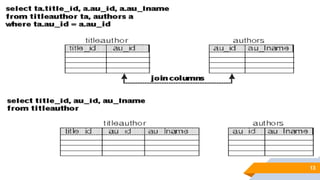
▰ Adding redundant columns eliminates joins for
many queries. The problems with this solution
are that it:
• Requires maintenance of new column. All
changes must be made to two tables, and
possibly to many rows in one of the tables.
• Requires more disk space, since au_lname is
duplicated.
12
13
Combining Tables
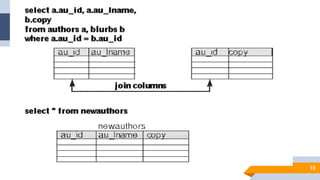
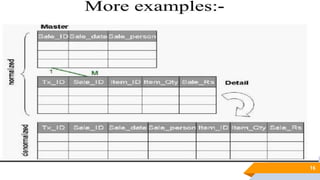
▰ • If most users need to see the full set of joined data
from two tables, collapsing the two tables into one
can improve performance by eliminating the join.
▰
• For example, users frequently need to see the author name, author
ID, and the blurbs copy data at the same time. The solution is to
collapse the two tables into one. The data from the two tables
must be in a one-to-one relationship to collapse tables.
14
15
16
Adding Derived Columns.
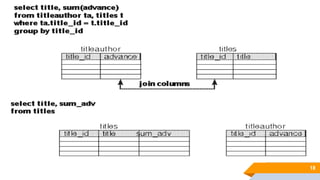
▰ • Adding derived columns can help eliminate
joins and reduce the time needed to produce
aggregate values.
• The example shows both benefits. Frequent
joins are needed between the titleauthor and
titles tables to provide the total advance for a
particular book title.
17
18
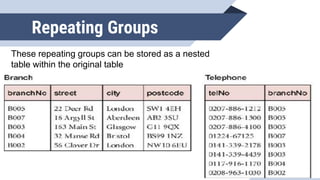
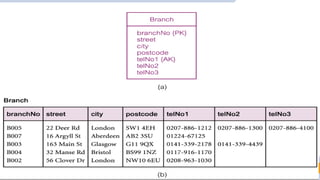
Repeating Groups
19
These repeating groups can be stored as a nested
table within the original table
20
Advantages vs
Disadvantages
21
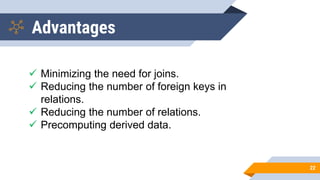
Advantages
22
✓ Minimizing the need for joins.
✓ Reducing the number of foreign keys in
relations.
✓ Reducing the number of relations.
✓ Precomputing derived data.
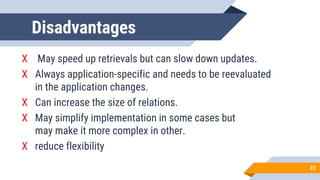
Disadvantages
X May speed up retrievals but can slow down updates.
X Always application-specific and needs to be reevaluated
in the application changes.
X Can increase the size of relations.
X May simplify implementation in some cases but
may make it more complex in other.
X reduce flexibility
23
Summary
24
Summary
o DE normalization aids the process of adding redundancy to the database to
improve performance .
o DE normalize can be done with tables or columns.
o Require acknowledges of how data is being used .
o There are costs of DE normalization reduces the “integrity” of the design ,always
slow DML (data manipulation language) , need more memory space to store
redundant data and required additional
programming to maintain the DE normalized data
25
26
THANKS!
Any questions?

De normalozation

  • 1.
  • 2.
    HELLO! I am KhuramShahzad I am here because I love to give presentations. You can find me at twitter.com/@_kkhuramshahzad 2
  • 3.
    Objectives:- 3 ▰ Introduction ▰ Definition ▰Why and when to de normalize data ▰ Method of de normalization ▰ Advantages and disadvantages of DE normalization ▰ Summary
  • 4.
  • 5.
    Introduction ❑ Result ofnormalization is Designed: structurally consistent with Minimal redundancy. ❑ However Sometimes: normalized database does not provide maximum processing efficiency. ❑ At this point we move toward: 👉De Normalization 55
  • 6.
  • 7.
    Definition:- ▰ De normalizationis a process of combine two relation into one new relation. ▰ DE normalization is the process of taking a normalized database and modifying table structures to allow controlled redundancy for increased database performance . ▰ It sometimes claimed to make the database easier to understand. 7
  • 8.
    When and Whyto De Normaize 8 1. Is the system’s performance unacceptable with fully normalized data? 2. If the performance is unacceptable, will de normalizing make it acceptable? 3. If you de normalize to clear those bottlenecks, will the system and its data still be reliable? Why
  • 9.
    When… ▰ Speed upretrievals. ▰ A strict performance is required. ▰ It is not heavily updated. - So, De normalize only when there is a very clear advantage to doing 9
  • 10.
  • 11.
    Method of DeNormalization:- ❑ Adding Redundant (unnecessary) Columns. ❑ Adding Derived Columns. ❑ Combining Tables. ❑ Repeating Groups. ❑ Creating extract tables. ❑ Partitioning Relations. 11
  • 12.
    Adding Redundant Columns. ▰Adding redundant columns eliminates joins for many queries. The problems with this solution are that it: • Requires maintenance of new column. All changes must be made to two tables, and possibly to many rows in one of the tables. • Requires more disk space, since au_lname is duplicated. 12
  • 13.
  • 14.
    Combining Tables ▰ •If most users need to see the full set of joined data from two tables, collapsing the two tables into one can improve performance by eliminating the join. ▰ • For example, users frequently need to see the author name, author ID, and the blurbs copy data at the same time. The solution is to collapse the two tables into one. The data from the two tables must be in a one-to-one relationship to collapse tables. 14
  • 15.
  • 16.
  • 17.
    Adding Derived Columns. ▰• Adding derived columns can help eliminate joins and reduce the time needed to produce aggregate values. • The example shows both benefits. Frequent joins are needed between the titleauthor and titles tables to provide the total advance for a particular book title. 17
  • 18.
  • 19.
    Repeating Groups 19 These repeatinggroups can be stored as a nested table within the original table
  • 20.
  • 21.
  • 22.
    Advantages 22 ✓ Minimizing theneed for joins. ✓ Reducing the number of foreign keys in relations. ✓ Reducing the number of relations. ✓ Precomputing derived data.
  • 23.
    Disadvantages X May speedup retrievals but can slow down updates. X Always application-specific and needs to be reevaluated in the application changes. X Can increase the size of relations. X May simplify implementation in some cases but may make it more complex in other. X reduce flexibility 23
  • 24.
  • 25.
    Summary o DE normalizationaids the process of adding redundancy to the database to improve performance . o DE normalize can be done with tables or columns. o Require acknowledges of how data is being used . o There are costs of DE normalization reduces the “integrity” of the design ,always slow DML (data manipulation language) , need more memory space to store redundant data and required additional programming to maintain the DE normalized data 25
  • 26.