Distributed Data base System
by M. Tamer Özsu • Patrick Valduriez

Chp-1

1.6-

Third Edition

Design Issues

Slides by: M. Esar ul Haq Qasmi
std@ UIIT-Pak

Note: All Details are available in defined Book. Here in slides just Summary is written for an overlook and preparations.
Design Issues
• presenting the design issues that arise in building a
distributed DBMS.
I. Distributed Database Design
II. Distributed Directory Management
III. Distributed Query Processing
IV. Distributed Concurrency Control
V. Distributed Deadlock Management
VI. Reliability of Distributed DBMS
Design Issues
I. Distributed Database Design
-How the database and the applications that run against it should be placed across the
sites?
-There are two basic alternatives to placing data: partitioned (or non-replicated) and
replicated.
-Replicated designs can be either fully replicated or partially replicated
-The two fundamental design issues are fragmentation, the separation of the database
into partitions called fragments, and distribution, the optimum distribution of
fragments.
Design Issues
II-Distributed Directory Management
A directory contains information (such as
descriptions and locations) about data items in
the database. Problems related to directory
management are similar in nature to the
database
Design Issues
III-Distributed Query Processing
Query processing deals with designing
algorithms that analyze queries and convert
them into a series of data manipulation
operations.
Design Issues
IV-Distributed Concurrency Control
Concurrency control involves the
synchronization of accesses to the distributed
data-base, such that the integrity of the
database is maintained.
Design Issues
V-Distributed Deadlock Management
• The deadlock problem in DDBSs is similar in nature
to that encountered in operating systems.
• The competition among users for access to a set of
resources (data, in this case) can result in a deadlock
if the synchronization mechanism is based on
locking. The well-known alternatives of prevention,
avoidance, and detection/recovery also apply to
DDBSs.
Design Issues
VI-Reliability of Distributed DBMS
• to ensure the consistency of the database as
well as to detect failures and recover from them.
• The implication for DDBSs is that when a failure
occurs and various sites become either
inoperable or inaccessible, the databases at the
operational sites remain consistent and up to
date.
Design Issues
VII- Replication
• If the distributed database is (partially
or fully) replicated, it is necessary to
implement protocols that ensure the
consistency of the replicas, i.e., copies
of the same data item have the same
value.
Design Issues
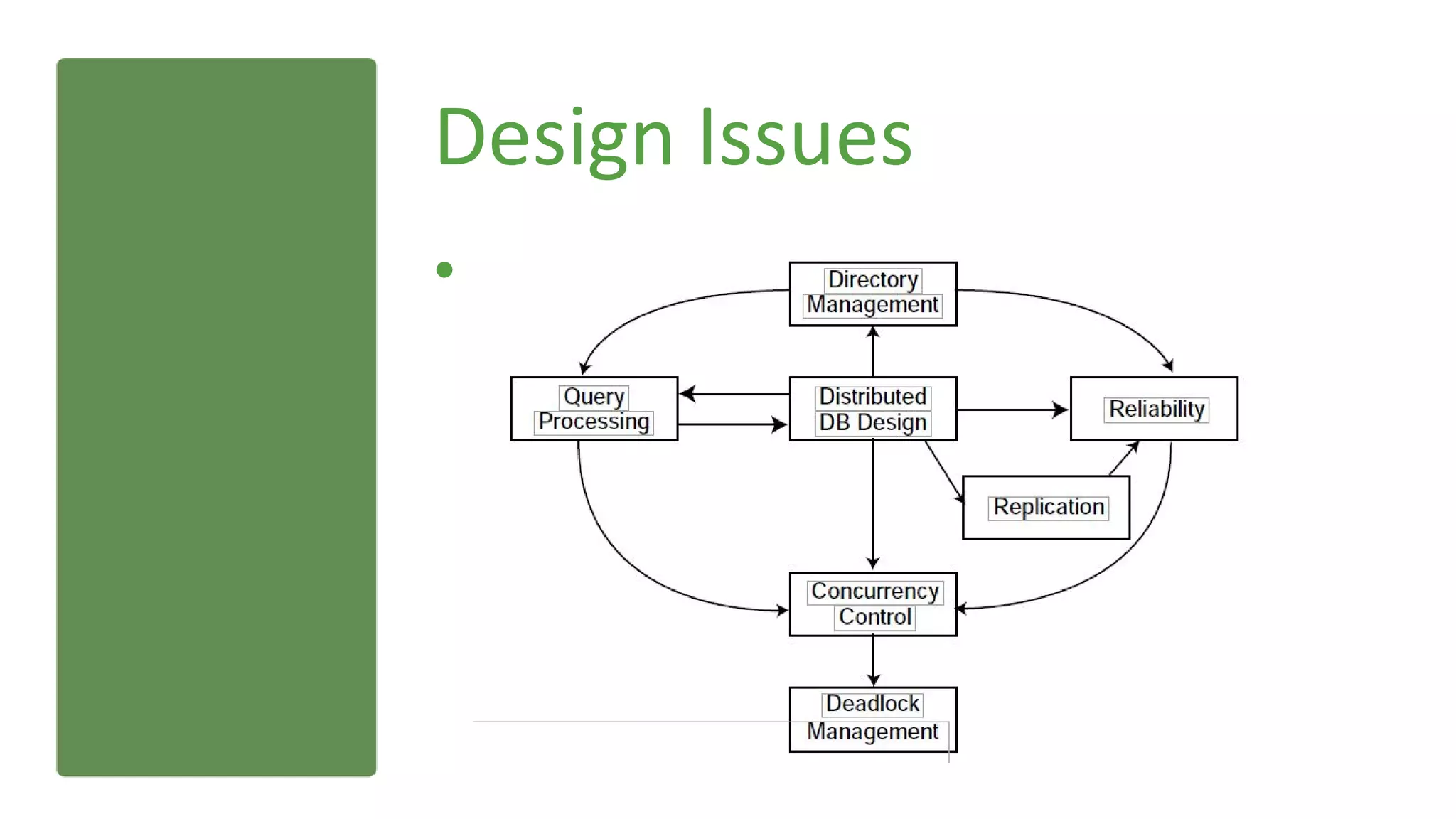
VIII-Relationship among Problems
• The relationship among the components
• The design of distributed databases affects
many areas….
• directory management, fragment structure
and placement, processing of queries,
replication of fragments, transaction
management, Reliability, replication etc
Design Issues
• IX-Additional Issues
• federated databases and data integration systems
The growth of the Internet as a fundamental networking
platform has raised important questions about the
assumptions underlying distributed database systems.
Two issues are of particular concern to us.
• One is the re-emergence of peer-to-peer
• computing, and the other is the development and growth
of the World Wide Web (web for short)
Design Issues
•
Design Issues
Design issues Topic Finished

Note: All Details are available in defined Book. Here in slides just Summary is written for an overlook and preparations.

Ddb 1.6-design issues

  • 1.
    Distributed Data baseSystem by M. Tamer Özsu • Patrick Valduriez Chp-1 1.6- Third Edition Design Issues Slides by: M. Esar ul Haq Qasmi std@ UIIT-Pak Note: All Details are available in defined Book. Here in slides just Summary is written for an overlook and preparations.
  • 2.
    Design Issues • presentingthe design issues that arise in building a distributed DBMS. I. Distributed Database Design II. Distributed Directory Management III. Distributed Query Processing IV. Distributed Concurrency Control V. Distributed Deadlock Management VI. Reliability of Distributed DBMS
  • 3.
    Design Issues I. DistributedDatabase Design -How the database and the applications that run against it should be placed across the sites? -There are two basic alternatives to placing data: partitioned (or non-replicated) and replicated. -Replicated designs can be either fully replicated or partially replicated -The two fundamental design issues are fragmentation, the separation of the database into partitions called fragments, and distribution, the optimum distribution of fragments.
  • 4.
    Design Issues II-Distributed DirectoryManagement A directory contains information (such as descriptions and locations) about data items in the database. Problems related to directory management are similar in nature to the database
  • 5.
    Design Issues III-Distributed QueryProcessing Query processing deals with designing algorithms that analyze queries and convert them into a series of data manipulation operations.
  • 6.
    Design Issues IV-Distributed ConcurrencyControl Concurrency control involves the synchronization of accesses to the distributed data-base, such that the integrity of the database is maintained.
  • 7.
    Design Issues V-Distributed DeadlockManagement • The deadlock problem in DDBSs is similar in nature to that encountered in operating systems. • The competition among users for access to a set of resources (data, in this case) can result in a deadlock if the synchronization mechanism is based on locking. The well-known alternatives of prevention, avoidance, and detection/recovery also apply to DDBSs.
  • 8.
    Design Issues VI-Reliability ofDistributed DBMS • to ensure the consistency of the database as well as to detect failures and recover from them. • The implication for DDBSs is that when a failure occurs and various sites become either inoperable or inaccessible, the databases at the operational sites remain consistent and up to date.
  • 9.
    Design Issues VII- Replication •If the distributed database is (partially or fully) replicated, it is necessary to implement protocols that ensure the consistency of the replicas, i.e., copies of the same data item have the same value.
  • 10.
    Design Issues VIII-Relationship amongProblems • The relationship among the components • The design of distributed databases affects many areas…. • directory management, fragment structure and placement, processing of queries, replication of fragments, transaction management, Reliability, replication etc
  • 11.
    Design Issues • IX-AdditionalIssues • federated databases and data integration systems The growth of the Internet as a fundamental networking platform has raised important questions about the assumptions underlying distributed database systems. Two issues are of particular concern to us. • One is the re-emergence of peer-to-peer • computing, and the other is the development and growth of the World Wide Web (web for short)
  • 12.
  • 13.
    Design Issues Design issuesTopic Finished Note: All Details are available in defined Book. Here in slides just Summary is written for an overlook and preparations.