Digital Communication (KEC-601)
Unit-4
Digital Receiver
Dr. Aruna Tyagi
Asst. Prof., ECE
AKGEC Ghaziabad
Syllabus
Unit-IV
Digital Receiver
❑Optimum threshold detection,
❑Concept of Matched Filters,
❑BER analysis of BASK, BFSK, BPSK,
❑Introduction of Spread spectrum communication
(DS-SS, FH-SS). DR. ARUNA TYAGI
ECE
UNIT-3
DIGITAL
MODULATION
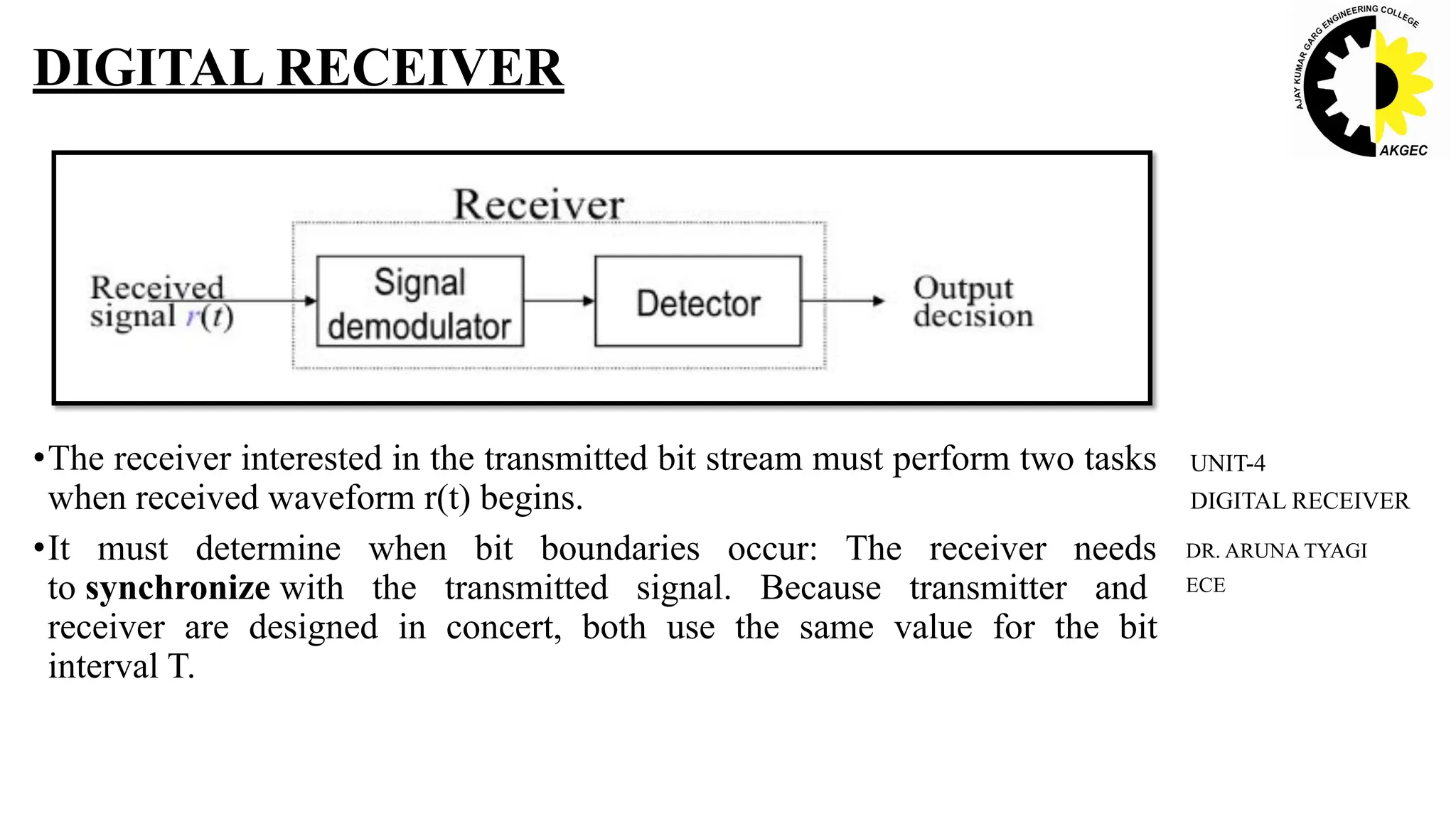
•The receiver interested in the transmitted bit stream must perform two tasks
when received waveform r(t) begins.
•It must determine when bit boundaries occur: The receiver needs
to synchronize with the transmitted signal. Because transmitter and
receiver are designed in concert, both use the same value for the bit
interval T.
DIGITAL RECEIVER
DR. ARUNA TYAGI
ECE
UNIT-4
DIGITAL RECEIVER
•Synchronization can occur because the transmitter begins sending with a
reference bit sequence, known as the preamble. The receiver knows what
the preamble bit sequence is and uses it to determine when bit boundaries
occur. This procedure amounts to what in digital hardware as self-clocking
signaling.
•The receiver of a bit stream must derive the clock — when bit boundaries
occur — from its input signal. Because the receiver usually does not
determine which bit was sent until synchronization occurs, it does not know
when during the preamble it obtained synchronization.
•The transmitter signals the end of the preamble by switching to a second bit
sequence. The second preamble phase informs the receiver that data bits are
about to come and that the preamble is almost over.
•Once synchronized and data bits are transmitted, the receiver must then
determine every T seconds what bit was transmitted during the previous bit
interval.
•The receiver for digital communication is known as a matched filter.
DR. ARUNA TYAGI
ECE
UNIT-4
DIGITAL RECEIVER
•An optimum filter is such a filter used for acquiring a best estimate of
desired signal from noisy measurement. It is different from the
classic filters like lowpass, highpass and bandpass filters.
•Optimum signal detection is Performance of digital
communication systems in the presence of additive noise as measured by
the probability of error.
•Requirement of Detection Techniques:
• Must have minimum probability of error
• Detector should check the received signal at instant in each bit interval
when the signal has max. possible amplitude.
• Maximizes S/N ratio.
OPTIMUM RECEIVER/ OPTIMUM THRESHOLD
DETECTION
DR. ARUNA TYAGI
ECE
UNIT-4
DIGITAL RECEIVER
•Detection Techniques
• Integrate and Dump Receiver
• Optimum Filter
• Matched Filter
• Correlator or Coherent Receiver
Optimum Threshold Detection…
DR. ARUNA TYAGI
ECE
UNIT-4
DIGITAL RECEIVER
•A very important problem in signal processing is the determining how two
signals compare with each other.
•To give an example, you can program most cell phones to obey voice
commands: how does it do? The cellphone compares the signal from the
microphone to a dictionary of possible phonemes and decide which one is
the “closest” one.
•Another example we will be addressing is the detection of a radar or sonar
return. In this case a pulse is transmitted and, if there is a target, it bounces
back. Since there is distortion and noise, what we receive is not identical to
what we transmit and we need sort of define a measure of similarity, so we
can decide whether the received signal is the pulse we expect.
INTRODUCTION TO MATCHED FILTER
DR. ARUNA TYAGI
ECE
UNIT-4
DIGITAL RECEIVER
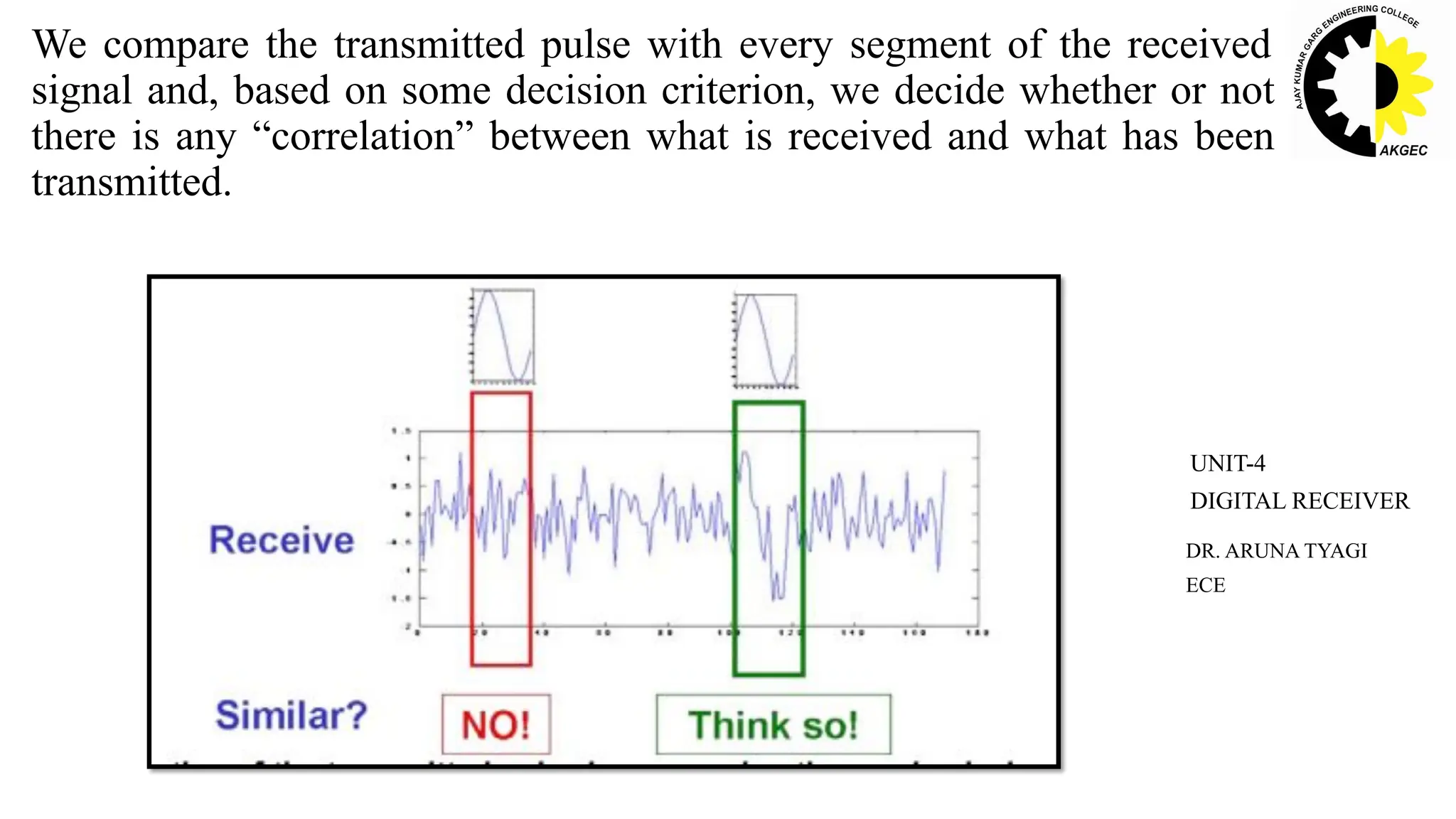
As it is well known, we determine the distance of a target by
transmitting a pulse (say x[n]) and detecting the return. The time interval
between transmission and reception gives the information on the
distance of the target. The figure below illustrates the problem
DR. ARUNA TYAGI
ECE
UNIT-4
DIGITAL RECEIVER
We compare the transmitted pulse with every segment of the received
signal and, based on some decision criterion, we decide whether or not
there is any “correlation” between what is received and what has been
transmitted.
DR. ARUNA TYAGI
ECE
UNIT-4
DIGITAL RECEIVER
••The matched filter is the optimal linear filter for maximizing the signal to
noise ratio (SNR) in the presence of additive stochastic noise.
•Matched filters are commonly used in radar, in which a signal is sent out,
and we measure the reflected signals, looking for something similar to what
was sent out.
••Two-dimensional matched filters are commonly used in image processing,
e.g., to improve SNR for X-ray pictures
MATCHED FILTERS
DR. ARUNA TYAGI
ECE
UNIT-4
DIGITAL RECEIVER
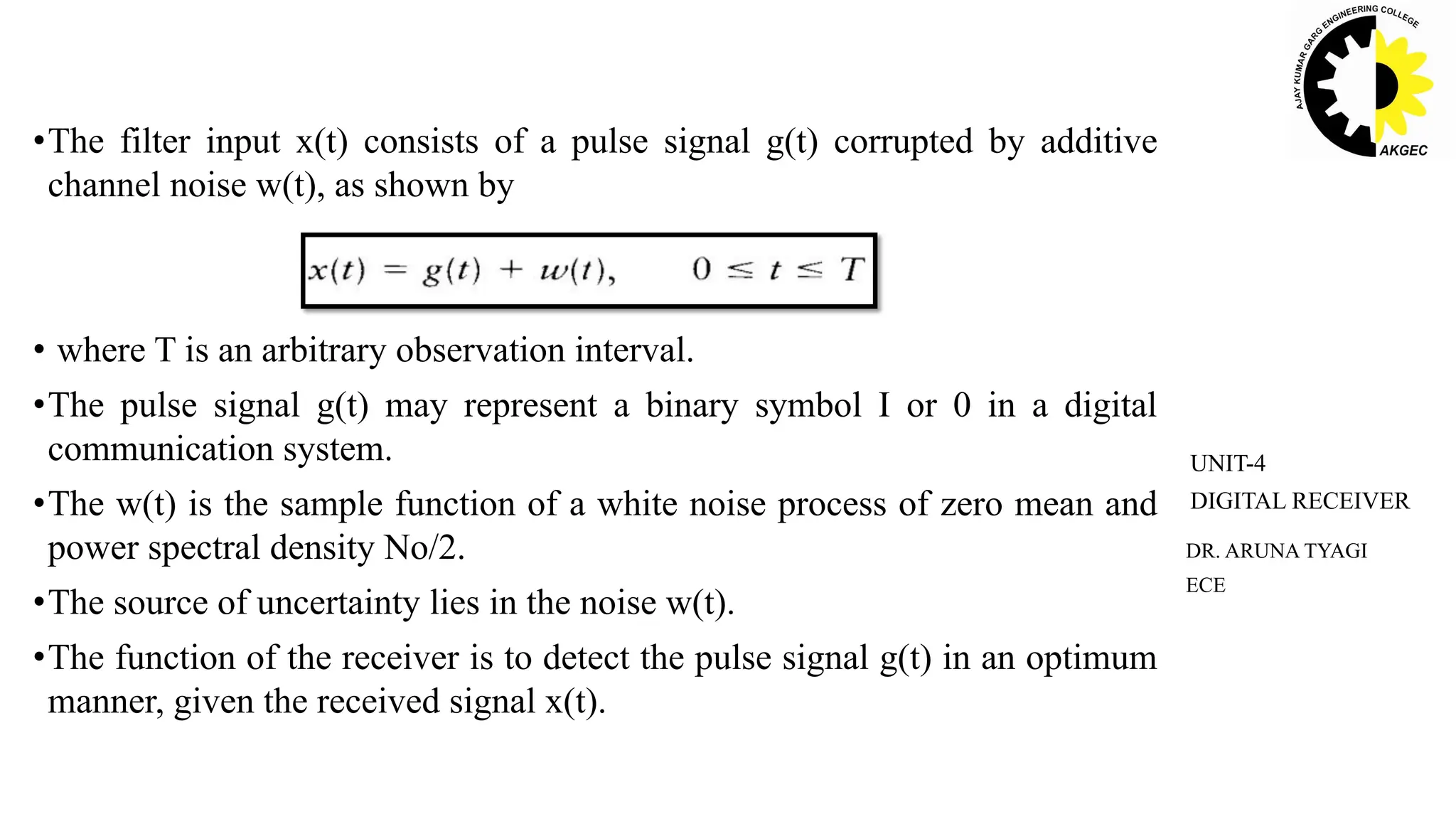
BLOCK DIAGRAM
DR. ARUNA TYAGI
ECE
UNIT-4
DIGITAL RECEIVER
•The filter input x(t) consists of a pulse signal g(t) corrupted by additive
channel noise w(t), as shown by
• where T is an arbitrary observation interval.
•The pulse signal g(t) may represent a binary symbol I or 0 in a digital
communication system.
•The w(t) is the sample function of a white noise process of zero mean and
power spectral density No/2.
•The source of uncertainty lies in the noise w(t).
•The function of the receiver is to detect the pulse signal g(t) in an optimum
manner, given the received signal x(t).
DR. ARUNA TYAGI
ECE
UNIT-4
DIGITAL RECEIVER
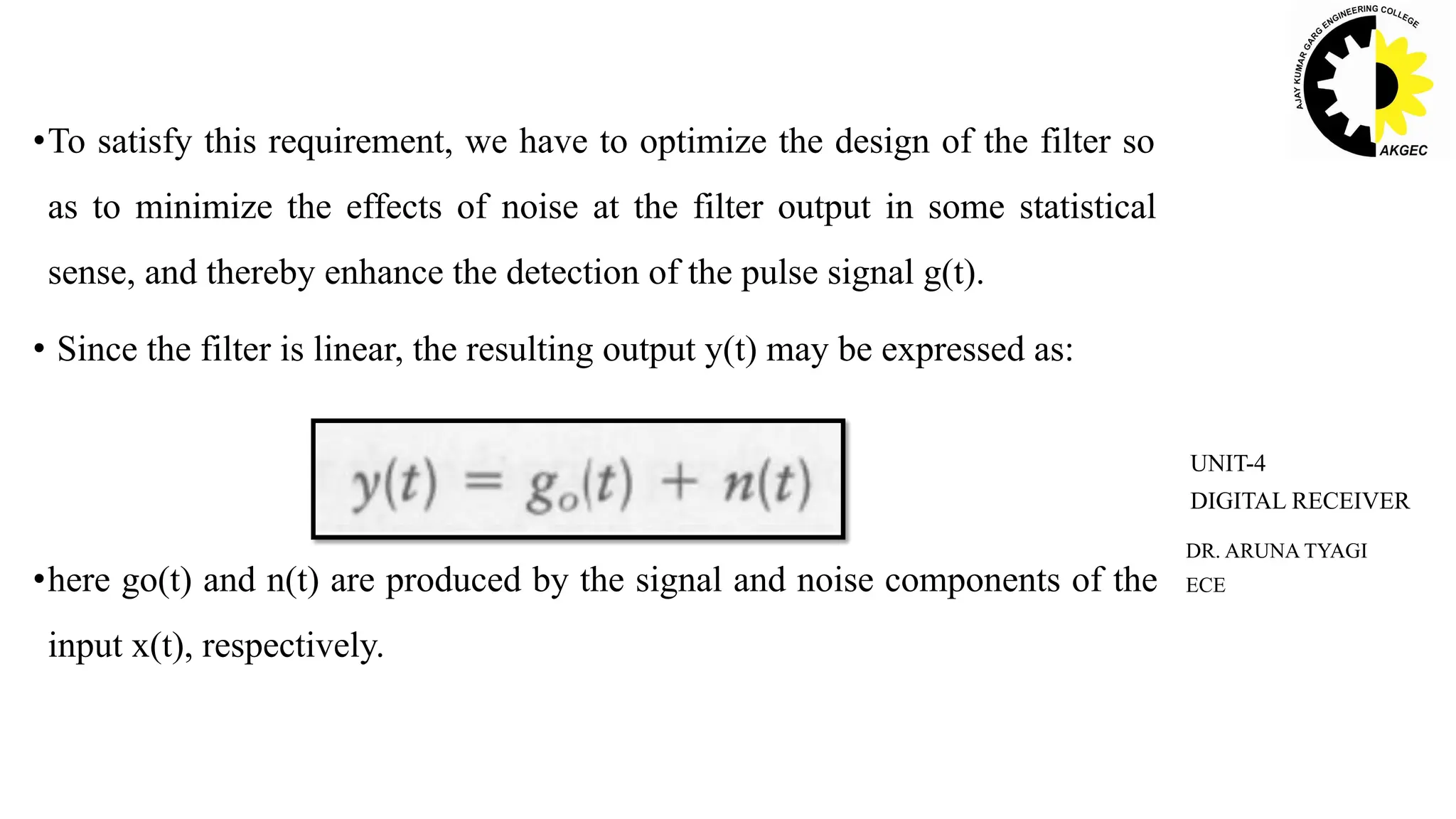
•To satisfy this requirement, we have to optimize the design of the filter so
as to minimize the effects of noise at the filter output in some statistical
sense, and thereby enhance the detection of the pulse signal g(t).
• Since the filter is linear, the resulting output y(t) may be expressed as:
•here go(t) and n(t) are produced by the signal and noise components of the
input x(t), respectively.
DR. ARUNA TYAGI
ECE
UNIT-4
DIGITAL RECEIVER
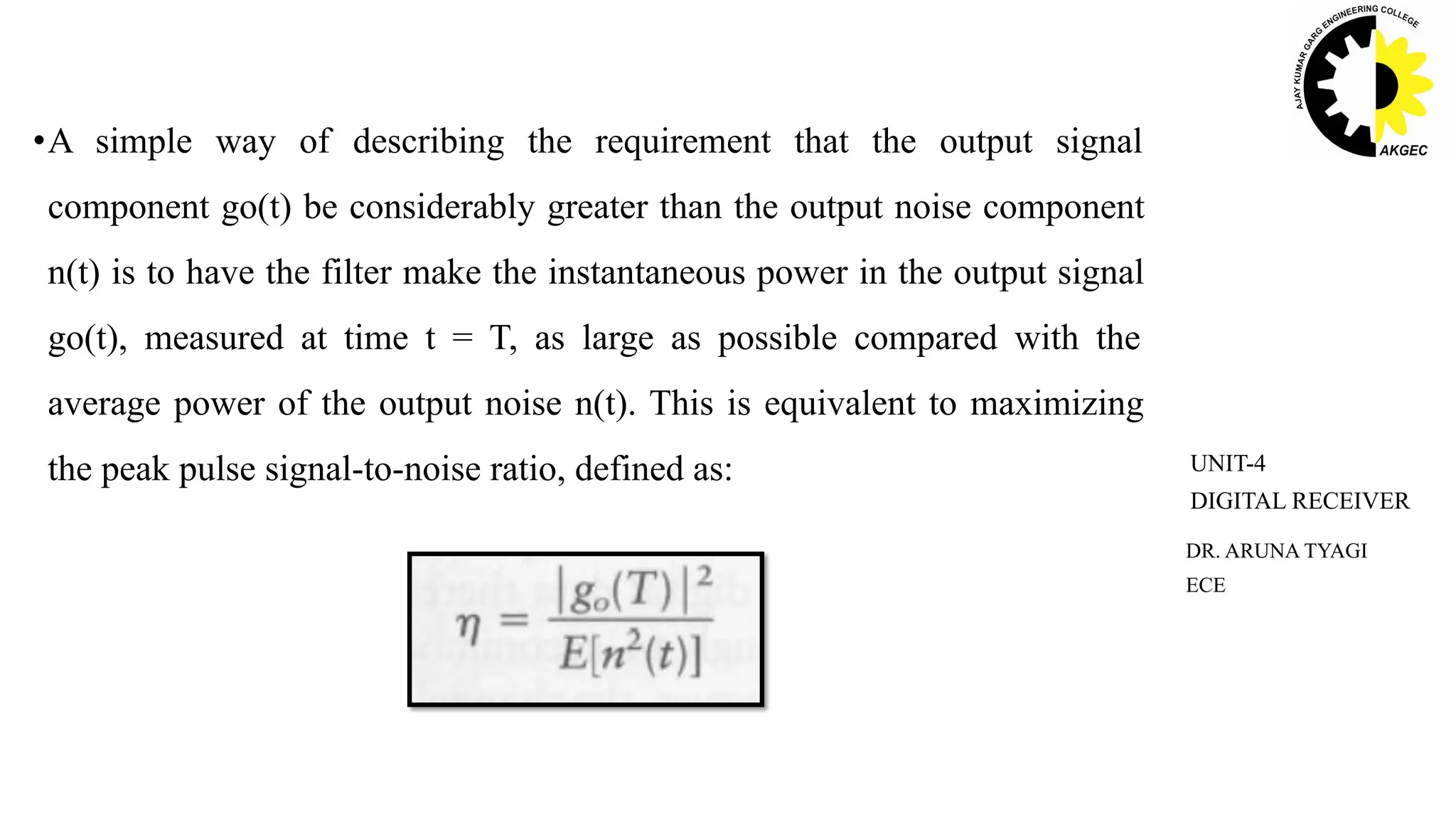
•A simple way of describing the requirement that the output signal
component go(t) be considerably greater than the output noise component
n(t) is to have the filter make the instantaneous power in the output signal
go(t), measured at time t = T, as large as possible compared with the
average power of the output noise n(t). This is equivalent to maximizing
the peak pulse signal-to-noise ratio, defined as:
DR. ARUNA TYAGI
ECE
UNIT-4
DIGITAL RECEIVER
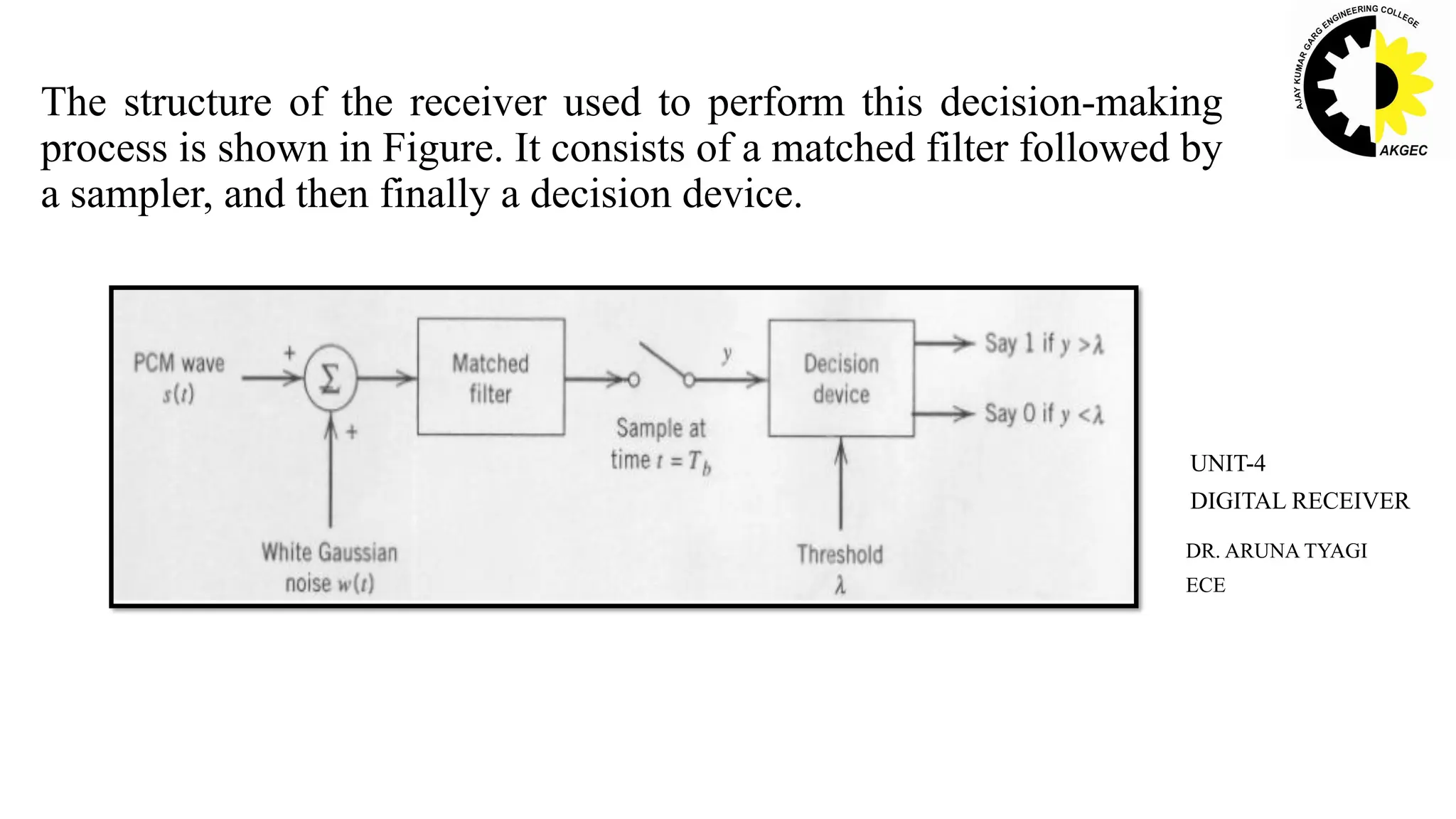
The structure of the receiver used to perform this decision-making
process is shown in Figure. It consists of a matched filter followed by
a sampler, and then finally a decision device.
DR. ARUNA TYAGI
ECE
UNIT-4
DIGITAL RECEIVER
•The filter is matched to a rectangular pulse of amplitude A and duration Tb,
exploiting the bit-timing information available to the receiver.
•The resulting matched filter output is sampled at the end of each signaling
interval.
•The presence of channel noise w(t) adds randomness to the matched filter
output.
•The sample value y is compared to a preset threshold A in the decision
device.
•If the threshold is exceeded, the receiver makes a decision in favor of
symbol 1; if not, a decision is made in favor of symbol 0.
•• There are two possible kinds of error to be considered:
•1. Symbol 1 is chosen when a 0 was actually transmitted; we refer to this
error as an error of the first kind.
• 2. Symbol 0 is chosen when a 1 was actually transmitted; we refer to this
error as an error o f the second kind
DR. ARUNA TYAGI
ECE
UNIT-4
DIGITAL RECEIVER
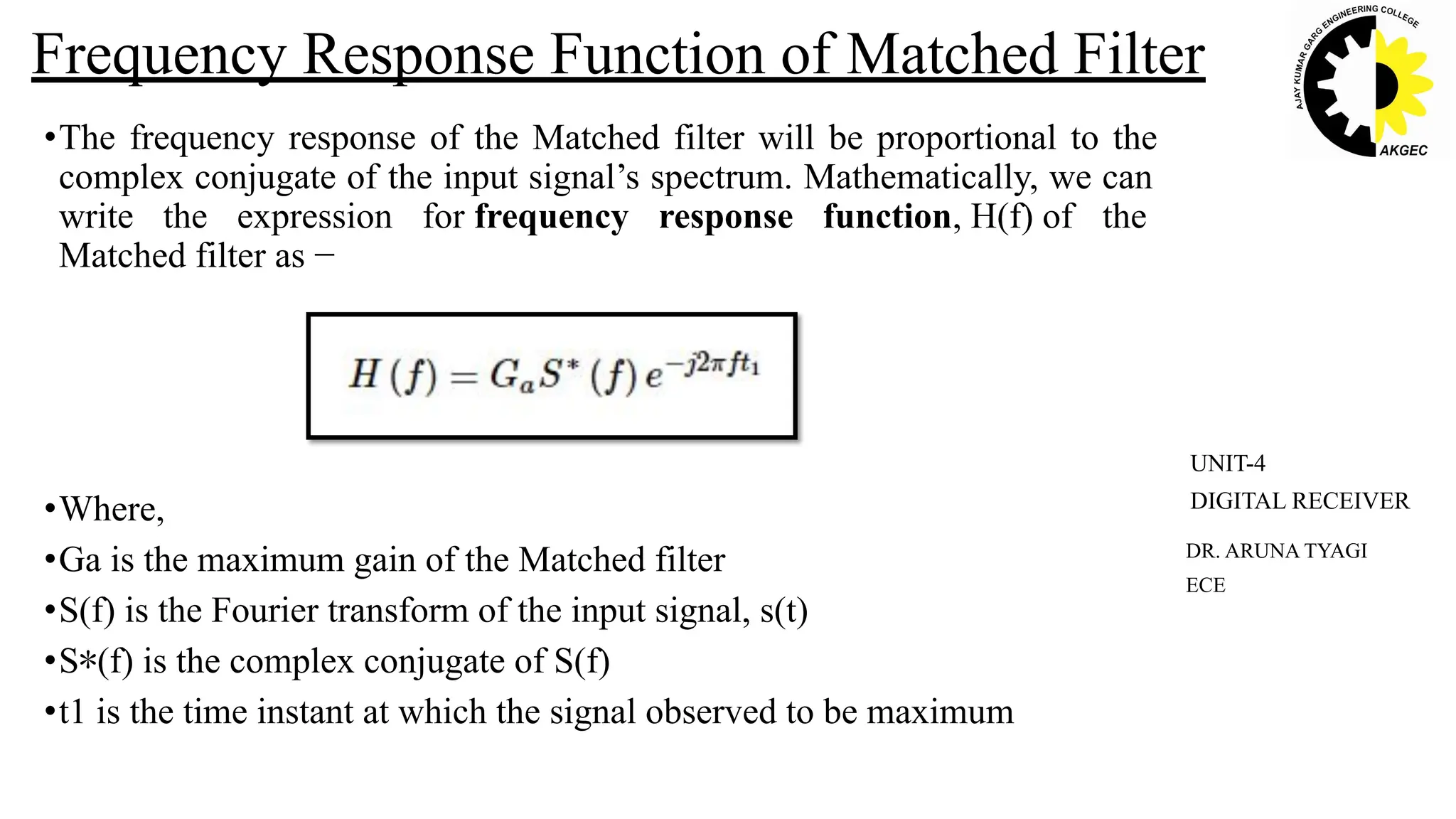
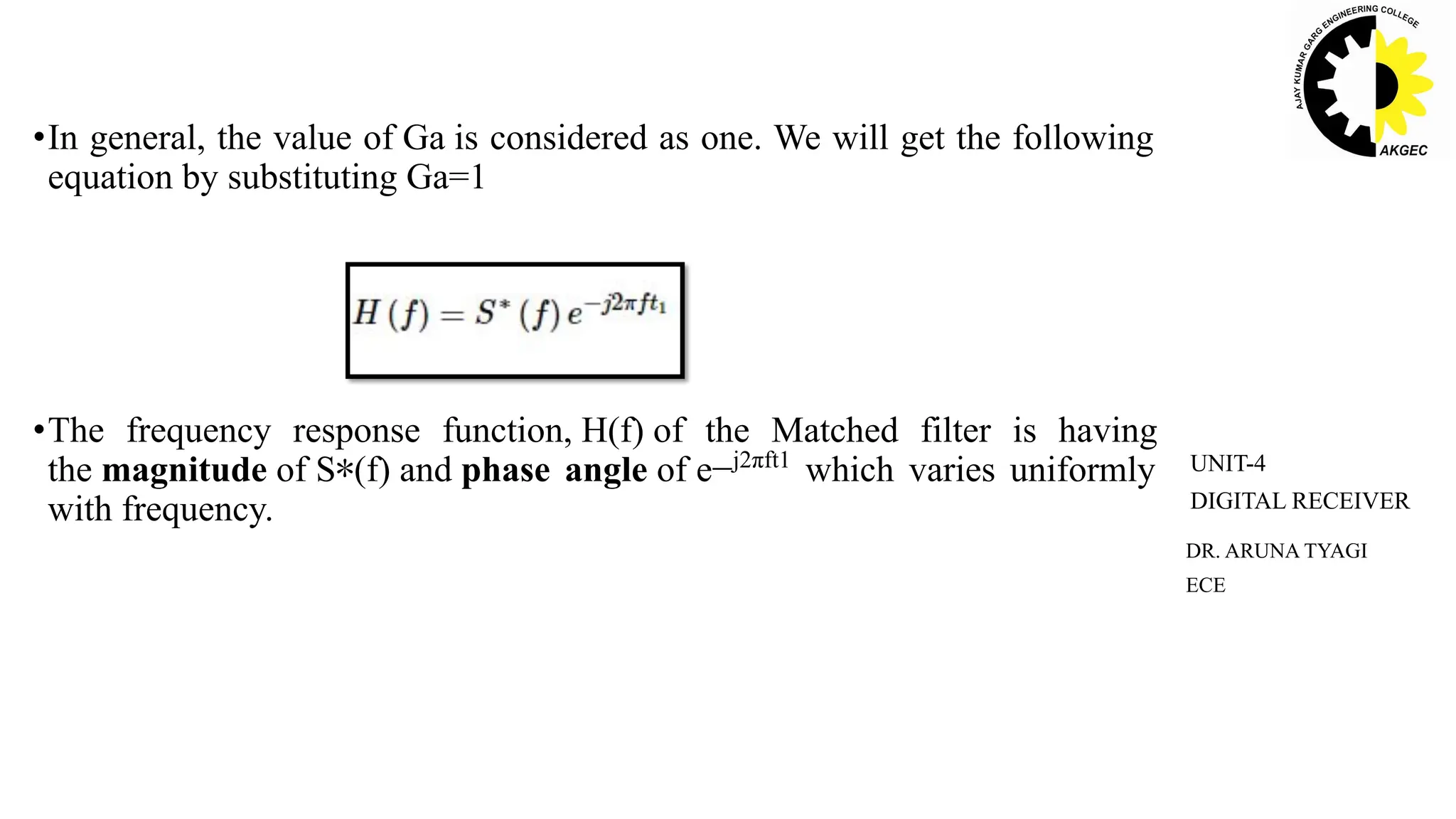
•The frequency response of the Matched filter will be proportional to the
complex conjugate of the input signal’s spectrum. Mathematically, we can
write the expression for frequency response function, H(f) of the
Matched filter as −
•Where,
•Ga is the maximum gain of the Matched filter
•S(f) is the Fourier transform of the input signal, s(t)
•S∗(f) is the complex conjugate of S(f)
•t1 is the time instant at which the signal observed to be maximum
Frequency Response Function of Matched Filter
DR. ARUNA TYAGI
ECE
UNIT-4
DIGITAL RECEIVER
•In general, the value of Ga is considered as one. We will get the following
equation by substituting Ga=1
•The frequency response function, H(f) of the Matched filter is having
the magnitude of S∗(f) and phase angle of e−j2πft1
which varies uniformly
with frequency.
DR. ARUNA TYAGI
ECE
UNIT-4
DIGITAL RECEIVER
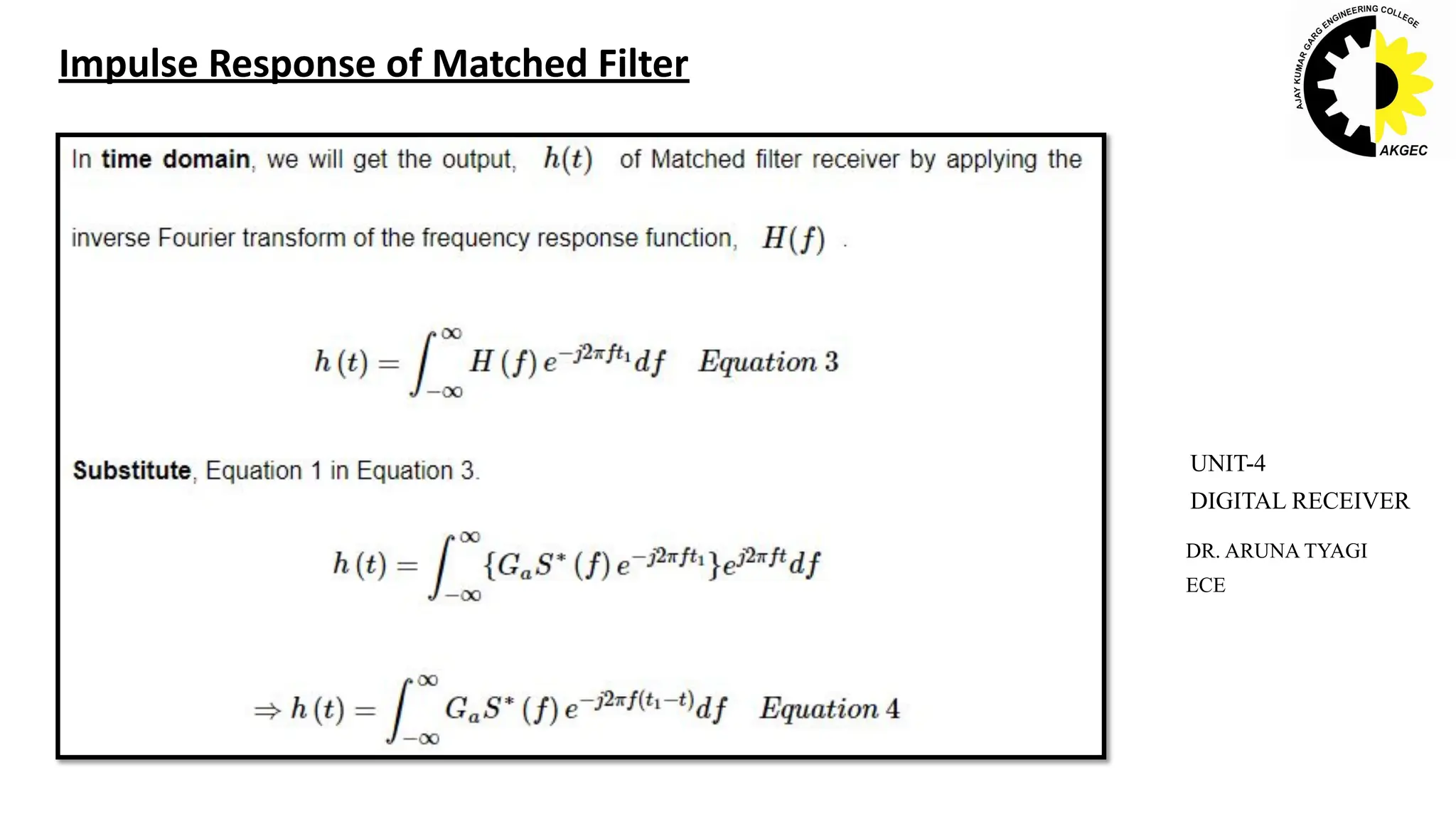
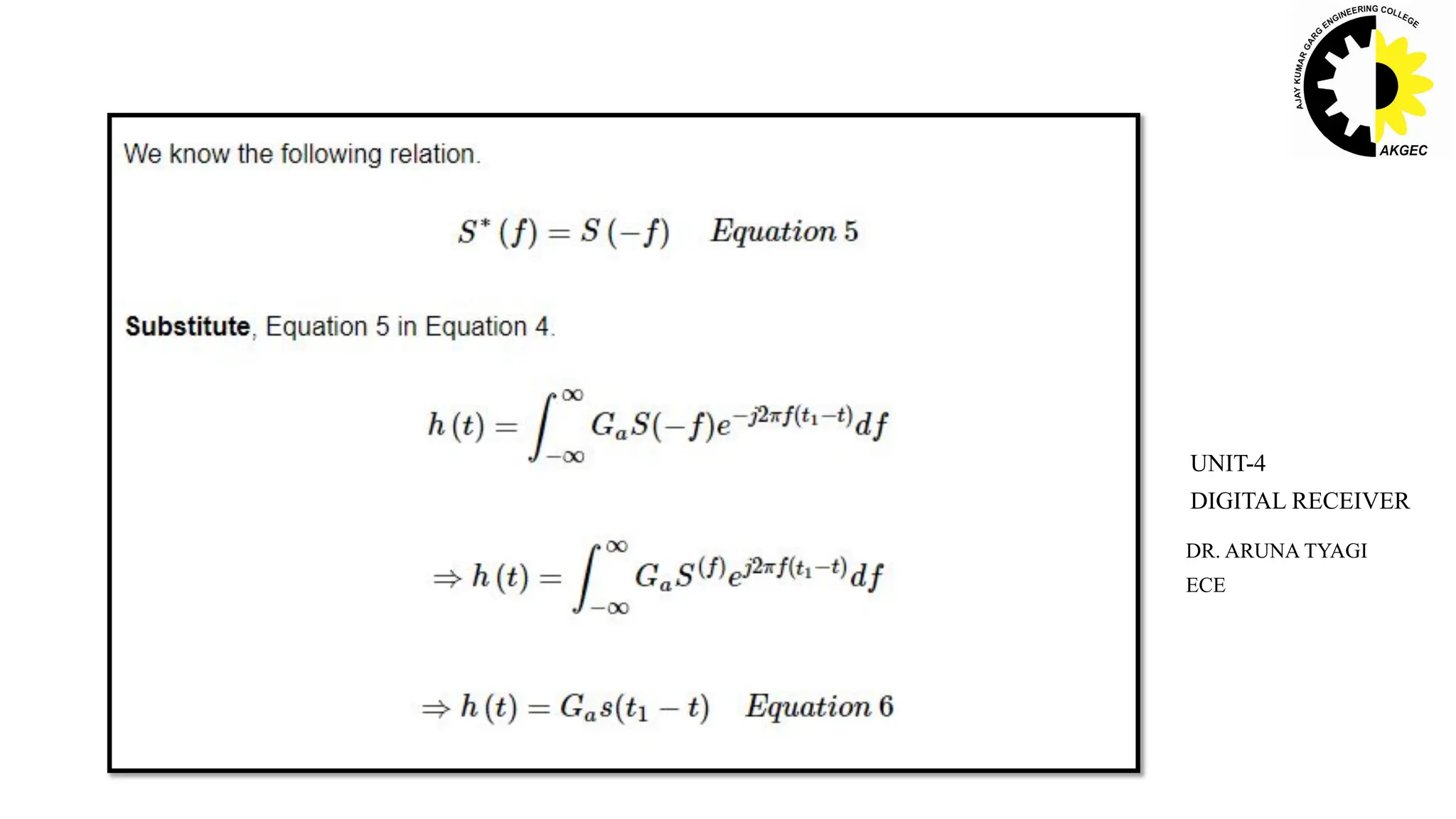
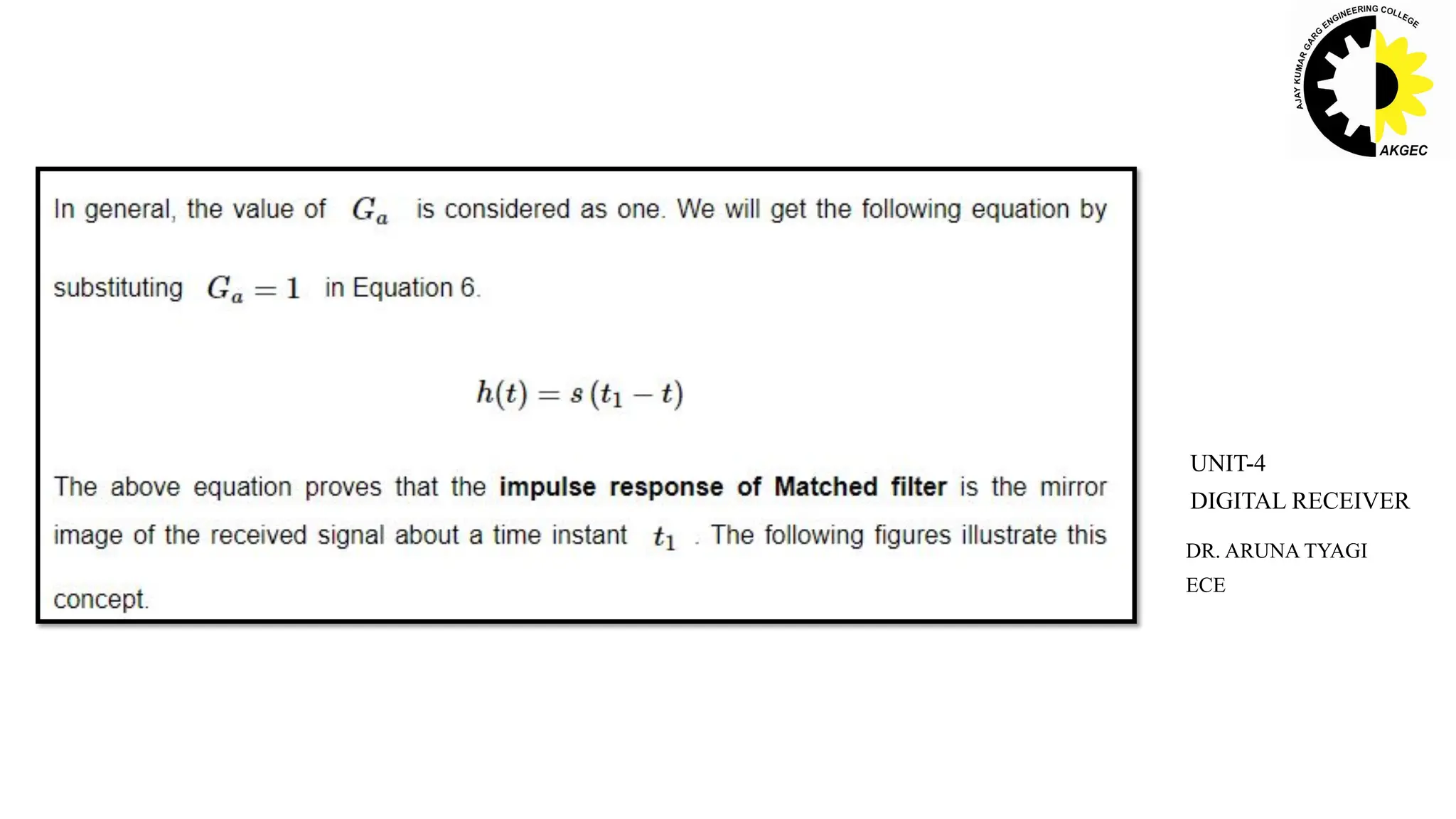
Impulse Response of Matched Filter
DR. ARUNA TYAGI
ECE
UNIT-4
DIGITAL RECEIVER
DR. ARUNA TYAGI
ECE
UNIT-4
DIGITAL RECEIVER
DR. ARUNA TYAGI
ECE
UNIT-4
DIGITAL RECEIVER
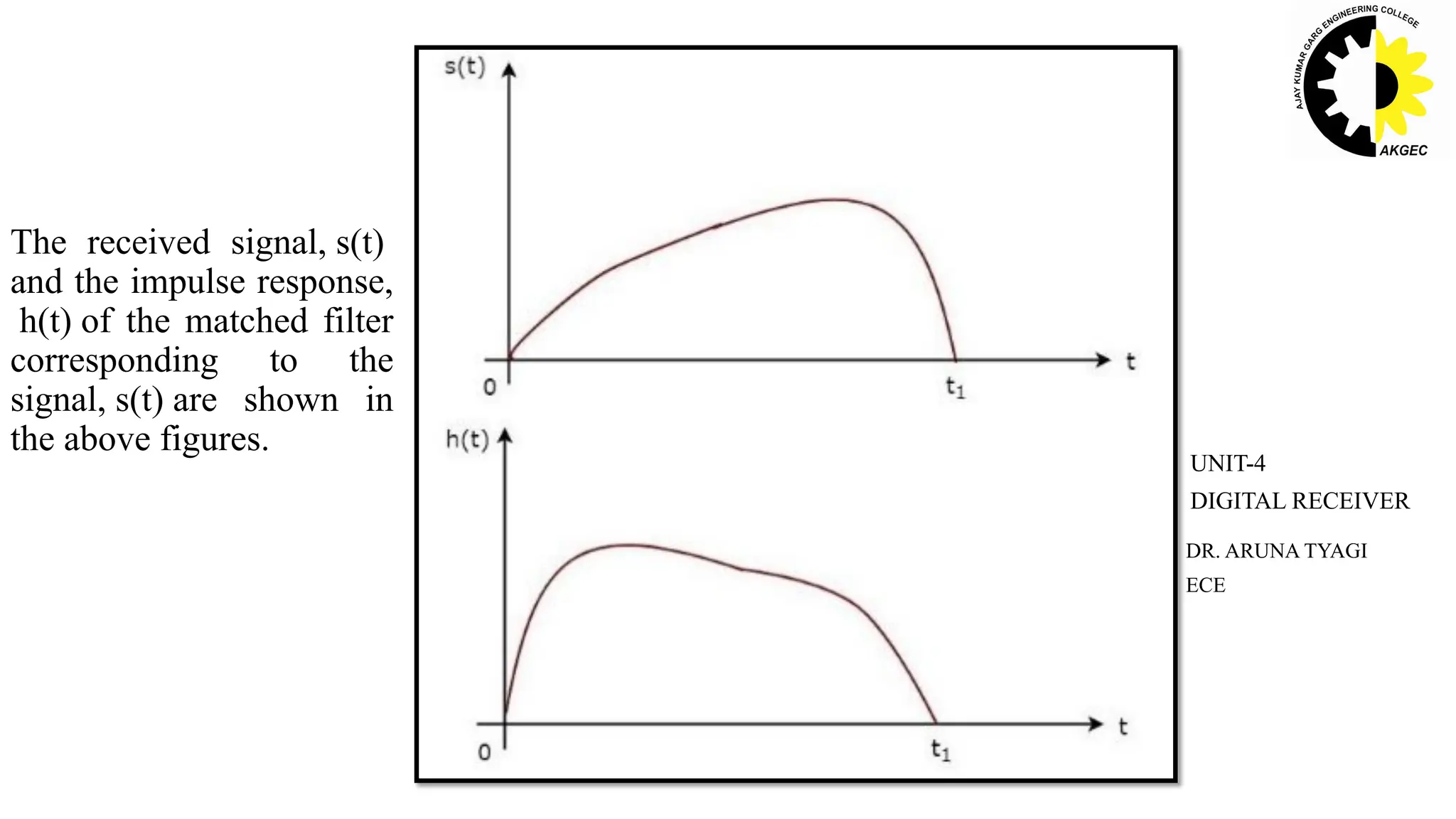
The received signal, s(t)
and the impulse response,
h(t) of the matched filter
corresponding to the
signal, s(t) are shown in
the above figures.
DR. ARUNA TYAGI
ECE
UNIT-4
DIGITAL RECEIVER
SIGNAL TO NOISE RATIO in Matched Filter
DR. ARUNA TYAGI
ECE
UNIT-4
DIGITAL RECEIVER
SIGNAL TO NOISE RATIO in Matched Filter…
DR. ARUNA TYAGI
ECE
UNIT-4
DIGITAL RECEIVER
SIGNAL TO NOISE RATIO in Matched Filter…
DR. ARUNA TYAGI
ECE
UNIT-4
DIGITAL RECEIVER
SIGNAL TO NOISE RATIO in Matched Filter…
DR. ARUNA TYAGI
ECE
UNIT-4
DIGITAL RECEIVER
DR. ARUNA TYAGI
ECE
UNIT-4
DIGITAL RECEIVER
DR. ARUNA TYAGI
ECE
UNIT-4
DIGITAL RECEIVER
DR. ARUNA TYAGI
ECE
UNIT-4
DIGITAL RECEIVER
DR. ARUNA TYAGI
ECE
UNIT-4
DIGITAL RECEIVER
DR. ARUNA TYAGI
ECE
UNIT-4
DIGITAL RECEIVER
DR. ARUNA TYAGI
ECE
UNIT-4
DIGITAL RECEIVER
DR. ARUNA TYAGI
ECE
UNIT-4
DIGITAL RECEIVER
DR. ARUNA TYAGI
ECE
UNIT-4
DIGITAL RECEIVER
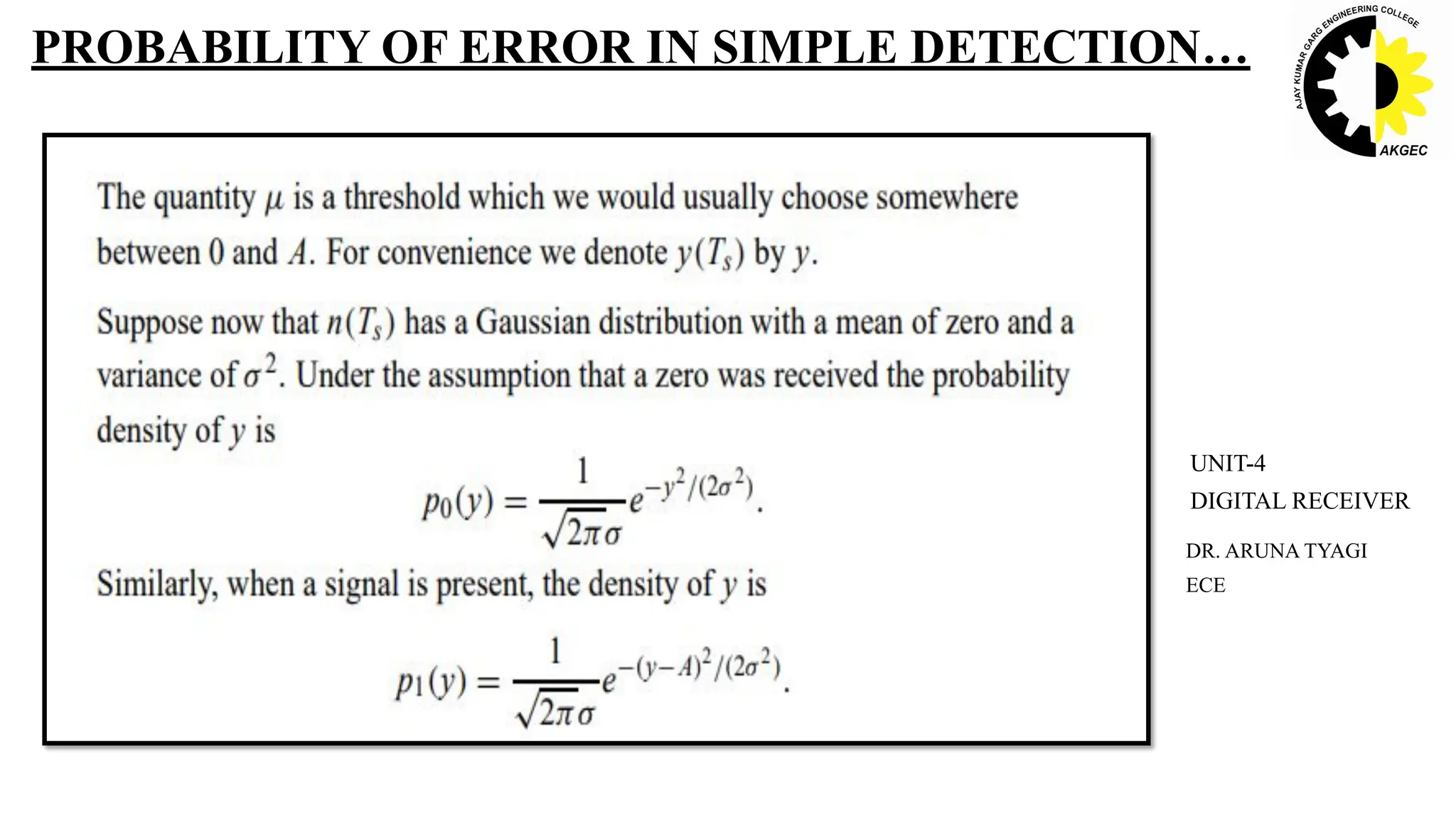
PROBABILITY OF ERROR IN SIMPLE DETECTION…
DR. ARUNA TYAGI
ECE
UNIT-4
DIGITAL RECEIVER
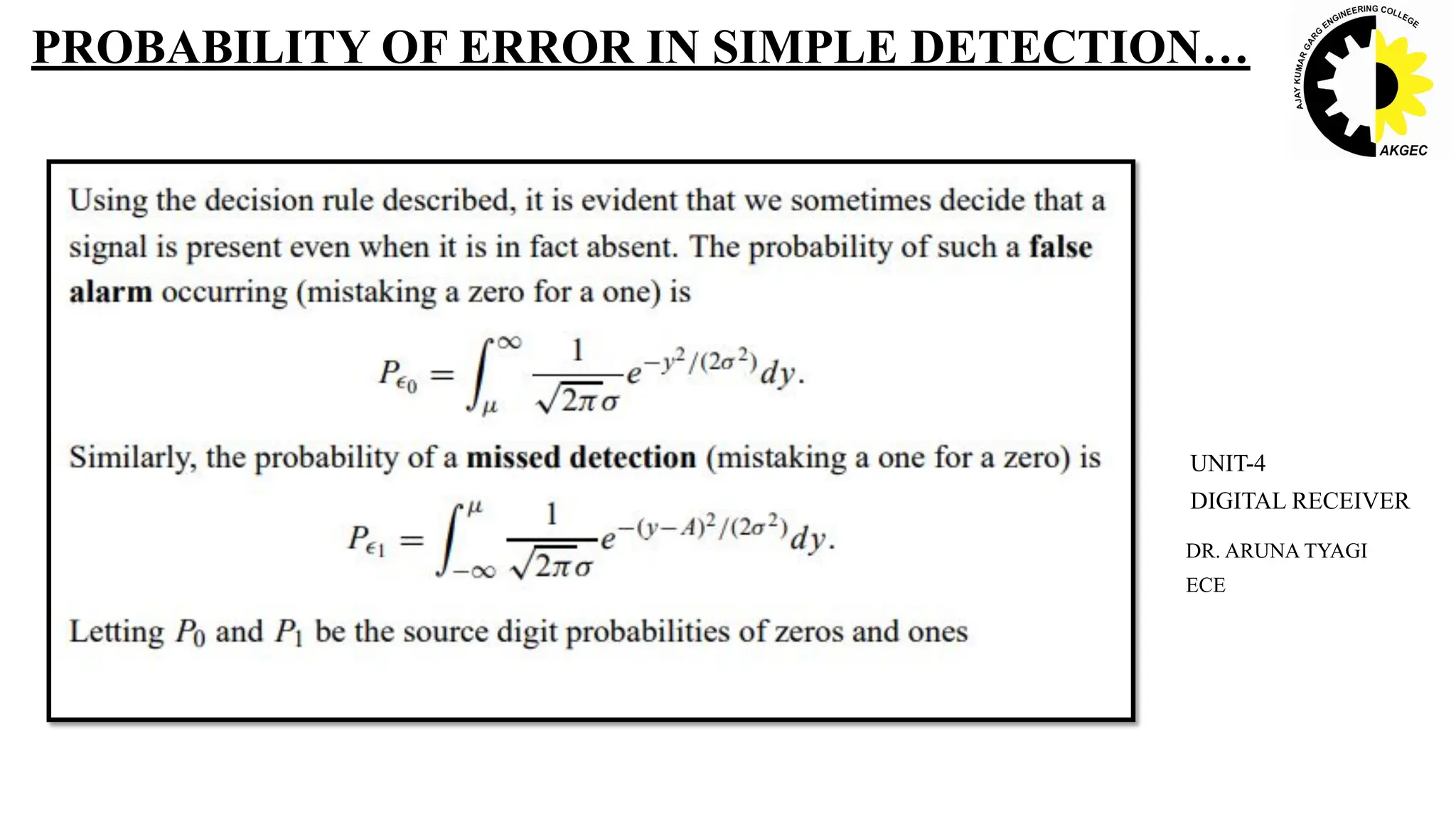
PROBABILITY OF ERROR IN SIMPLE DETECTION…
DR. ARUNA TYAGI
ECE
UNIT-4
DIGITAL RECEIVER
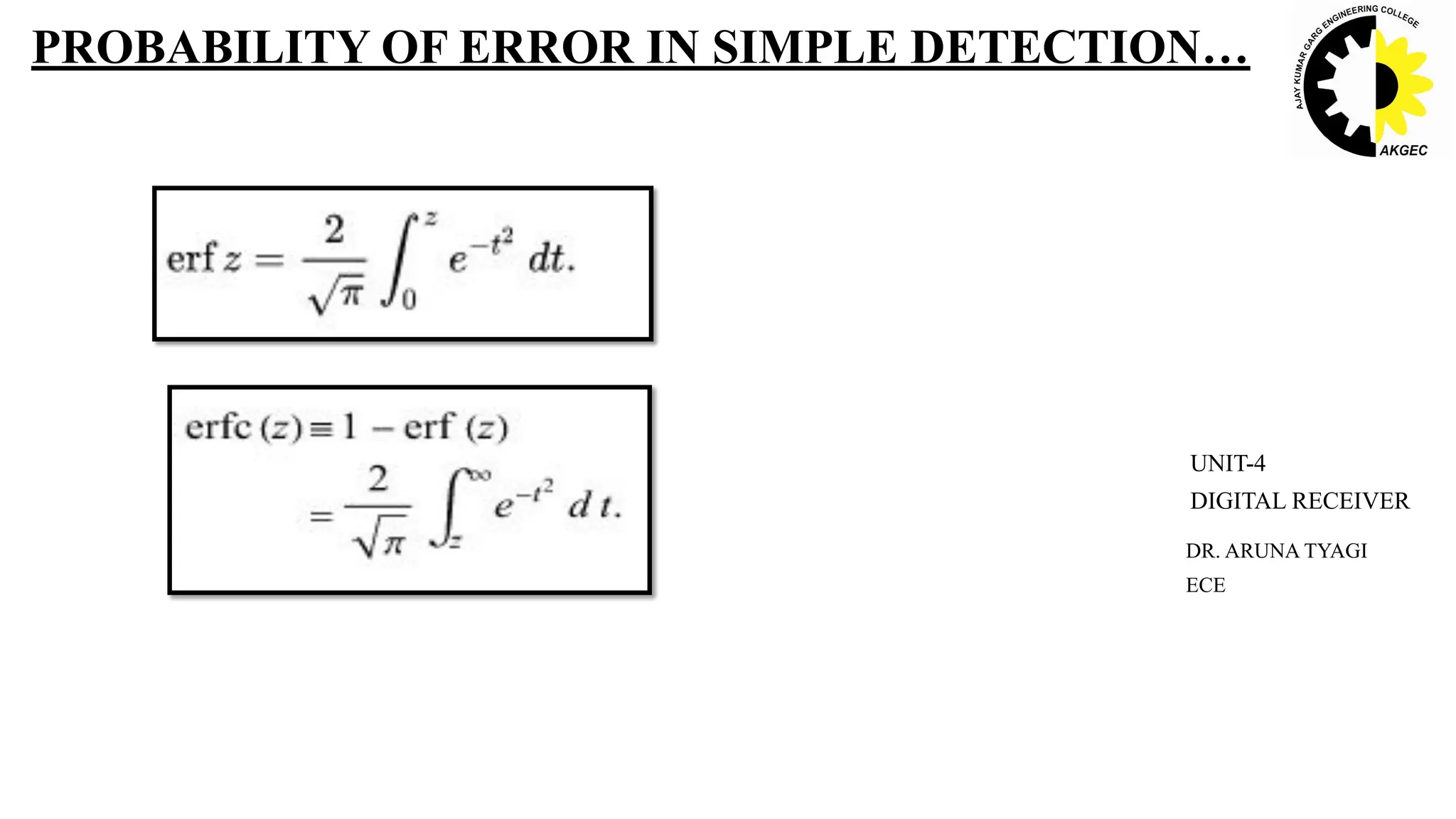
PROBABILITY OF ERROR IN SIMPLE DETECTION…
DR. ARUNA TYAGI
ECE
UNIT-4
DIGITAL RECEIVER
PROBABILITY OF ERROR IN SIMPLE DETECTION…
DR. ARUNA TYAGI
ECE
UNIT-4
DIGITAL RECEIVER
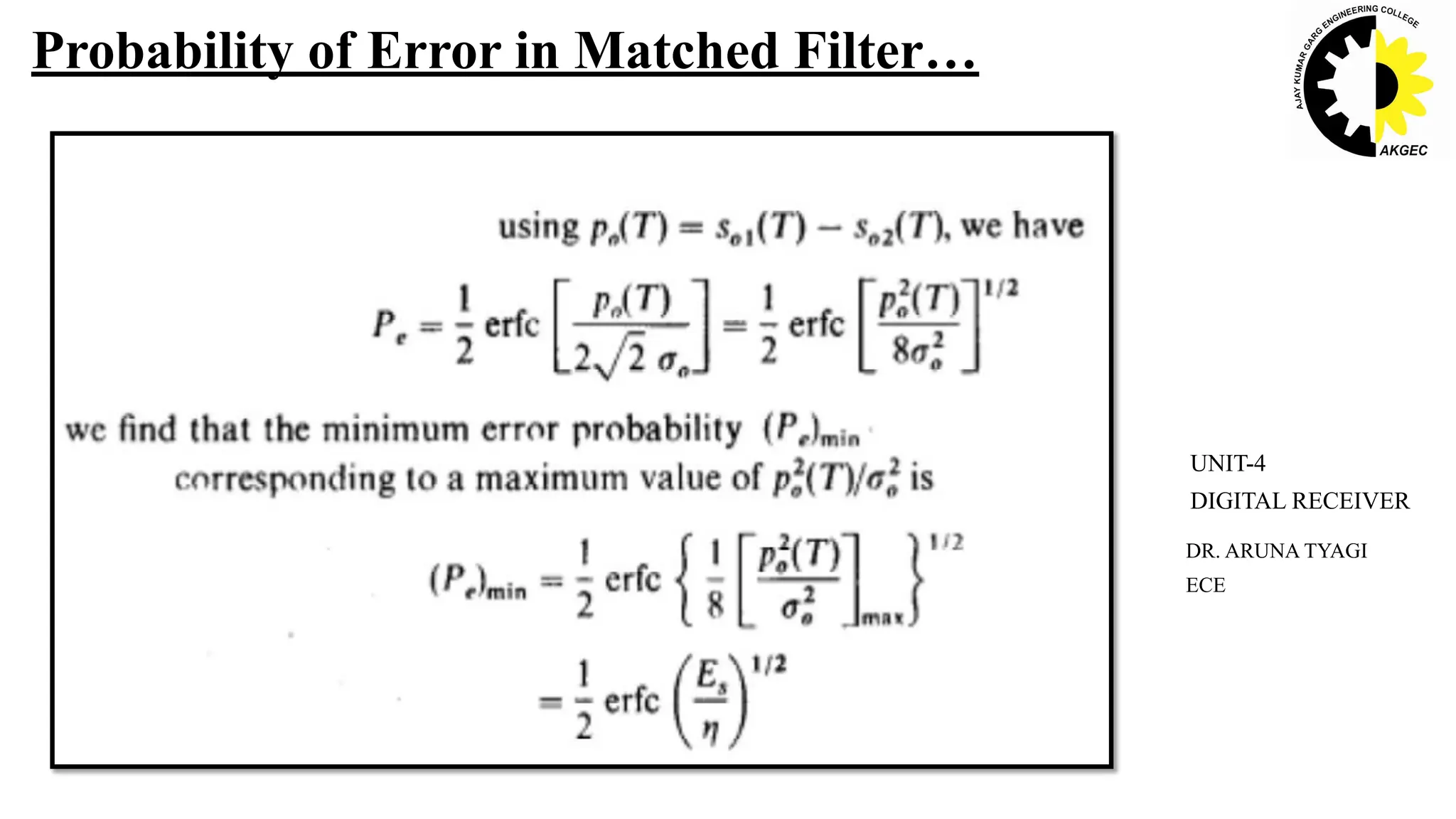
Probability of Error in Matched Filter…
DR. ARUNA TYAGI
ECE
UNIT-4
DIGITAL RECEIVER
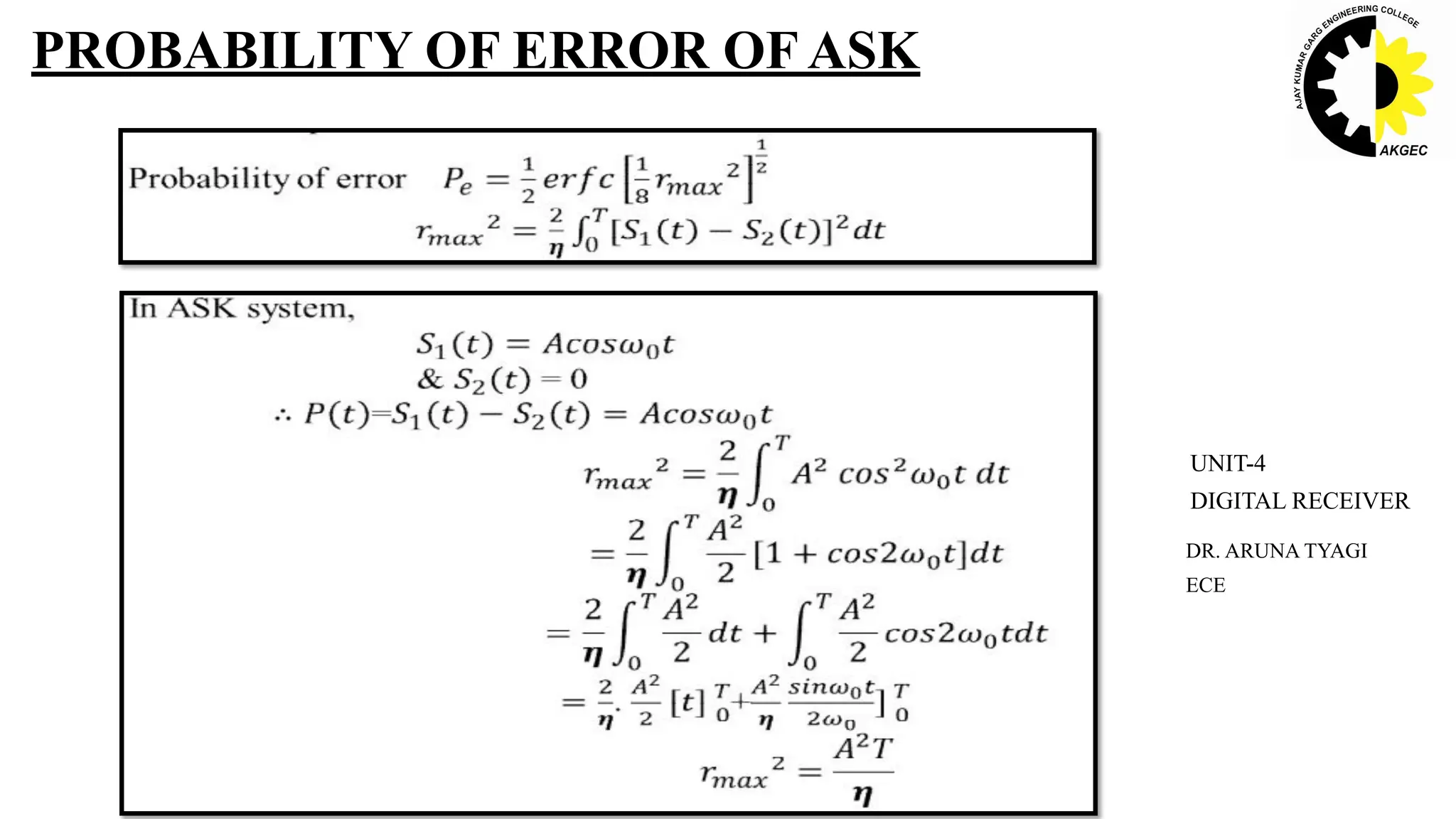
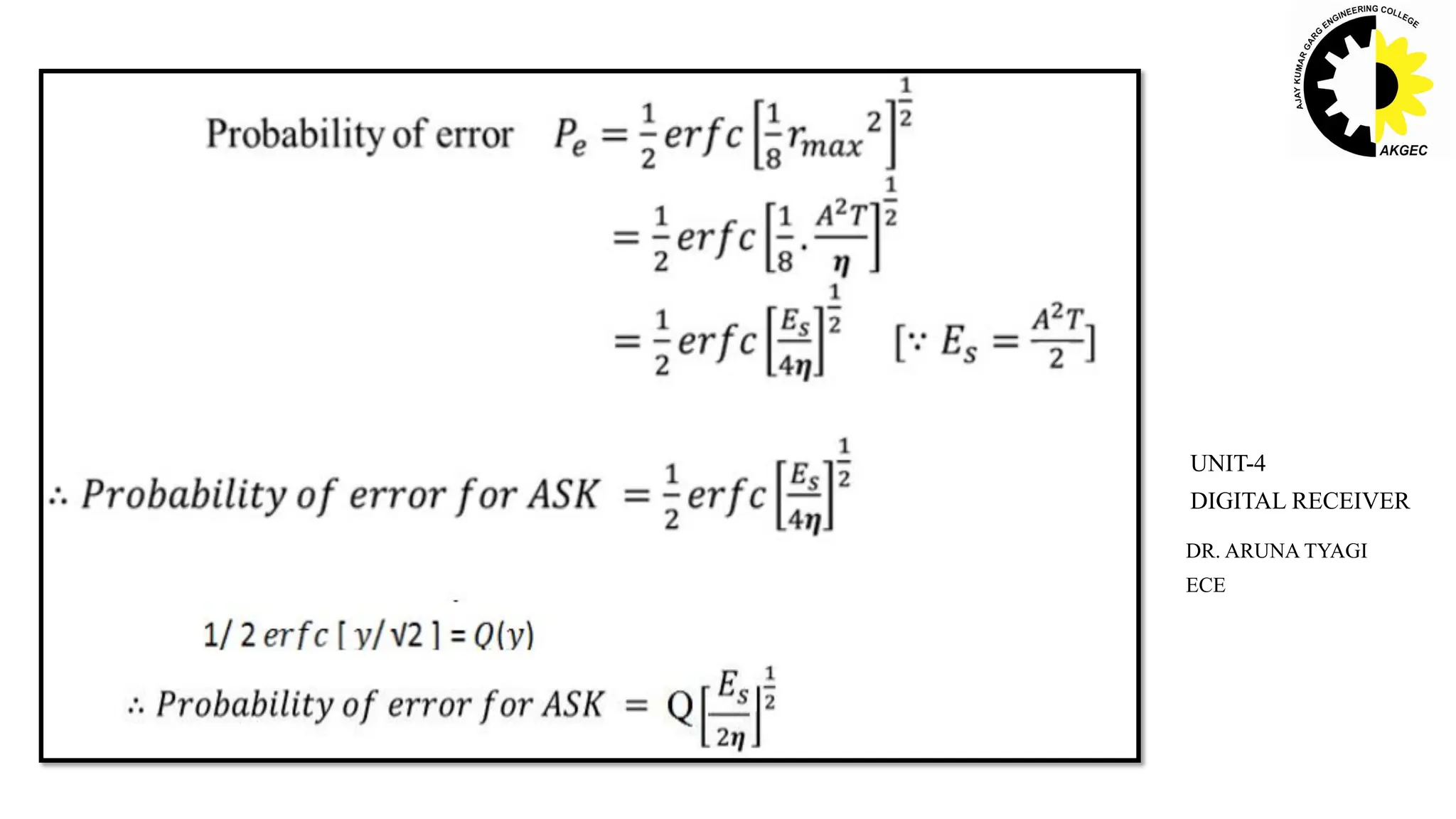
PROBABILITY OF ERROR OF ASK
DR. ARUNA TYAGI
ECE
UNIT-4
DIGITAL RECEIVER
DR. ARUNA TYAGI
ECE
UNIT-4
DIGITAL RECEIVER
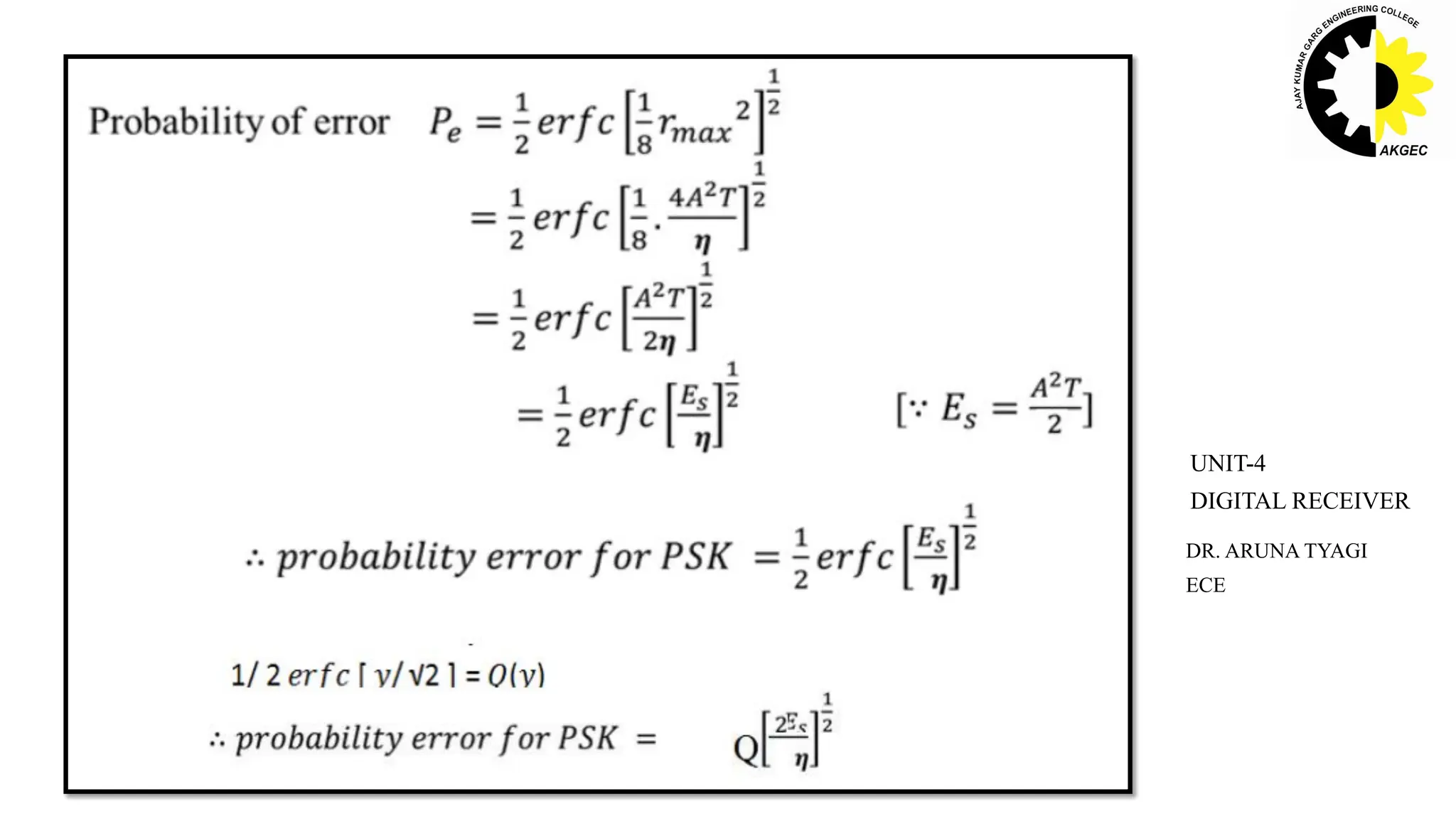
PROBABILITY OF ERROR OF PSK
DR. ARUNA TYAGI
ECE
UNIT-4
DIGITAL RECEIVER
DR. ARUNA TYAGI
ECE
UNIT-4
DIGITAL RECEIVER
PROBABILITY OF ERROR OF FSK
DR. ARUNA TYAGI
ECE
UNIT-4
DIGITAL RECEIVER
DR. ARUNA TYAGI
ECE
UNIT-4
DIGITAL RECEIVER
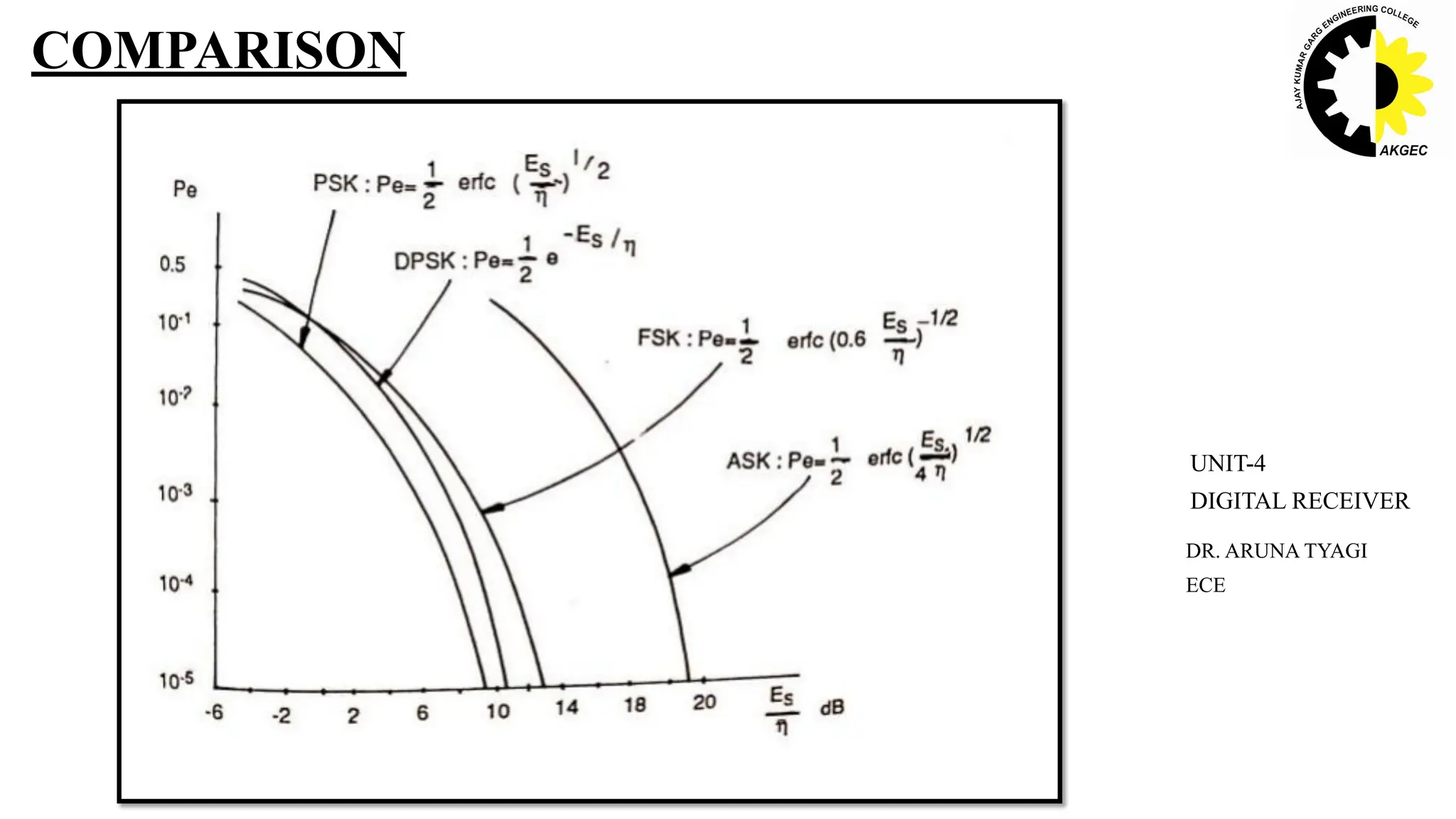
COMPARISON
DR. ARUNA TYAGI
ECE
UNIT-4
DIGITAL RECEIVER
1. Frequency Division Multiple Access (FDMA) :
FDMA is a type of channelization protocol. In this bandwidth is divided
into various frequency bands. Each station is allocated with band to send
data and that band is reserved for particular station for all the time which is
as follows :
MULTIPLE ACCESS TECHNIQUES
DR. ARUNA TYAGI
ECE
UNIT-4
DIGITAL RECEIVER
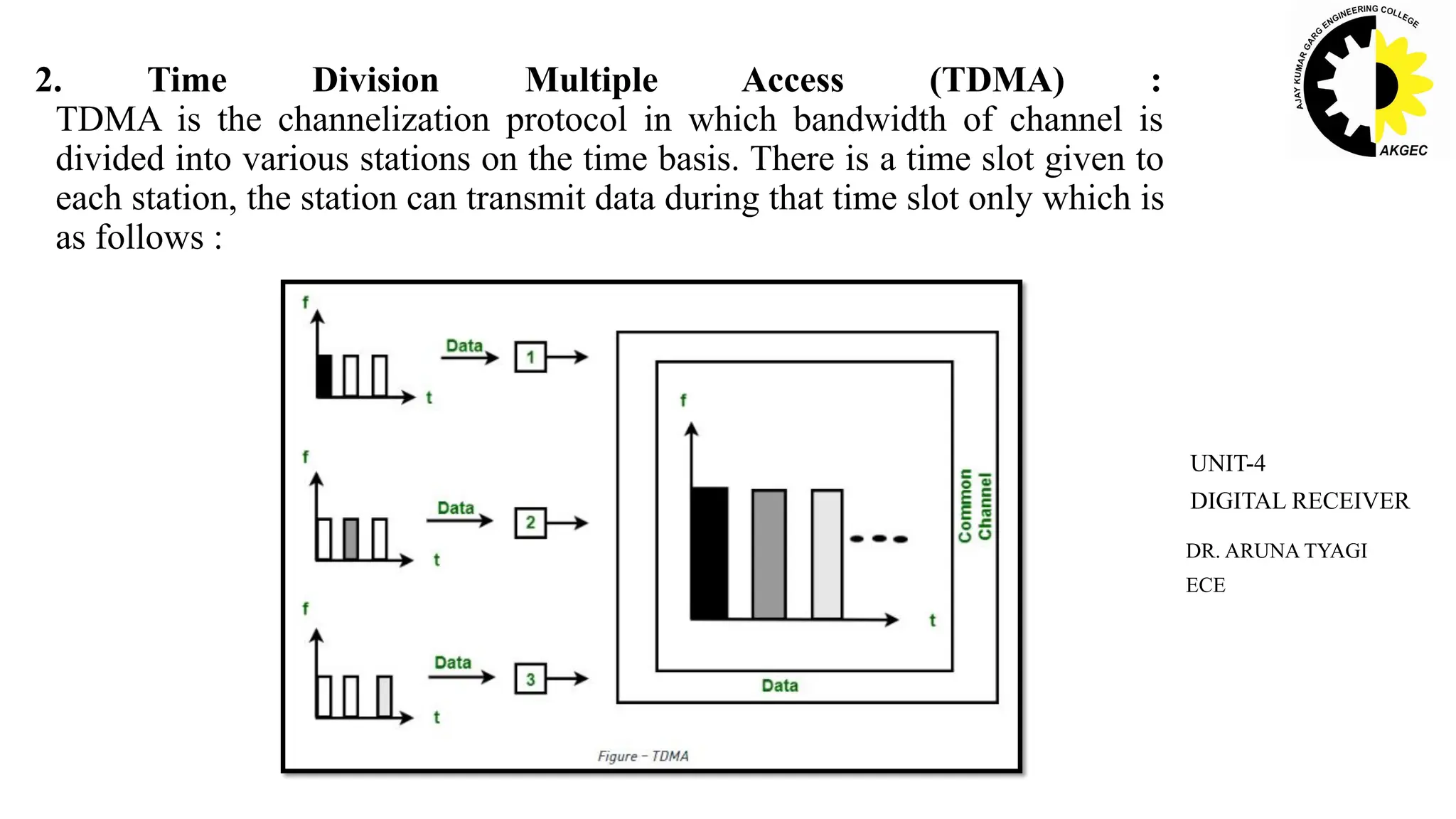
2. Time Division Multiple Access (TDMA) :
TDMA is the channelization protocol in which bandwidth of channel is
divided into various stations on the time basis. There is a time slot given to
each station, the station can transmit data during that time slot only which is
as follows :
DR. ARUNA TYAGI
ECE
UNIT-4
DIGITAL RECEIVER
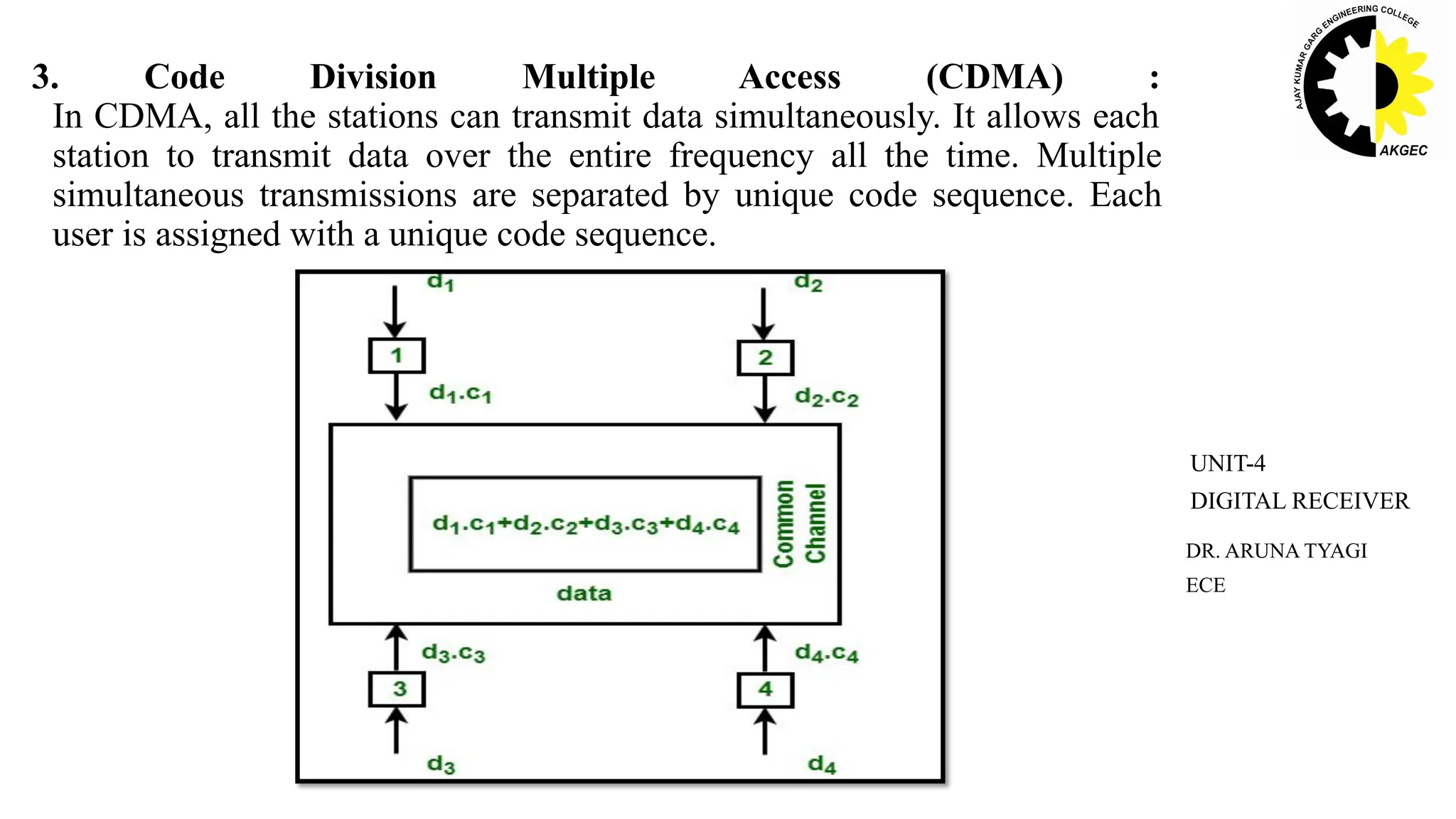
3. Code Division Multiple Access (CDMA) :
In CDMA, all the stations can transmit data simultaneously. It allows each
station to transmit data over the entire frequency all the time. Multiple
simultaneous transmissions are separated by unique code sequence. Each
user is assigned with a unique code sequence.
DR. ARUNA TYAGI
ECE
UNIT-4
DIGITAL RECEIVER
•In CDMA, since all the mobiles transmit at the same frequency, the internal
interference of the network plays a critical role in determining network
capacity. Further, each mobile transmitter power must be controlled to limit
the interference.
•Power control is essentially needed to solve the near-far problem. The main
idea to reduce the near-far problem, is to achieve the same power level
received by all mobiles to the base station. Each received power must be at
least level, so that it allows the link to meet the requirements of the system
such that Eb/N0.
•To receive the same power level at the base station, the mobiles those are
closer to the base station should transmit less power than the mobiles which
are far away from the mobile base station.
•Another solution is multiuser detection (MUD) which exploits the
information of signals of interfering users to detect signal from individual
user. It is also called joint detection and interference cancellation.
Near-far Problem in CDMA (Power Control)
DR. ARUNA TYAGI
ECE
UNIT-4
DIGITAL RECEIVER
•Both the Narrow band and Spread spectrum signals can be understood
easily by observing their frequency spectrum as shown in the following
figures.
Narrow-band and Spread-spectrum Signals
DR. ARUNA TYAGI
ECE
UNIT-4
DIGITAL RECEIVER
•Narrowband:
•Band of signals occupy a narrow range of frequencies.
•Power density is high.
•Spread of energy is low and concentrated.
•Though the features are good, these signals are prone to interference.
•Wideband:
•Band of signals occupy a wide range of frequencies.
•Power density is very low.
•Energy is wide spread.
Following are some of its features −
DR. ARUNA TYAGI
ECE
UNIT-4
DIGITAL RECEIVER
•Problem of radio transmission: Narrow band can be wiped out due to
interference. To disrupt the communication, the adversary needs to do two
things,
• (a) to detect that a transmission is taking place and (b) to transmit a
jamming signal which is designed to confuse the receiver.
Solution
• A spread spectrum system is therefore designed to make these tasks as
difficult as possible.
•Firstly, the transmitted signal should be difficult to detect by an
adversary/jammer, i.e., the signal should have a low probability of intercept
(LPI).
•Secondly, the signal should be difficult to disturb with a jamming signal,
i.e., the transmitted signal should possess an anti-jamming (AJ) property
Remedy: spread the narrow band signal into a broad band to protect against
interference
DR. ARUNA TYAGI
ECE
UNIT-4
DIGITAL RECEIVER
•In a digital communication system the primary resources are Bandwidth
and Power.
•The study of digital communication system deals with efficient utilization
of these two resources, but there are situations where it is necessary to
sacrifice their efficient utilization in order to meet certain other design
objectives.
•For example to provide a form of secure communication (i.e. the
transmitted signal is not easily detected or recognized by unwanted
listeners) the bandwidth of the transmitted signal is increased in excess of
the minimum bandwidth necessary to transmit it.
•This requirement is catered by a technique known as “Spread Spectrum
Modulation”.
•The primary advantage of a Spread – Spectrum communication system is
its ability to reject ‘Interference’ whether it be the unintentional or the
intentional interference
•A collective class of signaling techniques are employed before transmitting
a signal to provide a secure communication, known as the Spread
Spectrum Modulation.
•Spread spectrum multiple access techniques uses signals which have a
transmission bandwidth of a magnitude greater than the minimum required
RF bandwidth.
Spread Spectrum Modulation
DR. ARUNA TYAGI
ECE
UNIT-4
DIGITAL RECEIVER
DR. ARUNA TYAGI
ECE
UNIT-4
DIGITAL RECEIVER
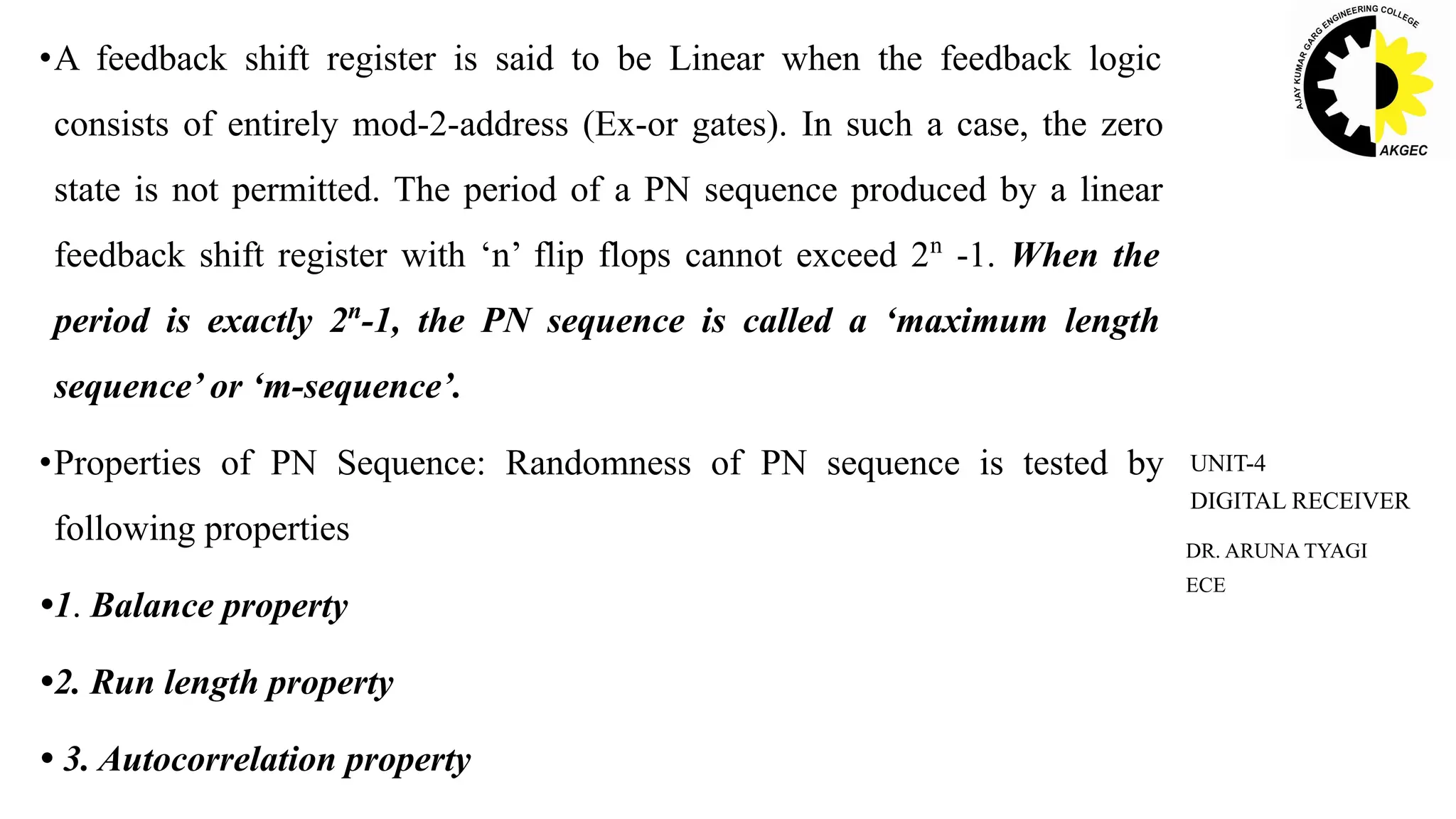
•To apply a spread-spectrum technique, simply inject the corresponding
spread-spectrum code somewhere in the transmitting chain before the
antenna (receiver). (That injection is called the spreading operation.) The
effect is to diffuse the information in a larger bandwidth.
•Conversely, we can remove the spread-spectrum code (called a despreading
operation) at a point in the receive chain before data retrieval. A
despreading operation reconstitutes the information into its original
bandwidth.
•Obviously, the same code must be known in advance at both ends of the
transmission channel. (In some circumstances, the code should be known
only by those two parties.)
•Resistance to Interference and Anti jamming Effects
There are many benefits to spread-spectrum technology. Resistance to
interference is the most important advantage.
•Intentional or unintentional interference and jamming signals are rejected
because they do not contain the spread-spectrum key.
•Only the desired signal, which has the key, will be seen at the receiver when
the despreading operation is exercised.
Benefits of Spread Spectrum
DR. ARUNA TYAGI
ECE
UNIT-4
DIGITAL RECEIVER
DR. ARUNA TYAGI
ECE
UNIT-4
DIGITAL RECEIVER
•At this point, it is worth restating that the main characteristic of spread
spectrum is the presence of a code or key, which must be known in advance
by the transmitter and receiver(s).
•In modern communications the codes are digital sequences that must be as
long and as random as possible to appear as "noise-like" as possible.
•But in any case, the codes must remain reproducible, or the receiver cannot
extract the message that has been sent. Thus, the sequence is "nearly
random." Such a code is called a pseudo-random number (PRN) or
sequence.
•The method most frequently used to generate pseudo-random codes is
based on a feedback shift register.
Spread Spectrum and (De)coding "Keys"
DR. ARUNA TYAGI
ECE
UNIT-4
DIGITAL RECEIVER
•One example of a PRN is shown in Figure.
•The shift register contains eight data flip-flops (FF). At the rising edge of
the clock, the contents of the shift register are shifted one bit to the left. The
data clocked in by FF1 depends on the contents fed back from FF8 and
FF7. The PRN is read out from FF8. The contents of the FFs are reset at the
beginning of each sequence length.
Pseudo Random Number Generation
DR. ARUNA TYAGI
ECE
UNIT-4
DIGITAL RECEIVER
•A feedback shift register is said to be Linear when the feedback logic
consists of entirely mod-2-address (Ex-or gates). In such a case, the zero
state is not permitted. The period of a PN sequence produced by a linear
feedback shift register with ‘n’ flip flops cannot exceed 2n
-1. When the
period is exactly 2n
-1, the PN sequence is called a ‘maximum length
sequence’ or ‘m-sequence’.
•Properties of PN Sequence: Randomness of PN sequence is tested by
following properties
•1. Balance property
•2. Run length property
• 3. Autocorrelation property
DR. ARUNA TYAGI
ECE
UNIT-4
DIGITAL RECEIVER
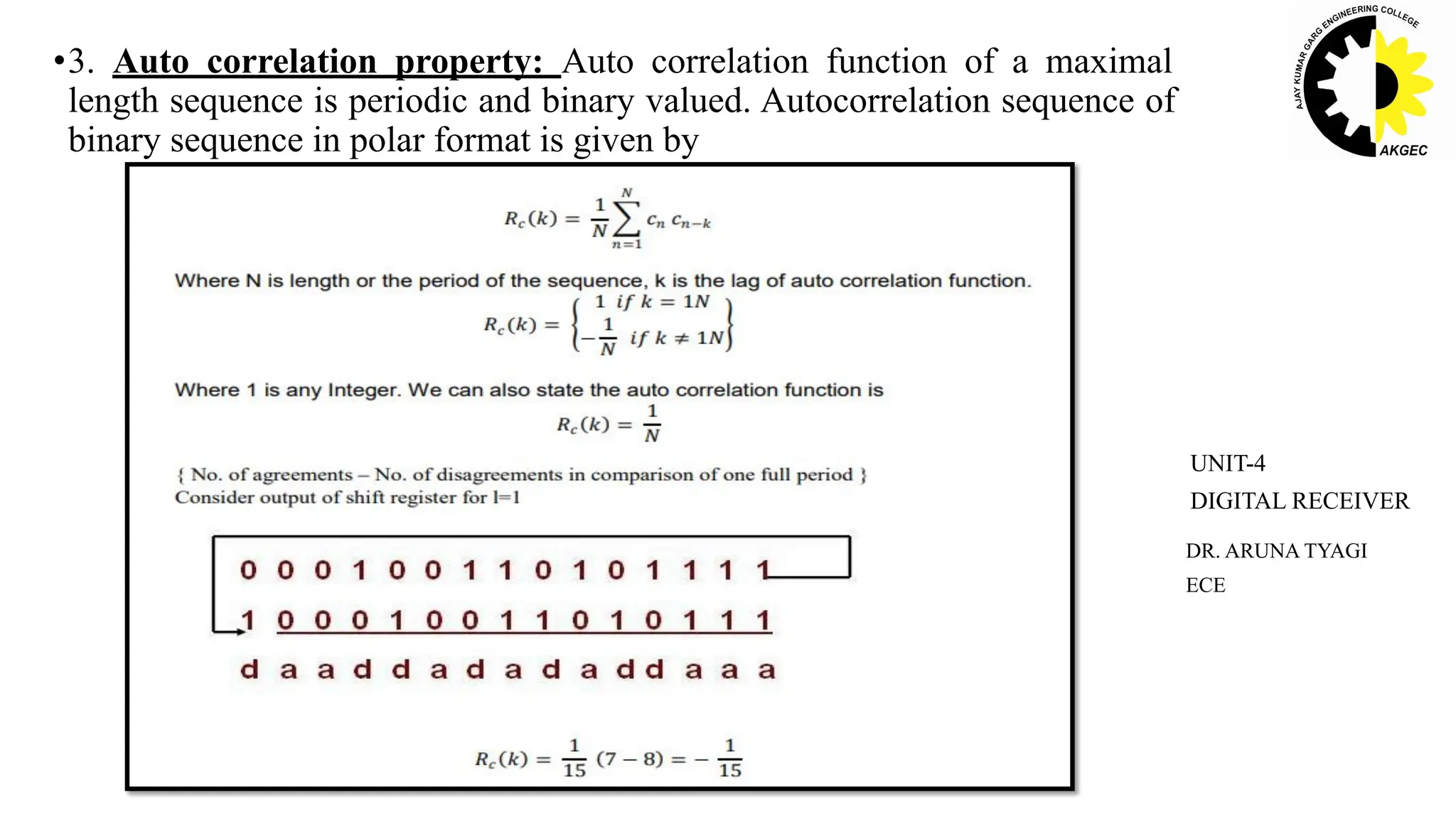
•1. Balance property: In each Period of the sequence , number of binary
ones differ from binary zeros by at most one digit.
•Consider output of shift register 0 0 0 1 0 0 1 1 0 1 0 1 1 1 1
•Seven zeros and eight ones -meets balance condition.
•2. Run length property: Among the runs of ones and zeros in each period,
it is desirable that about one half the runs of each type are of length 1, one-
fourth are of length 2 and one-eighth are of length 3 and so-on.
DR. ARUNA TYAGI
ECE
UNIT-4
DIGITAL RECEIVER
•3. Auto correlation property: Auto correlation function of a maximal
length sequence is periodic and binary valued. Autocorrelation sequence of
binary sequence in polar format is given by
DR. ARUNA TYAGI
ECE
UNIT-4
DIGITAL RECEIVER
DR. ARUNA TYAGI
ECE
UNIT-4
DIGITAL RECEIVER
•These are of two types.
There are two types of Spread Spectrum Systems
•1. Averaging system
•2. Avoidance system
•Averaging system: In this system, interference reduction takes place because the
interference can be averaged over a large time interval.
•Example: A Direct Sequence (DS) system
•Avoidance system: In this system, reduction of interference occurs because the
signal is made to avoid the interference for a large fraction of time.
•Example: Frequency Hopping (FH), time hopping (TH), and chirping systems.
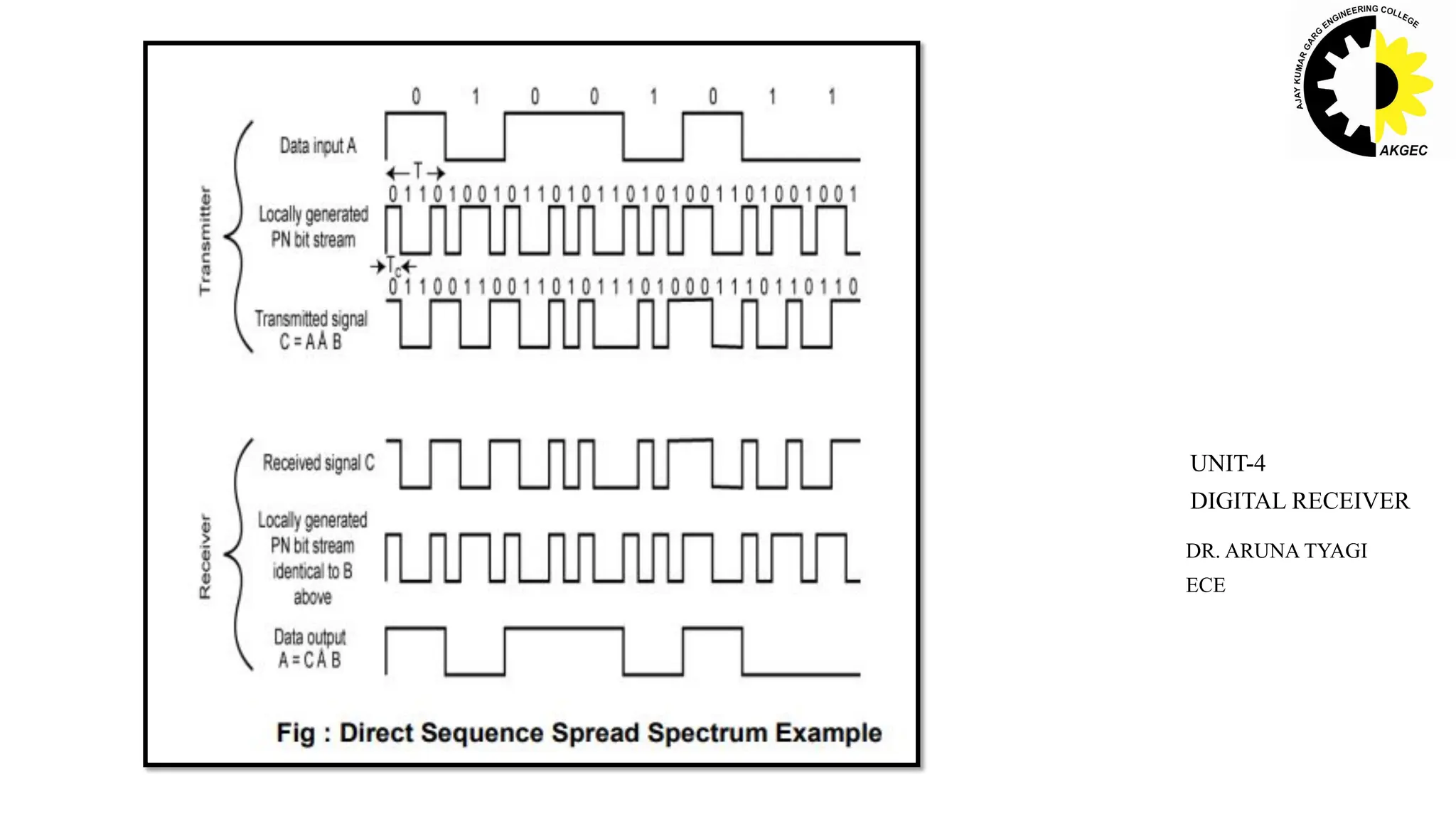
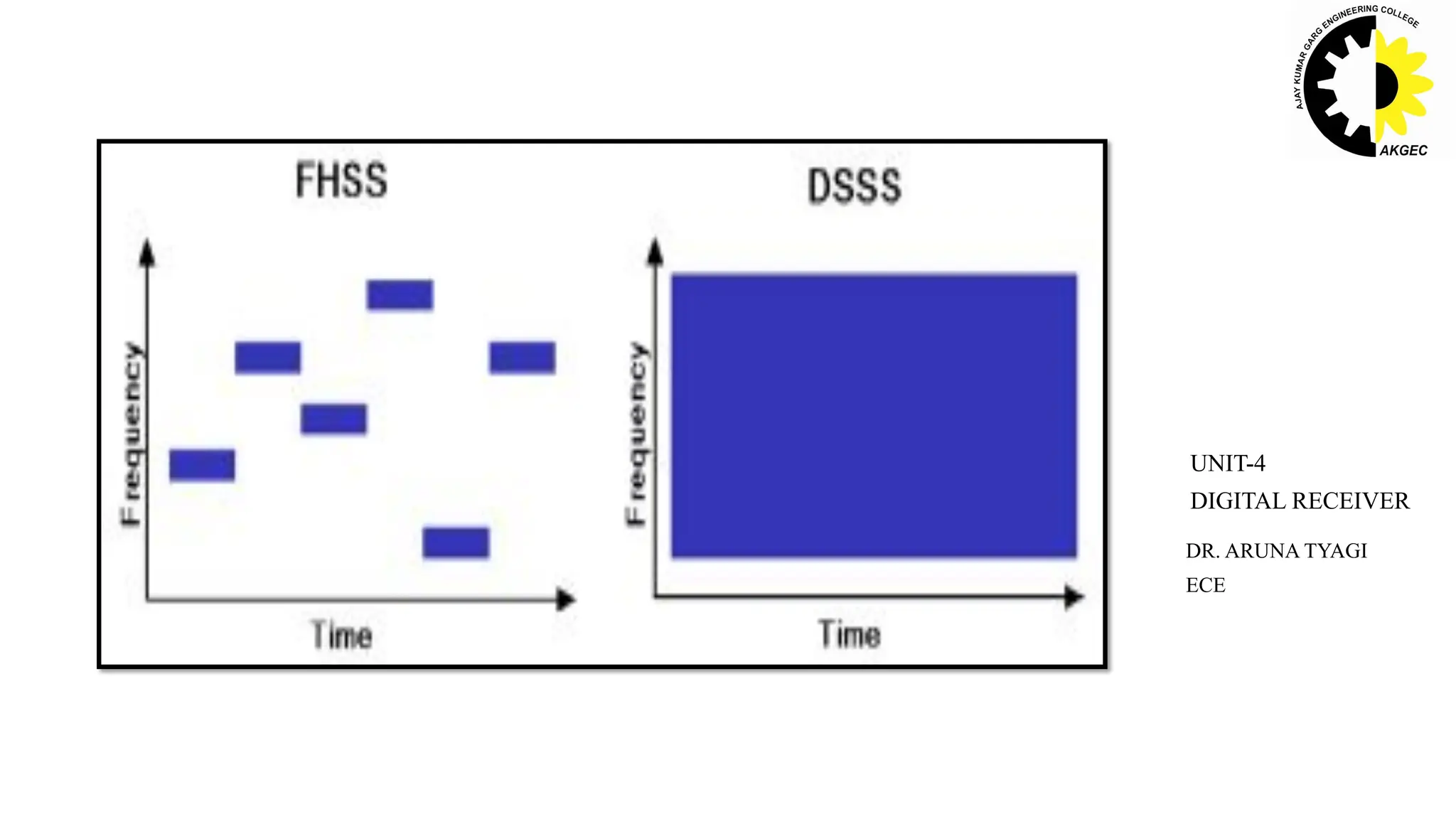
• Direct Sequence Spread Spectrum also known as Direct Sequence Code
Division Multiple Access (DS-CDMA) entails the division of the stream of
information into small pieces, each of which is allocated to a frequency
channel across the spectrum
• A data signal at the point of transmission is combined with a higher
data-rate bit sequence, also known as the „chipping code‟, which divides
the data according to a spreading ratio. The redundant chipping code helps
the signal resist interference and enables the original data to be recovered if
data bits are damaged during transmission.
Direct Sequence Spread Spectrum
DR. ARUNA TYAGI
ECE
UNIT-4
DIGITAL RECEIVER
DR. ARUNA TYAGI
ECE
UNIT-4
DIGITAL RECEIVER
•To provide band pass transmission, the base band data sequence is
multiplied by a Carrier by means of shift keying.
•Normally binary phase shift keying (PSK) is used because of its
advantages.
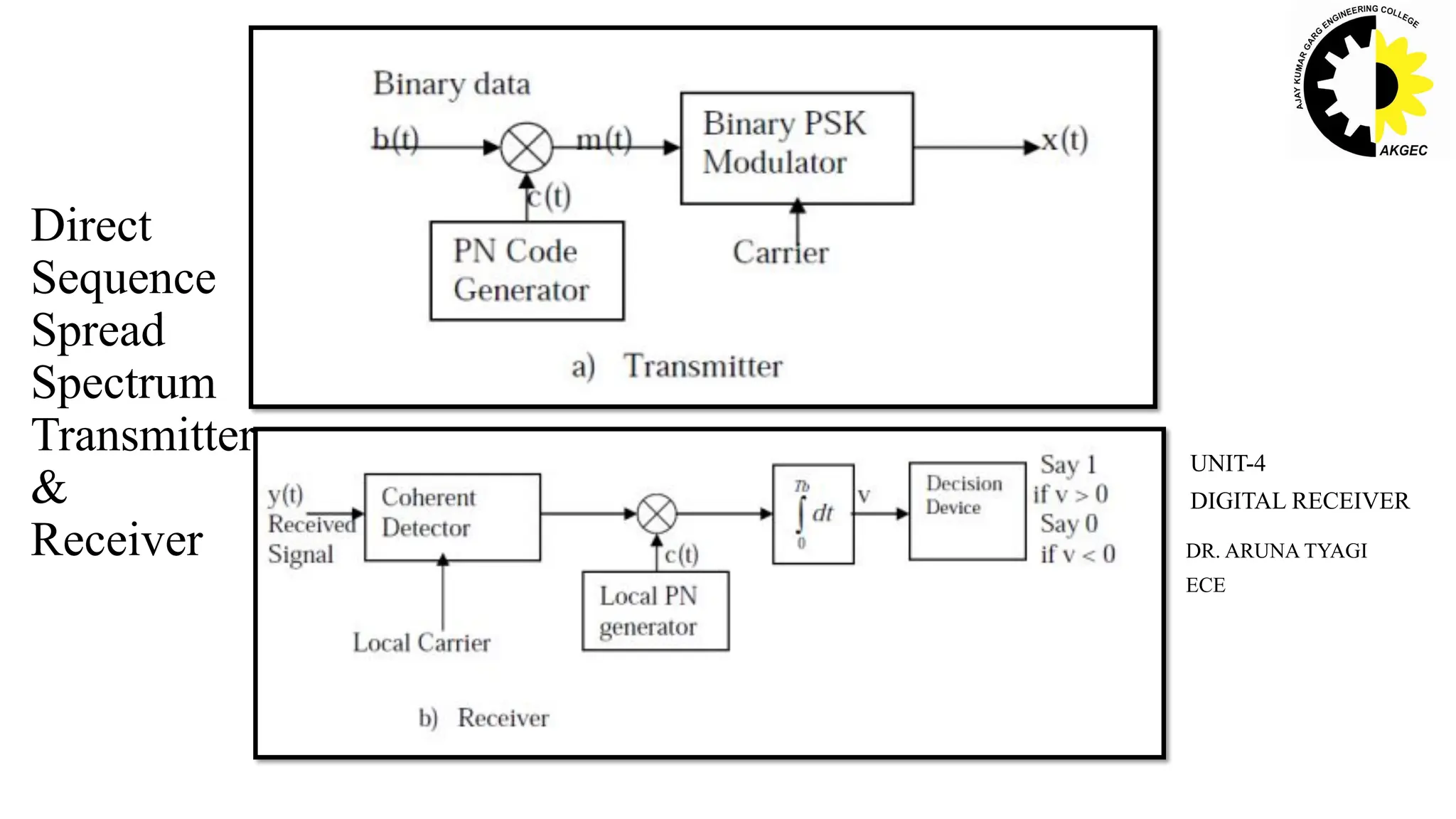
•The transmitter first converts the incoming binary data sequence {bk} into
an NRZ waveform b(t), which is followed by two stages of modulation.
•The first stage consists of a multiplier with data signal b(t) and the PN
signal c(t) as inputs. The output of multiplier is m(t) is a wideband signal.
Thus a narrow – band data sequence is transformed into a noise like wide
band signal.
•The second stage consists of a binary Phase Shift Keying (PSK) modulator.
Which converts base band signal m(t) into band pass signal x(t). The
transmitted signal x(t) is thus a direct – sequence spread binary PSK signal.
DR. ARUNA TYAGI
ECE
UNIT-4
DIGITAL RECEIVER
Direct Sequence Spread Spectrum Transmitter/Receiver
•The receiver consists of two stages of demodulation.
•In the first stage the received signal y(t) and a locally generated carrier are
applied to a coherent detector (a product modulator followed by a low pass
filter), Which converts band pass signal into base band signal.
•The second stage of demodulation performs Spectrum despreading by
multiplying the output of low-pass filter by a locally generated replica of
the PN signal c(t), followed by integration over a bit interval Tb and finally
a decision device is used to get binary sequence. DR. ARUNA TYAGI
ECE
UNIT-4
DIGITAL RECEIVER
DR. ARUNA TYAGI
ECE
UNIT-4
DIGITAL RECEIVER
Direct
Sequence
Spread
Spectrum
Transmitter
&
Receiver
DR. ARUNA TYAGI
ECE
UNIT-4
DIGITAL RECEIVER
•In a frequency hop Spread Spectrum technique, the spectrum of data
modulated carrier is widened by changing the carrier frequency in a pseudo
– random manner. The carrier hops randomly form one frequency to
another.
• Since frequency hopping does not covers the entire spread spectrum
instantaneously, we are led to consider the rate at which the hop occurs.
•Depending upon this we have two types of frequency hop:
•1. Slow frequency hopping:- In which the symbol rate Rs of the MFSK
signal is an integer multiple of the hop rate Rh. That is several symbols are
transmitted on each frequency hop.
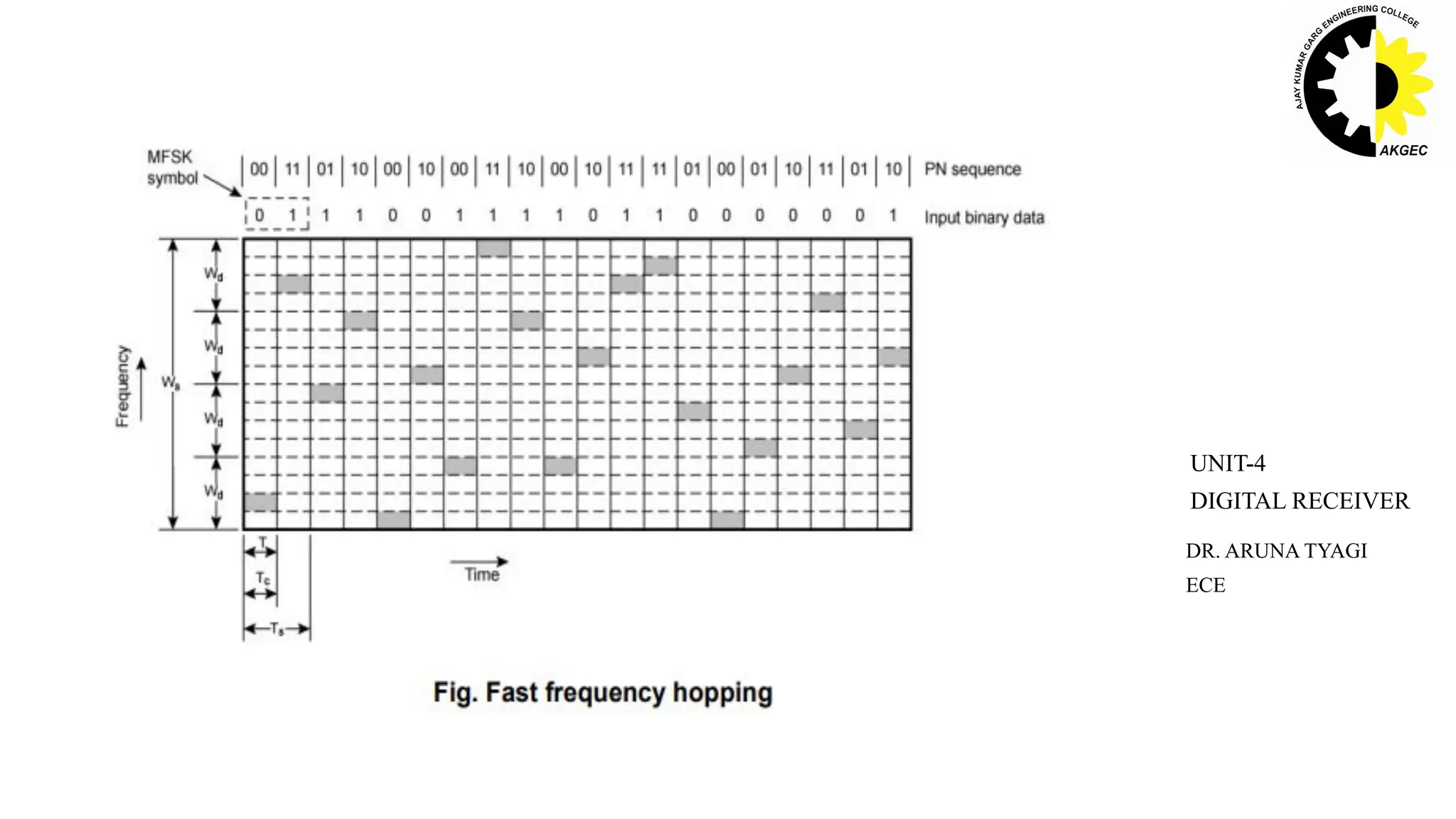
•2. Fast – Frequency hopping:- In which the hop rate Rh is an integral
multiple of the MFSK symbol rate Rs. That is the carrier frequency will hop
several times during the transmission of one symbol.
•A common modulation format for frequency hopping system is that of M-
ary frequency – shift – keying (MFSK).
Frequency Hopping Spread Spectrum
DR. ARUNA TYAGI
ECE
UNIT-4
DIGITAL RECEIVER
DR. ARUNA TYAGI
ECE
UNIT-4
DIGITAL RECEIVER
DR. ARUNA TYAGI
ECE
UNIT-4
DIGITAL RECEIVER
Slow frequency hopping Fast frequency hopping
In slow frequency hopping, multiple
symbols are transmitted in one
frequency hop.
In fast frequency hopping, multiple hops
are required to transmit one symbol.
One or more symbols are transmitted
over the same carrier frequency.
One symbol is transmitted over multiple
carriers in different hops.
Symbol rate is equal to chip rate. Hop rate is higher than symbol rate.
Hop rate is lower than symbol rate. Hop rate is higher than symbol rate.
A jammer can detect this signal if
carrier frequency in one hop is known.
A jammer can’t detect this signal
because one symbol is transmitted using
more than one carrier frequencies.
Slow and Fast FHSS:
DR. ARUNA TYAGI
ECE
UNIT-4
DIGITAL RECEIVER
FHSS TRANSMITTER
DR. ARUNA TYAGI
ECE
UNIT-4
DIGITAL RECEIVER
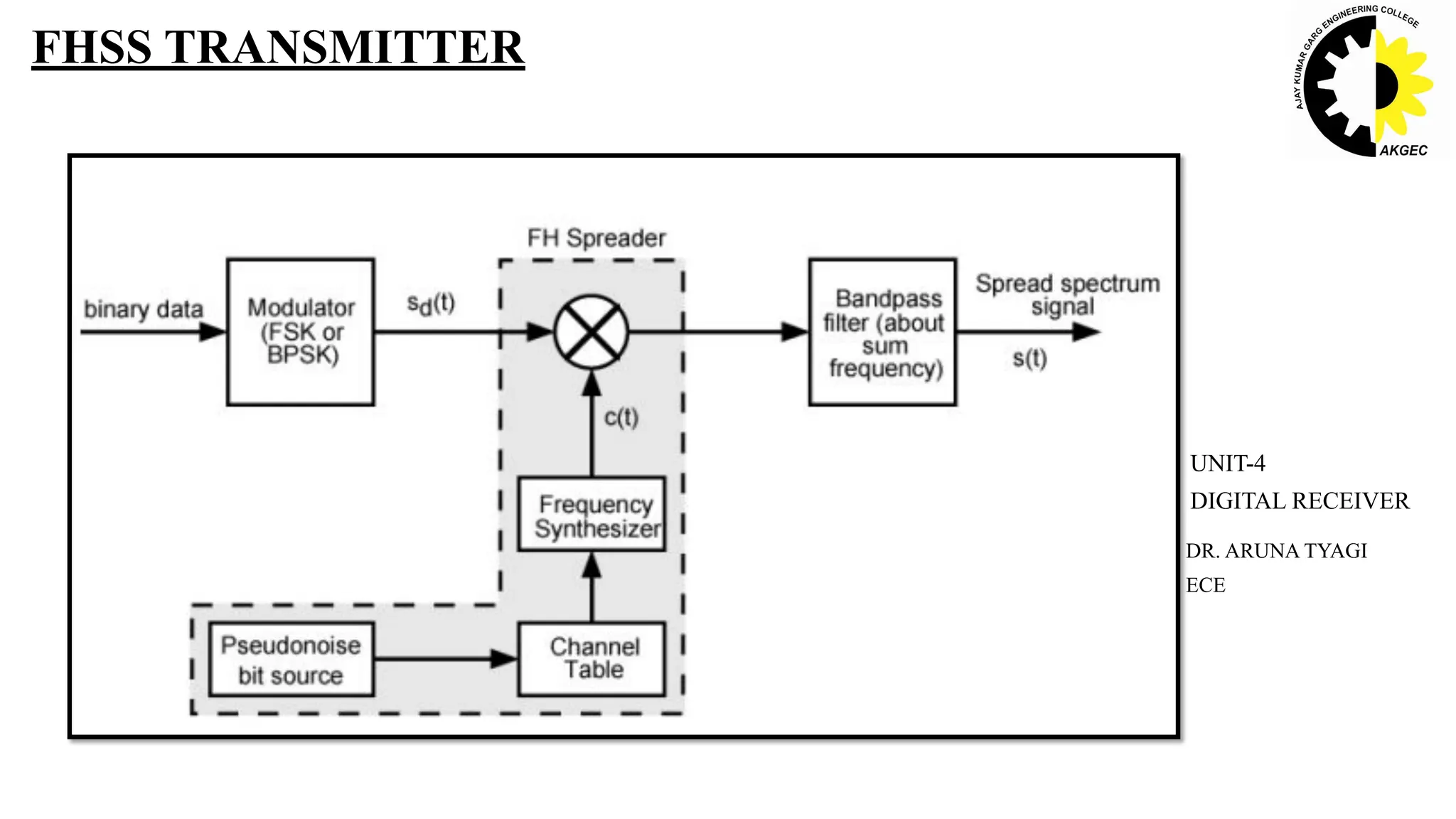
•Fig Shows the block diagram of an FH / MFSK transmitter, which involves
frequency modulation followed by mixing.
•The incoming binary data are applied to an M-ary FSK modulator.
•The resulting modulated wave and the output from a digital frequency
synthesizer are then applied to a mixer that consists of a multiplier followed
by a band – pass filter.
•The filter is designed to select the sum frequency component resulting from
the multiplication process as the transmitted signal.
•An ‘k’ bit segments of a PN sequence drive the frequency synthesizer,
which enables the carrier frequency to hop over 2n
distinct values.
•Since frequency synthesizers are unable to maintain phase coherence over
successive hops, most frequency hops spread spectrum communication
system use non coherent M-ary modulation system.
FHSS RECEIVER
DR. ARUNA TYAGI
ECE
UNIT-4
DIGITAL RECEIVER
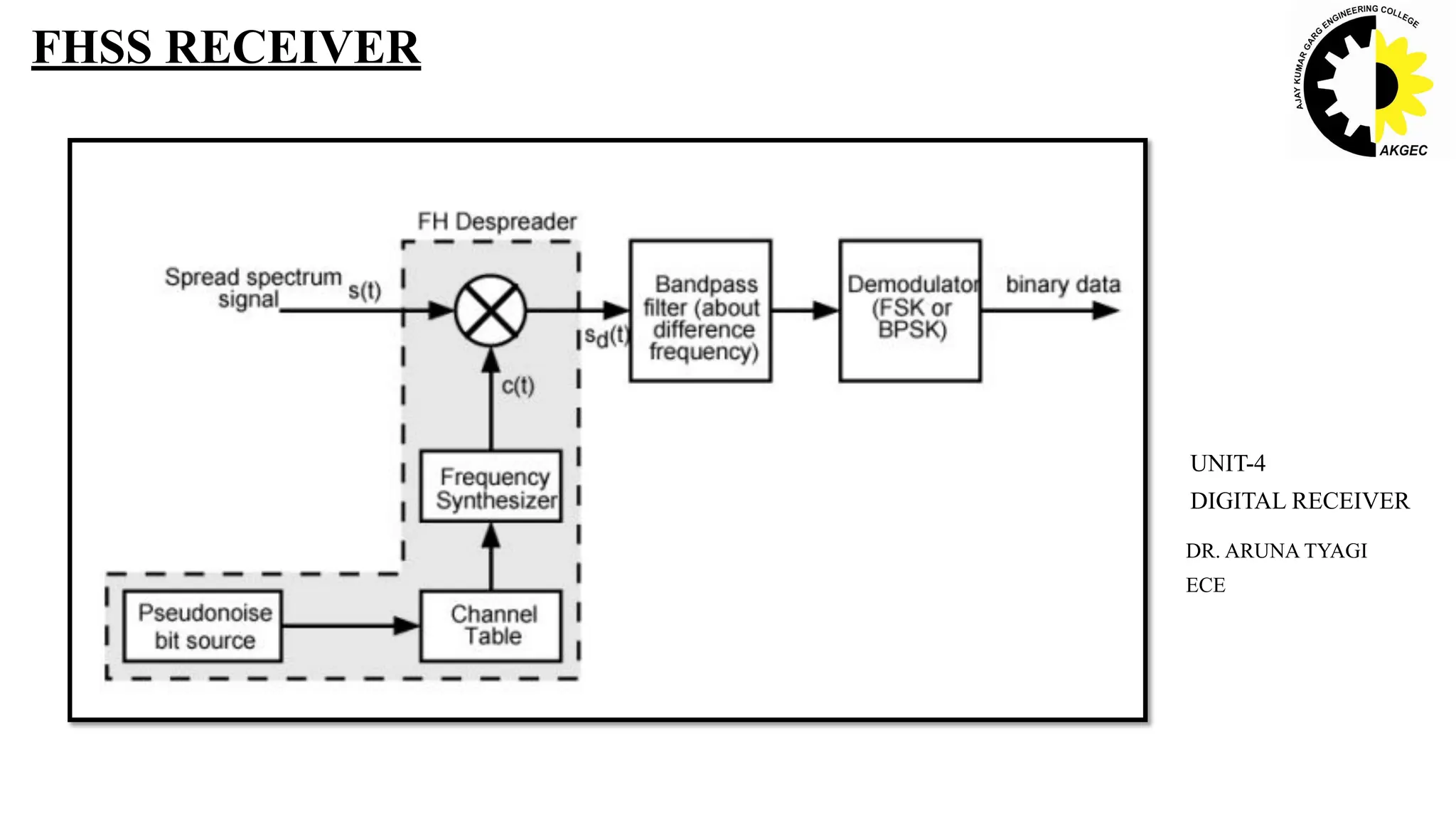
•In the receiver the frequency hopping is first removed by mixing the
received signal with the output of a local frequency synthesizer that is
synchronized with the transmitter.
•The resulting output is then band pass filtered and subsequently processed
by a non coherent M-ary FSK demodulator.
•To implement this M-ary detector, a bank of M non coherent matched
filters, each of which is matched to one of the MFSK tones is used.
•By selecting the largest filtered output, the original transmitted signal is
estimated.
DR. ARUNA TYAGI
ECE
UNIT-4
DIGITAL RECEIVER
•Jamming intends to disable the legitimate transmission by. saturating
the receiver with noise or false information through. deliberate
radiation of radio signals, and thus significantly. decreases the
signal-to-noise-plus-interference ratio (SNIR).
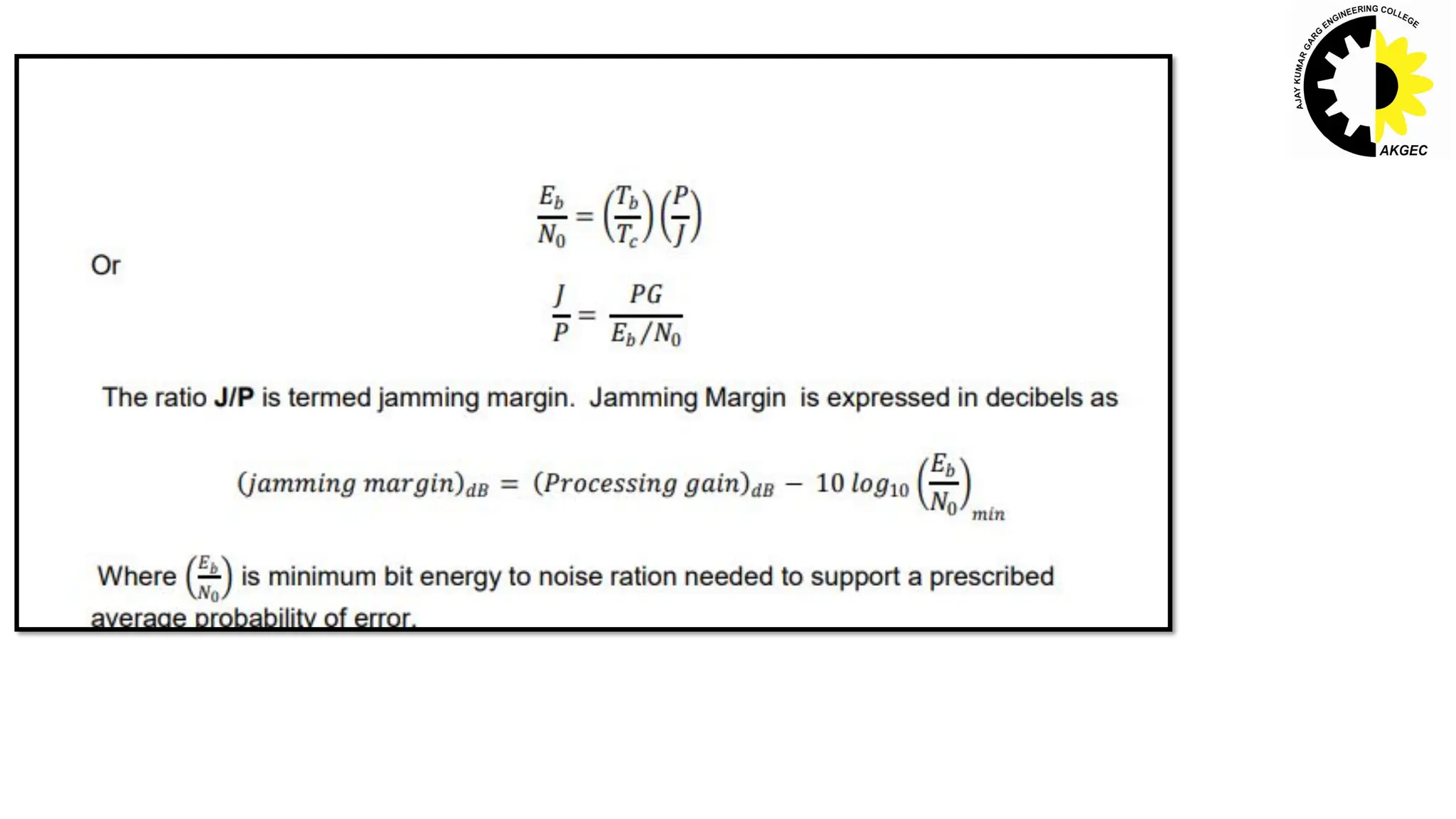
•Jamming margin is the level or range of interference which a system can
handle without affecting the specified level of performance. For example,
maintaining a specific bit-error ratio despite the ratio of signal-to-noise is
reducing.
•In other words, it is defined as how much protection it can give to the
system from jamming.
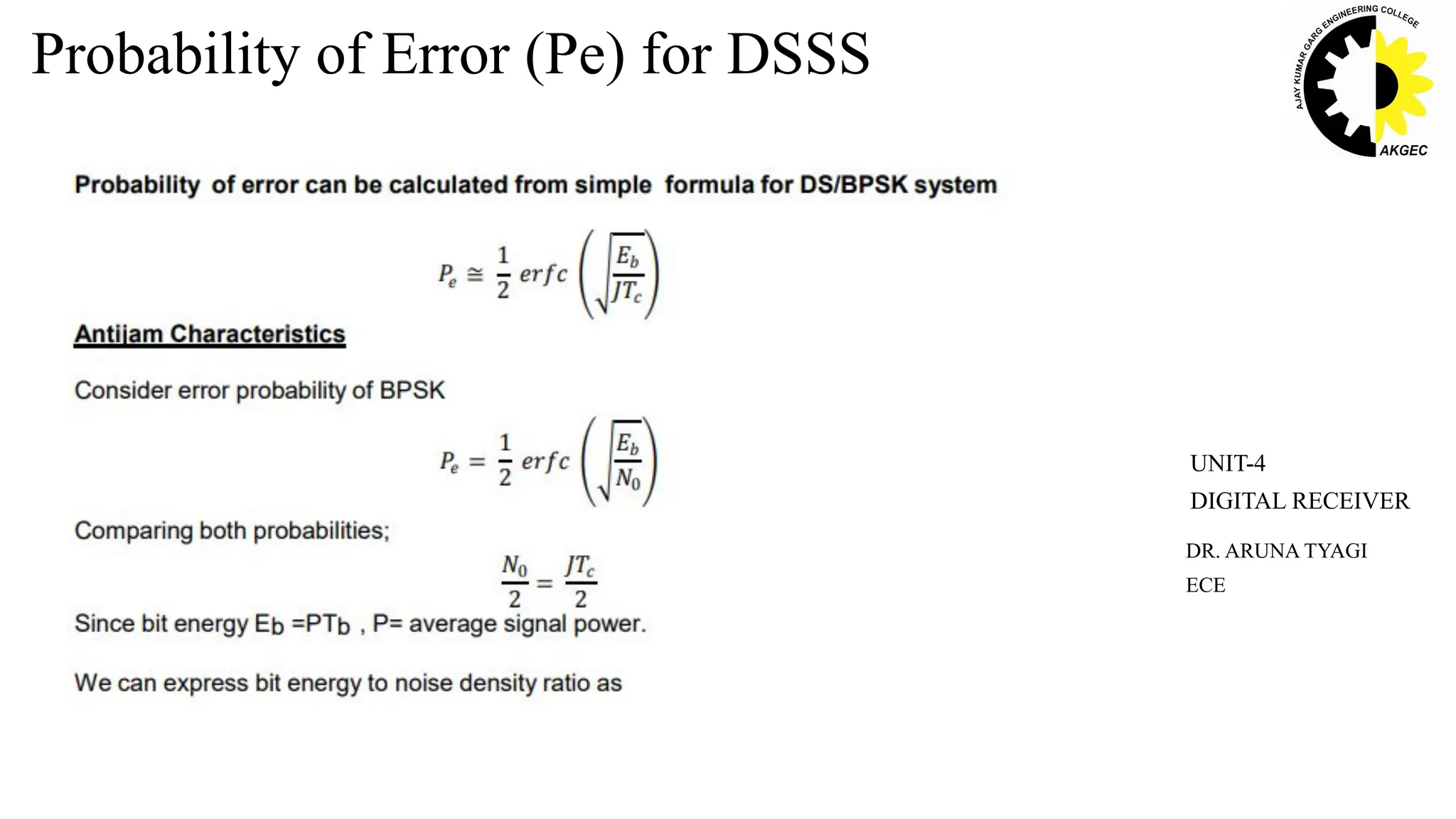
Jamming in DSSS
Probability of Error (Pe) for DSSS
DR. ARUNA TYAGI
ECE
UNIT-4
DIGITAL RECEIVER
DR. ARUNA TYAGI
ECE
UNIT-4
DIGITAL RECEIVER
DR. ARUNA TYAGI
ECE
UNIT-4
DIGITAL RECEIVER
•A pseudo random sequence is generated using a feed back shift register of
length m=4. The chip rate is 107 chips per second. Find the following
•a) PN sequence length b) Chip duration of PN sequence c) PN sequence
period
•Solution:
•a) Length of PN sequence N = 2m
-1= 24
-1 =15
•b) Chip duration Tc = 1/chip rate =1/107 = 0.1µsec
•c) PN sequence period T = NTc = 15 x 0.1µsec = 1.5µsec
EXAMPLE 1:
DR. ARUNA TYAGI
ECE
UNIT-4
DIGITAL RECEIVER
•A direct sequence spread binary phase shift keying system uses a feedback
shift register of length 19 for the generation of PN sequence. Calculate
the processing gain of the system.
•Solution
•Given length of shift register = m =19
•Therefore length of PN sequence N = 2m
- 1 = 219
- 1
•Processing gain PG = Tb/Tc =N in db =10log10
N = 10 log10
(219
) = 57db
EXAMPLE 2:
DR. ARUNA TYAGI
ECE
UNIT-4
DIGITAL RECEIVER
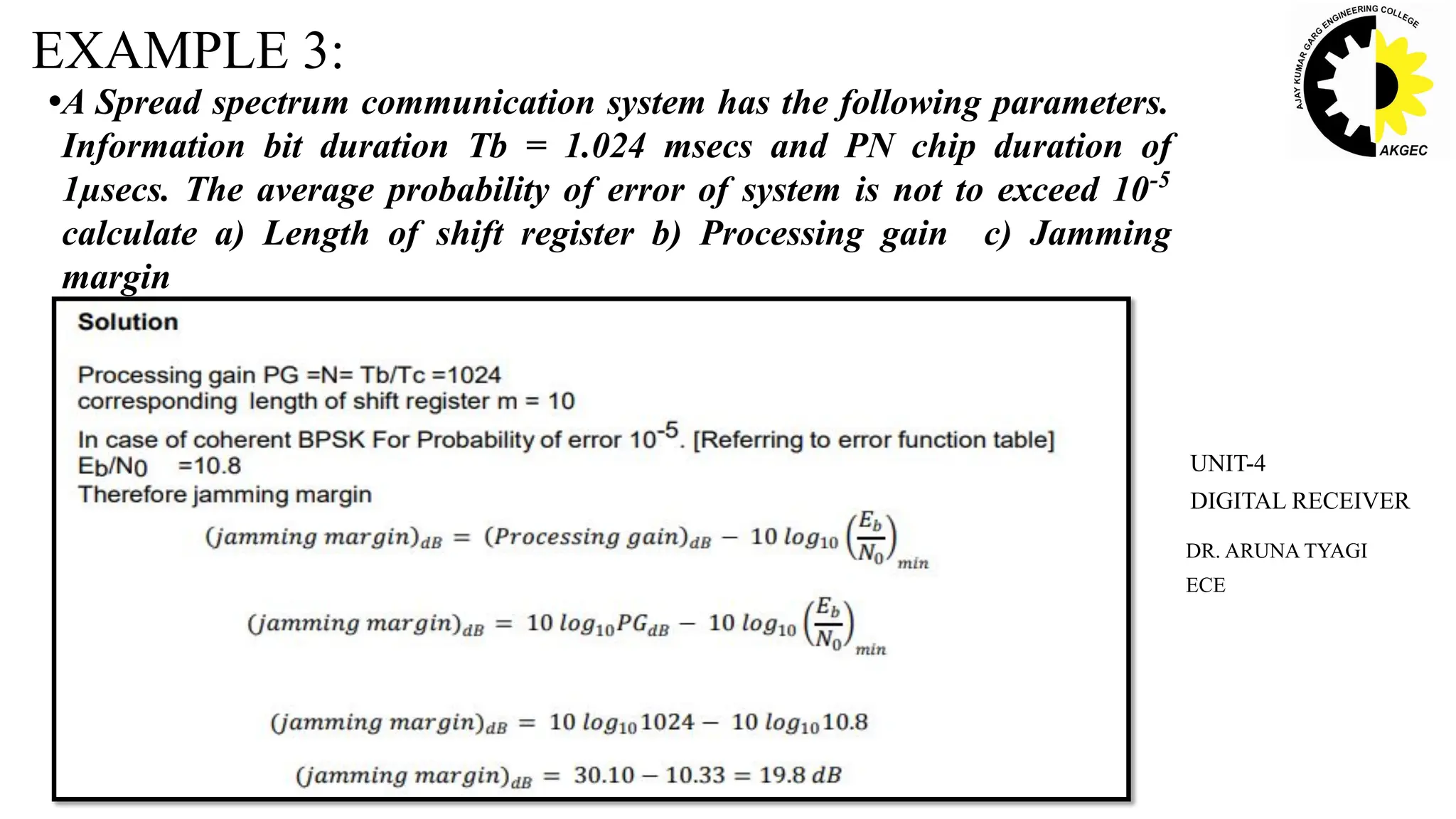
•A Spread spectrum communication system has the following parameters.
Information bit duration Tb = 1.024 msecs and PN chip duration of
1µsecs. The average probability of error of system is not to exceed 10-5
calculate a) Length of shift register b) Processing gain c) Jamming
margin
EXAMPLE 3:
DR. ARUNA TYAGI
ECE
UNIT-4
DIGITAL RECEIVER
•Solution:
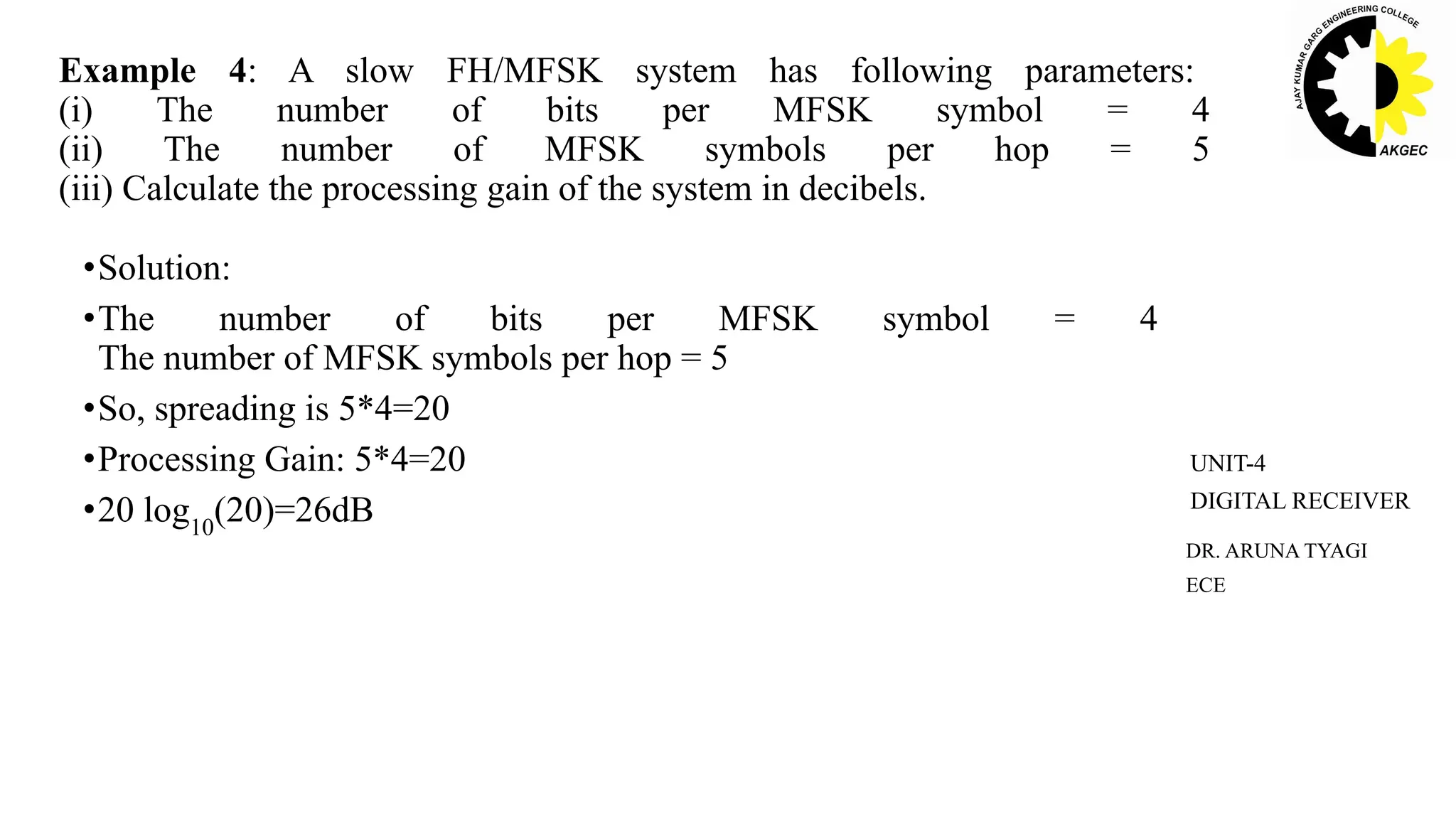
•The number of bits per MFSK symbol = 4
The number of MFSK symbols per hop = 5
•So, spreading is 5*4=20
•Processing Gain: 5*4=20
•20 log10
(20)=26dB
Example 4: A slow FH/MFSK system has following parameters:
(i) The number of bits per MFSK symbol = 4
(ii) The number of MFSK symbols per hop = 5
(iii) Calculate the processing gain of the system in decibels.
DR. ARUNA TYAGI
ECE
UNIT-4
DIGITAL RECEIVER
DR. ARUNA TYAGI
ECE
UNIT-3
DIGITAL
MODULATION
THANK YOU!

DC Unit chapter containing information about electronic

  • 1.
    Digital Communication (KEC-601) Unit-4 DigitalReceiver Dr. Aruna Tyagi Asst. Prof., ECE AKGEC Ghaziabad
  • 2.
    Syllabus Unit-IV Digital Receiver ❑Optimum thresholddetection, ❑Concept of Matched Filters, ❑BER analysis of BASK, BFSK, BPSK, ❑Introduction of Spread spectrum communication (DS-SS, FH-SS). DR. ARUNA TYAGI ECE UNIT-3 DIGITAL MODULATION
  • 3.
    •The receiver interestedin the transmitted bit stream must perform two tasks when received waveform r(t) begins. •It must determine when bit boundaries occur: The receiver needs to synchronize with the transmitted signal. Because transmitter and receiver are designed in concert, both use the same value for the bit interval T. DIGITAL RECEIVER DR. ARUNA TYAGI ECE UNIT-4 DIGITAL RECEIVER
  • 4.
    •Synchronization can occurbecause the transmitter begins sending with a reference bit sequence, known as the preamble. The receiver knows what the preamble bit sequence is and uses it to determine when bit boundaries occur. This procedure amounts to what in digital hardware as self-clocking signaling. •The receiver of a bit stream must derive the clock — when bit boundaries occur — from its input signal. Because the receiver usually does not determine which bit was sent until synchronization occurs, it does not know when during the preamble it obtained synchronization. •The transmitter signals the end of the preamble by switching to a second bit sequence. The second preamble phase informs the receiver that data bits are about to come and that the preamble is almost over. •Once synchronized and data bits are transmitted, the receiver must then determine every T seconds what bit was transmitted during the previous bit interval. •The receiver for digital communication is known as a matched filter. DR. ARUNA TYAGI ECE UNIT-4 DIGITAL RECEIVER
  • 5.
    •An optimum filteris such a filter used for acquiring a best estimate of desired signal from noisy measurement. It is different from the classic filters like lowpass, highpass and bandpass filters. •Optimum signal detection is Performance of digital communication systems in the presence of additive noise as measured by the probability of error. •Requirement of Detection Techniques: • Must have minimum probability of error • Detector should check the received signal at instant in each bit interval when the signal has max. possible amplitude. • Maximizes S/N ratio. OPTIMUM RECEIVER/ OPTIMUM THRESHOLD DETECTION DR. ARUNA TYAGI ECE UNIT-4 DIGITAL RECEIVER
  • 6.
    •Detection Techniques • Integrateand Dump Receiver • Optimum Filter • Matched Filter • Correlator or Coherent Receiver Optimum Threshold Detection… DR. ARUNA TYAGI ECE UNIT-4 DIGITAL RECEIVER
  • 7.
    •A very importantproblem in signal processing is the determining how two signals compare with each other. •To give an example, you can program most cell phones to obey voice commands: how does it do? The cellphone compares the signal from the microphone to a dictionary of possible phonemes and decide which one is the “closest” one. •Another example we will be addressing is the detection of a radar or sonar return. In this case a pulse is transmitted and, if there is a target, it bounces back. Since there is distortion and noise, what we receive is not identical to what we transmit and we need sort of define a measure of similarity, so we can decide whether the received signal is the pulse we expect. INTRODUCTION TO MATCHED FILTER DR. ARUNA TYAGI ECE UNIT-4 DIGITAL RECEIVER
  • 8.
    As it iswell known, we determine the distance of a target by transmitting a pulse (say x[n]) and detecting the return. The time interval between transmission and reception gives the information on the distance of the target. The figure below illustrates the problem DR. ARUNA TYAGI ECE UNIT-4 DIGITAL RECEIVER
  • 9.
    We compare thetransmitted pulse with every segment of the received signal and, based on some decision criterion, we decide whether or not there is any “correlation” between what is received and what has been transmitted. DR. ARUNA TYAGI ECE UNIT-4 DIGITAL RECEIVER
  • 10.
    ••The matched filteris the optimal linear filter for maximizing the signal to noise ratio (SNR) in the presence of additive stochastic noise. •Matched filters are commonly used in radar, in which a signal is sent out, and we measure the reflected signals, looking for something similar to what was sent out. ••Two-dimensional matched filters are commonly used in image processing, e.g., to improve SNR for X-ray pictures MATCHED FILTERS DR. ARUNA TYAGI ECE UNIT-4 DIGITAL RECEIVER
  • 11.
    BLOCK DIAGRAM DR. ARUNATYAGI ECE UNIT-4 DIGITAL RECEIVER
  • 12.
    •The filter inputx(t) consists of a pulse signal g(t) corrupted by additive channel noise w(t), as shown by • where T is an arbitrary observation interval. •The pulse signal g(t) may represent a binary symbol I or 0 in a digital communication system. •The w(t) is the sample function of a white noise process of zero mean and power spectral density No/2. •The source of uncertainty lies in the noise w(t). •The function of the receiver is to detect the pulse signal g(t) in an optimum manner, given the received signal x(t). DR. ARUNA TYAGI ECE UNIT-4 DIGITAL RECEIVER
  • 13.
    •To satisfy thisrequirement, we have to optimize the design of the filter so as to minimize the effects of noise at the filter output in some statistical sense, and thereby enhance the detection of the pulse signal g(t). • Since the filter is linear, the resulting output y(t) may be expressed as: •here go(t) and n(t) are produced by the signal and noise components of the input x(t), respectively. DR. ARUNA TYAGI ECE UNIT-4 DIGITAL RECEIVER
  • 14.
    •A simple wayof describing the requirement that the output signal component go(t) be considerably greater than the output noise component n(t) is to have the filter make the instantaneous power in the output signal go(t), measured at time t = T, as large as possible compared with the average power of the output noise n(t). This is equivalent to maximizing the peak pulse signal-to-noise ratio, defined as: DR. ARUNA TYAGI ECE UNIT-4 DIGITAL RECEIVER
  • 15.
    The structure ofthe receiver used to perform this decision-making process is shown in Figure. It consists of a matched filter followed by a sampler, and then finally a decision device. DR. ARUNA TYAGI ECE UNIT-4 DIGITAL RECEIVER
  • 16.
    •The filter ismatched to a rectangular pulse of amplitude A and duration Tb, exploiting the bit-timing information available to the receiver. •The resulting matched filter output is sampled at the end of each signaling interval. •The presence of channel noise w(t) adds randomness to the matched filter output. •The sample value y is compared to a preset threshold A in the decision device. •If the threshold is exceeded, the receiver makes a decision in favor of symbol 1; if not, a decision is made in favor of symbol 0. •• There are two possible kinds of error to be considered: •1. Symbol 1 is chosen when a 0 was actually transmitted; we refer to this error as an error of the first kind. • 2. Symbol 0 is chosen when a 1 was actually transmitted; we refer to this error as an error o f the second kind DR. ARUNA TYAGI ECE UNIT-4 DIGITAL RECEIVER
  • 17.
    •The frequency responseof the Matched filter will be proportional to the complex conjugate of the input signal’s spectrum. Mathematically, we can write the expression for frequency response function, H(f) of the Matched filter as − •Where, •Ga is the maximum gain of the Matched filter •S(f) is the Fourier transform of the input signal, s(t) •S∗(f) is the complex conjugate of S(f) •t1 is the time instant at which the signal observed to be maximum Frequency Response Function of Matched Filter DR. ARUNA TYAGI ECE UNIT-4 DIGITAL RECEIVER
  • 18.
    •In general, thevalue of Ga is considered as one. We will get the following equation by substituting Ga=1 •The frequency response function, H(f) of the Matched filter is having the magnitude of S∗(f) and phase angle of e−j2πft1 which varies uniformly with frequency. DR. ARUNA TYAGI ECE UNIT-4 DIGITAL RECEIVER
  • 19.
    Impulse Response ofMatched Filter DR. ARUNA TYAGI ECE UNIT-4 DIGITAL RECEIVER
  • 20.
  • 21.
  • 22.
    The received signal,s(t) and the impulse response, h(t) of the matched filter corresponding to the signal, s(t) are shown in the above figures. DR. ARUNA TYAGI ECE UNIT-4 DIGITAL RECEIVER
  • 23.
    SIGNAL TO NOISERATIO in Matched Filter DR. ARUNA TYAGI ECE UNIT-4 DIGITAL RECEIVER
  • 24.
    SIGNAL TO NOISERATIO in Matched Filter… DR. ARUNA TYAGI ECE UNIT-4 DIGITAL RECEIVER
  • 25.
    SIGNAL TO NOISERATIO in Matched Filter… DR. ARUNA TYAGI ECE UNIT-4 DIGITAL RECEIVER
  • 26.
    SIGNAL TO NOISERATIO in Matched Filter… DR. ARUNA TYAGI ECE UNIT-4 DIGITAL RECEIVER
  • 27.
  • 28.
  • 29.
  • 30.
  • 31.
  • 32.
  • 33.
  • 34.
  • 37.
    PROBABILITY OF ERRORIN SIMPLE DETECTION… DR. ARUNA TYAGI ECE UNIT-4 DIGITAL RECEIVER
  • 38.
    PROBABILITY OF ERRORIN SIMPLE DETECTION… DR. ARUNA TYAGI ECE UNIT-4 DIGITAL RECEIVER
  • 39.
    PROBABILITY OF ERRORIN SIMPLE DETECTION… DR. ARUNA TYAGI ECE UNIT-4 DIGITAL RECEIVER
  • 40.
    PROBABILITY OF ERRORIN SIMPLE DETECTION… DR. ARUNA TYAGI ECE UNIT-4 DIGITAL RECEIVER
  • 41.
    Probability of Errorin Matched Filter… DR. ARUNA TYAGI ECE UNIT-4 DIGITAL RECEIVER
  • 42.
    PROBABILITY OF ERROROF ASK DR. ARUNA TYAGI ECE UNIT-4 DIGITAL RECEIVER
  • 43.
  • 44.
    PROBABILITY OF ERROROF PSK DR. ARUNA TYAGI ECE UNIT-4 DIGITAL RECEIVER
  • 45.
  • 46.
    PROBABILITY OF ERROROF FSK DR. ARUNA TYAGI ECE UNIT-4 DIGITAL RECEIVER
  • 47.
  • 48.
  • 50.
    1. Frequency DivisionMultiple Access (FDMA) : FDMA is a type of channelization protocol. In this bandwidth is divided into various frequency bands. Each station is allocated with band to send data and that band is reserved for particular station for all the time which is as follows : MULTIPLE ACCESS TECHNIQUES DR. ARUNA TYAGI ECE UNIT-4 DIGITAL RECEIVER
  • 51.
    2. Time DivisionMultiple Access (TDMA) : TDMA is the channelization protocol in which bandwidth of channel is divided into various stations on the time basis. There is a time slot given to each station, the station can transmit data during that time slot only which is as follows : DR. ARUNA TYAGI ECE UNIT-4 DIGITAL RECEIVER
  • 52.
    3. Code DivisionMultiple Access (CDMA) : In CDMA, all the stations can transmit data simultaneously. It allows each station to transmit data over the entire frequency all the time. Multiple simultaneous transmissions are separated by unique code sequence. Each user is assigned with a unique code sequence. DR. ARUNA TYAGI ECE UNIT-4 DIGITAL RECEIVER
  • 53.
    •In CDMA, sinceall the mobiles transmit at the same frequency, the internal interference of the network plays a critical role in determining network capacity. Further, each mobile transmitter power must be controlled to limit the interference. •Power control is essentially needed to solve the near-far problem. The main idea to reduce the near-far problem, is to achieve the same power level received by all mobiles to the base station. Each received power must be at least level, so that it allows the link to meet the requirements of the system such that Eb/N0. •To receive the same power level at the base station, the mobiles those are closer to the base station should transmit less power than the mobiles which are far away from the mobile base station. •Another solution is multiuser detection (MUD) which exploits the information of signals of interfering users to detect signal from individual user. It is also called joint detection and interference cancellation. Near-far Problem in CDMA (Power Control) DR. ARUNA TYAGI ECE UNIT-4 DIGITAL RECEIVER
  • 54.
    •Both the Narrowband and Spread spectrum signals can be understood easily by observing their frequency spectrum as shown in the following figures. Narrow-band and Spread-spectrum Signals DR. ARUNA TYAGI ECE UNIT-4 DIGITAL RECEIVER
  • 55.
    •Narrowband: •Band of signalsoccupy a narrow range of frequencies. •Power density is high. •Spread of energy is low and concentrated. •Though the features are good, these signals are prone to interference. •Wideband: •Band of signals occupy a wide range of frequencies. •Power density is very low. •Energy is wide spread. Following are some of its features − DR. ARUNA TYAGI ECE UNIT-4 DIGITAL RECEIVER
  • 56.
    •Problem of radiotransmission: Narrow band can be wiped out due to interference. To disrupt the communication, the adversary needs to do two things, • (a) to detect that a transmission is taking place and (b) to transmit a jamming signal which is designed to confuse the receiver. Solution • A spread spectrum system is therefore designed to make these tasks as difficult as possible. •Firstly, the transmitted signal should be difficult to detect by an adversary/jammer, i.e., the signal should have a low probability of intercept (LPI). •Secondly, the signal should be difficult to disturb with a jamming signal, i.e., the transmitted signal should possess an anti-jamming (AJ) property Remedy: spread the narrow band signal into a broad band to protect against interference DR. ARUNA TYAGI ECE UNIT-4 DIGITAL RECEIVER
  • 57.
    •In a digitalcommunication system the primary resources are Bandwidth and Power. •The study of digital communication system deals with efficient utilization of these two resources, but there are situations where it is necessary to sacrifice their efficient utilization in order to meet certain other design objectives. •For example to provide a form of secure communication (i.e. the transmitted signal is not easily detected or recognized by unwanted listeners) the bandwidth of the transmitted signal is increased in excess of the minimum bandwidth necessary to transmit it. •This requirement is catered by a technique known as “Spread Spectrum Modulation”. •The primary advantage of a Spread – Spectrum communication system is its ability to reject ‘Interference’ whether it be the unintentional or the intentional interference
  • 58.
    •A collective classof signaling techniques are employed before transmitting a signal to provide a secure communication, known as the Spread Spectrum Modulation. •Spread spectrum multiple access techniques uses signals which have a transmission bandwidth of a magnitude greater than the minimum required RF bandwidth. Spread Spectrum Modulation DR. ARUNA TYAGI ECE UNIT-4 DIGITAL RECEIVER
  • 59.
    DR. ARUNA TYAGI ECE UNIT-4 DIGITALRECEIVER •To apply a spread-spectrum technique, simply inject the corresponding spread-spectrum code somewhere in the transmitting chain before the antenna (receiver). (That injection is called the spreading operation.) The effect is to diffuse the information in a larger bandwidth. •Conversely, we can remove the spread-spectrum code (called a despreading operation) at a point in the receive chain before data retrieval. A despreading operation reconstitutes the information into its original bandwidth. •Obviously, the same code must be known in advance at both ends of the transmission channel. (In some circumstances, the code should be known only by those two parties.)
  • 60.
    •Resistance to Interferenceand Anti jamming Effects There are many benefits to spread-spectrum technology. Resistance to interference is the most important advantage. •Intentional or unintentional interference and jamming signals are rejected because they do not contain the spread-spectrum key. •Only the desired signal, which has the key, will be seen at the receiver when the despreading operation is exercised. Benefits of Spread Spectrum DR. ARUNA TYAGI ECE UNIT-4 DIGITAL RECEIVER
  • 61.
  • 62.
    •At this point,it is worth restating that the main characteristic of spread spectrum is the presence of a code or key, which must be known in advance by the transmitter and receiver(s). •In modern communications the codes are digital sequences that must be as long and as random as possible to appear as "noise-like" as possible. •But in any case, the codes must remain reproducible, or the receiver cannot extract the message that has been sent. Thus, the sequence is "nearly random." Such a code is called a pseudo-random number (PRN) or sequence. •The method most frequently used to generate pseudo-random codes is based on a feedback shift register. Spread Spectrum and (De)coding "Keys" DR. ARUNA TYAGI ECE UNIT-4 DIGITAL RECEIVER
  • 63.
    •One example ofa PRN is shown in Figure. •The shift register contains eight data flip-flops (FF). At the rising edge of the clock, the contents of the shift register are shifted one bit to the left. The data clocked in by FF1 depends on the contents fed back from FF8 and FF7. The PRN is read out from FF8. The contents of the FFs are reset at the beginning of each sequence length. Pseudo Random Number Generation DR. ARUNA TYAGI ECE UNIT-4 DIGITAL RECEIVER
  • 64.
    •A feedback shiftregister is said to be Linear when the feedback logic consists of entirely mod-2-address (Ex-or gates). In such a case, the zero state is not permitted. The period of a PN sequence produced by a linear feedback shift register with ‘n’ flip flops cannot exceed 2n -1. When the period is exactly 2n -1, the PN sequence is called a ‘maximum length sequence’ or ‘m-sequence’. •Properties of PN Sequence: Randomness of PN sequence is tested by following properties •1. Balance property •2. Run length property • 3. Autocorrelation property DR. ARUNA TYAGI ECE UNIT-4 DIGITAL RECEIVER
  • 65.
    •1. Balance property:In each Period of the sequence , number of binary ones differ from binary zeros by at most one digit. •Consider output of shift register 0 0 0 1 0 0 1 1 0 1 0 1 1 1 1 •Seven zeros and eight ones -meets balance condition. •2. Run length property: Among the runs of ones and zeros in each period, it is desirable that about one half the runs of each type are of length 1, one- fourth are of length 2 and one-eighth are of length 3 and so-on. DR. ARUNA TYAGI ECE UNIT-4 DIGITAL RECEIVER
  • 66.
    •3. Auto correlationproperty: Auto correlation function of a maximal length sequence is periodic and binary valued. Autocorrelation sequence of binary sequence in polar format is given by DR. ARUNA TYAGI ECE UNIT-4 DIGITAL RECEIVER
  • 67.
    DR. ARUNA TYAGI ECE UNIT-4 DIGITALRECEIVER •These are of two types. There are two types of Spread Spectrum Systems •1. Averaging system •2. Avoidance system •Averaging system: In this system, interference reduction takes place because the interference can be averaged over a large time interval. •Example: A Direct Sequence (DS) system •Avoidance system: In this system, reduction of interference occurs because the signal is made to avoid the interference for a large fraction of time. •Example: Frequency Hopping (FH), time hopping (TH), and chirping systems.
  • 68.
    • Direct SequenceSpread Spectrum also known as Direct Sequence Code Division Multiple Access (DS-CDMA) entails the division of the stream of information into small pieces, each of which is allocated to a frequency channel across the spectrum • A data signal at the point of transmission is combined with a higher data-rate bit sequence, also known as the „chipping code‟, which divides the data according to a spreading ratio. The redundant chipping code helps the signal resist interference and enables the original data to be recovered if data bits are damaged during transmission. Direct Sequence Spread Spectrum DR. ARUNA TYAGI ECE UNIT-4 DIGITAL RECEIVER
  • 69.
  • 70.
    •To provide bandpass transmission, the base band data sequence is multiplied by a Carrier by means of shift keying. •Normally binary phase shift keying (PSK) is used because of its advantages. •The transmitter first converts the incoming binary data sequence {bk} into an NRZ waveform b(t), which is followed by two stages of modulation. •The first stage consists of a multiplier with data signal b(t) and the PN signal c(t) as inputs. The output of multiplier is m(t) is a wideband signal. Thus a narrow – band data sequence is transformed into a noise like wide band signal. •The second stage consists of a binary Phase Shift Keying (PSK) modulator. Which converts base band signal m(t) into band pass signal x(t). The transmitted signal x(t) is thus a direct – sequence spread binary PSK signal. DR. ARUNA TYAGI ECE UNIT-4 DIGITAL RECEIVER Direct Sequence Spread Spectrum Transmitter/Receiver
  • 71.
    •The receiver consistsof two stages of demodulation. •In the first stage the received signal y(t) and a locally generated carrier are applied to a coherent detector (a product modulator followed by a low pass filter), Which converts band pass signal into base band signal. •The second stage of demodulation performs Spectrum despreading by multiplying the output of low-pass filter by a locally generated replica of the PN signal c(t), followed by integration over a bit interval Tb and finally a decision device is used to get binary sequence. DR. ARUNA TYAGI ECE UNIT-4 DIGITAL RECEIVER
  • 72.
    DR. ARUNA TYAGI ECE UNIT-4 DIGITALRECEIVER Direct Sequence Spread Spectrum Transmitter & Receiver
  • 73.
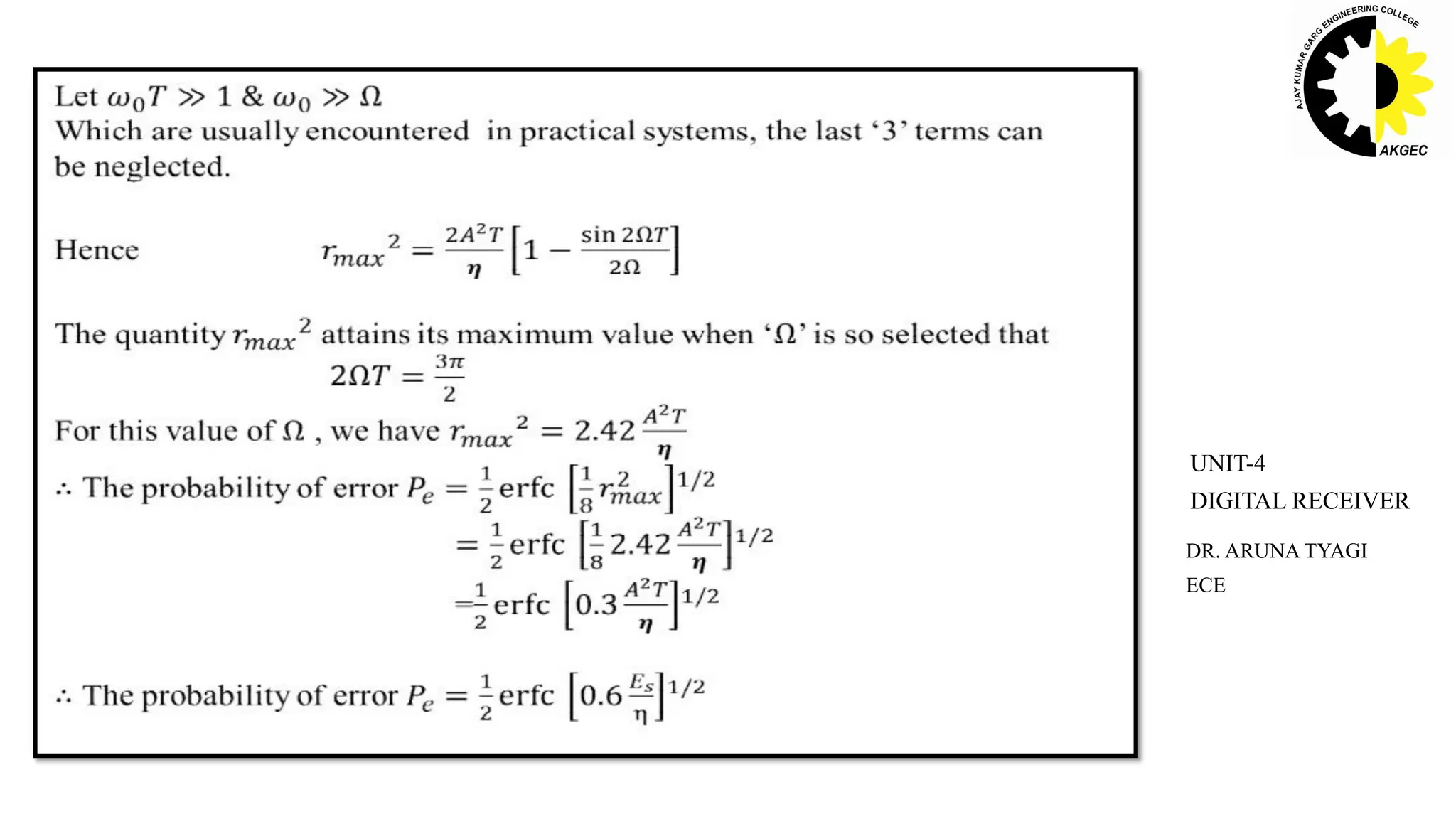
  • 74.
    •In a frequencyhop Spread Spectrum technique, the spectrum of data modulated carrier is widened by changing the carrier frequency in a pseudo – random manner. The carrier hops randomly form one frequency to another. • Since frequency hopping does not covers the entire spread spectrum instantaneously, we are led to consider the rate at which the hop occurs. •Depending upon this we have two types of frequency hop: •1. Slow frequency hopping:- In which the symbol rate Rs of the MFSK signal is an integer multiple of the hop rate Rh. That is several symbols are transmitted on each frequency hop. •2. Fast – Frequency hopping:- In which the hop rate Rh is an integral multiple of the MFSK symbol rate Rs. That is the carrier frequency will hop several times during the transmission of one symbol. •A common modulation format for frequency hopping system is that of M- ary frequency – shift – keying (MFSK). Frequency Hopping Spread Spectrum DR. ARUNA TYAGI ECE UNIT-4 DIGITAL RECEIVER
  • 75.
  • 76.
  • 77.
    Slow frequency hoppingFast frequency hopping In slow frequency hopping, multiple symbols are transmitted in one frequency hop. In fast frequency hopping, multiple hops are required to transmit one symbol. One or more symbols are transmitted over the same carrier frequency. One symbol is transmitted over multiple carriers in different hops. Symbol rate is equal to chip rate. Hop rate is higher than symbol rate. Hop rate is lower than symbol rate. Hop rate is higher than symbol rate. A jammer can detect this signal if carrier frequency in one hop is known. A jammer can’t detect this signal because one symbol is transmitted using more than one carrier frequencies. Slow and Fast FHSS: DR. ARUNA TYAGI ECE UNIT-4 DIGITAL RECEIVER
  • 78.
    FHSS TRANSMITTER DR. ARUNATYAGI ECE UNIT-4 DIGITAL RECEIVER
  • 79.
    •Fig Shows theblock diagram of an FH / MFSK transmitter, which involves frequency modulation followed by mixing. •The incoming binary data are applied to an M-ary FSK modulator. •The resulting modulated wave and the output from a digital frequency synthesizer are then applied to a mixer that consists of a multiplier followed by a band – pass filter. •The filter is designed to select the sum frequency component resulting from the multiplication process as the transmitted signal. •An ‘k’ bit segments of a PN sequence drive the frequency synthesizer, which enables the carrier frequency to hop over 2n distinct values. •Since frequency synthesizers are unable to maintain phase coherence over successive hops, most frequency hops spread spectrum communication system use non coherent M-ary modulation system.
  • 80.
    FHSS RECEIVER DR. ARUNATYAGI ECE UNIT-4 DIGITAL RECEIVER
  • 81.
    •In the receiverthe frequency hopping is first removed by mixing the received signal with the output of a local frequency synthesizer that is synchronized with the transmitter. •The resulting output is then band pass filtered and subsequently processed by a non coherent M-ary FSK demodulator. •To implement this M-ary detector, a bank of M non coherent matched filters, each of which is matched to one of the MFSK tones is used. •By selecting the largest filtered output, the original transmitted signal is estimated. DR. ARUNA TYAGI ECE UNIT-4 DIGITAL RECEIVER
  • 82.
    •Jamming intends todisable the legitimate transmission by. saturating the receiver with noise or false information through. deliberate radiation of radio signals, and thus significantly. decreases the signal-to-noise-plus-interference ratio (SNIR). •Jamming margin is the level or range of interference which a system can handle without affecting the specified level of performance. For example, maintaining a specific bit-error ratio despite the ratio of signal-to-noise is reducing. •In other words, it is defined as how much protection it can give to the system from jamming. Jamming in DSSS
  • 83.
    Probability of Error(Pe) for DSSS DR. ARUNA TYAGI ECE UNIT-4 DIGITAL RECEIVER
  • 85.
  • 86.
  • 87.
    •A pseudo randomsequence is generated using a feed back shift register of length m=4. The chip rate is 107 chips per second. Find the following •a) PN sequence length b) Chip duration of PN sequence c) PN sequence period •Solution: •a) Length of PN sequence N = 2m -1= 24 -1 =15 •b) Chip duration Tc = 1/chip rate =1/107 = 0.1µsec •c) PN sequence period T = NTc = 15 x 0.1µsec = 1.5µsec EXAMPLE 1: DR. ARUNA TYAGI ECE UNIT-4 DIGITAL RECEIVER
  • 88.
    •A direct sequencespread binary phase shift keying system uses a feedback shift register of length 19 for the generation of PN sequence. Calculate the processing gain of the system. •Solution •Given length of shift register = m =19 •Therefore length of PN sequence N = 2m - 1 = 219 - 1 •Processing gain PG = Tb/Tc =N in db =10log10 N = 10 log10 (219 ) = 57db EXAMPLE 2: DR. ARUNA TYAGI ECE UNIT-4 DIGITAL RECEIVER
  • 89.
    •A Spread spectrumcommunication system has the following parameters. Information bit duration Tb = 1.024 msecs and PN chip duration of 1µsecs. The average probability of error of system is not to exceed 10-5 calculate a) Length of shift register b) Processing gain c) Jamming margin EXAMPLE 3: DR. ARUNA TYAGI ECE UNIT-4 DIGITAL RECEIVER
  • 90.
    •Solution: •The number ofbits per MFSK symbol = 4 The number of MFSK symbols per hop = 5 •So, spreading is 5*4=20 •Processing Gain: 5*4=20 •20 log10 (20)=26dB Example 4: A slow FH/MFSK system has following parameters: (i) The number of bits per MFSK symbol = 4 (ii) The number of MFSK symbols per hop = 5 (iii) Calculate the processing gain of the system in decibels. DR. ARUNA TYAGI ECE UNIT-4 DIGITAL RECEIVER
  • 91.