Model Evaluation
• Metrics for Performance Evaluation
• How to evaluate the performance of a model?
• Methods for Performance Evaluation
• How to obtain reliable estimates?
• Methods for Model Comparison
• How to compare the relative performance among
competing models?
Model Evaluation
• Metrics for Performance Evaluation
• How to evaluate the performance of a model?
• Methods for Performance Evaluation
• How to obtain reliable estimates?
• Methods for Model Comparison
• How to compare the relative performance among
competing models?
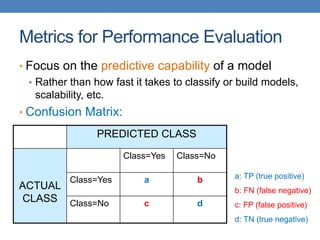
Metrics for Performance Evaluation
• Focus on the predictive capability of a model
• Rather than how fast it takes to classify or build models,
scalability, etc.
• Confusion Matrix:
PREDICTED CLASS
ACTUAL
CLASS
Class=Yes Class=No
Class=Yes a b
Class=No c d
a: TP (true positive)
b: FN (false negative)
c: FP (false positive)
d: TN (true negative)
Metrics for Performance Evaluation…
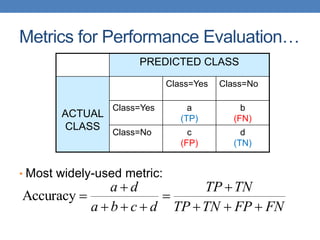
• Most widely-used metric:
PREDICTED CLASS
ACTUAL
CLASS
Class=Yes Class=No
Class=Yes a
(TP)
b
(FN)
Class=No c
(FP)
d
(TN)
FN
FP
TN
TP
TN
TP
d
c
b
a
d
a










Accuracy
Limitation of Accuracy
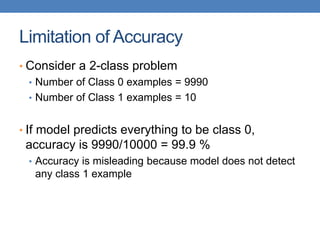
• Consider a 2-class problem
• Number of Class 0 examples = 9990
• Number of Class 1 examples = 10
• If model predicts everything to be class 0,
accuracy is 9990/10000 = 99.9 %
• Accuracy is misleading because model does not detect
any class 1 example
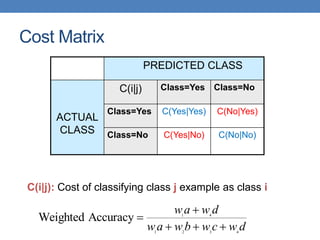
Cost Matrix
PREDICTED CLASS
ACTUAL
CLASS
C(i|j) Class=Yes Class=No
Class=Yes C(Yes|Yes) C(No|Yes)
Class=No C(Yes|No) C(No|No)
C(i|j): Cost of classifying class j example as class i
d
w
c
w
b
w
a
w
d
w
a
w
4
3
2
1
4
1
Accuracy
Weighted





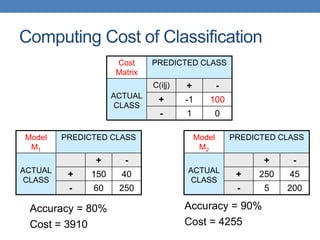
Computing Cost of Classification
Cost
Matrix
PREDICTED CLASS
ACTUAL
CLASS
C(i|j) + -
+ -1 100
- 1 0
Model
M1
PREDICTED CLASS
ACTUAL
CLASS
+ -
+ 150 40
- 60 250
Model
M2
PREDICTED CLASS
ACTUAL
CLASS
+ -
+ 250 45
- 5 200
Accuracy = 80%
Cost = 3910
Accuracy = 90%
Cost = 4255
Cost vs Accuracy
Count PREDICTED CLASS
ACTUAL
CLASS
Class=Yes Class=No
Class=Yes a b
Class=No c d
Cost PREDICTED CLASS
ACTUAL
CLASS
Class=Yes Class=No
Class=Yes p q
Class=No q p
N = a + b + c + d
Accuracy = (a + d)/N
Cost = p (a + d) + q (b + c)
= p (a + d) + q (N – a – d)
= q N – (q – p)(a + d)
= N [q – (q-p)  Accuracy]
Accuracy is proportional to cost if
1. C(Yes|No)=C(No|Yes) = q
2. C(Yes|Yes)=C(No|No) = p
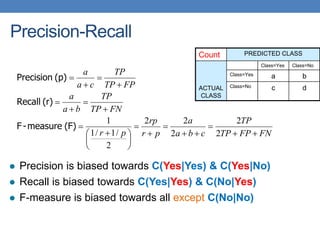
Precision-Recall
FN
FP
TP
TP
c
b
a
a
p
r
rp
p
r
FN
TP
TP
b
a
a
FP
TP
TP
c
a
a













 









2
2
2
2
2
2
/
1
/
1
1
(F)
measure
-
F
(r)
Recall
(p)
Precision
 Precision is biased towards C(Yes|Yes) & C(Yes|No)
 Recall is biased towards C(Yes|Yes) & C(No|Yes)
 F-measure is biased towards all except C(No|No)
Count PREDICTED CLASS
ACTUAL
CLASS
Class=Yes Class=No
Class=Yes a b
Class=No c d
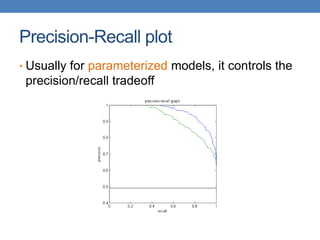
Precision-Recall plot
• Usually for parameterized models, it controls the
precision/recall tradeoff
Model Evaluation
• Metrics for Performance Evaluation
• How to evaluate the performance of a model?
• Methods for Performance Evaluation
• How to obtain reliable estimates?
• Methods for Model Comparison
• How to compare the relative performance among
competing models?
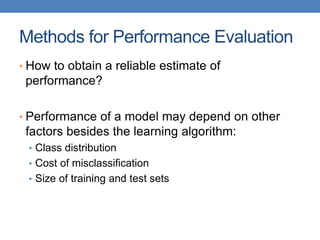
Methods for Performance Evaluation
• How to obtain a reliable estimate of
performance?
• Performance of a model may depend on other
factors besides the learning algorithm:
• Class distribution
• Cost of misclassification
• Size of training and test sets
Methods of Estimation
• Holdout
• Reserve 2/3 for training and 1/3 for testing
• Random subsampling
• One sample may be biased -- Repeated holdout
• Cross validation
• Partition data into k disjoint subsets
• k-fold: train on k-1 partitions, test on the remaining one
• Leave-one-out: k=n
• Guarantees that each record is used the same number of
times for training and testing
• Bootstrap
• Sampling with replacement
• ~63% of records used for training, ~27% for testing
Dealing with class Imbalance
• If the class we are interested in is very rare, then
the classifier will ignore it.
• The class imbalance problem
• Solution
• We can modify the optimization criterion by using a cost
sensitive metric
• We can balance the class distribution
• Sample from the larger class so that the size of the two classes
is the same
• Replicate the data of the class of interest so that the classes are
balanced
• Over-fitting issues
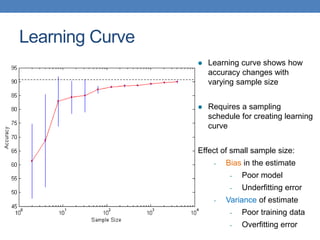
Learning Curve
 Learning curve shows how
accuracy changes with
varying sample size
 Requires a sampling
schedule for creating learning
curve
Effect of small sample size:
- Bias in the estimate
- Poor model
- Underfitting error
- Variance of estimate
- Poor training data
- Overfitting error
Model Evaluation
• Metrics for Performance Evaluation
• How to evaluate the performance of a model?
• Methods for Performance Evaluation
• How to obtain reliable estimates?
• Methods for Model Comparison
• How to compare the relative performance among
competing models?
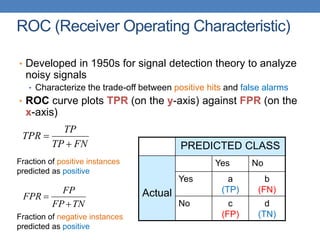
ROC (Receiver Operating Characteristic)
• Developed in 1950s for signal detection theory to analyze
noisy signals
• Characterize the trade-off between positive hits and false alarms
• ROC curve plots TPR (on the y-axis) against FPR (on the
x-axis)
FN
TP
TP
TPR


TN
FP
FP
FPR


PREDICTED CLASS
Actual
Yes No
Yes a
(TP)
b
(FN)
No c
(FP)
d
(TN)
Fraction of positive instances
predicted as positive
Fraction of negative instances
predicted as positive
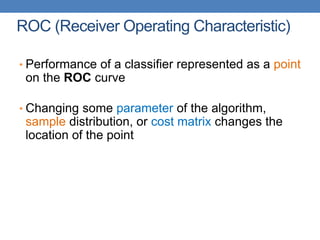
ROC (Receiver Operating Characteristic)
• Performance of a classifier represented as a point
on the ROC curve
• Changing some parameter of the algorithm,
sample distribution, or cost matrix changes the
location of the point
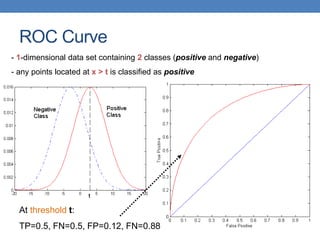
ROC Curve
At threshold t:
TP=0.5, FN=0.5, FP=0.12, FN=0.88
- 1-dimensional data set containing 2 classes (positive and negative)
- any points located at x > t is classified as positive
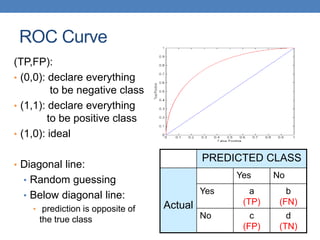
ROC Curve
(TP,FP):
• (0,0): declare everything
to be negative class
• (1,1): declare everything
to be positive class
• (1,0): ideal
• Diagonal line:
• Random guessing
• Below diagonal line:
• prediction is opposite of
the true class
PREDICTED CLASS
Actual
Yes No
Yes a
(TP)
b
(FN)
No c
(FP)
d
(TN)
Using ROC for Model Comparison
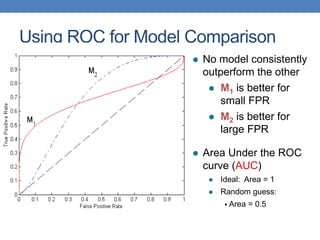
 No model consistently
outperform the other
 M1 is better for
small FPR
 M2 is better for
large FPR
 Area Under the ROC
curve (AUC)
 Ideal: Area = 1
 Random guess:
 Area = 0.5
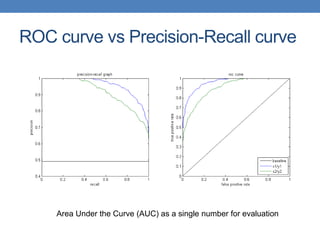
ROC curve vs Precision-Recall curve
Area Under the Curve (AUC) as a single number for evaluation

datamining-lect11.pptx

  • 1.
    Model Evaluation • Metricsfor Performance Evaluation • How to evaluate the performance of a model? • Methods for Performance Evaluation • How to obtain reliable estimates? • Methods for Model Comparison • How to compare the relative performance among competing models?
  • 2.
    Model Evaluation • Metricsfor Performance Evaluation • How to evaluate the performance of a model? • Methods for Performance Evaluation • How to obtain reliable estimates? • Methods for Model Comparison • How to compare the relative performance among competing models?
  • 3.
    Metrics for PerformanceEvaluation • Focus on the predictive capability of a model • Rather than how fast it takes to classify or build models, scalability, etc. • Confusion Matrix: PREDICTED CLASS ACTUAL CLASS Class=Yes Class=No Class=Yes a b Class=No c d a: TP (true positive) b: FN (false negative) c: FP (false positive) d: TN (true negative)
  • 4.
    Metrics for PerformanceEvaluation… • Most widely-used metric: PREDICTED CLASS ACTUAL CLASS Class=Yes Class=No Class=Yes a (TP) b (FN) Class=No c (FP) d (TN) FN FP TN TP TN TP d c b a d a           Accuracy
  • 5.
    Limitation of Accuracy •Consider a 2-class problem • Number of Class 0 examples = 9990 • Number of Class 1 examples = 10 • If model predicts everything to be class 0, accuracy is 9990/10000 = 99.9 % • Accuracy is misleading because model does not detect any class 1 example
  • 6.
    Cost Matrix PREDICTED CLASS ACTUAL CLASS C(i|j)Class=Yes Class=No Class=Yes C(Yes|Yes) C(No|Yes) Class=No C(Yes|No) C(No|No) C(i|j): Cost of classifying class j example as class i d w c w b w a w d w a w 4 3 2 1 4 1 Accuracy Weighted     
  • 7.
    Computing Cost ofClassification Cost Matrix PREDICTED CLASS ACTUAL CLASS C(i|j) + - + -1 100 - 1 0 Model M1 PREDICTED CLASS ACTUAL CLASS + - + 150 40 - 60 250 Model M2 PREDICTED CLASS ACTUAL CLASS + - + 250 45 - 5 200 Accuracy = 80% Cost = 3910 Accuracy = 90% Cost = 4255
  • 8.
    Cost vs Accuracy CountPREDICTED CLASS ACTUAL CLASS Class=Yes Class=No Class=Yes a b Class=No c d Cost PREDICTED CLASS ACTUAL CLASS Class=Yes Class=No Class=Yes p q Class=No q p N = a + b + c + d Accuracy = (a + d)/N Cost = p (a + d) + q (b + c) = p (a + d) + q (N – a – d) = q N – (q – p)(a + d) = N [q – (q-p)  Accuracy] Accuracy is proportional to cost if 1. C(Yes|No)=C(No|Yes) = q 2. C(Yes|Yes)=C(No|No) = p
  • 9.
    Precision-Recall FN FP TP TP c b a a p r rp p r FN TP TP b a a FP TP TP c a a                         2 2 2 2 2 2 / 1 / 1 1 (F) measure - F (r) Recall (p) Precision  Precisionis biased towards C(Yes|Yes) & C(Yes|No)  Recall is biased towards C(Yes|Yes) & C(No|Yes)  F-measure is biased towards all except C(No|No) Count PREDICTED CLASS ACTUAL CLASS Class=Yes Class=No Class=Yes a b Class=No c d
  • 10.
    Precision-Recall plot • Usuallyfor parameterized models, it controls the precision/recall tradeoff
  • 11.
    Model Evaluation • Metricsfor Performance Evaluation • How to evaluate the performance of a model? • Methods for Performance Evaluation • How to obtain reliable estimates? • Methods for Model Comparison • How to compare the relative performance among competing models?
  • 12.
    Methods for PerformanceEvaluation • How to obtain a reliable estimate of performance? • Performance of a model may depend on other factors besides the learning algorithm: • Class distribution • Cost of misclassification • Size of training and test sets
  • 13.
    Methods of Estimation •Holdout • Reserve 2/3 for training and 1/3 for testing • Random subsampling • One sample may be biased -- Repeated holdout • Cross validation • Partition data into k disjoint subsets • k-fold: train on k-1 partitions, test on the remaining one • Leave-one-out: k=n • Guarantees that each record is used the same number of times for training and testing • Bootstrap • Sampling with replacement • ~63% of records used for training, ~27% for testing
  • 14.
    Dealing with classImbalance • If the class we are interested in is very rare, then the classifier will ignore it. • The class imbalance problem • Solution • We can modify the optimization criterion by using a cost sensitive metric • We can balance the class distribution • Sample from the larger class so that the size of the two classes is the same • Replicate the data of the class of interest so that the classes are balanced • Over-fitting issues
  • 15.
    Learning Curve  Learningcurve shows how accuracy changes with varying sample size  Requires a sampling schedule for creating learning curve Effect of small sample size: - Bias in the estimate - Poor model - Underfitting error - Variance of estimate - Poor training data - Overfitting error
  • 16.
    Model Evaluation • Metricsfor Performance Evaluation • How to evaluate the performance of a model? • Methods for Performance Evaluation • How to obtain reliable estimates? • Methods for Model Comparison • How to compare the relative performance among competing models?
  • 17.
    ROC (Receiver OperatingCharacteristic) • Developed in 1950s for signal detection theory to analyze noisy signals • Characterize the trade-off between positive hits and false alarms • ROC curve plots TPR (on the y-axis) against FPR (on the x-axis) FN TP TP TPR   TN FP FP FPR   PREDICTED CLASS Actual Yes No Yes a (TP) b (FN) No c (FP) d (TN) Fraction of positive instances predicted as positive Fraction of negative instances predicted as positive
  • 18.
    ROC (Receiver OperatingCharacteristic) • Performance of a classifier represented as a point on the ROC curve • Changing some parameter of the algorithm, sample distribution, or cost matrix changes the location of the point
  • 19.
    ROC Curve At thresholdt: TP=0.5, FN=0.5, FP=0.12, FN=0.88 - 1-dimensional data set containing 2 classes (positive and negative) - any points located at x > t is classified as positive
  • 20.
    ROC Curve (TP,FP): • (0,0):declare everything to be negative class • (1,1): declare everything to be positive class • (1,0): ideal • Diagonal line: • Random guessing • Below diagonal line: • prediction is opposite of the true class PREDICTED CLASS Actual Yes No Yes a (TP) b (FN) No c (FP) d (TN)
  • 21.
    Using ROC forModel Comparison  No model consistently outperform the other  M1 is better for small FPR  M2 is better for large FPR  Area Under the ROC curve (AUC)  Ideal: Area = 1  Random guess:  Area = 0.5
  • 22.
    ROC curve vsPrecision-Recall curve Area Under the Curve (AUC) as a single number for evaluation