Data-informed blended learning design:March 2018
Pilot workshop
Image CC BY-NC-ND 2.0 iandolphin
Overview
» Morning – learning design
» 13.00 (approx) - Lunch
» Afternoon – using data to improve
learning design
» 16.00 - Close
Outline of the day
Image CC BY-SA 2.0 Aspire-edu
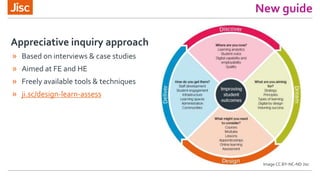
New guide
» Based on interviews & case studies
» Aimed at FE and HE
» Freely available tools & techniques
» ji.sc/design-learn-assess
Appreciative inquiry approach
Image CC BY-NC-ND Jisc
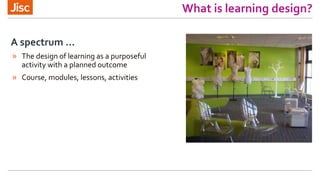
What is learning design?
» The design of learning as a purposeful
activity with a planned outcome
» Course, modules, lessons, activities
A spectrum …
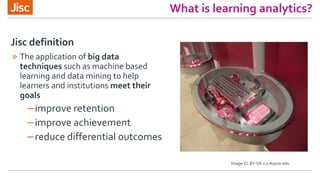
What is learning analytics?
» The application of big data
techniques such as machine based
learning and data mining to help
learners and institutions meet their
goals
–improve retention
–improve achievement
–reduce differential outcomes
Jisc definition
Image CC BY-SA 2.0 Aspire-edu
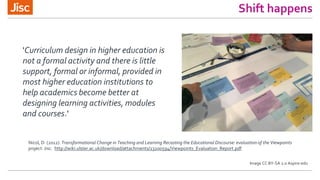
Shift happens
'Curriculum design in higher education is
not a formal activity and there is little
support, formal or informal, provided in
most higher education institutions to
help academics become better at
designing learning activities, modules
and courses.'
Nicol, D. (2012). Transformational Change in Teaching and Learning Recasting the Educational Discourse: evaluation of the Viewpoints
project. Jisc. http://wiki.ulster.ac.uk/download/attachments/23200594/Viewpoints_Evaluation_Report.pdf
Image CC BY-SA 2.0 Aspire-edu
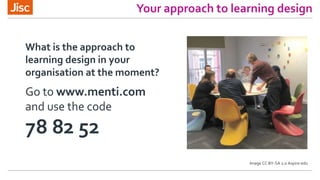
Your approach to learning design
What is the approach to
learning design in your
organisation at the moment?
Go to www.menti.com
and use the code
78 82 52
Image CC BY-SA 2.0 Aspire-edu
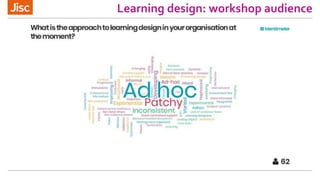
Learning design: workshop audience
Your use of data
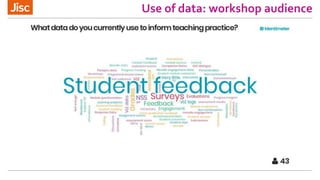
What data do you
currently use to inform
teaching practice?
Go to www.menti.com
and use the code
89 93 79
Image CC BY-SA 2.0 Aspire-edu
Use of data: workshop audience
Time for aTrojan horse
» Support for learning design is often ad hoc
rather than strategic
» Various types of learning analytics but
little focus on curriculum as yet
» Buzzword bingo! Digital strategy; Blended
learning; Learning analytics; Dashboards;
Big data!
» Need to relate data to day-to-day
learning and teaching practice
Data-informed learning design
Image CC BY-NC-ND 2.0 emmapatsie
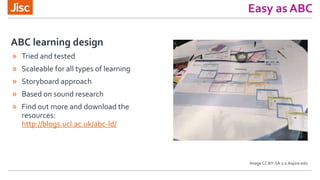
» Tried and tested
» Scaleable for all types of learning
» Storyboard approach
» Based on sound research
» Find out more and download the
resources:
http://blogs.ucl.ac.uk/abc-ld/
ABC learning design
Easy as ABC
Image CC BY-SA 2.0 Aspire-edu
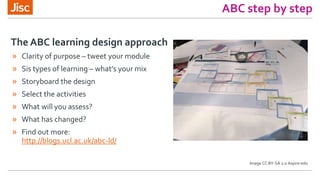
» Clarity of purpose – tweet your module
» Sis types of learning – what’s your mix
» Storyboard the design
» Select the activities
» What will you assess?
» What has changed?
» Find out more:
http://blogs.ucl.ac.uk/abc-ld/
The ABC learning design approach
ABC step by step
Image CC BY-SA 2.0 Aspire-edu
Lunch break
Image CC BY-NC 2.0 motivational pasta
Now that you have a design
what might impact how it
works in practice ?
Design and fit
Image CC BY-SA 2.0 Aspire-edu
Now that you have a design what
might impact how it works in
practice ?
Design and fit
Image CC BY-SA 2.0 Aspire-edu
» Teaching
» Student capabilities
» Student behaviour
» Course level factors
» Assessment
» External factors
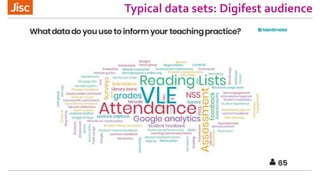
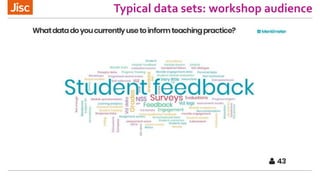
What data can help you tell how things
are working?
Typical data sets: Digifest audience
Typical data sets: workshop audience
Why don’t you make full
use of available data?
And so ...
Image CC BY-NC 2.0 motivational pasta
» What do you really want to know?
» Fit with academic practice
» Link to threshold concepts
» Link to self-study activities
» Is there a ‘critical path’ through the
learning?
» Answering specific questions not looking
for patterns
What data is most useful?
Designing in data ‘hooks’
Image CC BY-NC-ND 2.0 ian dolphin
Activity
Using the example you created
» What questions should we be asking about the effectiveness of the learning
design?
» What data should we collect to help answer these questions?
» Can you amend the design to help this process?
» Digital in the blend to give a data footprint
» In-flight vs post hoc interventions
» Can we identify a critical path?
» Appropriate level of granularity?
» From engagement to attainment
Data & design considerations
Art or science?
Image CC BY 2.0 kent schimke
Using data to explore learning design
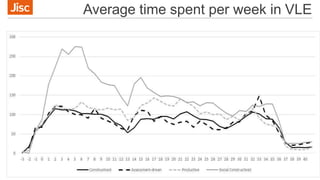
»Open University study into
impact of learning design
»Learning design data
»Student feedback
»Student records
»VLE logs
»140-300 modules, taken by
over 100,000 students.
10/09/2015 Moving from electronic management of assessment challenges to solutions
Average time spent per week in VLE
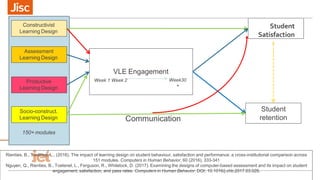
Constructivist
Learning Design
Assessment
Learning Design
Productive
Learning Design
Socio-construct.
Learning Design
Student
Satisfaction
Student
retention
150+ modules
VLE Engagement
Week 1 Week 2 Week30
+
Rienties, B., Toetenel, L., (2016). The impact of learning design on student behaviour, satisfaction and performance: a cross-institutional comparison across
151 modules. Computers in Human Behavior, 60 (2016), 333-341
Nguyen, Q., Rienties, B., Toetenel, L., Ferguson, R., Whitelock, D. (2017). Examining the designs of computer-based assessment and its impact on student
engagement, satisfaction, and pass rates. Computers in Human Behavior. DOI: 10.1016/j.chb.2017.03.028.
Communication
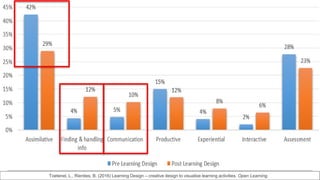
Toetenel, L., Rienties, B. (2016) Learning Design – creative design to visualise learning activities. Open Learning.
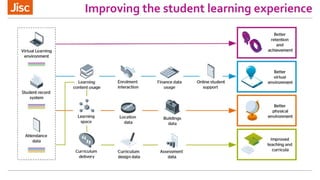
Improving the student learning experience
Recommendations
» Individual tutors/Module leads
» Course/Programme leads
» Dept/Faculty/Institution
» Staff developers
» Any other roles …
Ideas to be taken forward by ...
Image CC BY-SA 2.0 jiscinfonet
Next steps
» What do you most want to know about
your learners?
» What’s the most important data source
that you don’t currently have?
» What kinds of support do you need?
How can Jisc help
Image CC BY-SA 2.0 Aspire-edu
» Designing learning and assessment in a digital age ji.sc/design-learn-assess
» Jisc learning analytics project
https://www.jisc.ac.uk/rd/projects/effective-learning-analytics
» Student experience blog https://elearning.jiscinvolve.org
» Learning design network https://sites.google.com/site/learningdesignsig/home
Key resources
Further information
Contact us
Sam Ahern
s.ahern@ucl.ac.uk
Gill Ferrell
gill@aspire-edu.org
Patrick Lynch
p.lynch@hull.ac.uk
Nataša Perović
n.perovic@ucl.ac.uk
CliveYoung
c.p.l.young@ucl.ac.uk
jisc.ac.uk
Except where otherwise noted, this work
is licensed under CC-BY-NC-ND
Talk to Jisc…
Contact
Sarah Knight
Head of change
Student Experience
sarah.knight@jisc.ac.uk

Data-informed blended learning design

  • 1.
    Data-informed blended learningdesign:March 2018 Pilot workshop Image CC BY-NC-ND 2.0 iandolphin
  • 2.
    Overview » Morning –learning design » 13.00 (approx) - Lunch » Afternoon – using data to improve learning design » 16.00 - Close Outline of the day Image CC BY-SA 2.0 Aspire-edu
  • 3.
    New guide » Basedon interviews & case studies » Aimed at FE and HE » Freely available tools & techniques » ji.sc/design-learn-assess Appreciative inquiry approach Image CC BY-NC-ND Jisc
  • 4.
    What is learningdesign? » The design of learning as a purposeful activity with a planned outcome » Course, modules, lessons, activities A spectrum …
  • 5.
    What is learninganalytics? » The application of big data techniques such as machine based learning and data mining to help learners and institutions meet their goals –improve retention –improve achievement –reduce differential outcomes Jisc definition Image CC BY-SA 2.0 Aspire-edu
  • 6.
    Shift happens 'Curriculum designin higher education is not a formal activity and there is little support, formal or informal, provided in most higher education institutions to help academics become better at designing learning activities, modules and courses.' Nicol, D. (2012). Transformational Change in Teaching and Learning Recasting the Educational Discourse: evaluation of the Viewpoints project. Jisc. http://wiki.ulster.ac.uk/download/attachments/23200594/Viewpoints_Evaluation_Report.pdf Image CC BY-SA 2.0 Aspire-edu
  • 8.
    Your approach tolearning design What is the approach to learning design in your organisation at the moment? Go to www.menti.com and use the code 78 82 52 Image CC BY-SA 2.0 Aspire-edu
  • 9.
  • 10.
    Your use ofdata What data do you currently use to inform teaching practice? Go to www.menti.com and use the code 89 93 79 Image CC BY-SA 2.0 Aspire-edu
  • 11.
    Use of data:workshop audience
  • 12.
    Time for aTrojanhorse » Support for learning design is often ad hoc rather than strategic » Various types of learning analytics but little focus on curriculum as yet » Buzzword bingo! Digital strategy; Blended learning; Learning analytics; Dashboards; Big data! » Need to relate data to day-to-day learning and teaching practice Data-informed learning design Image CC BY-NC-ND 2.0 emmapatsie
  • 13.
    » Tried andtested » Scaleable for all types of learning » Storyboard approach » Based on sound research » Find out more and download the resources: http://blogs.ucl.ac.uk/abc-ld/ ABC learning design Easy as ABC Image CC BY-SA 2.0 Aspire-edu
  • 14.
    » Clarity ofpurpose – tweet your module » Sis types of learning – what’s your mix » Storyboard the design » Select the activities » What will you assess? » What has changed? » Find out more: http://blogs.ucl.ac.uk/abc-ld/ The ABC learning design approach ABC step by step Image CC BY-SA 2.0 Aspire-edu
  • 15.
    Lunch break Image CCBY-NC 2.0 motivational pasta
  • 16.
    Now that youhave a design what might impact how it works in practice ? Design and fit Image CC BY-SA 2.0 Aspire-edu
  • 17.
    Now that youhave a design what might impact how it works in practice ? Design and fit Image CC BY-SA 2.0 Aspire-edu » Teaching » Student capabilities » Student behaviour » Course level factors » Assessment » External factors What data can help you tell how things are working?
  • 18.
    Typical data sets:Digifest audience
  • 19.
    Typical data sets:workshop audience
  • 20.
    Why don’t youmake full use of available data? And so ... Image CC BY-NC 2.0 motivational pasta
  • 21.
    » What doyou really want to know? » Fit with academic practice » Link to threshold concepts » Link to self-study activities » Is there a ‘critical path’ through the learning? » Answering specific questions not looking for patterns What data is most useful? Designing in data ‘hooks’ Image CC BY-NC-ND 2.0 ian dolphin
  • 22.
    Activity Using the exampleyou created » What questions should we be asking about the effectiveness of the learning design? » What data should we collect to help answer these questions? » Can you amend the design to help this process?
  • 23.
    » Digital inthe blend to give a data footprint » In-flight vs post hoc interventions » Can we identify a critical path? » Appropriate level of granularity? » From engagement to attainment Data & design considerations Art or science? Image CC BY 2.0 kent schimke
  • 24.
    Using data toexplore learning design »Open University study into impact of learning design »Learning design data »Student feedback »Student records »VLE logs »140-300 modules, taken by over 100,000 students. 10/09/2015 Moving from electronic management of assessment challenges to solutions
  • 25.
    Average time spentper week in VLE
  • 26.
    Constructivist Learning Design Assessment Learning Design Productive LearningDesign Socio-construct. Learning Design Student Satisfaction Student retention 150+ modules VLE Engagement Week 1 Week 2 Week30 + Rienties, B., Toetenel, L., (2016). The impact of learning design on student behaviour, satisfaction and performance: a cross-institutional comparison across 151 modules. Computers in Human Behavior, 60 (2016), 333-341 Nguyen, Q., Rienties, B., Toetenel, L., Ferguson, R., Whitelock, D. (2017). Examining the designs of computer-based assessment and its impact on student engagement, satisfaction, and pass rates. Computers in Human Behavior. DOI: 10.1016/j.chb.2017.03.028. Communication
  • 27.
    Toetenel, L., Rienties,B. (2016) Learning Design – creative design to visualise learning activities. Open Learning.
  • 28.
    Improving the studentlearning experience
  • 29.
    Recommendations » Individual tutors/Moduleleads » Course/Programme leads » Dept/Faculty/Institution » Staff developers » Any other roles … Ideas to be taken forward by ... Image CC BY-SA 2.0 jiscinfonet
  • 30.
    Next steps » Whatdo you most want to know about your learners? » What’s the most important data source that you don’t currently have? » What kinds of support do you need? How can Jisc help Image CC BY-SA 2.0 Aspire-edu
  • 31.
    » Designing learningand assessment in a digital age ji.sc/design-learn-assess » Jisc learning analytics project https://www.jisc.ac.uk/rd/projects/effective-learning-analytics » Student experience blog https://elearning.jiscinvolve.org » Learning design network https://sites.google.com/site/learningdesignsig/home Key resources Further information
  • 32.
    Contact us Sam Ahern s.ahern@ucl.ac.uk GillFerrell gill@aspire-edu.org Patrick Lynch p.lynch@hull.ac.uk Nataša Perović n.perovic@ucl.ac.uk CliveYoung c.p.l.young@ucl.ac.uk
  • 33.
    jisc.ac.uk Except where otherwisenoted, this work is licensed under CC-BY-NC-ND Talk to Jisc… Contact Sarah Knight Head of change Student Experience sarah.knight@jisc.ac.uk

Editor's Notes

  • #9 May or may not use but could be interesting to compare the 2 days.
  • #11 May or may not use but could be interesting to compare the 2 days (& Digifest).
  • #27 Summarise findings from converted presentation. Aspects of learning design negatively correlated with student satisfaction: finding information, productive, assessment. Interactive (using info in simulated settings) +ve predicted satisfaction More communicative activities led to higher VLE engagement (more engagement per visit) More communicative activities predicts better student completion – retention.
  • #28 Assimilative – attending to information – read, watch, listen Finding and handling information – searching for and processing information – list, analyse, plot, assess, select, manipulate Communication – discussing module-related content with at least one other person (student or tutor). Productive – actively construct an artefact (including written work) Experiential – apply learning in real-world setting Interactive – apply learning in simulated setting Assessment – all forms of assessment