


Data Warehouse and OLAP Technology
What is a Data Ware House?Data warehousing provides architectures and tools for business executives to systematically organize, understand, and use their data to make strategic decisions.
Difference between data warehouses and other data repository systemsSubject-oriented: A data warehouse is organized around major subjects, such as customer,supplier, product, and sales.Integrated: A data warehouse is usually constructed by integrating multiple heterogeneoussources, such as relational databases, flat files, and on-line transaction records.Time-variant: Data are stored to provide information from a historical perspective(e.g., the past 5–10 years).Nonvolatile: A data warehouse is always a physically separate store of data transformed from
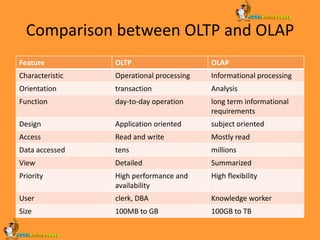
Differences between Database Systems Operational Data Warehouses The major task of on-line operational database systems is to perform on-line transaction and query processing. These systems are called on-line transaction processing (OLTP) systems.Data warehouse systems serve users or knowledge workers in the role of data analysis and decision making. Such systems can organize and present data in various formats in order to accommodate the diverse needs of the different users. These systems are known as on-line analytical processing (OLAP) systems.
Comparison between OLTP and OLAP
A Multidimensional Data ModelTables and Spreadsheets to Data Cubes, Stars, Snowflakes, and Fact Constellations are example for Multidimensional Databases
OLAP Operations in the Multidimensional Data ModelOLAP provides a user-friendly environment for interactive data analysis.Roll-up: The roll-up operation (also called the drill-up operation by some vendors)performs aggregation on a data cube, either by climbing up a concept hierarchy fora dimension or by dimension reduction.Drill-down: Drill-down is the reverse of roll-up. It navigates from less detailed data to more detailed dataSlice and dice: The slice operation performs a selection on one dimension of thegiven cube, resulting in a sub cube.Pivot (rotate): Pivot (also called rotate) is a visualization operation that rotates the data axes in view in order to provide an alternative presentation of the data.
Steps for the Design and Construction of Data WarehousesThe Design of a Data Warehouse: A Business Analysis FrameworkThe Process of Data Warehouse DesignA Three-Tier Data Warehouse Architecture designBuilding of Data Warehouse Back-End Tools and UtilitiesBuilding a Metadata Repository
Different applications of data warehouseInformation processing supports querying, basic statistical analysis, and reporting using crosstabs, tables, charts, or graphsAnalytical processing supports basic OLAP operations, including slice-and-dice, drill-down, roll-up, and pivoting.Data mining supports knowledge discovery by finding hidden patterns and associations, constructing analytical models, performing classification and prediction, and presenting the mining results using visualization tools.
Efficient Processing of OLAP Queries Determine which operations should be performed on the available cuboidsDetermine to which materialized cuboid(s) the relevant operations should be applied
On-Line Analytical MiningOn-line analytical mining (OLAM) (also called OLAP mining) integrates on-line analytical processing (OLAP) with data mining and mining knowledge in multidimensional databases. Among the many different paradigms and architectures of data mining systems
Importance of OLAMHigh quality of data in data warehousesAvailable information processing infrastructure surrounding data warehousesOLAP-based exploratory data analysisOn-line selection of data mining functions
Visit more self help tutorialsPick a tutorial of your choice and browse through it at your own pace.The tutorials section is free, self-guiding and will not involve any additional support.Visit us at www.dataminingtools.net

Data warehouse and olap technology

  • 1.
    Data Warehouse andOLAP Technology
  • 2.
    What is aData Ware House?Data warehousing provides architectures and tools for business executives to systematically organize, understand, and use their data to make strategic decisions.
  • 3.
    Difference between datawarehouses and other data repository systemsSubject-oriented: A data warehouse is organized around major subjects, such as customer,supplier, product, and sales.Integrated: A data warehouse is usually constructed by integrating multiple heterogeneoussources, such as relational databases, flat files, and on-line transaction records.Time-variant: Data are stored to provide information from a historical perspective(e.g., the past 5–10 years).Nonvolatile: A data warehouse is always a physically separate store of data transformed from
  • 4.
    Differences between DatabaseSystems Operational Data Warehouses The major task of on-line operational database systems is to perform on-line transaction and query processing. These systems are called on-line transaction processing (OLTP) systems.Data warehouse systems serve users or knowledge workers in the role of data analysis and decision making. Such systems can organize and present data in various formats in order to accommodate the diverse needs of the different users. These systems are known as on-line analytical processing (OLAP) systems.
  • 5.
  • 6.
    A Multidimensional DataModelTables and Spreadsheets to Data Cubes, Stars, Snowflakes, and Fact Constellations are example for Multidimensional Databases
  • 7.
    OLAP Operations inthe Multidimensional Data ModelOLAP provides a user-friendly environment for interactive data analysis.Roll-up: The roll-up operation (also called the drill-up operation by some vendors)performs aggregation on a data cube, either by climbing up a concept hierarchy fora dimension or by dimension reduction.Drill-down: Drill-down is the reverse of roll-up. It navigates from less detailed data to more detailed dataSlice and dice: The slice operation performs a selection on one dimension of thegiven cube, resulting in a sub cube.Pivot (rotate): Pivot (also called rotate) is a visualization operation that rotates the data axes in view in order to provide an alternative presentation of the data.
  • 8.
    Steps for theDesign and Construction of Data WarehousesThe Design of a Data Warehouse: A Business Analysis FrameworkThe Process of Data Warehouse DesignA Three-Tier Data Warehouse Architecture designBuilding of Data Warehouse Back-End Tools and UtilitiesBuilding a Metadata Repository
  • 9.
    Different applications ofdata warehouseInformation processing supports querying, basic statistical analysis, and reporting using crosstabs, tables, charts, or graphsAnalytical processing supports basic OLAP operations, including slice-and-dice, drill-down, roll-up, and pivoting.Data mining supports knowledge discovery by finding hidden patterns and associations, constructing analytical models, performing classification and prediction, and presenting the mining results using visualization tools.
  • 10.
    Efficient Processing ofOLAP Queries Determine which operations should be performed on the available cuboidsDetermine to which materialized cuboid(s) the relevant operations should be applied
  • 11.
    On-Line Analytical MiningOn-lineanalytical mining (OLAM) (also called OLAP mining) integrates on-line analytical processing (OLAP) with data mining and mining knowledge in multidimensional databases. Among the many different paradigms and architectures of data mining systems
  • 12.
    Importance of OLAMHighquality of data in data warehousesAvailable information processing infrastructure surrounding data warehousesOLAP-based exploratory data analysisOn-line selection of data mining functions
  • 13.
    Visit more selfhelp tutorialsPick a tutorial of your choice and browse through it at your own pace.The tutorials section is free, self-guiding and will not involve any additional support.Visit us at www.dataminingtools.net