
PROJECT REPORT ON
DATA WAREHOUSING
SUBMITTED BY:
SANA ALVI
(24)
TABLE OF CONTENTS:
 ABSTRACT OF DATA WAREHOUSING
 INTRODUCTION OF DATA WAREHOUSING
 BACKGROUND OF DATA WAREHOUSING
 ARCHITECTURE OF DATA WAREHOUSING
 ADVANTAGES OF DATA WAREHOUSING
 CONCLUSION
 REFRENCES
ABSTRACT
 Presently, large enterprises rely on database systems
to manage their data and information. These
databases are useful for conducting daily business
transactions. However, the tight competition in the
marketplace has led to the concept of data mining in
which data are analyzed to derive effective business
strategies and discover better ways in carrying out
business. In order to perform data mining, regular
databases must be converted into what so called
informational databases also known as data
warehouse. Data warehouse is used for transforming
an operational database into an informational
warehouse useful for decision makers to conduct
data analysis, predication, and forecasting.
 A data warehouse can be thought of as a place the
information systems department puts the data that is
to be turned into information. Data warehouses are
information repositories specialized in supporting
decision making. It is used for transforming an
operational database into an informational
warehouse useful for decision makers to conduct
data analysis, predication, and forecasting.
INTRODUCTION
 Nowadays, almost every enterprise uses a database to
store its vital data and information (Pant, May 21–24,
1995,).For instance, dynamic websites, accounting
information systems, payroll systems; stock management
systems all rely on internal databases as a container to
store and manage their data. The competition in the
marketplace has led business managers and directors to
seek a new way to increase their profit and market power,
and that by improving their decision making processes. In
this sense, the idea of data warehouse and data mining
was born (Zhu & Davidson, 2007).
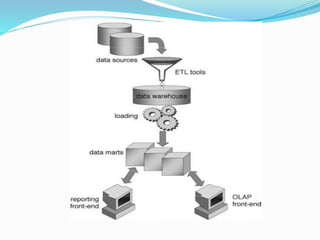
 Data warehousing is the process of collecting data from
operational functional databases, transforming, and then
archiving them into special data repository called data
warehouse with the goal of producing accurate and
timely management information (Preeti S. S. R., 2011);
whereas, Data mining is the process of discovering trends
and patterns from data warehouse, useful to carry out
data analysis (Kantardzic M. , 2003.)
 A typical university often comprises a lot of
subsystems crucial for its internal processes and
operations. Examples of such subsystems include the
student registration system, the payroll system, the
accounting system, the course management system,
the staff system, and many others. In essence, all these
systems are connected to many underlying distributed
databases that are employed for every day transactions
and processes.
Background of Data Warehouse
 Operational Database: An operational database is a
regular database meant to run the business on a
current basis and support everyday transactions and
processes (W. H. Inmon, 1992.).
 Informational Database: An informational database
is a special type of database that is designed to support
decision making based on historical point-in-time and
prediction data for complex queries and data mining
applications. A data warehouse is an example of
informational database.
 Data Mining: In its broader sense, it is a knowledge
discovery process that uses a blend of statistical,
machine learning, and artificial intelligence
techniques to detect trends and patterns from large
data-sets, often represented as data warehouse. The
purpose of data mining is to discover news facts about
data helpful for decision makers (Tan, Steinbach, &
Kumar, 2005).
ARCHITECTURE OF DATA
WAREHOUSING
 The warehouse architecture may include:
 (Mumick, Gupta, & IS, 18, June 1995)
 • Process Architecture
 • Data Model architecture
 • Technology Architecture
 • Information Architecture
 • Resource Architecture
ADVANTAGES OF DATA
WAREHOUSING
 Integrating data from multiple sources;
 Performing new types of analyses; and
 Reducing cost to access historical data.
 Standardizing data across the organization, a "single
version of the truth";
 Improving turnaround time for analysis and reporting;
 Sharing data and allowing others to easily access data;
 Supporting ad hoc reporting and inquiry;
 Reducing the development burden on IS/IT; and
 Removing informational processing load from
transaction-oriented databases;
CONCLUSION
 Data warehouse is a collection of wide variety of
corporate data that is organised and made available to
the end users for decision-making purposes .DW is
used by managers and knowledge workers who require
access to this data for analysing the business and
planning its future. Data warehouses have come into
use because of high capacity mass storage. Data
warehousing is the leading and most reliable
technology used today by companies for planning,
forecasting, and management for e.g. resource
planning, financial forecasting and control etc.

 Data warehouses need a lot more maintenance and a
support team of qualified professionals is needed to
take care of the issues that arise after its deployment
including data extraction, data loading, network
management, training and communication, query
management and some other related tasks.
REFRENCES
 A, G., & Mumick, I. S. (1995, June). Techniques and Applications. Maintenance
of Materialized Views, 18(2), 18-24.
 Anahory, S., & Murray, D. (1997). Data Warehousing in the Real World: A
Practical Guide for Building Decision Support Systems. Addison Wesley
Professional.
 Chatziantoniou, D., & Ross, K. (2000). Querying Multiple Features . VLDB (pp.
11-22). Wiley.
 Chen, B., Chen, L., Lin, Y., & Ramakrishnan. (2005). Prediction cubes., (pp.
pages 982–993).
 Cube, G. J. (1997). Generalizing Group-by, Cross-Tab and Sub Totals. A
Relational Aggregation Operator, 1, 1.
 Devlin, & Murphy, P. T. (1988). An architecture for a business and information
system. IBM Systems Journal, 27(1), 27-55.
 Hackney, D. (1997). Understanding and Implementing Successful Data Marts.
Addison-Wesley.
 Husemann, B., Lechtenborger, J., & Vossen, G. (2000). Conceptual data
warehouse., (pp. 22-30). Stockholm.
 Inmon. (1992). W.H. Building the Data Warehouse. John Wiley.
 Inmon, & W, H. (1991). Third Wave Processing: Database Machines and
Decision Support System. Canada: ACM.
 Inmon. (1992). W.H. Building the Data Warehouse. John Wiley.
 Inmon, & W, H. (1991). Third Wave Processing: Database Machines and
Decision Support System. Canada: ACM.
 Inmon, & W, H. (1995). What is a Data Warehouse? Prism, 1(1), 50-62.
 Inmon, & William. (1999). Building the Operational Data Store. London:
John Wiley & Sons.
 Inmon, W., Imhoff, C., & Sousa. (2001). Corporate Information Factory.
 J, W. (1995). Research Problems in Data Warehousing. CIKM.
 Jeffrey, A. H., Prescott, M., & Heikki, T. (2008). Modern Database
Management. Prentice Hall.
 Kantardzic, & Mehmed. (2003). Data Mining: Concepts, Models,
Methods, and Algorithms. London: John Wiley & Sons.
 Kantardzic, M. (2011). Data Mining: Concepts, Models, Methods,. John
Wiley & Sons.
 Kimball, R. (1996). The Data Warehouse Toolkit. Wiley Computer
Publishing.
 Kimball, R. (2000). Backward in Time. Intelligent Enterprise Magazine,
3-15.
 Laberge, R. (2011.). The Data Warehouse Mentor: Practical Data
Warehouse and Business Intelligence . Osborne Media: McGraw-
Hill.
 Lehner, W., Albrecht, J., & Wedekind, H. (1998). Normal forms for
multidimensional. International Conference on Scientific and
Statistical (pp. 63-72). Capri: ACM.
 Malvestuto, & F, M. (1988). Existence of extensions and product
extensions for discrete. Discrete Mathematics, 61–77.
 Malvestuto., F. (1988.). Existence of extensions and product
extensions for discrete. 69:61–77,.
 Mendelzon, & Hurtado, C. (2004). OLAP.
 Mertz, & Kimbal, R. (2000). The Data Webhouse Toolkit: Building
the Web-Enabled. John Wiley & Sons (pp. 20-43). Chichester:
Wiley.
 Michael, G., & Gruenwald, L. (1999, June 23). A Survey of Data
Mining and Knowledge Discovery Software Tools. 1, pp. 20-33.
Chicago: ACM.
 Microsoft Access Home Page. (n.d.). Retrieved from
http://office.microsoft.com/en-us/access/default.aspx
 Mumick, & Gupta. (18 June 1995). Maintenance of materialized views:
Problems.
 Mumick, Gupta, A., & S, I. (1995). Maintenance of materialized views:
Problems. IEEE Data Engineering Bulletin, 8(2), 18.
 Pant, S., & Hsu, C. (1995). Strategic Information Systems Planning: A
Review. Information Resources Management Association, (pp. 21-24).
Atlanta.
 Power, D. (2000). What are the advantages and disadvantages of Data
Warehouses? DSS news, 1(7), 1-22.
 Preeti, S., Srikantha, R., & Suryakant, P. (2011). Optimization of Data
Warehousing System: Simplification in Reporting and Analysis. 9, pp.
33-37. International Journal of Computer Applications.
 Rizzi, Matteo, G., & Stefano. (2009). Data Warehouse Design: Modern
Principles and Methodologies. New York: McGraw-Hill Osborne.
 S, H. P. (1995). Strategic Information Systems Planning: A Review.
Information Resources Management Association, (pp. 21-24). Atlanta.
 Sagiv, Y. (1983, January 9). A characterization of globally consistent
databases and their access. 266–286.
 Sagiv., Y. (1991.). Evaluation of queries in independent
database schemes., (pp. 38:120–161,).
 Sen, A., & Sinha, A. P. (2005). A Comparison of Data
warehousing. ACM, 79-84.
 Stephen, R. (1998). Building the Data Warehouse.
 Tan, Pang, N., Steinbach, M., & Kumar, V. (2005).
Introduction to Data Mining. New York: Addison Wesley.
 W, H., & Inmon. (1992). Building the Data Warehouse,. New
York: John canned SQL and Wiley.
 Zhu, X., & Davidson, I. (2007). Knowledge Discovery and
Data Mining: Challenges and Realities. New York.
 Zhu, X., Davidson, & Ian. (2007). Knowledge Discovery and
Data Mining: Challenges and Realities. (pp. 30-41). New York:
Hershey.
Data Warehouse

Data Warehouse

  • 1.
    PROJECT REPORT ON DATAWAREHOUSING SUBMITTED BY: SANA ALVI (24)
  • 2.
    TABLE OF CONTENTS: ABSTRACT OF DATA WAREHOUSING  INTRODUCTION OF DATA WAREHOUSING  BACKGROUND OF DATA WAREHOUSING  ARCHITECTURE OF DATA WAREHOUSING  ADVANTAGES OF DATA WAREHOUSING  CONCLUSION  REFRENCES
  • 3.
    ABSTRACT  Presently, largeenterprises rely on database systems to manage their data and information. These databases are useful for conducting daily business transactions. However, the tight competition in the marketplace has led to the concept of data mining in which data are analyzed to derive effective business strategies and discover better ways in carrying out business. In order to perform data mining, regular databases must be converted into what so called informational databases also known as data warehouse. Data warehouse is used for transforming an operational database into an informational warehouse useful for decision makers to conduct data analysis, predication, and forecasting.
  • 4.
     A datawarehouse can be thought of as a place the information systems department puts the data that is to be turned into information. Data warehouses are information repositories specialized in supporting decision making. It is used for transforming an operational database into an informational warehouse useful for decision makers to conduct data analysis, predication, and forecasting.
  • 5.
    INTRODUCTION  Nowadays, almostevery enterprise uses a database to store its vital data and information (Pant, May 21–24, 1995,).For instance, dynamic websites, accounting information systems, payroll systems; stock management systems all rely on internal databases as a container to store and manage their data. The competition in the marketplace has led business managers and directors to seek a new way to increase their profit and market power, and that by improving their decision making processes. In this sense, the idea of data warehouse and data mining was born (Zhu & Davidson, 2007).
  • 6.
     Data warehousingis the process of collecting data from operational functional databases, transforming, and then archiving them into special data repository called data warehouse with the goal of producing accurate and timely management information (Preeti S. S. R., 2011); whereas, Data mining is the process of discovering trends and patterns from data warehouse, useful to carry out data analysis (Kantardzic M. , 2003.)
  • 7.
     A typicaluniversity often comprises a lot of subsystems crucial for its internal processes and operations. Examples of such subsystems include the student registration system, the payroll system, the accounting system, the course management system, the staff system, and many others. In essence, all these systems are connected to many underlying distributed databases that are employed for every day transactions and processes.
  • 8.
    Background of DataWarehouse  Operational Database: An operational database is a regular database meant to run the business on a current basis and support everyday transactions and processes (W. H. Inmon, 1992.).  Informational Database: An informational database is a special type of database that is designed to support decision making based on historical point-in-time and prediction data for complex queries and data mining applications. A data warehouse is an example of informational database.
  • 9.
     Data Mining:In its broader sense, it is a knowledge discovery process that uses a blend of statistical, machine learning, and artificial intelligence techniques to detect trends and patterns from large data-sets, often represented as data warehouse. The purpose of data mining is to discover news facts about data helpful for decision makers (Tan, Steinbach, & Kumar, 2005).
  • 10.
    ARCHITECTURE OF DATA WAREHOUSING The warehouse architecture may include:  (Mumick, Gupta, & IS, 18, June 1995)  • Process Architecture  • Data Model architecture  • Technology Architecture  • Information Architecture  • Resource Architecture
  • 12.
    ADVANTAGES OF DATA WAREHOUSING Integrating data from multiple sources;  Performing new types of analyses; and  Reducing cost to access historical data.  Standardizing data across the organization, a "single version of the truth";  Improving turnaround time for analysis and reporting;  Sharing data and allowing others to easily access data;  Supporting ad hoc reporting and inquiry;  Reducing the development burden on IS/IT; and  Removing informational processing load from transaction-oriented databases;
  • 13.
    CONCLUSION  Data warehouseis a collection of wide variety of corporate data that is organised and made available to the end users for decision-making purposes .DW is used by managers and knowledge workers who require access to this data for analysing the business and planning its future. Data warehouses have come into use because of high capacity mass storage. Data warehousing is the leading and most reliable technology used today by companies for planning, forecasting, and management for e.g. resource planning, financial forecasting and control etc. 
  • 14.
     Data warehousesneed a lot more maintenance and a support team of qualified professionals is needed to take care of the issues that arise after its deployment including data extraction, data loading, network management, training and communication, query management and some other related tasks.
  • 15.
    REFRENCES  A, G.,& Mumick, I. S. (1995, June). Techniques and Applications. Maintenance of Materialized Views, 18(2), 18-24.  Anahory, S., & Murray, D. (1997). Data Warehousing in the Real World: A Practical Guide for Building Decision Support Systems. Addison Wesley Professional.  Chatziantoniou, D., & Ross, K. (2000). Querying Multiple Features . VLDB (pp. 11-22). Wiley.  Chen, B., Chen, L., Lin, Y., & Ramakrishnan. (2005). Prediction cubes., (pp. pages 982–993).  Cube, G. J. (1997). Generalizing Group-by, Cross-Tab and Sub Totals. A Relational Aggregation Operator, 1, 1.  Devlin, & Murphy, P. T. (1988). An architecture for a business and information system. IBM Systems Journal, 27(1), 27-55.  Hackney, D. (1997). Understanding and Implementing Successful Data Marts. Addison-Wesley.  Husemann, B., Lechtenborger, J., & Vossen, G. (2000). Conceptual data warehouse., (pp. 22-30). Stockholm.  Inmon. (1992). W.H. Building the Data Warehouse. John Wiley.  Inmon, & W, H. (1991). Third Wave Processing: Database Machines and Decision Support System. Canada: ACM.
  • 16.
     Inmon. (1992).W.H. Building the Data Warehouse. John Wiley.  Inmon, & W, H. (1991). Third Wave Processing: Database Machines and Decision Support System. Canada: ACM.  Inmon, & W, H. (1995). What is a Data Warehouse? Prism, 1(1), 50-62.  Inmon, & William. (1999). Building the Operational Data Store. London: John Wiley & Sons.  Inmon, W., Imhoff, C., & Sousa. (2001). Corporate Information Factory.  J, W. (1995). Research Problems in Data Warehousing. CIKM.  Jeffrey, A. H., Prescott, M., & Heikki, T. (2008). Modern Database Management. Prentice Hall.  Kantardzic, & Mehmed. (2003). Data Mining: Concepts, Models, Methods, and Algorithms. London: John Wiley & Sons.  Kantardzic, M. (2011). Data Mining: Concepts, Models, Methods,. John Wiley & Sons.  Kimball, R. (1996). The Data Warehouse Toolkit. Wiley Computer Publishing.  Kimball, R. (2000). Backward in Time. Intelligent Enterprise Magazine, 3-15.
  • 17.
     Laberge, R.(2011.). The Data Warehouse Mentor: Practical Data Warehouse and Business Intelligence . Osborne Media: McGraw- Hill.  Lehner, W., Albrecht, J., & Wedekind, H. (1998). Normal forms for multidimensional. International Conference on Scientific and Statistical (pp. 63-72). Capri: ACM.  Malvestuto, & F, M. (1988). Existence of extensions and product extensions for discrete. Discrete Mathematics, 61–77.  Malvestuto., F. (1988.). Existence of extensions and product extensions for discrete. 69:61–77,.  Mendelzon, & Hurtado, C. (2004). OLAP.  Mertz, & Kimbal, R. (2000). The Data Webhouse Toolkit: Building the Web-Enabled. John Wiley & Sons (pp. 20-43). Chichester: Wiley.  Michael, G., & Gruenwald, L. (1999, June 23). A Survey of Data Mining and Knowledge Discovery Software Tools. 1, pp. 20-33. Chicago: ACM.  Microsoft Access Home Page. (n.d.). Retrieved from http://office.microsoft.com/en-us/access/default.aspx
  • 18.
     Mumick, &Gupta. (18 June 1995). Maintenance of materialized views: Problems.  Mumick, Gupta, A., & S, I. (1995). Maintenance of materialized views: Problems. IEEE Data Engineering Bulletin, 8(2), 18.  Pant, S., & Hsu, C. (1995). Strategic Information Systems Planning: A Review. Information Resources Management Association, (pp. 21-24). Atlanta.  Power, D. (2000). What are the advantages and disadvantages of Data Warehouses? DSS news, 1(7), 1-22.  Preeti, S., Srikantha, R., & Suryakant, P. (2011). Optimization of Data Warehousing System: Simplification in Reporting and Analysis. 9, pp. 33-37. International Journal of Computer Applications.  Rizzi, Matteo, G., & Stefano. (2009). Data Warehouse Design: Modern Principles and Methodologies. New York: McGraw-Hill Osborne.  S, H. P. (1995). Strategic Information Systems Planning: A Review. Information Resources Management Association, (pp. 21-24). Atlanta.  Sagiv, Y. (1983, January 9). A characterization of globally consistent databases and their access. 266–286.
  • 19.
     Sagiv., Y.(1991.). Evaluation of queries in independent database schemes., (pp. 38:120–161,).  Sen, A., & Sinha, A. P. (2005). A Comparison of Data warehousing. ACM, 79-84.  Stephen, R. (1998). Building the Data Warehouse.  Tan, Pang, N., Steinbach, M., & Kumar, V. (2005). Introduction to Data Mining. New York: Addison Wesley.  W, H., & Inmon. (1992). Building the Data Warehouse,. New York: John canned SQL and Wiley.  Zhu, X., & Davidson, I. (2007). Knowledge Discovery and Data Mining: Challenges and Realities. New York.  Zhu, X., Davidson, & Ian. (2007). Knowledge Discovery and Data Mining: Challenges and Realities. (pp. 30-41). New York: Hershey.