CSE-443
SIX WEEKS
SUMMER
TRAINING
COMPETITIVE CODING USING DATA
STRUCTURES
BY HUMAN RESOURCE DEVELOPMENT
CENTRE, LOVELY PROFESSIONAL
UNIVERSITY
--UDIT AGARWAL
--12108895
INTRODUCTION
• A data structure is a way of organizing and storing data to
enable efficient manipulation, retrieval, and management.
• It defines how data elements are arranged and connected,
providing a framework for performing various operations
on the data.
• Data structures are fundamental in computer science and are
used to optimize algorithms and solve a wide range of
problems.
• For ex- Arrays, LinkedList, Stack, Queue, Tree etc.
SEARCHING
• Searching Algorithms are designed to check for an
element or retrieve an element from any data structure
where it is stored. Based on the type of search operation,
these algorithms are generally classified into two
categories:
1. Sequential Search: In this, the list or array is traversed
sequentially, and every element is checked. For
example: Linear Search.
2. Interval Search: These algorithms are specifically
designed for searching in sorted data-structures. These
type of searching algorithms are much more efficient
than Linear Search as they repeatedly target the center of
the search structure and divide the search space in half.
For Example: Binary Search.
SORTING
A Sorting Algorithm is used to
rearrange a given array or list of
elements according to a
comparison operator on the
elements. The comparison operator
is used to decide the new order of
elements in the respective data
structure.
For Example: The Array
[45,25,65,10,90] can be written in
a sorted way as [10,25,45,65,90].
Its very helpful in searching any
element in any given array.
ARRAYS
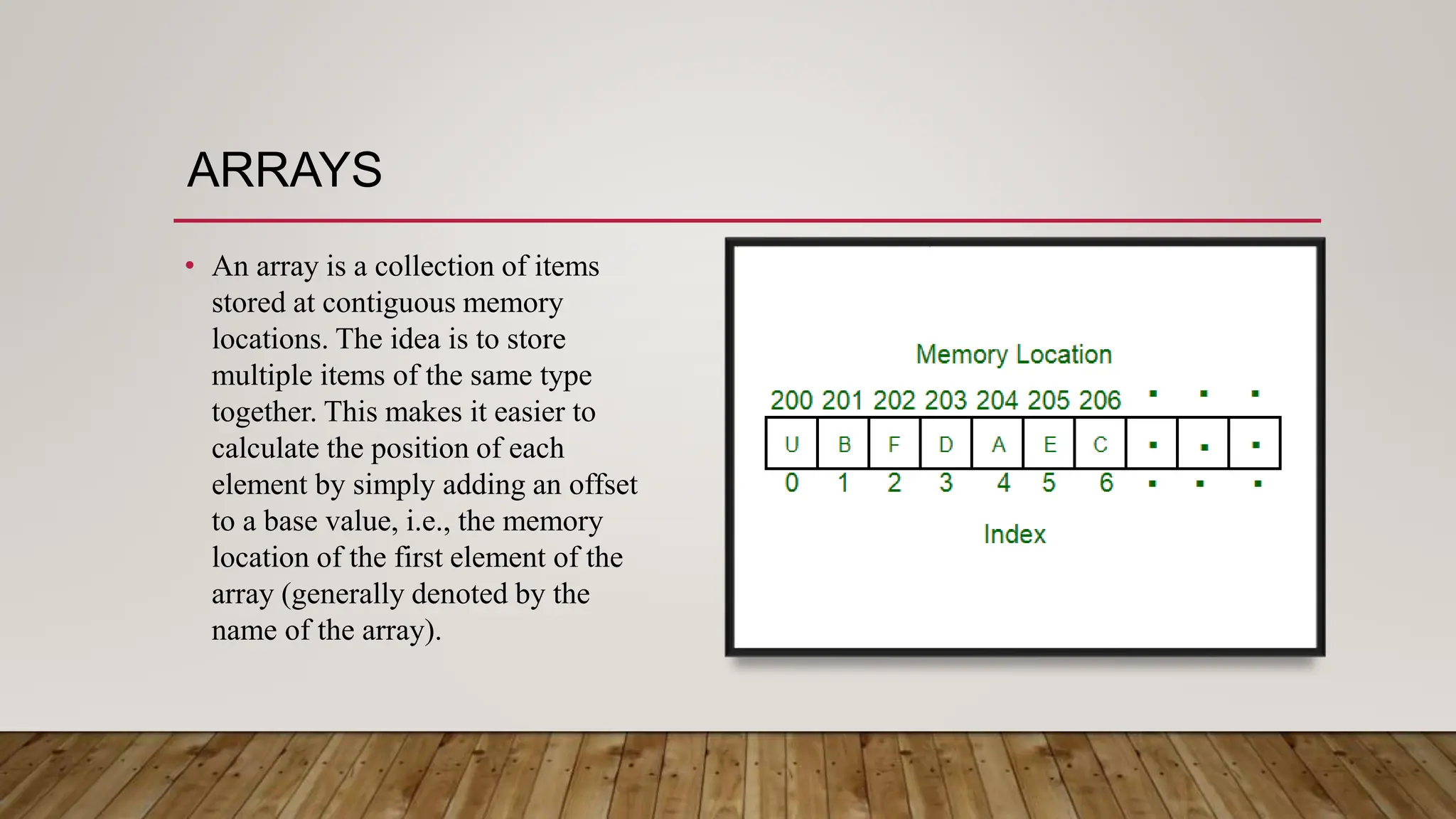
• An array is a collection of items
stored at contiguous memory
locations. The idea is to store
multiple items of the same type
together. This makes it easier to
calculate the position of each
element by simply adding an offset
to a base value, i.e., the memory
location of the first element of the
array (generally denoted by the
name of the array).
2-D ARRAY
• A 2-D Array represents a collection of numbers
arranged in an order of rows and columns. It is
necessary to enclose the elements of the array in
parentheses or brackets.
• For example:
• This array has 3 rows and 3 columns. Each
element of array can be referred to by its row
and column number. For example, a[0][0]=1
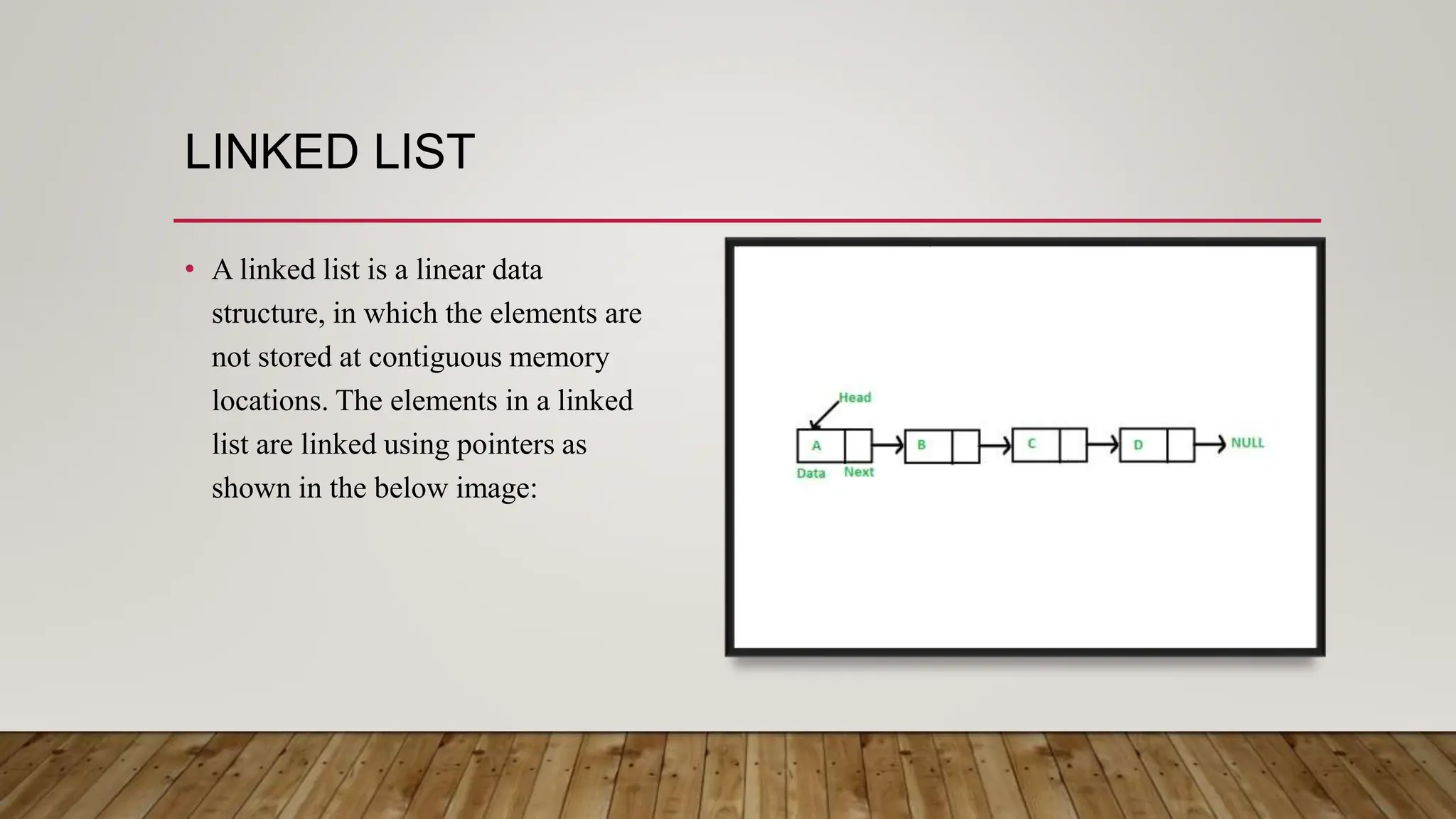
LINKED LIST
• A linked list is a linear data
structure, in which the elements are
not stored at contiguous memory
locations. The elements in a linked
list are linked using pointers as
shown in the below image:
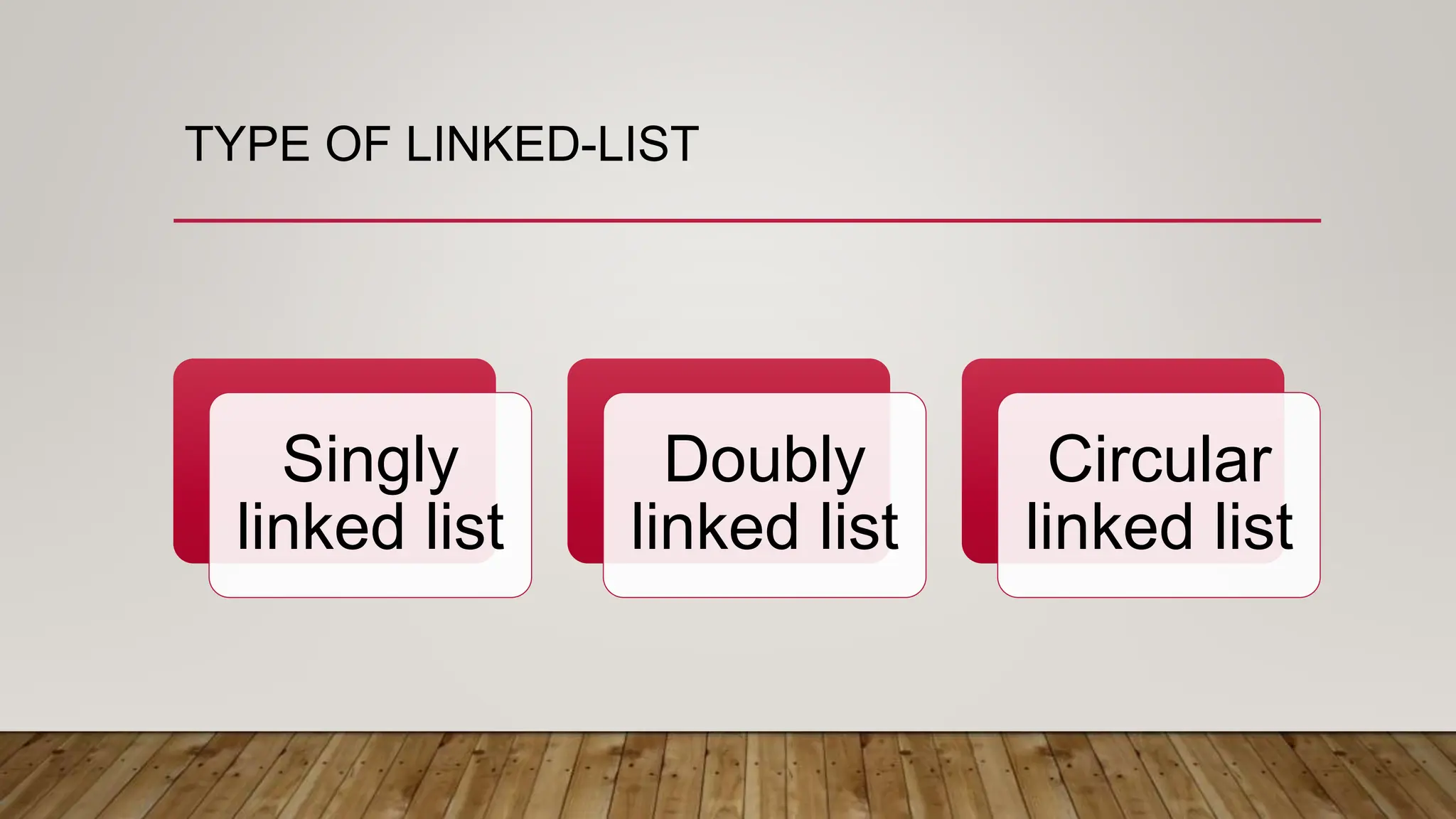
TYPE OF LINKED-LIST
Singly
linked list
Doubly
linked list
Circular
linked list
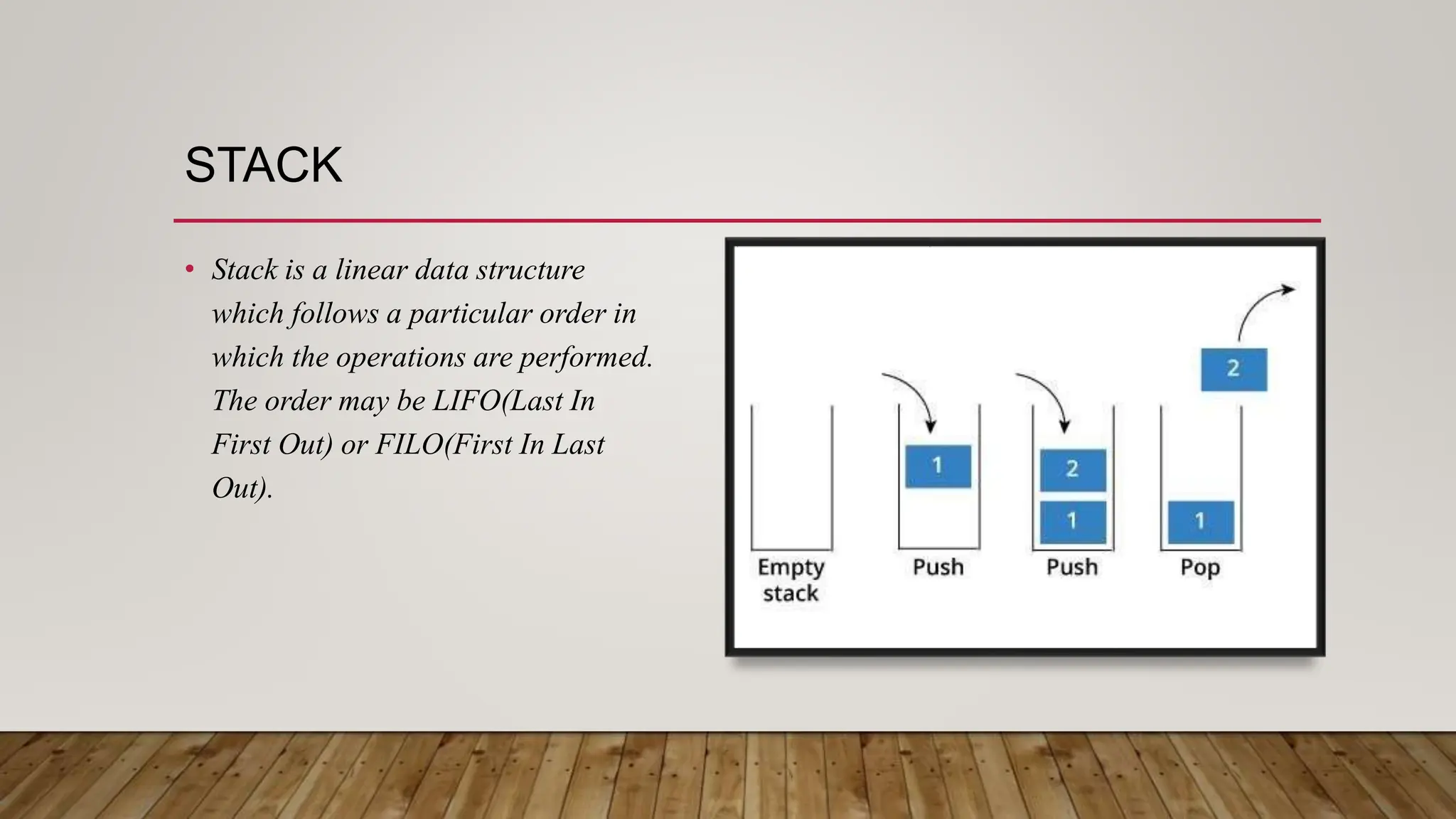
STACK
• Stack is a linear data structure
which follows a particular order in
which the operations are performed.
The order may be LIFO(Last In
First Out) or FILO(First In Last
Out).
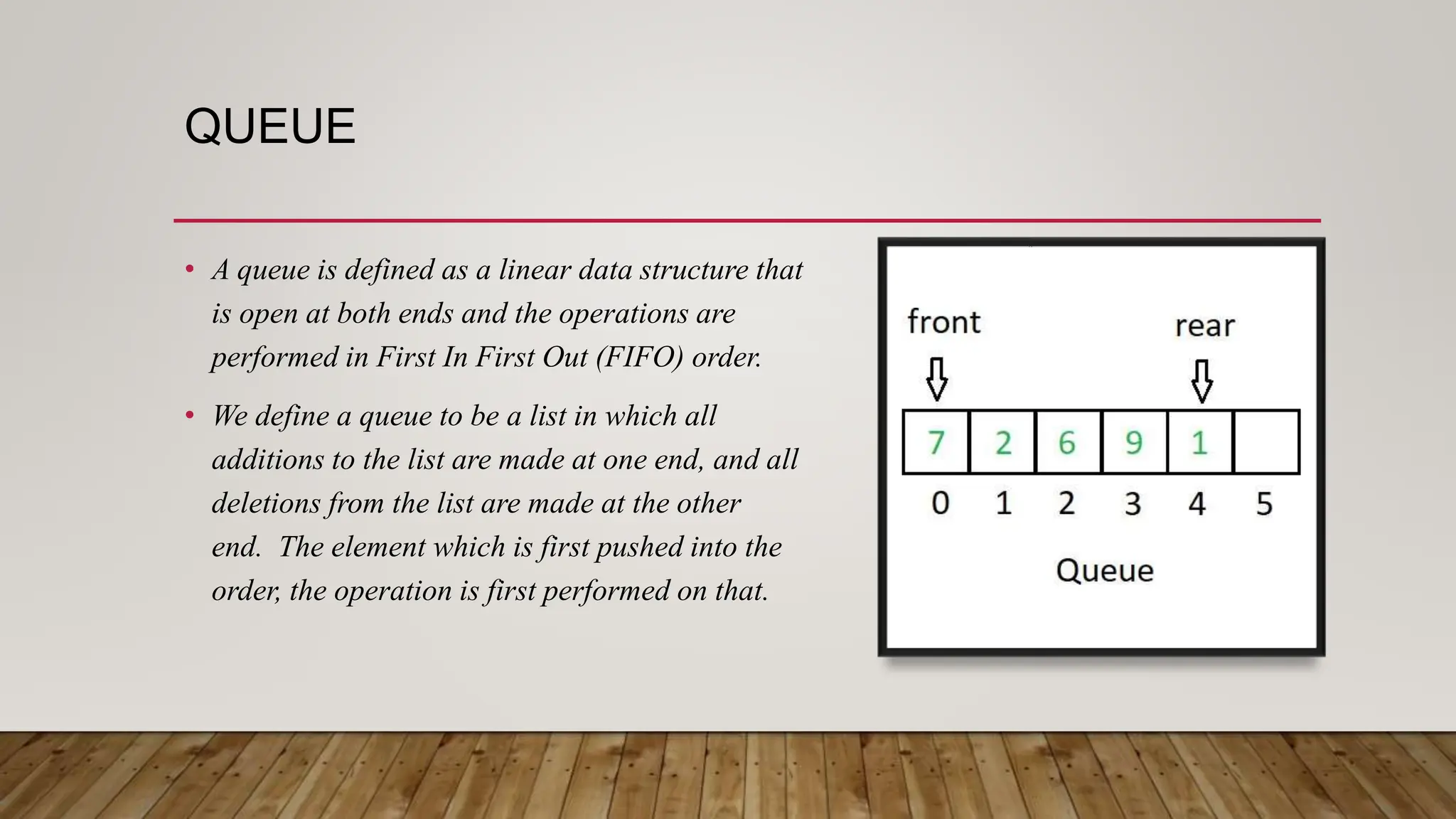
QUEUE
• A queue is defined as a linear data structure that
is open at both ends and the operations are
performed in First In First Out (FIFO) order.
• We define a queue to be a list in which all
additions to the list are made at one end, and all
deletions from the list are made at the other
end. The element which is first pushed into the
order, the operation is first performed on that.
TREE
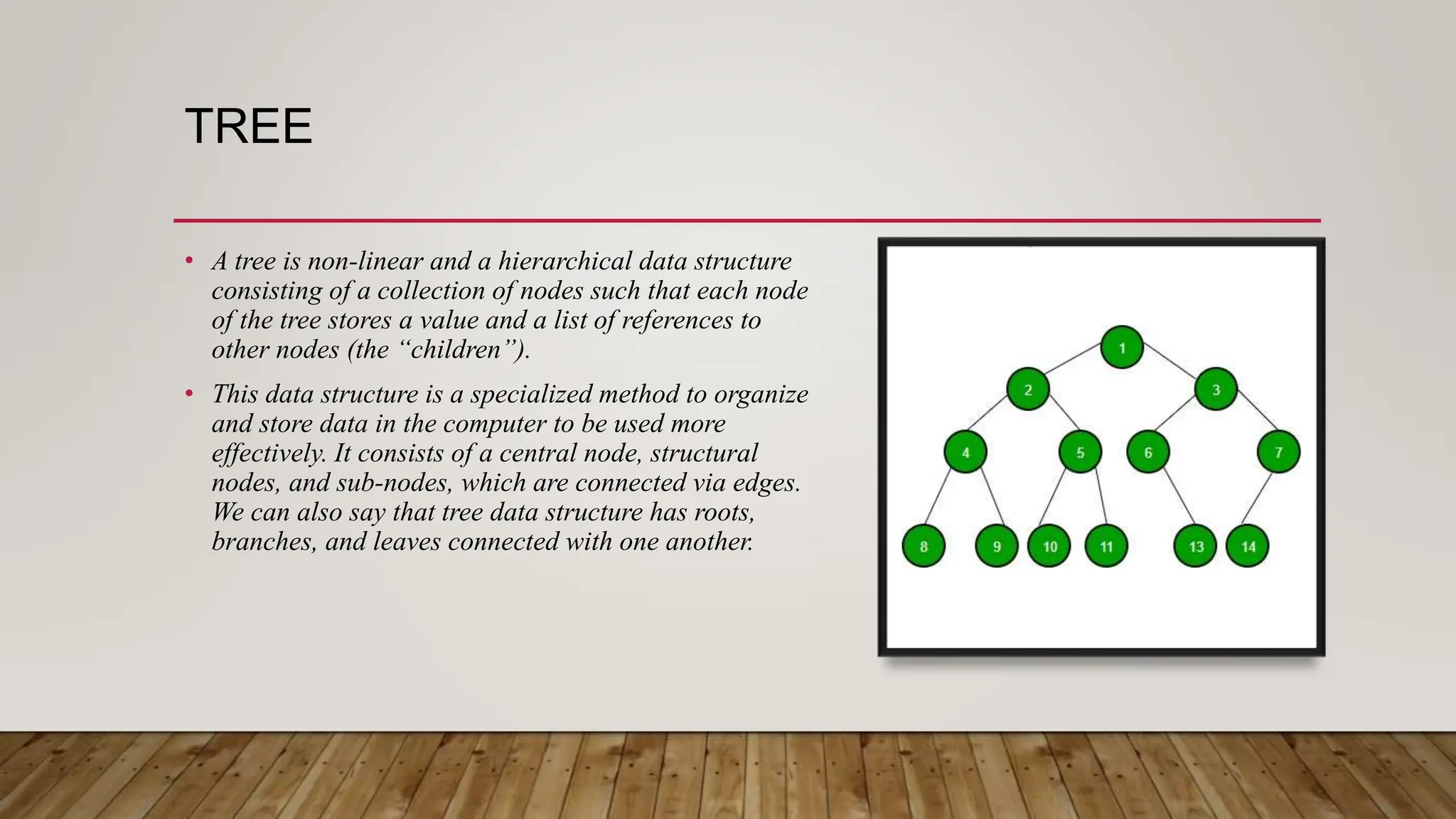
• A tree is non-linear and a hierarchical data structure
consisting of a collection of nodes such that each node
of the tree stores a value and a list of references to
other nodes (the “children”).
• This data structure is a specialized method to organize
and store data in the computer to be used more
effectively. It consists of a central node, structural
nodes, and sub-nodes, which are connected via edges.
We can also say that tree data structure has roots,
branches, and leaves connected with one another.
BINARY SEARCH TREE
Binary Search Tree is
a node-based binary
tree data structure
which has the
following properties:
The left subtree of a
node contains only
nodes with keys lesser
than the node’s key.
The right subtree of a
node contains only
nodes with keys
greater than the node’s
key.
The left and right
subtree each must
also be a binary
search tree.
BACKTRACKING
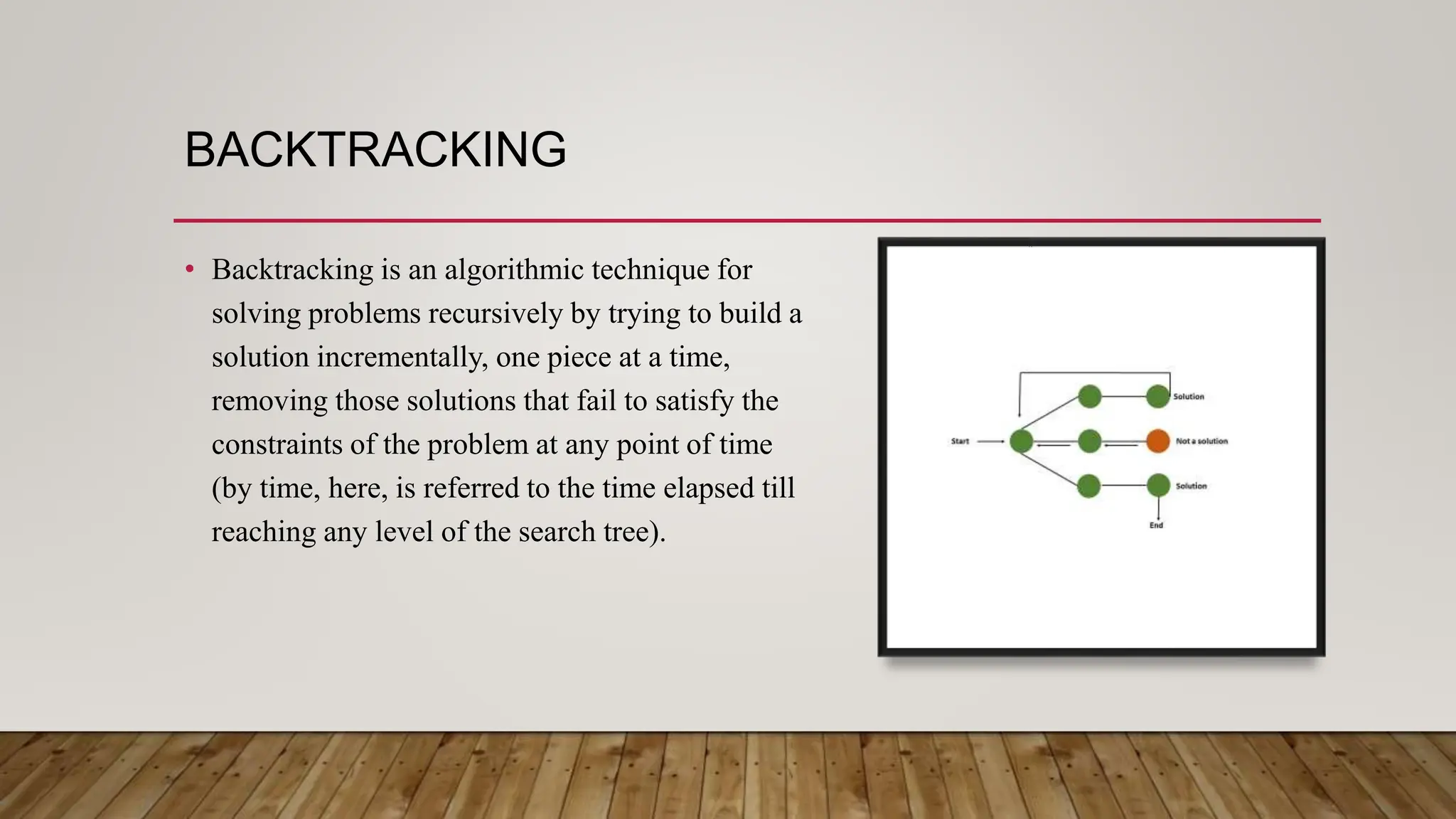
• Backtracking is an algorithmic technique for
solving problems recursively by trying to build a
solution incrementally, one piece at a time,
removing those solutions that fail to satisfy the
constraints of the problem at any point of time
(by time, here, is referred to the time elapsed till
reaching any level of the search tree).
WHY LEARN DSA
• Data structures and algorithms (DSA) goes
through solutions to standard problems in detail
and gives you an insight into how efficient it is to
use each one of them. It also teaches you the
science of evaluating the efficiency of an
algorithm. This enables you to choose the best of
various choices.
LEARNING OUTCOMES
• Understand the concept of Dynamic memory
management, data types, algorithms, Big O
notation.
• Understand basic data structures such as
arrays, linked lists, stacks and queues.
• Describe the hash function and concepts of
collision and its resolution methods
• Solve problem involving graphs, trees and
heaps
• Apply Algorithm for solving problems like
sorting, searching, insertion and deletion of
data
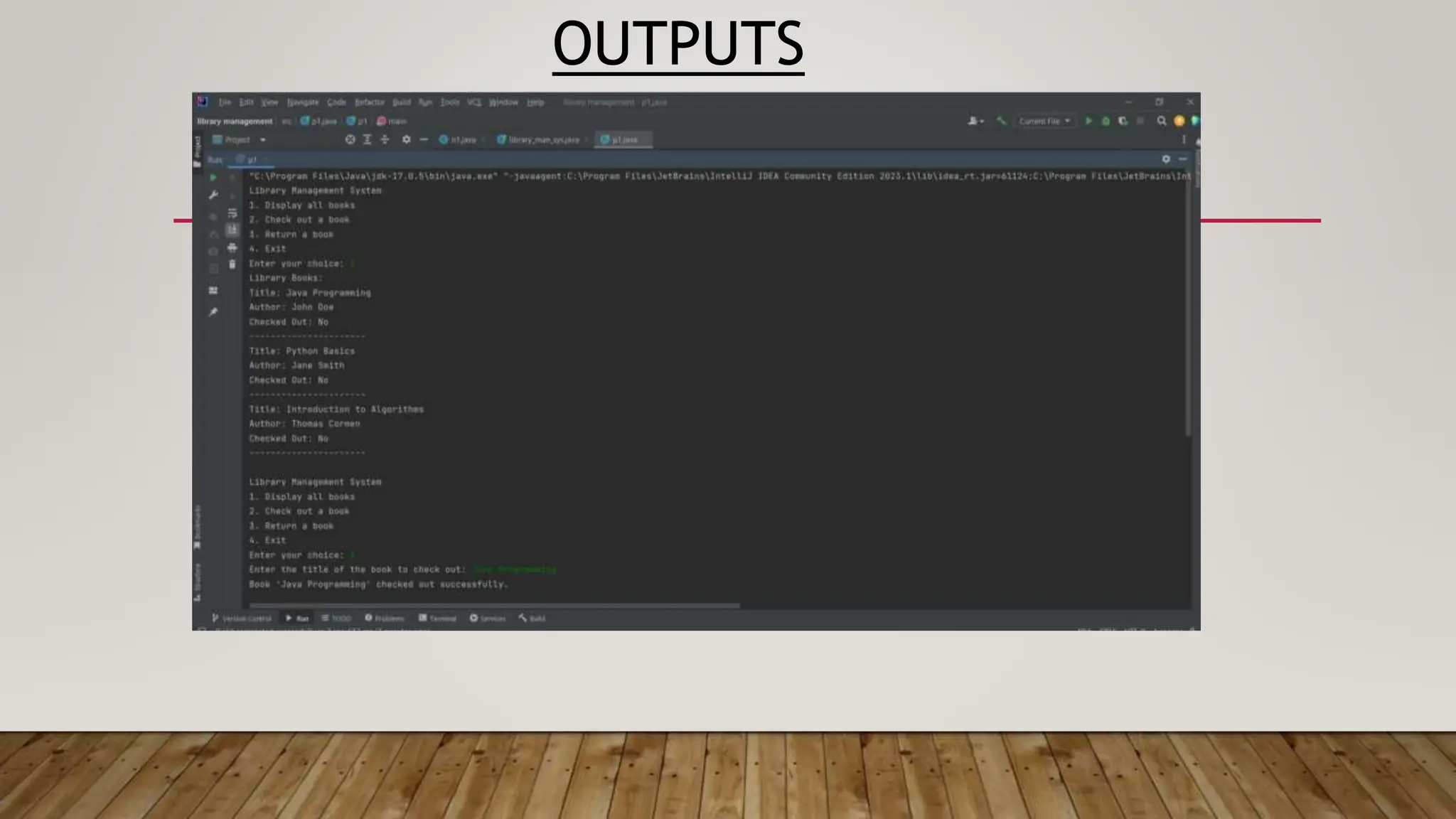
PROJECT
Library Management System
With the help of Hashmap
Modules:-
Addbook()
Remove book()
Search book()
Issue book()
F_latter() // to find which more books student needed
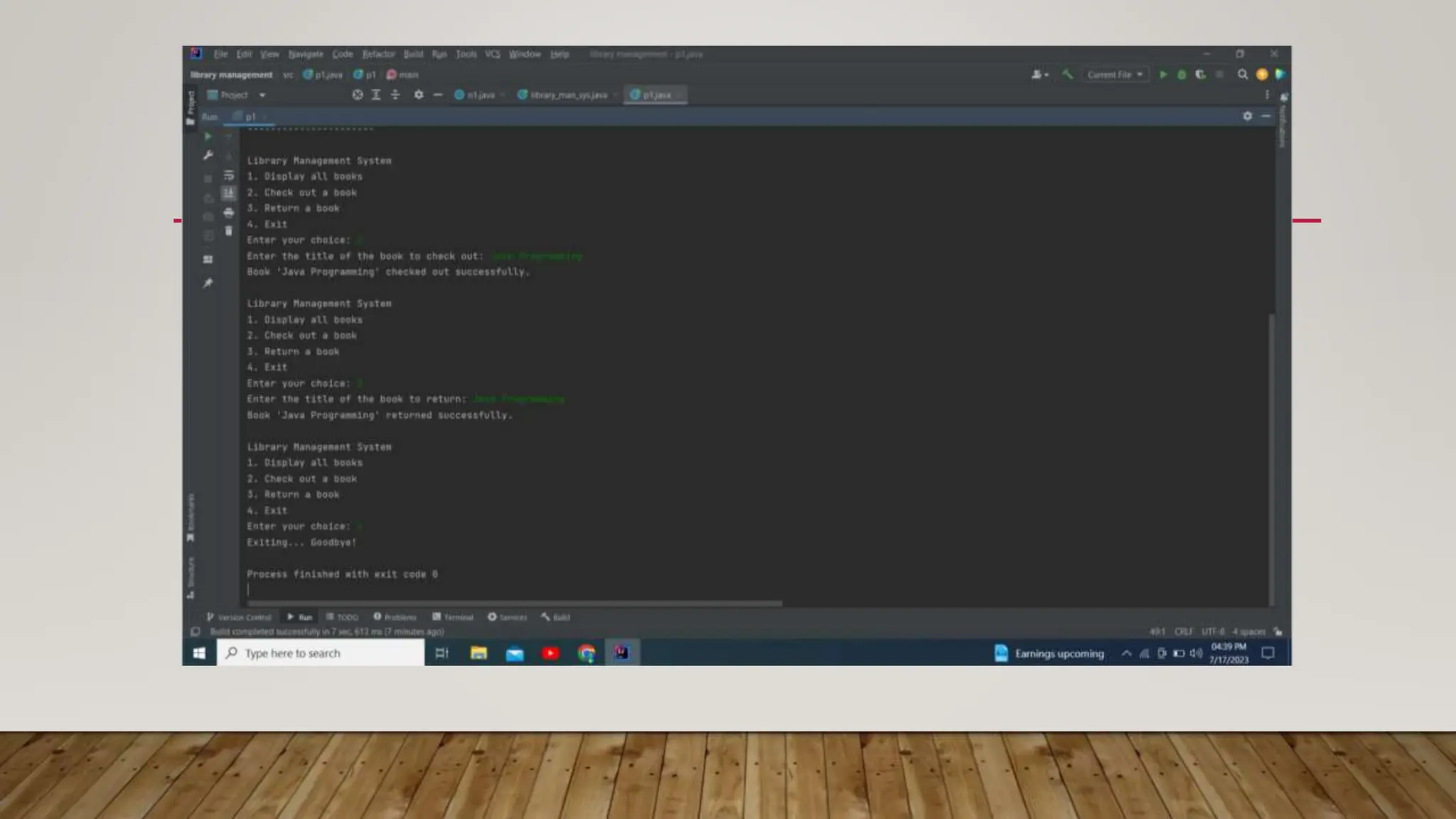
OUTPUTS
Thank You

data science

  • 1.
    CSE-443 SIX WEEKS SUMMER TRAINING COMPETITIVE CODINGUSING DATA STRUCTURES BY HUMAN RESOURCE DEVELOPMENT CENTRE, LOVELY PROFESSIONAL UNIVERSITY --UDIT AGARWAL --12108895
  • 2.
    INTRODUCTION • A datastructure is a way of organizing and storing data to enable efficient manipulation, retrieval, and management. • It defines how data elements are arranged and connected, providing a framework for performing various operations on the data. • Data structures are fundamental in computer science and are used to optimize algorithms and solve a wide range of problems. • For ex- Arrays, LinkedList, Stack, Queue, Tree etc.
  • 3.
    SEARCHING • Searching Algorithmsare designed to check for an element or retrieve an element from any data structure where it is stored. Based on the type of search operation, these algorithms are generally classified into two categories: 1. Sequential Search: In this, the list or array is traversed sequentially, and every element is checked. For example: Linear Search. 2. Interval Search: These algorithms are specifically designed for searching in sorted data-structures. These type of searching algorithms are much more efficient than Linear Search as they repeatedly target the center of the search structure and divide the search space in half. For Example: Binary Search.
  • 4.
    SORTING A Sorting Algorithmis used to rearrange a given array or list of elements according to a comparison operator on the elements. The comparison operator is used to decide the new order of elements in the respective data structure. For Example: The Array [45,25,65,10,90] can be written in a sorted way as [10,25,45,65,90]. Its very helpful in searching any element in any given array.
  • 5.
    ARRAYS • An arrayis a collection of items stored at contiguous memory locations. The idea is to store multiple items of the same type together. This makes it easier to calculate the position of each element by simply adding an offset to a base value, i.e., the memory location of the first element of the array (generally denoted by the name of the array).
  • 6.
    2-D ARRAY • A2-D Array represents a collection of numbers arranged in an order of rows and columns. It is necessary to enclose the elements of the array in parentheses or brackets. • For example: • This array has 3 rows and 3 columns. Each element of array can be referred to by its row and column number. For example, a[0][0]=1
  • 7.
    LINKED LIST • Alinked list is a linear data structure, in which the elements are not stored at contiguous memory locations. The elements in a linked list are linked using pointers as shown in the below image:
  • 8.
    TYPE OF LINKED-LIST Singly linkedlist Doubly linked list Circular linked list
  • 9.
    STACK • Stack isa linear data structure which follows a particular order in which the operations are performed. The order may be LIFO(Last In First Out) or FILO(First In Last Out).
  • 10.
    QUEUE • A queueis defined as a linear data structure that is open at both ends and the operations are performed in First In First Out (FIFO) order. • We define a queue to be a list in which all additions to the list are made at one end, and all deletions from the list are made at the other end. The element which is first pushed into the order, the operation is first performed on that.
  • 11.
    TREE • A treeis non-linear and a hierarchical data structure consisting of a collection of nodes such that each node of the tree stores a value and a list of references to other nodes (the “children”). • This data structure is a specialized method to organize and store data in the computer to be used more effectively. It consists of a central node, structural nodes, and sub-nodes, which are connected via edges. We can also say that tree data structure has roots, branches, and leaves connected with one another.
  • 12.
    BINARY SEARCH TREE BinarySearch Tree is a node-based binary tree data structure which has the following properties: The left subtree of a node contains only nodes with keys lesser than the node’s key. The right subtree of a node contains only nodes with keys greater than the node’s key. The left and right subtree each must also be a binary search tree.
  • 13.
    BACKTRACKING • Backtracking isan algorithmic technique for solving problems recursively by trying to build a solution incrementally, one piece at a time, removing those solutions that fail to satisfy the constraints of the problem at any point of time (by time, here, is referred to the time elapsed till reaching any level of the search tree).
  • 14.
    WHY LEARN DSA •Data structures and algorithms (DSA) goes through solutions to standard problems in detail and gives you an insight into how efficient it is to use each one of them. It also teaches you the science of evaluating the efficiency of an algorithm. This enables you to choose the best of various choices.
  • 15.
    LEARNING OUTCOMES • Understandthe concept of Dynamic memory management, data types, algorithms, Big O notation. • Understand basic data structures such as arrays, linked lists, stacks and queues. • Describe the hash function and concepts of collision and its resolution methods • Solve problem involving graphs, trees and heaps • Apply Algorithm for solving problems like sorting, searching, insertion and deletion of data
  • 16.
    PROJECT Library Management System Withthe help of Hashmap Modules:- Addbook() Remove book() Search book() Issue book() F_latter() // to find which more books student needed
  • 17.
  • 19.