Data Privacy
& Protection
Technical Learning
Session
KNOWLEDGE
EDUCATION
CONFERENCE
April 17-18, 2018
Sison Auditorium
Lingayen, Pangasinan
KEC13
Housekeeping
•About me
What’s in this lecture
•Gadgets and other devices
About me
Francis Euston R. Acero
Chief, Complaints and
Investigations Division
complaints@privacy.gov.ph
Member
Integrated Bar of the
Philippines
Certified Penetration Testing
Engineer
Certified Digital Forensics
Examiner
Gadgets and other devices
Just in case you don’t get a copy, mail us at
info@privacy.gov.ph for one!
No need to capture with phones
Be careful of what you post on Facebook
Feel free to ask questions at ANY time during the
presentation
In this lecture
The law on data privacy and protection
Personal information and sensitive personal information
Data privacy principles
Conducting a Privacy Impact Assessment
Consent and the conditions for processing data
Key components of a Privacy Management Program
Protecting your own personal data
The law on data privacy
•The need to protect data privacy
The Data Privacy Act and its Implementing Rules
Concepts and Definitions
“The world’s most valuable
commodity is data.”
The Economist, 6 May
2017
Using data
“Like oil, those who see its
value and learn to extract
and use it will reap
rewards.”
Joris Toonders,
founder of Yonego
(Internet Marketing
Service)
writing for Wired, July 2014
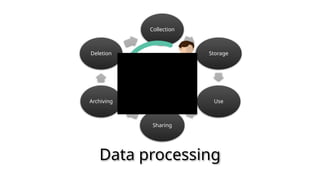
Collection
Storage
Use
Sharing
Archiving
Deletion
Data processing
Data privacy laws
•Also known as data
protection (EU) and
information privacy (US)
•Ensure the free flow of
information by:
• Building trust between the
personal information
controller and the data subject
• Ensuring that data is secure
and used only for stated
purposes
The Data Privacy Act
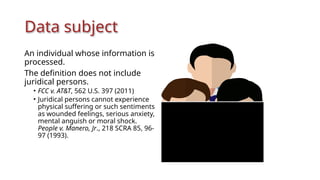
Data subject
An individual whose information is
processed.
The definition does not include
juridical persons.
• FCC v. AT&T, 562 U.S. 397 (2011)
• Juridical persons cannot experience
physical suffering or such sentiments
as wounded feelings, serious anxiety,
mental anguish or moral shock.
People v. Manero, Jr., 218 SCRA 85, 96-
97 (1993).
Personal information
Any information:
• from which the identity of an
individual is apparent or can
be reasonably and directly
ascertained by the entity
holding the information;
• or when put together with
other information would
directly and certainly identify
an individual.
Sensitive personal
information
•Information about an
individual’s race, ethnic
origin, marital status, age,
color, and religious,
philosophical or political
affiliations
•Information about an
individual’s health,
education, genetic or sexual
life of a person, or to any
proceeding for any offense,
the disposal of such
proceedings, or the
sentence of any court in
such proceedings;
Sensitive personal
information
•Issued by government
agencies peculiar to an
individual which includes,
but not limited to, social
security numbers, previous
or current health records,
licenses or its denials,
suspension or revocation,
and tax returns
•Specifically established by an
executive order or an act of
Congress to be kept
classified
Data Privacy Principles
•Once you understand these core principles to data
protection, the text of the law follows
Transparency
Legitimate Purpose
Proportionality
Transparency
• The data subject must know
• The kind of personal data collected
• How the personal data will be
collected
• Why personal data will be
collected
• The data processing policies of
the PIC must be known to the
data subject
• The information to be provided
to the data subject must be in
clear and plain language
Legitimate Purpose
• Data collected must be always be
collected only for the specific, explicit,
and legitimate purposes of the PIC.
• No processing of data that is not
compatible with the purpose for
which the data was collected.
• The processing of data must respect
the law of the applicable jurisdiction,
in accordance with the International
Bill of Rights.
• Any processing of data that gives rise
to unlawful or arbitrary
discrimination is unfair.
Proportionality
• The processing of personal
data should be limited to
such processing as is
adequate, relevant, and not
excessive in relation to the
purpose of the data
processing.
• Efforts should be made to
limit the processed data to
the minimum necessary.
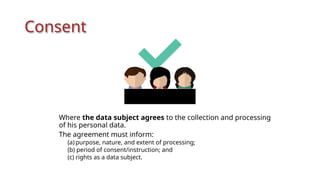
Consent
Where the data subject agrees to the collection and processing
of his personal data.
The agreement must inform:
(a) purpose, nature, and extent of processing;
(b) period of consent/instruction; and
(c) rights as a data subject.
Processing Personal Information
(a) The data subject has given his or
her consent;
(b) The processing of personal
information is necessary and is
related to the fulfillment of a
contract with the data subject or in
order to take steps at the request of
the data subject prior to entering
into a contract;
(c) The processing is necessary for
compliance with a legal obligation to
which the personal information
controller is subject;
Processing Personal Information
(d) The processing is necessary to
protect vitally important interests
of the data subject, including life
and health;
(e) The processing is necessary in
order to respond to national
emergency, to comply with the
requirements of public order and
safety, or to fulfill functions of
public authority which necessarily
includes the processing of personal
data for the fulfillment of its
mandate; or
Processing Personal Information
(f) The processing is necessary
for the purposes of the
legitimate interests pursued by
the personal information
controller or by a third party or
parties to whom the data is
disclosed, except where such
interests are overridden by
fundamental rights and
freedoms of the data subject
which require protection under
the Philippine Constitution.
Processing Sensitive Information
(a) The data subject has given
his or her consent, specific to
the purpose prior to the
processing, or in the case of
privileged information, all
parties to the exchange have
given their consent prior to
processing;
(b) The processing of the same is
provided for by existing laws and
regulations:
• Provided, That such regulatory
enactments guarantee the
protection of the sensitive personal
information and the privileged
information:
• Provided, further, That the consent
of the data subjects are not
required by law or regulation
permitting the processing of the
sensitive personal information or
the privileged information;
Processing Sensitive Information
(c) The processing is
necessary to protect the life
and health of the data subject
or another person, and the
data subject is not legally or
physically able to express his
or her consent prior to the
processing;
(d) The processing is necessary to
achieve the lawful and
noncommercial objectives of public
organizations and their associations:
• Provided, That such processing is only
confined and related to the bona fide
members of these organizations or
their associations:
• Provided, further, That the sensitive
personal information are not
transferred to third parties:
• Provided, finally, That consent of the
data subject was obtained prior to
processing;
Processing Sensitive Information
(e) The processing is
necessary for purposes of
medical treatment, is carried
out by a medical practitioner
or a medical treatment
institution, and an adequate
level of protection of personal
information is ensured; or
(f) The processing concerns
such personal information as
is necessary for the protection
of lawful rights and interests of
natural or legal persons in
court proceedings, or the
establishment, exercise or
defense of legal claims, or
when provided to government
or public authority.
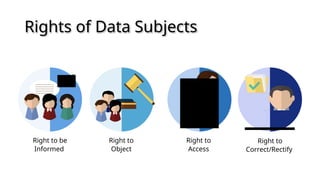
Rights of Data Subjects
Right to be
Informed
Right to
Object
Right to
Access
Right to
Correct/Rectify
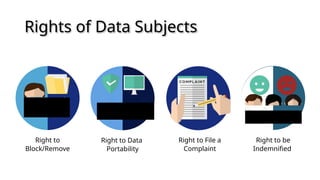
Rights of Data Subjects
Right to
Block/Remove
Right to Data
Portability
Right to File a
Complaint
Right to be
Indemnified
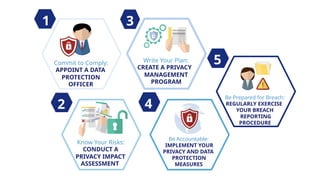
1
Commit to Comply:
APPOINT A DATA
PROTECTION
OFFICER
2
Know Your Risks:
CONDUCT A
PRIVACY IMPACT
ASSESSMENT
3
Write Your Plan:
CREATE A PRIVACY
MANAGEMENT
PROGRAM
4
Be Accountable:
IMPLEMENT YOUR
PRIVACY AND DATA
PROTECTION
MEASURES
5
Be Prepared for Breach:
REGULARLY EXERCISE
YOUR BREACH
REPORTING
PROCEDURE
This is what it is, okay? I
said, “Empty your mind.” Be
formless, shapeless. Like
water. Now, you put water
into a cup, it becomes the
cup. You put water into a
bottle, it becomes the
bottle. You put it in a
teapot, it becomes the
teapot. Now, water can flow
or it can crash.
Be water, my friend.
-Bruce Lee
The Privacy Impact Assessment
•Foundation for Effective Privacy Management
Privacy Impact Assessment
•Tool to help understand data life cycles within an
organization
•Identifies attendant risks in data processing
•Proposes measures to control risks through a structured
framework
Key Considerations
•One PIA for every data
processing activity
•When applicable, done
before implementation of
the processing activity
•The output report can be
used to evaluate readiness
•May cover one processing
activity between controllers
and processors
Skip the PIA step only if:
There are minimal risks to the rights and freedoms of data
subjects
DPO recommendation to forego PIA exists
Objectives
Identify, evaluate, and manage risks in data processing
Documentation for processing activities, as integral part of
privacy management program
Determines state of compliance with standards
Establish control framework
Objectives
The final report must
contain:
•Stakeholder involvement
•Measures for risk
management
•Process through which
report will be
communicated through
stakeholders
Responsibility
Should be in controller or processor’s data privacy and
protection policies
• Triggers for activation
• Key personnel involved
• Resource allocation
• Review process
DPO should understand when to conduct a PIA
• Extent of participation to be determined
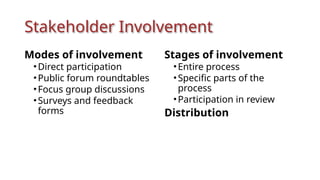
Stakeholder Involvement
Modes of involvement
•Direct participation
•Public forum roundtables
•Focus group discussions
•Surveys and feedback
forms
Stages of involvement
•Entire process
•Specific parts of the
process
•Participation in review
Distribution
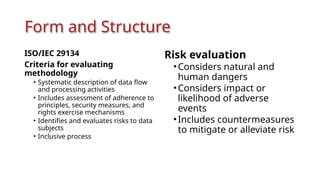
Form and Structure
ISO/IEC 29134
Criteria for evaluating
methodology
• Systematic description of data flow
and processing activities
• Includes assessment of adherence to
principles, security measures, and
rights exercise mechanisms
• Identifies and evaluates risks to data
subjects
• Inclusive process
Risk evaluation
•Considers natural and
human dangers
•Considers impact or
likelihood of adverse
events
•Includes countermeasures
to mitigate or alleviate risk
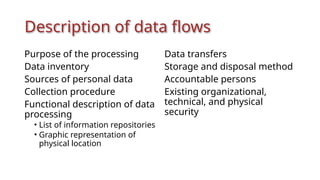
Description of data flows
Purpose of the processing
Data inventory
Sources of personal data
Collection procedure
Functional description of data
processing
• List of information repositories
• Graphic representation of
physical location
Data transfers
Storage and disposal method
Accountable persons
Existing organizational,
technical, and physical
security
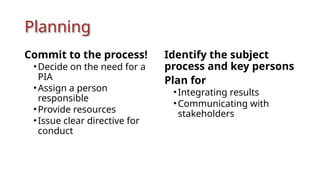
Planning
Commit to the process!
•Decide on the need for a
PIA
•Assign a person
responsible
•Provide resources
•Issue clear directive for
conduct
Identify the subject
process and key persons
Plan for
•Integrating results
•Communicating with
stakeholders
Key Persons
•Process owners
•Participants
•Persons in charge
•Signatories to report
•Secretariat (if necessary)
•Internal or external
stakeholders
Preparation
•Conduct a data inventory
• Understand and document
each stage of the data life cycle
•Determine inclusions in
baseline information
• Existing policies and security
measures
• Coordinate with department
heads
•Stakeholders may be
involved
•If processing more than
1000, ISO/IEC 27002 and
ISO/IEC 29151
recommended
Preparation
•Establish schedules and
timelines
• Completion of preparatory
activities
• Conduct of the PIA
• Reporting and publication of
results
•Obtain approval of resource
and budget allocations
•Set time for participants
•Set methods for stakeholder
involvement
•Define documentation and
review process
•Prepare any additional
documents
The Assessment
Collect and complete baseline
information
Evaluate processing activities
against the legal obligations
of the entity
Evaluate processing activities
against the control
framework
• Adheres to data privacy
principles
• Implementation of security
measures
• Procedure for exercise of
rights
• Consider privacy and data
protection measures
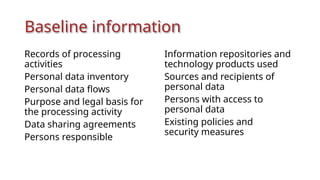
Baseline information
Records of processing
activities
Personal data inventory
Personal data flows
Purpose and legal basis for
the processing activity
Data sharing agreements
Persons responsible
Information repositories and
technology products used
Sources and recipients of
personal data
Persons with access to
personal data
Existing policies and
security measures
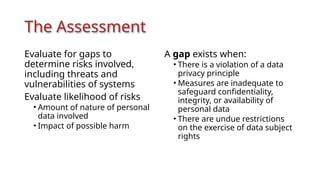
The Assessment
Evaluate for gaps to
determine risks involved,
including threats and
vulnerabilities of systems
Evaluate likelihood of risks
• Amount of nature of personal
data involved
• Impact of possible harm
A gap exists when:
• There is a violation of a data
privacy principle
• Measures are inadequate to
safeguard confidentiality,
integrity, or availability of
personal data
• There are undue restrictions
on the exercise of data subject
rights
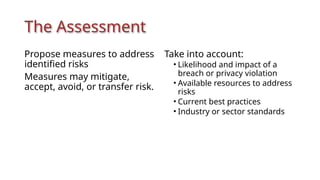
The Assessment
Propose measures to address
identified risks
Measures may mitigate,
accept, avoid, or transfer risk.
Take into account:
• Likelihood and impact of a
breach or privacy violation
• Available resources to address
risks
• Current best practices
• Industry or sector standards
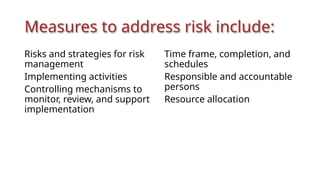
Measures to address risk include:
Risks and strategies for risk
management
Implementing activities
Controlling mechanisms to
monitor, review, and support
implementation
Time frame, completion, and
schedules
Responsible and accountable
persons
Resource allocation
The Assessment
Document stakeholder
participation
Review and assess results
before finalizing and
approving the PIA
Should include proposed
measures that serve as basis
for implementing changes
Communicate results!
The Assessment
Recipients
•Management
•Internal stakeholders
•External stakeholders
Redactions
Results may be redacted to
reduce legal or security
exposure
Documentation and Review
Results must be reduced into a report
Entity must maintain a record of PIA reports
Reports must be made available to data subjects on request
Evaluate on an annual basis
Accountability
Demonstration of compliance with Philippine data privacy
and protection laws
Considered in evaluating if the entity exercised due diligence
Provide a copy of the system to the NPC on demand
Protecting personal data
•Technical Provisions in NPC Circular No. 16-01
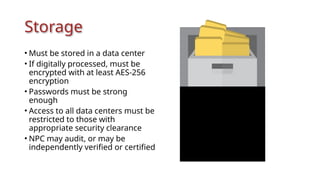
Storage
• Must be stored in a data center
• If digitally processed, must be
encrypted with at least AES-256
encryption
• Passwords must be strong
enough
• Access to all data centers must be
restricted to those with
appropriate security clearance
• NPC may audit, or may be
independently verified or certified
Agency Access to Personal Data
•Only programs developed or
licensed by a government
agency may access or
modify databases containing
personal data under that
agency’s control
•Access must be strictly
regulated
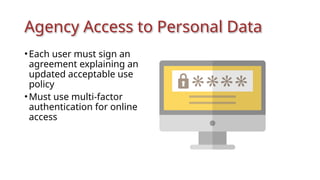
Agency Access to Personal Data
•Each user must sign an
agreement explaining an
updated acceptable use
policy
•Must use multi-factor
authentication for online
access
Agency Access to Personal Data
• Only known devices, properly
configured for security, can access
personal data. Only authorized media
may be used on computer equipment.
• Mobile devices owned by the agency
must be equipped with remote
disconnection or deletion technologies.
• Paper-based data systems must keep
logs showing file last accesed, including
when, where, and by whom.
Transfer of Personal Data
•If done by e-mail, must
ensure that data is
encrypted, or use a secure e-
mail facility that facilitates
the encryption of all data,
including any attachments.
•Send passwords on a
separate e-mail.
Transfer of Personal Data
•Scan outgoing emails for
attachments and keywords
that indicate personal data,
and prevent transmission
•Controls must be in place to
prevent printing or copying
to word processors and
spreadsheets without
security or access controls in
place.
Transfer of Personal Data
• Data stored in portable
media, like discs or USB
storage, must be encrypted
• Laptops must utilize full disk
encryption
• Manual transfer of personal
data, where possible is
prohibited. If impossible,
authentication technology
must be in place.
Transfer of Personal Data
•NO FAX TRANSMISSIONS
•Use registered mail or,
where appropriate,
guaranteed parcel post
service.
•Safeguards apply to internal
transfers!
Disposal of Personal Data
• Comply with National Archives of
the Philippines Act (RA 9470) if
archiving records
• Procedures must be established
over
• Disposal of files that contain
personal data, regardless of storage
medium
• Disposal of computer equipment at
end-of-life, including storage media.
Includes the use of degaussers,
erasers, physical destruction devices
• Offsite disposal
End.
https://privacy.gov.ph
facebook.com/privacy.gov.ph
twitter.com/PrivacyPH

Data Privacy & Protection for the Data Privacy Act

  • 1.
    Data Privacy & Protection TechnicalLearning Session KNOWLEDGE EDUCATION CONFERENCE April 17-18, 2018 Sison Auditorium Lingayen, Pangasinan KEC13
  • 3.
    Housekeeping •About me What’s inthis lecture •Gadgets and other devices
  • 4.
    About me Francis EustonR. Acero Chief, Complaints and Investigations Division complaints@privacy.gov.ph Member Integrated Bar of the Philippines Certified Penetration Testing Engineer Certified Digital Forensics Examiner
  • 5.
    Gadgets and otherdevices Just in case you don’t get a copy, mail us at info@privacy.gov.ph for one! No need to capture with phones Be careful of what you post on Facebook Feel free to ask questions at ANY time during the presentation
  • 6.
    In this lecture Thelaw on data privacy and protection Personal information and sensitive personal information Data privacy principles Conducting a Privacy Impact Assessment Consent and the conditions for processing data Key components of a Privacy Management Program Protecting your own personal data
  • 7.
    The law ondata privacy •The need to protect data privacy The Data Privacy Act and its Implementing Rules Concepts and Definitions
  • 8.
    “The world’s mostvaluable commodity is data.” The Economist, 6 May 2017
  • 9.
    Using data “Like oil,those who see its value and learn to extract and use it will reap rewards.” Joris Toonders, founder of Yonego (Internet Marketing Service) writing for Wired, July 2014
  • 10.
  • 11.
    Data privacy laws •Alsoknown as data protection (EU) and information privacy (US) •Ensure the free flow of information by: • Building trust between the personal information controller and the data subject • Ensuring that data is secure and used only for stated purposes
  • 12.
  • 13.
    Data subject An individualwhose information is processed. The definition does not include juridical persons. • FCC v. AT&T, 562 U.S. 397 (2011) • Juridical persons cannot experience physical suffering or such sentiments as wounded feelings, serious anxiety, mental anguish or moral shock. People v. Manero, Jr., 218 SCRA 85, 96- 97 (1993).
  • 14.
    Personal information Any information: •from which the identity of an individual is apparent or can be reasonably and directly ascertained by the entity holding the information; • or when put together with other information would directly and certainly identify an individual.
  • 15.
    Sensitive personal information •Information aboutan individual’s race, ethnic origin, marital status, age, color, and religious, philosophical or political affiliations •Information about an individual’s health, education, genetic or sexual life of a person, or to any proceeding for any offense, the disposal of such proceedings, or the sentence of any court in such proceedings;
  • 16.
    Sensitive personal information •Issued bygovernment agencies peculiar to an individual which includes, but not limited to, social security numbers, previous or current health records, licenses or its denials, suspension or revocation, and tax returns •Specifically established by an executive order or an act of Congress to be kept classified
  • 17.
    Data Privacy Principles •Onceyou understand these core principles to data protection, the text of the law follows
  • 18.
  • 19.
    Transparency • The datasubject must know • The kind of personal data collected • How the personal data will be collected • Why personal data will be collected • The data processing policies of the PIC must be known to the data subject • The information to be provided to the data subject must be in clear and plain language
  • 20.
    Legitimate Purpose • Datacollected must be always be collected only for the specific, explicit, and legitimate purposes of the PIC. • No processing of data that is not compatible with the purpose for which the data was collected. • The processing of data must respect the law of the applicable jurisdiction, in accordance with the International Bill of Rights. • Any processing of data that gives rise to unlawful or arbitrary discrimination is unfair.
  • 21.
    Proportionality • The processingof personal data should be limited to such processing as is adequate, relevant, and not excessive in relation to the purpose of the data processing. • Efforts should be made to limit the processed data to the minimum necessary.
  • 22.
    Consent Where the datasubject agrees to the collection and processing of his personal data. The agreement must inform: (a) purpose, nature, and extent of processing; (b) period of consent/instruction; and (c) rights as a data subject.
  • 23.
    Processing Personal Information (a)The data subject has given his or her consent; (b) The processing of personal information is necessary and is related to the fulfillment of a contract with the data subject or in order to take steps at the request of the data subject prior to entering into a contract; (c) The processing is necessary for compliance with a legal obligation to which the personal information controller is subject;
  • 24.
    Processing Personal Information (d)The processing is necessary to protect vitally important interests of the data subject, including life and health; (e) The processing is necessary in order to respond to national emergency, to comply with the requirements of public order and safety, or to fulfill functions of public authority which necessarily includes the processing of personal data for the fulfillment of its mandate; or
  • 25.
    Processing Personal Information (f)The processing is necessary for the purposes of the legitimate interests pursued by the personal information controller or by a third party or parties to whom the data is disclosed, except where such interests are overridden by fundamental rights and freedoms of the data subject which require protection under the Philippine Constitution.
  • 26.
    Processing Sensitive Information (a)The data subject has given his or her consent, specific to the purpose prior to the processing, or in the case of privileged information, all parties to the exchange have given their consent prior to processing; (b) The processing of the same is provided for by existing laws and regulations: • Provided, That such regulatory enactments guarantee the protection of the sensitive personal information and the privileged information: • Provided, further, That the consent of the data subjects are not required by law or regulation permitting the processing of the sensitive personal information or the privileged information;
  • 27.
    Processing Sensitive Information (c)The processing is necessary to protect the life and health of the data subject or another person, and the data subject is not legally or physically able to express his or her consent prior to the processing; (d) The processing is necessary to achieve the lawful and noncommercial objectives of public organizations and their associations: • Provided, That such processing is only confined and related to the bona fide members of these organizations or their associations: • Provided, further, That the sensitive personal information are not transferred to third parties: • Provided, finally, That consent of the data subject was obtained prior to processing;
  • 28.
    Processing Sensitive Information (e)The processing is necessary for purposes of medical treatment, is carried out by a medical practitioner or a medical treatment institution, and an adequate level of protection of personal information is ensured; or (f) The processing concerns such personal information as is necessary for the protection of lawful rights and interests of natural or legal persons in court proceedings, or the establishment, exercise or defense of legal claims, or when provided to government or public authority.
  • 29.
    Rights of DataSubjects Right to be Informed Right to Object Right to Access Right to Correct/Rectify
  • 30.
    Rights of DataSubjects Right to Block/Remove Right to Data Portability Right to File a Complaint Right to be Indemnified
  • 31.
    1 Commit to Comply: APPOINTA DATA PROTECTION OFFICER 2 Know Your Risks: CONDUCT A PRIVACY IMPACT ASSESSMENT 3 Write Your Plan: CREATE A PRIVACY MANAGEMENT PROGRAM 4 Be Accountable: IMPLEMENT YOUR PRIVACY AND DATA PROTECTION MEASURES 5 Be Prepared for Breach: REGULARLY EXERCISE YOUR BREACH REPORTING PROCEDURE
  • 32.
    This is whatit is, okay? I said, “Empty your mind.” Be formless, shapeless. Like water. Now, you put water into a cup, it becomes the cup. You put water into a bottle, it becomes the bottle. You put it in a teapot, it becomes the teapot. Now, water can flow or it can crash. Be water, my friend. -Bruce Lee
  • 33.
    The Privacy ImpactAssessment •Foundation for Effective Privacy Management
  • 34.
    Privacy Impact Assessment •Toolto help understand data life cycles within an organization •Identifies attendant risks in data processing •Proposes measures to control risks through a structured framework
  • 35.
    Key Considerations •One PIAfor every data processing activity •When applicable, done before implementation of the processing activity •The output report can be used to evaluate readiness •May cover one processing activity between controllers and processors
  • 36.
    Skip the PIAstep only if: There are minimal risks to the rights and freedoms of data subjects DPO recommendation to forego PIA exists
  • 37.
    Objectives Identify, evaluate, andmanage risks in data processing Documentation for processing activities, as integral part of privacy management program Determines state of compliance with standards Establish control framework
  • 38.
    Objectives The final reportmust contain: •Stakeholder involvement •Measures for risk management •Process through which report will be communicated through stakeholders
  • 39.
    Responsibility Should be incontroller or processor’s data privacy and protection policies • Triggers for activation • Key personnel involved • Resource allocation • Review process DPO should understand when to conduct a PIA • Extent of participation to be determined
  • 40.
    Stakeholder Involvement Modes ofinvolvement •Direct participation •Public forum roundtables •Focus group discussions •Surveys and feedback forms Stages of involvement •Entire process •Specific parts of the process •Participation in review Distribution
  • 41.
    Form and Structure ISO/IEC29134 Criteria for evaluating methodology • Systematic description of data flow and processing activities • Includes assessment of adherence to principles, security measures, and rights exercise mechanisms • Identifies and evaluates risks to data subjects • Inclusive process Risk evaluation •Considers natural and human dangers •Considers impact or likelihood of adverse events •Includes countermeasures to mitigate or alleviate risk
  • 42.
    Description of dataflows Purpose of the processing Data inventory Sources of personal data Collection procedure Functional description of data processing • List of information repositories • Graphic representation of physical location Data transfers Storage and disposal method Accountable persons Existing organizational, technical, and physical security
  • 43.
    Planning Commit to theprocess! •Decide on the need for a PIA •Assign a person responsible •Provide resources •Issue clear directive for conduct Identify the subject process and key persons Plan for •Integrating results •Communicating with stakeholders
  • 44.
    Key Persons •Process owners •Participants •Personsin charge •Signatories to report •Secretariat (if necessary) •Internal or external stakeholders
  • 45.
    Preparation •Conduct a datainventory • Understand and document each stage of the data life cycle •Determine inclusions in baseline information • Existing policies and security measures • Coordinate with department heads •Stakeholders may be involved •If processing more than 1000, ISO/IEC 27002 and ISO/IEC 29151 recommended
  • 46.
    Preparation •Establish schedules and timelines •Completion of preparatory activities • Conduct of the PIA • Reporting and publication of results •Obtain approval of resource and budget allocations •Set time for participants •Set methods for stakeholder involvement •Define documentation and review process •Prepare any additional documents
  • 47.
    The Assessment Collect andcomplete baseline information Evaluate processing activities against the legal obligations of the entity Evaluate processing activities against the control framework • Adheres to data privacy principles • Implementation of security measures • Procedure for exercise of rights • Consider privacy and data protection measures
  • 48.
    Baseline information Records ofprocessing activities Personal data inventory Personal data flows Purpose and legal basis for the processing activity Data sharing agreements Persons responsible Information repositories and technology products used Sources and recipients of personal data Persons with access to personal data Existing policies and security measures
  • 49.
    The Assessment Evaluate forgaps to determine risks involved, including threats and vulnerabilities of systems Evaluate likelihood of risks • Amount of nature of personal data involved • Impact of possible harm A gap exists when: • There is a violation of a data privacy principle • Measures are inadequate to safeguard confidentiality, integrity, or availability of personal data • There are undue restrictions on the exercise of data subject rights
  • 50.
    The Assessment Propose measuresto address identified risks Measures may mitigate, accept, avoid, or transfer risk. Take into account: • Likelihood and impact of a breach or privacy violation • Available resources to address risks • Current best practices • Industry or sector standards
  • 51.
    Measures to addressrisk include: Risks and strategies for risk management Implementing activities Controlling mechanisms to monitor, review, and support implementation Time frame, completion, and schedules Responsible and accountable persons Resource allocation
  • 52.
    The Assessment Document stakeholder participation Reviewand assess results before finalizing and approving the PIA Should include proposed measures that serve as basis for implementing changes Communicate results!
  • 53.
    The Assessment Recipients •Management •Internal stakeholders •Externalstakeholders Redactions Results may be redacted to reduce legal or security exposure
  • 54.
    Documentation and Review Resultsmust be reduced into a report Entity must maintain a record of PIA reports Reports must be made available to data subjects on request Evaluate on an annual basis
  • 55.
    Accountability Demonstration of compliancewith Philippine data privacy and protection laws Considered in evaluating if the entity exercised due diligence Provide a copy of the system to the NPC on demand
  • 56.
    Protecting personal data •TechnicalProvisions in NPC Circular No. 16-01
  • 57.
    Storage • Must bestored in a data center • If digitally processed, must be encrypted with at least AES-256 encryption • Passwords must be strong enough • Access to all data centers must be restricted to those with appropriate security clearance • NPC may audit, or may be independently verified or certified
  • 58.
    Agency Access toPersonal Data •Only programs developed or licensed by a government agency may access or modify databases containing personal data under that agency’s control •Access must be strictly regulated
  • 59.
    Agency Access toPersonal Data •Each user must sign an agreement explaining an updated acceptable use policy •Must use multi-factor authentication for online access
  • 60.
    Agency Access toPersonal Data • Only known devices, properly configured for security, can access personal data. Only authorized media may be used on computer equipment. • Mobile devices owned by the agency must be equipped with remote disconnection or deletion technologies. • Paper-based data systems must keep logs showing file last accesed, including when, where, and by whom.
  • 61.
    Transfer of PersonalData •If done by e-mail, must ensure that data is encrypted, or use a secure e- mail facility that facilitates the encryption of all data, including any attachments. •Send passwords on a separate e-mail.
  • 62.
    Transfer of PersonalData •Scan outgoing emails for attachments and keywords that indicate personal data, and prevent transmission •Controls must be in place to prevent printing or copying to word processors and spreadsheets without security or access controls in place.
  • 63.
    Transfer of PersonalData • Data stored in portable media, like discs or USB storage, must be encrypted • Laptops must utilize full disk encryption • Manual transfer of personal data, where possible is prohibited. If impossible, authentication technology must be in place.
  • 64.
    Transfer of PersonalData •NO FAX TRANSMISSIONS •Use registered mail or, where appropriate, guaranteed parcel post service. •Safeguards apply to internal transfers!
  • 65.
    Disposal of PersonalData • Comply with National Archives of the Philippines Act (RA 9470) if archiving records • Procedures must be established over • Disposal of files that contain personal data, regardless of storage medium • Disposal of computer equipment at end-of-life, including storage media. Includes the use of degaussers, erasers, physical destruction devices • Offsite disposal
  • 67.